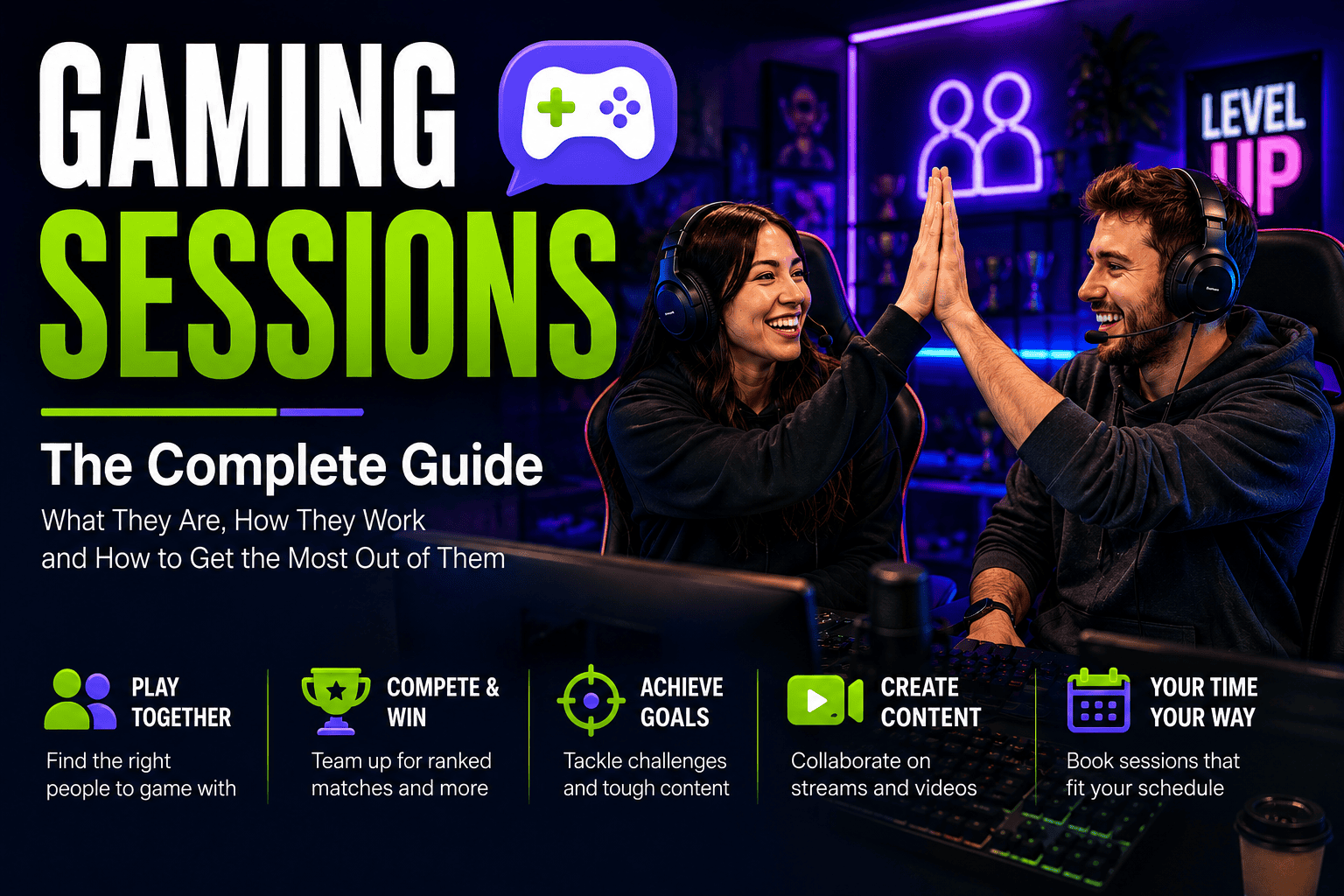
Gaming is better when you have the right people in your lobby. A gaming session gives players an organised way to meet, play and enjoy a particular game, goal or shared experience.
You might want a relaxed teammate for the evening, a skilled player to help with difficult content, serious competition or another creator for your next stream. Instead of leaving everything to random matchmaking, gaming sessions give you more choice over who you play with and what you do together.
This guide explains how gaming sessions work, the different types available and what to expect before joining one.
Quick answer: A gaming session is an arranged period in which two or more people play video games together. Sessions may be casual, competitive, focused on completing difficult content or organised around creating gaming content. They can be free or paid and may take place on PC, console or mobile.
1. What Is a Gaming Session?
A gaming session is a planned block of time during which people meet to play a video game together. It may involve two players, a small squad or a larger group.
Unlike entering a random public lobby, an organised session normally has an agreed game, starting time and purpose. Everyone knows what they are joining and has some idea of the experience they can expect.
🎮 Gaming Session Snapshot
Game: The title everyone will play
Players: A host, guest, teammates or wider group
Purpose: Social play, content creation, skilled support or competition
Schedule: An agreed date, starting time and duration
Platform: PC, console, mobile or cross-platform
Price: Free, paid or privately arranged
A gaming session could mean playing relaxed Fortnite matches, entering competitive Valorant games, completing a difficult Destiny 2 raid or recording a Minecraft challenge with another creator.
The details change, but the basic idea remains the same: people deliberately arrange to play together.
What can happen during a gaming session?
Players arrange sessions for many different reasons. You might:
- Play casual matches and meet someone new
- Find a dependable teammate for multiplayer games
- Join an experienced player for difficult missions or raids
- Compete with players who share your approach
- Record a video, livestream or gaming challenge
- Explore a virtual world with another player
- Complete co-op objectives that require a group
- Join community activities or custom matches
A session might last 30 minutes, several hours or an entire afternoon. Its length depends on the game, activity and agreement between the players.
A gaming session in action
Imagine you want to complete a difficult co-op mission, but your regular teammates are unavailable. You could enter public matchmaking and hope for the best, which is gaming’s traditional method of summoning chaos.
Alternatively, you could find a player offering a suitable session. You agree on the game, mission, platform and starting time before playing.
When the session begins, you join the same lobby, communicate through voice or text chat and attempt the mission together. That complete experience – from arranging the match to finishing the agreed playing time – is a gaming session.
The four main StackedGame session categories
Gaming sessions on StackedGame are organised into four categories:
- Casual & Social: Relaxed, no-pressure gaming with other players
- Content & Collab: Sessions for streams, videos and creative gaming content
- Get Carried: Play alongside high-skilled gamers who take the lead during challenging gameplay
- Competitive: Play with gamers who want focused, competitive matches
These categories help players find sessions that match how they want to play instead of sorting through unrelated offers.
The simple version: choose an experience, find the right player, agree on a time and get gaming.
2. How Do Gaming Sessions Work?
Most gaming sessions follow a straightforward process. One person creates or offers a session, another player joins it and both sides confirm the important details before playing.
Sessions between friends may begin with a quick message. Paid sessions generally require a clearer description, schedule and booking arrangement.
Choose your experience → Find a suitable player → Confirm the details → Connect in-game → Play together
🔍 Step 1: Choose the experience you want
Start by deciding what you want from the session. Your goal will help determine which StackedGame category is the best match.
Want relaxed company? Choose Casual & Social.
Want to make gaming content? Choose Content & Collab.
Want skilled support during difficult gameplay? Choose Get Carried.
Want focused matches with serious players? Choose Competitive.
A clear goal makes it easier to find compatible players. “I want someone to play Fortnite with” is a starting point, but “I want a relaxed teammate for casual Zero Build matches” gives potential hosts a much better picture.
If your main goal is structured teaching, analysis and long-term improvement, you may need video game coaching rather than a standard gaming session.
🧑🤝🧑 Step 2: Find a suitable player
Once you know what kind of session you want, look for a player whose offer matches it.
Check their:
- Game and supported platform
- Session category
- Preferred modes and playstyle
- Gaming experience
- Availability and time zone
- Language and communication style
- Voice-chat requirements
- Ratings or previous feedback
- Price and session duration
Rank is only one part of the decision. A highly skilled player may suit a Get Carried or Competitive session, but personality and communication can matter more when you want a relaxed social experience.
The best host is not always the player with the wildest statistics. It is the person who can provide the experience described.
📅 Step 3: Confirm the details
Before the session starts, both players should understand what has been arranged.
Confirm:
- The game and mode
- The platform, server and region
- The session category
- The agreed objective or activity
- The date, starting time and duration
- Whether voice chat will be used
- Who will create the lobby
- Whether the session may be streamed or recorded
- What is included in the price
Clear expectations prevent a Casual & Social guest from arriving for relaxed matches while the host prepares for an evening of maximum-intensity ranked combat.
🎧 Step 4: Connect and play
At the scheduled time, the players add or invite one another, enter the agreed lobby and begin the session.
A useful opening check takes less than a minute:
“Is your audio working? Are we playing the agreed mode? Is there anything specific you want to do during the session?”
The host may lead the activity, provide a reliable teammate or simply play alongside the guest. Their role depends on the category and what the listing promised.
✅ Step 5: Finish the session
When the agreed time ends, the players can finish the current match, extend the session where supported or arrange another booking.
If reviews are available, the guest can leave feedback about the experience. Helpful reviews mention whether the host was punctual, friendly, communicative and able to deliver the type of session advertised.
Important: Paying for a gaming session purchases another player’s agreed time and participation. A Get Carried or Competitive session should not guarantee a victory, rank increase, rare reward or other result that cannot be controlled.
3. What Types of Gaming Sessions Are There?
StackedGame divides Gaming Sessions into four main categories. Our guide to the different types of gaming sessions explains how casual, competitive, collaborative and get carried experiences compare.
Casual & Social Gaming Sessions
Best for: Relaxed games, conversation and meeting other players
Casual & Social sessions focus on enjoying the game without heavy pressure. You might play unranked matches, explore an open world, complete everyday objectives or chat while gaming.
These sessions can be useful when your regular friends are unavailable or you want to meet people outside your usual gaming circle.
You might book one to:
- Play relaxed multiplayer matches
- Meet another gamer with similar interests
- Explore a new game or mode
- Enjoy co-op gameplay without competitive pressure
- Find a regular gaming partner
- Join a welcoming, beginner-friendly session
Wins are always welcome. Treating every missed shot like an international incident is generally less welcome.
Content & Collab Gaming Sessions
Best for: Streamers, video creators and collaborative ideas
Content & Collab sessions connect gamers who want to create something together. The session might involve filming a multiplayer challenge, streaming with a guest or creating standout moments for short-form content.
Possible activities include:
- YouTube gaming videos
- Twitch or YouTube livestreams
- TikTok, Shorts and Reels content
- Multiplayer challenges
- Custom matches
- Role-playing content
- Collaborative builds
- Community or viewer games
Everyone should know beforehand if the session will be recorded or broadcast. The listing should explain the content idea, the participant’s role and whether voice chat or on-camera involvement is expected.
Content check: Confirm the game, format, recording arrangements, publishing platforms and permitted use of each player’s voice, username or gameplay.
Get Carried Gaming Sessions
Best for: Playing difficult content with a high-skilled gamer
Get Carried sessions let players join experienced gamers who can take the lead during challenging gameplay. The guest still participates, but the higher-skilled player provides stronger support, direction and performance.
These sessions may suit players attempting:
- Difficult missions and quests
- Raids and dungeons
- Boss encounters
- Co-op challenges
- Demanding multiplayer objectives
- High-intensity matches
A skilled teammate can improve coordination and give the group a better chance of success. They cannot control every match, random event, opposing player or server-shaped disaster.
Get Carried does not mean guaranteed: The host provides their time, skill and active participation. A particular victory, rank, achievement or reward should never be promised unless the outcome is genuinely within the seller’s control.
Get Carried is also different from account boosting performed without the buyer. In a gaming session, the buyer joins the gameplay and participates alongside the host.
Competitive Gaming Sessions
Best for: Ranked play and focused multiplayer competition
Competitive sessions are designed for players who want teammates with a similar approach to winning. They may involve ranked matches, team practice, scrims or other serious multiplayer modes.
Players might use these sessions to:
- Enter ranked matches with a coordinated teammate
- Find someone at a compatible skill level
- Improve communication and team chemistry
- Practise roles, tactics or team compositions
- Prepare for tournaments or organised competition
- Avoid relying entirely on random teammates
Competitive does not have to mean toxic, joyless or auditioning for an esports contract. It means that everyone agrees performance and teamwork matter.
Which category should you choose?
Choose Casual & Social if: You want relaxed play, conversation or a friendly gaming partner.
Choose Content & Collab if: You want to record, stream or create something with another gamer.
Choose Get Carried if: You want a high-skilled player beside you during difficult gameplay.
Choose Competitive if: You want serious matches with players who share your competitive mindset.
A session can contain elements from more than one category, but its main category should describe the experience players are booking.
4. Who Are Gaming Sessions For?
Gaming sessions are not only for beginners or people stuck on difficult content. They can suit anyone who wants more control over their multiplayer experience.
The most useful question is not “Am I good enough?” It is “What would make my gaming time better?”
🌱 The new or casual player
You want: A relaxed environment without public-lobby pressure
New players may still be learning maps, characters, controls and multiplayer etiquette. A patient gaming partner can help them settle into the experience without turning every mistake into a post-match inquiry.
Casual players may simply want enjoyable company and matches that do not feel like unpaid overtime.
Best match: Casual & Social
If the player wants structured lessons, personalised feedback or a development plan, Game Coaching will usually be more appropriate.
🧍 The solo gamer
You want: Reliable people to play with
Not everyone has a ready-made squad. Friends may play different titles, live in another time zone or have schedules that make regular sessions difficult.
Gaming sessions give solo players another way to find people who enjoy the same games and playstyles.
Best match: Casual & Social or Competitive
⚔️ The player facing difficult content
You want: A skilled teammate who can take the lead
Raids, bosses and demanding multiplayer objectives often require more coordination than public matchmaking can provide.
A Get Carried session lets the player join someone with relevant experience. The host can lead the activity, contribute stronger gameplay and help keep the group focused on the objective.
Best match: Get Carried
🏆 The competitive player
You want: Teammates who take the match as seriously as you do
Competitive players may struggle with random teammates who ignore roles, avoid communication or leave after one unfortunate round.
An organised session lets players look for compatible skill levels, goals and communication styles before entering ranked or competitive modes.
Best match: Competitive
📹 The gaming creator
You want: Players for videos, streams or collaborative concepts
Creating gaming content alone can limit the formats and ideas available. Creators may need another player for a challenge, custom match, role-playing scenario or multiplayer recording.
Content & Collab sessions make the purpose clear from the start. Both players can discuss the idea, format and recording arrangements before creating anything.
Best match: Content & Collab
🎮 The experienced gamer
You want: To offer your skills, time or personality to other players
Experienced gamers can host sessions based on what they already enjoy doing.
A host might be:
- Friendly and entertaining during casual play
- Skilled at leading difficult missions
- Reliable in competitive matches
- Comfortable appearing in gaming content
- Good at bringing players together
Professional esports credentials are not essential for every category. A Casual & Social host may succeed because they are welcoming and dependable, while a Get Carried host will need stronger game-specific ability.
Best match: Hosting the category that fits your strengths
Is a gaming session right for you?
A session could be worthwhile if you want to:
- Find dependable teammates
- Meet more gamers
- Play difficult content with skilled support
- Enter competitive modes with coordinated players
- Create gaming content with someone else
- Arrange gaming around a limited schedule
- Earn by offering your own gaming experience
You do not need to be an elite player, complete beginner or natural extrovert. You need a clear idea of the experience you want – or the experience you can offer.
5. Why Do Players Join Gaming Sessions?
Random matchmaking can fill a lobby. It cannot promise compatible goals, useful communication or a teammate who stays after the first disastrous round.
Gaming sessions give players more choice over who they play with, when they play and what they do together.
| Player need | Suitable category | Main benefit |
|---|---|---|
| Friendly company | Casual & Social | Relaxed play with a compatible gamer |
| Creative collaboration | Content & Collab | Planned support for streams and videos |
| Skilled gameplay support | Get Carried | An experienced player leads difficult content |
| Serious teamwork | Competitive | Coordinated play with similar goals |
| Structured improvement | Game Coaching | Teaching, feedback and skill development |
🤝 Find compatible players
Two people can enjoy the same game in completely different ways. One may want relaxed exploration, while another treats every match like the grand final.
Gaming sessions let players choose an experience before joining the lobby. Categories, descriptions and host profiles make it easier to find someone with a compatible playstyle.
🎮 Make gaming more social
Multiplayer games can still feel strangely lonely. You may be surrounded by other players while interacting with little more than usernames and the occasional mysterious emote.
Casual & Social sessions create space for conversation and shared experiences. A one-off session may eventually lead to a regular teammate, wider community or genuine friendship.
⚔️ Get support with challenging gameplay
Some content becomes dramatically easier when an experienced player understands the objective and can lead the group.
Get Carried sessions help players spend less time searching for teammates and more time attempting the content. The experienced host contributes their skill and participation, while the guest remains involved in the gameplay.
Success cannot always be guaranteed, but preparation and capable support can make a substantial difference.
🏆 Compete with people who share your goals
Competitive games depend heavily on teamwork. Random players may use different strategies, avoid communication or have no interest in the same objective.
Competitive sessions help players find teammates who agree on the level of focus before the match begins. That shared intent can improve communication and make serious gameplay more enjoyable – even when the scoreboard refuses to cooperate.
📹 Create better gaming content
Many content ideas need more than one participant. A creator may require another player for reactions, challenges, custom modes, scripted situations or collaborative commentary.
Content & Collab sessions provide a direct way to find gamers who are interested in creating something. Both sides know the session is about more than simply playing a few matches.
🕒 Play at a convenient time
Booked sessions give players a defined date, start time and duration. This can be especially valuable for people balancing gaming with work, study, family commitments and the occasional obligation to sleep.
A planned one-hour session may be more useful than spending half the evening waiting for friends or searching for a group.
🛡️ Gain more control over the experience
Organised sessions let players consider the host’s category, game, availability, communication style and reputation before committing.
That does not make every session perfect. It does provide something random matchmaking rarely offers: the ability to choose the type of gaming experience you want before the lobby loads.
Choose what matters most
Connection: Casual & Social
Creativity: Content & Collab
High-skilled support: Get Carried
Competition: Competitive
Structured improvement: Game Coaching
One player may want serious ranked matches. Another may want friendly company while exploring a new world. The best gaming session is the one that matches what the player genuinely wants from their time online.
6. Free vs Paid Gaming Sessions
Gaming sessions do not have to cost anything. Players have organised sessions with friends, clans, guilds and online communities for as long as multiplayer games have existed.
Paid gaming sessions offer another option. Instead of relying on whoever happens to be online, you can book a particular gamer for an agreed time and experience.
| Free gaming sessions | Paid gaming sessions | |
|---|---|---|
| Where you find them | Friends, communities, clans and matchmaking | Gaming marketplaces and individual hosts |
| Player choice | Depends on who is available | Choose from suitable hosts and listings |
| Scheduling | Often informal | Agreed before booking |
| Session purpose | May be loosely defined | Usually explained in the listing |
| Reliability | Can vary | The host has accepted a scheduled booking |
| Cost | No session fee | Set by the seller |
| Protection | Usually handled privately | May include marketplace order protection |
Neither option is automatically better. The right choice depends on who is available, what you want to do and how much control you want over the experience.
🆓 When a free session makes sense
A free session is usually the obvious choice when you already have compatible players available.
You might organise one through:
- Friends and existing teammates
- Discord servers and gaming communities
- Clans, guilds and in-game groups
- Looking-for-group channels
- Social media communities
- Public matchmaking
Free sessions can work brilliantly when everyone wants the same kind of gameplay. If your friends are online, ready to play and somehow agree on the mode without a 40-minute debate, there may be no need to book anyone else.
The drawbacks are usually availability and uncertainty. Community members may not be online at the right time, and random teammates might have different goals, communication styles or skill levels.
💰 When a paid session may be useful
A paid session can make sense when you want a particular type of experience and cannot easily find it through your existing network.
You might book one because you want:
- A friendly player for a Casual & Social session
- Another creator for a Content & Collab session
- A high-skilled teammate for a Get Carried session
- A serious player for a Competitive session
- A session at a specific date and time
- More information about the player before committing
You are paying for the host’s scheduled time, participation and the experience described in the listing. The price should reflect factors such as session length, game knowledge, skill, reputation and what the host will provide.
What are you actually paying for?
A paid session does not purchase a guaranteed win. It gives you the ability to choose a suitable player and arrange the experience in advance.
Depending on the listing, the price may cover:
- A defined amount of the host’s time
- Live gameplay with the host
- A particular session category
- Agreed communication during the session
- Preparation for a planned activity
- Reliable attendance at the booked time
The listing should state what is included. If the description is vague, contact the seller or choose another session rather than hoping the missing details become clear halfway through a raid.
Free or paid?
Choose free when suitable friends or community members are already available.
Consider paid when you want a particular host, experience, time or level of reliability.
7. Gaming Sessions vs Random Matchmaking
Random matchmaking and organised gaming sessions can both put players into a multiplayer lobby. The difference is how much control you have before the match begins.
Matchmaking chooses from players who are currently searching. A gaming session lets you choose someone based on their listing, playstyle, category, availability or reputation.
The quick comparison
Random matchmaking: Enter a queue → Receive available teammates → Discover what they are like after the game starts
Gaming session: Choose the experience → Review the player → Agree on the details → Play at the scheduled time
Matchmaking wins on speed. Gaming sessions win on choice and preparation.
🎲 What random matchmaking does well
Random matchmaking is fast, convenient and built into many multiplayer games. You can join a queue and start playing without organising anything beforehand.
It works well when:
- You want to play immediately
- The game has a healthy player population
- Team composition is not especially important
- You are comfortable meeting unknown players
- You do not need a particular experience
- You only plan to play one or two quick matches
For everyday multiplayer gaming, that convenience is difficult to beat. Sometimes you want a carefully selected teammate; sometimes you want to press a button and see what chaos arrives.
Where matchmaking becomes frustrating
Matchmaking is designed to create a playable lobby. It does not necessarily create a compatible group.
You may encounter players who:
- Leave before the match ends
- Ignore the shared objective
- Refuse or are unable to communicate
- Have a very different playstyle
- Create an unpleasant atmosphere
- Want to play a different mode
- Lack the experience needed for difficult content
Skill-based systems may attempt to balance players, but skill rating cannot measure patience, reliability, communication or whether someone will spend the entire match testing a deeply questionable strategy.
🎮 What an organised session changes
A gaming session allows more of those decisions to happen before playing. You can look for someone who offers the right category, game, schedule and approach.
For example:
- Choose Casual & Social instead of hoping for a friendly lobby
- Choose Content & Collab instead of asking random players to join a recording
- Choose Get Carried instead of repeatedly searching for experienced group members
- Choose Competitive instead of gambling on teammates with conflicting goals
Organised sessions require more planning and paid sessions have a cost. In return, you gain greater control over the experience.
Which option should you use?
Want to play immediately? Use matchmaking.
Want a specific type of teammate? Choose a gaming session.
Playing a quick, low-stakes mode? Matchmaking may be enough.
Planning a raid, recording or serious ranked session? An organised session may work better.
Already have reliable friends online? Invite them and save everyone the search.
Gaming sessions are not intended to replace matchmaking. They solve the situations in which a randomly assembled group is unlikely to provide what you need.
8. Gaming Sessions vs Game Coaching and Boosting
Gaming sessions, game coaching and boosting may all involve paying another gamer, but they are not the same service.
The easiest way to separate them is to look at the main purpose and who controls the gameplay.
| Service | Main purpose | Who plays? | Provider’s role |
|---|---|---|---|
| Gaming session | Share a gaming experience | Customer and host play together | Teammate, collaborator or gaming partner |
| Game coaching | Help the customer improve | Customer usually plays or submits gameplay | Teacher, analyst or mentor |
| Boosting service | Progress an account or achieve an agreed service outcome | Depends on the service format and game rules | Service provider completing defined work |
These services can overlap at the edges, but the central promise should remain clear.
🎮 Gaming sessions are about playing together
During a gaming session, the host joins the customer for an agreed experience.
That might involve:
- Relaxed social play
- Collaborative content creation
- Difficult co-op activities
- Ranked or competitive matches
The host may offer occasional advice, but teaching is not necessarily the main purpose. The customer is paying for their time, participation and the session described.
Choose a gaming session when: you mainly want someone suitable to play with.
🧠 Game coaching is about improvement
A gaming coach focuses on helping a player develop their skills, knowledge or decision-making.
Coaching might involve:
- Personalised gameplay feedback
- Live instruction
- VOD or replay review
- Targeted practice
- Strategy development
- Progress planning
A coach may play alongside the customer, but the gameplay supports a learning objective. If becoming a better player is your main goal, structured video game coaching will usually be a better fit than a standard gaming session.
Choose coaching when: you want teaching, analysis and a plan for improvement.
🚀 Boosting is about progression or an outcome
A boosting service is generally purchased to help with an agreed form of in-game progression. The exact format can vary between games and listings.
Some boosting arrangements may involve playing alongside the customer. Others may involve work completed as a separate service where permitted by the game’s rules and the marketplace’s requirements.
This differs from a Get Carried gaming session. During a Get Carried session, the customer joins the gameplay while a high-skilled player takes a leading role. The session provides skilled support, but it should not promise a result that depends on opponents, random events or other uncontrollable factors.
Choose boosting when: you are purchasing a clearly defined progression service and understand how it will be delivered.
Choose the right option
Ask yourself one question:
What is the main thing I want to receive?
- A person to play with: Gaming Session
- Help becoming a better player: Game Coaching
- A defined progression service: Game Boosting
- A strong teammate for difficult live gameplay: Get Carried Gaming Session
Read the complete listing before buying. The service title, description and delivery method should all point to the same experience.
9. What Games Work Best for Gaming Sessions?
Almost any multiplayer title can support a gaming session. The strongest choices are games where communication, teamwork, shared creativity or having the right people noticeably improves the experience.
A good session game usually offers at least one of these:
- Multiplayer or co-op gameplay
- Activities that benefit from communication
- Repeatable matches or missions
- Difficult group content
- Competitive modes
- Creative or social tools
- Opportunities for collaborative content
Find the right session category for your game
| Game genre | Suitable session categories | Possible activities |
|---|---|---|
| Multiplayer shooters | Casual & Social, Get Carried, Competitive, Content & Collab | Casual matches, ranked play, challenges and recordings |
| MMORPGs | Casual & Social, Get Carried, Competitive | Quests, raids, dungeons and PvP |
| MOBAs | Casual & Social, Competitive, Get Carried | Normal matches, ranked games and team practice |
| Battle royale games | All four categories | Squads, ranked matches, challenges and streams |
| Sandbox and creative games | Casual & Social, Content & Collab | Building, exploration, role-play and videos |
| Co-op action games | Casual & Social, Get Carried | Campaigns, bosses and difficult missions |
| Sports and racing games | Casual & Social, Competitive, Content & Collab | Friendly matches, team play and creator challenges |
| Party games | Casual & Social, Content & Collab | Community nights, streams and multiplayer challenges |
🔫 Shooters and battle royale games
Games such as Fortnite, Call of Duty, Counter-Strike 2 and Valorant naturally support several session types.
Players can organise casual squad matches, competitive games, Get Carried sessions or creator collaborations. Clear communication is particularly useful when positioning, timing and team coordination affect the result.
These games also have repeatable matches, making them suitable for both short and long sessions.
⚔️ MMORPGs and online role-playing games
MMORPGs provide a huge range of group activities. Players may meet to quest, explore, run dungeons, defeat bosses or enter player-versus-player modes.
Games such as World of Warcraft and Final Fantasy XIV can support:
- Casual social adventures
- Get Carried sessions for demanding group content
- Competitive PvP sessions
- Community events and collaborative content
The best category depends on the activity. Exploring and chatting is Casual & Social; tackling a difficult raid with an experienced leader may fit Get Carried.
🏆 MOBAs and competitive team games
Games such as League of Legends reward coordination, role knowledge and communication. They can work well for competitive sessions because players can select teammates with compatible goals and positions.
Players who want structured feedback should consider coaching. Players who mainly want a dependable teammate should choose a gaming session.
That distinction prevents every useful comment during a match from mysteriously transforming into a coaching programme.
🧱 Sandbox, survival and creative games
Minecraft, Roblox and similar games offer more than conventional matches. Players can build, explore, role-play, survive or create custom experiences together.
These games are particularly well suited to:
- Casual & Social sessions
- Content & Collab sessions
- Community activities
- Collaborative builds
- Recorded challenges
There may be no scoreboard, final boss or traditional victory. The shared activity is the experience.
🤝 Co-op games
Games built around two or more players are obvious candidates for organised sessions. A host might join the customer for a campaign, puzzle, survival run or difficult mission.
The category depends on the tone:
- Relaxed campaign play → Casual & Social
- Difficult mission led by an experienced player → Get Carried
- Recorded co-op challenge → Content & Collab
- Score-based or high-difficulty competition → Competitive
⚽ Sports, racing and party games
Sports and racing titles can support friendly matches, organised competition and content collaborations. Party games are especially effective for social sessions, community nights and streams.
The genre matters less than the shared purpose. If having the right person changes the experience, the game can probably support a worthwhile session.
Is your game suitable?
Ask:
- Can players join one another online?
- Is there something worthwhile to do together?
- Can the activity fit into an agreed time?
- Does the host provide skill, reliability, company or creative value?
If the answers are yes, the game is likely suitable for a gaming session.
10. How Long Does a Gaming Session Last?
A gaming session can last anywhere from 30 minutes to several hours. There is no universal length because different games and activities need different amounts of time.
A few battle royale matches may fit comfortably into one hour. A raid, tournament or content recording could need considerably longer – especially once technical problems and “one final attempt” enter negotiations.
⚡ 30-minute gaming sessions
Short sessions work best for focused activities with limited setup.
They may suit:
- A few quick matches
- A short social session
- One specific mission or challenge
- Testing compatibility with a new host
- A brief creator appearance
- Fast competitive games
Thirty minutes may be too short for raids, long matchmaking queues or games that require extensive preparation. Check that the planned activity can realistically fit before booking.
Best for: quick play, simple goals and first-time bookings.
🎮 One-hour gaming sessions
An hour is a practical middle ground for many games. It provides enough time to settle in and play without claiming the customer’s entire evening.
A one-hour session could include:
- Several competitive matches
- Casual multiplayer gaming
- Co-op missions
- Open-world exploration
- Challenge attempts
- Short-form content recording
This duration works well across all four StackedGame session categories. It also gives first-time players enough time to decide whether they enjoy playing together.
Best for: most standard gaming sessions.
🕹️ Two-hour gaming sessions
Two hours may be more appropriate when the activity requires preparation, multiple attempts or steady progress.
Suitable activities include:
- Raids and dungeons
- Longer co-op missions
- Extended ranked play
- Collaborative building
- Livestreams
- Video recording sessions
- Community activities
Longer sessions benefit from a short break, particularly when the gameplay requires sustained concentration. No achievement is improved by everyone becoming tired, irritated and mysteriously unable to locate the objective.
Best for: substantial activities and extended collaboration.
🗓️ Sessions lasting several hours
Some events, tournaments, creative projects and advanced group activities may require half a day or longer.
Before arranging an extended session, confirm:
- Total expected duration
- Planned breaks
- Time-zone differences
- Whether setup time is included
- What happens if the activity finishes early
- Whether additional time can be purchased
- Cancellation and rescheduling arrangements
Long sessions are more demanding for both the host and customer. The listing should explain exactly what the booking covers.
Choose your session length
Choose 30 minutes if: you want a quick activity or first session.
Choose one hour if: you want a flexible standard booking.
Choose two hours if: the activity needs preparation or several attempts.
Choose longer if: you are planning a raid, event, stream or major collaboration.
Longer does not automatically mean better. The best duration gives players enough time to complete the intended activity without making the session feel rushed or exhausting.
When comparing listings, consider the total price, session length and activity together. A cheaper 30-minute session is not necessarily better value than a well-planned hour with a host who perfectly matches what you want.
11. How Much Do Paid Gaming Sessions Cost?
There is no standard price for a gaming session. Buyers can compare gaming session prices by considering the host’s experience, session length, category and everything included in the booking.
Some gaming sessions are free. Others charge a set price for 30 minutes, one hour, several hours or a package containing multiple sessions.
💰 What affects the price?
The session category is only one part of the calculation. Two Competitive sessions for the same game could have different prices because the hosts offer different experience levels, durations or booking options.
Common pricing factors include:
- Session length: Longer sessions generally cost more than shorter bookings.
- Host experience: Highly skilled or established players may charge more.
- Game and activity: Difficult raids, serious competition and complex collaborations may require more preparation.
- Session format: One-on-one sessions may be priced differently from group sessions.
- Host reputation: Strong reviews and repeat demand can support a higher price.
- Availability: Sessions offered during popular times may attract greater demand.
- What is included: Preparation, planning or content participation can add value.
- Number of sessions: Packages may offer a lower per-session price than individual bookings.
Pricing ultimately comes down to the value of the experience and what players are willing to pay. There is no magical number hidden inside the settings menu.
Free introductory sessions
Some hosts may offer a free session to introduce themselves, build early reviews or let players experience their style before making a paid booking.
A free session might include:
- A short Casual & Social meetup
- A few Competitive matches
- An introductory creator collaboration
- A trial session with a new host
Free does not mean the session should be vague or poorly organised. The listing should still explain its length, category and intended activity.
Individual sessions vs packages
An individual booking works well when you are trying a host for the first time or only need help with one activity.
A package may be better when you want several scheduled sessions with the same person. Sellers can use packages to combine a defined number of sessions and may offer a lower effective price per booking.
Example: Instead of purchasing five sessions separately, a player might choose a five-session package offered at a combined price.
Before buying a package, try a single session where possible. Five discounted hours with the wrong teammate remain five hours with the wrong teammate.
How to compare gaming-session prices
Do not compare the displayed price alone. Look at what you receive for that price.
Use this simple calculation:
Total price ÷ total session time = approximate hourly cost
Then check:
- Does the category match what you want?
- Is the host experienced in the relevant activity?
- Is preparation included?
- Is it an individual or group session?
- Are there reviews from previous players?
- Does the listing explain the experience clearly?
- Can you book at a suitable time?
A cheaper session is not better value if it is too short, poorly described or offered by someone who does not match your playstyle.
Price-check shortcut
Good value: Clear offer + suitable host + useful duration + fair price
Poor value: Vague promise + unclear duration + weak fit + suspicious guarantees
12. Where Can You Find Gaming Sessions?
Gaming sessions can be found through existing friends, online communities, in-game systems and dedicated marketplaces. The best place depends on whether you want a free informal group or a scheduled session with a particular host.
Your main options
Friends and existing teammates
This is usually the simplest place to start. You already know how these players communicate, what they play and whether they can survive losing a match without declaring the entire game broken.
The limitation is availability. Your friends may play different games, live in another time zone or be busy when you want to play.
Clans, guilds and gaming communities
Organised groups can be excellent for finding raids, social activities, ranked teams and community events. They are particularly useful when you regularly play the same title.
Larger communities may offer dedicated looking-for-group channels based on region, platform or activity.
In-game matchmaking and LFG tools
Many games provide matchmaking, party finders or looking-for-group systems. These are convenient when you want to play immediately and do not need much information about your teammates.
The trade-off is uncertainty. You often discover a player’s communication style and intentions only after the match has started.
Discord servers and social communities
Discord servers, forums and social platforms can help players find others with similar interests. Some groups focus on one game, while others cover particular regions, skill levels or communities.
Check the group’s rules and reputation before sharing information or arranging anything privately.
Gaming marketplaces
A dedicated marketplace gives players a more structured way to compare gaming sessions. Listings can explain the game, category, duration, host and price before the player books.
StackedGame lets players browse Gaming Sessions across Casual & Social, Content & Collab, Get Carried and Competitive categories.
Discovery map
Already know suitable players? Ask your friends or team.
Want a free community group? Try clans, guilds or Discord servers.
Want to play immediately? Use matchmaking or an in-game LFG tool.
Want to choose the host and schedule? Use a gaming marketplace.
What to watch for when searching
Wherever you find a session, check that its purpose is clear. Be cautious when someone:
- Promises guaranteed wins or ranks they cannot control
- Pressures you to pay immediately
- Refuses to explain what the session includes
- Requests unnecessary personal information
- Asks for account credentials for a live-play session
- Wants to move a marketplace transaction off-platform
- Has no credible profile, history or community presence
A good host should be able to explain what they offer without turning the conversation into a side quest through six suspicious links.
13. How to Choose the Right Gaming Session
The best gaming session is not automatically the cheapest listing or the one offered by the highest-ranked player. It is the session that most closely matches how you want to play.
Start with the experience, then compare the practical details. Our step-by-step guide can help you choose the right gaming session based on your goals, platform, skill level and preferred atmosphere.
Start with the experience, then compare the practical details.
🎯 1. Choose the correct category
Your first decision should be straightforward:
- Casual & Social: Relaxed gameplay, conversation and meeting players
- Content & Collab: Streams, videos, challenges and creator activities
- Get Carried: Playing difficult content with a high-skilled gamer
- Competitive: Focused matches with players who want to compete
If you primarily want teaching and personalised improvement, look for Game Coaching instead.
🎮 2. Check the game and platform
Confirm that the session supports your game, platform and version. A listing for the correct title may still be unsuitable if it is offered on another platform or server.
Check:
- PC, PlayStation, Xbox, Nintendo Switch or mobile
- Cross-platform support
- Game edition or version
- Server and region
- Required downloadable content
- Rank or level requirements
- Supported game modes
Do not assume cross-play is available. Technology has achieved remarkable things, but persuading every platform to cooperate is apparently still considered advanced sorcery.
🧑 3. Review the host
Look beyond the profile headline. The description, previous feedback and communication style can tell you whether the host suits the session you want.
Consider:
- Relevant game experience
- Rank or achievements, where important
- Communication style
- Languages spoken
- Reliability and response quality
- Reviews from previous customers
- Experience with the advertised activity
Skill matters most in Get Carried and high-level Competitive sessions. Personality may matter more for Casual & Social bookings, while creators should assess reliability and on-stream chemistry.
📦 4. Understand what is included
A strong listing should answer the obvious questions before you need to ask them.
Look for:
- Session duration
- Planned activity
- Number of participants
- Communication method
- Available dates and times
- Any eligibility requirements
- What preparation is required
- Whether recording or streaming is involved
- What happens if technical problems occur
Be wary of descriptions built entirely from phrases such as “best service,” “easy wins” and “trust me.” Confidence is useful. Details are better.
⭐ 5. Check ratings and reviews
Reviews can reveal things a listing cannot. Look for comments about punctuality, communication, attitude and whether the session matched its description.
A host does not need hundreds of reviews to be worth booking. New sellers may provide excellent sessions, especially when their listing is clear and they communicate well.
For a new host, you could begin with a shorter or free introductory session before committing to a package.
📅 6. Confirm availability and time zones
Make sure the advertised time works in your location. If the host lives overseas, check whether the marketplace displays the booking time in your local zone.
Confirm the date and time again before the session. Mixing up time zones is a painfully efficient way to create a solo gaming session.
Gaming-session scorecard
Give each area a score from one to five:
| Check | Your score |
|---|---|
| Correct category | /5 |
| Game and platform compatibility | /5 |
| Host experience and personality | /5 |
| Clear session description | /5 |
| Suitable date and time | /5 |
| Price and value | /5 |
| Reviews and reputation | /5 |
A low score in one essential area may matter more than a high total. A brilliant host on the wrong server is still on the wrong server.
Final check: Right category → Right game → Right host → Right time → Right price
14. How to Book a Gaming Session
Booking a session through StackedGame follows a clear path. You find a suitable listing, select an available time, complete checkout and connect with the seller using the session-order details.
🔍 Step 1: Browse Gaming Sessions
Start by comparing the available sessions for your game, platform and preferred type of experience.
Choose from:
- Casual & Social
- Content & Collab
- Get Carried
- Competitive
You can then compare listings and open those that match the game and experience you want.
🎯 Step 2: Read the complete listing
Check what the seller is offering before selecting a time.
Review the:
- Game and platform
- Session category
- Price
- Duration
- Planned activity
- Seller’s experience
- Communication requirements
- Available booking times
- Any special conditions
Ask the seller for clarification if something important is missing. It is much easier to resolve uncertainty before checkout than during the opening cinematic.
📅 Step 3: Choose an available time
Use the listing’s calendar booking option to select an available date and time.
Before confirming, check:
- The displayed date
- Starting time
- Time zone
- Session duration
- Your own availability
- Any required setup time
Do not book the exact minute you finish work if your console updates with the urgency of an ancient glacier.
🛒 Step 4: Add the session to your cart and check out
Once you have selected a suitable booking, add the session to your cart and complete checkout.
Review the order information before paying. Confirm that the selected listing, time and price are correct.
💬 Step 5: Connect with the seller
After purchasing, the service-order delivery page contains the session details and communication options. It also provides the seller’s Discord information so the players can connect for the session.
Use this stage to exchange the minimum details required to play together, such as:
- Gamer tag or username
- Platform
- Server or region
- Discord username
- Party or lobby information
Keep transaction and delivery communication connected to the marketplace order wherever possible.
🎮 Step 6: Join at the scheduled time
Prepare your game and communication setup before the booking begins. Join the Discord call shortly before the scheduled time and enter the agreed game lobby.
The host and buyer can then complete the session described in the listing.
✅ Step 7: Confirm delivery and leave a review
After the session has been delivered, the buyer confirms completion through the service-order delivery page.
The buyer can then leave a rating and comments about the experience. Fair, specific feedback helps good hosts build their reputation and gives future players useful information.
The booking flow
Find a session → Check the listing → Select a time → Check out → Connect → Play → Confirm delivery → Review
15. How to Prepare for Your Gaming Session
Good preparation protects the time you paid for. You do not need to train like an esports team, but your game should ideally be installed before the booking begins.
Preparation depends on the category, although every player should check the same basic technical and scheduling details.
The day before
Confirm the booking information while there is still time to solve problems.
Check:
- The session date and starting time
- Your local time zone
- The game and planned mode
- Your platform and server
- Whether cross-play is required
- The host’s gamer tag or username
- Discord or other communication details
- Required game updates or downloadable content
- Any instructions in the listing or order
If the activity has entry requirements – such as a character level, game rank or unlocked mission – confirm that your account meets them.
30 minutes before
Give yourself enough time for updates, restarts and the unexpected disappearance of a controller cable.
Complete this quick setup:
- Turn on your system
- Install pending game updates
- Charge your controller or headset
- Test your microphone and audio
- Check your internet connection
- Open Discord if required
- Sign in to the correct account
- Enter the correct server or region
- Close unnecessary downloads and applications
For PC games, check that background software is not using excessive bandwidth or system resources.
Five minutes before
Join or prepare to join the agreed communication channel. Have the seller’s username and your order details available.
You should be ready to:
- Accept a friend or party request
- Confirm the intended activity
- Explain any specific goals
- Mention accessibility or communication needs
- Begin close to the scheduled time
Arriving early is useful. Arriving 45 minutes early and repeatedly messaging the host is less useful.
Category-specific preparation
Casual & Social
Think about the games, modes and tone you prefer. Tell the host if you do not want voice chat or would like a beginner-friendly experience.
Content & Collab
Confirm whether the session will be recorded or streamed, what each player will do and how the resulting content may be used. Prepare any scripts, challenges, custom maps or recording software in advance.
Get Carried
Make sure you can access the mission, raid or mode. Equip the required gear and understand the basic objective where possible. Tell the host honestly about your experience so they can plan around it.
Competitive
Warm up before the session and check your rank, region and preferred role. Be ready to communicate and follow the agreed approach without treating every tactical suggestion as an attack on your family honour.
What should you bring?
Required: Game, platform, internet connection and account access
Usually helpful: Headset, microphone and Discord
Activity-specific: Correct character, gear, rank or unlocked content
For creators: Recording software, content plan and permissions
Most important: A clear idea of what you want from the session
Never share passwords, security codes or unnecessary personal information. A normal live gaming session should not require another player to sign in to your account.
Final pre-session checklist
- I have confirmed the correct date and time.
- My game is installed and updated.
- My platform, server and region are correct.
- My controller, headset and microphone work.
- I have the seller’s connection details.
- I understand what the session includes.
- I can access the planned activity.
- I have not shared sensitive account information.
- I am ready to join a few minutes early.
A little preparation means more of the booking is spent playing. After all, watching an update bar crawl across the screen is technically gaming-related, but nobody would call it a premium session.
16. What Happens During a Gaming Session?
A gaming session should follow the activity described in the listing. The host and buyer connect at the scheduled time, confirm the plan and then play together for the agreed duration.
The exact experience depends on whether the session is Casual & Social, Content & Collab, Get Carried or Competitive. A relaxed Minecraft build will naturally feel different from a serious hour of ranked Valorant.
A typical gaming-session timeline
Before the session: Connect and check the details
Opening minutes: Confirm audio, game mode and goals
Main session: Complete the planned gameplay
Final minutes: Finish the current activity and discuss next steps
After the session: Confirm delivery and leave an honest review
🎧 The opening check-in
At the beginning, the host should make sure both players are ready and understand what has been arranged.
A useful check-in covers:
- Whether voice or text chat is working
- The correct game, platform and server
- The planned mode or activity
- The buyer’s expectations
- Any time-sensitive objectives
- Accessibility or communication preferences
- Whether the session will be recorded or streamed
This should be brief. Nobody wants to spend the first 20 minutes of a one-hour booking attending a meeting about the gaming they had hoped to be doing.
What happens in each session category?
Casual & Social
The host and buyer might play relaxed matches, explore, complete ordinary objectives or simply chat while gaming. The host’s main job is to be friendly, reliable and enjoyable to play with.
There may be no major objective beyond having a good time. That is not a lack of value; it is the point of the session.
Content & Collab
The players follow the agreed content idea. They may record a challenge, join a livestream, create funny moments or work on a collaborative gaming project.
Both sides should already understand whether the session is being recorded and how the content may be used. The host might also need to follow a rough script, repeat a scene or avoid revealing private information on stream.
Get Carried
The high-skilled host takes a leading role during difficult gameplay. They may organise the group, suggest an approach and contribute stronger performance while the buyer participates.
The host should provide the skilled support described in the listing, but they cannot guarantee outcomes affected by opponents, random events or game systems.
Competitive
Both players enter focused matches with an agreed competitive mindset. Communication, teamwork and role selection may be more important than in a casual session.
The host and buyer should understand whether they are playing ranked modes, practising as a team or simply seeking higher-quality competitive matches.
During the main activity
A good session should remain close to its description. Small changes are normal – perhaps a queue is unavailable or a mission takes longer than expected – but major changes should be discussed.
Both players should:
- Communicate clearly
- Respect the agreed session category
- Avoid unnecessary delays
- Stay within the game’s rules
- Raise problems early
- Keep track of the remaining time
- Treat each other respectfully
If technical trouble interrupts the session, pause and agree on what happens next. Ignoring the clock while repeatedly announcing “it should work now” is not a troubleshooting policy.
Ending the session
The host should give the buyer reasonable notice as the scheduled finish approaches. Where practical, the players can complete the current match or activity rather than stopping halfway through.
At the end, they may:
- Confirm that the planned session was delivered
- Discuss another booking
- Arrange an extension where available
- Exchange brief feedback
- Complete the order-delivery process
- Leave a rating or review
A gaming session does not need a dramatic closing ceremony. A clear “Thanks for playing” generally does the job.
17. Gaming Session Etiquette
Good gaming-session etiquette is mostly common sense: arrive on time, communicate clearly and do not make the other player regret owning a headset.
Because organised sessions involve agreed time and expectations, both the host and buyer have responsibilities.
| Good session behaviour | Poor session behaviour |
|---|---|
| Join on time and ready to play | Arrive late without warning |
| Read the listing before booking | Demand activities that were not included |
| Communicate calmly and clearly | Insult, harass or shout at other players |
| Respect the session duration | Expect free additional time |
| Follow the game’s rules | Ask another player to cheat or exploit |
| Explain technical problems promptly | Disappear without communicating |
| Respect recording boundaries | Stream or publish someone without consent |
| Leave fair, specific feedback | Threaten a bad review to obtain extras |
⏰ Be punctual
Both players should be ready close to the scheduled starting time. If you expect to be late, send a message as soon as possible.
A few minutes may be manageable. Arriving near the end and expecting the host to restart the entire booking is not.
Hosts should also respect the customer’s time. Repeated lateness makes even a highly skilled player difficult to recommend.
💬 Communicate like a teammate
Clear communication improves almost every category of gaming session.
Tell the other player if:
- You cannot hear them
- The wrong mode has been selected
- You do not understand the plan
- You need a short break
- A technical issue has occurred
- You are uncomfortable with the conversation
- You need to stop unexpectedly
Do not assume silence means everything is fine. It may simply mean someone is wondering how politely they can escape.
🎮 Respect the agreed experience
A buyer should not book Casual & Social and then demand coaching, guaranteed wins or account progression. A host should not advertise Content & Collab and then refuse to participate in the agreed recording.
The session description establishes the basic deal. Any significant changes require agreement from both sides.
🧠 Keep competitive behaviour under control
Competitive sessions can be intense without becoming abusive. Frustration does not justify insults, harassment, threats or deliberately ruining the game.
Useful competitive communication is:
- Brief
- Relevant
- Calm
- Focused on the next decision
Blaming a teammate for the previous five rounds rarely improves the sixth.
📹 Ask before recording or streaming
Do not record, stream or publish another player’s voice, username or gameplay without their knowledge and agreement.
Content & Collab listings should make recording expectations clear. In other categories, ask first – even if your audience currently consists of three loyal viewers and one suspicious bot.
⭐ Leave fair feedback
Reviews should describe what happened. Mention whether the host arrived on time, communicated well and delivered the advertised experience.
Do not punish a seller because the team lost a match that was never guaranteed. Judge what the host controlled: their preparation, conduct, participation and service.
Good etiquette in one line: Respect the booking, the clock, the game and the person on the other side of the screen.
18. How to Stay Safe During Gaming Sessions
Most gaming sessions only require basic information such as a gamer tag, platform and communication username. They should not require your password, security codes or unrelated personal details.
A few sensible boundaries can prevent most avoidable problems.
The safe-session flow
Check the listing → Use the marketplace order → Share only necessary details → Play through your own account → Confirm delivery after the session
If someone asks you to break that flow without a clear reason, stop and assess the request.
🔐 Protect your gaming account
Never share:
- Your account password
- Two-factor authentication codes
- Backup or recovery codes
- Email login details
- Payment information
- Answers to security questions
For a normal gaming session, each person should access their own account and join the same game or lobby.
Be cautious if someone sends an unexpected download, browser extension or program. Verify what it is and why it is needed before opening anything.
Keep payments and delivery on-platform
When booking through a marketplace, complete the transaction and relevant delivery communication through the platform’s supported process.
Moving a transaction away from the marketplace can remove useful order records and available protections. A small discount is rarely worth replacing a documented purchase with “trust me, bro” and a disappearing username.
Use the service-order page to retain a record of the session details and communication.
🧍 Protect your personal information
Only share what is reasonably needed to play.
Usually, that means:
- Gamer tag
- Platform
- Server or region
- Discord username
- Party or lobby details
You generally do not need to share your home address, legal documents, workplace, school or private social accounts.
Use privacy settings that limit what unfamiliar players can see. Consider using a gaming-specific Discord profile rather than one containing extensive personal information.
🎥 Control recording and streaming
Ask whether the session will be recorded or broadcast. Content & Collab sessions should explain this before booking, but it is still worth confirming.
Agree on:
- Whether your voice will be recorded
- Whether your username will be visible
- Where the content may be published
- Whether clips can be reused
- Whether you may also record the session
If you do not agree to being recorded, state that clearly before play begins.
🚩 Recognise warning signs
Stop and seek platform support if another player:
- Requests passwords or security codes
- Sends suspicious files or links
- Pressures you to pay outside the platform
- Asks for unnecessary personal information
- Makes threats or engages in harassment
- Changes the service after purchase
- Promises impossible or prohibited results
- Refuses to communicate through the order process
- Pressures you to break a game’s rules
Trust evidence, not urgency. Scammers often want decisions made before your common sense finishes loading.
What to do if something feels wrong
- Stop sharing information.
- Leave the voice call or game if necessary.
- Save relevant order messages or evidence.
- Do not continue private payment discussions.
- Block the user where appropriate.
- Report the problem through the marketplace or game.
- Secure your accounts if sensitive information was exposed.
If you shared a password, change it immediately and enable two-factor authentication. Also review active sessions and connected devices for the affected account.
Safety rule: A legitimate gaming session needs enough information to connect and play – not enough information to take over your digital life.
19. Common Gaming Session Problems and Solutions
Even a well-planned session can encounter technical trouble, late players or mismatched expectations. The best response is to identify the problem early and agree on a practical solution.
| Problem | What to do |
|---|---|
| Player is late | Send a message, allow a reasonable grace period and keep a record |
| Game will not connect | Confirm platform, region, cross-play and usernames |
| Voice chat fails | Switch to text chat or another agreed communication option |
| Game update starts | Explain the delay and agree whether to wait or reschedule |
| Wrong activity expected | Recheck the listing and original order details |
| Host cannot provide the session | Discuss rescheduling or use the marketplace support process |
| Buyer asks for extra work | Explain what the booking includes and offer another booking if appropriate |
| Player behaves abusively | End the session, save evidence, block and report |
| Match or mission is unsuccessful | Judge whether the host provided the promised time and participation |
| Connection drops repeatedly | Pause the session and agree on a fair next step |
⏰ Someone is late
Send a short message through the agreed communication channel. Confirm that you have the correct date and time before assuming the other player has vanished into another dimension.
If there is no response, retain the order messages and follow the marketplace’s process for an undelivered or disputed session.
Hosts should explain their grace-period or rescheduling policy in the listing where possible.
🌐 The players cannot connect
Connection problems often come from simple compatibility issues.
Check:
- Correct gamer tags
- Platform and cross-play settings
- Server and region
- Privacy and friend-request settings
- Game version
- Required downloadable content
- Party or lobby permissions
- Current server status
Restarting the game may help, but confirm the basics first. Restarting six times with the wrong server selected is merely cardio for your loading screen.
🎧 Voice chat is not working
Try the game’s text chat or another communication method agreed by both players. Check microphone permissions, input devices, mute settings and Discord audio options.
Some sessions can continue without voice chat. Competitive, Get Carried and Content & Collab activities may be more difficult, so both players should decide whether continuing still makes sense.
🎯 Expectations do not match
Return to the listing and order details. The advertised category, activity and duration should guide the discussion.
If the buyer requests something substantially different, the host can explain what the current booking covers. If the host provides a different experience, the buyer should raise the problem before confirming delivery.
🏆 The team does not win
Losing does not automatically mean the session failed. Competitive games contain opponents, random events and enough unpredictable physics to embarrass everyone eventually.
Ask whether the host:
- Arrived and played for the agreed duration
- Provided the advertised category of session
- Participated actively
- Communicated appropriately
- Used the relevant skills described
- Followed the game’s rules
A Get Carried or Competitive host should provide strong participation, not pretend to control every possible outcome.
🚫 A player behaves badly
Harassment, threats, hate speech, deliberate griefing and pressure to break game rules are not ordinary session problems.
End the interaction if needed. Save relevant evidence, block the player and report the behaviour through the appropriate platform or game.
A useful three-step response
Pause: Do not let frustration make the problem worse.
Check: Review the listing, connection details and messages.
Agree: Continue, adjust, reschedule or contact support.
Clear communication solves many issues. It also creates a useful record when it does not.
20. Can You Make Money Hosting Gaming Sessions?
Yes. Gamers can earn money by offering paid sessions based on their skills, reliability, personality or ability to create an experience other players value.
You do not always need to be an elite competitor. The skills required depend on which category you offer.
If you want to turn those skills into income, learn how to sell gaming sessions online and build an offer players can understand and book.
What can make a host worth booking?
Casual & Social
Players may pay for someone who is friendly, dependable and enjoyable to game with. Strong conversation, patience and an inclusive attitude can matter more than rank.
Content & Collab
Creators may value hosts who are entertaining, confident on voice chat and able to follow a content plan. Streaming experience, creative ideas and reliable participation can make the session more useful.
Get Carried
These sessions require strong game knowledge and above-average ability in the advertised activity. The host should be capable of taking a leading role while the buyer participates.
Competitive
Competitive hosts need suitable skill, communication and teamwork. They should understand roles, modes and expectations relevant to the players they want to attract.
The value formula
Useful gaming ability or personality + clear session offer + reliable delivery + good reputation = earning potential
Being good at a game is only one part of the equation. A talented player who arrives late, communicates poorly and writes a vague listing may struggle to attract repeat customers.
What affects your earning potential?
Your potential income can depend on:
- The games you support
- Demand for your session category
- Your skill and experience
- Session length and pricing
- The quality of your listing
- Your available booking times
- Ratings and reviews
- Repeat customers
- The number of sessions you can deliver
- How effectively you promote your offer
Income is never guaranteed. Hosting should be treated as a service: you need to provide something players consider worth booking.
Start with one clear offer
New hosts do not need a catalogue containing every game they have touched since childhood. Begin with one session that explains:
- What game you play
- Which category it belongs to
- Who the session is for
- What will happen
- How long it lasts
- When you are available
- Why someone should choose you
- What the session does not guarantee
For example:
I will join you for one hour of relaxed Fortnite Zero Build matches. This Casual & Social session is suitable for adult players who want friendly conversation and no-pressure gameplay. Voice chat is optional.
That is far more useful than “I play games with you – best service.”
Price your time realistically
Consider the length, preparation and value of the session. New hosts may use a competitive introductory price or offer a free trial to begin building reviews.
Packages can encourage repeat bookings, but only offer as many sessions as you can deliver reliably. Five sales are less exciting when they create five scheduling emergencies.
Build trust through delivery
Early customers are especially important because their feedback can shape your reputation.
Focus on:
- Arriving on time
- Following the listing
- Communicating clearly
- Providing the complete duration
- Treating players respectfully
- Solving problems fairly
- Avoiding promises you cannot control
Hosting gaming sessions is one of several ways to turn gaming experience into income. Other options include selling gaming skills, services and digital work.
You do not need to be famous to begin. You need a clear offer, a suitable audience and a session worth booking again.
21. What Can You Offer as a Gaming Session Host?
A gaming session should give players a clear reason to book your time. That reason might be your personality, competitive ability, game knowledge, creative energy or experience completing difficult content.
Start with what you already do well. Then match it to one of StackedGame’s four Gaming Sessions categories.
😊 Casual & Social session ideas
You do not need a tournament history to offer a good Casual & Social session. Players may value someone who is friendly, patient, reliable and genuinely enjoyable to play with.
Possible offers include:
- Relaxed Fortnite or Call of Duty matches
- Beginner-friendly multiplayer sessions
- Minecraft exploration and building
- MMORPG questing and social play
- Co-op campaign sessions
- Voice-chat-optional gaming
- Sessions for returning players
- Friendly party-game sessions
- Regular weekly gaming meetups
A strong Casual & Social host makes players feel welcome. Being able to survive a lost match without delivering a lecture on everyone else’s failures is an excellent start.
Host value: Personality + reliability + compatible playstyle
🎥 Content & Collab session ideas
Content & Collab sessions connect gamers who want to create videos, streams and memorable multiplayer moments.
You could offer:
- Appearances in gaming videos
- Livestream collaborations
- Multiplayer challenge sessions
- Viewer or community games
- Funny-moment recording sessions
- Custom match participation
- Role-playing content
- Collaborative Minecraft builds
- Short-form gaming clips
- Co-hosted gaming discussions
Explain what role you can perform and whether you are comfortable using voice chat, appearing on stream or following a content plan.
Do not promise exposure or audience growth unless you can support the claim. Participating in a livestream is deliverable; guaranteeing that someone becomes famous by Tuesday is less so.
Host value: Creativity + confidence + dependable participation
⚔️ Get Carried session ideas
Get Carried sessions suit experienced gamers who can take the lead during challenging gameplay while the customer plays alongside them.
Possible offers include:
- Raid and dungeon sessions
- Boss-fight assistance
- Difficult co-op missions
- High-level quest support
- Battle royale squad sessions
- Challenge and achievement attempts
- Survival-mode assistance
- Experienced leadership for group content
Your listing should identify the game, activity and experience level you bring. It should also explain any requirements the buyer must meet, such as character level, equipment or access to particular content.
Never guarantee a win, rank or reward that depends on opponents, game systems or chance. Sell your time, skill and participation – not ownership of the universe’s random-number generator.
Host value: Gaming ability + leadership + relevant experience
🏆 Competitive session ideas
Competitive hosts play with customers who want serious matches and coordinated teamwork.
You might offer:
- Ranked duo sessions
- Competitive squad play
- Tournament practice
- Team communication sessions
- Scrims and organised matches
- Role-specific team play
- Competitive warm-up sessions
- Regular ranked-team bookings
Include your current or relevant rank where appropriate, but keep it accurate. Also explain your preferred role, region, communication method and the skill levels you are comfortable playing with.
A competitive host should be focused without becoming hostile. Customers are booking a teammate, not a live demonstration of why the mute button was invented.
Host value: Skill + communication + competitive teamwork
Choose an offer you can deliver consistently
Your session idea should pass three tests:
- Players can understand it quickly.
- You can deliver it reliably.
- It fits the selected marketplace category.
Begin with one focused offer rather than listing every possible activity. A clear Fortnite Zero Build social session will usually attract a more relevant buyer than “I can play any game and do anything.”
22. How to Create a Gaming Session Players Want to Book
A strong gaming-session listing answers the buyer’s questions before they need to ask them. It explains what will happen, who the session suits and why the host is worth choosing.
Fancy claims cannot rescue a confusing offer. Clarity does most of the selling.
Build your listing around the buyer
Before writing, imagine the player considering your session. They want to know:
- Is this the right game and platform?
- What will we do?
- Is the session suitable for my skill level?
- How long will it last?
- Will we use voice chat?
- What does the host bring to the experience?
- Are there any requirements?
- What results are and are not promised?
Answer those questions in plain language.
🎯 Write a specific title
Your title should identify the game and main experience.
Weak title:
I Will Play Games With You
Better title:
I Will Join You for Relaxed Fortnite Zero Build Sessions
Competitive example:
I Will Play Ranked Valorant With You on OCE Servers
Get Carried example:
I Will Help You Tackle Destiny 2 Co-op Content
Avoid titles filled with unsupported claims such as “guaranteed wins,” “instant rank” or “best player in the world.” Buyers need useful details, not the gaming equivalent of a carnival barker.
📝 Open with a clear promise
The first lines should explain the session in a few seconds.
A useful opening formula is:
I will [activity] with [type of player] for [duration or purpose].
For example:
I will join you for relaxed Fortnite Zero Build matches in a Casual & Social gaming session. This is designed for players who want friendly conversation, dependable company and no-pressure gameplay.
That immediately tells the buyer what they are considering.
Explain what is included
Use a short, practical list:
- One-hour Casual & Social session
- Fortnite Zero Build on OCE servers
- Duos or squads
- Friendly, adult gaming environment
- Voice chat optional
- Beginner and returning players welcome
- Session delivered through Discord and in-game play
Keep the list specific to the offer. Do not add features simply because other sellers have them.
Introduce yourself
Buyers are choosing a person as well as a service. Include a brief introduction covering the experience that matters.
You might mention:
- How long you have played the game
- Your preferred modes or roles
- Relevant ranks or achievements
- Your communication style
- Languages spoken
- The type of players you enjoy helping
- Experience with streaming or content creation
Two or three convincing details are better than a heroic autobiography beginning with the day you first held a controller.
State requirements and boundaries
Tell buyers what they need before booking.
Depending on the session, this may include:
- The correct game and platform
- A supported server or region
- Access to a particular mission
- A minimum character level or rank
- Discord
- A working microphone
- Permission to record or stream
- Respectful behaviour
Also explain what the session does not include. A Get Carried listing should state that wins, ranks and rewards are not guaranteed.
Set realistic availability
Only publish times you can regularly honour. Consider your time zone, work schedule and how much preparation the session requires.
Leave enough space between bookings for:
- Sessions that finish slightly late
- Order communication
- Technical setup
- Short breaks
- Updating your availability
Back-to-back bookings look efficient until one game runs long and the entire schedule collapses like a poorly defended base.
Complete listing example
Relaxed Fortnite Zero Build Gaming Session
Looking for someone friendly and reliable to play Fortnite with?
I will join you for one hour of relaxed Fortnite Zero Build matches on OCE servers. This Casual & Social session is suitable for adult players who want good conversation, cooperative gameplay and no pressure over rank or results.
What is included:
- One hour of Fortnite gameplay
- Zero Build duos or squads
- OCE server
- Beginner and returning players welcome
- Voice chat available but optional
- Friendly, respectful gameplay
I have played Fortnite regularly for several years and enjoy helping new players feel comfortable in multiplayer matches.
Please have Fortnite updated and send your Epic Games username before the session. This is a social gaming session and does not include formal coaching or guaranteed wins.
The listing-quality test
Before publishing, ask:
Can a buyer understand the game, category, experience, duration, requirements and host value without sending me a message?
If yes, the listing is ready to compete. If not, add the missing information before decorating it with another emoji.
23. Gaming Session Checklists
A useful gaming-session checklist depends on which side of the booking you are on. Buyers need to select carefully and arrive prepared. Hosts need to describe, organise and deliver the experience.
Buyer checklist: before booking
- I have chosen the correct session category.
- The listing supports my game and platform.
- The server or region is compatible.
- I understand what the session includes.
- The duration is suitable for the activity.
- The seller’s experience matches what I need.
- I have checked available ratings or reviews.
- I understand the communication requirements.
- The date and time work in my time zone.
- The price represents reasonable value.
- The listing does not rely on suspicious guarantees.
Buyer checklist: before playing
- My game is installed and updated.
- I can access the planned mode or activity.
- My controller, headset and microphone work.
- I have the host’s connection details.
- I have sent any required gamer tag or username.
- I know whether voice chat will be used.
- Recording or streaming arrangements are clear.
- I am ready a few minutes before the session.
- I have not shared passwords or security codes.
Buyer checklist: after the session
- The agreed session time was delivered.
- The experience matched the listing.
- I have raised any unresolved issue before confirming delivery.
- I have completed the order-delivery process.
- I have left fair and specific feedback.
- I know whether I want to book this host again.
Host checklist: before publishing
- My session fits one official category.
- The title names the game and experience.
- The description identifies the intended player.
- The duration and price are clear.
- I have listed the platform, server and region.
- Voice-chat requirements are explained.
- Buyer requirements are stated.
- Recording permissions are clear where relevant.
- I have avoided guarantees I cannot control.
- My available booking times are accurate.
Host checklist: before delivery
- I have reviewed the order.
- I have the buyer’s connection details.
- My game and equipment are ready.
- I understand the buyer’s main goal.
- I can access the planned activity.
- I am available for the complete booking.
- I have allowed time between sessions.
- I am ready to connect before the start.
Host checklist: after delivery
- I provided the full agreed duration.
- I delivered the advertised experience.
- I communicated any problems clearly.
- The buyer knows the session has finished.
- Relevant delivery information is recorded.
- My future availability remains accurate.
- I have considered useful feedback.
- I have updated the listing if buyers repeatedly ask the same question.
The shortest checklist: Be clear before the booking, prepared before the start and professional until the order is complete.
24. Gaming Sessions FAQ
What is a gaming session?
A gaming session is an arranged period during which two or more people play video games together. It may focus on social play, content creation, skilled support or competition.
Sessions can be organised privately or booked through a gaming marketplace.
What are the main types of gaming sessions?
StackedGame has four Gaming Sessions categories:
- Casual & Social
- Content & Collab
- Get Carried
- Competitive
Each category represents a different reason for playing together.
Are gaming sessions free?
Gaming sessions can be free or paid. Friends, clans and communities commonly organise free sessions, while marketplaces allow players to offer scheduled sessions at a set price.
Some sellers may also offer a free introductory session.
Can you pay someone to play video games with you?
Yes. A paid gaming session lets you book another gamer’s time for an agreed playing experience.
Depending on the category, the host might provide relaxed company, participate in content, lead difficult gameplay or join competitive matches.
How long does a gaming session last?
Gaming sessions can last 30 minutes, one hour, two hours or longer. The right duration depends on the game and planned activity.
Quick matches may only need a short booking, while raids, streams and major collaborations may require several hours.
Do I need voice chat?
Not always. Some Casual & Social sessions can use text or in-game communication.
Voice chat may be more important for Competitive, Get Carried and Content & Collab sessions. Check the listing before booking.
What is a Get Carried gaming session?
A Get Carried session lets a player join a high-skilled gamer who takes a leading role during challenging gameplay. The customer remains involved and plays alongside the host.
The host provides their time, skill and participation. Outcomes affected by opponents, game systems or chance should not be guaranteed.
Are gaming sessions the same as game coaching?
No. Gaming sessions primarily focus on playing together, while game coaching focuses on helping someone improve through teaching, feedback and structured development.
A host may offer occasional advice during a gaming session, but that does not automatically make it coaching.
Are gaming sessions the same as boosting?
Not necessarily. A gaming session involves the buyer and host playing together for an agreed experience.
Boosting generally focuses on a defined progression service. Buyers should read the listing carefully to understand who plays, what is delivered and whether the service follows the relevant game’s rules.
Are gaming sessions safe?
Gaming sessions can be arranged safely when players use reputable platforms, protect their account information and communicate through the supported order process.
Never share passwords, authentication codes or unnecessary personal information. Stop the session and report the user if you encounter harassment, suspicious files or pressure to pay privately.
What games can gaming sessions be used for?
Almost any multiplayer game can support a gaming session. Shooters, battle royale games, MMORPGs, MOBAs, co-op titles, sandbox games, sports games and party games are all suitable.
The best choices are games where teamwork, communication, creativity or reliable company improves the experience.
Can I make money hosting gaming sessions?
Yes. Gamers can sell sessions based on their skills, reliability, personality or creative abilities.
Income is not guaranteed. Successful hosts need a clear listing, realistic pricing, useful availability and an experience players consider worth booking.
Do you need to be a professional gamer to host sessions?
No. Professional-level skill may help with Get Carried or advanced Competitive sessions, but it is not essential for every category.
Casual & Social hosts can provide value through friendliness and reliability. Content & Collab hosts may succeed through confidence, creativity and experience working with creators.
What information do I need to share?
A normal session may require your gamer tag, platform, server, region and Discord username.
You should not need to provide your account password, authentication codes, payment details or unrelated personal information.
What happens if the session has technical problems?
Tell the other player immediately and try simple compatibility checks. If the session cannot continue, agree on an appropriate next step or use the marketplace’s order-support process.
Keep relevant communication connected to the order so there is a clear record of what happened.
25. Find the Right Gaming Session for You
Gaming sessions make it easier to find the right people for the way you want to play.
You might want a relaxed teammate, someone to join your next video, a high-skilled player for difficult content or a competitive partner who understands that “one more match” is rarely only one more match.
The starting point is simple:
Choose your experience → Find a suitable player → Book a time → Connect → Play
🎮 Ready to play?
Choose the category that matches what you want:
- Casual & Social: Relax, chat and enjoy games with other players
- Content & Collab: Create videos, streams and gaming moments together
- Get Carried: Play difficult content alongside a high-skilled gamer
- Competitive: Find focused teammates for serious matches
Compare the game, platform, host, schedule and experience carefully before booking.
💰 Ready to host?
If you already provide something other gamers value, you can turn it into a session.
You might offer:
- A welcoming social experience
- Confident participation in gaming content
- Skilled leadership during difficult gameplay
- Reliable competitive teamwork
Create one clear offer, set realistic availability and deliver exactly what your listing promises. You can start selling on StackedGame and manage your listings, orders and earnings through your seller account.
Gaming sessions are ultimately about making multiplayer gaming more intentional. Instead of hoping the right person appears in your next lobby, you can choose the experience, find someone suitable and spend more of your gaming time actually enjoying the game.