1. You Don’t Need to Be a Pro Gamer to Make Money Gaming
For a long time, making money from video games seemed to come with one fairly inconvenient requirement:
You had to be ridiculously good at them.
Not “I normally finish near the top of the scoreboard” good.
More like “people slow down YouTube clips of my gameplay to work out what just happened” good.
Thankfully, that’s no longer the case.
The gaming economy has grown far beyond professional esports, tournament winnings and being one of the best players in the world.
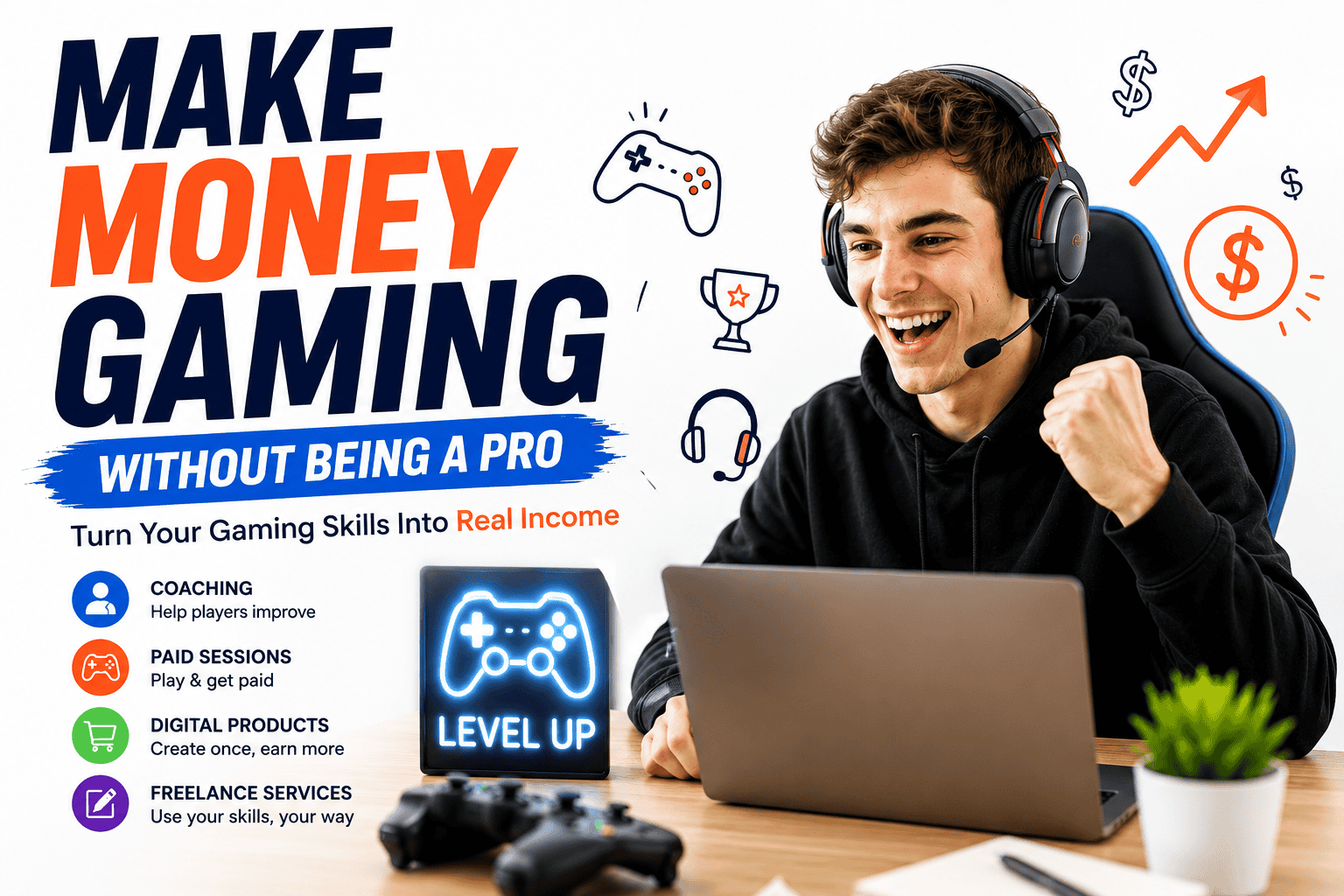
Today, there are plenty of ways ordinary gamers can make money gaming – including selling gaming services, helping other players, creating digital gaming products, offering paid gaming sessions and turning years of accumulated gaming knowledge into something useful.
And that creates opportunities for a much larger group of gamers.
Including those of us whose esports careers mysteriously never quite got started.
🎮 Quick Answer – Can You Make Money Gaming Without Being a Pro?
Yes. You absolutely can.
You don’t necessarily need:
- 🏆 Professional gaming experience
- 🎯 God-tier mechanical skill
- 📈 A top 0.1% competitive rank
- 📺 Thousands of Twitch viewers
- ▶️ A massive YouTube channel
- 🥇 An esports trophy gathering dust behind your monitor
What you do need is something another gamer finds valuable.
That could be your:
🎮 Gaming Experience – You’ve spent years learning a game.
🧠 Game Knowledge – You understand mechanics, maps, builds, strategies or progression systems.
💬 Communication Skills – You’re good at explaining things or helping other players.
🤝 Personality – You’re simply enjoyable to play with.
🎨 Creativity – You can create graphics, guides, mods, videos or other gaming content.
⚙️ Technical Skills – You understand optimisation, streaming setups, modding or game development.
⏱️ Time – You’re willing to complete gaming tasks other players would rather not spend hours doing themselves.
The important shift is this:
You don’t need to be one of the world’s best gamers. You need to be useful to other gamers.
That’s a much lower barrier to entry.
🧠 Being “Average” at Games Doesn’t Mean You Have Nothing to Offer
This is where gamers tend to underestimate themselves.
If you’ve played a game for 500, 1,000 or 3,000 hours, there’s a good chance you’ve accumulated an absurd amount of knowledge without really noticing.
You might know:
- Which weapons work best in different situations
- How particular maps flow
- Where beginners usually go wrong
- Which character builds actually work
- How to complete difficult missions
- Where certain resources spawn
- How the game’s economy works
- Which settings improve performance
- How to organise a raid
- How to explain the game to someone who installed it yesterday
To you, some of this probably feels obvious.
To a new player staring at 47 menus, six currencies, a skill tree resembling an electrical schematic and a chat full of acronyms nobody has explained – it isn’t obvious at all.
I’ve had this experience plenty of times with games.
You play something long enough that you forget there was ever a time when you didn’t know what everything meant.
Then a new player asks what you consider a ridiculously basic question.
You explain it.
And suddenly you realise:
“Oh. I actually know quite a lot about this game.”
That’s knowledge.
And knowledge can have value.
💰 Gaming Skill Is Only One Thing You Can Monetise
There’s another misconception worth killing early.
Being good at playing games and being good at making money from gaming aren’t the same skill.
Consider gaming coaching.
Being highly skilled certainly helps, particularly if you want to coach advanced competitive players. But a coach helping beginners doesn’t necessarily need to be a professional player.
They need to understand the game well enough to help someone who knows less than they do – and, crucially, they need to be able to explain it.
That’s why becoming a gaming coach isn’t exclusively reserved for retired esports professionals.
The same applies elsewhere.
A great gaming writer doesn’t need professional-level aim.
A talented mod creator doesn’t need to dominate ranked.
A brilliant video editor doesn’t need a 4.7 K/D ratio.
Someone running enjoyable paid gaming sessions might succeed because they’re reliable, friendly and genuinely fun to play with.
Someone creating game guides might simply understand a particular game incredibly well.
In each case, the thing being monetised is different.
🎯 The Better Question to Ask
Instead of asking:
“Am I good enough at gaming to make money?”
Ask:
“What do I know, do or create that could be valuable to another gamer?”
That’s the question we’re going to answer throughout this guide.
Because there are far more possibilities than most people initially realise.
You could help someone improve.
You could play alongside them.
You could create something they want.
You could save them time.
You could entertain them.
You could solve a gaming-related problem.
You could teach them something you’ve already spent hundreds of hours learning.
Some methods can generate a little extra spending money. Others can develop into genuine gaming side hustles. A smaller number can potentially grow much further if you develop the right skills, reputation, audience or business around them.
None require you to wake up tomorrow and defeat Faker in a best-of-five.
Which is fortunate.
🚀 Start With What You Already Have
If your goal is to make money gaming, don’t immediately assume you need to become dramatically better at games first.
Start by looking at what you already have.
Your gaming knowledge.
Your experience.
Your personality.
Your creative abilities.
Your technical skills.
Your favourite games.
Even the gaming problems you’ve learned to solve over the years.
Somewhere in that collection may be something another gamer would happily pay for.
And as we’ll see throughout this guide, professional gaming skill is only one small corner of a much bigger gaming economy.
So before we get into the specific ways you can make money without going pro, let’s clear up exactly what “making money gaming” actually means.
2. What Does “Making Money Gaming” Actually Mean?
When someone says they want to make money gaming, the obvious picture is getting paid to sit down, load up your favourite game and start playing.
Preferably while somebody periodically deposits money into your bank account.
Lovely arrangement if you can get it.
But making money gaming is much broader than simply being paid to play video games.
Today, gamers can earn money from the skills, knowledge, creations and experience that surround gaming – sometimes without being particularly exceptional at the game itself.
Broadly, gaming income tends to fall into a few categories:
- 🎮 Playing – paid gaming sessions, playing alongside others or helping players complete objectives
- 🧠 Teaching – coaching, VOD reviews, tutorials and beginner assistance
- 💰 Selling – in-game items, currency and other gaming-related digital assets where permitted
- 🎨 Creating – guides, mods, graphics, videos, streams and other digital content
- 🛠️ Providing services – editing, optimisation, development, stream setup and other gaming-related freelance work
- 🧪 Testing – game testing, playtesting and user research
- 👥 Building communities – moderation, community management and running gaming groups
Some of these involve spending most of your time inside a game.
Others monetise everything you’ve learned because you play games.
That’s an important distinction.
🎮 Getting Paid to Play vs Getting Paid Because You Game
Imagine you’ve spent the last three years playing the same MMO.
During that time you’ve learned the best farming routes, how the economy works, which builds are effective, how raids operate and approximately 400 obscure facts that would be completely useless at a dinner party.
That knowledge can potentially be used in several ways.
You might offer gaming sessions to help other players.
You could teach beginners.
You could create a guide.
You might produce videos explaining difficult mechanics.
You could create or sell permitted digital gaming products.
You might even use your experience to provide services to the game’s wider community.
You’re not necessarily being paid because you’re an extraordinary player.
You’re being paid because your gaming experience has become useful.
That’s why the opportunities available to ordinary gamers are considerably wider than they first appear.
💡 Think Beyond Your Rank
Competitive rank is easy to measure, so gamers naturally use it as a yardstick.
“I’m only Gold. Why would anybody pay me?”
Maybe they wouldn’t pay you to coach a Grandmaster.
Fair enough.
But that’s only one possible customer for one possible service.
A brand-new player might happily pay someone patient to teach them the basics. Another gamer might want a reliable teammate for a difficult mission. Someone else could buy a guide you’ve created because it saves them five hours of trial and error.
And none of them particularly care whether you once finished 7th in a ranked match at 1:30 in the morning.
Different gamers value different things.
That opens the door to far more ways of earning than professional competition alone.
💰 You’re Usually Selling One of Five Things
Strip away all the different platforms, games and business models and most gaming income comes down to providing at least one of these:
Time – You do something another gamer doesn’t want to spend hours doing.
Knowledge – You know something another player wants to learn.
Skill – You can do something another player can’t.
Creativity – You make something gamers want to watch, use or buy.
Experience – You make somebody else’s gaming experience easier, better or simply more enjoyable.
Sometimes an opportunity combines several.
A gaming coach might sell knowledge, skill and time.
A content creator combines knowledge, creativity and entertainment.
Someone producing a detailed game guide turns knowledge into a digital product that can potentially be sold or monetised repeatedly.
That’s also why there isn’t one universally best way to make money gaming.
The right option depends heavily on what you’re already good at – and what you actually enjoy doing.
🕹️ You Don’t Even Have to Play Games for Every Method
This sounds slightly ridiculous in an article about making money gaming, but stick with me.
Some gaming income doesn’t involve playing very much at all.
A thumbnail designer working with gaming YouTubers is earning money from the gaming industry.
So is a video editor cutting Twitch streams into Shorts.
So is somebody designing stream overlays.
Or creating mods.
Or writing game guides.
Or managing a Discord community.
Gaming can be the industry you operate in, rather than the activity you’re directly being paid to perform.
That’s particularly useful if you love gaming but your mechanical abilities aren’t exactly causing esports scouts to kick down your front door.
🎯 Find Where You Can Create Value
Ultimately, making money gaming isn’t about finding some magical game that starts spitting out dollar bills whenever you press Start.
It’s about finding the overlap between:
what you enjoy + what you’re good at + what other gamers value.
That might be playing.
It might be teaching.
It might be creating.
It might be selling.
It might be solving problems for other gamers.
And once you start looking at gaming income this way, being a professional player suddenly becomes much less important.
Because raw gaming ability is only one kind of value – and, as we’ll look at next, it isn’t necessarily the most useful one.
3. Why Being a Great Gamer Isn’t the Same as Being Valuable
Being great at a video game is impressive.
But it doesn’t automatically mean someone will pay you for it.
I could become frighteningly good at navigating the menus in Football Manager, for example. Unless somebody desperately needs an emergency substitute negotiator at 2 a.m., that particular talent probably isn’t paying the mortgage.
The important distinction is between being skilled at a game and providing something valuable to another gamer.
Sometimes they’re the same thing.
Often, they’re not.
🎯 Gaming Skill Is Only One Type of Value
Elite gaming ability obviously has commercial value in the right circumstances.
Professional esports players can compete for prize money. Highly ranked players can offer advanced video game coaching. Skilled players may also be able to help others with difficult gaming objectives.
But there are plenty of other qualities gamers will pay for.
You might be particularly good at:
- 🧠 Understanding complicated game mechanics
- 💬 Explaining things clearly
- 🤝 Playing cooperatively with other people
- 🎨 Creating useful or entertaining content
- 🔧 Solving technical gaming problems
- 🗺️ Finding efficient ways to progress
- 👥 Building or managing communities
- 😂 Making gaming sessions genuinely entertaining
- ⏱️ Saving other players time
None of those require you to be among the best players in the world.
In fact, I’ve played with plenty of highly skilled gamers who would make absolutely terrible coaches.
They know exactly what they should do.
Ask them to explain why they did it and you might receive something along the lines of:
“You just… do it.”
Excellent.
That’ll be $50, please.
🧠 Knowing Something Isn’t the Same as Teaching It
This matters particularly if you’re considering gaming coaching.
Imagine two players.
Player A is ranked in the top 0.5%. They’re incredibly talented but impatient, terrible at explaining decisions and become visibly distressed whenever somebody doesn’t understand something immediately.
Player B is ranked in the top 10%. They’re knowledgeable, patient, encouraging and excellent at spotting what another player is doing wrong.
Which one would a beginner rather learn from?
Quite possibly Player B.
That’s because good coaching involves far more than raw mechanical skill. Communication, observation, patience and the ability to adapt advice to another player all matter.
It’s also why you don’t necessarily need professional experience if you want to become a gaming coach.
Your ability still needs to match the level you’re teaching, of course.
If you’ve just escaped Bronze after a heroic six-year campaign, advertising yourself as an elite competitive coach might be ambitious.
But helping someone completely new understand the fundamentals?
That’s a different proposition.
🤝 Sometimes Being Good With People Is the Skill
Gaming is increasingly social.
Players aren’t always looking for somebody who can carry them to victory while communicating exclusively through angry keyboard noises.
Sometimes they want someone who’s:
Reliable. Friendly. Patient. Communicative. Fun to play with.
Those qualities can matter enormously for paid gaming sessions, community roles and other gaming services.
Think about the people you actually enjoy gaming with.
They’re probably not always the most mechanically gifted players you know.
They’re the people who make the session better.
They communicate.
They don’t rage when something goes wrong.
They help newer players.
They can lose a match without immediately conducting a forensic investigation into whose fault it was.
That has value.
💡 Your “Normal” Gaming Knowledge Might Be Valuable to Someone Else
One of the strangest things about becoming experienced at anything is that you eventually forget which parts were difficult to learn.
Gaming is no different.
After hundreds of hours, certain things become automatic.
You know where to go.
You recognise important items instantly.
You understand which abilities work together.
You know what not to waste resources on.
You can spot a beginner mistake before the beginner even realises they’ve made one.
To you, that’s just playing the game.
To someone starting from scratch, it can save hours of frustration.
And saving people time is one of the oldest business models on Earth.
We’ve simply added dragons and assault rifles.
💰 Value Comes From Solving Gaming Problems
A useful way to think about making money gaming is to stop focusing entirely on yourself.
Instead, look at the other player.
What problem do they have?
Maybe they want to:
- Improve faster
- Understand a complicated game
- Find people to play with
- Complete difficult content
- Save time
- Improve their gaming setup
- Find useful gaming resources
- Learn a particular strategy
- Be entertained
- Get more enjoyment from the game
If something you know, create or do helps solve that problem, you’ve potentially created value.
And that’s the foundation of almost every legitimate gaming side hustle.
🚀 Don’t Ask “Am I Good Enough?”
For most gamers, there’s a better question:
“What am I good enough at to help someone else?”
Maybe you’re nowhere near professional level.
Fine.
You don’t need to be.
You might understand one particular game exceptionally well.
You might be great with beginners.
You might know how to create mods.
You might make brilliant graphics.
You might know every efficient farming route in an MMO because apparently your brain decided that information deserved permanent storage.
Whatever it is, start there.
Because once we stop treating professional-level gaming ability as the entrance ticket, a much wider range of ways to make money becomes available.
And some of the simplest start with things you’re probably already earning, collecting or creating while you play.
4. Sell In-Game Items, Currency and Other Digital Assets
One of the most obvious ways to make money from gaming without being a pro is to sell something you’ve acquired, earned or created inside a game.
Depending on the game, that might include:
- ⚔️ Weapons and equipment
- 💎 Rare items
- 🧥 Skins and cosmetics
- 🪙 In-game currency
- 🧱 Resources and materials
- 🎁 Collectibles
- 🏰 Other transferable digital assets
This approach is interesting because your competitive ability might barely matter.
Nobody buying a rare item particularly cares whether you can land a 360 no-scope while falling from a helicopter.
They care about the item.
💰 Your Time and Game Knowledge Can Be the Valuable Part
In many games, desirable items aren’t necessarily locked behind elite competitive skill.
They’re valuable because they’re rare, difficult to obtain or time-consuming to acquire.
Perhaps you’ve learned an efficient farming route.
Maybe you know which activities provide the best rewards.
You might understand the game’s economy well enough to spot undervalued items.
Or perhaps you’ve simply played for so long that your inventory resembles the warehouse at the end of Raiders of the Lost Ark.
That creates an interesting opportunity.
You’re effectively turning time + knowledge + digital assets into something another player may value.
For someone with limited gaming time, paying for an item can be more attractive than spending dozens of hours trying to obtain it themselves.
🎮 In-Game Currency Can Work the Same Way
Currency is another example.
Some games allow players to accumulate tradable currency through activities such as:
- Completing quests
- Gathering resources
- Crafting
- Trading
- Farming particular locations
- Participating in the game’s economy
You don’t necessarily need lightning-fast reflexes to become efficient at these activities.
Sometimes knowing what to farm, where to farm it and when to sell it matters far more.
I’ve always found game economies fascinating for exactly this reason.
Give gamers enough freedom and within approximately seventeen minutes somebody has created a spreadsheet calculating the optimal profit per hour from selling virtual cabbages.
And they’ll probably be right.
🧠 Knowledge Can Give You an Advantage
The more familiar you become with a game’s economy, the easier it can be to recognise what players actually value.
You might notice that:
Beginners want progression items.
Competitive players want particular equipment.
Collectors want rare cosmetics.
Busy players want to save time.
Understanding that demand is often more important than simply accumulating random stuff and hoping somebody wants it.
It’s the same basic principle as any marketplace:
Find something people want – then work out how you can legitimately provide it.
⚠️ Check the Game’s Rules Before Selling Anything
This part matters.
Not every game allows players to sell items, currency, accounts or other digital assets for real money.
Publisher terms can vary considerably. Some games permit certain types of trading, some restrict external transactions and others prohibit real-money trading altogether.
Rules can also change.
So before trying to monetise anything you’ve earned inside a game:
- Check the game’s current terms of service.
- Confirm whether the asset can legitimately be transferred.
- Check whether real-money transactions are permitted.
- Understand any marketplace rules that apply.
- Never assume something is allowed simply because other players appear to be doing it.
A profitable-looking opportunity becomes considerably less attractive if it ends with your 2,000-hour account being introduced to the ban hammer.
📦 You Don’t Need an Inventory Worth Thousands
Another misconception is that selling gaming assets only makes sense if you possess some ultra-rare digital item worth a small fortune.
Not necessarily.
For many sellers, the opportunity can come from consistently providing useful gaming items or resources, rather than discovering one digital lottery ticket.
A $10 sale isn’t going to change your life.
But making your first $10 from something connected to a game you’ve already been playing can change the way you think about gaming income.
Suddenly, the idea isn’t theoretical anymore.
Someone valued something you had enough to pay for it.
And that’s an important first step.
🎯 Who Is This Method Best For?
Selling gaming assets may suit you if you:
- Enjoy collecting or trading
- Understand a game’s economy
- Don’t mind grinding
- Know efficient ways to acquire resources
- Prefer selling products rather than interacting directly with customers for long sessions
- Already accumulate useful items through normal gameplay
Most importantly, none of that requires professional-level gaming ability.
You aren’t trying to become the best player.
You’re identifying something other players value and finding an efficient way to provide it – where the game and platform rules allow it.
But perhaps you don’t have anything you want to sell.
That’s fine.
Because another thing you can potentially monetise is much simpler:
the experience of playing with you.
5. Get Paid to Play With Other Gamers
What if the thing you’re selling isn’t an item, guide or service performed behind the scenes?
What if it’s simply playing games with someone?
Paid gaming sessions are one of the clearest examples of how you can make money gaming without being a professional player.
Other gamers may be looking for someone to:
- 🎮 Play alongside them
- 🤝 Join their squad or party
- ⚔️ Help complete missions, raids or other objectives
- 🗺️ Show them around an unfamiliar game
- 🏆 Provide a capable teammate for competitive matches
- 💬 Chat and socialise while gaming
- 🎥 Join a content or collaboration session
- 👋 Help them get comfortable with a new game
In other words, you can potentially get paid for something gamers have been doing since multiplayer existed:
“Anyone online?”
Except this time, somebody actually turns up.
🤝 You Don’t Always Need to Carry Anyone
When people hear about paid gaming sessions, they sometimes assume the customer must be paying an elite player to single-handedly bulldoze the opposition.
That certainly can be one type of session.
But it isn’t the only one.
Some players simply want a competent, reliable teammate.
Maybe they need another person for a raid.
Perhaps they’re tired of matchmaking with teammates whose strategic philosophy appears to be run directly toward gunfire and see what happens.
Maybe they’re new to the game and would rather play alongside somebody patient.
Or perhaps they just want someone friendly to game with for an hour.
In those situations, being enjoyable to play with can be just as important as being highly skilled.
🎮 Social Gaming Has Value Too
It’s easy to underestimate the social side of gaming because playing with friends feels completely normal.
But not everybody has friends who play the same games, on the same platform, in the same region, at the same times.
We’ve probably all had some version of this experience.
You finally have a free evening.
You load up the game.
Your usual squad is offline.
One friend hasn’t played for six months.
Another says they’ll be on “in five minutes” and is last seen three hours later watching Netflix.
Suddenly, your planned squad session has become an intimate evening with random matchmaking.
Paid social gaming sessions can solve that problem by giving players a way to find someone specifically available to play with them.
🧠 What Makes Someone Worth Playing With?
For casual and social sessions, you don’t need a trophy cabinet.
You need qualities such as:
Reliability – Turn up when you say you will.
Communication – Talk to the other player and coordinate properly.
Patience – Not everyone learns or plays at the same pace.
Game knowledge – Know enough to make the session smoother.
Adaptability – Match the customer’s goals and preferred playstyle.
Personality – Be someone people actually want to spend an hour gaming with.
That last one matters more than you might think.
A technically brilliant player who spends the entire session complaining about every mistake might be less appealing than a slightly less skilled player who’s helpful, relaxed and fun.
Nobody wants to pay money to be shouted at by a stranger because they missed a skill shot.
Ranked matchmaking already provides that service for free.
⚔️ More Skilled Players Can Offer Goal-Focused Sessions
If you are reasonably skilled at a particular game, you can move beyond purely social sessions.
For example, you might offer sessions focused on:
- Completing difficult missions
- Tackling raids or dungeons
- Helping with cooperative objectives
- Playing competitive matches together
- Practising particular strategies
- Helping someone become comfortable with maps or game modes
This sits somewhere between casual gaming and formal coaching.
You’re not necessarily teaching a structured lesson.
You’re playing alongside the customer and using your experience to help make the session more productive, successful or enjoyable.
💰 You’re Selling an Experience, Not Just an Hour
This is an important distinction if you ever decide to offer paid gaming sessions.
A customer isn’t really buying 60 minutes of your time.
They’re buying what happens during those 60 minutes.
Maybe they want to finally complete a difficult activity.
Maybe they want a dependable teammate.
Maybe they want to learn while playing.
Maybe they simply want an enjoyable evening gaming with another person.
So rather than thinking:
“Why would anyone pay to play games with me?”
Think:
“What could make playing with me better than rolling the dice with random matchmaking?”
If you can answer that clearly, you’ve started creating an actual offer.
🎯 Who Is This Method Best For?
Paid gaming sessions can be particularly suitable if you:
- Enjoy multiplayer games
- Like meeting and talking to other gamers
- Communicate well
- Are patient with less experienced players
- Know one or more games reasonably well
- Prefer playing games over creating content
- Can reliably commit to scheduled sessions
- Make gaming more enjoyable for the people you’re playing with
You don’t need to be professional.
You don’t even necessarily need to be exceptionally competitive.
You need to provide a gaming experience somebody else considers worth paying for.
And if you’re particularly good at explaining what you’re doing while you play, there’s another natural step you can take.
Instead of simply playing alongside beginners, you can start helping them become better players themselves.
6. Help Beginners Improve at Games
You don’t need to be an esports champion to help someone get better at a video game.
You just need to know more than the person you’re helping – and know how to explain it.
That distinction opens the door to one of the most practical ways experienced gamers can make money from what they already know: helping beginners learn a game.
Think back to the first few hours of a game you now know inside out.
You probably had questions like:
- 🎮 What am I supposed to be doing?
- 🗺️ Where should I go?
- ⚔️ Which weapons or characters should I use?
- 🧠 What does this ability actually do?
- 💰 What should I spend my resources on?
- 🎯 Why do I keep losing?
- ⚙️ Which settings should I change?
- 😐 Why does everyone else apparently understand this?
Then, eventually, those things became second nature.
That’s precisely the knowledge a beginner may find valuable.
🧠 You Don’t Have to Coach the Pros
The word “coach” can make this opportunity sound more intimidating than it really is.
It’s easy to picture someone standing behind a professional esports team with a headset, six monitors and an expression suggesting national security depends on the next round.
But gaming coaching covers a much wider range of skill levels.
A complete beginner doesn’t need the world’s greatest player.
They might simply need someone who can explain:
the fundamentals clearly and patiently.
If you’ve played a game for hundreds of hours, there’s a reasonable chance you can help someone who has played for five.
That could involve teaching:
- Basic mechanics
- Character or class selection
- Maps and positioning
- Builds and loadouts
- Resource management
- Movement
- Objectives
- Progression systems
- Beginner strategy
- Common mistakes
This type of coaching isn’t about turning somebody into a professional player overnight.
It’s about helping them skip some of the painful trial-and-error you went through yourself.
🎯 The Knowledge Gap Is What Matters
Imagine you’re ranked somewhere around the top 15% of players in a game.
You’re good.
You’re nowhere near professional.
You would also probably get dismantled by an actual esports player so comprehensively that you’d begin reconsidering several major life choices.
But to somebody in the bottom 50%?
You may know a lot that could help them.
This is the knowledge gap.
You don’t have to know everything.
You need enough knowledge and experience to help the type of player you’re targeting.
That’s also why one of the most important lessons in how to become a gaming coach is understanding who you’re actually qualified to help.
A good beginner coach doesn’t pretend to be something they’re not.
They simply know their audience.
💬 Being Able to Explain Things Is a Huge Advantage
Gaming knowledge by itself isn’t enough.
You also need to communicate it.
Suppose a beginner asks:
“Why did I lose that fight?”
One answer is:
“Your positioning was bad.”
Technically useful.
Emotionally devastating.
Educationally… not spectacular.
A better explanation might show them:
- Where they should have positioned themselves
- What information they missed
- When they should have disengaged
- Which ability they used too early
- What they could try next time
That’s coaching.
The goal isn’t simply to identify mistakes.
It’s to help another player understand and correct them.
And sometimes a patient, clear communicator can provide more value to a beginner than a vastly more talented player who struggles to explain their own decisions.
🎥 You Can Help Players Without Live Coaching
Helping someone improve doesn’t always require sitting beside them virtually while they play.
Another option is reviewing recorded gameplay.
With a VOD review, a player sends recorded gameplay to a coach, who analyses what happened and provides feedback.
This can suit gamers who are good at:
- Spotting patterns
- Analysing decisions
- Identifying mistakes
- Explaining strategy
- Breaking complicated situations into simple advice
You might notice that a player repeatedly takes bad fights.
Perhaps their positioning leaves them exposed.
Maybe they’re wasting important abilities.
Or perhaps their tactical master plan appears to consist entirely of “I’ll push them again – surely it’ll work this time.”
Having another experienced player review the footage can reveal mistakes that are difficult to notice while you’re actually playing.
💰 Start With the Level You Can Genuinely Help
If you’re considering coaching, don’t immediately advertise yourself as:
ULTIMATE ELITE RANKED COACH – I WILL TRANSFORM YOUR GAMEPLAY
Especially if your own match history is currently requesting privacy.
Start with what you can genuinely offer.
For example:
Beginner coaching for new players.
Learn the fundamentals in 60 minutes.
Understand maps, positioning and basic strategy.
Beginner VOD review with practical feedback.
Those are clear, useful offers.
As your own skill, coaching experience and reputation improve, you can expand into more advanced coaching.
🎮 Who Is This Method Best For?
Helping beginners can be a strong option if you:
- Know a particular game well
- Enjoy teaching people
- Communicate clearly
- Have patience
- Can identify mistakes without making people feel stupid
- Understand why strategies work rather than simply copying them
- Enjoy seeing other players improve
Most importantly, you don’t need to be the best player in the game.
You need to be capable of helping a particular type of player take the next step.
And if teaching isn’t your thing, that’s fine too.
Maybe you’d rather take everything you’ve learned from gaming and turn it into something that can help hundreds of players without having to book a single coaching session.
That’s where gaming guides, mods and other digital products become interesting.
7. Create and Sell Gaming Guides, Mods and Digital Products
One of my favourite things about gaming knowledge is that you don’t necessarily have to sell it one hour at a time.
You can turn what you know into something useful, package it as a digital product and potentially sell the same creation more than once.
That could be:
- 📘 Game guides
- 🗺️ Maps and walkthroughs
- 📋 Cheat sheets and checklists
- 🧙 Character or build guides
- 💰 Farming and resource guides
- ⚙️ Mods and other permitted game customisations
- 🎨 Gaming graphics and digital assets
- 📺 Stream overlays, emotes and badges
- 🛠️ Other downloadable gaming resources
And once again, there’s no requirement that you be a professional gamer.
You need to know something, create something or solve something that another gamer finds useful.
📘 Turn What You’ve Learned Into a Game Guide
Game guides are probably the easiest example.
Think about how often you’ve searched for something while playing:
“Best beginner build.”
“Fastest way to level.”
“Where is this stupid quest item?”
“How do I beat this boss without throwing my controller through a window?”
Behind every one of those searches is a problem somebody wants solved.
If you know the answer particularly well, you may be able to turn that knowledge into a useful guide.
For example, you could create:
Beginner guides – Help new players understand the fundamentals.
Build guides – Explain characters, equipment, abilities or skill combinations.
Progression guides – Show players efficient ways to level or advance.
Farming guides – Explain where and how to gather valuable resources.
Maps and walkthroughs – Help players navigate complicated areas or complete objectives.
Checklists – Turn a complicated process into something players can follow easily.
The important part isn’t producing 147 pages titled The Complete Philosophical History of This Game’s Crafting System.
It’s solving a specific problem well.
🧠 Your Experience Can Become the Product
This is where all those hours you’ve spent gaming can suddenly look slightly more productive.
Imagine you’ve spent 800 hours playing an MMO.
Over that time, you’ve learned which resources matter, where to find them, which mistakes waste time and how to progress efficiently.
You could explain those things individually to another player.
Or you could spend time creating one genuinely useful resource that explains everything clearly.
Once created, that digital product doesn’t disappear when somebody buys it.
Another person can buy it.
Then another.
That’s fundamentally different from selling your time through coaching or paid gaming sessions.
If you sell a one-hour gaming session, you have to provide another hour to make another sale.
With a digital product, much of the work happens upfront.
That doesn’t make the income magically passive – you’ll still need to update, improve and promote what you’ve created – but it can make digital products much more scalable.
⚙️ Mods Can Turn Technical Skills Into Gaming Income
If you’re more technically inclined, another possibility is creating mods or other permitted game customisations.
Modding can involve anything from relatively simple tweaks to enormous community projects that practically turn one game into another.
Depending on the game and your skills, that might include:
- Gameplay modifications
- New maps or environments
- UI improvements
- Character or equipment additions
- Quality-of-life features
- Visual enhancements
- Custom scenarios
- Other game-specific additions
This is an excellent example of why professional gaming ability isn’t required.
The person creating an amazing mod might be completely average at actually playing the game.
Their value comes from development, design and creativity instead.
Of course, monetisation rules vary between games and publishers, so always check the relevant game’s modding, intellectual property and commercial-use policies before trying to sell anything.
Just because you can modify something doesn’t automatically mean you’re allowed to sell it.
Copyright lawyers are notoriously difficult boss fights.
🎨 Gaming Digital Products Go Far Beyond Guides and Mods
You don’t even need to create something that changes the game itself.
There’s a huge ecosystem surrounding gaming.
Streamers need graphics.
Gaming creators need thumbnails.
Players want useful resources.
Communities need artwork.
Game developers need assets.
That creates opportunities for people who can produce things such as:
- Stream overlays
- Emotes
- Badges
- Gaming artwork
- Character graphics
- Templates
- Maps
- Reference sheets
- Digital tools
- Other downloadable resources
So if you’re a gamer who also happens to be a designer, writer, developer or generally creative person, those abilities can overlap nicely.
Your advantage is that you understand the audience you’re creating for.
A designer who actually games may already understand what a streamer means when they ask for an overlay that looks clean without covering half the HUD.
That kind of familiarity helps.
💡 Solve a Small Problem Before Building Something Huge
If you’re starting out, don’t immediately spend six months creating the world’s most comprehensive gaming product.
Start smaller.
Ask:
What annoying problem do players of this game repeatedly encounter?
Then create something that makes it easier.
Maybe it’s a concise beginner guide.
A boss checklist.
A levelling route.
A resource map.
A build reference sheet.
A simple mod that fixes an irritating interface problem.
Small, specific products can be easier to create, easier to explain and easier for potential buyers to understand.
If somebody sees your product and immediately thinks:
“Yep. I need that.”
You’ve probably done something right.
💰 Digital Products Can Scale Differently
This is one of the biggest advantages of this method.
Suppose you charge $20 for an hour of your gaming time.
Five customers require five hours.
Twenty customers require twenty hours.
But imagine you spend ten hours creating a really useful downloadable gaming guide.
If twenty people eventually buy it, you don’t need to recreate the guide twenty times.
The original work can keep producing value.
There will still be ongoing work – customer questions, updates, promotion and changes when the game inevitably releases a patch that destroys your carefully researched “ultimate build.”
But you’re no longer tying every dollar directly to another hour of your time.
That’s why digital products can be particularly interesting if you’re trying to turn a small gaming side hustle into something more scalable.
🎯 Who Is This Method Best For?
Creating gaming digital products may suit you if you:
- Know a particular game extremely well
- Enjoy writing or explaining things
- Like creating useful resources
- Have design or development skills
- Know how to create mods
- Prefer working independently
- Don’t particularly want to appear on camera
- Like the idea of creating something once and potentially selling it repeatedly
And you don’t need to start with some enormous commercial project.
Your first product could be a simple guide solving one problem you’ve personally encountered dozens of times.
Because there’s a decent chance other players have encountered it too.
The difference is that you already know how to solve it.
But digital products aren’t the only way to turn gaming knowledge into something scalable.
Instead of selling what you create directly, you can also build an audience around it – which brings us to gaming content creation.
8. Make Money Creating Gaming Content
Gaming content creation is probably the route most people think of after professional gaming.
Start a YouTube channel.
Stream on Twitch.
Post gaming clips.
Become wildly successful.
Retire at 24.
Discover that your “job” now involves thumbnails, analytics, editing, sponsorship emails, comments and wondering why the video you spent three days making got fewer views than the clip you uploaded while eating breakfast.
Still, content creation is one of the most accessible ways to potentially make money from gaming – and you absolutely don’t need to be a professional-level player to do it.
You need to give people a reason to watch, read or follow what you create.
🎥 You Don’t Have to Be Amazing at Games to Be Entertaining
Some gaming creators build audiences because they’re incredibly skilled.
Others succeed because they’re:
- 😂 Funny
- 🧠 Knowledgeable
- 🎙️ Good storytellers
- 🔍 Great at explaining things
- 👀 Interesting to watch
- 📰 Good at finding gaming stories
- 🧪 Willing to experiment
- 🎮 Passionate about a particular game or niche
Sometimes being spectacularly bad at a game can even be entertaining.
There are only so many times you can accidentally walk into the same boss attack before it stops being poor gameplay and becomes recurring content.
The point is that skill is only one reason people consume gaming content.
Entertainment, information and personality can be just as important.
📺 Gaming Content Comes in More Forms Than Streaming
You also don’t have to become a full-time streamer.
Gaming content can include:
YouTube videos – Guides, reviews, challenges, commentary, news, tutorials and longer-form entertainment.
Short-form videos – YouTube Shorts, TikTok and other bite-sized gaming content.
Livestreams – Gameplay, challenges, community sessions and interactive content.
Written content – Articles, reviews, guides and gaming news.
Tutorials – Teach players mechanics, builds, strategies or technical fixes.
Game-specific content – Build an audience around one game you know particularly well.
Gaming commentary – Discuss updates, industry news, controversies, trends or communities.
That gives you plenty of room to choose a format that actually suits you.
If the thought of talking continuously to a livestream with three viewers fills you with existential dread, you don’t have to do it.
🙈 You Don’t Have to Show Your Face Either
This is another common assumption.
You can create gaming content without ever appearing on camera.
For example, you could produce:
- Gameplay with voiceover
- Screen-recorded tutorials
- Game guides
- Reviews
- News videos
- Lore content
- Strategy breakdowns
- Rankings
- Shorts
- Edited gameplay
- Written gaming content
Some creators build entire channels around narration, gameplay footage, graphics or animation.
That can make content creation much more approachable if you’re happy sharing your knowledge but aren’t particularly interested in becoming The Face of Gaming™.
🧠 Your Gaming Knowledge Gives You Something to Talk About
Remember all that seemingly useless knowledge we discussed earlier?
Content gives it somewhere to go.
If you’ve played one game for years, you probably have opinions, experiences and knowledge newer players don’t.
Maybe you know:
- The mistakes beginners constantly make
- Which builds are overrated
- How to progress efficiently
- Which updates changed the game
- What experienced players wish they’d known earlier
- How certain mechanics actually work
- Which strategies are worth learning
Each of those can become content.
A question you’ve answered ten times in Discord could become a video.
A complicated mechanic you’ve explained to friends could become a tutorial.
A mistake you made for your first 100 hours could become:
“7 Things I Wish I Knew Before Starting…”
Congratulations.
You have become a content creator.
Try not to immediately purchase a ring light.
💰 How Gaming Content Actually Makes Money
Creating content itself doesn’t automatically produce income.
You need an audience, customers or another monetisation method around it.
Depending on the platform and content, creators may eventually earn through:
- Advertising revenue
- Sponsorships
- Affiliate marketing
- Memberships
- Viewer support
- Brand partnerships
- Selling their own products
- Promoting gaming services
- Driving customers to another business
This is why content can be particularly powerful when combined with another gaming side hustle.
For example, someone offering coaching could publish helpful gameplay tutorials.
A mod creator could demonstrate their mods.
A designer could showcase gaming graphics.
Someone selling guides could create free content answering smaller questions.
The content builds trust.
The product or service gives that audience something more substantial to buy.
📈 Don’t Expect Instant Results
This is the less glamorous part.
Content creation usually takes time.
Your first video may get 23 views.
Eight might be you.
Three might be your mum, who doesn’t understand why you’re talking about weapon balancing but is supportive nonetheless.
That’s normal.
Building an audience generally requires consistency, experimentation and learning what people actually want to watch.
You’ll probably improve your:
- Titles
- Thumbnails
- Editing
- Presentation
- Search optimisation
- Storytelling
- Topic selection
- Understanding of your audience
The creators who eventually make money aren’t necessarily the ones who produced something brilliant on day one.
They’re often the ones who kept improving long enough to become good at it.
🎯 Start With Useful Content
If you’re completely new, one of the easiest places to start is answering questions.
Look at what players repeatedly ask about a game you know well.
Then create something useful around those questions.
It might be:
“How to…”
“Best way to…”
“Beginner’s guide to…”
“5 mistakes new players make…”
“What I wish I knew before…”
Useful content has a built-in reason to exist.
Someone has a problem.
Your content provides the answer.
That’s considerably stronger than uploading Gameplay Episode #1 and waiting for the internet to discover your previously hidden charisma.
🎮 Who Is This Method Best For?
Gaming content creation may suit you if you:
- Enjoy talking or writing about games
- Have useful gaming knowledge
- Like entertaining people
- Enjoy editing or storytelling
- Have strong opinions about the games you play
- Want something that can grow over time
- Prefer building an audience rather than selling directly
- Are willing to experiment without immediate results
You don’t need professional gaming credentials.
You need something worth watching, reading or listening to.
And if creating your own audience sounds like far too much work, there’s another option.
Instead of becoming the gaming creator, you can get paid for the skills gaming creators and businesses already need.
9. Offer Gaming-Related Freelance Services
Here’s where the definition of making money gaming gets considerably wider.
You don’t necessarily need to make money inside a game.
You can make money from the enormous industry that has grown around gaming.
Streamers need editors.
YouTubers need thumbnails.
Gaming communities need moderators.
Players need technical help.
Game developers need artists, writers, testers and other specialists.
And somewhere, right now, a streamer is probably staring at OBS wondering why their microphone has suddenly decided to sound like it’s broadcasting from the bottom of the ocean.
If you can solve problems like these, you may have a gaming side hustle without needing extraordinary gaming ability at all.
🛠️ What Gaming Services Could You Offer?
The possibilities depend much more on your wider skills than your competitive rank.
Examples include:
- 🎬 Gaming video editing
- 🖼️ YouTube thumbnail design
- 🎨 Stream overlays and graphics
- 🎙️ Streaming setup assistance
- ⚙️ Game and PC optimisation
- 💬 Discord server setup
- 👥 Community moderation
- ✍️ Gaming writing
- 🧩 Modding
- 💻 Game development assistance
- 🎵 Audio editing
- 📱 Gaming social media content
- 🕹️ Other specialised gaming services
You might already have one of these skills.
Or you might have developed it almost accidentally through gaming.
Plenty of people first learn video editing because they want to make gaming clips.
Others learn Photoshop because they need thumbnails.
Some learn server management because they volunteered to set up a Discord for six friends and somehow became the unpaid IT department.
Gaming has a habit of teaching useful skills while pretending we’re wasting time.
🎮 Being a Gamer Can Give You an Advantage
Suppose two video editors have similar technical ability.
One has never played games.
The other has spent years watching gaming videos, understands Twitch, knows what a kill feed is, recognises gaming terminology and understands why cutting away from the screen half a second before the winning play is probably a bad editorial decision.
Which one might a gaming creator prefer?
Knowing the industry can make your broader professional skills more valuable.
You already understand:
- Gaming terminology
- Different genres
- Gaming humour
- Streaming culture
- What gaming audiences expect
- How gameplay is presented
- What moments are important
- How gaming communities communicate
That context can save clients a lot of explaining.
💡 Sell the Problem You Solve, Not Just the Skill
This is one of the easiest mistakes to make when offering freelance services.
You say:
“I edit videos.”
Fine.
Thousands of people edit videos.
Instead, think about the actual outcome.
“I turn gaming streams into short-form clips for YouTube Shorts and TikTok.”
That’s much clearer.
Or instead of:
“I do graphic design.”
Try:
“I create gaming thumbnails for YouTube creators.”
Instead of:
“I know Discord.”
You might offer:
“I’ll set up and organise your gaming community’s Discord server.”
Now a potential customer can immediately understand why they might need you.
The more specific your offer becomes, the easier it is for the right customer to recognise it.
💰 Freelancing Can Be Easier to Monetise Than an Audience
One advantage of services is that you don’t necessarily need thousands of followers before you can make your first dollar.
You need one customer.
That’s very different from content creation.
A new YouTube channel might require months of publishing before it generates meaningful revenue.
A freelancer could theoretically create a useful service today and find their first client much sooner.
That doesn’t mean it’s effortless.
You’ll still need to:
- Develop a useful skill
- Create a clear offer
- Show examples of your work
- Find potential customers
- Communicate professionally
- Deliver what you promised
- Build reviews and reputation
But you don’t need to become internet-famous first.
For many people looking to start earning relatively small amounts from gaming, that’s an important difference.
🧠 You Can Start With Skills You Already Have
Before learning something completely new, look at what you already know how to do.
Maybe you’re good at editing videos.
Perhaps you’ve been designing graphics for years.
Maybe you understand PC optimisation.
You might be a developer who also loves games.
Perhaps you’re an excellent writer.
Or you’re the person everyone asks whenever their Discord permissions somehow result in the entire server being able to delete everything.
Take the skill.
Then ask:
How could I apply this specifically to gamers, gaming creators or gaming businesses?
That intersection is often where a good niche service appears.
📈 Specialisation Can Make You More Valuable
You also don’t need to offer every possible service.
In fact, becoming known for one specific thing can make your offer stronger.
For example:
General video editor
could become:
Gaming video editor
which could become:
Short-form editor for FPS gaming creators.
Each step narrows the potential audience.
But it also makes you more relevant to the people who are in that audience.
If an FPS creator needs someone to turn streams into Shorts, the specialist suddenly looks much more attractive than the person whose portfolio contains wedding videos, corporate interviews, cooking tutorials and one slightly confused Fortnite montage.
🎯 Who Is This Method Best For?
Gaming-related freelancing may suit you if you:
- Already have a useful digital skill
- Enjoy working with clients
- Prefer services over building an audience
- Understand gaming culture
- Want to start with relatively little upfront cost
- Like solving specific problems
- Want skills that can also be useful outside gaming
- Aren’t particularly interested in becoming a professional player
In fact, your actual gaming ability might barely enter the conversation.
A creator hiring you to edit their videos probably isn’t going to demand proof of your ranked stats.
They want to know whether you can do the job well.
And that’s the wider lesson running through all these methods.
Sometimes the best way to make money from gaming isn’t to become better at playing games.
It’s to become better at something the gaming world needs.
But what if you’d rather work directly with games themselves?
In that case, game testing and paid playtesting might sound like the dream – although the reality is a little different from being paid to casually play whatever you want.
10. Get Paid for Game Testing and Playtesting
Getting paid to test video games sounds suspiciously close to the job many of us invented when adults asked what we wanted to do for a living.
“I’ll just play games all day.”
Perfect.
Career planning complete.
The reality is a little less eight hours of gaming with unlimited snacks and a little more testing specific things, finding problems and explaining exactly what happened.
Still, game testing and paid playtesting can provide opportunities to earn money from gaming without being anywhere near professional-player level.
🧪 Game Testing and Playtesting Aren’t Quite the Same Thing
These terms are often used interchangeably, but they can describe different types of work.
Game testing or QA testing is generally more structured.
A tester might look for:
- Bugs
- Crashes
- Graphical problems
- Broken mechanics
- Interface issues
- Performance problems
- Reproducible errors
- Unexpected behaviour
The job isn’t simply to play the game normally.
You may need to perform the same action repeatedly, document what happens and provide enough information for developers to reproduce the problem.
Imagine opening the same door 40 times because it occasionally causes your character to become permanently attached to the ceiling.
By attempt 37, the glamour may have faded slightly.
But you’ve found a bug.
🎮 Playtesting Is More About the Player Experience
Playtesting can focus more heavily on how people actually experience a game.
Developers may want to know:
- Is the tutorial understandable?
- Is a particular level confusing?
- Did players understand the objective?
- Is the difficulty appropriate?
- Which features did players enjoy?
- Where did players become frustrated?
- Does a menu make sense?
- Would players keep playing?
In this situation, being an ordinary gamer can actually be useful.
A developer testing whether new players understand a tutorial doesn’t necessarily want an esports professional who can decipher the entire game within 30 seconds.
They want feedback from people who resemble the game’s intended audience.
🧠 What Skills Do You Actually Need?
You don’t need elite reactions or tournament experience.
Useful qualities include:
Attention to detail – Notice when something doesn’t behave as expected.
Communication – Explain problems clearly.
Patience – Repeating tasks is often part of testing.
Observation – Recognise confusing or frustrating elements.
Following instructions – Test the thing you’re actually being asked to test.
Gaming familiarity – Understand common controls, systems and conventions.
For more formal QA roles, employers may also expect specific technical skills, documentation ability or previous testing experience.
The job is closer to quality assurance that happens to involve video games than simply being paid for recreational gaming.
💬 Good Feedback Is More Useful Than “I Didn’t Like It”
Imagine you’re testing a new mission.
You finish and report:
“It was confusing.”
That’s feedback.
Technically.
But it’s not particularly useful.
A better explanation might be:
“After completing the first objective, I didn’t realise the marker had moved to another part of the map. I spent about four minutes searching the original area because I expected the next objective to appear there.”
Now the developer has something they can investigate.
Good testers can describe:
what happened, what they expected to happen and what they were doing when the problem occurred.
That ability matters far more than your K/D ratio.
💰 Can You Actually Make Money Playtesting Games?
Yes, although it’s important to keep expectations realistic.
Paid playtesting opportunities can appear through game developers, research companies and specialist testing platforms.
Compensation may vary considerably depending on:
- The length of the test
- The type of game
- The research required
- Whether the session is remote or in person
- Your demographic or gaming experience
- The company running the test
Some opportunities might provide occasional extra money.
Professional QA testing can become an actual career.
Those are two very different things.
So if you’re looking for a dependable gaming side hustle, don’t assume you’ll find enough casual playtests to fill every afternoon.
Think of paid consumer playtesting as one possible income source, rather than guaranteed regular work.
🚨 Be Sensible About “Get Paid to Test Games” Offers
As with most things involving the words “easy money online,” a little scepticism is healthy.
Be cautious if an opportunity:
- Requires a large upfront payment
- Promises unrealistic guaranteed income
- Is vague about who is running the test
- Requests unnecessary sensitive information
- Claims you’ll earn huge amounts simply for playing games
- Sounds suspiciously like somebody discovered an infinite-money glitch in real life
Legitimate testing is valuable because developers need useful information.
They’re paying for your time, observations and feedback.
Not because they woke up feeling unusually charitable toward gamers.
🎯 Who Is This Method Best For?
Game testing and playtesting may suit you if you:
- Enjoy trying different games
- Notice small details
- Communicate clearly
- Don’t mind repetitive tasks
- Can follow structured instructions
- Like figuring out why something isn’t working
- Want gaming-related opportunities without needing elite gaming skill
It can also provide an interesting glimpse behind the curtain at how games are developed and improved.
Just remember: if you’re asked to run into the same wall 73 times to reproduce a collision bug, you’re no longer procrastinating.
You’re conducting professional research.
And if testing games isn’t quite social enough for you, another route is to turn the time you already spend around other gamers into something valuable – by helping build, manage and moderate gaming communities.
11. Work in Gaming Communities
If you’ve spent any serious amount of time gaming online, you’ve probably also spent a fair amount of time around gaming communities.
Discord servers.
Forums.
Clans.
Guilds.
Creator communities.
Game-specific groups.
Some are wonderfully organised places where players help each other, share useful information and arrange games.
Others appear to be held together by three moderators, a collection of bots and one exhausted person repeatedly asking everyone to stop arguing in #general.
Running these communities takes work.
And that creates another way to make money in gaming that has very little to do with being a professional player.
👥 Gaming Communities Need People Behind the Scenes
Large communities don’t manage themselves.
Depending on the size and purpose of the community, someone may need to:
- Welcome new members
- Answer questions
- Moderate discussions
- Enforce community rules
- Organise channels
- Manage roles and permissions
- Schedule gaming events
- Run competitions or activities
- Handle disputes
- Publish announcements
- Coordinate moderators
- Gather community feedback
- Keep conversations active
- Deal with spam and scams
None of these tasks require you to win an esports tournament.
They require communication, organisation and people skills.
And occasionally the patience of a medieval saint.
💬 Moderation Is More Than Deleting Messages
At first glance, community moderation can look simple.
Someone breaks a rule.
Delete the message.
Done.
In reality, good moderation requires judgement.
Was somebody joking?
Has the conversation genuinely crossed a line?
Does a new member understand the rules?
Is somebody deliberately provoking other users?
Can the situation be resolved quietly before it becomes a 400-message argument about something nobody will remember tomorrow?
Good moderators help create an environment where people actually want to remain part of the community.
That can make them valuable to gaming creators, businesses, clans and other organisations building audiences online.
🧠 Understanding Gamers Helps
This is another area where years spent around gaming can become surprisingly useful.
If you’re already familiar with gaming communities, you probably understand:
- Common gaming terminology
- How Discord servers typically work
- Different player personalities
- Gaming etiquette
- Community memes and humour
- Common sources of arguments
- How players organise sessions
- How gaming communities communicate
You understand the environment.
That’s useful because managing a gaming community is different from moderating a corporate discussion board where the most controversial topic of the week is the new expense policy.
Gaming communities can move quickly.
Especially when somebody mentions balance changes.
🛠️ Community Management Can Go Beyond Moderation
As communities grow, the work can become much broader.
A community manager might help with:
Engagement – Starting discussions, polls and activities.
Events – Organising tournaments, community nights or gaming sessions.
Announcements – Communicating updates clearly.
Feedback – Collecting player opinions and reporting recurring issues.
Support – Helping members find information or resolve basic problems.
Growth – Finding ways to attract and retain members.
Organisation – Creating channels, roles and systems that keep the community manageable.
This moves beyond basic moderation into something closer to an actual business function.
For gaming companies and larger creators, maintaining a healthy community can be extremely important.
🎮 Your Own Gaming Community Can Become Valuable Too
You don’t necessarily have to work for somebody else’s community.
You could build your own around:
- A particular game
- A genre
- A clan or guild
- Gaming guides
- Coaching
- Mods
- Competitive play
- Casual gaming
- A content channel
Initially, there might be no direct income at all.
But a strong community can eventually support other things you’re doing.
A gaming coach might build a community around improvement.
A content creator might use Discord to bring viewers together.
A mod creator might create a place for users to get updates and support.
A gaming seller might build an audience interested in their particular niche.
The community itself becomes a way of creating trust, repeat engagement and relationships.
That’s difficult to measure on day one.
Over time, it can become extremely valuable.
💰 Can Community Work Actually Pay?
Yes – but there are several levels to it.
At the casual end, moderation may be voluntary or provide relatively small payments.
More established creators or gaming organisations may hire people for regular moderation and community support.
At the professional end, community management can be a genuine career, particularly within game studios, publishers, esports organisations and gaming businesses.
So this isn’t necessarily a quick:
“Join Discord on Monday, retire Friday.”
It’s another example of how skills developed around gaming can eventually become commercially useful.
🎯 Who Is This Method Best For?
Gaming community work may suit you if you:
- Enjoy talking with other gamers
- Spend plenty of time on Discord or gaming forums
- Communicate clearly
- Stay calm when disagreements happen
- Like organising things
- Enjoy helping people
- Understand online gaming culture
- Can enforce rules fairly
- Don’t need to be the centre of attention
Your gaming skill level might barely matter.
Nobody interviewing a community manager is likely to stop halfway through and say:
“Everything looks excellent, but unfortunately your Rocket League rank is unacceptable.”
They’re looking for someone who can help make a community better organised, safer, more useful and more enjoyable.
And that brings us to an important point.
We’ve now covered quite a few different ways to make money gaming without being a pro.
The next question isn’t what opportunities exist.
It’s:
Which of them actually fits you?
12. What Gaming Skills Can You Actually Monetise?
By this point, you might be thinking:
“Fine. Apparently there are lots of ways to make money gaming. But what could I actually sell?”
That’s the more useful question.
Because the best gaming side hustle isn’t necessarily the one with the biggest theoretical earning potential.
It’s usually the one that sits somewhere between:
what you’re good at + what you enjoy + what other gamers actually value.
And there’s a good chance you already have more useful gaming skills than you realise.
🎮 Start With the Games You Already Know
Before learning some completely new skill because a YouTube video promised you $847 PER DAY GAMING FROM HOME, start with what you’ve already accumulated.
Think about the games you’ve spent the most time playing.
For each one, ask yourself:
- How many hours have I played?
- What do I understand particularly well?
- What do friends ask me for help with?
- Which parts of the game do I find easy that beginners struggle with?
- Do I understand its economy?
- Do I know efficient progression methods?
- Can I explain its mechanics clearly?
- Have I created anything for the game?
- Do I regularly help other players?
You don’t need to know everything about a game.
Sometimes a very specific area of knowledge is more useful.
Maybe you’re the person everyone asks about character builds.
Or crafting.
Or trading.
Or raids.
Or graphics settings.
Or where that one ridiculous quest item is hidden behind a barrel in a basement nobody would reasonably think to search.
That’s expertise too.
🧠 Look Beyond Your Mechanical Skill
Next, forget your rank for a moment.
Gaming develops and attracts all sorts of abilities that have nothing to do with reaction speed.
For example:
Communication – Can you explain complicated things simply?
Teaching – Are you patient when helping beginners?
Analysis – Can you watch gameplay and recognise what went wrong?
Creativity – Can you design, write, edit or create interesting things?
Technical ability – Can you troubleshoot PCs, games, mods or streaming setups?
Organisation – Can you manage groups, events or communities?
Social skills – Are you genuinely enjoyable to play with?
Research – Are you good at finding information and turning it into something useful?
Persistence – Are you willing to grind activities other players would rather avoid?
These are all potentially monetisable in the right context.
The trick is recognising that you’ve developed them.
💬 Pay Attention to What People Already Ask You For
This is one of the easiest clues.
What do other gamers already come to you for?
Maybe your friends constantly ask:
“What build should I use?”
“Can you help me with this boss?”
“How did you set up your stream?”
“Can you fix my Discord roles?”
“Where do I find this item?”
“Can you edit this clip?”
“Why does my game run like it’s being powered by a potato?”
Those questions are useful.
If people repeatedly ask you for the same kind of help for free, there’s at least a possibility that a wider audience has the same problem.
That doesn’t automatically mean they’ll pay for your solution.
But it’s a very good place to investigate.
🔍 Find the Problems You Solve Naturally
Another useful exercise is to think about what you do during normal gaming sessions.
Maybe you automatically organise the group before a raid.
Perhaps you’re always explaining mechanics to newer players.
Maybe you spend more time tweaking settings than actually playing.
You might enjoy researching builds.
Perhaps you make spreadsheets tracking prices.
Maybe you create mods.
Or you’re the person producing clips whenever something funny happens.
These habits reveal what you naturally enjoy doing.
And that’s important.
You could make money editing gaming videos.
But if editing makes you want to throw your computer through the nearest available window, it’s probably not the side hustle for you.
💰 Are You Better Suited to Selling Time or Creating Something?
This is one of the biggest choices.
Some gaming income involves selling your time.
For example:
- Gaming sessions
- Coaching
- Freelance services
- Community work
- Testing
You perform the work each time you get paid.
Other methods involve creating something that can potentially generate value repeatedly:
- Gaming guides
- Mods
- Videos
- Digital graphics
- Other downloadable products
Neither model is automatically better.
Services can sometimes be easier to monetise initially because you only need one customer.
Digital products and content can take longer to gain traction but may eventually scale beyond the number of hours you personally have available.
Think about which style suits you.
🎯 Try the “Would Someone Pay Me to…” Test
Take something you’re good at and finish this sentence:
“Would another gamer pay me to…”
…teach them this?
…do this for them?
…play this with them?
…create this for them?
…save them time doing this?
…solve this problem?
…explain this clearly?
…make their gaming experience better?
If the answer is possibly, you’ve found something worth exploring.
Then comes the second question:
“Who specifically would pay for it?”
That’s where an idea starts becoming a potential business.
“Gaming coaching” is broad.
“Beginner coaching for players learning competitive FPS fundamentals” is much clearer.
“Graphic design” is broad.
“Custom thumbnails for gaming YouTubers” immediately tells you who the customer is.
Specificity helps.
📝 Make Your Own Gaming Skills Inventory
If you’re serious about trying this, spend ten minutes writing down:
Games I know well
Things I’m particularly good at
Gaming problems I know how to solve
Things other players ask me about
Creative or technical skills I have
Things I enjoy doing
Things I absolutely do not want to do
That final category is surprisingly important.
There’s little point creating a gaming side hustle that makes you hate gaming.
The goal isn’t to transform your favourite hobby into a second job you resent every time you see the desktop shortcut.
🚀 You Only Need One Useful Starting Point
Don’t worry if your list doesn’t immediately reveal some revolutionary gaming business.
You’re not looking for twenty ideas.
You’re looking for one useful starting point.
Maybe you’re good at teaching beginners.
Maybe you love grinding and trading.
Maybe you can create brilliant gaming graphics.
Maybe you’re technically minded.
Maybe you’re great at bringing people together.
Maybe you’ve accumulated an absurd amount of knowledge about one particular game.
Start there.
Because once you’ve identified your strongest gaming-related skills, the next step becomes much easier:
matching those strengths to a way of making money that actually suits you.
13. Match Your Strengths to the Right Gaming Side Hustle
Now that you’ve worked out what you’re actually good at, the next step is matching those strengths to a realistic way of making money.
Because not every gaming side hustle suits every gamer.
Someone who loves talking to strangers might enjoy coaching or paid gaming sessions.
Someone who considers an unexpected Discord call a personal attack may prefer creating guides, mods or graphics.
Both can work.
The important part is choosing something that fits how you naturally like to work.
🎯 Find the Best Fit for Your Skills
Here’s a simple starting point:
| If You’re Good At… | Gaming Side Hustles to Consider |
|---|---|
| 🧠 Explaining things | Gaming coaching, tutorials, guides |
| 🎮 Playing with others | Paid gaming sessions, co-op assistance |
| 💬 Socialising | Gaming sessions, streaming, community work |
| 🔍 Analysing gameplay | VOD reviews, coaching, strategy content |
| ✍️ Writing | Game guides, gaming articles, scripts |
| 🎨 Designing | Thumbnails, overlays, emotes, gaming graphics |
| 🎬 Editing | Gaming videos, Shorts, stream highlights |
| 💻 Technical work | Mods, game development, optimisation |
| 💰 Trading and game economies | In-game items, currency and permitted digital assets |
| 🧪 Finding problems | Game testing, QA, playtesting |
| 👥 Organising people | Community management, Discord management |
| 😂 Entertaining people | Streaming, videos, social content |
| 🗺️ Deep game knowledge | Guides, coaching, tutorials, gaming content |
You might fit into several categories.
That’s normal.
The goal isn’t to choose your one true gaming destiny from a sacred table.
It’s to narrow the options down.
🎮 If You’re Good With People
Consider:
Paid gaming sessions, coaching, streaming or community work.
These methods reward communication and personality.
You don’t necessarily need extraordinary gaming ability if people enjoy interacting with you.
This is especially true for social gaming sessions.
If you’re reliable, relaxed, helpful and can hold a conversation while playing, you’ve already got qualities that can be difficult to teach.
You’d be amazed how far turning up on time and not being unpleasant can take you professionally.
🧠 If You Know a Game Inside Out
Consider:
Coaching, VOD reviews, guides, tutorials or game-specific content.
Deep knowledge is useful because you can turn it into several different products or services.
Suppose you know an MMO extremely well.
You might:
- Help beginners learn it
- Create progression guides
- Explain character builds
- Produce farming guides
- Make tutorial videos
- Review another player’s gameplay
The same knowledge can support several income streams.
This is also where hundreds or thousands of hours in one game can become an advantage.
You already did the research.
Admittedly, you called it “gaming” at the time.
🎨 If You’re Creative
Consider:
Gaming graphics, video editing, content creation, mods or digital products.
You don’t even need to monetise your gameplay directly.
You could create things for the people who do.
Gaming creators constantly need:
- Thumbnails
- Videos
- Stream graphics
- Overlays
- Emotes
- Short-form clips
- Artwork
- Other digital assets
If you’re both creative and familiar with gaming culture, that’s a useful combination.
You understand what you’re creating and who it’s for.
💻 If You’re Technical
Consider:
Modding, game optimisation, development services or streaming setup assistance.
Technical gamers often solve problems other players would happily pay to avoid.
Maybe you understand:
- PC performance
- Game settings
- Mods
- Servers
- Streaming software
- Development tools
- Technical troubleshooting
If you’re already the person friends contact whenever something stops working, pay attention.
There may be a service hiding inside those requests.
Although perhaps start charging before they discover yet another mysterious driver issue at 11:45 p.m.
💰 If You Enjoy Grinding, Collecting or Trading
Consider:
Permitted in-game items, currency and other transferable digital assets.
Some gamers genuinely enjoy repetitive progression.
Others would rather clean the oven.
That’s where differences in player preferences can create value.
If you understand a game’s economy, enjoy gathering resources or know efficient ways to acquire desirable items, you may be able to turn that knowledge and time into something useful to other players.
Just remember to check the game’s rules before selling anything for real money.
🙈 If You Prefer Working Alone
Consider:
Guides, mods, writing, graphics, editing or other digital products.
Not every gaming side hustle requires:
“Hey guys! Welcome back to another video!”
You can make money in gaming without streaming, showing your face or spending hours talking to customers.
If you prefer quieter, independent work, digital products and freelance creation can be a much better fit.
You can spend your time building something useful and let the finished work do the talking.
📈 Think About What You Want From It
Your personality isn’t the only factor.
Ask what you’re actually trying to achieve.
Do you want:
A little extra money?
Casual playtesting, small services or occasional gaming sessions might be enough.
A regular side hustle?
Coaching, freelancing, gaming sessions or selling digital products may offer more room to build repeat income.
Something scalable?
Content, digital products, guides and other reusable creations become more interesting.
A potential career?
Skills such as development, QA, video editing, community management and content creation can extend well beyond a casual side hustle.
The “best” option changes depending on the goal.
🚀 Don’t Pick Something Just Because It Sounds Profitable
This is worth emphasising.
If you hate talking to strangers, don’t force yourself into live coaching because somebody online says coaches can earn good money.
If you hate editing, don’t decide you’re becoming a gaming video editor.
If you find grinding painfully boring, farming digital resources probably isn’t going to become more enjoyable simply because there’s $12 waiting at the end.
Choose something you can realistically imagine doing consistently.
Because making your first few dollars is one challenge.
Continuing long enough to get genuinely good at what you’re offering is another.
And if you’re still thinking:
“This all sounds good, but I’m really not that skilled at gaming…”
Good news.
Some of these options require surprisingly little actual gaming ability – which is exactly what we’ll look at next.
14. Which Methods Require the Least Gaming Skill?
Let’s say you’ve made it this far and you’re still thinking:
“This is all very nice, but you haven’t seen me play.”
Fair point.
Maybe you’re genuinely average at games.
Maybe competitive modes treat you with open hostility.
Maybe your greatest gaming achievement this month was remembering to save before walking into an obviously suspicious room.
You can still potentially make money in gaming.
Because several of the methods we’ve covered rely much more heavily on other skills than your ability to actually play.
🎨 Gaming Graphics and Design
If you’re good at design, your gaming rank is almost completely irrelevant.
Gaming creators, streamers and communities need things such as:
- Thumbnails
- Stream overlays
- Emotes
- Banners
- Avatars
- Social media graphics
- Other digital assets
What matters is whether you can create something good.
Being a gamer certainly helps because you understand the audience, terminology and visual style.
But nobody ordering a YouTube thumbnail is going to ask you to complete a ranked placement match before approving the invoice.
🎬 Gaming Video Editing
The same applies to video editing.
A good gaming editor needs to understand:
timing, pacing, storytelling, humour and which moments actually matter.
Gaming knowledge helps enormously.
Gaming skill?
Much less important.
In fact, you might spend considerably more time inside Premiere Pro or DaVinci Resolve than inside the game itself.
You’re still earning money within the gaming ecosystem – you’re just monetising your editing ability rather than your aim.
✍️ Gaming Writing and Guides
If you can research, explain and write clearly, gaming content can be another relatively low-skill route.
That could include:
- Beginner guides
- Walkthroughs
- Gaming articles
- Tutorials
- Scripts
- Reviews
- Game-related website content
You still need enough knowledge to produce something accurate and useful.
But you don’t necessarily need elite mechanical ability.
Someone searching for an explanation of a crafting system doesn’t care whether the writer can win a 1v5.
They want the crafting system explained without needing a second guide to understand the first one.
👥 Community Moderation and Management
Gaming communities are another area where your interpersonal skills matter far more than your competitive ability.
If you’re:
- Organised
- Reliable
- Fair
- Good at communicating
- Comfortable dealing with people
- Familiar with Discord and gaming culture
…you already have many of the qualities useful for community work.
Your job isn’t to carry everyone through ranked.
It’s to help stop the server descending into chaos because two members disagree about a patch note.
🧪 Game Testing and Playtesting
You generally don’t need to be an exceptional player to participate in game testing either.
Depending on the role, developers may care much more about your ability to:
- Follow instructions
- Notice problems
- Explain what happened
- Reproduce bugs
- Give useful feedback
- Describe your experience clearly
In some playtests, being an ordinary player is precisely the point.
Developers often want to know how normal people respond to a game.
If every tester were a professional gamer with 15,000 hours of competitive experience, the results wouldn’t necessarily tell them much about how a beginner experiences the tutorial.
🤝 Casual Paid Gaming Sessions
Paid gaming sessions can also have a relatively low competitive-skill barrier when the focus is social rather than performance-based.
A customer may care more about whether you’re:
friendly, available, reliable and enjoyable to play with.
You still need to understand the game and provide the experience you’ve advertised.
But you don’t necessarily need to be capable of carrying someone through the highest competitive ranks.
Sometimes the value is simply:
“Here’s someone I know will turn up and be fun to game with.”
That’s a legitimate service.
🛠️ Technical Gaming Services
If you’re technically minded, you can potentially move even further away from raw gaming ability.
Examples might include:
- Stream setup
- Discord setup
- PC or game optimisation
- Modding
- Development assistance
- Technical troubleshooting
Here, gaming knowledge provides useful context.
But the thing the customer is really paying for is your technical ability.
Your character could spend half the match walking into walls and it wouldn’t make you any worse at configuring OBS.
Preferably don’t demonstrate both simultaneously.
💡 “Low Gaming Skill” Doesn’t Mean “No Skill”
This is the important part.
There really isn’t a reliable way to make money where you need:
no useful skills, no knowledge, no effort and no experience.
If there were, we’d all be doing it.
The skill simply moves somewhere else.
You may not need professional gaming ability.
But you might need to become good at:
writing.
editing.
design.
communication.
sales.
teaching.
technical troubleshooting.
content creation.
community management.
That’s actually good news.
Because unlike becoming one of the best players in the world, many of these skills can be deliberately learned and improved.
🎯 Choose the Skill Gap You’re Willing to Close
If you’re currently an average gamer, don’t ask:
“Which method requires no skill?”
Ask:
“Which useful skill would I actually enjoy getting better at?”
Maybe that’s editing.
Maybe it’s coaching.
Maybe it’s design.
Maybe it’s writing.
Maybe it’s building communities.
You don’t need to transform yourself into a professional gamer.
You need to become useful enough at something that somebody is willing to pay for it.
And once you’ve found something that suits you, another question naturally appears:
Which of these methods actually has the highest earning potential?
15. Which Gaming Methods Can Make the Most Money?
At some point, we have to ask the question everyone was politely pretending wasn’t the main question:
How much money can you actually make?
Unfortunately, there isn’t one gaming side hustle sitting at the top of a giant leaderboard with:
#1 – THIS ONE. DO THIS.
Earning potential varies enormously.
Someone might make $50 occasionally from a gaming service while another person builds a full-time business around essentially the same idea.
The difference often comes down to skill, demand, reputation, pricing, audience and scalability.
💰 Some Methods Are Easier to Start – Others Are Easier to Scale
One useful way to compare gaming income methods is to look at whether you’re primarily selling your time or something that can grow beyond your available hours.
For example:
Gaming sessions – You generally get paid for the time you spend playing.
Coaching – You get paid for your expertise and time.
Freelancing – You complete work for individual clients.
These can be relatively straightforward to understand.
One customer buys one service.
You deliver it.
You get paid.
But there’s an obvious limit.
There are only so many hours in a day.
Even if years of late-night gaming have occasionally convinced us otherwise.
📈 Scalable Gaming Income Works Differently
Other methods can potentially reach more people without requiring you to repeat the entire job for every customer.
Examples include:
- Gaming guides
- Mods
- Digital gaming products
- YouTube videos
- Gaming websites
- Creator businesses
- Digital assets
Suppose you spend ten hours creating a detailed gaming guide.
Whether one person reads or buys it or 1,000 people do, you don’t necessarily need to recreate the guide 1,000 times.
The same principle applies to a successful video.
You create it once.
People can continue discovering it long after you’ve published it.
That’s what makes scalable models attractive.
They’re usually harder to get moving, but the ceiling can be much higher.
🎮 Services Can Still Become Serious Businesses
That doesn’t mean services are limited to pocket money.
Far from it.
A skilled gaming coach can increase their rates as their reputation grows.
A gaming video editor can work with larger creators.
A designer can specialise in higher-value work.
A community manager can move into professional roles.
A freelancer can eventually build an agency or hire other people.
The key is that you stop competing purely on:
“How cheaply can I sell one hour of my time?”
Instead, you build:
- Expertise
- Reputation
- Reviews
- Specialisation
- Better clients
- Repeat business
- Systems
- A recognisable brand
That’s where earning potential can start increasing substantially.
🏆 High Income Usually Requires More Than Gaming Skill
This is worth remembering.
The people making serious money from gaming often aren’t simply the best gamers.
They’re good at several things at once.
A successful creator might combine:
gaming knowledge + entertainment + editing + marketing + consistency.
A successful coach might combine:
gaming ability + teaching + communication + reputation.
A successful digital-product seller might combine:
game knowledge + product creation + customer research + marketing.
A successful gaming freelancer might combine:
technical skill + communication + sales + reliability.
This is why becoming better at the business around the skill can eventually matter as much as improving the original skill itself.
💡 The Highest Hourly Rate Isn’t Always the Best Opportunity
Imagine two options.
Option A: You earn $50 for a one-hour gaming service.
Option B: You create a $15 digital product.
At first glance, Option A looks much better.
One sale = $50.
But each additional $50 requires another hour.
If 100 people eventually buy the $15 digital product, that’s $1,500 from something you didn’t need to personally deliver 100 separate times.
Of course, that’s the simplified version.
You’ll still have platform fees, taxes, marketing, customer support, updates and the minor inconvenience of actually finding 100 customers.
But it demonstrates why scalability matters.
🚀 Combining Methods Can Increase Your Earning Potential
You also don’t have to choose one method forever.
In fact, some of the strongest gaming businesses combine several.
Imagine you offer beginner gaming coaching.
You could also:
- Create free tutorials
- Publish gaming videos
- Sell a beginner guide
- Offer VOD reviews
- Run group sessions
- Build a gaming community
Now each part supports the others.
Your content attracts people.
Your guides demonstrate expertise.
Your coaching generates revenue.
Your community creates repeat engagement.
That’s a much stronger position than relying entirely on one income source.
It’s also how a simple side hustle can gradually develop into something more substantial.
⚠️ Don’t Confuse “High Potential” With “Easy Money”
This is where the internet occasionally becomes creative.
You’ll see claims that somebody made enormous amounts from streaming, gaming content, digital products or another gaming business.
Maybe they did.
What often gets considerably less screen time is:
the years spent building the audience, developing the skill, producing content, failing repeatedly and learning what works.
High earning potential doesn’t mean high probability of instant success.
Streaming has enormous potential.
Most new streamers won’t make much.
YouTube has enormous potential.
Most new channels won’t become huge.
Digital products can scale.
Most products don’t magically sell themselves.
So treat income screenshots with the same healthy scepticism you’d apply to someone in global chat offering an unbelievably cheap rare item.
🎯 So Which Methods Have the Highest Potential?
Broadly speaking, methods that can scale beyond your own time tend to have the greatest long-term upside.
That can include:
Content creation
Digital products
Gaming businesses
Specialised freelance services that can grow into teams or agencies
Communities and audiences that support multiple income streams
But the best opportunity for you is still the one where your skills, interests and market demand overlap.
A theoretical $100,000 opportunity you abandon after two weeks is worth less than a smaller side hustle you steadily build for two years.
And that brings us to the more practical question.
Forget the spectacular success stories for a moment.
How much can an ordinary, non-pro gamer realistically expect to make?
16. How Much Can a Non-Pro Gamer Realistically Make?
We’ve reached the dangerous part of any article about making money online.
Actual numbers.
This is normally where somebody announces that gaming can make you “$10,000 a month from your bedroom” and quietly forgets to mention that their example has 4.2 million YouTube subscribers.
The reality is much less dramatic – but also more useful.
A non-pro gamer might make nothing at first, a little extra spending money, a consistent side income or potentially build something much larger.
It depends entirely on what you do and how far you take it.
💰 There Isn’t a Standard “Gaming Income”
Two people can use exactly the same method and earn completely different amounts.
Take gaming coaching.
One person might occasionally coach a beginner for an hour.
Another might develop a reputation, specialise in a popular competitive game, attract repeat customers and eventually charge considerably more for their time.
The same applies to:
- Gaming sessions
- Freelance services
- Digital products
- Game guides
- Content creation
- Community work
- Game testing
So rather than asking:
“How much does gaming pay?”
A better question is:
“How much could this particular gaming income method pay once I’m good at it?”
That’s much more useful.
📊 What Determines How Much You Can Make?
Your earning potential will usually depend on several things.
Demand – Do people actually want what you’re offering?
Skill – How good are you at delivering it?
Game or niche – Some gaming communities have much larger markets than others.
Competition – How many other people offer something similar?
Reputation – Reviews and previous results can make it easier to attract customers.
Pricing – Are you charging appropriately for the value you provide?
Time – How many hours can you realistically commit?
Audience – Particularly important for content and creator-based income.
Scalability – Can you earn without personally delivering every individual sale?
This is why there isn’t much value in saying:
“Gaming side hustles pay $X per hour.”
Some do work on an hourly basis.
Others don’t.
🎮 Your First $10 Matters More Than It Sounds
If you’re completely new to this, I wouldn’t make your first goal:
“Replace my salary.”
That’s a fantastic way to turn an interesting experiment into a stressful one.
Aim for something much smaller.
Make your first $10 from gaming.
It sounds almost laughably modest.
But think about what it proves.
Somebody you don’t know has looked at something you can do, create or provide and decided:
“That’s worth paying for.”
That’s important.
You’ve moved from:
“Could this theoretically work?”
to:
“Someone actually bought it.”
Once you’ve done that, you can start figuring out how to do it again.
🚀 Think in Stages, Not Overnight Success
A much healthier way to approach gaming income is as a progression.
Stage 1 – First Sale
Prove somebody will pay for what you’re offering.
Stage 2 – First $100
Work out whether you can repeat the process.
Stage 3 – Consistent Side Income
Improve your offer, reputation, pricing and customer acquisition.
Stage 4 – Meaningful Monthly Income
Develop repeat customers, better products or multiple income sources.
Stage 5 – Potential Business or Career
Scale what works and decide whether you actually want to take it further.
Not everybody needs to reach Stage 5.
If gaming pays for a new game every month, great.
If it covers your internet bill, great.
If it becomes a serious side hustle, also great.
The goal is whatever makes sense for you.
⏱️ Services Can Produce Income Earlier
If your priority is making your first few dollars, services can sometimes provide a shorter route.
For example:
- Paid gaming sessions
- Beginner coaching
- Video editing
- Graphic design
- Technical gaming services
You don’t necessarily need thousands of customers.
You need one.
Then another.
This is one reason service-based gaming side hustles can be attractive for beginners.
The downside is that your income is often closely tied to the amount of time you can work.
📈 Content and Digital Products May Take Longer
Scalable methods often behave differently.
A gaming YouTube channel might earn absolutely nothing for quite some time.
A guide might initially sell only a handful of copies.
A mod may take months to develop.
But if the audience or product eventually gains traction, the earning potential can become less dependent on individual hours worked.
That’s the trade-off.
Services can be easier to monetise early.
Scalable products can have more upside later.
Neither is automatically better.
🎯 Don’t Compare Your Beginning With Someone Else’s Year Five
This is particularly important with gaming content.
You might see a creator with hundreds of thousands of subscribers and think:
“Well, there’s no point starting now.”
But you’re looking at the result.
You’re not seeing their first 47 videos.
You’re not seeing the terrible thumbnails.
You’re not seeing the livestream attended by two people, one of whom was probably a bot offering promotional services.
Everyone starts somewhere.
The useful comparison isn’t between you and somebody who’s been doing this professionally for years.
It’s between where you are now and where you were six months ago.
💡 What Is a Realistic Goal?
If you’re starting from zero, I’d keep the first goal deliberately simple:
Find one thing you can offer.
Find one person willing to pay for it.
Deliver it well.
Learn from the experience.
Do it again.
That’s it.
Don’t worry about turning gaming into a full-time income yet.
First prove that you can make any money from it.
Because once you’ve made that first sale, the next question becomes much more interesting:
How do you turn one sale into something repeatable?
And that’s exactly where we’ll go next – with a simple way to start making money gaming without trying to launch six side hustles at once.
17. How to Start Making Money Gaming
At this point, we’ve covered enough possibilities that it’s tempting to do what I usually do when presented with too many options in a game:
Spend 45 minutes researching everything and choose nothing.
Don’t do that.
You don’t need a business plan, five social accounts, a logo and a spreadsheet forecasting your gaming empire through 2034.
You need one sensible thing to try.
🎮 Step 1 – Start With a Game You Already Know
Your easiest starting point is usually somewhere familiar.
Pick one or two games you’ve spent significant time playing and ask:
- What do I know particularly well?
- What do other players struggle with?
- What do people regularly ask about?
- What could I teach?
- What could I create?
- What could I help someone do?
- What gaming-related problems can I solve?
You don’t necessarily need to chase whichever game currently appears on every “BEST GAMES TO MAKE MONEY” list.
Existing knowledge gives you a head start.
If you’ve spent 1,000 hours learning a game, throwing that away to start from scratch somewhere else because somebody claims it’s more profitable isn’t automatically a great strategy.
🎯 Step 2 – Pick One Method
Not three.
Not seven.
One.
Maybe you’ll offer beginner gaming sessions.
Perhaps you’ll create a guide.
Maybe you’ll edit gaming videos.
You could offer VOD reviews.
Perhaps you’ll design thumbnails.
Or test whether there’s demand for something you’ve already been creating.
The first goal isn’t to build multiple gaming income streams.
It’s to discover whether one idea actually works.
You can expand later.
Trying to launch a YouTube channel, coaching service, Discord community, digital-product store and Twitch stream simultaneously is an excellent way to become extremely busy while earning precisely $0.
🔍 Step 3 – Check Whether People Actually Want It
Before spending weeks creating something, look for signs of demand.
Search gaming communities.
Look at the questions players repeatedly ask.
Check existing services and products.
Read comments.
Browse forums and Discord communities where appropriate.
Look at what players complain about.
You’re searching for problems people already have.
For example:
“I don’t understand this game’s ranking system.”
“I can’t find anyone reliable to play with.”
“I need somebody to edit my gaming clips.”
“What’s the fastest way to level this character?”
“How do I improve my positioning?”
Each one potentially points toward something useful you could offer.
You don’t need to invent demand.
Finding existing demand is considerably easier.
💡 Step 4 – Create a Specific Offer
Avoid vague offers.
“I can help you with gaming.”
Wonderful.
With what?
Instead, make the outcome obvious.
For example:
“60-minute beginner coaching session for new FPS players.”
“I’ll review one ranked match and identify your five biggest mistakes.”
“I’ll turn your gaming stream into three short-form clips.”
“Beginner progression guide for [Game].”
“Casual one-hour co-op gaming session.”
The customer should be able to understand what they’re getting within a few seconds.
If your offer requires three paragraphs of explanation before anyone understands what you’re selling, simplify it.
💰 Step 5 – Keep Your First Price Sensible
When you’re new, you probably don’t have:
- Reviews
- A reputation
- Previous customers
- A large portfolio
- Proof that your offer works
So your first objective isn’t necessarily squeezing every possible dollar from each sale.
It’s getting real customers and real feedback.
That doesn’t mean working for nothing.
It means pricing sensibly for your current experience.
Once you’ve delivered successfully, collected positive reviews and improved your offer, you can reassess what your time or product is worth.
🛒 Step 6 – Put Your Offer Somewhere Gamers Can Find It
Once you’ve created something useful, it needs to exist somewhere other than a folder on your computer.
Depending on what you’re selling, that might mean:
- Listing it on a gaming marketplace
- Creating a freelance service
- Publishing your digital product
- Posting useful content
- Building a simple portfolio
- Promoting your service within communities where permitted
For gaming-specific products and services, platforms such as StackedGame can provide a place to connect what you’re offering with gamers looking to buy.
We’ll look at where you can sell gaming skills, services and digital items in more detail in the next section.
🤝 Step 7 – Overdeliver on the First Few Customers
Your first customers are particularly valuable.
Not because they’re going to make you rich.
They’re going to teach you things.
You might discover:
Your description wasn’t clear.
Customers want something slightly different.
The service takes longer than expected.
Your pricing is too low.
Your guide is missing something obvious.
The part you thought mattered most isn’t what customers actually value.
Listen carefully.
Then improve.
And when you get customers, treat them well.
Communicate clearly.
Turn up when you say you will.
Deliver what you promised.
Don’t disappear for four days and return with:
“Sorry bro.”
Professionalism isn’t particularly glamorous, but it has a remarkable habit of separating people who build something from people who don’t.
⭐ Step 8 – Build Reputation Before You Try to Scale
Once you’ve made a few sales, start collecting evidence that you’re good at what you do.
That might include:
- Reviews
- Testimonials
- Portfolio examples
- Repeat customers
- Before-and-after results
- Successful projects
Trust matters enormously online.
A buyer choosing between two similar sellers will naturally feel more comfortable with the person who has evidence they’ve successfully helped other customers.
Your reputation gradually becomes an asset of its own.
📈 Step 9 – Improve What Already Works
This is where people often make things unnecessarily complicated.
Suppose your beginner coaching starts selling.
You don’t immediately need to launch a clothing brand.
Improve the coaching.
Refine the listing.
Create better packages.
Increase your expertise.
Ask customers what else they need.
Maybe later you add VOD reviews.
Then perhaps a beginner guide.
Then useful content that attracts more potential customers.
Expand from evidence, not excitement.
That’s how a small gaming side hustle can gradually become something much more substantial.
🚀 Your First Goal Is Simple
Forget becoming a full-time gaming entrepreneur for the moment.
Your first mission is:
Choose one thing.
Create one useful offer.
Find one customer.
Deliver it well.
Learn.
Repeat.
Your first $10 from gaming probably won’t change your financial situation.
But it proves something much more important:
someone is willing to pay for the value you can provide as a gamer.
And once you know what you’re going to offer, you need somewhere to sell it – which brings us to the next question:
Where can you actually sell gaming skills, services and digital items?
18. Where Can You Sell Gaming Skills, Services and Digital Items?
Once you’ve figured out what you can offer, you run into the next problem:
Where exactly do you sell it?
Because creating a brilliant gaming service and leaving it sitting quietly on your computer isn’t technically a business.
It’s a hobby with excellent preparation.
Fortunately, there are several ways to get your gaming skills, services or digital products in front of potential customers.
🎮 Gaming Marketplaces
A dedicated gaming marketplace is one of the most obvious places to start because the audience is already there for gaming.
Rather than trying to explain why somebody browsing a general marketplace might need your Elden Ring build guide, you’re dealing with people who already understand gaming products and services.
Depending on the marketplace, sellers may be able to offer things such as:
- Digital gaming products
- Gaming sessions
- Coaching
- In-game items
- Gaming services
- Mods and guides
- Other game-related offerings
This can make gaming marketplaces particularly useful when your offer is specific to gamers.
🛒 Selling on StackedGame
On StackedGame, sellers can list gaming-related offers across three broad types:
Downloads – Digital products customers can purchase and download.
Sessions – Scheduled gaming experiences delivered directly with another player.
Services – Gaming-related work completed for a customer.
That means quite a few of the ideas we’ve discussed throughout this guide can potentially fit into one of those categories.
For example, you might sell:
A game guide as a download.
A coaching session as a session.
A gaming-related freelance service as a service.
Or you might have an offer combining more than one element.
The important thing is to think about what the buyer is actually receiving.
Are they downloading something?
Spending time gaming with you?
Paying you to complete a service?
Once you know that, creating the right type of listing becomes much easier.
💻 General Freelance Platforms
For skills such as:
- Video editing
- Graphic design
- Writing
- Development
- Community management
- Technical support
…general freelance platforms can also be worth considering.
The advantage is access to a large pool of potential customers.
The disadvantage?
You’re also competing with a large pool of freelancers.
That’s why specialising can help.
Rather than advertising yourself simply as:
“Video Editor”
you could position yourself as:
“Gaming Video Editor for YouTube and Short-Form Content.”
Now your gaming experience becomes part of the reason someone might choose you.
📺 Your Own Content and Audience
If you create gaming content, your audience can eventually become another source of customers.
Suppose you publish useful tutorials about a particular game.
Someone discovers your guide.
They watch another video.
Then another.
Eventually, they realise you also offer coaching.
At that point, they’re not discovering you as a complete stranger.
They’ve already seen your knowledge.
That’s why content and services can work so well together.
Your content demonstrates what you know.
Your paid offer gives people a way to get more help.
The same approach can work for:
- Guides
- Mods
- Graphics
- Freelance services
- Coaching
- Digital products
You don’t need millions of followers.
A smaller audience interested in exactly what you offer can sometimes be far more useful than a huge audience that isn’t.
👥 Gaming Communities
Gaming communities can also help you discover what people need.
Discord servers, forums, social groups and other communities can show you the questions players repeatedly ask and the problems they regularly encounter.
But there’s an important rule here:
Don’t become the person who joins a community and immediately starts spamming advertisements.
Nobody likes that person.
You’ve probably seen them.
They arrive.
They say hello.
Eight seconds later:
“BUY MY SERVICE!!! BEST PRICE!!! DM ME!!!”
Then they’re mysteriously gone.
Instead, participate normally.
Be useful.
Answer questions.
Understand what the community allows.
And if promotion is permitted, follow its rules.
Your reputation will generally be worth much more than one badly placed sales pitch.
🌐 You Can Eventually Build Your Own Store or Website
As your gaming side hustle grows, you might eventually want more control.
That could mean creating:
- Your own website
- A portfolio
- A digital-product store
- A booking system
- An email list
- Your own gaming community
This gives you more ownership over the relationship with your audience.
But I wouldn’t make this your first priority.
If you’ve never made a sale, spending three weeks choosing fonts for your new gaming business website is probably not the highest-value use of your time.
Prove the offer works first.
Then build infrastructure around it.
🔍 Don’t Rely on Just One Place Forever
Once something starts working, it can be useful to diversify where customers discover you.
For example:
Marketplace listing → Gives people somewhere to buy.
YouTube content → Helps new customers discover you.
Gaming community → Builds relationships.
Social media → Distributes your content.
Website → Gives you a longer-term home.
You don’t need all of these on day one.
Start with one or two.
Add more when you have a reason.
Otherwise, you’ll spend your entire gaming side hustle maintaining profiles instead of actually earning anything.
🎯 Go Where Your Customers Already Are
The best place to sell depends on what you’re offering.
If you’re selling gaming-specific sessions or services, a gaming marketplace makes sense.
If you’re editing videos for gaming creators, go where creators hire freelancers.
If you’re creating content, publish where players search for or watch that type of content.
If you’re selling a product for one specific game, understand where that game’s community spends its time.
Don’t ask:
“Which platform is best?”
Ask:
“Where are the people who need what I’m offering?”
That’s the platform you should investigate first.
Once you’ve found somewhere to sell, however, there’s still plenty that can go wrong.
And most beginner mistakes have surprisingly little to do with gaming skill.
19. Common Mistakes to Avoid
Making money gaming without being a pro is absolutely possible.
That doesn’t mean every idea you try will work.
Some won’t.
That’s normal.
The bigger problem is making avoidable mistakes that kill a perfectly reasonable idea before you’ve given it much of a chance.
Fortunately, most of these mistakes are considerably easier to fix than improving your aim.
🚫 Waiting Until You’re “Good Enough”
This is probably the biggest one.
You keep telling yourself:
“I’ll start coaching when I reach the next rank.”
“I’ll make videos when I’m better at editing.”
“I’ll sell guides when I know more.”
“I’ll launch my service once everything looks professional.”
Six months later, you’re slightly better prepared and still haven’t started.
Obviously, don’t sell expertise you don’t have.
But there’s a huge difference between being unqualified and being imperfect.
You don’t need to be the world’s greatest coach to help beginners.
Your first video doesn’t need documentary-level production.
Your first digital product doesn’t need to contain everything ever discovered about the game.
Start with something you’re genuinely capable of delivering.
Then improve it.
🎯 Trying to Serve Everyone
Another common mistake is making your offer so broad that nobody knows exactly who it’s for.
For example:
“I offer gaming coaching.”
For which game?
Which skill level?
What do you help with?
Compare that with:
“Beginner FPS coaching focused on positioning, decision-making and fundamentals.”
Now I have some idea what I’m buying.
The same applies to freelance services.
“I edit videos.”
versus:
“I turn gaming streams into short-form clips for YouTube Shorts and TikTok.”
Specific offers are usually easier to understand, market and improve.
💰 Choosing Something Only Because It Sounds Profitable
Money matters.
That’s why we’re here.
But picking a gaming side hustle you absolutely hate because somebody claims it has high earning potential is rarely a great long-term strategy.
If you hate talking to people, live coaching might become exhausting.
If you hate repetitive gameplay, farming resources isn’t going to become magical because there’s money attached.
If editing a 60-second clip somehow takes you four hours and causes you to question the nature of existence, video editing might not be your calling.
Look for the overlap between:
something people want + something you’re capable of doing + something you can tolerate doing repeatedly.
Ideally, you actually enjoy it.
🛒 Creating Something Nobody Wants
This one hurts.
You spend weeks making an enormous gaming guide.
You polish it.
You design a cover.
You upload it.
You wait.
Nothing.
The problem might not be the quality.
There may simply be little demand for it.
That’s why it’s worth researching before investing significant time.
Look at:
- Questions players repeatedly ask
- Problems they complain about
- Existing products and services
- What people already pay for
- Gaps in current offerings
- Popular games and communities
You don’t need to copy what other people are doing.
You’re checking whether the problem you’re solving actually exists.
📉 Expecting Instant Results
You’ve created your listing.
It’s been live for 48 hours.
No sales.
Clearly the entire concept of making money gaming was a lie.
Probably not.
Getting traction takes time.
You may need to improve:
- Your offer
- Pricing
- Description
- Images
- Portfolio
- Promotion
- Reputation
- Target audience
Your first attempt is information.
If nobody buys, ask why.
If people view but don’t purchase, something may be wrong with the offer or price.
If nobody even sees it, you may have a visibility problem.
Treat early results as feedback rather than a final verdict.
⭐ Ignoring Reputation
When you’re selling online, buyers don’t automatically know you’re reliable.
They can’t see that you’re a perfectly reasonable human sitting behind the listing.
All they see is:
New seller.
No reviews.
No history.
Give money.
Understandably, they may hesitate.
That’s why your first few successful transactions matter so much.
Communicate clearly.
Deliver what you promised.
Be realistic about turnaround times.
Handle problems professionally.
Build reviews.
A strong reputation can eventually become one of your biggest advantages.
⚠️ Ignoring Game Rules
This is particularly important if you’re dealing with:
- Accounts
- In-game items
- Currency
- Mods
- Game-related services
Different publishers have different rules regarding transfers, real-money trading, commercial use and permitted services.
Check them.
Don’t assume something is allowed simply because you’ve seen other people doing it.
“But everyone else was doing it” has historically performed poorly as a defence against account bans.
🔐 Taking Unnecessary Risks
Gaming income still involves online transactions.
Use sensible precautions.
Be wary of:
- Suspicious payment requests
- Requests to move transactions outside protected systems
- Phishing links
- Requests for unnecessary account credentials
- Buyers or sellers offering deals that make absolutely no economic sense
If somebody you’ve known for eleven minutes needs your password to complete a “totally safe transaction”, something has gone badly wrong.
Protect your accounts, personal information and payments.
📈 Trying to Scale Before You’ve Proven Anything
You don’t need:
A company logo.
Five social channels.
An elaborate website.
A Discord server.
A newsletter.
Three different service packages.
A branded mug.
Not yet.
First answer one question:
Will somebody buy what I’m offering?
If the answer is yes, improve it.
Then get another customer.
Once you have evidence that something works, scaling starts to make sense.
Before that, you’re decorating.
🎮 Turning Gaming Into Something You Hate
This one is easy to overlook.
Gaming might currently be something you do to relax.
The moment money becomes involved, the relationship can change.
Suddenly there are:
- Deadlines
- Customers
- Expectations
- Messages
- Revisions
- Scheduled sessions
- Performance pressure
That’s not necessarily bad.
But be careful about monetising every part of something you enjoy.
You might decide to keep certain games purely recreational while using others for content, coaching or services.
That’s completely reasonable.
The goal is to make money from gaming.
Not to reach the point where opening your favourite game feels suspiciously like clocking into work.
🚀 Treat Your First Attempt as an Experiment
Perhaps the most useful mindset is:
You’re testing an idea.
Choose something.
Create an offer.
Put it in front of potential customers.
See what happens.
Learn.
Adjust.
Try again.
Your first idea doesn’t have to become your forever business.
Maybe coaching isn’t for you.
Maybe you discover you love creating guides.
Perhaps video editing unexpectedly takes off.
Maybe a tiny gaming service you barely thought about becomes the thing customers keep requesting.
Follow the evidence.
Because if you find something that works and keep improving it, the question eventually changes from:
“Can I make some extra money gaming?”
to:
“Could I actually turn this into a full-time income?”
20. Can You Eventually Turn Gaming Into a Full-Time Income?
Making your first $10 from gaming is one thing.
Making enough to pay your bills is something else entirely.
So, can an ordinary gamer eventually turn gaming into a full-time income without becoming a professional player?
Yes – it’s possible.
But there’s an enormous difference between possible and easy.
You probably won’t upload three gaming videos, sell two guides and hand in your resignation on Friday.
If you do, I’d strongly recommend checking the resignation policy.
🎮 Full-Time Gaming Income Doesn’t Have to Mean Professional Gaming
This is perhaps the biggest misconception we’ve been dismantling throughout this guide.
When someone says:
“I make a living from gaming.”
That could mean dozens of things.
They might be a:
- Gaming coach
- Content creator
- Video editor
- Gaming writer
- Community manager
- Mod creator
- Game tester
- Developer
- Digital-product seller
- Gaming marketplace seller
- Streamer
- Designer
Their income comes from the gaming industry.
But they aren’t necessarily being paid because they’re one of the world’s best players.
That’s why it’s entirely possible to earn a living playing video games – or working around them – without ever going anywhere near professional esports.
📈 Side Hustles Usually Grow in Stages
For most people, the sensible path looks something like:
Idea → First customer → Repeat customers → Consistent side income → Better offer → Higher income → Potential business
Not:
Installed game → Millionaire.
That first path isn’t particularly exciting.
It also happens to be considerably more realistic.
You start with something small.
Maybe you offer beginner coaching after work.
Perhaps you edit gaming videos on weekends.
Maybe you create guides.
You learn what customers want.
You improve.
You build reviews.
You increase your rates.
You get repeat customers.
Eventually, what started as occasional extra income becomes more predictable.
That’s the point where it can begin looking less like an experiment and more like a genuine business.
💰 Consistency Matters More Than One Great Month
Suppose your gaming side hustle makes $3,000 one month.
Fantastic.
But if it makes $150 the next month and $0 the month after that, quitting your job might still be slightly premature.
Full-time income needs a degree of reliability.
Before relying heavily on gaming income, you’d ideally want to understand:
- How customers find you
- Whether demand is consistent
- Your average monthly income
- Your costs
- Platform fees
- Taxes
- Seasonal changes
- How dependent you are on one game or platform
- Whether customers return
- How easily income could disappear
A side hustle can survive volatility.
Your electricity provider is generally less interested in hearing that the algorithm had a bad month.
🧠 Your Business Skills Start Mattering More
Something interesting happens as gaming income grows.
Gaming skill becomes less important.
Business skills become more important.
You start thinking about:
Pricing.
Marketing.
Customer service.
Reputation.
Time management.
Systems.
Audience building.
Cash flow.
Diversification.
That’s why someone who isn’t the best gamer can sometimes build a much better gaming business than someone who is extraordinarily talented.
Being brilliant at a game doesn’t automatically make you brilliant at finding customers.
🚀 Multiple Income Streams Can Make Gaming Income Stronger
Many people who eventually make substantial income in gaming don’t rely on just one method.
A coach might also sell guides.
A streamer might earn from advertising, memberships, sponsorships and affiliate partnerships.
A gaming creator might sell digital products.
A mod developer might offer custom development work.
A freelancer might eventually create templates or other reusable products.
This creates a useful combination:
Active income + scalable income.
Your services can generate money now.
Your products, content or audience can potentially grow over time.
And importantly, you’re not relying entirely on one customer, platform or income source.
⚠️ Don’t Build Everything Around One Game
This is particularly important in gaming.
Games change.
Player populations decline.
Publishers change policies.
Updates alter entire economies.
A game that’s enormous today may be considerably quieter several years from now.
If your entire income depends on one game remaining popular forever, you’ve created a fairly obvious weakness.
That doesn’t mean you shouldn’t specialise.
Specialisation can be extremely powerful.
But as your income grows, consider whether the underlying skill can move with you.
A coach can learn another game.
An editor can work with different creators.
A writer can cover different titles.
A community manager can move between communities.
A developer can apply technical skills elsewhere.
Build skills that survive longer than any single game.
🕹️ You Don’t Have to Turn It Into a Career
There’s also absolutely nothing wrong with stopping at side-hustle level.
Maybe gaming earns you an extra $200 a month.
Maybe $500.
Maybe enough to cover your gaming setup, new releases or a few bills.
If you’re happy with that, excellent.
Not every hobby needs to become a startup.
Sometimes the best outcome is simply:
“Gaming now pays for gaming.”
That’s a pretty good achievement.
🎯 When Should You Consider Going Full-Time?
I’d be very cautious about making that decision based on one strong month or an exciting growth period.
Instead, you’d want evidence that what you’re doing is becoming consistently sustainable.
That means understanding your finances, having repeatable ways to attract customers and ideally building some protection against income suddenly dropping.
And remember that self-employed income isn’t the same as salary.
You’ll need to account for things such as taxes, expenses, equipment, software, unpaid time off and other costs that an impressive-looking revenue number doesn’t show.
Full-time gaming income can be a goal.
It just shouldn’t be treated like a speedrun.
💡 Start Small and Let the Results Decide
You don’t need to decide today whether gaming will become your career.
That’s putting far too much pressure on your first attempt.
Start with something smaller.
Make the first sale.
Then the second.
Build consistent income.
Improve your skills.
See whether you actually enjoy doing it when money and customers become involved.
If it keeps growing, you can decide how far you want to take it.
Because the real advantage of making money gaming without being a pro isn’t that everyone can suddenly quit their job and play games forever.
It’s that gaming can create opportunities at almost every level – from your first few dollars to a genuine side business and, for some people, eventually much more.
And before we wrap things up, let’s answer some of the most common questions people have about getting started.
21. FAQs – Making Money Gaming Without Being a Pro
Can an Average Gamer Really Make Money Gaming?
Yes.
You don’t need professional-level gaming ability to make money from gaming.
Ordinary gamers can potentially earn through gaming sessions, coaching beginners, digital products, content creation, freelance services, community work, game testing and other gaming-related opportunities.
The key isn’t being exceptional at everything.
It’s finding something you know, do or create that another gamer values.
Do You Have to Be Good at Video Games to Make Money?
It depends on the method.
Competitive coaching or skill-based gaming services obviously require a reasonable level of gaming ability.
But other methods rely much more heavily on different skills.
A gaming video editor needs to be good at editing.
A community manager needs communication and organisational skills.
A designer needs creativity.
A game tester needs attention to detail.
You can be thoroughly average with a controller and still have valuable skills within the gaming industry.
What Is the Easiest Way to Start Making Money Gaming?
There isn’t one method that’s easiest for everyone.
The simplest starting point is usually to use a skill or gaming knowledge you already have.
If you’re knowledgeable about a game and enjoy helping people, beginner coaching could make sense.
If you’re creative, consider gaming graphics, videos or digital products.
If you’re social, paid gaming sessions might suit you.
If you’re technical, consider mods or gaming-related services.
Starting with an existing strength means you don’t have to learn everything from scratch before making your first attempt.
Can You Make Money Gaming Without Streaming?
Absolutely.
Streaming is only one option.
You could make money through:
- Gaming coaching
- Paid gaming sessions
- Digital gaming products
- Game guides
- Freelance services
- Game testing
- Community management
- Mods
- Gaming graphics
- Other gaming-related services
So if the idea of spending four hours enthusiastically talking to a webcam doesn’t appeal to you, you’re safe.
Can You Make Money Gaming Without a YouTube Channel?
Yes.
YouTube can be useful for building an audience, but it isn’t a requirement.
Service-based methods such as coaching, freelancing and paid gaming sessions can work without a YouTube channel.
The same applies to selling digital products or offering other gaming-related services through marketplaces and freelance platforms.
Content can help you attract customers later, but you don’t necessarily need an audience to make your first sale.
Can You Make Money Gaming Without Showing Your Face?
Yes.
Plenty of gaming income methods require no on-camera presence at all.
You could create:
- Written game guides
- Gameplay tutorials
- Voiceover videos
- Mods
- Gaming graphics
- Digital products
- Edited gaming videos
You could also provide freelance services, VOD reviews or community management without building a public-facing personal brand.
Your face is optional.
Your ability to provide something useful isn’t.
What Gaming Skills Can You Sell?
Potentially far more than just your ability to play.
Useful gaming-related skills can include:
Game knowledge – Builds, maps, mechanics and strategy.
Teaching – Helping less experienced players improve.
Communication – Coaching, gaming sessions and community work.
Design – Thumbnails, graphics, overlays and digital assets.
Editing – Gaming videos, clips and short-form content.
Technical skills – Mods, optimisation, development and streaming setup.
Writing – Guides, articles and gaming content.
Entertainment – Streaming, videos and social content.
Sometimes the most valuable gaming skill you’ve developed isn’t actually playing the game.
How Much Money Can a Beginner Make Gaming?
There’s no standard amount.
A beginner may initially make nothing while testing ideas and developing their offer.
Others might earn occasional extra money from services, products or paid gaming opportunities.
Over time, some people develop consistent gaming side hustles, while a smaller number build substantial businesses or careers.
Instead of immediately focusing on a large monthly income target, aim for something simpler:
Make your first sale.
Then work out how to repeat it.
Which Games Are Best for Making Money?
That depends heavily on how you plan to make money.
A competitive multiplayer game might have opportunities for coaching.
An MMO may have demand for guides, group sessions or other permitted gaming services.
A moddable game might suit developers and creators.
Popular games can provide larger audiences but often come with more competition.
If you’re choosing where to start, a game you already understand deeply can be more useful than chasing whichever title currently appears most profitable.
Do You Need Expensive Gaming Equipment?
Usually not.
The equipment you need depends on the method.
A gaming coach or paid teammate may only need a capable gaming setup, reliable internet and communication software.
A content creator may eventually benefit from better audio, editing software or recording equipment.
A designer or developer may need more specialised tools.
But don’t turn buying equipment into another excuse to delay starting.
Your first customer probably doesn’t care whether your keyboard has enough RGB lighting to be visible from space.
Can Gaming Become a Full-Time Job?
It can.
People earn full-time incomes through content creation, coaching, game development, QA, community management, freelancing, digital products and many other parts of the gaming industry.
But turning gaming into dependable full-time income usually takes time, skill, consistency and business sense.
For most people, starting with a small side hustle is the more sensible approach.
Prove that people will pay for what you offer.
Build from there.
Because you don’t need to become a professional gamer before you start.
You just need to find one useful thing you can offer the gaming world.