When people hear “make money gaming,” one career path tends to appear immediately:
Become a streamer.
Buy a decent microphone. Set up Twitch. Add some RGB lights. Talk continuously for six hours while three people watch – one of whom may be your mum.
Fortunately, that’s not the only option.
You can make money gaming without streaming, building a huge audience or becoming a content creator.
Gamers can potentially earn by selling their skills, knowledge, time, digital products, in-game items and gaming-related services directly to people who value them.
And for many gamers, that may actually be a much better fit.
🎮 Quick Answer: How Can You Make Money Gaming Without Streaming?
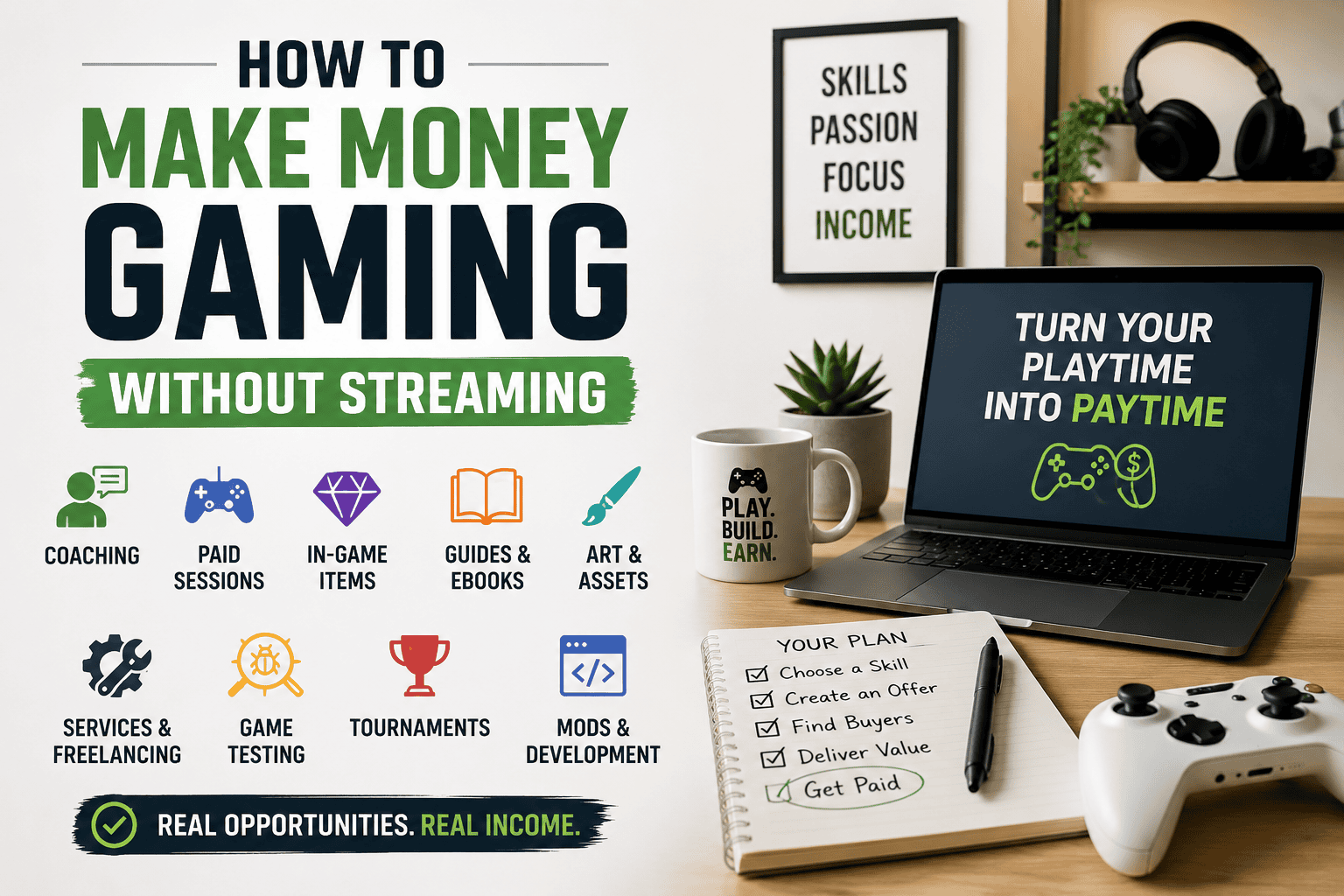
Some of the main ways to make money gaming without streaming include:
- Video game coaching – help other players improve
- Paid gaming sessions – get paid to play with other gamers
- Selling eligible in-game items – monetise valuable transferable items where permitted
- Selling gaming guides – turn your game knowledge into digital products
- Creating game mods – build useful or entertaining content for supported games
- Selling gaming art and graphics – create digital assets for gamers and creators
- Offering gaming services – monetise technical, creative or specialist skills
- Game testing and playtesting – help developers test games and player experiences
- Gaming tournaments – compete for prize money
- Gaming-related freelancing – sell writing, design, development, editing or community skills
The important difference is that these methods don’t necessarily require an audience.
Instead of trying to get thousands of people to watch you play, you’re giving one customer something they’re willing to pay for.
That’s a completely different business model.
💡 You Don’t Need Followers – You Need Something Valuable
Streaming is an audience-based way of making money.
You create content.
People watch.
If enough people keep watching, you may eventually earn through advertising, subscriptions, sponsorships, donations or other monetisation.
That can absolutely work.
But there’s a rather inconvenient stage between:
“I’ll start streaming.”
and:
“This now pays me money.”
It’s called:
building an audience.
And it can take a long time.
Making money without streaming flips the model around.
Instead of asking:
How do I get thousands of people to watch me?
you ask:
What can I offer another gamer that’s valuable enough for them to pay for?
That’s a much more useful question for many gamers.
Maybe you’re excellent at Valorant and can help someone improve their positioning.
Maybe you’ve spent 2,000 hours learning an MMO economy and understand exactly which resources players need.
Maybe you’re great at creating mods.
Maybe you’re the person everyone asks when they can’t optimise a game properly.
Maybe you’re simply reliable, entertaining and enjoyable to play with.
Those can all potentially become starting points.
🧠 Your Gaming Experience Can Be More Valuable Than You Think
One strange thing about gaming is how easily we dismiss the skills we develop because we learned them while playing.
Spend 1,000 hours learning something in almost any other field and we’d probably call it:
experience.
Spend 1,000 hours mastering a game and we say:
“Yeah, I’ve played it a bit.”
But think about what experienced gamers actually learn.
Depending on the game, you might understand:
- Advanced mechanics
- Character builds
- Maps
- Positioning
- Team strategy
- Game economies
- Crafting systems
- Resource locations
- Progression
- Competitive metas
- Hardware and optimisation
- Mods and customisation
Somebody else may want that knowledge, skill or experience.
That’s where the opportunity starts.
Our guide to making money gaming without being a pro explores this idea in more detail, because professional-level mechanical skill is only one type of gaming value.
You might be a better teacher than competitor.
A better creator than player.
A better trader than either.
The gaming industry contains rather more job descriptions than:
“Be ridiculously good at Fortnite.”
💰 Selling Value vs Building an Audience
Here’s the simplest way to understand the difference.
Streaming
Play games → Create content → Build audience → Monetise audience
Direct Gaming Income
Develop skill/knowledge/product → Find someone who values it → Sell it
Neither model is automatically better.
They’re simply different.
Streaming can potentially scale enormously because one creator can reach thousands of viewers simultaneously.
But direct gaming income can have a much lower barrier to making your first dollar because you don’t necessarily need thousands of people.
You might only need:
one coaching client
one gaming-session booking
one guide buyer
or
one person who wants the item you’re selling.
Your first customer doesn’t care whether you have 17 followers or 17 million.
They care whether you can provide what they need.
🚫 You Don’t Have to Become a Content Creator Either
There’s another misconception worth clearing up early.
Not streaming doesn’t mean you have to start a YouTube channel instead.
If you enjoy making videos, brilliant.
Content creation can be one of the many ways to make money playing video games.
But maybe you don’t want to:
- Show your face
- Record your voice
- Edit videos
- Chase algorithms
- Post constantly
- Build a personal brand
- Turn every gaming session into content
That’s completely fine.
You can potentially earn from gaming behind the scenes.
You can teach.
Sell.
Create.
Test.
Design.
Develop.
Play with customers.
Provide services.
No webcam required.
Your RGB lighting may finally be allowed to exist purely because you like RGB lighting.
🚀 Start With What You Already Have
You also don’t need to immediately buy:
a $4,000 gaming PC
a studio microphone
three monitors
professional lighting
a chair that looks like it was removed from a racing car
Start with the games, equipment, skills and knowledge you already have.
Then ask:
What am I genuinely good at?
What do other players ask me for help with?
What do I know that newer players struggle to understand?
What can I create?
What gaming activity do I already enjoy enough to repeat?
Those answers can point toward the right income method.
Maybe that’s coaching.
Maybe it’s paid gaming sessions.
Maybe it’s selling in-game items.
Maybe it’s something completely different.
The goal isn’t to force your hobby into whichever gaming side hustle currently looks fashionable.
It’s to find the overlap between:
what you’re good at
what you enjoy
and
what another gamer values enough to pay for.
And there are considerably more ways to find that overlap than going live and saying:
“Hey guys, welcome to the stream.”
Next, let’s look at why you don’t actually need to become a streamer to make money gaming – and the important difference between building an audience and selling value directly.
Do You Need to Be a Streamer to Make Money Gaming?
No. You don’t need to be a streamer to make money gaming.
Streaming is simply one business model within a much larger gaming economy.
You can potentially earn money by helping other players improve, playing alongside them, selling permitted digital items, creating gaming products, testing games or providing useful gaming-related services.
The key difference is what you’re monetising.
A streamer primarily monetises an audience.
Many other gaming income methods monetise value provided directly to a customer.
That distinction changes almost everything.
📺 How the Streaming Model Works
Streaming usually follows a path something like this:
Play games → Create entertaining content → Attract viewers → Build an audience → Monetise the audience
Potential income might eventually come from:
- Subscriptions
- Advertising
- Donations
- Sponsorships
- Affiliate marketing
- Brand deals
There’s nothing wrong with this model.
For successful creators, it can become extremely valuable.
The difficult part is sitting right there in the middle:
Build an audience.
Before meaningful monetisation happens, you generally need people to discover you, watch you and – ideally – return.
That means streaming isn’t merely:
playing video games while somebody pays you.
You’re also becoming an entertainer, presenter, marketer and community builder.
Occasionally all while trying not to get eliminated because you were reading chat.
🎮 Direct Gaming Income Works Differently
Now compare streaming with gaming coaching.
The model might look like:
Develop gaming expertise → Find a player who needs help → Coach them → Get paid
Or selling an eligible gaming item:
Acquire item → Find buyer → Sell item → Get paid
Or creating a gaming guide:
Develop knowledge → Create guide → Find buyer → Sell guide
Notice what’s missing?
You don’t necessarily need an audience first.
You need a customer.
That’s an important distinction.
You don’t need 10,000 people to know who you are if one player is willing to pay you for something useful.
💰 Audience-Based vs Value-Based Gaming Income
We can simplify the two approaches:
| Audience-Based Income | Direct Value-Based Income | |
|---|---|---|
| Example | Streaming | Coaching |
| Primary asset | Audience | Skill/knowledge |
| Need followers? | Usually important | Not necessarily |
| Income source | Audience/advertisers | Customer |
| Content required? | Yes | Often no |
| Personal brand important? | Usually | Less important |
| First income | Often requires audience growth | Potentially after first customer |
| Scalability | Potentially very high | Depends on method |
Neither approach is inherently better.
The question is:
Which suits you?
If you love performing, creating content and building communities, streaming might be brilliant.
If the thought of narrating everything you do while playing makes you want to unplug your microphone permanently, there are other options.
👤 You Don’t Need to Be Internet Famous
This is one of the most useful things to understand about direct gaming income.
Imagine you offer video game coaching.
A potential customer doesn’t necessarily care whether you have:
50,000 followers
or
50 followers.
They care whether you can help them improve.
If you’re selling a gaming guide, the buyer cares whether the guide solves their problem.
If you’re selling an eligible in-game item, they care whether it’s the correct item, fairly priced and reliably delivered.
If you’re offering a gaming service, they care whether you can actually perform the service.
Your value comes from what you provide, not necessarily how many people recognise your username.
That’s rather liberating.
🧠 You Don’t Even Need to Be an Elite Gamer
You also don’t necessarily need professional-level gaming ability.
Different income methods reward different skills.
For example:
Great at teaching?
Gaming coaching might suit you.
Know a game’s economy inside out?
Item selling or trading might suit you.
Enjoy playing socially?
Paid gaming sessions might suit you.
Excellent writer?
Gaming guides might suit you.
Creative or technical?
Mods, graphics or gaming services might suit you.
Competitive monster with reactions apparently unavailable to normal humans?
Tournaments may be worth exploring.
Your strongest gaming asset might not be your rank.
That’s why making money gaming without being a pro is entirely possible.
⏱️ Streaming Also Requires More Than Gaming Time
This part is easy to underestimate.
A two-hour stream isn’t necessarily a two-hour business.
There may also be:
- Stream preparation
- Channel management
- Social media promotion
- Clip creation
- Video editing
- Thumbnail creation
- Community management
- Sponsorship outreach
Content creators can spend significant amounts of time not playing games at all.
This isn’t a criticism.
It’s simply the nature of the business.
If your goal is:
“I’d like to earn from gaming without becoming a full-time content machine,”
a direct service or product model may fit better.
📱 What About YouTube and TikTok?
YouTube, TikTok and other platforms can absolutely be used to make money from gaming too.
But they’re still primarily content and audience models.
You create something.
You attract attention.
You build reach.
You monetise that reach directly or indirectly.
Again, perfectly legitimate.
But not mandatory.
This article is specifically for the gamer thinking:
“I don’t want to stream.”
“I don’t want to make videos.”
“I don’t want to become an influencer.”
“Can I still make money gaming?”
Yes.
🔄 You Can Use Content Without Depending on It
There’s also a middle ground.
Suppose you’re a gaming coach.
Your income comes primarily from coaching clients.
But you occasionally post:
- Helpful tips
- Short guides
- Gameplay advice
Those posts might help potential customers discover you.
Content becomes marketing, rather than the product itself.
Likewise, someone selling mods might create a short demonstration video.
The video isn’t necessarily how they make money.
It’s how they show people what they’ve created.
That’s very different from needing content views themselves to generate your income.
🛒 Marketplaces Can Replace Part of the Audience-Building Problem
This is where marketplaces become particularly useful.
If you’re trying to sell something independently, you need to find buyers.
That can mean building:
- A website
- An audience
- Social accounts
- A community
- Advertising
A marketplace can instead put sellers and existing buyers in the same place.
You still need to create a good offer.
But you don’t necessarily need to create your own audience from scratch first.
That’s particularly useful for gamers who want to monetise something they already do without simultaneously becoming marketers, influencers and amateur video editors.
🎯 Think Customer First, Followers Second
If you don’t want to stream, stop asking:
“How do I build an audience?”
Start with:
“What can I offer another gamer?”
Maybe you can:
teach them
play with them
save them time
sell them something useful
create something for them
solve a gaming problem
That’s the foundation of making money gaming without streaming.
Your first goal doesn’t need to be:
1,000 followers.
It can simply be:
1 paying customer.
And fortunately, there are quite a few ways to find one.
Next, we’ll compare the 10 best ways to make money gaming without streaming so you can see which opportunities best match your skills, experience and preferred way to play.
10 Ways to Make Money Gaming Without Streaming
So, if you’re not streaming, how can you actually make money from gaming?
There are more options than you might expect.
Some let you earn directly from playing. Others monetise your gaming knowledge, creativity, technical skills or the digital products you create.
And importantly, none of the methods below require you to spend every evening saying:
“Don’t forget to like and subscribe.”
Here’s a quick comparison before we explore the strongest options in more detail.
| Method | What You Monetise | Startup Cost | Skill Level | Income Model |
|---|---|---|---|---|
| 1. Gaming coaching | Knowledge and skill | Low | Medium–High | Per session |
| 2. Paid gaming sessions | Time and gameplay | Low | Low–High | Per session |
| 3. Selling in-game items | Items and game knowledge | Low–Medium | Medium | Per sale |
| 4. Gaming guides | Knowledge | Low | Medium | Per download/sale |
| 5. Game mods | Creative/technical skills | Low | Medium–High | Per download/sale |
| 6. Gaming art and graphics | Creative skills | Low–Medium | Medium–High | Per product/project |
| 7. Gaming services | Specialist skills | Low–Medium | Varies | Per service |
| 8. Game testing | Testing and feedback | None–Low | Low–Medium | Hour/project |
| 9. Gaming tournaments | Competitive skill | None–Medium | High | Prize money |
| 10. Gaming freelancing | Professional skills | Low | Varies | Project/hour |
Let’s quickly look at what each involves.
🎓 1. Gaming Coaching
If you’re knowledgeable about a particular game and can explain why players are making mistakes, coaching can turn that knowledge into income.
You might help players with:
- Mechanics
- Positioning
- Strategy
- Game sense
- Builds
- Decision-making
- Ranked progression
- VOD analysis
The important word is help.
You don’t need to spend the session demonstrating that you’re considerably better than your client.
That’s called showing off.
Coaching means helping them become better.
You also don’t necessarily need professional esports credentials. Strong game knowledge combined with good communication can be far more useful to an average player.
Best for: Experienced gamers who enjoy teaching.
🎮 2. Paid Gaming Sessions
What if you want to earn by actually playing?
Paid gaming sessions can be one of the most direct options.
Depending on the game and applicable rules, players might pay for:
- Casual/social sessions
- Competitive sessions
- Hired gun/carry-style sessions
- Content collaborations
This can suit gamers who are reliable, friendly and enjoyable to play with – even if they aren’t professional-level players.
Sometimes another gamer isn’t looking for a coach.
They just want:
someone competent to play with.
A revolutionary concept after several evenings of random matchmaking.
Best for: Social gamers and skilled teammates.
💎 3. Selling In-Game Items
If you understand a game’s economy, eligible in-game items can potentially become another source of income.
Depending on the game and its rules, this might involve:
- Farming resources
- Crafting items
- Trading
- Selling unwanted valuable items
The key is finding the overlap between:
buyer demand + efficient acquisition + worthwhile profit.
Rare doesn’t automatically mean valuable.
The item needs somebody willing to buy it.
We’ve covered the entire process in our guide to making money selling in-game items.
Best for: Gamers who enjoy farming, crafting, trading and game economies.
📚 4. Create and Sell Gaming Guides
Think about a game you know extremely well.
How much do you know that a beginner doesn’t?
Potentially hundreds of hours’ worth.
That knowledge could become:
- Build guides
- Farming guides
- Strategy guides
- Progression plans
- Boss guides
- Checklists
- Economy guides
- Reference sheets
A digital guide has another advantage:
you create it once and can potentially sell it repeatedly.
That’s very different from selling your time by the hour.
The challenge is creating something useful enough that players are willing to pay rather than simply searching for free information.
Best for: Knowledgeable gamers who can explain complicated systems clearly.
🛠️ 5. Create Game Mods
If you enjoy tinkering with games rather than simply playing them, modding can open another route.
Depending on the game, you might create:
- Gameplay modifications
- Visual enhancements
- Quality-of-life improvements
- Maps
- Custom content
- Other permitted modifications
Mods can potentially be monetised where the game’s rules and distribution model allow it.
Always check publisher policies before selling or monetising mods.
Apparently spending 80 hours making every dragon wear a tiny hat doesn’t automatically grant you commercial rights to the underlying game.
Legal systems continue to disappoint.
Best for: Technical and creative gamers.
🎨 6. Sell Gaming Art and Graphics
You don’t even need to be particularly good at playing games to earn within gaming.
Creative skills can be valuable too.
Potential products and services include:
- Gaming artwork
- Character art
- UI assets
- Icons
- Textures
- Overlays
- Stream graphics
- Gaming templates
Yes, stream graphics can make you money without you becoming a streamer.
There’s something pleasingly efficient about letting somebody else deal with chat while you sell them the graphics.
Best for: Designers, illustrators and creative gamers.
🧑💻 7. Offer Gaming Services
Gaming creates all sorts of problems players and creators may be willing to pay someone to solve.
Depending on your skills, legitimate services might include:
- Game optimisation
- Stream customisation
- Game development
- Technical assistance
- Other specialist gaming services
This category is deliberately broad because the valuable skill may exist around the game rather than inside it.
Maybe you’re not the person carrying everyone through ranked.
You’re the person who can work out why their game suddenly runs at 37 FPS.
That can still be useful.
Best for: Gamers with technical or specialist skills.
🧪 8. Get Paid to Test Games
Game testing sounds suspiciously like:
“Play unreleased games and get paid.”
Sometimes it involves that.
It can also involve:
“Walk into this wall 27 times and tell us exactly when the character clips through it.”
Professional QA testing is about finding, reproducing and documenting problems.
Separate playtesting opportunities may instead involve playing a game and providing feedback about:
- Controls
- Difficulty
- Tutorials
- Gameplay
- User experience
- Features
It can be an interesting way to earn from gaming without needing an audience.
Best for: Detail-oriented gamers who enjoy analysing how games work.
🏆 9. Enter Gaming Tournaments
Competitive players can potentially earn through:
- Online tournaments
- Community competitions
- Amateur leagues
- Esports events
The upside can be significant in some competitions.
The downside is fairly obvious:
you need to win.
Prize-based gaming income is therefore much less predictable than selling a product or service.
I wouldn’t recommend tournaments as the default plan for someone trying to earn their first $50 gaming.
But if you’re already highly competitive, they can be one piece of the puzzle.
Best for: Highly skilled competitive players.
💼 10. Gaming Freelancing
Finally, look at skills you’ve developed because of gaming or around gaming.
Perhaps you can offer:
- Gaming writing
- Video editing
- Graphic design
- Community management
- Discord management
- Game development
- QA
- Research
These are conventional freelance skills applied to the gaming industry.
You may not technically be paid for playing the game itself.
But you’re still turning your gaming knowledge and interests into income.
And for some people, this can become considerably more reliable than hoping tonight’s stream finally goes viral.
Best for: Gamers with transferable professional, creative or technical skills.
📊 Which Methods Are Easiest to Start?
There’s no universal winner.
But if you’re starting with little money and no audience, I’d look first at methods that use something you already have:
Your gaming skill → Coaching
Your time → Gaming sessions
Your game knowledge → Guides
Your existing eligible inventory → In-game items
Your technical/creative skills → Services or digital products
You don’t need to launch five simultaneously.
In fact, please don’t.
Trying coaching, item selling, game testing, mod development and freelance design in the same weekend is less a side hustle strategy and more an excellent way to achieve nothing efficiently.
Pick one.
Test it.
See whether people will pay.
Then improve it.
🎯 The Best Method Depends on What You’re Good At
Ask yourself:
Am I good at teaching?
Do I enjoy playing with other people?
Do I understand game economies?
Can I create useful digital products?
Do I have creative or technical skills?
Am I genuinely competitive?
Your answers will point toward different opportunities.
And if teaching other players immediately sounds like something you’d enjoy, the first option deserves a much closer look.
Because video game coaching can turn something many experienced gamers already do for free – helping friends improve – into a paid service.
1. 🎓 Make Money With Video Game Coaching
If you’re good at a game and regularly find yourself explaining things to other players, video game coaching can be one of the most natural ways to make money gaming without streaming.
Instead of building an audience and hoping thousands of people eventually watch you play, you’re working directly with individual players who want to improve.
You’re essentially selling:
your gaming knowledge + your ability to teach it.
And no, you don’t necessarily need to be a professional esports player.
Being unbelievably good at a game and being unbelievably good at explaining it are two entirely different skills.
We’ve all played with someone who can pull off mechanically ridiculous plays but, when asked how they did it, provides the insightful coaching advice:
“Just do this.”
Cheers, coach.
🎮 What Does a Gaming Coach Actually Do?
A gaming coach helps another player understand their gameplay and improve specific areas.
Depending on the game, that could include:
- Mechanics
- Aim
- Positioning
- Map awareness
- Strategy
- Decision-making
- Builds or loadouts
- Communication
- Teamwork
- Game sense
- Ranked progression
A good coach doesn’t simply tell someone:
“Play better.”
They identify why the player is struggling and give them practical things to work on.
For example, maybe a player thinks their aim is holding them back.
After watching their gameplay, you notice they’re repeatedly taking terrible fights from exposed positions.
Their mechanical skill may not actually be the main problem.
Spotting things the player can’t easily recognise themselves is where coaching becomes valuable.
🧠 You Don’t Need to Be a Pro Gamer
This is probably the biggest misconception around gaming coaching.
Players sometimes assume they need:
professional esports experience
or
the highest possible rank
before anyone would pay them for advice.
Not necessarily.
Your required skill level depends on who you’re coaching.
Imagine you’re an advanced player helping beginners.
You don’t need to be one of the best 100 players in the world to teach someone who has just started learning:
- Core mechanics
- Basic positioning
- Character roles
- Map awareness
- Common mistakes
You simply need to know considerably more than the person you’re helping and be able to teach that knowledge effectively.
That’s why our guide to making money gaming without being a pro is so relevant here.
There are plenty of ways gaming experience can be valuable without your name appearing on an esports trophy.
🗣️ Teaching Ability Matters
This is where great players can sometimes make terrible coaches.
Suppose you instantly recognise that a player made the wrong decision.
That’s useful.
But can you explain:
what they did wrong?
why it was wrong?
what they should have done instead?
how they can recognise the same situation next time?
That’s coaching.
The goal isn’t to prove how much better you are.
It’s to make the other player better.
Patience, communication and the ability to simplify complicated ideas can matter just as much as raw mechanical skill.
🖥️ Live Gaming Coaching
One common format is live coaching.
You might:
- Watch the player while they play
- Give real-time feedback
- Discuss decisions between matches
- Demonstrate techniques
- Work through specific weaknesses
Live coaching can be useful because you see how the player responds in the moment.
Maybe they understand positioning perfectly while discussing it calmly.
Then the match starts, three enemies appear and every piece of tactical knowledge immediately leaves the building.
Seeing those moments can help identify what actually needs work.
🎥 VOD Reviews
Another option is reviewing recorded gameplay.
The player sends you footage of a match.
You analyse it and provide feedback.
This can let you pause, rewind and examine important moments more carefully than during a live session.
You might identify:
- Positioning mistakes
- Missed information
- Poor rotations
- Bad engagements
- Resource management problems
- Repeated decision-making patterns
VOD reviews can be particularly useful for strategic games where the biggest mistakes aren’t always obvious while everything is happening at full speed.
🎯 Specialise Instead of Coaching Everything
You don’t need to offer:
“I will make you better at every aspect of this game.”
A more focused coaching offer can actually be stronger.
Maybe you’re particularly good at:
aim and mechanics
specific characters
support roles
ranked strategy
beginner fundamentals
team communication
VOD analysis
Specialisation makes it easier for buyers to understand:
“This coach helps with the exact thing I’m struggling with.”
It also lets you concentrate on areas where you genuinely have something valuable to offer.
💰 How Do Gaming Coaches Make Money?
Gaming coaches commonly charge for their time or for a defined coaching service.
For example:
60-minute live coaching session
or:
VOD review + written feedback
Your earning potential depends on factors such as:
- Game
- Experience
- Rank
- Coaching ability
- Reputation
- Reviews
- Session length
- Specialisation
- Demand
Don’t assume you need to charge premium rates immediately.
When you’re new, your first objective is proving that people value your coaching.
A few successful sessions and positive reviews can be much more useful than creating an expensive offer nobody books.
📈 Coaching Can Have Better Economics Than Farming
This is worth considering if you’re comparing different gaming side hustles.
Imagine farming items earns you:
$6 per hour.
But your gaming knowledge is valuable enough that somebody will pay:
$25 for an hour of coaching.
Suddenly, the economics look very different.
You’re monetising something you’ve spent years developing:
expertise.
And unlike inventory, your knowledge doesn’t disappear when you sell it.
Coach one player today and you can sell another coaching session tomorrow.
That’s one reason service-based gaming income can be attractive.
⭐ Your Reputation Can Increase Your Value
When you’re starting, buyers don’t know whether you’re a good coach.
Over time, successful sessions can help you build:
- Reviews
- Testimonials
- Repeat clients
- Coaching experience
- A stronger seller profile
That can make it easier for future players to trust you.
Eventually, reputation itself becomes part of the value you’re offering.
The coach with a history of helping players improve may be able to charge more than someone whose entire sales pitch is:
“Trust me, I’m cracked.”
🛒 Where Can You Sell Gaming Coaching?
You can offer coaching through specialist gaming marketplaces that support coaching services.
For example, players can browse gaming coaching sessions on StackedGame to find coaches offering help across different games and skills.
For sellers, a marketplace can reduce one of the biggest problems with making money without an audience:
finding customers.
Instead of needing thousands of followers, you can create an offer where players are already looking for gaming services.
You still need a compelling listing and a useful service.
But you don’t necessarily need to become an influencer first.
🚀 How to Start as a Gaming Coach
A simple starting process looks like this:
1. Choose a game you know well
Don’t coach something because it’s popular if you barely understand it.
2. Identify what you can teach
Maybe that’s beginner fundamentals, positioning, mechanics or a specific role.
3. Decide on a coaching format
Live coaching? VOD review? Both?
4. Create a clear offer
Explain exactly who the coaching is for and what you’ll help them improve.
5. Start with a realistic price
You can refine pricing as you gain experience and reviews.
6. Coach your first player
Then learn from the experience.
If this route appeals to you, our complete guide to how to become a gaming coach takes you through the process in much greater detail.
🎯 Who Is Gaming Coaching Best For?
Coaching may suit you if:
✓ You know a game deeply
✓ You’re patient
✓ You enjoy helping other players
✓ You can explain why something works
✓ You’re comfortable communicating one-on-one
✓ You can give constructive feedback without behaving like a ranked teammate who has just lost three games
That final skill is more valuable than it sounds.
If coaching doesn’t appeal to you, there’s another way to monetise your actual gaming time without teaching anyone.
Sometimes people simply want a reliable, skilled or entertaining person to play with.
And that’s where paid gaming sessions come in.
2. 🎮 Get Paid to Play Games With Other People
What if you don’t want to teach people how to play?
You just want to play.
Paid gaming sessions can be one of the most direct ways to make money gaming without streaming because another player pays for your time, gaming ability or the experience of playing together.
No audience required.
No video editing.
No thumbnail containing your shocked face next to an enormous red arrow.
You arrange a session, play the game and provide the experience the buyer booked.
For some gamers, that’s considerably closer to what they imagined when they first heard:
“You can get paid to play video games.”
🕹️ What Are Paid Gaming Sessions?
A paid gaming session is an arranged period where another player pays to game with you for a particular purpose.
That purpose can vary considerably.
Some players want:
- A reliable teammate
- Help completing difficult content
- Competitive support
- Someone experienced to play with
- A social gaming partner
- A collaborator for gaming content
The value isn’t always:
“This person is unbelievably good.”
Sometimes it’s:
“This person actually turns up, communicates and doesn’t rage-quit after the first loss.”
Anyone who has spent enough time in random matchmaking will appreciate that this is apparently a premium service.
⚔️ Hired Gun and Carry-Style Sessions
Skilled players may be able to offer sessions where they join another player for difficult or competitive gameplay, where permitted.
That might involve:
- Difficult missions
- Raids
- Boss encounters
- Cooperative challenges
- Competitive matches
The important distinction is that you’re playing alongside the buyer rather than taking over their account.
Always check the relevant game’s current rules before offering these types of sessions.
Different publishers have different policies around commercial activity, boosting and related services.
🏆 Competitive Gaming Sessions
Some players simply want better teammates.
Maybe they’re tired of entering ranked matchmaking and discovering their team strategy consists of:
three people pushing different directions while one person argues in chat.
A competitive gaming session might involve playing alongside someone who values:
- Strong mechanics
- Communication
- Teamwork
- Game knowledge
- Reliability
You don’t necessarily need to be a professional player.
But if you’re charging someone specifically for competitive ability, you should obviously be able to deliver what your listing promises.
“Elite ranked teammate” becomes a difficult proposition if you spend the entire session asking which button reloads.
👋 Casual and Social Gaming Sessions
This is an interesting category because mechanical skill may not be the main selling point at all.
Some gamers simply want someone friendly and reliable to play with.
That could include:
- Casual multiplayer
- Cooperative games
- Exploring game worlds
- Completing activities together
- Social gaming
The value is the experience.
Maybe the buyer doesn’t have friends who play the same game.
Maybe their normal group isn’t available.
Maybe they want someone experienced who can help make the session enjoyable without turning every match into an esports final.
If you’re social, patient and good company, those are genuine strengths.
🎥 Content and Collaboration Sessions
Gaming creators sometimes need other players for:
- Videos
- Challenges
- Multiplayer recordings
- Screenshots
- Testing ideas
- Collaborative content
You don’t need your own audience to participate.
In this situation, you’re being paid for your:
time, reliability and contribution to somebody else’s project.
Which means you can technically make money helping someone stream without having to become a streamer yourself.
We’ve successfully outsourced the terrifying part.
🧠 What Makes Someone Worth Paying to Play With?
This is where people often assume:
high rank = valuable session
But that’s only part of it.
Depending on the session, buyers may value:
- Gaming skill
- Experience
- Communication
- Reliability
- Patience
- Teamwork
- Personality
- Game knowledge
Think about the people you genuinely enjoy gaming with.
They’re probably not simply the players with the highest stats.
They’re the ones who:
communicate
help the team
don’t disappear halfway through
and
don’t make you regret joining voice chat.
Those qualities matter when someone is paying for the experience.
💰 How Do You Price Gaming Sessions?
Paid sessions are usually easiest to structure around a clear amount of time or defined activity.
For example:
60-minute casual gaming session
or:
90-minute competitive session
Pricing can depend on:
- Game
- Session type
- Your skill level
- Session length
- Demand
- Reputation
- Reviews
Don’t choose a price simply because another seller charges it.
Ask whether the amount makes sense for your time and what you’re providing.
If a session requires preparation, coordination or additional work, factor that in too.
📋 Make the Session Clear Before It Starts
A good listing should answer basic questions such as:
What game are we playing?
Which platform?
What type of session is this?
How long does it last?
What skill level is it aimed at?
Do we need voice chat?
Are there any prerequisites?
The clearer the listing, the less time you spend answering:
“So what exactly do I get?”
after someone has already booked.
⏰ Reliability Is a Competitive Advantage
This sounds boring.
It is also extremely important.
If someone books you for 7:00 pm, be ready at 7:00 pm.
If something genuinely prevents you from attending, communicate.
A player who is slightly less skilled but consistently:
shows up
communicates
delivers what was promised
may build a better reputation than someone mechanically brilliant who treats scheduled sessions as vague suggestions.
You are no longer merely logging on whenever you feel like playing.
Someone has paid for your time.
That changes things.
⭐ Good Sessions Can Lead to Repeat Buyers
Paid gaming sessions also have strong repeat-customer potential.
If someone enjoys playing with you, they may book again.
That means your first successful session can potentially become:
one booking → repeat booking → regular customer
You don’t need to rebuild trust from scratch each time.
This is where providing a genuinely good experience matters.
You’re not trying to extract maximum money from one session.
You’re trying to become someone buyers are happy to play with again.
🛒 Where Can You Offer Paid Gaming Sessions?
Gaming marketplaces can connect players offering sessions with buyers looking for people to play with.
On StackedGame, gaming sessions can cover different purposes, including:
Hired Gun / Carry & Win
Competitive
Content & Collab
Casual & Social
That gives sellers several ways to package what they already enjoy doing rather than squeezing every gamer into the same type of service.
If you’re interested in offering sessions, you can become a seller on StackedGame and create listings around the games and session types you want to offer.
⚠️ Check the Game’s Rules
As with any gaming-related commercial activity, check the current rules for the game you’re playing.
Some publishers restrict certain:
- Commercial services
- Boosting activities
- Account sharing
- Real-money transactions
Don’t assume something is permitted simply because other players are advertising it somewhere.
And avoid services that require prohibited account access or other rule-breaking activity.
A sustainable gaming side hustle works much better when your business plan isn’t:
“Hopefully nobody notices.”
🎯 Who Are Paid Gaming Sessions Best For?
Paid sessions could suit you if:
✓ You already spend plenty of time playing multiplayer games
✓ You’re reliable
✓ You communicate well
✓ You enjoy playing with new people
✓ You have useful gaming skills or experience
✓ You can provide an enjoyable session
For the right gamer, it’s one of the clearest examples of earning directly from gaming without streaming.
You don’t need viewers.
You need another player who values the experience you provide.
But gaming time isn’t the only thing you can monetise.
If you’ve spent years accumulating valuable digital inventory or learning the economies behind your favourite games, there may be another opportunity hiding inside your account.
Next, we’ll look at making money by selling eligible in-game items.
3. 💎 Make Money Selling In-Game Items
If you’ve spent enough time playing games with player-driven economies, there’s a decent chance you’ve accumulated an inventory containing:
valuable items
useful resources
and
approximately 4,000 things you’re keeping because you might need them someday.
For eligible games and items, some of that digital inventory may potentially be worth real money.
Selling in-game items is another way to make money gaming without streaming because you’re monetising items and your understanding of a game’s economy, rather than an audience.
Depending on the game, that could involve acquiring items through legitimate:
- Farming
- Crafting
- Trading
- Normal gameplay
Then selling transferable items that other players genuinely want.
🎮 What Types of In-Game Items Can Have Value?
The exact opportunities depend entirely on the game.
Potential examples can include:
- Crafting materials
- Resources
- Equipment
- Weapons
- Armour
- Consumables
- Collectibles
- Other transferable digital items
But don’t make the classic mistake of assuming:
rare = valuable.
An item can have a microscopic drop rate and still be worth approximately nothing if nobody wants it.
What matters is demand.
A boring crafting material needed by thousands of players may create a better selling opportunity than a spectacular-looking item that sells once every six months.
Sometimes the economic hero isn’t the legendary sword.
It’s 500 pieces of ore.
Gaming remains humbling.
🔍 Look for Items Players Actually Want
Before spending hours acquiring inventory, research the market.
You’re looking for items with some combination of:
Demand – players actually want them.
Margin – enough difference exists between your costs and selling price.
Volume – buyers purchase them regularly enough.
Efficiency – you can acquire them without spending absurd amounts of time.
That last point matters.
Making $20 profit sounds considerably less exciting when you discover it required eight hours of repetitive farming.
Always think about profit per hour, not simply profit per sale.
🌾 Farming Can Turn Game Knowledge Into Inventory
Experienced players often know efficient ways to acquire resources.
Maybe you understand:
- The best farming routes
- Efficient builds
- Resource locations
- Respawn patterns
- Activities with useful secondary drops
That knowledge can make you considerably more efficient than somebody approaching the same game without experience.
You’re not simply monetising your playtime.
You’re monetising everything you’ve learned about how to use that playtime efficiently.
Just make sure your farming methods comply with the game’s rules.
Prohibited bots, exploits or automation are not clever scaling strategies.
They’re more like putting a countdown timer on your account.
🔨 Crafting Can Create Additional Value
Sometimes raw resources aren’t the most profitable thing to sell.
You may be able to turn materials into:
- Equipment
- Consumables
- Upgrade items
- Components
- Other desirable products
But don’t assume crafting automatically creates profit.
If the materials could sell for $10 and the finished product sells for $11 after fees, your magnificent crafting empire has produced approximately:
$1.
Before celebrating, calculate:
Finished selling price – material value – other costs = potential profit
Your materials aren’t free simply because you farmed them yourself.
They still took time to acquire and may have their own market value.
🔄 Trading Rewards Market Knowledge
Another approach is trading.
Instead of farming an item, you might acquire it at one price and sell it at another.
That shifts the advantage from:
efficient gameplay
toward:
understanding the market.
Experienced traders may look for:
- Mispriced items
- Supply shortages
- Changing demand
- Update-driven opportunities
- Price differences
But trading also introduces risk.
Buy an item for $30 expecting to sell it for $45 and a game update can turn your clever investment into:
a $17 reminder that markets move.
Start small.
💰 Calculate Your Real Profit
Suppose you sell an item for:
$40
but acquiring it cost:
$20
and selling costs total:
$5.
Your profit is:
$15.
Now suppose it took you three hours to acquire, list and deliver.
Your effective return is:
$5 per hour.
That’s the number you should use when deciding whether the opportunity is worth repeating.
If you would have been playing and acquiring the item anyway, you might view that return differently.
But know what you’re actually earning.
Revenue screenshots are exciting.
Profit calculations are useful.
🛒 Where Can You Sell In-Game Items?
Depending on the game and its rules, eligible items may be sold through supported trading systems or gaming marketplaces.
On StackedGame, buyers can browse in-game items offered by sellers across supported games.
For sellers, a marketplace can provide somewhere to create a listing and connect with gamers already looking for digital gaming products.
That’s particularly useful when you’re trying to earn without building your own audience.
You don’t necessarily need thousands of followers.
You need someone who wants the item you’re offering.
🛡️ Check the Rules Before Selling
This part is essential.
An item being tradable inside a game does not automatically mean the publisher allows it to be sold externally for real money.
Before selling, check the game’s current rules covering:
- Real-money trading
- Virtual items
- External marketplaces
- Commercial activity
- Player-to-player transfers
Also follow the rules of whichever marketplace you’re using.
Don’t try to sell account-bound items or bypass transfer restrictions.
If something can’t legitimately be transferred, that’s a strong hint that it shouldn’t appear in your product catalogue.
🔐 Protect Your Gaming Account
Whenever digital items and real money meet, scammers tend to arrive shortly afterwards.
Use sensible security practices:
- Never share passwords
- Never share authentication codes
- Be suspicious of unexpected links
- Don’t install files sent by random buyers
- Verify payment through the legitimate system
- Confirm buyer details before transferring valuable items
If somebody tells you they need your two-factor authentication code to complete the purchase, what they actually need is:
access to your account.
Don’t give it to them.
📚 Want the Complete Item-Selling Process?
We’ve only covered the essentials here because this article is about the wider range of ways to make money gaming without streaming.
If selling digital inventory sounds like your kind of side hustle, our complete guide to how to make money selling in-game items goes much deeper into:
- Finding profitable items
- Researching demand
- Farming
- Crafting
- Trading
- Pricing
- Creating listings
- Delivery
- Scams and security
- Calculating profit
- Scaling your sales
That’s the better place to start if you’re seriously considering this route.
🎯 Who Is Selling In-Game Items Best For?
This method may suit you if:
✓ You understand a game’s economy
✓ You enjoy farming, crafting or trading
✓ You know which items players value
✓ You can acquire inventory efficiently
✓ The game permits the transactions you’re considering
✓ You’re willing to manage listings and deliveries
The big advantage is that you can potentially monetise gaming knowledge you’ve already accumulated without ever appearing on camera.
But perhaps the most valuable thing you’ve accumulated isn’t sitting in your inventory at all.
It might be sitting in your head.
If you know the best builds, farming routes, strategies or progression methods, you may be able to turn that knowledge into something you create once and potentially sell repeatedly.
Next, we’ll look at making money by creating and selling gaming guides.
4. 📚 Make Money Selling Gaming Guides
If you’ve played a game for hundreds — or thousands — of hours, there’s a good chance you know things newer players would happily skip 200 hours of trial and error to learn.
You might know:
- The fastest progression routes
- The best character builds
- Efficient farming locations
- Boss strategies
- Crafting systems
- PvP tactics
- Hidden mechanics
- Game economy tricks
- Common beginner mistakes
To you, that information may feel obvious.
That’s because you’ve spent an unreasonable portion of your life learning it.
To somebody who installed the game yesterday, it can be extremely useful.
Turning that knowledge into a gaming guide is another way to make money gaming without streaming — and unlike coaching or paid sessions, a digital guide can potentially be sold more than once.
🧠 Your Gaming Knowledge Is the Product
With coaching, you sell your knowledge through your time.
With a guide, you package that knowledge into a product.
For example, instead of spending an hour explaining the same beginner progression strategy to five different players, you could create:
The Complete Level 1–50 Progression Guide
and potentially sell the same guide to multiple buyers.
That creates a very different income model:
Research → Create → Sell → Sell again
Rather than:
Work one hour → Get paid once
Of course, creating a genuinely useful guide takes work upfront.
But once it exists, delivering another digital copy generally doesn’t require you to defeat the same boss another 37 times.
That’s rather appealing.
🎮 What Types of Gaming Guides Can You Sell?
“Gaming guide” covers a huge range of possible products.
Depending on the game, you might create:
- Beginner guides
- Character build guides
- Class guides
- Weapon guides
- Farming guides
- Crafting guides
- Levelling guides
- Progression roadmaps
- Boss guides
- PvP guides
- Achievement guides
- Economy and trading guides
- Checklists
- Reference sheets
The strongest guides usually solve a specific problem.
Compare:
Guide to Elden Ring
with:
Early-Game Strength Build Guide for New Players
The second tells the buyer much more clearly what they’ll get.
Specificity helps.
🔍 Find Problems Players Are Already Trying to Solve
Don’t create a guide simply because you know a lot about something.
Create one because players want help with it.
Look at the questions players repeatedly ask.
Maybe they struggle with:
“What should I do first?”
“Which build should I use?”
“Where do I farm this resource?”
“How do I beat this boss?”
“What’s the fastest way to level?”
“Why am I permanently broke?”
That last question has remarkable crossover between virtual economies and real life.
Repeated questions can reveal potential demand.
The more painful, confusing or time-consuming the problem, the more valuable a genuinely good solution can become.
💡 Free Information Doesn’t Mean Paid Guides Can’t Work
This is an obvious question:
Why would somebody buy a gaming guide when there’s so much free information online?
Fair point.
A paid guide needs to provide something better than:
information that exists somewhere on the internet.
Its value might come from:
- Better organisation
- Greater depth
- Clearer explanations
- Tested strategies
- Convenient reference material
- Saving research time
- Bringing scattered information together
- A specific progression system
Imagine the information a player needs exists across:
four Reddit threads
three YouTube videos
a wiki
and
one forum post written in 2019
A well-organised guide can save them the archaeological expedition.
You’re not necessarily selling secret information.
You may be selling clarity and convenience.
✍️ Make the Guide Genuinely Useful
A good gaming guide shouldn’t feel like somebody stretched three tips across 30 pages to justify charging for a PDF.
Give readers something practical.
Depending on the topic, that might include:
- Step-by-step instructions
- Recommended builds
- Screenshots
- Maps
- Tables
- Checklists
- Examples
- Progression milestones
- Common mistakes
- Alternative strategies
Ask yourself:
Could the buyer actually use this while playing?
If yes, you’re moving in the right direction.
If the guide spends six pages explaining that “practice makes perfect,” perhaps return to the drawing board.
🎯 Specialised Guides Can Be More Valuable
You don’t need to create the definitive encyclopedia for an entire game.
In fact, a narrower guide may be easier to create and easier to sell.
Instead of:
Complete Guide to Everything in Game X
consider:
Best Solo Progression Route
Beginner Crafting Guide
PvP Positioning Guide
Endgame Farming Checklist
Economy and Trading Guide
The buyer immediately understands the problem being solved.
It also lets you create guides around areas where you have genuine expertise rather than pretending you know every obscure mechanic in a 15-year-old MMO.
Nobody knows everything.
Except apparently the person replying to every question on the game’s subreddit.
💰 How Do Gaming Guides Make Money?
The simplest model is selling the guide as a digital download.
You create the product once, then potentially sell copies repeatedly.
For example:
Guide price: $10
If you sell:
5 copies → $50 revenue
20 copies → $200 revenue
100 copies → $1,000 revenue
Those figures are only illustrations, of course — actual sales depend on demand, pricing, competition and the quality of the product.
And remember:
revenue isn’t profit.
You still need to consider marketplace fees, production costs and the time spent creating and maintaining the guide.
⏱️ The Economics Are Different From Coaching
Suppose creating a detailed guide takes you:
20 hours.
At first, that looks terrible compared with a one-hour paid coaching session.
But the guide can potentially keep selling.
If it earns $200, your initial return is:
$10 per hour.
If it eventually earns $600:
$30 per hour.
If it earns absolutely nothing:
You have created a beautifully formatted reminder to research demand before spending 20 hours making things.
Digital products can scale better than selling time, but they also involve more upfront risk.
🔄 Keep Your Guides Updated
Games change.
A brilliant guide can become obsolete after:
one balance patch
one expansion
or
one developer deciding your favourite build was having far too much fun.
If you sell guides for actively updated games, review them when major changes happen.
Update:
- Builds
- Item recommendations
- Strategies
- Screenshots
- Progression routes
- Patch-specific information
Make the version or update date clear where useful.
Nobody wants to buy:
The Ultimate 2026 Strategy Guide
and discover half the recommended items were removed in 2024.
⚠️ Respect Copyright and Game Rules
Creating a guide about a game doesn’t mean you own the game’s intellectual property.
Be careful with copyrighted:
- Artwork
- Screenshots
- Maps
- Logos
- Characters
- Other game assets
Check the publisher’s policies and applicable rules when using game-related material commercially.
Where possible, create your own original explanations, diagrams, tables and supporting material rather than simply copying existing resources.
The value should come from your expertise — not from repackaging somebody else’s work with a nicer heading.
🛒 Where Can You Sell Gaming Guides?
Digital gaming marketplaces can provide a way to connect guides with gamers already looking for gaming-related products.
On StackedGame, sellers can offer gaming guides as digital downloads, giving knowledgeable players another way to turn their expertise into something other gamers can buy.
That can be particularly useful when you don’t already have an audience.
Instead of needing 50,000 YouTube subscribers, you can focus on creating a useful product and presenting it clearly to potential buyers.
⭐ Build a Collection Instead of One Giant Guide
If your first guide works, you don’t necessarily need to make it 400 pages longer.
You might create several focused products.
For example:
Beginner Guide
↓
Build Guide
↓
Farming Guide
↓
Endgame Guide
Now your knowledge supports multiple products aimed at different problems.
You may even eventually combine several related guides into a larger bundle.
This is where gaming knowledge can start becoming a small digital product catalogue rather than a one-off experiment.
🎯 Who Is Selling Gaming Guides Best For?
Gaming guides may suit you if:
✓ You know a game deeply
✓ You enjoy explaining things
✓ You can organise information clearly
✓ Players regularly ask questions you know how to answer
✓ You prefer creating a product over selling your time
✓ You’re willing to keep time-sensitive information updated
You don’t need a webcam.
You don’t need to entertain a live audience.
You don’t even need to be online when somebody buys the guide.
You take what you know, organise it into something genuinely useful and create a product another gamer can use.
And if your talents are less about explaining games and more about changing them, the next opportunity takes us into considerably more technical territory.
Next, we’ll look at making money by creating and selling game mods.
5. 🛠️ Make Money Creating Game Mods
Some gamers play a game and think:
“This is brilliant.”
Modders play the same game and think:
“This is brilliant… but what if I changed half of it?”
If you enjoy creating, coding, designing or tinkering with games, game modding can potentially become another way to make money gaming without streaming.
Instead of monetising your ability to play, you’re monetising your ability to create something that improves, changes or expands another player’s experience.
Depending on the game and what its publisher permits, mods can range from small quality-of-life improvements to enormous projects that feel almost like entirely new games.
And unlike coaching or paid gaming sessions, a mod is a digital product.
Create it once and, potentially, many different players can use it.
🎮 What Is a Game Mod?
A game mod – short for modification – changes or adds something to an existing game.
That could mean:
- New gameplay mechanics
- New maps
- Additional quests
- Visual improvements
- UI changes
- New characters
- Items or equipment
- Quality-of-life features
- Difficulty changes
- New game modes
- Custom content
Some mods make tiny improvements.
Others become so ambitious that you begin wondering whether the creator remembered they weren’t actually employed by the developer.
The important point is that mods solve problems, add content or give players new ways to experience a game they already enjoy.
💡 Why Would Players Pay for Mods?
The same principle we’ve used throughout this guide applies:
value.
A player may value a mod because it:
improves the game
saves time
adds useful features
introduces new content
or simply:
makes the game more fun.
A particularly useful mod can potentially remain relevant for years if the underlying game retains an active community.
That’s very different from earning money one gaming session at a time.
🧠 What Skills Do You Need?
Modding varies enormously between games.
Depending on what you’re creating, useful skills might include:
- Programming
- Scripting
- 3D modelling
- Texture creation
- Animation
- Level design
- Sound design
- UI design
- Game balancing
- Writing
But don’t look at that list and assume you need to master all of them before opening a modding tool.
You don’t.
A simple UI improvement may require a completely different skill set from building a new quest line.
Start with something manageable.
Your first mod probably doesn’t need to be:
“Skyrim 2, except I’ve made it myself.”
🔍 Find Problems Players Want Solved
As with gaming guides, good mod ideas often begin with frustration.
Look at what players repeatedly complain about.
Maybe:
- The inventory system is awkward
- The UI hides important information
- A repetitive action could be improved
- Players want additional customisation
- The game lacks a particular feature
- A popular system could be expanded
A problem that thousands of players experience can create demand for a good solution.
Sometimes the best mod idea begins with:
“Why on earth did the developer make it work like this?”
Then you discover 14,000 other people have asked exactly the same question.
Opportunity spotted.
🎨 Mods Don’t Have to Be Huge
It’s easy to look at famous total-conversion mods and assume successful modding requires years of development.
It doesn’t.
Small mods can be extremely useful.
For example:
UI improvement
inventory enhancement
visual tweak
new item
quality-of-life feature
A narrowly focused mod that solves one irritating problem brilliantly may be more useful than an enormous project that never actually gets finished.
This is particularly important if you’re trying to turn modding into a side hustle.
A finished useful product has an interesting commercial advantage over:
“Massive RPG overhaul – 6% complete.”
💰 How Can Game Mods Make Money?
Monetisation depends heavily on the game, platform and publisher’s rules.
Where permitted, mod creators may potentially earn through models such as:
- Selling eligible mods
- Paid downloads
- Official creator programmes
- Revenue-sharing systems
- Donations or supporter models
- Commissioned custom mod work
Some games actively support commercial modding.
Others allow mods but restrict how creators can monetise them.
Others may prohibit particular forms of commercial use.
That means there isn’t one universal:
“Here’s how to sell any mod for any game.”
The publisher gets a rather significant vote.
⚠️ Check the Game’s Modding and Commercial-Use Rules
This is essential.
Before trying to sell or otherwise monetise a mod, check the game’s current:
- Modding policy
- Terms of service
- End-user licence agreement
- Fan-content policy
- Commercial-use rules
- Distribution requirements
Also check whether the game restricts:
- Paid mods
- Use of game assets
- External distribution
- Commercial modifications
- Certain types of functionality
Just because a game allows free mods doesn’t automatically mean it allows you to sell them.
Moddable and commercially sellable are not synonyms.
Annoying, perhaps.
Still considerably less annoying than spending 200 hours creating something you’re not permitted to monetise.
🚫 Don’t Confuse Mods With Cheats
There’s also an important distinction between legitimate game modifications and tools designed to provide prohibited advantages.
A mod might legitimately:
- Add content
- Change visuals
- Improve interfaces
- Modify supported single-player gameplay
That doesn’t mean anything that alters a game becomes acceptable.
Avoid creating or selling prohibited cheats, exploits or tools designed to circumvent game rules or anti-cheat systems.
If your product description contains:
“Completely undetectable!”
you’ve probably wandered away from the side-hustle strategy we’re discussing.
Stick to legitimate modding permitted by the developer and platform.
🧪 Test Before You Sell
Nobody wants to pay for a mod that:
doesn’t install
breaks the game
or
turns every NPC into a floating purple cube.
Unless that was the advertised feature.
Test your mod carefully.
Check:
- Installation
- Core functionality
- Compatibility
- Common conflicts
- Uninstallation
- Major bugs
If specific dependencies or game versions are required, make that clear.
A good product listing shouldn’t require the buyer to perform digital archaeology to discover why nothing works.
📝 Create Clear Installation Instructions
Mod users vary enormously in technical experience.
Something obvious to you may be completely unfamiliar to the buyer.
Include clear instructions covering:
Requirements
Installation
Configuration
Compatibility
Known limitations
Updates
Removal/uninstallation
The easier your mod is to use, the fewer support questions you’ll receive.
That’s good for buyers.
It’s also good for you.
Answering:
“Where do I put the file?”
for the 47th time is an excellent incentive to improve your documentation.
🔄 Expect to Maintain Successful Mods
Games update.
Mods break.
It’s one of nature’s less celebrated cycles.
A developer changes something seemingly unrelated and suddenly your beautifully functioning mod behaves as though it’s never encountered a computer before.
If you’re charging for a mod, buyers may reasonably expect appropriate maintenance.
Consider the ongoing time required for:
- Compatibility updates
- Bug fixes
- Support
- Documentation
- New game versions
This affects the economics.
A mod isn’t necessarily:
create once → collect money forever.
Sometimes it’s:
create → sell → patch → update → wonder what the developer changed → patch again.
Factor maintenance into your decision.
📦 Digital Products Can Scale
Despite the work involved, mods have one major advantage over time-based gaming income.
Suppose you create a mod and sell one copy.
You don’t need to recreate the entire mod for the second customer.
Or the third.
Or the hundredth.
That’s why digital products can potentially scale more efficiently than services.
Compare:
Gaming coaching: one hour usually serves one client.
Gaming session: one hour usually serves one booking.
Game mod: one product can potentially serve many buyers.
The upfront work is higher.
The marginal work per additional sale can be much lower.
🛒 Selling Game Mods Through Gaming Marketplaces
Where the game’s rules allow commercial distribution, gaming marketplaces can provide another way to reach potential buyers without building a streaming audience.
StackedGame includes a Game Mods & Trainers downloads category for eligible gaming products.
The important word remains:
eligible.
Sellers are responsible for ensuring what they offer complies with relevant game, publisher and marketplace rules.
For legitimate mod creators, though, a marketplace model can provide a simple proposition:
Create something useful → List it → Let interested gamers discover it.
No daily livestream required.
⭐ Build a Reputation as a Mod Creator
If players like your first mod, your next product may be easier to sell.
Over time, you can build a catalogue.
For example:
UI Mod
↓
Inventory Mod
↓
Gameplay Enhancement
↓
Mod Bundle
Players who already trust your work may be more willing to try your next release.
That’s where a single digital product can begin developing into a small creator business.
Your reputation becomes an asset.
Try not to destroy it by releasing:
Ultimate Performance Mod v2
that reduces everyone’s frame rate by 40%.
🎯 Who Is Game Modding Best For?
Modding may suit you if:
✓ You enjoy creating rather than simply playing
✓ You have technical or creative skills
✓ You like solving gameplay problems
✓ You’re willing to test and maintain your work
✓ The games you work with support the type of modding you want to do
✓ The publisher permits your intended monetisation method
You don’t need followers.
You don’t need to be an elite player.
You need to create something gamers find useful, interesting or entertaining.
And if your creative skills lean more toward Photoshop than Python, there’s another route that requires considerably less debugging.
Next, we’ll look at making money selling gaming art, graphics and digital assets.
6. 🎨 Make Money Selling Gaming Art, Graphics and Digital Assets
Maybe your greatest gaming talent isn’t landing headshots, carrying ranked matches or writing code.
Maybe it’s making things look good.
Gaming creates enormous demand for visual content. Players, streamers, gaming communities and developers all use graphics and digital assets for everything from profiles and channels to games themselves.
That means artists and designers can potentially make money from gaming without streaming and, technically, without being particularly good at the games at all.
Your K/D ratio is finally irrelevant.
🖌️ What Gaming Art and Graphics Can You Sell?
There’s a broad range of gaming-related digital products you could potentially create.
Examples include:
- Original gaming artwork
- Character artwork
- Avatars
- Profile graphics
- Banners
- Icons
- UI elements
- Textures
- Overlays
- Stream graphics
- Panels
- Emotes
- Badges
- Templates
- Game-development assets
Some products are created for individual gamers.
Others are designed for streamers, gaming communities or independent developers.
And yes, you can make money creating graphics for streamers without becoming one yourself.
They can deal with maintaining a conversation while fighting a boss.
You can remain safely inside your design software.
💡 You’re Selling Creative Skill, Not Gaming Skill
This method highlights an important theme running throughout this guide.
Making money from gaming doesn’t necessarily mean somebody pays you because you’re brilliant at playing games.
The gaming ecosystem needs people who can:
design
illustrate
animate
write
code
edit
teach
and
create.
If you’re a talented designer who understands gaming culture, that combination can be useful.
You understand what gamers actually like while also having the skills to create it.
That’s often more valuable than simply knowing how to make something technically attractive.
👤 Custom Gaming Artwork
One possible route is commissioned artwork.
A customer might want:
- An original gaming-style avatar
- Custom character artwork
- A profile image
- Banner artwork
- Team graphics
- Community artwork
Custom work usually involves selling your time and creative skill.
For example:
Customer requests artwork → You create it → Customer receives final files → You get paid
The advantage is that bespoke work can potentially command higher prices than generic digital assets.
The disadvantage?
Every order requires more work.
If you get ten commissions, congratulations.
You also have ten commissions.
Digital economics can be annoyingly literal.
📦 Sell Pre-Made Digital Assets
Another approach is creating assets that multiple customers can use.
For example:
- Icon packs
- UI packs
- Overlay packages
- Texture packs
- Templates
- Graphic bundles
This has more in common with selling gaming guides or mods.
You create the product upfront and can potentially sell it repeatedly.
That gives you:
Create once → Sell multiple times
rather than:
New customer → New project
Neither model is automatically better.
Custom work can produce more revenue per buyer.
Pre-made products can be more scalable.
You can also do both.
🎥 Create Graphics for Streamers
You may have absolutely no desire to become a streamer.
Fortunately, plenty of other people do.
And they need things.
Potential products include:
- Stream overlays
- Starting screens
- BRB screens
- Offline screens
- Panels
- Alerts
- Banners
- Emotes
- Subscriber badges
A creator trying to build a professional-looking channel may be perfectly happy to pay somebody else to handle the design.
This creates a slightly amusing business model:
They build the audience.
You sell them the graphics.
No webcam required.
🕹️ Create Assets for Indie Game Developers
Independent game developers also need visual assets.
Depending on your skills, you might create:
- 2D sprites
- Icons
- UI elements
- Textures
- Environment assets
- Concept art
- Character designs
- Menu graphics
Some developers need bespoke work.
Others purchase pre-made asset packs.
This can potentially move your gaming side hustle closer to professional game-development work.
And unlike your teammates in ranked, developers generally appreciate when you obsess over tiny visual details.
🎯 Pick a Niche
Trying to sell:
“Gaming graphics.”
is extremely broad.
You may have more success specialising.
For example:
Pixel-art game assets
Fantasy RPG UI packs
Esports team graphics
Streamer overlay packages
Gaming avatars
Indie game icons
A niche makes it easier for buyers to understand what you do.
It also lets you develop a recognisable style and improve a narrower set of skills.
You can expand later.
You don’t need to become the world’s leading creator of every digital image containing a controller.
⭐ Your Portfolio Matters
For visual products, buyers want to see what you can do.
A portfolio can show:
- Finished examples
- Different styles
- Previous commissions
- Product previews
- Before-and-after work
You don’t necessarily need 100 examples.
A smaller collection of strong, relevant work is more useful than a giant folder containing everything you’ve made since discovering Photoshop.
If you’re selling fantasy character artwork, show fantasy character artwork.
Your excellent corporate brochure from 2017 may be less persuasive.
📝 Make Product Listings Visual
If you’re selling pre-made graphics or digital assets, presentation matters.
Your listing should clearly show:
- What the buyer receives
- File formats
- Dimensions
- Number of assets
- Customisation options
- Licence terms
- Compatibility where relevant
Use good previews.
Someone buying a visual product shouldn’t need to imagine what it looks like.
That’s asking rather a lot from the sales process.
💰 How Do You Price Gaming Graphics?
Pricing depends heavily on what you’re selling.
For custom work, consider:
Time + complexity + skill + revisions + commercial usage
For pre-made assets, think about:
Product quality + usefulness + competition + licence + market demand
Don’t simply calculate:
“This took me two hours, therefore it costs $20.”
Your experience may allow you to produce something in two hours that would take a beginner 20.
Customers are paying for the result, not for evidence that you suffered long enough creating it.
At the same time, don’t price so low that every sale makes you resent opening your design software.
🔄 Be Clear About Revisions
If you’re offering custom design work, define what’s included.
For example:
Includes two revisions
is considerably clearer than:
Unlimited changes until you achieve spiritual fulfilment.
Without boundaries, a simple avatar can become:
“Could we just try one more tiny change?”
followed by revision number 19.
Explain:
- Number of revisions
- What counts as a revision
- Delivery timeframe
- File formats
- What the customer needs to provide
Clarity protects both sides.
⚠️ Be Careful With Copyrighted Game Content
This is particularly important with gaming art.
Just because you can draw, edit or reproduce a famous game character doesn’t automatically mean you have the right to commercially sell products based on that intellectual property.
Publishers may have rules covering:
- Fan art
- Commercial use
- Logos
- Characters
- Game screenshots
- Game assets
- Trademarks
Check the relevant publisher’s current policies before commercially using protected game content.
Creating original gaming-inspired artwork and assets can give you much more control over what you’re selling.
Your artistic talent may be yours.
Mario, unfortunately, remains Nintendo’s.
📜 Think About Licensing
For digital assets, tell buyers what they’re allowed to do with them.
For example:
Personal use
Commercial use
Use in a game project
Modification permitted
Redistribution prohibited
Licensing can become particularly important when selling assets to developers or content creators.
A customer buying an icon pack for their indie game needs to know whether they’re actually allowed to include it in a commercial release.
Don’t make them solve that mystery themselves.
🛒 Where Can You Sell Gaming Art and Graphics?
Digital gaming marketplaces can provide a way to list gaming-specific creative products where gamers are already looking for them.
StackedGame includes a Game Arts & Graphics downloads category for digital gaming products.
That can suit creators offering things such as graphics, artwork and other eligible gaming assets without needing to build a large audience first.
Again, the model is:
Create something valuable → Present it clearly → Find buyers
rather than:
Post content every day until the algorithm acknowledges your existence.
🚀 Turn Individual Products Into a Catalogue
One advantage of digital design is that products can build on each other.
Maybe you start with:
Gaming avatar pack
Then create:
Banner pack
Then:
Matching icon pack
Then:
Complete graphics bundle
Now one creative skill supports multiple products.
Existing buyers may also return when you release something new.
That’s how a side hustle can gradually become a small digital-product business.
You don’t need 50 products on day one.
Start with one good one.
🎯 Who Is Selling Gaming Art and Graphics Best For?
This route may suit you if:
✓ You’re artistic or design-focused
✓ You understand gaming aesthetics and culture
✓ You enjoy creating digital products
✓ You’d rather create than perform
✓ You can produce original work
✓ You’re willing to learn about licensing and intellectual-property rules
It’s another reminder that making money gaming doesn’t necessarily mean getting paid for your mechanical skill.
Sometimes the valuable thing is what you can create for the gaming world.
And visual design is only one example.
Gamers, creators and developers also need people who can solve technical problems, customise setups and provide specialist assistance.
Next, we’ll look at the much broader world of making money by selling gaming services.
7. 🧑💻 Make Money Selling Gaming Services
Not every gaming side hustle involves selling an item, creating a guide or being good enough to coach another player.
Sometimes the valuable thing is much simpler:
you can solve a problem another gamer can’t.
The gaming ecosystem is full of players, creators and developers who need help with technical, creative and specialist tasks.
If you have the right skills, offering gaming-related services can be another practical way to make money gaming without streaming.
You’re not monetising an audience.
You’re monetising your ability to:
fix
build
improve
customise
or
create.
And unlike ranked matchmaking, people may actually thank you afterwards.
🎮 What Is a Gaming Service?
A gaming service is essentially work you perform for another gamer, creator or gaming project.
Rather than selling a pre-made digital product, the buyer pays you to complete a particular task.
Depending on your skills and what the relevant game or platform permits, services could include:
- Game optimisation
- Stream customisation
- Game development
- Gaming-related design
- Technical assistance
- Configuration
- Other specialist gaming services
Some services are relatively simple.
Others require professional-level technical or creative skills.
The common thread is:
the customer has a gaming-related problem and you’re able to solve it.
⚡ Game Optimisation Services
PC gaming is wonderful.
You buy powerful hardware.
Install the game.
Launch it.
And somehow get:
43 FPS.
Game optimisation services can help players improve how games run on their systems.
Depending on your expertise, that might involve legitimate assistance with:
- Graphics settings
- Performance configuration
- Resolution settings
- Frame-rate optimisation
- System configuration
- Troubleshooting
- Game-specific settings
Some players simply don’t want to spend an evening searching:
“Why does Game X stutter despite my PC costing more than my first car?”
If you understand gaming hardware and software well, solving those problems can have value.
🖥️ Stream Customisation Services
Here’s another way to make money from streaming without actually streaming.
Help other people do it.
Creators may need assistance with:
- Stream setup
- Scene configuration
- Layouts
- Alerts
- Overlays
- Audio setup
- Channel customisation
- Other technical configuration
This can overlap with graphic design, but the service may involve actually helping configure the creator’s setup rather than simply providing downloadable assets.
You deal with the technical side.
They deal with trying to remain cheerful when somebody in chat asks the same question for the 19th time.
Everyone plays to their strengths.
🕹️ Game Development Services
If you have development skills, the potential opportunities become considerably broader.
Independent developers and small teams may need help with:
- Programming
- Scripting
- Level design
- UI development
- Game mechanics
- Testing
- Prototyping
- Asset implementation
- Bug fixing
This isn’t necessarily a casual side hustle you learn on Saturday afternoon.
Many development services require substantial expertise.
But if you already have those skills, gaming gives you an industry where they can potentially be monetised.
You don’t need to build the next Elden Ring yourself.
Sometimes somebody just needs help getting a door to open properly.
Game development is glamorous like that.
🎨 Creative Gaming Services
Creative skills can also be sold as services rather than pre-made products.
For example:
- Custom gaming graphics
- UI design
- Character artwork
- Game assets
- Animation
- Video editing
- Audio work
The distinction is straightforward.
With a digital product:
Create once → Sell multiple copies
With a service:
Customer requests something → You create it for them
Custom work can potentially command higher prices because it’s tailored to the buyer.
But each order requires your time.
🧠 Specialist Game Knowledge Can Become a Service
Your useful skill may also be highly specific.
Perhaps you understand a particular:
- Game system
- Modding environment
- Configuration process
- Development tool
- Technical setup
A niche skill can be valuable precisely because most people don’t know how to do it.
This is something gamers frequently underestimate.
If you’ve spent years solving the same obscure technical problems, what feels obvious to you may be extremely confusing to somebody else.
You’ve already paid the learning cost.
The buyer may be paying to skip it.
🎯 Solve a Specific Problem
One of the biggest mistakes when selling services is offering something vague.
For example:
“I will help with gaming.”
That’s not especially compelling.
Compare it with:
“I will optimise your PC game settings for smoother performance.”
Much clearer.
A strong service usually answers:
Who is this for?
What problem do I solve?
What does the buyer receive?
The more specific the problem, the easier it is for the right customer to recognise:
“That’s exactly what I need.”
📦 Package Your Service
You don’t necessarily need to sell everything by the hour.
Some services can be packaged around a clear result.
For example:
Basic Game Optimisation
- Settings review
- Performance recommendations
- One game
Then perhaps:
Advanced Game Optimisation
- Detailed configuration
- Multiple settings profiles
- Follow-up troubleshooting
Packaging can make services easier to understand and compare.
It also stops every order becoming a custom negotiation beginning with:
“So… how much would you charge for this?”
💰 Price the Result and the Work Involved
Pricing gaming services depends on factors such as:
- Complexity
- Time required
- Skill level
- Demand
- Competition
- Customisation
- Support required
Don’t forget the hidden time around the service.
A task that takes:
one hour to perform
might also require:
20 minutes discussing requirements
15 minutes preparing
and
20 minutes answering follow-up questions.
Suddenly your “one-hour service” consumed almost two.
Track the entire workload when deciding whether your pricing makes sense.
📝 Define Exactly What’s Included
Service listings should make the scope clear.
Explain things such as:
- What you’ll do
- What you’ll deliver
- What the buyer must provide
- Expected timeframe
- Number of revisions where relevant
- What’s not included
This prevents scope creep.
A buyer orders:
“Configure my stream.”
Then halfway through asks:
“While you’re here, could you also design my logo, edit three videos and fix my computer?”
Those may all be perfectly reasonable services.
They are not necessarily the service that was purchased.
🔐 Be Extremely Careful With Account Access
Some technical services can tempt sellers or buyers toward sharing account credentials.
Avoid unnecessary access.
Never ask buyers to send sensitive information such as:
- Passwords
- Authentication codes
- Backup codes
- Payment details
Where assistance can be provided through instructions, screen sharing or other safer methods, prefer approaches that don’t require taking control of sensitive accounts.
Likewise, buyers should be cautious about giving strangers unrestricted access to their devices or accounts.
Convenience isn’t worth turning:
“Can you improve my graphics settings?”
into:
“Why has my email password changed?”
⚠️ Follow Game and Platform Rules
As always, make sure the service itself is permitted.
Games and platforms may restrict certain:
- Commercial services
- Account access
- Automation
- Modifications
- Boosting
- Software
- Competitive advantages
Don’t disguise prohibited activity as a “gaming service.”
If a service depends on violating a game’s rules, bypassing security systems or using prohibited tools, find something legitimate to offer instead.
Sustainable income works much better when you’re not permanently waiting for a ban email.
⭐ Reputation Matters for Services
Services require trust.
The buyer is relying on you to perform something correctly.
Reviews and successful orders can therefore become increasingly valuable.
A strong seller reputation can demonstrate:
- Reliability
- Communication
- Quality
- Delivery
- Expertise
This can eventually help you compete on something other than price.
You don’t necessarily want to become:
the cheapest person on the internet.
You want to become:
the person buyers trust to do the job properly.
There’s considerably more margin in the second position.
🛒 Where Can You Sell Gaming Services?
Gaming marketplaces can connect people with specialist gaming skills to buyers looking for those services.
StackedGame supports several gaming service categories, including areas such as:
- Game Optimization
- Game Stream Customization
- Video Game Creation & Development
For someone trying to make money gaming without an existing audience, that marketplace model can be useful.
Instead of first building thousands of followers, you can create a clear service listing around something you’re already good at and make it available to gamers looking for help.
🚀 Services Can Become Products Later
There’s another interesting opportunity here.
After performing the same service repeatedly, you may notice parts of it could become a digital product.
For example:
Repeatedly explain a process
↓
Create a guide
Or:
Repeatedly build similar graphics
↓
Create a template pack
Or:
Repeatedly configure something
↓
Create a downloadable configuration resource, where appropriate
Your service work can reveal what people repeatedly need.
Those patterns can inspire products that are more scalable.
Customers are remarkably useful market research when they’re repeatedly asking you for the same thing.
🎯 Who Are Gaming Services Best For?
Selling gaming services may suit you if:
✓ You have a useful technical, creative or specialist skill
✓ You enjoy solving problems
✓ You communicate clearly with customers
✓ You can define and deliver a specific outcome
✓ You’d rather work directly with buyers than build an audience
✓ The service complies with relevant game, platform and marketplace rules
Gaming services demonstrate just how broad “making money gaming” can actually become.
You don’t necessarily need professional gaming ability.
Sometimes the valuable skill is knowing why somebody’s game keeps crashing, how to build a UI or how to turn an idea into something that actually works.
But perhaps you’d rather work even closer to the games themselves.
Instead of helping players after a game launches, you can potentially get paid to help developers test games before or during release.
That’s where we’re heading next.
8. 🧪 Get Paid to Test Games
Getting paid to test video games sounds suspiciously like the job every gamer invented when they were 12.
Play games all day.
Find problems.
Get paid.
Perfect.
The reality is a little less:
“I can’t believe they’re paying me to play this!”
and a little more:
“I have walked into the same wall 37 times and can confirm the character still falls through it.”
But game testing and playtesting are legitimate ways some people can earn money around gaming without streaming, creating an audience or becoming a professional player.
The important thing is understanding what “game testing” actually means.
🎮 Game Testing vs Playtesting
These terms are often used interchangeably, but they can describe different things.
Quality assurance (QA) testing focuses on identifying and documenting problems with a game.
A tester might look for:
- Bugs
- Crashes
- Broken mechanics
- Graphical problems
- UI issues
- Compatibility problems
- Reproducible errors
Playtesting or user research is often more focused on the player’s experience.
Developers may want feedback on things such as:
- Controls
- Difficulty
- Tutorials
- Progression
- Game mechanics
- Features
- Overall experience
In other words:
QA: “Can you break this?”
Playtesting: “Is this actually fun?”
Occasionally the answer to both is yes.
🐛 What Does a Game Tester Actually Do?
Professional QA testing is considerably more structured than casually playing through a game.
Imagine you discover that opening your inventory while climbing a ladder causes your character to disappear.
Useful information.
But the developer needs more than:
“My guy vanished lol.”
You may need to determine:
- What you were doing
- Where it happened
- Whether it happens every time
- Which actions trigger it
- Which game version you were using
- Whether restarting fixes it
- How severe the problem is
Then you document the issue clearly enough that somebody else can reproduce it.
Attention to detail matters.
🔁 Yes, It Can Be Repetitive
This is worth saying because the phrase “paid to play games” can create the wrong impression.
Testing may involve repeating:
the same level
the same menu action
the same interaction
over and over.
You aren’t necessarily playing however you want.
You may be testing a very specific feature.
Nobody at the studio is particularly interested that you’d rather spend the afternoon exploring the new map.
They need to know whether pressing:
Settings → Audio → Reset → Cancel
causes the game to crash.
Eight more times, please.
Living the dream.
🧠 What Skills Make a Good Game Tester?
Being an experienced gamer can certainly help.
But being good at games isn’t necessarily the most important skill.
Useful qualities include:
- Attention to detail
- Clear communication
- Patience
- Analytical thinking
- Following instructions
- Problem solving
- Writing clear reports
- Reproducing bugs consistently
You need to notice when something behaves incorrectly and explain exactly what happened.
Saying:
“The game feels weird.”
is feedback.
Saying:
“After changing resolution from X to Y, the inventory menu becomes unresponsive until restarting the game.”
is considerably more useful feedback.
👀 Playtesting Can Be More Accessible
Not every opportunity requires professional QA experience.
Developers also need ordinary players to test games and provide feedback.
A playtest might ask you to:
- Play a prototype
- Try a new feature
- Complete a particular section
- Test onboarding
- Answer questions afterwards
- Discuss what you liked or disliked
In these cases, developers may specifically want feedback from people who resemble their intended audience.
That means being an ordinary gamer can actually be the qualification.
They’re trying to understand how real players react.
Not how a professional tester thinks they should react.
💰 How Much Can You Make Testing Games?
There’s no single standard rate.
Compensation can depend on:
- Type of testing
- Company
- Location
- Session length
- Experience
- Technical requirements
- Whether it’s employment, contract QA or individual playtesting
A professional QA role is very different from participating in an occasional paid research session.
So be cautious with websites promising:
“Earn $500 a day playing unreleased games from your bedroom!”
Could opportunities exist?
Certainly.
Should the sentence immediately make you slightly suspicious?
Also certainly.
🔎 Where Can You Find Legitimate Game Testing Opportunities?
Potential routes include:
- Game development studios
- QA companies
- User research companies
- Official developer playtesting programmes
- Gaming industry job boards
- Freelance opportunities
For professional QA work, look at legitimate vacancies from established studios and testing companies.
For playtesting, developers sometimes recruit players directly for research programmes.
Always verify who you’re dealing with before providing personal information.
🚨 Watch Out for Game Testing Scams
The appeal of:
“Get paid to play video games!”
makes this area particularly attractive to scammers.
Be cautious if an opportunity:
- Requires large upfront fees
- Promises unrealistic guaranteed earnings
- Requests sensitive financial information unnecessarily
- Sends suspicious software
- Uses unofficial communication while impersonating a known company
- Requires you to buy expensive “training” before accessing jobs
Research the organisation independently.
Navigate to official websites yourself rather than trusting unfamiliar links in messages.
If the opportunity supposedly comes from a major game studio but the recruiter is emailing from:
totallyrealgametestingjobs247.biz
further investigation seems prudent.
🔐 Be Careful With Unreleased Games
Testing unreleased games may involve confidential information.
You might be required to agree to a non-disclosure agreement (NDA) or other confidentiality requirements.
If so, take them seriously.
Don’t:
- Post screenshots
- Share gameplay
- Discuss unreleased features
- Upload footage
- Tell everyone in Discord
The fact that your friend promises:
“I won’t tell anyone”
doesn’t create a fascinating new exception to a confidentiality agreement.
Follow whatever legitimate terms you’ve agreed to.
🖥️ Technical Knowledge Can Open More Opportunities
Some testing roles become more specialised.
Technical experience may help with areas such as:
- PC compatibility
- Hardware testing
- Network testing
- Performance testing
- Platform-specific testing
- Automation and QA engineering
This moves beyond simply being an experienced player.
But if you’re already technically inclined, testing can become another way to combine those skills with your interest in gaming.
📈 Game Testing Can Lead Into the Games Industry
For some people, testing isn’t simply a small side income.
It can also provide experience within game development.
You may gain exposure to:
- Development workflows
- Bug tracking
- Production processes
- Game design
- Software testing
- Development teams
That doesn’t mean QA automatically becomes a game-design career.
But professional testing can develop transferable skills and provide experience working within game production.
If your longer-term goal is to work in gaming, that’s worth considering.
⚖️ Testing Isn’t as Scalable as Digital Products
Game testing usually involves selling your time.
If you complete a two-hour paid playtest, you’re compensated for that session.
You can’t normally sell the same two hours again.
Compare that with a gaming guide or mod:
Create once → Potentially sell repeatedly
Testing is closer to:
Work → Get paid → Repeat
That doesn’t make it bad.
It simply means you should evaluate the hourly return and availability of opportunities.
🎯 Who Is Game Testing Best For?
Game testing or playtesting may suit you if:
✓ You’re highly observant
✓ You enjoy analysing games
✓ You can follow instructions carefully
✓ You communicate problems clearly
✓ You don’t mind repetitive tasks
✓ You’re interested in how games are actually built
✓ You want gaming-related income without building an audience
Just don’t go into professional QA expecting eight hours of leisurely gaming.
Sometimes you’ll be exploring an exciting new world.
Sometimes you’ll be checking whether the settings menu breaks for the 19th consecutive build.
Both are game testing.
And if repeatedly finding bugs sounds less appealing than repeatedly defeating other players, the next option might suit you considerably better.
Next, we’ll look at making money through gaming tournaments and competitions.
9. 🏆 Make Money From Gaming Tournaments and Competitions
If you’re genuinely good at competitive games, there is perhaps no more obvious way to turn gaming skill into money than:
win something.
Gaming tournaments can offer prize money to players who perform well in organised competitions, from small online community events to professional esports tournaments.
You don’t need to stream.
You don’t necessarily need an audience.
You need something considerably less convenient:
the ability to beat everyone else.
For highly skilled competitive gamers, tournaments can be worth exploring. But compared with coaching, gaming sessions or selling digital products, tournament income is usually far less predictable.
🎮 What Types of Gaming Tournaments Are There?
Competitive gaming exists at many levels.
You might find:
- Online tournaments
- Community competitions
- Amateur leagues
- Local gaming events
- Ranked competitions
- Organised team leagues
- Esports qualifiers
- Professional tournaments
You don’t need to begin by entering a stadium while commentators analyse your mouse movement.
Smaller competitions can provide a more realistic starting point.
They also give you experience with tournament formats, rules and competitive pressure before the stakes become more serious.
💰 How Do You Make Money From Tournaments?
The basic model isn’t particularly complicated:
Enter competition → Perform well → Win prize money
The difficult part is hiding inside:
perform well.
Tournament payouts vary enormously.
Some smaller events may offer modest prizes.
Major esports competitions can offer considerably larger prize pools, but they also attract players operating at an exceptionally high level.
Don’t look at a professional tournament’s prize pool and calculate:
“Excellent. I’ll just win that.”
Several thousand other people have independently developed the same financial strategy.
🧠 Skill Matters More Here Than With Most Gaming Side Hustles
Many of the methods in this guide don’t require elite gaming ability.
You can:
create guides
sell artwork
test games
offer services
without being particularly frightening in ranked matchmaking.
Tournament income is different.
Competitive performance is the product.
That means factors such as:
- Mechanics
- Game knowledge
- Reaction time
- Strategy
- Decision-making
- Communication
- Teamwork
- Consistency
can directly affect your earning potential.
If you want to make money specifically through tournaments, becoming better at the game isn’t optional.
It’s the business plan.
🎯 Pick a Game You’re Already Strong At
Don’t choose a competitive game solely because you’ve seen enormous tournament prize pools.
Start with games you:
already play
genuinely enjoy
and
perform well in.
If you’re starting from scratch, the amount of practice required to reach competitive tournament level can dwarf the potential income.
Someone who has already spent years developing high-level ability is in a much stronger position.
You’re looking to monetise an existing competitive advantage, not manufacture one overnight because you discovered esports has prize money.
🏅 Start With Smaller Competitions
If you’ve never competed before, smaller tournaments can be extremely useful.
They allow you to experience:
- Tournament rules
- Match scheduling
- Brackets
- Competitive pressure
- Different opponents
- Team coordination
- Elimination formats
You may discover that tournament play feels very different from ordinary ranked games.
Suddenly:
“We’ll see how this match goes.”
becomes:
“If we lose this round, we’re out.”
Pressure has an interesting way of turning mechanics you’ve performed 10,000 times into something your hands have apparently never encountered before.
Learning to perform under those conditions is part of competitive gaming.
👥 Team Games Add Another Layer
If your game requires a team, individual skill isn’t enough.
You’ll also need:
- Communication
- Defined roles
- Practice
- Strategy
- Scheduling
- Reliability
A team containing five individually brilliant players can still perform terribly if everyone wants to be the hero.
Organised competition rewards coordination.
That can mean practising together rather than simply assembling the highest-ranked players you know 15 minutes before registration closes.
⏱️ Calculate the Real Time Commitment
Tournament earnings can look attractive until you calculate how much time went into them.
Suppose you win:
$200
Excellent.
But perhaps you spent:
25 hours practising
5 hours competing
and
3 hours organising your team.
That’s 33 hours associated with the result.
And you won’t necessarily win the next tournament.
This is why prize money should be treated differently from predictable service income.
A gaming coach can charge for each completed session.
A tournament player can practise for weeks and earn:
$0.
Competitive glory remains stubbornly unwilling to pay hourly wages.
📉 Tournament Income Can Be Unpredictable
This is the biggest drawback.
Even highly skilled players lose.
You might:
win one tournament
finish second in another
get eliminated early in the next three.
Your income can fluctuate dramatically.
That’s why I wouldn’t make tournament winnings the first recommendation for someone asking how to earn their first bit of money gaming.
For most gamers, something like coaching, gaming sessions or selling a useful product gives them more control over the transaction.
📈 Tournaments Can Support Other Income Streams
Competitive success can still have value beyond prize money.
Strong tournament results may help demonstrate expertise if you later offer:
- Gaming coaching
- Competitive gaming sessions
- Strategy guides
- VOD reviews
For example, there’s a meaningful difference between writing:
“I’m good at this game.”
and:
“I’ve consistently placed highly in competitive tournaments.”
Results can become evidence of your skill.
That reputation may then support other, more predictable income streams.
🎓 Competitive Players Can Combine Tournaments With Coaching
This is one of the more sensible approaches.
Suppose you’re an excellent competitive player.
Rather than relying entirely on tournament winnings, you might combine:
Competition + Coaching
Your tournament performance demonstrates your ability.
Your coaching provides income between competitions.
Now the skills you’re developing for one activity support another.
And if you discover you’re better at explaining competitive strategy than actually winning prize money, congratulations.
You’ve accidentally found the more profitable part of your skill set.
🔎 Where Can You Find Gaming Tournaments?
Potential places to look include:
- Official game websites
- Esports organisations
- Tournament platforms
- Gaming communities
- Local gaming events
- University or community leagues
- Developer-run competitions
Always check:
- Eligibility
- Region restrictions
- Entry fees
- Tournament rules
- Prize structure
- Payment terms
For team competitions, make sure you also understand how prize money is divided.
Finding out after winning that five teammates have six different interpretations of the prize split is an avoidable boss fight.
🚨 Be Careful With Entry Fees and Fake Tournaments
Not every competition is legitimate.
Be cautious about tournaments that:
- Demand unusually high entry fees
- Promise unrealistic prizes
- Have unclear organisers
- Provide vague competition rules
- Request unnecessary sensitive information
- Require suspicious downloads
Research unfamiliar organisers before paying money or installing anything.
A tournament shouldn’t require you to hand over your gaming account credentials.
If registration somehow involves sending someone your password, you’ve entered the wrong competition.
🎯 Who Are Gaming Tournaments Best For?
Tournament income may suit you if:
✓ You’re already highly skilled at a competitive game
✓ You enjoy serious competition
✓ You perform well under pressure
✓ You’re willing to practise consistently
✓ You understand that income won’t be guaranteed
✓ You can find legitimate competitions suited to your level
For the right player, tournament winnings can be an exciting way to turn gaming ability directly into money.
For everyone else, trying to become an esports champion purely because you want a side hustle is taking the scenic route.
Fortunately, many of the skills you’ve developed around gaming can make money without requiring you to win anything at all.
Next, we’ll look at how skills such as writing, editing, design, community management and development can become gaming-related freelance income.
10. 💼 Make Money With Gaming Freelancing
You don’t necessarily need to get paid for playing a game to make money from gaming.
Sometimes the opportunity comes from all the skills you’ve developed around games.
Maybe you can write.
Edit videos.
Design graphics.
Manage communities.
Build websites.
Code.
Research.
Develop games.
Those are conventional freelance skills, but applying them to an industry you already understand can give you an advantage.
After all, there’s a difference between someone who can write technically correct copy about gaming and someone who knows that telling Dark Souls players to simply “lower the difficulty” may cause a minor diplomatic incident.
Understanding the audience matters.
🎮 What Is Gaming Freelancing?
Gaming freelancing means providing professional or creative services to clients within the gaming industry.
Potential clients might include:
- Game developers
- Gaming websites
- Content creators
- Esports organisations
- Gaming communities
- Gaming marketplaces
- Gaming businesses
- Other players
Instead of building your own streaming audience, you’re using skills you already have to help someone else’s gaming project.
The client pays for the work.
You don’t need 50,000 subscribers first.
✍️ Gaming Writing
If you know games and can write clearly, gaming writing can be one possible route.
Potential work includes:
- Gaming articles
- Guides
- Reviews
- News
- Game descriptions
- Website copy
- Product descriptions
- Scripts
- Tutorials
Gaming knowledge can be particularly useful here.
A general writer may need several hours to understand basic terminology that an experienced gamer already knows instinctively.
That doesn’t mean:
“I play games, therefore I am now a professional writer.”
Sadly, several thousand hours in Call of Duty don’t automatically teach punctuation.
You still need strong writing skills.
But combining those skills with genuine gaming knowledge can create a useful specialisation.
🎬 Gaming Video Editing
Gaming creators produce an enormous amount of footage.
Someone has to turn:
four hours of gameplay
into:
a watchable ten-minute video.
That someone could potentially be you.
Gaming video editors might work on:
- YouTube videos
- Shorts
- Gameplay highlights
- Tutorials
- Trailers
- Promotional clips
- Esports content
Understanding gaming can help you recognise:
important moments
funny moments
good plays
what can safely be cut
and
why the creator just screamed after finding a particular item.
A non-gamer might see 15 seconds of someone staring at an inventory screen.
You might recognise that they just obtained something absurdly rare.
Context matters.
🎨 Graphic Design
We’ve already covered selling gaming art and graphics as products, but design can also be offered as freelance work.
Clients might need:
- Thumbnails
- Banners
- Social graphics
- Stream assets
- Esports graphics
- Website graphics
- Game UI
- Promotional material
This is generally custom client work rather than selling the same pre-made asset repeatedly.
The upside is that custom projects may command higher prices.
The downside is that the client can occasionally utter the legendary phrase:
“Can you make it pop more?”
Nobody knows precisely what this means.
Yet somehow designers understand.
👥 Gaming Community Management
Gaming communities need people who can keep things organised.
That might involve:
- Discord management
- Community moderation
- Event coordination
- Member support
- Announcements
- Feedback collection
- Community engagement
This can suit gamers who understand online communities and genuinely enjoy interacting with people.
Patience helps.
If moderating a disagreement between two people arguing for 45 minutes about whether a weapon is overpowered sounds like your personal version of hell, perhaps choose another option.
🧑💻 Game Development Freelancing
Technical skills can open more specialised opportunities.
Freelancers may potentially work on:
- Programming
- Scripting
- UI development
- Level design
- Prototyping
- Game mechanics
- Testing
- Bug fixing
- Technical implementation
Independent developers don’t always have every skill they need within their own team.
They may hire freelancers for specific pieces of work.
This can range from relatively small tasks to substantial development projects.
Naturally, the barrier to entry is higher.
Knowing how to configure your graphics settings does not mean you’re ready to rewrite someone’s multiplayer networking code.
Start where your actual skills are.
🧪 Freelance QA and Testing
Game testing can also overlap with freelancing.
Developers may need temporary help testing:
- Builds
- Features
- Updates
- Compatibility
- User interfaces
- Gameplay systems
If you have QA experience, you may be able to offer more structured testing services than casual playtesting.
This is another example of turning something gaming-related into a professional skill rather than simply being paid to play casually.
🧠 Gaming Knowledge Can Be Your Competitive Advantage
Suppose two freelancers have similar technical ability.
One understands gaming deeply.
The other doesn’t.
For a gaming client, the first freelancer may require less explanation.
They already understand:
- Gaming terminology
- Player expectations
- Genres
- Platforms
- Communities
- Gaming culture
That’s useful.
You can speak the client’s language.
Of course, gaming knowledge doesn’t replace professional ability.
You still need to be good at the thing you’re selling.
Think of gaming knowledge as a multiplier, not a substitute.
🗂️ Build a Portfolio Around the Work You Want
If you want gaming clients, make it easy for them to see relevant examples.
Want gaming writing work?
Show gaming articles.
Want video editing clients?
Create gaming video samples.
Want UI design work?
Show game-related interface projects.
Your portfolio should answer:
“Can this person do the kind of work I need?”
Don’t make potential clients perform detective work.
A portfolio containing 40 unrelated projects may actually be less persuasive than five excellent examples closely aligned with the service you’re offering.
🚀 You Can Create Samples Before You Have Clients
There’s an annoying problem with starting freelancing:
Clients want experience.
But:
You need clients to get experience.
Fortunately, your portfolio doesn’t have to contain only paid work.
You can create sample projects.
For example:
Writer?
Create a polished gaming article.
Designer?
Design a fictional game UI.
Editor?
Edit your own gameplay footage.
Developer?
Build a small playable project.
The goal is to demonstrate what you can do.
Your first potential client doesn’t need to know that nobody paid you to create the example.
They need to know whether you’re capable of producing good work.
💰 How Do Gaming Freelancers Charge?
Common pricing models include:
Hourly
You charge for the time spent working.
Per project
You agree on a fixed price for a defined deliverable.
Per deliverable
For example, per article, graphic or video.
Ongoing agreement
You provide recurring work for a client.
Each model has advantages.
Fixed-price projects can reward efficiency.
Hourly pricing can protect you when the workload is difficult to predict.
Whatever you choose, make the scope clear.
Otherwise:
“Can you make one small change?”
can reproduce until it has a family.
📈 Repeat Clients Can Be Extremely Valuable
One-off freelance jobs are useful.
Repeat clients are better.
If a gaming company likes your work, they may need:
another article
another video
another design
next week.
Now you don’t need to constantly find a new customer for every piece of work.
That’s one of the biggest differences between occasional freelancing and building a sustainable side income.
Deliver good work.
Communicate clearly.
Meet deadlines.
These aren’t particularly glamorous competitive advantages.
They are, however, remarkably effective.
⚠️ Protect Yourself From Scope Creep
Define what the client is buying.
For example:
One 1,500-word gaming article + one revision
is clear.
Help with gaming content
is not.
Clarify:
- Deliverables
- Deadlines
- Revisions
- File formats
- Communication
- Payment terms
This protects both sides.
The client knows what they’ll receive.
You know when the job is actually finished.
Without that second part, some projects achieve immortality.
🎯 Who Is Gaming Freelancing Best For?
Gaming freelancing may suit you if:
✓ You already have a professional, creative or technical skill
✓ You understand gaming culture
✓ You enjoy project-based work
✓ You can communicate with clients
✓ You can work to deadlines
✓ You want to earn within gaming without becoming a creator yourself
It’s also an important reminder:
Your gaming skills aren’t limited to what happens while you’re holding a controller.
Years around games may have helped you develop knowledge, creative abilities, technical skills and experience that can be useful in ways you haven’t considered.
Which raises an important question:
What gaming skills do you actually have that someone might pay for?
That’s exactly what we’ll work out next.
🧠 What Gaming Skills Can You Actually Make Money From?
At this point, you might be thinking:
“Okay, but what could I actually sell?”
That’s the right question.
One of the biggest mistakes people make when looking for ways to make money gaming is focusing entirely on the opportunity:
Coaching sounds profitable.
Maybe I should sell items.
Perhaps I should make mods.
A better starting point is to look at what you’re already good at and work backwards.
You may have spent years developing useful gaming skills without ever thinking of them as skills.
Because when something comes naturally, we tend to assume:
“Doesn’t everyone know how to do this?”
No.
They really don’t.
🎮 1. Playing Skills
This is the most obvious category.
If you’re particularly good at playing a game, you may have developed valuable skills such as:
- Aim
- Mechanics
- Movement
- Positioning
- Game sense
- Decision-making
- Reaction speed
- Teamwork
- Competitive strategy
Those skills could potentially support:
Gaming coaching
Competitive gaming sessions
Tournaments
VOD reviews
But don’t immediately conclude that you need to be one of the best players in the world.
The question isn’t:
“Am I professional-level?”
It’s:
“Is my ability valuable to someone else?”
An advanced player may still have plenty to teach a beginner or intermediate player.
🧠 2. Game Knowledge
Sometimes what you know is more valuable than how well you mechanically play.
Maybe you understand:
- Character builds
- Weapons
- Classes
- Crafting
- Progression
- Farming routes
- Game economies
- Maps
- Strategies
- Hidden mechanics
You might be the person your friends ask:
“Where do I get this item?”
and somehow you immediately know:
the location
the drop rate
the enemy
and
the most efficient route to farm it.
That’s knowledge.
Potential ways to monetise it include:
Gaming guides
Coaching
VOD reviews
In-game item selling
Strategy services
You’ve already spent the time learning.
The opportunity is packaging that knowledge into something another player finds useful.
🎓 3. Teaching Skills
Knowing something and teaching it are different abilities.
You may understand exactly why a player made the wrong decision.
But can you explain it without saying:
“Well… you just shouldn’t have done that.”
Good teachers can:
- Identify mistakes
- Explain concepts simply
- Demonstrate techniques
- Give constructive feedback
- Adapt explanations
- Create practice routines
- Stay patient
If friends regularly ask you for advice because you’re good at explaining games, pay attention to that.
You may already be doing unpaid coaching.
Your teaching ability could support:
Live coaching
VOD reviews
Gaming guides
Beginner training
This is why raw rank isn’t everything.
A slightly less skilled player who teaches brilliantly may provide much more value than an elite player who communicates exclusively through sighing.
💬 4. Social and Communication Skills
Don’t underestimate this category.
Gaming is social.
Being someone other people genuinely enjoy playing with has value.
Useful qualities include:
- Communication
- Reliability
- Teamwork
- Patience
- Leadership
- Encouragement
- Conversation
These can support:
Casual gaming sessions
Competitive sessions
Community management
Coaching
Gaming events
You don’t need to carry every match.
Sometimes the valuable thing is simply being:
reliable
friendly
and
not completely exhausting to spend two hours in voice chat with.
A surprisingly competitive skill set.
💰 5. Trading and Economy Skills
Some gamers seem to understand virtual economies instinctively.
They know:
- What items are worth
- When prices are changing
- Which resources are in demand
- What players will need next
- Which activities produce the best returns
While everyone else is fighting the final boss, they’re quietly building an economic empire through crafting materials.
These skills may support:
Selling eligible in-game items
Trading
Economy guides
Farming guides
The important skill isn’t simply owning valuable items.
It’s understanding why they’re valuable and how the market behaves.
If you enjoy spreadsheets almost as much as games, this may be your moment.
🎨 6. Creative Skills
Maybe you spend more time creating things around games than actually playing them.
Creative gaming skills might include:
- Illustration
- Graphic design
- 3D modelling
- Animation
- UI design
- Video editing
- Writing
- Audio production
These could potentially become:
Gaming art
Digital assets
Streamer graphics
Game assets
Gaming videos
Freelance services
Gaming guides
The gaming industry needs considerably more than players.
Every game, website, community and creator needs creative work somewhere.
🧑💻 7. Technical Skills
If you’re the person friends contact whenever something gaming-related breaks, you may have another useful skill set.
Technical abilities might include:
- PC optimisation
- Troubleshooting
- Programming
- Scripting
- Modding
- Game development
- Stream setup
- Server configuration
- QA testing
Potential income routes include:
Game optimisation services
Game development
Mod creation
Technical gaming services
QA/testing
Stream customisation
Some of these require significant expertise.
But technical skills can also command more value precisely because fewer people possess them.
Knowing how to turn a computer off and on again probably isn’t enough.
Knowing what to do when that fails might be.
✍️ 8. Writing and Explanation Skills
If you can take complicated gaming information and make it understandable, that’s useful.
You could potentially create:
- Gaming guides
- Articles
- Tutorials
- Scripts
- Walkthroughs
- Product descriptions
- Game documentation
This combines particularly well with deep gaming knowledge.
Knowing everything about a game is useful.
Being able to organise that knowledge so another human can understand it is considerably more commercially interesting.
🔍 9. Analytical Skills
Some players naturally analyse everything.
Why did the team lose?
Why is this build performing better?
Why did the game’s economy suddenly change?
Why does this particular strategy work?
Analytical skills can support:
- VOD reviews
- Coaching
- Strategy guides
- Game testing
- QA
- Economy analysis
- Build optimisation
If you’re the player reviewing yesterday’s match while everyone else has emotionally moved on with their lives, this may be one of your strengths.
Use it.
🛠️ 10. Problem-Solving Skills
Finally, think about the gaming problems you’re unusually good at solving.
Maybe you can:
optimise terrible performance
find efficient progression routes
fix mod conflicts
design better builds
identify gameplay mistakes
organise teams
configure complicated setups
Those problems can point directly toward things people might pay for.
A side hustle often begins when:
something is difficult for somebody else
but
relatively easy for you.
That difference has value.
📋 Do a Quick Gaming Skills Audit
Take five minutes and answer these questions:
Which games do I know exceptionally well?
What am I better at than the average player?
What do friends regularly ask me for help with?
What gaming problems can I solve quickly?
What can I create?
What do I enjoy doing repeatedly?
Which skills do I have outside gaming that could apply to gaming?
Write the answers down.
You may start seeing patterns.
For example:
Good at competitive strategy + patient + good communicator
→ Gaming coaching
Or:
Understand game economy + enjoy farming + know item prices
→ Selling in-game items
Or:
Designer + gamer + enjoy creating UI
→ Gaming graphics or game-development assets
That’s considerably more useful than randomly choosing whichever side hustle somebody on YouTube claims earns:
“$847 PER DAY!!!”
Presumably while standing beside a rented Lamborghini.
🔗 Match Your Skills With Something Players Value
The sweet spot looks like this:
What you’re good at
What you enjoy
What gamers need
What they’re willing to pay for
That’s where your strongest opportunity is likely to sit.
Notice that “What I enjoy” is included.
You could monetise something you’re good at but absolutely hate doing.
That’s technically a business.
It’s also an efficient method for ruining your favourite hobby.
Try to find something you can imagine doing repeatedly.
🎯 Don’t Try to Monetise Everything
You may identify several useful skills.
Great.
That doesn’t mean you should immediately launch:
a coaching service
three gaming guides
a mod
an item store
and
a freelance development business
by Friday.
Pick your strongest opportunity.
Test it.
See whether anyone will pay.
Then improve.
Your first goal isn’t to build a gaming empire.
It’s to prove:
“Someone will pay me for this.”
Once you’ve established that, you can think about making it bigger.
And that brings us to the question nearly everyone eventually asks:
How much money can you actually make gaming without streaming?
💰 How Much Can You Make Gaming Without Streaming?
This is probably the question sitting quietly behind everything we’ve covered so far:
How much money can you actually make gaming without streaming?
The slightly frustrating answer is:
It depends.
There isn’t a universal gaming hourly rate waiting to be unlocked once you’ve completed 1,000 hours of Counter-Strike.
Your earning potential depends on what you’re selling, how good you are at it, demand, pricing, competition and how much time you’re willing to put in.
For some gamers, that might mean earning a little extra money from something they already enjoy.
For others, a successful gaming side hustle could potentially develop into a more substantial source of income.
But it’s important to understand that different methods have very different economics.
📊 Comparing Gaming Income Methods
Rather than promising suspiciously precise earnings, it’s more useful to compare how the main methods actually work.
| Method | Income Model | Consistency | Scalability | Main Limitation |
|---|---|---|---|---|
| Gaming coaching | Per session | Medium–High | Medium | Your available time |
| Paid gaming sessions | Per session | Medium | Medium | Your available time |
| In-game items | Per sale | Varies | Medium–High | Supply, demand and game rules |
| Gaming guides | Per sale | Varies | High | Finding enough buyers |
| Game mods | Per sale/support | Varies | High | Creation and maintenance |
| Gaming art | Product/project | Medium | Medium–High | Production time |
| Gaming services | Per service | Medium–High | Medium | Your available time |
| Game testing | Hour/session/project | Medium | Low | Availability of work |
| Tournaments | Prize money | Low | Varies | You have to win |
| Gaming freelancing | Hour/project | Medium–High | Medium | Client workload |
This reveals something important:
Making money gaming isn’t one business model.
It’s several completely different ones wearing the same headset.
⏱️ Time-Based Income
Some methods primarily involve selling your time.
Examples include:
- Gaming coaching
- Paid gaming sessions
- Freelancing
- Game testing
- Custom gaming services
The economics are relatively straightforward.
Suppose you charge:
$25 for a one-hour gaming session.
If you complete four sessions:
$25 × 4 = $100 revenue
The advantage is predictability.
You know roughly what each completed booking is worth.
The disadvantage is scalability.
There are only so many hours in your week.
Eventually, you encounter a business constraint known technically as:
needing to sleep.
📦 Product-Based Income
Digital products work differently.
Examples include:
- Gaming guides
- Mods
- Graphic packs
- Digital assets
You invest time upfront creating something.
Then you can potentially sell the same product repeatedly.
Suppose you create a gaming guide and sell it for:
$10
Sell:
10 copies → $100 revenue
50 copies → $500 revenue
100 copies → $1,000 revenue
Those numbers are examples, not promises.
The important point is that you don’t need to spend another hour recreating the guide for every customer.
That gives digital products potentially stronger scalability.
But there’s a catch.
You could spend 30 hours creating something that sells:
zero copies.
Welcome to business.
💎 Transaction-Based Income
Selling in-game items sits somewhere between the two.
You earn each time an item sells, but you may need to:
- Farm
- Craft
- Trade
- Acquire
- List
- Deliver
additional inventory.
Your income therefore depends on both:
sales volume
and
how efficiently you can obtain what you’re selling.
Someone who earns $10 profit from an item they can acquire in 20 minutes has a very different opportunity from someone earning the same $10 after three hours of farming.
This is why we spent so much time in our guide to selling in-game items talking about profit per hour, not merely selling price.
🏆 Prize-Based Income
Tournaments are different again.
Your potential reward might be high.
Your guaranteed income is:
$0.
You can practise for weeks, enter a competition and leave with nothing.
That makes tournament income much harder to predict.
For exceptionally skilled players, competition may still be worthwhile.
But if your goal is building reliable side income, I’d generally prefer something where:
doing the work = getting paid
rather than:
doing the work + beating everybody else = maybe getting paid.
💵 Revenue Isn’t the Same as Profit
This deserves its own section because screenshots of revenue have caused enough economic confusion already.
Suppose you make:
$500 in sales.
That doesn’t necessarily mean you’ve made:
$500.
You may have:
- Marketplace fees
- Payment fees
- Software costs
- Materials
- Equipment costs
- Advertising
- Other expenses
So:
Revenue – costs = profit
Simple.
Frequently ignored.
If you sell $1,000 worth of digital items that cost you $850 to acquire, you haven’t built a four-figure gaming side hustle.
You’ve made:
$150 before considering your time.
Still money.
Just considerably less cinematic.
⌛ Calculate Your Effective Hourly Return
Profit alone doesn’t tell you whether something is worthwhile.
You also need to consider your time.
Suppose you make:
$120 profit
from something that required:
12 hours of work.
Your effective return is:
$10 per hour.
Now compare that with another gaming activity where you make:
$80 profit
from:
4 hours of work.
That’s:
$20 per hour.
The second activity made less total money but used your time much more efficiently.
Track both:
profit
and
time spent.
Otherwise, it’s remarkably easy to create a side hustle that produces money while quietly consuming your entire life.
📈 Your Earnings Can Improve With Experience
Your first attempt may be inefficient.
That’s normal.
A new gaming coach may spend too much time preparing.
A new item seller may farm inefficiently.
A new freelancer may underprice projects.
A new guide creator may spend 20 hours formatting a table nobody particularly needed.
Experience can improve:
- Pricing
- Efficiency
- Quality
- Customer selection
- Product choice
- Delivery
- Reputation
That can increase your effective hourly return without necessarily working more hours.
Better can be more valuable than more.
⭐ Reputation Can Increase What You’re Worth
For service-based income, trust matters.
Suppose two coaches offer similar sessions.
One has:
no reviews
and the other has:
dozens of positive reviews.
The established coach may find it easier to attract buyers and potentially justify higher pricing.
The same applies to:
- Freelancers
- Gaming-session sellers
- Designers
- Service providers
Over time, your reputation can become part of what customers are paying for.
You’re no longer simply selling:
one hour of coaching.
You’re selling:
one hour with a coach who has repeatedly demonstrated they know what they’re doing.
🚀 Scaling Doesn’t Always Mean Working More
There are two basic ways to increase gaming income.
Work more
or
make each hour more valuable.
The second is generally more interesting.
You might:
increase your price
improve your service
sell digital products
create bundles
develop repeat customers
specialise
improve acquisition efficiency
For example, a coach might eventually combine:
paid sessions + VOD reviews + digital training guides
Now their income isn’t entirely dependent on booking another hour.
That’s a much stronger model.
🎯 What Should You Aim for at the Beginning?
Don’t start with:
“How do I make $10,000 a month gaming?”
Start with:
“Can I make my first $10?”
Then:
$50
Then:
$100
The first sale proves something extremely important:
another person values what you’re offering enough to pay for it.
That’s validation.
Once you’ve achieved that, you can improve the offer, pricing and process.
Trying to design your future gaming empire before making your first sale is usually backwards.
🧮 Ask Whether the Money Is Worth the Effort
Ultimately, the amount you can make isn’t the only question.
Ask:
Do I enjoy doing this?
How much time does it take?
What are my costs?
How consistent is the income?
Can I improve the return?
Would I rather spend this time doing something else?
Maybe earning an extra $100 a month from something you genuinely enjoy is worthwhile.
Maybe you’d need considerably more.
That’s personal.
Gaming side hustles don’t magically become good opportunities simply because the word gaming appears in front of them.
The numbers still have to work.
🕹️ You Don’t Need Streaming-Level Scale
This brings us back to the biggest advantage of the methods in this article.
A streamer may need:
hundreds or thousands of viewers
before their audience generates meaningful income.
With direct gaming income, you might begin with:
one buyer.
One coaching client.
One gaming-session booking.
One guide sale.
One freelance project.
One customer.
That’s a much smaller target.
And if you’re currently sitting at zero followers, zero subscribers and zero audience, that’s particularly useful.
Because the next question is:
How do you actually get started when nobody knows who you are?
That’s exactly what we’ll tackle next.
🚀 How to Start Making Money Gaming With No Audience
Here’s the good news:
You don’t need followers to start making money gaming.
You don’t need a Twitch community.
You don’t need 50,000 YouTube subscribers.
You don’t need to spend six months posting clips and hoping an algorithm eventually decides you’re worthy.
For many of the methods we’ve covered, you need something much simpler:
a useful offer and someone willing to pay for it.
Your first goal isn’t:
1,000 followers.
It’s:
1 paying customer.
Here’s how to get there.
🎯 Step 1: Identify What You’re Good At
Start with the skills audit from the previous section.
Ask:
- Which games do I know well?
- What am I particularly good at?
- What do other players ask me for help with?
- What can I create?
- What gaming problems can I solve?
- What do I actually enjoy doing?
Be specific.
“I’m good at gaming” isn’t particularly useful.
Something like:
“I’m an experienced support player and I’m good at explaining positioning to newer players”
is much more interesting.
Now we can see a potential service:
beginner support-role coaching.
Specific skills create specific opportunities.
💡 Step 2: Match Your Skill With Something Gamers Value
Next, connect what you’re good at with a problem somebody else has.
For example:
You’re good at teaching
→ Players want to improve
→ Offer coaching
You’re reliable and social
→ Players want people to game with
→ Offer gaming sessions
You understand game economies
→ Players want valuable items
→ Sell eligible in-game items
You know complicated game systems
→ Players want clear answers
→ Create gaming guides
You’re technically skilled
→ Players have technical problems
→ Offer gaming services
This is where an interesting hobby becomes a potential offer.
You’re looking for the intersection between:
What I can do
and
What someone needs.
🥇 Step 3: Choose ONE Way to Start
This part deserves capitals.
Choose one.
Not:
coaching + item selling + mods + guides + freelancing + tournaments
because you’re feeling motivated on Sunday afternoon.
Pick the opportunity that best matches:
your strongest skill
your interests
buyer demand
and
your available time.
You can always expand later.
Starting with one method makes it much easier to learn what’s working.
Otherwise, three weeks later you’ll have six half-finished side hustles and an impressive collection of browser tabs.
📦 Step 4: Turn Your Skill Into a Clear Offer
Now make what you’re selling easy to understand.
Bad:
“I can help you with Valorant.”
Better:
“60-Minute Valorant Beginner Coaching Session – Positioning and Game Sense”
Bad:
“Gaming graphics.”
Better:
“Custom Gaming Avatar and Profile Banner Package”
Bad:
“I sell items.”
Better:
A listing for the specific eligible item, quantity and delivery method.
Customers shouldn’t need to interrogate you to discover what you’re selling.
A strong offer tells them:
what it is
who it’s for
and
what they get.
💰 Step 5: Set a Sensible Starting Price
Don’t obsess over finding the mathematically perfect price before you’ve made a sale.
Research comparable offers.
Then consider:
- Your experience
- Your costs
- Time required
- Competition
- Complexity
- Buyer demand
If you’re completely new, you may choose a competitive introductory price while you build experience and reviews.
That doesn’t mean:
work for practically nothing forever.
Your price should still respect your time.
The objective is to remove unnecessary barriers to your first customers, then refine your pricing as you learn.
🛒 Step 6: Put Your Offer Where Buyers Can Find It
This is where you solve the:
“But I don’t have an audience”
problem.
Instead of creating an audience from scratch, place your offer somewhere people are already looking for gaming products or services.
A gaming marketplace can help connect:
people who have something gaming-related to offer
with
people looking to buy it.
On StackedGame, sellers can create listings across gaming Downloads, Sessions and Services, depending on what they’re offering.
That might include things such as:
- Gaming coaching
- Gaming sessions
- In-game items
- Gaming guides
- Game mods
- Gaming graphics
- Game optimisation
- Stream customisation
- Game-development services
If you already know what you want to offer, you can become a seller on StackedGame and create your first listing.
You don’t need to arrive with an existing fanbase.
The point is to put your offer somewhere potential buyers can discover it.
✍️ Step 7: Make Your Listing Worth Clicking
Simply creating a listing isn’t enough.
You still need to persuade someone that your offer is worth choosing.
A good listing should clearly explain:
What are you selling?
Who is it for?
What does the buyer receive?
Why should they choose you?
How does delivery work?
Use a clear title.
Add useful images where appropriate.
Write a description that answers likely questions.
Don’t fill the listing with empty claims such as:
BEST GAMING COACH!!! 100% AMAZING!!!
Specific information is more persuasive.
For example:
I’ll review one complete match and identify your three biggest positioning and decision-making mistakes, with practical exercises to improve them.
Now the buyer understands the value.
⭐ Step 8: Focus on Getting Your First Customer
Your first sale matters disproportionately.
Not because it’s going to make you rich.
It probably won’t.
It matters because it answers the most important question:
Will somebody actually pay for this?
Until then, everything is theoretical.
Once someone buys, you learn:
- What convinced them
- What questions they had
- Whether your pricing worked
- How long delivery took
- Whether the service was profitable
- What could be improved
Your first customer is partly revenue.
They’re also market research.
Try not to tell them that.
It sounds slightly sinister.
🤝 Step 9: Deliver More Than a Transaction
When somebody does buy, make the experience good.
That means:
- Communicate clearly
- Deliver what you promised
- Meet agreed timeframes
- Be professional
- Solve problems quickly
- Don’t disappear
This sounds basic.
That’s because it is.
It’s also where many sellers manage to create surprisingly large competitive advantages.
Being:
reliable
helpful
and
easy to deal with
can take you a long way.
⭐ Step 10: Build Reviews and Repeat Customers
Once you’ve completed successful orders, your reputation starts working for you.
Positive reviews can help future buyers feel more comfortable choosing you.
Repeat customers can be even more valuable.
Imagine:
Customer 1 books one gaming session.
They enjoy it.
Next week they book again.
Now you didn’t need to find an entirely new buyer for the second sale.
This can gradually turn:
random sales
into
repeatable income.
That’s when a side hustle starts becoming much more interesting.
📊 Step 11: Track the Numbers
After your first few sales, don’t rely on memory.
Track:
- Revenue
- Costs
- Fees
- Profit
- Time spent
- Number of sales
- Repeat customers
Then calculate:
Profit ÷ Hours Worked = Effective Hourly Return
You might discover something surprising.
Perhaps your $40 service takes three hours to deliver.
Meanwhile, your $20 product takes 15 minutes of ongoing work per sale.
The bigger price isn’t necessarily the better business.
Data has an irritating habit of ruining perfectly good assumptions.
🔄 Step 12: Improve What Works
Once you’ve made several sales, look for patterns.
Ask:
Which offers sell?
Which don’t?
What do customers keep asking for?
Which work produces the best return?
Where am I wasting time?
Then adjust.
Maybe you:
- Improve your listing
- Increase your price
- Create another package
- Specialise further
- Stop offering something unprofitable
- Turn repeated work into a digital product
Don’t scale because you think something should work.
Scale because you’ve got evidence that it does.
📈 Step 13: Expand Slowly
Once one offer works, then consider adding another.
For example:
Gaming coach
↓
Add VOD reviews
↓
Create a training guide
↓
Offer a coaching package
Or:
Gaming designer
↓
Sell custom avatars
↓
Create pre-made graphic packs
↓
Build larger bundles
Now you’re expanding from something already validated.
That’s much safer than launching 15 products on day one because you’ve recently discovered the phrase:
“multiple income streams.”
One profitable stream is considerably more useful than 14 dry riverbeds.
🧠 The Simple No-Audience Formula
If you remember nothing else from this section, remember this:
Skill → Problem → Offer → Buyer → Delivery → Review → Improve
That’s the basic process.
Notice what’s missing:
Followers.
An audience can certainly help later.
Content can help market your services.
Social media can bring customers.
But none of those things necessarily needs to exist before your first sale.
🎯 Start Small Enough That You Actually Start
Don’t wait until you have:
the perfect logo
the perfect seller profile
the perfect pricing
the perfect product range
the perfect business strategy.
Create one useful offer.
Put it in front of potential buyers.
See what happens.
Your first attempt probably won’t be perfect.
Good.
Now you have something real to improve.
The goal isn’t to look like you’ve been running a gaming business for ten years.
The goal is to make your first legitimate sale and learn from it.
And while getting started can be relatively simple, there are several mistakes that can make the process considerably harder than it needs to be.
Next, we’ll look at the most common mistakes gamers make when trying to turn gaming into income – and how to avoid them.
⚠️ Common Mistakes When Trying to Make Money Gaming
Making money gaming without streaming isn’t particularly complicated in theory:
Find something you’re good at → offer something useful → find a buyer → deliver it well → get paid.
Then humans become involved.
We overcomplicate things.
We chase shortcuts.
We spend $2,000 preparing to make our first $20.
And occasionally we farm 10,000 virtual mushrooms before checking whether anybody actually wants virtual mushrooms.
Most early mistakes are avoidable.
Here are the big ones.
🎯 Mistake #1: Trying Everything at Once
You’ve just discovered ten ways to make money gaming.
Naturally, the correct response is to start all ten immediately.
No.
You don’t need to become:
a coach
an item seller
a mod creator
a freelance writer
a game tester
and
an esports champion
before Tuesday.
Pick one method that fits your strongest skills.
Test it.
If it works, improve it.
If it doesn’t, understand why before moving on.
Focus gives you useful information. Trying everything simultaneously mostly gives you unfinished projects.
🏆 Mistake #2: Assuming You Need to Be a Pro
We’ve touched on this repeatedly because it’s one of the biggest misconceptions.
Professional-level skill matters for certain opportunities, particularly high-level tournaments.
It matters much less for others.
You could potentially make money through:
- Beginner coaching
- Casual gaming sessions
- Gaming guides
- Art and graphics
- Mods
- Testing
- Freelancing
- Technical services
None automatically requires an esports contract.
Ask:
“What value can I provide?”
rather than:
“Am I one of the world’s best players?”
The second question eliminates perfectly good opportunities for no reason.
💸 Mistake #3: Spending Too Much Before You’ve Made Anything
You decide to start a gaming side hustle.
Excellent.
Obviously, you now require:
a new PC
professional microphone
new desk
three monitors
premium software
new gaming chair
and perhaps some tasteful RGB lighting to improve quarterly earnings.
Not quite.
For many of the methods in this guide, you can start using equipment and skills you already have.
Before spending heavily, prove that people actually want what you’re offering.
A $3,000 setup does not transform an unwanted service into a profitable one.
It simply gives you a very nice place to sit while nobody buys it.
💰 Mistake #4: Confusing Revenue With Profit
You sell $500 worth of gaming products.
You’ve made $500!
Except for:
costs
fees
software
materials
other expenses.
Maybe your actual profit was $180.
Track:
Revenue – Expenses = Profit
Then go one step further.
Track your time.
A side hustle generating $500 profit per month sounds good.
If it requires 100 hours of work, the picture changes considerably.
Know what you’re actually earning.
⏱️ Mistake #5: Ignoring Your Time
Gamers are particularly vulnerable to this one because we often think:
“I would have been gaming anyway.”
Sometimes that’s fair.
But if you’re deliberately farming, creating, coaching or delivering something for a customer, your time has value.
Suppose you make:
$15 profit
after:
four hours of work.
That’s:
$3.75 per hour.
Maybe you’re happy with that because you enjoyed the activity.
Fine.
But make the decision knowingly.
Don’t accidentally build a job that pays badly simply because the office contains video games.
📉 Mistake #6: Choosing Something Because It Sounds Profitable
Don’t chase an opportunity purely because someone online claims it’s lucrative.
Your strongest opportunity usually sits at the intersection of:
your skills
your interests
buyer demand
and
reasonable economics.
If you hate farming, don’t build a side hustle around farming.
If you despise talking to strangers, social gaming sessions may not be your calling.
If explaining things makes you want to throw your headset through a wall, perhaps don’t become a coach.
Theoretically profitable isn’t the same as profitable for you.
🔍 Mistake #7: Creating Before Checking Demand
This one hurts.
You spend:
30 hours creating a guide.
Or:
60 hours developing a mod.
Or:
three weeks accumulating inventory.
Then you list it.
Nothing happens.
Before investing serious time, research whether people actually want what you’re planning to sell.
Look for:
- Existing demand
- Common player problems
- Competing products
- Search interest
- Active communities
- Existing buyers
You don’t need perfect certainty.
You just want evidence that the market contains something more encouraging than:
you personally thinking it’s a great idea.
📦 Mistake #8: Making Your Offer Too Vague
Consider:
“I provide gaming coaching.”
Okay.
For whom?
Which game?
What do you teach?
How long is the session?
What does the buyer receive?
Compare it with:
“60-Minute Beginner FPS Coaching – Positioning, Decision-Making and Game Sense.”
Now we understand the offer.
Specificity helps customers decide whether something is right for them.
Don’t make buyers work out why they should give you money.
That’s your job.
💲 Mistake #9: Automatically Being the Cheapest
When you’re new, competitive pricing can help.
But there’s a difference between:
competitive
and
absurdly cheap.
Suppose everyone charges around $25–$40 for a particular service.
You charge:
$5.
You may attract buyers.
You may also discover you’ve created a very busy side hustle that you deeply resent.
Compete on:
- Quality
- Specialisation
- Reliability
- Communication
- Convenience
- Reputation
Price matters.
It doesn’t need to be your only weapon.
⭐ Mistake #10: Ignoring Customer Experience
You can be brilliant at the technical part and still provide a terrible service.
Maybe you’re an excellent coach but:
arrive late
reply slowly
explain nothing clearly
and
make the buyer feel like an idiot.
They’re unlikely to return.
Customers remember the whole experience.
Be:
clear
reliable
helpful
professional.
These are almost offensively simple competitive advantages.
Use them.
📜 Mistake #11: Ignoring Game and Platform Rules
This can turn a promising side hustle into an account problem remarkably quickly.
Before monetising something connected to a particular game, check the current rules.
Pay particular attention to:
- Real-money trading
- Commercial services
- Mods
- Account sharing
- Boosting
- Digital item transfers
- Intellectual property
Different games have different policies.
Something allowed in one ecosystem may be prohibited in another.
Don’t use:
“Other people are doing it”
as your legal department.
🚫 Mistake #12: Looking for “Easy Money”
Gaming attracts some spectacular income claims.
You may encounter:
“Make $500 a day gaming!”
“Guaranteed gaming income!”
“Earn thousands with zero experience!”
Treat claims like these with the same enthusiasm you’d give a level-one stranger offering to duplicate your rarest item.
Legitimate income generally requires some combination of:
skill
time
knowledge
work
or
something valuable to sell.
There may be efficient ways to earn.
There is rarely a secret button labelled:
FREE GAMING MONEY.
🧑💼 Mistake #13: Treating Paid Work Exactly Like Casual Gaming
Once somebody pays you, expectations change.
If you’ve sold a gaming session for 7:00 pm, turning up at 7:40 because:
“I got distracted playing something else”
isn’t ideal.
If you promise a guide by Friday, deliver it by Friday.
If a customer asks a reasonable question, respond.
You don’t need to transform into a multinational corporation.
You do need to treat buyers’ money and time seriously.
🔄 Mistake #14: Refusing to Change What Isn’t Working
Sometimes an idea simply doesn’t work.
Maybe:
- Nobody wants the product
- Your price is wrong
- Your listing is weak
- Competition is too strong
- The work takes too long
- Your chosen game has little demand
Don’t keep doing the same thing indefinitely because you’ve already invested time.
That’s how 20 hours becomes 100.
Test.
Measure.
Adjust.
Your first idea doesn’t need to become your final business model.
😩 Mistake #15: Turning Gaming Into Something You Hate
This is the one worth watching most carefully.
Gaming may currently be how you relax.
Once money becomes involved, some of that changes.
You now have:
- Customers
- Deadlines
- Messages
- Orders
- Expectations
A game you once played whenever you felt like it can start feeling like work.
That doesn’t mean you shouldn’t monetise gaming.
It means you should protect the parts you enjoy.
Maybe you coach for five hours a week rather than 30.
Maybe you monetise one game and keep another purely for fun.
Maybe you decide a particular side hustle simply isn’t worth it.
Making money gaming is considerably less impressive if you accidentally make yourself hate gaming.
🎯 Start Small, Learn Fast
Most of these mistakes become much less expensive if you start small.
Instead of buying huge inventory:
test a few items.
Instead of creating five guides:
create one.
Instead of offering six services:
offer one.
Instead of spending thousands on equipment:
use what you already have.
Your early goal is learning.
Find out:
Will people buy this?
Can I deliver it well?
Do the numbers work?
Do I actually enjoy doing it?
Once the answer to those questions is yes, you have something worth developing.
But there’s another issue we haven’t covered in enough detail yet.
Whenever gaming accounts, digital products and real money meet, scammers tend to become extremely interested.
So before you start selling anything, let’s cover how to stay safe while making money gaming online.
🛡️ Stay Safe When Making Money Gaming Online
The moment gaming and real money meet, another group inevitably joins the party:
scammers.
Most legitimate gaming transactions are wonderfully boring.
A buyer places an order.
You deliver what was agreed.
You get paid.
Everyone carries on with their day.
Problems usually begin when somebody suddenly wants you to:
click this link
download this file
move the transaction somewhere else
or
send them a six-digit code that just arrived on your phone.
Making money gaming online can involve accounts, digital products, payments and communication with people you’ve never met.
So security isn’t optional.
🔐 Protect Your Gaming Accounts
Your gaming accounts may contain years of:
- Progress
- Purchases
- Characters
- Achievements
- Digital items
- Friends
- Personal information
Protect them accordingly.
Use:
- Strong, unique passwords
- Two-factor authentication where available
- Secure email accounts
- Official login pages
- Updated recovery information
Avoid reusing the same password across your gaming, email and marketplace accounts.
If one service is compromised, password reuse can turn one breach into several.
And no, adding 123 to the end of your normal password doesn’t qualify as an entirely new security strategy.
🚫 Never Share Authentication Codes
This one deserves to be extremely clear.
Never give another person your two-factor authentication code.
A legitimate buyer doesn’t need it.
A legitimate marketplace doesn’t need you to send it through chat.
A legitimate customer doesn’t need it to:
“verify your account.”
If someone asks for a login code that has just arrived on your phone or email, assume they’re trying to access your account.
Those codes exist to prove that you are logging in.
Don’t outsource the proof.
🎣 Watch for Phishing Links
A common scam involves sending a link designed to imitate:
- A marketplace
- Steam
- Discord
- A game publisher
- A payment provider
- Another familiar gaming service
The page may look convincing.
Its purpose may be to steal your login credentials.
Be cautious when someone says:
“I paid – check here.”
or:
“Your account needs verification.”
or:
“Join my team through this link.”
Instead of trusting an unfamiliar link, navigate to the relevant service through your normal bookmark, app or official website and check there.
The extra ten seconds are considerably cheaper than recovering a stolen account.
📁 Be Suspicious of Unexpected Downloads
Gaming transactions don’t usually require random executable files from strangers.
Be extremely cautious if someone asks you to download:
.exefiles- Unknown archives
- Scripts
- Browser extensions
- “Verification” software
- Unfamiliar applications
A buyer wanting a gaming guide doesn’t need you to install:
BuyerVerificationTool_FINAL_v7.exe
The word FINAL somehow makes it worse.
Use trusted software and official platforms wherever possible.
💳 Verify Payments Properly
Don’t rely on:
screenshots
emails forwarded by buyers
or
“Trust me, I’ve sent it.”
Check the payment through the legitimate marketplace or payment system you’re using.
Screenshots can be edited.
Emails can be faked.
A buyer saying:
“It should arrive soon”
is not the same as confirmed payment.
Follow the platform’s transaction process before delivering anything valuable.
🛒 Keep Transactions on the Marketplace Where Appropriate
A buyer may offer:
“We can do this privately and avoid the marketplace fee.”
Tempting.
But moving outside the platform can also mean losing whatever transaction records, dispute procedures or buyer/seller protections the marketplace provides.
It can also violate marketplace rules.
Be particularly cautious when a stranger immediately tries to move communication or payment elsewhere.
Sometimes they’re trying to save money.
Sometimes they’re trying to remove the protections standing between them and your inventory.
📦 Confirm Exactly What You’re Delivering
Before transferring a digital item or completing a service, verify:
- Buyer details
- Game
- Platform
- Item
- Quantity
- Character or account identifier where relevant
- Agreed delivery method
Digital transactions can be difficult to reverse.
Sending the correct item to the wrong character is still:
the wrong delivery.
Take a few seconds to check.
📝 Keep Transaction Records
For important transactions, keep appropriate records of:
- Order details
- Buyer communication
- Delivery confirmation
- Relevant transaction information
If a dispute occurs later, having clear records can make it much easier to establish what happened.
This is another advantage of using marketplace systems that retain order information.
Memory becomes surprisingly unreliable when two people are arguing about what was supposedly agreed three weeks ago.
🧑💻 Protect Your Personal Information
You don’t need to give buyers unnecessary personal information.
Avoid casually sharing things such as:
- Home address
- Personal phone number
- Private email credentials
- Identification documents
- Banking credentials
Only provide information genuinely required by a legitimate service or transaction.
A customer purchasing a digital gaming guide does not need to know where you live.
If they insist they do, that’s not a quirky customer-service request.
That’s a reason to stop.
🖥️ Be Careful With Remote Access
Technical gaming services may sometimes involve helping another person configure software or troubleshoot a system.
Remote-access tools create additional risk for both parties.
Prefer methods that minimise unnecessary access.
For example:
instructions
screen sharing without control
or
guided configuration
may be sufficient.
If remote control is genuinely required, use reputable tools and understand exactly what access is being granted.
Never allow an unknown person unrestricted access to your computer simply because they claim it will:
“make the transaction easier.”
Making transactions easier is a strangely popular ambition among people trying to steal things.
⚠️ Avoid Account Sharing Where Possible
Some gaming activities may tempt buyers and sellers to share account credentials.
That creates obvious security risks and may also violate game rules.
Where a service can be provided without account access, use that approach.
For example:
playing alongside somebody
is very different from:
logging into their account and playing for them.
Before offering any gaming service, check the game’s current policies and avoid arrangements requiring prohibited account sharing.
🎮 Follow the Game’s Rules
Security isn’t the only risk.
You can successfully complete a transaction and still create a problem if the activity itself violates the game’s terms.
Check relevant rules covering:
- Real-money trading
- Commercial services
- Item transfers
- Mods
- Account sharing
- Boosting
- Automation
- External marketplaces
Policies vary between games.
Don’t assume:
“It’s technically possible.”
means:
“It’s permitted.”
The developers control the game environment.
They tend to have opinions about this sort of thing.
🚨 Recognise Common Red Flags
Be cautious when someone:
- Creates unnecessary urgency
- Offers dramatically more than your asking price
- Requests authentication codes
- Sends suspicious links
- Wants you to install software
- Asks for passwords
- Insists on moving payment outside the platform
- Claims payment was made but can’t be verified
- Requests unusual personal information
- Changes the agreed transaction at the last moment
One red flag doesn’t automatically prove fraud.
Several red flags waving simultaneously deserve your full attention.
If something feels unnecessarily complicated, stop and verify what’s happening.
🧠 Don’t Let a Big Sale Override Common Sense
Imagine your normal item sells for:
$30.
Someone suddenly offers:
$150
but needs you to:
use their payment method
click their special link
and
verify your account first.
The extra money can make otherwise obvious warning signs look strangely reasonable.
That’s exactly why unusually generous offers can be effective bait.
Ask yourself:
Why is this person willing to pay far more than necessary?
Sometimes there’s a legitimate explanation.
Sometimes you’re the product.
🛡️ Use Marketplace Protections Properly
If you’re selling through a marketplace, understand how its transaction process works.
Know:
- How orders are confirmed
- When payment is considered valid
- How delivery is recorded
- How disputes work
- What communication should remain on-platform
Don’t bypass safeguards because a buyer claims their alternative process is:
“faster.”
Security procedures often feel slightly inconvenient right up until the moment you need them.
🎯 Keep Transactions Boring
The safest transaction is usually the least exciting one.
Buyer orders.
Payment is verified.
You deliver exactly what was promised.
Delivery is confirmed.
Transaction completes.
No mysterious links.
No secret middleman.
No authentication codes.
No urgent cryptocurrency adventure.
No stranger from Discord requiring temporary control of your PC.
Beautifully boring.
That’s what you want.
Once you’ve got a safe way to sell, the next question is deciding which of these gaming income methods actually makes the most sense for you.
Because coaching, gaming sessions, digital products, testing and tournaments all have very different strengths.
Next, we’ll compare them and work out which gaming income method best matches your skills, personality and goals.
🎯 Which Gaming Income Method Is Best for You?
We’ve now covered plenty of ways to make money gaming without streaming.
The problem has changed.
At the beginning, it was:
“How can I make money gaming?”
Now it’s:
“Which one should I actually try?”
The best option isn’t necessarily the method with the biggest theoretical earning potential.
It’s the one that best matches:
your gaming skills + your other abilities + what you enjoy + what people will pay for.
Someone who loves teaching may thrive as a gaming coach.
Someone who would rather fight Malenia with a dance pad than spend an hour talking to a stranger probably shouldn’t.
Let’s narrow it down.
📊 Quick Comparison: Which Method Fits You?
| If You’re Good At… | Consider… | How You Earn | Audience Needed? |
|---|---|---|---|
| Teaching and explaining | Gaming coaching | Per session | No |
| Playing and socialising | Paid gaming sessions | Per session | No |
| Game economies and trading | Selling eligible in-game items | Per sale | No |
| Explaining game knowledge | Gaming guides | Digital sales | No |
| Coding and modding | Game mods | Digital sales/other permitted monetisation | No |
| Art and design | Gaming graphics and assets | Sales/projects | No |
| Technical problem-solving | Gaming services | Per service | No |
| Finding bugs and analysing games | Game testing | Hour/session/project | No |
| Competitive play | Tournaments | Prize money | No |
| Professional/creative skills | Gaming freelancing | Hour/project | No |
Notice the final column.
That’s the point of this entire article.
None of these methods inherently requires you to become a streamer first.
🎓 Best If You Enjoy Teaching: Gaming Coaching
If you’re:
- Knowledgeable
- Patient
- Analytical
- Good at explaining things
- Comfortable working one-on-one
then gaming coaching is one of the strongest options to consider.
It can have a relatively low startup cost because you’re primarily selling expertise you already have.
It can also be easier to validate than spending weeks creating a digital product.
You can offer one coaching session and see whether somebody books it.
If coaching sounds like the best fit, our complete guide to how to become a gaming coach covers the process in much greater detail.
Best fit: Skilled gamers who enjoy helping others improve.
🎮 Best If You Just Want to Play: Paid Gaming Sessions
Maybe you’re good at games but have absolutely no desire to explain:
why the enemy’s positioning created a temporary numerical advantage on the weak side of the map.
Fair enough.
You just want to play.
Paid gaming sessions may be a better fit if you’re:
- Reliable
- Social
- Good at multiplayer games
- A strong teammate
- Enjoyable to play with
Depending on the session, mechanical ability may matter.
But personality, communication and reliability can matter too.
Best fit: Gamers who want their side hustle to involve actual gameplay.
💎 Best If You Love Game Economies: Selling In-Game Items
Some people defeat a boss and think:
“Excellent fight.”
Other people think:
“Interesting. That drop is selling for $14.”
If that’s you, selling eligible in-game items may be worth exploring.
It can suit players who enjoy:
- Farming
- Crafting
- Trading
- Market research
- Optimisation
The key is understanding demand and calculating profit per hour, not simply collecting rare things.
Our complete guide to making money selling in-game items covers this route in detail.
Best fit: Gamers fascinated by virtual economies.
📚 Best If You Have Deep Game Knowledge: Gaming Guides
If you know a game extremely well and can explain complicated systems clearly, consider turning that knowledge into a digital product.
Gaming guides can be attractive because they’re potentially scalable.
You do the work upfront.
Then the same guide can potentially be sold repeatedly.
The trade-off is greater initial risk.
Nobody has promised to buy your guide simply because you spent 25 hours making it.
Research demand first.
Best fit: Knowledgeable gamers who enjoy writing and explaining.
🛠️ Best If You Like Building Things: Game Mods
Modding may suit gamers who look at existing games and immediately start imagining what they’d change.
Potential strengths include:
- Coding
- Scripting
- Design
- 3D modelling
- Level design
- Problem-solving
Digital distribution can make mods scalable where commercial monetisation is permitted.
But expect development, testing and maintenance.
Also check the publisher’s rules before building your business around selling anything.
Best fit: Technical creators who enjoy changing and expanding games.
🎨 Best If You’re Creative: Gaming Art and Graphics
Artists and designers can participate in gaming without needing exceptional gameplay ability.
You might create:
- Artwork
- Avatars
- Graphics
- UI assets
- Stream packages
- Game-development assets
You can choose between:
custom commissions
or
pre-made digital products.
Or combine both.
Best fit: Designers, illustrators and visual creators who understand gaming culture.
🧑💻 Best If You’re Technical: Gaming Services
If you’re constantly fixing other people’s gaming problems, there may be an opportunity hiding there.
Gaming services could involve areas such as:
- Game optimisation
- Stream customisation
- Development
- Technical assistance
This can work particularly well when you solve a specific, painful problem.
Someone struggling with a technical issue may value a solution considerably more than you expect.
Best fit: Technically capable gamers and problem-solvers.
🧪 Best If You’re Analytical: Game Testing
If you enjoy finding problems, analysing systems and documenting exactly what happened, game testing may suit you.
It isn’t necessarily:
“Play games however you want and receive money.”
Professional QA can be structured and repetitive.
But it can provide gaming-related work without requiring an audience.
Best fit: Detail-oriented gamers interested in how games work.
🏆 Best If You’re Highly Competitive: Tournaments
Tournament income makes the most sense when you’re already exceptionally good at a competitive game.
Don’t choose this route because:
“The prize pool is huge.”
Choose it because:
“I have a realistic chance of placing well.”
Even then, income can be inconsistent.
Competitive players may find it smarter to combine tournaments with more predictable options such as coaching.
Best fit: High-level competitive gamers.
💼 Best If You Already Have Professional Skills: Gaming Freelancing
This is one of the most overlooked options.
Maybe your strongest monetisable skill isn’t gaming itself.
Maybe it’s:
- Writing
- Editing
- Design
- Development
- Community management
- QA
- Research
Apply that skill to gaming.
You already understand the industry and audience, which can give you useful context when working with gaming clients.
Best fit: People with transferable professional, creative or technical skills.
⏱️ Choose Between Selling Time and Selling Products
Here’s another simple way to narrow your options.
Do you want to sell your time?
Consider:
Coaching
Gaming sessions
Services
Testing
Freelancing
These can sometimes be quicker to start because you don’t need to create a product first.
Or would you rather create something that can potentially sell repeatedly?
Consider:
Gaming guides
Mods
Graphics
Digital assets
These can offer better scalability, but usually require more work before the first sale.
Neither model is automatically superior.
One provides faster validation.
The other can provide more leverage.
🧮 Choose Based on Your Actual Situation
Ask yourself five questions:
1. What am I already good at?
Don’t choose something that requires six months of training if you already possess another valuable skill.
2. What do I enjoy?
You need to tolerate doing this repeatedly.
Preferably without developing a hatred for the game involved.
3. What are people willing to pay for?
Skill without demand is difficult to monetise.
4. How quickly do I want to start?
A coaching listing might be created quickly.
A sophisticated mod might take months.
5. Do I want active or scalable income?
Selling your time and selling digital products create very different businesses.
Your answers should eliminate several options immediately.
🥇 If You’re Still Unsure, Start With the Simplest Test
You don’t need to choose your gaming career for the next decade.
Choose one experiment.
For example:
Good at teaching?
Create one coaching offer.
Know a game’s economy?
Test selling a small amount of eligible inventory.
Good writer?
Create one focused gaming guide.
Designer?
Create one digital asset pack.
Then ask:
Did anyone want it?
That’s more useful than another 20 hours researching hypothetical side hustles.
Real buyers provide brutally efficient feedback.
🔀 You Can Combine Methods Later
These income methods aren’t mutually exclusive.
In fact, some combinations work naturally.
For example:
Gaming coaching + VOD reviews + gaming guides
or:
Gaming art + custom design services + digital asset packs
or:
Competitive gaming + tournaments + coaching
or:
Game modding + development freelancing
Start with one.
Once it works, add complementary income streams.
That lets each new offer build on skills, customers and reputation you already have.
🎯 The Best Gaming Side Hustle Is the One You Can Actually Sell
Don’t obsess over finding the theoretical best method.
A $100 digital product with no buyers earns:
$0.
A $20 service that people repeatedly purchase is a business.
The goal is to find something you:
can do well
don’t hate doing
can legally and legitimately sell
and
people actually want.
That’s a much better foundation than chasing whichever gaming side hustle happens to be trending this month.
Once you’ve chosen your method, there’s one final practical question:
How do you turn it from an idea into your first actual dollar?
Next, we’ll put everything together into a simple 7-day plan for starting your first gaming side hustle without streaming.
🚀 7-Day Plan to Start Making Money Gaming Without Streaming
You’ve got the options.
You’ve identified your skills.
Now comes the part where most side-hustle plans meet their natural predator:
“I’ll start next week.”
So let’s make this practical.
You don’t need to build an entire gaming business in seven days.
The goal is much smaller:
Choose one gaming income method, create one genuine offer and put it in front of potential buyers.
You might even make your first sale.
But if you don’t, that’s fine. At the end of seven days, you should have something real to test and improve rather than another idea sitting in your notes app.
📅 Day 1: Choose One Way to Make Money
Start by choosing one method from this guide.
Not three.
One.
Your main options include:
- Gaming coaching
- Paid gaming sessions
- Selling eligible in-game items
- Gaming guides
- Game mods
- Gaming art and graphics
- Gaming services
- Game testing
- Tournaments
- Gaming freelancing
Use three questions to narrow the list:
What am I already good at?
What would I actually enjoy doing?
What might somebody pay me for?
Look for the overlap.
For example:
High-level player + good teacher + enjoys helping beginners
→ Gaming coaching
Or:
Designer + gamer + enjoys creating digital assets
→ Gaming graphics
Don’t spend three days choosing.
That’s procrastination wearing business-casual clothing.
Pick your strongest option and move.
🔍 Day 2: Research What Buyers Actually Want
Before creating anything substantial, investigate demand.
Look at:
- Existing products or services
- Common player questions
- Gaming communities
- Comparable listings
- Typical pricing
- Problems players repeatedly mention
You’re trying to answer:
What specific problem could I solve?
Suppose you want to offer gaming coaching.
Don’t stop at:
“People buy coaching.”
Look deeper.
Maybe players want help with:
ranking up
positioning
specific characters
aim
beginner fundamentals
Now you can create a much more targeted offer.
The same principle applies to products.
Don’t spend 40 hours creating:
The Ultimate Everything Guide
before discovering everyone really wanted:
The Fastest Beginner Levelling Route.
Research is cheaper than regret.
🎯 Day 3: Define Your Offer
Today, turn the idea into something another person could actually buy.
Define:
What are you selling?
Who is it for?
What problem does it solve?
What does the buyer receive?
How much will it cost?
For example:
Instead of:
Gaming coaching
try:
60-Minute Beginner Coaching Session – Positioning and Game Sense
Instead of:
Gaming art
try:
Custom Gaming Avatar + Banner Package
Instead of:
Gaming guide
try:
Beginner Progression Guide – Levels 1–50
Specific offers are easier to understand.
And things people understand are considerably easier to sell.
🛠️ Day 4: Create the Product or Prepare the Service
Now build what you’re selling.
If it’s a service, prepare:
- Your process
- Requirements
- Delivery method
- Session structure
- Customer questions
- Any templates you need
If it’s a digital product, create the first viable version.
Notice the word:
viable.
Your first product doesn’t need to become the War and Peace of gaming guides.
It needs to solve the promised problem well.
If you’re selling an in-game item, make sure:
- You legitimately have the inventory
- It can be transferred
- The transaction is permitted
- You understand delivery
If you’re offering coaching, know exactly how the session will work before someone books it.
You don’t want your first paid session beginning with:
“Right… so what should we do?”
Confidence comes from preparation.
💰 Day 5: Set Your Price and Create Your Listing
Now decide what your offer costs.
Research comparable options, then consider:
- Your skill
- Your time
- Costs
- Competition
- Complexity
- Demand
Don’t automatically choose the cheapest price.
You want something attractive enough for an early buyer while still making the work worthwhile.
Then create your listing.
A strong listing should include:
Clear title
Useful description
What’s included
Who it’s for
Delivery details
Requirements
Good images where relevant
Avoid filling the description with claims such as:
🔥 BEST SERVICE 🔥 CHEAPEST 🔥 FASTEST 🔥 PRO 🔥
Aside from looking like a digital fireworks accident, it tells the buyer surprisingly little.
Specificity sells better.
🛒 Day 6: Publish Your Offer
Time to make it real.
If your offer fits a gaming marketplace, publish it somewhere potential buyers can discover it.
For example, StackedGame allows sellers to list eligible gaming products and services across:
Downloads
Sessions
Services
If you’re ready to test your first offer, you can become a seller on StackedGame and create a listing around the gaming skill, product or service you want to monetise.
The important thing today is:
publish something.
Not:
“Make another 17 improvements before publishing.”
Your listing can be improved later.
It can’t generate a customer while sitting unpublished on your computer.
📣 Day 7: Promote, Measure and Improve
Your offer exists.
Now help people find it.
Depending on what you’re selling and where promotion is permitted, that could involve relevant:
- Gaming communities
- Social platforms
- Forums
- Existing contacts
- Marketplace profiles
Don’t spam.
Dropping your link into 47 unrelated Discord channels isn’t marketing.
It’s an efficient method for meeting moderators.
Instead, participate genuinely and promote only where commercial posts are allowed and relevant.
Then start measuring what happens.
Look at:
- Views
- Enquiries
- Clicks
- Sales
- Customer questions
- Feedback
No sale?
Don’t immediately conclude:
“Nobody makes money gaming.”
Diagnose the problem.
Maybe:
Nobody saw the listing.
That’s a traffic problem.
Maybe:
People saw it but didn’t click.
That could be a title, image or positioning problem.
Maybe:
People clicked but didn’t buy.
That could indicate pricing, trust or offer problems.
Different problems require different fixes.
🏁 What Should You Have After Seven Days?
By the end of the week, aim to have:
✓ One income method selected
✓ One target customer identified
✓ One specific problem you’re solving
✓ One clear offer
✓ One sensible price
✓ One published listing or active opportunity
✓ Some initial feedback or performance data
And ideally:
✓ Your first customer
But don’t judge the entire experiment on whether somebody purchases within seven days.
Your real achievement is moving from:
“I’d like to make money gaming.”
to:
“Here’s exactly what I’m selling.”
That’s a significant difference.
💵 Then Aim for Your First $10
Forget about:
$10,000 per month.
For now.
Your next target is simply:
your first $10.
That first bit of gaming income proves that someone other than you believes your offer has value.
Then aim for:
$50.
Then:
$100.
At each stage, ask:
What worked?
What took too long?
What did buyers want?
What could I improve?
Small experiments give you answers.
Huge plans mostly give you spreadsheets.
🔄 What Happens After the First Sale?
Once somebody buys, don’t immediately create ten new offers.
First, make the existing one better.
Improve:
- Your listing
- Your delivery process
- Your pricing
- Your communication
- Your product
- Your service
Then try to sell it again.
One sale could be luck.
Repeated sales indicate something more interesting:
demand.
That’s when you can start thinking about scaling.
🎯 The Goal Isn’t to Become a Gaming Millionaire in Seven Days
The goal is to start.
You don’t need:
an audience
a streaming setup
professional esports credentials
or
a suspiciously expensive course from somebody standing beside a Lamborghini.
You need something useful you can provide to another gamer.
Start small.
Get feedback.
Make the first sale.
Improve.
Repeat.
That’s a much more realistic route to making money gaming than waiting for your Twitch channel to magically explode.
And before we wrap everything up, there are still a few questions that come up constantly around making money gaming without streaming.
Let’s answer those next.
❓ Frequently Asked Questions About Making Money Gaming Without Streaming
Can You Really Make Money Gaming Without Streaming?
Yes.
Streaming is only one way to monetise gaming.
Other options include:
- Gaming coaching
- Paid gaming sessions
- Selling eligible in-game items
- Creating gaming guides
- Creating eligible game mods
- Gaming art and digital assets
- Gaming services
- Game testing
- Tournaments
- Gaming freelancing
The major difference is what you’re monetising.
A streamer primarily monetises an audience.
With these methods, you’re monetising a skill, product, service, knowledge, time or competitive ability.
That means you can potentially start without building thousands of followers first.
What Is the Easiest Way to Make Money Gaming Without Streaming?
There isn’t one easiest method for everyone.
The easiest place to start is usually something that uses skills or assets you already have.
For example:
Good at teaching?
Try gaming coaching.
Good at multiplayer games and enjoy playing with others?
Consider paid gaming sessions.
Understand game economies?
Explore selling eligible in-game items.
Know a game inside out?
Consider creating a gaming guide.
Have creative or technical skills?
Look at gaming graphics, mods, services or freelancing.
Starting with an existing strength means you don’t first need to spend months learning an entirely new skill.
Can You Make Money Gaming Without Being a Pro?
Absolutely.
Professional-level gaming ability is mainly relevant to opportunities such as high-level competitive tournaments.
Many other methods depend on entirely different skills.
You could potentially earn through:
- Teaching beginners
- Creating digital products
- Selling gaming artwork
- Game testing
- Freelancing
- Technical services
- Selling eligible digital items
Even gaming coaching doesn’t automatically require professional esports experience.
Your ability to teach and provide value to the player you’re coaching matters.
We’ve explored this in more detail in our guide to making money gaming without being a pro.
Do You Need an Audience to Make Money Gaming?
No.
That’s one of the biggest advantages of the methods covered in this article.
You don’t necessarily need:
- Twitch followers
- YouTube subscribers
- TikTok followers
- A personal brand
- An existing community
Instead, you can put a product or service where potential buyers are already looking for it.
For example, a gaming marketplace can connect sellers offering gaming products, sessions and services with gamers interested in buying them.
An audience can certainly help later.
It just doesn’t need to be step one.
Can You Get Paid Just to Play Video Games?
Sometimes, but usually there’s more to the transaction than simply playing whatever you want.
Examples can include:
Paid gaming sessions – another gamer pays to play with you.
Game testing – you’re paid to test or evaluate a game.
Tournaments – you compete for prize money.
Gaming coaching – gameplay may form part of a paid teaching session.
If you’re looking specifically for opportunities centred on actual gameplay, our guide to how to get paid to play video games explores the topic in much greater depth.
How Can Beginners Make Money Gaming?
Beginners should start with something they can already provide rather than trying to become elite gamers first.
That might mean using:
- Creative skills
- Writing skills
- Technical skills
- Social skills
- Existing game knowledge
If you’re relatively new to gaming itself, options such as gaming art, freelance writing, community work or game testing may be more realistic than competitive coaching or tournaments.
The question isn’t:
“How good am I at games?”
It’s:
“What useful thing can I provide within gaming?”
Can You Make Money Playing Games From Home?
Many gaming income methods can be performed remotely.
Examples include:
- Online coaching
- Gaming sessions
- Digital product creation
- Game testing
- Freelancing
- Gaming services
- Mod development
- Selling digital assets
However, the exact requirements depend on the work.
Some professional testing roles, tournaments or gaming-industry jobs may require particular locations, equipment or working arrangements.
How Much Money Can You Make Gaming?
There isn’t a guaranteed amount.
Earnings depend on factors such as:
- Skill
- Method
- Demand
- Pricing
- Competition
- Reputation
- Hours worked
- Costs
Someone casually selling a few gaming products may earn occasional side income.
Someone who develops a strong service, product catalogue or freelance business could potentially earn considerably more.
Rather than focusing immediately on a large income target, aim first to make a legitimate sale profitably.
Your first $10 tells you more than a spreadsheet forecasting your future $10,000 month.
Which Gaming Side Hustle Pays the Most?
There isn’t a single winner.
A highly skilled freelancer could earn more than a casual gaming coach.
A successful digital product could outperform both.
A tournament winner could earn a large prize and then nothing from the next five events.
Generally, higher-value skills and scalable digital products can offer stronger earning potential, while services can sometimes provide more predictable income.
Focus on:
profit + demand + time required + repeatability
rather than simply asking which method has the highest theoretical ceiling.
Can You Make a Full-Time Income From Gaming Without Streaming?
Potentially, but don’t assume it will happen quickly.
Turning a gaming side hustle into substantial income generally requires some combination of:
- Strong skills
- Consistent demand
- Good pricing
- Repeat customers
- Reputation
- Efficient processes
- Scalable products or services
A sensible progression is:
First sale → Repeat sales → Consistent side income → Scale
Trying to skip directly from:
“I like gaming”
to:
“This will replace my salary next month”
is optimistic even by gaming standards.
Is Selling In-Game Items a Legitimate Way to Make Money?
It can be where the game, publisher and relevant platform rules permit the transaction.
Not every game allows external real-money trading.
Before selling anything, check the current rules covering:
- Real-money transactions
- Item transfers
- External marketplaces
- Commercial activity
If permitted, selling eligible in-game items can potentially turn farming, crafting, trading and unwanted inventory into income.
Our guide to making money selling in-game items explains how to evaluate this opportunity properly.
Can You Make Money Selling Gaming Guides?
Potentially.
A gaming guide can provide value by helping players solve a specific problem faster or more clearly than they could by piecing together information themselves.
Possible examples include:
- Build guides
- Farming guides
- Progression guides
- Strategy guides
- Checklists
- Reference resources
The advantage is scalability.
You create the guide once and can potentially sell it repeatedly.
The challenge is making something useful enough that players are willing to pay for it when free information also exists.
Can You Make Money Creating Game Mods?
Potentially, depending on the game and its rules.
Some developers support various forms of modding and creator monetisation, while others restrict commercial use.
Always check the relevant publisher’s current policies before attempting to monetise a mod.
Don’t assume that because a game allows modding, it automatically allows paid modding.
Do You Have to Pay Tax on Money Made From Gaming?
Potentially, yes.
Gaming income doesn’t receive a magical exemption because it involved defeating virtual dragons.
Tax obligations depend on factors including:
- Where you live
- How much you earn
- Whether the activity is considered a hobby or business
- The type of income
- Your individual circumstances
Keep records of income and relevant expenses and check the tax requirements that apply in your country.
For anything significant or unclear, consider getting advice from a qualified tax professional.
Is Making Money Gaming Safe?
It can be, provided you use sensible precautions.
Protect yourself by:
- Using strong unique passwords
- Enabling two-factor authentication
- Avoiding suspicious links
- Never sharing authentication codes
- Verifying payments properly
- Keeping appropriate transaction records
- Following marketplace procedures
- Checking game and platform rules
Be particularly suspicious of anyone who unnecessarily complicates a straightforward transaction.
The safest gaming sale is usually a boring one.
Is StackedGame Free to Join?
You can create an account and explore opportunities on StackedGame, with sellers able to list eligible gaming-related Downloads, Sessions and Services through the marketplace.
If you’ve identified something you could offer, you can become a seller on StackedGame and start turning that idea into an actual listing.
You don’t need to become a streamer first.
You need something useful another gamer wants.
And that brings us neatly to the final question:
Is making money gaming without streaming actually worth trying?
🎮 Is Making Money Gaming Without Streaming Worth It?
For the right person, yes.
And in some ways, it can be a more practical starting point than streaming.
Streaming asks you to build an audience before that audience can become valuable.
Many of the methods we’ve covered work differently.
You can start with:
one skill
one product
one service
and
one customer.
That’s a considerably smaller mountain to climb than convincing thousands of strangers to watch you play games several nights a week.
💡 You Don’t Need to Turn Gaming Into a Career
There’s a strange tendency with online income advice to jump immediately from:
“Could I make some extra money doing this?”
to:
“HOW TO QUIT YOUR JOB BY FRIDAY.”
There’s plenty of territory in between.
Maybe you make enough gaming to:
- Pay for new games
- Upgrade your setup
- Cover a few bills
- Build some savings
- Fund another hobby
- Create a useful side income
That’s still a win.
Your gaming income doesn’t need to replace your salary to be worthwhile.
If something you already know, create or enjoy doing can generate extra income without consuming your life, that’s a perfectly respectable outcome.
🎯 Start With What You Already Have
You don’t necessarily need:
professional gaming ability
thousands of followers
expensive equipment
or
a personality engineered for livestreaming.
You might already have something valuable.
Perhaps it’s:
your skill → coaching
your time and teamwork → paid gaming sessions
your game knowledge → guides
your inventory and economy knowledge → eligible in-game items
your creativity → art, graphics or mods
your technical ability → gaming services
your professional skills → gaming freelancing
The opportunity often starts by looking at what you’ve already spent years learning.
Those 2,000 hours in your favourite game may not qualify as traditional career development.
But they might contain something useful.
Your parents will be thrilled.
🚀 Your First Goal Is One Sale
Don’t begin by trying to build a gaming empire.
Try to make:
one legitimate sale.
Sell one guide.
Complete one coaching session.
Book one gaming session.
Sell one eligible item.
Finish one freelance project.
That first transaction answers the question that matters:
Will somebody actually pay for what I’m offering?
If the answer is yes, you have something to improve.
Then aim for the second sale.
Then the tenth.
That’s how something small becomes repeatable.
📈 Build Around What Actually Works
You don’t need to predict your perfect gaming business before starting.
Let customers help you discover it.
Maybe you begin offering general coaching and discover buyers repeatedly want VOD reviews.
Perhaps you sell one gaming guide and players keep asking for a more advanced version.
Maybe one type of digital asset outsells everything else.
Pay attention.
Then:
do more of what works
and
less of what doesn’t.
Groundbreaking stuff, admittedly.
Yet considerably more effective than continuing to produce something nobody wants because it was part of your original master plan.
🧠 Don’t Forget the Economics
Gaming is fun.
Your side hustle should still make financial sense.
Track:
- Revenue
- Expenses
- Profit
- Time
- Repeat customers
- Demand
Ask yourself:
Is the money worth the work?
A gaming side hustle earning $200 per month might be fantastic if it takes a few enjoyable hours.
The same $200 looks rather different if it requires 60 hours of repetitive farming and has caused you to develop a personal vendetta against virtual trees.
Don’t just make money.
Make sure the numbers make sense.
🛡️ Keep It Legitimate
Whichever route you choose, make sure what you’re doing complies with the relevant:
- Game rules
- Publisher policies
- Platform requirements
- Marketplace rules
- Laws and tax obligations
This matters particularly for areas such as:
in-game item sales
mods
account access
boosting
and
commercial use of gaming intellectual property.
A sustainable side hustle shouldn’t depend on hoping nobody notices what you’re doing.
Build something you can actually keep doing.
❤️ Don’t Ruin Gaming for Yourself
This might be the most important point in the entire guide.
You presumably started gaming because:
it’s fun.
Once money becomes involved, gaming can start acquiring:
deadlines
customers
messages
orders
targets
and
spreadsheets.
Nothing says immersive fantasy adventure quite like calculating your quarterly margins.
Keep some boundaries.
Maybe one game becomes part of your side hustle while another remains purely recreational.
Maybe you only coach a few hours each week.
Maybe you decide that monetising a particular activity makes it less enjoyable and stop.
Making money gaming is optional.
Enjoying gaming should survive the experiment.
🎮 You Don’t Need to Become a Streamer
That’s really the central point.
Streaming can absolutely be a legitimate way to make money gaming.
But it’s one route, not the route.
You don’t need to spend months trying to build:
followers
subscribers
watch hours
and
content schedules
before you’re allowed to monetise your gaming skills.
You can sell something directly.
A product.
A session.
A service.
Your knowledge.
Your creative ability.
Your technical expertise.
Your time.
For many gamers, that’s a much more natural place to begin.
💰 Turn Gaming Into Income
If you’ve reached this far, don’t finish the article by thinking:
“Interesting. Maybe someday.”
Pick one idea.
Something small.
Something you can genuinely deliver.
Then test it.
If you want a marketplace where you can turn gaming skills and knowledge into an offer, StackedGame lets sellers list eligible gaming Downloads, Sessions and Services.
You can start selling on StackedGame and create a listing around what you already know, make or do.
Maybe that’s:
a coaching session
a gaming session
an eligible in-game item
a gaming guide
a digital asset
or
a gaming service.
You don’t need a million views.
You don’t need to go viral.
You don’t need to become the next famous streamer.
You need to start with something much simpler:
one thing another gamer finds valuable.
Then find your first buyer.
That’s how you start making money gaming — without ever pressing “Go Live.”
🎯 Final Thoughts: You Don’t Need an Audience to Make Money Gaming
For years, making money gaming has been closely associated with streaming.
Start a Twitch channel.
Build a YouTube audience.
Post clips.
Gain followers.
Hope the algorithm eventually smiles upon you.
That route can work.
But it’s far from the only one.
As we’ve covered throughout this guide, you can potentially make money gaming without streaming through:
- 🎓 Gaming coaching
- 🎮 Paid gaming sessions
- 💎 Selling eligible in-game items
- 📚 Gaming guides
- 🛠️ Game mods
- 🎨 Gaming art and digital assets
- 🧑💻 Gaming services
- 🧪 Game testing
- 🏆 Tournaments
- 💼 Gaming freelancing
These methods have one major thing in common:
You don’t need an audience before you can provide value.
You need something another gamer, creator or gaming business actually wants.
💡 Stop Asking How Many Followers You Need
Ask a different question:
What do I already know, own, make or do that could be valuable to another gamer?
Maybe you’re great at explaining strategy.
That’s coaching.
Maybe you’re the teammate everyone wants in their squad.
That’s a potential gaming session.
Maybe you understand a game’s economy better than its economy understands itself.
That could support legitimate item trading or a useful guide.
Maybe you can design, code, write or troubleshoot.
Those skills can become products or services within gaming.
The opportunity isn’t necessarily hiding in your follower count.
It may be hiding in skills you’ve already spent years developing.
🚀 Start Smaller Than You Think
You don’t need to launch a gaming business with:
27 products
a five-year growth strategy
professional branding
and
a spreadsheet forecasting your 2031 revenue.
Start with one offer.
Try to make one sale.
Then ask:
Did people want it?
Was it profitable?
Did I enjoy delivering it?
Would I do it again?
If yes, improve it.
Then repeat.
Your first $10 earned gaming may teach you more than another month spent researching how other people supposedly make $10,000.
🎮 Your Gaming Experience Can Have Value
Thousands of hours spent gaming can build genuine knowledge and skills.
You may have learned how to:
- Teach complicated mechanics
- Work within a team
- Analyse gameplay
- Understand virtual economies
- Create digital content
- Solve technical problems
- Communicate with gaming communities
- Build or modify games
Not every one of those skills will make money.
But some might.
The trick is turning the useful ones into something another person can clearly understand and buy.
Skill → Offer → Buyer → Delivery → Improve
That’s the process.
No webcam required.
💰 Ready to Give It a Try?
If you’ve identified something gaming-related you could sell, don’t wait until everything is perfect.
Test the idea.
StackedGame connects buyers and sellers across gaming Downloads, Sessions and Services, giving gamers a place to list eligible products and skills without first needing to build their own audience.
You can become a seller on StackedGame and turn your first idea into an actual listing.
Maybe nothing happens immediately.
Maybe you adjust the offer.
Maybe your second idea works better than your first.
Or maybe somebody buys it.
And suddenly:
“Can I make money gaming without streaming?”
isn’t really the question anymore.
You’ve already answered it.
Now you’re figuring out how far you can take it.