1. Introduction + Quick Answer
Not every gamer needs the same type of coaching.
A brand-new player learning the basics needs very different guidance from a highly ranked player preparing for competitive tournaments. As your skills improve, video game coaching can evolve with you – from learning fundamental mechanics to refining the tiny details that separate great players from elite competitors.
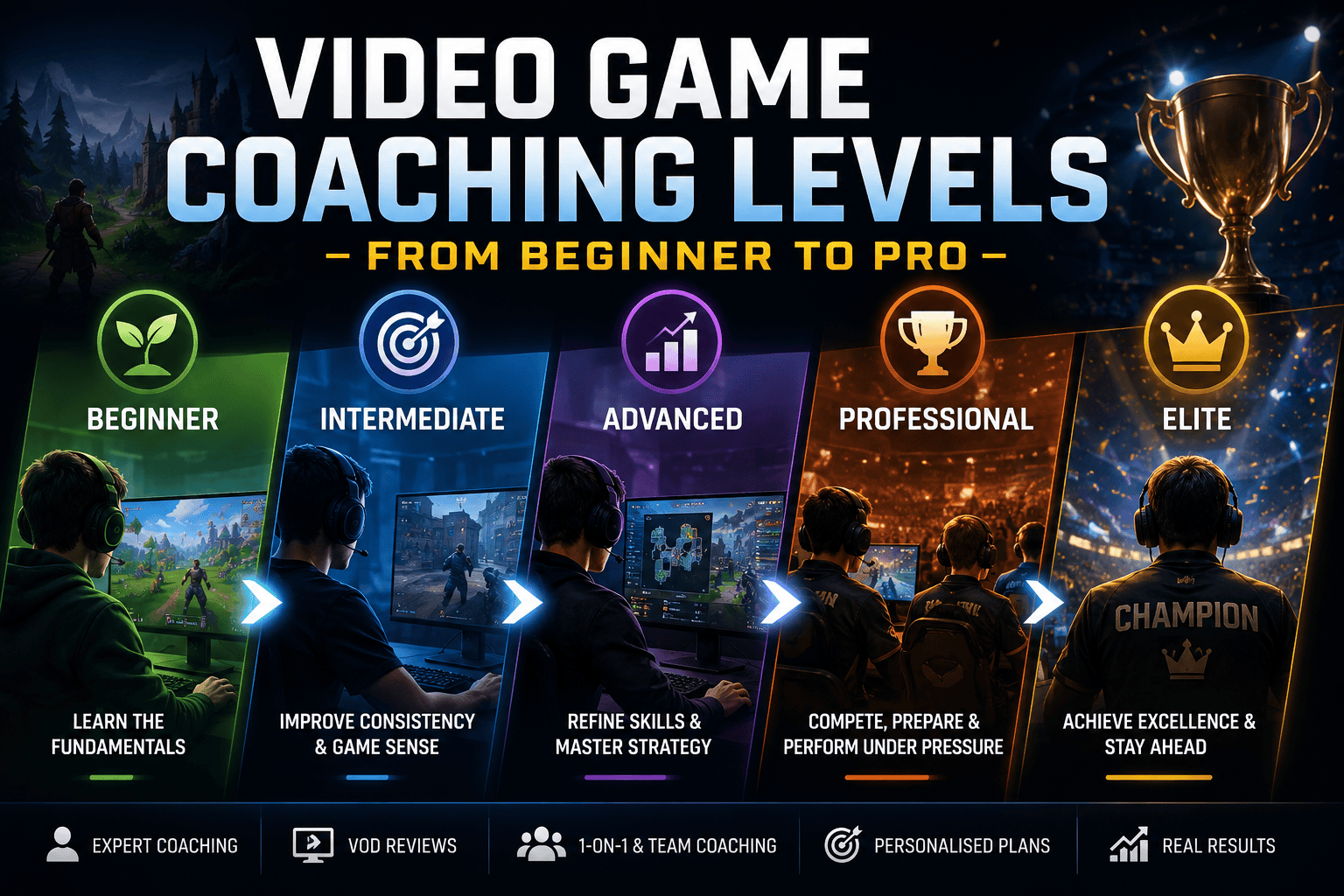
So, what are the main video game coaching levels?
🌱 Beginner → 🎯 Intermediate → 🔥 Advanced → 🏆 Professional → 👑 Elite
Each level has a different focus:
🌱 Beginner Coaching – Learn the fundamentals, mechanics and basic strategies
🎯 Intermediate Coaching – Improve consistency, game sense and decision-making
🔥 Advanced Coaching – Refine high-level skills, strategy and competitive performance
🏆 Professional Coaching – Prepare for serious competition, tournaments and high-level team play
👑 Elite Coaching – Fine-tune performance and find marginal gains at the highest levels
These aren’t official or universal coaching classifications. Games, coaches and coaching platforms may describe skill levels differently. Instead, they’re a useful way to understand how coaching changes as your skills, experience and goals develop.
Your rank doesn’t necessarily determine your coaching level either. Two players at the same rank can have completely different strengths, weaknesses and ambitions.
One might need help fixing fundamental positioning mistakes. Another might want advanced VOD analysis to squeeze more performance from an already strong game.
There are also coaching types that sit outside the skill-level progression. Specialized coaching can target a particular character, role, mechanic or weakness, while team coaching focuses on communication, coordination and strategy across an entire squad.
The key is finding coaching that matches where you are now and where you want to go next.
If you’re new to coaching altogether, our guide to what video game coaching is explains how coaching works, what a coach does and what you can expect from a session.
Let’s break down each video game coaching level, what you can expect and how to work out which one is right for you. 🎯
2. Video Game Coaching Levels at a Glance
Video game coaching can look very different depending on your current skill level, experience and goals.
A beginner might need help understanding basic mechanics and positioning, while an advanced player may spend an entire coaching session analysing a handful of decisions from one match.
Here’s a quick comparison of the five main video game coaching levels:
| Coaching Level | Best For | Main Coaching Focus | Typical Goals |
|---|---|---|---|
| 🌱 Beginner | New and casual players | Fundamentals, mechanics, basic strategy and confidence | Learn the game and build strong foundations |
| 🎯 Intermediate | Players comfortable with the basics | Consistency, game sense, positioning and decision-making | Improve performance and break through skill plateaus |
| 🔥 Advanced | Experienced and highly ranked players | Advanced strategy, mechanics, VOD analysis and meta knowledge | Refine weaknesses and optimise competitive performance |
| 🏆 Professional | Aspiring pros and competitive players | Tournament preparation, scrims, team strategy and performance | Compete successfully at a high level |
| 👑 Elite | Top-level and professional competitors | Marginal gains, opponent analysis and peak performance | Find small competitive advantages at the highest level |
🎯 Which Coaching Level Are You?
You don’t necessarily need to choose a coaching level based on your rank.
Instead, think about what you need help with right now.
🌱 Still learning how everything works? Start with beginner coaching.
🎯 Know the game but struggling to improve consistently? Intermediate coaching may be the better fit.
🔥 Already highly skilled but looking for an extra competitive edge? Advanced coaching can focus on optimisation.
🏆 Preparing for tournaments or serious competitive play? Professional-level coaching becomes more relevant.
👑 Already competing near the highest level? Elite coaching focuses on the small details that can separate winning from losing.
And these levels aren’t permanent.
As your mechanics, game sense and competitive experience improve, your coaching can evolve with you.
🌱 Learn → 🎯 Improve → 🔥 Refine → 🏆 Compete → 👑 Master
Next, let’s look at what you can expect from each coaching level in more detail.
3. Beginner Video Game Coaching
Everyone starts somewhere.
Beginner video game coaching is designed for new players, casual gamers and anyone still developing the fundamental skills needed to play a game confidently.
These are just some of the benefits of hiring a video game coach, whether you’re completely new to a game or trying to reach a higher level.
You don’t need a high rank, hundreds of hours played or competitive ambitions to work with a gaming coach. In fact, getting guidance early can help you understand the game faster and avoid developing bad habits that become harder to fix later.
🎮 What Does Beginner Gaming Coaching Cover?
At beginner level, coaching is usually focused on building a strong foundation rather than introducing complicated high-level strategies.
Depending on the game, a coach might help you with:
- 🎮 Controls and mechanics – Learn movement, aiming, abilities, combat and other core mechanics
- 🗺️ Maps and objectives – Understand where to go, what you’re trying to achieve and why it matters
- 🧠 Basic game sense – Start recognising what’s happening around you and how to react
- 📍 Positioning – Learn where you should be during common situations
- 🛡️ Roles and characters – Understand different roles, classes, heroes or characters
- ⚙️ Equipment and settings – Get familiar with weapons, builds, loadouts and useful game settings
- 🎯 Basic strategies – Learn simple tactics you can start applying immediately
- 🏋️ Practice routines – Discover which skills to practise and how to improve them
The goal isn’t to bombard you with every advanced strategy in the game.
It’s to teach you the right things at the right time.
🌱 Who Is Beginner Coaching Best For?
Beginner coaching can be useful if you:
- Have recently started playing a game
- Understand the basics but still feel overwhelmed
- Mostly play casually and want to improve
- Want to learn a new role, character or game mode
- Keep making basic mistakes but aren’t sure why
- Want to build good habits from the beginning
- Learn better through personalised guidance than general tutorials
You also don’t need to be completely new.
Someone with dozens of hours in a game might still benefit from beginner coaching if they’re missing important fundamentals.
💡 Why Get Coaching as a Beginner?
When you’re new to a game, there’s often a lot to learn at once.
Maps. Characters. Weapons. Abilities. Objectives. Builds. Movement. Positioning. Strategies. And, inevitably, some teammate yelling an acronym you’ve never heard before.
A coach can cut through that noise and focus your attention on what actually matters at your current stage.
That personalised guidance is one of the biggest benefits of hiring a video game coach, particularly when you’re trying to improve without wasting time on information that isn’t relevant to your current level.
Instead of trying to learn everything simultaneously, you can develop your skills step by step:
🎮 Learn the Basics → 🏋️ Build Good Habits → 🎯 Practise With Purpose → 📈 Improve
That foundation becomes increasingly important as you move into more advanced gameplay.
Once the fundamentals start becoming second nature, you’re ready for the next stage – intermediate video game coaching.
4. Intermediate Video Game Coaching
You’ve learned the fundamentals. You know the maps, understand the objectives and can hold your own in a match.
But now improvement is getting harder.
Intermediate video game coaching is designed for players who understand how their game works but want to become more consistent, develop stronger game sense and move beyond their current skill level.
At this stage, coaching shifts from learning how to play towards understanding how to play better.
🎮 What Does Intermediate Gaming Coaching Cover?
Intermediate players usually don’t need someone explaining the basic controls. Instead, a coach can start identifying the less obvious weaknesses affecting performance.
Depending on the game, intermediate coaching might focus on:
- 🧠 Game sense – Better understand what’s happening around you and anticipate what could happen next
- 📍 Positioning – Recognise where you should be during fights, objectives and other key moments
- ⚡ Mechanics – Refine aim, movement, combos, ability usage or other game-specific skills
- 🎯 Decision-making – Learn when to attack, defend, rotate, retreat or take an objective
- 🗺️ Map awareness – Use information from the map and your surroundings more effectively
- ♟️ Strategy – Move beyond basic tactics and start thinking several steps ahead
- 🔄 Consistency – Reduce the difference between your best matches and your worst
- 📹 Gameplay analysis – Review matches to identify recurring mistakes and missed opportunities
This is also where coaching can become much more personalised.
Rather than teaching everyone the same fundamentals, a coach can examine your specific gameplay and determine what’s preventing you from progressing.
📈 Breaking Through the Intermediate Skill Plateau
Intermediate players often experience one particularly frustrating problem:
You know you’re getting better, but your rank isn’t moving.
You might win several matches, lose several more and end up exactly where you started.
Welcome to the skill plateau.
At this point, simply playing more isn’t always the answer. You may already have hundreds of hours of experience – but experience can reinforce bad habits just as easily as good ones.
A coach can help identify the bottleneck.
Maybe your mechanics are strong but your positioning repeatedly puts you in bad situations.
Maybe your game knowledge is excellent but your decisions become rushed under pressure.
Maybe you’re winning individual fights but failing to convert those wins into objectives.
The goal is to identify the specific weaknesses limiting your progress, rather than trying to improve everything at once.
🎯 Who Is Intermediate Coaching Best For?
Intermediate coaching may be a good fit if you:
- Understand the fundamentals of your game
- Have developed reasonable mechanical skills
- Want to climb higher in ranked play
- Keep making the same mistakes
- Struggle with consistency
- Feel like your improvement has slowed down
- Want to develop stronger game sense
- Are ready to learn more advanced strategies
- Want personalised feedback on your gameplay
Rank alone doesn’t determine whether you’re an intermediate player.
What matters more is whether you’ve moved beyond simply learning the game and are now trying to understand how to perform more effectively and consistently.
📹 Where VOD Review Starts to Shine
Intermediate coaching is also a great stage to introduce VOD review.
Watching your gameplay back with an experienced coach can reveal mistakes that are almost impossible to notice while you’re concentrating on the match itself.
A coach might pause a replay and ask:
Why did you move here?
What information did you have at this moment?
What other options were available?
What happened because of that decision?
Those questions help you move beyond simply being told what went wrong.
You start learning how to analyse your own gameplay.
And that’s an important step towards becoming a more advanced player.
Once your fundamentals are solid, your performance becomes more consistent and you’re beginning to think deliberately about every decision, the focus changes again.
That’s where advanced video game coaching comes in. 🔥
5. Advanced Video Game Coaching
At the advanced level, you already know how to play well.
Your mechanics are strong. You understand the game. You’ve developed solid game sense and you’re probably comfortable competing against skilled opponents.
Now the margins get smaller.
Advanced video game coaching is designed for experienced and highly skilled players who want to refine their gameplay, eliminate subtle weaknesses and optimise their performance for higher-level competition.
At this stage, coaching becomes less about fixing obvious mistakes and more about finding the details that separate good decisions from great ones.
🔥 What Does Advanced Gaming Coaching Cover?
Advanced coaching can become highly specific to the game, role and individual player.
Common areas of focus include:
- 🧠 Advanced decision-making – Analyse difficult situations and make better choices with limited information
- ⚡ Mechanical refinement – Fine-tune aim, movement, combos, ability usage and other high-level mechanics
- 📍 Advanced positioning – Improve positioning based on teammates, opponents, objectives and changing match conditions
- 🗺️ Map control and awareness – Understand how positioning, pressure and information influence the wider game
- ♟️ Advanced strategy – Develop deeper tactical understanding and recognise multiple possible outcomes
- 📊 Meta knowledge – Understand current strategies, builds, characters, weapons and how to counter them
- 🔄 Adaptability – Adjust your approach when opponents, strategies or match conditions change
- 📹 Detailed VOD analysis – Examine individual decisions, patterns and small inefficiencies within your gameplay
- 🎯 Role mastery – Develop a deeper understanding of your specific role, character or playstyle
- 💪 Competitive consistency – Maintain strong performance against increasingly skilled opponents
At this level, small improvements can start making a big difference.
📹 Advanced VOD Review Gets More Detailed
VOD review becomes particularly valuable as obvious mistakes disappear.
An advanced player might watch a match and think:
“I played that pretty well.”
And they might be right.
But “pretty well” leaves room for improvement.
An experienced coach can dig deeper:
- Could you have taken a better position before the fight started?
- Did you use an important ability too early?
- Was there information available that you didn’t react to?
- Could you have predicted the opponent’s rotation?
- Did you take an unnecessary risk?
- Was there a higher-value objective available?
- Could your resource management have been more efficient?
At lower levels, coaching might identify what went wrong.
At advanced levels, coaching increasingly examines what could have been done better – even when nothing obviously went wrong.
That’s a significant shift.
🗺️ Understanding and Adapting to the Meta
Advanced players also need a deeper understanding of the meta – the strategies, characters, weapons, builds and tactics that are currently effective within a game.
But simply copying the meta isn’t enough.
Advanced coaching can help you understand:
What is strong → Why it is strong → How opponents use it → How to counter it → When to adapt
This becomes particularly important in games that receive frequent balance patches, new characters, map changes or seasonal updates.
A strategy that worked brilliantly last month might suddenly be average after one patch.
Advanced players need to recognise those changes quickly and adapt their gameplay accordingly.
🎯 Who Is Advanced Coaching Best For?
Advanced video game coaching may be suitable if you:
- Already perform at a high skill level
- Have strong fundamentals and mechanics
- Compete seriously in ranked play
- Want to reach the highest ranks
- Need help identifying subtle weaknesses
- Want detailed analysis of your gameplay
- Are learning advanced strategies or roles
- Want to improve consistency against skilled opponents
- Are considering tournaments or organised competitive play
- Feel you’ve reached the limits of improving through practice alone
Again, rank isn’t everything.
An advanced player isn’t simply someone with a particular badge next to their username. It’s someone who has developed strong fundamentals and now needs more detailed, specialised feedback to keep progressing.
⚡ From Improvement to Optimisation
This is perhaps the biggest difference between intermediate and advanced coaching.
At intermediate level, the question is often:
“What’s stopping me from improving?”
At advanced level, it increasingly becomes:
“How can I optimise what I’m already doing?”
The improvements may become smaller, but they also become more precise.
A slightly better position.
A faster read.
A smarter rotation.
A more efficient ability.
One better decision under pressure.
Those small advantages begin to matter much more as the skill level of your opponents increases.
And when the goal moves beyond climbing ranked ladders towards serious tournaments, organised competition or pursuing professional play, coaching changes again.
That’s where professional video game coaching begins. 🏆
6. Professional Video Game Coaching
Professional-level coaching is where gaming starts to become much more than climbing the ranked ladder.
Professional video game coaching is designed for highly skilled players who compete – or are preparing to compete – in organised tournaments, leagues, esports teams and other serious competitive environments.
You don’t necessarily need to already be a professional gamer to benefit from this level of coaching.
Aspiring pros, semi-professional players and high-ranked competitors looking to make the jump into organised competition may also need the more structured approach professional coaching provides.
At this stage, the question isn’t simply:
“How can I become a better player?”
It’s increasingly:
“How can I perform at my best when the result actually matters?”
🏆 What Does Professional Gaming Coaching Cover?
Professional coaching is usually highly structured and tailored around competitive performance.
Depending on the game, player and competition, coaching may focus on:
- 📹 Advanced VOD review – Analyse matches, scrims and tournament performances in detail
- 🔍 Opponent analysis – Study opposing players or teams to identify tendencies, strengths and weaknesses
- ♟️ Competitive strategy – Develop game plans for specific maps, opponents and situations
- 🎮 Scrim analysis – Turn practice matches into useful information rather than simply wins or losses
- 🗺️ Map preparation – Develop strategies, positioning and responses for different maps
- 👥 Team coordination – Improve communication, roles, rotations and team decision-making
- 🏋️ Structured practice – Build training schedules around specific competitive goals
- 🧠 Performance under pressure – Develop routines and decision-making for high-pressure matches
- 🔄 Adaptability – Respond to opponents changing tactics during a match or series
- 📊 Post-match analysis – Identify what worked, what didn’t and what needs to change before the next competition
The focus becomes increasingly specific.
At this level, simply telling a player to “work on positioning” isn’t particularly useful.
A coach needs to explain which position was wrong, why it was wrong, what information should have influenced the decision and what the better option was.
🔍 Preparing for Specific Opponents
One major difference between ranked coaching and professional-level coaching is the importance of opponent preparation.
In ordinary matchmaking, you often don’t know who you’re going to face.
In organised competition, you might.
That creates opportunities for much deeper preparation.
A coach may analyse previous matches to identify things such as:
- Preferred strategies
- Common rotations
- Character or hero choices
- Map preferences
- Aggressive or defensive tendencies
- Recurring patterns
- Weaknesses under pressure
- How a team reacts to particular situations
The goal isn’t simply to understand your own game.
It’s to understand the game you’re likely to face.
🎮 Turning Scrims Into Better Practice
Professional and aspiring professional players may spend significant time scrimming against other competitive players or teams.
But playing scrims isn’t automatically productive.
Professional coaching can help give those practice matches a clear purpose.
Instead of:
Scrim → Win/Lose → Next Scrim
The process becomes:
🎯 Set Objective → 🎮 Scrim → 📹 Review → 🔍 Identify Patterns → 🏋️ Adjust → 🔁 Test Again
A team might deliberately practise a particular map, strategy, team composition or situation rather than treating every scrim like a tournament final.
This makes practice more measurable and gives players something specific to improve.
🧠 Performing When the Pressure Is On
Playing well in ranked matches and playing well in an important tournament aren’t always the same thing.
Pressure changes things.
Players may become overly cautious, rush decisions, abandon strategies or hesitate in situations they normally handle comfortably.
Professional coaching can help players develop more consistent routines around:
- Pre-match preparation
- Communication
- Decision-making
- Staying focused after mistakes
- Resetting between rounds or matches
- Handling wins and losses
- Maintaining concentration across longer competitions
The objective isn’t to remove pressure entirely.
It’s to help players perform effectively despite it.
🎯 Who Is Professional Coaching Best For?
Professional-level video game coaching may be appropriate if you:
- Compete in organised tournaments or leagues
- Play for an esports or competitive team
- Are preparing to enter higher-level competition
- Are pursuing semi-professional or professional play
- Regularly participate in structured scrims
- Need opponent-specific preparation
- Want detailed competitive VOD analysis
- Need more structured training and performance review
- Already have advanced mechanics and game knowledge
- Want to perform more consistently in high-pressure matches
Professional coaching is therefore less about teaching the game and more about preparing you to compete within it.
🏆 From Ranked Player to Competitive Player
This distinction matters.
Being exceptionally good at ranked play doesn’t automatically make someone an exceptional tournament player.
Organised competition can introduce different demands:
👥 Teamwork → ♟️ Preparation → 🔍 Opponent Analysis → 🎮 Execution → 🧠 Pressure → 📹 Review
Professional coaching helps bring those pieces together.
The aim is no longer simply to become mechanically better or reach a higher rank.
It’s to turn individual skill into repeatable competitive performance.
And once you’re already competing among the very best, the margins become smaller again.
At that point, coaching moves towards finding tiny advantages that can make a very big difference.
That’s the territory of elite video game coaching. 👑
7. Elite Video Game Coaching
At the elite level, there aren’t many obvious weaknesses left to fix.
Players already have exceptional mechanics, deep game knowledge, strong decision-making and extensive competitive experience.
The challenge is finding the small advantages that still exist.
Elite video game coaching is designed for top-level players competing at or approaching the highest levels of their game, where marginal improvements can make the difference between winning and losing.
At this stage, coaching becomes extremely detailed and highly personalised.
You’re no longer learning how to play the game well.
You’re looking for ways to play it exceptionally well – consistently and against exceptional opponents.
👑 What Does Elite Gaming Coaching Cover?
Elite coaching varies enormously depending on the game, player, role and competitive environment.
Areas of focus can include:
- 🔍 Opponent-specific analysis – Study individual players and teams to identify patterns, tendencies and possible weaknesses
- 📹 Deep VOD analysis – Examine individual decisions, positioning and interactions in extremely fine detail
- 🧠 Decision-making optimisation – Refine choices in complex situations where several options may be viable
- ♟️ Advanced strategy – Develop and adapt strategies for specific opponents, maps and competitive situations
- 📊 Meta analysis – Understand emerging strategies and how the competitive meta is evolving
- ⚡ Mechanical refinement – Fine-tune already strong mechanics and eliminate small inefficiencies
- 🔄 Adaptability – Recognise and respond quickly when opponents change their approach
- 🎯 Consistency – Maintain elite performance across matches, series and tournaments
- 🏆 Tournament preparation – Prepare for specific competitions, formats and opponents
- 💪 Performance mindset – Develop routines that support focus, confidence and decision-making under pressure
At this level, coaching isn’t necessarily about making dramatic changes.
Sometimes it’s about finding one better decision in one important moment.
🔬 The Power of Marginal Gains
The higher the level of competition, the harder it becomes to find major advantages.
A beginner might improve dramatically by learning basic positioning.
An intermediate player might climb significantly after fixing recurring decision-making mistakes.
An advanced player might improve by refining strategy and mechanics.
An elite player?
The improvement might be much smaller.
It could be:
- Taking a slightly better position
- Recognising an opponent’s tendency earlier
- Using an ability a second later
- Changing a rotation
- Communicating information more efficiently
- Managing a resource differently
- Responding faster to a strategic adjustment
Individually, these changes may seem tiny.
Collectively, they can influence matches.
At beginner level, coaching might change how you play. At elite level, it might change one decision – but that one decision can decide a match.
🔍 Opponent-Specific Preparation
Elite competition also makes detailed opponent analysis increasingly valuable.
When you’re regularly facing the same high-level teams or players, patterns can emerge.
A coach may analyse opponents to understand:
- How they approach particular maps
- Which strategies they prefer
- How they respond when pressured
- Which characters, heroes or compositions they favour
- How their strategies change depending on the score
- Recurring positioning or rotation patterns
- How individual players behave in specific situations
The objective isn’t to predict every move.
It’s to enter a match with more information and better preparation.
And because opponents may be doing exactly the same thing, elite players must also understand their own tendencies and avoid becoming predictable.
📊 Staying Ahead of the Competitive Meta
At lower levels, understanding the established meta may be enough.
At elite level, players may need to recognise where the meta is going next.
High-level competition can move quickly.
A new patch, balance adjustment, character, weapon or strategy can change how a game is played at the top.
Elite coaching may therefore involve:
📊 Analyse → 🧪 Test → 🎮 Practise → 🔄 Adapt → 🏆 Compete
Rather than simply copying what everyone else is doing, elite players and coaches can experiment with new approaches and look for strategies opponents haven’t fully adapted to yet.
The ability to adapt quickly can itself become a competitive advantage.
💪 Maintaining Peak Performance
Reaching an elite level is one challenge.
Performing at that level consistently is another.
Elite players may compete across long tournament days, multiple matches or extended seasons where concentration and consistency become increasingly important.
Coaching can help create more structured approaches to preparation and performance, including:
- Pre-match routines
- Practice structure
- Match preparation
- Communication routines
- Reviewing mistakes objectively
- Resetting between matches
- Maintaining concentration
- Adapting after losses
- Post-match review
The objective is to make high-level performance repeatable, rather than something that only appears when everything happens to click.
🎯 Who Is Elite Coaching Best For?
Elite video game coaching is generally most relevant if you:
- Compete at or near the highest level of your game
- Play professionally or at a very high competitive level
- Regularly compete against other elite players
- Already have exceptional mechanics and game knowledge
- Need highly detailed VOD analysis
- Want opponent-specific preparation
- Need to find small competitive advantages
- Want to refine already strong decision-making
- Need to adapt quickly to high-level meta changes
- Are preparing for major tournaments or competitions
For most gamers, elite coaching isn’t necessary – and that’s perfectly fine.
The purpose of coaching isn’t to choose the most advanced level possible.
It’s to choose the level that matches what you actually need.
👑 When Tiny Improvements Matter
Elite coaching represents the end of the skill-level progression we’ve covered:
🌱 Beginner → 🎯 Intermediate → 🔥 Advanced → 🏆 Professional → 👑 Elite
As you move through those levels, the purpose of coaching changes.
At first, you’re learning.
Then you’re improving.
Then you’re refining.
Then you’re preparing to compete.
Finally, you’re searching for the smallest advantages available against opponents who are doing exactly the same thing.
But skill level isn’t the only way video game coaching can be structured.
Some players don’t need a “higher” level of coaching at all – they need coaching focused on one particular part of their game.
That’s where specialized video game coaching comes in. 🎯
8. Specialized Video Game Coaching
Not every player needs to move to a higher coaching level.
Sometimes you already know exactly what you want to improve.
Maybe your overall gameplay is strong but your aim is inconsistent. Perhaps you’ve switched roles, started learning a new character or discovered one particular weakness that’s holding you back.
That’s where specialized video game coaching comes in.
Unlike beginner, intermediate, advanced, professional and elite coaching, specialized coaching isn’t really another step on the skill ladder.
It’s targeted coaching focused on a specific part of your gameplay.
A beginner can use specialized coaching.
So can an elite player.
The difference is what you want to improve, rather than how good you already are.
🎯 What Can Specialized Gaming Coaching Focus On?
Specialized coaching can target almost any game-specific skill, role or area of performance.
Common examples include:
- 🎯 Aim coaching – Accuracy, tracking, flicking, crosshair placement and target selection
- ⚡ Mechanics coaching – Movement, combos, inputs, ability usage and other technical skills
- 🧙 Character or hero coaching – Master a particular character, champion, hero or class
- 👤 Role-specific coaching – Improve as a support, tank, jungler, sniper, goalkeeper or another game-specific role
- 📍 Positioning coaching – Learn where to position yourself in different situations and why
- 🗺️ Map coaching – Improve map knowledge, rotations, routes, angles and objective control
- 🧠 Game sense coaching – Develop awareness, anticipation and stronger decision-making
- ♟️ Strategy coaching – Focus on tactics, matchups, counters and strategic planning
- 📹 VOD review – Analyse recorded gameplay to identify specific weaknesses and recurring patterns
- 🗣️ Communication coaching – Improve callouts, information sharing and communication with teammates
- 🏆 Competitive preparation – Focus on a particular tournament, opponent, map or competitive challenge
The exact specialisation will naturally depend on the game.
A Valorant player might want to improve crosshair placement and utility usage.
A League of Legends player might focus on wave management or a particular champion.
A Rocket League player could work specifically on rotations, aerial control or positioning.
The principle is the same:
Identify the skill → Focus the coaching → Practise deliberately → Measure improvement
🔍 Why Choose Specialized Coaching?
General coaching can be useful when you’re unsure what’s holding you back.
Specialized coaching makes more sense when the problem is already clear.
For example, imagine you’re a strong player overall but consistently struggle with positioning.
You probably don’t need someone to teach you the game from scratch.
You need someone who can analyse why your positioning breaks down, identify the situations where it happens and help you correct it.
That narrower focus can allow more of the coaching session to be spent working directly on the area you care about.
📹 Specialized Coaching Can Go Deep
The more specific the coaching goal, the deeper the analysis can become.
Instead of reviewing your entire performance, a coach might watch a VOD looking specifically at one area.
For example:
Positioning Review
📍 Where were you positioned before each fight?
↓
🔍 What information was available?
↓
🧠 Why did you choose that position?
↓
⚠️ What problems did it create?
↓
🎯 Where could you have positioned instead?
That focused approach can make patterns much easier to spot.
The same process can be applied to aim, rotations, resource management, communication, character usage or almost any other part of a game.
🎮 Specialized Coaching Can Work at Any Skill Level
This is the important distinction between a coaching level and a coaching specialisation.
A beginner might want specialized coaching to learn one difficult character.
An intermediate player might want aim coaching to improve FPS mechanics.
An advanced player might want detailed VOD analysis of their positioning.
A professional player might work with someone who specialises in opponent analysis.
An elite player might seek highly specialised coaching around one particular matchup or competitive strategy.
So specialized coaching doesn’t replace the five main coaching levels.
It works alongside them.
🌱 Beginner + 🎯 Specialisation
🎯 Intermediate + 🎯 Specialisation
🔥 Advanced + 🎯 Specialisation
🏆 Professional + 🎯 Specialisation
👑 Elite + 🎯 Specialisation
🎯 Who Is Specialized Coaching Best For?
Specialized video game coaching may be a good choice if you:
- Know exactly what you want to improve
- Have one weakness that’s limiting your overall performance
- Want to master a particular character, hero, class or role
- Need help with a specific mechanic
- Want focused VOD analysis
- Are switching to a new role or playstyle
- Want to prepare for a particular matchup or competitive situation
- Prefer targeted training rather than general coaching
If you’re not sure what your biggest weakness actually is, broader coaching or an initial gameplay review may be more useful first.
A coach can help identify the problem before you start trying to solve it.
🎯 General Improvement vs Specialized Improvement
A simple way to choose between them is to ask:
“Do I know exactly what I need help with?”
If the answer is no, broader coaching based on your current skill level may make more sense.
If the answer is yes, specialized coaching can let you concentrate your time on that particular area.
But sometimes the issue isn’t one player’s mechanics, positioning or decision-making.
Sometimes the whole team needs to improve how it plays together.
That’s where team video game coaching comes in. 👥
9. Team Video Game Coaching
Sometimes individual skill isn’t the problem.
You can have five mechanically talented players on the same team and still watch everything fall apart the moment they need to coordinate.
Team video game coaching focuses on improving how a group of players communicates, coordinates and performs together.
Rather than concentrating on one player’s individual weaknesses, a team coach looks at the bigger picture:
How effectively does the team play as a unit?
Like specialized coaching, team coaching isn’t another step above elite coaching. Teams can benefit from coaching at amateur, intermediate, advanced and professional levels.
👥 What Does Team Gaming Coaching Cover?
Team coaching varies depending on the game and competitive level, but common areas include:
- 🗣️ Communication – Improve callouts, information sharing and communication under pressure
- 🎯 Roles and Responsibilities – Make sure each player understands what they’re responsible for
- 🤝 Team Coordination – Improve how players combine abilities, movements and decisions
- 🗺️ Rotations and Positioning – Develop better movement and positioning across the entire team
- ♟️ Team Strategy – Build strategies for maps, objectives, opponents and different match situations
- ⚡ Execution – Turn planned strategies into coordinated in-game actions
- 🔄 Adaptability – Improve how the team responds when opponents change their strategy
- 📹 Team VOD Review – Analyse matches and scrims to identify recurring team-wide problems
- 🎮 Scrim Analysis – Use practice matches to test strategies and measure improvement
- 🏆 Tournament Preparation – Prepare strategies, roles and routines for competitive matches
The important difference is that the coach isn’t only asking:
“What could this player have done better?”
They’re also asking:
“What could the team have done better together?”
🗣️ Better Communication Can Change Everything
Communication is one of the most important areas of team coaching.
More communication isn’t necessarily better communication.
Five players constantly talking over each other can create more confusion than useful information.
A team coach can help players understand:
- What information needs to be communicated
- When it needs to be communicated
- Who needs to make particular calls
- How to keep callouts clear and concise
- When unnecessary communication becomes distracting
- How the team should react to important information
The goal is to make communication useful, timely and actionable.
Instead of five players independently reacting to what’s happening, the team starts making decisions together.
♟️ Build Strategies Everyone Understands
Strong team play also requires more than telling everyone to “work together”.
Players need to understand the plan.
A coach can help teams develop strategies around:
- Maps
- Objectives
- Team compositions
- Character or hero selections
- Rotations
- Attacking and defending
- Opening strategies
- Mid-game adjustments
- Specific opponents
- Different match situations
Just as importantly, each player needs to understand their role within that strategy.
It’s not enough for one player to know what should happen next.
The team needs to know.
📹 Team VOD Review Shows the Bigger Picture
Individual VOD review might focus heavily on one player’s positioning, mechanics or decisions.
Team VOD review zooms out.
A coach can examine how decisions connect across the entire squad.
For example:
🔍 What Happened?
↓
👤 What Did Each Player Do?
↓
🗣️ What Was Communicated?
↓
♟️ What Was the Team’s Intended Strategy?
↓
⚠️ Where Did Coordination Break Down?
↓
🎯 What Should the Team Do Next Time?
This can reveal problems that aren’t obvious when players only review their own gameplay.
One player’s bad position might actually have been caused by unclear communication.
A failed attack might have started with two players interpreting the strategy differently.
A lost objective might result from a team-wide rotation problem rather than an individual mistake.
Team coaching helps connect those dots.
🎮 Making Scrims More Productive
Competitive teams can also use coaching to get more value from scrims.
Rather than treating every practice match as something that simply needs to be won, a coach can give each scrim a specific purpose.
For example:
🎯 Set a Goal → 🎮 Scrim → 📹 Review → 🔍 Identify Problems → 🛠️ Adjust → 🔁 Test Again
A team might spend a scrim specifically testing:
- A new strategy
- A different team composition
- Communication changes
- A particular map
- Defensive rotations
- Objective control
- Responses to a specific opponent strategy
Winning the scrim is nice.
Learning something useful from it is better.
🏆 Who Is Team Coaching Best For?
Team video game coaching can be useful for:
- Groups of friends wanting to play better together
- Ranked teams
- Amateur competitive teams
- School and university esports teams
- Organized gaming clubs
- Tournament teams
- Semi-professional teams
- Professional esports teams
The depth of coaching simply changes with the team’s level.
An amateur squad might focus heavily on communication, roles and basic coordination.
A professional team might spend far more time on opponent analysis, advanced strategy, scrim review and tournament preparation.
👥 Individual Coaching vs Team Coaching
The simplest distinction is:
Individual coaching asks: “How can you play better?”
Team coaching asks: “How can you play better together?”
Many competitive players can benefit from both.
Individual coaching can improve your mechanics, decision-making and personal weaknesses, while team coaching helps turn those individual skills into coordinated performance.
And with the different coaching levels and types now clear, there’s one obvious question left:
Which video game coaching level is actually right for you? 🤔
10. What Level of Video Game Coaching Do You Need?
With five main coaching levels and several more specialised coaching options, choosing the right one might sound complicated.
It doesn’t need to be.
The best video game coaching level isn’t necessarily the most advanced one. It’s the level that matches your current skills, weaknesses and gaming goals.
A simple way to think about it is:
🌱 Learn → 🎯 Improve → 🔥 Refine → 🏆 Compete → 👑 Master
Here’s how to work out where you fit.
🌱 Choose Beginner Coaching If…
Beginner coaching is likely the best starting point if you’re still learning the fundamentals of a game.
Consider beginner coaching if you:
- Are completely new to the game
- Understand some basics but still feel overwhelmed
- Need help with controls or mechanics
- Don’t fully understand maps, objectives, roles or characters
- Want to build good habits from the beginning
- Play casually but want to become a better player
The goal at this level is simple:
Build strong foundations before worrying about advanced techniques.
You don’t need to reach a certain rank before you’re “good enough” for coaching.
🎯 Choose Intermediate Coaching If…
Intermediate coaching is for players who already understand the game but are finding improvement increasingly difficult.
It may be right for you if you:
- Understand the fundamentals
- Have reasonable mechanical skills
- Play ranked regularly
- Want to climb higher
- Struggle with consistency
- Keep repeating the same mistakes
- Feel like you’ve reached a skill plateau
- Want stronger game sense and decision-making
At this stage, coaching becomes much more about identifying what’s holding you back.
You know how to play.
Now you’re learning how to play better and more consistently.
🔥 Choose Advanced Coaching If…
Advanced coaching is aimed at experienced players who already perform at a high level.
Consider advanced coaching if you:
- Have strong mechanics and fundamentals
- Play at a high competitive rank
- Already have good game knowledge
- Want detailed VOD analysis
- Need help identifying subtle weaknesses
- Want to master advanced strategies
- Need deeper knowledge of the current meta
- Are trying to optimise your competitive performance
At this level, the obvious problems may already be gone.
The focus shifts from fixing major weaknesses to refining the details.
🏆 Choose Professional Coaching If…
Professional-level coaching becomes relevant when your goals extend beyond ordinary ranked play into organised competition.
It may suit you if you:
- Compete in tournaments or leagues
- Play for a competitive team
- Regularly participate in scrims
- Are pursuing semi-professional or professional competition
- Need tournament preparation
- Want opponent-specific analysis
- Need structured competitive practice
- Want to perform more consistently under pressure
Professional coaching isn’t exclusively for players who already earn a living from gaming.
It can also be useful for highly skilled players trying to make the transition into serious competitive play.
👑 Choose Elite Coaching If…
Elite coaching sits at the very top of the progression.
It’s generally designed for players who already compete at or near the highest levels of their game.
Elite coaching may be appropriate if you:
- Already compete at an exceptional level
- Regularly face other top-level players
- Have very few obvious weaknesses
- Need extremely detailed performance analysis
- Want opponent-specific preparation
- Need to identify marginal competitive advantages
- Are preparing for major competitions
- Want to maintain peak performance consistently
At this level, coaching may focus on improvements that seem tiny to most players but can matter enormously against equally skilled opponents.
🎯 What If You Only Want to Improve One Skill?
You may not need a different coaching level at all.
If you already know exactly what you want to improve, specialized coaching could be the better option.
For example:
🎯 Aim problems? → Aim coaching
🧙 Learning a particular character? → Character or hero coaching
📍 Poor positioning? → Positioning coaching
📹 Want detailed feedback? → VOD review
🧠 Struggling with decisions? → Game sense or strategy coaching
🗣️ Communication problems? → Communication coaching
Specialized coaching can be combined with any skill level.
An intermediate player and an elite competitor could both need aim coaching – but what they’re working on within those sessions would be very different.
👥 What If You Play as Part of a Team?
If the main problem is how your squad performs together, team coaching may make more sense.
Team coaching can focus on:
- Communication
- Roles and responsibilities
- Team strategy
- Coordination
- Rotations
- Scrim analysis
- Competitive preparation
You can also combine individual and team coaching.
For example, you might use individual coaching to improve your own mechanics and decision-making while your squad uses team coaching to improve communication and strategy.
🎮 Quick Coaching Level Guide
Still unsure? Start with the problem you’re trying to solve:
🌱 “I’m still learning the game.”
→ Beginner Coaching
🎯 “I know how to play, but I’m struggling to improve.”
→ Intermediate Coaching
🔥 “I’m already highly skilled and want to optimise my performance.”
→ Advanced Coaching
🏆 “I’m preparing for serious competitive play.”
→ Professional Coaching
👑 “I’m competing near the highest level and looking for marginal gains.”
→ Elite Coaching
🎯 “I know exactly which skill I need to improve.”
→ Specialized Coaching
👥 “Our individual players are good, but our team needs to perform better together.”
→ Team Coaching
💡 Don’t Choose Based on the Label Alone
These coaching levels aren’t rigid categories.
You might be advanced mechanically but intermediate when it comes to game sense.
You could be an experienced player learning an entirely new role and need coaching that temporarily goes back to the fundamentals.
Or you might be highly ranked without ever having played in an organised competitive environment.
That’s why the best coaching should be based on what you need to improve, not simply the badge beside your username.
Your rank can provide useful context – but does it actually determine your coaching level?
That’s what we’ll look at next. 📈
11. Does Your Gaming Rank Determine Your Coaching Level?
Your gaming rank can give a coach useful information about your current ability – but rank alone doesn’t determine what level of coaching you need.
Two players can hold exactly the same rank while having completely different strengths, weaknesses and goals.
One might have excellent mechanics but poor positioning.
Another might have great game sense but struggle with consistency.
A third might dominate ranked matches but have little experience playing within an organised competitive team.
Same rank. Very different coaching needs.
🎮 Rank Is a Starting Point – Not the Whole Picture
Ranks such as Bronze, Gold, Diamond, Grandmaster or their equivalents can provide a quick indication of where you sit within a game’s competitive ladder.
But ranking systems vary enormously between games.
Your rank can also be influenced by factors such as:
- 🎯 Mechanical ability
- 🧠 Game sense
- 📍 Positioning
- ♟️ Strategic knowledge
- 👥 Teamwork
- 🗣️ Communication
- 🔄 Consistency
- 🎮 Role or character choice
- ⏱️ Experience and time played
- 🏆 Competitive experience
That’s why a good coach should look beyond the badge beside your username.
🔍 Your Strengths and Weaknesses Matter More
Think of your overall skill as a collection of different abilities rather than one number.
For example, your skills might look something like:
⚡ Mechanics – Advanced
🧠 Game Sense – Intermediate
📍 Positioning – Intermediate
🗺️ Map Knowledge – Advanced
🗣️ Communication – Beginner
🏆 Competitive Experience – Beginner
Calling that player simply “advanced” doesn’t tell us very much.
A coach can look at these individual areas and identify where improvement could have the biggest impact.
This is one reason personalised coaching can be useful – it doesn’t need to follow a rigid formula based purely on rank.
🎯 Your Goals Matter Too
Your current ability is only half of the equation.
The other half is what you’re trying to achieve.
Consider two highly ranked players.
Player A wants to climb one more division in ranked.
Player B wants to join a competitive team and start entering tournaments.
Their current skill levels might be similar, but their coaching requirements could be very different.
Player A might benefit from:
- Detailed VOD review
- Positioning improvements
- Better decision-making
- Meta knowledge
- Mechanical refinement
Player B might also need:
- Team communication
- Scrim experience
- Tournament preparation
- Opponent analysis
- Competitive strategy
- Performance under pressure
The right coaching level therefore depends on both:
📍 Where You Are Now + 🎯 Where You Want to Go
🔄 Your Coaching Level Can Change
Your coaching needs aren’t permanent either.
As you improve, your priorities will change.
You might start with beginner coaching to learn the fundamentals, move into intermediate coaching as you begin playing ranked and eventually need advanced coaching as you reach higher levels.
Or your needs might change without your rank moving at all.
For example, an advanced player switching to a completely unfamiliar role may temporarily need more fundamental coaching in that specific area.
That’s normal.
The purpose isn’t to earn a coaching label.
It’s to get the guidance that’s most useful right now.
🧩 Skill Level Isn’t Always Even
Players rarely improve every part of their game at exactly the same rate.
You can be:
🔥 Advanced mechanically but 🎯 intermediate strategically.
🧠 Excellent at decision-making but 📍 weak at positioning.
🏆 Highly ranked individually but 👥 inexperienced in competitive team play.
This is also why specialized coaching can be so useful.
Instead of forcing you into one broad category, coaching can target the specific part of your gameplay that needs attention.
📈 So, Does Rank Matter?
Yes – but it should be treated as context, not a diagnosis.
Your rank helps a coach understand roughly where you’re competing.
Your gameplay shows them why you’re there.
And your goals tell them where you’re trying to go next.
A useful coaching assessment should therefore consider:
🎮 Current Skill + 📊 Rank + 🔍 Strengths & Weaknesses + 🎯 Goals + 🏆 Competitive Ambitions
Together, those factors give a much better picture of the coaching you actually need.
And if you’re sitting at the opposite end of the spectrum – completely new to a game and wondering whether you’re even experienced enough for coaching – there’s another common misconception worth clearing up.
Yes, beginners can benefit from video game coaching too. 🌱
12. Can Beginners Benefit From Video Game Coaching?
Absolutely.
One of the biggest misconceptions about video game coaching is that you need to be highly ranked or seriously competitive before hiring a coach.
You don’t.
Beginner video game coaching can help new and casual players learn faster, understand the fundamentals and build good habits from the start.
You don’t need ambitions of becoming an esports professional either. Maybe you’ve just started playing a new game, want to keep up with your friends or simply want to become better at something you enjoy.
If you’re still deciding whether paying for personalised help makes sense, our guide to whether video game coaching is worth it looks at the value of coaching for different players, goals and skill levels.
Those are perfectly good reasons to get coaching.
🎮 Why Coaching Can Help New Players
Modern games can have surprisingly steep learning curves.
A new player might need to understand:
- 🎮 Controls and mechanics
- 🗺️ Maps and objectives
- 🧙 Characters, heroes or classes
- ⚔️ Weapons, abilities and equipment
- 📍 Positioning
- 🧠 Basic game sense
- 👥 Team roles
- ♟️ Strategies and tactics
- ⚙️ Builds and loadouts
- 🗣️ Gaming terminology
Trying to learn everything at once can quickly become overwhelming.
You can watch guides, read wikis and spend hours experimenting – but you still have to work out which information actually matters at your current level.
A coach can simplify that process.
Instead of throwing everything at you at once, they can focus on the fundamentals that will make the biggest difference first.
🌱 Build Good Habits From the Beginning
There’s another advantage to getting coaching early:
You have fewer bad habits to unlearn.
Players often develop their own ways of doing things when they’re learning.
Some work.
Some don’t.
But once you’ve repeated the same mistake hundreds of times, changing it can become much harder.
Beginner coaching can help establish better habits around things such as:
- Positioning
- Movement
- Aim technique
- Ability usage
- Map awareness
- Resource management
- Decision-making
- Communication
Learning a strong foundation early can make later improvement much easier.
⚡ Learn Without the Trial and Error
Trial and error is part of gaming.
It’s also part of the fun.
But not every lesson needs to take 50 matches to discover.
A coach can explain why something happened and show you what to try differently next time.
That creates a much clearer learning loop:
🎮 Play → ❓ Ask → 💡 Understand → 🏋️ Practise → 📈 Improve
Instead of repeatedly wondering “What am I doing wrong?”, you have someone who can help you find the answer.
😊 Coaching Doesn’t Have to Be About Ranked Play
Not every coaching session needs to revolve around climbing a competitive ladder.
Beginner and casual players might simply want to:
- Understand a complicated game
- Learn a new character
- Play better with friends
- Stop feeling lost during matches
- Become more confident
- Learn a particular game mode
- Improve enough to enjoy the game more
That’s an important point.
Video game coaching is about helping you achieve your gaming goals – whatever those goals happen to be.
For one player, success might mean reaching the highest competitive rank.
For another, it might mean finally understanding what everyone else on their team is shouting about.
Both count.
🎯 Do Beginners Need an Expert-Level Coach?
Not necessarily.
The best coach for a beginner isn’t automatically the player with the highest rank or most impressive competitive record.
You need someone who can teach beginners effectively.
Look for a coach who can:
- Explain concepts clearly
- Be patient with questions
- Adapt sessions to your experience
- Avoid overwhelming you with advanced information
- Give practical feedback
- Set achievable goals
- Make sessions enjoyable
- Help you understand why something works
Knowing a game at an elite level and being able to teach it are two different skills.
The best beginner coach combines strong game knowledge with the ability to make that knowledge easy to understand.
🌱 When Should a Beginner Move to Intermediate Coaching?
There’s no exact rank or number of hours that determines when you’re ready.
A better sign is that the fundamentals have started becoming comfortable.
You understand the game.
You know what your role is.
You can perform the basic mechanics.
And instead of asking:
“How do I play this game?”
You’re starting to ask:
“How do I become better at this game?”
That’s when your coaching needs begin shifting towards the intermediate level.
So if you’re new to a game, don’t think of coaching as something you need to earn the right to use.
Sometimes getting the right guidance early is exactly what helps you build the foundation for everything that comes next. 🌱
13. Can You Move Between Video Game Coaching Levels?
Yes – and that’s exactly how video game coaching should work.
Your coaching level isn’t a permanent label. It should evolve as your skills, experience and goals change.
A player might start with beginner coaching to learn the fundamentals, move into intermediate coaching as they become more confident and eventually progress towards advanced coaching as they reach higher levels of play.
The typical journey might look something like this:
🌱 Learn → 🎯 Improve → 🔥 Refine → 🏆 Compete → 👑 Master
But progression isn’t always perfectly linear.
🌱 From Beginner to Intermediate
Beginner coaching is largely about building foundations.
You’re learning:
- Core mechanics
- Controls
- Maps and objectives
- Basic positioning
- Roles and characters
- Fundamental strategies
- Good practice habits
As these skills become more natural, the questions you ask start changing.
Instead of:
“What should I do?”
You start asking:
“How can I do it better?”
That’s usually a sign you’re moving towards intermediate coaching.
The focus begins shifting from learning the game to improving your consistency, game sense and decision-making.
🎯 From Intermediate to Advanced
Moving from intermediate to advanced coaching can be less obvious.
By this stage, you already understand the game and probably have plenty of experience.
But you’re still finding weaknesses.
Intermediate coaching might focus on correcting recurring positioning mistakes, inconsistent mechanics or poor decisions.
As those larger weaknesses disappear, advanced coaching becomes increasingly focused on refinement and optimisation.
The question changes again:
“What’s holding me back?”
becomes:
“Where can I find the next improvement?”
That could mean deeper VOD analysis, advanced strategy, role mastery, stronger meta knowledge or fine-tuning mechanics.
🔥 From Advanced to Professional
Not every advanced player needs professional-level coaching.
This transition is determined as much by your goals as your ability.
An advanced player who mainly wants to climb ranked may continue benefiting from advanced coaching.
But if you start entering:
- 🏆 Tournaments
- 🎮 Competitive leagues
- 👥 Organised teams
- ⚔️ Regular scrims
- 🌐 Higher-level esports competition
your coaching needs may change.
Now you aren’t only trying to become a better individual player.
You may need help with tournament preparation, opponent analysis, team strategy, scrim review and performing under competitive pressure.
That’s where professional-level coaching becomes more relevant.
🏆 From Professional to Elite
The transition from professional to elite coaching is less about learning entirely new skills and more about how detailed the coaching becomes.
At this level, major weaknesses should be increasingly rare.
Instead, coaching might focus on:
- Tiny decision-making improvements
- Opponent-specific preparation
- Advanced strategic adjustments
- Emerging meta changes
- Detailed performance analysis
- Maintaining consistency
- Finding marginal competitive advantages
The improvements get smaller.
But against equally skilled opponents, those small improvements can matter more than ever.
🔄 You Can Also Move Backwards – And That’s Fine
Moving between coaching levels doesn’t always mean moving upward.
An advanced player learning a completely new role may temporarily need more fundamental guidance.
A professional FPS player switching to a new competitive game may understand high-level competition brilliantly but still need help learning that game’s mechanics.
A highly ranked solo player joining their first organised team might need relatively basic guidance around structured team communication.
That’s not regression.
It’s simply using the right coaching for the skill you’re currently developing.
🎯 Specialized Coaching Can Appear Anywhere
You can also add specialized coaching at any point in your progression.
For example:
🌱 Beginner + Character Coaching
🎯 Intermediate + Aim Coaching
🔥 Advanced + VOD Review
🏆 Professional + Tournament Preparation
👑 Elite + Opponent Analysis
Your overall coaching level and your coaching specialisation don’t have to be the same thing.
One describes where you are in your development.
The other describes what you’re working on.
📈 How Do You Know When It’s Time to Change Levels?
Don’t worry too much about assigning yourself the perfect label.
Instead, look at whether your current coaching is still challenging you and helping you progress.
It may be time to change your coaching approach when:
- Your current training feels too basic
- You’ve achieved your original goals
- Your weaknesses have changed
- You’ve reached a higher competitive level
- You’re preparing for organised competition
- You want more detailed analysis
- You’ve switched roles, characters or games
- Your improvement has started to plateau again
A good coach should also be able to recognise when your needs have changed and adjust the coaching accordingly.
🚀 Your Coaching Should Grow With You
The real purpose of coaching levels isn’t to put every gamer into a neat little box.
It’s to make sure the coaching remains relevant.
Your journey might be:
🌱 Learn the Game
↓
🎯 Build Consistency
↓
🔥 Refine Your Performance
↓
🏆 Prepare to Compete
↓
👑 Chase Marginal Gains
Or it might take a completely different path.
What matters is that the coaching continues to match where you are now, what you need to improve and where you want to go next.
Once you understand your level, the next step is finding a video game coach who’s actually suited to helping you at that stage.
14. How to Choose the Right Video Game Coach for Your Level
Once you know roughly what level of coaching you need, the next step is finding the right video game coach.
And the highest-ranked coach isn’t automatically the best choice.
A great coach should understand your game, but they should also be able to teach players at your skill level, identify what you need to improve and explain it in a way that makes sense to you.
Here’s what to look for.
🎮 Look for Experience With Your Game
Start with the obvious one.
Your coach should have strong knowledge of the game you want to improve at.
Depending on your level, look for experience with:
- Game mechanics
- Maps and objectives
- Characters, heroes or classes
- Roles and playstyles
- Builds and loadouts
- Current strategies
- Competitive meta
- Ranked systems
- Game-specific tactics
The more advanced you become, the more important detailed game knowledge can be.
A beginner might need someone who can explain the fundamentals brilliantly.
An advanced or competitive player may need someone with deep knowledge of high-level strategy, matchups and the current meta.
🎯 Find a Coach Who Works With Your Skill Level
Being great at a game and being great at teaching that game are different skills.
A highly ranked player might have incredible mechanics but struggle to explain basic concepts to a beginner.
Likewise, a fantastic beginner coach might not have the competitive experience required to prepare an advanced player for tournaments.
Look for a coach whose experience matches what you’re trying to achieve.
The same principle works from the other side too – if you’re an experienced player considering coaching others, our guide on how to become a gaming coach explains how to match your skills and experience with the right players.
🌱 Beginner? Look for patience, clear explanations and strong knowledge of the fundamentals.
🎯 Intermediate? Look for someone skilled at identifying weaknesses, analysing gameplay and helping players break through plateaus.
🔥 Advanced? Prioritise high-level game knowledge, detailed VOD review and strategic analysis.
🏆 Competitive? Look for experience with tournaments, scrims, team environments and competitive preparation.
👑 Elite? Relevant high-level competitive and coaching experience becomes increasingly important.
🏆 Check Their Gaming and Coaching Experience
Rank and competitive experience can certainly matter.
If you’re trying to reach the highest levels of a game, you probably want someone who understands what playing at that level actually requires.
Useful things to consider include:
- Current or previous rank
- Competitive experience
- Tournament history
- Team experience
- Years playing the game
- Coaching experience
- Players or teams they’ve previously coached
- Areas of specialisation
But don’t judge a coach purely by an impressive rank.
Playing knowledge tells you what they know. Coaching ability determines how well they can teach it.
Ideally, you want both.
🎯 Match Their Specialisation to Your Goals
Think back to the reason you’re looking for coaching in the first place.
What do you actually want help with?
If your aim is the problem, find someone who specialises in mechanics or aim.
If you want to master a particular character, look for a coach with deep experience playing that character.
If you’re preparing for competitive play, look for someone familiar with tournaments, scrims and team strategy.
Your goal might be:
🎯 Better Aim → Aim Coach
🧙 Character Mastery → Character or Hero Coach
📍 Better Positioning → Gameplay or Positioning Coach
📹 Find Hidden Mistakes → VOD Review
🧠 Better Decisions → Game Sense or Strategy Coach
👥 Better Team Performance → Team Coach
🏆 Tournament Preparation → Competitive Coach
The closer the coach’s expertise matches your goal, the more relevant the session is likely to be.
🎧 Choose the Right Coaching Format
Different coaches may also offer different ways to learn.
Common options include:
- 🎧 Live Coaching – Get feedback while you’re playing
- 📹 VOD Review – Analyse previously recorded gameplay in detail
- 👤 One-on-One Coaching – Work directly with a coach on your individual gameplay
- 👥 Team Coaching – Improve communication, coordination and team strategy
- 🏋️ Tools and Drills – Focus on practising specific skills
- 📦 Coaching Packages – Work with a coach across multiple sessions
The best format depends on what you’re trying to achieve.
Live coaching can be useful for seeing how you make decisions in real time.
VOD review can be better for slowing situations down and understanding exactly what happened.
For longer-term improvement, combining different coaching formats can work particularly well.
⭐ Look at Reviews and Previous Player Experiences
Reviews can give you information that rank alone can’t.
Look for feedback about:
- Communication
- Patience
- Reliability
- Coaching style
- Quality of feedback
- Game knowledge
- Whether sessions felt personalised
- Whether previous players found the coaching useful
Pay particular attention to reviews from players who had similar goals or skill levels to you.
A glowing review from a complete beginner doesn’t necessarily tell an elite competitor whether that coach is right for them – and vice versa.
💬 Make Sure Their Coaching Style Works for You
Different players learn differently.
Some prefer direct feedback.
Others want detailed explanations.
Some want a coach constantly analysing their gameplay, while others prefer to play first and review everything afterwards.
A good coaching relationship should allow you to:
- Ask questions
- Understand the feedback
- Know why changes are being recommended
- Leave with clear areas to practise
- Feel comfortable discussing mistakes
- Understand what you’re working towards
The goal isn’t simply to be told:
“Don’t do that.”
Useful coaching explains:
What happened → Why it happened → What you could do differently → How to practise it
That’s feedback you can actually use.
💰 Compare Value – Not Just Price
The cheapest gaming coach isn’t automatically the best value.
It also helps to understand how much video game coaching costs so you can compare different coaches, session formats and experience levels more effectively.
Neither is the most expensive.
Look at what you’re actually getting for the price.
Consider:
- Session length
- Coaching format
- Coach experience
- Areas covered
- VOD analysis
- Training plans
- Follow-up resources
- Single sessions vs packages
A shorter session with highly focused feedback may be more valuable than a much longer session that doesn’t address what you actually need.
Choose based on fit and value, not price alone.
🔎 The Right Coach Should Match Three Things
Ultimately, choosing a video game coach comes down to three things:
🎮 Your Game
Does the coach understand it deeply enough to help you?
📈 Your Level
Do they have experience coaching players at your current stage?
🎯 Your Goal
Can they help you achieve what you’re actually trying to accomplish?
Get those three things aligned and you’re much more likely to find coaching that’s genuinely useful.
🎮 Right Game + 📈 Right Level + 🎯 Right Goal = Better Coaching Match
You don’t need the most famous coach, the highest-ranked coach or the most expensive coach.
You need the right coach for you.
15. Final Thoughts – Find the Right Coaching Level for You
Video game coaching isn’t just for elite players, aspiring esports professionals or gamers chasing the highest ranks.
There’s a coaching level for almost every stage of your gaming journey.
You might be learning a new game for the first time, trying to escape a frustrating ranked plateau, refining advanced mechanics or preparing to compete at a much higher level.
The coaching you need should change with you.
The five main video game coaching levels can be thought of as a progression:
🌱 Beginner → 🎯 Intermediate → 🔥 Advanced → 🏆 Professional → 👑 Elite
Or, more simply:
🌱 Learn → 🎯 Improve → 🔥 Refine → 🏆 Compete → 👑 Master
But remember – these aren’t rigid categories.
Your rank doesn’t automatically determine your coaching level and you don’t need to move through every stage in order.
You might be mechanically advanced but need intermediate help with game sense. You might be highly ranked but completely new to organised team competition. Or you might simply want specialized coaching to master one character, mechanic or role.
What matters is finding coaching that matches three things:
🎮 Your Game + 📈 Your Current Level + 🎯 Your Goals
🚀 Your Next Level Starts With the Right Focus
A good video game coach isn’t there to play the game for you.
They’re there to help you understand what to work on, why it matters and how to improve it.
As you progress, that might mean:
- 🌱 Building strong fundamentals
- 🎯 Developing consistency and better game sense
- 🔥 Refining advanced skills and strategies
- 🏆 Preparing for serious competitive play
- 👑 Finding marginal gains at the highest level
- 🎯 Targeting one specific weakness through specialized coaching
- 👥 Improving communication and coordination as a team
The “best” coaching level isn’t the most advanced one.
It’s the one that helps you take your next step.
🎮 Ready to Level Up Your Game?
Explore video game coaching sessions for different games, skill levels and goals – including one-on-one coaching, VOD reviews, team coaching, specialised training and coaching packages.
Whether you’re just getting started or chasing your next competitive breakthrough, find a coach who matches where you are now and where you want to go next.