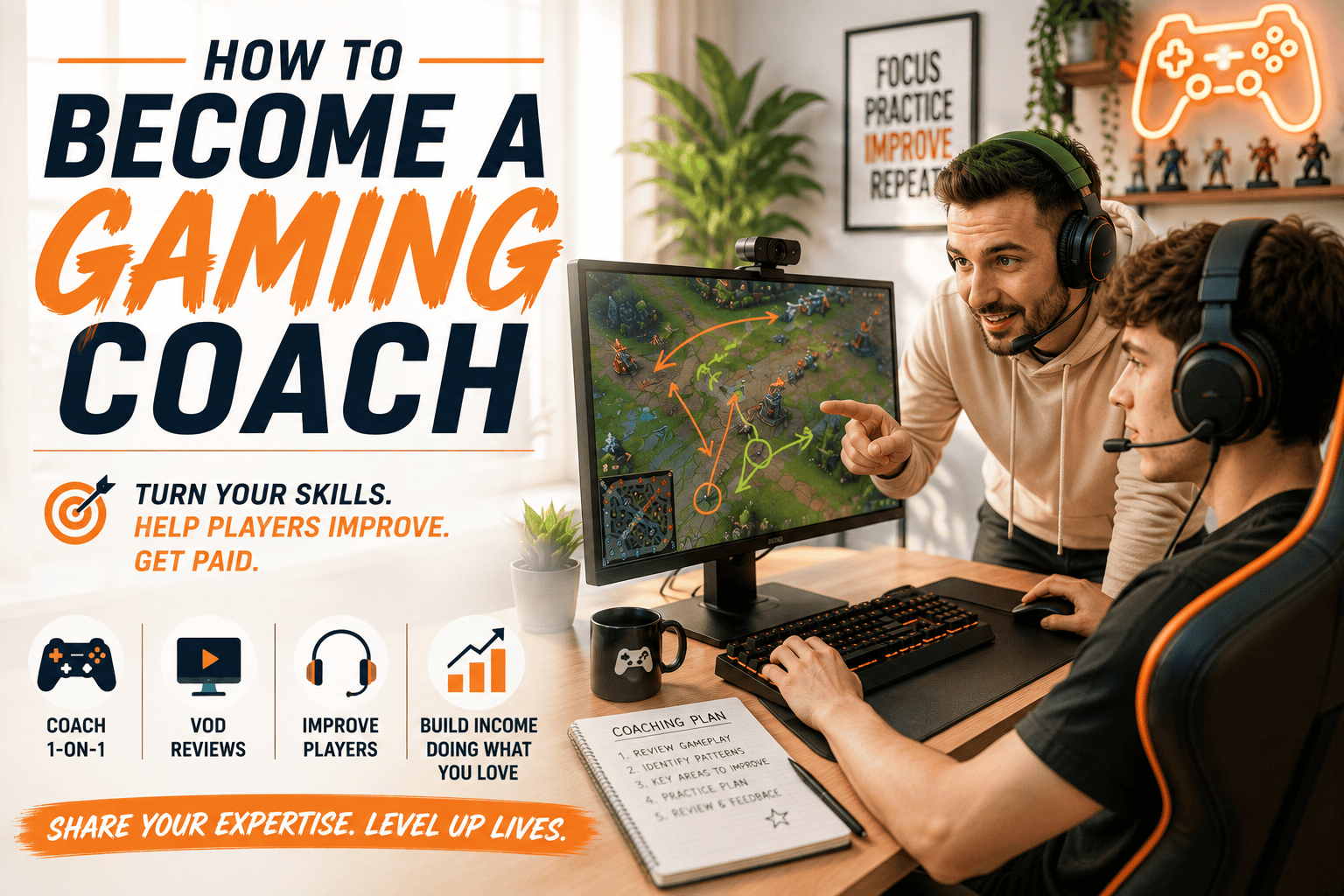
If you’re good at a game and know how to help other players improve, you could already have the foundations needed to become a gaming coach.
And no, you don’t need to be a professional esports player.
Gaming coaches come from all sorts of backgrounds and skill levels. Some have competed professionally, while others are experienced, high-ranked players who understand their game extremely well and know how to pass that knowledge on.
If you’re completely new to the concept, understanding what video game coaching is and how coaching sessions work is a useful place to start.
What matters is that you have something genuinely useful to teach.
If you’re a Diamond player, for example, you probably shouldn’t be offering advanced coaching to Grandmaster players. But you may have plenty of knowledge that could help someone struggling in Bronze, Silver or Gold.
That’s really what gaming coaching comes down to:
You know something another player wants to learn – and you know how to teach it.
1. How Do You Become a Gaming Coach?
Getting started is actually pretty straightforward.
Here’s the basic path:
🎮 Choose Your Game → 🎯 Find Your Niche → 🧠 Build Your Coaching Skills → 💰 Set Your Price → 📝 Create Your Coaching Service → ⭐ Get Your First Clients
You don’t necessarily need formal qualifications, expensive equipment or a huge social media following.
You do need a few important things:
- 🎮 Strong game knowledge – You should understand the mechanics, strategies and systems you’re trying to teach.
- 🏆 Enough skill and experience – You need to be comfortably ahead of the players you’re targeting.
- 🧠 The ability to coach – Spotting a mistake is one thing. Explaining why it happened and how to fix it is another.
- 💬 Good communication – Players need to understand your advice and feel comfortable asking questions.
- 🎯 A clear coaching offer – Players should know exactly what you can help them improve.
- 📅 Time and availability – You need reliable times when players can actually book you.
- 📝 Somewhere to sell your coaching – You’ll need a way to advertise your service, accept bookings and connect with players.
None of those requires you to have lifted an esports trophy.
🏆 Do You Have to Be an Amazing Gamer?
You need to be good enough to provide genuine value to the people you’re coaching.
That’s slightly different from needing to be one of the best players in the world.
Think about traditional coaching.
Someone teaching beginner guitar doesn’t need to be the world’s greatest guitarist. A personal trainer doesn’t need to be an Olympic athlete.
Gaming coaching works in much the same way.
If you understand concepts that another player is struggling with and can help them improve, that knowledge can have value.
Of course, the higher the level you want to coach, the stronger your own credentials generally need to be.
Someone helping beginners learn the fundamentals is operating in a very different market from a coach preparing a competitive team for a tournament.
🧠 Being Good at Gaming Isn’t the Same as Being Good at Coaching
This is where becoming a gaming coach gets a little more interesting.
You might be able to hit Radiant in Valorant.
That doesn’t automatically mean you can explain to a Silver player why they keep losing gunfights.
Great players often make decisions instinctively. They’ve played for so long that positioning, timing and decision-making happen almost automatically.
A coach has to slow that process down and explain it.
Instead of saying:
“Your positioning was bad there.”
A good coach needs to explain where the player should have been, why that position would have been better and what information should have influenced the decision.
That’s a very different skill.
And it’s one you’ll develop as you coach more players.
🚀 Getting Started Is the Easy Part
Technically, becoming a gaming coach isn’t particularly difficult.
Choose a game you know well, decide what you can teach, set a price and create a coaching service.
You could potentially do all of that today.
Building a coaching service that players actually want to book takes more work.
You’ll need to learn how to structure sessions, communicate with different types of players, build reviews, find customers and gradually develop a reputation.
Your first session probably won’t be perfect.
It doesn’t need to be.
Start with an area of gaming where you know you can genuinely help someone. Deliver a useful session. Learn from it. Make the next one better.
Do that consistently and you can go from simply being good at a game to being someone other players are willing to pay to learn from.
Next, let’s look at what a gaming coach actually does and what players are paying you to help them with.
Want to explore the wider world of gaming coaching? Our Game Coaching Guides cover becoming a coach, finding coaching clients, coaching formats, earnings and how online game coaching works.
2. What Does a Gaming Coach Actually Do?
A gaming coach helps other players understand what they’re doing wrong, develop their skills and become better at a particular game.
That sounds simple enough.
In practice, there’s a lot more to coaching than sitting in a voice chat telling someone where to aim.
A good gaming coach needs to watch how someone plays, identify the problems holding them back and turn those observations into advice the player can actually use.
Depending on the game and type of coaching, that could mean improving mechanics, positioning, strategy, communication, decision-making or even the way a player approaches competitive matches.
The exact job changes from coach to coach, but most gaming coaching involves some combination of the following.
👀 Watch and Analyse Gameplay
Before you can help someone improve, you need to understand how they currently play.
That might involve watching them play live, screen sharing during a session or reviewing previously recorded gameplay.
You’re looking for patterns.
Maybe a Valorant player has good aim but consistently takes bad fights.
Perhaps a League of Legends player understands their champion but struggles with map awareness.
A Rocket League player might have impressive mechanics but poor rotations.
The player’s problem isn’t always the thing they think is the problem either.
Someone might tell you:
“My aim is terrible.”
After watching them play, you may realise their aim is perfectly reasonable – they’re simply putting themselves in positions where almost every gunfight is difficult.
Finding that distinction is part of the coach’s job.
🎯 Identify the Biggest Areas for Improvement
Once you’ve watched someone play, you’ll probably notice plenty of mistakes.
Don’t try to fix all of them at once.
If you give a player a list of 25 things they’re doing wrong, there’s a good chance they’ll remember approximately none of them.
Good coaching means working out which problems matter most.
You might identify two or three areas that are having the biggest impact on the player’s performance and focus the session around those.
For example:
- 🎯 Crosshair placement
- 🗺️ Positioning
- 🧠 Decision-making
- 👀 Map awareness
- 💬 Communication
- ⏱️ Timing
- 🎮 Mechanics
- 📈 Consistency
Fixing one fundamental problem can sometimes improve several other parts of a player’s game at the same time.
🧠 Explain Why Mistakes Are Happening
Spotting a mistake isn’t enough.
A coach needs to explain it.
Imagine a player dies because they pushed into an enemy team alone.
Saying:
“You shouldn’t have pushed there.”
is technically correct.
It’s also not particularly useful.
A better coach might explain that two teammates were still respawning, the player had no information about the enemy positions and there was no objective forcing them to take the fight.
Now the player has something they can recognise next time.
That’s the difference between telling someone what they did wrong and teaching them how to make a better decision.
🎮 Teach Mechanics, Strategy and Game Sense
Different players need help with different things.
Beginners may need to learn basic mechanics and game systems.
Intermediate players might understand the fundamentals but struggle to apply them consistently.
Advanced players could be looking for small improvements in decision-making, positioning or competitive strategy.
Depending on your game, you might coach areas such as:
- 🎯 Aim and mechanical skills
- 🗺️ Maps and positioning
- 🧙 Characters, champions, heroes or classes
- 🧠 Strategy and game sense
- 💰 Economy and resource management
- 👥 Team composition
- 💬 Communication
- ⚔️ Matchups
- 📊 Builds and loadouts
- 🏆 Competitive play
Your job isn’t necessarily to teach everything you know.
It’s to teach what that particular player needs to know next.
🎥 Review VODs and Replays
Recorded gameplay can be one of the most useful coaching tools available.
During a live match, everything happens quickly. A player makes a decision, something explodes and ten seconds later everyone is thinking about the next fight.
A replay lets you stop.
Rewind.
Look at what information was available.
Then ask:
Why did you make that decision?
VOD reviews can help uncover habits players don’t notice while they’re actually playing.
They also give coaches time to explain situations in more detail without the pressure of another enemy appearing halfway through the explanation.
Some coaches offer VOD reviews as part of a live session, while others sell them as a separate coaching service.
📝 Give Players Something to Practise
A coaching session shouldn’t end with the player closing Discord and immediately forgetting everything you’ve discussed.
Give them something specific to work on.
Instead of:
“Work on your aim.”
you could suggest a particular aim routine for 15 minutes before ranked matches.
Instead of:
“Improve your map awareness.”
you might ask them to consciously check the minimap at particular moments during their next ten games.
Good practice goals should be specific enough that the player knows exactly what to do.
Depending on the student, you might provide:
- 🎯 Practice exercises
- 📝 Session notes
- 🎥 VOD recommendations
- 📈 Improvement goals
- 🎮 Training routines
- 🧠 Specific concepts to focus on
This gives the player something useful to take away from the session even when you’re no longer there.
📈 Track Progress Over Multiple Sessions
If someone books you regularly, your role can develop beyond fixing individual mistakes.
You can start tracking their progress.
Maybe they were struggling with positioning during the first session.
By the third session, their positioning has improved but their decision-making during late-game situations is now the bigger issue.
That’s progress.
Longer-term coaching lets you adjust what you’re teaching as the player improves rather than starting from scratch every time.
It can also make your coaching feel much more personal because you’re building on what you’ve already learned about that player.
👥 Coach Individuals or Entire Teams
Not every gaming coach works with one player at a time.
Some coaches work with teams.
Team coaching introduces a different set of problems because you’re no longer looking only at individual performance.
You might need to analyse:
- 💬 Team communication
- 🗺️ Rotations
- 🤝 Coordination
- 🎯 Role responsibilities
- 🧠 Team strategy
- ⚔️ Set plays
- 🏆 Competitive preparation
A team could have five individually talented players and still perform badly because nobody is working together.
That’s a coaching problem too.
🏆 Help Players Reach a Specific Goal
Ultimately, gaming coaching should have a purpose.
The player might want to:
- 📈 Reach a higher rank
- 🎯 Improve a particular mechanic
- 🧠 Understand the game better
- 🏆 Prepare for a tournament
- 👥 Improve with their team
- 🎮 Learn a new role or character
- 🌱 Stop feeling completely lost as a beginner
Your job is to understand that goal and work out what needs to change to help them move towards it.
That’s why gaming coaching isn’t simply about showing someone how good you are at a game.
The session isn’t really about you.
It’s about making the player better than they were before they booked you.
And to do that consistently, you’ll need more than gaming skill alone – which brings us to the skills that actually make someone a good gaming coach.
3. Do You Need to Be a Professional Gamer to Become a Coach?
No – you don’t need to be a professional gamer to become a gaming coach.
Professional experience can certainly help. If you’ve competed in esports, reached the highest ranks or played at an elite level, you’ve got credentials that can make your coaching easier to market.
But professional gaming experience isn’t a requirement for helping someone become a better player.
What matters more is whether you know enough to genuinely help the type of player you’re trying to coach.
🎮 You Don’t Need to Be the Best Player in the World
There’s a huge amount of space between being a beginner and being a professional esports player.
That’s where most gaming coaches and students sit.
Imagine you’re a Diamond-ranked player.
You might not have much to offer a Grandmaster player trying to reach the highest competitive level.
But what about someone who’s been stuck in Silver for six months?
You probably understand dozens of things that player hasn’t learned yet.
You may recognise positioning mistakes immediately. You might understand matchups they struggle with, know when they should be taking fights and spot bad habits they don’t even realise they’ve developed.
That knowledge can be valuable.
The important question isn’t:
“Am I one of the best players in the world?”
It’s:
“Can I genuinely help this player become better?”
If the answer is yes, you potentially have something worth coaching.
🏆 Your Skill Level Should Match Who You Coach
This doesn’t mean rank doesn’t matter.
It does.
You should have enough experience and skill to confidently teach the players you’re targeting.
Understanding the different video game coaching levels can help you decide which players you’re currently best equipped to coach.
A useful way to think about it is:
| Your Experience | Players You Might Target |
|---|---|
| 🎮 Experienced / Above Average | Beginners and newer players |
| 📈 High-Ranked | Beginner to intermediate players |
| 🏆 Top-Ranked | Intermediate to advanced players |
| ⭐ Professional / Esports Experience | Advanced, competitive and team players |
These aren’t strict rules. Different games have different ranking systems and individual coaching ability varies enormously.
The principle is what matters:
Don’t pretend to have expertise you don’t have.
If you’re excellent at helping beginners understand the fundamentals, there’s nothing wrong with building your coaching service around beginners.
In fact, having a clearly defined audience can make your coaching easier to sell.
🧠 Coaching Ability Can Matter More Than Rank
Here’s where things become less straightforward.
Imagine two coaches.
Coach A is among the top 0.1% of players but struggles to explain why they make certain decisions.
Coach B is slightly lower ranked but is patient, observant and excellent at breaking complicated situations into simple lessons.
Which one would make the better coach?
For many students, it could easily be Coach B.
High-level players often do things instinctively.
They’ve repeated certain situations thousands of times, so they don’t consciously think through every decision anymore.
A student doesn’t have those instincts yet.
A coach needs to unpack them.
Instead of:
“Obviously you rotate here.”
the student needs:
“Rotate here because your teammate has committed forward, you’re the last player back and pushing up would leave nobody covering the counterattack.”
The first statement shows knowledge.
The second teaches it.
🎯 You Only Need to Be Qualified for What You’re Selling
This is an important distinction for anyone wondering whether they’re “good enough” to start coaching.
You don’t need to know everything about the game.
You need to know enough about what you’re offering to teach.
Maybe you’re not an elite all-round Fortnite player, but you’re exceptionally good at building and editing.
Perhaps you play League of Legends and specialise almost entirely in jungle.
Maybe your strongest area in Counter-Strike 2 is positioning and game sense rather than raw aim.
Those can become coaching niches.
You could offer:
- 🎯 Aim coaching
- 🗺️ Positioning coaching
- 🧠 Game-sense coaching
- 🧙 Character or role-specific coaching
- 🎮 Beginner fundamentals
- 📈 Ranked improvement
- 🎥 VOD analysis
- 👥 Team communication
Being specific about what you teach also helps prevent you from drifting into areas where your knowledge isn’t as strong.
⭐ Professional Experience Still Has Advantages
While professional experience isn’t required, it would be silly to pretend it doesn’t matter.
Former and current professional players can bring experience that most gamers simply don’t have.
That could include:
- 🏆 High-level competitive experience
- 🧠 Advanced strategy
- 👥 Professional team environments
- 💬 Competitive communication
- 🎥 Detailed VOD analysis
- 🥇 Tournament preparation
- 🎯 Experience playing against elite opponents
Those credentials can be particularly valuable when coaching advanced players or competitive teams.
They can also support higher coaching rates because the knowledge is rarer.
But that represents one part of the coaching market – not the entire thing.
A Bronze player looking to understand the fundamentals probably doesn’t need a world championship winner charging premium rates.
They need someone who can explain why they keep dying.
💬 Be Honest About Your Experience
If you’re going to charge someone for coaching, be clear about what qualifies you to help them.
List your real:
- 🏆 Current and peak ranks
- 🎮 Gaming experience
- 🥇 Tournament experience
- 👥 Team experience
- ⭐ Coaching experience
- 🎯 Specialist skills
Don’t inflate your rank or pretend you’ve competed professionally when you haven’t.
Apart from the obvious problem of misleading customers, it isn’t necessary.
If you’re a high-ranked player who specialises in helping beginners and intermediate players improve, say exactly that.
The right customers will know what they’re getting.
🚀 Start With the Players You Know You Can Help
If you’re unsure whether you’re ready to become a gaming coach, start small.
Think about the players you already help.
Maybe friends regularly ask you for advice.
Perhaps you’re the person explaining strategies to your team, reviewing someone’s gameplay or helping newer players understand the game.
That’s coaching – you’re just not charging for it yet.
You can start by targeting players at a level where you’re confident your knowledge will make a difference.
As you gain coaching experience, improve your teaching and build a reputation, you can decide whether you want to move into more advanced coaching.
You don’t need an esports contract to start.
You need enough gaming knowledge to provide value – and the ability to turn that knowledge into advice another player can actually use.
4. What Skills Do You Need to Become a Gaming Coach?
Knowing the game is obviously important.
But if gaming knowledge were the only requirement, every highly ranked player would automatically be a great coach.
They aren’t.
A good gaming coach needs a mix of game knowledge, analytical ability, communication skills and patience. You need to understand what’s happening, work out what the player should change and then explain it in a way that actually helps.
Some of these skills may come naturally. Others you’ll develop with every session you coach.
🎮 Strong Game Knowledge
Let’s start with the obvious one.
You need to know the game you’re coaching.
That means more than simply having played it for a long time. You should understand the systems that affect how players perform, including things such as:
- 🎯 Core mechanics
- 🗺️ Maps and positioning
- 🧙 Characters, champions, heroes or classes
- ⚔️ Matchups
- 🧠 Strategy and game sense
- 💰 Economy or resource management
- 📊 Builds, loadouts or equipment
- 👥 Team roles
- 🏆 Ranked and competitive play
Exactly what you need to know depends on what you’re offering.
If you specialise in beginner coaching, you may spend much more time teaching fundamentals.
If you’re coaching advanced competitive players, they’ll expect much deeper knowledge.
Either way, you should be confident in the areas you’re charging someone to learn from you.
👀 Observation and Analytical Skills
A student isn’t paying you to simply watch them play.
They’re paying you to notice things they don’t.
That’s where analytical skills become important.
You need to be able to watch gameplay and ask:
What actually caused that mistake?
A player might keep losing fights and assume their mechanics aren’t good enough.
But perhaps they’re entering fights with poor positioning.
Maybe they’re using abilities too early.
Perhaps they’re constantly taking 1v2 situations without realising it.
The obvious problem isn’t always the real problem.
A good coach looks beyond the result and identifies what caused it.
💬 Clear Communication
You could have an encyclopaedic knowledge of your game.
If nobody understands what you’re saying, it’s not much use.
Good coaches can take complicated concepts and make them easier to understand.
That often means avoiding unnecessary jargon, particularly when you’re working with beginners.
It also means explaining why something matters.
Instead of:
“Your rotations are bad.”
Try:
“You’re rotating forward before your teammate has recovered, which leaves nobody covering behind you. Wait until they’re back in position before you commit.”
Now the player knows what went wrong, why it mattered and what they should do differently next time.
That’s coaching.
🧠 The Ability to Teach – Not Just Tell
There’s a difference between giving instructions and teaching.
If you tell a player exactly what to do every five seconds, they might perform better while you’re sitting beside them.
What happens when you’re gone?
Good coaching should help players make better decisions for themselves.
Sometimes that means asking questions rather than immediately giving the answer.
For example:
“What information did you have before taking that fight?”
or:
“Where were your teammates when you pushed?”
Getting the player to think through the situation can help them recognise the same problem in future matches.
The goal isn’t to create someone who needs a coach whispering instructions in their ear forever.
It’s to create a better player.
🤝 Patience
At some point, a student will make the exact mistake you explained ten minutes ago.
Then they’ll do it again.
Welcome to coaching.
People learn at different speeds and in different ways.
Something that feels painfully obvious to you may be completely new to the person you’re teaching.
Remember, you’ve probably spent hundreds or thousands of hours developing habits that now feel automatic.
Your student hasn’t.
Getting frustrated because someone doesn’t immediately understand a concept isn’t going to make them learn faster.
A good coach needs enough patience to explain things differently when the first explanation doesn’t work.
🎯 Goal Setting
“I want to get better.”
That’s probably the most common goal in gaming.
It’s also not particularly useful.
Better at what?
Aim? Positioning? Game sense? Communication? Ranked performance?
A coach should help turn vague ambitions into specific areas for improvement.
Instead of:
“Get better at Valorant.”
a useful short-term goal might be:
“Improve crosshair placement and reduce unnecessary deaths when defending sites.”
Now you have something you can actually work on.
Good goals also make progress easier to see.
If a student can recognise that something they struggled with three weeks ago has noticeably improved, they’ll know the coaching is working.
📈 Adaptability
Not every student should receive the same coaching session.
A beginner may need concepts explained slowly with plenty of examples.
An advanced player might understand the fundamentals perfectly and want detailed analysis of a handful of decisions.
Some players learn best by watching.
Others need to play through situations themselves.
Some want detailed explanations.
Others want you to get to the point.
A good coach adjusts.
You’re not changing what is correct about the game.
You’re changing how you communicate it to the person sitting on the other side of the screen.
🎥 Attention to Detail
Small mistakes can have big consequences in competitive games.
A slightly late rotation.
Poor crosshair placement.
Using an ability three seconds too early.
Missing information on the minimap.
Taking a fight from the wrong angle.
These details are easy to miss when you’re the person actually playing.
As a coach, you have the luxury of watching.
Replay tools and VOD reviews make this even easier because you can pause, rewind and examine exactly what happened.
The better you become at spotting those details, the more useful your feedback can become.
🌱 A Willingness to Keep Learning
Games change.
New patches arrive. Characters get buffed. Weapons get nerfed. Maps change. Strategies evolve and yesterday’s brilliant advice can eventually become today’s terrible advice.
If you’re charging players for current expertise, you need to keep that expertise current.
That might involve:
- 📝 Reading patch notes
- 🏆 Watching high-level competitive play
- 🎥 Reviewing professional matches
- 🎮 Continuing to play the game yourself
- 🧠 Learning new strategies
- 👥 Following changes in the competitive community
You should also keep learning how to coach.
Pay attention to which explanations work.
Notice where students get confused.
Ask for feedback.
Every session gives you information you can use to make the next one better.
⭐ The Best Coaches Combine Gaming Skill With People Skills
You don’t need to be perfect at every one of these things before offering your first coaching session.
But it’s worth understanding that gaming coaching is ultimately about people as much as games.
Your gaming ability gives you the knowledge.
Your analytical skills help you find the problem.
Your communication helps the player understand it.
And your coaching ability helps them fix it.
Combine those skills well and you’re offering something far more valuable than simply being a highly ranked player who’s available for an hour.
Next comes deciding which game you should actually coach – and whether there’s a market for what you know.
5. Choose the Right Game to Coach
If you’re going to become a gaming coach, one of your first decisions is also one of the most obvious:
What game are you going to coach?
For some players, the answer will be easy.
If you’ve spent the last five years playing League of Legends, reached a high rank and know your role inside out, you probably don’t need a spreadsheet to tell you where to start.
But if you’re good at several games, choosing the right one deserves a little more thought.
The best game to coach isn’t necessarily the one with the highest coaching rates or the biggest esports prize pools.
It’s usually the game where your knowledge, skill and experience overlap with something other players want to learn.
🏆 Start With a Game You’re Genuinely Good At
First things first – you need to know what you’re talking about.
You don’t necessarily need to be among the best players in the world, but you should have enough experience to confidently help the type of player you’re targeting.
Ask yourself:
- 🎮 How long have I played this game?
- 🏆 What’s my current and peak rank?
- 🧠 How well do I understand the game beyond basic mechanics?
- 🎯 What am I particularly good at?
- 💬 Could I explain those skills to someone else?
- 📈 Which types of players could I realistically help?
Be realistic here.
Having 2,000 hours in a game doesn’t automatically make you qualified to coach it.
Likewise, someone with fewer hours but a strong rank, deep understanding and natural ability to teach might make an excellent coach.
Experience matters, but what you’ve learned from that experience matters more.
🎯 Look for Games Where Players Want to Improve
Some games naturally lend themselves to coaching more than others.
Competitive games are particularly well suited because players usually have clear reasons to improve.
They might want to reach the next rank, win more matches, master a character or start playing competitively.
Games with features such as these can create strong coaching opportunities:
- 🏆 Ranked or competitive modes
- 📈 Clear skill progression
- 🎯 High skill ceilings
- 👥 Large or active player bases
- 🥇 Esports scenes
- 🧠 Deep strategies and mechanics
- 🔄 Regular updates and changing metas
- 🎥 Replay or VOD systems
The easier it is for a player to recognise that they have something to improve, the easier it is to understand why they might pay someone to help them improve it.
🎮 Popular Games for Gaming Coaching
You’ll find gaming coaches across a huge range of titles, but competitive games tend to dominate.
Some obvious examples include:
- 🎯 Valorant – Aim, positioning, agents, game sense and ranked improvement
- 🧙 League of Legends – Roles, champions, laning, macro play and ranked climbing
- 🔫 Counter-Strike 2 – Aim, movement, positioning, utility and team strategy
- 🚗 Rocket League – Mechanics, rotations, positioning and ranked progression
- 🏗️ Fortnite – Building, editing, aim, movement and competitive play
- 🛡️ Overwatch 2 – Heroes, positioning, team composition and communication
- ⚔️ Dota 2 – Heroes, roles, itemisation, strategy and decision-making
- ⚽ EA Sports FC – Gameplay mechanics, tactics, formations and competitive play
These aren’t the only games you can coach.
Far from it.
Fighting games, strategy games, racing games, sports games, battle royales, MOBAs and competitive shooters can all have players looking to improve.
Even games without huge esports scenes can create coaching opportunities if there’s an active community of players who take improvement seriously.
❤️ Pick a Game You Actually Enjoy
This sounds obvious, but it’s easy to overlook when money enters the conversation.
You may be playing the same game for hours every week.
Then you’re going to spend additional hours watching other people play it.
Then you’ll probably review their replays.
Then someone will ask you why they lost a match.
Then you’ll watch another replay.
If you’re already completely sick of the game, coaching it isn’t likely to improve the relationship.
Choosing a game you genuinely enjoy makes it easier to stay engaged with patches, strategies, competitive play and the community around it.
That matters because coaching isn’t a one-time test of your knowledge.
You need to keep that knowledge current.
📈 Consider the Demand – But Don’t Chase It Blindly
A large game can mean a large pool of potential students.
It can also mean a large pool of coaches.
That’s the trade-off.
A popular competitive game such as Valorant or League of Legends may have plenty of players interested in coaching, but you’ll also be competing with established coaches, top-ranked players and sometimes former professionals.
A smaller game may have fewer potential customers but considerably less competition.
Neither is automatically better.
Instead of simply asking:
“Which game has the most players?”
ask:
“Where can I offer something players will have a reason to choose?”
That’s a much more useful question.
🧠 Think About What You Know Better Than Most Players
Your coaching game and your coaching niche are closely connected.
Maybe you’re a strong League of Legends player, but your real strength is jungle.
Perhaps you’ve reached a high Valorant rank largely because of your positioning and game sense rather than extraordinary aim.
Maybe you’ve spent years mastering Rocket League mechanics.
Those strengths matter.
Consider what friends and teammates already ask you about.
Do they ask you to explain builds?
Review their gameplay?
Teach them mechanics?
Help with strategies?
Tell them why they keep losing?
Those questions can point towards the knowledge other players may actually value.
🔄 Think About Whether You Can Stay Current
Competitive games rarely stand still.
Patches change weapon balance.
Characters are added or reworked.
Maps change.
New strategies appear.
The meta shifts.
If you’re going to sell coaching, particularly at higher levels, you can’t rely entirely on what worked two years ago.
Before choosing a game, ask yourself whether you’re willing to continue following it.
That might mean:
- 📝 Reading patch notes
- 🎥 Watching high-level gameplay
- 🏆 Following competitive matches
- 🎮 Continuing to play regularly
- 🧠 Learning new strategies
- 🔄 Updating your coaching as the game changes
Players are paying for your expertise.
Ideally, that expertise shouldn’t be three patches behind.
💡 Don’t Choose a Game Just Because the Rates Look High
Suppose you see established coaches charging $75 an hour for a particular game.
Tempting.
But if you’re only moderately skilled at that game, while you’re genuinely excellent at another, chasing the higher advertised rate probably isn’t the smartest move.
Remember:
An advertised hourly rate isn’t the same thing as actual earnings.
A $75 coaching listing with no customers earns nothing.
A $30 service that regularly gets booked does.
Your best opportunity is usually where you can provide the strongest value and build a reputation around it.
🎯 Choose Your Game – Then Get More Specific
Choosing your game is only the first layer.
“I coach Valorant.”
That’s a start.
But thousands of other people could say the same thing.
The next question is:
What kind of Valorant coach are you?
Who do you help?
What do you specialise in?
What problem can you solve?
That’s where your coaching service starts becoming much more interesting.
And it’s exactly what we’ll tackle next when we look at how to find your gaming coaching niche.
6. Find Your Gaming Coaching Niche
Once you’ve chosen the game you want to coach, the next step is deciding what you actually want to be known for.
You could simply create a listing that says:
“I offer Valorant coaching.”
There’s nothing technically wrong with that.
It’s just not very specific.
Compare it with:
“I help Silver-Platinum Valorant players improve positioning, game sense and ranked performance.”
Now a potential student immediately knows who the coaching is for and what they’re going to get from it.
That’s your coaching niche.
And finding one can make it much easier to stand out from dozens of other coaches offering broadly the same thing.
🎯 What Is a Gaming Coaching Niche?
Your niche is simply the specific type of player or problem your coaching focuses on.
You don’t need to invent some microscopic speciality that only three people on Earth are searching for.
You just need to give players a clearer idea of where you’re particularly useful.
A League of Legends coach might specialise in helping lower-ranked jungle players.
A Rocket League coach could focus on mechanics and rotations for Diamond and Champion players.
A Fortnite coach might specialise in building, editing and competitive preparation.
All three are still gaming coaches.
They’ve just made it easier for the right student to recognise them.
🏆 Specialise by Player Skill Level
One of the easiest ways to define your niche is by the level of player you want to coach.
For example:
- 🌱 Beginner Coaching – Learning mechanics, terminology and basic strategy
- 🎮 Intermediate Coaching – Fixing bad habits and improving consistency
- 📈 Ranked Coaching – Helping players overcome specific ranked plateaus
- 🏆 Advanced Coaching – Refining high-level mechanics and decision-making
- ⭐ Competitive Coaching – Tournament preparation and advanced team play
This also helps keep your coaching within your own level of expertise.
If you’re a strong player but nowhere near professional level, beginner and intermediate coaching might be exactly where you provide the most value.
There’s nothing wrong with that.
Someone learning the basics doesn’t necessarily need an esports champion.
They need someone who understands the basics extremely well and can teach them clearly.
🎮 Specialise by Role or Position
Many competitive games divide players into clearly defined roles.
That creates natural coaching niches.
In League of Legends, you could specialise in:
- ⚔️ Top
- 🌲 Jungle
- 🧙 Mid
- 🎯 ADC
- 🛡️ Support
Other games have their own equivalents.
You might specialise in goalkeeping in EA Sports FC, support heroes in Overwatch 2 or playing as an IGL in Counter-Strike 2.
If you’ve spent years mastering one role, don’t hide that expertise behind a generic coaching offer.
Make it part of the reason someone should book you.
🧙 Specialise by Character, Champion or Class
You can get even more specific.
Some players don’t want to learn an entire game.
They want to get better with one particular character.
A League of Legends player might want coaching specifically for their main champion.
A Valorant player could want to improve with a particular agent.
An Overwatch 2 player may be trying to master one hero.
MMOs and other class-based games can create similar opportunities.
This can be particularly effective if you’ve reached a high level while specialising in that same character, champion or class.
You’re offering knowledge that comes from actually mastering the thing the student wants to learn.
🧠 Specialise by Skill
You can also build a coaching service around a particular skill or weakness.
For example:
- 🎯 Aim
- 🗺️ Positioning
- 🧠 Game sense
- ⚔️ Mechanics
- 💬 Communication
- 📊 Strategy
- 🎥 VOD analysis
- 💰 Economy management
- 🤝 Teamwork
- 🏗️ Building and editing
This works particularly well when players already know what they’re struggling with.
Someone searching for help with Valorant aim training may find a dedicated Valorant Aim Coaching service more appealing than a generic coaching session.
The offer matches the problem.
📈 Specialise by the Result Players Want
Another approach is to focus on the player’s goal.
Players don’t always care about the technical name for what they’re doing wrong.
They know what they want to achieve.
That could be:
- 📈 Reach a higher rank
- 🏆 Prepare for competitive play
- 🎮 Learn a new role
- 🧠 Improve game sense
- 🎯 Become more consistent
- 👥 Improve as a team
- 🌱 Learn the game as a beginner
- 🔄 Return after a long break
This can make your coaching easier to understand because you’re selling an outcome, not just an hour of your time.
Be careful with guarantees, though.
You can help someone improve their chances of climbing the ranks.
You can’t reasonably promise that every student will reach a specific rank after one session.
🔍 Look at What Other Coaches Are Offering
Before settling on your niche, do a little research.
Look at coaches offering services for the same game.
Pay attention to:
- 🎯 What they specialise in
- 🏆 What ranks they’re targeting
- 💰 What they charge
- ⭐ Which services have reviews
- 📦 What their sessions include
- 🎥 Whether they offer VOD reviews
- 📝 How they describe their coaching
You’re not looking for something to copy.
You’re looking for gaps.
Perhaps there are hundreds of general Valorant coaches but relatively few specialising in controller players.
Maybe most Rocket League listings target beginners while you have the experience to coach higher-ranked players.
Or perhaps everyone is selling live sessions and you think detailed VOD reviews would suit your coaching style better.
Competitors can tell you quite a lot about what the market already has – and where you might fit into it.
💡 Use What You’re Already Known For
Sometimes your niche is already sitting in front of you.
Think about your gaming friends and teammates.
What do they ask you for help with?
Maybe you’re always explaining jungle routes.
Perhaps everyone sends you clips to review their aim.
Maybe you’re the person who understands team compositions or knows every ridiculous matchup in the game.
If people already come to you for a particular kind of advice, that’s a useful signal.
You may have developed specialist knowledge without deliberately trying to.
🎯 Use a Simple Formula to Define Your Coaching
If you’re struggling to work out exactly what your coaching service should be, try this:
I help [TYPE OF PLAYER] improve [SKILL OR RESULT] in [GAME].
For example:
🎯 I help Silver-Platinum Valorant players improve positioning, game sense and ranked performance.
🚗 I help Diamond-Champion Rocket League players improve rotations and consistency.
🧙 I help beginner League of Legends jungle players improve pathing, objectives and map awareness.
🏗️ I help Fortnite players improve building, editing and competitive mechanics.
You don’t necessarily need to use that exact sentence in your listing.
The point is to make your own offer clear in your head first.
If you can’t explain who your coaching is for and what you’re helping them achieve, potential customers will probably struggle too.
🚀 Don’t Make Your Niche Too Narrow
Specialisation is useful.
Going absurdly specific isn’t.
You probably don’t need to become:
“The premier Tuesday-night OCE Silver 2 left-handed Valorant controller coach.”
At some point, you’ve run out of customers.
Your niche should make your service more relevant to a group of players without excluding everyone else unnecessarily.
You can also broaden it later.
Start with an area where you’re particularly strong. Build reviews and experience. Then add other services if players are asking for them.
⭐ Give Players a Reason to Choose You
Ultimately, finding a niche answers one important question:
Why should someone book you instead of another gaming coach?
Maybe you’re particularly good with beginners.
Maybe you’re an exceptionally high-ranked support player.
Maybe your VOD analysis is incredibly detailed.
Maybe you’ve spent years competing.
Maybe you specialise in one mechanic that players regularly struggle with.
Whatever it is, make it obvious.
You don’t need to be the perfect coach for every player.
You need to be a great choice for the players you’re actually trying to help.
Once you know who those players are, the next step is deciding what type of gaming coaching you’re going to offer them.
7. Decide What Type of Gaming Coaching You’ll Offer
You’ve chosen your game.
You’ve worked out who you want to help.
Now you need to decide what the player is actually going to buy.
Gaming coaching can take several different forms. You might coach someone live while they play, analyse a recorded match, work with an entire team or build a longer-term coaching program around a player’s goals.
You don’t need to offer all of them.
In fact, if you’re new to coaching, starting with one or two simple formats is usually the better option.
Let’s look at the main choices.
🎧 One-on-One Gaming Coaching
This is probably what most people picture when they think of gaming coaching.
You work directly with one player for a set amount of time, often through voice chat and screen sharing.
A typical session could involve:
- 🎯 Discussing the player’s goals
- 🎮 Watching them play
- 👀 Identifying mistakes
- 🧠 Explaining better decisions
- 🎥 Reviewing important moments
- 📝 Giving them things to practise
The biggest advantage is personalisation.
You’re not giving generic advice to thousands of players watching the same YouTube video.
You’re looking at this player’s gameplay and this player’s problems.
For new coaches, one-on-one sessions are also relatively easy to understand, price and sell.
🎥 VOD and Replay Reviews
Sometimes the best way to understand what a player is doing wrong is to watch a match after it’s finished.
That’s where VOD and replay coaching comes in.
The player sends you recorded gameplay or an in-game replay and you analyse it.
You can pause important moments, rewind decisions and explain what could have been done differently.
This can be particularly useful for analysing:
- 🗺️ Positioning
- 🧠 Decision-making
- 👀 Map awareness
- ⚔️ Fight selection
- 💰 Resource management
- 🎯 Mechanical mistakes
- 👥 Teamplay
A VOD review could happen live with the player or you could record your analysis and send it to them afterwards.
The second option has another advantage:
You don’t necessarily need to be online at the same time as the student.
That can make VOD reviews easier to fit around other commitments.
🎮 Live Gameplay Coaching
Another option is coaching while the player is actually playing.
You might watch through screen sharing and provide feedback during or between matches.
This allows you to see how the player reacts to situations in real time.
It can be useful for spotting habits that don’t always stand out in isolated clips.
However, there’s a balance to find.
If you spend the entire match shouting instructions such as:
“Go left. Use your ability. Rotate now. Don’t push. Reload.”
the player may perform better while you’re there without actually learning much.
Live coaching works best when you’re helping the player understand how to make those decisions themselves.
Otherwise, you’ve become a very expensive minimap.
📦 Multi-Session Coaching Packages
Not every problem can be fixed in 60 minutes.
A player trying to climb several ranks or improve a complicated skill may benefit more from multiple sessions spread over several weeks.
That’s where coaching packages can work well.
For example:
🚀 3-Session Improvement Package
Session 1 – Assessment
Review gameplay, identify the biggest weaknesses and set improvement goals.
Session 2 – Development
Review progress, work on the main problem areas and introduce more advanced concepts.
Session 3 – Progress Review
Analyse what’s improved, identify remaining weaknesses and create a longer-term practice plan.
This gives the coaching some structure.
Instead of three unrelated sessions, the player is working through a clear improvement process.
It can also help coaches build repeat business rather than relying entirely on one-off bookings.
👥 Team Coaching
You don’t have to coach one player at a time.
Competitive teams may want help improving how they play together.
Team coaching can focus on areas such as:
- 💬 Communication
- 🗺️ Rotations and positioning
- 🤝 Coordination
- 🎯 Role responsibilities
- 🧠 Team strategy
- ⚔️ Set plays
- 🎥 Match reviews
- 🏆 Competitive preparation
This can be particularly relevant in games such as Valorant, Counter-Strike 2, League of Legends, Overwatch 2 and Rocket League.
Team coaching usually requires a different skill set from individual coaching.
You’re not just looking at whether one player made the right decision.
You’re looking at how several players’ decisions affect one another.
🏆 Competitive and Tournament Coaching
If you have genuine competitive experience, you may be able to offer more advanced coaching.
This could involve helping individual players or teams prepare for:
- 🥇 Tournaments
- 🎮 Competitive leagues
- 🏆 Qualifiers
- 👥 Team tryouts
- 📈 Higher-level ranked play
Competitive coaching might include detailed VOD analysis, opponent preparation, team strategy, communication and performance reviews.
This is also an area where your own credentials become particularly important.
A beginner doesn’t necessarily care whether you’ve competed professionally.
A team preparing for a serious tournament probably will.
🎯 Skill-Specific Coaching
Your coaching service can also be built around one particular skill.
Instead of offering general Counter-Strike 2 coaching, for example, you could offer an Aim and Positioning Review.
Other examples might include:
- 🎯 Valorant Aim Coaching
- 🧠 League of Legends Macro Coaching
- 🌲 LoL Jungle Coaching
- 🚗 Rocket League Mechanics Coaching
- 🏗️ Fortnite Building and Editing Coaching
- 💬 Team Communication Coaching
- 🎥 Ranked VOD Analysis
This works particularly well if you’ve already identified a clear coaching niche.
A player with a specific problem can immediately see that your service was designed for them.
📈 Longer-Term Coaching
Some students may want more than a few isolated sessions.
They may be looking for someone who can work with them over several weeks or months.
Longer-term coaching could include:
- 🎧 Regular one-on-one sessions
- 🎥 Ongoing VOD reviews
- 📝 Training plans
- 🎯 Weekly goals
- 📈 Progress tracking
- 💬 Feedback between sessions
The advantage is continuity.
You already know how the player performs, what you’ve worked on and where they’re trying to get.
Instead of spending part of every session figuring out what’s going wrong, you can build on previous coaching.
For the coach, regular students can also make bookings and income more predictable.
💡 What Should a New Gaming Coach Offer?
If you’re just starting, don’t make this more complicated than it needs to be.
A very reasonable first coaching offer could simply be:
🎧 60-Minute One-on-One Gaming Coaching
You could include:
- A short discussion about the player’s goals
- Live gameplay or VOD analysis
- Personalised coaching
- A summary of their biggest weaknesses
- A few specific things to practise afterwards
That’s enough to start.
Once you’ve coached several players, you’ll begin learning what people actually want.
Maybe everyone asks whether you offer replay reviews.
Perhaps students keep returning for follow-up sessions.
Maybe players want longer packages.
That’s when you can start adding more options.
🎮 Build Your Services Around What Players Need
There’s no prize for having the longest coaching menu.
Five different packages, four session lengths and twelve optional extras can sometimes make choosing harder rather than easier.
Start with a clear service that solves a clear problem.
Then pay attention.
What are players asking for?
What gets booked?
What type of coaching produces the best results?
Your coaching services can evolve as you gain experience.
The important thing is that when someone books you, they understand exactly what they’re buying and what they can expect from the session.
And that brings us to an important question for every new coach:
What should actually happen during your first gaming coaching session?
8. Plan Your First Gaming Coaching Session
You’ve got your first booking.
Great.
Now what are you actually going to do for the next hour?
Your first gaming coaching session doesn’t need an elaborate training program or a 47-slide presentation on positioning.
But it does need some structure.
A good session should help you understand the player, identify what’s holding them back and give them a small number of useful things they can start improving straight away.
The player should finish the session knowing more than when they started – and knowing what to work on next.
Here’s one way to structure it.
💬 Before the Session – Understand the Player
Don’t wait until 20 minutes into the session to discover what the player actually wants help with.
Before you begin, ask a few simple questions.
For example:
- 🎮 What game and mode do you mainly play?
- 🏆 What’s your current and peak rank?
- 🎯 What rank or skill level are you trying to reach?
- 🧙 What role, character or class do you normally play?
- 🧠 What do you think you’re struggling with?
- 🎥 Do you have any gameplay or replays available?
- 📈 What would make this coaching session feel worthwhile?
You don’t need to interrogate them.
The idea is simply to get enough context to avoid giving generic advice.
A player trying to escape Bronze may need something completely different from someone who’s one rank away from the top competitive tier.
⏱️ A Simple 60-Minute Gaming Coaching Session
There’s no single correct way to structure a coaching session, but here’s a straightforward starting point:
| Time | What You’re Doing |
|---|---|
| 5-10 mins | 🎯 Discuss goals, rank and current problems |
| 30-40 mins | 🎮 Watch gameplay, review a VOD and provide coaching |
| 10-15 mins | 📝 Recap key lessons and create a practice plan |
You can adjust this depending on the game and the student.
Some sessions might involve more gameplay.
Others could be almost entirely VOD analysis.
The important thing is that the session has a purpose rather than becoming an hour of randomly pointing out mistakes.
🎯 Start With a Clear Goal
At the beginning of the session, agree on what you’re trying to accomplish.
If the player says:
“I just want to get better.”
help them narrow that down.
After talking for a few minutes, you might discover that they’re losing most of their fights because of poor positioning.
Now the session has a focus:
Identify the player’s positioning mistakes and give them a practical way to improve them.
You probably won’t transform their entire game in one hour.
That’s fine.
A useful coaching session doesn’t need to fix everything.
It needs to move the player forward.
👀 Watch Before You Start Fixing
One of the easiest mistakes for a new coach to make is jumping in immediately.
The player makes one questionable decision and suddenly you’re delivering a five-minute lecture.
Give yourself time to observe first.
Watch how they move.
Look at the decisions they make.
Notice where they’re looking and what information they’re using.
Try to identify patterns rather than isolated mistakes.
One bad push could simply be a bad push.
Five bad pushes probably tell you something.
You may also discover that the problem the player mentioned before the session isn’t actually what’s holding them back.
That’s useful.
Your job is to find the highest-impact problems, not simply confirm what the player already believes.
🧠 Explain the Why – Not Just the What
When you identify a mistake, explain what happened.
Then explain why.
Then explain what the player should do differently.
For example:
What happened:
“You pushed into that fight alone.”
Why it was a problem:
“Both teammates were still recovering, so if you lost the fight there was nobody available to trade or defend.”
What to do instead:
“Before committing, check whether your teammates are in a position to follow. If they’re not, hold your position and wait.”
Now you’ve given the player a rule they can apply in future matches.
That’s much more useful than simply saying:
“Don’t push there.”
❌ Don’t Try to Fix Everything
You’ll probably notice plenty of mistakes.
Resist the urge to mention every single one.
Imagine trying to play while someone tells you:
Your aim is wrong.
Your positioning is wrong.
Your movement is wrong.
Your ability usage is wrong.
You missed the minimap.
Your crosshair is too low.
You rotated late.
Also, your build is weird.
Good luck concentrating.
Instead, identify two or three areas that will make the biggest difference.
Once those improve, you can move onto something else.
Coaching should make the game feel clearer – not more complicated.
💬 Ask Questions During the Session
Don’t spend the entire hour talking at the player.
Ask them what they were thinking.
For example:
“Why did you take that fight?”
“What information did you have here?”
“Where did you think the enemy was?”
“What were you expecting your teammate to do?”
Sometimes the player’s answer reveals more than the gameplay itself.
Maybe they didn’t notice something.
Perhaps they misunderstood a game mechanic.
Or maybe their reasoning was actually good and the outcome was simply unfortunate.
Understanding why the player made the decision helps you coach the decision-making process rather than judging everything by whether they won or lost.
🎮 Let the Player Apply What You’ve Taught
Where possible, give the student a chance to use the advice during the session.
If you’ve spent 15 minutes discussing positioning, watch another round or match and see whether they recognise the same situations.
You don’t need to immediately tell them what to do.
Give them a moment.
They might surprise you.
And if they make the right decision themselves, reinforce it.
Knowing what someone did right can be just as useful as knowing what they did wrong.
📝 Finish With a Clear Summary
Don’t end the session with:
“Well, that’s an hour. Good luck.”
Use the final few minutes to recap.
What were the biggest problems you identified?
What improved during the session?
What should the player work on next?
Keep it manageable.
A useful summary might look like:
🎯 Focus 1 – Crosshair Placement
Keep your crosshair at likely enemy head height rather than adjusting after an enemy appears.
🗺️ Focus 2 – Positioning
Avoid taking fights where you’re exposed to multiple angles.
👀 Focus 3 – Map Awareness
Check teammate positions before committing to aggressive plays.
Now the player leaves with three specific things to practise.
📈 Give Them a Simple Practice Plan
If appropriate, give the player something to work on before their next session.
It doesn’t need to be complicated.
For example:
Before each ranked session:
- 10-15 minutes of aim practice
- One warm-up match
- Focus specifically on crosshair placement
During ranked matches:
- Check teammate positions before pushing
- Pay attention to deaths caused by poor positioning
After playing:
- Save one replay for review
Now the coaching continues to have value after the session has finished.
⭐ Make the Player Feel Like the Session Was Built for Them
This is ultimately what separates personal coaching from generic gaming advice.
The internet already contains thousands of guides, tutorials, streams and videos telling people how to improve.
Your student has chosen to pay for something different.
Personal feedback.
They want someone to look at their gameplay, find their mistakes and help with their goals.
So don’t deliver the exact same speech to every player.
Listen.
Watch.
Ask questions.
Then build the session around what you actually see.
🎯 Your First Session Won’t Be Perfect
You’ll probably finish your first few coaching sessions thinking of things you could have explained better.
That’s normal.
Maybe you spent too long on one topic.
Perhaps you gave the player too much information.
Maybe an explanation that sounded perfectly clear in your head landed like a patch note written in another language.
Learn from it.
After each session, ask yourself:
What worked?
Where did the player struggle?
What would I do differently next time?
That’s how you become a better coach.
And once you’ve worked out what your coaching session looks like, the next question becomes much more practical:
How much should you charge for it?
9. How Much Should a New Gaming Coach Charge?
You’ve chosen your game, worked out what you’re going to teach and planned your coaching session.
Now comes the slightly awkward part:
How much should you charge?
For a new gaming coach, around $10-$25+ per hour can be a reasonable starting range, but there’s no universal price that works for every coach or every game.
It can also help to compare how much video game coaching costs across different games, coaching formats and experience levels before setting your own rate.
Your ideal rate depends on your rank, experience, game, coaching format, competition and – eventually – your reputation.
The important thing is to choose a price that gives players a reason to try you without making your time feel worthless.
🌱 Start With a Realistic Introductory Price
When you’re brand new to coaching, you have a problem that established coaches don’t:
Nobody knows whether you’re any good yet.
You might be an exceptional player and a natural teacher.
But if your coaching profile has zero completed sessions and zero reviews, a potential customer has to take your word for it.
An introductory price can reduce that risk.
If similar established coaches are charging $30-$40 per hour, for example, you might decide to start somewhat lower while you build experience and reviews.
That doesn’t mean you need to become the cheapest coach available.
You’re simply giving players a reason to take a chance on someone new.
🔍 See What Other Gaming Coaches Charge
Before choosing a number, do some research.
Look for coaches offering similar services for the same game.
Don’t just look at the price.
Compare:
- 🏆 Their rank and experience
- ⭐ Number and quality of reviews
- ⏱️ Session length
- 🎯 What they specialise in
- 🎥 Whether VOD analysis is included
- 📦 Any coaching packages
- 👥 Individual or team coaching
- 🥇 Competitive or esports experience
If a former professional player with hundreds of reviews charges $60 an hour, matching their price on your first day probably isn’t the strongest strategy.
On the other hand, if you have exceptional credentials yourself, you may not need to start at the very bottom of the market.
Price yourself according to the value you can realistically demonstrate.
🎮 Your Game Can Affect Your Rate
Coaching prices can vary between games.
A large competitive title may have thousands of potential students, but it could also have plenty of coaches competing for them.
A smaller competitive game may have fewer players but fewer coaches.
Certain games also have particularly deep competitive systems, creating opportunities for specialist coaching around ranks, roles, characters and mechanics.
This is why there isn’t really a universal “gaming coach hourly rate”.
What players are willing to pay depends partly on the coaching market around the game you’re offering.
🏆 Your Rank and Experience Matter
The stronger your credentials, the easier it may be to justify a higher starting price.
Relevant experience could include:
- 🏆 A high current or peak rank
- 🥇 Tournament results
- 👥 Competitive team experience
- ⭐ Previous coaching experience
- 🎯 Specialist expertise
- 🎮 Years of high-level play
- 🧠 Experience in a particular role or character
Just remember that credentials get someone interested.
The quality of your coaching determines whether they come back.
🎥 Price the Service – Not Just the Hour
Not every 60-minute coaching session offers the same thing.
Imagine two coaches both charge $30.
One offers:
🎧 60 minutes of live coaching
The other offers:
🎥 Pre-session replay review + 🎧 60-minute coaching session + 📝 personalised improvement notes
Those aren’t really equivalent services.
Think about everything you’re providing and how much time it takes you.
If a one-hour session requires another 30 minutes of preparation and VOD analysis, you’re doing more than one hour of work.
Your pricing should eventually reflect that.
💰 Don’t Make Cheap Your Entire Selling Point
Charging less can help when you’re getting started.
But there’s a difference between using an introductory price and building your entire coaching service around being the cheapest option.
Very low pricing can sometimes create its own problem.
Players may wonder:
Why is this coach so much cheaper than everyone else?
You also leave yourself very little room once you account for preparation, communication and other unpaid time around the session.
Compete on value where you can.
Your niche, coaching style, rank, session structure and specialist knowledge can all give players reasons to choose you besides price.
⭐ Build Reviews – Then Reassess
Your first price doesn’t have to be your forever price.
Suppose you start at $15 per hour.
You complete several sessions.
Players leave good reviews.
Some come back.
Your available times begin filling regularly.
At that point, try $20.
If demand remains strong, perhaps you eventually move to $25 or $30.
This is much more useful than trying to guess the perfect price before you’ve coached a single paying student.
Let demand give you information.
📈 Don’t Confuse Your Rate With Your Earnings
This is worth repeating because it’s an easy trap to fall into.
A coach charging $50 per hour isn’t necessarily earning more than someone charging $25.
Consider:
Coach A: $50 × 2 paid sessions = $100
Coach B: $25 × 8 paid sessions = $200
The higher-priced coach has the more impressive hourly rate.
The lower-priced coach made twice as much revenue.
Your goal isn’t simply to push your advertised price as high as possible.
It’s to find a rate where your time is properly valued and players still want to book you.
📦 Consider Packages Once You Have Some Experience
Once players start returning, you can consider offering multiple sessions together.
For example:
🎮 Single Session – $25
One 60-minute coaching session.
🚀 3-Session Package – $70
Three coaching sessions focused on a specific improvement goal.
🏆 5-Session Program – $110
Five sessions with ongoing progress reviews and a structured improvement plan.
Those figures are only examples, but the principle is useful.
Packages can give players a reason to commit to longer-term improvement while helping you secure several bookings at once.
🎯 So, What Should You Charge for Your First Session?
If you’re starting with no coaching history or reviews, $10-$25+ per hour is a practical range to investigate.
But don’t simply pick $20 because an article told you to.
Look at comparable coaches in your game.
Consider your rank and experience.
Think about what’s included in your session.
Then choose a price that makes sense for your position in the market.
You can adjust it once you have real information about how players respond.
For a much deeper look at hourly rates, monthly income and what established coaches can earn, see our guide:
💰 How Much Do Gaming Coaches Earn?
Once you’ve settled on a starting price, you’re ready to turn everything we’ve covered so far into something players can actually find and book:
your gaming coaching service.
10. Create Your Gaming Coaching Service
By this point, you know what game you’re coaching, who you want to help, what your sessions will involve and roughly what you’re going to charge.
Now you need to turn all of that into a coaching service someone can actually book.
Your listing doesn’t need to sound like it was written by a marketing department.
It needs to answer a few simple questions:
What do you coach? Who is it for? What will I learn? Why should I choose you? How does the session work?
If a player can understand those things within a few seconds, you’re already on the right track.
🎮 Give Your Coaching Service a Clear Title
Start with a title that tells players what you’re offering.
Something like:
“I Will Coach You in Valorant”
works.
But you can make it much more useful by adding what makes the service different:
“Immortal Valorant Coaching – Improve Your Game Sense & Rank”
or:
“Rocket League Coaching for Diamond & Champion Players”
or:
“League of Legends Jungle Coaching – Pathing, Objectives & Ranked Improvement”
The goal isn’t to cram every keyword imaginable into the title.
It’s to help the right player immediately think:
That’s what I’m looking for.
🎯 Explain Who Your Coaching Is For
Don’t make players guess whether they’re at the right level for your coaching.
Tell them.
You might specialise in:
- 🌱 Beginners
- 🎮 Casual players
- 📈 Lower-ranked players
- 🏆 Advanced players
- 🎯 A particular role or position
- 🧙 Specific characters or classes
- 👥 Teams
- 🥇 Competitive players
Being clear about your audience can also save you from unsuitable bookings.
If you specialise in helping Bronze-Gold players improve, say so.
That way, a top-ranked player looking for advanced competitive analysis knows to find a different coach – and a Silver player knows your service was built for someone like them.
🧠 Tell Players What You’ll Help Them Improve
Avoid descriptions that don’t really say anything.
For example:
“I’m an experienced gamer and I’ll help you become better.”
Better at what?
Instead, tell players what you can actually work on.
Depending on the game, that might include:
- 🎯 Aim and mechanics
- 🗺️ Positioning
- 🧠 Game sense
- 👀 Map awareness
- 💬 Communication
- 🧙 Role or character knowledge
- ⚔️ Matchups
- 📊 Builds and loadouts
- 📈 Ranked improvement
- 🎥 VOD analysis
You don’t need to include everything.
In fact, a shorter list focused on your strongest areas can make your service feel more specialised rather than less complete.
🏆 Show Why You’re Qualified to Coach
Players are giving you their money and their time.
Give them a reason to trust you.
Include relevant credentials such as:
- 🏆 Current and peak rank
- 🎮 Years of experience
- 🥇 Tournament achievements
- 👥 Competitive team experience
- 🎯 Specialist roles or characters
- ⭐ Previous coaching experience
- 📈 Relevant accomplishments
Keep it relevant.
The player probably doesn’t need the complete story of every game you’ve played since you first picked up a controller.
They want to know why you can help them with this game.
And, as always, be truthful.
A genuine Diamond coach who clearly explains who they can help is far more credible than someone mysteriously becoming a former world champion the moment they create a listing.
🎧 Explain Exactly How the Session Works
This is one of the most important parts of your coaching service.
Players should know what happens after they book.
For example:
🎮 60-Minute One-on-One Coaching Session
Before the session:
We’ll briefly discuss your current rank, goals and the areas you’d like to improve.
During the session:
I’ll review your gameplay through live screen sharing or VOD analysis, identify the biggest areas holding you back and explain how to improve them.
After the session:
You’ll leave with clear feedback and a small number of specific things to practise.
That’s much more useful than simply saying:
“One hour of coaching.”
The more clearly players understand what they’re buying, the easier it is for them to decide whether the session is right for them.
💰 Make Your Price and Session Length Obvious
Nobody should have to solve a riddle to work out what your coaching costs.
Make the basics clear:
⏱️ Session Length: 60 minutes
💰 Price: $20
🎧 Format: One-on-one live coaching
🎥 VOD Review: Included
If you offer several options, keep them easy to compare.
For example:
🌱 Quick Review – 30 Minutes
🎮 Standard Coaching – 60 Minutes
🚀 Improvement Session – 90 Minutes
You can introduce packages and more advanced options later.
For your first service, simple is usually better.
📅 Set Clear Availability
Players also need to know when they can book you.
If the platform you’re using supports session scheduling, keep your available times accurate.
Don’t mark yourself available every evening if you’re actually only free on Tuesdays and Saturdays.
Reliable availability helps both sides.
Players can choose a suitable time and you don’t have to spend half your life sending messages such as:
“Can you do Wednesday?”
“No.”
“Thursday?”
“No.”
“Next Wednesday?”
A good booking system should make that process considerably less painful.
📝 Write Your Description for the Player
There’s an easy trap when creating a coaching listing:
Writing the entire description about yourself.
“I’ve played for six years.”
“I’m Immortal.”
“I’ve won tournaments.”
“I have 4,000 hours.”
Those things can establish credibility.
But the player is still thinking:
What’s in this for me?
Try connecting your experience to what you’ll help them achieve.
Instead of:
“I’ve played Valorant for four years and reached Immortal.”
you might write:
“As an Immortal player with four years of experience, I’ll help you identify the positioning, decision-making and game-sense mistakes that could be holding back your ranked progress.”
Now your credentials have a purpose.
✍️ What Does a Good Gaming Coaching Listing Look Like?
Here’s a simple example.
🎯 Immortal Valorant Coaching – Improve Your Game Sense & Ranked Play
Stuck at the same rank or not sure what’s holding you back?
I’m an Immortal Valorant player offering one-on-one coaching for Silver-Diamond players who want to improve their positioning, decision-making and overall game sense.
During our 60-minute session, we’ll review your gameplay, identify the biggest mistakes affecting your performance and work through practical ways to fix them.
What we can work on:
- 🎯 Aim and crosshair placement
- 🗺️ Positioning
- 🧠 Game sense and decision-making
- 🧙 Agent-specific advice
- 💬 Communication
- 📈 Ranked improvement
You’ll finish the session with clear feedback and a few specific areas to focus on in your next games.
⏱️ Session: 60 minutes
🎧 Format: One-on-one coaching
🎥 Gameplay Review: Included
Simple.
The player knows who the coach is, who the service is designed for, what they’ll learn and what happens during the session.
📸 Make Your Listing Look Worth Booking
Presentation matters too.
Use a clear featured image and make your listing easy to scan.
If the platform allows it, you could also include relevant screenshots, rank achievements or examples of your coaching.
Just don’t turn the page into a shrine to your own gaming statistics.
Everything should help answer one question:
Why should this player trust you to help them improve?
⭐ Your First Listing Doesn’t Need to Be Perfect
You can improve your coaching listing over time.
In fact, you probably should.
After your first few bookings, you may notice that players keep asking the same question.
Add the answer to your listing.
Perhaps everyone wants VOD reviews.
Make that clearer.
Maybe your beginner sessions sell well but advanced coaching doesn’t.
Focus more heavily on beginners.
Your listing should evolve based on what real customers are actually interested in.
🚀 Turn Your Gaming Knowledge Into Something Players Can Book
A good coaching listing takes everything you’ve worked out so far – your game, niche, skills, session format and price – and packages it into something another player can understand.
You don’t need clever sales language.
You need clarity.
Tell players who you help, what you can teach and what they’ll get when they book you.
Once that’s in place, there’s one practical side of coaching we haven’t covered yet:
What equipment and software do you actually need to deliver the session?
11. What Equipment and Software Do Gaming Coaches Need?
One of the biggest misconceptions about becoming a gaming coach is that you need a professional streaming setup, expensive camera equipment and a room that looks like a futuristic esports arena.
You don’t.
In fact, many successful gaming coaches start with equipment they already own.
If you can comfortably play the game, communicate clearly and review gameplay with your students, you’re already most of the way there.
That said, a few basic tools can make your coaching sessions smoother and more professional.
🎧 A Good Headset and Microphone
Communication is one of the most important parts of coaching.
A student can forgive a lot of things.
Constant crackling, background noise and sounding like you’re broadcasting from the bottom of the ocean aren’t usually among them.
You don’t need a studio-quality microphone, but you should be easy to hear and understand.
A decent gaming headset or USB microphone is usually more than enough.
Before coaching your first student, test your audio by recording yourself or joining a voice call with a friend.
If your student has to spend the first ten minutes asking you to repeat every second sentence, the session probably isn’t starting well.
💻 A PC or Console That Can Handle the Game
This sounds obvious, but it’s worth mentioning.
You need hardware that allows you to comfortably play, observe or review the game you’re coaching.
For most coaches, that means:
- 💻 A gaming PC
- 🎮 A console
- 🖥️ A laptop capable of reviewing gameplay
- 🌐 A reliable internet connection
The exact requirements depend on the game.
If you’re coaching through VOD reviews, your system may not need to be particularly powerful.
If you’re live coaching competitive games while screen sharing, you’ll generally want something that can comfortably handle both tasks at the same time.
🌐 Reliable Internet
Nothing destroys momentum quite like disconnecting every few minutes.
A stable internet connection is especially important if you’re:
- 🎧 Using voice chat
- 🎥 Sharing your screen
- 🎮 Watching live gameplay
- 👥 Coaching teams
- 🏆 Running competitive sessions
You don’t necessarily need the fastest internet plan available.
Reliability is usually more important than raw speed.
A stable connection helps create a smoother experience for both you and the student.
💬 Voice Communication Software
Most gaming coaching sessions happen remotely.
That means you’ll need a way to communicate with students.
For many coaches, Discord is the obvious choice.
It’s free, familiar to most gamers and supports:
- 🎧 Voice calls
- 🎥 Screen sharing
- 💬 Text chat
- 📁 File sharing
- 👥 Group discussions
Other communication platforms can work too, but the important thing is choosing something that’s easy for both you and the student to use.
The less time spent troubleshooting software, the more time spent coaching.
🎥 Screen Sharing and Gameplay Review Tools
Being able to see what the player is doing is often essential.
Depending on the game and coaching format, you may need:
- 🎥 Screen sharing
- 🎮 Live gameplay viewing
- 📹 Replay systems
- 🎬 Recorded gameplay
- 📝 Annotation tools
Many games already include built-in replay systems.
Others allow players to record gameplay using software such as OBS or platform-specific recording tools.
The goal isn’t necessarily to create cinematic productions.
You simply need a way to review gameplay and discuss what happened.
📝 A Way to Take Notes
This is one of the most underrated coaching tools.
Taking notes helps you remember:
- 🎯 Player goals
- 📈 Areas for improvement
- 🧠 Key coaching points
- 📅 Previous sessions
- ⭐ Progress over time
Without notes, it’s easy for sessions to blend together, particularly once you start coaching multiple students.
Your note-taking system doesn’t need to be complicated.
A simple document, spreadsheet or notebook can work perfectly well.
The important thing is being able to track what you’ve already covered so you don’t end up repeating the same conversation every week.
📊 Optional Tools That Can Improve Your Coaching
As your coaching grows, you may decide to use additional tools.
These aren’t essential, but they can make coaching more efficient.
Examples include:
- 📈 Stat tracking tools
- 🎥 Video recording software
- 📝 Shared coaching documents
- 📊 Performance analysis tools
- 📅 Scheduling software
- 📁 Cloud storage for replays and notes
Use them if they genuinely improve your coaching process.
Don’t add complexity just because someone on YouTube said every coach needs seventeen different applications.
📅 A Way for Players to Book Sessions
Eventually, you’ll need a system for managing bookings.
At a minimum, players need to know:
- 📅 When you’re available
- ⏱️ Session length
- 💰 Session price
- 🎮 What they’re booking
- 📍 Where the session takes place
Trying to organise everything manually through messages can become surprisingly messy once you have multiple students.
A proper booking system can save a lot of back-and-forth communication and make your coaching feel more professional.
🎥 Do You Need a Webcam?
Not necessarily.
Many gaming coaches never use one.
For most students, the value comes from your coaching, not from seeing your face in the corner of the screen.
If you’re comfortable using a webcam, it can help build rapport and create a more personal experience.
But it shouldn’t stop you from getting started.
A clear voice and useful coaching are usually far more important.
💰 Don’t Let Equipment Stop You From Starting
New coaches sometimes convince themselves they need better equipment before they’re ready to coach.
A new microphone.
A better monitor.
A faster PC.
A different headset.
A more expensive chair that apparently increases coaching performance by 37%.
Most of the time, that’s procrastination disguised as preparation.
If your current setup allows you to communicate clearly, review gameplay and provide useful advice, you likely have enough equipment to start.
You can always upgrade later.
⭐ Your Knowledge Is More Important Than Your Setup
The truth is that students don’t book gaming coaches because they’re impressed by someone’s microphone.
They book because they want help improving.
A coach with average equipment and excellent advice will almost always provide more value than a coach with a perfect setup and poor coaching skills.
Focus on delivering useful sessions first.
Everything else can improve over time.
Once you’ve got the basics covered, the next challenge becomes one that every new coach eventually faces:
How do you actually find your first gaming coaching clients?
12. How to Get Your First Gaming Coaching Clients
You can be an incredible coach, create the perfect listing and charge a great price.
None of it matters much if nobody knows you exist.
Getting your first few gaming coaching clients can be one of the hardest parts of becoming a coach because you’re starting without the thing that makes selling coaching easier:
A reputation.
No reviews. No repeat students. No track record.
The good news is that you don’t need hundreds of clients to get started.
You need one.
Then another.
Then you need to make those first sessions good enough that players want to come back, leave a positive review or recommend you to someone else.
Here’s where you can start looking.
For a more detailed strategy, our guide to finding your first gaming coaching clients walks through how to get your offer in front of players and start building that initial reputation.
🛒 List Your Coaching on a Gaming Marketplace
One of the simplest ways to start is to create a coaching listing on a marketplace where players can already look for gaming services.
Instead of building your own website, payment system and booking process, you can focus on the thing you’re actually trying to sell:
your coaching.
A good listing should make it immediately clear:
- 🎮 What game you coach
- 🏆 Your rank and experience
- 🎯 Who you can help
- 🧠 What you’ll teach
- ⏱️ How long the session lasts
- 💰 What it costs
- 📅 When you’re available
On StackedGame, for example, sellers can create gaming coaching listings and set their session availability so players can choose from the times they’re available to coach.
That removes some of the friction from arranging sessions manually and gives you somewhere to send potential students when promoting your coaching elsewhere.
🎮 Get Involved in Gaming Communities
If you want to find people interested in improving at a game, go where those players already spend their time.
Gaming communities can include:
- 💬 Discord servers
- 👥 Forums
- 🎮 Game-specific communities
- 🏆 Competitive communities
- 📱 Social media groups
- 👥 Local gaming groups
But there’s an important difference between participating in a community and spamming your coaching link everywhere.
Nobody enjoys the person who joins a Discord server and immediately posts:
“CHEAP COACHING!!! DM ME!!!”
before disappearing forever.
Be useful first.
Answer questions.
Discuss the game.
Help newer players.
Share useful advice.
If the community allows self-promotion, you then have a much more natural opportunity to mention that you also offer coaching.
💬 Use Discord to Build a Reputation
Discord can be particularly useful because so many gaming communities already live there.
Look for servers related to:
- 🎮 Your game
- 🏆 Ranked play
- 👥 Competitive teams
- 🎯 Specific characters or roles
- 🥇 Esports
- 🌎 Your region
Again, check the server rules before promoting anything.
Some communities have dedicated coaching or self-promotion channels.
Others don’t allow commercial posts at all.
Respect that.
You don’t need to turn every conversation into a sales pitch either.
If you’re regularly giving useful advice, people may naturally start recognising that you know what you’re talking about.
That’s a much stronger starting point than dropping a link into 40 servers and hoping nobody bans you.
📱 Share Useful Content on Social Media
You don’t need a million followers to use social media to promote coaching.
You don’t even need 10,000.
Short educational content can demonstrate your knowledge before someone ever considers booking you.
For example, a Valorant coach could post:
🎯 3 Crosshair Placement Mistakes Keeping You in Silver
A Rocket League coach might create:
🚗 Why You’re Rotating Too Early
A League of Legends jungle coach could post:
🌲 Stop Making This Mistake on Your First Clear
The content itself provides value.
Then you can naturally mention that you offer personal coaching for players who want more detailed help.
Instead of saying:
“I’m a great coach. Pay me.”
you’re showing people:
“Here’s something useful I know.”
That’s much more convincing.
🎥 Use YouTube or TikTok to Show How You Coach
Video content is particularly well suited to gaming coaching because players can actually see your analysis.
You could create:
- 🎥 Short VOD reviews
- 🎯 Mechanical tips
- 🧠 Strategy breakdowns
- 🗺️ Positioning guides
- 📈 Ranked improvement tips
- 🎮 Gameplay analysis
- ❌ Common mistakes
- 🏆 Competitive breakdowns
You don’t need to become a full-time content creator.
Even a small collection of useful videos can act as proof that you understand the game and can explain it clearly.
If someone enjoys your free advice, they may be much more comfortable paying for personalised advice.
👥 Start With Your Existing Gaming Network
Your first coaching client doesn’t necessarily need to be a stranger.
Think about the people you already play with.
Maybe you have friends who are lower ranked.
Perhaps someone regularly asks you for advice.
Maybe you’ve already spent hours reviewing teammates’ gameplay without calling it coaching.
Those people can be a useful place to start.
You could offer a few introductory sessions while you’re developing your coaching process.
The goal isn’t to pressure your friends into buying something.
It’s to get experience working with real players and learn what actually makes a coaching session useful.
⭐ Your First Reviews Matter
Once you start getting paying customers, reviews become incredibly valuable.
Imagine you’re choosing between two coaches.
Both are similarly ranked.
Both charge $25.
One has no reviews.
The other has 15 players saying the coaching was clear, useful and helped them improve.
Which feels safer to book?
That’s why your early sessions are about more than the money you make from them.
They’re helping you build proof that your coaching has value.
Deliver a good session and, where appropriate, encourage satisfied players to leave an honest review.
Don’t chase fake reviews.
A handful of genuine reviews from real students is far more valuable than a suspicious wall of praise apparently written by your entire extended family.
🔁 Turn First-Time Clients Into Repeat Students
Getting someone to book once is good.
Getting them to book again is better.
At the end of a session, give the player clear things to practise.
Then explain what you could look at next if they decide to continue.
For example:
Session 1: Identify positioning problems.
Practice: Work on the specific positioning habits discussed.
Session 2: Review progress and move onto decision-making.
Now there’s a logical reason for another session.
You’re not manufacturing a problem to generate another sale.
You’re giving the player a structured path towards improvement.
If the coaching works, repeat bookings can gradually become a significant part of your schedule.
📦 Offer Packages Once Players Start Returning
If students regularly book multiple sessions, consider making that easier.
Instead of requiring them to purchase one session at a time, you could offer:
- 🎮 3-session coaching package
- 🚀 5-session improvement program
- 🎥 Coaching + VOD review package
- 📈 Monthly coaching program
Packages can make sense for players with longer-term goals and help you secure several sessions at once.
Just don’t rush into complicated packages before you’ve established whether players actually want them.
Let demand guide you.
🤝 Ask for Referrals Naturally
Happy students can become one of your best sources of new clients.
If someone genuinely enjoyed the session, they may have friends who play the same game and struggle with similar problems.
You don’t need to turn the end of every coaching call into a sales seminar.
A simple:
“If you found the session useful, feel free to recommend me to anyone you play with who’s looking for coaching.”
is enough.
Word of mouth works particularly well because the recommendation comes with built-in trust.
💰 Don’t Make Your First Goal Maximum Profit
When you have zero customers, optimising your theoretical hourly rate isn’t particularly useful.
Your first objective should be proving that:
Someone will pay for your coaching.
Then:
You can deliver a session they’re happy with.
Then:
They’ll leave a good review or book again.
Once those things start happening, you have much better information about what your coaching is worth.
You can increase your price later.
🚀 Start With One Client
It’s easy to look at established gaming coaches with hundreds of reviews and wonder how you’re supposed to compete.
Don’t.
They didn’t start with hundreds either.
Your first milestone isn’t:
“Become a full-time gaming coach.”
It’s:
“Get one person to book me.”
Then make that session as useful as you can.
Get feedback.
Improve.
Get another booking.
Build a few reviews.
Find out which players respond best to your coaching.
Gradually, you’re no longer an unknown player trying to sell their first session.
You’re a coach with experience, reviews and students who can show that your coaching is worth paying for.
And once those clients start arriving, your next job is making sure your coaching keeps getting better.
13. How to Become a Better Gaming Coach
Getting your first few clients makes you a gaming coach.
Becoming a good gaming coach takes practice.
Just like the players you’re teaching, you’re going to make mistakes, learn what works and improve over time.
You might explain something badly. Spend too long on one topic. Give a beginner far too much information. Or finish a session and realise you completely missed the player’s biggest problem until the final ten minutes.
That’s normal.
The important thing is to treat coaching as a skill you’re developing – not something you automatically master because you’re good at the game.
🎥 Review Your Own Coaching
You probably tell students to review their gameplay.
Do the same with your coaching.
After a session, think about what actually happened.
Ask yourself:
- 🎯 Did we achieve the goal of the session?
- 🧠 Did the player understand my explanations?
- 💬 Did I talk too much?
- 👀 Did I identify the biggest problems?
- 📝 Did the player leave with clear things to practise?
- ⏱️ Did I use the session time effectively?
- 📈 Was there any noticeable improvement?
You don’t need to conduct a formal performance review after every call.
Just spend a few minutes thinking about what you’d do differently next time.
Small improvements across dozens of sessions can completely change the quality of your coaching.
💬 Ask Your Students for Feedback
There’s an obvious way to find out whether your coaching is useful:
Ask the person you’re coaching.
At the end of a session, you could ask:
“Was there anything you wanted us to cover that we didn’t?”
or:
“Was there anything I explained that wasn’t clear?”
You can also ask what part of the session they found most useful.
Don’t fish for compliments.
You’re looking for information.
If several students tell you that your VOD analysis is particularly helpful, perhaps that’s something worth developing further.
If people regularly say they felt overwhelmed by the amount of information, that’s useful too.
Feedback isn’t always comfortable.
Neither is being stuck in Bronze for four seasons, but presumably that’s why your student hired you.
🧠 Learn How Different Players Learn
Not everyone learns the same way.
One student might understand something immediately when you explain it verbally.
Another needs to see the situation replayed.
Someone else needs to play through it themselves before it clicks.
You might use:
- 🎥 Replay examples
- 🎮 Live demonstrations
- 💬 Verbal explanations
- 📝 Written notes
- 🎯 Practice exercises
- ❓ Questions
- 📊 Simple diagrams
Pay attention to what works for each student.
If someone clearly isn’t understanding your explanation, repeating the exact same sentence more loudly probably isn’t the solution.
Try another approach.
🎯 Give Specific Advice
Vague advice is easy to give.
It’s also difficult to use.
“Work on your game sense.”
Okay.
How?
Compare that with:
“Before you rotate, check where your teammates are and whether you’re leaving an area undefended. For your next five games, make that check before every aggressive rotation.”
Now the player has something specific to practise.
Try to make your feedback:
Specific → Understandable → Actionable
The player should know what went wrong, why it mattered and what they can do differently next time.
👀 Focus on Patterns – Not Every Mistake
One bad decision doesn’t necessarily mean there’s a problem.
Repeated bad decisions probably do.
As you become more experienced, you’ll get better at separating random mistakes from underlying habits.
Maybe the player doesn’t simply have “bad positioning”.
Perhaps they consistently move too far forward whenever their team gains an advantage.
Maybe they aren’t generally bad at aiming.
Their crosshair placement could be forcing them to make unnecessarily large adjustments before every shot.
Finding the pattern lets you address the cause instead of endlessly correcting individual mistakes.
📈 Track Your Students’ Progress
If someone books multiple sessions, keep notes.
You don’t need an elaborate database.
Record things such as:
- 🏆 Current rank
- 🎯 Main goals
- 🧠 Problems identified
- 📝 Practice recommendations
- 📈 Improvements
- 🎮 Topics covered
- 🔜 What to work on next
Then when the player returns, you’re not asking:
“So… what did we talk about last time?”
You already know.
More importantly, you can compare their current gameplay with previous sessions and show them where they’ve improved.
Progress can be motivating.
It also gives you evidence that your coaching process is working.
🎮 Stay Current With the Game
Your coaching knowledge has an expiry date.
Sometimes a surprisingly short one.
A patch changes weapon balance.
A character gets reworked.
A map changes.
A new strategy becomes popular.
Suddenly the advice you confidently gave three months ago is outdated.
If you’re charging for expertise, stay involved with the game.
That could mean:
- 📝 Reading patch notes
- 🎮 Continuing to play
- 🏆 Watching high-level players
- 🎥 Following competitive matches
- 🧠 Studying new strategies
- 💬 Keeping up with the game’s community
- 🔄 Updating your coaching material
You don’t need to spend every waking moment studying the meta.
But you should know when the game has changed enough that your advice needs to change with it.
🏆 Learn From Better Players and Coaches
Being a coach doesn’t mean you’ve finished learning.
Watch people who know more than you.
That could include professional players, high-ranked streamers, esports coaches or other gaming coaches.
Pay attention not only to what they know, but how they explain it.
How do they break down complicated decisions?
What questions do they ask?
How do they structure VOD reviews?
How do they deal with players who don’t immediately understand?
You don’t need to copy someone else’s coaching style.
Take the useful parts and develop your own.
📝 Prepare for Your Sessions
Preparation can make a big difference, particularly as your coaching becomes more advanced.
If a student sends you a replay beforehand, watch at least enough of it to understand what you’re dealing with.
Review their goals.
Check your notes from previous sessions.
If you’re coaching something affected by a recent patch, make sure your knowledge is current.
Even a few minutes of preparation can prevent the first quarter of the session being spent figuring out what everyone is supposed to be doing.
💬 Learn When to Stop Talking
New coaches often feel they need to fill every second of the session with advice.
You don’t.
Sometimes the most useful thing you can do is watch.
Let the player make a decision.
Ask them why they made it.
Give them time to think.
If you’re constantly talking, the student may become dependent on your instructions instead of learning how to analyse situations themselves.
Remember, the goal isn’t to demonstrate how much you know.
It’s to help them know more.
🔁 Build a Repeatable Coaching Process
As you gain experience, you’ll probably notice that certain parts of your coaching work particularly well.
Turn them into a process.
For example:
1. Understand the player’s goal
↓
2. Observe their gameplay
↓
3. Identify the highest-impact problems
↓
4. Explain why they’re happening
↓
5. Practise the solution
↓
6. Give the player clear goals
↓
7. Review progress next time
Having a structure doesn’t mean every session becomes identical.
It simply gives you a reliable framework you can adapt to different students.
⭐ Measure Success by the Player’s Improvement
It’s easy to judge a coaching session by how much information you managed to provide.
That’s the wrong scoreboard.
You could talk non-stop for an hour and explain 40 advanced concepts.
If the student remembers none of them tomorrow, what did you achieve?
A better measure is:
Did the player understand something they didn’t understand before?
Do they know what they need to practise?
Are they making better decisions?
Are they moving towards their goal?
That’s what good coaching looks like.
Your gaming knowledge may be what gets someone to book their first session.
But your ability to turn that knowledge into genuine improvement is what can convince them to book the next one.
14. Common Mistakes New Gaming Coaches Make
Nobody starts out as the perfect gaming coach.
Your first few sessions will probably include moments where you explain too much, miss something obvious or finish the call thinking:
“I could’ve handled that better.”
That’s part of learning.
But some coaching mistakes are particularly common – and knowing about them before your first session can help you avoid a few unnecessary ones.
❌ Trying to Coach Players Above Your Level
Confidence is useful.
Pretending you know more than you do isn’t.
If you’re a Diamond player, you may have plenty to teach Bronze, Silver and Gold players.
That doesn’t necessarily mean you’re qualified to coach someone pushing for the highest competitive ranks.
Be realistic about where your expertise starts and ends.
The higher the level of the student, the more advanced and accurate your knowledge needs to be.
There’s no shame in saying:
“That’s outside the level I currently coach.”
In fact, it makes you more credible.
Build your coaching around the players you can genuinely help, then expand as your own knowledge and experience grow.
🗣️ Talking Too Much
When someone is paying for your expertise, it’s tempting to feel like you need to spend the entire session demonstrating how much you know.
You don’t.
Coaching shouldn’t be a one-hour lecture.
Give the player time to play, think and ask questions.
Instead of immediately explaining every decision, occasionally ask:
“What were you thinking here?”
You may discover that the player understands the concept but simply made a mechanical mistake.
Or their answer might reveal a completely different misunderstanding.
Good coaching is a conversation.
If the student could mute their microphone for the entire session without you noticing, you’re probably talking too much.
🤯 Trying to Fix Everything at Once
Watch a lower-ranked player for ten minutes and you’ll probably spot plenty of things that could be improved.
That doesn’t mean you should mention all of them.
If you give someone 20 different things to work on, they’ll probably struggle to improve any of them.
Instead, identify the two or three problems having the biggest impact.
Work on those first.
Once those habits improve, move onto the next layer.
Players need a clear path forward, not a catalogue of everything they’ve ever done wrong.
💬 Giving Vague Advice
“Improve your positioning.”
“Work on your aim.”
“You need better game sense.”
None of these statements is necessarily wrong.
They’re just not very useful.
If the player already knew exactly how to improve those things, they probably wouldn’t be paying you.
Make your advice specific.
Instead of:
“Your positioning is bad.”
try:
“You’re standing too far forward when your teammates aren’t in a position to support you. Before committing, check where your team is and whether someone can trade the fight.”
Now the player has something they can recognise and apply.
🧠 Assuming the Player Understands What You Mean
Gaming communities develop their own language.
Peeking. Rotating. Trading. Pathing. Tempo. Macro. Micro. Neutral. Utility.
If you’ve played a game for thousands of hours, those words may feel completely normal.
A beginner might have absolutely no idea what you’re talking about.
Don’t assume.
If a concept matters, make sure the player understands it.
And if they look confused, explain it differently.
Knowing complicated terminology isn’t the same as being good at explaining a game.
🏆 Showing Off Instead of Coaching
You’re probably better at the game than your student.
That’s why they’re paying you.
You don’t need to spend half the session proving it.
There can be value in demonstrating a mechanic or showing how you would approach a situation.
But constantly taking over just to show how much better you are doesn’t help the player improve.
Remember whose session it is.
Your job isn’t to impress the student with your gameplay. It’s to improve theirs.
🎯 Ignoring What the Player Actually Wants
Not every student wants to become a professional gamer.
Some want to reach the next rank.
Some want to stop losing to their friends.
Some are returning after two years away.
Some simply want to understand what on Earth is happening in their matches.
Ask what they want before deciding what they need.
You may think advanced mechanical training is fascinating.
If the player booked you because they’re confused about basic positioning, it’s probably not the best use of their hour.
Good coaching starts with the student’s goal.
💰 Charging Premium Prices Before You’ve Built Any Proof
Maybe you’re confident your coaching is worth $75 an hour.
Potential customers don’t know that yet.
If you have no reviews, no coaching history and no reputation, asking players to pay the same price as established coaches can make getting those first bookings difficult.
That doesn’t mean you need to give your time away.
Set a reasonable starting price.
Build some experience.
Collect genuine reviews.
See whether players come back.
Then adjust your pricing as the evidence supporting your value grows.
📉 Promising Results You Can’t Guarantee
Be careful with claims such as:
“I guarantee you’ll reach Diamond.”
You don’t control every variable.
The player still needs to practise, apply your advice and actually play the game. Matchmaking, teammates and individual improvement rates can all affect results too.
Sell the quality of your coaching rather than promising an outcome you can’t control.
You can help someone improve their decision-making.
You can identify weaknesses.
You can create a training plan.
You can’t magically guarantee a particular rank.
📋 Using the Same Session for Everyone
A coaching structure is useful.
A script isn’t.
Two Silver players can have completely different problems.
One might have excellent mechanics but terrible positioning.
The other could understand the game well but struggle to execute mechanically.
Giving both players exactly the same lesson because they’re the same rank misses the entire point of personal coaching.
Use a repeatable process, but adapt the actual coaching to the individual.
⏰ Being Unreliable
This one has nothing to do with gaming ability.
If someone has paid for your time, show up.
Be ready.
If something genuinely prevents you from attending, communicate as early as possible.
Repeatedly cancelling, arriving late or disappearing from messages is an excellent way to turn potential repeat clients into former clients.
You don’t need to act like you’re running a multinational corporation.
Basic reliability will do nicely.
🔄 Letting Your Game Knowledge Go Out of Date
Games change quickly.
If a major patch completely changes the meta and you’re still teaching strategies from six months ago, players will notice.
Keep up with the game you’re coaching.
Read important patch notes.
Watch high-level gameplay.
Understand major balance changes.
Continue learning.
If you’re selling expertise, keeping that expertise current is part of the job.
⭐ Forgetting That You’re Coaching a Person
This might be the biggest mistake of all.
Ranks, statistics, mechanics and VODs can make coaching feel very analytical.
But there’s still a person on the other side of the screen.
Some players are confident.
Some are nervous.
Some learn quickly.
Some need concepts explained several times.
Some respond well to direct criticism.
Others will shut down if the entire session feels like an hour-long list of everything they do badly.
You don’t need to sugar-coat useful feedback.
But you do need to deliver it in a way that helps the player improve.
🎮 Make Every Session Better Than the Last
You’re going to make some of these mistakes.
Probably more than once.
That’s okay.
What matters is noticing them.
After each session, think about what worked and what didn’t. Listen to feedback, adjust your approach and keep refining the way you coach.
Your students are trying to become better players.
You should be trying to become a better coach at the same time.
Avoid the biggest mistakes, keep improving your process and you’ll be in a much stronger position to turn occasional coaching sessions into something more serious.
Which raises the next question:
Can gaming coaching actually become a career?
15. Can Gaming Coaching Become a Career?
Yes – gaming coaching can become a career, but for most people it makes more sense to start as a side hustle and build from there.
There’s a big difference between getting someone to pay for one coaching session and generating enough consistent bookings to rely on coaching as your main source of income.
The first proves that someone values your knowledge.
The second requires a business.
That doesn’t mean you need an office, employees and a suspiciously enthusiastic LinkedIn profile.
It means you need enough paying students, repeat bookings and reliable demand to generate consistent income.
🎮 Start With Gaming Coaching as a Side Hustle
For most new coaches, starting part-time is the sensible option.
You could make yourself available for a few hours during evenings or weekends and see what happens.
That lets you answer some important questions:
- 🎯 Do players actually want your coaching?
- 💰 Are they willing to pay your asking price?
- ⭐ Are you getting positive reviews?
- 🔁 Are students booking again?
- 📅 Can you consistently fill your available hours?
- 🧠 Do you actually enjoy coaching?
- 📈 Is demand growing?
You can learn all of that without needing to immediately depend on coaching to pay the bills.
If nobody books, you’ve learned something.
If every available session starts filling, you’ve learned something much more interesting.
📈 From Casual Coach to Full-Time Gaming Coach
There’s no single path from your first coaching session to doing it professionally.
But the progression might look something like this:
🎮 Casual Coaching → 💰 Side Income → ⭐ Established Coach → 📈 Consistent Bookings → 🏆 Full-Time Coaching
At first, you might coach two or three players each week.
As you build reviews, more people may start finding your service.
Some students return.
Others recommend you.
You add more availability.
Eventually, coaching could begin generating meaningful monthly income.
The important part is that each stage is supported by actual demand.
You don’t become a full-time coach because you changed your profile description to “Professional Gaming Coach.”
You become one when enough people consistently pay for your coaching.
💰 How Much Do Full-Time Gaming Coaches Earn?
There’s no standard salary for independent gaming coaches.
Someone coaching casually might earn a few hundred dollars per month, while established coaches with strong demand can potentially generate several thousand dollars.
Your income depends heavily on:
- 💰 Your coaching rate
- 📅 Number of paid sessions
- 🔁 Repeat customers
- 📦 Coaching packages
- 🎯 Your niche
- 🎮 The game you coach
- ⭐ Your reputation
- 🏆 Your experience and credentials
For example, a coach charging $50 per hour and completing 20 paid hours each week would generate around $4,000 in gross monthly coaching revenue using a four-week month.
At $75 per hour for 20 paid hours per week, that becomes around $6,000 per month.
But those are revenue examples – not guaranteed earnings.
Marketplace fees, payment fees, taxes and other expenses may need to come out of that amount.
And, crucially, you still need enough customers to actually book those 20 hours.
For a deeper breakdown of hourly rates, monthly revenue and earning potential, see our guide:
💰 How Much Do Gaming Coaches Earn?
📅 Bookings Matter More Than Your Advertised Rate
It’s easy to look at a coach charging $100 per hour and assume they’re making a fortune.
Maybe they are.
Maybe nobody books them.
An advertised rate tells you very little without knowing how many paid sessions they’re completing.
Consider:
Coach A: $100/hour × 4 paid hours/week = $400/week
Coach B: $40/hour × 15 paid hours/week = $600/week
Coach B charges less than half as much but generates more coaching revenue.
That’s why building demand is so important.
Your goal isn’t simply to reach the highest hourly rate possible.
It’s to find the combination of price and bookings that makes your coaching worthwhile.
🔁 Repeat Students Can Make Income More Predictable
Finding 20 completely new clients every week would be exhausting.
Fortunately, you shouldn’t have to.
If your coaching is useful, some players will want another session.
Maybe you’re helping someone climb through several ranks.
Perhaps you’re working with a competitive player over an entire season.
Or you could be coaching a team that meets every week.
Those repeat bookings can give your schedule some stability.
Instead of starting every Monday with zero sessions booked, you may already have several regular students.
That can make the transition from occasional coaching to a more serious income much easier.
📦 Coaching Packages Can Help You Grow
As your service develops, you don’t have to rely entirely on individual one-hour bookings.
You might offer:
- 🎧 One-on-one coaching
- 🎥 VOD reviews
- 📦 Multi-session packages
- 👥 Team coaching
- 🏆 Competitive preparation
- 📈 Longer-term improvement programs
A student who books a five-session program can be more valuable than five people who each consider booking a single session and disappear.
Packages can also give the coaching more structure.
Instead of trying to solve everything in one hour, you can work towards a longer-term goal over several sessions.
⭐ Your Reputation Becomes More Important as You Grow
When you’re starting out, your gaming rank might be the main reason someone considers booking you.
Over time, something else becomes increasingly important:
your reputation as a coach.
A strong coaching profile might eventually include:
- ⭐ Positive reviews
- 🔁 Repeat students
- 📈 Player success stories
- 🏆 Competitive experience
- 🎯 A recognised speciality
- 👥 Referrals
- 🎥 Useful educational content
At that point, people aren’t only booking you because you’re good at Valorant, League of Legends or Rocket League.
They’re booking you because other players have shown that you’re good at teaching it.
That can make higher rates much easier to justify.
📣 Building a Personal Brand Can Create More Opportunities
You don’t need to become a gaming influencer to build a coaching career.
But having some presence outside your coaching listing can help.
You might share:
- 🎥 Short coaching clips
- 🎯 Quick tips
- 🧠 Strategy breakdowns
- 📊 VOD reviews
- 🎮 Gameplay analysis
- 📈 Improvement advice
Useful content gives potential students a chance to see how you think and teach before paying for a session.
Over time, it could also create opportunities beyond direct coaching, such as content creation, team coaching, partnerships or other gaming-related work.
⚠️ Full-Time Coaching Income Can Be Unpredictable
This is the less exciting part.
Independent coaching doesn’t usually come with a guaranteed salary.
Some months may be busy.
Others may be quieter.
A game can decline in popularity.
A major update can change the coaching market.
Players can move onto something else.
Your personal availability can change too.
That’s why it’s worth looking at several months of consistent demand rather than one unusually good week before making major decisions about going full-time.
🚀 When Might Full-Time Coaching Make Sense?
There isn’t a magic number, but there are some useful signs:
- 📈 Your bookings have grown consistently
- 📅 Your available coaching hours regularly fill
- ⭐ You’ve built a strong collection of reviews
- 🔁 Students frequently return
- 👥 Referrals are bringing in new players
- 💰 Your coaching income has become reasonably predictable
- 📦 Players are purchasing multiple sessions
- 🎯 You’ve established a clear coaching niche
- 🏆 You have a reputation beyond simply being highly ranked
If those things are happening consistently, increasing the amount of time you spend coaching becomes much less of a gamble.
🎯 You Decide How Far You Want to Take It
Not everyone needs to turn gaming coaching into a career.
For some people, earning an extra few hundred dollars each month from a game they already know well is a great result.
Others might build coaching into a serious side income.
A smaller group may eventually make it their primary work.
There’s no single definition of success.
The advantage of gaming coaching is that you can start small and scale your involvement as demand grows.
You don’t need to decide today whether you’re going to become a full-time gaming coach.
Get your first client.
Then your fifth.
Build some reviews.
See whether people come back.
If the demand keeps growing, you can decide what comes next.
And if you’re ready to get started, let’s bring everything together into a simple step-by-step plan for becoming a gaming coach.
16. How to Become a Gaming Coach – Step-by-Step
We’ve covered a lot.
But actually getting started doesn’t need to be complicated.
You don’t need to have your entire coaching career mapped out before you help your first player. You need a game you know well, something useful to teach and a simple way for players to book you.
Here’s how to put everything together.
🎮 Step 1 – Choose a Game You Know Well
Start with the game where you can provide the most value.
Ideally, it should be a game you’ve played extensively and understand beyond the basics.
Think about:
- 🏆 Your current and peak rank
- ⏱️ How long you’ve played
- 🧠 Your knowledge of mechanics and strategy
- 🎯 Your strongest skills
- ❤️ Whether you still enjoy the game
- 📈 Whether players actively want to improve
Don’t choose a game simply because you’ve seen other coaches charging high rates.
Choose one you can genuinely teach.
🏆 Step 2 – Decide Who You’re Qualified to Coach
You don’t need to be a professional gamer.
You do need to know enough to help the players you’re targeting.
Be realistic about your level.
If you’re an experienced Diamond player, you might be well positioned to help beginners and lower-ranked players but not someone preparing for professional competition.
Ask yourself:
Which players know less about this game than I do – and what could I help them understand?
That’s your starting audience.
🎯 Step 3 – Find Your Coaching Niche
Next, get more specific.
Instead of:
“I offer League of Legends coaching.”
you might offer:
“League of Legends jungle coaching for Bronze-Gold players.”
You can specialise by:
- 🌱 Player skill level
- 🎮 Role or position
- 🧙 Character, champion or class
- 🎯 Specific mechanic
- 🧠 Game sense or strategy
- 📈 Ranked improvement
- 🏆 Competitive play
- 🎥 VOD analysis
A clear niche helps players understand why your coaching is relevant to them.
🎧 Step 4 – Decide How You’ll Deliver Your Coaching
Choose the type of coaching you want to offer.
For a new coach, keeping things simple is usually best.
You might start with:
🎧 60-Minute One-on-One Coaching
During the session, you could watch live gameplay or review a VOD, identify the player’s biggest problems and give them specific things to practise.
Later, you can add:
- 🎥 VOD reviews
- 📦 Multi-session packages
- 👥 Team coaching
- 🏆 Competitive coaching
- 📈 Longer-term programs
You don’t need six different services on day one.
Start with one that you can deliver well.
🧠 Step 5 – Plan Your Coaching Session
Don’t improvise the entire thing after the player arrives.
Create a simple structure.
For a 60-minute session, that could look like:
5-10 minutes – 🎯 Understand the Player
Discuss their rank, goals and biggest concerns.
30-40 minutes – 🎮 Coaching
Watch gameplay or review a VOD, identify patterns and work through the highest-impact problems.
10-15 minutes – 📝 Review
Summarise the main lessons and give the player a few specific things to practise.
The exact timings can change.
The structure simply prevents your session from turning into an hour of random observations.
💰 Step 6 – Set Your Starting Price
Research what similar coaches are charging.
Look at coaches in the same game with comparable ranks, experience and services.
If you’re completely new, around $10-$25+ per hour may be a reasonable range to investigate.
But don’t treat that as a fixed rule.
Your game, credentials, location, coaching format and competition can all affect what makes sense.
You can always adjust your price as you gain reviews and demand.
📝 Step 7 – Create Your Gaming Coaching Listing
Now turn your coaching into something players can actually book.
Your listing should clearly explain:
- 🎮 What game you coach
- 🎯 Who the coaching is for
- 🧠 What you’ll help them improve
- 🏆 Your rank and experience
- 🎧 How the coaching works
- ⏱️ Session length
- 💰 Price
- 📅 Availability
Keep it clear.
Players shouldn’t need to read 1,500 words before discovering what you’re selling.
📅 Step 8 – Set Your Availability
Decide when you’re genuinely available to coach.
That could be:
Monday-Friday: 6:00 PM-9:00 PM
Saturday: 10:00 AM-4:00 PM
Sunday: Unavailable
You don’t need to make yourself available every day.
In fact, don’t.
Choose times you can reliably commit to.
If the platform you’re selling through supports bookable availability, keep your schedule updated so players can choose a suitable session time.
⭐ Step 9 – Get Your First Client
Now comes the part that makes everything else real.
Find your first paying student.
You could promote your coaching through:
- 🛒 Gaming marketplaces
- 💬 Discord communities
- 🎮 Gaming communities
- 📱 Social media
- 🎥 YouTube or TikTok
- 👥 Your existing gaming network
- 🤝 Referrals
Don’t spam people.
Show that you know what you’re talking about.
Useful tips, gameplay analysis and helpful community participation can demonstrate your expertise much better than repeatedly posting:
“COACHING AVAILABLE – DM ME.”
Your first goal isn’t 100 customers.
It’s one good coaching session.
🎮 Step 10 – Deliver a Great First Session
When someone finally books you, make it count.
Show up on time.
Understand what they want.
Watch before assuming.
Explain why mistakes are happening.
Give specific advice.
Don’t overwhelm them.
Finish with clear things they can practise.
Your first few sessions are where you begin learning what kind of coach you’re going to be.
Pay attention to what works.
⭐ Step 11 – Build Reviews and Repeat Clients
A satisfied student can be worth much more than a single booking.
They might:
- ⭐ Leave a positive review
- 🔁 Book another session
- 👥 Recommend you to a friend
- 📦 Purchase a coaching package
That creates momentum.
Instead of constantly trying to convince complete strangers that you’re worth booking, you gradually build evidence that other players already think you are.
📈 Step 12 – Improve and Grow
Once you’ve completed several sessions, look at what’s happening.
Are certain services more popular?
Do players keep asking for VOD reviews?
Are your available times regularly filling?
Do students come back?
If demand grows, you can start experimenting.
You might:
- 💰 Increase your rates
- 📦 Introduce coaching packages
- 🎥 Add VOD reviews
- 👥 Offer team coaching
- 📅 Increase your availability
- 🎯 Narrow or expand your niche
- 📱 Create content to attract more players
Let real demand guide what you do next.
🚀 Your Gaming Coaching Roadmap
If you want the whole process in one line:
🎮 Choose Your Game → 🏆 Know Who You Can Help → 🎯 Find Your Niche → 🎧 Choose Your Coaching Format → 🧠 Plan Your Sessions → 💰 Set Your Price → 📝 Create Your Listing → 📅 Set Your Availability → ⭐ Get Your First Clients → 📈 Improve and Grow
That’s it.
You don’t need to start with professional esports experience, hundreds of followers or a perfectly polished coaching business.
Start with what you already know.
Find players you can genuinely help.
Deliver a useful session.
Then make the next one better.
That’s how you go from being good at a game to becoming a gaming coach.
17. Gaming Coach FAQ
Thinking about becoming a gaming coach but still have a few questions? Here are some quick answers to the things new coaches commonly want to know.
🎮 Can Anyone Become a Gaming Coach?
Technically, almost anyone can offer gaming coaching, but being able to play a game doesn’t automatically mean you’re ready to teach it.
You need enough knowledge and experience to provide genuine value to the players you’re targeting.
You also need to be able to communicate that knowledge clearly.
If you’re an experienced player who regularly helps friends or teammates improve, you may already have the foundations needed to start coaching.
🎓 Do You Need Qualifications to Become a Gaming Coach?
Generally, you don’t need formal qualifications to become an independent gaming coach.
For most online coaching, your gaming experience, rank, specialist knowledge, coaching ability and reputation are more relevant to potential students.
Professional esports organisations, schools or other employers may have their own requirements for coaching positions.
But if you’re independently offering one-on-one gaming coaching, you don’t usually need a degree or formal coaching certificate just to get started.
🏆 Do You Need to Be a Professional Gamer?
No.
Professional gaming experience can be a major advantage, particularly if you want to coach advanced competitive players, but it isn’t required for most gaming coaching.
A high-ranked player may have plenty to teach beginners and intermediate players.
The important question is:
Can you genuinely help the type of player you’re offering to coach?
If you can, professional esports experience isn’t essential.
📈 What Rank Do You Need to Become a Gaming Coach?
There’s no universal minimum rank.
It depends on the game and the players you’re trying to help.
You should generally be comfortably more knowledgeable and experienced than your target students.
For example, a high-ranked player may be well suited to coaching beginners and lower-ranked players without being anywhere near professional level.
If you want to coach advanced or elite players, however, your own experience and credentials will usually need to be considerably stronger.
Be honest about your level and coach where you can genuinely provide value.
💰 How Much Do Beginner Gaming Coaches Charge?
New gaming coaches may start at around $10-$25+ per hour, although rates vary considerably between games, coaches and coaching formats.
Your starting price can depend on:
- 🏆 Rank and experience
- 🎮 The game you coach
- 🎯 Your speciality
- 🎥 What’s included in the session
- ⭐ Your coaching experience and reviews
- 📈 Demand for your services
As you gain experience, positive reviews and repeat students, you can test higher rates.
For a full breakdown, see our guide:
💰 How Much Do Gaming Coaches Earn?
💵 Can Gaming Coaching Be a Side Hustle?
Yes.
In fact, starting gaming coaching as a side hustle can be one of the easiest ways to test whether it’s right for you.
You might make yourself available for a few sessions during evenings or weekends while keeping your existing work or studies.
If demand grows, you can gradually increase your availability.
That makes it possible to start small without needing to immediately turn gaming coaching into a full-time job.
🎯 What Games Are Best for Coaching?
Games with competitive modes, large or active player bases and meaningful skill progression tend to work particularly well for coaching.
Examples include:
- 🎯 Valorant
- 🧙 League of Legends
- 🔫 Counter-Strike 2
- 🚗 Rocket League
- 🏗️ Fortnite
- 🛡️ Overwatch 2
- ⚔️ Dota 2
- ⚽ EA Sports FC
However, the biggest game isn’t automatically the best game for you to coach.
A better choice is usually a game where you have strong knowledge, useful experience and something specific you can teach other players.
🎧 What Equipment Do You Need to Become a Gaming Coach?
You don’t need a professional streaming setup.
For most online gaming coaching, the basics are enough:
- 🎧 A clear microphone or headset
- 💻 A suitable gaming PC or console
- 🌐 Reliable internet
- 💬 Voice communication software
- 🎥 Screen sharing or replay tools
- 📝 Somewhere to keep coaching notes
Depending on how you coach, you may already own everything you need.
Your coaching ability matters far more than having the most expensive setup.
🛒 Where Can You Sell Gaming Coaching?
Gaming coaches can find students through gaming marketplaces, communities, social media, Discord, content platforms and their existing gaming networks.
A gaming marketplace can be particularly useful because it gives you somewhere to create a dedicated coaching service that players can find and book.
On StackedGame, sellers can list gaming coaching sessions, set their availability and connect with players looking for gaming services.
If you’re ready to set yours up, our step-by-step guide explains how to sell video game coaching sessions on StackedGame, from creating your listing and setting availability to connecting with players.
Wherever you choose to sell, make sure your listing clearly explains what you coach, who you help, your experience, what the session includes and how much it costs.
👥 How Do Gaming Coaches Find Clients?
Getting your first few clients usually requires some promotion.
You could:
- 🛒 Create a gaming coaching listing
- 💬 Participate in gaming communities
- 🎮 Help players in game-specific communities
- 📱 Share useful tips on social media
- 🎥 Create educational gaming content
- 👥 Start with your existing gaming network
- ⭐ Build reviews from early customers
- 🤝 Encourage referrals from satisfied students
The key is demonstrating that you know something worth learning.
Useful content and genuine community participation can do that far better than repeatedly posting advertisements.
🎥 Can You Coach Gaming Without Playing With the Student?
Yes.
VOD and replay coaching allows you to analyse previously recorded gameplay without playing alongside the student.
You can review positioning, mechanics, decision-making, strategy and other aspects of their gameplay.
Some coaches review the footage live with the student, while others record their analysis and send it afterwards.
This can also make coaching more flexible because you don’t necessarily need to be online at exactly the same time.
📦 Should New Gaming Coaches Offer Packages?
You can, but you don’t need to start with them.
For your first few clients, a simple 30 or 60-minute coaching session may be easier to manage.
Once students begin returning, you could introduce packages containing multiple sessions, VOD reviews or longer-term improvement plans.
Let customer demand tell you whether packages are worth adding rather than building ten different options before you’ve received your first booking.
⏱️ How Long Should a Gaming Coaching Session Be?
Around 60 minutes is a practical starting point for many types of one-on-one gaming coaching.
That usually gives you enough time to understand the player’s goals, review gameplay, explain the biggest problems and provide some practical advice.
However, session length can vary.
A quick replay review could be shorter, while detailed team coaching or competitive preparation might take considerably longer.
What’s most important is that players know the session length before they book.
⭐ What Makes a Good Gaming Coach?
A good gaming coach combines gaming knowledge with the ability to teach.
That usually means being able to:
- 👀 Identify problems
- 🧠 Understand why they’re happening
- 💬 Explain them clearly
- 🎯 Give specific advice
- 🤝 Adapt to different students
- 📝 Provide useful practice goals
- 📈 Track improvement
- 🎮 Keep their game knowledge current
Being highly ranked can establish credibility.
Helping someone actually improve is what makes you a coach.
🏆 Can You Become a Full-Time Gaming Coach?
Potentially.
Some coaches may eventually build enough demand to make gaming coaching a significant source of income or pursue it full-time.
But there’s no guaranteed salary.
Your income depends on your rates, number of bookings, repeat students, reputation and the demand for coaching in your game.
For most people, it makes more sense to start part-time, build a customer base and see how consistently your available sessions fill before considering coaching as a full-time career.
🚀 What’s the Best Way to Start Gaming Coaching?
Keep it simple.
Choose a game you know well.
Identify the type of player you can genuinely help.
Create one clear coaching service.
Set a realistic starting price and availability.
Then focus on getting your first student and delivering the best session you can.
You don’t need to build an entire coaching business before you’ve coached anyone.
Start with one player, prove you can help them and build from there.
18. Final Thoughts – Ready to Become a Gaming Coach?
Becoming a gaming coach is probably more achievable than you thought when you started reading this guide.
You don’t need to be a professional esports player.
You don’t need thousands of followers.
And you certainly don’t need to be the best player in the world.
What you do need is strong knowledge of a game, enough experience to help your target players and the ability to turn what you know into advice they can actually use.
That’s the foundation of gaming coaching.
🎮 Start With the Game You Already Know
You don’t need to reinvent yourself to become a gaming coach.
Start with what you already know.
Maybe you’ve spent thousands of hours playing Counter-Strike 2.
Perhaps you’ve climbed to a high rank in Valorant.
Maybe you know League of Legends jungle pathing inside out or can immediately spot what’s wrong with someone’s Rocket League rotations.
Somewhere below your current level are players still trying to learn those things.
And some of them may be willing to pay someone to help them get there faster.
The question isn’t whether you’re the greatest player in the world.
It’s much simpler:
Do you know enough to genuinely help someone else improve?
If you do, you’ve got somewhere to start.
🎯 Find the Players You Can Help
Don’t try to coach everyone.
If you’re great at helping beginners understand the fundamentals, build your coaching around beginners.
If you’re a high-ranked specialist in one role, make that your niche.
If VOD analysis is where you provide the most value, make it a central part of your service.
A clear coaching offer is much easier for players to understand than:
“I’m good at games. Book me.”
Know who you help.
Know what you can teach.
Then make both obvious.
🧠 Remember That Coaching Is a Skill Too
Being good at gaming gets you part of the way there.
The rest is learning how to teach.
You’ll need to watch players carefully, identify what’s actually holding them back and explain it without drowning them in information.
Some sessions will go brilliantly.
Others will teach you more than they teach the student.
That’s part of the process.
The more people you coach, the better you’ll become at recognising problems, structuring sessions and adapting your explanations to different players.
Your students aren’t the only ones who should be improving.
💰 Start Small and Let Demand Guide You
You don’t need to decide whether gaming coaching will become your career before your first booking.
Start with a few sessions.
Set a reasonable price.
See whether players book.
See whether they come back.
See whether they leave good reviews.
If your available times begin filling consistently, increase your availability.
If demand stays strong, test a higher rate.
If students want longer-term coaching, introduce packages.
There’s no need to guess what your coaching business will look like six months from now.
Let real customers tell you.
⭐ Build a Reputation One Session at a Time
Your first coaching profile might have nothing more than your rank, experience and description.
That’s enough to start.
But over time, something more valuable can begin to develop.
A reputation.
One player leaves a good review.
Another books again.
Someone recommends you to a friend.
You complete ten sessions.
Then twenty.
Eventually, potential students aren’t just taking your word for it when you say you’re a good coach.
They can see that other players have already trusted you.
That reputation can lead to more bookings, repeat students and eventually higher rates.
But it all starts with doing a good job for the person who books you first.
🚀 Ready to Start Gaming Coaching?
If you know a game well enough to help other players improve, you don’t need to wait until you have a perfect setup, professional esports experience or thousands of social media followers.
Choose what you want to teach.
Decide who you can help.
Create your coaching service.
Set your availability.
Then get your first session booked.
With StackedGame, you can list your gaming coaching service, set the times you’re available and let players book sessions that work with your schedule.
Whether you’re looking to earn some extra money from gaming or want to see how far coaching can take you, the first step is the same:
🎮 Turn what you know about gaming into something worth teaching.