1. Introduction + Quick Answer
Ever finished a match completely convinced you played well, only to watch it back and realise you spent half the game making decisions that now seem… questionable? 📹🎮
Welcome to VOD review.
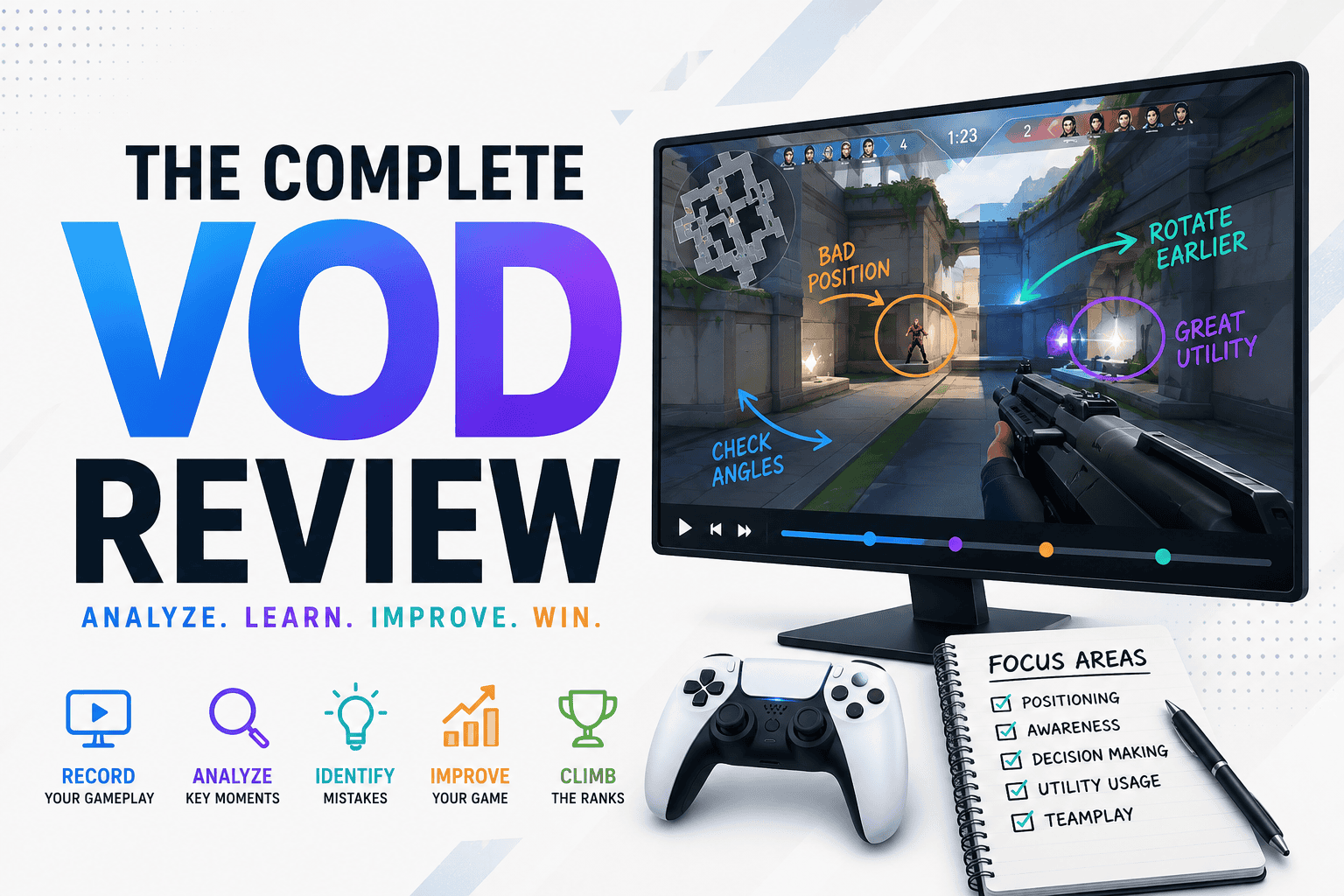
A VOD review is when you or a gaming coach watches recorded gameplay to analyse your decisions, mistakes and habits and work out what you can improve.
Instead of simply playing another match and hoping things magically get better, you go back and actually look at what happened.
The basic process is pretty simple:
🎮 Play → 📹 Record → 🔎 Review → 🧠 Find Mistakes → 🎯 Practise → 📈 Improve
And yes, watching yourself play can occasionally be brutal.
📹 What Does VOD Review Mean?
VOD stands for Video on Demand.
In gaming, a VOD generally refers to previously recorded gameplay that you can watch back later.
A VOD review takes that recording and turns it into something useful.
Rather than just rewatching the match, you’re actively looking at things like:
- 🗺️ Positioning
- 🧠 Decision-making
- 👀 Map awareness
- ⚔️ Fight selection
- 🎯 Target priority
- ⏱️ Timing and rotations
- 🤝 Teamplay and communication
- 🎮 Mechanics
- 🔁 Repeated mistakes
The goal isn’t to sit there admiring your best plays.
It’s to understand why certain things happened and what you could do differently next time.
🧠 Why Review Gameplay Instead of Just Playing More?
Because playing and analysing are two very different things.
During an actual match, your brain is busy.
You’re aiming, moving, checking the map, listening for enemies, watching abilities, communicating with teammates and trying not to die.
There’s not much time left for calmly thinking:
“Was rotating through this area really the optimal strategic decision?”
You’re already dead.
When you watch the match back, all that pressure disappears.
You can pause.
Rewind.
Look at the map.
Check where your teammates were.
See what information was available.
And suddenly, situations that felt confusing during the match can become painfully obvious.
🔎 VOD Review Helps You See What You Missed
This is where reviewing your own gameplay gets interesting.
During the match, you might think:
“That enemy came out of nowhere.”
Then you watch the replay.
They were on your screen for four seconds.
Four.
Entire.
Seconds.
Apparently they didn’t come out of nowhere. You just weren’t looking at them.
That’s exactly the kind of thing a VOD review can expose.
You start noticing mistakes and habits that are almost invisible when you’re concentrating on actually playing.
🎓 Do You Need a Gaming Coach to Review a VOD?
No.
You can absolutely review your own gameplay.
In fact, learning to analyse your own matches is a useful skill for any player who wants to improve.
But there’s one obvious problem.
You only know what you know.
If you don’t understand why a decision was wrong, watching yourself make that decision again doesn’t necessarily give you the answer.
That’s where a gaming coach can help.
An experienced coach can look at the same situation and spot positioning problems, missed information or better options that you might never have considered yourself.
🎯 What Is the Point of a VOD Review?
The goal isn’t to find every mistake you made.
If you’ve ever watched one of your rougher ranked matches back, we’d probably be here all day.
The goal is to find the mistakes that matter most.
Maybe you keep overextending.
Maybe you’re rotating too late.
Maybe your positioning is putting you into fights you’re unlikely to win.
Or maybe the aim you’ve been blaming for the last six months isn’t actually the main problem.
That’s a fun discovery.
A useful VOD review turns those observations into specific things you can practise during your next games.
📈 The Real Value of VOD Review
Playing more gives you more experience.
But simply repeating the same habits for another 500 matches doesn’t guarantee those habits will get any better.
VOD review gives you a chance to stop and ask:
What am I actually doing?
Why am I doing it?
What could I do better next time?
That’s what this guide is going to help you do.
We’ll look at how VOD reviews work, what coaches look for, how to review your own gameplay, which matches you should analyse and how to turn what you find into actual improvement.
Because sometimes getting better isn’t about playing more – it’s about finally noticing what you’ve been doing wrong.
2. What Does VOD Mean in Gaming?
VOD stands for Video on Demand. 📹
In gaming, the term usually refers to previously recorded gameplay that you can watch back later, rather than gameplay you’re watching live.
That could be your own match, another player’s gameplay, a scrim, a tournament match or even a recording from a stream.
Basically, if the gameplay has already happened and you can replay it, you’ve got something that can potentially be used as a VOD.
🎮 What Counts as a Gaming VOD?
A gaming VOD can come from several places.
For example:
- 📹 Recorded Gameplay – Footage you’ve captured while playing.
- 🎮 In-Game Replays – Match recordings created by games with built-in replay systems.
- 🏆 Competitive Matches – Recorded ranked, tournament or league gameplay.
- 👥 Scrims – Practice matches between competitive players or teams.
- 📺 Past Streams – Previously streamed gameplay that has been saved.
- 🎥 Tournament Footage – Professional or amateur competitive matches available to watch afterwards.
For coaching purposes, your own gameplay is usually the most useful because it allows the review to focus specifically on your decisions and habits.
Watching a professional player can teach you plenty.
Watching yourself repeatedly make the same questionable rotation can teach you something slightly more personal.
📹 A VOD Isn’t Necessarily a Video File
The name can be slightly misleading.
When people hear “VOD”, they often imagine a recorded video sitting on a computer.
That can absolutely be the case.
But depending on the game, a VOD review might use an in-game replay system instead.
Replay systems can sometimes provide additional information such as:
- 🗺️ Different camera angles
- 👀 Other players’ perspectives
- 🧭 Full map views
- 📊 Match statistics
- ⏪ Rewind and fast-forward controls
- 🐌 Slow-motion playback
That can make them particularly useful for analysing situations you couldn’t fully see from your own perspective during the match.
🔴 Live Gameplay vs VOD Gameplay
The easiest way to understand the difference is:
🔴 Live Gameplay = You’re watching the match while it’s happening
📹 VOD Gameplay = You’re watching the match after it happened
That difference becomes important when we start talking about coaching.
Live gameplay allows a coach to see how you perform and give feedback in real time.
A VOD gives them something different – time.
They can pause the match, rewind a decision and examine exactly what was happening around you.
🔎 Watching a VOD vs Reviewing a VOD
This is probably the most important distinction.
Simply watching your old gameplay isn’t automatically a VOD review.
You can watch an entire match and learn absolutely nothing.
I’ve managed it plenty of times.
A proper VOD review means you’re watching with a purpose.
Instead of:
“Let’s watch that match again.”
You’re asking:
“Why did I lose that fight?”
“What information did I have here?”
“Where should I have positioned?”
“Why did I rotate?”
“What other options did I have?”
“Do I keep making this same mistake?”
That’s the difference between entertainment and analysis.
🧠 The Goal Is to Understand Your Decisions
A good VOD review doesn’t just focus on the final result.
Imagine you lose a fight.
It’s easy to pause at the moment you died and decide:
“I missed my shots.”
Maybe you did.
But rewind ten seconds and the real problem might become obvious.
You were out of position.
Your teammates weren’t nearby.
You had no cover.
You used an important ability earlier.
And then you took the fight anyway.
Suddenly, your aim doesn’t look like the main problem anymore.
That’s why VOD reviews often look at what happened before the obvious mistake.
🎯 Turning a Recording Into a Learning Tool
A gaming VOD is just footage.
The review is what makes it useful.
When you start pausing important moments, questioning your decisions and looking for repeated patterns, that recording becomes a tool for improvement.
🎮 Gameplay → 📹 VOD → 🔎 Analysis → 🧠 Understanding → 🎯 Improvement
And that’s the idea behind VOD review in gaming.
You’re taking matches you’ve already played and squeezing a little more value out of them.
Considering how much time some of us have spent playing games over the years, we may as well get our money’s worth.
3. What Is a VOD Review?
A VOD review is a structured analysis of recorded gameplay designed to help you understand what happened, why it happened and what you can do better next time. 📹🔎
Rather than immediately queueing another match, you go back through gameplay you’ve already played and look at it with a much more critical eye.
You might review the footage yourself, analyse it with teammates or have an experienced gaming coach review it for you.
When a coach is involved, VOD review is one of several ways online coaching can be delivered. Our guide to how online video game coaching works explains the complete process from finding a coach and choosing a format through to preparing for and completing your session.
The goal is the same:
Find useful lessons in your past gameplay that can improve your future gameplay.
🎮 What Actually Happens During a VOD Review?
During a VOD review, you don’t necessarily watch every second of the match in painstaking detail.
Instead, you focus on important moments and decisions.
That might include:
- ⚔️ Fights you won or lost
- 💀 Deaths or eliminations
- 🗺️ Positioning decisions
- 🔄 Rotations
- 🎯 Target selection
- ⏱️ Ability usage and timing
- 👀 Information you noticed or missed
- 🤝 Team decisions
- 🏆 Objective plays
- 🔁 Mistakes that keep happening
When something important happens, you can pause the footage and break down the situation.
What happened?
Why did it happen?
What information was available?
What other options did you have?
What should you do if the same situation happens again?
That’s where the actual learning starts.
🧠 It’s About the Decision, Not Just the Result
One of the most useful things about VOD review is learning to separate a bad result from a bad decision.
They’re not always the same thing.
You can make a smart decision and still lose the fight.
You can also make an absolutely terrible decision and somehow win.
We’ve all had those moments where you charge into a situation you had no business surviving, get three eliminations and briefly convince yourself you’re a tactical genius.
The replay may have other opinions.
A good VOD review asks whether your decision made sense based on the information you had at the time, rather than judging everything purely by whether it worked.
🔎 Look Beyond the Obvious Mistake
Deaths naturally attract attention when reviewing gameplay.
You died. Something clearly went wrong.
But the most useful moment to analyse may have happened five, ten or even thirty seconds earlier.
Maybe you:
- 🗺️ Rotated into a poor position
- ⚔️ Took an unnecessary fight
- 👀 Missed important information
- ⏱️ Used a key ability too early
- 🤝 Separated from your teammates
- 🎯 Focused on the wrong opponent
By the time you actually died, the damage may already have been done.
That’s why good VOD analysis often involves rewinding and asking:
“Where did this situation actually start going wrong?”
🔁 Find Patterns, Not Just Individual Mistakes
This is one of the biggest reasons to review entire matches rather than isolated clips.
One bad push might just be a bad push.
Five bad pushes probably tell you something.
A VOD review can reveal repeated habits such as:
- ⚔️ Taking fights at a disadvantage
- 🗺️ Overextending
- 👀 Forgetting to check the map
- 🎯 Poor target priority
- ⏱️ Rotating too late
- 🤝 Moving away from your team
- 😬 Making rushed decisions under pressure
These patterns are extremely valuable because fixing one repeated problem could improve dozens of situations across future matches.
👤 Who Uses VOD Reviews?
VOD review isn’t just for professional esports teams sitting in training rooms analysing tournament footage.
It can be useful for almost anyone who genuinely wants to improve.
That includes:
- 🎮 Casual players trying to get better
- 📈 Ranked players trying to climb
- 🏆 Competitive players
- 👥 Teams
- 🎓 Players learning complicated games
- 🚀 Aspiring esports players
- 🧠 Gaming coaches
The level of analysis might change, but the basic idea doesn’t.
Look at past gameplay to make better decisions in future gameplay.
🎓 Self-Review vs Coaching Review
You can absolutely perform your own VOD reviews.
In fact, learning to recognise your own mistakes is one of the most useful skills you can develop as a player.
But self-review has limitations.
You might know that something went wrong without understanding what the better option was.
A coach can bring another perspective and potentially identify mistakes or opportunities that you don’t yet have the experience to recognise.
We’ll compare self-review and coach-led VOD review properly later in this guide.
🎯 A Good VOD Review Ends With Something to Practise
This part matters.
Finding mistakes isn’t the end goal.
You need to turn them into something useful.
If you finish reviewing a match with:
“Wow, I made a lot of mistakes.”
Congratulations. You’ve successfully damaged your confidence.
If you finish with:
“I keep overextending after winning fights, so I’m going to focus on resetting my position before chasing another elimination.”
Now you’ve got something you can actually practise.
A useful VOD review should eventually lead to:
🔎 Identify → 🧠 Understand → 🎯 Focus → 🎮 Practise
📈 The Real Purpose of VOD Review
Ultimately, VOD review isn’t about becoming an expert at analysing old matches.
It’s about becoming better at playing new ones.
The more you review your decisions, the more likely you are to start recognising similar situations while they’re actually happening.
Eventually, you don’t need the replay to tell you:
“This push is probably a terrible idea.”
You recognise it before you make it.
And frankly, avoiding the mistake the first time is much more convenient than watching yourself make it again in 0.5x speed.
4. How Does a Gaming VOD Review Work?
A gaming VOD review doesn’t need to be complicated. 📹
At its simplest, you’re taking gameplay you’ve already played, slowing things down and asking better questions about the decisions you made.
Whether you’re reviewing the match yourself or working with a gaming coach, the basic process looks something like this:
🎮 Play → 📹 Record → 🔎 Review → 🧠 Understand → 🎯 Practise → 📈 Improve
The important part is turning what you notice in the replay into something you can actually use the next time you play.
🎯 Step 1 – Choose the Right Gameplay
Start with a match that represents how you normally play.
A close loss can be particularly useful because it often contains plenty of decisions that could have changed the result.
Good footage might include:
- 🎮 A normal ranked match
- ⚔️ A close win or loss
- 🤔 A match where you weren’t sure what went wrong
- 🎯 Gameplay containing a problem you’re trying to fix
- 📊 A fairly typical performance
Try not to cherry-pick your greatest-ever match.
Yes, going 31-4 felt fantastic.
No, we don’t need to spend an hour admiring it.
▶️ Step 2 – Watch the Gameplay
Before stopping every five seconds, get some context.
Watch enough of the match to understand how it developed.
Pay attention to moments where:
- ⚔️ Fights begin
- 🗺️ Positions change
- 🔄 Rotations happen
- 🎯 Objectives become important
- 👀 New information appears
- 💀 Things start going wrong
If you’re working with a coach, they may already be taking notes and spotting patterns during this first pass.
⏸️ Step 3 – Pause at Important Moments
Now the real review begins.
Pause when you reach an important decision.
This doesn’t mean stopping every time you miss a shot.
Focus on moments where your choices affected what happened next.
For example:
Should I have taken this fight?
Should I have rotated earlier?
Was this position safe?
Should I have stayed with my team?
Did I use this ability at the right time?
These are the moments where VOD review becomes much more valuable than simply watching yourself play.
🔎 Step 4 – Work Out What Happened
Start with the facts.
Where were you?
Where were your teammates?
What were the opponents doing?
What resources or abilities were available?
What information could you see?
Try not to jump immediately to:
“My aim was bad.”
Maybe it was.
But if you walked into a terrible fight with no cover and half your team on the other side of the map, your accuracy might not be the main mystery we’re trying to solve.
🧠 Step 5 – Understand Why You Made the Decision
This is where the review gets really useful.
Ask yourself:
What was I trying to achieve?
What information did I have?
What did I miss?
What other options were available?
What would a better decision have looked like?
Understanding the reasoning behind your mistake makes it much easier to recognise similar situations later.
You’re not just learning:
“Don’t do that.”
You’re learning:
“When I see this situation again, here’s what I should look for before deciding.”
That’s a much more transferable lesson.
🔁 Step 6 – Look for Repeated Patterns
Don’t treat every mistake as an isolated event.
Keep watching.
Does the same problem appear again?
Maybe you’re repeatedly:
- 🗺️ Overextending
- ⚔️ Taking low-percentage fights
- 👀 Missing map information
- ⏱️ Rotating late
- 🎯 Focusing on the wrong targets
- 🤝 Separating from teammates
- 🧠 Rushing decisions
If the same mistake appears several times, you’ve probably found something worth prioritising.
Repeated problems usually matter more than one-off mistakes.
🎯 Step 7 – Choose What to Improve
This is where a lot of players go wrong.
You finish reviewing the match with a list of twelve things you did badly.
Fantastic.
Now what?
Don’t try to fix everything.
Choose one or two high-impact problems.
For example:
🎯 Focus 1 – Stop overextending after winning fights
🎯 Focus 2 – Check teammate positions before engaging
That’s manageable.
A seventeen-point improvement checklist isn’t.
🎮 Step 8 – Take It Back Into the Game
Now comes the part where the actual improvement happens.
Play again and deliberately focus on what you identified.
You might use a simple cycle:
🎯 Choose Focus → 🎮 Play → 🧠 Apply → 📹 Record → 🔎 Review Again
Over time, the better decision should start becoming more natural.
That’s when VOD review starts changing your actual gameplay rather than simply improving your ability to criticise yourself.
📈 Step 9 – Review Your Progress
After you’ve practised for a while, look at another match.
Ask:
Am I still making the same mistake?
If you’re not, great.
Move onto something else.
If you are, look deeper.
Maybe you understand the problem but still struggle to recognise it quickly enough during matches.
That’s useful information too.
🔄 VOD Review Is a Cycle
A good VOD review isn’t really a one-time event.
It’s part of a simple improvement cycle:
🎮 Play → 📹 Review → 🔎 Identify → 🧠 Understand → 🎯 Practise → 📈 Improve → 🔁 Repeat
You don’t need to analyse every match you ever play.
That would get exhausting remarkably quickly.
Review when you need direction, focus on the mistakes that matter and then spend enough time actually playing to work on them.
Because the goal isn’t to become amazing at watching yourself play games – it’s to become better at playing them.
5. What Does a Coach Look for During a VOD Review?
When a gaming coach reviews your VOD, they’re not just sitting there waiting for you to die so they can point at the screen and say, “Yep, that was bad.” 📹
At least, you’d hope not.
A good coach is looking at the bigger picture – the decisions, habits and patterns that led to what happened.
Your death might be the obvious mistake. But the real problem could have started 20 seconds earlier when you moved into a bad position, ignored information on the map or decided that taking a 1v3 was somehow going to work out differently this time.
Here’s what a coach will typically be looking for.
🗺️ Positioning
Positioning is one of the biggest areas a coach can analyse through recorded gameplay.
They might look at:
- 📍 Where you’re positioned
- 👥 Where your teammates are
- ⚔️ Where opponents are
- 🛡️ What cover you have
- 👀 Which angles you’re exposed to
- 🚪 Whether you have an escape route
- 🎯 How your position relates to the objective
The important question isn’t simply:
“Was this a bad position?”
It’s:
“Why was this a bad position and where could you have been instead?”
Understanding that difference helps you make better positioning decisions in future matches.
🧠 Decision-Making
Every match is basically one long sequence of decisions.
Push or hold?
Fight or disengage?
Rotate or stay?
Use the ability or save it?
Help your teammate or quietly pretend you didn’t see what they just did?
A coach can pause those moments and analyse whether your decision made sense based on the information available at the time.
This is one of the biggest strengths of VOD review because there’s finally time to explore the alternatives.
👀 Awareness
Sometimes the problem isn’t the decision itself.
It’s the information you missed before making it.
Depending on the game, a coach might look at whether you’re paying attention to:
- 🗺️ The minimap
- 👥 Teammate locations
- ⚔️ Enemy positions
- 💀 Eliminations
- 🔊 Audio cues
- ⏱️ Timers
- 🎯 Objectives
- 💥 Abilities or resources
You might discover that you’re making perfectly logical decisions based on half the information available to you.
Which is slightly less reassuring than it sounds.
⚔️ Fight Selection
Not every fight needs to be fought.
This revelation took some of us longer to learn than we’d like to admit.
A coach may look at whether you’re entering fights where you actually have a reasonable chance of winning.
They might consider:
- 👥 Player numbers
- ❤️ Health
- 🛡️ Resources
- 🗺️ Positioning
- ⏱️ Timing
- 🎯 Objectives
- 🤝 Teammate availability
- 🚪 Escape options
Sometimes the biggest improvement isn’t learning how to win more bad fights.
It’s learning not to take the bad fight in the first place.
⏱️ Timing
Being in the right place isn’t much use if you arrive ten seconds too late.
Timing can affect almost everything:
- 🔄 Rotations
- ⚔️ Engagements
- 🎯 Objectives
- 💥 Ability usage
- 🛡️ Defensive plays
- 🤝 Team pushes
- 🚪 Disengagements
VOD review lets a coach rewind and identify exactly when an opportunity appeared – and when it disappeared.
That’s much easier to understand when the game isn’t continuing at full speed.
🎯 Target Priority
You can execute everything perfectly and still be focusing on the wrong target.
During fights, a coach might analyse:
- 🎯 Who you’re attacking
- ⚠️ Which opponent poses the biggest threat
- ❤️ Which enemies are vulnerable
- 🛡️ Which defensive abilities are available
- 👥 Who your teammates are focusing
- 🏆 What actually needs to happen to win the fight
This can be especially important in team-based games where attacking the first enemy you see isn’t always the best option.
Tempting, yes.
Optimal, not necessarily.
🤝 Communication & Teamplay
If the VOD includes team communication, a coach can also look at how well you’re working with other players.
That might include:
- 💬 Callouts
- 👂 Listening to teammates
- 🤝 Coordinating pushes
- 🎯 Sharing important information
- 🗺️ Moving with the team
- ⚔️ Following engagements
- 🔄 Coordinating rotations
Sometimes your individual decision makes sense on its own but doesn’t make sense within what the rest of the team is doing.
That distinction can be difficult to notice while you’re playing.
🎮 Mechanics
VOD review isn’t only about strategy.
A coach can still identify mechanical problems such as:
- 🎯 Crosshair placement
- 🔫 Aim
- 🕹️ Movement
- ⌨️ Inputs
- ⚔️ Combos
- 💥 Ability usage
- ⏱️ Mechanical timing
- 🎮 Character or weapon control
Live coaching can be better for actively correcting some mechanical problems, but recorded gameplay is still excellent for identifying them.
Maybe your aim isn’t inconsistent.
Maybe your crosshair is consistently pointed somewhere no enemy has ever stood.
Useful distinction.
🔁 Repeated Habits
This is arguably the most important thing a coach looks for.
Individual mistakes matter.
Patterns matter more.
A coach isn’t necessarily interested in the one time you made a strange decision.
They’re interested when you make essentially the same decision five times.
For example:
Death #1 – You overextended.
Death #2 – You overextended.
Death #3 – You overextended.
Death #4 – Completely unrelated, obviously.
Except it probably isn’t.
Repeated mistakes can reveal the underlying habits holding your gameplay back.
✅ What You’re Doing Well
A good VOD review shouldn’t be a 60-minute compilation of everything you’ve done wrong since installing the game.
Coaches can also identify things you’re doing correctly.
That’s useful because you want to understand which habits should be kept.
Maybe your positioning is generally strong.
Maybe your communication is excellent.
Maybe you’re consistently making good objective decisions.
Knowing your strengths lets you focus your practice on the areas that actually need attention.
🎯 Finding the Mistakes That Matter Most
A coach could probably find dozens of tiny mistakes in almost any match.
That’s not necessarily useful.
The goal is to identify the highest-impact problems.
If fixing one positioning habit could prevent several deaths every match, that’s probably more important than spending twenty minutes analysing one missed shot.
A useful VOD review should eventually narrow everything down to something manageable:
🔎 What keeps happening?
🧠 Why is it happening?
🎯 What should you work on first?
That’s where having another experienced pair of eyes can be valuable.
Coach-led VOD analysis can also form part of broader one-on-one video game coaching, where personalised gameplay review is combined with discussion, feedback, practice goals or live coaching.
A good coach doesn’t just tell you what you did wrong – they help you understand which mistakes actually matter and what you can do about them.
5. What Does a Coach Look for During a VOD Review?
When a gaming coach reviews your VOD, they’re not just sitting there waiting for you to die so they can point at the screen and say, “Yep, that was bad.” 📹
At least, you’d hope not.
A good coach is looking at the bigger picture – the decisions, habits and patterns that led to what happened.
Your death might be the obvious mistake. But the real problem could have started 20 seconds earlier when you moved into a bad position, ignored information on the map or decided that taking a 1v3 was somehow going to work out differently this time.
Here’s what a coach will typically be looking for.
🗺️ Positioning
Positioning is one of the biggest areas a coach can analyse through recorded gameplay.
They might look at:
- 📍 Where you’re positioned
- 👥 Where your teammates are
- ⚔️ Where opponents are
- 🛡️ What cover you have
- 👀 Which angles you’re exposed to
- 🚪 Whether you have an escape route
- 🎯 How your position relates to the objective
The important question isn’t simply:
“Was this a bad position?”
It’s:
“Why was this a bad position and where could you have been instead?”
Understanding that difference helps you make better positioning decisions in future matches.
🧠 Decision-Making
Every match is basically one long sequence of decisions.
Push or hold?
Fight or disengage?
Rotate or stay?
Use the ability or save it?
Help your teammate or quietly pretend you didn’t see what they just did?
A coach can pause those moments and analyse whether your decision made sense based on the information available at the time.
This is one of the biggest strengths of VOD review because there’s finally time to explore the alternatives.
👀 Awareness
Sometimes the problem isn’t the decision itself.
It’s the information you missed before making it.
Depending on the game, a coach might look at whether you’re paying attention to:
- 🗺️ The minimap
- 👥 Teammate locations
- ⚔️ Enemy positions
- 💀 Eliminations
- 🔊 Audio cues
- ⏱️ Timers
- 🎯 Objectives
- 💥 Abilities or resources
You might discover that you’re making perfectly logical decisions based on half the information available to you.
Which is slightly less reassuring than it sounds.
⚔️ Fight Selection
Not every fight needs to be fought.
This revelation took some of us longer to learn than we’d like to admit.
A coach may look at whether you’re entering fights where you actually have a reasonable chance of winning.
They might consider:
- 👥 Player numbers
- ❤️ Health
- 🛡️ Resources
- 🗺️ Positioning
- ⏱️ Timing
- 🎯 Objectives
- 🤝 Teammate availability
- 🚪 Escape options
Sometimes the biggest improvement isn’t learning how to win more bad fights.
It’s learning not to take the bad fight in the first place.
⏱️ Timing
Being in the right place isn’t much use if you arrive ten seconds too late.
Timing can affect almost everything:
- 🔄 Rotations
- ⚔️ Engagements
- 🎯 Objectives
- 💥 Ability usage
- 🛡️ Defensive plays
- 🤝 Team pushes
- 🚪 Disengagements
VOD review lets a coach rewind and identify exactly when an opportunity appeared – and when it disappeared.
That’s much easier to understand when the game isn’t continuing at full speed.
🎯 Target Priority
You can execute everything perfectly and still be focusing on the wrong target.
During fights, a coach might analyse:
- 🎯 Who you’re attacking
- ⚠️ Which opponent poses the biggest threat
- ❤️ Which enemies are vulnerable
- 🛡️ Which defensive abilities are available
- 👥 Who your teammates are focusing
- 🏆 What actually needs to happen to win the fight
This can be especially important in team-based games where attacking the first enemy you see isn’t always the best option.
Tempting, yes.
Optimal, not necessarily.
🤝 Communication & Teamplay
If the VOD includes team communication, a coach can also look at how well you’re working with other players.
That might include:
- 💬 Callouts
- 👂 Listening to teammates
- 🤝 Coordinating pushes
- 🎯 Sharing important information
- 🗺️ Moving with the team
- ⚔️ Following engagements
- 🔄 Coordinating rotations
Sometimes your individual decision makes sense on its own but doesn’t make sense within what the rest of the team is doing.
That distinction can be difficult to notice while you’re playing.
🎮 Mechanics
VOD review isn’t only about strategy.
A coach can still identify mechanical problems such as:
- 🎯 Crosshair placement
- 🔫 Aim
- 🕹️ Movement
- ⌨️ Inputs
- ⚔️ Combos
- 💥 Ability usage
- ⏱️ Mechanical timing
- 🎮 Character or weapon control
Live coaching can be better for actively correcting some mechanical problems, but recorded gameplay is still excellent for identifying them.
Maybe your aim isn’t inconsistent.
Maybe your crosshair is consistently pointed somewhere no enemy has ever stood.
Useful distinction.
🔁 Repeated Habits
This is arguably the most important thing a coach looks for.
Individual mistakes matter.
Patterns matter more.
A coach isn’t necessarily interested in the one time you made a strange decision.
They’re interested when you make essentially the same decision five times.
For example:
Death #1 – You overextended.
Death #2 – You overextended.
Death #3 – You overextended.
Death #4 – Completely unrelated, obviously.
Except it probably isn’t.
Repeated mistakes can reveal the underlying habits holding your gameplay back.
✅ What You’re Doing Well
A good VOD review shouldn’t be a 60-minute compilation of everything you’ve done wrong since installing the game.
Coaches can also identify things you’re doing correctly.
That’s useful because you want to understand which habits should be kept.
Maybe your positioning is generally strong.
Maybe your communication is excellent.
Maybe you’re consistently making good objective decisions.
Knowing your strengths lets you focus your practice on the areas that actually need attention.
🎯 Finding the Mistakes That Matter Most
A coach could probably find dozens of tiny mistakes in almost any match.
That’s not necessarily useful.
The goal is to identify the highest-impact problems.
If fixing one positioning habit could prevent several deaths every match, that’s probably more important than spending twenty minutes analysing one missed shot.
A useful VOD review should eventually narrow everything down to something manageable:
🔎 What keeps happening?
🧠 Why is it happening?
🎯 What should you work on first?
That’s where having another experienced pair of eyes can be valuable.
A good coach doesn’t just tell you what you did wrong – they help you understand which mistakes actually matter and what you can do about them.
6. Why Are VOD Reviews So Useful?
The biggest advantage of VOD review is something you rarely get while actually playing – time to think. 📹🧠
During a match, everything happens quickly.
You’re aiming, moving, checking the map, tracking enemies, listening to teammates and making decisions in seconds.
Then you watch the same situation back with absolutely none of that pressure and suddenly think:
“Why did I do that?”
That’s VOD review in a nutshell.
It lets you slow the game down, see things you missed and understand why situations played out the way they did.
⏸️ You Can Pause the Action
This sounds incredibly basic, but it’s one of the biggest advantages of reviewing recorded gameplay.
You can stop at the exact moment a decision needs to be made.
Then ask:
- 🧠 What was I thinking here?
- 👀 What information was available?
- 🗺️ Where were my teammates?
- ⚔️ Where were the opponents?
- 🎯 What was I trying to achieve?
- 🚪 What other options did I have?
During the actual match, you might have had two seconds to answer those questions.
Now you’ve got as long as you need.
⏪ You Can Rewind Your Decisions
Sometimes the obvious mistake isn’t the real mistake.
You might pause at the moment you die and think:
“I lost the fight because I missed my shots.”
Rewind ten seconds.
You entered the fight alone.
Rewind another ten.
You abandoned a strong position to chase someone.
Ah.
Suddenly, the missed shots aren’t looking quite so important.
Rewinding lets you trace a bad outcome back to the decision that actually caused it.
🐌 You Can Slow Complicated Situations Down
Some gaming situations are complete chaos.
Abilities everywhere.
Players moving in different directions.
Someone shouting something through voice chat.
Half the screen glowing.
Your health disappearing at an alarming rate.
Good luck conducting a thoughtful tactical analysis in the middle of that.
A replay lets you slow the situation down and work through what happened piece by piece.
That’s particularly useful for complicated team fights, rotations and situations where several decisions happen within seconds.
👀 You Notice Information You Missed
One of the more humbling parts of reviewing your own gameplay is discovering just how much information was sitting right there on the screen.
You might notice:
- 🗺️ An enemy appearing on the minimap
- 👥 Your teammates moving somewhere else
- 💀 An important elimination
- ⏱️ A timer you ignored
- 🔊 An audio cue you didn’t react to
- 🎯 An objective becoming available
- ⚔️ An opponent changing position
None of this information magically appeared in the replay.
It was there the first time.
You just had seventeen other things competing for your attention.
🧠 You Can Understand Why You Made a Mistake
Knowing what you did wrong is useful.
Understanding why you did it is much better.
Maybe you constantly overextend because you’re chasing eliminations.
Maybe you rotate late because you aren’t checking the map frequently enough.
Maybe you waste an ability because you panic when someone pushes you.
These are much more useful conclusions than:
“I need to play better.”
Technically true.
Not exactly a breakthrough.
🔁 You Can Spot Patterns
This is where VOD review becomes particularly powerful.
Individual mistakes are easy to dismiss.
Repeated mistakes are harder to argue with.
Review enough gameplay and you might discover that you consistently:
- 🗺️ Move into unsafe positions
- ⚔️ Take unnecessary fights
- 👀 Miss the same type of information
- 🎯 Focus on poor targets
- ⏱️ Rotate too late
- 🤝 Separate from teammates
- 💥 Waste important abilities
Once you recognise the pattern, you can start actively looking for it during future games.
Instead of:
“I made a bad decision.”
you’ve discovered:
“I have a habit of making this type of bad decision.”
That’s much more useful.
🎯 You Can Create Specific Practice Goals
VOD review helps turn vague improvement goals into specific ones.
Instead of:
❌ “I need better game sense.”
you might discover:
✅ “I need to check teammate positions before starting a fight.”
Instead of:
❌ “My positioning is bad.”
you might decide:
✅ “I need to stop leaving cover when I don’t have an escape route.”
Instead of:
❌ “I need to stop dying.”
Well…
Yes.
But we’re going to need slightly more detail.
Specific problems give you something you can actually practise.
📈 You Can Track Whether You’re Improving
Once you’ve identified a weakness, future VODs give you a way to check your progress.
Maybe your first review shows that you’re constantly overextending.
You spend the next couple of weeks deliberately working on positioning.
Then you review another match.
Are you still doing it?
If the mistake appears less often, that’s progress.
If it’s still happening constantly, you know the habit needs more work.
Either way, you’re getting something more useful than simply looking at whether your rank moved.
🎮 You Get More Value From Matches You’ve Already Played
Normally, once a match ends, it’s done.
You get the win or loss, maybe complain about matchmaking for thirty seconds and queue again.
VOD review gives that same match another purpose.
Even a terrible game can become useful if it reveals something important about how you play.
In fact, some of your worst matches can be your best review material.
Nobody enjoys going 4-15.
But if it exposes a positioning habit that’s been costing you games for months, at least the suffering produced something.
🏆 VOD Review Helps You Become Your Own Coach
One of the best long-term benefits is learning how to analyse yourself.
The more gameplay you review, the better you can become at recognising:
⚠️ This position is dangerous.
⚠️ I’m about to overextend.
⚠️ My team isn’t ready.
⚠️ I’ve taken this exact bad fight before.
Eventually, those thoughts start appearing during the match instead of afterwards.
That’s when VOD review is really doing its job.
📹 The Biggest Advantage Is Hindsight
During gameplay, you have limited time and limited attention.
During a VOD review, you have neither problem.
You can:
⏸️ Pause → ⏪ Rewind → 🔎 Analyse → 🧠 Understand → 🎯 Improve
That’s what makes VOD reviews so useful.
They give you a second chance to understand a situation – so hopefully you don’t need a second chance the next time it happens.
7. What Can You Learn From a VOD Review?
A good VOD review can teach you much more than “I should have aimed better.” 📹
In fact, one of the biggest surprises when you start reviewing your gameplay is discovering that the problem you thought you had isn’t always the problem actually holding you back.
Maybe your aim is fine.
Maybe you’re just constantly putting yourself into fights where even perfect aim would struggle to save you.
That’s slightly harder on the ego, but considerably more useful.
🧠 Understand Why You’re Losing Fights
When you lose a fight, the obvious explanation is usually the easiest one.
“I missed.”
“They got lucky.”
“Their weapon is broken.”
“My teammate…”
We’ll stop there.
A VOD review lets you rewind and see what actually led to the fight.
Maybe you:
- ⚔️ Engaged while outnumbered
- 🗺️ Had poor positioning
- ❤️ Entered with low health
- 💥 Didn’t have an important ability available
- 👥 Were too far from your teammates
- 🚪 Had no safe escape
- 👀 Missed information showing an enemy nearby
Suddenly, the final gunfight is only a small part of the story.
🗺️ Discover Positioning Problems
Positioning is one of those things that can feel perfectly reasonable while you’re playing.
Then you pause the replay.
You’re standing in the open.
Your teammates are somewhere in another postcode.
Three enemies have an angle on you.
There is no cover.
There is no escape.
There is, however, optimism.
VOD review can help you understand where you should position and why.
Over time, you can start recognising safer positions before things go wrong.
👀 See What You’re Not Paying Attention To
Sometimes your decisions are based on incomplete information because you’re simply not noticing everything available to you.
A review might reveal that you regularly miss:
- 🗺️ Minimap information
- 🔊 Audio cues
- 👥 Teammate movement
- ⚔️ Enemy positions
- 💀 Eliminations
- ⏱️ Timers
- 🎯 Objective information
- 💥 Ability usage
You can’t realistically pay attention to everything at once.
But if you’re repeatedly missing the same type of information, that’s something you can work on.
⚔️ Learn When Not to Fight
This can be a painful lesson for aggressive players.
Sometimes the correct play is not fighting.
I know.
Disgusting.
A VOD review can show you how many engagements you’re taking simply because an enemy appeared on your screen.
Before committing, you might need to consider:
- 👥 Do we have the numbers?
- ❤️ What is my health?
- 💥 What resources are available?
- 🗺️ Is my position good?
- 🤝 Is my team ready?
- 🎯 Is there a more important objective?
- 🚪 Can I safely disengage?
Learning to avoid bad fights can sometimes improve your results faster than learning how to mechanically win them.
⏱️ Improve Your Timing
You may be doing the right thing at the wrong time.
A rotation can be correct but late.
An ability can be useful but used too early.
A push can make sense but happen before your teammates are ready.
VOD review makes these timing problems much easier to spot because you can look at what was happening immediately before and after your decision.
Sometimes the difference between a brilliant play and a terrible one is only a few seconds.
🎯 Improve Your Target Priority
You might also discover that you’re consistently focusing on the wrong target.
Maybe you’re attacking whoever is closest rather than whoever poses the biggest threat.
Or chasing a low-health opponent while something much more important is happening elsewhere.
Replay analysis gives you time to ask:
“What was actually the priority here?”
That could be:
🎯 A dangerous opponent
🏆 An objective
🤝 Protecting a teammate
🚪 Escaping the fight
🛡️ Holding a position
The answer isn’t always “shoot the person directly in front of me.”
🔁 Find Habits You Didn’t Know You Had
This is where VOD review can become slightly unsettling.
You start noticing things you apparently do all the time.
Maybe you:
- 🗺️ Overextend after winning fights
- ⚔️ Chase low-health enemies
- 👀 Stop checking the map during combat
- 💥 Panic-use abilities
- 🤝 Wander away from your team
- ⏱️ Rotate late
- 🎯 Tunnel vision on one opponent
You probably didn’t consciously decide to develop these habits.
They just happened.
The good news is that once you’ve noticed them, you can start correcting them.
🎮 Discover That Mechanics Aren’t Always the Problem
This can be one of the most valuable discoveries.
Players often assume improving mechanically is the answer.
Better aim.
Faster reactions.
Cleaner movement.
And sometimes it absolutely is.
But VOD review might reveal that you’re already mechanically capable of competing at your level.
You’re just making life unnecessarily difficult for yourself.
If you repeatedly enter fights from bad positions, improving your aim by another 5% might matter less than stopping yourself from taking terrible fights.
That’s good news.
Decision-making is trainable too.
💪 Identify What You’re Already Doing Well
VOD review shouldn’t only be about finding faults.
You can also learn what you’re doing correctly.
Maybe you’re consistently:
- 🗺️ Taking strong positions
- 🎯 Choosing good targets
- 🤝 Communicating useful information
- ⚔️ Taking favourable fights
- ⏱️ Rotating at the right time
- 💥 Using abilities effectively
Understanding your strengths matters because you don’t want to accidentally “fix” something that wasn’t broken.
It also gives you a clearer picture of your actual gameplay rather than remembering only the mistakes.
🎯 Find Your Biggest Improvement Opportunity
Ultimately, the most useful thing a VOD review can teach you is:
What should I work on next?
Not everything.
Not the 37 tiny mistakes you spotted across the match.
The one or two problems that are costing you the most.
Maybe that’s positioning.
Maybe it’s awareness.
Maybe it’s fight selection.
Maybe it really is your aim.
Once you know, your practice becomes much more focused.
📈 Turn “Play More” Into “Practise Better”
Without analysis, improving can easily become:
🎮 Play → 🎮 Play → 🎮 Play → 🎮 Play
You might improve naturally.
You might also spend the next six months becoming incredibly consistent at making the same mistakes.
VOD review adds direction:
🎮 Play → 📹 Review → 🔎 Identify → 🎯 Practise → 📈 Improve
That’s the real lesson.
A VOD review doesn’t just show you what went wrong – it helps you figure out what deserves your attention next.
8. Self VOD Review vs Coach VOD Review
You don’t need a gaming coach every time you want to review your gameplay. 📹
You can absolutely do it yourself.
In fact, learning to analyse your own matches is one of the most useful skills you can develop if you’re serious about improving.
But there’s also a reason gaming coaches offer VOD reviews.
Sometimes you can watch the same mistake ten times and still not realise why it’s a mistake.
That’s where another experienced pair of eyes can make a big difference.
👤 What Is a Self VOD Review?
A self VOD review is exactly what it sounds like – you analyse your own recorded gameplay.
You watch your matches back, pause important moments and look for things you could have done differently.
That might involve asking:
- 🧠 Why did I make that decision?
- 🗺️ Was my positioning good?
- 👀 What information did I miss?
- ⚔️ Should I have taken that fight?
- ⏱️ Was my timing right?
- 🎯 Did I focus on the right target?
- 🔁 Have I made this mistake before?
The more experienced you become at reviewing your own gameplay, the easier it can be to recognise patterns.
💰 The Biggest Advantage – It’s Free
Let’s start with the obvious one.
Reviewing your own gameplay costs nothing.
You can record a match tonight, watch it tomorrow and review another one next week without paying for each session.
For players who want to improve but aren’t ready to pay for coaching, that’s a pretty compelling feature.
Price: $0.
Difficult to argue with.
⏰ Review Whenever You Want
Self-review is also incredibly flexible.
There’s no booking.
No coach availability.
No time-zone maths.
You simply review your gameplay whenever you have time.
That makes it particularly useful as something you can build into your normal gaming routine.
For example:
🎮 Play → 📹 Save Interesting Match → 🔎 Review Later → 🎯 Choose Something to Practise
You don’t need to review every match.
Just save the ones that seem useful.
🧠 Self-Review Teaches You to Analyse Your Own Gameplay
This is probably the biggest long-term advantage.
If you always rely on someone else to tell you what’s wrong, you can become dependent on external feedback.
Learning to review yourself teaches you to ask better questions.
Eventually, you may start recognising mistakes while you’re actually playing.
Instead of needing a replay to tell you:
“I’m overextending again.”
you start catching yourself halfway through the push.
Ideally before the entire enemy team notices.
🙈 The Problem – You Have Blind Spots
Unfortunately, reviewing yourself has one fairly obvious limitation.
You’re reviewing the decisions made by the same person who made them.
You might pause a situation and think:
“Yeah, I think that was probably the right play.”
An experienced coach might look at the same situation and immediately identify three better options.
It’s difficult to recognise mistakes when you don’t yet understand the concept you’re getting wrong.
🧠 You Only Know What You Know
This is probably the biggest limitation of self-review.
Imagine your positioning is poor.
You watch the replay.
You see yourself standing in that position.
But if you don’t know where you should have been instead, you may not recognise the problem.
The same applies to:
- 🗺️ Positioning
- 🔄 Rotations
- ⚔️ Fight selection
- 🎯 Target priority
- 💥 Ability usage
- 🧠 Strategy
- 🤝 Teamplay
Self-review is excellent for identifying problems you already understand.
It becomes harder when the problem sits outside your current game knowledge.
🎓 What Does a Coach VOD Review Add?
A coach brings experience and an outside perspective.
Instead of only looking at what happened, they can help explain:
Why did it happen?
What other options did you have?
What would a stronger player likely do?
Which mistake actually matters most?
That last question is particularly important.
You might finish a self-review with twelve things you want to fix.
A coach may look at the same match and say:
“Ignore ten of those for now. These two are costing you games.”
That’s useful.
🔎 Coaches Can Spot Things You Miss
A coach may notice patterns you haven’t recognised.
For example:
You think your biggest weakness is aim.
The coach notices that you’re constantly taking fights from terrible positions.
Your aim might still need work.
But suddenly the bigger problem becomes obvious.
You’re expecting your mechanics to rescue you from situations you probably shouldn’t have entered in the first place.
That’s the value of an outside perspective.
🎯 Coach Feedback Can Be More Specific
Good coaching shouldn’t stop at:
“Your positioning needs work.”
Ideally, you want something more useful:
“You’re leaving cover before you know where the second opponent is. Next time, hold the angle until you have that information.”
Now you’ve got something you can actually practise.
A coach can help turn broad weaknesses into specific changes.
📋 Coach Reviews Can Be More Structured
Depending on the coaching service, a VOD review might include:
- 📹 Recorded analysis
- 💬 Live discussion
- 📝 Written notes
- ⏱️ Timestamped feedback
- 🎯 Improvement priorities
- 🧠 Explanations of key decisions
- 🎮 Practice recommendations
- 📈 Follow-up goals
That structure can be useful if you’ve tried reviewing your own gameplay but aren’t sure what to do with what you’re finding.
⚖️ Self VOD Review vs Coach VOD Review – Quick Comparison
| 👤 Self Review | 🎓 Coach Review | |
|---|---|---|
| Cost | Free | Usually Paid |
| Flexibility | ⭐⭐⭐⭐⭐ | ⭐⭐⭐⭐ |
| Outside Perspective | ⭐⭐ | ⭐⭐⭐⭐⭐ |
| Game Knowledge | Depends on You | Depends on Coach |
| Personalised Feedback | Self-Directed | ⭐⭐⭐⭐⭐ |
| Finding Blind Spots | Harder | Easier |
| Building Self-Analysis | ⭐⭐⭐⭐⭐ | ⭐⭐⭐⭐ |
| Best For | Regular Improvement | Deeper Guidance |
Neither approach has to replace the other.
🔄 The Best Approach? Learn From Both
You don’t need to choose one forever.
A really useful approach can be:
👤 Self Review → 🎯 Identify Problems → 🎮 Practise
Then, when you’re stuck:
🎓 Coach Review → 🔎 Find Blind Spots → 🧠 Learn → 🎮 Practise
Then take what you’ve learned from the coach back into your own future reviews.
Over time, your ability to analyse yourself should improve too.
🏆 Which Should You Choose?
Start with self-review if:
- 💰 You don’t want to spend money yet
- 🧠 You already understand the game reasonably well
- 🔎 You can identify some of your own mistakes
- 🎮 You want to make review part of your regular routine
Consider a coach VOD review if:
- 🧱 You’ve hit a plateau
- 🤔 You can’t work out what’s going wrong
- 🔁 You keep repeating the same problems
- 🎯 You want clear improvement priorities
- 🧠 You want feedback from someone more experienced
🎮 You Don’t Need a Coach Forever
The goal of coaching shouldn’t be to make you incapable of analysing a match without someone else sitting beside you.
A good coach can help you understand what to look for and how to think about your decisions.
Then you can start applying those lessons yourself.
Self VOD review helps you become better at analysing your own gameplay. Coach VOD review helps you see the things you don’t yet know how to analyse.
And sometimes paying someone to tell you “yes, you really do keep making the same mistake” is exactly the reality check required.
9. VOD Review vs Live Gaming Coaching
VOD review isn’t the only way to get personalised feedback on your gameplay.
The other major option is live gaming coaching, where a coach watches you play and provides feedback while you’re actually in the game. 🎮
Both can help you improve, but they solve slightly different problems.
The simplest way to think about it is:
📹 VOD Review = Understand what happened
🎮 Live Coaching = Improve while it’s happening
⚖️ VOD Review vs Live Coaching – Quick Comparison
| 📹 VOD Review | 🎮 Live Coaching | |
|---|---|---|
| Feedback | After gameplay | Real-time or between matches |
| Detailed Analysis | ⭐⭐⭐⭐⭐ | ⭐⭐⭐ |
| Game Sense | ⭐⭐⭐⭐⭐ | ⭐⭐⭐⭐ |
| Decision Analysis | ⭐⭐⭐⭐⭐ | ⭐⭐⭐⭐ |
| Mechanical Coaching | ⭐⭐⭐ | ⭐⭐⭐⭐⭐ |
| Interaction | Varies | ⭐⭐⭐⭐⭐ |
| Flexibility | Often higher | Usually scheduled |
| Pressure | Gameplay already recorded | Coach watches you play |
| Best For | Understanding mistakes | Applying corrections |
Neither one wins every category.
Which is annoyingly reasonable for an article section that literally has “vs” in the title.
📹 VOD Review Gives You More Time to Analyse
The main advantage of VOD review is being able to stop the game.
You can pause before an important decision and ask:
What information did I have?
Where were my teammates?
Should I have taken this fight?
What other options were available?
Then rewind and look again.
That makes VOD review particularly useful for:
- 🧠 Decision-making
- 🗺️ Positioning
- 👀 Awareness
- ⚔️ Fight selection
- 🎯 Target priority
- ⏱️ Rotations
- 🔁 Repeated mistakes
You’re analysing the match without worrying about what happens in the next five seconds.
🎮 Live Coaching Gives You Immediate Feedback
Live coaching has the opposite advantage.
The game can’t be paused, but the coach gets to see how you actually perform at full speed.
They can watch how you react under pressure and provide feedback either during gameplay or between rounds and matches.
That can be particularly useful for:
- 🎯 Aim and mechanics
- 🕹️ Movement
- ⚡ Execution
- ⏱️ Ability timing
- 💬 Communication
- 🧠 Decisions under pressure
- 🎮 Applying new techniques
You can receive feedback and immediately try to do something differently.
🧠 Knowing vs Doing
This is probably the most important difference.
A VOD review might help you realise:
“I keep pushing before my teammates are ready.”
Great.
You’ve identified the problem.
But recognising that mistake while calmly watching a replay is different from recognising it during a match when you’re convinced you can secure one more elimination.
Live coaching can help bridge that gap.
A coach can see the situation developing and help you learn to recognise it before the mistake happens.
🎯 Which Is Better for Mechanics?
Generally:
🏆 Live Coaching
Mechanical skills benefit from immediate feedback and repetition.
If you’re working on aim, movement, inputs, combos or execution, having someone watch you attempt corrections in real time can be extremely useful.
VOD review can still identify mechanical problems.
Live coaching is often better for actively working on them.
🧠 Which Is Better for Game Sense?
Generally:
🏆 VOD Review
Game sense involves understanding situations, information and available options.
Being able to pause and examine those decisions gives VOD review a natural advantage.
You can actually ask:
“What should I have recognised here?”
without an enemy rudely interrupting the discussion.
🏆 Can You Use Both?
Absolutely.
In fact, the two formats can work extremely well together.
A simple improvement cycle could be:
📹 VOD Review → 🔎 Identify the Problem → 🎮 Live Coaching → 🎯 Practise the Correction → 📈 Review Again
For example, your VOD review might reveal that your positioning is repeatedly putting you into bad fights.
A live coach can then watch specifically for that habit and help you recognise those situations while they’re happening.
Now you’re combining analysis with application.
🎮 Which Should You Choose?
If you’re trying to decide between the two, start with your biggest problem.
📹 Choose VOD Review if:
- 🤔 You don’t understand what you’re doing wrong
- 🧠 You want to improve game sense
- 🗺️ Positioning is a weakness
- 🔎 You want detailed analysis
- 🔁 You’re repeating the same mistakes
🎮 Choose Live Coaching if:
- 🎯 Mechanics are holding you back
- ⚡ You struggle to apply what you know
- 💬 You want immediate interaction
- 🕹️ You’re working on execution
- 🧠 You struggle with decisions under pressure
And if you need both?
Use both.
There’s no rule saying you have to pick a side and defend it for the rest of your gaming career.
🔎 Want the Full Comparison?
We’ve gone much deeper into the differences between the two coaching styles in our dedicated guide:
👉 Live Gaming Coaching vs VOD Review – Which Is Better?
There you’ll find a full comparison of the benefits, downsides, costs and best uses of each approach.
For this guide, the important takeaway is simple:
📹 VOD review helps you understand your gameplay.
🎮 Live coaching helps you adjust your gameplay while you’re playing.
Sometimes you need to understand the mistake.
Sometimes you need someone there to stop you making it again.
10. How to Choose the Right Gameplay for a VOD Review
Not every match makes good VOD review material. 📹
You could spend an hour analysing the game where you completely dominated the other team, finished at the top of the scoreboard and made almost every decision look brilliant.
It would probably feel great.
It might not teach you very much.
For a useful VOD review, you want gameplay that shows how you normally play and gives you something meaningful to analyse.
🎯 Choose Representative Gameplay
The best VOD isn’t necessarily your best or worst match.
It’s usually one that represents your normal level of play.
You want the person reviewing it to see your real habits:
- 🧠 How you make decisions
- 🗺️ Where you position
- ⚔️ Which fights you take
- 👀 What information you notice
- ⏱️ How you use abilities or resources
- 🤝 How you interact with teammates
- 🎯 How you perform mechanically
If you’re working with a coach, representative gameplay gives them a much better picture of the player they’re actually trying to help.
⚔️ Close Matches Can Be Excellent
A close win or loss is often great material for VOD review.
Why?
Because there are usually plenty of moments where a different decision could have changed what happened next.
Maybe you lost an important fight.
Maybe you rotated late.
Maybe you gave up a strong position.
Maybe you made a great decision that kept your team in the game.
Close matches tend to contain a useful mixture of good and bad moments – which gives you plenty to analyse.
🤔 Choose Matches Where You Don’t Know What Went Wrong
These can be particularly valuable.
Sometimes you finish a match thinking:
“I actually thought I played pretty well. Why did that go so badly?”
Save it.
That’s exactly the kind of match that can reveal problems you’re not currently noticing.
If the mistake is already obvious, you may not need someone to spend 45 minutes explaining it.
If you’re genuinely confused about why you’re struggling, there’s much more to investigate.
🎯 Match the VOD to What You Want to Improve
If you already know what you’re working on, choose footage that contains that problem.
For example:
🗺️ Working on positioning?
Choose a match with plenty of team fights and positional decisions.
⚔️ Working on fight selection?
Choose gameplay where you weren’t sure when to engage or disengage.
👀 Working on awareness?
Pick a match where lots of information was changing around you.
🤝 Working on teamplay?
Choose gameplay where communication and coordination mattered.
🎯 Working on mechanics?
Pick footage containing enough relevant combat to actually analyse them.
The footage should give the review a chance to answer the question you’re asking.
❌ Don’t Automatically Send Your Best Match
We understand.
You went 37-6.
You hit shots you haven’t hit since.
Your teammates may even have complimented you.
Naturally, this match deserves to be preserved forever.
But it probably isn’t your best coaching material.
A match where everything goes right can hide weaknesses that appear during more difficult games.
Your highlight reel has a purpose.
VOD review isn’t it.
❌ Avoid Complete Stomps
This works both ways.
If your team completely destroys the opposition, there may not be enough challenging situations to analyse.
Likewise, if your team gets completely demolished from the opening minute, the match might not represent normal gameplay.
There can still be useful lessons in either situation, but a more competitive match will often give you better material.
❌ Avoid Highly Unusual Matches
Try not to choose a game dominated by something that rarely happens.
Maybe someone disconnected immediately.
Maybe your team spent the entire match arguing.
Maybe you were experimenting with a character you’ve played twice.
Maybe the match was such a disaster that everyone involved would prefer the footage destroyed.
Unless that unusual situation is specifically what you want analysed, choose something more representative.
📹 Don’t Edit Out Your Mistakes
If you’re sending gameplay to a coach, give them the real thing.
Don’t remove the ugly parts.
The missed shots.
The questionable pushes.
The moment you somehow failed to notice the extremely visible enemy directly beside you.
That’s the useful stuff.
You’re not submitting an audition tape.
You’re trying to improve.
🎮 One Useful Match Can Be Enough
You don’t necessarily need to send hours of gameplay.
A single representative match can reveal plenty.
If the same positioning problem appears six times in one game, your coach probably doesn’t need another four hours of footage to establish that you have a positioning problem.
More footage isn’t automatically better.
Useful footage is better.
📋 Quick VOD Selection Checklist
Before choosing a match, ask yourself:
✅ Is this fairly representative of how I normally play?
✅ Was the match reasonably competitive?
✅ Did I make decisions I’m unsure about?
✅ Does it contain situations I want help with?
✅ Can the reviewer see enough of my normal gameplay?
If the answer is yes to most of those, you’ve probably got a useful VOD.
🏆 What Is the Best Gameplay for a VOD Review?
For most players, a strong choice is:
A close ranked match – ideally a loss – where you played reasonably normally but aren’t completely sure what you could have done differently.
That gives you plenty to investigate without the match being completely unrepresentative.
And don’t worry about looking bad.
If you’re paying someone to find your mistakes, hiding the mistakes would be a fairly impressive waste of money.
Choose the gameplay that shows where you struggle – not the gameplay that makes you look good.
11. How to VOD Review Your Own Gameplay
You don’t need a coach every time you want to analyse a match. 📹
Once you know what to look for, you can start reviewing your own gameplay and identifying plenty of problems yourself.
The trick is to actually review the match rather than just watch it again.
There’s a difference.
If you sit through 30 minutes of gameplay, admire two nice plays, get annoyed about an opponent and then queue another match, congratulations – you’ve watched a replay.
Let’s make it slightly more useful than that.
🎯 Start With a Question
Before you press play, decide what you’re looking for.
Maybe you want to understand:
- 🗺️ Why you keep getting caught out of position
- ⚔️ Why you’re losing certain fights
- 👀 Whether you’re missing important information
- ⏱️ Why your rotations feel late
- 🎯 Whether you’re choosing the right targets
- 🤝 How well you’re playing around teammates
- 💥 Whether you’re using abilities effectively
You can review generally too, but having a question helps keep you focused.
Instead of:
“Let’s see what I did wrong.”
Try:
“Why do I keep dying first in team fights?”
Now you’ve got something specific to investigate.
▶️ First Watch – Don’t Pause Everything
Start by watching the gameplay naturally.
You don’t need to stop every time something goes slightly wrong.
Look for the general flow of the match and make a mental note of important moments.
Pay attention to:
- 💀 Deaths
- ⚔️ Major fights
- 🗺️ Position changes
- 🔄 Rotations
- 🎯 Objective decisions
- 💥 Ability usage
- 🤔 Moments where you’re unsure what you should have done
You’re looking for patterns and important decisions, not conducting a forensic investigation into every missed shot.
⏸️ Second Watch – Pause at Decisions
Now go back to the important moments.
Pause before the outcome happens.
This is important.
If you only pause after you’ve died, you already know the result and hindsight starts influencing your judgement.
Instead, stop just before the key decision.
Then ask yourself:
What do I know right now?
Where are my teammates?
Where are the opponents?
What resources do I have?
What am I trying to achieve?
What options do I have?
Now make your judgement.
Only then continue the replay.
🧠 Ask Why You Made the Decision
Don’t just label something as:
“Bad push.”
Go deeper.
Why did you push?
Maybe you:
🎯 Saw a low-health opponent
👥 Thought your teammates were following
👀 Missed another enemy
🗺️ Didn’t check the map
⚡ Got impatient
🏆 Thought the objective required it
Now you’ve got something useful.
The problem isn’t simply:
“Stop pushing.”
It might be:
“Check teammate positions before committing to a chase.”
That’s something you can actually practise.
⏪ Rewind Further Than You Think
When something goes wrong, rewind.
Then rewind a little more.
The mistake that killed you may have happened much earlier than you expect.
For example:
💀 You die
⬆️ You lost the fight
⬆️ You entered with no escape
⬆️ You chased an opponent
⬆️ You left your team’s position
The death was just the final result.
The decision worth fixing happened several steps earlier.
Try to find the earliest point where making a different choice could realistically have changed the situation.
🔁 Look for Repeated Mistakes
One mistake isn’t necessarily worth building your entire practice routine around.
Keep watching.
Does it happen again?
Maybe you repeatedly:
- 🗺️ Overextend
- ⚔️ Take fights while outnumbered
- 👀 Stop checking the map
- 🎯 Tunnel vision on one target
- ⏱️ Rotate too late
- 🤝 Move away from teammates
- 💥 Panic-use abilities
If the same problem appears three or four times, you’ve probably found something worth working on.
✅ Look at Good Decisions Too
Don’t only analyse disasters.
Pause some successful moments and ask:
Why did this work?
Maybe you:
- 🛡️ Used cover well
- 👀 Recognised an enemy rotation
- ⚔️ Waited for teammates before fighting
- 🎯 Chose the right target
- 🗺️ Took a strong position
- 💥 Saved an ability until it mattered
Understanding your good decisions helps reinforce them.
Otherwise, your VOD review becomes an hour-long documentary called Everything I Apparently Do Wrong.
Not particularly motivating.
📝 Write Down What You Find
You don’t need a spreadsheet containing every mistake you’ve made since 2017.
Keep it simple.
For example:
🔎 Problem: I keep chasing enemies after winning fights.
🧠 Why: I focus on getting another elimination instead of checking the overall situation.
🎯 Focus: Reset my position and check teammates before chasing.
That’s much more useful than:
“Stop dying.”
Although technically we’d all like to improve that one.
🎯 Pick Just 1-2 Things to Improve
This is probably the most important step.
Your review might reveal:
- Poor positioning
- Late rotations
- Weak map awareness
- Bad fight selection
- Inconsistent aim
- Poor ability usage
- Questionable target priority
- Overaggression
Do not attempt to fix all of them during your next match.
Pick one or two.
For example:
🎯 Focus 1 – Check teammate positions before engaging
🎯 Focus 2 – Stop chasing after winning a fight
Now your next gaming session has a clear purpose.
🎮 Go Back and Practise
Close the replay.
Yes, eventually you do have to play the game again.
Take your improvement priorities into your next matches and deliberately focus on them.
Don’t expect instant perfection.
You’re trying to change habits that may have developed over hundreds or thousands of games.
Give yourself time.
📹 Review Again Later
After you’ve practised for a while, record another match.
Then compare.
Ask:
Am I making the mistake less often?
Am I recognising the situation earlier?
Has my decision-making changed?
Has another weakness become more important?
Now your VOD reviews become part of an actual improvement cycle:
🎮 Play → 📹 Review → 🔎 Identify → 🎯 Focus → 🎮 Practise → 📈 Review Again
📋 Simple Self VOD Review Checklist
If you want an easy process to follow, use this:
▶️ Watch – Understand the match.
⏸️ Pause – Stop before important decisions.
❓ Question – What information and options did you have?
⏪ Rewind – Find where the problem really started.
🔁 Compare – Look for repeated mistakes.
📝 Record – Write down the biggest problems.
🎯 Prioritise – Choose 1-2 things to improve.
🎮 Practise – Take them into your next games.
📹 Review Again – See whether anything changed.
🏆 Learn to Catch the Mistake Before the Replay Does
The real goal of self VOD review isn’t becoming incredibly good at explaining why you died 30 minutes ago.
It’s training yourself to recognise the same situation before it happens again.
At first:
📹 “I shouldn’t have pushed there.”
Eventually:
🎮 “This looks like that same bad push – I’m staying here.”
That’s progress.
The best VOD review is the one that eventually stops you creating the same clip in the first place.
12. Common VOD Review Mistakes
VOD review sounds simple enough.
Record gameplay. Watch it back. Find mistakes. Improve. 📹
Easy.
Except it’s surprisingly easy to spend 45 minutes reviewing a match and come away having learned almost nothing.
The goal isn’t to become your own commentator. It’s to find useful patterns and changes you can take into your next games.
Here are some of the most common VOD review mistakes to avoid.
❌ Only Reviewing Your Deaths
Deaths are obvious places to stop.
You died, so something clearly went wrong.
But the death itself often isn’t the real mistake.
Maybe you lost the final fight because you missed your shots.
Rewind 15 seconds and you might discover that you:
- 🗺️ Left a strong position
- ⚔️ Chased an unnecessary fight
- 👥 Moved away from your team
- 💥 Used an important ability
- 🚪 Gave up your escape route
By the time the actual fight happened, you’d already made life considerably harder for yourself.
Don’t just ask:
“Why did I die?”
Ask:
“Where did this situation start going wrong?”
🎯 Blaming Mechanics for Everything
Missing shots is easy to see.
Bad decisions can be harder.
That makes mechanics a convenient explanation for almost everything.
“If I’d hit that shot, I would have won.”
Maybe.
But should you have been taking that fight at all?
If you’re constantly putting yourself into situations where you need incredible mechanics just to survive, improving your aim might not solve the bigger problem.
Sometimes the best mechanical improvement is requiring fewer miracles from your mechanics.
👥 Spending the Review Blaming Your Teammates
Your teammates will make mistakes.
Sometimes spectacular ones.
You will encounter players who push alone, ignore objectives, miss obvious information and appear to be conducting an entirely different match from everyone else.
But unless you’re reviewing their gameplay to coach them, that’s not particularly useful.
Focus on:
What could I have done differently?
Maybe your teammate made a terrible decision.
Could you have recognised it earlier?
Could you have avoided following them?
Could you have changed your position?
Could you have communicated something?
You can’t control the random teammate you may never see again.
You can control what you do next time.
❌ Only Looking at What Went Wrong
A VOD review shouldn’t be an extended compilation of your failures.
Review successful moments too.
Ask:
Why did this fight work?
Why was this position strong?
What information did I recognise?
Why was this rotation successful?
Understanding good decisions helps you repeat them.
If you only study mistakes, you’re learning what to avoid.
You also want to learn what good gameplay looks like when you’re the one producing it.
🧠 Judging Decisions Only by the Result
This one is easy to fall into.
You won the fight, therefore the decision was good.
You lost the fight, therefore the decision was bad.
Not necessarily.
You can make the correct decision and lose.
You can also make a terrible decision and somehow win.
Gaming has a wonderful way of occasionally rewarding behaviour it absolutely should not encourage.
Judge the decision based on the information and options you had at the time, not just what happened afterwards.
🔎 Analysing Every Tiny Mistake
If you look hard enough, you’ll find something wrong with almost every minute of gameplay.
Your crosshair could have been slightly higher.
You could have moved a fraction earlier.
You missed one bit of information.
You took 0.7 seconds too long to react.
Technically useful?
Maybe.
Worth making your next practice priority?
Probably not.
Focus on high-impact mistakes and repeated patterns.
Fixing one major habit can be worth far more than correcting twenty tiny imperfections.
📝 Creating a Giant List of Problems
You finish reviewing one match with:
17 Things I Need to Improve.
Excellent.
Now your next match begins and your brain is trying to remember all seventeen while someone is shooting at you.
That’s not going to work.
Narrow the review down to one or two priorities.
For example:
🎯 Check teammate positions before engaging
🗺️ Stop leaving cover without an escape route
That’s manageable.
Everything else can wait.
▶️ Watching Without Asking Questions
If you’re simply pressing play and observing what happened, you’re not really analysing.
Pause important moments and ask:
What did I know?
What did I miss?
What options did I have?
Why did I choose this one?
What could I do differently next time?
Questions turn the replay from footage into something you can learn from.
⏸️ Pausing Too Much
Yes, you should pause during VOD review.
No, you don’t need to pause every four seconds.
If you constantly stop the footage, you can lose sight of how the match actually developed.
Use pauses for meaningful decisions and situations, not every imperfect movement or missed shot.
You’re analysing gameplay.
You’re not restoring an ancient film frame by frame.
📹 Choosing Bad Gameplay to Review
As we covered earlier, the footage matters.
If you only review your best games, you may not see the problems that appear when you’re under pressure.
If you only review complete disasters, you may get an equally distorted picture.
Look for representative matches containing useful decisions.
Usually, a close win or loss gives you plenty to work with.
🧠 Using Hindsight Unfairly
When watching a replay, you already know what happens.
That’s dangerous.
You might look at a situation and think:
“Obviously I should have rotated.”
Was it actually obvious before you knew the outcome?
Try to judge your decision using only the information that was available at that moment.
Pausing before the important decision can help.
Ask what you would choose without letting the next 20 seconds influence your answer.
🎮 Never Actually Practising the Feedback
This is the big one.
You can perform the greatest VOD review in gaming history.
You identify every mistake.
You understand every decision.
You produce beautiful notes.
Then you queue another match and play exactly the same way.
Nothing changes.
VOD review only becomes useful when analysis turns into practice:
📹 Review → 🔎 Identify → 🎯 Choose a Focus → 🎮 Practise → 📈 Improve
Otherwise, you’ve basically just watched yourself play the same game twice.
🔁 Reviewing Too Much and Playing Too Little
VOD analysis can become addictive once you start finding things.
But eventually, you need new gameplay to practise what you’ve learned.
Don’t feel like every match needs a full review.
Analyse enough to identify useful priorities.
Then go play.
Give yourself time to work on those priorities before reviewing again.
🎯 Keep the Review Focused
A useful VOD review should leave you with clarity, not a crisis.
You should finish knowing:
🔎 What am I repeatedly doing wrong?
🧠 Why is it happening?
🎯 What am I going to work on next?
If you can answer those three questions, the review has done its job.
You don’t need to find every mistake you’ve ever made. You need to find the mistakes worth fixing first.
13. How Long Should a VOD Review Take?
There’s no perfect length for a gaming VOD review. ⏱️
A useful review might take 15 minutes.
Another could take an hour or more.
It depends on the game, the length of the match, what you’re trying to improve and how deeply you’re analysing each situation.
The important thing isn’t how long you spend reviewing.
It’s whether you finish with something useful to work on.
⏱️ You Don’t Need to Analyse Every Second
A common mistake is thinking a proper VOD review means stopping every few seconds and analysing absolutely everything.
It doesn’t.
If nothing meaningful is happening, keep the footage moving.
You generally want to spend your time on moments such as:
- ⚔️ Important fights
- 💀 Deaths and the decisions leading up to them
- 🗺️ Positioning changes
- 🔄 Rotations
- 🎯 Objective decisions
- 💥 Ability usage
- 👀 Missed information
- 🤝 Team decisions
- 🤔 Situations where you weren’t sure what to do
The goal is to find important decisions and repeated patterns, not produce a director’s commentary for your entire match.
📹 Match Length Makes a Difference
Different games naturally produce very different VOD lengths.
A short match might only give you 10-20 minutes of footage.
Other matches can run much longer.
That doesn’t mean a 40-minute game needs a 40-minute review.
You might spend two minutes analysing one important fight and then skip through several minutes where nothing particularly useful happens.
Review time doesn’t have to equal gameplay time.
🎯 Your Goal Affects the Review Length
A focused VOD review can be surprisingly quick.
If your goal is:
“Why do I keep dying first in team fights?”
you can concentrate specifically on the situations leading to those deaths.
If your goal is:
“Analyse my overall gameplay and tell me what I should improve.”
the review will probably take longer because you’re looking across several areas.
The more specific your question, the more focused the review can be.
🔎 Depth Matters More Than Length
Spending an hour reviewing gameplay doesn’t automatically make the review better.
You could spend 60 minutes discussing every tiny mistake and finish completely overwhelmed.
Or spend 20 minutes identifying two major habits that have been costing you games for months.
Which one sounds more useful?
A good review should go deep enough to understand the important problems without getting buried in details that don’t matter yet.
👤 Self-Reviews Can Be Short and Focused
If you’re reviewing your own gameplay regularly, you don’t necessarily need a massive analysis session every time.
You might review one match and focus on:
🎯 One question
🔎 A few important situations
🔁 One repeated pattern
📝 One or two improvement priorities
Then go back and practise.
That can be much more sustainable than turning every gaming session into homework.
We’re still supposed to be enjoying this, remember.
🎓 Coach VOD Reviews May Take Longer
A coach-led VOD review can naturally take longer because there’s more discussion involved.
A coach might:
- ⏸️ Pause important moments
- 🧠 Explain different options
- ❓ Ask what you were thinking
- 🗺️ Demonstrate better positioning
- 🔁 Compare repeated situations
- 📝 Give improvement priorities
- 🎯 Suggest things to practise
A 30-minute match could therefore produce a review that’s longer than the actual gameplay.
That’s perfectly fine if the extra time is being used to explain why decisions matter.
⚖️ Quality Beats Quantity
There’s no prize for completing the longest VOD review.
If you’ve already identified that you’re making the same positioning mistake repeatedly, you probably don’t need to spend another hour finding eleven more examples.
At some point, the answer becomes:
Yes. You definitely do this.
Now go fix it.
🛑 Know When to Stop
A good stopping point is when you can clearly answer:
🔎 What is my biggest problem?
🧠 Why is it happening?
🎯 What should I do differently?
🎮 What am I going to practise next?
Once you’ve got those answers, continuing to analyse may offer diminishing returns.
Close the replay and take the lesson back into the game.
📋 A Simple Rule for Review Length
Rather than worrying about an exact number of minutes, use this rule:
Review until you’ve identified 1-2 meaningful things to practise.
That might take 15 minutes.
It might take 45.
It might take longer if you’re working through a detailed coach-led analysis.
The clock isn’t the goal.
Finding something useful is.
🎮 Don’t Spend All Your Time Reviewing
VOD review is supposed to improve your gameplay.
That requires… gameplay.
If you’re spending three hours analysing every decision and ten minutes actually practising the changes, the balance has probably gone slightly wrong.
Use VOD review to give your practice direction.
Then play enough matches to actually build the new habits.
📹 Review → 🎯 Find Your Focus → 🎮 Practise → 📈 Check Progress
That’s the useful cycle.
Because eventually, you have to stop watching yourself play the game and actually play the game.
Terrible news, I know.
14. How Often Should You Review Your Gameplay?
There’s no magic number for how often you should review your gameplay. 📹
You don’t need to analyse every match.
You also probably won’t get much value from doing one VOD review, identifying a problem and then forgetting about it for the next six months.
The sweet spot is somewhere in between.
Review often enough to identify patterns and track progress, but leave yourself enough time between reviews to actually practise what you’ve learned.
🎮 Casual Players – Review When You Feel Stuck
If you mostly play for fun, there’s no reason to turn your gaming sessions into a performance review.
You’re allowed to just play the game.
Wild concept, I know.
But if you notice yourself repeatedly struggling with something, reviewing a match can help.
Maybe:
- 🧱 You’ve hit a skill plateau
- ⚔️ You keep losing similar fights
- 🗺️ You’re constantly caught out of position
- 🤔 You don’t understand why certain matches go badly
- 🎯 You’re trying to learn a new role or character
In those situations, one focused review can give you plenty to work on.
📈 Ranked Players – Review Regularly, Not Constantly
If you’re actively trying to climb ranked, VOD review can be useful as part of your normal improvement routine.
You might save an interesting match whenever:
- ❓ You don’t understand why you lost
- 🔁 The same problem keeps appearing
- 🧱 Your progress has stalled
- 🎯 You’re working on a specific weakness
- 📉 Your performance feels inconsistent
The important part is not reviewing after every loss.
Sometimes you lost because the other team played better.
Sometimes the match was messy.
Sometimes ranked matchmaking decided tonight would be character building.
You don’t need a tactical investigation every time the defeat screen appears.
🏆 Competitive Players – Make Review Part of Training
For serious competitive players and teams, VOD review can become a more structured part of practice.
You might review:
- 🏆 Competitive matches
- 👥 Scrims
- 🎯 Specific opponents
- 🗺️ Maps or strategies
- ⚔️ Team fights
- 🤝 Communication
- 🔄 Rotations
- 📈 Progress on previous weaknesses
At this level, VOD review isn’t just about individual mistakes.
It can also help teams understand how they’re playing together and whether their strategy is actually working.
🎯 Review After You’ve Had Time to Practise
This is probably the most important point.
Suppose your VOD review identifies that you’re constantly overextending.
You play two matches.
Then immediately review again.
Unsurprisingly, you’re probably still overextending.
Habits take time to change.
Give yourself enough matches to deliberately work on the problem before checking your progress.
A better cycle looks like:
📹 Review → 🎯 Choose a Focus → 🎮 Practise → 🎮 Practise More → 📹 Review Again
That gives the feedback time to actually influence your gameplay.
🔁 Use Reviews to Check Whether Habits Are Changing
Your next review shouldn’t always be about finding a completely new problem.
Sometimes the question should simply be:
“Am I still doing the thing I was trying to stop doing?”
Maybe your first VOD showed that you consistently pushed without checking teammate positions.
After practising, review another match and look specifically for that behaviour.
If it’s happening less often, great.
If it’s still happening constantly, you know the habit needs more work.
That’s a much more useful measure of improvement than immediately jumping to the next weakness.
🧠 Don’t Keep Adding New Problems
There’s a dangerous point where VOD review becomes an endless collection of things you need to improve.
Week one:
Fix positioning.
Week two:
Fix positioning + map awareness.
Week three:
Fix positioning + map awareness + rotations + aim + communication + ability usage + apparently my entire personality.
No.
Keep the list short.
If you’re still working on an important weakness, you don’t necessarily need another review to give you five more.
📹 Review When Something Feels Off
You don’t always need a schedule.
Sometimes you’ll know when a review would be useful.
Maybe you’ve played several matches where you keep thinking:
“I genuinely don’t know what I’m doing wrong.”
That’s a good time to save a replay.
A VOD review can help reset your focus and give you something specific to work on rather than simply continuing to queue while getting increasingly annoyed.
⏱️ Don’t Spend More Time Reviewing Than Playing
Unless you’re a coach or analyst, your main activity should probably still be playing the game.
VOD review supports practice.
It doesn’t replace it.
You need actual matches to:
- 🎯 Apply new ideas
- 🧠 Recognise situations faster
- 🎮 Build habits
- ⚡ Improve execution
- 📈 Test whether changes work
At some point, the replay has told you enough.
Close it.
Queue again.
🔄 Find a Rhythm That Works for You
There’s no universal schedule because players have different goals.
A casual player might review occasionally.
A ranked player might review whenever they hit a plateau or after several useful matches.
A competitive player might make VOD analysis part of regular structured training.
The important thing is maintaining the cycle:
🎮 Play → 📹 Review → 🔎 Learn → 🎯 Practise → 📈 Check Progress
Not:
📹 Review → 📹 Review → 📹 Review → 📹 Review
At that point, you’ve accidentally become an analyst.
🎯 The Simple Answer
So, how often should you VOD review?
As often as you need new direction or want to check whether your current practice is working.
Review enough to understand what needs improvement.
Then give yourself time to actually improve it.
The goal isn’t to constantly find new mistakes – it’s to stop making some of the old ones.
15. What Games Are VOD Reviews Good For?
VOD review isn’t limited to one type of game. 📹🎮
If a game involves decision-making, positioning, mechanics, strategy or teamwork, there’s probably something useful you can learn by watching your gameplay back.
Competitive games are the obvious candidates, but you don’t need to be chasing an esports career to benefit.
If you’re trying to improve, recorded gameplay gives you something concrete to analyse instead of relying on the highly reliable human memory of:
“I’m pretty sure I played that perfectly.”
Let’s look at where VOD review can be particularly useful.
🔫 FPS & Tactical Shooters
First-person shooters are some of the most obvious games for VOD review.
Games such as Valorant, Counter-Strike 2, Overwatch 2, Rainbow Six Siege and similar competitive shooters involve constant decisions around positioning, aim and information.
You can review things like:
- 🎯 Crosshair placement
- 🗺️ Positioning
- 👀 Map awareness
- 🔊 Audio information
- ⚔️ Fight selection
- 💥 Utility usage
- 🔄 Rotations
- 🤝 Team coordination
One of the biggest benefits is being able to rewind before a death and see whether the problem really was your aim.
Sometimes it was.
Sometimes you walked around a corner into three enemies with no utility, no teammate and apparently no fear.
The replay will clear that up.
🧙 MOBAs
Games such as League of Legends and Dota 2 are packed with decisions, which makes them excellent for VOD analysis.
A review can help you examine:
- 🗺️ Map awareness
- ⚔️ Fight selection
- 🔄 Rotations
- 💰 Resource management
- 🎯 Objective decisions
- ⏱️ Timing
- 🧙 Ability usage
- 🤝 Team coordination
- 📈 Early, mid and late-game decisions
Because so many decisions can influence what happens several minutes later, VOD review is particularly useful for looking beyond the final death or lost team fight.
The real mistake may have happened much earlier.
🚗 Rocket League
Rocket League looks simple enough.
Car.
Ball.
Goal.
Then you actually play against good players and discover there are approximately seventeen thousand ways to be in the wrong place.
VOD review can help analyse:
- 🚗 Positioning
- 🔄 Rotations
- ⚡ Boost management
- ⚽ Challenges
- 🛡️ Defensive decisions
- 🎯 Shot selection
- 🤝 Team spacing
- ⏱️ Timing
Because positioning changes so quickly, slowing down gameplay can make rotational mistakes much easier to understand.
🥊 Fighting Games
VOD review can also be extremely useful in fighting games.
You can analyse:
- ⚔️ Matchups
- 🛡️ Defensive habits
- 🎯 Punishes
- 🧠 Reads
- 🔁 Repeated patterns
- ⏱️ Timing
- 🎮 Execution
- 💥 Resource usage
Fighting games are particularly good for identifying habits.
Maybe you keep using the same defensive option.
Maybe you become predictable under pressure.
Maybe your opponent noticed that three rounds ago.
Watching the match back lets you notice it too.
🪂 Battle Royale Games
Battle royales such as Fortnite, PUBG and Apex Legends involve much more than simply winning gunfights.
A VOD review can look at:
- 🗺️ Rotations
- 📍 Positioning
- 🎒 Resource management
- ⚔️ Fight selection
- 👀 Awareness
- 🏃 Movement
- 🤝 Teamplay
- ⏱️ Zone timing
- 🎯 End-game decisions
These games are especially useful for reviewing the question:
“Did I actually need to take that fight?”
The answer may occasionally hurt.
⚽ Sports Games
Competitive sports games can also benefit from replay analysis.
Depending on the game, you might review:
- 🎯 Attacking decisions
- 🛡️ Defensive positioning
- ⚽ Possession
- 🧠 Tactical choices
- ⏱️ Timing
- 🔄 Transitions
- 🎮 Mechanical execution
In games such as EA Sports FC, for example, replaying a match can help reveal whether you’re repeatedly forcing attacks, pulling defenders out of position or making predictable passes.
🧠 Strategy Games
Strategy games are almost built for VOD review.
There’s usually a lot happening, and decisions can have consequences long after they’re made.
You might analyse:
- 💰 Resource management
- 🗺️ Map control
- 🏗️ Build orders
- 👀 Scouting
- ⚔️ Engagements
- 🔄 Adaptation
- ⏱️ Timing
- 🧠 Strategic decisions
Because strategy games reward planning, being able to pause and ask “What information did I have here?” can be incredibly useful.
🏎️ Racing Games
Racing games can benefit from replay analysis too.
You might look at:
- 🏎️ Racing lines
- 🛑 Braking points
- ⚡ Acceleration
- 🔄 Corner entry and exit
- ⏱️ Lap consistency
- 🚗 Overtaking decisions
- 🛡️ Defensive driving
Even small improvements repeated across every lap can make a noticeable difference.
🛡️ MMORPGs & Group Content
VOD review can also help with challenging MMORPG content.
Players and groups might analyse:
- 🏆 Raid mechanics
- 📍 Positioning
- 💥 Ability usage
- ⏱️ Cooldown timing
- 🤝 Team coordination
- 💬 Communication
- ⚔️ Encounter execution
For organised groups, reviewing a failed attempt can help identify exactly where things started falling apart.
Which is often more productive than everyone immediately deciding it was someone else’s fault.
🎮 What About Other Games?
The games above are only examples.
VOD review can work for plenty of other genres.
The better question isn’t:
“Is my game suitable for VOD review?”
It’s:
“Does my gameplay contain decisions or skills I could analyse afterwards?”
If the answer is yes, there’s probably something worth reviewing.
🎯 What Makes a Game Good for VOD Review?
VOD review is particularly useful when a game has:
- 🧠 Meaningful decision-making
- 🗺️ Positioning
- ⚔️ Strategic choices
- 🎯 Mechanical skill
- 👀 Information management
- 🤝 Teamwork
- ⏱️ Timing
- 🔁 Repeatable situations
The more of these a game contains, the more there usually is to analyse.
📹 If You Can Record It, You Can Probably Learn From It
You don’t need a built-in replay system either.
If you can record your gameplay clearly enough to see what happened, you can potentially review it.
Some games will naturally offer better analysis tools than others, but the basic process remains the same:
🎮 Play → 📹 Record → 🔎 Analyse → 🎯 Practise
VOD review isn’t really about the genre.
It’s about taking a match you’ve already played and asking:
“What can this teach me about the next one?”
And considering how many hours we’ve all put into games over the years, getting a little extra value out of those matches seems fair.
16. Are VOD Reviews Good for Beginners?
Yes – VOD reviews can be great for beginners, but there’s a catch. 📹🎮
You need enough experience with the game for there to actually be something useful to review.
If you’ve played three matches, you’re still learning which button does what and half the characters look vaguely familiar, you probably don’t need detailed replay analysis yet.
You need to play.
But once you understand the basics and start developing your own habits, VOD review can become one of the best ways to figure out what you should improve next.
🆕 Complete Beginners Should Learn the Basics First
When you’re completely new to a game, most of your problems aren’t exactly mysteries.
You don’t know the maps yet.
You don’t understand every ability.
You’re still learning objectives.
You occasionally press the wrong button.
That’s normal.
At this stage, you’ll probably get more value from:
- 🎮 Playing matches
- 📖 Beginner guides
- 🎥 Tutorials
- 🗺️ Learning maps
- 🎯 Practising basic mechanics
- 🧠 Understanding roles and objectives
- ⚙️ Learning how the game actually works
You don’t necessarily need someone analysing your positioning when you’re still trying to remember which character threw the giant glowing thing at you.
Give yourself some time.
📈 VOD Review Becomes More Useful Once Habits Form
After you’ve played for a while, something interesting happens.
You stop consciously thinking about every action.
You develop habits.
Some are good.
Some are… less good.
Maybe you start:
- 🗺️ Standing in the same types of positions
- ⚔️ Taking certain fights automatically
- 👀 Checking the map at particular times
- 🎯 Prioritising certain targets
- 💥 Using abilities in predictable ways
- 🤝 Following teammates into particular situations
Now there’s something useful to analyse.
A VOD review can help you identify which habits are helping and which ones are quietly making the game harder for you.
🔎 Beginners Often Don’t Know What They’re Doing Wrong
This is where VOD review can be especially valuable.
Experienced players usually have at least some idea of their weaknesses.
Beginners often don’t.
You might know:
“I keep dying.”
That’s a start.
But why?
Is it:
🎯 Aim?
🗺️ Positioning?
⚔️ Fight selection?
👀 Awareness?
💥 Ability usage?
🤝 Teamplay?
Without enough experience, it can be difficult to tell.
Watching your gameplay back gives you a chance to investigate rather than simply assuming the answer.
🎓 A Coach Can Help Identify the Fundamentals
This is also where a coach-led VOD review can be useful for newer players.
An experienced coach may quickly spot basic problems you don’t yet know to look for.
For example:
“You’re standing too far forward.”
“You’re using this ability too early.”
“You don’t need to take this fight.”
“You’re not checking where your teammates are.”
These might seem obvious once they’re explained.
Before that, you may have had no idea they were problems.
🎯 Focus on the Big Things First
Beginners generally don’t need ultra-detailed analysis.
You probably don’t need to spend twenty minutes discussing whether you could have moved two steps to the left during one fight.
Focus on fundamentals.
That might include:
- 🗺️ Basic positioning
- 👀 Awareness
- ⚔️ When to fight
- 🎯 Simple mechanics
- 💥 Basic ability usage
- 🤝 Playing around teammates
- 🏆 Understanding objectives
Fixing these bigger problems will usually give you more value than obsessing over tiny optimisations.
There’s plenty of time for those later.
Lucky you.
🧠 Avoid Information Overload
This is important.
A beginner’s VOD review can easily become:
“Here’s everything you’re doing wrong.”
Not particularly helpful.
If you’re still learning the game, your brain already has enough to process.
A useful review should probably leave you with one or two clear priorities.
For example:
🎯 Focus 1 – Stay closer to cover during fights
👀 Focus 2 – Check teammate positions before engaging
That’s manageable.
Now you can actually think about those things while playing.
🎮 Play More Than You Review
For beginners, actual gameplay is still incredibly important.
You need matches to build:
- 🎯 Mechanics
- 🗺️ Map knowledge
- 🧠 Game understanding
- ⚡ Reactions
- 👀 Awareness
- 🎮 General experience
VOD review should help direct that practice, not replace it.
A simple cycle might be:
🎮 Play → 🎮 Play More → 📹 Review → 🎯 Choose a Focus → 🎮 Practise
Not:
🎮 Play → 📹 Analyse for Three Hours
You’re learning a video game, not preparing evidence for court.
📈 VOD Review Can Help Prevent Bad Habits From Sticking
One advantage of reviewing earlier in your learning process is that you may catch bad habits before they become deeply ingrained.
If you realise fairly early that you’re constantly overextending, you can start correcting it.
That’s easier than discovering the same problem after 2,000 matches when your hands apparently push forward entirely on their own.
Early feedback can give your practice better direction.
🏆 When Should a Beginner Try VOD Review?
A good time is when you can say:
“I understand the basics, but I don’t understand why I’m struggling.”
At that point, you’ve probably played enough for your gameplay to reveal useful patterns.
You don’t need to be good.
That’s rather the point.
You just need enough familiarity with the game for the review to go beyond explaining the basic rules.
🎯 The Verdict
So, are VOD reviews good for beginners?
Yes – once you’ve learned the fundamentals.
Complete beginners should usually spend some time playing, learning the game and getting comfortable first.
Once you’ve developed a basic understanding and want to start improving more deliberately, VOD review can help answer one of the most important questions:
“What should I actually work on?”
And for a newer player, getting a clear answer to that question can save a lot of time spent practising the wrong thing.
17. Are VOD Reviews Worth It?
For players who genuinely want to improve, VOD reviews can absolutely be worth it. 📹🎮
But that doesn’t mean every player needs one.
If you’re happily jumping online for a few casual matches with friends and couldn’t care less whether your positioning is technically optimal, you probably don’t need someone analysing your gameplay.
Keep playing. Have fun. Protect that innocence.
But if you’re trying to climb ranked, fix a stubborn weakness or understand why you’ve stopped improving, a VOD review can give you something that’s difficult to get from simply playing more:
A clear idea of what you should work on next.
🎯 VOD Reviews Can Give Your Practice Direction
One of the easiest ways to waste time when trying to improve is practising without knowing what the real problem is.
You think your aim needs work.
So you spend hours practising aim.
Then someone reviews your gameplay and points out that you’re constantly entering fights from terrible positions.
Your aim wasn’t necessarily the main issue.
You were asking it to perform miracles.
A good VOD review can help identify the highest-impact weaknesses in your gameplay so you can spend your practice time more effectively.
🧱 VOD Reviews Can Be Useful When You’ve Plateaued
Most players eventually reach a point where improvement slows down.
You keep playing.
Your rank stays roughly the same.
Your matches start feeling familiar.
And you can’t quite work out what’s stopping you from progressing.
This is where another perspective can help.
A VOD review may uncover habits you’ve become too used to noticing, such as:
- 🗺️ Poor positioning
- ⚔️ Taking unnecessary fights
- 👀 Missing important information
- ⏱️ Rotating too late
- 🎯 Weak target priority
- 💥 Inefficient ability usage
- 🤝 Poor coordination
- 🔁 Repeated decision-making mistakes
Sometimes you don’t need more hours.
You need better direction for those hours.
🔎 Personalised Feedback Is the Big Advantage
There are thousands of free gaming guides, videos and tutorials available.
And they’re useful.
But they’re usually teaching everyone.
A VOD review looks at you.
A general guide might explain:
“Here are five positioning tips.”
A VOD review can tell you:
“You’re repeatedly leaving this type of position too early, and here’s why it’s getting you killed.”
That’s a very different type of feedback.
You’re not learning about hypothetical mistakes.
You’re analysing the ones you’re actually making.
💰 Is Paying for a Coach VOD Review Worth It?
Potentially – particularly if you’ve already tried reviewing your own gameplay and aren’t sure what you’re missing.
You’re not really paying someone to watch you play.
You’re paying for their:
- 🧠 Game knowledge
- 🔎 Analysis
- 👀 Outside perspective
- 🎯 Ability to identify priorities
- 📝 Feedback
- 🏆 Experience
A strong coach may spot a recurring problem within one match that you’ve failed to notice across hundreds of your own.
If you’re weighing up coaching more broadly, our guide to whether video game coaching is worth it looks at the potential benefits, costs and situations where personalised coaching can make the most sense.
If correcting that problem improves how you play going forward, the value can extend well beyond the review itself.
👤 But You Can VOD Review for Free
This is worth repeating.
You don’t need to pay for VOD review.
Recording and analysing your own gameplay can already be extremely useful.
Start there if you want.
Learn how to pause at important decisions, ask better questions and identify repeated patterns.
Then, if you reach the point where you’re thinking:
“I can see what’s happening, but I don’t know what I should be doing instead.”
that’s when getting feedback from a more experienced player or coach may become much more valuable.
📈 One Review Can Give You Weeks of Practice
A useful VOD review doesn’t necessarily require constant coaching.
Imagine one review identifies two major weaknesses:
🗺️ You’re overextending after winning fights.
👀 You’re engaging without checking teammate positions.
Those two observations could give you plenty to focus on across your next several gaming sessions.
You practise.
You build better habits.
Then you review again later.
That’s often more useful than booking review after review without giving yourself enough time to apply anything.
⚖️ When Is a VOD Review Probably Worth It?
A VOD review is worth considering if:
- 🎯 You genuinely want to improve
- 🧱 You’ve hit a plateau
- 🤔 You don’t understand what you’re doing wrong
- 🔁 You keep repeating the same mistakes
- 📈 You’re trying to climb ranked
- 🏆 You’re preparing for competitive play
- 🧠 You want personalised feedback
- 🎮 You’re willing to practise afterwards
That final point matters.
A lot.
❌ When Might a VOD Review Not Be Worth It?
You probably don’t need one if:
- 😊 You’re completely happy playing casually
- 🆕 You’re still learning the absolute basics
- 📈 You’re already improving comfortably
- 💰 Paid coaching doesn’t suit your budget
- 🎮 You don’t have time to practise the feedback
- 🤷 You don’t particularly care about improving
There’s nothing wrong with playing games purely for fun.
Not every hobby needs a performance optimisation strategy.
Sometimes you just want to log in and shoot things.
Perfectly respectable.
🧠 The Value Depends on What You Do Afterwards
This is the big one.
A coach could give you the most detailed VOD review imaginable.
They identify your weaknesses.
Explain every mistake.
Give you clear practice goals.
You nod thoughtfully.
Then you immediately go back to playing exactly the same way.
That wasn’t particularly good value.
The real return comes afterwards:
📹 Review → 🧠 Understand → 🎯 Practise → 🔁 Build Better Habits → 📈 Improve
The review provides the direction.
You still have to do something with it.
🎮 VOD Review vs Simply Playing More
Could you improve by simply playing another 100 matches?
Absolutely.
Experience matters.
But there’s also a risk that you’re spending those 100 matches repeating the same mistakes.
VOD review gives you a chance to interrupt that cycle.
Instead of:
🎮 Play → 🎮 Play → 🎮 Play → 🎮 Play
you get:
🎮 Play → 📹 Review → 🔎 Identify → 🎯 Practise → 📈 Improve
More hours aren’t automatically better.
Better-directed hours usually are.
🏆 The Verdict – Are VOD Reviews Worth It?
If you’re serious about getting better and aren’t sure what’s holding you back, a VOD review can be one of the most useful forms of personalised gaming feedback.
You don’t necessarily need to pay for one.
You don’t need one every week.
And you definitely don’t need someone analysing every questionable decision you’ve ever made.
Start by reviewing your own gameplay.
If you hit a point where you can’t identify the problem – or you can see the problem but don’t know how to fix it – consider getting an experienced coach involved.
A good VOD review doesn’t just tell you how you played. It gives you something specific to do differently the next time you play.
And that’s ultimately what makes one worth it.
18. How to Get the Most From a Coach VOD Review
If you’re paying a gaming coach to review your gameplay, you want more than someone watching your match and occasionally saying:
“Yeah… probably shouldn’t have done that.” 📹
A good VOD review should leave you with a clearer understanding of your gameplay and, most importantly, specific things you can work on afterwards.
But the coach isn’t the only person who affects how useful the review is.
What you send, what you ask and what you do afterwards can make a big difference.
Getting the right feedback also starts with finding the right person. Our guide on how to choose a video game coach covers experience, specialisation, communication style, reviews, pricing and other factors worth comparing before you book.
🎯 Tell the Coach What You Want to Improve
Give your coach some context before the review starts.
You don’t need to diagnose your own gameplay perfectly – that’s partly why you’re there.
But explain what you’re struggling with.
For example:
“I’ve been stuck at the same rank for a while.”
“I keep dying early in team fights.”
“I feel like my mechanics are okay, but my decision-making isn’t.”
“I’m learning this role and I’m not sure where I should be positioning.”
This gives the coach somewhere to start while still allowing them to identify problems you haven’t noticed yourself.
🏆 Share Your Rank and Experience Level
Tell the coach roughly where you’re at.
Useful information might include:
- 🏆 Current rank
- 📈 Previous or peak rank
- ⏱️ How long you’ve played
- 🎮 Main role
- 🧙 Character, hero or class
- 🎯 Your improvement goals
- 🏅 Whether you play casually, ranked or competitively
Advice should match the player receiving it.
A beginner probably doesn’t need the same level of analysis as someone preparing for competitive tournaments.
📹 Send Representative Gameplay
As we covered earlier, don’t automatically send your greatest performance.
Your coach isn’t a talent scout.
Choose a match that shows how you normally play.
Ideally:
- ⚔️ The match was reasonably close
- 🎮 You played normally
- 🤔 You weren’t sure what went wrong
- 🔎 There were meaningful decisions to analyse
- 🎯 The gameplay relates to what you want to improve
A close loss is often excellent.
And yes, sending someone footage of yourself losing can feel slightly strange.
That’s where most of the useful stuff is hiding.
❌ Don’t Hide the Ugly Parts
Leave the mistakes in.
The missed shots.
The bad positioning.
The questionable ability usage.
The heroic solo push that lasted approximately 1.8 seconds.
A coach needs to see your actual gameplay to identify your actual weaknesses.
There’s no benefit in editing the footage to make yourself look better.
You’re buying feedback, not producing a montage.
❓ Prepare a Few Questions
You don’t need a 30-question interview prepared, but think about what you’d like to understand.
Useful questions might include:
- 🧠 What is my biggest weakness?
- 🎯 What should I practise first?
- 🗺️ Where should I have positioned here?
- ⚔️ Should I have taken this fight?
- 👀 What information did I miss?
- ⏱️ Was this rotation too late?
- 💥 Should I have saved this ability?
- 📈 What would you focus on at my level?
Good questions help turn general feedback into specific lessons.
🧠 Ask “Why?”
This might be the most useful question you can ask.
If your coach says:
“Don’t take this fight.”
ask:
“Why?”
Maybe you’re outnumbered.
Maybe your positioning is weak.
Maybe your teammates aren’t ready.
Maybe there’s a more important objective.
Understanding the reason helps you recognise similar situations in completely different matches.
Otherwise, you risk memorising one specific example rather than learning the principle behind it.
💬 Be Open About What You Were Thinking
If you’re reviewing the VOD together, explain your reasoning.
Maybe the coach pauses and asks:
“Why did you push here?”
Don’t try to invent the correct answer now that you’re watching the replay.
Tell them what you were actually thinking.
Maybe:
“I thought that enemy was alone.”
Great.
Now the coach knows the problem may be information gathering, not aggression.
Understanding your thought process can help them give much more useful feedback.
📝 Take Notes – But Keep Them Simple
You don’t need to transcribe the entire review.
Focus on the main lessons.
Something like:
🗺️ Positioning – Stay closer to cover during team fights
👀 Awareness – Check teammate locations before engaging
⚔️ Fight Selection – Stop chasing after winning an engagement
That’s enough.
You want notes you can actually remember when you return to the game.
Not a 14-page document requiring its own table of contents.
🎯 Ask for Your Top 1-3 Priorities
A detailed review might reveal plenty of weaknesses.
Don’t leave with all of them competing for attention.
Ask your coach:
“If I only worked on two things after this review, what should they be?”
That’s an excellent question.
An experienced coach should be able to identify the problems likely to give you the biggest improvement.
🎮 Turn Feedback Into Something You Can Practise
Broad feedback isn’t enough.
Try to convert each major weakness into a clear action.
For example:
❌ “Improve awareness.”
becomes:
✅ “Check the minimap before committing to a fight.”
Or:
❌ “Improve positioning.”
becomes:
✅ “Before engaging, identify my cover and escape route.”
Specific actions are much easier to practise than vague concepts.
🕹️ Practise Before Booking Another Review
Once the review ends, give yourself time to apply the feedback.
Play.
Focus on the priorities.
Make mistakes.
Try again.
You probably don’t need another VOD review tomorrow.
If the coach identified two major habits, spend enough time working on them for something to actually change.
Otherwise, your next review might consist largely of:
“Yep. Still doing it.”
Useful confirmation, perhaps.
Not ideal value.
📹 Record Your Progress
Once you’ve had time to practise, save another representative match.
Now you’ve got something useful to compare.
Ask:
Am I still making the same mistakes?
Am I recognising situations earlier?
Has my positioning improved?
Am I making better decisions under pressure?
This is where VOD coaching can become a genuine improvement cycle rather than a one-off analysis.
🔄 Build an Improvement Loop
A strong coaching process might look like:
📹 Review → 🔎 Identify Weaknesses → 🎯 Choose Priorities → 🎮 Practise → 📹 Record → 📈 Review Progress
Then repeat when you need new direction.
The coach helps identify the route.
You’re still doing the driving.
Preferably with fewer unexplained detours into the enemy team.
🏆 Get More Than One Session’s Value
This is ultimately how you get the most value from a coach VOD review.
Don’t judge the session purely by how many mistakes the coach finds.
Judge it by whether you leave knowing:
🔎 What am I doing wrong?
🧠 Why am I doing it?
🎯 What should I change?
🎮 How am I going to practise it?
If you can answer those questions, one review can influence many hours of gameplay afterwards.
The best VOD review doesn’t just analyse the match you’ve already played – it changes how you approach the matches you haven’t played yet.
19. VOD Review FAQ
Still have questions about VOD reviews? 📹
Here are quick answers to some of the most common questions players have about reviewing gameplay and getting VOD coaching.
❓ What Does VOD Stand for in Gaming?
VOD stands for Video on Demand.
In gaming, it generally refers to previously recorded gameplay that you can watch back later.
This could be a video recording, saved stream, competitive match or footage available through an in-game replay system.
📹 What Is a VOD Review in Gaming?
A VOD review is the process of analysing recorded gameplay to identify mistakes, understand decisions and find ways to improve your future performance.
You can review your own gameplay or have another player or gaming coach analyse it for you.
A proper VOD review goes beyond simply watching the match again.
You’re actively looking for things such as:
- 🧠 Decision-making
- 🗺️ Positioning
- 👀 Awareness
- ⚔️ Fight selection
- 🎯 Target priority
- ⏱️ Timing
- 🎮 Mechanics
- 🔁 Repeated habits
The goal is to turn what happened in the match into something useful you can practise afterwards.
🔎 How Do You VOD Review Your Own Gameplay?
Start by recording or saving a representative match.
Watch the gameplay and pause around important decisions.
Ask yourself:
What information did I have?
What was I trying to do?
What other options were available?
What could I have done differently?
Then look for mistakes that happen repeatedly.
Choose one or two important weaknesses and focus on improving them during your next gaming sessions.
A simple process is:
🎮 Play → 📹 Review → 🔎 Identify → 🎯 Practise → 📈 Review Again
👤 Can You VOD Review Yourself?
Absolutely.
You don’t need a coach to perform a VOD review.
Self-review can be a great way to identify obvious mistakes, track your progress and become better at analysing your own gameplay.
The main limitation is that you may not recognise mistakes you don’t yet understand.
If you know something is going wrong but can’t work out why, getting feedback from a more experienced player or coach can help.
🎓 What Is a Coach VOD Review?
A coach VOD review is when a gaming coach analyses your recorded gameplay and provides personalised feedback.
Depending on the coach and service, this might involve:
- 📹 Recorded analysis
- 💬 Live discussion
- 📝 Written feedback
- ⏱️ Timestamped notes
- 🎯 Improvement priorities
- 🧠 Explanations of decisions
- 🎮 Practice recommendations
The main advantage is getting an experienced outside perspective on your gameplay.
⏱️ How Long Should a VOD Review Take?
There’s no fixed length.
A focused self-review might only take 15-30 minutes, while a detailed coach-led analysis could take considerably longer.
Rather than worrying about the clock, review until you’ve identified one or two meaningful things you can work on.
Once you know what needs improving and how you’re going to practise it, you’ve probably got what you need.
📅 How Often Should You VOD Review?
It depends on your goals.
Casual players may only review gameplay occasionally when they feel stuck.
Ranked and competitive players may review more regularly to identify patterns and track improvement.
The important thing is leaving enough time between reviews to actually practise what you’ve learned.
A useful rhythm is:
📹 Review → 🎯 Focus → 🎮 Practise → 📈 Review Progress
There’s little point finding five new problems every week while never fixing the first one.
🎮 What Gameplay Should I Use for a VOD Review?
Choose gameplay that represents how you normally play.
A close ranked match – particularly one where you’re unsure what you could have done differently – can be excellent review material.
Try to avoid choosing only:
❌ Your best performances
❌ Complete stomps
❌ Highly unusual matches
❌ Highlight clips
You want footage that reveals your normal decisions and habits.
🏆 Do I Need to Lose the Match for It to Be Useful?
No.
Wins can be useful too.
A close win may contain just as many interesting decisions as a close loss.
You should also review things you did well so you understand why they worked and how to repeat them.
Losses are often useful simply because they tend to expose weaknesses more clearly.
Apparently losing wasn’t painful enough. Now we’re studying it.
🆕 Are VOD Reviews Good for Beginners?
Yes – once you’ve learned the basics.
Complete beginners will usually benefit more from playing, learning the controls, understanding maps and getting familiar with the game’s basic mechanics.
Once you’ve developed some normal gameplay habits, VOD review becomes much more useful.
That’s when you can start asking:
“Why do I keep doing this?”
rather than:
“What does this button do?”
🎮 Is VOD Review Better Than Live Coaching?
Neither is universally better.
They serve different purposes.
📹 VOD Review is particularly good for detailed analysis, positioning, game sense, decision-making and identifying repeated mistakes.
🎮 Live Coaching is particularly useful for immediate feedback, mechanics, execution and applying corrections under pressure.
Some players may benefit from combining both.
💰 Do You Have to Pay for VOD Review?
No.
You can review your own gameplay for free.
You can also sometimes get feedback from teammates, friends or gaming communities.
Paid VOD coaching becomes useful when you want personalised analysis from someone with more experience or expertise.
You’re paying for their knowledge and ability to identify problems you may not see yourself.
📈 Can VOD Review Actually Make You Better?
It can help – but watching the replay isn’t enough.
The improvement comes from what you do afterwards.
If your review identifies that you’re constantly taking fights without your teammates, you need to deliberately work on that habit during future matches.
The full process is:
📹 Analyse → 🧠 Understand → 🎯 Practise → 🔁 Repeat
VOD review gives your practice direction.
Practice is what turns the lesson into a habit.
🏁 What’s the Main Purpose of a VOD Review?
The main purpose is simple:
Understand your past gameplay so you can make better decisions in future gameplay.
You’re looking for the mistakes and habits having the biggest impact on your performance, then turning them into specific things you can practise.
Because watching yourself make the same mistake five times is educational.
Watching yourself make it for another six months after noticing it is just commitment.
20. Final Thoughts – Should You Review Your Gameplay?
If you’re serious about improving at a game, VOD review is one of the simplest ways to understand what’s actually happening in your gameplay. 📹🎮
Playing gives you experience.
Reviewing helps you learn from that experience.
And there’s an important difference between the two.
You can play hundreds of matches and naturally improve over time. But you can also spend hundreds of matches repeating the same positioning mistakes, taking the same bad fights and blaming your aim for problems your aim had absolutely no involvement in creating.
VOD review gives you a chance to break that cycle.
📹 Your Gameplay Is Full of Useful Information
Every match leaves clues about how you play.
Your positioning.
Your decision-making.
The fights you choose.
The information you notice.
The information you somehow don’t notice despite it occupying a fairly significant portion of the screen.
Normally, the match ends and all of that disappears into your gaming history.
With VOD review, you can go back and learn from it.
🧠 Don’t Just Find Mistakes – Understand Them
The goal isn’t to finish a review with a giant list of everything you did wrong.
That’s not particularly useful.
Instead, try to understand:
🔎 What keeps going wrong?
🧠 Why does it keep happening?
🎯 What could I do differently?
🎮 How can I practise that change?
That’s what turns replay analysis into actual improvement.
🎯 Focus on What Matters Most
You don’t need to fix everything at once.
If one VOD reveals ten weaknesses, identify the one or two that are having the biggest impact.
Work on those.
Give yourself time to practise.
Then review again.
Over time, the improvement process becomes:
🎮 Play → 📹 Review → 🧠 Understand → 🎯 Practise → 📈 Improve
Simple.
Not necessarily easy.
But simple.
👤 Start With Your Own Gameplay
You don’t need to pay for coaching to start using VOD review.
Record a representative match.
Watch it back.
Pause before important decisions.
Ask what information you had and what options were available.
Look for patterns.
You might be surprised how much you notice once you’re no longer concentrating on actually playing.
And yes, some of what you discover may be mildly embarrassing.
That’s part of the experience.
🎓 Get Another Perspective When You Need It
There may eventually be a point where self-review stops giving you answers.
You can see that something isn’t working, but you don’t understand what the better option is.
That’s where a more experienced player or gaming coach can help.
A coach can provide an outside perspective, identify blind spots and turn vague problems into specific things you can practise.
You don’t necessarily need ongoing coaching.
Sometimes one good review can give you enough direction for weeks of practice.
📈 The Goal Is to Need the Replay Less
This is probably the best way to think about VOD review.
At first, you notice the mistake afterwards:
📹 “I shouldn’t have pushed there.”
Then you start recognising the pattern:
🧠 “I keep pushing when my teammates aren’t ready.”
Eventually, you recognise it during the match:
🎮 “My team isn’t ready. I’m not pushing.”
That’s the real progress.
You’re taking something you could only see with hindsight and turning it into something you can recognise in real time.
🎮 Ready to Improve Your Gameplay?
If you’ve tried reviewing your own matches but want another perspective, a gaming coach can help analyse your gameplay, identify weaknesses and give you clear areas to work on.
🎯 Find a Gaming Coach → Get personalised feedback on your gameplay and start working on the things that matter most.
And if you’re an experienced player who enjoys analysing gameplay and helping others improve:
💰 Become a Gaming Coach → Turn your game knowledge and experience into a coaching service.
🏁 One Last Thing
You don’t need to review every match.
You don’t need a spreadsheet tracking every mistake.
And you definitely don’t need to spend more time watching yourself play than actually playing.
Use VOD review when you need direction.
Find the problems that matter.
Practise the fixes.
Then check your progress.
Playing more can make you better. Understanding how you play can make those hours count for more.
And if nothing else, watching the replay will finally settle whether that enemy really “came out of nowhere.”
Spoiler: there’s a decent chance they didn’t.
🎮 Ready to Get Feedback on Your Gameplay?
Explore video game coaching on StackedGame to find coaches offering personalised feedback, including VOD reviews, one-on-one coaching and other coaching formats.