1. How Much Is Your Gaming Knowledge Actually Worth?
You know the game. You know how to spot mistakes. You can explain why someone keeps losing the same fights, taking terrible positions or making decisions that seemed brilliant right up until the respawn screen appeared.
Then someone asks a surprisingly difficult question:
“How much do you charge?”
Suddenly, figuring out the enemy team’s strategy seems easy.
Pricing is one of the trickiest parts of becoming a gaming coach, especially when you’re just starting out. Charge too little and you could spend hours coaching, preparing and reviewing gameplay for barely any return. Charge too much before you’ve built the experience or reputation to justify it and players may simply scroll on to the next coach.
The good news is that there isn’t one magical gaming coaching rate you have to discover.
What you should charge depends on a combination of factors, including:
- 🎮 The game you coach
- 🏆 Your skill level and experience
- 🎧 The type of coaching you provide
- 🧠 Your ability to actually teach
- 🎯 How specialised your coaching is
- ⭐ Your reviews and reputation
- ⏱️ How much work happens before and after the session
- 📈 Demand for your coaching
And that last bit about teaching matters more than many new coaches realise.
Being an incredible player doesn’t automatically make you an incredible coach.
A top-ranked player who watches someone make a mistake and says “don’t do that” technically identified the problem. They haven’t necessarily provided $50 worth of enlightenment.
A good coach can explain what went wrong, why it went wrong and what the player should do differently next time.
That’s what players are really paying for.
💰 Your Price Isn’t Just About Your Rank
It’s tempting to think gaming coaching prices should work like a ranked ladder:
Higher Rank = Higher Price
Rank certainly matters. It can demonstrate experience and give potential clients confidence that you understand the game.
But it’s only one part of your value as a coach.
Imagine two players offering coaching for the same game.
Coach A is an elite player with exceptional mechanics but struggles to explain their decisions.
Coach B isn’t quite as highly ranked but is brilliant at analysing gameplay, spotting recurring mistakes and turning complicated concepts into simple things a player can practise.
Who provides the better coaching?
Depending on the client, it could easily be Coach B.
That’s why your price should reflect the value of the coaching experience you’re providing, not simply the badge sitting next to your username.
If you’re still deciding whether you have the skills and experience to coach other players, our guide to how to become a gaming coach covers what actually makes someone a good coach and how to start turning your gaming knowledge into a coaching service.
🎯 What Should You Charge?
That’s exactly what we’re going to work out.
We’ll look at what gaming coaches charge, how your experience affects your rate, how to price live coaching and VOD reviews, whether you should offer packages and how to calculate what you’re actually earning once preparation and follow-up time are included.
We’ll also look at what to charge when you have no reviews, when it makes sense to increase your prices and how to recognise when you’ve gone too far in either direction.
Because the goal isn’t to find the cheapest price players will accept.
It’s to find a price where:
🎮 The Player Gets Genuine Value + 💰 The Coach Gets Fairly Paid
Get that balance right and you’ve got the foundations of a coaching service that can actually be worth running.
And before we start dissecting pricing strategies, packages and effective hourly rates, let’s answer the question you’re probably here for:
How much should a gaming coach actually charge?
2. Quick Answer – How Much Should a Gaming Coach Charge?
If you’ve come here looking for an actual number rather than 4,000 words of “well, it depends”, let’s start there.
For many independent gaming coaches, a sensible starting point is somewhere around US$15–$30 per hour, with experienced or highly specialised coaches potentially charging US$30–$60+ per hour.
Established coaches with strong reputations, professional competitive experience or particularly valuable specialist knowledge may be able to charge considerably more.
As a rough starting guide:
| Coaching Level | Example Hourly Price |
|---|---|
| 🌱 New Coach | US$10–$20 |
| 🎮 Developing Coach | US$15–$30 |
| ⭐ Experienced Coach | US$25–$50 |
| 🏆 Advanced / Specialist Coach | US$40–$75+ |
| 👑 Elite / Pro-Level Coach | US$75+ |
These aren’t rules.
They’re starting points.
Two coaches with exactly the same rank could reasonably charge completely different prices depending on their experience, reviews, coaching style, game, demand and what they include with the session.
One might offer:
60 minutes of live gameplay coaching.
Another might offer:
60 minutes of coaching + pre-session VOD review + personalised notes + practice drills + follow-up questions.
Calling both of those a “one-hour coaching session” doesn’t tell the whole story.
🎮 What Are Gaming Coaches Charging Right Now?
Current gaming coaching listings show just how much prices can vary.
You can find relatively inexpensive coaching sessions from newer or lower-priced coaches, while established coaches with hundreds of reviews, specialist expertise or more comprehensive sessions can charge considerably more.
That means you shouldn’t look at one coach charging $15 and immediately decide:
“Cool. I charge $14.”
Congratulations. You’ve invented a price war with somebody who doesn’t know they’re participating.
Instead, look at the range of prices for coaches comparable to you and then look at what those coaches actually provide.
Are they offering live coaching?
Are they reviewing gameplay beforehand?
Do they provide written notes?
Are they highly ranked?
Do they have hundreds of positive reviews?
Are they coaching beginners or advanced competitive players?
Do they specialise in something difficult to find elsewhere?
The number on the listing only makes sense when you understand what’s behind it.
💰 A Sensible Starting Point for New Coaches
If you’re completely new to coaching, you usually don’t need to charge premium rates immediately.
You need something arguably more valuable:
Proof that you’re good at coaching.
Your first few clients can help you develop your coaching process, learn what players actually need, improve the way you explain concepts and begin building genuine reviews and repeat customers.
For example, imagine you’re an experienced competitive player starting your first coaching service.
You could launch with:
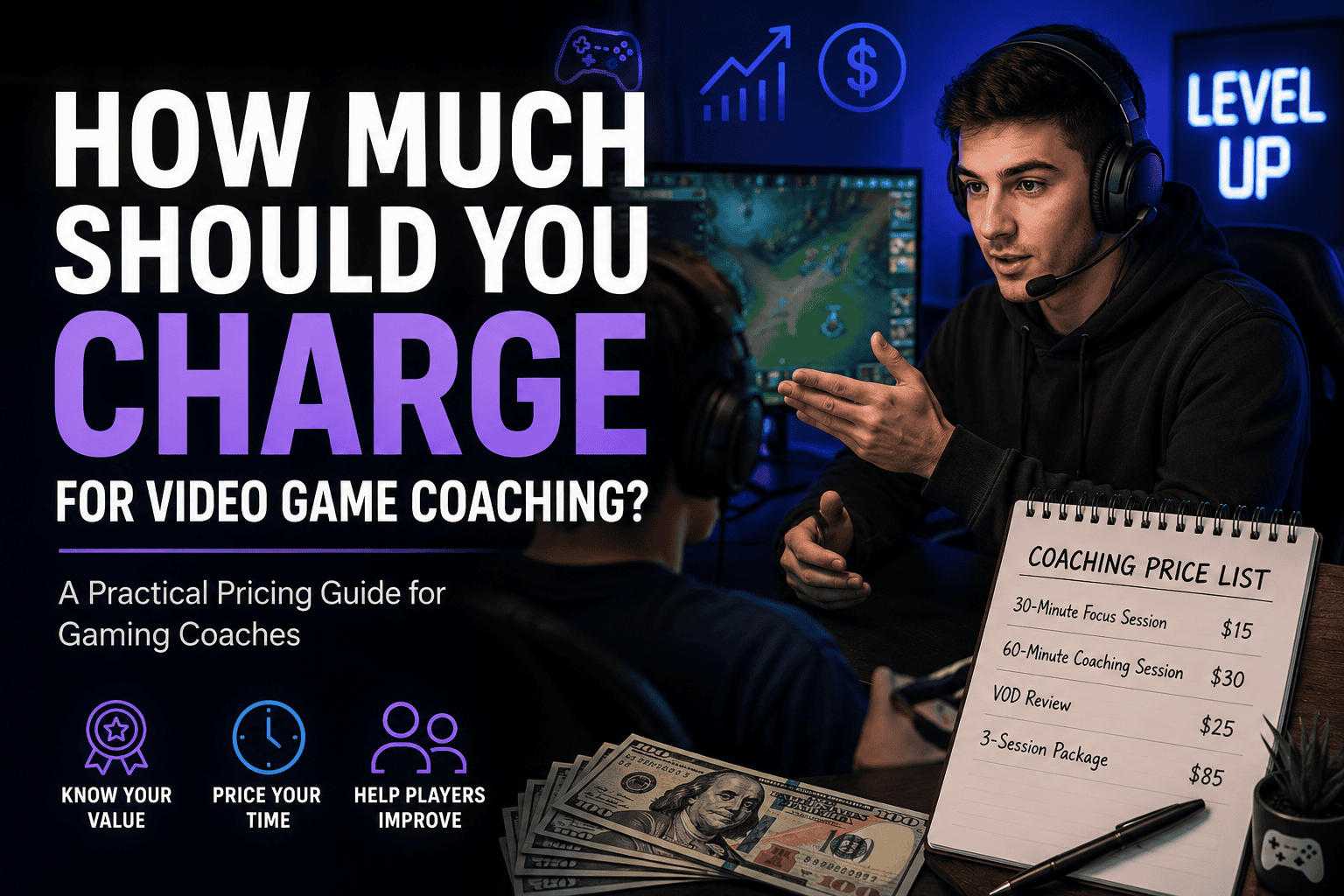
30-minute introductory session – US$10
60-minute coaching session – US$20
Three 60-minute sessions – US$55
That gives players a relatively low-risk way to try your coaching without forcing you to work for free.
Once you’ve delivered successful sessions, collected strong reviews and started receiving repeat bookings, you might move towards:
30-minute session – US$15
60-minute coaching session – US$30
Three 60-minute sessions – US$80
The important thing is that your pricing can grow with your coaching business.
Your launch price doesn’t have to become a lifelong commitment.
📈 Experienced Coaches Can Charge for More Than Their Time
Once you’ve built a reputation, players aren’t simply buying 60 minutes on Discord.
They’re buying your accumulated knowledge.
They’re paying for your ability to watch one team fight and notice the positioning mistake they’ve been repeating for the last six months.
They’re paying for you to recognise that their aim isn’t actually the problem – despite the 47 aim-training videos they’ve watched this week.
They’re paying for experience that can potentially save them dozens or even hundreds of hours of figuring things out themselves.
That’s where higher coaching rates become easier to justify.
If you’re wondering what those higher rates can translate into as an actual income, our guide to how much gaming coaches earn looks at hourly earnings, side-hustle potential and the factors that can increase your coaching income.
⚠️ Don’t Pick Your Price From This Table and Call It a Day
The ranges above give you somewhere to start, but your final rate should take into account much more than your gaming rank.
Before deciding:
“I’m an experienced coach, therefore I’m charging $40.”
you need to ask what makes your particular coaching service worth $40.
Your experience matters.
Your rank matters.
Your game matters.
Your reputation matters.
But so do your teaching ability, specialisation, session format, preparation time and the results players can realistically expect from working with you.
That’s what we’re going to break down next.
Because the best coaching price isn’t simply the highest amount you think someone might pay.
It’s a price that makes the player think “that was worth it” while leaving you thinking “that was worth my time.”
Get both sides saying that and you’re probably somewhere close to the right number.
3. What Do Video Game Coaches Typically Charge?
Spend a few minutes browsing gaming coaches and one thing becomes obvious pretty quickly:
There is no standard price for video game coaching.
You might find one coach offering an hour for $15, another charging $30 and another asking $60 or more for what, at first glance, appears to be the same thing.
They’re all sitting there under some variation of:
“1-on-1 Gaming Coaching – 60 Minutes”
So what’s going on?
Usually, you’re not actually comparing the same service.
🎮 Gaming Coaching Exists at Several Price Levels
It helps to think about gaming coaching as a spectrum rather than a single market rate.
At the lower end, you’ll often find newer coaches trying to establish themselves, coaches targeting beginners or relatively simple sessions with few extras.
Move up the range and you’ll start seeing coaches with more experience, stronger reputations, better reviews, specialist knowledge or more comprehensive coaching.
At the premium end, you may be paying for competitive experience, deep expertise in a particular game or role, proven coaching ability and a much more developed service.
A simplified version might look like this:
🌱 Entry-Level Coaching
Usually aimed at beginners or players looking for affordable help.
The coach may be relatively new to paid coaching but still have strong knowledge of the game. Sessions might focus on fundamentals, basic mistakes, ranked improvement and straightforward live feedback.
🎮 Established Coaching
The coach has more experience working with players and may have reviews, repeat clients and a more polished coaching process.
Instead of simply watching you play and pointing things out, they may identify recurring patterns, set improvement goals and give you specific things to practise after the session.
⭐ Specialist Coaching
This is where you’re often paying for deeper expertise.
Maybe the coach specialises in a particular role, character, mechanic, competitive level or coaching format.
Instead of:
“I’ll help you get better at League of Legends.”
their offer might effectively be:
“I specialise in helping Diamond-level jungle players improve pathing, objective control and decision-making so they can push towards Master.”
That’s a much narrower service – but to the right player, it’s also considerably more valuable.
🏆 Premium and Pro-Level Coaching
At the upper end, coaches may have professional playing experience, esports coaching credentials, extensive reviews, tournament experience or a recognised reputation within a particular game.
Players aren’t just paying for an hour of someone’s time.
They’re paying for access to expertise that may have taken thousands of hours to develop.
💰 Same Hour. Completely Different Product.
Consider two hypothetical coaching sessions.
Coach A – $20
You join Discord.
You play for an hour.
The coach watches and gives you feedback while you play.
At the end, they give you a couple of things to work on.
Perfectly reasonable service.
Now consider:
Coach B – $50
Before the session, you send them a replay.
They review it and identify several recurring problems.
During the session, they explain those mistakes, analyse examples, watch you play and help you apply the changes.
Afterwards, they send you personalised notes, practice drills and three areas to focus on before your next session.
Both listings might say:
60-Minute Gaming Coaching Session
But Coach B isn’t really selling 60 minutes.
They’re selling a coaching process.
That’s an important distinction when you’re deciding what you should charge.
🧠 Players Aren’t Buying Minutes
This is one of the easiest pricing traps for new coaches to fall into.
You start thinking:
“If other coaches charge $30 an hour, I should probably charge $30 an hour.”
But players aren’t really buying an hour.
They’re buying an outcome.
Maybe they want to:
- 📈 Climb out of a rank they’ve been stuck in for months
- 🎯 Improve their aim or mechanics
- 🧠 Make better decisions under pressure
- 🗺️ Understand positioning and rotations
- ⚔️ Master a particular character, champion or role
- 🏆 Prepare for competitive matches
- 🔍 Work out what they’re doing wrong
The better you become at solving those problems, the less useful it becomes to think of your coaching as simply selling blocks of time.
A mechanic doesn’t really sell you 60 minutes either.
You care that the mysterious clunking noise disappears.
Preferably before the wheel does.
Gaming coaching isn’t exactly the same, of course, but the principle is useful:
Customers care about what your time can do for them.
⭐ Reputation Can Change What Players Are Willing to Pay
Imagine you’re choosing between two coaches.
One has:
No reviews. No previous clients. No clear coaching history.
The other has:
150 completed sessions, excellent reviews and players repeatedly saying the coaching helped them improve.
Even if their gaming ability is similar, most buyers will see less risk in choosing the second coach.
That trust has value.
This is why a coach charging $20 when they launch doesn’t necessarily need to stay at $20 forever.
As you accumulate:
Sessions → Experience → Reviews → Results → Reputation
you build evidence that your coaching is worth paying for.
That can give you room to increase your rates without simply announcing:
“I’ve decided I’m expensive now.”
🎯 Your Competition Isn’t Every Gaming Coach
This is another useful distinction.
If you coach Rocket League, it doesn’t particularly matter that an elite Street Fighter coach charges $70 per hour.
You’re not really competing with them.
Even within the same game, the comparison can be misleading.
A coach helping complete beginners learn the fundamentals may operate in a completely different market from someone preparing high-ranked players for tournaments.
When researching prices, try to compare yourself with coaches who are similar in:
- Game
- Player skill level
- Coaching experience
- Competitive experience
- Specialisation
- Session format
- Session length
- Reviews and reputation
- Extras included with the session
That’s your real comparison group.
🚀 Don’t Worry About Finding the “Perfect” Price
Your first coaching price probably won’t be perfect.
That’s fine.
You aren’t carving it into a stone tablet.
Think of your initial price as a starting hypothesis.
You choose a sensible rate based on the market, your experience and what you’re offering.
Then you see what happens.
Are players booking?
Are they coming back?
Are you getting good reviews?
Are sessions taking much more work than you expected?
Are you becoming fully booked?
Do players consistently tell you the session was great value?
All of that gives you information you can use to adjust your pricing later.
The aim isn’t to magically discover the exact dollar value of your gaming knowledge on day one.
It’s to start with a sensible price, deliver coaching that’s genuinely worth paying for and build from there.
To do that properly, though, you need to understand what actually determines your value as a coach.
And there are several factors that matter far more than simply looking at your rank and attaching a dollar sign to it.
4. What Determines Your Gaming Coaching Rate?
So far, we’ve established that there isn’t a universal gaming coaching rate.
That’s useful.
It’s also slightly inconvenient.
It means you can’t simply look up “Official Gaming Coach Hourly Rate 2026”, discover you’re worth $37.50 an hour and get back to gaming.
Instead, your rate comes down to a combination of factors.
Some increase the value of your coaching significantly. Others might sound impressive on a listing but don’t necessarily make you a better coach.
Understanding the difference will help you set a price you can actually justify.
🏆 1. Your Gaming Skill and Experience
Your ability at the game obviously matters.
Players generally aren’t going to pay someone to teach them a game they understand better than the coach.
Higher ranks, competitive experience and years spent playing can all demonstrate that you understand the mechanics, strategies and decisions required to perform at a higher level.
But context matters.
Imagine you’re a Diamond player coaching someone in Bronze.
You may have more than enough knowledge to identify their biggest mistakes and help them improve.
You don’t necessarily need to be a former world champion who once shook hands with an esports trophy.
For beginner and intermediate coaching especially, being several steps ahead of the player you’re helping can be more important than being among the best players on Earth.
As your target clients become more advanced, however, your own level of expertise becomes increasingly important.
A high-ranked player trying to break into elite competition will understandably expect a coach with the experience to help them at that level.
🧠 2. Your Coaching Experience
Knowing how to play and knowing how to teach are different skills.
The first time you coach someone, you might notice twelve things they’re doing wrong and enthusiastically explain all twelve.
Congratulations.
Your client now has twelve problems and absolutely no idea which one to fix first.
Experienced coaches learn how to prioritise.
They know when to stop a player and explain something, when to let them continue and when a mistake is worth ignoring temporarily because there’s a much bigger problem to solve first.
Over time, you also get better at recognising patterns.
You’ve seen the same positioning mistake before.
You’ve heard the same misunderstanding about a mechanic.
You know which explanation tends to make the concept finally click.
That experience can make your coaching more efficient and more valuable – and it can justify higher rates.
🎯 3. Who You Coach
Your target player matters almost as much as the game itself.
There is a big difference between offering:
Beginner Valorant Coaching
and:
Advanced Immortal-Level Valorant Coaching
The beginner may need help with fundamentals such as crosshair placement, positioning, utility usage and basic decision-making.
The advanced player may already understand all of that.
Their problems could involve tiny positioning advantages, advanced team coordination, opponent tendencies, economy decisions or mistakes that only become significant at very high levels of play.
That requires deeper expertise.
When setting your price, ask:
Who exactly am I qualified to help?
Trying to coach absolutely everyone from someone’s first match to professional competition doesn’t necessarily make your service more attractive.
Often, being clear about who you coach best makes your offer stronger.
🎮 4. The Game You Coach
Not every game has the same coaching market.
A huge competitive game with millions of ranked players may have plenty of potential customers – but it may also have thousands of coaches competing for them.
A smaller game could have fewer players but far fewer coaches.
Different games also require different types of expertise.
Coaching might focus heavily on:
- Aim and mechanics
- Positioning
- Builds or loadouts
- Map knowledge
- Team composition
- Character matchups
- Economy management
- Rotations
- Strategy
- Communication
- Replay analysis
Some games also have strong competitive ladders where players are highly motivated to improve their rank, creating a natural demand for coaching.
We’ll look more closely at how your game can influence your pricing later in this guide.
⭐ 5. Your Reputation and Reviews
When you’re new, potential clients mostly have to take your word for it.
You can tell them you’re knowledgeable.
You can tell them you’re patient.
You can tell them your coaching will help.
Of course you can.
It’s your listing.
Reviews are different.
When other players consistently say things like:
“They spotted mistakes I didn’t realise I was making.”
or:
“I finally understand why I keep losing those situations.”
you’ve got evidence that your coaching provides value.
That reduces the perceived risk for new clients.
A coach with a proven track record can therefore often charge more than an equally skilled coach who has never coached anyone before.
This is one reason your first few clients are so important. You’re not just earning money from those sessions – you’re beginning to build the reputation that can make future sessions worth more.
🔍 6. Your Specialisation
General coaching can be valuable.
Specialist coaching can be even more valuable to the right person.
Instead of:
“I coach Overwatch.”
you might specialise in:
Support coaching for competitive players trying to climb from Platinum to Masters.
Now your potential audience is smaller.
But if someone happens to be a Platinum support player struggling to reach Masters, your service suddenly looks extremely relevant.
Specialisation could involve:
- A particular role
- Character or champion
- Game mode
- Rank range
- Mechanic
- Competitive format
- Team strategy
- Tournament preparation
- VOD analysis
The harder your expertise is to find elsewhere, the more pricing power you may have.
You don’t want to become so specialised that your target market consists of Kevin from Brisbane and nobody else.
But having a clear niche can help distinguish your coaching from dozens of generic alternatives.
🎧 7. How You Deliver the Coaching
A coaching session isn’t always just:
Join voice chat → play game → receive wisdom → leave.
Different formats involve different amounts of work.
For example, you could offer:
Live Coaching
Watch the player in real time and provide feedback during or between matches.
VOD Review
Analyse recorded gameplay and break down mistakes, decisions and opportunities.
One-on-One Coaching
Build the session around one player’s specific goals and weaknesses.
Replay Analysis + Live Session
Review gameplay before meeting the player, then use the session to explain what you’ve found.
Ongoing Coaching
Work with the same player over several sessions and track their development.
If you’re deciding which approach to offer, our guide to live gaming coaching vs VOD review explores the differences between the two formats and where each can be most useful.
You can also explore our guide to one-on-one video game coaching for a closer look at personalised coaching sessions.
The more preparation, analysis and personalisation involved, the more you need to consider whether your price properly reflects the work.
📦 8. What the Player Actually Gets
Finally, look beyond the session itself.
Two coaches might both advertise a 60-minute session.
One includes:
60 minutes of live coaching.
The other includes:
Pre-session questionnaire + replay review + 60-minute session + written feedback + practice plan + follow-up questions.
Those shouldn’t automatically cost the same.
Extras that can add genuine value include:
- Pre-session gameplay analysis
- Personalised goals
- Written session notes
- Practice drills
- Replay timestamps
- Training plans
- Follow-up feedback
- Progress tracking
- Resources tailored to the player
The important word there is genuine.
Adding a 14-page PDF nobody asked for doesn’t automatically transform a $20 session into a $70 premium coaching experience.
Extras should help the player improve.
💰 Put the Factors Together
No single factor determines your price.
Think of your rate as the result of several pieces working together:
Gaming Expertise + Coaching Ability + Specialisation + Reputation + Demand + Session Value + Time Required
A highly ranked player with no coaching experience might reasonably start at a lower price.
An experienced coach with hundreds of successful sessions, excellent reviews and specialist expertise might charge substantially more.
And somewhere between those two is probably where most coaches will begin.
The useful question isn’t:
“What rank am I, and how much is that rank worth?”
It’s:
“Who can I genuinely help, what value can I give them and what would make this coaching session worth paying for?”
Answer that well and setting your price becomes considerably easier.
5. Gaming Skill vs Coaching Skill – What Are Players Really Paying For?
If you’re exceptionally good at a game, you’ve already got something valuable to offer.
You’ve probably spent hundreds – maybe thousands – of hours learning mechanics, maps, matchups, strategies and all the tiny decisions that separate a good player from someone staring at the defeat screen wondering how everything went wrong so quickly.
But there’s an important distinction:
Being good at a game and being good at coaching that game are not the same thing.
You can be brilliant at both.
But one doesn’t automatically unlock the other.
🎮 Great Players Often Do Things Without Thinking
The better you become at a game, the more decisions you start making instinctively.
You don’t consciously think:
“The enemy has used two important abilities, their support is out of position and we’ve got a numbers advantage, therefore this is a good time to push.”
You just see the opportunity.
That’s great when you’re playing.
It’s less useful when you’re coaching someone who asks:
“How did you know we should push there?”
If your answer is:
“You can just tell.”
We’ve hit a slight coaching problem.
A strong coach needs to take those instincts and turn them back into something another player can understand and reproduce.
That’s where coaching skill starts to become valuable.
🧠 Information Isn’t the Same as Understanding
Most gamers aren’t short of information.
There are guides, streams, videos, wikis, forums, Discord servers and approximately seventeen million people on YouTube willing to explain why you’re playing your main incorrectly.
The challenge is working out:
Which information actually applies to me?
That’s one of the biggest things a coach can provide.
A generic guide might tell a player:
“Improve your positioning.”
A coach can say:
“You’re consistently moving too far forward after your team gets an advantage. Watch these three fights – the same thing happens every time.”
That’s a completely different level of usefulness.
The first gives the player information.
The second gives them something specific to fix.
🎯 Good Coaches Find the Right Problem
Players aren’t always particularly good at diagnosing their own weaknesses.
Someone might book a session because:
“My aim is terrible.”
You review their gameplay and discover their aim is actually fine.
They’re losing fights because they’re constantly taking them from awful positions.
Now you’ve potentially saved them another three months of aim training while standing in exactly the wrong place.
This is where good coaching becomes much more than pointing out mistakes.
You need to identify which mistakes matter most.
A player might make 30 questionable decisions during a match.
Trying to correct all 30 at once usually isn’t helpful.
A better coach might identify three recurring problems responsible for most of them.
Instead of giving the player an enormous list of everything they did wrong, you give them a manageable plan:
1. Fix your positioning before engagements.
2. Stop using this ability before you actually need it.
3. Check the minimap before committing to a fight.
Now the player knows what to practise.
💬 Can You Explain Why?
This might be one of the most valuable coaching skills of all.
Imagine a player makes a bad rotation.
There are several ways you could respond.
“Bad rotation.”
Technically correct.
Not enormously useful.
You could say:
“You should have rotated earlier.”
Better.
Or you could explain:
“You needed to rotate about five seconds earlier because we already knew the objective was spawning, your lane was safe and the enemy player had disappeared from vision. By waiting, you arrived after the fight had already started.”
Now the player understands the decision.
Even better, they can potentially recognise the same situation next time.
That’s what you’re trying to create as a coach.
Not a player who needs you sitting beside them forever telling them what button to press.
A player who gradually learns how to make better decisions for themselves.
👂 Coaching Means Listening Too
There’s another trap skilled players can fall into:
Talking.
A lot.
You know the game. You’re excited about the game. You’ve got approximately 900 things you’d like to explain about the game.
Unfortunately, there’s another human in the session.
Good coaching is partly about understanding what that player wants.
Maybe they want to climb ranked.
Maybe they’re preparing for competitive play.
Maybe they only have a few hours a week and want to stop wasting those hours repeating the same mistakes.
Maybe they’re a complete beginner and half the terminology you’re casually throwing around sounds like you’ve changed languages halfway through the session.
Ask questions.
Find out:
- 🎯 What are they trying to achieve?
- 🎮 How long have they been playing?
- 📈 What’s their current skill level?
- 🧱 Where do they feel stuck?
- 🧠 How do they prefer to learn?
- ⏱️ How much time can they realistically practise?
A coaching plan for someone playing two hours a week should probably look different from one designed for someone grinding ranked every evening.
Personalisation is part of what makes paid coaching different from simply watching another guide.
🏆 Do You Need to Be Better Than Everyone You Coach?
Generally, you need enough expertise to provide meaningful guidance at the level you’re coaching.
But that doesn’t necessarily mean you need to be the highest-ranked player in the game.
A strong Diamond player might have plenty to teach Bronze, Silver and Gold players.
A former high-level competitor might be better positioned to coach advanced players.
And some coaches develop exceptional analytical or teaching skills that make them valuable even when they aren’t currently sitting at the absolute top of the ranked ladder.
The key is being honest about the level you can coach effectively.
Don’t advertise elite competitive coaching if your experience doesn’t support it.
You don’t need to pretend to be something you’re not.
Instead, make your actual strengths part of your offer.
For example:
“I help new and intermediate players build strong fundamentals and climb ranked.”
That’s clear.
It tells potential clients exactly who the service is designed for.
And if that’s what you’re genuinely good at, it’s a much stronger offer than pretending you can coach everyone from their first match to the world championship.
⭐ Better Coaching Can Become More Valuable Than Better Rank
This is where pricing gets interesting.
Suppose two coaches are both highly skilled players.
Coach A has a slightly higher rank.
Coach B has coached 100 players, developed a clear session structure, knows how to analyse replays, communicates brilliantly and consistently receives excellent feedback.
Which one should charge more?
There isn’t automatically a correct answer.
But Coach B has something Coach A doesn’t:
Evidence that they can turn their gaming knowledge into results for other people.
That’s incredibly valuable.
As you become a better coach, you’re developing a separate skill set:
Playing Experience → Game Knowledge → Analysis → Communication → Teaching → Player Improvement
The further you move along that chain, the more complete your coaching service becomes.
📈 Your Coaching Skills Can Improve Too
One of the best things about starting at a sensible rate is that you get room to develop.
Your tenth session will probably be better than your first.
Your fiftieth may be considerably better.
You’ll learn which questions uncover problems quickly, which explanations players understand and which parts of your sessions provide the most value.
You’ll also discover things that seemed like brilliant ideas at the time but don’t actually help.
Perhaps nobody reads your magnificent six-page post-session report.
Fair enough.
Make it shorter.
Perhaps players love getting three personalised practice goals at the end of every session.
Great.
Build that into your service.
The same way players improve through practice and feedback, coaches improve by coaching.
And as your ability to deliver useful sessions grows, your pricing can grow with it.
If you’re still building those skills, our guide to how to become a gaming coach covers the wider process of developing your coaching offer and getting started.
💰 So What Are Players Really Paying For?
They’re not simply paying for your rank.
They’re not paying because you’ve played the game for 4,000 hours.
And they’re definitely not paying to hear you say “skill issue” every time they die.
They’re paying for your ability to use everything you’ve learned to help them improve.
That means spotting problems they can’t see.
Explaining decisions they don’t understand.
Giving them practical ways to improve.
Helping them focus on the things that matter.
And hopefully saving them from spending another 200 matches practising the wrong thing.
Your gaming skill gets you through the door.
Your coaching skill is what makes players want to come back.
And when you’re deciding what to charge, both deserve a place in the calculation.
6. Does the Game You Coach Affect Your Price?
Absolutely.
You could be an excellent coach with years of experience, a polished coaching process and the patience of someone who’s somehow survived 10,000 ranked matches without uninstalling the game.
But the game you coach still affects what players may be willing to pay.
Different games have different player populations, competitive scenes, learning curves, coaching demand and numbers of coaches competing for the same customers.
That doesn’t mean one game is automatically worth more than another.
It means you need to understand the market around the game you’re coaching before deciding what your service should cost.
🎮 Bigger Games Can Mean More Potential Clients
Popular competitive games can naturally create large coaching markets.
Games such as League of Legends, Valorant, Counter-Strike 2, Fortnite, Rocket League and Overwatch 2 have competitive systems where players can spend hundreds or thousands of hours trying to improve.
And ranked ladders have a remarkable ability to make perfectly rational people decide:
“One more game. I’ll stop after I get those points back.”
Three hours later, they’re somehow two ranks lower.
That desire to improve creates opportunities for coaches.
A large active player base can mean:
- More potential clients
- More players actively trying to improve
- More skill levels to coach
- More opportunities to specialise
- More repeat coaching potential
But there’s a catch.
Popular games can also attract more coaches.
If hundreds of people are offering similar coaching for the same game, players have plenty of options to compare.
That competition can put pressure on prices, particularly for newer coaches without reviews or a clear specialisation.
🔍 Smaller Games Can Create Different Opportunities
A smaller player base doesn’t automatically mean a bad coaching market.
Sometimes the opposite can happen.
Imagine a competitive game with a passionate community but only a handful of coaches offering structured one-on-one help.
There may be fewer potential customers overall, but there could also be far less competition for those customers.
If you have expertise that’s genuinely difficult to find elsewhere, that scarcity can make your coaching more valuable.
The challenge is demand.
Being the world’s greatest coach for an obscure game isn’t particularly profitable if the entire active coaching market consists of four people – and two of them are your friends.
So when considering a smaller game, ask two questions:
Is there demand for coaching?
and:
How many other coaches are already serving that demand?
You want enough players looking for help without disappearing into a sea of identical coaching offers.
🎯 Some Games Naturally Create More Coaching Problems to Solve
The type of game matters too.
Different genres create different coaching opportunities.
🔫 FPS and Tactical Shooters
Games built around shooting mechanics can offer coaching in areas such as:
- Aim
- Crosshair placement
- Positioning
- Movement
- Map knowledge
- Utility usage
- Peeking
- Communication
- Decision-making
- Team play
A beginner might need help with fundamentals.
An experienced player could want extremely specific coaching around positioning, utility usage or high-level decision-making.
That gives coaches room to offer services at multiple skill levels.
🧠 MOBAs
MOBA coaching can become incredibly detailed.
You might coach:
- Laning
- Champion mechanics
- Matchups
- Farming
- Itemisation
- Map awareness
- Rotations
- Objective control
- Team fights
- Drafting
- Role-specific strategy
A coach could even specialise entirely in one role or a small group of champions.
That depth can create opportunities for highly targeted coaching offers.
🚗 Competitive Sports and Racing Games
Games such as football, basketball, racing and car-based competitive titles can involve a mixture of mechanics, tactics and decision-making.
Coaching might focus on:
- Mechanical execution
- Positioning
- Game plans
- Defence
- Attacking patterns
- Rotations
- Decision-making
- Competitive strategy
Again, the more advanced the player becomes, the more specialised their problems may become.
⚔️ Fighting Games
Fighting games can be particularly suited to detailed coaching because small mistakes can have immediate consequences.
Players may want help with:
- Matchups
- Combos
- Neutral game
- Punishes
- Defence
- Movement
- Character knowledge
- Reading opponents
- Decision-making under pressure
Sometimes the difference between winning and losing is one habit the player doesn’t even realise they have.
Which is excellent news for a coach who knows how to spot it.
Less excellent news for the controller that has been blamed for the last six losses.
♟️ Strategy Games
Strategy coaching can lean heavily towards analysis and decision-making.
Players might need help with:
- Build orders
- Resource management
- Timing
- Map control
- Unit composition
- Adaptation
- Opponent analysis
- Long-term strategy
Because these games often involve complex decision trees, replay analysis can be particularly valuable.
🏆 Competitive Games Often Have Stronger Coaching Demand
Games with visible ranks, ladders and competitive progression give players a very obvious measurement of improvement.
Silver → Gold → Platinum → Diamond
There’s always another target.
That creates a natural reason to seek coaching.
A player who’s been stuck one division below their goal for three months knows exactly what they want:
Get me out of here.
Of course, a responsible coach shouldn’t promise guaranteed rank increases. There are too many variables involved, and improvement doesn’t always immediately translate into a shiny new badge.
But the existence of clear competitive goals can make coaching easier to position.
Instead of selling:
“I’ll teach you Valorant.”
you might offer:
“One-on-one coaching for Silver and Gold players who want to improve positioning, decision-making and ranked consistency.”
That’s much more specific.
📈 Different Skill Levels Can Support Different Prices
The same game can contain several completely different coaching markets.
Consider a competitive shooter.
You might offer:
Beginner Coaching
Fundamentals, controls, basic mechanics and positioning.
Intermediate Ranked Coaching
Decision-making, map awareness, consistency and common mistakes.
Advanced Coaching
Detailed VOD analysis, high-level positioning, team coordination and specialist mechanics.
Competitive Coaching
Tournament preparation, team strategy, opponent analysis and advanced performance review.
The deeper the expertise required, the more you may be able to charge – assuming you actually have the experience to provide it.
This is why saying:
“Valorant coaching costs $X per hour”
isn’t particularly useful by itself.
The better question is:
“What type of Valorant coaching are you offering, and who is it for?”
💡 Your Game Can Help You Find a Coaching Niche
If you’re entering a competitive coaching market, don’t immediately assume you need to compete with every other coach in the game.
Look for a narrower problem you can solve particularly well.
Instead of:
Fortnite Coach
you could position yourself around:
Beginner Fortnite Coaching
or:
Competitive Build and Edit Coaching
or:
Fortnite VOD Reviews for Ranked Players
The same principle can apply across almost any game.
You could specialise by:
Game → Skill Level → Role → Problem → Coaching Format
For example:
League of Legends → Gold/Platinum → Jungle → Decision-Making → VOD Review
That’s much more distinctive than:
“I coach League.”
And importantly, a specialist offer gives players a reason to choose you that isn’t simply:
“This person is $3 cheaper.”
💰 Don’t Choose a Game Just Because Coaching Prices Look Higher
If you’re thinking about becoming a gaming coach, it can be tempting to look at a game where established coaches charge premium rates and think:
That’s where the money is.
There’s one small complication.
You need to be good enough to coach it.
Your strongest opportunity will usually come from the games where you already have substantial knowledge, experience and credibility.
If you’ve spent five years mastering one competitive game, that’s probably a better foundation than jumping into another because you saw somebody charging $70 an hour.
Players are paying for expertise.
Trying to manufacture that expertise backwards from the price tag rarely ends well.
🎯 Research Your Game, Not Just Gaming Coaching
Before setting your rate, spend some time looking specifically at the coaching market for your game.
Look at:
- What coaches charge
- What ranks they hold
- What skill levels they target
- What session lengths they offer
- Whether they provide live coaching or VOD reviews
- What specialisations are common
- What their reviews say
- What higher-priced coaches include
- Where there appear to be gaps in the market
If you’re still deciding which game could make the strongest coaching service, our guide to the best games for video game coaching explores what makes certain games particularly well suited to coaching.
The goal isn’t to find the game with the highest advertised hourly rate.
It’s to find the intersection between:
🎮 What You’re Great At + 🎯 What Players Need Help With + 💰 What They’re Willing to Pay For
Find that overlap and you’ve got a much stronger foundation for setting your coaching price.
But if you’re completely new to paid coaching, there’s still another question to answer:
Where should your price actually start?
7. How Much Should a New Gaming Coach Charge?
Setting your first coaching price can feel strangely intimidating.
Charge too much and you might worry nobody will book.
Charge too little and you could end up spending two hours preparing, coaching and writing feedback for enough money to buy a sandwich.
Possibly not even a particularly impressive sandwich.
For most new gaming coaches, the goal shouldn’t be to maximise your hourly rate immediately.
Your first goal is to get something even more useful:
Real coaching experience.
You need opportunities to work with actual players, test your coaching process, discover what clients find valuable and start building the reviews and reputation that can justify higher prices later.
That makes your starting price important – but it doesn’t make it permanent.
🌱 Start Competitive, Not Cheap
There’s a difference between offering an attractive introductory price and simply being the cheapest coach available.
Suppose comparable established coaches in your game are charging around $25–$40 per hour.
If you’re brand new with no reviews or coaching history, launching at $40 might be difficult to justify.
But charging $5 isn’t necessarily the answer either.
A more sensible starting position might be somewhere around:
$15–$25 per hour
depending on your gaming experience, rank, specialisation and what the session includes.
You’re giving players a reason to take a chance on a new coach while still putting a reasonable value on your time.
Think of it as:
“I’m new to paid coaching.”
Not:
“My knowledge is virtually worthless.”
Those are very different messages.
🎮 New Coach Doesn’t Mean New Player
This distinction matters.
You might be completely new to coaching while having thousands of hours of experience in the game.
Perhaps you’ve competed at a high level.
Perhaps you’ve reached an impressive rank.
Perhaps you’ve spent years helping friends, teammates or guild members improve without ever calling it coaching.
You’re not starting from zero.
Your gaming experience still has value.
What you haven’t yet demonstrated is your ability to consistently turn that knowledge into a great paid coaching experience.
That’s why a slightly lower introductory rate can make sense.
It compensates for the uncertainty the customer is taking on – not because your gaming knowledge suddenly disappeared when money entered the conversation.
🎯 Your First Price Should Make It Easy to Say Yes
Imagine a player comparing two coaches.
Coach A
$40 per hour
75 positive reviews
200+ completed sessions
Coach B
$40 per hour
No reviews
No completed sessions
Even if Coach B is an exceptional player, most customers will probably choose Coach A.
There’s simply less uncertainty.
Now imagine Coach B launches at:
$20 for their first 60-minute session
Suddenly the decision becomes more interesting.
The established coach offers proof and reputation.
The new coach offers a lower-risk way to try their service.
That’s the job of an introductory price.
It gives players a reason to choose you before you have the reviews to do that job for you.
💰 A Simple Starting Price Structure
If you’re launching your first gaming coaching service, you don’t need twelve packages.
Keep it simple.
For example:
🎮 30-Minute Intro Session – $10
A low-commitment way for a player to meet you, discuss their goals and get focused help with a specific problem.
🎯 60-Minute Coaching Session – $20
Your core coaching option.
Enough time to analyse problems, explain improvements and give the player clear things to work on.
📈 Three 60-Minute Sessions – $55
A small package for players who want ongoing help, with a modest discount for committing to multiple sessions.
That’s enough to start.
You can always add VOD reviews, longer sessions, advanced packages and interpretive dance later.
Actually, probably skip the last one.
🧠 Consider What You’re Already Bringing to the Table
Not every new coach should start at exactly the same price.
Imagine three people launching their first paid coaching service.
Coach A
Strong intermediate player
No competitive experience
Has informally helped friends improve
Coach B
Top-ranked player
Several years of competitive experience
Frequently analyses teammates’ gameplay
Coach C
Former competitive player
Has coached a team informally
Specialises in high-level VOD analysis
Technically, all three are new paid coaches.
But they’re clearly not starting from the same place.
Coach C may reasonably launch at a higher rate than Coach A because they’re bringing substantially more relevant experience into the service.
So don’t automatically think:
New Coach = Lowest Possible Price
Instead ask:
What evidence do I already have that I can provide useful coaching?
That could include:
- Your rank
- Competitive experience
- Game knowledge
- Team leadership
- Previous informal coaching
- Replay analysis experience
- Specialist expertise
- Results you’ve helped other players achieve
Use those factors to decide where within the beginner pricing range you belong.
⭐ Your First Clients Are Building More Than Revenue
Suppose you coach your first five players.
You probably aren’t retiring.
But those five sessions can give you something enormously useful.
You start learning:
What questions should I ask before the session?
What mistakes do players commonly make?
Which explanations work best?
How much preparation do I actually need?
What do players find most useful?
How long does my follow-up take?
You may also begin collecting genuine reviews and testimonials.
That means those early sessions aren’t only producing revenue.
They’re helping you build the coaching system that future customers will pay more for.
If you’re trying to get those first bookings, our guide to how to find your first gaming coaching clients covers practical ways to start attracting players and building credibility.
📈 Give Your Introductory Price an Expiry Point
One mistake new coaches make is setting a low launch price and then leaving it there indefinitely.
Six months later they’re fully booked, have excellent reviews and are still charging exactly what they did when nobody knew who they were.
Don’t wait for the Pricing Fairy to arrive and officially approve an increase.
Decide in advance when you’ll review your rate.
For example:
Review my pricing after 10 paid sessions.
Or:
Review my pricing after receiving five positive reviews.
Or:
Review my pricing after three months.
You don’t automatically need to increase it at that point.
You’re simply asking:
Does my current price still reflect the value I’m providing?
If you’ve become better at coaching, built reviews and started receiving consistent bookings, the answer may be no.
⚠️ Be Careful With Permanent “Beginner Pricing”
Your first price can attract customers.
But eventually, pricing too low can start causing problems.
You may find yourself:
- Spending too much time for too little return
- Attracting customers primarily because you’re cheap
- Struggling to justify preparation and follow-up
- Filling your available coaching hours without earning enough
- Feeling reluctant to put additional effort into sessions
That’s not particularly sustainable.
You want players to think:
“This coach provides great value.”
Not:
“This is suspiciously cheap, but I’ll give it a go.”
There’s a difference.
🚀 Start Somewhere – Then Improve
Your first coaching price isn’t a final verdict on what your skills are worth.
It’s simply your starting point.
Choose a rate that’s competitive for your game and experience.
Make your offer clear.
Deliver an excellent session.
Ask for feedback.
Learn from it.
Get another client.
Then another.
As your coaching becomes better and your reputation grows, reassess what you’re charging.
A new coach might begin at $15–$25 per hour and eventually move to $30, $40, $50 or considerably more as their experience, specialisation and demand increase.
You don’t need to start expensive.
You need to become worth paying more for.
And before deciding that the easiest way to get those first clients is simply to coach everyone for nothing, there’s another option worth examining:
Should you offer your first gaming coaching sessions for free?
8. Should You Offer Your First Gaming Coaching Sessions for Free?
When you’re trying to get your first coaching clients, offering a few sessions for free can sound like the obvious solution.
No reviews?
Free coaching.
No customers?
Free coaching.
Nobody knows whether you’re any good?
FREE COACHING FOR EVERYONE.
It can work.
But free coaching should have a purpose.
Used strategically, a handful of free sessions can help you practise coaching, test your service and gather valuable feedback before asking strangers to pay you.
Used indefinitely, you’ve invented a gaming coaching business with one fairly significant flaw:
It doesn’t make any money.
🎮 When Free Coaching Can Make Sense
If you’ve never coached another player before, jumping immediately into paid sessions can feel like a big step.
You might know the game incredibly well but still have questions about the coaching itself.
How should you structure the session?
How much gameplay should you review?
When should you interrupt?
How much feedback can a player realistically absorb?
What should you send them afterwards?
Your first few free sessions can help answer those questions.
Instead of thinking of them as free work, think of them as practice sessions for your coaching service.
You could offer three to five sessions to players who fit the type of customer you eventually want to coach.
For example:
I’m developing a one-on-one Valorant coaching service for Silver to Platinum players and I’m looking for five players to test the session format with.
That’s much more useful than:
Free coaching! Anyone want some?
The first approach lets you practise with your actual target audience.
🧪 Use Free Sessions to Test Your Coaching Process
Your first coaching format probably won’t be perfect.
That’s normal.
You might originally plan:
10 minutes – Discuss goals
40 minutes – Live coaching
10 minutes – Feedback
Then after three sessions you realise the player barely gets warmed up before you’ve reached the feedback section.
Or perhaps you discover that reviewing ten minutes of gameplay before the session gives you enough information to make the entire hour more focused.
Maybe players love receiving three practice goals afterwards.
Maybe nobody wants the enormous written report you spent 45 minutes creating.
Excellent.
You’ve learned something.
A small number of free sessions gives you room to experiment before turning your process into a paid product.
🎯 Pick Your Free Clients Carefully
Free doesn’t mean random.
Ideally, your test clients should resemble the players you eventually want to charge.
If you want to coach beginners, find beginners.
If you’re building a service for Gold and Platinum ranked players, coach players around those ranks.
If you want to specialise in a particular role, character or game mode, look for players who actually need that expertise.
This helps you discover whether your coaching offer works for the audience it’s designed for.
It also gives you much more useful feedback.
Your friend who has never played the game before telling you:
“Yeah mate, that was really good.”
is encouraging.
A player from your target audience saying:
“The replay breakdown finally showed me why I keep losing those fights.”
is considerably more useful.
⭐ Ask for Feedback – Not Fake Reviews
If you’re giving someone a free test session, ask them for honest feedback afterwards.
Questions could include:
- What was the most useful part of the session?
- Was anything confusing?
- Did the session feel too fast or too slow?
- What would you change?
- Do you know what to practise next?
- Would you consider paying for another session?
- What do you think a session like this is worth?
That final question can be particularly interesting.
You don’t have to price your service based entirely on what one person says, but if five test clients independently tell you they’d happily pay around $25–$30 for the session, that’s useful information.
And if they all say $5…
Well.
At least you’ve discovered that before printing the business cards.
If someone genuinely enjoyed the session, you can also ask whether they’d be comfortable leaving a review or testimonial that clearly reflects their real experience.
Don’t manufacture reviews, write them yourself or pressure people into saying your coaching changed their life after one free session.
Trust is valuable.
Don’t sacrifice it before you’ve even launched.
💰 Free Isn’t Your Only Option
You don’t necessarily need to go all the way to zero.
An introductory price can often be a better option.
For example:
Normal planned price: $25 per hour
Launch offer: First five sessions at $15
Now the player gets a meaningful discount for trying a new coach, while you establish something important from the beginning:
Your coaching has monetary value.
Even a small payment can change the dynamic.
Someone who pays for a session is more likely to behave like a real customer.
They may arrive more prepared, take the session more seriously and give you a better idea of what paying clients will expect.
It also answers an important business question:
Will somebody actually pay for this?
Ten people accepting free coaching tells you people like free things.
Humanity had already conducted extensive research on that subject.
Getting your first paying client tells you something much more useful.
⚠️ The Danger of Coaching for “Exposure”
Be careful when free coaching stops being a deliberate launch strategy and starts becoming your normal business model.
You might hear:
“Coach me for free and I’ll tell my friends.”
Maybe they will.
Or:
“I’ll give you exposure.”
Exposure can be useful when it’s genuine, targeted and substantial.
But vague promises of future customers don’t automatically compensate you for your time.
If someone has a relevant audience and you’re deliberately arranging a promotional collaboration, that’s different.
For example, coaching a creator in exchange for a genuine video or stream featuring your service could potentially make commercial sense.
But that’s a marketing decision.
It’s not the same as providing free coaching because someone has promised to mention your name somewhere in the vast wilderness of the internet.
🛑 Set a Limit Before You Start
If you decide to offer free sessions, establish the limit in advance.
For example:
I’ll provide five free test sessions.
After those five:
I’ll launch at $20 per hour.
After ten paid sessions:
I’ll review my pricing.
Now you’ve got a progression:
Free Testing → Introductory Pricing → Paid Experience → Reviews → Price Review
Without a limit, it’s easy to keep saying:
“I’ll start charging once I’ve got a little more experience.”
Five sessions becomes ten.
Ten becomes twenty.
Eventually you’re an experienced coach who still isn’t charging.
🚀 Make Every Free Session Earn Something
If you’re not earning money from an early test session, try to make sure you’re gaining something else valuable.
That could be:
Experience – you’re becoming better at coaching.
Feedback – you’re improving your session format.
Confidence – you’re learning how to work with real players.
Testimonials – you’re beginning to build social proof.
Content – with permission, you may identify common coaching problems you can later discuss in educational content.
Referrals – a genuinely impressed player may recommend you to someone else.
A future paying customer – if the player gets value from the session, they may book again.
The important thing is that free coaching should move you towards a paid coaching service.
🎯 So, Should Your First Sessions Be Free?
For a completely new coach, offering a small number of carefully chosen free test sessions can be worthwhile.
Three to five is plenty for most people.
Use them to practise, improve your coaching structure and collect honest feedback.
Then start charging.
If you’re already confident in your ability to coach – perhaps you’ve been helping teammates, reviewing gameplay or coaching informally for years – you may not need a free stage at all.
A discounted introductory rate could make more sense.
Either way, don’t fall into the trap of believing you need 50 glowing reviews before you’re allowed to ask for money.
At some point you need to stop testing whether people want free coaching and start testing whether you’ve built a coaching service they’re willing to pay for.
And when you’re ready to do that, the simplest pricing model is usually also the easiest place to begin:
charging for your time.
9. Hourly Pricing – The Simplest Place to Start
When you’re setting up your first gaming coaching service, it’s easy to get carried away with pricing options.
Thirty-minute sessions.
One-hour sessions.
Three-session bundles.
Monthly improvement plans.
Premium VOD packages.
Elite Diamond Ultra Coaching™ with a complimentary motivational Discord message every Tuesday.
You probably don’t need all of that yet.
For most new gaming coaches, hourly pricing is the simplest place to start.
The player knows exactly what they’re buying, you know exactly how much time you’re committing and comparing your price with other coaches is relatively straightforward.
Start simple.
You can always get clever later.
⏱️ Why 60-Minute Coaching Sessions Work So Well
An hour is a useful default for one-on-one gaming coaching because it’s usually long enough to accomplish something meaningful without overwhelming the player.
Depending on your coaching format, a 60-minute session might include:
- 🎯 A quick discussion about the player’s goals
- 🎮 Live gameplay or replay analysis
- 🔍 Identifying recurring mistakes
- 🧠 Explaining why those mistakes are happening
- 🛠️ Working through possible solutions
- 📈 Setting specific areas to practise afterwards
- ❓ Time for questions
You don’t necessarily need to cram all of those into every session.
In fact, trying to solve every problem a player has in 60 minutes is a good way to finish with both of you needing another coaching session just to recover.
Focus on the areas that can make the biggest difference.
🎮 Should You Offer 30-Minute Coaching Sessions?
Short sessions can be an excellent entry point, particularly for new customers.
A 30-minute session could work well for:
Quick VOD analysis – review a particular match, round or situation.
Specific problems – help with one mechanic, matchup, role or strategy.
Introductory sessions – let a player experience your coaching before committing to something longer.
Follow-up sessions – check progress after a previous coaching session.
They can also make your service more accessible.
A player who isn’t ready to spend $30 on an hour might happily spend $15 on a shorter session.
If they find it useful, you’ve potentially gained a customer who returns for longer coaching later.
There is one important catch.
💰 Don’t Automatically Charge Half Price for Half the Time
Suppose your normal rate is:
60 minutes – $30
It seems logical that:
30 minutes – $15
should follow.
Sometimes that’s fine.
But remember that the session itself may not be your only work.
Perhaps every booking involves:
5 minutes messaging the client
10 minutes reviewing their goals
5 minutes setting up
30 minutes coaching
10 minutes writing follow-up notes
Your 30-minute session has actually consumed 60 minutes of your time.
Now compare that with a 60-minute coaching session using roughly the same preparation and follow-up.
The shorter session can be less efficient for you.
That’s why you might price:
30 minutes – $18
60 minutes – $30
rather than exactly halving the hourly rate.
The player still gets a cheaper entry option, while you’re compensated for the fixed work surrounding every booking.
We’ll calculate your real hourly coaching rate later in this guide, because this is one of the easiest costs for new coaches to underestimate.
🕐 What About 90-Minute Sessions?
For more detailed coaching, 90 minutes can be a useful middle ground.
It gives you enough time to explore a player’s gameplay in more depth without turning the session into an endurance event.
For example:
10 minutes – Goals and previous progress
50 minutes – Gameplay/coaching
20 minutes – Detailed analysis
10 minutes – Questions and practice plan
A 90-minute session could work particularly well for players who want:
- Detailed live coaching
- Multiple matches reviewed
- Deeper strategic analysis
- Mechanics plus decision-making
- More advanced coaching
- A combination of gameplay and VOD review
You might price a 90-minute session slightly below your normal hourly rate as an incentive.
For example:
60 minutes – $30
90 minutes – $42
The player receives a little more value for booking longer, while your total earnings from the booking increase.
⏰ Should You Offer Two-Hour Coaching Sessions?
You can.
But longer isn’t automatically better.
Two hours might make sense for:
- Advanced players
- Team coaching
- Tournament preparation
- Detailed replay analysis
- Multiple matches
- Combined VOD review and live coaching
- Players already accustomed to longer sessions
For a beginner, however, two hours of concentrated feedback can be a lot.
By minute 110, you may be delivering an excellent explanation of advanced positioning while your client is mentally thinking about what they’re having for dinner.
There is only so much new information most people can absorb at once.
A shorter session followed by focused practice can sometimes produce better results than one enormous coaching marathon.
This is where understanding how often players should have video game coaching sessions can help. Improvement happens between sessions too – players need time to practise and turn your advice into better habits.
📦 Longer Sessions Don’t Need Huge Discounts
If you’re encouraging players to book longer sessions, a modest discount can make sense.
For example:
| Session Length | Example Price | Effective Hourly Rate |
|---|---|---|
| 30 Minutes | $18 | $36/hour |
| 60 Minutes | $30 | $30/hour |
| 90 Minutes | $42 | $28/hour |
| 120 Minutes | $54 | $27/hour |
The longer the player books, the slightly better value they receive.
But notice something important.
You’re not doing this:
30 minutes – $15
60 minutes – $30
90 minutes – $35
120 minutes – $40
At that point you’re practically paying them to stay.
Discounts should encourage larger bookings without destroying the value of your time.
🎯 Keep Your Main Offer Obvious
If you’re just starting out, I’d avoid presenting players with a giant menu.
Something as simple as this can work:
⚡ 30-Minute Focus Session
Best for one specific problem, quick analysis or trying coaching for the first time.
🎮 60-Minute Coaching Session
Your main coaching option for personalised gameplay analysis, feedback and improvement goals.
🏆 90-Minute Deep-Dive Session
For players who want more detailed analysis and time to work through multiple areas.
Three choices.
Easy to understand.
If one option becomes particularly popular, you’ve learned something useful about what your customers want.
🧠 Price the Result, But Respect the Clock
Earlier, we said players aren’t really buying minutes – they’re buying the value your coaching can provide.
That’s still true.
But your time matters too.
You only have so many hours available to coach.
If you charge $25 for a 60-minute session that actually requires:
15 minutes preparation + 60 minutes coaching + 20 minutes follow-up
you haven’t earned $25 per hour.
You’ve earned $25 for 95 minutes of work.
That’s roughly $15.79 per hour before any platform fees or other costs.
Suddenly that $25 coaching rate looks quite different.
That’s why your advertised session length should be only one part of your pricing calculation.
🚀 Start With One Core Coaching Session
If you’re launching your coaching service today, you don’t need to solve every possible pricing scenario.
Start with one strong core offer.
For many coaches, that will be:
60-Minute One-on-One Gaming Coaching
Decide exactly what the player receives.
Set a sensible price.
Deliver it several times.
See how much work it actually requires.
Then build around it.
Maybe players keep asking for shorter sessions.
Add a 30-minute option.
Maybe your sessions naturally run longer because your coaching involves detailed analysis.
Add 90 minutes.
Maybe clients want to work with you over several weeks.
That’s when packages start becoming interesting.
Your pricing structure can develop alongside your coaching service.
For now, the important thing is that every session length has a clear purpose – and that the price makes sense for all the time you actually put into delivering it.
But session length isn’t the only thing that changes how much work coaching requires.
Watching someone play live and spending an hour dissecting their recorded gameplay can be two very different jobs – which means they don’t necessarily deserve the same price.
10. Live Coaching vs VOD Review Pricing
Not every hour of gaming coaching requires the same amount of work.
A 60-minute live coaching session might involve watching a player in real time, discussing their decisions and giving feedback as situations unfold.
A VOD review might involve watching a 30-minute recording, rewinding the same fight six times, taking notes, identifying patterns, marking timestamps and then spending another hour explaining everything you’ve found.
Both are gaming coaching.
They shouldn’t automatically cost the same.
When pricing your services, think about how much work the entire coaching process requires, not just how long you’re talking to the player.
🎧 How Live Gaming Coaching Works
Live coaching generally involves working with the player while they’re actively playing.
Depending on the game and your coaching style, you might:
- Watch their screen through Discord or another streaming tool
- Observe one or more matches
- Give feedback between rounds or games
- Ask why they made particular decisions
- Point out mistakes as they happen
- Suggest adjustments for the next match
- Discuss what worked and what didn’t afterwards
The biggest advantage is immediacy.
You can see what the player is doing in real time and help them connect your advice directly to situations they’re experiencing.
For coaches, live sessions can also be relatively straightforward to price because the majority of the work happens during the booked coaching time.
If you charge $30 for a 60-minute session and only need ten minutes of preparation and ten minutes of follow-up, you have a reasonably clear idea of how much time the booking requires.
But live coaching has its own challenges.
🎮 Be Careful With Constant Real-Time Instructions
There is a difference between live coaching and effectively playing the game through someone else’s hands.
If you’re constantly saying:
“Go left.”
“Use that ability.”
“Push now.”
“Back up.”
“Reload.”
“No, not there!”
the player might perform better while you’re directing them – but have they actually learned anything?
Good live coaching needs enough explanation for the player to understand why a decision was good or bad.
That might mean letting the match play out and discussing key moments afterwards rather than trying to provide a running commentary on every mouse movement.
The value isn’t simply having an expert voice in the player’s headset.
It’s helping them make better decisions when that voice isn’t there.
📹 VOD Reviews Work Differently
A VOD review uses recorded gameplay rather than relying entirely on live observation.
The player sends you a replay, recording or match footage and you analyse what happened.
That gives you something live coaching often doesn’t:
time to look closely.
You can pause.
Rewind.
Check positioning.
Watch the minimap.
Look at what teammates were doing.
Review ability usage.
Notice patterns that weren’t obvious the first time.
And, of course, replay that one spectacular decision several times while trying to work out exactly what the player thought was going to happen.
VOD reviews can be incredibly valuable because they let you move beyond individual mistakes and identify recurring habits.
If you’re unfamiliar with the format, our complete guide to VOD reviews in gaming explores how gameplay analysis works and what players can learn from it.
⏱️ A 30-Minute VOD Can Take Much Longer Than 30 Minutes to Review
This is the pricing mistake to watch.
A player sends you a 30-minute match.
You think:
30-minute video = 30 minutes of work.
Not necessarily.
You might spend:
30 minutes watching the gameplay.
15 minutes replaying important moments.
10 minutes taking notes and marking timestamps.
15 minutes organising your feedback.
You’ve already spent 70 minutes on a 30-minute recording.
If you’re then meeting the player for a 60-minute call to discuss it, the entire service could require more than two hours of your time.
That’s why pricing a detailed VOD review at the same rate as a basic 30-minute live session could leave you seriously undercharging.
💰 Three Ways to Price VOD Reviews
There are several sensible approaches.
1. Charge by Gameplay Length
For example:
Up to 15 minutes of gameplay – $15
Up to 30 minutes – $25
Up to 60 minutes – $45
This is simple for customers to understand.
But you need to know roughly how long it takes you to analyse each minute of gameplay.
If you’re spending three minutes analysing every minute of footage, your pricing needs to reflect that.
2. Charge by Review Package
Instead of selling minutes, sell a defined result.
For example:
Quick VOD Review – $20
- Review of one short match
- Key mistakes identified
- Three improvement priorities
- Written feedback
Or:
Detailed VOD Review – $40
- Full match analysis
- Timestamped feedback
- Recurring mistakes identified
- Personalised practice recommendations
- 30-minute follow-up discussion
This approach can be easier because the player knows exactly what they’ll receive.
3. Combine VOD Review With Live Coaching
You could also offer something like:
VOD Review + 60-Minute Coaching Session – $50
Before the session, you analyse the player’s gameplay.
Then you use the coaching hour to discuss what you’ve found, explain key mistakes and build an improvement plan.
This can create a particularly strong coaching experience because you arrive at the session already knowing where the player’s biggest problems are.
No spending the first 25 minutes watching them play while thinking:
“Ah. I see what’s happening here.”
You’ve already done the diagnosis.
🎯 Live Coaching and VOD Reviews Can Target Different Problems
Pricing should also consider what each format is particularly good at.
Live coaching can be excellent for:
- Mechanics
- Immediate decision-making
- Communication
- Reactions under pressure
- Applying previous feedback
- Observing the player’s natural habits
VOD review can be excellent for:
- Positioning
- Strategy
- Recurring mistakes
- Map awareness
- Rotations
- Resource management
- Decision-making patterns
- Detailed tactical analysis
Neither format is automatically better.
They solve slightly different problems.
Our guide to live gaming coaching vs VOD review compares both approaches in more detail and can help you decide which format fits the coaching service you want to offer.
🧠 Don’t Make Your VOD Review Too Detailed
There is another side to this.
Just because you can analyse every second of someone’s gameplay doesn’t mean you should.
Imagine receiving feedback like:
00:47 – Position slightly questionable.
00:52 – Camera movement could be better.
01:04 – Could have stood approximately 14 pixels further left.
01:11 – Existential concerns regarding ability usage.
By the end, the player has 83 things to fix and no idea where to begin.
The goal of a VOD review isn’t to produce the longest possible list of mistakes.
It’s to identify the most important patterns.
A strong review might uncover dozens of errors but ultimately tell the player:
These are the three things I want you to work on first.
That’s useful.
And because a focused review may take less time to produce while giving the player clearer direction, improving your coaching process can eventually improve your profitability too.
📦 You Can Offer More Than One VOD Review Level
As your coaching service develops, you might create different levels of analysis.
For example:
🔍 Quick Review
One short replay with the three biggest areas for improvement.
📹 Detailed VOD Review
Full match analysis with timestamps, explanations and personalised recommendations.
🎯 VOD Review + Coaching
Detailed analysis followed by a live one-on-one session.
Now customers can choose based on how much help they want and how much they’re comfortable spending.
It also prevents you from trying to squeeze every possible service into one low-priced package.
⚠️ Set Limits on What Players Can Send You
This sounds obvious until somebody sends you:
“Here’s some gameplay for the review.”
You open the link.
It’s three hours and forty-seven minutes long.
Excellent.
Be specific about what your price includes.
For example:
One replay up to 30 minutes
or:
Up to two matches with a maximum combined length of 45 minutes
or:
One full competitive match
You should also explain what happens if the footage exceeds that limit.
Clear boundaries prevent awkward conversations later and make it much easier to predict how much work each booking will require.
📈 Track How Long Reviews Actually Take You
When you first start offering VOD reviews, record how long the entire process takes.
Not just the video.
Track:
Receiving and checking the footage
Reviewing the gameplay
Rewatching important moments
Taking notes
Preparing feedback
Delivering the review
Answering follow-up questions
After five or ten reviews, you’ll have real information.
You might discover that your $25 VOD review takes an average of 45 minutes.
Great.
Or you might discover it takes two hours and twelve minutes.
Less great.
Either way, you now know whether the price makes sense.
💡 Example Live Coaching and VOD Pricing
A developing coach charging around $30 for their main live session might structure their services like this:
| Coaching Service | Example Price |
|---|---|
| 30-Minute Live Coaching | $18 |
| 60-Minute Live Coaching | $30 |
| Quick VOD Review | $20 |
| Detailed VOD Review | $35 |
| VOD Review + 60-Minute Coaching | $50 |
The exact numbers aren’t important.
The structure is.
A service requiring more preparation and analysis costs more because you’re doing more work and delivering more value.
💰 Price the Whole Job, Not Just the Call
This is the principle to remember.
If a player pays $40 and spends an hour talking to you, that doesn’t necessarily mean you’ve earned $40 an hour.
If you spent another hour reviewing their gameplay beforehand, your starting point is already closer to:
$40 ÷ 2 hours = $20 per hour
And that’s before considering messages, follow-up or any fees.
Live coaching can therefore be easier to price around session length, while VOD analysis often needs to account more carefully for work performed outside the visible coaching session.
Once you’ve worked out which formats you want to offer, there’s another way to make your pricing more attractive to players while potentially creating more predictable income for you:
selling multiple coaching sessions together as a package.
11. Should You Sell Gaming Coaching Packages?
Once you’ve got a solid individual coaching session, the next question is whether you should bundle several sessions together.
For many gaming coaches, the answer is yes – eventually.
Coaching packages can give players a better path towards meaningful improvement while giving you more predictable bookings and repeat business.
Instead of:
“Thanks for the session. Good luck out there.”
you can build something closer to:
Session 1 → Identify Problems → Practise → Session 2 → Review Progress → Practise → Session 3 → Refine
That’s where coaching can become much more powerful.
Because while one session might reveal what’s holding a player back, lasting improvement usually requires actually fixing it.
🎯 Why Players Might Prefer a Coaching Package
Imagine someone books a single session because they’ve been stuck at the same rank for months.
During the session, you discover three major problems:
- Their positioning is too aggressive
- They’re wasting an important ability early
- They’re making poor decisions when their team has an advantage
Great.
You’ve identified the problems.
But knowing you do something wrong and stopping yourself from doing it during an actual match are two very different achievements.
Anyone who has ever been told:
“Stop chasing kills.”
then immediately chased someone halfway across the map will understand.
A package gives the player time to:
Learn → Practise → Get Feedback → Adjust → Practise Again
That can make ongoing coaching particularly useful for players trying to make significant improvements rather than solve one isolated problem.
🎮 Packages Can Be Better for Coaches Too
Packages aren’t only useful for the player.
They can make your coaching service more sustainable.
If every customer books exactly one session, you’re constantly trying to find another customer.
But if some clients book three or five sessions, you’ve created future work from someone who already knows and trusts you.
That can mean:
- More predictable income
- Fewer empty coaching slots
- Less time constantly finding new clients
- Stronger relationships with players
- More opportunities to demonstrate results
- More repeat customers
Finding one player who books five sessions can be considerably easier than finding five completely different players.
And your fifth session with someone can often be more productive than your first because you already understand how they play.
📦 What Could a Gaming Coaching Package Look Like?
You don’t need to make this complicated.
A simple three-session package might be:
🎮 Single Session – $30
One 60-minute coaching session.
📈 3-Session Improvement Package – $85
Three 60-minute sessions delivered over several weeks.
The player saves $5 compared with booking separately.
You secure three bookings.
Everyone survives the transaction.
A larger package could look like:
🏆 5-Session Coaching Package – $135
Five 60-minute sessions with progress tracked between sessions.
Instead of $150 when purchased individually, the player saves $15.
Again, enough of a discount to reward commitment without giving away half your coaching.
💰 How Much Should You Discount Coaching Packages?
This is where coaches sometimes get a little too enthusiastic.
Suppose your normal session costs:
$30
Three sessions would normally cost:
$90
You don’t need to make the package:
Three Sessions – $55!!!
You’ve successfully sold more coaching while earning dramatically less for doing it.
A modest discount is usually enough.
For example:
| Package | Standard Price | Package Price | Saving |
|---|---|---|---|
| 1 × 60-Minute Session | $30 | $30 | – |
| 3 × 60-Minute Sessions | $90 | $85 | $5 |
| 5 × 60-Minute Sessions | $150 | $135 | $15 |
The exact discount you choose will depend on your pricing and margins, but the principle is simple:
Reward commitment without devaluing your coaching.
A package should make the player think:
“I’m getting better value by booking several sessions.”
It shouldn’t make them think:
“Apparently the normal price was completely made up.”
🧠 Give the Package a Purpose
A coaching package becomes much more appealing when it represents something more than:
One session, except several times.
Think about what the player is trying to achieve across those sessions.
For example:
🌱 Ranked Improvement Package
Session 1 – Gameplay Assessment
Review the player’s current gameplay, identify their biggest weaknesses and establish improvement priorities.
Session 2 – Progress Review
See how they’ve applied the feedback, correct remaining problems and introduce the next area of focus.
Session 3 – Refinement
Review progress again, tackle more advanced issues and create a plan for continued improvement.
Now you’re selling a progression, not simply three calendar appointments.
That’s much easier for a potential customer to understand.
📈 Track Progress Between Sessions
One of the biggest advantages of ongoing coaching is that you can see whether your advice is actually working.
Suppose you tell a player their biggest problem is positioning.
They practise for a week.
When they return, you review another match.
Maybe their positioning has improved considerably.
Excellent.
Now you can move onto the next issue.
Or perhaps they’re still making exactly the same mistake.
Also useful.
You can try a different explanation, drill or approach.
This creates a feedback loop:
Identify → Practise → Review → Adjust
That’s difficult to achieve with a single standalone session.
It can also help players see their own progress.
Someone might feel like:
“I’m still terrible.”
Meanwhile, you can show them that they’re making a particular mistake half as often as they were three weeks ago.
That’s meaningful improvement, even if the ranked badge hasn’t caught up yet.
If you’re curious about how coaching frequency fits into that process, our guide to how often you should have video game coaching sessions looks at balancing coaching with enough time for players to practise between sessions.
🎯 Don’t Force Everyone Into a Package
Packages can be valuable.
That doesn’t mean they should be the only way someone can work with you.
A new customer may simply want:
- One VOD reviewed
- Help with one specific problem
- A quick mechanics session
- To see whether they like your coaching style
- Advice before an important match
- A one-off gameplay assessment
Making them commit to five sessions before they’ve even spoken to you creates unnecessary friction.
A strong setup might therefore include:
30-Minute Focus Session
60-Minute Coaching Session
3-Session Improvement Package
That gives players an easy entry point while still offering a longer-term option.
⭐ Packages Become Easier to Sell After a Great First Session
You don’t necessarily need to convince every new customer to buy a package immediately.
Sometimes the best sales pitch for your coaching package is simply:
an excellent first session.
The player experiences your coaching.
They understand how you work.
They get useful feedback.
They leave knowing exactly what they need to practise.
At the end, you might explain:
“We’ve identified these three areas today. If you want to continue, over the next few sessions we could work through them individually and track how you’re progressing.”
That’s useful.
You’re explaining why additional coaching could help, rather than trying to upsell someone before you’ve demonstrated any value.
⚠️ Be Clear About What the Package Includes
If you’re selling multiple sessions upfront, make the terms easy to understand.
Specify things such as:
- Number of sessions
- Session length
- What’s included
- Whether VOD analysis is included
- How sessions are scheduled
- How long the package remains valid
- Rescheduling or cancellation rules
- Whether unused sessions can be refunded or transferred
You don’t need a document requiring three lawyers and an archaeological team to interpret.
Just make sure the customer knows what they’re buying.
Clear expectations prevent awkward conversations later.
🗓️ Don’t Sell More Coaching Than You Can Deliver
Packages create future commitments.
That’s great – until you sell ten five-session packages and realise you’ve just promised 50 hours of coaching around your existing schedule.
Before offering larger packages, think about your actual availability.
If you’re coaching as a side hustle around work, study or other commitments, there may be a limit to how many ongoing clients you can comfortably handle.
Selling every available hour isn’t necessarily the goal.
You still need time for preparation, follow-up, administration and – occasionally – playing games yourself.
Remember those?
💡 Should You Offer Monthly Coaching?
Once you have repeat clients, you might eventually experiment with ongoing monthly coaching.
For example:
Monthly Coaching Plan
- Four 60-minute sessions
- One session per week
- Progress tracking
- Practice goals between sessions
- Limited follow-up questions
This can create recurring income while giving players consistent support.
But I’d treat this as something to introduce after you’ve gained experience.
Monthly coaching adds more responsibility.
You’re no longer delivering isolated sessions. You’re helping manage someone’s improvement over a longer period.
Make sure your pricing accounts for that additional work.
🚀 Start With a Small Package
If you’re new to selling coaching, you don’t need:
Bronze Package
Silver Package
Gold Package
Platinum Package
Diamond Package
Grandmaster Package
Grandmaster Plus With Priority Discord Access Package
You’re a gaming coach, not a mobile phone company.
Start with something simple.
For example:
1 Session – $30
3 Sessions – $85
See whether players actually buy the package.
See whether three sessions feels like the right amount.
See how much work ongoing clients require.
Then adjust.
Your packages should grow from what your customers actually need, not from a desire to make your pricing page look impressively complicated.
💰 Packages Should Create More Value – Not Just Lower Prices
This is the most important point.
The strongest package isn’t necessarily the one with the biggest discount.
It’s the one where working together over multiple sessions produces something a single session can’t.
That might be:
Progress tracking.
Structured improvement.
Accountability.
Different skills covered across different sessions.
Before-and-after VOD analysis.
A personalised training plan that evolves over time.
When the package delivers additional value, you don’t need to slash the price to make it attractive.
And as you become more experienced, you may discover that certain types of coaching require deeper expertise than others.
That’s where specialist coaching becomes particularly interesting – both for helping the right players and potentially supporting higher rates.
12. Can Specialist Gaming Coaching Command Higher Prices?
Being a general gaming coach can work perfectly well.
But as you gain experience, you may discover that you’re particularly good at solving one specific type of problem.
Maybe you understand jungle pathing better than almost anyone you play with.
Maybe you’re brilliant at analysing positioning in tactical shooters.
Maybe you can watch a fighting game replay and immediately spot the habit that’s getting someone punished every third round.
That’s where specialist coaching starts to become interesting.
Because when your expertise becomes harder to find – and particularly valuable to a certain type of player – you may be able to charge more for it.
🎯 General Coaching vs Specialist Coaching
Imagine you’re looking for help with a competitive game and see these two coaching offers:
Gaming Coach – Improve Your Gameplay
and:
Diamond+ Support Coaching – Positioning, Team Fights and Decision-Making
If you’re a Diamond support player struggling with exactly those areas, which one immediately feels more relevant?
Probably the second.
The first coach might actually be fantastic.
But the specialist has done something important:
They’ve made it obvious who they help and what they help them with.
That specificity can make a coaching service more valuable to the right customer.
🎮 What Can a Gaming Coach Specialise In?
Specialisation doesn’t necessarily mean choosing one obscure mechanic and dedicating the rest of your natural life to it.
There are plenty of ways to build a niche.
You might specialise by:
🏆 Skill Level
Beginner, intermediate, high-ranked or competitive players.
🎭 Role or Character
A particular role, class, champion, hero, agent or character.
🎯 Specific Skill
Aim, positioning, mechanics, movement, decision-making, strategy, communication or map awareness.
📹 Coaching Format
VOD analysis, live coaching, replay reviews or long-term improvement programmes.
⚔️ Competitive Goal
Rank climbing, tournament preparation, team play or competitive progression.
🧠 Player Problem
Helping players break bad habits, improve consistency, overcome a plateau or understand a particular part of the game.
You can even combine several of these.
For example:
Valorant Coaching
becomes:
Valorant Controller Coaching
which becomes:
VOD Reviews for Gold–Diamond Valorant Controller Players
Each step narrows the audience.
But for someone who fits that description, the offer becomes increasingly relevant.
💰 Why Can Specialists Charge More?
Specialisation can support higher prices for a simple reason:
The player has fewer comparable alternatives.
Suppose there are 100 general coaches for a game.
If they all appear broadly similar, customers can compare them heavily on price.
Now suppose only five coaches specialise in the exact role or problem a player needs help with.
Price becomes only one part of the decision.
The player might happily pay more because they’ve found someone who appears to understand their specific problem.
This happens outside gaming all the time.
If your kitchen tap is dripping, a general plumber will probably do nicely.
If you’re trying to repair a highly specialised industrial system that apparently requires a technician, three laptops and a tool nobody has seen since 1997, you expect the specialist to cost more.
Expertise becomes more valuable when it’s difficult to replace.
🧠 Specialist Knowledge Can Save Players Time
Imagine an advanced player has spent months trying to improve one particular weakness.
They’ve watched guides.
They’ve practised.
They’ve asked teammates.
They’ve stared suspiciously at their settings menu.
Nothing has fixed it.
Then they find a coach who specifically works with players experiencing that problem.
That coach may recognise the issue quickly because they’ve seen it dozens of times before.
Instead of spending several sessions discovering what’s wrong, they might identify the problem in the first 20 minutes.
That’s valuable.
The player isn’t necessarily paying the specialist because the coach works longer.
They’re paying because the coach can potentially reach the useful answer faster.
🏆 Advanced Players May Need More Specialised Coaching
General coaching can be incredibly useful for beginners because there are often large fundamental improvements available.
A newer player might need help with:
- Basic positioning
- Core mechanics
- Game knowledge
- Map awareness
- Common mistakes
- Decision-making fundamentals
Fixing those areas can produce substantial improvements.
Advanced players are different.
They may already understand the fundamentals extremely well.
Their weaknesses might be much smaller and harder to identify.
Imagine coaching a player who’s already among the top few percent in their game.
Telling them:
“You should work on your positioning.”
isn’t going to cause a revelation.
They may need someone capable of explaining:
which positioning decision was wrong, why it was wrong in that particular situation and what higher-level alternative was available.
That requires deeper knowledge.
And deeper expertise can justify a higher price.
⚔️ Competitive and Tournament Coaching Can Be More Valuable
Coaching players preparing for organised competition can create another level of specialisation.
Instead of simply helping someone improve their ranked gameplay, you might be working on:
- Team strategy
- Communication
- Opponent analysis
- Map preparation
- Drafting
- Team compositions
- Set plays
- Tournament preparation
- Performance under pressure
This can require substantially more work than a normal one-hour individual coaching session.
For example, you might need to review several matches before meeting the player or team.
You might research an opponent.
You might prepare specific strategies.
You might review gameplay afterwards.
At that point, charging purely for the hour spent on the call could seriously underestimate the amount of work involved.
📹 VOD Analysis Can Become a Specialisation Too
You don’t necessarily need to specialise in a particular rank or character.
Your coaching method itself can become your niche.
Perhaps you’re exceptionally good at detailed VOD analysis.
You might develop a reputation for taking a player’s gameplay and breaking it down into:
Recurring mistakes
Critical decision points
Missed opportunities
Positioning patterns
Mechanical weaknesses
Clear practice priorities
A player who specifically wants deep gameplay analysis may value that more than generic live coaching.
As we covered earlier, the key is making sure your price accounts for the time required to perform that analysis – not simply the length of the video the player sends you.
🎯 You Don’t Need to Be Specialist in Everything
Here’s where coaches sometimes go wrong.
They discover that specialisation can support higher prices and suddenly their profile says:
FPS Specialist | Aim Specialist | Strategy Specialist | VOD Specialist | Competitive Specialist | Beginner Specialist | Advanced Specialist | Mindset Specialist
At some point, the word specialist starts losing some of its magic.
Pick areas where you genuinely have unusual strength.
Ask yourself:
What do players regularly ask me for help with?
What parts of the game do I understand particularly well?
Which mistakes am I unusually good at identifying?
What types of players do I enjoy coaching?
Where do I have experience that many other coaches don’t?
Those answers can help you find a niche that’s based on actual expertise rather than marketing decoration.
🌱 Your Specialisation Can Develop Over Time
You don’t need to know your perfect niche before coaching your first player.
In fact, coaching clients may reveal it.
Perhaps you start as a general Rocket League coach.
After 20 sessions, you realise you’re particularly good at helping intermediate players understand rotations and positioning.
Players consistently mention it in reviews.
Repeat clients come back specifically for that help.
That’s a signal.
You could gradually reposition your service around that strength.
Your coaching journey might look like:
General Rocket League Coaching
↓
Ranked Rocket League Coaching
↓
Positioning and Rotation Coaching
↓
Positioning and Rotation Coaching for Platinum–Champion Players
Now you’ve developed a much clearer target customer.
⚠️ Specialist Doesn’t Automatically Mean Expensive
Putting the word specialist in your listing doesn’t magically add $30 to your hourly rate.
Your niche needs to provide real value.
You still need:
- Relevant expertise
- Strong coaching ability
- A market that needs the specialisation
- Enough potential customers
- A service that solves a genuine problem
- Evidence that you can help
There also needs to be demand.
You could become the world’s foremost expert in an incredibly specific mechanic used by seven players.
Impressive?
Absolutely.
Retirement plan?
Possibly not.
The strongest niches sit somewhere between specific enough to stand out and broad enough to have customers.
💡 How Much More Should a Specialist Charge?
There isn’t a universal specialist premium.
Don’t simply decide:
General coaching = $30
therefore:
Specialist coaching = $60
Instead, look at the market.
Compare coaches offering similar expertise.
Consider how difficult your knowledge is to find, how much experience you have and how much additional work the service requires.
For example, an established coach might offer:
60-Minute General Coaching – $30
Detailed Specialist VOD Review – $40
Advanced Competitive Coaching – $45
Tournament Preparation + VOD Analysis – $60
Those are examples rather than prescribed prices, but they demonstrate the principle.
The higher-priced services involve either deeper expertise, additional work or both.
⭐ Specialisation Can Help You Compete Without Being the Cheapest
This might be the biggest commercial advantage.
If your offer looks exactly like everyone else’s, price becomes an obvious comparison point.
If ten coaches all say:
“I will help you improve at League of Legends.”
the player might naturally start sorting by price.
But if your offer says:
“Jungle VOD Reviews for Gold–Diamond Players – Improve Pathing, Objectives and Mid-Game Decisions”
you’ve given the right player several other reasons to choose you.
That’s a much healthier position than constantly trying to undercut competitors.
And if your specialist coaching genuinely delivers better results for those players, you may gradually earn stronger reviews, more referrals and greater demand.
All of which can support higher prices later.
🚀 Become Known for Something
You don’t necessarily need to be the cheapest coach.
You don’t necessarily need to be the highest-ranked coach.
You don’t even need to coach the largest possible audience.
But it helps enormously if potential clients can understand why they should choose you.
Specialisation can provide that answer.
Become particularly good at solving a certain problem for a certain type of player.
Build your coaching process around it.
Collect evidence that your approach works.
And price the service according to the expertise and work involved.
Because once players start seeking you out specifically for what you do well, you’re no longer competing purely on hourly rate.
But whether you’re offering general coaching or highly specialised analysis, there’s one part of pricing that’s incredibly easy to overlook:
all the work you’re doing when the coaching clock isn’t running.
13. Don’t Forget the Work Outside Your Coaching Session
You charge $30 for a one-hour coaching session.
Nice.
You’ve made $30 an hour, right?
Maybe.
Or maybe that one-hour session actually looks like this:
10 minutes – Messaging the player and understanding their goals
15 minutes – Reviewing their profile or gameplay beforehand
60 minutes – Delivering the coaching session
15 minutes – Writing notes and practice recommendations
10 minutes – Answering follow-up questions
Your one-hour coaching session has suddenly become:
110 minutes of work.
That $30 hourly rate?
It’s actually closer to $16.36 per hour before you’ve accounted for any fees or other costs.
This is one of the easiest mistakes to make when pricing gaming coaching.
You charge for the visible hour.
Then accidentally give away everything surrounding it.
⏱️ Your Coaching Session Starts Before the Call
Good coaching often begins before you join Discord.
You might ask the player:
- What’s your current rank?
- What’s your target rank?
- What are you struggling with?
- What role or character do you play?
- How long have you been playing?
- What would you most like to improve?
- Is there any gameplay you’d like reviewed?
Those questions make the coaching session better.
Instead of spending the first 20 minutes trying to work out why the player booked you, you can arrive with some context.
But gathering that information takes time.
If you send every client a short pre-session questionnaire and spend ten minutes reviewing their answers, that’s part of the work required to deliver your coaching.
Don’t pretend those ten minutes don’t exist simply because the customer isn’t sitting in a voice call with you yet.
📹 Pre-Session Gameplay Review Can Add Up Quickly
Some coaches like to review gameplay before meeting the player.
This can be extremely valuable.
You arrive already knowing:
“Their mechanics are actually pretty good, but their positioning is getting them killed constantly.”
Now you can spend the session solving the problem rather than discovering it.
But if you’re reviewing 20 minutes of gameplay before every session, you’ve added a substantial amount of work.
And as we covered with VOD reviews, 20 minutes of gameplay doesn’t necessarily mean 20 minutes of analysis.
You might pause.
Rewind.
Take notes.
Watch a fight again.
Check what happened earlier.
Stare at the screen for several seconds wondering why anyone thought pushing four enemies alone was going to end differently this time.
It all takes time.
If pre-session analysis is part of your standard coaching service, build it into your price.
📝 Post-Session Notes Are Work Too
Written feedback can make a coaching session considerably more useful.
Instead of relying on the player to remember everything you discussed, you might send them something like:
Main Problem #1 – Positioning
You’re moving too far forward before fights begin. Focus on staying closer to cover and checking where your teammates are before committing.
Main Problem #2 – Ability Usage
You’re using your defensive ability too early. Try holding it until the enemy actually commits.
Practice Goal
For your next ten matches, focus primarily on positioning rather than trying to fix everything at once.
That’s useful.
It’s personalised.
And it might take you 10–20 minutes to prepare properly.
If you coach five players in a week and spend 15 minutes writing notes for each one, that’s another:
75 minutes of work.
If you haven’t included that time in your pricing, you’re effectively providing it for free.
💬 Messaging Can Quietly Eat Your Time
One message doesn’t feel like work.
Neither does another one.
Then you open Discord and discover you’ve somehow spent 45 minutes answering questions.
This can happen particularly with enthusiastic clients.
After the session:
“Quick question…”
Five minutes later:
“Also, what do you think about this?”
Then:
“I played another match – can you check this clip?”
Then:
“Would you change my settings?”
Then:
“Here’s a 38-minute replay. No rush.”
They’re not necessarily doing anything wrong.
If you haven’t set boundaries, they may reasonably assume follow-up help is part of the service.
That’s why you need to decide what your coaching price actually includes.
🎯 Define Your Follow-Up Support
You don’t need to become unavailable the second the session ends.
A little follow-up can create a much better customer experience.
But make it manageable.
For example:
Included:
- Written session summary
- Three personalised practice goals
- Follow-up questions for 24 hours
Or:
Included:
- Session notes
- One short gameplay clip for follow-up feedback
Now the player knows what they’re getting and you know what you’ve committed to.
Compare that with:
“Message me anytime if you need anything!”
Friendly?
Absolutely.
Potentially dangerous?
Also yes.
Three months later you could still be receiving:
“Hey, remember me? Can you review these seven matches?”
📅 Scheduling and Administration Count Too
Running a coaching service involves more than coaching.
You may also spend time:
- Managing bookings
- Confirming sessions
- Rescheduling
- Updating availability
- Responding to enquiries
- Managing listings
- Handling cancellations
- Keeping client notes
- Tracking packages
- Following up with players
Individually, these tasks might take only a few minutes.
Across multiple clients, they add up.
Suppose you coach ten sessions per week and spend an average of just 10 minutes on administration for each booking.
That’s:
100 minutes per week
or more than 86 hours per year if you’re coaching consistently.
Suddenly those tiny five-minute tasks don’t look quite so tiny.
🧠 Customisation Takes Time – But Can Add Value
Personalisation is one of the reasons players hire a coach rather than simply watching free videos.
A player doesn’t necessarily want:
“Here’s my standard guide to improving.”
They want:
“Here’s what YOU should work on.”
That might mean creating:
- Personalised drills
- Practice routines
- Character recommendations
- Role-specific advice
- VOD timestamps
- Matchup notes
- Improvement goals
- Training plans
The more personalised your service becomes, the more valuable it can be.
But the more time it can require too.
This doesn’t mean you should stop personalising your coaching.
Quite the opposite.
It means you should price personalised work like personalised work.
💡 Create Systems Without Making Coaching Generic
As you gain experience, look for parts of your coaching process you can streamline.
For example, instead of writing every follow-up email from scratch, you might create a simple structure:
What You Did Well
Your Three Biggest Improvement Areas
What to Practise Next
Recommended Focus Before Our Next Session
The content remains personalised.
The structure doesn’t need to be reinvented every time.
You could do the same with:
- Pre-session questionnaires
- Session notes
- Booking messages
- Practice-plan templates
- Follow-up messages
- Progress tracking
This can reduce your administrative workload without turning your coaching into a copy-and-paste factory.
The goal is:
Standardise the process. Personalise the coaching.
That’s a useful distinction.
📈 Your Extra Work Should Improve the Session
There’s another important point.
Not every additional task is worth doing.
Suppose you spend 45 minutes creating an elaborate personalised PDF after every coaching session.
It has graphs.
It has diagrams.
It has a cover page.
There may be a tasteful gradient.
Very professional.
But if your clients only really use the three practice goals on the final page, most of that work isn’t adding meaningful value.
More work doesn’t automatically mean better coaching.
Ask yourself:
Does this help the player improve?
If yes, keep it.
If not, simplify it.
A coach who delivers three excellent actionable recommendations in ten minutes may provide more value than someone who spends an hour producing a document the player never opens again.
💰 Work Out Your Total Time Per Client
Before deciding whether your coaching price is sustainable, track everything involved in several real sessions.
For example:
| Activity | Time |
|---|---|
| Client messages and booking | 10 mins |
| Pre-session preparation | 15 mins |
| Coaching session | 60 mins |
| Post-session notes | 15 mins |
| Follow-up questions | 10 mins |
| Total | 110 mins |
Now you’ve got a much more realistic picture of what you’re selling.
If the customer pays:
$30
you’re not earning $30 per hour.
You’re earning:
$30 ÷ 1.83 hours = approximately $16.39 per hour
before fees and other costs.
If they pay:
$45
your effective rate becomes approximately:
$24.59 per hour
That’s a big difference.
🚀 Track Your Time Before You Change Your Price
You don’t need to sit beside your computer with a stopwatch every time someone sends you a Discord message.
For your first 5–10 clients, though, it’s worth keeping a rough record.
Track:
Preparation + Session + Follow-Up + Administration
You may discover your supposedly one-hour service takes:
75 minutes
Perfectly manageable.
Or:
Two hours and fifteen minutes.
That’s something you probably want to know.
Once you understand how much time your coaching really takes, you can make better decisions about:
- Your session price
- What you include
- What should cost extra
- Whether packages are profitable
- How many clients you can handle
- Which parts of your process need simplifying
Most importantly, you’ll stop confusing your advertised hourly price with what you’re actually earning.
Because if you really want to know whether $20, $30 or $50 per session makes sense, there’s one calculation every gaming coach should understand:
your real hourly coaching rate.
14. Calculate Your Real Hourly Coaching Rate
You advertise your coaching at $30 an hour.
You coach four players.
You’ve worked four hours and made $120.
Simple.
Except, as we just discovered, your one-hour coaching session might not actually take one hour to deliver.
Once preparation, messages, VOD reviews, notes and follow-up are included, your real hourly rate can look very different from the number on your coaching listing.
Fortunately, you don’t need an accounting degree to work it out.
You just need one simple calculation:
Coaching Revenue ÷ Total Time Spent = Real Hourly Rate
That’s it.
And it’s one of the most useful numbers you can know when deciding what to charge.
💰 Example 1 – The $30 Coaching Session
Let’s start with a straightforward session.
You charge:
$30 for 60 minutes of coaching
But the complete booking involves:
10 minutes – Messages and preparation
60 minutes – Coaching
10 minutes – Follow-up notes
Your total time is:
80 minutes
or:
1.33 hours
Now calculate:
$30 ÷ 1.33 = approximately $22.56 per hour
So although your advertised coaching rate is:
$30/hour
your real hourly rate is closer to:
$22.56/hour
That’s a fairly significant difference.
And we haven’t deducted any fees yet.
📹 Example 2 – The VOD Review That Ate Your Afternoon
Now imagine you offer:
VOD Review + 60-Minute Coaching – $50
Sounds pretty good.
Then you actually deliver it.
10 minutes – Client communication
45 minutes – Reviewing gameplay
15 minutes – Preparing notes
60 minutes – Coaching call
15 minutes – Post-session feedback
10 minutes – Follow-up questions
Total:
155 minutes
That’s:
2 hours and 35 minutes
Your calculation becomes:
$50 ÷ 2.58 hours = approximately $19.38 per hour
Your listing might look like a $50 coaching service.
But your time tells a different story.
This doesn’t necessarily mean $50 is a bad price.
Maybe you’re new and deliberately offering an introductory rate.
Maybe the experience you’re gaining is valuable.
Maybe you can streamline the VOD review as you become more experienced.
The important thing is that you know the number.
🎮 Example 3 – The Coach Who Streamlines Their Process
Now imagine you’ve delivered dozens of sessions.
You’ve improved your process.
You use a short pre-session questionnaire.
You know exactly what information you need.
You’ve developed a simple structure for your post-session notes.
You still personalise everything important, but you’re no longer reinventing the entire coaching process for every player.
You charge:
$40 for a 60-minute session
Your time looks like:
5 minutes – Review questionnaire
60 minutes – Coaching
10 minutes – Personalised notes
5 minutes – Administration
Total:
80 minutes
Your real hourly rate is:
$40 ÷ 1.33 = approximately $30.08 per hour
That’s considerably stronger.
Notice what happened.
You didn’t simply raise your price.
You also became more efficient at delivering the service.
Both can improve what you actually earn.
🧠 Efficiency Doesn’t Mean Rushing Players
There’s an important distinction here.
Increasing your real hourly rate doesn’t mean:
“How quickly can I get this customer out of Discord?”
The goal isn’t to reduce the quality of your coaching.
It’s to eliminate unnecessary work.
For example:
Instead of exchanging 12 messages before every booking, use a pre-session questionnaire.
Instead of creating follow-up notes from a blank page, use a consistent structure.
Instead of manually explaining your booking process every time, make it clear in your coaching listing.
Instead of reviewing an unlimited amount of gameplay, specify exactly how much footage is included.
Those changes can save time without reducing the player’s experience.
In some cases, they actually make the experience better.
⏱️ Calculate Your Rate Across Several Sessions
Don’t panic because one unusually complicated client destroyed your hourly rate.
Maybe someone sends the wrong replay.
Maybe a technical problem delays the session.
Maybe you spend 25 minutes helping someone fix Discord because their microphone has apparently entered another dimension.
Individual sessions vary.
A better approach is to calculate your rate across several bookings.
For example, suppose over one week you earn:
$250 from coaching
and spend:
9 total hours
on everything associated with those clients.
Your real hourly rate is:
$250 ÷ 9 = $27.78 per hour
That’s a much more useful measure of how your coaching service is performing overall.
📊 Track Revenue and Time Together
You don’t need complicated software.
A basic spreadsheet can tell you plenty.
Track something like:
| Client | Revenue | Coaching | Prep | Follow-Up | Total Time | Real Hourly Rate |
|---|---|---|---|---|---|---|
| Player A | $30 | 60m | 10m | 10m | 80m | $22.50 |
| Player B | $40 | 60m | 10m | 10m | 80m | $30.00 |
| Player C | $50 | 60m | 45m | 20m | 125m | $24.00 |
Don’t obsess over whether every minute is perfectly recorded.
You’re looking for patterns.
Perhaps your normal live sessions are profitable, but your detailed VOD reviews take far longer than expected.
Perhaps 30-minute sessions involve so much fixed administration that they barely make sense.
Perhaps one coaching package generates great revenue because repeat clients require less preparation.
That’s useful information.
🎯 Decide What You Want Your Time to Be Worth
Once you understand your real hourly rate, you can work backwards.
Suppose your goal is to earn approximately:
$30 for every hour you actually spend working on coaching.
And you know a typical 60-minute session requires:
15 minutes of preparation
and:
15 minutes of follow-up
Your total time is:
90 minutes
or:
1.5 hours
To achieve a real hourly rate of $30:
1.5 × $30 = $45
Your session would therefore need to generate approximately:
$45
before considering any applicable fees or other costs.
That’s a much more logical way to price than:
“$29.99 feels about right.”
💡 Work Backwards From Your Target Rate
You can use a simple formula:
Desired Hourly Rate × Total Hours Required = Minimum Session Revenue
For example:
You want to earn:
$25/hour
A coaching booking takes:
1.5 hours total
So:
$25 × 1.5 = $37.50
Your session needs to generate roughly:
$37.50
to achieve that target before costs.
If the booking requires two hours of your time:
$25 × 2 = $50
Now you can see why detailed services such as VOD analysis may need to cost considerably more than a simple live session.
You’re not randomly charging more.
You’re accounting for the additional work.
📦 Calculate Packages the Same Way
Packages can make your calculations slightly more interesting.
Suppose you sell:
3 × 60-minute coaching sessions for $85
At first glance:
$85 ÷ 3 = $28.33 per session
But perhaps repeat clients require less preparation.
Your first session takes:
90 minutes total
Your second:
75 minutes
Your third:
75 minutes
Total work:
240 minutes
or:
4 hours
Now:
$85 ÷ 4 = $21.25 per hour
Is that enough?
Maybe.
Maybe not.
But now you can make that decision using actual numbers.
You might increase the package to $95.
You might reduce unnecessary follow-up work.
You might decide the package is worthwhile because repeat clients are easier to manage.
The calculation doesn’t tell you what decision to make.
It gives you the information to make a better decision.
📈 Your Real Hourly Rate Can Improve as You Get Better
One encouraging thing about coaching is that your economics can improve from both directions.
You can gradually charge more as your reputation grows.
And you can become faster and more efficient at delivering great coaching.
Maybe your first VOD review takes 90 minutes.
After you’ve completed 30 of them, you’ve developed a much stronger analysis process and can produce an equally useful review in 60 minutes.
You’ve increased the value of your time without cutting the quality of the service.
Combine that with stronger reviews and higher prices and your real hourly rate can increase significantly as your coaching business develops.
If you want to see how coaching rates can translate into broader earning potential, our guide to how much gaming coaches earn explores coaching income at different rates and booking levels.
⚠️ Revenue Still Isn’t the Same as Profit
There’s one final catch.
Even your real hourly rate doesn’t necessarily tell you how much money you’re keeping.
If you generate $40 from a session, there may still be:
- Marketplace fees
- Payment processing costs
- Currency conversion
- Software or service costs
- Taxes where applicable
- Other expenses associated with your coaching
So think of the calculation we’ve made here as:
Revenue per Hour Worked
rather than necessarily:
Money in Your Pocket per Hour Worked
That’s the next layer of the calculation.
Because before you decide your $40 coaching session is making you $30 an hour, it’s worth checking how much of that $40 actually reaches you.
15. Fees, Costs and What You Actually Earn
You charge a player $40 for a coaching session.
They pay $40.
So you earn $40.
If only online payments were that beautifully simple.
Depending on where and how you sell your coaching, there may be fees and other costs between the price the player sees and the amount that ultimately reaches you.
That’s why it’s useful to separate three different numbers:
Selling Price → Revenue After Fees → What You Actually Earn
Understanding the difference can stop you setting a coaching price that looks great on your listing but becomes considerably less exciting once everything else is accounted for.
💰 Your Selling Price Isn’t Always Your Take-Home Amount
Suppose you list a coaching session for:
$40
Depending on the platform and payment method you’re using, costs could potentially include:
- Marketplace or platform fees
- Payment processing fees
- Currency conversion costs
- Withdrawal fees
- Refunds or cancellations
- Software or service costs
- Taxes where applicable
Not every coach will have every one of these costs.
The important thing is to know which ones apply to you.
Before deciding what to charge, check how much of the customer’s payment you’re actually likely to receive.
🎮 Marketplace Fees
If you sell coaching through an online marketplace, the platform may take a fee from each transaction.
That isn’t necessarily a bad thing.
A marketplace may provide services such as:
- Helping players discover your coaching
- Processing payments
- Providing seller tools
- Managing bookings or orders
- Giving you somewhere to display reviews
- Helping establish trust between buyers and sellers
The question isn’t simply:
“Does this platform charge a fee?”
It’s:
“What am I getting in return for that fee?”
If a marketplace helps you find customers you wouldn’t have found yourself, the fee may be a perfectly reasonable customer acquisition cost.
If you’re comparing different places to sell your coaching, look at both the fees and the value the platform provides.
💳 Payment Processing Can Take Another Slice
Even if you sell coaching independently, accepting online payments can involve processing fees.
The exact amount depends on the payment provider, transaction type, country, currency and other factors.
For a single coaching session, the amount may seem small.
Across hundreds of bookings, it becomes more noticeable.
Imagine that after all transaction-related fees, you effectively keep 90% of your listed price.
A:
$20 session
becomes:
$18
A:
$40 session
becomes:
$36
A:
$60 session
becomes:
$54
Those are only illustrative examples – your actual costs could be higher or lower.
The lesson is simply:
Price using the amount you expect to keep, not only the number the customer pays.
🌍 Currency Conversion Can Matter for Global Coaching
Gaming coaching is naturally international.
Your client could be sitting in Canada.
You could be coaching from Australia.
The game servers could be somewhere in between wondering why everyone is complaining about ping.
That global audience is one of the advantages of online coaching, but currencies can introduce additional costs.
If you advertise in USD but receive your money in AUD, GBP, EUR or another currency, the final amount you receive can depend on:
- Exchange rates
- Conversion fees
- Payment-provider rates
- Withdrawal currency
You don’t need to become a foreign-exchange trader before accepting your first booking.
Just avoid assuming:
US$30 displayed = exactly the local-currency equivalent deposited into my account.
Check how the service you’re using handles international payments.
↩️ Refunds and Cancellations Are Part of Running a Service
Not every booking will go perfectly.
A player may cancel.
Someone might book the wrong time.
A technical problem could prevent a session from happening.
A customer may request a refund.
Your marketplace or payment provider may also have its own rules around refunds, disputes and cancellations.
This is another reason to have clear terms around:
- Cancellations
- Rescheduling
- No-shows
- Late arrivals
- Technical problems
- Refund eligibility
You don’t need to assume every customer is preparing an elaborate scheme to steal 60 minutes of Valorant coaching.
Most aren’t.
Clear policies simply make it easier for everyone to understand what happens when something goes wrong.
🖥️ Don’t Forget Your Own Coaching Costs
Gaming coaching can be a relatively inexpensive service to start because you may already own much of what you need.
But there can still be costs.
Depending on how you coach, these might include:
- Gaming equipment
- Headset or microphone
- Internet connection
- Software subscriptions
- Cloud storage
- Video recording tools
- Scheduling tools
- Website or marketplace costs
- Business-related services
Be sensible about what you count.
If you already own a gaming PC because you’d be playing anyway, you don’t necessarily need to panic and divide the entire cost of your GPU across your first seven coaching sessions.
But if you start paying for software specifically because you need it for your coaching service, that’s a genuine business cost worth tracking.
📊 Example – What Happens to a $40 Coaching Session?
Let’s use a fictional example.
You sell a session for:
$40
Suppose transaction and platform-related costs total:
$4
That leaves:
$36
Now suppose the session involves:
10 minutes preparation
60 minutes coaching
10 minutes follow-up
Total time:
80 minutes
or roughly:
1.33 hours
Your effective revenue after those example fees becomes:
$36 ÷ 1.33 = approximately $27.07 per hour
Compare that with simply looking at the listing and thinking:
“I make $40 an hour.”
Same coaching session.
Very different number.
📹 Example – A More Time-Intensive Service
Now imagine you sell a detailed coaching package for:
$60
It includes a VOD review and live session.
Your hypothetical costs are:
$6
leaving:
$54
Your total time spent preparing, analysing gameplay, coaching and following up is:
2 hours
Your effective revenue becomes:
$54 ÷ 2 = $27 per hour
Interesting.
The customer paid considerably more than in our previous example.
But because the service required more work, your effective hourly earnings are almost identical.
This is exactly why you shouldn’t decide your prices based only on what looks expensive or cheap on a listing.
🎯 Work Backwards From What You Want to Earn
Once you understand your costs, you can build them into your pricing.
Suppose you’d like your coaching to generate approximately:
$30 per hour of your actual working time
A typical booking requires:
1.5 hours total
So before costs, you already need around:
$30 × 1.5 = $45
Now suppose you estimate that approximately 10% of the selling price will go towards applicable transaction and platform costs.
Charging exactly $45 would no longer leave you with your target amount.
You’d need to price slightly higher to account for those costs.
This doesn’t mean obsessively calculating your price down to:
$48.37
Nobody needs to see that.
It means understanding your numbers well enough to choose a sensible price.
🧾 Keep Basic Records From the Beginning
You don’t need a finance department.
A spreadsheet is enough to start.
Track things such as:
Date
Coaching service
Selling price
Fees
Amount received
Time spent
Other relevant costs
After a few months, this information becomes incredibly useful.
You can see which services generate the best return.
You can see whether your packages are actually worthwhile.
You can see whether VOD reviews are taking too long.
And you can see how much your coaching is genuinely generating rather than relying on:
“I think I’m doing pretty well?”
Numbers are less easily impressed by optimism.
⚠️ Remember That Tax Depends on Your Circumstances
Money you earn from gaming coaching may have tax implications depending on where you live, how much you earn and how your coaching activity is structured.
Those rules vary significantly between countries and individual circumstances.
So don’t treat a general gaming coaching guide as personalised tax advice.
If your coaching starts generating meaningful income, check the requirements that apply where you live and consider getting professional advice where appropriate.
The important point for pricing is simply that gross coaching revenue and personal take-home income aren’t necessarily the same thing.
💡 A Higher Price Doesn’t Always Mean Higher Earnings
This is worth remembering.
Coach A charges:
$50 per session
but spends two hours delivering everything involved.
Coach B charges:
$40 per session
but has developed an efficient process requiring 75 minutes.
Before other differences are considered, Coach B may actually generate more revenue for each hour they work.
That’s why good pricing isn’t just about asking:
“How can I charge more?”
It’s also about asking:
“How can I deliver excellent coaching efficiently?”
Improve both sides of that equation and your coaching becomes much more sustainable.
🚀 Know Your Numbers Before You Set Your Rates
You don’t need to calculate every possible cost before launching your first coaching service.
But you should understand the basics:
What does the player pay?
What fees come out?
How much do you receive?
How much time did the booking actually require?
What does that leave you earning per hour?
Once you know those numbers, you’re in a much stronger position to decide whether your current rate makes sense.
If you want to explore what different coaching rates and booking volumes could mean over a week, month or year, our guide to how much gaming coaches earn goes deeper into the income side of coaching.
But before changing your prices, there’s another useful reality check:
What are coaches offering similar services actually charging?
16. Research What Other Gaming Coaches Charge
You now know what your coaching takes to deliver and roughly what you’d like to earn.
There’s one more number worth knowing:
What are players already being asked to pay for similar coaching?
Competitor research won’t tell you exactly what you should charge.
But it can tell you whether your proposed price sits somewhere sensible in the market – or whether you’ve accidentally priced a beginner coaching session like you’re personally preparing an esports team for the world championship.
The goal isn’t to copy another coach’s price.
It’s to understand the market you’re entering.
🔍 Start With Coaches Who Actually Compete With You
Searching for:
“gaming coaching prices”
isn’t particularly useful on its own.
Gaming coaching covers an enormous range of services.
A beginner coach helping new players understand Rocket League rotations isn’t directly comparable with a former professional offering advanced tournament preparation.
Instead, look for coaches who are similar to you in several ways:
Same game
Similar coaching format
Similar target skill level
Similar experience
Similar reputation
Similar session length
Similar level of specialisation
The closer the comparison, the more useful the price becomes.
🎮 Compare Like With Like
Imagine you’re planning to offer:
60-Minute Valorant Coaching for Bronze–Platinum Players
You find three other coaches:
Coach A – $18
New coach, few reviews, general live coaching.
Coach B – $30
Experienced coach, strong reviews, VOD analysis included.
Coach C – $65
Former high-level competitor specialising in advanced players.
Should you average those prices?
$18 + $30 + $65 = $113
$113 ÷ 3 = $37.67
Great.
$37.67 it is.
Except that calculation tells you almost nothing.
Coach C is selling a substantially different service to a different type of player.
A much better comparison would be finding several coaches similar to the service you intend to provide.
📊 Build a Simple Competitor Pricing Table
You don’t need complicated market research.
Pick perhaps 5–10 relevant coaches and record the basics.
For example:
| Coach | Session | Price | Experience | Reviews | Extras |
|---|---|---|---|---|---|
| Coach A | 60-min Live | $20 | New | Few | None |
| Coach B | 60-min Live | $25 | Developing | Some | Session Notes |
| Coach C | 60-min Live | $30 | Experienced | Strong | Follow-Up |
| Coach D | VOD + 60-min | $45 | Experienced | Strong | VOD + Notes |
| Coach E | Specialist 60-min | $50 | Advanced | Strong | Specialist Analysis |
Now you’re starting to see the market.
Perhaps straightforward live coaching commonly sits around one level while deeper analysis or specialist services sit higher.
That gives you useful context for positioning your own offer.
💰 Don’t Automatically Become the Cheapest Coach
This is probably the easiest pricing strategy imaginable.
Find the cheapest comparable coach.
Charge:
$1 less.
Done.
Unfortunately, you’ve now started competing primarily on price.
Someone else can respond by charging another dollar less.
Then someone undercuts them.
Before long, everyone is coaching for the financial equivalent of finding loose change behind the sofa.
Being competitively priced doesn’t mean being the cheapest.
If comparable coaches are charging around:
$20–$30
you might reasonably launch at:
$20
or:
$25
depending on your experience and offer.
You don’t necessarily need to charge:
$12
just to attract customers.
⚠️ Cheap Competitors Aren’t Always Good Pricing Benchmarks
You’ll probably find coaches charging surprisingly little.
That doesn’t automatically mean you should match them.
There are plenty of reasons someone might charge a very low rate.
They might:
- Be completely new
- Live somewhere with different income expectations
- Be running an introductory promotion
- Be trying to build reviews
- Coach casually rather than as meaningful income
- Have a very efficient service
- Be deliberately competing on price
- Simply be undercharging
You don’t know.
That’s why one cheap listing shouldn’t determine your entire pricing strategy.
Look for patterns across multiple comparable coaches.
🏆 Expensive Coaches Need Context Too
The same applies at the other end.
You might discover a coach charging:
$100+ per session
and think:
Excellent. Apparently this is what we’re doing now.
Before updating your listing, look at why they can charge that amount.
Maybe they have:
- Professional esports experience
- An exceptional competitive rank
- Hundreds of reviews
- A recognised personal brand
- Years of coaching experience
- A highly specialised service
- Proven client results
- Strong demand and limited availability
Their price can still teach you something.
It shows what may be possible at the premium end of the market.
But it doesn’t necessarily show what a brand-new coach should charge tomorrow.
🧠 Study What Higher-Priced Coaches Actually Include
This is where competitor research becomes much more useful than simply collecting prices.
When you find coaches charging more, ask:
What makes their service different?
Perhaps they include:
Pre-session VOD analysis
Personalised notes
Practice drills
Post-session questions
Progress tracking
Specialist role coaching
Tournament preparation
Multiple-session programmes
Maybe their profile clearly explains their coaching method.
Maybe they have strong reviews describing specific results.
Maybe their service simply looks more professional and trustworthy.
Instead of thinking:
“They’re charging $50, so I’ll charge $50.”
think:
“What makes players comfortable paying them $50?”
That’s a much more useful question.
⭐ Reviews Can Help Explain Pricing
Suppose two coaches offer similar one-hour sessions.
Coach A:
$20 – 3 reviews
Coach B:
$35 – 180 reviews
The difference in price might not be entirely about coaching quality.
Coach B has much more social proof.
A new customer can see that many other players have already booked them.
That reduces uncertainty.
It’s one reason your pricing can potentially increase as you build a reputation.
When you’re researching competitors, don’t record price alone.
Look at:
Price + Reviews + Experience + Offer
Those four pieces of information together tell you much more.
🎯 Look at How Coaches Position Their Services
Pay attention to the language other coaches use.
Compare:
“I will coach you at Valorant.”
with:
“Improve Your Valorant Ranked Gameplay – Personalised VOD Analysis and 1-on-1 Coaching.”
The second offer communicates more clearly what the player is buying.
Strong positioning can make a higher price easier to justify.
Look for:
- Who the coach says they help
- Problems they promise to work on
- How sessions are structured
- What the customer receives
- Their areas of expertise
- Their experience
- Their reviews
- What makes their service different
You’re not copying their listing.
You’re learning what information helps customers understand the value of coaching.
📦 Research Packages as Well as Individual Sessions
Don’t compare only hourly prices.
Look at how coaches structure:
30-minute sessions
60-minute sessions
90-minute sessions
VOD reviews
Multi-session packages
Specialist coaching
Long-term programmes
You might discover that many coaches use a relatively accessible single session to attract new clients, then offer packages for players who want ongoing help.
Or perhaps VOD reviews in your game are commonly sold separately.
That information can help you design your own pricing structure.
🕵️ Don’t Pretend to Be a Customer
Competitor research should stay professional.
You can learn plenty from publicly available coaching listings, profiles, reviews and pricing.
You don’t need to book someone under false pretences.
You don’t need to message:
“Hello fellow normal gamer. Definitely not another coach. Please explain your complete business strategy.”
Look at what’s publicly available.
That’s usually enough.
And if you genuinely want coaching from someone because they’re better than you in a particular area, that’s different – paying another coach can actually be a useful way to experience coaching from the customer’s perspective.
📅 Check Competitor Prices More Than Once
Gaming markets change.
Games become more or less popular.
New coaches appear.
Established coaches raise their rates.
New coaching formats emerge.
A price you researched a year ago might not represent the market today.
You don’t need to monitor competitors every Tuesday at 7:14 PM.
But checking occasionally can be useful.
For example:
When you first launch
Before a significant price increase
When adding a new coaching service
Every few months while you’re actively growing
You’re looking for broad changes, not obsessing over every $2 adjustment another coach makes.
🎯 Find Your Position in the Market
Once you’ve researched comparable coaches, think about where you realistically belong.
You might position yourself as:
Budget / Introductory
Affordable coaching for players who want to try coaching without a large commitment.
Mid-Market
Strong personalised coaching at a competitive rate.
Specialist
More targeted expertise for a particular type of player or problem.
Premium
Highly experienced coaching backed by reputation, specialist knowledge or competitive credentials.
None of those positions is automatically best.
What matters is whether your:
Price + Experience + Offer + Reputation
make sense together.
💡 Use Competitor Research as a Range, Not a Rule
Suppose your research suggests genuinely comparable coaches mostly charge:
$20–$35 per hour
That doesn’t mean you must charge exactly $27.50.
It tells you something more useful:
the market appears comfortable buying this type of coaching somewhere around this range.
Now combine that information with everything you’ve already calculated.
Ask:
How experienced am I?
How good is my coaching?
What exactly is included?
How much time does each booking require?
What do I need to earn for the service to be worthwhile?
How much evidence do I have that players value my coaching?
Your final price might be:
$20
$25
$30
or:
$35
All could potentially make sense depending on the answers.
🚀 Research the Market – Then Build Your Own Offer
Competitor pricing is useful.
Competitor pricing is not your pricing strategy.
Use other coaches to understand what players are already seeing, what different levels of service cost and how stronger coaches justify higher rates.
Then build an offer based on your own value and economics.
The goal isn’t:
“How closely can I copy everyone else?”
It’s:
“Where does my coaching realistically fit in this market?”
And if you’re looking at all those established coaches thinking:
“That’s great, but they have reviews and I have precisely zero…”
that’s the next pricing problem to solve.
17. How to Price Yourself When You Have No Reviews
Every established gaming coach with hundreds of reviews once had the same slightly awkward number on their profile:
0 reviews.
You might have years of experience in the game.
You might be an excellent teacher.
You might understand your role better than most players you’ll ever coach.
But from the customer’s perspective, there’s still an unanswered question:
“Is this person actually any good at coaching?”
That’s the challenge when you’re starting.
You don’t necessarily need to become the cheapest coach available.
You need to make it easier for someone to take a chance on you.
⭐ Why Reviews Affect What Players Will Pay
Imagine two coaching listings.
Coach A
60-minute session – $30
127 reviews
4.9-star rating
Detailed profile
Several testimonials
Coach B
60-minute session – $30
0 reviews
New profile
Even if both coaches are equally good, Coach A is probably the easier choice.
Why?
Because other players have already taken the risk.
The reviews effectively say:
“Yes, this person exists.”
“Yes, they turned up.”
“Yes, the coaching was useful.”
“No, they didn’t spend 45 minutes blaming my teammates.”
That reassurance has value.
When you have no reviews, you need to compensate for the additional uncertainty in other ways.
💰 Use an Introductory Price – Not a Permanent Cheap Price
One sensible approach is launching slightly below the established coaches you’re genuinely comparable with.
Suppose your research suggests similar coaches generally charge:
$25–$35 per hour
You might launch at:
$20–$25
That gives players a reason to try someone new.
You’re effectively saying:
“You don’t know me yet, so I’m making the first booking easier.”
That’s very different from saying:
“My coaching is worth almost nothing.”
The important word is:
introductory.
Your initial price should have a purpose.
Build experience.
Improve your process.
Collect honest reviews.
Then reassess it.
🎯 Give Yourself a Clear Review Point
Don’t launch at $15 and vaguely think:
“I’ll increase it someday.”
Someday has an impressive ability to become never.
Instead, decide beforehand when you’ll reconsider your rate.
For example:
After 5 reviews
or:
After 10 paid coaching sessions
or:
After your first 2 months
You might start at:
$20
Then after ten successful sessions and several strong reviews:
$25
Later, once demand and your reputation grow:
$30
Your price develops alongside your coaching.
That’s much more deliberate than waking up six months later and realising you’re still charging your launch price despite having considerably more experience.
🎮 Make the First Booking Low Risk
Price is only one way to reduce the customer’s risk.
You can also make your service easier to try.
Instead of requiring a new player to buy a five-session package, offer something like:
30-Minute Coaching Session
or:
Quick VOD Review
or:
60-Minute Introductory Session
A smaller first commitment can be attractive to someone who isn’t ready to spend heavily with a coach they’ve never used before.
If they have a great experience, you’ve now solved your biggest problem:
you’re no longer an unknown coach to that player.
The second booking becomes much easier.
📝 Make Your Coaching Listing Do More Work
When you have few reviews, your profile and listing become even more important.
A vague listing such as:
“I’m a high-ranked player and I’ll help you get better.”
doesn’t give someone much confidence.
Instead, clearly explain:
Who You Coach
For example, Bronze–Platinum players.
What You Help With
Positioning, decision-making, mechanics, strategy or another specific area.
How the Session Works
Live gameplay, VOD review, discussion, drills or a combination.
What the Player Receives
Personalised feedback, practice priorities, notes or follow-up.
Your Experience
Relevant rank, competitive background, coaching experience or other genuine credentials.
What the Player Should Expect
A clear description of how you’ll spend the session.
You’re trying to answer the customer’s questions before they need to ask them.
🏆 Use Your Gaming Experience as Evidence
No reviews doesn’t mean no credibility.
Perhaps you’ve:
- Reached a high competitive rank
- Played the game for years
- Competed in tournaments
- Led or coached teams
- Helped friends or teammates improve
- Created educational gaming content
- Specialised deeply in a particular role
- Analysed hundreds of matches
- Developed strong knowledge of specific mechanics or strategies
Use relevant experience.
Just don’t exaggerate it.
If you’ve reached Diamond, say you’ve reached Diamond.
Don’t transform:
“Played in a few community tournaments.”
into:
“Experienced esports competitor.”
Players are hiring you partly because they trust your expertise.
Start that relationship by being accurate about it.
📹 Show How You Think
Another way to build trust without reviews is to demonstrate your knowledge.
You might create:
- Short gameplay breakdowns
- Educational clips
- Example VOD reviews
- Game-specific guides
- Strategy posts
- Coaching tips
- Before-and-after examples with permission
Imagine two new coaches with zero reviews.
Coach A says:
“I know a lot about the game.”
Coach B has several useful gameplay breakdowns showing exactly how they analyse positioning and decision-making.
Coach B has given the player something tangible to evaluate.
Content can effectively act as a preview of your coaching ability.
🧠 Give Players a Clear Coaching Process
A defined process can make a new coach look considerably more professional.
For example:
Before the Session
Tell me your current rank, goals and biggest challenges.
During the Session
We’ll review your gameplay, identify the biggest issues and work through practical solutions.
After the Session
You’ll receive three priority areas to practise before your next session.
Simple.
But now the player knows what they’re buying.
Compare that with:
“We’ll jump in Discord and see what happens.”
Maybe you’ll deliver brilliant coaching.
But the second option doesn’t inspire quite the same confidence.
💬 Your First Clients Can Become Your Most Important Reviews
When you’re starting, don’t think of your first few clients purely in terms of revenue.
They’re also helping establish your reputation.
That doesn’t mean you should pressure them for glowing feedback.
It means you should deliver a genuinely good service and then make it easy for satisfied players to leave an honest review.
After the session, you could simply say:
“Thanks for the session. If you found the coaching useful, an honest review would really help while I’m building up my coaching profile.”
That’s enough.
Don’t write the review for them.
Don’t tell them it needs to be five stars.
And definitely don’t turn the end of the session into:
“So… on a scale of four stars to five stars, how transformational was this experience?”
Let the quality of your coaching do the work.
If you’re still looking for those first players, our guide to how to find your first gaming coaching clients covers practical ways to start getting your coaching in front of potential customers.
🚀 Aim for Your First Five Strong Reviews
Your first milestone doesn’t need to be:
100 customers.
It could simply be:
5 genuinely satisfied clients.
Five reviews won’t suddenly make you the most established coach in the game.
But your profile now looks very different from one with zero.
You’ve demonstrated that real players have:
Booked you → Received coaching → Found it useful → Left feedback
Then aim for ten.
Then twenty.
Over time, you’re building evidence that makes future customers more comfortable choosing you.
📈 Reviews Can Help You Earn More Without Changing the Service
Suppose you launch at:
$20 per hour
After ten sessions, you’ve improved your coaching process and collected several positive reviews.
You increase to:
$25
Players continue booking.
Later, you have:
30 reviews
repeat customers and a stronger profile.
You increase to:
$30
Again, bookings remain healthy.
You’re now earning 50% more per session than when you started.
You haven’t necessarily doubled the amount of work you’re doing.
What’s changed is the combination of:
Experience + Coaching Ability + Reputation + Customer Confidence
That’s why your first price doesn’t need to be your forever price.
⚠️ Don’t Fake Social Proof
Starting with zero reviews can feel uncomfortable.
Leave it at zero until you’ve earned the first one.
Don’t:
- Create fake customer accounts
- Ask friends to review sessions they never received
- Invent testimonials
- Copy feedback from somewhere else
- Misrepresent your coaching experience
- Claim results you can’t support
Apart from the ethical problems, you’re building a service based on trust.
Fake reviews are a particularly poor foundation for that.
A profile with three genuine reviews is worth far more than one with twenty suspicious ones.
🎯 Don’t Stay Cheap Just Because Your First Clients Like the Price
Here’s another trap.
You launch at $15.
Players start booking.
Fantastic.
You get reviews.
More people book.
Then you think:
“I can’t raise the price. What if everyone leaves?”
But the whole reason you started lower was because you didn’t have evidence yet.
Now you do.
If demand remains strong as your experience grows, increasing your price is perfectly reasonable.
Existing clients might even understand.
Some coaches may choose to give established clients a temporary legacy rate while increasing prices for new customers.
Others may increase rates across the board.
Either approach can work depending on your service.
The important thing is not allowing fear to lock you permanently into a rate that no longer reflects your value.
💡 Let Demand Give You Information
Pricing isn’t something you decide once and then defend for eternity.
Your bookings tell you things.
If you’re charging:
$20
and your available sessions disappear almost immediately every week, that might suggest there’s room to increase your price.
If you raise it to:
$25
and demand remains strong, you’ve learned something else.
If you jump to:
$45
and bookings disappear completely, you’ve also learned something.
Pricing is partly an experiment.
The goal isn’t necessarily to keep every customer.
It’s to find a rate where enough players see strong value in your coaching and the work remains worthwhile for you.
⭐ Zero Reviews Is Temporary
Don’t treat having no reviews as some enormous disadvantage you need to solve with bargain-basement pricing.
Every coach starts there.
Your job is simply to make those first few buying decisions easier.
Use:
A sensible introductory price
A clear coaching offer
Relevant gaming credentials
A professional coaching process
A low-risk first session
Excellent service
Then let your early clients start building the evidence for you.
Once you’ve got experience, reviews and repeat customers, the question changes.
It stops being:
“How do I convince someone to book a coach with no reviews?”
and becomes:
“When have I earned the right to charge more?”
18. When Should You Raise Your Gaming Coaching Prices?
At some point, you may look at your coaching price and realise something has changed.
When you first set it, you had:
No reviews.
Very little coaching experience.
A completely untested process.
No idea whether anyone would actually book you.
Now you’ve coached dozens of players.
Your sessions are better structured.
You’ve collected positive reviews.
Players are coming back.
Your available coaching slots are starting to fill.
Yet you’re still charging exactly the same introductory price you picked six months ago.
That’s usually a good moment to ask:
Is my coaching worth more now?
📈 Your Price Should Be Allowed to Grow With Your Coaching
There’s nothing wrong with starting at a lower rate.
As we’ve already covered, introductory pricing can make sense when you’re trying to get your first clients and establish a reputation.
The mistake is assuming that price needs to stay forever.
If you’ve become a better coach, built stronger social proof and created more demand for your time, your pricing can evolve too.
Think of your rate as something that develops alongside your coaching.
For example:
Launch – $20
↓
Early Reviews – $25
↓
Established Coaching Process – $30
↓
Strong Demand – $35
↓
Experienced or Specialist Coach – $40+
Those numbers are only an example.
The important part is the progression.
Your pricing doesn’t need to jump from:
$15 → $75
because you received your fourth review and felt particularly confident that morning.
Small, deliberate increases are usually much easier to test.
⭐ Reviews Are One Signal That You Can Raise Your Price
Positive reviews provide evidence that players value what you’re doing.
Suppose you started at $20 because you had no coaching history.
Now you’ve completed:
20 sessions
received:
12 strong reviews
and had:
5 players book again.
You’re no longer selling the same unknown service you were at the beginning.
Future customers can see evidence.
That can justify reconsidering your introductory rate.
You don’t necessarily need to raise your price every time another review appears.
Otherwise:
Review #17 – $31
Review #18 – $32
Review #19 – $33
Your pricing page starts behaving like the stock market.
Instead, use reviews as one indicator that your coaching is becoming more established.
🔥 Strong Demand Is an Even Bigger Signal
Imagine you offer ten coaching slots each week.
At $20 per session, all ten regularly sell.
You increase your rate to:
$25
They still sell.
That tells you something important.
Players continue to believe the coaching provides enough value at the higher price.
Now imagine your available sessions are booking days or weeks in advance.
At that point, keeping your price artificially low can actually create another problem:
you have more demand than time.
You can’t keep adding hours forever.
Eventually, raising your rate may be more sensible than trying to coach every person who wants a session.
🗓️ Your Calendar Can Help Set Your Price
Your availability is a useful pricing signal.
Consider three situations.
Coach A
Charges $30 and only fills 20% of available coaching slots.
Coach B
Charges $30 and fills around 60–70%.
Coach C
Charges $30 and is completely booked every week.
Which coach has the strongest reason to test a higher price?
Probably Coach C.
If you’re consistently at capacity, a modest price increase can help balance demand with the amount of time you actually have available.
You might lose a few bookings.
That isn’t automatically bad.
Suppose you currently coach:
10 sessions × $25 = $250
You raise your rate to:
$30
and now book:
9 sessions × $30 = $270
You’ve earned more while delivering one fewer session.
That’s a potentially healthier coaching business.
💰 You Don’t Need 100% Booking Capacity
This is an important mindset shift.
The goal isn’t necessarily to have every possible coaching slot filled.
Imagine these two situations:
Option A
15 sessions × $20 = $300
Option B
10 sessions × $30 = $300
Same revenue.
Five fewer sessions.
Depending on the preparation and follow-up involved, Option B could leave you with several additional hours each week.
You could use that time to:
- Improve your coaching
- Create content
- Find new clients
- Update your listings
- Develop specialist services
- Play the game you’re supposedly coaching
- Leave your computer and discover whether daylight still exists
More bookings aren’t always better.
What matters is the combination of:
Price × Demand × Time Required
🎯 Repeat Customers Are Another Strong Signal
If players repeatedly book you, they’re giving you particularly useful feedback.
They’re not simply saying:
“That was good.”
They’re saying:
“That was useful enough that I’m willing to pay for it again.”
That’s powerful.
Suppose a large percentage of your clients return for another session.
That may indicate your coaching is delivering genuine value.
If your price is still sitting at an introductory level, it may be time to test an increase.
Repeat bookings can also help you understand which parts of your coaching are most valuable.
Perhaps clients keep returning for:
VOD reviews
or:
ranked improvement programmes
or:
specialist role coaching.
You might eventually increase the price of those services independently rather than raising everything at once.
🧠 Better Coaching Can Justify Better Pricing
Your rate shouldn’t increase only because time has passed.
You should also be improving.
Compare your first coaching session with your fiftieth.
By then, you may be much better at:
- Identifying problems quickly
- Explaining complicated concepts
- Prioritising feedback
- Creating useful practice goals
- Managing session time
- Reviewing gameplay efficiently
- Communicating with different types of players
- Structuring long-term improvement
The player might receive more value from your 50th session even if it requires less effort from you.
That’s expertise.
You’re not being paid for how difficult the coaching feels to you.
You’re being paid for how useful it is to them.
🏆 New Credentials Can Support a Price Increase
Sometimes your own gaming experience changes too.
Perhaps since setting your original rate you’ve:
Reached a significantly higher rank
Competed successfully in tournaments
Developed expertise in a particular role
Coached a large number of players
Built an audience around educational content
Started working with higher-level players
Developed a specialist coaching service
Those developments can change your position in the market.
Your old price may no longer reflect what you’re offering.
📦 You Can Raise Prices Without Changing Everything
A price increase doesn’t necessarily mean every service needs to become more expensive overnight.
You could raise:
Your main 60-minute session
while leaving your 30-minute introductory option unchanged.
Or increase:
Specialist VOD reviews
because they’re taking considerably more time than expected.
Or adjust:
New customer pricing
while temporarily keeping existing clients on their previous rate.
You can make targeted changes based on what’s actually happening in your coaching business.
💡 Consider Raising Prices in Small Steps
If you’re unsure how customers will react, test modest increases.
For example:
$20 → $25
rather than:
$20 → $50
Then watch what happens.
Do bookings remain strong?
Do repeat customers continue?
Are you still attracting the right type of client?
Does the new rate make your coaching feel more worthwhile?
If yes, you’ve learned that the market can support the higher price.
Later, you can reassess again.
Pricing doesn’t need to be one enormous irreversible decision.
📊 Measure What Happens After a Price Increase
When you change your rate, give yourself enough time to evaluate it properly.
Track:
Number of enquiries
Number of bookings
Repeat bookings
Revenue
Hours worked
Real hourly rate
For example:
| Price | Sessions Per Month | Revenue |
|---|---|---|
| $20 | 20 | $400 |
| $25 | 18 | $450 |
| $30 | 15 | $450 |
| $35 | 10 | $350 |
This simple example shows why booking volume alone isn’t enough.
At $25, the coach delivers fewer sessions but earns more.
At $30, revenue stays the same while five fewer sessions are required.
At $35, the higher rate may have reduced demand enough that total revenue falls.
Which price is best?
It depends on the coach’s goals.
Someone coaching alongside a full-time job might happily choose:
15 sessions for $450
instead of:
20 sessions for $400.
Someone trying to build their client base might choose differently.
⚠️ Don’t Raise Your Price Just Because You’re Busy for One Week
Demand can fluctuate.
Maybe a new game season launched.
Maybe one of your videos suddenly received a lot of attention.
Maybe three players happened to book on the same day.
One busy week doesn’t necessarily mean:
EMERGENCY PRICE INCREASE.
Look for a pattern.
If you’re consistently filling your available coaching slots over several weeks, that’s much stronger evidence.
Likewise, if you raise your price and have two quiet days, don’t immediately panic and reverse everything.
Give your pricing enough time to produce useful information.
💬 What About Existing Coaching Clients?
This can feel awkward.
Someone has been paying you:
$25 per session
for months.
Your new price is:
$35.
What now?
You have several options.
You could move everyone to the new rate.
You could give existing clients advance notice.
You could keep established clients at their current price for a limited period.
You could offer them a package before the increase takes effect.
For example:
“From next month, my standard coaching rate will increase from $25 to $30 as I’ve expanded the service and availability has become more limited. Existing clients can continue booking at the current rate until the end of this month.”
Clear.
Professional.
No dramatic announcement required.
You’re changing the price of a service, not delivering a national address.
🚫 Don’t Apologise for a Reasonable Price Increase
If your coaching has improved and your existing rate no longer makes sense, you don’t need to write:
“I’m so incredibly sorry and I hope everyone can forgive me, but unfortunately I may possibly need to increase my price by $5.”
Explain the change clearly.
Give appropriate notice where relevant.
Then move on.
Customers understand that prices change.
The key is ensuring the new rate still represents good value.
🎯 Set Regular Pricing Checkpoints
Rather than thinking about pricing constantly, create occasional checkpoints.
For example, review your rates:
Every three months
or:
Every 20–30 coaching sessions
or when:
You become consistently booked
You introduce a new service
Your coaching workload changes significantly
Your experience or reputation increases
At each checkpoint, ask:
Am I getting enough bookings?
Am I getting too many bookings for my available time?
Are clients returning?
What is my real hourly rate?
Have my skills improved?
What are comparable coaches charging?
Does this still feel worthwhile?
Then decide whether to:
Keep your price
Increase it
or occasionally:
Reduce or restructure it
🚀 Raise Your Price When the Evidence Supports It
You don’t need permission to increase your coaching rate.
But you should have a reason.
The strongest signals are usually some combination of:
⭐ Strong reviews
🔁 Repeat customers
📅 High booking capacity
📈 Growing demand
🏆 Greater experience
🎯 Specialist expertise
💰 An unsustainably low real hourly rate
When several of those start appearing together, your current price may be holding you back.
Raise it modestly.
Watch what happens.
Keep delivering excellent coaching.
Then reassess again later.
Because pricing isn’t about finding one magical number and keeping it forever.
It’s about finding the price that makes sense for where your coaching is right now.
And sometimes the signs tell you to raise your price.
Other times, they reveal something equally important:
you’re already charging too much – or still charging far too little.
19. Are You Charging Too Much or Too Little?
Pricing gaming coaching can feel strangely personal.
Set your rate too low and you start wondering whether you’re undervaluing your time.
Set it higher and suddenly every quiet day feels like the market has gathered for an emergency meeting and unanimously decided:
“Absolutely not.”
In reality, you don’t need to guess.
Your bookings, enquiries, repeat customers, workload and earnings can all give you clues about whether your price is working.
The goal isn’t to find the highest price you can possibly charge.
It’s to find a price where:
Players receive strong value + Enough players want to book + Coaching remains worthwhile for you
💸 Signs You Might Be Charging Too Little
A low price isn’t automatically a bad price.
You might deliberately charge less while building experience and reviews.
But once your coaching becomes established, several signs can suggest you’ve outgrown your current rate.
🔥 You’re Constantly Fully Booked
This is one of the clearest signals.
Suppose you make ten coaching slots available each week.
Every week:
10 available → 10 booked
Then players start asking:
“Do you have anything else available?”
That’s a nice problem to have.
But it’s still a pricing signal.
If demand regularly exceeds the amount of coaching you’re willing or able to provide, a modest price increase may help bring the two closer together.
You don’t necessarily need more clients.
You may need to earn more from the time you already have available.
📩 Players Book With Almost No Hesitation
If customers consistently book as soon as they find your service, your offer may be particularly attractive at its current price.
That’s great.
But combine it with:
Strong reviews
Repeat bookings
Limited availability
and:
Growing experience
and there may be room to increase your rate.
The important part is looking at the pattern rather than one enthusiastic customer.
Someone saying:
“Wow, that’s cheap!”
is interesting.
Twenty customers behaving as though your coaching is an obvious purchase is much more useful information.
🔁 You Have Lots of Repeat Customers
Repeat customers already know exactly what your coaching is like.
They’ve experienced the service and decided:
“Yes, I would pay for that again.”
If you’re getting a high level of repeat business while still charging an introductory rate, your pricing may not have caught up with your reputation.
This is particularly important if your coaching has improved since those prices were originally set.
⏱️ Your Real Hourly Rate Is Too Low
Sometimes your calendar looks healthy but the maths doesn’t.
You might be charging:
$30 per session
and getting plenty of bookings.
But once preparation, coaching, follow-up and fees are included, perhaps you’re actually generating:
$17 per hour worked.
If that isn’t enough to make coaching worthwhile for you, something needs to change.
That could mean:
Increasing the price
Reducing unnecessary work
Charging separately for extras
or:
Restructuring the service
A popular coaching service isn’t automatically a sustainable coaching service.
🧠 You’re Doing Far More Than Similar Coaches
Perhaps comparable coaches charge:
$30
for a straightforward 60-minute live session.
You also charge:
$30
but include:
Pre-session VOD analysis
60 minutes of live coaching
Detailed written notes
A personalised training plan
Follow-up questions
Congratulations.
You may have accidentally created the deluxe package and sold it at the standard price.
Either simplify the offer or charge appropriately for the additional value.
🏆 Your Experience Has Outgrown Your Price
Maybe you originally charged $20 because you were new.
Now you have:
- Dozens of completed sessions
- Strong reviews
- Repeat customers
- Better coaching systems
- Higher gaming credentials
- Specialist knowledge
- A clearer track record
Yet your price is still:
$20
That’s worth reviewing.
Your first rate was designed for the coach you were then.
It doesn’t have to define the coach you are now.
💰 Signs You Might Be Charging Too Much
Now for the other side.
Sometimes a higher price simply isn’t working.
That doesn’t mean you’re a bad coach.
It means the combination of your price, offer and current reputation may not be compelling enough yet.
🦗 You Have Plenty of Traffic but Almost No Bookings
Suppose lots of potential customers view your coaching service.
They read the listing.
They check your profile.
Then:
Nothing.
Silence.
A digital tumbleweed rolls across your booking calendar.
Price could be part of the problem.
But don’t immediately assume it is.
Low bookings can also come from:
- A weak coaching description
- Poor positioning
- Unclear benefits
- No reviews
- Limited availability
- An unpopular game or niche
- Lack of trust
- A confusing offer
- Weak profile presentation
Before cutting your rate, try to identify where potential customers are dropping off.
🔍 Compare Yourself With Similar Coaches
Suppose you charge:
$50 per hour
You have:
3 reviews
and:
6 months of coaching experience.
Meanwhile, several comparable coaches charge:
$25–$35
with:
50+ reviews
and more experience.
Your $50 price isn’t necessarily impossible.
But the player needs a reason to pay it.
Maybe you’re exceptionally specialised.
Maybe you have professional competitive experience.
Maybe your session includes much more.
If not, your offer may simply be difficult to justify beside the alternatives.
🎯 A High Price Needs a Clear Reason
Imagine these two listings:
Coach A – $25
60-minute coaching session.
Coach B – $50
60-minute coaching session.
If that’s all the customer knows, Coach B has a problem.
Why does it cost twice as much?
Now imagine Coach B offers:
Pre-session VOD analysis
60-minute specialist coaching
Personalised improvement plan
Written session notes
Advanced role-specific expertise
Suddenly the difference makes more sense.
Higher pricing becomes easier when the customer can clearly see what they’re paying more for.
⭐ Your Reputation Might Not Support Your Target Price Yet
You can be an excellent coach and still need time to build commercial credibility.
Suppose you know your coaching is worth $40.
But you have:
0 reviews
0 completed marketplace sessions
and:
0 visible testimonials.
A potential customer doesn’t have access to your internal confidence.
They see an unknown coach asking $40.
You may eventually charge that amount comfortably.
But starting slightly lower could help you build the evidence that makes the higher rate easier to support.
Your target price and your current market price don’t always have to be identical.
📉 Don’t Confuse Fewer Bookings With Failure
This is important when testing a higher price.
Suppose you increase from:
$25 → $30
and bookings fall from:
20 per month → 18
At first glance:
Oh no. Two customers disappeared.
But look at revenue.
Before:
20 × $25 = $500
After:
18 × $30 = $540
You’re delivering fewer sessions and generating more revenue.
That could be an excellent result.
Now suppose bookings fall to:
10 × $30 = $300
That’s very different.
The point is:
Don’t judge your price purely by the number of bookings.
Look at revenue and workload together.
📊 Compare Revenue Per Hour, Not Just Revenue
Imagine two pricing options.
Option A
20 sessions × $25 = $500
Each booking requires 90 minutes of total work.
Total work:
30 hours
Effective revenue:
$16.67 per hour
Now:
Option B
15 sessions × $35 = $525
Each booking still requires 90 minutes.
Total work:
22.5 hours
Effective revenue:
$23.33 per hour
Option B produces:
More revenue
with:
7.5 fewer hours of work.
That’s why simply chasing the maximum number of bookings can lead you in the wrong direction.
🧪 Test Your Price Instead of Guessing
If you’re uncertain whether you’re too expensive or too cheap, experiment.
Suppose you’re currently charging:
$25
and regularly filling your schedule.
Try:
$30
for new bookings.
Then monitor what happens over several weeks.
Did bookings:
Stay roughly the same?
Great.
Did they fall slightly while total revenue increased?
Potentially even better.
Did they collapse?
Maybe $30 is too high for your current offer – or perhaps the service needs stronger positioning before customers will pay it.
Either way, you’ve learned something.
⚠️ Don’t Change Your Price Every Three Days
Testing is useful.
Constantly fiddling with your rate isn’t.
Monday:
$25
Wednesday:
$28
Friday:
$22
Sunday:
$31 because someone left a nice review
Now you have no idea what’s working.
Choose a sensible price.
Run it long enough to collect meaningful information.
Then review.
Depending on your booking volume, that might mean several weeks or a reasonable number of enquiries and sessions.
Pricing decisions become much easier when they’re based on patterns rather than moods.
🧠 Sometimes the Problem Isn’t Your Price
This deserves emphasis.
If nobody is booking, reducing your price isn’t always the solution.
Imagine your listing says:
“I coach games. Message me.”
You charge $30.
No bookings.
You reduce it to:
$20.
Still no bookings.
Then:
$10.
Still nothing.
The market may not be saying:
“Too expensive.”
It may be saying:
“I have absolutely no idea why I should hire you.”
Before discounting, improve the offer.
Explain:
Who you help
What problems you solve
How your coaching works
What the player receives
Why you’re qualified
What makes your service different
Price matters.
But customers still need a reason to buy.
🎯 Ask Whether Your Price Matches Your Value
A useful pricing check is to compare these four things:
1. Your Price
What are you asking the player to pay?
2. Your Offer
What exactly do they receive?
3. Your Evidence
What experience, reviews and results support the offer?
4. Your Market
What alternatives does the player have?
If those four things make sense together, your price is probably somewhere reasonable.
If one looks badly out of place, you’ve found something worth investigating.
💡 A Simple Pricing Health Check
Every few months, ask yourself:
Am I getting enough enquiries?
Are those enquiries becoming bookings?
Are clients coming back?
Are my available slots filling?
What am I earning per hour actually worked?
Are customers happy with the service?
How does my pricing compare with similar coaches?
Has my experience increased since I last set my rate?
Would I still choose to provide this service at this price?
That final question matters.
If every new booking makes you think:
“Great… another two hours of work for $20.”
your pricing probably needs attention.
🚀 The Best Price Works for Both Sides
There’s no prize for being the cheapest gaming coach.
There’s also no prize for putting the highest number on your listing and receiving no bookings.
Good pricing sits somewhere between the two.
The player should feel:
“The coaching I received was worth what I paid.”
And you should feel:
“The money I earned was worth the work I put in.”
When both are true, you’re getting close.
And if you want players to happily pay your rate – especially as that rate increases – the next challenge isn’t another pricing trick.
It’s making sure your coaching is genuinely worth the price.
20. Make Your Gaming Coaching Worth the Price
There’s a simple way to make charging for gaming coaching feel much easier:
Make the player feel like they got their money’s worth.
If someone pays $30 and finishes the session thinking:
“That completely changed how I look at the game.”
your price probably isn’t the problem.
If they finish thinking:
“So… I paid $30 to be told I need better positioning?”
you’ve got some work to do.
The stronger your coaching becomes, the easier it is to charge confidently, earn good reviews, attract repeat clients and eventually increase your rates.
So instead of asking only:
“How much can I charge?”
ask:
“How can I make this session more valuable?”
🎯 Start With What the Player Actually Wants
Every coaching session should begin with a goal.
Not your goal.
Their goal.
A player might want to:
- Escape a particular rank
- Improve positioning
- Understand why they’re losing fights
- Learn a new role
- Improve mechanics
- Prepare for competitive play
- Fix inconsistent decision-making
- Understand a difficult character
- Stop making the same mistakes every match
Those are very different coaching problems.
If someone books because they’re struggling with mid-game decision-making and you spend 45 minutes discussing their aim, you might give technically excellent advice while completely missing what they came for.
Ask before the session:
What would make this coaching session feel successful for you?
That one question can immediately make your coaching more focused.
🔍 Diagnose Before You Prescribe
Players don’t always know what’s actually holding them back.
Someone might tell you:
“My aim is terrible.”
You review their gameplay.
Their aim is fine.
The real problem is that they repeatedly take fights from awful positions.
If you simply accept their diagnosis, you might spend the entire session recommending aim drills.
A good coach investigates.
Look at the gameplay.
Ask questions.
Find patterns.
Work out which mistakes are actually costing the player the most.
Then prioritise them.
That’s one of the biggest differences between generic gaming advice and personalised coaching.
The internet can tell someone:
“Improve your positioning.”
A coach should be able to say:
“Here’s where your positioning is breaking down, here’s why it’s happening and here’s what I want you to do differently.”
🧠 Explain Why – Not Just What
Imagine a coach watching your gameplay and saying:
“Don’t rotate there.”
Useful?
A little.
Now compare:
“Don’t rotate there because your team already controls the objective and moving away gives the opponent an uncontested route through this side of the map. Stay here until you see where they’re committing.”
Now the player understands the decision.
That matters because they won’t encounter the exact same situation every match.
If you only tell them what button to press or where to stand, they may improve while you’re watching.
If you teach them why the decision works, they can start solving similar situations themselves.
That’s much more valuable.
🎮 Don’t Try to Fix Everything in One Session
This is one of the easiest mistakes enthusiastic coaches can make.
You review someone’s gameplay and find:
Bad positioning
Poor resource management
Weak mechanics
Questionable rotations
Missed map information
Bad ability timing
Inconsistent communication
Over-aggression
Under-aggression
And whatever happened at 14:37 that we’re all going to agree never to discuss again.
You could explain every one of those problems.
But should you?
Probably not.
A player who leaves with 25 things to improve often leaves with nothing they can realistically focus on.
Instead, prioritise.
Ask:
Which two or three changes would make the biggest difference?
Focus the session around those.
The other problems will still be there next week.
They aren’t going anywhere.
📋 Give Players Clear Action Points
A coaching session shouldn’t end with:
“Cool. Hope that helped.”
The player should know what to do next.
For example:
Priority 1 – Positioning
For your next ten matches, avoid entering fights without nearby cover.
Priority 2 – Ultimate Usage
Before using your ultimate, check whether your team can actually follow up.
Priority 3 – Map Awareness
Build a habit of checking the minimap whenever you’re not actively fighting.
Now the player has something concrete to practise.
This transforms coaching from:
Information
into:
Action.
And action is where improvement starts.
🏋️ Give Players Drills They Can Actually Use
Where appropriate, turn advice into practice.
If someone needs better mechanics, don’t simply say:
“Practise your mechanics.”
Give them something specific.
For example:
Spend 15 minutes before ranked practising this movement sequence.
Or:
Play five matches focusing only on maintaining this positioning rule.
Or:
Review your next three deaths and ask whether you had a safer position available.
The exact drill depends on the game and problem.
But the principle is powerful:
Tell the player how to practise what you’ve taught them.
Otherwise, they may understand your feedback perfectly and have no idea how to turn it into improvement.
💬 Make the Session a Conversation
Gaming coaching shouldn’t feel like a university lecture delivered over Discord.
Ask questions.
For example:
“What were you thinking here?”
“What information did you have?”
“What options did you consider?”
“Why did you decide to push?”
“What could you have done instead?”
This helps you understand how the player thinks.
Sometimes what looks like a mechanical mistake is actually a decision-making problem.
Sometimes what looks like a terrible decision made perfect sense based on incorrect information.
And occasionally the answer is:
“I panicked.”
Fair enough.
Now you’ve learned something useful.
👂 Adapt to the Player
Different players learn differently.
One player might love detailed strategic explanations.
Another might understand better when you show them visually.
Someone else might want:
“Just tell me the three biggest things I’m doing wrong.”
Your coaching becomes more valuable when you can adapt.
That doesn’t mean completely reinventing your approach for every customer.
It means noticing whether the player is actually understanding you.
If you’ve explained the same concept three times and they’re still confused, saying it a fourth time but slightly louder probably isn’t the solution.
Try another explanation.
Use an example.
Show them in-game.
Compare two situations.
Good coaches don’t just know the answer.
They find a way to make the answer understandable.
⭐ Point Out What Players Are Doing Well
Coaching shouldn’t be a 60-minute documentary about everything the player does badly.
If something is good, say so.
For example:
“Your positioning here is exactly what we were talking about earlier.”
or:
“That was a much better decision because you waited for your teammate before committing.”
Positive feedback serves a practical purpose.
It tells the player:
This is the behaviour you want to repeat.
It can also make the coaching experience considerably more enjoyable.
There’s only so much:
Wrong. Wrong. Wrong. Why are you there? Wrong again.
a human being can absorb before reconsidering the entire hobby.
📈 Show Players Their Progress
This becomes especially powerful with repeat clients.
Suppose you’ve coached someone for four sessions.
In Session 1, they constantly overextended.
By Session 4, they’re doing it much less often.
Point that out.
You might compare:
Earlier Gameplay
with:
Current Gameplay
and show exactly what’s improved.
Players don’t always notice their own progress because they’re still making mistakes.
Seeing evidence that your coaching is helping can make the service feel considerably more valuable.
It can also increase motivation.
Instead of:
“I’m still stuck.”
they can see:
“I’m actually making better decisions – I just need to keep working on them.”
📝 A Short Session Summary Can Add Significant Value
You don’t necessarily need to create a ten-page coaching report.
A concise summary can be enough.
For example:
What You Did Well
Your mechanics were strong and you generally recognised when your team had an advantage.
Main Improvement Areas
- Positioning before fights
- Defensive ability timing
- Knowing when to disengage
Practice Focus
For your next ten matches, prioritise staying near cover and avoiding unnecessary fights when your team is disadvantaged.
That’s probably more useful than sending someone 1,800 words of analysis they’ll promise to read later.
Simple.
Personalised.
Actionable.
⏱️ Respect the Player’s Time
If someone books 60 minutes, give them a well-structured 60 minutes.
Don’t spend:
15 minutes fixing your microphone
then:
10 minutes talking about yesterday’s ranked games
then:
20 minutes trying to find the replay
before finally beginning the coaching.
Technical problems occasionally happen.
We’re dealing with gaming PCs. Sometimes they wake up and choose violence.
But generally, arrive prepared.
Know what you’re doing.
Have your tools ready.
Understand the player’s goals.
Professionalism adds value even in a casual gaming environment.
🧑🏫 Be Honest When You Don’t Know Something
You don’t need to pretend you know everything.
A player might ask about:
An unusual matchup
A recent patch change
A character you rarely play
A highly specific mechanic
If you don’t know, say so.
“I’m not confident enough on that matchup to give you a reliable answer.”
That’s much better than inventing something confidently and hoping the game doesn’t immediately prove you wrong.
Trust is part of the coaching relationship.
Protect it.
🚫 Don’t Promise Results You Can’t Control
Be careful with promises such as:
“I’ll get you to Diamond.”
“Guaranteed rank increase.”
“You’ll win more games after one session.”
You can help players improve.
You can identify mistakes.
You can teach better strategies.
You can create practice plans.
But you can’t control:
- Their teammates
- Their opponents
- How much they practise
- How quickly they learn
- Matchmaking
- Game updates
- Their performance on any particular day
Sell what you can genuinely provide:
better understanding, personalised feedback and a clearer path towards improvement.
That’s already valuable.
🎯 Create a Coaching Experience Players Remember
The coaches who stand out aren’t always the ones with the most information.
They’re often the ones who make complicated information feel simple.
A player might forget half of what you said during a session.
But they may remember:
“Stop taking fights without an escape route.”
Then every time they’re about to charge into a questionable situation, that sentence appears in their head.
They pause.
They reposition.
They make a better decision.
That’s coaching doing its job.
💰 Better Coaching Makes Pricing Easier
When players consistently leave your sessions with:
Clearer understanding
Specific problems identified
Practical solutions
Useful practice goals
Confidence about what to work on next
your price becomes much easier to justify.
Then something useful starts happening.
Better coaching can lead to:
Better Experiences
↓
Better Reviews
↓
More Trust
↓
More Bookings
↓
More Experience
↓
Better Coaching
↓
Potentially Higher Prices
That’s a much stronger strategy than trying to find clever ways to make mediocre coaching look expensive.
🚀 Give Players Something They Couldn’t Easily Get for Free
This is the ultimate value test.
There are thousands of free gaming guides, videos, streams, Reddit posts and tutorials available online.
So why should someone pay you?
The answer should be:
Because your coaching is about them.
Their gameplay.
Their mistakes.
Their goals.
Their decisions.
Their improvement.
Free content can explain how good positioning works.
A good coach can show a player exactly where their positioning is going wrong and what they should change.
That’s the value of personalised coaching.
And once you know how to deliver that value consistently, you can turn everything we’ve covered so far into something much more practical:
an actual gaming coaching price list.
21. Example Video Game Coaching Prices and Packages
We’ve covered the theory.
Now let’s turn it into something you could actually put on a coaching profile.
The examples below aren’t prices every gaming coach should copy. Your game, experience, reputation, coaching format and target audience can all change what makes sense.
Instead, use them as starting structures.
The important question isn’t:
“Which price should I copy?”
It’s:
“Which structure best matches the coaching I’m offering?”
🌱 Example 1 – New Gaming Coach
Let’s start with someone who:
- Knows their game extremely well
- Is new to paid coaching
- Has few or no reviews
- Wants to build experience
- Primarily coaches beginner and intermediate players
A simple price list could look like this:
| Coaching Service | Example Price |
|---|---|
| 30-Minute Focus Session | $10 |
| 60-Minute Coaching Session | $20 |
| 3 × 60-Minute Sessions | $55 |
Nothing complicated.
The 30-minute option gives new customers an inexpensive way to try the coach.
The 60-minute session becomes the main offer.
The three-session package gives players who want ongoing help a small saving.
Most importantly, the coach isn’t launching with:
12 different packages, three membership tiers and a loyalty programme.
Get the coaching right first.
🎮 Example 2 – Developing Gaming Coach
Now imagine the coach has:
- Completed 20–30 paid sessions
- Collected positive reviews
- Developed a consistent coaching process
- Started getting repeat customers
- Become better at analysing gameplay
Their pricing might develop into:
| Coaching Service | Example Price |
|---|---|
| 30-Minute Focus Session | $15 |
| 60-Minute Coaching Session | $30 |
| Quick VOD Review | $20 |
| 3 × 60-Minute Sessions | $85 |
This coach now has enough experience to offer more options without making the service unnecessarily complicated.
They’ve also increased the main session from:
$20 → $30
because they’re no longer selling an entirely unproven service.
⭐ Example 3 – Established Gaming Coach
Now imagine someone with:
- Strong reviews
- Significant coaching experience
- Repeat clients
- A refined coaching process
- Consistent demand
They might offer:
| Coaching Service | Example Price |
|---|---|
| 30-Minute Focus Session | $25 |
| 60-Minute Coaching Session | $45 |
| Detailed VOD Review | $40 |
| VOD Review + 60-Minute Coaching | $65 |
| 3 × 60-Minute Sessions | $125 |
Notice that the price hasn’t increased simply because the coach has been around longer.
The service has developed too.
The coach may now be:
Better at diagnosing problems
Faster at reviewing gameplay
Better at explaining complicated concepts
More experienced with different types of players
Backed by reviews and repeat customers
That’s what supports the stronger pricing.
🏆 Example 4 – Specialist Gaming Coach
Now consider a coach with a clearly defined niche.
For example:
Advanced Valorant Controller Coaching for Diamond+ Players
or:
High-Level League of Legends Jungle VOD Analysis
or:
Competitive Fighting Game Matchup Coaching
This type of coach might structure their services differently.
| Coaching Service | Example Price |
|---|---|
| Specialist 60-Minute Session | $50 |
| Detailed Specialist VOD Review | $45 |
| VOD Review + 60-Minute Session | $75 |
| 3-Session Improvement Programme | $140 |
| Tournament Preparation Session | $70+ |
Again, these aren’t prescribed market prices.
They’re examples of how specialist expertise can sit above general coaching when the experience and demand justify it.
A specialist doesn’t need to offer the cheapest option.
They need to make it clear why the right player should choose them.
📹 Example 5 – VOD-Focused Gaming Coach
Maybe live coaching isn’t your main service at all.
Perhaps you’re particularly strong at gameplay analysis.
Your pricing could be structured around VOD reviews.
For example:
| VOD Coaching Service | Example Price |
|---|---|
| Quick Review – Up to 15 Minutes | $15 |
| Standard Review – Up to 30 Minutes | $30 |
| Detailed Review – Up to 45 Minutes | $45 |
| Detailed Review + 30-Minute Debrief | $55 |
| Detailed Review + 60-Minute Coaching | $70 |
The key is clearly defining what each level includes.
For example:
Quick Review
- One short gameplay recording
- Three biggest mistakes identified
- Three practice priorities
Detailed Review
- Deeper gameplay analysis
- Key timestamps
- Recurring mistakes identified
- Written feedback
- Personalised improvement priorities
Review + Coaching
- Detailed analysis before the session
- Live discussion of the gameplay
- Questions and explanations
- Personalised practice plan
Now the player isn’t simply choosing between:
$15, $30 or $45.
They’re choosing how much analysis and support they want.
🎯 Example 6 – Coaching Built Around One Main Offer
You don’t actually need several services.
A very effective coaching profile could simply offer:
🎮 60-Minute Personalised Gaming Coaching – $30
Includes:
- Pre-session goal assessment
- 60 minutes of one-on-one coaching
- Live gameplay or replay analysis
- Identification of your biggest improvement areas
- Personalised practice recommendations
- Short post-session summary
That’s it.
One offer.
One price.
One obvious decision.
For a newer coach, this can be extremely useful because it lets you focus on making one service excellent.
You can add packages and specialist options later when customers start asking for them.
📦 Example 7 – A Simple Three-Tier Coaching Menu
Once you’ve gained more experience, you might want to give customers a few clear options.
For example:
⚡ Quick Fix – $15
30 Minutes
Best for one specific question or problem.
Includes:
- Focused gameplay analysis
- One main improvement area
- Practical recommendations
🎮 Full Coaching Session – $30
60 Minutes
Best for players wanting a broader gameplay review.
Includes:
- Gameplay analysis
- Multiple improvement areas
- Live discussion
- Personalised practice priorities
- Session summary
🚀 Improvement Package – $85
3 × 60-Minute Sessions
Best for players who want ongoing improvement.
Includes:
- Initial gameplay assessment
- Three coaching sessions
- Progress tracking
- Updated practice goals
- Final improvement plan
Now the customer can quickly understand the difference.
Small Problem → Quick Fix
General Improvement → Full Session
Longer-Term Progress → Package
That’s much better than presenting six vaguely different services and making the player conduct a forensic investigation to work out which one they need.
🧠 Example 8 – Build Around the Player’s Goal
You could also structure coaching around outcomes rather than time alone.
For example:
🎯 Gameplay Assessment – $25
For players who aren’t sure what’s holding them back.
Includes:
- Gameplay review
- Identification of key weaknesses
- Three priority improvement areas
- Recommended practice plan
📈 Ranked Improvement Session – $40
For players trying to break through a competitive plateau.
Includes:
- Pre-session gameplay review
- 60-minute coaching session
- Ranked decision-making analysis
- Personalised practice goals
🏆 Competitive Preparation – $60
For players preparing for tournaments, team play or higher-level competition.
Includes:
- Detailed VOD analysis
- Advanced strategy review
- Competitive preparation
- Personalised recommendations
This can make your pricing feel more relevant because players aren’t simply buying:
30 minutes
or:
60 minutes.
They’re buying help with a particular problem.
💰 Which Pricing Structure Is Best?
There isn’t one.
A new coach might be better with:
One 60-minute session + One small package
An established coach might benefit from:
Live coaching + VOD review + Multi-session package
A specialist might focus almost entirely on:
One premium service
The right structure depends on what your customers actually want.
Don’t add services just because they make your profile look busier.
Every option should have a reason to exist.
⚠️ Avoid Too Many Similar Choices
Imagine visiting a coaching profile and seeing:
45-Minute Standard Coaching – $24
60-Minute Standard Plus Coaching – $29
60-Minute Advanced Coaching – $34
75-Minute Advanced Plus – $39
90-Minute Premium Coaching – $46
Premium Coaching Plus – $51
At this point, the player doesn’t need a coach.
They need a spreadsheet.
Too much choice creates friction.
For most coaches, two to four clearly different options will be easier to understand than a huge pricing menu.
🎯 Give Each Service a Clear Job
A useful test is to ask:
Why would someone choose this option instead of the others?
If you can’t answer easily, the services may be too similar.
For example:
30-Minute Session
For one specific problem.
60-Minute Session
For a complete coaching session.
VOD Review
For detailed recorded gameplay analysis.
3-Session Package
For ongoing improvement.
Each has a clear purpose.
That’s what you want.
📈 Your Price List Should Change as You Learn
Your first coaching menu isn’t permanent.
You might discover:
Nobody books your 30-minute option.
Remove it.
Perhaps:
Everyone asks whether you offer VOD reviews.
Add one.
Maybe:
Your three-session package becomes your most popular service.
Develop it further.
Or:
Your detailed VOD review takes twice as long as expected.
Increase the price or reduce what’s included.
Your customers will gradually show you which services are actually useful.
Listen to them.
💡 Start Simple and Earn the Complexity
If you’re about to launch your first coaching service, something like this is probably enough:
30-Minute Session – $10–$15
60-Minute Session – $20–$30
3 × 60-Minute Package – Small Discount
Then coach real players.
Learn what they need.
Build reviews.
Improve your process.
Add VOD reviews if people want them.
Create specialist services when you’ve identified a genuine niche.
Raise prices as your experience and demand grow.
You don’t need to design the perfect coaching business before you’ve coached anyone.
🚀 Turn the Examples Into Your Own Price List
The numbers in this section are examples.
Your job is to adapt them using everything we’ve covered so far:
Your Experience
Your Coaching Ability
Your Game and Niche
Your Session Format
Your Total Time
Your Costs
Competitor Pricing
Your Reviews and Demand
=
Your Coaching Price
You now have all the pieces.
So rather than looking at another example, let’s use them to build your own gaming coaching price list from scratch.
22. Build Your Own Gaming Coaching Price List
You’ve seen the examples.
Now it’s time to stop borrowing imaginary coaches’ prices and work out what your own coaching should cost.
You don’t need a complicated pricing model.
You need to answer a handful of practical questions:
What am I selling?
Who am I coaching?
How much work does it take?
What do comparable coaches charge?
What do I need to earn?
What makes my coaching worth choosing?
Work through those questions and you can build a price list based on something considerably more useful than:
“$25 feels like a gaming coach kind of number.”
🎮 Step 1 – Choose Your Main Coaching Service
Start with one core offer.
For most new coaches, that’s probably something like:
60-Minute One-on-One Coaching
Keep it simple.
You can add VOD reviews, packages and specialist services later.
Now define exactly what the session includes.
For example:
60-Minute Personalised Coaching
- Pre-session questions
- Live gameplay or replay analysis
- One-on-one coaching
- Identification of key mistakes
- Personalised improvement priorities
- Short post-session summary
Now you know what you’re actually pricing.
🎯 Step 2 – Decide Who You’re Coaching
Your target player affects the value and complexity of your service.
Are you helping:
Complete beginners?
Bronze–Gold ranked players?
Intermediate players trying to break through a plateau?
Advanced players?
Competitive players?
A specific role or character?
For example:
“I coach League of Legends.”
is extremely broad.
Compare that with:
“I help Silver–Platinum jungle players improve pathing, objective control and mid-game decision-making.”
Now you have a much clearer service.
That makes competitor research easier too, because you know which coaches are genuinely comparable.
⏱️ Step 3 – Estimate the Total Time Required
Don’t write:
60-minute coaching session = 60 minutes of work.
We’ve already seen how dangerous that can be.
Estimate the entire booking.
For example:
| Activity | Estimated Time |
|---|---|
| Pre-Session Questions | 5 mins |
| Preparation | 10 mins |
| Coaching | 60 mins |
| Session Notes | 10 mins |
| Administration | 5 mins |
| Total | 90 mins |
Your one-hour coaching service actually requires:
1.5 hours of your time.
That’s the number you should use when thinking about your earnings.
💰 Step 4 – Choose a Target Hourly Return
Now ask:
What would make coaching worthwhile for me?
Perhaps you’re happy starting around:
$15 per hour actually worked
because your main goal is gaining experience.
Maybe you want:
$25 per hour
because you’re treating coaching as a side hustle.
Or perhaps you’re an experienced specialist aiming considerably higher.
There’s no universal correct answer.
But once you choose a target, you can work backwards.
Suppose your target is:
$25 per hour
and your session requires:
1.5 hours
Your starting calculation becomes:
$25 × 1.5 = $37.50
So approximately $37.50 in revenue would be needed to generate your target hourly return before considering applicable fees and costs.
Already, that’s more useful than guessing.
🧾 Step 5 – Allow for Fees and Costs
Now consider what might come out of the payment.
Depending on how you sell your coaching, there may be:
- Platform fees
- Payment processing
- Currency conversion
- Software costs
- Other business expenses
You don’t need to predict every cent perfectly.
You do need a reasonable idea of what you’ll actually keep.
If your calculations suggest you need around:
$37.50
after transaction-related costs, then charging exactly:
$37.50
may not be enough.
You might decide the actual selling price needs to be closer to:
$40–$45
depending on the costs that apply to you.
Check the current fee structure of whichever platform or payment method you’re using before setting the final price.
🔍 Step 6 – Compare Your Number With the Market
Now you’ve calculated:
What you would ideally like to charge.
Next ask:
Does the market support it?
Suppose your calculation gives you:
$45
but comparable coaches with similar experience are generally charging:
$20–$30.
That doesn’t automatically mean you must charge $30.
But it does raise an important question:
Why would a player choose you at $45?
Perhaps you include considerably more.
Perhaps you’re highly specialised.
Perhaps you have stronger credentials.
If not, your desired rate might be ahead of what your current offer can support.
You have several choices.
You could:
Start lower while building reviews
Simplify the service so it takes less time
Increase the value of the offer
Develop a stronger specialisation
or:
Target a different part of the market
Your desired earnings matter.
So does what customers are willing to pay.
Successful pricing has to connect the two.
⭐ Step 7 – Adjust for Your Experience and Reputation
Now place yourself realistically within the market.
If comparable coaching ranges from:
$20–$40
a brand-new coach with no reviews might start towards the lower end.
An established coach with strong reviews might sit around the middle or upper end.
A highly experienced specialist might be able to go higher.
Think about:
Your competitive experience
Your coaching experience
Your reviews
Your specialist knowledge
Your reputation
Your demand
The quality of your service
Be confident.
But be realistic.
Your price should represent where your coaching is now, not where you hope it will be after 200 clients.
🧠 Step 8 – Decide What Should Be Included
This is where you protect yourself from accidentally creating unlimited coaching.
Define your service clearly.
For example:
🎮 60-Minute Coaching Session
Includes:
- Short pre-session questionnaire
- 60-minute one-on-one coaching
- Live gameplay or replay analysis
- Three personalised improvement priorities
- Short written summary
Doesn’t Include:
- Full pre-session VOD review
- Unlimited replay analysis
- Ongoing coaching between sessions
- Additional sessions
You don’t necessarily need a giant DOES NOT INCLUDE section on your public listing.
The point is that you should understand the boundaries.
If a customer asks for additional work, you can decide whether it’s:
Included
A small courtesy
or:
Another paid service
📹 Step 9 – Add One Additional Service
Once your main offer is clear, add another option only if it serves a different purpose.
For example:
30-Minute Focus Session
for players with one specific problem.
Or:
Detailed VOD Review
for players who want deeper analysis.
Or:
3-Session Improvement Package
for players wanting ongoing coaching.
You don’t need all three immediately.
A simple starting menu might be:
30-Minute Focus Session – $15
60-Minute Coaching Session – $30
That’s enough to start.
📦 Step 10 – Add a Package When Repeat Coaching Makes Sense
If your coaching benefits from several sessions, create a package.
Suppose your main rate is:
$30 per session
Three sessions normally cost:
$90
You might offer:
3-Session Improvement Package – $85
Now give the package some structure.
For example:
Session 1 – Gameplay Assessment
Identify the biggest weaknesses and establish practice priorities.
Session 2 – Progress Review
Review how the player has applied the feedback and address remaining problems.
Session 3 – Refinement
Measure progress, tackle the next priority and create a longer-term improvement plan.
You’re not just selling:
Three hours for slightly less money.
You’re selling a coaching journey.
🏆 Step 11 – Add Specialist Pricing Only When You Can Justify It
If you offer deeper expertise, you might eventually create a specialist service.
For example:
Standard 60-Minute Coaching – $30
Advanced Jungle VOD Analysis – $40
Why does the second service cost more?
Perhaps it requires:
More preparation
Deeper analysis
Specialist knowledge
Detailed timestamps
Personalised recommendations
Now the higher price makes sense.
Don’t simply add:
Premium Coaching – $50
without explaining what makes it premium.
The word itself isn’t worth $20.
📊 Step 12 – Check Your Price List as a Customer
Now pretend you’ve never seen your coaching service before.
Look at the menu.
Can you immediately answer:
Which service should I choose?
How long is it?
What do I get?
How much does it cost?
What’s the difference between the options?
If not, simplify it.
A customer shouldn’t need to message you saying:
“What’s the difference between Advanced Coaching Plus and Premium Advanced Coaching?”
If you’re struggling to explain the difference, they probably shouldn’t both exist.
🎯 Your First Price List Could Be This Simple
For a newer coach:
⚡ 30-Minute Focus Session – $15
Best for one specific gameplay problem.
Includes:
- 30 minutes of one-on-one coaching
- Focused gameplay analysis
- Key recommendations
- Practice goal
🎮 60-Minute Coaching Session – $30
Best for a complete coaching session.
Includes:
- Pre-session goal assessment
- 60 minutes of personalised coaching
- Gameplay analysis
- Key improvement areas
- Practice recommendations
- Short session summary
🚀 3-Session Improvement Package – $85
Best for players wanting ongoing improvement.
Includes:
- Three 60-minute sessions
- Initial gameplay assessment
- Progress tracking
- Updated practice goals
- Final improvement plan
Three choices.
Each one has a clear purpose.
That’s a perfectly respectable coaching price list.
🧮 Run One Final Pricing Check
Before publishing, take your main service and run it through this checklist.
Selling Price: $____
Estimated Fees/Costs: $____
Expected Revenue After Fees: $____
Preparation Time: ____ minutes
Coaching Time: ____ minutes
Follow-Up Time: ____ minutes
Total Time: ____ hours
Then:
Revenue After Fees ÷ Total Hours = Estimated Real Hourly Rate
Now ask:
Am I happy coaching for that amount?
If yes, excellent.
If no, something needs to change.
You can:
Increase the price
or:
Reduce the amount of work required
or:
Restructure what’s included
That’s far better than discovering the problem after 50 sessions.
🚀 Publish, Learn and Adjust
Your first price list doesn’t need to be perfect.
It needs to be reasonable enough to test.
Set your rates.
Publish your coaching offer.
Work with real players.
Track how long sessions take.
See what customers book.
Notice what they ask for.
Collect honest reviews.
Then improve your pricing based on what actually happens.
If you’re ready to turn that price list into a real coaching offer, our guide to how to sell video game coaching sessions on StackedGame walks through getting your coaching service listed and in front of players.
Because eventually you have to stop adjusting the spreadsheet and actually start coaching.
Before you hit publish, though, it’s worth checking that you haven’t fallen into one of the most common gaming coaching pricing mistakes.
23. Common Gaming Coaching Pricing Mistakes
By this point, you could probably build a reasonably sensible gaming coaching price list.
Unfortunately, there are still plenty of ways to completely ruin it.
The good news is that most pricing mistakes are avoidable once you know what to look for.
So before you publish your coaching service, check that you’re not accidentally doing any of these.
❌ Mistake #1 – Picking a Price Completely at Random
This is the classic approach.
You think:
$10 seems too cheap.
$50 seems expensive.
$25 feels nice.
Done.
Sometimes you’ll accidentally land on a perfectly reasonable price.
But you have no idea why it’s reasonable.
A stronger price considers:
Your experience
Your coaching format
Your total workload
Your target player
Comparable coaches
Your costs
Your reputation
The value you’re providing
Your price doesn’t need to be mathematically perfect.
It should at least have some logic behind it.
💸 Mistake #2 – Being the Cheapest Coach Just to Get Bookings
Charging less can help when you’re new.
Being permanently cheaper than everyone else is a very different strategy.
Suppose comparable coaches charge:
$25–$35 per session
and you decide:
$10
because surely everyone will choose the cheapest option.
Some might.
But very low pricing can create problems.
You earn less.
You need more bookings to generate the same income.
Raising your prices later becomes harder.
And some customers may even wonder:
“Why is this so much cheaper?”
Compete on:
Value
Expertise
Specialisation
Service
Reviews
not simply:
Who is willing to work for the least money?
⏱️ Mistake #3 – Charging Only for the Visible Coaching Time
We’ve covered this one for a reason.
Your:
60-minute coaching session
might involve:
10 minutes preparation
60 minutes coaching
15 minutes notes
10 minutes follow-up
That’s:
95 minutes of work.
If you’re pricing as though only the middle 60 minutes exist, your real hourly rate may be much lower than you think.
Always consider the whole job.
📹 Mistake #4 – Underpricing VOD Reviews
A 30-minute VOD doesn’t necessarily take 30 minutes to review.
You might:
Pause
Rewind
Take notes
Mark timestamps
Compare repeated mistakes
Prepare recommendations
A detailed review can easily require more work than a live coaching session.
Don’t automatically make VOD reviews cheaper simply because you’re not sitting on a live call with the player.
Price the work involved.
🎁 Mistake #5 – Including Too Much for Free
This one often starts with good intentions.
You want to provide an amazing service, so your $25 coaching session includes:
Pre-session VOD analysis
60 minutes coaching
Detailed written notes
Custom practice drills
Unlimited Discord questions
Follow-up replay reviews
A personalised improvement plan
Apparently lifetime technical support
The customer may love it.
Your calendar may not.
Extras are valuable when they’re deliberate.
Decide what’s included and price accordingly.
You can still occasionally go above and beyond for a client.
Just don’t accidentally make above and beyond the minimum requirement for every $20 booking.
📦 Mistake #6 – Discounting Packages Too Heavily
Packages should reward commitment.
They shouldn’t destroy your earnings.
If one session costs:
$30
then three sessions normally cost:
$90
A package at:
$85
might make sense.
A package at:
$55
means you’re giving away $35 to secure work you still have to perform.
Ask yourself:
Does this discount help secure useful repeat business without making each session significantly less worthwhile?
If yes, great.
If not, reduce the discount.
The real value of a package should come from structured ongoing coaching, not simply a massive price cut.
🧩 Mistake #7 – Creating Too Many Coaching Options
Choice sounds good.
Until your profile contains:
30-Minute Basic
45-Minute Basic Plus
60-Minute Standard
60-Minute Standard Pro
75-Minute Advanced
90-Minute Premium
Premium Plus
Ultimate
Ultimate Pro
Ultimate Pro Max
Congratulations.
You’ve recreated the process of buying a new smartphone.
Players shouldn’t need a comparison spreadsheet to book you.
Give each service a clear purpose.
For many coaches, something like:
Short Session
Full Session
Coaching Package
is enough.
Add additional services when there’s a genuine reason for them.
⭐ Mistake #8 – Charging Premium Prices Before You’ve Built Premium Evidence
You might genuinely believe your coaching is excellent.
That doesn’t automatically mean a stranger will pay premium rates for it immediately.
A higher price becomes easier to support when you have things like:
- Strong reviews
- Relevant competitive credentials
- Coaching experience
- Repeat clients
- Specialist expertise
- Proven results
- Consistent demand
If you’re completely new, you may need to build some of that evidence first.
That doesn’t mean charging almost nothing.
It means recognising the difference between:
what you believe your coaching will eventually be worth
and:
what customers are currently willing to pay based on the evidence they can see.
🏆 Mistake #9 – Thinking Rank Automatically Determines Price
Being highly ranked can absolutely help establish credibility.
But:
High Rank ≠ Automatically Great Coach
A brilliant player who can’t explain their decisions may provide less useful coaching than a slightly lower-ranked player who’s excellent at analysis and teaching.
Players aren’t paying merely to sit in Discord with someone who has an impressive ranked badge.
They’re paying to learn from them.
Your gaming ability matters.
Your ability to transfer that knowledge matters too.
📉 Mistake #10 – Never Raising Your Price
You launch at:
$15
because you have no reviews.
Six months later:
40 sessions
25 reviews
Repeat customers
Better coaching
Strong demand
Your price:
Still $15.
At that point, your introductory price has quietly become your permanent price.
Review your rates occasionally.
As your coaching improves, your pricing should be allowed to evolve with it.
📈 Mistake #11 – Raising Prices Without Improving Anything
The opposite mistake exists too.
You charge:
$20
Then decide you’d prefer:
$50
Fair enough.
But why should the player pay the difference?
Higher prices become much easier to justify when something supports them:
More experience
Better reviews
Higher demand
Greater specialisation
A stronger coaching process
More valuable deliverables
Better results
You don’t necessarily need to add more stuff to every session.
But the value of your coaching should support the price you’re asking.
🕵️ Mistake #12 – Copying Another Coach’s Price Without Context
You find someone charging:
$60 per hour.
Excellent.
You charge $60 too.
Small problem.
They have:
Five years of coaching experience
Hundreds of reviews
Professional competitive experience
and:
A waiting list.
You have:
A Discord account and optimism.
Competitor research is useful when you compare similar services.
Don’t copy the highest number you can find and assume the market won’t notice the difference.
🎯 Mistake #13 – Trying to Coach Everyone
A broad offer can make pricing harder.
If your service says:
“I coach all ranks, all roles, all characters and all problems.”
it’s difficult for players to understand exactly where your expertise is strongest.
You don’t need an incredibly narrow niche.
But some focus can help.
For example:
Ranked Coaching for Beginner–Intermediate Players
or:
Support Positioning and Decision-Making Coaching
or:
Advanced VOD Analysis
A clearer target customer can make your coaching more relevant and your pricing easier to justify.
🧠 Mistake #14 – Selling Information Instead of Coaching
Players can already find an enormous amount of gaming information for free.
If your paid coaching consists mostly of repeating generic advice available in hundreds of YouTube videos, your value proposition is weak.
The paid value comes from applying knowledge to:
Their gameplay
Their mistakes
Their goals
Their habits
Their skill level
Their improvement
Don’t simply tell someone what good players should do.
Show them what they should do differently.
🗣️ Mistake #15 – Promising Results You Can’t Guarantee
Avoid building your pricing around promises such as:
“Guaranteed Diamond.”
“Guaranteed rank increase.”
“Guaranteed wins.”
You can control the quality of your coaching.
You can’t control every result afterwards.
Players still need to practise and apply what they’ve learned.
They’ll still have good games and terrible games.
And occasionally matchmaking will present them with an experience best described as character building.
Sell what you can genuinely deliver:
Personalised analysis
Expert feedback
Better understanding
Practical improvement strategies
A clearer path forward
That’s enough.
💬 Mistake #16 – Offering Unlimited Support
Be careful with phrases like:
“Message me anytime.”
That sounds wonderfully supportive.
Until four clients are sending replays at midnight.
Define reasonable boundaries.
For example:
Follow-up questions for 24 hours
or:
One short follow-up clip included
or:
Ongoing support included with coaching packages
You can still be friendly and helpful without becoming someone’s permanently available personal gaming hotline.
📅 Mistake #17 – Ignoring Your Available Time
A low price can generate lots of bookings.
That sounds excellent until you realise you’re coaching:
15 hours per week
while also spending another:
8 hours preparing and following up.
If you’re coaching alongside work, study, content creation or other commitments, your time is limited.
Your price needs to make the workload worthwhile.
Sometimes charging more and coaching fewer players creates a much healthier balance.
📊 Mistake #18 – Never Tracking What Actually Happens
You set your price.
Players book.
Money arrives.
Seems fine.
But do you know:
Which service earns the most?
Which takes the most time?
Which gets repeat bookings?
Which rarely sells?
What your real hourly rate is?
How much you lose to fees?
You don’t need advanced analytics.
Track a few basic numbers.
They’ll tell you far more than:
“It feels like coaching is going pretty well.”
🔄 Mistake #19 – Changing Prices Constantly
Your bookings are quiet for three days.
Price reduction.
You get five bookings.
Price increase.
Two people don’t book.
Price reduction.
Someone leaves a fantastic review.
Price increase.
At this point, you’re not running a pricing strategy.
You’re playing Competitive Pricing Simulator 2026.
Give your rates enough time to generate useful information.
Then make deliberate adjustments based on patterns.
💡 Mistake #20 – Forgetting That the Player Needs to See the Value
You might know exactly why your coaching costs $40.
The customer doesn’t automatically know.
Explain what they receive.
Instead of:
60-Minute Coaching – $40
you could show:
60-Minute Personalised Coaching – $40
Includes:
- Pre-session goal assessment
- One-on-one gameplay analysis
- Personalised feedback
- Key improvement priorities
- Practical training recommendations
- Post-session summary
Now the player can understand what the $40 buys.
Don’t make customers reverse-engineer your value from the price.
🚀 Avoid the Biggest Pricing Mistake of All – Never Starting
There’s one final mistake that’s surprisingly common.
You research prices.
Then research competitors.
Then adjust your package.
Then reconsider the session length.
Then research prices again.
Then wonder whether:
$25 or $27.50
would create a fundamentally different coaching business.
Three weeks later, you still haven’t published anything.
Your first price doesn’t need to be perfect.
It needs to be reasonable, sustainable and testable.
You can change it.
You can add services.
You can remove services.
You can increase your rate.
You can restructure your packages.
Real clients will teach you far more about your pricing than another twelve hours staring at competitor listings.
So once you’ve avoided the obvious mistakes, there’s only one thing left to do:
set your price and start coaching.
24. Set Your Price and Start Coaching
You’ve researched the market.
You’ve calculated how much time your sessions actually take.
You’ve thought about fees, VOD reviews, packages, specialisation, reviews and what other coaches charge.
At some point, though, you have to choose a number.
Because the perfect gaming coaching price doesn’t exist.
There is only:
A sensible starting price → Real customers → Real feedback → Better pricing decisions
You will learn more from your first ten paying clients than you will from endlessly adjusting a hypothetical price list.
So take everything we’ve covered and turn it into an offer you can actually sell.
🎮 If You’re a New Gaming Coach, Keep It Simple
You don’t need an enormous coaching menu.
Start with something like:
30-Minute Focus Session – $10–$15
60-Minute Coaching Session – $20–$30
3 × 60-Minute Coaching Package – Small Discount
Those are starting examples, not rules.
If you have significant competitive experience, specialist expertise or previous coaching experience, you may reasonably start higher.
If you’re completely new to coaching and want to build your first reviews quickly, you might start towards the lower end.
The important thing is that the price makes sense for:
Your experience + Your service + Your market + Your time
🎯 Make Your Main Coaching Offer Obvious
If someone lands on your coaching listing, they should immediately understand:
Who is this for?
What will we work on?
How long is the session?
What will I receive?
How much does it cost?
For example:
60-Minute Personalised Valorant Coaching – $25
For beginner and intermediate players who want to improve their ranked gameplay.
We’ll work on:
- Positioning
- Decision-making
- Ability usage
- Map awareness
- Common gameplay mistakes
You’ll receive:
- 60 minutes of one-on-one coaching
- Personalised gameplay feedback
- Your biggest improvement priorities
- Practical goals to work on afterwards
That’s much easier to buy than:
“Gaming Coaching – $25.”
The more clearly you explain the value, the less work the price has to do by itself.
💰 Don’t Wait Until You Feel “Qualified Enough”
There’s a strange moment many potential coaches reach.
They’re clearly good enough to help less experienced players.
Friends already ask them for advice.
They analyse matches naturally.
They understand the game deeply.
But when money becomes involved:
“Who would actually pay me for this?”
You don’t need to be the best player in the world to help someone improve.
You need to know enough to provide genuine value to the players you’re offering to coach.
A Diamond player may have enormous amounts to teach someone in Bronze.
An experienced specialist may understand one role exceptionally well without being an elite player in every part of the game.
A strong analyst might be a better coach than someone ranked slightly higher.
Be honest about your ability.
Coach players you can genuinely help.
Then let customers decide whether your knowledge is worth paying for.
If you’re still working out how to turn your gaming knowledge into a service, our guide to how to become a gaming coach walks through the wider process.
🌱 Your First Price Is a Starting Point
Imagine you launch at:
$20 per hour
You get bookings.
Players enjoy the sessions.
You collect reviews.
After ten sessions, you realise:
Your coaching is better than when you started.
Players are coming back.
Your available slots are filling.
You increase to:
$25.
Bookings continue.
Later, you move to:
$30.
That’s how pricing can develop naturally.
You don’t need to predict today what your coaching will be worth two years from now.
You need to choose a reasonable price for the coach you are today.
📈 Let Your Customers Teach You
Your early clients will reveal things no pricing guide can know in advance.
You might discover players constantly ask:
“Can you review my gameplay before the session?”
Perhaps there’s demand for a VOD review service.
Maybe clients regularly return after the first session.
A three-session package might make sense.
Perhaps everyone books your 60-minute option while your 30-minute session sits untouched.
Remove it.
Maybe you’re constantly fully booked.
Consider raising your price.
Maybe players love your specialist role analysis.
Develop it into a dedicated service.
Your price list should respond to real customer behaviour.
🧠 Improve the Coaching Before You Obsess Over the Price
Especially early on, one of the best ways to increase your future earning potential is simply to become a better coach.
After each session, ask yourself:
What worked well?
Where did the player get confused?
Did I identify the most important problem?
Did I spend too long explaining something minor?
Did the player leave with clear actions?
What could I do better next time?
Your first session may be slightly awkward.
That’s normal.
You might explain too much.
You might run out of time.
You might prepare eight improvement points and realise halfway through that the player can realistically absorb about three.
Good.
You’re learning.
By Session 20, you should be better than Session 1.
By Session 100, considerably better again.
That’s how your coaching becomes more valuable.
⭐ Build Reviews Through Great Experiences
Your early goal doesn’t need to be enormous revenue.
It could simply be:
Get your first five satisfied clients.
Then:
Get your first five genuine reviews.
Then:
Get your first repeat customer.
Then:
Get your first referral.
Those milestones matter because they build trust around your coaching.
Once potential clients can see that other players have booked you and found the service useful, your pricing becomes easier to support.
If you’re starting from zero, our guide to how to find your first gaming coaching clients can help you turn that empty booking calendar into your first real sessions.
🚀 Your First Coaching Clients Don’t Need to Come From a Huge Audience
You don’t need:
50,000 YouTube subscribers
A giant Twitch channel
An esports organisation
or:
A suspiciously energetic TikTok following
to start coaching.
Your first customers could come from:
- Gaming communities
- Discord servers
- Existing teammates
- Social media
- Gaming forums
- Coaching marketplaces
- Referrals
- Educational content
- Players already searching for coaching
Start where the players are.
One good coaching experience can lead to:
A review
which can lead to:
Another booking
which can lead to:
A repeat customer
which can lead to:
A referral.
You don’t need thousands of customers at once.
You need the first one.
📊 Review Your Pricing After Real Sessions
Once you’ve completed several paid sessions, return to your numbers.
Look at:
Average Selling Price
How much are customers actually paying?
Total Time Per Booking
How long are you really spending?
Fees and Costs
How much are you actually keeping?
Real Hourly Rate
Is coaching financially worthwhile?
Booking Rate
Are players interested at this price?
Repeat Customers
Are people coming back?
Reviews
Do customers believe the service delivers value?
Now you’re no longer guessing.
You’re making decisions from evidence.
🎯 A Simple Pricing Roadmap
If you’re wondering what the entire process looks like, it can be surprisingly straightforward:
1. Research comparable coaches
↓
2. Choose one main coaching service
↓
3. Calculate the total work involved
↓
4. Set a sensible starting price
↓
5. Publish your coaching offer
↓
6. Get your first clients
↓
7. Deliver excellent coaching
↓
8. Collect honest reviews
↓
9. Track your time and earnings
↓
10. Adjust your price as your experience and demand grow
That’s your pricing strategy.
Not:
Spend four months searching for the mathematically perfect number.
💡 So, How Much Should You Charge for Video Game Coaching?
If you’ve reached the end of this guide hoping for one universal number, there isn’t one.
But there is a sensible framework.
For many coaches, pricing may broadly develop something like:
| Coaching Stage | Example Hourly Range |
|---|---|
| New Coach | $10–$20 |
| Developing Coach | $15–$30 |
| Experienced Coach | $25–$50 |
| Advanced/Specialist Coach | $40–$75+ |
| Elite/Professional-Level Coach | $75+ |
Treat those as starting benchmarks rather than fixed rules.
Your actual price should reflect:
🎮 Your Gaming Expertise
How much useful knowledge can you bring to the player?
🧠 Your Coaching Ability
Can you turn that knowledge into understandable, actionable advice?
🎯 Your Specialisation
Do you solve a particularly valuable or difficult problem?
⭐ Your Reputation
Do reviews, experience and repeat clients reduce the risk for new customers?
⏱️ Your Total Workload
How much time does the entire service actually require?
💰 Your Costs
How much of the selling price do you ultimately keep?
📈 Your Demand
How easily are your available coaching sessions filling?
🏆 Your Value
Most importantly, does the player leave believing the coaching was worth what they paid?
❓ Quick Gaming Coaching Pricing FAQ
How much should a beginner gaming coach charge?
A newer coach might consider starting around $10–$20 per hour, depending on their gaming expertise, target players, coaching format and the prices of comparable coaches. Someone with significant competitive experience or specialist knowledge may reasonably start higher.
Should I charge for my first coaching sessions?
You can. A small number of free sessions can be useful for testing your coaching process, but discounted paid sessions can give you more realistic feedback about whether players are willing to pay for your service.
Is $20 an hour good for gaming coaching?
It can be a reasonable starting price for a newer coach, but calculate the total time involved. If a $20 one-hour session actually requires two hours once preparation and follow-up are included, your real hourly return is much lower.
Can gaming coaches charge $50 or more per hour?
Yes. Experienced, highly rated or specialist coaches may be able to support higher rates. The price needs to make sense for the coach’s expertise, reputation, service and market demand.
Should VOD reviews cost less than live coaching?
Not automatically. Detailed VOD analysis can require substantial time because the coach may pause, rewind, take notes, identify patterns and prepare personalised feedback.
Should I offer coaching packages?
Packages can work well when players benefit from several sessions. Keep discounts modest and make the package valuable through structured progression, progress tracking or additional support rather than simply making each session much cheaper.
When should I raise my coaching price?
Strong reviews, repeat customers, improved coaching ability and consistently high demand are all useful signals. Increase prices gradually and watch what happens to bookings, revenue and your real hourly rate.
🏁 Set the Price – Then Prove the Value
Pricing matters.
But ultimately, the number on your listing isn’t what builds a successful coaching service.
The coaching does.
Set a price that’s fair to the player and worthwhile for you.
Explain clearly what they’re getting.
Deliver personalised advice they couldn’t easily get from another generic gaming guide.
Help them understand their mistakes.
Give them practical ways to improve.
Then build your reputation one session at a time.
If you’re ready to start selling your own sessions, you can learn how to sell video game coaching on StackedGame or head straight to seller signup and start building your coaching offer.
Your first price won’t be perfect.
Your first coaching session probably won’t be either.
Start anyway. Learn. Improve. Raise your value – and let your price grow with it. 🎮