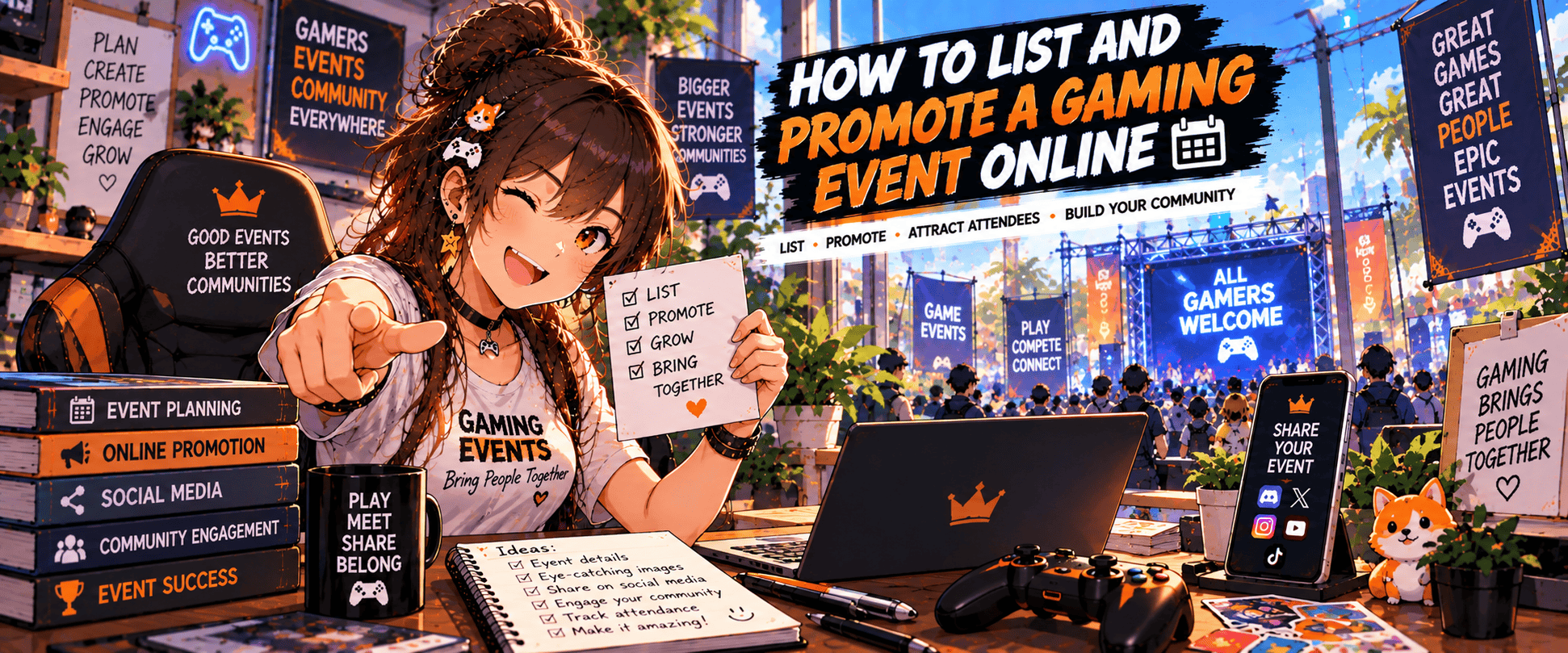
You can organise an incredible gaming event and still end up with an empty room if nobody knows it exists.
That applies whether you’re running a local Street Fighter tournament, university LAN, indie game showcase, retro gaming night, esports competition or full gaming convention.
Promotion isn’t simply posting “We’re running an event!” on social media three days beforehand and hoping the algorithm suddenly develops a passionate interest in your tournament.
People need to discover the event, understand it and have an obvious way to attend.
The basic process looks like this:
Build the event details → create listings → optimise for discovery → promote through gaming communities → build momentum → convert interest into registrations
You don’t necessarily need a huge advertising budget either.
Smaller gaming events can grow through a good event listing, search visibility, Discord communities, social media, local partnerships and existing gaming networks.
This guide explains how to list and promote a gaming event online, from creating your event page to building a promotion timeline that gets more players through the door.
🎮 1. Get Your Gaming Event Details Ready Before Promoting It
Before telling everyone about your event, make sure you can answer the questions they’re going to ask.
This sounds obvious.
It isn’t always.
An event announcement saying “Huge gaming tournament coming soon – more details later!” might generate some initial curiosity, but it doesn’t give someone enough information to make a decision.
Start With the Essential Information
At minimum, prepare:
- Event name
- Date
- Start and finish time
- Venue
- City and country
- Online or in-person format
- Games or activities
- Ticket or entry price
- Registration link
- Age restrictions
- Organiser name
- Contact information
For a tournament, you may also need:
- Game
- Platform
- Tournament format
- Team size
- Skill restrictions
- Entry fee
- Prize information
- Registration deadline
- Check-in time
- Tournament rules
For a convention or festival, attendees may care more about exhibitors, guests, panels, activities and ticket options.
The information changes with the event.
The principle doesn’t:
Don’t make potential attendees hunt for basic details.
Decide Who the Event Is Actually For
“Gamers” is usually too broad.
A local Tekken 8 tournament isn’t trying to reach exactly the same audience as a family-friendly gaming expo.
Define the people most likely to attend.
For example:
Local fighting game tournament
Primary audience:
- Fighting game players
- Local competitive gamers
- Existing FGC communities
- Players within reasonable travelling distance
Retro gaming convention
Primary audience:
- Retro gamers
- Collectors
- Arcade and pinball fans
- Families
- Gaming history enthusiasts
Indie showcase
Primary audience:
- Indie game fans
- Developers
- Students
- Creators
- Games industry professionals
This decision affects almost every promotional channel you use later.
Give People a Reason to Attend
Don’t promote only the existence of the event.
Promote the experience.
Instead of:
Gaming Tournament – Saturday 18 October
Try:
Compete in our local Tekken 8 tournament, meet other players and battle through a double-elimination bracket for prizes.
The second version tells someone what they’re actually being invited to do.
Ask yourself:
Why would someone give up their Saturday for this?
Then put the answer into the event description.
📝 2. Create a Gaming Event Listing That Actually Converts
Your event listing is the central source of information people can return to after discovering the event somewhere else.
Treat it like a landing page, not an administrative form you need to complete before promotion starts.
Use a Clear Event Title
A good title should immediately explain what the event is.
For example:
Perth Tekken 8 Championship 2026
is more useful than:
Battle Night 2026
You can still use a creative event name, but add enough context for someone unfamiliar with your brand.
For example:
Battle Night 2026 – Perth Fighting Game Tournament
Now both humans and search engines have some idea what’s happening.
Write a Short Opening Description
The first few lines should answer:
What is it? Who is it for? Why should I care?
For example:
Battle Night is a one-day fighting game tournament in Perth featuring Tekken 8, Street Fighter 6 and Guilty Gear Strive. Compete against local players, watch the finals and meet Western Australia’s fighting game community.
That’s much stronger than opening with the organiser’s entire history.
People can learn about your organisation later.
First, tell them why the event is interesting.
Make the Important Details Easy to Scan
Don’t bury practical information inside six paragraphs.
Create an obvious event information block:
Date: Saturday 18 October 2026
Time: 10:00 am–8:00 pm
Location: Perth, Western Australia
Games: Tekken 8, Street Fighter 6, Guilty Gear Strive
Entry: From A$20
Registration closes: 16 October
Format: In-person tournament
Someone should be able to scan the page in seconds and understand the basics.
Explain What Will Happen
Give attendees a better picture of the day.
Depending on your event, describe:
- Games
- Tournaments
- Exhibitors
- Panels
- Guests
- Free-play areas
- Activities
- Food
- Merchandise
- Competitions
- Prizes
- Community meetups
This is where you turn logistical information into something people can imagine attending.
Include One Obvious Next Step
What do you want the visitor to do?
Usually:
Register
Buy Tickets
Get Tickets
Join the Tournament
RSVP
Don’t make people read the entire page and then wonder what happens next.
If registration happens on another platform, link directly to it.
📸 3. Use Strong Images and Promotional Assets
Gaming events are visual.
Your promotion should be too.
A page containing nothing but text can technically communicate everything about your event, but it’s much harder to make that event feel exciting.
Create One Strong Main Event Image
Start with a primary promotional image that represents the event.
It might feature:
- Gaming imagery
- Event branding
- Characters or genre-inspired visuals
- Tournament atmosphere
- Arcade machines
- Gaming hardware
- Venue imagery
Keep essential text readable.
A poster containing the event name, seven games, five sponsors, four ticket types, three social handles, the complete schedule and a paragraph explaining parking will become unreadable the moment someone sees it on a phone.
Your main image should create interest.
The event listing can handle the details.
Prepare Different Image Sizes
You may need assets for:
- Event listings
- X
- Discord
- Website banners
- Stories
- Creator promotion
Don’t assume one enormous landscape banner will look good everywhere.
Create a small asset pack before promotion begins.
At minimum:
Landscape image + square image + vertical social image
That makes future promotion much easier.
Show the Experience When Possible
If you’ve run the event before, use real photos.
Show:
- Players competing
- Crowds
- Gaming setups
- Stages
- Cosplay
- Exhibitors
- Arcade machines
- Previous winners
Real event photography answers a question potential attendees may not consciously ask:
“What will this actually feel like?”
If it’s your first event, use good graphics, venue imagery and relevant gaming visuals instead.
Keep Branding Consistent
Use consistent:
- Event name
- Logo
- Fonts
- Visual style
- Key imagery
Someone might see your event on Discord on Monday, Instagram on Thursday and an event directory the following week.
Consistent visuals help those separate impressions connect.
“I’ve seen this event before” is much more useful than looking like three unrelated events accidentally share the same date.
🌐 4. List Your Gaming Event in More Than One Place
Don’t create one event page and assume everyone will somehow find it.
Different gamers discover events through different channels.
Your job is to put the event in the places your audience already looks.
Start With Your Main Event Page
You need one page that acts as the definitive source of information.
This could be:
- Your event website
- Organisation website
- Ticketing page
- Tournament registration page
- Event directory listing
Other promotional posts should point people towards this source when they need complete details.
Keep it updated.
Nothing undermines confidence quite like an Instagram post saying registration closes Friday while the event page says Thursday.
Add the Event to Gaming Event Directories
Specialist directories give your event another opportunity to be discovered by people already looking for gaming activities.
You can list your gaming event on StackedGame Events so gamers browsing for events can discover it alongside other gaming conventions, tournaments and community events.
When creating a directory listing, don’t rush through it.
Use:
- Complete event title
- Accurate dates
- Correct location
- Strong description
- Relevant event categories
- Good image
- Registration or ticket link
Think of each useful listing as another doorway into your event.
Use Tournament Platforms Where Appropriate
If you’re running a competitive gaming tournament, tournament platforms may handle registration and brackets while also providing additional discovery.
Depending on the game and community, that could include platforms such as:
- Start.gg
- FACEIT
- Battlefy
- Game-specific tournament platforms
Use the platform your target players already understand where possible.
A fighting game community may behave very differently from a Counter-Strike community.
Don’t choose technology simply because it has the longest feature list.
Choose what makes entering easy.
Create Listings on Relevant General Platforms
Depending on your event and country, other useful places may include:
- Facebook Events
- Eventbrite
- Meetup
- Venue event calendars
- University calendars
- Local community calendars
- Tourism or city event websites
You don’t need to list absolutely everywhere.
Prioritise platforms that genuinely reach your audience.
Keep Your Information Consistent
If the event appears on six websites, all six should agree about:
- Date
- Time
- Location
- Price
- Registration deadline
- Event name
When something changes, update your main listings.
Old information spreads remarkably well once it’s online.
🔎 5. Optimise Your Gaming Event for Google and Search
Social posts disappear quickly.
Search visibility can keep helping people discover your event for weeks or months.
You don’t need to become an SEO specialist to improve your chances.
You mainly need to describe the event using the same language someone would naturally use when searching for it.
Think About What Gamers Will Search
Imagine you’re organising a gaming convention in Perth.
Potential searches might include:
- Gaming events Perth
- Gaming convention Perth
- Gaming expo Perth
- Gaming events Western Australia
- Gaming convention near me
- Perth gaming events October 2026
A Tekken tournament might instead target searches such as:
- Tekken tournament Perth
- Fighting game tournaments Perth
- Tekken 8 tournament WA
- Esports tournaments Perth
Use relevant phrases naturally in your event title and description.
Don’t write:
Perth gaming event gaming convention Perth gaming expo Perth gamers event Perth
Google doesn’t need to be shouted at.
Neither do your readers.
Include the Location Clearly
Local search is extremely important for physical gaming events.
Mention the:
- Venue
- Suburb
- City
- State or region
- Country
Where appropriate, include directions and nearby landmarks.
This helps search engines understand where the event is happening and helps actual humans work out whether they can get there.
Include the Date
Dates matter for event searches.
Use the full date clearly on the page rather than relying entirely on a calendar widget.
For example:
Saturday 18 October 2026
is immediately understandable.
If your event runs annually, create a clear current-year page rather than leaving visitors wondering whether they’ve discovered information from three years ago.
Write a Useful Page Title
Your page title should combine the event name with useful context.
For example:
Battle Night 2026 – Perth Fighting Game Tournament
or:
Perth Retro Gaming Expo 2026 – Classic Games & Arcade Event
These titles communicate much more than the brand name alone.
Write an Original Event Description
Don’t paste the same two sentences everywhere if a platform gives you room to create a proper listing.
Explain:
- What the event is
- Where it happens
- Who should attend
- What people can do
- Which games are involved
- How to register
Useful content gives both search engines and attendees more context.
Make Sure the Registration Link Works
This sounds painfully basic.
Check it anyway.
Click the link from:
- Desktop
- Mobile
- Social posts
- Event directories
Make sure it leads directly to the correct registration or ticket page.
Every unnecessary step between “this looks interesting” and “I’m registered” gives someone another opportunity to leave.
💬 6. Promote Your Event Through Discord and Gaming Communities
For many gaming events, the best audience already exists somewhere online.
They’re talking about the game, organising matches, sharing clips and looking for other people to play with.
Your job isn’t to create that community from scratch.
It’s to introduce your event to it without arriving like a promotional bot that learned how to type.
Find Communities That Actually Match the Event
A local Street Fighter 6 tournament might be relevant to:
- Fighting game Discord servers
- Local FGC communities
- Street Fighter groups
- Esports communities
- University gaming clubs
- Local gaming groups
- Gaming venue communities
A retro gaming convention needs a different list.
Look for:
- Retro gaming communities
- Collector groups
- Arcade communities
- Pinball groups
- Local gaming communities
- Retro game stores
Relevance matters more than size.
A Discord server containing 600 active local fighting game players can be dramatically more valuable than a general gaming server containing 100,000 people scattered around the world.
Check the Community Rules First
Before posting anything, find out whether event promotion is allowed.
Look for channels such as:
- Events
- Tournaments
- Self-promotion
- Community announcements
- Local events
- Looking for players
If there isn’t an obvious place, ask a moderator.
A simple message works:
“Hey, we’re running a local Tekken 8 tournament in Perth next month. Is there somewhere appropriate I can share the event details?”
That’s much better than dropping a ticket link into general chat and disappearing.
Make the Post Useful
Don’t post:
BIG EVENT!!! REGISTER NOW!!! [link]
Give people enough information to decide whether they care.
For example:
🎮 Perth Tekken 8 Tournament – 18 October
We’re running an in-person Tekken 8 tournament next month with a double-elimination bracket, casual setups and prizes.
📍 Perth, WA
📅 Saturday 18 October
🎟️ Entry from A$20
🏆 Open tournamentFull details and registration: [link]
People can understand that without clicking anything.
The link is there when they’re interested.
Don’t Spam the Same Community
Posting the event once doesn’t mean you can paste it into the same channel every morning until registration closes.
Use meaningful updates instead.
For example:
- Registration opens
- New game announced
- Guest confirmed
- Prize revealed
- Early-bird tickets ending
- Schedule released
- One week remaining
- Registration closing soon
Each post now has a reason to exist.
Become Part of the Community
If you regularly organise events, relationships become one of your best promotional assets.
Participate.
Answer questions.
Share useful information.
Support other events.
People respond differently when an event is posted by someone they recognise rather than an account that materialises every six months to sell tickets.
📱 7. Promote Your Gaming Event on Social Media
Social media gives you repeated opportunities to put the event in front of potential attendees.
The mistake is treating every post as the same advertisement.
You don’t need to say “buy tickets” 17 different ways.
Show people why the event looks worth attending.
Create Different Types of Posts
Your promotion can include:
- Event announcement
- Game reveals
- Venue photos
- Previous event footage
- Tournament information
- Prize announcements
- Exhibitor reveals
- Guest announcements
- Behind-the-scenes preparation
- Countdown posts
- Registration reminders
- Player highlights
- FAQs
- Schedule releases
If you’re running a retro gaming event, show the arcade machines.
If you’re running an indie festival, show the games.
If you’re running a tournament, show people competing.
The experience should become visible before the event happens.
Use the Platforms Your Audience Actually Uses
You don’t necessarily need to promote everywhere.
Depending on the event, useful platforms could include:
- TikTok
- YouTube
- X
- Bluesky
- Twitch
A local community event might get excellent results from Facebook and Discord.
A visually exciting convention may have much more potential on Instagram and TikTok.
An esports tournament could benefit from X, Discord, Twitch and game-specific communities.
Follow the audience rather than maintaining seven social accounts badly.
Short Video Is Particularly Useful
Gaming events naturally produce video-friendly material.
Try short clips showing:
- Previous tournaments
- Gaming setups
- Arcade machines
- Venue preparation
- Cosplay
- Crowd reactions
- Game demos
- Prize reveals
- Event highlights
A 15-second clip of a packed tournament final can communicate atmosphere much faster than a paragraph telling people the event will be exciting.
Make Location Obvious
Local events frequently forget this.
Someone sees a great post.
They become interested.
Then they spend the next minute trying to work out which country the event is in.
Put the location in promotional content where appropriate:
Perth, WA
Melbourne, Australia
Austin, Texas
London, UK
Don’t make geography a puzzle.
Give Every Post a Job
Before publishing, ask what the post is supposed to achieve.
Is it trying to:
- Build awareness?
- Get registrations?
- Reveal information?
- Encourage sharing?
- Create urgency?
- Show atmosphere?
Not every post needs an aggressive CTA.
But when registration matters, make the next step obvious.
👥 8. Use Reddit, Facebook Groups and Local Communities Without Spamming
Community platforms can be excellent for event promotion because they allow you to reach people with very specific interests.
They’re also places where obvious advertising can be rejected extremely quickly.
The difference is usually relevance and approach.
Find the Most Relevant Communities
A gaming event in Brisbane doesn’t need exposure to every gamer on Reddit.
It needs people who might realistically attend.
Look for:
- City subreddits
- Game-specific subreddits
- Regional gaming communities
- Esports groups
- University gaming groups
- Local Facebook groups
- Genre communities
- Collector groups
- LAN communities
The smaller, more relevant community can often be more valuable.
Read the Promotional Rules
Some communities allow events.
Some restrict self-promotion.
Others require moderator approval or specific posting formats.
Respect that.
Getting your post removed isn’t a marketing strategy.
If you’re unsure, message the moderators before posting.
Write Like a Person
Community posts shouldn’t sound like press releases.
Instead of:
EXPERIENCE THE ULTIMATE GAMING EXTRAVAGANZA THIS OCTOBER!
try:
We’re running a small fighting game tournament in Perth next month
We’re putting together an in-person Tekken 8 and Street Fighter 6 tournament on 18 October. It’s open to newer players as well as regular competitors, and we’ll have casual setups running alongside the bracket.
Thought I’d share it here in case any local players are interested.
That sounds like someone inviting people to an event.
Because that’s what you’re doing.
Answer Questions
If people comment asking about parking, age restrictions, skill levels or registration, answer them.
Those conversations can also reveal information missing from your event listing.
If five people ask whether beginners can enter, perhaps Beginner Friendly needs to be much more obvious on the event page.
Community promotion can double as audience research.
🤝 9. Work With Creators, Venues, Sponsors and Gaming Partners
You don’t need to promote the entire event alone.
Other people and organisations may already have access to exactly the audience you’re trying to reach.
Give them a reason – and an easy way – to help.
Start With the Venue
If your event is being held at a:
- Gaming cafe
- Esports arena
- Arcade
- Convention centre
- University
- Bar
- Community venue
- Game store
ask whether they can promote it.
They may have:
- Social accounts
- Email lists
- Website calendars
- Digital screens
- Discord communities
- Physical noticeboards
The venue benefits from people attending too.
Use that shared interest.
Ask Exhibitors and Participants to Share
If your event has:
- Indie developers
- Vendors
- Tournament teams
- Cosplayers
- Speakers
- Streamers
- Community groups
give them promotional assets they can easily share.
Send:
Image + short description + event link + date + suggested social copy
Don’t make 30 exhibitors individually design promotional graphics for your event.
Make sharing almost effortless.
Work With Smaller Gaming Creators
You don’t necessarily need a creator with a million followers.
For a local event, a creator with a smaller but relevant audience can be much more valuable.
Look for creators covering:
- The featured game
- Local gaming
- Esports
- Retro gaming
- Indie games
- Cosplay
- Gaming conventions
A Perth gaming creator with 5,000 engaged local followers may be more useful to a Perth event than a global creator with 500,000 followers.
Audience fit wins.
Give Creators Something Interesting to Share
Don’t simply ask:
“Can you promote our event?”
Offer an angle.
For example:
- Early access
- Interview with organiser
- Tournament entry
- Giveaway
- Behind-the-scenes footage
- Exclusive game reveal
- Creator meetup
- Guest appearance
- Discount code
Promotion works better when the creator has actual content to make.
Cross-Promote With Other Gaming Organisations
Other organisers aren’t automatically competitors.
A retro event, esports tournament and indie showcase may serve overlapping communities without competing directly.
Support each other’s events where it makes sense.
Someone who attends gaming events regularly is exactly the person you want discovering yours.
📅 10. Build a Gaming Event Promotion Timeline
One of the biggest event marketing mistakes is doing almost nothing for two months and then promoting aggressively during the final week.
Give yourself time.
A simple promotion timeline creates repeated opportunities for people to discover the event without requiring you to constantly invent something new.
8–12 Weeks Before – Launch
For a reasonably sized event:
- Publish the main event page
- Open registration or ticket sales
- Create event directory listings
- Publish the announcement
- Contact communities
- Prepare promotional assets
- Add the event to relevant calendars
Your goal is awareness.
People need to know the event exists.
For very small local tournaments, you may not need this much lead time. Larger conventions may need considerably more.
6–8 Weeks Before – Build Interest
Start revealing more of the event.
Promote:
- Games
- Activities
- Guests
- Exhibitors
- Tournament formats
- Prizes
- Venue features
This gives you reasons to keep talking about the event without repeating the original announcement.
3–6 Weeks Before – Show the Experience
Now make the event feel real.
Share:
- Previous event footage
- Behind-the-scenes preparation
- Player registrations
- Exhibitor highlights
- Creator content
- Venue photos
- Community posts
This is also a good time to answer common questions publicly.
1–2 Weeks Before – Increase Urgency
People who thought “that looks cool” six weeks ago may have completely forgotten.
Remind them.
Useful messages include:
- Two weeks to go
- One week to go
- Registration closing
- Final tickets
- Schedule released
- Tournament check-in details
- What to bring
- Travel information
Now your CTA can become more direct.
Final 48 Hours – Focus on Practical Information
Don’t spend the final two days pretending nobody knows about the event yet.
Help registered attendees actually get there.
Share:
- Start time
- Venue
- Parking
- Public transport
- Registration deadline
- Check-in
- Schedule
- Entry requirements
- Weather considerations if relevant
You can still encourage last-minute registrations if they’re available.
But existing attendees need information too.
Promotion Timeline at a Glance
| Time Before Event | Main Goal | What to Promote |
|---|---|---|
| 8–12 weeks | Awareness | Announcement, listings, registration |
| 6–8 weeks | Interest | Games, guests, prizes, activities |
| 3–6 weeks | Trust and excitement | Footage, exhibitors, venue, community |
| 1–2 weeks | Urgency | Countdown, schedule, closing dates |
| Final 48 hours | Attendance | Location, times, check-in, final reminders |
You don’t need to follow those dates perfectly.
The important part is having a plan.
Otherwise, event promotion has a habit of becoming:
Eight weeks remaining: Plenty of time.
Four weeks remaining: We should probably post something.
Five days remaining: EVERYONE POST EVERYTHING.
A timeline is considerably less stressful.
🎟️ 11. Turn Event Interest Into Registrations and Ticket Sales
Getting people to view your event page isn’t the final goal.
You need some of them to actually register, buy a ticket or RSVP.
If plenty of people are visiting but very few are signing up, throwing more promotion at the problem may not fix it.
Look at the event page itself.
Make Registration Obvious
Someone interested in attending shouldn’t have to search for the registration button.
Use a clear CTA such as:
- Register Now
- Get Tickets
- Join the Tournament
- RSVP
- Book Your Place
Place it somewhere obvious.
For longer event pages, consider repeating the CTA after major sections rather than making people scroll all the way back to the top.
Reduce Uncertainty
People hesitate when they don’t understand what they’re buying or committing to.
Make these details clear:
- Ticket price
- What’s included
- Refund policy
- Event date
- Start and finish times
- Location
- Age requirements
- Registration deadline
- Skill requirements
- What attendees need to bring
For tournaments, explain whether the event welcomes beginners.
A newer player might love the idea of competing but assume everyone else will be terrifyingly good.
If the tournament is open to all skill levels, say so.
Keep Registration Simple
Every unnecessary step creates friction.
Ideally:
Interested → click → understand → register
Not:
Interested → click → create account → find event again → click another link → read unrelated page → create second account → question life choices
Some complexity may be unavoidable, particularly with tournament platforms.
Remove what you can.
Use Real Urgency
Urgency works when it’s genuine.
Examples include:
- Early-bird tickets ending
- Registration deadline approaching
- Limited tournament slots
- Final ticket allocation
- Team registration closing
- Vendor applications ending
Don’t manufacture fake scarcity.
If there are 400 tickets remaining, ONLY 3 SPOTS LEFT!!! is going to become awkward.
Answer Common Objections
Think about what might stop someone attending.
“I’m not good enough.”
Explain the expected skill level.
“I don’t know anyone.”
Highlight the community and social side.
“I don’t know what happens at the event.”
Show photos, schedules and activities.
“It’s expensive.”
Explain what’s included in the ticket.
Good promotion doesn’t only create excitement.
It removes reasons to hesitate.
⏳ 12. Promote Your Gaming Event During the Final Week
The final week matters.
Some people register early.
Plenty of others make decisions surprisingly late.
Your promotion should become more frequent as the event approaches, but that doesn’t mean repeating the same poster seven days in a row.
Seven Days Before
Publish a clear one-week reminder.
Include:
- Event name
- Date
- Location
- Main activities
- Registration status
- Ticket link
This is also a good opportunity to share the final programme or tournament schedule.
Three to Five Days Before
Focus on something exciting.
That could be:
- Prize pool
- Featured game
- Guest
- Exhibitor
- Tournament numbers
- Arcade lineup
- Indie developers
- Venue setup
- Merchandise
Give people another reason to care rather than simply announcing that time continues to pass.
24–48 Hours Before
Shift towards practical information.
Tell attendees:
- When doors open
- Where to go
- Where to park
- How check-in works
- What to bring
- Whether tickets remain
- When registration closes
If you’re running a tournament, make check-in requirements extremely obvious.
The player who registered six weeks ago may not remember the details.
On Event Day
Promotion isn’t finished.
Post:
- Doors open
- Registration updates
- Live photos
- Tournament progress
- Crowd shots
- Activities
- Schedule reminders
This helps current attendees and gives people who didn’t attend a reason to notice the event.
That’s useful if you plan to run another one.
Capture Content for Next Time
Take photos.
Record video.
Get crowd shots.
Capture the venue before and during the event.
Film exciting tournament moments where appropriate.
Your current event is creating the promotional material for your next one.
A photo showing 100 gamers enjoying themselves is much stronger evidence than next year’s poster claiming the event will be amazing.
📊 13. Measure What Actually Worked
Once the event is over, don’t immediately forget how you promoted it.
Work out what produced results.
You don’t need an enormous marketing dashboard.
Even basic information can make the next event easier to promote.
Ask Attendees How They Found You
This can be incredibly useful.
Add a simple registration question:
How did you hear about this event?
Possible answers:
- Discord
- TikTok
- Friend
- Gaming community
- Event directory
- Previous event
- Venue
- Creator
- Other
After the event, look at the pattern.
You may discover that the Discord server with 900 members generated more registrations than a social account with 20,000 followers.
That’s useful.
Track Your Registration Links
Where possible, use analytics or campaign tracking to understand which links are being clicked.
You might create separate tracked links for:
- Discord
- Creator partnerships
- Event directories
Don’t become obsessed with clicks alone.
The useful question is:
Which channels produced attendees?
A post can receive enormous engagement from people living 5,000 kilometres away and contribute almost nothing to a local event.
Compare Promotion With Registrations
Track registrations over time.
Did they increase after:
- Initial announcement?
- Prize reveal?
- Creator post?
- Discord promotion?
- Early-bird deadline?
- Schedule release?
- Final-week reminder?
This helps identify what actually motivates your audience.
Ask Attendees What Could Improve
Afterwards, send a short survey or ask your community.
Useful questions include:
- What did you enjoy?
- What could be improved?
- How did you hear about the event?
- Was the event information clear?
- Would you attend again?
- What would you like next time?
Don’t make the survey enormous.
People attended a gaming event.
They haven’t volunteered for an annual census.
Save What Worked
Keep:
- Best-performing posts
- Promotional images
- Email templates
- Community contacts
- Creator contacts
- Event listings
- Useful photos
- Video clips
- Registration data
- Attendee feedback
Your second event shouldn’t require rebuilding everything from zero.
🚀 14. Gaming Event Promotion Checklist
Promoting a gaming event online isn’t about finding one magical platform that instantly fills the venue.
It’s about giving the right gamers multiple opportunities to discover the event and making the decision to attend as easy as possible.
Before launching your promotion, work through this checklist.
Event Information
- Event name confirmed
- Date and time confirmed
- Venue confirmed
- City and country clearly listed
- Ticket or entry price confirmed
- Registration deadline set
- Age restrictions listed
- Games and activities explained
- Organiser contact available
Event Listing
- Clear event title
- Strong opening description
- Complete event details
- Good main image
- Registration or ticket CTA
- Working registration link
- Mobile page checked
- Event information proofread
Event Discovery
- Main event page published
- Gaming event directories added
- StackedGame Events listing considered
- Tournament platform added if relevant
- Facebook Event considered
- Local event calendars checked
- Venue calendar checked
- Search-friendly title used
- Location clearly included
Community Promotion
- Relevant Discord communities identified
- Community rules checked
- Local gaming groups identified
- Relevant Reddit communities checked
- University or club communities considered
- Organisers and moderators contacted where appropriate
Social Promotion
- Announcement post
- Landscape image
- Square social image
- Vertical image or video
- Games or activities highlighted
- Guests or exhibitors highlighted
- Countdown posts planned
- Final-week reminders scheduled
Partners
- Venue asked to promote
- Exhibitors given promotional assets
- Sponsors asked to share
- Relevant creators contacted
- Gaming organisations contacted
- Participants encouraged to share
Final Week
- One-week reminder
- Final schedule published
- Registration deadline promoted
- Venue information repeated
- Parking or transport information shared
- Check-in instructions published
- Final ticket availability confirmed
- Event-day posts prepared
After the Event
- Photos saved
- Video clips saved
- Attendee feedback collected
- Registration sources reviewed
- Best promotional channels identified
- Partners thanked
- Community updated
- Next event promotion assets saved
The individual tactics aren’t especially complicated.
The difference comes from doing them consistently.
Create an event page people can understand. List it where gamers are already searching. Promote it through communities that genuinely care about the games involved. Show people what they’ll experience and give them a clear way to register.
Then start early enough that you don’t spend the final 72 hours desperately posting the same event graphic everywhere on the internet.
Most importantly, make the event worth talking about.
Good promotion can get someone through the door once.
A good gaming event gives them a reason to come back – and bring somebody with them next time.