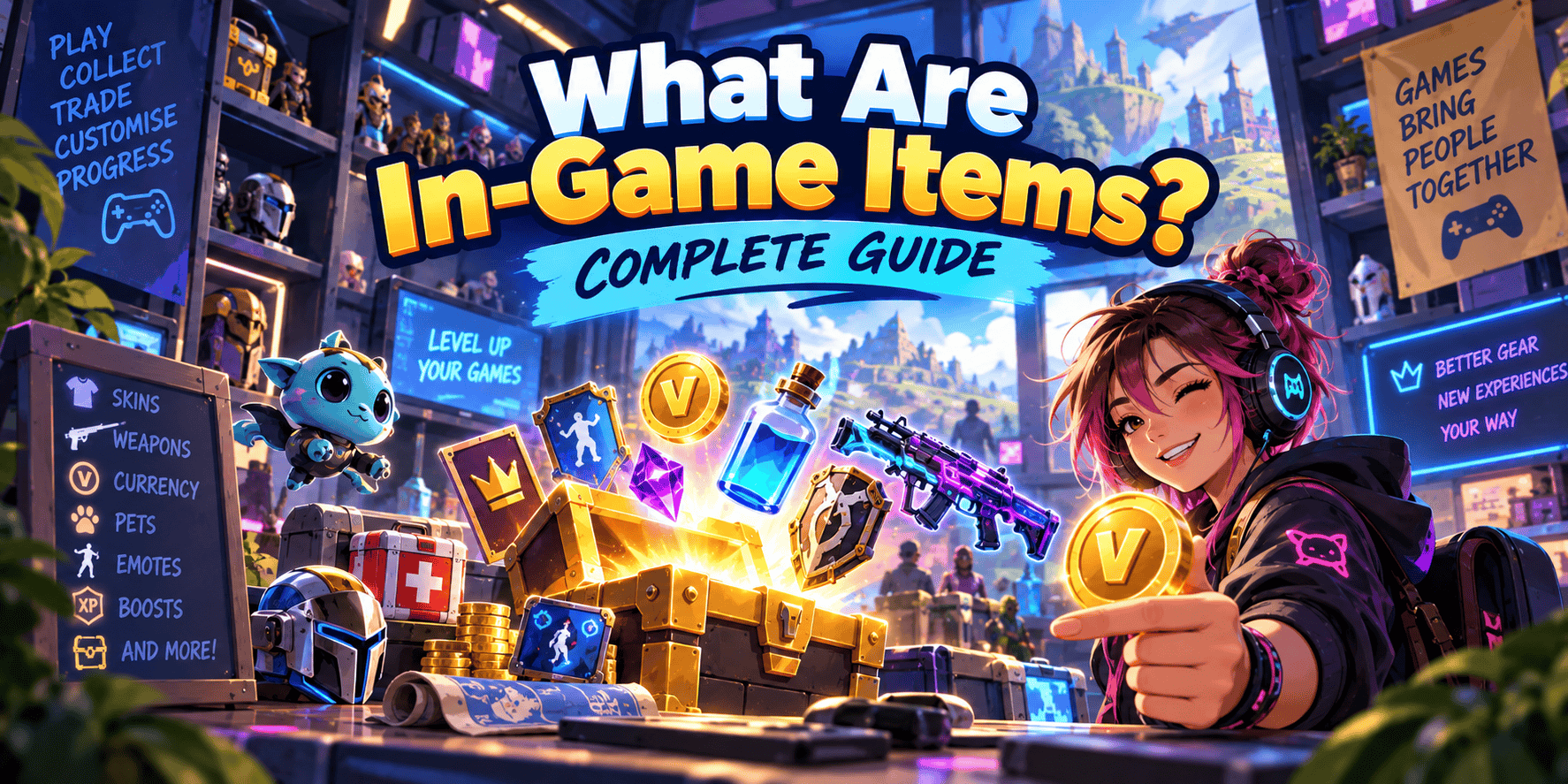
If you have ever equipped a new sword, opened a loot drop, changed your character’s skin or spent far too long trying to get a ridiculously rare mount, you have already dealt with in-game items.
They can be tiny cosmetic extras or some of the most sought-after possessions in a game. Some help you play. Some make your character look better. Some can be traded between players, while others are permanently attached to your account.
And yes, some digital items can become surprisingly valuable.
So, what exactly counts as an in-game item, how do they work and why do players care so much about them? Let’s empty the inventory and take a proper look. 🎒
1. What Are In-Game Items? 🎮
In-game items are digital objects, assets or resources that players can obtain, use, collect or sometimes trade within a video game.
Depending on the game, an item could be a weapon that improves your character, a cosmetic skin that changes how something looks, a crafting material, a collectible pet or even something as simple as a health potion.
Common examples include:
- 🗡️ Weapons and equipment – swords, guns, armour, tools and accessories
- 👕 Skins and cosmetics – outfits, weapon skins, emotes and visual effects
- 🧪 Consumables – potions, boosts, food and temporary power-ups
- 🧱 Resources and materials – ingredients used for crafting, building or upgrading
- 🐉 Pets and mounts – companions, creatures and vehicles
- 🏆 Collectibles – badges, cards, trophies and limited-event items
- 📦 Loot and containers – chests, crates and other item bundles
- 💎 Rare or special items – limited releases, unusual drops and highly sought-after collectibles
What qualifies as an “item” varies enormously between games. A diamond sword in Minecraft, a weapon skin in Counter-Strike 2 and a rare mount in World of Warcraft are very different things, but they all sit under the broad in-game item umbrella.
If you want to dig deeper into those categories, our Types of In-Game Items Explained guide breaks down the major types and what they actually do.
🎮 Quick Definition: An in-game item is a digital object or asset that exists within a video game and can usually be obtained, collected, equipped, consumed, used or – where the game allows it – traded.
Simple enough. Until somebody tells you their virtual knife costs more than your actual gaming PC.
2. How Do In-Game Items Work? ⚙️
Most in-game items exist as part of a game’s inventory, progression or economy system.
You obtain an item, the game records that item against your character or account, and you can then interact with it according to the game’s rules.
A basic item journey might look something like this:
🎯 Earn or acquire → 🎒 Store → ⚔️ Use or equip → 🔄 Trade, consume or keep
How that works in practice depends heavily on the game.
You might defeat a boss and receive a new weapon. Complete an event and unlock a cosmetic. Craft an item from resources. Buy something from an in-game shop. Trade with another player. Or spend three evenings farming the same enemy only to watch your friend get the drop on their first attempt.
Gaming is fair like that.
🎁 Items Can Come From Many Places
Games distribute items through systems such as:
- Enemy and boss drops
- Quests and achievements
- Crafting
- In-game shops
- Battle passes
- Seasonal events
- Treasure chests and loot systems
- Player-to-player trading
- Official marketplaces
- Promotional rewards
Once acquired, an item might appear in your inventory, become available to equip or immediately affect your account.
The important part is that the game controls what you can actually do with it.
Some items can be freely transferred between players. Others are account-bound, become bound once equipped or cannot be transferred at all.
We’ll explore that distinction properly in Tradable vs Non-Tradable In-Game Items.
3. Why Do Video Games Have In-Game Items? 🕹️
In-game items aren’t just there to fill your inventory with 47 objects you are absolutely certain you’ll need later.
They serve several important purposes within games.
🏆 Progression and Rewards
Items give developers a way to reward players for playing.
Defeat a difficult boss? Here’s a better weapon.
Complete a tournament? Here’s a unique cosmetic.
Spend 200 hours exploring every suspicious-looking cave? Maybe there’s finally something worthwhile in one of them.
That reward loop can give players a reason to continue progressing even after they’ve mastered the basic mechanics.
🎨 Customisation and Identity
Cosmetics let players make characters, weapons and other parts of a game feel more personal.
Skins, outfits, emotes, mounts, banners and accessories might not necessarily make someone better at the game, but they can change how that player presents themselves.
In multiplayer games especially, appearance can become part of a player’s identity.
We’ll examine that distinction more closely in Cosmetic vs Functional In-Game Items.
⚔️ Gameplay
Other items have a direct purpose.
Weapons can affect damage. Armour might improve defence. Consumables restore health. Crafting materials unlock upgrades. Tools allow players to perform new actions.
These items aren’t merely sitting in the inventory looking pretty – they’re part of how the game works.
💰 Game Economies
Tradable items can also create entire player-driven economies.
When players want different items and those items have limited availability, you get supply, demand, trading and fluctuating prices.
Suddenly that funny-looking hat isn’t merely a funny-looking hat.
It’s an asset somebody else wants.
Our later guide to How Do In-Game Economies Work? will explore what happens when millions of players start buying, selling, crafting and trading within the same virtual world.
🛒 Monetisation
Finally, in-game items can generate revenue for developers and publishers.
Games may sell cosmetics, bundles, passes or other virtual goods directly to players. The exact model varies enormously – as do the rules around purchasing, transferring and reselling those items.
That’s an important distinction throughout this guide:
💡 An item existing in a game does not automatically mean players are allowed to trade or sell it.
Always check the rules for the particular game and platform before attempting an item transaction.
4. What Are the Different Types of In-Game Items? 🎒
There isn’t one universal item system shared by every video game.
A survival game’s inventory might be packed with food, weapons and building resources. An MMO might have thousands of armour pieces, crafting materials and collectibles. A competitive shooter could place much more emphasis on weapon skins and cosmetics.
Still, most items fit into a handful of broad categories.
| Item Type | What It Does | Examples |
|---|---|---|
| ⚔️ Weapons | Used in combat | Swords, rifles, bows |
| 🛡️ Equipment | Changes stats or abilities | Armour, helmets, accessories |
| ✨ Cosmetics | Changes appearance | Skins, outfits, effects |
| 🧪 Consumables | Used up when activated | Potions, food, boosts |
| 🧱 Materials | Used to create or upgrade things | Ore, wood, crafting components |
| 🐲 Pets & Mounts | Companions or transportation | Horses, dragons, pets |
| 🏆 Collectibles | Collected for completion, rarity or status | Cards, trophies, event items |
| 🎁 Containers | Hold or provide other items | Crates, chests, packs |
Some games blur these categories.
A rare mount might be cosmetic and provide transportation. A weapon can be functional while also having a valuable cosmetic appearance. An ordinary crafting ingredient might suddenly become highly desirable because a new update makes everyone need 50 of them.
That’s why understanding the item itself is only the beginning.
Our dedicated Types of In-Game Items Explained guide will go much further into each category without turning this beginner’s guide into an inventory management simulator.
5. Cosmetic vs Functional In-Game Items ✨⚔️
One of the easiest ways to understand in-game items is to separate them into two broad groups: cosmetic items and functional items.
✨ Cosmetic Items
Cosmetic items primarily change how something looks or is presented without intentionally improving its gameplay performance.
Examples include:
- Character skins
- Weapon skins
- Outfits
- Emotes
- Sprays
- Banners
- Cosmetic pets
- Visual effects
A bright pink rifle skin probably won’t improve your aim.
It may, however, make missing the entire magazine considerably more stylish.
⚔️ Functional Items
Functional items affect what you can actually do within the game.
Examples might include:
- Weapons
- Armour
- Healing items
- Crafting resources
- Tools
- Equipment
- Stat-boosting accessories
- Upgrade materials
A stronger sword can increase damage. Better armour might improve defence. A healing potion could keep your character alive.
Those are functional differences, not merely visual ones.
🎨⚔️ Some Items Can Be Both
The line isn’t always perfect.
An item can have gameplay functionality while also having a distinctive appearance, rarity or collectible appeal. Different games also structure their systems differently, so it’s better to think of cosmetic and functional as useful categories rather than universal rules.
| Cosmetic Item | Functional Item |
|---|---|
| Primarily changes appearance | Affects gameplay or progression |
| Often optional | May contribute to player performance |
| Value can depend heavily on design and rarity | Value can depend heavily on usefulness |
| Common in skins and character customisation | Common in RPGs, MMOs and survival games |
This distinction becomes particularly important when we start looking at why players want certain items and what gives those items value.
A powerful weapon might be desirable because it performs well.
A cosmetic skin might be desirable because it looks incredible, was only available during a particular event or has become difficult to obtain.
And occasionally, gamers will decide that one particular shade of digital pixels is worth a small fortune.
We’ll break the differences down properly in Cosmetic vs Functional In-Game Items and explore the bigger question in What Makes an In-Game Item Valuable?.
6. How Do You Get In-Game Items? 🎁
There is no single way to fill your inventory. Depending on the game, you might earn items through regular gameplay, craft them from resources, buy them from a shop or trade with another player.
Some methods require skill. Some require patience. Some require luck. And some require defeating the same boss so many times that you begin to question whether the item actually exists.
🎮 Earn Items Through Gameplay
The most familiar way to get in-game items is simply by playing the game.
Items can be rewarded for:
- Completing quests or missions
- Defeating enemies and bosses
- Winning matches
- Levelling up
- Reaching milestones
- Completing achievements
- Participating in events
- Exploring particular areas
The harder an item is to obtain, the more desirable it can sometimes become – although difficulty alone doesn’t automatically make an item valuable.
🎲 Find Items Through Drops
Many games use item drops, where enemies, bosses, containers or other activities have a chance of producing particular items.
Some drops are virtually guaranteed. Others have extremely low drop rates. When millions of players want an item but only a small percentage ever receive one, scarcity can quickly become part of its appeal.
Rarity systems help organise these differences, which we’ll explore properly in How Does Item Rarity Work in Video Games?.
🔨 Craft In-Game Items
Crafting systems allow players to turn resources or existing items into something new.
⛏️ Gather resources → 🧩 Collect components → 🔨 Craft → ⚔️ Receive item
Crafting can create everything from basic supplies to powerful equipment. In games with player economies, the ingredients can sometimes become just as important as the finished product.
🛒 Buy Items
Some games allow players to purchase items through an official in-game shop or marketplace.
Depending on the game, purchases might use:
- Regular in-game currency
- Premium currency
- Real money
- Marketplace balances
- Tokens or other game-specific currencies
Players may also be able to buy eligible items from other players through marketplaces.
If you’re considering doing that, don’t start by clicking the cheapest listing you can find and hoping for the best. Our How to Buy In-Game Items Safely guide covers what to check before making a purchase.
🔄 Trade With Other Players
Trading allows players to exchange eligible items directly or through a supported marketplace.
A trade could be as simple as:
🎒 Item ↔ 🎒 Item
Or, depending on the game’s systems:
🎒 Item ↔ 💰 Currency
Whether an item can be transferred – and what it can legitimately be exchanged for – depends on the game’s rules.
7. Are All In-Game Items Tradable? 🔄
No. Having an item in your inventory doesn’t necessarily mean you can transfer it to another player.
Games can place very different restrictions on digital items. Before you start mentally spending the money from that ultra-rare drop, it’s worth checking whether you’re actually allowed to sell it.
| Item Status | What It Usually Means |
|---|---|
| 🔄 Tradable | Can be transferred between eligible players |
| 🔒 Account-Bound | Locked to the player’s account |
| 👤 Character-Bound | Locked to a particular character |
| ⚔️ Bind-on-Use/Equip | Becomes non-tradable after being used or equipped |
| ⏳ Trade-Restricted | Cannot be transferred until a restriction expires |
| 🚫 Non-Tradable | Cannot normally be transferred at all |
⚠️ Check Before You Buy or Sell
Imagine finding an item that appears to be worth $100, creating a listing and finding a buyer.
Lovely.
Then you discover the item is permanently account-bound.
Less lovely.
Before treating an item as something you can trade, check:
- Whether player-to-player transfers are supported
- Whether the specific item is eligible
- Whether a trade lock applies
- Whether using or equipping it changes its status
- Whether marketplace restrictions exist
- Whether the proposed transaction complies with the game’s rules
Our Tradable vs Non-Tradable In-Game Items guide goes deeper into these restrictions and how to check an item’s status before committing to a transaction.
8. What Makes an In-Game Item Valuable? 💎
This is where digital items become particularly interesting.
Two virtual items can perform almost exactly the same function while having dramatically different values. Why? Because item value isn’t determined by one thing.
💰 The Main Drivers of Item Value
An item’s desirability or market value can be influenced by:
- 💎 Rarity – How difficult is the item to obtain?
- 📦 Supply – How many exist or are available for trade?
- 🔥 Demand – How many players actually want it?
- ⚔️ Utility – Does it provide something useful in the game?
- 🎨 Appearance – Does it have a particularly desirable design?
- ⏳ Availability – Can players still obtain it?
- 🏆 Prestige – Is it associated with an achievement, event or particular period?
- 🔄 Tradability – Can it actually be transferred?
- 📈 Market activity – What are buyers currently willing to pay?
One factor rarely tells the whole story.
💎 Rare Doesn’t Automatically Mean Valuable
This is one of the biggest misconceptions around virtual items.
Suppose Item A is extremely rare, but almost nobody wants it. Item B is slightly less rare, but thousands of players are trying to buy one.
Item B may command the higher price.
💡 Rarity limits supply. Demand gives that scarcity value.
An item can therefore be incredibly difficult to obtain and still have limited market demand. Likewise, an item doesn’t always need to be the rarest object in the game to become valuable.
Strong demand, limited supply and high desirability can be a potent combination.
We’ll unpack all of these factors in What Makes an In-Game Item Valuable?.
9. How Does Item Rarity Work? ⭐
Rarity is a system games use to distinguish items based on factors such as availability, drop chance, quality or perceived importance.
You’ve probably seen some version of the familiar rarity ladder:
⚪ Common → 🟢 Uncommon → 🔵 Rare → 🟣 Epic → 🟠 Legendary
Not every game uses these labels, colours or rankings, but the basic idea appears throughout gaming.
🎲 Rarity Can Mean Different Things
This is where things get slightly messy.
A “Legendary” item doesn’t necessarily mean only seven copies exist somewhere on Earth.
Depending on the game, rarity might describe:
- Drop probability
- Item quality
- Power level
- Availability
- Crafting difficulty
- Collectibility
- A developer-defined item tier
That’s why you shouldn’t assume an item’s rarity label tells you what it is worth.
⭐ Rarity vs Value
Consider two items:
| Item A | Item B | |
|---|---|---|
| Drop Chance | 0.5% | 2% |
| Rarity | Higher | Lower |
| Player Demand | Low | Very High |
| Potential Market Value | Not necessarily higher | Could be higher |
Item A is technically harder to obtain. Item B could still be more valuable.
🎯 Rarity is a characteristic of an item. Market value depends on what players are actually willing to exchange or pay for it.
For a deeper look at drop rates, rarity tiers, scarcity and how rarity can affect value, see How Does Item Rarity Work in Video Games?.
10. Can You Buy and Sell In-Game Items? 🛒
Some in-game items can be bought, sold or traded, but it depends on the game, the item and the platform involved.
There are several different ways item transactions can work.
🏪 Official In-Game Shops
The simplest model is an official store operated by the game’s developer or publisher.
Players purchase an item directly from the game, often using real money or premium virtual currency.
This doesn’t necessarily mean the purchased item can later be resold. Buying something and gaining the right to transfer it are two different things.
🔄 Official Player Marketplaces
Some games or platforms provide systems where players can list eligible items for other players.
The platform may control:
- Which items can be listed
- What currency can be used
- Transaction fees
- Trade restrictions
- How items are transferred
- Whether proceeds can be withdrawn or only reused within the ecosystem
That last point is particularly important.
Receiving marketplace credit isn’t necessarily the same as receiving withdrawable real money.
🤝 Player-to-Player Trading
Other games allow players to exchange items directly.
The actual trade might occur inside the game while the players agree on the terms separately. Direct trading can provide flexibility, but it can also introduce more risk if there isn’t a system protecting both sides of the transaction.
🌐 Third-Party Gaming Marketplaces
Eligible game items may also be offered through third-party gaming marketplaces where the game’s rules permit the transaction.
These marketplaces can connect buyers looking for particular items with sellers who already own them.
Before buying or selling, however, there are three separate questions worth asking:
🎮 Can the item technically be transferred?
📜 Do the game’s rules allow the proposed transaction?
🛡️ Can the transaction be completed safely?
“Yes” to the first question doesn’t automatically mean “yes” to the other two.
For buyers, we’ll cover the process in How to Buy In-Game Items Safely.
For players on the other side of the transaction, How to Sell In-Game Items Online covers checking your item, choosing where to sell, creating a listing, setting a price and completing the sale.
11. Can You Sell In-Game Items for Real Money? 💵
In some games and marketplaces, in-game items can be sold for real money – but not every game, item or transaction allows it.
This is an important distinction because being able to transfer an item between players doesn’t automatically mean you’re allowed to sell it for cash.
💰 How Real-Money Item Sales Can Work
Where permitted, a typical sale might look something like this:
🎒 Seller owns item → 🛒 Item is listed → 👤 Buyer purchases → 🔄 Item is transferred → 💰 Seller receives payment
The exact process varies depending on the game and marketplace.
Some ecosystems provide official player marketplaces. Others allow certain forms of player trading but restrict real-money transactions. Third-party marketplaces may also support eligible items, provided the transaction is compatible with the game’s rules.
📜 Check the Game’s Rules First
Before attempting to sell an item for real money, check:
- Whether the item can actually be transferred
- Whether real-money trading is permitted
- Whether third-party marketplaces are allowed
- Whether there are regional restrictions
- Whether marketplace or transaction fees apply
- Whether selling could put your game account at risk
Don’t assume that because you’ve seen other players doing it, it must be allowed. The internet contains plenty of people confidently doing things they’re not supposed to be doing.
Our Can You Sell In-Game Items for Real Money? guide takes a much closer look at how real-money sales work, what to check and the difference between selling an item and simply trading it.
12. How Does In-Game Item Trading Work? 🤝
Item trading allows players to exchange eligible digital items with other players.
At its simplest, one player has something another player wants.
👤 Player A → 🎒 Item → 👤 Player B
In return, Player A might receive another item, supported in-game currency or another permitted form of value.
The complicated part isn’t the basic idea. It’s everything surrounding the trade.
🔄 Different Games Use Different Trading Systems
A game might support:
Direct trading – two players meet in-game and exchange items through a trade window.
Marketplace trading – a player lists an item and another player purchases it through an official or supported marketplace.
Auction systems – players list items and buyers compete or purchase at a set price.
Item-for-item trading – players directly swap eligible items.
Some systems automate most of the process. Others require considerably more trust between the two players.
🛡️ A Trade Isn’t Finished Until Both Sides Get What They Expected
Before completing a trade, players should verify exactly what is being exchanged.
Check the:
- Item name
- Quantity
- Rarity or variant
- Condition or relevant attributes
- Agreed price or exchange
- Player you’re trading with
- Final contents of the trade window
That last check sounds painfully obvious until a rare item gets swapped for a similar-looking cheap one two seconds before confirmation.
For the full process, see How Does In-Game Item Trading Work?.
13. Are In-Game Items Safe to Buy and Trade? 🛡️
Buying and trading in-game items can be safe when you understand the transaction, follow the game’s rules and use appropriate protections.
The trouble starts when players rush.
A suspiciously cheap rare item can make even sensible gamers temporarily forget everything they’ve ever learned about scams.
🚨 Common Risks to Watch For
Potential problems can include:
- Fake or misleading listings
- Impersonation
- Phishing links
- Stolen accounts or items
- Item-switching during trades
- Fake payment confirmations
- Chargebacks
- Transactions outside marketplace protections
- Items that cannot actually be transferred
- Trades that breach a game’s rules
Not every transaction is dangerous, of course. The goal isn’t to approach every seller like they’re secretly running an international crime syndicate from behind a level 12 wizard.
It’s to verify before you trust.
✅ A Simple Safety Checklist
Before buying or trading an item:
✔ Check the game’s trading rules
✔ Confirm the exact item you’re receiving
✔ Research its approximate value
✔ Check the seller or trader carefully
✔ Keep communication within supported systems where possible
✔ Never share your password or account login details
✔ Be cautious about unfamiliar external links
✔ Check everything again before confirming the transaction
If you’re buying rather than swapping items, our How to Buy In-Game Items Safely guide covers the process in much more detail.
14. Do You Really Own Your In-Game Items? 📜
You obtained the item. It’s sitting in your inventory. Maybe you even paid real money for it.
So you own it… right?
Not necessarily in the same way you own a physical object.
When you buy a physical controller, you can generally sell it, give it away or leave it gathering dust in a cupboard for the next decade.
Digital game items can work differently.
🎮 Your Rights Depend on the Game and Platform
Access to an in-game item is usually governed by the game’s or platform’s terms.
Depending on those terms, the publisher may control:
- Whether the item can be transferred
- Whether it can be sold
- Where it can be traded
- How long it remains available
- What happens if an account is suspended
- Whether the item or game can be changed or discontinued
That means having an item available on your account isn’t necessarily equivalent to having unrestricted ownership rights over it.
🔐 Access, Control and Ownership Aren’t Always the Same Thing
It’s useful to separate three ideas:
| Concept | Simple Explanation |
|---|---|
| 🎮 Access | You can use the item in the game |
| 🔧 Control | You can perform certain permitted actions with it |
| 📜 Ownership Rights | The legal rights you have over the digital item |
These can overlap, but they aren’t automatically identical.
The exact legal position depends on the game, platform, terms and jurisdiction, so broad claims such as “players own all their digital items” or “players never own anything” can oversimplify the issue.
We’ll dig much further into licences, player rights, account restrictions and digital ownership in Do You Really Own Your In-Game Items?.
15. How Do In-Game Economies Work? 📈
Once enough players can earn, craft, consume and trade items, a game can develop something resembling its own economy.
And gamers being gamers, it usually doesn’t take long before someone creates a spreadsheet.
📦 Supply Meets Demand
At the heart of many in-game economies are two familiar forces:
Supply – how much of an item is available.
Demand – how much players want it.
Imagine a game releases a new crafting recipe requiring a previously boring resource.
Yesterday:
“Why do I have 800 of these useless things?”
Today:
“I am a business genius.”
Demand has changed, and the resource may become more desirable as a result.
🔥 What Can Change an In-Game Economy?
Item markets can be affected by:
- New game updates
- Balance changes
- New crafting recipes
- Seasonal events
- Changes to drop rates
- Items being removed or reintroduced
- Growing or shrinking player populations
- Changes in player strategies
- New content
- Large changes in supply
This means item values aren’t necessarily permanent.
An item that is highly desirable today could become less valuable after an update. Another forgotten item might suddenly become useful and see demand surge.
💸 Inflation Can Happen Too
If a game continuously creates currency or items without enough ways to remove them from circulation, the available supply can increase dramatically.
That can contribute to inflation or falling item values within the game’s economy.
Developers often use currency sinks and item sinks to counter this. Repair costs, crafting fees, marketplace fees, consumable items and upgrade systems can all remove resources from circulation.
The deeper mechanics can get surprisingly complex, which is why we’ve dedicated an entire guide to How Do In-Game Economies Work?.
For buyers and sellers, though, the important lesson is simple:
📈 In-game item values can change. What an item was worth six months ago doesn’t necessarily tell you what players will pay for it today.
16. In-Game Items FAQ ❓
Still sorting through the inventory? Here are quick answers to some of the most common questions about in-game items.
🎮 What Is an In-Game Item?
An in-game item is a digital object, asset or resource that exists within a video game. It might be something you equip, consume, collect, craft, buy or trade.
Weapons, armour, skins, crafting materials, potions, pets, mounts and collectibles can all be examples of in-game items.
💰 Can In-Game Items Be Worth Real Money?
Some can.
If an item can legitimately be transferred or sold, its real-money value may be influenced by factors such as rarity, supply, demand, usefulness, appearance and current market activity.
That doesn’t mean every rare item has a pile of cash hiding behind it. An item still needs buyers who actually want it.
If you’re trying to put a number on something in your inventory, How to Check What an In-Game Item Is Worth covers the process in detail.
🔄 Can You Trade In-Game Items With Other Players?
It depends on the game and the item.
Some games have extensive player trading systems, while others restrict transfers or don’t allow them at all. Individual items can also have their own restrictions, including account binding and temporary trade locks.
Always check the game’s current rules before arranging a trade.
🛒 Where Can You Buy In-Game Items?
Depending on the game, items may be available through:
- Official in-game stores
- Official player marketplaces
- Player-to-player trading
- Supported third-party gaming marketplaces
The right option depends on the particular game, the item you’re looking for and what forms of trading are permitted.
Our Where to Buy In-Game Items Online guide compares the main options and what to look for before choosing where to buy.
💸 Can You Make Money Selling In-Game Items?
It can be possible where the game, item and transaction method allow real-money sales.
How much someone can make varies enormously. Valuable inventory doesn’t magically appear because you have decided today is the day you’re becoming a virtual-item tycoon.
Players considering selling should first understand whether an item is transferable, what it’s worth, where it can be sold and what rules apply.
📉 Can In-Game Items Lose Value?
Absolutely.
Item values can change when:
- Demand falls
- Supply increases
- Drop rates change
- An item is re-released
- A game update changes its usefulness
- Player numbers change
- A newer item becomes more desirable
- The wider in-game economy changes
Past prices can provide useful information, but they aren’t a guarantee of future value.
💎 Why Are Some In-Game Items So Expensive?
Expensive items often combine several desirable characteristics rather than having one magical ingredient.
An item might be extremely scarce, visually distinctive, difficult to obtain, associated with an old event or highly sought after by collectors. If supply is limited while lots of players want one, prices can rise dramatically.
🛡️ Are In-Game Item Marketplaces Safe?
Marketplace safety varies, so buyers and sellers should check how a platform handles payments, transactions, disputes and user protection before using it.
Be particularly wary of anyone trying to move a protected transaction somewhere less secure, requesting unnecessary account credentials or sending suspicious login links.
A bargain stops being a bargain remarkably quickly when it comes bundled with a stolen account.
🎒 So, What Are In-Game Items?
In-game items are much more than random objects cluttering a virtual backpack.
They can shape progression, change how characters look, provide useful abilities, support crafting systems, become collectibles and even form the foundation of complex player economies.
Some are common and disposable. Others are scarce, tradable and highly sought after. What you can actually do with an item depends on the game – especially when buying, selling or trading enters the picture.
For players, the useful habit is simple: understand what you have before deciding what to do with it. Check whether the item is tradable, learn what affects its value and understand the rules surrounding any transaction.
Because that unremarkable item sitting on page six of your inventory?
It might be vendor trash.
Or it might be the reason someone has been refreshing the marketplace all week.