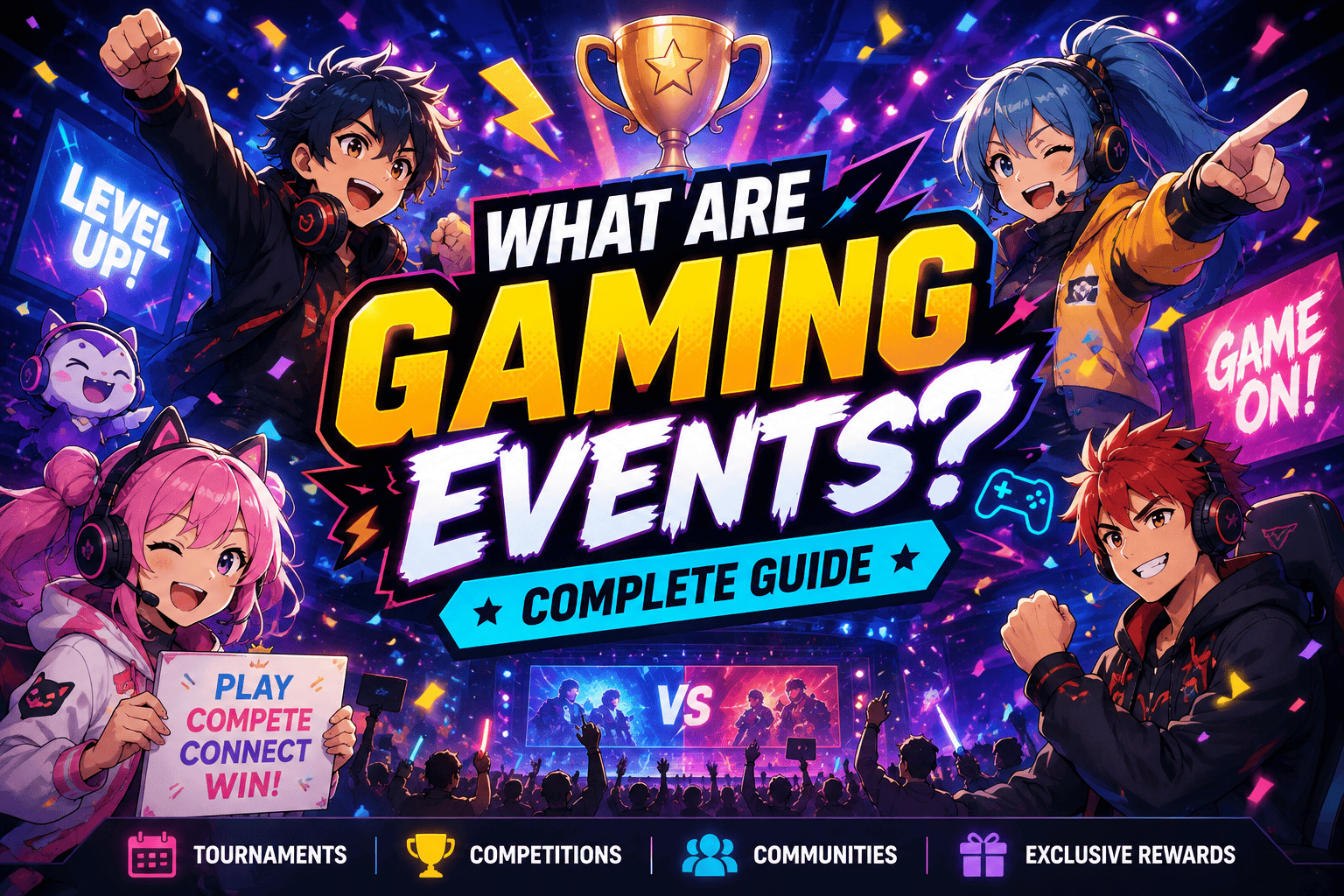
🎮 What Are Gaming Events? Complete Guide
Gaming used to be fairly easy to explain. You bought a game, sat in front of a screen and played it. Maybe a few friends came over, somebody brought a second controller and an argument eventually broke out over who was “screen watching.”
Gaming events take that experience and make it considerably bigger.
A gaming event is an organised event that brings people together around video games, competitive gaming or gaming culture. That could mean thousands of fans filling an exhibition centre for a huge gaming convention, spectators watching professional esports teams battle on stage or 30 local players turning up for a weekend tournament.
Some gaming events are all about competition. Others focus on discovering new games, meeting developers, watching panels, buying merchandise, dressing up as your favourite character or simply spending a day surrounded by people who understand why you’ve put 600 hours into a game you regularly claim to hate.
And there’s a surprisingly large variety of them.
Gaming events can include:
- 🏟️ Gaming conventions
- 🏆 Esports tournaments
- 🕹️ Gaming expos
- 💡 Indie game festivals
- 👾 Retro gaming events
- 🖥️ LAN parties
- 🤝 Community meetups
- 🧑💻 Developer conferences
- 📢 Game showcases
- ⚔️ Amateur tournaments
- 🌐 Online events
- 🔄 Hybrid gaming events
Some events combine several of these formats under one roof.
A major gaming convention, for example, might have playable game demos on one side of the venue, an esports tournament happening on a stage, indie developers showing off their latest games, cosplay competitions, merchandise stalls and panels with developers and content creators.
Meanwhile, a small local event might consist of a room, 20 gaming PCs, a tournament bracket and enough energy drinks to concern a cardiologist.
Both are gaming events.
That variety is also part of what makes gaming events interesting. You don’t need to be a professional esports player or someone who owns a display cabinet full of collector’s editions to enjoy them. There are events for competitive players, casual gamers, collectors, retro enthusiasts, developers, streamers, cosplayers, families and just about every other corner of gaming culture.
In this guide, we’ll look at what gaming events actually are, the different types you can attend, what happens at them, how to find events near you and what to expect if you’re thinking about attending one for the first time.
🧩 Gaming Events Explained
The easiest way to understand gaming events is to think of “gaming event” as the umbrella term.
Underneath that umbrella are many different types of events, each built around a different part of gaming.
A convention might celebrate gaming culture as a whole. An esports tournament revolves around organised competition. An indie festival gives smaller developers somewhere to showcase their games. A retro event might have people gathering around arcade cabinets and consoles that were considered cutting-edge when saving a game required an actual memory card.
What connects these events is that they create an organised experience around games and the people interested in them.
📏 Gaming Events Can Be Huge or Tiny
There’s no minimum crowd size required before something magically becomes a gaming event.
At one end of the scale are international events attracting players, exhibitors and visitors from around the world. Large conventions can occupy enormous exhibition venues with different halls dedicated to publishers, indie games, esports, merchandise, panels and other attractions.
At the other end could be a local fighting-game tournament held at a gaming café.
The purpose can be completely different too.
One person might attend an event because they want to:
- 🎯 Compete in a tournament
- 🏆 Watch professional esports
- 🎮 Try upcoming games
- 💎 Discover indie titles
- 🧑💻 Meet developers
- 🛍️ Buy gaming merchandise
- 🦸 Enter a cosplay competition
- 🤝 Meet online friends
- 💼 Learn about the games industry
- 👥 Find other people who play the same games
Or, realistically, do six of those things before lunch.
🎪 Gaming Events Aren’t All Conventions
One useful distinction is that gaming convention and gaming event aren’t interchangeable terms.
A gaming convention is one type of gaming event.
But plenty of gaming events aren’t conventions.
An esports championship built primarily around competitive matches is different from a consumer gaming expo where publishers demonstrate upcoming releases. Both are different again from a local LAN party.
That’s why separating the different event types is useful.
If someone says they’re “going to a gaming event,” they could be heading somewhere with 50,000 other gaming fans — or carrying a suspiciously expensive PC into a community hall.
The details matter.
🌐 Physical, Online and Hybrid Events
Gaming events don’t necessarily require everyone to be in the same building either.
Physical events remain a huge part of gaming culture, but competitive gaming in particular works unusually well across both physical and digital environments.
That gives us three broad formats:
📍 Physical gaming events take place at a venue where attendees participate in person.
🌐 Online gaming events happen digitally, allowing players or audiences to participate remotely.
🔄 Hybrid gaming events combine the two — perhaps with competitors and spectators at a physical venue while a much larger audience watches online.
We’ll explore all of these different formats throughout this guide.
🔥 Why Are Gaming Events So Popular?
Gaming is already one of the easiest hobbies to enjoy without leaving home.
You can download games instantly, play multiplayer with people on the other side of the planet, watch esports online, follow developers on social media and spend entire evenings talking to friends through Discord.
So why would anyone buy a ticket, travel across a city — or sometimes across a country — and willingly stand in a queue?
Because gaming events offer something the screen doesn’t.
🤝 You Get to Experience Gaming With Other People
Games are incredibly social, even when we’re physically playing them alone.
Gaming events take those online communities and put them into the same physical space.
Suddenly the person you’ve been playing with every Thursday for three years isn’t just a username and a slightly questionable profile picture.
They’re standing next to you.
That community aspect can be one of the biggest attractions of attending an event.
You might meet:
- Friends you’ve previously only known online
- Other players of your favourite game
- Members of gaming communities
- Content creators you follow
- Developers whose games you’ve played
- Competitive players and esports teams
For some visitors, those interactions end up being more memorable than whatever was happening on the main stage.
🎮 You Can Try Games Rather Than Just Watch Trailers
Gaming events can also provide opportunities to actually play games.
Depending on the event, attendees might get hands-on time with upcoming releases, indie games, gaming hardware, virtual reality experiences or games they simply haven’t tried before.
This is particularly valuable for indie developers.
At a large convention you might walk past dozens of games you’d never heard of, try one because a booth happens to catch your attention and discover something brilliant.
No algorithm required.
🏆 Esports Is Different With a Crowd
Watching competitive gaming from home is convenient.
Watching it surrounded by thousands of fans is something else entirely.
Esports events turn matches into live spectator experiences, complete with stages, commentators, team entrances, giant screens and crowds reacting together to whatever is happening in the game.
And you don’t necessarily have to be sitting in the audience.
Many tournaments allow amateur or community players to compete, giving ordinary gamers the chance to experience organised competition themselves.
Pulling off a ridiculous play online feels good.
Pulling it off while a crowd is watching and your opponent is sitting a few metres away?
That’s a different level of adrenaline.
🎭 Gaming Events Offer More Than Games
Ironically, one of the reasons gaming events work so well is that you don’t have to spend the entire day playing games.
Large events can include:
- 🎤 Developer panels
- 🏆 Esports matches
- 🦸 Cosplay competitions
- 📸 Creator meet-and-greets
- 🛍️ Gaming merchandise
- 🎨 Artist areas
- 🖥️ Hardware demonstrations
- 💼 Industry talks
- 🤝 Community activities
- 🎁 Competitions and giveaways
- 🍔 Food and entertainment
It means two people can attend the same gaming event and have completely different days.
One spends six hours watching tournaments.
The other tries 14 indie games, buys a shirt they absolutely didn’t need, watches a developer panel and somehow comes home carrying a three-foot sword.
Both had a productive day.
✨ They Turn Gaming Into an Experience
Ultimately, this is probably the biggest reason gaming events continue to attract people.
They make gaming feel like an occasion.
Playing a new game at home can be great. Playing it before release while the developer is standing three metres away is different.
Watching an esports final online can be exciting. Hearing thousands of people react to the winning play at the same moment is different.
Talking to gaming friends online is normal. Finally meeting them in person at an event you’ve planned for months is different.
And gaming events don’t all provide the same experience.
Some are enormous celebrations of gaming culture. Some are fiercely competitive. Some are built around independent developers, while others are dedicated to games released decades ago.
So before deciding which event is worth your time, it helps to understand exactly what’s out there.
🕹️ Understanding the Different Types of Gaming Events
🎪 Gaming Conventions
Gaming conventions are probably what most people picture when they hear the words “gaming event.”
They’re large gatherings built around gaming and the wider culture surrounding it. Rather than focusing on one particular activity, conventions usually bring a lot of different things together under the same roof.
Depending on the convention, you might find:
- 🎮 Playable games and demos
- 🧑💻 Publisher and developer booths
- 🏆 Esports competitions
- 💡 Indie game areas
- 🦸 Cosplay
- 🎤 Panels and Q&As
- 📸 Content creator appearances
- 🛍️ Merchandise stalls
- 🎨 Artist areas
- 🎲 Tabletop gaming
- 🤝 Community meetups
- 🎁 Competitions and giveaways
That variety is a big part of their appeal.
You can arrive intending to try three upcoming games and somehow spend half the afternoon watching a cosplay competition you didn’t even know was happening.
🧩 What Makes a Gaming Convention Different?
Unlike an esports tournament, where competition is usually the main attraction, gaming conventions tend to cater to many different types of gaming fans at once.
You don’t need to be particularly good at games. You don’t even necessarily need to play much while you’re there.
Someone interested in game development might spend the day attending panels and speaking with developers. A collector could spend hours browsing merchandise. Competitive players might disappear into the tournament area. Someone else might simply want to meet friends, take photos and experience the atmosphere.
It’s essentially gaming culture concentrated into a building for a few days.
Some conventions are primarily focused on video games, while others cover broader interests such as tabletop gaming, anime, comics, technology or general pop culture alongside them.
That’s worth checking before buying a ticket — particularly if you’re travelling a long way specifically for video games.
🎟️ Why Attend a Gaming Convention?
Conventions make sense when you want variety.
Instead of travelling specifically to watch one tournament or see one developer, you get access to numerous activities within the same event.
They’re particularly good for:
- 🔎 Discovering new games
- 🎮 Trying games before buying them
- 🤝 Meeting gaming communities
- 🧑💻 Seeing developers and creators
- 🏆 Watching live competitions
- 🛍️ Shopping for gaming merchandise
- 🦸 Cosplay
- 🎉 Spending an entire day immersed in gaming
For newcomers, they’re also one of the easiest ways to experience a gaming event because you can simply explore at your own pace.
There’s no requirement to compete, dress up or know exactly what you’re doing.
Turn up. Wander around. Find something interesting.
Although perhaps look at the event map first. Exhibition centres have an impressive ability to make a 30-metre walk somehow take 45 minutes.
🏆 Esports Events and Tournaments
If gaming conventions celebrate gaming broadly, esports events put competition front and centre.
Esports is organised competitive video gaming, ranging from grassroots tournaments to professional competitions featuring highly skilled players, established teams, prize money and large audiences.
The games themselves vary enormously.
Competitive events can be built around:
- 🔫 First-person shooters
- ⚔️ MOBAs
- 🥊 Fighting games
- ⚽ Sports games
- 🏎️ Racing games
- 🪂 Battle royales
- ♟️ Strategy games
- 🃏 Digital card games
- 📱 Mobile games
That means an esports event built around a fighting game can feel completely different from a major team-based tournament played inside an arena.
The common ingredient is competition.
🌟 Professional Esports Events
At the top end are professional esports tournaments.
These events can feature elite teams and players competing through structured brackets, leagues or championship formats.
Major matches may be staged in arenas or other spectator venues, complete with commentary, large displays, lighting, player introductions and crowds supporting their favourite teams.
For spectators, it’s closer to attending a traditional sporting event than visiting a conventional gaming expo.
You’re primarily there to watch competition unfold live.
That might mean following one team throughout a tournament, attending the final stages of a championship or travelling specifically to watch the best players in your favourite game.
The atmosphere is also part of the appeal.
A ridiculous play feels considerably less ridiculous when several thousand other people realise what just happened at exactly the same moment.
🎯 Amateur and Community Tournaments
Esports isn’t limited to professional players.
At the opposite end of the spectrum are local and amateur competitions where regular players can enter and compete.
These might be organised by:
- 🎮 Gaming cafés
- 🎓 Universities
- 👥 Community groups
- 🏆 Local esports organisations
- 🎪 Convention organisers
- 🕹️ Gaming clubs
- 🌐 Online communities
Some require qualification or particular rankings. Others are open-entry competitions where almost anyone who meets the basic eligibility requirements can register.
That makes esports events unusual because you can participate in them at several different levels.
You might attend one tournament purely as a spectator, then enter a smaller competition yourself a few weeks later.
And yes, your first competitive event might result in somebody dismantling you in round one.
At least you’ll know what to practise on Monday.
🚀 Gaming Expos and Industry Shows
Gaming expos put more emphasis on what’s happening next in gaming.
They’re often places where publishers, developers, hardware manufacturers and other gaming companies showcase products, demonstrate technology or talk about upcoming releases.
At a gaming expo, you might encounter:
- 🎮 Upcoming games
- 🕹️ Playable demos
- 🎤 Developer presentations
- 🖥️ Gaming hardware
- 🔧 PC components
- 🎧 Gaming accessories
- 🥽 Virtual reality technology
- 📢 Publisher showcases
- 📰 Industry announcements
- 🤝 Business networking
Some expos are designed primarily for consumers. Others cater heavily to developers, publishers, journalists, investors and other people working within the games industry.
And some do both.
🎪 Gaming Expo vs Gaming Convention
The distinction between an expo and a convention can become fuzzy.
Very fuzzy.
There isn’t an international Gaming Event Police Department issuing fines when an expo contains too much cosplay.
Broadly speaking, an expo tends to put greater emphasis on exhibitors, products, games and industry showcases, while a convention usually has a broader community and entertainment focus.
In practice, major events frequently combine both.
You might spend the morning playing demos from major publishers, the afternoon browsing indie games and the evening watching an esports tournament — all without leaving the venue.
That’s why it’s usually more useful to look at what an event actually offers rather than getting too hung up on what organisers decided to call it.
If you’re choosing an event to attend, check the exhibitor list, activities, schedule and overall focus. Those tell you far more than whether “Expo” or “Convention” happens to appear in the name.
💡 Indie Gaming Events and Festivals
Not every gaming event needs giant publisher booths, enormous screens and marketing budgets capable of funding a small moon mission.
Indie gaming events and festivals focus on games created by independent developers and smaller studios.
These events can be some of the most interesting places to discover games because you’re often seeing ideas that haven’t been designed around established franchises or huge commercial audiences.
You might encounter:
- 💎 Unreleased indie games
- 🧪 Experimental projects
- 🎓 Student-developed games
- 🛠️ Early prototypes
- 📖 Narrative games
- 🕹️ Unusual control schemes
- 🧑💻 Local developers
- ⏱️ Game jams
- 🎤 Developer talks
- 🏅 Indie awards and showcases
Some indie festivals are standalone events. Others appear as dedicated areas inside larger gaming conventions.
🤝 Why Indie Events Feel Different
One of their biggest advantages is access to the people actually making the games.
At a huge publisher booth, you might play ten minutes of an upcoming game before moving on.
At an indie booth, the person explaining the controls may be the developer who designed the game, wrote half the dialogue and spent the previous night fixing the bug you’re hopefully not about to discover.
That creates a much more personal experience.
You can often ask questions, provide feedback and learn about how the game was made.
For developers, that interaction is valuable too. Watching real players use a game can reveal things that months of internal testing didn’t.
Particularly when every single player walks confidently past the button the developer assumed was impossible to miss.
🔎 Indie Events Are Great for Discovering Something New
Large gaming releases are difficult to avoid.
By the time a major game launches, you’ve probably seen trailers, previews, advertisements, livestreams and somebody online arguing about its frame rate.
Indie events offer something different: discovery.
You can walk up to a game knowing absolutely nothing about it and decide within a few minutes whether it’s interesting.
Some won’t be for you.
Others may become the game you spend the next six months recommending to everyone who makes the mistake of asking what you’ve been playing.
For anyone interested in finding unusual games, meeting independent developers or seeing the more experimental side of game development, indie festivals can offer something refreshingly different from the biggest commercial gaming events.
And indie events are only one specialised corner of gaming culture.
Some events look forward to what developers are creating next.
Others look several decades backwards — preferably toward a television with a questionable aspect ratio and a console that still works perfectly despite being older than half the people in the room.
That’s where retro gaming events come in.
👾 Retro Gaming Events
Gaming moves quickly.
Today’s cutting-edge console eventually becomes tomorrow’s retro hardware, which is mildly upsetting when you remember buying it new.
Retro gaming events celebrate older games, consoles, arcade machines and the communities that continue to enjoy them. Some are dedicated entirely to retro gaming, while larger conventions may have separate retro areas filled with classic systems and games.
Depending on the event, you might find:
- 🎮 Classic consoles
- 🕹️ Arcade cabinets
- 🔴 Pinball machines
- 💾 Retro PC games
- 📺 Vintage gaming hardware
- 💿 Game cartridges and discs
- 🏆 Collectibles
- ⚔️ Retro tournaments
- ⏱️ Speedrunning
- 🔄 Trading and selling
- 📰 Gaming history displays
- 🔧 Restoration and preservation groups
The definition of “retro” varies, of course.
For one person, retro gaming means Atari and Commodore. For someone else, it’s the original PlayStation.
And eventually somebody will describe a console you still consider reasonably modern as “retro” and ruin your afternoon.
🕹️ Why Attend a Retro Gaming Event?
Nostalgia is obviously a big part of the attraction.
Retro events give people the chance to revisit games and hardware they grew up with, sometimes on the original equipment rather than through modern emulation or rereleases.
But nostalgia isn’t the whole story.
Plenty of younger gamers attend retro events because they’re interested in games released before they started playing. It can be surprisingly interesting to experience influential games on the hardware they were actually designed for.
There’s also a strong collecting culture surrounding retro gaming.
Events may feature sellers offering:
- Games
- Consoles
- Controllers
- Manuals
- Boxes
- Gaming magazines
- Posters
- Memorabilia
- Rare hardware
- Replacement parts
For collectors, that creates the dangerous situation of entering an event with a sensible budget and leaving with three cartridges, an obscure controller and a console they absolutely did not plan to buy.
🏆 Retro Gaming Can Be Competitive Too
Older games haven’t escaped competitive gaming.
Retro events can feature tournaments built around classic fighting games, racing games, puzzle games and arcade titles. High-score competitions and speedrunning can also form part of the experience.
That makes retro events a good example of how gaming-event categories frequently overlap.
A retro convention can simultaneously be:
- 🤝 A community meetup
- 🛍️ A marketplace
- 🕹️ A gaming exhibition
- 🏆 A tournament
- 📚 A celebration of gaming history
That’s part of the appeal. Retro events aren’t simply museums where everyone quietly admires an old Nintendo 64 behind glass.
The games are there to be played.
🖥️ LAN Parties and Community Gaming Events
Not every worthwhile gaming event happens inside a giant convention centre.
Some of the most accessible events are much smaller.
LAN parties and community gaming events bring groups of players together to play games, compete and socialise in a shared location.
LAN stands for local area network, and traditional LAN parties involved connecting computers together locally so everyone could play multiplayer games without relying on an internet connection.
Modern LAN events obviously have access to the internet, but the basic idea remains wonderfully stubborn: instead of everyone playing together from separate homes, bring the players — and often their gaming PCs — into the same place.
🔌 What Happens at a LAN Event?
LAN events vary considerably in size and format.
A small gathering might involve a handful of friends setting up computers for a weekend. Larger organised LAN events can attract hundreds or even thousands of players.
Activities might include:
- 🎮 Multiplayer gaming
- 🙂 Casual matches
- 🏆 Organised tournaments
- ⚔️ Team competitions
- 🎯 Challenges
- 🎁 Giveaways
- 🤝 Social activities
- 🌙 Overnight gaming
Some events provide equipment. Others require attendees to bring their own PC, monitor, peripherals and cables.
If you’re attending the latter, “What should I bring?” becomes a slightly more serious question than remembering a phone charger.
LAN events have historically played an important role in multiplayer gaming culture because they combine the convenience of digital multiplayer with the atmosphere of everyone physically being in the same room.
Victory is somehow more satisfying when you can immediately turn around and see the person you just beat.
Defeat is considerably less convenient for the same reason.
🏘️ Local Gaming Events Go Beyond LAN Parties
Community gaming events cover an even wider range of gatherings.
You might find them organised by:
- 🎮 Gaming cafés
- 🕹️ Local gaming clubs
- 🎓 Universities
- 🏫 Schools
- 📚 Libraries
- 🏢 Community centres
- 🏆 Esports organisations
- 🛍️ Game stores
- ❤️ Charities
- 🌐 Online gaming communities
They might host a particular tournament, organise a regular gaming night or simply create somewhere for local players to meet.
These events can be especially useful if you want to get involved in gaming events without travelling interstate or internationally.
They’re often cheaper and easier to attend than major conventions, while also providing an opportunity to become part of a local gaming community.
And unlike flying across the country for a convention, discovering the event isn’t quite your thing doesn’t result in an awkward conversation with your bank account.
Large conventions get most of the attention, but a great gaming event doesn’t necessarily need 50,000 attendees and an exhibition hall the size of an airport terminal.
Sometimes you just need a good game and enough people who want to play it.
🌐 Online and Hybrid Gaming Events
Gaming events don’t always require leaving the house.
Online gaming events allow players, developers, creators or audiences to participate remotely through the internet.
That’s particularly natural for gaming because the activity itself is already digital.
An online gaming event might include:
- 🏆 Esports tournaments
- ⚔️ Community competitions
- 📢 Game showcases
- 🧑💻 Developer presentations
- 🌐 Digital conventions
- 🎤 Livestreamed panels
- 🛠️ Game jams
- ⏱️ Speedrunning events
- ❤️ Charity gaming events
- 👥 Online meetups
Competitive gaming is particularly well suited to the format. Players can compete remotely without needing every participant to travel to the same venue.
For smaller tournaments, that can dramatically lower the barrier to participation.
You don’t need to book flights and accommodation just to discover in round one that somebody in another state is considerably better at the game than you are.
🔄 What Is a Hybrid Gaming Event?
A hybrid gaming event combines physical and online participation.
For example, an esports tournament might have players competing at a physical venue in front of spectators while thousands of additional viewers watch the matches online.
A convention might host physical panels while livestreaming selected sessions for people who can’t attend.
A tournament could even begin with online qualifying rounds before successful competitors travel to a venue for the finals.
Hybrid events can offer the best of both formats.
Physical attendees get the atmosphere and social experience of being there, while online audiences can participate without the expense and logistics of travelling.
⚖️ Physical vs Online Gaming Events
Neither format is automatically better.
They provide different experiences.
📍 Physical events are better for:
- Meeting people
- Exploring booths and exhibitions
- Trying hardware
- Playing local multiplayer
- Experiencing the live atmosphere
- Shopping for merchandise
- Cosplay
- Hands-on activities
🌐 Online events are better for:
- Accessibility
- Lower costs
- International participation
- Watching from anywhere
- Entering remote tournaments
- Avoiding travel
Hybrid events try to bridge the two.
For someone attending their first major gaming event, however, the physical experience is difficult to replicate online.
You can watch a convention livestream from your desk.
You can’t accidentally spend 40 minutes playing an indie game you’d never heard of because you were originally trying to find the toilets.
And that brings us to another question.
Once you’ve actually arrived at a gaming event, what do you spend the day doing?
🎮 What Actually Happens at Gaming Events?
Knowing the different types of gaming events is useful. Knowing what you’ll actually be doing for the six hours after somebody scans your ticket is probably more useful.
The answer depends heavily on the event.
An esports tournament might revolve around a carefully scheduled series of matches. A large convention can feel more like a small temporary city dedicated to gaming, with enough simultaneous activities that seeing everything is practically impossible.
That’s part of the fun.
Here are some of the things you can expect to find.
🕹️ Playing Games
Let’s begin with the obvious one.
There tends to be quite a lot of gaming at gaming events.
Depending on the event, you could be playing:
- 🚀 Upcoming releases
- 💎 Indie games
- 👾 Retro games
- ⚔️ Competitive multiplayer games
- 🥽 Virtual reality games
- 🏎️ Racing simulators
- 🕹️ Arcade games
- 👥 Local multiplayer games
- 📱 Mobile games
- ❓ Games you’ve somehow never encountered before
At expos and conventions, publishers and developers often provide gaming stations where attendees can try their games.
Sometimes these are already-released titles. More excitingly, you may get hands-on time with something that hasn’t launched yet.
🚀 Trying Upcoming Games
Playable previews are one of the biggest attractions at some gaming events.
Instead of judging a game from trailers, screenshots and the internet’s reliably calm pre-release discussions, you can actually play it.
The experience might be a short demonstration lasting ten or twenty minutes or a particular section of the game selected by the developer.
Popular demos can attract significant queues, particularly when a highly anticipated game is being shown publicly for the first time.
If there’s something you’re desperate to play, it’s worth checking the event schedule and heading there early rather than wandering over two hours before closing and discovering half the convention had the same idea.
💎 Discovering Games You’ve Never Heard Of
The unexpected discoveries can be even better.
Indie sections often contain dozens of smaller games competing for attention. You can walk past them, watch somebody playing for a minute and decide to give one a try.
There’s no store algorithm deciding what you should see.
There’s just a booth, a controller and possibly a developer enthusiastically trying to explain what happens when you press the left trigger.
That ability to stumble across something genuinely unfamiliar is one of the best parts of exploring a gaming event.
🏆 Watching Tournaments and Esports
For competitive gaming fans, the controller isn’t always in your hands.
Many gaming events include live tournaments and esports matches, ranging from small competitions on side stages to professional events where competition is the entire reason everyone is there.
Watching esports live can feel very different from watching the same match at home.
You might have:
- 📺 Large screens
- 🎙️ Live commentators
- 🌟 Player introductions
- 🚶 Team entrances
- 💡 Stage lighting
- 🎵 Music
- 📣 Crowd chants
- 🔁 Instant replays
- 🏆 Trophy presentations
Most importantly, you have the crowd.
A close match becomes considerably more intense when hundreds or thousands of people are reacting alongside you.
👀 You Don’t Need to Understand Every Detail
If you’ve never watched esports live before, don’t worry if you aren’t an expert on every strategy, player and statistic.
Commentators are usually there to help explain what’s happening, particularly during major competitions.
And sometimes the crowd gives you a fairly reliable clue.
If 8,000 people suddenly leap out of their seats, something important probably happened.
Different esports also produce very different spectator experiences. A tactical shooter, fighting-game tournament and MOBA championship can have completely different rhythms, formats and fan cultures.
That’s one reason it’s worth looking for competitive events built around games you already enjoy.
🎤 Panels, Talks and Developer Sessions
Gaming events aren’t all screens and controllers.
Many conventions and festivals also host panels, presentations, interviews and talks featuring people who make, play or work around games.
Topics can include:
- 🧑💻 Game development
- 🎨 Art and animation
- 🧩 Game design
- ✍️ Writing
- 🏆 Esports
- 📹 Streaming
- 🎬 Content creation
- 🎙️ Voice acting
- 👾 Gaming history
- 👥 Community management
- 💼 Careers in gaming
- 🚀 Upcoming releases
These sessions can range from highly technical developer presentations to relaxed Q&As with creators.
🧑💻 Hearing From the People Behind Games
Developer sessions can be particularly interesting because they reveal the decisions behind games you’ve already played.
Why was a particular mechanic designed that way?
Why was some content removed?
How did the art direction develop?
How many months did somebody spend fixing a feature players completed in twelve minutes?
Game development contains a lot of stories that never appear in the finished product.
Panels provide an opportunity to hear some of them directly from the people involved.
🗓️ Check the Schedule Before the Event
Unlike wandering around an exhibition floor, panels usually happen at fixed times.
If there’s something you really want to see, check the event schedule beforehand and plan around it.
Popular sessions may also have limited capacity.
You don’t need to organise every minute of your day — turning a convention into a military operation rather defeats the purpose — but having two or three priority activities can stop you from discovering afterwards that the panel you wanted to see happened while you were buying lunch.
🦸 Cosplay, Merchandise and Gaming Culture
Gaming events aren’t just celebrations of games themselves.
They’re celebrations of the culture that has grown around them.
Few things demonstrate that better than walking into a convention and seeing somebody dressed as a character whose armour would require planning permission in ordinary life.
🎭 Cosplay
Cosplay is a major feature of many gaming conventions.
Some attendees create elaborate costumes that take months to design and build. Others put something together for fun. Plenty don’t dress up at all.
Depending on the event, you may find:
- 🏆 Cosplay competitions
- 🚶 Costume parades
- 📸 Dedicated photography areas
- 👥 Character meetups
- 🧵 Cosplay workshops
- 🔨 Crafting demonstrations
If you’re attending in costume, check the event’s rules beforehand. Venues can have restrictions covering props, replica weapons, costume size, masks and other items.
If you’re not cosplaying, there’s one simple piece of etiquette worth remembering:
📸 Ask before taking close-up photos of people.
Someone dressed as a seven-foot space marine is still a person trying to enjoy their afternoon.
🛍️ Gaming Merchandise
Then there’s merchandise.
Gaming events can be dangerous places for anyone who enters with both disposable income and poor impulse control.
Depending on the event, vendors may sell:
- 👕 Clothing
- 🖼️ Posters
- 🧍 Figures
- 🧸 Plush toys
- 🎨 Artwork
- 📌 Pins
- 💎 Collectibles
- 👾 Retro games
- 🎮 Accessories
- 🛠️ Handmade items
- ⭐ Limited-edition merchandise
Large publishers may have official stores, while artist alleys and independent vendors can offer items you won’t find through normal gaming retailers.
It’s worth setting yourself a rough budget before arriving.
Otherwise, the phrase “event exclusive” can perform remarkable acts of financial persuasion.
❤️ Gaming Culture Beyond the Games
Events also provide physical spaces for fan communities that usually exist online.
You may find meetups centred around individual games, franchises, creators or gaming communities.
For many attendees, that wider culture is every bit as important as the playable games.
They aren’t necessarily attending to discover the next big release.
They’re there because these are their people.
🤝 Meeting Gamers, Creators and Developers
Gaming connects people remarkably well across distance.
You can play with somebody for years without ever being in the same country.
Gaming events give those communities somewhere physical to meet.
👥 Meeting Online Friends in Person
For many attendees, conventions become natural meetup points.
Rather than five online friends organising separate trips to visit one another, everyone chooses an event and meets there.
It provides something to do throughout the day while also turning the event into a social occasion.
Just remember that meeting someone in person for the first time is still meeting someone in person for the first time. Use normal safety precautions, particularly when travelling or meeting people you only know online.
📹 Meeting Content Creators and Players
Larger gaming events may feature appearances from:
- Streamers
- YouTubers
- Professional esports players
- Casters
- Gaming personalities
- Voice actors
Some appearances are scheduled meet-and-greets. Others involve panels, exhibition matches or creator areas.
If meeting someone specific is important to you, check whether registration or an additional ticket is required. Popular appearances can fill quickly.
🧑💻 Talking to Game Developers
Smaller developer booths can offer a completely different interaction.
Indie developers in particular may be standing directly beside the game they’re exhibiting.
That gives you an opportunity to ask about the game, learn how it was created and provide feedback after playing.
You don’t need to conduct a 40-minute interrogation about their rendering pipeline.
Even something as simple as telling a developer what you enjoyed can mean a lot when they’ve spent years working on a project.
💼 Networking at Gaming Events
Events can also be useful professionally.
Developers, artists, creators, esports organisations, publishers and other gaming businesses frequently use events to meet people working in the same industry.
Some events have dedicated business or networking areas. Others produce connections much more casually.
If you’re trying to work in games, attending relevant talks and speaking to people can help you understand the industry in a way that browsing job listings can’t.
Just remember that “networking” is still talking to another human being.
Opening with your name generally works better than immediately presenting someone with a QR code to your LinkedIn profile.
Whether you’re there to play, watch, learn, shop or meet people, there’s no single correct way to experience a gaming event.
And that’s important because gaming events aren’t only for one particular type of gamer.
👥 Who Goes to Gaming Events?
Gaming events attract a much broader crowd than you might expect.
You don’t need to compete professionally, own an expensive gaming PC or be able to identify every Pokémon from its silhouette.
People attend gaming events for completely different reasons.
You might find:
- 🎮 Casual gamers
- 🏆 Competitive players
- 👀 Esports fans
- 👾 Retro gamers
- 💎 Collectors
- 🦸 Cosplayers
- 📹 Content creators
- 🧑💻 Game developers
- 🎨 Artists
- 👨👩👧 Families
- 🎓 Students
- 💼 Games-industry professionals
- 🚀 People hoping to work in gaming
- 🤝 Friends and partners who have been brought along for the adventure
The audience also depends heavily on the event.
A professional esports final will naturally attract a different crowd from a family-friendly gaming convention. An indie festival may attract developers and people interested in discovering unusual games, while a retro event can bring together collectors, arcade fans and people trying to reclaim a small part of 1998.
That’s why finding the right type of gaming event matters.
🎮 Gaming Events Aren’t Just for Hardcore Gamers
There’s a persistent idea that gaming events are mainly for people who take gaming extremely seriously.
They certainly can be.
Some events are filled with highly competitive players who know every map, matchup, statistic and patch note.
But that’s only one part of the audience.
Most public gaming conventions and expos are designed to appeal to a much wider range of people.
You might spend five hours playing games every night.
You might play Mario Kart twice a month.
Both are perfectly legitimate reasons to attend.
🏆 You Don’t Need to Be Good at Games
Unless you’re entering a competition with specific qualification requirements, your gaming ability usually doesn’t matter.
Nobody is standing at the entrance asking to inspect your ranked statistics before allowing you onto the exhibition floor.
You can try games you’re terrible at.
You can enter beginner-friendly tournaments.
You can play an unfamiliar indie game and repeatedly fall off the same platform while the developer watches.
That’s all part of it.
Gaming events are about participating in gaming culture, not proving that you’re particularly skilled at it.
🧠 You Don’t Have to Know Everything Either
You also don’t need encyclopaedic knowledge of gaming.
In fact, events can be excellent places to discover parts of gaming you’ve never explored.
Maybe you’ve never watched esports.
Watch a match.
Never played a retro arcade game?
Put a coin in.
Never tried VR?
Give it a go.
Never understood why people spend six months building cosplay armour?
Spend five minutes looking at one up close and you’ll probably start to understand.
Curiosity is more useful than expertise.
🌱 Are Gaming Events Beginner-Friendly?
For the most part, yes.
Public gaming events generally expect plenty of people to be attending for the first time.
Nobody arrives at their first convention already knowing which entrance has the shortest queue, where the best food is or why everybody suddenly started running toward Hall B.
You learn.
🎪 Large Conventions
Large gaming conventions can actually be very beginner-friendly because there’s usually so much variety.
You can explore without committing to a particular activity.
If esports doesn’t interest you, move on.
If the queue for one game looks ridiculous, try another.
If you unexpectedly discover an entire section devoted to retro gaming, disappear into it for two hours.
The main challenges for first-time attendees tend to be practical rather than gaming-related:
- 👥 Crowds
- ⏳ Queues
- 🗺️ Navigating large venues
- 🗓️ Understanding schedules
- 🎟️ Registering for popular activities
- 🚶 Walking considerably further than expected
Comfortable shoes are significantly more important than gaming ability.
🏟️ Esports Spectator Events
Watching an esports event is also straightforward.
You buy a ticket, find your seat or viewing area and watch the competition.
Knowing the game helps, obviously, but you don’t need professional-level knowledge to enjoy the atmosphere.
⚔️ Competitive Tournaments
Entering a tournament requires a little more preparation.
You need to understand the tournament rules, eligibility requirements, check-in procedure and whether you need to bring equipment.
That doesn’t mean tournaments aren’t beginner-friendly.
It simply means participating requires more preparation than watching.
Community competitions and open tournaments can be excellent starting points if you want to experience competitive gaming without immediately challenging someone whose username you’ve seen on a trophy.
🔎 Finding Gaming Events
Once you know what kind of event you’d like to attend, you encounter one of the more annoying problems:
Where do you actually find them?
Major conventions aren’t particularly difficult to discover.
Smaller gaming events can be.
A brilliant local tournament might be happening 20 minutes from your house, but if the organiser posted about it twice in a Discord server you don’t belong to, you’d never know.
Fortunately, there are several ways to improve your chances of finding something worthwhile.
📍 How Do You Find Gaming Events?
There’s no single universal calendar containing every gaming event happening around the world.
Events are spread across organiser websites, ticketing platforms, social media, gaming communities, venues and event directories.
That means good event discovery usually involves using several sources.
🗓️ Gaming Event Directories
Dedicated event directories can make the process considerably easier by bringing events from different organisers together.
Rather than knowing the name of an event before you can search for it, you can browse what’s happening and discover something new.
That’s also the idea behind StackedGame Events — creating a dedicated place where gamers can discover gaming conventions, tournaments, esports competitions, festivals and other gaming events.
Instead of only searching for events you already know exist, you can see what else is happening.
That distinction is useful.
It’s difficult to Google the name of an event you’ve never heard of.
🔍 Search Engines
Search engines are still one of the simplest ways to find events.
Try combining gaming-related terms with your location.
For example:
- “gaming events Perth”
- “gaming conventions near me”
- “esports tournaments near me”
- “gaming conventions Australia”
- “fighting game tournaments Perth”
- “retro gaming events 2026”
- “indie game festivals near me”
Getting specific can produce better results.
Instead of searching only for gaming events, try the game, event type, city or region you’re actually interested in.
📱 Social Media
Gaming-event organisers frequently use social media to announce:
- 📅 Event dates
- 🎟️ Ticket releases
- 🏆 Tournaments
- 📢 Guest announcements
- 🎮 Exhibitors
- ⏰ Registration deadlines
- 🔄 Schedule changes
Following organisers and local gaming communities can help you discover events before tickets sell out.
Hashtags and location searches can also uncover smaller events that don’t rank prominently in traditional search results.
💬 Discord and Gaming Communities
For competitive and community gaming in particular, Discord can be extremely useful.
Many local gaming scenes organise themselves through Discord servers.
That can include:
- Fighting-game communities
- Esports teams
- University clubs
- LAN groups
- Local tournaments
- Individual game communities
These communities may announce events long before they appear anywhere else — assuming they ever appear anywhere else at all.
The downside is discoverability.
You generally need to find the community before you can find the events being shared inside it.
🏢 Gaming Venues and Local Organisations
Don’t overlook physical venues either.
Gaming cafés, esports centres, game stores, universities and community organisations may run regular events.
Once you find a good local organiser, follow them.
One tournament often leads to another.
🗺️ Finding Gaming Events by Location
Another useful approach is to start with where you’re willing to travel.
A local tournament and an international convention require completely different levels of planning, even though both qualify as gaming events.
🏠 Local Gaming Events
Start close to home.
Search your:
- City
- Suburb
- Region
- University
- Local gaming venues
- Nearby convention centres
Local events can include:
- 🎮 Community gaming nights
- 🏆 Amateur tournaments
- 🖥️ LAN events
- 👾 Retro gaming meetups
- 🛍️ Small expos
- 🎓 University competitions
- 🤝 Gaming club events
These events are often inexpensive and easy to attend.
They’re also useful if you’re curious about gaming events but aren’t ready to commit to flights, hotels and three days wandering around an enormous convention centre.
🇦🇺 National Gaming Events
Expanding your search nationally opens up larger conventions and esports events.
Countries with established gaming communities often have major annual events concentrated around their largest cities.
For Australians, that might mean travelling interstate to attend a major event in Sydney, Melbourne, Brisbane, Perth or another city.
In the United States, distances can be much greater, while gamers in the UK may have several major cities within relatively practical travelling distance.
Either way, national events can provide the large convention experience without necessarily requiring international travel.
✈️ International Gaming Events
Then there are the events worth building an entire trip around.
Major international gaming conventions and esports tournaments can attract visitors from dozens of countries.
Attending one can combine gaming with travel, but the costs increase quickly.
You’ll potentially need to consider:
- ✈️ Flights
- 🏨 Accommodation
- 🚆 Local transport
- 🛡️ Travel insurance
- 🍔 Food
- 🎟️ Event tickets
- 💳 Spending money
Suddenly that $80 convention ticket isn’t really an $80 convention ticket anymore.
International events can still be fantastic experiences.
Just calculate the whole trip cost before convincing yourself you’ve found a bargain.
🧭 Finding Gaming Events by Type
Location isn’t the only way to search.
Sometimes it’s easier to start with what you actually want to do.
🎪 Want Lots of Different Activities?
Look for gaming conventions and consumer expos.
These usually provide the widest variety, including games, exhibitors, panels, esports, merchandise, cosplay and community activities.
They’re a good choice when you’re attending with friends who have different interests because everyone can find something to do.
🏆 Want to Watch Competitive Gaming?
Look for esports tournaments and championships.
Searching by the game you follow will usually produce more relevant results than searching broadly for esports.
A Counter-Strike fan and a fighting-game fan may both love esports while wanting completely different events.
⚔️ Want to Compete?
Search for:
- Open tournaments
- Amateur competitions
- Community tournaments
- Local leagues
- Online qualifiers
- LAN competitions
Include the specific game whenever possible.
The more specific your search, the less likely you are to spend 20 minutes scrolling through events for games you don’t play.
💎 Want to Discover New Games?
Look for indie gaming festivals, developer showcases and gaming expos with strong independent sections.
These are ideal if your favourite part of an event is wandering around trying games you’ve never seen before.
👾 Want Classic Games?
Retro gaming conventions, collector fairs and arcade events are your best bet.
Some broader conventions also have dedicated retro areas.
🎯 Start With the Experience You Want
Rather than asking:
“What’s the biggest gaming event?”
Ask:
“What do I actually want to do there?”
If your dream day involves watching elite competition, a huge consumer expo might not be the best choice.
If you want to try 30 different games, travelling to a tournament focused entirely on one title probably isn’t ideal either.
Start with the experience.
Then find the event that matches it.
Once you’ve found something interesting, the next step is figuring out what attending your first gaming event is actually going to be like.
🎟️ Attending Your First Gaming Event
Finding an event that looks brilliant is the easy part.
Then the practical questions start.
What should you expect? How much will it cost? What should you bring? Do you need to plan everything beforehand?
Your first large gaming event can feel slightly overwhelming, particularly when you open the schedule and discover 47 things are apparently happening at the same time.
Fortunately, a little preparation goes a long way.
👀 What Should You Expect at Your First Gaming Event?
Every event is different, but large gaming conventions usually combine several areas and activities within the same venue.
You might walk into:
- 🎮 Gaming areas
- 🏢 Exhibition halls
- 🏆 Tournament stages
- 🎤 Panel rooms
- 🛍️ Merchandise areas
- 💎 Indie game sections
- 🦸 Cosplay areas
- 🍔 Food and drink zones
- 🤝 Community spaces
- 📸 Meet-and-greet areas
At major events, there could be thousands of people moving between them.
Don’t worry about trying to understand everything immediately.
Give yourself some time to look around and get your bearings.
👥 Expect Crowds
Popular gaming events can become busy.
Very busy.
Entrances, major booths, merchandise stores and popular game demos can all develop queues.
If there’s something you absolutely want to experience, consider doing it earlier rather than assuming you’ll wander back later when it’s quieter.
Because everyone else may have developed exactly the same strategy.
🔊 Expect Noise
Gaming events aren’t libraries.
You’ve potentially got game audio, announcements, esports commentators, crowds, music and dozens of exhibitors competing for attention.
The atmosphere can be fantastic, but it can also become tiring after several hours.
If you’re sensitive to noise, earplugs or noise-reducing headphones can be useful.
Finding a quieter area for an occasional break isn’t admitting defeat either.
Sometimes your brain simply needs 15 minutes without somebody enthusiastically announcing a tournament result through a stadium-sized speaker.
🚶 Expect to Walk — A Lot
Large exhibition venues can be enormous.
You’ll walk between halls, stages, booths, food areas and probably several places you didn’t intend to visit because you took the wrong turn.
Comfortable shoes are essential.
Those impressive shoes that looked perfect with your outfit at 9:00 am can become medieval torture equipment by 3:30 pm.
Choose wisely.
🗓️ You Don’t Need a Minute-by-Minute Plan
Planning helps.
Overplanning doesn’t.
Choose a few things you definitely want to experience, then leave room to explore.
You might discover a game, panel or activity that wasn’t on your radar before arriving.
Some of the best convention experiences happen because you abandoned the plan for a while.
💰 How Much Do Gaming Events Cost?
Gaming events range from completely free community meetups to international trips costing thousands of dollars.
There’s no useful single figure.
The real cost depends on:
- 🎟️ Event tickets
- ✈️ Transport
- 🏨 Accommodation
- 🚗 Parking
- 🚆 Local transport
- 🍔 Food
- 🛍️ Merchandise
- 🏆 Tournament entry
- 📸 Meet-and-greets
- ⭐ Premium activities
For a local event, your entire cost might be a ticket, lunch and transport.
For an international convention, the admission ticket may actually be one of the cheaper parts of the trip.
🎟️ Ticket Prices
Events can offer several ticket types, including:
- Free entry
- Single-day tickets
- Weekend tickets
- Multi-day passes
- Early-bird tickets
- Premium tickets
- VIP packages
- Family passes
- Tournament entry tickets
Before paying extra for a premium package, check exactly what’s included.
Early entry, exclusive merchandise or reserved seating may be valuable if you genuinely want them.
A differently coloured lanyard probably shouldn’t be the deciding factor in your annual entertainment budget.
✈️ Travel and Accommodation
If the event isn’t local, travel can quickly become the biggest expense.
Flights and hotels around major conventions may become more expensive as the event approaches.
Once you’ve committed to attending, booking early can potentially save money and give you more accommodation choices.
Location matters too.
A cheaper hotel 40 kilometres from the venue may stop looking like a bargain after three days of taxis, trains or heroic early-morning journeys across an unfamiliar city.
🍔 Food and Spending Money
Food is easy to underestimate.
If you’re spending an entire day inside a venue, you’ll probably need several meals, drinks or snacks.
Check whether you’re allowed to bring your own food and water.
Then there’s merchandise.
You don’t need a merchandise budget.
But if you know you’re likely to buy something, setting one beforehand can stop “I’ll just have a look” from developing into a significant financial event.
🎒 What Should You Bring to a Gaming Convention?
You generally don’t need to carry half your house into a convention.
A few essentials can make the day considerably easier.
A basic gaming-event kit might include:
- 🎟️ Ticket or QR code
- 🪪 Photo ID if required
- 📱 Phone
- 🔋 Portable charger
- 💳 Payment method
- 💧 Water if permitted
- 💊 Any medication you need
- 👕 Comfortable clothing
- 👟 Comfortable shoes
- 🎒 Small bag if permitted
Your exact list will depend on the event and how long you’ll be there.
🎟️ Keep Your Ticket Accessible
Most modern events use digital tickets or QR codes.
Save the ticket somewhere easy to access before arriving.
Taking a screenshot can also be useful in case mobile reception becomes unreliable around a crowded venue.
Standing at the front of a queue desperately searching through 14,000 emails is not the ideal opening ceremony.
🔋 Bring a Portable Charger
Your phone may be doing a lot during the day.
You could use it for:
- Tickets
- Event maps
- Schedules
- Photos
- Messages
- Social media
- Transport
- Payments
Convention days can be long.
A portable charger prevents that uncomfortable late-afternoon moment when your phone reaches 38% and you both know exactly where this relationship is heading.
💧 Stay Hydrated
Large venues can become warm, particularly when they’re crowded.
Bring water if the event allows it or work out where you can buy or refill it.
It’s easy to spend several hours distracted by games and forget basic things such as drinking water and eating lunch.
Your body unfortunately continues requiring maintenance even when you’re busy trying an unreleased game.
🎒 Check the Bag Policy
Some venues restrict:
- Bag sizes
- Outside food
- Bottles
- Props
- Equipment
Check before attending rather than discovering the rule at security.
And if you’re planning to buy merchandise, leave some room in your bag.
Carrying six separate shopping bags around a convention for seven hours is an excellent way to become extremely familiar with your purchasing decisions.
🗓️ How to Prepare Before You Go
You don’t need weeks of preparation to attend a gaming convention.
But spending 20 or 30 minutes checking the important details beforehand can save a surprising amount of frustration.
📅 Check the Schedule
Look for:
- 🎤 Panels you want to see
- 🏆 Tournament times
- 📸 Meet-and-greets
- 🎮 Game demonstrations
- 🦸 Cosplay competitions
- 📢 Special presentations
- ⏰ Opening and closing times
Pick your priorities.
If something only happens once, build your day around it.
You can usually visit a merchandise stall later. You can’t attend a developer panel three hours after it finished.
🗺️ Check the Venue
Find out:
- Which entrance you need
- How you’re getting there
- Where you’ll park
- Which public transport options are available
- Where different halls are located
- Whether there are cloakrooms or lockers
- Where food areas are
- Where accessibility services are located if required
You may still get lost.
But you’ll get lost professionally.
📋 Read the Event Rules
This is particularly important if you’re bringing cosplay, gaming equipment or children.
Check policies covering:
- 🎒 Bags
- 🍔 Food and drink
- ⚔️ Cosplay props
- 🔫 Replica weapons
- 📸 Photography
- 🚪 Re-entry
- 👶 Age restrictions
- ♿ Accessibility
- 🚫 Prohibited items
Discovering at the entrance that your six-foot foam sword violates the venue’s prop rules isn’t an ideal start to the day.
🎮 Register for Activities Early
Some tournaments, demos, workshops and meet-and-greets require separate registration.
Don’t assume your general admission ticket automatically guarantees access.
If registrations open before the event, check whether anything you’re interested in needs to be booked.
Popular activities can fill up quickly.
🧭 Leave Some Flexibility
Finally, resist the urge to plan every minute.
A schedule is useful.
A spreadsheet specifying that you must purchase merchandise between 2:17 pm and 2:26 pm is perhaps taking things too far.
Give yourself time to wander around.
Gaming events are full of things you won’t know you’re interested in until you see them.
With the practical preparation handled, there’s another side of gaming events worth exploring.
Instead of simply watching other people compete, what if you want to enter a tournament yourself?
🏆 Gaming Events for Competitors
Watching a tournament from the crowd can eventually produce a fairly predictable thought:
“Could I enter one of these?”
Quite possibly.
Competitive gaming isn’t limited to professional players with sponsorships, salaries and reflexes that make the rest of us question our life choices.
There are amateur tournaments, community competitions and open events for ordinary players too.
If you’ve always played competitively online but never entered an organised tournament, gaming events can be a great way to experience the next level of competition.
⚔️ Can Anyone Enter a Gaming Tournament?
It depends on the tournament.
Some competitions are restricted to invited players, qualified teams or competitors who meet specific ranking requirements.
Others are completely open to regular players.
You might find open competitions at:
- 🎮 Local gaming events
- 🏆 Esports venues
- 🥊 Fighting-game events
- ☕ Gaming cafés
- 🎪 Gaming conventions
- 🎓 Universities
- 👥 Community events
- 🌐 Online qualifiers
- 🖥️ LAN events
If a tournament is advertised as open entry, open bracket, community, casual, beginner or amateur, there’s a good chance ordinary players can participate.
That doesn’t necessarily mean it’ll be easy.
It just means you’re allowed through the door before somebody considerably better than you potentially sends you back out again.
📋 Check the Eligibility Requirements
Always read the tournament rules before registering.
Eligibility requirements might include:
- 🔞 Minimum age
- 🌍 Country or regional restrictions
- 📊 Ranking requirements
- 🎮 Platform
- 👥 Team size
- 🪪 Game account requirements
- 🏅 Competitive division
- 🎟️ Qualification
- 💳 Membership
- 💰 Entry fees
Some tournaments are designed specifically for beginners or lower-ranked players.
Others may be part of professional circuits where participants need to qualify through earlier competitions.
Don’t assume.
Check first.
🎮 You Don’t Have to Be an Elite Player
One of the biggest barriers to entering a first tournament isn’t usually eligibility.
It’s confidence.
Playing ranked matches from home is one thing. Sitting beside an opponent at an event while somebody records your result feels considerably more serious.
But amateur tournaments aren’t expecting every entrant to be a professional.
Somebody has to enter their first tournament.
Why shouldn’t it be you?
Even losing can be useful.
Tournament competition exposes you to:
- 🧠 Different strategies
- ⚔️ Unfamiliar opponents
- ⏱️ Competitive formats
- 😬 Pressure and nerves
- 🎯 Weaknesses in your game
- 🏋️ Areas you need to practise
Think of an early tournament loss as a coaching session delivered slightly more aggressively than usual.
🌱 Choose an Appropriate First Tournament
If you’ve installed the game three days ago, entering an elite championship probably isn’t the ideal introduction to competitive gaming.
Look for community-level competitions first.
Smaller events can provide a more relaxed environment where you can learn how tournament formats work without adding unnecessary pressure.
Once you’ve experienced one, the next becomes much easier.
The mysterious world of brackets, check-ins and tournament rules suddenly becomes much less mysterious.
🔎 How to Find Esports Tournaments Near You
Finding local tournaments can be slightly harder than finding major gaming conventions.
A large convention has advertising campaigns, ticketing websites and thousands of social media followers.
A 32-player local tournament might have Dave and an Instagram account.
You sometimes need to search a little harder.
🎮 Search for Your Game First
Instead of searching broadly for esports events, include the specific game you play.
For example:
- “[game] tournaments near me”
- “[game] tournament Perth”
- “[game] esports Perth”
- “[game] competitive community Australia”
- “[game] tournament August 2026”
This works particularly well for games with established competitive communities.
A general search for “esports tournaments” could return almost anything.
Searching for your specific game immediately narrows the field.
📍 Check Local Gaming Venues
Physical gaming venues can be excellent places to find regular tournaments.
Look at:
- 🖥️ Esports centres
- ☕ Gaming cafés
- 🕹️ LAN venues
- 🎓 Universities
- 🎮 Game stores
- 🎪 Convention centres
- 🏢 Community venues
Some organisers run weekly or monthly competitions, so finding one event can lead to an entire calendar of future tournaments.
💬 Find the Local Community
For smaller competitive scenes, local online communities can be incredibly useful.
Discord servers and social media groups may share:
- 📅 Tournament announcements
- 🎟️ Registration links
- 🏋️ Practice sessions
- 👥 Team recruitment
- 📋 Rules
- 🏆 Results
- 📢 Future events
Fighting-game communities are a good example.
A city might have a highly active competitive scene that isn’t immediately obvious through a general web search because much of the organisation happens inside community channels.
Once you find the community, finding tournaments becomes considerably easier.
🎪 Check Gaming Conventions
Gaming conventions frequently include competitive events within their broader schedules.
These can range from casual tournaments with small prizes to significant esports competitions.
If you’re already planning to attend a convention, check the tournament schedule before you go.
You may discover there’s a competition for a game you already play.
🗓️ Browse Gaming Event Listings
Gaming-event directories can also help bring tournaments from different organisers together.
That’s part of what we’re building with StackedGame Events — making conventions, esports tournaments and other gaming events easier to discover without needing to already know the organiser exists.
When you’re searching, pay attention to the event details.
Make sure you’re looking at:
- 📍 The correct location
- 📅 The correct date
- 🎮 The correct game
- 🖥️ The correct platform
- 🌱 The appropriate skill level
- 🎟️ An event you can actually enter
Finding the tournament is only step one.
Next comes actually signing up and competing.
🥇 How to Enter Your First Gaming Tournament
Entering your first tournament sounds more intimidating than it usually is.
The basic process is fairly straightforward:
🔎 Find tournament → 📋 Check rules → 🎟️ Register → 🎮 Prepare → ✅ Check in → ⚔️ Compete
The exact process varies between organisers, but most tournaments follow something similar.
1. 🔎 Find the Right Tournament
Look for a competition suitable for your experience level.
For your first event, community tournaments, open brackets and amateur competitions are often good choices.
Check whether the event is:
- Online or physical
- Individual or team-based
- Open entry or qualification-based
- Beginner-friendly or highly competitive
There’s nothing wrong with challenging yourself.
Just understand what you’re entering.
2. 📖 Read the Rules
Yes, actually read them.
Tournament rules can cover:
- Match format
- Maps
- Character restrictions
- Equipment
- Controllers
- Team requirements
- Disconnects
- Pauses
- Check-in
- Behaviour
- Disputes
You don’t need to memorise the entire document, but understand the important parts before arriving.
Waiting until you’re standing beside the tournament organiser to ask what double elimination means is perhaps leaving your research slightly late.
3. 🎟️ Register Before the Deadline
Some events allow registration on the day.
Others don’t.
Popular tournaments may reach capacity before the advertised deadline, so register once you’re confident you want to compete.
Make sure your registration information is accurate, particularly your gamer tag, team details and contact information.
If there’s an entry fee, check whether it’s paid online or at the venue.
4. 🏋️ Practise the Tournament Format
Normal online matchmaking may not perfectly match tournament conditions.
If possible, practise using the same:
- Maps
- Rules
- Match length
- Character restrictions
- Team format
You don’t need to transform your life into a Rocky training montage.
Just avoid discovering important format differences during your first match.
5. ⏰ Arrive Early
For physical tournaments, give yourself more time than you think you’ll need.
You may have to:
- Find the venue
- Park
- Enter the event
- Locate the tournament area
- Register
- Check in
- Set up equipment
- Attend a briefing
Arriving 45 minutes early and waiting around is considerably better than sprinting across a convention hall while your name is being called for round one.
6. 🙋 Ask Questions
If you’re confused, ask an organiser.
They would generally prefer to answer a simple question before the match rather than resolve a dispute afterwards.
You can also talk to other competitors.
Most gaming communities are perfectly happy to help someone attending their first tournament.
Everyone there had a first event once.
7. 🎯 Focus on the Experience
You probably aren’t going to win your first tournament.
You might.
In which case, excellent work — this section was apparently unnecessary.
For everyone else, focus on learning.
Pay attention to:
- How stronger players approach matches
- How you perform under pressure
- Which mistakes become more obvious
- How tournament play differs from matchmaking
- What you want to practise next
Even going 0–2 gives you something you didn’t have before:
tournament experience.
And once you’ve competed at one event, entering another becomes much less intimidating.
Whether you’re competing or simply attending, though, there’s still a bigger question to answer.
Gaming events can require tickets, travel, time and planning.
So are they actually worth it?
✨ Are Gaming Events Worth Attending?
For most gamers, attending an event requires more effort than playing at home.
There’s the ticket, transport, planning and possibly accommodation. You may spend time in queues. Food probably won’t be cheap. Your feet may begin submitting formal complaints sometime after lunch.
So what makes gaming events worth the trouble?
The biggest difference is simple:
They offer experiences that are difficult to recreate online.
🎯 The Biggest Reasons to Go
People attend gaming events for all sorts of reasons.
You might want to watch an esports championship, discover upcoming games, meet friends or simply experience what happens when thousands of people who love gaming are put inside the same building.
Here are some of the biggest reasons to give one a try.
👥 Experience Gaming With a Crowd
Gaming might happen on screens, but many of its best moments are shared.
At an event, you’re surrounded by people who understand the games, characters and communities you’re interested in.
That atmosphere can transform something as simple as watching a tournament or seeing a new game announcement.
Instead of reacting alone at home, you’re experiencing it alongside hundreds or thousands of other people.
A huge esports play becomes louder.
A surprise announcement gets an immediate reaction.
And even standing in a queue can somehow turn into a conversation about a game you’ve both spent far too much time playing.
🔎 Discover Something Unexpected
You can research every exhibitor before attending.
You probably shouldn’t.
Leaving some room for discovery is part of the experience.
You might find:
- 💎 An indie game you’d never heard of
- 🎤 A developer panel you hadn’t planned to watch
- 👾 A retro game you’d forgotten existed
- 🏆 A tournament that suddenly makes you want to compete
- 🤝 A gaming community from your area
- 📹 A creator you didn’t realise was attending
Gaming events concentrate a lot of things into one place, which makes those unexpected discoveries far more likely.
Sometimes the thing you remember most isn’t what convinced you to buy the ticket in the first place.
🤝 Meet People
For many attendees, this becomes the best part.
Events provide opportunities to meet:
- 👥 Online friends
- 🎮 Other players
- 🧑💻 Developers
- 📹 Creators
- 🏆 Competitors
- 💎 Collectors
- 🏘️ Local gaming communities
You might attend because of the games and remember the people.
That’s particularly true for communities that mostly exist online. An annual gaming event can become the one weekend when everyone actually meets face-to-face.
🎮 Try Things Before Buying Them
Playable games and hardware are another advantage.
Depending on the event, you may be able to try:
- 🚀 Upcoming games
- 💡 Indie titles
- 🥽 VR hardware
- 🎧 Gaming peripherals
- 🏎️ Racing setups
- 🕹️ New consoles or devices
It’s much easier to decide whether you like something after actually using it rather than watching someone enthusiastically describe it in a sponsored video.
🏆 See Competitive Gaming Live
If you follow esports, attending a major competition can be worth doing at least once.
The match itself is familiar.
The atmosphere isn’t.
Crowd reactions, player entrances and the tension of watching important matches unfold live create a completely different experience from watching the same tournament through a browser.
Even smaller tournaments can be fun to watch because you’re physically close to the competition and the players involved.
✈️ Make a Trip Out of It
Major events can also become an excuse to visit somewhere new.
If you’re travelling interstate or internationally, the gaming event doesn’t have to occupy the entire trip.
Attend the convention for a day or two, explore the city and turn the event into part of a larger holiday.
This can make the travel expense easier to justify — although telling yourself you’ve “basically saved money” by extending a four-day trip to nine days is advanced convention mathematics.
💰 Are Gaming Conventions Worth the Money?
For many gamers, yes — but it depends on what you want from the event and how much attending will actually cost you.
A $50 local convention is a very different decision from an international event requiring flights, hotels and several days away from home.
Before buying a ticket, consider three things.
🎪 What’s Actually at the Event?
Don’t buy a ticket purely because something calls itself a gaming convention.
Look at:
- 🏢 Exhibitors
- 🎮 Games
- 🏆 Tournaments
- 🌟 Guests
- 🎤 Panels
- 🎯 Activities
- 🛍️ Merchandise
- 👥 Event size
- 📅 Previous years
If several things genuinely interest you, that’s a good sign.
If the only attraction you care about is one 30-minute panel, perhaps reconsider the three-hour flight.
💳 What Will It Really Cost?
Calculate the entire trip rather than just the ticket.
Include:
- ✈️ Transport
- 🏨 Accommodation
- 🍔 Food
- 🚗 Parking
- ⭐ Event extras
- 🛍️ Spending money
A cheap ticket doesn’t automatically mean a cheap weekend.
Likewise, an expensive ticket may still represent good value if it provides an entire day or weekend of activities you genuinely want to experience.
⚖️ Could You Get the Same Experience Somewhere Else?
This is particularly important when travelling.
If you’re mainly interested in playing games, you might have a great local event nearby.
If you’re travelling specifically to attend a unique international convention, see particular developers or watch a major championship, the experience may be much harder to replicate.
Value isn’t just about how much something costs.
It’s about what you’re getting for that cost.
🌍 Gaming Events Around the World
🗺️ From Local Meetups to Global Gaming Events
Gaming is global, and so are its events.
You can find conventions, tournaments, festivals and community gatherings across North America, Europe, Asia, Australia and many other regions.
Some attract predominantly local audiences.
Others bring visitors from all over the world.
🌆 Major Gaming Destinations
Certain cities and regions naturally become gaming-event hotspots because they have:
- 👥 Large gaming audiences
- 🏢 Major exhibition venues
- 🏆 Established esports scenes
- 🧑💻 Game-development industries
- ✈️ Strong transport connections
- 🎪 Existing convention infrastructure
That can result in multiple significant events happening in the same city throughout the year.
But don’t assume the biggest destination automatically provides the best experience.
A specialised indie festival with a few thousand attendees could be far more interesting to you than an enormous general gaming convention.
Once again, the right event matters more than the biggest event.
🇦🇺 Gaming Events in Australia
Australia has its own mix of major conventions, esports tournaments, gaming festivals and community events.
Events can be found across major cities including Sydney, Melbourne, Brisbane, Perth and Adelaide, alongside smaller regional and community gatherings.
For Australian gamers, attending domestically can provide much of the large-event experience without the rather significant inconvenience of flying halfway around the planet.
And because Australia isn’t exactly famous for having neighbouring countries a quick train ride away, avoiding an international flight is no small advantage.
🇺🇸 Gaming Events in the USA
The United States has one of the world’s largest gaming markets and hosts a wide variety of gaming conventions, esports competitions, developer events and gaming festivals.
Events range from enormous conventions attracting international visitors to highly specialised gatherings centred around particular games or communities.
The country’s size also means “attending an event in the USA” can still involve substantial travel.
A convention being in the same country doesn’t necessarily make it local.
🇬🇧 Gaming Events in the UK
The UK also has a strong calendar of gaming conventions, esports events, retro gatherings and other gaming experiences.
Its smaller geography can make travelling between major cities considerably more practical than in larger countries.
That gives gamers the opportunity to attend events outside their immediate area without necessarily turning every convention into a full-scale holiday.
🏠 You Don’t Need to Travel Internationally
The world’s biggest gaming events naturally receive the most coverage.
They’re not automatically the events you should attend.
Start locally.
See what’s happening in your city or region. Attend a smaller event. Work out which parts you enjoy.
Maybe you discover that you love enormous conventions and eventually build an overseas holiday around one.
Maybe you realise you’d rather spend Saturday afternoon at a 60-player local tournament.
Both count.
The best gaming event isn’t necessarily the one with the biggest attendance number.
It’s the one you actually enjoy attending.
📢 For Gaming Event Organisers
🚀 Can You Promote Your Own Gaming Event?
So far we’ve looked at gaming events almost entirely from the attendee’s perspective.
But every convention, tournament, LAN party and indie festival has somebody on the other side trying to convince people to turn up.
If you organise gaming events, online discoverability matters.
You could be promoting:
- 🎪 A gaming convention
- 🏆 An esports tournament
- ⚔️ A local competition
- 🖥️ A LAN event
- 💎 An indie festival
- 👾 A retro gaming event
- 🤝 A community meetup
- 🎓 A university gaming event
- ☕ A gaming café tournament
- ❤️ A charity gaming event
Regardless of size, potential attendees need somewhere to discover the event and understand why they should attend.
📝 What Information Should an Event Listing Include?
At minimum, potential attendees need the basics:
- 📛 Event name
- 📅 Date
- 📍 Location
- 🎮 Event type
- 📝 Description
- 🎟️ Ticket information
- ✅ Registration details
- 🌐 Official website or booking information
But a useful event listing goes further.
Explain what someone will actually experience.
Will there be tournaments?
Playable games?
Cosplay?
Developers?
Merchandise?
Panels?
Prize money?
Retro consoles?
If your description consists entirely of “Exciting gaming event coming soon!”, you’ve successfully communicated that an event exists.
The attendee still knows almost nothing about it.
📣 Help Gamers Discover Your Event
Event promotion usually works best across several channels.
That could include:
- 🌐 Your own website
- 📱 Social media
- 👥 Gaming communities
- 💬 Discord
- 🏘️ Local organisations
- 🗓️ Event directories
- 📹 Relevant creators
- 🔍 Search engines
The goal isn’t simply to announce the event once.
It’s to put useful information in the places potential attendees are already looking.
A tournament might benefit from promotion inside communities built around that specific game.
A local convention could focus more heavily on regional search, social media and local gaming groups.
An indie festival may benefit from developers and exhibitors promoting their involvement to their own audiences.
Different events require different approaches.
🎮 List Your Event on StackedGame Events
This is one of the reasons we’ve built StackedGame Events alongside the wider StackedGame platform.
Gamers need somewhere to discover events.
Organisers need places where those gamers can find them.
Listing an event gives organisers another discovery channel while helping build a broader catalogue of gaming conventions, esports tournaments, festivals and community events.
A useful listing should give potential attendees enough information to quickly understand:
- 🎮 What the event is
- 📍 Where it’s happening
- 📅 When it’s happening
- 👀 What they can expect
- 🎟️ How they can attend
The easier you make those questions to answer, the easier it becomes for somebody to decide whether your event is worth attending.
Whether you’re organising an event or attending one, the basic idea is the same:
Gaming events are at their best when the right people can actually find them.
❓ Frequently Asked Questions About Gaming Events
🎮 What Is Considered a Gaming Event?
A gaming event is an organised gathering or experience centred around video games, competitive gaming or gaming culture.
That can include:
- 🎪 Gaming conventions
- 🏆 Esports tournaments
- 🕹️ Gaming expos
- 🖥️ LAN parties
- 💎 Indie festivals
- 👾 Retro gaming events
- 🤝 Community meetups
- 🌐 Online competitions
Events can range from small local gatherings with a few dozen players to major international conventions attracting visitors from around the world.
If games are at the centre of an organised experience bringing players, fans, developers or communities together, it can generally be considered a gaming event.
🎪 What Happens at a Gaming Convention?
Gaming conventions usually combine several activities rather than focusing on one thing.
Depending on the event, you might be able to:
- 🎮 Play upcoming games
- 💎 Discover indie titles
- 🏆 Watch esports
- ⚔️ Enter tournaments
- 🎤 Attend developer panels
- 📹 Meet content creators
- 🦸 See cosplay
- 🛍️ Buy merchandise
- 🖥️ Try gaming hardware
- 🤝 Meet other gamers
Every convention has a different focus, so it’s worth checking the exhibitor list and event schedule before buying a ticket.
🌱 Are Gaming Events Suitable for Beginners?
Absolutely.
Most public gaming events don’t require any special gaming knowledge or experience.
You can attend, explore the venue and choose whichever activities interest you.
Large conventions can actually be particularly good for first-time attendees because there’s usually plenty to do without needing to participate in anything specific.
Start with a few activities you’re interested in, wear comfortable shoes and give yourself plenty of time to explore.
Nobody expects you to arrive knowing exactly what you’re doing.
🏆 Do You Have to Be Good at Games to Attend?
No.
Gaming events aren’t skill tests.
You can attend conventions, expos and esports events regardless of how good you are at the games involved.
Skill only becomes relevant when you’re entering certain competitive tournaments — and even then, plenty of community competitions welcome beginners and amateur players.
Nobody at the convention entrance is checking your K/D ratio.
👨👩👧 Can Children Attend Gaming Events?
Many gaming events allow children, but age policies vary by event and venue.
Some events are specifically designed with families in mind. Others may have age restrictions because of game content, venue licensing, evening activities or other factors.
Children may also need to attend with a parent or guardian.
Always check the organiser’s current age policy before purchasing tickets.
It’s also worth considering the environment itself. Large conventions can be crowded, noisy and involve a lot of walking, so planning breaks can make the day considerably easier for younger attendees.
💰 Are Gaming Events Free?
Some are.
Local gaming meetups, community events, showcases and smaller tournaments may offer free entry.
Larger conventions and professional esports events generally require tickets.
Attending can also involve costs beyond admission, including:
- 🚗 Transport
- 🏨 Accommodation
- 🍔 Food
- 🏆 Tournament fees
- 🛍️ Merchandise
- ⭐ Optional activities
So even when an event itself is free, the entire day might not be.
⚔️ Can Anyone Enter an Esports Tournament?
Some esports tournaments are open to almost anyone, while others have specific eligibility or qualification requirements.
Before registering, check:
- 🔞 Age requirements
- 🌍 Regional restrictions
- 📊 Skill divisions
- 🎮 Platform
- 👥 Team requirements
- 📅 Registration deadlines
- 💰 Entry fees
- 🏅 Qualification rules
If you’re new to competitive gaming, look for tournaments described as open, community, amateur or beginner-friendly.
You don’t need to wait until you’re an elite player before trying organised competition.
📍 Where Can I Find Gaming Events Near Me?
Start with gaming-event directories, search engines, social media, gaming communities, Discord servers and local gaming venues.
Searching by both location and event type usually produces better results.
For example:
- “gaming conventions near me”
- “esports tournaments Perth”
- “retro gaming events London”
- “gaming events California”
- “indie gaming festivals Australia”
You can also browse StackedGame Events to discover gaming conventions, tournaments, festivals and other upcoming gaming events.
For smaller events, it’s particularly useful to follow local gaming venues and communities because some competitions and meetups may receive relatively little promotion outside their existing audience.
⚖️ What’s the Difference Between a Gaming Convention and an Esports Event?
A gaming convention generally celebrates gaming more broadly and can include playable games, exhibitors, panels, cosplay, merchandise, tournaments and other activities.
An esports event is primarily built around organised competitive gaming.
There’s plenty of overlap.
A gaming convention may host esports tournaments, while a major esports event might also have merchandise, community areas and other attractions.
The easiest way to distinguish them is by asking what the main reason for the event is.
If competition is the central attraction, it’s probably an esports event.
If you’re choosing between 40 different things to do and somehow haven’t made it beyond the first exhibition hall after three hours, you’re probably at a convention.
🚀 Find Your Next Gaming Event
Gaming events come in almost every shape and size.
You could spend a weekend exploring a huge international gaming convention, watch the world’s best players compete in an esports arena, discover strange and brilliant indie games, hunt for old cartridges at a retro event or enter a local tournament five minutes from home.
There’s no single “best” way to experience them.
And you don’t need to begin with the biggest event you can find.
Start with what interests you.
🏆 If you love competitive gaming, find an esports event.
🎪 If you want a bit of everything, try a gaming convention.
💎 If discovering new games sounds better than seeing the year’s biggest releases, look for an indie festival.
👾 If your idea of cutting-edge gaming hardware still involves a CRT television, there’s probably a retro event waiting for you too.
⚔️ If you want to test your skills, look for an open tournament and give competitive gaming a shot.
🤝 And if you simply want to meet other gamers, even a small local community event can be worth attending.
🔎 Discover What’s Happening
The hardest part is often simply discovering what’s out there.
Major conventions are difficult to miss.
Smaller tournaments, gaming festivals, community gatherings and local events can be much easier to overlook.
That’s what StackedGame Events is designed to help with — bringing gaming events together so players can discover conventions, esports tournaments, festivals and other gaming experiences worth attending.
Instead of waiting until an interesting event appears randomly in your social feed, you can actively look for something that matches the games, locations and experiences you’re interested in.
🎮 Your Next Gaming Experience Might Not Be Online
Gaming is brilliant from the couch.
There’s a reason most of us have happily spent thousands of hours there.
But gaming events offer something different.
They turn games into shared experiences.
You can meet the people behind them, compete against other players, discover something unexpected and experience gaming communities outside the usual collection of usernames, Discord messages and voice chat.
Your first event doesn’t need to be enormous.
It doesn’t need to involve international travel.
And you definitely don’t need to be the best player in the room.
Find something that sounds fun, grab a ticket and see what gaming is like when everyone actually turns up in the same place. 🎮