1. Introduction + Quick Answer
Some games are simply made for video game coaching.
The best games for coaching tend to have a high skill ceiling, competitive gameplay and plenty of opportunities to identify exactly where you’re going wrong – which is useful when your usual explanation for losing is “my teammates.”
🎯 High skill ceilings – there’s always another mechanic, technique or strategy to improve.
🧠 Strong tactical or strategic elements – winning isn’t just about faster reactions. Positioning, timing and decision-making matter too.
📈 Clear opportunities for measurable improvement – better aim, smarter rotations, improved farming, fewer deaths or finally escaping the rank you’ve been “temporarily” stuck in for six months.
🏆 Competitive or ranked modes – rankings give players a clear reason to improve and a convenient way to measure progress.
🔍 Gameplay that can be analysed and reviewed – mistakes can be spotted, patterns identified and specific areas targeted for improvement.
👥 Large, active player communities – more players usually means more competition, more strategies to learn and more demand for specialised coaching.
🎮 So, What Are the Best Games for Video Game Coaching?
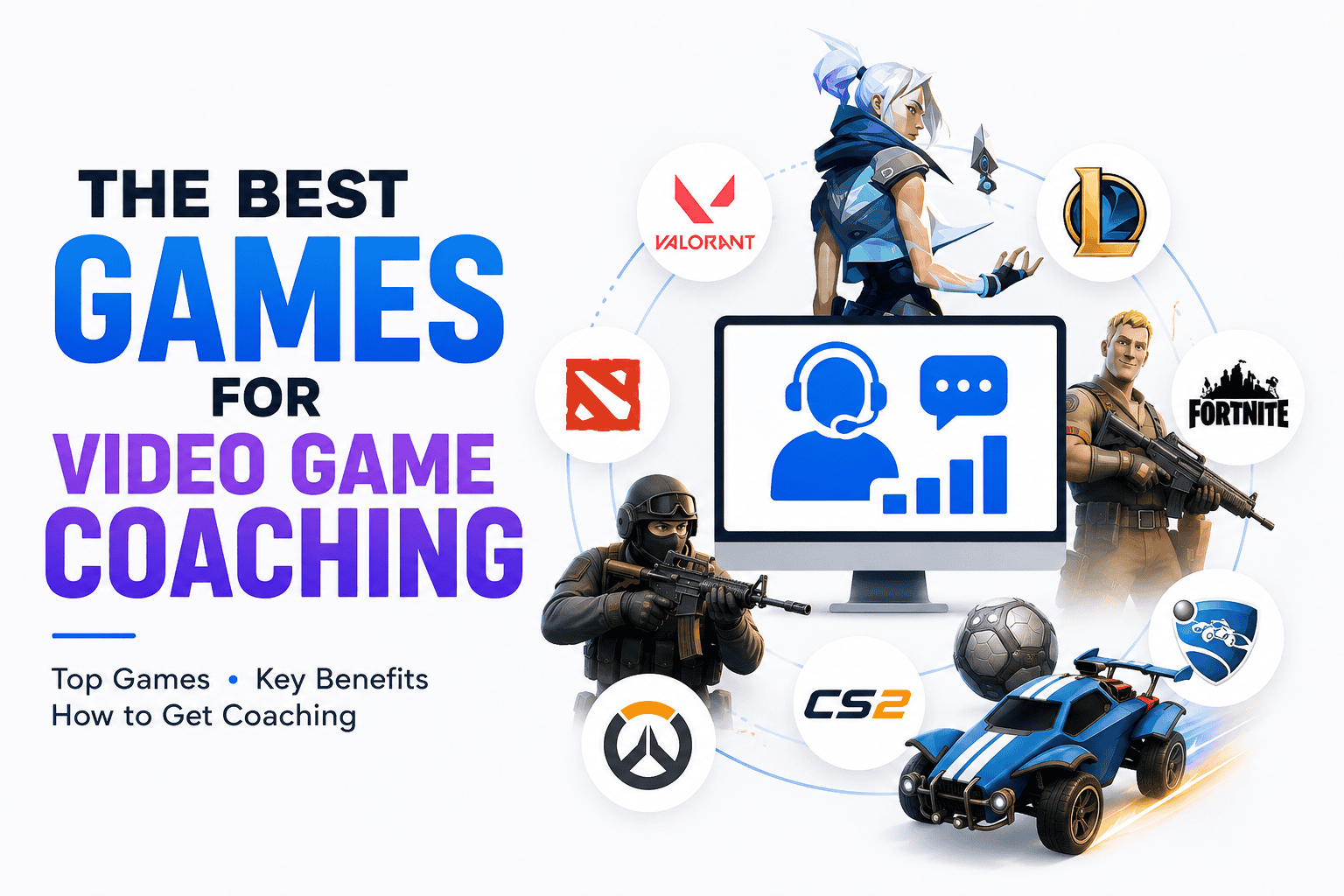
Some of the best games for video game coaching include Valorant, Counter-Strike 2, League of Legends, Dota 2, Fortnite, Overwatch 2 and Rocket League. Fighting games and RTS titles can also be excellent choices for more specialised coaching.
There’s a good reason competitive games dominate that list.
In games like Valorant, League of Legends and Rocket League, the difference between winning and losing can come down to dozens of small decisions made throughout a match.
You might think your aim is holding you back when the real problem is positioning. You might blame your build when you’re actually taking fights at the wrong time. Or you might discover that charging directly at the enemy team for the seventh time wasn’t quite the tactical masterstroke it felt like.
That’s where a coach can help.
Rather than simply telling you to “get better,” a good coach can identify specific weaknesses, explain what you should be doing differently and give you practical things to work on.
If you’re completely new to the idea, our guide to what video game coaching is explains what a gaming coach does and how coaching can help different types of players.
And coaching isn’t reserved for aspiring esports pros with lightning-fast reactions, three monitors and a keyboard that costs more than your first console.
Beginners, casual players, ranked grinders and experienced competitive players can all benefit – just in different ways.
In this guide, we’ll start by looking at the types of games that are best suited to coaching, including FPS, MOBA, battle royale, sports, fighting and strategy games.
Then we’ll dig into some of the individual games where coaching can make the biggest difference – and what a coach can actually help you improve in each one.
Let’s find your game. 🎮
2. What Makes a Game Good for Coaching?
Technically, you can get coaching for almost any video game.
If somebody knows more about a game than you do and can explain that knowledge without simply shouting “How did you miss that?”, there’s probably something they can teach you.
But some games are much better suited to coaching than others.
The sweet spot tends to be games where mechanical skill, strategy and decision-making all matter – and where mistakes can be identified, explained and corrected.
🎯 Skills You Can Actually Practise
Games with learnable mechanics give coaches something concrete to work on.
Depending on the game, that could include:
- Aim and crosshair placement
- Movement and positioning
- Recoil control
- Combos
- Building and editing
- Aerial control
- Farming
- Ability usage
Better still, these are skills you can practise between coaching sessions.
A Valorant coach might notice that your crosshair is constantly pointing at the floor. A Rocket League coach might spot inefficient aerial movement. A fighting game coach might discover that your favourite combo works brilliantly – right up until you have to perform it against another human.
These are specific problems with specific ways to improve them.
🧠 Strategy and Decision-Making Matter
Raw mechanics only get you so far.
Many of the best games for coaching constantly force players to make decisions:
Where should I position? When should I attack? Should I rotate? Which objective matters most? Should I take this fight?
And occasionally:
Why on earth did I think that was a good idea?
This is where coaching can be especially valuable.
An experienced coach can look beyond what happened and explain why it happened. That might mean identifying poor positioning in Overwatch 2, inefficient rotations in Rocket League or a questionable decision to chase one League of Legends opponent halfway across the map while the rest of your team desperately tries to defend the base.
Understanding those decisions is often what turns short-term improvement into better overall game sense.
📈 Progress You Can Measure
Good coaching works particularly well when improvement can actually be seen.
That doesn’t necessarily mean jumping three ranks after one session.
Progress could mean:
- Winning more engagements
- Dying less often
- Improving accuracy
- Farming more efficiently
- Making smarter rotations
- Using abilities more effectively
- Improving positioning
- Making fewer avoidable mistakes
- Gradually climbing through ranked divisions
It gives you and your coach something tangible to work towards rather than the wonderfully vague objective of “I just want to be better.”
Different players will naturally have different targets. A beginner learning the fundamentals needs a very different approach from an experienced player trying to squeeze out the final few percent of performance.
We explore those differences in Video Game Coaching Levels – From Beginner to Pro.
🔍 Mistakes That Can Be Identified
The best coaching games also make it possible to work out why something went wrong.
That’s important because your memory isn’t always the world’s most reliable match analyst.
It remembers the incredible headshot.
It occasionally forgets the three unnecessary deaths immediately before it.
Recorded matches, replays and detailed gameplay give a coach the opportunity to spot patterns that can be difficult to notice while you’re busy playing.
Maybe you’re consistently standing in the wrong place. Perhaps you’re using an ability too early. Maybe your rotations are costing your team opportunities without you even realising it.
Once a recurring problem has been identified, it becomes something you can actually work on.
🏆 Competitive Modes Give You a Target
Ranked and competitive modes give coaching another useful ingredient:
A goal.
Maybe you want to reach Diamond in Valorant, escape Silver in League of Legends or finally beat the friend who has been reminding you about the same Rocket League victory for the last two years.
Whatever the motivation, having a clear target makes coaching more focused.
Instead of simply trying to become “better”, you can identify the skills and weaknesses standing between where you are now and where you want to be.
👥 Active Communities Create Specialist Coaches
Large communities don’t automatically make a game good for coaching, but they certainly help.
Popular competitive games tend to have established metas, ranked systems, competitive scenes and thousands – sometimes millions – of players trying to improve.
That also creates room for specialist coaching.
You might not just want a League of Legends coach.
You might want a coach who specialises in your role, champion, rank or even a particular weakness in your gameplay.
The more developed a game’s competitive community becomes, the easier it is for coaching to become specialised rather than one-size-fits-all.
🎮 The Best Coaching Games Give You Something to Work On
Ultimately, the best games for video game coaching aren’t necessarily the hardest games.
They’re games where a coach can identify mistakes, explain why they’re happening and give you practical ways to improve them.
That could mean sharpening your aim in an FPS, improving your map awareness in a MOBA, learning better rotations in Rocket League or discovering that repeatedly using the same attack in a fighting game is, apparently, predictable.
With that in mind, let’s look at the game genres that offer some of the best opportunities for video game coaching.
3. Best Types of Games for Video Game Coaching
Some game genres are naturally better suited to coaching than others.
Competitive games tend to lead the pack because they combine mechanical skill, strategy, decision-making and measurable progression. There’s usually something specific to analyse, practise and improve – rather than simply being told to “play more.”
Here’s a quick look at the game types where coaching can be particularly effective:
| 🎮 Game Type | 🔥 Popular Examples | 🎯 Main Coaching Focus | 👤 Best For |
|---|---|---|---|
| 🎯 FPS | Valorant, Counter-Strike 2, Overwatch 2 | Aim, movement, positioning, game sense and teamwork | Players wanting stronger mechanics and competitive performance |
| 🧠 MOBA | League of Legends, Dota 2 | Laning, map awareness, strategy, objectives and decision-making | Players wanting to improve game knowledge and climb ranked |
| 🏗️ Battle Royale | Fortnite | Aim, movement, building, rotations and fight selection | Players wanting better mechanics and smarter survival |
| 🚗 Sports & Competitive | Rocket League | Car control, aerials, positioning, rotations and teamwork | Players wanting measurable mechanical and ranked improvement |
| 🥊 Fighting Games | Street Fighter, Tekken, Super Smash Bros. | Combos, matchups, movement, defence and reading opponents | Players wanting focused one-on-one improvement |
| ♟️ RTS & Strategy | StarCraft II, Age of Empires | Build orders, economy, scouting, micro, macro and strategy | Players who want stronger planning and decision-making |
🎯 FPS Games – Mechanics Meet Game Sense
First-person shooters are almost tailor-made for coaching.
Aim obviously matters, but improving at an FPS isn’t just about clicking heads faster.
Positioning, crosshair placement, movement, map knowledge, utility usage, communication and knowing when not to take a fight can be just as important.
That last one has ruined more heroic plans than we’d care to count.
Games such as Valorant and Counter-Strike 2 give coaches plenty to analyse because even small changes to positioning or decision-making can have a noticeable effect on performance.
🧠 MOBAs – There’s Always Something Else to Learn
MOBA games take the phrase “easy to learn, difficult to master” and occasionally remove the “easy to learn” part.
Games such as League of Legends and Dota 2 combine mechanical skills with enormous amounts of game knowledge.
Players need to understand characters, abilities, builds, lanes, objectives, positioning, team fights, map awareness and an ever-changing meta.
That makes MOBAs particularly strong candidates for coaching because the problem isn’t always mechanical.
Sometimes the biggest improvement comes from understanding what you should be doing and why.
🏗️ Battle Royale – Surviving Is Only the Beginning
Battle royale games add another challenge: unpredictability.
Different drops, opponents, resources and situations mean players constantly have to adapt.
In Fortnite, for example, coaching can cover aim, movement, building, editing, positioning, rotations, resource management and deciding which fights are actually worth taking.
Because being capable of fighting everyone you see doesn’t necessarily mean you should fight everyone you see.
A lesson many players learn approximately three seconds before returning to the lobby.
🚗 Sports and Competitive Games – Small Improvements Matter
Games such as Rocket League are particularly interesting for coaching because progress can be very visible.
Better car control, cleaner aerials, smarter rotations and improved positioning can completely change how someone plays.
There’s also a huge gap between understanding what you’re supposed to do and actually doing it while a giant football is flying over your head at alarming speed.
That combination of mechanical execution and tactical awareness makes competitive sports-style games excellent for structured coaching.
🥊 Fighting Games – Nowhere to Hide
Fighting games offer a very different coaching environment.
There are no teammates to blame.
Tragic, we know.
Games such as Street Fighter, Tekken and Super Smash Bros. place enormous emphasis on individual mechanics, matchups, reactions, movement, defence and reading your opponent.
A coach can help identify predictable habits, missed punish opportunities, weak matchup knowledge and mechanical problems that may be difficult to spot yourself.
For players who enjoy focused one-on-one competition, fighting games can be extremely well suited to specialist coaching.
♟️ RTS and Strategy Games – Outsmart Before You Outplay
Real-time strategy games shift more of the coaching focus towards planning, efficiency and decision-making.
Games such as StarCraft II and Age of Empires can involve build orders, resource management, scouting, unit composition, map control, timing, micro and macro management.
That’s quite a lot to think about while someone is simultaneously trying to destroy everything you’ve built.
Coaching can help players understand not only what went wrong, but the chain of decisions that led there.
And that’s an important theme across almost every genre on this list.
The best coaching games give you identifiable skills and decisions that can be improved.
Now let’s look more closely at the individual games that do this particularly well – starting with one of gaming’s biggest coaching categories: FPS games. 🎯
4. 🎯 FPS Games – Valorant, Counter-Strike 2 and Overwatch 2
FPS games are among the best games for video game coaching because there’s rarely just one thing determining whether you win or lose a fight.
Yes, aim matters.
But so do positioning, movement, map knowledge, reaction time, communication, utility usage and knowing when charging around a corner is likely to end badly.
A good FPS coach can break those skills apart and work out what’s actually holding you back.
You might think you need better aim when you’re consistently entering fights from poor positions. You might know every map perfectly but struggle with movement. Or your mechanics might be excellent while your decision-making has all the subtlety of kicking down the front door.
Let’s look at three FPS games particularly well suited to coaching.
🔴 Valorant
Valorant combines precise gunplay with agents that have their own abilities, roles and tactical possibilities.
That creates plenty for a coach to work with.
Valorant coaching can focus on:
- 🎯 Aim and crosshair placement
- 🏃 Movement and peeking
- 🗺️ Map knowledge
- 💥 Agent abilities and utility
- 📍 Positioning
- 💰 Economy management
- 🧠 Game sense and decision-making
- 💬 Communication and teamwork
One of the biggest advantages of Valorant coaching is that weaknesses can often be isolated.
If you’re losing gunfights, a coach can examine your crosshair placement, movement or positioning. If you’re struggling to have an impact despite decent mechanics, the problem might instead be ability usage, rotations or decision-making.
And sometimes the coach gets to deliver the devastating news that your aim isn’t the problem at all.
You’re just standing in terrible places.
Valorant’s ranked system also gives players a clear progression path, making it easier to set goals and track improvement over time.
💣 Counter-Strike 2
Counter-Strike 2 is another natural fit for coaching.
The basic objective is easy enough to understand.
Actually becoming consistently good at it is another matter entirely.
CS2 coaching can cover:
- 🎯 Aim and crosshair placement
- 🔫 Recoil and spray control
- 🏃 Movement
- 💨 Smoke, flash and grenade usage
- 🗺️ Map knowledge
- 📍 Positioning
- 💰 Economy management
- 🧠 Game sense
- 🤝 Team tactics and communication
One of the most valuable areas a coach can address is consistency.
A player might have excellent aim in one match and struggle in the next because their positioning, movement or decision-making puts them into unnecessarily difficult fights.
A coach can help identify those patterns.
Instead of asking, “How do I aim better?”, the better question might become:
“Why am I constantly putting myself in situations where I need incredible aim just to survive?”
That’s a much more useful problem to solve.
🦸 Overwatch 2
Overwatch 2 takes FPS coaching in a slightly different direction.
Mechanical skill still matters, but hero abilities, roles and team composition add another layer of complexity.
Overwatch 2 coaching might focus on:
- 🎯 Aim and mechanics
- 🦸 Hero mastery
- 📍 Positioning
- 💥 Ability usage
- ⚡ Ultimate management
- 🛡️ Role-specific skills
- 🤝 Team composition
- 💬 Communication
- 🧠 Target selection and decision-making
A player can have strong mechanics and still struggle because they’re using abilities at the wrong time, taking poor positions or failing to understand what their role needs to accomplish.
There’s also the small matter of dozens of heroes with different abilities, strengths, weaknesses and matchups.
Learning all of that through trial and error is certainly possible.
So is assembling furniture without reading the instructions.
A coach can make the process considerably less painful.
🎯 Why FPS Games Work So Well for Coaching
What makes Valorant, Counter-Strike 2 and Overwatch 2 particularly suitable for coaching is the combination of mechanical skill and decision-making.
A coach isn’t limited to saying:
“Your aim needs work.”
They can identify why you’re losing engagements, whether that’s crosshair placement, movement, positioning, ability usage, poor fight selection or something else entirely.
FPS games also work particularly well with both live coaching and gameplay analysis. We’ll look more closely at those different approaches later in this guide, but if you’re interested in how they compare, see Live Gaming Coaching vs VOD Review – Which Is Better?.
For players who enjoy competitive matches, measurable progression and the eternal pursuit of clicking on opponents slightly faster than they click on you, FPS games are one of the strongest categories for video game coaching.
Next up, we move from clicking heads to managing lanes, objectives, builds and approximately 400 other things at once: MOBA games. 🧠
5. 🧠 MOBA Games – League of Legends and Dota 2
If FPS coaching is about mechanics meeting game sense, MOBA coaching takes that idea and adds a small encyclopedia of extra things to learn.
Games like League of Legends and Dota 2 have enormous skill ceilings because success depends on far more than quick reactions.
You need to understand your character, your opponents, the map, objectives, items, positioning, timings, team fights and what everyone else is likely to do next.
Preferably all at the same time.
That makes MOBAs some of the best games for video game coaching, particularly for players who feel like they’re playing plenty of matches but aren’t actually improving.
⚔️ League of Legends
League of Legends is almost perfectly designed for coaching.
There are plenty of mechanical skills to improve, but a huge part of becoming a better player comes from making better decisions more consistently.
League of Legends coaching can focus on:
- ⚔️ Champion mechanics
- 🛣️ Laning
- 💰 Farming and CS
- 🌊 Wave management
- 👀 Map awareness
- 🐉 Objective control
- 🛒 Builds and itemisation
- 📍 Positioning
- ⚡ Team fighting
- 🧠 Decision-making
- 📈 Ranked progression
The useful thing about coaching is that it can expose problems you may not realise you have.
Maybe you’re mechanically strong but consistently falling behind in farm.
Perhaps you’re winning your lane and then struggling to turn that advantage into objectives.
Or maybe you’ve developed an unfortunate habit of chasing low-health enemies into places where five of their closest friends are waiting.
It happens.
A coach can look at the bigger picture and help connect individual decisions to what happens later in the match.
🛡️ Dota 2
If League of Legends has a steep learning curve, Dota 2 looked at the curve and apparently decided it wasn’t steep enough.
Dota 2 combines mechanical execution with an enormous amount of strategic knowledge.
Coaching can cover areas such as:
- 🦸 Hero knowledge
- 🛣️ Laning
- 💰 Farming efficiency
- 🛒 Itemisation
- 🗺️ Map control
- 👀 Vision and awareness
- 📍 Positioning
- ⚔️ Team fighting
- 🏆 Objective management
- ⏱️ Timings
- 🧠 Decision-making and strategy
Because so many systems interact with each other, small mistakes can have consequences several minutes later.
Poor farming can delay an important item. A bad rotation can cost map control. Weak positioning can turn an otherwise winnable team fight into five grey screens and a brief period of collective reflection.
A coach can help players understand those chains of cause and effect.
🔍 Why MOBA Coaching Can Be So Valuable
One of the biggest challenges with improving at a MOBA is simply working out what you should improve first.
You might finish a match knowing that something went wrong without being able to pinpoint exactly what it was.
Was your build wrong?
Were you farming inefficiently?
Did you rotate too late?
Should you have contested that objective?
Was your positioning poor?
Or was trying to fight the entire enemy team alone perhaps a touch ambitious?
This is where an experienced coach can provide something YouTube guides and build websites can’t always give you:
feedback on your gameplay.
General guides can tell you what good players should do.
A coach can show you what you’re actually doing and where the two differ.
🎥 MOBAs Are Excellent for Gameplay Review
League of Legends and Dota 2 are also particularly well suited to reviewing recorded matches.
A coach can pause the action, examine your positioning, question decisions and identify mistakes that might be almost impossible to notice while you’re actively playing.
More importantly, they can spot repeated patterns.
One questionable decision is a mistake.
Making the same questionable decision every match is a coaching opportunity.
That makes MOBA coaching particularly useful for players who have hit a plateau and aren’t sure what’s preventing them from climbing further.
Whether you’re learning the basics or trying to push into higher-ranked play, the sheer depth of MOBAs means there’s almost always another part of your game that can be improved.
Next, we’ll move into a genre where strategy still matters – but now the map is huge, the situation changes constantly and dozens of other players would quite like to eliminate you: Battle Royale. 🏗️
6. 🏗️ Battle Royale Games – Fortnite
Battle royale games introduce a problem that coaches absolutely love:
Almost nothing goes exactly to plan.
You can practise your aim, learn the map and perfect your mechanics – then land next to three opponents, find questionable loot and suddenly discover that today’s carefully prepared strategy is “survive the next 15 seconds.”
That unpredictability is exactly what makes battle royale games interesting from a coaching perspective.
And when it comes to coaching, Fortnite is the obvious standout.
🪂 Fortnite
Fortnite combines traditional shooter mechanics with building, editing, movement, resource management and constantly changing tactical situations.
In other words, there’s quite a lot going on.
Fortnite coaching can focus on:
- 🎯 Aim and accuracy
- 🏃 Movement
- 🏗️ Building
- ✏️ Editing
- 🗺️ Map knowledge
- 🔄 Rotations
- 📍 Positioning
- 🎒 Resource management
- ⚔️ Fight selection
- 🧠 Game sense
- 🏆 Endgame strategy
For newer players, coaching might start with basic movement, building and combat.
More experienced players might focus on advanced editing, faster building, smarter rotations or improving decision-making during competitive matches.
That makes Fortnite particularly versatile for coaching because there’s a clear path from learning the fundamentals to refining highly advanced mechanics.
🏗️ Building and Editing Add Another Skill Layer
Fortnite’s building system is one of the biggest things separating it from traditional shooters.
It’s also one of the areas where the difference between experienced and inexperienced players can become painfully obvious.
One player fires a shot.
The other responds by constructing what appears to be a three-bedroom townhouse.
A coach can break building and editing into individual skills rather than leaving you to frantically press buttons and hope something structurally useful appears.
That could include:
- Faster builds
- Cleaner edits
- Defensive building
- Taking height
- Piece control
- Combining building with movement
- Using builds effectively during fights
These are repeatable mechanics that can be practised individually – making them particularly suitable for structured coaching.
🔄 Rotations and Positioning Matter Too
Good Fortnite players don’t just win fights.
They also know which fights to take, where to move and when to move there.
A coach can help with decisions such as:
Where should you land?
When should you rotate?
Should you push another player?
When should you disengage?
Where should you position for the next zone?
That last one can be especially important.
Winning a spectacular fight only to realise the storm is now approximately three postcodes behind you is not ideal.
Learning better rotations and positioning can help players survive longer without needing to win every encounter through mechanical skill alone.
⚔️ Learning Which Fights to Take
Battle royale games constantly tempt players into unnecessary fights.
You see another player.
You have a weapon.
Nature takes its course.
But taking every available fight isn’t always the smartest way to win.
A Fortnite coach can help players recognise when they have an advantage, when an opponent has better positioning and when walking away is actually the stronger decision.
That’s particularly valuable in competitive play, where survival, positioning and timing can matter just as much as eliminations.
📈 Fortnite Coaching Works Across Skill Levels
Another reason Fortnite works well for video game coaching is the huge range of skills involved.
A beginner might need help understanding:
- Basic building
- Weapon selection
- Movement
- Combat fundamentals
An intermediate player might focus on:
- Editing speed
- Fight selection
- Rotations
- Positioning
An advanced or competitive player might work on:
- Piece control
- Advanced mechanics
- Endgame decisions
- Tournament strategy
- Reviewing small mistakes that cost placements
The coaching doesn’t necessarily become completely different as players improve.
It becomes more specific.
That’s one of the reasons coaching can work from beginner level right through to serious competitive play. If you’re wondering where you fit, Video Game Coaching Levels – From Beginner to Pro explains how coaching needs change as players become more experienced.
🎮 Why Fortnite Is So Good for Coaching
Fortnite has almost everything that makes a game coachable.
It has a high mechanical skill ceiling, tactical decision-making, competitive modes, measurable progression and gameplay that can be analysed after a match.
More importantly, there are lots of different ways to improve.
Your aim might be excellent while your rotations need work. Your building could be fast while your fight selection keeps getting you eliminated. Or your mechanics might be strong enough to win fights that better positioning could have helped you avoid entirely.
A good coach can help work out which part of that puzzle deserves your attention first.
Next, we’re swapping assault rifles and storm circles for something completely different – although you’ll still spend plenty of time flying through the air.
Let’s talk Rocket League. 🚗⚽
7. 🚗 Sports and Competitive Games – Rocket League
Sports and competitive games can be excellent for coaching because improvement is often easy to see but difficult to achieve.
You know what you want to do.
The game simply refuses to cooperate.
Few games demonstrate this better than Rocket League, where the basic idea sounds wonderfully simple:
Cars + football = hit ball into goal.
Then someone flies across the arena, spins upside down, redirects the ball into the top corner and makes you reconsider what the word “simple” means.
⚽ Rocket League
Rocket League has an enormous mechanical skill ceiling combined with positioning, rotations, decision-making and teamwork.
That gives coaches plenty to work with.
Rocket League coaching can focus on:
- 🚗 Car control
- ⚽ Ball control
- 🚀 Aerials
- 🎯 Shooting accuracy
- 🧱 Wall play
- 🔄 Recoveries
- 📍 Positioning
- 🔁 Rotations
- ⚡ Boost management
- 🤝 Teamwork
- 🧠 Decision-making
For beginners, simply becoming comfortable controlling the car and judging the ball can produce huge improvements.
At higher levels, coaching becomes increasingly precise – aerial control, recoveries, positioning, boost efficiency and tiny rotational decisions can all make the difference.
🚀 Mechanics Are Easy to Practise – Eventually
One reason Rocket League works so well for coaching is that many of its mechanical skills can be isolated and practised.
A coach might identify weaknesses in:
- Aerials
- Dribbling
- First touches
- Shooting
- Recoveries
- Wall play
- Kick-offs
Instead of simply playing another 100 matches and hoping something magically improves, you can work specifically on the mechanic that’s holding you back.
And Rocket League has plenty of mechanics where knowing what you’re supposed to do and actually doing it are two entirely different experiences.
Watching an experienced player perform an aerial can make it look effortless.
Trying it yourself can resemble a shopping trolley falling down a staircase.
Practice helps.
Good practice helps considerably more.
🔄 Rotations Can Matter More Than Flashy Mechanics
It’s easy to assume that becoming better at Rocket League means learning increasingly ridiculous aerial tricks.
Those certainly help.
But positioning and rotations can be just as important.
A coach might notice that you’re:
- Chasing the ball too often
- Rotating into poor positions
- Leaving the goal exposed
- Crowding teammates
- Committing when you should defend
- Using boost unnecessarily
- Recovering too slowly after a challenge
These aren’t always spectacular mistakes.
That’s exactly why they’re easy to miss.
Fixing several small positional problems can sometimes improve your results more than spending hours trying to master the latest mechanical trick you saw someone perform on YouTube.
⚡ Boost Management Changes Everything
Boost looks like a simple resource.
You collect it.
You use it.
Preferably not all of it while driving directly into a wall.
But efficient boost management affects almost everything you do in Rocket League.
It influences how quickly you can challenge, recover, rotate and reposition.
A coach can help identify when you’re wasting boost, taking inefficient routes to collect it or abandoning a good position because you’ve decided that the large boost pad on the other side of the arena looks particularly inviting.
Sometimes being in the right place with 30 boost is better than being in the wrong place with 100.
🤝 Teamwork Adds Another Layer
Rocket League also changes dramatically depending on whether you’re playing 1v1, 2v2 or 3v3.
A strong individual player can still create problems for their team through poor rotations or unnecessary challenges.
That’s why coaching can go beyond individual mechanics and look at:
- When to challenge
- When to rotate
- How to support teammates
- Maintaining spacing
- Reading your teammate’s position
- Recognising when you’re the last defender
That final point tends to become obvious approximately half a second after you’ve committed to an unnecessary aerial.
📈 Rocket League Makes Progress Easy to Spot
Rocket League is particularly satisfying for coaching because improvement can be very visible.
Aerials become more controlled.
Shots become more accurate.
Recoveries become quicker.
Rotations become cleaner.
And gradually, situations that once felt chaotic start to become predictable.
Your rank provides another obvious measure of progress, but it isn’t the only one.
A player can become considerably better before their rank catches up – which is why understanding your actual strengths and weaknesses matters.
🚗 Why Rocket League Is Great for Coaching
Rocket League combines almost everything you’d want from a coachable game:
Deep mechanics, tactical positioning, teamwork, repeatable skills and clear competitive progression.
There’s always something to improve, whether you’re learning how to hit the ball consistently or trying to shave tiny inefficiencies from high-level rotations.
And unlike many team games, it’s often relatively easy to see the connection between a specific mistake and what happened next.
Sometimes painfully easy.
Next, we’ll move into another genre where individual mistakes are particularly difficult to hide – because this time, there aren’t any teammates to blame.
Welcome to fighting games. 🥊
8. 🥊 Fighting Games – Street Fighter, Tekken and Super Smash Bros.
Fighting games offer one of the purest forms of competitive gaming.
It’s you against one opponent.
No random teammates. No questionable rotations. No jungler to blame.
Just you, your opponent and the uncomfortable possibility that the problem might actually be you.
That makes fighting games particularly well suited to one-on-one coaching.
Games such as Street Fighter, Tekken and Super Smash Bros. combine mechanical execution with matchup knowledge, positioning, reactions and the ability to predict what another player is about to do.
There’s plenty to learn – and nowhere to hide.
👊 Street Fighter
Street Fighter might look like two players exchanging increasingly elaborate punches and kicks, but underneath that is a highly tactical game.
Coaching can focus on:
- 👊 Character mechanics
- 🎮 Combos
- 🦶 Movement and spacing
- 🛡️ Defence
- ⚡ Punishes
- 🧠 Matchup knowledge
- 👀 Reading opponents
- ⏱️ Timing
- 🎯 Decision-making
A coach can help identify habits that opponents may already be exploiting.
Perhaps you jump too often.
Maybe you use the same approach every time.
Or perhaps you’ve spent hours learning a spectacular combo that you almost never manage to start in an actual match.
The combo isn’t much use if your opponent refuses to stand still and cooperate.
Coaching can help bridge that gap between knowing techniques and knowing when to use them.
🥋 Tekken
Tekken takes fighting game complexity and turns the dial considerably higher.
Characters can have enormous move lists, while movement, spacing, punishment and matchup knowledge all play major roles.
Tekken coaching might cover:
- 🥋 Character-specific moves
- 🎮 Combos
- ↔️ Movement and spacing
- 🛡️ Blocking and defence
- ⚡ Punishment
- 🧠 Matchup knowledge
- 🎯 Attack selection
- 👀 Opponent habits
- ⏱️ Timing
For newer players, a coach can help cut through the overwhelming number of options and focus on the moves and concepts that actually matter.
More experienced players might analyse specific matchups, improve punishment or identify tiny habits that stronger opponents are exploiting.
Sometimes improvement isn’t about learning another 20 moves.
It’s about becoming much better at using the right five.
💥 Super Smash Bros.
Super Smash Bros. approaches fighting games differently, but it’s still packed with coaching opportunities.
Depending on the title and competitive format, coaching can focus on:
- 🎮 Character mechanics
- 🏃 Movement
- 📍 Stage positioning
- 💥 Combos
- 🛡️ Defence
- 🔄 Recovery
- 🧠 Matchups
- 👀 Reading opponents
- 🎯 Decision-making
Smash adds stage control, recovery and movement options that can dramatically change how matches play out.
A coach might notice that you’re consistently giving up good positions, approaching opponents predictably or using the same recovery route every time.
Your opponent may have noticed too.
They’ve just been less polite about mentioning it.
👀 Learning to Read Your Opponent
One of the biggest differences between fighting games and many other competitive genres is how directly you’re interacting with another player.
You’re not only controlling your own character.
You’re constantly trying to work out what the other person is going to do next.
Does your opponent attack after blocking?
Do they always jump from the same position?
Are they vulnerable after using a particular move?
Do they panic when pressured?
And, just as importantly:
What habits are they noticing about you?
A coach can help identify those patterns and teach you to become less predictable while recognising patterns in your opponents.
🎮 Mechanics Aren’t Everything
Learning combos is useful.
But fighting game coaching can go much deeper than memorising button sequences.
Strong players understand:
- When to attack
- When to defend
- How to control space
- Which moves are safe
- Which mistakes can be punished
- How different matchups change their approach
- When an opponent is becoming predictable
That’s why someone can know an impressive collection of combos and still struggle against a player with better fundamentals.
It’s the fighting game equivalent of owning an expensive toolbox while hitting everything with the hammer.
🔍 Fighting Games Are Excellent for Match Review
Because matches are usually one-on-one, fighting game footage can be particularly useful for identifying repeated mistakes.
A coach can review a match and spot:
- Predictable attacks
- Missed punish opportunities
- Weak defence
- Poor spacing
- Repeated movement patterns
- Bad matchup decisions
- Mechanical execution problems
Those mistakes can then become specific areas to practise.
This is where VOD review in gaming can be especially useful – instead of trying to remember what happened during a frantic match, you and a coach can slow things down and work out exactly where things started going wrong.
🥊 Why Fighting Games Are Great for Coaching
Fighting games have almost everything needed for effective coaching:
Deep mechanics, clear mistakes, repeatable situations, strategic decision-making and direct competition.
They’re also particularly suited to highly specialised coaching.
A Street Fighter player might want help with one character. A Tekken player might need to improve a particular matchup. A Smash player might want to work specifically on movement or recovery.
The better you become, the more precise the coaching can become.
And when you’re done blaming yourself for everything, there’s good news.
Our next genre lets you blame your economy, build order and entire strategic plan instead.
Let’s move on to RTS and strategy games. ♟️
9. ♟️ RTS and Strategy Games – StarCraft II and Age of Empires
Not every coachable game is about lightning-fast aim or executing the perfect combo.
Sometimes the biggest weapon is simply making better decisions than the person trying to destroy your base.
Real-time strategy games – or RTS games – combine planning, resource management, map awareness and tactical decision-making with the slightly inconvenient requirement of doing everything at once.
Games such as StarCraft II and Age of Empires can be excellent for coaching because there are so many interconnected decisions to analyse.
One bad choice might not cost you immediately.
It might quietly ruin your game five minutes later.
🚀 StarCraft II
StarCraft II has one of the highest skill ceilings in competitive strategy gaming.
Players need to manage their economy, produce units, scout opponents, expand, control armies and react to changing situations – often within seconds.
StarCraft II coaching can focus on:
- 🏗️ Build orders
- 💰 Resource management
- 👀 Scouting
- 🗺️ Map awareness
- ⚔️ Unit composition
- ⏱️ Timing attacks
- 🎮 Micro management
- 🧠 Macro management
- 🏰 Expansion
- 🔄 Adapting strategies
- 📈 Competitive progression
One of the biggest advantages of coaching is learning why your strategy failed.
Maybe your build was too slow.
Perhaps you didn’t scout an important change in your opponent’s strategy.
Or maybe you were carefully managing your economy while an enormous enemy army arrived at your front door.
Economically responsible.
Strategically less impressive.
A coach can help connect those events and identify the decisions that actually determined the outcome.
🏰 Age of Empires
Age of Empires takes many of the same strategic principles and adds its own mix of civilisations, technologies, economy management and military tactics.
Coaching can cover:
- 🏗️ Build orders
- 🪵 Resource gathering
- 👷 Worker efficiency
- 🏰 Base development
- 👀 Scouting
- ⚔️ Army composition
- 🗺️ Map control
- ⏱️ Attack timings
- 🧠 Strategic decision-making
- 🔄 Adapting to opponents
For newer players, coaching can help establish efficient fundamentals.
How many workers should you produce? Which resources should you prioritise? When should you advance? When should you expand?
More experienced players might focus on optimising build orders, reading opponents and reacting faster when the original plan stops working.
Because the opponent, rather inconsiderately, gets a strategy too.
💰 Economy Is Part of the Battle
One thing that separates RTS coaching from many other genres is the importance of resource management.
Winning isn’t simply about controlling your army well.
You also need the economy capable of producing that army in the first place.
A coach might identify problems such as:
- Too many unused resources
- Inefficient worker distribution
- Expanding too late
- Producing the wrong units
- Poor production capacity
- Investing in upgrades at the wrong time
These mistakes can be surprisingly difficult to notice while you’re concentrating on everything else happening across the map.
And unlike missing a shot in an FPS, the consequences aren’t always immediate.
A mistake made at minute five might be the reason you’re losing at minute fifteen.
👀 Scouting Turns Guesswork Into Strategy
Good strategy depends on information.
If you know what your opponent is building, where they’re expanding and which units they’re producing, you can adapt.
If you don’t know?
Well, surprise armies are rarely the fun kind of surprise.
Coaching can help players develop better scouting habits and, importantly, actually use the information they discover.
Spotting your opponent’s strategy is only useful if you change yours accordingly.
⚡ Micro vs Macro
RTS games also create an interesting balance between micro and macro.
Micro is how effectively you control individual units and armies during fights.
Macro is how effectively you manage the larger game – economy, production, expansion and overall strategy.
Players often naturally favour one.
You might have excellent unit control but constantly forget to produce workers.
Or you might build a magnificent economy capable of funding an enormous army that you then send directly into the worst possible fight.
A coach can identify which side of your game needs more attention.
🔍 Strategy Games Are Perfect for Reviewing Decisions
RTS matches leave behind a trail of decisions.
Build timings, expansions, army movements, scouting information and resource spending can all be examined after the game.
That makes strategy games particularly useful for detailed gameplay analysis.
Instead of simply concluding “I lost the final battle,” a coach might discover that the match was effectively lost several minutes earlier because of poor resource allocation, missed scouting information or an inefficient build.
That’s a much more useful lesson.
You can’t improve a mistake you haven’t identified.
♟️ Why RTS and Strategy Games Are Great for Coaching
RTS games reward players who can plan, adapt and execute.
Mechanical speed helps, particularly at higher levels, but simply performing more actions isn’t enough if those actions aren’t useful.
A good coach can help players become more efficient, recognise strategic mistakes and understand the reasoning behind better decisions.
That’s what makes games such as StarCraft II and Age of Empires excellent candidates for specialist coaching – especially for players who enjoy winning with their brain before the final battle even begins.
We’ve now covered the major genres.
But which games benefit most from coaching?
That’s where things get interesting. 🎮
10. 🏆 Which Games Benefit Most From Coaching?
So, which game benefits most from video game coaching?
Annoyingly, there isn’t one universal winner.
The best game for coaching depends on what you’re trying to improve.
A Valorant player working on aim has very different needs from a League of Legends player struggling with map awareness. A Rocket League player might need better mechanics while a StarCraft II player could benefit more from fixing an inefficient build order.
Different games reward different skills – and that’s exactly why coaching needs to be tailored to the player.
Here’s how some of the strongest coaching games compare.
| 🎯 Coaching Goal | 🎮 Best Games | 💡 Why? |
|---|---|---|
| Mechanical Skills | Valorant, CS2, Fortnite, Rocket League | Aim, movement and advanced mechanics can be isolated and practised |
| Strategy & Decision-Making | League of Legends, Dota 2, StarCraft II, Age of Empires | Matches involve constant tactical choices and long-term planning |
| Teamwork & Communication | Valorant, Overwatch 2, League of Legends | Coordination, positioning and communication directly affect team performance |
| One-on-One Improvement | Street Fighter, Tekken, Rocket League | Individual mistakes are easier to identify and analyse |
| Gameplay Review | League of Legends, Dota 2, Valorant, Rocket League | Replays can reveal positioning, decision-making and repeated mistakes |
| Ranked Progression | Valorant, CS2, League of Legends, Rocket League | Established ranked systems provide clear goals and measurable progression |
🎯 Best Games for Improving Mechanical Skills
If your main goal is improving raw mechanics, FPS games, Fortnite and Rocket League are particularly strong choices.
Games such as Valorant and Counter-Strike 2 allow players to work specifically on aim, movement and crosshair placement.
Fortnite adds building and editing.
Rocket League adds an entirely different collection of mechanical challenges involving car control, aerials, recoveries and ball control.
The advantage is that these skills can often be broken down and practised individually.
Instead of playing match after match hoping your mechanics improve eventually, a coach can identify the specific skill causing problems and give you something focused to practise.
🧠 Best Games for Strategy and Decision-Making
If your mechanics are fine but your decision-making occasionally resembles a series of unfortunate accidents, MOBAs and strategy games are hard to beat.
League of Legends, Dota 2, StarCraft II and Age of Empires constantly ask players to make decisions with incomplete information.
Where should you move?
Which objective should you prioritise?
Should you attack?
Should you retreat?
What is your opponent likely to do next?
And, most importantly:
Should you really take that fight?
A coach can help slow those decisions down and explain the reasoning behind better alternatives.
Over time, those lessons can become instinctive.
🤝 Best Games for Teamwork and Communication
Some games require more than individual skill.
Valorant, Overwatch 2 and League of Legends all rely heavily on teamwork, positioning and communication.
You can play brilliantly and still make life considerably harder for everyone around you.
A coach can help improve things such as:
- Communication
- Team positioning
- Role awareness
- Ability coordination
- Rotations
- Objective decisions
- Knowing when to support rather than engage
These skills become increasingly important as players move into higher levels of competitive play.
Being mechanically brilliant is useful.
Being mechanically brilliant while accidentally sabotaging your team’s strategy is slightly less useful.
🥊 Best Games for One-on-One Improvement
Fighting games are particularly strong for players who want highly personalised coaching.
In Street Fighter and Tekken, every mistake is yours.
Which sounds harsh.
But from a coaching perspective, it’s extremely useful.
There are fewer variables to separate from your own performance, making it easier to identify weaknesses in mechanics, defence, spacing, matchups and decision-making.
Rocket League can offer something similar in 1v1 play, where positioning and mechanical mistakes become particularly obvious.
🔍 Best Games for Gameplay Review
Some games produce particularly useful replays.
League of Legends, Dota 2, Valorant and Rocket League all contain plenty of situations where reviewing what happened can reveal mistakes that weren’t obvious during the match.
A coach can pause the action and ask:
Why were you standing here?
What information did you have?
What other options were available?
Why did you take this fight?
Occasionally the answer to that last one is:
“I don’t know.”
Which, strangely enough, is a perfectly useful place for coaching to begin.
📈 Best Games for Ranked Progression
Ranked games naturally work well with coaching because players have a clear target.
Valorant, Counter-Strike 2, League of Legends and Rocket League all have competitive systems where progression can be tracked over time.
But rank shouldn’t be the only measure of whether coaching is working.
Better positioning, fewer mistakes, stronger mechanics and smarter decisions may appear before a major rank increase does.
The rank is the scoreboard.
The improved gameplay is what eventually moves it.
🎮 So, Which Game Should You Get Coaching For?
The answer is surprisingly simple:
The game you actually want to improve at.
Don’t choose a game because it’s supposedly the “best” for coaching.
Choose coaching because you’ve found something in your game that you want to get better at.
Maybe that’s aim in Valorant.
Rotations in Rocket League.
Wave management in League of Legends.
Building in Fortnite.
Matchups in Tekken.
Or finally working out why your beautifully planned StarCraft II economy keeps getting flattened by minute eight.
If a game has skills to develop, decisions to analyse and mistakes to correct, there’s a good chance coaching can help.
The next question is how that coaching should actually happen – live while you play or by reviewing your gameplay afterwards?
11. 🎮 Live Coaching vs VOD Review – Which Games Suit Each?
Once you’ve decided a game is worth getting coaching for, there’s another question:
Should the coach work with you live or review your gameplay afterwards?
Both approaches can be effective.
The better choice depends on the game, the skill you’re trying to improve and how you learn best.
Some problems are easier to fix when a coach can watch you play and give immediate feedback. Others become much clearer when everyone has the luxury of pausing the action and asking:
“Right. What exactly were you trying to do here?”
🎧 Live Coaching – Best for Immediate Feedback
Live coaching involves working with a coach while you’re playing, practising or going through specific exercises.
This can work particularly well when you’re developing mechanics or making decisions in real time.
Live coaching is useful for:
- 🎯 Aim and mechanical practice
- 🏃 Movement
- 📍 Positioning
- ⚡ Ability usage
- 🔄 Rotations
- 💬 Communication
- 🧠 Real-time decision-making
- 🎮 Training routines
Games such as Valorant, Counter-Strike 2, Fortnite, Overwatch 2 and Rocket League can all benefit from live coaching.
A coach can watch what you’re doing, identify a problem and correct it immediately.
Instead of discovering after the match that your positioning was poor, you can hear:
“Don’t stand there.”
Move.
Try again.
That’s a wonderfully efficient learning cycle.
🎥 VOD Review – Best for Slowing Everything Down
VOD review takes a different approach.
Rather than coaching you during the action, the coach reviews recorded gameplay or a match replay with you.
This gives both of you time to pause, rewind and analyse important moments without an opponent trying to eliminate you halfway through the explanation.
VOD review is particularly useful for:
- 🧠 Decision-making
- 📍 Positioning
- 👀 Map awareness
- 🔄 Rotations
- ⚔️ Fight selection
- 🏆 Objective decisions
- ♟️ Strategy
- 🔍 Identifying repeated mistakes
Games such as League of Legends, Dota 2, Valorant, Rocket League and RTS titles are especially well suited to this type of analysis.
If you’d like a deeper look at how this works, our guide to VOD review in gaming explains what coaches look for and how reviewing recorded gameplay can help you improve.
🔍 VOD Review Is Great at Finding Patterns
One of the biggest advantages of reviewing gameplay is that it removes the chaos of actually playing.
During a match, you’re thinking about opponents, teammates, abilities, positioning, objectives and approximately seventeen other things.
Afterwards, you can concentrate on one question:
What went wrong?
A coach might notice that you’re repeatedly:
- Taking fights from poor positions
- Rotating too late
- Missing information on the map
- Wasting resources
- Using abilities unnecessarily
- Making the same decision in similar situations
These patterns are incredibly valuable.
A single mistake might just be a mistake.
The same mistake appearing five times in one match?
Now we’ve found something worth fixing.
⚡ Live Coaching Is Great for Building Better Habits
Live coaching has a different strength:
Immediate correction.
If you’re practising crosshair placement in Valorant, aerials in Rocket League or building in Fortnite, waiting until the end of the session to discover you’ve been practising something incorrectly isn’t ideal.
A coach can intervene straight away.
That can help prevent bad habits from becoming more deeply ingrained and gives you an opportunity to immediately try the corrected technique.
For mechanical skills in particular, that feedback loop can be extremely useful:
Try → Feedback → Adjust → Try Again.
Repeat until either the skill improves or your hands request annual leave.
🔄 Many Games Work Well With Both
You don’t necessarily need to choose one coaching format forever.
In fact, some of the strongest coaching games work extremely well with both live coaching and VOD review.
A Valorant player might use VOD review to identify poor positioning, then work with a coach live to practise better approaches.
A Rocket League player might analyse rotational mistakes from previous matches, then move into training to practise the mechanics needed to fix them.
A League of Legends player could review a ranked match, identify weak map awareness and then work on recognising those situations during future games.
The two approaches can complement each other.
One helps you understand the problem.
The other helps you practise the solution.
🎮 Which Coaching Format Should You Choose?
A simple rule of thumb is:
Choose live coaching when you need help with execution.
Choose VOD review when you need help understanding decisions.
That’s not an absolute rule, but it’s a useful starting point.
If you’re still unsure, our full comparison of Live Gaming Coaching vs VOD Review – Which Is Better? breaks down the advantages, disadvantages and best uses of each approach.
And remember – the format matters less than finding a coach who understands your game, your skill level and what you’re actually trying to improve.
Because even the world’s greatest VOD review won’t help much if the coach’s only feedback is:
“Yeah… probably don’t do that again.”
12. 🎮 Do You Need to Be a Competitive Player to Get Coaching?
No.
You don’t need to be an esports player, sit at the top of the ranked ladder or have ambitions of lifting a trophy in front of 20,000 screaming fans.
Video game coaching can be useful at almost any skill level.
In fact, newer and intermediate players can sometimes make the biggest improvements because there are plenty of fundamentals that can be identified and corrected early.
You don’t need to be great at a game before getting a coach.
That’s rather the point.
🌱 Beginners Can Learn the Right Habits Early
Starting a new competitive game can be overwhelming.
You’re learning controls, mechanics, maps, characters, abilities, weapons, strategies and an entirely new vocabulary that everyone else appears to have agreed upon while you weren’t looking.
A coach can help cut through that noise.
Beginner coaching might focus on:
- 🎮 Core game mechanics
- 🗺️ Maps and objectives
- 🎯 Basic mechanical skills
- 🧠 Fundamental strategies
- 📍 Positioning
- 🛠️ Game settings and controls
- 🏋️ Effective practice routines
The goal isn’t to turn a new player into a professional overnight.
It’s to help them build good fundamentals without spending months reinforcing bad habits.
📈 Intermediate Players Can Break Through Plateaus
This is where coaching can become particularly valuable.
You’ve learned the game.
You understand the mechanics.
You’ve played hundreds – perhaps thousands – of matches.
And your rank has decided that this is apparently where you live now.
Welcome to the plateau.
Intermediate players often know how to play but have recurring weaknesses that are difficult to identify themselves.
That might include:
- Poor positioning
- Predictable decisions
- Inefficient mechanics
- Weak map awareness
- Bad rotations
- Inconsistent execution
- Taking unnecessary fights
A coach provides an outside perspective.
Sometimes one small change can solve a problem you’ve been repeating for months without noticing.
🏆 Advanced Players Need More Specific Coaching
As players improve, coaching usually becomes more specialised.
An advanced Valorant player probably doesn’t need someone explaining basic crosshair placement.
They might need help with:
- High-level positioning
- Agent-specific tactics
- Team coordination
- Advanced utility
- Opponent tendencies
- Small mechanical inefficiencies
- Competitive preparation
The same applies across other games.
A high-ranked Rocket League player might focus on tiny rotational errors. An experienced League of Legends player might analyse specific matchups or decision-making around objectives.
At higher levels, the obvious mistakes have usually disappeared.
The small ones become more important.
😎 What About Casual Players?
Casual players can benefit too.
You don’t need to care about rankings at all.
Maybe you simply want to:
- Learn a difficult game faster
- Stop getting destroyed by your friends
- Understand a favourite character
- Improve one annoying mechanic
- Become more confident online
- Enjoy the game without constantly wondering what’s happening
That’s a perfectly legitimate reason to get coaching.
Not every gaming goal needs to end with “become an esports professional.”
Sometimes the goal is simply to stop being the person everyone politely waits for at the bottom of the scoreboard.
Progress is progress.
🎯 Coaching Should Match Your Level
The important thing isn’t whether you’re “good enough” for coaching.
It’s finding coaching appropriate for where you are now and where you want to go next.
A beginner needs fundamentals.
An intermediate player might need help identifying bad habits.
An advanced player may need highly specialised analysis.
A competitive player might need preparation, strategy and tiny performance improvements.
Our guide to Video Game Coaching Levels – From Beginner to Pro explores these stages in more detail and explains how coaching changes as players improve.
🎮 You Don’t Need to Be a Pro – You Just Need Something You Want to Improve
Ultimately, there’s no minimum rank required before coaching suddenly becomes worthwhile.
If you’re playing a game and thinking:
“I want to get better at this.”
That’s enough.
Whether you’re learning your first competitive game, trying to escape a stubborn rank or refining advanced mechanics, coaching can give you something that’s surprisingly difficult to get from simply playing more:
Focused feedback on your own gameplay.
And once you’ve decided coaching might help, the next challenge is finding someone who’s actually good at providing it.
13. 🔍 How to Choose a Coach for Your Game
Finding someone who’s good at your game is easy.
Finding someone who’s good at teaching your game is a little different.
A player can have incredible mechanics, thousands of hours of experience and a rank that makes the rest of us feel inadequate – and still struggle to explain why you shouldn’t stand in that particular corner.
The best video game coaches combine game knowledge with communication, patience and the ability to identify what you actually need to improve.
Here’s what to look for.
🎮 Experience in Your Game
Start with the obvious one.
Your coach should know the game they’re coaching.
Look for experience with things such as:
- Competitive or ranked play
- Current game mechanics
- Maps and objectives
- Characters, heroes or agents
- Strategies and tactics
- The current meta
- Common mistakes at different skill levels
But don’t automatically assume the highest-ranked coach is the best choice.
Rank matters.
Relevant experience matters more.
🎯 Find a Coach Who Matches Your Goals
Different players need different coaches.
If you’re a beginner learning Valorant, you probably don’t need someone specialising exclusively in high-level competitive team strategy.
Likewise, an experienced League of Legends player trying to reach a higher rank probably doesn’t need a session explaining what a lane is.
Before choosing a coach, ask yourself:
What do I actually want help with?
Maybe it’s:
- Aim
- Positioning
- Ranked progression
- A specific character or role
- Building or editing
- Rotations
- Matchups
- Strategy
- VOD analysis
- Competitive preparation
The more specific your goal, the easier it becomes to find someone suited to helping you reach it.
🧠 Look for Specialised Knowledge
Some games have enough depth that specialist coaches can be extremely useful.
A League of Legends coach might specialise in a particular role.
A Valorant coach could focus on certain agents or ranks.
A fighting game coach might specialise in your character or a difficult matchup.
A Rocket League coach could focus on mechanics, rotations or high-level competitive play.
You don’t always need that level of specialisation.
But if you’ve identified a very specific weakness, finding someone who understands it deeply can make your coaching session much more focused.
💬 Communication Matters
Being brilliant at a game doesn’t automatically make someone brilliant at explaining it.
A good coach should be able to tell you:
What you’re doing wrong.
Why it’s causing problems.
What you should do instead.
And most importantly:
How to practise the improvement.
“Play better” is technically accurate advice.
It’s just not especially useful.
Good coaching turns complicated ideas into practical actions you can actually take into your next match.
⭐ Check Reviews and Coaching Experience
If reviews are available, use them.
Look beyond the star rating and see what previous players actually say.
Useful signs might include comments about:
- Clear explanations
- Helpful feedback
- Patience
- Game knowledge
- Good communication
- Practical improvement tips
- Sessions tailored to the player
Someone might be an exceptional player but completely new to coaching.
That doesn’t automatically make them a bad choice, but previous coaching experience and positive feedback can give you more confidence about what to expect.
📋 Look for a Clear Coaching Approach
A good coaching listing should make it reasonably obvious what you’re buying.
Does the coach offer live gameplay analysis?
VOD review?
Mechanical training?
Ranked advice?
Character-specific coaching?
A mixture?
The clearer the offer, the easier it is to decide whether it matches your goals.
If the entire description amounts to “I’m really good. Trust me.”
Perhaps keep browsing.
🏆 Don’t Choose on Rank Alone
High rank is useful evidence that someone understands the game.
It isn’t proof that they can teach.
The best coach for you might not be the highest-ranked person available.
It could be the coach who:
- Understands your current level
- Specialises in your problem
- Communicates clearly
- Gives practical feedback
- Creates realistic goals
- Makes complicated ideas easier to understand
That’s why choosing a coach should be about fit, not simply finding the most impressive profile.
For a more detailed checklist, see Choosing a Video Game Coach – 10 Things to Look For.
🎯 The Right Coach Should Make Your Next Steps Clear
A good coaching session shouldn’t leave you with 47 different things to fix.
It should leave you knowing what matters most right now.
Maybe that’s improving crosshair placement.
Maybe it’s better rotations.
Maybe it’s learning one matchup properly.
Or perhaps it’s finally accepting that your favourite strategy stopped being clever after the opponent predicted it for the fourth consecutive time.
Find the right coach and you’ll have something much more useful than general gaming advice:
A plan built around your game, your weaknesses and your goals.
Of course, there’s still one fairly important question before booking a session:
How much is all of this going to cost? 💰
14. 💰 How Much Does Coaching Cost for Different Games?
Video game coaching doesn’t come with one universal price tag.
A beginner Fortnite lesson, an advanced League of Legends VOD review and specialist Valorant coaching can all require very different levels of experience and preparation.
So rather than asking “How much does gaming coaching cost?”, it’s often more useful to ask:
“What am I actually paying for?”
🎮 The Game Can Affect the Price
Different games require different types of coaching.
An FPS coach might work heavily on mechanics, positioning and real-time decision-making.
A MOBA coach may spend more time analysing strategy, map awareness and recorded matches.
A fighting game coach could specialise in one character or matchup.
An RTS coach might break down build orders, resource efficiency and decisions made ten minutes before everything went horribly wrong.
The game itself doesn’t automatically make coaching expensive or cheap, but the depth and specialisation required can influence what coaches charge.
🏆 Coach Experience Matters
Just like most services, experience can affect the price.
A newer coach building their reputation may charge less.
An established coach with years of experience, strong reviews or high-level competitive credentials may charge more.
At the top end, professional players, former professionals and specialist esports coaches can command considerably higher rates.
That doesn’t mean the most expensive coach is automatically the best choice.
If you’re learning the basics of Rocket League, you probably don’t need to hire someone who spent last weekend analysing professional tournament rotations.
Unless you really want to.
🎯 Your Skill Level Can Change What You Need
Beginner coaching is often broader.
You might work on:
- Core mechanics
- Basic positioning
- Game knowledge
- Controls and settings
- Simple strategies
Advanced coaching tends to become much more specific.
A high-level player may want detailed analysis of a particular weakness, matchup, role or competitive situation.
The more specialised the problem, the more important it becomes to find a coach with the right expertise.
⏱️ Session Length Makes a Difference
Unsurprisingly, longer sessions usually cost more.
Common coaching formats might include:
- Short introductory sessions
- Standard one-hour coaching
- Extended sessions
- VOD reviews
- Ongoing coaching arrangements
But longer isn’t automatically better.
A focused session targeting one or two specific weaknesses can sometimes be more useful than several hours of trying to fix everything you’ve ever done wrong since installing the game.
That’s a lot to unpack.
🎥 Live Coaching vs VOD Review
The coaching format can also affect pricing.
Live coaching requires the coach to work with you in real time, watching your gameplay, providing feedback and adapting the session as you go.
VOD review involves analysing recorded gameplay, often pausing at key moments to discuss positioning, strategy and decision-making.
Neither format is automatically better or more expensive.
What matters is choosing the format that fits what you’re trying to improve.
💡 Don’t Choose a Coach on Price Alone
The cheapest session isn’t necessarily the best value.
Neither is the most expensive.
Instead, compare:
- 🎮 Game experience
- 🎯 Coaching specialisation
- ⭐ Reviews
- 💬 Communication
- 📋 What’s included
- ⏱️ Session length
- 🧠 Whether the coach matches your goals
Paying less for advice that doesn’t help isn’t much of a bargain.
Likewise, paying premium rates for advanced coaching when you just need help with the fundamentals is probably unnecessary.
The goal is to find the right level of coaching at a price that makes sense for you.
For a deeper breakdown of typical prices, formats and what affects coaching rates, see How Much Does Video Game Coaching Cost?.
💰 Think About Value, Not Just the Hourly Rate
Ultimately, good coaching should give you something you can continue using after the session ends.
That might be a better practice routine, improved mechanics, a clearer understanding of your mistakes or a list of specific areas to work on.
You’re not simply paying for an hour of somebody watching you play.
You’re paying for an experienced player to help shorten the trial-and-error process.
Because while spending another 500 hours figuring everything out yourself is technically free…
your time might disagree.
And if you’re already the experienced player people regularly ask for advice, there’s another possibility worth considering.
Maybe you should be the one doing the coaching. 🎮💰
15. 🎓 Can You Become a Coach for These Games?
Maybe you’re reading this article from the other side of the screen.
You’re already good at Valorant.
You understand League of Legends well enough to explain why your friend’s latest “experimental build” was doomed from the loading screen.
Or perhaps you’re the person everyone asks for help with Rocket League rotations, Fortnite building or Tekken matchups.
If so, you might be wondering:
Could I become a video game coach?
Absolutely.
You don’t necessarily need to be a professional esports player to help someone improve. You need strong knowledge of your game, something useful to teach and – rather importantly – the ability to explain it.
🎮 You Don’t Have to Be a Pro
Professional experience can certainly help.
But there’s a huge range of players looking for coaching, from complete beginners through to experienced competitive players.
A beginner learning Valorant doesn’t necessarily need a professional Valorant player.
They might need someone who can patiently explain:
- Crosshair placement
- Movement
- Basic positioning
- Agent abilities
- Map fundamentals
- How to practise effectively
Likewise, someone new to Rocket League might benefit enormously from a coach who understands rotations, car control and basic aerials.
The important question isn’t:
“Am I one of the best players in the world?”
It’s:
“Do I know enough to help this player reach their next level?”
🎯 Find Your Coaching Niche
Trying to coach absolutely everything can make your offer less convincing.
Instead, think about what you’re particularly good at teaching.
Your coaching niche might be:
- 🌱 Beginner coaching
- 📈 Ranked improvement
- 🎯 Mechanical training
- 🧠 Strategy and game sense
- 🦸 Character, hero or agent coaching
- 🎥 VOD review
- 🗺️ Map knowledge and positioning
- 🏆 Competitive coaching
- ⚔️ Matchup coaching
You can get even more specific.
Instead of offering generic League of Legends coaching, you might specialise in a particular role.
Instead of simply offering Fortnite coaching, you could focus on building and editing.
Instead of “I coach Rocket League”, your strength might be helping intermediate players improve rotations and positioning.
Specific problems create clearer coaching offers.
🧠 Being Good at a Game Isn’t Enough
There’s an important difference between knowing something and teaching it.
Experienced players often perform certain actions instinctively.
They know where to stand.
They recognise when a fight is bad.
They understand when to rotate.
But a coaching client needs more than:
“You’ll just know after you’ve played enough.”
A good coach needs to explain why.
Why was that position dangerous?
Why should the player rotate?
Why was that ability wasted?
Why was that fight a bad idea?
Turning instinct into an explanation is one of the most important coaching skills you can develop.
💬 Good Coaches Give Useful Feedback
Nobody hires a coach to hear:
“You’re doing it wrong.”
They need to know what went wrong and what to do differently next time.
Useful feedback should be:
- Specific
- Easy to understand
- Relevant to the player’s level
- Practical
- Focused on improvement
Instead of saying:
“Your positioning is bad.”
Explain where the player should have positioned, why it would have been safer and what information should influence that decision next time.
That’s coaching.
The first version is just criticism with a headset.
📋 Create a Clear Coaching Offer
Once you know what you can teach, turn it into something players can easily understand.
A coaching offer should explain:
🎮 What game do you coach?
🎯 What can you help players improve?
👤 Which skill levels do you coach?
🎥 What coaching format do you offer?
⏱️ How long is the session?
🏆 What experience do you have?
The clearer your offer is, the easier it becomes for the right players to find you.
If you’re interested in turning your gaming knowledge into a coaching service, How to Become a Gaming Coach walks through the process from choosing your game and niche to building your coaching skills and getting started.
🚀 Start With the Players You Can Genuinely Help
You don’t need to coach every skill level from day one.
If you’re strongest at helping beginners, start there.
If you know one character exceptionally well, specialise.
If you’re brilliant at analysing recorded matches but don’t enjoy talking someone through a live game, offer VOD reviews.
Build around what you’re actually good at.
Your first goal isn’t to become the world’s most famous gaming coach.
It’s to help one player improve.
Then another.
Then another.
And preferably avoid saying “How did you not see that?” when somebody makes the exact mistake you’ve explained four times.
Patience.
Apparently, that’s part of coaching too.
16. 🌎 What Other Games Can Be Coached?
We’ve focused on games such as Valorant, League of Legends, Fortnite and Rocket League because they have many of the ingredients that make video game coaching work particularly well.
But they’re certainly not the only options.
In reality, almost any game with skill, strategy, knowledge or decision-making can be coached.
It doesn’t even need a traditional ranked ladder.
If one player knows how to do something better than another player – and can explain how – there’s probably room for coaching.
🧙 MMORPGs
MMORPGs can have enormous amounts of knowledge hidden beneath the surface.
Games such as World of Warcraft and Final Fantasy XIV can involve complex classes, rotations, equipment, raids and group mechanics.
Coaching might focus on:
- ⚔️ Class or job mechanics
- 🔄 Ability rotations
- 🛡️ Tanking
- ❤️ Healing
- 💥 Damage optimisation
- 🏰 Dungeon and raid mechanics
- 🎒 Gear and progression
- 👥 Group play
- 🏆 PvP
For newer players especially, MMORPGs can be overwhelming.
You create a character.
You receive approximately 14 abilities.
Then eventually 14 becomes 37 and everyone else appears to know exactly when each one should be pressed.
A knowledgeable player can make that learning curve considerably less painful.
🏎️ Racing Games
Racing games are another natural fit for coaching.
Competitive racing isn’t simply about holding the accelerator and hoping for the best.
Coaching can cover:
- 🏁 Racing lines
- 🛑 Braking points
- ⚙️ Gear selection
- 🚗 Car control
- 🎯 Corner entry and exit
- 🛞 Tyre management
- ⏱️ Lap consistency
- 🧠 Race strategy
Sim racing can become particularly technical, giving specialist coaches plenty to analyse.
And unlike blaming your teammates in a MOBA, blaming the tyres for every slow lap has a fairly limited shelf life.
Eventually, someone is going to look at the telemetry.
🃏 Card and Strategy Games
Digital card games can also benefit from coaching.
Games such as Hearthstone and Magic: The Gathering Arena rely heavily on knowledge, probability, deck construction and decision-making.
Coaching might involve:
- 🃏 Deck building
- 🧠 Strategy
- 📊 Probability
- 🔄 Resource management
- 👀 Reading opponents
- 🎯 Matchups
- 🏆 Ranked progression
These games demonstrate an important point:
Coaching doesn’t have to involve mechanical skills at all.
Sometimes the entire value comes from helping a player think differently.
🔫 Extraction and Tactical Games
Extraction shooters and other tactical multiplayer games can also create interesting coaching opportunities.
These games often reward:
- 🗺️ Map knowledge
- 👂 Situational awareness
- 🎒 Resource management
- 🎯 Combat skills
- 📍 Positioning
- 🧠 Risk assessment
- 🤝 Team communication
- 🚪 Knowing when to extract
That last skill deserves more respect.
Finding excellent loot and then losing all of it because you decided to investigate one more building is practically a genre tradition.
A coach can help players make better decisions about movement, engagements and risk rather than focusing entirely on shooting mechanics.
🎮 New Competitive Games
The best games for coaching won’t remain the same forever.
New competitive games launch.
Existing games decline.
Others suddenly explode in popularity.
New modes can even create coaching opportunities within games that previously had little demand for it.
That’s why it’s better to think about what makes a game coachable rather than maintaining a fixed list of titles.
Ask:
Does the game have skills players want to improve?
Are there strategies or decisions that can be taught?
Can an experienced player identify and correct mistakes?
Are players motivated to get better?
If the answer is yes, coaching can probably work.
💡 Coaching Can Become Extremely Specific
There’s another opportunity beyond simply coaching different games:
Specialisation within them.
A coach doesn’t necessarily have to offer “World of Warcraft coaching.”
They might offer raid coaching for a specific role.
A racing coach could focus on one simulator or type of racing.
A fighting game coach might specialise in one character.
A tactical shooter coach might focus entirely on positioning and map knowledge.
The deeper a game becomes, the more opportunities there are to create specialised coaching around individual skills.
🌎 Almost Any Game Can Have Something to Teach
The games we’ve covered throughout this guide are strong coaching candidates because they combine skill development, strategy, competition and clear opportunities for improvement.
But don’t treat them as a definitive list.
Gaming changes far too quickly for that.
Today’s niche competitive title could become tomorrow’s breakout hit.
And sometimes coaching opportunities appear in games nobody initially expected.
The simplest rule is this:
If players can get noticeably better at something, someone can probably help teach them how.
That leaves us with one useful job before wrapping things up:
Putting the strongest video game coaching options side by side. 🎮
17. 📊 Quick Comparison – Best Games for Video Game Coaching
We’ve covered a lot of games, mechanics and coaching styles.
So if your brain is currently trying to remember whether you need better crosshair placement, wave management, aerial control or an entirely new personality after losing eight ranked matches in a row, here’s the simpler version.
The table below compares some of the best games for video game coaching and the areas where coaching can be particularly useful.
| 🎮 Game | 🕹️ Genre | 🎯 Main Coaching Areas | 🎧 Live Coaching | 🎥 VOD Review |
|---|---|---|---|---|
| Valorant | FPS | Aim, positioning, utility, agents, game sense and teamwork | ⭐⭐⭐ Excellent | ⭐⭐⭐ Excellent |
| Counter-Strike 2 | FPS | Aim, movement, utility, positioning, economy and tactics | ⭐⭐⭐ Excellent | ⭐⭐⭐ Excellent |
| Overwatch 2 | Hero Shooter | Hero mechanics, positioning, abilities, roles and teamwork | ⭐⭐⭐ Excellent | ⭐⭐⭐ Excellent |
| League of Legends | MOBA | Laning, farming, map awareness, objectives and decision-making | ⭐⭐ Good | ⭐⭐⭐ Excellent |
| Dota 2 | MOBA | Laning, farming, itemisation, map control and strategy | ⭐⭐ Good | ⭐⭐⭐ Excellent |
| Fortnite | Battle Royale | Aim, building, editing, movement, rotations and positioning | ⭐⭐⭐ Excellent | ⭐⭐ Good |
| Rocket League | Sports/Competitive | Car control, aerials, positioning, rotations and boost management | ⭐⭐⭐ Excellent | ⭐⭐⭐ Excellent |
| Fighting Games | Fighting | Mechanics, combos, spacing, matchups, defence and reads | ⭐⭐⭐ Excellent | ⭐⭐⭐ Excellent |
| RTS Games | Strategy | Build orders, economy, scouting, micro, macro and decision-making | ⭐⭐ Good | ⭐⭐⭐ Excellent |
⭐⭐⭐ Excellent – particularly well suited to this coaching format
⭐⭐ Good – useful for many skills and players
⭐ Useful – can help, but another coaching format may be better suited
🎯 There’s No Single “Best” Coaching Game
Valorant might be fantastic for improving aim and positioning.
League of Legends might be better for someone who wants to develop map awareness and decision-making.
Rocket League offers an enormous range of mechanical skills to master.
Fortnite combines shooting with building, editing and constantly changing tactical situations.
And fighting games provide something particularly valuable:
Absolutely nobody else to blame.
The best choice comes down to three things:
🎮 What game do you play?
🎯 What do you want to improve?
🧠 What type of feedback would help you improve it?
Once you can answer those questions, choosing the right type of coaching becomes much easier.
🎧 Live Coaching or 🎥 VOD Review?
You’ll also notice that many of the games above score highly for both coaching formats.
That’s because they solve different problems.
Live coaching is particularly useful when you need immediate feedback while practising mechanics, movement or real-time decisions.
VOD review shines when you need to slow everything down and understand why you keep making the same mistakes.
And for many players, the best approach may involve a mixture of both.
🏆 The Best Game for Coaching Is Your Game
You don’t need to switch to Valorant because somebody declared it the world’s most coachable game.
If you’re obsessed with Rocket League, get better at Rocket League.
If you’ve spent years playing League of Legends, work on the weaknesses stopping you from progressing.
If Tekken is your game, find someone who understands your character and matchups.
And if you’ve just started Fortnite and your building currently resembles an unsuccessful garden shed…
Well, that’s something a coach can work with too.
The best game for video game coaching is ultimately the game you enjoy enough to want to get better at.
Now let’s tackle some of the most common questions players have about which games can be coached and whether coaching is actually right for them. 🎮
18. ❓ FAQs – Best Games for Video Game Coaching
Still deciding whether your favourite game is worth getting coaching for?
Here are some quick answers to the most common questions about video game coaching and which games are best suited to it.
🎮 What Are the Best Games for Video Game Coaching?
Some of the best games for video game coaching include Valorant, Counter-Strike 2, League of Legends, Dota 2, Fortnite, Overwatch 2 and Rocket League.
Fighting games such as Street Fighter and Tekken and strategy games such as StarCraft II can also be excellent for specialist coaching.
Generally, games are particularly well suited to coaching when they combine mechanical skill, strategy, decision-making and clear opportunities to measure improvement.
🌎 Can You Get Coaching for Any Video Game?
Potentially, yes.
A game doesn’t need a huge esports scene or competitive ranked system to be coachable.
If it contains skills, strategies or knowledge that an experienced player can teach, coaching can work.
That could include anything from improving your racing lines in a driving simulator to learning a difficult raid in an MMORPG.
The bigger question is whether experienced coaches are actually available for the game you play.
🎧 Which Games Are Best for Live Coaching?
Live coaching works particularly well for games where players benefit from immediate feedback.
Strong examples include:
- Valorant
- Counter-Strike 2
- Overwatch 2
- Fortnite
- Rocket League
- Fighting games
A coach can watch your mechanics, positioning and decisions as they happen, then help you correct mistakes immediately.
It’s essentially someone looking over your shoulder – except hopefully with considerably less shouting than your teammates.
🎥 Which Games Are Best for VOD Review?
Games with lots of strategic decisions and useful replay systems are particularly good for VOD review.
Examples include:
- League of Legends
- Dota 2
- Valorant
- Counter-Strike 2
- Rocket League
- Fighting games
- RTS games
VOD review allows you and your coach to pause important moments, analyse decisions and identify repeated mistakes without worrying about the small inconvenience of someone actively trying to eliminate you.
🌱 Can Beginners Get Video Game Coaching?
Absolutely.
You don’t need to reach a certain rank before you’re “ready” for coaching.
Beginner coaching can help you learn good habits from the start, understand core mechanics and avoid spending months practising something incorrectly.
More experienced players may need increasingly specialised coaching, but the basic idea remains the same:
Identify what needs improving and work on it.
🏆 Is Video Game Coaching Only for Competitive Players?
No.
Competitive players are obvious candidates for coaching because they often have clear goals such as climbing ranks or preparing for tournaments.
But casual players can get coaching too.
You might simply want to understand a difficult game, improve enough to play with more experienced friends or finally learn the mechanic you’ve been avoiding for the last six months.
You don’t need esports ambitions.
Wanting to improve is enough.
📈 Is Coaching Worth It for Ranked Games?
It can be – particularly if you’ve reached a plateau and don’t know why.
Simply playing more matches doesn’t guarantee improvement.
If you’re repeatedly making the same mistakes, playing another 500 games may simply make you extremely experienced at making those mistakes.
A coach can provide an outside perspective and help identify weaknesses that are difficult to spot yourself.
🎓 Can I Become a Coach for My Favourite Game?
Yes – if you have enough knowledge and experience to genuinely help other players improve.
You don’t necessarily need to be a professional gamer.
Strong coaches also need to communicate clearly, identify mistakes and turn their knowledge into practical advice.
If you’re interested in taking that route, our guide to How to Become a Gaming Coach explains how to choose your niche, develop your coaching skills and start offering sessions.
🔍 How Do I Find the Right Coach for My Game?
Look beyond rank alone.
Consider the coach’s experience, specialisation, reviews, communication style and whether they work with players at your skill level.
Most importantly, look for someone who specialises in what you actually want to improve.
A brilliant Valorant coach specialising in advanced team strategy may not be the best choice if you’re a beginner who needs help with basic mechanics.
The right coach isn’t necessarily the most impressive player.
It’s the person best equipped to help you take the next step.
19. 🎮 Final Thoughts – The Best Game to Get Coaching For
So, what’s the best game for video game coaching?
There isn’t one.
Valorant is fantastic for improving aim, positioning and tactical decision-making.
League of Legends and Dota 2 offer almost endless opportunities to improve strategy, map awareness and game sense.
Fortnite combines shooting with building, editing and battle royale decision-making.
Rocket League has an enormous mechanical skill ceiling.
Fighting games expose individual strengths and weaknesses with nowhere to hide.
And RTS games can turn one questionable decision made five minutes ago into a very educational pile of burning buildings.
Different games simply offer different things to improve.
🏆 What the Best Coaching Games Have in Common
The strongest games for coaching tend to share a few important qualities:
- 🎯 Skills that can be practised
- 🧠 Decisions that can be analysed
- 🔍 Mistakes that can be identified
- 📈 Progress that can be measured
- 🏆 Goals players actually care about reaching
That’s why competitive games feature so heavily throughout this guide.
They constantly give you opportunities to make decisions, test your skills and discover entirely new ways of getting something wrong.
Fortunately, that’s also how improvement happens.
🎯 Start With What You Want to Improve
Rather than asking which game is objectively “best” for coaching, ask a simpler question:
What do I want to get better at?
Maybe you want sharper aim in Valorant.
Better rotations in Rocket League.
Smarter map awareness in League of Legends.
Faster building in Fortnite.
Stronger matchups in Tekken.
Or perhaps you’d simply like to finish a StarCraft II match without wondering exactly when everything started going terribly wrong.
Once you know what you want to improve, finding the right coaching becomes much easier.
🚀 You Don’t Need to Figure Everything Out Alone
You can absolutely improve by playing more, watching guides, practising mechanics and analysing your own matches.
Plenty of players do.
The advantage of coaching is personalised feedback.
Instead of learning what players generally do wrong, a coach can help identify what you’re doing wrong – and, more importantly, what you should work on next.
That can save a lot of trial and error.
Especially the error.
🎮 Find Your Game. Find Your Weakness. Get Better.
You don’t need to be a professional.
You don’t need the perfect rank.
And you certainly don’t need to wait until you’re “good enough” to get coaching.
If there’s something about your favourite game you want to improve, that’s enough.
Choose the game you enjoy.
Find the skills you want to develop.
Then find a coach who can help you take the next step.
Because the best game for video game coaching isn’t necessarily Valorant, League of Legends, Fortnite or Rocket League.
It’s the game you care enough about to get better at. 🎮