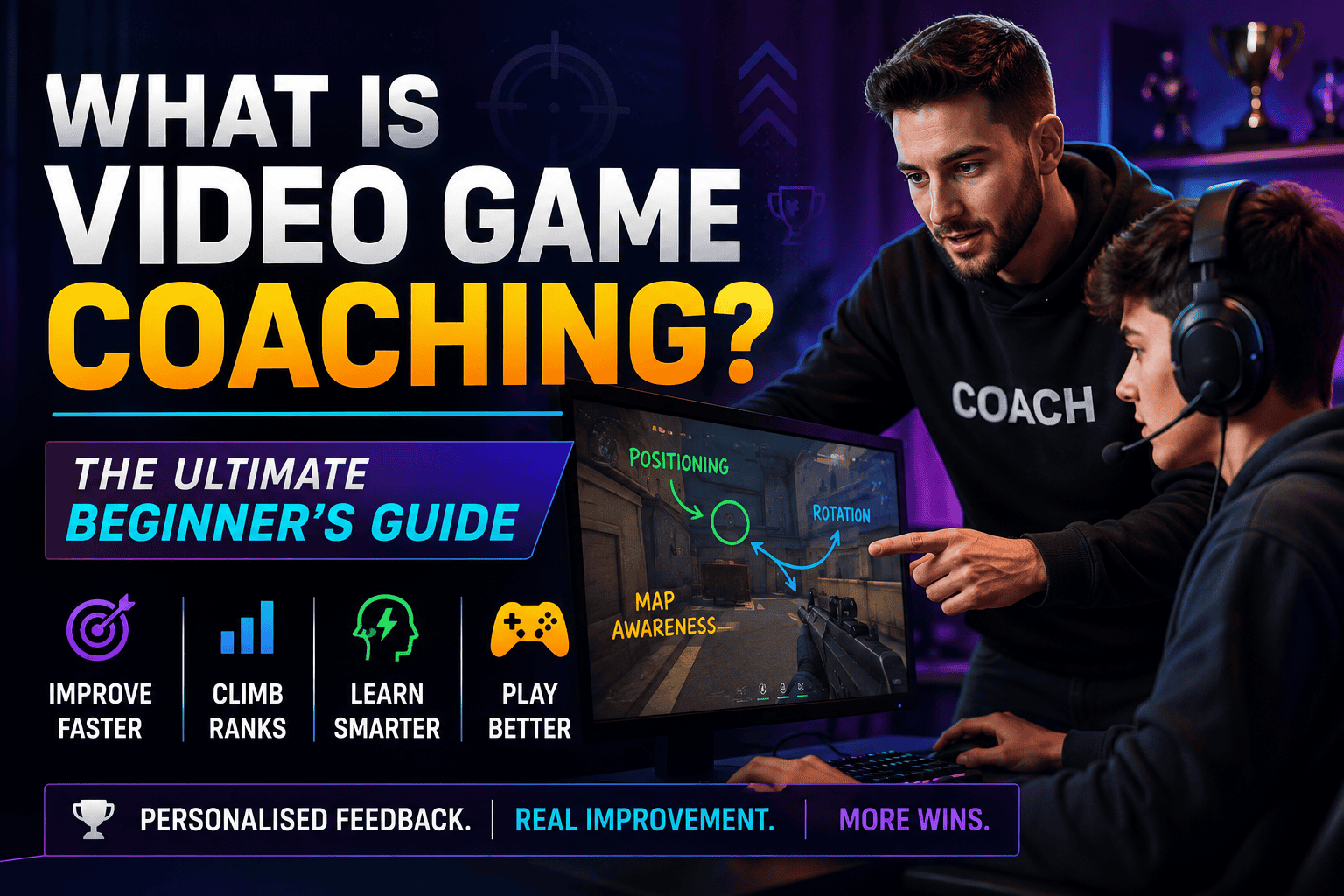
1. Introduction – What Is Video Game Coaching?
Ever feel like you’re putting in the hours but your rank isn’t getting the memo?
Maybe your aim has plateaued, you’re making the same mistakes every match or you’ve watched enough YouTube guides to qualify for a minor degree in Things I Should Be Doing But Somehow Am Not.
That’s where video game coaching comes in.
Gaming has become seriously competitive. Whether you’re climbing the ranks in Valorant, mastering League of Legends, improving your mechanics in Fortnite or simply trying to become the player your teammates think you should already be, there’s always another level to reach.
And you don’t need dreams of becoming an esports superstar to get some help reaching it.
Players use game coaching for all kinds of reasons – improving mechanics, understanding strategy, climbing ranks, mastering a particular role, fixing bad habits or simply getting better at a game they love.
Want to explore the topic further? Visit our Game Coaching Guides for more advice on improving your gameplay, finding the right coach and becoming a gaming coach.
🎮 The Quick Answer: What Is Video Game Coaching?
Video game coaching is personalised training where an experienced gamer or coach helps another player improve their skills, strategy and overall gameplay.
Think of it like having a personal trainer for gaming.
Instead of spending hundreds of hours trying to figure everything out yourself, a coach can watch how you play, identify weaknesses, explain what you’re doing wrong and help you focus on the areas most likely to improve your game.
Depending on the game and your goals, coaching can include:
🎯 Mechanics & Aim – Improve accuracy, movement, timing and other core gameplay skills.
🧠 Game Sense – Make smarter decisions and better understand what’s happening around you.
🗺️ Positioning & Strategy – Learn where to be, when to move and why certain plays work.
🤝 Teamwork & Communication – Improve callouts, coordination and playing effectively with others.
📈 Ranked Performance – Identify what’s holding you back and develop a plan for climbing higher.
🎥 Gameplay Reviews – Have a coach analyse recorded gameplay and pinpoint mistakes you may not notice yourself.
🏆 Competitive Development – Take your gameplay further if you’re aiming for tournaments, esports or higher-level competition.
Coaching can happen through live one-on-one sessions, team or group coaching, gameplay reviews, training drills and structured coaching programs.
And perhaps most importantly, it’s not just for elite players.
A complete beginner trying to understand a game can benefit from coaching just as much as an experienced competitive player chasing the next rank. The goals are different, but the idea is the same:
Get personalised advice, understand what you need to improve and spend less time guessing how to get better.
In this beginner’s guide, we’ll break down how video game coaching works, the different types of coaching available, what happens during a coaching session, which games you can get coaching for and how much coaching typically costs.
Ready to level up? Let’s get into it. 🎮🚀
2. How Does Video Game Coaching Work?
So, you’ve decided you’d like to get better at your game. What actually happens next?
Video game coaching is usually pretty straightforward: you choose a coach, explain what you want to improve and work together through live gameplay, reviews, training or a combination of all three.
Think less school classroom and more having an experienced player sitting beside you saying, “Yep… that’s why you keep dying there.”
The exact approach depends on the game, your skill level and what you’re trying to achieve, but most coaching follows a similar process.
🎯 1. Choose What You Want to Improve
Good coaching starts with a goal.
Maybe you want to:
📈 Climb to a higher rank
🎯 Improve your aim or mechanics
🧠 Make better decisions under pressure
🗺️ Improve positioning and map awareness
⚔️ Master a particular character, role or playstyle
🤝 Communicate better with teammates
🏆 Prepare for competitive matches or tournaments
🎮 Simply stop making the same mistakes every game
You don’t necessarily need to know exactly what’s holding you back. That’s part of what a coach can help you figure out.
But having a clear idea of where you want to go makes it much easier to build a coaching session around getting you there.
🔎 2. Your Coach Assesses Your Gameplay
Before trying to fix anything, a good coach needs to understand how you currently play.
This might involve watching you play live, reviewing a recorded match or asking about your rank, experience and biggest frustrations.
They’re looking for patterns.
Maybe your aim is great but your positioning keeps getting you eliminated. Perhaps you understand the mechanics but make poor decisions when matches get chaotic. Or maybe you’ve developed a bad habit you’ve repeated so many times that you don’t even notice it anymore.
That’s one of the biggest advantages of personalised coaching.
It’s difficult to spot your own mistakes when you’re busy making them.
An experienced coach can provide another set of eyes and identify where you’re losing opportunities.
🎮 3. You Play, Review or Train Together
Next comes the actual coaching.
Depending on the type of session, your coach might:
👀 Watch you play live and provide feedback
🎥 Review previously recorded gameplay with you
🎯 Run drills targeting specific mechanics
🧠 Talk through strategy and decision-making
🗺️ Review positioning, rotations or map awareness
⚔️ Practise specific matchups, characters or roles
🤝 Work on team communication and coordination
Some coaches give feedback while you’re playing. Others prefer to let you finish a match and then break down what happened afterwards.
Neither approach is automatically better.
The best format depends on how you learn and what you’re trying to improve.
💡 4. Your Coach Explains the “Why”
This is where good coaching separates itself from simply being told:
“Don’t do that.”
Knowing you made a mistake is useful.
Understanding why it was a mistake and what you should have done instead is what actually helps you improve.
A coach might explain why a particular position exposed you to an unnecessary risk, why you should have rotated earlier or why using an ability five seconds sooner completely changed the fight.
The goal isn’t to have someone make every decision for you.
It’s to help you understand the game well enough that you start making better decisions yourself.
🛠️ 5. You Get Something to Work On
One coaching session isn’t going to magically transform you into an esports legend overnight.
Tragic, we know.
Instead, a good coach should leave you with specific things to practise.
That could include:
🎯 Aim or mechanical drills
🗺️ Positioning exercises
🎥 Reviewing your own matches
🧠 Decision-making exercises
⚔️ Practising particular matchups
🤝 Communication drills
📋 A personalised improvement plan
This gives you something much more useful than “just play more.”
After all, playing another 500 matches while repeating exactly the same mistakes is technically practice. It’s just not particularly efficient practice.
🔄 6. Review, Improve & Repeat
If you book ongoing coaching, future sessions can be used to review your progress and tackle the next areas holding you back.
Your coach can see whether you’ve fixed previous mistakes, adjust your training and gradually introduce more advanced concepts as you improve.
That creates a simple cycle:
🎮 Play → 🔎 Review → 💡 Learn → 🎯 Practise → 📈 Improve
And that’s really how game coaching works.
It’s not about having someone play the game for you or magically handing you a higher rank.
You still do the playing.
The coach simply helps you understand what to work on, why it matters and how to improve faster than figuring everything out through trial and error.
Next, let’s look at the different types of video game coaching and which style might suit you best.
3. Types of Video Game Coaching
Not every player learns the same way – and thankfully, not every gaming coach teaches the same way either.
Some players want a coach watching their gameplay live and calling out mistakes as they happen. Others would rather send over a replay and have someone dissect exactly where things went sideways.
There are also coaches for complete beginners, ranked players, competitive teams and seriously advanced gamers chasing those last few percentage points of performance.
So, which type of coaching is right for you?
Let’s break down the main options.
🎯 One-on-One Coaching
One-on-one coaching gives you the coach’s full attention.
Sessions are built around your game, skill level, weaknesses and goals rather than following a generic training program.
Your coach might watch you play, analyse your decisions, work on specific mechanics or help you understand why you keep making the same mistakes.
One-on-one coaching can be particularly useful if you want to:
🎮 Improve specific gameplay skills
📈 Climb the ranked ladder
🎯 Fix weaknesses in your mechanics
🧠 Improve decision-making and game sense
⚔️ Master a particular character, class or role
🏆 Prepare for more competitive gameplay
The biggest advantage is simple – the session is about you.
If your aim is already cracked but your positioning is getting you deleted every second match, there’s little point spending half the session practising aim.
A good coach focuses on what will actually make you better.
👥 Group & Team Coaching
Gaming isn’t always a solo mission.
Group and team coaching involves multiple players working with a coach together.
This can work particularly well for competitive teams, groups of friends or players who want to improve how they perform alongside others.
Instead of focusing entirely on individual mechanics, team coaching can cover things such as:
🤝 Communication
📢 Callouts
🗺️ Positioning and rotations
⚔️ Team strategy
🧠 Decision-making
🎯 Roles and responsibilities
🔄 Coordinating plays
🏆 Competitive preparation
A team full of individually talented players can still fall apart spectacularly if everyone is doing their own thing.
Team coaching helps turn five good players into one good team.
Group sessions can also be more affordable than one-on-one coaching because the cost may be shared between several players.
🟢 Live Game Coaching
Want feedback while you’re actually playing?
Live coaching lets a coach watch your gameplay in real time and provide guidance during or immediately after matches.
Depending on the game and coaching style, the coach might watch through screen sharing, spectate your game or communicate with you through voice chat.
This gives them the chance to spot things such as:
👀 Mistakes as they happen
🗺️ Poor positioning
⏱️ Bad timing
🧠 Questionable decisions
🎯 Mechanical weaknesses
⚔️ Missed opportunities
The advantage is immediate feedback.
Instead of trying to remember why you made a decision three matches ago, you can discuss it while the situation is still fresh.
For players who learn best by playing and doing, live coaching can be particularly effective.
🎥 VOD & Gameplay Reviews
Don’t need someone watching over your shoulder while you play?
A VOD review lets you submit recorded gameplay for a coach to analyse.
The coach can review your match, identify mistakes and provide detailed feedback on what you’re doing well and what needs work.
VOD reviews are particularly useful for analysing:
🧠 Decision-making
🗺️ Positioning
⚔️ Engagements and fights
🔄 Rotations
🎯 Mechanics
🤝 Team play
❌ Repeated mistakes
💡 Missed opportunities
One of the biggest benefits is that gameplay can be paused, replayed and broken down in detail.
That questionable decision you made in half a second?
Your coach now has all the time in the world to tell you exactly why it was questionable. 😬
VOD reviews can also be a flexible option if you and your coach live in different timezones or can’t easily schedule a live session.
🎯 Coaching Tools & Drills
Sometimes you don’t need another full match.
You need to practise one thing until you’re better at it.
Coaches may use specific exercises, training tools and drills to target individual skills.
Depending on the game, this could include:
🎯 Aim training
⚡ Reaction exercises
🕹️ Movement practice
⌨️ Keybind or controller exercises
⚔️ Matchup practice
🗺️ Map knowledge
🧠 Decision-making scenarios
🔄 Ability or combo practice
Think of it like training in traditional sports.
A basketball player doesn’t improve their free throws by only playing full games. Sometimes you take the thing you want to improve and practise it repeatedly.
Gaming is no different.
📦 Coaching Packages
Not every problem can be fixed in an hour.
If you’re looking for longer-term improvement, some coaches offer coaching packages consisting of multiple sessions.
Instead of treating each session separately, you might work through a structured improvement plan over several days or weeks.
For example:
Session 1 – Gameplay assessment and goals
Session 2 – Mechanics and positioning
Session 3 – Strategy and decision-making
Session 4 – Gameplay review and progress check
This gives your coach the opportunity to see whether you’re actually improving between sessions and adjust the training accordingly.
Packages can be particularly useful for players working towards a specific goal such as reaching a new rank, preparing for competition or making significant improvements to their overall gameplay.
🏆 Coaching for Different Skill Levels
You don’t need to be an esports player to get game coaching.
Coaching can be useful at almost any skill level, with different video game coaching levels suited to players ranging from complete beginners through to competitive and professional gamers.
🌱 Beginner Coaching – Learn the fundamentals, understand game mechanics and build good habits from the start.
📈 Intermediate Coaching – Identify weaknesses, improve consistency and develop more advanced skills and strategies.
🔥 Advanced Coaching – Refine high-level mechanics, decision-making and competitive performance.
🏆 Pro & Competitive Coaching – Focus on advanced strategy, team performance, tournament preparation and the small details that can separate elite players.
The best coach isn’t necessarily the player with the highest rank or the biggest collection of tournament trophies.
It’s someone who understands where you are now, where you want to get to and how to help you bridge the gap.
🤔 Which Type of Game Coaching Is Best?
There’s no single “best” type of video game coaching.
It depends on what you want to improve and how you prefer to learn.
Want personalised attention and immediate feedback? One-on-one live coaching could be your best option.
Want someone to dig into your mistakes in detail? Try a VOD review.
Playing competitively with friends or teammates? Team coaching makes more sense.
Need to sharpen one particular skill? Coaching drills and training tools might be all you need.
And if you’re serious about making bigger improvements over time, a multi-session coaching package can provide a more structured path forward.
The important part isn’t choosing the fanciest coaching option.
It’s finding the format – and the coach – that matches your game, your goals and the way you learn best.
Next up, we’ll look at the specific skills and areas a video game coach can help you improve.
4. What Can a Video Game Coach Help You Improve?
So, what can a gaming coach actually help you get better at?
Quite a lot.
Video games might look simple from the outside – press buttons, defeat enemies, try not to get eliminated. Easy, right?
Anyone who’s spent hours stuck at the same rank knows otherwise.
Competitive games can involve mechanics, strategy, positioning, communication, timing, decision-making and game knowledge all happening at once. The tricky part isn’t always knowing that you’re struggling – it’s figuring out what’s actually holding you back.
That’s where a good coach can make a difference.
🎯 Mechanics & Aim
For many players, mechanics are the most obvious place to start.
Depending on the game, a coach can help you improve:
🎯 Aim and accuracy
⚡ Reaction time
🕹️ Movement
⌨️ Keyboard, mouse or controller technique
⚔️ Combos and ability usage
⏱️ Timing
🔄 Mechanical consistency
In shooters such as Valorant or Counter-Strike 2, that might mean improving crosshair placement, movement and recoil control.
In fighting games, it could mean cleaner combos and better execution.
In Rocket League, it might involve movement, aerial control and ball mechanics.
Small mechanical improvements can make a surprisingly big difference – especially when they’re repeated hundreds of times across your matches.
🧠 Game Sense & Decision-Making
Great mechanics can win fights.
Knowing which fights you should actually take is another matter entirely.
Game sense is your ability to understand what’s happening in a match and make good decisions based on the information available.
A coach can help you recognise things such as:
👀 When to attack or back off
⚔️ Which fights are worth taking
🔄 When to rotate
🎯 Which targets to prioritise
⏱️ When to use important abilities or resources
🧠 What your opponent is likely to do next
📊 How to react when the match isn’t going according to plan
This is one of the areas where coaching can be particularly valuable because poor decisions aren’t always obvious to the person making them.
Sometimes the problem isn’t that you lost the fight.
The problem is that you shouldn’t have been in that fight in the first place.
🗺️ Positioning & Map Awareness
Where you are can be just as important as what you’re doing.
Poor positioning can leave you exposed, isolate you from teammates or put you somewhere with very few options when things go wrong.
A coach can help you understand:
🗺️ Strong and weak positions
👀 Sightlines and angles
🛡️ Using cover effectively
🔄 Rotations
📍 Map control
⚔️ Where to position during fights
🤝 How your position relates to your teammates
🚪 When and where to retreat
Good positioning often looks less spectacular than landing an impossible shot, but it can quietly win you a lot more games.
After all, it’s considerably easier to hit your shots when you’re not standing somewhere terrible.
⚔️ Strategy & Tactics
Knowing how to play a game and knowing how to win it aren’t always the same thing.
Coaching can help you understand the bigger strategic picture.
Depending on the game, that could include:
🧠 Match strategy
🎯 Objective priorities
🔄 Rotations and timing
⚔️ Offensive and defensive tactics
🧩 Team compositions
💰 Resource or economy management
🎮 Character, hero or champion selection
🔎 Understanding opponents and adapting to them
Rather than simply reacting to whatever happens next, better strategy helps you start thinking one or two moves ahead.
That’s particularly important as you move into higher ranks, where everyone already knows which button makes their character shoot.
🤝 Teamwork & Communication
If you’re playing a team-based game, your individual skill is only part of the equation.
You can be mechanically brilliant and still make life miserable for everyone else on your team.
A coach can help improve:
📢 Clear callouts
🤝 Team coordination
🎯 Role responsibilities
🔄 Coordinating attacks and rotations
👂 Listening and reacting to teammates
🧠 Making decisions as a team
🏆 Leadership and shot-calling
Good communication isn’t about talking constantly.
It’s about providing the right information at the right time without turning voice chat into your personal podcast.
For competitive teams, these skills can be just as important as mechanics.
🎮 Characters, Roles & Playstyles
Many games become much more complicated once you start specialising.
A League of Legends jungle player needs different knowledge from a support player. A Valorant Controller approaches a match differently from a Duelist. A World of Warcraft tank has very different responsibilities from a healer.
A specialist coach can help you improve your understanding of:
🎮 Specific characters, heroes or champions
⚔️ Roles and responsibilities
🔥 Matchups
🧩 Builds and loadouts
🎯 Role-specific mechanics
🧠 Advanced strategies
🔄 How your role fits into the wider team
This is where finding a coach with experience relevant to what you actually play becomes particularly important.
Being amazing at the game doesn’t automatically make someone amazing at every role within it.
📈 Ranked & Competitive Performance
Trying to climb the ranks?
A coach can look beyond individual matches and help identify patterns that may be slowing your progress.
That could involve:
📊 Reviewing your overall performance
❌ Identifying repeated mistakes
🎯 Setting realistic improvement goals
🧠 Developing better ranked-game habits
🔄 Improving consistency
🏆 Preparing for higher levels of competition
📋 Creating a structured practice plan
The goal shouldn’t simply be “win my next match.”
A good coaching plan focuses on becoming a better player so you’re capable of winning more matches over time.
Rank is usually the result.
Improvement is the process.
🧘 Mindset & Consistency
Sometimes the thing holding you back isn’t your aim, mechanics or game knowledge.
It’s what happens after you’ve lost three matches in a row and suddenly every teammate appears to have been personally assigned to ruin your evening.
Competitive gaming can be frustrating.
Coaching can help players work on:
🧘 Staying composed under pressure
🧠 Maintaining focus
🔄 Recovering after mistakes
😤 Managing frustration and tilt
🎯 Keeping attention on improvement
📈 Developing consistent playing habits
🏆 Handling competitive pressure
A coach isn’t necessarily a sports psychologist, but an experienced player can help you develop better habits around how you approach practice, competition and setbacks.
Because playing angry rarely unlocks the secret hidden performance buff we keep hoping for.
🎥 Spotting the Mistakes You Don’t See
Perhaps the biggest benefit of coaching is also the simplest:
Someone else is watching.
When you’re playing, you’re processing everything happening in the game at once. That makes it surprisingly difficult to objectively analyse your own performance.
You might think your biggest problem is aim.
A coach might watch three matches and realise you’re consistently entering fights from poor positions.
You might think your teammates are the problem.
The replay may have… other opinions. 👀
An experienced coach provides an outside perspective and can help identify the small habits, repeated mistakes and missed opportunities that are difficult to notice yourself.
Once you know what’s actually holding you back, you can stop practising everything and start focusing on the things that matter most.
🎯 Better feedback. Smarter practice. Faster improvement.
Next, let’s look at what actually happens during a video game coaching session – from meeting your coach to reviewing your gameplay and putting that advice into practice.
5. What Happens During a Video Game Coaching Session?
You’ve found a coach, booked a time and you’re ready to level up.
So what actually happens when the session starts?
There’s no single formula for game coaching. A session might involve live gameplay, screen sharing, VOD reviews, targeted drills, strategy discussions or playing alongside your coach.
It all depends on the game, your goals and the type of coaching you’ve booked.
But most good coaching sessions follow a fairly simple path.
👋 1. Meet Your Coach & Talk About Your Goals
Before anyone starts analysing your questionable ranked decisions, your coach will usually spend a few minutes getting to know you as a player.
They may ask about your:
- 🎮 Current game and rank
- ⏱️ Playing experience
- 🎯 Goals
- 💪 Strongest areas
- 🔧 Skills you want to improve
- 😤 Biggest frustrations
- 🏆 Competitive ambitions
You don’t need to arrive with a detailed training plan.
Something as simple as “I’ve been stuck at this rank for months and I don’t know why” gives a good coach somewhere to start.
This initial conversation helps make sure the session focuses on your game and your goals, rather than becoming a generic lesson you could have watched online for free.
🔎 2. Assess Your Current Gameplay
Next, your coach needs to see what they’re working with.
Depending on the coaching format, they might:
- 👀 Watch you play a live match
- 🎥 Review a replay or recorded game
- 🎮 Spectate your gameplay
- 🕹️ Play alongside you
- 🎯 Ask you to complete specific drills
- 📊 Review your rank, stats or match history
This gives the coach a chance to identify your strengths, weaknesses and recurring habits.
And this is where things can get interesting.
The problem you think you have isn’t always the problem you actually have.
Maybe you’re convinced your aim is holding you back, but your coach notices you’re constantly taking fights from terrible positions.
Maybe you think your strategy is the issue, but you’re repeatedly wasting an important ability ten seconds before you need it.
A fresh pair of experienced eyes can reveal a lot.
🎮 3. Play, Review & Get Feedback
Now you’re into the heart of the session.
Your coach will start working through the areas that can improve your gameplay.
In a live session, they may provide feedback while you play or wait until natural breaks between matches.
During a VOD review, they can pause, rewind and analyse specific moments in detail.
You might hear feedback around:
- 🎯 Aim and mechanics
- 🗺️ Positioning
- 🧠 Decision-making
- ⚔️ Fight selection
- 🔄 Rotations
- ⏱️ Timing
- 🤝 Communication
- 🎮 Character or role-specific play
- ❌ Repeated mistakes
- 💡 Opportunities you didn’t spot
The goal isn’t to point out every tiny thing you did wrong.
If your coach spends an hour listing 147 mistakes, congratulations – you’ve purchased an anxiety simulator.
Good coaching should identify the most important areas to work on first.
💡 4. Understand Why Things Went Wrong
Knowing that something went wrong is only half the lesson.
A useful coach explains why.
Instead of:
❌ “Your positioning was bad.”
You want something closer to:
💡 “By moving here, you exposed yourself to two opponents while cutting yourself off from your teammate. Holding this position would have given you cover and a safer escape route.”
That’s the difference between criticism and coaching.
Good feedback gives you something you can recognise and apply the next time the same situation appears.
The aim isn’t for your coach to make decisions for you forever.
It’s to help you develop the knowledge to make better decisions yourself.
🎯 5. Practise Specific Skills
Once a weakness has been identified, your coach may spend part of the session helping you work on it directly.
That could involve:
- 🎯 Aim or accuracy drills
- 🕹️ Movement exercises
- ⚔️ Practising particular matchups
- 🔄 Rotation exercises
- 🗺️ Map walkthroughs
- 🎮 Character or role-specific practice
- 🧠 Decision-making scenarios
- 🤝 Communication exercises
This is where coaching becomes much more targeted than simply playing more matches.
If one particular skill is holding you back, you can isolate it and practise it deliberately.
Playing more isn’t always the answer. Practising better often is.
❓ 6. Ask Questions
A coaching session shouldn’t be a one-way lecture.
Ask questions.
If you don’t understand why the coach suggested something, ask them to explain it.
If there’s a particular situation that keeps causing you trouble, bring it up.
If you want to know how a higher-ranked player would approach a particular matchup, objective or decision, ask.
Some useful questions might include:
- 💬 “What should I have done differently there?”
- 🎯 “What’s the biggest thing holding me back?”
- 🗺️ “Where should I have positioned instead?”
- 🧠 “How would you read that situation?”
- ⚔️ “When should I take that fight?”
- 📈 “What should I focus on if I want to reach the next rank?”
You’re paying for access to someone’s experience and knowledge.
Use it.
📋 7. Leave With Something to Work On
A good coaching session shouldn’t end when the call does.
By the end, you should have a clearer idea of:
What you’re doing well.
What’s holding you back.
What you should work on next.
Your coach may recommend:
- 🎯 Specific drills
- 🎥 Reviewing your own gameplay
- 📋 A practice routine
- 🗺️ Areas of the game to study
- ⚔️ Particular mechanics or matchups to practise
- 🧠 Habits to focus on during matches
- 📈 Goals to work towards before your next session
Try not to fix everything at once.
If your coach identifies five weaknesses, focusing properly on the most important one or two is usually more useful than vaguely trying to improve all five.
🔄 8. Follow-Up Sessions & Progress
One session can reveal a lot, but meaningful improvement usually happens through practice and repetition.
If you continue working with the same coach, future sessions can build on what you’ve already learned.
Your coach can review whether you’ve improved, identify new weaknesses and adjust your training as your skill level changes.
That creates a simple improvement loop:
🎮 Play → 🔎 Review → 💡 Learn → 🎯 Practise → 📈 Improve
Then do it again.
The goal isn’t to become dependent on coaching.
Quite the opposite.
Good coaching should gradually help you become better at understanding your own gameplay, recognising your mistakes and knowing how to improve them.
⏱️ How Long Does a Game Coaching Session Last?
Session length varies depending on the coach, game and type of coaching.
A focused VOD review might be relatively short, while live coaching, team training or an in-depth gameplay analysis could take considerably longer.
Many coaches also offer different session lengths or packages, allowing you to choose something that suits your goals and budget.
For your first session, don’t worry about trying to cram every weakness you’ve ever had into one booking.
Pick a few priorities and give the coach enough time to actually work through them.
Quality feedback on one important problem beats speed-running twenty problems and remembering none of them.
🚀 What Should You Expect From Your First Coaching Session?
Your first coaching session shouldn’t feel like an exam.
You’re there to learn, not prove how good you already are.
Expect your coach to ask questions, watch you play, identify areas for improvement and give you practical feedback you can start using immediately.
And don’t worry about making mistakes in front of them.
That’s rather the point.
The more accurately your coach sees how you really play, the more useful their advice can be.
Come prepared to play, ask questions and take feedback onboard.
You might be surprised by how quickly an outside perspective changes the way you see your own game.
Next up – which games can you actually get video game coaching for? 🎮
6. What Games Can You Get Video Game Coaching For?
Think game coaching is only for esports pros sweating through high-level ranked matches?
Not even close.
You can find coaching across a huge range of games – from competitive shooters and MOBAs to sports games, fighting games, MMOs and even games where building, strategy or creativity matter just as much as raw mechanics.
As a general rule, if a game has skill, strategy, competition or a learning curve, there’s probably something a good coach can help you improve.
Here are some of the most popular types of games for coaching.
🔫 FPS & Tactical Shooters
First-person shooters are a natural fit for coaching because there’s much more to winning than simply having good aim.
Popular games include:
- 🎯 Valorant
- 💥 Counter-Strike 2
- 🪖 Call of Duty
- 🛡️ Overwatch 2
- 🔥 Apex Legends
- 🏗️ Fortnite
Depending on the game, coaching can focus on aim, movement, positioning, map knowledge, recoil control, ability usage, communication and decision-making.
And yes, sometimes the answer really is stop running around that corner without checking it.
🧠 MOBAs
Games such as League of Legends and Dota 2 have enormous learning curves, making them particularly well suited to coaching.
A MOBA coach might help with:
- 🗺️ Map awareness
- ⚔️ Matchups
- 🧠 Decision-making
- 💰 Farming and resource management
- 🔄 Rotations
- 🎮 Champion or hero mastery
- 🤝 Team fighting
- 📈 Ranked progression
Even experienced players can have major gaps in their game knowledge.
When a game contains dozens or even hundreds of playable characters, countless interactions and an ever-changing meta, there’s always something else to learn.
⚽ Sports & Racing Games
Traditional sports aren’t the only place where coaching can improve your technique.
Gaming coaches can also help players improve in titles such as:
- ⚽ EA Sports FC
- 🏀 NBA 2K
- 🏎️ Gran Turismo
- 🏁 F1
- 🚗 Rocket League
Coaching might cover mechanics, formations, tactics, defending, attacking, car control, racing lines, decision-making and competitive strategy, depending on the game.
Rocket League is an especially good example.
At first glance, it’s cars playing football.
Then someone starts flying upside down across the arena and you realise there may be a little more to learn.
⚔️ Fighting Games
Fighting games reward precision, timing and an almost uncomfortable amount of knowledge about what your opponent might do next.
Popular coaching games can include:
- 👊 Street Fighter 6
- 🥋 Tekken 8
- 🐉 Mortal Kombat
- ⚡ Super Smash Bros.
A fighting game coach can help with:
- ⚡ Combos and execution
- 🛡️ Defence
- 🎯 Punishes
- 🧠 Matchup knowledge
- ⏱️ Timing
- 📏 Spacing
- 👀 Reading opponents
- 🔄 Adapting during matches
Learning the buttons gets you started.
Learning when, why and against whom to press them is where things get interesting.
🧙 MMOs & RPGs
Coaching isn’t limited to traditional competitive games.
MMOs and RPGs can involve complex systems, classes, builds and group content where experienced guidance can save a lot of trial and error.
Games such as World of Warcraft can offer coaching around:
- 🧙 Classes and specialisations
- ⚔️ Combat rotations
- 🛡️ Tanking
- 💚 Healing
- 🏹 Damage optimisation
- 🐉 Raids and dungeons
- 🎒 Builds and equipment
- 🤝 Group mechanics
- 🏆 PvP
Instead of spending hours wondering why everyone else’s damage numbers appear to belong to a completely different game, a knowledgeable player can help identify what you’re missing.
♟️ Strategy Games
Strategy games are another natural home for coaching.
These games can place less emphasis on reaction speed and more on planning, resource management, decision-making and understanding your opponent.
Depending on the title, coaching might focus on:
- 🧠 Strategic decision-making
- 💰 Resource management
- 🗺️ Map control
- ⚔️ Build orders
- 🔎 Scouting
- ⏱️ Timing
- 🔄 Adapting strategies
- 🏆 Competitive play
In games where one questionable decision ten minutes ago quietly destroys your entire match, having someone explain which questionable decision it was can be rather useful.
🧱 Sandbox & Creative Games
Even games without a traditional ranked ladder can have plenty to learn.
Take Minecraft.
Coaching or guided sessions could help players learn things such as:
- 🏗️ Building techniques
- 🔴 Redstone
- ⚔️ PvP
- 🏃 Speedrunning
- 🌎 Survival strategies
- 🧭 Exploration
- ⚙️ Advanced game mechanics
The goal isn’t necessarily to climb a rank.
Sometimes you simply want to learn something new, get better at what you enjoy or stop building houses that look suspiciously like wooden boxes.
That’s reason enough.
🎯 What Makes a Game Good for Coaching?
Some games naturally attract more coaching than others.
Games tend to be particularly well suited to coaching when they have:
- 📈 A strong skill progression
- 🏆 Competitive or ranked modes
- 🧠 Deep strategy
- 🎯 Mechanics that can be practised and improved
- 🎮 Different characters, classes or roles to master
- 🤝 Team-based gameplay
- 🔄 Regular updates and changing metas
- 👥 Large, active player communities
The bigger the difference between a beginner and an experienced player, the more opportunity there usually is for someone knowledgeable to help bridge that gap.
🔍 Finding Coaching for Your Game
The most important thing isn’t whether a game appears on a “best games for coaching” list.
It’s finding a coach who actually understands your game and the area you want to improve.
If you’re trying to master a specific Valorant Agent, improve as a League of Legends Jungler or perfect your rotations in Rocket League, a coach with relevant specialist experience will usually be more useful than someone offering generic gaming advice.
Look at the coach’s game experience, skill level, coaching focus and the type of sessions they offer before making your choice.
And if your favourite game isn’t one of the obvious esports giants, don’t write coaching off.
If there’s something to master, there’s probably someone out there who’s already mastered it – and can help you get there faster. 🎮🚀
Next, we’ll tackle one of the biggest questions before booking a session – is video game coaching actually worth it?
7. Is Video Game Coaching Worth It?
So, is video game coaching actually worth paying for?
For the right player – absolutely.
A good gaming coach can help you identify mistakes, improve specific skills and focus your practice on the things that actually matter. These are just some of the benefits of hiring a video game coach, particularly when you want personalised feedback rather than generic advice. Instead of spending another few hundred hours hoping you’ll somehow get better through sheer determination, coaching gives you feedback based on how you actually play.
That doesn’t mean everyone needs a coach.
If you’re happily playing casually, improving naturally and having a great time, keep doing exactly that. Gaming doesn’t suddenly require homework.
But if you’re serious about improving, stuck at the same level or simply want to learn faster, coaching can give you a useful shortcut – not around the work, but around the guesswork.
🚀 Improve Faster With Focused Feedback
You can learn a huge amount about almost any game for free.
YouTube videos, streams, guides, communities and practice modes can all help you improve.
The problem is that most of them can’t tell you what you’re doing wrong.
A guide might explain perfect positioning.
A coach can watch your gameplay and tell you why your positioning keeps getting you eliminated.
That’s a pretty important difference.
Personalised coaching helps you spend more time working on weaknesses that actually affect your performance and less time practising things you’ve already mastered.
Less guessing. More focused improvement.
👀 Spot Mistakes You Don’t Notice
Everyone develops habits.
Some are good.
Some involve repeatedly peeking the same angle, losing the same fight and remaining completely convinced that next time will somehow be different.
When you’re concentrating on playing, it can be difficult to step outside the game and objectively analyse everything you’re doing.
A coach can spot patterns you may have stopped noticing:
- ❌ Repeated positioning mistakes
- ⚔️ Poor fight selection
- ⏱️ Bad timing
- 🧠 Predictable decisions
- 🎯 Mechanical weaknesses
- 🔄 Missed rotations
- 🤝 Communication problems
- 💡 Opportunities you’re overlooking
Sometimes one small adjustment can fix a problem that’s been costing you games for months.
You just need someone to notice it first.
🎯 Get Advice Built Around You
Generic gaming advice has an obvious limitation.
It’s generic.
“Improve your aim.”
Great. Thanks.
A coach can go considerably deeper.
They can look at your game, experience, playstyle and goals before deciding what you should actually work on.
A beginner learning Valorant doesn’t need the same advice as an Immortal player trying to squeeze another few percent out of their performance.
Likewise, someone struggling with mechanics needs a different approach from someone with excellent mechanics but questionable decision-making.
Good coaching meets you where you are now and helps you work towards where you want to be.
⏱️ Make Better Use of Your Gaming Time
There’s nothing wrong with learning through trial and error.
Gamers have been doing it forever.
But trial and error can involve an awful lot of… well, error.
If you’ve only got a few hours each week to play, spending those hours repeatedly making the same mistakes isn’t particularly efficient.
Coaching can help you identify what deserves your attention, giving your practice more direction.
Instead of:
🎮 Play → Lose → Queue Again → Repeat
you can start moving towards:
🎮 Play → 🔎 Review → 💡 Understand → 🎯 Practise → 📈 Improve
You’re still putting in the work.
You’re just giving that work somewhere useful to go.
📈 Break Through a Plateau
Almost every competitive gamer eventually hits one.
The dreaded plateau.
You improve quickly at first, climb through a few ranks and then…
Nothing.
Same rank. Same mistakes. Same promotion game ending in emotional devastation.
Plateaus often happen because the easy improvements have already been made. Getting to the next level requires identifying smaller weaknesses that aren’t always obvious.
That’s where an experienced coach can be particularly useful.
They may identify changes to your mechanics, strategy, positioning or decision-making that help you start progressing again.
Sometimes you don’t need to completely reinvent how you play.
You just need to find the next thing holding you back.
🏆 Work Towards a Specific Goal
Coaching can be especially worthwhile when you have a clear goal.
Maybe you want to:
- 📈 Reach a particular rank
- 🎯 Master a specific skill
- ⚔️ Learn a new role or character
- 🏆 Prepare for competitive play
- 🤝 Improve with your team
- 🎮 Get better at a game you genuinely enjoy
- 🔥 Push your gameplay as far as you can
A coach can help turn a vague ambition like “I want to get better” into something much more practical.
What needs improving?
What should you practise?
How should you practise it?
What progress should you look for?
Having a clear direction can make improvement feel much more achievable.
💰 When Might Game Coaching Not Be Worth It?
Game coaching isn’t magic.
And despite what your ranked teammates may have told you, there is no secret button that instantly makes someone good.
Coaching may not be worth paying for if:
- 🎮 You’re completely happy playing casually
- 💰 The cost doesn’t fit comfortably within your budget
- 📚 You haven’t yet tried readily available free learning resources
- 🕹️ You’re not interested in practising between sessions
- 🎯 You don’t have any particular desire to improve
- 👎 The coach isn’t a good match for your goals or learning style
Perhaps most importantly, a coach can show you what to improve, but they can’t practise for you.
If someone gives you excellent feedback and you immediately ignore all of it, your results may prove disappointingly familiar.
🤔 Coaching vs Free Gaming Guides
It doesn’t necessarily have to be one or the other.
Free gaming guides are fantastic for learning general knowledge, strategies, mechanics and concepts.
Coaching becomes more valuable when you want that information applied specifically to your gameplay.
A simple way to think about it:
📖 Gaming Guides: “Here’s how good positioning works.”
🎯 Game Coaching: “Here’s why your positioning is hurting you and what you should do differently.”
For many players, the best approach is a combination of both.
Use guides, videos and other free resources to build your knowledge, then use coaching when you want personalised feedback, targeted improvement or help breaking through something you can’t solve yourself.
⭐ So, Is Gaming Coaching Worth the Money?
If you’re serious about improving and find the right coach, game coaching can absolutely be worth it.
You’re not paying someone to magically make you better.
You’re paying for their experience, perspective and personalised feedback – and potentially saving yourself a lot of time figuring out the same lessons alone.
The value ultimately depends on your goals.
For a casual player who’s already having fun? You probably don’t need it.
For someone who’s stuck, wants to improve faster or is serious about reaching the next level?
Having an experienced player show you exactly where you’re going wrong can be a game-changer.
Of course, whether it’s worth it also depends on what you’re actually paying.
So next up, let’s look at how much video game coaching costs and what you can expect for your money. 💰🎮
8. How Much Does Video Game Coaching Cost?
So, you’ve decided game coaching could help.
Now for the question your wallet has been waiting for:
How much does video game coaching actually cost? 💰
There’s no single price for gaming coaching. Video game coaching costs can vary considerably depending on the game, coach, session length, coaching format, skill level and experience you’re looking for.
A newer coach offering a straightforward gameplay review might charge relatively little, while an experienced high-ranked player, specialist coach or esports professional may charge significantly more for their time.
The good news?
There’s usually a range of options, so you don’t necessarily need an esports-sized budget to get useful coaching.
💰 What Affects the Price of Game Coaching?
Several factors can influence what you’ll pay.
🏆 Coach Experience & Skill Level
Experience is one of the biggest factors.
A highly ranked player with years of competitive experience will often charge more than someone newer to coaching.
Coaches with professional or esports backgrounds may command premium prices, particularly when they’re offering advanced or specialised coaching.
But remember – the most accomplished player isn’t automatically the best coach for you.
If you’re a beginner learning the fundamentals, you probably don’t need a world champion explaining which button makes you jump.
Match the coach’s experience to what you’re actually trying to achieve.
🎮 The Game You’re Playing
Coaching prices can also vary between games.
Games with large competitive communities, established ranked systems and active esports scenes tend to have more coaches available.
Popular coaching games might include:
- 🎯 Valorant
- 🧠 League of Legends
- 💥 Counter-Strike 2
- 🏗️ Fortnite
- 🚗 Rocket League
- 🛡️ Overwatch 2
- 🔥 Apex Legends
- ⚽ EA Sports FC
- ⚔️ Fighting games
- 🧙 World of Warcraft
More niche games may have fewer coaches available, particularly if you’re looking for someone with specialist high-level knowledge.
⏱️ Session Length
Pretty straightforward – more coaching time will generally cost more.
Depending on the coach and type of training, you might find:
- ⚡ Short focused sessions
- 🕐 One-hour coaching sessions
- 🎮 Extended coaching sessions
- 📦 Multi-session packages
- 🏆 Longer-term coaching programs
Don’t automatically assume longer is better.
If you have one very specific problem, a focused session may be all you need.
If you’re trying to overhaul your entire game, that’s probably not getting solved during your lunch break.
🕹️ Coaching Format
The way coaching is delivered can affect the price too.
Live one-on-one coaching gives you direct access to the coach and personalised feedback in real time, so it may cost more than less interactive formats.
Other options can include:
- 👀 Live gameplay coaching
- 🎥 VOD and replay reviews
- 👥 Group coaching
- 🤝 Team coaching
- 🎯 Specialist drills
- 📋 Structured coaching packages
A VOD review, for example, may offer a more focused way to have your gameplay analysed without requiring a full live coaching session.
Group sessions may also provide better value when several players want to learn together.
🎯 What Are You Actually Paying For?
This is an important question.
You’re not simply paying someone to sit there and watch you play.
At least, you shouldn’t be.
A good gaming coach is selling access to their knowledge, experience and ability to analyse your gameplay.
You’re potentially paying for someone to:
- 👀 Identify mistakes you haven’t noticed
- 🧠 Explain complex strategies
- 🎯 Find the weaknesses holding you back
- 💡 Provide personalised feedback
- 📈 Build an improvement plan
- ⚔️ Teach advanced techniques
- 🎥 Analyse your gameplay
- ⏱️ Help you practise more efficiently
A player may have spent thousands of hours learning a game.
Good coaching gives you access to some of that experience without requiring you to discover every lesson the hard way yourself.
You’re not buying a better rank. You’re buying knowledge that can help you become a better player.
📦 Are Coaching Packages Better Value?
If you’re serious about improving over time, a coaching package can sometimes make more sense than booking individual sessions.
A package might include several sessions covering different stages of your development.
For example:
Session 1: 🔎 Gameplay assessment
Session 2: 🎯 Mechanics and positioning
Session 3: 🧠 Strategy and decision-making
Session 4: 📈 Progress review and next steps
This gives the coach time to see whether you’re applying their advice and how your gameplay changes between sessions.
Some coaches may also offer better overall value when several sessions are booked together.
But don’t feel pressured into buying a large package immediately.
If you’ve never worked with a particular coach before, booking one session first can be a smart way to see whether their coaching style works for you.
👥 Can Group Coaching Cost Less?
Potentially, yes.
If several players are learning together, group or team coaching can spread the cost across multiple people.
This can be particularly useful for:
- 🤝 Established gaming teams
- 👥 Groups of friends
- 🏆 Competitive squads
- 🎮 Players learning similar skills
You may receive less individual attention than with one-on-one coaching, but if your goal involves teamwork, communication or coordinated strategy, having everyone in the session can actually be an advantage.
💡 Don’t Just Look for the Cheapest Coach
Everyone loves a bargain.
But choosing a coach purely because they’re the cheapest option isn’t always the best strategy.
Compare what you’re actually getting.
Look at:
- 🏆 The coach’s experience
- 🎮 Their knowledge of your game
- 🎯 Their specialisation
- 👨🏫 Their coaching experience
- ⭐ Reviews from other players
- ⏱️ Session length
- 🕹️ Coaching format
- 📋 What’s included
- 💰 Overall price
A cheaper coach who gives generic advice may offer less value than someone who quickly identifies the exact problem holding you back.
Equally, more expensive doesn’t automatically mean better.
You don’t need to hire an esports legend to teach you the basics if a good experienced coach can do it for considerably less.
⭐ Think About Value, Not Just Price
The better question may not be:
“How cheap can I get game coaching?”
Instead, ask:
“What am I getting for my money?”
If a coaching session helps you identify a mistake you’ve been repeating for months, gives you a better way to practise and makes the game more enjoyable, that could represent excellent value.
If you pay for an hour and leave with nothing more useful than “keep practising”…
Maybe not so much.
Before booking, consider whether the coach’s experience, specialisation, reviews and coaching format match what you actually want to achieve.
🎮 Start With One Session
If you’re new to game coaching, you don’t need to go all-in immediately.
Start with a single session.
Use it to see:
- 🤝 Whether you get along with the coach
- 💬 Whether they explain things clearly
- 🎯 Whether their feedback feels useful
- 🧠 Whether they understand your weaknesses
- 📈 Whether you leave knowing what to work on next
If the session clicks, you can always book another or look at a longer coaching package.
If it doesn’t, try someone else.
The goal isn’t to find the most expensive coach or the cheapest coach.
It’s to find the coach who gives you the most useful path towards becoming a better player. 🎯
And that brings us neatly to the next question – how do you choose the right gaming coach in the first place?
9. How to Choose the Right Gaming Coach
Finding a gaming coach is easy.
Finding the right gaming coach for you takes a little more thought.
The highest-ranked player, biggest streamer or person with the most impressive profile isn’t automatically going to be the best teacher. Being ridiculously good at a game and being ridiculously good at explaining it are two very different skills.
A great coach should understand your game, your goals and how to help you improve.
Before booking a session, here are some of the biggest things to look for.
🎮 Look for Experience in Your Game
Start with the obvious one.
Your coach should know the game you’re trying to improve at – and ideally know the specific role, character, mode or skill you want help with.
If you’re trying to improve as a Jungler in League of Legends, a coach specialising in jungle strategy and decision-making may be more useful than a higher-ranked player who mainly plays another role.
The same applies across different games.
Look for experience relevant to:
- 🎮 Your game
- ⚔️ Your role, character or class
- 🏆 Your competitive level
- 🎯 The skills you want to improve
- 📈 The rank you’re trying to reach
Relevant experience beats impressive experience that has nothing to do with your goals.
🏆 Check Their Skill & Experience
Rank and competitive experience still matter.
If someone is teaching you how to reach a higher level, you’d reasonably expect them to understand what playing at that level requires.
Depending on what you’re looking for, consider things such as:
- 🏆 Current or previous rank
- 🎮 Years playing the game
- ⚔️ Competitive experience
- 🥇 Tournament or esports experience
- 🎯 Specialist knowledge
- 👨🏫 Previous coaching experience
But don’t get hypnotised by a shiny rank badge.
A highly skilled player who can’t explain why they make certain decisions may not be as useful as a slightly lower-ranked coach who’s excellent at identifying problems and communicating solutions.
👨🏫 Look for Coaching Ability – Not Just Gaming Ability
This one matters.
Playing well and teaching well aren’t the same thing.
A good gaming coach should be able to:
- 💬 Explain concepts clearly
- 👀 Identify mistakes without simply criticising them
- 💡 Explain why something went wrong
- 🎯 Give practical ways to improve
- 🔄 Adapt their approach to your skill level
- ❓ Answer questions
- 📈 Help you set realistic goals
- 🤝 Communicate respectfully
You want someone who can turn their experience into advice you can actually use.
“Just aim better” may technically be accurate.
It’s not much of a coaching session.
🎯 Match the Coach to Your Goals
Before choosing a coach, ask yourself:
What am I actually trying to achieve?
Maybe you want to climb the ranked ladder.
Maybe your mechanics need work.
Maybe you’re learning a completely new role.
Maybe you’ve hit a plateau and can’t work out what’s stopping you from progressing.
Or perhaps you just started playing and would like someone to explain what on earth is going on.
Different goals can require different coaches.
For example:
🌱 New player – Look for someone patient who specialises in fundamentals.
📈 Ranked player – Look for experience around your rank and the levels above it.
🎯 Mechanics-focused player – Find someone specialising in the specific mechanical skills you want to improve.
🤝 Competitive team – Look for a coach experienced with strategy, communication and team play.
🏆 Advanced player – Specialist or high-level competitive experience becomes much more important.
The clearer you are about your goal, the easier it becomes to find someone who can help you reach it.
🕹️ Choose the Right Coaching Style
Remember all those coaching formats we covered earlier?
This is where they matter.
Some coaches specialise in live one-on-one coaching.
Others focus on VOD reviews, drills, team coaching or structured packages.
Think about how you learn best.
Would you rather have someone:
- 👀 Watch you play live?
- 🎥 Analyse your recorded gameplay?
- 🎯 Work through specific drills with you?
- 🧠 Explain strategy away from the pressure of a live match?
- 🎮 Play alongside you?
- 📋 Build a longer-term improvement plan?
There’s no universally superior format.
The best option is the one that suits what you’re trying to learn and how you prefer to learn it.
⭐ Check Reviews & Feedback
If previous customers have left reviews, read them.
Don’t just look at the star rating.
Look at what people actually say.
Useful reviews might tell you whether the coach:
- 💬 Communicates clearly
- ⏰ Shows up on time
- 🎯 Gives useful, specific advice
- 🤝 Is patient and easy to work with
- 📈 Helps players improve
- 🎮 Understands the game at the required level
- 👨🏫 Is actually good at teaching
A review saying “great coach” is nice.
A review explaining that the coach identified a positioning problem, provided specific drills and helped someone climb out of a rank they’d been stuck in tells you considerably more.
💰 Consider Price – But Don’t Choose on Price Alone
The cheapest coach isn’t automatically the best deal.
The most expensive coach isn’t automatically the best either.
What matters is value.
Consider the coach’s experience, session length, coaching format, specialisation and what you’ll actually receive.
A shorter session with an excellent coach who quickly identifies your biggest weakness could be more valuable than several hours of generic advice.
Likewise, beginners don’t necessarily need an elite esports coach charging premium rates to explain the fundamentals.
Choose the level of coaching that makes sense for your goals and budget.
🌎 Check Availability & Timezones
The perfect coach isn’t particularly useful if you’re never awake at the same time.
Check when the coach is available and whether those times work with your schedule.
On marketplaces with booking functionality, available coaching times may be displayed directly on the listing and converted into your local timezone.
That makes it easier to find a coach who isn’t expecting you to attend your improvement session at 4:17am.
Because your reaction time probably isn’t getting better under those conditions.
💬 Don’t Be Afraid to Try Someone Else
Sometimes a coach can be excellent and still not be the right coach for you.
Maybe their teaching style doesn’t click.
Maybe you want more detailed explanations.
Maybe you’d prefer someone more relaxed, more structured or more focused on a particular area.
That’s fine.
Coaching is personal.
If you don’t feel like you’re getting useful feedback or making progress, you can try another coach whose style better matches the way you learn.
Finding the right fit can make a huge difference to what you get from your sessions.
✅ Quick Checklist – Choosing a Gaming Coach
Before booking, ask yourself:
- 🎮 Do they have strong experience in my game?
- 🎯 Do they understand the specific area I want to improve?
- 🏆 Is their skill level appropriate for my goals?
- 👨🏫 Do they have coaching or teaching experience?
- ⭐ Do previous customers recommend them?
- 🕹️ Do they offer the type of coaching I want?
- 💬 Does their communication style suit me?
- 🌎 Does their availability work with my schedule?
- 💰 Does the price make sense for what I’m getting?
If you’re ticking most of those boxes, you’re probably heading in the right direction.
🚀 Find a Coach Who Helps You Move Forward
The best gaming coach isn’t necessarily the player with the flashiest rank, biggest following or longest list of achievements.
It’s the person who can look at how you play now, understand where you want to go and give you practical advice that helps close the gap.
Take your time, compare your options and choose someone whose experience and coaching style fit what you actually need.
Because ultimately, you’re not hiring someone to show you how good they are.
You’re hiring them to help you discover how good you can become. 🎮🚀
Want to go deeper? Check out our guide to choosing the right video game coach for a more detailed look at finding someone who matches your game, goals and playstyle.
10. Ready to Level Up Your Game?
Video game coaching isn’t about finding someone to play the game for you.
It’s about finding someone who can help you play it better.
Whether you’re completely new to a game, stuck at the same rank, chasing a competitive goal or simply curious about how much better you could become, the right coach can give you something that’s difficult to get from another hundred matches:
A fresh perspective on your own gameplay.
Throughout this guide, we’ve covered how game coaching works, the different coaching formats available, what coaches can help you improve, what happens during a session, which games offer coaching and what to consider when choosing a coach.
But ultimately, good coaching comes down to three things:
- 🎯 Know what you want to improve – You don’t need all the answers, but having a goal gives your coaching direction.
- 👨🏫 Find the right coach – Look for relevant game knowledge, coaching ability and a teaching style that works for you.
- 🎮 Put the advice into practice – Coaching can show you the path, but you’re still the one holding the controller.
🚀 Your Next Level Might Be Closer Than You Think
Sometimes improvement doesn’t require playing more.
It requires seeing the game differently.
One positioning change. One bad habit spotted. One mechanic cleaned up. One decision you finally understand instead of repeating because that’s what you’ve always done.
Those small improvements add up.
And that’s where personalised coaching can be so useful.
Instead of throwing more hours at the game and hoping something eventually clicks, you can get targeted feedback, focus your practice and start working on the areas that actually matter.
Less guesswork. Smarter practice. Better gaming.
🎮 Find Game Coaching on StackedGame
Ready to see what coaching could do for your game?
Explore Game Coaching on StackedGame to discover coaching sessions across different games, skill levels and coaching styles.
Whether you’re looking for one-on-one coaching, gameplay reviews, specialised training or a longer-term coaching package, you can compare your options and find something that matches the way you want to improve.
Already know what you need help with?
Even better.
Find a coach who understands your game, book a time that works and start working towards your next goal.
💰 Already the Player Everyone Comes to for Advice?
Maybe you’ve been reading this guide from the other side of the screen.
You’re the experienced player.
You’re the one explaining strategies to teammates, helping friends improve or somehow turning “What am I doing wrong?” into a twenty-minute breakdown complete with diagrams.
That knowledge has value too.
If you’ve built skills and experience in a game you love, game coaching can also be a way to turn that knowledge into income.
You don’t need to be a professional esports player to have something useful to teach. If you understand a game well, communicate clearly and can genuinely help other players improve, you may have the foundations of a great gaming coach.
If that sounds more like your side of the screen, learn how to sell video game coaching and start turning your gaming knowledge into a coaching offer.
🏆 Play Better. Share Your Skills. Go Further.
That’s the great thing about gaming.
There’s always another mechanic to master, another strategy to discover, another rank to chase and another player who knows something you don’t.
You can learn from them.
And eventually, someone else might be learning from you.
Whether your next step is booking your first coaching session or offering your own, keep doing what brought you here in the first place:
Play what you love, keep improving and see how far your gaming can take you. 🎮🚀