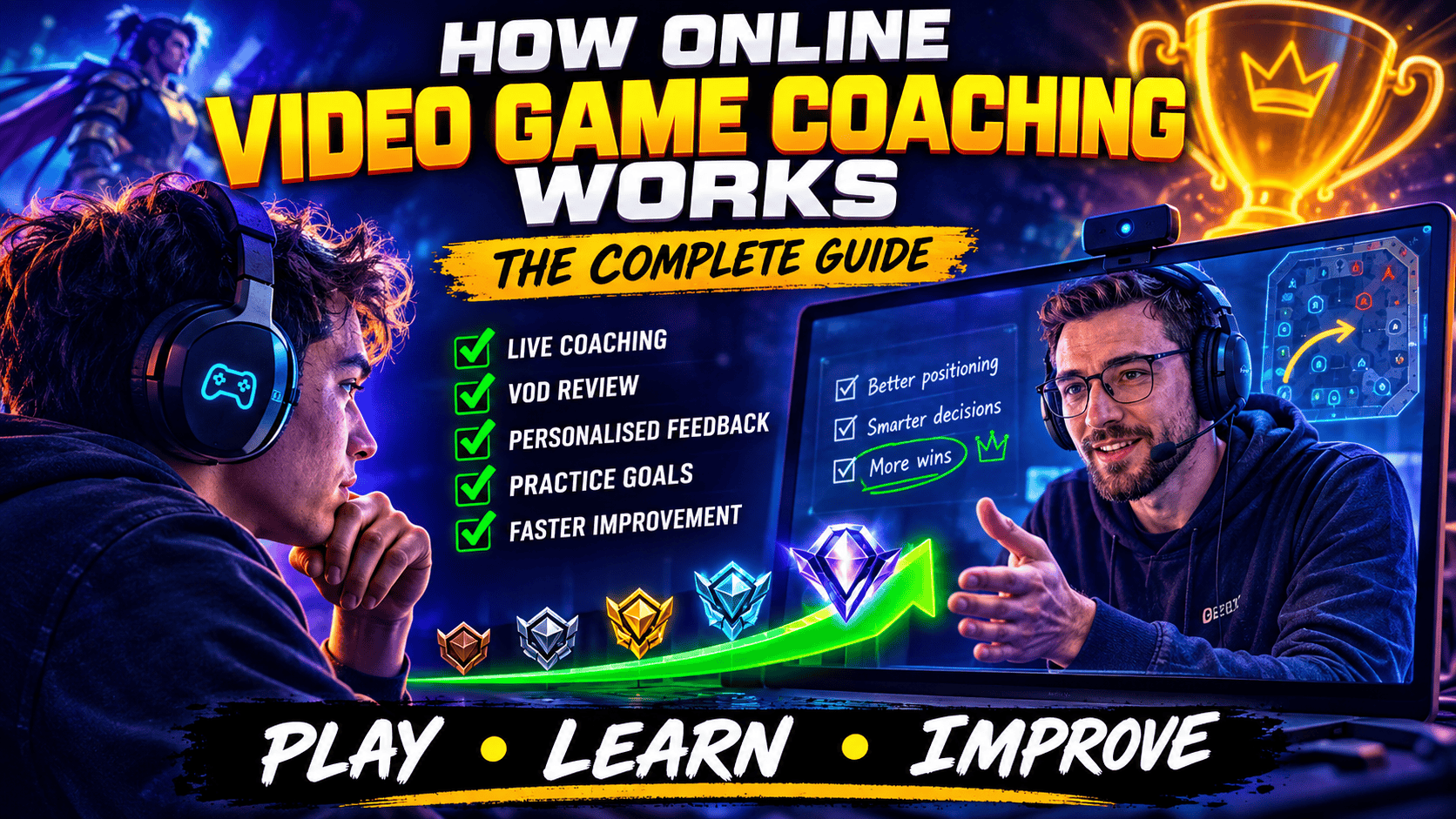
1. How Does Online Video Game Coaching Work? – Quick Answer
Online video game coaching connects you with an experienced player or coach who watches your gameplay, identifies what you could improve and gives you personalised advice to help you become a better player. 🎮🎓
And no, they don’t remotely take control of your mouse and suddenly transform you into an esports prodigy.
Sadly.
Instead, online gaming coaching usually works something like this:
🎯 Choose Your Goal → 👤 Find a Coach → 📅 Book a Session → 🎮 Play or Share Gameplay → 👀 Get Feedback → 🎯 Practise → 📈 Improve
Depending on the coaching format, your coach might watch you play live, analyse a recording of one of your matches or combine both approaches.
The big difference between gaming coaching and watching another “10 INSANE TIPS TO INSTANTLY RANK UP” video?
The coach is looking at how you play.
🎮 What Happens in Online Gaming Coaching?
A typical online coaching session starts with a conversation about where you’re currently at.
Your coach might ask:
🏆 What’s your current rank?
🎯 What are you trying to improve?
🎮 How long have you played the game?
🧙 Which role, character or class do you play?
🤔 What do you think you’re struggling with?
Then comes the interesting part.
They actually watch you play.
Depending on the type of session, that might happen through:
- 🖥️ Live screen sharing
- 👀 Spectator mode
- 📺 Private streaming
- 📹 Recorded gameplay
- 🎧 Voice chat
- 🎮 In-game tools
The coach can then analyse what you’re doing and look for areas where you could improve.
🔎 What Does a Gaming Coach Look For?
That depends on the game, but they may analyse things like:
- 🎯 Aim and mechanics
- 🗺️ Positioning
- 👀 Awareness
- 🧠 Game sense
- ⚔️ Decision-making
- 🔄 Rotations
- 💥 Ability or resource usage
- 🤝 Teamplay
- 💬 Communication
- 🔁 Repeated bad habits
This is where personalised coaching becomes useful.
You might think your biggest problem is:
“My aim is terrible.”
Then your coach watches your gameplay and discovers that your aim is actually fine.
The real problem?
You’re repeatedly walking into fights from positions where you need the mechanical ability of a genetically engineered esports octopus to survive.
Different problem.
Different solution.
🎮 Live Coaching vs VOD Review
Most online gaming coaching falls into two broad formats.
🎮 Live Coaching
You play while the coach watches and provides feedback during or between matches.
This can be great for:
⚡ Real-time decision-making
🎯 Mechanics
🧠 Thinking under pressure
🎮 Applying changes immediately
Then there’s:
📹 VOD Review
You provide recorded gameplay that the coach can analyse.
Because the match has already happened, you can:
⏸️ Pause
⏪ Rewind
🔎 Examine mistakes
🗺️ Analyse positioning
🧠 Discuss different decisions
VOD review can be particularly useful for understanding why something went wrong, rather than simply seeing the final result.
Some coaches combine both.
They analyse your previous gameplay, identify a weakness and then watch you play live while you practise correcting it.
🧠 What Makes Online Coaching Different From a Gaming Guide?
There are already thousands of fantastic gaming guides online.
So why pay someone to tell you how to play?
Because guides generally teach everyone.
Coaching teaches you.
A guide might explain:
“Stay near cover when taking fights.”
Useful.
A coach might watch your gameplay and say:
“You’re consistently moving too far from cover before you know where the second opponent is.”
Much more specific.
Even better, they can explain what you should do differently the next time that situation appears.
That’s the real advantage of personalised video game coaching.
🎯 What Kind of Feedback Do You Get?
Good coaching shouldn’t leave you with vague advice like:
“Improve your game sense.”
Fantastic.
I’ll just press the Improve Game Sense button.
You want something actionable.
For example:
🔴 Problem: You’re engaging before your teammates are ready.
🧠 Why It Matters: You’re turning potentially even fights into situations where you’re outnumbered.
🟢 Better Decision: Check teammate positions before committing.
🎯 Practice Goal: Make a deliberate teammate check before every major engagement.
Now you’ve got something you can actually practise.
🌐 Why Can Gaming Coaching Work So Well Online?
Gaming is almost perfectly suited to remote coaching.
The game is already happening on a screen.
The coach doesn’t necessarily need to sit beside you.
Through screen sharing, gameplay recordings and voice chat, they can see:
👀 What you’re seeing
🎯 What you’re aiming at
🗺️ Where you’re positioning
⚔️ Which fights you’re taking
🔄 When you’re rotating
🧠 Which decisions you’re making
That also means your coach doesn’t need to live nearby.
You could potentially learn from someone on the other side of the world without either of you leaving your gaming setup.
We’ve used the internet for worse things.
🏆 Does Gaming Coaching Automatically Make You Better?
No.
And this is important.
A gaming coach can:
👀 Find the problem
🧠 Explain the problem
🎯 Show you what to practise
But you still need to actually practise it.
The real process looks more like:
🎓 Coaching → 🎯 Focused Practice → 🎮 Matches → 🔁 Repetition → 📈 Improvement
Not:
💳 Pay Coach → ✨ Gaming Powers Unlocked → 🏆 Top Rank
I’d certainly prefer the second version.
Unfortunately, competitive games continue to insist on this whole “skill development” thing.
🎯 The Quick Answer
So, how does online video game coaching work?
You choose a coach who understands your game, book a coaching session and share your gameplay through live play, screen sharing or recorded footage.
The coach then:
👀 Watches how you play
↓
🔎 Identifies strengths and weaknesses
↓
🧠 Explains what you’re doing wrong
↓
✅ Shows you better options
↓
🎯 Gives you specific things to practise
↓
📈 Helps you improve over time
That’s really the whole idea.
A gaming guide can tell you how the game should be played.
A gaming coach can help you understand how you could play it better.
And occasionally confirm that, yes, pushing the entire enemy team alone probably wasn’t the optimal strategy.
2. What Is Online Video Game Coaching?
Online video game coaching is personalised training where an experienced gamer or coach helps another player improve their skills remotely over the internet. 🎮🌐
For a broader introduction to coaching itself, our guide to what video game coaching is explains what coaches do, who coaching is for and the different ways players can use it to improve.
Instead of meeting a coach in person, you connect online using things like voice chat, screen sharing, gameplay recordings, spectator modes or in-game tools.
The coach watches how you play, identifies strengths and weaknesses and helps you understand what you could do differently.
Think of it as the gaming version of having a personal trainer.
Except nobody is asking you to do burpees.
Already an improvement.
🎮 What Does a Video Game Coach Actually Do?
A gaming coach isn’t simply someone who’s better at the game than you.
At least, a good one isn’t.
Their job is to analyse your gameplay and help turn their experience into something you can actually use.
That might involve:
- 👀 Watching your gameplay
- 🔎 Identifying mistakes
- 🎯 Analysing mechanics
- 🗺️ Reviewing positioning
- 🧠 Improving decision-making
- ⚔️ Discussing fight selection
- 🔄 Reviewing rotations
- 💥 Analysing abilities or resources
- 🤝 Improving teamwork
- 📋 Creating practice goals
The exact coaching will depend heavily on the game.
A Valorant coach might spend time analysing crosshair placement and utility usage.
A League of Legends coach could focus on farming, map awareness and rotations.
A Rocket League coach might work on positioning, boost management and car control.
Different games.
Same basic principle:
Figure out what’s holding the player back and help them improve it.
🌐 Why Is It Called Online Gaming Coaching?
Because the coach and player don’t need to be in the same physical location.
You might be sitting at home in Australia while your coach is in Europe, North America or somewhere else entirely.
As long as you can communicate and share gameplay, the session can work.
Depending on the coaching service, you might connect through:
🎧 Voice chat
🖥️ Screen sharing
📺 Private streaming
📹 Gameplay recordings
👀 Spectator mode
🎮 In-game features
Gaming is particularly well suited to online coaching because the important thing the coach needs to see is already conveniently displayed on a screen.
👤 What Is One-on-One Online Gaming Coaching?
One-on-one gaming coaching means one coach works directly with one player.
This is usually the most personalised form of coaching.
The entire session can focus on:
Your gameplay.
Your mistakes.
Your questions.
Your goals.
If positioning is your biggest weakness, the coach can spend more time on positioning.
If your mechanics are solid but your decision-making needs work, the session can focus there instead.
You aren’t following a generic lesson plan designed for thousands of players.
The coaching can adapt to you.
If personalised coaching sounds like the right fit, our guide to one-on-one video game coaching explains how individual sessions work, what to expect and when this format can be most useful.
👥 What Is Group Gaming Coaching?
Online coaching can also involve multiple players.
Group gaming coaching might be used for:
👥 Groups of friends
🏆 Competitive teams
🎮 Gaming communities
🤝 Players learning together
Instead of focusing entirely on one player, the coach may analyse how several players work together.
That can make group coaching particularly useful for improving:
💬 Communication
🤝 Coordination
🔄 Team rotations
⚔️ Engagement timing
🎯 Target priority
🗺️ Team positioning
🏆 Competitive strategy
Sometimes the individual players are perfectly capable.
The problem begins when all five of them develop completely different plans at exactly the same time.
Team games have a talent for exposing this.
🎮 What Is Live Online Gaming Coaching?
With live gaming coaching, the coach watches while you play.
You might share your screen or use a spectator feature while talking through voice chat.
The coach can then provide feedback either:
⚡ During gameplay
or
⏸️ Between rounds, matches or practice attempts
For example, you might be preparing to take a fight when your coach asks:
“Where are your teammates?”
You check.
They’re nowhere nearby.
Interesting development.
Instead of taking the fight, you wait.
That’s live coaching in action – helping you recognise better decisions while the situation is actually happening.
📹 What Is VOD Review Coaching?
VOD review works differently.
Instead of the coach watching you play live, you provide previously recorded gameplay.
The coach can then:
⏸️ Pause the footage
⏪ Rewind important moments
🔎 Analyse decisions
🗺️ Examine positioning
👀 Identify missed information
⚔️ Discuss alternative plays
🎯 Find repeated mistakes
This can make VOD review particularly useful for deeper analysis.
Maybe you died during a fight and assumed:
“I missed my shots.”
Rewind twenty seconds.
Turns out you abandoned a strong position, used an important ability unnecessarily and separated from your teammates.
By the time the shooting started, you’d already created a fairly impressive collection of problems.
🔀 Some Gaming Coaches Combine Both
You don’t necessarily have to choose between live coaching and VOD review.
Some coaches use a combination.
For example:
📹 Review Previous Gameplay
↓
🔎 Identify a Weakness
↓
🧠 Explain the Better Approach
↓
🎮 Play Live
↓
🎯 Practise the Change
↓
📈 Review the Result
This can work particularly well because you’re connecting understanding with practice.
First, you see what went wrong.
Then you try doing it differently.
🎓 Is Gaming Coaching Just Getting Advice From a Better Player?
Not quite.
You probably already have friends who give you advice.
Sometimes even when nobody asked.
Gaming coaching should be more structured.
A coach isn’t simply saying:
“You should’ve pushed.”
They should be able to explain:
Why should you have pushed?
What information made the push good?
When was the opportunity available?
How could you recognise that situation next time?
That’s the difference between simply being told what to do and actually learning how to make the decision yourself.
🧠 Coaching Is About Understanding, Not Copying
A good coach shouldn’t turn you into someone who needs constant instructions.
The goal isn’t:
Coach says rotate → You rotate.
It’s:
Coach explains why → You understand the situation → You recognise it yourself next time.
Over time, the process should become:
👀 Coach Notices the Situation
↓
🎓 Coach Helps You Notice It
↓
🧠 You Start Noticing It Yourself
↓
🎮 The Better Decision Becomes Natural
That’s when coaching starts producing lasting improvement.
🎯 What Skills Can Online Gaming Coaching Improve?
The exact skills depend on the game, but common coaching areas include:
- 🎯 Aim
- 🕹️ Movement
- 🗺️ Positioning
- 👀 Awareness
- 🧠 Game sense
- ⚔️ Decision-making
- 🔄 Rotations
- 💥 Ability usage
- ⏱️ Timing
- 🤝 Communication
- 🏆 Competitive strategy
You don’t necessarily need help with all of them.
In fact, you probably shouldn’t try to improve all of them simultaneously.
A coach can help identify which areas deserve your attention first.
🏆 Do You Need to Be a Competitive Gamer?
No.
Online gaming coaching isn’t only for esports players or people trying to reach the highest rank.
It can be useful for:
🆕 Beginners learning fundamentals
😊 Casual players wanting to improve
📈 Ranked players trying to climb
🧱 Experienced players stuck at a plateau
🏆 Competitive players refining their skills
🚀 Aspiring esports players
The important thing is finding coaching that matches your current level.
A beginner doesn’t need the same session as a top-ranked competitive player.
🤔 Why Pay for Coaching When Gaming Guides Are Free?
Fair question.
There is an enormous amount of excellent free gaming content online.
YouTube guides.
Streams.
Tutorials.
Forums.
Articles.
Watching better players.
And you should absolutely use them.
The difference is personalisation.
A guide might say:
“Players at your rank often position too aggressively.”
A coach can say:
“You position too aggressively, and here are three examples from your own match.”
That’s considerably harder to argue with.
🎯 The Simple Definition
At its core, online video game coaching is personalised gaming instruction delivered remotely.
A coach uses your actual gameplay to help you:
👀 See mistakes
🧠 Understand them
🎯 Learn better options
🎮 Practise those changes
📈 Improve over time
It isn’t someone playing the game for you.
It isn’t a guaranteed rank increase.
And it definitely isn’t a magical shortcut that removes the need to practise.
It’s simply a more personalised way to learn.
Instead of asking, “How do I get better at this game?”
online coaching tries to answer the much more useful question:
“How do I get better at this game based on the way I’m actually playing it?”
If you want to explore coaching in more detail, our Video Game Coaching Guides cover everything from choosing a coach and coaching costs to different coaching formats and improving your gameplay.
3. How Online Gaming Coaching Works – Step by Step
So, what actually happens when you book online video game coaching? 🎮
Thankfully, it’s pretty simple.
You don’t need to visit an esports training facility, submit your lifetime ranked statistics or prove that the last five losses genuinely weren’t your fault.
For most players, the process looks something like this:
🎯 Set Your Goal → 👤 Find a Coach → 📅 Book a Session → 🎮 Play or Share Gameplay → 👀 Get Feedback → 🧠 Understand Your Mistakes → 🎯 Practise → 📈 Improve
The exact process varies between coaches, games and coaching formats, but here’s how a typical online gaming coaching session works from start to finish.
🎯 Step 1 – Decide What You Want to Improve
Before choosing a coach, think about what you actually want help with.
Maybe you’re trying to:
- 📈 Climb ranked
- 🎯 Improve your aim
- 🗺️ Fix your positioning
- 🧠 Develop better game sense
- 👀 Improve awareness
- ⚔️ Make better decisions
- 🔄 Improve rotations
- 🧙 Master a character, class or role
- 🤝 Improve communication
- 🏆 Prepare for competitive play
You don’t need to know exactly what’s wrong.
In fact, that’s one of the reasons people get coaching.
Your goal could simply be:
“I’ve been stuck at the same rank for months and I don’t know why.”
Perfectly valid.
The coach can help with the detective work.
👤 Step 2 – Find a Gaming Coach
Next, find someone who coaches your game.
Ideally, don’t just search for the player with the most impressive rank badge and immediately hand over your money.
Look at the whole picture:
🎮 Game experience
🎯 Specialisation
🏆 Rank or competitive experience
🎓 Coaching experience
⭐ Reviews
💬 Communication style
💰 Price
🕒 Availability
📹 Coaching format
If you want to dig deeper into those factors, our guide on how to choose a video game coach covers what to look for before booking and how to find someone who suits your game, level and goals.
Depending on the game, you may want someone who specialises even further.
For example:
League of Legends → Role
Valorant → Agent or role
World of Warcraft → Class/content
Fighting Games → Character
The more advanced you become, the more valuable specialist knowledge can be.
🎮 Step 3 – Choose the Type of Coaching
Now decide how you want the coaching delivered.
The main options are usually:
🎮 Live Coaching
You play while the coach watches and provides feedback.
📹 VOD Review
The coach analyses recorded gameplay.
🎧 Live VOD Review
You and the coach watch your recorded gameplay together.
🤝 Play-With Coaching
The coach joins you in-game and teaches while you play together, where appropriate.
🔀 Hybrid Coaching
You combine recorded analysis with live practice.
There’s no universally best option.
If you’re trying to understand why you keep making certain mistakes, VOD review can be fantastic.
If you’re trying to recognise situations and make better decisions under pressure, live coaching may be more useful.
If you’re unsure which approach suits you, our comparison of live gaming coaching vs VOD review breaks down the strengths of each format and when you might choose one over the other.
📅 Step 4 – Book Your Coaching Session
Once you’ve found a coach and service you like, it’s time to book.
Depending on how the coach operates, you’ll usually choose things such as:
📅 Date
🕒 Time
⏱️ Session duration
🎮 Game
🎯 Coaching type
You may also provide information about your current rank, role, platform or goals.
If the coach lives overseas, check the time zone carefully.
Nothing tests your commitment to improvement quite like accidentally booking coaching for 3:30 AM.
📝 Step 5 – Tell the Coach About Yourself
Before the session, give the coach some context.
Useful information might include:
🎮 Game: Valorant
🏆 Current Rank: Gold
🎯 Goal: Reach Platinum
👤 Main Role: Controller
🤔 Main Problem: Positioning and knowing when to rotate
⏱️ Experience: Around one year
This gives the coach somewhere to start.
You can also tell them what you think your biggest weakness is.
Maybe you’re right.
Maybe you’re not.
Both outcomes are useful.
📹 Step 6 – Prepare Gameplay if Required
If you’ve booked a VOD review, you’ll usually need to provide recorded gameplay.
Try to choose a match that represents how you normally play.
Not:
🏆 Your greatest match of all time
where every shot landed and you briefly became the player you always suspected you were.
And probably not:
💀 The 3-13 disaster
where your entire team collapsed so quickly there was barely anything useful to analyse.
A reasonably close, representative match is often a good choice.
It gives the coach plenty of real decisions to examine.
🖥️ Step 7 – Get Your Setup Ready
For live online coaching, you’ll generally need your normal gaming setup plus whatever communication or screen-sharing tools the coach uses.
Before the session:
✅ Update your game
✅ Test your headset
✅ Check your microphone
✅ Test screen sharing
✅ Check your internet connection
✅ Prepare any recordings
✅ Make sure you can log in
Do this before the scheduled start time.
Getting ready for your first session? Use our first online gaming coaching session checklist to make sure you’re prepared before your coach joins.
Launching the game two minutes before coaching begins and discovering:
UPDATE REQUIRED – 42.7 GB
is an avoidable character-building experience.
🎧 Step 8 – Meet Your Coach Online
At the scheduled time, you’ll connect with your coach.
The first few minutes will usually involve discussing:
🎯 Your goals
🏆 Your current level
🎮 What you play
🤔 What you’re struggling with
📋 What you’ll work on during the session
Don’t worry if you’ve never had gaming coaching before.
You aren’t expected to arrive knowing how coaching works.
That’s partly what the coach is there for.
🎮 Step 9 – Play or Review Your Gameplay
Now the actual coaching starts.
If it’s live coaching, you might play while the coach watches.
If it’s VOD review, you’ll analyse recorded gameplay.
If it’s a hybrid session, you might do both.
The coach will start looking for patterns.
Maybe you:
🗺️ Position too aggressively
⚔️ Take unnecessary fights
👀 Miss important information
🔄 Rotate too late
💥 Waste abilities
🤝 Separate from teammates
🎯 Have inconsistent mechanics
One isolated mistake might not mean much.
Repeated mistakes are where things get interesting.
🔎 Step 10 – Identify the Real Problems
This is one of the most valuable parts of coaching.
What you think is going wrong isn’t always what is actually going wrong.
For example:
You die.
Your immediate conclusion:
“I missed my shots.”
Your coach rewinds.
Ten seconds earlier, you moved away from cover.
Five seconds later, you pushed without your teammate.
Then you challenged two opponents simultaneously.
Yes, you missed the shot.
But by that point, your survival plan already required divine intervention.
The coach helps trace mistakes back to their actual cause.
🧠 Step 11 – Understand What You Should Do Instead
Identifying mistakes isn’t enough.
A good coach should explain the alternative.
Instead of:
❌ “That was bad positioning.”
you want:
✅ “Stay closer to this cover because it lets you disengage if the second opponent appears.”
Now you understand:
What went wrong.
Why it went wrong.
What you should do differently.
That’s actual coaching.
🎯 Step 12 – Turn Feedback Into Practice Goals
By the end of the session, you should have a few specific things to work on.
Preferably not twenty-seven.
Something like:
🎯 Goal 1 – Stay closer to cover during engagements
👀 Goal 2 – Check teammate positions before pushing
is much more useful than:
“Improve game sense.”
Specific goals give you something you can deliberately practise.
🎮 Step 13 – Practise Without the Coach
This is where the improvement actually happens.
Take what you’ve learned into your normal matches.
At first, you may need to consciously remind yourself:
“Check teammates.”
“Stay near cover.”
“Don’t chase.”
Eventually, those decisions start becoming more natural.
That’s the goal.
The coach helps you understand the better behaviour.
Repetition turns it into a habit.
📹 Step 14 – Review Your Progress
After you’ve practised for a while, look at whether the original problem is happening less often.
You could:
📹 Review your own gameplay
📊 Look at relevant performance trends
🎮 Think about recent matches
🎓 Book a follow-up session
Ask yourself:
Am I recognising the situation earlier?
Am I making the mistake less often?
Is the better decision becoming easier?
If yes, you’re improving.
🔁 Step 15 – Get More Coaching When You Need It
You don’t necessarily need another coaching session immediately.
One good session might give you enough to work on for dozens of matches.
Practise first.
Then, once you’ve improved or hit another plateau, consider getting more feedback.
A useful coaching cycle can look like:
🎓 Learn
↓
🎯 Practise
↓
🎮 Play
↓
📹 Review
↓
📈 Improve
↓
🔁 Repeat When Needed
🏆 The Whole Process in One Example
Let’s say you’re stuck in Gold and want to reach Platinum.
You think your aim is the problem.
You find a coach and book a VOD review.
The coach watches your gameplay.
Plot twist:
Your aim isn’t the main problem.
You’re constantly taking fights without checking whether your teammates can support you.
So your coach gives you one main practice goal:
👀 Check teammate positions before committing to an engagement.
You spend the next few weeks deliberately practising that.
You start taking fewer outnumbered fights.
You survive longer.
You create better engagements.
Your results begin improving.
That’s how online gaming coaching is supposed to work.
Not because the coach magically increased your skill level.
They simply helped you identify where your effort would be better spent.
🎯 The Simple Version
If all those steps sound like a lot, the process really comes down to this:
1️⃣ Find the Right Coach
2️⃣ Show Them How You Play
3️⃣ Find Out What’s Holding You Back
4️⃣ Understand What to Do Differently
5️⃣ Practise It
6️⃣ Repeat
That’s online video game coaching.
The coach provides the outside perspective.
You provide the practice.
And somewhere along the way, hopefully, you finally stop chasing that one low-health opponent halfway across the map.
Character development.
4. Step 1 – Decide What You Want to Improve
Before you book an online video game coaching session, it’s worth asking one simple question:
What do I actually want help with? 🎯
You don’t need a beautifully structured development plan complete with charts, milestones and a quarterly performance review.
You’re playing a video game.
Let’s maintain some perspective.
But having a rough idea of what you want to improve helps you choose the right coach and gives them somewhere useful to start.
🎯 Start With Your Main Goal
Think about what made you consider gaming coaching in the first place.
Maybe you want to:
- 📈 Climb to a higher rank
- 🎯 Improve your aim
- 🗺️ Fix your positioning
- 🧠 Develop better game sense
- 👀 Improve map awareness
- ⚔️ Make better decisions
- 🔄 Learn better rotations
- 🧙 Master a character, class or role
- 🤝 Improve communication
- 🏆 Prepare for competitive play
- 🧱 Break through a skill plateau
Your goal doesn’t need to be complicated.
Something as simple as:
“I’ve been stuck at the same rank for months.”
is enough.
🤷 What if You Don’t Know What You’re Doing Wrong?
This is completely normal.
In fact, it may be one of the best reasons to get coaching.
Sometimes you know something isn’t working.
You just can’t identify what.
You lose fights.
You die too often.
Your rank isn’t moving.
You watch better players and think:
“They’re clearly doing something differently.”
Excellent analysis.
Now what?
A coach can look at your gameplay from the outside and help identify the problem.
Your goal can simply be:
“I want to understand what’s holding me back.”
That’s plenty to work with.
🎯 Your Biggest Weakness Might Not Be What You Think
This is where coaching can get interesting.
Suppose you’re convinced your aim is the problem.
Every time you die, you think:
“I need better mechanics.”
So you practise aim.
More aim training.
More drills.
More warm-ups.
Your mouse has now completed more training than some professional athletes.
Then a coach watches your gameplay.
Your aim?
Actually pretty decent.
Your real problem is that you’re constantly taking terrible fights.
You’re:
🗺️ Leaving cover
👥 Fighting without teammates
⚔️ Challenging multiple opponents
🚪 Taking positions with no escape
👀 Missing important information
By the time aim becomes relevant, you’ve already created a horrible situation.
That’s why it’s useful to tell the coach what you think your weakness is without becoming too attached to the diagnosis.
🧠 Separate Your Goal From the Skill You Need
Players often start with an outcome:
“I want to reach Diamond.”
That’s a perfectly reasonable goal.
But you can’t directly practise:
Reach Diamond.
You need to identify the skills and behaviours that could help you get there.
For example:
🏆 Goal: Reach Diamond
might become:
🗺️ Improve positioning
👀 Check the minimap more consistently
⚔️ Stop taking unnecessary fights
🔄 Rotate earlier
🎯 Improve mechanical consistency
Your coach can help turn the big goal into smaller areas you can actually work on.
📈 Rank Can Be a Goal – But Don’t Make It the Only Goal
There’s nothing wrong with wanting to rank up.
Competitive games literally put a shiny badge on the screen and then design an entire system around making us emotionally invested in its colour.
They knew what they were doing.
But rank shouldn’t be your only measure of improvement.
You might be getting better even if your rank hasn’t moved yet.
Look for changes such as:
- 📉 Fewer unnecessary deaths
- 🗺️ Better positioning
- ⚔️ Smarter fight selection
- 👀 Improved awareness
- 🔄 Better rotations
- 💥 More efficient ability usage
- 🎯 More consistent mechanics
These are things you can actually control and practise.
Rank is what may follow.
🎮 Think About Which Part of the Game Feels Hard
Another way to identify a coaching goal is to think about when you feel least confident.
Maybe:
Early game feels fine, but I struggle late game.
I understand my character, but I don’t know when to rotate.
My mechanics are good, but I panic during fights.
I perform well individually but struggle with teamplay.
I know what I should do when watching a replay, but I don’t recognise it during matches.
Those are excellent starting points.
They give the coach a specific area to investigate.
🗺️ Positioning
Positioning is one of the most common areas players can work on.
Depending on the game, that might involve:
- 🛡️ Using cover
- 👀 Controlling sightlines
- 🤝 Positioning around teammates
- 🚪 Maintaining escape options
- 🗺️ Controlling useful areas
- ⚔️ Setting up favourable fights
- 🔄 Repositioning at the right time
Positioning mistakes can also disguise themselves as mechanical problems.
Sometimes you didn’t lose because your opponent aimed better.
You lost because you gave them the easier shot.
Rude of you, really.
🎯 Mechanics
If your decisions are reasonable but your execution lets you down, mechanical coaching might be the priority.
Depending on the game, mechanics could include:
🎯 Aim
🕹️ Movement
🔫 Weapon control
💥 Combos
⚡ Execution speed
⏱️ Timing
🚗 Car control
🥊 Inputs
Mechanical improvement usually requires repetition, so coaching can help make sure you’re practising the right technique rather than simply repeating the wrong one faster.
🧠 Game Sense & Decision-Making
Maybe mechanics aren’t the issue.
Maybe you regularly find yourself thinking:
“Why was I even there?”
That’s more interesting.
Decision-making coaching might focus on:
- ⚔️ When to fight
- 🛡️ When to disengage
- 🔄 When to rotate
- 🎯 Which target to prioritise
- 🗺️ Where to position
- 💥 When to use resources
- 👀 What information to consider
These are areas where VOD review can be particularly useful because you can stop the action and analyse what information was available at the time.
👀 Awareness
Sometimes the information was there.
You just didn’t notice it.
Maybe you missed:
🗺️ Something on the map
👥 A teammate’s position
💥 An opponent using an important ability
🎯 An objective becoming available
🔄 An enemy rotation
⏱️ A timing opportunity
A coach can help you identify which information you should be checking and when.
Because “just be more aware” isn’t exactly a training plan.
🧙 Character, Role or Class Mastery
You might understand the game reasonably well but want help becoming better at something specific.
For example:
🧙 One League of Legends role
🎯 A particular Valorant agent
🛡️ A World of Warcraft class
🥊 A fighting game character
🚗 A specific Rocket League role or mechanic
Specialist coaching can become particularly valuable here because the coach can go deeper into matchups, techniques and role-specific decisions.
🏆 Competitive Play
If you’re moving beyond normal ranked matches, your goals may become more specialised.
Competitive coaching might involve:
🤝 Team coordination
💬 Communication
📹 Match analysis
🧠 Strategy
🎯 Role responsibilities
👀 Opponent analysis
🏆 Tournament preparation
At higher levels, improvement may come from smaller details.
When everyone already understands the fundamentals, tiny mistakes start becoming much more expensive.
📝 Write Down Your Goal Before Booking
You don’t need anything fancy.
A simple note is enough:
🎮 Game: Valorant
🏆 Current Rank: Gold 3
🎯 Main Goal: Reach Platinum
🤔 Biggest Problem: I think I take too many bad fights
🗺️ Secondary Problem: Positioning
🎮 Main Role: Controller
That immediately gives a potential coach useful context.
🎯 Pick One Main Goal
If possible, don’t arrive with:
“I want better aim, positioning, movement, awareness, game sense, communication, rotations, mechanics, consistency and decision-making.”
That’s less of a coaching goal.
That’s a complete rebuild.
Pick the biggest issue first.
A coach may discover that fixing one problem improves several others anyway.
Better positioning, for example, can lead to:
Easier fights → Fewer deaths → Better mechanics under pressure → Better results
Sometimes one weakness creates several symptoms.
🔎 Let the Coach Challenge Your Assumptions
This is important.
Tell the coach what you want help with.
But also give them permission to disagree.
You might say:
“I think my aim is holding me back.”
A useful coach might respond:
“Your aim could improve, but that’s not your biggest problem.”
Good.
That’s exactly the sort of outside perspective you’re paying for.
You don’t need someone to confirm your existing theory.
You need someone to help you find the right one.
🎯 The Bottom Line
Before getting online gaming coaching, decide what you’d like to improve, even if the goal is fairly broad.
It could be:
📈 “I want to rank up.”
🎯 “I want better mechanics.”
🧠 “I want to make smarter decisions.”
or simply:
🤷 “I don’t know why I’m not improving anymore.”
Then let the coach help narrow it down.
You don’t need to diagnose every weakness yourself.
If you could already identify every problem, understand exactly why it happens and know how to fix it…
Well.
You’d be making the coach’s job suspiciously easy.
5. Step 2 – Find the Right Gaming Coach
Once you know what you want to improve, the next step is finding someone who can actually help you improve it. 🎮👤
There are plenty of talented gamers out there.
There are fewer talented gamers who can watch someone else’s gameplay, identify the real problem and explain the solution without resorting to:
“Bro, just don’t do that.”
That’s why choosing the right online gaming coach matters.
The best coach isn’t necessarily the highest-ranked player or the person with the most impressive competitive history. You want someone with the right combination of game knowledge, coaching ability, communication skills and experience relevant to your goals.
🎮 Start With Someone Who Knows Your Game
This one’s fairly obvious.
If you want coaching for Valorant, find someone with strong Valorant experience.
If you’re learning Rocket League, find a Rocket League coach.
If you want help with League of Legends, the fact that someone reached a ridiculous rank in Counter-Strike isn’t especially relevant.
Different games require different knowledge.
A coach should understand the mechanics, strategies, maps, characters, matchups and competitive systems relevant to your game.
🎯 Look for the Right Specialisation
Sometimes finding a coach for your game isn’t specific enough.
Depending on the title, you might want someone who specialises in:
- 🧙 Your character
- 🎯 Your role
- 🛡️ Your class
- 🗺️ Your game mode
- ⚔️ Your preferred playstyle
- 🏆 Your competitive level
- 🎮 A particular mechanic
For example, a League of Legends player might want a coach specialising in jungle.
A Valorant player might want someone experienced with controllers.
A fighting game player may want coaching for a particular character.
The more advanced you become, the more useful that specialisation can be.
🏆 Check the Coach’s Experience
Look at the coach’s background.
Depending on the service, their profile or listing might include:
🎮 Years playing the game
🏆 Current or peak rank
🥇 Competitive experience
🎓 Previous coaching experience
👥 Teams they’ve worked with
📹 VOD review experience
🎯 Areas of specialisation
This gives you an idea of whether their knowledge matches what you’re trying to learn.
If you’re a beginner, you probably don’t need someone with professional esports experience to explain basic positioning.
If you’re already highly ranked, deeper competitive experience may matter much more.
🎓 Don’t Choose a Gaming Coach Based on Rank Alone
Rank is useful evidence that someone understands how to play the game.
It is not proof that they know how to teach it.
Some exceptional players make decisions instinctively.
They’ve played thousands of hours.
They see something and immediately know what to do.
Ask them why and you get:
“It was obvious.”
Excellent.
I’ll add that to the training plan.
A good gaming coach needs to take that knowledge and break it into something another player can understand.
💬 Communication Matters More Than You Might Think
You could find someone with incredible game knowledge.
But if they can’t explain it clearly, you’re going to struggle to use it.
Good coaching should sound more like:
❌ What happened: You were caught out of position.
🧠 Why: You moved away from cover before knowing where the second opponent was.
✅ Better option: Hold the stronger position until you have more information.
🎯 Practice goal: Stay within one movement option of cover when holding that angle.
That’s useful.
Compare it with:
“Position better.”
Cheers.
Problem solved.
⭐ Check Ratings and Reviews
If the platform you’re using has ratings or reviews, read them.
Don’t only look at the overall score.
Look at what previous players actually say.
Useful comments might mention:
- 💬 Clear communication
- 🧠 Good explanations
- 🎯 Actionable advice
- 🤝 Patience
- 📹 Detailed analysis
- ⏱️ Reliability
- 📈 Useful improvement plans
- 🎮 Strong game knowledge
Reviews from players around your own skill level can be particularly helpful.
Someone who is brilliant at coaching advanced competitive players may not necessarily be the best choice for a complete beginner.
🎯 Match the Coach to Your Goal
Remember the goal you identified in the previous section?
Use it.
If you want help with:
🎯 Aim
look for someone who offers mechanical coaching.
If you want:
📹 Detailed gameplay analysis
look for a coach who specialises in VOD review.
If you’re struggling with:
🧠 Decision-making
look for someone who focuses on game sense and strategic analysis.
If you want:
🏆 Competitive preparation
look for relevant competitive experience.
The question isn’t:
“Is this person a good gaming coach?”
It’s:
“Is this person a good gaming coach for what I need?”
Much more useful.
🎮 Check Which Coaching Formats They Offer
Not every coach delivers sessions the same way.
They might offer:
🎮 Live coaching
📹 VOD review
🎧 Live VOD analysis
🤝 Play-with coaching
📝 Written feedback
🔀 Hybrid sessions
Think about how you learn best.
If you want someone helping you recognise situations while they’re happening, live coaching may suit you.
If you want to pause situations and understand every detail, VOD review could be better.
If you want both?
Find someone who combines them.
📋 Read What’s Actually Included
Don’t assume every coaching listing offering “60 minutes” means the same thing.
One might include:
🎮 60 minutes of live coaching
Another could offer:
📹 Pre-session gameplay review + 🎧 60-minute discussion + 📝 Follow-up notes
Another might simply be:
🎧 60-minute VOD review
Look at:
- ⏱️ Session duration
- 📹 Whether gameplay is reviewed beforehand
- 🎮 Whether live gameplay is included
- 📝 Whether notes are provided
- 🎯 Whether you receive practice goals
- 💬 Whether follow-up questions are included
That makes comparing coaches much easier.
💰 Don’t Automatically Pick the Cheapest Coach
Price matters.
Nobody is suggesting you throw your wallet at the screen.
But the cheapest option isn’t automatically the best value.
Imagine:
Coach A – $15
Generic advice.
Coach B – $30
Specialises in your role, identifies your biggest weakness and gives you a clear plan for fixing it.
Coach A was cheaper.
Coach B may have been better value.
The reverse can also happen.
A more expensive coach isn’t automatically better simply because they’ve discovered the confidence required to charge more.
Compare what you’re actually getting.
🗣️ Think About Language and Communication Style
Online coaching can connect you with people from around the world.
That’s fantastic.
But you still need to understand each other.
Check whether the coach speaks a language you’re comfortable learning in.
Also think about coaching style.
Some coaches are:
😊 Relaxed
🎯 Direct
📊 Analytical
⚡ Fast-paced
🧠 Detailed
🏆 Highly competitive
There’s no universally best personality.
You want someone whose style helps you learn.
🕒 Check Availability and Time Zones
This is another practical consideration.
A coach may look perfect.
Right game.
Right specialisation.
Great reviews.
Reasonable price.
Available exclusively between:
2:00 AM and 4:00 AM your time.
Slight issue.
Online gaming coaching gives you access to coaches around the world, but time zones still exist.
Check availability before getting too attached to a particular coach.
🆕 Beginners Should Look for Beginner-Friendly Coaches
If you’re relatively new, look for someone comfortable teaching fundamentals.
You want a coach who can explain:
🗺️ Basic positioning
🎯 Core mechanics
🧠 Basic decision-making
👀 Awareness
⚔️ Fight selection
🎮 Role fundamentals
You don’t need someone spending fifteen minutes explaining a microscopic optimisation used exclusively by the top 0.1% of players.
Let’s learn to walk before we’re frame-perfect speedrunning.
🏆 Advanced Players Should Look for Deeper Expertise
If you’re already highly ranked, your requirements change.
You may want a coach with experience in:
🏆 High-level competitive play
📹 Advanced VOD analysis
🧠 Strategy
⚔️ Matchups
🎯 Role specialisation
👀 Opponent analysis
🤝 Teamplay
At higher levels, the obvious mistakes are usually already gone.
You’re looking for smaller weaknesses.
That requires someone capable of actually seeing them.
🚩 Watch for Red Flags
A few things should make you cautious.
🚩 Guaranteed rank increases
🚩 “Become pro fast” promises
🚩 Vague coaching descriptions
🚩 No clear experience
🚩 Poor reviews
🚩 Pressure to buy large packages
🚩 Requests for unnecessary account access
🚩 Anything involving breaking game rules
A gaming coach should be selling knowledge, feedback and guidance.
Not miracles.
🔐 Your Coach Usually Doesn’t Need Your Password
For normal online gaming coaching, there’s generally no reason to hand over your account login.
The coach can watch through:
🖥️ Screen sharing
📹 Recorded gameplay
👀 Spectator mode
🎧 Voice chat
Keep your:
🔑 Password
📱 Authentication codes
📧 Recovery information
to yourself.
The coach is there to help you play better.
If they’re asking to log in and play for you, that’s no longer coaching.
🧪 Consider Starting With One Session
Found someone promising?
Start with one session.
You don’t need to immediately buy:
THE ULTIMATE 37-SESSION ROAD TO GAMING GREATNESS PACKAGE™
See how the first session goes.
Ask yourself:
Did they identify something useful?
Did their explanations make sense?
Did I feel comfortable asking questions?
Do I know what to practise next?
If yes, excellent.
You can always book again.
✅ Quick Checklist – Choosing an Online Gaming Coach
Before booking, check:
✅ They have strong experience with your game
✅ Their specialisation matches your needs
✅ Their experience suits your skill level
✅ They communicate clearly
✅ Reviews are positive
✅ Their coaching format suits you
✅ You understand what’s included
✅ Their availability works for you
✅ Their price fits your budget
✅ They provide actionable feedback
✅ They don’t make unrealistic promises
✅ They don’t require unnecessary account access
You don’t need every coach to be perfect.
You need one who fits what you’re trying to achieve.
🎯 The Bottom Line
Finding the right online gaming coach isn’t about searching for the highest-ranked human being willing to enter a voice call with you.
Look for someone who combines:
🎮 Game Knowledge
🎯 Relevant Experience
🎓 Teaching Ability
💬 Clear Communication
🤝 A Coaching Style That Works for You
A great player knows how to make the right decision.
A great coach can help you understand how to make that decision yourself.
And that’s considerably more useful than paying someone to watch your gameplay and occasionally mutter:
“Interesting.”
6. Step 3 – Choose Your Coaching Format
Once you’ve found the right gaming coach, the next question is:
How do you actually want to be coached? 🎮🎓
Online video game coaching isn’t one single format. Some coaches watch you play live. Others analyse recorded gameplay. Some play alongside you and others combine several methods into one session.
The main options are:
🎮 Live Coaching → 📹 VOD Review → 🎧 Live VOD Review → 🤝 Play-With Coaching → 🔀 Hybrid Coaching
There’s no single “best” coaching format.
The right choice depends on what you want to improve, how you learn and the type of game you’re playing.
🎮 Option 1 – Live Gaming Coaching
With live gaming coaching, your coach watches you play in real time.
This might happen through:
🖥️ Screen sharing
📺 Private streaming
👀 Spectator mode
🎮 In-game tools
🎧 Voice chat
Depending on the game and coach, they may give you feedback while you’re playing or wait until quieter moments between rounds and matches.
For example, you’re about to push an opponent.
Your coach asks:
“Where’s your team?”
You look at the map.
Your team appears to be approximately three business days away.
Perhaps we reconsider.
That’s one of the advantages of live coaching – the coach can help you recognise situations while they’re actually happening.
⚡ What Is Live Coaching Best For?
Live gaming coaching can be particularly useful for improving:
- 🎯 Mechanics
- 🕹️ Movement
- 👀 Awareness
- 🧠 Real-time decision-making
- ⚔️ Fight selection
- 🔄 Rotations
- 💬 Communication
- 🎮 Applying new techniques
It can also help reveal what happens when you’re under pressure.
Watching a replay calmly is one thing.
Making the right decision while three opponents are firing at you and someone is yelling through voice chat is another.
📹 Option 2 – VOD Review
VOD review means your coach analyses previously recorded gameplay.
Instead of everything happening at full speed, you can:
⏸️ Pause
⏪ Rewind
🔎 Examine situations
🧠 Discuss decisions
🗺️ Analyse positioning
👀 Look for missed information
⚔️ Compare alternative plays
This makes VOD review excellent for understanding why things happened.
Maybe you died during a fight and assumed your mechanics let you down.
The coach rewinds fifteen seconds.
You left cover.
Then you separated from your teammate.
Then you used an important ability unnecessarily.
Then you pushed.
Then you missed the shot.
Technically, yes.
You missed the shot.
But the investigation has uncovered several earlier developments.
🔎 What Is VOD Review Best For?
VOD review can be particularly useful for:
🧠 Decision-making
🗺️ Positioning
👀 Awareness
🔄 Rotations
⚔️ Fight selection
💥 Ability or resource usage
📊 Identifying repeated patterns
🏆 Strategic analysis
It’s also useful if you like asking questions and understanding situations in detail.
Nothing is happening in real time, so you can stop and discuss a decision properly.
🎧 Option 3 – Live VOD Review
This is slightly different from simply sending a coach your gameplay and receiving feedback later.
With a live VOD review, you and your coach watch the recording together.
The coach can pause the footage and ask questions like:
“What are you thinking here?”
“What information do you have?”
“Where could the opponent be?”
“What options do you have?”
This is useful because the coach isn’t only analysing what you did.
They’re trying to understand why you did it.
And that’s important.
Two players can make the same mistake for completely different reasons.
🧠 Why Your Thought Process Matters
Suppose you push into a bad fight.
Why?
Maybe:
A) You didn’t notice your teammate had rotated away.
B) You thought the opponent was alone.
C) You misunderstood the matchup.
D) You knew it was risky and decided to send it anyway.
Same push.
Four different problems.
A good coach needs to know which one they’re fixing.
Live VOD review makes it easier to talk through that thought process.
🤝 Option 4 – Play-With Coaching
Some coaches offer sessions where they play alongside you.
Instead of simply watching, they may join your match, party or practice environment.
This can be useful for demonstrating:
🎯 Positioning
🔄 Rotations
🤝 Team coordination
💬 Communication
🧠 Decision-making
🎮 Specific techniques
You may be able to see how the coach approaches situations while talking through what they’re doing.
🎮 Learning by Playing Together
Play-with coaching can feel more natural for players who learn by doing.
Instead of:
“Here’s how you should rotate.”
the coach can potentially demonstrate:
“Watch where I’m moving here and why.”
Then you can try applying the same principle yourself.
Just make sure the session remains coaching.
The goal isn’t for the better player to carry you through matches.
You’re there to learn.
A shiny victory screen is nice.
Knowing why you won is better.
🔀 Option 5 – Hybrid Gaming Coaching
Hybrid coaching combines multiple approaches.
And for many players, this can be a very effective format.
A session might look like:
📹 Review Previous Gameplay
↓
🔎 Identify the Problem
↓
🧠 Explain the Better Decision
↓
🎮 Play Live
↓
🎯 Practise the Change
↓
📈 Review What Happened
This creates a nice connection between analysis and application.
You see the mistake.
You understand the mistake.
Then you immediately try doing something different.
🏆 Which Gaming Coaching Format Is Best?
There’s no universal winner.
It depends on what you’re trying to improve.
A simple guide:
| Your Goal | Coaching Format to Consider |
|---|---|
| 🎯 Improve mechanics | Live Coaching |
| 🧠 Understand decisions | VOD Review |
| 🗺️ Analyse positioning | VOD Review |
| 👀 Improve real-time awareness | Live Coaching |
| 🔄 Understand rotations | VOD or Live Coaching |
| 💬 Improve communication | Live Coaching |
| 🔎 Analyse repeated mistakes | VOD Review |
| 🎮 Apply new concepts | Live Coaching |
| 🧠 Understand + practise | Hybrid Coaching |
These aren’t strict rules.
Different coaches may use different methods successfully.
🎯 Choose Live Coaching If…
Live coaching might suit you if you want:
⚡ Immediate feedback
🎮 Real-time practice
👀 Help recognising situations
🎯 Mechanical guidance
🧠 Decision-making under pressure
💬 Interactive coaching while playing
It’s particularly useful when your problem is:
“I understand what I’m supposed to do, but I don’t recognise it quickly enough during a match.”
📹 Choose VOD Review If…
VOD review might suit you if you want:
🔎 Detailed analysis
🗺️ Positioning feedback
🧠 Decision-making breakdowns
⏸️ Time to discuss situations
👀 Help spotting missed information
📊 Analysis of repeated mistakes
It’s particularly useful when your problem is:
“I keep making mistakes, but I don’t understand why.”
🔀 Choose Hybrid Coaching If…
Hybrid coaching may be ideal when you want to connect the two.
For example:
You learn during VOD review that you’re constantly positioning too far from cover.
Then you play live.
Your coach watches for that exact habit.
The moment you start drifting too far away:
“Where’s your cover?”
Right.
Back we go.
That immediate reinforcement can help turn an abstract lesson into something practical.
🆕 What Format Is Best for Beginners?
Beginners may benefit from live coaching or a combination of live coaching and VOD review.
Live coaching can help with:
🎮 Basic mechanics
🗺️ Fundamental positioning
👀 Awareness
🧠 Basic decision-making
VOD review can then explain mistakes in more detail.
But complete beginners may want to spend some time simply learning the game first.
If you’re still discovering that pressing R reloads…
You probably don’t need frame-by-frame strategic analysis just yet.
🏆 What Format Is Best for Advanced Players?
More experienced players may get substantial value from detailed VOD analysis.
At higher skill levels, the problems can become smaller and harder to spot.
Instead of:
“You stood in the wrong place.”
the issue might be:
“You rotated three seconds too late because you didn’t react to this information.”
Small difference.
Potentially huge consequence.
Being able to pause and analyse these moments can be valuable.
💰 Check What You’re Actually Paying For
Different coaching formats can involve different amounts of work.
For example, a VOD review might include preparation before you speak to the coach.
They may spend time:
📹 Watching your gameplay
📝 Taking notes
⏱️ Marking timestamps
🔎 Identifying patterns
🎯 Preparing recommendations
Meanwhile, a live session may involve the coach working with you entirely during the scheduled time.
When comparing prices, look at what’s included, not simply the session duration.
🎮 Can You Try Different Coaching Formats?
Absolutely.
You might start with a VOD review.
Learn what your main weaknesses are.
Practise them.
Then later book live coaching to see whether you’re applying the changes correctly.
For example:
📹 First Session – Find the Problem
↓
🎯 Practice
↓
🎮 Second Session – Apply the Fix
That can make more sense than repeatedly booking the same format simply because it’s what you started with.
🎯 The Bottom Line
The main types of online video game coaching are:
🎮 Live Coaching – feedback while you play.
📹 VOD Review – detailed analysis of recorded gameplay.
🎧 Live VOD Review – analyse your recording together.
🤝 Play-With Coaching – learn while playing alongside the coach.
🔀 Hybrid Coaching – combine analysis with live practice.
If you’re unsure where to start, think about the problem you’re trying to solve.
Want to understand why you’re making mistakes? 📹
VOD review is a strong option.
Know what to do but struggle to do it during matches? 🎮
Live coaching may be better.
Want both? 🔀
Combine them.
Because sometimes the most useful coaching process is simply:
“Here’s what you’re doing wrong.”
followed immediately by:
“Great. Now let’s try not doing that.”
7. Step 4 – Book Your Gaming Coaching Session
You’ve worked out what you want to improve.
You’ve found a coach who looks like a good fit.
You’ve chosen between live coaching, VOD review or a combination of both.
Now it’s time to actually book your online gaming coaching session. 🎮📅
The booking process is usually straightforward. You’ll choose the coaching service you want, select a suitable date and time and provide the coach with any information they need before the session.
No esports contract.
No dramatic signing ceremony.
Usually just a calendar and a payment screen.
📅 Choose a Date and Time
For live online coaching, you’ll need to find a time when both you and the coach are available.
Depending on the platform or marketplace you’re using, you may be able to select directly from the coach’s available time slots.
Choose a time when you can actually concentrate.
Booking coaching ten minutes before you need to leave for work probably isn’t ideal.
Neither is squeezing it between dinner and:
“I’ll only play one quick match with the boys.”
We both know how that ends.
🌍 Check the Time Zone
One of the biggest advantages of online gaming coaching is that your coach can be almost anywhere in the world.
One of the biggest disadvantages?
Your coach can be almost anywhere in the world.
Time zones matter.
A coach might advertise availability at:
7:00 PM
Lovely.
Whose 7:00 PM?
If the booking system automatically converts availability into your local time, even better.
If not, double-check before confirming.
You don’t want to discover that your perfectly reasonable evening coaching session is actually scheduled for 4:00 AM on Tuesday.
⏱️ Choose the Session Length
Gaming coaching can be offered in different session lengths.
Depending on the coach, you might find:
⏱️ Short introductory sessions
🎮 Standard coaching sessions
📹 Longer VOD reviews
📦 Multi-session packages
Longer isn’t automatically better.
A focused session that identifies two important weaknesses can give you plenty to work on.
After all, there’s a limit to how much feedback your brain can process while also trying to remember:
aim, positioning, teammates, map, abilities, rotations, objectives…
You’ve died.
Again.
🎮 Select the Coaching Service
Some coaches offer several different services.
For example:
🎮 Live One-on-One Coaching
📹 VOD Review
🎧 Live VOD Analysis
🤝 Play-With Coaching
🔀 Live + VOD Coaching
Make sure you’re booking the format you actually want.
Don’t assume every “gaming coaching session” works the same way.
Read the listing carefully so you know exactly what will happen.
📋 Check What’s Included
Before paying, look at what’s included in the session.
A coaching listing might include:
- ⏱️ 60 minutes of coaching
- 📹 Pre-session VOD analysis
- 🎮 Live gameplay review
- 🎧 Voice chat
- 📝 Written notes
- 🎯 Personalised practice goals
- 💬 Follow-up questions
- 📊 Progress review
Two sessions with the same duration can offer very different amounts of coaching.
Compare the whole service, not just the number beside the clock.
💰 Check the Price Before Booking
Gaming coaching prices vary depending on the coach, game, session length and what’s included.
Before booking, make sure you understand:
💰 Total price
⏱️ Session duration
📹 What’s included
📦 Whether you’re buying one session or a package
🔄 Any cancellation or rescheduling conditions
You don’t necessarily need the cheapest coach.
You need the coach who offers good value for what you’re trying to achieve.
🎯 Provide Your Coaching Goal
When booking, you may have the option to tell the coach what you want help with.
Use it.
Even a short description can be useful.
For example:
“I’m currently Gold and trying to reach Platinum. I mainly play support and struggle with positioning during team fights.”
That’s much more useful than:
“Help me get good.”
Accurate.
Just lacking detail.
🎮 Include Your Game and Platform
Make sure the coach knows what you’re playing.
Depending on the game, useful information could include:
🎮 Game: Valorant
🖥️ Platform: PC
🏆 Rank: Gold 2
🎯 Role: Controller
🌎 Region: Oceania
🗣️ Language: English
Some games work differently across platforms, regions or competitive modes.
Providing the basics helps avoid surprises when the session starts.
🧙 Include Your Role, Character or Class
For games with specialised roles, tell the coach what you play.
That might mean:
🧙 Champion
🎯 Agent
🛡️ Class
⚔️ Character
🤝 Role
🚗 Position
This can be particularly important when booking specialist coaching.
If you’ve hired someone because they’re brilliant at your specific role, you probably want them to know that’s why you’re there.
📹 Check Whether You Need to Send Gameplay
If you’ve booked a VOD review, find out how and when the coach wants your recording.
They may ask for:
📹 A full match
🎮 Several shorter clips
🔗 A replay link
📁 A gameplay recording
🏆 A particular type of match
Try to send it with enough time for the coach to review it if pre-session analysis is included.
Sending a 55-minute recording four minutes before the session and saying:
“Take your time.”
is perhaps slightly optimistic.
📹 Choose Representative Gameplay
If you need to provide a recording, choose something that represents your normal performance.
Ideally, pick a match where:
✅ You were actively involved
✅ There were meaningful decisions
✅ The game was reasonably competitive
✅ Your normal habits were visible
Avoid deliberately choosing only your best match.
You’re not trying to impress the coach.
They already know you occasionally win.
Probably.
You’re trying to give them useful material to analyse.
💳 Use a Secure Booking and Payment Method
When paying for online coaching, use a reputable platform or marketplace with clear transaction processes.
Ideally, you want:
🔐 Secure payments
📋 Clear service details
⭐ Seller or coach reviews
💬 Communication records
🛡️ Buyer protections where available
Be cautious about sending money directly to strangers through payment methods that give you little protection if something goes wrong.
A coaching session should begin with gameplay analysis.
Not financial detective work.
🔐 Don’t Send Account Passwords
Booking a coaching session normally shouldn’t require handing over your gaming account.
Your coach may need:
🎮 Your username
🏆 Your rank
📹 Gameplay footage
🖥️ Screen sharing
👀 Spectator access
They generally shouldn’t need:
❌ Your password
❌ Authentication codes
❌ Recovery information
Keep those private.
The coach is there to teach you how to play better.
🔄 Check the Cancellation and Rescheduling Rules
Life happens.
Internet dies.
Work runs late.
Something comes up.
Or your computer chooses that exact afternoon to discover a fascinating new hardware problem.
Before booking, check what happens if you need to:
📅 Reschedule
❌ Cancel
⏰ Change the time
🔄 Move the session
Knowing the rules beforehand saves arguments later.
📦 Should You Book One Session or a Coaching Package?
Some coaches offer packages containing multiple sessions.
For example:
🎓 Session 1 – Gameplay Analysis
↓
🎯 Practice Period
↓
📈 Session 2 – Progress Review
↓
🏆 Session 3 – Advanced Coaching
That can be useful if you already know you want ongoing coaching.
But if you’ve never worked with the coach before, starting with one session can make sense.
See whether you like:
💬 Their communication
🎓 Their teaching style
🧠 Their explanations
🎯 Their feedback
Then decide whether you want more.
🕒 Give Yourself Some Space Around the Booking
Try not to schedule your coaching session with absolutely no breathing room.
If possible, give yourself time beforehand to:
🎮 Launch the game
⬇️ Install updates
🎧 Test audio
🖥️ Test screen sharing
📹 Prepare recordings
📝 Review your questions
And give yourself a little time afterwards too.
You may want to organise your notes or even play a few matches while the advice is fresh.
📧 Check Your Booking Confirmation
Once you’ve booked, check the confirmation details.
Make sure you’ve got the correct:
📅 Date
🕒 Time
🌍 Time zone
⏱️ Duration
🎮 Coaching service
💬 Communication method
📹 Gameplay requirements
Put the session somewhere you’ll remember it.
Because explaining:
“Sorry, I forgot I booked you.”
is probably not the opening impression we’re aiming for.
✅ Quick Booking Checklist
Before confirming your gaming coaching session:
✅ Choose the right coach
✅ Select the right coaching format
✅ Check the date
✅ Check the time zone
✅ Choose the session length
✅ Read what’s included
✅ Check the total price
✅ Provide your game and platform
✅ Explain your coaching goal
✅ Include your rank or experience if relevant
✅ Check whether gameplay is required
✅ Review cancellation rules
✅ Use a secure payment method
✅ Keep your account password private
Then you’re booked.
🎯 The Bottom Line
Booking online video game coaching should be pretty simple:
👤 Choose Your Coach
↓
🎮 Select Your Coaching Service
↓
📅 Pick an Available Time
↓
📝 Share Your Goals
↓
💳 Confirm Your Booking
↓
🎓 Get Ready for Your Session
Take a few minutes to check the details before confirming.
Especially the time zone.
Because gaming coaching can absolutely help improve your decision-making.
But ideally, the first decision it improves shouldn’t be:
“Why did I book this for 3:00 AM?”
8. Step 5 – Tell Your Coach About Your Goals
Before your online gaming coaching session begins, give your coach some context about you as a player. 🎮🎯
They don’t need your complete gaming autobiography.
Nobody needs:
“It all started on Christmas morning, 2009…”
But a few useful details can help your coach understand where you’re at, what you’re struggling with and what you want to get from the session.
The more relevant information they have, the less time you’ll spend explaining the basics once the clock starts.
🎯 Tell Them What You Want to Achieve
Start with your main goal.
Maybe you want to:
- 📈 Reach a higher rank
- 🎯 Improve your mechanics
- 🗺️ Fix your positioning
- 🧠 Develop better game sense
- 👀 Improve awareness
- ⚔️ Make smarter decisions
- 🔄 Learn better rotations
- 🧙 Improve with a particular character or role
- 🤝 Become a better teammate
- 🏆 Prepare for competitive play
You don’t need to know exactly how to achieve the goal.
That’s rather the point of hiring the coach.
🏆 Share Your Current Skill Level
Tell your coach roughly where you’re at.
Depending on the game, that could mean your:
🏆 Current rank
📈 Peak rank
🎮 Experience level
⏱️ Time spent playing
🏅 Competitive experience
For example:
Current Rank: Gold 2
Peak Rank: Gold 3
Experience: Around 18 months
Goal: Reach Platinum
That immediately gives the coach some context.
🎮 Tell Them What You Play
Depending on the game, your coach may also want to know your:
🧙 Character
🛡️ Class
🎯 Role
⚔️ Position
🎮 Game mode
🖥️ Platform
For example:
Game: League of Legends
Role: Jungle
Main Champions: Vi and Nocturne
Current Rank: Gold
Goal: Improve pathing and decision-making
Or:
Game: Valorant
Role: Controller
Current Rank: Platinum
Goal: Improve positioning and utility timing
This helps the coach tailor the session to the way you actually play.
🤔 Explain What You Think You’re Struggling With
Now tell the coach what you think the problem is.
Maybe:
“My aim feels inconsistent.”
“I don’t know when to rotate.”
“I keep dying early in fights.”
“I struggle against aggressive players.”
“I play well in practice but panic in ranked.”
“I don’t know why I’ve stopped climbing.”
All useful.
And yes:
“My teammates are always terrible.”
is technically information.
But perhaps we dig slightly deeper.
🔎 You Don’t Need to Diagnose Yourself Correctly
This is important.
Your job isn’t to arrive with the correct diagnosis.
Tell the coach what you’ve noticed.
Then let them investigate.
You might say:
“I think my aim is holding me back.”
The coach might watch your gameplay and agree.
Great.
Or they might say:
“Your aim isn’t the main problem. You’re taking fights from terrible positions.”
Also great.
Actually, potentially more useful.
You’ve just discovered you’ve been trying to fix the wrong thing.
🧠 Tell Them What Happens When Things Go Wrong
Try to describe situations where you struggle.
For example:
“I’m comfortable early game but get lost during the mid-game.”
“I don’t know when I should leave my lane.”
“I panic when multiple enemies push me.”
“I keep using abilities too early.”
“I’m usually the first person to die in team fights.”
These patterns can give your coach clues about where to look.
📹 Mention Any Specific Gameplay You Want Reviewed
If there’s a match or situation you’re particularly confused about, tell them.
Maybe:
“I lost this match even though I thought I played pretty well.”
Excellent VOD material.
Or:
“I keep losing this matchup and don’t understand why.”
Also useful.
Specific examples give the coach something concrete to analyse.
🧱 Tell Them if You’ve Hit a Plateau
A lot of players look for coaching because they’ve stopped improving.
Maybe you climbed quickly through several ranks and then…
Nothing.
For months.
You’re playing regularly.
Watching guides.
Trying to improve.
Your rank appears to have entered a legally binding agreement with its current position.
Tell the coach.
A plateau can indicate that your existing habits have taken you as far as they currently can.
The coach can start looking for the next bottleneck.
📚 Tell Them What You’ve Already Tried
This can save time.
Maybe you’ve already:
🎯 Used aim trainers
📺 Watched guides
📹 Reviewed your own VODs
🎮 Practised mechanics
👥 Played with stronger players
🔄 Changed roles
🧠 Worked on specific strategies
If something hasn’t helped, tell the coach.
They don’t need to spend twenty minutes recommending the exact thing you’ve been doing for six months.
🎓 Tell Them How You Like to Learn
If you know your preferred learning style, mention it.
Maybe you like:
📊 Detailed explanations
🎮 Learning by doing
📹 Reviewing examples
💬 Asking lots of questions
🎯 Short, direct feedback
📝 Written notes
A good coach can often adjust their approach.
Some players want every decision explained.
Others want:
“Tell me the three biggest things I’m doing wrong and let me work on them.”
Both are reasonable.
💬 Be Honest About What You Don’t Understand
Don’t pretend you understand something because you think you should.
If your coach asks:
“Do you understand how this rotation works?”
and the answer is no…
Say no.
You’re paying someone to teach you.
This is possibly the safest environment available for admitting:
“I genuinely have no idea.”
A good coach should explain it differently.
😬 Don’t Try to Impress Your Coach
This deserves its own section.
You don’t need to prove you’re secretly much better than your rank suggests.
You don’t need to explain every loss.
You don’t need to prepare an opening statement concerning your teammates.
Just be honest.
If you make mistakes, excellent.
Those mistakes are literally what you’re there to investigate.
📊 Give Them a Simple Player Profile
You can make this really easy.
Before the session, send something like:
🎮 Game: Valorant
🏆 Current Rank: Gold 3
📈 Peak Rank: Platinum 1
🎯 Goal: Consistently reach Platinum
👤 Role: Controller
🤔 Biggest Problem: I think I take too many unnecessary fights
🗺️ Secondary Problem: Positioning
⏱️ Experience: Around two years
📹 Coaching Preference: VOD review + live discussion
That’s enough information for a coach to start forming a plan before you’ve even joined the session.
🎯 Focus on One or Two Main Goals
Try not to send:
“I want to improve aim, movement, positioning, awareness, rotations, utility, communication, game sense, consistency, strategy and everything else.”
Fair.
But we’re going to need a longer appointment.
Pick your biggest concerns.
Your coach can always identify additional areas during the session.
🧠 Be Open to Changing Your Goal
You might book the session wanting to improve mechanics.
Halfway through, the coach discovers a much larger issue with decision-making.
That’s okay.
The purpose of coaching isn’t to prove your original theory correct.
It’s to figure out what will actually help you improve.
Sometimes the most valuable thing a coach can tell you is:
“That’s not the problem you should be focusing on.”
🚫 Don’t Blame Everything on Teammates
Your teammates matter.
Obviously.
Sometimes they make mistakes.
Sometimes spectacular ones.
But coaching works best when you focus on the part you can control:
You.
Instead of:
“My teammates never support me.”
try:
“I often end up fighting without support. Am I engaging at the wrong time?”
Now there’s something useful to analyse.
🎯 Ask the Coach What They Want From You
If you’re unsure what information to provide, just ask.
A coach may want:
📹 One full VOD
🎮 Your current rank
🧙 Your main character
🎯 Your goals
📊 Match statistics
❓ Specific questions
Different coaches work differently.
Give them what helps them prepare.
🏆 The Bottom Line
Before your online video game coaching session, give your coach a simple picture of:
🎮 What You Play
🏆 Where You’re At
🎯 Where You Want to Go
🤔 What You Think Is Holding You Back
📹 What You Want Them to Look At
You don’t need to diagnose yourself perfectly.
That’s part of the coach’s job.
Just give them enough context to start looking in the right places.
And be honest.
Because telling your coach:
“I almost never overextend.”
approximately thirty seconds before they watch you sprint alone into five opponents…
is going to make for an awkward replay.
9. Step 6 – Prepare for Your Online Gaming Coaching Session
Your online gaming coaching session is booked. 🎮📅
Now you just need to get ready.
Don’t worry – preparation doesn’t mean spending the previous evening desperately practising so your coach thinks you’re better than you actually are.
That rather defeats the purpose.
The goal is much simpler:
Get your setup working, prepare anything the coach needs and arrive knowing roughly what you want help with.
A little preparation means more of your paid session can be spent on actual coaching instead of troubleshooting why your microphone suddenly sounds like it’s broadcasting from the bottom of the ocean.
🎮 1. Update Your Game Before the Session
Let’s start with the important one.
Update your game.
Not when the session starts.
Before.
Preferably well before.
Because there are few gaming experiences more predictable than:
6:55 PM – Coaching starts at 7:00 PM
6:56 PM – Launch game
6:57 PM – “Update Required: 46.8 GB”
Excellent.
See you at 7:45.
Launch the game earlier and make sure everything is installed and working.
🌐 2. Check Your Internet Connection
Online coaching relies on a stable connection.
Depending on the coaching format, you might simultaneously be:
🎮 Playing online
🎧 Using voice chat
🖥️ Sharing your screen
📺 Streaming gameplay
That’s more demanding than simply playing the game.
You don’t need laboratory-grade internet, but you want something stable enough that your coach sees your actual gameplay rather than a slideshow documenting it.
If possible, close unnecessary downloads or bandwidth-heavy applications before the session.
🎧 3. Test Your Headset and Microphone
Good communication is a huge part of online coaching.
Check:
🎧 Headphones work
🎤 Microphone works
🔊 Game audio isn’t overpowering voice chat
🔇 Nothing important is muted
⚙️ The correct audio devices are selected
If you’re using a communication app, join early and test your microphone there.
Your coach can analyse your positioning.
They cannot analyse:
“…hello?… can you hear… static …hello?”
At least, not productively.
🖥️ 4. Test Screen Sharing
If the coach will watch you play through screen sharing, test it beforehand.
Make sure:
✅ The game appears correctly
✅ The stream is reasonably smooth
✅ Your coach will be able to see the important parts of the screen
✅ Your resolution works properly
✅ Game capture isn’t displaying a mysterious black rectangle
Some games and display modes behave differently with screen sharing.
Find that out before the session.
📹 5. Prepare Your Gameplay Recording
If you’ve booked a VOD review, get your footage ready.
Ideally, choose gameplay that represents how you normally play.
A useful recording often includes:
🎮 A full match
⚔️ Plenty of meaningful engagements
🧠 Real decision-making
🗺️ Normal positioning
👀 Typical mistakes
🏆 A reasonably competitive result
You want the coach to see the real version of your gameplay.
Not your audition tape.
🏆 6. Don’t Send Only Your Best Match
We all have that match.
Everything worked.
Your aim was ridiculous.
Your decisions were perfect.
Your teammates were somehow coordinated.
For forty glorious minutes, you became the gamer you always believed you were.
Naturally, you’ve saved the replay.
Probably shown someone.
But it may not be the most useful coaching footage.
Your coach needs to see your normal habits, including the bad ones.
Especially the bad ones.
💀 7. Don’t Automatically Send Your Worst Match Either
The opposite extreme isn’t necessarily useful.
If your entire team got completely destroyed and you barely had opportunities to make meaningful decisions, there may not be much for the coach to analyse.
Look for a representative game.
A close loss can be excellent.
A normal win can work too.
The important thing is that your usual decision-making is visible.
📝 8. Write Down a Few Questions
Before the session, think about what you’d like to ask.
For example:
❓ Why do I keep losing this matchup?
❓ Is my positioning too aggressive?
❓ When should I rotate?
❓ What should I practise between sessions?
❓ Is my aim actually holding me back?
Write them down.
Because the moment the coaching session begins, your brain may suddenly decide you’ve never had a question about gaming in your life.
🎯 9. Remind Yourself of Your Main Goal
You should already have told your coach what you want help with.
Now remind yourself.
Maybe your main goal is:
🎯 Improve positioning
or:
🧠 Understand why you’re losing fights
or:
📈 Find out what’s preventing you from climbing
Keeping that goal in mind helps stop the session wandering into twelve unrelated areas.
🧠 10. Prepare to Explain What You Were Thinking
During gameplay analysis, your coach may pause and ask:
“What were you thinking here?”
They’re not necessarily setting a trap.
They’re trying to understand the decision.
For example:
You pushed because:
A) You thought the opponent was alone.
B) You didn’t notice your teammate had left.
C) You misunderstood the situation.
D) You panicked.
E) Honestly, there wasn’t much thinking involved.
All useful answers.
Your thought process helps the coach understand why the mistake happened.
🔕 11. Reduce Distractions
Try to give yourself somewhere reasonably quiet to concentrate.
Before the session:
📱 Put your phone aside
🔕 Disable unnecessary notifications
🚪 Reduce interruptions where possible
🎧 Use headphones
🖥️ Close unnecessary applications
You don’t need to recreate a professional esports training facility.
You just need to be able to concentrate.
If someone walks through the background carrying laundry, civilisation will survive.
🖥️ 12. Close Anything You Don’t Want to Share
If you’re sharing your entire screen, check what’s open.
Close:
📧 Personal emails
💬 Private conversations
🔐 Password managers
📄 Personal documents
🏦 Financial information
🖼️ Anything else you’d rather keep private
Ideally, share only the game window if your software allows it.
Your coach needs to see your questionable in-game decisions.
They don’t need the rest of your digital life.
🔐 13. Keep Your Account Details Private
Your coach generally doesn’t need your gaming password.
Don’t share:
❌ Passwords
❌ Authentication codes
❌ Recovery codes
❌ Email passwords
For normal online coaching, gameplay can usually be shared through screen sharing, recordings or spectator tools.
You’re hiring someone to improve your account’s owner.
Not replace them.
🎮 14. Check Your In-Game Settings
If your coaching involves mechanics, it may be useful to know your current settings.
Depending on the game, this could include:
🎯 Sensitivity
🖱️ DPI
⌨️ Keybinds
🖥️ Resolution
🎮 Controller settings
🔊 Audio settings
Don’t randomly change everything five minutes before coaching.
If your coach wants to suggest adjustments, it’s useful for them to see what you’re currently using.
📝 15. Have Somewhere to Take Notes
You don’t need a leather-bound coaching journal.
A text document works.
So does your phone.
So does actual paper, for those keeping ancient technologies alive.
Keep somewhere handy for recording:
🔴 Main mistakes
🟢 Better decisions
🎯 Practice goals
❓ Follow-up questions
Don’t try to transcribe the entire session.
Focus on the important points.
🎥 16. Consider Recording the Session
If the coach and platform allow it, recording the coaching session can be useful.
There’s usually too much information to remember perfectly.
Being able to revisit an explanation later can help.
Just make sure recording is permitted and that everyone involved knows it’s happening.
Alternatively, ask whether the coach provides:
📹 Session recordings
📝 Written notes
🎯 Practice summaries
😬 17. Don’t Warm Up for Three Hours Trying to Look Good
A normal warm-up?
Absolutely.
If you’d normally spend 10 or 15 minutes warming up before ranked, do that.
But don’t turn the hours before coaching into:
OPERATION CONVINCE THE COACH I’M SECRETLY ELITE.
They need to see your normal gameplay.
If you make mistakes, that’s useful.
You’re not being graded.
🎮 18. Play Normally
This might be the most important preparation tip.
Don’t completely change your playstyle because someone is watching.
If you’re normally aggressive, play naturally.
If you’re cautious, be cautious.
If you have a bad habit of chasing low-health opponents into areas where every rational instinct says:
“Do not go there.”
Well…
Your coach probably needs to see that.
🧘 19. Be Ready to Make Mistakes
You’re going to make mistakes during coaching.
Possibly immediately.
That’s fine.
You might miss an easy shot.
Make a terrible rotation.
Forget something your coach explained seven minutes earlier.
That’s normal.
Coaching isn’t about demonstrating how good you already are.
It’s about finding ways to get better.
⏰ 20. Join a Few Minutes Early
Be ready before the scheduled start time.
Have:
🎮 The game open
🎧 Your headset connected
🎤 Your microphone working
🖥️ Screen sharing ready
📹 Your VOD available
📝 Your questions nearby
Then when the session begins, you can start.
Simple.
Efficient.
Shockingly professional.
✅ Quick Pre-Coaching Checklist
Before your online gaming coaching session:
✅ Update your game
✅ Check your internet
✅ Test your microphone
✅ Test your headset
✅ Test screen sharing
✅ Prepare gameplay footage
✅ Write down your questions
✅ Know your main goal
✅ Close private windows
✅ Keep passwords private
✅ Have somewhere to take notes
✅ Reduce distractions
✅ Join a few minutes early
✅ Play normally
✅ Be ready to receive feedback
You don’t need to prepare perfectly.
You just want to avoid wasting coaching time on things you could have sorted beforehand.
🎯 The Bottom Line
Preparing for online video game coaching isn’t complicated.
Get your technical setup working.
Prepare your gameplay if required.
Know what you’d like help with.
Have a few questions ready.
Then turn up prepared to play normally and receive feedback.
Most importantly, don’t worry about impressing your coach.
They need to see the mistakes to help you fix them.
Besides, if you suddenly play the greatest match of your entire life the moment the coach starts watching…
Congratulations.
You’ve discovered the most expensive warm-up routine imaginable.
10. Step 7 – Join the Online Gaming Coaching Session
You’ve booked your coach.
Your game is updated.
Your microphone works.
You’ve even tested screen sharing.
Frankly, you’re already better prepared than most gaming sessions I’ve joined. 🎮🎧
Now it’s time for the actual online video game coaching session.
If you’ve never had gaming coaching before, don’t overthink it. Most sessions start with a quick conversation about your goals before moving into live gameplay, VOD review or whatever coaching format you’ve booked.
A typical session might look something like:
👋 Introduction → 🎯 Discuss Goals → 🎮 Play or Review Gameplay → 🔎 Analyse Mistakes → 🧠 Explain Improvements → 🎯 Set Practice Goals
Here’s what you can expect.
👋 Start With a Quick Introduction
Most coaching sessions begin with a short chat.
Your coach may ask about:
- 🎮 What you play
- 🏆 Your current rank
- 📈 Your peak rank
- 🎯 What you want to improve
- 🧙 Your character, class or role
- 🤔 What you think you’re struggling with
- ⏱️ How long you’ve been playing
You may have already provided this information when booking, so this doesn’t need to become a 20-minute biography.
The goal is simply to make sure you and the coach are on the same page.
🎯 Agree on What You’ll Focus On
Next, establish the main focus of the session.
For example:
🎯 Main Goal: Improve positioning
🧠 Secondary Goal: Understand when to disengage
That’s much better than trying to fix:
Aim.
Movement.
Positioning.
Awareness.
Rotations.
Communication.
Abilities.
Game sense.
And apparently your entire relationship with competitive gaming.
One or two priorities are usually plenty.
🎮 If It’s Live Coaching, You’ll Start Playing
For a live gaming coaching session, you’ll usually begin playing while your coach watches.
Depending on the setup, they might watch through:
🖥️ Screen sharing
👀 Spectator mode
📺 Private streaming
🎮 In-game tools
They may provide feedback while you’re playing or save more detailed explanations for breaks between rounds or matches.
Different coaches handle this differently.
🎧 Your Coach May Ask Questions While You Play
Don’t be surprised if your coach starts asking things like:
“Where are your teammates?”
“What information do you have?”
“Why are you holding this position?”
“What are you expecting the opponent to do?”
“Where could you retreat?”
They’re not conducting an interrogation.
They’re trying to understand your thought process.
Because knowing why you made a decision can be more useful than simply seeing what happened.
🧠 Say What You’re Thinking
This can feel strange at first.
Most of us don’t normally narrate our gaming decisions.
Usually it’s more:
“He’s there.”
“One shot.”
“WHAT?”
Not exactly a detailed tactical analysis.
During coaching, it can help to explain what you’re thinking.
For example:
“I’m pushing because I think the second opponent rotated away.”
Now your coach can evaluate the reasoning behind the decision.
Maybe the idea was correct.
Maybe you missed information.
Maybe your coach points at the minimap and your entire theory collapses immediately.
Either way, you’ve learned something.
📹 If It’s VOD Review, You’ll Start With Recorded Gameplay
If you’ve booked a VOD review, you won’t necessarily play immediately.
Instead, you and your coach may watch your recorded gameplay together.
The coach can:
⏸️ Pause important moments
⏪ Rewind situations
🔎 Highlight mistakes
🗺️ Examine positioning
👀 Point out missed information
⚔️ Discuss alternative decisions
🎯 Identify patterns
This slower pace gives you time to understand situations that happened very quickly during the actual match.
⏸️ Expect the Coach to Pause Before the Mistake
This is one of the interesting things about VOD coaching.
You might expect the coach to pause when you die.
Instead, they pause 20 seconds earlier.
You think:
“Nothing even happened here.”
Exactly.
That’s where the problem started.
Maybe you moved into the wrong position.
Used an important resource.
Ignored information.
Separated from your teammate.
By the time you eventually died, the final fight was just the conclusion.
Good coaching often focuses on the decision that created the problem, not simply the moment the problem became obvious.
🔎 Your Coach Will Start Looking for Patterns
One mistake isn’t always important.
Everyone makes mistakes.
Even professionals.
The useful stuff often appears when the same problem keeps happening.
Maybe you repeatedly:
🗺️ Move too far from cover
⚔️ Take outnumbered fights
👀 Miss information
🔄 Rotate late
💥 Waste abilities
🎯 Rush mechanical execution
🤝 Separate from teammates
Repeated behaviour gives the coach something concrete to work on.
💬 Expect Direct Feedback
You’re paying for feedback.
So ideally, you’ll get some.
A useful coach shouldn’t spend the entire session telling you:
“Yeah, looks good.”
That’s pleasant.
Not terribly educational.
They should be willing to point out mistakes clearly while explaining why they’re mistakes.
For example:
❌ “That positioning is bad.”
isn’t enough.
Better:
“You’re too far from cover here. If the second opponent appears, you don’t have a safe way to disengage.”
Now you understand the problem.
🎯 Good Feedback Should Include an Alternative
Identifying mistakes is only half the job.
You also need to know what you could have done instead.
A good explanation might look like:
🔴 What You Did
Pushed forward before your teammate arrived.
🧠 Why It Was Risky
You created a potential 1v2.
🟢 Better Option
Hold your position for another few seconds.
🎯 What to Look for Next Time
Check teammate distance before committing.
That’s something you can actually take into your next match.
❓ Ask Questions When Something Doesn’t Make Sense
Don’t sit quietly pretending you understand.
Ask.
Useful questions include:
“Why is that position better?”
“What information should I have noticed?”
“When would pushing actually be correct?”
“How could I recognise this situation earlier?”
“How should I practise this?”
You aren’t interrupting the coaching.
That is the coaching.
🧠 Try to Understand Principles, Not Individual Plays
This is important.
Suppose your coach says:
“Don’t push here.”
You don’t want to leave thinking:
Never push from this exact location on this exact map.
You want to understand something broader:
Don’t commit when I don’t know where the second opponent is and my teammate can’t support me.
Now you’ve learned something you can apply to thousands of future situations.
That’s much more valuable.
🎮 You May Practise the Change Immediately
With live or hybrid coaching, your coach may ask you to deliberately practise something they’ve identified.
For example:
Problem: You’re moving too far from cover.
Your next goal becomes:
🎯 Stay within one movement option of cover during every engagement.
Now the coach watches specifically for that behaviour.
You play.
You start drifting away.
Coach:
“Where’s your cover?”
Ah.
Back we go.
This immediate feedback can help connect the explanation with the actual behaviour.
😬 You Will Probably Repeat the Mistake
Your coach explains something perfectly.
You understand it.
Completely.
Five minutes later…
You do it again.
Don’t panic.
That’s normal.
Understanding a mistake and automatically avoiding it under pressure are very different things.
The process often looks like:
❌ Make Mistake
↓
👀 Coach Points It Out
↓
🧠 Understand Mistake
↓
❌ Make Mistake Again
↓
👀 Notice It Yourself
↓
🎯 Correct It Earlier
↓
✅ Better Habit
That’s learning.
Messy, repetitive and occasionally embarrassing.
📝 Take Simple Notes
During natural breaks, write down the important things.
You don’t need every sentence.
Focus on:
🔴 Main Problem
🧠 Why It Happens
🟢 Better Decision
🎯 Practice Goal
For example:
🔴 Problem: Engaging without support.
🧠 Why: Not checking teammate positions.
🟢 Better Decision: Wait until support is available.
🎯 Practice: Check teammates before every major engagement.
Simple.
Useful.
🎯 Ask What You Should Prioritise
Your coach may identify ten weaknesses.
That’s okay.
You don’t need to fix ten weaknesses tomorrow.
Before the session ends, ask:
“What are the two biggest things I should focus on?”
Ideally, you leave with a small number of high-impact priorities.
Something like:
1️⃣ Stay closer to cover
2️⃣ Check teammate positions before engaging
Perfect.
That’s enough homework.
📈 Don’t Expect to Transform During the Session
You might improve immediately.
You might also play worse.
That’s not necessarily a bad sign.
When you’re consciously trying to change a habit, your brain is doing more work.
Something that used to happen automatically now requires thought.
Your gameplay can temporarily feel awkward.
Give it time.
🏆 Don’t Judge the Session by Whether You Won
If you’re playing live matches during coaching, don’t worry too much about the result.
You can lose and have an excellent coaching session.
You can also win while making fifteen terrible decisions.
Victory doesn’t automatically mean:
“Everything I did was correct.”
Sometimes you made questionable choices and the opponent was simply more committed to making worse ones.
Focus on the quality of your decisions.
🎯 Finish With Clear Next Steps
Before the coaching session ends, you should ideally know:
👀 What your main weaknesses are
🧠 Why they’re happening
🟢 What you should do differently
🎯 What you should practise next
That’s the real deliverable.
Not the number of matches you played.
Not whether you won.
Not whether your coach witnessed your greatest clutch ever.
🎮 What Happens Next?
Once the call ends, the coaching isn’t really finished.
In many ways, that’s when the important part starts.
You now need to take what you’ve learned into your own games and practise it without someone sitting there saying:
“Remember what we literally just talked about?”
That’s where feedback starts becoming skill.
🏆 The Bottom Line
When you join an online gaming coaching session, expect the coach to watch your gameplay, ask questions, identify patterns and help you understand what you could do differently.
A good session should move beyond:
❌ “You made a mistake.”
and get to:
🧠 “Here’s why it happened.”
🟢 “Here’s the better option.”
🎯 “Here’s how to practise it.”
That’s the difference between someone simply watching you play and someone actually coaching you.
And yes, having another person witness your questionable ranked decisions can feel slightly uncomfortable at first.
Don’t worry.
They’ve almost certainly seen worse.
11. What Happens During Live Gaming Coaching?
Live gaming coaching is exactly what it sounds like – you play the game while a coach watches and gives you personalised feedback in real time. 🎮🎧
Instead of analysing a match after it’s finished, the coach gets to see your decisions as they’re happening.
That matters because gaming looks very different when you’re calmly watching a replay compared with when you’re actually playing.
During a VOD review, you might pause the footage and confidently announce:
“Obviously I should have waited for my teammate here.”
Very impressive.
Unfortunately, during the actual match you sprinted forward alone without a second thought.
Live coaching helps bridge that gap between knowing what you should do and actually doing it under pressure.
🎮 How Does Live Gaming Coaching Work?
A typical live coaching session might look something like:
🎯 Discuss Your Goal
↓
🖥️ Share Your Gameplay
↓
🎮 Play Normally
↓
👀 Coach Watches
↓
💬 Receive Feedback
↓
🎯 Practise the Change
↓
📈 Review What Happened
Depending on the coach and game, feedback might happen continuously or during natural breaks.
🖥️ How Does the Coach Watch You Play?
There are several ways a gaming coach can watch your gameplay remotely.
Common options include:
- 🖥️ Screen sharing
- 📺 Private streaming
- 👀 Spectator mode
- 🎮 In-game observation tools
- 📹 Live gameplay capture
You’ll usually also communicate through voice chat.
The exact setup doesn’t matter too much as long as the coach can clearly see what’s happening and you can talk to each other.
🎧 What Does the Coach Say While You’re Playing?
This varies between coaches.
Some provide frequent real-time prompts.
You might hear:
“Check the map.”
“Where’s your teammate?”
“Stay near cover.”
“Don’t commit yet.”
“What information do you have?”
Others deliberately say less while you’re playing.
They watch.
Take notes.
Then discuss important moments between rounds or matches.
Both approaches can work.
⚡ Immediate Feedback Can Be Powerful
One of the biggest advantages of live coaching is that feedback arrives while the situation is still fresh.
Imagine you move into an aggressive position.
Your coach immediately asks:
“If two opponents appear here, where do you go?”
You look around.
Interesting.
There appears to be no answer.
Now the positioning problem makes sense.
You’re not discussing some abstract principle from a guide.
You’re looking directly at the situation you created.
🧠 Your Coach May Ask Questions Instead of Giving Orders
Good live coaching doesn’t necessarily mean someone constantly telling you what button to press.
In fact, asking questions can be more useful.
A coach might ask:
“What are you looking for here?”
“Where could the opponent be?”
“Who has the advantage?”
“What happens if you push?”
“What information are you missing?”
These questions force you to think about the decision.
That’s important because the long-term goal isn’t to become brilliant at following your coach’s instructions.
It’s to make better decisions when they’re no longer there.
🎯 Live Coaching Can Help Build Better Habits
Suppose your biggest weakness is poor map awareness.
During normal play, you simply forget to check it.
Your coach starts reminding you:
“Map.”
You check.
A little later:
“Map.”
You check again.
Eventually, the coach doesn’t say anything.
You check anyway.
That’s the progression you’re looking for:
🎓 Coach Reminds You
↓
👀 You Remember Yourself
↓
🔁 You Repeat It
↓
🧠 It Becomes a Habit
Live coaching can be particularly useful for this kind of behavioural change.
🎮 What Skills Can Live Coaching Help With?
The exact focus depends on the game, but live coaching can be useful for improving:
- 🎯 Mechanics
- 🕹️ Movement
- 🗺️ Positioning
- 👀 Awareness
- 🧠 Decision-making
- ⚔️ Fight selection
- 🔄 Rotations
- 💥 Ability usage
- 🤝 Communication
- ⏱️ Timing
It’s especially useful for skills that need to happen quickly and consistently during real gameplay.
🎯 Live Coaching for Mechanics
A coach can watch how you execute mechanics rather than simply looking at the final result.
In an FPS, they might notice:
🎯 Poor crosshair placement
🕹️ Movement affecting accuracy
🔫 Weak recoil control
⚡ Rushed shots
In Rocket League:
🚗 Car control
⚽ First touches
💨 Boost management
🛞 Recovery mechanics
In a fighting game:
🥊 Inputs
🛡️ Defensive reactions
⚡ Combo execution
⏱️ Timing
The coach can potentially identify small technical habits you may not realise you’re doing.
🗺️ Live Coaching for Positioning
Positioning is another area where live feedback can be extremely useful.
Your coach can ask questions such as:
“Why are you standing here?”
“What cover do you have?”
“Can your teammate support you?”
“What happens if the enemy pushes?”
Over time, you start asking yourself the same questions.
That’s the goal.
Not:
Coach: “Move left.”
You: moves left
Congratulations.
You have successfully developed remote-controlled gaming.
We can aim higher.
🧠 Live Coaching for Decision-Making
Decision-making happens fast.
You might only have a few seconds to decide whether to:
⚔️ Fight
🛡️ Retreat
🔄 Rotate
💥 Use an ability
🎯 Change targets
🤝 Help a teammate
Live coaching lets someone see how you handle those decisions under actual pressure.
Your coach may notice that you:
⏱️ Decide too slowly
⚔️ Commit too early
👀 Act without enough information
🔄 Miss obvious rotation windows
😬 Panic when situations become chaotic
These patterns can be harder to understand when you’re simply looking at statistics after the match.
💬 Live Coaching Can Improve Communication
For team-based games, a coach can also listen to how you communicate.
They may notice:
📢 Calls are too vague
⏱️ Information arrives too late
🗺️ Important information isn’t communicated
🤐 You stop talking during intense moments
🗣️ You’re providing too much unnecessary information
Good communication isn’t about talking constantly.
Your teammates probably don’t require live commentary on your entire emotional journey.
It’s about communicating useful information at useful times.
🤔 Should a Coach Talk Constantly?
Probably not.
Too much feedback can become distracting.
Imagine you’re trying to:
🎯 Aim
🗺️ Position
👀 Watch the map
💥 Track abilities
🤝 Follow teammates
⚔️ Fight
while someone continuously explains six additional concepts through your headset.
At some point your brain simply leaves.
A good coach should balance immediate feedback with enough space for you to actually play.
⏸️ Some Feedback Is Better Between Rounds
Not every mistake needs to be analysed the second it happens.
A coach might note something during gameplay and then discuss it after the round.
For example:
“Three times that round you moved away from cover before you had information about the second opponent.”
That’s useful because now you’re identifying a pattern, not obsessing over every individual mistake.
📹 Live Sessions Can Still Use Replays
Live coaching and VOD review aren’t mutually exclusive.
A coach might watch you play a match and then immediately review key moments afterwards.
That can be a powerful combination:
🎮 Experience the Situation
↓
📹 Review the Situation
↓
🧠 Understand the Mistake
↓
🎮 Try Again
You get both the real-time experience and the slower analysis.
😬 What if You Play Terribly During the Session?
Excellent.
Seriously.
You don’t need to perform well for your coach.
If anything, your normal mistakes give them more useful information.
You might:
🎯 Miss easy shots
🗺️ Position badly
⚔️ Take a ridiculous fight
🔄 Rotate late
💥 waste an ability
Good.
Now there’s something to analyse.
You haven’t failed the coaching session.
You’ve provided content.
🏆 What if You Suddenly Play Amazingly?
This happens too.
You book coaching because you’ve been struggling for weeks.
The coach starts watching.
Suddenly:
Perfect aim.
Excellent positioning.
Smart decisions.
Huge win.
Naturally.
Apparently all you needed was professional supervision.
Don’t worry.
A good coach can still analyse successful gameplay.
Winning doesn’t mean every decision was correct.
There will usually still be things to discuss.
🎯 Try Applying Feedback Immediately
One major advantage of live coaching is that you can often practise the correction during the same session.
For example:
🔴 Problem: You’re committing before checking teammates.
Coach gives you a new rule:
👀 Check teammate positions before every major engagement.
Now you play another match.
The coach watches specifically for that behaviour.
You check.
You wait.
Your teammate arrives.
You take the fight together.
Suddenly, the lesson isn’t theoretical anymore.
You’ve experienced the difference.
🚫 Don’t Become Dependent on Instructions
There’s one potential downside to live coaching.
You can start playing better because someone else is making decisions for you.
Coach says:
“Rotate.”
You rotate.
“Back up.”
You back up.
“Push.”
You push.
Great session.
Then the coach leaves.
Your tactical department has apparently closed.
That’s why good coaching should gradually move from instructions to understanding.
🧠 The Coach Should Eventually Say Less
A healthy progression might look like:
Stage 1
🎓 Coach: “Check your teammates.”
Stage 2
🎓 Coach: “What should you check before pushing?”
Stage 3
🧠 You check teammates yourself.
Stage 4
🎮 You automatically check before committing.
Now you’ve actually learned something.
🎮 Who Is Live Gaming Coaching Best For?
Live coaching may be particularly useful if:
✅ You understand concepts but struggle to apply them
✅ You want feedback on mechanics
✅ You make poor decisions under pressure
✅ You struggle with awareness
✅ You want to improve communication
✅ You want immediate feedback
✅ You learn best by doing
If your biggest goal is deeply analysing why previous decisions went wrong, VOD review may be more suitable.
Many players can benefit from both.
🎯 The Bottom Line
Live gaming coaching lets a coach watch your gameplay in real time and help you improve while you’re actually playing.
They can see:
👀 What you’re noticing
🧠 How you’re thinking
⚔️ Which decisions you’re making
🎯 How you’re executing them
Then they can help you recognise better options while those situations are happening.
The goal isn’t to have someone permanently telling you:
“Push. Stop. Rotate. Back up.”
The goal is to eventually recognise those decisions yourself.
Because sooner or later the coaching session ends.
And sadly, ranked matchmaking refuses to provide a personal tactical advisor with every queue.
12. What Happens During a VOD Review?
VOD review is a type of online gaming coaching where a coach analyses recorded gameplay instead of only watching you play live. 📹🎮
You send the coach a recording or replay of one of your matches, then they break down what happened, identify repeated mistakes and explain what you could have done differently.
The big advantage?
You can stop time.
During a live match, everything happens quickly.
An opponent appears.
You react.
Someone uses an ability.
Your teammate rotates.
You push.
You die.
You stare at the screen and confidently conclude:
“Aim.”
During a VOD review, your coach can rewind twenty seconds and discover that aim was approximately the fourth problem in the sequence.
That’s where things get interesting.
📹 What Does VOD Mean in Gaming?
VOD stands for Video on Demand.
In gaming coaching, a VOD is usually a recording or replay of gameplay that can be watched later.
If this coaching format interests you, our complete guide to VOD reviews in gaming explains how they work, what coaches analyse and which types of players can benefit most.
That could be:
🎮 A full match recording
📹 A game replay
📺 Recorded stream footage
🖥️ Captured gameplay
Instead of trying to analyse everything while you’re actively playing, you and your coach can go back through the match at a slower pace.
🔎 How Does a Gaming VOD Review Work?
The exact process varies between coaches, but it often looks something like:
📹 Share Your Gameplay
↓
👀 Coach Watches
↓
⏸️ Pause Important Moments
↓
🔎 Analyse Decisions
↓
🧠 Identify Patterns
↓
✅ Discuss Better Options
↓
🎯 Create Practice Goals
Some coaches review the gameplay before your session.
Others watch it with you live.
Some do both.
🎧 Live VOD Review vs Recorded Feedback
There are a couple of common ways VOD coaching can be delivered.
With a live VOD review, you and your coach watch the gameplay together over voice chat.
This lets you discuss situations in real time.
The coach can pause and ask:
“What were you thinking here?”
“What information did you have?”
“Where are your teammates?”
“What options did you have?”
Alternatively, a coach might analyse the footage independently and provide:
📹 Recorded commentary
📝 Written feedback
⏱️ Timestamps
🎯 Practice recommendations
Both approaches can work.
Live review gives you more opportunity to ask questions, while recorded feedback can be convenient if your schedules don’t line up.
⏸️ Why Pausing Gameplay Is So Useful
Games happen fast.
Really fast.
During a match, you’re trying to process:
🎯 Aim
🗺️ Positioning
👀 Opponents
🤝 Teammates
💥 Abilities
🔄 Rotations
🎯 Objectives
⏱️ Timings
There’s not always much brainpower left for:
“Let’s carefully evaluate the strategic implications of this decision.”
You mostly just do something.
VOD review removes the pressure.
You can pause at the exact moment a decision needs to be made and ask:
What information do I have?
What are my options?
What would the better decision be?
That’s much easier to learn from.
⏪ The Coach May Rewind Before the Obvious Mistake
This is one of the most useful parts of VOD analysis.
Imagine you lose a fight.
You think the mistake happened here:
💀 Missed Shot → Died
Your coach rewinds.
Turns out the real sequence was:
🗺️ Left Strong Position
↓
👀 Didn’t Check Teammates
↓
💥 Used Important Ability Early
↓
⚔️ Took Outnumbered Fight
↓
🎯 Missed Shot
↓
💀 Died
Yes, you missed.
But fixing the shot wouldn’t necessarily fix the underlying problem.
A good VOD review looks for the decision that created the bad situation.
🧠 Your Coach Can Analyse Your Decision-Making
This is where VOD review can really shine.
Because the action can be paused, the coach can examine why you made a particular decision.
For example:
Why did you push?
Maybe you thought:
“The opponent is alone.”
Fair enough.
But then the coach points out information showing another opponent nearby.
Now the lesson isn’t simply:
“Don’t push.”
It’s:
“You need to check this information before deciding whether to push.”
That’s a lesson you can use again.
🗺️ VOD Review Is Great for Positioning
Positioning mistakes can be difficult to recognise while you’re playing.
You’re busy trying not to die.
During a replay, the coach can stop and examine:
🛡️ Your available cover
👀 Enemy sightlines
🤝 Teammate positions
🚪 Escape routes
🗺️ Objective locations
⚔️ Possible engagement angles
They might show you that moving only a few metres differently would have given you:
Better cover + teammate support + an escape option.
Small change.
Very different fight.
👀 Your Coach Can Find Information You Missed
Sometimes your decision made sense based on what you noticed.
The problem was that you missed something.
Maybe:
🗺️ An enemy appeared on the map
🤝 A teammate rotated away
💥 An important ability was used
🎯 An objective became available
🔄 The opposing team changed position
VOD review lets the coach point directly at that information.
There it is.
On your screen.
Mocking you.
⚔️ VOD Review Can Improve Fight Selection
Not every available fight is a good fight.
A coach can help you analyse:
Should you have fought?
Should you have waited?
Could your teammates support you?
Did you have an advantage?
Could you disengage?
Was there something more important happening elsewhere?
Sometimes improving at a competitive game isn’t about becoming better at winning difficult fights.
It’s about becoming better at not creating unnecessary difficult fights.
🔄 Rotations Are Easier to Analyse in Replays
Rotations are another great use for VOD review.
A coach can pause before the rotation and ask:
“What information tells you it’s time to move?”
Then compare:
When you rotated
with:
When you could have rotated.
Maybe you were only five seconds late.
Five seconds doesn’t sound like much.
In competitive games, five seconds can apparently be enough time for your entire team to disappear.
💥 Ability and Resource Usage Can Be Reviewed
Depending on the game, your coach might also track how you’re using:
💥 Abilities
🛡️ Defensive resources
💰 Economy
⚡ Cooldowns
🎯 Ultimates
🚗 Boost
🧪 Consumables
They can identify patterns such as:
Using abilities too early
Holding important resources too long
Spending resources on low-value situations
Entering important fights without what you need
Again, the focus is on patterns rather than one isolated mistake.
📊 Patterns Matter More Than Individual Mistakes
Everyone makes bad decisions occasionally.
You don’t need a coach to spend forty minutes analysing the one time you accidentally pressed the wrong button.
The valuable stuff is usually repeated.
Maybe across one match you:
Leave cover unnecessarily – 6 times
Engage without teammates – 4 times
Rotate late – 5 times
Now we’ve got something.
Repeated mistakes reveal habits.
Habits are things you can deliberately work on.
🧠 A Good VOD Review Explains “Why”
The coach shouldn’t simply create a compilation of everything you did wrong.
That would be entertaining.
Not necessarily useful.
Good feedback explains:
🔴 What happened
🧠 Why it was a problem
🟢 What you could have done instead
🎯 How to recognise it next time
For example:
🔴 Problem: You pushed without support.
🧠 Why: Your teammate had already rotated away.
🟢 Better Option: Hold your position until support returns.
🎯 Future Trigger: Check teammate positions before committing.
Now the mistake becomes a lesson.
🎯 Turn the VOD Review Into Practice Goals
By the end of the review, you should ideally have a small number of things to practise.
Not:
“Become better at the game.”
We’re aiming for slightly more precision.
Something like:
🎯 Goal 1 – Stay closer to cover during engagements
👀 Goal 2 – Check teammate positions before pushing
🔄 Goal 3 – React earlier to rotation information
Those are behaviours you can take into your next matches.
📹 What Gameplay Should You Submit?
Choose gameplay that represents how you normally play.
A close match can be particularly useful because it usually contains plenty of meaningful decisions.
Try to provide footage where:
✅ You were actively involved
✅ Your normal playstyle is visible
✅ There are meaningful decisions to analyse
✅ The match isn’t completely one-sided
✅ The recording clearly shows relevant information
Don’t only send your greatest match.
And don’t deliberately find the worst performance of your life either.
Your coach isn’t judging your highlight reel or conducting an autopsy.
They want representative gameplay.
🎮 Wins Can Be Useful Too
A VOD review doesn’t have to be a loss.
You can make plenty of mistakes while winning.
Sometimes a bad decision works because:
🎯 Your mechanics saved you
🤝 A teammate helped
🎲 The opponent made an even worse decision
🍀 Things simply worked out
A good coach can distinguish between:
Good decision + good outcome
and:
Bad decision + somehow survived
Gamers occasionally confuse the second one with genius.
Understandably.
🏆 Who Is VOD Review Best For?
VOD review may be particularly useful if you:
✅ Keep repeating the same mistakes
✅ Want to understand your decision-making
✅ Struggle with positioning
✅ Want better game sense
✅ Need help with rotations
✅ Want detailed strategic analysis
✅ Prefer slower, more analytical coaching
✅ Want to understand why situations go wrong
It can be useful from beginner through advanced levels, although the analysis naturally becomes more detailed as your skill increases.
🎮 VOD Review vs Live Coaching
The simplest distinction is:
🎮 Live Coaching – What should I do right now?
📹 VOD Review – Why did this happen?
That’s not absolute, but it’s a useful way to think about them.
Live coaching is excellent for practising decisions under pressure.
VOD review is excellent for slowing those decisions down and understanding them.
Combine the two and you get:
📹 Understand → 🎮 Practise
Which can be a very effective coaching cycle.
🎯 The Bottom Line
During a gaming VOD review, your coach analyses recorded gameplay to identify mistakes, patterns and opportunities for improvement.
They can pause the action.
Rewind.
Look at the information available.
Understand what you were thinking.
Then help you answer the question that matters:
“What could I do differently next time?”
That’s what makes VOD review so useful.
Because sometimes the mistake wasn’t the shot you missed.
It was the questionable series of decisions that placed you in a 1v3, miles from your teammates, with no abilities and nowhere to escape.
The missed shot was just the finale.
13. What Does a Gaming Coach Actually Look For?
When a gaming coach watches your gameplay, they’re not just waiting for you to die so they can point at the screen and say:
“Yep. That was bad.” 🎮
Very insightful.
A good video game coach looks beyond individual deaths, missed shots or lost matches. They’re trying to identify patterns in how you play – the decisions, habits and mechanics that repeatedly help or hurt your performance.
Depending on the game, they might analyse:
🎯 Mechanics → 🗺️ Positioning → 👀 Awareness → 🧠 Decision-Making → ⚔️ Fight Selection → 🔄 Rotations → 💥 Resource Usage → 🤝 Communication → 🔁 Habits
And sometimes the thing you think is the problem isn’t actually the problem at all.
🎯 Mechanics
Mechanics are the physical skills involved in playing the game.
Depending on the game, a coach might look at:
- 🎯 Aim
- 🕹️ Movement
- 🔫 Weapon control
- ⚡ Reaction and execution
- 🥊 Combos
- 🚗 Car control
- ⌨️ Inputs
- ⏱️ Timing
But they’re not simply asking:
“Did you hit the shot?”
They may look at why you missed.
Was your crosshair badly positioned?
Were you moving when you fired?
Did you rush?
Did you take a mechanically difficult fight when an easier option was available?
Sometimes the solution to inconsistent aim isn’t another 500 hours in an aim trainer.
Sometimes it’s stop taking horrible fights.
🗺️ Positioning
Positioning is a huge part of many competitive games.
A coach may analyse:
🛡️ Your access to cover
👀 Enemy sightlines
🤝 Your distance from teammates
🚪 Your escape options
🎯 Your effective range
🗺️ Your position relative to objectives
⚔️ The angles you’re exposing yourself to
Small positioning differences can completely change a fight.
Move slightly one way and you’re:
Protected + supported + able to disengage.
Move slightly the other way and you’re:
Exposed + alone + suddenly reconsidering several life choices.
👀 Awareness
Games constantly feed you information.
The question is whether you’re actually noticing it.
A coach may look at whether you’re paying attention to:
🗺️ The minimap
🤝 Teammate positions
👤 Enemy positions
💥 Abilities being used
🔊 Audio cues
🎯 Objectives
⏱️ Timers
🔄 Rotations
Sometimes players make a bad decision because they didn’t have enough information.
Other times the information was sitting directly on their screen.
They just didn’t look at it.
That’s an awareness problem.
🧠 Decision-Making
This is where gaming coaching often goes much deeper than simply watching mechanics.
Your coach may analyse decisions such as:
Should you fight?
Should you retreat?
Should you rotate?
Should you use an ability?
Should you chase?
Should you wait for your teammate?
Should you change targets?
Strong mechanics can rescue bad decisions occasionally.
But repeatedly creating terrible situations and then trying to mechanically escape them is a fairly exhausting way to play.
⚔️ Fight Selection
Not every opponent you see needs to become an immediate personal project.
A coach may look at whether you’re taking fights where you have:
🤝 Teammate support
🛡️ Better positioning
💥 Useful resources
🎯 A range advantage
👀 Better information
🚪 A way to disengage
They may also notice that you repeatedly engage when several of those things are missing.
The question isn’t just:
“Could you win that fight?”
It’s:
“Was taking that fight actually a good decision?”
Those are very different questions.
🔄 Rotations
In games where movement around the map matters, coaches often look closely at rotations.
They may ask:
When did you rotate?
Why did you rotate?
What information triggered the decision?
Could you have moved earlier?
Did you rotate somewhere useful?
Being five seconds late can sometimes turn:
🤝 Arrive and help your team
into:
👀 Arrive and observe what used to be your team.
Timing matters.
💥 Ability and Resource Usage
Depending on the game, you may have limited resources such as:
💥 Abilities
⚡ Cooldowns
🎯 Ultimates
🛡️ Defensive tools
💰 Economy
🧪 Consumables
🚗 Boost
🔋 Energy
A coach can look at whether you’re:
Using resources too early
Holding them too long
Using them without a clear purpose
Entering important situations without them available
Sometimes players obsess over whether an ability landed.
The better question might be whether it should have been used at all.
🤝 Teamplay
In team-based games, your individual performance doesn’t exist in isolation.
A coach may analyse:
👥 Your distance from teammates
⚔️ Whether you engage together
🔄 Whether you rotate with the team
🎯 Whether you’re supporting the correct player
💥 Whether abilities are coordinated
🛡️ Whether you’re creating opportunities for others
You can make a individually reasonable decision that becomes terrible because your team isn’t in position to support it.
Context matters.
💬 Communication
If the coach can hear your voice chat, they may also analyse how you communicate.
Good communication is usually:
Clear.
Relevant.
Timely.
Not necessarily constant.
A coach might notice that you:
📢 Give vague callouts
⏱️ Communicate information too late
🤐 Stop communicating under pressure
🗺️ Miss important positional information
🗣️ Talk so much that nobody can hear anything useful
Your teammates need information.
They probably don’t need the director’s commentary.
⏱️ Timing
Sometimes your decision is correct.
You just made it at the wrong time.
Maybe you:
🔄 Rotated too late
⚔️ Engaged too early
💥 Used an ability before it had value
🛡️ Retreated too slowly
🎯 Challenged before your teammate was ready
The difference between a good play and a terrible one can sometimes be a few seconds.
That’s why coaches often analyse when you did something, not just what you did.
🔁 Repeated Habits
This is one of the biggest things a coach looks for.
Everyone makes random mistakes.
You accidentally press the wrong button once?
Probably not worth redesigning your entire training routine.
But if you repeatedly:
❌ Leave cover
❌ Chase low-health opponents
❌ Forget the minimap
❌ Fight without teammates
❌ Waste important abilities
❌ Rotate late
then you’ve got a pattern.
Patterns matter because they’re probably affecting multiple matches.
Fixing one repeated habit can sometimes improve your performance more than fixing ten unrelated mistakes.
🔎 The Mistake Before the Mistake
This is one of the most useful concepts in gaming coaching.
Imagine:
💀 You die.
You think:
“I missed the shot.”
Your coach might trace the sequence backwards:
💀 Died
↑
🎯 Missed Shot
↑
⚔️ Took 1v2
↑
🤝 Separated From Teammate
↑
🗺️ Left Strong Position
Suddenly the missed shot doesn’t look like the main problem.
The real mistake happened much earlier.
A good coach tries to find the decision that created the bad situation.
🧠 Your Thought Process
Coaches aren’t only interested in what happened on screen.
They may want to know what was happening inside your head.
Terrifying, I know.
They might ask:
“Why did you push?”
Maybe you thought the enemy was alone.
That’s useful.
Now the coach can ask:
“What information made you think that?”
Perhaps there wasn’t any.
We’ve made progress.
Understanding your thought process helps the coach fix the reasoning behind the decision rather than simply telling you not to repeat that exact play.
🟢 Your Strengths Matter Too
Gaming coaching shouldn’t be a two-hour documentary titled:
Everything You’re Doing Wrong.
A good coach should also recognise what you’re doing well.
Maybe you have:
🎯 Strong mechanics
🧠 Good strategic understanding
🤝 Excellent teamwork
👀 Strong awareness
💬 Clear communication
⚡ Fast reactions
Knowing your strengths helps identify where your biggest opportunities for improvement actually are.
If your mechanics are already strong, spending the entire session rebuilding them probably isn’t the best use of time.
📊 Coaches Look for High-Impact Problems
You could probably find hundreds of tiny imperfections in any match.
The important question is:
Which ones matter most?
A good coach should prioritise problems that:
🔁 Happen frequently
💀 Have meaningful consequences
🎯 Can realistically be improved
📈 Affect multiple areas of your gameplay
For example, poor positioning might cause:
More difficult fights
↓
More mechanical pressure
↓
More deaths
↓
Less objective impact
Fixing positioning could improve all four.
That’s a much better target than obsessing over one missed shot in round seven.
🎯 The Goal Is to Find What You Should Practise
Ultimately, the coach isn’t analysing your gameplay purely for entertainment.
They’re trying to turn what they see into something useful.
That means moving from:
👀 Observation
↓
🔎 Pattern
↓
🧠 Cause
↓
🟢 Better Decision
↓
🎯 Practice Goal
For example:
👀 Observation: You keep dying away from your team.
🔎 Pattern: You’re engaging before support arrives.
🧠 Cause: You’re not checking teammate positions before committing.
🟢 Better Decision: Wait until support is available.
🎯 Practice Goal: Check teammate positions before every major engagement.
Now you’ve got something you can actually work on.
🏆 The Bottom Line
A good gaming coach isn’t just watching whether you win or lose.
They’re looking at how you play.
That includes your:
🎯 Mechanics
🗺️ Positioning
👀 Awareness
🧠 Decisions
⚔️ Fight Selection
🔄 Rotations
💥 Resource Usage
🤝 Teamplay
🔁 Habits
Most importantly, they’re looking for the patterns that repeatedly hold you back.
Because the obvious mistake isn’t always the real mistake.
You might think you died because you missed one shot.
Your coach might discover you died because of a decision you made twenty seconds earlier.
Which is slightly annoying.
But considerably more useful.
14. What Kind of Feedback Will You Get From a Gaming Coach?
One of the biggest reasons to pay for online video game coaching is feedback. 🎮🧠
Not generic advice.
Not:
“Aim better.”
“Improve your positioning.”
“Work on your game sense.”
Technically correct.
About as useful as telling someone who wants to get fitter:
“Become more fit.”
Good gaming coaching should give you specific, personalised and actionable feedback based on how you actually play.
The goal is to leave the session knowing exactly what you should work on next.
🎯 Good Gaming Coaching Feedback Is Specific
Imagine your coach watches you die after pushing an opponent.
They could say:
❌ “You overextended.”
That’s not completely useless.
But it doesn’t explain much.
Better feedback would be:
🟢 “You pushed after your teammate rotated away, which meant nobody could support you. Check teammate positions before committing to that fight.”
Now you know:
What happened.
Why it was a problem.
What you should do differently.
That’s useful feedback.
🧠 Good Feedback Explains Why
A coach shouldn’t only tell you what to do.
They should help you understand why.
For example:
❌ “Stay closer to cover.”
Okay.
But why?
Better:
✅ “Stay closer to this cover because if the second opponent appears, you can disengage instead of being trapped in the open.”
Now you’re learning a principle.
That means you can apply the same idea somewhere else.
Different map.
Different opponent.
Different match.
Same logic.
🔎 Feedback May Challenge What You Think Is Wrong
You might book a coaching session convinced that your biggest problem is aim.
Your coach watches three matches.
Then says:
“Your aim isn’t the main issue.”
Interesting.
Apparently the hundreds of hours spent tweaking your sensitivity to four decimal places may not have been the breakthrough.
Instead, the coach notices that you consistently take fights where:
❌ You’re exposed
❌ Your teammates can’t help
❌ The opponent has better positioning
❌ You don’t have an escape route
Your mechanics might still need work.
But improving your fight selection could have a much bigger impact.
That’s why outside feedback can be valuable.
🎮 You May Get Mechanical Feedback
If mechanics are part of the problem, your coach may analyse things such as:
- 🎯 Aim
- 🕹️ Movement
- 🔫 Weapon control
- ⚡ Execution
- ⏱️ Timing
- 🥊 Inputs
- 🚗 Car control
- 🎮 Controller technique
The feedback should ideally go beyond:
“Your aim needs work.”
A coach might identify something specific like:
“Your crosshair is consistently too low when entering new angles.”
Now you have something concrete to practise.
🗺️ You May Get Positioning Feedback
Positioning feedback can include:
🛡️ Where you’re standing
👀 Which angles you’re exposing
🤝 How close you are to teammates
🚪 Whether you have an escape route
🎯 Whether you’re playing at the right range
🗺️ How you’re positioning around objectives
The coach may pause your gameplay and show you:
Current position: Exposed to three angles.
Better position: Similar pressure, but with cover and an escape option.
Sometimes the improvement is literally moving a few metres.
Gaming can be cruel like that.
🧠 You May Get Decision-Making Feedback
Decision-making feedback focuses on the choices you’re making.
For example:
⚔️ Should you have taken that fight?
🔄 Should you have rotated earlier?
🛡️ Should you have disengaged?
💥 Should you have saved that ability?
🎯 Should you have targeted someone else?
The coach may ask you what information you used to make the decision.
That helps identify whether the problem was:
Bad reasoning
or:
Missing information
Those require different fixes.
👀 You May Get Awareness Feedback
Sometimes the correct information was available.
You simply didn’t notice it.
Your coach might point out:
🗺️ An enemy appearing on the map
🤝 A teammate moving away
💥 An important ability being used
🔄 An opponent rotating
🎯 An objective becoming available
That might lead to feedback such as:
“Before committing to a fight, check the minimap for teammate positions.”
That’s much more useful than:
“Be more aware.”
🔄 You May Get Rotation and Timing Feedback
Timing can completely change whether a decision works.
Your coach might say:
“The rotation itself was correct, but you started it too late.”
Then they can show you the earlier signal you should have reacted to.
Now you’ve got a trigger:
When X happens → Start rotating.
That’s actionable.
💥 You May Get Ability or Resource Feedback
In games with limited resources, coaches may analyse how you’re using:
⚡ Cooldowns
🎯 Ultimates
💰 Economy
🛡️ Defensive tools
🧪 Consumables
🚗 Boost
💥 Abilities
For example:
❌ “You wasted your ability.”
Not especially useful.
Better:
✅ “You’re using this ability before the opponent commits, so they can simply wait it out. Hold it until they cross this point.”
Now you know when and why to use it.
💬 You May Get Communication Feedback
For team-based games, coaching may also cover communication.
The coach could notice that your callouts are:
🗣️ Too long
❓ Too vague
⏱️ Too late
🔇 Missing important information
📢 Overloading teammates with unnecessary information
Good communication feedback might be:
Instead of: “There’s a guy over there near where I died.”
Try:
“Two enemies left side, one low.”
Less storytelling.
More useful information.
🔁 Coaches May Point Out Repeated Habits
Some of the most valuable feedback isn’t about one particular moment.
It’s about something you keep doing.
For example:
“You’ve pushed without checking teammate positions four times this match.”
Now we’ve identified a pattern.
That can become a practice goal.
Repeated habits are often more important than isolated mistakes because fixing them can improve dozens of future situations.
🟢 You Should Get Positive Feedback Too
Useful coaching isn’t just a list of everything you did wrong.
Your coach should also identify things you’re doing well.
Maybe:
🎯 Your mechanics are strong
👀 Your awareness is improving
🗺️ Your positioning is generally good
🤝 You communicate clearly
⚔️ Your fight selection is solid
🧠 Your decision-making is improving
Positive feedback matters because it tells you:
“Keep doing this.”
Otherwise, you might accidentally change something that was already working.
🎯 The Best Feedback Becomes a Practice Goal
This is where coaching feedback becomes genuinely useful.
You don’t want to leave with twenty observations.
You want a few things you can practise.
For example:
🔴 Problem: You frequently fight without support.
🧠 Cause: You’re not checking teammate positions.
🟢 Better Decision: Wait until teammates can support the engagement.
🎯 Practice Goal: Check teammate positions before every major fight.
That’s excellent feedback because you can take it directly into your next match.
📋 You May Receive Written Notes
Depending on the coach and service, you may receive:
📝 Session notes
🎯 Practice goals
📹 Video timestamps
📊 Gameplay observations
🔗 Training resources
🎮 Recommended drills
Written notes can be particularly useful because coaching sessions can contain a lot of information.
You probably won’t remember everything.
Especially after spending an hour simultaneously trying to learn and avoid publicly demonstrating every bad habit you’ve developed since installing the game.
📹 You Might Receive a Recorded Review
Some coaches provide recorded VOD analysis.
They may:
📹 Record their commentary
⏸️ Pause important moments
✏️ Highlight areas of the screen
🗺️ Explain positioning
🎯 Suggest alternative decisions
This can be useful because you can revisit the feedback later.
Something that didn’t make complete sense during the session may become much clearer after you’ve played another twenty matches.
❓ Ask for Clarification
If your coach gives feedback you don’t understand, ask.
For example:
“Why is that position better?”
“What information should I have noticed?”
“How do I practise this?”
“What should trigger that rotation?”
“What should I prioritise first?”
A good coach should be able to explain the idea differently.
Don’t leave with advice you don’t understand simply because you didn’t want to ask.
🚩 Watch Out for Feedback That’s Too Vague
Be cautious if most of the coaching sounds like:
“Aim better.”
“Play smarter.”
“Improve awareness.”
“Work on positioning.”
These may identify genuine problems.
But they’re not complete solutions.
Ask:
“What specifically should I change?”
The coach should be able to answer.
🎯 Don’t Try to Fix Everything at Once
A coach may notice many weaknesses during one session.
That’s normal.
You don’t need to fix all of them tomorrow.
Ideally, prioritise the one to three biggest issues.
For example:
1️⃣ Stay closer to cover
2️⃣ Check teammate positions before engaging
3️⃣ Stop using your defensive ability too early
That’s manageable.
Trying to consciously remember twelve different improvements while playing ranked is an excellent way to remember none of them.
📈 Feedback Should Change as You Improve
Good coaching feedback isn’t static.
Maybe your first session focuses on:
🗺️ Basic positioning
You improve.
Later sessions might move toward:
🧠 Decision-making
Then:
⚔️ Advanced fight selection
Then:
⏱️ Timing
As obvious weaknesses disappear, smaller ones become easier to see.
That’s part of progressing.
🏆 What Should You Know at the End of the Session?
By the end of a good gaming coaching session, you should ideally be able to answer:
🔴 What am I doing wrong?
🧠 Why is it causing problems?
🟢 What should I do instead?
🎯 How do I practise it?
That’s the test.
If you’ve got those answers, you’ve got something useful to work with.
🎯 The Bottom Line
The best gaming coaching feedback is:
👤 Personalised
🔎 Specific
🧠 Explained
🎯 Actionable
📈 Focused on improvement
Your coach shouldn’t simply tell you that something was wrong.
They should help you understand why it was wrong, what the better option was and how to recognise the same situation next time.
Because:
“Your positioning needs work.”
is an observation.
“You’re moving too far from cover before you know where the second opponent is – practise staying within one movement option of cover.”
is coaching.
One gives you something to nod thoughtfully at.
The other gives you something to actually do.
15. What Happens After Your Gaming Coaching Session?
Your online gaming coaching session is finished. 🎮🎓
You’ve discovered several things you’re doing wrong.
Some you suspected.
Some were completely unexpected.
And at least one mistake was probably so obvious in the replay that you’re now questioning how you didn’t notice it while playing.
Excellent.
Now comes the part that actually turns coaching into improvement:
Practice.
Because a coaching session can show you what to change, but it can’t magically build the new habits for you.
The real process is:
🎓 Learn → 🎯 Practise → 🎮 Play → 📹 Review → 📈 Improve → 🔁 Repeat
📝 Review Your Coaching Notes
Shortly after the session, go back through your notes while everything is still fresh.
If your coach provided:
📝 Written feedback
📹 A recorded session
⏱️ VOD timestamps
🎯 Practice goals
🔗 Training resources
save them somewhere easy to find.
You don’t need to rewatch the entire session immediately.
Just make sure you understand the main lessons.
🎯 Identify Your Biggest Priorities
Your coach may have spotted quite a few weaknesses.
That’s normal.
What you don’t want to do is enter your next match thinking:
Stay near cover. Check teammates. Watch map. Improve aim. Track abilities. Rotate earlier. Communicate. Manage resources. Don’t overextend. Breathe.
Enemy appears.
Brain crashes.
Pick the one to three highest-priority areas instead.
For example:
🎯 Priority 1 – Stay closer to cover
👀 Priority 2 – Check teammate positions before engaging
That’s enough to start.
🧠 Turn Advice Into Something You Can Actually Do
Avoid vague practice goals.
For example:
❌ Improve game sense
That’s not something you can deliberately do during your next match.
Instead:
✅ Check the minimap before every major engagement
Now you’ve got a behaviour.
Another example:
❌ Improve positioning
becomes:
✅ Stay within one movement option of cover when taking fights
Much better.
The more specific the practice goal, the easier it is to remember and measure.
🎮 Practise One Thing at a Time
This can feel painfully slow.
You might leave your session wanting to fix everything immediately.
Resist.
If your coach identified poor positioning as the biggest problem, spend your next matches deliberately thinking about positioning.
That might mean repeatedly asking yourself:
“Where’s my cover?”
It’ll feel forced at first.
That’s fine.
You’re trying to replace an automatic habit with a new one.
🔁 Expect to Make the Same Mistake Again
This is important.
You understood the coaching.
You agreed with the feedback.
You know exactly what you should do.
Then you queue.
Seven minutes later…
You do the exact same thing again.
Congratulations.
You’re human.
Learning often looks like:
❌ Make Mistake
↓
🎓 Learn About Mistake
↓
❌ Make Mistake Again
↓
👀 Notice Mistake Yourself
↓
⚡ Catch It Earlier
↓
🟢 Make Better Decision
↓
🔁 Repeat
↓
🧠 Build New Habit
The first sign of improvement isn’t always eliminating the mistake.
Sometimes it’s simply noticing that you’re making it.
👀 Learn to Catch Yourself
This is where coaching starts becoming useful outside the session.
Maybe your coach repeatedly asked:
“Where are your teammates?”
During your next few matches, you suddenly hear that question in your head before pushing.
You check.
They’re not there.
You don’t push.
That’s progress.
Your coach isn’t present anymore.
But the decision-making process they taught you is.
🎯 Use Simple Mental Triggers
A good way to apply coaching advice is to attach it to something that happens during gameplay.
For example:
⚔️ Before engaging → Check teammates
🚪 Before leaving cover → Identify next cover
🔄 Objective changes → Check rotation
💥 Before using ability → Ask what it’s achieving
These triggers can help turn advice into repeatable behaviour.
Instead of trying to remember:
“Improve awareness.”
you’re remembering:
“Before I push, check the map.”
Much easier.
🎮 Don’t Worry Too Much About Winning While Practising
This sounds strange.
Obviously, you still want to win.
But when you’re deliberately changing a habit, focus on whether you’re applying the lesson correctly.
Suppose you’re practising positioning.
You lose the match.
But you:
🛡️ Used cover more consistently
⚔️ Took fewer terrible fights
👀 Checked teammates more often
💀 Died less unnecessarily
That’s still useful progress.
One match result doesn’t tell you whether you’re becoming a better player.
📈 Track Behaviour, Not Just Rank
Rank is tempting because it’s easy to measure.
Gold.
Platinum.
Diamond.
Number goes up.
Brain pleased.
But rank can fluctuate for plenty of reasons.
Instead, look at whether the behaviours you’re working on are improving.
Ask:
Am I dying out of position less often?
Am I checking teammates before engaging?
Am I rotating earlier?
Am I using abilities more deliberately?
Am I recognising bad fights sooner?
Those are signs that the coaching is actually changing how you play.
📹 Record More Gameplay
After you’ve practised for a while, record another match.
Now compare it with your earlier gameplay.
Look specifically at the problem you were working on.
If the original issue was:
“I constantly leave cover during fights.”
don’t spend the whole replay analysing every possible mistake.
Ask:
Am I staying closer to cover now?
That’s it.
Focused review makes progress easier to see.
🔎 Review Your Own Gameplay
One useful side effect of coaching is that you start learning how to analyse yourself.
Your coach may have taught you to ask questions like:
Where are my teammates?
What information do I have?
Why am I taking this fight?
What escape options do I have?
What could I have done differently?
Start using those questions when reviewing your own gameplay.
Over time, you may become much better at identifying your own mistakes.
That’s a pretty good return on a coaching session.
🧠 Don’t Obsess Over Every Mistake
Once you learn how to analyse gameplay, there’s a danger.
You start analysing everything.
Every death becomes:
The Investigation.
Pause.
Rewind.
Enhance.
Zoom.
Cross-reference minimap.
Interview witnesses.
Sometimes you just missed.
That’s fine.
Focus on repeated patterns and important decisions.
Not every imperfect moment requires a tactical inquiry.
⏱️ Give Yourself Time to Practise
You don’t necessarily need another coaching session immediately.
If you’ve been given several useful things to work on, go work on them.
Depending on the skill, you might need:
🎮 Several matches
📅 Several days
🔁 Dozens of repetitions
📈 A few weeks
before the new behaviour starts feeling natural.
Booking another session before you’ve practised the previous feedback can simply result in hearing:
“You’re still doing that thing we talked about.”
Fair.
🎓 When Should You Book Another Coaching Session?
Consider another session when:
✅ You’ve practised the previous feedback
✅ You want your progress checked
✅ You’ve hit another plateau
✅ You’re struggling to apply something
✅ A new weakness has appeared
✅ You’re moving into more advanced concepts
✅ You want another VOD reviewed
A follow-up session can answer:
“Am I actually fixing the original problem?”
That’s useful.
📊 Compare Your Progress
If you do book another session, give the coach some context.
Tell them:
What you practised
What improved
What still feels difficult
What you’re noticing now
For example:
“I’ve been checking teammate positions before fights and I’m dying alone less often, but I’m still struggling to know when I should rotate.”
Perfect.
Now the coaching can move forward instead of starting again.
🔁 Build a Coaching Cycle
You don’t need to think of coaching as something you do continuously.
A better approach for many players may be:
🎓 Get Coaching
↓
🎯 Identify Priorities
↓
🎮 Practise
↓
📹 Record Gameplay
↓
🔎 Review Progress
↓
📈 Improve
↓
🎓 Get More Coaching When Needed
That gives you time to actually apply what you’ve learned.
🏆 Eventually, You Should Need Less Help
This is an important sign of good coaching.
Over time, you should become better at:
👀 Spotting your own mistakes
🧠 Understanding why they happened
🎯 Choosing what to practise
📹 Reviewing your gameplay
🔄 Adjusting your decisions
The goal isn’t to make you permanently dependent on a coach.
It’s to make you a more independent player.
Eventually, you may catch yourself making a mistake and immediately know:
What happened.
Why it happened.
What you need to change.
That’s a pretty powerful skill.
🎯 The Bottom Line
What happens after your online gaming coaching session matters just as much as what happens during it.
Your coach can:
👀 Identify the problem
🧠 Explain the problem
🟢 Show you a better option
But then it’s your turn:
🎯 Practise
🎮 Apply
🔁 Repeat
📈 Improve
Don’t leave your coaching notes sitting in a folder while you immediately return to playing exactly the same way.
Pick one or two important lessons.
Practise them deliberately.
Review your progress.
Then get more feedback when you actually need it.
Because unfortunately, paying for a coaching session doesn’t automatically install the improvements.
I checked.
Still no patch for that.
16. What Equipment Do You Need for Online Gaming Coaching?
Good news: you don’t need an esports training facility, three monitors arranged like mission control or a gaming chair capable of entering low Earth orbit. 🎮🚀
For most online video game coaching, you can use the gaming setup you already have.
At a basic level, you’ll usually need:
🎮 Your Gaming Setup + 🌐 Internet + 🎧 Headset/Microphone + 💬 Voice Chat + 🖥️ Screen Sharing or 📹 Recorded Gameplay
Exactly what you need depends on whether you’re doing live coaching, VOD review or another coaching format.
🎮 1. A Gaming PC or Console
First, you’ll obviously need something to play the game on.
That might be:
🖥️ Gaming PC
🎮 PlayStation
🎮 Xbox
🎮 Nintendo Switch
📱 Mobile device
Online gaming coaching isn’t limited to PC players.
If your gameplay can be shared, streamed, recorded or spectated, there’s usually some way for a coach to analyse it.
The exact setup will depend on the game and platform.
🌐 2. A Stable Internet Connection
For live online gaming coaching, a reliable internet connection is important.
Remember, you may be doing several things simultaneously:
🎮 Playing an online game
🎧 Talking to your coach
🖥️ Sharing your screen
📺 Streaming gameplay
That’s considerably more network activity than simply playing.
You don’t necessarily need absurdly fast internet, but you do want it to be stable.
If possible, avoid running huge downloads or updates during the session.
Your coach is trying to analyse your movement.
Not determine whether the frozen character on screen is making a tactical decision.
🎧 3. A Headset or Headphones
A headset makes online coaching much easier.
You’ll be able to hear:
🎮 Game audio
💬 Your coach
🔊 Important in-game sounds
without everything blasting through speakers and feeding back into your microphone.
You don’t need an expensive professional headset.
If you can hear your coach clearly while playing, you’re fine.
🎤 4. A Microphone
You’ll also want a microphone so you can communicate with the coach.
This might already be built into your:
🎧 Gaming headset
💻 Laptop
🎮 Controller
📱 Mobile device
A separate studio microphone is absolutely not required.
You’re getting gaming coaching.
You’re not recording the next great gaming podcast.
The important thing is that your coach can understand you clearly.
💬 5. Voice Chat Software
Most online gaming coaching involves some form of voice communication.
Depending on the coach, this might happen through:
🎧 A voice chat platform
🎮 In-game voice chat
💻 A video meeting platform
📱 Another communication service
Your coach should tell you what they use before the session.
Install it beforehand.
Logging in for the first time while your paid session timer is already running isn’t ideal.
🖥️ 6. Screen-Sharing Software
For live coaching, the coach needs to see what you’re doing.
One of the easiest methods is screen sharing.
You share your game window while you play and the coach watches remotely.
Before the session, test that:
✅ Your game is visible
✅ The stream runs smoothly
✅ Your screen isn’t completely black
✅ Important HUD information can be seen
✅ Your microphone still works while sharing
Some games can behave strangely with certain screen-sharing methods or fullscreen settings.
Better to discover that beforehand.
📹 7. Gameplay Recording Software for VOD Review
If you’re doing a gaming VOD review, you’ll need some way to record your gameplay.
Many platforms already include recording tools.
Depending on your setup, you might use:
🖥️ PC recording software
🎮 Built-in console recording
📹 Game replay systems
📺 Stream recordings
📱 Mobile screen recording
The recording doesn’t need Hollywood production quality.
Your coach isn’t reviewing your cinematography.
They need to clearly see what’s happening.
👀 Make Sure Important Information Is Visible
For coaching, your gameplay recording should ideally show the same information you were seeing while playing.
That could include:
🗺️ Minimap
💥 Abilities
❤️ Health
🎯 Crosshair
💰 Resources
⏱️ Timers
🤝 Teammate information
Avoid cropping out important parts of the interface.
A coach can’t analyse information you had available if the recording conveniently removes half of it.
🔊 Game Audio Can Be Useful
If possible, include game audio in your recording or live stream.
Sound can provide important information in many games.
A coach may want to know whether you could hear:
👣 Footsteps
💥 Abilities
🔫 Gunfire
📢 Announcements
🎯 Objective cues
Sometimes the coach will discover that the information you missed wasn’t hidden at all.
It was shouting through your headphones.
🎥 Do You Need a Webcam?
Usually?
No.
Your coach generally needs to see your gameplay, not your face.
A webcam might be useful in certain situations, such as analysing:
⌨️ Keyboard technique
🖱️ Mouse movement
🎮 Controller inputs
🪑 Physical setup
But for most standard gaming coaching sessions, it’s optional.
Your facial expression after losing a 1v1 may communicate tremendous emotional information.
It just isn’t particularly useful for improving your positioning.
🖱️ Do You Need Expensive Gaming Equipment?
No.
A gaming coach may recommend adjusting settings or equipment if something is genuinely limiting you.
But you don’t need:
❌ A $300 mouse
❌ A professional keyboard
❌ A 500 Hz monitor
❌ An esports-grade headset
❌ Enough RGB lighting to guide aircraft
to benefit from coaching.
Good fundamentals matter far more than expensive hardware.
🎯 Your Current Settings Can Be Useful
Depending on what you’re working on, your coach may ask about settings such as:
🖱️ Mouse DPI
🎯 Sensitivity
🎮 Controller sensitivity
⌨️ Keybinds
🖥️ Resolution
👁️ Field of view
🔊 Audio settings
If mechanics are part of your coaching, these can be relevant.
Don’t randomly change everything immediately before the session.
Let the coach see what you’re currently comfortable using.
🎮 What Do Console Players Need?
Console players can absolutely use online gaming coaching.
You may need:
🎮 Your console
🎧 Headset
🎤 Microphone
🌐 Internet connection
📹 Gameplay recording or streaming
Many modern consoles can capture gameplay directly.
Depending on the coaching method, you may also be able to use spectator modes or replay systems.
The exact process varies between games.
📱 What About Mobile Gaming Coaching?
Mobile games can be coached online too.
You might use:
📱 Screen recording
📺 Screen sharing
🎧 Voice communication
🎮 Built-in replay systems
For competitive mobile games, the coach may analyse many of the same things as PC or console games:
🎯 Mechanics
🗺️ Positioning
🧠 Decisions
👀 Awareness
💥 Ability usage
The device changes.
Bad decisions remain impressively cross-platform.
📹 What Do You Need for VOD Review?
For a basic VOD review, you may need surprisingly little.
Usually:
🎮 Your Game
📹 A Gameplay Recording
🎧 A Way to Talk to Your Coach
That’s about it.
If the coach provides recorded feedback rather than meeting live, you may not even need voice chat at the same time.
This can make VOD review one of the easiest coaching formats to set up.
🎮 What Do You Need for Live Coaching?
Live coaching usually requires a little more.
A typical setup might include:
🎮 Gaming PC/Console
🌐 Stable Internet
🎧 Headset
🎤 Microphone
🖥️ Screen Sharing
💬 Voice Chat
If those things work, you’re probably ready.
🔐 Remember Your Privacy
If you’re screen sharing, make sure you aren’t accidentally sharing personal information.
Before the session:
🔒 Close private windows
📧 Close personal emails
💬 Hide private messages
🔑 Close password managers
📄 Remove sensitive documents from view
If possible, share only the game window rather than your entire desktop.
Your coach needs to analyse your questionable rotations.
They don’t need to analyse your inbox.
🔑 You Shouldn’t Need to Share Account Passwords
Normal gaming coaching generally doesn’t require someone to log into your account.
You can usually provide what they need through:
📹 Gameplay recordings
🖥️ Screen sharing
👀 Spectator modes
🎮 Replay systems
Keep passwords, authentication codes and recovery information private.
Coaching means helping you play.
✅ Online Gaming Coaching Equipment Checklist
For most sessions, check that you have:
✅ Gaming PC, console or mobile device
✅ Stable internet connection
✅ Headset or headphones
✅ Working microphone
✅ Voice chat software
✅ Screen-sharing capability for live coaching
✅ Recording capability for VOD review
✅ Game updated and ready
✅ Gameplay recording prepared if required
✅ Enough storage for recordings
✅ Private information closed before sharing
That’s really all most players need.
🎯 The Bottom Line
You generally don’t need specialist equipment for online video game coaching.
If you already play games online, there’s a good chance you already have most of what you need.
For live coaching, the important things are:
🎮 Play + 🎧 Communicate + 🖥️ Share
For VOD review:
🎮 Play + 📹 Record + 🔎 Review
You can worry about the $4,000 battle station later.
For now, make sure your microphone works.
Your coach can’t fix your game sense if the first 20 minutes are spent asking:
“Can you hear me now?”
17. What Games Can You Get Online Coaching For?
You can get online video game coaching for almost any game where skill, strategy, mechanics or decision-making play a meaningful role. 🎮🎓
That includes competitive shooters, MOBAs, battle royales, sports games, fighting games, MMORPGs, racing games and strategy games.
Unsurprisingly, coaching tends to be most popular in games where players can spend hundreds – or thousands – of hours trying to improve.
Because apparently playing for 1,200 hours and still saying:
“I have no idea what I’m doing wrong.”
is a universal gaming experience.
🔫 FPS & Tactical Shooter Coaching
First-person shooters are particularly well suited to online coaching.
Popular examples include:
🎯 Valorant
💣 Counter-Strike 2
🤖 Overwatch 2
🪖 Call of Duty
A gaming coach might help with:
- 🎯 Aim and crosshair placement
- 🗺️ Positioning
- 👀 Map awareness
- 🔄 Rotations
- 💥 Utility or ability usage
- ⚔️ Fight selection
- 🤝 Teamplay
- 💬 Communication
FPS players often assume every problem is an aim problem.
Sometimes it is.
Sometimes your crosshair is perfectly capable and you’re simply presenting yourself to three opponents simultaneously.
The mouse can only do so much.
🧙 MOBA Coaching
MOBAs are another major category for online gaming coaching because they combine mechanics, strategy, teamwork and an alarming number of decisions.
Examples include:
⚔️ League of Legends
🛡️ Dota 2
Coaching might cover:
🗺️ Map awareness
💰 Farming and resource management
🔄 Rotations
⚔️ Trading and fighting
🎯 Objective control
🧙 Champion or hero mastery
🤝 Teamplay
🧠 Decision-making
Coaches may also specialise by role.
For example, a League of Legends player might look specifically for:
⚔️ Top coaching
🌲 Jungle coaching
🧙 Mid coaching
🏹 ADC coaching
🛡️ Support coaching
At higher levels, specialist coaching can become increasingly useful.
🪂 Battle Royale Coaching
Battle royale games create an interesting coaching challenge because every match develops differently.
Popular examples include:
🏗️ Fortnite
🔫 Apex Legends
🪖 Call of Duty: Warzone
📱 PUBG Mobile
A coach might analyse:
🗺️ Drop locations
🎒 Looting efficiency
🔄 Rotations
⚔️ Fight selection
👀 Awareness
🎯 Mechanics
🛡️ Positioning
🏆 End-game decisions
Battle royale coaching isn’t just about winning gunfights.
Knowing which fights not to take can be just as important.
That enemy who’s one shot and running away?
Yes.
We all know you want to chase them.
The coach knows too.
⚽ Sports Game Coaching
Competitive sports games also have plenty of room for coaching.
Examples include:
⚽ EA Sports FC
🏀 NBA 2K
🏈 Madden NFL
Coaching could focus on:
🎮 Mechanics
🧠 Tactical decision-making
🛡️ Defence
⚔️ Attacking patterns
🎯 Set plays
🔄 Player movement
📋 Team setup
🏆 Competitive strategy
The exact coaching depends heavily on the game and mode you’re playing.
🚗 Rocket League Coaching
Rocket League deserves special mention because it combines mechanics, positioning and team strategy in ways that can make coaching particularly useful.
A coach might help with:
🚗 Car control
⚽ Ball control
💨 Boost management
🔄 Rotations
🛡️ Defensive positioning
⚔️ Challenges
🤝 Teamplay
🎯 Mechanical consistency
Newer players might focus heavily on mechanics.
More experienced players may discover that their mechanics are perfectly respectable and the real problem is repeatedly abandoning sensible rotations because:
“I thought I could get the ball.”
A timeless classic.
🥊 Fighting Game Coaching
Fighting games can also work extremely well with online coaching.
Examples include:
🥊 Street Fighter 6
👊 Tekken 8
🔥 Mortal Kombat 1
A coach might analyse:
🎮 Execution
⚔️ Matchups
🛡️ Defence
🎯 Punishes
🧠 Reads
⏱️ Timing
🥊 Combos
🔄 Movement
Fighting game coaching can become very specialised because players may want help with a particular character or matchup.
A coach can review replays and identify situations where you repeatedly choose the wrong option.
Which is slightly less painful than discovering it by losing to the same move seventeen times.
🛡️ MMORPG Coaching
MMORPGs can involve a different style of coaching.
Games such as World of Warcraft can involve coaching for:
🛡️ Tanking
❤️ Healing
⚔️ DPS performance
🏰 Raids
🗝️ Dungeons
🎯 Class mechanics
💥 Ability rotations
🤝 Team coordination
Instead of focusing purely on rank, MMORPG coaching may be about improving performance within specific types of content.
A coach might analyse:
📊 Damage or healing performance
💥 Ability usage
🗺️ Positioning
⏱️ Cooldown timing
🎯 Encounter mechanics
🏎️ Racing & Sim Racing Coaching
Racing games and simulators are another strong fit for online coaching.
Depending on the game, coaching might cover:
🏎️ Racing lines
🛑 Braking points
⚡ Acceleration
🎯 Corner entry
🔄 Weight transfer
🏁 Racecraft
🧠 Strategy
⏱️ Lap consistency
Replay analysis can be particularly useful here because a coach can compare lines, braking points and inputs.
Sometimes finding a few tenths of a second requires an impressive amount of analysis.
Motorsport has always been very efficient at turning tiny numbers into enormous emotional events.
🧠 Strategy Game Coaching
Strategy games are obviously another natural fit.
Examples might include:
🏰 Age of Empires IV
🚀 StarCraft II
⚔️ Other competitive strategy games
Coaching can focus on:
💰 Resource management
🏗️ Build orders
🗺️ Map control
👀 Scouting
⚔️ Army composition
⏱️ Timing
🧠 Decision-making
🔄 Adaptation
Because these games involve so many interconnected decisions, replay analysis can be especially valuable.
The mistake that lost the match may have happened several minutes before anything visibly went wrong.
♟️ Tactical & Card Game Coaching
Games built around strategy, deck construction or tactical decision-making can also be coached.
A coach may help with:
🧠 Decision-making
🃏 Deck or build choices
📊 Probability
🎯 Matchups
💰 Resource management
🔄 Adaptation
🏆 Competitive strategy
In these games, mechanical skill may matter less.
Your decisions become the main event.
Which means there’s nowhere left to blame your aim.
Unfortunate.
🎮 Can Casual Players Get Coaching?
Absolutely.
You don’t need to be:
❌ An esports player
❌ Top ranked
❌ A streamer
❌ Trying to become professional
Maybe you just really enjoy a game and want to become better at it.
That’s enough.
You might want to:
😊 Stop feeling completely lost
🎯 Improve a specific skill
🤝 Keep up with friends
📈 Reach a personal rank goal
🏆 Become more competitive
🧠 Understand the game better
Gaming coaching doesn’t need to be part of some grand professional gaming career plan.
Sometimes getting better is simply fun.
🆕 Can Beginners Get Gaming Coaching?
Yes, although complete beginners may benefit from learning the basics first.
If you’ve played three matches and you’re still asking:
“Which button makes me jump?”
give it a little time.
Free tutorials, beginner guides and normal gameplay can teach you plenty.
Coaching becomes more useful once you have enough experience for the coach to analyse how you’re actually playing.
That doesn’t mean you need hundreds of hours.
You just need enough familiarity with the game for personalised feedback to have something to work with.
🏆 What About Highly Ranked Players?
This is where coaching can become much more specialised.
Advanced players may look for help with:
🧠 High-level decision-making
⏱️ Timing
⚔️ Specific matchups
🎯 Small mechanical improvements
🤝 Team coordination
📹 Detailed VOD analysis
🏆 Tournament preparation
At higher levels, improvement may come from fixing smaller mistakes.
Those mistakes can also be much harder to notice yourself.
🎯 Different Games Need Different Coaching Styles
There’s no universal coaching method that works equally well for every game.
An FPS player might benefit heavily from:
🎮 Live Gameplay + 📹 VOD Review
A strategy player might benefit more from:
📹 Replay Analysis + 🧠 Decision Breakdown
A fighting game player might need:
🥊 Matchup Analysis + 🎮 Live Practice
An MMORPG player might want:
📊 Performance Analysis + 🎯 Encounter Coaching
The game should influence the coaching format.
🔎 Look for Coaches Who Actually Specialise in Your Game
If you’re searching for an online gaming coach, don’t only look at general coaching experience.
Look for relevant experience with:
🎮 Your game
🎯 Your role
🧙 Your character or class
🏆 Your skill level
📹 The type of coaching you want
The more specialised your goal becomes, the more useful specialist experience can be.
🎯 The Bottom Line
You can find online gaming coaching across a huge range of video games, including:
🔫 FPS Games
🧙 MOBAs
🪂 Battle Royales
⚽ Sports Games
🚗 Rocket League
🥊 Fighting Games
🛡️ MMORPGs
🏎️ Racing Games
🧠 Strategy Games
What changes from game to game is what the coach actually analyses.
For an FPS player, it might be aim and positioning.
For a MOBA player, rotations and map awareness.
For a racing player, braking points and racing lines.
For a strategy player, resource management and timing.
The game changes.
The basic idea doesn’t:
👀 Find what’s holding you back → 🧠 Understand it → 🎯 Practise something better → 📈 Improve.
And if you’ve somehow found a competitive game where nobody is desperately trying to optimise every possible advantage…
Give it a week.
18. How Much Does Online Video Game Coaching Cost?
The cost of online video game coaching can vary quite a bit. 🎮💰
There isn’t one universal price because you’re not really buying a standard product.
You’re paying for someone’s time, gaming knowledge, coaching experience and level of expertise.
A newer coach offering a straightforward session may charge relatively little, while an experienced coach with high-level competitive credentials or specialist knowledge may charge considerably more.
And, as with most things in gaming, paying more doesn’t automatically unlock the legendary version.
💰 What Determines the Cost of Gaming Coaching?
Several factors can affect how much you pay:
- 🎓 Coaching experience
- 🏆 Player rank or competitive background
- 🎮 The game being coached
- 🎯 Level of specialisation
- ⏱️ Session length
- 📹 Live coaching vs VOD review
- 📝 Preparation required
- 📦 Single sessions vs coaching packages
- ⭐ Reviews and reputation
- 🧠 Level of analysis provided
This is why two coaches offering a “one-hour coaching session” might charge very different prices.
They may not actually be offering the same thing.
🎓 Coaching Experience Can Affect Price
Someone who’s new to coaching may charge less while they build experience and reviews.
A more established coach may charge more because they have:
⭐ Proven feedback
🎓 More coaching experience
📋 Established training methods
🧠 Experience identifying common mistakes
🎯 A track record with different skill levels
That doesn’t mean a newer coach can’t be excellent.
Everyone starts somewhere.
But experience can make it easier to judge what you’re getting.
🏆 High-Level Gaming Experience Can Increase the Price
A coach’s playing background can also influence their rates.
Someone with experience at:
🏆 High competitive ranks
🥇 Tournament level
🎮 Semi-professional play
🏅 Professional esports
may charge more.
That experience can be valuable, particularly for advanced players.
But remember:
Being an amazing player doesn’t automatically make someone an amazing coach.
You need them to explain what they know.
Otherwise you’ve paid to spend an hour watching someone possess knowledge.
Very impressive.
Slightly inconvenient.
🎯 Specialist Coaching May Cost More
The more specialised your needs become, the more valuable specialist knowledge can be.
For example, you might want:
🧙 Coaching for one particular character
🎯 Role-specific coaching
🏆 High-rank competitive analysis
🤝 Team strategy coaching
📹 Advanced VOD review
🥊 Matchup-specific fighting game coaching
If only a smaller number of coaches have the expertise you need, prices may be higher.
A beginner learning basic fundamentals generally has a much wider choice.
⏱️ Session Length Matters
Unsurprisingly, longer sessions generally cost more.
You might find coaches offering:
⚡ Short introductory sessions
🎮 Standard one-on-one sessions
📹 Extended VOD reviews
🏆 Longer advanced coaching sessions
But don’t assume longer automatically means better.
A focused session that identifies two major problems can be more useful than several hours of information overload.
Your brain can only absorb so many variations of:
“Please stop doing that.”
🎮 Live Coaching vs VOD Review Pricing
The coaching format can also affect the price.
With live coaching, the coach is typically working with you during the scheduled session.
With VOD review, there may be additional work before you even speak.
For example, the coach might:
📹 Watch your gameplay
⏸️ Review important moments
📝 Take notes
⏱️ Mark timestamps
🔎 Identify patterns
🎯 Prepare recommendations
So a one-hour VOD session could potentially involve more than one hour of the coach’s actual time.
Check what’s included before comparing prices.
📹 Pre-Session Analysis Can Add Value
Suppose two coaches both offer a 60-minute VOD review.
Coach A
🎧 Watches the gameplay with you during the 60 minutes.
Coach B
📹 Reviews the footage beforehand
📝 Prepares notes
🎧 Spends 60 minutes discussing it with you
🎯 Provides practice goals afterwards
Those aren’t really equivalent services.
The second coach has done additional preparation.
That may justify a higher price.
📝 Written Feedback May Be Included
Some coaching sessions include extras such as:
📝 Written notes
📊 Gameplay analysis
🎯 Personalised practice plans
📹 Recorded reviews
⏱️ VOD timestamps
🔗 Training resources
💬 Follow-up questions
These can add value beyond the actual call.
When comparing coaching prices, check the full service rather than looking only at:
“$X per hour.”
📦 Coaching Packages Can Change the Cost
Some gaming coaches offer multiple sessions as a package.
For example:
🎓 Session 1 – Initial Analysis
↓
🎯 Practice Period
↓
📈 Session 2 – Progress Review
↓
🏆 Session 3 – Advanced Coaching
Buying several sessions together may offer better value than booking each individually.
But that doesn’t mean you should immediately buy a massive package.
Especially if you’ve never worked with that coach before.
🎮 Start With One Session
If you’re new to gaming coaching, one session is often a sensible place to start.
It lets you test:
💬 Communication
🎓 Teaching style
🧠 Quality of explanations
🎯 Usefulness of feedback
🤝 Whether you actually enjoy working with them
If it works?
Great.
Book another session when you need it.
If it doesn’t?
You’ve learned something without committing to twelve more appointments.
💸 Is the Cheapest Gaming Coach Worth It?
Possibly.
Cheap doesn’t automatically mean bad.
A newer coach may be highly knowledgeable but charge less because they’re building their reputation.
Likewise, expensive doesn’t automatically mean brilliant.
Price is one factor.
Look at:
🎮 Experience
🎯 Specialisation
⭐ Reviews
📋 What’s Included
💬 Communication
💰 Price
Then decide whether the overall offer looks worthwhile.
🏆 Do Beginners Need Expensive Coaches?
Usually, there’s little reason for a beginner to immediately seek out the most expensive elite-level coach available.
If you’re learning:
🎯 Basic mechanics
🗺️ Fundamental positioning
👀 Awareness
🧠 Basic decision-making
🎮 Role fundamentals
a good coach who teaches beginners well may be exactly what you need.
You probably don’t need a former professional esports analyst to explain that standing in the open is causing problems.
Save that level of analysis for later.
🧠 Advanced Players May Benefit From Specialist Coaches
As your skill increases, finding useful improvements becomes harder.
You may already understand:
🎮 Basic mechanics
🗺️ Positioning fundamentals
🔄 Standard rotations
🧠 Core strategy
Now you’re looking for smaller advantages.
That may require a coach with deeper knowledge of:
🏆 High-level competition
🎯 Specific roles
🧙 Particular characters
⚔️ Advanced matchups
📹 Detailed VOD analysis
🤝 Team strategy
Specialist expertise can be more expensive because you’re paying for knowledge that fewer coaches have.
📈 Think About Value, Not Just Price
Here’s the better question:
Not:
“How cheap is this coaching session?”
But:
“What am I likely to get from this coaching session?”
Imagine you pay for a session and the coach identifies one repeated mistake that’s been affecting hundreds of your matches.
You spend the next month fixing it.
That’s potentially excellent value.
Now imagine you pay half as much and receive:
“Aim more.”
Less excellent.
🚩 Be Careful With Unrealistic Promises
Be cautious of coaches promising things like:
🚩 Guaranteed rank increases
🚩 Guaranteed wins
🚩 Instant improvement
🚩 “Become pro” in a fixed number of sessions
🚩 Huge results without practice
A coach can help improve your knowledge and gameplay.
They can’t guarantee what happens in every future match.
Your opponents stubbornly retain the right to also be good at the game.
🎯 How Much Should You Spend on Gaming Coaching?
Spend an amount you’re comfortable with for the level of help you actually need.
If you’re a casual player who simply wants a few pointers, you probably don’t need premium specialist coaching.
If you’re highly competitive and trying to solve advanced problems, paying more for the right expertise may make sense.
The important thing is matching:
💰 Price
with:
🎯 Your Goal + 🏆 Your Level + 🎓 The Coach’s Expertise + 📋 What’s Included
🔁 You Don’t Need Coaching Every Week
Gaming coaching doesn’t have to become another monthly subscription silently draining your bank account.
One session might give you enough to practise for weeks.
A sensible cycle can be:
🎓 Get Coaching
↓
🎯 Identify Weaknesses
↓
🎮 Practise
↓
📹 Review Progress
↓
🎓 Book Again When Needed
That can make coaching both more useful and more affordable.
💡 Free Resources Still Have a Place
Paid gaming coaching doesn’t replace free learning.
You can combine coaching with:
📺 YouTube guides
📚 Gaming guides
📹 Self-VOD review
🎮 Practice modes
👥 Advice from stronger players
📺 Watching high-level gameplay
Use free resources for general knowledge.
Use coaching when you want someone to analyse your specific gameplay.
That’s where the biggest difference lies.
🎯 The Bottom Line
The cost of online video game coaching depends on the coach, game, session length, coaching format and level of expertise involved.
Rather than choosing purely by price, compare:
🎓 Coaching Experience
🏆 Relevant Gaming Experience
🎯 Specialisation
📹 Coaching Format
📝 What’s Included
⭐ Reviews
💰 Total Cost
And if you’re trying gaming coaching for the first time, consider starting with one session.
See what you learn.
Practise it.
Then decide whether you need another.
Because the best-value coaching session isn’t necessarily the cheapest one.
It’s the one that leaves you thinking:
“Oh. I’ve been doing THAT wrong for the last six months.”
Painful?
A little.
Useful?
Absolutely.
For a full breakdown of typical prices and the factors that affect them, see our guide to how much video game coaching costs.
19. Is Online Video Game Coaching Worth It?
For the right player, online video game coaching can absolutely be worth it. 🎮🎓
The biggest advantage isn’t that a coach possesses some secret gaming knowledge unavailable to ordinary humans.
It’s that they can watch you play.
They can identify your mistakes, explain why they’re happening and give you specific things to work on.
That’s something even the greatest:
“10 PRO TIPS YOU NEED TO KNOW RIGHT NOW 😱”
YouTube video can’t really do.
The question is whether personalised feedback is worth paying for in your situation.
If you’re still deciding whether to book, our complete guide to whether video game coaching is worth it looks more closely at the benefits, costs and situations where personalised coaching makes the most sense.
🎯 When Is Gaming Coaching Worth It?
Gaming coaching tends to make the most sense when you’ve reached the point where you know you want to improve but don’t know what’s holding you back.
Maybe you’re:
📈 Stuck at the same rank
🔁 Repeating the same mistakes
🎯 Practising without seeing much improvement
🧠 Struggling with decision-making
🗺️ Unsure about positioning
⚔️ Losing fights without understanding why
🏆 Trying to reach a specific competitive goal
At that point, an outside perspective can be extremely useful.
🧱 Coaching Can Help When You’ve Hit a Plateau
This is probably one of the strongest reasons to try coaching.
You’ve played.
You’ve practised.
You’ve watched guides.
You’ve changed your sensitivity.
Then changed it back.
Then changed it again because apparently 0.31 felt slightly weird on Tuesday.
Still stuck.
A coach may be able to identify something you’ve stopped noticing because it’s become part of the way you naturally play.
That’s the problem with bad habits.
They rarely introduce themselves.
👀 A Coach Can See Things You Can’t
When you’re playing, you’re busy.
You’re tracking opponents, teammates, abilities, objectives and whatever else the game is throwing at you.
You don’t have much spare attention to analyse your own behaviour.
A coach does.
They might notice that you consistently:
🗺️ Position too aggressively
⚔️ Take fights without support
👀 Miss information
🔄 Rotate late
💥 Waste important abilities
🎯 Rush mechanical execution
You might have played hundreds of matches without noticing the pattern.
Someone watching from the outside might see it within twenty minutes.
🧠 Personalised Feedback Is the Real Value
Free gaming content is fantastic for learning general concepts.
Want to understand:
🎯 Crosshair placement?
🗺️ Map strategy?
🧙 A character?
🔄 Standard rotations?
⚔️ A matchup?
There’s probably a guide for it.
Possibly 4,000 guides.
But none of those guides know how you play.
That’s where coaching becomes different.
A coach can say:
“You understand this concept, but you’re consistently applying it too late.”
That’s personalised information.
⏱️ Coaching Can Save You Time
Could you discover your own weaknesses?
Absolutely.
You can record gameplay.
Review it.
Research strategies.
Compare yourself with stronger players.
Experiment.
Practise.
Repeat.
That’s a perfectly valid way to improve.
But it can take time.
A good coach may shorten that process by helping you identify the important problem sooner.
Instead of spending three months practising aim when positioning is the bigger issue, you can start working on positioning now.
That’s potentially where much of the value comes from.
🎮 Coaching Doesn’t Replace Practice
This is the catch.
You can’t outsource improvement.
A coach can identify the problem.
They can explain the solution.
They can show you examples.
But eventually…
you have to play.
The process is still:
👀 Identify → 🧠 Understand → 🎯 Practise → 🔁 Repeat → 📈 Improve
If you’re expecting one coaching session to instantly transform your rank, you’re probably going to be disappointed.
Sadly, skill still requires effort.
Terrible business model, really.
💰 When Might Gaming Coaching NOT Be Worth It?
Gaming coaching won’t make sense for everyone.
You may not need it if:
❌ You’re completely new to the game
❌ You’re improving quickly on your own
❌ You haven’t tried free learning resources
❌ You don’t really care about improving
❌ You aren’t willing to practise afterwards
❌ The cost isn’t comfortable for you
If you’re enjoying the game and don’t particularly care about rank or improvement, there’s nothing wrong with simply playing.
Not every hobby needs a performance review.
🆕 Complete Beginners May Want to Wait
If you’ve just started playing, you can often learn a huge amount for free.
Learn:
🎮 Basic controls
🗺️ Maps
🧙 Characters
⚔️ Core mechanics
🎯 Objectives
📋 Basic strategies
Play enough matches to understand how the game works.
Once you start noticing:
“I understand the basics, but I don’t know why I’m struggling with this…”
coaching becomes more useful.
📈 Intermediate Players Can Be Great Candidates for Coaching
Intermediate players often know enough to play competently but may have developed habits that are holding them back.
You know the game.
You know the mechanics.
You’ve watched the guides.
But something isn’t clicking.
This is where personalised analysis can be particularly useful.
A coach can help move you from:
“I know what I’m supposed to do.”
to:
“I know why I’m not actually doing it.”
That’s a surprisingly large gap.
🏆 Advanced Players May Benefit From Specialist Coaching
At higher levels, the obvious mistakes become less obvious.
You’re probably not constantly forgetting basic mechanics.
Instead, improvement might come from:
⏱️ Better timing
🧠 More precise decisions
⚔️ Matchup knowledge
🔄 Advanced rotations
🤝 Team coordination
🎯 Small mechanical optimisations
These details can be difficult to identify yourself.
That’s where a specialist coach with relevant high-level experience may offer more value.
🎯 Coaching Can Be Worth It Even Without Competitive Ambitions
You don’t need dreams of becoming an esports professional.
Maybe you simply want to:
😊 Enjoy the game more
🎮 Keep up with your friends
📈 Reach a personal rank goal
🧠 Understand your favourite game better
🏆 Become more competitive
🎯 Master a particular character
That’s enough.
People pay for lessons in golf, tennis, music, fitness and countless other hobbies.
Gaming isn’t magically exempt because your equipment happens to glow.
📹 Could You Just Review Your Own Gameplay?
Yes.
And you probably should.
Self-VOD review is one of the best free ways to improve.
But there’s an obvious limitation:
You only know what you know.
You might watch a replay and think:
“Looks fine.”
A more experienced player sees:
“You’ve made the same positioning mistake six times.”
Once someone teaches you what to look for, self-review becomes much more useful.
That’s another potential benefit of coaching – learning how to analyse yourself.
📺 What About YouTube Guides?
Use them.
Seriously.
Good guides are incredibly useful.
The difference is:
📺 Guide: “Here’s how good positioning works.”
🎓 Coach: “Here’s why your positioning keeps getting you killed.”
Those two things complement each other.
They don’t need to compete.
👥 What About Asking Better Players for Help?
Also useful.
If you’ve got a skilled friend who’s willing to review your gameplay and explain things clearly, congratulations.
You’ve discovered gaming coaching with an excellent pricing model.
The challenge is that being better at the game doesn’t automatically make someone good at teaching it.
You may receive feedback like:
“Just rotate earlier.”
Right.
How much earlier?
Why?
What should tell me to rotate?
That’s where structured coaching can have an advantage.
💸 How Do You Know if You Got Good Value?
Don’t judge a coaching session purely by whether your rank immediately increases.
Instead, ask:
Did I learn something about my gameplay that I didn’t know before?
Do I understand why I’m making certain mistakes?
Do I know what I should practise next?
Can I recognise those situations more easily now?
If yes, the session probably gave you something useful.
Rank may follow later.
🧪 Try One Session Before Committing
If you’re curious but unsure whether gaming coaching is worth the money, start small.
Book one session.
Then ask:
🎯 Did the coach identify useful problems?
🧠 Did their explanations make sense?
🎮 Did the advice apply to my gameplay?
📈 Do I have clear things to practise?
💰 Was that worth what I paid?
If yes, you can always book another session later.
If no, don’t.
Revolutionary financial advice.
⚖️ Gaming Coaching – Pros and Cons
| 👍 Pros | 👎 Cons |
|---|---|
| Personalised feedback | Costs money |
| Identifies mistakes you may miss | Quality varies between coaches |
| Can speed up improvement | Still requires practice |
| Helps break bad habits | Results aren’t guaranteed |
| Provides structured practice goals | Finding the right coach can take time |
| Useful for breaking through plateaus | Not necessary for every player |
| Can improve self-analysis skills | One session won’t magically transform you |
The key word is personalised.
That’s what you’re paying for.
🏆 So, Should You Get a Gaming Coach?
Consider coaching if you can say:
✅ I genuinely want to improve
✅ I’ve learned the basics
✅ I’m struggling to identify my weaknesses
✅ I’m willing to receive criticism
✅ I’m prepared to practise afterwards
✅ The cost fits comfortably within my budget
You don’t need all six to be true.
But the more boxes you’re ticking, the more likely coaching is to be useful.
🎯 The Bottom Line
Online video game coaching can be worth it if you want personalised feedback and a faster way to identify what’s holding your gameplay back.
It isn’t magic.
It won’t guarantee a higher rank.
And your coach unfortunately cannot prevent your teammate from doing whatever that was.
What a good coach can do is help you understand:
👀 What you’re doing
🧠 Why it’s causing problems
🟢 What you could do differently
🎯 What you should practise next
For players who genuinely want to improve, that can be extremely valuable.
Because sometimes you don’t need another 30 hours of practice.
You need someone to point out that you’ve been practising the wrong thing.
20. Final Thoughts – How Online Video Game Coaching Works
So, how does online video game coaching work? 🎮🎓
The process is actually pretty simple.
You find a coach who understands your game, choose the type of coaching you want, book a session and share your gameplay.
The coach then watches how you play, identifies what’s holding you back and helps you understand what to change.
From there?
Unfortunately, you still have to practise.
I know.
We were so close to finding a shortcut.
🎮 The Online Gaming Coaching Process
If you’ve made it this far, here’s the entire process in one place:
🎯 Set Your Goal
↓
👤 Find the Right Coach
↓
🎮 Choose Live Coaching or VOD Review
↓
📅 Book Your Session
↓
📝 Tell the Coach About Your Goals
↓
🖥️ Prepare Your Setup
↓
🎓 Complete Your Coaching Session
↓
🧠 Understand Your Mistakes
↓
🎯 Get Practice Goals
↓
🎮 Practise
↓
📈 Track Your Improvement
↓
🔁 Repeat When Needed
That’s really what gaming coaching comes down to.
It’s not someone magically making you better.
It’s someone helping you figure out what you should actually be working on.
🧠 Good Coaching Helps You Understand Why
One of the biggest differences between good coaching and generic gaming advice is the word:
Why.
Anyone can tell you:
“Don’t push there.”
A coach should help you understand:
Why was the push risky?
Maybe your teammate couldn’t support you.
Maybe you didn’t know where the second opponent was.
Maybe you had no escape route.
Maybe you were at a disadvantage.
Once you understand the reason, you can recognise similar situations in future matches.
That’s when coaching starts becoming genuinely useful.
🎮 Live Coaching Helps You Apply It
With live gaming coaching, your coach can watch what happens while you’re actually playing.
They can see:
👀 What you’re noticing
🧠 How you’re making decisions
🎯 How you’re executing mechanically
⚔️ How you react under pressure
That makes live coaching particularly useful when you understand a concept but struggle to apply it during actual matches.
You know you should check the map.
You know you should wait for your teammate.
You know you shouldn’t chase.
Then the opponent reaches 10% health.
Suddenly, everything you’ve ever learned leaves your body.
Live coaching can help with that gap.
📹 VOD Review Helps You Understand It
With VOD review, you can slow everything down.
Pause.
Rewind.
Look at what information was available.
Discuss the alternatives.
That makes it easier to understand why something happened.
What looked like:
🎯 Missed Shot → 💀 Death
might actually have been:
🗺️ Poor Position → 👀 Missed Information → ⚔️ Bad Fight → 🎯 Missed Shot → 💀 Death
That’s considerably more useful to know.
🔀 Combining Both Can Be Powerful
You don’t necessarily need to choose one coaching method forever.
A useful cycle might be:
📹 Review Gameplay
↓
🧠 Identify the Problem
↓
🎮 Practise Live
↓
👀 Get Immediate Feedback
↓
🎯 Continue Practising Alone
↓
📹 Review Again Later
VOD review helps you understand.
Live coaching helps you apply.
Practice helps make it stick.
🎯 Focus on Your Biggest Weaknesses First
You don’t need to fix everything.
Your coach might spot:
🎯 Mechanical issues
🗺️ Positioning problems
👀 Awareness mistakes
🔄 Poor rotations
⚔️ Questionable fight selection
💥 Bad resource usage
🤝 Communication issues
Trying to consciously fix all of them at once isn’t particularly realistic.
Pick the biggest one or two.
Work on those.
Then move on.
📈 Improvement Usually Happens Between Sessions
This is worth remembering.
The coaching session gives you:
👀 Insight
🧠 Understanding
🎯 Direction
The improvement happens when you take those things into your own games.
That’s why one useful coaching session might give you several weeks of things to practise.
You don’t necessarily need another session tomorrow.
Give yourself time to apply what you’ve learned.
🏆 You Don’t Need to Be an Esports Player
Gaming coaching isn’t only for aspiring professionals.
You might simply want to:
📈 Reach the next rank
🎯 Improve at your favourite game
🤝 Keep up with your friends
🧠 Understand what you’re doing wrong
🏆 Become more competitive
😊 Enjoy playing more
Those are perfectly good reasons.
If becoming better at something makes your hobby more enjoyable, coaching can be worthwhile.
🔐 Keep Coaching Safe
Remember the basic rule:
A gaming coach is there to teach you how to play better.
For normal coaching, they generally don’t need:
❌ Your password
❌ Authentication codes
❌ Recovery information
You can share gameplay through:
🖥️ Screen sharing
📹 Recordings
👀 Spectator modes
🎮 Replay systems
Keep your account information private and use reputable platforms and secure payment methods when booking coaching.
🎓 What Should a Good Gaming Coach Give You?
At the end of a useful coaching experience, you should have a clearer understanding of:
🔴 What You’re Doing Wrong
↓
🧠 Why It’s Happening
↓
🟢 What You Should Do Instead
↓
🎯 How You Can Practise It
That’s the real product.
Not somebody watching you play for an hour.
Not someone flexing their rank.
Not someone telling you:
“You need better game sense.”
You’re paying for personalised guidance that helps you improve.
🚀 Ready to Try Online Gaming Coaching?
If you’ve been stuck at the same rank, repeating the same mistakes or simply wondering what a better player would notice in your gameplay, trying a coaching session can give you a fresh perspective.
Start with a clear goal.
Find a coach who suits your game and skill level.
Choose a coaching format that matches what you want to improve.
Then take what you learn and actually practise it.
You don’t need to become a completely different player overnight.
Fix one problem.
Then another.
Then another.
That’s how improvement happens.
🎯 The Bottom Line
Online video game coaching works by combining personalised gameplay analysis, expert feedback and focused practice.
A good coach helps you move from:
“I keep losing and I don’t know why.”
to:
“I know what I’m doing wrong, I know what I should do instead and I know what I need to practise.”
That’s a pretty significant upgrade.
Will your teammates immediately notice your new tactical genius?
Probably not.
Will they still blame you for something?
Almost certainly.
But at least you’ll know whether they’re right. 🎮😄
Find a Game Coach on StackedGame.com
21. Frequently Asked Questions About Online Video Game Coaching
Still have questions about how online video game coaching works? 🎮🎓
Here are quick answers to some of the most common questions players have before booking their first session.
🎮 What Is Online Video Game Coaching?
Online video game coaching is a service where an experienced player or coach helps you improve your gameplay remotely.
A coach may watch you play live, review recorded gameplay or combine both approaches.
They can help identify weaknesses in areas such as:
🎯 Mechanics
🗺️ Positioning
👀 Awareness
🧠 Decision-making
🔄 Rotations
⚔️ Fight selection
🤝 Communication
The main difference from watching a guide is that the advice is based on your gameplay.
🖥️ How Does Online Gaming Coaching Work?
The basic process usually looks like this:
🎯 Choose Your Goal → 👤 Find a Coach → 📅 Book a Session → 🎮 Share Your Gameplay → 🧠 Get Feedback → 🎯 Practise
For live coaching, the coach may watch through screen sharing, streaming or spectator mode.
For VOD review, you provide recorded gameplay that can be paused and analysed.
📹 What Is a VOD Review in Gaming?
A VOD review is when a coach analyses recorded gameplay.
They can pause, rewind and examine important moments to identify:
🗺️ Positioning mistakes
🧠 Poor decisions
👀 Missed information
⚔️ Bad fight selection
🔄 Rotation problems
💥 Ability or resource usage
VOD review is particularly useful when you want to understand why you’re making certain mistakes.
🎮 What Is Live Gaming Coaching?
Live gaming coaching happens while you’re playing.
Your coach watches your gameplay in real time and provides feedback through voice chat.
They may give immediate prompts or discuss mistakes between rounds and matches.
Live coaching can be especially useful for applying concepts under pressure and developing better habits.
🔀 Is Live Coaching or VOD Review Better?
Neither is automatically better.
Choose live coaching if you want help applying skills and making decisions during real matches.
Choose VOD review if you want detailed analysis of your positioning, strategy and decision-making.
For some players, combining both can work particularly well:
📹 Analyse → 🧠 Understand → 🎮 Practise → 📈 Improve
🎯 What Can a Gaming Coach Help You Improve?
Depending on the game, a coach may help with:
🎯 Aim and mechanics
🗺️ Positioning
👀 Map awareness
🧠 Game sense
⚔️ Fight selection
🔄 Rotations
💥 Ability usage
🤝 Teamplay
💬 Communication
🏆 Competitive strategy
A good coach should prioritise the areas having the biggest impact on your performance.
🆕 Do You Need to Be Good at Gaming to Get Coaching?
No.
Gaming coaching can be useful for beginners, intermediate players and highly ranked competitors.
However, if you’ve only just installed a game, it can make sense to learn the basic controls, rules and mechanics first.
You don’t need to pay someone $40 to explain which button opens the map.
Probably.
🏆 Can Beginners Get Video Game Coaching?
Yes.
Beginner coaching might focus on:
🎮 Core mechanics
🗺️ Basic positioning
👀 Awareness
🧠 Decision-making fundamentals
🎯 Understanding your role
Look for coaches who specifically mention that they’re comfortable working with beginners.
Being incredibly good at a game and being incredibly good at explaining it to someone new are two different skills.
📈 Can Gaming Coaching Help You Rank Up?
Gaming coaching may help you improve the skills and decision-making needed to climb ranks, but no legitimate coach can guarantee a particular rank.
Your results still depend on factors such as:
🎯 Your current ability
🎮 How much you practise
🧠 How well you apply the feedback
⏱️ How much time you play
🏆 The game’s ranking system
The coach can provide direction.
Unfortunately, they cannot negotiate directly with the matchmaking algorithm.
⏱️ How Long Is a Gaming Coaching Session?
Session lengths vary by coach and service.
You may find shorter introductory sessions, standard one-hour sessions or longer coaching and VOD-review options.
More time isn’t automatically better.
A focused session that identifies your two biggest weaknesses may give you plenty to practise afterwards.
📅 How Often Should You Get Gaming Coaching?
There’s no need to automatically book coaching every week.
A useful approach can be:
🎓 Coaching Session
↓
🎯 Get Practice Goals
↓
🎮 Practise Independently
↓
📹 Review Progress
↓
🔁 Book Another Session When Needed
Give yourself enough time to actually apply the previous feedback.
Otherwise your second session may become an expensive reminder of the first one.
📹 Do I Need to Record My Gameplay?
Not always.
For live coaching, your coach may watch through screen sharing, streaming or spectator mode.
For VOD review, you’ll normally need recorded gameplay or an in-game replay.
Recording your gameplay can still be useful even if it isn’t required because it gives you something to review afterwards.
🎧 What Equipment Do I Need for Online Gaming Coaching?
For most sessions, you only need the equipment you already use for gaming.
Typically:
🎮 Gaming PC, console or mobile device
🌐 Stable internet
🎧 Headset or headphones
🎤 Microphone
💬 Voice chat
🖥️ Screen sharing for live coaching
📹 Recording capability for VOD review
No esports command centre required.
🎥 Do I Need a Webcam?
Usually not.
The coach primarily needs to see your gameplay, not you.
A webcam might occasionally be useful for analysing mouse, keyboard or controller technique, but it isn’t normally necessary for standard online gaming coaching.
Your webcam can remain safely spared from witnessing your ranked-session expressions.
🔐 Does a Gaming Coach Need My Account Password?
For normal gaming coaching, you generally shouldn’t need to give your coach your account password.
Coaching can usually happen through:
🖥️ Screen sharing
📹 Recorded gameplay
👀 Spectator mode
🎮 Replay systems
Keep passwords, authentication codes and recovery details private.
If someone needs to take control of your account and play for you, that’s no longer ordinary coaching.
🌍 Can You Get Gaming Coaching From Someone in Another Country?
Yes.
That’s one of the biggest advantages of online coaching.
You can potentially work with coaches from around the world.
Just remember to check:
🌍 Time zones
🗣️ Language
📅 Availability
🌐 Connection requirements
Because discovering that your “Saturday afternoon” session is actually Sunday morning at 3:00 AM is character-building, but unnecessary.
🎮 What Games Can You Get Coaching For?
Gaming coaching is available across many genres, including:
🔫 FPS games
🧙 MOBAs
🪂 Battle royales
⚽ Sports games
🥊 Fighting games
🚗 Rocket League
🛡️ MMORPGs
🏎️ Racing games
🧠 Strategy games
Popular competitive games tend to have the largest coaching communities, but coaching can work for almost any game where skill and strategy matter.
💰 How Much Does Gaming Coaching Cost?
Prices vary depending on:
🎓 Coach experience
🏆 Competitive background
🎮 Game
🎯 Specialisation
⏱️ Session duration
📹 Coaching format
📝 What’s included
Rather than comparing price alone, look at the coach’s experience, reviews, specialisation and exactly what the service includes.
💳 Should I Book One Session or a Package?
If you’ve never worked with the coach before, starting with one session can be sensible.
See whether:
💬 You communicate well
🧠 Their explanations make sense
🎯 Their feedback is useful
🎓 Their teaching style works for you
You can always book more later.
Much easier than discovering halfway through session two of twelve that you absolutely cannot stand each other.
💸 Is Online Gaming Coaching Worth Paying For?
It can be if you genuinely want to improve and value personalised feedback.
Coaching may be particularly useful when you’re:
📈 Stuck at the same rank
🔁 Repeating mistakes
🧠 Unsure what’s holding you back
🎯 Struggling to improve through practice alone
If you’re already improving quickly through free resources and self-review, you may not need coaching yet.
📺 Is Gaming Coaching Better Than Watching YouTube Guides?
They’re useful for different things.
📺 Gaming Guides
Teach general concepts.
🎓 Gaming Coaching
Applies those concepts specifically to your gameplay.
You don’t necessarily need to choose one.
Use guides to learn.
Use coaching when you want personalised analysis.
👥 Can a Friend Coach Me Instead?
Absolutely.
If you’ve got a much stronger player who’s also good at explaining things, they may be able to help.
The important part is the second half.
Being excellent at a game doesn’t automatically make someone excellent at teaching.
If their entire coaching system is:
“Just play smarter, bro.”
we may have identified a limitation.
🎯 How Do I Know if My Gaming Coach Is Good?
A good coach should generally:
✅ Explain mistakes clearly
✅ Tell you why they happened
✅ Suggest better alternatives
✅ Identify repeated patterns
✅ Give actionable practice goals
✅ Adapt feedback to your skill level
✅ Communicate respectfully
✅ Avoid unrealistic promises
You should leave the session knowing what you need to work on next.
🚩 Can Gaming Coaches Guarantee Results?
Be cautious of anyone guaranteeing a specific rank, number of wins or competitive result.
A coach can help you improve your knowledge, habits and skills.
They can’t guarantee what happens in every match.
There are simply too many variables.
Including teammates.
Especially teammates.
🎯 What’s the Best Way to Get the Most From Gaming Coaching?
Come prepared.
Know roughly what you want help with.
Provide representative gameplay.
Ask questions.
Take notes.
Then, most importantly:
actually practise the feedback afterwards.
The coaching session gives you direction.
Your practice turns that direction into improvement.
🏆 Final FAQ Takeaway
Online video game coaching doesn’t need to be complicated.
At its simplest:
🎮 You Play
↓
👀 Coach Watches
↓
🧠 Coach Identifies Problems
↓
💬 You Discuss Them
↓
🎯 You Get Practice Goals
↓
📈 You Work on Them
That’s it.
No secret esports ceremony.
No gaming initiation ritual.
Just another player looking at your gameplay and helping you spot things you probably weren’t seeing yourself.
Occasionally followed by the devastating sentence:
“You’ve been doing this every round.”
And suddenly the coaching fee feels very reasonable.