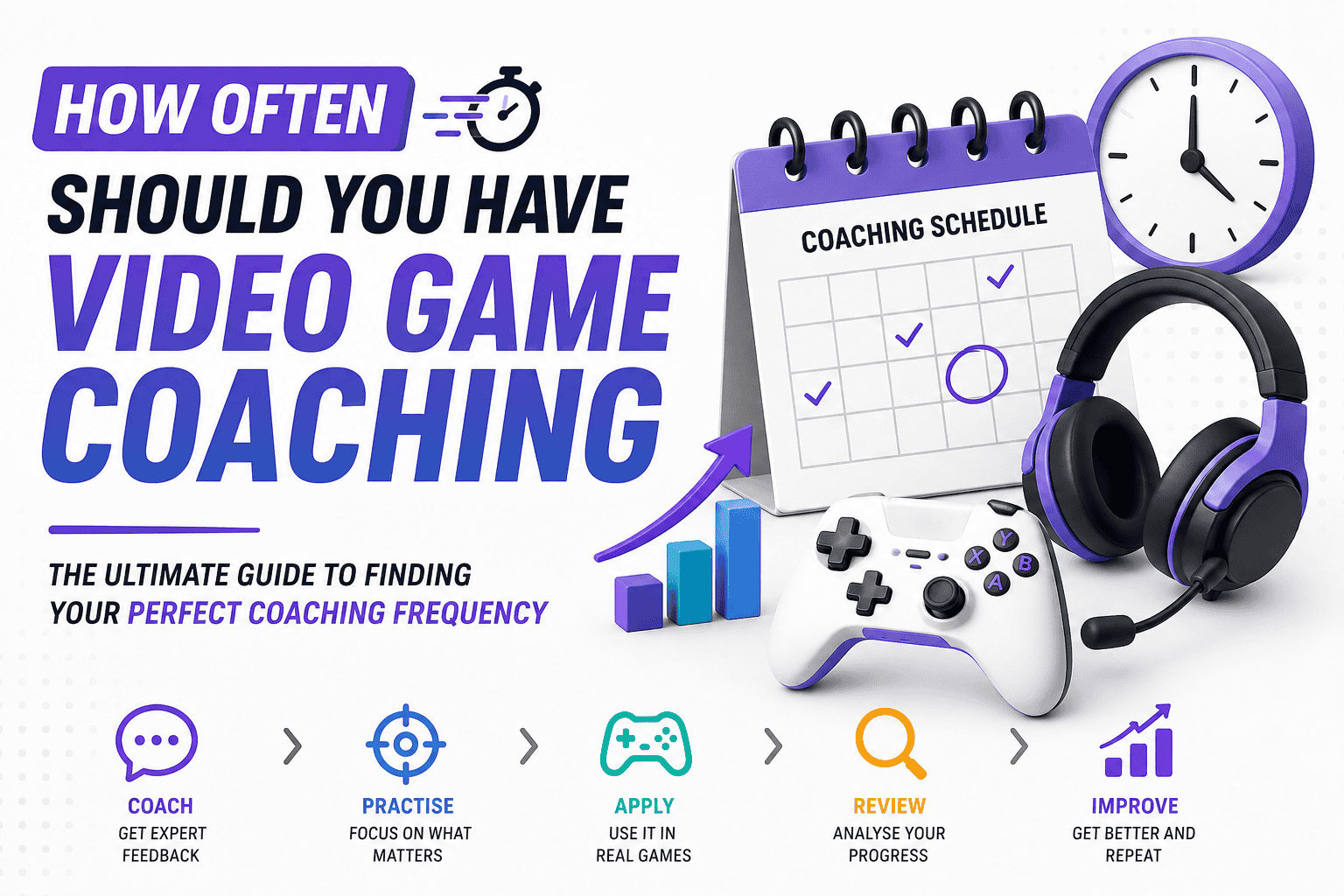
1. Introduction + Quick Answer
So, you’ve had your first video game coaching session.
Your coach has identified what you’re doing wrong, given you several things to work on and politely explained why charging into the same losing fight for the fourth time probably isn’t a strategy.
Naturally, the next question is:
When should you book another session?
For most players, there’s no need to have video game coaching every day – or even several times a week.
For structured improvement, one coaching session every 1-2 weeks can be a useful starting point. That usually gives you enough time to practise, apply the feedback in real matches and discover which areas still need work before your next session.
Beginners and casual players may need coaching less often, while competitive players working towards specific goals may benefit from more frequent sessions.
The important point is that there’s no perfect coaching frequency that works for everyone.
🎧 Coaching Works Best When There’s Practice in Between
A coaching session can show you:
- 🎯 What you need to improve
- 🔍 Which mistakes you’re making
- 🧠 Why those mistakes are happening
- 🏋️ How to practise the solution
- 📈 What you should focus on next
But knowing what to fix and actually fixing it are two different things.
If your Rocket League coach tells you to improve your rotations on Monday, another session on Tuesday probably won’t magically install better rotations.
You need time to play.
Make mistakes.
Remember the advice.
Make the mistake again.
Remember the advice slightly earlier.
And eventually stop making it quite so often.
That’s practice.
🔄 The Coaching Improvement Cycle
A useful coaching schedule should give you time to move through a simple cycle:
🎧 Coaching → 🎯 Identify Improvements → 🏋️ Practise → 🎮 Apply → 🔍 Review → 🎧 Next Session
Each stage matters.
Skip the practice and application stages and you risk arriving at your next session with exactly the same problems you had during the previous one.
Your coach may be delighted to see you again.
Your gameplay less so.
📅 How Often Should You Get Gaming Coaching?
As a rough starting point:
🌱 Beginners – every 1-2 weeks or when you need additional help
📈 Intermediate players – weekly or fortnightly during periods of focused improvement
😎 Casual players – occasionally or whenever there’s something specific they want to learn
🏆 Advanced players – based on specific weaknesses, goals and training needs
🥇 Competitive players – potentially more frequently during structured training or preparation for competition
These aren’t rules.
A player who only has two hours a week to practise may need much longer between coaching sessions than someone playing several hours every day.
🎯 Your Goal Matters More Than the Calendar
How often you need coaching also depends on what you’re trying to accomplish.
If you want help fixing one specific mechanic, you might only need a single session.
If you’re learning a complicated new game, you might benefit from occasional sessions as your understanding develops.
If you’re actively trying to climb ranked, regular coaching and gameplay reviews could help identify problems as they appear.
And if you’re preparing for competitive play, your coaching might become more structured around your training schedule.
The question isn’t simply:
“How often should I have coaching?”
It’s:
“How much time do I need to apply what I learned before more feedback becomes useful?”
🏋️ More Coaching Doesn’t Automatically Mean Faster Improvement
It’s tempting to assume:
More Coaching = More Improvement
Unfortunately, there’s an important ingredient missing:
More Coaching + Focused Practice = Improvement
You can book five sessions in a week.
But if you haven’t practised anything between them, you may simply receive increasingly detailed explanations of the same problem.
For many players, one useful coaching session followed by several hours of focused practice can be more valuable than several coaching sessions squeezed together.
That’s why the best coaching schedule isn’t necessarily the one with the most sessions.
It’s the one that gives you enough time to improve between them.
And that’s exactly why understanding what happens between coaching sessions matters just as much as deciding when to book the next one. 🎮
2. ⏱️ Is There an Ideal Video Game Coaching Frequency?
There isn’t one perfect video game coaching schedule that works for everyone.
For many players, one coaching session every 1-2 weeks is a sensible starting point. But that doesn’t mean you should automatically open your calendar and book a session every second Tuesday for the rest of your gaming career.
How often you need coaching depends on how quickly you can practise, apply the feedback and develop new questions or weaknesses.
Some players may benefit from weekly coaching.
Others might have one session, practise independently for a month and only return when they need more help.
Both approaches can work.
🎯 Your Goals Make a Big Difference
Start with what you’re trying to achieve.
Someone who wants help learning the basics of Rocket League has very different coaching needs from someone preparing for a competitive Valorant tournament.
Your goal might be:
- 🌱 Learning a new game
- 🎯 Improving one specific mechanic
- 📈 Climbing ranked
- 🚧 Breaking through a plateau
- 🧠 Improving strategy or game sense
- 🏆 Preparing for competitive play
- 😎 Simply becoming better at a game you enjoy
The more focused and time-sensitive your goal becomes, the more regular coaching might be useful.
If you’re casually learning a game, there’s rarely any reason to rush.
The game will still be there next Thursday.
Probably with another update.
🌱 Your Skill Level Matters
Different skill levels can also benefit from different coaching schedules.
Beginners often have plenty to work on after a single session.
A coach might identify basic problems with movement, positioning, mechanics and game knowledge. Trying to address all of that before lunch would be ambitious.
Intermediate players may benefit from more regular sessions because they’re often trying to correct established habits or break through ranked plateaus.
Advanced players usually need increasingly specialised feedback. Their coaching schedule may revolve around specific weaknesses rather than a fixed frequency.
Competitive players might use coaching more frequently during structured training or tournament preparation.
The important thing is matching the coaching to where you are now.
🎮 The Game You’re Playing Matters Too
Not every gaming skill develops at the same speed.
Mechanical skills usually require repetition.
If a Rocket League coach gives you aerial drills, you need time to practise them.
If a Counter-Strike 2 coach works on your crosshair placement, you’ll need matches to turn the advice into a habit.
Strategic coaching can work differently.
A League of Legends player might play several matches before bringing new gameplay back for review.
An RTS player may need time to practise a build order against different opponents before another coaching session reveals anything useful.
The game doesn’t dictate an exact schedule, but it affects how much useful practice can happen between sessions.
🏋️ Your Practice Time Is One of the Biggest Factors
Imagine two players receive exactly the same coaching session.
Player A plays 15 hours during the following week.
Player B plays two hours.
Should they automatically book their next coaching session on the same day?
Probably not.
Player A may have had plenty of opportunities to practise the feedback, encounter new situations and develop new questions.
Player B may still be working on the first exercise.
This is why your available practice time matters more than simply following a calendar.
If you only play occasionally, leave more time between sessions.
If you’re practising regularly and deliberately, you may be ready for feedback sooner.
💰 Your Budget Matters
Coaching also costs money.
That sounds obvious, but it’s easy to become focused on improvement and assume more sessions must therefore be better.
Your coaching schedule should be financially comfortable and sustainable.
If weekly sessions don’t fit your budget, don’t force them.
One coaching session followed by several weeks of deliberate practice can still provide excellent value.
You can also use free resources between sessions:
- 🎥 Gaming guides
- 🏋️ Training modes
- 🔍 Self-review
- 👀 Watching experienced players
- 🎮 Regular matches
- 📝 Notes from previous coaching
Coaching should complement your practice, not become the only way you know how to improve.
🔍 Ask Whether There’s Something New to Review
Here’s one of the simplest ways to decide whether another session is worthwhile:
Has anything changed since the last one?
Have you practised the feedback?
Have you played enough matches to test it?
Are you making fewer mistakes?
Have new weaknesses appeared?
Do you have questions?
Is there new gameplay worth reviewing?
If yes, another session may be useful.
If the answer is:
“No, but it’s been seven days.”
The calendar alone probably isn’t a compelling reason.
📅 Think in Terms of Progress, Not Appointments
A fixed schedule can be useful for players who like structure.
But coaching works best when the frequency supports your actual improvement cycle.
Think:
🎧 Get Feedback → 🏋️ Practise → 🎮 Apply → 📈 Progress → 🔍 Need More Feedback
rather than:
🎧 Monday = Coach
The first approach responds to what your gameplay needs.
The second mostly demonstrates that calendars are very good at remembering Mondays.
🎯 The Ideal Frequency Is Personal
For many developing players, weekly or fortnightly coaching can provide a useful balance between regular feedback and independent practice.
But don’t treat that as a prescription.
The ideal frequency is the one that gives you:
Enough coaching to keep you moving in the right direction.
And:
Enough time between sessions to actually move.
That second part is crucial.
Because before booking another session, you need to give the previous advice a chance to become something more useful than notes sitting beside your keyboard. 🏋️
3. 🏋️ Why You Need Time Between Coaching Sessions
One of the easiest mistakes to make with video game coaching is assuming that more sessions automatically mean faster improvement.
They don’t.
Coaching gives you information, feedback and direction.
But improvement usually happens between the sessions, when you take that advice and actually use it.
If your coach identifies poor positioning on Monday, explains it again on Tuesday and reviews the same problem on Wednesday, you’ve certainly received plenty of coaching.
Whether you’ve had enough time to become better at positioning is another question.
🧠 Understanding Something Isn’t the Same as Being Able to Do It
Your coach explains a mistake.
You understand it immediately.
Problem solved?
Not quite.
There’s an important difference between:
“I understand what I should do.”
and:
“I automatically do it correctly during a match.”
Suppose a Valorant coach teaches you to keep your crosshair at head height.
The idea takes seconds to understand.
Making it a consistent habit might take hours of deliberate practice.
The same applies to:
- 🚗 Rocket League rotations
- 🏗️ Fortnite building and editing
- 🥊 Fighting game combos
- 👀 League of Legends map awareness
- 🎯 Counter-Strike 2 crosshair placement
- ♟️ RTS build orders
- 📍 Positioning across almost every competitive game
Knowing the answer is the first step.
Executing it consistently is the actual skill.
🔄 Improvement Happens Through Repetition
Most gaming skills need repetition before they become natural.
A simple learning process looks like:
🧠 Learn → 🏋️ Practise → 🔄 Repeat → ⚡ Automate
At first, you have to consciously think about the new behaviour.
Take checking the minimap.
Initially:
“Remember to check the minimap.”
Then:
“Oh. I forgot to check the minimap.”
Eventually:
You simply check it.
The action becomes part of how you naturally play.
That’s what you’re trying to achieve between coaching sessions.
🎮 You Need Real Matches to Test the Advice
Training modes are useful.
But eventually you need to take the lesson into an actual game.
That’s where things become interesting.
It’s relatively easy to remember perfect positioning while somebody has paused a replay and drawn attention to it.
It’s considerably harder when:
- An opponent appears
- Your teammate starts shouting
- An objective is contested
- Three abilities go off simultaneously
- Somebody pings something seventeen times
- Your carefully considered plan disappears from your brain
Real matches test whether you can apply the coaching under pressure.
You need enough of those situations to discover whether the new approach is starting to work.
🎯 Focus on One or Two Improvements at a Time
A coaching session might identify several weaknesses.
That doesn’t mean you should practise all of them simultaneously.
Suppose your coach says you need to improve:
- Aim
- Movement
- Positioning
- Map awareness
- Communication
- Ability usage
That’s useful information.
Trying to consciously fix all six during your next match?
Less useful.
Choose one or two priorities.
For example:
🎯 This week: Crosshair placement
📍 Secondary focus: Positioning near cover
Once those begin to feel more natural, move on.
Improvement becomes much easier when your brain isn’t trying to run six software updates at once.
🔍 Practice Reveals New Problems
There’s another reason to leave time between sessions.
Practising creates new information.
Maybe your coach helps fix your basic Rocket League rotations.
After practising for a week, your rotations improve.
Great.
But now you notice your recoveries are slowing everything down.
That’s a new problem worth discussing.
Or perhaps your League of Legends coach helps improve your laning.
Once that becomes stronger, you realise your mid-game decision-making is the next weakness.
This is how coaching can progress naturally:
Fix Problem A → Practise → Discover Problem B → Next Coaching Session
Without enough practice between sessions, Problem B may never have had a chance to reveal itself.
🎥 Practice Gives You Better Gameplay to Review
Time between sessions is particularly important if you’re using VOD review.
Your coach needs something useful to analyse.
Ideally, you want matches where you’ve genuinely tried to apply the previous feedback.
Then the next review can answer:
Did the change work?
Are you applying it consistently?
Are you misunderstanding something?
What should you work on next?
That’s far more valuable than reviewing another match played immediately after the previous session before you’ve changed anything.
If you’re deciding how to use live coaching and recorded gameplay analysis together, see Live Gaming Coaching vs VOD Review – Which Is Better?.
📈 Give Improvements Time to Become Visible
Not every improvement will show up immediately in your rank or win rate.
You might start:
- Dying less often
- Taking better positions
- Making smarter decisions
- Using abilities more effectively
- Recognising dangerous situations sooner
- Performing mechanics more consistently
Those are meaningful improvements even if your rank hasn’t moved yet.
Give yourself enough time to see whether the coaching is changing how you play, not simply whether you won the last three matches.
🚫 Don’t Collect Advice Faster Than You Can Use It
This is probably the simplest way to think about coaching frequency.
If every session gives you five new things to improve and you haven’t practised the previous five, eventually you’ll have an impressive collection of advice and exactly the same gameplay.
That’s not training.
That’s hoarding.
Before booking another session, ask:
Have I actually practised what I learned last time?
If not, more feedback may not be what you need yet.
🏋️ Coaching Points You in the Right Direction – Practice Moves You There
A good coach can save you enormous amounts of trial and error.
They can identify weaknesses, explain solutions and help you practise more effectively.
But they can’t perform the repetitions for you.
The ideal rhythm is:
🎧 Coaching → 🎯 Focus → 🏋️ Practice → 🎮 Real Matches → 🔍 Review → 📈 Improvement
Then, when you’ve had enough time to apply the feedback, another coaching session can help identify the next step.
Don’t rush from one session to another.
Give the coaching enough time to actually become part of your gameplay.
For beginners especially, that breathing room can be important – which brings us to how often newer players should actually book coaching sessions. 🌱
4. 🌱 How Often Should Beginners Have Gaming Coaching?
For most beginners, one video game coaching session every 1-2 weeks can be a sensible starting point – provided you’re actually playing and practising between sessions.
But even that may be more coaching than some beginners need.
If your first session gives you several fundamentals to work on, you might spend two, three or even four weeks practising before another session becomes useful.
The goal isn’t to maintain a perfect coaching schedule.
It’s to book another session when you’re ready for more feedback.
🎮 Start With One Coaching Session
If you’re completely new to gaming coaching, don’t worry about planning your next ten sessions.
Start with one.
A good beginner session should help:
- 🎯 Identify your biggest weaknesses
- 🎮 Teach important fundamentals
- 🔍 Spot beginner mistakes
- 🧠 Explain what you’re doing wrong and why
- 🏋️ Give you specific things to practise
- 📋 Create a simple improvement plan
That can give you plenty to work on.
If your coach identifies poor positioning, weak map awareness and inconsistent movement, you don’t necessarily need another coaching session three days later.
You need to play.
🏋️ Give Yourself Time to Practise
Beginners often need time to turn new information into habits.
Imagine your Valorant coach gives you three priorities:
🎯 Keep your crosshair at head height
📍 Position closer to cover
👀 Check the minimap more regularly
Those ideas are easy enough to understand.
Remembering all three when somebody suddenly appears around a corner is another matter.
Give yourself several gaming sessions to deliberately practise the advice.
You want to reach the point where you’re thinking about it less consciously because the better behaviour is starting to become natural.
📅 Weekly Coaching Can Work for Active Beginners
If you’re playing regularly – perhaps several times each week – weekly coaching may work well.
You’ll have enough time between sessions to:
- Practise specific skills
- Play real matches
- Test the feedback
- Encounter new situations
- Develop questions
- Notice new weaknesses
Your next session can then review what changed.
This creates a useful cycle:
🎧 Week 1: Coaching
↓
🏋️ Practise
↓
🎮 Play Matches
↓
🔍 Week 2: Review Progress
Weekly coaching makes the most sense when there’s actually a week’s worth of meaningful practice happening between those sessions.
🗓️ Fortnightly Coaching May Suit Many Beginners Better
For many beginners, every two weeks may provide an even better balance.
It gives you more time to practise without allowing so much time to pass that you’ve forgotten what your coach told you.
A fortnight might look like:
🎧 Day 1: Coaching session
🏋️ Days 2-7: Practise the fundamentals
🎮 Days 8-12: Apply them during normal matches
🔍 Days 13-14: Think about what’s improved and what still feels difficult
🎧 Next session: Review and choose the next priorities
You don’t need to follow that exact schedule.
Gaming improvement doesn’t collapse if Tuesday becomes Wednesday.
The point is to give yourself enough repetitions for the feedback to mean something.
😎 Occasional Players May Need Longer Between Sessions
What if you only play once or twice a week?
Then weekly coaching probably doesn’t make much sense.
You may spend almost as much time being coached as actually playing the game.
If you only have a few hours available each week, you might leave several weeks between sessions.
That’s perfectly fine.
Coaching frequency should match how often you actually play.
A beginner playing 15 hours per week can apply feedback much faster than someone playing two.
The calendar doesn’t know that.
Your coaching schedule should.
🎯 Beginners Often Have Plenty to Work on Already
One reason beginners may need less frequent coaching is that their first few sessions can uncover large, fundamental improvements.
An advanced player might work on one tiny positioning decision.
A beginner might discover:
- Their sensitivity is making aiming difficult
- Their positioning is consistently unsafe
- They’re using the wrong practice routine
- They’re ignoring important information
- They’ve misunderstood a core mechanic
Fixing just one of those can require plenty of practice.
You don’t need another coach to arrive every 48 hours with a fresh list.
Your current list is doing just fine.
🚦When Is a Beginner Ready for Another Session?
Consider another coaching session when:
✅ You’ve practised the previous feedback
✅ You’ve played enough matches to test it
✅ Some improvements are becoming more comfortable
✅ You still have problems you can’t solve
✅ New questions have appeared
✅ You’d like feedback on your progress
✅ You’re ready for the next skill or concept
Notice what’s missing:
“Exactly seven days have passed.”
Time matters because you need practice.
But readiness matters more than an arbitrary date.
🛑 Don’t Use Coaching as a Substitute for Practice
This is particularly important for beginners.
It’s easy to feel productive during a coaching session because you’re constantly learning something new.
Practice can feel slower.
You repeat things.
You make mistakes.
You forget the advice.
You remember it.
Then you make a completely different mistake.
That’s normal.
Don’t respond by immediately booking another session every time something doesn’t work.
Sometimes the answer isn’t more instruction.
It’s more repetitions.
🌱 Beginner Coaching Should Build Independence
Your coach shouldn’t need to guide every match you play.
Over time, you should start recognising:
“My positioning was bad there.”
“I forgot to check the map.”
“I took a fight I didn’t need to take.”
That’s progress.
You’re developing the ability to analyse your own gameplay.
Our Video Game Coaching for Beginners – Complete Guide covers the full beginner journey, including choosing a coach, preparing for your first session and getting the most from the feedback.
🎮 A Good Starting Point for Beginners
If you want a simple recommendation:
Start with one coaching session.
Then spend 1-2 weeks practising what you learned.
After that, ask yourself:
Have I practised the feedback enough for another session to be useful?
If yes, book another.
If not, keep practising.
There’s no prize for having the most coaching sessions.
The prize is getting better at the game. 🎮
5. 📈 How Often Should Intermediate Players Have Coaching?
For intermediate players, weekly or fortnightly video game coaching can work particularly well during periods of focused improvement.
At this level, you already understand the fundamentals.
You know how the game works.
Your mechanics are developing.
You’ve probably played enough ranked matches to develop strong opinions about matchmaking.
And, importantly, you’ve also had enough time to develop habits – both good and bad.
That’s where regular coaching can become particularly useful.
🎯 Intermediate Players Usually Need More Specific Coaching
Beginner coaching often focuses on broad fundamentals.
Intermediate coaching tends to become more targeted.
Instead of:
“How does positioning work?”
You might be asking:
“Why does my positioning keep getting punished in this particular situation?”
Your coaching might focus on:
- 🎯 Mechanical consistency
- 📍 Positioning
- 🧠 Decision-making
- 👀 Map awareness
- 🔄 Rotations
- ⚔️ Fight selection
- 🦸 Character or role mastery
- 💬 Communication
- 🏆 Ranked progression
At this stage, the obvious beginner mistakes may be disappearing.
The remaining problems can be harder to identify yourself.
📅 Weekly Coaching Can Work During Focused Improvement
If you’re playing several times a week and actively trying to improve, weekly coaching can provide a useful feedback loop.
For example:
🎧 Monday: Coaching session
🏋️ Tuesday-Thursday: Focused practice
🎮 Friday-Sunday: Apply the changes in matches
🔍 Next Monday: Review progress
That gives you enough time to test the previous feedback while keeping coaching regular enough to correct problems before they become established habits.
Weekly coaching can be particularly useful if you’re:
- Actively climbing ranked
- Learning a new role
- Changing your playstyle
- Fixing an established weakness
- Preparing for competitive play
- Working through a skill plateau
But weekly coaching only makes sense if you’re actually doing something useful between the sessions.
🗓️ Fortnightly Coaching Gives You More Practice Time
For many intermediate players, one session every two weeks may provide an excellent balance.
You get regular feedback without constantly interrupting your independent practice.
Two weeks gives you time to:
- Work on specific mechanics
- Play enough matches to see patterns
- Test different situations
- Review your own gameplay
- Develop questions
- See whether the previous advice is actually working
This can be particularly useful for skills that require repetition.
If your Rocket League coach gives you a new mechanical routine, for example, seven days may not be enough to judge whether you’ve genuinely improved.
Another week could make the next coaching session much more informative.
🚧 Coaching Can Help Break Through a Plateau
Intermediate players often reach the stage where improvement becomes less obvious.
When you’re a beginner, almost everything can improve.
Later, you might find yourself stuck.
Same rank.
Same mistakes.
Same weaknesses.
Same promotion match somehow ending in disaster.
Welcome to the plateau.
A coaching session can help identify what’s actually preventing the next step.
Maybe your mechanics are good enough.
Perhaps your decision-making isn’t.
Maybe your positioning is strong but your communication is weak.
Or perhaps you’ve been practising something that isn’t actually your biggest problem.
Once the bottleneck is identified, you can spend the next week or two working specifically on it.
🎥 VOD Review Becomes Particularly Valuable
As players become more experienced, gameplay review can become increasingly useful.
Why?
Because intermediate problems are often about decisions, not simply mechanics.
A coach can review several situations and identify patterns such as:
You’re rotating too early.
You’re taking fights without enough information.
You’re using an important ability too soon.
You’re repeatedly positioning yourself without an escape route.
Those patterns can be difficult to recognise while you’re actually playing.
You can then spend the period before your next session deliberately correcting them.
📊 Use Your Matches to Create Useful Feedback
Instead of simply playing until the next coaching appointment, treat your matches as information.
Suppose your coach tells you:
“You’re too aggressive when your team has the advantage.”
During your next matches, deliberately watch for those situations.
Ask:
Did I recognise the advantage?
Did I still take an unnecessary fight?
Did I play more patiently?
What happened when I changed my approach?
Now your next coaching session has something meaningful to review.
You’re not simply asking:
“Am I better yet?”
You’re testing a specific change.
🎯 Ranked Climbers May Benefit From Regular Sessions
If your goal is specifically to climb ranked, weekly or fortnightly sessions can help keep your improvement focused.
But don’t make the mistake of judging whether coaching is working entirely by your rank.
Your rank might move:
Gold 2 → Gold 3 → Gold 2 → Gold 1 → Gold 2
which can feel suspiciously like going nowhere.
Meanwhile, you may actually be:
- Making better decisions
- Dying less often
- Improving mechanically
- Communicating better
- Making fewer positioning errors
- Recognising situations faster
Those improvements matter.
Rank often follows better gameplay over time, rather than moving neatly upwards after every coaching session.
🔍 Adjust the Frequency When Your Needs Change
You don’t need to maintain weekly coaching indefinitely.
Maybe you have weekly sessions for a month while fixing a particular weakness.
Then you move to fortnightly.
Later, perhaps monthly.
Eventually, you only book when you hit another plateau.
That’s perfectly reasonable.
Your coaching schedule might evolve like this:
📅 Weekly → 🗓️ Fortnightly → 📆 Monthly → 🎯 As Needed
Or it might move in the opposite direction when you’re pursuing a new competitive goal.
Frequency should change with your needs.
📈 A Good Starting Point for Intermediate Players
If you’re an intermediate player actively trying to improve, a useful starting point is:
🎧 Weekly coaching if you’re playing and practising frequently.
or:
🗓️ Fortnightly coaching if you want more time to apply the feedback independently.
Then adjust.
If every session produces useful new feedback, your schedule may be working well.
If your coach keeps pointing out the same problems because you haven’t had time to fix them, spread the sessions further apart.
Intermediate coaching should help you find the next bottleneck – then give you enough time to break through it.
Once you reach advanced or competitive levels, however, the equation changes again.
The improvements become smaller, the feedback becomes more specialised and the calendar may start revolving around something rather less forgiving:
competition day. 🏆
6. 🏆 How Often Should Advanced and Competitive Players Have Coaching?
For advanced and competitive players, there isn’t a simple “once a week” answer.
At higher skill levels, coaching usually becomes more specialised and goal-driven.
You’re no longer learning what the minimap does.
Hopefully.
Instead, coaching may focus on small mechanical weaknesses, advanced decision-making, opponent analysis, team strategy or preparation for a specific tournament.
That means coaching frequency should usually be built around training goals and competition schedules, rather than an arbitrary recurring appointment.
🎯 Advanced Players Need More Specific Feedback
As your skill level increases, the obvious mistakes become less obvious.
A beginner might need to improve basic positioning.
An advanced player might already understand positioning extremely well but consistently make one poor decision in a particular situation.
Coaching could focus on:
- 🧠 Advanced decision-making
- 🎯 Mechanical consistency
- 📍 High-level positioning
- ♟️ Strategy
- 🔍 Opponent analysis
- 🗺️ Map-specific tactics
- 🦸 Character, hero or role mastery
- 💬 Team communication
- 🎥 Detailed gameplay review
- 🏆 Competitive preparation
These improvements can be smaller.
But at higher levels, small improvements can matter considerably more.
📅 Weekly Coaching Can Work for Structured Training
Advanced players who train regularly may benefit from weekly coaching during focused improvement periods.
A weekly structure could look like:
🎧 Coaching Session → 🎯 Identify Specific Weakness → 🏋️ Targeted Practice → 🎮 Competitive Matches → 🎥 Review → 🎧 Next Session
Because advanced players may play many hours each week, they can generate enough practice and gameplay between sessions for regular feedback to remain useful.
The important part is that each session should have a purpose.
If you’re booking weekly simply because Tuesday is apparently coaching day, reconsider.
🥇 Competitive Players May Need More Frequent Coaching
Competitive players preparing for tournaments, qualifiers or organised team play may sometimes benefit from multiple coaching sessions within a week.
That’s a very different situation from ordinary ranked improvement.
A competitive schedule might include:
- 🎥 Match or scrim reviews
- ♟️ Tactical preparation
- 👥 Team coaching
- 🔍 Opponent analysis
- 🗺️ Map preparation
- 💬 Communication reviews
- 🎯 Individual skill work
In this environment, coaching may become part of a broader training programme rather than a standalone session.
There may also be a deadline.
If your tournament starts Saturday, discovering on Friday that your team needs three weeks to practise a new strategy is mildly inconvenient.
📆 Coaching Can Increase Before Competition
Advanced coaching frequency doesn’t need to stay constant throughout the year.
A competitive player might normally have coaching every two weeks.
Then, before an important event, increase to weekly or more frequent sessions.
After the competition, the schedule might reduce again.
Think in terms of training blocks:
🏋️ Development Phase → 📈 Increased Training → 🏆 Competition → 🔍 Review → 😌 Reduced Intensity
This makes more sense than maintaining maximum coaching frequency permanently.
🎥 Gameplay Review Becomes Increasingly Important
At advanced levels, tiny decisions can have significant consequences.
That’s why detailed gameplay review can become particularly valuable.
A coach might analyse:
Why did you take this fight?
What information did you have?
What information did you miss?
Could you have created a better position five seconds earlier?
Was the mechanical mistake actually caused by a poor decision beforehand?
At this level, the important mistake may have happened well before the moment everything visibly went wrong.
That makes replay and VOD analysis particularly useful.
👥 Team Coaching Changes the Equation
Competitive gaming isn’t always about individual performance.
Teams may need coaching around:
- Communication
- Roles
- Rotations
- Strategy
- Objective control
- Team compositions
- Map preparation
- Opponent tendencies
Team coaching may therefore happen alongside individual coaching.
A player could have an individual session focused on mechanics and decision-making, then participate in separate team reviews.
At that point, counting “coaching sessions per week” becomes less useful.
What matters is whether the overall training programme is producing useful improvements without overwhelming the players.
🧠 More Coaching Can Still Become Too Much
Being advanced doesn’t make you immune to overcoaching.
You still need time to:
- Practise
- Experiment
- Play independently
- Apply tactical changes
- Build habits
- Recover mentally
Constant feedback can even become counterproductive if you start analysing every tiny decision while trying to play.
At some point, you need to stop discussing the game and actually play it.
Even Formula 1 drivers eventually have to leave the garage.
📈 Advanced Players May Need Less Frequent Coaching Too
There’s an interesting flip side.
Some advanced players may actually need coaching less frequently.
Why?
Because experienced players are often better at:
- Reviewing their own gameplay
- Identifying weaknesses
- Creating practice routines
- Understanding mistakes
- Finding useful resources
- Tracking their own performance
They may only need an outside perspective when they:
Hit a plateau.
Develop a specific weakness.
Change roles.
Prepare for competition.
Need specialist analysis.
In that case, coaching becomes a precision tool rather than a weekly routine.
🎯 Match Coaching Frequency to the Competitive Calendar
For advanced players, the question shouldn’t be:
“How often should advanced players get coaching?”
It should be:
“What am I preparing for and where would coaching help?”
That could mean:
📆 Off-season: Occasional coaching
🏋️ Training block: Weekly coaching
🏆 Pre-competition: More frequent targeted sessions
🎮 Competition: Tactical reviews as needed
🔍 Post-competition: Detailed analysis and adjustment
The schedule follows the goal.
🏆 A Good Starting Point for Advanced Players
For advanced players, consider weekly or fortnightly sessions during focused improvement periods, then adjust based on progress.
For serious competitive players, coaching may become more frequent around structured training and tournaments.
But don’t assume advanced automatically means more coaching.
It usually means more precise coaching.
If you’re unsure where your current ability sits, Video Game Coaching Levels – From Beginner to Pro explains how coaching needs change as players progress.
Ultimately, advanced coaching should target the small differences that still separate where you are from where you want to be.
Because once you’re already good, finding that next 1% can be considerably harder than finding the first 50%. 🎮
7. 😎 How Often Should Casual Gamers Have Coaching?
Casual gamers generally don’t need a fixed video game coaching schedule.
You might have one session, practise what you’ve learned and not need another for weeks or months.
Or ever.
That’s completely fine.
Video game coaching doesn’t have to be part of a serious ranked grind, esports ambition or carefully planned training programme.
Sometimes you just want to become better at a game because…
being better at things you enjoy is fun.
Revolutionary concept.
🎮 Casual Players Can Still Benefit From Coaching
You don’t need competitive ambitions to justify getting coaching.
Maybe you want to:
- 🎯 Improve your aim
- 🧠 Understand a complicated game
- 🦸 Learn a favourite character
- 🏗️ Finally understand Fortnite building
- 🚗 Stop missing the ball in Rocket League
- 👥 Keep up with more experienced friends
- 🎮 Learn a game you’ve recently started
- 😎 Simply become a better player
Those are all perfectly good reasons to book a session.
Your goal doesn’t need to end with:
“Become Grandmaster.”
It can end with:
“Stop embarrassing myself when I play with Dave.”
Motivation is motivation.
🎯 One Session May Be All You Need
Casual players often have specific problems.
For example:
“How do Rocket League rotations work?”
“Which Valorant agent should I learn?”
“Why do I keep losing fights in Fortnite?”
“Can somebody explain League of Legends without requiring me to read an encyclopaedia?”
A single coaching session may be enough to answer the question, identify a few weaknesses and give you some useful things to practise.
After that, go play.
If the problem improves, brilliant.
There’s no requirement to immediately book another session.
📆 Coaching Every Few Weeks or Months Can Work
Some casual players might enjoy occasional coaching as a way to check their progress.
That could mean:
🎧 Coaching Session
↓
🎮 Play Normally for Several Weeks
↓
📈 Improve
↓
🚧 Encounter Another Problem
↓
🎧 Book Another Session
This is a perfectly legitimate coaching schedule.
In fact, for players who aren’t deliberately training several times a week, it may make more sense than weekly sessions.
🕹️ Match Coaching Frequency to How Often You Play
If you only play a game for two or three hours each week, weekly coaching may be excessive.
Imagine:
1 hour coaching
2 hours playing
1 hour coaching
At that point, your coach is becoming dangerously close to being a regular member of your gaming group.
You need enough independent gameplay to actually use what you’ve learned.
If you play occasionally, leave more time between sessions.
👥 Coaching Can Help You Keep Up With Friends
This is an underrated reason for casual coaching.
Maybe your friends have been playing a game for years.
You started last Tuesday.
They understand the maps, mechanics, characters and strategies.
You’re still trying to work out why everyone suddenly ran in the opposite direction.
A coaching session can help close some of that knowledge gap.
You won’t instantly match thousands of hours of experience.
But you might understand enough of the fundamentals to participate more confidently and enjoy playing with the group.
🌱 You Can Use Coaching When Starting a New Game
Casual gamers often jump between games.
That’s another situation where occasional coaching can make sense.
Instead of spending your first 30 hours trying to understand everything through trial and error, you could book a beginner session to learn:
- Core mechanics
- Basic strategy
- Important settings
- Beginner-friendly characters
- Common mistakes
- Useful practice routines
Then continue learning independently.
You don’t necessarily need an ongoing coach.
You might just need a better starting point.
💰 Occasional Coaching Can Keep Costs Down
Casual players also have less reason to spend heavily on frequent sessions.
If gaming is primarily entertainment, coaching should fit comfortably within whatever budget you’re happy spending on the hobby.
One session every month or two might provide plenty of value.
Or you might only book coaching when there’s a specific reason.
That lets you combine paid coaching with:
- Free guides
- Videos
- Practice modes
- Advice from friends
- Gaming communities
- Your own experience
There’s no need to turn improvement into another monthly bill unless you genuinely want regular coaching.
🎯 Book When You Have a Reason
For casual gamers, this is probably the best rule:
Don’t book based on the calendar. Book based on the problem.
Another session may make sense when:
✅ You’ve started a new game
✅ You’re struggling with something specific
✅ You’ve stopped improving
✅ You want to learn a new character or role
✅ You want feedback on your gameplay
✅ You’re preparing to try ranked
✅ You simply feel like improving again
That’s enough.
😎 Gaming Doesn’t Need to Become Homework
Coaching should make gaming more enjoyable, not transform your evenings into compulsory training sessions.
If you enjoy structured practice, great.
If you’d rather receive some advice and then spend the next month playing normally, also great.
Casual coaching can be exactly that:
Occasional expert help when you want it.
No weekly commitment.
No performance targets.
No coach appearing in Discord at 6:00 a.m. shouting that it’s time for aim drills.
Unless you’re into that sort of thing.
For casual players, the ideal coaching frequency is usually simple:
Get coaching when there’s something you want help with – then give yourself plenty of time to enjoy the game and apply what you’ve learned.
But sometimes your goal is much more specific than simply “get better”.
And when the goal changes, the ideal coaching frequency can change with it. 🎯
9. 🎮 Does the Game Affect How Often You Need Coaching?
Yes – the game you’re playing can affect how often video game coaching makes sense.
Different games demand different combinations of mechanical skill, strategy, decision-making and game knowledge.
That matters because some improvements require hours of repetition, while others benefit from reviewing matches, discussing decisions and making tactical adjustments.
A Rocket League player practising aerials may need plenty of time between sessions.
A League of Legends player working on decision-making might benefit from playing several matches and then bringing those games back for review.
Same idea.
Different learning cycle.
🎯 FPS Games – Valorant, Counter-Strike 2 and Overwatch 2
FPS coaching often combines mechanics with decision-making.
You might work on:
- 🎯 Aim
- ➕ Crosshair placement
- 🏃 Movement
- 📍 Positioning
- 🗺️ Map knowledge
- 💥 Utility or ability usage
- 🧠 Game sense
Mechanical improvements generally need repetition.
If your Valorant coach identifies poor crosshair placement, you need enough matches to turn the correction into a habit.
That might mean a week or two of focused practice before another session becomes useful.
More strategic areas – such as positioning, rotations or ability usage – can then be reviewed through new gameplay.
A useful cycle could be:
🎧 Coaching → 🎯 Aim/Positioning Focus → 🏋️ Practice → 🎮 Matches → 🎥 Review
🧠 MOBA Games – League of Legends and Dota 2
MOBAs contain an enormous amount of information.
Characters.
Items.
Lanes.
Objectives.
Matchups.
Team fights.
Economy.
Map awareness.
And just when you’ve finally understood something, a patch arrives.
Coaching may focus on:
- 💰 Farming
- 🛣️ Laning
- 👀 Map awareness
- 📍 Positioning
- 🏆 Objective control
- 🦸 Champion or hero mastery
- 🧠 Decision-making
- ⚔️ Team fights
Because many of these skills involve decisions made across an entire match, VOD and replay review can be particularly valuable.
You may want to play several matches between sessions so the coach has enough new situations to analyse.
One terrible match can teach you something.
Five matches can reveal whether it’s a pattern.
🏗️ Battle Royale Games – Fortnite
Fortnite combines several different types of skill:
Aim + Movement + Building + Editing + Positioning + Rotations + Decision-making
That means coaching frequency may depend heavily on what you’re working on.
If you’re learning building or editing, you’ll probably need plenty of independent practice between sessions.
If you’re working on rotations or fight selection, playing matches and reviewing them may be more useful.
For example:
🎧 Learn Building Technique → 🏋️ Practise → 🎮 Apply in Matches → 🔍 Identify Problems → 🎧 Follow-Up
There’s little value in having your coach demonstrate an edit again tomorrow if your fingers still haven’t forgiven you for today’s session.
🚗 Rocket League
Rocket League is one of the clearest examples of why practice time matters.
A coach can explain how to perform an aerial relatively quickly.
Your car may have other ideas.
Skills such as:
- 🚗 Car control
- ⚽ Ball control
- 🚀 Aerials
- 🔄 Recoveries
- 🎯 Shooting
can require considerable repetition.
Meanwhile:
- 📍 Positioning
- 🔄 Rotations
- ⚡ Boost management
- 🧠 Decision-making
may benefit more from match analysis.
A Rocket League player could therefore have a coaching session, spend one or two weeks practising, then return with new gameplay to review.
🥊 Fighting Games
Fighting games can involve a mixture of:
- 🎮 Execution
- 👊 Combos
- 🛡️ Defence
- 🦶 Movement
- 📏 Spacing
- ⚡ Punishes
- 🧠 Matchup knowledge
- 👀 Reading opponents
Mechanical techniques need repetition.
Lots of it.
A coach can teach you a combo.
They cannot remotely control your hands until muscle memory develops.
Rather inconsiderate.
Give yourself enough time between sessions to practise execution and then test those skills against actual opponents.
Once the mechanic is comfortable, coaching can shift towards when and why to use it.
♟️ RTS and Strategy Games
Games such as StarCraft II and Age of Empires often benefit heavily from replay analysis.
Coaching may focus on:
- 🏗️ Build orders
- 💰 Economy management
- 👀 Scouting
- ⚔️ Unit composition
- 🗺️ Map control
- 🧠 Strategic decisions
- ⏱️ Timing
A coach might give you a build order to practise.
You then need to execute it across multiple matches.
Different opponents create different problems.
Maybe the build works beautifully when nobody interferes.
Then another player attacks four minutes earlier than expected and suddenly your carefully constructed economy resembles a historical site.
Those matches create valuable material for the next review.
🔍 Mechanical Games Often Need More Practice Between Sessions
There’s a useful general rule here.
If your coaching focuses heavily on physical execution, you may need more repetitions between sessions.
Examples include:
🎯 Aim
🚀 Aerials
🏗️ Building
🥊 Combos
🏎️ Racing lines
A coach can correct technique.
But your hands still need time to learn it.
🧠 Strategic Coaching Needs Gameplay to Analyse
Strategy and decision-making also require practice, but in a slightly different way.
You need enough matches to encounter situations where you can apply the new idea.
Then you can review:
Did I recognise the situation?
Did I make the right decision?
What happened afterwards?
Am I repeating the same mistake?
That makes batches of gameplay particularly useful before another coaching session.
🎮 Match the Schedule to What You’re Learning
Don’t choose your coaching frequency purely because another player has weekly sessions.
Ask:
What am I currently trying to improve?
If it’s mechanical:
🎧 Learn → 🏋️ Repeat → 🏋️ Repeat → 🎮 Apply → 🎧 Review
If it’s strategic:
🎧 Learn → 🎮 Play → 🎮 Play → 🔍 Review Decisions → 🎧 Analyse
Both need time between sessions.
They simply use that time differently.
For a broader look at which genres and individual titles are particularly well suited to coaching, see Best Games for Video Game Coaching.
Ultimately, the game matters – but what you’re trying to learn within that game matters even more.
And there’s another factor that can change the ideal schedule too:
How you’re actually being coached. 🎧
10. 🎧 Does Coaching Format Affect How Often You Need Sessions?
Yes – the type of video game coaching you choose can affect how often another session makes sense.
Live coaching and VOD review work differently.
One lets a coach correct problems while you’re actually playing.
The other lets you slow everything down, analyse completed matches and identify patterns across your gameplay.
Because they produce different types of feedback, they can also create different practice cycles between sessions.
🎮 Live Coaching – Learn and Correct in Real Time
With live coaching, your coach works with you while you’re playing or practising.
They might:
- 👀 Watch your gameplay
- 🎯 Correct mechanics
- 📍 Adjust your positioning
- 🧠 Talk through decisions
- 🏋️ Demonstrate drills
- ❓ Answer questions immediately
- 🎮 Play alongside you
The big advantage is immediate feedback.
Suppose you’re learning Valorant and repeatedly positioning yourself too far from cover.
Your coach can spot it.
Explain it.
Have you reposition.
Then watch you try again.
That’s an extremely useful learning loop.
🏋️ Live Coaching Usually Needs Practice Afterwards
The danger with live coaching is assuming that because you successfully corrected something during the session, you’ve now learned it permanently.
You haven’t necessarily.
Your coach was there reminding you.
The real test comes three days later when you’re playing alone and nobody says:
“Remember the positioning thing?”
That’s why live coaching should normally be followed by independent practice.
A useful cycle is:
🎧 Live Coaching → 🎯 Learn the Correction → 🏋️ Practise Alone → 🎮 Apply in Matches → 🔍 Review Progress
Once you’ve had enough time to practise independently, another live session can check whether the improvement is sticking.
🎥 VOD Review Works Differently
VOD review involves analysing gameplay you’ve already recorded or match replays.
Instead of correcting something while it’s happening, the coach can stop and examine the decisions that led to it.
This can be particularly useful for:
- 📍 Positioning
- 🧠 Decision-making
- 🔄 Rotations
- 👀 Map awareness
- ⚔️ Fight selection
- 🏆 Objective decisions
- ♟️ Strategy
- 🔍 Identifying repeated mistakes
Because VOD review relies on completed gameplay, you need enough new gameplay to make another review worthwhile.
Reviewing another match immediately after the previous session may simply reveal exactly the same problems.
📹 Build Up Useful Gameplay Between VOD Reviews
Suppose your League of Legends coach reviews a match and identifies that you’re rotating at poor times.
Your next step probably isn’t:
Book another VOD review tomorrow.
It’s:
🎯 Understand the problem → 🎮 Play several matches → 🧠 Apply the advice → 📹 Collect new gameplay → 🔍 Review again
Now the next coaching session can answer much more useful questions:
Are your rotations improving?
Are you recognising the correct situations?
Are you making a different mistake instead?
What’s the next thing to work on?
That’s genuine progression.
🔄 Live Coaching and VOD Review Can Work Together
You don’t have to choose one format forever.
In fact, combining them can create an excellent coaching cycle.
For example:
🎥 VOD Review
Identify that your positioning is causing problems.
↓
🎧 Live Coaching
Work on better positioning in real situations.
↓
🏋️ Independent Practice
Apply the correction without your coach.
↓
🎮 Play Matches
Build experience using the new approach.
↓
🎥 VOD Review
See whether the problem has improved.
This allows one coaching format to identify the problem and another to help practise the solution.
🎯 Match the Coaching Format to the Skill
A useful rule of thumb is:
🎧 Live coaching works particularly well when you need help doing something.
🎥 VOD review works particularly well when you need help understanding what happened and why.
For example:
| Skill | Coaching Format That May Help |
|---|---|
| 🎯 Aim and mechanics | Live coaching |
| 🏗️ Building and editing | Live coaching |
| 🚀 Rocket League mechanics | Live coaching |
| 📍 Positioning | Both |
| 🧠 Decision-making | VOD review |
| 🔄 Rotations | Both |
| ♟️ Strategy | VOD review |
| 👀 Finding repeated mistakes | VOD review |
These aren’t strict rules.
A good coach may combine both approaches within the same programme.
📅 So, Does One Format Require More Frequent Sessions?
Not necessarily.
The better question is:
How much useful practice or gameplay needs to happen before the next session?
After live coaching, you may need time to practise a newly learned skill independently.
After VOD review, you may need time to play enough matches to see whether you’ve changed the behaviour the coach identified.
Either way, the next session should ideally contain new information.
If nothing has changed since the last session, waiting a little longer may make the next one more valuable.
For a full comparison of the two formats, see Live Gaming Coaching vs VOD Review – Which Is Better?.
🎧 Let the Format Support Your Improvement Cycle
Don’t choose weekly live coaching simply because that’s what you’ve always done.
And don’t schedule a VOD review every Friday if you’ve only played two matches since the previous one.
Let your coaching format determine what needs to happen next:
Live Coaching → Practise the Skill
VOD Review → Apply the Feedback and Generate New Gameplay
Then return when there’s something useful to work on.
Of course, sometimes having a simple recurring schedule makes everything easier.
So next, let’s compare the most common options directly:
weekly vs fortnightly vs monthly video game coaching. 📅
11. 📅 Weekly vs Fortnightly vs Monthly Video Game Coaching
So, what’s the best schedule?
Weekly, fortnightly or monthly video game coaching can all work well – but for different players and different goals.
If you’re actively training and playing regularly, weekly sessions can provide a strong feedback loop.
If you want more time to practise between sessions, fortnightly coaching may offer the best balance.
If you’re a casual player or already comfortable improving independently, monthly coaching may be plenty.
And sometimes?
You don’t need a schedule at all.
Book coaching when you actually need it.
📊 Quick Comparison
| Coaching Frequency | Best For | Main Advantage |
|---|---|---|
| 📅 Weekly | Focused improvement, regular players and ranked progression | Frequent feedback |
| 🗓️ Every 2 Weeks | Most developing players | Strong balance of coaching and practice |
| 📆 Monthly | Casual or self-directed players | Plenty of independent practice |
| 🎯 As Needed | Specific problems, plateaus or occasional goals | Maximum flexibility |
These are guidelines rather than rules.
Your ideal frequency depends on how much you play, what you’re practising and whether another session would actually provide useful new feedback.
📅 Weekly Video Game Coaching
Weekly coaching can work particularly well for players who are actively trying to improve and playing several times each week.
A typical schedule might look like:
🎧 Monday: Coaching
🏋️ Tuesday-Wednesday: Focused practice
🎮 Thursday-Sunday: Apply the feedback in matches
🔍 Next Monday: Review progress
This creates a regular feedback loop without leaving too much time between sessions.
Weekly coaching may suit:
- 📈 Ranked players
- 🎯 Players working on specific weaknesses
- 🏋️ Players practising several times per week
- 🦸 Players learning a new role or character
- 🏆 Competitive players
- 🚧 Players trying to break through a plateau
The key requirement?
You need to actually play between sessions.
If your controller hasn’t moved since last Monday, Tuesday’s coaching session may arrive slightly ahead of schedule.
🗓️ Fortnightly Video Game Coaching
For many developing players, one coaching session every two weeks may provide an excellent balance.
You still receive regular feedback, but you have considerably more time to:
- Practise new mechanics
- Play matches
- Apply tactical changes
- Build habits
- Review your own gameplay
- Identify new questions
- Generate gameplay for VOD review
This can work especially well when you’re learning something that requires repetition.
Your first week might focus heavily on deliberate practice.
Your second could focus more on applying the improvement during real matches.
Then you return to your coach with something meaningful to review.
🎯 Is Fortnightly Coaching the Best Starting Point?
If someone asked for one general starting point, every 1-2 weeks is reasonable for a player who’s actively practising.
Fortnightly coaching has a useful advantage:
It reduces the risk of booking sessions faster than you can implement the feedback.
You have enough time to make mistakes.
Correct them.
Make them again.
Correct them slightly faster.
And eventually begin wondering why you ever made them in the first place.
That’s usually a good sign.
📆 Monthly Video Game Coaching
Monthly coaching can work well for players who are:
- 😎 Playing casually
- 🎮 Playing fewer hours
- 🧠 Comfortable learning independently
- 💰 Managing a smaller coaching budget
- 🎯 Looking for occasional expert feedback
- 📈 Using coaching mainly to check progress
A monthly session could function almost like a gameplay check-up.
You spend several weeks playing and practising independently.
Then your coach reviews where you are, identifies new weaknesses and gives you another set of priorities.
For self-directed players, that may be all the outside feedback they need.
🎯 Coaching Only When You Need It
There’s also the wonderfully complicated schedule known as:
Whenever there’s actually a reason.
You might book a coaching session when:
- You’ve hit a plateau
- You’re struggling with a particular mechanic
- You’ve started a new game
- You’ve changed roles
- You want to begin ranked
- You have gameplay you want analysed
- You’ve developed a bad habit
- You’re preparing for competition
Then you might go weeks or months without another session.
That’s completely fine.
Gaming coaching doesn’t need to become a subscription.
🔄 Your Schedule Can Change
You also don’t need to choose one frequency permanently.
Your coaching might look like:
🌱 Starting Out: Fortnightly
↓
📈 Focused Ranked Push: Weekly
↓
🎯 Goal Achieved: Monthly
↓
😎 Independent Improvement: As needed
↓
🚧 New Plateau: Fortnightly again
Your coaching frequency should respond to what you’re trying to achieve.
Not because you once decided Thursdays were apparently sacred.
💰 Frequency Also Changes the Cost
The difference between weekly and monthly coaching becomes substantial over time.
If one session costs the same amount:
Weekly coaching = roughly 4 sessions per month
Fortnightly coaching = roughly 2 sessions per month
Monthly coaching = 1 session per month
That’s why frequency should be considered alongside value.
If you’re receiving useful feedback every week and applying it, weekly sessions may be worthwhile.
If every second session repeats advice you haven’t practised yet, you’re probably paying for feedback you already own.
For a deeper look at pricing, see How Much Does Video Game Coaching Cost?.
🏆 The Best Schedule Is the One You Can Use
Don’t worry about finding the mathematically perfect coaching interval.
Instead, ask three questions:
1️⃣ Have I practised what I learned last time?
2️⃣ Have I played enough to see whether it’s working?
3️⃣ Is there something useful for my coach to help with now?
If the answer to all three is yes, another session probably makes sense.
If not?
Keep playing.
The coach isn’t going anywhere.
Hopefully.
And if you’re unsure whether enough time has passed, there’s an even better way to decide:
look for the signs that you’re actually ready for another coaching session. 🔍
12. 🔍 How Do You Know You’re Ready for Another Coaching Session?
Forget the calendar for a moment.
One of the best ways to decide when to book another video game coaching session is to ask:
“Have I done enough with the advice from my last session for new feedback to be useful?”
If the answer is yes, you may be ready.
If your notes from the previous session are still sitting untouched beside your keyboard, perhaps give those a fighting chance first.
✅ You’ve Practised the Previous Feedback
This is the biggest sign.
Before booking another session, you should ideally have spent some time working on what your coach previously identified.
Maybe you’ve been practising:
- 🎯 Crosshair placement
- 📍 Positioning
- 🚗 Rocket League rotations
- 🏗️ Fortnite building
- 👀 Map awareness
- 🥊 Fighting game combos
- 🧠 Decision-making
- 🦸 Character-specific mechanics
You don’t need to have mastered the skill.
That’s important.
You simply need to have practised it enough to learn something from the attempt.
📈 You’re Starting to See Progress
Another useful sign is that something has changed.
Perhaps you’re:
- Making fewer positioning mistakes
- Hitting a mechanic more consistently
- Recognising situations earlier
- Making better decisions
- Dying less unnecessarily
- Feeling more comfortable with a role
- Understanding why certain plays succeed or fail
Progress doesn’t mean the problem has disappeared.
In fact, partial improvement can create excellent material for your next coaching session.
Your coach can see what’s working and what still needs adjustment.
🎮 You’ve Tested the Advice in Real Matches
Practice modes are useful.
Eventually, though, you need to take the improvement into actual gameplay.
That’s where things get less cooperative.
You might perform a mechanic perfectly in training.
Then enter a ranked match and suddenly your hands appear to have been replaced by those of an entirely different person.
Normal.
Real matches help reveal whether you can apply the skill under pressure.
Once you’ve tested the feedback across enough situations, another coaching session can help analyse what happened.
❓ You’ve Developed New Questions
Good practice tends to create questions.
You might start wondering:
“I’m positioning better, but what should I do when my teammates push?”
“I can perform this mechanic in training, but why can’t I use it consistently in matches?”
“My laning has improved, but what should I be doing afterwards?”
These are excellent reasons to return to a coach.
Your understanding has progressed far enough that you’ve encountered the next layer of the problem.
That’s exactly what you want.
🚧 You’ve Hit Another Plateau
Maybe the previous coaching worked.
You improved.
Your rank climbed.
Your mechanics became more consistent.
Then…
Nothing.
Progress slows down again.
That’s another good time for coaching.
A fresh session can help identify whether:
- A different weakness is now holding you back
- You’ve developed another bad habit
- Your practice routine needs changing
- Your strategy needs to evolve
- You’ve reached a more advanced problem
Improvement often happens in stages.
Progress → Plateau → Adjustment → Progress
Coaching can help with the adjustment.
🎥 You Have New Gameplay Worth Reviewing
If you’re using VOD review, ask whether you’ve accumulated enough useful gameplay since your previous session.
Ideally, you want footage where you’ve attempted to apply the previous advice.
That gives your coach something meaningful to compare.
For example:
Previous session: Your rotations were too early.
Practice period: You deliberately work on delaying them.
New VOD: Your coach checks whether the timing has improved.
Now the review measures an actual change.
That’s much more useful than bringing another replay where you’ve made exactly the same decisions for exactly the same reasons.
🎯 Your Goal Has Changed
Sometimes you’re ready for another session because you’re no longer working towards the same thing.
Maybe you:
- Started ranked
- Reached your original rank goal
- Changed characters
- Switched roles
- Started playing competitively
- Joined a team
- Began learning a new mechanic
- Decided to focus on a different weakness
A new goal can require a new training plan.
Your coach can help reassess what deserves your attention.
🧠 You Don’t Know What to Work on Next
This is another strong reason to get coaching.
You’ve practised.
You’ve improved.
But now you’re not sure what the next priority should be.
Rather than randomly choosing another mechanic because a YouTube thumbnail told you it was “BROKEN”, a coach can review your current gameplay and identify the next useful area.
That keeps your practice focused.
📋 Quick Check – Are You Ready for Another Session?
Before booking, ask yourself:
✅ Have I practised the previous feedback?
✅ Have I played enough matches to apply it?
✅ Do I understand what improved?
✅ Am I still struggling with something?
✅ Have new questions appeared?
✅ Do I have useful gameplay to review?
✅ Have I reached another plateau?
✅ Has my goal changed?
✅ Am I unsure what to work on next?
You don’t need to tick every box.
But if several apply, another coaching session could be useful.
🎯 Book When There’s Something Worth Coaching
The best signal isn’t:
“It’s been two weeks.”
It’s:
“I’ve worked on the previous feedback and I’m ready for the next step.”
Sometimes that happens after a week.
Sometimes after a month.
Sometimes one coaching session gives you everything you need for much longer.
The important thing is that your next session should move the process forward.
And there’s a useful flip side to this question.
If you’re constantly booking sessions before reaching this point, you may actually be getting coaching too often. ⚠️
13. 🛑 Signs You’re Having Coaching Sessions Too Often
Yes – you can have video game coaching too often.
More coaching can be useful when you’re practising regularly and each session builds on the last.
But if you’re booking sessions faster than you can apply the feedback, more coaching may simply give you more things to think about without enough time to actually improve them.
The problem isn’t necessarily the number of sessions.
It’s whether you’re getting enough value from each one.
Here are some signs you may want to leave a little more time before booking the next session.
🏋️ You Haven’t Practised the Previous Feedback
This is the clearest sign.
If your coach gave you three things to work on and you’ve barely practised any of them, another session probably isn’t the priority.
Suppose your previous session focused on:
🎯 Crosshair placement
📍 Positioning
👀 Map awareness
Three days later, you’ve played one match and booked another coaching session.
What exactly is the coach supposed to review?
You haven’t failed.
You simply haven’t given the advice enough time to work.
🔄 Every Session Covers the Same Problems
Listen carefully if your coach keeps saying:
“Remember what we talked about last time?”
If every session returns to the same issue, you may need more practice between them.
For example:
Session 1: Stop chasing the ball in Rocket League.
Session 2: Stop chasing the ball in Rocket League.
Session 3: Please stop chasing the ball in Rocket League.
At some point, additional explanation isn’t the missing ingredient.
You need enough independent gameplay to change the habit.
📋 Your Improvement List Keeps Getting Longer
A good coaching session might leave you with two or three useful priorities.
But imagine booking another session before you’ve addressed them.
Now you receive three more.
Then another three.
Soon your practice plan looks like:
Aim
Movement
Positioning
Map awareness
Ability usage
Communication
Decision-making
Rotations
Resource management
Remember to occasionally enjoy the game
That’s too much.
A huge improvement list can make it difficult to focus on anything properly.
Finish some of the current work before adding more.
🎧 You’re Becoming Dependent on Live Feedback
Coaching should eventually help you make better decisions without your coach being there.
If you find yourself constantly thinking:
“I don’t know what to do unless my coach tells me.”
you may be relying too heavily on live guidance.
Independent gameplay matters because it forces you to:
- Make your own decisions
- Recognise situations yourself
- Identify mistakes
- Experiment
- Build confidence
- Develop game sense
A coach should help improve your judgement.
They shouldn’t permanently replace it.
🎮 You’re Getting Coached More Than You’re Playing
This one’s fairly straightforward.
If you spend three hours per week in coaching sessions and two hours actually playing the game, the balance may be backwards.
Coaching is supposed to support gameplay.
Gameplay isn’t supposed to exist purely to provide something to discuss during coaching.
You need enough time playing independently to build experience and apply what you’re learning.
🧠 You’re Overthinking Everything
Too much feedback can sometimes create another problem:
analysis paralysis.
You enter a match thinking:
Crosshair.
Positioning.
Map.
Utility.
Movement.
Teammates.
Objective.
Rotation.
Don’t overextend.
Check corners.
Remember what the coach said about –
Dead.
Competitive games already demand a lot of attention.
If you’re consciously trying to remember twenty coaching points simultaneously, your performance may actually become worse temporarily.
Focus on a few improvements until they become more natural.
Then add more.
📈 Your Sessions Aren’t Producing New Feedback
Another sign you’re booking too frequently is that each session feels almost identical.
Your coach isn’t finding new problems.
Your gameplay hasn’t changed enough to analyse.
Your questions haven’t developed.
You’re essentially reviewing the same version of yourself repeatedly.
That’s usually a signal to spend more time:
🏋️ Practising
🎮 Playing
🔍 Self-reviewing
before returning.
Your next coaching session becomes more valuable when you’ve actually created something new to discuss.
💰 You’re Spending More Than You’re Comfortable With
Coaching should fit within your budget.
If frequent sessions are becoming financially uncomfortable, that’s a perfectly good reason to reduce them.
You can still improve between coaching sessions using:
- Free guides
- Training modes
- Gameplay review
- Practice routines
- Experienced friends
- Gaming communities
- Your notes from previous sessions
Reducing coaching frequency doesn’t mean you’re less serious about improving.
It may simply mean you’re using each paid session more efficiently.
😩 Coaching Is Starting to Make Gaming Feel Like Work
If you’re pursuing competitive gaming seriously, structured training is part of the deal.
For everyone else, remember:
Gaming is supposed to be enjoyable.
If your schedule has become:
Monday – Coaching
Tuesday – Aim Training
Wednesday – VOD Review
Thursday – Coaching
Friday – Ranked Grind
Saturday – Existential Crisis After Losing Rank
…you may want to reconsider the balance.
Improvement can be rewarding.
It doesn’t need to consume every gaming session.
⏸️ What Should You Do If You’re Getting Coached Too Often?
Simple.
Leave a little more space.
Instead of:
🎧 Coaching → 🎧 Coaching → 🎧 Coaching
try:
🎧 Coaching → 🏋️ Practice → 🎮 Matches → 🔍 Self-Review → 📈 Progress → 🎧 Coaching
You might move from weekly sessions to fortnightly.
Or fortnightly to monthly.
Or stop following a schedule entirely and book when there’s a specific reason.
🎯 More Coaching Isn’t Always More Improvement
The goal isn’t to maximise the number of coaching sessions you receive.
It’s to maximise what you get from them.
If your coach keeps repeating advice, you’re not practising enough and your improvement list is becoming longer than the game’s patch notes, spread the sessions out.
Give yourself time to actually become the player your coach is trying to help you become.
Of course, you can go too far in the opposite direction too.
Leave it long enough and that carefully explained advice from your last session may become a distant memory.
So next, let’s look at the signs that you might be waiting too long between coaching sessions. 🐌
14. 🐌 Signs You Might Be Leaving Too Long Between Coaching Sessions
Just as you can have video game coaching too often, you can also leave so much time between sessions that the feedback loop starts to break down.
This doesn’t mean you need a coach permanently hovering over your shoulder.
Quite the opposite.
Independent practice is essential.
But if you’ve hit another plateau, forgotten what you were working on or have no idea what to improve next, another session might be useful.
Here are some signs you may have waited long enough.
🧠 You’ve Forgotten the Previous Feedback
Your last coaching session finished with three beautifully clear priorities.
You wrote them down.
You understood them.
You were definitely going to practise them.
Three months later:
“There was something about positioning…”
If you can barely remember what you were supposed to be working on, the gap may have become too long for structured progression.
This is particularly relevant if you’re using coaching as part of a longer-term improvement plan.
You want each session to build on the previous one – not require an archaeological expedition to discover what happened last time.
🔄 Old Habits Are Returning
Maybe you fixed a problem after your last session.
Your crosshair placement improved.
You stopped overextending.
Your rotations became more disciplined.
Then gradually…
The old behaviour returned.
Bad habits are persistent little things.
If you’ve noticed yourself repeatedly slipping back into mistakes that previous coaching helped correct, another session can provide a useful reset.
A coach may also help work out why the habit returned and whether your practice routine needs adjusting.
🚧 You’ve Hit Another Plateau
This is one of the clearest reasons to return.
You practised the previous feedback.
You improved.
Everything was moving nicely.
Then progress stopped.
Maybe your rank hasn’t moved.
Perhaps a particular mechanic isn’t getting any better.
Or you’ve reached the point where you know something is wrong but can’t identify what.
That’s exactly the kind of situation where another coaching session can help.
Your previous weakness may no longer be the main problem.
You may have reached the next bottleneck.
🎯 You Don’t Know What to Practise Anymore
A good improvement plan gives your practice direction.
But eventually, you may complete the original goals.
Then what?
If your training has become:
“I suppose I’ll just play some matches and hope improvement happens…”
it might be time for another assessment.
A coach can look at your current gameplay and identify:
What’s improved
What’s still weak
What’s now holding you back
What you should focus on next
That can restore some purpose to your practice.
❓ You’ve Accumulated Lots of Questions
Practice creates questions.
That’s a good thing.
But if your list has become:
When should I rotate here?
Why do I keep losing this matchup?
Should I change my character pool?
Why does this strategy work sometimes but fail other times?
Am I practising this mechanic correctly?
…another coaching session may save you a lot of guesswork.
You can absolutely research those questions yourself.
But if several relate specifically to your own gameplay, personalised feedback may be more useful.
🎮 Your Gameplay Has Changed Significantly
Maybe you’ve moved on since your last session.
You might have:
- 🏆 Reached a higher rank
- 🦸 Changed your main character
- 🔄 Switched roles
- 🎮 Started a different game mode
- 👥 Joined a team
- 🥇 Started competing
- 🎯 Developed different goals
The coaching advice that suited you six months ago may not perfectly match the player you are today.
Another session can reassess your current level and create a new set of priorities.
🎥 You Have Plenty of New Gameplay to Review
If you’ve played dozens of matches since your last coaching session, you’ve probably generated plenty of useful material.
Especially if you’ve been deliberately working on previous feedback.
A VOD review could now reveal:
- New mistakes
- Recurring patterns
- Improved habits
- New weaknesses
- Strategic problems
- Areas where you’ve misunderstood previous advice
The more meaningful gameplay you’ve accumulated, the more useful another review can become.
📉 Your Progress Has Started Going Backwards
Not every temporary dip requires coaching.
Everyone has bad sessions.
Everyone loses matches.
Everyone occasionally plays like they’ve never encountered the game before.
But if you’ve noticed a consistent decline in an area that was previously improving, it may be worth investigating.
Maybe:
- You’ve developed a new bad habit
- Your practice routine isn’t working
- Your strategy needs adjusting
- A game update changed something important
- You’re misunderstanding a mechanic
- Your current approach has stopped producing results
A coach can provide an outside perspective.
⏱️ How Long Is Too Long Between Coaching Sessions?
There’s no fixed cutoff.
For one player, a month might be too long.
For another, six months could be perfectly fine.
Ask yourself:
Am I still making useful progress independently?
If yes, keep going.
You don’t need another coaching session purely because time has passed.
If no, ask:
Would outside feedback help me understand what to do next?
If the answer is yes, that’s a much better reason to book.
⚖️ Find the Middle Ground
The goal isn’t to maximise or minimise coaching frequency.
It’s to find the point where coaching provides useful direction without replacing independent learning.
Too frequent:
🎧 Feedback → 🎧 More Feedback → 🤯 Too Much to Apply
Too infrequent:
🎧 Feedback → 🏋️ Practice → 🎮 Play → 🐌 Drift → ❓ “What was I working on again?”
A better rhythm is:
🎧 Feedback → 🏋️ Practice → 🎮 Apply → 📈 Progress → 🚧 New Problem → 🎧 Feedback
That’s the sweet spot.
Your next coaching session should arrive when it can solve something useful, not simply because enough pages have fallen off the calendar.
And there’s another practical reason not to book sessions more frequently than you need:
every additional coaching session costs money. 💰
15. 💰 How Coaching Frequency Affects Cost
How often you book video game coaching doesn’t just affect your improvement schedule.
It affects your wallet too.
One coaching session might fit comfortably within your gaming budget.
Book that same session every week and suddenly you’ve created a fairly substantial recurring expense.
That’s why it’s worth thinking about coaching frequency and coaching cost together.
The goal isn’t to buy the maximum amount of coaching you can afford.
It’s to get the most useful improvement from the coaching you pay for.
🧮 Small Differences in Frequency Add Up
Imagine a coaching session costs $30.
Your approximate monthly spending would look like:
| Coaching Frequency | Sessions Per Month | Approx. Monthly Cost |
|---|---|---|
| 📅 Weekly | 4 | $120 |
| 🗓️ Fortnightly | 2 | $60 |
| 📆 Monthly | 1 | $30 |
| 🎯 As Needed | Varies | Varies |
Over a year, the difference becomes much larger.
Weekly coaching at $30 per session could cost around $1,560 across 52 sessions.
Monthly coaching would be around $360 across 12 sessions.
That’s not an argument against weekly coaching.
If you’re using every session effectively and it fits your budget, great.
It’s an argument for making sure the frequency is actually helping.
🎯 Think About Value Per Session
The cheapest coaching isn’t automatically the best value.
Neither is booking fewer sessions simply to minimise spending.
Instead, ask:
What am I getting from each session?
A valuable coaching session might:
- 🔍 Identify an important weakness
- 🎯 Give you clear priorities
- 🧠 Explain a problem you couldn’t diagnose yourself
- 🏋️ Improve your practice routine
- 🎥 Analyse mistakes in your gameplay
- 📈 Help you break through a plateau
If one session gives you enough useful feedback to work on for three weeks, booking another session three days later may not provide much additional value.
🏋️ Practice Is Free – Use It
This is where coaching economics become rather convenient.
Once you’ve paid for good feedback, practising that feedback usually doesn’t cost anything extra.
Suppose you have two options:
Option A
🎧 1 coaching session
🏋️ 10 hours of focused practice
Option B
🎧 3 coaching sessions
🏋️ 2 hours of practice
Option B costs considerably more.
It doesn’t automatically produce better results.
If the skill you’re learning requires repetition, Option A may actually provide more value.
Your coach can tell you how to improve your crosshair placement.
Fortunately, they don’t need to invoice you every time you practise it.
📅 Set a Coaching Budget
If you want regular coaching, consider setting a simple monthly budget.
For example:
Gaming coaching budget: $60 per month
You could use that for:
2 × $30 fortnightly sessions
or:
1 × $60 specialist session
or:
1 session this month and save the rest for later
This prevents coaching from gradually becoming a larger expense simply because you’ve fallen into a recurring schedule.
Your budget should determine what you’re comfortable spending.
Not your losing streak.
😤 Don’t Panic-Book Coaching After Bad Matches
You’ve lost six ranked matches.
Your rank has dropped.
Your teammates have apparently forgotten the objective exists.
Everything is terrible.
Time to book three coaching sessions?
Maybe not.
A bad evening doesn’t necessarily mean your entire training plan needs rebuilding.
Before spending more, ask:
Is this a genuine skill problem?
Is it something I can identify myself?
Have I practised my existing feedback?
Would another coaching session actually help?
Book because there’s a useful problem to solve.
Not because ranked has personally offended you.
📦 Coaching Packages Can Change the Calculation
Some coaches may offer multiple-session packages or bundles.
These can reduce the effective price per session.
But a cheaper session isn’t automatically useful if you don’t actually need it.
Before buying a package, consider:
- How often you realistically play
- How much practice time you have
- Whether the sessions expire
- What each session includes
- Whether you want ongoing coaching
- Whether the coach is a good fit
Buying ten sessions because they’re cheaper per session isn’t much of a bargain if you only needed three.
📈 Spend More When There’s a Reason
There may be times when temporarily increasing your coaching frequency makes sense.
For example:
- 🏆 Preparing for a tournament
- 📈 Making a focused ranked push
- 🦸 Learning a new role
- 🚧 Breaking through a difficult plateau
- 👥 Joining a competitive team
You might increase from fortnightly to weekly sessions for a month.
Then reduce the frequency again once the goal is achieved.
Your coaching spending can change alongside your training intensity.
💡 More Expensive Coaches Don’t Necessarily Need More Sessions
Another option is to book a more experienced or specialised coach less frequently.
For example, instead of four general sessions every month, you might prefer one highly focused session followed by several weeks of practice.
Whether that’s better depends on your needs.
Don’t compare coaches only by hourly price.
Compare:
Price + Experience + Coaching Quality + Relevance + What You Actually Receive
For a deeper breakdown of typical pricing factors, see How Much Does Video Game Coaching Cost?.
💰 The Best Value Comes From Using the Feedback
Ultimately, coaching value doesn’t come from how many hours you buy.
It comes from what happens afterwards.
If a $30 session identifies a problem that you spend the next month successfully correcting, that’s potentially excellent value.
If four $30 sessions give you pages of advice you never practise…
You’ve mostly purchased an unusually detailed description of your weaknesses.
So when deciding how often to book coaching, don’t just ask:
“Can I afford another session?”
Ask:
“Have I got enough value from the last one yet?”
Because as you become better at practising, reviewing and correcting your own gameplay, something interesting may happen:
you might need coaching less often. 🎮
16. 📈 Should You Have Video Game Coaching Forever?
No.
Video game coaching doesn’t need to become a permanent part of your gaming life.
You might use coaching for a few sessions while learning a new game.
You might have regular coaching during a ranked push.
You might return whenever you hit a plateau.
Or you could eventually reach the point where you rarely need coaching at all.
That’s not coaching failing.
In many cases, it’s a sign that the coaching worked.
🧠 Good Coaching Should Make You More Independent
When you first start coaching, you might rely heavily on your coach to identify problems.
You play a match.
Something goes wrong.
You know it went wrong.
You just don’t know why.
A coach can help connect the dots:
“Your aim wasn’t the main problem – you took that fight from a terrible position.”
Over time, you should start recognising those situations yourself.
Instead of waiting for your coach to say it, you begin thinking:
“That wasn’t an aim problem. My positioning put me at a disadvantage before the fight even started.”
That’s a significant improvement.
You’re not just becoming better at the game.
You’re becoming better at understanding your own gameplay.
🔍 You Should Get Better at Identifying Your Own Mistakes
One of the most valuable skills coaching can develop is self-review.
Eventually, you should become better at asking:
- ❓ Why did I lose that fight?
- 📍 Was my positioning correct?
- 👀 What information did I miss?
- ⚔️ Did I need to take that fight?
- 🧠 Was my decision sensible?
- 🎯 Was the problem mechanical or tactical?
- 🔄 Am I repeating the same mistake?
You won’t always diagnose everything correctly.
Even highly experienced players benefit from an outside perspective.
But you should become less dependent on somebody else identifying every problem for you.
🏋️ You Should Learn How to Practise Properly
Good coaching shouldn’t just tell you what you’re doing wrong.
It should help you understand how to improve it.
Maybe your coach teaches you:
🎯 Aim drills for a mechanical weakness
🎥 VOD review for decision-making
🚗 Training routines for Rocket League mechanics
🥊 Repetition drills for fighting game execution
🧠 Specific match objectives for developing game sense
Over time, you build your own improvement toolkit.
When you discover a weakness, you have a better idea of what to do about it.
That’s much more useful than needing another paid session every time something goes wrong.
📋 You Can Start Building Your Own Practice Plans
Early on, your coach might tell you exactly what to practise.
Later, you may be able to create a simple plan yourself.
For example:
Current weakness: Poor map awareness
🎯 Goal: Check the minimap more consistently
🏋️ Practice: Deliberately check at specific moments
🎮 Application: Focus on awareness during normal matches
🔍 Review: Check whether missed information still causes mistakes
That’s essentially a small coaching process you’ve created yourself.
Congratulations.
You’re becoming your own slightly less expensive coach.
📉 Coaching Frequency May Naturally Decrease
As you become more independent, your coaching schedule may gradually spread out.
For example:
🌱 Beginner: Every 1-2 weeks
↓
📈 Developing Player: Fortnightly
↓
🎯 Experienced Player: Monthly
↓
🧠 Self-Directed Player: As needed
This isn’t a required progression.
Some competitive players may increase coaching frequency at higher levels.
Others may rarely need it.
The important point is that you shouldn’t assume regular coaching must continue forever simply because it was useful initially.
🚧 You Can Return When You Hit Another Plateau
Stopping regular coaching doesn’t mean you’re closing the door permanently.
You might improve independently for months.
Then hit a plateau.
Maybe you’ve reached a higher rank where your old strategies aren’t working.
Perhaps you’ve changed roles.
Maybe the game has changed significantly.
Or you’ve developed a weakness you can’t identify yourself.
That’s an excellent time to return.
Think of coaching as something you can use when it provides value, rather than something you need continuously.
🏆 Competitive Players May Use Coaching Differently
Serious competitive players are an exception worth noting.
At higher levels, coaching may remain part of an ongoing training programme.
Professional and competitive players can benefit from outside analysis because small strategic or mechanical differences matter.
Even then, the coach isn’t supposed to make every decision for the player.
The goal remains to develop:
- Better decision-making
- Stronger game understanding
- More effective practice
- Better self-analysis
- Greater adaptability
The level changes.
The principle doesn’t.
🎮 Sometimes You Simply Don’t Need Coaching Anymore
Maybe you reached the goal you originally set.
You wanted to understand the game.
Now you do.
You wanted to reach a particular rank.
You reached it.
You wanted to stop losing every match against your friends.
Dave is strangely quiet now.
Mission accomplished.
There’s no reason to keep booking coaching purely because you’ve always booked coaching.
You can continue playing, practising and improving independently.
🎯 Coaching Should Teach You How to Improve
The best long-term outcome isn’t:
“I need my coach to tell me what to do.”
It’s:
“I know how to work out what I need to improve.”
A good coach can help you develop the skills to:
🔍 Identify → 🎯 Prioritise → 🏋️ Practise → 🎮 Apply → 📈 Review
Once you can run more of that cycle yourself, coaching can become less frequent and more targeted.
Maybe you book another session next week.
Maybe next month.
Maybe six months from now when you encounter something you can’t solve.
That’s fine.
The goal isn’t to need coaching forever.
It’s to become a better player – and eventually, a better student of your own gameplay.
So what might that progression actually look like in practice?
Next, let’s put together a few example video game coaching schedules for different types of players. 📅
17. 🗓️ Example Video Game Coaching Schedules
So far, we’ve established that there’s no perfect coaching frequency for everyone.
Useful.
But perhaps not particularly helpful when you’re staring at a calendar wondering whether to book Tuesday.
So let’s make it practical.
The schedules below aren’t rules. They’re starting points you can adjust based on your skill level, goals, available practice time and progress.
The basic principle remains the same:
🎧 Coaching → 🏋️ Practice → 🎮 Apply → 🔍 Review → 📈 Adjust
🌱 Example Schedule for a Beginner
Beginners usually need plenty of time to practise fundamentals.
A simple three-week cycle might look like:
Week 1 – 🎧 Coaching Session
- Assess your current gameplay
- Identify 2-3 major weaknesses
- Learn important fundamentals
- Get a simple practice routine
Week 2 – 🏋️ Focused Practice
- Work on the skills your coach identified
- Keep the number of priorities small
- Repeat drills where appropriate
- Play normal matches
Week 3 – 🎮 Apply and Review
- Focus on using the improvements in real matches
- Notice which mistakes are disappearing
- Write down new questions
- Save useful gameplay for review
Then ask:
Do I need another session?
If yes, book one.
If you’re still working through the original feedback, keep practising.
You don’t need to summon your coach simply because Week 4 has arrived.
📈 Example Schedule for an Intermediate Ranked Player
Intermediate players who play regularly may benefit from a tighter feedback loop.
For example:
Week 1 – 🎧 Coaching
Identify one or two weaknesses affecting ranked performance.
↓
Week 1 – 🏋️ Targeted Practice
Work specifically on those weaknesses.
↓
Week 1-2 – 🎮 Ranked Matches
Apply the changes during real gameplay.
↓
Week 2 – 🎥 Review
Bring useful gameplay into another coaching session.
↓
Week 2 – 🎯 Set New Priorities
Continue working on the existing weakness or move to the next bottleneck.
This creates a fortnightly coaching cycle.
If you’re playing and practising heavily, you could shorten it to weekly.
If you’re only playing a few hours, extend it.
🚧 Example Schedule for Breaking Through a Plateau
If you’ve been stuck at the same level for a while, don’t immediately commit to months of coaching.
Try a short improvement block.
Week 1 – 🔍 Assessment Session
Have the coach identify what’s actually holding you back.
Weeks 1-2 – 🏋️ Focused Practice
Work primarily on the biggest weakness.
Weeks 2-3 – 🎮 Apply in Matches
Test whether the change improves your gameplay.
Week 3 – 🎥 Follow-Up Review
Review your progress.
Then decide what happens next.
If you’ve broken through the problem, you may not need another session immediately.
If the plateau remains, your coach can reassess it.
This is much more useful than blindly booking weekly sessions and hoping sheer calendar density defeats the plateau.
😎 Example Schedule for a Casual Gamer
Casual coaching can be wonderfully uncomplicated.
🎧 Have a Coaching Session
↓
🎮 Play the Game
↓
🏋️ Practise When You Feel Like It
↓
😎 Continue Enjoying Yourself
↓
🚧 Encounter Something You Want Help With
↓
🎧 Book Another Session
The gap might be:
Two weeks.
Two months.
Six months.
It doesn’t matter.
If you’re not pursuing a time-sensitive goal, there’s no reason coaching needs to follow a strict schedule.
🏆 Example Schedule for a Competitive Player
Competitive players may need coaching built around their training and event calendar.
For example:
4 Weeks Before Competition
🎧 Assessment and strategy session
🎯 Identify priority weaknesses
🏋️ Begin focused training
3 Weeks Before
🎥 Review scrims or competitive matches
♟️ Adjust tactics
👥 Work on communication or team play
2 Weeks Before
🎧 Follow-up coaching
🔍 Review progress
🎯 Refine remaining weaknesses
Final Week
🏆 Competition-specific preparation
🎥 Opponent or gameplay review where relevant
🧠 Focus on execution rather than introducing ten new ideas
Then after the event:
🔍 Review → Identify Lessons → Adjust Training
The exact frequency will depend heavily on the player, game and competitive environment.
🎯 Example Schedule for Fixing One Specific Skill
Sometimes you don’t need a complete coaching programme.
You just want to fix something.
Suppose you’re struggling with Rocket League aerials.
A simple schedule could be:
Day 1 – 🎧 Coaching
Learn the correct technique.
↓
Days 2-7 – 🏋️ Practice
Repeat drills and build consistency.
↓
Week 2 – 🎮 Apply
Start deliberately using the mechanic in matches.
↓
Week 2-3 – 🔍 Assess
Is it improving?
If yes, continue practising.
If not, another session might help identify what’s going wrong.
That’s coaching based on need, rather than frequency.
🎥 Example Live Coaching + VOD Review Schedule
You can also alternate coaching formats.
For example:
Week 1 – 🎧 Live Coaching
Work directly on mechanics, positioning or execution.
↓
Week 1-2 – 🏋️ Independent Practice
Apply the corrections.
↓
Week 2 – 🎮 Play Matches
Generate new gameplay.
↓
Week 3 – 🎥 VOD Review
Analyse whether the changes are working.
↓
Week 3+ – 🎯 Adjust
Continue practising or identify the next priority.
This can create a useful balance between learning what to do and reviewing whether you’re actually doing it.
📊 Quick Coaching Schedule Guide
| Player or Goal | Possible Starting Schedule |
|---|---|
| 🌱 Beginner | Every 1-2 weeks, then adjust |
| 📈 Intermediate Player | Weekly or fortnightly |
| 🎯 Ranked Climber | Weekly or fortnightly during a focused push |
| 🚧 Skill Plateau | Assessment → 1-3 weeks practice → review |
| 😎 Casual Gamer | As needed |
| 🏆 Competitive Player | Structured around training and competition |
| 🛠️ Specific Skill | Initial session → practice → follow-up if needed |
🔄 Your Schedule Should Change With You
Your coaching schedule isn’t a contract with your future self.
Change it when your circumstances change.
If you’re improving quickly:
Spread the sessions out.
If you’ve hit a difficult plateau:
Temporarily increase them.
If you’re preparing for competition:
Build coaching around the event.
If you’re happily improving independently:
Don’t book anything.
The best schedule is the one that provides feedback when you need it and practice time when you don’t.
Start with a sensible frequency.
See how you respond.
Then adjust.
Because ultimately, a coaching schedule should serve your improvement – your improvement shouldn’t serve the schedule. 🎮
18. ⚠️ Common Mistakes When Scheduling Gaming Coaching
Finding the right video game coaching schedule isn’t particularly complicated.
Yet it’s surprisingly easy to get wrong.
The biggest mistake is treating coaching frequency as the goal itself.
Weekly coaching isn’t automatically better than fortnightly coaching. Fortnightly isn’t automatically better than monthly.
The right schedule is the one that gives you useful feedback and enough time to do something with it.
Here are some of the most common mistakes to avoid.
📅 Booking Sessions Just Because They’re Scheduled
Regular coaching can be useful.
But a recurring appointment shouldn’t become the only reason you’re having a session.
Before each session, ask:
Have I practised the previous feedback?
Have I played enough matches to apply it?
Do I have new questions or gameplay to review?
Is there something useful for my coach to help with?
If the answer to all four is no, postponing the session might make more sense.
Your calendar won’t be offended.
🎧 Booking Too Many Sessions
It’s tempting to think:
More Coaching = Faster Improvement
But we’ve already met the missing ingredient:
practice.
If you have three coaching sessions in a week but barely play between them, you’re receiving feedback faster than you can implement it.
A better balance might be:
🎧 1 Coaching Session + 🏋️ Several Practice Sessions
rather than:
🎧 Coaching + 🎧 Coaching + 🎧 Coaching + 🤯
Your brain has storage limits too.
🏋️ Not Practising Between Sessions
This is probably the biggest scheduling mistake.
Your coach can explain better positioning.
They can demonstrate a mechanic.
They can identify a poor decision.
They can give you drills.
What they can’t do is magically convert that information into muscle memory while you sleep.
Annoying, really.
You need time between sessions to:
- Repeat mechanics
- Play matches
- Test strategies
- Build habits
- Make mistakes
- Correct those mistakes
- Apply the feedback without your coach
Without that stage, coaching becomes information rather than improvement.
🐌 Leaving Too Long Without a Reason
The opposite mistake is waiting indefinitely even when you’ve clearly reached the point where more feedback would help.
Maybe you’ve:
- 🚧 Hit another plateau
- ❓ Developed new questions
- 🔄 Fallen back into old habits
- 🎯 Changed your goals
- 🦸 Switched roles or characters
- 🏆 Started playing at a higher level
If you’ve stopped making useful progress independently, another session may help identify the next step.
There’s no medal for going the longest without speaking to your coach.
📊 Measuring Your Schedule Only by Rank
Suppose you book weekly coaching.
Your rank doesn’t increase after three weeks.
Does that mean weekly coaching isn’t working?
Not necessarily.
Look at the gameplay itself.
Are you:
- Making better decisions?
- Improving mechanically?
- Positioning more effectively?
- Dying less unnecessarily?
- Communicating better?
- Recognising mistakes sooner?
Rank is useful, but it’s a lagging and sometimes noisy measure of improvement.
Don’t completely redesign your coaching schedule because you lost four matches on Saturday.
Ranked mode has caused enough questionable decisions already.
🏆 Expecting Regular Coaching to Guarantee Rank Progression
This deserves its own warning.
A weekly coaching session doesn’t create a contractual obligation for your rank to increase every Friday.
Coaching can improve:
knowledge, mechanics, decision-making, awareness and practice quality.
It can’t control:
teammates, opponents, matchmaking, individual match outcomes or how consistently you apply the advice.
Be cautious of anyone promising guaranteed ranked results from a particular number of sessions.
🎯 Changing Focus Every Session
Session one:
Aim.
Session two:
Positioning.
Session three:
Movement.
Session four:
Strategy.
Session five:
New character because apparently we’re doing that now.
Constantly changing priorities can prevent you from spending enough time on any one weakness.
Whenever possible, let sessions build on each other.
Identify → Practise → Review → Refine
Then move on when you’ve made meaningful progress.
💰 Spending Beyond Your Budget
Don’t build a coaching schedule that makes you uncomfortable financially.
Weekly coaching may sound ideal until you calculate the monthly or annual cost.
Choose a frequency you can comfortably sustain.
That might mean:
Weekly → Fortnightly
or:
Fortnightly → Monthly
or simply:
Book when needed.
Less frequent coaching combined with focused practice can still be extremely effective.
📦 Buying a Large Package Too Early
Multi-session packages can offer good value.
But don’t immediately buy 20 sessions from a coach you’ve never worked with.
Start smaller.
See whether:
- You communicate well
- Their teaching style suits you
- Their expertise matches your needs
- You actually enjoy the sessions
- Their feedback helps you improve
A discounted package isn’t particularly economical if you discover after Session 2 that you’re not a good match.
👤 Copying Someone Else’s Coaching Schedule
Your friend has coaching twice a week.
Should you?
Maybe.
But your friend might:
- Play 30 hours a week
- Be preparing for competition
- Have completely different goals
- Learn differently
- Have a larger budget
- Be at a different skill level
Don’t copy someone else’s schedule without considering why it works for them.
The correct frequency is personal.
🎮 Forgetting to Actually Enjoy the Game
There’s a point where optimising everything can become exhausting.
Coaching session.
Aim routine.
Replay analysis.
Rank tracking.
Performance notes.
Another coaching session.
At some stage you may remember:
“Didn’t I start playing this because it was fun?”
Competitive players may deliberately accept intense training schedules.
Casual and developing players don’t necessarily need to.
Improvement should generally make the game more rewarding, not turn every gaming session into an unpaid performance review.
🎯 Keep the Schedule Simple
A good coaching schedule doesn’t need to be complicated.
Use this basic rule:
🎧 Get Coaching
↓
🎯 Choose 1-3 Priorities
↓
🏋️ Practise
↓
🎮 Apply Them
↓
🔍 Review Your Progress
↓
❓ Ask: Do I Need More Feedback?
If yes:
Book another session.
If no:
Keep practising.
That’s really the whole system.
Avoid booking too frequently, waiting unnecessarily long, chasing rank after every session or treating the calendar like it knows more about your gameplay than you do.
Because if you want the shortest possible answer to how often you should have video game coaching, the next section brings everything together. 🎮
19. 📊 Quick Guide – How Often Should You Get Video Game Coaching?
If you’ve made it this far and would now quite like someone to just give you the numbers, fair enough.
Here’s the quick answer:
For many players who are actively trying to improve, video game coaching every 1-2 weeks is a sensible starting point.
But that’s a starting point – not a rule.
Beginners may need more time to practise fundamentals. Competitive players may temporarily need more frequent coaching. Casual players might only book a session every few months.
The best frequency depends on your skill level, goals, available practice time and how quickly you’re applying the feedback.
🎮 Video Game Coaching Frequency at a Glance
| Player Type | Suggested Starting Point | Why It Can Work |
|---|---|---|
| 🌱 Beginner | Every 1-2 weeks or as needed | Time to practise fundamentals |
| 📈 Intermediate | Weekly to fortnightly | Regular feedback while developing |
| 🏆 Advanced | Fortnightly or as needed | More targeted, specialised feedback |
| 😎 Casual | Occasionally/as needed | Coaching when there’s something specific to improve |
| 🎯 Ranked Climber | Weekly or fortnightly | Regular review during focused improvement |
| 🥇 Competitive Player | Based on training and competition | Frequency can increase around events |
| 🚧 Player at a Plateau | Assessment + follow-up after practice | Identify the bottleneck, practise it, then review |
These aren’t prescriptions.
You don’t need to cancel Thursday night plans because a table on the internet said FORTNIGHTLY.
Use the frequency that matches how you’re actually playing.
🌱 Beginner – Every 1-2 Weeks or As Needed
Beginners often receive a lot to work on from one coaching session.
Your coach might identify problems with:
- 🎯 Mechanics
- 📍 Positioning
- 👀 Awareness
- 🎮 Game fundamentals
- 🏋️ Practice habits
Give yourself time to work on those things before adding more.
If you’re playing regularly, another session after a week or two might make sense.
If you only play occasionally, wait longer.
📈 Intermediate – Weekly to Fortnightly
Intermediate players often benefit from a more regular feedback loop.
You understand the fundamentals but may be working on:
- Ranked progression
- Specific mechanics
- Decision-making
- Role mastery
- Established bad habits
- Skill plateaus
If you’re practising several times per week, weekly coaching can work well.
If you want more independent practice time, fortnightly may provide a better balance.
🏆 Advanced – Fortnightly or As Needed
Advanced players generally need more specialised coaching rather than simply more coaching.
You may only need another session when:
- You’ve identified a specific weakness
- You’ve hit a plateau
- You’re changing roles
- You need detailed gameplay analysis
- You’re preparing for competition
Experienced players are also often better at reviewing their own gameplay, which can reduce how frequently outside feedback is needed.
😎 Casual – Whenever You Want Help
Casual gamers can keep things extremely simple.
Have coaching when there’s something you want help with.
That might mean:
One session this month.
Then nothing for three months.
Then another session when you start a new game.
Perfectly fine.
You don’t need a recurring schedule just because coaching exists.
🎯 Ranked Climber – Weekly or Fortnightly
If you’re making a deliberate ranked push, regular coaching can help maintain focus.
A useful cycle might be:
🎧 Coaching → 🏋️ Practice → 🎮 Ranked Matches → 🎥 Review → 🎧 Coaching
Weekly sessions may work if you’re playing heavily.
Fortnightly may be better if you need more time to implement changes.
And remember:
Don’t judge the entire coaching schedule by whether your rank increased this week.
Look at whether your gameplay is improving.
🥇 Competitive – Build Coaching Around Training
Competitive players are the least suited to a simple calendar recommendation.
Coaching frequency may increase around:
- 🏆 Tournaments
- 🎮 Qualifiers
- 👥 Team training
- 🎥 Scrim reviews
- ♟️ Tactical preparation
- 🔍 Opponent analysis
During quieter development periods, coaching may become less frequent.
The schedule should support the competitive calendar.
🚧 Plateau – Assessment, Practice, Review
If you’ve stopped improving, don’t assume you suddenly need coaching twice a week forever.
Try:
🔍 Assessment Session
↓
🎯 Identify the Bottleneck
↓
🏋️ Focused Practice
↓
🎮 Apply the Changes
↓
🎥 Follow-Up Review
If the problem improves, you can reduce the frequency again.
Use coaching to solve the plateau rather than automatically turning it into a permanent appointment.
⏱️ Practice Time Can Override Everything Above
There’s one factor that can completely change these recommendations:
How much you actually play.
Two intermediate players might both have fortnightly coaching.
Player A plays:
20 hours between sessions.
Player B plays:
3 hours between sessions.
They may not be equally ready for another session.
That’s why the table above should always be combined with one question:
Have I had enough time to practise the previous feedback?
🔍 The 5-Question Coaching Frequency Test
Still unsure?
Before booking another session, ask:
1️⃣ Have I practised what my coach told me?
2️⃣ Have I applied it in real matches?
3️⃣ Have I learned something from doing that?
4️⃣ Do I have new questions, problems or gameplay to review?
5️⃣ Would another session help me move forward?
Mostly yes?
Book the session.
Mostly no?
Keep practising.
🎯 The Simplest Answer
If you want one general recommendation:
Start with video game coaching every 1-2 weeks if you’re actively practising.
Then adjust based on your progress.
Move sessions closer together when there’s a clear reason.
Spread them further apart when you’re improving independently.
And stop following a schedule entirely if you don’t need one.
The best coaching frequency isn’t measured by days between sessions.
It’s measured by whether each new session gives you something useful that you were ready to learn. 🎮
20. ❓ Video Game Coaching Frequency FAQs
Still wondering whether you should book another coaching session next week, next month or sometime after you’ve finally practised everything from the last one?
Here are quick answers to the most common questions about how often you should have video game coaching sessions.
🎮 How Often Should You Have Video Game Coaching?
For many players actively trying to improve, one coaching session every 1-2 weeks is a sensible starting point.
That gives you time to practise, play matches and apply the feedback before receiving more.
However, there’s no ideal frequency for everyone.
Casual players may only need occasional coaching, while competitive players may benefit from more frequent sessions during focused training periods.
🌱 How Often Should Beginners Have Gaming Coaching?
Beginners can often start with one session every 1-2 weeks or simply book coaching when needed.
A beginner’s first session may identify several fundamental areas to improve, so there’s usually plenty to practise afterwards.
If you’re only playing a few hours each week, you may want to leave even longer between sessions.
Our Video Game Coaching for Beginners – Complete Guide covers what new players can expect from coaching in more detail.
📅 Is Weekly Video Game Coaching Worth It?
It can be – particularly if you’re playing and practising regularly between sessions.
Weekly coaching can create a useful feedback cycle:
🎧 Coaching → 🏋️ Practice → 🎮 Matches → 🔍 Review → 🎧 Coaching
It may suit ranked players, intermediate players and anyone working towards a focused improvement goal.
But if you haven’t had enough time to practise the previous feedback, weekly coaching may be more frequent than you need.
🗓️ Is Coaching Every Two Weeks Enough?
For many players, yes.
Fortnightly coaching can provide an excellent balance between regular feedback and independent practice.
Two weeks gives you time to work on mechanics, play matches, build habits and generate new gameplay for review.
For players who aren’t training every day, fortnightly coaching may actually be more useful than weekly sessions.
📆 Is Monthly Gaming Coaching Enough?
It can be.
Monthly coaching may suit:
- 😎 Casual gamers
- 🎮 Players with limited gaming time
- 🧠 Self-directed players
- 💰 Players managing a coaching budget
- 🔍 Experienced players wanting occasional feedback
A monthly session can work as a regular check-in where you review progress and identify the next priorities.
🎧 Can You Have Too Many Gaming Coaching Sessions?
Yes.
You may be having coaching too frequently if:
- You haven’t practised the previous feedback
- Your coach keeps repeating the same advice
- Your improvement list keeps getting longer
- You’re getting coached more than you’re playing
- You rely on your coach to make decisions
- Sessions aren’t producing anything new
More coaching isn’t automatically more effective.
Sometimes what you need is another five hours of practice, not another hour of explanation.
⏱️ How Long Should I Wait Between Gaming Coaching Sessions?
There isn’t a required waiting period.
Instead, wait long enough to practise and apply the previous feedback.
For an active player, that might be a week.
For someone playing casually, it could be several weeks.
Ask whether you’ve had enough opportunities to test what you learned.
If not, keep practising.
🏋️ Should I Practise Between Coaching Sessions?
Absolutely.
In fact, practice between sessions is one of the most important parts of video game coaching.
Your coach can identify weaknesses, explain solutions and give you exercises.
You still need to turn that information into skill.
Think:
🎧 Coaching teaches you what to change.
🏋️ Practice helps you actually change it.
🎯 How Often Should I Get Coaching to Climb Ranked?
If you’re actively trying to climb ranked and playing regularly, weekly or fortnightly coaching can be a reasonable starting point.
That allows your coach to review your progress while still giving you time to practise.
But don’t expect your rank to increase after every session.
Focus on improvements such as:
- Better decision-making
- Stronger mechanics
- Improved positioning
- Fewer repeated mistakes
- Better game awareness
Rank should be treated as one measure of progress – not the only one.
📉 Should I Book Another Session if I’m Not Improving?
Maybe.
First ask why you’re not improving.
Have you actually practised the previous advice?
If not, another session may not solve the problem.
But if you’ve practised consistently and still can’t progress, another coaching session can help determine whether:
- You’re practising incorrectly
- The original problem was misidentified
- Another weakness is holding you back
- Your practice routine needs changing
- You’ve reached a new plateau
That’s exactly where personalised feedback can be valuable.
🎥 How Often Should I Have VOD Review Sessions?
Have another VOD review when you’ve accumulated enough new gameplay for the coach to analyse something meaningful.
For example:
🎥 VOD Review → 🎯 Identify Problem → 🎮 Play Several Matches → 🏋️ Apply Feedback → 🎥 Review Again
The exact number of matches isn’t important.
What matters is that you’ve had enough opportunities to apply the previous feedback.
🎮 Can I Just Book Gaming Coaching When I Need It?
Yes.
You don’t need a recurring coaching schedule at all.
You could book a session when:
- You’re learning something new
- You’ve hit a plateau
- You’re struggling with a mechanic
- You want gameplay analysed
- You’re starting ranked
- You’ve changed roles
- You’re preparing for competition
Then continue improving independently until you need help again.
For many casual and experienced players, as-needed coaching may be the most sensible approach.
💰 Is Regular Gaming Coaching Expensive?
It depends on the coach’s rate and how frequently you book.
Even relatively inexpensive sessions can add up when booked every week.
Before committing to regular coaching, consider both:
Cost per session × Number of sessions
A cheaper session every week can cost more over time than a more expensive session once a month.
For a detailed breakdown of pricing, see How Much Does Video Game Coaching Cost?.
🏆 Do Competitive Players Need Coaching More Often?
Not necessarily – but they sometimes do.
Competitive players may increase coaching frequency during:
- Tournament preparation
- Qualifiers
- Team training
- Tactical development
- Scrim reviews
- Focused improvement blocks
At other times, coaching may become less frequent.
Advanced coaching is usually better structured around specific goals and competition schedules rather than simply having more sessions.
🎯 What’s the Best Video Game Coaching Schedule?
The best schedule gives you:
Enough coaching to identify what needs improving.
Enough practice time to actually improve it.
For many active players, every 1-2 weeks is a useful place to start.
Then adjust.
If you’re still working through the previous feedback, wait longer.
If you’ve practised it, developed new questions and have useful gameplay to review, another session may be worthwhile.
The calendar is a guide.
Your progress should make the final decision. 🎮
21. 🎮 Final Thoughts – Coach, Practise, Improve, Repeat
So, how often should you have video game coaching sessions?
For many players actively trying to improve, one session every 1-2 weeks is a sensible starting point.
But there isn’t a magic number.
Weekly coaching can work brilliantly for someone playing 20 hours between sessions.
It might be completely unnecessary for someone playing two.
The best coaching schedule depends on your goals, skill level, game, available practice time and how quickly you’re applying the feedback.
🎯 Don’t Measure Coaching by the Calendar
It’s easy to think:
“It’s been two weeks. Time for another session.”
Instead, ask:
“Am I ready for another session?”
That’s a much better question.
You might be ready because:
- 🏋️ You’ve practised the previous feedback
- 🎮 You’ve applied it in real matches
- 📈 You’ve made progress
- ❓ You’ve developed new questions
- 🚧 You’ve reached another plateau
- 🎥 You have useful gameplay to review
- 🎯 Your goals have changed
Those are reasons to get coaching.
Tuesday appearing again isn’t.
🏋️ Remember Where Improvement Actually Happens
Your coach can identify the problem.
They can explain the solution.
They can demonstrate what better gameplay looks like.
But eventually…
you have to play the game.
The most useful coaching cycle is:
🎧 Get Feedback → 🎯 Know What to Fix → 🏋️ Practise → 🎮 Apply → 🔍 Review → 📈 Improve
Then repeat when necessary.
Skip the middle and you end up with:
🎧 Coaching → 🎧 Coaching → 🎧 Coaching
which is an excellent way to become extremely knowledgeable about all the things you’re still doing wrong.
📅 Let Your Coaching Frequency Change
Your ideal schedule today doesn’t need to be your ideal schedule six months from now.
You might start with:
🌱 Fortnightly coaching
Then move to:
📈 Weekly coaching during a ranked push
Then:
📆 Monthly progress reviews
And eventually:
🎯 Coaching only when needed
You can increase the frequency when you’re pursuing a specific goal and reduce it when you’re improving independently.
That’s not inconsistency.
That’s using coaching when it’s useful.
💰 More Sessions Aren’t Automatically Better Value
This matters too.
Every additional coaching session costs money.
If you’re getting useful new feedback every week and applying it, regular sessions may provide excellent value.
But if your coach is repeating the same advice because you haven’t practised it yet, you’re effectively paying to hear the sequel to a film you haven’t finished watching.
Use the feedback you’ve already bought.
Then decide whether you need more.
🧠 The Long-Term Goal Is Independence
Good coaching should eventually make you better at:
- 🔍 Recognising your own mistakes
- 🎯 Choosing what to improve
- 🏋️ Building useful practice routines
- 🎥 Reviewing your gameplay
- 🧠 Understanding why situations went wrong
- 📈 Tracking your own progress
Over time, you may need your coach less frequently.
That’s a good outcome.
The goal isn’t to become permanently dependent on coaching.
It’s to become better at improving yourself.
🚀 Find the Rhythm That Works for You
If you’re completely unsure where to begin, keep it simple:
1️⃣ Book one coaching session
2️⃣ Choose 1-3 things to improve
3️⃣ Practise them
4️⃣ Apply them during real matches
5️⃣ Review your progress
6️⃣ Book another session when you have a reason
For many players, that might naturally create a weekly or fortnightly rhythm.
For others, the gap could be a month.
That’s fine.
There’s no leaderboard for Most Coaching Sessions Attended.
And if there were, we’re not entirely sure you’d want to win it.
🎮 Coach. Practise. Improve. Repeat.
The answer to how often should you have video game coaching sessions? ultimately comes down to balance.
Enough coaching to keep you moving in the right direction.
Enough independent practice to actually move.
So don’t ask:
“How many coaching sessions can I fit in?”
Ask:
“Have I practised enough to make my next coaching session useful?”
If the answer is yes, book another session.
If the answer is no?
You already know what to do.
Go play. 🎮