1. Gaming Sessions vs Game Coaching: The Quick Answer
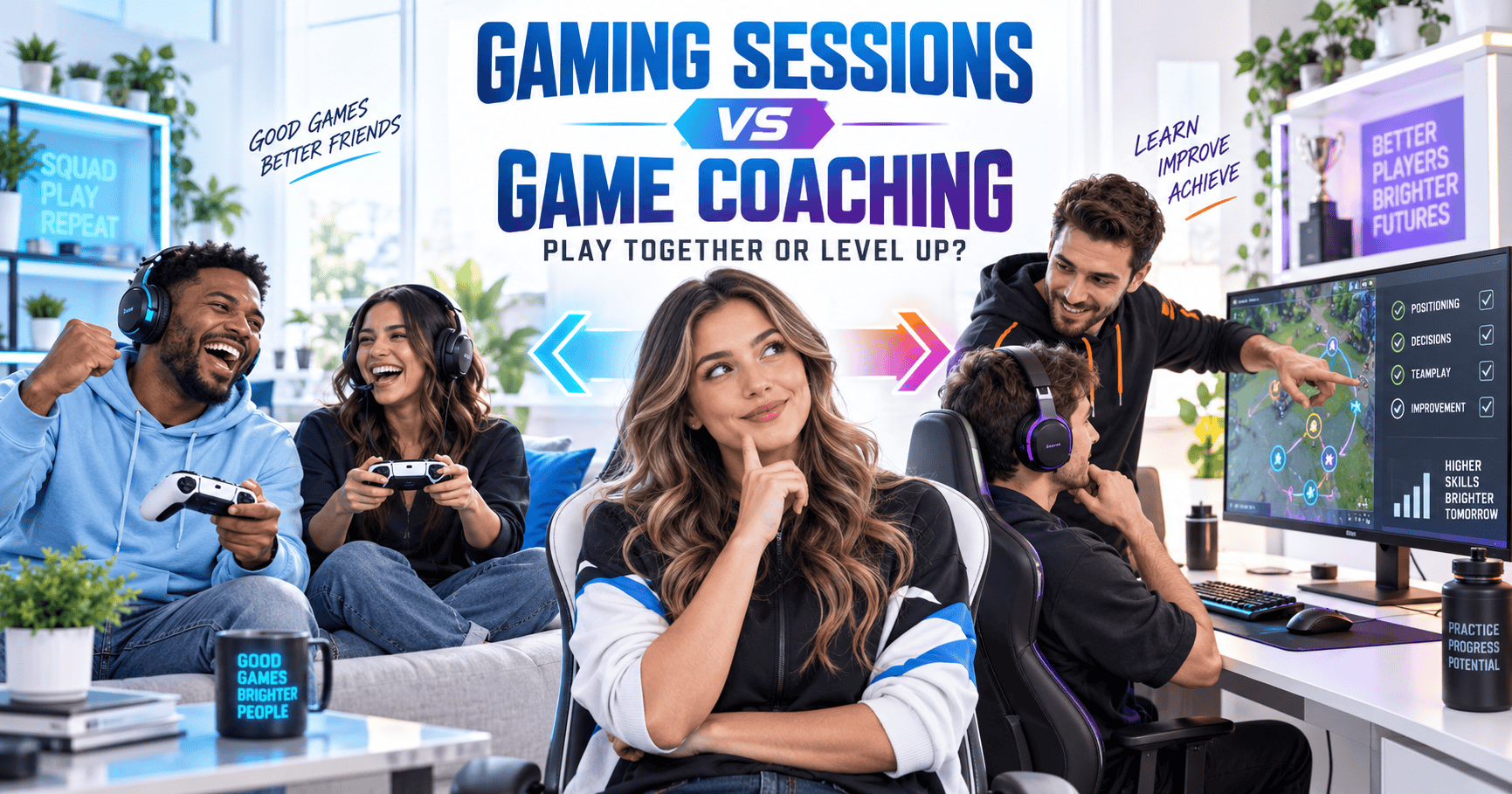
Gaming sessions and game coaching can both involve spending time online with another experienced gamer, but they are designed for different goals.
A gaming session is mainly about the experience you have together. Game coaching is about helping you understand, practise and improve your own gameplay.
🎮 Gaming session: Play with someone, join an organised activity, create content, compete together or get help completing part of a game.
🧠 Game coaching: Work with someone who analyses your gameplay, explains your mistakes and helps you build stronger skills.
🎮 Choose a Gaming Session If You Want To
- Play with reliable teammates
- Find friendly gaming company
- Complete co-op missions or raids
- Join competitive matches
- Create gaming content
- Get help with difficult activities
- Enjoy the game without turning it into a lesson
A gaming session can be relaxed, competitive or goal-focused. The host may share tips, but teaching is not always the main purpose.
Sometimes you just want somebody who joins on time, knows which end of the controller to hold and does not disappear after one bad match.
🧠 Choose Game Coaching If You Want To
- Identify weaknesses in your gameplay
- Improve mechanics or aim
- Make better decisions
- Understand strategy
- Fix repeated mistakes
- Learn a role, character or game mode
- Build a personalised practice plan
- Improve your competitive performance
Coaching is a learning service. The coach should do more than play well beside you. They should be able to observe your gameplay, explain what is happening and turn that information into something you can use.
⚡ The Fastest Way to Decide
Ask yourself one question:
Do I mainly want a better gaming experience, or do I want to become a better player?
🎮 Better experience → Choose a gaming session
🧠 Better player → Choose game coaching
🔄 A bit of both → Consider a hybrid session that includes gameplay and structured feedback
The simplest difference is purpose: gaming sessions help you play, while coaching helps you improve.
2. What Is a Gaming Session?
A gaming session is organised time spent playing with another gamer or group.
The host might provide company, teamwork, leadership, entertainment or skilled support. The exact experience depends on the game and session type, but the focus remains on doing something together.
If you are new to the concept, the beginner’s guide explains what gaming sessions are and how they work.
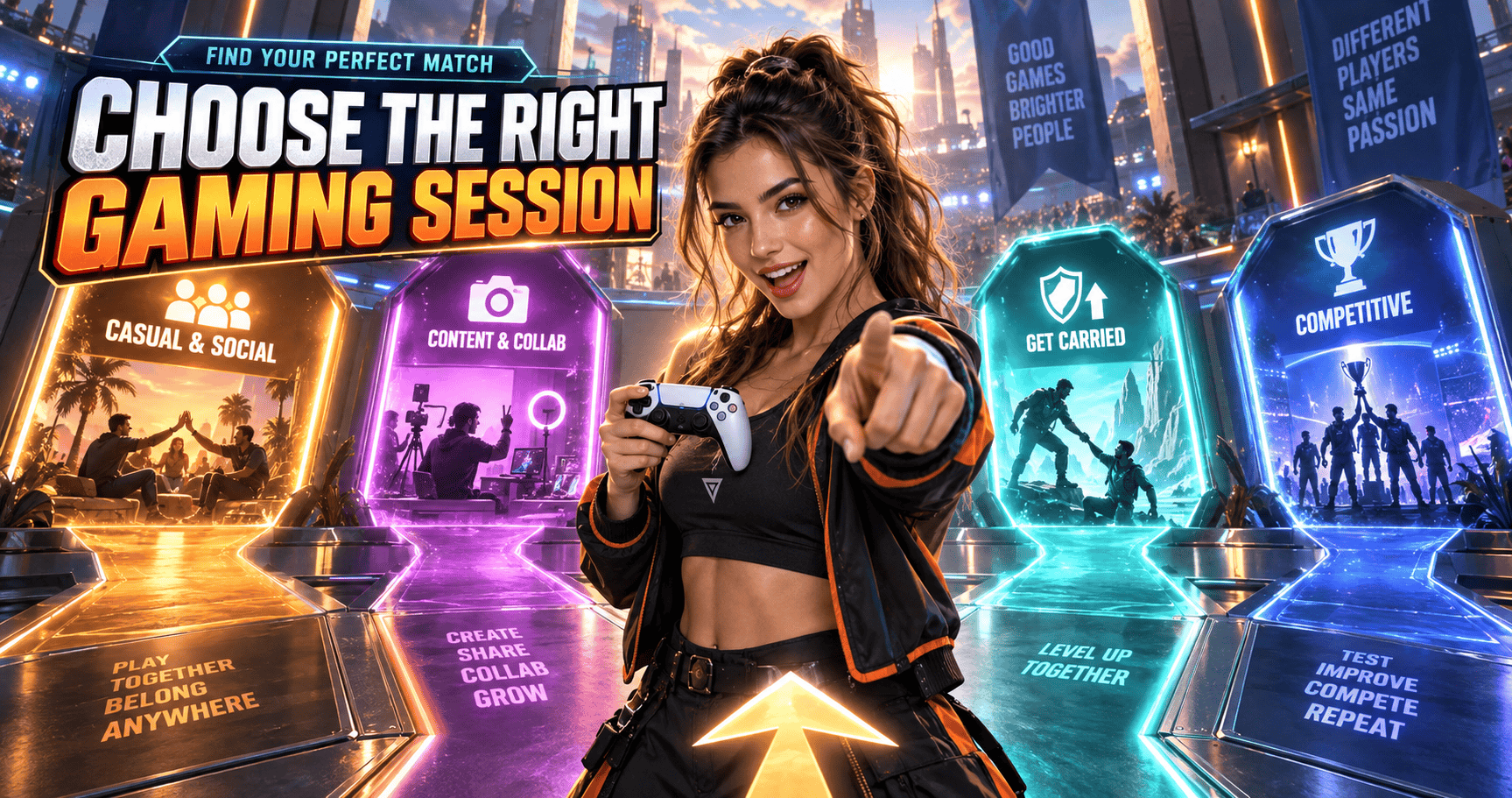
😄 Casual and Social Sessions
Casual and Social sessions focus on relaxed gameplay and friendly interaction.
Players might book one because they want to:
- Play without competitive pressure
- Meet another gamer
- Explore a new game
- Continue a co-op campaign
- Join party games
- Chat while playing
- Avoid random matchmaking
The host does not need to turn every mistake into a teaching moment. If somebody misses a jump, you can laugh and continue rather than beginning a detailed lecture on advanced platforming mechanics.
🎥 Content and Collab Sessions
Content and Collab sessions bring gamers together to create videos, streams, challenges or other gaming content.
A session might involve:
- Recording gameplay footage
- Appearing in a livestream
- Attempting a creator challenge
- Acting in a custom scene
- Testing a video idea
- Producing short-form clips
- Collaborating with another creator
The main goal is usable content and enjoyable interaction. The host may need strong communication, good energy and the ability to repeat the same scene without sounding defeated by take number nine.
🛡️ Get Carried Sessions
Get Carried sessions connect the buyer with a stronger player who can take greater responsibility for the result.
The host might help with:
- Difficult missions
- Challenging co-op content
- Boss encounters
- Ranked matches
- Progression objectives
- Team coordination
- Unfamiliar game modes
The buyer still participates. They are paying for capable support during the activity, not necessarily a lesson explaining how to perform it independently next time.
🏆 Competitive Sessions
Competitive sessions focus on organised, performance-driven gameplay.
Players may want:
- Skilled teammates
- Clear communication
- Reliable roles
- Ranked matches
- Team practice
- Competitive scrims
- Better coordination
The host may provide strategic suggestions, but the core service is playing competitively together. If the buyer wants detailed analysis of why their positioning keeps ending in disaster, that begins moving towards coaching.
🎮 What Are You Paying For?
Most gaming sessions provide one or more of these:
🤝 Company – Someone reliable to play with
🎯 Participation – An organised gaming activity
🛡️ Support – Help completing content or improving results
🎥 Collaboration – Another player for videos or streams
🏆 Teamwork – Coordinated competitive gameplay
😄 Enjoyment – A more welcoming multiplayer experience
The player is paying for the shared experience, not necessarily for long-term skill development.
3. What Is Video Game Coaching?
Video game coaching is personalised training designed to help a player improve.
A coach might watch you play, review recorded gameplay, explain strategy or build a practice plan around your weaknesses. Instead of simply helping you through one difficult match, coaching should leave you better prepared for future matches.
The complete beginner’s guide explains what video game coaching is and how different coaching formats work.
🔍 Gameplay Assessment
A coach usually begins by learning how you currently play.
They might:
- Watch live gameplay
- Review a replay or recording
- Ask about your rank and experience
- Discuss your biggest frustrations
- Test particular mechanics
- Review recent match results
The purpose is to find patterns.
Perhaps your aim is strong, but your positioning leaves you exposed. Maybe your mechanics are fine until the match becomes stressful and every sensible decision quietly leaves the building.
💬 Personalised Feedback
A coach should explain what is happening and why.
Useful feedback might cover:
- Mechanics
- Positioning
- Timing
- Game sense
- Map awareness
- Communication
- Ability usage
- Resource management
- Decision-making
- Team strategy
Good feedback is specific enough to act on.
“Play better” is not coaching. It is the gaming equivalent of telling somebody to solve a problem by not having the problem.
🛠️ Practice and Training
Identifying a weakness is only the first step.
The coach may recommend:
- Aim drills
- Movement exercises
- Matchup practice
- Positioning scenarios
- Replay reviews
- Communication exercises
- Custom-game practice
- A weekly training routine
The player then practises those skills between sessions.
This is one of the biggest differences between coaching and a normal gaming session. A gaming session can deliver value while it is happening. Coaching should continue providing value after the booking ends.
📈 Progress Over Time
Coaching often works best as a cycle:
🎮 Play → 🔍 Review → 💡 Learn → 🎯 Practise → 📈 Improve
Future sessions can assess progress, correct new problems and introduce more advanced concepts.
The coach is not supposed to make every decision forever. The aim is to help the player understand the game well enough to make stronger decisions independently.
🧠 What Are You Paying For?
Game coaching normally provides:
🔍 Analysis – Identifying what is holding you back
💬 Explanation – Understanding why mistakes happen
🎯 Direction – Knowing what to focus on next
🛠️ Practice – Using drills or targeted exercises
📋 Structure – Following an improvement plan
📈 Development – Building skills that remain useful later
A high-ranked player is not automatically a good coach. Playing brilliantly and explaining clearly are different skills, as anyone who has received the advice “just click their head” can confirm.
4. Gaming Sessions vs Game Coaching at a Glance
Gaming sessions and coaching can both involve voice chat, live gameplay and an experienced provider. Their purpose, structure and intended result are what separate them.
| 🎮 Factor | 🤝 Gaming Session | 🧠 Game Coaching |
|---|---|---|
| Main Goal | Shared gameplay or experience | Player improvement |
| Provider’s Role | Host, teammate or collaborator | Teacher, analyst or trainer |
| Typical Activity | Playing together | Reviewing, explaining and practising |
| Feedback | Optional or informal | Central to the service |
| Structure | Flexible and activity-led | Structured around learning goals |
| Best For | Fun, company, teamwork or completion | Skills, strategy and performance |
| Result | An enjoyable or productive session | Knowledge and actions for improvement |
| After the Session | Usually nothing required | Practice is normally required |
🎯 Same Game, Different Service
Imagine two players booking help with a difficult ranked game.
The first player wants a capable teammate who communicates clearly and helps them compete. A competitive gaming session suits that goal.
The second player wants somebody to review their decisions, identify mistakes and explain how to improve. That player needs coaching.
Both services can involve playing the same game for the same amount of time. What changes is the value being delivered.
⚠️ Do Not Judge by Skill Level Alone
A gaming-session host might be an exceptional player. A coach might also play alongside the customer.
That does not make the services identical.
Ask what the provider will actually do:
- Will they participate as a teammate?
- Will they assess your gameplay?
- Will they explain mistakes?
- Will they create practice goals?
- Will they help complete an activity?
- Will they provide feedback after the session?
The answers reveal whether you are booking gameplay, coaching or a hybrid of both.
5. The Biggest Difference Is the Player’s Goal
The best service depends on what you want after the booking.
Do you want to finish an activity, enjoy better company or play with a reliable teammate? Choose a gaming session.
Do you want to understand your mistakes and perform better without someone permanently guiding you? Choose coaching.
🎮 Experience Goal
“I want somebody reliable to play with tonight.”
This points towards a gaming session.
The desired result is an enjoyable shared experience. The player may want conversation, teamwork or relief from the mysterious collection of chaos known as random matchmaking.
🧠 Improvement Goal
“I want to understand why I keep losing the same fights.”
This points towards coaching.
The player needs assessment and feedback. Winning one match with a stronger teammate might feel good, but it may not explain why the problem keeps happening.
🎯 Completion Goal
“I want help completing this difficult raid.”
This usually points towards a gaming session, particularly Get Carried.
The immediate objective is completing the activity. The host provides skilled support, stronger coordination or leadership during the booking.
📈 Development Goal
“I want to learn how to complete this raid without being carried.”
This points towards coaching.
The player wants to understand mechanics, positioning, loadouts or team roles so they can perform more effectively in the future.
🎥 Collaboration Goal
“I need another gamer for a challenge video.”
This points towards a Content and Collab gaming session.
The provider’s role is to help create a useful and entertaining piece of content, not analyse the creator’s mechanics between takes.
🏆 Competitive Goal
“I need a reliable teammate for ranked matches.”
Choose a competitive gaming session.
“I need to discover why my ranked progress has stalled.”
Choose coaching.
⚡ Goal-to-Service Shortcut
🎮 Play together → Gaming session
🤝 Find company → Gaming session
🛡️ Complete content → Gaming session
🎥 Create content → Gaming session
🧠 Understand mistakes → Game coaching
🎯 Develop skills → Game coaching
📈 Build long-term improvement → Game coaching
Want help achieving something during the booking? Choose a gaming session. Want help becoming more capable after the booking? Choose coaching.
6. What Happens During a Gaming Session?
A gaming session normally begins with a clear activity rather than an improvement assessment.
The host and player confirm what they will play, how long the booking will last and what they want to accomplish. Once everyone joins, most of the time is spent playing rather than analysing every decision.
The exact format depends on the different types of gaming sessions, but most follow a similar process.
🎯 1. Confirm the Activity
The host checks the essential booking details:
- Game and platform
- Server region
- Game mode
- Session duration
- Player count
- Voice-chat method
- Main objective
- Any special requirements
A casual session may only need a quick confirmation. A raid, ranked session or creator collaboration usually requires more preparation.
The goal is to prevent both players arriving with entirely different ideas about what they booked. One person preparing for a relaxed co-op session while the other expects tournament-level tactics rarely produces a calm opening.
🎧 2. Join the Lobby
The host provides their username, lobby details or server information.
They may also:
- Send a friend request
- Open a private lobby
- Prepare a custom match
- Confirm crossplay settings
- Start voice chat
- Arrange teams or roles
- Check that everyone can connect
Joining should be simple. The player has paid to play, not to spend 25 minutes solving the mystery of why the invitation has vanished into another dimension.
🎮 3. Play Together
Most of the booking is spent completing the agreed activity.
Depending on the session, this could involve:
😄 Playing casual multiplayer matches
🗺️ Exploring an open world
⚔️ Completing co-op missions
🛡️ Attempting difficult content
🏆 Playing ranked matches
🎥 Recording a challenge video
🎉 Hosting a private group activity
The host participates directly. They may lead the activity, support the player or simply provide friendly and reliable company.
🔄 4. Adapt the Session
Games do not always follow the plan.
Servers go offline, matchmaking takes longer than expected and carefully designed strategies can collapse approximately four seconds after the match begins.
A good host adjusts by:
- Changing game modes
- Switching servers
- Trying another mission
- Modifying the difficulty
- Rebalancing teams
- Using a backup activity
- Changing the pace
The host should explain any significant change and make sure the alternative still matches what the player wanted.
⏱️ 5. Manage the Available Time
The host monitors the session without turning it into a visible countdown.
They should:
- Start promptly
- Avoid unnecessary delays
- Give a warning near the end
- Choose a suitable final activity
- Avoid beginning something that cannot be completed
- Finish at a natural stopping point
Time management matters because the main value comes from the experience delivered during the booking.
✅ 6. Complete the Session
The host finishes the current activity, confirms what was completed and thanks the player for joining.
There may be a short follow-up message, but the service is usually complete once the gaming session ends.
🎮 Confirm → 🎧 Connect → 🕹️ Play → 🔄 Adapt → ✅ Complete
7. What Happens During a Game Coaching Session?
Game coaching usually begins with a problem, goal or question.
The player might want to improve their aim, understand a role, climb the ranked ladder or finally discover why every aggressive push seems to end with a grey screen and several disappointed teammates.
A coach then builds the session around helping the player improve.
🎯 1. Set an Improvement Goal
The coach asks what the player wants to achieve.
Common goals include:
- Improve aim or mechanics
- Make better decisions
- Understand positioning
- Learn a character or role
- Communicate more effectively
- Fix repeated mistakes
- Climb to a higher rank
- Prepare for competitive play
The goal should be specific enough to guide the session.
“I want to get better” is a reasonable starting point, but “I want to improve my positioning during late-game fights” gives the coach something far more useful to work with.
🔍 2. Assess the Player’s Current Gameplay
Before offering advice, the coach needs to understand how the player currently performs.
Assessment may involve:
- Watching live gameplay
- Reviewing recorded footage
- Spectating a match
- Discussing recent problems
- Checking settings or keybinds
- Running a short mechanical test
- Reviewing rank and experience
- Asking how the player usually practises
The coach looks for patterns rather than judging one isolated mistake.
Everybody makes one questionable decision occasionally. Making the same questionable decision in every match is where coaching becomes useful.
🧠 3. Identify the Main Problem
Players are not always aware of what is holding them back.
A player might blame their aim when the real issue is poor positioning. They may blame teammates when they are repeatedly entering fights alone. They might blame the game, which is a proud gaming tradition but not always the most accurate diagnosis.
The coach should identify the weakness with the greatest impact.
That might be:
- Poor timing
- Weak map awareness
- Unnecessary aggression
- Passive decision-making
- Inconsistent mechanics
- Bad resource management
- Confused role selection
- Ineffective communication
Focusing on one or two important problems is normally more useful than listing every mistake made during the session.
💡 4. Explain What Needs to Change
Good coaching explains:
- What happened
- What the player did
- Why it caused a problem
- What a stronger option looked like
- How to recognise the situation next time
A coach might say:
You entered the fight before your teammates were close enough to help. Wait until the group is in position, then engage together.
That is more useful than:
Stop dying first.
Both observations may be technically accurate. Only one helps.
🛠️ 5. Practise the Improvement
The player should have an opportunity to apply the advice.
Practice might involve:
- Repeating a mechanic
- Running an aim drill
- Replaying a matchup
- Testing a new position
- Trying another match
- Reviewing a similar scenario
- Improving a communication routine
- Practising a specific role
The coach watches for improvement and corrects any misunderstandings.
📋 6. Leave With a Clear Plan
A coaching session should normally finish with something the player can continue using.
That could be:
🎯 One mechanic to practise
🗺️ One positioning habit to change
🎥 One replay to review
🧠 One decision-making question to ask
🤝 One communication skill to improve
📅 One weekly practice routine
The session ends, but the work continues.
🎮 Play → 🔍 Assess → 💡 Explain → 🛠️ Practise → 📈 Improve
8. Which Option Is Better for Casual and Social Players?
Casual players do not automatically need coaching.
You can enjoy a game, want better company or need help understanding the basics without turning the entire experience into an improvement programme.
The right choice depends on whether you want to enjoy the game differently or learn to play it differently.
😄 Choose a Gaming Session for Relaxed Play
A Casual and Social gaming session is usually the better option if you want:
- Friendly company
- Relaxed conversation
- Co-op gameplay
- Party games
- Help exploring a new game
- A regular gaming partner
- Less pressure than random matchmaking
The host is there to improve the experience rather than measure your performance.
You can make mistakes, try strange strategies and spend ten minutes deciding which virtual hat looks best. Nobody needs to create a training plan about it.
🎮 Choose a Gaming Session When You Feel Uncomfortable Playing Alone
Some players understand the game perfectly well but dislike joining multiplayer alone.
They may want:
- A welcoming teammate
- Someone who communicates respectfully
- Help joining group activities
- A player who understands the game mode
- Company while learning a new game
- Protection from toxic random teammates
This is mainly a social or confidence need, not a coaching need.
A good session host can make multiplayer feel more approachable without turning every match into a lesson.
🧠 Choose Coaching When the Basics Are Confusing
Coaching may be useful when you want to understand:
- Controls
- Menus and systems
- Characters or classes
- Equipment and loadouts
- Maps and objectives
- Basic strategies
- Multiplayer roles
- Game-specific terminology
Beginner coaching should be patient and easy to follow. The player should feel more confident after the session, not as though they have accidentally enrolled in an advanced esports seminar.
🎯 Choose Coaching When Frustration Is Reducing the Fun
Casual players can still benefit from improving.
If repeated mistakes are making the game less enjoyable, a coach may help remove the frustration. Learning better positioning, understanding a boss mechanic or fixing basic settings can make future sessions considerably more fun.
The goal does not need to be professional competition. Sometimes improvement simply means reaching the point where the game stops repeatedly punching you in the face.
⚡ Casual Player Decision Guide
😄 Want company? → Gaming session
🎮 Want relaxed co-op play? → Gaming session
🤝 Want a regular teammate? → Gaming session
🧠 Want the basics explained? → Game coaching
🎯 Want to fix a frustrating weakness? → Game coaching
🔄 Want to learn while playing together? → Hybrid session
9. Which Option Is Better for Competitive Players?
Competitive players can benefit from both gaming sessions and game coaching.
The decision depends on whether you need someone beside you in the match or someone outside the match analysing how you play.
🏆 Choose a Competitive Gaming Session When You Need a Teammate
A competitive session can help when you want:
- A reliable ranked teammate
- Clear voice communication
- Better team coordination
- Consistent roles
- Organised competitive matches
- Practice with a regular group
- A player at a compatible skill level
The provider participates directly in the match.
They might make callouts, coordinate strategies and fulfil a particular team role. The main value comes from having someone capable and dependable playing alongside you.
🤝 Choose a Gaming Session for Team Practice
Not every competitive problem is an individual skill problem.
A team may need to practise:
- Callouts
- Rotations
- Role responsibilities
- Objective control
- Set plays
- Team composition
- Communication under pressure
- Responding to different strategies
An organised session can provide the environment needed for that practice.
However, if the team needs someone to observe its performance and identify why its strategy is failing, team coaching may be more appropriate.
🧠 Choose Coaching When Your Progress Has Stalled
Coaching may help when:
- Your rank has plateaued
- You cannot identify your mistakes
- Your practice is not producing results
- You struggle with a particular matchup
- Your performance changes under pressure
- You repeat the same bad decisions
- You need an improvement plan
Competitive players often know a large amount about their game already.
The value of coaching comes from finding details they have missed, habits they no longer notice or weaknesses hidden behind strong mechanics.
🎥 Choose Coaching for Detailed Analysis
A coach can review:
- Positioning
- Ability usage
- Timing
- Rotations
- Engagement choices
- Resource management
- Communication
- Mechanical consistency
- Responses to pressure
- Missed opportunities
This analysis can be difficult during a normal gaming session because both players are busy competing.
A teammate sees the match from inside the action. A coach can step back and examine the wider pattern.
🎯 Teammate or Teacher?
| Competitive Need | Better Choice |
|---|---|
| A reliable player for ranked matches | Gaming session |
| Stronger in-game communication | Gaming session |
| A regular competitive group | Gaming session |
| Identification of repeated mistakes | Game coaching |
| Detailed gameplay analysis | Game coaching |
| A personalised practice routine | Game coaching |
| Team strategy plus outside feedback | Team coaching |
🔄 When Competitive Players Need Both
A competitive player might use coaching to identify weaknesses, then book gaming sessions to practise those skills with reliable teammates.
For example:
- A coach identifies poor communication during team fights
- The player learns a clearer callout system
- They practise it during competitive gaming sessions
- A later coaching session reviews the improvement
🧠 Learn the skill → 🎮 Use the skill → 🔍 Review the result
10. Feedback Is Optional in Gaming Sessions but Essential in Coaching
A gaming-session host may give advice, but informal tips do not automatically make the service coaching.
The difference is whether feedback is an occasional part of playing together or one of the main products being delivered.
🎮 Feedback During a Gaming Session
A host might say:
- “Stay close while we enter this area.”
- “Use that ability before the next fight.”
- “This boss attacks twice before becoming vulnerable.”
- “Let’s rotate towards the next objective.”
- “Try this loadout for the mission.”
These tips help the immediate activity.
The host is sharing useful information so the session runs more smoothly. They may not be analysing the player’s wider performance or creating a long-term improvement plan.
🧠 Feedback During Game Coaching
A coach should connect advice to the player’s habits and goals.
They might explain:
- Why the player was out of position
- How an earlier decision caused a later problem
- Which mechanic needs focused practice
- Why the player’s usual strategy is inconsistent
- What alternative decision would work better
- How to recognise the situation next time
The purpose is not only to solve the immediate moment. It is to improve future decisions.
💡 The Coaching Feedback Formula
Useful feedback usually follows this pattern:
❌ Mistake → 🔍 Cause → 💡 Better Choice → 🛠️ Practice
For example:
You entered the fight before your defensive ability was available. Wait for the cooldown, then engage when you have an escape option. Practise checking that ability before committing.
The coach identifies the mistake, explains why it mattered and gives the player something specific to practise.
⚠️ Being Critical Is Not the Same as Coaching
A coach should not spend the session listing everything the player does badly.
Useful feedback should be:
- Specific
- Respectful
- Actionable
- Relevant to the goal
- Appropriate for the player’s level
- Balanced enough to recognise strengths
- Limited to a manageable number of improvements
Telling a player they made twelve mistakes in one fight may be accurate. Helping them fix the two mistakes that caused the other ten is far more useful.
🎯 What Good Feedback Leaves Behind
After coaching, the player should understand:
✅ What they need to improve
✅ Why it is affecting their gameplay
✅ What they should do differently
✅ How they can practise it
✅ How they will recognise progress
A gaming session can be successful because both players had a great time or completed the activity. Coaching succeeds when the player leaves with a clearer path towards becoming better.
11. Gaming Sessions vs Live Game Coaching
Live game coaching can look surprisingly similar to a gaming session.
In both services, you may join voice chat, enter the same game and spend an hour with another experienced player. The difference is the role that person takes once the session begins.
A gaming-session host usually participates as a teammate, collaborator or activity leader. A live coach watches, analyses and teaches while you play.
🎮 What Happens During a Live Gaming Session?
The host normally plays alongside you.
They may:
- Join your team
- Lead a mission or raid
- Communicate during matches
- Help complete an objective
- Participate in a creator challenge
- Fill a missing team role
- Provide friendly gaming company
- Help the group stay organised
The host’s attention is mainly on the shared activity.
They may offer useful advice, but they are also managing their own character, role and decisions. It can be difficult to perform detailed analysis while simultaneously trying not to be eliminated.
🧠 What Happens During Live Coaching?
A live coach focuses more closely on your gameplay.
They may watch through:
- Screen sharing
- Spectator mode
- A livestream
- In-game observation tools
- A shared replay
- Playing alongside you with a coaching focus
The coach looks for problems as they happen.
They might notice that you:
- Enter fights too early
- Use abilities at the wrong time
- Ignore important information
- Choose weak positions
- Communicate unclearly
- Miss useful opportunities
- Repeat the same mechanical error
The session may pause between matches so the coach can explain what happened.
⚡ Live Gaming Session vs Live Coaching
| 🎮 Live Gaming Session | 🧠 Live Coaching |
|---|---|
| The provider plays alongside you | The provider watches, teaches or guides you |
| The activity is the main focus | Your performance is the main focus |
| Advice is usually informal | Feedback is deliberate and structured |
| Success means a good shared session | Success means useful learning |
| Practice after the session is optional | Practice after the session is encouraged |
| Best for company, teamwork and completion | Best for skills, strategy and improvement |
🎯 Example: The Same Ranked Match
Imagine you are playing a competitive shooter.
During a gaming session, your teammate might say:
Two players are pushing from the left. Stay with me and we will defend together.
During coaching, the coach might say:
You were holding the correct area, but you moved before the opponents committed. Wait until you have clear information, then reposition with your team.
The gaming-session callout helps you survive the immediate fight.
The coaching feedback helps you understand how to make a better decision in future fights.
🔄 What About Playing With a Coach?
Some coaches play alongside the player while teaching.
This can work well because the coach can:
- Demonstrate techniques
- Create practice situations
- Model good communication
- Explain decisions in real time
- Observe how the player responds
- Provide feedback between matches
The service is still coaching if the main purpose is structured improvement.
Being in the same lobby does not define the service. The provider’s purpose does.
12. Gaming Sessions vs VOD Reviews
A gaming session always involves scheduled interaction between players.
A VOD review may not involve playing together at all.
VOD stands for video on demand. In gaming coaching, it usually refers to recorded gameplay that a coach watches, analyses and discusses with the player.
🎮 What Happens During a Gaming Session?
You and the host meet at an agreed time and play together.
The value comes from:
- Live participation
- Immediate communication
- Shared gameplay
- Team coordination
- Social interaction
- Skilled assistance
- Completing an activity
Once the session ends, the service is usually complete.
🎥 What Happens During a VOD Review?
The player records a match and sends the footage to a coach.
The coach can then:
- Pause important moments
- Rewatch decisions
- Analyse positioning
- Review ability usage
- Identify repeated mistakes
- Study team communication
- Highlight missed opportunities
- Add spoken or written feedback
Some VOD reviews are delivered as recorded analysis. Others include a live call where the coach and player watch the footage together.
🔍 Why Recorded Gameplay Can Reveal More
Live matches move quickly.
A decision may happen in less than a second, followed immediately by another fight, objective or heroic attempt to recover from the original mistake.
Recorded footage allows the coach to slow everything down.
They can ask:
- What information was available?
- What options did the player have?
- Why did they choose that action?
- Was their position safe?
- Did they use their resources effectively?
- What happened because of the decision?
- What would a stronger choice have looked like?
That level of analysis is difficult during a normal gaming session.
⚡ Gaming Session vs VOD Review
| Factor | Gaming Session | VOD Review |
|---|---|---|
| Main activity | Playing together | Analysing recorded gameplay |
| Interaction | Live and immediate | Recorded or discussed later |
| Best for | Company, teamwork and activities | Detailed performance analysis |
| Gameplay required during service | Yes | Not always |
| Feedback depth | Usually light | Usually detailed |
| Scheduling | Both players meet to play | Can be partly asynchronous |
| Result | Shared gaming experience | Specific improvement advice |
🎯 Which Should You Choose?
Choose a gaming session if you want:
- Someone to play with now
- Live teamwork
- Help completing content
- A shared competitive experience
- Social interaction
Choose a VOD review if you want:
- Detailed analysis
- Mistakes explained
- Feedback without live pressure
- The ability to revisit key moments
- Advice based on your normal gameplay
🔄 Can You Combine Them?
Yes.
A useful hybrid process could be:
🎥 Review a Match → 💡 Identify a Problem → 🎮 Play Together → 🛠️ Practise the Fix
For example, the coach might identify weak positioning during the review, then join a custom game to help the player practise safer positions.
The important part is making sure the service description explains what is included. A buyer should know whether they are booking shared gameplay, recorded analysis or both.
13. Gaming Sessions, Get Carried and Boosting Are Not the Same
Gaming services use several terms that sound similar but describe very different activities.
A player looking for help may see gaming sessions, Get Carried offers, coaching and boosting services presented around the same game. Choosing the wrong one can lead to mismatched expectations and, in some cases, unnecessary account risk.
🎮 Gaming Session
A gaming session is an organised experience in which the buyer participates.
The host may provide:
- Company
- Teamwork
- Competition
- Content collaboration
- Activity leadership
- Skilled support
The purpose depends on the advertised session, but the players normally meet and play together.
🛡️ Get Carried
Get Carried is a type of gaming session where a stronger player takes greater responsibility for helping the buyer achieve a result.
This could include:
- Completing difficult missions
- Defeating a challenging boss
- Clearing co-op content
- Improving match results
- Supporting progression
- Providing a stronger competitive teammate
The buyer still plays.
A carry may include advice, but improvement is not necessarily the main product. The immediate result matters more than teaching the buyer how to achieve it alone next time.
🧠 Game Coaching
Game coaching focuses on helping the buyer improve their own ability.
The coach may:
- Identify weaknesses
- Explain mechanics
- Review decisions
- Recommend practice
- Create drills
- Track progress
- Teach strategy
The player remains responsible for applying the advice and performing in future games.
Coaching does not guarantee that somebody else will complete difficult content for you. It is designed to help you become more capable of completing it yourself.
⚠️ Account Boosting
Account boosting may involve another person accessing or playing on the buyer’s account to increase rank, progression or unlocks.
This creates different considerations:
- Account-sharing risks
- Possible breaches of game rules
- Security concerns
- Suspicious login activity
- Potential penalties
- Reduced buyer control
Some games prohibit account sharing or boosting. Players should review the game’s rules before purchasing any service involving account access.
Never provide passwords, recovery codes or authentication details unless you fully understand the risks and the activity is permitted. In most cases, keeping control of your own account is the safer option.
🔍 Quick Service Comparison
| Service | Who Plays? | Main Goal | Teaching Included? |
|---|---|---|---|
| Gaming Session | Buyer and host | Shared experience | Sometimes |
| Get Carried | Buyer and stronger player | Complete content or improve results | Optional |
| Game Coaching | Buyer, with coach guidance | Develop the buyer’s skills | Yes |
| Account Boosting | Provider may use buyer’s account | Increase rank or progression | Usually no |
🎯 Which One Do You Need?
Choose a gaming session if you want to play with somebody.
Choose Get Carried if you want skilled support achieving an immediate objective.
Choose coaching if you want to improve your own gameplay.
Treat any service requesting account access with additional caution. A higher rank is not much use if your account receives a ban or develops a mysterious new owner.
14. How Do Gaming Session and Coaching Prices Compare?
Gaming-session and coaching prices vary widely.
The amount may depend on the game, provider experience, service duration, player count, preparation required and complexity of the activity. There is no universal rate that applies to every game or provider.
The important question is not simply which service costs less. It is what value you receive for the price.
💰 What Are You Paying for in a Gaming Session?
A gaming-session price may reflect:
- The host’s time
- Their skill level
- Activity preparation
- Session length
- Number of players
- Game difficulty
- Competitive experience
- Content recording requirements
- Custom lobby preparation
- Demand for the game
A relaxed casual session may require little preparation.
A competitive session, difficult raid or creator collaboration may involve more work before the buyer even joins.
🧠 What Are You Paying for in Game Coaching?
A coaching price may include:
- The live session
- Gameplay assessment
- Replay analysis
- Lesson preparation
- Personalised feedback
- Written notes
- Practice drills
- Training plans
- Follow-up support
- Specialist game knowledge
A one-hour coaching session may involve more than one hour of work for the coach.
They might review footage before the call, prepare examples or write an improvement plan afterwards. Those tasks may be included in the price even though the player does not see them happening live.
For a deeper pricing breakdown, see how much video game coaching costs.
📊 What Affects the Price?
| Pricing Factor | Gaming Session | Game Coaching |
|---|---|---|
| Duration | Longer sessions usually cost more | Longer lessons usually cost more |
| Provider skill | Important for competitive and carry sessions | Important for advanced coaching |
| Preparation | Varies by activity | Often includes assessment and planning |
| Player count | Group sessions may cost more overall | Group coaching may reduce the cost per player |
| Service complexity | Raids, events and content sessions may cost more | VOD analysis and written plans may cost more |
| Follow-up work | Usually limited | May include notes, drills or later support |
| Demand | Popular games or providers may cost more | Specialist coaches may charge more |
⚡ Price Does Not Automatically Equal Value
The cheapest service may not suit your goal.
A low-cost gaming session will not provide much value if you need detailed coaching. Expensive coaching is also unnecessary if you simply want someone friendly to join your co-op campaign.
Compare:
- What the service includes
- The provider’s experience
- Reviews
- Duration
- Preparation
- Communication style
- Expected outcome
Choose the service that matches your need rather than the one with the most impressive price tag.
🎯 Think About What Remains Afterwards
A gaming session delivers most of its value during the booking.
Coaching may continue delivering value afterwards because the player can reuse the advice, drills and strategies.
That does not make coaching automatically better. It simply means the services provide value in different ways.
🎮 Gaming session value: The experience you have
🧠 Coaching value: The improvement you can continue building
15. Which Option Requires More Commitment?
Gaming sessions and game coaching both require the player to attend and participate.
Coaching normally requires more work before or after the booking because improvement depends on applying what has been learned.
A gaming session can still be valuable even if the player does nothing afterwards.
🎮 Gaming Session Commitment
Before the session, the player may need to:
- Confirm the booking details
- Install updates
- Prepare the correct game
- Join the host
- Meet any activity requirements
During the session, they participate in the agreed activity.
Afterwards, there is usually nothing else required. The experience has already been delivered.
🧠 Game Coaching Commitment
Before coaching, the player may need to:
- Identify an improvement goal
- Record gameplay
- Share their rank or experience
- Prepare questions
- Complete an assessment
- Review previous feedback
During the session, they need to listen, ask questions and attempt the suggested changes.
Afterwards, they may need to:
- Practise drills
- Review recordings
- Track mistakes
- Test new strategies
- Follow a training routine
- Prepare for the next coaching session
Hiring a coach and ignoring every recommendation is technically possible. It is also an unusually expensive method of continuing exactly as before.
📊 Commitment Comparison
| Commitment | Gaming Session | Game Coaching |
|---|---|---|
| Before | Confirm details and prepare the game | Set goals and provide gameplay information |
| During | Participate in the activity | Learn, practise and ask questions |
| After | Usually nothing required | Apply feedback and practise |
| Long-term | Repeat sessions are optional | Improvement develops through repetition |
| Progress tracking | Usually unnecessary | Often useful |
| Personal effort | Focused on participation | Focused on learning and change |
⏱️ How Much Time Do You Have?
A gaming session may suit you if you have limited time and want an immediate experience.
Coaching may suit you if you can spend additional time practising between sessions.
Ask yourself:
- Do I have time to practise?
- Am I willing to change existing habits?
- Do I want immediate help or long-term improvement?
- Will I review and apply the feedback?
- Am I looking for fun or structured development?
🎯 The Commitment Test
Choose a gaming session if you want the service to deliver most of its value while you are playing.
Choose coaching if you are willing to continue working after the session.
🎮 Book → Play → Finish
🧠 Book → Learn → Practise → Review → Improve
Coaching can shorten the trial-and-error process, but it cannot remove the need for practice. Even the best coach cannot secretly install better decision-making while you are offline.
16. How to Choose Between a Gaming Session and Coaching
The best choice depends on what you want the provider to do.
Do you want them to play beside you, help complete an activity or make multiplayer more enjoyable? Choose a gaming session.
Do you want them to observe, explain and help you improve? Choose game coaching.
🎮 Choose a Gaming Session If
A gaming session is likely the better choice if you:
- Mainly want to play
- Want friendly gaming company
- Need a reliable teammate
- Want help completing content
- Need another player for a creator collaboration
- Prefer a relaxed experience
- Want organised competitive matches
- Do not need detailed feedback
The service should make the immediate gaming experience better.
You might finish a raid, record a useful video, enjoy better matches or simply avoid spending another evening being matched with teammates who communicate entirely through angry pings.
🧠 Choose Game Coaching If
Game coaching is likely the better choice if you:
- Want measurable improvement
- Need help identifying mistakes
- Want personalised instruction
- Have reached a skill plateau
- Need a practice routine
- Want to understand strategy
- Struggle with a particular mechanic
- Want feedback on recorded gameplay
- Are preparing for higher-level competition
The service should improve your understanding and give you something useful to practise.
⚡ Use the Three-Question Test
Ask yourself these questions:
1. What Do I Want to Be Different After the Booking?
If you want to have completed or enjoyed an activity, choose a gaming session.
If you want to understand your gameplay better, choose coaching.
2. Do I Want a Teammate or a Teacher?
A gaming-session host joins the experience.
A coach studies your performance and helps you improve it.
3. Am I Willing to Practise Afterwards?
If not, coaching may provide useful information that you never apply.
A gaming session may offer better value if your goal is simply to enjoy the time you have available.
🎯 Quick Decision Guide
Do you want structured improvement?
- Yes → Choose game coaching
- No → Continue to the next question
Do you want company, teamwork or help completing something?
- Yes → Choose a gaming session
- No → Decide whether you need a different gaming service
Do you want gameplay and structured feedback?
- Yes → Look for a clearly described hybrid service
For more help comparing session formats, see how to choose the right gaming session.
🚩 Check the Service Description
Before booking, confirm:
- What the provider will do
- Whether you will play together
- Whether feedback is included
- How long the session lasts
- What game and platform are supported
- Whether preparation is required
- Whether follow-up notes are provided
- What result is being attempted
Do not assume that every highly skilled player provides coaching. Do not assume that every coach will join your matches as a teammate.
The listing should make the service clear before money changes hands.
17. Can You Combine Gaming Sessions and Game Coaching?
Yes. A hybrid session can combine shared gameplay with structured coaching.
This format works well for players who learn best by playing rather than watching a lecture or reviewing footage for an entire session.
The provider might play alongside the customer, observe their decisions and give feedback between matches.
🔄 How a Hybrid Session Can Work
A simple hybrid session might follow this process:
- Play one match normally
- Identify one important weakness
- Explain what needs to change
- Play another match with that focus
- Review whether the adjustment worked
- Set a practice goal
This creates a useful loop:
🎮 Play → 🔍 Review → 💡 Adjust → 🎮 Play Again → 📈 Improve
🎯 Example: Improving Team Communication
Imagine a player struggles to communicate during competitive matches.
The hybrid session could include:
- Playing one match together
- Reviewing missed callouts
- Creating a simpler communication system
- Playing another match
- Practising the new callouts
- Discussing what improved
The player gets a real gaming experience while also receiving structured guidance.
🛠️ Example: Learning a Difficult Activity
A player wants to complete a challenging raid but also understand its mechanics.
The provider could:
- Explain the roles
- Demonstrate important mechanics
- Play through the activity
- Pause between attempts
- Review mistakes
- Repeat difficult sections
This differs from a basic carry because the provider is deliberately teaching the player how to perform the activity.
⚠️ Make Sure the Hybrid Service Is Clear
Hybrid sessions can become confusing if the listing does not explain what is included.
The provider should clarify:
- How much time is spent playing
- How much feedback is provided
- Whether gameplay is paused for explanations
- Whether written notes are included
- Whether the provider plays or spectates
- What improvement goal will be covered
- What result can realistically be achieved
A 30-minute session cannot always provide a full gaming experience, detailed analysis, mechanical training, a written plan and a miraculous rank transformation.
Trying to include everything may leave no time to do anything properly.
💡 When a Hybrid Session Makes Sense
Consider a hybrid service if you:
- Learn best through practical experience
- Want immediate feedback
- Need help applying advice
- Prefer coaching inside the game
- Want to practise with the coach
- Need both demonstration and explanation
Choose a more focused service if you only want company, completion help or deep replay analysis.
🎮 Playing Together Does Not Automatically Mean Coaching
The provider must intentionally teach.
Occasional tips during a match are useful, but a hybrid coaching service should include:
- A clear learning goal
- Observation
- Explanation
- Practice
- Feedback
- A useful next step
Without those elements, it is probably a gaming session with advice rather than structured coaching.
18. How to Stay Safe When Booking Either Service
Gaming sessions and coaching involve interacting with people you may not know.
Most bookings should be straightforward, but players should still protect their accounts, payments and personal information.
A friendly voice in Discord is not a security check.
🔐 Protect Your Gaming Account
A gaming-session host or coach may need your:
- Public gaming username
- Platform
- Rank
- Server region
- Gameplay recording
- Preferred voice-chat method
They should not normally need your:
- Password
- Recovery codes
- Authentication codes
- Email password
- Payment login
- Unrestricted account access
Never share security information simply because someone claims it is required to deliver the service.
💳 Keep Payment on the Marketplace
Avoid providers who pressure you to pay privately.
Marketplace payments can provide:
- A record of the order
- Clear service details
- Buyer and seller information
- Delivery confirmation
- Dispute processes
- Payment protection
Moving the transaction elsewhere can remove those protections.
The promise of a small discount is less exciting when the seller vanishes immediately afterwards.
🎥 Confirm Recording Permission
Some coaching and content sessions involve recording gameplay, voice chat or video.
Before the session, confirm:
- What will be recorded
- Why it is being recorded
- Who can access it
- Whether it will be published
- How long it will be stored
- Whether usernames will be visible
- Whether you can request removal
Joining a session does not automatically mean agreeing to appear in somebody’s next highlight compilation.
📜 Check the Game’s Rules
Some games restrict:
- Account sharing
- Boosting
- Cheating tools
- Exploits
- Real-money services
- Unauthorised tournaments
- Certain forms of competitive assistance
Review the relevant game rules before purchasing a service.
A provider offering something publicly does not prove that the activity is permitted. It only proves that they found the listing button.
🚩 Watch for These Warning Signs
Be cautious if a provider:
- Requests your password
- Asks for authentication codes
- Pressures you to pay elsewhere
- Guarantees impossible results
- Refuses to explain the service
- Requests unnecessary personal information
- Wants remote access to your device
- Encourages cheating or exploit use
- Becomes aggressive when questioned
- Has a service description that changes after purchase
Trustworthy providers should be able to explain what they offer without requesting control of your account or your entire digital identity.
🛡️ Use Safe Communication Habits
Protect yourself by:
- Using platform messaging where possible
- Keeping personal details private
- Blocking abusive users
- Saving relevant messages
- Reporting serious misconduct
- Using unique passwords
- Enabling multi-factor authentication
- Leaving any session that feels unsafe
The Australian eSafety Commissioner provides additional online gaming safety guidance covering privacy, online interactions and account protection.
19. Frequently Asked Questions
Is a Gaming Session the Same as Game Coaching?
No. A gaming session focuses on playing together or completing an activity. Game coaching focuses on helping the player improve through assessment, explanation and practice.
Both services may involve live gameplay, but their main goals are different.
Can a Gaming Session Include Advice?
Yes. A host may share tips, explain mechanics or suggest a strategy during the session.
Informal advice does not automatically make the service coaching. Coaching should include deliberate observation, personalised feedback and an improvement goal.
Can a Game Coach Play Alongside Me?
Yes. Some coaches join the player’s matches, demonstrate techniques or create practice situations inside the game.
It remains coaching when the main purpose is helping the player learn rather than simply participating as a teammate.
Is Game Coaching Only for Competitive Players?
No. Beginners and casual players can also benefit from coaching.
A coach can explain controls, roles, maps, game systems or basic strategies. The goal might be feeling more confident rather than reaching a professional level.
Should I Book Coaching or Get Carried?
Book coaching if you want to improve your own ability.
Choose Get Carried if you want a stronger player to help complete content or achieve a better result during the session.
A carry focuses on the immediate objective. Coaching focuses on what you can do independently later.
Are Gaming Sessions Cheaper Than Coaching?
Sometimes, but not always.
Prices depend on the provider, game, duration, preparation, skill level and service format. Coaching may cost more when it includes replay analysis, written feedback or preparation outside the live session.
Compare what is included rather than relying only on the hourly price.
Can I Book Both?
Yes. Gaming sessions and coaching can support different parts of the same goal.
You might use coaching to identify weaknesses, then join gaming sessions to practise with reliable teammates.
How Long Should I Book?
A standard 60-minute session may be enough for casual play, several matches or focused coaching.
Longer bookings may suit raids, group activities, team coaching or detailed gameplay analysis. Check that the planned activity can realistically fit within the available time.
Will Coaching Guarantee That I Improve?
No coach can guarantee a particular rank or level of improvement.
A coach can provide analysis, advice and practice methods. Progress still depends on the player’s effort, available time and willingness to apply the feedback.
Will a Gaming Session Guarantee a Win?
Usually not.
The host can provide skill, teamwork and preparation, but they cannot control matchmaking, opponents, server problems or every other player in the game.
Be cautious of guaranteed results that depend on factors outside the provider’s control.
Can Coaching Help Complete Difficult Content?
Yes, but the approach may differ.
A coach might teach the mechanics, explain the strategy and help the player practise. A Get Carried session may focus more directly on completing the activity during the booking.
Which Option Is Better for Beginners?
Choose a gaming session if you want relaxed company while learning naturally.
Choose coaching if you want the game’s systems, mechanics or strategies explained clearly. A hybrid session may suit beginners who want to learn while playing.
20. Final Thoughts – Gaming Session or Game Coaching?
Gaming sessions and game coaching are not competing versions of the same service.
They solve different problems.
A gaming session is built around playing together. It can provide company, teamwork, creator collaboration, competitive support or help completing an activity.
Game coaching is built around learning. It provides analysis, explanations, practice and a clearer path towards improvement.
🎮 Choose a Gaming Session If You Want To
- Play with someone
- Find reliable teammates
- Complete difficult content
- Enjoy social gaming
- Create gaming content
- Join organised competitive matches
🧠 Choose Game Coaching If You Want To
- Identify weaknesses
- Understand mistakes
- Improve mechanics
- Learn strategy
- Build better habits
- Follow a structured improvement plan
🔄 Choose a Hybrid Session If You Want To
- Learn while playing
- Receive immediate feedback
- Practise with the provider
- Combine demonstration with explanation
- Apply coaching inside real matches
The final decision comes back to one question:
Do you want help with the game you are playing now, or help becoming a stronger player for the games you will play next?
🎮 Shared experience → Gaming session
🧠 Structured improvement → Game coaching
🔄 Gameplay plus feedback → Hybrid service
Players looking for company, teamwork or organised gameplay can browse gaming sessions on StackedGame and compare available experiences by game, session type and provider.