Your gaming inventory could be hiding something valuable.
That weapon skin you picked up months ago? It might be worth more than you think. The rare collectible you’ve been holding onto? There could be buyers actively searching for it.
And that pile of virtual loot you’ve accumulated after hundreds of hours of gaming? Well, some of it might have genuine resale potential.
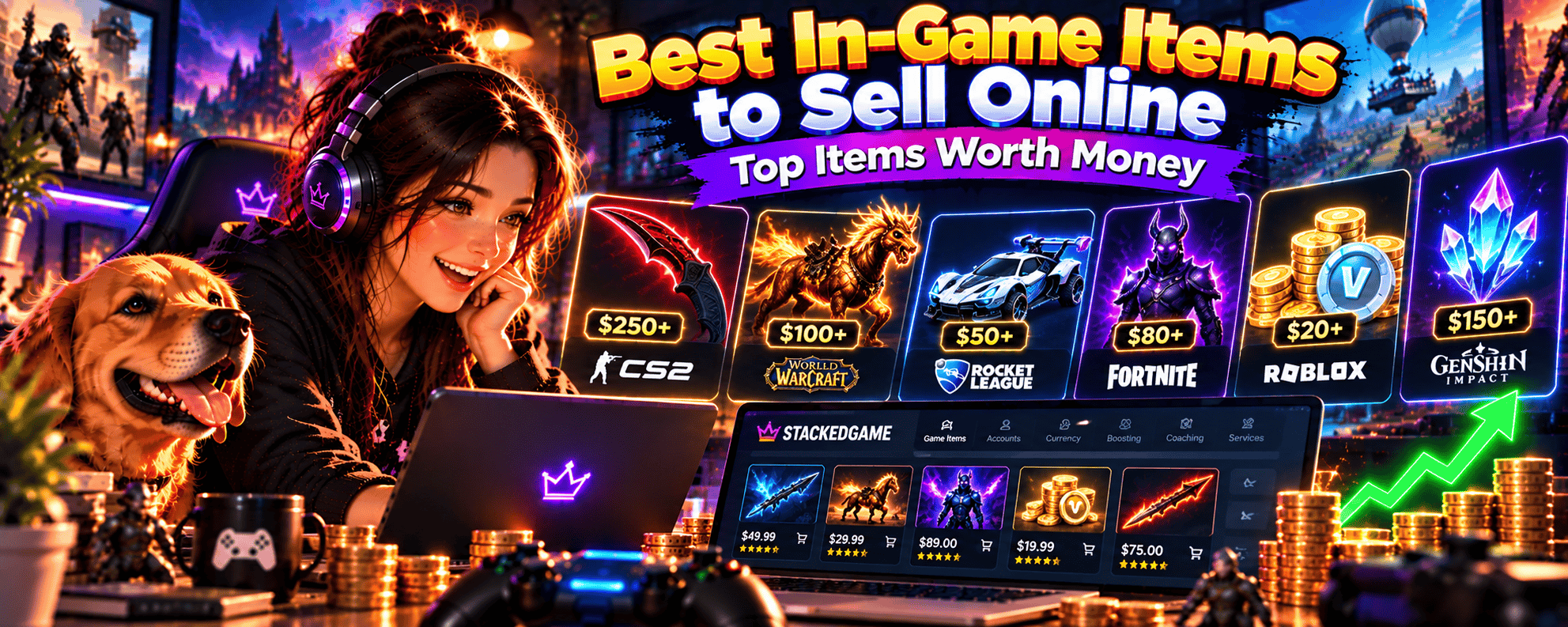
The best in-game items to sell online are usually those with strong buyer demand, desirable characteristics, limited availability and a legitimate way to transfer ownership.
From CS2 weapon skins and rare cosmetics to valuable equipment and virtual collectibles, certain gaming items have developed active trading communities where players buy, sell and exchange digital goods.
But there’s a catch.
Not every rare item is valuable. Not every valuable item is easy to sell. And not every game allows players to exchange virtual items for real money.
Knowing the difference can save you time, money and a few painful inventory mistakes.
In this guide, we’ll explore the best types of in-game items to sell, what makes them desirable and how to identify virtual goods with genuine earning potential.
Whether you’re looking to sell unwanted cosmetics, trade valuable collectibles or turn your gaming knowledge into a side hustle, let’s discover which items might be worth more than their inventory slots suggest.
1. What Are the Best In-Game Items to Sell for Real Money? 💰
Not all gaming items are created equal.
Some cosmetics are worth very little because millions of players already own them. Others attract collector interest because they’re scarce, visually distinctive or associated with particular events.
Then there are items with practical gameplay value, such as equipment with desirable attributes in games that support player trading.
The best in-game items to sell are those that combine genuine buyer demand, identifiable value and permitted transferability.
Let’s look at what separates an ordinary inventory item from something buyers might actually pay for.
🎮 1. Strong Buyer Demand
An item needs interested buyers.
It doesn’t matter how rare something is if nobody wants it.
Items with strong demand often have one or more desirable characteristics:
- Popular cosmetic designs.
- Recognisable item names.
- Useful gameplay attributes.
- Collector appeal.
- Limited availability.
- Relevance to an active gaming community.
For example, a recognisable CS2 weapon skin may attract interest from players who want to customise their weapons.
However, popularity alone doesn’t guarantee a high selling price.
💎 2. Rarity and Scarcity
Rarity can influence value, particularly when buyers actively want the item.
Some items are difficult to obtain because they come from limited releases, unusual drops or specific in-game activities.
Others may have rare patterns or attributes that appeal to collectors.
However, rarity and value aren’t the same thing.
An extremely rare item with almost no buyer demand might sell for less than a common item that thousands of players want.
🔥 3. Desirable Appearance
Cosmetic items can attract buyers because of how they look.
Examples include:
- Weapon skins.
- Character outfits.
- Cosmetic accessories.
- Special visual effects.
- Unique colour variations.
- Distinctive patterns.
A visually appealing item may attract interest even when it provides no gameplay advantage.
That’s one reason cosmetic markets have become an important part of gaming economies.
⚔️ 4. Useful Gameplay Attributes
Some games feature tradable equipment with characteristics that affect gameplay.
Buyers may value items that provide:
- Desirable character statistics.
- Powerful equipment modifiers.
- Useful crafting properties.
- Rare combinations of attributes.
- Advantages for particular character builds.
However, many games prohibit selling these items for external real-world payments.
Always check the game’s rules before considering a cash sale.
📈 5. An Active Trading Market
A valuable item is more useful to a seller when there’s a realistic opportunity to find a buyer.
Look for evidence such as:
- Recent completed transactions.
- Multiple interested buyers.
- Consistent trading activity.
- Comparable listings.
- Recognisable pricing patterns.
A market filled with expensive listings but no completed sales may indicate unrealistic seller expectations.
🔐 6. Permitted Transferability
This is one of the most important factors.
An item might be valuable inside a game but impossible to sell legitimately outside it.
For example, some items are:
- Account-bound.
- Non-tradable.
- Restricted to particular trading systems.
- Subject to temporary trading holds.
- Prohibited from external real-money transactions.
Being able to trade an item inside a game does not automatically mean you’re allowed to sell it for real money.
Before listing, check the game’s terms, item restrictions and marketplace requirements.
For a detailed explanation, see our Can You Sell In-Game Items for Real Money? guide.
🏆 7. Potential Profit After Fees
An item selling for $100 doesn’t necessarily mean you’ve made $100.
Consider:
- Original acquisition cost.
- Marketplace commission.
- Withdrawal fees.
- Currency conversion costs.
- Crafting expenses.
- Other applicable charges.
For example:
| Item | Amount |
|---|---|
| Selling Price | $100 |
| Original Cost | $60 |
| Marketplace Fees | $8 |
| Other Costs | $2 |
| Profit Before Tax | $30 |
These figures are illustrative.
If you’ve spent hours obtaining an item, you might also consider the value of your time.
🎯 What Types of In-Game Items Are Worth Selling?
Here are some of the main categories worth researching.
| Item Type | Why Buyers May Want It | Main Consideration |
|---|---|---|
| Weapon Skins | Appearance, patterns and collector appeal | Condition and demand |
| Character Cosmetics | Customisation and distinctive designs | Availability and transferability |
| Limited-Edition Items | Scarcity and collector interest | Genuine demand |
| Rare Equipment | Desirable gameplay attributes | Game rules and item eligibility |
| Virtual Collectibles | Collection completion and rarity | Trading activity |
| Crafting Materials | Demand from players creating equipment | Supply and permitted trading |
| Crafted Items | Useful or unusual attribute combinations | Production costs and demand |
| In-Game Currency | Purchasing power within a game economy | External sale restrictions |
No category guarantees profits.
The key is finding items that people genuinely want and that you can sell through a permitted process.
🎮 Which Items Are Best for Beginners?
For beginners, it can make sense to start with items that are easy to identify and value.
Look for:
- Clear item names.
- Transparent attributes.
- Accessible pricing information.
- Recent comparable transactions.
- Straightforward, permitted transfers.
Avoid investing heavily in unfamiliar items simply because someone claims they’re about to become valuable.
🎯 The Golden Rule of Choosing Items to Sell
Look for genuine demand, research comparable sales and confirm that the transaction is permitted before trying to sell.
An item doesn’t need to be legendary to have resale potential.
Sometimes the ordinary-looking skin with an active market is a better selling opportunity than the mythical sword nobody’s willing to buy.
2. Rare Weapon Skins and Cosmetic Items 🔫
If you’ve ever played a game where players customise their weapons, characters or equipment, you’ll know that appearances matter.
Some gamers spend hours perfecting their loadouts.
Others collect distinctive cosmetics because they enjoy the artwork, rarity or status associated with particular items.
And in games with supported trading systems, certain cosmetics have developed active secondary markets.
Weapon skins and cosmetic items are among the most recognisable categories of tradable gaming goods, particularly when they have strong collector demand and clearly identifiable attributes.
Let’s explore what makes these items interesting to sellers.
🎮 1. Counter-Strike 2 Weapon Skins
Counter-Strike 2 is one of the best-known examples of a game with an established skin-trading economy.
Players can own cosmetic finishes for weapons such as:
- AK-47.
- AWP.
- M4A1-S.
- M4A4.
- Desert Eagle.
- USP-S.
These finishes change a weapon’s appearance rather than its underlying gameplay performance.
Some are widely available, while others attract substantial collector interest.
💎 2. What Makes Certain CS2 Skins Valuable?
Several characteristics can influence the value of a CS2 skin.
Weapon Popularity
Skins for frequently used weapons may attract broader interest.
Visual Design
Distinctive colours, artwork and finishes can influence demand.
Wear Condition
A skin’s wear classification can affect its appearance and market value.
Pattern Variations
Some finishes have pattern variations that collectors value differently.
Special Versions
Certain variations, including StatTrak versions where applicable, may appeal to particular buyers.
These factors interact.
A rare pattern doesn’t automatically command a premium if buyers aren’t interested in it.
🔍 3. Understanding CS2 Skin Conditions
Many CS2 weapon finishes use wear classifications.
These include:
| Condition | General Meaning |
|---|---|
| Factory New | Lowest wear range |
| Minimal Wear | Relatively low wear |
| Field-Tested | Moderate wear range |
| Well-Worn | Higher wear range |
| Battle-Scarred | Highest wear range |
Condition can affect appearance and pricing.
However, a Factory New version isn’t automatically the most valuable variation of every skin.
Special patterns, scarcity and collector preferences can create exceptions.
🔥 4. Rare Patterns and Collector Interest
Some weapon finishes feature patterns that vary between individual items.
Collectors may seek particular appearances or pattern combinations.
For example, certain Case Hardened finishes can attract interest because of their distinctive pattern distributions.
However, identifying valuable patterns requires specialist knowledge.
Don’t assume a skin has a rare premium simply because it looks unusual.
Compare its exact characteristics with relevant market evidence.
🗡️ 5. Knife Skins
Knife skins are another recognisable category in CS2 trading.
Examples of knife types include:
- Karambit.
- Butterfly Knife.
- M9 Bayonet.
- Talon Knife.
- Huntsman Knife.
Individual knife values can vary considerably depending on the model, finish, wear and pattern.
Some attract significant collector interest.
Others may be relatively affordable compared with the most sought-after examples.
🧤 6. Glove Skins
Glove cosmetics are also part of the CS2 item economy.
Like weapon and knife skins, their desirability can depend on appearance, condition and demand.
Certain combinations of gloves and weapon skins appeal to players building coordinated loadouts.
However, don’t assume every glove skin is valuable.
Research the specific item.
🎨 7. Character Cosmetics and Accessories
Weapon skins aren’t the only cosmetic items players collect.
Depending on the game, tradable cosmetics may include:
- Character outfits.
- Hats.
- Back accessories.
- Cosmetic equipment.
- Special visual effects.
- Decorative accessories.
These items may appeal to players who want distinctive character appearances.
🎩 8. Team Fortress 2 Cosmetics
Team Fortress 2 is another well-known example of a game with tradable cosmetic items.
Players collect hats, accessories and other cosmetics.
Some Unusual-quality items feature special particle effects that attract collector interest.
An item’s desirability may depend on its effect, cosmetic type and market demand.
However, external cash-sale permissions and trading requirements should be checked before listing.
🛡️ 9. Dota 2 Cosmetic Items
Dota 2 includes cosmetic items that alter the appearance of heroes and equipment.
Some items have special visual effects or collectible characteristics.
Certain cosmetics can be traded or marketed within supported systems, while others are restricted.
Item eligibility varies, so check the specific item’s current status.
💰 10. Are Cosmetic Items Profitable to Sell?
Potentially, but profitability depends on your costs and selling price.
Imagine you acquired an eligible cosmetic for $25.
Later, comparable items are selling for $40.
If selling fees total $4, your profit before tax and other expenses would be $11.
However, prices can also decline.
A cosmetic that sells for $40 today might attract much less demand after a game update or change in player preferences.
⚠️ 11. Common Cosmetic Selling Mistakes
Avoid:
- Assuming every rare skin is valuable.
- Misidentifying item condition.
- Overlooking special attributes.
- Using screenshots of a different item.
- Ignoring marketplace fees.
- Treating asking prices as completed sales.
- Assuming external cash sales are always permitted.
🏆 12. Which Cosmetic Items Should You Research First?
Start with items you understand.
If you regularly play CS2, you may already recognise popular weapon skins and understand the importance of wear classifications.
If you’re familiar with TF2, you might know which cosmetic effects interest collectors.
That knowledge can help you evaluate listings more accurately.
🎯 The Golden Rule of Selling Cosmetic Items
Focus on exact item characteristics and genuine market demand rather than rarity labels alone.
A desirable skin isn’t valuable just because it looks cool.
Although looking cool while landing the winning shot certainly doesn’t hurt.
For a deeper explanation of how rarity systems influence item availability and desirability, see our How Does Item Rarity Work in Video Games? guide.
3. Limited-Edition and Event-Exclusive Items 🏆
Gaming events can create some memorable rewards.
Maybe you completed a difficult seasonal challenge, participated in a special event or collected an item that was only available during a particular release.
Months or years later, that item might no longer be obtainable through its original method.
Sounds valuable, right?
Sometimes.
Limited-edition and event-exclusive in-game items can attract collector interest when their supply is restricted and players continue to want them.
But limited availability doesn’t automatically translate into a high selling price.
Let’s explore how these items work.
🎮 1. What Are Limited-Edition In-Game Items?
Limited-edition items are virtual goods made available under specific conditions.
For example:
- A seasonal event.
- A promotional campaign.
- A tournament.
- An anniversary celebration.
- A limited-time release.
- A special collaboration.
Some items remain obtainable through trading after the original event ends.
Others become unavailable or remain permanently account-bound.
🎃 2. Seasonal Event Cosmetics
Many games introduce themed cosmetics during seasonal events.
These might include:
- Halloween-themed weapon skins.
- Winter holiday outfits.
- Anniversary accessories.
- Special event collectibles.
- Seasonal visual effects.
Some become popular because of their distinctive appearance.
However, seasonal items may return in later events.
A cosmetic being temporarily unavailable doesn’t necessarily make it permanently scarce.
🏆 3. Tournament and Esports Collectibles
Competitive gaming events sometimes introduce special virtual items.
Examples may include:
- Tournament-related stickers.
- Commemorative cosmetics.
- Event-themed collectibles.
- Special edition item variations.
In games with supported trading markets, certain tournament collectibles attract interest from fans and collectors.
Their value can depend on factors such as popularity, availability and historical significance.
💎 4. Discontinued Items
Some virtual items are removed from normal acquisition methods.
This can create scarcity.
However, several questions matter:
- How many items already exist?
- Can the item still be traded?
- Do players actively want it?
- Could the developer reintroduce it?
- Are comparable items selling?
An item being discontinued doesn’t guarantee that its price will rise.
🔥 5. Items Associated With Major Game Moments
Some collectibles gain recognition because they’re connected to memorable events in gaming history.
For example, items associated with notable tournaments, teams or releases may interest collectors.
However, collector demand can be unpredictable.
A famous event doesn’t automatically make every related cosmetic valuable.
🎨 6. Unique Visual Designs
Limited-edition items may feature designs that aren’t available through ordinary gameplay.
For example:
- Distinctive colour schemes.
- Special animations.
- Unique cosmetic effects.
- Event-themed artwork.
- Recognisable symbols.
These features may contribute to buyer interest.
But appearance is subjective, and demand can change over time.
📈 7. How Scarcity Can Influence Prices
Imagine an event cosmetic was originally available to thousands of players.
After the event ends, no new copies are being introduced through the original reward system.
If players continue to want the item and transfers are permitted, limited supply may support its value.
But if interest fades, scarcity alone may not prevent prices from declining.
📊 Example: Scarcity vs Demand
| Item | Availability | Buyer Demand | Possible Market Outcome |
|---|---|---|---|
| Item A | Very Limited | High | Strong collector interest |
| Item B | Very Limited | Low | Difficult to sell |
| Item C | Common | High | Active trading at competitive prices |
| Item D | Common | Low | Limited resale interest |
This illustrates why scarcity and demand must be considered together.
🔍 8. How to Research Event-Exclusive Items
Before listing an event collectible, investigate:
- Original release conditions.
- Current availability.
- Trading eligibility.
- Recent completed sales.
- Collector demand.
- Potential re-release information.
Use reliable sources and current marketplace evidence.
Avoid relying on rumours that an item is about to become extremely valuable.
🔐 9. Check Whether the Item Is Transferable
This is particularly important for event rewards.
Some are permanently linked to the account that earned them.
Others may have restrictions on trading or external sales.
Don’t assume that because an item is rare, it can be sold.
💰 10. Should You Hold or Sell Limited-Edition Items?
That depends on your goals and the available evidence.
You might consider selling if:
- Current demand is strong.
- Comparable sales support your target price.
- You no longer want the item.
- The transaction is permitted.
- The proceeds meet your expectations.
Holding an item in the hope that it appreciates involves risk.
Game updates, re-releases and changing player preferences can affect prices.
⚠️ 11. Avoid Speculative Buying
Be cautious about purchasing large quantities of limited-edition items solely because someone predicts a future price increase.
Virtual item markets can be volatile.
There may also be fees, liquidity limitations and restrictions on transfers.
Research carefully before committing money.
🏆 12. What Makes an Event Item Worth Selling?
Look for a combination of:
- Recognisable item identity.
- Genuine limited availability.
- Strong collector interest.
- Recent completed sales.
- Clear item attributes.
- Permitted transferability.
If those factors align, the item may be worth researching as a selling opportunity.
For a more detailed look at the factors influencing virtual item prices, see our What Makes an In-Game Item Valuable? guide.
🎯 The Golden Rule of Selling Limited-Edition Items
Scarcity can make an item interesting, but buyer demand determines whether someone is willing to pay for it.
That exclusive event helmet might be one of only a few remaining.
But if nobody wants to wear it, you’ve still got a very rare helmet collecting virtual dust.
4. Valuable In-Game Equipment and Gear ⚔️
Not every valuable gaming item is cosmetic.
In some games, equipment can influence how effectively a character performs.
A weapon might provide powerful modifiers. A piece of armour could support a popular character build. A rare accessory might have a combination of attributes that’s difficult to obtain.
These characteristics can create demand among players looking to improve their characters.
Valuable in-game equipment often attracts interest because of its gameplay usefulness, desirable attributes and compatibility with popular builds.
However, external real-money sales may be prohibited even when in-game trading is allowed.
Let’s explore what makes equipment worth researching.
🎮 1. What Types of Equipment Can Have Value?
Depending on the game, valuable equipment may include:
- Weapons.
- Armour.
- Accessories.
- Rings and amulets.
- Shields.
- Rare equipment components.
- Crafted gear.
- Items with desirable modifiers.
The exact categories vary between games.
⚔️ 2. Powerful Weapons
Weapons can attract demand when they provide useful gameplay advantages.
For example, players may seek weapons with:
- High damage potential.
- Desirable modifiers.
- Useful attack properties.
- Compatibility with popular builds.
- Rare combinations of attributes.
However, an item with impressive statistics isn’t necessarily valuable to every player.
Its usefulness depends on the game’s mechanics and current character builds.
🛡️ 3. Rare Armour and Defensive Equipment
Armour may be valuable because it provides desirable defensive characteristics.
Depending on the game, players might look for:
- High defensive values.
- Elemental resistances.
- Special modifiers.
- Useful bonuses.
- Particular combinations of attributes.
An item that fits a popular character build may attract stronger demand than one with unusual but impractical statistics.
💎 4. Accessories With Desirable Attributes
Accessories can be particularly interesting in games where small attribute differences matter.
Examples include:
- Rings.
- Amulets.
- Charms.
- Belts.
- Other equipment accessories.
Some may provide combinations of attributes that players struggle to obtain.
However, their market value depends on the specific game and its trading economy.
🔥 5. Equipment for Popular Character Builds
In games with complex character development, certain builds become popular.
Players may seek equipment that supports those builds.
For example, a build might require:
- Particular damage modifiers.
- Specific resistances.
- Certain resource bonuses.
- Unique equipment effects.
- Carefully balanced attributes.
Demand for related items may increase when a build becomes popular.
However, balance changes can quickly affect that demand.
🎮 6. Path of Exile Equipment
Path of Exile provides an example of a game with a detailed player-driven item economy.
Players trade equipment and resources using supported in-game systems.
Items may be valued for characteristics such as:
- Modifier combinations.
- Item level.
- Crafting potential.
- Build compatibility.
- Rarity.
- Current player demand.
However, Grinding Gear Games prohibits real-money trading outside authorised arrangements.
Path of Exile’s in-game trading economy should not be confused with permission to sell equipment for external cash.
The game is useful for understanding how complex item attributes influence value, but sellers must respect its trading rules.
🔍 7. Why Item Attributes Matter
Two items with the same general name or rarity may have very different usefulness.
Imagine two hypothetical swords.
Sword A
- High damage.
- Useful attack modifier.
- Attributes compatible with a popular build.
Sword B
- Moderate damage.
- Less desirable modifiers.
- Limited build compatibility.
Sword A might attract more interest.
However, actual value depends on the game’s mechanics and current market conditions.
📈 8. Game Updates Can Change Equipment Demand
Equipment values may change when developers adjust game balance.
For example:
- A popular build becomes weaker.
- A new character build emerges.
- An item becomes easier to obtain.
- A modifier is changed.
- New equipment replaces older options.
These changes can influence buyer interest.
An item that’s highly desirable today might become less useful after a major update.
🔨 9. Crafted Equipment
Some games allow players to create or modify equipment.
Crafted items may have desirable attributes that are difficult to obtain through ordinary drops.
However, crafting can involve substantial costs.
Before evaluating profitability, consider:
- Materials used.
- Currency spent.
- Crafting attempts.
- Time invested.
- Final item value.
We’ll explore crafted items in more detail later in this guide.
💰 10. How to Estimate Equipment Value
Start by identifying the item’s important attributes.
Then compare it with similar equipment.
Look for:
- Equivalent modifiers.
- Similar item levels.
- Comparable gameplay usefulness.
- Recent trading activity.
- Current demand.
Be careful when comparing items with different characteristics.
A small attribute difference can sometimes have a significant impact on value.
🔐 11. Can You Sell Equipment for Real Money?
That depends on the game, item and transaction method.
Some games support internal player trading but prohibit external cash sales.
Others may restrict transfers entirely.
Before considering a real-money listing, verify the relevant rules.
Don’t assume that a thriving in-game economy automatically creates a permitted cash marketplace.
🏆 12. Which Equipment Is Best to Sell?
The strongest candidates generally have:
- Desirable attributes.
- Clear gameplay usefulness.
- Active buyer demand.
- Reliable comparable pricing.
- Permitted transferability.
- Reasonable selling costs.
If you’re unfamiliar with a game’s equipment system, take time to learn how its attributes work before trying to sell valuable items.
🎯 The Golden Rule of Selling In-Game Equipment
Focus on equipment that players genuinely want for their builds and confirm that the proposed transaction is permitted.
A legendary weapon isn’t necessarily valuable just because it has a golden border.
Sometimes the plain-looking sword with the perfect combination of attributes is the real treasure.
And sometimes that shiny legendary weapon is just taking up inventory space while you wait for a buyer who never arrives.
5. Rare Collectibles and Trading Items 💎
Some gamers collect items because they’re useful.
Others collect them because they’re rare, visually distinctive or connected to a particular moment in gaming history.
And then there are the collectors who simply want to own every variation of their favourite item.
If you’ve ever spent hours hunting down one missing collectible to complete a set, you’ll understand the appeal.
Rare collectibles and trading items can attract buyers when they combine scarcity, collector interest and a supported trading market.
Unlike equipment valued primarily for gameplay performance, collectibles may be desirable because of their appearance, history or place within a collection.
Let’s explore which types of collectibles are worth researching and what makes them interesting to potential buyers.
🎮 1. What Are Collectible In-Game Items?
Collectible in-game items are virtual goods that players acquire, keep or trade because of their perceived value or personal appeal.
Examples include:
- Rare cosmetic accessories.
- Digital trading cards.
- Tournament memorabilia.
- Limited-release collectibles.
- Unusual item variations.
- Special-edition virtual goods.
- Items associated with gaming events.
- Collectibles needed to complete sets.
Some collectibles are purely decorative.
Others may have gameplay functionality, but their collector appeal can extend beyond their practical use.
🃏 2. Digital Trading Cards
Digital trading cards are a familiar example of virtual collectibles.
Depending on the platform, players may collect cards associated with particular games, characters or events.
Some systems allow cards to be traded or sold through supported marketplaces.
For example, Steam Trading Cards can be exchanged through Steam’s supported trading and Community Market systems when eligible.
However, Steam Community Market sales generate Steam Wallet funds, not withdrawable cash.
That’s an important distinction if your goal is to earn real money.
🏆 3. Tournament Collectibles
Some games introduce collectibles associated with competitive gaming events.
These might include:
- Team-related stickers.
- Player-related memorabilia.
- Event-themed cosmetics.
- Commemorative items.
- Special tournament variations.
Collectors may value these items because of their connection to a particular event, team or player.
For example, certain CS2 tournament stickers have attracted collector interest.
However, values vary significantly between individual items.
A sticker associated with a major tournament isn’t automatically worth a fortune.
💎 4. Rare Item Variations
Some collectible items have multiple variations.
These might differ by:
- Colour.
- Pattern.
- Visual effect.
- Edition.
- Condition.
- Special attributes.
Collectors may seek particular combinations.
For example, certain TF2 Unusual cosmetics feature distinctive particle effects.
The combination of cosmetic item and effect can influence collector demand.
But unusual doesn’t always mean valuable.
You still need evidence that buyers are interested.
🎨 5. Collectibles With Unique Visual Appeal
Some items become desirable simply because players love how they look.
A distinctive cosmetic may appeal to collectors even if it provides no gameplay advantage.
Examples include:
- Animated accessories.
- Unusual colour combinations.
- Special cosmetic effects.
- Recognisable artwork.
- Themed collectible sets.
Visual appeal is subjective, so popularity can change over time.
🔥 6. Discontinued Collectibles
Items that are no longer obtainable through their original acquisition method can attract interest.
However, discontinued doesn’t necessarily mean permanently unavailable.
Developers may reintroduce items or create alternative ways to obtain them.
Before assigning a premium, research:
- Original availability.
- Current supply.
- Trading eligibility.
- Potential re-releases.
- Recent completed sales.
Avoid relying on rumours about future scarcity.
🧩 7. Collectible Sets
Some gamers enjoy completing collections.
For example, a player might want every item in a particular cosmetic series.
An individual item could become desirable because it completes a set.
However, the value of a collection isn’t necessarily equal to the sum of its individual items.
Some buyers may pay more for a complete set, while others prefer purchasing items separately.
Research the relevant market before deciding how to sell.
📈 8. How Collector Demand Influences Value
Collector markets can behave differently from markets for functional equipment.
A powerful weapon might attract buyers because it improves gameplay.
A collectible may attract buyers because of:
- Historical significance.
- Scarcity.
- Appearance.
- Community recognition.
- Collection completion.
- Personal preference.
This can make collectible prices difficult to predict.
Two visually similar items may have very different values because of small differences that matter to collectors.
🔍 9. How to Research Collectible Prices
Start by identifying the exact item and variation.
Then investigate:
- Recent completed sales.
- Comparable active listings.
- Trading frequency.
- Collector demand.
- Relevant item attributes.
- Current availability.
Be careful when using advertised prices.
An item listed for $5,000 isn’t necessarily worth $5,000 if nobody is willing to purchase it.
💰 10. Are Rare Collectibles Profitable to Sell?
Potentially.
Imagine you acquired an eligible collectible for $20.
Later, comparable items sell for $65.
If selling costs total $5, your profit before tax would be $40.
However, the reverse can also happen.
Collector interest may decline, leaving you with an item worth less than you paid.
⚠️ 11. Watch Out for Low Trading Activity
Rare collectibles sometimes have very small buyer audiences.
An item might appear valuable based on a handful of historical sales but take months to find a buyer.
Consider both price and liquidity.
An item with a high estimated value isn’t necessarily easy to convert into money.
🏆 12. Which Collectibles Are Worth Selling?
Look for items with:
- Recognisable collector appeal.
- Verifiable rarity.
- Active trading interest.
- Reliable pricing evidence.
- Clear item characteristics.
- Permitted transferability.
If you already understand a particular game’s collectible market, that knowledge can help you identify opportunities.
🎯 The Golden Rule of Selling Rare Collectibles
Look for items that collectors actively want, not simply items that are difficult to obtain.
A collectible might be one of the rarest items in your inventory.
But if nobody wants it, you’ve essentially got a museum exhibit with no visitors.
And unfortunately, virtual museums don’t usually pay admission fees.
6. In-Game Currency and Tradeable Resources 🪙
Not every valuable gaming item has a flashy appearance.
Sometimes the most useful things in a game are the resources players need to craft equipment, upgrade characters or participate in the economy.
Think crafting materials, consumable resources and in-game currencies.
These items may lack the visual excitement of a rare weapon skin, but they can play an important role in player-driven markets.
In-game currency and tradeable resources can attract consistent demand when players need them for gameplay, crafting or other permitted transactions.
However, selling currency or resources for external real money is prohibited by many games.
Let’s explore how these markets work and what sellers need to understand.
🎮 1. What Is In-Game Currency?
In-game currency is a form of virtual money used within a video game.
Depending on the game, players might use it to:
- Purchase equipment.
- Trade with other players.
- Buy crafting materials.
- Upgrade characters.
- Access in-game services.
- Participate in marketplace transactions.
Some currencies are earned through gameplay.
Others may be purchased directly from the developer.
🪙 2. Different Types of Gaming Currency
Games can have several currency systems.
| Currency Type | Typical Purpose |
|---|---|
| Earned Currency | Obtained through gameplay |
| Premium Currency | Often purchased through official channels |
| Trade Currency | Used in supported player transactions |
| Crafting Currency | Used to create or modify items |
| Event Currency | Used during particular activities |
These categories can overlap.
Not all currencies are transferable between players.
⚔️ 3. Path of Exile Currency
Path of Exile provides an interesting example of a currency-based item economy.
Players use various currency items for crafting, modifying equipment and trading.
Different currency items have different gameplay functions and levels of demand.
For example, Divine Orbs and Chaos Orbs have historically played important roles in the game’s trading economy.
Their relative values can change with league conditions and player activity.
However, Path of Exile prohibits unauthorised real-money trading.
Its currency economy is an example of how player demand creates in-game value, not permission to sell currency externally for cash.
🔨 4. Crafting Materials
Many games require resources to create equipment or consumables.
Examples might include:
- Rare minerals.
- Crafting components.
- Upgrade materials.
- Enchanting resources.
- Special ingredients.
- Equipment modification materials.
Players may seek these resources because gathering them requires time or effort.
Where trading is permitted, that demand can create an active in-game market.
💎 5. Rare Upgrade Materials
Some games include resources needed for high-level upgrades.
These materials may be desirable because they support:
- Powerful equipment improvements.
- Advanced crafting.
- Character progression.
- Special enhancements.
- Endgame activities.
However, demand can change as players progress through the game.
An upgrade material that’s valuable early in a season may become less desirable later.
📈 6. Why Resources Can Have Strong Demand
Resources are often consumed during gameplay.
For example, a player might use crafting materials to create an item.
Once consumed, those materials may no longer be available.
This can create recurring demand.
However, supply matters too.
If resources become easier to obtain, their value may decline.
🔄 7. How Game Updates Affect Resource Prices
Developers can influence virtual economies through changes to:
- Drop rates.
- Crafting requirements.
- Item availability.
- Currency generation.
- Trading restrictions.
- Game balance.
For example, increasing the drop rate of a rare material may reduce its scarcity.
However, the price effect depends on how demand changes as well.
📊 8. Example of Supply and Demand
Imagine a hypothetical crafting material.
| Market Condition | Potential Effect |
|---|---|
| High Demand, Limited Supply | Prices may increase |
| Low Demand, High Supply | Prices may decrease |
| New Crafting Recipe | Demand may increase |
| Increased Drop Rate | Supply may increase |
| Reduced Player Activity | Trading activity may decline |
These are possible market effects, not guaranteed outcomes.
💰 9. Can You Sell In-Game Currency for Real Money?
Only where the game’s rules and the relevant marketplace explicitly permit the transaction.
Many games prohibit external real-money trading.
Some currencies are also non-transferable.
Even when a currency can be traded internally, selling it for cash may violate the game’s terms.
Always verify the rules before attempting a sale.
🔐 10. Risks of Selling Currency Through Unauthorised Channels
Unauthorised currency trading can expose players to:
- Account penalties.
- Item or currency removal.
- Payment fraud.
- Scams.
- Disputes.
- Loss of account access.
Avoid unfamiliar websites promising guaranteed profits or unrestricted currency transfers.
🛒 11. Where Can You Trade Resources?
That depends on the game.
Some games provide official trading systems or in-game marketplaces.
Others restrict exchanges to specific items or account types.
Use approved trading methods and follow the game’s requirements.
🏆 12. Are Resources Better to Sell Than Rare Cosmetics?
It depends on the market.
Resources may have more frequent demand because players consume them.
Rare cosmetics may command higher prices because of collector interest.
However, resources can also be subject to intense competition and price fluctuations.
Neither category guarantees profitability.
For a deeper understanding of supply, demand, trading and currency systems, see our How Do In-Game Economies Work? guide.
🎯 The Golden Rule of Selling In-Game Currency and Resources
Focus on legitimate trading opportunities and understand the rules before considering any real-money transaction.
A mountain of virtual gold might make you feel rich inside a game.
But if the developer doesn’t allow you to sell it for real money, it’s still just virtual gold.
Great for buying imaginary swords.
Not quite as useful for paying your electricity bill.
7. Crafted Items and Player-Made Equipment 🔨
Some of the most interesting items in gaming aren’t discovered in treasure chests.
They’re created by players.
Whether it’s a weapon with carefully selected attributes, a piece of armour designed for a specific build or a useful item produced from rare materials, crafting systems can create valuable virtual goods.
And in games with supported trading economies, other players may be willing to exchange resources or currency for desirable crafted items.
Crafted items can become valuable when they combine useful attributes, difficult-to-obtain materials and genuine player demand.
But crafting isn’t automatically profitable.
Sometimes the materials cost more than the finished item is worth.
Let’s explore how to evaluate crafted items.
🎮 1. What Are Crafted In-Game Items?
Crafted items are virtual goods created or modified through a game’s crafting system.
Depending on the game, crafting may involve:
- Combining materials.
- Upgrading equipment.
- Adding modifiers.
- Creating consumables.
- Producing weapons or armour.
- Modifying existing items.
- Using specialised crafting resources.
The exact mechanics vary considerably.
⚔️ 2. Crafted Weapons
Some games allow players to create weapons with particular characteristics.
These might include:
- Damage modifiers.
- Special effects.
- Attribute bonuses.
- Elemental properties.
- Build-specific characteristics.
A crafted weapon may be desirable when its attributes support a popular gameplay strategy.
However, its value depends on the game’s economy and trading rules.
🛡️ 3. Crafted Armour
Armour crafting can involve creating equipment with desirable defensive properties.
Players might seek particular combinations of:
- Resistances.
- Defensive statistics.
- Resource bonuses.
- Special modifiers.
- Build-specific attributes.
An item with several complementary characteristics may attract more interest than one with unrelated bonuses.
💎 4. Rare Modifier Combinations
Some crafting systems produce items with randomised attributes.
This can make certain combinations difficult to obtain.
For example, imagine two hypothetical crafted items.
Item A
- High defensive value.
- Useful resistance bonuses.
- Attributes compatible with a popular build.
Item B
- Moderate defensive value.
- Unrelated modifiers.
- Limited practical usefulness.
Item A might attract stronger demand.
However, the actual value depends on the game and its current balance.
🔨 5. Crafting Materials and Production Costs
Before selling a crafted item, calculate what it cost to produce.
For example:
| Crafting Expense | Cost |
|---|---|
| Base Item | $10 |
| Materials | $15 |
| Additional Crafting Costs | $5 |
| Total Cost | $30 |
Hypothetical USD-equivalent figures for illustrating profitability, not an actual game’s cash market.
If the finished item could be sold for $35, the apparent margin is only $5 before selling fees.
And if crafting outcomes are random, unsuccessful attempts may significantly increase your total costs.
🎲 6. Understand Crafting Risk
Some games use crafting systems where results aren’t guaranteed.
You might spend resources attempting to create a desirable item and end up with something less valuable.
Before committing resources, consider:
- Probability of success.
- Cost per attempt.
- Number of expected attempts.
- Value of unsuccessful outcomes.
- Demand for the finished item.
Avoid assuming every crafting attempt will produce a profitable result.
📈 7. Popular Builds Can Influence Demand
Crafted equipment may become desirable when it supports popular character builds.
For example, players may seek particular modifier combinations after a new build guide becomes popular.
However, demand can change after balance updates.
An item crafted for today’s popular build may become less desirable later.
🔍 8. Research Before Crafting for Sale
Before investing in materials, investigate:
- What buyers currently want.
- Which attributes matter.
- Comparable item values.
- Material costs.
- Crafting probabilities.
- Market competition.
- Relevant trading restrictions.
This can help you avoid creating items that cost more to produce than buyers are willing to pay.
🛒 9. Can You Sell Crafted Items for Real Money?
Only when the game and marketplace permit the transaction.
Some games support internal trading of crafted equipment but prohibit external cash sales.
Others may restrict crafted items from being transferred at all.
Confirm eligibility before listing.
💰 10. Is Crafting Better Than Selling Found Items?
Not necessarily.
Crafting gives players some control over item creation, depending on the system.
However, it may involve substantial material costs and uncertain outcomes.
Found items may have lower direct acquisition costs but require significant gameplay time.
The better approach depends on the game, item demand and your costs.
🏆 11. Which Crafted Items Are Worth Researching?
Look for items with:
- Desirable attribute combinations.
- Clear gameplay usefulness.
- Strong player demand.
- Reasonable crafting costs.
- Reliable market comparisons.
- Permitted transferability.
Items that support popular builds may be worth investigating, but avoid assuming current demand will continue indefinitely.
🎯 The Golden Rule of Selling Crafted Items
Calculate the full cost of crafting before deciding whether an item is worth producing for sale.
Creating an amazing weapon is one thing.
Spending $200 worth of resources to make something buyers value at $20 is another.
That’s not a side hustle.
That’s an extremely expensive crafting tutorial.
8. Popular In-Game Items Across Different Games 🎮
Different games have very different item economies.
Some are famous for cosmetic trading.
Others have complex equipment markets, crafting systems or collectible communities.
Understanding these differences can help you identify which item categories are worth researching.
However, it’s important to distinguish between items that are valuable within a game and items that can legitimately be sold for external real money.
Let’s explore several well-known examples.
🔫 1. Counter-Strike 2 – Weapon Skins and Collectibles
Counter-Strike 2 has a recognisable market for cosmetic items.
Popular categories include:
- Weapon skins.
- Knife skins.
- Gloves.
- Stickers.
- Certain collectible items.
Values may depend on condition, pattern, rarity and collector demand.
Eligible items can be traded through supported systems.
External cash-sale arrangements require separate consideration of applicable rules and marketplace requirements.
🎩 2. Team Fortress 2 – Hats and Unusual Cosmetics
Team Fortress 2 is known for its cosmetic item economy.
Collectors may seek:
- Unusual hats.
- Cosmetics with desirable particle effects.
- Certain limited or discontinued items.
- Recognisable collectible variations.
An item’s value can depend on the cosmetic, effect and buyer demand.
Not every unusual item commands a high price.
🛡️ 3. Dota 2 – Hero Cosmetics
Dota 2 includes cosmetic items associated with heroes and equipment.
Players may collect:
- Hero cosmetic sets.
- Individual equipment cosmetics.
- Special visual effects.
- Certain event-related items.
Trading and market eligibility vary by item.
Some cosmetics are restricted or account-bound.
⚔️ 4. Path of Exile – Equipment and Crafting Currency
Path of Exile features a detailed item economy.
Players trade equipment, currency items and crafting resources through supported in-game arrangements.
Desirable items may include:
- Rare equipment.
- Unique items.
- Crafting materials.
- Currency items.
- Build-specific gear.
However, unauthorised external real-money trading is prohibited.
Its economy is useful for understanding virtual item valuation, but it should not be treated as an unrestricted cash-selling opportunity.
🧱 5. Minecraft – Server-Specific Items and Resources
Minecraft servers may have their own economies, rules and trading systems.
Depending on the server, players might exchange:
- Building materials.
- Equipment.
- Decorative items.
- Server-specific collectibles.
- Other virtual resources.
However, server rules and Minecraft’s commercial usage requirements affect what transactions are permitted.
Don’t assume that an item traded on one server can be sold externally for real money.
🏹 6. MMORPG Equipment and Collectibles
Many MMORPGs feature equipment and item economies.
Depending on the game, players may trade:
- Weapons.
- Armour.
- Crafting materials.
- Consumables.
- Collectibles.
- Other resources.
Some games permit internal trading but prohibit external cash transactions.
Always check the relevant game’s rules.
📊 Comparing Popular Gaming Item Categories
| Game | Recognisable Item Categories | Important Consideration |
|---|---|---|
| Counter-Strike 2 | Weapon skins, knives, gloves, stickers | Item characteristics and market rules |
| Team Fortress 2 | Hats, Unusual cosmetics, collectibles | Effect combinations and demand |
| Dota 2 | Hero cosmetics and collectible items | Item-specific trading restrictions |
| Path of Exile | Equipment, currency and crafting materials | External real-money trading prohibited |
| Minecraft | Server-specific resources and equipment | Server and commercial usage rules |
| Other MMORPGs | Gear, materials and collectibles | Game-specific trading permissions |
🔍 7. Which Game Has the Most Valuable Items?
There isn’t a single answer that applies to every item or market.
Some individual CS2 collectibles have attracted extremely high valuations.
Other games have rare equipment or cosmetics that players value highly within their own economies.
However, exceptional sales shouldn’t be treated as typical earnings.
Most items are worth far less than headline-grabbing collectibles.
💰 8. Which Games Are Best for Selling Items?
The best option depends on:
- Whether the game permits the proposed sale.
- Which items are transferable.
- Buyer demand.
- Available marketplaces.
- Selling fees.
- Your knowledge of the game’s economy.
A game with valuable items isn’t automatically suitable for real-money selling.
🎮 9. Should You Focus on One Game?
For beginners, specialising in a game you already understand can be useful.
You’ll be more familiar with:
- Item names.
- Rarity systems.
- Desirable attributes.
- Trading restrictions.
- Player demand.
- Market changes.
That knowledge may help you make better selling decisions.
📈 10. How to Find Opportunities Across Games
Start by researching supported marketplaces and item categories.
Look for:
- Recent completed sales.
- Consistent buyer activity.
- Transparent pricing.
- Transferable items.
- Permitted transactions.
- Reasonable fees.
Avoid jumping into unfamiliar markets solely because you’ve heard about an expensive item sale.
🏆 11. Don’t Confuse High Item Prices With Easy Profits
A game might have individual items worth thousands of dollars.
That doesn’t mean the average player can easily obtain or sell them.
High-value items may be extremely rare, expensive to acquire or difficult to trade.
Focus on realistic opportunities rather than exceptional transactions.
🔐 12. Always Check the Rules Before Selling
Before attempting a real-money sale, confirm:
- The item is transferable.
- The transaction is permitted.
- The marketplace supports the item.
- You meet seller requirements.
- The delivery method complies with relevant rules.
If a game prohibits external cash trading, don’t attempt to bypass that restriction.
🎯 The Golden Rule of Choosing a Game to Sell Items From
Start with a game you understand, identify items with genuine demand and only pursue transactions that are permitted.
You don’t need to become an expert in every gaming economy.
Understanding one legitimate market well can be more useful than chasing rare loot across twenty different games.
Especially when half those games have inventories full of items you can’t actually sell.
9. How to Identify In-Game Items Worth Selling 🔍
Your inventory might contain hundreds of items.
Some could have genuine resale value. Others might be worth very little, even if they took hours to obtain.
So how do you separate valuable gaming loot from ordinary inventory clutter?
The answer isn’t simply to look for the rarest item or the one with the most impressive name.
The best way to identify in-game items worth selling is to research buyer demand, recent sales, item characteristics, market competition and whether the transaction is permitted.
Let’s explore how to find promising selling opportunities without wasting time chasing items nobody wants.
🎮 1. Start With Your Existing Inventory
Before spending money acquiring items to resell, review what you already own.
You might discover:
- Weapon skins you no longer use.
- Rare cosmetics.
- Limited-edition collectibles.
- Duplicate tradable items.
- Equipment with desirable attributes.
- Unused crafting resources.
- Event-related items.
Starting with your existing inventory can reduce the need for additional purchases.
However, items you obtained through gameplay still have an opportunity cost if you could otherwise use or trade them.
💎 2. Identify Items With Desirable Characteristics
Look beyond the item’s name.
Depending on the game, important characteristics might include:
- Rarity.
- Condition.
- Pattern.
- Item level.
- Special modifiers.
- Cosmetic effects.
- Limited availability.
- Collector appeal.
For example, two CS2 skins with the same name may have different market values because of their wear or pattern characteristics.
Make sure you identify the exact version before researching its price.
🔍 3. Check Whether the Item Is Tradable
Before spending time researching prices, confirm that the item can actually be transferred.
Some virtual items are permanently linked to an account.
Others have temporary trading restrictions or can only be exchanged through particular systems.
Check the item’s current status and the game’s trading rules.
An item being tradable doesn’t automatically mean external real-money sales are permitted.
If the proposed transaction violates the game’s rules, it isn’t a suitable real-money selling opportunity.
📈 4. Research Recent Completed Sales
Completed sales are among the most useful indicators of what buyers have actually paid.
Where available, look for transactions involving equivalent items.
For example, imagine you’re researching a particular eligible cosmetic.
| Recent Sale | Selling Price |
|---|---|
| Sale 1 | $38 |
| Sale 2 | $41 |
| Sale 3 | $40 |
| Sale 4 | $39 |
| Sale 5 | $42 |
The average selling price is $40.
That gives you a useful starting point for evaluating the item.
However, make sure the sales involve comparable conditions and attributes.
🛒 5. Compare Active Listings
Next, review current asking prices.
Imagine similar items are advertised for:
- $39.
- $42.
- $44.
- $47.
- $65.
The $65 listing might represent a genuinely special variation.
Or it might simply be overpriced.
Don’t assume the highest asking price reflects market value.
Compare item characteristics and recent completed transactions.
👥 6. Look for Evidence of Buyer Demand
An item can have a high advertised price but very few interested buyers.
Look for signs of an active market.
These might include:
- Frequent completed sales.
- Consistent trading activity.
- Multiple comparable transactions.
- Reasonable differences between asking and selling prices.
- Continued interest from players or collectors.
An item that sells regularly at $25 may be easier to sell than a rare collectible advertised for $500 with no recent transactions.
⏳ 7. Consider How Quickly Items Sell
Selling price is only one part of the equation.
Liquidity matters too.
Liquidity describes how easily an item can be sold at a price close to its estimated market value.
For example:
Item A: Regularly sells for approximately $30.
Item B: Occasionally sells for $100 but may take months to find a buyer.
Item B has a higher potential selling price.
However, Item A may be more suitable if your goal is to generate sales consistently.
📊 8. Compare Supply and Demand
Look at how many similar items are available.
If hundreds of sellers offer the same cosmetic, competition may be strong.
If supply is limited but buyer interest remains high, the market may support higher prices.
However, limited supply alone doesn’t guarantee demand.
Consider both sides of the market.
🔥 9. Watch for Game Updates and Events
Gaming economies can change quickly.
Developments that may influence demand include:
- Major game updates.
- New cosmetic releases.
- Seasonal events.
- Balance changes.
- Changes to item availability.
- Popular character builds.
- Esports tournaments.
For example, a newly popular weapon or character might increase interest in related cosmetics.
But these effects aren’t guaranteed.
Avoid purchasing items based solely on speculation.
💰 10. Calculate the Expected Net Proceeds
Before deciding whether an item is worth selling, calculate what you’ll actually receive.
Imagine an eligible item could sell for $50.
| Component | Amount |
|---|---|
| Expected Selling Price | $50 |
| Marketplace Fees | -$4 |
| Other Transaction Costs | -$1 |
| Expected Net Proceeds | $45 |
If the item originally cost $35, your expected profit before tax would be $10.
If it cost $55, you’d be selling at a loss.
Don’t confuse a high selling price with a profitable transaction.
⚠️ 11. Avoid Relying on Price Predictions
Gaming communities sometimes speculate that particular items will increase dramatically in value.
Be cautious about claims such as:
- “This skin will double next month.”
- “These items are guaranteed to become rare.”
- “Buy now before prices explode.”
- “Everyone will want this after the update.”
Virtual item markets are unpredictable.
Research actual transactions rather than relying on hype.
🏆 12. Create a Shortlist of Items Worth Selling
Once you’ve reviewed your inventory, create a simple shortlist.
For example:
| Item | Estimated Value | Buyer Demand | Selling Eligibility | Priority |
|---|---|---|---|---|
| Weapon Skin A | $45 | High | Confirmed | High |
| Cosmetic B | $20 | Moderate | Confirmed | Medium |
| Collectible C | $100 | Low | Confirmed | Medium |
| Equipment D | $75 | High | External sale prohibited | Not Eligible |
Hypothetical examples. Eligibility must be verified for the actual game, item and transaction.
This approach helps you prioritise items with realistic selling opportunities.
🎯 The Golden Rule of Identifying Valuable Items
Focus on items with verified demand, realistic prices and permitted transfer methods rather than chasing rarity alone.
For a more detailed walkthrough of researching item prices, see our How to Check What an In-Game Item Is Worth guide.
The rarest item in your inventory isn’t necessarily the best one to sell.
Sometimes that ordinary-looking cosmetic with steady buyer demand is the real MVP.
10. Which In-Game Items Are Most Profitable to Sell? 📈
Finding an item that sells for $100 sounds exciting.
But what if you paid $90 to acquire it, spent $15 on fees and invested several hours researching the market?
Suddenly, that impressive sale doesn’t look quite so profitable.
The most profitable in-game items to sell are those that generate a worthwhile return after acquisition costs, marketplace fees and other relevant expenses.
High prices don’t automatically mean high profits.
Let’s explore how to identify items with better earning potential.
💰 1. Understand the Difference Between Revenue and Profit
Revenue is the amount you receive from selling an item before expenses.
Profit is what’s left after deducting relevant costs.
For example:
Selling Price: $100 Original Purchase Cost: $60 Marketplace Fees: $8 Other Costs: $2
Profit Before Tax: $30
This distinction matters when comparing selling opportunities.
An item that sells for $200 could be less profitable than one that sells for $50.
🧮 2. Calculate Your Profit Margin
Profit margin measures profit as a percentage of the selling price.
The formula is:
[ text{Profit Margin}=frac{text{Profit}}{text{Selling Price}}times100 ]
For example:
Selling Price: $50 Total Costs: $35 Profit: $15
Your profit margin is:
[ frac{15}{50}times100=30% ]
That means 30% of your selling revenue remains as profit before tax.
📊 3. Compare Different Item Categories
Let’s compare some hypothetical selling opportunities.
| Item Type | Selling Price | Total Costs | Profit | Margin |
|---|---|---|---|---|
| Weapon Skin | $80 | $60 | $20 | 25% |
| Rare Cosmetic | $45 | $25 | $20 | 44.4% |
| Collectible | $150 | $125 | $25 | 16.7% |
| Crafted Item | $60 | $35 | $25 | 41.7% |
Illustrative USD figures for permitted transactions, not actual market prices.
The collectible generates the highest revenue.
However, the rare cosmetic has the highest profit margin.
The crafted item and collectible produce the same absolute profit despite very different selling prices.
🎮 4. Items You Already Own
Selling items from your existing inventory can be a practical starting point.
You may not need to spend additional money acquiring stock.
However, it’s still useful to consider the item’s current market value and original cost.
For example, an item obtained through gameplay might have a current market value of $40.
Selling it could generate proceeds, but that doesn’t necessarily mean you’ve earned $40 in economic profit.
💎 5. Rare Cosmetics With Strong Demand
Some rare cosmetics may offer attractive selling opportunities.
However, rarity alone doesn’t determine profitability.
You need to consider:
- Acquisition cost.
- Current market value.
- Selling fees.
- Buyer demand.
- Trading activity.
- Price volatility.
A rare cosmetic purchased at an inflated price may produce a loss even if it remains desirable.
🔫 6. Popular Weapon Skins
Weapon skins can have active markets where buyers compare similar items.
This may make pricing easier for certain well-known skins.
However, strong competition can limit margins.
If dozens of sellers offer equivalent items, buyers may gravitate towards competitive prices.
🏆 7. Limited-Edition Collectibles
Some limited-edition collectibles appreciate in value.
Others decline or become difficult to sell.
Potential profitability depends on:
- Original acquisition cost.
- Current demand.
- Available supply.
- Collector interest.
- Re-release risk.
- Trading eligibility.
Avoid treating limited-edition items as guaranteed investments.
🔨 8. Crafted Items
Crafting may create valuable equipment, but production costs matter.
Imagine you spend $20 on materials and produce an item that sells for $50.
After $5 in selling fees, your profit before tax would be $25.
That sounds promising.
But what if the desired result requires several unsuccessful crafting attempts?
Your true costs could be much higher.
Calculate the expected cost of production rather than only the cost of a successful attempt.
⏳ 9. Consider the Value of Your Time
Suppose you spend ten hours obtaining an item that produces $20 in net proceeds.
That’s effectively $2 per hour before accounting for other costs.
Now compare that with selling an unwanted cosmetic already sitting in your inventory.
The second opportunity might require much less effort.
If you’re approaching item selling as a side hustle, time matters.
🔄 10. Think About How Frequently Items Sell
A high-margin item isn’t always the best option if it takes months to sell.
Compare:
Item A
Profit per sale: $10 Typical selling activity: Frequent
Item B
Profit per sale: $50 Typical selling activity: Rare
Item B offers more profit per transaction.
However, Item A might generate more total profit over time if sufficient demand exists and you can source items economically.
Don’t assume either outcome without market evidence.
📉 11. Account for Market Volatility
Virtual item prices can change.
Potential influences include:
- Game updates.
- Player activity.
- New item releases.
- Changes to drop rates.
- Trading restrictions.
- Collector sentiment.
- Marketplace competition.
An item that appears profitable today could lose value before you sell it.
Avoid tying up money you cannot afford to lose in speculative virtual items.
🔐 12. Don’t Ignore Trading and Marketplace Risks
Even profitable-looking items may involve risks.
These can include:
- Account restrictions.
- Unauthorised trading.
- Payment disputes.
- Fraud.
- Unexpected fees.
- Changes to marketplace policies.
Only pursue transactions permitted by the game and marketplace.
🏆 13. Which Items Offer the Best Profit Potential?
There’s no universal winner.
The best opportunities depend on your knowledge, available capital and market conditions.
For beginners, a sensible approach is to prioritise items that:
- You already own or understand.
- Have reliable comparable sales.
- Attract genuine buyer interest.
- Have transparent selling costs.
- Can be transferred legitimately.
- Offer acceptable net proceeds.
💰 14. Price for Profit, Not Just Attention
A very low price might attract buyers quickly.
But selling below your total costs isn’t a sustainable strategy if your goal is to earn money.
Research the market and calculate your desired return before setting an asking price.
For more detailed pricing strategies, see our How to Price In-Game Items guide.
🎯 The Golden Rule of Profitable Item Selling
Measure success by what you keep after costs, not by the biggest selling price you can advertise.
Selling a virtual sword for $500 sounds impressive.
But if you spent $550 obtaining it, you’ve essentially paid $50 for the privilege of watching someone else enjoy your sword.
Not exactly the legendary profit you were hoping for.
11. How to Sell Your In-Game Items for the Best Price 🛒
You’ve identified an item worth selling.
You’ve researched its value and confirmed that the transaction is permitted.
Now it’s time to turn that research into a listing that attracts buyers.
Selling in-game items successfully involves choosing the right marketplace, setting a competitive price, presenting the item accurately and following supported delivery procedures.
Here’s a practical step-by-step approach.
🎮 Step 1: Choose an Eligible Item
Start with an item you own and can legitimately transfer.
For example:
- An eligible weapon skin.
- A transferable cosmetic.
- A permitted virtual collectible.
- Another supported gaming item.
Check the game’s rules before considering a real-money transaction.
🔍 Step 2: Identify Its Exact Characteristics
Record the important details.
Depending on the item, these might include:
- Game.
- Item name.
- Rarity.
- Condition.
- Pattern.
- Special attributes.
- Quantity.
Accurate identification is essential for researching comparable prices.
💎 Step 3: Research Current Market Value
Look for recent completed sales involving equivalent items.
Compare condition, rarity and other relevant characteristics.
Avoid relying solely on the highest advertised prices.
For example, if comparable items regularly sell for $40–$45, that may provide a reasonable starting range.
💰 Step 4: Calculate Your Target Price
Consider:
- Current market value.
- Original acquisition cost.
- Marketplace fees.
- Withdrawal charges.
- Other expenses.
- Your desired return.
Choose a price that reflects market conditions and meets your goals.
🛒 Step 5: Select a Suitable Marketplace
Look for a marketplace that:
- Supports your game and item.
- Permits the proposed transaction.
- Has relevant buyer activity.
- Provides suitable selling categories.
- Offers acceptable fees.
- Supports appropriate payment and delivery methods.
A large marketplace isn’t automatically the best choice.
🎯 Step 6: Write a Searchable Listing Title
Use the exact item name and important characteristics.
For example:
CS2 AK-47 | Redline – Field-Tested
Avoid vague titles such as “Amazing Rare Skin”.
A specific title helps buyers recognise your item.
✍️ Step 7: Create an Accurate Description
Explain what buyers will receive.
Include relevant information such as:
- Exact item name.
- Condition.
- Important attributes.
- Quantity.
- What’s included.
- Delivery method.
- Applicable restrictions.
Keep your description clear and easy to scan.
📸 Step 8: Upload Genuine Screenshots
Use screenshots of the actual item.
Show its appearance and important characteristics.
Avoid misleading edits or promotional images that don’t represent the item being sold.
📂 Step 9: Choose the Correct Category
Select the game and item category that best match your listing.
Complete any relevant filters accurately.
Incorrect categorisation can make your item harder to discover.
🔐 Step 10: Explain Delivery Requirements
Describe the supported transfer process.
Disclose relevant trading restrictions and buyer requirements.
Never request account passwords or authentication codes.
🚀 Step 11: Publish Your Listing
Review everything before publishing.
Check that:
- The title is correct.
- The price is accurate.
- The screenshots match the item.
- The description is complete.
- The quantity is correct.
- Delivery information is clear.
- The transaction is permitted.
Once satisfied, publish through the marketplace’s supported process.
📈 Step 12: Monitor Buyer Interest
After publishing, review your listing periodically.
If interest is limited, investigate:
- Asking price.
- Competing listings.
- Buyer demand.
- Item presentation.
- Category selection.
- Market conditions.
Make targeted improvements rather than immediately cutting your price.
💬 Step 13: Respond to Buyer Questions
Buyers may ask about:
- Item condition.
- Special attributes.
- Availability.
- Delivery.
- Trading restrictions.
Respond clearly and professionally through supported marketplace channels.
📦 Step 14: Complete the Transaction Safely
If your item sells, follow the marketplace’s approved delivery process.
Verify the relevant transaction details before transferring the item.
Keep appropriate records and follow the platform’s requirements.
🏆 Example: Selling a Weapon Skin
Imagine you own an eligible CS2 weapon skin.
You’ve researched comparable sales and estimate its market value at $45.
You choose an appropriate marketplace and create the following hypothetical listing.
Title: CS2 AK-47 | Redline – Field-Tested
Asking Price: $45 USD
Description:
“Selling one AK-47 | Redline weapon skin for Counter-Strike 2 in Field-Tested condition.
The listing includes the specific item shown in the screenshots.
Relevant item attributes and applicable transfer restrictions are disclosed in the listing.
Delivery will be completed through the supported trading process, subject to game and marketplace requirements.”
Screenshots:
- Clear overall view.
- Alternative angle.
- Relevant item information.
This example illustrates listing structure rather than confirming a specific transaction is authorised.
📊 What Makes This Listing Effective?
| Element | Benefit |
|---|---|
| Clear Title | Helps buyers identify the item |
| Accurate Price | Supports market comparisons |
| Detailed Description | Explains what’s included |
| Genuine Screenshots | Shows the actual item |
| Correct Category | Improves discoverability |
| Delivery Information | Sets expectations |
| Transparent Restrictions | Reduces uncertainty |
A strong listing doesn’t need exaggerated claims.
It needs the right information.
For a complete walkthrough of titles, descriptions, screenshots and listing optimisation, see our How to Create an In-Game Item Listing That Sells guide.
🎯 The Golden Rule of Selling for the Best Price
Research the market, present your item accurately and choose a price that balances buyer demand with your desired return.
The goal isn’t necessarily to sell your item immediately.
It’s to find a buyer willing to pay a reasonable price through a legitimate transaction.
And ideally, to turn some of that hard-earned gaming loot into money without accidentally selling your favourite weapon for the price of a virtual sandwich.
12. Best In-Game Items to Sell – FAQ ❓
🎮 What Are the Best In-Game Items to Sell Online?
Popular categories worth researching include weapon skins, tradable cosmetics, limited-edition collectibles and eligible virtual equipment.
The best items combine genuine buyer demand, realistic market value and permitted transferability.
💰 What Are the Most Valuable In-Game Items?
Some rare weapon skins, unusual cosmetic variations and limited-edition collectibles have attracted very high prices.
However, exceptional sales aren’t representative of typical item values.
Most virtual items sell for substantially less.
🔫 Can You Sell CS2 Skins for Real Money?
CS2 has supported item trading and an established secondary market.
However, external cash transactions are distinct from Steam Community Market sales, which generate Steam Wallet funds rather than withdrawable cash.
Check the applicable rules and marketplace requirements before using any external selling service.
💎 Are Rare Skins Always Worth More?
No.
Rarity can influence value, but buyer demand matters too.
A common skin with strong demand may sell for more than a rare cosmetic that few players want.
🏆 Are Limited-Edition Items Good to Sell?
They can be worth researching when collector demand is strong and the item is transferable.
However, limited availability doesn’t guarantee appreciation.
Developers may reintroduce items, and buyer interest can decline.
🔨 Can You Make Money Selling Crafted Items?
Potentially, where the game and marketplace permit real-money sales.
However, crafting costs, unsuccessful attempts, fees and buyer demand all influence profitability.
Many games allow in-game crafting and trading but prohibit external cash transactions.
⚔️ Are Weapons and Armour Worth Selling?
Some equipment has significant value within player-driven game economies.
Desirable attributes and compatibility with popular character builds can influence demand.
However, the ability to trade equipment internally doesn’t automatically permit real-money selling.
🪙 Can You Sell In-Game Currency?
Only where the game’s rules and relevant marketplace explicitly permit it.
Many games prohibit unauthorised external currency sales.
Check the rules before attempting any transaction.
📈 Which In-Game Items Are Easiest to Sell?
Items with active buyer demand, transparent pricing and straightforward permitted transfers may be easier to sell.
However, no item category guarantees a quick transaction.
🔍 How Do I Find Valuable Items in My Inventory?
Start by identifying exact item names and characteristics.
Then research recent comparable sales, buyer demand and trading eligibility.
Avoid relying solely on rarity labels.
💰 How Much Money Can You Make Selling In-Game Items?
Earnings vary widely.
Some sellers may generate occasional income from unwanted items, while others may engage in more frequent trading.
Profit depends on acquisition costs, fees, market conditions and the ability to find buyers.
There are no guaranteed earnings.
🛒 Where Can I Sell In-Game Items Online?
You can research marketplaces that support your specific game and item category.
Before listing, confirm that the proposed transaction is permitted and review fees, payment arrangements and delivery procedures.
StackedGame is one gaming-focused marketplace where sellers can explore opportunities involving eligible gaming items and services.
🎯 How Do I Know What Price to Charge?
Research recent completed sales involving comparable items.
Consider condition, rarity, special attributes, fees and current buyer demand.
Avoid treating unusually high asking prices as reliable evidence of market value.
📸 Do Screenshots Help Sell Gaming Items?
Clear, genuine screenshots can help buyers evaluate an item’s appearance and characteristics.
For cosmetic items, accurate visual presentation is particularly useful.
🔐 Is Selling In-Game Items Safe?
Selling involves risks, including fraud, payment disputes and account restrictions.
Use permitted transaction methods, follow marketplace procedures and never share account passwords or authentication codes.
🎮 Can I Sell Items From Any Video Game?
No.
Some games prohibit external real-money trading.
Others restrict item transfers or make certain items permanently account-bound.
Always check the relevant rules.
🏆 Should I Sell My Rare Items or Keep Them?
That depends on your goals.
If current market demand supports a price you’re happy with, selling may make sense.
If you enjoy owning the item or believe its personal value exceeds the available selling price, keeping it may be preferable.
Avoid assuming its future market value will increase.
💎 Are Cosmetic Items Better to Sell Than Equipment?
Neither category is universally better.
Cosmetics may attract collectors, while equipment may appeal to players seeking gameplay benefits.
Compare actual demand, trading eligibility, selling costs and market activity.
📊 What Makes an In-Game Item Profitable?
An item is profitable when its selling proceeds exceed its relevant costs.
These may include acquisition expenses, marketplace fees, withdrawal charges and crafting costs.
If you’re selling regularly, consider the value of your time as well.
⚡ Can I Make Money Selling Items Without Spending Money First?
Potentially.
You may already own eligible items that can be sold.
However, items obtained through gameplay still have an economic value, and selling may involve fees.
Check the rules before listing.
🎯 Final Thoughts: Find the Best In-Game Items to Sell
The best in-game items to sell aren’t necessarily the rarest, most expensive or most impressive-looking items in your inventory.
They’re the items that buyers genuinely want, that have a realistic market value and that can be sold through permitted transactions.
Weapon skins, cosmetics, limited-edition collectibles and other virtual goods can all be worth researching.
But successful selling starts with understanding what makes an item desirable.
Look at recent completed sales, compare relevant characteristics and consider how frequently similar items are traded.
Remember to calculate your costs before deciding whether a sale is worthwhile.
A $100 transaction isn’t particularly exciting if you’ve spent $110 obtaining the item.
And most importantly, confirm that the game’s rules and marketplace requirements allow the proposed transaction.
For gamers interested in exploring legitimate opportunities to earn from gaming, StackedGame provides a gaming-focused marketplace for eligible items and services.
Whether you’re clearing out unwanted cosmetics, researching rare collectibles or exploring gaming-related side hustles, developing a good understanding of virtual item markets can help you make better selling decisions.
Your next valuable gaming item might already be sitting in your inventory.
The challenge is knowing whether someone wants it, what they’re willing to pay and whether you can legitimately sell it.
Because sometimes the real treasure isn’t the legendary sword you’ve been carrying for six months.
It’s discovering that someone else actually wants to buy it.