You’ve spent hours grinding for rare loot, collecting valuable skins or building an impressive inventory of gaming items.
You’ve researched the prices, created your listings and waited for the buyers to arrive.
One day passes.
Then three.
Then an entire week.
Your items are still sitting there, gathering virtual dust.
Sound familiar?
If your in-game items aren’t selling, you’re not alone. Even valuable cosmetics, rare equipment and sought-after collectibles can struggle to attract buyers.
The frustrating part? Sometimes the item itself isn’t the problem.
Your price might be slightly too high. Your listing might be buried beneath hundreds of competing offers. Or perhaps you’re advertising a valuable item in a marketplace where nobody is looking for it.
And occasionally, that legendary sword you spent 200 hours obtaining simply isn’t as desirable as you thought.
Ouch.
But here’s the good news.
Many common selling problems can be identified and improved with a few practical changes.
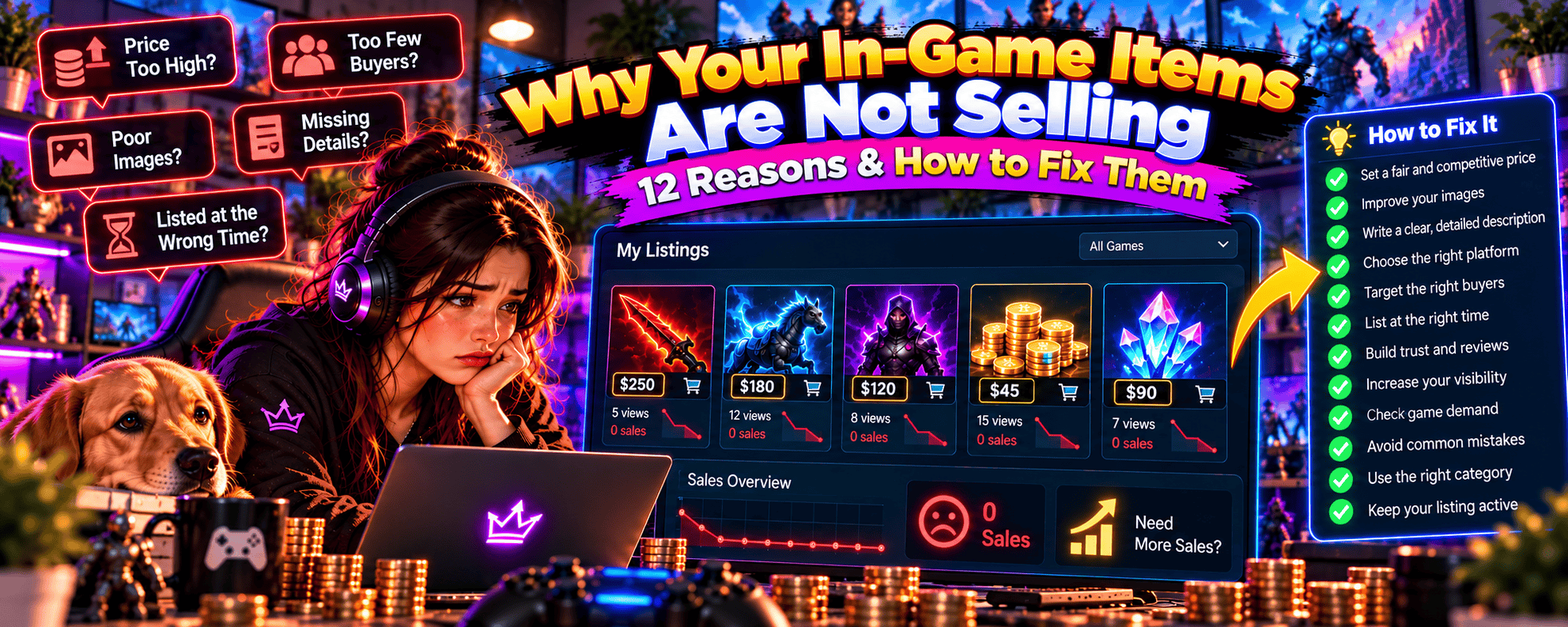
In this guide, we’ll explore 12 common reasons your in-game items aren’t selling and explain how to improve your chances of making a sale.
You’ll discover how to recognise pricing problems, improve listing visibility, understand buyer demand and make your gaming items more attractive to potential customers.
Whether you’re selling CS2 skins, rare cosmetics, tradable equipment or digital gaming collectibles, these strategies can help you understand what’s going wrong.
Because earning valuable gaming loot is one achievement.
Finding someone willing to buy it is an entirely different boss fight.
Let’s find out what’s stopping your items from selling.
1. Why Your In-Game Items Are Not Selling 🔍
When an in-game item doesn’t sell, it’s tempting to assume the price is the problem.
Sometimes it is.
But lowering your asking price won’t necessarily help if buyers can’t find your listing or simply aren’t interested in the item.
Most unsuccessful listings can be traced to three underlying problems: low visibility, low buyer conversion or insufficient demand.
Understanding which problem you’re facing is the first step towards fixing it.
👀 1. Your Listing Isn’t Getting Enough Views
Imagine opening a shop filled with rare gaming collectibles.
Your prices are competitive.
Your products look fantastic.
There’s just one problem.
Your shop is hidden in a dungeon that nobody visits.
That’s essentially what happens when your marketplace listings receive little visibility.
Potential reasons include:
- Incorrect listing categories.
- Missing search keywords.
- Poor item titles.
- Limited marketplace traffic.
- Strong competition.
- Items listed in the wrong game category.
Even an attractive price won’t generate sales if interested buyers never discover the item.
What to do: Focus on improving discoverability before making major price reductions.
🤔 2. Buyers Are Viewing Your Listing but Not Purchasing
Now imagine your listing receives plenty of views.
Gamers are finding it.
They’re checking the screenshots.
But nobody completes a purchase.
This suggests a different problem.
Potential buyers may be interested in the item but unconvinced by the offer.
Common reasons include:
- An asking price above comparable listings.
- Unclear item descriptions.
- Poor-quality screenshots.
- Limited seller credibility.
- Unexpected fees.
- Confusing delivery information.
- More attractive competing offers.
What to do: Review the complete buying experience, not just the price.
📉 3. There’s Not Enough Demand for Your Item
Some gaming items are genuinely difficult to sell.
They might be rare but unpopular.
They could belong to a game with declining player activity.
Or perhaps the marketplace already has hundreds of identical items available.
In these situations, improving your listing may help, but it cannot create unlimited demand.
What to do: Research actual buyer activity and recent completed sales where available.
💰 4. Your Asking Price Doesn’t Match the Market
An item is only worth what buyers are willing to pay under current market conditions.
You might have purchased a cosmetic for $100.
That doesn’t mean buyers will still pay $100 today.
Prices can change because of:
- New item releases.
- Game updates.
- Shifting player preferences.
- Increased supply.
- Reduced demand.
- Changes to trading rules.
What to do: Compare current offers and recent completed transactions rather than relying on historical prices.
🎮 5. You’re Selling to the Wrong Audience
Different gaming marketplaces attract different types of buyers.
Some focus on particular games.
Others specialise in cosmetics, equipment or collectibles.
If your item doesn’t match the marketplace’s audience, it may receive limited attention.
What to do: Choose a permitted selling platform where buyers actively look for your item category.
🔐 6. Buyers Don’t Trust Your Listing
Trust matters when purchasing virtual items.
A buyer may hesitate if your listing contains vague descriptions, misleading images or unclear delivery information.
Even if your item is legitimate, poor presentation can make the transaction appear risky.
What to do: Provide accurate details, genuine screenshots and clear information about the supported delivery process.
⚔️ 7. Your Competition Has a Better Offer
Imagine two sellers advertising the same cosmetic.
SELLER A
$45
“Rare skin. Good condition.”
Blurry screenshot, unclear details
SELLER B
$42
Exact item name, condition and attributes
Clear images, transparent delivery
Hypothetical example: Seller B offers clearer information and a lower price.
Which listing would you investigate first?
For many buyers, the second offer will look more attractive.
What to do: Compare your listing against the strongest competing offers, not just the average ones.
📊 8. Diagnose the Problem Before Changing Anything
Use this simple framework to identify where your selling process may be failing.
| What You’re Seeing | Likely Problem | First Thing to Try |
|---|---|---|
| Very few listing views | Low visibility | Improve title and category |
| Plenty of views, no sales | Low conversion | Review price and presentation |
| Few enquiries across multiple marketplaces | Weak demand | Research actual buyer activity |
| Buyers repeatedly negotiate lower | Price resistance | Compare completed sales |
| Buyers ask basic item questions | Missing information | Improve description |
| Buyers express security concerns | Lack of trust | Clarify delivery and transaction process |
| Competitors sell while yours doesn’t | Weak competitive offer | Compare price, details and presentation |
These are diagnostic clues, not guaranteed explanations. Some marketplaces also provide limited or unreliable view statistics.
🎯 The Golden Rule of Diagnosing Poor Sales
Don’t immediately slash your prices. First identify whether buyers aren’t finding your item, aren’t convinced by your offer or simply don’t want the item.
Each problem requires a different solution.
Lowering your price by 50% when nobody can find your listing is like offering half-price potions in an empty dungeon.
Technically a bargain.
Still no customers.
2. Your In-Game Item Prices Are Too High 💰
Pricing is one of the biggest factors influencing whether a gaming item sells.
Buyers can often compare multiple offers before making a decision.
If your item costs significantly more than similar alternatives, you’ll need a convincing reason for that premium.
An overpriced in-game item can remain unsold even when it’s rare, desirable and correctly advertised.
But pricing isn’t simply about being the cheapest seller.
It’s about understanding what makes your particular item valuable and positioning it competitively.
🔍 1. Don’t Confuse Asking Prices With Selling Prices
One of the most common mistakes is using other sellers’ asking prices as proof of market value.
Imagine seeing three listings for a cosmetic:
| Seller | Asking Price | Status |
|---|---|---|
| Seller A | $120 | Unsold |
| Seller B | $110 | Unsold |
| Seller C | $105 | Unsold |
You decide to list yours for $115.
Seems reasonable.
But what if recent comparable items actually sold for around $80?
Those unsold listings don’t establish that buyers are willing to pay $110 or more.
Completed sales, where available, are generally stronger pricing evidence than advertised prices alone.
📉 2. Understand That Gaming Item Prices Change
Virtual item markets can be volatile.
An item that sold for $150 last month might attract substantially different offers today.
Possible reasons include:
- Increased item supply.
- New game updates.
- Changes in item popularity.
- Trading restrictions.
- New cosmetic releases.
- Changes in player activity.
Avoid treating historical prices as permanent valuations.
🎮 3. Compare Items With Similar Attributes
Not every item with the same name has the same value.
Depending on the game, buyers may care about:
- Condition.
- Pattern.
- Rarity.
- Edition.
- Special effects.
- Attached enhancements.
- Collectible characteristics.
For example, two CS2 skins may have different market values because of their specific attributes.
Make sure you’re comparing genuinely similar items.
💎 4. Don’t Assume Rarity Guarantees a High Price
Rarity can influence value.
But rarity alone doesn’t guarantee demand.
A rare cosmetic that nobody wants may struggle to sell.
Meanwhile, a more common item with strong player demand may sell regularly.
Buyers ultimately determine whether an item’s rarity is worth paying for.
💰 5. Account for Marketplace Fees
Your asking price isn’t necessarily the amount you’ll receive.
For example, consider a hypothetical marketplace charging a 10% selling fee.
| Item Price | Illustrative Fee | Seller Receives |
|---|---|---|
| $20 | $2 | $18 |
| $50 | $5 | $45 |
| $100 | $10 | $90 |
| $200 | $20 | $180 |
These are illustrative figures, not actual StackedGame or other marketplace fees. Additional payment or withdrawal charges may apply.
Understanding your net proceeds helps you set realistic prices.
⚔️ 6. Compare Your Price Against Competing Offers
Search for the same item or the closest available alternatives.
Review:
- Current asking prices.
- Item attributes.
- Seller information.
- Listing quality.
- Delivery conditions.
- Recent sales, where available.
If multiple comparable items are available for $40 and yours is listed for $65, buyers may have little reason to choose yours.
Unless your item has additional value, the price difference could be holding you back.
⏳ 7. Decide Whether You Want a Fast Sale or a Higher Price
Not every seller has the same objective.
Some want to sell quickly.
Others are prepared to wait for a buyer willing to pay a premium.
Consider these approaches:
Quick Sale: Price competitively against comparable items, accepting that faster sales may require lower margins.
Balanced Sale: Set a price supported by market evidence and allow reasonable time for buyer interest.
Premium Sale: Ask more when genuine item characteristics justify the price, understanding that it may take longer to sell.
None guarantees a particular result.
🔄 8. Review Prices When Market Conditions Change
Don’t leave an item at the same price indefinitely without checking the market.
If comparable items are selling for less, your listing may become less competitive.
However, avoid making constant changes based on tiny fluctuations.
Use meaningful evidence rather than reacting to every new listing.
📊 9. Example: Fixing an Overpriced Gaming Item
Imagine listing a rare cosmetic for $90.
After two weeks, you’ve received several views but no purchases.
You research comparable completed sales and find that similar items have recently sold between $65 and $75.
Your original price may be too high for current demand.
You could test a revised asking price within that range, provided it still meets your selling objectives.
Then monitor whether enquiries or sales improve.
This doesn’t guarantee a sale, but it gives you a more evidence-based approach.
🚀 10. Use Pricing as Part of Your Overall Strategy
Price matters, but it isn’t everything.
A clear listing, accurate item information and trustworthy transaction process can also influence buyer decisions.
For a complete pricing strategy, see our How to Price In-Game Items guide.
It explores the factors that influence gaming item prices and how to evaluate your inventory more effectively.
🎯 The Golden Rule of Item Pricing
Price your item according to current market evidence and its genuine characteristics, not simply what you paid or what you hope to earn.
That legendary weapon might be priceless to you.
Unfortunately, buyers don’t usually pay extra because it helped you defeat the final boss on your third attempt.
3. There’s Not Enough Demand for Your Gaming Items 📉
Sometimes your price is reasonable.
Your listing looks professional.
You’ve chosen an appropriate marketplace.
And still, nobody buys.
In these situations, the problem may be demand.
An item can be rare, attractive and correctly priced while still having very few interested buyers.
Understanding demand helps you decide whether to improve your listing, adjust your price, wait for market conditions to change or focus on different items.
🎮 1. Popular Games Usually Have Larger Potential Audiences
Items associated with games that have active trading communities may have access to more potential buyers.
However, a large player base doesn’t automatically translate into strong demand for every item.
Consider:
- How many players actively trade.
- Whether the game supports item transfers.
- Whether the item category is popular.
- Whether buyers use the marketplace you’ve selected.
A game can have millions of players while offering limited opportunities for permitted item sales.
💎 2. Rare Doesn’t Always Mean Desirable
Imagine owning an extremely rare cosmetic.
Only a small number exist.
Sounds valuable, right?
Possibly.
But if players dislike its appearance or have little use for it, buyer interest may remain limited.
Rarity influences supply. Demand determines whether buyers actually want what’s available.
The strongest selling opportunities often involve items with both desirable characteristics and an active buyer audience.
📦 3. Too Much Supply Can Make Selling Difficult
Suppose a marketplace has 500 listings for the same item.
Even if buyers are interested, your listing faces significant competition.
When supply is abundant, buyers may have more negotiating power.
You might need to compete through:
- Realistic pricing.
- Accurate item information.
- Clear screenshots.
- Reliable fulfilment.
- Better listing visibility.
But if supply consistently exceeds demand, sales may remain slow.
🔄 4. Game Updates Can Change Buyer Interest
Updates can affect item demand.
For example, a game might introduce:
- New equipment.
- Alternative cosmetics.
- Balance changes.
- Additional rewards.
- New trading restrictions.
- Changes to item availability.
These developments can influence what players want to buy.
Avoid assuming an item’s popularity will remain unchanged.
🕹️ 5. Cosmetic Trends Can Shift
Gaming cosmetics often depend on player preferences.
A skin that was highly desirable during one season may attract less attention later.
New designs, community trends and changing aesthetics can influence demand.
Sometimes an item doesn’t become less rare.
It simply becomes less fashionable.
Digital fashion moves quickly.
Apparently, even legendary armour can go out of style.
📊 6. Understand Item Liquidity
Liquidity describes how easily an item can be sold at a price reasonably close to its current market value.
An item with frequent transactions and many interested buyers may be relatively liquid.
An obscure collectible with few completed sales may be less liquid.
For example:
| Item Type | Hypothetical Buyer Activity | Likely Selling Difficulty |
|---|---|---|
| Popular tradable cosmetic | Frequent transactions | Potentially easier |
| Common item with heavy competition | High supply and mixed demand | Price-sensitive |
| Rare niche collectible | Few interested buyers | Potentially slower |
| Item from a declining trading community | Limited transactions | Potentially difficult |
These are illustrative scenarios, not verified market statistics.
🔍 7. Look for Evidence of Actual Buyer Demand
Useful indicators may include:
- Recent completed sales.
- Transaction frequency.
- Active buy orders, where supported.
- Buyer enquiries.
- Relevant community discussions.
- Changes in listing inventory.
Be careful about interpreting advertised prices as evidence of demand.
A marketplace filled with expensive unsold items may indicate weak liquidity rather than a thriving market.
💰 8. Understand the Relationship Between Demand and Price
When demand is weak, sellers may need to offer more competitive prices to attract buyers.
But reducing prices doesn’t always solve the problem.
If nobody wants the item, even a substantial discount might generate little interest.
Before cutting your price, determine whether there’s an active market.
⏳ 9. Consider Whether Waiting Makes Sense
Some items experience temporary fluctuations in demand.
Others may face longer-term declines.
Holding an item could make sense if you’re comfortable with the uncertainty and don’t need to sell immediately.
However, there’s no guarantee that future demand or prices will improve.
Don’t assume every rare item will eventually become more valuable.
🎯 10. Focus on Items With Genuine Buyer Interest
If you’re planning to sell more items in the future, pay attention to what actually sells.
Look for categories with:
- Consistent buyer activity.
- Permitted trading mechanisms.
- Understandable market prices.
- Reasonable competition.
- Reliable item availability.
Our Best In-Game Items to Sell Online guide explores different item categories and what can make them attractive to buyers.
🚀 11. Don’t Confuse Personal Value With Market Demand
You might have spent 100 hours obtaining an item.
That effort makes it meaningful to you.
But buyers usually evaluate the item based on what they receive, not how difficult your personal journey was.
The market doesn’t necessarily reward the time invested in obtaining something.
🎯 The Golden Rule of Understanding Demand
Before trying to sell an item, check whether people are actually buying comparable items, not just whether other sellers are advertising them.
An item with no interested buyers isn’t automatically a hidden treasure.
Sometimes it’s simply an item with no interested buyers.
Even if it does glow purple.
4. Your In-Game Item Listings Aren’t Getting Enough Views 👀
You can’t sell an item that nobody sees.
And on busy gaming marketplaces, even desirable items can disappear beneath hundreds of competing listings.
If your listings receive little attention, improving their visibility may be more effective than immediately reducing your prices.
The challenge is making sure interested buyers can find your item when searching or browsing.
Let’s explore how.
🔍 1. Use the Exact Item Name in Your Title
Buyers often search for specific items.
If your listing title is vague, it may not appear relevant to their searches.
For example:
Weak Title: Rare Gaming Skin for Sale
Better Title: CS2 AK-47 | Redline – Field-Tested
The second title identifies the game, item and condition.
Use the item’s actual supported name and attributes rather than adding irrelevant keywords.
🎮 2. Choose the Correct Game Category
A listing placed in the wrong category may receive fewer relevant views.
Before publishing, confirm:
- Game.
- Item category.
- Item type.
- Applicable attributes.
- Relevant marketplace classifications.
Don’t deliberately miscategorise items to reach a larger audience.
That can confuse buyers and may violate marketplace rules.
💎 3. Include Relevant Item Attributes
Depending on the game, buyers may search for specific characteristics.
These might include:
- Rarity.
- Condition.
- Pattern.
- Edition.
- Item level.
- Special effects.
- Relevant collectible attributes.
Include details that accurately describe the item.
Avoid keyword stuffing.
📸 4. Use Clear, Genuine Screenshots
Screenshots can help buyers quickly evaluate an item.
Use images that show:
- The actual item.
- Relevant condition or attributes.
- Important visual characteristics.
- Clear item details.
Avoid misleading edits or images that don’t represent the item being sold.
📝 5. Write a Useful Description
A good description should answer the buyer’s most important questions.
For example:
- What exactly is being sold?
- Which game is it from?
- What condition or attributes does it have?
- Are there trading restrictions?
- How will delivery work through the supported process?
Clear information reduces uncertainty.
It may also help your listing appear relevant to buyers searching for particular characteristics, depending on marketplace functionality.
⚔️ 6. Review Competing Listing Titles
Search for similar items and compare how other sellers present them.
Look for useful details you may have missed.
However, don’t simply copy competing descriptions.
Your listing should accurately represent your particular item.
📱 7. Make Listings Easy to Read on Mobile
Some buyers browse marketplaces on mobile devices.
Long, confusing titles and poorly structured descriptions can be difficult to read.
Keep important information easy to find.
Use concise wording and avoid unnecessary filler.
🛒 8. Understand How Marketplace Search Works
Different marketplaces may use different ranking and discovery systems.
Some may consider:
- Listing relevance.
- Category.
- Price.
- Recency.
- Item attributes.
- Other platform-specific factors.
Don’t assume every marketplace uses the same ranking algorithm.
Check any available seller documentation before trying to optimise listings.
📊 9. Measure Listing Views Where Possible
If the marketplace provides analytics, review them.
Useful metrics might include:
- Listing views.
- Enquiries.
- Purchases.
- Conversion rate.
- Changes after listing updates.
For example:
| Listing | Views | Sales | Observed Conversion |
|---|---|---|---|
| Item A | 20 | 0 | 0% |
| Item B | 100 | 2 | 2% |
| Item C | 250 | 1 | 0.4% |
These are hypothetical examples.
Low views suggest a possible visibility problem.
High views with few purchases may indicate pricing, presentation or trust concerns.
However, view counts alone don’t establish buyer intent, and small samples can be misleading.
🚀 10. Improve Your Listing Before Paying for Promotion
If a marketplace offers paid promotion, don’t assume it will fix a weak listing.
More views won’t necessarily produce sales if the item is overpriced or poorly described.
First improve:
- Listing title.
- Category.
- Screenshots.
- Description.
- Price competitiveness.
- Delivery clarity.
Then evaluate whether additional promotion is worthwhile.
🔄 11. Update Listings When Necessary
If your item has been listed for a long time, review whether the information is still accurate.
Check:
- Current market price.
- Item availability.
- Competing offers.
- Description quality.
- Category accuracy.
Some marketplaces may have rules about editing or relisting items.
Follow those rules rather than repeatedly reposting to manipulate visibility.
🏆 12. Create Listings That Help Buyers Make Decisions
The goal isn’t simply to attract clicks.
It’s to attract relevant buyers and provide enough information for them to evaluate the offer.
A misleading title might generate attention.
But if the item doesn’t match expectations, those views are unlikely to become successful purchases.
For a complete walkthrough, see our How to Create an In-Game Item Listing That Sells guide.
It covers how to structure listings, present item details and make offers more appealing to potential buyers.
🎯 The Golden Rule of Listing Visibility
Make your item easy to find, easy to understand and easy to evaluate.
Use accurate titles, appropriate categories, genuine screenshots and useful descriptions.
Because even the rarest legendary loot won’t sell if it’s buried on page 47 under a listing titled “Cool Stuff – Cheap”.
And unlike an RPG quest, buyers probably aren’t going to spend six hours searching for it.
5. Your Item Listings Don’t Look Trustworthy 🔐
You’ve found a marketplace with active buyers.
Your item is competitively priced.
Your listing is getting views.
But nobody seems willing to purchase.
What’s going wrong?
Sometimes the problem isn’t the item or its price.
Buyers may be interested in what you’re selling but uncertain whether they can trust the listing or complete the transaction safely.
When purchasing virtual items, buyers can’t always inspect the product in the same way they would examine something in a physical shop.
They depend on accurate descriptions, genuine screenshots and reliable transaction procedures.
If those details are missing, even an attractive offer can look risky.
📸 1. Poor Screenshots Make Buyers Hesitate
Imagine two sellers advertising the same rare cosmetic.
The first listing includes a blurry screenshot with half the item cut off.
The second shows the item clearly, including its condition and relevant attributes.
Which would you investigate first?
Clear screenshots help buyers understand exactly what they’re purchasing.
How to fix it:
- Use genuine images of the actual item.
- Show important visual characteristics.
- Include relevant item information.
- Avoid misleading filters or edits.
- Make sure screenshots are easy to understand.
If your item has special attributes that affect its value, show them where possible.
📝 2. Vague Descriptions Create Uncertainty
Consider this description:
“Rare skin. Good price. Message me.”
It doesn’t tell the buyer much.
A stronger description explains the item’s name, condition, characteristics and relevant transfer information.
Buyers shouldn’t have to ask five questions just to understand what you’re selling.
How to fix it: Include accurate information that helps buyers evaluate the item without unnecessary guesswork.
🎮 3. Missing Item Details Can Reduce Confidence
Depending on the game, buyers may care about:
- Item rarity.
- Condition.
- Pattern.
- Edition.
- Special effects.
- Quantity.
- Trading restrictions.
- Transfer eligibility.
Leaving out important characteristics can make a listing less appealing.
It may also lead to misunderstandings after purchase.
💰 4. Unrealistic Claims Can Look Suspicious
Descriptions such as these can raise concerns:
- “Guaranteed rarest item in the game!”
- “Worth $1,000 but selling for $50!”
- “100% risk-free transaction!”
- “Buy now before the price triples!”
Unless you have reliable evidence, avoid exaggerated claims.
A professional listing should communicate genuine value rather than manufacture excitement.
You can still make your description engaging.
Just don’t promise things you cannot substantiate.
🔐 5. Unclear Delivery Information Makes Buyers Nervous
Buyers want to understand how they’ll receive their purchase.
If your listing doesn’t explain the supported delivery process, they may hesitate.
Useful information might include:
- The permitted transfer method.
- Applicable trading restrictions.
- Relevant delivery conditions.
- What the buyer needs to provide.
- Any platform-required confirmation steps.
Never promise instant delivery if a trading hold or other restriction could prevent it.
⭐ 6. Seller Reputation Can Influence Decisions
Some marketplaces provide seller profiles, transaction histories or review systems.
Where available, these signals may help buyers evaluate potential sellers.
However, reputation alone doesn’t guarantee a safe transaction.
How to fix it: Build credibility through accurate listings, professional communication and consistent fulfilment of legitimate orders.
Don’t fabricate reviews or make unsupported claims about previous sales.
💬 7. Poor Communication Can Cost You Buyers
Imagine asking a seller whether an item has a particular attribute.
Their response?
“Dunno. Just buy it.”
Not exactly reassuring.
Clear, professional communication can help buyers feel more comfortable.
Respond accurately to reasonable questions and avoid pressuring people into purchasing.
🎭 8. Avoid Anything That Resembles a Scam
Unfortunately, gaming marketplaces can attract fraudulent listings.
Buyers may be especially cautious when sellers:
- Request payment outside supported channels.
- Send unfamiliar verification links.
- Refuse to explain delivery.
- Provide inconsistent item details.
- Demand account credentials.
- Pressure buyers to act immediately.
Even if your intentions are legitimate, these behaviours can undermine confidence.
🛡️ 9. Make the Transaction Process Transparent
Buyers should understand what they’re agreeing to.
Be clear about:
- The exact item.
- The advertised price.
- Applicable restrictions.
- The supported delivery method.
- Relevant marketplace requirements.
Transparency reduces uncertainty.
It can also help prevent avoidable disputes.
📊 10. Compare a Weak Listing With a Stronger One
| Listing Element | Weak Listing | Stronger Listing |
|---|---|---|
| Title | Rare Gaming Skin | Exact Item Name and Condition |
| Screenshots | Blurry or unrelated | Genuine and clear |
| Description | Minimal information | Accurate item details |
| Price | Unsupported claims | Based on comparable offers |
| Delivery | Unclear | Supported process explained |
| Seller Communication | Vague or pushy | Professional and informative |
A stronger listing doesn’t guarantee a sale.
But it gives interested buyers more information to make a decision.
🚀 11. Review Your Listing From the Buyer’s Perspective
Before publishing, ask yourself:
Would I understand exactly what I’m buying?
Can I verify the important item characteristics?
Does the price make sense?
Is the delivery process clear?
Would anything about this listing make me suspicious?
If you identify concerns, address them before expecting buyers to commit.
For more guidance on evaluating marketplace credibility and reputation signals, see our How to Choose a Trusted In-Game Item Seller guide.
Understanding what buyers look for can help you make your own listings more trustworthy.
🎯 The Golden Rule of Building Buyer Trust
Make your listing accurate, transparent and easy to verify.
Trust doesn’t come from repeatedly telling buyers you’re trustworthy.
It comes from providing the information they need and following legitimate transaction procedures.
Because “Trust me bro” isn’t exactly a premium marketplace feature.
6. You’re Selling on the Wrong Marketplace 🛒
Not every gaming marketplace attracts the same buyers.
Some focus on particular games.
Others specialise in cosmetics, virtual equipment, digital collectibles or gaming services.
If you’re advertising your items on a platform where your target audience rarely shops, even a fantastic listing may struggle.
Choosing the right marketplace means finding a permitted selling environment where buyers actively search for the type of item you’re offering.
Let’s explore how to identify whether your selling platform is holding you back.
🎮 1. Different Marketplaces Serve Different Games
A marketplace popular with CS2 skin traders may not be the best place to advertise equipment from an unrelated RPG.
Likewise, a platform specialising in virtual collectibles may attract a different audience from one focused on gaming services.
Before listing, investigate whether the marketplace supports your game and item category.
Don’t assume a large gaming audience automatically means strong demand for your particular item.
🔍 2. Check Whether Buyers Are Actually Active
A marketplace might display hundreds of listings.
But that doesn’t necessarily mean those listings are selling.
Look for evidence of genuine activity, such as:
- Recent completed transactions, where visible.
- Active buyer enquiries.
- Relevant item searches.
- Current buy orders, where supported.
- Community discussions about purchasing items.
A marketplace filled with unsold inventory may offer less opportunity than its listing count suggests.
📦 3. Understand the Marketplace’s Item Categories
If your item doesn’t fit the available categories, buyers may struggle to find it.
For example, a marketplace may separate:
- Weapon skins.
- Character cosmetics.
- Equipment.
- Collectibles.
- In-game currency.
- Other supported digital goods.
Choose the category that accurately represents your item.
Avoid placing listings in unrelated categories simply to gain attention.
💰 4. Compare Fees and Your Net Proceeds
Marketplace fees can affect how competitively you price your items.
For example, two platforms may offer different transaction costs.
| Hypothetical Marketplace | Sale Price | Illustrative Total Fees | Seller Receives |
|---|---|---|---|
| Marketplace A | $100 | $5 | $95 |
| Marketplace B | $100 | $10 | $90 |
| Marketplace C | $100 | $15 | $85 |
These figures are illustrative and do not represent actual marketplace fees.
A platform with lower fees may allow more pricing flexibility.
However, lower fees aren’t necessarily valuable if there are very few interested buyers.
🔐 5. Consider Payment and Delivery Procedures
Marketplace suitability isn’t just about traffic.
You also need to understand how transactions work.
Investigate:
- Supported payment methods.
- Seller eligibility.
- Delivery procedures.
- Dispute handling.
- Withdrawal options.
- Account security.
- Applicable game restrictions.
Some platforms may provide structured transaction procedures, while others offer fewer safeguards.
Never assume every marketplace offers the same protections.
👀 6. Review the Competition
Search for your item on the marketplace.
How many competing listings appear?
Are they priced competitively?
Do sellers provide detailed descriptions?
Is there evidence that buyers are purchasing similar items?
A large number of competing offers may make it harder to stand out.
But very few listings can also indicate limited demand.
Consider both supply and buyer activity.
📱 7. Check the Buying Experience
Try viewing the marketplace as a potential customer.
Can you easily find the item?
Are categories understandable?
Can you compare prices?
Are the transaction requirements clear?
If the buying experience is confusing, some interested gamers may abandon their search.
🎯 8. Match Your Marketplace to Your Target Buyer
Different buyers have different priorities.
For example:
Casual Buyers: May prioritise affordable items, clear descriptions and straightforward transactions.
Collectors: May care more about rare attributes, condition and authenticity.
Competitive Players: May seek specific equipment or cosmetics associated with their favourite games.
Understanding the likely buyer helps you choose where to advertise.
🛒 9. Consider Specialist Gaming Marketplaces
Specialist platforms may help connect sellers with audiences interested in particular gaming products.
For example, StackedGame is a gaming-focused marketplace where sellers can explore opportunities involving eligible virtual items and gaming services.
Before listing, confirm that your game, item and proposed transaction are supported.
Review current marketplace rules, payment arrangements and delivery requirements.
🔄 10. Test Another Marketplace When Appropriate
If your item isn’t attracting attention, consider whether another permitted marketplace has a more relevant audience.
Before moving or duplicating your listing:
- Check the game’s trading rules.
- Review each marketplace’s policies.
- Compare total fees.
- Research buyer activity.
- Understand fulfilment requirements.
If multiple listings are permitted, keep inventory availability accurate to avoid accepting overlapping orders.
📊 11. Signs You Might Be Using the Wrong Marketplace
| Warning Sign | What It Could Mean |
|---|---|
| Few listings for your game | Limited marketplace focus |
| Little evidence of completed sales | Weak buyer activity |
| Incorrect or unsuitable categories | Poor item discoverability |
| High fees relative to item value | Reduced pricing flexibility |
| Few relevant buyer enquiries | Audience mismatch |
| Confusing transaction procedures | Potential buyer hesitation |
These signs don’t prove a marketplace is unsuitable, but they provide useful starting points for investigation.
🚀 12. Choose Marketplaces Based on Evidence
Don’t choose a platform simply because another seller claims to make huge profits there.
Research whether it supports your item and attracts relevant buyers.
For a broader comparison of selling channels, see our Where to Sell In-Game Items Online guide.
🎯 The Golden Rule of Marketplace Selection
Sell where your potential buyers are already looking, provided the item and transaction are permitted.
A marketplace with millions of visitors won’t necessarily help if none of them wants your particular gaming item.
It’s like trying to sell legendary swords at a racing game tournament.
Impressive inventory.
Questionable audience.
7. Your Items Are Competing With Better Listings ⚔️
Gaming marketplaces can be competitive.
Sometimes you’re not the only person selling a particular item.
You might be competing with dozens or even hundreds of sellers offering similar products.
And if another seller offers a clearer listing, better price or more attractive transaction experience, buyers may choose them instead.
To improve your chances of selling, you need to understand how your offer compares with the alternatives buyers can already see.
This doesn’t mean you must always be the cheapest.
It means giving buyers a compelling, legitimate reason to consider your listing.
💰 1. Compare Your Price Against Similar Items
Start by researching comparable offers.
If five sellers advertise similar cosmetics between $30 and $35, a listing priced at $50 may struggle unless there’s a meaningful difference.
Check whether your item has attributes that justify a premium.
Avoid comparing items that only appear similar but have different characteristics.
📸 2. Improve Your Screenshots
Clear images can make a listing more appealing.
Show the actual item and any characteristics buyers are likely to care about.
For example, a cosmetic listing might benefit from screenshots showing its appearance and condition.
Avoid misleading edits or screenshots that obscure important details.
📝 3. Write a More Informative Description
Competing listings may provide more information than yours.
Compare the details they include.
Could your description better explain:
- The item’s characteristics?
- Its condition?
- Relevant restrictions?
- Supported delivery arrangements?
- Any genuine distinguishing features?
An informative description can help buyers evaluate your offer.
💎 4. Highlight Genuine Item Advantages
Some items have characteristics that make them more desirable.
These might include:
- Rare patterns.
- Limited editions.
- Special visual effects.
- Desirable conditions.
- Collectible attributes.
If your item has a legitimate advantage, explain it clearly.
Don’t invent rarity or exaggerate value.
🎮 5. Make the Exact Item Easy to Identify
Buyers searching for specific items want confidence that they’re viewing the correct product.
Use accurate titles and attributes.
Avoid vague descriptions such as “rare weapon” when the actual item name is available.
🔐 6. Make Your Offer Feel More Reliable
Buyers may compare seller credibility as well as price.
Where supported, a complete seller profile, accurate listings and relevant transaction history can help.
Professional communication also matters.
Avoid suspicious payment requests or attempts to bypass marketplace procedures.
⏳ 7. Be Realistic About Delivery
A competitor might advertise faster delivery.
That can influence buyers.
However, don’t promise instant fulfilment if you cannot provide it.
Trading holds, platform requirements and other restrictions may affect delivery.
Accurate expectations are better than promises you cannot keep.
📊 8. Compare Your Listing Against Competitors
Consider this hypothetical example:
| Feature | Your Listing | Competing Listing |
|---|---|---|
| Item | Same cosmetic | Same cosmetic |
| Price | $55 | $48 |
| Screenshots | One blurry image | Three clear images |
| Description | Two sentences | Detailed item attributes |
| Delivery | Unclear | Supported process explained |
| Seller Profile | Limited information | Complete available information |
The competing listing offers several advantages.
Lowering your price might help.
But improving your images, description and delivery clarity could also make your offer more competitive.
🔄 9. Don’t Copy Competing Listings
Researching competitors is useful.
Copying their descriptions or screenshots isn’t.
Your listing should represent the actual item you’re selling.
Using another seller’s images can create confusion and may violate marketplace rules.
🛒 10. Consider the Complete Buyer Experience
Buyers don’t necessarily choose the lowest advertised price.
They may also consider:
- Transaction fees.
- Item details.
- Seller credibility.
- Delivery requirements.
- Marketplace familiarity.
- Payment options.
A slightly more expensive listing may still appeal to buyers if it offers genuine advantages.
However, don’t assume those advantages justify any price difference.
🚀 11. Make One Improvement at a Time
If you’re trying to understand why your listing isn’t competitive, test changes systematically.
For example:
- Improve your title and description.
- Monitor relevant views or enquiries.
- Update screenshots if necessary.
- Review pricing against comparable sales.
- Evaluate the results.
Making every change simultaneously can make it harder to identify what helped.
🏆 12. Focus on Value, Not Just Discounts
Constantly reducing your price can erode your proceeds.
Before discounting, ask whether you can improve the listing itself.
Better information, clearer screenshots and more accurate presentation may help buyers recognise the value of your item.
🎯 The Golden Rule of Beating Competing Listings
Make your listing a better overall offer through competitive pricing, accurate information and a trustworthy transaction experience.
You don’t need to defeat every competing seller.
You just need to give interested buyers a reason to choose your item.
Think of it like upgrading your gear before a boss fight.
Sometimes the answer isn’t swinging harder.
It’s improving your equipment.
8. You’re Not Promoting Your In-Game Items Effectively 📣
Creating a listing is only part of selling an item.
Depending on the marketplace, buyers may discover it through search, categories, recommendations or external communities.
But if your item isn’t receiving enough attention, you may need to improve how you’re reaching potential buyers.
Effective promotion means making your listing visible to gamers who are genuinely interested in that type of item, without spamming communities or making misleading claims.
Let’s explore practical ways to attract more relevant attention.
🎮 1. Understand Who Might Buy Your Item
Before promoting anything, consider your target audience.
For example:
- CS2 skin collectors may seek specific patterns or conditions.
- RPG players may look for useful equipment where trading is permitted.
- Cosmetic collectors may value limited editions.
- Casual players may prioritise affordable items.
Different buyers respond to different information.
Your promotion should reflect what makes the item relevant to them.
🔍 2. Optimise Your Marketplace Listing First
External promotion won’t necessarily help if your listing is unclear or overpriced.
Before sharing it, check:
- Title accuracy.
- Item description.
- Screenshots.
- Price competitiveness.
- Supported delivery information.
- Category selection.
A strong listing gives interested visitors a better reason to continue.
💬 3. Participate in Relevant Gaming Communities
Gaming communities can be useful places to understand player interests.
Depending on the game’s rules and community policies, some may permit marketplace discussions or item advertisements.
Potential channels include:
- Game-specific forums.
- Discord communities.
- Trading discussion groups.
- Relevant social media communities.
- Marketplace community features.
Always check whether commercial posts and external transactions are permitted.
Don’t assume every gaming community welcomes item advertisements.
📱 4. Use Discord Carefully
Discord communities can bring together players interested in particular games and items.
However, many servers restrict selling or promotional messages.
Before posting:
- Read the server rules.
- Check whether trading is permitted.
- Use designated channels where available.
- Avoid unsolicited direct messages.
- Don’t repeatedly post identical advertisements.
A useful, relevant contribution is more likely to be welcomed than aggressive promotion.
🛒 5. Share Accurate Listing Information
When promotion is permitted, include the details buyers need.
For example:
Hypothetical Listing Promotion
“CS2 AK-47 | Redline – Field-Tested. Genuine item screenshots and condition details available in the listing. Asking $35. Please review the marketplace’s supported transaction requirements before purchasing.”
This is clearer than:
“SUPER RARE SKIN! BUY NOW!!!”
Accuracy is more useful than excessive hype.
💎 6. Highlight What Makes the Item Interesting
If your item has a desirable characteristic, mention it.
For example:
- Special edition.
- Unusual pattern.
- Rare cosmetic effect.
- Collectible variation.
- Competitive market price.
Only make claims you can support.
Don’t describe an ordinary item as exceptionally rare simply to attract attention.
📸 7. Use Visuals Where Appropriate
Gaming items are often highly visual.
Clear screenshots can help potential buyers understand the product.
For cosmetic items, consider showing their appearance in the game where permitted.
For equipment, show relevant item attributes.
Avoid images that exaggerate the item’s appearance or misrepresent what the buyer will receive.
🔄 8. Avoid Repetitive Promotion
Posting the same listing repeatedly can annoy community members.
It may also violate community rules.
Instead, focus on relevant opportunities to share your listing.
For example, a community discussion about a particular cosmetic category may be more relevant than an unrelated general gaming conversation.
🎯 9. Promote to Interested Buyers, Not Everyone
A rare CS2 skin is unlikely to interest every gamer.
Targeting relevant communities can be more effective than broadcasting to the widest possible audience.
Think about:
- Which game the item belongs to.
- Whether the community permits trading.
- What item attributes matter.
- Whether members actively discuss purchases.
- Which marketplace they use.
Quality of interest matters more than raw exposure.
📊 10. Measure Whether Promotion Helps
If you have access to listing analytics, compare activity before and after promotion.
For example:
| Metric | Before Promotion | After Promotion |
|---|---|---|
| Weekly Listing Views | 25 | 80 |
| Buyer Enquiries | 1 | 5 |
| Completed Sales | 0 | 1 |
These figures are hypothetical.
An increase in views can indicate improved visibility.
However, if views rise without corresponding enquiries or sales, you may need to review pricing, demand or listing quality.
💰 11. Be Careful With Paid Promotion
Some marketplaces or advertising platforms may offer paid visibility.
Before spending money, consider:
- The item’s expected net proceeds.
- Promotion costs.
- Likely buyer interest.
- Marketplace rules.
- Whether the listing is already competitive.
Spending $20 to promote an item that would earn you $15 after fees is unlikely to be worthwhile.
Paid promotion also doesn’t guarantee a sale.
🔐 12. Keep Promotions Legitimate
Avoid promotional tactics involving:
- Fake reviews.
- Misleading rarity claims.
- Fabricated sales.
- Unsolicited spam.
- Suspicious payment links.
- Attempts to bypass game or marketplace restrictions.
A short-term increase in attention isn’t worth damaging buyer trust or risking account restrictions.
🚀 13. Build a Repeatable Promotion Process
If you regularly sell eligible gaming items, develop a simple routine.
For example:
- Publish an accurate listing.
- Confirm that it appears in the correct category.
- Share it through relevant permitted channels.
- Respond professionally to genuine enquiries.
- Monitor views and buyer interest.
- Review the listing if results remain weak.
This approach is more sustainable than constantly posting random advertisements.
🤝 14. Learn Where Genuine Buyers Spend Their Time
Different item categories may attract buyers through different channels.
Pay attention to where legitimate enquiries originate.
Over time, you may discover that particular marketplaces or communities are more relevant to your inventory.
For more practical ideas, see our How to Find Buyers for In-Game Items guide.
It explores ways to reach interested gamers, improve listing discoverability and turn genuine enquiries into potential sales.
🎯 The Golden Rule of Promoting Gaming Items
Promote your items where interested buyers are likely to look, using accurate information and respecting community rules.
You don’t need to shout about your legendary loot in every Discord server on the internet.
You need to reach the gamers who actually want it.
Because posting your rare sword listing in a channel dedicated to Minecraft chicken farms probably isn’t the marketing breakthrough you’re looking for.
9. Why Buyers View Your Items but Don’t Purchase 🤔
Your listing is getting attention.
Gamers are clicking through, checking your screenshots and reading your description.
But nobody is buying.
What’s going wrong?
When your in-game item listing receives views but no sales, the problem may be conversion rather than visibility.
In other words, potential buyers are discovering your item, but something is preventing them from completing a purchase.
That could be the price, the listing itself, a lack of trust or simply buyers comparing their options.
Let’s explore how to identify the problem.
👀 1. Understand the Difference Between Views and Sales
A listing view doesn’t necessarily mean someone intends to purchase.
Some gamers browse out of curiosity.
Others research prices or compare different items.
A buyer might even return several times before deciding.
That’s why views alone don’t guarantee demand.
However, consistently attracting interested visitors without making sales can suggest that something needs improving.
💰 2. Your Price May Be Discouraging Buyers
One of the first things buyers compare is price.
Imagine three sellers advertising equivalent cosmetics:
| Seller | Asking Price | Listing Quality |
|---|---|---|
| Seller A | $40 | Clear and detailed |
| Seller B | $45 | Clear and detailed |
| Your Listing | $60 | Clear and detailed |
If the items are genuinely comparable, buyers may have little reason to pay an extra $15–$20.
How to fix it: Compare recent completed sales and competing offers before adjusting your price.
Remember that item condition, rarity and special attributes can justify legitimate differences.
📸 3. Your Screenshots Aren’t Convincing
Buyers want to understand what they’re purchasing.
If your screenshots are blurry, incomplete or misleading, they may leave without buying.
For example, someone purchasing a cosmetic might want to inspect its appearance and relevant condition.
How to fix it: Use genuine screenshots that clearly show the item and its important characteristics.
📝 4. Your Description Leaves Too Many Questions
A vague description creates uncertainty.
Potential buyers may wonder:
- Is this the exact item shown?
- What condition is it in?
- Are there special attributes?
- Is it currently transferable?
- How will delivery work?
- Are there restrictions?
If these questions remain unanswered, buyers may choose another listing.
How to fix it: Make your description informative, accurate and easy to understand.
🔐 5. Buyers May Be Concerned About Trust
Virtual item transactions can involve risks.
Buyers may hesitate if your listing contains unusual payment instructions, inconsistent information or unclear delivery procedures.
Some may also prefer sellers with an established transaction history where marketplace reputation features are available.
How to fix it: Follow supported marketplace procedures and communicate transparently.
Never ask buyers to share account credentials or bypass legitimate payment systems.
💳 6. Unexpected Fees Can Affect Purchase Decisions
A buyer might see an item advertised for $50.
But during checkout, additional charges may increase the total.
Depending on the platform, these could include transaction or payment processing fees.
Buyers may reconsider if the final cost is higher than expected.
How to fix it: Understand the marketplace’s pricing structure and avoid misleading claims about the total purchase cost.
⏳ 7. Delivery Restrictions May Discourage Buyers
Some gaming items have trading holds or other transfer restrictions.
If buyers expect immediate delivery but discover that the item cannot be transferred yet, they may abandon the purchase.
How to fix it: Clearly explain relevant delivery restrictions and avoid promising timelines you cannot meet.
⚔️ 8. Buyers May Find a Better Competing Offer
Your listing might be perfectly reasonable.
But another seller may offer:
- A lower price.
- A more desirable item variation.
- Better screenshots.
- Clearer item details.
- A more suitable delivery arrangement.
Review competing listings regularly.
You don’t need to copy them, but understanding their advantages can help you improve.
🎮 9. Your Listing May Be Attracting the Wrong Audience
A vague title can generate views from people looking for something different.
For example, a listing titled “Rare CS2 Skin” may attract broad curiosity.
But buyers searching for a specific weapon skin, condition or pattern may not find what they need.
How to fix it: Use accurate item names and relevant attributes to attract more qualified visitors.
📊 10. Calculate Your Listing Conversion Rate
If the marketplace provides reliable view and sales data, you can estimate conversion.
The basic formula is:
Conversion Rate = (Completed Sales ÷ Listing Views) × 100
For example:
| Listing | Views | Sales | Conversion Rate |
|---|---|---|---|
| Item A | 100 | 1 | 1% |
| Item B | 200 | 4 | 2% |
| Item C | 150 | 0 | 0% |
These are hypothetical examples, not industry benchmarks.
Be careful when interpreting the figures. View counts may include repeat visits, and a single item may only be available for one sale.
🔍 11. Compare Views With Buyer Enquiries
Enquiries can provide useful clues.
High Views, Few Enquiries: Buyers may not find the item or offer compelling.
High Views, Many Price Negotiations: Your asking price may be above what interested buyers want to pay.
High Views, Repeated Delivery Questions: Your delivery information may be unclear.
High Views, Security Concerns: Buyers may lack confidence in the transaction process.
These patterns aren’t definitive, but they can help identify what to investigate.
🔄 12. Test Improvements Systematically
Rather than changing everything at once, try a structured approach.
For example:
- Review your price against comparable completed sales.
- Improve unclear item information.
- Replace poor screenshots.
- Clarify permitted delivery procedures.
- Monitor buyer activity.
- Reassess after a reasonable period.
Where possible, track which changes coincide with improved results.
💰 13. Check Whether Buyers Have Better Alternatives
Sometimes the issue isn’t that your price is unreasonable.
It’s that another item offers better perceived value.
For example, buyers may prefer a slightly more expensive cosmetic with a more desirable condition or pattern.
Compare the full offer rather than price alone.
Our How to Compare In-Game Item Prices guide explains how to evaluate comparable items and recognise meaningful differences in value.
🎯 The Golden Rule of Improving Conversion
If buyers are viewing your listing but not purchasing, investigate what might be stopping them from committing.
More traffic isn’t always the answer.
Sometimes you need a better price, clearer information or a more convincing offer.
Because attracting 1,000 gamers to a listing nobody wants to buy is impressive.
Just not particularly profitable.
10. How Long Should It Take to Sell In-Game Items? ⏳
You’ve listed your item.
You’ve checked the price.
You’ve improved the description.
Now comes the hardest part.
Waiting.
But how long should you wait before deciding something is wrong?
A day?
A week?
A month?
There’s no universal timeframe for selling in-game items. The time required depends on buyer demand, item rarity, pricing, marketplace activity and competition.
Some items may sell quickly.
Others could remain listed for weeks or months without attracting a buyer.
Let’s explore what influences selling time.
🎮 1. Popular Items May Attract Buyers More Quickly
Items with strong demand and frequent trading activity may be easier to sell.
For example, a commonly traded cosmetic with an established buyer audience may receive more interest than an obscure collectible.
However, popularity alone doesn’t guarantee a quick sale.
Pricing and competition still matter.
💎 2. Rare Items Can Take Longer to Sell
Rarity doesn’t always mean fast sales.
A rare collectible may appeal to only a small number of buyers.
Even if those buyers are willing to pay a premium, finding them can take time.
This is particularly relevant for unusual item variations or expensive collectibles.
💰 3. Your Asking Price Influences Selling Time
A competitively priced item may attract more interest than an equivalent listing priced well above the market.
But lower prices don’t guarantee faster sales.
If demand is weak, even substantial discounts may not help.
Consider whether your priority is maximising the sale price or reducing the time spent waiting.
📉 4. Market Liquidity Matters
Liquidity describes how easily an item can be sold near its prevailing market value.
A liquid item generally has active buyers and regular transactions.
An illiquid item may have few interested buyers and infrequent sales.
For example:
| Hypothetical Item | Buyer Activity | Potential Selling Experience |
|---|---|---|
| Popular cosmetic | Frequent transactions | May sell relatively quickly |
| Common equipment | High supply and moderate demand | Competitive pricing important |
| Rare collector item | Few potential buyers | May require patience |
| Item from an inactive game economy | Limited transactions | May be difficult to sell |
These examples illustrate general patterns rather than guaranteed selling times.
🔍 5. Look at Recent Completed Sales
Where available, completed transaction data can help you understand how actively an item trades.
For example, an item with numerous recent sales may have a more active market than one with no recorded transactions for several months.
However, marketplace data may be incomplete.
Don’t assume the absence of visible sales proves that no transactions occur elsewhere.
🛒 6. Marketplace Activity Affects Selling Time
The same item may attract different levels of interest across marketplaces.
A platform with a relevant buyer audience may offer better visibility than one focused on unrelated games.
Research where buyers actively trade your item category, provided the proposed transactions are permitted.
⚔️ 7. Competition Can Slow Sales
If hundreds of sellers advertise identical items, buyers have plenty of options.
Your listing may struggle unless it offers competitive value.
Review how your price and presentation compare with alternatives.
📆 8. Timing Can Influence Demand
Game updates, events, new releases and changes in player activity may influence item demand.
For example, interest in certain cosmetics could increase around a relevant game event.
But timing effects are unpredictable.
Don’t assume every event will increase prices or generate more buyers.
🔄 9. When Should You Review an Unsold Listing?
Rather than using a fixed deadline, consider the available evidence.
For example:
After a Few Days: Confirm the listing is visible, correctly categorised and accurately described.
After One to Two Weeks: Review views, enquiries, competing offers and recent market prices.
After Several Weeks: Reassess demand, marketplace suitability and whether your asking price remains realistic.
These are practical review intervals, not expected selling times.
High-value or niche items may justify longer periods.
💰 10. Should You Lower Your Price?
Consider a price adjustment when:
- Comparable items are consistently selling for less.
- Your asking price is no longer competitive.
- Buyers repeatedly negotiate lower.
- Your selling priorities have changed.
- Market demand has weakened.
Avoid lowering your price solely because a few days have passed.
🎮 11. Should You Hold Onto an Item Instead?
Holding an item may be reasonable if you’re comfortable waiting and understand the risks.
However, future prices can rise or fall.
An item that seems valuable today may become less desirable after a game update or market change.
Don’t treat virtual item appreciation as guaranteed.
📊 12. Track Your Listing Performance Over Time
If you’re selling regularly, consider keeping simple records.
For example:
| Item | Listed Price | Days Listed | Views | Enquiries | Status |
|---|---|---|---|---|---|
| Cosmetic A | $25 | 4 | 65 | 3 | Sold |
| Equipment B | $60 | 14 | 30 | 1 | Active |
| Collectible C | $250 | 35 | 12 | 0 | Active |
These are hypothetical figures.
Tracking results can help you identify which item categories attract buyers and which consistently struggle.
🚀 13. Don’t Mistake Patience for a Selling Strategy
Waiting can be reasonable.
But leaving an overpriced or poorly presented listing untouched for months isn’t necessarily productive.
Review market conditions periodically and make evidence-based improvements.
🎯 The Golden Rule of Selling Time
Judge your listing against actual market activity, not an arbitrary number of days.
Some items sell quickly.
Others require patience.
And some may never find a buyer at your preferred price.
Even legendary loot doesn’t come with a guaranteed delivery date.
11. How to Fix In-Game Items That Won’t Sell 🚀
We’ve explored pricing, demand, marketplace selection, listing quality and buyer behaviour.
Now it’s time to put everything together.
If your gaming items aren’t selling, you need a practical troubleshooting process.
The goal is to identify the most likely reason your listing is underperforming, make targeted improvements and evaluate whether those changes help.
Rather than randomly reducing prices or reposting advertisements, work through the following steps.
🔍 Step 1: Confirm the Item Can Be Sold
Before making any changes, check that your item is eligible for the proposed transaction.
Confirm:
- The item is transferable.
- The game permits the transaction.
- The marketplace supports the item.
- No restrictions prevent delivery.
- Your listing complies with platform rules.
There’s little point optimising a listing for an item that cannot legitimately be delivered.
💰 Step 2: Check the Current Market Price
Research comparable items.
Look for recent completed sales where available.
Compare relevant characteristics such as condition, rarity and special attributes.
If your asking price is significantly above comparable offers, determine whether there’s a genuine reason.
📉 Step 3: Evaluate Buyer Demand
Ask whether people are actually purchasing similar items.
Look for:
- Recent transactions.
- Active buy orders.
- Buyer enquiries.
- Marketplace activity.
- Relevant community interest.
If demand is extremely limited, a better description alone may not solve the problem.
👀 Step 4: Review Listing Visibility
If your marketplace provides view statistics, check them.
Low views may indicate:
- Poor title optimisation.
- Incorrect category.
- Limited marketplace activity.
- Weak discoverability.
- Strong competition.
Focus on helping relevant buyers find your item.
📸 Step 5: Improve Your Screenshots
Replace blurry or incomplete images.
Use genuine screenshots that clearly represent the item.
Show relevant attributes and condition where possible.
Avoid misleading visual edits.
📝 Step 6: Rewrite Your Description
Make your listing easier to understand.
Include:
- Exact item name.
- Game.
- Relevant characteristics.
- Condition.
- Applicable restrictions.
- Supported delivery information.
Remove exaggerated claims and unnecessary filler.
🔐 Step 7: Improve Buyer Confidence
Review whether your listing provides enough information for a buyer to evaluate the transaction.
Use supported marketplace procedures and communicate professionally.
Don’t request unusual payment arrangements or account credentials.
⚔️ Step 8: Compare Your Listing Against Competitors
Search for similar offers.
Compare:
- Price.
- Item characteristics.
- Screenshots.
- Description quality.
- Delivery conditions.
- Seller credibility signals.
Identify the most meaningful differences.
🛒 Step 9: Reconsider the Marketplace
If your listing receives little relevant interest, investigate whether another permitted marketplace has a more suitable audience.
Check transaction rules, fees and delivery requirements before moving or duplicating listings.
📣 Step 10: Improve Promotion
Where community and marketplace rules allow, share your listing with relevant gaming audiences.
Avoid unsolicited spam.
Focus on communities where people are genuinely interested in your item category.
📊 Step 11: Measure the Results
After making improvements, monitor relevant indicators.
For example:
- Views.
- Enquiries.
- Offers.
- Completed sales.
- Time listed.
Don’t assume that every increase in views represents meaningful progress.
Look for changes in genuine buyer interest.
🔄 Step 12: Adjust Your Strategy
If your listing still isn’t selling, consider your options.
You might:
- Adjust the price.
- Improve presentation further.
- Try a more suitable marketplace.
- Wait for buyer interest.
- Decide not to sell at the current market price.
The best decision depends on the item, your priorities and the available evidence.
📊 Your In-Game Item Selling Troubleshooter
Use this table to identify your next move.
| Problem | Likely Cause | Recommended Action |
|---|---|---|
| No listing views | Poor discoverability | Improve title and category |
| Views but no enquiries | Weak offer or low buyer interest | Review price and description |
| Enquiries but no purchases | Trust, price or delivery concerns | Investigate buyer objections |
| Repeated low offers | Asking price may be too high | Compare recent completed sales |
| Many competing listings | High supply | Improve value and presentation |
| Little market activity | Weak demand | Reassess selling strategy |
| Buyers ask basic questions | Missing listing details | Expand description |
| Buyers express security concerns | Unclear transaction process | Clarify supported procedures |
| Listing performs poorly everywhere | Demand or price problem | Research the market again |
🎯 The Golden Rule of Fixing Unsold Items
Diagnose the problem, make targeted changes and measure whether buyer interest improves.
Don’t change your price, title, screenshots and marketplace simultaneously unless there’s a clear reason.
A systematic approach helps you understand what works.
Think of it like improving your gaming performance.
You don’t randomly change every setting after losing a match.
You identify the problem, adjust your strategy and try again.
Preferably without throwing your controller.
12. Why Your In-Game Items Aren’t Selling – FAQ ❓
🎮 Why Are My In-Game Items Not Selling?
Common reasons include unrealistic pricing, weak buyer demand, poor listing visibility, incomplete descriptions, strong competition and limited buyer trust.
Start by checking whether your listing receives views and whether comparable items are actually selling.
💰 Should I Lower My In-Game Item Prices?
Consider reducing your price if comparable items are consistently selling for less.
However, don’t automatically discount an item simply because it hasn’t sold.
First investigate demand, visibility and listing quality.
🔍 How Do I Know if My Gaming Item Is Overpriced?
Compare recent completed sales and current listings for genuinely similar items.
Pay attention to condition, rarity, patterns and other characteristics that influence value.
An asking price isn’t proof that buyers will pay that amount.
👀 Why Do My Listings Get Views but No Sales?
Potential buyers may be comparing prices, researching items or finding more attractive alternatives.
Review your asking price, screenshots, description, delivery information and buyer confidence signals.
🎮 Why Aren’t My CS2 Skins Selling?
Possible reasons include pricing, item condition, market demand, competition, trade restrictions and listing visibility.
Compare your exact skin characteristics with recent market activity rather than relying on the item name alone.
🚀 How Can I Sell In-Game Items Faster?
Focus on competitive pricing, accurate listings, genuine screenshots and marketplaces with relevant buyer activity.
However, faster sales aren’t guaranteed, particularly for niche or illiquid items.
💎 Does Item Rarity Guarantee Demand?
No.
A rare item may attract little interest if players don’t find it desirable.
Rarity affects supply, but buyer demand is essential to successful sales.
🛒 Where Should I List My Gaming Items?
Choose a reputable marketplace that supports your game, item category and proposed transaction.
Research buyer activity, fees, payment procedures and delivery requirements.
⏳ How Long Should I Wait Before Changing My Price?
There’s no universal timeframe.
Review market conditions and listing performance periodically.
If comparable items are consistently selling for less, a price adjustment may be appropriate.
📸 Can Poor Screenshots Affect Sales?
Yes.
Unclear or misleading screenshots can make it harder for buyers to evaluate an item.
Use genuine images that accurately show its appearance and relevant characteristics.
⚔️ How Do I Compete With Other Item Sellers?
Compare the complete offer, including price, item attributes, listing quality and delivery clarity.
Focus on providing accurate information and genuine value rather than relying solely on discounts.
📣 Should I Promote My Gaming Items on Discord?
Only where community rules permit it and the proposed transaction is allowed.
Use relevant channels, avoid unsolicited spam and direct interested buyers through legitimate transaction procedures.
🔄 Should I Relist Items That Aren’t Selling?
First check whether the marketplace permits relisting and whether doing so would improve discoverability.
Updating an existing listing may be more appropriate.
Avoid repeatedly reposting identical offers in violation of platform rules.
📉 What Are the Hardest In-Game Items to Sell?
Items with limited buyer demand, heavy competition, unclear valuations or restrictive trading conditions may be difficult to sell.
Rare niche collectibles can also take longer to find interested buyers.
💰 Is It Worth Holding Onto an Item Instead of Selling?
That depends on your goals and willingness to accept market risk.
Holding may make sense if you don’t need to sell immediately, but future prices and demand are uncertain.
🔐 Does Seller Reputation Affect Sales?
It can.
Where marketplaces provide reputation features, buyers may consider transaction history and reviews.
However, reputation alone doesn’t guarantee trust or successful sales.
📊 What’s a Good Conversion Rate for In-Game Item Listings?
There’s no universal benchmark.
Conversion depends on the marketplace, item category, price and how views are measured.
Compare your own results over time rather than relying on an arbitrary percentage.
🎮 Can I Sell Items From Any Video Game?
No.
Some games restrict trading or prohibit external real-money transactions.
Always check the game’s rules and marketplace eligibility requirements before listing.
💳 Do Marketplace Fees Affect Buyer Decisions?
They can.
Fees may influence the final purchase cost and the amount sellers receive.
Understand the full transaction costs before setting your price.
🚨 What if Nothing Improves My Sales?
If you’ve improved your listing, reviewed pricing and tested suitable marketplaces without success, the item may have limited demand at your preferred price.
You may need to adjust expectations, wait or reconsider whether selling is worthwhile.
Final Thoughts: Turn Unsold Gaming Loot Into Better Selling Opportunities 🎮💰
You’ve collected the loot.
You’ve created the listing.
You’ve waited for the buyers.
But your items still aren’t selling.
Frustrating? Absolutely.
Impossible to improve? Not necessarily.
The key to selling in-game items more successfully is understanding why buyers aren’t purchasing and making improvements based on evidence.
Sometimes the problem is simple.
Your price is too high.
Your screenshots aren’t clear.
Or your listing is missing important details.
Other times, the challenge is more fundamental.
Perhaps the marketplace doesn’t attract the right audience, competing sellers offer better value or demand for your item is simply limited.
That’s why a successful selling strategy involves more than publishing a listing and hoping for the best.
Research current market prices.
Understand buyer demand.
Make your items easy to discover.
Create accurate, trustworthy listings.
Compare competing offers.
And regularly review what’s working.
If you’re exploring ways to sell eligible gaming items and services, StackedGame provides a gaming-focused marketplace to investigate. Check the applicable game rules and marketplace requirements before listing.
Remember that not every item will sell quickly, and some may never attract a buyer at your preferred price.
But by understanding the market and improving your approach, you can give your gaming inventory a better chance of finding the right buyers.
Don’t just list your loot. Learn what buyers want, fix what’s holding your listings back and give your items their best chance to sell.
Because defeating the final boss was difficult enough.
You shouldn’t need another 200-hour grind just to find someone willing to buy the reward.