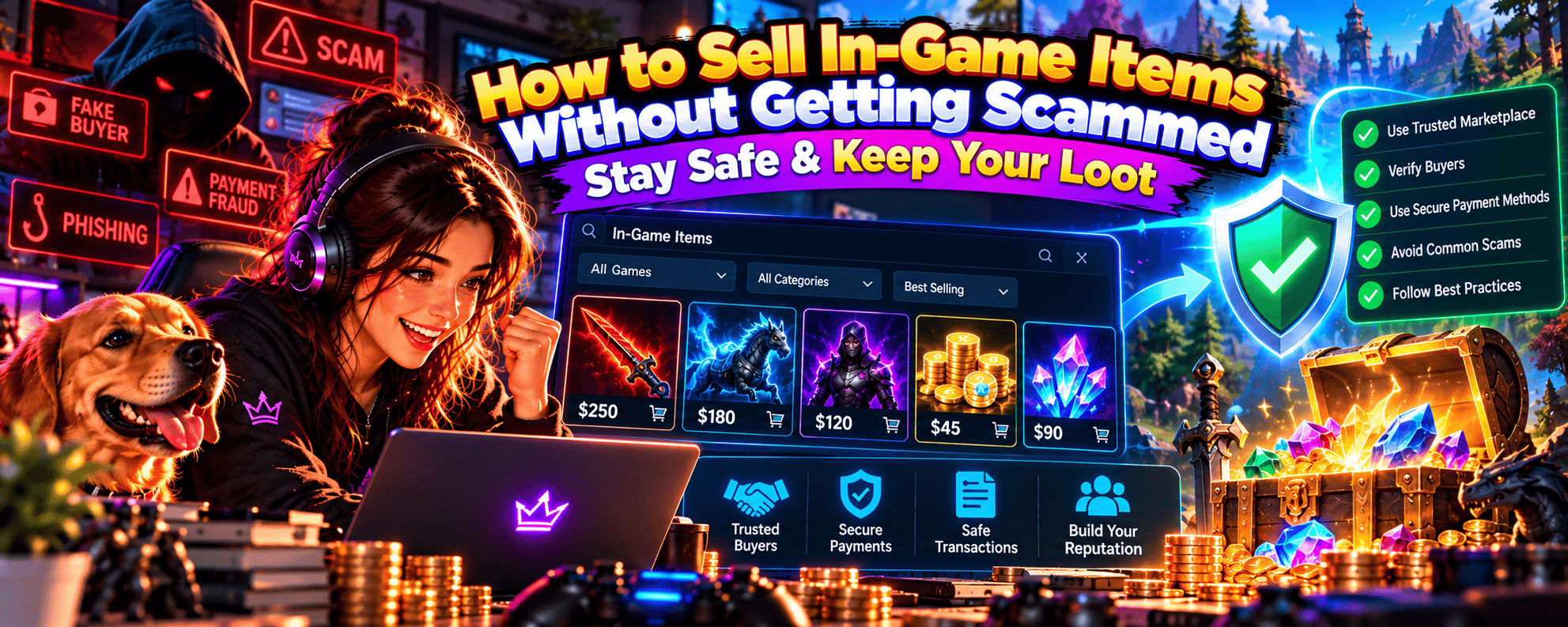
You’ve spent hours grinding for rare equipment, collecting valuable cosmetics or building an inventory of gaming items worth selling.
You’ve found a buyer.
They’ve agreed to your price.
Everything looks perfect.
Then comes the message:
“I’ve sent the payment! Just transfer the item now.”
Sounds straightforward, right?
Not necessarily.
Selling in-game items can expose gamers to scams involving fake payments, phishing links, fraudulent buyers and stolen accounts. And when virtual items are transferred to the wrong person, getting them back can be extremely difficult.
Whether you’re selling CS2 skins, rare cosmetics, tradable equipment or valuable gaming collectibles, understanding how scams work is essential.
The good news? Many common scams rely on predictable tactics that you can learn to recognise.
You don’t need to become a cybersecurity expert to protect your gaming inventory. You just need to understand the warning signs, follow legitimate transaction procedures and know when to walk away.
In this guide, we’ll explain how to sell in-game items without getting scammed, identify suspicious buyers, choose safer marketplaces and protect your items throughout the selling process.
We’ll also explore the tricks scammers use to steal valuable gaming items and the practical precautions that can help you avoid them.
Because earning money from your gaming loot is great.
Losing your entire inventory to someone called “OfficialSteamSupport_472” is considerably less great.
Let’s keep your items where they belong until a legitimate transaction is completed.
1. How to Sell In-Game Items Without Getting Scammed 🔐
Selling gaming items safely starts long before you receive your first offer.
The marketplace you choose, the information you share and the way you handle payments can all influence your risk.
The safest approach is to sell only eligible items, use reputable platforms with clearly documented transaction procedures, secure your accounts and independently verify every important step before transferring anything.
No marketplace or payment method can eliminate every risk.
However, following a consistent process can help you avoid many common mistakes.
🎮 1. Confirm Your Item Can Be Sold
Before advertising anything, check the rules of the game and platform.
Some games allow players to trade items with each other.
Others permit sales only through an official marketplace.
And some prohibit external real-money transactions entirely.
For example, the Steam Community Market allows eligible items to be sold for Steam Wallet funds, but those funds cannot be withdrawn as cash.
That’s different from selling an item for real money through an external marketplace.
Before listing an item, confirm:
- Whether the item is transferable.
- Whether real-money sales are permitted.
- Whether an official marketplace must be used.
- Whether trading restrictions apply.
- Whether the proposed delivery method is supported.
Never assume that because an item can be traded, it can automatically be sold for cash.
Our How to Sell In-Game Items Online guide explains the broader selling process.
🛒 2. Choose Your Selling Platform Carefully
A marketplace can provide a structured environment for listing items and managing transactions.
However, not all platforms offer the same protections.
Before using one, investigate:
- The platform’s reputation.
- Supported games and item categories.
- Seller eligibility requirements.
- Payment procedures.
- Delivery requirements.
- Dispute resolution processes.
- Applicable fees.
- Account security features.
Look for clearly documented policies rather than relying on advertising claims.
A marketplace describing itself as “100% scam-proof” isn’t evidence that every transaction is safe.
🔐 3. Secure Your Gaming Account
Your account is often the gateway to your entire inventory.
Protect it with:
- A strong, unique password.
- Two-factor authentication where supported.
- Secure recovery information.
- Up-to-date devices and software.
- Careful management of connected applications.
Never share passwords, authentication codes or recovery credentials with buyers.
Legitimate item transfers shouldn’t require you to surrender control of your account.
💰 4. Understand How You’ll Receive Payment
Before agreeing to a sale, understand exactly how the payment process works.
Important questions include:
- Who processes the payment?
- When is payment considered confirmed?
- Can the payment be reversed?
- Does the marketplace hold funds?
- What seller protections apply?
- When can you withdraw your proceeds?
- What happens if the buyer disputes the transaction?
Different payment methods carry different risks.
Even a payment that initially appears successful may later be reversed under certain circumstances.
👀 5. Verify Buyers Through Supported Channels
Not every buyer who contacts you is legitimate.
Be particularly cautious when someone:
- Insists on communicating outside the marketplace.
- Sends unfamiliar payment links.
- Requests your login credentials.
- Offers significantly more than market value.
- Pressures you to transfer the item immediately.
- Claims to represent marketplace support.
Where possible, keep transaction communication within the marketplace’s supported systems.
🤝 6. Follow the Approved Delivery Process
Every supported marketplace may have different delivery requirements.
Some transactions involve direct item transfers.
Others use platform-managed procedures.
Follow the documented process rather than accepting improvised instructions from a buyer.
Before confirming any transfer, verify:
- The intended recipient.
- The exact item.
- The trade contents.
- Any applicable restrictions.
- The platform’s required transaction status.
Remember that an item transfer may be irreversible.
📸 7. Keep Relevant Transaction Records
Records can be useful if a dispute arises.
Depending on the platform, retain:
- Listing details.
- Transaction identifiers.
- Relevant messages.
- Payment records.
- Delivery confirmation.
- Trade history.
Store records securely and avoid collecting unnecessary personal information.
Screenshots can support a dispute, but they aren’t proof that a payment is genuine.
🚨 8. Know When to Walk Away
Sometimes the safest decision is not to complete the sale.
If a buyer refuses to follow supported procedures or insists on suspicious arrangements, stop the transaction.
You don’t need to accept unnecessary risks simply because someone offers an attractive price.
There will be other potential buyers.
Your inventory, however, may be much harder to replace.
🎯 The Golden Rule of Safe Selling
Never transfer an item simply because a buyer claims they’ve paid. Follow the platform’s verified payment and delivery procedures before releasing anything.
A legitimate buyer should be willing to complete a transaction through the agreed, permitted process.
Anyone demanding your item first while promising to sort everything out later deserves serious scrutiny.
Especially when their profile picture is a suspiciously pixelated Steam logo.
2. The Most Common In-Game Item Selling Scams ⚠️
Scammers don’t always use complicated technology.
Sometimes they simply create convincing messages, exploit a seller’s excitement or persuade someone to make a rushed decision.
The methods vary, but the objective is usually the same.
Get the seller to transfer an item, reveal account credentials or approve a transaction they don’t fully understand.
Knowing the most common scams makes them easier to recognise.
💳 1. Fake Payment Confirmation Scams
This is one of the simplest tricks.
A buyer claims they’ve paid and sends a screenshot showing a completed transaction.
They may even provide a convincing-looking payment receipt.
But the screenshot could be edited or entirely fabricated.
Example:
You’re selling a cosmetic for $75.
The buyer sends an image showing a $75 payment and asks you to transfer the item immediately.
You check your payment account and find no corresponding transaction.
The buyer insists the payment is simply delayed.
How to protect yourself:
- Never rely on screenshots as payment confirmation.
- Check transaction status independently through the official payment provider or marketplace.
- Follow the platform’s required release procedure.
- Don’t transfer items because someone claims payment is pending.
Even a genuine payment may remain subject to reversal or dispute.
🔄 2. Chargeback and Payment Reversal Scams
Some payment methods allow transactions to be disputed or reversed.
A dishonest buyer may receive an item and later challenge the payment.
For example:
- A buyer purchases an eligible item.
- The seller transfers it.
- The buyer disputes the payment.
- The payment provider investigates and may reverse the transaction.
The seller could lose both the item and the payment.
This outcome isn’t inevitable, and not every payment dispute is fraudulent.
However, sellers should understand the risks before accepting a particular payment method.
How to protect yourself:
- Review the payment provider’s seller protection policies.
- Understand whether virtual goods are covered.
- Follow documented delivery requirements.
- Retain transaction records.
- Use supported marketplace dispute procedures.
Never assume a payment method offers complete protection against reversals.
🎭 3. Marketplace Staff Impersonation
A scammer pretends to be a moderator, administrator or customer support representative.
They may claim there’s a problem with your listing or account.
For example:
“Your account has been flagged. Transfer your item to our verification account to avoid suspension.”
This is a major warning sign.
A scammer may use official-looking logos, usernames or messages to appear legitimate.
How to protect yourself:
- Access support through the marketplace’s official website or app.
- Verify messages independently.
- Never transfer items to an unverified support account.
- Don’t share passwords or authentication codes.
- Be suspicious of urgent threats.
A display name or profile badge alone isn’t reliable proof of someone’s identity.
🔗 4. Phishing Website Scams
Phishing websites imitate legitimate gaming platforms or marketplaces.
A scammer might send you a link claiming you need to:
- Verify your Steam account.
- Confirm your inventory.
- Accept a payment.
- Unlock a trade.
- Complete seller verification.
The website may look almost identical to the real service.
But entering your credentials could give an attacker access to your account.
How to protect yourself:
- Open the official website independently rather than following an unexpected link.
- Check the exact domain.
- Avoid unfamiliar login pages.
- Never enter authentication codes on suspicious websites.
- Review account activity if you suspect compromise.
A professional-looking website is not proof of legitimacy.
🤝 5. Fake Middleman Scams
Some scammers suggest using a supposedly trusted third party to complete a transaction.
The person may claim to hold the item until payment is confirmed.
But the middleman could be working with the buyer or be another account controlled by the same scammer.
Example:
A buyer offers $300 for your rare cosmetic.
They insist that a well-known community middleman must handle the trade.
You transfer the item to the middleman.
Both accounts disappear.
How to protect yourself:
- Don’t trust middlemen recommended through unsolicited messages.
- Verify whether the marketplace supports an official transaction process.
- Avoid transferring items to unknown third parties.
- Don’t assume community reputation claims are genuine.
An independent third party doesn’t automatically make a transaction safer.
🎮 6. Item-Switching Scams
Item-switching scams involve changing the contents of a trade.
A scammer may initially show a valuable item or an agreed set of items.
Then they alter the trade before confirmation.
For example, two cosmetic items might have similar names or appearances but very different values.
If the seller doesn’t check carefully, they may approve an unfavourable exchange.
How to protect yourself:
- Review the final trade contents.
- Verify item names and attributes.
- Check quantities and variations.
- Never rush confirmation.
- Cancel the trade if anything changes unexpectedly.
The final confirmation screen matters more than earlier promises.
📱 7. QR-Code Login Scams
Some legitimate services support QR-code authentication.
Scammers can exploit this by persuading users to scan codes that initiate an unintended login or authorisation.
A QR code might be presented as a way to verify payment or confirm ownership.
How to protect yourself:
- Don’t scan unsolicited authentication QR codes.
- Understand what your authenticator is approving.
- Never approve an unexpected login request.
- Access the official service directly.
If an authentication request doesn’t match an action you initiated, reject it.
🛒 8. Fake Marketplace Scams
Some websites imitate genuine marketplaces or claim to offer unusually favourable selling conditions.
They may advertise:
- Extremely low fees.
- Guaranteed instant sales.
- Unusually high purchase prices.
- Exclusive buyer access.
- Special account verification procedures.
A fake marketplace might attempt to steal login details, payment information or virtual items.
How to protect yourself:
Research the platform independently before registering or transferring anything.
Check its domain, policies, support channels and credible external reputation.
Avoid assuming that search rankings or professional branding establish legitimacy.
💰 9. Overpayment Scams
A buyer offers more than your asking price.
That might sound fantastic.
But they may then claim to have accidentally sent too much money and request a refund of the difference.
The original payment could be fake, unauthorised or reversible.
Example:
You list an item for $80.
The buyer claims to have sent $180 and asks you to refund $100 immediately.
You send the refund.
Later, the original payment fails or is reversed.
How to protect yourself:
Never send a separate refund based solely on a buyer’s claim.
Handle overpayments through the original payment provider or marketplace’s official refund process.
⏳ 10. Urgency and Pressure Scams
Scammers often create artificial deadlines.
You might receive messages such as:
“Transfer now or the payment expires!”
“My account is being locked in five minutes!”
“I’ve already paid, so stop wasting time!”
These messages are designed to make you act before checking the details.
How to protect yourself:
Take the time needed to verify the transaction.
A legitimate sale shouldn’t require you to ignore essential security checks.
🔐 11. Account Verification Scams
A scammer claims you must prove ownership of your gaming account.
They may ask for:
- Passwords.
- Authentication codes.
- Recovery codes.
- Account recovery details.
- Access to your email.
- Approval of unexpected login requests.
Never provide these details to a buyer.
Legitimate item sales shouldn’t require surrendering control of your account.
📊 12. Common Scam Warning Signs
| Scam Type | Typical Warning Sign | Safer Response |
|---|---|---|
| Fake Payment | Buyer sends only a screenshot | Verify through the official payment system |
| Chargeback Fraud | Buyer insists on an unsupported payment method | Review seller protection and use approved procedures |
| Staff Impersonation | Unexpected account verification demand | Contact support independently |
| Phishing | Unfamiliar login link | Open the official service directly |
| Fake Middleman | Buyer insists on an unknown third party | Use documented marketplace processes |
| Item Switching | Trade contents change unexpectedly | Recheck everything before approval |
| QR-Code Scam | Unexpected authentication request | Reject and verify independently |
| Overpayment | Buyer asks for a separate refund | Use the original provider’s refund process |
| Urgency Scam | Pressure to transfer immediately | Stop and verify |
🎯 The Golden Rule of Recognising Scams
Be suspicious whenever someone asks you to bypass normal procedures, reveal security information or make an irreversible transfer before the transaction is properly verified.
Many of these tactics also appear in ordinary item trading.
Our How to Trade In-Game Items Safely guide explores additional precautions for player-to-player exchanges.
Remember, scammers don’t always look suspicious.
Sometimes they’re friendly, patient and surprisingly knowledgeable about the game.
Right up until they ask you to transfer your $500 skin to an account called “Official Verification Bot”.
3. How to Spot Fake Buyers and Suspicious Offers 👀
Not every suspicious transaction begins with an obvious scam message.
Some scammers behave like ordinary buyers.
They ask reasonable questions, discuss prices and appear genuinely interested in your item.
Then, once you’ve started trusting them, they introduce an unusual payment arrangement or ask you to visit an unfamiliar website.
The best way to identify potentially fraudulent buyers is to pay attention to their behaviour, verify claims independently and avoid making exceptions to essential security procedures.
Let’s explore the warning signs.
💰 1. Offers That Seem Too Good to Be True
Imagine listing a cosmetic for $100.
A buyer contacts you and immediately offers $180.
No negotiation.
No questions.
They just want to buy it right now.
An unusually high offer isn’t automatically fraudulent. Some items have characteristics that justify higher prices.
However, an unexplained premium can be a warning sign, particularly when accompanied by unusual transaction requests.
Before proceeding:
- Verify the item’s actual market value.
- Check whether special attributes justify the offer.
- Review the proposed payment method.
- Follow supported marketplace procedures.
Don’t let an attractive offer override basic precautions.
⏳ 2. Buyers Who Create Artificial Urgency
Scammers often try to prevent sellers from thinking carefully.
Common messages include:
- “I need the item immediately.”
- “My payment expires in ten minutes.”
- “Transfer now or I’m cancelling.”
- “I can’t wait for marketplace verification.”
A buyer may genuinely be in a hurry.
But their urgency doesn’t remove the need to verify the transaction.
🔗 3. Buyers Who Send Suspicious Links
Be cautious when someone sends a link claiming you need to:
- Confirm a payment.
- Verify your Steam inventory.
- Unlock trading.
- Approve seller status.
- Complete an account security check.
Don’t enter credentials through unfamiliar links.
Navigate to the official service independently.
💬 4. Buyers Who Insist on Moving Off-Platform
A buyer might ask to continue the conversation through Discord, Telegram or another messaging service.
That request isn’t automatically proof of fraud.
However, moving away from the marketplace can make it harder to preserve transaction records or use platform protections.
Be especially cautious when someone insists that payment or delivery must also happen outside the supported process.
🎭 5. Buyers Claiming Special Authority
Some scammers pretend to be:
- Marketplace moderators.
- Steam administrators.
- Trusted community traders.
- Professional brokers.
- Payment verification agents.
They may use convincing profile images and usernames.
Don’t rely on those signals.
Verify any authority claim through the organisation’s official support channels.
🔐 6. Requests for Account Credentials
A buyer should not need your password to purchase an item.
Be suspicious of requests for:
- Gaming account passwords.
- Email passwords.
- Authentication codes.
- Recovery codes.
- Account recovery links.
- Unexpected login approvals.
These are security credentials, not transaction details.
Never share them.
🤝 7. Buyers Who Demand an Unknown Middleman
A buyer may insist that a third party must verify the transaction.
They might provide a profile claiming the person has handled thousands of trades.
That reputation could be fabricated.
Unless you’re using a documented, officially supported transaction arrangement, avoid transferring items to unknown intermediaries.
📸 8. Buyers Who Rely on Screenshots as Proof
Screenshots can be useful for showing item characteristics.
They’re not reliable proof of payment.
A buyer might send an image of:
- A completed bank transfer.
- A payment confirmation.
- A marketplace balance.
- A pending transaction.
These images can be altered.
Verify the transaction directly through the relevant official system.
🎮 9. Buyers Who Don’t Understand the Item
Sometimes a buyer appears unfamiliar with what they’re purchasing.
For example, they may offer a high price for an ordinary item without asking about its condition or attributes.
This doesn’t necessarily mean they’re fraudulent.
But when combined with pressure, unusual payment requests or suspicious links, it deserves additional caution.
⭐ 10. Don’t Rely Entirely on Profile Reputation
A buyer may have:
- An established account.
- An expensive-looking inventory.
- Positive comments.
- A convincing profile picture.
- A long membership history.
These can be useful context, but they aren’t guarantees.
Accounts can be compromised, reviews can be fabricated and profiles can be impersonated.
Always verify the transaction itself.
💳 11. Buyers Who Refuse Supported Payment Methods
A buyer may suggest an unfamiliar payment service or an arrangement that bypasses the marketplace.
They might claim the alternative is faster or cheaper.
Before agreeing, investigate the risks.
If the proposed method isn’t supported or permitted, don’t proceed.
🚨 12. Buyers Who Change the Deal at the Last Minute
A common warning sign is a sudden change in transaction details.
For example:
- A different receiving account.
- A new payment method.
- A replacement trade link.
- A different item.
- An unexpected third party.
- A request to transfer before payment verification.
Treat significant changes as a reason to stop and recheck the entire transaction.
📊 13. How to Evaluate Suspicious Buyer Behaviour
| Buyer Behaviour | Risk Level | Recommended Action |
|---|---|---|
| Asks reasonable item questions | Normal | Respond accurately |
| Negotiates the asking price | Normal | Evaluate the offer |
| Requests additional genuine screenshots | Usually Normal | Share through supported channels |
| Offers significantly above market value | Caution | Investigate the reason |
| Insists on moving payment off-platform | High Concern | Follow approved payment procedures |
| Sends an unfamiliar login link | High Concern | Don’t open or authenticate |
| Requests your authentication code | Serious Warning | Refuse and report |
| Demands an immediate item transfer | High Concern | Stop and verify |
| Claims to be support and requests your inventory | Serious Warning | Verify through official support |
These categories are general guidance rather than guarantees about a person’s intentions.
🛡️ 14. Trust the Process, Not the Sales Pitch
A scammer might sound convincing.
They might know the game extremely well.
They might even have a profile that looks more impressive than yours.
None of that replaces transaction verification.
Focus on whether the buyer is willing to follow legitimate marketplace procedures.
For more strategies on attracting genuine customers, see our How to Find Buyers for In-Game Items guide.
🎯 The Golden Rule of Identifying Fake Buyers
Judge buyers by their actions and willingness to follow safe transaction procedures, not by impressive profiles, generous offers or reassuring promises.
A legitimate buyer doesn’t need your password.
They don’t need you to disable account security.
And they certainly don’t need you to send your rarest cosmetic to their mysterious cousin who apparently works for Steam.
4. How to Choose a Safe Marketplace for Selling Items 🛒
Choosing where to sell your gaming items is about more than finding the lowest fees or the biggest audience.
You also need to understand how the marketplace handles payments, deliveries, disputes and account security.
A platform with attractive prices but unclear transaction procedures may expose you to unnecessary risk.
A safer marketplace is one that supports your item, clearly explains its selling process and provides transparent information about payments, seller responsibilities and dispute handling.
No platform can guarantee that every buyer is legitimate or every transaction will be successful.
But choosing carefully can help reduce avoidable risks.
🎮 1. Check Whether the Marketplace Supports Your Game
Start with the basics.
Does the marketplace actually support your game and item category?
For example, a platform specialising in cosmetic trading may not support equipment from an unrelated RPG.
Before registering, confirm:
- Supported games.
- Eligible item categories.
- Trading requirements.
- Permitted payment methods.
- Delivery arrangements.
Don’t assume every tradable item is eligible for external real-money sales.
🔍 2. Research the Marketplace’s Reputation
Look beyond the platform’s own marketing.
Research:
- Independent user experiences.
- Relevant community discussions.
- Documented complaints.
- Publicly available company information.
- Support responsiveness.
- Clear transaction policies.
Individual reviews can be misleading, so look for patterns rather than relying on one glowing testimonial or one negative comment.
💳 3. Understand How Payments Are Processed
Different marketplaces use different payment arrangements.
Some process payments directly.
Others use third-party providers.
Some may hold funds until particular transaction conditions are met.
Before selling, understand:
- How buyers pay.
- When funds become available.
- Whether funds can be reversed.
- What fees apply.
- Whether withdrawals are supported.
- What seller protections exist.
Never assume that a marketplace holding payment eliminates every risk.
🔐 4. Review Seller Protection Policies
Some marketplaces provide procedures for investigating disputes.
However, protections may have important limitations.
For example, coverage might depend on:
- The item category.
- The payment method.
- Proof of delivery.
- Compliance with marketplace rules.
- Transaction records.
- Applicable exclusions.
Read the actual policy.
Don’t rely on a vague claim that sellers are fully protected.
🤝 5. Understand the Delivery Process
Virtual items can be delivered in different ways.
Depending on the game and platform, this might involve:
- Supported player-to-player trades.
- Platform-managed transfers.
- Approved in-game systems.
- Other documented delivery arrangements.
Check the exact procedure before listing.
If the marketplace requires specific evidence of delivery, understand how to provide it.
🛡️ 6. Look for Strong Account Security
Useful security features may include:
- Two-factor authentication.
- Login notifications.
- Account recovery procedures.
- Session management.
- Security alerts.
- Clear guidance about phishing.
Features vary between platforms.
Check what’s actually available rather than assuming every marketplace offers the same protections.
💬 7. Check How Disputes Are Handled
What happens if a buyer claims they never received an item?
What if a payment is disputed?
What if the buyer provides incorrect delivery details?
A marketplace should explain its dispute process and the responsibilities of each party.
Look for information about:
- Reporting problems.
- Required evidence.
- Response deadlines.
- Refund procedures.
- Seller obligations.
- Escalation options.
Understanding these rules before selling is much easier than discovering them after something goes wrong.
💰 8. Compare Total Selling Costs
Fees can include more than a simple commission.
Depending on the platform, you might encounter:
- Listing fees.
- Transaction fees.
- Payment processing charges.
- Currency conversion costs.
- Withdrawal fees.
Consider the total amount you’ll receive after applicable charges.
However, don’t choose a marketplace solely because it advertises the lowest fees.
🎭 9. Watch for Fake Marketplace Websites
Scammers may create websites that resemble established platforms.
They might use:
- Similar domain names.
- Copied logos.
- Familiar colour schemes.
- Fake support messages.
- Convincing login pages.
Always check the exact website address.
Access the platform through a trusted bookmark or independently verified official link.
Don’t assume that a link supplied by a buyer leads to the genuine marketplace.
⭐ 10. Understand Marketplace Ratings and Reviews
Seller ratings may help buyers evaluate listings.
But they shouldn’t be treated as definitive proof that an account is trustworthy.
Likewise, positive marketplace reviews don’t guarantee that every transaction is safe.
Use reputation information alongside other checks.
📱 11. Check Support Availability
Before using a marketplace, find out how to contact support.
Look for:
- Official support channels.
- Help documentation.
- Transaction dispute procedures.
- Account recovery information.
- Clear contact instructions.
Be cautious if the only available support comes through an unsolicited Discord message or an unverified social media account.
🎮 12. Consider Gaming-Focused Marketplaces
Specialist gaming marketplaces can make it easier to organise listings around relevant games and item categories.
For example, StackedGame is a gaming-focused marketplace where sellers can explore opportunities involving eligible virtual items and gaming services.
Before listing, confirm that your particular item and proposed transaction are supported.
Review the platform’s current payment, delivery and dispute procedures rather than assuming specific protections are available.
📊 13. Marketplace Safety Comparison
Use this framework when evaluating potential selling platforms.
| Safety Factor | What to Check |
|---|---|
| Game Support | Is your item eligible for listing and sale? |
| Marketplace Reputation | Is there credible independent information? |
| Payment Processing | How are payments handled and verified? |
| Seller Protection | What protections and exclusions apply? |
| Delivery Procedures | How are items transferred and confirmed? |
| Account Security | What security features are available? |
| Dispute Handling | How are problems investigated? |
| Fees | What are the total selling costs? |
| Support | Can you contact verified support channels? |
| Platform Rules | Are the proposed transactions permitted? |
🚨 14. Marketplace Red Flags
Be particularly cautious when a platform:
- Guarantees completely risk-free transactions.
- Requires you to share account passwords.
- Provides unclear payment information.
- Has no accessible terms or policies.
- Uses suspicious or inconsistent website addresses.
- Pressures you to deposit items immediately.
- Has no identifiable support process.
- Promises unusually high guaranteed returns.
One warning sign doesn’t always prove a platform is fraudulent.
But multiple serious concerns should make you reconsider.
🏆 15. Choose Safety Over Convenience
A platform promising instant sales and zero fees might sound attractive.
But if its payment and delivery procedures are unclear, the potential risks may outweigh the convenience.
Take time to compare your options.
For a broader look at different selling channels, see our Where to Sell In-Game Items Online guide.
🎯 The Golden Rule of Choosing a Marketplace
Use a marketplace that supports your item, explains its transaction process clearly and provides enough information for you to understand the risks before selling.
The safest-looking website isn’t necessarily the safest marketplace.
Professional graphics, glowing testimonials and impressive promises are easy to create.
Clear policies, verifiable information and reliable procedures matter much more.
Because when you’re selling valuable gaming loot, the last thing you want is to discover that the marketplace’s customer support department consists of one Discord account that’s suddenly gone offline.
5. How to Avoid Fake Payments and Chargeback Scams 💳
You’ve found a buyer for your rare gaming item.
They’ve agreed to your price, confirmed the details and sent you a message saying payment is complete.
Excellent!
But before you transfer anything, there’s one important question.
Has the payment actually been verified through the approved transaction process?
Fake payment confirmations and payment reversals are among the risks sellers need to understand when trading virtual items for real money.
Unlike physical products, virtual items can sometimes be transferred almost instantly. Once an item has left your inventory, recovering it may be difficult or impossible.
Let’s explore how to protect yourself.
💰 1. Never Trust Payment Screenshots Alone
A buyer might send a screenshot showing a completed payment.
It could display:
- Your username.
- The agreed amount.
- A transaction reference.
- A payment confirmation.
- A familiar payment provider’s logo.
Unfortunately, screenshots can be edited.
Even a convincing receipt doesn’t prove that money has reached your account.
What to do instead:
Open the official payment service or marketplace independently and check the transaction status.
Never rely solely on an image supplied by the buyer.
🔍 2. Understand the Difference Between Pending and Completed Payments
Payment systems use different transaction statuses.
A payment might be:
- Initiated.
- Pending.
- Authorised.
- Under review.
- Completed.
- Reversed.
- Refunded.
These terms don’t necessarily mean the same thing across providers.
For example, an authorised payment may not yet be fully settled.
Even a completed payment can sometimes be disputed later.
Before transferring an item, understand what the marketplace requires and when you’re authorised to fulfil the order.
🎮 3. Follow the Marketplace’s Payment Process
If you’re selling through a marketplace, use its documented transaction procedures.
A legitimate marketplace may provide order statuses, payment confirmation and delivery instructions.
However, not every platform offers the same protections.
Don’t assume that a message from a buyer overrides the marketplace’s actual order status.
If the order hasn’t reached the required stage, don’t release the item.
🔄 4. Understand How Chargebacks Work
A chargeback occurs when a payment is disputed through the relevant card issuer or payment system.
The provider investigates the transaction and may reverse the payment.
Chargebacks can happen for legitimate reasons, including unauthorised transactions.
However, they can also be abused.
Imagine this hypothetical scenario:
| Transaction Stage | What Happens |
|---|---|
| 1. Item Listed | Seller advertises a cosmetic for $150 |
| 2. Buyer Purchases | Payment initially appears successful |
| 3. Item Delivered | Seller transfers the cosmetic |
| 4. Payment Disputed | Buyer challenges the transaction |
| 5. Dispute Resolved | Payment may be reversed depending on the evidence and rules |
If the payment is reversed, the seller may lose the proceeds while the buyer retains the item.
That’s why understanding seller protection is important.
🛡️ 5. Check Whether Digital Goods Are Covered
Not every payment provider offers identical protection for virtual goods.
Some may cover certain digital transactions if specific conditions are met.
Others may exclude particular categories or require detailed delivery evidence.
Before selling, check:
- Whether virtual items are eligible for seller protection.
- Which payment methods qualify.
- What proof of delivery is required.
- Whether external game-item sales are permitted.
- What exclusions apply.
- How disputes are handled.
Don’t assume that using a familiar payment provider guarantees reimbursement.
📸 6. Keep Evidence of the Transaction
If a dispute occurs, records may help establish what happened.
Useful information can include:
- Marketplace order number.
- Listing description.
- Item characteristics.
- Transaction records.
- Relevant buyer messages.
- Trade confirmation.
- Delivery timestamps.
- Supported proof of fulfilment.
Retain records in accordance with marketplace requirements and applicable privacy obligations.
A screenshot may support your account of events, but it doesn’t guarantee a successful dispute outcome.
⚠️ 7. Watch for Overpayment Scams
A buyer may claim they’ve accidentally paid too much.
For example:
You agree to sell an item for $80.
The buyer claims to have sent $180.
They ask you to refund the extra $100 through another payment method.
If the original payment is fraudulent or reversed, you could lose the refund as well.
Never send a separate refund based on a buyer’s screenshot or message.
Use the original payment provider’s official refund procedure.
💬 8. Be Suspicious of Payment Verification Messages
Scammers may send messages claiming:
“Your payment is waiting. Click here to release it.”
Or:
“Verify your Steam account to receive your money.”
These messages may direct you to phishing websites.
Access your marketplace or payment account independently.
Never enter account credentials through an unexpected payment link.
⏳ 9. Don’t Let Buyers Rush Payment Verification
A buyer might say:
“I’ve already paid. Why haven’t you sent the item?”
Respond professionally.
For example:
“I’ll complete delivery once the transaction reaches the required confirmation stage through the marketplace.”
You don’t need to apologise for following legitimate security procedures.
🛒 10. Understand Marketplace Balances and Withdrawals
Not every marketplace balance represents withdrawable cash.
For example, Steam Community Market sales provide Steam Wallet funds, which cannot be withdrawn as cash.
Other marketplaces may support withdrawals but impose processing times, fees or eligibility requirements.
Before selling, understand how your proceeds can actually be used.
For a broader explanation, see our Can You Sell In-Game Items for Real Money? guide.
🔐 11. Avoid Unapproved Payment Arrangements
A buyer may suggest bypassing marketplace checkout to save fees.
That might sound appealing.
However, it can remove access to platform procedures and may violate marketplace rules.
Never assume an off-platform payment provides equivalent protection.
🏆 12. Understand That No Payment Method Is Completely Risk-Free
Even established payment systems can experience disputes, reversals or fraud.
The goal isn’t to find a magical payment method that eliminates every possible problem.
It’s to understand the risks and use procedures designed for the transaction you’re completing.
🎯 The Golden Rule of Payment Safety
Verify payment independently, understand the possibility of reversals and follow the marketplace’s required delivery process.
A screenshot saying “Payment Successful” is not a substitute for proper verification.
Neither is a buyer promising they’re trustworthy.
Your gaming loot deserves better security than a JPEG and a handshake.
6. Protect Your Gaming Accounts From Phishing and Theft 🛡️
When selling in-game items, the item itself isn’t always the only thing at risk.
Your gaming account may contain an entire inventory of valuable cosmetics, collectibles and equipment.
If someone gains access to that account, the consequences could extend far beyond a single failed transaction.
Protecting your gaming account is one of the most important steps you can take when selling virtual items.
Scammers may attempt to steal login credentials, intercept authentication requests or persuade you to approve actions you didn’t initiate.
Fortunately, several practical precautions can significantly reduce your exposure.
🔐 1. Use a Strong, Unique Password
Your gaming account should have a password that isn’t reused across other websites.
If you use the same password for multiple services, a breach elsewhere could expose your gaming inventory.
A password manager can help you create and store strong, unique passwords.
Avoid passwords based on easily guessed information such as your username or favourite game.
📱 2. Enable Two-Factor Authentication
Two-factor authentication adds another security step when signing in.
Depending on the platform, this may involve:
- An authenticator application.
- A hardware security key.
- A device approval.
- A one-time verification code.
Use the strongest supported method that’s practical for your account.
However, remember that two-factor authentication doesn’t make an account immune to phishing.
Attackers may still try to trick you into approving a fraudulent login.
🔗 3. Watch for Fake Steam Login Pages
Steam-related phishing is particularly relevant to sellers of eligible Steam inventory items.
A scammer may send a link claiming you need to:
- Confirm your trade.
- Verify your inventory.
- Receive a payment.
- Check your account status.
- Complete a marketplace security review.
The page might closely resemble Steam’s genuine login interface.
Before signing in, verify that you’re using the authentic service.
A safer habit is to open Steam independently through its official application or a trusted bookmark rather than following unsolicited links.
🎭 4. Don’t Trust Familiar Branding Alone
Scammers can copy:
- Steam logos.
- Marketplace branding.
- Login page designs.
- Support profile pictures.
- Security warning messages.
A website can look professional and still be malicious.
Check the exact domain and how you arrived at the page.
Don’t rely on appearance alone.
📲 5. Be Careful With QR-Code Login Requests
QR-code login can be convenient.
But an unexpected QR code may be designed to authorise an action you didn’t intend.
For example, someone might claim:
“Scan this code to verify your inventory.”
Before scanning, ask yourself whether the action is genuinely required by the official platform.
Only approve authentication requests you initiated and understand.
🚨 6. Never Share Authentication Codes
A legitimate buyer should not need your authentication code.
Neither should an unknown middleman.
Be cautious of messages requesting:
- One-time login codes.
- Recovery codes.
- Email verification codes.
- Password reset links.
- Authenticator approvals.
These details can provide access to your account.
Keep them private.
💻 7. Keep Your Devices Secure
Account security also depends on the devices you use.
Useful precautions include:
- Keeping your operating system updated.
- Updating browsers.
- Using reputable security software.
- Avoiding suspicious downloads.
- Removing untrusted browser extensions.
- Checking for unexpected applications.
Be especially careful with software advertised as trading assistants, inventory checkers or marketplace automation tools.
Some may contain malware.
🔍 8. Review Connected Applications
Depending on the gaming platform, third-party services may request account access or permissions.
Periodically review connected applications and authorised sessions.
Remove anything you don’t recognise or no longer use.
If you suspect compromise, follow the platform’s official security guidance for reviewing sessions, connected applications and relevant authorisations.
🛡️ 9. Protect Your Email Account
Your email account may be used for password resets and account recovery.
If someone compromises your email, they may be able to target your gaming accounts as well.
Protect your email with:
- A unique password.
- Two-factor authentication.
- Secure recovery methods.
- Regular security reviews.
Don’t overlook the account that controls access to your other accounts.
🎮 10. Be Careful With Inventory Verification Requests
A scammer may claim that your inventory needs to be inspected before a sale.
They might direct you to a website that requests login access or unusual permissions.
Don’t grant access simply because a buyer says verification is required.
Check the marketplace’s official documentation.
⏳ 11. Recognise Unexpected Security Alerts
A legitimate security notification can be important.
But scammers also create fake alerts designed to provoke panic.
For example:
“Your account will be permanently banned unless you verify within ten minutes.”
Rather than clicking the message, open the official platform independently and check your account status.
🔄 12. What to Do if You Entered Credentials on a Suspicious Website
If you believe you’ve entered your password into a phishing website, act promptly.
- Stop interacting with the suspicious website.
- Change your password through the genuine platform using a trusted device.
- Secure your associated email account.
- Review active sessions and connected applications.
- Check recent account activity and trade history.
- Follow the platform’s official account recovery and security instructions.
- Contact verified support if you suspect unauthorised access.
If malware may be involved, secure the affected device before using it to change sensitive credentials.
💎 13. Protect Valuable Inventories With Extra Care
If your account contains expensive cosmetics or collectibles, a compromise could be particularly costly.
Consider additional precautions such as stronger authentication, careful management of connected services and regular security reviews.
Never share account access to simplify a transaction.
🎯 The Golden Rule of Account Security
Your account credentials are never part of the item you’re selling. Keep them private and approve only authentication requests you initiated.
A buyer needs the item.
They don’t need your password, recovery codes or access to your entire gaming account.
If someone claims otherwise, that’s your cue to stop the transaction.
Preferably before they turn your inventory into their inventory.
7. How to Transfer In-Game Items Safely 🤝
You’ve found a buyer.
The transaction has reached the appropriate stage.
Your account is secure.
Now it’s time to deliver the item.
This is one of the most important moments in the selling process because transferring a virtual item may be difficult or impossible to reverse.
Safe item delivery means following the game’s permitted transfer method, verifying the recipient and reviewing the final transaction details before confirming anything.
Let’s walk through the precautions sellers should take.
🎮 1. Confirm That the Item Is Transferable
Not every in-game item can be traded.
Some items are:
- Account-bound.
- Character-bound.
- Temporarily trade-locked.
- Restricted to internal marketplaces.
- Limited by game-specific conditions.
Before selling, confirm that your item can be transferred through the proposed method.
Don’t promise delivery if the game’s rules prevent it.
🛒 2. Follow the Marketplace’s Documented Procedure
If you’re selling through a marketplace, review its official delivery instructions.
Different platforms may have different requirements.
Some use direct trades.
Others have platform-managed fulfilment arrangements.
Don’t improvise a transfer process because a buyer requests it.
🔍 3. Verify the Exact Recipient
Before sending anything, confirm that the destination matches the approved transaction.
Be cautious of:
- Similar usernames.
- Lookalike profile pictures.
- Unexpected account changes.
- New trade links.
- Messages claiming the buyer has switched accounts.
A scammer may attempt to redirect delivery to a different account.
If the recipient details change unexpectedly, stop and verify through the marketplace’s official process.
🎭 4. Watch for Impersonation
Scammers sometimes imitate legitimate buyers.
For example, someone might create an account with a nearly identical display name.
They then contact the seller and request delivery.
Never rely solely on a display name or avatar.
Use the platform’s documented identity and recipient verification procedures.
📦 5. Double-Check the Exact Item
Before approving a trade, verify the item being transferred.
For example, a CS2 skin may have characteristics that affect its value.
Check relevant details such as:
- Item name.
- Condition.
- Pattern.
- Special attributes.
- Quantity.
- Any additional included items.
Don’t accidentally transfer a more valuable variation than the one advertised.
⚠️ 6. Review the Final Trade Contents
Some scams involve changing a trade after the initial agreement.
Before confirmation, check everything again.
For example:
| Trade Detail | What to Verify |
|---|---|
| Recipient | Correct approved account |
| Item | Exact item being sold |
| Quantity | Correct number of items |
| Attributes | Correct condition or variation |
| Additional Items | Nothing included unintentionally |
| Transaction Status | Marketplace requirements satisfied |
If anything is unexpected, cancel or pause the transfer.
💰 7. Don’t Deliver Based on a Buyer Message
A buyer may claim payment is complete.
That claim doesn’t establish that delivery is authorised.
Use the marketplace’s actual transaction status and documented release requirements.
Don’t transfer an item merely because someone sends a receipt or demands immediate delivery.
⏳ 8. Understand Trading Holds
Some games and platforms impose temporary restrictions on item transfers.
These may depend on account security settings, item eligibility or other factors.
Check the current rules before promising a delivery timeframe.
Never suggest bypassing a trading hold through suspicious third-party tools.
📱 9. Read Authentication Confirmations Carefully
Some transfers require confirmation through an authenticator or mobile application.
Before approving, review the details shown.
Make sure the confirmation matches the transaction you intended.
Reject unexpected or mismatched requests.
🔐 10. Avoid Unknown Trade Links
Scammers may send links claiming they’re necessary to receive payment or deliver an item.
Don’t open unfamiliar trade or login links without verifying their legitimacy.
Where possible, initiate the transfer through the official platform rather than relying on an unsolicited link.
📸 11. Keep Delivery Records
Depending on the marketplace, relevant evidence may include:
- Order reference.
- Trade identifier.
- Delivery timestamp.
- Item details.
- Recipient information.
- Official trade history.
Keep records securely and in accordance with the marketplace’s requirements.
These records may help if a dispute arises.
🚨 12. Stop if Something Changes Unexpectedly
A transaction should not suddenly require:
- A new recipient.
- A different item.
- An unknown middleman.
- An unfamiliar website.
- Additional account verification.
- An unexpected authentication request.
Significant changes deserve fresh verification.
Don’t proceed simply because you’ve already spent time negotiating.
🏆 13. Complete the Transaction Through the Approved Process
After delivery, follow the marketplace’s required confirmation steps.
Don’t assume the sale is complete merely because an item has left your inventory.
Check the transaction status and retain relevant records.
🎯 The Golden Rule of Safe Item Delivery
Verify the recipient, inspect the final trade and follow the approved transaction process before confirming an irreversible transfer.
That extra minute spent checking details could save you from losing an item you’ve spent hundreds of hours obtaining.
Your legendary sword has survived countless bosses.
Don’t let its final enemy be a typo in a username.
8. Avoid Fake Middlemen and Marketplace Impersonators 🎭
Some scammers don’t pretend to be ordinary buyers.
Instead, they claim to be someone important.
A marketplace administrator.
A trusted trader.
A community moderator.
A professional middleman.
Or even an official gaming platform employee.
These scams work by exploiting authority and reputation.
The safest way to avoid impersonation scams is to verify identities independently and never transfer items or reveal credentials based solely on someone’s claimed position.
Let’s look at how these scams operate.
🎮 1. Understand What a Middleman Claims to Do
A middleman is a third party who claims to help coordinate a transaction between a buyer and seller.
In some arrangements, the middleman may offer to hold an item while payment is completed.
However, transferring an item to an unknown third party introduces significant risk.
If the middleman disappears, the seller may lose the item.
A middleman recommended by a buyer isn’t automatically independent or trustworthy.
🤝 2. Recognise Fake Middleman Scams
Imagine selling a rare cosmetic for $400.
The buyer says:
“I’ll purchase it, but we need to use my trusted middleman.”
They introduce someone who appears to have an established trading reputation.
The middleman asks you to transfer the item first.
Once you do, both accounts disappear.
The buyer and middleman may have been working together or controlled by the same person.
🎭 3. Watch for Fake Marketplace Staff
Scammers may impersonate marketplace administrators.
They might claim:
- Your account needs verification.
- Your listing has been flagged.
- A transaction is under investigation.
- Your inventory must be checked.
- Your items need to be transferred for safekeeping.
These claims are designed to make you act without verifying the request.
Never send items to an unverified account claiming to represent support.
🔍 4. Verify Support Through Official Channels
If someone claims to represent a marketplace, don’t rely on their message.
Instead:
- Open the marketplace independently.
- Find its official support contact.
- Check whether the claimed issue exists.
- Follow the documented support process.
Don’t use contact details supplied exclusively by the suspicious person.
⭐ 5. Don’t Trust Profile Reputation Alone
A fake middleman may display:
- Positive comments.
- High-value inventory screenshots.
- Community endorsements.
- Professional branding.
- A familiar username.
- Claims of thousands of successful trades.
These details can be fabricated or copied.
Even an established account could be compromised.
📱 6. Be Careful With Discord Impersonation
Discord usernames and profile images can be used to imitate other people.
A scammer may contact you with a profile that looks similar to a known moderator or trader.
Don’t assume a familiar display name establishes identity.
Verify through the community’s official channels and avoid sharing credentials or transferring items based on unsolicited messages.
🔗 7. Watch for Fake Verification Websites
An impersonator may send a link claiming you need to verify your account.
For example:
“Before the middleman can process your trade, log in here to confirm ownership.”
The website may be designed to steal your credentials.
Avoid unfamiliar verification links and access legitimate services independently.
💰 8. Be Suspicious of Additional Verification Fees
A scammer may claim you need to pay a fee before receiving your sale proceeds.
For example:
“Your $300 payment is ready, but you need to pay a $25 verification charge.”
Don’t send money based on an unsolicited payment-release demand.
Check the marketplace’s published fee structure and official transaction status.
⚠️ 9. Recognise Fake Escrow Claims
Some scammers describe their service as “escrow” to make it sound secure.
However, simply using that word doesn’t establish that funds or items are protected.
Before relying on an escrow arrangement, verify that it is legitimate, permitted and supported by the relevant platform.
Avoid improvised arrangements involving unknown accounts.
🛡️ 10. Never Transfer Items for Account Verification
A legitimate account verification process should not require you to send valuable inventory to an unknown individual.
Be suspicious of requests to:
- Transfer items temporarily.
- Send items to a verification bot.
- Prove ownership through a trade.
- Deposit inventory into an unfamiliar account.
These are serious warning signs.
💬 11. What to Say When Someone Requests a Middleman
You can keep your response simple.
For example:
“I’m only completing the transaction through the marketplace’s documented payment and delivery process.”
You don’t need to debate the buyer.
If they refuse to proceed through the approved method, you can decline the transaction.
🚨 12. Report Suspicious Impersonation Attempts
If someone appears to be impersonating marketplace staff or another trader, report the account through the relevant platform.
Preserve useful evidence such as:
- Usernames and profile identifiers.
- Message history.
- Suspicious links.
- Transaction references.
- Screenshots of relevant communications.
Avoid publicly sharing sensitive personal information.
🔐 13. Understand Why Authority Scams Work
People are more likely to comply when they believe a request comes from someone with authority.
Scammers exploit this by creating a sense of urgency or official responsibility.
For example:
“Your account will be suspended unless you comply immediately.”
The combination of authority and pressure can make an unusual request seem legitimate.
Recognising this tactic helps you slow down and verify independently.
🏆 14. Use Official Processes Instead of Personal Guarantees
A person claiming to be trustworthy isn’t a substitute for a documented transaction procedure.
Look for clear rules, verifiable support channels and appropriate dispute processes.
For additional guidance on evaluating seller identities and marketplace trust signals, see our How to Choose a Trusted In-Game Item Seller guide.
Although that article focuses on buyers evaluating sellers, many of the same identity-verification principles apply when sellers assess potential trading partners.
🎯 The Golden Rule of Avoiding Impersonators
Never trust a claimed title, profile or reputation without independent verification, especially when someone requests an item transfer or account access.
A genuine marketplace representative shouldn’t need to convince you through a random Discord message.
And anyone calling themselves “Supreme Head of Steam Inventory Security” probably deserves a little extra scrutiny.
Particularly when their first official duty is asking you to hand over your rarest skin.
9. What to Do if a Buyer Tries to Scam You 🚨
You’ve received a suspicious message.
The buyer is pressuring you to transfer an item, asking you to visit an unfamiliar website or claiming that your payment is waiting for verification.
Something doesn’t feel right.
What should you do?
The most important thing is to stop the transaction before transferring anything, sharing account credentials or approving unexpected authentication requests.
Even experienced gamers can encounter convincing scams. The difference often comes down to recognising suspicious behaviour and responding before an attacker gains access to your items or account.
Here’s how to handle a suspected scam.
🛑 1. Stop the Transaction Immediately
If something seems suspicious, don’t continue simply because you’ve already spent time negotiating.
Pause the transaction if a buyer:
- Requests your account password.
- Sends an unfamiliar login link.
- Demands an immediate item transfer.
- Changes the recipient unexpectedly.
- Introduces an unknown middleman.
- Claims payment is complete without official confirmation.
- Asks you to bypass marketplace procedures.
You don’t owe a suspicious buyer an explanation beyond declining the transaction.
🔍 2. Verify the Transaction Independently
Don’t rely on information supplied exclusively by the buyer.
If they claim payment has been completed, check the official marketplace or payment provider directly.
If they claim to represent support, contact the platform through its verified support channels.
If they claim your account has been restricted, check your account through the genuine application or website.
Never use a suspicious link to verify whether that same link is legitimate.
🔐 3. Secure Your Account if You’ve Shared Information
If you’ve entered your password on a suspicious website, act quickly.
Take these steps:
- Open the genuine gaming platform using a trusted device.
- Change your password.
- Secure your associated email account.
- Review active sessions and connected applications.
- Revoke unfamiliar access where supported.
- Check recent account and trade activity.
- Contact official support if you suspect unauthorised access.
If you downloaded suspicious software, check the device for malware before entering new credentials.
📱 4. Review Unexpected Authentication Requests
If you receive a login approval you didn’t initiate, reject it.
Don’t approve a request simply because someone claims it’s necessary to receive payment.
Repeated unexpected authentication prompts can indicate that someone is attempting to access your account.
Review your account security through official channels.
📸 5. Preserve Evidence of the Attempt
Useful evidence may include:
- Buyer username and profile identifier.
- Marketplace order reference.
- Relevant messages.
- Suspicious website address.
- Payment claims.
- Trade offers.
- Transaction timestamps.
- Screenshots of the interaction.
Keep records securely.
Avoid publishing sensitive information or attempting to investigate the scammer yourself.
🚨 6. Report the Suspicious Account
Use the reporting features provided by the marketplace, gaming platform or messaging service.
For example, depending on where the interaction occurred, you may be able to report:
- Fraudulent marketplace activity.
- Steam account impersonation.
- Discord phishing.
- Suspicious trade offers.
- Fake payment requests.
Provide accurate details and relevant evidence.
Don’t exaggerate or make unsupported claims.
💳 7. Contact Your Payment Provider if Money Is Involved
If you’ve sent money or believe a payment has been compromised, contact the relevant payment provider promptly.
Explain what happened and ask about available dispute or recovery procedures.
Outcomes depend on the payment method, transaction details and applicable rules.
Don’t assume every fraudulent payment can be recovered.
🎮 8. Check Your Inventory and Trade History
If your account may have been compromised, review recent activity.
Look for:
- Unrecognised trades.
- Missing items.
- Unexpected transfers.
- Changed account settings.
- Unknown connected applications.
- Unfamiliar login sessions.
If you identify unauthorised activity, report it through official support.
⚠️ 9. Don’t Attempt to Recover Items Through Unknown Services
After a scam, you may encounter people claiming they can recover stolen items for a fee.
Some are additional scammers targeting victims.
Be cautious of anyone requesting payment, account access or credentials in exchange for guaranteed recovery.
Use official platform recovery and reporting channels.
🛡️ 10. Understand That Item Recovery May Be Limited
Once a virtual item has been transferred, recovery may be difficult or unavailable.
The outcome depends on the game, platform and circumstances.
Reporting a scam doesn’t automatically mean the item will be returned.
That’s why preventing an unauthorised transfer is so important.
🇦🇺 11. Report Financial Scams Where Appropriate
In Australia, suspected scams can also be reported through Scamwatch.
If money has been stolen, contact your financial institution promptly. Depending on the circumstances, reporting to police or the relevant cybercrime reporting service may also be appropriate.
Keep transaction records and follow official reporting guidance.
📊 12. What to Do in Different Scam Situations
| Situation | Immediate Action |
|---|---|
| Buyer sends a suspicious link | Don’t open it; verify independently |
| Buyer requests your password | Refuse and report |
| Buyer sends a fake payment receipt | Check the official payment system |
| Unexpected login approval appears | Reject it and review account security |
| You’ve entered credentials on a phishing site | Secure your account and email immediately |
| Buyer changes the trade recipient | Stop and verify the approved recipient |
| Item has been transferred fraudulently | Report promptly and preserve evidence |
| Payment has been reversed | Contact the marketplace and payment provider |
🎯 The Golden Rule of Responding to Scams
Stop the transaction, secure your accounts, preserve evidence and report suspicious activity through official channels.
Don’t let embarrassment, urgency or the prospect of a big sale persuade you to continue a suspicious transaction.
Your best defence is often recognising that something isn’t right before the item leaves your inventory.
Because losing a sale is disappointing.
Losing your entire gaming inventory is a considerably worse outcome.
10. How to Protect Yourself When Selling Expensive Gaming Items 💎
Selling a $5 cosmetic and selling a $2,000 collectible are very different experiences.
The underlying principles may be similar, but the potential consequences of a mistake are much greater.
Expensive gaming items can attract serious collectors and legitimate buyers.
Unfortunately, they may also attract scammers willing to invest more time in creating convincing fraudulent transactions.
When selling high-value in-game items, take additional precautions to verify the item’s value, protect your account, assess transaction risks and follow documented marketplace procedures.
Let’s explore how to approach valuable inventory more carefully.
💰 1. Understand What Makes Your Item Valuable
Before listing an expensive item, research its actual market value.
Factors may include:
- Rarity.
- Condition.
- Pattern.
- Special attributes.
- Collector demand.
- Limited availability.
- Recent completed sales.
Two items that look similar may have substantially different values.
For example, certain cosmetic variations can command premiums because of characteristics that collectors specifically seek.
For a deeper explanation, see our What Makes an In-Game Item Valuable? guide.
🔍 2. Research Comparable Sales Carefully
Don’t rely on a single expensive listing.
A seller might advertise an item for $5,000 without ever finding a buyer.
Completed sales, where available, provide stronger evidence of what people have actually paid.
Consider:
- Recent transaction prices.
- Item condition.
- Special variations.
- Trading volume.
- Market changes.
- Comparable item availability.
If your item is exceptionally rare, reliable comparisons may be difficult to find.
Avoid assuming a precise value when market evidence is limited.
🎮 3. Verify the Exact Item Characteristics
High-value cosmetics may have attributes that significantly affect their price.
Before selling, confirm the relevant details using the game’s supported item information and trustworthy reference sources.
For example, depending on the item, characteristics might include:
- Wear condition.
- Pattern identifier.
- Special effects.
- Edition.
- Collectible status.
- Relevant attached items.
Incorrect information can lead to pricing mistakes or disputes.
🛒 4. Choose the Marketplace Carefully
For expensive items, marketplace selection becomes particularly important.
Investigate:
- Supported transaction values.
- Payment arrangements.
- Seller protection eligibility.
- Dispute procedures.
- Identity verification requirements.
- Withdrawal restrictions.
- Delivery confirmation processes.
- Relevant fees.
Don’t assume a marketplace supports every transaction size or item category.
💳 5. Understand Payment Reversal Risk
A high-value sale can create substantial financial exposure.
For example, imagine selling a collectible for $1,500.
If the payment is later reversed after the item has been delivered, you could face a significant loss.
Review the payment provider’s rules before proceeding.
Confirm whether the transaction qualifies for any seller protection and what evidence is required.
No payment method should be treated as automatically risk-free.
🔐 6. Strengthen Your Account Security
If your inventory contains valuable items, consider additional security measures.
These may include:
- Strong, unique passwords.
- Two-factor authentication.
- Secure email recovery.
- Regular review of active sessions.
- Removal of unnecessary third-party access.
- Careful authentication approval.
- Up-to-date devices.
Don’t share account access with a buyer or supposed broker.
🎭 7. Be Especially Cautious of Impersonation
High-value transactions may attract more elaborate impersonation attempts.
A scammer might pose as:
- A professional collector.
- A recognised trader.
- A marketplace employee.
- A community moderator.
- An escrow provider.
They may create convincing profiles or reference genuine trading communities.
Verify claims independently.
🤝 8. Avoid Unverified Middlemen
A buyer may insist that a third party handle the transaction because the item is expensive.
That doesn’t automatically make the arrangement safer.
An unknown middleman could steal the item.
Use only legitimate, permitted transaction arrangements whose procedures and risks you understand.
Don’t transfer an item to a third party merely because someone describes them as trusted.
📸 9. Document the Item Before Selling
For valuable items, accurate records can be particularly useful.
Depending on the platform, document:
- Exact item name.
- Relevant attributes.
- Condition.
- Screenshots.
- Listing description.
- Agreed price.
- Marketplace order details.
Keep records securely and avoid exposing sensitive account information.
⏳ 10. Don’t Rush High-Value Transactions
A buyer offering a substantial amount may create excitement.
But a large offer is also a reason to be careful.
Take time to verify:
- The item’s value.
- The proposed transaction.
- Payment procedures.
- Delivery requirements.
- Recipient information.
- Relevant restrictions.
If a buyer refuses to allow reasonable verification, consider declining the transaction.
📊 11. Understand the Financial Exposure
Consider these hypothetical transactions.
| Item | Sale Price | Potential Loss if Item and Payment Are Lost |
|---|---|---|
| Common Cosmetic | $10 | Up to $10 |
| Rare Weapon Skin | $150 | Up to $150 |
| Valuable Collectible | $750 | Up to $750 |
| High-Value Cosmetic | $2,500 | Up to $2,500 |
These figures illustrate item value at risk, not actual market prices. Additional fees or other losses may apply.
The higher the value, the more important careful verification becomes.
🛡️ 12. Be Careful With Private Offers
A buyer may contact you privately with an attractive offer.
That doesn’t necessarily indicate fraud.
However, private transactions can introduce risks when they bypass marketplace procedures.
Be cautious if the buyer:
- Refuses supported payment methods.
- Requests account credentials.
- Introduces an unknown middleman.
- Insists on immediate delivery.
- Sends unfamiliar verification links.
An attractive price doesn’t compensate for an unsafe transaction.
🔄 13. Understand Trading Restrictions
Some items may have temporary trade holds or other limitations.
Confirm eligibility before agreeing to delivery terms.
Don’t promise a transfer date you cannot meet.
And never attempt to bypass game restrictions through suspicious tools or unauthorised services.
🏆 14. Be Prepared to Decline the Sale
Sometimes walking away is the best decision.
If the payment process is unclear, the buyer’s identity cannot be adequately verified or the transaction requires suspicious actions, don’t proceed.
A valuable item may attract another buyer.
An irreversible fraudulent transfer may leave you with no item to sell.
🎯 The Golden Rule of High-Value Item Sales
The more valuable the item, the more carefully you should verify the transaction before approving an irreversible transfer.
Selling expensive gaming loot can be exciting.
But there’s no achievement badge for completing a $2,000 trade in record time.
Especially if the buyer disappears three seconds later.
11. Safe Selling Checklist: Before, During and After a Sale ✅
By now, we’ve covered fake payments, phishing, suspicious buyers, marketplace security and safe item transfers.
That’s a lot to remember.
Fortunately, you can simplify the process into a practical routine.
Before every sale, confirm that the item is eligible, the transaction is legitimate and the delivery details are correct.
Use the following checklist as a reference.
🎮 Before Listing Your Item
1. Confirm the Game’s Trading Rules
Check whether the item can be transferred and whether the proposed real-money sale is permitted.
2. Verify the Item’s Characteristics
Confirm its exact name, condition, rarity and relevant attributes.
3. Research Its Market Value
Compare genuine completed sales where available.
4. Choose a Suitable Marketplace
Review supported categories, payment procedures, fees and dispute policies.
5. Secure Your Account
Use a strong password and two-factor authentication where supported.
6. Create an Accurate Listing
Include genuine screenshots, a clear description and relevant delivery information.
💬 When a Buyer Contacts You
7. Review the Enquiry Carefully
Check whether the buyer’s request matches your listing.
8. Watch for Suspicious Behaviour
Be cautious of unusual offers, pressure tactics, phishing links and unexpected payment arrangements.
9. Keep Communication Through Supported Channels
Avoid bypassing marketplace procedures.
10. Never Share Account Credentials
Passwords, authentication codes and recovery details must remain private.
11. Confirm the Agreed Transaction Details
Verify the item, price and approved delivery arrangements.
💳 Before Transferring the Item
12. Verify Payment Through the Official Process
Don’t rely on screenshots or buyer claims.
13. Confirm That Delivery Is Authorised
Follow the marketplace’s documented order and fulfilment requirements.
14. Verify the Recipient
Check that the destination matches the approved transaction.
15. Review the Exact Item
Make sure you’re transferring the correct item and quantity.
16. Inspect the Final Trade Confirmation
Check all details before approving.
17. Reject Unexpected Authentication Requests
Only approve actions you initiated and understand.
📦 After Completing the Sale
18. Follow the Marketplace’s Completion Procedure
Confirm delivery as required by the platform.
19. Keep Relevant Records
Retain appropriate order, payment and delivery information.
20. Review Your Account Activity
Check for unexpected trades or security changes.
21. Update Your Listings
Remove or update sold items to avoid accepting orders you cannot fulfil.
22. Monitor for Transaction Issues
Be aware that some payments can be disputed or reversed after initial confirmation.
🚨 If Something Goes Wrong
23. Stop Further Transfers
Don’t continue a suspicious transaction.
24. Secure Potentially Compromised Accounts
Change credentials through official services and review account access.
25. Preserve Evidence and Report the Incident
Use the relevant marketplace, payment provider and gaming platform reporting procedures.
📊 Quick Reference: Safe Selling Essentials
| Stage | Most Important Action |
|---|---|
| Before Listing | Confirm the item and transaction are permitted |
| Marketplace Selection | Review payment, delivery and dispute procedures |
| Buyer Enquiry | Watch for phishing and impersonation |
| Payment | Verify through the official transaction system |
| Delivery | Confirm recipient and exact item |
| After Sale | Retain records and review account activity |
| Suspicious Activity | Stop, secure accounts and report |
🎯 The Golden Rule of Safe Selling
Don’t skip verification steps because a buyer is friendly, impatient or offering an unusually attractive price.
Most legitimate transactions don’t require complicated security decisions.
Follow the documented process, check the details and avoid unnecessary exceptions.
Your inventory took time to build.
Protecting it deserves a few extra minutes.
12. Selling In-Game Items Safely – FAQ ❓
🔐 What Is the Safest Way to Sell In-Game Items?
Use a reputable marketplace that supports your item and proposed transaction.
Secure your account, follow the platform’s payment and delivery procedures and verify all details before transferring anything.
No method eliminates every risk.
🎮 Can You Get Scammed Selling CS2 Skins?
Yes.
CS2 skin sellers may encounter phishing, fake payments, impersonation, fraudulent trade offers and other scams.
Use official Steam security features and follow the applicable marketplace procedures.
💳 How Do Fake Payment Scams Work?
A scammer claims to have paid and may provide a fabricated receipt or screenshot.
They then pressure the seller to transfer the item.
Always verify payment independently through the official payment system.
🔄 Can Buyers Reverse Payments After Receiving an Item?
Depending on the payment method and circumstances, payments may be disputed or reversed.
Review the payment provider’s seller protection rules and keep appropriate delivery records.
💬 Is It Safe to Sell In-Game Items Through Discord?
Discord can be useful for community discussions, but it doesn’t automatically provide payment or delivery protection.
Some servers prohibit real-money trading.
Check community rules and use legitimate, permitted transaction procedures.
🤝 Should I Use a Middleman for Item Trading?
Be extremely cautious.
An unknown middleman may be fraudulent or working with the buyer.
Don’t transfer items to third parties based solely on reputation claims or unsolicited recommendations.
🔗 How Can I Identify a Fake Steam Login Page?
Check the exact website address and avoid login links sent through unexpected messages.
Access Steam independently through its official application or website.
Don’t enter credentials or approve authentication requests you didn’t initiate.
📱 Are Steam QR-Code Login Scams Real?
Yes, attackers can misuse authentication flows by tricking people into approving unintended login requests.
Only scan authentication QR codes and approve requests you initiated and understand.
🚨 What Should I Do if Someone Sends a Suspicious Trade Link?
Don’t open or use the link.
Verify the transaction through the genuine gaming platform or marketplace.
Report suspicious messages through the appropriate service.
🛒 How Do I Know Whether a Gaming Marketplace Is Legitimate?
Research the platform independently.
Review its website address, policies, payment procedures, support channels and credible user experiences.
Avoid platforms with unclear rules or suspicious account verification demands.
💰 Can I Sell Gaming Items Without Getting Scammed?
You can reduce your risk significantly by using secure accounts, permitted marketplaces and verified transaction procedures.
However, no selling method can guarantee complete protection against fraud.
📸 Is a Screenshot Enough to Prove Payment?
No.
Screenshots can be edited or fabricated.
Check the actual transaction status through the official payment provider or marketplace.
🎭 How Do I Recognise Fake Marketplace Support?
Be suspicious of unsolicited messages requesting passwords, authentication codes, item transfers or urgent verification.
Contact support independently through the marketplace’s official channels.
💎 Are Expensive Gaming Items More Likely to Attract Scammers?
High-value items can be attractive targets because of their potential resale value.
However, scams can affect items at any price.
Apply appropriate precautions regardless of value.
⏳ Should I Transfer an Item if the Buyer Says Payment Is Pending?
No. Don’t transfer an item based solely on a buyer’s claim.
Follow the marketplace’s documented payment confirmation and delivery requirements.
🔐 What if I’ve Already Entered My Password on a Suspicious Website?
Secure your account immediately through the genuine platform.
Change your password, review sessions and connected applications, secure your email and follow official account recovery guidance.
📦 Can I Recover an Item After Being Scammed?
Recovery depends on the game, platform and circumstances.
Some transfers cannot be reversed.
Report the incident promptly, preserve evidence and follow official support procedures.
💳 What Should I Do if a Buyer Disputes Payment?
Contact the marketplace or payment provider through its official dispute process.
Provide relevant transaction and delivery evidence.
The outcome depends on the provider’s rules and the circumstances.
🎮 Can I Sell In-Game Items for Real Money on Steam?
The Steam Community Market allows eligible items to be sold for Steam Wallet funds, not withdrawable cash.
External cash transactions are separate and may be restricted by the relevant game’s or platform’s rules.
🏆 What’s the Most Important Rule for Avoiding Scams?
Never transfer items, share credentials or approve unexpected authentication requests based solely on a buyer’s promises.
Verify the transaction independently and follow the approved process.
Final Thoughts: Protect Your Gaming Loot and Sell With Confidence 🔐🎮
Selling in-game items can be a way to earn money from eligible gaming inventory.
But finding a buyer is only part of the process.
Protecting your items, accounts and payments is just as important as getting a good selling price.
Scammers may use fake payment confirmations, phishing websites, impersonation, fraudulent middlemen and suspicious trade requests to target sellers.
Many of these tactics depend on the same basic weakness: persuading someone to act before checking the details.
The best defence is a consistent selling process.
Confirm that your item can be sold legitimately.
Choose a marketplace with clear transaction procedures.
Secure your gaming accounts and never share authentication credentials.
Verify payment through the official system rather than trusting screenshots or buyer messages.
And always check the recipient and final trade contents before approving a transfer.
If something seems suspicious, stop.
There’s no reason to risk your entire inventory simply because someone is offering a tempting price or demanding immediate delivery.
For gamers exploring opportunities to sell eligible virtual items and gaming services, StackedGame provides a gaming-focused marketplace worth exploring. Always check the relevant game rules and current marketplace requirements before listing.
Whether you’re selling a common cosmetic, a rare weapon skin or a valuable digital collectible, the same principle applies.
A successful sale isn’t just about getting paid. It’s about completing a legitimate transaction without losing your items, money or account security.
Your gaming loot may have taken hundreds of hours to collect.
Don’t let a scammer claim it in thirty seconds.
Play smart. Sell safely. Keep your loot protected.