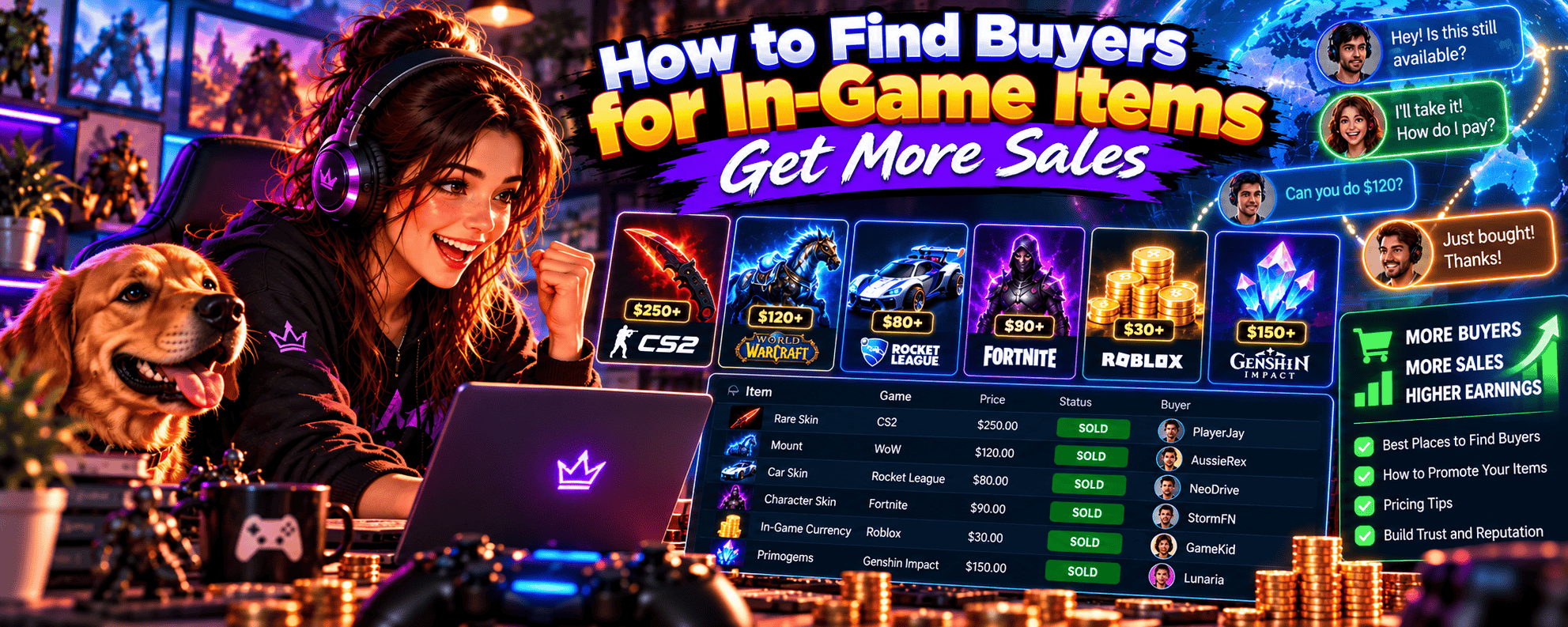
You’ve got the gaming loot. You’ve checked what it’s worth. You’ve even created a listing.
There’s just one small problem.
Where are all the buyers?
Selling in-game items isn’t simply about owning something valuable. You need to connect with gamers who actually want what you’re offering and are willing to pay a reasonable price for it.
Whether you’re selling CS2 weapon skins, rare cosmetics, virtual collectibles or other eligible gaming items, finding the right buyers can make the difference between a successful sale and a listing that sits untouched for weeks.
The good news? You don’t need thousands of followers, a massive advertising budget or a legendary inventory to get started.
The best way to find buyers for in-game items is to reach gamers who are already searching for those items, make your listings easy to discover and give potential customers confidence in the transaction.
Gaming marketplaces, Discord communities, forums and social platforms can all help you connect with interested players. But each works differently, and not every community permits buying, selling or promotional posts.
In this guide, we’ll explore how to find genuine buyers for in-game items, where to reach them and how to attract more interest without spamming gaming communities or wasting time on people who were never going to buy.
We’ll also cover how to understand buyer behaviour, improve your visibility and turn more enquiries into actual sales.
Ready to find someone who appreciates your virtual treasure as much as you do?
Let’s get started.
1. How to Find Buyers for In-Game Items Online 🔍
Finding buyers starts with understanding one simple principle.
You don’t need to reach every gamer. You need to reach the gamers who want your specific item.
Someone playing Fortnite might have absolutely no interest in your CS2 weapon skin. A collector searching for a rare cosmetic might not care about the high-level equipment you’ve accumulated in an RPG.
That’s why targeting the right audience matters.
Rather than advertising your items everywhere, focus on places where interested buyers are already searching, comparing prices and discussing virtual goods.
🎮 1. Identify What You’re Actually Selling
Before looking for buyers, make sure you understand your item.
Important details may include:
- Game and item name.
- Item category.
- Rarity and condition.
- Special attributes or variations.
- Current market value.
- Trading restrictions.
- Permitted delivery methods.
These details help you identify the type of gamer most likely to be interested.
For example, a rare cosmetic may appeal to collectors, while equipment with desirable attributes may interest players focused on character optimisation.
If you’re unsure which categories have potential demand, our Best In-Game Items to Sell Online guide explores different types of gaming items worth researching.
🎯 2. Understand Your Target Buyer
Different items attract different buyers.
Consider these examples.
| Item Type | Potential Buyer | Main Motivation |
|---|---|---|
| CS2 Weapon Skin | CS2 player or collector | Appearance, condition or rarity |
| Rare Cosmetic | Cosmetic collector | Unique design or limited availability |
| Tournament Collectible | Esports enthusiast | Collection or event association |
| Eligible Equipment | RPG or MMO player | Gameplay usefulness |
| Virtual Trading Card | Digital card collector | Completing a collection |
| Crafted Item | Player seeking specific attributes | Convenience or performance |
The better you understand your target buyer, the easier it becomes to choose where and how to promote your item.
🛒 3. Start With Gaming Marketplaces
Gaming marketplaces are often a practical starting point because visitors may already have purchasing intent.
Unlike general social media, where people are primarily looking for entertainment, marketplace visitors may be actively searching for specific products.
For example, someone searching for a particular weapon skin is potentially much closer to making a purchase than someone casually scrolling through gaming videos.
However, you still need to choose a marketplace that supports the item and transaction.
💬 4. Explore Relevant Gaming Communities
Gaming communities can help you discover where interested players spend their time.
Potential channels include:
- Discord servers.
- Game-specific forums.
- Reddit communities.
- Facebook gaming groups.
- Specialist trading communities.
Not every community permits item sales.
Some allow trading discussions but prohibit advertising, while others ban external real-money transactions entirely.
Always check the rules before posting.
🔍 5. Search for Buyers Using Specific Item Names
Broad searches can produce lots of irrelevant results.
For example:
“Gaming items for sale”
That’s unlikely to help you identify a specific buyer.
More targeted searches might include:
- “CS2 AK-47 Redline trading”
- “TF2 Unusual cosmetic collectors”
- “CS2 sticker trading community”
- “Game-specific item marketplace”
These searches can help you discover relevant marketplaces and discussions.
However, finding a community discussing an item doesn’t mean that community permits cash transactions.
📈 6. Research Where Similar Items Are Selling
One of the easiest ways to understand buyer demand is to examine existing market activity.
Look for:
- Similar items being listed.
- Recent completed transactions.
- Frequently searched item categories.
- Competitive pricing.
- Active trading discussions.
- Evidence of repeat demand.
If comparable items are selling regularly, that’s a useful indication that buyers exist.
If dozens of listings remain unsold for months, demand may be weaker than sellers expect.
💰 7. Match Your Price to Buyer Expectations
Even interested buyers have limits.
Imagine three sellers offering equivalent items.
| Seller | Asking Price |
|---|---|
| Seller A | $40 |
| Seller B | $42 |
| Seller C | $65 |
If the items are genuinely comparable, Seller C may struggle to attract interest.
Buyers can often compare prices quickly.
A realistic asking price helps you compete without necessarily being the cheapest seller.
🔐 8. Make Sure Your Item Can Be Sold
Before approaching potential buyers, confirm that the proposed transaction is permitted.
Some games support internal trading but prohibit external real-money sales.
Others restrict particular items from being transferred.
Don’t advertise items through unauthorised channels or attempt to bypass game restrictions.
🚀 9. Start Small and Measure Results
You don’t need to advertise dozens of items immediately.
Start with a small number of eligible listings.
Monitor:
- Listing views, where available.
- Buyer enquiries.
- Questions received.
- Price comparisons.
- Completed sales.
- Time taken to sell.
These observations can help you understand which items attract genuine interest.
🏆 10. Focus on Buyer Quality, Not Just Quantity
A hundred random views aren’t necessarily better than ten views from genuinely interested buyers.
Someone searching for your exact item may be much more valuable than someone who happens to see your promotional post.
The goal is to attract relevant buyers, not simply generate traffic.
🎯 The Golden Rule of Finding Buyers
Go where your target buyers already spend time and make it easy for them to recognise the value of your item.
You don’t need to shout about your legendary loot across every gaming community on the internet.
You need to find the players who are actually looking for it.
Because advertising a rare CS2 skin to a Minecraft building community probably isn’t going to produce the sales explosion you’re hoping for.
2. Use Gaming Marketplaces to Reach Active Buyers 🛒
Imagine opening a shop in the middle of nowhere.
You might have amazing products, competitive prices and the friendliest customer service imaginable.
But if nobody knows your shop exists, sales will be difficult.
Gaming marketplaces solve part of that problem by bringing sellers and potential buyers together.
A suitable gaming marketplace can help you reach players who are already searching for virtual items, comparing listings and considering purchases.
However, marketplaces differ in their supported games, trading rules, audiences and payment arrangements.
Choosing the right one matters.
🎮 1. Why Gaming Marketplaces Can Be Effective
Gaming marketplaces organise items into searchable categories.
Buyers may be able to browse by:
- Game.
- Item type.
- Item name.
- Price.
- Rarity.
- Condition.
- Other relevant attributes.
This helps connect buyers with specific products.
For example, someone searching for a CS2 weapon skin may be able to find relevant listings without browsing unrelated gaming content.
🔍 2. Marketplace Visitors May Have Stronger Buying Intent
Consider the difference between two situations.
Situation A: Someone sees a random gaming item promotion while scrolling through social media.
Situation B: Someone searches a marketplace for the exact item you’re selling.
The second person has demonstrated more specific interest.
That doesn’t guarantee a sale, but it can make marketplace traffic more relevant.
🛒 3. Choose a Marketplace That Supports Your Item
Before creating an account, check whether the marketplace supports your particular game and item category.
Important questions include:
- Is the game supported?
- Can you list the specific item?
- Are external cash transactions permitted?
- What seller requirements apply?
- What fees are charged?
- How are payments handled?
- What delivery methods are supported?
- What happens if a transaction is disputed?
Avoid assuming that every gaming marketplace supports every virtual item.
💰 4. Understand Marketplace Fees
Fees affect how much money you keep.
For example, imagine selling an eligible item for $50.
| Component | Amount |
|---|---|
| Selling Price | $50 |
| Example Marketplace Fee | -$5 |
| Example Other Charges | -$2 |
| Net Proceeds | $43 |
These are hypothetical figures.
Actual fees depend on the marketplace and payment arrangements.
Compare total costs rather than looking at commission percentages alone.
📈 5. Research Marketplace Activity
A marketplace with thousands of listings isn’t necessarily a marketplace with thousands of active buyers.
Look for evidence of:
- Relevant item categories.
- Recent completed sales, where visible.
- Active listings.
- Competitive prices.
- Buyer enquiries.
- Current marketplace activity.
Some platforms provide more market information than others.
Where transaction data isn’t available, avoid making assumptions about sales volume.
🎯 6. Choose the Correct Game and Category
Accurate categorisation makes your listing easier to discover.
For example, a weapon skin should appear in the relevant game and item category rather than an unrelated section.
Incorrect categorisation may reduce visibility and frustrate potential buyers.
✍️ 7. Use Specific, Searchable Listing Titles
Buyers often search for exact item names.
Compare these examples.
Weak Title:
“Super Rare Gaming Skin – Cheap!”
Better Title:
“CS2 AK-47 | Redline – Field-Tested”
The second title communicates the game, item name and condition.
It helps interested buyers identify what you’re offering.
📸 8. Include Genuine Item Screenshots
Buyers want to see what they’re purchasing.
Where relevant, provide screenshots showing:
- The actual item.
- Its appearance.
- Important attributes.
- Condition.
- Special variations.
Avoid misleading images or screenshots of a different item.
🔐 9. Explain Delivery Clearly
Virtual item delivery can involve specific procedures.
Depending on the game and marketplace, buyers may need to understand:
- Trading eligibility.
- Applicable restrictions.
- Supported transfer methods.
- Delivery requirements.
- Expected processing arrangements.
Only describe delivery methods that are actually supported and permitted.
Clear information can reduce uncertainty.
⭐ 10. Build a Reliable Seller Reputation
Buyer confidence matters.
A seller who provides accurate descriptions, communicates professionally and completes permitted transactions reliably may be more appealing than one with vague listings.
Where marketplaces provide seller ratings or transaction histories, these may help buyers evaluate sellers.
Don’t invent reviews or make unsupported claims about your experience.
🎮 11. Consider StackedGame
StackedGame is a gaming-focused marketplace where sellers can explore opportunities involving eligible gaming items and services.
For sellers, the advantage of a specialist gaming platform is the ability to present products in a context designed around gaming rather than a general classified advertising website.
However, sellers should still verify supported categories, current platform requirements and the rules of the relevant game before listing.
📊 12. Compare Marketplace Options
When evaluating platforms, consider these factors.
| Factor | Why It Matters |
|---|---|
| Supported Games | Determines whether your item can be listed |
| Buyer Audience | Influences potential exposure |
| Search Features | Helps buyers discover items |
| Fees | Affects net proceeds |
| Payment Arrangements | Determines how transactions are processed |
| Seller Requirements | Affects eligibility |
| Delivery Procedures | Helps transactions run smoothly |
| Dispute Processes | Clarifies how problems are handled |
Don’t select a marketplace solely because it has the lowest advertised fees.
A marketplace with relevant buyers and suitable transaction procedures may offer a better overall selling experience.
🏆 13. Avoid Listing Everywhere Without a Plan
Listing the same item across multiple marketplaces can create complications.
For example, you might sell an item on one platform while another listing remains active.
That could lead to an order you can no longer fulfil.
If you use multiple platforms, keep your inventory and listings accurate.
🎯 The Golden Rule of Choosing a Marketplace
Choose a marketplace that supports your item, attracts relevant buyers and provides a suitable process for completing the transaction.
For a deeper comparison of selling channels, see our Where to Sell In-Game Items Online guide.
The biggest marketplace isn’t automatically the best.
Sometimes a smaller platform with the right audience can be more useful than a giant website where your listing disappears beneath thousands of unrelated products.
3. Find Buyers in Gaming Communities and Discord Servers 💬
Gaming communities aren’t just places to discuss updates, share memes and argue about which weapon needs a nerf.
They’re also places where players talk about cosmetics, equipment, collectibles and item values.
For sellers, these discussions can reveal what gamers want and where potential buyers spend their time.
However, there’s an important distinction between participating in a community and using it as an advertising channel.
Gaming communities can help you connect with interested players, but successful outreach starts with respecting community rules and contributing something useful.
Let’s explore how to find relevant communities without becoming the person everyone immediately mutes.
🎮 1. Find Communities Related to Your Game
Start with the game your item belongs to.
For example, if you’re researching CS2 skins, look for communities focused on:
- Counter-Strike 2.
- Weapon skins.
- Cosmetic collecting.
- Item valuation.
- Permitted trading discussions.
A general gaming community might have thousands of members but very little interest in your specific item.
A smaller specialist community may be more relevant.
💬 2. Explore Discord Servers
Discord is widely used by gaming communities.
Some servers focus on gameplay, while others discuss cosmetics, collections or trading.
Look for channels dedicated to relevant topics.
These might include:
- Item discussions.
- Collection showcases.
- Market analysis.
- Price checks.
- Trading information.
However, the existence of a trading channel doesn’t automatically mean cash sales or promotional links are allowed.
Read the server rules first.
📜 3. Check Community Rules Before Posting
Every community has its own expectations.
Some prohibit all advertising.
Others allow promotional posts in designated channels.
Some permit in-game trading discussions but prohibit external real-money transactions.
Before posting, check:
- Whether selling is allowed.
- Which items can be discussed.
- Whether external marketplace links are permitted.
- Which channels accept promotional content.
- Whether posting frequency is restricted.
- Whether moderators require approval.
If the rules prohibit your proposed activity, find another suitable channel.
🔍 4. Use Reddit to Understand Buyer Interest
Reddit communities can provide useful insights into gaming item markets.
Players may discuss:
- Popular cosmetics.
- Recent price movements.
- Collector preferences.
- Item rarity.
- Trading restrictions.
- Marketplace experiences.
However, many subreddits have strict rules against buying, selling or self-promotion.
Use these communities primarily to understand demand unless promotional activity is explicitly permitted.
🎯 5. Look for Specific Buyer Discussions
Rather than posting generic advertisements, pay attention to what players are discussing.
For example, you might notice repeated questions about:
- A particular weapon skin.
- A discontinued cosmetic.
- A rare pattern.
- A collectible series.
- An item with desirable attributes.
These discussions can help you understand buyer interests.
However, avoid unsolicited direct messages or treating every question as an invitation to sell.
🏆 6. Participate Before Promoting
Communities tend to respond better to useful participation than repetitive advertising.
You could contribute by:
- Answering item-related questions.
- Sharing general market knowledge.
- Explaining item attributes.
- Discussing game updates.
- Helping players understand rarity.
- Providing useful information about supported trading systems.
This helps establish credibility.
It also gives you a better understanding of the community.
💎 7. Share Useful Information, Not Just Sales Pitches
Consider these two approaches.
Spammy Approach:
“BUY MY RARE SKIN NOW! BEST PRICE! DM ME!”
Community-Friendly Approach:
“Interesting to see how different wear conditions affect the price of this skin. I’ve been comparing recent sales and the variation is bigger than I expected.”
The second message contributes to a discussion.
If the community permits relevant listings, you can share your item through its approved promotional channel.
Don’t disguise advertisements as independent recommendations.
📣 8. Use Dedicated Trading Channels Where Permitted
Some communities provide designated spaces for trading activity.
If your item and transaction are allowed, these channels may help you reach relevant buyers.
A useful post might include:
- Exact item name.
- Relevant characteristics.
- Asking price.
- Genuine screenshot.
- Approved listing link.
- Applicable transfer requirements.
Keep it concise and follow the channel’s formatting rules.
🔐 9. Be Careful With Unsolicited Offers
Not every person contacting you is a genuine buyer.
Be cautious about people who:
- Ask you to move immediately to an unfamiliar website.
- Request account credentials.
- Send suspicious login links.
- Ask for authentication codes.
- Pressure you to transfer an item before approved payment confirmation.
- Offer unrealistic prices.
Use supported marketplace communication and transaction procedures wherever possible.
🤝 10. Build Relationships With Other Gamers
You don’t need to treat every interaction as a sales opportunity.
Participating in relevant communities can help you:
- Understand item demand.
- Learn about market changes.
- Discover trading restrictions.
- Recognise common scams.
- Improve your item knowledge.
- Identify suitable marketplaces.
These benefits can be valuable even when you don’t make an immediate sale.
📈 11. Learn From Community Feedback
Players may comment on an item’s condition, attributes or asking price.
Not every opinion will be accurate.
However, recurring feedback can help you identify issues worth investigating.
For example, if several knowledgeable players point out that your price is significantly above comparable sales, that may be worth checking.
🚀 12. Avoid Posting the Same Advertisement Everywhere
Copying identical promotional messages into dozens of Discord servers and Reddit communities is rarely a good strategy.
It may lead to:
- Deleted posts.
- Muted accounts.
- Community bans.
- Negative seller perceptions.
- Very little relevant buyer interest.
Instead, focus on a small number of suitable communities where promotional activity is permitted.
🎯 The Golden Rule of Community-Based Selling
Be a useful member of the gaming community first and promote your items only where the rules allow it.
You don’t need to become the loudest seller in every Discord server.
You need to become someone whose listings are relevant, accurate and welcome.
Because nothing says “trustworthy seller” quite like getting banned from six servers before breakfast.
Actually, that’s probably the opposite.
4. Understand What In-Game Item Buyers Are Looking For 🎯
Finding buyers becomes much easier when you understand why someone wants your item.
Not every gamer is shopping for the same reason.
Some want a better-looking weapon. Others are searching for a specific collectible, completing a cosmetic set or looking for equipment that supports their favourite character build.
Understanding buyer motivations helps you create more relevant listings, choose better selling channels and communicate the value of your items more effectively.
Let’s explore what influences gaming item purchases.
🎮 1. Appearance and Personalisation
Many players purchase cosmetic items because they enjoy customising their gaming experience.
For example, a CS2 player might want a particular weapon skin because it matches their preferred colour scheme.
Another player might collect character cosmetics that create a distinctive appearance.
For these buyers, visual presentation matters.
Clear screenshots can help them evaluate the item.
💎 2. Rarity and Exclusivity
Some buyers enjoy owning items that aren’t widely available.
They may be interested in:
- Rare cosmetic variations.
- Limited-release items.
- Special patterns.
- Event collectibles.
- Discontinued designs.
However, rarity alone doesn’t guarantee interest.
Collectors usually care about specific items, characteristics or collections.
🏆 3. Collector Appeal
Collectors may purchase items because they want to complete a set or own something associated with a particular game or event.
For example, someone collecting CS2 tournament stickers might seek a specific missing sticker.
That buyer may care more about authenticity and exact item identity than general cosmetic appeal.
⚔️ 4. Gameplay Usefulness
In games with tradable equipment, players may seek items that improve their characters.
Important characteristics can include:
- Damage modifiers.
- Defensive attributes.
- Special effects.
- Build compatibility.
- Crafting potential.
- Equipment level.
However, many games prohibit external cash sales of gameplay equipment.
Only consider real-money transactions where they’re permitted.
⏳ 5. Convenience and Time Savings
Some buyers value convenience.
They may prefer obtaining an eligible item through a supported marketplace rather than spending time searching for it through gameplay or trading.
However, convenience doesn’t override game rules.
An item must still be transferable through a permitted process.
💰 6. Competitive Pricing
Price is an important factor for many buyers.
Even someone who really wants your item may compare several listings before purchasing.
For example:
| Listing | Price | Item Information |
|---|---|---|
| Seller A | $45 | Clear description and screenshots |
| Seller B | $42 | Limited information |
| Seller C | $44 | Detailed attributes and delivery information |
Some buyers may choose Seller B because it’s cheaper.
Others may prefer Seller C because the listing provides clearer information.
Price matters, but it’s not the only factor.
🔐 7. Trust and Confidence
Buyers want confidence that they’ll receive the item described.
They may evaluate:
- Seller reputation.
- Listing accuracy.
- Genuine screenshots.
- Clear item attributes.
- Supported payment arrangements.
- Delivery procedures.
- Communication quality.
A buyer who feels uncertain may decide not to proceed, even when the price looks attractive.
📸 8. Accurate Item Presentation
Buyers need to understand exactly what they’re purchasing.
For example, a CS2 collector may care about the item’s precise condition and pattern.
A vague listing with a generic screenshot may not provide enough information.
Accurate details reduce uncertainty and help attract the right buyers.
🔍 9. Searchable Item Names
Some buyers know exactly what they want.
They may search using:
- Game title.
- Item name.
- Condition.
- Rarity.
- Specific variation.
- Relevant attributes.
If your listing doesn’t include the correct terminology, interested buyers may struggle to find it.
📈 10. Current Popularity
Buyer preferences can change.
For example, demand may shift after:
- A major game update.
- A tournament.
- A new cosmetic release.
- A change in gameplay balance.
- A seasonal event.
- A popular content creator showcasing an item.
However, trends don’t always last.
Avoid assuming that temporary popularity guarantees future sales.
🎯 11. Match Your Listing to Buyer Intent
Different buyers need different information.
Consider these examples.
| Buyer Type | What They Care About | What Your Listing Should Highlight |
|---|---|---|
| Cosmetic Enthusiast | Appearance | Genuine screenshots and visual details |
| Collector | Rarity and variation | Exact item characteristics |
| Competitive Player | Gameplay usefulness | Relevant equipment attributes |
| Budget Buyer | Price | Competitive asking price |
| Experienced Trader | Market value | Accurate specifications and pricing |
| Cautious Buyer | Transaction confidence | Clear delivery information and seller details |
A strong listing addresses the needs of its likely audience.
💬 12. Answer the Questions Buyers Are Likely to Ask
Before publishing, consider what someone might want to know.
For example:
- Is this the exact item shown?
- What condition is it in?
- Does it have special attributes?
- Why is the price different from other listings?
- Can it be transferred?
- How does delivery work?
- Are there trading restrictions?
Answering these questions in your listing may reduce unnecessary enquiries.
💎 13. Understand Perceived Value
Two buyers may value the same item differently.
One might appreciate its appearance.
Another might want it because of its rarity.
A third might only be interested if the price is particularly competitive.
This is why understanding your target audience matters.
An item isn’t valuable simply because the seller believes it should be.
Its market value depends on what buyers are willing to pay.
For a deeper explanation, see our What Makes an In-Game Item Valuable? guide.
🏆 14. Don’t Try to Appeal to Everyone
A listing aimed at every possible buyer can end up appealing to nobody.
Instead, focus on the characteristics that matter most to your likely customer.
For example:
For a Cosmetic Collector:
Highlight the exact item, appearance, condition and special variations.
For a Buyer Seeking Equipment:
Highlight the relevant attributes and gameplay usefulness, where trading is permitted.
For a Price-Conscious Buyer:
Provide a competitive price and clear information about what’s included.
🎯 The Golden Rule of Understanding Buyers
Sell the characteristics your target buyers actually care about, not just the features you personally find impressive.
You might think your virtual helmet looks incredible.
But the buyer might only care that it’s the final missing piece in their collection.
And that’s perfectly fine.
You don’t need them to share your emotional attachment to the helmet.
You just need them to want it enough to buy it.
5. Make Your In-Game Item Listings Easier to Find 🚀
You’ve found a marketplace with potential buyers. You’ve researched your item and you understand what makes it desirable.
Now comes the next challenge.
Getting your listing in front of the right gamers.
Even a valuable item can struggle to sell if buyers can’t find it. A poorly written title, incorrect category or missing item details can make your listing difficult to discover.
The good news is that improving visibility doesn’t necessarily require spending money on advertising.
The best way to make your in-game item listings easier to find is to use accurate, searchable titles, relevant categories, complete item information and genuine screenshots.
Let’s explore how to help potential buyers discover your gaming loot.
🎮 1. Use the Exact Item Name in Your Title
Many buyers search for specific items rather than browsing randomly.
For example, someone looking for a particular CS2 skin might search for its exact weapon and finish.
Compare these titles.
Weak Title:
“Awesome Rare Gaming Skin – Great Price!”
Better Title:
“CS2 AK-47 | Redline – Field-Tested”
The second title tells buyers exactly what they’re looking at.
It includes the game, weapon, skin and condition.
This makes it more useful for both buyers and marketplace search systems.
🔍 2. Include Relevant Search Keywords
Think about the words buyers might use when searching for your item.
Depending on the game, these could include:
- Game name.
- Item name.
- Item type.
- Rarity.
- Condition.
- Special variation.
- Relevant attributes.
Use these terms naturally.
Avoid repeating the same keywords unnecessarily.
For example, a title like “Rare CS2 Skin CS2 Weapon Skin Best CS2 Skin Cheap CS2 Skin” looks spammy and provides little useful information.
🛒 3. Choose the Correct Marketplace Category
Categories help buyers narrow their searches.
An item placed in the wrong category may never appear in the searches most relevant to it.
For example, a weapon skin should be listed under the appropriate game and item category rather than an unrelated gaming service.
Before publishing, check:
- Game selection.
- Item category.
- Relevant subcategory.
- Available item attributes.
- Any marketplace-specific requirements.
Correct categorisation can improve discoverability.
💎 4. Complete Important Item Attributes
Many gaming items have characteristics that influence buyer decisions.
For example, a cosmetic listing might need:
- Condition.
- Pattern.
- Rarity.
- Edition.
- Special effects.
- Other relevant variations.
Equipment listings may require different information.
Completing these details helps buyers determine whether your item matches their requirements.
It may also help your listing appear in filtered searches where supported.
📸 5. Use Clear, Genuine Screenshots
Screenshots can make a significant difference when selling cosmetic items.
Buyers want to see what they’re purchasing.
Use images that show:
- The actual item.
- Its appearance.
- Important characteristics.
- Relevant condition details.
- Special visual features.
Avoid misleading edits or screenshots of a different item.
A buyer searching for a particular pattern or condition needs accurate information.
✍️ 6. Write a Useful Description
A good description answers the buyer’s most important questions.
Include:
- What the item is.
- Its exact characteristics.
- What’s included.
- Relevant restrictions.
- Supported delivery arrangements.
- Other information necessary to evaluate the item.
Keep paragraphs short and easy to read.
You don’t need to write an epic fantasy novel about how you obtained the item.
Unless the item comes with an actual dragon.
Even then, buyers probably want the specifications first.
🎯 7. Highlight What Makes Your Item Different
Some items have characteristics that distinguish them from similar listings.
For example:
- A particular cosmetic pattern.
- A desirable condition.
- A special visual effect.
- A limited-release variation.
- An unusual combination of attributes.
If those characteristics genuinely apply, explain them clearly.
Avoid unsupported claims such as “rarest item ever” or “guaranteed investment”.
📊 8. Understand Marketplace Search and Sorting
Different marketplaces organise listings differently.
Some may allow buyers to sort by price or filter by item attributes.
Others may consider listing relevance or additional factors.
You shouldn’t assume every marketplace uses the same ranking system.
Instead, focus on information that helps buyers identify and compare your item.
💰 9. Make Your Price Easy to Understand
Buyers often compare several listings.
Display your price accurately and use the marketplace’s supported currency and pricing format.
If additional charges apply, disclose them as required.
Unexpected costs can discourage buyers from completing a purchase.
🔄 10. Keep Your Listings Accurate
Item availability can change.
If an item sells elsewhere or becomes unavailable, update or remove the listing promptly.
Check that:
- The item is still available.
- The asking price remains appropriate.
- Screenshots are accurate.
- Item details haven’t changed.
- Delivery information remains valid.
An accurate listing creates a better buying experience.
📈 11. Review Listing Performance
Where your marketplace provides analytics, monitor:
- Listing views.
- Buyer enquiries.
- Saved or favourited listings.
- Completed sales.
- Time on the market.
These indicators may help identify opportunities for improvement.
For example, a listing receiving views but no enquiries might have pricing or presentation issues.
A listing receiving almost no views may need better categorisation or more relevant search terms.
🏆 12. Improve One Thing at a Time
If a listing isn’t performing, avoid changing everything simultaneously.
You might start by improving the title.
Then review the screenshots.
Next, compare the price with current market activity.
Making targeted changes helps you understand what may be affecting buyer interest.
🎯 The Golden Rule of Listing Visibility
Make it easy for buyers to find your item, understand exactly what you’re selling and compare it with similar listings.
For a complete walkthrough of creating effective listings, see our How to Create an In-Game Item Listing That Sells guide.
A valuable item hidden behind a vague title is like a legendary sword buried in a random chest.
It might be amazing.
But nobody’s going to buy it if they can’t find it.
6. Use Competitive Pricing to Attract Interested Buyers 💰
You’ve created a great listing.
The title is accurate, the screenshots look good and you’ve included all the important details.
But buyers still aren’t interested.
One possible reason?
Your asking price doesn’t match what buyers expect to pay.
Price is one of the most important factors influencing purchasing decisions, particularly when several sellers offer similar items.
However, competitive pricing doesn’t mean you always need to be the cheapest.
The goal is to set a price that attracts genuine buyers while delivering an acceptable return after fees and other costs.
Let’s explore how to find that balance.
🎮 1. Research Comparable Listings
Start by finding items similar to yours.
Compare:
- Exact item name.
- Condition.
- Rarity.
- Special attributes.
- Pattern or variation.
- Current asking prices.
- Recent completed sales.
Be careful when comparing items with different characteristics.
For example, two CS2 skins with the same name may have different values because of their wear or pattern.
📊 2. Use Completed Sales Where Available
Asking prices show what sellers hope to receive.
Completed sales show what buyers have actually paid.
Imagine comparable eligible items recently sold for:
| Recent Sale | Price |
|---|---|
| Sale 1 | $38 |
| Sale 2 | $40 |
| Sale 3 | $39 |
| Sale 4 | $41 |
| Sale 5 | $42 |
The average selling price is $40.
This provides a useful starting point.
However, you should still consider the item’s specific attributes and current market conditions.
💎 3. Understand Why Similar Items Have Different Prices
Two listings may look similar but have different values.
Possible reasons include:
- Item condition.
- Special patterns.
- Limited availability.
- Desirable modifiers.
- Collector interest.
- Additional included items.
- Different marketplace fees.
Don’t automatically match the lowest advertised price.
Make sure you’re comparing genuinely equivalent items.
💰 4. Calculate Your Minimum Acceptable Price
Before publishing, calculate your costs.
For example:
| Component | Amount |
|---|---|
| Original Item Cost | $25 |
| Expected Marketplace Fees | $4 |
| Other Costs | $1 |
| Total Costs | $30 |
| Desired Profit | $10 |
| Target Selling Price | $40 |
These figures are hypothetical.
Your actual costs will depend on the item and marketplace.
Knowing your target price helps you avoid accepting an unprofitable sale simply because a buyer makes an offer.
🔥 5. Consider Competitive Pricing Strategies
Different approaches may suit different items.
Market-Based Pricing
Set your asking price close to recent comparable sales.
Premium Pricing
Consider a higher price when your item has genuinely desirable characteristics that justify it.
Competitive Pricing
Price slightly below comparable listings when you want to attract attention, provided the sale still meets your financial goals.
Patient Pricing
Maintain a reasonable asking price when you’re comfortable waiting for the right buyer.
No strategy guarantees a sale.
🛒 6. Avoid Racing to the Bottom
Imagine five sellers offering equivalent items.
One reduces their price.
Another responds by going lower.
Soon, everyone is competing primarily on price.
This can reduce profits without necessarily increasing overall demand.
Instead of immediately undercutting competitors, consider whether your listing provides enough information and confidence to justify its price.
📈 7. Understand Buyer Price Expectations
Buyers may have a rough idea of an item’s market value.
For example, if similar cosmetics regularly sell for $30–$35, a listing priced at $60 may struggle to attract interest.
However, an unusually valuable variation could justify a premium.
The important thing is to provide accurate information supporting the price.
⏳ 8. Consider How Quickly You Want to Sell
Your preferred selling timeframe can influence pricing.
For example:
Seller A: Wants to sell quickly and accepts a competitive price.
Seller B: Is willing to wait for a buyer who values a particular collectible.
Neither approach is automatically better.
Choose based on your goals and the market.
🔄 9. Review Prices When Market Conditions Change
Gaming item values can change because of:
- New item releases.
- Game updates.
- Changes in player demand.
- Trading restrictions.
- Supply changes.
- Seasonal events.
Review your asking price periodically.
Don’t assume an item is worth the same amount it was several months ago.
🎯 10. Don’t Overreact to One Competitor
One unusually cheap listing doesn’t necessarily establish the market value.
The seller may be seeking a quick sale.
The item may have different characteristics.
Or the listing may contain inaccurate information.
Look at multiple comparable transactions before changing your price.
🔐 11. Be Careful With Suspicious Offers
An unexpected offer significantly above market value can be a warning sign.
Be cautious if a buyer:
- Insists on using an unfamiliar website.
- Sends a suspicious payment link.
- Requests account credentials.
- Pressures you to transfer an item before approved payment confirmation.
- Wants to bypass marketplace procedures.
A high offer isn’t valuable if the transaction is fraudulent.
🏆 12. Test and Adjust Your Price
If your listing receives views but no serious enquiries, pricing may be one factor worth reviewing.
Compare recent sales and competing listings.
Consider whether your price is justified by the item’s attributes.
If necessary, make a measured adjustment.
Avoid repeatedly reducing your price without understanding the market.
🎯 The Golden Rule of Competitive Pricing
Price your item according to genuine market evidence, not wishful thinking or the highest listing you can find.
For a more detailed pricing framework, see our How to Price In-Game Items guide.
You might believe your legendary cosmetic is worth $500.
But if comparable items are selling for $30, buyers probably aren’t going to fund your early retirement.
At least not with that particular cosmetic.
7. Build Trust With Potential In-Game Item Buyers 🔐
Imagine finding two listings for the exact same gaming item.
Both have similar prices.
One includes clear screenshots, detailed item information and straightforward delivery instructions.
The other says:
“Rare item. Trust me. Send payment.”
Which seller would you feel more comfortable buying from?
For most buyers, the answer is obvious.
Trust is a major factor in virtual item purchases because buyers need confidence that the item is genuine, the listing is accurate and the transaction will be completed properly.
You don’t need hundreds of sales to start building that confidence.
You can begin with the way you present your items and communicate with potential customers.
🎮 1. Provide Accurate Item Information
Start by describing the item correctly.
Include relevant details such as:
- Game.
- Exact item name.
- Condition.
- Rarity.
- Special attributes.
- Quantity.
- Trading restrictions.
Avoid exaggerating an item’s value or characteristics.
If you’re unsure about a particular attribute, verify it before publishing.
📸 2. Use Screenshots of the Actual Item
Buyers should be able to see what they’re purchasing.
For cosmetic items, genuine screenshots are particularly important.
Where relevant, show:
- Overall appearance.
- Condition.
- Special variations.
- Item information.
- Distinctive features.
Don’t use screenshots of a more valuable variation to advertise a different item.
💬 3. Communicate Clearly
Professional communication can help buyers feel more confident.
Respond to questions with accurate information.
For example:
Buyer: “Is this the exact skin shown in the screenshot?”
Seller: “Yes, the screenshots show the specific item included in this listing.”
Only make statements you can verify.
⏳ 4. Set Realistic Delivery Expectations
Buyers want to know what happens after purchasing.
Explain the supported delivery process and any applicable restrictions.
For example, some items may have temporary trading holds.
If a delay applies, disclose it rather than promising immediate delivery.
🛒 5. Follow Marketplace Procedures
Use the marketplace’s supported payment, communication and delivery processes.
Avoid asking buyers to bypass platform requirements.
Off-platform arrangements can introduce additional risks and may violate marketplace rules.
⭐ 6. Build a Positive Seller Reputation
Where marketplaces support ratings or reviews, a reliable transaction history may help future buyers evaluate your listings.
Good seller practices include:
- Accurate descriptions.
- Clear communication.
- Honest pricing.
- Reliable fulfilment.
- Prompt responses.
- Respectful dispute handling.
Reputation develops through consistent behaviour.
🔍 7. Make Your Listings Easy to Verify
Buyers may want to compare your item with similar listings.
Provide enough information for them to evaluate its characteristics.
For example, a CS2 collector might want to know the exact condition and relevant pattern information.
A vague listing can create uncertainty.
💰 8. Be Transparent About Costs
Unexpected fees can discourage buyers.
Clearly disclose relevant charges and payment requirements as required by the marketplace.
Avoid advertising one price and introducing unexplained additional costs later.
🔐 9. Protect Your Account and Your Buyers
Never ask buyers to share:
- Account passwords.
- Authentication codes.
- Recovery codes.
- Private security credentials.
Likewise, don’t share your own credentials with buyers.
Use supported transfer methods.
⚠️ 10. Recognise Common Trust Warning Signs
Buyers may become cautious when a seller:
- Uses inconsistent item information.
- Provides misleading screenshots.
- Refuses reasonable questions.
- Pressures them to act immediately.
- Requests unusual payment arrangements.
- Makes unrealistic promises.
- Attempts to bypass marketplace procedures.
Avoid these behaviours.
🤝 11. Handle Questions and Concerns Professionally
Not every buyer will purchase immediately.
Some may want additional information.
Others may compare multiple listings.
Responding professionally helps create a better experience, even when a sale doesn’t happen.
Don’t pressure buyers or make claims you cannot support.
📈 12. Trust Can Influence Conversion
Imagine two equivalent items.
| Listing | Price | Buyer Experience |
|---|---|---|
| Seller A | $40 | Vague description, unclear screenshots |
| Seller B | $42 | Detailed listing, genuine images, clear delivery |
Some buyers may choose Seller B despite the slightly higher price.
Why?
Because better information can reduce uncertainty.
However, trust doesn’t guarantee a sale or justify any asking price.
🏆 13. Think Beyond the First Transaction
A positive experience may encourage buyers to consider your future listings.
A negative experience can discourage them from returning.
Treat each transaction as an opportunity to demonstrate reliability.
🎯 The Golden Rule of Building Buyer Trust
Be accurate, transparent and reliable throughout the entire selling process.
For another perspective on what buyers evaluate before purchasing, see our How to Choose a Trusted In-Game Item Seller guide.
You don’t need to promise that you’re the greatest gaming item seller in the history of the internet.
You just need to show buyers that you’re offering exactly what you say you are.
And preferably without asking them to send payment to a mysterious account named “TotallyLegitSkinKing99”.
8. Promote Your In-Game Items Without Spamming 📣
You’ve created a listing, researched the price and made sure everything is accurate.
Now you want more people to see it.
That’s where promotion comes in.
But there’s a fine line between sharing something useful and becoming the person who posts the same advertisement in every gaming channel.
Effective promotion means reaching relevant gamers through channels that permit advertising, using clear information and giving interested buyers a reason to view your listing.
You don’t need to flood social media with promotional messages.
A targeted approach is usually more useful.
🎮 1. Start With the Right Audience
Before promoting an item, think about who might want it.
For example:
- CS2 weapon skins may interest CS2 players and collectors.
- TF2 cosmetics may interest TF2 cosmetic enthusiasts.
- Tournament collectibles may interest esports collectors.
- Eligible equipment may appeal to players using particular character builds.
Promoting to the right audience is more useful than posting to unrelated gaming communities.
💬 2. Use Discord Communities Where Promotion Is Allowed
Some Discord servers provide designated channels for item listings or marketplace promotions.
If your item and transaction are permitted, these channels may be useful.
Before posting:
- Read the server rules.
- Check whether marketplace links are allowed.
- Use the correct channel.
- Follow any required format.
- Respect posting frequency limits.
Don’t send unsolicited promotional direct messages.
📱 3. Share Listings Through Relevant Social Channels
Depending on your audience and platform rules, social channels may help you reach interested gamers.
Potential options include:
- X.
- Facebook gaming groups.
- Relevant gaming communities.
- Your own gaming social profiles.
However, avoid assuming every platform or group permits real-money item sales.
Check the rules before posting.
🔍 4. Use Specific Item Names in Promotional Posts
Generic messages rarely communicate much value.
Compare these examples.
Weak Promotion:
“Rare Gaming Item for Sale! Check It Out!”
Better Promotion:
“CS2 AK-47 | Redline – Field-Tested. Genuine screenshots and item details available in the listing.”
The second example tells interested buyers exactly what’s being offered.
📸 5. Include a Clear Image
Cosmetic items are visual products.
A genuine screenshot can help gamers recognise the item quickly.
Choose an image that clearly shows the item and its relevant characteristics.
Avoid exaggerated effects that misrepresent its actual appearance.
💰 6. Include the Price When Appropriate
If the promotional channel allows it, including your asking price can help buyers decide whether they’re interested.
For example:
Item: CS2 AK-47 | Redline – Field-Tested Price: $45 USD Details: Genuine screenshots and relevant item information available in the listing.
Illustrative promotional example, not a verified market price or authorisation for a particular sale.
This is more useful than a message that simply says “DM for price”.
🛒 7. Link to Your Actual Marketplace Listing
Where external links are permitted, direct interested buyers to the relevant listing.
Avoid linking to unrelated pages or making people search through dozens of items.
Make sure the listing is active and accurate before promoting it.
✍️ 8. Write Promotional Messages That Sound Human
You don’t need excessive hype.
A straightforward promotional message can be more useful.
For example:
Example Discord Post
“Selling an eligible CS2 AK-47 | Redline in Field-Tested condition. I’ve included genuine screenshots and the item details in the listing. Asking $45 USD. Listing link: [insert verified listing URL].”
Only use this type of post where the game, marketplace and community permit the transaction.
🎯 9. Highlight What Makes the Item Relevant
Different items have different selling points.
For example:
Cosmetic Item: Highlight appearance and condition.
Collectible: Highlight the exact variation and relevant collector characteristics.
Eligible Equipment: Highlight gameplay attributes.
Limited-Edition Item: Explain its release history accurately.
Focus on factual details rather than exaggerated promises.
📈 10. Share Useful Gaming Content
Promotion doesn’t always need to be a direct advertisement.
You could create useful content about:
- How item rarity works.
- How to compare skin conditions.
- What affects cosmetic prices.
- How to identify valuable collectibles.
- How to avoid item trading scams.
Useful content may attract gamers interested in the same item categories you sell.
However, avoid disguising advertising as independent advice.
🔄 11. Don’t Repeat the Same Post Constantly
Posting too frequently can frustrate community members.
It may also result in deleted messages or account restrictions.
Instead:
- Follow community posting limits.
- Share updates only when relevant.
- Avoid duplicate messages.
- Remove outdated promotions.
- Respect moderator decisions.
📊 12. Measure Which Channels Attract Buyers
Where possible, track the results of your promotional efforts.
For example:
| Channel | Views or Enquiries | Sales | Observation |
|---|---|---|---|
| Gaming Marketplace | 25 Enquiries | 3 | Relevant buyer interest |
| Discord Community | 8 Enquiries | 1 | Specialist audience |
| Social Media | 5 Enquiries | 0 | Lower purchase intent |
Hypothetical figures illustrating how to compare channels.
Don’t assume the channel generating the most views is necessarily the most effective.
Look at genuine buyer enquiries and completed sales.
🏆 13. Focus on Sustainable Promotion
A sustainable approach might involve:
- Maintaining accurate marketplace listings.
- Participating in relevant communities.
- Sharing useful information.
- Promoting only where permitted.
- Responding to genuine enquiries.
- Reviewing results periodically.
You don’t need to be active everywhere.
A few relevant channels can be more manageable than dozens of unrelated ones.
⚠️ 14. Avoid Common Promotional Mistakes
Some mistakes to avoid include:
- Posting in communities that prohibit selling.
- Sending unsolicited direct messages.
- Using misleading item images.
- Making unsupported rarity claims.
- Promoting unavailable items.
- Sharing suspicious links.
- Repeatedly posting identical advertisements.
- Pressuring buyers to complete transactions.
These behaviours can damage your reputation and reduce buyer confidence.
🎯 The Golden Rule of Promoting Gaming Items
Promote the right item to the right audience, through the right channel and with information buyers can trust.
You don’t need to turn every Discord conversation into a sales pitch.
Sometimes the most effective promotion is simply having a good listing and sharing it with people who are already interested.
Because posting “BUY MY SKIN” fifty times in a server doesn’t make you a marketing genius.
It just makes you the reason the moderators added a slow-mode timer.
9. How to Turn Interested Gamers Into Paying Buyers 🤝
Getting someone to view your listing is a good start.
Getting them to ask a question is even better.
But neither guarantees a sale.
A potential buyer might love your item, agree that it’s reasonably priced and still decide not to purchase.
Why?
Maybe they’re comparing other listings. Perhaps they’re unsure about the delivery process. Or they might simply need more information before making a decision.
The key to turning interested gamers into paying buyers is to remove uncertainty, communicate clearly and make the purchasing process as straightforward as possible.
You don’t need aggressive sales tactics or elaborate marketing tricks.
You need to help buyers make confident, informed decisions.
🎮 1. Understand the Difference Between Interest and Purchase Intent
Not everyone viewing your listing is ready to buy.
Some gamers are:
- Researching prices.
- Comparing cosmetic variations.
- Exploring available items.
- Checking rarity or condition.
- Looking for a particular item.
- Ready to make a purchase.
These buyers have different levels of interest.
Someone casually browsing a marketplace may not be ready to spend money.
Someone asking about the delivery process for an exact item may be closer to purchasing.
🔍 2. Recognise Signs of Genuine Buyer Interest
Potential buyers may demonstrate stronger purchase intent by asking specific questions.
For example:
- “Is this exact item still available?”
- “Does it have the pattern shown?”
- “What condition is it in?”
- “How does delivery work?”
- “Are there any trading restrictions?”
- “Is the price negotiable?”
These questions suggest the buyer is evaluating a possible transaction.
However, interest doesn’t guarantee a sale or establish that the buyer is trustworthy.
💬 3. Respond Clearly and Promptly
Buyers may contact several sellers.
A clear response can help them evaluate your listing.
For example:
Buyer: “Is the skin still available?”
Seller: “Yes, the item shown in the listing is currently available. The screenshots show its actual appearance and condition.”
Keep your responses factual and professional.
Don’t promise availability or delivery arrangements you cannot guarantee.
🎯 4. Answer the Question Being Asked
Avoid turning every enquiry into a lengthy sales pitch.
If someone asks about an item’s condition, explain its condition.
If they ask about a special attribute, provide the relevant information.
If they ask about delivery, describe the approved transfer process.
Clear answers are usually more useful than exaggerated claims about how amazing your item is.
📸 5. Provide Additional Item Information When Needed
Sometimes buyers want more detail before purchasing.
Depending on the item, you might provide:
- Additional genuine screenshots.
- Exact item attributes.
- Condition information.
- Pattern details.
- Relevant restrictions.
- Clarification about what’s included.
Share information through supported marketplace communication channels.
Never expose sensitive account information.
💰 6. Handle Price Questions Professionally
Some buyers may ask whether you’re willing to negotiate.
For example:
Buyer: “Would you accept $40 instead of $45?”
You might respond:
“Thanks for the offer. I’ve priced the item based on comparable listings, so I’m currently looking for $45.”
Alternatively, if you’re comfortable negotiating:
“Thanks for the offer. I could consider $43.”
You don’t need to accept every offer.
Choose a price that reflects the market and your selling goals.
🛒 7. Make the Next Step Clear
Once a buyer is interested, explain how to proceed through the marketplace.
For example:
“The item is available through the listing. You can review the details and complete the purchase using the marketplace’s supported checkout process.”
Avoid asking buyers to bypass payment protections or move to unfamiliar websites.
🔐 8. Reduce Transaction Uncertainty
Buyers may hesitate because they’re unsure what happens after payment.
Your listing should explain:
- What they’ll receive.
- Whether the item is transferable.
- The supported delivery method.
- Any relevant restrictions.
- Applicable delivery expectations.
Clear information can help buyers understand the transaction before committing.
⭐ 9. Use Genuine Reputation Signals
Where available, marketplace ratings and verified transaction histories may help buyers evaluate sellers.
However, never fabricate reviews or claim to have completed transactions that haven’t occurred.
If you’re a new seller, focus on accurate listings and reliable communication.
A strong reputation develops over time.
⏳ 10. Avoid Pressuring Buyers
Aggressive tactics can make buyers uncomfortable.
Avoid statements such as:
- “Buy in the next five minutes or lose it!”
- “This price is guaranteed to double!”
- “Don’t ask questions, just pay!”
- “Send payment now and I’ll explain later!”
Unless a deadline or availability restriction is genuine, don’t manufacture urgency.
Buyers should have enough information to make their own decisions.
📊 11. Understand Why Buyers Hesitate
Different concerns require different responses.
| Buyer Concern | Helpful Seller Response |
|---|---|
| Unsure About Price | Explain relevant comparable market evidence |
| Unsure About Condition | Provide accurate item details |
| Concerned About Delivery | Explain the supported transfer process |
| Wants More Images | Provide genuine screenshots |
| Comparing Listings | Highlight verifiable item characteristics |
| Concerned About Trust | Direct them to marketplace procedures and available reputation information |
The goal isn’t to overcome every objection.
It’s to provide useful information.
🤝 12. Know When to Stop Following Up
Some buyers won’t proceed.
That’s normal.
If a marketplace permits follow-up messages, one polite response to an outstanding enquiry may be appropriate.
Avoid repeated unsolicited messages.
Respect the buyer’s decision.
🏆 13. Learn From Unsuccessful Enquiries
If several buyers ask the same question, your listing might be missing important information.
For example, repeated questions about item condition could indicate that you need clearer screenshots or attributes.
Repeated price objections might suggest your asking price deserves another look.
Use genuine feedback to improve future listings.
🎯 The Golden Rule of Converting Buyers
Help interested gamers make informed decisions rather than trying to pressure them into purchasing.
You don’t need to convince someone that your virtual sword will change their life.
You need to show them exactly what they’re buying, what it costs and how the transaction works.
If they want the sword, great.
If they don’t, there are plenty of other gamers exploring the marketplace.
10. Why Buyers Aren’t Responding to Your Listings 📉
You’ve published your listing.
You’ve waited patiently.
You’ve checked it again.
And again.
Still nothing.
No enquiries. No offers. No sales.
Before assuming your item is worthless, it’s worth investigating why buyers aren’t responding.
Listings can struggle because of weak demand, poor visibility, unrealistic pricing, incomplete information or uncertainty about the transaction.
The challenge is identifying which problem is affecting your listing.
Let’s explore the most common causes.
🎮 1. Your Item Has Limited Buyer Demand
Some items simply aren’t popular.
An item might be rare, visually interesting or difficult to obtain without attracting many buyers.
Before making changes, investigate whether comparable items are actually selling.
Look for:
- Recent completed transactions.
- Current buyer interest.
- Trading frequency.
- Comparable listings.
- Evidence of ongoing demand.
If demand is very low, improving the listing may not be enough.
💰 2. Your Asking Price Is Too High
Buyers can often compare prices quickly.
If similar items regularly sell for $30 and your equivalent item is listed for $60, you may struggle to attract interest.
However, check whether your item has special characteristics that justify a premium.
Don’t compare different conditions or variations as though they’re identical.
🔍 3. Buyers Can’t Find Your Listing
A good item can remain unnoticed if the listing is difficult to discover.
Possible causes include:
- Vague title.
- Incorrect category.
- Missing item name.
- Incomplete attributes.
- Irrelevant keywords.
- Limited marketplace exposure.
Review how buyers search for similar items.
Make sure your listing includes the information they need.
📸 4. Your Screenshots Aren’t Helpful
Buyers may hesitate when images are unclear.
Common problems include:
- Blurry screenshots.
- Missing item details.
- Images of the wrong variation.
- Excessive editing.
- Generic promotional artwork.
- Important characteristics not shown.
Use genuine images of the actual item.
✍️ 5. Your Description Is Too Vague
Consider this listing:
“Rare item. Good condition. Fast delivery.”
It doesn’t explain much.
A stronger description identifies the exact item, relevant attributes, condition and supported delivery arrangements.
Buyers shouldn’t have to ask basic questions that the listing could answer.
🔐 6. Buyers Don’t Understand the Delivery Process
Virtual item transactions can involve restrictions.
Buyers may be concerned about:
- Trading eligibility.
- Delivery timing.
- Transfer requirements.
- Payment procedures.
- Account security.
Explain the supported process accurately.
Don’t promise immediate delivery if a trading hold or other restriction applies.
🛒 7. You’re Using the Wrong Marketplace
A marketplace might support your item but have limited relevant buyer activity.
For example, a general gaming marketplace may attract a different audience from a specialist cosmetic trading platform.
Consider whether your chosen platform reaches the buyers most interested in your item.
However, avoid assuming marketplace size automatically translates into sales.
📉 8. There’s Too Much Competition
Popular items may have many competing listings.
If dozens of sellers offer equivalent cosmetics, buyers have plenty of options.
Compare your listing with competitors.
Consider:
- Price.
- Item characteristics.
- Screenshots.
- Description quality.
- Seller reputation.
- Delivery information.
You don’t necessarily need to be the cheapest.
But buyers need a reason to consider your listing.
⏳ 9. You’re Expecting Results Too Quickly
Not every item sells immediately.
Some have frequent trading activity.
Others attract occasional collector interest.
A listing remaining unsold for a few days doesn’t automatically indicate a problem.
Consider typical market activity before making major changes.
🔄 10. Market Conditions Have Changed
Gaming item demand can shift after:
- Game updates.
- New cosmetic releases.
- Seasonal events.
- Balance changes.
- Changes to item supply.
- Reduced player activity.
A price that was competitive several weeks ago might no longer reflect current conditions.
Review recent market evidence.
💬 11. You’re Missing Buyer Enquiries
If potential customers contact you, respond through supported marketplace channels.
Unanswered questions can prevent a transaction from progressing.
Where notification settings are available, make sure you can see relevant enquiries.
⚠️ 12. Your Item May Not Be Eligible for Sale
Some items cannot be transferred.
Others can be traded internally but cannot be sold for external real money.
If an item isn’t eligible for the proposed transaction, don’t attempt to bypass restrictions.
Focus on items that can be sold legitimately.
📊 13. Diagnose the Problem Using Listing Activity
Where analytics are available, different patterns may suggest different issues.
| Listing Performance | Possible Issue | What to Review |
|---|---|---|
| Very Few Views | Limited visibility | Title, category and marketplace |
| Many Views, Few Enquiries | Price or presentation | Screenshots, description and demand |
| Many Enquiries, Few Sales | Buyer uncertainty or pricing | Communication and transaction details |
| Repeated Low Offers | Price expectations | Comparable completed sales |
| No Market Activity | Weak demand | Item desirability and trading activity |
These are possible explanations, not definitive diagnoses.
Use actual marketplace evidence wherever available.
🏆 14. Improve Your Listing Systematically
Rather than changing everything at once, work through the likely causes.
Start by confirming demand.
Then review your price.
Next, check the title, category, screenshots and description.
Finally, consider whether the marketplace is suitable.
This approach helps you make informed improvements.
🎯 The Golden Rule of Fixing Unsold Listings
Find out why buyers aren’t responding before reducing your price or spending money on promotion.
Our upcoming Why Your In-Game Items Are Not Selling guide will explore these problems in greater detail.
Sometimes your item isn’t selling because the price is too high.
Sometimes buyers can’t find it.
And sometimes the market simply isn’t interested in your collection of twelve identical virtual hats.
Even if you think they’re magnificent.
11. How to Find Repeat Buyers for In-Game Items 🔄
Finding your first buyer is an important milestone.
But what happens after the transaction?
If you plan to sell gaming items regularly, building a positive reputation and encouraging legitimate repeat business can be valuable.
A satisfied buyer may return when they’re looking for another eligible item.
They might also recommend your listings to other gamers.
The best way to encourage repeat buyers is to provide accurate listings, reliable service, clear communication and a positive purchasing experience.
Let’s explore how to build relationships that last beyond a single sale.
🎮 1. Deliver Exactly What You Advertised
This is the foundation of a good seller reputation.
If your listing describes a particular item, condition or variation, make sure the buyer receives exactly that.
Avoid substitutions or unexpected changes.
If a problem arises, follow the marketplace’s procedures.
🔐 2. Use Reliable Transaction Processes
Buyers should understand how their purchase will be completed.
Follow the approved payment and delivery arrangements.
Don’t request unusual off-platform payments or account credentials.
A predictable transaction experience can help buyers feel more comfortable purchasing again.
💬 3. Communicate Professionally
Clear communication matters before, during and after a transaction.
For example, if a buyer asks about availability, provide an accurate response.
If a permitted delivery delay occurs, explain the situation through the appropriate marketplace channel.
Avoid making promises you cannot keep.
⭐ 4. Build Your Seller Reputation Over Time
Where marketplaces provide seller ratings or reviews, a positive transaction history may help future customers evaluate your listings.
Focus on:
- Accurate descriptions.
- Honest communication.
- Reliable fulfilment.
- Appropriate dispute handling.
- Respectful interactions.
Never purchase fake reviews or fabricate sales histories.
🛒 5. Keep Your Listings Current
Repeat buyers may revisit your seller profile or marketplace listings.
Make sure available items are accurately represented.
Remove sold items where necessary.
Update prices and descriptions when relevant details change.
An organised catalogue makes browsing easier.
🎯 6. Develop Knowledge in a Particular Game
Specialising in a game or item category can help you understand your customers.
For example, a seller familiar with CS2 cosmetics may understand:
- Popular weapon skins.
- Condition differences.
- Collector preferences.
- Special patterns.
- Current market activity.
That knowledge can improve listing quality and buyer communication.
However, avoid claiming expertise you don’t have.
💎 7. Offer Items Your Buyers Actually Want
If you’re selling regularly, pay attention to genuine demand.
Which categories attract enquiries?
Which items sell consistently?
What characteristics do buyers ask about?
Use this information to guide future listings.
Don’t assume one successful sale guarantees continued demand.
📈 8. Monitor Customer Preferences
Buyer interests can change.
A particular cosmetic series may become less popular.
New items may attract attention.
Game updates can influence demand.
Stay informed about the market rather than relying entirely on historical sales.
🤝 9. Encourage Buyers to Return Naturally
You don’t need aggressive follow-up messages.
A positive transaction experience may be enough to encourage someone to consider your listings again.
Where marketplace features allow it, buyers may be able to follow sellers, save listings or browse seller profiles.
Use these features appropriately.
📣 10. Avoid Unsolicited Marketing
Don’t assume that purchasing an item gives you permission to send repeated promotional messages.
Respect buyer privacy and communication preferences.
Only send marketing messages through permitted channels and with any required consent.
💰 11. Maintain Fair and Transparent Pricing
Repeat buyers may compare your prices with other sellers.
Competitive, evidence-based pricing can support buyer confidence.
However, don’t promise guaranteed discounts or future prices you cannot honour.
🔄 12. Handle Problems Constructively
Even careful sellers can encounter transaction issues.
If something goes wrong:
- Review the transaction details.
- Communicate accurately.
- Follow marketplace dispute procedures.
- Keep relevant records.
- Resolve issues according to applicable requirements.
A professional response can help prevent a manageable problem from becoming a larger dispute.
🏆 13. Think About Long-Term Seller Value
A seller who consistently provides accurate listings and reliable service may develop a stronger reputation over time.
This can be particularly useful when selling multiple eligible items.
However, repeat purchases depend on buyer needs, market demand and the quality of the experience.
They’re never guaranteed.
🎯 The Golden Rule of Finding Repeat Buyers
Make every transaction accurate, straightforward and professional so buyers have a reason to consider your listings again.
You don’t need to become best friends with everyone who purchases a weapon skin.
You just need to be the kind of seller they’d feel comfortable buying from twice.
And ideally, someone they remember for great service rather than an unforgettable trading disaster.
12. How to Find In-Game Item Buyers – FAQ ❓
🎮 Where Can I Find Buyers for In-Game Items?
You can research gaming marketplaces, game-specific communities, specialist trading groups and permitted promotional channels.
Start with platforms where people are already searching for your type of item.
Always confirm that the game and marketplace permit the proposed transaction.
💰 What’s the Fastest Way to Find Buyers for Gaming Items?
Listing eligible items on a marketplace with relevant buyer activity can be a practical starting point.
Accurate titles, competitive pricing and clear item details may improve your chances of attracting interest.
However, no method guarantees a quick sale.
🔫 How Do I Find Buyers for CS2 Skins?
Research marketplaces and communities focused on CS2 cosmetic items.
Include the exact weapon, skin name, condition and relevant characteristics in your listing.
Check applicable trading and marketplace rules before attempting an external cash transaction.
💬 Can I Find In-Game Item Buyers on Discord?
Potentially.
Some Discord communities discuss gaming items and permitted trading.
However, many servers prohibit advertising or external real-money transactions.
Read the rules before posting and avoid unsolicited direct messages.
🛒 Should I Use a Gaming Marketplace or Social Media?
Gaming marketplaces may be useful because visitors are often searching for items.
Social media may help you reach relevant communities, but purchase intent can be less direct.
A combination can work where promotion and transactions are permitted.
🔍 How Do I Get More Views on My Item Listings?
Use exact item names, relevant categories, complete attributes and genuine screenshots.
Where available, review listing analytics to understand whether buyers are discovering your items.
💎 Do Rare Items Attract More Buyers?
Not necessarily.
Rare items may appeal to collectors, but demand varies.
An ordinary item with strong buyer interest may sell more frequently than a rare collectible with a small audience.
💰 Should I Lower My Price to Find Buyers?
Only after reviewing market evidence.
Compare recent completed sales and genuinely equivalent listings.
If your asking price is significantly above the market, a reduction may help.
However, price isn’t always the reason an item isn’t selling.
📸 Do Screenshots Help Attract Buyers?
Yes, clear screenshots can help buyers evaluate appearance and item characteristics.
Use genuine images of the actual item rather than misleading promotional artwork.
🎯 How Do I Know What Buyers Want?
Research completed sales, relevant community discussions and current market activity.
Pay attention to item characteristics that attract genuine enquiries.
🔐 How Can I Tell Whether a Buyer Is Genuine?
No single signal guarantees that a buyer is trustworthy.
Use supported marketplace processes and be cautious about suspicious links, requests for credentials, unusual payment arrangements or pressure to transfer items prematurely.
🤝 How Do I Turn Enquiries Into Sales?
Answer questions accurately, explain the item clearly and provide relevant delivery information.
Make it easy for buyers to understand the transaction without pressuring them.
📉 Why Aren’t Buyers Responding to My Listings?
Possible reasons include weak demand, high pricing, poor visibility, incomplete descriptions or unclear screenshots.
Review market activity and listing performance before making changes.
📣 Do I Need to Advertise My Gaming Items?
Not necessarily.
A well-presented listing on a relevant marketplace may attract buyers without additional promotion.
Advertising can provide extra exposure where permitted, but it doesn’t guarantee sales.
⭐ Do Seller Reviews Matter?
Where available, genuine ratings and transaction histories may help buyers evaluate sellers.
New sellers can begin building trust through accurate listings and professional communication.
🔄 How Do I Find Repeat Buyers?
Provide reliable service, accurate item descriptions and clear communication.
Keep your listings current and respect customer communication preferences.
🎮 Can I Sell Items Directly to Other Players?
That depends on the game and the proposed transaction.
Some games permit internal player trading but prohibit external real-money sales.
Always verify the rules before attempting a direct transaction.
⏳ How Long Does It Take to Find a Buyer?
Selling time depends on item demand, price, marketplace activity and other factors.
Some items attract frequent interest.
Others may take much longer to sell.
There is no guaranteed timeframe.
💰 Can I Find Buyers Without Spending Money on Advertising?
Yes, potentially.
You can start with relevant marketplace listings and permitted community participation.
However, marketplaces may charge listing, transaction or other fees.
🏆 What’s the Best Strategy for Finding In-Game Item Buyers?
Focus on four things: choosing items with genuine demand, listing them where relevant buyers search, providing accurate information and maintaining competitive prices.
Consistent, trustworthy selling practices are more sustainable than spam or exaggerated promotional claims.
Final Thoughts: Find the Right Buyers for Your Gaming Items 🎮💰
Finding buyers for in-game items isn’t about reaching as many gamers as possible.
It’s about connecting with the right players, presenting your items effectively and making it easy for interested buyers to make informed purchasing decisions.
Start by understanding your item and the type of gamer most likely to want it.
Choose marketplaces and communities where those buyers already spend time.
Make your listings searchable with accurate titles, genuine screenshots and clear descriptions.
Research comparable sales so your asking prices reflect actual market conditions.
And remember that trust matters.
Buyers are more likely to consider a listing when they understand exactly what they’re purchasing and how the transaction will work.
If you’re exploring ways to turn eligible gaming items into income, StackedGame is a gaming-focused marketplace where sellers can explore opportunities involving virtual items and gaming services.
Whether you’re selling an unwanted cosmetic, researching rare collectibles or building a gaming-related side hustle, finding buyers starts with understanding what gamers want.
You don’t need the biggest inventory, the loudest advertising or the rarest item in the game.
You need something people genuinely want, a fair price and a legitimate way to connect with them.
Because that legendary item sitting in your inventory isn’t going to sell itself.
But with the right audience and a strong listing, you can give it a much better chance of finding its next owner.