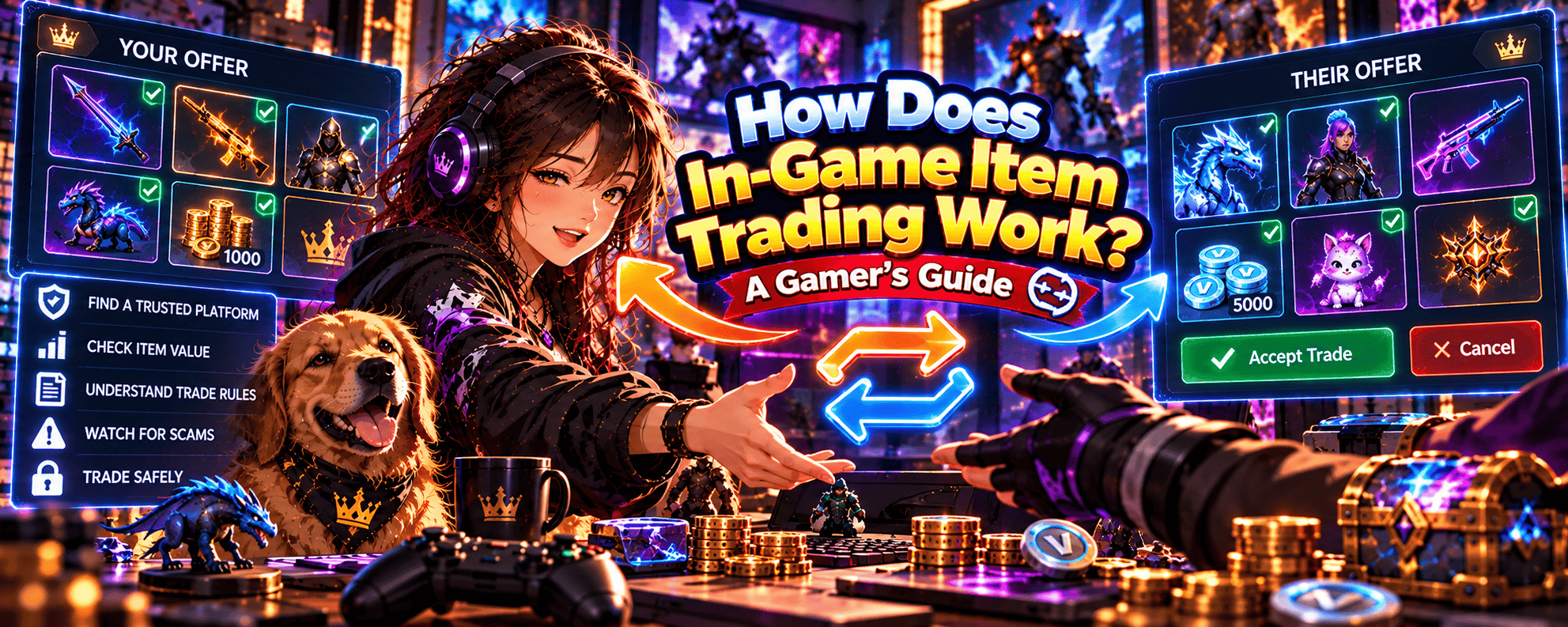
1. How Does In-Game Item Trading Work? 🔄
You’ve just scored a rare weapon skin, but there’s one problem.
It’s not the skin you actually wanted.
Meanwhile, another player has exactly what you’re looking for, and they’re interested in something sitting in your inventory.
Sounds like the perfect opportunity for a trade, right?
That’s where in-game item trading comes in.
In-game item trading allows players to exchange eligible virtual items, currencies or other gaming assets through supported trading systems.
Instead of relying entirely on random drops, crafting or purchasing items directly, gamers can exchange things they already own for items they actually want.
Depending on the game, you might trade weapons, armour, cosmetic skins, crafting materials, collectibles or in-game currency.
But trading systems aren’t identical across games.
Some allow direct player-to-player exchanges. Others use auction houses, marketplace listings or specialised trading interfaces.
Understanding how these systems work is the first step towards becoming a smarter trader.
🎮 What Is In-Game Item Trading?
In-game item trading is the process of transferring eligible virtual items between players in exchange for something of value.
That exchange might involve:
- One item for another item.
- Multiple items for a single valuable item.
- Equipment exchanged for in-game currency.
- Crafting materials exchanged for weapons.
- Collectibles exchanged through an official trading system.
For example, imagine you’ve obtained a rare sword in an RPG.
Unfortunately, you’re playing a mage.
That sword might be incredibly valuable to another player, but it’s not particularly useful for your character.
If the game permits trading, you could exchange it for a staff, crafting materials or another item that better suits your build.
Everyone gets something they want.
That’s the basic idea behind item trading.
💎 Why Do Gamers Trade In-Game Items?
Players trade for several reasons.
Upgrade Their Equipment
Trading can help gamers obtain weapons, armour and other items that improve their characters.
Collect Rare Cosmetics
Some players trade to acquire desirable skins, outfits or limited-edition collectibles.
Get Items They Can’t Easily Find
Trading may provide an alternative to spending hours farming a particular drop.
Exchange Unwanted Loot
An item that’s useless to one player might be valuable to someone else.
Support Crafting and Progression
Players may trade resources or equipment to support their builds and crafting activities.
Participate in the Game’s Economy
For some gamers, researching item values and negotiating trades becomes an enjoyable part of the game itself.
After all, not everyone wants to spend six hours farming a particular weapon when another player has three sitting in their stash.
⚔️ How Does a Typical Item Trade Work?
Although the exact process varies between games, a basic item trade often follows these steps:
- Find an eligible item: Identify something you own that can be traded.
- Find a trading partner: Locate another player interested in exchanging items.
- Discuss the exchange: Agree on which items or currencies each player will provide.
- Open the supported trading system: Use the game’s official trade interface or another permitted method.
- Review the offer: Confirm the exact items, quantities and attributes.
- Accept the trade: Complete the required confirmations.
- Check your inventory: Verify that you received the agreed items.
Some games handle the entire process through a direct trade window.
Others require players to create listings or purchase items through an auction house.
🔍 Is Trading the Same as Buying In-Game Items?
Not exactly.
Buying generally involves obtaining an item by paying an advertised price.
Trading is a broader concept that can involve exchanging items directly or using supported in-game currencies.
| Feature | Buying Items | Trading Items |
|---|---|---|
| Main Action | Purchase an item | Exchange items or value |
| Payment | Supported currency or payment method | Items, currency or both |
| Negotiation | Sometimes | Often possible |
| Item Valuation | Important | Especially important |
| Trading Partner | Usually a seller | Another player or seller |
| Supported System | Marketplace or shop | Trade interface, marketplace or auction house |
The distinction can become less clear in games where players exchange items for in-game currency.
For example, purchasing equipment from another player through an auction house is also part of the game’s player-driven trading economy.
🌍 Which Games Support In-Game Item Trading?
Several popular games have established trading systems.
Counter-Strike 2
Eligible skins and other supported inventory items can be exchanged through Steam’s trading system, subject to applicable restrictions.
World of Warcraft
Players can exchange eligible items through direct trades and supported auction-house systems.
Path of Exile
Players can trade eligible equipment, crafting materials and currency items through supported trading systems.
Roblox
Eligible Limited and Limited U collectibles can be traded through Roblox’s official trading system, subject to account and platform requirements.
Not every item in these games is transferable, and the relevant rules can change.
🏆 Why Understanding Trading Matters
Trading can help you obtain desirable items without relying entirely on random rewards.
However, a successful trade involves more than simply agreeing to exchange loot.
You need to understand:
- Which items are eligible.
- How the trading system works.
- What each item is worth.
- Whether the exchange is fair.
- What restrictions apply.
- How to confirm the transaction.
The better you understand the trading process, the easier it becomes to recognise worthwhile opportunities and avoid unnecessary mistakes.
And who knows?
That unwanted sword collecting dust in your inventory might be exactly what another player needs to complete their dream build.
2. What Types of In-Game Items Can You Trade? 💎
Not every item in your inventory can be traded.
Some games allow players to exchange a wide range of equipment, cosmetics and crafting materials.
Others place strict limits on what can be transferred between accounts.
And some items are permanently tied to the player who obtained them.
Before attempting a trade, you need to understand which types of items are eligible and what restrictions apply.
Let’s explore the main categories of tradable gaming items.
🎨 1. Cosmetic Skins and Appearance Items
Cosmetic items change how characters, weapons or equipment look without necessarily changing gameplay performance.
Examples include:
- Weapon skins.
- Character outfits.
- Decorative accessories.
- Cosmetic equipment.
- Collectible appearance items.
Some games allow eligible cosmetics to be traded between players.
For example, supported CS2 skins can be transferred through Steam’s trading system.
However, cosmetic trading is not universal.
Fortnite outfits, for example, aren’t freely tradable between player accounts through an official skin-trading system.
Always check the specific game’s rules.
⚔️ 2. Weapons and Armour
Weapons and armour are common trading categories in RPGs and other loot-focused games.
Depending on the game, eligible items might include:
- Swords.
- Bows.
- Staffs.
- Shields.
- Helmets.
- Chest armour.
- Gloves.
- Boots.
Their value often depends on gameplay attributes.
For example, a weapon with desirable damage modifiers might attract more interest than a similar weapon with weaker statistics.
However, many games restrict certain equipment after it has been equipped, obtained or used.
🧪 3. Crafting Materials and Resources
Crafting materials are frequently traded because players need them to create or upgrade equipment.
Examples include:
- Ores.
- Herbs.
- Gems.
- Crafting components.
- Upgrade materials.
- Other eligible resources.
In games with active crafting economies, these resources may be exchanged regularly.
For example, World of Warcraft players use the Auction House to trade eligible crafting materials.
Demand may change as players level professions, pursue equipment upgrades or prepare for new content.
💰 4. In-Game Currency
Some games allow players to exchange items for supported in-game currencies.
For example, eligible equipment might be purchased using gold or another game-specific currency.
However, currency systems vary considerably.
Some games support direct player-to-player currency transfers.
Others restrict transfers or use specific trading mechanisms.
Being able to trade an in-game currency does not automatically mean players are permitted to sell that currency for real money.
🐉 5. Rare and Collectible Items
Some gamers specialise in collecting unusual virtual items.
These might include:
- Limited-edition cosmetics.
- Event collectibles.
- Rare item variations.
- Unusual weapon patterns.
- Discontinued tradable items.
- Special decorative items.
Collectors may value these items because of their appearance, history or scarcity.
However, rarity doesn’t guarantee trading eligibility.
An extremely rare account-bound reward might be impossible to transfer legitimately.
📦 6. Consumables and Usable Items
Certain games allow players to trade consumable items.
Examples may include:
- Potions.
- Food.
- Buff items.
- Crafting consumables.
- Other eligible usable resources.
These items may have steady demand because players regularly consume them during gameplay.
Unlike rare collectibles, consumables are often valued according to their practical usefulness and current availability.
🔐 Tradable vs Non-Tradable Items
One of the most important distinctions is whether an item can actually be transferred.
| Item Type | What It Means |
|---|---|
| Tradable | Can be transferred through a supported system |
| Account-Bound | Restricted to the relevant account |
| Character-Bound | Restricted to a particular character |
| Temporarily Trade-Locked | Cannot be transferred until a restriction expires |
| Conditionally Tradable | Can be transferred only when certain requirements are met |
| Marketplace-Eligible | Can be listed through a particular supported marketplace |
The exact terminology and restrictions vary by game.
For example, an item might be eligible for direct trading but unavailable for sale through a particular marketplace.
Another might become non-tradable after being equipped.
Our Tradable vs Non-Tradable In-Game Items guide explores these differences in greater detail.
🎮 Trading Examples Across Popular Games
| Game | Examples of Eligible Tradable Items | Main Consideration |
|---|---|---|
| Counter-Strike 2 | Supported weapon skins and inventory items | Steam trading restrictions |
| World of Warcraft | Eligible equipment, materials and consumables | Binding rules and game version |
| Path of Exile | Eligible weapons, armour, crafting resources and currency items | Game and league restrictions |
| Roblox | Eligible Limited and Limited U collectibles | Account eligibility and trading requirements |
These are general examples rather than guarantees that every item within a category is tradable.
🏆 How Can You Check Whether an Item Is Tradable?
Before arranging an exchange:
- Inspect the item’s description.
- Look for binding or trading restrictions.
- Check whether the item appears in the supported trading interface.
- Review relevant account eligibility requirements.
- Confirm whether any temporary trade lock applies.
- Check the game’s current trading rules.
Don’t rely entirely on a seller’s description.
An item advertised as tradable may still have restrictions that prevent the proposed exchange.
🎯 The Golden Rule of Tradable Items
Always confirm that an item can be transferred before negotiating a trade.
Its rarity, appearance or usefulness doesn’t matter if the game won’t let you exchange it.
Discovering that your legendary sword is account-bound after spending twenty minutes negotiating isn’t exactly a heroic ending.
3. Different Ways to Trade In-Game Items 🎮
There isn’t one universal method for trading gaming items.
Different games have developed different systems for exchanging equipment, cosmetics and other virtual assets.
Some make trading as simple as opening a window and swapping items.
Others rely on auction houses, marketplace listings or dedicated trading platforms.
Understanding the available trading methods helps you choose the right approach for the game and item involved.
🤝 1. Direct Player-to-Player Trading
Direct trading involves two players exchanging eligible items through a supported trading interface.
For example:
- Player A offers a weapon.
- Player B offers crafting materials.
- Both players review the exchange.
- Both confirm the trade.
- The system processes the transfer.
Direct trading is common in games where players regularly exchange equipment or resources.
Advantages
- Players can negotiate.
- Items may be exchanged directly.
- Trades can involve multiple items.
- The process can be straightforward.
Limitations
- Both players may need to meet eligibility requirements.
- Some items cannot be transferred.
- Finding a suitable trading partner may take time.
- Trade interfaces and restrictions vary by game.
🛒 2. In-Game Auction Houses
Auction houses allow players to list eligible items for other players to purchase.
Rather than negotiating individually with every potential buyer, sellers can advertise their items through the game’s trading system.
For example, World of Warcraft has an Auction House where players can buy and sell eligible goods.
A typical process involves:
- The seller lists an item.
- The seller sets the permitted price or auction terms.
- Other players browse available listings.
- A buyer purchases or bids according to the system.
- The game processes the transaction.
Auction houses can make it easier to compare available items.
However, they may charge in-game fees or impose listing restrictions.
💰 3. Official Gaming Marketplaces
Some gaming platforms provide marketplaces where players can list eligible virtual items.
The Steam Community Market is one example.
It allows supported items to be bought and sold using Steam Wallet funds.
This differs from a direct item-for-item trade.
The seller receives the applicable wallet proceeds, while the buyer receives the item through the platform’s system.
Steam Wallet funds generally cannot be withdrawn directly as cash.
⚔️ 4. Supported Player Trading Websites and Listings
Some games provide official trading websites or searchable listings that help players find suitable exchanges.
Path of Exile is an example of a game with supported trading tools.
Depending on the relevant game and trading system, players may:
- Search for equipment.
- Filter by item attributes.
- Compare asking prices.
- Contact sellers.
- Complete the exchange using the supported process.
The exact procedure depends on the game, league and trading features available.
🌍 5. Third-Party Gaming Marketplaces
Some independent marketplaces advertise eligible gaming items.
These platforms may provide listings, seller profiles and purchasing options.
However, third-party marketplaces operate separately from the game’s own trading systems.
Before using one, check:
- Whether the game permits the proposed transaction.
- Whether the item is eligible for transfer.
- What payment methods are supported.
- How fees are calculated.
- What transaction protections are available.
- Whether the marketplace has a credible reputation.
A third-party listing doesn’t automatically make a restricted item transferable.
For more information about different purchasing channels, see our Where to Buy In-Game Items Online guide.
🎮 6. Trading Communities and Forums
Gaming communities can help players find trading opportunities.
Depending on the game, these may include:
- Official forums.
- Community discussion boards.
- Trading-focused Discord servers.
- Game-specific communities.
- Supported in-game chat channels.
These communities can be useful for discovering potential trading partners.
However, finding someone through a community doesn’t replace the need to use a permitted and appropriate trading process.
Be particularly cautious about unsolicited messages, suspicious links and requests to bypass normal trading systems.
📊 Comparing Different Trading Methods
| Trading Method | How It Works | Best Suited For |
|---|---|---|
| Direct Player Trading | Players exchange eligible items | Negotiated item swaps |
| In-Game Auction House | Sellers list items for in-game purchases | Common equipment and resources |
| Official Marketplace | Supported items are bought and sold through a platform | Eligible marketplace items |
| Supported Trading Website | Players search for and arrange trades | Games with dedicated trading tools |
| Third-Party Marketplace | Independent platform advertises eligible items | Permitted external transactions |
| Trading Community | Players discover potential trading partners | Finding opportunities and negotiating |
🔍 Which Trading Method Is Best?
The answer depends on what you’re trying to achieve.
Want to swap one item for another?
Direct player trading may be suitable if the game supports it.
Need common crafting materials?
An in-game auction house may provide convenient access to available listings.
Looking for a particular CS2 skin?
Steam’s supported marketplace and trading features may provide relevant options.
Searching for equipment with specific modifiers?
A game’s dedicated trading tools may help you find suitable items.
Exploring gaming items across different games?
Relevant marketplaces may provide additional listings, subject to game rules and item eligibility.
🏆 What Should You Check Before Choosing a Trading Method?
Consider five important factors.
1. Game Compatibility
Does the trading method support your game?
2. Item Eligibility
Can the item actually be transferred?
3. Transaction Costs
Are there listing fees, trading charges or other costs?
4. Convenience
How easy is it to find a trading partner and complete the exchange?
5. Security and Rules
Is the trading method permitted, and are the transaction procedures clear?
🎯 The Golden Rule of Choosing a Trading Method
Use a trading system that supports the item, follows the game’s rules and provides a clear exchange process.
A convenient trading opportunity isn’t worth risking your account or valuable inventory.
Especially when the alternative is losing your favourite skin to someone whose username is suspiciously close to “DefinitelyNotAScammer”.
4. How to Trade In-Game Items Step by Step ⚔️
Ready to make your first item trade?
Whether you’re exchanging a weapon skin, swapping RPG equipment or trading crafting resources, the basic principles are similar.
You need an eligible item, a suitable trading partner and a supported method for completing the exchange.
The most important part of trading is making sure both players understand exactly what’s being exchanged before confirming the transaction.
Here’s a beginner-friendly walkthrough.
🎮 Step 1: Choose an Item You Want to Trade
Start by checking your inventory.
Look for items you no longer need or items that other players might want.
For example:
- Duplicate cosmetics.
- Unused equipment.
- Extra crafting materials.
- Eligible collectibles.
- Weapons that don’t suit your build.
Before offering anything, confirm that the item is tradable.
Some games restrict items after they’re equipped or obtained.
💎 Step 2: Identify What You Want in Return
Decide what you’d like to receive.
You might want:
- A different cosmetic.
- Better equipment.
- Crafting materials.
- An eligible collectible.
- Supported in-game currency.
Being clear about your goal makes it easier to evaluate offers.
For example, if you’re trading a sword, you might specifically want a staff with certain modifiers.
That gives you something concrete to search for.
🔍 Step 3: Research Your Item’s Value
Before accepting an offer, investigate what your item is worth.
Check relevant marketplace listings and completed transactions where available.
Pay attention to:
- Item rarity.
- Attributes.
- Current demand.
- Recent selling prices.
- Trading restrictions.
- Relevant game and league.
This helps you recognise whether a proposed exchange is reasonable.
🤝 Step 4: Find a Suitable Trading Partner
Depending on the game, you might find another trader through:
- A supported in-game trading system.
- An official trading website.
- An auction house.
- A relevant gaming community.
- A permitted marketplace.
Look for someone offering the item or currency you want.
Avoid arranging trades through suspicious links or unverified accounts.
💰 Step 5: Agree on the Exchange
Once you’ve found a potential trading partner, discuss the proposed trade.
For example:
Player A Offers:
- One rare sword.
- 100 units of eligible crafting material.
Player B Offers:
– One rare staff.
Both players should understand the exact items and quantities involved.
If the trade involves items with variable attributes, confirm those details as well.
📊 Example: Comparing the Trade Values
Imagine the items have the following hypothetical values in the same supported in-game currency.
| Item | Estimated Value |
|---|---|
| Rare Sword | 1,000 Gold |
| Crafting Materials | 200 Gold |
| Rare Staff | 1,200 Gold |
Player A offers items with an estimated combined value of 1,200 gold.
Player B offers a staff estimated at 1,200 gold.
On paper, the exchange appears balanced.
However, both players should still consider the actual item attributes and their personal needs.
A fair trade doesn’t always mean both sides receive items with identical market values.
🔐 Step 6: Open the Supported Trading Interface
Once you’ve agreed on the exchange, use the game’s supported trading system.
Depending on the game, this might involve:
- Opening a direct trade window.
- Selecting the trading partner.
- Adding items to the offer.
- Reviewing the other player’s items.
- Confirming the transaction.
Never assume that an exchange described in chat will automatically match what appears in the actual trading interface.
👀 Step 7: Review Every Item Carefully
Before accepting, check:
- The correct item names.
- The correct quantities.
- Item rarity and condition.
- Relevant modifiers or attributes.
- Any additional currency.
- Whether the other player changed their offer.
- Whether the final exchange matches the agreement.
Some trading systems reset confirmations when an offer changes.
Others have different safeguards.
Regardless of the interface, always review the final contents.
⚔️ Step 8: Confirm the Trade
If everything matches the agreement, complete the required confirmations.
The system may process the exchange immediately or impose additional requirements.
For example, some Steam trades may involve authentication steps or applicable trade holds.
Follow the platform’s official process.
Never provide your password or authentication codes to another player.
📦 Step 9: Check Your Inventory
After the transaction completes, confirm that you received the agreed items.
Check:
- Item names.
- Quantities.
- Attributes.
- Inventory location.
- Transaction records, where available.
If something appears incorrect, use the relevant game’s or platform’s official support process.
🚫 Step 10: Know When to Cancel a Trade
Not every proposed exchange deserves to be completed.
Consider cancelling if:
- The other player changes the agreed items.
- The values appear significantly different from your research.
- The seller pressures you to hurry.
- You’re asked to disclose account information.
- The trading method appears unsupported.
- The transaction details are unclear.
- You no longer feel comfortable proceeding.
There’s nothing wrong with walking away from a questionable trade.
🏆 Beginner’s Trading Checklist
Before confirming your first trade, make sure you can answer yes to the following questions:
- Is the item eligible for trading?
- Am I using a supported trading method?
- Do I understand the item’s approximate value?
- Have both players agreed on the exchange?
- Have I checked the exact item attributes?
- Does the trade interface match our agreement?
- Am I comfortable with the transaction?
🎯 The Golden Rule of Your First Item Trade
Never confirm a trade until you’ve checked exactly what you’re giving and receiving.
A good trade should be clear, deliberate and completed through an appropriate trading system.
There’s no need to rush.
Your inventory isn’t going anywhere while you spend another thirty seconds checking the details.
And if the other player suddenly swaps that legendary sword for a rusty spoon?
Well, that’s probably your cue to cancel.
5. How Does Player-to-Player Item Trading Work? 🤝
Sometimes the best way to get the item you want is to find another gamer who already has it.
Maybe you’ve got a rare CS2 skin that doesn’t match your loadout. Another player has the exact skin you’ve been hunting for, and they’re interested in yours.
Rather than buying something new, you could potentially arrange a direct exchange.
That’s the idea behind player-to-player item trading.
Player-to-player trading allows two gamers to exchange eligible virtual items directly through a supported trading system.
Depending on the game, these exchanges might involve weapons, armour, cosmetics, crafting materials or in-game currency.
However, the process varies considerably between games.
🎮 How Does Direct Item Trading Work?
Most direct trading systems follow a similar process.
- Two players agree to trade.
- One player sends a trade request or offer.
- Both players select the items they want to exchange.
- The trading interface displays the proposed transaction.
- Both players review the details.
- Each player completes the required confirmations.
- The system processes the exchange.
Some games require players to be online simultaneously.
Others allow asynchronous trade offers that the recipient can review later.
The important thing is that both players can see what they’re exchanging before completing the transaction.
🔫 How Does CS2 Player Trading Work?
Counter-Strike 2 uses Steam’s inventory and trading systems for eligible items.
Players can exchange supported skins and other inventory items through Steam trade offers.
A typical process involves:
- Finding the intended trading partner’s Steam profile.
- Opening the supported trade interface.
- Selecting eligible inventory items.
- Reviewing both sides of the offer.
- Completing any required confirmations.
- Waiting for any applicable trade restrictions or holds.
Steam may impose restrictions based on account security settings, item eligibility and other factors.
For example, certain items may be temporarily unavailable for trading.
Always check the current restrictions before arranging an exchange.
⚔️ How Does Path of Exile Player Trading Work?
Path of Exile has an established player-driven trading economy.
Players can search for eligible equipment and currency items using the game’s supported trading tools.
For example, imagine you’re looking for a weapon with particular damage modifiers.
You could search for suitable listings, identify a seller and arrange an exchange through the supported trading process.
Depending on the game and trading method, the exchange may involve:
- Contacting the seller.
- Joining an appropriate game instance.
- Opening the trade interface.
- Adding the agreed items or currency.
- Reviewing the offer.
- Confirming the trade.
Path of Exile and Path of Exile 2 have different trading systems and economies, so follow the process relevant to the game you’re playing.
🐉 How Does World of Warcraft Player Trading Work?
World of Warcraft supports direct trading of eligible items between players.
Depending on the item and applicable restrictions, players may exchange equipment, resources or gold through the game’s trading interface.
However, many items are bound to characters or accounts.
Some items may also have specific eligibility requirements or limited trading windows.
For example, certain loot may be tradable only between eligible players for a limited period.
Always inspect the item and its restrictions before promising it to another player.
🧱 Can You Trade Roblox Items With Other Players?
Roblox supports trading for eligible Limited and Limited U collectibles through its official trading system.
Trading eligibility depends on platform requirements, including appropriate account subscriptions and other restrictions.
Players can submit offers involving eligible collectibles and permitted Robux amounts, subject to Roblox’s rules.
Not every Roblox avatar item can be traded.
And Roblox trading should not be confused with transferring entire accounts or selling unrestricted access to items.
💰 Do Both Players Need to Offer Items of Equal Value?
Not necessarily.
A trade doesn’t always need to involve two items with identical market values.
For example, imagine:
Player A Offers:
– A cosmetic skin valued at approximately $50.
Player B Offers:
– Two eligible skins with a combined estimated value of $45.
Player A might still accept because they prefer the two skins.
Likewise, a player might trade a valuable RPG weapon for a slightly less valuable item that’s more useful for their build.
A successful trade depends on both players agreeing to the exchange, not necessarily receiving identical market value.
However, understanding item values helps prevent accidental overpayment.
🔐 Why Are Trade Confirmations Important?
Trading interfaces often require players to review and confirm their offers.
These steps help prevent accidental exchanges.
Before confirming, check:
- The other player’s identity.
- Item names.
- Quantities.
- Item attributes.
- Additional currency.
- Any changes to the original offer.
Be especially careful if another player modifies the offer shortly before confirmation.
Never rely solely on what someone promised in chat.
The contents of the actual trading interface are what matter.
⚠️ Can You Reverse a Player-to-Player Trade?
That depends on the game and platform.
Some completed trades are final.
Other platforms may have limited recovery, dispute or reversal procedures for particular circumstances.
You should never assume that support can reverse an unwanted exchange.
For example, Steam has introduced protections and reversal features for certain eligible CS2 trades, but these are subject to specific conditions and consequences.
Always check the current platform rules rather than assuming every completed trade can be undone.
🏆 When Is Direct Player Trading a Good Option?
Direct trading can be particularly useful when:
- You want to exchange one item for another.
- You’re looking for specific item attributes.
- Both players have compatible trading requirements.
- The game supports direct exchanges.
- You prefer negotiating rather than purchasing from a fixed-price listing.
It may be less convenient when you’re searching for common items that are readily available through an auction house.
🎯 The Golden Rule of Player-to-Player Trading
Use the game’s supported trading system and review the final offer before confirming.
Direct trading can be a great way to turn unwanted loot into something genuinely useful.
Just remember that a friendly conversation isn’t a substitute for checking the actual items.
Your legendary sword deserves a little more attention than a quick click on the Accept button.
6. How Do In-Game Marketplaces and Auction Houses Work? 🛒
Not every item trade involves two players negotiating directly.
In many games, marketplaces and auction houses make trading more convenient by allowing players to browse available items and purchase them through a structured system.
Instead of searching for someone willing to exchange a particular weapon, you can browse listings and choose an offer that suits your needs.
In-game marketplaces and auction houses connect buyers and sellers through supported listing, pricing and transaction systems.
These systems play an important role in many player-driven gaming economies.
🎮 What Is an In-Game Marketplace?
An in-game marketplace is a system where players can buy or sell eligible virtual items.
Depending on the game, sellers may be able to:
- List items for sale.
- Set asking prices.
- Choose quantities.
- Review competing listings.
- Receive supported in-game currency.
- Manage active offers.
Buyers can search for items and compare available prices.
Some marketplaces use fixed-price listings.
Others support bidding, buy orders or different purchasing methods.
🐉 How Does the World of Warcraft Auction House Work?
World of Warcraft’s Auction House allows players to buy and sell eligible items using in-game gold.
For example, a player might list crafting materials they no longer need.
Another player searching for those materials can purchase them through the Auction House.
A simplified process looks like this:
- The seller selects an eligible item.
- The item is listed through the Auction House.
- The seller sets the available pricing terms.
- Other players search for the item.
- A buyer purchases the item.
- The game processes the transaction.
- The seller receives the applicable proceeds.
The Auction House may apply deposits or transaction charges depending on the listing and relevant game rules.
💰 Fixed-Price Listings vs Auctions
Not all marketplace transactions work the same way.
Fixed-Price Listings
The seller advertises an item at a specified price.
A buyer can purchase it at that price, subject to availability and platform rules.
Auction Listings
Players may place bids on an item.
The winning bid is determined according to the auction’s rules.
Buy Orders
Some marketplaces allow buyers to specify a price they’re willing to pay for an eligible item.
A matching sell offer may then result in a transaction.
The exact features depend on the marketplace.
🔫 How Does the Steam Community Market Work?
The Steam Community Market allows users to buy and sell eligible inventory items using Steam Wallet funds.
For example, a CS2 player might list an eligible skin for sale.
Other users can browse available listings and purchase the item through Steam’s marketplace.
The seller receives the applicable Steam Wallet proceeds after relevant fees.
However, Steam Wallet funds generally cannot be withdrawn directly as cash.
This distinction matters when comparing Steam marketplace prices with prices from permitted cash-based marketplaces.
📊 Marketplace Trading vs Direct Trading
| Feature | Direct Player Trading | Marketplace Trading |
|---|---|---|
| Trading Partner | Usually identified directly | Often matched through listings |
| Negotiation | Frequently possible | Depends on marketplace |
| Pricing | Agreed between players | Advertised or determined by market mechanisms |
| Item Exchange | Direct trade interface | Marketplace transaction system |
| Fees | Depends on game | Marketplace charges may apply |
| Convenience | Depends on finding a partner | Listings can simplify discovery |
| Item Eligibility | Game-specific | Marketplace-specific |
Both methods have advantages.
Direct trading can be useful for negotiated item exchanges.
Marketplaces can make it easier to compare numerous listings and find commonly traded items.
📈 How Do Marketplaces Influence Item Prices?
Marketplaces bring buyers and sellers together.
As players list items, purchase equipment and adjust their asking prices, market conditions develop.
For example, imagine a popular RPG weapon suddenly becomes essential for a powerful character build.
More players may start searching for it.
If demand increases faster than supply, sellers may raise their asking prices.
Alternatively, if a new event makes the weapon easier to obtain, increased supply may put downward pressure on prices.
This interaction between supply and demand is central to virtual item economies.
Our How Do In-Game Economies Work? guide explains how player behaviour, item availability and virtual currencies influence gaming markets.
💎 What Are Marketplace Fees?
Some marketplaces charge fees for listing or selling items.
These may include:
- Listing deposits.
- Transaction fees.
- Percentage-based seller charges.
- Other applicable marketplace costs.
For example, imagine a hypothetical marketplace charges a 5% selling fee.
If an item sells for 1,000 gold:
- Sale price: 1,000 gold.
- Selling fee: 50 gold.
- Seller receives: 950 gold.
This is an illustrative example, not a statement of any particular game’s current fee structure.
Understanding marketplace fees is important because they affect the amount sellers actually receive.
🔍 How Do Buyers Compare Marketplace Listings?
When browsing an auction house or marketplace, buyers should compare:
- Exact item names.
- Item attributes.
- Available quantities.
- Asking prices.
- Relevant fees.
- Current market activity.
- Trading restrictions.
For common resources, comparing the unit price can be particularly useful.
For example, a bundle of 100 crafting materials may appear expensive until you calculate the price per unit.
🏆 When Should You Use an Auction House or Marketplace?
Marketplaces can be particularly useful when:
- You want to browse multiple offers.
- You’re purchasing commonly traded resources.
- You want to compare advertised prices.
- You prefer a structured transaction process.
- The game provides a suitable official marketplace.
However, not every item is marketplace-eligible.
Some games require direct trades for particular items, while others prohibit certain transfers entirely.
🎯 The Golden Rule of Marketplace Trading
Understand how the marketplace handles listings, prices, fees and item transfers before using it.
A well-designed marketplace can make trading much easier.
But understanding the system helps you avoid overpaying and ensures you know exactly what you’re receiving.
After all, the Auction House is supposed to help you upgrade your gear.
Not accidentally spend your entire gold supply on 200 identical mushrooms.
7. How to Work Out Whether an Item Trade Is Fair 💰
You’ve found another player willing to trade.
They’re offering a rare weapon in exchange for two items from your inventory.
It sounds promising.
But how do you know whether the exchange is fair?
That’s one of the most important questions in item trading.
A fair trade is one where both players understand the exchange and consider the items or value they’re receiving acceptable.
Market prices provide a useful starting point, but personal preferences and item usefulness also matter.
🔍 Step 1: Research the Value of Each Item
Before agreeing to a trade, investigate the items involved.
Useful sources may include:
- Current marketplace listings.
- Recent completed sales.
- Supported trading websites.
- Relevant in-game auction houses.
- Reliable community pricing resources.
Look for comparable items rather than relying on broad estimates.
For example, a weapon with rare modifiers may be worth more than an ordinary version of the same weapon.
Our How to Check What an In-Game Item Is Worth guide explains how to research item values using relevant market evidence.
💎 Step 2: Compare Exact Item Attributes
An item’s name doesn’t always tell you everything about its value.
For cosmetic items, relevant attributes might include:
- Condition.
- Float value.
- Pattern.
- Special features.
- Collector demand.
For functional equipment, consider:
- Damage.
- Modifiers.
- Item level.
- Upgrade potential.
- Build compatibility.
A trade that looks balanced based on item names alone may be less attractive once you examine the details.
⚔️ Step 3: Calculate the Total Value of Each Offer
Imagine two players negotiating a hypothetical trade.
Player A Offers:
- Rare sword: 1,200 gold.
- Crafting materials: 300 gold.
Player B Offers:
– Rare staff: 1,400 gold.
The comparison looks like this:
| Trade Offer | Estimated Value |
|---|---|
| Player A – Rare Sword | 1,200 Gold |
| Player A – Crafting Materials | 300 Gold |
| Player A Total | 1,500 Gold |
| Player B – Rare Staff | 1,400 Gold |
| Player B Total | 1,400 Gold |
Values are hypothetical and expressed in the same supported in-game currency.
Player A is offering approximately 100 gold more in estimated market value.
Does that automatically make it a bad trade?
Not necessarily.
🎮 Step 4: Consider Personal Item Value
An item can be more useful to one player than another.
For example, Player A might be playing a mage who urgently needs a better staff.
The sword and crafting materials may have little immediate use.
Meanwhile, Player B might need the sword for a particular build.
Both players could consider the exchange worthwhile despite the difference in estimated market value.
Market value helps measure the exchange, but usefulness influences whether a trade makes sense for you.
📊 Step 5: Calculate the Difference Between Offers
A simple calculation can help identify significant imbalances.
Trade Value Difference = Value of Items Offered − Value of Items Received
Using the previous example:
1,500 gold − 1,400 gold = 100 gold.
Player A is offering approximately 100 gold more.
You can also calculate the percentage difference relative to the value received.
100 ÷ 1,400 × 100 = approximately 7.1%.
This doesn’t automatically make the exchange unfair.
It simply provides information to help both players make an informed decision.
📈 Step 6: Consider Market Demand
Some items are easier to trade than others.
For example, a popular crafting material may have steady demand.
An unusual collectible might be valuable to a small number of players but difficult to exchange quickly.
This difference matters when evaluating a trade.
An item with a high estimated value isn’t necessarily easy to sell at that price.
🔐 Step 7: Check Trading Restrictions
An item might have a strong estimated market value but be subject to restrictions.
For example:
- A temporary trade lock.
- Account eligibility requirements.
- Item-specific transfer restrictions.
- Game or league limitations.
Always confirm that the proposed exchange can be completed legitimately.
🤝 Step 8: Negotiate When Appropriate
If the values don’t appear balanced, you may be able to negotiate.
For example, Player A might ask Player B to include additional crafting materials.
Alternatively, Player A could reduce the quantity of materials being offered.
Not every game or marketplace supports negotiation, but direct player trading often provides some flexibility.
🏆 What Does a Fair Trade Look Like?
A reasonable trade generally satisfies several conditions.
Both Players Understand the Exchange
The items and quantities are clear.
The Values Are Reasonably Understood
Players have researched relevant market information.
The Items Meet Their Needs
Each player is receiving something useful or desirable.
The Trade Is Permitted
The game supports the exchange.
Both Players Agree Voluntarily
Neither player is being pressured or misled.
⚠️ Warning Signs of an Unfair Trade
Be cautious when:
- The other player refuses to identify exact item attributes.
- You’re pressured to accept immediately.
- The claimed item value cannot be supported.
- The other player changes the offer unexpectedly.
- You’re asked to trade outside supported systems.
- The exchange depends on promises of future payment.
A trade that appears significantly unbalanced deserves additional research.
🎯 The Golden Rule of Fair Trading
Know what you’re giving away, understand what you’re receiving and decide whether the exchange makes sense for you.
Not every fair trade involves identical market values.
Sometimes an item that’s worth slightly less on paper is far more useful to your character.
But there’s a difference between knowingly accepting a small value difference and accidentally trading your legendary weapon for three potatoes.
Unless, of course, those potatoes are part of an extremely powerful endgame build.
8. How Do Trading Restrictions and Item Ownership Work? 🔐
You’ve found the perfect trading partner.
You’ve agreed on the items.
You’ve checked their values.
Everything looks ready.
Then you open the trading interface and discover that your item can’t be transferred.
What happened?
The answer often comes down to trading restrictions.
Games and marketplaces control which virtual items can be transferred, when transfers are permitted and which accounts are eligible to participate.
Understanding these rules is essential before arranging a trade.
🎮 Why Do Games Restrict Item Trading?
Developers introduce trading restrictions for several reasons.
These may include:
- Protecting account security.
- Limiting fraud.
- Managing virtual economies.
- Controlling item availability.
- Preserving gameplay progression.
- Preventing certain forms of exploitation.
- Enforcing platform rules.
Restrictions vary considerably between games.
An item that’s freely tradable in one game might be permanently bound in another.
🔒 What Are Account-Bound Items?
Account-bound items are restricted to a particular account.
They generally cannot be transferred freely to unrelated player accounts.
For example, a game might award an exclusive cosmetic for completing a difficult achievement.
The developer may restrict the reward to the account that earned it.
Even if the item is rare and desirable, that doesn’t necessarily make it eligible for trading.
⚔️ What Are Character-Bound Items?
Some games restrict items to a particular character.
For example, a powerful piece of equipment might become bound after being equipped.
The exact rules depend on the game.
Some items may be transferable between eligible characters on the same account.
Others may have stricter restrictions.
Always check the item’s description and applicable game rules.
⏳ What Is a Trade Lock?
A trade lock temporarily prevents an item from being transferred.
For example, an item might be unavailable for trading until a specified period has passed.
Trade locks can apply after particular transactions or account events.
They may also depend on security settings.
Before negotiating a trade, check whether the item is currently eligible for transfer.
🔫 How Do Steam Trading Restrictions Work?
Steam applies various restrictions to inventory trading.
Depending on the account and item, these may include:
- Trade holds.
- Security-related restrictions.
- Temporary item transfer limitations.
- Account eligibility requirements.
- Additional confirmation steps.
Certain CS2 items may have specific restrictions following acquisition or trading.
These rules can change, so always review Steam’s current information before arranging an exchange.
🐉 How Do World of Warcraft Binding Rules Work?
World of Warcraft uses different binding classifications for equipment and other items.
Depending on the item, these may include:
- Bind on Pickup.
- Bind on Equip.
- Warbound or other account-related classifications.
- Items with limited trading eligibility.
For example, a Bind on Equip item may be tradable before being equipped but become restricted afterwards.
Some loot may also have limited trading windows between eligible players.
Always inspect the item before assuming it can be exchanged.
🧱 What Restrictions Apply to Roblox Trading?
Roblox trading is limited to eligible collectibles and accounts.
Requirements can involve account subscription status, trading settings and other platform conditions.
Not every Roblox item supports resale or trading.
The platform also controls how eligible collectibles and permitted Robux amounts can be included in offers.
Check Roblox’s current rules before attempting a trade.
🌍 Do Regional Restrictions Affect Trading?
Sometimes.
Games may operate separate regional markets or restrict certain transactions between regions.
For example, a game’s servers or market structure may determine which players can exchange items.
Other platforms may impose payment or account restrictions based on location.
Don’t assume that items available in one region can automatically be transferred to another.
💎 Do You Actually Own Your In-Game Items?
This is an important question.
When you acquire a virtual item, you generally receive rights to use it under the relevant game’s terms.
That doesn’t necessarily mean you own it in the same way you own a physical object.
Developers and platforms often retain significant control over virtual items, including their availability and transferability.
Our Do You Really Own Your In-Game Items? guide explores the difference between virtual item access, ownership rights and platform restrictions.
💰 Can You Trade In-Game Items for Real Money?
That depends on the game, item and applicable platform rules.
Some games or platforms support specific forms of real-money trading.
Others prohibit selling virtual items or currency outside approved systems.
For example, being able to transfer an item between players doesn’t automatically mean you’re permitted to sell it for cash.
Always distinguish between:
- In-game item exchanges.
- Purchases using supported virtual currency.
- Official marketplace transactions.
- Permitted real-money sales.
- Prohibited external transactions.
A technically possible transfer isn’t necessarily an authorised transaction.
📊 Common Trading Restrictions Explained
| Restriction | What It Means |
|---|---|
| Account-Bound | Item is restricted to the relevant account |
| Character-Bound | Item is restricted to a particular character |
| Trade Lock | Item cannot be transferred temporarily |
| Account Eligibility | Certain account requirements must be met |
| Regional Restriction | Trading may be limited by region |
| Marketplace Restriction | Item may not be eligible for a particular marketplace |
| Limited Trading Window | Transfer is permitted only under specific conditions |
| Prohibited External Sale | Game rules do not permit the proposed external transaction |
🔍 How to Check Trading Restrictions Before Making an Offer
Follow these steps:
- Inspect the item’s description.
- Check whether it appears in the supported trading interface.
- Look for trade locks or binding restrictions.
- Review relevant account requirements.
- Confirm the game and market are compatible.
- Check the platform’s current trading rules.
- Avoid arranging transactions that violate those rules.
If you’re uncertain whether an item can be transferred, investigate before making commitments to another player.
🏆 Why Trading Restrictions Matter
Restrictions influence more than whether an exchange can be completed.
They can also affect item availability, demand and market value.
For example, an item with limited transferability may have fewer potential buyers.
Another item might become more widely available after a temporary trade restriction expires.
Understanding these conditions helps you make more informed trading decisions.
🎯 The Golden Rule of Item Ownership and Trading Restrictions
Just because an item appears in your inventory doesn’t mean you can freely transfer or sell it.
Always check the game’s rules before trading.
That rare cosmetic might look like the perfect opportunity to upgrade your inventory.
But if it’s permanently account-bound, it’s staying right where it is.
At least your character will continue looking legendary.
9. How to Find Players to Trade In-Game Items With 🌍
You’ve got a rare weapon, a few valuable skins or a stash full of crafting materials.
Now you need someone who actually wants them.
Finding the right trading partner is an important part of in-game item trading. After all, even the most valuable loot isn’t particularly useful in a trade if nobody is interested in what you’re offering.
Fortunately, many games have established trading systems and communities where players can connect.
The best way to find trading partners is to use relevant gaming communities, supported trading platforms and official marketplace systems.
Let’s explore your options.
🎮 1. Use Your Game’s Official Trading System
Start with the trading features provided or supported by the game.
Depending on the title, these may include:
- In-game trading interfaces.
- Auction houses.
- Official trading websites.
- Marketplace listings.
- Supported player-to-player trade offers.
For example, Path of Exile provides trading tools that help players search for eligible equipment and locate sellers.
World of Warcraft has an Auction House where players can purchase eligible items without negotiating directly with every seller.
These systems are often the most practical starting point because they’re designed around the game’s trading rules.
🤝 2. Join Gaming Communities
Gaming communities can help you connect with players interested in trading.
Popular community spaces include:
- Game-specific forums.
- Official community channels.
- Trading-focused Discord servers.
- Reddit gaming communities.
- In-game guilds and groups.
Some communities have dedicated channels where players advertise items they want to exchange.
For example, a player might post:
Trading a rare staff with critical strike modifiers. Looking for comparable caster equipment or eligible crafting currency.
This makes it easier for interested players to understand the offer.
However, finding a trading partner through a community doesn’t mean the community itself guarantees the transaction.
Always use a permitted trading method.
🔫 3. Find CS2 Trading Partners
CS2 players can use Steam’s supported trading features to exchange eligible inventory items.
Players may also discover potential trading partners through relevant gaming communities.
Before arranging a trade, check:
- The other player’s Steam profile.
- The exact items being offered.
- Current trade restrictions.
- Applicable authentication requirements.
- Whether the offer matches your agreement.
Be cautious about unsolicited trade offers involving unusually generous promises.
And never sign in through an unfamiliar website simply because someone claims it’s necessary to complete a trade.
⚔️ 4. Find Path of Exile Trading Partners
Path of Exile’s trading tools are particularly useful for finding players with specific equipment.
Imagine you’re searching for a weapon with:
- High physical damage.
- Increased attack speed.
- Critical strike modifiers.
- A suitable item level.
Rather than asking hundreds of players individually, you can search relevant listings using supported filters.
This helps you identify sellers offering equipment that matches your requirements.
Make sure you’re searching within the correct game and league.
🐉 5. Use Guilds and In-Game Communities
Guilds and established gaming groups can be useful for finding players interested in exchanging resources.
For example, a World of Warcraft guild might have members who specialise in different professions.
One player gathers materials.
Another crafts equipment.
A third needs consumables for group content.
Where the game permits trading, these players may exchange eligible resources or equipment.
Established communities can also make it easier to communicate about item requirements.
However, knowing another player doesn’t eliminate the need to check the trade details.
🌐 6. Explore Relevant Gaming Marketplaces
Some gaming marketplaces allow sellers to advertise eligible items to interested buyers.
For example, StackedGame provides listings across gaming-related categories, including in-game items.
When exploring marketplace listings, check whether the advertised item matches your requirements and whether the proposed transaction is permitted by the game.
Remember that purchasing an item through a marketplace isn’t necessarily the same as arranging a direct item-for-item exchange.
📦 7. Create a Clear Trading Offer
If you’re looking for a particular item, a clear trading post can help attract relevant responses.
Include:
- The game and relevant version or league.
- The exact item you’re offering.
- Important item attributes.
- What you’d like in return.
- Any relevant trading requirements.
- The supported method you intend to use.
For example:
Game: Path of Exile Offering: Rare weapon with specified damage and attack speed modifiers Looking For: Eligible crafting currency or comparable equipment Trade Method: Supported in-game trading system
Avoid vague descriptions such as SUPER RARE ITEM – AMAZING VALUE!
Specific information is much more useful.
🔐 8. Check Potential Trading Partners
Before completing an exchange, investigate the other player’s credibility where relevant information is available.
Consider:
- Whether the account appears authentic.
- Whether the player provides accurate item details.
- Whether their offer is consistent.
- Whether they’re willing to use the supported trading process.
- Whether they’re requesting unusual account information.
Don’t assume that an old account or positive-looking profile guarantees trustworthiness.
🏆 Where Should Beginners Start?
For beginners, the simplest approach is usually to start with the game’s official or supported trading features.
These systems can help you understand item eligibility, available offers and the mechanics of completing transactions.
As you gain experience, relevant gaming communities can provide additional opportunities to discover potential trading partners.
The goal is to find players interested in legitimate exchanges, not simply collect as many trade offers as possible.
One reliable trading partner is worth considerably more than fifty suspicious messages promising free legendary loot.
10. Common In-Game Item Trading Scams and Mistakes ⚠️
Trading can be one of the most enjoyable parts of a game’s economy.
Unfortunately, valuable virtual items can also attract scammers.
Some attempt to steal inventory items through misleading offers.
Others impersonate trusted players, advertise fake marketplaces or pressure gamers into accepting unfair exchanges.
Understanding common trading scams can help you recognise suspicious behaviour before it becomes an expensive problem.
The safest approach is to verify every trade, protect your account information and use supported trading systems.
🚫 1. Item Switching Scams
An item-switching scam occurs when someone changes the contents of a trade offer, hoping the other player won’t notice.
For example, imagine you’ve agreed to exchange your rare sword for a valuable staff.
The other player initially adds the correct staff.
However, before the trade is completed, they replace it with a similar-looking item that has weaker attributes.
If you don’t review the final offer, you might accept something worth considerably less than expected.
How to avoid it: Check the exact items, quantities and attributes immediately before confirming.
🎭 2. Player Impersonation
Scammers sometimes pretend to be trusted players, marketplace representatives or community moderators.
They may copy usernames, profile pictures or other account details.
Their goal is to convince you that you’re dealing with someone legitimate.
How to avoid it: Verify the actual account identity through the platform’s official features rather than relying on names or profile pictures.
🔗 3. Fake Trading Websites
Some scammers create websites designed to resemble legitimate gaming marketplaces or login pages.
These websites may attempt to collect account credentials or authentication information.
You might receive a message claiming:
Check the price of your skin here before we trade.
The link could lead to a fraudulent website.
How to avoid it: Navigate directly to trusted services using known addresses or official links. Avoid entering credentials on unfamiliar pages.
💰 4. Misleading Item Valuations
A player might exaggerate the value of an item to make an unfair trade appear attractive.
For example:
- Your item has an estimated value of $100.
- The other player’s item has a typical market value of $30.
- They claim their item is worth $150 because it’s supposedly extremely rare.
Without checking comparable transactions, you might accept the offer.
How to avoid it: Research item values independently using reliable market evidence.
⏳ 5. Pressure and Urgency Tactics
Some scammers try to rush players into accepting offers.
Common messages include:
- “Accept now or the deal is gone!”
- “I have five other buyers waiting!”
- “Don’t waste time checking prices!”
- “You need to confirm immediately!”
A legitimate trading opportunity shouldn’t require you to ignore basic verification.
How to avoid it: Take the time you need to review the exchange.
🎁 6. Fake Giveaways and Free Item Offers
Messages promising free skins, rare equipment or valuable collectibles can be tempting.
However, some are designed to direct players towards fraudulent websites or obtain account information.
Be especially cautious about giveaways that require you to disclose passwords, authentication codes or recovery information.
How to avoid it: Verify promotions through official sources and never disclose sensitive account credentials.
💳 7. Off-Platform Payment Requests
Some scammers encourage players to abandon a marketplace’s normal transaction process.
They may promise a discount in exchange for direct payment through an unsupported method.
This can remove whatever transaction protections the original marketplace provides.
It may also violate the game’s rules.
How to avoid it: Use permitted payment and trading methods, and understand the platform’s procedures before completing a transaction.
🤝 8. Trust Trading Scams
A trust trade involves one player transferring an item first based on a promise that the other player will provide something later.
For example:
Send me your rare skin first, and I’ll send you two valuable skins afterwards.
The problem is that the second player may never complete their side of the arrangement.
How to avoid it: Prefer supported trading systems that allow both sides of the exchange to be reviewed together.
⚔️ 9. Trading Items With Different Attributes
Not every bad trade involves deliberate fraud.
Sometimes players simply fail to notice important item differences.
For example:
- A skin has a different wear classification.
- A weapon has weaker modifiers.
- An item belongs to the wrong league.
- A collectible lacks a desirable attribute.
These mistakes can lead to disappointment even when both players act honestly.
How to avoid it: Compare the exact item specifications before accepting.
🔐 10. Ignoring Trading Restrictions
Players sometimes arrange exchanges without checking whether the items are eligible for transfer.
This can result in cancelled transactions, delays or attempts to use unsupported workarounds.
How to avoid it: Confirm trading eligibility and follow the game’s current rules.
📊 Common Trading Scams and How to Avoid Them
| Scam or Mistake | Warning Sign | Recommended Precaution |
|---|---|---|
| Item Switching | Offer changes unexpectedly | Review final trade contents |
| Impersonation | Suspicious or copied profile | Verify account identity |
| Fake Websites | Unfamiliar login link | Use official services |
| Misleading Values | Unsupported price claims | Research comparable sales |
| Pressure Tactics | Demands for immediate acceptance | Take time to verify |
| Fake Giveaways | Requests for credentials | Never share account information |
| Off-Platform Payments | Requests to bypass normal systems | Use permitted transaction methods |
| Trust Trading | Promise of payment later | Avoid unsupported one-sided transfers |
| Incorrect Attributes | Similar-looking but different item | Inspect exact specifications |
| Trading Restrictions | Item cannot be transferred | Check eligibility first |
🛡️ What Should You Do if a Trade Looks Suspicious?
If something doesn’t feel right:
- Stop the transaction.
- Avoid opening unfamiliar links.
- Verify the other player’s identity.
- Review the proposed items and values.
- Check the platform’s trading rules.
- Report suspicious behaviour through official channels where appropriate.
If you’ve already entered credentials into a suspicious website, secure your account using the platform’s official recovery and security procedures.
Our upcoming How to Trade In-Game Items Safely guide will provide a more detailed walkthrough of trading precautions, account security and scam prevention.
🏆 The Golden Rule of Avoiding Trading Scams
Never let the excitement of a potential bargain override basic account security and trade verification.
A rare skin might be difficult to find.
But recovering a compromised gaming account can be considerably more frustrating.
And if someone promises you a $500 knife skin in exchange for your password, you’ve probably found a scam rather than the deal of the century.
11. Tips for Becoming a Better In-Game Item Trader 🏆
Anyone can open a trading interface and exchange items.
Becoming a better trader takes a little more effort.
Experienced traders often develop a strong understanding of item values, market demand and the mechanics of their favourite game’s economy.
They learn when to accept an offer, when to negotiate and when to walk away.
The good news?
You don’t need to be a professional trader or own an inventory worth thousands to improve.
Good item trading is built on research, patience, clear communication and sensible decision-making.
🎮 1. Start With a Game You Understand
Every gaming economy has its own rules.
CS2 skin trading is very different from exchanging Path of Exile equipment or buying crafting materials in World of Warcraft.
Start with a game you already play regularly.
You’ll have a better understanding of:
- Desirable items.
- Common equipment.
- Popular builds.
- Item rarity.
- Trading restrictions.
- Typical player demand.
This knowledge can make it easier to recognise worthwhile exchanges.
💎 2. Learn What Makes Items Valuable
Item values depend on more than rarity.
Depending on the game, important factors might include:
- Supply.
- Demand.
- Gameplay usefulness.
- Cosmetic appeal.
- Item attributes.
- Collector interest.
- Availability.
- Trading restrictions.
Understanding these factors helps you evaluate offers more confidently.
For example, a rare weapon with poor modifiers might be less desirable than a more common weapon that supports a popular character build.
💰 3. Research Prices Before Trading
Don’t rely entirely on what another player tells you an item is worth.
Check relevant marketplaces, recent transactions and comparable listings.
If you’re exchanging multiple items, estimate the combined value of each side.
Our How to Compare In-Game Item Prices guide explains how to evaluate marketplace listings, fees and item attributes.
📊 4. Keep Track of Market Trends
Gaming economies change.
An item might become more desirable after a game update.
A newly available reward might increase supply and reduce prices.
A popular content creator might draw attention to an unusual collectible.
Pay attention to changes that affect the items you trade.
However, don’t assume every short-term price movement represents a lasting trend.
⚔️ 5. Understand Item Attributes
When trading functional equipment, learn which statistics matter.
For example, Path of Exile weapons can have combinations of modifiers that significantly affect their usefulness.
For CS2 skins, float values and patterns may influence collector demand.
Understanding these details can help you avoid exchanging valuable items for less desirable alternatives.
🤝 6. Communicate Clearly
Good trading communication reduces misunderstandings.
When arranging a trade, explain:
- What you’re offering.
- What you’d like in return.
- Important item attributes.
- Relevant quantities.
- The supported trading method.
Avoid vague descriptions or exaggerated claims.
A clear offer is easier for other players to evaluate.
⏳ 7. Be Patient
Not every offer deserves an immediate response.
If you’re unsure about an item’s value, research it before accepting.
If the other player refuses to allow reasonable time for verification, consider walking away.
Patience is especially important when trading unusual collectibles with limited market information.
🔐 8. Protect Your Account
Trading valuable items makes account security particularly important.
Use the security features supported by your gaming platform.
These may include:
- Multi-factor authentication.
- Official authentication applications.
- Strong, unique passwords.
- Login notifications.
- Account recovery options.
Never share passwords or authentication codes with another player.
📦 9. Keep a Simple Trading Record
Tracking previous exchanges can help you understand your decisions.
For example:
| Trade | Items Given | Items Received | Estimated Value Difference |
|---|---|---|---|
| Trade 1 | Rare Sword | Rare Staff | +100 Gold |
| Trade 2 | Crafting Materials | Armour Upgrade | -50 Gold |
| Trade 3 | Cosmetic Skin A | Cosmetic Skin B | Approximately Equal |
Hypothetical examples.
A positive value difference means the estimated market value received exceeded the value given. A negative difference means the opposite.
However, estimated market value isn’t the only measure of success.
An item that improves your gameplay might be worth accepting a small difference.
🎯 10. Set Clear Trading Goals
Before trading, decide what you’re trying to achieve.
For example:
Improve Your Character
Focus on equipment that benefits your build.
Complete a Cosmetic Collection
Prioritise the particular skins or collectibles you want.
Acquire Crafting Materials
Compare quantities and relevant in-game costs.
Explore the Trading Economy
Start with lower-value items while learning the system.
Having a goal helps you avoid exchanging items simply because an offer looks exciting.
🚫 11. Don’t Chase Every Bargain
An item being cheap doesn’t automatically make it useful.
Before accepting a discounted offer, ask:
- Do I actually want this item?
- Is it suitable for my character?
- Is the price supported by market evidence?
- Can it be traded legitimately?
- Am I comfortable with the transaction?
Buying or trading for unwanted items can leave you with an inventory full of things you never intended to collect.
📈 12. Learn From Your Previous Trades
Not every trade will turn out perfectly.
You might discover that an item was worth more than expected.
You might accept equipment that doesn’t suit your build.
Or you might miss a good opportunity because you weren’t familiar with the market.
Review these experiences and use them to improve future decisions.
🏆 What Makes a Good In-Game Item Trader?
A good trader doesn’t necessarily own the rarest inventory or complete the most exchanges.
They’re someone who:
- Understands their game’s trading rules.
- Researches item values.
- Recognises meaningful attributes.
- Communicates clearly.
- Protects their account.
- Avoids unnecessary risks.
- Makes decisions based on their goals.
The best trading habit is knowing when an exchange makes sense—and when it doesn’t.
You don’t need to win every negotiation.
Sometimes the smartest move is keeping your legendary sword and waiting for a better offer.
12. In-Game Item Trading FAQ ❓
🔄 How Does In-Game Item Trading Work?
In-game item trading allows players to exchange eligible virtual items through supported trading systems.
Depending on the game, this might involve direct player-to-player trades, auction houses or marketplace transactions.
Players generally agree on an exchange, review the relevant items and complete the transaction through the permitted system.
🎮 Can You Trade Items in Every Video Game?
No.
Some games support extensive item trading, while others restrict or prohibit transfers between players.
Even games with trading systems may have items that are account-bound, character-bound or temporarily locked.
Always check the specific game’s rules.
💎 What Types of In-Game Items Can You Trade?
Depending on the game, eligible items may include:
- Cosmetic skins.
- Weapons.
- Armour.
- Crafting materials.
- Consumables.
- Collectibles.
- Supported in-game currencies.
Not every item within these categories is necessarily tradable.
🔫 How Does CS2 Skin Trading Work?
Counter-Strike 2 uses Steam’s supported inventory trading system.
Players can exchange eligible skins and other supported items through trade offers.
Trades may be subject to account requirements, confirmations and item restrictions.
🐉 Can You Trade Items in World of Warcraft?
Yes.
World of Warcraft supports trading eligible items between players and through its Auction House.
However, many items have binding restrictions or specific trading conditions.
⚔️ How Does Path of Exile Trading Work?
Path of Exile allows players to exchange eligible equipment, currency items and crafting resources.
Players can use supported trading tools to search for items and arrange transactions.
The exact process depends on the game version, league and available trading features.
🧱 Can You Trade Roblox Collectibles?
Yes, eligible Limited and Limited U collectibles can be traded through Roblox’s official trading system.
Account eligibility and platform restrictions apply.
Not every Roblox avatar item supports trading.
💰 Can You Trade In-Game Items for Real Money?
Some games and platforms permit specific forms of real-money item transactions.
Others prohibit external sales.
Being able to transfer an item between players doesn’t automatically mean selling it for cash is allowed.
Check the game’s current terms before attempting a real-money transaction.
🤝 Do Both Players Need to Offer Items of Equal Value?
No.
Players can agree to exchanges involving different estimated market values.
For example, someone might accept a slightly lower-value item because it suits their character build.
However, understanding the approximate value of each offer helps both players make informed decisions.
🔍 How Do You Know Whether an Item Trade Is Fair?
Research comparable item prices, check attributes and consider the usefulness of what you’re receiving.
For multiple-item trades, estimate the combined value of each side.
Also consider trading restrictions and current market demand.
🔐 Is In-Game Item Trading Safe?
Trading can be conducted more safely when players use supported systems, protect their accounts and carefully review transaction details.
However, scams and mistakes can still occur.
Never share passwords or authentication codes, and avoid suspicious trading links.
⏳ What Is a Trade Lock?
A trade lock temporarily prevents an item from being transferred.
Restrictions may apply because of item acquisition, account security settings or platform rules.
The duration and conditions depend on the game.
🚫 Can You Reverse an In-Game Item Trade?
It depends on the game and platform.
Some completed trades are final, while certain platforms provide limited recovery or reversal options under specific conditions.
Never assume a completed trade can be undone.
🌍 Where Can You Find Players to Trade With?
Potential trading partners can be found through supported in-game systems, official trading websites and relevant gaming communities.
Forums, Discord communities and gaming marketplaces may also help players discover opportunities.
Always verify the proposed transaction and use a permitted trading method.
📈 Can You Make a Profit Trading In-Game Items?
Some players attempt to acquire items at favourable prices and exchange or sell them later.
However, item values can change, transaction fees may apply and real-money sales may be restricted.
Trading does not guarantee a profit, and some virtual items may be difficult to resell.
🏆 What’s the Best Advice for Beginner Item Traders?
Start with a game you understand.
Learn its trading rules, research item values and use supported trading systems.
Begin with lower-value exchanges while becoming familiar with the process.
Most importantly, never rush into a trade you don’t fully understand.
🎯 Final Thoughts: Start Trading Smarter
In-game item trading opens up exciting possibilities for gamers.
Instead of relying entirely on random drops or grinding for every upgrade, you can exchange eligible items with other players.
That unwanted weapon might become the perfect upgrade for your character.
Those spare crafting materials might help you obtain something far more useful.
And that rare cosmetic collecting dust in your inventory could be exactly what another player has been searching for.
But successful trading requires more than finding someone willing to swap loot.
You need to understand the game’s trading systems, item eligibility, market values and transaction rules.
Start by learning how your favourite game’s economy works.
Research the items you’re offering and receiving.
Use supported trading methods, verify the final exchange and protect your account.
As you gain experience, you’ll become better at recognising fair offers, negotiating exchanges and finding items that genuinely improve your gaming experience.
Trade smart. Know your loot. Make every exchange count.
Because the best trade isn’t necessarily the one involving the rarest item.
It’s the one where you walk away with something you actually wanted—and your inventory still intact.