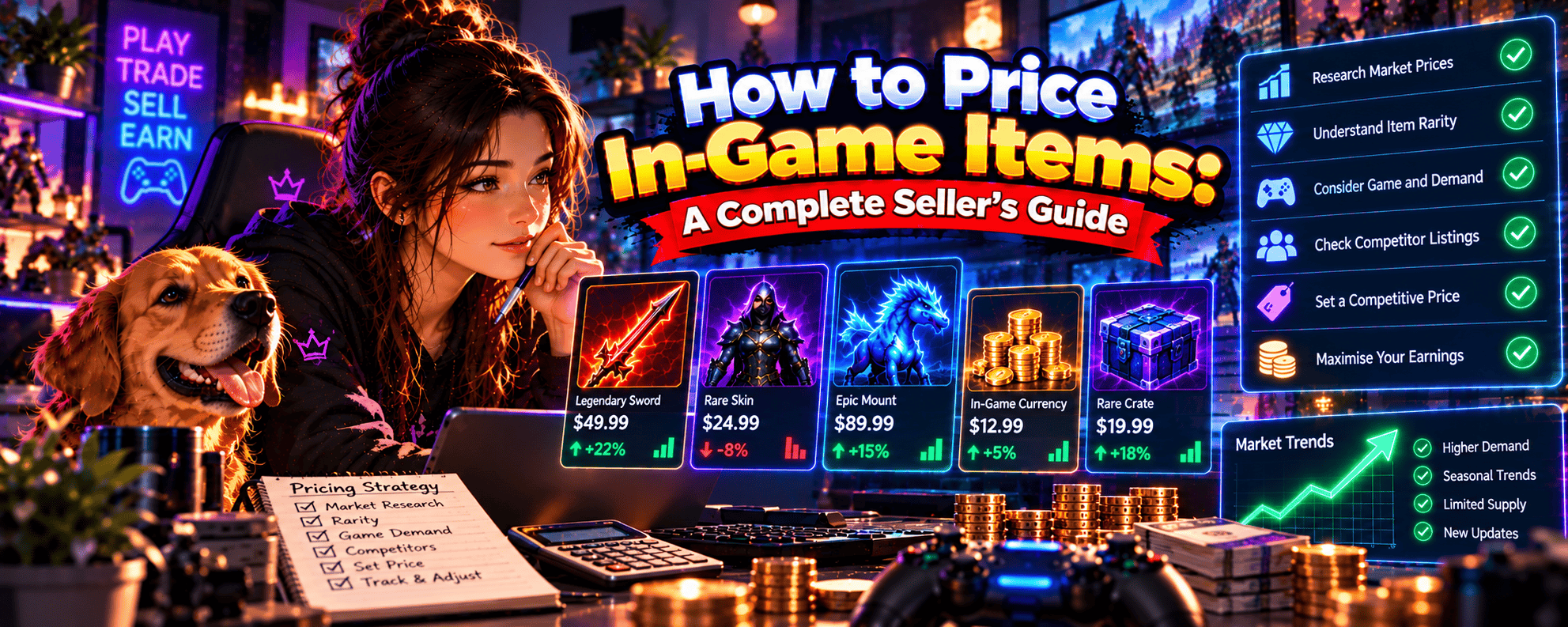
Got a rare weapon skin, valuable collectible or inventory full of gaming loot that you’re thinking about selling?
There’s one big question you need to answer before creating your listing.
How much should you charge?
Set your price too high and buyers might scroll straight past your item. Price it too low and you could end up giving away valuable loot for a fraction of what it’s worth.
And with virtual item prices changing based on rarity, demand, game updates and marketplace activity, finding the right number isn’t always straightforward.
The good news? You don’t need to be a professional trader or gaming economy expert to price your items competitively.
You just need to understand what influences item values, how to research comparable sales and how to calculate what you’ll actually earn after marketplace fees.
In this guide, we’ll explore how to price in-game items for selling online, from everyday cosmetics and weapon skins to rare collectibles with unusual attributes.
You’ll learn how to research market prices, compare selling platforms, avoid common pricing mistakes and choose an asking price that balances buyer interest with your potential earnings.
Whether you’re selling your first virtual item or looking to get more value from your gaming inventory, let’s make sure your loot gets the price it deserves.
1. How to Price In-Game Items 💰
The best way to price an in-game item is to research recent sales of comparable items, consider current buyer demand and calculate your expected earnings after selling costs.
Sounds simple enough, right?
The challenge is that virtual item markets don’t always behave like traditional shops.
Two items that look almost identical can have different prices. A rare collectible might attract buyers willing to pay hundreds of dollars, while another item with similar rarity struggles to sell for a few dollars.
Understanding the difference is the key to pricing successfully.
🎮 Why Does Pricing Matter?
Your asking price directly affects how attractive your listing appears to potential buyers.
A competitive price can help you:
- Attract more interested buyers.
- Improve your chances of making a sale.
- Avoid unnecessary price reductions.
- Earn a reasonable return on valuable items.
- Compete with similar marketplace listings.
- Build experience as a seller.
However, the lowest price isn’t always the best price.
Some items have special characteristics that justify a premium.
Others may require a discount to attract attention in a crowded marketplace.
💎 Market Value vs Asking Price
One of the most important concepts to understand is the difference between what sellers ask for an item and what buyers actually pay.
Imagine you’re researching a particular weapon skin.
You find these listings:
| Seller | Asking Price |
|---|---|
| Seller A | $42 |
| Seller B | $45 |
| Seller C | $49 |
| Seller D | $65 |
At first glance, you might assume the skin is worth somewhere between $42 and $65.
But what if recent completed sales show that similar skins are consistently selling for around $40?
That tells you something important.
The $65 listing doesn’t necessarily represent the item’s realistic market value.
It’s simply what one seller hopes to receive.
Completed sales are generally stronger evidence of buyer willingness to pay than unsold asking prices.
📊 What Is a Fair Market Price?
A fair market price is an estimate of what a willing buyer might reasonably pay for an item under current market conditions.
For gaming items, this depends on factors such as:
- Recent selling prices.
- Available supply.
- Buyer demand.
- Item condition.
- Rarity.
- Special characteristics.
- Marketplace activity.
Market value isn’t necessarily one fixed number.
Instead, you might identify a reasonable price range.
For example, if comparable items regularly sell between $38 and $43, that range may be more useful than choosing an arbitrary price of $50.
🛒 Why Do Different Marketplaces Show Different Prices?
The same item might have different prices across gaming marketplaces.
This can happen because platforms have different:
- Buyer audiences.
- Seller competition.
- Transaction fees.
- Payment methods.
- Available inventory.
- Trading restrictions.
For example, a marketplace offering cash withdrawals may have different pricing from a platform where sellers receive non-withdrawable credit.
Always consider the type of marketplace before comparing prices.
⚡ Should You Price for Profit or a Quick Sale?
That depends on your goal.
If you want to sell quickly, you might choose a price near the lower end of the realistic market range.
If you’re willing to wait, you might start closer to the upper end, particularly when your item has desirable characteristics.
For example:
| Selling Goal | Hypothetical Asking Price |
|---|---|
| Faster Sale | $38 |
| Competitive Market Price | $41 |
| Higher Asking Price | $45 |
Illustrative USD prices for the same hypothetical item.
A lower price may improve buyer interest, but it doesn’t guarantee a faster sale.
Likewise, a higher price may increase your potential proceeds but could leave the item unsold.
🏆 The Three Questions Every Seller Should Ask
Before listing an item, answer these questions.
1. What are comparable items actually selling for?
Research recent completed transactions wherever reliable information is available.
2. What makes my item different?
Consider rarity, condition, appearance and any special attributes.
3. How much will I receive after fees?
Your asking price isn’t the same as your final proceeds.
These three questions provide a practical foundation for setting a competitive price.
🎯 The Golden Rule of Pricing In-Game Items
Price your item based on current market evidence, not simply what you hope someone will pay.
Your favourite sword might have carried you through hundreds of battles.
Unfortunately, buyers aren’t usually willing to pay extra for the emotional damage you suffered obtaining it.
2. What Determines the Price of an In-Game Item? 💎
Why does one virtual weapon skin sell for a few dollars while another attracts significantly higher offers?
The answer usually involves a combination of rarity, demand, appearance, condition and market availability.
An in-game item’s value is determined by what buyers are willing to pay, influenced by its characteristics and the market in which it’s traded.
Let’s explore the biggest pricing factors.
💎 1. Item Rarity
Rarity is one of the most recognisable factors affecting virtual item prices.
Some games classify items into rarity tiers such as:
- Common.
- Uncommon.
- Rare.
- Epic.
- Legendary.
- Mythic.
However, these labels aren’t universal and don’t necessarily translate directly into real-money value.
An item labelled Legendary might be widely available, while an older collectible without a prestigious rarity label could be difficult to obtain.
Scarcity can support higher prices, but only when buyers actually want the item.
👥 2. Buyer Demand
Demand is often just as important as rarity.
Imagine two collectible items.
Item A: Extremely rare but unpopular.
Item B: Less rare but highly desirable among active players.
Item B could sell for more because more buyers are competing to obtain it.
Demand may be influenced by:
- Game popularity.
- Player preferences.
- Competitive trends.
- Cosmetic appeal.
- Collecting communities.
- Influencer attention.
- Seasonal events.
An item doesn’t need to be the rarest in the game to have strong market demand.
📦 3. Available Supply
Supply refers to how many items are available to potential buyers.
If thousands of identical items are listed, sellers may need to compete more aggressively on price.
If only a handful are available, sellers may have greater pricing flexibility.
However, limited supply doesn’t automatically guarantee a premium.
An item still needs interested buyers.
🎨 4. Appearance and Cosmetic Appeal
For cosmetic items, appearance can be a major pricing factor.
Buyers may prefer particular:
- Colour combinations.
- Weapon finishes.
- Visual effects.
- Patterns.
- Character outfits.
- Decorative features.
In games such as CS2, certain skin patterns and visual characteristics can attract collector interest.
Two skins with the same general name may have different market values because of these details.
🔍 5. Item Condition
Some games assign condition or wear characteristics to items.
For example, CS2 weapon skins may have wear classifications such as:
- Factory New.
- Minimal Wear.
- Field-Tested.
- Well-Worn.
- Battle-Scarred.
These categories can affect appearance and price.
However, condition doesn’t influence every item in the same way.
Some patterns or special characteristics may be more important than the general wear category.
⚔️ 6. Gameplay Usefulness
In games where functional equipment is transferable, usefulness can influence demand.
For example, players may value equipment that:
- Improves particular character builds.
- Supports popular gameplay strategies.
- Provides desirable attributes.
- Helps complete challenging content.
- Reduces time spent acquiring resources.
However, a game’s rules may prohibit exchanging such items for real money.
Always confirm that the proposed transaction is permitted before assigning an external selling price.
⏳ 7. Limited Availability
Some virtual items are available only during particular events or promotional periods.
Examples include:
- Seasonal cosmetics.
- Anniversary collectibles.
- Limited-release items.
- Event rewards.
- Discontinued cosmetics.
If an item becomes unavailable and demand remains strong, its price may increase.
But this isn’t guaranteed.
A developer might reintroduce an item or release alternatives that reduce demand.
🎮 8. Game Popularity
The size and activity of a game’s player community can influence item values.
A popular game with an active trading community may have more potential buyers.
However, changes in player activity can affect demand.
For example, if a game’s popularity declines significantly, interest in its virtual collectibles may also decrease.
🔄 9. Game Updates and Balance Changes
Game updates can affect virtual item economies.
Changes might include:
- New item releases.
- Adjustments to drop rates.
- Trading restrictions.
- Changes to crafting systems.
- Gameplay balance updates.
- New cosmetic alternatives.
These developments can influence both supply and demand.
A formerly desirable item may lose popularity after an update, while another becomes more attractive.
🏆 10. Special Attributes and Collector Appeal
Some items have characteristics that make them especially interesting to collectors.
For example:
- Unusual patterns.
- Rare visual combinations.
- Desirable numerical attributes.
- Limited production histories.
- Special cosmetic effects.
- Distinctive item variations.
These features may justify higher prices when there is evidence of buyer demand.
However, sellers should avoid assuming every unusual attribute automatically adds value.
📊 Factors That Influence Item Prices
| Factor | Potential Effect on Price |
|---|---|
| Rarity | Scarce items may attract premiums |
| Buyer Demand | Strong demand can support higher prices |
| Supply | More available items may increase competition |
| Appearance | Popular designs may attract more buyers |
| Condition | Desirable condition may increase value |
| Gameplay Usefulness | Useful items may attract demand where trading is permitted |
| Limited Availability | Scarcity may influence collector interest |
| Game Popularity | Active communities can support trading demand |
| Game Updates | Changes may increase or decrease value |
| Special Attributes | Desirable variations may command premiums |
💰 Which Pricing Factor Matters Most?
There isn’t one universal answer.
For an ordinary cosmetic item, recent comparable sales and buyer demand may be the strongest indicators.
For a rare collectible, specific attributes and scarcity could play a larger role.
For functional equipment, gameplay usefulness may influence value within permitted markets.
The important thing is to consider several factors together rather than relying on rarity alone.
Our What Makes an In-Game Item Valuable? guide explores these factors in greater detail.
🎯 The Golden Rule of Understanding Item Value
An item is only worth a premium when buyers recognise and are willing to pay for the characteristics that make it special.
A rare item with no interested buyers isn’t automatically a gold mine.
Sometimes it’s just a very exclusive piece of digital clutter.
3. How to Find the Current Market Price of an Item 🔍
Before deciding what to charge, you need to understand what similar items are currently worth.
Fortunately, many gaming marketplaces provide information that can help sellers research prices.
The challenge is knowing which information to trust.
The most reliable starting point is recent completed sales of genuinely comparable items, supported by current listings and market trends.
Here’s how to research an item’s price.
🎮 Step 1: Identify Your Exact Item
Start by recording the item’s important details.
Depending on the game, these might include:
- Game title.
- Exact item name.
- Item category.
- Rarity.
- Condition.
- Pattern.
- Special attributes.
- Trading restrictions.
For example, researching a CS2 weapon skin requires more than simply knowing the weapon name.
The finish, wear condition and other attributes may significantly affect its price.
Comparing the wrong variation can produce a misleading valuation.
🛒 Step 2: Search Relevant Marketplaces
Look for marketplaces that support your particular item.
Search using its exact name and relevant attributes.
Review multiple comparable listings where possible.
For example, you might find:
| Listing | Asking Price |
|---|---|
| Item A | $48 |
| Item B | $50 |
| Item C | $53 |
| Item D | $70 |
The $70 listing could represent an unusual attribute, an optimistic seller or simply an overpriced item.
You need more evidence before treating it as representative.
📊 Step 3: Look for Recent Completed Sales
Completed transactions can provide stronger evidence than active listings.
For example:
| Recent Sale | Selling Price |
|---|---|
| Sale 1 | $47 |
| Sale 2 | $49 |
| Sale 3 | $48 |
| Sale 4 | $51 |
| Sale 5 | $50 |
The average of these five hypothetical sales is $49.
That gives you a useful starting point.
However, you should also check whether the items were genuinely comparable and whether any sales were unusual.
Not every marketplace publishes completed transaction data.
If reliable sales information isn’t available, use current comparable listings more cautiously.
📈 Step 4: Review Price History
Some marketplaces and item tracking services provide historical price information.
This can help you understand whether an item’s price is:
- Increasing.
- Decreasing.
- Relatively stable.
- Experiencing unusual volatility.
For example, an item might currently be listed at $80.
But if its recent trading history shows prices around $55, you should investigate the difference.
Perhaps demand has increased.
Or perhaps current sellers are simply asking more than buyers are willing to pay.
👥 Step 5: Check Market Activity
Price alone doesn’t tell the whole story.
Consider how frequently comparable items sell.
Imagine two items.
Item A: Listed for $100, with regular completed sales.
Item B: Listed for $150, with very few transactions.
Item B has a higher advertised price, but Item A may have a more reliable market value.
Sales activity helps you assess whether a price is realistic.
🔍 Step 6: Compare Similar Item Attributes
Make sure you’re comparing like with like.
For example, two CS2 skins might share the same name but have different:
- Wear values.
- Patterns.
- Stickers.
- Special characteristics.
These differences can influence price.
Avoid comparing an ordinary item with a rare collector variation unless you account for the differences.
💰 Step 7: Identify a Realistic Price Range
Once you’ve gathered enough information, estimate a reasonable selling range.
For example:
Recent Completed Sales: $45–$52
Current Comparable Listings: $48–$60
Typical Buyer Activity: Moderate
Based on this hypothetical evidence, a seller might consider an asking price around $49–$53.
The appropriate price depends on the item’s exact characteristics and the seller’s preferred timeframe.
⚠️ Step 8: Watch Out for Misleading Price Information
Not every advertised price is reliable.
Potential warning signs include:
- Extremely high listings with no sales.
- Outdated transaction data.
- Comparisons with different item variants.
- Prices from incompatible marketplace types.
- Unusual transactions that distort averages.
- Very low trading activity.
An expensive listing isn’t proof that an item is worth that amount.
🧮 Step 9: Use More Than One Pricing Indicator
A useful pricing estimate combines several sources of information.
For example:
| Pricing Indicator | Hypothetical Finding |
|---|---|
| Recent Completed Sales | $45–$52 |
| Current Listings | $48–$60 |
| Price History | Mostly Stable |
| Buyer Demand | Moderate |
| Item Attributes | Standard Variation |
| Suggested Research Range | $48–$53 |
Illustrative USD example.
This approach is generally more reliable than choosing the highest price you can find.
🏆 Step 10: Record Your Research
If you’re planning to sell several items, keep a simple record of your findings.
Include:
- Item name.
- Date researched.
- Marketplace.
- Comparable prices.
- Recent sales.
- Relevant attributes.
- Proposed asking price.
This makes future price reviews easier.
It also helps you recognise when market conditions change.
For a more detailed walkthrough, see our How to Check What an In-Game Item Is Worth guide.
🎯 The Golden Rule of Market Price Research
Use recent, relevant and comparable market evidence rather than relying on a single listing.
If one seller wants $500 for an item everyone else is selling for $40, that doesn’t mean you’ve discovered a hidden fortune.
It might just mean someone has a very optimistic imagination.
4. How to Compare Prices Across Gaming Marketplaces 🛒
Once you’ve researched your item’s value, you might notice something interesting.
The same item can have noticeably different prices on different marketplaces.
For example, an eligible weapon skin might be advertised for $60 on one platform and $75 on another.
Does that mean one marketplace is offering a better deal?
Not necessarily.
To compare in-game item prices accurately, you need to consider item characteristics, marketplace fees, payment methods, currencies and the type of buyers using each platform.
Let’s break it down.
🎮 1. Compare the Exact Same Item
Before comparing prices, confirm that the items are genuinely equivalent.
Check:
- Exact item name.
- Game.
- Condition.
- Rarity.
- Pattern.
- Special attributes.
- Transfer eligibility.
For example, two weapon skins may look similar but have different wear values.
If those differences affect collector demand, their prices may not be directly comparable.
💳 2. Understand Cash Prices vs Platform Credit
This is one of the most important differences between marketplaces.
Some platforms allow eligible sellers to withdraw real money.
Others provide credit that can only be spent within the platform.
For example, the Steam Community Market uses Steam Wallet funds.
Steam Wallet credit isn’t equivalent to withdrawable cash.
As a result, you shouldn’t assume a $100 Steam Wallet sale has the same financial value to you as receiving $100 through a cash-paying marketplace.
💰 3. Compare Marketplace Fees
Different platforms have different fee structures.
One marketplace might charge a percentage of the sale.
Another might apply additional withdrawal costs.
Consider this hypothetical comparison.
| Marketplace | Selling Price | Total Fees | Net Proceeds |
|---|---|---|---|
| Marketplace A | $60 | $3 | $57 |
| Marketplace B | $65 | $8 | $57 |
| Marketplace C | $62 | $4 | $58 |
Illustrative USD figures, not actual marketplace fee schedules.
Marketplace B has the highest selling price.
However, Marketplace C provides the highest net proceeds in this example.
Always compare what you’ll receive, not just what the buyer pays.
🌍 4. Account for Currency Differences
Gaming marketplaces may display prices in different currencies.
For example:
- USD.
- EUR.
- GBP.
- AUD.
A price of €50 isn’t the same as $50 USD.
Exchange rates also change over time.
When comparing marketplaces, convert prices into a common currency using a consistent exchange rate.
Remember that payment providers may apply conversion margins or additional fees.
👥 5. Consider Buyer Demand
A marketplace with higher asking prices doesn’t necessarily produce better sales.
For example:
Marketplace A
Comparable items are listed for $70, but few transactions occur.
Marketplace B
Comparable items are listed for $62, with regular buyer activity.
Marketplace B might provide a better opportunity if your goal is to sell within a reasonable timeframe.
Consider both price and sales activity.
📦 6. Check Available Supply
Look at how many comparable items are listed.
If dozens of sellers are offering identical items, buyers may have plenty of choices.
If only a few are available, you may have more pricing flexibility.
However, limited supply can also indicate a small market with relatively few buyers.
⏳ 7. Compare How Quickly Items Sell
Some marketplaces may have more active buyers for particular games or item categories.
For example, a specialist skin marketplace might attract more buyers interested in specific CS2 collectibles.
A broader gaming marketplace might have a different audience.
Look for evidence of recent sales rather than assuming the largest marketplace is always the best option.
🔐 8. Consider Marketplace Restrictions
Before comparing potential earnings, confirm that the marketplace supports your item and that the proposed transaction is permitted.
Check:
- Supported games.
- Seller country eligibility.
- Trading restrictions.
- Payout requirements.
- Minimum withdrawal amounts.
- Item delivery procedures.
A higher advertised price isn’t useful if you cannot legitimately sell the item or receive the proceeds.
📊 9. Build a Simple Marketplace Comparison
Imagine you’re selling an eligible collectible.
You research three marketplaces and find:
| Factor | Marketplace A | Marketplace B | Marketplace C |
|---|---|---|---|
| Comparable Asking Price | $50 | $55 | $53 |
| Recent Sales Evidence | Strong | Limited | Moderate |
| Estimated Fees | $4 | $7 | $5 |
| Potential Net Proceeds | $46 | $48 | $48 |
| Buyer Activity | High | Low | Moderate |
Hypothetical USD example.
Marketplace B and Marketplace C offer the same estimated net proceeds.
However, Marketplace C may be more attractive if its buyer activity is stronger.
Marketplace A might be preferable if you prioritise selling speed.
The best choice depends on your goals.
🏆 10. Should You Always Choose the Highest-Paying Marketplace?
Not necessarily.
Consider the complete selling experience.
A marketplace offering slightly higher proceeds may have:
- Fewer buyers.
- Longer selling times.
- Higher withdrawal requirements.
- Additional verification.
- Different dispute procedures.
For a low-value item, convenience and selling speed might matter more than earning an extra dollar.
For an expensive collectible, even small percentage differences in fees can have a meaningful impact.
💎 11. Can You Use Prices From Different Marketplaces to Set Your Own?
Yes, provided the comparisons are relevant.
Prices from several marketplaces can help establish a broader picture of market demand.
However, account for differences in:
- Payment type.
- Fees.
- Item attributes.
- Buyer activity.
- Trading restrictions.
Avoid copying a price from another platform without understanding why it differs.
Our How to Compare In-Game Item Prices guide explains how to evaluate pricing differences and identify more useful comparisons.
🎯 The Golden Rule of Comparing Marketplace Prices
The best marketplace price is the one that offers a realistic chance of selling your item at an acceptable net return.
A $100 listing that never sells isn’t necessarily better than an $85 listing that attracts genuine buyers.
Because when you’re trying to turn virtual loot into real money, an impressive asking price doesn’t pay for anything until someone actually buys the item.
5. How to Calculate Your Selling Price and Profit 🧮
You’ve researched your item’s market value, compared similar listings and found a price range that looks reasonable.
Now comes the important part.
How much money will you actually make when the item sells?
Your asking price isn’t necessarily the amount you’ll receive, and the money you receive isn’t necessarily your profit.
Marketplace fees, withdrawal charges, currency conversion and the original cost of your item can all affect your final earnings.
Understanding these costs will help you set prices that make financial sense.
💰 1. Understand Selling Price vs Profit
There are three important figures every seller should understand.
Selling Price: The amount the buyer pays for your item.
Net Proceeds: The money remaining after applicable selling and payment fees.
Profit: Your net proceeds minus the original cost of acquiring the item and any other relevant expenses.
For example, imagine you purchased an eligible weapon skin for $40 and later sold it for $60.
If selling fees total $5, your calculation would look like this:
| Component | Amount |
|---|---|
| Selling Price | $60 |
| Marketplace Fees | -$4 |
| Withdrawal Fees | -$1 |
| Net Proceeds | $55 |
| Original Purchase Price | -$40 |
| Profit Before Tax | $15 |
Hypothetical USD example.
Although the item sold for $60, your actual profit was $15.
That’s quite a difference.
🛒 2. Understand Marketplace Commissions
Many marketplaces charge sellers a fee when an item sells.
This might be:
- A percentage of the selling price.
- A fixed transaction fee.
- A combination of both.
- A fee that varies by item category or seller account.
For example, imagine a marketplace charges a hypothetical 6% selling commission.
If your item sells for $100:
Marketplace Fee = $100 × 6% = $6
Your proceeds would be $94 before any additional charges.
Always check the marketplace’s current fee schedule rather than assuming every platform charges the same amount.
🏦 3. Include Withdrawal Fees
Some platforms charge additional fees when sellers withdraw their money.
These may include fixed charges or percentage-based fees.
For example:
Selling Price: $100 Marketplace Commission: $6 Withdrawal Fee: $2 Net Proceeds: $92
A seemingly small withdrawal charge can make a meaningful difference when you’re selling inexpensive items.
🌍 4. Consider Currency Conversion
If you sell items internationally, you may receive payment in a different currency from the one displayed on the marketplace.
Currency conversion can introduce additional costs.
These might include:
- Exchange rate margins.
- Payment provider charges.
- International transfer fees.
For accurate comparisons, calculate your expected proceeds in a consistent currency.
🧮 5. Use a Simple Profit Formula
For most straightforward sales, you can estimate your profit using:
Profit = Selling Price − Selling Fees − Withdrawal Costs − Original Item Cost − Other Relevant Expenses
For example:
$80 − $5 − $2 − $50 = $23 Profit Before Tax
This calculation is useful when deciding whether a proposed selling price is worthwhile.
📈 6. Calculate Your Minimum Selling Price
What if you want to achieve a particular profit?
You can work backwards.
Imagine:
- Original item cost: $50.
- Desired profit: $15.
- Marketplace commission: 5%.
- Fixed withdrawal fee: $2.
Your minimum selling price would be:
Minimum Selling Price = (Item Cost + Desired Profit + Fixed Fees) ÷ (1 − Commission Rate)
($50 + $15 + $2) ÷ 0.95 = $70.53
You would need to sell for approximately $70.53 to achieve your target profit under these assumptions.
However, that doesn’t mean buyers will pay that amount.
Your desired profit still needs to be realistic compared with current market prices.
🎮 7. What if You Earned the Item Through Gameplay?
If you acquired an eligible item through normal gameplay, you might not have paid a separate purchase price.
In that case, your direct financial costs may be lower.
However, you should still consider:
- Marketplace fees.
- Withdrawal charges.
- Other acquisition expenses.
- Time spent obtaining the item.
- Any applicable tax obligations.
An item earned through gameplay isn’t automatically free of economic cost.
📊 8. Compare Different Selling Prices
Imagine you’re selling an item that originally cost $30.
Your marketplace charges a hypothetical 5% commission and a $1 withdrawal fee.
| Selling Price | Net Proceeds | Profit Before Tax |
|---|---|---|
| $35 | $32.25 | $2.25 |
| $40 | $37.00 | $7.00 |
| $45 | $41.75 | $11.75 |
| $50 | $46.50 | $16.50 |
Hypothetical USD examples.
Higher selling prices produce greater potential profit, but only if buyers are willing to pay them.
That’s why profitability and market demand need to be considered together.
⚖️ 9. Check Whether Real-Money Selling Is Permitted
Before calculating potential cash earnings, confirm that the game allows the proposed transaction.
Some games support in-game trading but prohibit external real-money sales.
Others have official marketplaces that provide platform credit rather than withdrawable cash.
Our Can You Sell In-Game Items for Real Money? guide explains these differences and the restrictions sellers should understand.
🎯 The Golden Rule of Calculating Profit
Always calculate what you’ll keep after fees and costs, not just the amount displayed on your listing.
Selling a rare skin for $100 sounds impressive.
Discovering you only made $3 profit after buying it for $90 and paying fees?
Slightly less legendary.
6. Should You Price Your Item Above or Below Market Value? 📈
Once you’ve established a realistic market price, you need to decide where to position your listing.
Should you undercut competing sellers to attract buyers?
Match the going rate?
Or ask for a premium and wait for someone willing to pay more?
The best pricing strategy depends on your item’s characteristics, buyer demand and how quickly you want to sell.
Let’s explore the main approaches.
⚡ 1. Pricing Below Market Value
Pricing slightly below comparable listings can make your item more attractive to price-conscious buyers.
For example, imagine similar items are regularly selling for approximately $50.
You might list yours for $47 to encourage a quicker sale.
Potential advantages include:
- Greater price competitiveness.
- More interest from bargain hunters.
- A potentially shorter selling period.
- Reduced competition from higher-priced listings.
However, pricing below market value also has disadvantages.
You could earn less than necessary or start a price competition with other sellers.
A lower price can improve your chances of selling, but it doesn’t guarantee an immediate buyer.
💰 2. Pricing at Market Value
Pricing near the current market rate is often a sensible starting point.
For example:
Recent Comparable Sales: $48–$52 Your Asking Price: $50
This approach balances competitiveness with potential earnings.
It works particularly well when:
- Your item has standard attributes.
- There are plenty of comparable sales.
- Buyer demand is reasonably consistent.
- You aren’t under pressure to sell immediately.
For beginners, market-based pricing is generally easier to justify than setting an unusually high asking price.
🏆 3. Pricing Above Market Value
Some items may justify premium pricing.
For example, your item might have:
- A desirable pattern.
- Exceptional condition.
- Unusual attributes.
- Limited availability.
- Strong collector appeal.
Imagine standard versions of a skin sell for $50.
If your variation has a characteristic that collectors consistently pay extra for, a higher price may be reasonable.
However, you should look for evidence of actual premium sales.
Simply describing an item as rare doesn’t automatically justify charging more.
📊 Comparing Three Pricing Strategies
| Strategy | Example Price | Main Advantage | Main Risk |
|---|---|---|---|
| Below Market | $47 | Potentially faster sale | Lower proceeds |
| At Market | $50 | Balanced approach | Competes with similar listings |
| Above Market | $55 | Higher potential proceeds | Longer selling time |
Hypothetical USD example for a standard item worth approximately $50.
👥 4. Consider How Many Buyers Are Active
Pricing strategies work differently depending on demand.
High-Demand Market
If comparable items sell frequently, you may not need to discount heavily.
Low-Demand Market
If buyers are scarce, even a competitive price may take time to attract interest.
Collector Market
If your item appeals to a small group of collectors, finding the right buyer may matter more than competing on price alone.
📦 5. Consider How Much Competition Exists
Imagine there are 100 identical items listed between $40 and $45.
Listing yours for $60 probably won’t attract much attention unless it has something genuinely special.
Now imagine only three comparable items are available.
You may have more flexibility, although fewer listings don’t necessarily mean strong demand.
Always evaluate supply alongside buyer activity.
⏳ 6. How Quickly Do You Need to Sell?
Your preferred selling timeframe can influence your asking price.
If you want to sell an unwanted item without much waiting, a competitive price near the lower end of the market range may be appropriate.
If you’re selling a rare collectible and aren’t in a hurry, you might be comfortable testing a higher price.
However, waiting has its own risks.
Market prices can decline, game popularity can change and trading restrictions may be introduced.
🎮 7. Should You Always Undercut the Cheapest Seller?
Not necessarily.
The cheapest listing might:
- Have different item attributes.
- Be subject to additional restrictions.
- Come from a seller using a different pricing strategy.
- Represent an unusually low price.
- Be an outdated listing.
Check whether the competing item is genuinely comparable before adjusting your own price.
🔄 8. Can You Start High and Lower Your Price Later?
Yes, where the marketplace permits price adjustments.
Some sellers begin near the upper end of a realistic range and reduce the price if buyer interest is limited.
For example:
Initial Asking Price: $55 After Reviewing Market Activity: $52 Revised Competitive Price: $49
This approach can be useful, but repeated reductions don’t guarantee a sale.
Make adjustments based on market evidence rather than changing prices randomly.
🎯 The Golden Rule of Choosing Your Price Position
Match your pricing strategy to your selling goal while staying within a range supported by real market evidence.
If you want a fast sale, competitiveness matters.
If you’re selling a genuinely unusual collectible, patience may be worthwhile.
Just remember that setting a ridiculous asking price and hoping for a billionaire gamer to appear isn’t really a pricing strategy.
7. How to Price Rare and High-Value In-Game Items 🏆
Pricing an ordinary cosmetic item can be relatively straightforward when dozens of comparable sales are available.
But what happens when you’re selling something genuinely unusual?
Maybe you own a rare weapon skin, a discontinued collectible or an item with special attributes that few other players possess.
Rare and high-value items require more detailed research because standard market averages may not reflect their individual characteristics.
Let’s explore how to approach these items.
💎 1. Understand What Makes the Item Rare
Start by identifying the exact source of the item’s rarity.
Possibilities include:
- Limited availability.
- Low acquisition probability.
- Unusual patterns.
- Exceptional condition.
- Rare visual effects.
- Historical significance.
- Special item attributes.
Not all forms of rarity carry the same value.
For example, an item might be rare because few players ever wanted it.
That doesn’t necessarily make it desirable to collectors.
🎨 2. Research Special Patterns and Attributes
Some virtual collectibles have characteristics that significantly affect their price.
CS2 skins are a useful example.
Depending on the skin, collectors may consider:
- Float values.
- Pattern variations.
- Wear classifications.
- Stickers.
- Special finishes.
- Other distinctive characteristics.
Two items with the same general name can have very different values.
For expensive collectibles, even small differences may matter.
📊 3. Look for Comparable High-Value Sales
Ordinary marketplace listings may not provide enough information.
Look for completed sales involving items with similar characteristics.
For example, suppose you own a collectible with an unusual pattern.
You find:
| Comparable Sale | Selling Price |
|---|---|
| Similar Pattern A | $420 |
| Similar Pattern B | $460 |
| Similar Pattern C | $445 |
These sales suggest a possible pricing range.
However, differences in condition, timing and buyer demand may still affect your item’s value.
Don’t assume your item is worth exactly the average.
🔍 4. Avoid Relying on Extreme Asking Prices
Imagine you discover a similar item listed for $2,000.
That sounds promising.
But what if the last several completed sales were between $400 and $500?
The $2,000 listing doesn’t prove that buyers will pay that amount.
It may simply represent an optimistic seller.
For rare items, completed sales and credible collector demand are generally more useful than isolated high asking prices.
👥 5. Understand Collector Demand
High-value collectibles sometimes appeal to a relatively small audience.
A particular pattern or variation might be highly desirable to collectors but unimportant to ordinary players.
This can create unusual pricing behaviour.
For example, a collector might pay a substantial premium for a specific characteristic that most gamers wouldn’t notice.
However, finding that buyer may take time.
⏳ 6. Consider How Long You’re Willing to Wait
Rare items may take longer to sell.
You might have fewer potential buyers, particularly at premium prices.
Before listing, decide whether you prefer:
- A competitive price intended to attract buyers sooner.
- A market-based price supported by comparable sales.
- A premium asking price that may require patience.
None of these strategies guarantees a sale.
🛒 7. Choose a Marketplace That Supports Your Item
A specialist marketplace may be useful for particular collectible categories.
For example, platforms focused on CS2 skins may offer relevant item filters and market information.
However, check:
- Seller eligibility.
- Game and item restrictions.
- Marketplace fees.
- Payout options.
- Delivery procedures.
- Account security.
For high-value transactions, even small fee differences can affect your proceeds significantly.
💰 8. Calculate Fees Carefully
Imagine selling a rare collectible for $1,000.
Compare two hypothetical marketplace fee structures.
| Component | Marketplace A | Marketplace B |
|---|---|---|
| Selling Price | $1,000 | $1,000 |
| Commission | 5% | 8% |
| Withdrawal Fee | $5 | $5 |
| Net Proceeds | $945 | $915 |
Illustrative USD example.
The difference is $30.
That may not seem enormous compared with the total selling price, but it directly affects your return.
For particularly valuable items, the difference can be much larger.
🔐 9. Be Extra Careful With High-Value Transactions
Expensive items can attract scammers.
Be particularly cautious of:
- Buyers offering suspiciously high prices.
- Requests to move transactions off-platform.
- Fake marketplace support accounts.
- Phishing links.
- Trade impersonation.
- Requests for account credentials.
- Pressure to complete transfers immediately.
Follow approved marketplace procedures and verify transaction details independently.
📉 10. Remember That Rare Items Can Lose Value
Rarity doesn’t make an item immune to price declines.
Possible causes include:
- Changing collector preferences.
- New game content.
- Reduced player activity.
- Changes in item supply.
- Trading restrictions.
- Market volatility.
Purchasing rare items primarily for resale introduces financial risk.
🏆 11. How Does Rarity Actually Work?
Different games use different rarity systems.
Some rely on fixed item tiers, while others have complex combinations of drop rates, patterns and attributes.
Understanding the specific game’s rarity system helps you identify whether your item has characteristics buyers genuinely value.
Our How Does Item Rarity Work in Video Games? guide explains these systems and how rarity can influence perceived value.
🎯 The Golden Rule of Pricing Rare Items
Price rare items using evidence of comparable sales, genuine collector demand and the specific characteristics that make your item desirable.
A legendary rarity label might sound impressive.
But when it comes to real-money selling, buyers care more about what makes the item special than how many dramatic colours appear around its inventory icon.
8. Common In-Game Item Pricing Mistakes to Avoid ⚠️
Even experienced gamers can make pricing mistakes.
Sometimes sellers overestimate an item’s rarity.
Other times they copy an unrealistic marketplace listing or forget to calculate transaction fees.
The result?
Their items remain unsold, attract little interest or generate less money than expected.
Avoiding common pricing mistakes can help you create more competitive listings and make better selling decisions.
Here are the biggest mistakes to watch out for.
❌ 1. Pricing Based on What You Want to Earn
It’s tempting to choose a price based on your financial goal.
Maybe you want $100 for a new game.
So you list an item for $100.
Unfortunately, buyers don’t base their offers on your shopping plans.
If comparable items consistently sell for $40, asking $100 probably won’t attract much interest.
Better approach: Research the market first, then decide whether selling at a realistic price meets your goals.
💎 2. Assuming Rare Means Expensive
Rarity can influence value, but demand matters too.
An item might be extremely difficult to obtain yet attract little buyer interest.
Meanwhile, a more common cosmetic with a popular design might sell for more.
Better approach: Consider rarity alongside demand, supply and completed sales.
📈 3. Copying the Highest Marketplace Price
One of the easiest mistakes is finding the most expensive listing and assuming your item is worth the same amount.
Imagine five comparable items are listed at:
$40, $42, $45, $48 and $150.
The $150 listing doesn’t necessarily establish market value.
Better approach: Review multiple listings and recent completed sales rather than relying on an outlier.
🔍 4. Comparing Different Item Variations
Two items can share the same name but have different values.
For example, differences in:
- Condition.
- Pattern.
- Float value.
- Special attributes.
- Collectible features.
These characteristics may influence buyer demand.
Better approach: Compare your item with genuinely equivalent versions wherever possible.
💰 5. Forgetting Marketplace Fees
A seller might list an item for $50 and assume they’ll receive $50.
But marketplace commissions and withdrawal charges can reduce the final amount.
Better approach: Calculate expected net proceeds before publishing your listing.
🌍 6. Ignoring Currency Differences
A price displayed in EUR isn’t equivalent to the same number in USD.
Currency conversion fees can also affect proceeds.
Better approach: Compare prices using a consistent currency and account for conversion costs.
⏳ 7. Using Outdated Price Information
Virtual item prices can change following game updates, market activity or shifts in player demand.
A price from several months ago may no longer be relevant.
Better approach: Prioritise recent sales and review current listings before setting your asking price.
👥 8. Ignoring Buyer Demand
An item might have a high advertised price but very little trading activity.
Without buyers, that price may be difficult to achieve.
Better approach: Consider how frequently comparable items sell, not just their listed prices.
⚡ 9. Automatically Undercutting Every Seller
Some sellers constantly reduce prices to remain the cheapest.
While competitive pricing can help attract buyers, unnecessary discounting reduces potential earnings.
It can also encourage further price competition.
Better approach: Choose a realistic price based on your preferred selling timeframe and the market evidence.
🏆 10. Overvaluing Emotional Attachment
Maybe you’ve owned a particular item for years.
Perhaps you earned it after hundreds of hours of gameplay.
That history might make the item personally valuable.
However, buyers generally evaluate its transferable characteristics and market appeal.
Better approach: Separate sentimental value from realistic resale value.
🔐 11. Ignoring Trading Restrictions
Some items have temporary or permanent transfer restrictions.
Others may be tradable within a game but cannot legitimately be sold for external money.
Better approach: Confirm that the item and proposed transaction comply with the game’s rules before creating a listing.
📦 12. Listing Without Checking Available Supply
If dozens of identical items are already available at lower prices, your listing may struggle to attract attention.
Better approach: Review competing listings and adjust your strategy based on supply and demand.
🔄 13. Never Reviewing Your Price
An item might be competitively priced when you first list it.
But market conditions can change.
New listings, declining demand or game updates may make your asking price less attractive.
Better approach: Review your price periodically and adjust when supported by market evidence.
📊 Common Pricing Mistakes and Better Approaches
| Pricing Mistake | Better Approach |
|---|---|
| Choosing an arbitrary price | Research comparable sales |
| Assuming rarity guarantees value | Check buyer demand |
| Copying the highest listing | Review completed transactions |
| Comparing different variations | Match exact item attributes |
| Ignoring marketplace fees | Calculate net proceeds |
| Using outdated prices | Check recent market activity |
| Constantly undercutting sellers | Use a deliberate pricing strategy |
| Overvaluing sentimental items | Focus on market evidence |
| Ignoring transfer restrictions | Verify game and marketplace rules |
| Never updating prices | Review changing market conditions |
🎮 14. What if You’ve Already Made a Pricing Mistake?
Don’t panic.
If your item hasn’t sold, you may be able to revise your listing.
Start by reviewing:
- Recent comparable sales.
- Current competing listings.
- Item-specific attributes.
- Marketplace fees.
- Buyer demand.
- Your preferred selling timeframe.
Then adjust your asking price if the evidence supports a change.
If you’ve already sold an item for less than its potential value, treat the experience as a learning opportunity.
Researching more carefully next time can help you avoid repeating the mistake.
🎯 The Golden Rule of Avoiding Pricing Mistakes
Don’t let guesswork, emotion or unrealistic marketplace listings determine your asking price.
Good pricing decisions come from understanding your item, researching the market and knowing what you’ll receive after costs.
Because the only thing worse than watching a valuable item sit unsold for months is discovering you accidentally sold it for less than the price of a decent gaming mousepad.
9. How Often Should You Update Your In-Game Item Prices? 🔄
You’ve researched your item, calculated a competitive asking price and published your listing.
Job done, right?
Not quite.
Virtual item markets can change as new content is released, player demand shifts and competing sellers adjust their prices.
An item that was competitively priced last week might be overpriced today. Alternatively, demand could increase and make your original asking price look surprisingly cheap.
Review your in-game item prices regularly, particularly when market conditions change or your listings aren’t attracting buyers.
The trick is knowing when an adjustment is worthwhile and when it’s better to leave your price alone.
📅 1. How Frequently Should You Review Your Prices?
There’s no universal schedule that works for every item.
A sensible review frequency depends on how actively the item trades and how quickly its market changes.
| Item Type | Suggested Review Frequency |
|---|---|
| Popular, Frequently Traded Skins | Every Few Days |
| Standard Cosmetics | Weekly |
| Rare Collectibles | Weekly or When Comparable Sales Occur |
| Slow-Moving Items | Every 1–2 Weeks |
| Items Affected by Major Updates | When Relevant News or Changes Occur |
These are practical starting points rather than fixed rules.
For occasional sellers, checking prices weekly may be sufficient.
If you’re managing multiple valuable listings in an active market, more frequent reviews may be worthwhile.
📉 2. Watch for Falling Market Prices
Imagine you list an eligible weapon skin for $60.
At the time, comparable items are selling for around $58–$62.
Two weeks later, similar items are regularly selling for $48–$52.
Your original price may no longer be competitive.
Before reducing it, investigate whether the decline reflects genuine completed sales or simply a few sellers offering discounts.
A change in asking prices doesn’t always mean the underlying market value has changed.
📈 3. Look for Increasing Demand
Prices can also move upwards.
For example, a particular cosmetic might become more desirable following a game update or renewed collector interest.
If recent comparable sales are consistently higher than your asking price, it may be worth reconsidering your listing.
However, don’t assume a temporary price increase will continue indefinitely.
🎮 4. Monitor Game Updates
Game updates can affect item prices in several ways.
They may introduce:
- New cosmetics.
- Additional item supply.
- Changes to item drop rates.
- Trading restrictions.
- New crafting requirements.
- Changes to gameplay balance.
- Limited-time events.
For example, an update that increases the availability of a previously scarce item could put downward pressure on its price.
Conversely, changes that increase demand for particular items may support higher prices.
🎃 5. Consider Seasonal Demand
Some virtual items attract attention during particular events.
For example:
- Halloween-themed cosmetics.
- Holiday collectibles.
- Anniversary items.
- Seasonal event rewards.
- Items associated with major gaming competitions.
Buyer interest may increase around relevant events.
However, seasonal demand isn’t guaranteed and may already be reflected in current market prices.
👥 6. Review Competing Listings
Your price doesn’t exist in isolation.
If several sellers list equivalent items below your asking price, buyers may have little reason to choose yours.
Check whether those competing listings are genuinely comparable.
Look at condition, rarity, patterns and other relevant attributes before making adjustments.
⏳ 7. What if Your Item Hasn’t Sold?
An unsold listing doesn’t automatically mean the price is wrong.
Other possible explanations include:
- Limited buyer demand.
- Poor listing visibility.
- Incomplete item information.
- Unclear screenshots.
- Marketplace restrictions.
- A small potential buyer audience.
Before reducing your price, check whether the listing itself needs improvement.
💰 8. How Much Should You Adjust Your Price?
Avoid making arbitrary reductions.
Instead, use updated market research to establish a realistic range.
For example:
Original Asking Price: $75 Recent Comparable Sales: $65–$70 Updated Asking Price: $69
This adjustment is based on market evidence rather than guesswork.
For a rare item with limited comparable sales, you may need to be more cautious.
🏆 9. When Should You Leave Your Price Alone?
Sometimes the best decision is not to change anything.
You might keep your current price when:
- Comparable sales support it.
- Buyer demand remains stable.
- Your item has desirable attributes.
- Recent market activity is limited.
- You’re comfortable waiting for a suitable buyer.
Constantly changing prices can create unnecessary work without improving your chances of selling.
🎯 The Golden Rule of Updating Prices
Review prices regularly, but only adjust them when market evidence or your selling goals justify the change.
You don’t need to chase every tiny price movement.
Otherwise, you’ll spend more time refreshing marketplace listings than actually playing games.
And that would be a tragic use of a perfectly good gaming PC.
10. How to Price Items for a Faster Sale ⚡
Sometimes getting the highest possible price isn’t your main priority.
Maybe you’re clearing unwanted items from your inventory.
Perhaps you’ve moved on to another game and want to sell collectibles you’re no longer using.
Or maybe you’d simply prefer receiving a reasonable amount now rather than waiting weeks for a slightly higher offer.
Whatever your reason, pricing for a faster sale requires a different approach.
To improve your chances of selling an in-game item quickly, research recent sales, choose a competitive asking price and list where suitable buyers are active.
Let’s explore how to do it without unnecessarily sacrificing your earnings.
💰 1. Start With the Current Market Price
Before discounting your item, establish its realistic market value.
For example, imagine comparable items have recently sold between $45 and $50.
That gives you a useful reference point.
Without this research, you could accidentally discount an item that’s already competitively priced.
⚡ 2. Consider Pricing Near the Lower End of the Market
If your priority is selling sooner, you might list near the lower end of recent comparable sales.
For example:
| Pricing Strategy | Hypothetical Asking Price |
|---|---|
| Premium Asking Price | $53 |
| Typical Market Price | $48 |
| Competitive Quick-Sale Price | $45 |
Illustrative USD example.
A $45 asking price may attract more interest than a $53 listing for an equivalent item.
However, a lower price doesn’t guarantee a sale.
Buyer demand still matters.
👥 3. Choose a Marketplace With Active Buyers
A competitive price won’t help much if few buyers are searching for your item.
Look for marketplaces with:
- Relevant item categories.
- Recent completed transactions.
- Active listings.
- Suitable buyer audiences.
- Supported delivery methods.
For example, a specialist skin marketplace may be more relevant for particular CS2 collectibles than a general-purpose marketplace.
However, confirm that the proposed sale complies with the game’s rules.
📸 4. Make Your Listing Easy to Understand
Even a competitively priced item can struggle if buyers can’t tell exactly what they’re purchasing.
Include:
- Accurate item name.
- Game title.
- Rarity or condition.
- Relevant attributes.
- Clear screenshots.
- Correct quantity.
- Delivery information.
Avoid vague descriptions such as “Super rare item, best price!”
Buyers want useful details, not just enthusiasm.
📊 5. Compare Your Price With Direct Competitors
Imagine you’re selling a standard cosmetic item.
Current listings show:
| Competing Listing | Asking Price |
|---|---|
| Seller A | $40 |
| Seller B | $42 |
| Seller C | $43 |
| Your Original Price | $49 |
If the items are genuinely equivalent, your listing may struggle to compete.
You could consider adjusting closer to the established range.
However, don’t automatically undercut every seller.
Your item’s attributes, marketplace fees and desired return still matter.
🧮 6. Calculate Your Minimum Acceptable Price
Before offering a discount, decide what you’re willing to accept.
For example:
Original Item Cost: $25 Estimated Selling Fees: $3 Minimum Desired Profit: $7
Your minimum acceptable selling price would be approximately $35 under those assumptions.
However, if comparable items only sell for $30, the market may not support your target profit.
In that situation, you need to decide whether to accept a lower return, wait or keep the item.
🎮 7. Don’t Ignore Item-Specific Premiums
If your item has a desirable pattern, rare attribute or unusual condition, avoid pricing it like an ordinary version.
A premium collectible may require more specialised research.
Selling quickly shouldn’t mean ignoring characteristics that could materially affect its value.
⏳ 8. Consider the Trade-Off Between Time and Money
Imagine two possible outcomes.
Option A: Sell an item for $45 within a few days.
Option B: Attempt to sell it for $55, potentially waiting several weeks or longer.
Which is better?
That depends on your priorities.
If you want to clear inventory, Option A might be attractive.
If you’re comfortable waiting and market evidence supports $55, Option B could be reasonable.
Neither outcome is guaranteed.
🔄 9. Review Your Listing if Interest Is Low
If your item isn’t attracting buyers, investigate why.
Check:
- Current competing prices.
- Recent completed sales.
- Item attributes.
- Listing accuracy.
- Buyer activity.
- Marketplace suitability.
Sometimes a modest price adjustment is enough to improve competitiveness.
Other times, the issue is limited demand rather than pricing.
🛒 10. Where Should You Sell for a Faster Transaction?
Different marketplaces attract different buyers.
A platform with active demand for your particular item may provide a better selling opportunity than one with higher advertised prices but fewer transactions.
Our Where to Sell In-Game Items Online guide explores marketplace options and the factors sellers should compare.
🏆 11. Avoid Desperation Pricing
If an item isn’t selling immediately, resist the temptation to slash its price repeatedly.
This can reduce your earnings without necessarily attracting buyers.
Instead:
- Review recent sales.
- Check competing listings.
- Confirm your item details.
- Evaluate buyer demand.
- Make a considered adjustment.
A deliberate pricing strategy is usually more useful than reacting emotionally to every unsold day.
🎯 The Golden Rule of Selling Faster
Price competitively enough to attract genuine buyers while protecting the value of your item.
A faster sale can be worthwhile.
But selling a valuable collectible for pocket change simply because you’re impatient probably isn’t the achievement you were hoping to unlock.
11. How to Price Your First In-Game Item Listing 🚀
Ready to put everything into practice?
Pricing your first item doesn’t need to be complicated.
You don’t need advanced trading software, a spreadsheet full of complicated formulas or years of marketplace experience.
You just need a repeatable process that helps you research your item and choose a sensible asking price.
The easiest way to price your first in-game item is to identify its exact characteristics, research comparable sales, calculate fees and select a price aligned with your selling goals.
Here’s how to get started.
🎮 Step 1: Choose an Eligible Item
Start with an item you already own.
For example:
- A transferable weapon skin.
- An eligible cosmetic.
- A collectible.
- A permitted virtual item from a supported game.
Before considering its price, check that the item is transferable and that the proposed sale is permitted by the game’s rules.
An item being tradable doesn’t automatically mean real-money selling is authorised.
🔍 Step 2: Record Your Item’s Details
Write down the characteristics that might influence its value.
For example:
Game: CS2 Item: Example Weapon Skin Condition: Minimal Wear Pattern: Standard Variation Quantity: 1
Hypothetical item example.
Accurate identification is important because small differences can affect prices.
🛒 Step 3: Find Comparable Listings
Search marketplaces that support your item.
Look for listings with equivalent attributes.
For example:
| Comparable Listing | Asking Price |
|---|---|
| Listing A | $42 |
| Listing B | $44 |
| Listing C | $46 |
| Listing D | $49 |
These listings suggest a possible asking-price range.
However, you still need to investigate what buyers are actually paying.
📊 Step 4: Check Recent Completed Sales
Where reliable sales data is available, review recent transactions.
Imagine you find:
| Recent Sale | Selling Price |
|---|---|
| Sale 1 | $41 |
| Sale 2 | $43 |
| Sale 3 | $44 |
| Sale 4 | $42 |
The average selling price is $42.50.
That provides a useful reference point.
However, confirm that the sold items have comparable attributes and that the sales are reasonably recent.
💎 Step 5: Check for Special Characteristics
Before setting your price, ask whether your item differs from the examples you’ve researched.
For example:
- Does it have an unusual pattern?
- Is its condition particularly desirable?
- Does it include special cosmetic features?
- Is it part of a limited release?
- Does it have attributes collectors value?
If your item has distinctive characteristics, investigate whether buyers have historically paid premiums for them.
💰 Step 6: Calculate Your Expected Proceeds
Imagine you decide to list your item for $44.
Your chosen marketplace charges a hypothetical 5% commission and a $1 withdrawal fee.
| Component | Amount |
|---|---|
| Asking Price | $44.00 |
| Marketplace Commission | -$2.20 |
| Withdrawal Fee | -$1.00 |
| Expected Net Proceeds | $40.80 |
Illustrative USD example before tax and any additional costs.
If you originally purchased the item for $30, your estimated profit would be $10.80 before tax.
This calculation helps you understand whether the proposed price meets your goals.
⚡ Step 7: Choose Your Pricing Strategy
Now decide how quickly you want to sell.
Faster Sale: Consider pricing near the lower end of the supported market range.
Balanced Approach: Choose a competitive price around recent comparable sales.
Premium Approach: Consider a higher price only when item characteristics or market evidence justify it.
For a first listing, a balanced market-based price is generally a sensible starting point.
✍️ Step 8: Create an Accurate Listing
Your listing should make it easy for buyers to understand what they’re purchasing.
Include:
- Exact item name.
- Relevant attributes.
- Clear description.
- Accurate screenshots.
- Asking price.
- Delivery information.
- Any important restrictions.
Avoid unsupported claims such as “Guaranteed rarest item” or “Price will definitely double.”
🔐 Step 9: Check the Marketplace’s Rules
Before publishing, confirm:
- Your item is supported.
- The proposed transaction is permitted.
- You meet seller eligibility requirements.
- You understand the fees.
- You know how delivery works.
- You can receive the proceeds through an available payment method.
This helps avoid unpleasant surprises after a buyer places an order.
🚀 Step 10: Publish Your Listing
Once you’re satisfied with the details and price, publish the listing.
Follow the marketplace’s instructions.
Don’t provide account credentials or transfer items outside approved transaction procedures.
📈 Step 11: Monitor Buyer Interest
After publishing, review your listing periodically.
Look for changes in:
- Comparable asking prices.
- Completed sales.
- Buyer demand.
- Available supply.
- Game-related developments.
If the market changes, consider whether your asking price still makes sense.
🔄 Step 12: Learn From the Result
Whether your item sells quickly or takes longer than expected, the experience can help improve your future pricing decisions.
Ask yourself:
- Was my initial valuation realistic?
- Did I compare the correct item variations?
- Were the marketplace fees acceptable?
- Did I choose a suitable platform?
- Was my listing clear?
- Would I use the same pricing strategy again?
Over time, this process can help you make more informed selling decisions.
📊 First Listing Pricing Example
Here’s how the entire process might look.
| Step | Hypothetical Result |
|---|---|
| Item | Eligible Weapon Skin |
| Recent Comparable Sales | $41–$44 |
| Current Asking Prices | $42–$49 |
| Chosen Asking Price | $44 |
| Estimated Fees | $3.20 |
| Expected Net Proceeds | $40.80 |
| Original Purchase Cost | $30 |
| Potential Profit Before Tax | $10.80 |
Illustrative USD example.
This approach provides a clear basis for your price rather than relying on guesswork.
For a complete guide to creating listings, managing transactions and selling eligible gaming items, see How to Sell In-Game Items Online.
🎯 The Golden Rule of Pricing Your First Listing
Start with an eligible item you understand, use recent market evidence and calculate your expected proceeds before publishing.
You don’t need to get every decision perfect on your first attempt.
The goal is to develop a reliable process you can use again.
And unlike that boss fight you’ve attempted 37 times, pricing an item shouldn’t require memorising a complicated attack pattern.
12. How to Price In-Game Items: FAQ ❓
💰 How Do I Know What My In-Game Item Is Worth?
Research recent completed sales of comparable items on relevant marketplaces.
Consider rarity, condition, special attributes, buyer demand and current supply.
Avoid relying on a single advertised price.
🎮 What’s the Best Way to Price In-Game Items?
Start with recent comparable sales, identify a realistic market range and calculate your expected proceeds after fees.
Then choose an asking price based on your item’s characteristics and how quickly you want to sell.
📉 Should I Use the Lowest Marketplace Price?
Not necessarily.
The cheapest listing may have different attributes or represent an unusually low price.
Compare genuinely equivalent items and consider completed sales before setting your price.
💎 How Much Should I Charge for Rare Skins?
Rare skins may require more detailed research.
Look for completed sales involving comparable patterns, condition and other desirable characteristics.
A rarity label alone doesn’t establish value.
🔍 Why Do Identical-Looking Items Have Different Prices?
Items that appear identical may have different underlying attributes.
For example, CS2 skins can vary by wear value, pattern and other characteristics.
Marketplace fees and seller pricing strategies can also create differences.
🛒 Why Are Prices Different Across Marketplaces?
Prices vary because marketplaces have different buyers, sellers, fee structures and payment arrangements.
Some platforms offer withdrawable cash, while others provide non-withdrawable credit.
These differences affect how prices should be compared.
🧮 How Do Marketplace Fees Affect My Asking Price?
Fees reduce your net proceeds.
For example, if you sell an item for $50 and total fees are $5, you’ll receive $45 before tax and any other costs.
Calculate expected proceeds before listing.
⚡ Should I Price Below Market Value to Sell Faster?
Pricing slightly below comparable listings may improve buyer interest.
However, a lower price doesn’t guarantee a sale.
Consider buyer demand, item attributes and your minimum acceptable return.
📈 Can I Sell an Item Above Market Value?
Potentially.
A higher price may be justified by desirable attributes, limited supply or strong collector demand.
However, pricing above comparable items can increase the time required to find a buyer.
🔄 How Often Should I Update My Item Prices?
Review prices when market conditions change or when a listing isn’t attracting interest.
Popular items may benefit from more frequent reviews, while slower-moving collectibles may need less frequent adjustments.
⏳ Should I Lower My Price if an Item Isn’t Selling?
Possibly, but investigate the reason first.
Check comparable sales, buyer demand, competing listings and the quality of your description.
An unsold item isn’t always overpriced.
📉 Can In-Game Item Prices Change Overnight?
Yes.
Game updates, trading restrictions, market activity and sudden changes in demand can affect prices quickly.
However, not every short-term movement represents a lasting change in value.
🏆 Is It Better to Sell Quickly or Wait for a Higher Price?
That depends on your goals.
Selling quickly may provide more immediate proceeds, while waiting could produce a higher price if demand supports it.
However, prices can also decline while you’re waiting.
💰 How Do I Calculate Profit From Selling an Item?
Subtract marketplace fees, withdrawal costs, original acquisition costs and other relevant expenses from your selling price.
For example:
Selling Price: $80 Total Selling Fees: $6 Original Purchase Cost: $50 Profit Before Tax: $24
🎮 Can I Price Items I’ve Earned Through Gameplay?
Yes, if the item is transferable and the proposed sale is permitted.
Research comparable market transactions just as you would for a purchased item.
Remember that items acquired through gameplay may still involve time and other costs.
🔐 Can I Sell Any Tradable Item for Real Money?
No.
Some games allow item transfers but prohibit external cash sales.
Check the game’s current terms and marketplace rules before listing.
🛒 Where Should I List My In-Game Items?
Choose a marketplace that supports your item and permitted transaction.
Compare buyer activity, selling fees, payout options and delivery procedures.
A specialist marketplace may be more suitable for certain collectibles, while broader gaming marketplaces may support different categories.
🏆 What’s the Biggest Pricing Mistake Beginners Make?
One of the most common mistakes is confusing asking prices with actual market value.
An item listed for $500 isn’t necessarily worth $500.
Recent completed sales generally provide stronger evidence of what buyers are willing to pay.
🎯 Final Thoughts: How to Price In-Game Items Successfully
Learning how to price in-game items is about understanding what buyers are willing to pay and choosing a realistic asking price based on current market evidence.
Whether you’re selling an everyday cosmetic, a valuable weapon skin or a rare collectible, the same fundamental principles apply.
Research comparable sales, understand what makes your item desirable, account for marketplace fees and choose a pricing strategy that suits your goals.
Don’t assume rarity guarantees value, don’t copy unrealistic asking prices and don’t forget to calculate what you’ll actually receive after costs.
For beginners, starting with an eligible item already in your inventory is a practical way to develop your pricing skills without purchasing additional inventory.
As you gain experience, you’ll become more confident evaluating demand, comparing marketplaces and adjusting prices when conditions change.
StackedGame provides a gaming-focused marketplace where sellers can explore eligible in-game item listings and other gaming-related opportunities.
The goal isn’t simply to list your item for the highest possible price. It’s to find a price that attracts genuine buyers while delivering a return you’re happy with.
Because turning unwanted gaming loot into real money is satisfying.
Turning it into real money without accidentally underselling your rarest collectible?
That’s an achievement worth unlocking.