Got a rare CS2 skin, valuable gaming collectible or an inventory full of items you no longer use?
You might be sitting on something other gamers would happily pay for.
But before you start counting your earnings, there’s an important question to answer:
Where can you actually sell in-game items online and receive real money?
The answer depends on what you’re selling, which game it comes from and whether the game permits the transaction.
Some marketplaces specialise in weapon skins. Others support a broader range of virtual gaming products. Certain platforms offer cash payouts, while others only provide credit you can spend within their ecosystem.
And not every marketplace that accepts an item is necessarily authorised by the game’s developer.
Choosing the right platform matters. A good marketplace can help you reach interested buyers, understand your item’s value and complete transactions through a clear selling process.
A poor choice could leave you paying excessive fees, struggling to find buyers or risking your gaming account.
In this guide, we’ll explore the best places to sell eligible in-game items online, compare different marketplace options and explain how to choose a platform that suits your inventory.
Whether you’re selling your first virtual item or clearing out years of accumulated loot, let’s find out where that gaming treasure might actually be worth something.
1. Where to Sell In-Game Items Online 🎮
You can sell eligible in-game items through official game marketplaces, specialised third-party gaming marketplaces and permitted player-to-player trading platforms.
The best option depends on the game, item type, available buyers and how you want to receive payment.
For example, a gamer selling an eligible CS2 weapon skin has different marketplace options from someone trying to sell equipment from an RPG.
Some games have well-established trading economies, while others prohibit external sales altogether.
🛒 What Are Your Main Selling Options?
There are four broad options worth understanding.
1. Official Game Marketplaces
These are marketplaces operated by a game developer or platform provider.
They may offer integrated item transfers and familiar trading systems.
However, proceeds may be restricted to platform credit rather than withdrawable cash.
2. Specialised Skin Marketplaces
These platforms focus on particular games or virtual item categories.
For example, some marketplaces specialise in CS2 weapon skins and related collectibles.
They may offer real-money payouts, subject to their rules and eligibility requirements.
3. General Gaming Marketplaces
These marketplaces support multiple gaming categories.
Depending on the platform, sellers may be able to list eligible virtual items, gaming services or other digital products.
4. Gaming Communities and Player-to-Player Trading
Some gamers connect through forums, Discord communities or game-specific trading groups.
These can help sellers discover potential buyers, although direct transactions may carry additional risks and offer fewer protections.
💰 Selling for Cash vs Marketplace Credit
One of the biggest differences between selling platforms is what you receive after a successful transaction.
Consider these two examples.
Example A: Marketplace Credit
You sell an eligible item for $50 through a marketplace that credits your platform wallet.
You now have $50 in platform credit, subject to its terms.
However, you may not be able to withdraw that money into your bank account.
Example B: Real-Money Payout
You sell an eligible item for $50 through a marketplace that supports cash withdrawals.
After applicable fees, the remaining proceeds may be available through a supported payout method.
These are very different outcomes.
If your goal is earning real money, make sure the marketplace supports withdrawable proceeds before listing anything.
📊 Comparing Your Selling Options
| Marketplace Type | Best Suited For | Payment Consideration |
|---|---|---|
| Official Game Marketplace | Supported in-game items | May provide platform credit |
| Specialised Skin Marketplace | Eligible weapon skins and collectibles | May support cash withdrawals |
| General Gaming Marketplace | Multiple eligible gaming categories | Depends on platform |
| Gaming Communities | Finding interested players | Transaction protections vary |
| Direct Player Sales | Permitted private transactions | Higher payment and delivery risks |
🎮 Does Every Game Allow Item Selling?
No.
Some games support item trading but prohibit selling items for external payment.
Others restrict transfers entirely.
Before choosing a marketplace, check:
- Whether the item is tradable.
- Whether real-money sales are permitted.
- Whether third-party marketplaces are allowed.
- Whether the item has transfer restrictions.
- Whether the proposed delivery method complies with game rules.
An item being listed on a third-party website doesn’t automatically mean selling it is permitted.
🏆 Which Selling Option Is Best for Beginners?
Beginners should generally prioritise marketplaces with clear listing procedures, transparent fees, understandable payment arrangements and appropriate transaction safeguards.
Start with an eligible item you already own.
Research its approximate value and learn how the platform handles orders, delivery and payouts.
You don’t need to become a professional virtual-item trader overnight.
Sometimes selling one unwanted skin successfully is a better starting point than attempting to launch a full-scale digital loot empire.
2. What Types of In-Game Items Can You Sell? 💎
Before deciding where to sell, you need to understand what you’re actually offering.
Different marketplaces specialise in different types of virtual items.
A platform designed for CS2 skins might not support RPG equipment, while a broader gaming marketplace may have categories for several games.
The most suitable marketplace is one that supports your specific item and a transaction permitted by the game’s rules.
Let’s explore the main item categories.
🎨 1. Weapon Skins and Cosmetics
Cosmetic items change the appearance of weapons, characters or other game elements.
Examples include:
- Weapon skins.
- Character outfits.
- Decorative accessories.
- Cosmetic finishes.
- Special visual effects.
- Collectible appearances.
Certain CS2 weapon skins have established secondary-market demand.
Their value can depend on condition, pattern, rarity and buyer interest.
However, cosmetics in many other games cannot be transferred between accounts.
Don’t assume an item is resellable simply because you purchased it from an in-game store.
⚔️ 2. Weapons and Equipment
Some games allow players to trade weapons, armour and other functional equipment.
Examples might include:
- Swords and ranged weapons.
- Armour sets.
- Shields.
- Accessories.
- Equipment with special modifiers.
- Character build components.
These items may attract interest because of their gameplay usefulness.
For example, equipment with desirable attributes could be valuable within a game’s trading economy.
However, in-game trading permission does not automatically authorise real-money selling.
This distinction is especially important for RPGs and online multiplayer games.
💎 3. Rare and Collectible Items
Some items are valuable primarily because of their scarcity or collectible appeal.
These might include:
- Limited-release cosmetics.
- Unusual item variants.
- Discontinued collectibles.
- Event-related items.
- Rare decorative objects.
Collectors may be interested in items that are difficult to obtain.
However, scarcity alone doesn’t guarantee demand.
An item can be extremely rare and still have very few potential buyers.
🧱 4. Crafting Materials and Resources
Some games support trading materials used to create or upgrade equipment.
Examples include:
- Ores and minerals.
- Crafting ingredients.
- Gems.
- Upgrade materials.
- Special resources.
- Transferable consumables.
These items may be more common than rare collectibles, but demand can be driven by players who need large quantities.
Again, check whether external sales are permitted.
🏆 5. Event and Seasonal Items
Limited-time events sometimes introduce exclusive virtual items.
Examples include:
- Anniversary collectibles.
- Seasonal cosmetics.
- Special event rewards.
- Promotional items.
- Limited-edition decorations.
Some remain transferable after an event ends.
Others become permanently bound to the original account.
Availability and transferability need to be checked separately.
🎮 6. Game-Specific Virtual Collectibles
Certain games have unique virtual economies.
Their items might include decorative objects, special accessories, digital collectibles or other transferable assets.
These items don’t always fit neatly into conventional categories such as weapons or armour.
When evaluating where to sell them, look for marketplaces that specifically support the game and the relevant item type.
🔐 7. Tradable vs Non-Tradable Items
One of the most important factors is whether the item can actually be transferred.
Tradable items can be exchanged between players through supported systems.
Non-tradable items may be permanently restricted to a particular account or character.
Some items are also subject to temporary trade locks.
An item that cannot be transferred generally cannot be delivered through a normal item-sale transaction.
📊 Which Items Suit Different Marketplace Types?
| Item Category | Potential Marketplace Type | Main Consideration |
|---|---|---|
| CS2 Weapon Skins | Specialised Skin Marketplace | Condition, pattern and trade restrictions |
| Tradable Cosmetics | Game-Specific Marketplace | Transferability and game rules |
| RPG Equipment | Permitted Game Trading System | External sale restrictions |
| Rare Collectibles | Supported Specialist Marketplace | Buyer demand and authenticity |
| Crafting Materials | Game-Specific Trading Platform | Quantity and transfer rules |
| Event Items | Compatible Marketplace | Whether the item remains tradable |
For a more detailed breakdown, see our Types of In-Game Items Explained guide.
🎯 The Golden Rule of Choosing Items to Sell
Choose the marketplace based on the item, not the other way around.
A website with thousands of buyers won’t help much if it doesn’t support your game or item.
And a legendary sword isn’t automatically sellable just because it has a shiny border and a name that sounds like it belongs in an ancient prophecy.
3. Official Game Marketplaces vs Third-Party Marketplaces ⚖️
One of the biggest decisions sellers face is whether to use an official marketplace or an independent trading platform.
Both approaches can have advantages.
However, they differ in important areas, including supported items, fees, payment methods and transaction rules.
Official marketplaces often provide closer integration with a game or platform, while third-party marketplaces may offer additional selling options and cash payouts where permitted.
Understanding the differences helps you make an informed decision.
🎮 1. What Is an Official Game Marketplace?
An official marketplace is operated by a game developer, publisher or platform provider.
It typically supports specific items associated with its games or services.
For example, the Steam Community Market allows users to buy and sell eligible items using Steam Wallet funds.
Potential advantages include:
- Integration with supported inventories.
- Established platform processes.
- Familiar account systems.
- Defined trading rules.
- Convenient access for existing users.
However, official marketplaces may restrict how proceeds can be used.
💳 2. The Biggest Limitation: Platform Credit
A marketplace sale doesn’t always produce withdrawable money.
For example, Steam Community Market proceeds are generally credited to Steam Wallet.
Steam Wallet funds cannot ordinarily be withdrawn directly as cash.
This can be perfectly suitable if you want to purchase games or other eligible Steam products.
But it’s less suitable if your objective is receiving money in your bank account.
🛒 3. What Is a Third-Party Gaming Marketplace?
A third-party marketplace is operated independently of the game developer or platform provider.
Depending on the service, it may support:
- Eligible weapon skins.
- Virtual collectibles.
- Other transferable gaming items.
- Multiple game categories.
- Real-money payouts.
Some specialise in particular games, while others cover a broader range of gaming products.
However, independent marketplaces vary considerably in their operating models and protections.
💰 4. Why Do Sellers Use Third-Party Marketplaces?
Potential advantages include:
- Access to additional buyers.
- Cash payout options.
- Different fee structures.
- Specialist item categories.
- Alternative listing features.
- Different pricing and discovery tools.
For example, a seller interested in converting an eligible skin into withdrawable funds may prefer a marketplace that supports cash payouts rather than one offering only platform credit.
However, availability depends on the marketplace and the seller’s circumstances.
🔐 5. Are Third-Party Marketplaces Safe?
Safety varies between platforms.
A reputable marketplace may provide structured order processes, account security measures and dispute procedures.
However, independent platforms can also introduce risks such as phishing, impersonation, payment disputes and misleading websites.
Research the platform before using it.
Check its actual website address, payment terms, fees and support arrangements.
⚠️ 6. Are Third-Party Sales Always Permitted?
No.
This is one of the most important distinctions.
A game might allow item transfers while prohibiting external real-money transactions.
The existence of a third-party marketplace doesn’t override the game’s terms.
You should verify whether your proposed transaction is permitted before listing.
📊 Official vs Third-Party Marketplaces
| Feature | Official Marketplace | Third-Party Marketplace |
|---|---|---|
| Operator | Game or Platform Provider | Independent Business |
| Game Integration | Often Direct | Varies |
| Supported Items | Platform-Specific | May Be Specialist or Multi-Game |
| Payment | May Be Platform Credit | May Support Cash Payouts |
| Fees | Platform-Defined | Provider-Defined |
| Item Delivery | Often Integrated | Depends on Trading Systems |
| Account Requirements | Official Platform Rules | Marketplace and Game Rules |
| Transaction Protection | Platform-Specific | Varies by Provider |
🤝 7. What About Direct Player Trading?
Some games provide player-to-player trading interfaces.
These can be useful for exchanging items through authorised systems.
However, arranging external payment separately can introduce additional risks and may breach game rules.
A trade window isn’t automatically a secure payment system.
Our How Does In-Game Item Trading Work? guide explains the different trading models and how virtual item transfers operate.
🏆 8. Which Marketplace Type Should You Choose?
Consider an official marketplace when:
- You want to trade supported items within the platform.
- Platform credit meets your needs.
- You prefer integrated inventory systems.
- The available fees and rules are acceptable.
Consider a third-party marketplace when:
- Your game permits the proposed transaction.
- The marketplace supports your item.
- You want an eligible cash payout.
- You understand its fees and protections.
- You can follow its approved delivery procedures.
🎯 The Golden Rule of Marketplace Selection
Choose based on what you’re selling, what you want to receive and whether the transaction is permitted.
An official marketplace isn’t automatically the best choice for every seller.
And a third-party marketplace isn’t automatically better simply because it advertises cash payouts.
The right choice is the one that supports your item and your selling objectives without creating unnecessary risks.
4. Best Places to Sell In-Game Items Online 🛒
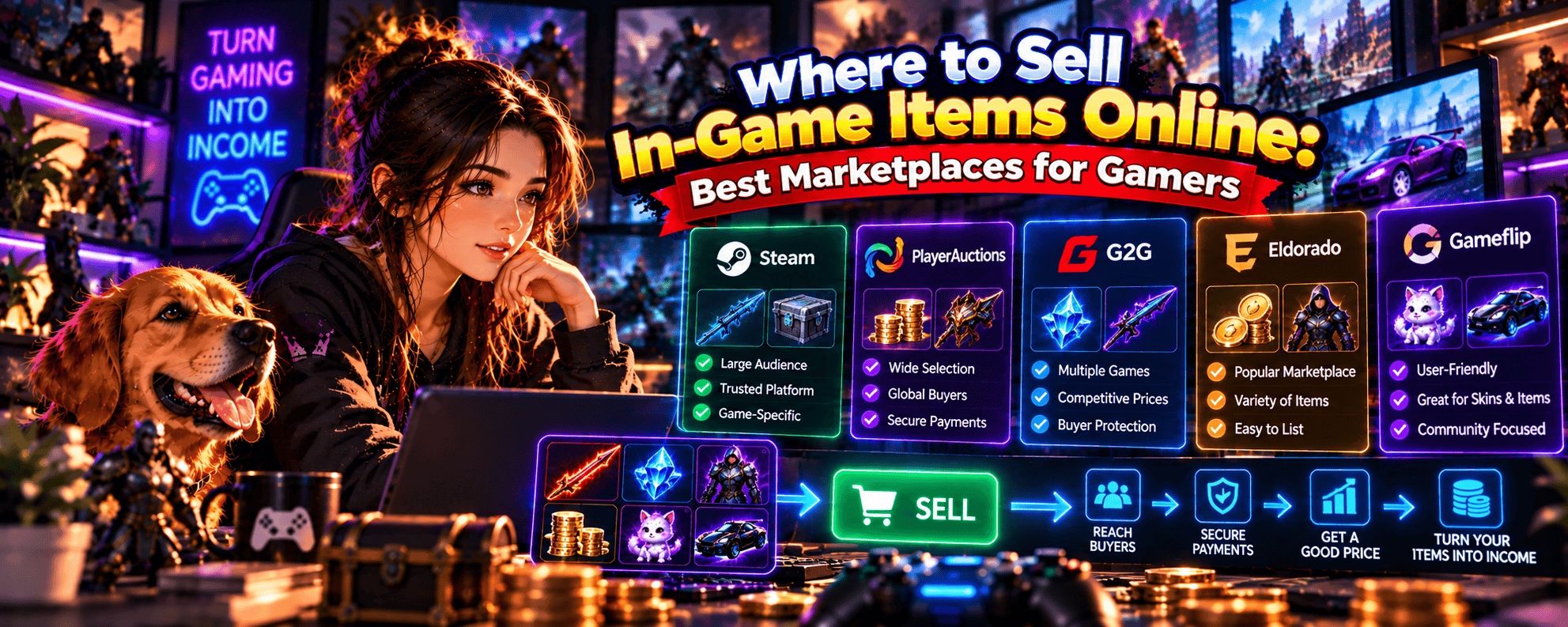
Now that you understand the different marketplace types, let’s look at some actual platforms.
There isn’t one marketplace that’s best for every gamer.
Some specialise in CS2 skins, others support multiple gaming categories and some are designed primarily for trading within a particular ecosystem.
The best place to sell your in-game items is a marketplace that supports your specific items, has relevant buyer demand and offers payment arrangements that meet your needs.
Here are five options worth comparing.
🎮 1. Steam Community Market – Best for Official Steam Marketplace Trading

Website: steamcommunity.com/market
The Steam Community Market is an established marketplace for eligible items associated with supported Steam games.
Players can list items from compatible inventories and receive Steam Wallet funds when sales are completed.
What Can You Sell?
Depending on eligibility:
- CS2 weapon skins.
- Dota 2 items.
- Team Fortress 2 items.
- Other supported Steam inventory items.
Advantages
- Official Steam marketplace.
- Integrated inventory and listing systems.
- Established buyer ecosystem.
- Straightforward access for eligible Steam users.
Limitations
The biggest limitation is that Steam Community Market proceeds are not withdrawable as cash.
Steam confirms that Community Market transactions use Steam Wallet funds, which cannot be transferred to a bank account.

Steam Support
Best For: Gamers who want to sell eligible Steam items and use the proceeds within Steam.
💰 2. Skinport – Best for Selling Eligible Skins for Cash

Website: skinport.com
Skinport is a specialist marketplace for virtual gaming skins, particularly CS2 items.
It provides a marketplace for sellers looking to convert eligible virtual items into real-money proceeds.
What Can You Sell?
Supported item categories include eligible gaming skins and collectibles, with availability depending on the platform’s current inventory support.
Advantages
- Specialised skin marketplace.
- Focus on collectible virtual items.
- Real-money selling model.
- Established item listings and pricing.
Fees
Skinport announced a standard selling fee of 8%, with a 6% rate for items over €1,000 and 2% for qualifying private sales. Verify the applicable fee before listing.
Skinport Blog
Limitations
- Primarily suitable for supported skin categories.
- Payout eligibility and methods depend on the seller’s circumstances.
- Not a general marketplace for every game.
Best For: Gamers selling eligible CS2 skins who want a specialist marketplace with cash payout options.
⚔️ 3. CSFloat – Best for CS2 Skin Trading and Competitive Fees

Website: csfloat.com
CSFloat is a specialist marketplace focused on Counter-Strike skins.
It uses a peer-to-peer trading model where sellers transfer eligible items directly to buyers through Steam’s trading system.
What Can You Sell?
Primarily supported CS2 skins and related eligible collectibles.
Advantages
- Specialist CS2 marketplace.
- Peer-to-peer item transfers.
- Detailed skin information.
- Cash withdrawal options in supported locations.
- Competitive published selling fees.
Fees and Payouts
CSFloat advertises a 2% selling fee, with additional withdrawal fees that depend on the payout method and seller circumstances. It also explains that seller proceeds can be subject to a holding period before withdrawal.
csfloat.com
+1
Limitations
- Primarily focused on CS2.
- Sellers need to understand Steam trading procedures.
- Payout timing and availability vary.
Best For: CS2 skin sellers who want specialist trading features and competitive fees.
🛒 4. Gameflip – Best for Multiple Gaming Item Categories

Website: gameflip.com
Gameflip is a broader gaming marketplace supporting various gaming-related products.
Unlike platforms focused almost exclusively on CS2 skins, Gameflip offers multiple categories for eligible gaming products.
What Can You Sell?
Depending on current platform support:
- Eligible in-game items.
- Gaming skins.
- Certain virtual gaming products.
- Game keys and other supported digital products.
Advantages
- Multiple gaming categories.
- Seller listings and order management.
- Supported cash withdrawal methods.
- Structured payment and delivery procedures.
Fees
Gameflip’s published fee structure includes an 8% commission plus a fixed charge, a 2% partner fee and a further 2% fee for applicable digital items. Withdrawal fees may also apply.
Gameflip Help
Limitations
- Fees can be higher than some specialist marketplaces.
- Item support varies by game.
- Sellers must follow identity verification and delivery requirements.
Gameflip’s official guidance also explains that sellers should wait for payment confirmation before delivering items.
Gameflip Help
Best For: Gamers selling different types of eligible virtual gaming products rather than focusing exclusively on CS2 skins.
🚀 5. StackedGame – Best for Exploring Broader Gaming Selling Opportunities
Website: stackedgame.com
StackedGame is a gaming-focused marketplace designed to connect buyers and sellers of gaming products and services.
Its marketplace includes categories for in-game items and other gaming-related offerings.
What Can You Sell?
Subject to game rules and marketplace requirements, sellers can explore listing eligible in-game items and other supported gaming products.
Advantages
- Gaming-focused marketplace.
- Dedicated in-game item category.
- Ability to describe specific items and selling terms.
- Opportunities to explore other gaming-related product and service categories.
Things to Consider
As with any marketplace, sellers should confirm item eligibility, current fees, supported payment arrangements and the transaction process before listing.
Marketplace exposure does not guarantee that an item will sell.
Best For: Gamers who want to explore listing eligible in-game items alongside broader gaming marketplace opportunities.
📊 Comparing the Best In-Game Item Selling Marketplaces
| Marketplace | Main Focus | Payment Model |
|---|---|---|
| Steam Community Market | Supported Steam Items | Steam Wallet Credit |
| Skinport | Gaming Skins | Eligible Cash Payouts |
| CSFloat | CS2 Skins | Eligible Cash Payouts |
| Gameflip | Multiple Gaming Categories | Supported Cash Withdrawals |
| StackedGame | Gaming Items and Services | Check Current Seller Terms |
🏆 Which Marketplace Should You Choose?
The answer depends on what you’re selling.
If you want to sell an eligible Steam item and spend the proceeds on other Steam purchases, the Steam Community Market may be convenient.
If you’re selling CS2 skins and want withdrawable money, specialist marketplaces such as Skinport and CSFloat may be worth comparing.
If you’re selling other eligible gaming products, broader marketplaces such as Gameflip and StackedGame may be relevant options.
Before committing, compare the actual proceeds you’d receive after fees, the availability of buyers and the permitted delivery process.
🎯 The Golden Rule of Comparing Marketplaces
Don’t choose a marketplace simply because it advertises the highest prices or lowest fees.
A slightly higher selling price means little if the item never sells, the fees consume your earnings or you cannot withdraw the proceeds.
Choose a platform that supports your item, provides clear transaction arrangements and gives you a realistic opportunity to reach buyers.
After all, the goal is to sell your virtual treasure, not leave it permanently displayed in five different marketplace listings.
5. Where to Sell In-Game Items for Real Money 💰
Selling an in-game item is one thing. Actually receiving real money is another.
Some marketplaces allow you to sell items but only provide credit that can be spent within their platform. Others support withdrawals to a bank account or an approved payment provider.
If your goal is to turn unused gaming items into extra income, choosing a marketplace that supports real-money payouts is essential.
Let’s look at how cash selling works and what to check before listing.
💳 1. Understand the Difference Between Cash and Store Credit
Not all marketplace balances are created equal.
For example, if you sell a CS2 skin for $50 on the Steam Community Market, the proceeds are credited to your Steam Wallet.
You can use those funds for eligible Steam purchases, but you cannot ordinarily withdraw them into your bank account.
By comparison, certain independent skin marketplaces support real-money withdrawals.
| Selling Method | What You Receive | Can You Withdraw Cash? |
|---|---|---|
| Steam Community Market | Steam Wallet Funds | No |
| Skinport | Eligible Sale Proceeds | Yes, subject to requirements |
| CSFloat | Eligible Sale Proceeds | Yes, subject to requirements |
| Gameflip | Marketplace Sale Proceeds | Supported withdrawal options |
| StackedGame | Proceeds under marketplace payment arrangements | Confirm current seller terms |
Before listing, check what the marketplace means by balance, earnings and available funds.
They aren’t always interchangeable.
🏦 2. Check Available Withdrawal Methods
Depending on the marketplace and your country, supported withdrawal methods may include:
- Bank transfers.
- Approved payment providers.
- Other supported payout services.
Some payment options may only be available in certain countries.
Others require identity verification or have minimum withdrawal amounts.
If you’re selling from Australia, for example, check whether the marketplace supports Australian sellers and bank accounts before creating listings.
⏳ 3. Understand When Your Money Becomes Available
Receiving an order doesn’t necessarily mean you can immediately withdraw the proceeds.
Marketplaces may apply holding periods for:
- Payment verification.
- Item delivery confirmation.
- Fraud prevention.
- Buyer disputes.
- Seller verification.
A platform may show a completed sale while the proceeds are still pending release.
Review the payout conditions before accepting transactions.
💰 4. Calculate Your Actual Cash Proceeds
Imagine you’re selling a rare skin for $100.
Your potential earnings might look like this:
| Component | Amount |
|---|---|
| Selling Price | $100 |
| Marketplace Fee | -$5 |
| Withdrawal Fee | -$2 |
| Currency Conversion Cost | -$1 |
| Cash Proceeds Before Tax | $92 |
Hypothetical USD example, not the fee schedule of any particular marketplace.
The buyer pays $100, but you receive $92.
If another marketplace charges higher fees, the difference could become significant when selling multiple items.
🔐 5. Verify the Marketplace Before Connecting Your Account
Before using an unfamiliar platform:
- Confirm you’re visiting its genuine website.
- Review its payment and withdrawal policies.
- Check whether it supports your game and item.
- Understand its seller verification requirements.
- Look for credible information about transaction protections.
- Check whether your proposed sale complies with game rules.
Be particularly careful with websites promoted through unsolicited messages.
A fake marketplace designed to steal Steam credentials can look surprisingly convincing.
🎮 6. Is Selling for Cash Always Better?
Not necessarily.
If you regularly purchase games or other eligible products on Steam, Steam Wallet credit may be perfectly useful.
But if you want to receive money outside the gaming platform, a permitted cash-payout marketplace may be more appropriate.
Our How to Sell In-Game Items Online guide explains the complete selling process, from preparing your items to receiving payment.
🎯 The Golden Rule of Selling for Real Money
Check the payout method before you list, not after you sell.
A $100 sale sounds great.
Discovering afterwards that the $100 can only be spent on more games might be slightly less exciting if you were planning to pay an actual bill.
6. How to Choose a Trusted In-Game Item Marketplace 🔐
Finding a marketplace that supports your items is important.
Finding one you can reasonably trust is even more important.
Virtual item transactions can involve valuable digital assets, account connections and financial payments.
That makes marketplace security a critical consideration.
A trustworthy in-game item marketplace should provide transparent fees, clear transaction procedures, accessible support and appropriate security measures.
Here’s what to investigate before selling.
🏆 1. Research the Marketplace’s Reputation
Start by looking into the platform’s history and reputation.
Consider:
- How long it has operated.
- Whether its business information is identifiable.
- What sellers report about completed transactions.
- Whether complaints are addressed.
- Whether its policies are publicly available.
- Whether its support channels are active.
Reviews can provide useful information, but don’t rely entirely on star ratings.
Look for patterns in detailed feedback, particularly around payments, disputes and account security.
💳 2. Check Payment and Withdrawal Policies
A marketplace should clearly explain how sellers receive proceeds.
Look for information about:
- Supported payout methods.
- Seller commissions.
- Withdrawal charges.
- Payment holding periods.
- Minimum withdrawal amounts.
- Identity verification.
- Refunds and disputes.
If you cannot determine how or when you’ll receive your money, investigate further before listing.
🔐 3. Review Account Security
Strong account security is particularly important when connecting gaming inventories.
Look for appropriate protections such as:
- Secure authentication.
- Two-factor authentication where supported.
- Clear account connection procedures.
- Session management.
- Suspicious activity notifications.
Never provide your gaming account password directly to another seller or buyer.
When connecting external accounts, use legitimate authentication flows and verify the website address carefully.
⚖️ 4. Understand Buyer and Seller Protection
Marketplaces differ in how they handle disputes.
Before selling, investigate what happens if:
- A buyer claims an item wasn’t delivered.
- A payment is disputed.
- An item transfer fails.
- A buyer provides incorrect delivery details.
- An order is cancelled.
Check what evidence sellers must retain and whether the marketplace provides a formal dispute process.
No marketplace can eliminate every risk, but clear procedures are important.
📦 5. Understand How Item Delivery Works
Different marketplaces may use different delivery arrangements.
Some rely on supported game trading systems.
Others provide structured instructions for completing eligible transactions.
Make sure you understand:
- When delivery should occur.
- How the buyer is identified.
- How the item is verified.
- What confirms successful delivery.
- What happens if something goes wrong.
Avoid platforms that encourage unsafe account access or require you to bypass game restrictions.
👤 6. Check Seller Verification Requirements
Some marketplaces require identity verification before allowing withdrawals.
This may be a legitimate compliance requirement.
However, verification should only be completed through the platform’s official process.
Be suspicious of unsolicited messages requesting identification documents or payment information.
🚩 7. Recognise Marketplace Warning Signs
Be cautious if a platform:
- Promises guaranteed profits.
- Hides important fees.
- Provides no clear withdrawal policy.
- Uses suspicious login links.
- Requests account passwords.
- Has no identifiable support process.
- Pressures you to deposit money to unlock earnings.
- Encourages transactions that breach game rules.
One warning sign doesn’t necessarily prove fraud, but several together should make you reconsider.
📊 Trusted Marketplace Evaluation
| Factor | What to Look For |
|---|---|
| Reputation | Credible seller experiences and operating history |
| Security | Legitimate authentication and account protection |
| Fees | Transparent, understandable charges |
| Payments | Clearly documented withdrawal process |
| Delivery | Defined transaction procedures |
| Disputes | Accessible policies and support |
| Game Compatibility | Supported items and permitted transactions |
| Seller Requirements | Clear eligibility and verification rules |
🤝 8. Does Seller Reputation Matter Too?
Absolutely.
Trust works both ways.
Buyers are more likely to feel confident when sellers provide accurate listings, clear delivery terms and reliable communication.
Our How to Choose a Trusted In-Game Item Seller guide explores what buyers look for when evaluating sellers.
Understanding those expectations can also help you present yourself more professionally.
🎯 The Golden Rule of Marketplace Trust
Research the platform before trusting it with valuable items or payment information.
A marketplace doesn’t become trustworthy simply because it has a polished website and impressive graphics.
Gamers have seen enough beautifully designed villains to know that appearances can be deceiving.
7. How Much Do In-Game Item Marketplaces Charge? 💳
Marketplace fees can make a significant difference to your earnings.
Two platforms might advertise similar selling prices but leave you with very different amounts after commissions and withdrawal charges.
That’s why comparing fees should be part of choosing where to sell.
The most important figure isn’t the selling price. It’s the amount you receive after all applicable costs.
Let’s break down the common charges.
💰 1. Marketplace Selling Commissions
Many marketplaces charge a percentage of the selling price.
For example, a hypothetical 5% commission on a $100 sale would cost $5.
A 10% commission would cost $10.
This difference becomes more important as the value or volume of your sales increases.
🛒 2. Listing Fees
Some marketplaces may charge a fee to create or maintain a listing.
Others allow sellers to list items without an upfront charge and collect fees only after a sale.
Check whether there are charges for:
- Creating listings.
- Renewing listings.
- Promoting items.
- Using optional selling features.
Avoid paying for promotional features before understanding whether your item has genuine buyer demand.
💳 3. Payment Processing Fees
Depending on the marketplace, payment processing costs may be included in the selling commission or charged separately.
These can affect the amount you receive.
Read the fee schedule carefully to avoid counting charges incorrectly.
🏦 4. Withdrawal Fees
Some platforms charge fees when sellers withdraw proceeds.
The cost may depend on:
- Withdrawal method.
- Payment provider.
- Country.
- Currency.
- Withdrawal amount.
A marketplace with a low selling commission might still have additional payout costs.
🌍 5. Currency Conversion Fees
If the marketplace uses USD or EUR but you receive AUD, currency conversion may affect your proceeds.
For example, a payment provider might apply an exchange rate that includes a conversion margin.
This can reduce the amount deposited into your account.
Always compare proceeds in the currency you’ll actually receive.
📊 6. Example: Comparing Marketplace Fees
Imagine selling an eligible gaming item for $100 on three hypothetical marketplaces.
| Fee Component | Marketplace A | Marketplace B | Marketplace C |
|---|---|---|---|
| Selling Price | $100 | $100 | $100 |
| Commission | $2 | $8 | $10 |
| Payment/Withdrawal Costs | $3 | $1 | $0 |
| Net Proceeds Before Tax | $95 | $91 | $90 |
Hypothetical USD example. These are not actual marketplace fee schedules.
Marketplace A produces the highest proceeds in this example.
However, fees aren’t the only consideration.
Marketplace B might have stronger buyer demand or a more suitable delivery process.
A lower fee is useful only if you can actually complete a sale.
🎮 7. Are Specialist Marketplaces Cheaper?
Sometimes.
Specialist marketplaces may offer competitive fees because they focus on particular item categories.
For example, CS2 skin marketplaces can have different fee structures from broader gaming platforms.
However, fees change over time and may vary by item value, account type or withdrawal method.
Always check the latest official pricing information.
💎 8. Should You Increase Your Price to Cover Fees?
You can factor fees into your asking price, but buyers still compare your listing with alternatives.
For example, if you want to receive $50 after a 10% commission, you would need to charge approximately $55.56, assuming no other costs.
However, if comparable items regularly sell for $45, buyers may not accept your higher price.
Your desired proceeds don’t automatically determine market value.
🧮 9. Calculate Your Break-Even Price
Suppose you originally purchased an item for $40.
You want to recover that amount after a hypothetical 8% selling commission.
The calculation is:
[ text{Required Selling Price}=frac{$40}{1-0.08} ]
[ =$43.48 ]
You would need to sell for approximately $43.48 to recover $40 after that commission, excluding any additional fees.
This doesn’t guarantee buyers will pay that amount.
📈 10. Compare Net Proceeds, Not Just Asking Prices
When evaluating marketplaces, compare:
- Expected selling price.
- Selling commission.
- Payment fees.
- Withdrawal costs.
- Currency conversion.
- Potential buyer demand.
- Expected selling timeframe.
Our How to Compare In-Game Item Prices guide explains how to assess pricing differences across virtual item markets.
🎯 The Golden Rule of Marketplace Fees
Always calculate your expected net proceeds before choosing where to sell.
A marketplace advertising a 2% commission might appear cheaper than one charging 8%.
But the full picture depends on additional fees, payout conditions and the price buyers are actually willing to pay.
After all, keeping 98% of a sale is only useful if the sale actually happens.
8. How to Create Your First In-Game Item Listing ✍️
You’ve compared marketplaces, checked payment options and reviewed the fees.
Now it’s time to put your item up for sale.
For beginners, creating a listing can seem complicated.
But the basic process is straightforward once you understand what information buyers need.
A good in-game item listing clearly identifies the item, explains its attributes, shows accurate images and provides realistic pricing and delivery information.
Here’s a practical step-by-step approach.
🎮 Step 1: Choose an Eligible Item
Start with an item you already own.
Confirm that:
- It is transferable.
- The game permits the proposed sale.
- The marketplace supports the item.
- You can deliver it through an approved method.
- You understand any applicable restrictions.
Avoid purchasing additional inventory until you’ve learned how the selling process works.
💎 Step 2: Record the Item’s Details
Identify the exact characteristics of your item.
Depending on the game, these might include:
- Official item name.
- Rarity.
- Condition.
- Level.
- Attributes.
- Modifiers.
- Pattern or variant.
- Trading restrictions.
Small differences can affect both buyer interest and value.
💰 Step 3: Research the Market Price
Before setting a price, investigate comparable listings.
Where available, prioritise recent completed sales.
For example, imagine similar items recently sold for:
- $36
- $38
- $40
- $39
These transactions suggest an approximate market range of $36–$40.
However, your item’s specific characteristics may justify a different price.
For more detailed valuation methods, see our How to Check What an In-Game Item Is Worth guide.
🛒 Step 4: Select Your Marketplace
Choose a platform that supports your item and preferred payment arrangements.
Before creating an account or connecting your gaming inventory, review:
- Marketplace eligibility.
- Seller fees.
- Payment options.
- Withdrawal requirements.
- Delivery procedures.
- Dispute policies.
Follow the marketplace’s official registration and verification process.
✍️ Step 5: Write a Descriptive Listing Title
Your title should help buyers identify the exact item.
Avoid vague descriptions such as:
“SUPER RARE GAMING ITEM!!!”
Instead, use relevant details.
For example:
“CS2 AK-47 Skin – Factory New – Specific Finish”
Or:
“Rare RPG Armour – Level 80 – Listed Attributes”
Only include characteristics that accurately describe the item.
📸 Step 6: Add Clear Screenshots
Where supported, include images showing:
- The actual item.
- Its appearance.
- Relevant attributes.
- Condition or rarity.
- Important modifiers.
Use genuine screenshots rather than unrelated promotional images.
Avoid exposing sensitive account information.
📦 Step 7: Explain Delivery
Describe how the buyer will receive the item.
Where applicable, include:
- Supported transfer method.
- Required account conditions.
- Delivery availability.
- Temporary trade restrictions.
- Other relevant requirements.
Don’t promise instant delivery if you cannot reliably provide it.
💳 Step 8: Set Your Price
Use your pricing research to choose a competitive asking price.
Consider marketplace fees and your desired proceeds.
However, remember that buyers compare your listing with alternatives.
A realistic price is usually more useful than an ambitious one unsupported by market evidence.
🔍 Step 9: Review Everything Before Publishing
Before submitting your listing, check:
- Is the item name correct?
- Are the attributes accurate?
- Do the screenshots show the actual item?
- Is the price correct?
- Are trading restrictions disclosed?
- Can you deliver the item as described?
- Does the listing comply with marketplace and game rules?
Correcting mistakes before publication is easier than resolving a dispute afterwards.
📊 Example: Your First Item Listing
Here’s a hypothetical listing for an eligible item in a game that permits the proposed transaction.
Listing Title: Rare Fantasy Sword – Level 75 – Critical Damage Bonus
Game: Example Fantasy RPG
Item Type: Weapon
Rarity: Rare
Price: $35 USD
Description:
Selling one eligible rare sword with the following attributes:
- Item Level: 75
- Primary Modifier: Critical Damage Bonus
- Secondary Modifier: Attack Speed
- Quantity: 1
- Condition: As shown in screenshots
Delivery will be arranged through the game’s permitted trading system, subject to applicable restrictions.
Please review the item details before purchasing.
Illustrative example, not an actual listing.
🚀 Step 10: Publish and Monitor Your Listing
Once your listing is live, monitor it periodically.
Be prepared to:
- Answer legitimate buyer questions.
- Update item availability.
- Review market prices.
- Clarify delivery arrangements.
- Follow the marketplace’s order procedures.
Avoid repeatedly changing prices without researching the market.
🏆 Tips for Your First Successful Sale
If you’re new to selling, focus on keeping things simple.
Start with one or two eligible items rather than creating dozens of listings immediately.
Learn how the marketplace handles transactions and payments.
Keep accurate records and follow the approved delivery process.
As you gain experience, you can decide whether selling additional items is worthwhile.
🎯 The Golden Rule of Your First Listing
Make it easy for buyers to understand exactly what they’re purchasing and how the transaction will work.
Your first listing doesn’t need to be complicated.
It needs to be accurate, competitively priced and compliant with the relevant rules.
And remember, even the most legendary gaming merchant had to sell their first piece of loot somewhere.
9. How to Find Buyers for Your In-Game Items 🚀
You’ve chosen a marketplace, created your listing and set a competitive price.
Now comes the next challenge.
Finding someone who actually wants to buy your item.
Even valuable gaming items won’t necessarily sell immediately. Buyers need to discover your listing, understand what you’re offering and feel confident enough to make a purchase.
The best way to find buyers for in-game items is to list them where relevant gamers are already shopping, use accurate descriptions and offer competitive prices.
Here are some practical ways to improve your chances.
🎮 1. Choose a Marketplace With Relevant Buyers
Not all gaming marketplaces attract the same audience.
A specialist CS2 marketplace may be more suitable for selling weapon skins than a platform focused on unrelated gaming products.
Likewise, a marketplace supporting multiple gaming categories may be useful for reaching buyers interested in different types of eligible items.
Before listing, investigate:
- Whether the marketplace supports your game.
- How many comparable items are listed.
- Whether similar items have recently sold.
- Whether buyers appear active.
- What types of items receive the most attention.
A large marketplace isn’t automatically the best option if nobody is interested in your particular item.
🔍 2. Make Your Listing Easy to Find
Buyers often search for specific items rather than browsing randomly.
Use the exact item name and relevant attributes in your listing title.
For example:
Weak Title: Awesome Rare Skin!
Better Title: CS2 AK-47 Skin – Factory New – Exact Finish
The second title gives buyers more useful information.
Include relevant keywords naturally, but avoid repeating the same terms unnecessarily.
💰 3. Set a Competitive Price
Buyers frequently compare similar listings.
If your item is significantly more expensive than comparable alternatives, they may choose another seller.
Research recent completed sales and current asking prices.
Consider whether your item’s rarity, condition or attributes justify a premium.
Remember that the cheapest listing doesn’t always win, particularly when buyers value accurate descriptions and reliable sellers.
📸 4. Use Clear Item Images
Screenshots can help buyers understand what they’re purchasing.
Where permitted, show:
- The actual item.
- Its appearance.
- Relevant statistics.
- Rarity or condition.
- Special attributes.
- Any distinguishing features.
Avoid misleading screenshots or images of a different item variant.
🤝 5. Participate in Gaming Communities
Gaming communities can help you understand what players are looking for.
Potential communities include:
- Game-specific forums.
- Discord servers.
- Trading discussion groups.
- Gaming social communities.
- Official game discussion boards.
Participate genuinely rather than posting advertisements everywhere.
If a community permits marketplace listings or promotional posts, follow its rules.
Don’t spam unrelated channels or pressure players into buying.
⭐ 6. Build a Positive Seller Reputation
Buyers may be more comfortable purchasing from sellers with a history of successful transactions.
You can build confidence by:
- Describing items accurately.
- Responding professionally.
- Meeting agreed delivery expectations.
- Following marketplace procedures.
- Resolving legitimate issues fairly.
- Maintaining current listings.
Avoid fake reviews or manufactured transaction histories.
A trustworthy reputation develops through consistent behaviour.
⏳ 7. Respond to Buyer Enquiries
Potential buyers may have questions about item attributes, pricing or delivery.
Prompt, clear responses can help them make informed decisions.
However, don’t feel pressured to remain available around the clock.
If delivery requires you to be online, explain your normal availability.
💎 8. Focus on Items With Genuine Demand
Some items naturally attract more buyer interest than others.
Look for evidence such as:
- Recent completed sales.
- Active comparable listings.
- Popular item characteristics.
- Consistent demand.
- Reasonable selling prices.
An extremely rare item isn’t automatically easy to sell.
Sometimes a moderately priced, desirable cosmetic will attract buyers faster than an obscure collectible with a much higher asking price.
📈 9. Keep Your Listings Current
Virtual item prices can change.
Review your listings periodically to check whether:
- Your asking price remains competitive.
- The item is still available.
- Its attributes are accurately described.
- Market demand has changed.
- Delivery information remains correct.
Outdated listings can create confusion and reduce buyer confidence.
📊 Common Reasons Buyers Ignore Listings
| Problem | Possible Improvement |
|---|---|
| Price Too High | Research comparable sales |
| Vague Title | Include the exact item name |
| Poor Images | Show the actual item clearly |
| Missing Attributes | Add relevant item details |
| Unclear Delivery | Explain the permitted transfer method |
| Wrong Marketplace | Choose a platform with relevant buyers |
| Limited Demand | Reassess the item’s selling potential |
🏆 10. Should You Promote Your Listings?
Promotion can sometimes help, but it isn’t always necessary.
Some marketplaces offer paid promotional features.
Before paying for additional exposure, consider whether the item has enough potential value and demand to justify the expense.
For lower-value items, promotion costs could consume much of your profit.
Start by improving your listing quality and pricing.
🎯 The Golden Rule of Finding Buyers
Put the right item in front of the right gamers at a price they’re willing to consider.
Finding buyers isn’t about shouting the loudest.
It’s about making your listing relevant, accurate and easy to discover.
Because even the most legendary sword won’t sell if it’s hidden in the digital equivalent of a forgotten storage chest.
10. How to Sell In-Game Items Safely and Avoid Scams ⚠️
Finding a buyer is exciting.
But before transferring your valuable gaming item, make sure the transaction is legitimate.
Unfortunately, scammers target virtual item sellers because digital assets can sometimes be transferred quickly and may be difficult to recover.
Common scams include fake payment confirmations, phishing websites, account impersonation and manipulated trading requests.
The safest approach is to use permitted transaction systems, verify payment through official channels and carefully check every item transfer.
Let’s explore the main risks.
💳 1. Watch Out for Fake Payment Confirmations
A buyer might claim they’ve already paid and send you a screenshot as proof.
However, screenshots can be edited.
Fake confirmation emails can also be designed to resemble genuine payment notifications.
How to protect yourself:
Check the marketplace’s official order status.
Follow its instructions about when delivery should occur.
Never transfer an item based solely on a screenshot or private message.
🔐 2. Avoid Phishing Websites
Phishing websites imitate legitimate gaming marketplaces or login pages.
A scammer might send a link claiming you need to:
- Verify your inventory.
- Confirm a trade.
- Unlock a payment.
- Authenticate your account.
- Complete a security check.
The website may actually be designed to steal your credentials.
How to protect yourself:
Access marketplaces through their genuine websites or applications.
Check website addresses carefully.
Never share passwords, recovery codes or authentication details.
👤 3. Beware of Buyer Impersonation
A scammer may create an account that resembles a genuine buyer.
They might copy a profile picture, display name or other identifying details.
The goal is to trick you into transferring an item to the wrong account.
How to protect yourself:
Verify the recipient against the official marketplace order.
Don’t rely solely on a username or profile image.
📦 4. Check Every Item Before Confirming a Trade
Some trading systems allow multiple items to be exchanged.
A dishonest participant may attempt to change the items or quantities before confirmation.
How to protect yourself:
Review the complete trade before accepting it.
Confirm the exact item, variant and quantity.
Don’t rush through confirmation screens.
⚠️ 5. Be Cautious About Off-Platform Transactions
A buyer may offer a higher price if you complete the transaction outside the marketplace.
They might claim this avoids fees or makes payment faster.
However, moving outside the approved transaction process can remove protections and may breach marketplace rules.
How to protect yourself:
Follow the marketplace’s authorised payment and delivery procedures.
Be suspicious of last-minute requests to change the transaction method.
🤝 6. Avoid Fake Middleman Services
Some scammers claim a third party must hold the item or payment until the transaction is complete.
They may impersonate marketplace moderators or trusted community members.
The supposed middleman then disappears with the item.
How to protect yourself:
Only use transaction services officially supported by the marketplace.
Never assume someone is trustworthy because they claim to be an administrator.
💰 7. Understand Payment Reversal Risks
Certain payment methods allow transactions to be disputed or reversed.
A seller may deliver an item and later discover that the payment has been challenged.
The outcome depends on the payment provider and applicable protections.
How to protect yourself:
Understand the marketplace’s dispute policies.
Use approved payment arrangements and keep relevant delivery records.
⏳ 8. Don’t Let Buyers Rush You
Scammers sometimes create artificial urgency.
For example:
- “Transfer the item now or I’ll cancel.”
- “My payment expires in five minutes.”
- “You need to confirm immediately.”
- “Don’t contact support or the transaction will fail.”
These messages are designed to discourage verification.
How to protect yourself:
Take the time needed to check the transaction.
A legitimate sale shouldn’t require ignoring basic security procedures.
📊 Common In-Game Item Selling Scams
| Scam Type | Warning Sign | Safer Action |
|---|---|---|
| Fake Payment | Screenshot without verified order | Check official payment status |
| Phishing | Unfamiliar login website | Use the genuine platform |
| Impersonation | Lookalike buyer account | Verify recipient details |
| Item Switching | Unexpected trade changes | Review items before confirmation |
| Fake Middleman | Unverified third-party service | Use authorised transaction systems |
| Payment Reversal | Unsupported payment arrangement | Understand payment protections |
| Urgency Pressure | Demands for immediate transfer | Stop and verify |
🛡️ 9. What Should You Do if You Suspect a Scam?
If something doesn’t look right:
- Stop the transaction.
- Don’t transfer additional items.
- Avoid suspicious links.
- Verify the order through official channels.
- Preserve relevant messages and transaction records.
- Contact marketplace support.
- Secure your gaming account if necessary.
If you believe your login details have been compromised, change your password through the legitimate service, review active sessions and enable stronger account protection.
🔐 10. Can Any Marketplace Guarantee Complete Safety?
No.
Even established marketplaces cannot eliminate every possible risk.
However, clear transaction procedures, appropriate security measures and careful seller behaviour can substantially reduce exposure.
For additional advice, see our How to Trade In-Game Items Safely guide.
🎯 The Golden Rule of Selling Safely
Never transfer an item until you’ve verified the genuine order, recipient and required payment status.
A few extra minutes checking the details could save you from losing something valuable.
Because handing over a rare item to a scammer is one gaming achievement you definitely don’t want.
11. Tips for Choosing the Best Marketplace for Your Items 🏆
By now, you’ve seen that different marketplaces offer different advantages.
Some specialise in particular games.
Others support broader categories of virtual gaming products.
Some provide cash withdrawals, while others only offer platform credit.
So how do you decide which marketplace is best for your items?
The best approach is to compare marketplaces against your specific selling requirements rather than choosing based on popularity alone.
Here’s a practical framework.
🎮 1. Start With Game Compatibility
The first question is simple.
Does the marketplace support your game and item?
For example, CS2 skin marketplaces may be excellent for supported Counter-Strike collectibles but unsuitable for unrelated RPG equipment.
Check the marketplace’s current supported categories before creating an account.
🔐 2. Confirm the Transaction Is Permitted
A marketplace supporting a particular game doesn’t automatically mean every transaction complies with the game’s rules.
Check whether:
- The item is transferable.
- External sales are permitted.
- The proposed delivery method is allowed.
- Account restrictions apply.
Don’t risk losing your gaming account over a transaction that violates the game’s terms.
💰 3. Compare Expected Selling Prices
Look at similar items across suitable marketplaces.
Compare recent completed sales where available.
Avoid assuming the highest advertised asking price represents actual market value.
A platform with lower listing prices might still be more attractive if items sell consistently.
💳 4. Calculate Net Proceeds
Fees can significantly affect your earnings.
Consider:
- Selling commission.
- Payment processing costs.
- Withdrawal charges.
- Currency conversion fees.
- Other applicable expenses.
Calculate what you expect to receive rather than focusing only on the advertised sale price.
👥 5. Look for Active Buyer Demand
A marketplace with relevant buyers may be more useful than one with a large but unrelated audience.
Look for evidence of actual sales.
For example, if similar items have recently sold on one marketplace but remain unsold elsewhere, that may indicate stronger demand.
However, past sales don’t guarantee future results.
🏦 6. Check Payout Options
If your goal is receiving real money, confirm that the platform supports withdrawals.
Check:
- Available payment methods.
- Country eligibility.
- Identity verification requirements.
- Withdrawal fees.
- Processing times.
- Minimum payout amounts.
This is particularly important when selling internationally.
📦 7. Understand the Delivery Process
Choose a marketplace with a delivery process you understand and can follow.
For example, some platforms use supported inventory trading systems.
Others require sellers to complete approved player-to-player transfers.
Avoid arrangements that require sharing passwords or bypassing game restrictions.
⭐ 8. Consider Marketplace Reputation
Investigate the marketplace’s operating history, seller feedback and support procedures.
Look for transparent policies and credible information about how disputes are handled.
Don’t rely exclusively on promotional claims or star ratings.
⏳ 9. Consider How Much Time You Want to Spend Selling
Some sellers prefer a simple listing process.
Others are comfortable managing multiple offers, researching price movements and monitoring the market regularly.
Choose a platform that suits your level of experience and available time.
Selling one unwanted skin shouldn’t require running a miniature trading corporation.
📊 Marketplace Selection Scorecard
Use this simple comparison framework when evaluating suitable marketplaces.
Rate each marketplace from 1 (poor) to 5 (excellent). Compare only platforms where the transaction is permitted.
Marketplace A
Supports my game and itemRate
Transaction is permittedRate
Relevant buyer demandRate
Competitive net proceedsRate
Suitable payout optionsRate
Clear transaction protectionsRate
Convenient selling processRate
0 / 150 points
Marketplace B
Supports my game and itemRate
Transaction is permittedRate
Relevant buyer demandRate
Competitive net proceedsRate
Suitable payout optionsRate
Clear transaction protectionsRate
Convenient selling processRate
0 / 150 points
Reset Scores
The scorecard helps organise your comparison, but it isn’t a substitute for checking game rules, marketplace policies and actual seller eligibility.
🏆 10. Should You List on Multiple Marketplaces?
Potentially, where the platforms and game rules permit it.
Listing across multiple marketplaces may increase exposure.
However, it can also create complications.
For example, if the same unique item sells on two platforms, you may be unable to fulfil both orders.
Before cross-listing, check marketplace rules and ensure you can remove unavailable items promptly.
For beginners, starting with one suitable marketplace is often simpler.
🎯 The Golden Rule of Choosing a Marketplace
Choose the platform that offers the best overall combination of item compatibility, buyer demand, net proceeds and transaction reliability.
The cheapest marketplace isn’t always the best.
The biggest marketplace isn’t always the best.
And the marketplace with the most impressive homepage definitely isn’t guaranteed to find a buyer for your collection of 300 common helmets.
12. Where to Sell In-Game Items Online: FAQ ❓
🎮 What Is the Best Website to Sell In-Game Items?
The best website depends on your game and item type.
For eligible CS2 skins, specialist marketplaces such as Skinport and CSFloat may be worth comparing.
For broader gaming products, platforms such as Gameflip and StackedGame may offer relevant listing categories.
Always confirm current item support, game rules and seller requirements.
💰 Where Can I Sell In-Game Items for Real Money?
Some independent gaming marketplaces support real-money payouts.
Examples include specialist skin marketplaces and certain broader gaming marketplaces.
However, eligibility, withdrawal methods and supported items vary.
Check the platform’s current terms before listing.
💳 Can You Withdraw Money From Steam?
Steam Community Market sales generally provide Steam Wallet funds.
These funds cannot ordinarily be withdrawn directly to a bank account.
If you want withdrawable proceeds, investigate permitted alternatives that support cash payouts.
⚔️ Can You Sell CS2 Skins for Cash?
Eligible CS2 skins can be sold through certain third-party marketplaces that support real-money payouts.
However, you should check the game’s current rules, marketplace requirements and available withdrawal methods before completing a transaction.
💎 Where Can You Sell Rare RPG Items?
The available options depend on the game.
Some RPGs support in-game item trading but prohibit external real-money transactions.
Check whether your item is transferable and whether the game permits the proposed sale.
🛒 Is It Better to Sell on an Official Marketplace?
Not always.
Official marketplaces can offer convenient integration with supported game inventories.
However, some only provide platform credit.
Third-party marketplaces may offer additional selling options, but fees, security and game restrictions need careful consideration.
📉 Which In-Game Item Marketplace Has the Lowest Fees?
Fees vary and can change over time.
Some specialist marketplaces advertise relatively low selling commissions, while broader platforms may have different fee structures.
Compare all costs, including withdrawal and currency conversion charges.
The lowest advertised commission doesn’t necessarily produce the highest net proceeds.
🔐 Can You Sell In-Game Items Without Getting Scammed?
You can reduce the risk by using permitted transaction systems, verifying payment and following marketplace procedures.
Avoid suspicious login links, fake payment confirmations and requests to bypass approved protections.
No marketplace can guarantee complete safety.
⏳ How Long Does It Take to Sell an In-Game Item?
Selling time depends on item demand, price, marketplace activity and buyer preferences.
Some desirable items may sell quickly.
Others can remain listed for weeks or longer.
There is no guaranteed selling timeframe.
🏦 How Long Does It Take to Receive Payment?
Payment timing depends on the marketplace, payment provider and transaction requirements.
Some platforms apply verification checks or holding periods before releasing proceeds.
Check the marketplace’s payout policy for current information.
🎮 Can Beginners Sell Virtual Gaming Items?
Yes, provided the items are eligible and the proposed transactions are permitted.
Beginners should start with items they already own, research their value and learn the marketplace’s procedures before expanding their selling activity.
📦 Can You Sell Items From Any Game?
No.
Some games prohibit item transfers or real-money trading.
Others only support certain item categories.
Always check the game’s rules before attempting to sell.
🌍 Can You Sell In-Game Items Internationally?
Potentially, depending on the game and marketplace.
International selling may involve country restrictions, identity verification, payment eligibility and currency conversion costs.
Confirm the platform supports sellers in your location.
⭐ Does Seller Reputation Matter?
Yes.
Accurate listings, reliable communication and successful transactions can help buyers feel more confident.
Where supported, genuine seller feedback may also influence purchasing decisions.
Avoid manipulating ratings or creating fake reviews.
💰 How Much Money Can You Make Selling In-Game Items?
Earnings vary considerably.
Some items have little resale value, while desirable collectibles may command higher prices.
Actual proceeds depend on market demand, selling prices, fees and other costs.
There are no guaranteed earnings.
🧾 Do You Need to Pay Tax When Selling In-Game Items?
Tax obligations depend on your jurisdiction and circumstances.
Occasional personal sales may be treated differently from regular commercial selling.
Keep relevant records and seek qualified advice where necessary.
🏆 Final Thoughts: Where Should You Sell Your In-Game Items?
The best place to sell in-game items online depends on what you’re selling, who wants to buy it and how you want to receive payment.
Official marketplaces can be convenient for supported items, particularly when platform credit meets your needs.
Specialist skin marketplaces may offer useful options for eligible CS2 collectibles, while broader gaming marketplaces can support additional categories of virtual products.
Before choosing where to sell, compare marketplace fees, buyer demand, payment arrangements and transaction protections.
Most importantly, confirm that your item can be transferred and that the proposed transaction complies with the game’s rules.
If you’re exploring opportunities to sell eligible gaming items, StackedGame is another gaming-focused marketplace worth considering alongside the established alternatives.
Start with a small number of items, research their value and choose a platform that suits your selling objectives.
You don’t need the biggest inventory or the rarest item to get started. You need the right marketplace, a realistic price and a transaction process you understand.
Because the best gaming loot isn’t necessarily the item with the most impressive statistics.
Sometimes it’s the one you can legitimately sell to someone who’ll actually use it.