1. Introduction + Quick Answer
If you’ve ever spent hours watching guides, practising mechanics and grinding ranked only to think “Why am I still making the same mistakes?”, you’re definitely not alone. 🎮
I’ve been gaming long enough to know the traditional improvement method pretty well:
🎮 Play → 💀 Lose → 🎮 Play Again → 💀 Make the Same Mistake → 🔁 Repeat
Eventually, something clicks.
Hopefully.
One-on-one video game coaching offers a more direct approach.
Instead of trying to figure everything out yourself, you work directly with an experienced gaming coach who can watch how you play, identify weaknesses and help you understand what you should be doing differently.
🎯 What Is One-on-One Video Game Coaching?
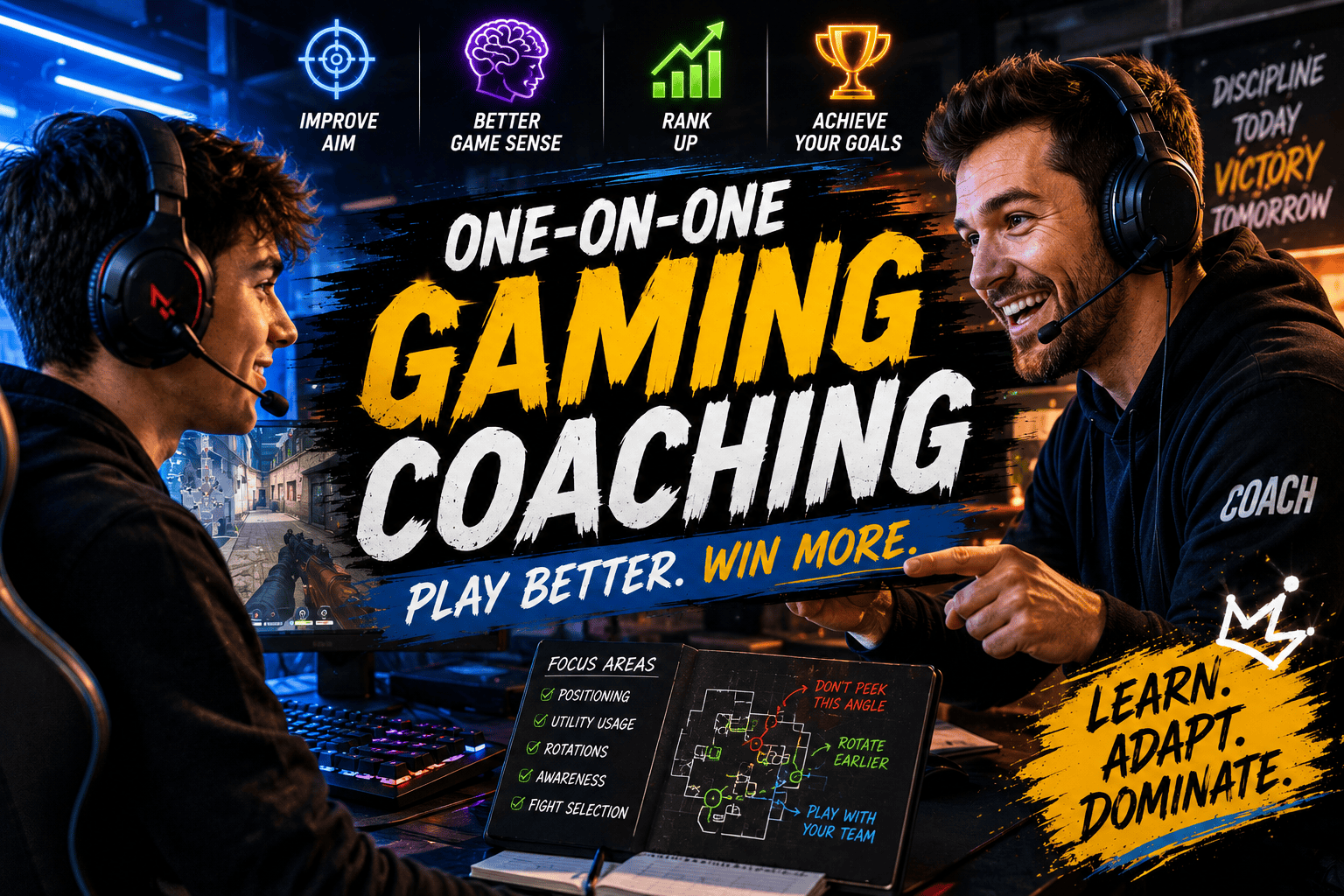
One-on-one video game coaching is personalised gaming coaching where one coach works directly with one player to improve their skills, mechanics, strategy, decision-making and overall gameplay.
You’ll also see it called:
- 🎮 1-on-1 gaming coaching
- 👤 Private gaming coaching
- 🎯 Personal gaming coaching
- 🏆 Individual gaming coaching
Whatever name is used, the basic idea is the same:
One Player + One Coach + Personalised Feedback
Unlike a general YouTube guide or tutorial, the coach isn’t explaining what players in general should do.
They’re looking at you.
Your gameplay.
Your decisions.
Your mechanics.
And, unfortunately, that push you were hoping nobody would mention.
🎮 How Does One-on-One Gaming Coaching Work?
The exact format depends on the game and coach, but a typical coaching process might look like this:
🎯 Set Your Goals → 🎮 Play → 👀 Coach Observes → 🧠 Get Feedback → 🎯 Practise → 📈 Improve
A coach might watch you play live, review recorded gameplay with you or combine several coaching methods.
During a session, you might work on things like:
- 🎯 Aim and mechanics
- 🕹️ Movement
- 🧠 Game sense
- 🗺️ Positioning
- 👀 Awareness
- ⚔️ Fight selection
- ⏱️ Timing
- 💥 Ability usage
- 🤝 Communication and teamplay
- 🏆 Ranked or competitive strategy
The coaching should be adapted to your skill level and what you’re actually trying to achieve.
A beginner learning the fundamentals doesn’t need the same session as an experienced ranked player trying to squeeze out another few percent of performance.
🧠 Why Not Just Watch Gaming Guides?
You absolutely should.
There is an incredible amount of useful gaming content available for free.
Guides can teach you:
“Here’s where you should position.”
“Here’s how this mechanic works.”
“Here’s the best strategy for this situation.”
The problem is that a guide can’t watch your gameplay and say:
“Yes, I know you watched the positioning guide. You’re still not doing it.”
That’s the difference.
General guides give you information.
One-on-one coaching gives you personalised feedback.
You might think your aim is holding you back, while a coach notices you’re constantly entering fights from terrible positions.
Maybe you don’t need another 20 hours in an aim trainer.
Maybe you just need to stop walking into situations where hitting every shot is the only possible way to survive.
Slightly less glamorous.
Potentially much more useful.
👀 A Coach Can See Things You Don’t
This is probably one of the biggest reasons players try private gaming coaching.
When you’ve played a game for hundreds or thousands of hours, certain habits become automatic.
You stop noticing them.
Maybe you always:
- ⚔️ Push too aggressively
- 🗺️ Stand in poor positions
- 👀 Miss important information
- 💥 Use abilities too early
- 🎯 Focus on the wrong opponent
- 🤝 Move away from teammates
- ⏱️ Rotate a few seconds too late
You might know something isn’t working without understanding what the actual problem is.
An experienced coach gives you another perspective.
Sometimes that’s reassuring.
Sometimes it’s someone watching ten minutes of your gameplay and immediately identifying the habit you’ve apparently been perfecting since 2022.
Either way, now you know.
🆕 Do You Need to Be a Good Player to Get Coaching?
No.
Gaming coaching isn’t only for high-ranked players or aspiring esports pros.
Beginners can use coaching to learn fundamentals.
Intermediate players can use it to break bad habits.
Ranked players can use it to climb or overcome a plateau.
Competitive players can use it to refine smaller weaknesses.
You don’t need to reach some imaginary skill level before you’re “good enough” for coaching.
That would be a little backwards.
The whole point is that you’re trying to get better.
🏆 Can One-on-One Coaching Help You Rank Up?
It can help you develop the skills and decision-making needed to improve your performance, but no legitimate coach can guarantee you’ll reach a particular rank.
Your results still depend on things like:
- 🎮 How much you practise
- 🎯 What you’re working on
- 🧠 How well you apply feedback
- ⏱️ How much time you play
- 📈 Your current skill level
- 🔁 Whether you actually change your habits
A coach can show you the problem.
They can explain the solution.
They cannot reach through the monitor and physically stop you making the same terrible push again.
Technology has limits.
🎯 What’s the Biggest Benefit of One-on-One Coaching?
Personalisation.
That’s really what separates private coaching from most other ways of learning a game.
You’re not following advice created for thousands of players.
The session can focus on:
🎮 Your gameplay
🧠 Your mistakes
🎯 Your weaknesses
❓ Your questions
🏆 Your goals
And that can make your practice much more focused.
Instead of spending the next 100 matches thinking:
“I just need to play more.”
you can go into them thinking:
“I’m working specifically on this.”
📈 What You’ll Learn in This Guide
In this guide, we’ll break down everything you need to know about one-on-one video game coaching, including:
- 🎮 How private gaming coaching works
- 👀 What happens during a coaching session
- 🎯 What a gaming coach can help you improve
- 🆕 Whether coaching is suitable for beginners
- 🏆 How coaching works for ranked players
- 📹 Live coaching vs VOD review
- 👥 One-on-one vs group coaching
- 💰 What affects gaming coaching prices
- 🔎 How to choose the right gaming coach
- 🎧 How to prepare for your first session
- 📈 How to get the most from coaching
The goal isn’t to convince you that everyone needs a gaming coach.
They don’t.
It’s to help you understand what one-on-one gaming coaching actually involves, when it can be useful and whether it makes sense for you.
Because sometimes the fastest way to figure out what you’re doing wrong is to have someone else watch you do it.
Painful?
Potentially.
Useful?
Very possibly.
2. What Is One-on-One Video Game Coaching?
One-on-one video game coaching is personalised coaching where one gaming coach works directly with one player to help them improve their skills, strategy and overall gameplay. 🎮🎯
You’ll also hear it called 1-on-1 gaming coaching, private gaming coaching, personal gaming coaching or individual gaming coaching.
Different name.
Same basic setup:
👤 One Player + 🎓 One Coach + 🎯 Personalised Feedback
Instead of following a general guide designed for thousands of players, you’re getting advice based on how you actually play.
And that’s the important part.
🎮 How Is One-on-One Coaching Different From a Gaming Guide?
Gaming guides are great.
I’ve consumed enough of them over the years to qualify for some kind of honorary degree.
They can teach you:
- 🗺️ Where to position
- 🎯 How to improve mechanics
- 🧠 How strategies work
- 💥 When to use abilities
- ⚔️ How to approach fights
- 🏆 How higher-ranked players think
But there’s one thing a guide can’t do.
Watch you play.
A guide can explain:
“Don’t overextend when your teammates aren’t ready.”
Very sensible.
Then you load into your next match, see an opponent on low health and immediately chase them halfway across the map.
A coach can actually see that happening and say:
“This. This is what we were talking about.”
That’s the advantage of personalised coaching.
👀 The Coach Focuses on Your Gameplay
During one-on-one coaching, the session revolves around you.
Depending on the coaching format, your coach might analyse:
- 🎯 Your mechanics
- 🗺️ Your positioning
- 👀 Your awareness
- 🧠 Your decision-making
- ⚔️ Your fight selection
- ⏱️ Your timing
- 💥 Your ability or resource usage
- 🤝 Your communication
- 🔄 Your rotations
- 🔁 Your repeated habits
They can then identify the areas having the biggest impact on your performance.
Maybe you think your problem is aim.
The coach watches you for fifteen minutes and discovers your aim is actually fine.
The bigger issue is that you’re constantly taking fights while outnumbered.
Good news: your aim isn’t terrible.
Bad news: apparently your decision-making has been trying to kill you.
Still, progress.
🎯 Coaching Can Be Built Around Your Goals
One-on-one gaming coaching also gives you the ability to focus on what you specifically want to achieve.
Maybe you want to:
📈 Climb ranked
🎯 Improve your aim
🧠 Develop better game sense
🗺️ Fix your positioning
🧙 Learn a new character or role
⚔️ Improve in certain matchups
🤝 Become a better teammate
🏆 Prepare for competitive play
🎮 Stop feeling completely lost in certain situations
Your coach can build the session around those goals.
That doesn’t mean they’ll only tell you what you want to hear.
You might arrive saying:
“I really need help with my aim.”
Twenty minutes later:
“Okay, apparently I really need help with positioning.”
That’s useful too.
📹 Different Types of One-on-One Gaming Coaching
Private gaming coaching doesn’t always mean someone sitting in a voice call watching you play live.
There are several ways a one-on-one session can work.
🎮 Live Gameplay Coaching
You play while the coach watches.
They may provide feedback during gameplay, between rounds or after matches.
This can be useful for seeing how you:
- ⚡ React under pressure
- 🎯 Execute mechanics
- 🧠 Make quick decisions
- 👀 Process information
- 🤝 Communicate
- 🎮 Apply feedback immediately
📹 VOD Review
You provide previously recorded gameplay and the coach analyses it.
Because the gameplay has already happened, they can:
⏸️ Pause
⏪ Rewind
🔎 Analyse decisions
🗺️ Examine positioning
🧠 Discuss alternative plays
🎯 Identify repeated mistakes
This makes VOD review particularly useful for detailed analysis.
If you want to explore this format in more detail, our complete guide to VOD reviews in gaming explains how they work, what a coach can analyse and when recorded gameplay review can be particularly useful.
🎧 Play-With Coaching
In some games, the coach may actually join you.
Playing together can allow them to demonstrate positioning, communication, strategies or techniques directly inside the game.
It can also give them a closer look at how you interact with teammates and react to situations.
🧠 Discussion & Strategy Coaching
Not every minute of a coaching session needs to involve playing.
You might spend time discussing:
- 🗺️ Maps
- ⚔️ Matchups
- 🧙 Characters or roles
- 💥 Abilities
- 🎯 Objectives
- 🔄 Rotations
- 🧠 Decision-making
- 📋 Practice routines
Sometimes understanding why something works is just as important as physically practising it.
🔀 Coaching Can Combine Different Formats
A session doesn’t necessarily have to choose only one approach.
For example:
📹 Review a Previous Match → 🔎 Identify a Problem → 🎮 Play Live → 🎯 Practise the Correction
That can work particularly well because you’re combining analysis with application.
You identify the mistake while watching the replay.
Then you immediately try to avoid it during actual gameplay.
Hopefully successfully.
No promises on attempt number one.
🧠 It’s More Than Someone Telling You What to Do
Good one-on-one coaching shouldn’t just be:
“Go here.”
“Shoot that.”
“Don’t do that.”
You want to understand why.
Why is this position stronger?
Why shouldn’t you take this fight?
Why should you rotate now?
Why should you save that ability?
If you understand the principle behind the advice, you can apply it to completely different situations later.
Otherwise, you’re just following instructions while the coach is there.
The goal is to eventually make those decisions yourself.
🎓 A Great Player Isn’t Automatically a Great Coach
This distinction matters when you’re looking for one-on-one coaching.
Someone can be unbelievably good at a game and still be terrible at explaining it.
We’ve all played with that person.
You ask:
“What should I have done there?”
They respond:
“Just don’t die.”
Outstanding.
A good gaming coach needs more than skill.
They also need to be able to:
- 💬 Communicate clearly
- 🧠 Explain complicated ideas simply
- 👀 Identify mistakes
- 🎯 Prioritise what matters
- 📈 Adapt advice to your skill level
- 🤝 Give constructive feedback
- ❓ Answer questions
Playing and teaching are related skills.
They’re not the same skill.
👤 Why Does the One-on-One Part Matter?
Because the coach doesn’t have to divide their attention across a group.
The session can move at your pace.
If you already understand something, move on.
If you’re struggling with something, spend more time on it.
If you have a question, ask it.
If the coach discovers an unexpected weakness, the session can change direction.
That’s the main appeal of private gaming coaching:
The coaching adapts to the player instead of the player adapting to the coaching.
🎯 The Simple Definition
If we strip everything else away, one-on-one video game coaching is pretty straightforward:
An experienced player works directly with you to understand how you play, identify what you can improve and help you develop the skills and knowledge to play better.
They don’t play the game for you.
They don’t magically give you their mechanics.
And they certainly can’t guarantee your next ranked teammates will cooperate with the master plan.
What they can give you is personalised direction.
And when you’ve spent the last few hundred matches wondering why you’ve stopped improving, knowing what to work on next can be pretty valuable.
3. How Does One-on-One Gaming Coaching Work?
One-on-one gaming coaching is usually pretty straightforward. 🎮
You choose a coach who knows your game, explain what you’re trying to improve and then work together through live gameplay, recorded matches, practice exercises or a combination of all three.
If you want to see the complete process from finding a coach through to completing your session, our guide to how online video game coaching works walks through it step by step.
The exact format varies between coaches, but the general process looks something like this:
🎯 Set Your Goals → 🎮 Play → 👀 Coach Observes → 🧠 Get Feedback → 🎯 Practise → 📈 Improve
You’re still doing the playing.
The coach is there to make sure those hours have a little more direction than “I’ll just keep queueing until something changes.”
🎯 Step 1 – Choose the Right Gaming Coach
First, you need someone who actually understands what you’re trying to improve.
That doesn’t necessarily mean choosing the highest-ranked player you can find.
Look at things like:
- 🎮 Games they coach
- 🏆 Experience and skill level
- 🧙 Roles, characters or specialisations
- 🎯 Areas they teach
- ⭐ Reviews from other players
- 💬 Coaching style
- 📹 Session format
- 💰 Price
If you’re trying to improve as a support player, someone specialising in that role may be more useful than an incredible player who primarily coaches something completely different.
And remember:
Being great at a game and being great at teaching a game aren’t automatically the same thing.
For a more detailed checklist of what to look for, our guide on how to choose a video game coach covers experience, communication style, specialisation, reviews, pricing and other factors worth comparing before you book.
We’ve all met mechanically gifted players whose entire coaching vocabulary consists of:
“Bro, just win that.”
Useful.
💬 Step 2 – Tell the Coach About Yourself
Before you start, give your coach some context.
They’ll usually want to know things like:
- 🏆 Your current rank or skill level
- 🎮 How long you’ve been playing
- 🧙 Your main role, character or class
- 🎯 What you want to improve
- 🧱 Where you feel stuck
- 🏆 Your longer-term goals
You don’t need to know exactly what’s wrong with your gameplay.
That’s partly what the coaching is for.
Something as simple as:
“I’ve been stuck at this rank for a few months and I don’t understand what’s holding me back.”
is already useful information.
🎯 Step 3 – Set a Goal for the Session
A good coaching session should have some direction.
Your goal might be:
🎯 Improve aim
🗺️ Fix positioning
🧠 Develop better game sense
⚔️ Improve fight selection
🧙 Learn a new role
📈 Understand why you’ve stopped climbing
Or you might simply ask the coach to analyse your overall gameplay and identify the biggest weaknesses.
The important thing is leaving with something more specific than:
“Become better at game.”
Ambitious.
Slightly broad.
🎮 Step 4 – Play or Review Gameplay
Now the coach needs to see how you actually play.
This can happen in several ways.
🎮 Live Gameplay
You play while the coach watches through screen sharing, spectating or another available method.
This lets them see how you:
- ⚡ React under pressure
- 👀 Process information
- 🎯 Execute mechanics
- 🧠 Make decisions
- 🤝 Communicate
- ⏱️ Respond to changing situations
The coach may give feedback during the match or wait until breaks between rounds or games.
📹 VOD Review
Instead of playing live, you provide recorded gameplay.
The coach can:
⏸️ Pause
⏪ Rewind
🔎 Analyse decisions
🗺️ Examine positioning
🧠 Explain alternatives
🎯 Identify repeated mistakes
VOD review is particularly useful when you want to understand why certain situations went wrong.
🎧 Playing Together
Depending on the game and coaching service, the coach may join you.
That can be useful for demonstrating:
- 🗺️ Positioning
- 🤝 Teamplay
- 💬 Communication
- 🔄 Rotations
- 🎯 Strategies
The session format should match what you’re trying to learn.
👀 Step 5 – The Coach Looks for Patterns
A good coach isn’t just counting your mistakes.
They’re looking for patterns.
Maybe you die four times in completely different situations.
At first glance, they look unrelated.
But the coach notices that before every death, you moved too far away from your teammates.
Now you’ve found something useful.
They might identify patterns involving:
- 🗺️ Positioning
- ⚔️ Fight selection
- 👀 Awareness
- 🎯 Target priority
- 💥 Ability usage
- ⏱️ Timing
- 🤝 Teamplay
- 🎮 Mechanics
One isolated mistake might not matter much.
The same mistake appearing five times probably deserves attention.
🧠 Step 6 – Understand What You’re Doing Wrong
Finding the mistake is only half the job.
The coach should help you understand why it’s a mistake.
For example:
❌ “Don’t push here.”
isn’t particularly useful on its own.
Better feedback might be:
✅ “Don’t push here because your teammates are still rotating, you don’t know where the second opponent is and you’ll have no safe way to disengage.”
Now you understand the principle.
Next time you encounter a similar situation, you can ask yourself:
Is my team ready?
Do I have enough information?
Can I safely get out?
That’s knowledge you can take into future matches.
🎯 Step 7 – Decide What to Work On
A coach might spot twenty things you could improve.
You probably shouldn’t try to fix twenty things.
Ideally, the session should narrow everything down to one or two high-impact priorities.
For example:
🎯 Focus 1 – Check teammate positions before engaging
🗺️ Focus 2 – Stay near cover when holding an angle
That’s manageable.
Compare that with trying to remember:
Positioning. Aim. Map awareness. Rotations. Communication. Timing. Abilities. Movement. Objectives. Target priority.
By the time you’ve remembered number ten, you’ve probably already died.
🎮 Step 8 – Practise the Feedback
This is where the actual improvement happens.
The coaching session identifies what needs work.
Practice changes it.
Take your priorities into future matches and deliberately work on them.
If your coach tells you to check teammate positions before engaging, make that your focus.
You may still forget.
Then remember.
Then forget again.
Eventually, the new behaviour starts becoming automatic.
That’s how habits change.
📈 Step 9 – Review Your Progress
After you’ve had enough time to practise, look at your gameplay again.
You can do this yourself or during another coaching session.
Ask:
Am I still making the same mistake?
Am I recognising the situation earlier?
Has this weakness improved?
What should I focus on next?
That creates a much more useful coaching cycle:
🎮 Play → 👀 Analyse → 🧠 Understand → 🎯 Practise → 📈 Review → 🔁 Repeat
🔄 Do You Need Coaching Every Time You Play?
Definitely not.
A coach doesn’t need to sit beside you digitally for every match.
Ideally, coaching gives you direction for your own practice.
You might have one session, discover two major weaknesses and spend the next several weeks working on them yourself.
Then, if you hit another plateau or aren’t sure whether you’re improving, another session can help reassess things.
Think of coaching as a way to periodically correct your direction, rather than something you need every time you log in.
🏆 The Goal Is to Make Better Decisions Yourself
Ultimately, good one-on-one gaming coaching shouldn’t make you dependent on your coach.
Quite the opposite.
Over time, you should start recognising situations yourself.
At first:
🎓 Coach: “Don’t push here.”
Later:
🧠 You: “This looks like the situation my coach was talking about.”
Eventually:
🎮 You: “My teammates aren’t ready. I’m not pushing.”
That’s the progression you’re looking for.
A good gaming coach doesn’t just tell you what to do – they help you understand the game well enough to make better decisions when they’re no longer there.
And ideally, one day you’ll look at that ridiculous 1v3 and simply walk away.
Growth.
4. What Happens During a One-on-One Gaming Coaching Session?
If you’ve never booked a gaming coach before, you might be wondering what actually happens once the session starts. 🎮
Do you immediately jump into ranked?
Does the coach watch silently while taking deeply concerning notes?
Are you expected to play the greatest match of your life?
Usually, no.
A good one-on-one gaming coaching session should be fairly relaxed and structured around your skill level, goals and the areas you want to improve.
And importantly, you don’t need to impress your coach.
If anything, playing normally is much more useful.
They’re there to find your mistakes.
Hiding them would be a slightly strange use of everyone’s time.
💬 Start With a Quick Introduction
Most sessions begin with a short conversation.
Your coach may ask about:
- 🎮 The game you play
- 🏆 Your current rank
- 📈 Your peak or previous rank
- ⏱️ How long you’ve been playing
- 🧙 Your main role, character or class
- 🎯 What you want to improve
- 🧱 Where you feel stuck
- 🏆 Your longer-term goals
This gives the coach some context before they start analysing your gameplay.
Advice for someone who’s been playing for three months should probably look different from advice for someone with 3,000 hours who’s trying to reach the next competitive rank.
🎯 You’ll Usually Set a Goal
Next, you’ll normally decide what the session should focus on.
Maybe you’ve already got something specific in mind:
“I struggle with positioning during team fights.”
“My mechanics feel inconsistent.”
“I don’t know when I should rotate.”
“I’ve been stuck at the same rank for months.”
Or maybe you genuinely don’t know what’s wrong.
That’s fine too.
You can simply ask the coach to watch your gameplay and identify the biggest areas for improvement.
Sometimes:
“I don’t know what I’m doing wrong.”
is actually a pretty useful place to start.
🎮 You May Play Live
In a live one-on-one coaching session, you’ll usually play while the coach watches.
Depending on the game and setup, they might watch through:
- 🖥️ Screen sharing
- 👀 Spectator mode
- 🎮 In-game systems
- 📺 Streaming
- 🎧 Playing alongside you
The coach can then see how you perform when the game is actually moving.
That’s useful because there’s a big difference between knowing what you should do and remembering to do it when everything gets chaotic.
💬 The Coach May Talk While You Play
Some coaches give feedback during gameplay.
For example:
“Check your map.”
“Your teammate isn’t ready.”
“Hold this position.”
“Don’t use that ability yet.”
This can help you recognise situations in real time.
However, too much live feedback can become distracting.
It’s difficult enough tracking five enemies, four teammates, three cooldowns and whatever else is happening without someone delivering a podcast directly into your headset.
Good coaches usually find a balance.
⏸️ Or Feedback May Come Between Matches
Another approach is allowing you to play naturally and discussing what happened afterwards.
The coach might make notes while watching and then go through the important moments between rounds or matches.
This can be useful because the coach gets to see how you normally make decisions without constantly influencing them.
Then you can discuss:
What happened?
Why did you make that decision?
What other options were available?
What should you look for next time?
📹 You Might Review Recorded Gameplay
Some one-on-one sessions use VOD review instead of, or alongside, live gameplay.
You’ll watch recorded gameplay together and pause at important moments.
For example:
⏸️ Pause
“What were you thinking here?”
You explain.
Then the coach might show you:
🗺️ Your position
👥 Your teammates
⚔️ The opponents
🎯 The objective
🚪 Your available escape routes
Suddenly, the situation looks very different when you have unlimited time to stare at it.
This is one of the biggest advantages of replay analysis.
During the actual match, you had two seconds.
Now you’ve got twenty minutes if you really want them.
🧠 Expect Questions From the Coach
Good coaching shouldn’t just involve someone lecturing you.
Your coach may ask:
“Why did you move here?”
“What were you looking at?”
“What did you think the opponent was going to do?”
“Why did you use that ability?”
“What other options did you have?”
These questions help the coach understand your thought process.
Two players can make exactly the same mistake for completely different reasons.
Maybe you pushed because you didn’t see the second enemy.
Maybe you saw them but thought your teammate was following.
Maybe you knew everything and just decided:
“Yeah, I reckon I’ve got this.”
Different problem.
Different coaching.
🔎 The Coach Will Identify Your Biggest Weaknesses
As the session continues, patterns should start appearing.
Maybe you’re repeatedly:
- 🗺️ Standing in poor positions
- ⚔️ Taking unnecessary fights
- 👀 Missing important information
- ⏱️ Rotating too late
- 💥 Using abilities inefficiently
- 🎯 Focusing on the wrong targets
- 🤝 Separating from teammates
- 🕹️ Making the same mechanical mistake
The coach’s job isn’t simply to find as many faults as possible.
It’s to work out which ones matter most.
✅ They’ll Hopefully Point Out What You’re Doing Well Too
A coaching session shouldn’t feel like someone has been hired to professionally criticise you for an hour.
You also want to know what’s working.
Maybe your:
🎯 Mechanics are strong
🗺️ Positioning is generally good
💬 Communication is useful
⚔️ Fight selection is improving
🧠 Decision-making is better than you thought
Knowing your strengths matters.
If you’re already doing something correctly, you want to understand why it works so you can keep doing it.
Also, hearing:
“That was actually really good.”
after twenty minutes of discussing your mistakes does wonders for morale.
🎯 You May Work on Specific Skills
Depending on the session, the coach might stop analysing matches and work directly on a particular skill.
That could include:
- 🎯 Aim drills
- 🕹️ Movement practice
- 💥 Ability combinations
- 🗺️ Positioning exercises
- ⚔️ Matchup practice
- 🔄 Rotation scenarios
- 🧠 Decision-making exercises
- 🤝 Communication practice
This is where coaching can become more active.
You’ve identified the problem.
Now you’re starting to work on the solution.
📝 You Should Leave With Clear Priorities
By the end of the session, you should ideally know:
🔎 What are my biggest weaknesses?
🧠 Why are they causing problems?
🎯 What should I do differently?
🎮 What should I practise next?
You don’t need twenty improvement goals.
One or two good ones are enough.
For example:
🎯 Priority 1 – Check teammate positions before committing to fights
🗺️ Priority 2 – Stop leaving cover without a safe escape
Now you’ve got something specific to take into your next gaming session.
⏱️ Every Coach Will Run Sessions Differently
There’s no universal format for a one-on-one gaming coaching session.
One coach might spend most of the session reviewing VODs.
Another might focus heavily on live gameplay.
Another might combine:
📹 Review → 🧠 Explain → 🎮 Demonstrate → 🎯 Practise
That’s why it’s worth checking the coaching listing or description before booking.
You want to know what you’re actually getting.
🎮 Don’t Try to Play Perfectly
One final tip:
Play normally.
Seriously.
If you’re so focused on impressing the coach that you completely change how you normally play, you’re making their job harder.
Make the mistakes.
Take the questionable fight.
Miss the shot.
Forget the rotation.
Obviously, don’t do any of this deliberately.
But don’t worry when it happens.
That’s what the session is for.
A one-on-one gaming coaching session isn’t an exam – it’s a chance to figure out what you’re doing well, what you’re doing badly and what you should work on next.
And if your coach gets to witness one truly horrific decision along the way?
Well.
At least you’ve given them something to work with.
5. What Can a Gaming Coach Help You Improve?
A good gaming coach can help with much more than aim. 🎮
That’s worth saying because when a lot of us think about getting better at games, our first instinct is:
“I just need better mechanics.”
Sometimes that’s true.
Other times, your aim is perfectly respectable and the bigger issue is that you keep entering fights where you’d need the reactions of a 17-year-old esports prodigy running on three hours of sleep and questionable amounts of caffeine to survive.
One of the biggest benefits of one-on-one video game coaching is that a coach can look across your entire gameplay and identify what’s actually holding you back.
🎯 Aim and Mechanics
Let’s start with the obvious one.
Depending on the game, a coach can help you improve mechanical skills such as:
- 🎯 Aim
- 🕹️ Movement
- 🔫 Crosshair placement
- ⚡ Reaction and execution
- 💥 Combos
- ⌨️ Inputs
- 🧙 Character-specific mechanics
- 🎮 Weapon or vehicle control
A coach can watch how you’re performing and identify specific mechanical problems rather than simply telling you:
“Practise your aim more.”
Maybe your raw aim is fine, but your crosshair placement means you’re constantly making larger corrections than necessary.
Maybe your movement is making your shots harder.
Maybe you’re rushing.
Small mechanical habits can have a surprisingly large impact when they’re repeated hundreds of times.
🧠 Game Sense
Game sense is your ability to understand what’s happening in a match and make good decisions based on that information.
It’s also one of those wonderfully vague gaming terms that everyone tells you to improve without necessarily explaining how.
A coach can break game sense into more practical skills, such as:
- 👀 Reading the situation
- 🧠 Predicting opponents
- 🗺️ Understanding map control
- ⚔️ Recognising favourable fights
- 🎯 Identifying priorities
- 🔄 Anticipating rotations
- ⏱️ Understanding timing
- 🤝 Reading teammate intentions
You develop plenty of game sense naturally through experience.
Coaching can help you understand why certain situations work the way they do, rather than waiting another 500 matches for the lesson to eventually sink in.
🗺️ Positioning
Positioning is one of the most common areas where players can improve.
And it’s incredibly easy to get wrong without realising it.
You might feel perfectly safe.
Then your coach pauses the gameplay and points out:
You’re exposed to three angles.
Your teammates can’t help you.
There’s no cover nearby.
Your escape route doesn’t exist.
But apart from that, fantastic spot.
A coach can help you understand:
- 📍 Where you should position
- 🛡️ How to use cover
- 👀 Which angles you’re exposed to
- 🤝 How to position around teammates
- ⚔️ How positioning affects fights
- 🚪 When you need an escape route
- 🎯 How your position relates to objectives
Good positioning can make everything else easier.
You’re not asking your mechanics to rescue you from terrible situations quite so often.
👀 Awareness
Sometimes you’re making a bad decision because you haven’t noticed the information that would have told you it was bad.
A coach might notice that you’re regularly missing:
- 🗺️ Minimap information
- 👥 Teammate positions
- ⚔️ Enemy locations
- 🔊 Audio cues
- 💀 Eliminations
- ⏱️ Timers
- 🎯 Objectives
- 💥 Abilities or resources
This doesn’t necessarily mean you don’t understand the game.
You may simply be focusing your attention in the wrong places.
A coach can help you develop better habits around what to check and when to check it.
⚔️ Fight Selection
Seeing an enemy doesn’t automatically mean you need to fight them.
I appreciate that this information may be upsetting.
A coach can help you recognise when an engagement is actually favourable.
Before fighting, you might need to consider:
👥 Do we have the numbers?
❤️ What is my health?
💥 What resources do we have?
🗺️ Is my position good?
🤝 Are my teammates ready?
🎯 Is there a more important objective?
🚪 Can I safely disengage?
Sometimes getting better isn’t about learning how to win more fights.
It’s learning which fights weren’t worth taking in the first place.
⏱️ Timing
You can make the right decision at the wrong time.
Rotate too late.
Push too early.
Use an ability before it’s needed.
Wait too long to disengage.
A coach can help you improve timing around:
- 🔄 Rotations
- ⚔️ Engagements
- 💥 Abilities
- 🎯 Objectives
- 🛡️ Defensive plays
- 🤝 Team pushes
- 🚪 Disengagements
A few seconds can completely change whether a decision works.
This is particularly important in competitive games where opportunities appear and disappear quickly.
🎯 Target Priority
Who should you actually be focusing on?
The closest enemy?
The weakest enemy?
The biggest threat?
The person attacking your teammate?
The objective instead?
It depends.
A coach can help you understand how to choose targets based on the situation rather than automatically attacking whoever happens to occupy the largest number of pixels on your screen.
Better target priority can improve both individual fights and overall team performance.
💥 Ability and Resource Management
Many games revolve around managing limited resources.
Abilities.
Cooldowns.
Ammo.
Mana.
Boost.
Economy.
Items.
Ultimates.
A coach can look at whether you’re:
- ⏱️ Using resources too early
- 😬 Panic-using abilities
- 💰 Wasting limited resources
- 🔁 Holding abilities too long
- ⚔️ Entering fights without what you need
- 🎯 Using important abilities on low-value situations
We’ve all saved an ultimate for the “perfect moment” only for the match to end with it still fully charged.
Technically excellent resource conservation.
Strategically less impressive.
🔄 Rotations and Map Movement
Knowing when and where to move is hugely important in many competitive games.
A coach can analyse:
- 🗺️ Your routes
- ⏱️ When you rotate
- 🎯 Why you’re rotating
- 👥 Where your teammates are moving
- ⚔️ Where opponents are likely to be
- 🏆 Which objectives matter
- 🚪 Whether you’re moving through safe areas
Good rotations can put you into strong situations before the fight even begins.
Bad rotations can put you somewhere very exciting for approximately four seconds.
🤝 Communication and Teamplay
For team-based games, individual skill is only part of the equation.
A coach may also help you improve:
- 💬 Callouts
- 👂 Listening
- 🎯 Sharing useful information
- 🤝 Coordinating engagements
- 🗺️ Moving with teammates
- 🔄 Coordinating rotations
- ⚔️ Following team decisions
- 🧠 Understanding your role within the team
Sometimes your individual decision isn’t terrible.
It just has absolutely nothing to do with what the other four people on your team are doing.
That can still be a problem.
🧘 Decision-Making Under Pressure
Here’s an interesting one.
You might know exactly what the correct decision is while watching a guide.
You might even recognise it instantly during VOD review.
Then you’re actually playing.
Enemies appear.
Someone starts shouting.
Your health drops.
Three abilities go off.
And apparently everything you learned has left the building.
Live one-on-one coaching can help with applying knowledge under pressure.
Over time, good decisions need to become fast enough that you can actually use them during real gameplay.
🔁 Bad Habits You Don’t Notice
This might be the biggest benefit of having someone else watch you.
Your coach can identify habits you’ve stopped noticing.
Maybe you always:
- ⚔️ Chase low-health opponents
- 🗺️ Leave cover too early
- 👀 Stop checking the map during fights
- 💥 Panic-use abilities
- 🤝 wander away from teammates
- 🎯 Tunnel vision
- ⏱️ Rotate late
One example might mean nothing.
Six examples in thirty minutes?
We may have found something.
💪 Your Strengths
Good coaching isn’t only about weaknesses.
A coach should also identify what you’re already doing well.
Maybe your:
🎯 Mechanics are strong
🧠 Game sense is developing well
🗺️ Positioning is generally solid
🤝 Communication is excellent
⚔️ Fight selection is smart
💥 Resource usage is efficient
Understanding your strengths matters because improvement isn’t just:
“Stop doing bad things.”
It’s also:
“Keep doing the good things consistently.”
🎯 What Should You Improve First?
This is where one-on-one coaching can be particularly useful.
You might have ten different areas that could improve.
But they won’t all matter equally.
A good coach can help identify the one or two weaknesses currently having the biggest impact on your gameplay.
Maybe improving your aim would help a little.
But fixing your positioning would improve almost every fight you take.
Start there.
Then move on.
The goal of one-on-one gaming coaching isn’t to find every tiny flaw in your gameplay – it’s to identify the changes that can make the biggest difference and give you a clear way to work on them.
Because “get better at everything” is technically a plan.
It’s just not a particularly useful one.
6. Who Is One-on-One Gaming Coaching For?
One-on-one gaming coaching isn’t just for aspiring esports pros or players sitting one rank below the promised land. 🎮
It can be useful for beginners, casual players, ranked grinders and competitive players – basically anyone who wants more personalised help improving at a game.
The reason is simple.
Different players struggle with different things.
A beginner might need help understanding positioning.
An experienced player might understand positioning perfectly but struggle to make the right decision quickly under pressure.
And some of us know exactly what we’re supposed to do and then confidently do the opposite anyway.
One-on-one coaching can adapt to wherever you are.
🆕 Beginners Learning the Game
Beginners can benefit from coaching once they’ve got a basic understanding of how the game works.
A coach can help with fundamentals such as:
- 🎮 Core mechanics
- 🗺️ Basic positioning
- 👀 Awareness
- 🎯 Objectives
- 🧙 Roles or characters
- ⚔️ When to fight
- 💥 Ability usage
- 🤝 Basic teamplay
This can help newer players avoid developing bad habits early.
That said, if you’ve literally just installed the game, you probably don’t need private coaching immediately.
Play first.
Learn what the buttons do.
Discover why everyone keeps yelling about the objective.
Then coaching becomes much more useful.
😊 Casual Players Who Want to Improve
You don’t need to care about ranked to want to get better.
Maybe you mostly play with friends but you’re tired of being the person everyone politely describes as:
“Good for morale.”
A coaching session can help casual players understand the fundamentals without turning gaming into a second job.
You might simply want to:
🎯 Improve your mechanics
🧠 Understand the game better
🎮 Keep up with friends
🗺️ Stop getting lost
⚔️ Win more fights
That’s a perfectly valid reason to get coaching.
📈 Ranked Players Trying to Climb
This is probably one of the most obvious groups for one-on-one video game coaching.
You’ve learned the game.
Your mechanics are decent.
You’ve played hundreds of matches.
But your rank isn’t moving.
Welcome to the plateau.
A coach can analyse your gameplay and look for the habits preventing you from progressing, such as:
- 🗺️ Poor positioning
- ⚔️ Bad fight selection
- 👀 Weak awareness
- ⏱️ Late rotations
- 🎯 Poor target priority
- 💥 Inefficient ability usage
- 🤝 Weak team coordination
- 🔁 Repeated decision-making mistakes
Sometimes the difference between your current rank and the next one isn’t learning something completely new.
It’s stopping yourself from doing one stupid thing quite so often.
Annoyingly achievable.
🧱 Players Who Have Hit a Plateau
You don’t necessarily need to care about rank to hit a skill plateau.
Maybe you’ve simply reached a point where playing more doesn’t seem to be making you noticeably better.
That’s often when outside feedback becomes useful.
When you’ve played the same way for hundreds of hours, your habits start feeling normal.
A coach can watch with fresh eyes and ask:
“Why do you always do this?”
And you realise:
“I… actually don’t know.”
Excellent.
We’ve found somewhere to start.
🧙 Players Learning a New Role or Character
Being experienced at a game doesn’t mean you’re experienced at everything within it.
Maybe you’re:
🧙 Learning a new character
🎯 Switching roles
🔫 Trying a different weapon or playstyle
🗺️ Learning new maps
⚔️ Learning unfamiliar matchups
A coach who specialises in that area can help shorten the learning curve.
Instead of figuring everything out through trial and error, you can learn the fundamentals first and then build experience on top of them.
You’ll still make mistakes.
Just hopefully more interesting ones.
🎯 Players With a Specific Weakness
One-on-one coaching can be particularly useful when you already know roughly what you need help with.
For example:
“My positioning is terrible.”
“I panic during fights.”
“My aim is inconsistent.”
“I don’t know when to rotate.”
“I struggle with this matchup.”
Now the session can be built around that specific problem.
Rather than spending an hour reviewing everything you do, the coach can focus on the weakness that’s bothering you most.
🤔 Players Who Don’t Know What’s Wrong
Then there’s the opposite problem.
You know you’re struggling.
You just don’t know why.
Your mechanics feel okay.
You understand the game.
You’re putting in the hours.
But something isn’t clicking.
This is one of the strongest cases for getting another perspective.
A coach may identify a problem you’ve never considered.
Maybe you’re focusing on aim while your positioning is costing you fights.
Maybe you’re blaming positioning when your real issue is timing.
Maybe you’re blaming your teammates.
We may need slightly longer for that one.
🏆 Competitive Players
At higher skill levels, coaching can become more detailed.
Competitive players might use one-on-one sessions to work on:
- 🧠 Advanced decision-making
- 🎯 Mechanical refinement
- 🗺️ Positioning
- ⚔️ Matchups
- 🔄 Rotations
- 👀 Opponent tendencies
- 🤝 Communication
- 💥 Resource management
- 📹 Match analysis
At this level, the problems may be smaller.
But small improvements can matter more when everyone you’re playing against is already good.
🚀 Aspiring Esports Players
Players trying to move towards organised competition or esports can also benefit from personalised coaching.
The focus may extend beyond normal ranked gameplay into areas such as:
🏆 Competitive strategy
🤝 Team coordination
💬 Communication
📹 Match preparation
🧠 Mental decision-making
🎯 Role specialisation
🔎 Opponent analysis
A coach can’t promise an esports career.
Nobody sensible should.
But they can help you understand the skills and habits required to compete at a higher level.
👥 Team-Based Players
Even though we’re talking about one-on-one coaching, the skills you work on can still be heavily team-focused.
A coach might analyse how you:
- 🤝 Play around teammates
- 💬 Communicate
- 🎯 Coordinate targets
- 🔄 Rotate with the team
- ⚔️ Follow engagements
- 🗺️ Maintain useful positioning
You can be mechanically excellent and still make life remarkably difficult for everyone around you.
Individual coaching can help fix that.
Your teammates may never know.
They should probably send a thank-you card anyway.
🎮 Do You Need to Be “Good Enough” for Gaming Coaching?
No.
This is one of the stranger assumptions around coaching.
You don’t need to reach a particular rank before you’re allowed to get help improving.
Think about how coaching works almost everywhere else.
You don’t wait until you’re an excellent tennis player before getting tennis lessons.
You don’t master guitar before finding a guitar teacher.
Gaming isn’t particularly different.
The coaching simply needs to match your current level and goals.
❌ Who Probably Doesn’t Need One-on-One Coaching?
Not everyone needs a gaming coach.
You probably don’t need one if:
- 😊 You’re completely happy with your current level
- 🎮 You only play casually and don’t care about improving
- 🆕 You’re still learning the absolute basics
- 📈 You’re already improving comfortably on your own
- 💰 Coaching doesn’t fit your budget
- 🎯 You don’t have any interest in practising afterwards
There’s nothing wrong with simply enjoying games.
Not every match needs to become a personal development exercise.
Sometimes you want to log in, play with friends and make deeply questionable decisions together.
That’s gaming too.
🎯 The Simple Answer
One-on-one gaming coaching is for players who want personalised help getting better.
Your current skill level matters less than your goal.
You could be a beginner trying to understand the fundamentals.
A ranked player stuck at the same level.
An experienced player fixing a specific weakness.
Or a competitive player chasing smaller improvements.
The important question isn’t:
“Am I good enough for coaching?”
It’s:
“Would personalised feedback help me understand what I should work on next?”
If the answer is yes, one-on-one coaching might be worth considering.
7. Is One-on-One Gaming Coaching Good for Beginners?
Yes – one-on-one gaming coaching can be great for beginners, especially once you’ve learned the basic controls and understand how the game works. 🎮
In some ways, getting coaching earlier can actually be useful because you haven’t had quite as much time to turn questionable decisions into permanent habits.
Anyone who’s played the same game for years knows how that goes.
At some point, you’re no longer choosing to overextend.
Your hands just seem to do it.
🆕 Complete Beginners Should Play First
If you’ve just installed a game, don’t feel like you need to immediately find a private gaming coach.
Play first.
Learn:
- 🎮 The controls
- 🗺️ Basic maps
- 🎯 The main objectives
- 🧙 Characters, classes or roles
- 💥 Basic abilities
- ⚔️ How combat works
- 🏆 How you actually win
At this stage, simply playing gives you enormous amounts of new information.
If you’re still asking:
“Wait, what does this ability do?”
you probably don’t need someone conducting a detailed analysis of your positioning yet.
Give yourself some time to be terrible naturally.
It’s an important gaming tradition.
🎯 Coaching Becomes Useful Once You Know the Basics
Once you understand the fundamentals, coaching can become much more valuable.
You’ve started developing your own playstyle.
You’re making decisions independently.
And you’ve probably developed a few habits.
Now a coach has something meaningful to analyse.
They can start helping you understand:
Why did that fight go wrong?
Where should you have positioned?
When should you use that ability?
What information should you be watching?
When should you engage or disengage?
These lessons make much more sense once you’ve experienced those situations yourself.
🧠 Beginners Don’t Always Know What They’re Doing Wrong
This is one of the biggest challenges when learning a competitive game.
You know something went wrong.
You just don’t know what.
You die and think:
“My aim needs work.”
Maybe.
Or perhaps you:
🗺️ Had terrible positioning
👥 Were nowhere near your teammates
💥 Used your abilities too early
⚔️ Took a bad fight
👀 Missed important information
🚪 Had no escape route
From your perspective, the final thing that happened was losing the fight.
So naturally, that feels like the problem.
An experienced coach can look further back and help identify what actually caused the situation.
🎓 A Coach Can Teach You the Right Fundamentals
Beginners often learn games through a mixture of:
🎮 Playing
📺 Watching videos
👥 Copying friends
📖 Reading guides
🤷 Making things up as they go
That works.
Eventually.
But it can also mean picking up some strange habits along the way.
One-on-one coaching can help you build stronger fundamentals around things like:
- 🗺️ Positioning
- 👀 Awareness
- 🎯 Basic mechanics
- ⚔️ Fight selection
- 💥 Ability usage
- 🤝 Teamplay
- 🏆 Objectives
- 🧠 Decision-making
Getting those fundamentals right early can make everything you learn afterwards easier.
🔁 Coaching Can Help Prevent Bad Habits
This is one of the biggest potential advantages for newer players.
Bad habits are much easier to correct before you’ve repeated them thousands of times.
Maybe you always chase low-health opponents.
A coach catches it early.
They explain why it’s risky and what you should check before chasing.
Now you can start building a better habit.
Compare that with discovering the same problem after 2,000 matches when chasing someone on 10% health has become less of a decision and more of a spiritual calling.
Earlier feedback can help.
🎯 Beginner Coaching Should Focus on the Big Things
A beginner doesn’t need every tiny mistake analysed.
If your coach spends fifteen minutes explaining a highly advanced optimisation that saves you 0.3 seconds in one unusual situation, that’s probably not where your attention belongs yet.
Start with high-impact fundamentals.
For example:
🗺️ Stay near cover
👀 Check where your teammates are
⚔️ Don’t take fights while heavily outnumbered
🎯 Understand your role
🏆 Pay attention to objectives
These concepts affect lots of situations.
Fixing them gives you a foundation for more advanced skills later.
🧠 Don’t Try to Learn Everything at Once
Modern competitive games can be complicated.
Maps.
Characters.
Weapons.
Abilities.
Matchups.
Strategies.
Objectives.
Economies.
Cooldowns.
And apparently you’re expected to keep track of all of this while another human being is actively trying to remove you from the match.
There’s a lot going on.
A good beginner coaching session should simplify things.
Rather than:
“Here are 19 things you’re doing wrong.”
you want:
🎯 Here are the two things we’re going to work on first.
Much more manageable.
🎮 Coaching Doesn’t Replace Playing
This is important.
A beginner still needs experience.
Lots of it.
A coach can explain positioning, but you need matches to recognise those positions naturally.
They can explain when to fight, but you need gameplay experience to develop that instinct.
They can teach mechanics, but you need repetition to build them.
Think of coaching as giving your practice direction.
A useful cycle might be:
🎓 Learn → 🎮 Play → 🎯 Practise → 📈 Improve → 🔁 Repeat
Not:
🎓 Coaching → 🏆 Instantly Good
Sadly, that package remains unavailable.
👤 One-on-One Coaching Can Be Especially Helpful for Beginners
One advantage of private coaching is that the session can move at your pace.
In a general guide, the creator doesn’t know what you already understand.
A one-on-one coach does.
If you understand something:
Move on.
If you’re confused:
Stop.
Ask questions.
Go through it again.
If one particular concept is causing problems, spend more time there.
That flexibility can make private gaming coaching especially useful when you’re learning.
❓ Beginners Can Ask the “Stupid” Questions
Another underrated benefit?
You can ask questions.
Lots of them.
“Why do we rotate here?”
“Why is this position better?”
“Why shouldn’t I use this ability now?”
“Why did we lose that fight?”
There aren’t really stupid questions when you’re learning.
Well, there probably are.
But your coach has almost certainly heard worse.
Understanding why something works will help you much more than blindly copying what better players do.
💰 Do Beginners Need Ongoing Coaching?
Not necessarily.
One useful coaching session might give a beginner several things to practise.
For example:
🎯 Improve basic positioning
👀 Check teammate locations more often
You could spend plenty of matches working on those before needing more feedback.
Then, once you’ve improved or hit another problem, you can reassess.
You don’t need someone watching every match.
Ideally, coaching gradually helps you become better at recognising your own mistakes.
🏆 When Should a Beginner Consider Gaming Coaching?
A good time is when you can say:
“I understand how the game works, but I’m not sure how to play it well.”
That’s the sweet spot.
You know enough to understand the feedback.
You’ve played enough to develop some habits.
And you still have plenty of room to build strong fundamentals.
🎯 The Verdict
So, is one-on-one gaming coaching good for beginners?
Yes – provided you’ve learned the absolute basics first.
A good coach can help you understand the game faster, identify mistakes you don’t recognise yet and build stronger habits from the beginning.
But coaching shouldn’t replace playing.
Learn something.
Take it into your matches.
Make mistakes.
Practise.
Come back when you need more direction.
The goal isn’t to skip being a beginner – it’s to spend less time being confused about why you’re still making the same beginner mistakes.
8. One-on-One Coaching for Ranked & Competitive Players
If you’ve been playing ranked for long enough, you’ve probably experienced the plateau. 📈
You know the game.
Your mechanics are decent.
You’ve watched the guides.
You’ve learned the meta.
You’ve played enough matches that the menu music has become part of your personality.
And yet…
Your rank isn’t moving.
This is where one-on-one gaming coaching can become particularly useful. Instead of teaching you the basics, a coach can dig into the smaller habits, decisions and weaknesses that may be stopping you from reaching the next level.
🧱 Breaking Through a Ranked Plateau
When you’re new to a game, improvement can happen quickly.
You learn the maps.
Your mechanics improve.
You understand the characters.
You stop pressing abilities just to see what they do.
Progress feels obvious.
Eventually, those easy improvements disappear.
Now you might play another 100 matches and barely feel any better.
At this point, the problem often isn’t a complete lack of knowledge. It can be a handful of repeated mistakes that have become part of how you normally play.
A coach can help identify them.
🔎 Small Mistakes Start to Matter More
As you climb higher, opponents become better at punishing mistakes.
That slightly aggressive position you got away with at a lower rank?
Someone notices.
That late rotation?
The objective is already gone.
That unnecessary ability?
Someone immediately takes advantage of the cooldown.
One-on-one coaching can help uncover smaller issues involving:
- 🗺️ Positioning
- 👀 Awareness
- ⚔️ Fight selection
- ⏱️ Timing
- 🎯 Target priority
- 💥 Resource management
- 🔄 Rotations
- 🤝 Team coordination
- 🎮 Mechanical consistency
You may already understand these concepts.
The question becomes how consistently you’re applying them.
🧠 Improve Your Decision-Making
Higher-level gameplay isn’t only about doing things faster.
It’s often about making better decisions.
Should you push?
Hold?
Rotate?
Disengage?
Use an ability?
Save it?
Take the objective?
Help a teammate?
Ignore the teammate who has just sprinted directly into five opponents and is now aggressively pinging you?
Competitive games constantly ask questions like these.
A coach can pause situations and help you understand the information you should be using to make those decisions.
Over time, the goal is to recognise those situations faster yourself.
🎯 Refine Your Mechanics
Ranked and competitive players can also use coaching to refine mechanics.
At this level, you may already have solid fundamentals.
The focus can become more specific:
- 🎯 Crosshair placement
- 🕹️ Movement efficiency
- ⚡ Execution speed
- 💥 Combos
- 🔫 Weapon control
- ⏱️ Mechanical timing
- 🧙 Character-specific techniques
- 🔁 Consistency
Sometimes you don’t need completely new mechanics.
You need the mechanics you already have to become more reliable under pressure.
Hitting something once in practice is nice.
Doing it when the match actually matters is slightly more useful.
🗺️ Improve Positioning at a Higher Level
Positioning becomes more nuanced as players improve.
At lower levels, the lesson might simply be:
“Stop standing in the open.”
Fair enough.
At higher levels, positioning can involve:
- 👀 Controlling sightlines
- 🛡️ Using cover efficiently
- 🤝 Maintaining useful spacing
- 🎯 Creating pressure
- 🚪 Preserving escape options
- ⚔️ Setting up favourable engagements
- 🗺️ Controlling important areas
- 🔄 Anticipating rotations
A coach can help explain not only where you should position but why that position is strong in that particular situation.
That’s much more useful than memorising locations.
⚔️ Understand Matchups
Competitive players often need deeper knowledge of specific matchups.
Depending on the game, that might mean understanding:
- 🧙 Character matchups
- 🔫 Weapon matchups
- ⚔️ Role interactions
- 🗺️ Map-specific strategies
- 💥 Ability interactions
- 🎯 Opponent tendencies
- 🛡️ Counters
You might be perfectly comfortable in most situations but consistently struggle against one particular matchup.
A coach who specialises in your role or character can help you understand what needs to change.
Sometimes the answer isn’t:
“Play better.”
Always encouraging when we can narrow things down.
🔄 Improve Rotations and Timing
As competition improves, being a few seconds late can matter.
You might understand that you need to rotate.
But are you recognising the moment early enough?
A coach can help analyse:
When did the rotation become available?
What information suggested you should move?
When did you actually react?
What did the delay cost you?
That distinction is important.
Knowing the correct play after the opportunity has disappeared isn’t quite the same as recognising it while it’s happening.
👀 Learn to Read Opponents
More experienced players can also start thinking beyond their own actions.
What is the opponent likely to do?
What resources have they used?
Where are they likely to rotate?
What strategy are they repeating?
A coach can help you recognise patterns in opponent behaviour and use that information to make better decisions.
This is where game sense becomes less about reacting to what’s directly in front of you and more about anticipating what might happen next.
🤝 Improve Competitive Teamplay
If you’re playing organised competitive matches, individual performance is only part of the picture.
One-on-one coaching can still help with team-focused skills such as:
- 💬 Communication
- 🤝 Coordination
- 🗺️ Positioning around teammates
- 🎯 Target focus
- 🔄 Rotations
- ⚔️ Engagement timing
- 🧠 Understanding your role
Sometimes your individual play looks perfectly reasonable when viewed alone.
Then you zoom out and realise the rest of your team is doing something completely different.
Five individually sensible plans can still produce one spectacular disaster.
📹 VOD Review Becomes Particularly Valuable
For ranked and competitive players, recorded gameplay can be incredibly useful.
A coach can pause important moments and dig into the smaller details.
Instead of simply saying:
“That fight was bad.”
you can examine:
Where did it start going wrong?
Maybe the fight itself wasn’t the problem.
Maybe the real mistake happened 20 seconds earlier when you gave up map control, used an important resource or rotated into the wrong position.
That deeper analysis is difficult to do while the match is still happening.
🎯 Coaching Can Make Practice More Specific
One of the biggest dangers when you’ve plateaued is simply playing more without changing anything.
You finish your session thinking:
“I’ll grind again tomorrow.”
Tomorrow becomes next week.
Next week becomes another 200 matches.
And you’re still making the same mistake.
Coaching can give those matches a specific purpose.
Instead of:
🎮 Play More
you get:
🎯 Fix This Weakness → 🎮 Practise It → 📹 Review → 📈 Adjust
That’s a much more deliberate way to improve.
🏆 Coaching Doesn’t Guarantee a Higher Rank
This needs to be clear.
A gaming coach can help you improve your skills and decision-making.
They cannot guarantee you’ll reach a particular rank.
Ranked results depend on many factors, including:
- 🎮 Your performance
- 🎯 Your mechanics
- 🧠 Your decision-making
- ⏱️ How much you practise
- 🔁 Your consistency
- 👥 Other players
- 🎲 The normal chaos of competitive matchmaking
Be suspicious of anyone promising a guaranteed rank through coaching.
The goal should be becoming a better player.
Rank improvement may follow from that.
🚀 What About Aspiring Esports Players?
For players moving towards organised competition, coaching can become even more specialised.
You might work on:
- 🏆 Competitive preparation
- 📹 Match analysis
- 🧠 Advanced strategy
- 🤝 Team coordination
- 💬 Communication
- 🎯 Role specialisation
- 👀 Opponent analysis
- 🗺️ Map-specific preparation
- 💥 Resource management
At this level, you’re often looking for smaller advantages.
When everyone can aim, move and understand the fundamentals, tiny improvements start becoming much more valuable.
🎮 Sometimes You Don’t Need More Hours
This is probably the key takeaway for ranked players.
More playtime can absolutely help.
But more hours don’t automatically equal more improvement.
If you’re repeatedly making the same mistake, another 100 matches may simply give you 100 more opportunities to practise that mistake.
One-on-one coaching can help interrupt that cycle.
🔎 Identify the Problem → 🧠 Understand It → 🎯 Practise the Correction → 📈 Track Improvement
Sometimes the breakthrough isn’t learning some secret high-level technique.
It’s having someone watch your gameplay and say:
“You know that thing you keep doing?”
Yes.
That thing.
Maybe stop doing that.
9. Live One-on-One Coaching vs VOD Review
One-on-one gaming coaching doesn’t always mean having a coach watch you play live. 🎮
Another popular option is VOD review, where a coach analyses gameplay you’ve already recorded.
Both can be useful.
Both provide personalised feedback.
But they work in different ways and are better suited to different types of improvement.
The short version?
🎮 Live Coaching = Learn while you’re playing
📹 VOD Review = Analyse after you’ve played
Neither is automatically better. The right choice depends on what you’re trying to improve and how you prefer to learn.
⚖️ Live Coaching vs VOD Review – Quick Comparison
| 🎮 Live One-on-One Coaching | 📹 VOD Review | |
|---|---|---|
| When Feedback Happens | During or immediately after gameplay | After gameplay |
| Real-Time Interaction | Excellent | Depends on format |
| Detailed Analysis | Good | Excellent |
| Mechanics | Excellent | Good |
| Decision-Making | Excellent | Excellent |
| Positioning | Excellent | Excellent |
| Game Sense | Excellent | Excellent |
| Questions | Immediate | Usually during live review or afterwards |
| Applying Feedback | Can practise immediately | Practise in future matches |
| Best For | Making changes in real time | Understanding what went wrong |
The biggest difference is when the analysis happens.
🎮 What Is Live One-on-One Gaming Coaching?
With live coaching, you play while your coach watches.
They might observe through:
- 🖥️ Screen sharing
- 👀 Spectator mode
- 🎮 In-game tools
- 📺 Streaming
- 🎧 Playing alongside you
Depending on their coaching style, they may give feedback while you’re playing or wait until breaks between rounds and matches.
This lets them see your decisions as they’re happening.
⚡ The Big Advantage of Live Coaching – Real-Time Feedback
Imagine you’re about to push.
Your coach says:
“Wait. Where are your teammates?”
You check.
Ah.
They’re nowhere near you.
Suddenly, the heroic solo push has been cancelled due to insufficient heroism.
That’s something live coaching does particularly well.
The coach can help you recognise situations before you make the mistake.
Over time, the goal is for their question:
“Where are your teammates?”
to become your own internal question.
That’s how coaching can start changing your real-time decision-making.
Still not sure which format suits you? Our full live gaming coaching vs VOD review comparison breaks down the advantages of each approach and when you might choose one over the other.
🎯 Live Coaching Can Be Great for Mechanics
Live coaching is also useful when you’re working on skills that involve execution.
For example:
- 🎯 Aim
- 🕹️ Movement
- 🔫 Crosshair placement
- 💥 Combos
- ⚡ Mechanical execution
- ⏱️ Timing
- 🎮 Character-specific techniques
The coach can watch what you’re doing, suggest an adjustment and immediately see what happens when you try it.
That creates a quick feedback loop:
🎮 Attempt → 👀 Feedback → 🎯 Adjust → 🎮 Try Again
You don’t have to wait until another session to test the advice.
🧠 Live Coaching Shows How You Think Under Pressure
There’s also something a replay can’t fully recreate:
What you’re thinking in the moment.
During live coaching, a coach can hear how you process information and see how quickly you react.
Maybe you know the correct decision when the game is paused.
But during an actual fight?
Your brain apparently decides that strategy is optional.
Live coaching helps bridge the gap between knowing what to do and actually doing it under pressure.
📹 What Is a VOD Review?
A VOD review uses previously recorded gameplay.
Instead of trying to analyse everything while the match is happening, you and the coach can slow things down.
You can:
⏸️ Pause
⏪ Rewind
🔎 Examine decisions
🗺️ Look at positioning
👀 Check available information
⚔️ Compare different options
🧠 Discuss your thought process
This makes VOD review particularly good for deep analysis.
🔎 The Big Advantage of VOD Review – Detail
During a live match, everything happens quickly.
A fight might be over in seconds.
With recorded gameplay, you can go back and ask:
Where did this actually start going wrong?
Maybe you died at 12:45.
The obvious assumption is that you lost the final fight.
But rewind twenty seconds.
At 12:25, you left a strong position.
At 12:31, you used an important ability.
At 12:38, you separated from your teammate.
By the time you actually died, the situation was already terrible.
VOD review makes those chains of decisions much easier to see.
🗺️ VOD Review Is Excellent for Positioning and Game Sense
Because you can stop the footage, a coach can explain:
- 🗺️ Why one position is stronger
- 👀 What information you missed
- ⚔️ Why a fight was favourable or unfavourable
- 🔄 When you should have rotated
- 🎯 Which target mattered most
- 💥 Which resources were available
- 🧠 What alternatives you had
There’s no rush.
You can actually understand the situation before moving on.
That’s particularly useful for developing game sense and decision-making.
💬 What About Asking Questions?
Both formats can be interactive.
Live coaching naturally gives you plenty of opportunities to ask questions during the session.
VOD review can work the same way if you and the coach review the footage together.
For example:
Coach: “Why did you push here?”
You: “I thought their teammate had rotated.”
Coach: “What information made you think that?”
And suddenly you’ve uncovered the actual issue.
Maybe the problem wasn’t aggression.
Maybe it was how you interpreted information.
That conversation can be more valuable than simply being told:
“Bad push.”
🎯 Which Is Better for Mechanics?
Generally:
🎮 Live Coaching
Being able to observe and correct mechanical execution in real time can be extremely useful.
The coach can make adjustments and immediately see whether they help.
That doesn’t mean VOD review can’t identify mechanical problems.
It can.
But if you’re trying to actively change movement, aim technique or execution, live practice often makes more sense.
🧠 Which Is Better for Game Sense?
Both.
But they approach it differently.
📹 VOD Review gives you more time to deeply analyse decisions.
🎮 Live Coaching helps you recognise those decisions while the match is actually happening.
One teaches you to understand the situation.
The other helps you apply that understanding under pressure.
Ideally, those two eventually meet.
🔀 Why Combining Both Can Work So Well
You don’t necessarily have to choose.
A strong one-on-one coaching session might combine the two:
📹 Review Previous Gameplay
↓
🔎 Identify a Repeated Mistake
↓
🧠 Explain the Better Decision
↓
🎮 Play Live
↓
🎯 Practise Recognising the Situation
↓
📈 Review the Result
For example, your VOD shows that you’re constantly pushing without checking teammate positions.
You identify it.
You understand it.
Then you play live.
The situation appears again.
This time, your coach prompts you.
You check your teammates.
You don’t push.
Congratulations.
We’ve successfully resisted the urge to sprint directly towards danger.
💰 Which Gives Better Value?
That depends entirely on what you need.
If you want detailed analysis of an existing match, VOD review may provide more time for breaking down decisions.
If you want interactive practice and immediate feedback, live coaching may be more valuable.
The better question isn’t:
“Which type of coaching gives me more minutes?”
It’s:
“Which format is better suited to the problem I’m trying to solve?”
🎯 Which Should You Choose?
Choose live one-on-one coaching if you want:
- ⚡ Real-time feedback
- 🎯 Mechanical coaching
- 🎮 Interactive practice
- 🧠 Help making decisions under pressure
- ❓ Immediate questions and answers
- 🔁 Fast feedback while applying changes
Choose VOD review if you want:
- 🔎 Detailed gameplay analysis
- 🗺️ Positioning breakdowns
- 🧠 Deeper decision-making analysis
- ⏸️ Time to examine important moments
- 🔁 Identification of repeated patterns
- 📋 Clear improvement priorities
And consider a combination if you want both.
🏆 So, Is Live Coaching or VOD Review Better?
There isn’t a universal winner.
Live coaching is excellent for applying changes.
VOD review is excellent for understanding problems.
For many players, the strongest approach is actually:
📹 Understand the Mistake → 🎮 Practise the Correction
VOD review shows you what happened and why.
Live coaching helps you recognise the same situation when you don’t have a pause button.
And unfortunately, ranked still refuses to provide one.
10. One-on-One Coaching vs Group Gaming Coaching
If you’re looking for gaming coaching, one of the first choices you’ll come across is private one-on-one coaching or group coaching. 🎮
Both can help you improve, but they’re designed for slightly different situations.
The simplest way to think about it is:
👤 One-on-One Coaching = Focus on you
👥 Group Coaching = Focus on learning together
If you want personalised feedback on your own gameplay, one-on-one coaching usually makes more sense. If you’re learning with friends or trying to improve how a team plays together, group coaching has some big advantages.
⚖️ One-on-One vs Group Gaming Coaching
| 👤 One-on-One Coaching | 👥 Group Coaching | |
|---|---|---|
| Coach Attention | Focused entirely on you | Shared between players |
| Personalisation | Very high | Moderate to high |
| Individual Feedback | Excellent | More limited |
| Teamplay | Good | Excellent |
| Communication Practice | Good | Excellent |
| Learning Pace | Your pace | Group pace |
| Questions | More individual time | Shared time |
| Social Experience | Lower | Higher |
| Best For | Personal improvement | Teams and shared learning |
Neither option is automatically better.
It depends on what you want to get better at.
👤 Why Choose One-on-One Gaming Coaching?
The biggest advantage is personalisation.
You’re the only player the coach needs to focus on.
That means the session can revolve around:
- 🎯 Your mechanics
- 🧠 Your decision-making
- 🗺️ Your positioning
- 👀 Your awareness
- ⚔️ Your fight selection
- 🔄 Your rotations
- 💥 Your ability usage
- ❓ Your questions
If the coach notices that positioning is your biggest weakness, you can spend most of the session working on positioning.
You don’t have to move on because four other people need coaching too.
🎯 One-on-One Coaching Targets Your Weaknesses
Imagine five players join a group session.
One needs help with aim.
Another struggles with rotations.
Someone else has poor positioning.
Another needs help communicating.
And the fifth player apparently considers teamwork an optional game mechanic.
The coach has to divide their attention.
With private coaching, your problems get the entire session.
That makes one-on-one coaching particularly useful when you have a specific weakness you want to fix.
⏱️ You Can Learn at Your Own Pace
One-on-one coaching also lets you control the pace.
If you understand something immediately:
Move on.
If you’re confused:
Stop.
Ask questions.
Try another example.
Go through it again.
You don’t have to worry about holding anyone else up.
This can be especially useful for beginners, where one concept might take a little longer to click.
❓ You Get More Time to Ask Questions
This is one of the underrated benefits of private coaching.
You can ask questions whenever something doesn’t make sense.
For example:
“Why should I position here?”
“Why was that fight bad?”
“When should I rotate instead?”
“What information did I miss?”
“What should I practise after this?”
The ability to keep asking “why?” can turn a simple instruction into something you actually understand.
And once you understand the principle, you’re much more likely to recognise it in future matches.
👥 Why Choose Group Gaming Coaching?
Group coaching becomes particularly useful when the thing you’re trying to improve involves other players.
This could include:
- 🤝 Team coordination
- 💬 Communication
- ⚔️ Coordinated engagements
- 🔄 Team rotations
- 🎯 Target priority
- 🗺️ Map control
- 🏆 Competitive strategy
- 🎮 Playing around teammates
Instead of analysing players individually, the coach can see how everyone interacts.
And that’s important.
Five good players don’t automatically create a good team.
Sometimes they create five excellent players all executing five completely different plans.
💬 Group Coaching Is Great for Communication
Communication is difficult to practise properly when you’re alone.
A team coach can listen to how players communicate during actual gameplay.
They may notice:
🔇 Not enough information
📢 Too much information
⏱️ Callouts arriving too late
🎯 Unclear calls
🗣️ Multiple people talking at once
🤝 Nobody confirming decisions
Sometimes everyone is communicating.
That’s the problem.
Five people shouting simultaneously can turn perfectly useful information into competitive white noise.
🏆 Group Coaching Works Well for Teams
If you regularly compete with the same players, group coaching can be particularly valuable.
The coach can analyse things such as:
- 🎯 Team roles
- 🤝 Coordination
- 🔄 Rotations
- ⚔️ Engagement timing
- 💥 Resource usage
- 🗺️ Positioning
- 💬 Communication
- 🧠 Team decision-making
Instead of asking:
“What should this player have done?”
the question becomes:
“What should the team have done?”
That’s a very different type of analysis.
🧠 You Can Learn From Other Players
Another advantage of group coaching is that you don’t only learn from your own mistakes.
The coach might analyse another player’s decision and you suddenly realise:
“Wait. I do that constantly.”
Congratulations.
You’ve discovered a problem without even having to demonstrate it yourself.
Watching other players receive feedback can expose habits you share and show you alternative ways to approach situations.
💰 Is Group Gaming Coaching Cheaper?
It can be.
Because multiple players are sharing the session, group coaching may have a lower cost per player than private coaching.
That can make it attractive for:
👥 Groups of friends
🏆 Competitive teams
🎮 Gaming communities
🆕 Players wanting to learn together
But price shouldn’t be the only consideration.
A cheaper session isn’t automatically better value if you want detailed personalised feedback and only receive a small amount of individual attention.
🎮 What About Coaching With Friends?
This can be a really fun middle ground.
Maybe you regularly play ranked with the same friend or small group.
A coach can watch you play together and help improve:
- 🤝 Coordination
- 💬 Communication
- 🔄 Rotations
- ⚔️ Fight selection
- 🎯 Target priority
- 🗺️ Positioning around each other
There’s also the added entertainment value of finally having an independent expert determine who actually caused that disastrous team fight you’ve been arguing about for three weeks.
Just remember:
The coach’s ruling is final.
🆕 Which Is Better for Beginners?
For individual beginners, I’d generally favour one-on-one coaching.
Why?
Because the coach can adapt everything to your experience level.
If you need something explained twice, that’s fine.
If you already understand something, you can move on.
Group coaching can still work well when several beginners are learning the same game together, especially if they regularly play as a team.
📈 Which Is Better for Ranked Players?
If you’re primarily trying to improve your own ranked performance, one-on-one coaching is usually the stronger fit.
The session can focus specifically on:
Your rank.
Your gameplay.
Your weaknesses.
Your improvement goals.
That’s exactly what you want when you’re trying to figure out why you’ve been staring at the same rank badge for the last three months.
🏆 Which Is Better for Competitive Teams?
Group coaching starts becoming much more valuable when you’re part of an organised team.
If your main problem is:
“We aren’t playing well together.”
then coaching everyone separately won’t necessarily solve it.
The coach needs to see the team functioning as a unit.
For serious teams, combining both approaches can make sense:
👤 Individual Coaching → Improve Each Player
👥 Team Coaching → Improve How They Work Together
⚖️ One-on-One vs Group Coaching – Which Should You Choose?
Choose one-on-one gaming coaching if you want:
- 🎯 Highly personalised feedback
- 👤 Full coach attention
- 🔎 Analysis of your gameplay
- ❓ More time for questions
- 📈 Individual improvement
- ⏱️ Coaching at your own pace
Choose group gaming coaching if you want:
- 👥 Team improvement
- 🤝 Better coordination
- 💬 Communication practice
- 🏆 Competitive team strategy
- 🎮 To learn alongside friends
- 💰 Potentially lower per-player costs
🎯 The Verdict
For most players looking to improve their individual gameplay, one-on-one coaching offers the biggest advantage:
Everything is personalised to you.
But if you’re trying to improve how several players work together, group coaching can teach things that private coaching simply can’t recreate as effectively.
Think of it like this:
👤 One-on-One Coaching – “How can I play better?”
👥 Group Coaching – “How can we play better?”
Both are useful questions.
Although if your team’s main strategy is still four people shouting “HE’S ONE SHOT!” at exactly the same time, perhaps start with the second one.
11. Online vs In-Person Gaming Coaching
When you hear one-on-one coaching, you might picture sitting beside a coach while they watch you play.
That can happen.
But gaming has one fairly obvious advantage over traditional sports:
We’re already online. 🎮🌐
Most one-on-one video game coaching can be delivered remotely through voice chat, screen sharing, recorded gameplay or in-game tools. Your coach could be in the same city or on the other side of the world and still watch your gameplay in real time.
For most players, that makes online gaming coaching the more practical option.
🌐 How Does Online Gaming Coaching Work?
Online coaching usually combines tools you’re probably already familiar with.
Depending on the coach and game, a session might use:
- 🎧 Voice chat
- 🖥️ Screen sharing
- 🎮 In-game spectating
- 📹 Recorded gameplay
- 💬 Text chat
- 📺 Private streaming
- 🎯 Practice modes
- 🤝 Playing together
The coach watches your gameplay, talks through what you’re doing and provides feedback without needing to be physically beside you.
If you’re doing a VOD review, you might not even need to play during the session.
You can simply watch the footage together and analyse what happened.
🎮 What Does Live Online Coaching Look Like?
Let’s say you’ve booked a one-hour live coaching session.
You join the call.
Have a quick conversation about your rank and goals.
Share your gameplay.
Then you start playing.
The coach might watch silently for a while to understand your normal habits.
Or they might provide occasional prompts:
“Check your teammates.”
“What information do you have here?”
“Do you need to take this fight?”
“Where can you position instead?”
The important thing is that you’re still playing normally while receiving personalised feedback.
Ideally, slightly more normally than when someone says:
“I’m watching you play.”
and you immediately forget how you’ve held a controller for the last twenty years.
🖥️ Screen Sharing Makes Remote Coaching Easy
Screen sharing is particularly useful because the coach can see almost exactly what you see.
They can observe:
- 👀 Where you’re looking
- 🗺️ What information is available
- 🎯 Your mechanics
- 🧠 Your decisions
- 💥 Your ability usage
- 🔄 Your movement and rotations
- 🤝 How you interact with teammates
This can be more useful than simply seeing the final result of a match.
The coach gets to watch the decisions that created it.
📹 Online VOD Review Is Even Simpler
For a VOD review, you record your gameplay beforehand.
Then either:
📹 Send the recording to the coach for analysis
or
🎧 Review the recording together during a live session
Because the footage is recorded, the coach can:
⏸️ Pause
⏪ Rewind
🔎 Examine important moments
🗺️ Discuss positioning
🧠 Explain decisions
🎯 Suggest alternatives
There’s no requirement for the coach to be anywhere near you geographically.
Your questionable positioning travels remarkably well over the internet.
🌍 You Can Choose Coaches From Around the World
This is one of the biggest advantages of online gaming coaching.
You’re not limited to coaches who happen to live nearby.
You can potentially choose based on:
- 🎮 Game expertise
- 🧙 Role or character specialisation
- 🏆 Experience
- 🎯 Coaching style
- ⭐ Reviews
- 💰 Price
- 🕒 Availability
- 🗣️ Language
That gives you a much larger pool of potential coaches.
If you want someone who specialises in your exact game, rank and role, online coaching makes that much easier.
🕒 Online Coaching Can Be More Flexible
Remote coaching can also make scheduling easier.
There’s no travel.
No physical venue.
No need for both people to live nearby.
You can book a session, get your setup ready and start.
That makes online coaching particularly convenient for gaming because everything required for the lesson is already sitting on your desk.
Probably surrounded by several empty glasses you’ve been meaning to move.
🏠 What Is In-Person Gaming Coaching?
In-person gaming coaching works exactly how it sounds.
The coach and player are physically in the same location.
This might happen:
🏠 At someone’s home
🎮 At a gaming venue
🏆 Through an esports organisation
🏫 At a school or university program
🎯 At a training facility
The coach can sit nearby, watch the player’s setup and provide feedback directly.
It’s much closer to the traditional coaching model used in physical sports.
👀 Are There Advantages to In-Person Coaching?
Potentially.
Being physically present allows a coach to observe things that may be harder to notice online.
For example:
- 🖱️ Mouse movement
- ⌨️ Keyboard technique
- 🎮 Controller grip
- 🪑 Physical setup
- 🖥️ Monitor position
- 🎧 Equipment setup
- 🧍 Posture
For highly mechanical training, that extra perspective could occasionally be useful.
In-person communication can also feel more natural for some people.
❌ But In-Person Coaching Has Some Obvious Limitations
The biggest one is location.
Your ideal coach might live:
2 kilometres away.
Excellent.
Or:
12,000 kilometres away.
Slightly more inconvenient.
In-person coaching limits you to coaches you can realistically meet.
You may also need to consider:
- 🚗 Travel
- 📍 Location
- 🕒 Scheduling
- 💰 Venue costs
- 🎮 Equipment availability
For most everyday gaming coaching, these complications aren’t particularly necessary.
⚖️ Online vs In-Person Gaming Coaching
| 🌐 Online Coaching | 🏠 In-Person Coaching | |
|---|---|---|
| Coach Choice | Potentially worldwide | Limited by location |
| Convenience | Excellent | Depends on location |
| Live Gameplay | Yes | Yes |
| VOD Review | Excellent | Excellent |
| Screen Sharing | Yes | Usually unnecessary |
| Physical Setup Analysis | Limited | Excellent |
| Travel Required | No | Usually |
| Scheduling | Generally flexible | More restrictive |
| Best For | Most players | Specialist/local coaching |
For most players, online coaching provides everything needed for an effective one-on-one gaming session.
🎧 What Do You Need for Online Gaming Coaching?
Usually, not much beyond your normal gaming setup.
Depending on the session, you may need:
- 🎮 Your game
- 🌐 Reliable internet
- 🎧 Headset or microphone
- 🖥️ Screen-sharing capability
- 📹 Recording software for VOD review
- 💬 Whatever communication platform the coach uses
If you’re unsure, check the coaching listing before booking.
A good coach should explain what you need beforehand.
🌐 Is Online Gaming Coaching Effective?
It certainly can be.
Gaming is particularly well suited to remote coaching because the important part of the session is usually already happening on a screen.
A coach doesn’t need to physically stand behind you to analyse:
🎯 Your aim
🗺️ Your positioning
🧠 Your decisions
👀 Your awareness
⚔️ Your fight selection
🔄 Your rotations
They need to see your gameplay and communicate effectively with you.
Online tools make that relatively easy.
🎯 Which Should You Choose?
For most players, I’d start with online one-on-one gaming coaching.
It’s convenient, gives you access to more coaches and works naturally with live gameplay and VOD review.
In-person coaching may make sense if:
- 🏠 You specifically prefer face-to-face learning
- 🖱️ You want detailed physical setup or technique feedback
- 🏆 You’re involved in an organised esports program
- 🎮 You already have access to a suitable local coach
Otherwise, remote coaching will usually do the job.
🏆 The Verdict
You don’t need a gaming coach sitting beside you to get personalised feedback.
That’s one of the advantages gaming has over many other coached activities.
A coach can potentially live halfway around the world and still:
👀 Watch your gameplay
🧠 Analyse your decisions
💬 Talk you through mistakes
🎯 Give you things to practise
Which is pretty impressive when you think about it.
We’ve reached the point where someone 10,000 kilometres away can watch you completely whiff an easy shot and immediately offer professional feedback.
Technology really is incredible.
12. What Games Can You Get One-on-One Coaching For?
One-on-one gaming coaching isn’t limited to a handful of esports titles. 🎮
If a game involves skill, strategy, mechanics, decision-making or competition, there’s probably something a coach can help you improve.
That includes obvious competitive games such as Valorant, League of Legends and Counter-Strike 2, but also sports games, racing games, fighting games, MMORPGs and plenty more.
The coaching just looks different depending on the game.
You’re probably not going to practise crosshair placement in Rocket League.
If you are, we may have identified the problem.
🔫 FPS & Tactical Shooter Coaching
First-person shooters are particularly well suited to one-on-one video game coaching because there’s so much for a coach to analyse.
Popular examples include:
- 🔫 Valorant
- 💣 Counter-Strike 2
- 🛡️ Rainbow Six Siege
- 🤖 Overwatch
- 🪂 Apex Legends
- 🎖️ Call of Duty
A coach might help you improve:
🎯 Aim
🔫 Crosshair placement
🕹️ Movement
🗺️ Positioning
👀 Awareness
💥 Utility usage
⚔️ Fight selection
🔄 Rotations
🤝 Teamplay
And importantly, they can help determine whether your problem really is aim.
Because blaming aim is wonderfully convenient.
Sometimes the replay reveals that you walked into an awful position, challenged two players simultaneously and expected your mouse to sort everything out.
Your mouse would like legal representation.
🧙 MOBA Coaching
Games such as League of Legends and Dota 2 are packed with decisions.
That makes them excellent candidates for personalised coaching.
Depending on your role and level, coaching might cover:
- 🧙 Champion or hero mastery
- 💰 Farming and resource management
- 🗺️ Map awareness
- 🔄 Rotations
- ⚔️ Trading and fighting
- 🎯 Objective control
- 👀 Vision and information
- ⏱️ Timing
- 🧠 Decision-making
- 🤝 Team coordination
One-on-one coaching can be especially useful because different roles require very different skills.
Advice for a jungler isn’t necessarily useful to someone trying to improve as an ADC.
A coach specialising in your role can dig much deeper.
🪂 Battle Royale Coaching
Battle royale games create another interesting coaching environment.
Games such as Fortnite, Apex Legends and PUBG combine mechanics with positioning, resource management and decision-making.
A coach might analyse:
- 🗺️ Rotations
- 📍 Positioning
- 🎒 Resource management
- ⚔️ Fight selection
- 🎯 Aim
- 🕹️ Movement
- 👀 Awareness
- 🤝 Teamplay
- ⏱️ Zone timing
- 🏆 End-game decisions
One particularly useful lesson?
You don’t need to fight everyone you see.
I know.
This guide continues to deliver devastating revelations.
🚗 Rocket League Coaching
Rocket League has a huge amount of room for individual coaching.
A coach can work with you on:
- 🚗 Car control
- ⚽ Ball control
- 🔄 Rotations
- ⚡ Boost management
- 🛡️ Defence
- 🎯 Shooting
- 🤝 Team spacing
- ⚔️ Challenges
- ⏱️ Timing
- 🧠 Decision-making
At lower levels, coaching may focus heavily on fundamentals.
At higher levels, small improvements in rotations, challenges and consistency can make a significant difference.
Also, sometimes the correct play really is not having all three players chase the same ball.
Who knew?
🥊 Fighting Game Coaching
Fighting games are another natural fit for one-on-one coaching.
Examples include games such as Street Fighter, Tekken, Mortal Kombat and other competitive fighters.
A coach might help with:
- 🥊 Matchups
- 🎯 Combos
- 🛡️ Defence
- ⚔️ Punishes
- 🧠 Reads
- ⏱️ Timing
- 🎮 Execution
- 🔁 Habits and patterns
- 💥 Resource management
One-on-one analysis can be especially useful for spotting predictable behaviour.
Maybe every time you’re pressured, you use the same defensive option.
You haven’t noticed.
Your opponents have.
Repeatedly.
And enthusiastically.
⚽ Sports Game Coaching
Competitive sports games can also benefit from personalised coaching.
For example:
⚽ EA Sports FC
🏀 NBA 2K
🏈 Madden NFL
Depending on the game, coaching might focus on:
- 🎯 Attacking decisions
- 🛡️ Defensive positioning
- ⚽ Possession
- 🧠 Tactical choices
- ⏱️ Timing
- 🔄 Transitions
- 🎮 Mechanics
- 📋 Team setup
A coach can help you understand why you’re repeatedly conceding the same type of goal or why your attacks keep breaking down.
The answer isn’t always:
“The game is scripted.”
I realise this may cause controversy.
🧠 Strategy Game Coaching
Strategy games are practically built for analysis.
Games such as StarCraft, Age of Empires and other competitive strategy titles involve a constant stream of decisions.
A coach might analyse:
- 💰 Resource management
- 🏗️ Build orders
- 👀 Scouting
- 🗺️ Map control
- ⚔️ Engagements
- ⏱️ Timing
- 🔄 Adaptation
- 🧠 Strategic decision-making
Because decisions can have consequences several minutes later, replay analysis can be particularly valuable.
The moment you lost the match may have happened long before the screen actually told you.
Cheerful thought.
🏎️ Racing & Sim Racing Coaching
Yes, racing games can be coached too.
For racing and sim racing titles, coaching might cover:
- 🏎️ Racing lines
- 🛑 Braking points
- ⚡ Throttle control
- 🔄 Corner entry and exit
- ⏱️ Lap consistency
- 🚗 Overtaking
- 🛡️ Defensive driving
- ⚙️ Setup decisions
Because lap times are measurable, improvement can also be easier to track.
Find a few tenths here.
Another few tenths there.
Suddenly you’re considerably faster.
Or you’ve launched yourself into the barrier at greater efficiency.
Practice remains important.
🛡️ MMORPG Coaching
MMORPGs can involve plenty of coachable skills too, particularly around challenging group content or competitive modes.
A coach might help with:
- 🧙 Class or role knowledge
- 💥 Ability rotations
- 🏆 Raid mechanics
- 📍 Positioning
- ⏱️ Cooldown management
- ⚔️ PvP
- 🤝 Group coordination
- 🎯 Encounter strategy
- 📈 Character progression
For difficult raids or encounters, VOD review can be especially useful because you can analyse exactly where execution started falling apart.
Sometimes that’s a complex mechanical problem.
Sometimes Dave stood in the giant glowing circle again.
🏆 Esports & Competitive Games
Naturally, one-on-one coaching is particularly common in games with strong competitive scenes.
Competitive players might use coaching for:
🎯 Mechanical refinement
🧠 Advanced game sense
📹 Match analysis
👀 Opponent analysis
🗺️ Strategy
🤝 Communication
🏆 Competitive preparation
As the skill level rises, coaching often shifts away from teaching basic concepts and towards finding smaller improvements that can produce an advantage.
🎮 What About Games That Aren’t Competitive?
Coaching doesn’t necessarily require ranked modes or esports.
Players might want help with:
🧩 Difficult mechanics
🏆 Challenging content
🧙 Character builds
🗺️ Progression
⚔️ Boss encounters
🎮 Advanced techniques
If there’s a skill to learn or a challenge to overcome, someone with more experience may be able to teach it.
You don’t need a rank badge for improvement to count.
🔎 What Makes a Game Good for Coaching?
One-on-one coaching tends to work particularly well when a game includes several of these:
- 🎯 Mechanical skill
- 🧠 Decision-making
- 🗺️ Positioning
- 👀 Awareness
- ⚔️ Strategic choices
- ⏱️ Timing
- 🤝 Teamwork
- 🔁 Repeatable situations
- 📈 A meaningful skill curve
The more opportunities there are to make decisions and develop skills, the more there usually is for a coach to analyse.
🎯 Look for a Coach Who Actually Knows Your Game
This sounds obvious, but it’s important.
A great gaming coach isn’t automatically a great coach for every game.
Ideally, look for someone with relevant experience in:
🎮 Your game
and, where appropriate:
🧙 Your role
🎯 Your character
🏆 Your skill level
⚔️ Your competitive mode
Specialisation becomes increasingly valuable as you improve.
Generic advice can only take you so far.
🏁 The Simple Answer
So, what games can you get one-on-one gaming coaching for?
Potentially, almost any game where players can meaningfully improve through practice, knowledge, strategy or better decision-making.
From shooters and MOBAs to fighting games, sports games, racing and MMORPGs, the actual skills being coached may change dramatically.
But the basic process doesn’t:
🎮 Play → 👀 Analyse → 🧠 Learn → 🎯 Practise → 📈 Improve
If there’s a skill gap between where you are and where you want to be, there’s probably something worth learning.
And somewhere out there is probably a player who’s spent an alarming number of hours figuring it out already.
13. How Much Does One-on-One Gaming Coaching Cost?
The cost of one-on-one video game coaching can vary a lot. 💰🎮
There’s no universal hourly rate because you’re not really buying “an hour of gaming”. You’re paying for a coach’s experience, knowledge, teaching ability and time.
A newer coach offering straightforward sessions may charge relatively little, while an experienced high-ranked player, specialist coach or former competitive player may charge considerably more.
The important question isn’t necessarily:
“Who is cheapest?”
It’s:
“Am I getting useful coaching for what I’m paying?”
Because a cheap hour that teaches you nothing is still an expensive way to watch someone watch you play.
For a broader look at typical rates and what affects them, see our complete guide to how much video game coaching costs across different coaching formats, experience levels and session types.
💰 What Affects the Price of Gaming Coaching?
Several factors can influence how much a private gaming coach charges.
These commonly include:
- 🏆 Coach experience and skill level
- 🎮 The game being coached
- 🎯 Area of specialisation
- 🧙 Role, character or class expertise
- ⏱️ Session length
- 🎮 Live coaching vs VOD review
- 📹 Amount of gameplay being analysed
- 📝 Written notes or follow-up feedback
- 📦 Single sessions vs coaching packages
- 🏅 Competitive or esports experience
Two coaches offering a 60-minute session can therefore provide very different services.
Always look at what’s actually included.
🏆 Coach Experience Can Affect the Price
Experience is one of the more obvious factors.
A coach might be:
🎮 An experienced high-ranked player
🏆 A competitive player
🎓 An established gaming coach
📊 An analyst
🥇 A current or former esports player
More experience can justify higher pricing, particularly when you’re looking for advanced coaching.
But don’t assume:
Higher rank = Better coach = Higher value
Someone can be absurdly good at a game and still struggle to explain why they’re good.
Teaching is its own skill.
🎮 The Game Can Make a Difference
Coaching prices can also vary between games.
Popular competitive titles may have lots of available coaches, giving players more choice across different price points.
More specialised games may have fewer coaches.
Your requirements can narrow the field even further.
For example, you’re not just looking for:
“League of Legends coach.”
You might want:
“League of Legends coach who specialises in my role and understands players around my rank.”
The more specialised the coaching, the more important it becomes to compare expertise rather than price alone.
⏱️ Session Length Matters
Gaming coaching can be offered in different session lengths.
You might find:
⏱️ Short introductory sessions
🎮 Standard sessions
📹 Longer gameplay reviews
📦 Multi-session packages
Longer isn’t automatically better.
A focused session that identifies two important weaknesses can be more useful than spending several hours discussing every tiny imperfection in your gameplay.
There’s only so much feedback your brain can realistically carry into the next match.
🎮 Live Coaching and VOD Review May Be Priced Differently
The coaching format can affect the price too.
🎮 Live coaching requires the coach to work with you at a scheduled time.
📹 VOD review may involve the coach analysing recorded gameplay before delivering written, recorded or live feedback.
Some services combine both:
📹 VOD Analysis + 🎧 Live Discussion + 🎯 Practice Recommendations
When comparing prices, check whether you’re buying:
- Live coaching time
- Recorded analysis
- Written feedback
- A live VOD review
- Gameplay together
- Follow-up support
- A combination of these
Two listings labelled “1 Hour Gaming Coaching” aren’t necessarily offering the same experience.
📹 VOD Preparation Can Add Value
A detailed VOD review may involve work outside the actual coaching call.
A coach could spend time:
🔎 Reviewing your gameplay
⏱️ Adding timestamps
📝 Preparing notes
🎯 Identifying repeated patterns
📋 Creating practice recommendations
That preparation can make a shorter live discussion surprisingly detailed.
Again, look at what’s included rather than judging everything by the number of minutes on the clock.
📦 Coaching Packages Can Change the Cost Per Session
Some coaches offer packages containing several sessions.
For example:
🎮 Initial Review → 🎯 Practice Goals → 📈 Follow-Up → 🔁 Progress Review
A package may offer better value per session than booking each session separately.
But don’t automatically buy ten sessions because the per-session price looks attractive.
Start smaller.
See whether you actually like the coach’s teaching style.
A coaching package isn’t particularly good value if you discover twenty minutes into session one that you don’t click with the person teaching you.
🆕 Beginners Don’t Necessarily Need the Most Expensive Coach
If you’re relatively new to a game, you may not need a world-class competitive player teaching you basic positioning.
You need someone who:
- 💬 Explains things clearly
- 🎯 Understands fundamentals
- 🧠 Can identify beginner mistakes
- 📈 Knows how to prioritise improvement
- 🤝 Has a coaching style that works for you
Advanced expertise becomes more important as the problems you’re trying to solve become more advanced.
Don’t pay for knowledge you aren’t ready to use yet.
🏆 Higher-Level Players May Benefit From Specialists
The opposite can apply to experienced players.
If you’re already highly ranked, generic coaching may offer less value.
You might need someone who understands:
🎯 Your specific role
🧙 Your character
🗺️ High-level strategy
⚔️ Advanced matchups
🏆 Competitive play
📹 Detailed VOD analysis
At that point, paying more for the right expertise may make more sense than choosing the cheapest available coach.
💡 Don’t Compare Coaches on Price Alone
Imagine two coaches.
Coach A is cheaper but provides a fairly general session.
Coach B costs more but specialises in your role, identifies a major weakness and gives you a clear practice routine for fixing it.
Which was cheaper?
Coach A.
Which provided better value?
Potentially Coach B.
That’s why gaming coaching is difficult to compare purely by hourly rate.
Look at:
💰 Price + 🎓 Experience + ⭐ Reviews + 🎯 Specialisation + 📋 What’s Included
🚩 Be Careful With Unrealistic Promises
Be wary of coaching listings promising things like:
“Guaranteed rank increase.”
“Reach the highest rank instantly.”
“Become a pro in one session.”
A legitimate gaming coach can help improve your knowledge, skills and decision-making.
They can’t guarantee what rank you’ll achieve.
If someone has discovered a guaranteed method for turning every player into an esports prodigy within sixty minutes, you’d imagine we’d have heard about it.
💰 How Much Should You Spend on Gaming Coaching?
There’s no amount that makes sense for everyone.
Think about:
🎯 What do I want to improve?
🏆 What level am I currently at?
💰 What am I comfortable spending?
🎓 Does this coach have the expertise I need?
📋 What does the session actually include?
For many players, starting with one session makes sense.
See what you learn.
Practise the feedback.
Then decide whether another session would be useful.
🔎 Compare Gaming Coaches Before Booking
Before choosing a coach, compare several listings rather than immediately booking the first one you see.
Look at:
- 💰 Price
- ⏱️ Session length
- 🎮 Coaching format
- 🎯 Specialisation
- 🏆 Experience
- ⭐ Ratings and reviews
- 📹 Whether VOD review is included
- 📝 Follow-up support
- 📦 Available packages
The cheapest option won’t always be the best value.
The most expensive one won’t automatically be the best either.
🎯 The Simple Answer
So, how much does one-on-one gaming coaching cost?
There’s no single standard price. It depends on the game, coach, session length, coaching format and level of expertise you’re looking for.
Rather than choosing purely by hourly rate, focus on what you’re getting for your money.
A useful coaching session should leave you with a clearer understanding of your gameplay and specific things to practise afterwards.
After all, you’re not really paying someone to watch you play games.
Your friends will probably do that for free.
You’re paying for someone who knows what to look for – and knows how to help you improve it.
14. Is One-on-One Video Game Coaching Worth It?
For players who genuinely want to improve, one-on-one video game coaching can absolutely be worth it. 🎮📈
The biggest advantage isn’t that a coach possesses some secret collection of gaming knowledge hidden from the rest of the internet.
It’s personalisation.
There are thousands of free guides, tutorials, streams and videos that can teach you how to play better.
But none of them are watching you.
A private gaming coach can look at your gameplay and say:
“This is what you’re doing well.”
“This is what’s holding you back.”
“And this is what I’d work on next.”
When you’ve been stuck for a while, that kind of direction can be extremely useful.
If you’re still weighing up the value of paying for personalised help, our guide to whether video game coaching is worth it takes a broader look at the benefits, costs and situations where coaching can make sense.
🎯 When Is One-on-One Coaching Worth It?
Private gaming coaching is particularly worth considering if:
- 🧱 You’ve hit a skill or ranked plateau
- 🤔 You don’t know what’s holding you back
- 🔁 You keep making the same mistakes
- 🎯 You have a specific weakness you want to fix
- 🧠 You want personalised feedback
- 📈 You want to improve more deliberately
- 🏆 You’re preparing for competitive play
- 🎮 You’re willing to practise afterwards
That last point matters more than anything else.
A coach can identify the problem.
They can explain the solution.
They can give you drills and practice goals.
They cannot climb through your monitor and force you to actually do them.
You’re still involved in this arrangement.
🧠 Personalised Feedback Can Save You Time
Let’s say you’ve decided your aim is holding you back.
So you spend the next month practising aim.
Every day.
Very disciplined.
Then a coach watches one of your matches and notices your aim isn’t actually the biggest problem.
You’re constantly taking fights from terrible positions.
Suddenly, the issue looks very different.
You could have eventually figured that out yourself.
But how many matches would it have taken?
That’s where coaching can provide value.
It can help you spend your practice time working on the right things.
🧱 Coaching Can Be Particularly Useful When You’re Stuck
Improvement is usually pretty obvious when you first start playing a game.
You learn the controls.
Your mechanics improve.
You understand the maps.
You stop walking directly into abilities you’ve now learned are extremely bad for your health.
Then progress slows down.
Eventually, you might reach a point where you’re playing plenty but don’t feel like you’re getting noticeably better.
That’s when an outside perspective can help.
A coach may notice habits that have become completely normal to you.
Sometimes the problem isn’t that you need to learn something new.
It’s that you need to stop doing something old.
🔎 A Coach Can Find Problems You Can’t See
Self-analysis has one obvious limitation:
You’re analysing yourself with the same knowledge you used to make the decision in the first place.
If you don’t know something is a mistake, why would you notice it?
You might watch your own replay and think:
“Yep. Lost the fight because I missed that shot.”
A coach might rewind twenty seconds and point out:
“You shouldn’t have been in that fight at all.”
Different diagnosis.
Different solution.
That’s one of the biggest reasons personalised coaching can be valuable.
🎓 Is Paid Coaching Better Than Free Guides?
Not necessarily.
They’re different tools.
Free gaming guides are fantastic for learning:
- 🎯 Mechanics
- 🧠 Concepts
- 🗺️ Maps
- 🧙 Characters
- ⚔️ Strategies
- 💥 Abilities
- 🏆 General techniques
One-on-one coaching becomes useful when you want someone to apply those concepts specifically to your gameplay.
Think of it like this:
📺 Guide: “Here’s how good positioning works.”
🎓 Coach: “Here’s why your positioning keeps getting you killed.”
Both are useful.
The second is simply more personal.
💰 Is Gaming Coaching Worth Paying For?
That depends on what you get from the session.
Suppose you pay for one coaching session and the coach identifies two major weaknesses you’ve been struggling with for months.
You then spend the next few weeks deliberately practising those areas.
If that makes your practice more focused and helps you improve, you may consider the session excellent value.
On the other hand, if you book coaching, ignore the feedback and continue playing exactly as before…
Probably less impressive.
The value isn’t just in the hour you spend with the coach.
It’s in what you do with the information afterwards.
📈 One Session Can Give You Plenty to Work On
You don’t necessarily need ongoing coaching.
A single session might reveal:
🗺️ You’re positioning too aggressively.
👀 You’re engaging without checking teammate positions.
That’s already plenty.
You could spend your next 20, 50 or 100 matches deliberately working on those two habits.
Once you’ve made progress, you can decide whether another coaching session would be useful.
That can be much better than immediately booking session after session while still making exactly the same mistakes.
❌ When Might One-on-One Coaching Not Be Worth It?
Private coaching probably isn’t necessary for everyone.
You might not need it if:
- 😊 You’re perfectly happy playing casually
- 🆕 You’ve only just started the game
- 📈 You’re already improving quickly
- 📚 You haven’t tried free learning resources yet
- 💰 Coaching doesn’t comfortably fit your budget
- 🎮 You don’t have time to practise
- 🤷 You’re not particularly interested in improving
And that’s completely fine.
Gaming doesn’t have to become an optimisation project.
Sometimes you just want to finish work, log in with friends and spend two hours accomplishing almost nothing.
Time well spent.
🆕 Is Coaching Worth It for Beginners?
It can be, once you’ve learned the absolute basics.
A beginner coach can help you:
🎯 Build good fundamentals
🗺️ Understand positioning
🧠 Learn basic game sense
👀 Develop awareness
⚔️ Choose better fights
🔁 Avoid developing bad habits
But complete beginners should usually spend some time simply playing first.
There’s little point paying someone to explain advanced positioning while you’re still trying to remember which button reloads.
🏆 Is Coaching Worth It for Higher-Ranked Players?
Potentially even more so.
At higher levels, obvious weaknesses become less common.
You may need someone with enough expertise to identify smaller problems involving:
- ⏱️ Timing
- 🗺️ Positioning
- ⚔️ Matchups
- 🎯 Mechanical consistency
- 🔄 Rotations
- 🧠 Advanced decision-making
- 🤝 Teamplay
The improvement might be smaller.
But when you’re already good, smaller improvements can matter much more.
🚩 Coaching Shouldn’t Promise Guaranteed Results
One important point:
A gaming coach should not be guaranteeing you a particular rank or result.
They can help you improve.
They can identify weaknesses.
They can teach you better strategies.
They can give you things to practise.
But your results depend on what happens afterwards.
Be wary of promises such as:
“Guaranteed rank increase.”
“Reach the highest rank quickly.”
“Become a pro after one session.”
If someone could reliably produce professional gamers in sixty-minute appointments, the esports industry would look rather different.
⚖️ How Do You Decide If Coaching Is Worth It for You?
Ask yourself four questions:
🎯 Do I actually want to improve?
🤔 Do I know what’s holding me back?
💰 Am I comfortable paying for personalised help?
🎮 Will I practise what I learn afterwards?
If the answers are:
Yes → No → Yes → Yes
then one-on-one coaching could make a lot of sense.
🎮 Try One Session Before Committing
If you’re unsure, you don’t need to immediately buy a giant coaching package.
Start with one session.
See whether the coach:
- 🔎 Identifies useful weaknesses
- 🧠 Explains things clearly
- 🎯 Gives you actionable advice
- 💬 Communicates in a way you understand
- 📈 Leaves you knowing what to practise
Then go practise.
If you improve and eventually need more direction, you can always book another session later.
🏆 The Verdict – Is One-on-One Gaming Coaching Worth It?
Yes, it can be – particularly if you’re serious about improving and aren’t sure what you should work on next.
You’re not paying someone to magically make you better.
You’re paying for experience, analysis, personalised feedback and direction.
The coach helps you find the problem.
They help you understand it.
They show you what to practise.
Then the controller comes back to you.
Good coaching can point you in the right direction. You still have to walk it.
Or sprint directly into the enemy team.
But after the coaching session, at least you’ll know you shouldn’t.
15. How to Choose the Right One-on-One Gaming Coach
Choosing the right gaming coach matters almost as much as deciding to get coaching in the first place. 🎮
The best coach for you isn’t necessarily the player with the highest rank, biggest following or most impressive competitive history.
You want someone who understands your game, can identify your weaknesses and – crucially – can explain what you should do about them.
Because:
“You’re doing it wrong.”
is technically feedback.
It’s just not especially useful feedback.
🎮 1. Find a Coach Who Specialises in Your Game
Start with the obvious.
Your coach should have strong knowledge of the game you’re trying to improve at.
But depending on the game, you may want to go more specific.
Look for experience with:
- 🎮 Your game
- 🧙 Your role or class
- 👤 Your main character
- 🏆 Your competitive mode
- 🎯 Your current skill level
- ⚔️ The areas you want to improve
If you’re looking for advanced Valorant coaching, for example, someone with extensive experience in Valorant is obviously more useful than a generally talented FPS player.
Specialisation becomes even more important as your own skill level increases.
🏆 2. Check Their Experience
Look at the coach’s gaming and coaching background.
That might include:
🎯 Current or peak rank
🏆 Competitive experience
🎓 Coaching experience
📹 VOD analysis experience
👥 Teams they’ve worked with
🧙 Role or character expertise
This helps establish whether they have the knowledge required for what you want to learn.
But don’t stop there.
🎓 3. Don’t Choose Based on Rank Alone
A very high rank is certainly a good sign that someone understands the game.
It doesn’t prove they can teach it.
Playing and coaching are different skills.
An elite player may make excellent decisions almost automatically.
Ask why they made one and the explanation might be:
“It just felt right.”
Wonderful.
Unfortunately, downloading someone else’s instincts remains technically difficult.
A good coach needs to turn their knowledge into something you can understand and apply.
💬 4. Look for Good Communication
This is huge.
Your coach should be able to explain complicated ideas clearly.
Look for someone who can tell you:
❌ What went wrong
🧠 Why it went wrong
✅ What you could do instead
🎯 How to practise the improvement
Compare:
“Your positioning is bad.”
with:
“You’re moving too far from cover before you know where the second opponent is. Try holding this angle until you have that information.”
Same problem.
Much better coaching.
⭐ 5. Read Reviews From Other Players
Reviews can tell you things a coach’s profile can’t.
Look for comments about:
- 💬 Communication
- 🧠 Quality of explanations
- 🎯 Useful feedback
- 🤝 Patience
- ⏱️ Reliability
- 📋 Session organisation
- 📈 Whether players felt they learned something
Pay particular attention to reviews from players with similar goals or skill levels to you.
A coach might be excellent with advanced competitive players but not particularly suited to beginners.
Or vice versa.
🎯 6. Match the Coach to Your Goal
Before booking, ask yourself:
What am I actually trying to improve?
Maybe it’s:
🎯 Aim
🗺️ Positioning
🧠 Game sense
⚔️ Matchups
🔄 Rotations
🤝 Communication
🏆 Ranked performance
📹 VOD analysis
Then look for a coach whose experience matches that goal.
If you want detailed replay analysis, choose someone who actually offers VOD review.
If you want mechanical training, look for a coach who specialises in that.
Don’t book a steakhouse and complain that the sushi menu is disappointing.
🎮 7. Check the Coaching Format
Read the listing carefully before booking.
Does the coach offer:
🎮 Live coaching?
📹 VOD review?
🎧 Voice chat?
🤝 Play-with coaching?
📝 Written feedback?
📋 Practice plans?
🔁 Follow-up support?
Different formats suit different players.
If you learn best by doing, live coaching might suit you.
If you like understanding every decision in detail, VOD review may be better.
If you’re not sure, a coach combining both can be a strong option.
⏱️ 8. Check What’s Included in the Session
Two listings might both say:
“60-Minute Gaming Coaching Session”
But what’s included could be completely different.
One might provide:
🎮 60 minutes of live coaching
Another might include:
📹 Pre-session VOD analysis + 🎧 60-minute review + 📝 Written notes
Look beyond the headline.
Check:
- ⏱️ Session duration
- 📹 Whether preparation is included
- 📝 Whether you receive notes
- 🎯 Whether you get practice recommendations
- 💬 Whether follow-up questions are allowed
- 📦 Whether additional sessions are required
That makes price comparisons much more meaningful.
💰 9. Don’t Automatically Pick the Cheapest Coach
Price matters.
But the cheapest coach isn’t automatically the best value.
Imagine:
Coach A – Cheap, generic feedback
Coach B – More expensive, specialises in your role and identifies exactly what’s holding you back
Coach B may provide considerably better value even if the session costs more.
The same applies in reverse.
The most expensive coach isn’t automatically the best either.
You’re looking for the best fit, not the biggest number.
🧠 10. Look for Actionable Feedback
Good coaching should give you something you can actually practise.
At the end of the session, you shouldn’t just know:
“My positioning needs improvement.”
You should know something more like:
🎯 Stay closer to cover when holding this type of angle.
👀 Check teammate positions before committing to a fight.
🔄 Start your rotation when X happens rather than waiting for Y.
Specific feedback gives you a specific practice goal.
That’s much more useful.
🤝 11. Find a Coaching Style That Works for You
Different coaches teach differently.
Some are:
😊 Relaxed and encouraging
📊 Analytical and detailed
⚡ Fast and direct
🎯 Highly structured
💬 Conversational
🏆 Competitive and demanding
There’s no universally correct coaching personality.
Some players love direct criticism.
Others learn better when someone talks through mistakes calmly.
You want a coach who can challenge you without making the entire experience miserable.
You are paying to improve at a video game.
It doesn’t need to feel like you’ve been summoned to explain quarterly results.
🚩 12. Watch for Red Flags
There are a few things I’d be cautious about.
🚩 Guaranteed rank increases
🚩 Claims that you’ll become a pro quickly
🚩 Vague descriptions of what’s included
🚩 No evidence of relevant experience
🚩 Poor communication
🚩 Pressure to buy large packages immediately
🚩 Advice that involves breaking a game’s rules
🚩 Requests for unnecessary account access
A legitimate coach should be selling coaching, not miracles.
🔐 13. Be Careful With Your Gaming Account
For normal coaching, a coach generally shouldn’t need your account password.
You can usually:
🖥️ Share your screen
📹 Send gameplay footage
👀 Use spectator modes
🎮 Play while they watch
Keep your login details, authentication codes and recovery information private.
Coaching is about helping you play better.
If someone needs to take control of your account to deliver the service, you’re moving into something very different from coaching.
🧪 14. Start With One Session
If you’ve never worked with a particular coach before, consider starting small.
Book one session.
Then ask yourself:
Did I learn something useful?
Did the coach understand my problems?
Were their explanations clear?
Do I know what to practise next?
Did I actually enjoy learning from them?
If yes, great.
Book another session when you need it.
If not, try someone else.
There’s no reason to turn your first coaching session into a twelve-month contractual relationship.
🎯 15. A Good Coach Should Eventually Make You Less Dependent on Them
This might sound strange.
Surely a coach wants you to keep booking sessions?
Maybe.
But good coaching should gradually improve your ability to analyse your own gameplay.
Over time, you should start recognising:
👀 Mistakes earlier
🧠 Why situations went wrong
🎯 What you should practise
🔄 When old habits are returning
You may still benefit from occasional outside feedback, but you shouldn’t need your coach whispering instructions into your headset forever.
✅ Quick Checklist – Choosing a Gaming Coach
Before booking, check:
✅ They specialise in your game
✅ They understand your role or character if relevant
✅ Their experience matches your level
✅ They communicate clearly
✅ Reviews are positive
✅ The coaching format suits you
✅ The listing clearly explains what’s included
✅ The price fits your budget
✅ They provide actionable feedback
✅ They don’t make unrealistic promises
✅ They don’t require unnecessary account access
If those boxes are ticked, you’re probably looking in the right direction.
🏆 The Bottom Line
The best one-on-one gaming coach isn’t necessarily the best player you can find.
It’s the person who can look at your gameplay, understand what’s holding you back and explain the solution in a way that actually makes sense to you.
Knowledge matters.
Teaching matters.
Communication matters.
Fit matters.
Find someone who combines all four.
Because paying an elite player to watch you die and say:
“Yeah, don’t do that.”
might technically qualify as coaching.
But we can probably aim slightly higher.
16. How to Prepare for Your First One-on-One Gaming Coaching Session
You’ve chosen a coach.
You’ve booked your session.
Now there’s just one thing left to do:
Resist the sudden urge to become good at the game before they arrive. 🎮
Seriously, you don’t need to impress your coach.
The whole point of a one-on-one gaming coaching session is to find the areas where you can improve. If you spend the entire session desperately trying to hide every mistake, you’re making the coach’s job harder.
Turn up prepared.
Play normally.
Let the ugly stuff happen.
That’s where the useful feedback usually lives.
🎯 1. Decide What You Want From the Session
Before the session, spend a few minutes thinking about why you booked it.
Maybe you want to:
- 📈 Climb ranked
- 🎯 Improve your mechanics
- 🗺️ Fix your positioning
- 🧠 Develop better game sense
- 👀 Improve awareness
- ⚔️ Make better decisions
- 🧙 Learn a role or character
- 🔄 Improve rotations
- 🤔 Figure out why you’ve stopped improving
You don’t need an incredibly specific goal.
Something like:
“I’ve been stuck at the same rank for three months and I don’t know what’s holding me back.”
is perfectly useful.
📝 2. Write Down Your Biggest Questions
You know what happens.
You spend the entire week thinking:
“I need to ask the coach about this.”
Then the session starts.
Nothing.
Head completely empty.
Write your questions down beforehand.
For example:
❓ Why do I keep losing this matchup?
❓ Is my positioning too aggressive?
❓ What should I practise between sessions?
❓ When should I rotate on this map?
❓ Is my aim actually the problem?
Even three or four questions can help make sure you cover what matters.
📹 3. Record Some Gameplay
If the coach offers VOD review, prepare your gameplay in advance.
Ideally, don’t send your greatest match ever.
You know the one.
Twenty eliminations.
Perfect aim.
Every decision somehow worked.
You’ve already watched it six times.
Your coach doesn’t need the seventh screening.
Choose gameplay that represents how you normally play.
🎮 4. A Close Match Can Be Better Than a Complete Disaster
A useful VOD doesn’t necessarily need to be your worst performance either.
If your team gets completely destroyed and the match ends before you’ve had a chance to do anything meaningful, there may not be much to analyse.
A close match can be more useful because it gives the coach opportunities to examine:
- 🧠 Your decisions
- 🗺️ Your positioning
- ⚔️ Your fight selection
- 🔄 Your rotations
- 🎯 Your mechanics
- 👀 Your awareness
- 💥 Your resource usage
Wins can be useful too.
You still make mistakes when you win.
They’re just easier to forgive because the victory screen appears afterwards.
🖥️ 5. Test Your Setup
If you’re doing online coaching, test everything before the session.
Check:
- 🌐 Internet connection
- 🎧 Headset
- 🎤 Microphone
- 🖥️ Screen sharing
- 📹 Recording software
- 🎮 Game updates
- 💬 Communication software
You don’t want to spend the first fifteen minutes troubleshooting why your coach can hear your game, your keyboard and apparently your neighbour’s television – but not you.
Five minutes of preparation can save a surprising amount of paid coaching time.
🔄 6. Update Your Game Beforehand
This deserves its own mention.
If your session starts at 7:00 PM, 7:01 PM is not the ideal moment to discover a 38 GB update.
Launch the game beforehand.
Install updates.
Make sure you can log in.
Check that everything works.
It’s not glamorous preparation.
Neither is watching a progress bar consume half your coaching session.
🎧 7. Find Somewhere You Can Concentrate
Try to minimise distractions during the session.
That might mean:
📱 Putting your phone aside
🎧 Wearing headphones
🚪 Closing the door
🔕 Muting unnecessary notifications
🐈 Negotiating temporary terms with the cat
You don’t need complete silence.
You’re gaming, not performing surgery.
But you do want to hear what your coach is saying and be able to think about the feedback.
🧠 8. Be Honest About Your Skill Level
Tell the coach where you’re actually at.
Your real rank.
Your experience.
Your weaknesses.
How much you play.
What you’re struggling with.
There’s no benefit in pretending you’re better than you are.
Your coach is about to watch you play anyway.
The investigation will be brief.
Accurate information helps them tailor the session properly.
🎯 9. Tell the Coach What You Think Your Weaknesses Are
Even if you’re wrong.
Actually, especially if you’re wrong.
Maybe you think:
“My aim is terrible.”
The coach watches your gameplay and says:
“Your aim is fine. You’re positioning badly.”
That’s useful.
You’ve just discovered that the thing you’ve been practising isn’t necessarily the thing holding you back.
Tell the coach your own diagnosis, but stay open to a different one.
🧘 10. Don’t Worry About Making Mistakes
This is worth repeating.
Make mistakes.
Not intentionally.
Please don’t sprint directly into the enemy team and announce:
“This one’s for educational purposes.”
But when mistakes happen naturally, don’t get embarrassed.
They’re useful.
A mistake gives the coach something concrete to analyse.
If you die because of poor positioning, that’s an opportunity to understand better positioning.
If you make the wrong decision, that’s an opportunity to understand the better one.
💬 11. Explain What You Were Thinking
When your coach asks:
“Why did you do that?”
don’t immediately assume they’re criticising you.
They’re trying to understand your thought process.
Maybe you pushed because you thought an opponent was alone.
Maybe you thought your teammate was following.
Maybe you missed something on the minimap.
Maybe you just panicked.
All four could produce the same mistake.
But they require different solutions.
❓ 12. Ask “Why?”
Don’t just collect instructions.
Try to understand the reasoning behind them.
If your coach says:
“Hold this position.”
ask:
“Why is this position better?”
If they say:
“Don’t take this fight.”
ask:
“What makes this fight bad?”
If they say:
“Rotate now.”
ask:
“What tells me it’s time to rotate?”
Understanding the why helps you recognise similar situations when the coach isn’t there.
That’s where the real value is.
📝 13. Take Notes
You don’t need to document every sentence.
This isn’t a university lecture.
But write down the important stuff.
A simple format works well:
🔴 Problem: I engage before teammates are ready.
🟢 Change: Check teammate positions before committing.
🎯 Practice Goal: Make a deliberate teammate check before every major engagement.
That’s actionable.
Compare that with:
“Need better game sense.”
Wonderful.
We’ll get right on that.
🎯 14. Ask for Specific Practice Goals
Before the session ends, ask:
“What are the main things I should work on next?”
Ideally, you want one to three priorities.
For example:
🎯 Goal 1 – Improve crosshair placement
🗺️ Goal 2 – Stay closer to cover
👀 Goal 3 – Check teammate positions before engaging
Now your next gaming sessions have a purpose.
❌ Don’t Leave With 25 Things to Fix
Your coach might notice plenty of weaknesses.
That’s normal.
Trying to fix all of them simultaneously isn’t.
You don’t want to enter your next ranked match thinking:
Aim. Positioning. Movement. Map. Teammates. Rotations. Abilities. Resources. Objectives. Communication. Timing.
You’ve been eliminated.
Pick the highest-impact problems first.
Work on those.
Then move on.
🎮 15. Practise Soon After the Session
If possible, play again reasonably soon after your coaching session.
The feedback will still be fresh.
Take one or two lessons and deliberately focus on applying them.
You might initially play worse.
That’s okay.
Changing a habit requires conscious effort before the new behaviour starts feeling natural.
You’re not just playing anymore.
You’re practising.
There’s a difference.
📈 16. Give Yourself Time to Improve
Don’t expect:
🎓 Coaching Session → 🎮 Three Matches → 🏆 New Rank
Improvement isn’t usually that neat.
You may need dozens of matches to turn feedback into consistent behaviour.
Some lessons click immediately.
Others take weeks.
The important thing is that you now have a clearer idea of what you’re trying to improve.
🔁 17. Review Your Progress Before Booking Again
You don’t necessarily need another session immediately.
Take the feedback away.
Practise it.
Then review how you’re doing.
Ask:
Am I making this mistake less often?
Am I recognising the situation earlier?
Does the new behaviour feel more natural?
Have I developed another weakness I can’t explain?
Once you’ve made progress, another session can help identify the next priority.
✅ Quick Checklist – Before Your Coaching Session
Before the session starts:
✅ Know what you want help with
✅ Write down your questions
✅ Prepare gameplay if required
✅ Test your microphone and headset
✅ Test screen sharing
✅ Update the game
✅ Check your internet connection
✅ Have your login ready
✅ Find somewhere comfortable to play
✅ Bring something for notes
✅ Be ready to play normally
✅ Be open to feedback
Most importantly:
Don’t try to impress your coach.
You’re not auditioning for an esports team.
You’re there to learn.
Before your first booking starts, you can also run through our first online gaming coaching session checklist to make sure your setup, goals and session preparation are ready.
🏆 The Bottom Line
You don’t need to do hours of preparation before your first one-on-one gaming coaching session.
Get your setup working.
Know roughly what you want to improve.
Prepare representative gameplay if needed.
Bring some questions.
Then turn up ready to listen, ask questions and make mistakes.
The better prepared you are, the more of the session you can spend actually learning.
And please.
Update the game beforehand.
Your coach doesn’t need to spend the first 25 minutes watching Steam demonstrate the limitations of Australian internet.
17. How to Get the Most From One-on-One Gaming Coaching
Booking a gaming coach is the easy part. 🎮
Actually turning their advice into better gameplay?
That’s where you come in.
The players who get the most from one-on-one gaming coaching don’t just listen to feedback for an hour, nod thoughtfully and then immediately return to doing exactly the same thing they’ve done for the last 800 matches.
Coaching gives you direction.
Practice turns that direction into improvement.
🎯 Focus on One or Two Things at a Time
Your coach may identify plenty of areas you could improve.
Don’t try to fix everything at once.
If your notes say:
- 🎯 Improve aim
- 🗺️ Fix positioning
- 👀 Watch the minimap
- ⚔️ Choose better fights
- 🔄 Rotate earlier
- 💥 Manage abilities
- 🤝 Communicate better
- 🕹️ Improve movement
you’ve got a problem.
Not necessarily with your gameplay.
With your workload.
Choose one or two high-impact priorities.
For example:
🗺️ Priority 1 – Stay closer to cover
👀 Priority 2 – Check teammate positions before engaging
That’s manageable.
🧠 Understand the Reason Behind the Feedback
Don’t just memorise instructions.
Understand why they work.
If your coach says:
“Don’t push here.”
you don’t want to learn:
Never push from this exact spot.
You want to understand:
My teammates aren’t ready, I don’t know where the second opponent is and I have no safe way to disengage.
Now you’ve learned a principle you can apply to thousands of different situations.
That’s much more valuable.
🎮 Turn Normal Matches Into Practice
Once you have a specific goal, take it into your regular games.
Let’s say you’re working on positioning.
For your next few matches, don’t obsess over rank.
Focus on questions like:
🛡️ Am I near cover?
👀 What angles can see me?
🚪 Where can I escape?
🤝 Can my teammates help me here?
You’re still trying to win.
But you’re also deliberately practising a skill.
That distinction matters.
🏆 Don’t Judge Progress Only by Rank
This one is particularly important.
Your rank may not immediately increase after coaching.
You might even temporarily perform worse while changing old habits.
Instead, look for smaller signs of improvement.
Maybe you’re:
📉 Dying less from overextending
👀 Checking your map more often
🗺️ Using cover better
⚔️ Avoiding bad fights
🔄 Rotating earlier
💥 Wasting fewer abilities
Those improvements matter even if your rank badge hasn’t changed yet.
Rank is an outcome.
Focus first on the behaviours that influence it.
🔁 Expect New Habits to Feel Awkward
Suppose you’ve spent years playing aggressively.
Your coach tells you that you’re committing to fights too early.
Now you’re trying to wait.
It feels wrong.
Too passive.
Too slow.
You start thinking:
“Surely I should be doing something.”
That’s normal.
Old habits feel natural because you’ve repeated them thousands of times.
Better habits can initially feel uncomfortable simply because they’re new.
Give them time.
📹 Record Your Gameplay
Recording matches is one of the easiest ways to see whether you’re actually applying the feedback.
You don’t need to review every game.
Please don’t.
There are healthier hobbies.
Instead, occasionally watch a match and focus on the specific skill you’re practising.
If you’re working on positioning, watch your positioning.
Ask:
Did I stay near cover?
Did I expose myself unnecessarily?
Was I positioned around my teammates?
Did I have an escape route?
Now your review has a purpose.
📝 Keep Your Coaching Notes Simple
You don’t need a 14-page document.
A simple structure is enough:
🔴 Problem
I engage before my teammates are ready.
🟢 Better Habit
Check teammate positions before committing.
🎯 Practice Goal
Make one deliberate teammate check before each major engagement.
That’s something you can actually remember during a match.
🎯 Create Measurable Practice Goals
Try to turn vague advice into observable behaviour.
Instead of:
❌ “Improve awareness.”
Try:
✅ “Check the minimap before starting an engagement.”
Instead of:
❌ “Improve positioning.”
Try:
✅ “Stay within one movement option of cover whenever possible.”
Specific goals make progress easier to notice.
💬 Ask Questions During Coaching
If something doesn’t make sense, ask.
Don’t sit there thinking:
“I’m sure I’ll understand this later.”
You probably won’t.
Ask:
“Why?”
“What should I look for?”
“How do I recognise this situation?”
“What would you do instead?”
“How should I practise this?”
You’re paying for access to someone’s knowledge.
Use it.
🎓 Don’t Just Copy the Coach
This is an important distinction.
You don’t want to become good at following instructions.
You want to become good at making decisions yourself.
If the coach says:
“Rotate now.”
you should eventually understand:
Why now?
What changed?
What information made the rotation correct?
What would make staying correct instead?
That’s how the lesson transfers to future matches.
🧪 Experiment With the Advice
Sometimes you need to experience the difference.
Your coach might suggest holding a position longer instead of pushing.
Try it.
See what happens.
Maybe opponents are forced into you.
Maybe your teammates catch up.
Maybe you maintain control of a stronger area.
Now you’re not simply believing the coach.
You’re starting to understand the result yourself.
😬 Don’t Get Defensive About Mistakes
This can be difficult.
Especially when you’ve played the game for years.
A coach pauses the replay and says:
“This decision is causing problems.”
Your immediate reaction might be:
“Yeah, but my teammate…”
Stop.
Maybe your teammate did something ridiculous.
It’s ranked.
Statistically, someone probably did.
But you can’t control them.
Focus on the part of the situation you could have handled differently.
That’s the part you can improve.
🧠 Separate Mistakes From Bad Outcomes
Not every death means you made a mistake.
And not every successful play means you made a good decision.
You can make the correct play and still lose.
You can also make a terrible decision and somehow survive.
We’ve all had the match where we make a ridiculous push, eliminate everyone and immediately decide:
“See? Tactical genius.”
No.
Sometimes bad ideas work.
A coach can help you judge the quality of the decision, not just the outcome.
⏱️ Give Yourself Enough Time Between Sessions
You don’t necessarily need coaching every week.
If your coach gives you two substantial things to work on, spend time actually working on them.
That might mean:
🎓 Coaching → 🎮 20-50 Matches of Practice → 📹 Review → 🎓 Another Session
The exact number doesn’t matter.
The principle does.
Give yourself enough time to apply the feedback before collecting another mountain of it.
📈 Track Whether the Mistake Is Happening Less
Improvement doesn’t have to be complicated.
Suppose your coach identified that you’re constantly dying because you overextend.
After a few weeks, ask:
Is this happening less often?
If yes, good.
Keep going.
If not, you may need to change how you’re practising or revisit the issue with your coach.
You don’t need a spreadsheet containing 37 performance metrics.
Although, as gamers, I acknowledge someone will absolutely make one.
🔄 Use Follow-Up Sessions to Find the Next Bottleneck
Once you’ve improved one weakness, something else becomes the priority.
That’s normal.
Improvement often looks like:
🔎 Find Weakness → 🎯 Fix Weakness → 📈 Improve → 🔎 Find Next Weakness
Maybe positioning was your biggest problem.
You improve it.
Now your ability usage becomes the obvious weakness.
Great.
That’s progress.
The goal isn’t reaching a magical point where you never make mistakes again.
Even professional players make mistakes.
You’re simply trying to make fewer important ones.
🚩 Don’t Become Dependent on Live Instructions
Live coaching can be incredibly useful, but there’s a potential trap.
If your coach constantly says:
“Push.”
“Rotate.”
“Back up.”
“Use your ability.”
you may start playing better while they’re there without actually understanding why.
That’s not the goal.
Over time, the coach should need to say less.
You should start recognising the situations yourself.
Think of it as:
🎓 Coach Notices It
↓
👀 Coach Helps You Notice It
↓
🧠 You Notice It Yourself
↓
🎮 You Automatically Respond Correctly
That’s real improvement.
⭐ Find a Coach You Work Well With
If you’re planning multiple sessions, chemistry matters.
You don’t need to become best friends.
But you should feel comfortable:
- ❓ Asking questions
- 😬 Making mistakes
- 💬 Discussing your decisions
- 🎯 Receiving criticism
- 🧠 Saying when you don’t understand
A coach who makes you afraid to ask questions isn’t particularly useful.
Neither is one who spends the entire session telling you everything is fantastic.
You’re there for constructive feedback.
🎮 Remember to Still Enjoy the Game
This gets overlooked.
If you’re serious about improving, it’s easy to turn every match into:
THE PERFORMANCE REVIEW.
Every mistake becomes frustrating.
Every loss feels like regression.
Every missed shot becomes evidence that civilisation is collapsing.
Relax.
You’re still playing a game.
Improvement should make gaming more rewarding, not turn it into unpaid employment.
Have focused practice sessions.
Then sometimes just play.
✅ Quick Checklist – Getting More From Gaming Coaching
To get better value from your sessions:
✅ Arrive with a goal
✅ Ask questions
✅ Understand why mistakes happen
✅ Take simple notes
✅ Focus on one or two priorities
✅ Create specific practice goals
✅ Record occasional gameplay
✅ Review your progress
✅ Give yourself time to practise
✅ Don’t judge everything by rank
✅ Stay open to criticism
✅ Book another session when you need new direction
Most importantly:
Do something with the feedback.
🏆 The Bottom Line
One-on-one gaming coaching works best when the session is only the beginning.
The coach helps you:
👀 See the problem
🧠 Understand the problem
🎯 Build a plan
Then you take that plan into your own games.
Practise it.
Forget it.
Remember it again.
Mess it up.
Try again.
Eventually, the better decision starts becoming the automatic one.
That’s when coaching has really worked.
The goal isn’t to play brilliantly while your coach is watching – it’s to play better when they’re not.
18. Common Mistakes to Avoid With One-on-One Gaming Coaching
One-on-one gaming coaching can give you personalised feedback, clearer practice goals and a much better idea of what’s holding you back. 🎮
But simply booking a coach doesn’t guarantee you’ll improve.
You can absolutely pay for excellent advice and then completely waste it.
We gamers are nothing if not resourceful.
Here are some of the most common mistakes to avoid if you want to get real value from one-on-one video game coaching.
❌ 1. Expecting the Coach to Magically Make You Better
This is probably the biggest misconception.
A coach can:
👀 Identify mistakes
🧠 Explain concepts
🎯 Recommend changes
📋 Give you practice goals
📈 Track your progress
But they can’t transfer years of experience into your brain through voice chat.
Imagine:
🎓 Coaching Session → ✨ Magic → 🏆 Grandmaster
Lovely.
Unfortunately:
🎓 Coaching → 🎯 Focused Practice → 🔁 Repetition → 📈 Improvement
is closer to reality.
Less exciting.
More effective.
🎯 2. Trying to Fix Everything at Once
Your coach watches three matches and identifies:
Positioning.
Aim.
Movement.
Rotations.
Awareness.
Ability usage.
Communication.
Fight selection.
You write everything down.
Then enter your next match determined to fix all eight simultaneously.
Approximately twelve seconds later, your brain has resigned.
Pick one or two priorities.
For example:
🗺️ Stay closer to cover
👀 Check teammates before engaging
Once those habits improve, move on.
🏆 3. Focusing Only on Rank
This one is easy to fall into.
You book coaching because you want to climb.
Fair enough.
But then you judge the entire experience by whether your rank immediately increases.
That’s dangerous because rank is an outcome, not the skill itself.
Instead, look for improvements such as:
- ⚔️ Taking fewer bad fights
- 🗺️ Positioning more safely
- 👀 Checking information more consistently
- 💥 Using abilities more effectively
- 🔄 Rotating earlier
- 🎯 Making better decisions
If those things improve consistently, you’re moving in the right direction.
The shiny badge can catch up later.
📈 4. Expecting Immediate Results
You might understand your mistake after one explanation.
That doesn’t mean you’ll instantly stop making it.
There’s a difference between:
🧠 “I understand.”
and:
🎮 “I automatically do this correctly while three opponents are trying to kill me.”
Changing habits takes repetition.
Don’t assume the coaching didn’t work because you’re still making the mistake two days later.
Recognising it is often the first step.
😬 5. Getting Defensive About Feedback
This is a big one.
The coach pauses your gameplay.
Coach: “You shouldn’t have taken this fight.”
You: “Yeah, but my teammate…”
Maybe.
Your teammate might have made an absolutely spectacular decision.
They may deserve their own documentary.
But your coaching session is about your gameplay.
Focus on what you could have done differently.
You can’t control random teammates.
You can control your own decisions.
Mostly.
🧠 6. Blaming Every Mistake on Mechanics
Players love blaming mechanics because mechanics are easy to see.
You miss a shot.
Clearly:
Aim problem.
Except maybe you shouldn’t have taken the fight.
Maybe your positioning was terrible.
Maybe you ignored an opponent.
Maybe you had no cover.
Maybe your teammates weren’t ready.
The missed shot might simply have been the last thing that went wrong, not the first.
Let your coach trace the situation backwards.
Sometimes the best way to win more fights isn’t improving your aim.
It’s creating easier fights.
📹 7. Only Showing Your Best Gameplay
Please don’t curate a highlight reel for your coach.
They already believe you’ve won matches before.
You don’t need to prove it.
If you send VODs, choose gameplay that represents how you normally play.
A close loss can be particularly useful.
A normal win can work too.
What you don’t need is:
“Here’s the match where I went 27-2 and everything worked perfectly.”
Excellent performance.
Very impressive.
Not necessarily where the problems live.
💀 8. Only Showing Your Worst Gameplay
The opposite isn’t ideal either.
You don’t necessarily need the match where your entire team was destroyed from the opening minute and nothing remotely normal happened.
Look for representative gameplay.
You want situations where the coach can actually analyse your:
🎯 Mechanics
🗺️ Positioning
🧠 Decisions
⚔️ Fight selection
🔄 Rotations
👀 Awareness
The goal isn’t proving that you can lose.
Matchmaking has probably already documented that extensively.
📝 9. Taking Lots of Notes but Never Using Them
You finish the session with four pages of notes.
Beautiful headings.
Colour coding.
Bullet points.
Potentially a diagram.
Then you never open them again.
Your notes aren’t the improvement.
Applying them is.
Turn your notes into one or two practice goals.
Instead of:
“Need better positioning.”
write:
“Stay close enough to cover that I can disengage quickly.”
Now you’ve got something usable.
🎮 10. Playing Normally Without Practising Anything
There’s a difference between playing and practising.
Suppose your coach identifies poor map awareness.
If you simply queue another 50 matches without deliberately changing anything, you may continue exactly as before.
Instead, make map awareness the focus.
Before engagements:
👀 Check the map.
After engagements:
👀 Check the map.
During quieter moments:
You guessed it.
👀 Check the map.
You’re deliberately building the habit.
📚 11. Collecting Coaching Instead of Practising
More coaching isn’t automatically better.
It’s possible to fall into this pattern:
🎓 Session → 🎓 Session → 🎓 Session → 🎓 Session
You’re constantly collecting new advice without giving yourself enough time to apply the previous advice.
That’s like watching thirty fitness tutorials while remaining impressively committed to the sofa.
Give yourself time between sessions.
Learn.
Practise.
Review.
Then get more feedback when you actually need it.
💬 12. Not Asking Questions
If something doesn’t make sense, say so.
Your coach says:
“This rotation is better.”
Ask:
“Why?”
They say:
“Don’t take this fight.”
Ask:
“What makes it bad?”
They say:
“You need better spacing.”
Ask:
“What should I be looking for?”
You don’t want to leave with instructions you can only follow in one specific situation.
You want to understand the principle behind them.
🤖 13. Following Instructions Without Thinking
Live coaching can create a strange problem.
Your coach says:
“Back up.”
You back up.
“Rotate.”
You rotate.
“Push.”
You push.
You’re playing brilliantly.
Fantastic.
Then the session ends and apparently your tactical department has closed for the evening.
The coach should gradually help you understand why you’re making those decisions.
You don’t want to become better at following orders.
You want to become better at playing.
💰 14. Choosing a Coach Based Only on Price
Cheapest isn’t automatically best.
Most expensive isn’t automatically best either.
Look at the whole package:
🎮 Game Expertise
🎯 Specialisation
🎓 Coaching Experience
⭐ Reviews
💬 Communication
📋 What’s Included
💰 Price
A slightly more expensive coach who specialises in exactly what you need could provide much better value.
Likewise, a reasonably priced coach with excellent teaching skills may be more useful than an elite player charging premium rates.
🥇 15. Assuming the Best Player Is the Best Coach
This deserves repeating.
A player can be incredible at a game and terrible at teaching it.
They make a brilliant play.
You ask:
“How did you know to do that?”
They respond:
“Dunno. It’s obvious.”
Right.
Glad we cleared that up.
Good coaching requires the ability to explain decisions, not just make them.
🚩 16. Believing Guaranteed Rank Promises
Be cautious if a coach promises:
“Guaranteed rank increase.”
“Reach X rank in three sessions.”
“Become an elite player fast.”
A coach can help improve your skills.
They can’t guarantee your future ranked results.
Improvement depends on practice, consistency, matchmaking and plenty of other variables.
Choose coaches selling knowledge and feedback, not certainty.
🔐 17. Sharing Account Details You Don’t Need To
Normal gaming coaching generally shouldn’t require your password.
A coach can usually work through:
🖥️ Screen sharing
📹 Recorded gameplay
👀 Spectator modes
🎧 Voice chat
Keep passwords, authentication codes and recovery information private.
You’re paying them to teach you how to play.
Not to become you.
😡 18. Treating Every Loss as Failure
You’ll still lose after coaching.
Probably immediately.
Competitive games have a wonderful sense of humour like that.
Don’t evaluate progress match by match.
Look at patterns over time.
Are you making better decisions?
Are old mistakes happening less often?
Are you recognising situations earlier?
That’s improvement.
🎯 19. Forgetting Why You Got Coaching
You didn’t book coaching because you wanted someone to tell you:
“You’re amazing.”
Hopefully.
You booked because you wanted to improve.
That means discovering weaknesses.
Some feedback might be uncomfortable.
You may find out the thing you thought you were great at…
is not currently your strongest contribution to humanity.
That’s okay.
Finding the weakness gives you something to work on.
🎮 20. Forgetting to Have Fun
This one matters.
You can become so obsessed with improving that every gaming session turns into:
PERFORMANCE ANALYSIS SESSION #47
You die.
Analyse.
You lose.
Analyse.
You miss.
Analyse.
Eventually, you’re doing unpaid data science on something you originally bought because it looked fun.
Have deliberate practice sessions.
But also have normal gaming sessions.
Play with friends.
Try stupid strategies.
Enjoy yourself.
Improvement should make games more rewarding – not turn them into another job.
✅ The Better Approach
To get more from one-on-one gaming coaching:
🎯 Pick a Few Goals
↓
🎓 Get Personalised Feedback
↓
🧠 Understand Why
↓
🎮 Practise Deliberately
↓
📹 Review Your Progress
↓
🔁 Get More Feedback When Needed
That’s the cycle.
Not:
🎓 Book Coach → 🏆 Become Gaming God
Shame.
I liked that version too.
🏆 The Bottom Line
The biggest mistake you can make with one-on-one video game coaching is expecting the session itself to create the improvement.
It won’t.
The session helps you identify what needs changing.
The improvement happens afterwards – when you deliberately practise those changes until better decisions start becoming natural.
Listen to the feedback. Understand it. Practise it. Give it time.
And when your coach tells you for the fifth time to stop taking unnecessary 1v3s…
Maybe hear them out.
They could be onto something.
19. One-on-One Gaming Coaching FAQs
Still have questions about one-on-one video game coaching? 🎮
Here are quick answers to some of the most common questions players have before booking their first session.
🎮 What Is One-on-One Gaming Coaching?
One-on-one gaming coaching is personalised training where one coach works directly with one player to improve their gameplay.
The coach may analyse your mechanics, positioning, game sense, decision-making, awareness, strategy and other skills relevant to the game.
Unlike general gaming guides, the feedback is based specifically on how you play.
👤 How Does One-on-One Gaming Coaching Work?
You’ll usually start by discussing your current skill level and what you want to improve.
The coach may then:
🎮 Watch you play live
📹 Review recorded gameplay
🔎 Analyse specific mistakes
🧠 Explain better decisions
🎯 Give you practice goals
📈 Review your progress
Some coaches combine live gameplay with VOD review.
🆕 Is Gaming Coaching Good for Beginners?
Yes.
Gaming coaching can be useful for beginners once they understand the basic controls and rules of the game.
A coach can help beginners develop stronger fundamentals, understand positioning, improve decision-making and avoid building bad habits.
If you’ve literally just installed the game, play for a while first.
Learning which button makes you jump probably doesn’t require professional supervision.
🏆 Do You Need to Be a High-Ranked Player to Get Coaching?
No.
You can get coaching at almost any skill level.
One-on-one coaching can be useful for:
🆕 Beginners
😊 Casual players
📈 Ranked players
🏆 Competitive players
🚀 Aspiring esports players
The important thing is finding a coach who suits your current level and goals.
🎯 Can Gaming Coaching Help You Rank Up?
Gaming coaching can help you improve the skills and decisions that influence your ranked performance.
That might include:
- 🎯 Mechanics
- 🗺️ Positioning
- 👀 Awareness
- 🧠 Game sense
- ⚔️ Fight selection
- 🔄 Rotations
- 🤝 Teamplay
However, no legitimate coach can guarantee a particular rank.
They can help you become a better player.
You’ll still need to practise and perform.
And occasionally survive whatever matchmaking has planned for you.
⏱️ How Long Is a Gaming Coaching Session?
Session lengths vary between coaches.
You may find short introductory sessions, standard hourly sessions and longer coaching packages.
The best length depends on what you’re trying to achieve.
A focused session identifying one or two important weaknesses can sometimes give you plenty to practise without needing several hours of coaching.
📹 What Is VOD Review in Gaming Coaching?
VOD review is when a coach analyses recorded gameplay to identify mistakes, patterns and opportunities for improvement.
Because the footage is recorded, the coach can pause, rewind and examine situations in detail.
VOD review is particularly useful for analysing:
🗺️ Positioning
🧠 Decision-making
👀 Awareness
⚔️ Fight selection
🔄 Rotations
💥 Resource usage
It’s essentially the gaming equivalent of watching the replay and discovering the disaster actually began thirty seconds before you thought it did.
🎮 Is Live Gaming Coaching Better Than VOD Review?
Neither is always better.
Live coaching is particularly useful for real-time feedback, mechanics and learning to make better decisions under pressure.
VOD review is excellent for detailed analysis because you can pause and examine situations carefully.
For some players, combining both works best:
📹 Understand the Mistake → 🎮 Practise the Correction
👥 Is One-on-One Coaching Better Than Group Coaching?
It depends on your goal.
Choose one-on-one coaching when you want personalised feedback on your own gameplay.
Choose group coaching when you want to improve communication, coordination or team strategy with other players.
A simple way to think about it:
👤 One-on-One – How can I improve?
👥 Group – How can we improve?
🌐 Can Gaming Coaching Be Done Online?
Yes.
In fact, gaming is particularly well suited to online coaching.
A coach can work with you through:
🎧 Voice chat
🖥️ Screen sharing
👀 Spectator modes
📹 Recorded gameplay
🎮 In-game tools
That also means you’re not limited to coaches who live nearby.
Your positioning mistakes can now receive international criticism.
Progress.
🎧 What Do I Need for Online Gaming Coaching?
Usually, you’ll need:
- 🎮 The game
- 🌐 A reliable internet connection
- 🎧 Headset or microphone
- 🖥️ Screen-sharing software if required
- 📹 Recorded gameplay for VOD review if required
Check the coach’s listing before the session so you know exactly what they expect.
And update the game beforehand.
Nobody wants to pay for sixty minutes of coaching and spend twenty of them watching an update install.
📹 What Gameplay Should I Send for a VOD Review?
Choose gameplay that represents how you normally play.
Close matches can be particularly useful because they tend to contain plenty of meaningful decisions.
You don’t necessarily want:
🏆 Your greatest performance ever
or
💀 A complete disaster where nothing went normally
Give the coach something representative.
You’re looking for useful analysis, not submitting an esports highlight reel.
💰 How Much Does One-on-One Gaming Coaching Cost?
Prices vary depending on:
- 🎮 The game
- 🏆 Coach experience
- 🎯 Specialisation
- ⏱️ Session length
- 📹 Coaching format
- 📝 What’s included
- 📦 Whether you’re buying a package
Rather than comparing coaches purely by hourly rate, look at the overall value of the session.
A slightly more expensive coach who specialises in exactly what you need may provide better value than the cheapest available option.
💳 Is Gaming Coaching Worth Paying For?
It can be if you’re serious about improving and want personalised feedback.
Coaching may be particularly useful when:
🧱 You’ve hit a plateau
🤔 You don’t know what’s holding you back
🎯 You have a specific weakness
🔁 You’re repeating the same mistakes
🏆 You’re preparing for competitive play
If you’re already improving comfortably through free guides and practice, you may not need coaching yet.
🎓 Does a Gaming Coach Need to Be a Professional Player?
No.
A strong competitive background can certainly be valuable, but being an elite player doesn’t automatically make someone a good teacher.
A good coach should be able to:
👀 Identify problems
🧠 Understand why they’re happening
💬 Explain them clearly
🎯 Give actionable advice
📈 Help you practise effectively
Someone who says:
“Just aim better.”
may technically be correct.
We’d still like a little more for our money.
🔐 Does a Gaming Coach Need Access to My Account?
For normal coaching, generally not.
Most coaching can be delivered through:
🖥️ Screen sharing
📹 Gameplay recordings
👀 Spectating
🎧 Voice communication
You should keep passwords, authentication codes and recovery details private.
The coach is there to help you play.
📈 How Quickly Will I Improve With Gaming Coaching?
There’s no universal timeline.
Some lessons can immediately change how you think about the game.
Turning that knowledge into consistent behaviour can take much longer.
Your progress depends on things such as:
🎯 What you’re improving
🎮 How often you practise
🧠 How well you understand the feedback
🔁 How consistently you apply it
🏆 Your current skill level
Think:
🎓 Learn → 🎮 Practise → 🔁 Repeat → 📈 Improve
rather than:
🎓 One Session → 🏆 Instant Rank-Up
🔄 How Often Should You Get Gaming Coaching?
There’s no need to book coaching constantly.
A good session might give you one or two major weaknesses to work on.
Practise those first.
Then consider another session when:
- 📈 You’ve made progress
- 🧱 You’ve hit another plateau
- 🤔 You’re unsure what to work on next
- 🔎 You want your progress reviewed
Coaching should give your practice direction rather than replace practice.
🎯 What Should I Ask a Gaming Coach?
Useful questions include:
“What is my biggest weakness?”
“What should I focus on first?”
“Why was this decision wrong?”
“What information should I have noticed?”
“How should I practise this?”
“What should I focus on before another coaching session?”
The more you understand the reasoning behind the advice, the more useful it becomes when you’re playing alone.
🚩 Can a Gaming Coach Guarantee I’ll Reach a Certain Rank?
No reputable coach should guarantee a specific ranked result.
They can help improve your skills, knowledge and decision-making.
They can’t control:
🎲 Matchmaking
👥 Teammates
⚔️ Opponents
🎮 Your future performance
⏱️ How much you practise
Treat guaranteed rank promises with caution.
🎮 Can You Teach Yourself Instead?
Absolutely.
Plenty of excellent players improve through:
📺 Guides
📹 Watching high-level gameplay
🎮 Practice
🔎 Self-review
👥 Playing with stronger players
📚 Learning game mechanics
Coaching isn’t mandatory.
Its main advantage is personalised outside feedback.
Sometimes you can eventually discover the problem yourself.
Sometimes another player watches ten minutes of gameplay and immediately says:
“There. You keep doing that.”
Slightly annoying.
Potentially very useful.
🏆 What’s the Biggest Benefit of One-on-One Gaming Coaching?
Personalisation.
A guide teaches you how players can improve.
A private coach can help identify how you can improve.
They can look at your gameplay, find repeated weaknesses and help turn vague goals like:
“I need better game sense.”
into something practical like:
“Check teammate positions before committing to a fight.”
That’s a much easier thing to practise.
🎯 Is One-on-One Gaming Coaching Right for Me?
If you want to improve and feel like personalised feedback would help, it may be worth trying.
You don’t need to be highly ranked.
You don’t need esports ambitions.
And you don’t need to commit to months of coaching.
Start with a session.
See what you learn.
Take the feedback away and practise it.
Then decide whether you need more.
The best coaching doesn’t make you need your coach forever – it helps you become better at recognising and fixing your own mistakes.
Eventually, you might even stop taking that completely unnecessary 1v3 without someone having to remind you.
That’s when you know you’ve made it.
20. Final Thoughts – Is One-on-One Gaming Coaching Right for You?
After all of that, one-on-one video game coaching comes down to a pretty simple idea:
Sometimes the fastest way to see what you’re doing wrong is to have someone else watch you do it. 🎮
You can absolutely improve without a gaming coach.
Most of us have been doing exactly that for years through some combination of:
🎮 Playing
📺 Watching guides
📹 Studying better players
👥 Learning from friends
🔁 Making the same mistake 400 times until something finally clicks
It’s a proven system.
Not necessarily an efficient one.
One-on-one coaching gives you another option – personalised feedback based specifically on how you play.
🎯 What Does One-on-One Coaching Actually Give You?
A good gaming coach isn’t there to play the game for you.
They’re there to help you understand it better.
More specifically, they can help you:
- 👀 Identify mistakes you haven’t noticed
- 🧠 Understand why those mistakes happen
- 🎯 Decide what to improve first
- 🎮 Practise more deliberately
- 📹 Analyse your gameplay
- 🗺️ Improve positioning and awareness
- ⚔️ Make better decisions
- 📈 Track your progress
- 🔁 Break repeated bad habits
That’s the real value.
Not some secret strategy.
Not instant mechanical skill.
Not a guaranteed rank.
Direction.
🧠 You Might Not Need More Gaming Hours
This is probably the biggest lesson I’d take away.
If you’ve stopped improving, your first instinct might be:
“I need to play more.”
And sometimes you do.
Experience matters.
But if you’re making the same mistake repeatedly, another hundred matches can simply mean practising that mistake another hundred times.
At that point, the better question becomes:
“Do I actually know what I should be working on?”
If the answer is no, outside feedback can help.
🎮 Coaching Doesn’t Replace Practice
This part is unavoidable.
You can book an amazing coach.
Take perfect notes.
Understand every explanation.
Feel like your entire understanding of the game has been transformed.
Then you queue ranked.
And immediately do the exact thing they told you not to do.
Welcome to learning.
Knowing something and automatically doing it under pressure are different skills.
The real improvement cycle is:
👀 Identify → 🧠 Understand → 🎯 Practise → 🔁 Repeat → 📈 Improve
The coaching session handles the first couple of steps.
You handle the rest.
🆕 You Don’t Need to Be an Elite Player
One-on-one gaming coaching isn’t reserved for esports players.
It can make sense for:
🆕 Beginners learning strong fundamentals
😊 Casual players wanting to improve
📈 Ranked players trying to climb
🧱 Players stuck at a plateau
🎯 Players fixing specific weaknesses
🏆 Competitive players refining their gameplay
The coaching simply needs to match your current skill level.
A beginner and a top-ranked player may both benefit from coaching.
They just shouldn’t be receiving the same coaching.
🎯 Choose the Right Format
As we’ve covered throughout this guide, one-on-one coaching can take several forms.
You might prefer:
🎮 Live Coaching – for real-time feedback and practice.
📹 VOD Review – for detailed analysis of recorded gameplay.
🔀 Combined Coaching – analyse the mistake first, then practise the correction.
There’s no universal best format.
Choose based on what you’re trying to improve.
👤 Choose the Right Coach
The best player isn’t automatically the best coach.
Look for someone who:
🎮 Understands your game
🎯 Has relevant expertise
💬 Communicates clearly
🧠 Explains why
⭐ Has strong feedback from other players
📋 Provides actionable advice
🤝 Has a teaching style that works for you
You want to finish the session knowing:
“This is what I’m doing wrong and this is what I’m going to practise.”
Not:
“Apparently I need better game sense.”
Cheers.
Very actionable.
💰 Start Small
If you’re curious about coaching, you don’t need to commit to a huge package.
Try one session.
See what happens.
Did the coach identify something useful?
Did their explanations make sense?
Did you leave with specific things to practise?
If yes, great.
Go practise them.
You may not need another session for weeks.
If the coaching wasn’t useful, try another coach or continue improving through other resources.
📈 Measure Improvement Beyond Your Rank
Rank matters if climbing is your goal.
But don’t make it your only measure of progress.
Look at whether you’re:
🗺️ Positioning better
👀 noticing more information
⚔️ Taking smarter fights
🔄 Rotating earlier
💥 Managing resources better
🎯 Making fewer repeated mistakes
🧠 Understanding situations faster
Those improvements often come before the rank increase.
You want to become a better player first.
Let the badge follow.
🎮 And Remember – It’s Still a Game
If you’re spending money and time trying to improve, it’s easy to get very serious about the whole thing.
That’s fine.
Competitive games are fun partly because getting better feels rewarding.
But don’t optimise the enjoyment out of gaming.
Not every match needs to become a VOD review.
Not every mistake requires a spreadsheet.
Not every loss requires an investigation involving three witnesses and forensic analysis.
Sometimes you played badly.
Sometimes the opponent played brilliantly.
Sometimes matchmaking assembled five strangers with completely incompatible ideas about what the word “team” means.
Queue again.
🏆 So, Is One-on-One Gaming Coaching Worth Trying?
If you’re happy with how you play, probably not.
Keep playing.
Have fun.
Save your money.
But if you’re thinking:
“I really want to improve, but I don’t know what’s holding me back.”
then one-on-one coaching could be worth trying.
A good coach can provide something that’s difficult to get from even the best general gaming guides:
Feedback specifically about you.
Your gameplay.
Your decisions.
Your habits.
Your strengths.
Your weaknesses.
Your next steps.
🚀 Ready to Improve Your Game?
If you’ve decided you’d like some personalised help, the next step is simple:
🎮 Find a coach for your game → 🎯 Choose what you want to improve → 📅 Book a session → 📈 Start practising
You don’t need to become a professional player.
You don’t need to grind eight hours a day.
You don’t even need to tell your friends you’ve hired a coach.
Although when you finally outrank them, I strongly recommend revealing it dramatically.
One session won’t magically make you a better gamer.
But the right coach might show you exactly what you need to do to become one.