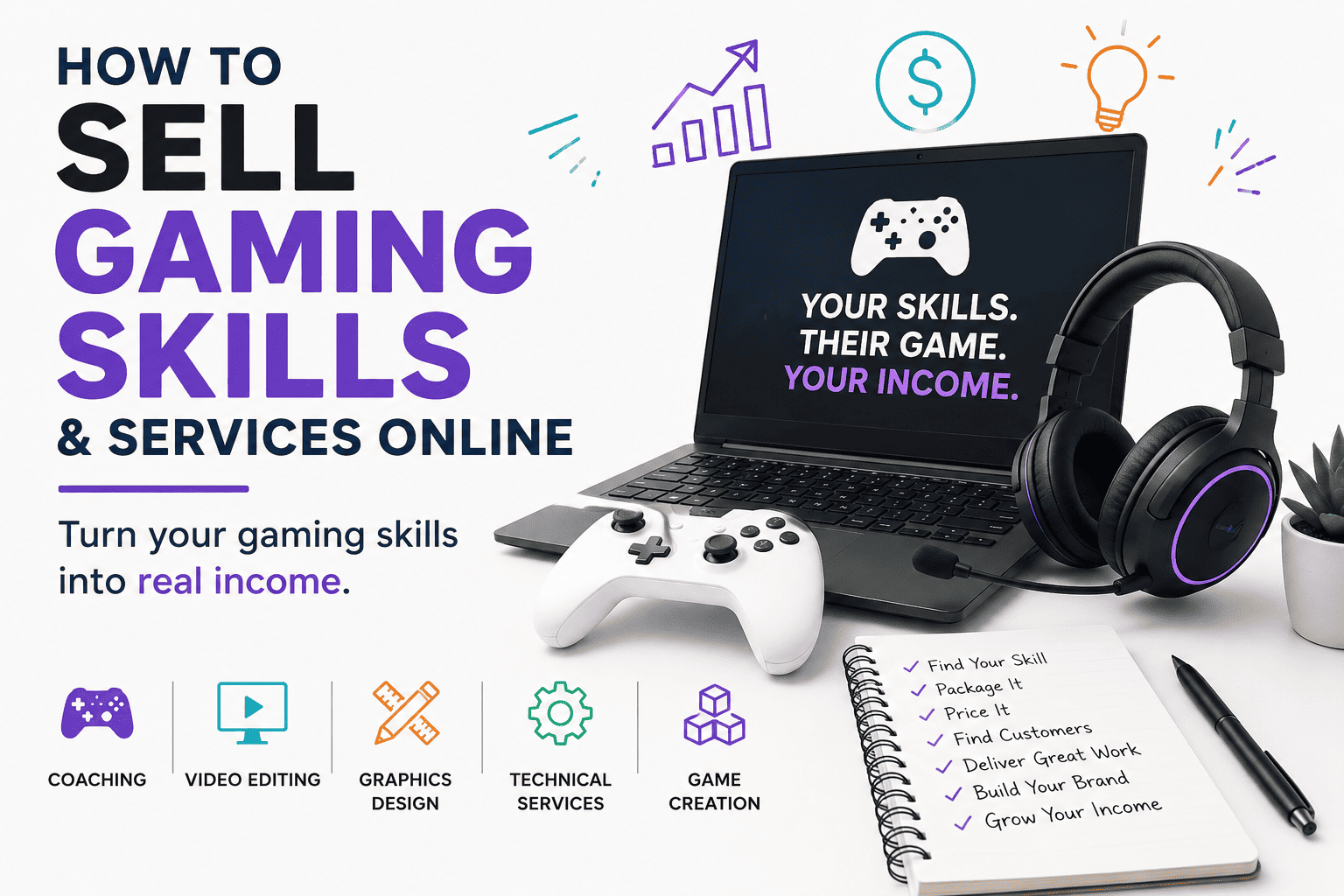
1. 🎮 Your Gaming Skills Could Be Worth Money
If you’ve spent hundreds – or thousands – of hours playing video games, you’ve probably developed more useful skills than you realise.
Maybe you understand every Valorant map like you’ve personally surveyed the land.
Maybe you’re the person your friends call when they can’t beat a boss.
Maybe you can build ridiculous Minecraft creations, edit gaming videos, design stream graphics or somehow make a struggling gaming PC behave itself.
Those skills can have value beyond the game itself.
And no, you don’t need to be an esports champion, professional streamer or someone who describes themselves as the CEO of Gaming Incorporated.
💡 Gamers Pay for Skills That Solve Problems
Think about the things gamers regularly want help with.
Some want to improve.
Others want someone experienced to play with.
Creators need videos edited, thumbnails designed and streams customised.
Server owners need builders, developers and community support.
Other gamers simply want someone knowledgeable to solve a problem that would take them hours to figure out themselves.
That’s where a gaming skill can become a service.
The important shift is moving from:
“I’m good at this game.”
to:
“What can I do with this skill that would be useful to somebody else?”
That second question is where the earning potential starts.
If you’re not sure which of your abilities could be valuable, how to make money from your gaming skills explores how everyday gaming experience can be turned into different income opportunities.
🕹️ You Don’t Have to Be an Elite Player
One of the biggest misconceptions about making money from gaming is that you need extraordinary mechanical ability.
You don’t.
Being highly skilled can obviously create opportunities, particularly in coaching and competitive gaming, but gaming services extend much further than simply being good at pressing buttons faster than everybody else.
You might be good at:
- Explaining game mechanics
- Analysing gameplay
- Teaching beginners
- Building in-game creations
- Editing gaming videos
- Designing gaming graphics
- Managing communities
- Configuring servers
- Improving PC performance
- Creating mods or digital resources
- Organising gaming events
- Writing useful gaming content
Some of these skills happen inside games.
Others develop because you’ve spent years around gaming.
Both can potentially be useful to customers.
🔍 Skills You Probably Don’t Think of as Skills
This is where things get interesting.
Gamers often underestimate abilities they’ve developed because those abilities feel normal to them.
If you’ve edited 200 gaming videos, editing probably doesn’t seem particularly unusual anymore.
If you’ve spent five years managing a large Discord server, handling roles, bots, moderation and community drama might simply feel like Tuesday.
If you can diagnose why someone’s game is stuttering while they’re still angrily blaming their internet provider, you’ve developed useful technical knowledge.
The fact that something feels easy to you doesn’t mean it’s easy for everybody else.
That’s often exactly why someone is willing to pay for help.
💰 The Skill Isn’t Enough – You Need an Offer
There’s an important difference between having a gaming skill and having something you can sell.
“Good at Rocket League” isn’t really a service.
But:
60-Minute Rocket League Coaching Session for Ranked Players
is.
“Good at Photoshop” isn’t a gaming service either.
But:
Custom Gaming YouTube Thumbnail Design
is.
The skill is the foundation.
Your job is to turn it into something with a clear customer, outcome and price.
That’s what we’re going to do throughout this guide.
We’ll look at the different gaming skills you can sell, how to identify the ones people might actually pay for, how to package and price your service, where to sell it and how to find your first customers.
You don’t need to begin with ten different services.
You need to find one useful gaming skill and one good reason for somebody to pay you for it.
So let’s start by looking at just how many different gaming skills can actually be sold online. 🔥
2. 🔥 What Gaming Skills Can You Sell Online?
When people think about selling gaming skills, coaching is often the first thing that comes to mind.
And yes, coaching can absolutely be one of them.
But the opportunity is much broader.
The gaming industry has created an enormous ecosystem around players, creators, streamers, communities, servers and digital content. All of those groups need different skills.
Some services involve playing games.
Others involve teaching, creating, fixing, organising or supporting the people who play them.
Here are some of the main areas worth considering.
🏆 Competitive Gaming Skills
If you’re particularly good at a game, your gameplay knowledge can become useful to other players.
Potential services include:
- One-to-one coaching
- Live gameplay coaching
- VOD reviews
- Strategy analysis
- Role-specific coaching
- Aim or mechanical training
- Team practice
- Competitive gaming sessions
You don’t necessarily need to be among the world’s best players.
A Gold player trying to reach Platinum doesn’t always need coaching from someone who competed at the world championships.
They need someone who understands the game well enough to identify what they’re doing wrong and explain how to improve it.
Being able to teach can be just as important as being able to play.
🧑🏫 Gaming Knowledge
Sometimes the valuable skill isn’t mechanical ability at all.
It’s knowledge.
You might understand:
- Character builds
- Game systems
- Maps
- Strategies
- Progression
- Crafting
- Team compositions
- Economy systems
- Equipment
- Game mechanics
If you’ve spent years learning a complicated game, information that seems obvious to you can save another player hours of confusion.
We’ve all had that moment where someone explains a game mechanic in 30 seconds and you realise you’ve been doing it wrong for six months.
Try not to think about the lost hours.
🕹️ Playing With Other Gamers
Some players aren’t necessarily looking for coaching.
They simply want someone experienced, reliable or enjoyable to play with.
That can create opportunities around:
- Casual gaming sessions
- Competitive sessions
- Co-op gameplay
- Team practice
- Hired-gun sessions
- Social gaming
- Content collaboration
- Helping players complete legitimate in-game activities
In these situations, the service isn’t necessarily:
“I’ll teach you how to play.”
It might simply be:
“I’ll play with you.”
Your value could come from your skill, game knowledge, communication, reliability or simply being good company.
🎨 Creative Gaming Skills
Gaming creates a constant demand for visual content.
YouTubers need thumbnails.
Streamers need overlays.
Communities need banners.
Gaming brands need graphics.
Players want custom artwork.
If you have creative skills, potential services include:
- Gaming thumbnails
- Stream overlays
- Channel banners
- Emotes
- Gaming logos
- Social media graphics
- Marketplace graphics
- Gaming artwork
- Video editing
- Shorts and clips
- Gaming montages
These services don’t require you to be particularly good at the game itself.
Your advantage may simply be that you understand what gaming content is supposed to look and feel like.
A designer who understands gaming doesn’t need a 20-minute explanation of why putting a stock photo of a businessman holding an Xbox controller on an esports thumbnail might not quite capture the intended vibe.
🧱 In-Game Creation Skills
Some games give players powerful creative tools of their own.
If you’ve become good at using them, that ability can potentially become a service.
Examples include:
- Minecraft building
- Custom maps
- Server spawns
- Roblox creation
- Fortnite Creative projects
- Level design
- In-game decoration
- Custom environments
- Game-world planning
A player might spend hundreds of hours developing these skills purely because they enjoy creating.
Eventually, somebody else may look at the result and think:
“I’d pay someone to build that for me.”
That’s the moment a hobby starts looking suspiciously like a service.
🛠️ Technical Gaming Skills
Gaming also produces plenty of technical problems.
PC performance.
Streaming setups.
Servers.
Mods.
Configuration.
Compatibility issues.
The eternal mystery of why a game that ran perfectly yesterday has decided that 17 FPS is now acceptable.
If you’re the person friends constantly ask for technical help, there may be a service hiding there.
Potential areas include:
- PC gaming optimisation
- Game settings optimisation
- Streaming setup
- OBS configuration
- Server setup
- Server configuration
- Mod installation and configuration
- Troubleshooting
- Gaming software setup
- Technical creator support
The value isn’t necessarily doing something extraordinarily complicated.
Sometimes people will happily pay because you already know how to solve a problem they don’t want to spend Saturday afternoon Googling.
🌎 Community and Content Skills
Gaming communities and creators need people behind the scenes too.
Potential services include:
- Discord setup
- Community management
- Moderation
- Tournament administration
- Gaming article writing
- Guide creation
- Social media assistance
- Creator support
- Content planning
- Community events
Someone who has spent years running guilds, clans or Discord communities may have developed surprisingly useful organisational skills.
Keeping 500 gamers in one Discord server vaguely moving in the same direction without starting an international incident over channel permissions is, frankly, an achievement.
🎯 You Only Need One Good Skill to Start
Looking at a list this long can create another problem:
You start thinking you need to offer everything.
You don’t.
If you’re excellent at coaching but terrible at graphic design, sell coaching.
If you make brilliant gaming videos but couldn’t coach your way out of the tutorial, focus on editing.
If you love Minecraft building, start there.
The goal isn’t to create the world’s most comprehensive collection of gaming services.
It’s to identify something you’re genuinely good at that solves a problem for another gamer, creator or gaming community.
And one of the most established ways to do exactly that is by turning your game knowledge into a coaching service. 🧑🏫
3. 🧑🏫 Sell Video Game Coaching
If you’re knowledgeable about a game and good at explaining why players are making mistakes, coaching can be one of the most direct ways to turn that knowledge into a service.
The important word there is explaining.
Being brilliant at a game doesn’t automatically make someone a brilliant coach.
We’ve probably all played with that mechanically gifted teammate whose entire educational philosophy consists of yelling:
“WHY DID YOU PEEK THAT?”
Technically, feedback was provided.
Whether anyone learned anything is another question.
🎯 What Does a Gaming Coach Actually Sell?
A gaming coach isn’t simply selling an hour of their time.
They’re selling improvement.
That might mean helping someone:
- Understand positioning
- Improve decision-making
- Develop better mechanics
- Learn a role or character
- Understand maps
- Fix recurring mistakes
- Improve communication
- Develop better practice habits
- Prepare for ranked play
- Analyse previous matches
Different players will need different things.
A beginner might need someone to explain fundamentals without assuming they’ve memorised every ability, weapon and map callout.
An experienced player might understand the fundamentals perfectly well but need someone else to spot the small mistakes holding them back.
That’s where personalised coaching becomes valuable.
🎥 Choose How You’ll Coach
Coaching can be delivered in several ways.
Live coaching involves watching or playing alongside the customer and providing guidance during the session.
VOD review involves analysing recorded gameplay and identifying mistakes, patterns and opportunities for improvement.
One-to-one coaching can combine discussion, demonstrations, gameplay analysis and practice.
You could also specialise further.
For example:
60-Minute Beginner Valorant Coaching
Rocket League Replay Analysis
League of Legends Jungle Coaching
Fortnite Ranked Improvement Session
Specific offers are easier for customers to understand than simply advertising yourself as a “Gaming Coach”.
🧠 Coaching Requires More Than Being Better Than the Customer
Good coaches need to communicate.
If you can identify a mistake but can’t explain it in a way the player understands, your knowledge isn’t particularly useful to them.
Strong gaming coaches tend to be good at:
- Observing gameplay
- Identifying patterns
- Prioritising improvements
- Explaining ideas clearly
- Giving constructive feedback
- Adjusting advice to different skill levels
- Remaining patient
- Creating practical improvement goals
You don’t need the personality of a motivational speaker.
You do, however, need something slightly more sophisticated than:
“Just aim better.”
If coaching sounds like the gaming skill you’d most like to monetise, how to become a gaming coach takes a deeper look at developing your coaching offer and getting started.
💰 Coaching Can Grow Beyond One Session
You can start simply with individual sessions.
As you gain experience, you might offer:
- VOD reviews
- Multi-session packages
- Beginner programmes
- Role-specific coaching
- Team coaching
- Follow-up sessions
- Personalised training plans
This gives customers different ways to work with you without forcing you to create a complicated coaching business on day one.
Start with one service you can deliver confidently.
Learn what players actually ask for.
Then expand from there.
And remember, not every gamer looking for paid help necessarily wants to be coached.
Some just want a good teammate.
4. 🕹️ Get Paid to Play With Other Gamers
Imagine getting paid to do something you might already spend Friday night doing anyway:
playing video games with other people.
Paid gaming sessions can work differently from coaching because the customer isn’t necessarily asking you to analyse their gameplay or teach them anything.
They may simply want someone skilled, reliable or enjoyable to play with.
🎮 Why Would Someone Pay to Play With Another Gamer?
There are plenty of reasons.
Someone might:
- Need another player for a co-op game
- Want an experienced teammate
- Prefer playing with someone who communicates
- Need help tackling difficult legitimate content
- Want to practise against stronger players
- Need another player for content creation
- Want a reliable gaming partner
- Be tired of random matchmaking
That last one probably requires no explanation.
Anyone who has spent enough time in online matchmaking has eventually stared at the screen and wondered whether the matchmaking system has developed a personal grievance against them.
A paid session gives the customer more control over who they’re spending their gaming time with.
⚔️ Competitive Gaming Sessions
Competitive players may want someone experienced to join them for practice or team play.
Your value could come from:
- Mechanical ability
- Communication
- Game knowledge
- Teamwork
- Role expertise
- Reliability
You might specialise in a particular role or playstyle.
For example:
Experienced Support Player for Competitive Sessions
or:
Rocket League Teammate for Ranked Practice
Again, specificity helps.
A customer can immediately understand what they’re booking.
😎 Casual and Social Sessions
Not every gaming session needs to involve sweating over ranked points.
Some customers simply want someone friendly to play with.
That could involve:
- Casual multiplayer
- Co-op games
- Exploration
- Survival games
- Social gaming
- Learning a new game together
- Completing PvE activities
In this type of service, personality and communication may matter as much as gaming skill.
Being extremely good at the game isn’t much of an advantage if spending an hour with you feels like being trapped in voice chat with an angry tournament commentator.
🎥 Content and Collaboration Sessions
Creators can also need other gamers.
A YouTuber might need players for:
- Challenge videos
- Multiplayer recordings
- Custom matches
- Experiments
- Collaborations
- Gameplay demonstrations
A streamer might need reliable people who understand what’s being recorded and won’t suddenly decide halfway through the session to test how many swear words can fit into seven seconds.
If you’re comfortable on voice chat and understand how gaming content works, that can itself become useful.
⏱️ Package Sessions Around Time
Gaming sessions are naturally suited to time-based packages.
For example:
30-Minute Session
60-Minute Session
90-Minute Session
You could also offer sessions based around a particular activity:
60-Minute Beginner Practice Session
Two-Hour Co-op Gaming Session
Content Collaboration Gaming Session
The customer should understand exactly what they’re booking and how long you’ll be available.
⚠️ Keep Sessions Within the Rules
Before offering paid gameplay, check the rules of the game and platform you’re using.
Playing with someone isn’t necessarily the same thing as playing for them.
Services involving account access, prohibited boosting, manipulation of rankings or other restricted activities can create problems.
We’ll cover this properly later in the guide, but the simple rule is:
Know what you’re allowed to offer before somebody pays you to offer it.
Paid gaming sessions are one way to monetise your actual playing ability.
But some of the most sellable gaming skills don’t involve playing at all.
They involve creating things for the enormous ecosystem that exists around games.
5. 🎨 Sell Creative Gaming Services
Open YouTube, Twitch, Discord or almost any gaming social feed and you’ll see something gaming constantly needs:
content.
Videos need editing.
Streams need graphics.
YouTube videos need thumbnails.
Communities need banners.
Creators need clips.
Gaming brands need visual assets.
If you have creative skills, you don’t necessarily need to become the creator yourself.
You can get paid to help other gaming creators look better.
🖼️ Gaming Graphic Design
Graphic design is one of the clearest examples.
Potential services include:
- YouTube thumbnails
- Twitch overlays
- Stream screens
- Channel banners
- Emotes
- Gaming logos
- Social media graphics
- Marketplace images
- Tournament graphics
- Discord banners
You might specialise in one area rather than trying to design everything.
For example:
Custom Gaming YouTube Thumbnails
is a much clearer offer than:
I Do Graphic Design
The customer immediately understands whether the service is relevant to them.
🎬 Gaming Video Editing
Gaming creators generate enormous amounts of footage.
Unfortunately for them, somebody eventually has to edit it.
A three-hour stream doesn’t magically transform itself into an eight-minute YouTube video.
Not yet, anyway.
Video editing services might include:
- YouTube videos
- Shorts
- TikToks
- Reels
- Stream highlights
- Gaming montages
- Tutorial videos
- Gameplay compilations
- Promotional videos
You can also specialise by content style.
A fast-paced Fortnite editor may develop a very different style from someone editing long-form strategy videos.
Understanding gaming helps because you already recognise:
what matters in the footage.
You know when something impressive happens.
You understand gaming humour.
You know when the creator is building towards a big moment.
You hopefully know not to cut away three frames before the winning shot.
🎮 Gaming Knowledge Can Be Your Advantage
General designers and editors can absolutely work with gaming customers.
But understanding gaming gives you context.
Imagine a client asks for a thumbnail about:
“Hitting Radiant.”
A gaming designer who understands Valorant already has useful context.
Likewise, an editor who understands the game can recognise the difference between an ordinary moment and something the audience will actually care about.
That specialist knowledge can help position you as:
a gaming creative
rather than simply another freelancer.
📦 Package Creative Work Clearly
Creative services work well when the buyer knows exactly what’s included.
For example:
Gaming Thumbnail Package
- 1 custom thumbnail
- 1280 × 720 delivery
- 2 revisions
- 3-day turnaround
Or:
Gaming Shorts Editing Package
- Up to 60 seconds
- Vertical format
- Captions
- Sound effects
- Basic motion graphics
- 2 revisions
Clear boundaries protect both sides.
The buyer knows what they’re getting.
You know what you’ve agreed to produce.
Without them, “Could you just make one small change?” has an alarming tendency to evolve into an entirely new project.
🖼️ Build Samples Before You Have Customers
Creative sellers can demonstrate their skills before making a single sale.
Design fictional gaming thumbnails.
Edit your own gameplay.
Create a stream overlay concept.
Turn an old clip into a polished Short.
You can then use those examples to show customers what you’re capable of.
This is one of the easiest ways to overcome the classic new-seller problem:
“I need customers to build a portfolio, but customers want to see a portfolio before hiring me.”
Create the proof yourself.
And creative skills don’t have to stop at graphics and video.
Some gamers have spent years learning to create things inside the games themselves.
6. 🧱 Sell In-Game Building and Creation Skills
Some gamers play Minecraft for two hours and produce a wooden rectangle with a door.
Others disappear for the weekend and return having constructed something resembling Minas Tirith.
If you’re closer to the second group, there may be people willing to pay for those skills.
Games with building and creation systems allow players to develop abilities that can become genuine creative services.
🏗️ Minecraft Building
Minecraft is probably the most obvious example.
Experienced builders can potentially create:
- Custom houses
- Survival bases
- Castles
- Server spawns
- Cities
- Landscapes
- Adventure areas
- Interiors
- Redstone builds
- Custom maps
Potential customers could include:
- Individual players
- Server owners
- Gaming communities
- Content creators
- Map creators
The customer has the idea.
You have the ability to actually build it without producing another giant cobblestone cube.
That’s the value exchange.
🌎 Creation Skills Go Beyond Minecraft
Other games and platforms also provide tools that reward creative ability.
Depending on the game and what its rules permit, opportunities may exist around:
- Roblox development
- Fortnite Creative
- Custom maps
- Level design
- Server environments
- In-game decoration
- Game-world creation
- Custom experiences
These skills can combine creativity with technical knowledge.
Someone may be brilliant at designing environments but also understand scripting, game mechanics or optimisation.
The more useful the combination, the more specialised the service can become.
🖼️ Your Portfolio Matters
In-game creation is extremely visual.
Use that.
Take high-quality screenshots.
Show different styles.
Create walkthrough videos.
Record timelapses.
Show before-and-after transformations.
If you’re offering Minecraft building, don’t simply write:
“I am a very good Minecraft builder.”
Show the castle.
Show the city.
Show the enormous fantasy server spawn that made your GPU briefly reconsider its career choices.
Let the work prove the claim.
💰 Choose a Pricing Model That Fits the Project
In-game building can be harder to price than a simple one-hour session because projects can vary enormously.
You might charge:
- Fixed price
- Hourly rate
- By project size
- By complexity
- Through predefined packages
- Through custom quotes
For example:
Small Build
Simple house, structure or interior.
Medium Build
Detailed base, larger structure or environment.
Large Custom Project
Server spawn, large castle, city area or complex custom environment.
Be careful with vague project descriptions.
“Build me a small castle” could mean a decorative tower that takes two hours.
Or it could apparently mean twelve towers, a harbour, underground tunnels, four villages and a fully functioning medieval economy.
Get the scope in writing.
📦 Service or Digital Product?
In-game creation can sometimes lead to two different income models.
You can build something specifically for one customer.
That’s a service.
Or you may be able to create a reusable digital resource that multiple customers can purchase, assuming the game and platform rules allow it.
That’s closer to a digital product.
You don’t need to choose one model forever.
A custom builder might eventually create reusable resources alongside commissioned projects.
We’ll return to that idea later when we look at how a successful gaming service can expand into a broader side hustle.
For now, there’s another category of gaming ability that people frequently underestimate because it doesn’t look particularly glamorous.
Until their game stops working.
Then suddenly it’s the most important skill in the world.
7. 🛠️ Sell Gaming Technical Skills
Gaming has a remarkable ability to create technical problems five minutes before you actually want to play.
The game won’t launch.
The frame rate has collapsed.
OBS has stopped capturing the correct window.
The microphone sounds like it was recovered from a shipwreck.
The mod refuses to load.
The server has apparently decided it no longer believes in connectivity.
For technically minded gamers, solving these problems can become a sellable skill.
💻 PC Gaming Optimisation
PC gamers have an enormous number of settings available to them.
That’s fantastic when everything works.
Less fantastic when somebody has changed 14 things after watching three conflicting optimisation videos and can no longer remember what the original settings were.
Potential optimisation services might help with areas such as:
- In-game graphics settings
- Performance configuration
- FPS optimisation
- Resolution settings
- Display configuration
- Basic system optimisation
- Game-specific settings
- Troubleshooting obvious performance issues
Be clear about what you can realistically improve.
You shouldn’t promise:
GUARANTEED 300 FPS
when the customer is trying to run a modern AAA game on hardware that remembers Windows Vista fondly.
Sell expertise, not miracles.
🎥 Streaming and Creator Setup
Streaming introduces another collection of technical challenges.
Potential services could involve:
- OBS setup
- Scene configuration
- Audio configuration
- Capture setup
- Stream layouts
- Recording configuration
- Basic creator workflows
This can work particularly well when technical knowledge overlaps with creative skills.
Someone who understands both OBS and stream design could potentially help a new streamer create an entire basic setup rather than solving one isolated problem.
🌐 Servers and Gaming Communities
Online communities can also require technical support.
Depending on your knowledge, that might involve:
- Game server setup
- Server configuration
- Discord configuration
- Bots
- Permissions
- Roles
- Channels
- Basic integrations
- Troubleshooting
Server owners often want the finished result without necessarily wanting to become experts in every piece of software involved.
If you already know how to configure it, you’re selling them something extremely valuable:
time and reduced frustration.
🧩 Mods and Game Configuration
Some gamers become highly experienced with:
- Mod installation
- Mod configuration
- Compatibility
- Load orders
- Game configuration
- Custom setups
Again, check the rules of the relevant game and platform before turning any technical activity into a paid service.
Technical capability doesn’t automatically mean an activity is permitted.
That becomes particularly important around multiplayer games, third-party software and anything that could affect competitive play.
🔐 Be Careful With Remote Access
Technical services sometimes create pressure to ask for direct access to a customer’s computer or account.
Avoid unnecessary access wherever possible.
If a problem can be solved by:
- Screen sharing
- Written instructions
- Voice guidance
- Customer-controlled configuration
that can often be preferable to taking direct control.
Never ask customers for passwords simply because it’s convenient.
A professional technical service should make the customer feel more secure, not wonder whether they’ve just handed their gaming life to a stranger called xX_FPSDoctor_Xx.
🎯 Sell the Solution, Not the Technical Jargon
Customers usually care less about how complicated your technical knowledge is than whether you can solve their problem.
Compare:
Advanced PC Configuration Services
with:
I’ll Help Optimise Your PC Settings for Better Gaming Performance
The second version communicates an outcome.
Likewise:
OBS Technical Configuration
is less immediately appealing than:
I’ll Set Up OBS for Your Gaming Stream
Don’t make customers decode your expertise.
Tell them what problem you solve.
And technical knowledge isn’t the only useful gaming skill that develops outside the game itself.
If you’ve spent years running Discord servers, organising communities, writing guides or supporting creators, you may have another group of sellable skills hiding in plain sight.
8. 🌎 Sell Gaming Community and Content Skills
Some of the most useful gaming skills aren’t developed during matches at all.
They’re developed in Discord servers, gaming communities, forums, YouTube channels and the organised chaos that surrounds them.
If you’ve spent years managing communities, creating gaming content or helping other gamers organise things, you may have developed skills that businesses, creators and communities are willing to pay for.
💬 Gaming Community Management
Running a gaming community involves much more than creating a Discord server and adding a channel called #general.
Active communities need people who can:
- Welcome new members
- Answer questions
- Create channels and roles
- Moderate discussions
- Organise activities
- Manage community rules
- Handle disputes
- Coordinate announcements
- Keep members engaged
- Support community growth
Large gaming communities can become surprisingly complicated.
At some point, you’re no longer simply chatting with people who enjoy the same game.
You’re deciding whether someone deserves a warning because an argument about weapon balancing has somehow escalated into a diplomatic crisis.
Those organisational and communication skills can be useful beyond your own community.
🛡️ Moderation
Moderation can also become a specialist service.
Gaming communities, streamers and creators may need help managing:
- Discord servers
- Livestream chats
- Forums
- Community groups
- Comments
- Events
Good moderators need judgement.
Deleting obvious spam is easy.
Deciding when a heated conversation needs intervention without turning every disagreement into a courtroom proceeding is harder.
Reliability matters too.
A community owner isn’t simply giving you permissions.
They’re trusting you with part of the environment they’ve built.
🏆 Gaming Events and Tournament Support
Communities frequently organise:
- Tournaments
- Competitions
- Game nights
- Community challenges
- Scrims
- Giveaways
- Creator events
Someone has to organise them.
If you’ve previously run tournaments for your clan or community, you may already understand tasks such as registrations, brackets, scheduling, player communication and results.
That’s useful experience.
A 32-player community tournament might look simple from the outside.
Then two teams can’t agree on a time, one player hasn’t read the rules, somebody registered under the wrong username and the favourite team has apparently vanished.
Welcome to event management.
✍️ Gaming Writing and Guides
If you know a game extremely well and can explain it clearly, writing can also become a gaming service.
Potential work could include:
- Game guides
- Strategy articles
- Beginner tutorials
- Build guides
- Website content
- Gaming news
- Product descriptions
- Scripts
- Community documentation
This combines two abilities:
knowing something useful and communicating it clearly.
That’s particularly valuable for complicated games where players regularly search for help.
You might provide custom writing as a service, or eventually turn your knowledge into guides and other digital resources that can be sold repeatedly.
📱 Support Gaming Creators
Creators often need help with far more than the actual recording.
Behind one gaming channel there might be:
- Video editing
- Thumbnail creation
- Research
- Community management
- Social posting
- Moderation
- Clip creation
- Content planning
- Upload management
You don’t necessarily need to become the person on camera.
You can build a service around helping the person who is.
This can be particularly attractive if you enjoy gaming content but have absolutely no desire to spend four hours livestreaming yourself while maintaining an enthusiastic conversation with a chat containing three people and a bot.
🎯 Look at What You’re Already Doing
Community and content skills are easy to overlook because many gamers develop them informally.
Ask yourself:
Have I managed a Discord server?
Have I organised tournaments?
Do people ask me to write guides?
Have I moderated communities?
Do I understand gaming content better than most beginners?
If the answer is yes, don’t dismiss that experience simply because nobody originally called it “work”.
The next step is determining which of all these gaming skills has enough value to become a service someone might actually buy.
9. 🔍 Find the Gaming Skills People Would Actually Pay You For
By now we’ve covered a fairly large collection of possible gaming services.
The temptation is to look at the list and ask:
“Which one makes the most money?”
There’s a better question:
“Which problem can I solve well enough that someone would pay me to solve it?”
That’s the foundation of a good service.
🧠 Start With a Gaming Skill Inventory
Write down the things you’re genuinely good at.
Not things you might become good at after watching six tutorials.
Things you can already do confidently.
Think about:
- Games you know extremely well
- Competitive skills
- Creative abilities
- Technical knowledge
- Community experience
- Content skills
- Software you understand
- Problems you regularly solve
- Things other gamers ask you about
Don’t worry yet about whether each one can make money.
You’re simply identifying your raw material.
You may be surprised by how much you’ve learned through gaming.
👀 Pay Attention to What People Already Ask You For
One of the strongest signals is something that’s probably happening already.
What do people ask you for help with?
Maybe friends constantly send you gameplay clips and ask what they’re doing wrong.
Maybe you’re the person everyone asks to configure the server.
Maybe creators ask how you make your thumbnails.
Maybe people copy your Minecraft builds.
Maybe you’re constantly fixing somebody’s mod setup.
Repeated requests indicate a problem exists.
If people already seek your help for free, ask whether there could be customers willing to pay for a more structured version of that help.
🧩 Connect the Skill to a Problem
A skill becomes easier to sell when you connect it to a specific problem.
A simple formula is:
Skill + Customer Problem + Clear Outcome = Sellable Gaming Service
For example:
Skill: Valorant knowledge
Problem: Player doesn’t understand why they’re losing ranked matches
Service: Gameplay review identifying their biggest mistakes
Or:
Skill: Video editing
Problem: Streamer has hours of footage but no time to edit
Service: Turn stream recordings into polished YouTube videos
Or:
Skill: Minecraft building
Problem: Server owner needs an impressive spawn area
Service: Custom Minecraft server spawn design and build
Or:
Skill: PC optimisation
Problem: Player has poor game performance
Service: Gaming settings and performance optimisation
The clearer the problem, the easier it becomes to explain why your service exists.
💰 Look for Problems Worth Paying to Solve
Not every problem creates a good paid service.
People are more likely to pay when your service saves them:
- Time
- Frustration
- Effort
- Learning
- Trial and error
Or helps them gain:
- Skill
- Better content
- Better results
- Convenience
- Quality
- Enjoyment
Imagine someone could spend eight hours learning how to solve something themselves.
If you already know how to do it and can solve it properly in one hour, there’s potential value in that knowledge.
This is one reason you don’t necessarily need professional-level gaming ability to earn. How to make money gaming without being a pro explores several opportunities where knowledge, creativity and useful skills can matter more than elite gameplay.
🧪 Test the Idea Before Building Around It
You don’t need to spend three months developing a brand around a service nobody has asked for.
Start smaller.
Create a basic offer.
Show it to relevant people.
List it.
Mention it in communities where promotion is allowed.
See what questions people ask.
You might discover customers want something slightly different from what you imagined.
That’s useful.
Suppose you plan to offer general gaming video editing, but most enquiries are from streamers wanting Shorts.
That tells you something.
Your original idea hasn’t failed.
The market has just handed you a fairly obvious hint.
🎯 Choose One Strong Starting Point
You may identify five skills with earning potential.
Pick one to start.
Choose something where:
You’re already competent.
There’s a clear customer.
There’s a recognisable problem.
You can explain the outcome.
You can realistically deliver the work.
You can always add more services later.
For now, one clear offer is enough.
Once you’ve chosen the skill, the next question becomes much easier:
Who exactly are you selling it to?
10. 🎯 Choose Who Your Gaming Service Is For
A common mistake when creating a service is trying to make it relevant to absolutely everybody.
You write something like:
Professional Gaming Help for All Gamers
Technically, you’ve excluded nobody.
Unfortunately, you’ve also given nobody a particularly strong reason to think:
“That’s exactly what I need.”
A service becomes easier to sell when you know who it’s designed for.
👤 Think About the Customer, Not Just the Skill
Suppose you’re good at Apex Legends.
You could advertise:
Apex Legends Coaching
That’s reasonable.
But perhaps your real strength is helping newer ranked players understand positioning and rotations.
Now you could offer:
Apex Legends Coaching for Beginner and Lower-Ranked Players
The second version tells a particular player:
This is for you.
That can be powerful.
🎮 Different Gaming Skills Have Different Customers
Potential customers could include:
- Beginner gamers
- Competitive players
- Casual players
- Streamers
- YouTubers
- Gaming creators
- Server owners
- Clan leaders
- Gaming communities
- Indie developers
- Tournament organisers
The person paying isn’t always the person playing.
A Minecraft builder may be hired by a server owner.
A video editor may work for a YouTuber.
A graphics designer may work for a streamer.
A community manager might be hired by a gaming brand.
Understanding who pays helps you design the service around what that person actually needs.
🧑🏫 Match Your Experience to the Right Customer
You don’t need to serve the most advanced customers.
In fact, trying to do so can make your service less credible if your experience doesn’t support it.
Imagine you’re a strong intermediate player who is excellent at teaching beginners.
That’s a perfectly useful skill.
You don’t need to suddenly market yourself as:
ELITE PRO COACHING FOR FUTURE ESPORTS CHAMPIONS
Beginner coaching may actually be a better service for you.
Your experience and communication style match the customer’s needs.
The same principle applies outside coaching.
A video editor who specialises in Shorts doesn’t need to pretend they produce cinematic documentaries.
A Minecraft builder who excels at medieval architecture doesn’t need to offer every imaginable style.
Specialisation can make your offer stronger.
💡 Understand What Your Customer Actually Wants
Customers rarely wake up thinking:
“Today I would like to purchase approximately two hours of someone’s labour.”
They want a result.
The competitive gamer wants to improve.
The YouTuber wants a finished video.
The server owner wants an impressive build.
The streamer wants professional graphics.
The community owner wants someone reliable to help manage members.
Focus your service around that desired outcome.
Instead of:
Two Hours of Video Editing
you could offer:
Gaming YouTube Video Edited From Your Raw Footage
The work may still take two hours.
But the second version describes what the customer gets.
🔎 Narrow Enough to Be Relevant, Not Invisible
You can specialise too far.
For example:
Tuesday Evening Coaching for Left-Handed Australian Bronze-Rank Support Players Who Main One Specific Character
Congratulations.
You may have created the world’s most precisely targeted service.
Your total addressable market is Competitive Gamer Gary.
Aim for a niche that makes your service relevant without shrinking the potential audience into non-existence.
Usually, specialising by game, service type, customer type or outcome is enough.
🗣️ Use the Customer’s Language
Think about how your customer would describe their problem.
A new streamer might not search for:
Advanced Audiovisual Broadcasting Configuration
They might search for:
Help Setting Up OBS for Streaming
Use clear language.
Gaming services already involve enough jargon without making the customer solve a vocabulary puzzle before they can hire you.
Once you know what you’re good at, what problem you solve and who you’re solving it for, you have the ingredients for a service.
Now you need to package those ingredients into something people can actually buy.
11. 📦 Turn Your Gaming Skill Into Something Gamers Can Buy
A skill isn’t automatically a product.
You can’t put:
I Know Loads About Rocket League
on a marketplace and expect customers to work out what they’re supposed to purchase.
You need to package your ability into a defined offer.
That means deciding:
What does the customer receive?
How much is included?
How does delivery work?
When is it finished?
🎯 Start With the Outcome
The easiest place to begin is the result.
Imagine you’re good at analysing competitive gameplay.
Instead of selling:
My Gaming Knowledge
you could sell:
60-Minute One-to-One Gameplay Review
Or:
Recorded VOD Review With Personalised Feedback
If you’re a designer:
Custom Gaming YouTube Thumbnail
If you’re a Minecraft builder:
Custom Survival Base Build
If you’re an editor:
Gaming Short Edited From Your Raw Footage
The customer should be able to understand the basic offer in seconds.
📋 Define What’s Included
Now establish the boundaries.
Depending on the service, specify:
- Session length
- Number of deliverables
- Project size
- Turnaround time
- Number of revisions
- Communication method
- File format
- Supported platform
- Customer requirements
- Important exclusions
This prevents misunderstandings.
Imagine a customer orders:
Custom Minecraft Castle
You imagine a tasteful medieval keep.
They imagine a continent-sized fortress with working redstone gates, seven villages, underground catacombs and a dragon sanctuary.
Both technically qualify as castles.
Only one fits the price you quoted.
Clear scope is your friend.
⏱️ Package Time-Based Services
Coaching and gaming sessions work naturally around time.
For example:
30-Minute Quick Review
60-Minute Coaching Session
90-Minute Extended Session
You could also package sessions by purpose.
For example:
Beginner Introduction
Ranked Gameplay Review
Competitive Improvement Session
The second approach can be particularly effective because customers are choosing an outcome rather than simply buying minutes.
🎨 Package Creative Services Around Deliverables
Creative work often makes more sense as a finished product.
For example:
Starter Thumbnail Package
- 1 custom gaming thumbnail
- 2 revisions
- 3-day delivery
Creator Thumbnail Pack
- 5 custom thumbnails
- 2 revisions each
- Consistent channel style
Or for editing:
Gaming Short
- Up to 60 seconds
- Captions
- Basic effects
- Vertical format
- 2 revisions
Again, the goal is removing uncertainty.
➕ Use Add-Ons for Extra Work
Some requests naturally sit outside the standard package.
Instead of making every customer pay for everything, you can potentially offer extras such as:
- Faster delivery
- Additional revisions
- Extra thumbnails
- Longer videos
- Additional coaching time
- Larger builds
- Extra file formats
- Additional versions
This keeps the core service simple while giving customers flexibility.
Just make sure add-ons don’t turn the listing into a restaurant menu containing 84 choices.
Customers should still understand what the main service actually is.
💬 Use Custom Quotes When the Work Really Is Custom
Not every gaming service fits neatly into predefined packages.
Large Minecraft builds, game development, technical projects and complex creative work may require a custom quote.
In those cases, gather the requirements before agreeing to a price.
Ask about:
- Scope
- Complexity
- Deadline
- Required features
- Deliverables
- Customer expectations
Then estimate the work realistically.
“How much for a server?” isn’t enough information.
Neither is:
“Shouldn’t take long.”
Those four words have preceded some of humanity’s longest projects.
🔄 Consider Whether the Skill Could Become a Product
Some services produce knowledge or assets that could eventually be packaged differently.
A coach might create a training guide.
A designer might create reusable templates.
A builder might create downloadable resources.
A writer might produce gaming guides.
That can open the door to digital products that aren’t tied directly to selling another hour of your time.
You don’t need to solve that now, but it’s worth recognising the possibility as your side hustle develops.
For the moment, focus on creating one clear service with one understandable outcome.
Once you’ve done that, you reach the question almost every new seller struggles with:
What should you charge for it?
12. 💰 How Much Should You Charge for Gaming Services?
Pricing a gaming service can feel strangely difficult.
Charge too much and you worry nobody will buy.
Charge too little and you may end up spending four hours completing a job that earns enough to purchase approximately half a sandwich.
The goal isn’t to discover the single mathematically perfect price.
It’s to find a price that makes sense for your skill, your time, the customer and the service you’re providing.
💵 Choose a Pricing Model
Different gaming services suit different pricing models.
Common options include:
- Hourly pricing
- Per-session pricing
- Fixed project pricing
- Packages
- Custom quotes
- Paid add-ons
Coaching might work well at a per-session rate.
Video editing could use fixed prices based on video length or complexity.
Community management might suit an hourly or ongoing arrangement.
Large custom builds may require individual quotes.
Choose the model that makes the service easiest for both you and the customer to understand.
⏱️ Calculate How Long the Work Really Takes
Don’t only count the obvious part.
Suppose you sell a gaming video edit for $60.
The editing takes two hours.
Sounds like $30 per hour.
But perhaps you also spend:
- 20 minutes discussing the brief
- 15 minutes downloading and organising footage
- 30 minutes handling revisions
- 15 minutes exporting and uploading files
Now the job takes more than three hours.
Your effective hourly rate is considerably lower.
A useful calculation is:
Price ÷ Total Time Required = Approximate Hourly Return
That doesn’t mean you have to charge hourly.
It simply helps you understand what your fixed price actually means.
🧠 Factor in Skill and Experience
Two people can spend an hour on the same type of work and produce completely different results.
Experience matters.
A highly experienced editor may finish a strong video faster than a beginner.
An established coach may spot problems immediately that someone less experienced misses.
A talented designer might create a better thumbnail in one hour than another person creates in four.
Customers aren’t necessarily paying for the number of minutes your mouse was moving.
They’re paying for the result your experience allows you to produce.
🔎 Research Comparable Services
Look at what other sellers charge for similar work.
Don’t simply find the cheapest person and undercut them.
Instead, look at:
- What they include
- Their experience
- Quality of work
- Package structure
- Delivery times
- Reviews
- Specialisation
This gives you a general sense of the market.
You may discover that what you planned to charge is unrealistic in either direction.
Research is information, not an instruction to copy someone else’s price.
🌱 Introductory Pricing Can Help
When you’re completely new, a temporary introductory price can make it easier for customers to take a chance on you.
You might offer:
First five sessions at a lower rate
or create:
A smaller entry-level package
The purpose is to gain:
- Experience
- Reviews
- Portfolio work
- Customer feedback
The important part is remembering that introductory pricing is introductory.
Don’t accidentally build a permanent business around rates you chose because you had zero reviews.
🚫 Don’t Automatically Become the Cheapest
Competing purely on price can become a race nobody particularly enjoys winning.
If one seller charges $40, you charge $30.
Someone else charges $20.
Then $15.
Eventually everyone is competing for the prestigious title:
Who Can Work for the Least Money?
Price matters, but buyers also care about:
- Quality
- Trust
- Experience
- Communication
- Reliability
- Specialisation
- Delivery time
A strong service doesn’t need to be the cheapest service.
📦 Use Packages to Create Choice
Packages can help customers choose based on their needs.
For example:
Quick VOD Review – $25
Short gameplay review with priority feedback.
Full VOD Review – $50
Detailed analysis with written recommendations.
Improvement Package – $90
Detailed VOD review plus one-to-one follow-up coaching.
Packages can also increase average order value without forcing every customer into the most expensive option.
Keep the differences meaningful and easy to understand.
💳 Remember Fees and Costs
Your advertised price isn’t necessarily what you keep.
Depending on how you sell, costs could include:
- Marketplace fees
- Payment processing
- Software
- Subscriptions
- Equipment
- Business expenses
- Taxes
You don’t need an accounting department before selling your first $30 service.
But you should understand that:
Revenue isn’t automatically profit.
This becomes increasingly important as your gaming income grows.
📈 Let Your Pricing Develop With Your Service
Your first price doesn’t need to remain unchanged forever.
As you gain experience, improve your portfolio and collect positive reviews, you can reassess it.
Pay attention to demand.
If nobody buys, price could be one issue – although your listing, offer or lack of trust could be equally responsible.
If you’re constantly fully booked, that tells you something too.
Pricing is something you refine as you learn.
Start with a sensible number based on the work involved, your ability and comparable services.
Then adjust based on what actually happens.
Because once you have a service and a price, you need to make sure potential customers understand why they should choose yours.
13. 📝 Create a Gaming Service Listing That Gets Attention
You can have a genuinely useful gaming service at a fair price and still make no sales if nobody understands what you’re offering.
That’s where your listing matters.
Think of it as the digital shop window for your service.
A potential customer should be able to scan it and quickly understand:
What do you offer? Who is it for? What do I get? Why should I trust you?
If they need to send you three messages just to work out whether you’re offering coaching, video editing or someone willing to spend Saturday afternoon building a Minecraft fortress, the listing needs work.
🎯 Start With a Clear Title
Your title is often the first thing a buyer sees.
Make it specific.
Compare:
❌ I Will Help You With Rocket League
with:
✅ One-to-One Rocket League Coaching for Ranked Players
Or:
❌ Gaming Video Editing
with:
✅ Gaming YouTube Video Editing From Your Raw Footage
Or:
❌ Minecraft Builder
with:
✅ Custom Minecraft Builds for Servers and Survival Worlds
The stronger versions explain the service immediately.
A useful starting formula is:
Game or Niche + Service + Customer or Outcome
You don’t need to cram all of that into every title, but it helps keep the offer focused.
👤 Open With the Customer’s Problem
The first part of your description should reassure the reader that they’ve found something relevant.
For example:
Struggling to understand why you’re losing ranked Valorant matches? I’ll review your gameplay and identify the biggest mistakes holding you back.
Or:
Need gaming videos but don’t have time to edit hours of raw footage? I’ll turn your gameplay into a polished YouTube video.
Both start with something the customer actually cares about.
That’s usually more effective than opening with:
Hello. My name is Dave and I’ve loved gaming since I was seven.
Dave may have had a wonderful childhood.
But the customer came because they need a video edited.
You can explain your experience after you’ve shown them the listing is relevant.
📦 Explain Exactly What’s Included
Don’t make buyers guess.
Depending on the service, explain:
- What you’ll do
- What they’ll receive
- Session length
- Number of deliverables
- Turnaround time
- Number of revisions
- Communication method
- Required files or information
- Supported games or platforms
- Important exclusions
For example:
60-Minute Gameplay Review
Includes:
- One-to-one voice session
- Review of your recorded gameplay
- Feedback on positioning and decision-making
- Three priority areas to improve
- Short written summary after the session
Now the customer can clearly see what their money buys.
That’s considerably stronger than:
Professional coaching that will take your gaming to the NEXT LEVEL!!!
Capital letters are not deliverables.
⭐ Explain Why You’re Qualified
Once the buyer understands the service, give them reasons to believe you can deliver it.
Relevant proof might include:
- Rank
- Years of experience
- Coaching background
- Portfolio work
- Technical experience
- Previous projects
- Tournament experience
- Community experience
- Specialist game knowledge
Keep it connected to the service.
If you’re selling Minecraft builds, screenshots of impressive builds matter far more than your Call of Duty K/D.
If you’re selling video editing, show editing work.
Match the evidence to the claim.
🖼️ Use Strong Listing Images
Visuals matter enormously for creative gaming services.
If you’re offering:
Graphics: show your designs.
Video editing: show finished examples or before-and-after work.
Minecraft building: show your strongest builds.
Technical services: use clear graphics explaining the service.
Coaching: use a clean image showing the game, type of coaching and who the service is for.
Avoid trying to fit your entire service description into one image.
If the main graphic includes 14 screenshots, seven icons and enough 8px text to qualify as a legal contract, simplify it.
The image should attract attention.
The listing description can do the explaining.
❓ Answer Obvious Questions Before They’re Asked
A short FAQ can remove uncertainty.
Useful questions might include:
- What do you need from me?
- Which games do you support?
- How does the session work?
- What file formats do you provide?
- How long will delivery take?
- Are revisions included?
- Can you handle custom requests?
- Should I message before ordering?
Think about the questions you’d ask if you were spending your own money.
Then answer the important ones.
✅ Do the Five-Second Test
Before publishing, look at the listing as if you’ve never seen it before.
Can you understand in five seconds:
What it is?
Who it’s for?
What the buyer gets?
If not, simplify it.
A good listing doesn’t make the buyer work hard to understand your offer.
It makes the decision feel easy.
Of course, a clear listing only solves part of the problem.
If you’re new and have no reviews yet, buyers still need a reason to trust you.
14. ⭐ How to Build Trust When Nobody Knows You Yet
Every new seller eventually meets the same frustrating problem:
Customers want reviews before they buy.
But you need customers before you can get reviews.
Welcome to the zero-review problem.
Fortunately, reviews aren’t the only way to build trust.
When you’re starting from scratch, your goal is to provide enough evidence that you’re capable, reliable and unlikely to vanish into the digital wilderness halfway through an order.
👤 Complete Your Seller Profile
If you’re selling through a marketplace, start with the basics.
A completely empty seller profile can make even a good service feel questionable.
Add:
- A suitable profile image
- Short introduction
- Relevant gaming experience
- Games or skills you specialise in
- Clear service descriptions
You don’t need to write your life story.
Buyers probably don’t need the exact date you received your first PlayStation.
They simply want enough information to understand who they’re dealing with.
🎮 Show Relevant Experience
Proof depends on the service.
A gaming coach might show:
- Competitive rank
- Years playing the game
- Coaching experience
- Tournament experience
- Specialist roles or characters
A designer should show graphics.
A video editor should show videos.
A builder should show builds.
A community manager might explain the size or type of communities they’ve previously managed.
The key word is relevant.
Proof that doesn’t connect to the service isn’t particularly persuasive.
🖼️ Build a Portfolio Before You Have Customers
One of the best ways to build trust is to create your own examples.
You don’t need paying customers before you’re allowed to demonstrate your skills.
A thumbnail designer could create fictional gaming thumbnails.
A video editor could edit their own gameplay.
A Minecraft builder could create several showcase projects.
A gaming writer could produce sample guides.
A coach could publish useful educational content.
This changes your message from:
“Trust me. I’m good.”
to:
“Here’s what I can do.”
Much better.
🧪 Make the Examples Realistic
Create samples that resemble the work you actually want customers to buy.
If you want to edit gaming Shorts, show gaming Shorts.
If you want Minecraft server work, build something a server owner might realistically commission.
If you want to design thumbnails, create several thumbnails in different gaming styles.
Don’t fill your portfolio with work unrelated to the service simply because it’s technically creative.
Someone looking for YouTube gaming thumbnails probably doesn’t need to see the birthday invitation you designed for your aunt in 2021.
💰 Consider a Smaller Starting Offer
Price can reduce the risk of trying a new seller.
Instead of asking a new customer to commit immediately to a large package, offer something smaller.
For example:
One coaching session instead of five
One thumbnail instead of ten
One edited Short instead of a full content package
A small custom build instead of an enormous server project
This allows the customer to test the service.
If they’re happy, you have the opportunity to earn repeat work.
💬 Communicate Properly
Trust can be built or destroyed before the order even starts.
Good communication means:
- Answering questions clearly
- Responding within a reasonable time
- Confirming requirements
- Being realistic about deadlines
- Explaining what’s included
- Asking questions when something is unclear
You don’t need to reply within eight seconds at 3 AM.
But disappearing for three days and returning with:
“yo sorry was busy”
probably isn’t the professional image you’re aiming for.
⏱️ Don’t Promise More Than You Can Deliver
New sellers sometimes overcompensate.
24-hour delivery!
Unlimited revisions!
Available anytime!
Guaranteed results!
It sounds impressive until several customers order at once.
Be realistic.
If something normally takes three days, don’t promise one day just because it looks more competitive.
Reliability builds trust far faster than ambitious promises you regularly fail to meet.
🤝 Make Your First Customers Count
Your earliest orders are about more than revenue.
They help you build:
- Experience
- Reviews
- Portfolio work
- Confidence
- Better systems
- Customer insight
Treat those customers well.
If they’re happy, encourage them to leave an honest review through the platform you’re using.
Don’t buy reviews or manufacture fake ones.
Five genuine reviews are much more useful than a suspicious collection of:
⭐⭐⭐⭐⭐ “Amazing seller very gaming yes.”
Trust builds slowly.
But once you’ve completed several good orders, it becomes much easier for the next buyer to feel comfortable choosing you.
And for that trust to matter, your service still needs to be listed somewhere customers can actually find it.
15. 🌐 Where Can You Sell Gaming Skills and Services?
Once your service is ready, you need somewhere to sell it.
You could build your own website, payment system, checkout process and marketing funnel from scratch.
Or you could start somewhere that already has potential customers.
For most new sellers, the second option is considerably less dramatic.
🎮 Specialist Gaming Marketplaces
Gaming marketplaces can be a natural fit because the audience already understands gaming.
Depending on the platform, sellers may be able to offer things such as:
- Gaming coaching
- Paid gaming sessions
- Technical services
- Creative services
- Digital products
- Game-related development
- In-game creative work
The biggest advantage is relevance.
A customer browsing a gaming marketplace isn’t confused by the existence of a Rocket League coaching service.
They’re there specifically because gaming products and services are being sold.
Marketplaces can also provide infrastructure such as:
- Listings
- Payments
- Reviews
- Customer accounts
- Order management
The trade-off is that you’ll need to follow the marketplace’s rules and may pay fees.
💻 General Freelance Platforms
Broader freelance platforms can also work well for gaming-related creative and technical services.
Examples might include:
- Video editing
- Graphic design
- Writing
- Community management
- Development
- Social media work
The challenge is that you’re competing within a much broader marketplace.
That’s where gaming specialisation can help.
Instead of simply being:
Video Editor
you might position yourself as:
Gaming Video Editor for YouTube and Short-Form Content
That gives gaming creators a clearer reason to choose you.
💬 Gaming Communities
Discord servers, forums, Reddit communities and game-specific groups can also help you find customers.
But this works best when you’re actually part of the community.
The worst possible approach looks something like:
- Join server
- Ignore every conversation
- Post service link
- Write CHEAP COACHING DM ME
- Get removed by moderator
- Decide marketing doesn’t work
A better approach is to contribute.
Answer questions.
Help people.
Participate.
Build a reputation.
Then, if promotion is permitted, mention your service in the correct place.
Trust is much easier to build when people already recognise you.
📱 Social Media and Gaming Content
Content can also bring potential customers to you.
A coach could publish tips.
A Minecraft builder could share timelapses.
A designer could post thumbnail redesigns.
A video editor could show before-and-after clips.
A technical specialist could share optimisation advice.
This works because you’re demonstrating the skill rather than merely advertising it.
We’ll look more closely at that later because showing your ability can become one of the strongest ways to attract customers.
👥 Your Existing Gaming Network
Don’t overlook people you already know.
Your first customer might come from:
- Friends
- Clan members
- Streamers
- Server owners
- Gaming communities
- Creators
- Previous collaborators
You don’t need to suddenly message everyone you’ve ever played with.
But if someone genuinely has a problem your service solves, let them know you’re offering it.
A simple:
“I’ve started editing gaming videos. If you ever need help with your channel, here’s some of my work.”
is enough.
Much better than:
“Dear valued gaming associate, I am delighted to announce several exciting commercial packages.”
You’re starting a side hustle.
Not announcing a multinational acquisition.
🌍 Your Own Website
Eventually, some sellers build their own site.
That gives you more control over:
- Branding
- Pricing
- Customer experience
- Marketing
- Products
The downside is that you’re responsible for bringing people there.
A marketplace may already have customers browsing.
A brand-new website has you, your service and perhaps one slightly confused search-engine crawler.
Building your own audience can absolutely be worthwhile later, but it doesn’t need to be step one.
🔀 You Can Use More Than One Channel
You don’t need to choose a single platform forever.
A gaming coach might:
- Sell through a marketplace
- Share tips on social media
- Participate in communities
- Gain referrals from previous customers
A designer might:
- Use marketplaces
- Build a portfolio
- Share work publicly
- Develop repeat customers
But when you’re new, don’t spread yourself across ten platforms at once.
Choose one or two places where your ideal customers already spend time.
Get the offer working there first.
For gaming-specific services, that can mean starting with a marketplace designed around gaming itself.
16. 🚀 Selling Your Gaming Skills on StackedGame
If your service is gaming-specific, you can turn it into a listing on the StackedGame gaming marketplace.
The marketplace is built around gaming, so sellers can create offers that fit naturally into the types of things gamers already buy.
The key is choosing the listing type that best matches what the customer receives.
🎮 Sell Gaming Sessions
Choose a Session when the customer is mainly paying for your time in a live gaming experience.
That can include:
- Coaching
- Casual gaming
- Competitive sessions
- Hired-gun sessions
- Social sessions
- Content collaborations
If the customer is booking you for a defined period of time, a Session may make the most sense.
For example:
60-Minute Valorant Coaching Session
or:
Two-Hour Casual Co-op Gaming Session
The important part is making the purpose and duration clear.
🛠️ Sell Gaming Services
A Service is more suitable when you’re completing work for the customer.
That could include areas such as:
- Game optimisation
- Stream customisation
- Technical setup
- Game creation
- Development
- Other specialist gaming work
The customer is paying for an outcome rather than simply reserving your time.
For example:
Set Up My Gaming Stream
or:
Optimise My PC Gaming Settings
The underlying skill might take you several hours.
But the customer cares about the finished result.
📥 Sell Downloads
Some skills produce something reusable.
That’s where Downloads become interesting.
Potential digital gaming products may include:
- Guides
- Graphics
- Templates
- Digital resources
- Mods
- Other downloadable gaming products
The advantage is scalability.
A service usually means doing new work for each customer.
A digital product can potentially follow a different model:
Create once → list once → sell more than once
That can become increasingly useful as your gaming side hustle grows.
🔀 Choose Based on What the Customer Buys
Some offers can contain multiple elements.
You might run a coaching session and provide a written plan afterwards.
Or provide a custom service that includes downloadable files.
That’s fine.
Focus on the main thing the customer is paying for.
Then explain any additional deliverables clearly.
Don’t make the structure more complicated than it needs to be.
If you require a flowchart and an ancient prophecy to work out whether your listing is a Session or Service, the buyer probably isn’t going to understand it either.
📝 Apply the Same Listing Principles
Whether you’re selling a Session, Service or Download, the fundamentals don’t change.
Use a clear title.
Explain who the offer is for.
Show what the customer receives.
Set realistic expectations.
Use strong images.
Explain your experience.
Make pricing easy to understand.
A marketplace gives you somewhere to put the service.
It doesn’t remove the need to make the service attractive.
🌱 Start With One Strong Listing
You don’t need to upload 15 listings immediately.
Start with the gaming service you’re most confident delivering.
See what customers ask.
Learn what gets attention.
Improve the listing.
Then expand around real demand.
A coach might eventually offer several types of sessions.
A designer might add different creative packages.
A technical seller may build several related services.
But one well-built offer is a better starting point than a catalogue of services created mainly because you wanted the profile to look busy.
Once your listing is live, the next challenge becomes obvious:
How do you get your first customer?
17. 🔎 How to Get Your First Gaming Service Customers
Publishing a gaming service can feel like a major achievement.
You hit publish.
Refresh the page.
Nothing.
Refresh it again.
Still nothing.
Twelve minutes have passed and, inexplicably, you are not yet financially independent.
Your first sale can take work because you haven’t yet built reviews, referrals or repeat customers.
The goal isn’t to reach thousands of people.
It’s to reach the right people.
🎮 Go Where Potential Customers Already Spend Time
Think about the customer you identified earlier.
Where do they hang out?
Depending on the service, that might include:
- Gaming marketplaces
- Discord servers
- Game forums
- YouTube
- TikTok
- Twitch communities
- Facebook groups
- Clans
- Guilds
The right place depends on what you’re selling.
Minecraft building?
Find Minecraft communities.
Gaming video editing?
Look around communities where gaming creators spend time.
Competitive coaching?
Go where players of that game discuss improvement.
You don’t need universal attention.
You need relevant attention.
💬 Be Helpful Before You Promote
Communities can produce customers, but only if you treat them like communities rather than free advertising boards.
Answer questions.
Share useful information.
Participate.
Help people when you genuinely can.
A coach might answer strategy questions.
A builder could share construction ideas.
A video editor might help creators improve their footage.
A technical seller could explain a common settings issue.
Over time, people start associating you with the skill you’re selling.
That’s much stronger than appearing out of nowhere with:
🔥 CHEAP SERVICES DM NOW 🔥
Nothing builds confidence quite like six fire emojis and an account created this morning.
Always check the rules before promoting anything.
📱 Show Your Work Publicly
If your service produces something visible, share examples.
That could include:
- Gaming builds
- Video edits
- Graphics
- Coaching tips
- Technical explanations
- Before-and-after examples
This gives potential customers a chance to see your skill before paying.
If someone discovers your work and thinks:
“I want that.”
your marketing is already doing part of the sales job.
👥 Start With Your Existing Network
You may already know people who need your service.
Think about:
- Gaming friends
- Clan members
- Server owners
- Streamers
- Creators
- Discord contacts
You don’t need to send everyone a sales pitch.
Simply make relevant people aware that you’re now offering the service.
For example:
“I’ve started offering gaming video editing. If you ever need help turning stream footage into YouTube videos, here’s what I can do.”
Simple.
Relevant.
Not weird.
💰 Make the First Order Easy
A large purchase feels risky when a seller has no reviews.
Offer an easier entry point.
Instead of:
Five coaching sessions
start with:
One coaching session
Instead of:
Ten edited videos
offer:
One edited video
Instead of:
Huge custom server build
offer:
Small custom build
The customer gets to test you.
You get a chance to prove yourself.
If the experience goes well, the relationship can grow.
⭐ Treat Early Customers Extremely Well
Your first few customers can create value far beyond the original order.
They can give you:
- Reviews
- Referrals
- Repeat business
- Portfolio examples
- Feedback
- Experience
Communicate clearly.
Deliver on time.
Pay attention to the brief.
If they’re happy, encourage them to leave an honest review through the platform you’re using.
Those early reviews help the next customer feel much more comfortable.
🔁 Ask for Referrals Naturally
A happy customer may know somebody else who needs the same service.
A coach could be referred to another teammate.
A video editor could be recommended to another creator.
A Minecraft builder could be introduced to another server owner.
You don’t need an elaborate referral programme.
Sometimes:
“If you know anyone else who might find this useful, feel free to send them my way.”
is enough.
📊 Learn From What Happens
If you’re not getting sales, look at the behaviour around the listing.
No views?
You probably have a discovery problem.
Views but no orders?
Look at the offer, price, trust signals and examples.
Lots of questions but no purchases?
Your listing might be unclear.
Customers buy once but never return?
Review the actual service experience.
Treat the early stage as testing.
You’re learning what the market responds to.
You don’t need 100 customers to prove the idea.
You need one.
Then another.
Then you make it easier for the third person to trust you than it was for the first.
And one of the best ways to do that is to stop simply saying you’re good at something and start showing people the evidence.
18. 🎥 Show Your Skills Instead of Just Saying You’re Good
Anyone can write:
Experienced Gaming Coach
or:
Professional Video Editor
or:
Expert Minecraft Builder
Those phrases are easy to type.
The harder part is proving them.
When customers can see what you can do before they buy, trust gets much easier.
🖼️ Use Examples That Match the Service
Your examples should reflect the type of work you actually want customers to order.
If you’re selling video editing, show edited gaming videos.
If you’re selling thumbnails, show thumbnails.
If you’re selling Minecraft builds, show builds.
If you’re selling coaching, share useful educational content that demonstrates your understanding of the game.
The closer your examples are to the paid service, the easier it is for a customer to imagine hiring you.
🎬 Before-and-After Content Works Well
Before-and-after examples can be particularly effective.
A video editor might show:
Raw gameplay → Finished Short
A designer could show:
Basic screenshot → Final thumbnail
A technical seller might show:
Poor settings → Improved configuration
A builder could show:
Empty area → Finished structure
This makes the value obvious.
You’re not asking the customer to imagine what you contributed.
They can see it.
🧑🏫 Demonstrate Knowledge Publicly
If you’re selling expertise rather than a visual deliverable, create useful content around that expertise.
A coach could share:
- Quick gameplay tips
- Common mistakes
- Positioning advice
- Short VOD breakdowns
A technical specialist could explain:
- Common settings problems
- Basic optimisation tips
- Setup mistakes
A community manager could share:
- Discord organisation tips
- Moderation advice
- Community engagement ideas
You don’t need to give away everything you know.
You simply need to demonstrate that you actually know something.
📱 Short-Form Content Can Be Enough
You don’t need to build a giant YouTube channel before you’re allowed to promote your service.
A few useful pieces of content can be enough to establish credibility.
That might include:
- TikToks
- Shorts
- Reels
- Screenshots
- Portfolio posts
- Quick tutorials
- Before-and-after clips
The goal isn’t necessarily to become a creator.
It’s to give people evidence.
🎯 Make the Content Useful on Its Own
Avoid turning every post into:
BUY MY SERVICE
Useful content performs better when it actually helps somebody.
Then the service becomes the natural next step for people who want more personalised help.
For example, a coach might share:
Three positioning mistakes lower-ranked players make
Then mention that they also offer one-to-one coaching.
The content provides value first.
The promotion comes second.
🔁 Reuse Your Best Work
One completed customer project can often produce several portfolio assets.
A gaming video edit could become:
- Portfolio example
- Before-and-after clip
- Short social post
- Website example
- Marketplace image
A custom build could become screenshots, a timelapse and a short showcase video.
With customer permission, reuse your strongest work.
You don’t need to create something brand new every time you want to prove you’re capable.
Strong examples help get the customer interested.
The next challenge is making sure the actual service experience lives up to the promise.
19. 🤝 Deliver a Service Gamers Want to Buy Again
Getting a customer is good.
Getting the same customer to return is better.
Repeat customers reduce the amount of time you spend constantly searching for new work and can turn occasional sales into something much more stable.
That depends heavily on how you deliver the service.
📋 Confirm the Requirements First
Before you start, make sure you understand what the customer wants.
Ask for the information you actually need.
That might include:
- Game
- Rank
- Goal
- Platform
- Raw files
- Reference images
- Build requirements
- Deadline
- Preferred style
- Technical details
Don’t assume.
A five-minute clarification at the start can prevent two hours of fixing the wrong thing later.
💬 Set Expectations Clearly
Explain what happens next.
For a coaching session:
- When the session starts
- Which platform you’ll use
- What the customer should prepare
For creative work:
- When you’ll deliver
- What files you’ll provide
- How revisions work
For technical work:
- What you’ll help with
- What isn’t included
- What information you need
Customers feel more comfortable when they know what to expect.
⏱️ Deliver When You Said You Would
Reliability sounds boring.
It’s also incredibly valuable.
If you say three days, aim for three days.
If something unexpected happens, communicate early.
Don’t wait until the deadline has already passed before sending:
“sorry bro been busy”
People are usually much more understanding when they’re kept informed.
🎯 Focus on the Outcome
Remember what the customer actually bought.
A coaching customer wants useful improvement.
A creator wants a finished video.
A server owner wants the agreed build.
A technical customer wants the problem solved.
Don’t get so focused on your process that you forget the outcome.
The customer doesn’t care that you spent four hours adjusting keyframes if the final video still isn’t what they asked for.
🔄 Handle Revisions Properly
Revisions are normal for many creative and technical services.
Set limits in advance.
For example:
Two revisions included
is much easier to manage than:
Unlimited changes until the heat death of the universe
When a revision is requested, clarify what needs changing.
Don’t take reasonable feedback personally.
The goal is to produce something the customer is happy with while staying inside the agreed scope.
⭐ Add Small Amounts of Extra Value
You don’t need to give away hours of unpaid work.
But small touches can make the service feel better.
A coach might provide three written improvement priorities after the session.
An editor might include a useful export variation.
A technical seller might leave the customer with a short checklist.
These extras can create a stronger experience without dramatically increasing the workload.
🔁 Make Rebooking Easy
If your service naturally leads to repeat work, make that obvious.
A coaching customer might benefit from another session in two weeks.
A creator may need regular editing.
A server owner may need future builds.
A community may need ongoing management.
You don’t need aggressive upselling.
Simply let satisfied customers know what else you can help with.
Good service delivery does something marketing can’t easily replace:
It gives the customer a reason to come back.
Before you focus too heavily on growth, though, there’s one more important area to get right.
Make sure the service you’re selling is actually allowed.
20. ⚠️ Check Game Rules and Protect Yourself
Gaming services can involve different games, platforms, accounts and marketplaces.
Each can have its own rules.
Before selling anything, understand what you’re allowed to do.
📜 Check the Game’s Terms
Some games restrict certain activities.
That can include things such as:
- Account sharing
- Boosting
- Real-money trading
- Automation
- Third-party software
- Certain modding
- Selling specific digital items
Don’t assume something is allowed simply because other people appear to be doing it.
Check the relevant rules.
The goal is to build a side hustle that lasts, not one that disappears because the account supporting it gets banned.
🔐 Avoid Unnecessary Account Access
Be cautious with services that require customer account access.
Whenever possible, structure the service so the customer remains in control.
For example:
- Coach through screen sharing
- Guide the customer through setup
- Ask them to make configuration changes themselves
- Deliver files instead of logging into their account
Never ask for passwords unless there is an extremely clear, legitimate reason and the platform permits the activity.
In many cases, you shouldn’t need them at all.
💻 Be Careful With Software and Downloads
If your service involves mods, tools or configuration, avoid distributing anything you don’t have the right to distribute.
Be especially cautious around:
- Cheats
- Exploits
- Malicious software
- Pirated files
- Unauthorised assets
Technical ability doesn’t make every possible service a good idea.
If the service relies on breaking the game’s rules, it’s probably not a sustainable business model.
🧾 Keep Agreements Clear
For custom projects, keep the scope written down.
Confirm:
- Price
- Deliverables
- Deadline
- Revisions
- Customer requirements
- Important limitations
This doesn’t need to become a 42-page contract for a $30 thumbnail.
A clear written agreement inside the platform’s messaging system can be enough to prevent many misunderstandings.
💳 Keep Payments on the Platform Where Required
If you’re selling through a marketplace, follow its payment rules.
Platforms often prohibit taking transactions outside their system because it removes buyer and seller protections.
Follow the process provided.
It can help with:
- Payment records
- Order history
- Disputes
- Reviews
- Customer protection
Trying to save a small fee by moving everything off-platform can create much larger problems.
🛡️ Protect Your Own Information Too
Sellers need to protect themselves as well.
Avoid unnecessarily sharing:
- Personal passwords
- Sensitive account details
- Private identification
- Home address
- Financial information
Use the communication and payment tools provided by reputable platforms where possible.
Be professional, but don’t hand strangers more information than they need to receive the service.
🤝 Know When to Decline a Job
Sometimes the right answer is:
No.
If someone asks you to do something that:
- Breaks game rules
- Violates platform policies
- Seems fraudulent
- Requires suspicious software
- Feels unsafe
decline it.
One questionable order is not worth risking your account, reputation or equipment.
Sustainable gaming income comes from services you can deliver openly and repeatedly.
Once you have that foundation, you can start thinking beyond individual orders.
21. 📈 Turn One Gaming Service Into a Side Hustle
Your first goal doesn’t need to be building a giant business.
It can simply be:
Get one person to pay for one useful gaming service.
Then learn.
Then improve.
Then do it again.
That’s how a gaming skill starts turning into a side hustle.
🎯 Start With One Offer
If you’re good at five things, resist the temptation to launch all five immediately.
One strong offer gives you more useful information.
You’ll learn:
- What customers ask
- What they care about
- What takes longer than expected
- What pricing works
- What parts of delivery are difficult
Then you can make the service better.
🔁 Build Around Repeat Demand
Pay attention to what customers request after the first order.
A coaching customer may ask for regular sessions.
A video client may need weekly edits.
A Minecraft server owner may need more builds.
A technical customer may ask for help with another setup.
Those repeat requests can reveal where the stronger long-term opportunity is.
📦 Add Related Services
Once one offer works, expand logically.
For example:
Start: Valorant coaching
Then add:
- VOD reviews
- Beginner coaching
- Rank improvement packages
- Multi-session bundles
Or:
Start: Gaming video editing
Then add:
- Shorts
- Thumbnails
- Stream highlights
- Monthly editing packages
Or:
Start: Minecraft building
Then add:
- Server spawns
- Maps
- Interiors
- Larger custom projects
Expansion should follow customer demand, not random inspiration at 1 AM.
💰 Raise Prices as Your Value Improves
As you gain:
- Experience
- Reviews
- Better samples
- Repeat customers
- More demand
your pricing can evolve.
You don’t need to remain permanently attached to the price you chose when nobody knew who you were.
Increase rates when the service has improved and the market supports it.
⚙️ Make Delivery More Efficient
As orders increase, look for repeated tasks.
Can you create:
- Templates
- Checklists
- Onboarding questions
- Standard messages
- Delivery processes
- Reusable project structures
Efficiency helps you complete work faster without reducing quality.
That increases the value of your time.
📥 Add Digital Products Where It Makes Sense
Some service businesses eventually create products that aren’t tied directly to time.
A coach might create:
- Training guides
- Practice plans
- Strategy resources
A designer might create:
- Templates
- Overlay packs
- Graphics packs
A builder might create downloadable resources.
A writer might create guides.
This can add a second income stream alongside your service.
🌐 Build an Audience Gradually
If you want to grow further, content can help.
Share useful:
- Tips
- Examples
- Tutorials
- Case studies
- Before-and-after work
Over time, people may discover the service through your content rather than through direct promotion.
That can reduce how much effort you spend chasing every single customer.
💡 Don’t Expect Every Side Hustle to Become Full-Time
A successful gaming side hustle doesn’t have to replace your job.
For some people, an extra few hundred dollars a month is already worthwhile.
Others may grow something much larger.
Both outcomes are valid.
The better question is:
Does the income justify the time and effort you’re putting into it?
If you want to explore the broader process of building something from scratch, how to start a gaming side hustle with no money covers practical ways to begin with skills and equipment you may already have.
The important part is getting started with something real.
Not endlessly planning the perfect gaming business.
Which brings us to the final step.
22. 🎮 Ready to Start Selling Your Gaming Skills?
You probably know more about gaming than you give yourself credit for.
Years spent playing, creating, fixing, organising and helping other gamers can build useful skills.
Those skills might include:
- Coaching
- Competitive gameplay
- Paid gaming sessions
- Video editing
- Graphic design
- In-game building
- Technical support
- Community management
- Gaming content
- Game development
The opportunity starts when you stop thinking only about:
“What am I good at?”
and start asking:
“How can this help somebody else?”
🚀 Keep Your First Step Simple
You don’t need:
- A company
- A huge audience
- Twenty services
- Professional branding
- Thousands of followers
You need:
One skill.
One customer problem.
One clear offer.
Then you need to put that offer somewhere people can find it.
That’s enough to start.
📝 Your Simple Action Plan
If you want to move from reading to doing, work through these steps:
1. Choose your strongest sellable gaming skill
Pick something you can already do confidently.
2. Identify the customer
Who needs that skill?
3. Define the problem
What are they struggling with?
4. Create the offer
Turn the skill into a clear service.
5. Set the price
Use the time involved, market rates and your experience as a guide.
6. Create the listing
Explain exactly what the buyer receives.
7. Show evidence
Use examples, screenshots, portfolio work or useful content.
8. Find your first customer
Start with the places where your ideal customers already spend time.
9. Deliver properly
Communicate well, meet expectations and make the experience worth repeating.
10. Improve
Use what you learn from real customers to refine the service.
🎯 Don’t Wait Until Everything Is Perfect
Your first listing probably won’t be perfect.
Your first price might change.
Your first service description may need rewriting.
Your first customer may ask a question you completely forgot to answer.
That’s normal.
You learn much faster from one real customer than from spending another six weeks rearranging your service ideas in a spreadsheet.
Start small.
Make the offer clear.
Deliver it well.
Then improve.
Because somewhere out there is another gamer who doesn’t know something you know, can’t do something you can do or simply doesn’t want to spend hours figuring it out themselves.
And that difference in skill, knowledge or time is exactly where a gaming service can begin. 🎮💰