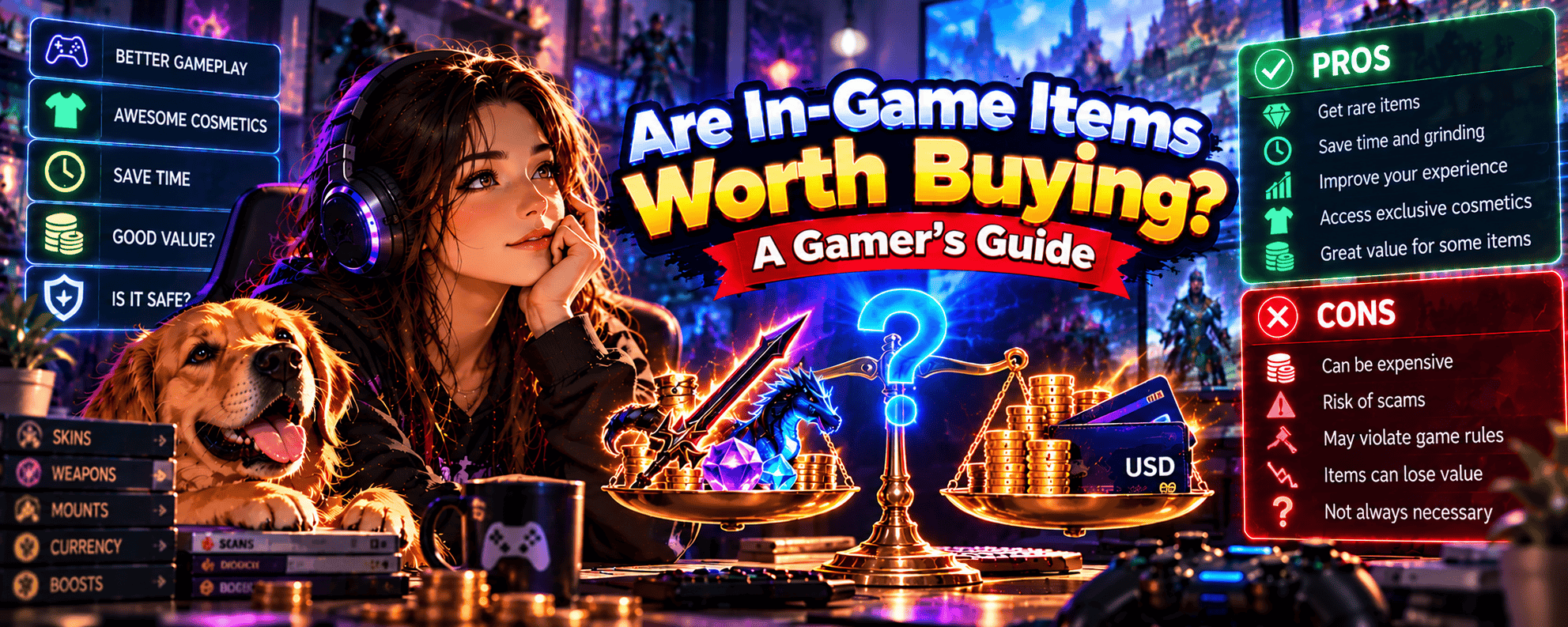
You’ve just spotted an incredible weapon skin, a legendary sword or a limited-edition cosmetic you’ve wanted for months.
It looks amazing. The price? Not quite so amazing.
Now you’re staring at the purchase button, wondering whether spending real money on something that only exists inside a video game is actually worth it.
Sound familiar?
Whether you’re considering a $5 cosmetic upgrade or a rare collectible worth hundreds of dollars, it’s a question almost every gamer eventually faces.
Are in-game items worth buying, or are you better off keeping your money and earning rewards through gameplay?
The answer depends on what you’re buying, how much you’ll use it and what you’re hoping to get from the purchase.
Let’s break it down.
1. Are In-Game Items Worth Buying? 🎮
Yes, in-game items can be worth buying when they provide enough enjoyment, convenience or gameplay value to justify their cost.
However, not every item represents good value, and spending more money doesn’t necessarily mean having more fun.
For some gamers, purchasing a favourite character skin is no different from spending money on another entertainment activity.
For others, paying real money for virtual equipment seems unnecessary when they can earn similar rewards by playing.
Neither perspective is automatically wrong.
What matters is understanding what you’re getting for your money.
💎 What Are You Actually Paying For?
When you purchase an in-game item, you’re generally paying for access to a digital product or feature within a particular game’s ecosystem.
Depending on the game, this could include:
- Cosmetic Items: Character skins, weapon finishes, outfits and visual effects.
- Functional Equipment: Weapons, armour and other items that influence gameplay.
- Collectibles: Rare or limited-availability virtual items.
- Convenience Items: Eligible upgrades that reduce repetitive gameplay or save time.
- Customisation Options: Decorations, accessories and other ways to personalise your experience.
- Crafting Materials: Resources used to create or upgrade equipment.
Not every game allows these items to be purchased or traded, particularly through third-party marketplaces.
The available options depend on the game’s rules and supported systems.
🎮 When Are In-Game Items Worth the Money?
An in-game item may be worth purchasing when:
- You’ll use it regularly.
- It improves your enjoyment of the game.
- It provides a useful benefit in a game that permits such purchases.
- It saves time you’d rather spend on other activities.
- It helps you personalise your gaming experience.
- Its price fits comfortably within your entertainment budget.
For example, spending $15 on a character skin you use for hundreds of hours might feel worthwhile.
Spending $100 on a cosmetic you’ll stop using next week might be harder to justify.
The difference isn’t simply the price.
It’s the value you receive from the purchase.
⚠️ When Are In-Game Items Not Worth Buying?
Some purchases offer little lasting value.
You might regret buying an item if:
- You rarely play the game anymore.
- You’re purchasing it because of social pressure.
- A similar item can be earned easily through gameplay.
- The price exceeds your budget.
- You’re expecting its resale value to increase.
- The item doesn’t provide the benefits you expected.
- You’re unsure whether the item can legally or technically be transferred under the game’s rules.
Impulse purchases can be particularly disappointing.
That legendary sword might look irresistible at midnight, but it could seem considerably less exciting the next morning.
💰 Does Spending More Make Gaming More Enjoyable?
Not necessarily.
Many games provide excellent experiences without requiring additional purchases.
A free cosmetic earned through a difficult challenge might feel more rewarding than an expensive skin bought instantly.
Likewise, purchasing powerful equipment doesn’t automatically improve your understanding of game mechanics.
Your enjoyment depends on the game, your preferences and how you like to play.
🏆 The Golden Rule of Buying In-Game Items
Buy an item because you genuinely want to use or enjoy it, not because you feel pressured to own it.
If the purchase fits your budget and improves your gaming experience, it may represent good entertainment value.
But if you’re only buying something because everyone else has it, your money might be better spent elsewhere.
2. Why Do Gamers Spend Money on In-Game Items? 💎
Gamers spend money on virtual items for many different reasons.
Some want their characters to look incredible.
Others want to save time, collect rare equipment or gain access to useful items through permitted purchasing systems.
And some simply enjoy owning something unusual.
Understanding these motivations can help you decide whether your own purchase makes sense.
🎨 1. Character and Weapon Customisation
One of the biggest reasons gamers purchase virtual items is personalisation.
Players often spend dozens or hundreds of hours using the same characters, weapons and equipment.
Naturally, they want those things to look good.
For example:
- A Fortnite player might purchase a favourite character outfit.
- A CS2 player might want a particular weapon finish.
- A Roblox player might customise their avatar.
- An RPG player might collect armour appearances or decorative equipment.
Cosmetic items generally change appearance without directly improving gameplay performance.
However, they can make the gaming experience feel more personal.
⚔️ 2. Gameplay Benefits
Some games feature items that influence how characters perform.
Depending on the game, these might include:
- Weapons with useful attributes.
- Armour with improved defensive statistics.
- Equipment that complements a particular build.
- Crafting materials.
- Consumables or other functional resources.
For example, a Path of Exile player might acquire eligible equipment that supports a particular character build.
However, purchasing functional items isn’t permitted in every game or through every marketplace.
Always check the relevant rules before buying.
⏳ 3. Saving Time
Not everyone has unlimited hours to grind for equipment.
Some players have work, study, family commitments or other interests competing for their gaming time.
Imagine an item requires approximately 20 hours of repetitive farming.
If a permitted purchasing option exists, a player might prefer to spend a modest amount rather than invest those hours.
For them, the purchase isn’t necessarily about gaining an advantage.
It’s about spending more time enjoying the parts of the game they like.
Of course, other players genuinely enjoy farming and progression.
For those gamers, skipping the grind might actually reduce the fun.
🏆 4. Collecting Rare and Exclusive Items
Some gamers enjoy collecting virtual items just as others collect trading cards, figures or memorabilia.
They might pursue:
- Limited-edition cosmetics.
- Discontinued items.
- Rare weapon patterns.
- Event-exclusive rewards.
- Unusual collectibles.
- Items with historical significance within a game.
The appeal may come from scarcity, appearance or personal attachment.
However, rare doesn’t automatically mean valuable.
An item still needs demand or personal usefulness to justify its price.
🤝 5. Social Identity and Community
Gaming is often a social experience.
Players interact through guilds, clans, competitive matches and online communities.
Cosmetics and collectibles can help players express their personality or connection to a particular game.
For example, wearing an outfit associated with a memorable gaming event might have sentimental value.
Some items also function as status symbols within gaming communities.
However, buying items purely to impress other players can become expensive.
🎮 6. Supporting Favourite Games
Some players purchase official cosmetic items because they want to support a game they enjoy.
This is particularly relevant to free-to-play titles that generate revenue through optional purchases.
For example, a player might spend $10 on a cosmetic after enjoying hundreds of hours of free gameplay.
They may consider that reasonable entertainment spending.
However, purchasing from another player on a secondary marketplace doesn’t necessarily financially support the game’s developer.
The distinction depends on where and how the purchase occurs.
💰 7. Trading and Collecting Opportunities
Some games support economies where eligible items can be exchanged between players.
This creates opportunities for collecting, trading and comparing market values.
Players may enjoy researching prices, finding desirable items and participating in trading communities.
However, virtual item markets can be unpredictable.
Purchasing items with the expectation of making money introduces risks that don’t apply in quite the same way to ordinary entertainment spending.
Our Types of In-Game Items Explained guide explores the different categories of virtual gaming items and their uses.
📊 Why Gamers Buy In-Game Items
| Motivation | Example | Main Benefit |
|---|---|---|
| Customisation | Character skin | Personal expression |
| Gameplay | Eligible RPG equipment | Character progression |
| Convenience | Permitted time-saving item | Less repetitive gameplay |
| Collecting | Rare cosmetic | Collection enjoyment |
| Social Identity | Event-related item | Community connection |
| Supporting Developers | Official cosmetic purchase | Supporting a favourite game |
| Trading | Tradable collectible | Participation in item markets |
🎯 The Golden Rule of Understanding Your Motivation
Know why you want an item before deciding whether it’s worth buying.
If you genuinely enjoy collecting rare skins, that enjoyment has value.
If you’re buying a weapon because you think it’ll instantly make you a better player, you might want to reconsider.
Unfortunately, even the most expensive CS2 skin doesn’t come with better aim included.
3. What Are the Benefits of Buying In-Game Items? 🏆
Buying in-game items isn’t automatically a waste of money.
For many gamers, virtual purchases provide real enjoyment and practical benefits.
The key is choosing items that improve your experience rather than simply adding more things to your inventory.
Here are some of the biggest potential advantages.
🎨 1. Personalise Your Gaming Experience
Cosmetic items allow players to customise their characters, weapons and environments.
You might prefer:
- A futuristic character outfit.
- A distinctive weapon skin.
- A themed armour appearance.
- A personalised avatar accessory.
- Decorative items for a virtual home.
These purchases may not improve your gameplay statistics.
But enjoying how your character or equipment looks can still be a meaningful benefit.
After all, you’re the one spending hours looking at it.
⚔️ 2. Access Useful Equipment
In games that permit item purchases or trading, acquiring equipment can help players develop their characters.
For example, a suitable weapon might complement a particular RPG build.
An armour upgrade might improve survivability.
Crafting materials might allow you to complete an equipment upgrade.
However, the benefit depends on the item’s actual attributes and compatibility.
An expensive item isn’t necessarily the best option for your character.
⏳ 3. Reduce Repetitive Grinding
Some games require substantial time to obtain particular items.
For players who dislike repetitive farming, permitted purchases can provide an alternative.
Consider this hypothetical example.
You want an item that typically requires 15 hours of farming.
A permitted marketplace offers an equivalent item for $20.
If you’d rather spend those 15 hours exploring new content, the purchase might be worthwhile.
However, if farming is one of your favourite activities, buying the item could remove part of the experience you enjoy.
💎 4. Obtain Items That Are Difficult to Find
Some virtual items are difficult to obtain through ordinary gameplay.
They may depend on:
- Rare random drops.
- Limited events.
- Specific achievements.
- Unusual crafting outcomes.
- Restricted availability.
Where the game permits trading, purchasing an eligible item may be more practical than trying to obtain it yourself.
However, limited availability can also lead to higher prices.
🎮 5. Improve Your Enjoyment of Favourite Games
Sometimes the benefit is simply having more fun.
Imagine you’ve played the same character for two years.
You discover a cosmetic that perfectly matches your preferred style.
Buying it might make your next hundred hours of gameplay more enjoyable.
That enjoyment can justify the purchase, provided the cost is affordable.
Entertainment doesn’t always need to produce something physical to have value.
🤝 6. Participate in Gaming Communities
Collecting and trading can be enjoyable social activities.
Players might discuss item values, compare collections or exchange eligible items.
This can create opportunities to meet people with similar interests.
However, participating in a trading community doesn’t require purchasing expensive items.
You can still enjoy the social experience without spending heavily.
🏆 7. Complete Personal Collections
For collectors, obtaining a particular item can be satisfying.
Perhaps you’ve been building a themed inventory for months.
One final cosmetic completes the collection.
The item’s value to you might be greater than its practical usefulness.
That’s a legitimate personal preference, provided the purchase remains affordable.
💰 8. Potential Resale Flexibility
Some games allow eligible items to be traded or resold.
This may provide flexibility if you no longer want an item.
However, resale isn’t guaranteed.
Item values can fall, trading rules can change and marketplace fees may reduce what you receive.
Some items cannot be transferred at all.
Never assume that a purchase can later be recovered through resale.
📊 Benefits of Buying In-Game Items
| Benefit | Best Suited To |
|---|---|
| Customisation | Players who enjoy unique appearances |
| Functional Equipment | Players seeking suitable gameplay upgrades |
| Time Savings | Gamers who dislike repetitive farming |
| Rare Item Access | Collectors and dedicated players |
| Entertainment Value | Players who regularly enjoy a game |
| Community Participation | Gamers interested in trading |
| Collection Completion | Players pursuing specific collections |
| Resale Flexibility | Players using permitted trading systems |
⚠️ Are These Benefits Worth Paying For?
That depends on the cost.
For example, a $10 cosmetic that provides months of enjoyment may be an easy purchase to justify.
A $300 collectible that you’ll rarely use requires more careful consideration.
Neither price automatically determines whether the item is worthwhile.
The important question is whether the benefits justify the expense for you.
🎯 The Golden Rule of Item Benefits
An in-game item is worth more to you when it meaningfully improves something you already enjoy.
Choose purchases that suit your gaming habits, preferences and budget.
A useful upgrade or favourite cosmetic can enhance your experience.
But buying items just because they’re available isn’t much of a strategy.
Unless your ultimate gaming achievement is collecting 400 skins and using exactly three of them.
4. What Are the Disadvantages of Buying In-Game Items? ⚠️
Buying virtual items can be enjoyable, but there are downsides worth considering.
Unlike many physical purchases, gaming items exist within digital environments controlled by game developers and platform operators.
Their usefulness, availability and transferability can change.
And once you’ve spent the money, getting it back may not be possible.
Understanding these risks can help you avoid purchases you’ll regret.
💰 1. In-Game Items Can Become Expensive
Individual purchases might seem relatively inexpensive.
A $5 cosmetic here.
A $15 weapon skin there.
Another $20 for something that looks particularly impressive.
But repeated purchases can add up.
Consider this hypothetical spending pattern:
| Purchase | Cost |
|---|---|
| Character Cosmetic | $15 |
| Weapon Skin | $25 |
| Decorative Item | $10 |
| Limited-Edition Cosmetic | $30 |
| Additional Accessories | $20 |
| Total | $100 |
Hypothetical USD prices.
None of these purchases is necessarily unreasonable.
However, the combined amount might be more than you originally intended to spend.
📉 2. Item Values Can Decline
Some gamers purchase items because they expect prices to rise.
Unfortunately, virtual item values aren’t guaranteed to increase.
Prices may decline because of:
- Reduced player demand.
- Increased item supply.
- Game updates.
- New competing cosmetics.
- Changes to trading systems.
- Declining game popularity.
An item worth $100 today might be worth considerably less in the future.
Treating virtual items as investments can introduce substantial financial risk.
🔐 3. You May Not Fully Own the Item
When you purchase a virtual item, you generally receive rights to use it under the game’s applicable terms rather than unrestricted ownership of a physical product.
Those rights may be limited.
For example, developers or platform operators may restrict:
- Item transfers.
- Resale.
- Account access.
- Item availability.
- Marketplace participation.
The precise rights depend on the game’s terms and applicable law.
Our Do You Really Own Your In-Game Items? guide explores digital ownership and the limitations affecting virtual gaming products.
🎮 4. Game Updates Can Change Item Usefulness
An item that performs exceptionally well today might become less useful after a balance update.
For example, a weapon could receive reduced damage or an ability might be adjusted.
A character build that previously relied on certain equipment could become less effective.
This is particularly important when buying functional items.
Cosmetic items can also be affected by changes to visual systems or game features.
⏳ 5. Your Interest in the Game May Change
You might absolutely love a game today.
But what about six months from now?
Gaming preferences change.
New titles launch, friends move to different games and personal interests evolve.
An expensive cosmetic might feel worthwhile while you’re playing every evening.
It may feel less valuable once you’ve stopped playing.
Before making a large purchase, consider how likely you are to continue using the item.
⚠️ 6. Scams and Fraud Are Possible
Buying items from unfamiliar sellers introduces potential risks.
These may include:
- Fake item listings.
- Seller impersonation.
- Phishing websites.
- Undelivered purchases.
- Misrepresented item attributes.
- Unsupported payment arrangements.
Even positive seller feedback doesn’t guarantee a successful transaction.
Always verify the seller and follow permitted purchasing procedures.
🚫 7. Some Purchases Can Violate Game Rules
Not every game allows players to purchase items from third-party sellers.
Some prohibit real-money trading or restrict item transfers.
Violating these rules may lead to penalties, including account restrictions or suspension.
Before purchasing, check whether the proposed transaction is permitted.
An attractive deal isn’t worth risking an account you’ve spent years developing.
📦 8. Digital Purchases May Be Difficult to Refund
Some virtual item transactions are final or subject to limited refund conditions.
Others may have specific eligibility requirements.
The available options depend on the platform, purchase circumstances and applicable consumer law.
Don’t assume you can return an item simply because you’ve changed your mind.
Review the relevant terms before buying.
🕹️ 9. Games and Marketplaces Can Shut Down
Virtual items depend on the continued operation of the relevant game or service.
If a game closes or removes certain features, your purchased items may become inaccessible or unusable.
This is an important difference between digital gaming items and many physical collectibles.
An expensive cosmetic doesn’t necessarily retain practical value outside its game.
🧠 10. Impulse Purchases Can Lead to Regret
Limited-time offers, countdown timers and exclusive-looking items can encourage rushed decisions.
You might buy something because you’re worried about missing out rather than because you genuinely want it.
A useful approach is to wait before making an expensive purchase.
If you still want the item after considering its cost and usefulness, the decision may be easier to justify.
📊 Advantages vs Disadvantages of Buying In-Game Items
| Advantages | Disadvantages |
|---|---|
| More character customisation | Additional spending |
| Access to useful equipment | Possible balance changes |
| Less repetitive grinding | May reduce progression enjoyment |
| Collecting rare items | Prices can decline |
| Personal entertainment value | Interest may fade |
| Trading opportunities | Scams and marketplace risks |
| Potential resale where permitted | Transfer restrictions and fees |
| More inventory variety | Limited digital ownership rights |
🏆 How Can You Reduce the Risks?
You don’t need to avoid every virtual purchase.
Instead, make informed decisions.
Before buying:
- Check whether the item is worth the price to you.
- Confirm that the transaction is permitted.
- Research the item’s actual characteristics.
- Consider how long you’ll use it.
- Investigate the seller and marketplace.
- Understand the refund and delivery conditions.
- Avoid spending money you need for essential expenses.
🎯 The Golden Rule of Understanding the Downsides
Treat in-game items as entertainment purchases first, not guaranteed financial assets.
If you enjoy the item and can comfortably afford it, the purchase may still be worthwhile even if its resale value eventually becomes zero.
But if you’re relying on future profits or stretching your budget to buy it, reconsider.
Because there’s nothing quite like spending $200 on a legendary weapon only to discover the next game update has turned it into an extremely expensive inventory decoration.
5. Cosmetic vs Functional Items: Which Are Worth Buying? ⚔️
Not all in-game items provide the same benefits.
Some make your character look incredible. Others can change how you play, improve your equipment or help you progress through challenging content.
But which type offers better value for money?
Cosmetic items are generally worth buying for personalisation and enjoyment, while functional items may be worth buying when they provide useful gameplay benefits in games that permit those purchases.
The better choice depends on what you want from your gaming experience.
🎨 What Are Cosmetic In-Game Items?
Cosmetic items change the appearance of characters, weapons, equipment or environments without directly improving gameplay statistics.
Common examples include:
- Character skins and outfits.
- Weapon finishes.
- Emotes and animations.
- Decorative accessories.
- Vehicle appearances.
- Housing decorations.
- Visual effects.
For example, a CS2 weapon skin changes how a weapon looks without increasing its damage or accuracy.
Similarly, a Fortnite outfit allows players to customise their appearance without providing an intended competitive advantage.
💎 Why Are Cosmetic Items Worth Buying?
Cosmetic items can provide enjoyment through personal expression.
You might want to:
- Create a unique character appearance.
- Match your equipment to a particular theme.
- Collect cosmetics from favourite events.
- Personalise weapons you use regularly.
- Complete a collection.
For many gamers, appearance matters.
If you spend hundreds of hours playing a character, investing in a cosmetic you genuinely enjoy might be worthwhile.
⚔️ What Are Functional In-Game Items?
Functional items influence gameplay mechanics.
Depending on the game, these may include:
- Weapons.
- Armour.
- Equipment upgrades.
- Crafting materials.
- Consumables.
- Items with special attributes.
For example, a Path of Exile weapon with suitable modifiers might improve a character build.
However, not every game permits players to purchase functional equipment using real money.
Always check the relevant rules.
🏆 Why Are Functional Items Worth Buying?
Functional items may provide practical benefits.
These can include:
Improved Character Performance
Suitable equipment may increase damage, defence or other relevant statistics.
Build Compatibility
An item might provide attributes needed for a particular character build.
Reduced Grinding
Where permitted, acquiring equipment through trading can reduce the time spent farming.
Access to Challenging Content
Appropriate equipment may help prepare a character for more demanding encounters.
However, buying powerful items doesn’t replace learning game mechanics.
A better sword won’t automatically teach you how to dodge.
📊 Cosmetic vs Functional In-Game Items
| Feature | Cosmetic Items | Functional Items |
|---|---|---|
| Main Purpose | Appearance and personalisation | Gameplay benefits |
| Examples | Skins, outfits, emotes | Weapons, armour, materials |
| Direct Stat Benefits | Generally none | Often yes |
| Personal Enjoyment | Potentially high | Potentially high |
| Value Depends On | Appearance, demand and rarity | Usefulness, attributes and demand |
| Risk of Balance Changes | Usually lower | Potentially higher |
| Best Suited To | Customisation and collecting | Character progression and builds |
💰 Which Offers Better Value?
Imagine you’re choosing between two hypothetical purchases.
Option A: $20 Cosmetic Skin
You love the appearance and expect to use it regularly.
Option B: $20 Equipment Upgrade
The equipment improves your character’s performance in a game that permits the purchase.
Which is better?
If you enjoy customisation, Option A might provide more satisfaction.
If you’re focused on progressing through difficult content, Option B may be more useful.
Neither is automatically the better purchase.
⚠️ Can Cosmetic Items Become More Valuable Than Functional Items?
Yes.
Some cosmetic items attract substantial collector demand because of their appearance, scarcity or historical significance.
A rare weapon skin may command a higher market price than functional equipment.
However, market value and personal usefulness are different things.
An expensive collectible might have little practical benefit to someone who doesn’t enjoy collecting.
🎯 The Golden Rule of Cosmetic vs Functional Items
Choose cosmetic items for enjoyment and functional items for usefulness, while considering the actual cost of each.
Our Cosmetic vs Functional In-Game Items guide explores these differences in more detail.
Ultimately, the best purchase is the one that improves your gaming experience.
Whether that means looking legendary or hitting like a legendary warrior is entirely up to you.
6. Are Rare and Legendary In-Game Items Worth the Price? 💰
There’s something exciting about owning a rare gaming item.
Maybe it’s a legendary sword that only drops from a difficult boss.
Perhaps it’s a discontinued cosmetic or an unusual CS2 weapon skin.
Whatever the item, rarity can make it feel special.
But does being rare automatically make something worth buying?
Rare and legendary in-game items can be worth purchasing when their usefulness, appearance or collectible appeal justifies the price. However, rarity alone doesn’t guarantee value.
Let’s explore why.
💎 1. Rarity Doesn’t Always Equal Value
Games often use rarity classifications to distinguish items.
These might include:
- Common.
- Uncommon.
- Rare.
- Epic.
- Legendary.
- Unique.
However, these labels don’t mean the same thing across every game.
A legendary item might be relatively easy to obtain in one game.
A particular rare item might be much harder to find in another.
The label alone doesn’t determine what buyers should pay.
📈 2. Supply and Demand Influence Prices
An item may be scarce, but scarcity doesn’t automatically create demand.
Imagine two hypothetical items.
Item A
Only 100 exist, but very few players want one.
Item B
Several thousand exist, but thousands of players actively want to purchase one.
Item B could command a higher price despite being more common.
This is why demand matters just as much as rarity.
🎨 3. Appearance Can Increase Collectible Appeal
Some items are valuable because players enjoy their visual design.
For example, certain weapon skins attract attention because of:
- Colour combinations.
- Unusual patterns.
- Special finishes.
- Limited availability.
- Association with memorable gaming events.
Players may be willing to pay more for items they find visually appealing.
However, appearance is subjective.
A cosmetic worth hundreds of dollars to one collector might be completely uninteresting to another.
⚔️ 4. Functional Attributes Can Matter More Than Rarity
In RPGs, an item’s usefulness may depend on its actual statistics.
For example, a rare weapon with excellent modifiers might outperform a legendary weapon with less suitable attributes.
Likewise, an item that complements a popular character build may attract stronger demand.
Before buying functional equipment, check whether its attributes genuinely benefit your character.
Don’t assume a legendary label guarantees superior performance.
⏳ 5. Limited Availability Can Affect Prices
Some items are only available during specific events or periods.
Once the event ends, obtaining them may become difficult or impossible.
This can increase collector interest.
However, limited availability doesn’t guarantee that prices will rise.
Developers may reintroduce items, release alternatives or change trading rules.
Player interest can also decline.
🏆 6. Prestige and Social Recognition
Some rare items have prestige within gaming communities.
Owning one might demonstrate:
- Participation in an early event.
- Completion of a difficult challenge.
- Membership in a long-standing gaming community.
- Collector interest.
- Access to a historically significant item.
For some players, these associations make an item more desirable.
However, prestige is difficult to measure financially.
💰 7. How Much Should You Pay for a Rare Item?
Before buying, consider:
- How rare is the item actually?
- How much demand exists?
- Are comparable items available?
- Does it have unusual attributes?
- Can it be traded or resold?
- Is its value dependent on temporary hype?
- How much personal enjoyment will it provide?
These questions help distinguish genuine interest from impulsive spending.
📊 Rare Item Value Comparison
| Item | Rarity | Player Demand | Potential Appeal |
|---|---|---|---|
| Limited Cosmetic | High | High | Strong collector interest |
| Unpopular Rare Weapon | High | Low | Limited demand |
| Useful RPG Equipment | Moderate | High | Gameplay usefulness |
| Common Cosmetic | Low | Moderate | Affordable personalisation |
| Discontinued Collectible | High | Variable | Historical or collector appeal |
Illustrative examples. Actual prices depend on the game and market.
⚠️ Are Expensive Rare Items Good Investments?
Not necessarily.
Virtual item prices can fluctuate significantly.
Risks include:
- Changing player demand.
- New item releases.
- Trading restrictions.
- Marketplace fees.
- Game updates.
- Reduced game popularity.
- Account or platform restrictions.
Some items may appreciate, but others can lose substantial value.
Don’t purchase rare items assuming they’ll produce guaranteed profits.
🎯 The Golden Rule of Rare Item Purchases
Pay for the enjoyment or usefulness you expect to receive, not simply the rarity label.
A rare item can be an exciting addition to your inventory.
But a legendary name doesn’t automatically justify a legendary price.
Especially when the item spends the next six months gathering virtual dust.
7. Should You Buy In-Game Items or Earn Them Through Gameplay? ⏳
One of gaming’s biggest debates is whether it’s better to buy items or earn them.
Some players love grinding for rare drops.
Others would rather spend a little money and jump straight into the content they enjoy.
Both approaches have advantages.
Buying in-game items can save time where permitted, while earning them through gameplay often provides greater satisfaction and avoids additional spending.
The right choice depends on your priorities.
🎮 1. The Benefits of Earning Items Through Gameplay
Earning items can be one of the most rewarding parts of gaming.
You might obtain equipment by:
- Defeating bosses.
- Completing quests.
- Participating in events.
- Crafting.
- Farming materials.
- Unlocking achievements.
- Trading items earned through gameplay.
These activities often form an important part of progression.
Obtaining a rare item after a difficult challenge can feel particularly satisfying.
🏆 2. The Satisfaction of Earning Rare Loot
Imagine defeating a challenging boss after several attempts.
It finally drops the weapon you’ve been chasing.
That moment can feel incredible.
The item isn’t just equipment.
It’s a reminder of what you accomplished.
Buying the same item, where permitted, might provide its practical benefits but not the same sense of achievement.
For some gamers, that difference matters.
💰 3. The Benefits of Buying Items
Purchasing eligible items may be useful when:
- You have limited gaming time.
- You dislike repetitive farming.
- You want to complete a particular build.
- You prefer other gameplay activities.
- The item is difficult to obtain.
- The purchase fits your budget.
For example, someone who only plays a few hours each week might prefer to avoid spending most of that time farming materials.
⏳ 4. Comparing Time and Money
Consider this hypothetical example.
You want an eligible item that typically requires 20 hours of farming.
A permitted marketplace offers it for $25.
| Option | Time Required | Additional Cost |
|---|---|---|
| Earn Through Gameplay | Approximately 20 hours | $0 |
| Purchase Item | Minimal farming time | $25 |
Illustrative example using USD.
Buying the item could save considerable time.
However, that doesn’t automatically make purchasing the better choice.
If you enjoy farming, those 20 hours may be entertainment rather than wasted time.
⚔️ 5. Does Buying Items Reduce the Challenge?
Sometimes.
In games built around character progression, acquiring powerful equipment early may remove part of the intended challenge.
You might skip:
- Learning important mechanics.
- Experimenting with equipment.
- Completing progression activities.
- Developing character builds.
- Experiencing rewarding loot drops.
For some players, this reduces enjoyment.
For others, it allows them to focus on more advanced content.
🎨 6. Cosmetic Items Are Different
Cosmetic purchases often involve a different decision.
If an item changes appearance without directly improving gameplay, buying it may not affect progression.
For example, purchasing an official character skin generally doesn’t replace learning gameplay mechanics.
However, some cosmetics are designed as achievement rewards.
Earning those items may carry personal significance that cannot be replicated through a purchase.
🤝 7. Consider Trading Items You’ve Already Earned
Some games allow players to exchange eligible items.
For example, you might trade unwanted equipment for something more useful.
This can provide an alternative to spending real money.
However, trading systems and restrictions vary between games.
Not every item can be exchanged.
🔐 8. Check Whether Purchasing Is Permitted
Before buying, confirm that the game allows the proposed transaction.
Some games support player trading but prohibit real-money item sales.
Others restrict purchases to official marketplaces.
Avoid transactions that could violate game rules or compromise your account.
📊 Buying vs Earning In-Game Items
| Factor | Buying Items | Earning Through Gameplay |
|---|---|---|
| Real-Money Cost | May require spending | Usually no additional purchase |
| Time Required | Potentially lower | Potentially higher |
| Achievement Satisfaction | Depends on player | Often higher |
| Gameplay Progression | May accelerate progression | Follows normal progression |
| Availability | Depends on permitted markets | Depends on game mechanics |
| Trading Risks | May involve seller risks | Generally avoids external seller risks |
| Best For | Players prioritising convenience | Players enjoying progression |
🏆 9. When Is Buying the Better Choice?
Buying may make sense when:
- The transaction is permitted.
- The item is affordable.
- You understand its attributes.
- You want to avoid repetitive gameplay.
- You expect to use it regularly.
- You aren’t sacrificing gameplay experiences you enjoy.
🎮 10. When Is Earning the Better Choice?
Earning may be preferable when:
- You enjoy grinding and progression.
- The item is reasonably obtainable.
- You want the satisfaction of unlocking it.
- You’re trying to minimise spending.
- Purchasing would remove enjoyable challenges.
- The game doesn’t permit the proposed purchase.
🎯 The Golden Rule of Buying vs Grinding
Choose the approach that makes the game more enjoyable for you.
If farming rare equipment is your favourite activity, keep grinding.
If you’d rather spend your limited gaming time exploring new content, a permitted purchase might be worthwhile.
There’s no universal answer.
Although after your 500th unsuccessful boss run, we can understand why the purchase button starts looking rather attractive.
8. Can In-Game Items Hold Their Value or Make You Money? 📈
Some gaming items are bought and sold for significant amounts of money.
Rare CS2 skins, limited collectibles and desirable virtual equipment can attract considerable interest.
Naturally, this raises an important question.
Can purchasing in-game items actually make you money?
Some tradable in-game items can retain or increase their market value, but profits are never guaranteed and many virtual items cannot be resold for real money.
Understanding the difference between collecting, trading and investing is essential.
💎 1. Why Do Some In-Game Items Have Resale Value?
An item may have resale value when:
- Other players want it.
- Its supply is limited.
- Trading is permitted.
- A functioning marketplace exists.
- Buyers can verify its characteristics.
- The game maintains an active player community.
For example, certain CS2 skins attract collector demand because of their appearance, rarity and market activity.
However, not every game supports comparable markets.
📈 2. Can In-Game Item Prices Increase?
Yes.
Prices may rise when demand increases or available supply becomes more limited.
Potential influences include:
- Growing game popularity.
- Increased collector interest.
- Limited item availability.
- Changes in player preferences.
- New demand for particular attributes.
However, price increases aren’t guaranteed.
Markets can change quickly.
📉 3. Why Do In-Game Items Lose Value?
Virtual items can decline in value for several reasons.
Reduced Demand
Players may lose interest in a particular cosmetic or game.
Increased Supply
New item drops or releases can make previously scarce items more common.
Game Updates
Changes to gameplay mechanics may reduce the usefulness of equipment.
New Alternatives
A newly released cosmetic might become more desirable than an older one.
Marketplace Restrictions
Trading changes can affect whether items can be transferred or sold.
These factors can make item prices unpredictable.
💰 4. Understand the Difference Between Market Value and Profit
Imagine purchasing an eligible item for $100.
Several months later, comparable listings suggest a market value of $130.
It might appear that you’ve made $30.
But that isn’t necessarily your actual profit.
You still need to consider:
- Whether a buyer will pay that price.
- Marketplace fees.
- Payment processing costs.
- Currency conversion.
- Applicable taxes.
- Trading restrictions.
An advertised market value isn’t the same as money you’ve received.
📊 Example: In-Game Item Resale Profit
Consider a hypothetical item purchase.
| Transaction | Amount |
|---|---|
| Original Purchase Price | $100 |
| Eventual Sale Price | $130 |
| Selling Fees | $13 |
| Other Transaction Costs | $2 |
| Net Profit Before Any Applicable Tax | $15 |
Hypothetical USD example.
Although the item increased in sale price by $30, the actual profit before any applicable tax is only $15.
If the sale price had fallen instead, the transaction could have resulted in a loss.
🔐 5. Not Every Item Can Be Resold
Some items are permanently bound to an account.
Others can be transferred only through specific game systems.
Certain marketplaces also restrict how sale proceeds can be used.
For example, Steam Community Market sales generally provide Steam Wallet funds rather than directly withdrawable cash.
Always understand the difference between platform credit and real-money proceeds.
🎮 6. What Happens if a Game Loses Popularity?
An item’s resale value often depends on continued player interest.
If a game’s community becomes significantly smaller, demand for its virtual items may decline.
This can make items harder to sell.
In extreme cases, a game or marketplace may close entirely.
That could leave items inaccessible or without a functioning resale market.
⚠️ 7. Are In-Game Items a Good Investment?
For most gamers, in-game items are better treated as entertainment purchases or collectibles rather than conventional investments.
Risks include:
- Price volatility.
- Limited liquidity.
- Platform dependency.
- Trading restrictions.
- Fraud.
- Uncertain long-term demand.
- Limited consumer protections in some transactions.
Unlike diversified financial investments, virtual items may depend heavily on the continued popularity and rules of a single game.
Only spend money you can afford to lose.
💎 8. How Can You Estimate an Item’s Current Value?
Where market information is available, you can investigate:
- Recent completed sales.
- Comparable listings.
- Item rarity.
- Relevant attributes.
- Current player demand.
- Marketplace fees.
- Trading eligibility.
Avoid relying solely on a seller’s asking price.
Our How to Check What an In-Game Item Is Worth guide explains how to research item values using comparable listings and market evidence.
🏆 9. Should You Buy Items Hoping to Sell Them Later?
Buying an item because you enjoy using or collecting it is different from buying solely for resale.
If your main objective is making money, you’re accepting additional financial risk.
Before purchasing, consider whether you’d still be satisfied owning the item if its resale value fell substantially.
If the answer is no, the purchase deserves more thought.
🎯 The Golden Rule of In-Game Item Resale
Never assume that a virtual item will maintain its value or that you’ll be able to sell it for a profit.
Some items may appreciate.
Others may lose most or all of their resale value.
Buy primarily for enjoyment and usefulness, with any future resale opportunity treated as uncertain.
Because that rare skin might look like digital gold today, but tomorrow’s market could have very different ideas.
9. How Much Should You Spend on In-Game Items? 💳
You’ve found an incredible skin for $50.
You can afford it, you love how it looks and you’re already imagining showing it off in your next match.
But is $50 a reasonable amount to spend on a virtual item?
What about $100? Or $500?
There’s no universal amount that gamers should spend on in-game items. The right budget depends on your financial situation, gaming habits and how much enjoyment you’ll get from the purchase.
The important thing is making sure your gaming purchases remain affordable.
💰 1. Set a Gaming Entertainment Budget
Treat in-game items as part of your entertainment spending.
Just as you might budget for movies, streaming subscriptions or other hobbies, you can set aside an amount for gaming purchases.
For example, your entertainment budget might cover:
- New video games.
- Gaming subscriptions.
- In-game cosmetics.
- Eligible virtual items.
- Downloadable content.
- Other gaming-related purchases.
You don’t need a separate budget for every category.
However, knowing how much you’re comfortable spending helps prevent purchases from adding up unexpectedly.
🎮 2. Match Your Spending to Your Gaming Habits
Different gamers have different priorities.
A casual player who logs in occasionally may have little reason to spend heavily on virtual items.
A dedicated player who spends hundreds of hours in one game might place greater value on customisation or collecting.
Here’s an illustrative approach.
| Gamer Type | Example Monthly Item Budget | Main Consideration |
|---|---|---|
| Casual Gamer | $0–$10 | Occasional purchases |
| Regular Gamer | $10–$25 | Items used frequently |
| Dedicated Gamer | $25–$50 | Collecting and customisation |
| Enthusiast Collector | Varies | Affordability and personal goals |
Hypothetical USD examples, not recommended spending targets.
These amounts aren’t rules.
A dedicated gamer might spend nothing, while a casual player might occasionally purchase an expensive collectible.
What matters is whether the spending fits comfortably within your finances.
⏳ 3. Consider How Often You’ll Use the Item
One way to evaluate a purchase is to estimate how much use you’ll get from it.
Imagine buying a $20 weapon skin.
If you use it for 200 hours, the cost works out to:
$20 ÷ 200 hours = $0.10 per hour
Now imagine purchasing a $100 cosmetic that you only use for five hours.
$100 ÷ 5 hours = $20 per hour
This isn’t a perfect measure of value.
Collectibles can provide enjoyment even when you’re not actively using them.
However, it can help put entertainment spending into perspective.
💎 4. Decide Whether the Item Is a Want or a Need
Most virtual gaming purchases are optional.
Even functional equipment may have alternatives available through normal gameplay.
Before purchasing, ask yourself:
Do I genuinely want this item, or am I buying it because it’s currently available?
An item can be desirable without being necessary.
Recognising that distinction helps you make more deliberate decisions.
⚠️ 5. Avoid Spending Money Needed Elsewhere
Gaming purchases shouldn’t interfere with essential expenses.
Avoid using money needed for:
- Housing.
- Food.
- Bills.
- Debt repayments.
- Essential savings.
- Other financial commitments.
If purchasing an item would create financial pressure, it’s probably not worth buying right now.
There will usually be other opportunities to enjoy your favourite game without additional spending.
🛒 6. Watch Out for Small Purchases Adding Up
Microtransactions can be easy to overlook.
For example:
| Purchase | Cost |
|---|---|
| Week 1 Cosmetic | $8 |
| Week 2 Weapon Skin | $12 |
| Week 3 Accessory | $6 |
| Week 4 Limited Cosmetic | $19 |
| Monthly Total | $45 |
Hypothetical USD prices.
None of these purchases seems particularly expensive on its own.
But repeated spending can become significant over time.
Reviewing your total purchases occasionally can help you stay within budget.
🔐 7. Be Careful With Randomised Purchases
Some games offer randomised rewards through loot boxes or similar systems.
These can make it difficult to predict how much you’ll spend obtaining a particular item.
You might purchase several attempts without receiving what you wanted.
Where randomised purchases are available, understand the probabilities and costs before spending.
Avoid repeatedly purchasing more attempts to recover previous spending or chase a desired reward.
🏆 8. Set a Limit for Expensive Items
For higher-value purchases, consider setting a maximum amount you’re willing to spend.
For example, you might decide that any virtual item costing more than $50 requires additional consideration.
You could wait 24 hours before making the purchase.
If you still want it after researching the item and reviewing your budget, you can make a more informed decision.
🎯 The Golden Rule of In-Game Item Spending
Spend an amount you can comfortably afford to lose without affecting your financial wellbeing.
If a purchase provides genuine enjoyment and fits your entertainment budget, it may be worthwhile.
But if buying a rare skin means worrying about your next electricity bill, that skin can wait.
Even legendary loot isn’t worth legendary financial stress.
10. How to Decide if an In-Game Item Is Worth Buying – 10 Questions to Ask 🔍
Sometimes it’s difficult to decide whether a virtual item deserves your money.
The screenshots look incredible.
The seller has positive reviews.
The price seems reasonable.
But something is still making you hesitate.
Rather than relying on excitement alone, work through these ten questions before purchasing.
A worthwhile in-game item purchase should provide clear personal value, fit your budget and involve an acceptable level of risk.
🎮 1. Do I Actually Want This Item?
Start with the simplest question.
Would you still want the item if nobody else knew you owned it?
If the answer is yes, you’re probably interested in the item itself.
If you’re only purchasing it because other players have it, consider whether the appeal will last.
💎 2. Will I Use or Enjoy It Regularly?
Think about how the item fits your gaming habits.
Will you use the skin every time you play?
Does the equipment support your favourite character build?
Will the collectible bring you satisfaction as part of a collection?
An item doesn’t need to be used every day to have value.
But you should have a clear reason for wanting it.
💰 3. Is the Price Reasonable?
Compare the asking price with equivalent items.
Check relevant attributes, recent sales and total transaction costs.
For example, two CS2 skins with the same name may have different values because of wear or pattern characteristics.
Don’t assume that the first listing you find represents a fair price.
⚔️ 4. Does the Item Improve My Gaming Experience?
Consider what you’re gaining.
Will it:
- Improve character customisation?
- Provide useful gameplay benefits?
- Save time?
- Complete a collection?
- Make your favourite game more enjoyable?
If you can’t identify a meaningful benefit, reconsider the purchase.
⏳ 5. Could I Earn the Item Through Gameplay?
Some items can be obtained through ordinary progression.
Others may be exclusive to particular purchasing or trading systems.
If the item is earnable, consider whether you’d enjoy unlocking it yourself.
Sometimes the challenge of obtaining an item is more satisfying than owning it.
🎨 6. Are There Cheaper Alternatives?
You might find another cosmetic with a similar appearance or equipment with comparable attributes.
For example, a $15 skin might provide almost as much enjoyment as a $100 collectible.
Likewise, a less expensive weapon could be perfectly suitable for your character build.
Don’t pay a premium unless the differences matter to you.
🔐 7. Is the Purchase Permitted and Safe?
Confirm that the relevant game allows the proposed transaction.
Check the seller’s credibility, item eligibility and payment arrangements.
Be cautious about unsupported trading methods, suspicious websites and requests for sensitive account information.
For a detailed walkthrough, see our How to Buy In-Game Items Safely guide.
📉 8. Would I Still Be Happy if the Item Lost Its Value?
This is particularly important for expensive collectibles.
Imagine purchasing an item for $200.
Six months later, its resale value falls to $50.
Would you still be satisfied owning it?
If the answer is yes because you genuinely enjoy the item, the purchase may make sense.
If the answer is no because you’re expecting a profit, consider the financial risk more carefully.
💳 9. Can I Comfortably Afford It?
Check your available entertainment budget.
Don’t stretch your finances for optional gaming purchases.
If the item is too expensive right now, waiting may be the better decision.
You can still enjoy the game without owning every rare cosmetic.
🏆 10. Will I Still Want It Tomorrow?
Impulse purchases often feel exciting in the moment.
But that excitement can fade quickly.
For expensive items, consider waiting before purchasing.
If you’re still interested after reviewing the details and comparing alternatives, you’re more likely to be making a deliberate decision.
📊 In-Game Item Buying Decision Checklist
| Question | What You’re Evaluating |
|---|---|
| Do I genuinely want it? | Personal interest |
| Will I use or enjoy it? | Entertainment value |
| Is the price reasonable? | Market comparison |
| Does it improve my experience? | Practical or personal benefit |
| Can I earn it instead? | Alternative acquisition methods |
| Are cheaper options available? | Value for money |
| Is the transaction permitted and safe? | Purchasing risk |
| Would I accept a loss in value? | Financial expectations |
| Can I afford it? | Budget |
| Will I still want it tomorrow? | Impulse control |
🎯 How Many Questions Should You Answer Positively?
There’s no magic number.
However, three questions deserve particular attention:
Can I afford it?
Is the transaction permitted and reasonably safe?
Will I genuinely enjoy or benefit from the item?
If the answer to any of these is no, reconsider the purchase.
🏆 The Golden Rule of Smart Item Purchases
If you understand the item, can afford the price and genuinely want what it offers, you have a stronger reason to buy it.
If you’re unsure, there’s nothing wrong with waiting.
Your inventory doesn’t need every legendary item to be legendary.
11. Tips for Getting Better Value When Buying In-Game Items 🛒
You’ve decided that buying an in-game item makes sense.
Now the goal is getting good value without unnecessary spending or risk.
Whether you’re purchasing a cosmetic, rare collectible or eligible piece of equipment, a little research can make a significant difference.
Here are some practical ways to make smarter purchases.
💰 1. Compare Prices Before Buying
Don’t automatically purchase the first listing you find.
Look at comparable items across relevant marketplaces where permitted.
Consider:
- Item rarity.
- Condition.
- Attributes.
- Quantity.
- Recent completed sales.
- Marketplace fees.
- Delivery requirements.
Remember that the cheapest advertised price isn’t always the lowest total cost.
Our How to Compare In-Game Item Prices guide explains how to compare listings and identify more reasonable offers.
💎 2. Research the Exact Item
Before buying, confirm the item’s characteristics.
For example, if you’re purchasing a CS2 skin, check the relevant wear classification and other important details.
For RPG equipment, verify the modifiers and character requirements.
Don’t pay premium prices for attributes that don’t matter to your gameplay.
⭐ 3. Check the Seller’s Reputation
Investigate the seller before purchasing.
Look for credible feedback, relevant transaction history and clear item descriptions.
Be cautious about fake reviews, impersonation and unsupported verification claims.
A professional-looking profile isn’t proof that a seller is legitimate.
🎮 4. Choose Items You’ll Actually Use
It’s easy to build an inventory full of cosmetics that rarely see any action.
Before purchasing, consider whether the item suits your regular gaming habits.
For example, buying a skin for your most-used weapon may provide more enjoyment than purchasing one for equipment you rarely touch.
⏳ 5. Avoid Impulse Purchases
Limited-time offers and exclusive-looking items can encourage rushed decisions.
Take time to consider whether you genuinely want the item.
For expensive purchases, waiting a day can help separate excitement from lasting interest.
⚔️ 6. Check for Gameplay Alternatives
If you’re purchasing functional equipment, investigate whether similar benefits are available through cheaper items or normal progression.
For example, an expensive RPG weapon might offer only a small improvement over an affordable alternative.
That difference may not justify the additional cost.
📦 7. Understand Trading Restrictions
Some items cannot be transferred.
Others may be subject to temporary trade locks or account restrictions.
Before purchasing, confirm that the proposed transaction is permitted and technically possible.
Avoid sellers who encourage you to bypass game rules.
💳 8. Calculate the Total Cost
Marketplace fees and payment charges can affect the final price.
For example:
| Cost Component | Amount |
|---|---|
| Advertised Item Price | $35 |
| Marketplace Fee | $3 |
| Payment Fee | $2 |
| Total Purchase Cost | $40 |
Hypothetical USD example.
Always check the total before authorising payment.
📈 9. Don’t Assume Prices Will Rise
An item might become more valuable in the future.
But it could also lose value.
Avoid purchasing solely because someone claims that an item is guaranteed to appreciate.
If you wouldn’t enjoy owning it after a price decline, reconsider.
🤝 10. Ask Questions Before Purchasing
If important details are unclear, contact the seller through the appropriate platform.
Useful questions include:
- Is this the exact item advertised?
- Are there any trading restrictions?
- What is the total price?
- How will delivery work?
- What happens if delivery cannot be completed?
A credible seller should be able to explain the transaction.
🏆 11. Consider Long-Term Enjoyment
Think about how much use or satisfaction the item might provide over time.
A cosmetic you enjoy for several years may offer better personal value than an expensive item purchased during a brief period of excitement.
However, don’t assume you’ll always play the same game.
Your interests may change.
🎯 The Golden Rule of Getting Better Value
Good value means getting the item you actually want at a reasonable total cost through a permitted and appropriately secure transaction.
It doesn’t necessarily mean buying the cheapest item.
Sometimes spending slightly more for the right attributes or a clearer purchasing process makes sense.
And sometimes the best deal is deciding you don’t need another skin for a weapon you haven’t used since last season.
12. Are In-Game Items Worth Buying? FAQ ❓
🎮 Is Spending Real Money on In-Game Items Worth It?
It can be.
If an item provides enjoyment, useful gameplay benefits or personal satisfaction and fits your budget, the purchase may be worthwhile.
However, spending real money isn’t necessary to enjoy most games.
💎 Are Expensive Gaming Skins Worth Buying?
Expensive skins may appeal to collectors or players who particularly enjoy their appearance.
However, high prices don’t automatically mean better value.
Consider how much you’ll enjoy the item, whether cheaper alternatives exist and whether you can comfortably afford it.
⚔️ Do In-Game Items Improve Gameplay?
Some do.
Functional items may provide weapons, armour or other gameplay-related benefits.
Cosmetic items generally change appearance without directly improving statistics.
The actual effects depend on the game and item.
📈 Are Rare In-Game Items a Good Investment?
Not necessarily.
Some rare items may increase in market value, but others can decline substantially.
Virtual item markets involve risks including changing demand, trading restrictions and platform dependency.
Treat purchases primarily as entertainment or collecting rather than guaranteed investments.
⏳ Is It Better to Buy or Grind for In-Game Items?
That depends on what you enjoy.
Buying eligible items may save time, while earning them through gameplay can provide a stronger sense of achievement.
If you enjoy progression and farming, grinding may be more rewarding.
If you have limited time and the game permits purchasing, buying may be convenient.
💰 Can You Resell Purchased In-Game Items?
Sometimes.
Certain games support trading or resale of eligible items.
Others restrict transfers or prohibit real-money transactions.
Always check the relevant game’s rules and marketplace conditions before assuming an item can be resold.
🔐 What Happens to Purchased Items if a Game Shuts Down?
If a game or service closes, purchased items may become inaccessible or unusable.
The outcome depends on the game’s systems, terms and applicable law.
This is one reason virtual items shouldn’t be treated as guaranteed long-term assets.
🎮 Should Beginners Spend Money on In-Game Items?
Beginners may benefit from learning the game before making significant purchases.
Playing first can help you understand which items are useful, which cosmetics you enjoy and whether you expect to continue playing.
There’s no need to rush into expensive purchases.
⚠️ Are In-Game Items a Waste of Money?
Not automatically.
Entertainment spending doesn’t need to produce a physical product to be worthwhile.
If an item provides genuine enjoyment at an affordable price, it may represent good value.
However, purchases made through pressure, impulse or unrealistic financial expectations can lead to regret.
💳 How Much Should You Spend on In-Game Items?
Spend only what fits comfortably within your entertainment budget.
There isn’t a universal recommended amount.
Consider your financial commitments, gaming habits and how much value you expect from the item.
💎 Are Cosmetic Items Worth Buying if They Don’t Improve Performance?
They can be.
Cosmetic items provide personalisation, visual enjoyment and collecting opportunities.
If appearance matters to you and the purchase is affordable, a cosmetic may be worthwhile even without gameplay advantages.
🏆 Is Buying a Legendary Item Better Than Earning It?
Not necessarily.
Buying an eligible item may save time.
Earning it through gameplay may provide greater satisfaction.
The better option depends on whether you value convenience or the achievement of obtaining the item yourself.
📉 Can In-Game Items Lose All Their Value?
Yes.
An item may lose most or all of its resale value if demand disappears, trading becomes restricted or the relevant game closes.
Some items have no resale market from the beginning.
Never assume that you can recover your purchase cost.
🔍 How Can You Avoid Regretting an In-Game Purchase?
Before buying:
- Research the item.
- Compare prices.
- Check alternatives.
- Confirm trading eligibility.
- Investigate the seller.
- Review your budget.
- Consider how often you’ll use it.
- Avoid rushed decisions.
For expensive items, waiting before purchasing can help you make a more deliberate choice.
🛒 Is It Safe to Buy In-Game Items From Other Players?
It depends on the game, seller and transaction method.
Some games permit player-to-player trading through supported systems.
Others restrict or prohibit real-money sales.
Verify the seller, follow permitted procedures and never disclose sensitive account information.
🎯 Final Thoughts: Are In-Game Items Really Worth Buying?
In-game items are worth buying when the enjoyment, usefulness or personal satisfaction they provide justifies the price.
For some gamers, that might mean purchasing a favourite character skin.
For others, it could involve collecting rare cosmetics, acquiring eligible equipment or saving time that would otherwise be spent grinding.
But buying virtual items isn’t automatically a good decision.
Prices can change, game updates can affect usefulness and digital ownership rights may be limited.
Before spending money, consider what you’re actually getting, how much you’ll use it and whether the purchase fits your budget.
Don’t assume that rare items will increase in value, and never feel pressured to purchase something simply because other players own it.
The best in-game item isn’t necessarily the rarest or most expensive. It’s the one that makes your gaming experience better without creating unnecessary financial pressure.
Because at the end of the day, gaming should be about having fun.
And you don’t need a $500 legendary sword to have a legendary gaming session.