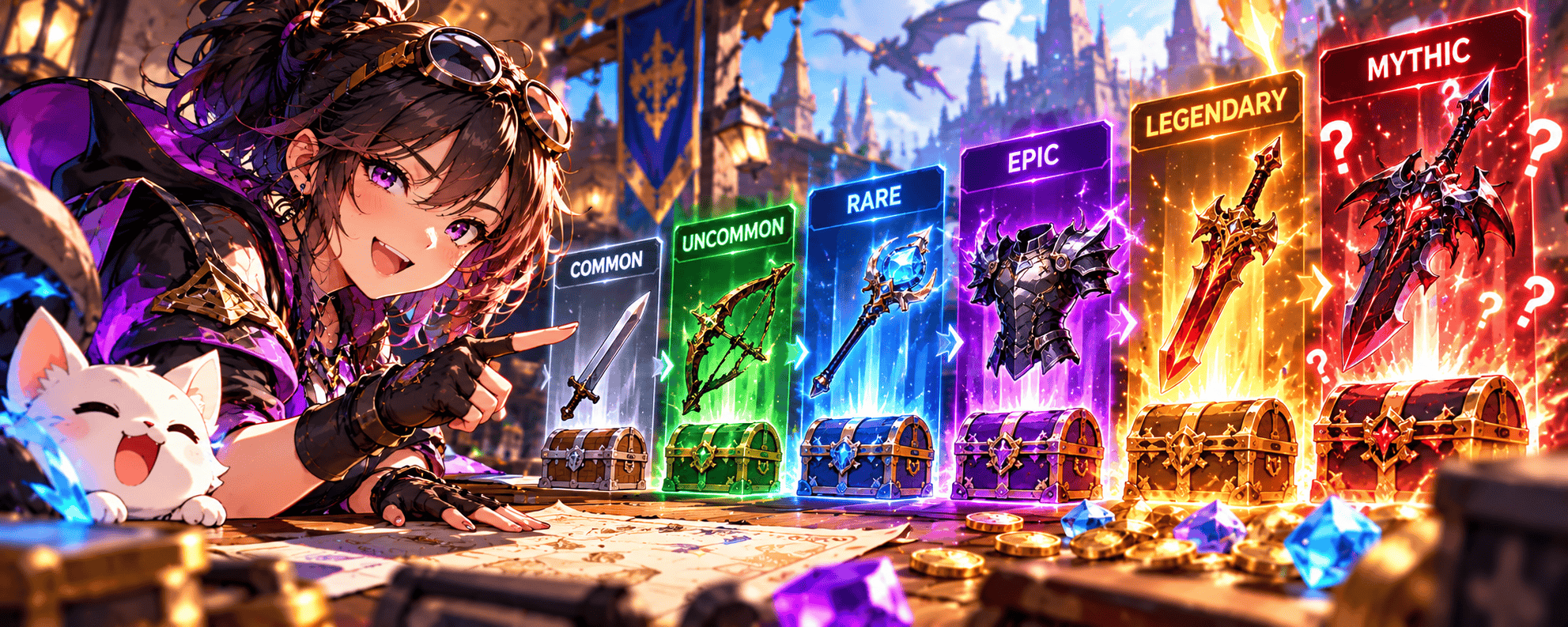
You’ve defeated the boss, opened the treasure chest and watched a beautiful orange beam shoot into the sky.
Legendary loot!
Suddenly, that exhausting boss fight feels completely worthwhile. Even if the item turns out to be something your character can’t actually use.
Item rarity is one of gaming’s most recognisable reward systems. From Common equipment to Legendary weapons, rarity tiers help players understand which items are ordinary, unusual or potentially special.
But how does item rarity actually work? Why are some items harder to obtain than others? What determines drop rates? And does finding a Legendary item automatically mean you’ve struck gold?
Let’s explore how rarity systems work, what makes items genuinely scarce and why the rarest item isn’t always the most valuable.
1. What Is Item Rarity in Video Games? ⭐
Item rarity is a system used by video games to classify items according to their availability, quality, characteristics or how difficult they are to obtain.
Many games represent rarity using colours, labels or visual effects.
A basic weapon might appear with a grey name, while a Legendary item receives an orange glow, dramatic animation or distinctive sound effect.
These visual signals help players quickly recognise different item tiers.
However, rarity doesn’t mean exactly the same thing in every game.
🎮 What Does Rarity Actually Tell You?
Depending on the game’s design, an item’s rarity might indicate:
- How frequently it drops.
- How difficult it is to obtain.
- How powerful its attributes are.
- Whether it has special abilities.
- How many copies exist.
- Whether it belongs to a special collection.
- Whether it was available during a limited event.
In loot-based RPGs, rarity often relates to equipment quality and potential attributes.
In games with collectible cosmetics, rarity might instead reflect availability, exclusivity or a developer-assigned classification.
Understanding the difference is important because an item’s rarity label doesn’t always describe its actual scarcity or value.
If you’re new to item systems, our What Are In-Game Items? Complete Guide explains how digital gaming items work and why players collect, use and trade them.
2. What Are the Different Item Rarity Tiers? 🌈
Although every game can create its own rarity system, many use a familiar progression from Common to Legendary.
Typical item rarity hierarchy
Common
Basic, frequently available items
Uncommon
Slightly less common items
Rare
Less frequent or more specialised rewards
Epic
Higher-tier or more distinctive items
Legendary
Top-tier or especially notable rewards
Mythic
An additional premium tier in some games
Illustrative hierarchy only. Colours, tier names and meanings vary between games.
⚪ Common Items
Common items are generally easy to obtain.
They often include basic equipment, ordinary resources or low-level rewards.
Players may encounter hundreds of Common items during normal gameplay.
🟢 Uncommon Items
Uncommon items are typically a step above Common equipment.
They might offer slightly better attributes, additional properties or less frequent availability.
🔵 Rare Items
Rare items are usually harder to obtain or offer more desirable characteristics.
They might appear less frequently in loot drops or require more challenging activities.
🟣 Epic Items
Epic items commonly represent a higher reward tier.
Depending on the game, they may offer stronger attributes, special effects or distinctive designs.
🟠 Legendary Items
Legendary items are often positioned among the game’s most prestigious rewards.
They might feature unusual abilities, powerful attributes, distinctive appearances or memorable acquisition requirements.
However, a Legendary label doesn’t necessarily mean only a handful of copies exist.
🔴 Mythic, Exotic and Other Tiers
Some games extend their rarity systems beyond Legendary.
Additional classifications might include:
- Mythic
- Exotic
- Ancient
- Unique
- Relic
- Divine
These labels aren’t universal. A Mythic item in one game might function completely differently from a Mythic item in another.
And in some games, an ordinary-looking item can be rarer than something labelled Legendary.
The colour is useful. The underlying system tells the real story.
3. How Do Item Drop Rates Work? 🎲
An item drop rate is the probability that a particular item will be awarded when a qualifying loot event occurs.
That event might involve defeating an enemy, opening a chest, completing a mission or receiving a reward.
For example, a game might assign the following hypothetical probabilities to a particular reward pool.
| Item Rarity | Example Drop Chance |
|---|---|
| Common | 60% |
| Uncommon | 25% |
| Rare | 10% |
| Epic | 4% |
| Legendary | 1% |
These percentages are illustrative, not actual rates from a specific game.
🎯 What Does a 1% Drop Rate Mean?
A 1% drop rate means each eligible attempt has a one-in-100 probability of producing the item, assuming independent attempts with a fixed probability.
It doesn’t mean you’re guaranteed to receive the item after 100 attempts.
You could receive it on your first attempt.
Or you might complete 200 attempts without seeing it.
For a fixed 1% chance on each independent attempt, the probability of receiving at least one copy after 100 attempts is approximately 63.4%.
That leaves roughly a 36.6% chance of receiving none.
Yes, the maths can be that cruel.
🔄 Do Drop Rates Change?
They can.
Some games adjust drop probabilities based on:
- Enemy difficulty
- Player level
- Game mode
- Event bonuses
- Loot modifiers
- Difficulty settings
- Reward systems
- Guaranteed-drop mechanics
Other games use fixed drop rates or more complicated reward tables.
The exact mechanics depend on the developer.
🛡️ What Is a Pity System?
Some games include systems designed to limit prolonged unlucky streaks.
A pity system might increase the chance of receiving a particular reward after repeated unsuccessful attempts or guarantee one after a specified number.
Not every game has these systems, and the rules can vary significantly.
The important thing is to understand whether each attempt is independent or whether previous results influence future rewards.
4. What Is RNG in Video Games? 🎰
RNG stands for Random Number Generation.
In gaming, it refers to the systems used to introduce randomness into outcomes such as loot drops, item attributes, encounters and rewards.
When players say they’ve been unlucky with RNG, they usually mean the game’s random reward system hasn’t been particularly generous.
🎲 How Does RNG Affect Item Rarity?
Imagine defeating a boss that can reward one of five items.
The game might use a random selection process to determine which reward you receive.
If some items have lower probabilities than others, they’ll generally appear less frequently across large numbers of attempts.
RNG can influence:
- Which item drops.
- Whether a rare item appears.
- The attributes assigned to equipment.
- The quality of crafted items.
- Random cosmetic rewards.
- Special item variations.
🍀 Can You Improve Your RNG?
Sometimes, but only through mechanics the game actually supports.
For example, certain games include:
- Luck attributes
- Drop-rate bonuses
- Special equipment
- Event multipliers
- Reward-enhancing consumables
- Guaranteed reward systems
These mechanics may improve your chances when the game explicitly provides them.
However, performing a lucky dance before opening a chest generally doesn’t alter the probability.
Unless the developer has implemented an unusually entertaining feature.
🧠 Why Random Rewards Feel So Exciting
Randomised rewards create uncertainty.
Players don’t know exactly what they’ll receive, so each qualifying drop carries the possibility of something special.
That anticipation can make a rare reward feel particularly memorable.
However, randomness can also encourage excessive grinding or spending, especially when rewards are tied to paid randomised systems.
Understanding the probabilities helps players make more informed decisions about how much time or money they’re willing to commit.
5. Why Do Video Games Use Item Rarity Systems? 🕹️
Rarity systems aren’t just colourful labels attached to inventory objects.
They help developers structure progression, distribute rewards and give players reasons to explore different activities.
📈 1. Create a Sense of Progression
Players often begin with basic equipment and gradually obtain more desirable items.
This creates a recognisable progression:
Common Gear → Better Equipment → Rare Rewards → End-Game Items
Improving your equipment can make character development feel more rewarding.
🏆 2. Reward Difficult Challenges
Developers can associate desirable items with challenging content.
A difficult boss, competitive achievement or demanding quest might provide access to rewards that aren’t available through ordinary gameplay.
This gives players something meaningful to work towards.
🔍 3. Encourage Exploration
Rare items can motivate players to investigate hidden areas, complete optional activities or experiment with different gameplay systems.
Without unique rewards, some activities might receive considerably less attention.
🔄 4. Support Replayability
Randomised loot can encourage players to repeat activities because each attempt offers another opportunity to receive a desirable reward.
This is particularly common in loot-focused RPGs and dungeon-based games.
💎 5. Create Collectible Rewards
Rarity also supports collecting.
Players might pursue unusual cosmetics, limited rewards or complete sets simply because they enjoy owning them.
Not every reward needs to improve combat performance.
💰 6. Influence Trading Economies
In games with player trading, rarity can affect item supply.
When desirable items are difficult to obtain, players may be willing to exchange other resources or currency for them.
However, rarity alone doesn’t determine price. Player demand, usefulness and trading restrictions also matter.
Our guide to What Makes an In-Game Item Valuable? explores why some rare items command attention while others struggle to find interested buyers.
Ultimately, a well-designed rarity system gives players meaningful goals without making every worthwhile reward feel impossibly out of reach.
6. What Makes an In-Game Item Rare? 💎
An in-game item becomes rare when it’s difficult to obtain, exists in limited quantities or has characteristics that distinguish it from more commonly available items.
However, rarity isn’t always determined by drop rates.
Some items are rare because players must complete challenging activities. Others were only available during a particular event or are no longer obtainable.
🎯 The Main Factors That Influence Item Rarity
Low Drop Rates
Items with very low drop probabilities can be difficult to obtain, particularly when players have limited opportunities to earn them.
Difficult Challenges
Some rewards require players to defeat challenging bosses, complete demanding achievements or reach high competitive rankings.
Limited Availability
An item might only be obtainable during a seasonal event, promotion or special activity.
Crafting Requirements
Certain items require rare materials, complicated recipes or significant time investment.
Unique Characteristics
Some games generate equipment with random attributes, making particular combinations exceptionally uncommon.
Restricted Supply
An item might have been distributed in limited quantities or removed from normal acquisition methods.
⚔️ Rare Doesn’t Always Mean Difficult to Obtain
Imagine two weapons.
The first is a Legendary sword that drops from a boss with a 5% probability.
The second is an ordinary-looking sword that was awarded during a one-time event several years ago.
The Legendary sword might require considerable effort to obtain, but players can continue farming it.
The event sword might be impossible to obtain today.
Which is rarer?
That depends on how many copies exist and whether players can still acquire them.
This leads to an important distinction between rarity and scarcity.
7. What Is the Difference Between Rarity and Scarcity? 📊
Rarity and scarcity are closely related, but they don’t mean exactly the same thing.
Rarity generally describes how unusual or difficult an item is to obtain. Scarcity describes how limited its available supply is.
An item can be classified as rare without being particularly scarce.
Likewise, an item that was originally common can become scarce over time.
🔍 Rarity vs Scarcity Explained
| Factor | Rarity | Scarcity |
|---|---|---|
| Main meaning | How unusual or difficult an item is to obtain | How limited its supply is |
| Influenced by | Drop rates, difficulty, rarity tiers | Existing copies, new supply, item removal |
| Can change? | Yes, depending on game mechanics | Yes, as supply changes |
| Example | Legendary weapon with a low drop rate | Discontinued cosmetic with few available copies |
🎮 Example: A Legendary Weapon
Imagine a game releases a Legendary weapon with a 1% drop rate.
Obtaining it is difficult.
However, if millions of players repeatedly defeat the relevant boss, a substantial number of copies might eventually enter circulation.
The weapon remains rare according to the game’s reward system, but its overall supply continues increasing.
🎨 Example: A Discontinued Cosmetic
Now imagine a cosmetic item that was available to everyone during a particular event.
Originally, it wasn’t especially rare.
But the event ends, the item is discontinued and some players stop playing.
Over time, the number of accessible copies might decrease.
The cosmetic can become scarce even though it was once easy to obtain.
💰 Why Does This Matter?
In games with trading economies, supply and demand influence how players value items.
An item that’s difficult to obtain but widely available through trading might be less desirable than a discontinued item with strong collector demand.
However, scarcity doesn’t automatically create value.
An item still needs players who actually want it.
8. What Are Limited-Edition and Event-Exclusive Items? 🏆
Limited-edition and event-exclusive items are rewards associated with particular releases, events, promotions or availability periods.
These items can become desirable because players associate them with a specific moment in a game’s history.
Examples include:
- Anniversary cosmetics
- Seasonal event rewards
- Tournament items
- Promotional skins
- Founder rewards
- Collaboration items
- Limited-time collectibles
- Special edition equipment
📅 Limited-Time Items
Some items are available only during a particular period.
For example, a game might introduce a Halloween cosmetic that players can obtain throughout October.
Once the event finishes, the item might disappear from the reward pool.
However, limited-time doesn’t necessarily mean permanently discontinued.
Developers may bring items back during future events.
🎟️ Event-Exclusive Items
Event-exclusive items are tied to specific activities or occasions.
Players might need to:
- Participate in a tournament.
- Complete a seasonal challenge.
- Attend an in-game event.
- Achieve a particular milestone.
- Purchase an eligible special edition.
- Complete a limited-time mission.
These requirements can make the items memorable, particularly when the event itself becomes part of the game’s history.
🔒 Are Limited-Edition Items Always Tradable?
No.
Some event rewards are permanently bound to the account that earned them.
Others can be transferred through supported trading systems.
This distinction matters because a collectible can be extremely rare without having a legitimate resale market.
If you’re evaluating an event-exclusive item, our Tradable vs Non-Tradable In-Game Items guide explains how transfer restrictions affect what players can do with their inventory.
🔄 Can Limited-Edition Items Return?
Absolutely.
Developers can reintroduce previously unavailable items through:
- Returning seasonal events
- Anniversary celebrations
- Updated reward pools
- Special promotions
- New crafting recipes
- Marketplace releases
A returning item may become easier to obtain, potentially changing its scarcity and desirability.
That exclusive cosmetic you spent three months proudly displaying?
It might return to the shop next Tuesday.
Gaming has a wonderful way of keeping collectors humble.
9. Does Higher Rarity Mean Better Items? ⚔️
Not necessarily. A higher rarity tier doesn’t automatically mean an item is more powerful, useful or desirable.
In some games, higher-tier equipment generally offers stronger attributes.
In others, rarity primarily reflects appearance, availability or special characteristics.
Even when rarity is connected to power, the item’s actual usefulness depends on the situation.
📊 Rarity vs Gameplay Performance
Consider three hypothetical weapons:
| Weapon | Rarity | Main Advantage | Potential Limitation |
|---|---|---|---|
| Iron Sword | Common | Reliable basic damage | Limited special attributes |
| Frost Blade | Epic | Additional ice damage | Less effective against resistant enemies |
| Dragon Slayer | Legendary | High damage against dragons | May be less useful against other enemies |
The Legendary weapon sounds impressive.
But if you’re fighting ice-resistant enemies rather than dragons, the Epic weapon might be more useful in some situations.
The best item depends on what you’re trying to accomplish.
🎯 Character Builds Matter
In RPGs and other equipment-focused games, players often create specialised character builds.
A particular build might rely on:
- Critical-hit chance
- Attack speed
- Elemental damage
- Cooldown reduction
- Defensive attributes
- Special equipment combinations
An item with the right attributes can outperform a higher-rarity alternative that doesn’t complement the build.
This is why experienced players often compare actual item statistics rather than simply equipping whatever has the most dramatic colour.
✨ Cosmetic Rarity Works Differently
For cosmetic items, higher rarity usually doesn’t indicate better gameplay performance.
A Legendary skin might be visually impressive, but a player could prefer a Common skin because of its design.
Personal preference plays a major role.
One player’s prized collectible is another player’s inventory clutter.
💎 Higher Rarity Doesn’t Guarantee Higher Value
Market value can also differ from the rarity hierarchy.
A desirable lower-tier item might attract more demand than a higher-tier item that players don’t particularly want.
For buyers and collectors, understanding how to check what an in-game item is worth is more useful than relying on rarity labels alone.
The important lesson is simple:
Rarity tells you something about an item. It doesn’t tell you everything.
10. Can Item Rarity Change Over Time? 🔄
Yes. An item’s rarity, availability and scarcity can change as a game evolves, even when its official rarity classification stays the same.
Game developers regularly introduce updates, events, new content and balance changes. These can affect how frequently items appear and how difficult they are to obtain.
An item that was once incredibly difficult to find might eventually become widely available.
The opposite can also happen.
🛠️ Game Updates Can Change Drop Rates
Developers sometimes adjust the probability of obtaining particular items.
For example, an update might:
- Increase the drop rate of a rare weapon.
- Reduce the availability of certain crafting materials.
- Introduce new sources of previously rare items.
- Remove items from existing reward pools.
- Change the requirements for earning special equipment.
Imagine a Legendary sword originally has a 0.5% drop rate.
After an update, the developer increases that probability to 5%.
The sword is now considerably easier to obtain, even if it retains its Legendary classification.
📅 Seasonal Events Can Affect Availability
Some items only appear during specific events.
A seasonal cosmetic might be available for two weeks, disappear for several months and return during the following year’s event.
Its availability changes throughout the year.
However, players shouldn’t automatically assume that every seasonal item will return.
Some rewards are permanently discontinued, while others reappear regularly.
📦 Existing Item Supply Can Change
In games with trading systems, the number of items available to players can change independently of official rarity tiers.
Supply might increase when:
- More players obtain the item.
- Drop rates improve.
- New crafting methods become available.
- Previously discontinued items return.
Supply might decrease when:
- Items are consumed or destroyed.
- Players permanently leave the game.
- Items become account-bound.
- Trading restrictions change.
- Existing copies become inaccessible.
These changes can influence how scarce an item feels within the active player community.
🎮 Does an Item’s Rarity Colour Change?
Sometimes, but not necessarily.
Developers can reclassify items, although many games retain the original rarity labels even after acquisition conditions change.
That’s why a Legendary item isn’t automatically as difficult to obtain today as it was when first released.
When evaluating an older item, consider both its official rarity classification and its current availability.
11. How Does Item Rarity Affect Value and Trading? 💰
Item rarity can influence value by affecting supply, but it doesn’t determine how much players are willing to pay.
In games that support item trading, prices generally depend on a combination of factors.
These include:
- Rarity
- Supply
- Player demand
- Gameplay usefulness
- Cosmetic appeal
- Tradability
- Item condition or attributes, where applicable
- Current game popularity
- Future availability
A rare item with little demand might have limited trading value.
Meanwhile, a relatively common resource needed for popular equipment could attract consistent demand.
📊 How Rarity Influences Supply and Demand
Consider three hypothetical items in a game with a player marketplace.
| Item | Availability | Player Demand | Potential Market Behaviour |
|---|---|---|---|
| Legendary Sword | Difficult to obtain | Low | Limited buyer interest |
| Rare Weapon Skin | Limited supply | High | Strong collector demand |
| Common Crafting Material | Widely available | Very high | Frequent trading activity |
The Legendary sword might have the highest official rarity tier.
But the Rare skin could attract higher offers because more players want it and fewer copies are available.
The Common crafting material might sell in large quantities because players constantly need it.
This illustrates an important principle:
Rarity influences supply, while demand helps determine whether that scarcity actually matters.
🔍 How Can You Tell Whether a Rare Item Is Valuable?
Where a game supports trading, useful indicators include:
Recent Completed Sales
Look at what buyers have actually paid, rather than relying exclusively on advertised prices.
Available Supply
Check how many comparable items are currently listed.
Player Demand
Consider whether the item is useful, popular or desirable among collectors.
Item Attributes
Some games generate equipment with different statistics, upgrades or cosmetic variations.
Two items with the same rarity classification might have significantly different characteristics.
Future Availability
Consider whether the item can still be obtained or might return through future events.
Trading Restrictions
Check whether the item can legally and technically be transferred through the game’s permitted systems.
🛒 Does Every Rare Item Have a Real-Money Value?
No.
Some games only permit exchanges using in-game resources or currency.
Others restrict trading entirely.
Even when players are interested in an item, the game’s rules may prohibit transferring or selling it for real money.
Our guide to Can You Sell In-Game Items for Real Money? explains how real-money item transactions work, including important restrictions and considerations.
For collectors and traders, the best approach is to evaluate the actual item and its market rather than assuming a particular rarity tier guarantees a particular price.
12. Item Rarity FAQ ❓
⭐ What Does Item Rarity Mean in Video Games?
Item rarity describes how unusual, difficult to obtain or specially classified an item is within a game.
It may be connected to drop probability, equipment quality, special attributes or limited availability.
The exact meaning depends on the game’s rarity system.
🌈 What Are the Most Common Item Rarity Colours?
Many games use a colour hierarchy resembling:
- ⚪ Grey or White – Common
- 🟢 Green – Uncommon
- 🔵 Blue – Rare
- 🟣 Purple – Epic
- 🟠 Orange – Legendary
Some games introduce additional tiers, including Mythic, Exotic or Unique.
There is no universal rarity colour system that every game follows.
💎 Is Legendary the Highest Item Rarity?
Not always.
Legendary is a high-tier classification in many games, but some include additional tiers above or alongside it.
The highest classification depends on the individual game.
🎲 Does a 1% Drop Rate Mean I’ll Get the Item After 100 Attempts?
No.
If each attempt is independent and has a fixed 1% chance, completing 100 attempts gives you approximately a 63.4% probability of receiving at least one copy.
It doesn’t guarantee success.
Some games include pity systems or guaranteed rewards that change these probabilities.
🍀 Can Luck Increase Item Drop Rates?
In some games, yes.
Certain games include luck statistics, equipment bonuses or event modifiers that influence drop probabilities.
However, these mechanics must be supported by the game.
Simply completing more attempts doesn’t necessarily improve the probability of success on the next independent attempt.
🏆 Are Limited-Edition Items Always Rare?
Not necessarily.
An item might only be available during a short event but still be obtained by millions of players.
Limited availability doesn’t automatically mean few copies exist.
An item’s actual scarcity depends on how many copies are available and whether more can enter circulation.
⚔️ Are Legendary Items Always Better Than Rare Items?
No.
In some games, Legendary equipment generally provides stronger attributes or unique abilities.
However, a lower-tier item might be more useful for a particular character build, activity or gameplay situation.
Cosmetic rarity is even less connected to gameplay performance.
💰 Are Rare In-Game Items Worth More Money?
Sometimes, but not always.
A rare item may attract strong demand because it’s difficult to obtain, visually desirable or useful.
However, an item with limited demand may have little market value regardless of its rarity classification.
🔄 Can a Rare Item Become Common?
Yes.
Developers can increase drop rates, introduce additional acquisition methods or re-release previously limited items.
These changes can make an item easier to obtain even if its official rarity label remains unchanged.
🎮 What’s the Difference Between Item Rarity and Item Value?
Rarity describes how unusual or difficult an item is to obtain. Value describes how desirable or useful that item is to players, including what buyers may be willing to exchange for it.
The two concepts are connected, but they’re not interchangeable.
An extremely rare item can have little demand, while a relatively common item can be highly sought after.
🎯 Final Thoughts: Rarity Isn’t Everything
Item rarity adds excitement, progression and collectibility to video games.
It gives players something to chase, whether that’s a Legendary weapon, a rare cosmetic or an elusive reward from a difficult boss.
But understanding rarity means looking beyond the colour of an item’s name.
Drop rates, scarcity, availability, gameplay usefulness and player demand all influence how special an item really is.
The next time a Legendary item drops, enjoy the moment.
Just remember to check its stats before declaring yourself the wealthiest player on the server.