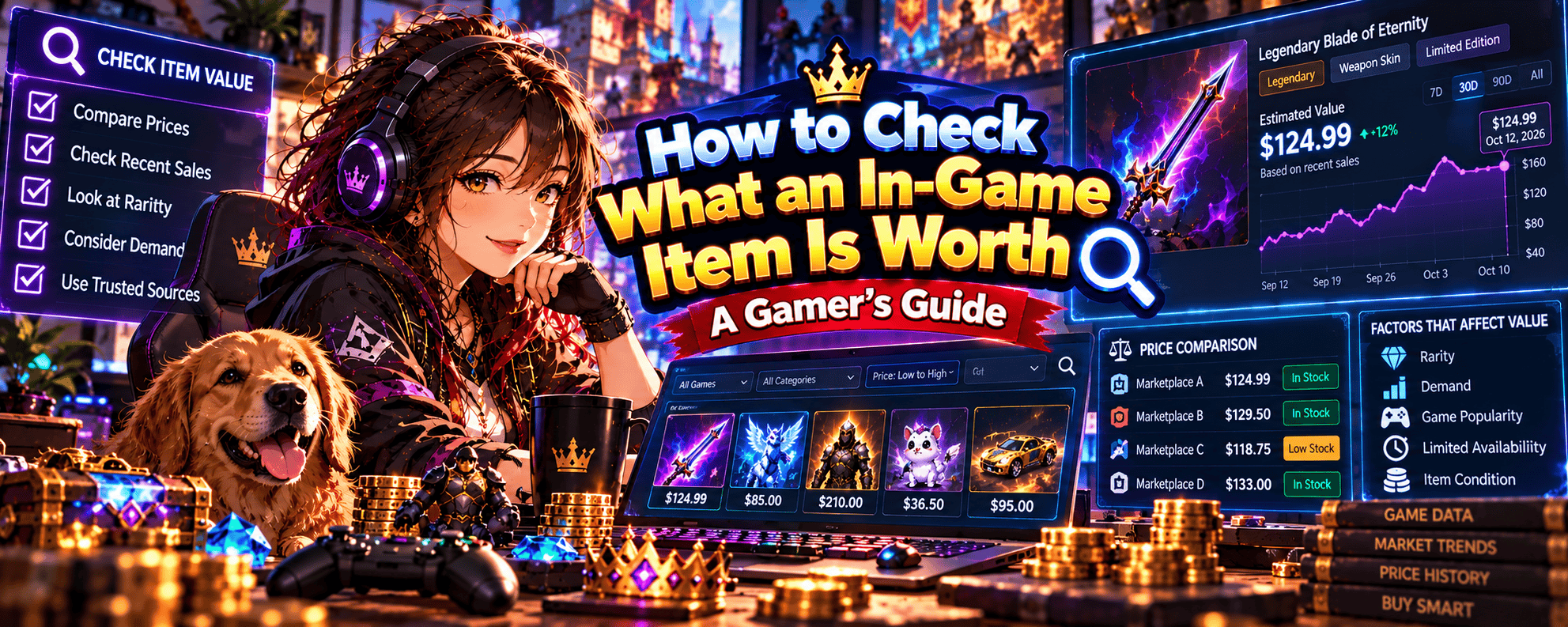
1. How to Check What an In-Game Item Is Worth 💎
You’ve just landed a rare drop after hours of grinding. The item looks incredible, has some impressive stats and might even be one of the rarest things in your inventory.
Naturally, there’s one question on your mind.
How much is this thing actually worth?
Maybe it’s a Counter-Strike 2 skin worth hundreds of dollars. Perhaps it’s a powerful Path of Exile weapon that other players desperately want. Or maybe it’s a limited-edition collectible that looks valuable but has surprisingly little demand.
Here’s the interesting part.
Two items that look almost identical can have completely different values.
And sometimes, the item you thought was worthless turns out to be exactly what another player has been searching for.
Knowing how to check what an in-game item is worth can help you make smarter decisions when buying, selling, collecting or trading virtual goods.
🎮 Why Is Knowing Your Item’s Value Important?
Whether you’re a casual gamer or a dedicated collector, understanding item values has several advantages.
Avoid Overpaying
If you’re buying an item, knowing its approximate market value helps you recognise overpriced listings.
Sell Items at a Fair Price
If you’re selling, accurate pricing can help you attract buyers without unnecessarily undervaluing your inventory.
Make Better Trades
Understanding the relative value of items can help you evaluate whether a proposed exchange is worthwhile.
Identify Valuable Drops
Some items have desirable attributes that aren’t immediately obvious.
Understand Your Inventory
Checking item values can reveal which collectibles, cosmetics or equipment deserve closer attention.
Make Smarter Gaming Decisions
Knowing which items are valuable can influence how you approach crafting, collecting and permitted trading.
For some gamers, learning how to value items becomes almost as rewarding as acquiring them.
Almost.
Nothing quite beats seeing that legendary drop animation.
💰 What Does an In-Game Item’s Value Actually Mean?
An item can have several different types of value.
These aren’t necessarily interchangeable.
| Type of Value | What It Means | Example |
|---|---|---|
| In-Game Value | Worth measured in a game’s currency or resources | A weapon worth 500,000 gold |
| Marketplace Value | Price buyers may pay through a supported marketplace | A CS2 skin listed for $75 in Steam Wallet funds |
| Trading Value | What other players may exchange for the item | A rare item exchanged for crafting currency |
| Real-Money Resale Value | Potential proceeds through a permitted cash-out system | An eligible collectible sold through a marketplace that supports withdrawals |
| Collector Value | Additional desirability because of rarity or special attributes | A sought-after skin pattern |
| Personal Value | What the item is worth to you | A cosmetic earned during your first major gaming event |
An item worth $100 on the Steam Community Market isn’t necessarily worth $100 in withdrawable cash.
Steam Wallet funds generally cannot be withdrawn directly as money, and prices can differ across marketplaces.
Similarly, an item worth millions of gold in an MMO doesn’t automatically have a legitimate real-money resale value.
Before checking an item’s price, decide which type of value you’re trying to measure.
⚔️ Can In-Game Items Really Be Worth Hundreds or Thousands of Dollars?
Yes, certain eligible virtual collectibles have attracted substantial prices in secondary markets.
Counter-Strike skins are a well-known example.
Some rare combinations of item condition, pattern and collector demand can command unusually high prices.
However, these examples aren’t representative of ordinary gaming inventories.
Most items have much lower values, and many cannot be resold at all.
A high advertised price also doesn’t guarantee that someone will actually pay it.
🔍 What’s the Best Way to Check an Item’s Worth?
A reliable valuation usually involves five steps:
- Identify the exact item and its attributes.
- Find a relevant marketplace or supported trading system.
- Research comparable listings.
- Check recent completed sales where available.
- Adjust for condition, rarity, demand and transaction fees.
This approach works across many games, although the available information varies.
For example, CS2 cosmetics may have detailed market histories, while a rare RPG weapon might require comparisons with similar equipment.
The goal isn’t to guess the highest possible selling price.
It’s to estimate what a genuine buyer might reasonably pay under current market conditions.
2. What Determines the Value of an In-Game Item? ⚔️
Ever wondered why one weapon skin sells for a few dollars while another attracts a price that could buy an entire gaming setup?
Or why an ordinary-looking piece of equipment becomes incredibly desirable after a game update?
The answer usually comes down to a combination of factors.
An item’s value depends on what it offers, how difficult it is to obtain and how much other players want it.
Understanding these factors is the foundation of accurate item valuation.
🌟 1. Item Rarity
Rarity describes how uncommon an item is within a game.
Some items are widely available, while others can only be obtained through difficult activities, limited events or rare drops.
Generally, limited supply can contribute to higher prices.
However, rarity alone doesn’t guarantee value.
An extremely rare item that nobody wants may sell for less than a common item with strong demand.
🔥 2. Player Demand
Demand is one of the most important influences on market value.
An item becomes more desirable when many players want to own it.
Demand can increase because of:
- Popular character builds.
- Attractive cosmetic designs.
- Competitive gameplay advantages.
- Community trends.
- Collector interest.
- Influencer exposure.
- New game content.
For example, a particular Path of Exile item might become highly desirable when players discover a powerful build that relies on its attributes.
As demand increases, sellers may be able to ask higher prices.
📦 3. Available Supply
Supply refers to how many copies of an item are available.
An item may become more valuable when supply decreases or becomes restricted.
This can happen when:
- An event ends.
- A reward becomes unavailable.
- Drop rates change.
- An item is removed from circulation.
- Existing owners stop selling.
- Trading restrictions reduce available inventory.
However, limited supply only creates substantial value when enough buyers are interested.
🎨 4. Cosmetic Appearance
Some items are valuable primarily because they look incredible.
This is particularly relevant to skins, outfits and collectibles.
Visual characteristics that can influence demand include:
- Colour combinations.
- Unique animations.
- Special effects.
- Recognisable designs.
- Popular themes.
- Rare patterns.
- Collector appeal.
A cosmetic doesn’t need to improve gameplay to attract buyers.
Sometimes looking legendary is the entire point.
🛡️ 5. Gameplay Utility
Functional items derive much of their value from what they help players accomplish.
Examples include:
- Weapons with desirable damage statistics.
- Armour with useful defensive bonuses.
- Equipment that supports popular builds.
- Rare crafting materials.
- Resources required for progression.
In RPGs and MMOs, equipment with the right combination of attributes can be more valuable than an item with a higher rarity classification.
💎 6. Item Condition and Attributes
Some games assign additional characteristics to individual items.
Counter-Strike 2 skins, for example, can have different wear values, patterns and other attributes.
These details can significantly affect collector demand.
In equipment-based games, differences in modifiers, upgrade levels or crafting potential may influence prices.
Always compare the exact item variation rather than relying solely on its name.
⏳ 7. Limited Availability
Items associated with seasonal events, promotions or discontinued content may attract collector interest.
However, limited availability doesn’t automatically make an item tradable or valuable.
A rare account-bound cosmetic might be highly desirable without having a legitimate resale market.
That’s an important distinction when assessing virtual item worth.
📈 8. Game Popularity and Market Activity
An item’s value can also depend on the health of the game’s trading economy.
A large, active player base may support more frequent transactions.
Conversely, declining player interest can reduce demand and make certain items harder to sell.
Market activity matters because an item isn’t necessarily worth its advertised price if there are no willing buyers.
📊 How Different Factors Influence Item Value
| Value Factor | Potential Effect | Example |
|---|---|---|
| High Rarity | Can increase desirability | Rare collectible skin |
| Strong Demand | Can increase prices | Popular competitive cosmetic |
| Limited Supply | Can support higher prices | Discontinued tradable item |
| Attractive Appearance | Increases cosmetic appeal | Distinctive weapon finish |
| Gameplay Utility | Creates practical demand | Powerful RPG equipment |
| Special Attributes | May create collector premiums | Unusual CS2 pattern |
| Limited Availability | May increase exclusivity | Eligible event collectible |
| Active Market | Supports price discovery | Frequently traded item |
| Low Liquidity | Makes valuation less certain | Rare item with few sales |
🏆 Which Factor Matters Most?
There isn’t one universal answer.
For cosmetic collectibles, rarity, appearance and collector demand may dominate.
For functional equipment, useful statistics and build compatibility can be more important.
For crafting resources, demand and available supply may drive much of the price movement.
Our What Makes an In-Game Item Valuable? guide explores these factors in greater detail.
The key takeaway is that item value comes from the interaction between desirability, availability and actual market activity.
A legendary label might make an item exciting.
But genuine buyer demand is what gives it a market price.
3. Where to Check In-Game Item Prices Online 🔍
So you’ve identified your item and understand what might make it valuable.
Now comes the practical part.
Where do you actually check its price?
Fortunately, many games have official marketplaces, trading systems or community resources that provide useful pricing information.
However, not every source measures value in the same way.
Some display asking prices.
Others provide historical transactions.
And certain platforms use currencies that cannot be withdrawn as real money.
🔫 Steam Community Market
The Steam Community Market is one of the most useful starting points for researching eligible Steam inventory items.
For supported games such as Counter-Strike 2, players can browse listings and review available market information.

Depending on the item, available information may include:
- Current listing prices.
- Quantity available for sale.
- Historical price trends.
- Recorded sales activity.
- Item descriptions.
This can help you understand how prices have changed and whether an advertised listing is competitive.
💰 Understanding Steam Market Prices
Steam Community Market transactions use Steam Wallet funds.
These balances generally cannot be withdrawn directly as cash.
For that reason, a skin’s Steam Market price should not automatically be treated as its withdrawable real-money value.
Prices may also differ between Steam and independent marketplaces because of fees, payment systems, trading restrictions and market demand.
When checking prices, compare values within the same marketplace or clearly account for these differences.
🐉 World of Warcraft Auction House
World of Warcraft players can research eligible item values through the in-game Auction House.
This is particularly useful for:
- Crafting materials.
- Consumables.
- Tradable equipment.
- Profession resources.
- Collectibles.
- Other eligible goods.
Prices are generally expressed in in-game gold.
However, the value of an item can differ between realms, regions, game versions and market conditions.
A crafting material that’s expensive in one market might be much cheaper elsewhere.
⚔️ Path of Exile Trading Systems
Path of Exile has an extensive trading economy where players can research eligible equipment and currency items.
Supported trading tools can help players search for items with particular attributes.
For example, you might search for weapons with:
- Specific damage modifiers.
- Increased critical strike chance.
- Particular elemental bonuses.
- Required item levels.
- Desirable combinations of affixes.
The closer your search matches the exact item, the more useful the pricing information becomes.
Be careful when comparing listings from different leagues or game versions.
An item that’s valuable in one economy may have a very different price in another.
🧱 Roblox Marketplace
Roblox’s official Marketplace provides pricing information for eligible avatar items.
Certain qualifying collectibles also support resale features.
Depending on the item and available marketplace data, players may be able to assess current asking prices and relevant resale information.
However, not every Roblox item can be resold.
Always check eligibility before assuming a listed purchase price represents a recoverable resale value.
🌐 Third-Party Gaming Marketplaces
Independent gaming marketplaces can provide additional pricing references for eligible items.
For example, you may find listings for gaming-related products through platforms such as StackedGame.
These listings can help you understand what sellers are asking.
However, there’s an important limitation.
An advertised price isn’t proof that an item has sold for that amount.
A seller might list an item for $150, but that doesn’t establish a market value of $150.
Without evidence of completed transactions, the listing is simply an asking price.
Before relying on external marketplace data, verify that the transaction is permitted by the game.
You can explore the different purchasing channels in our Where to Buy In-Game Items Online guide.
📊 Comparing Item Pricing Sources
| Pricing Source | Best For | Main Limitation |
|---|---|---|
| Steam Community Market | Eligible Steam cosmetics and collectibles | Steam Wallet value isn’t directly withdrawable cash |
| WoW Auction House | Eligible equipment, materials and resources | Prices use in-game gold and vary by market |
| Path of Exile Trading Systems | Equipment, currency items and crafting resources | Listings may not represent completed trades |
| Roblox Marketplace | Eligible avatar items and collectibles | Resale restrictions apply |
| Independent Marketplaces | Additional seller pricing references | Listing prices may lack verified sales data |
| Community Pricing Resources | Item-specific research and market trends | Data quality and freshness vary |
🔐 How Do You Know Whether a Pricing Source Is Reliable?
Before trusting a price, ask:
- Is the source relevant to the exact game and item?
- Does it show current information?
- Are the prices based on listings or completed transactions?
- Is the currency clearly identified?
- Are item variations accounted for?
- Is the marketplace active?
- Can the item actually be traded?
The more reliable and relevant the data, the stronger your valuation.
🏆 What’s the Best Place to Check Item Prices?
Start with the game’s official marketplace or supported trading system.
If reliable completed-sale data is available, use it alongside current listings.
For unusual or expensive collectibles, research several comparable transactions rather than relying on one price.
And remember, a marketplace listing tells you what someone hopes to receive.
A completed sale provides stronger evidence of what a buyer was actually willing to pay.
4. How to Find the Real Market Value of an Item 📊
Here’s where things get interesting.
Imagine you own a rare weapon skin.
You search online and find three listings:
- Seller A wants $80.
- Seller B wants $125.
- Seller C wants $200.
So what’s your skin worth?
$80? $125? $200?
The answer isn’t necessarily any of them.
Those are asking prices, not confirmed market values.
To estimate what your item is actually worth, you need to investigate what comparable items have sold for and how active the market is.
💰 Asking Price vs Actual Selling Price
An asking price is what a seller wants to receive.
A selling price is what a buyer actually paid.
These can be very different.
Consider this hypothetical example:
| Listing | Asking Price | Result |
|---|---|---|
| Seller A | $80 | Sold for $80 |
| Seller B | $125 | Still listed |
| Seller C | $200 | Still listed |
| Seller D | $85 | Sold for $85 |
| Seller E | $90 | Sold for $90 |
The completed sales provide stronger evidence of market value than the unsold listings.
In this example, recent comparable transactions suggest a value around $80–$90.
That doesn’t guarantee your item will sell within this range, but it’s a more defensible estimate than simply choosing the highest asking price.
🔍 Step 1: Identify the Exact Item
Before checking market prices, confirm the item’s characteristics.
Record:
- Exact item name.
- Game and version.
- Rarity.
- Condition.
- Special attributes.
- Upgrade level.
- Trading restrictions.
- Other relevant identifiers.
For a CS2 skin, this might include its wear classification, float value and pattern.
For an RPG weapon, it might include its damage, modifiers and crafting potential.
These details determine which listings are genuinely comparable.
📊 Step 2: Find Recent Comparable Sales
Where reliable completed-sale data is available, prioritise transactions involving similar items.
Ideally, compare items with:
- The same name and variation.
- Similar condition.
- Comparable attributes.
- The same game economy.
- Similar trading eligibility.
For items with substantial trading activity, recent sales can provide useful pricing evidence.
For extremely rare items, comparable transactions may be limited.
That makes valuation more uncertain.
Step 3: Calculate a Typical Selling Price
Suppose five comparable items recently sold for the following prices:
- $78
- $82
- $85
- $87
- $120
Average Price: $90.40
Median Price: $85.00
The average is $90.40.
However, the $120 sale increases the average noticeably.
The median price of $85 may provide a more representative starting point if the $120 transaction was unusual.
This is why experienced traders don’t always rely on simple averages.
The average is $90.40.
However, the $120 sale increases the average noticeably.
The median price of $85 may provide a more representative starting point if the $120 transaction was unusual.
This is why experienced traders don’t always rely on simple averages.
📈 Step 4: Check Current Market Conditions
Historical sales are useful, but markets change.
Before settling on a valuation, investigate:
- Recent price movements.
- Current supply.
- Number of active buyers.
- New game updates.
- Seasonal demand.
- Changes to trading restrictions.
- Recent increases or decreases in sales activity.
An item that sold for $100 last month might be worth considerably less today if demand has fallen.
Likewise, a newly popular character build could increase demand for particular equipment.
🔄 Step 5: Consider How Quickly the Item Might Sell
An item can have an attractive asking price but very few interested buyers.
This is where market liquidity becomes important.
Liquidity describes how easily an item can be sold at a reasonable price.
Highly traded items generally have more pricing evidence and may be easier to sell.
Rare collectibles with few transactions can be harder to value.
For example:
| Item | Recent Comparable Sales | Valuation Confidence |
|---|---|---|
| Popular CS2 Skin | Hundreds of transactions | Generally higher |
| Common MMO Crafting Material | Frequent transactions | Generally higher |
| Unusual RPG Weapon | Limited comparable trades | Moderate to low |
| Extremely Rare Collectible | Very few confirmed sales | Lower |
These are illustrative examples; actual confidence depends on the quality and recency of the data.
💳 Step 6: Account for Marketplace Fees
The amount a buyer pays isn’t always the amount a seller receives.
Marketplace fees, payment charges and currency conversion can reduce net proceeds.
Consider a hypothetical transaction:
| Calculation | Amount |
|---|---|
| Item Selling Price | $100 |
| Marketplace Fee (5%) | -$5 |
| Payment Processing Fee (3%) | -$3 |
| Estimated Net Proceeds | $92 |
The fees above are illustrative, not the published rates of a particular marketplace.
For accurate valuations, use the actual fee schedule and any applicable withdrawal charges.
Also remember that some marketplaces, including the Steam Community Market, don’t provide ordinary cash withdrawal of sale proceeds.
🏆 Step 7: Establish a Realistic Value Range
Instead of assigning one exact price, consider a range.
For example:
- Quick-Sale Estimate: $75–$80.
- Typical Market Estimate: $80–$90.
- Optimistic Asking Price: $95–$105.
These are hypothetical figures, not guaranteed outcomes.
The purpose is to recognise that market value depends partly on how quickly you want to sell and whether buyers are willing to pay a premium.
🎯 A Simple Formula for Estimating Item Value
A useful starting point is:
Estimated Market Value = Typical Recent Comparable Sale Price ± Adjustments for Item Attributes and Current Demand
Then, if you’re selling through a marketplace that supports payouts:
Estimated Net Proceeds = Expected Selling Price − Applicable Fees
Neither formula guarantees a sale, but together they provide a more practical valuation than choosing an arbitrary listing price.
⚔️ The Golden Rule of In-Game Item Valuation
An item is only worth what a willing buyer is prepared to pay under the available market conditions.
Rarity, appearance and impressive statistics can all influence demand.
But actual transactions provide the strongest evidence of what an item might realistically sell for.
Whether you’re checking a rare skin, powerful weapon or valuable crafting resource, focus on comparable sales, current demand and the exact attributes of your item.
Because there’s a big difference between owning an item listed for $500 and owning one that someone will actually buy for $500.
5. How Item Rarity Affects Market Value 🌟
You’ve finally obtained a legendary item after hundreds of attempts.
The drop rate was ridiculously low, the animation was spectacular and your inventory now contains something most players will never own.
Surely it must be worth a fortune?
Not necessarily.
Rarity can influence an in-game item’s value, but being rare doesn’t automatically make something expensive.
To understand how rarity affects prices, you need to consider how difficult an item is to obtain, how many copies exist and whether other players actually want it.
💎 What Does Item Rarity Mean?
Item rarity describes how uncommon an item is within a game.
Many games use rarity tiers to distinguish ordinary equipment from more unusual or desirable items.
A typical rarity system might include:
- Common: Widely available items with relatively ordinary attributes.
- Uncommon: Slightly harder to obtain, sometimes with improved characteristics.
- Rare: Less frequently encountered items with potentially desirable features.
- Epic: Higher-tier items that may offer distinctive attributes or appearances.
- Legendary: Items often associated with powerful effects, unusual designs or challenging acquisition requirements.
- Mythic: A particularly exclusive classification used by some games.
However, rarity classifications aren’t standardised across gaming.
A legendary item in one game might be relatively easy to obtain, while a rare item in another could be exceptionally difficult to acquire.
🎮 Why Are Rare Items Sometimes More Valuable?
Rare items can attract higher prices because fewer copies are available.
If an item is difficult to obtain and many players want it, competition between buyers can increase its market value.
For example, imagine a hypothetical collectible with:
- Only 500 tradable copies available.
- Thousands of interested collectors.
- No additional copies expected to enter circulation.
That combination could create significant demand relative to supply.
However, if only 20 players want the collectible, its limited availability might not translate into a high selling price.
Scarcity creates the potential for value. Demand determines whether that potential becomes meaningful.
🎲 How Do Drop Rates Influence Item Prices?
Drop rates describe the probability of obtaining an item through particular gameplay activities.
An item with a very low drop rate may require considerable time or effort to acquire.
This can influence market prices when players are willing to pay for a tradable item rather than repeatedly attempting to obtain it.
For example:
| Hypothetical Item | Drop Chance | Potential Market Implication |
|---|---|---|
| Basic Crafting Material | 50% | Usually plentiful |
| Uncommon Weapon | 10% | Moderate availability |
| Rare Cosmetic | 1% | Potentially limited supply |
| Ultra-Rare Collectible | 0.01% | Very limited acquisition rate |
These percentages are illustrative, not actual drop rates from a specific game.
Drop rates alone cannot establish market value. The number of players farming an item, how long it has been available and whether it can be traded also matter.
⏳ Does Limited-Time Availability Increase Value?
Sometimes.
Items introduced during seasonal events, special promotions or limited releases may become more desirable after their availability ends.
For example, a cosmetic might only be obtainable during a particular event.
If the item remains tradable and players continue wanting it, limited availability could support higher prices.
However, several factors can change the outcome:
- The developer might reintroduce the item.
- Collector interest might decline.
- Similar cosmetics might become available.
- The item might become non-tradable.
- The game’s popularity might decrease.
Limited availability should never be treated as a guarantee of future value.
🔫 Why Can Two Rare CS2 Skins Have Different Prices?
Counter-Strike 2 demonstrates why rarity is only part of the valuation process.
Two skins from the same rarity category can attract different prices because of:
- Weapon popularity.
- Cosmetic design.
- Wear condition.
- Float value.
- Pattern variations.
- Special collectible characteristics.
- Available supply.
- Buyer demand.
A visually desirable skin for a popular weapon might attract significantly more interest than a similarly rare skin for a less frequently used weapon.
Even individual examples of the same skin can have different values.
🚫 When Does Rarity Not Create Resale Value?
Some items are exceptionally rare but cannot be traded.
For example, an account-bound reward might require completing an extremely difficult challenge.
Other players may admire it, but that doesn’t mean there’s a legitimate marketplace where it can be sold.
Likewise, a discontinued cosmetic might be highly desirable without being transferable between accounts.
Before estimating a rare item’s resale value, confirm that the game permits the proposed transaction.
🏆 How Should You Value a Rare Item?
Start by checking:
- How many comparable items are available.
- Whether the item can still be obtained.
- How frequently comparable items sell.
- Whether demand is increasing or decreasing.
- Whether special attributes affect its desirability.
- Whether the item is tradable.
- Whether reliable completed-sale data exists.
Our How Does Item Rarity Work in Video Games? guide explores rarity systems, drop rates and item classifications in more detail.
The golden rule? Don’t confuse rarity with market value.
A rare item with strong demand can be incredibly valuable.
A rare item nobody wants might just be an interesting addition to your inventory.
And sometimes, that’s perfectly fine. Not every legendary drop needs to pay for your next graphics card.
6. How to Check the Value of Skins and Cosmetic Items 🎨
Cosmetic items are among the most recognisable virtual collectibles in gaming.
From elaborate weapon finishes to exclusive character outfits, cosmetics allow players to personalise their gaming experience.
But their prices can be surprisingly difficult to understand.
Why might one Counter-Strike 2 skin sell for $20 while a seemingly identical version attracts a much higher price?
And how can you tell whether a rare cosmetic is genuinely valuable or simply advertised at an unrealistic price?
The answer lies in understanding the attributes that influence cosmetic demand.
🔫 How to Check the Value of CS2 Skins
Counter-Strike 2 skins provide a useful example because many eligible items have established marketplace activity.
To research a skin’s value, start by identifying its exact characteristics.
Important details include:
- Weapon type.
- Skin name.
- Wear classification.
- Float value.
- Pattern.
- StatTrak status, where applicable.
- Stickers or other special attributes.
- Current marketplace availability.
These details can significantly influence pricing.
💎 What Is a CS2 Skin Float Value?
A float value is a numerical characteristic that influences a skin’s wear appearance.
CS2 skins generally use float values between 0 and 1, although individual finishes can have narrower possible ranges.
Lower values usually correspond to less wear.
Common wear classifications include:
| Wear Classification | Float Range |
|---|---|
| Factory New | 0.00–0.07 |
| Minimal Wear | 0.07–0.15 |
| Field-Tested | 0.15–0.38 |
| Well-Worn | 0.38–0.45 |
| Battle-Scarred | 0.45–1.00 |
The ranges are conventionally shown rounded to two decimal places.
Not every skin can exist in every wear category.
🎯 Does a Lower Float Always Mean a Higher Price?
No.
Although lower float values can attract collector premiums, pricing depends on the particular skin and market.
Some finishes show dramatic visual differences between wear levels.
Others change very little.
Certain collectors may also seek unusual high-float examples.
For accurate valuation, compare skins with similar float values rather than assuming all Factory New examples are worth the same amount.
🎨 How Do Skin Patterns Affect Value?
Some CS2 skins have pattern variations that influence their appearance.
Certain patterns may be particularly desirable to collectors.
For example, variations in colour distribution can create substantial differences in collector interest.
When researching pattern-sensitive skins:
- Identify the exact pattern index.
- Inspect the skin through a supported viewing method.
- Research comparable patterns.
- Look for reliable completed-sale information.
- Avoid assuming every unusual pattern commands a premium.
An attractive pattern isn’t automatically a valuable one.
⭐ Do Stickers Increase Skin Value?
Sometimes.
Stickers can contribute to a skin’s collector appeal, particularly when they’re rare, desirable or arranged in a sought-after combination.
However, the value of an applied sticker isn’t necessarily equal to the price of an unused sticker.
Collectors may evaluate:
- Sticker rarity.
- Placement.
- Appearance.
- Condition.
- Compatibility with the skin.
- Overall desirability.
Don’t simply add the full market value of every sticker to the skin’s base price.
That approach can produce unrealistic valuations.
🧱 How to Check the Value of Roblox Collectibles
Roblox has a different cosmetic economy.
Certain eligible avatar items support resale through Roblox’s official systems.
When evaluating an eligible collectible, consider:
- Current asking prices.
- Available resale history.
- Recent market activity.
- Number of competing listings.
- Collector demand.
- Applicable marketplace restrictions.
Remember that prices are generally expressed in Robux, which shouldn’t automatically be treated as an equivalent amount of withdrawable cash.
Not every avatar item can be resold.
🎮 Can You Check the Value of Fortnite Skins?
You can assess the original purchase price, availability and perceived collector desirability of Fortnite cosmetics.
However, Fortnite generally doesn’t permit players to resell or transfer existing Locker cosmetics to other accounts.
That means an old or rare Fortnite outfit doesn’t necessarily have a legitimate individual resale value.
Websites claiming to value an entire Fortnite account based on its cosmetics shouldn’t be confused with an authorised item marketplace.
📊 Cosmetic Item Valuation Checklist
| Attribute | What to Investigate |
|---|---|
| Item Name | Exact cosmetic and variation |
| Rarity | Availability and acquisition difficulty |
| Condition | Wear classification, where applicable |
| Float Value | Numerical wear characteristics |
| Pattern | Collector desirability |
| Special Features | Stickers, counters or other attributes |
| Market Activity | Recent comparable sales |
| Supply | Available listings |
| Trading Eligibility | Whether resale is permitted |
🏆 What’s the Best Way to Value a Cosmetic?
Find comparable items with matching attributes and examine their recent market activity.
For ordinary cosmetics, several recent transactions may provide a reasonable estimate.
For exceptionally rare skins, unusual patterns or specialised collectibles, valuation may require more detailed research.
The closer your comparisons match the exact cosmetic, the more useful your valuation becomes.
And remember, a skin might look priceless to you without having an established resale market.
Sometimes the real value is simply how good it looks during your next victory.
7. How to Value Weapons, Armour and Equipment 🛡️
Cosmetic items are largely about appearance and collector demand.
Weapons, armour and other functional equipment introduce another important factor.
What can the item actually do?
In RPGs, MMOs and other equipment-driven games, an item’s gameplay benefits can have a major influence on its value.
A powerful weapon might be highly desirable because it supports a popular character build.
Meanwhile, an impressive-looking legendary item might attract little trading interest because its statistics aren’t particularly useful.
⚔️ Why Are Equipment Values Different From Cosmetic Values?
Functional equipment is often valued according to its practical usefulness.
Players may purchase items to:
- Increase damage.
- Improve survivability.
- Strengthen particular abilities.
- Complete character builds.
- Improve resource generation.
- Support crafting or upgrades.
- Prepare for difficult content.
The value of an item can therefore change when gameplay mechanics or popular strategies change.
🎮 How to Check Weapon Value
When evaluating a weapon, investigate its relevant statistics.
Depending on the game, these might include:
- Base damage.
- Attack speed.
- Critical strike chance.
- Critical strike multiplier.
- Elemental damage.
- Special modifiers.
- Upgrade potential.
- Character requirements.
However, different games use different systems.
A statistic that’s extremely valuable in one game might be irrelevant in another.
💎 Example: Comparing Two RPG Weapons
Imagine two hypothetical swords available through a permitted in-game marketplace.
| Attribute | Sword A | Sword B |
|---|---|---|
| Rarity | Legendary | Rare |
| Base Damage | 150 | 140 |
| Critical Strike Bonus | 5% | 15% |
| Attack Speed Bonus | None | 10% |
| Asking Price | 1,000 Gold | 1,500 Gold |
At first glance, Sword A looks attractive because it’s legendary and has higher base damage.
However, Sword B might be more valuable for a character build that benefits heavily from critical strikes and attack speed.
The correct choice depends on how the statistics interact with the game’s mechanics.
This is why equipment valuation requires more than comparing rarity colours.
🐉 How to Value World of Warcraft Equipment
World of Warcraft equipment values depend on the item and relevant game version.
For eligible tradable equipment, useful factors may include:
- Item level.
- Primary and secondary statistics.
- Equipment slot.
- Class compatibility.
- Crafting quality.
- Upgrade eligibility.
- Current demand.
Many powerful items are account-bound or otherwise restricted.
Before researching market prices, confirm that the item is eligible for sale or trading.
For tradable equipment, the Auction House can provide a useful starting point.
⚔️ How to Value Path of Exile Equipment
Path of Exile equipment can be particularly complex because items may have numerous modifiers.
Two weapons with the same base type might differ dramatically in usefulness.
Depending on the game and item, important attributes may include:
- Item base type.
- Item level.
- Explicit modifiers.
- Implicit modifiers.
- Modifier tiers.
- Sockets or other item systems.
- Crafting potential.
- Build compatibility.
A valuable combination of modifiers can make an otherwise ordinary-looking item highly desirable.
When comparing prices, search for equipment with similar attributes rather than identical names alone.
🔥 How Do Popular Builds Affect Equipment Prices?
Character builds can strongly influence demand.
Imagine a game update makes a particular ability significantly more powerful.
Players may begin searching for equipment that enhances that ability.
If the supply of suitable equipment is limited, prices could rise.
The opposite can happen when an update weakens a popular build.
This means equipment values can be more sensitive to gameplay changes than certain cosmetic collectibles.
🔧 Does Crafting Potential Add Value?
Yes, in some games.
An item might be valuable because it can be improved through crafting.
For example, players may seek equipment with:
- Desirable base attributes.
- Useful existing modifiers.
- Available upgrade opportunities.
- Rare crafting characteristics.
- Potential for further customisation.
However, crafting outcomes can be uncertain and costly.
Don’t assume an item’s theoretical maximum potential represents its current market value.
📊 Functional vs Cosmetic Item Valuation
| Factor | Functional Equipment | Cosmetic Items |
|---|---|---|
| Gameplay Statistics | Often important | Usually irrelevant |
| Visual Appearance | Sometimes relevant | Often important |
| Character Build Demand | Can be significant | Usually limited |
| Rarity | Relevant | Relevant |
| Special Attributes | Often important | Can be important |
| Game Balance Updates | May strongly affect demand | Usually less direct |
| Collector Demand | Sometimes important | Often important |
| Trading Restrictions | Essential to check | Essential to check |
Our Cosmetic vs Functional In-Game Items guide explains how these categories differ and why players value them for different reasons.
🏆 How to Estimate Equipment Value
Follow this process:
- Identify the exact equipment and its attributes.
- Confirm that the item is tradable.
- Determine which character builds use it.
- Search for comparable equipment.
- Check recent market activity.
- Consider current game balance and demand.
- Account for crafting or upgrade potential.
- Establish a realistic value range.
The most valuable equipment isn’t necessarily the rarest or highest-level item. It’s the equipment other players genuinely want for their builds.
And if your legendary sword has terrible stats, at least it’ll look impressive gathering dust in your inventory.
8. How to Compare Similar In-Game Items 💰
You’ve found several listings for the item you’re researching.
They all look similar.
They have comparable names, rarity classifications and appearances.
But their prices are completely different.
How do you know which listing represents fair market value?
The answer is to compare items systematically rather than relying on the first price you find.
🔍 Step 1: Confirm You’re Comparing the Same Item
Start with the basics.
Make sure the listings refer to the same:
- Game.
- Item name.
- Item variation.
- Server or league, where applicable.
- Trading eligibility.
- Quantity.
This sounds obvious, but differences can be easy to overlook.
For example, equipment listed in one Path of Exile league may not be directly comparable with equipment in another.
Likewise, a CS2 skin in Factory New condition shouldn’t automatically be compared with a Battle-Scarred version.
💎 Step 2: Compare Item Attributes
Once you’ve confirmed the basic details, examine the attributes that influence value.
For cosmetic items, this might include:
- Wear.
- Float value.
- Pattern.
- Special features.
- Collector demand.
For functional equipment, consider:
- Damage.
- Defensive statistics.
- Modifiers.
- Upgrade level.
- Build compatibility.
- Crafting potential.
The goal is to identify which differences justify price premiums.
📊 Step 3: Compare Prices Using a Practical Example
Imagine you’re researching a hypothetical cosmetic skin.
You find the following listings on the same marketplace.
| Listing | Condition | Special Attributes | Asking Price (USD) |
|---|---|---|---|
| Skin A | Minimal Wear | Standard pattern | $75 |
| Skin B | Minimal Wear | Standard pattern | $80 |
| Skin C | Factory New | Standard pattern | $110 |
| Skin D | Minimal Wear | Desirable pattern | $140 |
| Skin E | Field-Tested | Standard pattern | $55 |
These prices are illustrative.
At first glance, Skin E appears to be the cheapest.
However, it has a different wear classification.
Skin C is more expensive because it’s Factory New.
Skin D has a pattern that might attract a collector premium.
For a standard Minimal Wear version, Skin A and Skin B are the closest comparisons.
Their asking prices suggest a starting range of $75–$80, although completed-sale data would provide stronger evidence.
💰 Step 4: Compare Recent Completed Sales
Asking prices show what sellers want.
Completed sales provide evidence of what buyers have actually paid.
Suppose recent comparable sales were:
- $72
- $76
- $78
- $79
- $81
The average completed-sale price is $77.20.
The median is $78.
These results suggest that an ordinary comparable item might reasonably be valued around $77–$78 under those market conditions.
However, the actual selling price could differ depending on current demand and item-specific characteristics.
📈 Step 5: Check Whether Prices Are Rising or Falling
Historical transactions become less useful when market conditions change.
Imagine the same item sold for $100 several months ago but recent transactions are closer to $75.
Using the older price alone could lead to overvaluation.
Look for:
- Recent price direction.
- Changes in sales activity.
- Increasing or decreasing supply.
- Relevant game updates.
- Seasonal demand.
- New competing items.
Short-term fluctuations don’t always indicate a lasting trend.
Use several observations rather than reacting to one unusual transaction.
⭐ Step 6: Identify Genuine Price Premiums
Some item attributes justify higher prices.
Others may simply reflect optimistic sellers.
For example, a rare pattern might command a premium if completed sales demonstrate consistent buyer demand.
But if the seller claims their pattern is worth an extra $100 without any supporting evidence, the premium is uncertain.
Ask:
Can I find comparable transactions showing buyers actually pay more for this characteristic?
If the answer is no, treat the claimed premium cautiously.
🔐 Step 7: Compare the Actual Value You Receive
Price alone isn’t enough.
You should also consider:
- Whether the item is authentic within the game’s systems.
- Whether its attributes match the listing.
- Whether the transfer is permitted.
- Whether the marketplace provides transaction records.
- Whether additional fees apply.
- Whether the seller is credible.
A cheap item from an unreliable source may be a poor purchase.
📊 Example: Comparing Overall Value
Consider three hypothetical offers for the same eligible item.
| Factor | Seller A | Seller B | Seller C |
|---|---|---|---|
| Item Price | $75 | $80 | $70 |
| Additional Fees | $5 | $0 | $10 |
| Total Cost | $80 | $80 | $80 |
| Item Attributes | Standard | Standard | Standard |
| Seller History | Established | Established | Limited |
| Delivery | Supported | Supported | Unclear |
All three offers have the same total price.
However, Seller B may be the more attractive option because the seller has an established history and a supported delivery process.
Seller C’s lower advertised price doesn’t necessarily provide better value.
These examples are hypothetical and don’t imply any particular marketplace guarantees.
🏆 Step 8: Establish Your Own Fair Price Range
After reviewing comparable items and completed transactions, establish a realistic range.
For example:
- Potential Bargain: Below $70.
- Typical Market Range: $75–$80.
- Possible Premium: $85–$95 if supported by desirable attributes.
- Potentially Overpriced: Above $100 without a justified difference.
These ranges are illustrative and depend on the evidence available.
They shouldn’t be treated as universal thresholds.
Our upcoming How to Compare In-Game Item Prices guide will explore marketplace comparisons and pricing decisions in greater detail.
🎯 The Golden Rule of Comparing In-Game Items
Compare like-for-like items, prioritise recent completed sales and investigate every meaningful price difference.
Don’t assume the cheapest listing is the best deal.
Don’t assume the most expensive listing represents the item’s true value.
And don’t pay a collector premium simply because someone added the word RARE to their listing title.
A little research can help you recognise genuine value, avoid misleading prices and make smarter decisions with your gaming inventory.
9. Why In-Game Item Prices Change Over Time 📈
You’ve been watching a rare skin for weeks.
Last month, it was selling for $50. Today, similar items are listed for $85.
What happened?
Did the item suddenly become rarer? Did a popular streamer show it off? Or has the entire market started moving?
In-game item prices aren’t fixed. They change as supply, demand, game updates and player behaviour evolve.
Understanding these changes can help you decide whether an item’s current value is reasonable or simply the result of temporary market excitement.
🎮 Supply and Demand: The Biggest Price Drivers
Most player-driven gaming economies operate around a familiar principle.
When more players want an item than there are sellers offering it, prices may increase.
When supply grows faster than demand, prices may fall.
For example, imagine a rare cosmetic with 100 available listings.
Suddenly, a popular gaming creator features it in a video.
More players start searching for the skin, but the number available remains relatively small.
Sellers may respond by increasing their asking prices.
However, if demand disappears after a few days, those higher prices might not last.
⚔️ How Game Updates Affect Item Values
Game updates can dramatically change the desirability of certain items.
Developers regularly introduce:
- New weapons.
- Character balance adjustments.
- Additional crafting systems.
- Equipment changes.
- New maps and game modes.
- Trading restrictions.
- Seasonal content.
These changes can affect what players want to buy.
For example, an RPG update might make a previously overlooked character build significantly stronger.
Equipment supporting that build could become more desirable, potentially increasing prices.
Alternatively, a balance adjustment might reduce demand for equipment that was previously considered essential.
🌟 Seasonal Events and Limited-Time Content
Seasonal events can also influence item values.
During an event, players may have new opportunities to obtain particular rewards.
This can increase supply and place downward pressure on prices for eligible tradable items.
Once the event ends, supply may become more limited.
However, prices won’t necessarily increase.
Demand must remain strong enough to support higher valuations.
💎 What Happens When Items Are Discontinued?
Discontinued items can become desirable collectibles, particularly when they remain tradable.
If no additional copies are entering circulation, existing owners may become the primary source of supply.
This can create opportunities for collector premiums.
However, several uncertainties remain:
- The developer might reintroduce the item.
- Similar items might reduce demand.
- Trading restrictions might change.
- Player interest could decline.
- The game itself could lose popularity.
Discontinued doesn’t automatically mean valuable.
🔥 How Gaming Trends Influence Prices
Gaming communities can influence demand surprisingly quickly.
For example:
- A popular streamer showcases a cosmetic.
- A competitive player uses a particular weapon skin.
- A new character build becomes popular.
- A collector highlights an unusual item pattern.
- A gaming community begins discussing a rare collectible.
These developments can increase attention and sometimes prices.
However, popularity driven by short-term trends can fade just as quickly.
📊 Example: How Item Prices Might Change
Consider a hypothetical tradable cosmetic.
| Period | Typical Selling Price | Possible Explanation |
|---|---|---|
| January | $40 | Stable demand |
| February | $45 | Gradual increase in interest |
| March | $75 | Popular creator features the item |
| April | $90 | Strong demand and limited listings |
| May | $65 | Interest begins to decline |
| June | $55 | Market stabilises |
These figures are illustrative.
The example demonstrates why an item’s highest historical price isn’t necessarily its current market value.
💰 How Do In-Game Economies Affect Prices?
An item’s price can also be influenced by the wider gaming economy.
For example, an increase in the supply of in-game currency may affect prices expressed in that currency.
Changes to crafting systems can alter demand for materials.
New sources of equipment may reduce the value of existing items.
Even changes to how players earn rewards can influence market activity.
Our How Do In-Game Economies Work? guide explores how virtual supply, demand, currency and trading systems interact.
🔍 How Can You Spot Price Trends?
When researching an item, examine:
- Recent completed-sale prices.
- Historical price movements.
- Changes in transaction volume.
- Current listing quantities.
- Relevant game updates.
- Seasonal events.
- Community interest.
- Trading restrictions.
Look for consistent patterns rather than isolated price movements.
A single unusually expensive sale doesn’t necessarily establish a new market value.
🏆 Should You Wait for Prices to Change?
That depends on why you’re buying or selling.
If you’re purchasing an item for personal enjoyment, you may prefer to buy when the price fits your budget.
If you’re selling, recent market activity can help you establish a reasonable asking price.
However, predicting future prices is inherently uncertain.
Historical trends can provide useful context, but they cannot guarantee future value.
Even legendary loot isn’t immune to market fluctuations.
10. How to Tell If an In-Game Item Is Overpriced 🚫
You’ve found the item you’ve been hunting for.
It’s rare, looks incredible and would fit perfectly into your collection.
There’s just one problem.
The seller wants $250, while similar items appear to be selling for considerably less.
Is the item genuinely special, or is someone hoping an enthusiastic gamer will pay an unrealistic premium?
Knowing how to recognise overpriced in-game items can help you avoid expensive mistakes.
💰 What Does Overpriced Actually Mean?
An item is potentially overpriced when its asking price is substantially higher than what comparable buyers are currently willing to pay, without a clear justification.
However, an expensive item isn’t automatically overpriced.
Some items genuinely command premiums because of:
- Exceptional rarity.
- Desirable attributes.
- Unusual patterns.
- Limited supply.
- Strong collector demand.
- Proven historical significance within a game.
The challenge is determining whether the premium is supported by market evidence.
🔍 Warning Sign #1: The Price Is Much Higher Than Comparable Listings
Start by researching similar items.
If most comparable listings are between $70 and $90, an ordinary version advertised for $180 deserves investigation.
There might be a legitimate reason for the difference.
Perhaps the item has an unusually desirable attribute.
But if the seller cannot explain the premium, the listing may simply be overpriced.
💎 Warning Sign #2: The Seller Claims the Item Is Extremely Rare
Words like rare, exclusive, legendary and one of a kind can make listings sound impressive.
However, these descriptions don’t establish market value.
A seller might describe an item as exceptionally rare without providing evidence of limited supply.
Before accepting a rarity premium, check:
- Actual item availability.
- Comparable listings.
- Relevant drop rates, where known.
- Trading restrictions.
- Recent sales.
- Collector demand.
Rarity claims should be supported by evidence, not just enthusiastic descriptions.
📈 Warning Sign #3: The Price Relies on Outdated Market Data
An item might have sold for $200 several months ago.
That doesn’t necessarily mean it’s worth $200 today.
Game updates, declining demand and increased supply can change prices.
If recent comparable sales are closer to $120, an old $200 transaction may no longer represent current value.
Prioritise recent, relevant market evidence.
🎨 Warning Sign #4: The Seller Adds an Unsupported Collector Premium
Certain cosmetic attributes can attract additional value.
For example, some CS2 patterns or unusually low float values may appeal to collectors.
However, sellers sometimes assign premiums without evidence of buyer demand.
Before paying extra, investigate whether similar attributes have actually attracted higher completed-sale prices.
An unusual item isn’t necessarily a valuable item.
⭐ Warning Sign #5: The Listing Has Been Available for a Long Time
An item that remains unsold for an extended period may be priced above what buyers are willing to pay.
However, this isn’t definitive.
Extremely rare collectibles can naturally take longer to sell because the potential buyer pool is small.
Consider listing age alongside other evidence, including comparable sales and market activity.
⚔️ Warning Sign #6: The Item’s Statistics Don’t Justify the Price
For functional equipment, gameplay usefulness matters.
A weapon might have an impressive rarity classification but relatively ordinary statistics.
Another item might be less rare yet considerably more useful for popular builds.
Before paying a premium for equipment, evaluate its actual performance and build compatibility.
📊 Example: Identifying an Overpriced Item
Imagine you’re researching a hypothetical rare weapon.
| Market Evidence | Price |
|---|---|
| Recent Comparable Sale 1 | $95 |
| Recent Comparable Sale 2 | $100 |
| Recent Comparable Sale 3 | $105 |
| Lowest Current Comparable Listing | $110 |
| Seller’s Asking Price | $180 |
The three completed sales average $100.
The seller’s $180 asking price is 80% higher than that average.
Unless the item has a meaningful attribute that justifies the difference, the listing appears expensive relative to available evidence.
That doesn’t prove the seller is dishonest.
It simply means the asking price isn’t well supported by the comparisons.
🔐 Warning Sign #7: The Seller Uses Pressure Tactics
An overpriced listing may also be accompanied by aggressive selling tactics.
For example:
- “Buy now or the price doubles!”
- “This is your only chance!”
- “Another buyer is waiting!”
- “Don’t waste time checking other listings!”
Sometimes items genuinely sell quickly.
But pressure shouldn’t prevent you from researching the purchase.
A legitimate seller should generally be able to explain the item’s attributes and pricing.
🏆 What Should You Do If an Item Seems Overpriced?
You have several options.
Keep Researching
Find additional comparable listings and completed transactions.
Ask About the Premium
The seller may have information about unusual attributes.
Consider Alternatives
A similar item might provide better value.
Wait for Another Listing
If the market is active, another opportunity may appear.
Negotiate Where Permitted
Some trading systems allow buyers and sellers to agree on prices.
Walk Away
Sometimes the best purchase is the one you decide not to make.
🎯 The Golden Rule of Spotting Overpriced Items
A high asking price needs a convincing explanation supported by relevant market evidence.
Don’t assume an item is worth more simply because the seller says it’s rare.
Compare actual transactions, verify its attributes and decide whether the premium makes sense.
Your inventory might need an upgrade.
Your wallet doesn’t need an unnecessary boss fight.
11. Common Mistakes When Checking Item Values ⚠️
Checking an item’s value sounds straightforward.
Search for the item, find a price and you’re done.
Unfortunately, that approach can lead to some spectacularly inaccurate valuations.
Virtual item markets contain unusual variations, inconsistent listings and different types of currency.
Even experienced traders can misinterpret the available information.
Here are the most common mistakes to avoid.
💰 Mistake #1: Treating Asking Prices as Market Value
A seller can advertise an item for almost any price permitted by the marketplace.
That doesn’t mean someone will buy it.
An item listed for $500 might have a realistic market value closer to $100.
Better approach: Prioritise recent completed transactions where reliable data is available.
📊 Mistake #2: Relying on One Listing
One listing rarely provides enough evidence for an accurate valuation.
The seller might have priced the item unusually high or low.
The item might also have special attributes that aren’t immediately obvious.
Better approach: Compare several relevant listings and completed sales.
🎨 Mistake #3: Comparing Different Item Variations
Two items with the same name can have different values.
Examples include:
- CS2 skins with different float values.
- Cosmetics with unusual patterns.
- Equipment with different modifiers.
- Items from different game leagues.
- Collectibles with different attributes.
Better approach: Match the exact item characteristics before comparing prices.
⏳ Mistake #4: Using Outdated Prices
Gaming markets can change rapidly.
An item that was valuable before a major update might become less desirable afterwards.
Likewise, a newly popular build could increase demand for previously overlooked equipment.
Better approach: Check current market conditions and recent transactions.
💳 Mistake #5: Confusing Marketplace Balances With Real Money
Not every marketplace uses withdrawable currency.
For example, Steam Community Market proceeds generally remain in Steam Wallet funds.
Similarly, in-game gold and other virtual currencies shouldn’t automatically be converted into real-money valuations.
Better approach: Identify the exact currency and whether legitimate withdrawals are supported.
🌟 Mistake #6: Assuming Rare Means Valuable
An item can be exceptionally rare without having strong buyer demand.
Some rare items are also permanently non-tradable.
Better approach: Investigate supply, demand, trading eligibility and actual sales.
📉 Mistake #7: Ignoring Market Liquidity
An item might have a high advertised price but almost no trading activity.
This makes its value difficult to establish.
For example, a collectible listed for $1,000 might attract no buyers for months.
Better approach: Consider how frequently comparable items sell, not just their asking prices.
⚔️ Mistake #8: Ignoring Gameplay Changes
Functional equipment can become more or less desirable after balance adjustments.
An expensive weapon might lose demand if a popular build becomes less effective.
Better approach: Research current game mechanics and player demand.
🔐 Mistake #9: Trusting Unverified Pricing Tools
Some websites provide automated item valuations.
These can be useful starting points, but their accuracy depends on the underlying data.
Potential problems include:
- Outdated prices.
- Limited transaction coverage.
- Incorrect item identification.
- Missing special attributes.
- Inaccurate currency conversions.
Better approach: Cross-check automated estimates against reliable marketplace evidence.
💰 Mistake #10: Forgetting Transaction Fees
A $100 sale doesn’t necessarily produce $100 in proceeds.
Fees and payment charges may reduce the amount received.
Better approach: Calculate estimated net proceeds using the marketplace’s actual fee structure.
🚫 Mistake #11: Treating Item Prices as Guaranteed Future Returns
Some collectors purchase items hoping their value will increase.
However, virtual item markets are uncertain.
Game popularity, developer decisions, trading restrictions and changing demand can affect prices.
Better approach: Avoid assuming historical appreciation will continue.
📊 Item Valuation Mistakes at a Glance
| Common Mistake | Better Approach |
|---|---|
| Using asking prices alone | Check completed sales |
| Relying on one listing | Compare multiple sources |
| Ignoring item variations | Match exact attributes |
| Using outdated prices | Research recent activity |
| Confusing virtual and real currencies | Identify the currency and withdrawal rules |
| Assuming rarity guarantees value | Check demand and tradability |
| Ignoring liquidity | Examine transaction frequency |
| Overlooking game updates | Review current gameplay changes |
| Trusting automated estimates blindly | Verify underlying data |
| Forgetting fees | Calculate net proceeds |
| Expecting guaranteed price increases | Recognise market uncertainty |
🏆 How Can You Avoid Most Valuation Mistakes?
Follow a consistent process.
- Identify the exact item.
- Confirm its trading eligibility.
- Find a relevant marketplace.
- Compare similar listings.
- Research completed sales.
- Check current demand.
- Consider special attributes.
- Account for fees and currency restrictions.
- Establish a realistic value range.
Accurate item valuation comes from evidence, not assumptions.
The more relevant information you gather, the more confident you can be in your estimate.
And if someone claims your ordinary crafting material is worth $10,000 because it’s ultra-legendary, perhaps do a little research before celebrating your early retirement.
12. How to Check In-Game Item Values FAQ ❓
🎮 How Do I Check What an In-Game Item Is Worth?
Start by identifying the exact item and its attributes.
Then research comparable listings and recent completed sales through relevant marketplaces or supported trading systems.
Consider rarity, demand, condition, trading eligibility and current market activity.
Use this information to estimate a realistic value range.
💎 Can I Check In-Game Item Prices for Free?
Yes.
Many official marketplaces and supported trading systems provide pricing information without requiring payment simply to browse.
For example, eligible Steam inventory items can be researched through the Steam Community Market.
Available information varies between games and platforms.
🔫 How Do I Find Out What My CS2 Skin Is Worth?
Identify the skin’s exact name, wear classification, float value, pattern and special attributes.
Then compare similar items through relevant marketplaces.
Where available, examine recent completed sales rather than relying entirely on asking prices.
🎨 What Makes a Gaming Skin Valuable?
Skin values can be influenced by rarity, appearance, demand, condition, special patterns and collector interest.
Some skins attract premiums because of unusual attributes.
However, not every rare or attractive cosmetic has significant resale value.
🌟 Are Legendary Items Always Valuable?
No.
Legendary rarity doesn’t guarantee high market value.
An item might be common within its rarity category, have limited demand or be permanently non-tradable.
Its actual value depends on the game and available market evidence.
🐉 How Do I Check World of Warcraft Item Prices?
For eligible tradable items, the World of Warcraft Auction House provides a useful starting point.
Check current listings and relevant market information.
Remember that prices can differ between game versions, regions and market environments.
⚔️ How Do I Check Path of Exile Item Values?
Use the supported trading systems for the relevant Path of Exile game and league.
Search for items with comparable attributes, modifiers and crafting characteristics.
Avoid comparing equipment from different leagues without accounting for their separate economies.
🧱 Can Roblox Items Be Valuable?
Certain eligible Roblox collectibles can attract resale demand.
However, not every Roblox avatar item can be resold.
Values are generally expressed in Robux, and marketplace restrictions apply.
Check the item’s resale eligibility and available market information before estimating its worth.
💰 How Do I Know If an Item Is Overpriced?
Compare its asking price against recent completed sales for similar items.
Investigate whether special attributes justify a premium.
If the price is substantially higher without supporting evidence, the item may be overpriced.
📊 Should I Use the Average or Median Selling Price?
Both can be useful.
The average reflects all prices in your sample but can be influenced by unusually high or low transactions.
The median represents the middle value and may provide a more useful starting point when the sample contains outliers.
Neither replaces careful comparison of item attributes.
🔍 Are In-Game Item Price Checkers Accurate?
Automated pricing tools can provide useful estimates, but accuracy varies.
Some may rely on outdated listings or fail to account for unusual item characteristics.
Use them as research aids rather than unquestionable valuations.
📈 Can In-Game Item Values Increase Over Time?
Yes, some items appreciate as demand increases or available supply becomes limited.
However, values can also decline.
Game updates, changing player interest and developer decisions can significantly influence prices.
There are no guaranteed returns.
💳 Is a Steam Skin Worth the Same Amount in Real Money?
Not necessarily.
Steam Community Market prices use Steam Wallet funds, which generally cannot be withdrawn directly as cash.
Values on marketplaces supporting permitted cash transactions may differ because of fees, restrictions and demand.
🔄 Can I Sell an Item for Its Estimated Market Value?
Possibly, but an estimate doesn’t guarantee a sale.
The actual selling price depends on buyer demand, item attributes, marketplace activity and available alternatives.
Some items sell quickly, while others may take considerable time.
💎 How Often Should I Check Item Values?
That depends on the item and your intentions.
For actively traded items, checking recent prices before buying or selling is sensible.
For rare collectibles, occasional research may be sufficient.
If a major game update affects your item, consider reassessing its value.
🏆 What’s the Most Reliable Way to Value an In-Game Item?
The strongest approach combines several sources of evidence:
- Exact item identification.
- Recent comparable sales.
- Current listings.
- Market activity.
- Item-specific attributes.
- Trading eligibility.
- Relevant fees.
Together, these provide a more reliable estimate than any single asking price.
🎯 Final Thoughts: Know What Your In-Game Items Are Really Worth
Whether you’ve discovered a rare CS2 skin, crafted a powerful RPG weapon or collected an unusual virtual cosmetic, understanding item values can help you make smarter gaming decisions.
The process doesn’t need to be complicated.
Start by identifying the exact item, checking relevant marketplaces and researching comparable transactions.
Then consider rarity, demand, special attributes and current market conditions.
Most importantly, remember that an item’s advertised price isn’t necessarily its actual market value.
A rare collectible might attract impressive offers, while an ordinary-looking item could turn out to be surprisingly desirable.
But the only way to know is to investigate the evidence.
If you’re planning to sell your items, our upcoming How to Price In-Game Items guide will help you turn that research into a practical pricing strategy.
So before you trade away your next legendary drop or spend your hard-earned currency on a shiny new cosmetic, check what it’s actually worth.
Know your loot. Understand the market. Make every trade count.
Because sometimes the most valuable skill in gaming isn’t landing the perfect headshot.
It’s knowing when you’ve found a genuinely good deal.