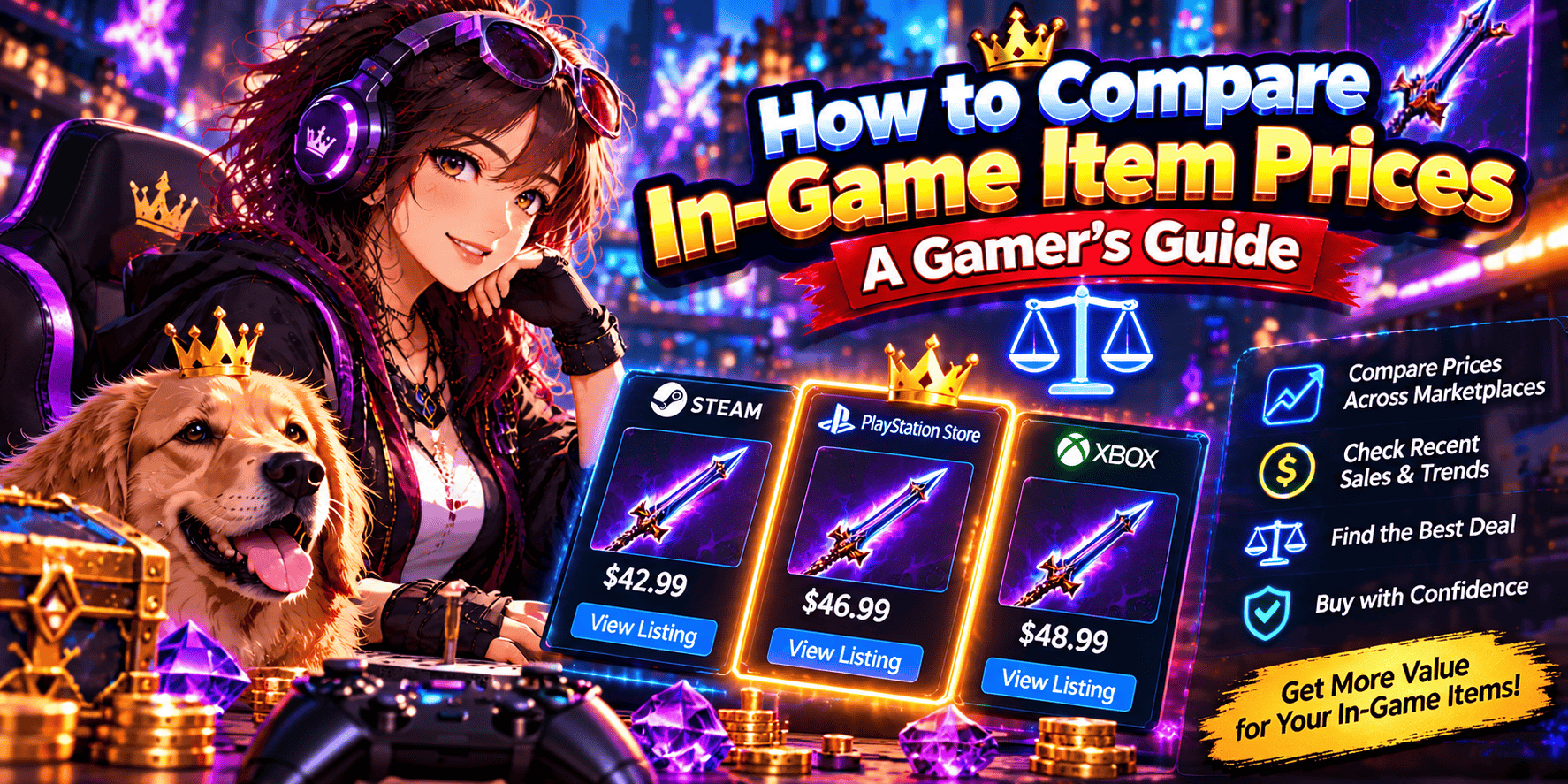
1. How to Compare In-Game Item Prices 💰
You’ve finally found that rare weapon skin you’ve been hunting for.
One marketplace lists it for $75. Another wants $95. A third has what looks like the exact same item for just $60.
Same game. Same item. Three completely different prices.
So which one should you buy?
Before you grab the cheapest listing and celebrate your bargain, there’s something worth knowing.
The lowest advertised price isn’t always the best deal, and the most expensive listing doesn’t necessarily represent an item’s true value.
Different marketplaces have different fees, payment methods, item availability and trading systems. Even seemingly identical items can have attributes that significantly affect their prices.
Learning how to compare in-game item prices helps you understand these differences, identify genuine bargains and avoid spending more than necessary.
Whether you’re shopping for CS2 skins, Path of Exile equipment, World of Warcraft resources or rare gaming collectibles, a little price research can make a big difference.
🎮 Why Should You Compare In-Game Item Prices?
Comparing prices isn’t just about finding the cheapest item.
It’s about understanding what you’re actually getting for your money or gaming currency.
Here are some of the biggest benefits.
Avoid Overpaying
Different sellers may advertise identical items at substantially different prices. Comparing listings helps you recognise when an asking price is unusually high.
Find Genuine Bargains
An item listed below its typical market price could represent good value, provided its attributes and trading conditions are legitimate.
Understand Marketplace Differences
Some platforms charge additional fees, use different currencies or impose trading restrictions.
Identify Valuable Item Attributes
A particular skin pattern, float value or equipment modifier might justify a higher price.
Make Better Trading Decisions
Price comparisons can help you evaluate whether an exchange offers reasonable value.
Understand Current Market Conditions
Researching several listings provides a clearer picture of supply, demand and recent price movements.
💎 What Should You Compare Besides Price?
Imagine two sellers offering the same weapon skin.
Seller A advertises it for $70.
Seller B advertises it for $80.
At first glance, Seller A appears cheaper.
However, Seller A’s marketplace charges an additional $12 in applicable fees, while Seller B’s advertised price is the total payable.
The comparison changes considerably.
| Comparison Factor | Seller A | Seller B |
|---|---|---|
| Advertised Price | $70 | $80 |
| Additional Fees | $12 | $0 |
| Total Cost | $82 | $80 |
| Item Attributes | Identical | Identical |
| Final Result | More expensive | Better price |
Prices are hypothetical and shown in USD.
Seller B offers the lower total cost, despite advertising a higher initial price.
This is why comparing only the headline price can be misleading.
⚔️ Are All In-Game Item Prices Directly Comparable?
No.
Different games and marketplaces use different currencies and trading systems.
For example:
- Counter-Strike 2 skins may be priced in Steam Wallet funds or through permitted third-party marketplaces.
- World of Warcraft equipment and resources may be priced in in-game gold.
- Path of Exile equipment may be traded using the game’s supported currency systems.
- Eligible Roblox collectibles may be priced in Robux.
These currencies aren’t necessarily interchangeable.
A price expressed in Steam Wallet funds shouldn’t automatically be treated as an equivalent amount of withdrawable cash.
Likewise, an item worth thousands of in-game gold doesn’t necessarily have an authorised real-money resale value.
Before comparing prices, make sure you’re comparing items within compatible markets and currencies.
🔍 What Makes a Good In-Game Item Price Comparison?
A useful comparison should answer five questions:
- Are the items genuinely identical or sufficiently similar?
- What is the total cost, including applicable fees?
- How does the asking price compare with recent market activity?
- Are there meaningful differences in item attributes?
- Is the transaction supported and permitted by the game?
Once you can answer these questions, you’re in a much better position to identify fair prices.
And that means fewer expensive mistakes when upgrading your inventory.
2. Why Do In-Game Item Prices Differ Between Marketplaces? 🎮
If two marketplaces are selling the same item, you’d expect their prices to be fairly similar.
Sometimes they are.
Other times, the difference can be surprisingly large.
A skin might be advertised for $100 on one platform and $75 on another, even when both listings appear to represent the same item.
So why does this happen?
Marketplace prices are influenced by fees, buyer demand, available supply, payment methods and the rules of each trading environment.
Understanding these differences is essential when comparing gaming item prices.
💰 1. Marketplace Fees
Marketplaces may charge sellers or buyers fees for processing transactions.
These costs can influence advertised prices.
For example, a seller who wants to receive $90 after fees might need to advertise their item at a higher amount on a platform with larger seller charges.
Another marketplace with lower fees might support a lower advertised price for the same desired proceeds.
However, fee structures vary considerably.
Some platforms include fees in the displayed price, while others add charges during checkout.
Always compare the total amount payable.
💳 2. Different Payment Methods
Payment methods can also influence marketplace pricing.
Depending on the platform, transactions may use:
- In-game currency.
- Platform wallet balances.
- Credit or debit cards.
- Supported digital payment services.
- Other permitted payment methods.
Each system has its own restrictions and potential costs.
For example, Steam Community Market transactions use Steam Wallet funds, which generally cannot be withdrawn directly as cash.
This means Steam prices and prices on permitted cash-based marketplaces aren’t directly equivalent.
🌍 3. Regional Pricing and Currency Differences
Some marketplaces display prices in different currencies or serve different regional markets.
A buyer browsing from Australia might see prices in AUD, while another marketplace displays USD.
Before comparing them, convert both prices into the same currency using an appropriate exchange rate.
Also consider:
- Currency conversion charges.
- Payment provider fees.
- Regional marketplace restrictions.
- Applicable taxes.
- Differences in item availability.
A lower converted price doesn’t automatically mean the final transaction will cost less.
📦 4. Supply and Demand
Different marketplaces can have different levels of trading activity.
One platform might have hundreds of listings for a popular cosmetic.
Another might have only a handful.
When supply is limited and demand is strong, sellers may advertise higher prices.
A marketplace with more competing sellers may offer lower prices, although that isn’t guaranteed.
🔥 5. Different Buyer Audiences
Not every marketplace attracts the same type of buyer.
Some specialise in particular games.
Others cater to collectors, casual players or gamers searching for specific equipment.
These differences can influence how much buyers are willing to pay.
For example, a marketplace with a strong collector community may have more interest in unusual skin patterns than a general gaming marketplace.
🎨 6. Item Attributes and Variations
Sometimes two listings appear to represent the same item but actually contain important differences.
For CS2 skins, these might include:
- Wear classification.
- Float value.
- Pattern index.
- Stickers.
- StatTrak status.
For RPG equipment, differences might include:
- Damage statistics.
- Item level.
- Modifiers.
- Upgrade potential.
- Crafting attributes.
These variations can create legitimate price differences.
Always check the exact item specifications before comparing prices.
🔐 7. Trading Restrictions
Some marketplaces or games impose restrictions on item transfers.
These may include:
- Trade holds.
- Account eligibility requirements.
- Item-specific transfer restrictions.
- Regional limitations.
- Marketplace access requirements.
Restrictions can affect how easily items are bought and sold.
More importantly, an item being advertised on a website doesn’t necessarily mean the proposed transaction is permitted by the game’s rules.
📈 8. Market Timing
Prices also change over time.
One marketplace may update its listings frequently, while another contains older offers.
A recent game update, popular character build or increase in collector interest might influence prices.
An older listing may no longer reflect current market conditions.
📊 Why Marketplace Prices Differ: Quick Comparison
| Factor | How It Can Affect Prices |
|---|---|
| Marketplace Fees | Sellers may adjust asking prices to account for charges |
| Payment Methods | Different payment systems can have different costs and restrictions |
| Currency | Exchange rates and conversion fees affect comparisons |
| Supply | Fewer available items may support higher asking prices |
| Buyer Demand | Popular items may attract higher prices |
| Item Attributes | Special characteristics may justify premiums |
| Trading Restrictions | Transfer limitations can affect availability |
| Market Timing | Older listings may not reflect current conditions |
🏆 Why Does This Matter When Comparing Prices?
Because you’re not always comparing identical transactions.
A $90 item on one marketplace might represent Steam Wallet value.
An $80 item elsewhere might be priced in USD through a platform that supports eligible cash transactions.
A third listing might use an entirely different in-game currency.
These differences matter when determining actual value.
Our How Do In-Game Economies Work? guide explains how virtual currencies, supply, demand and trading systems influence item prices.
The key takeaway is simple: compare the complete transaction, not just the number displayed beside the item.
3. Where to Compare In-Game Item Prices Online 🔍
Now that you understand why marketplace prices differ, the next question is where to find reliable comparisons.
Fortunately, many games have official marketplaces, supported trading systems and community pricing resources.
The challenge is knowing which sources are relevant to your item.
The best place to compare prices depends on the game, item type and whether you’re researching in-game value or a permitted real-money transaction.
Let’s explore some common options.
🔫 Steam Community Market – CS2 and Supported Steam Items
The Steam Community Market is a useful starting point for researching eligible items from supported games, including Counter-Strike 2.
Depending on the item, available information may include:
- Current asking prices.
- Available listing quantities.
- Historical price information.
- Recorded market activity.
This makes it useful for understanding general market trends.
However, individual CS2 skins can have characteristics that influence their value beyond the standard market listing.
For example, unusual float values or desirable patterns may require more detailed research.
Important: Steam Community Market transactions use Steam Wallet funds, not directly withdrawable cash.
🎯 Independent CS2 Skin Marketplaces
Certain independent marketplaces specialise in eligible CS2 skin transactions.
These can provide additional pricing references, particularly for skins with unusual attributes.
When comparing prices, investigate:
- Exact skin name.
- Wear classification.
- Float value.
- Pattern.
- Additional attributes.
- Advertised currency.
- Applicable fees.
- Trading restrictions.
Some platforms may display detailed information about individual skins.
However, don’t assume that every third-party marketplace is trustworthy or that every listed transaction is permitted.
Research the platform and applicable game rules before using it.
🐉 World of Warcraft Auction House
World of Warcraft’s Auction House provides a way to compare eligible items within supported in-game markets.
This is particularly useful for:
- Crafting materials.
- Consumables.
- Tradable equipment.
- Profession resources.
- Collectibles.
Prices are generally expressed in gold.
When comparing listings, consider the relevant game version, region and market environment.
Not all items are tradable, and prices can vary considerably between different markets.
⚔️ Path of Exile Trading Systems
Path of Exile has an active player-driven trading economy.
Its supported trading systems allow players to search for eligible items based on their characteristics.
This is particularly useful for equipment with complex modifiers.
For example, you might compare weapons with similar:
- Damage values.
- Critical strike modifiers.
- Attack speed.
- Elemental attributes.
- Item levels.
- Crafting potential.
Make sure you’re researching the correct game and league.
An item in one Path of Exile economy may have a substantially different value in another.
🧱 Roblox Marketplace
Roblox’s official Marketplace provides pricing information for avatar items.
Certain eligible collectibles support resale.
Depending on the item, available information may help you evaluate:
- Current asking prices.
- Resale activity.
- Available supply.
- Collector demand.
Prices are generally expressed in Robux.
Remember that not every Roblox item can be resold, and Robux values shouldn’t automatically be treated as equivalent to withdrawable cash.
🌐 General Gaming Marketplaces
Broader gaming marketplaces may provide additional price references for eligible gaming items.
For example, StackedGame allows sellers to create listings across supported gaming-related categories.
You can explore available offerings through the StackedGame marketplace.
When comparing general marketplace listings, pay attention to the exact item being offered.
Some listings may involve individual items, while others involve bundles or different types of gaming services.
Make sure you’re comparing equivalent products.
Also verify that the game’s rules permit the proposed transaction.
📊 Community Pricing Tools and Trackers
Some gaming communities maintain pricing databases or tools that track item values.
These resources can help identify:
- Historical price movements.
- Typical asking prices.
- Available supply.
- Market trends.
- Item-specific attributes.
However, the accuracy of a pricing tool depends on its data.
Some tools may rely on current listings rather than completed sales.
Others may have limited coverage of rare items.
Use them as supporting evidence rather than treating every estimate as definitive.
💰 Which Pricing Source Should You Use?
| Game or Item Type | Useful Starting Point | Main Consideration |
|---|---|---|
| CS2 Skins | Steam Community Market and relevant skin marketplaces | Float, pattern, fees and currency differences |
| WoW Equipment | In-Game Auction House | Game version and market differences |
| Path of Exile Equipment | Supported trading systems | Modifiers, item attributes and league |
| Roblox Collectibles | Official Roblox Marketplace | Resale eligibility and Robux pricing |
| General Gaming Items | Relevant gaming marketplaces | Exact item details and permitted transfers |
| Rare Collectibles | Specialist pricing resources and comparable sales | Limited transaction evidence |
🏆 How Many Sources Should You Compare?
There’s no universal number.
For common, frequently traded items, several comparable listings and recent sales may provide a reasonable picture.
For expensive or unusual collectibles, additional research is worthwhile.
Try to use sources that provide different types of evidence.
For example:
- An official marketplace for general pricing context.
- A relevant specialist marketplace for detailed item comparisons.
- Reliable completed-sale information where available.
The goal isn’t to collect as many prices as possible.
It’s to gather enough reliable evidence to make a sensible decision.
Our Where to Buy In-Game Items Online guide explores different purchasing channels and what gamers should consider before buying.
Remember: the most useful pricing source is the one that accurately represents the item and transaction you’re researching.
4. How to Compare Prices for the Same In-Game Item 📊
You’ve found your item on several marketplaces.
The prices look promising, but they’re not identical.
One seller wants $65. Another wants $80. A third has an unusual version advertised for $120.
Which listing represents fair value?
Instead of guessing, you can use a straightforward comparison process.
Here’s how to compare in-game item prices step by step.
🔍 Step 1: Identify the Exact Item
Start by recording the item’s details.
Depending on the game, these may include:
- Game title and version.
- Item name.
- Rarity.
- Condition.
- Special attributes.
- Upgrade level.
- Pattern or float value.
- Server or league.
- Trading eligibility.
This prevents you from accidentally comparing different items.
For example, two CS2 skins might have the same name but different wear classifications.
Likewise, two RPG weapons might look identical while having very different modifiers.
🎮 Step 2: Find Relevant Marketplace Listings
Search for the exact item through marketplaces or trading systems that support it.
Aim to find several comparable listings.
For example, imagine you’re researching a hypothetical tradable cosmetic skin.
You find these offers:
| Marketplace | Advertised Price (USD) | Item Condition |
|---|---|---|
| Marketplace A | $65 | Minimal Wear |
| Marketplace B | $72 | Minimal Wear |
| Marketplace C | $80 | Minimal Wear |
| Marketplace D | $95 | Factory New |
| Marketplace E | $120 | Minimal Wear, special pattern |
All prices are hypothetical.
Although the listings share the same basic skin name, they aren’t necessarily equivalent.
Marketplace D has a different wear classification.
Marketplace E has a special pattern that may influence collector demand.
For a standard Minimal Wear skin, Marketplaces A, B and C provide the closest comparisons.
💎 Step 3: Match Item Attributes
Before comparing prices, make sure the items have sufficiently similar characteristics.
For cosmetic items, compare:
- Condition.
- Pattern.
- Float value.
- Special features.
For functional equipment, compare:
- Damage.
- Modifiers.
- Item level.
- Upgrade potential.
- Relevant gameplay statistics.
If the items differ significantly, treat them as separate comparisons.
A premium for an unusual attribute may be legitimate, but it should be supported by evidence.
💰 Step 4: Calculate the Total Purchase Cost
The advertised price isn’t always the final amount payable.
Check whether additional charges apply.
For example:
| Marketplace | Item Price | Additional Fees | Total Cost |
|---|---|---|---|
| Marketplace A | $65 | $10 | $75 |
| Marketplace B | $72 | $0 | $72 |
| Marketplace C | $80 | $0 | $80 |
Hypothetical USD amounts.
Marketplace A has the lowest advertised price.
However, Marketplace B offers the lowest total cost.
That’s why comparing final checkout amounts is more useful than comparing headline prices alone.
📈 Step 5: Check Recent Completed Sales
Current listings show what sellers are asking.
Completed transactions provide stronger evidence of what buyers have paid.
Suppose comparable items recently sold for:
- $70
- $72
- $74
- $75
- $79
The average selling price is $74.
The median is also $74.
This suggests that approximately $74 could be a reasonable starting estimate under those market conditions.
However, you should still consider differences in item attributes, market activity and the currency used.
For a more detailed explanation of valuation methods, see our How to Check What an In-Game Item Is Worth guide.
🔐 Step 6: Compare Marketplace Conditions
Price isn’t the only factor that matters.
Before purchasing, investigate:
- Whether the marketplace supports the item.
- Whether the transaction is permitted.
- Whether the seller has a credible history.
- Whether the listing accurately describes the item.
- Whether the transfer method is supported.
- Whether the platform explains its fees.
- Whether any trading restrictions apply.
A cheaper listing isn’t a bargain if the transaction exposes you to unnecessary risk.
⚔️ Step 7: Look for Meaningful Price Differences
Once you’ve identified comparable items and calculated their total costs, investigate unusual differences.
For example, if most listings are around $75, an offer at $40 deserves closer examination.
Possible explanations include:
- The item has different attributes.
- The listing uses another currency.
- Additional fees haven’t been included.
- The seller wants a quick sale.
- The listing is inaccurate.
- The offer is fraudulent.
A low price doesn’t automatically indicate a scam, but unusually large discounts warrant additional checks.
🏆 Step 8: Choose the Best Overall Value
After completing your research, compare the strongest options.
Consider the total cost, item attributes, marketplace conditions and available market evidence.
For example:
| Factor | Marketplace A | Marketplace B |
|---|---|---|
| Total Price | $75 | $72 |
| Item Condition | Minimal Wear | Minimal Wear |
| Special Attributes | None | None |
| Seller History | Established | Established |
| Supported Transfer | Yes | Yes |
| Price Comparison | Reasonable | Better value |
Hypothetical example.
If both listings genuinely offer the same item under comparable conditions, Marketplace B appears to provide better value.
However, actual marketplace rules, fees and seller circumstances must always be checked.
🎯 A Simple Formula for Comparing Item Prices
For purchases made through marketplaces with monetary pricing:
Total Purchase Cost = Advertised Item Price + Applicable Fees + Currency Conversion Costs + Other Mandatory Charges
Once you’ve calculated the total cost, compare it against recent market evidence.
You can also calculate the difference between two offers:
Potential Saving = Higher Total Cost − Lower Total Cost
For example:
- Marketplace A total cost: $85.
- Marketplace B total cost: $72.
- Potential saving: $13.
That’s $13 you could keep for another purchase, provided both offers represent equivalent items and legitimate transactions.
🎮 The Golden Rule of Comparing In-Game Item Prices
Always compare the exact item, the complete transaction cost and the available market evidence.
Don’t assume the first listing is fairly priced.
Don’t assume the cheapest advertised offer is the best deal.
And definitely don’t pay twice the normal price for an ordinary skin just because the listing description says ULTRA RARE LEGENDARY COLLECTOR EDITION.
A few minutes of research can save you money, help you recognise genuine bargains and make your next inventory upgrade considerably more satisfying.
5. How to Compare CS2 Skin Prices Across Marketplaces 🔫
Counter-Strike 2 has one of gaming’s most recognisable virtual item economies.
From colourful AK-47 finishes to rare knives and gloves, CS2 skins can attract significant collector interest.
But comparing their prices isn’t always straightforward.
You might find the same skin advertised for $150 on the Steam Community Market and $110 on an independent marketplace.
Does that mean you’ve discovered a bargain?
Possibly. But before making a decision, you need to understand exactly what you’re comparing.
CS2 skin prices depend on marketplace conditions, item attributes, trading restrictions and the type of currency used.
🎮 Start With the Exact Skin Name
The first step is identifying the exact skin.
For example, a listing might describe an AK-47 skin with a particular finish and wear classification.
Before comparing prices, confirm:
- Weapon type.
- Skin name.
- Wear classification.
- StatTrak status, where applicable.
- Float value.
- Pattern index.
- Stickers or other special attributes.
Two skins can share the same basic name while having different market values.
💎 Compare Wear Classifications
CS2 skins use wear classifications that describe their appearance.
These include:
| Wear Classification | Float Range |
|---|---|
| Factory New | 0.00–0.07 |
| Minimal Wear | 0.07–0.15 |
| Field-Tested | 0.15–0.38 |
| Well-Worn | 0.38–0.45 |
| Battle-Scarred | 0.45–1.00 |
These ranges are shown rounded to two decimal places. Individual skins may have narrower possible float ranges.
A Factory New skin may attract a higher price than its Field-Tested equivalent, but this isn’t guaranteed for every finish or market.
When comparing listings, start with the same wear classification.
🎯 Check Float Values
Float values provide a more precise indication of a skin’s wear.
For example, two Minimal Wear skins might have float values of:
- Skin A: 0.071
- Skin B: 0.145
Although both belong to the same wear category, their appearances may differ.
Collectors sometimes pay premiums for particular float values.
However, the size of any premium depends on the skin and actual buyer demand.
Don’t assume every lower-float item is automatically worth more.
🎨 Compare Patterns and Special Attributes
Certain CS2 skins have pattern variations that influence their appearance.
Some patterns are especially desirable to collectors.
Other attributes that may affect pricing include:
- Rare pattern combinations.
- Unusual float values.
- StatTrak variants.
- Desirable stickers.
- Special collector characteristics.
For ordinary skins, standard marketplace comparisons may be sufficient.
For unusual collectibles, you may need to research individual transactions involving similar attributes.
💰 Understand Steam Wallet Prices vs Cash Prices
One of the biggest mistakes when comparing CS2 skins is treating every marketplace price as equivalent.
The Steam Community Market uses Steam Wallet funds.
These generally cannot be withdrawn directly as cash.
Some independent marketplaces support eligible cash transactions, subject to their rules and applicable game restrictions.
This means a skin advertised for $150 on Steam isn’t necessarily equivalent to a skin advertised for $150 through a cash-based marketplace.
The markets have different payment systems, fees and buyer demand.
📊 Example: Comparing a CS2 Skin Across Marketplaces
Imagine you’re researching a hypothetical Minimal Wear skin.
| Marketplace | Advertised Price | Currency Type | Additional Buyer Fees |
|---|---|---|---|
| Steam Community Market | $150 | Steam Wallet USD | Included in displayed buyer price |
| Marketplace A | $115 | USD | $5 |
| Marketplace B | $125 | USD | $0 |
| Marketplace C | $108 | USD | $12 |
All prices are hypothetical.
For the three cash-based marketplaces, the total purchase costs would be:
- Marketplace A: $120.
- Marketplace B: $125.
- Marketplace C: $120.
Marketplaces A and C offer the same total price.
The Steam listing provides useful market context, but its Steam Wallet price isn’t directly comparable to withdrawable cash.
Before choosing between the offers, confirm the skin attributes, seller credibility and trading conditions.
🔍 Where Should You Research CS2 Skin Prices?
Useful starting points include:
Steam Community Market
Provides pricing information and market history for eligible items.
Specialist Skin Marketplaces
May offer detailed information about float values, patterns and individual listings.
Community Pricing Resources
Can provide additional information about unusual skins and collector demand.
Completed-Sale Records
Where reliable data is available, these provide stronger evidence of market value than asking prices alone.
⚠️ Watch Out for Misleading CS2 Price Comparisons
Common mistakes include:
- Comparing Factory New skins with Field-Tested versions.
- Ignoring float values.
- Overlooking unusual patterns.
- Treating Steam Wallet funds as withdrawable cash.
- Forgetting marketplace fees.
- Using outdated sales information.
- Assuming an advertised collector premium is justified.
- Ignoring trading restrictions.
🏆 What’s the Best Way to Compare CS2 Skin Prices?
Follow this process:
- Identify the exact skin and its attributes.
- Find comparable listings.
- Separate Steam Wallet pricing from cash-marketplace pricing.
- Calculate the total purchase cost.
- Check recent comparable sales.
- Investigate unusual price premiums.
- Confirm the transaction is permitted and the seller is credible.
The best CS2 skin deal isn’t necessarily the lowest advertised price. It’s the best overall value for the exact skin you’re purchasing.
And if you’re about to spend hundreds on a knife skin, taking a few minutes to compare prices is probably worth it.
Your future inventory will thank you.
6. How to Compare Weapon, Armour and Equipment Prices ⚔️
Cosmetic skins are primarily valued for their appearance and collector appeal.
Functional equipment is different.
In games such as Path of Exile and World of Warcraft, weapons and armour can have statistics that directly affect gameplay.
This creates an additional challenge when comparing prices.
Two swords might look identical, share the same rarity classification and have similar names.
Yet one could be considerably more valuable because of its modifiers.
When comparing equipment prices, you need to evaluate both the market price and the item’s usefulness.
🛡️ Why Equipment Prices Are More Complicated
Functional equipment may have several attributes that influence its value.
Depending on the game, these can include:
- Base damage.
- Attack speed.
- Critical strike chance.
- Defensive statistics.
- Elemental resistance.
- Item level.
- Special modifiers.
- Upgrade potential.
- Crafting compatibility.
- Character build demand.
An item with the right combination of attributes may attract a premium.
However, a higher rarity classification doesn’t necessarily mean better performance.
⚔️ How to Compare Path of Exile Equipment Prices
Path of Exile equipment can have complex combinations of modifiers.
When comparing items, begin by identifying the attributes that matter most for your character build.
For example, a particular build might benefit from:
- Increased physical damage.
- Attack speed.
- Critical strike modifiers.
- Specific elemental damage.
- Useful defensive bonuses.
Search for items with similar attributes through the supported trading system for the relevant game and league.
Be careful when comparing Path of Exile and Path of Exile 2.
Their equipment systems and trading economies are not interchangeable.
Likewise, different leagues can have different prices and available supply.
💎 Example: Comparing Two RPG Weapons
Imagine you’re choosing between two hypothetical weapons.
| Attribute | Weapon A | Weapon B |
|---|---|---|
| Rarity | Legendary | Rare |
| Base Damage | 180 | 165 |
| Attack Speed Bonus | 5% | 15% |
| Critical Strike Bonus | 5% | 12% |
| Asking Price | 2,000 Gold | 2,500 Gold |
Weapon A has higher base damage and a legendary classification.
Weapon B offers stronger attack speed and critical strike bonuses.
Which one provides better value?
That depends on your character build and how the game’s damage calculations work.
For some builds, Weapon B could deliver better performance despite its lower rarity.
For others, Weapon A might be preferable.
Comparing equipment prices without understanding the relevant statistics can lead to poor purchasing decisions.
🐉 How to Compare World of Warcraft Equipment
World of Warcraft has several systems that influence equipment values.
For eligible tradable items, useful comparisons may include:
- Item level.
- Equipment slot.
- Primary statistics.
- Secondary statistics.
- Crafting quality.
- Upgrade eligibility.
- Class and specialisation requirements.
You should also consider whether the equipment is suitable for your character.
A powerful item designed for a different class or specialisation may provide little practical value.
Remember that many WoW items are soulbound, warbound or otherwise restricted.
Only eligible items can be traded through the relevant systems.
🔧 Compare Crafting and Upgrade Potential
Some equipment is valuable because of what it can become.
For example, an item might have desirable base attributes that make it suitable for crafting.
However, potential upgrades may require additional resources.
Before paying a premium, consider:
- The item’s current statistics.
- Available upgrade options.
- Required crafting materials.
- Potential crafting costs.
- Uncertainty in crafting outcomes.
- Comparable completed items already available.
Sometimes buying an upgraded item directly may be cheaper than purchasing a base item and attempting to improve it.
💰 Compare the Total Cost of Equipment
Imagine two hypothetical options.
Option A: Buy a Weapon and Upgrade It
- Weapon price: 1,000 gold.
- Crafting materials: 600 gold.
- Upgrade costs: 300 gold.
- Total expected expenditure: 1,900 gold.
Option B: Buy an Already-Upgraded Weapon
– Completed weapon price: 1,750 gold.
If both options produce equivalent equipment and the costs are reliable, Option B is cheaper.
However, if crafting outcomes are random, Option A may cost more than expected.
Always consider the full acquisition cost rather than the initial item price.
📈 How Do Popular Builds Influence Equipment Prices?
Demand for functional equipment can change after game updates.
For example, a newly popular character build might require a particular combination of modifiers.
If many players begin searching for those items, prices may increase.
Conversely, equipment associated with a weakened build might lose demand.
When comparing prices, check whether recent gameplay changes have influenced the market.
🏆 Equipment Price Comparison Checklist
Before buying a weapon, armour piece or other functional item, ask:
- Does the item support my character build?
- Are its statistics genuinely useful?
- Have I compared similar modifiers?
- Is the item from the correct game and league?
- Are there cheaper alternatives?
- What would upgrades cost?
- Is the item tradable?
- Are recent prices consistent with the asking price?
🎯 The Golden Rule of Equipment Price Comparisons
Compare equipment based on what it does, not just what it’s called.
A rare weapon with excellent attributes may be more valuable than a legendary weapon with mediocre statistics.
And spending extra on equipment that doesn’t benefit your build is a bit like buying a racing wheel for a game that only supports keyboard controls.
Impressive purchase. Questionable usefulness.
7. How to Compare Rare and Limited-Edition Item Prices 💎
Rare gaming collectibles can be some of the most exciting items to research.
Perhaps you’ve discovered an unusual weapon skin, a discontinued cosmetic or a collectible that only appeared during a particular event.
You search for comparable listings.
Nothing.
You try another marketplace.
One seller has a similar item listed for $500, while another wants $2,000.
Now what?
Comparing rare item prices is difficult because there may be very little reliable market information available.
Unlike frequently traded items, unusual collectibles can have limited transaction histories and highly variable asking prices.
🌟 Why Are Rare Items Harder to Compare?
Common items often have numerous listings and completed transactions.
Rare items may have only a handful.
This creates several challenges:
- Limited comparable sales.
- Unusual item attributes.
- Inconsistent asking prices.
- Small groups of potential buyers.
- Long periods between transactions.
- Uncertain collector demand.
A single high-priced listing doesn’t necessarily establish the item’s market value.
💎 Rarity vs Actual Market Demand
An item can be extremely rare without attracting much buyer interest.
Imagine a hypothetical collectible with only 100 copies in existence.
That sounds impressive.
But what if almost nobody wants it?
Limited supply alone won’t necessarily create a high market value.
Now imagine another collectible with 5,000 copies but thousands of interested buyers.
Despite being more common, it could attract stronger demand and higher prices.
Our What Makes an In-Game Item Valuable? guide explains why rarity, demand and availability work together to influence prices.
🔍 Step 1: Confirm the Item Is Actually Rare
Before accepting a rarity premium, investigate the item’s availability.
Ask:
- How was the item originally obtained?
- Is it still obtainable?
- Can additional copies enter circulation?
- Was it associated with a limited event?
- Is it tradable?
- How many comparable listings exist?
- Is there evidence of collector demand?
An item advertised as rare may simply be uncommon on one particular marketplace.
📊 Step 2: Research Historical Sales
For rare items, completed-sale information can be particularly valuable.
Suppose a hypothetical collectible has the following transaction history:
| Sale Date | Completed Sale Price |
|---|---|
| January | $400 |
| March | $450 |
| June | $425 |
| September | $500 |
Illustrative USD prices.
These transactions suggest that buyers have previously paid between $400 and $500.
However, four sales aren’t enough to establish a precise current market value.
The item’s attributes, current demand and market conditions still matter.
💰 Step 3: Investigate Collector Premiums
Certain rare items attract premiums because of unusual characteristics.
Examples may include:
- Desirable CS2 patterns.
- Exceptional float values.
- Special cosmetic combinations.
- Limited-edition designs.
- Historically significant collectibles.
- Unusual item attributes.
However, a seller’s claimed collector premium should be supported by comparable transactions where possible.
An item being unique doesn’t automatically mean someone will pay a substantial amount for it.
⏳ Step 4: Consider Market Liquidity
Liquidity describes how easily an item can be sold at a reasonable price.
Rare collectibles often have lower liquidity because fewer buyers are interested or able to purchase them.
For example, an item might have a reasonable estimated value of $1,000 but take months to find a buyer.
This matters when comparing prices.
A seller asking $1,200 may be willing to wait for a collector.
Another seller asking $900 may prefer a quicker transaction.
Neither asking price necessarily establishes the item’s true market value.
⚔️ Step 5: Compare Similar Attributes, Not Just Item Names
Rare items can have characteristics that make ordinary comparisons unreliable.
For example, two CS2 skins might share the same name but have different collector appeal because of their patterns.
Likewise, two rare RPG items might have substantially different modifiers.
When exact comparisons aren’t available, identify the closest alternatives and document their differences.
Avoid treating an imperfect comparison as definitive evidence.
📈 Step 6: Watch for Temporary Price Spikes
Rare items can experience sudden increases in attention.
For example:
- A popular streamer showcases the item.
- A collector makes an unusually large purchase.
- A game update changes item availability.
- Community speculation increases.
- A limited event ends.
These developments can influence prices.
However, one exceptional transaction doesn’t guarantee that future buyers will pay the same amount.
🔐 Step 7: Confirm the Item Can Be Legitimately Traded
Some rare items cannot be transferred between players.
Others may be restricted to particular trading systems.
For example, an exclusive cosmetic earned through an account-bound achievement might have considerable personal or collector appeal without having a legitimate resale market.
Before comparing resale prices, confirm the item’s trading eligibility.
🏆 How to Establish a Value Range for Rare Items
Instead of relying on one exact figure, consider several possible outcomes.
For example:
- Conservative Estimate: Based on lower comparable completed sales.
- Typical Estimate: Based on the most relevant available transactions.
- Potential Collector Premium: Supported by evidence of desirable attributes.
- Uncertain Asking Price: A higher advertised amount without confirmed buyer demand.
This approach acknowledges the uncertainty involved.
For rare collectibles, a realistic range is often more useful than an overly precise valuation.
🎯 The Golden Rule of Rare Item Price Comparisons
The rarer the item, the more carefully you should evaluate the available evidence.
Limited supply can make an item desirable, but it can also make accurate pricing difficult.
Don’t assume the highest advertised price represents fair value.
And don’t mistake a seller’s ambitious asking price for proof that you’ve discovered a virtual gold mine.
Sometimes you’ve found an incredible collectible.
Other times, you’ve found someone with an incredible imagination.
8. How to Calculate the True Cost of Buying an In-Game Item 🧮
You’ve compared several listings and found what appears to be the cheapest option.
The item is advertised for $45.
Perfect.
But when you reach checkout, the total is $53.
What happened?
Additional fees, currency conversion charges or other transaction costs can increase the amount you actually pay.
The true cost of an in-game item is the total amount required to complete the purchase, not just the advertised price.
Understanding this difference helps you make more accurate marketplace comparisons.
💰 What Costs Should You Consider?
Depending on the marketplace and payment method, potential costs include:
- Advertised item price.
- Buyer service fees.
- Payment processing charges.
- Currency conversion fees.
- Applicable taxes.
- Other mandatory transaction charges.
Not every marketplace charges all these fees.
Some include relevant costs in the advertised price.
Others display additional charges during checkout.
Always check the final payable amount.
📊 Example: Comparing Total Purchase Costs
Imagine you’re considering three hypothetical offers for the same eligible gaming item.
| Cost Component | Marketplace A | Marketplace B | Marketplace C |
|---|---|---|---|
| Item Price | $45 | $50 | $48 |
| Buyer Service Fee | $4 | $0 | $2 |
| Payment Fee | $2 | $0 | $1 |
| Currency Conversion | $2 | $0 | $0 |
| Total Cost | $53 | $50 | $51 |
All figures are hypothetical USD amounts.
Marketplace A advertises the lowest item price.
However, Marketplace B offers the lowest total purchase cost.
The difference is $3.
That might seem small, but repeated purchases can make these differences meaningful.
🧮 The Total Purchase Cost Formula
For monetary transactions, use:
Total Purchase Cost = Item Price + Buyer Fees + Payment Charges + Currency Conversion Costs + Applicable Taxes + Other Mandatory Charges
For example:
- Item price: $75.
- Buyer fee: $5.
- Payment processing: $2.
- Currency conversion: $3.
Total purchase cost: $85.
This provides a more accurate basis for comparing offers.
🌍 How Currency Conversion Affects Prices
Some marketplaces display prices in USD, while others use AUD or another currency.
If you’re comparing international listings, convert them into the same currency.
For example, suppose an item costs:
- Marketplace A: US$60.
- Marketplace B: A$95.
Using a hypothetical exchange rate of US$1 = A$1.50:
US$60 × 1.50 = A$90.
Marketplace A appears cheaper before additional charges.
However, currency conversion fees or payment charges could change the final comparison.
Always use a current exchange rate and check the actual amount your payment provider will charge.
💳 How Do Payment Processing Fees Work?
Some marketplaces or payment providers charge fees based on the selected payment method.
These might be:
- Fixed charges.
- Percentage-based fees.
- A combination of both.
For example, a hypothetical payment fee might be 2% plus $0.30.
For an $80 purchase:
- Percentage fee: $1.60.
- Fixed fee: $0.30.
- Total payment fee: $1.90.
The final cost would be $81.90 if no other charges applied.
These are illustrative calculations, not the published fees of a particular payment provider.
🎮 Why In-Game Currency Requires a Different Comparison
Not every gaming item is purchased using real money.
For example, World of Warcraft equipment may be priced in gold, while Path of Exile items may be exchanged for in-game currency.
In these cases, compare the relevant in-game costs.
You might consider:
- Item price in the game’s currency.
- Required crafting resources.
- Upgrade costs.
- Alternative acquisition methods.
- Relevant in-game transaction charges.
However, don’t automatically assign an external cash value to in-game currency.
Games have different rules governing trading and real-money transactions.
🔐 Are Withdrawal Fees Relevant When Buying?
Usually, withdrawal fees matter more to sellers than buyers.
However, they can still influence marketplace pricing.
For example, sellers may adjust asking prices to account for the fees they expect to pay when receiving or withdrawing proceeds.
As a buyer, focus on the total amount you must pay.
As a seller, calculate your expected net proceeds separately.
⚔️ How to Compare Item Bundles
Sometimes sellers offer multiple items together.
A bundle may appear cheaper than purchasing each item separately.
But is it actually good value?
Consider a hypothetical bundle containing:
- Weapon skin: $30.
- Armour cosmetic: $20.
- Collectible item: $15.
The combined individual prices total $65.
A bundle advertised for $55 appears to offer a $10 saving.
However, the comparison is only useful if the individual prices are realistic and you actually want all three items.
Paying $55 for a bundle when you only need the $30 weapon skin isn’t necessarily a bargain.
📊 Example: Bundle vs Individual Purchases
| Purchase Option | Total Cost | What You Receive |
|---|---|---|
| Weapon Skin Only | $30 | One desired item |
| Three Items Separately | $65 | All three items |
| Three-Item Bundle | $55 | All three items |
Hypothetical USD prices.
The bundle offers better value if you want all three items.
If you only want the weapon skin, purchasing it individually costs less.
💎 Don’t Forget the Value of Item Attributes
Even after calculating total costs, confirm you’re comparing equivalent items.
A cheaper skin might have a different wear classification.
A lower-priced weapon might have weaker modifiers.
A discounted collectible might lack a desirable attribute.
The total purchase cost tells you how much you’ll pay.
It doesn’t tell you whether the item is worth that amount.
🏆 Final Checklist: Calculating the True Cost
Before purchasing, confirm:
- The advertised item price.
- The currency being used.
- Any additional buyer fees.
- Payment processing charges.
- Currency conversion costs.
- Applicable taxes.
- The exact item attributes.
- Whether the transaction is permitted.
- The final checkout amount.
🎯 The Golden Rule of Total Cost Comparisons
Always compare the final payable amount for equivalent items.
The cheapest advertised listing may not be the cheapest purchase.
And a slightly more expensive listing might provide better overall value when fees, item attributes and transaction conditions are considered.
Because there’s nothing quite like finding a fantastic gaming bargain.
Except finding one that still looks fantastic when you reach checkout.
9. How to Spot Genuine In-Game Item Bargains 🏆
Every gamer loves finding a bargain.
Maybe it’s a rare CS2 skin listed well below its usual price. Perhaps it’s a powerful Path of Exile weapon that someone wants to sell quickly. Or maybe you’ve discovered a collectible that other buyers have overlooked.
Whatever the item, finding a great deal can be almost as satisfying as landing a legendary drop.
But there’s a catch.
Not every cheap in-game item is a genuine bargain.
Some listings are discounted because sellers want a quick transaction. Others are cheaper because the item has different attributes, additional fees or restrictions that aren’t immediately obvious.
And occasionally, an unbelievably low price is exactly what it looks like: a warning sign.
💰 What Makes an In-Game Item a Genuine Bargain?
A genuine bargain offers better value than comparable alternatives without introducing unacceptable risks.
For example, imagine a particular cosmetic regularly sells for approximately $100.
You discover an equivalent item listed for $80.
That could represent a worthwhile saving if:
- The item has matching attributes.
- Recent comparable sales support the $100 valuation.
- The seller is credible.
- The marketplace supports the transaction.
- Additional fees don’t eliminate the saving.
- The item can legitimately be transferred.
The important distinction is that a bargain is based on value, not simply a low advertised price.
🔍 Step 1: Compare Against Recent Selling Prices
Start by researching what comparable items have actually sold for.
Suppose a hypothetical skin has the following recent transaction history:
| Completed Sale | Price (USD) |
|---|---|
| Sale 1 | $95 |
| Sale 2 | $100 |
| Sale 3 | $98 |
| Sale 4 | $102 |
| Sale 5 | $105 |
The average selling price is $100.
If you find an equivalent item available for a total cost of $80, the offer is approximately 20% below that average.
That makes it worth investigating.
However, the historical transactions must genuinely represent comparable items.
🎨 Step 2: Check for Hidden Differences
Two items with identical names aren’t always equivalent.
For CS2 skins, check:
- Wear classification.
- Float value.
- Pattern.
- StatTrak status.
- Stickers or other special attributes.
For RPG equipment, compare:
- Damage.
- Modifiers.
- Item level.
- Upgrade potential.
- Character build compatibility.
A cheaper item may simply have less desirable attributes.
That’s not necessarily a bad purchase, but it changes the comparison.
⚔️ Step 3: Understand Why the Seller Might Be Discounting
There are legitimate reasons why sellers advertise items below typical market prices.
Quick Sales
A seller might prioritise receiving proceeds quickly rather than waiting for the highest possible price.
Increased Competition
A marketplace with numerous competing listings may encourage sellers to lower their prices.
Changing Demand
An item might become less desirable after a game update.
Inventory Changes
A player may no longer need certain equipment or collectibles.
Different Market Conditions
Prices can vary between platforms because of fees, payment systems and buyer demand.
A discounted listing isn’t automatically suspicious.
However, understanding the reason for the discount helps you assess whether the price makes sense.
📊 Step 4: Calculate the Actual Saving
Suppose you’re comparing two offers.
| Comparison | Standard Listing | Discounted Listing |
|---|---|---|
| Item Price | $100 | $78 |
| Additional Fees | $0 | $7 |
| Total Cost | $100 | $85 |
| Potential Saving | — | $15 |
Hypothetical USD prices.
Although the discounted listing advertises a $22 difference, the actual saving is $15.
That’s still potentially worthwhile, provided the items and transaction conditions are equivalent.
🔐 Step 5: Verify the Seller and Marketplace
An unusually cheap item deserves additional scrutiny.
Before purchasing, investigate:
- Whether the marketplace is legitimate.
- Whether the seller has a credible transaction history.
- Whether the listing accurately describes the item.
- Whether the proposed transfer is permitted.
- Whether payment takes place through a supported process.
- Whether the seller is requesting unusual information or payment arrangements.
Be especially cautious if someone asks you to leave a marketplace’s normal transaction process or disclose account credentials.
Our How to Buy In-Game Items Safely guide explores the precautions gamers should take before purchasing virtual items.
🚫 Step 6: Recognise Deals That Are Too Good to Be True
Imagine an item regularly sells for $200.
Someone offers it for $20.
Could it be a genuine bargain?
Possibly, but a 90% discount warrants substantial investigation.
Warning signs include:
- Pressure to purchase immediately.
- Requests for account passwords.
- Unusual payment instructions.
- Inconsistent item descriptions.
- Unverifiable seller claims.
- Refusal to use supported trading methods.
- Suspicious links or impersonated marketplace pages.
Never assume a low price justifies ignoring basic security precautions.
🏆 How Do You Know You’ve Found a Good Deal?
A strong bargain usually has three characteristics.
1. Competitive Pricing
The total cost is favourable compared with reliable market evidence.
2. Comparable Item Quality
The item has the attributes you actually want.
3. Acceptable Transaction Conditions
The seller, marketplace and transfer method meet your requirements.
If all three conditions are satisfied, you’ve found an offer worth considering.
🎯 The Golden Rule of Finding Gaming Bargains
A genuine bargain should survive careful comparison.
If an item still looks like good value after checking its attributes, market price, fees and seller credibility, that’s a promising sign.
If the deal only looks attractive before you investigate the details, it may not be much of a bargain after all.
Saving $20 on a rare skin feels great.
Losing $100 because you rushed into a suspicious transaction? Not quite the gaming achievement you were aiming for.
10. Common Mistakes When Comparing In-Game Item Prices ⚠️
Comparing prices sounds easy.
Find an item, open a few marketplaces and choose the cheapest listing.
Unfortunately, that approach can lead to expensive mistakes.
Virtual item markets have different currencies, trading restrictions, item variations and fee structures.
Even experienced gamers can overlook important details.
Here are the most common mistakes to avoid when comparing in-game item prices.
💰 Mistake #1: Comparing Advertised Prices Instead of Total Costs
A listing advertised for $50 might cost $60 after additional charges.
Another advertised for $55 might have no additional fees.
If you’re only comparing the advertised prices, you could choose the more expensive option.
Better approach: Calculate the complete purchase cost, including applicable fees and currency conversion.
🎨 Mistake #2: Comparing Different Item Variations
Two items may share the same name but have different characteristics.
For example:
- CS2 skins with different wear classifications.
- Skins with unusual patterns.
- Weapons with different modifiers.
- Equipment with different upgrade levels.
- Items from different game leagues.
These differences can significantly influence prices.
Better approach: Match the exact attributes before comparing listings.
📊 Mistake #3: Assuming Asking Prices Represent Market Value
A seller can advertise an item for considerably more than buyers are willing to pay.
An item listed for $500 isn’t necessarily worth $500.
Better approach: Research recent completed sales where reliable data is available.
⏳ Mistake #4: Using Outdated Price Information
Gaming item prices can change after updates, events and shifts in player demand.
An item that sold for $100 several months ago might have a very different value today.
Better approach: Prioritise recent transactions and current market conditions.
💳 Mistake #5: Confusing Different Currencies
Steam Wallet funds, Robux, in-game gold and withdrawable cash aren’t interchangeable.
For example, a $100 Steam Community Market listing doesn’t automatically represent $100 in cash resale value.
Better approach: Identify the currency, marketplace restrictions and payment conditions before comparing prices.
🌍 Mistake #6: Ignoring Currency Conversion
International marketplaces may display prices in different currencies.
A US$70 listing and an A$100 listing cannot be compared directly without conversion.
Better approach: Convert both prices into the same currency and account for applicable conversion charges.
💎 Mistake #7: Assuming Rarity Guarantees Value
Rare items aren’t automatically expensive.
Some have limited demand, while others cannot be traded.
Better approach: Investigate actual buyer interest, supply and trading eligibility.
📉 Mistake #8: Ignoring Market Liquidity
An item may have a high asking price but very few completed transactions.
This makes its value difficult to establish.
Better approach: Consider transaction frequency alongside advertised prices.
⚔️ Mistake #9: Overlooking Gameplay Changes
Functional equipment can become more or less desirable after game updates.
For example, an item associated with a popular character build might lose demand after a balance adjustment.
Better approach: Check whether recent gameplay changes have influenced item prices.
🔐 Mistake #10: Choosing an Unreliable Seller to Save Money
A lower price doesn’t compensate for unacceptable transaction risks.
An unfamiliar seller may be legitimate, but you should still verify their credibility.
Better approach: Evaluate seller history, marketplace procedures and supported transfer methods.
📦 Mistake #11: Comparing Bundles With Individual Items
A bundle containing several items may appear cheaper than buying everything separately.
However, it isn’t necessarily good value if you only need one item.
Better approach: Compare the cost of purchasing exactly what you want.
🔥 Mistake #12: Rushing Because of a Limited-Time Offer
Some sellers use urgency to encourage quick decisions.
Messages such as “Buy now!” or “Only five minutes left!” can make it tempting to skip your research.
Better approach: Verify the listing and complete your comparisons before committing.
📊 Common Price Comparison Mistakes at a Glance
| Mistake | Better Approach |
|---|---|
| Comparing advertised prices only | Calculate total costs |
| Ignoring item variations | Match exact attributes |
| Trusting asking prices | Check completed sales |
| Using outdated information | Research current prices |
| Confusing virtual currencies | Identify the currency and its restrictions |
| Ignoring exchange rates | Convert into one currency |
| Assuming rarity means value | Check actual demand |
| Overlooking liquidity | Examine transaction activity |
| Ignoring game updates | Review current gameplay changes |
| Choosing unreliable sellers | Verify credibility |
| Misjudging bundles | Compare what you actually need |
| Rushing into purchases | Research before buying |
🏆 How Can You Avoid Most Price Comparison Mistakes?
Use a consistent checklist before purchasing.
- Identify the exact item.
- Find several relevant listings.
- Match important attributes.
- Compare recent completed sales.
- Calculate the total purchase cost.
- Check currency differences.
- Review current market conditions.
- Verify the seller and marketplace.
- Confirm the transaction is permitted.
- Choose the offer that provides the best overall value.
Good price comparisons are based on accurate information, not assumptions.
A few minutes of research can help you avoid overpaying, recognise misleading listings and make smarter purchasing decisions.
And if a seller insists their ordinary wooden sword is worth $5,000 because it’s extremely legendary, perhaps compare a few more listings before reaching for your wallet.
11. How to Choose the Best Marketplace for Your Item 🛒
You’ve compared prices, checked item attributes and identified several promising offers.
Now there’s one final decision.
Where should you actually buy the item?
The cheapest marketplace isn’t necessarily the best choice.
Different platforms support different games, payment methods, trading systems and transaction procedures.
Choosing the right marketplace means balancing price, item availability, credibility and the conditions of the transaction.
🎮 Start With the Game and Item Type
Not every marketplace supports every type of gaming item.
Some specialise in particular games or categories.
Others offer broader gaming-related products.
Before comparing platforms, confirm that the marketplace supports the exact item you’re looking for.
For example:
- CS2 skin marketplaces focus on eligible cosmetic items.
- World of Warcraft’s Auction House supports eligible in-game goods.
- Path of Exile trading systems support relevant tradable equipment and currency items.
- Roblox’s official Marketplace supports eligible avatar items and collectibles.
- General gaming marketplaces may offer listings across multiple games and categories.
The most suitable platform depends on the item and the game’s trading rules.
💰 Compare Total Purchase Costs
Start by comparing the final amount payable.
Check:
- Advertised item price.
- Buyer fees.
- Payment charges.
- Currency conversion.
- Applicable taxes.
- Other mandatory costs.
Don’t assume a marketplace with lower advertised prices will always be cheaper.
🔍 Check Item Availability
A marketplace might offer attractive prices but have limited inventory.
For example, a specialist marketplace may have numerous listings for popular CS2 skins but fewer options for unusual collectibles.
A broader marketplace may offer different item categories but less detailed pricing information.
Consider whether the platform has:
- The exact item you want.
- Suitable item variations.
- Enough listings for meaningful comparisons.
- Clear item descriptions.
- Relevant pricing information.
🔐 Evaluate Marketplace Credibility
Before purchasing, investigate the marketplace itself.
Useful considerations include:
- Clear business information.
- Transparent transaction terms.
- Accessible support channels.
- Published fee information.
- Understandable dispute procedures.
- Appropriate account security measures.
- Credible independent feedback.
Be cautious about websites that imitate established marketplaces or encourage unusual payment arrangements.
⭐ Check Seller Credibility
Even on an established marketplace, individual seller quality matters.
Where available, review:
- Transaction history.
- Buyer feedback.
- Listing accuracy.
- Communication.
- Previous disputes.
- Fulfilment information.
Remember that ratings and reviews can sometimes be manipulated.
Treat them as one source of evidence rather than an absolute guarantee.
Our upcoming How to Choose a Trusted In-Game Item Seller guide will explore seller evaluation in greater detail.
⚔️ Confirm the Trading Method Is Supported
Different games have different rules governing item transfers.
Some support official marketplaces or direct player-to-player trading.
Others restrict particular items or prohibit certain external transactions.
Before buying, confirm:
- The item is eligible for transfer.
- The game permits the proposed transaction.
- The marketplace supports the relevant trading process.
- Any trade holds or account requirements are understood.
- The seller isn’t requesting prohibited account access.
A marketplace listing doesn’t override the game’s terms.
💳 Compare Payment Options
Payment methods can influence both convenience and transaction cost.
Check which methods the marketplace supports and whether additional charges apply.
Also investigate whether the platform provides clear information about refunds, disputes and transaction records.
Never provide account passwords or authentication codes to a seller.
🌐 What About General Gaming Marketplaces?
General gaming marketplaces can be useful when you’re exploring different categories of gaming-related products.
For example, StackedGame provides a marketplace where sellers can list eligible gaming items and services.
When browsing, compare listings based on:
- Exact item details.
- Advertised price.
- Seller information.
- Delivery or fulfilment arrangements.
- Applicable marketplace terms.
- Game-specific trading restrictions.
A broader marketplace may provide additional options, but each listing still needs to be evaluated individually.
📊 Marketplace Comparison Checklist
| Factor | What to Look For |
|---|---|
| Game Support | Marketplace supports the relevant game |
| Item Availability | Exact item and desired attributes |
| Pricing | Competitive total purchase cost |
| Fees | Clear and transparent charges |
| Payment Methods | Suitable supported options |
| Seller Credibility | Reliable transaction history |
| Transaction Process | Clear, permitted transfer method |
| Security | Appropriate account and payment protections |
| Support | Accessible assistance and dispute procedures |
| Trading Restrictions | Compliance with game rules |
🏆 Which Marketplace Is Best for Buying In-Game Items?
There isn’t one marketplace that’s best for every game or item.
For some purchases, an official in-game marketplace may be the most suitable option.
For others, a relevant specialist marketplace may provide more detailed item comparisons.
A broader gaming marketplace may be useful when researching different gaming products.
The right choice depends on the exact item, total cost and transaction conditions.
Choose the marketplace that offers the best combination of item availability, fair pricing and acceptable transaction safeguards.
A slightly cheaper listing isn’t worth compromising your account security or risking an unsupported transaction.
12. In-Game Item Price Comparison FAQ ❓
💰 How Do I Compare In-Game Item Prices?
Start by identifying the exact item and its attributes.
Find comparable listings through relevant marketplaces or supported trading systems.
Then compare recent completed sales, total purchase costs, item variations and marketplace conditions.
The goal is to identify the best overall value rather than simply choosing the lowest advertised price.
🔍 Where Can I Find the Cheapest In-Game Items?
The cheapest available offer depends on the game, item and current market conditions.
Official marketplaces, supported trading systems and relevant third-party marketplaces may provide useful comparisons.
Always calculate the total cost and verify that the transaction is permitted.
🔫 How Do I Compare CS2 Skin Prices?
Identify the exact skin, wear classification, float value, pattern and special attributes.
Then compare equivalent listings across relevant marketplaces.
Remember that Steam Wallet prices aren’t directly equivalent to withdrawable cash prices.
🎮 Why Are CS2 Skins Cheaper on Some Marketplaces?
Prices can differ because of marketplace fees, payment methods, supply, demand and currency restrictions.
Some platforms operate using Steam Wallet funds, while others support eligible cash transactions.
These differences can influence advertised prices.
💎 Is the Cheapest In-Game Item Always the Best Deal?
No.
A cheaper listing may involve additional fees, different item attributes or less favourable transaction conditions.
Compare the complete purchase rather than the advertised price alone.
📊 Should I Compare Asking Prices or Completed Sales?
Both provide useful information.
Asking prices show what sellers currently want.
Completed sales provide stronger evidence of what buyers have actually paid.
Where reliable completed-sale data is available, use it alongside current listings.
🐉 Can I Compare World of Warcraft Item Prices?
Yes, for eligible tradable items.
The in-game Auction House provides pricing information within the relevant market.
However, prices may vary between game versions, regions and market environments.
⚔️ How Do I Compare Path of Exile Equipment Prices?
Search for items with similar modifiers, statistics, item levels and other relevant attributes.
Make sure you’re comparing items within the correct game and league.
For complex equipment, exact attribute matching is especially important.
🧱 Can I Compare Roblox Collectible Prices?
Yes, for eligible collectibles with available resale information.
Check current listings, relevant market activity and resale restrictions.
Remember that Roblox prices are generally expressed in Robux.
📈 Do In-Game Item Prices Change Every Day?
Some frequently traded items can experience regular price movements.
Others may remain relatively stable for extended periods.
Prices can change because of supply, demand, game updates, events and trading activity.
💳 How Do Marketplace Fees Affect Price Comparisons?
Additional fees increase the total amount payable.
For example, an item advertised for $50 with $8 in mandatory fees costs $58.
Always compare the final purchase amount.
🌍 Should I Convert Marketplace Prices Into the Same Currency?
Yes, when comparing monetary prices in different currencies.
Use an appropriate current exchange rate and account for conversion charges.
However, don’t automatically treat in-game currencies or platform wallet balances as equivalent to withdrawable cash.
🔐 How Can I Tell Whether a Cheap Listing Is Legitimate?
Check the seller’s credibility, item attributes, marketplace procedures and trading eligibility.
Be cautious about unusually large discounts, suspicious links and requests for account credentials.
A low price should encourage research, not rushed decisions.
⭐ Are In-Game Item Price Trackers Accurate?
Price trackers can be useful, but accuracy depends on their data sources.
Some rely on asking prices rather than completed transactions.
Others may not account for unusual item attributes.
Cross-check estimates against relevant marketplace evidence.
💰 Can I Use Price Comparisons When Selling Items?
Absolutely.
Price comparisons can help sellers understand current market conditions and establish competitive asking prices.
However, selling also involves considering transaction fees, demand and how quickly you want to complete a sale.
Our upcoming How to Price In-Game Items guide will cover practical pricing strategies for sellers.
🏆 What’s the Most Important Thing to Remember When Comparing Prices?
Always compare equivalent items using the total purchase cost and reliable market evidence.
The lowest advertised price isn’t necessarily the best value.
And the highest asking price doesn’t automatically represent an item’s true worth.
🎯 Final Thoughts: Compare Prices Before You Upgrade Your Inventory
Whether you’re hunting for a rare CS2 skin, powerful Path of Exile equipment or a collectible you’ve wanted for months, comparing prices can help you make smarter purchasing decisions.
The process doesn’t need to be complicated.
Identify the exact item, research relevant marketplaces and compare recent market activity.
Then check item attributes, fees, currencies and trading conditions.
A little research can reveal meaningful differences between listings that initially appear identical.
You might discover that a cheaper item has less desirable attributes.
You might find that additional fees eliminate an advertised discount.
Or you might uncover a genuine bargain that other buyers have overlooked.
The key is understanding what you’re buying, what you’re paying and whether the transaction offers reasonable value.
Don’t rush into a purchase because a listing looks cheap.
And don’t assume an expensive item must be better.
Compare the loot. Check the numbers. Make every purchase count.
Because the only thing better than adding an incredible item to your inventory is knowing you got it at a great price.