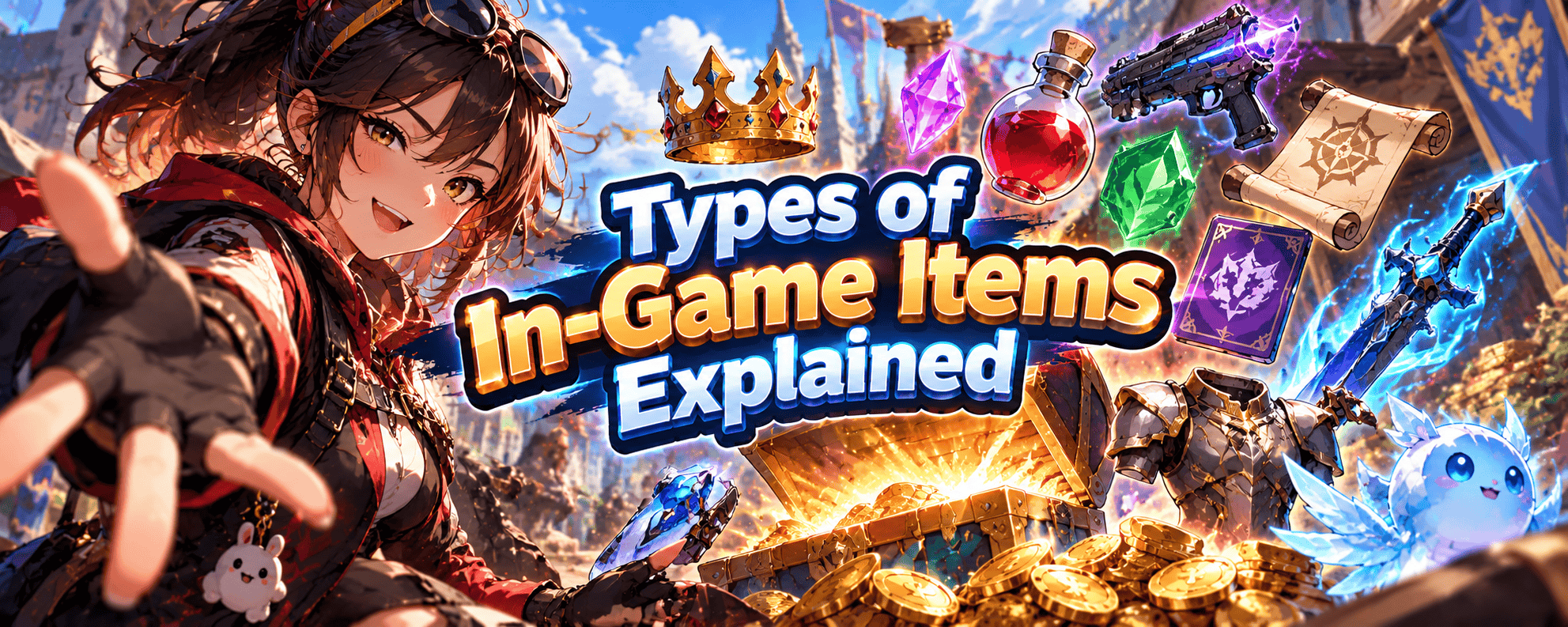
Open almost any video game and you’ll find items everywhere. Weapons stuffed into inventories, armour with increasingly dramatic shoulder pads, crafting materials you’re afraid to throw away and skins that somehow become irresistible at 11:47 pm.
But not every in-game item serves the same purpose.
Some items help you defeat enemies. Others let you customise your character, craft equipment, collect rewards or trade with other players. Certain items even serve several purposes at once.
Understanding these differences is particularly useful if you’re planning to buy, sell or trade gaming items, because an item’s type can influence everything from its usefulness and rarity to whether it can be transferred at all.
So, what are the different types of in-game items, and how do they work?
Let’s explore the main categories, what makes each one useful and why players want them.
1. What Are the Main Types of In-Game Items? 🎒
In-game items are digital objects, assets or resources that players can obtain, use, collect or interact with inside a video game.
If you’re completely new to the subject, our What Are In-Game Items? Complete Guide explains how items work, where they come from and why games use them.
The exact types available depend heavily on the game.
A competitive shooter, fantasy RPG and survival game can have completely different inventory systems.
However, most in-game items fall into several broad categories.
| Item Type | Main Purpose | Common Examples |
|---|---|---|
| ⚔️ Weapons | Combat | Swords, rifles, bows |
| 🛡️ Armour & Equipment | Protection, stats and abilities | Helmets, shields, accessories |
| ✨ Cosmetics & Skins | Customisation | Outfits, weapon skins, emotes |
| 🧪 Consumables | Temporary or single-use effects | Potions, food, boosts |
| 🧱 Crafting Materials | Creating and upgrading items | Ore, wood, components |
| 🏆 Collectibles | Collection and prestige | Cards, trophies, event rewards |
| 🐉 Pets & Mounts | Companionship, travel and utility | Pets, horses, dragons |
| 🔧 Tools & Utility Items | Performing specific actions | Pickaxes, repair kits, keys |
| 📜 Quest Items | Progression | Artefacts, mission objects |
| 🎁 Item Containers | Providing other items | Chests, crates, packs |
These categories aren’t always separate.
A mount might provide faster transportation while also being a rare collectible. A weapon can offer useful combat attributes and have a distinctive cosmetic appearance.
A crafting resource might even become one of the most desirable items in an entire game.
The important thing is understanding what an item does and why players want it.
2. Weapons ⚔️
Weapons are among the most recognisable in-game items.
Their primary purpose is usually straightforward: help players deal damage, defeat enemies or compete against other players.
Depending on the game, weapons might include:
- Swords and axes
- Rifles and pistols
- Bows and crossbows
- Magic staffs and wands
- Explosive weapons
- Melee weapons
- Sci-fi weapons
- Improvised or crafted weapons
However, two weapons that look similar can behave very differently.
🎯 Weapon Stats and Attributes
Functional weapons may have attributes such as:
- Damage
- Attack speed
- Range
- Accuracy
- Critical-hit chance
- Elemental damage
- Durability
- Special abilities
- Upgrade slots
These characteristics influence how useful a weapon is for particular activities.
A sword that looks like it was forged by the gods is impressive.
A sword that looks like it was forged by the gods and deletes half a boss’s health bar tends to attract slightly more attention.
🎨 Weapons Can Also Be Cosmetic
Not every weapon-related item affects gameplay.
Many games offer weapon skins that change a weapon’s appearance without intentionally changing its performance.
That creates an important distinction between the weapon itself and its cosmetic design.
A standard weapon might be easy to obtain, while a rare skin for that weapon could be highly sought after by collectors.
This is one reason item value can’t always be judged purely by gameplay usefulness.
3. Armour & Equipment 🛡️
Armour and equipment are items that players equip to characters to provide protection, attributes, abilities or other gameplay effects.
Typical examples include:
- Helmets
- Chest armour
- Gloves
- Boots
- Shields
- Rings
- Amulets
- Belts
- Accessories
These items are particularly common in RPGs, MMOs, action games and loot-based games.
📊 Equipment Can Change Character Builds
Equipment often influences character statistics.
One armour piece might increase defence. Another could improve movement speed, health, magic resistance or critical-hit chance.
That means equipment choices can become an important part of building a character.
Players may spend considerable time comparing two pieces of gear that appear almost identical because one provides an extra 2% of something extremely important.
To everyone else, this looks ridiculous.
To the player, this is serious mathematics.
⭐ Equipment Quality Can Vary
Games often divide equipment into different levels, tiers or rarity classes.
A basic piece of armour might be readily available, while a high-tier version could require:
- Defeating a difficult boss
- Completing end-game content
- Crafting rare materials
- Participating in an event
- Getting an unusually lucky drop
Higher rarity doesn’t automatically mean an item is more valuable.
Availability, usefulness and player demand can all contribute.
Our guide to what makes an in-game item valuable explores how these factors influence the desirability of weapons, equipment and other gaming items.
4. Cosmetic Items & Skins ✨
Cosmetic items are designed primarily to change how something looks or is presented without intentionally changing its gameplay performance.
They’re everywhere in modern gaming.
Common cosmetic items include:
- Character skins
- Outfits
- Weapon skins
- Emotes
- Sprays
- Banners
- Profile decorations
- Visual effects
- Cosmetic accessories
- Character animations
A cosmetic doesn’t need to make you stronger to be desirable.
Sometimes looking like an intergalactic banana while winning the match is reward enough.
🎨 Why Do Players Want Cosmetics?
Cosmetic items can provide several benefits.
Personalisation – making a character or loadout feel more individual.
Self-expression – showing off a particular style, character or theme.
Prestige – displaying something difficult or unusual to obtain.
Collectibility – completing sets or building a collection.
Nostalgia – owning cosmetics associated with older events or periods of a game.
Rarity – possessing something relatively few other players have.
These factors can make purely visual items surprisingly desirable.
💎 Cosmetics Can Become Valuable
Where cosmetics are tradable, their value can be influenced by scarcity and demand rather than gameplay usefulness.
An older cosmetic that is no longer obtainable might attract collectors. A visually distinctive weapon skin could become popular. An item associated with a limited event might become harder to find as time passes.
None of those items necessarily make the player better at the game.
They just make losing look considerably more expensive.
The distinction between appearance and performance is explored further in our Cosmetic vs Functional In-Game Items guide.
5. Consumables 🧪
Consumables are items that are used up, depleted or reduced in quantity when activated.
Unlike a sword or piece of armour that might stay equipped for hours, a consumable is generally designed to provide a temporary or one-time benefit.
Examples include:
- Health potions
- Mana potions
- Food and drinks
- Temporary stat boosts
- Experience boosts
- Ammunition
- Repair items
- Scrolls
- Revive items
- Crafting consumables
⏳ Temporary Doesn’t Mean Unimportant
Because consumables disappear when used, players often need them repeatedly.
That can create continuous demand.
Imagine a difficult activity where every serious player needs five particular potions.
Those potions aren’t glamorous, but thousands of players repeatedly consuming them can make the ingredients and finished products important parts of the game’s economy.
In other words, sometimes the boring bottle in your inventory has more economic relevance than the enormous flaming sword next to it.
📦 Consumables Can Act as Item Sinks
Consumables also help remove items and resources from circulation.
If a potion is used, it’s gone. To obtain another one, somebody may need to find, craft or purchase it.
This cycle can help create ongoing demand:
🧱 Resources → 🔨 Crafting → 🧪 Consumable → ⚔️ Used → 💨 Removed
That relationship between item creation, consumption, supply and demand is one of the foundations of in-game economies.
6. Crafting Materials & Resources 🧱
Crafting materials and resources are items used to create, upgrade, repair or improve other items.
On their own, they might not look particularly exciting. A lump of ore doesn’t have quite the same dramatic impact as a Legendary sword.
Until you discover you need 40 lumps of that ore to craft the Legendary sword.
Common crafting materials include:
- Wood and stone
- Ore and metals
- Herbs and plants
- Leather and cloth
- Gems and crystals
- Monster drops
- Components and parts
- Upgrade materials
- Enchanting resources
🔨 How Crafting Materials Work
Crafting systems allow players to combine resources to create new items.
A typical crafting process might look like this:
⛏️ Gather Materials → 📜 Unlock Recipe → 🔨 Craft Item → ⚔️ Use, Equip or Trade
Some resources are extremely common and easy to collect.
Others might only be available from particular enemies, locations or activities.
The harder a required material is to obtain, the more difficult the finished item may be to produce.
💰 Why Crafting Materials Can Be Valuable
Players don’t necessarily want to gather every resource themselves.
In games with trading systems, crafting materials can have active markets because other players would rather purchase resources than spend hours collecting them.
Demand can become particularly strong when:
- New crafting recipes are released.
- Popular equipment requires the material.
- An update introduces additional uses.
- Supply is limited.
- Resources take considerable time to gather.
- Large quantities are needed for upgrades.
Yesterday’s useless rock can become tomorrow’s hot commodity after one patch note.
This relationship between resource availability, crafting and player demand is explored further in our guide to how in-game economies work.
7. Collectibles 🏆
Collectibles are items players seek primarily because they want to complete a collection, display an achievement or own something unusual.
They don’t necessarily provide a gameplay advantage.
And that’s perfectly fine.
Gamers have been collecting things since developers first placed 100 hidden objects around a map and dared us not to find every single one.
Collectibles can include:
- Trading cards
- Trophies
- Badges
- Event items
- Figurines
- Lore objects
- Limited-edition items
- Achievement rewards
- Seasonal collectibles
- Complete item sets
🧩 Why Do Players Collect Digital Items?
The motivation varies between players.
Some enjoy completing everything a game has to offer. Others collect items associated with particular events, characters or periods of a game’s history.
Collectibles can provide:
🏆 Completion – finishing a set or collection.
💎 Rarity – owning something difficult to obtain.
📅 History – keeping an item associated with an older event or update.
😎 Prestige – displaying an achievement or unusual possession.
❤️ Personal Interest – collecting items simply because you like them.
That final reason shouldn’t be underestimated.
Not everything needs a complicated economic explanation.
Sometimes players just want all the shiny things.
📈 Can Collectibles Become Valuable?
Where collectible items are tradable, scarcity combined with collector demand can influence their value.
An item might become desirable because it was only available during a particular event or because completing a collection requires one especially difficult piece.
However, limited availability doesn’t guarantee high value.
There still needs to be sufficient demand from players who actually want to own it.
8. Pets, Mounts & Companions 🐉
Pets, mounts and companions are digital creatures, characters or vehicles that accompany the player.
Their purpose varies considerably between games.
Some are purely cosmetic.
Others provide transportation, combat support, inventory space, resource gathering or other useful abilities.
🐾 Pets & Companions
A pet might simply follow your character around looking adorable.
Another companion might:
- Help during combat.
- Collect resources.
- Carry items.
- Provide passive bonuses.
- Locate objects.
- Perform specific tasks.
That means two things both described as pets can belong to very different item categories.
One is effectively cosmetic.
The other is an unpaid employee.
🐎 Mounts
Mounts are commonly used to help players travel around game worlds more quickly.
They might include:
- Horses
- Dragons
- Motorcycles
- Spaceships
- Flying creatures
- Fantasy beasts
- Vehicles
Some games give most mounts similar functionality while making rare designs desirable for their appearance or prestige.
Others provide different mounts with unique speeds, abilities or utility.
💎 Why Are Rare Pets and Mounts Desirable?
Players may value them because of:
- Visual design
- Limited availability
- Difficult unlock requirements
- Rare drop rates
- Special abilities
- Event exclusivity
- Collector demand
- Prestige
A mount earned from defeating an extremely difficult boss can effectively become a trophy with legs.
Or wings.
Or occasionally both.
9. Tools & Utility Items 🔧
Not every useful item is designed for combat.
Tools and utility items help players perform specific actions, access areas, gather resources or manage other gameplay systems.
Examples include:
- Pickaxes
- Fishing rods
- Repair kits
- Lockpicks
- Keys
- Gathering tools
- Building tools
- Navigation items
- Storage upgrades
- Teleportation items
⛏️ Tools Can Unlock Better Resources
In survival and crafting games, tools often determine which resources a player can gather.
A basic pickaxe might collect common materials, while an upgraded version allows access to rarer resources.
That creates a progression loop:
🔧 Better Tool → ⛏️ Better Resources → 🔨 Better Equipment → 🗺️ More Progression
Utility items can therefore be much more important than their appearance suggests.
🔑 Some Utility Items Provide Access
Keys, passes and similar items may unlock:
- Dungeons
- Chests
- Restricted areas
- Missions
- Special events
- Loot rooms
Their usefulness can depend heavily on what sits on the other side of the lock.
A plain-looking key isn’t terribly exciting.
A plain-looking key that opens a room containing rare loot suddenly has a much better résumé.
10. Quest & Progression Items 📜
Quest items are objects connected to missions, storylines, achievements or player progression.
These might include:
- Mission keys
- Quest artefacts
- Letters and documents
- Special resources
- Story objects
- Tokens
- Boss items
- Proof-of-completion items
Unlike ordinary inventory items, quest objects often have restrictions on how they can be used.
🔒 Quest Items Are Often Non-Tradable
Many games prevent players from trading important progression items because doing so could interfere with quests or allow players to bypass intended gameplay.
A quest item might:
- Be locked to your character.
- Automatically disappear after completing a mission.
- Only work during a particular quest.
- Have no normal sale value.
- Be impossible to drop or transfer.
This demonstrates why having something in your inventory doesn’t automatically make it a tradable asset.
Our Tradable vs Non-Tradable In-Game Items guide explains account-bound items, transfer restrictions and what players should check before attempting a trade.
🗺️ Progression Items Can Be Different
Some progression-related items have broader uses.
Upgrade tokens, enhancement materials or special currencies might allow players to unlock abilities, improve equipment or access new content.
Depending on the game, these items can become highly desirable because players need them to continue progressing.
The key question is always the same:
What does the item actually allow the player to do?
Once you know that, understanding why players want it becomes considerably easier.
11. Loot Boxes, Crates & Item Containers 🎁
Some in-game items don’t provide an immediate weapon, cosmetic or resource. Instead, they contain other items that players receive when the container is opened.
These are commonly known as loot boxes, crates, chests, packs, capsules or item containers.
Depending on the game, opening one might provide:
- Cosmetic items
- Weapons or equipment
- Crafting materials
- Collectibles
- Consumables
- In-game currency
- Random rewards
- Items from a particular collection
🎲 What’s Inside an Item Container?
Some containers have fixed contents, so players know exactly what they’ll receive.
Others use randomised rewards.
For example, a container might have a high probability of providing Common items and a much smaller chance of producing something Legendary.
A typical randomised reward process looks like this:
🎁 Open Container → 🎲 Random Reward Selection → 💎 Receive Item
The important distinction is that the container itself is an in-game item, separate from whatever it contains.
💰 Can Item Containers Become Valuable?
Where trading is supported, unopened containers can sometimes have value independently of their contents.
This might happen because of:
- Potential rare rewards
- Limited availability
- Discontinued item collections
- Collector demand
- Event exclusivity
- Changes in supply
For example, a discontinued crate containing older cosmetic designs might attract interest from collectors.
However, potential rewards don’t guarantee valuable results.
Opening a container with a small chance of receiving a rare item doesn’t automatically make it a profitable decision.
The RNG gods have funded many disappointing inventory screens.
12. Tradable vs Non-Tradable Items 🔄
Another important way to classify in-game items is by whether they can be transferred between players.
Two otherwise identical items can have completely different trading restrictions.
This distinction matters particularly when buying, selling or collecting gaming items.
🔄 Tradable Items
Tradable items can be transferred between eligible players through systems supported by the game.
Depending on the game, this might involve:
- Direct player-to-player trades
- Auction houses
- Official marketplaces
- Item exchanges
- Supported third-party transactions
Tradability can influence an item’s potential market value.
A rare cosmetic that players can exchange may attract buyers, while an identical-looking account-bound reward might have no legitimate resale market.
🔒 Non-Tradable Items
Non-tradable items cannot normally be transferred to another player.
Common restrictions include:
- Account-bound items
- Character-bound items
- Quest rewards
- Achievement items
- Equipment that binds when used
- Promotional rewards
- Temporarily trade-locked items
Some restrictions are permanent.
Others expire after a particular period or only take effect after an item has been equipped.
🎯 Why Trading Restrictions Matter
Imagine finding a rare weapon that another player desperately wants.
You agree on a trade, open the trading interface and discover the weapon is permanently bound to your character.
Unfortunately, the item’s impressive rarity doesn’t override the game’s rules.
Before attempting to trade an item, check whether it can actually be transferred and whether the intended transaction is permitted.
This becomes especially important when you’re planning to sell in-game items online, where transfer restrictions can determine whether a listing is viable in the first place.
13. Common vs Rare In-Game Items ⭐
Games frequently classify items according to rarity.
Although the exact terminology varies, many use a familiar hierarchy:
⚪ Common → 🟢 Uncommon → 🔵 Rare → 🟣 Epic → 🟠 Legendary
Other games include classifications such as Mythic, Exotic, Ancient or Unique.
The purpose is generally similar: to help distinguish items according to availability, quality, drop probability or special characteristics.
🎲 What Makes an Item Rare?
An item might be considered rare because:
- It has a low drop rate.
- Few copies are available.
- It’s difficult to craft.
- It requires a challenging achievement.
- It was released during a limited event.
- It’s no longer obtainable.
- It belongs to a developer-defined rarity tier.
However, these factors aren’t interchangeable.
A game might label a weapon Legendary even though thousands of players own one.
Meanwhile, an ordinary-looking discontinued cosmetic could be genuinely scarce.
💎 Does Rare Mean Valuable?
Not automatically.
Rarity can limit supply, but players still need to want the item.
A rare cosmetic nobody likes may attract little demand.
A more common item required for a popular character build could be considerably more desirable.
This is why rarity and value should be treated as related concepts rather than the same thing.
Our How Does Item Rarity Work in Video Games? guide explores rarity tiers, drop rates, RNG and why Legendary doesn’t always mean valuable.
14. Cosmetic vs Functional Items ✨⚔️
Another useful distinction is whether an item primarily changes appearance or gameplay.
This is particularly important when evaluating why players want particular items.
✨ Cosmetic Items
Cosmetic items generally change how a character, weapon or other game element looks without intentionally providing gameplay advantages.
Examples include:
- Character skins
- Weapon skins
- Outfits
- Emotes
- Sprays
- Banners
- Decorative effects
Their desirability often comes from appearance, rarity, exclusivity or collectibility.
A cosmetic might be highly sought after even though it doesn’t make the player any stronger.
⚔️ Functional Items
Functional items affect what players can do.
Examples include:
- Weapons
- Armour
- Healing items
- Tools
- Equipment
- Upgrade materials
- Crafting resources
Their desirability may depend on usefulness, performance or importance to progression.
🎨 Can an Item Be Both?
Absolutely.
A weapon might provide useful combat attributes while also having a distinctive appearance.
A mount might improve transportation while simultaneously being a rare collectible.
A companion might provide helpful abilities and look fantastic following your character around.
That’s why item categories frequently overlap.
Sometimes the most useful question isn’t:
“What category does this item belong to?”
It’s:
“Why do players actually want it?”
Understanding that difference helps when comparing items, deciding what to collect or evaluating whether something might be worth trading.
15. In-Game Item Types FAQ ❓
🎮 What Is the Most Common Type of In-Game Item?
There isn’t one universal answer because different genres use different item systems.
RPGs often feature large amounts of weapons, equipment, consumables and crafting materials.
Shooters may focus more heavily on weapons and cosmetics, while survival games can contain extensive collections of resources and tools.
The game’s design determines which item types appear most frequently.
💎 What Type of In-Game Item Is Usually Most Valuable?
No single item category is always the most valuable.
A rare cosmetic might be highly desirable in one game, while powerful equipment, crafting materials or collectibles dominate another.
Value generally depends on supply, demand, rarity, usefulness, appearance and tradability rather than the item’s category alone.
✨ Are Skins Considered In-Game Items?
Yes. Skins are cosmetic in-game items.
They usually change the appearance of a character, weapon, vehicle or other game element without intentionally changing its gameplay performance.
Some skins are readily available, while others become desirable because of their design, rarity or limited availability.
🧱 Are Crafting Materials In-Game Items?
Yes.
Resources such as ore, wood, herbs, components and upgrade materials are all forms of in-game items when they exist as usable assets within a game.
They can also become important in games with active crafting and trading economies.
🔄 Can Every Type of In-Game Item Be Traded?
No.
Tradability depends on the individual game and item.
Weapons, cosmetics or crafting materials might be tradable in one game and completely restricted in another.
Always check the item’s actual transfer conditions rather than assuming its category determines whether it can be sold.
🎁 Are Loot Boxes In-Game Items?
Yes.
A loot box, crate or similar container can itself be an in-game item.
Its contents are separate items that may be fixed or randomly determined when the container is opened.
⚔️ What’s the Difference Between Equipment and Cosmetic Items?
Equipment generally provides gameplay functionality, such as protection, improved attributes or special abilities.
Cosmetic items primarily change appearance without intentionally affecting gameplay performance.
However, some items combine both characteristics.
🏆 Can Collectibles Have Real-Money Value?
Some collectibles can have real-money value where permitted trading systems exist and buyers are willing to purchase them.
However, rarity or collectibility doesn’t automatically guarantee resale value.
The item’s transfer restrictions, market demand and the game’s trading rules all matter.
🎯 Which In-Game Item Types Should You Understand?
You don’t need to memorise every possible category.
The useful thing is understanding the role an item plays.
Is it functional or cosmetic? Common or rare? Consumable or permanent? Tradable or locked to your account?
Once you understand those characteristics, it becomes much easier to work out how an item is used, why players want it and whether it might have value.
Because ultimately, the difference between a random object taking up inventory space and an item everybody suddenly wants can sometimes be one game update away.