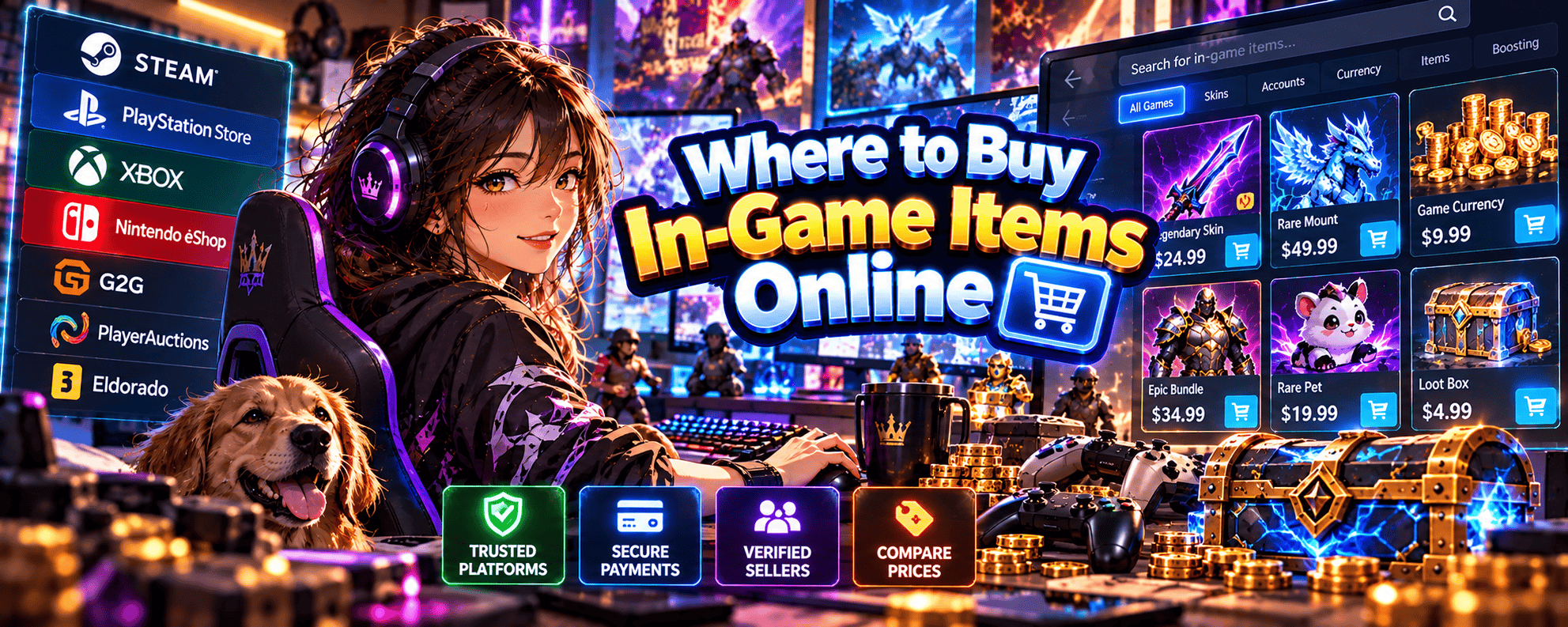
1. Where to Buy In-Game Items Online 🛒
You’ve spotted the perfect weapon skin. Your character desperately needs better equipment. Or maybe you’ve been hunting for that one rare collectible that would finally complete your inventory.
There’s just one question.
Where’s the best place to buy it?
From official game stores and player-driven marketplaces to independent gaming platforms, there are more ways than ever to discover and purchase virtual items.
But not every marketplace offers the same items, prices or purchasing experience.
Some specialise in cosmetic skins and collectibles. Others focus on weapons, armour, crafting resources or virtual currencies.
And while certain games actively support player trading, others restrict or prohibit selling items outside their official systems.
Knowing where to buy in-game items online can help you find what you’re looking for without wasting money or putting your gaming account at unnecessary risk.
🎮 Why Do Gamers Buy In-Game Items?
Every gamer has their own reasons for expanding their inventory.
Maybe you’re tired of grinding for materials. Perhaps you’ve found an incredible cosmetic that perfectly matches your character.
Or maybe collecting rare items is your favourite part of gaming.
Popular reasons include:
- Character Customisation: Unlocking skins, outfits, accessories and visual effects.
- Gameplay Progression: Acquiring eligible weapons, armour and equipment.
- Collecting Rare Items: Finding limited-edition cosmetics and valuable collectibles.
- Saving Time: Obtaining items through permitted purchasing systems instead of farming resources.
- Trading: Acquiring items for exchanges with other players.
- Supporting Creators: Purchasing eligible user-generated content through official marketplaces.
For some players, collecting items is almost a game within the game.
And let’s face it, defeating a difficult boss feels even better when your character looks legendary doing it.
💎 What Types of In-Game Items Can You Buy?
The items available depend on the game and marketplace.
Common categories include:
| Item Type | Examples | Where You Might Find Them |
|---|---|---|
| Cosmetic Items | Skins, outfits, accessories | Official stores and eligible marketplaces |
| Weapons | Swords, firearms, magical weapons | Supported in-game markets and trading systems |
| Armour & Equipment | Helmets, shields, character gear | RPG and MMO marketplaces |
| In-Game Currency | Premium currency, eligible tradable gold | Official stores and permitted trading systems |
| Crafting Resources | Materials, ingredients, components | In-game auction houses and player markets |
| Collectibles | Rare cosmetics, limited-edition items | Official and supported secondary marketplaces |
| User-Created Items | Avatar accessories, digital creations | Authorised creator marketplaces |
Not every item can be purchased from another player.
Some are permanently linked to an account, while others can only be acquired through gameplay.
Our Types of In-Game Items Explained guide explores the different categories and how they work.
🛒 What Are the Main Places to Buy In-Game Items?
Most purchasing options fall into four categories:
- Official In-Game Stores: Buy eligible items directly from the developer or publisher.
- Official Player Marketplaces: Purchase items listed by other players through supported platform systems.
- Third-Party Gaming Marketplaces: Browse listings from independent sellers through external websites.
- Direct Player-to-Player Trading: Exchange eligible items through supported trading features.
Each option has its own advantages and limitations.
For example, official stores are generally straightforward but may have limited selections.
Player marketplaces can offer rare collectibles, although prices may fluctuate significantly.
Third-party platforms can provide additional purchasing options, but buyers need to consider marketplace credibility and game restrictions.
⚔️ Does Every Game Allow You to Buy Items From Other Players?
No.
This is an important distinction.
Some games have extensive player-driven economies where trading is a major part of the experience.
Others limit purchases to official stores or restrict certain transfers.
For example:
- Counter-Strike 2: Eligible items can be bought and sold through the Steam Community Market.
- World of Warcraft: Players can trade eligible goods through supported in-game systems, subject to game and account restrictions.
- Roblox: Certain eligible avatar items can be resold through Roblox’s supported marketplace features.
- Fortnite: Players can purchase cosmetics through official systems, but existing Locker cosmetics generally cannot be transferred between accounts.
Before purchasing, check whether the game permits the particular item and transaction method.
🏆 What’s the Best Place to Start?
For most gamers, official game stores and authorised marketplaces are the best starting points.
They provide established purchasing processes and clearer connections to the game’s systems.
However, the best option ultimately depends on what you’re buying.
A rare collectible might be available through an eligible player marketplace, while a new cosmetic bundle may only be sold through the developer’s store.
The trick is knowing where to look.
2. Official In-Game Stores: The Safest Starting Point 🎮
When buying virtual items, official game stores are usually the simplest place to begin.
These stores are operated by game developers, publishers or authorised platform providers.
They allow players to purchase eligible digital goods directly through supported systems.
For many gamers, this means less uncertainty about item compatibility, delivery and account security.
🛒 How Do Official In-Game Stores Work?
The purchasing process is generally straightforward.
You open the game’s store, browse available content, select an item and complete the purchase using an accepted payment method or supported virtual currency.
Depending on the game, the item may then be added directly to your account.
Common purchases include:
- Character skins.
- Cosmetic bundles.
- Emotes and animations.
- Mounts and companions.
- Premium currencies.
- Battle passes.
- Eligible gameplay content.
The available selection depends on the developer and the game’s business model.
🎨 Fortnite Item Shop
Fortnite
Fortnite’s Item Shop is a familiar example of an official cosmetic store.
Players can purchase eligible outfits, emotes, accessories and other available cosmetics using V-Bucks.


The shop’s selection changes over time, and some cosmetics are only available during particular periods.
Advantages:
- Direct integration with Fortnite accounts.
- Official cosmetic purchasing.
- Established item delivery.
- Published purchasing and refund rules.
Limitations:
- Not every cosmetic is always available.
- Existing Locker cosmetics generally cannot be resold or transferred.
- Availability may change.
If you’re looking for a particular Fortnite outfit, the official shop is the appropriate starting point.
Be cautious of external websites claiming they can transfer rare skins from another player’s Locker.
🧱 Roblox Marketplace
Roblox
Roblox provides a marketplace where players can discover eligible avatar items, including accessories, clothing and other customisation options.


Many items are created by members of the Roblox creator community.
Purchases generally use Robux, and certain eligible items support resale under Roblox’s marketplace rules.
Advantages:
- Large selection of avatar customisation items.
- User-created content.
- Integrated purchasing.
- Supported resale features for eligible items.
Limitations:
- Not every item can be resold.
- Resale eligibility and fees vary.
- Marketplace rules can change.
- Some items may have additional restrictions.
Roblox is a good example of how official marketplaces can combine developer-supported purchasing with creator-driven digital goods.
🐉 World of Warcraft In-Game Shop
World of Warcraft
World of Warcraft offers official purchasing options for selected digital content, such as eligible mounts, pets and other account-related products.

However, the official shop is different from the game’s player-driven Auction House.
The shop sells selected products offered through Blizzard’s systems.
The Auction House, meanwhile, allows players to buy and sell eligible items using in-game gold.
Understanding this difference helps you choose the correct purchasing method.
💎 Other Official Gaming Stores
Many games operate similar purchasing systems.
Examples include:
- League of Legends cosmetic stores.
- Valorant’s in-game store.
- Overwatch 2’s cosmetic shop.
- Diablo IV’s official shop.
- Other developer-operated digital storefronts.
Each has its own rules governing purchases, refunds, item availability and account access.
📊 Advantages and Limitations of Official Stores
| Advantages | Limitations |
|---|---|
| Direct integration with the game | Limited to developer-selected products |
| Established checkout systems | Rare items may be unavailable |
| Clearer delivery processes | Some items cannot be traded |
| Official customer support | Prices may be fixed |
| Published purchasing policies | Refund eligibility varies |
| Reduced third-party seller exposure | No guarantee of permanent access |
🔐 Are Official Stores Completely Risk-Free?
No purchasing system is entirely risk-free.
Even official stores can involve issues such as accidental purchases, account compromise or misunderstanding product restrictions.
Always confirm:
- You’re using the genuine game or official website.
- The item is compatible with your account.
- The price and currency are correct.
- You understand the refund conditions.
- The item provides what you expect.
For most players, however, official stores offer a sensible starting point for purchasing supported digital content.
3. Official Gaming Marketplaces and Trading Platforms 💎
Not every desirable in-game item comes directly from a developer.
In some games, players acquire valuable cosmetics, equipment and collectibles through gameplay.
These items may then become available for purchase or exchange through official player marketplaces.
Unlike traditional in-game shops, these marketplaces can feature listings created by other players.
That means more variety, changing prices and occasionally some seriously rare loot.
🎮 What Is an Official Player Marketplace?
An official player marketplace is a trading or purchasing system supported by the game or platform operator.
Depending on the system, players may be able to:
- List eligible items for sale.
- Browse other players’ listings.
- Purchase items using supported currencies.
- Compare asking prices.
- Review transaction history.
- Transfer eligible items.
- Trade with other players.
Not every official marketplace supports all these features.
Some operate as auction houses, while others use fixed-price listings.
🔫 Steam Community Market
Steam Community Market
The Steam Community Market is one of the best-known examples of an official digital item marketplace.
It allows eligible Steam users to buy and sell supported items from participating games.


Counter-Strike 2 is a prominent example of a game with tradable cosmetics available through Steam’s systems.
Depending on the item, buyers may find:
- Weapon skins.
- Cases.
- Stickers.
- Other eligible collectibles.
💰 How Does Buying Through Steam Work?
Players can browse eligible listings and purchase items using Steam Wallet funds.
Prices are influenced by available listings and buyer demand.
However, there’s an important distinction.
Steam Wallet funds are not the same as withdrawable cash.
Proceeds from Steam Community Market sales generally remain within the Steam Wallet ecosystem and cannot be withdrawn directly as money.
Players should also understand marketplace fees, account requirements and trading restrictions.
🐉 World of Warcraft Auction House
World of Warcraft’s Auction House provides a different marketplace experience.
Instead of purchasing items with real money through an external website, players can buy eligible goods using in-game gold.

Depending on the game version and applicable rules, available items can include:
- Crafting materials.
- Equipment.
- Consumables.
- Trade goods.
- Collectibles.
- Other eligible resources.
The Auction House plays an important role in WoW’s player-driven economy.
Prices can fluctuate as players gather resources, craft items and respond to demand.
🧱 Roblox Limited Item Resales
Roblox also supports resale of certain eligible avatar items.
This allows qualifying items to circulate between users through Roblox’s supported marketplace systems.
However, resale isn’t available for every item.
Restrictions, fees and eligibility requirements apply.
Buyers should verify that an item is genuinely eligible for resale rather than assuming every Roblox cosmetic can be transferred.
🔄 What About Direct Trading Systems?
Some games support direct exchanges without a conventional marketplace listing.
For example, eligible players might exchange equipment or resources through an in-game trade window.
These systems can be useful when you already know another player who has the item you want.
However, direct trading may offer different protections from a structured marketplace purchase.
Our guide to Tradable vs Non-Tradable In-Game Items explains which items can be transferred and why trading restrictions matter.
📊 Comparing Official Gaming Marketplaces
| Marketplace | Typical Items | Purchasing System |
|---|---|---|
| Steam Community Market | Eligible skins and collectibles | Steam Wallet |
| World of Warcraft Auction House | Eligible equipment, materials and resources | In-game gold |
| Roblox Marketplace | Eligible avatar items and resales | Robux |
| Supported In-Game Trading Systems | Game-specific tradable items | Item exchanges or permitted currencies |
🏆 Why Choose an Official Player Marketplace?
Official marketplaces can be particularly useful when you’re searching for items that aren’t sold directly through a game’s shop.
They may provide:
- Access to player-owned inventory.
- Wider item selection.
- Market-driven pricing.
- Integrated transaction systems.
- Supported item transfers.
- Clearer platform rules.
However, buyers should still check item details, pricing and trading restrictions.
An official marketplace helps establish the transaction framework, but it doesn’t guarantee every listing represents good value.
4. Third-Party In-Game Item Marketplaces 🌐
Sometimes the item you’re looking for isn’t available through an official game store.
Perhaps you’re searching for a particular collectible, specialised equipment or another gaming product offered by an independent seller.
That’s where third-party gaming marketplaces enter the picture.
These websites connect buyers and sellers outside a game’s official storefront.
They can offer additional purchasing options, although availability and permitted transactions vary significantly between games.
🛒 What Is a Third-Party Gaming Marketplace?
A third-party marketplace is an independent platform where sellers advertise gaming-related goods or services.
Depending on the marketplace, listings may include:
- Eligible in-game items.
- Cosmetic skins.
- Gaming collectibles.
- In-game currencies.
- Equipment and resources.
- Other gaming-related products or services.
Some platforms specialise in particular games.
Others support multiple gaming categories.
Unlike an official game store, an independent marketplace doesn’t automatically have the developer’s authorisation to facilitate every advertised transaction.
🎮 Why Do Gamers Use Third-Party Marketplaces?
Players explore independent marketplaces for several reasons.
More Purchasing Options
Some platforms feature items and sellers not found through conventional game stores.
Specialised Listings
Certain marketplaces focus on particular games or types of virtual goods.
Price Comparison
Buyers may be able to compare offers from different sellers.
Seller Choice
Multiple sellers might advertise similar items with different prices or delivery arrangements.
Gaming Communities
Some platforms connect buyers with sellers who specialise in particular games.
These advantages can be useful, but they need to be balanced against marketplace credibility and game restrictions.
💎 StackedGame: A Marketplace for Gaming Products and Services
StackedGame
StackedGame is a gaming marketplace where sellers can create listings for gaming-related products and services.

The platform includes categories such as:
- In-Game Items.
- In-Game Currency.
- Gaming Sessions.
- Game Coaching.
- Game Boosting.
- Other gaming products and services.
For players exploring independently listed gaming items, StackedGame provides another place to discover relevant offers.
However, buyers should check each listing carefully, understand the proposed delivery method and confirm that the game permits the transaction.
Marketplace availability doesn’t override game rules.
🔍 What Should You Check Before Using a Third-Party Marketplace?
Before making a purchase, investigate the platform itself.
Important considerations include:
Marketplace Reputation
Look for independent customer feedback and any recurring complaints.
Seller Information
Check whether the seller provides credible listing details and transaction history.
Payment Methods
Understand how payments are processed and what protections may apply.
Delivery Procedures
Confirm how the item will be transferred and whether the process is supported by the game.
Refund and Dispute Policies
Check what happens if the item doesn’t arrive or doesn’t match the listing.
Game Restrictions
Verify that the transaction is permitted by the relevant game or platform.
⚠️ Are Third-Party Marketplaces Safe?
Some third-party marketplaces operate established businesses with structured purchasing systems.
Others may offer limited buyer protections or facilitate transactions that aren’t permitted by the relevant game.
You shouldn’t assume a marketplace is safe simply because it has professional branding, positive testimonials or a large number of listings.
Likewise, an external marketplace isn’t automatically fraudulent simply because it isn’t operated by the game developer.
The important distinction is whether the marketplace is credible and whether the specific transaction is permitted and appropriately protected.
🔐 What Are the Biggest Risks?
Potential risks include:
- Fraudulent seller listings.
- Items that cannot be transferred.
- Payment disputes.
- Delayed or failed delivery.
- Account security problems.
- Misleading item descriptions.
- Violations of game trading rules.
- Limited recovery options after a transaction.
These risks aren’t identical across every platform.
A marketplace’s policies, transaction procedures and seller behaviour can make a significant difference.
📊 Official vs Third-Party Marketplaces
| Feature | Official Marketplace | Third-Party Marketplace |
|---|---|---|
| Operated by Game/Platform Provider | Yes | Usually no |
| Developer Authorisation | Built into supported system | Must be checked for each transaction |
| Item Selection | Limited to eligible supported items | Varies by platform and seller |
| Pricing | Fixed or player-driven | Often seller-driven |
| Payment Methods | Platform-supported methods | Varies |
| Delivery | Integrated or officially supported | Depends on game and seller |
| Buyer Protection | Platform-specific policies | Marketplace-specific policies |
| Trading Restrictions | Enforced through platform systems | Must be independently verified |
🛡️ How to Buy From Third-Party Marketplaces More Safely
Before completing a purchase:
- Research the marketplace.
- Verify the seller’s credibility.
- Check whether the game permits the transaction.
- Confirm the exact item being sold.
- Compare prices against legitimate alternatives.
- Review payment and refund conditions.
- Understand the delivery process.
- Never disclose account passwords or recovery codes.
For a more detailed breakdown, read our How to Buy In-Game Items Safely guide.
🏆 Should You Buy From a Third-Party Marketplace?
That depends on the game, item and marketplace.
For items available through official purchasing systems, those are generally the best starting point.
For other eligible goods, independent marketplaces may provide additional options worth researching.
Just remember that finding a great item is only half the challenge.
Making sure you can purchase and receive it legitimately is what turns a promising listing into a successful transaction.
5. Buying In-Game Items Directly From Other Players 🔄
Sometimes the best place to find an in-game item isn’t a store or marketplace.
It’s another player’s inventory.
Maybe someone in your guild has the exact weapon you need. Perhaps a fellow collector owns a rare cosmetic you’ve been searching for, or another player has more crafting materials than they know what to do with.
In games that support trading, buying or exchanging items directly with other players can be a convenient way to get what you want.
But there’s an important catch.
Just because another player owns an item doesn’t mean they’re allowed to sell or transfer it.
🎮 How Does Player-to-Player Item Trading Work?
Player-to-player trading allows eligible gamers to exchange items through supported game systems.
Depending on the game, players might trade:
- Weapons and armour.
- Crafting materials.
- Consumables.
- Rare collectibles.
- Eligible cosmetics.
- In-game currency.
- Other transferable resources.
Some games provide dedicated trading interfaces where both players can inspect the proposed exchange before confirming.
Others use auction houses, trading posts or similar systems.
For example, Path of Exile has a player-driven item economy where eligible equipment and currencies can be exchanged through supported trading mechanisms.
However, trading in-game items doesn’t automatically mean selling them for real money is permitted.
🔍 Where Can You Find Players Selling Items?
Players often discover potential trading partners through:
In-Game Trading Channels
Some multiplayer games provide dedicated channels for discussing trades and finding eligible items.
Guilds and Gaming Communities
Guild members may exchange resources, equipment and collectibles through supported systems.
Official Game Forums
Certain games provide community spaces where players discuss item availability and trading opportunities.
Gaming Discord Communities
Some communities organise item exchanges, although private arrangements require additional caution.
Player Marketplaces
Official marketplace systems may allow players to list eligible items for others to purchase.
Wherever you discover a seller, make sure the actual transaction follows the game’s rules.
⚔️ Advantages of Buying Directly From Players
Direct trading can offer several benefits.
- Access to Specific Items: Find equipment or collectibles owned by other players.
- Negotiable Prices: Some trading systems allow buyers and sellers to negotiate.
- Community Connections: Build relationships with other gamers.
- Flexible Exchanges: Trade eligible items rather than relying exclusively on fixed-price stores.
- Specialised Inventory: Find unusual equipment, resources or item combinations.
For games with active trading communities, player-to-player exchanges can become an important part of the experience.
⚠️ What Are the Risks?
Direct trading can also expose buyers to additional risks.
For example:
- The seller might misrepresent an item’s attributes.
- The offered item could change before confirmation.
- The item might be subject to trading restrictions.
- A private payment might not have meaningful buyer protection.
- The seller might attempt to steal account credentials.
- The transaction could violate the game’s terms.
These risks become particularly important when a seller requests real-money payment outside an authorised system.
🛡️ How to Trade More Safely With Other Players
Before completing an exchange:
- Confirm the game permits the trade.
- Verify the exact item and its attributes.
- Use the game’s supported trading interface.
- Check the other player’s account identity.
- Inspect the final trade confirmation.
- Avoid suspicious links and unexpected login requests.
- Never share account passwords or recovery codes.
- Keep relevant transaction records.
If the seller changes the agreed terms unexpectedly, stop and investigate.
🏆 Is Direct Trading Better Than Using a Marketplace?
Not necessarily.
Direct trading can be convenient when both players understand the game’s trading system.
However, structured marketplaces may provide additional transaction records, pricing information or dispute procedures.
The best option depends on the item, game and available safeguards.
Our upcoming guide to How Does In-Game Item Trading Work? explores the trading process in greater detail.
And remember, just because someone calls themselves the legendary merchant of the server doesn’t mean you should hand over your entire inventory.
6. Where to Buy Skins, Cosmetics and Rare Collectibles 🎨
For many gamers, cosmetics are the ultimate inventory upgrade.
A rare weapon skin won’t necessarily improve your aim, but it can make every victory feel a little more stylish.
Whether you’re collecting Counter-Strike 2 skins, customising a Roblox avatar or searching for an exclusive character outfit, finding the right marketplace depends heavily on the game.
Some cosmetics are tradable.
Others can only be purchased through official stores.
And certain limited-edition items may no longer be available at all.
🔫 Where to Buy Counter-Strike 2 Skins
Counter-Strike 2 has one of gaming’s most recognisable cosmetic item economies.
Players can acquire eligible weapon skins through supported Steam systems, including the Steam Community Market.
Depending on availability, buyers may find:
- Weapon finishes.
- Knives.
- Gloves.
- Stickers.
- Cases.
- Other eligible collectibles.
Prices can vary considerably based on an item’s condition, rarity, pattern and demand.
💎 What Should You Check Before Buying CS2 Skins?
Two skins with similar appearances can have very different values.
Important characteristics may include:
Wear Condition
Skins have wear classifications, such as Factory New, Minimal Wear and Field-Tested.
Float Value
A numerical wear value can influence a skin’s appearance and collector desirability.
Pattern
Certain patterns may attract additional interest.
Special Attributes
Features such as StatTrak or particular stickers can affect an item’s desirability.
Market Availability
Supply and demand can influence prices.
Before purchasing an expensive skin, verify its attributes through supported inspection tools.
Don’t assume a screenshot tells the whole story.
🧱 Where to Buy Roblox Avatar Items
Roblox offers an official marketplace featuring avatar clothing, accessories and other eligible items.
Players can browse products created by Roblox and participating creators.
Some items are available for ordinary purchases, while certain eligible collectibles support resale.
However, not every avatar item can be traded or resold.
Before buying a collectible with future resale in mind, check the relevant eligibility requirements and restrictions.
🎮 Where to Buy Fortnite Skins
Fortnite cosmetics are generally purchased through Epic Games’ official systems, including the Item Shop.
Players can find outfits, emotes, accessories and other available cosmetic content.
However, Fortnite doesn’t generally support selling or transferring existing Locker cosmetics between players.
This means a website advertising an existing rare Fortnite skin for direct transfer should be treated with caution.
Buying another player’s account to obtain cosmetics can also violate Epic Games’ rules.
For Fortnite, stick to supported purchasing and gifting features.
🐉 Where to Buy MMO Cosmetics
MMOs often provide several ways to acquire cosmetic items.
Depending on the game, these may include:
- Official cosmetic stores.
- In-game auction houses.
- Supported player trading.
- Crafting systems.
- Seasonal events.
- Gameplay rewards.
For example, some World of Warcraft cosmetic items and collectibles can be obtained through the Auction House, while others are account-bound or only available through particular activities.
Always check the individual item’s restrictions.
🌟 Where to Find Rare and Limited-Edition Items
Rare collectibles can be particularly challenging to find.
Some are no longer sold through official stores.
Others may only appear during seasonal events or special promotions.
Before searching external marketplaces, establish whether the item can legally and technically change ownership.
If it cannot be transferred, a third-party seller’s claim that they can deliver it should raise concerns.
📊 Where to Buy Popular Cosmetic Items
| Game | Cosmetic Type | Purchasing Options |
|---|---|---|
| Counter-Strike 2 | Eligible weapon skins and collectibles | Steam Community Market and supported trading |
| Roblox | Avatar clothing and accessories | Official Roblox Marketplace |
| Fortnite | Outfits, emotes and accessories | Official Item Shop and eligible gifting |
| World of Warcraft | Eligible cosmetics and collectibles | Official shop, Auction House or supported gameplay systems |
| Valorant | Weapon skins and cosmetics | Official in-game store |
| Path of Exile | Cosmetic effects and eligible supporter content | Official game store |
🏆 Which Marketplace Is Best for Cosmetic Items?
The best marketplace depends on whether the item is transferable.
For cosmetics sold directly by developers, official stores are generally the simplest option.
For eligible player-owned collectibles, supported marketplaces may provide additional selection.
Always check the item’s trading status before assuming you can purchase it from another player.
That rare skin might look incredible, but if the game doesn’t permit transfers, no amount of wishful thinking will move it into your inventory.
7. Where to Buy Weapons, Armour and Equipment ⚔️
Not every gamer is hunting for cosmetics.
Sometimes you need equipment that actually helps your character survive.
Maybe your warrior needs a stronger sword. Your mage needs equipment with better bonuses. Or your character is finally ready for that endgame armour set.
In games with player-driven economies, buying eligible equipment can be an important part of progression.
But unlike cosmetic items, functional equipment often comes with additional considerations.
🎮 Which Games Allow Players to Buy Equipment?
Many RPGs and MMOs support trading certain weapons, armour and other equipment.
Examples include:
- World of Warcraft.
- Path of Exile.
- Old School RuneScape.
- EVE Online.
- Other multiplayer RPGs with supported trading economies.
However, the rules differ significantly.
Some games allow extensive trading, while others restrict powerful equipment or bind certain items to characters.
🐉 Buying Equipment in World of Warcraft
World of Warcraft’s Auction House allows players to purchase eligible equipment and other items using in-game gold.
Depending on the game version and current systems, buyers may find:
- Crafted weapons.
- Armour.
- Consumables.
- Profession materials.
- Collectibles.
- Other eligible equipment.
However, many powerful items are subject to binding restrictions.
An item obtained through a dungeon or raid may not be freely tradable.
Before purchasing, confirm whether the equipment can be used by your character.
⚔️ Buying Equipment in Path of Exile
Path of Exile features an extensive player-driven item economy.
Players can trade eligible equipment, currencies and crafting materials through supported systems.
Depending on the game and league, trading mechanisms and available items may differ.
Commonly traded equipment includes:
- Weapons.
- Armour.
- Rings and amulets.
- Unique items.
- Crafting materials.
- Other eligible resources.
Item attributes are particularly important.
Two weapons with the same base type can have dramatically different statistics.
💎 What Should You Check Before Buying Equipment?
Functional equipment requires more research than simply choosing an attractive cosmetic.
Important factors include:
Character Requirements
Can your character equip the item?
Equipment Statistics
Does the item improve the attributes that matter to your build?
Item Level
Does the equipment meet your progression needs?
Special Modifiers
Are the bonuses useful for your intended playstyle?
Trading Restrictions
Can the item actually be transferred?
Game Version
Is the item compatible with your current game, league or server?
🛡️ Don’t Confuse Expensive With Powerful
A high price doesn’t always mean an item is the best choice.
Some equipment is valuable because it’s rare.
Other items command higher prices because they’re useful for particular character builds.
For example, a weapon with exceptional critical strike bonuses might be highly desirable for one build but relatively unhelpful for another.
Before spending heavily, research whether the item actually suits your character.
💰 Compare Equipment Prices Carefully
Prices for functional items can vary depending on:
- Statistics.
- Upgrade levels.
- Special modifiers.
- Rarity.
- Demand.
- Crafting costs.
- Game updates.
- Market availability.
A balance update can change which equipment players want.
Similarly, new content may introduce stronger alternatives.
Our upcoming guide to How to Compare In-Game Item Prices will explain how to evaluate comparable listings and identify reasonable prices.
📊 Equipment Buying Checklist
| What to Check | Why It Matters |
|---|---|
| Character Class | Confirms equipment compatibility |
| Level Requirements | Determines whether the item can be equipped |
| Item Statistics | Shows its gameplay benefits |
| Special Modifiers | Identifies build-specific advantages |
| Upgrade Status | Helps assess overall usefulness |
| Tradability | Confirms transfer eligibility |
| Server or League | Prevents purchasing for the wrong environment |
| Price | Helps avoid overpaying |
🏆 Where Should You Buy Weapons and Armour?
For games with official auction houses or supported player trading, those systems are generally the best starting point.
They allow you to browse eligible equipment while remaining within the game’s established transaction framework.
Be cautious of external sellers offering items through methods that violate game rules.
The best equipment purchase is one that improves your character, fits your budget and can be acquired through a permitted transaction.
Because nothing hurts quite like buying an expensive legendary sword and discovering your character needs another 20 levels to equip it.
8. Where to Buy In-Game Currency and Resources 💰
Sometimes the item you need isn’t a weapon, skin or collectible.
It’s the currency required to buy everything else.
In-game currencies and resources play a major role in many gaming economies.
They can be used to purchase equipment, craft items, unlock content or participate in player trading.
However, buying virtual currency requires particular care because games often have strict rules governing real-money transactions.
🎮 What Types of In-Game Currency Can You Buy?
There are several different types of virtual currency.
Premium Currency
Purchased through official game stores, often using real money.
Examples include V-Bucks and Robux.
Earnable In-Game Currency
Obtained through gameplay activities, quests, trading or other supported mechanics.
Examples include gold in many RPGs.
Player-Tradable Currency
Certain games allow players to exchange eligible currencies or currency-like items through supported systems.
Crafting Resources
Materials used to create or upgrade equipment.
These may be tradable depending on the game.
Not every currency can be transferred between players.
🛒 Where to Buy Premium Game Currency
Official game stores are generally the appropriate place to purchase premium currency.
Examples include:
- V-Bucks through supported Fortnite purchasing channels.
- Robux through official Roblox purchasing systems.
- Riot Points through authorised League of Legends purchasing methods.
- Other developer-issued premium currencies.
Some games also support authorised gift cards or prepaid codes.
Always verify that you’re purchasing from an approved source.
Be cautious of unfamiliar websites promising large amounts of premium currency at unusually low prices.
🐉 Where to Buy World of Warcraft Gold
World of Warcraft provides an official mechanism involving WoW Tokens in supported regions and game versions.
Depending on the applicable system, players can purchase a WoW Token through Blizzard’s official process and sell it for in-game gold.
Players can also acquire gold through ordinary gameplay and permitted trading activities.
However, purchasing gold directly from unauthorised third-party sellers can violate Blizzard’s rules.
Before purchasing, check the current WoW Token rules for your region and game version.
⚔️ Where to Find Path of Exile Currency
Path of Exile uses a distinctive economy built around currency items rather than a conventional gold-based system in the original game.
These items serve purposes such as crafting and modifying equipment.
Eligible currency items can also be exchanged between players through supported trading systems.
However, buying in-game currency for real money from unauthorised sellers can violate the game’s rules.
For legitimate trading, use the systems supported by the relevant Path of Exile game and league.
💎 Buying Crafting Materials and Resources
Many multiplayer games allow players to purchase resources using in-game currency.
Common examples include:
- Ores and minerals.
- Herbs.
- Crafting components.
- Consumable ingredients.
- Upgrade materials.
- Other eligible trade goods.
These items may be available through in-game auction houses, trading posts or direct player exchanges.
Buying materials can save time when you’re working towards a crafting goal.
However, prices may fluctuate depending on supply, demand and game updates.
🚨 Why Is Buying In-Game Currency Risky?
Currency transactions can attract scams because buyers often expect fast delivery.
Common risks include:
- Fake currency sellers.
- Account phishing.
- Unauthorised real-money trading.
- Payment fraud.
- Currency that cannot be transferred.
- Account penalties.
- Failed or disputed delivery.
Some sellers may advertise enormous amounts of currency at prices that seem impossible to beat.
That should be a reason to investigate, not immediately open your wallet.
🔐 Can Buying Currency Get Your Account Banned?
Potentially.
Some games explicitly prohibit purchasing in-game currency from unauthorised third-party sellers.
Violating those rules may result in penalties, including restrictions or account suspension.
The consequences depend on the game’s policies and circumstances.
Always verify whether the particular transaction is allowed.
📊 Where to Buy Different Types of In-Game Currency
| Currency or Resource | Example | Appropriate Purchasing Channel |
|---|---|---|
| Premium Currency | Fortnite V-Bucks | Official or authorised purchasing channels |
| Premium Currency | Roblox Robux | Official Roblox purchasing systems |
| In-Game Gold | World of Warcraft Gold | Permitted in-game methods and official WoW Token system where available |
| Tradable Currency Items | Path of Exile Currency | Supported in-game trading systems |
| Crafting Materials | MMO Resources | Official auction houses or permitted player trading |
| Upgrade Materials | RPG Crafting Components | Supported game marketplaces and trading systems |
🏆 What’s the Best Place to Buy In-Game Currency?
For premium currency, use official or authorised purchasing channels.
For earnable currencies and resources, check whether the game supports purchasing or exchanging them through its own trading systems.
Avoid assuming that a currency is available for legitimate real-money purchase simply because an external website advertises it.
Understanding the difference between official currency purchases and unauthorised real-money trading is essential.
After all, saving a few hours of farming isn’t much of a victory if it costs you access to the account you’ve spent hundreds of hours building.
9. How to Compare In-Game Item Marketplaces 📊
You’ve found three different marketplaces selling the item you want.
One has the lowest price. Another has hundreds of positive reviews. The third offers a straightforward purchasing process through the game’s official systems.
Which one should you choose?
The best in-game item marketplace isn’t necessarily the cheapest. It’s the one that offers the right item, a permitted transaction and an acceptable level of purchasing protection.
Comparing marketplaces can help you avoid overpaying, identify better purchasing options and reduce unnecessary risks.
🎮 What Makes a Good In-Game Item Marketplace?
A good marketplace should make it easy to understand what you’re buying, how much it costs and how you’ll receive it.
Important factors include:
- Item Selection: Does the marketplace offer the item you’re looking for?
- Pricing: Are prices competitive with comparable listings?
- Seller Reputation: Can you evaluate the seller’s credibility?
- Payment Security: Are appropriate payment methods available?
- Delivery: Is the transfer process clear and supported?
- Buyer Protection: What happens if the item doesn’t arrive?
- Game Compatibility: Does the game permit the transaction?
- Customer Support: Is there a clear way to resolve problems?
These factors matter more than flashy website designs or impressive promotional claims.
💰 Compare the Total Purchase Price
A marketplace might advertise an item for $40, while another lists it for $45.
At first glance, the cheaper option looks better.
However, additional fees can change the comparison.
Consider this hypothetical example:
| Marketplace | Item Price | Additional Fees | Total Cost |
|---|---|---|---|
| Marketplace A | $40 | $6 | $46 |
| Marketplace B | $45 | $0 | $45 |
| Marketplace C | $42 | $2 | $44 |
Marketplace C has the lowest total cost, despite not advertising the cheapest item price.
Always compare the final checkout amount, including any applicable fees and currency conversion costs.
💎 Compare Identical Items
Before comparing prices, make sure the listings describe genuinely equivalent items.
For example, two Counter-Strike 2 skins might have different float values, patterns or collectible attributes.
Likewise, two RPG weapons might share a name but have different statistics.
Check:
- Item name and variation.
- Rarity and condition.
- Special attributes.
- Quantity.
- Upgrade status.
- Trading eligibility.
- Account or server compatibility.
A cheaper item isn’t necessarily a better deal if it lacks the attributes you’re looking for.
⭐ Compare Seller Reputation
Some marketplaces provide detailed seller histories, while others offer limited information.
Look for credible evidence of successful transactions.
Consider:
Transaction History
Does the seller have a consistent record of completed orders?
Customer Feedback
Are reviews detailed and believable?
Listing Accuracy
Are product descriptions clear and consistent?
Communication
Does the seller answer reasonable questions?
Dispute History
Are there unresolved complaints or recurring delivery problems?
Be cautious of sellers whose only credibility comes from their own promotional claims.
🔐 Compare Buyer Protection and Refund Policies
Different marketplaces offer different levels of protection.
Before purchasing, investigate:
- Whether orders are recorded.
- Whether payment disputes are supported.
- Whether buyers can report missing items.
- What evidence is required.
- Whether refund eligibility is clearly explained.
- How customer support handles complaints.
Don’t assume every marketplace provides escrow, guaranteed refunds or seller verification.
These features must be confirmed individually.
📦 Compare Delivery Methods
Delivery can be just as important as price.
One marketplace might use an official trading system, while another relies on a seller manually completing the transfer.
Consider:
- Whether the delivery method is permitted.
- Whether the item can be transferred.
- Whether the process requires account access.
- Whether delivery times are explained.
- Whether transaction records are available.
Never provide your password or authentication codes to receive an item.
📊 Comparing Different Purchasing Channels
| Feature | Official Game Store | Official Player Marketplace | Third-Party Marketplace | Direct Player Trading |
|---|---|---|---|---|
| Item Selection | Developer-selected | Eligible player-listed items | Varies by seller and platform | Depends on trading partner |
| Pricing | Usually store-set | Often market-driven | Often seller-driven | May be negotiable |
| Payment | Official checkout | Supported platform currency | Platform-dependent | Depends on permitted system |
| Delivery | Usually integrated | Officially supported | Varies | Game-specific |
| Buyer Protection | Official store policies | Platform policies | Marketplace-specific | May be limited |
| Trading Permissions | Built into official system | Built into official system | Must be checked | Must be checked |
| Main Advantage | Straightforward purchasing | Access to player-owned items | Additional purchasing options | Flexible exchanges |
🏆 Which Marketplace Offers the Best Value?
Value isn’t just about spending less.
A slightly more expensive item from a credible seller using a permitted delivery method may be a better purchase than a suspiciously cheap listing.
When comparing marketplaces, prioritise legitimacy, item accuracy and transaction security.
The best deal is the one where you receive the correct item at a reasonable price without unnecessary risk.
10. How to Choose the Best Place to Buy In-Game Items 🏆
With so many purchasing options available, finding the right marketplace can feel like navigating an enormous RPG inventory.
You’ve got official stores, player marketplaces, trading communities and independent platforms.
Where should you start?
Fortunately, choosing the right purchasing channel becomes much easier when you follow a simple process.
🎮 Step 1: Identify the Exact Item You Want
Start with the item itself.
Are you buying:
- A cosmetic skin?
- A rare collectible?
- A weapon or armour piece?
- Crafting resources?
- Premium currency?
- An eligible player-created item?
Different item categories have different purchasing options.
For example, a Fortnite cosmetic is generally purchased through official systems, while an eligible Counter-Strike 2 skin may be available through the Steam Community Market.
🔄 Step 2: Check Whether the Item Can Be Traded
Before searching player marketplaces, establish whether the item can actually change ownership.
Some items are:
- Freely tradable through supported systems.
- Tradable only after a waiting period.
- Restricted to certain accounts.
- Bound to a particular character.
- Permanently non-tradable.
If an item cannot be transferred, searching for external sellers is unlikely to produce a legitimate purchasing option.
🛒 Step 3: Start With Official Purchasing Channels
Check the game’s official store or supported marketplace first.
This helps you understand:
- Whether the item is available.
- Its official price, if applicable.
- Supported payment methods.
- Delivery procedures.
- Relevant restrictions.
Even if you eventually consider another purchasing option, official systems provide a useful starting point.
🌐 Step 4: Research Other Permitted Marketplaces
If the item isn’t available through an official store, investigate other purchasing channels that the game permits.
Look at marketplace reputation, seller credibility and available protections.
Don’t assume an external transaction is authorised simply because the website advertises the item.
💰 Step 5: Compare Prices and Fees
Research several comparable listings.
Pay attention to item variations, condition and additional charges.
For rare collectibles, recent completed sales may provide useful context where reliable transaction data is available.
Avoid making decisions based on one unusually cheap listing.
⭐ Step 6: Verify the Seller
Before paying an independent seller, check their reputation.
Look for consistent transaction history, clear listing details and credible customer feedback.
Be cautious if the seller:
- Refuses to answer questions.
- Requests account credentials.
- Insists on unusual payment arrangements.
- Pressures you to purchase immediately.
- Changes the agreed delivery process.
Our upcoming guide to How to Choose a Trusted In-Game Item Seller will explore these checks in more detail.
🔐 Step 7: Review Payment and Delivery
Before confirming the purchase, understand exactly what happens next.
Ask yourself:
- Is the payment method appropriate?
- Does the marketplace provide transaction records?
- How will the item be delivered?
- Is the transfer permitted?
- What happens if delivery fails?
- Are there refund or dispute options?
If important details remain unclear, investigate before paying.
💎 Step 8: Verify the Item After Delivery
Once the transaction is complete, check your inventory through the game’s official systems.
Confirm that the item matches the listing.
For valuable collectibles, inspect relevant attributes and identifiers.
Keep your purchase confirmation in case you need to raise a dispute.
🎯 Quick Guide: Where Should You Buy?
| What You’re Buying | Best Starting Point |
|---|---|
| New Cosmetic Skin | Official game store |
| Eligible CS2 Collectible | Steam Community Market |
| Roblox Avatar Item | Official Roblox Marketplace |
| MMO Crafting Materials | Supported in-game auction house |
| Tradable RPG Equipment | Official trading systems |
| Premium Game Currency | Official or authorised currency store |
| Rare Player-Owned Item | Permitted player marketplace or trading system |
| Independently Listed Gaming Item | Research the marketplace and verify game permissions |
🏆 The Best Marketplace Depends on Your Game
There isn’t one marketplace that’s best for every item or every player.
A platform that’s suitable for buying CS2 skins may be completely irrelevant when you’re searching for World of Warcraft crafting materials.
Likewise, a marketplace offering gaming services may not be appropriate for purchasing cosmetics that cannot legally or technically be transferred.
Choose the purchasing channel based on the item, game rules, seller credibility and available protections.
A few minutes of research can make the difference between a successful inventory upgrade and a very expensive mistake.
11. Common Mistakes When Buying In-Game Items Online 🚫
Even experienced gamers make mistakes when shopping for virtual items.
Sometimes it’s an unusually attractive price.
Other times it’s a convincing seller profile or a misunderstanding about how an item can be transferred.
Whatever the reason, many purchasing problems begin with avoidable decisions.
Here are some of the most common mistakes and how to prevent them.
💰 Mistake #1: Choosing the Cheapest Listing Without Research
Everyone loves finding a bargain.
But an item advertised for significantly less than comparable listings deserves extra scrutiny.
The listing might involve:
- A different item variation.
- Hidden fees.
- Trading restrictions.
- Misleading descriptions.
- A fraudulent seller.
Better approach: Compare identical items, investigate unusual prices and evaluate seller credibility before purchasing.
🔄 Mistake #2: Ignoring Trading Restrictions
An item might be visible in another player’s inventory without being transferable.
Some games restrict trading entirely, while others impose account requirements or temporary holds.
Buying an item that cannot be delivered through a permitted system can create serious problems.
Better approach: Confirm the item’s trading eligibility and the game’s rules before paying.
⭐ Mistake #3: Trusting Seller Ratings Without Checking Details
A five-star rating looks reassuring.
However, ratings can be misleading.
Some sellers may have only a few reviews, while others could have manipulated feedback.
Better approach: Look for credible transaction history, detailed reviews and consistent seller behaviour.
🎮 Mistake #4: Buying the Wrong Item Variation
This mistake is particularly common with collectibles and functional equipment.
For example, you might accidentally purchase:
- A lower-condition skin.
- An item with different statistics.
- Equipment for the wrong character class.
- A cosmetic with an unwanted variation.
- An item for the wrong game version.
Better approach: Verify the exact item name, attributes and compatibility before confirming the purchase.
💳 Mistake #5: Paying Outside the Marketplace
Some sellers offer discounts for private payments.
However, moving a transaction outside the marketplace’s supported checkout process can reduce available protections.
It may also violate platform rules.
Better approach: Use legitimate, supported payment methods and retain transaction records.
🔐 Mistake #6: Sharing Account Credentials
A seller might claim they need your password to deliver an item.
Or perhaps someone impersonating support asks for an authentication code.
These are serious warning signs.
Better approach: Never disclose passwords, recovery codes or authentication credentials to sellers.
📦 Mistake #7: Failing to Verify Delivery
Some buyers assume a transaction is complete because the seller says the item has been sent.
However, screenshots and messages aren’t reliable proof that the correct item reached your account.
Better approach: Check your inventory and official transaction history before confirming successful delivery.
🌐 Mistake #8: Assuming Every Marketplace Is Authorised
A marketplace may look professional and advertise thousands of gaming items.
That doesn’t mean every transaction is permitted by the relevant game developer.
Better approach: Check the game’s terms and the proposed transfer method before purchasing.
🚨 Mistake #9: Falling for Urgency Tactics
Scammers often create pressure.
They might claim:
- The item will disappear in five minutes.
- Another buyer is waiting.
- The discount expires immediately.
- You must pay before verification.
- The seller cannot hold the item.
Sometimes legitimate listings do sell quickly.
But urgency should never replace basic checks.
Better approach: Take enough time to verify the transaction, even if it means missing the deal.
💎 Mistake #10: Treating In-Game Items as Guaranteed Investments
Some gamers purchase rare items hoping their value will increase.
However, virtual item prices can change dramatically.
Demand, game updates, trading restrictions and platform policies can all influence value.
There is no guarantee that an item will appreciate or remain transferable.
Better approach: Buy items primarily because you want to use or collect them, and only spend what you’re comfortable risking.
📊 Common Buying Mistakes and Better Alternatives
| Common Mistake | Better Approach |
|---|---|
| Buying solely on price | Compare value, legitimacy and protections |
| Ignoring trading rules | Confirm the transaction is permitted |
| Trusting ratings blindly | Investigate seller history |
| Overlooking item attributes | Verify exact item details |
| Using private payments | Choose supported checkout systems |
| Sharing account credentials | Keep passwords and codes private |
| Assuming delivery is complete | Verify through official systems |
| Trusting marketplace branding | Research independently |
| Rushing because of pressure | Take time to investigate |
| Expecting guaranteed profits | Understand market uncertainty |
🏆 How to Avoid Most Buying Mistakes
The simplest strategy is to follow three rules:
Verify the item. Verify the seller. Verify the transaction.
If any part of the purchase seems unclear, investigate before proceeding.
A good deal should still look good after you’ve checked the details.
And if the only way to get a legendary sword is to send your password to someone called DefinitelyNotAScammer123, perhaps it’s time to find another seller.
12. Where to Buy In-Game Items Online FAQ ❓
🎮 Where Is the Best Place to Buy In-Game Items Online?
Official game stores and authorised player marketplaces are generally the best starting points.
However, the right purchasing channel depends on the game and item.
For eligible player-owned goods, supported trading systems or permitted marketplaces may provide additional options.
🛒 Can You Buy In-Game Items From Other Players?
Yes, in games that support the intended transaction.
Some games allow direct trading, auction house purchases or player marketplace listings.
Others restrict item transfers or prohibit certain real-money transactions.
Always check the game’s rules first.
💎 Where Can I Buy Rare In-Game Items?
Rare items may be available through official player marketplaces, supported trading systems or permitted independent marketplaces.
However, some limited-edition items are permanently non-tradable.
Before searching for sellers, confirm that the item can actually be transferred.
🔫 Where Can I Buy Counter-Strike 2 Skins?
Eligible Counter-Strike 2 skins can be purchased through the Steam Community Market.
Supported Steam trading systems also allow eligible item exchanges.
Third-party options require additional checks concerning transaction legitimacy, platform rules and buyer protection.
🎨 Where Can I Buy Fortnite Skins?
Fortnite cosmetics are generally purchased through Epic Games’ official systems, including the Item Shop.
Existing Locker cosmetics generally cannot be transferred between accounts.
Be cautious of external sellers advertising rare Fortnite skins through unsupported transfer methods.
🧱 Where Can I Buy Roblox Items?
Roblox’s official Marketplace offers eligible avatar clothing, accessories and other customisation items.
Certain qualifying items also support resale under Roblox’s rules.
Not every item is eligible for resale or trading.
🐉 Where Can I Buy World of Warcraft Items?
World of Warcraft players can purchase eligible equipment, materials and other goods through the in-game Auction House using gold.
Blizzard also offers selected digital products through official purchasing systems.
Item availability and restrictions depend on the game version and individual item.
⚔️ Where Can I Buy Path of Exile Items?
Eligible Path of Exile items can be acquired through the game’s supported trading systems.
These may include weapons, armour, currency items and crafting resources.
Real-money purchases from unauthorised sellers can violate the game’s rules.
💰 Where Can I Buy In-Game Currency?
Premium currency should generally be purchased through official or authorised channels.
For earnable currencies, check whether the game permits buying or exchanging them through supported systems.
Avoid assuming third-party real-money currency sales are allowed.
🌐 Are Third-Party Gaming Marketplaces Legitimate?
Some third-party marketplaces operate established businesses, but legitimacy and buyer protections vary.
A legitimate business doesn’t automatically have permission to facilitate every game-related transaction.
Research the marketplace and verify the game’s rules before purchasing.
🔐 Is It Safe to Buy In-Game Items With Real Money?
It can be reasonably safe when the game permits the purchase and you use legitimate payment and delivery systems.
However, risks include fraudulent sellers, account compromise, payment disputes and unsupported transfers.
Always verify the transaction before paying.
💳 What Payment Method Should I Use?
Use the payment methods supported by the official store or legitimate marketplace.
Where available, consider methods with appropriate transaction dispute protections.
Avoid unusual payment requests and never share sensitive banking or account credentials.
📦 How Are Purchased In-Game Items Delivered?
Delivery depends on the game and purchasing channel.
Items may be added automatically to your account, transferred through supported trading systems or delivered using another authorised mechanism.
Always confirm the delivery process before purchasing.
⭐ How Do I Find a Trusted In-Game Item Seller?
Check the seller’s transaction history, credible reviews, listing accuracy and communication.
Confirm that the seller uses a permitted delivery method.
Avoid relying entirely on ratings or verification badges.
💰 Can I Resell In-Game Items After Buying Them?
Sometimes.
Certain games allow eligible items to be resold or traded.
Other items are permanently bound to an account or restricted by platform rules.
Resale availability, fees and withdrawal options depend on the relevant system.
🚫 Can Buying In-Game Items Get My Account Banned?
Potentially, if the purchase violates the game’s terms.
Some developers prohibit unauthorised real-money trading, account transfers or certain third-party transactions.
Always review the applicable rules before purchasing.
🏆 Is It Better to Buy From an Official Store or Another Player?
Official stores are generally the simplest choice for developer-sold digital content.
Player marketplaces can be useful for eligible items that are owned and traded by other gamers.
The best option depends on availability, pricing, game permissions and transaction protections.
🎯 Final Thoughts: Find the Right Marketplace and Upgrade Your Inventory
Whether you’re searching for a rare Counter-Strike 2 skin, upgrading your RPG equipment or hunting for an elusive gaming collectible, knowing where to buy in-game items online can make the experience much easier.
Official game stores are generally the best starting point for supported digital purchases.
Player marketplaces and trading systems can provide additional options for eligible items, while independent marketplaces may offer further choices that require careful research.
But remember, the best marketplace isn’t always the one with the lowest price or the largest selection.
It’s the one that offers the item you want through a legitimate, permitted and appropriately protected transaction.
Compare your options, check the seller, understand the delivery process and never compromise your account security for a bargain.
Because finding legendary loot should feel like a victory.
Not the beginning of an unexpected boss fight with your bank.
Find your gear, shop smart and keep your inventory stacked.