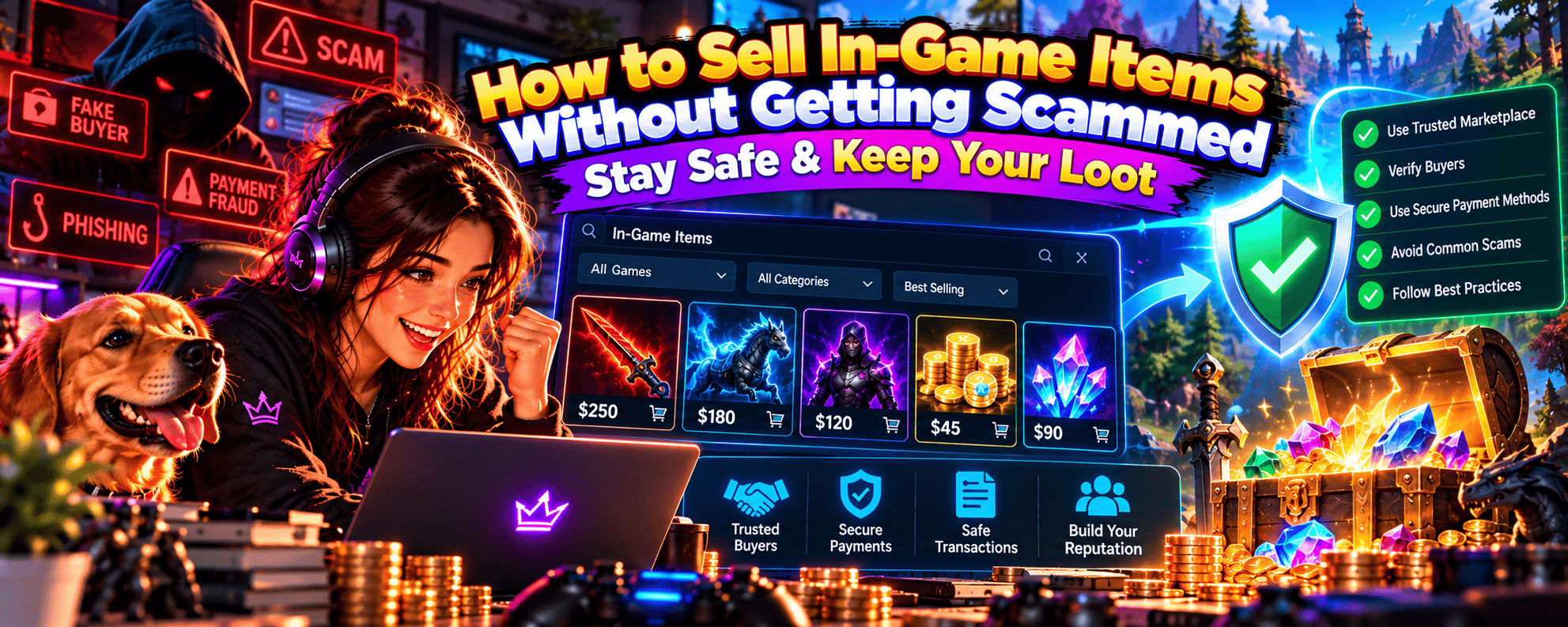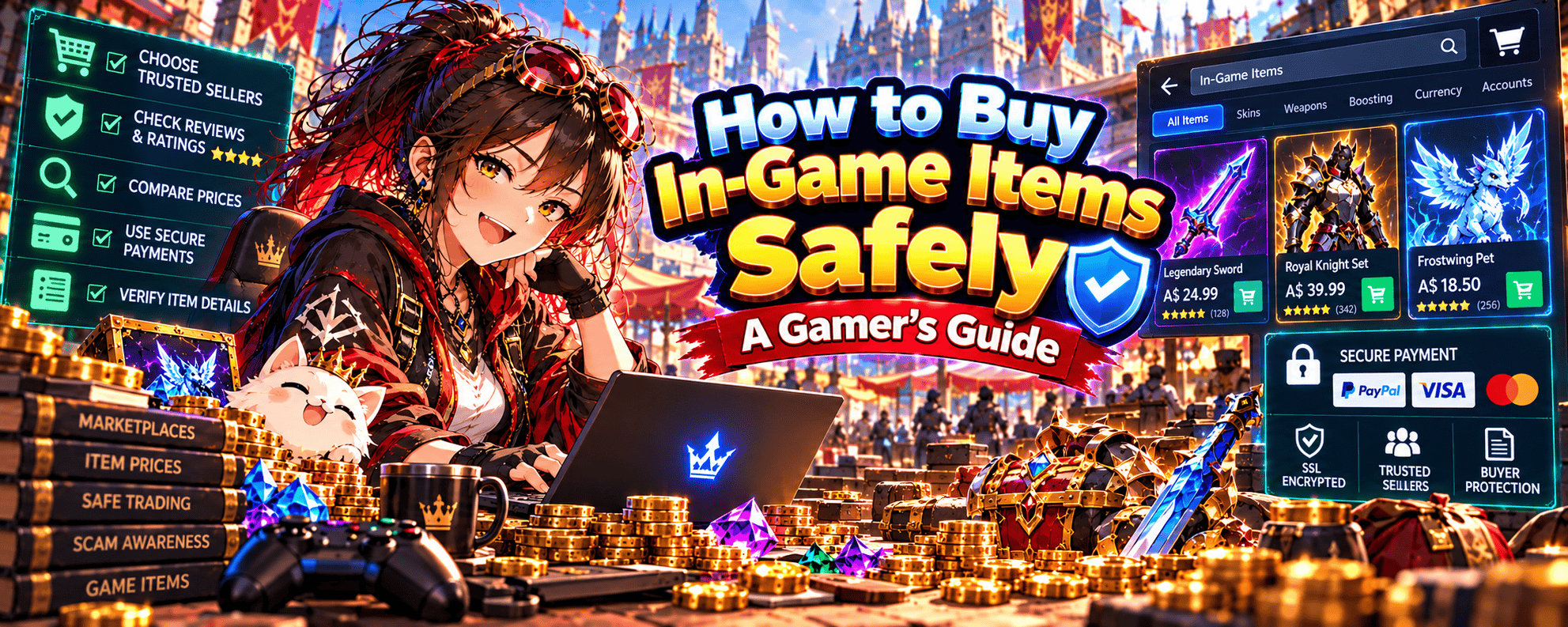
1. How to Buy In-Game Items Safely 🛡️
You’ve finally found it.
That legendary weapon you’ve been chasing for weeks. The rare Counter-Strike 2 skin that would complete your collection. Or perhaps a valuable in-game item that could give your character the upgrade it desperately needs.
There’s just one problem.
How do you know you’re buying from someone you can trust?
Buying in-game items can be an exciting way to customise your character, improve your gaming experience or get your hands on collectibles that would otherwise take hundreds of hours to earn.
But not every seller, marketplace or trading offer is legitimate.
From fake listings and phishing websites to stolen accounts and disappearing sellers, the risks are real.
Fortunately, learning how to buy in-game items safely doesn’t have to be complicated.
🎮 Why Do Gamers Buy In-Game Items?
Different players purchase virtual items for different reasons.
Some want to skip the grind. Others enjoy collecting rare cosmetics or finding equipment that suits their playstyle.
Common reasons include:
- Character Customisation: Buying skins, outfits and accessories to personalise your appearance.
- Gameplay Progression: Acquiring eligible weapons, equipment or resources to support your character.
- Collecting Rare Items: Finding limited-edition cosmetics, unusual collectibles and hard-to-obtain rewards.
- Saving Time: Purchasing items through permitted systems instead of spending hours farming resources.
- Trading and Collecting: Acquiring tradable items for personal collections or future exchanges.
- Supporting Creators: Purchasing eligible digital content through official creator marketplaces.
Whether you’re spending $5 or $500, the goal is the same: receive the item you paid for without putting your money or gaming account at unnecessary risk.
💎 What Makes Buying In-Game Items Risky?
Unlike buying a physical product, digital item transactions may involve account permissions, trading systems and virtual assets that can’t always be recovered.
For example, imagine purchasing a rare cosmetic from an unfamiliar seller.
You send the payment, but the seller never delivers the item.
Or perhaps you receive a trading link that looks legitimate, only to discover it’s a fake website designed to steal your account credentials.
Common risks include:
- Paying for items that never arrive.
- Receiving the wrong item.
- Purchasing items that cannot be transferred.
- Buying from impersonators or fraudulent sellers.
- Losing access to your gaming account.
- Using marketplaces that violate game rules.
- Falling victim to payment or trading scams.
These risks vary depending on the game, marketplace and transaction method.
🛡️ The Golden Rule of Buying In-Game Items
Always verify the item, seller, marketplace and transaction method before making a payment.
A legitimate-looking listing isn’t enough.
A seller with an impressive profile picture isn’t enough.
And a price that’s suspiciously cheaper than everywhere else?
That’s definitely worth investigating.
Before purchasing, you should understand:
- Whether the game permits the transaction.
- Whether the item is genuinely transferable.
- Whether the seller has a credible history.
- Whether the marketplace offers meaningful buyer protection.
- Whether the payment method is secure.
- How the item will be delivered.
- What happens if something goes wrong.
These checks can dramatically reduce avoidable risks.
⚔️ Are All In-Game Items Safe to Purchase?
No.
Different items come with different restrictions.
Some games allow players to purchase and trade eligible cosmetics, weapons or crafting resources.
Others prohibit transfers entirely.
For example, certain Counter-Strike 2 skins can be traded through Steam’s supported systems.
Meanwhile, Fortnite generally doesn’t allow players to transfer existing Locker cosmetics between accounts.
Even when an item is technically transferable, the intended transaction might still be restricted by the game’s terms.
Our What Are In-Game Items? Complete Guide explains the different types of virtual goods and how they work across modern games.
🏆 Is It Possible to Buy In-Game Items Without Getting Scammed?
Absolutely, although no purchasing method can eliminate every risk.
The safest approach is to use authorised systems, research unfamiliar sellers and avoid transactions that require you to bypass normal security procedures.
You don’t need to become a cybersecurity expert.
You just need to recognise the warning signs and understand how legitimate digital item transactions work.
Because that rare sword should be the most exciting part of your purchase.
Not wondering whether the seller has just disappeared with your money.
2. Where Can You Safely Buy In-Game Items? 🛒
Before purchasing an in-game item, one of the most important decisions is choosing where to buy it.
There are several different purchasing options, and each offers a different combination of convenience, item availability, restrictions and risk.
The best choice depends on the game, the item and whether the transaction is officially supported.
🎮 Official In-Game Stores
Official game stores are often the most straightforward purchasing option.
These stores are operated by the game developer, publisher or authorised platform.
Players can typically purchase eligible items directly through their gaming accounts.
Examples include:
- Fortnite’s Item Shop.
- Roblox’s supported avatar marketplace.
- Official in-game cosmetic stores.
- Developer-operated digital content stores.
- Supported game currency purchasing systems.
✅ Advantages of Official Stores
Official stores generally provide:
- Direct integration with your gaming account.
- Established payment systems.
- Clearer item delivery processes.
- Official customer support.
- Published purchasing and refund policies.
- Reduced exposure to third-party seller impersonation.
However, official stores aren’t automatically risk-free.
Players should still check item descriptions, account restrictions and purchasing conditions.
⚠️ Limitations of Official Stores
Official stores may not offer every item players want.
For example:
- Rare collectibles may no longer be available.
- Certain items may only appear during limited events.
- Player-created items may require separate marketplace systems.
- Some equipment can only be acquired through gameplay.
- Purchased cosmetics may be non-tradable.
This is why some gamers explore other purchasing options.
💎 Official Player Marketplaces
Some games and platforms operate marketplaces where eligible users can list items for other players to purchase.
For example, the Steam Community Market supports eligible items from participating games.
These systems can provide structured listings, transaction records and integrated item transfers.
However, buyers should understand the marketplace’s rules.
For example, Steam Community Market transactions use Steam Wallet funds, which generally cannot be withdrawn as cash.
Marketplace availability, trading restrictions and account eligibility may also affect purchases.
🔄 Direct Player-to-Player Trading
Some games allow players to exchange eligible items directly.
For example, an RPG might support trading through an in-game interface.
Depending on the game, players may exchange items for:
- Other items.
- In-game currency.
- Crafting materials.
- Equipment.
- Collectibles.
Direct trading can be convenient when the game provides a secure exchange system.
However, players should carefully inspect the final trade before confirming.
Some scams involve changing the offered item or quantity immediately before completion.
🌐 Third-Party In-Game Item Marketplaces
Third-party marketplaces connect buyers and sellers outside a game’s official store.
Depending on the platform, these marketplaces may offer listings for skins, equipment, virtual currencies or other gaming goods.
Some provide structured ordering, seller ratings and dispute processes.
However, a marketplace operating publicly doesn’t automatically mean its transactions are authorised by the game developer.
Before purchasing, check whether the game permits the intended transfer or sale.
Also investigate the marketplace’s reputation, payment arrangements and buyer protections.
For example, StackedGame provides a marketplace where sellers can list gaming-related products and services. Buyers should still check each listing’s terms, seller details and whether the transaction is permitted by the relevant game.
📊 Comparing In-Game Item Purchasing Options
| Purchasing Method | Main Advantage | Main Consideration |
|---|---|---|
| Official Game Store | Direct purchasing and account integration | Limited selection or non-tradable items |
| Official Player Marketplace | Supported listings and transactions | Platform fees and trading restrictions |
| Direct In-Game Trading | Exchange directly with other players | Requires careful trade verification |
| Third-Party Marketplace | Additional sellers and item selection | Marketplace credibility and game permissions |
| Unsolicited Social Media Offers | Sometimes attractive advertised prices | Higher impersonation and payment risks |
🎯 Which Purchasing Option Is Best?
For most gamers, an official or explicitly authorised purchasing system is the best starting point.
These systems generally provide clearer transaction procedures and better integration with the game.
However, when exploring other options, the priority should be verifying legitimacy and understanding the rules.
Our upcoming guide to Where to Buy In-Game Items Online will compare purchasing channels in more detail.
3. How to Check If an In-Game Item Seller Is Legitimate 🔍
You’ve found the perfect item.
The price looks reasonable, the listing has attractive screenshots and the seller claims to have completed hundreds of transactions.
Everything looks promising.
But how do you know the seller is genuine?
A legitimate seller should have a credible, consistent history and be willing to complete transactions through appropriate, permitted systems.
No single indicator guarantees legitimacy, so it’s important to consider several factors together.
⭐ Check the Seller’s Reviews and Ratings
Seller reviews can provide useful information about previous transactions.
Look for:
- A meaningful number of completed orders.
- Consistent feedback over time.
- Reviews describing successful delivery.
- Responses to customer concerns.
- Patterns of complaints or unresolved disputes.
Be cautious when a seller has only a handful of extremely enthusiastic reviews.
Fake or manipulated feedback can make unreliable sellers appear trustworthy.
A strong rating is useful, but it shouldn’t be your only consideration.
📅 Review the Seller’s Account History
An established seller account may provide more information than a newly created profile.
Consider checking:
- Account creation date.
- Previous listing activity.
- Completed transaction history.
- Consistency of advertised products.
- Marketplace verification indicators.
However, account age alone doesn’t guarantee legitimacy.
Established accounts can be compromised, and new sellers can be genuine.
Look for a combination of credible signals.
💬 Evaluate Seller Communication
Legitimate sellers should be able to answer reasonable questions about their listings.
For example:
- Is the item currently available?
- Is it eligible for trading?
- How will delivery work?
- Are there account or platform restrictions?
- What happens if delivery fails?
Be cautious if the seller avoids straightforward questions or pressures you to pay immediately.
A seller who becomes aggressive when you ask about buyer protection is giving you a reason to reconsider.
🔒 Watch for Requests to Move Off-Platform
One common warning sign is a seller attempting to move the transaction away from a marketplace’s supported checkout or communication system.
For example, they might claim:
- The marketplace is experiencing technical problems.
- They can offer a discount through a private payment.
- You need to contact them through an unrelated messaging app.
- Buyer protection isn’t necessary.
- You must pay directly before they can process the order.
Moving off-platform can remove important records and protections.
Where a marketplace offers an integrated purchasing process, it’s generally safer to use it.
💰 Be Suspicious of Unrealistic Prices
Everyone loves a bargain.
But a rare item advertised for a tiny fraction of its typical market price deserves extra scrutiny.
Suspicious pricing might indicate:
- A fake listing.
- An item that cannot actually be delivered.
- An attempt to collect payments quickly.
- Misleading item details.
- A compromised seller account.
Of course, not every discounted listing is fraudulent.
Some sellers simply want a quick sale.
The important thing is checking whether the price makes sense compared with similar legitimate listings.
🛡️ Check Seller Verification Carefully
Some marketplaces display verification badges or other credibility indicators.
These can be useful, but their meaning varies between platforms.
For example, verification might confirm an email address, identity information or particular account requirements.
It doesn’t necessarily guarantee that every listing is legitimate or that the seller will fulfil every order.
Before relying on a badge, check what the marketplace actually verifies.
📊 Legitimate Seller Signals vs Warning Signs
| Positive Signals | Warning Signs |
|---|---|
| Consistent transaction history | Newly created profile with unrealistic claims |
| Detailed, accurate listings | Vague or contradictory item descriptions |
| Clear delivery instructions | Unexplained or unusual delivery methods |
| Willingness to answer questions | Pressure to purchase immediately |
| Uses supported checkout systems | Requests for private payments |
| Credible customer feedback | Suspicious or repetitive reviews |
| Transparent terms | Refusal to explain restrictions |
🎮 What If the Seller Is New?
New sellers aren’t automatically suspicious.
Every legitimate seller starts with zero reviews.
If you’re considering purchasing from a new seller, focus on the safeguards available.
For example:
- Is the item clearly described?
- Does the marketplace provide a dispute process?
- Is payment handled securely?
- Is the delivery method permitted?
- Can the seller explain how the transaction works?
For expensive items, you may prefer sellers with an established history and stronger supporting evidence.
Our upcoming guide to How to Choose a Trusted In-Game Item Seller will explore seller verification and reputation checks in greater detail.
🏆 The Most Important Seller Check
Don’t rely on one impressive-looking number or badge.
Instead, look for consistency across the seller’s history, communication, listing details and transaction process.
A trustworthy seller should make the purchase easier to understand, not more confusing.
And if someone claims they’re the most trusted trader in gaming but needs your password to deliver a sword?
That’s your cue to leave.
4. How to Avoid In-Game Item Scams and Fake Listings 🚨
Gaming scams have become increasingly sophisticated.
Some involve obvious promises of free legendary items.
Others use convincing websites, copied seller profiles and realistic-looking trading interfaces.
Even experienced gamers can be caught out when a scam is designed to resemble a normal transaction.
The good news?
Many common scams follow recognisable patterns.
Learning those patterns can help you spot trouble before handing over your money or account access.
🎭 Scam #1: Fake Marketplace Websites
Fake marketplaces are designed to imitate legitimate trading platforms.
They may copy:
- Website layouts.
- Logos and branding.
- Login pages.
- Item listings.
- Seller profiles.
- Payment interfaces.
The goal is often to trick players into entering account credentials, approving malicious authentication requests or making payments.
How to avoid it:
- Navigate directly to trusted websites.
- Carefully check the domain name.
- Avoid unfamiliar links sent through private messages.
- Don’t assume a professional-looking website is legitimate.
- Never enter authentication or recovery codes into an unexpected website.
A secure connection symbol alone doesn’t prove that a website is trustworthy.
🔐 Scam #2: Account Verification Scams
A seller might claim that you must verify your account before receiving an item.
They may ask you to:
- Share your password.
- Provide a one-time authentication code.
- Approve an unexpected login request.
- Scan a suspicious QR code.
- Sign in through an unfamiliar website.
These requests can be attempts to take control of your gaming account.
Legitimate item delivery should not require giving another person your password or recovery credentials.
💎 Scam #3: Fake or Misleading Item Listings
Some fraudulent listings advertise items that don’t exist or misrepresent what will be delivered.
For example, a listing might show a rare cosmetic but actually offer a different variation.
Other misleading listings might involve:
- Incorrect item rarity.
- Wrong item quantities.
- Unavailable inventory.
- Non-tradable items advertised as transferable.
- Screenshots unrelated to the actual product.
- Hidden delivery conditions.
How to avoid it:
Read the full description and confirm the exact item before purchasing.
For valuable items, verify relevant identifiers, variants and other game-specific attributes.
🔄 Scam #4: Item Substitution During Trading
Item substitution scams involve changing the contents of a trade before completion.
Imagine agreeing to exchange currency for a rare weapon.
The seller initially displays the correct item.
But just before confirmation, they replace it with a cheaper version.
If you approve the trade without checking, you may receive something entirely different.
How to avoid it:
Inspect the final trade confirmation carefully.
Check the item name, quantity and relevant attributes immediately before approving.
Never assume that the final offer is identical to the one discussed earlier.
💰 Scam #5: Payment Outside the Marketplace
A seller may offer a discount if you pay through a separate method.
The deal might sound appealing.
However, off-platform payments can make disputes harder to resolve and may violate marketplace rules.
Be particularly cautious of requests involving:
- Payments to unrelated accounts.
- Cryptocurrency transfers without meaningful recourse.
- Gift cards.
- Unusual payment links.
- Transfers described as gifts or personal payments.
These methods can limit your ability to recover funds if something goes wrong.
🎮 Scam #6: Seller or Support Impersonation
Scammers sometimes pretend to represent well-known traders, marketplace moderators or official support teams.
They may copy usernames, profile images and other details.
For example, someone might contact you claiming your account has been flagged and you must transfer your items for inspection.
Legitimate support processes should not require transferring valuable items to an unknown person’s inventory for verification.
Always contact support through official channels rather than relying on unsolicited messages.
⚠️ Scam #7: Deals That Are Too Good to Be True
A rare collectible normally sells for $200.
Suddenly, someone offers it for $15.
They claim they’re quitting the game and need an immediate sale.
Could it be genuine?
Possibly.
But an unusually low price combined with pressure to act quickly is a major warning sign.
Scammers often use urgency to stop buyers from checking details.
📊 Common In-Game Item Scams
| Scam Type | How It Works | How to Protect Yourself |
|---|---|---|
| Fake Marketplace | Copies a legitimate website | Verify the domain and use trusted links |
| Account Phishing | Steals login credentials | Never share passwords or authentication codes |
| Fake Listing | Advertises misleading or unavailable items | Verify item details and availability |
| Item Substitution | Changes the offered item before confirmation | Inspect the final trade carefully |
| Off-Platform Payment | Moves payment outside supported systems | Use authorised checkout methods |
| Impersonation | Pretends to be a seller or support representative | Verify identities through official channels |
| Unrealistic Discount | Uses extreme pricing to attract buyers | Compare prices and investigate suspicious offers |
🛡️ What Should You Do If Something Feels Suspicious?
If a transaction doesn’t feel right, don’t rush.
Take a moment to:
- Stop the transaction.
- Verify the seller’s identity.
- Recheck the item details.
- Confirm the website address.
- Review the payment method.
- Contact official support if necessary.
You can also walk away.
There will usually be another item, another listing or another opportunity.
🏆 The Best Defence Against Gaming Scams
Most item scams rely on one of three things:
Trust, urgency or confusion.
A scammer wants you to trust an unfamiliar person, act before thinking or misunderstand what’s happening.
The simplest way to reduce your risk is to slow down and verify each part of the transaction.
Don’t let an exciting item or attractive price override basic security.
Because the only thing worse than missing out on rare loot is paying for it and getting absolutely nothing in return.
5. How to Check an In-Game Item Before Buying 💎
You’ve found a rare weapon skin, legendary piece of armour or valuable gaming collectible at a price you’re happy with.
The seller looks legitimate, and the marketplace seems trustworthy.
Time to buy?
Not quite.
Before purchasing any in-game item, make sure you’re getting exactly what you think you’re paying for.
Two items might look almost identical but have completely different values, trading restrictions or gameplay characteristics.
A few simple checks can help you avoid expensive mistakes.
🎮 Check the Exact Item Name and Description
Start by confirming the item’s full name.
Some games feature multiple variations of the same weapon, cosmetic or collectible.
These variations might differ in:
- Rarity.
- Appearance.
- Special effects.
- Equipment statistics.
- Item level.
- Upgrade status.
- Trading eligibility.
- Limited-edition attributes.
For example, two Counter-Strike 2 weapon skins might share the same basic design but differ significantly in condition, pattern or other collectible characteristics.
Always compare the listing against the exact item you’re looking for.
💎 Verify the Item’s Rarity
Rarity can influence how desirable an item is, but it doesn’t automatically determine its market value.
A rare item might be valuable because few are available.
Alternatively, it might have limited demand despite being difficult to obtain.
Check whether the advertised rarity matches the game’s actual classification.
Be particularly cautious when sellers use phrases such as:
- Ultra Rare.
- Exclusive.
- Limited Edition.
- One of a Kind.
- Legendary Collectible.
These descriptions can be legitimate, but they aren’t substitutes for verifiable item information.
⚔️ Check Item Statistics and Functionality
If you’re buying functional equipment, confirm that it suits your character or playstyle.
For example, an RPG weapon might have excellent damage statistics but require a character level you haven’t reached.
Similarly, an armour piece might provide bonuses that don’t benefit your build.
Before purchasing, check:
- Required character level.
- Equipment restrictions.
- Damage or defence statistics.
- Special abilities.
- Upgrade requirements.
- Class compatibility.
- Relevant game version.
The most expensive weapon isn’t necessarily the best weapon for your character.
And buying a legendary sword your character can’t equip?
That’s an impressive way to spend money on inventory decoration.
🎨 Inspect Cosmetic Variations and Condition
For cosmetic collectibles, small details can make a big difference.
Depending on the game, check:
- Cosmetic condition.
- Pattern or variation.
- Colour scheme.
- Special effects.
- Collectible identifiers.
- Stickers or additional decorations.
- Item-specific attributes.
For example, Counter-Strike 2 skins can have condition classifications and other attributes that affect collector demand.
A listing that shows a desirable variation but delivers a different one could leave you with an item worth considerably less.
Where supported, use official item inspection features before purchasing.
🔄 Confirm the Item Is Tradable
This is one of the most important checks.
An item might exist in a player’s inventory without being transferable.
Some items are:
- Account-bound.
- Character-bound.
- Temporarily trade-locked.
- Restricted to particular marketplaces.
- Permanently non-tradable.
If you’re purchasing an item from another player, verify that the intended transfer is supported.
Our guide to Tradable vs Non-Tradable In-Game Items explains these restrictions and why they matter.
🔐 Check for Account and Platform Restrictions
Some items only work within particular games, regions, platforms or account types.
For example, an item might require:
- A particular game edition.
- A compatible gaming platform.
- An eligible account.
- A specific character.
- A minimum account level.
- Completion of certain gameplay requirements.
Don’t assume an item will work with your account simply because you play the same game.
📊 In-Game Item Verification Checklist
| What to Check | Why It Matters |
|---|---|
| Exact Item Name | Prevents purchasing the wrong item |
| Rarity | Helps verify the advertised classification |
| Item Statistics | Confirms gameplay suitability |
| Cosmetic Condition | May affect appearance and market value |
| Special Attributes | Identifies important item variations |
| Tradability | Confirms whether transfer is possible |
| Account Compatibility | Helps prevent unusable purchases |
| Delivery Method | Confirms how the item will be received |
| Game Rules | Establishes whether the transaction is permitted |
🏆 The Best Way to Verify an Item
Whenever possible, compare the listing with information available through the game’s official systems.
Don’t rely entirely on screenshots or seller descriptions.
For expensive collectibles, take extra care to verify item-specific attributes before confirming the transaction.
The more valuable the item, the more important it is to check the details.
6. How to Compare In-Game Item Prices Before Purchasing 💰
You’ve found the item you want.
The seller is asking $75.
Is that a bargain, a fair price or an expensive mistake?
Without comparing similar listings, it’s difficult to know.
In-game item prices can vary significantly depending on rarity, demand, availability and marketplace conditions.
Learning how to compare prices can help you avoid overpaying while recognising suspicious offers.
💎 Why Do In-Game Item Prices Vary?
Several factors can influence an item’s asking price.
These include:
Rarity
Items with limited availability may attract higher prices.
Player Demand
Popular cosmetics, weapons and collectibles can command stronger prices.
Item Condition
In games with condition-based collectibles, different variations may have different market values.
Special Attributes
Unusual patterns, effects or other characteristics can influence collector interest.
Marketplace Activity
Prices can change as more buyers and sellers enter the market.
Game Updates
New content, balance changes and trading restrictions can affect demand.
Seller Pricing
Some sellers simply list items above or below typical market prices.
These factors can combine to create substantial price differences between otherwise similar items.
🔍 Compare Identical Items First
When researching prices, compare the exact same item whenever possible.
For example, don’t compare a common version of a weapon skin with a rare variation featuring desirable collectible attributes.
Similarly, two RPG weapons with the same name might have different statistics or upgrade levels.
Your comparison should account for:
- Item name.
- Rarity.
- Condition.
- Special attributes.
- Trading eligibility.
- Quantity.
- Game version.
- Relevant restrictions.
Comparing items that aren’t genuinely equivalent can produce misleading results.
📊 Look at Multiple Listings
One listing doesn’t establish an item’s market value.
A seller might be asking significantly more than other players.
Another might be offering an unusually low price.
Review several comparable listings to understand the typical asking range.
Where reliable transaction history is available, completed sales can provide additional context.
Remember that asking prices and actual sale prices aren’t necessarily the same.
A collectible advertised for $500 doesn’t automatically have a market value of $500.
Someone still needs to be willing and able to purchase it.
💰 Don’t Forget Marketplace Fees
Different marketplaces may charge different fees.
These can affect the final amount a buyer pays or the amount a seller receives.
For example, a listing might involve:
- Marketplace transaction fees.
- Payment processing fees.
- Currency conversion charges.
- Withdrawal restrictions.
- Other applicable costs.
Always check the final checkout amount before purchasing.
Also consider whether a marketplace balance represents withdrawable money or funds restricted to use within that platform.
For example, Steam Wallet funds generally cannot be withdrawn as cash.
⚠️ Why Are Some Items Suspiciously Cheap?
An unusually low price isn’t always a scam.
A seller might want a quick transaction or may have priced an item incorrectly.
However, extreme discounts can also be warning signs.
Possible explanations include:
- A fraudulent listing.
- Incorrect item information.
- Hidden trading restrictions.
- An unavailable item.
- A compromised seller account.
- A misleading variation or condition.
Before purchasing a suspiciously cheap item, investigate why the price differs so much from comparable listings.
🎮 How Do Game Updates Affect Prices?
Gaming markets can change quickly.
For example, a developer might release new cosmetic content that reduces demand for older items.
Alternatively, a discontinued collectible might attract additional interest.
Gameplay changes can also affect functional equipment.
A weapon that becomes more useful after a balance update may experience stronger demand in games where trading is permitted.
However, price movements aren’t guaranteed.
Trying to predict future item values can be risky.
🧠 Should You Wait for a Better Price?
Sometimes.
If an item is regularly available, comparing prices over time may help you identify more attractive offers.
However, waiting doesn’t guarantee a lower price.
An item might become more expensive, less available or subject to new trading restrictions.
For most gamers, a practical approach is to establish a budget and decide what the item is worth to you.
📊 Example Item Price Comparison
Imagine researching a particular tradable weapon skin.
You find the following hypothetical listings:
| Listing | Advertised Price | Important Detail |
|---|---|---|
| Seller A | $65 | Standard condition |
| Seller B | $72 | Same condition, established seller |
| Seller C | $110 | Different collectible variation |
| Seller D | $35 | Unusually low price, limited seller history |
Seller A and Seller B may provide the most useful comparison if the items are genuinely identical.
Seller C might justify a higher asking price because of its variation.
Seller D requires additional investigation because the price is substantially lower.
The cheapest listing isn’t automatically the best purchase.
🏆 How to Know If You’re Paying a Fair Price
A fair price depends on the item’s characteristics, available alternatives and your own budget.
Before buying:
- Compare identical items.
- Review several listings.
- Check completed sales where available.
- Account for marketplace fees.
- Investigate unusual price differences.
- Confirm the item is transferable.
- Avoid spending more than you’re comfortable losing access to.
Our upcoming guide to How to Check What an In-Game Item Is Worth explores item valuation in greater detail.
The goal isn’t always to find the cheapest item. It’s to find the right item at a reasonable price from a trustworthy source.
7. What Are the Safest Payment Methods for In-Game Items? 💳
You’ve verified the item, checked the seller and compared prices.
Everything looks good.
Now comes the part where real money changes hands.
Choosing a payment method is an important part of buying in-game items safely because different methods provide different levels of protection.
Some transactions may be eligible for payment disputes or refunds.
Others can be extremely difficult to reverse.
🛒 Use Official Checkout Systems Where Possible
Official game stores and authorised marketplaces generally provide structured payment processes.
These systems may include:
- Secure checkout pages.
- Transaction confirmations.
- Purchase histories.
- Customer support.
- Published refund policies.
- Fraud detection measures.
For example, purchasing eligible content directly through an official game store usually avoids the need to send money to an unfamiliar individual.
However, no payment system guarantees that every transaction will be problem-free.
Always verify that you’re using the genuine website or application.
💳 Are Credit and Debit Cards Safe?
Credit and debit cards can provide useful payment protections when used through legitimate merchants.
Depending on the card provider, transaction and circumstances, you may be able to dispute certain unauthorised transactions or purchases where goods weren’t supplied.
However, chargebacks aren’t guaranteed.
Eligibility depends on the relevant payment network rules, evidence and applicable time limits.
Before entering card details, verify the merchant and checkout page.
Avoid sending card information directly through messages or emails.
🔐 What About Digital Payment Services?
Some digital payment services provide buyer protection for eligible transactions.
However, coverage varies.
For example, certain payments may be excluded from purchase protection, while others may be eligible for dispute resolution.
Don’t assume every transaction receives the same protections simply because you recognise the payment provider.
Read the relevant terms before making expensive purchases.
💰 Are Cryptocurrency Payments Safe?
Cryptocurrency can be used for some digital transactions, but it carries additional risks.
Blockchain transfers are generally difficult or impossible to reverse once confirmed.
If you send funds to a fraudulent seller, recovering the payment may be extremely difficult.
Cryptocurrency transactions can also involve:
- Price volatility.
- Network fees.
- Incorrect wallet addresses.
- Fraudulent payment requests.
- Limited dispute options.
A seller insisting on cryptocurrency doesn’t automatically mean they’re fraudulent.
However, buyers should understand the lack of conventional payment reversal options.
🎁 Why Should You Be Careful With Gift Cards?
Scammers sometimes request payment using gift cards or prepaid codes.
These payment methods can be difficult to recover once the codes have been redeemed.
Be cautious if an unfamiliar seller asks you to purchase gift cards and send them the codes.
This is especially suspicious when the request is unrelated to the marketplace’s normal checkout process.
🚫 Avoid Unprotected Private Payments
Private payments to unfamiliar individuals can expose buyers to unnecessary risk.
For example, a seller might ask you to transfer money directly to a personal account before delivering the item.
If the seller disappears, recovering the payment may be difficult.
Similarly, falsely describing a commercial purchase as a personal gift may affect available protections and violate payment service rules.
Use the payment process supported by the legitimate marketplace whenever possible.
📊 Comparing Payment Methods
| Payment Method | Potential Advantage | Main Risk |
|---|---|---|
| Official Game Checkout | Integrated purchasing and support | Subject to store terms and restrictions |
| Credit or Debit Card | Potential dispute mechanisms | Chargebacks aren’t guaranteed |
| Eligible Digital Payment Service | May provide buyer protection | Coverage varies by transaction |
| Marketplace Wallet | Convenient within supported systems | Funds may not be withdrawable |
| Cryptocurrency | Supported by some sellers | Transfers generally irreversible |
| Gift Cards | Useful for authorised store purchases | Codes can be difficult to recover |
| Direct Bank Transfer | Straightforward payment method | Recovery may be difficult after fraud |
🛡️ How to Protect Your Payment Information
Before making a purchase:
- Verify the website address.
- Use the marketplace’s supported checkout.
- Avoid payment links from unsolicited messages.
- Never share card security codes through chat.
- Don’t provide banking passwords.
- Enable transaction notifications where available.
- Keep payment confirmations.
- Report suspicious transactions promptly.
🏆 Which Payment Method Should You Choose?
For most players, purchasing through an official or authorised checkout system using a supported payment method with appropriate dispute options is a sensible starting point.
The safest option depends on the merchant, transaction and available protections.
Never choose a payment method solely because the seller promises a discount.
Saving a few dollars isn’t worth losing your entire purchase.
8. How Does Safe In-Game Item Delivery Work? 📦
You’ve paid for your item.
Now you want it delivered.
Preferably before your next gaming session.
But digital item delivery isn’t always as simple as downloading a file.
Depending on the game, items may be added directly to your account, transferred through a trading interface or delivered using another supported method.
Understanding the process can help you identify suspicious requests and avoid delivery disputes.
🎮 How Are In-Game Items Usually Delivered?
Common delivery methods include:
Automatic Account Delivery
Official stores may add purchased content directly to your eligible gaming account.
Supported Player Trading
Eligible items may be transferred through an in-game or platform trading system.
Official Marketplace Transfers
A marketplace may process the transaction and transfer the item through supported systems.
Gifting Systems
Some games allow players to purchase eligible content as gifts for other accounts.
Other Authorised Delivery Methods
Certain games may support additional mechanisms, depending on their rules.
The important point is that the delivery method should be compatible with the game’s systems and permitted under its terms.
🔄 How Does Player-to-Player Delivery Work?
In games that support direct trading, the process might look something like this:
- The buyer and seller agree on the item and permitted transaction.
- Both players confirm that their accounts are eligible.
- The seller initiates a trade through the supported system.
- The buyer inspects the offered item.
- Both parties confirm the exchange.
- The system processes the transfer.
- The buyer verifies that the correct item has arrived.
The exact process varies by game.
Some systems include additional confirmations, trade holds or restrictions.
💎 Check the Item Before Accepting Delivery
Don’t rush through a trade confirmation.
Verify:
- Exact item name.
- Quantity.
- Condition.
- Rarity.
- Special attributes.
- Relevant item identifiers.
- Any additional agreed components.
For valuable collectibles, even a small difference can affect the item’s desirability.
If the final offer doesn’t match what you agreed to purchase, don’t approve it.
🔐 Never Share Your Login Credentials for Delivery
A legitimate transaction should not require giving an unfamiliar seller your password or recovery codes.
Be suspicious if someone claims they need to log into your account to transfer an item.
Similarly, don’t approve unexpected authentication requests or follow unfamiliar login links.
If a proposed delivery method requires sharing account access, it may create serious security risks and could violate platform rules.
⏳ What Are Trading Holds and Delivery Delays?
Some games and marketplaces impose temporary restrictions on item transfers.
These may exist to support account security, reduce fraud or manage marketplace activity.
For example, a newly acquired item might not be immediately eligible for another trade.
A seller should clearly explain relevant delivery restrictions before accepting payment.
Be cautious of anyone promising instant delivery when the platform’s rules make that impossible.
📦 How Do You Confirm an Item Has Arrived?
After delivery, check your inventory through the game’s official interface.
Confirm that:
- The item appears in the correct account.
- The item matches the listing.
- The quantity is correct.
- Relevant attributes match.
- The item is usable as expected.
- Any promised transfer has been completed.
Don’t rely solely on a screenshot sent by the seller.
Verify the item independently.
⚠️ What If the Seller Says Delivery Is Complete but Nothing Arrives?
If the seller claims the item was delivered but you can’t find it, avoid immediately sending additional payments.
Instead:
- Check the correct account and inventory.
- Review any official trade or transaction history.
- Confirm whether delivery restrictions apply.
- Save your order details and communications.
- Contact the marketplace’s official support.
- Use the available dispute process if necessary.
A legitimate seller should be able to provide relevant transaction information without requesting your password.
🚨 Watch Out for Fake Delivery Confirmations
Scammers sometimes send fabricated screenshots or messages claiming an item has been transferred.
Others may impersonate marketplace support and demand an additional payment to release the item.
Be particularly suspicious of requests for:
- Unexpected delivery fees.
- Account verification payments.
- Additional deposits.
- Authentication codes.
- Item transfers to supposed support accounts.
Always verify delivery information through official systems.
📊 Safe vs Suspicious Delivery Practices
| Safer Delivery Practices | Suspicious Delivery Practices |
|---|---|
| Supported in-game trading | Requests for account passwords |
| Official transaction records | Screenshots without verifiable transfers |
| Clear delivery conditions | Unexplained additional fees |
| Final trade confirmation | Pressure to approve immediately |
| Item verification through your inventory | Claims that verification is unnecessary |
| Official support channels | Unsolicited support impersonation |
🛡️ Why Delivery Verification Matters
A successful payment doesn’t necessarily mean a successful purchase.
The transaction is only properly fulfilled when the agreed item has been delivered under the applicable terms.
For valuable items, keep a record of the order and verify the result carefully.
Our upcoming guide to How to Trade In-Game Items Safely will explore secure trading practices, item verification and common trading mistakes in more detail.
🏆 The Final Rule of Safe Item Delivery
Never confirm that you’ve received the correct item until you’ve verified it through the game’s supported systems.
Check the details, follow the official process and keep your transaction records.
Because receiving your legendary weapon should be the moment you celebrate.
Not the moment you discover someone delivered a common wooden stick instead.
9. What Should You Check Before Buying From a Third-Party Marketplace? 🌐
You’ve found an in-game item marketplace offering hundreds of skins, weapons, rare collectibles and other gaming items.
The prices look competitive, the website looks professional and there are plenty of listings to explore.
But how do you know whether the marketplace itself is trustworthy?
Before buying from a third-party marketplace, check its reputation, security, buyer protections and compatibility with the game’s trading rules.
A legitimate-looking website doesn’t automatically guarantee a safe transaction.
🎮 Check Whether the Game Permits Third-Party Trading
This should always be your first consideration.
Different games have different rules governing virtual item sales and transfers.
Some games support player trading through official systems.
Others restrict real-money transactions or prohibit certain transfers entirely.
Before purchasing, confirm:
- Whether the item can be transferred between players.
- Whether third-party sales are permitted.
- Whether real-money transactions are allowed.
- Whether the proposed delivery method follows game rules.
- Whether purchasing could place your gaming account at risk.
An external marketplace cannot override restrictions imposed by a game developer.
For example, a website advertising Fortnite cosmetics doesn’t mean existing Locker items can legitimately be transferred between accounts.
⭐ Research the Marketplace’s Reputation
Look beyond the marketplace’s own promotional claims.
Search for independent information about its reputation, including:
- Customer experiences.
- Complaints about missing items.
- Payment disputes.
- Delivery problems.
- Account security concerns.
- Customer support responsiveness.
- Reports of misleading listings.
A handful of positive reviews shouldn’t be enough to establish trust.
Look for consistent feedback over time, while remembering that online reviews can be manipulated.
🔐 Check Website Security
Before creating an account or entering payment information, inspect the website carefully.
Look for:
- The correct domain name.
- HTTPS encryption.
- Clear contact information.
- Published terms and privacy policies.
- Recognisable payment processing methods.
- Secure account authentication options.
HTTPS is important for protecting information in transit, but it doesn’t prove that a business is legitimate.
Fraudulent websites can also use encrypted connections.
Be particularly cautious when accessing marketplaces through links sent by unfamiliar players.
💰 Understand Buyer Protection
Buyer protection can be one of the most important features of a marketplace.
However, not every marketplace offers the same protections.
Check whether the platform provides:
Order Tracking
Can you see the status of your purchase?
Dispute Resolution
What happens if the seller doesn’t deliver?
Refund Procedures
Under what circumstances can you request a refund?
Transaction Records
Can you access details of your payment and order?
Seller Accountability
Does the marketplace investigate complaints about sellers?
Customer Support
Is there a clear process for contacting support?
Don’t assume that every platform advertising secure transactions guarantees reimbursement.
Read the actual terms.
📜 Review Refund and Dispute Policies
Before making an expensive purchase, understand what happens if something goes wrong.
For example:
- What if the item isn’t delivered?
- What if the wrong item arrives?
- What if the seller disappears?
- What if the item cannot be transferred?
- What evidence is required for a dispute?
- Are there deadlines for reporting problems?
Clear policies make it easier to understand your options.
Also remember that applicable consumer protections may exist independently of a marketplace’s stated refund policy.
💳 Examine the Payment Process
A marketplace should explain how payments are handled.
Be cautious if the checkout process unexpectedly redirects you to an unrelated website or asks you to contact a seller privately.
Check the total price, including any applicable fees, before confirming payment.
If a marketplace offers an integrated checkout process, moving the transaction outside that system may reduce available protections.
📦 Understand How Items Are Delivered
Delivery methods vary depending on the game and marketplace.
Before purchasing, confirm:
- How the item will be transferred.
- Whether delivery requires player interaction.
- Whether trading restrictions apply.
- How long delivery is expected to take.
- What happens if delivery fails.
- How you can independently verify receipt.
Avoid transactions requiring you to disclose passwords, recovery codes or other sensitive account information.
📊 Third-Party Marketplace Safety Checklist
| What to Check | Why It Matters |
|---|---|
| Game Trading Rules | Confirms whether the transaction is permitted |
| Marketplace Reputation | Helps identify recurring problems |
| Website Security | Reduces exposure to phishing and credential theft |
| Seller Verification | Provides additional information about sellers |
| Buyer Protection | Explains what happens if an order fails |
| Refund Policy | Clarifies available remedies |
| Payment Process | Helps identify suspicious payment requests |
| Delivery Method | Confirms how the item will be transferred |
| Customer Support | Provides a way to resolve problems |
🏆 Should You Avoid Third-Party Marketplaces Entirely?
Not necessarily.
Third-party marketplaces can provide additional purchasing options for eligible digital goods.
However, their legitimacy, protections and permitted transactions vary.
The safest approach is to evaluate each marketplace individually rather than assuming all external platforms are either safe or unsafe.
A trustworthy marketplace should make its purchasing process, restrictions and dispute procedures easy to understand.
And if you need to complete six mysterious verification steps before receiving a $10 sword?
You might want to reconsider that purchase.
10. What to Do If You Get Scammed Buying In-Game Items 🚫
Nobody plans to get scammed.
You find a promising listing, complete the payment and expect your item to arrive.
But something goes wrong.
The seller disappears.
The item never arrives.
Or worse, you’ve entered your login details into a fraudulent website.
What should you do?
Act quickly, secure your accounts and preserve as much transaction evidence as possible.
The appropriate response depends on the type of scam.
🔐 Step 1: Secure Your Gaming Account
If you suspect your gaming account has been compromised, securing it should be your first priority.
Where possible:
- Change your account password using the official website or application.
- Change the password of your associated email account if it may also be compromised.
- Enable or reset multi-factor authentication.
- Review active login sessions.
- Sign out unfamiliar devices.
- Check connected applications and authorised services.
- Contact official account support.
If you’ve entered credentials into a phishing website, don’t wait for suspicious activity to appear.
Take action immediately.
💳 Step 2: Contact Your Payment Provider
If you’ve made a fraudulent payment, contact your bank, card issuer or payment service promptly.
Explain what happened and ask whether any transaction dispute or recovery options are available.
Depending on the payment method, you may be able to:
- Report an unauthorised transaction.
- Request an investigation.
- Initiate an eligible payment dispute.
- Seek advice about protecting your payment account.
However, refunds and payment reversals aren’t guaranteed.
For cryptocurrency transfers, recovery may be particularly difficult because confirmed blockchain transactions generally cannot be reversed.
📸 Step 3: Save Evidence of the Transaction
Before deleting messages or closing accounts, preserve relevant evidence.
Useful records include:
- Marketplace order numbers.
- Payment confirmations.
- Seller usernames.
- Item descriptions.
- Listing screenshots.
- Transaction dates.
- Trading records.
- Messages exchanged with the seller.
- Website addresses.
- Relevant account notifications.
This information may help marketplaces, payment providers or authorities investigate the incident.
🎮 Step 4: Report the Seller to the Marketplace
If the purchase occurred through a marketplace, use its official reporting or dispute process.
Provide a clear explanation of what happened.
For example:
- The seller failed to deliver the item.
- The delivered item didn’t match the listing.
- The seller requested an unauthorised payment.
- The account was impersonating another seller.
- The transaction involved a suspected phishing attempt.
Include supporting evidence where possible.
Avoid sending sensitive account credentials as part of a complaint.
🔄 Step 5: Check Your Trading History
If the scam involved an item transfer, inspect your official trading records.
Look for:
- Unexpected item transfers.
- Unfamiliar trading partners.
- Incorrect item quantities.
- Suspicious account activity.
- Transfers you didn’t authorise.
Contact the relevant game’s official support if you identify unauthorised activity.
Keep in mind that completed item transfers may not be reversible, depending on the platform’s policies and technical systems.
🚨 Step 6: Report the Scam to Relevant Authorities
Australian gamers can report scams through official channels.
Useful resources include:
- Scamwatch – Information about scams, reporting and recovery steps.
- ReportCyber – Reporting cybercrime to Australian authorities.
- IDCARE – Support for identity and cyber-related incidents.
If you’ve suffered financial loss or believe your identity has been compromised, these services may provide useful guidance.
🛡️ Step 7: Watch for Recovery Scams
Unfortunately, some scammers target victims a second time.
They may claim they can recover stolen items or funds in exchange for a fee.
Common warning signs include:
- Guaranteed recovery promises.
- Requests for advance payments.
- Demands for account passwords.
- Claims of special access to game administrators.
- Unsolicited messages from supposed recovery agents.
Be cautious of anyone promising to reverse transactions outside the platform’s official recovery procedures.
📊 What to Do After Different Types of Scams
| Scam Situation | Immediate Action |
|---|---|
| Item Never Delivered | Preserve evidence and open a marketplace dispute |
| Wrong Item Received | Record item details and contact support |
| Account Credentials Stolen | Secure account and email access immediately |
| Unauthorised Payment | Contact payment provider promptly |
| Items Transferred Without Permission | Check trading history and contact game support |
| Fake Marketplace Used | Secure accounts and report the website |
| Identity Information Exposed | Seek guidance from IDCARE and relevant authorities |
💰 Can You Recover Your Money or Items?
Sometimes, but recovery isn’t guaranteed.
Your options depend on:
- The payment method.
- The marketplace’s policies.
- The available transaction evidence.
- The game’s trading rules.
- Whether the transaction can be reversed.
- Applicable consumer protections.
Acting quickly can improve your chances of resolving certain problems.
However, it’s important to be realistic about the limitations of digital item recovery.
🏆 What Can You Learn From a Gaming Scam?
Being scammed can be frustrating, especially when you’ve lost valuable items or money.
The important thing is to secure your accounts, report the incident and identify how the scam occurred.
Understanding the warning signs can help you avoid similar problems in future.
And remember, a legitimate seller should never need your account password to deliver an item.
No matter how legendary that item supposedly is.
11. In-Game Item Buying Safety Checklist ✅
Buying in-game items safely doesn’t require complicated tools or endless research.
Most of the important checks can be completed before you spend any money.
Whether you’re purchasing a common cosmetic or an expensive collectible, following a consistent process can help reduce unnecessary risks.
🎮 Before You Start Shopping
Make sure you understand the item and the game’s rules.
- Confirm the game permits the intended purchase or transfer.
- Check whether the item is tradable.
- Understand any account or character restrictions.
- Decide how much you’re willing to spend.
- Research the item’s typical market price.
- Identify legitimate purchasing options.
If you’re unsure whether an item can be transferred, investigate before contacting sellers.
🔍 Before Choosing a Seller
Review the seller’s credibility.
- Check available reviews and transaction history.
- Look for consistent feedback over time.
- Read the full listing description.
- Verify the seller’s identity through the marketplace.
- Be cautious of newly created accounts making unrealistic claims.
- Avoid sellers who pressure you to purchase immediately.
- Investigate prices that seem unusually low.
Remember that positive reviews and verification badges aren’t absolute guarantees.
💎 Before Confirming the Item
Make sure the item matches your expectations.
- Verify the exact item name.
- Check rarity and condition.
- Confirm special attributes.
- Review gameplay statistics where relevant.
- Check platform compatibility.
- Confirm trading eligibility.
- Understand any delivery restrictions.
For expensive items, take extra time to verify collectible characteristics.
💳 Before Making Payment
Protect your money and account information.
- Use a legitimate, supported checkout process.
- Verify the website address.
- Check the final price and applicable fees.
- Review refund and dispute policies.
- Avoid unnecessary off-platform payments.
- Never share passwords or authentication codes.
- Keep your transaction confirmation.
Don’t allow a seller to rush you through payment.
📦 During Item Delivery
Verify each step of the transfer.
- Follow the game’s supported delivery process.
- Check the final trade offer.
- Confirm the item and quantity.
- Review any trade holds or restrictions.
- Avoid unexpected additional payment requests.
- Never provide account credentials.
- Keep relevant transaction records.
If something changes unexpectedly, stop and investigate.
🏆 After Receiving Your Item
Complete a final verification.
- Check that the item appears in your inventory.
- Confirm it matches the listing.
- Verify important attributes.
- Check that it’s usable as expected.
- Save your purchase records.
- Report any problems promptly.
- Leave accurate seller feedback where appropriate.
🚨 Five Warning Signs You Should Never Ignore
Even if everything else looks promising, reconsider a transaction when:
- The seller requests your password or authentication codes.
- The item is advertised as transferable despite game restrictions.
- The seller insists on an unusual payment method without a credible explanation.
- The listing details don’t match the item being delivered.
- You’re pressured to pay immediately without verifying the transaction.
Any one of these signs deserves additional scrutiny.
🛡️ The Simple Rule for Safer Purchases
Before completing any transaction, ask yourself:
Is the item legitimate, is the seller trustworthy, is the transaction permitted and is the payment process secure?
If you can’t confidently answer those questions, don’t rush.
A little extra research can save you from losing money, valuable items or access to your gaming account.
12. Buying In-Game Items Safely FAQ ❓
🎮 Is It Safe to Buy In-Game Items Online?
Buying in-game items online can be reasonably safe when you use legitimate purchasing systems, verify sellers and follow the game’s rules.
However, no marketplace or transaction method can eliminate every risk.
Always check the item, payment method and delivery process before purchasing.
🛒 Where Is the Safest Place to Buy In-Game Items?
Official game stores and explicitly authorised marketplaces are generally the best starting points.
They typically provide clearer purchasing procedures and direct integration with supported game systems.
Third-party marketplaces require additional checks concerning legitimacy, buyer protection and game permissions.
💎 How Do I Know If an In-Game Item Is Legitimate?
Verify the item’s name, rarity, condition, attributes and trading eligibility through reliable game information.
Where available, use official item inspection features.
Don’t rely entirely on screenshots supplied by sellers.
🔍 How Can I Tell If an In-Game Item Seller Is Trustworthy?
Look for consistent transaction history, credible reviews, accurate listings and clear communication.
Check whether the seller uses permitted delivery methods and supported payment systems.
Avoid relying on a single rating or verification badge.
💰 Why Are Some In-Game Items So Cheap?
Prices can vary because of seller preferences, item condition, supply and demand.
However, unusually low prices can also indicate fraudulent or misleading listings.
Compare equivalent items and investigate suspicious discounts.
💳 What Is the Safest Way to Pay for In-Game Items?
Using an official or authorised checkout system with a supported payment method and appropriate dispute options is generally a sensible approach.
Available protections depend on the merchant, payment provider and transaction.
Avoid sending money through unfamiliar payment links or unprotected private arrangements.
🔄 Can I Buy In-Game Items From Other Players?
Yes, where the game and platform permit the intended transaction.
Some games support direct player trading, while others restrict or prohibit item transfers.
Check the rules before purchasing.
🔐 Is It Safe to Give a Seller My Gaming Account Password?
No.
Never provide your gaming account password, recovery codes or authentication credentials to an unfamiliar seller.
Legitimate item transfers should use the game’s supported systems without requiring disclosure of sensitive account information.
⚔️ Can I Buy Weapons and Armour From Other Players?
In some games, yes.
Many RPGs and multiplayer games support trading eligible weapons, armour and resources.
However, some equipment is account-bound or character-bound, and real-money sales may be prohibited.
Always check the game’s rules.
🎨 Can I Buy Fortnite Skins From Other Players?
Fortnite generally doesn’t support transferring existing Locker cosmetics between accounts.
Although eligible purchases can sometimes be gifted through official systems, this is different from buying an existing skin directly from another player’s inventory.
Be cautious of sellers claiming they can bypass these restrictions.
🔫 Can I Buy Counter-Strike 2 Skins Safely?
Eligible Counter-Strike 2 skins can be purchased or traded through supported Steam systems.
Always verify the item’s attributes, inspect trade confirmations and understand any account or trading restrictions.
Third-party transactions may involve additional risks and require checking the applicable rules.
📦 How Long Does In-Game Item Delivery Take?
Delivery times vary.
Official purchases may be added automatically to an account, while player trades can involve additional steps or temporary restrictions.
Check the expected delivery process before paying.
🚫 What Should I Do If an Item Never Arrives?
Check your official transaction history and preserve your purchase records.
Contact the marketplace or seller through supported channels.
If the problem remains unresolved, investigate available dispute options with the marketplace or payment provider.
⚠️ Can I Get Banned for Buying In-Game Items?
Potentially, if the transaction violates the game’s rules.
Some games restrict real-money trading, account transfers or unauthorised marketplaces.
Check the applicable terms before purchasing.
💰 Can I Get a Refund for an In-Game Item Purchase?
Refund eligibility depends on the purchase, platform policies and applicable law.
In Australia, consumer protections may apply to eligible digital goods and services.
A marketplace’s refund policy doesn’t automatically exclude statutory consumer rights.
🛡️ What Is the Best Way to Avoid In-Game Item Scams?
Use legitimate purchasing systems, verify item details, research sellers and protect your account credentials.
Be cautious of unusual payment requests, suspiciously cheap listings and pressure to complete transactions quickly.
🎯 Final Thoughts: Buy In-Game Items Safely and Game With Confidence
Buying in-game items can be a great way to enhance your gaming experience.
Whether you’re searching for a rare cosmetic, upgrading your character’s equipment or adding another collectible to your inventory, finding the right item can be genuinely exciting.
But an attractive listing doesn’t automatically mean a safe purchase.
The smartest gamers verify the item, seller, marketplace and payment process before committing their money.
Understand the game’s trading restrictions, compare prices and use supported delivery methods whenever possible.
Most importantly, never compromise your account security for a supposedly amazing deal.
A little research can help you avoid scams, reduce unnecessary risks and make better purchasing decisions.
Because spending hours searching for the perfect legendary weapon is part of the adventure.
Spending hours trying to recover your account after buying it?
That’s a quest nobody wants.
Shop carefully, protect your inventory and enjoy your loot.