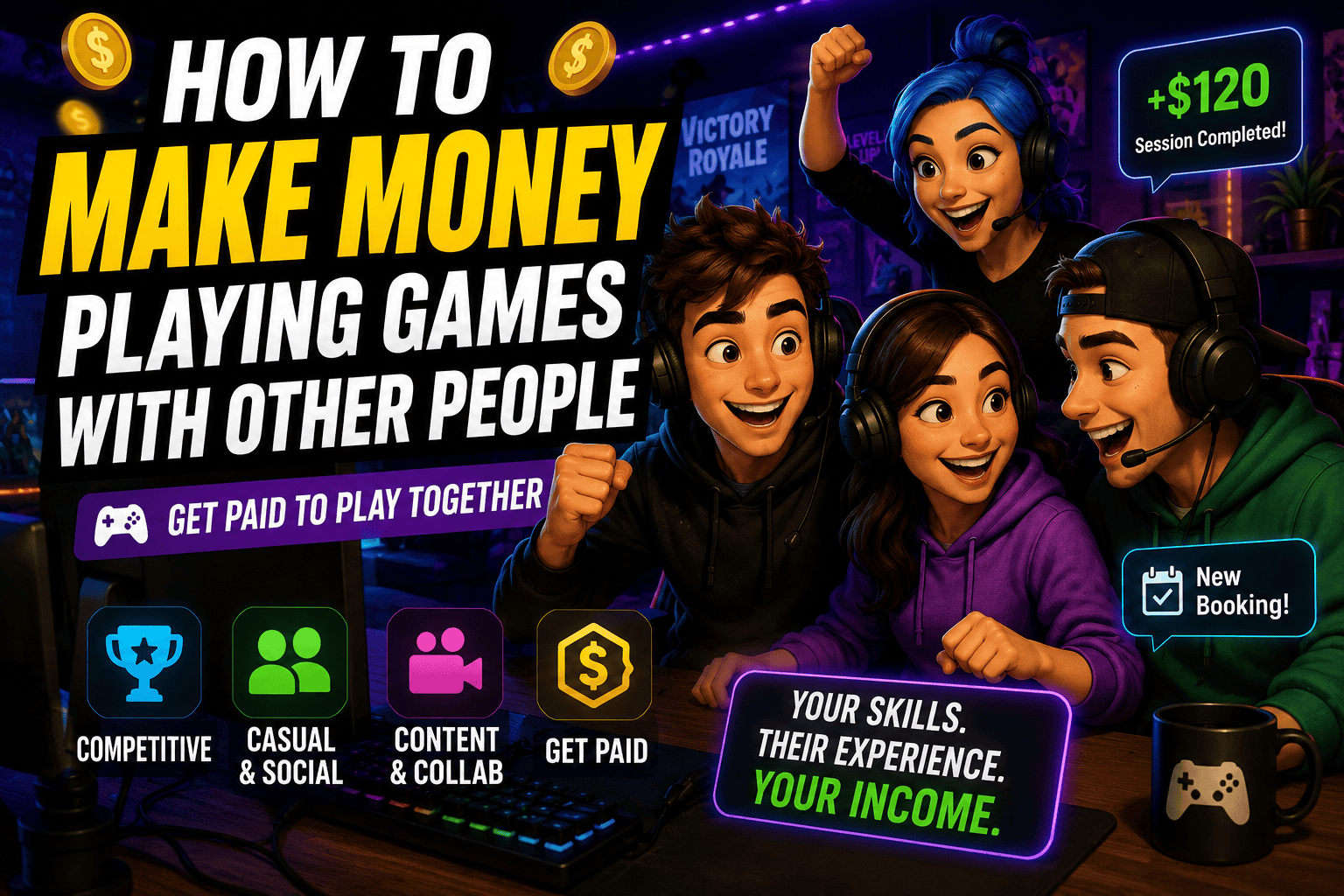
1. 🎮 Yes, You Can Get Paid to Play Games With Other People
Getting paid to play video games sounds like one of those ideas that should come with a catch.
Surely you need to be an esports professional?
Or a streamer with thousands of followers?
Or the kind of player who hasn’t seen daylight since ranked mode launched?
Not necessarily.
One of the more direct ways to potentially make money gaming is simply playing games with other people.
Not playing while thousands of people watch you.
Not necessarily teaching someone how to improve.
Actually joining another player in-game and creating an experience they’re willing to pay for.
🕹️ People Already Spend Money to Enjoy Games
Gamers regularly spend money improving their gaming experience.
They buy:
- 🎮 New games
- 🧩 Downloadable content
- 🎨 Cosmetics
- 🖥️ Better equipment
- 📚 Gaming guides
- 🧑🏫 Coaching
- 🎟️ Gaming events
Paying to play with another person follows a similar idea.
Sometimes the thing that would make someone’s gaming session better isn’t another skin or weapon.
It’s having the right person to play with.
👥 Maybe They Need a Teammate
Multiplayer games can be brilliant when you’ve got a good group.
They can be considerably less brilliant when matchmaking introduces you to three strangers who apparently have:
- No microphones
- No interest in the objective
- Completely different plans
- A mysterious personal grudge against teamwork
A player might prefer having someone reliable to join them.
That could mean helping with:
- Missions
- Raids
- Ranked matches
- Cooperative content
- Survival games
- Building projects
- Practice sessions
The value comes partly from knowing that the person joining them actually wants to be there and understands what they’re trying to do.
☕ Sometimes It’s About the Social Experience
Not every paid gaming session needs to be competitive.
Some players simply want someone enjoyable to game with.
Maybe their usual friends don’t play the same game.
Perhaps they play at unusual times.
Maybe they’re new and don’t want their first multiplayer experience to involve being yelled at by someone who’s been playing since 2014.
A friendly, patient and reliable gaming partner can provide value even without being an elite player.
That’s an important distinction.
Your value might come from:
🏆 Skill
🎧 Communication
😂 Personality
🤝 Teamwork
🧠 Game Knowledge
⏰ Reliability
Or, more realistically, a combination of several.
🎥 Creators Need People to Play With Too
Streamers, YouTubers and other gaming creators sometimes need additional players for content.
They might need someone for:
- Challenge videos
- Multiplayer recordings
- Roleplaying
- Custom matches
- Collaborative streams
- Gameplay demonstrations
- Large group content
In those situations, the value isn’t necessarily that you’re better at the game.
It might be that you’re entertaining, reliable and understand how to contribute to the content.
💡 You Don’t Need Millions of Followers
This is where paid gaming sessions differ significantly from many traditional gaming income ideas.
With streaming, building a large audience is usually part of the challenge.
With paid gaming sessions, you’re selling something much more direct:
your time + the experience of playing with you.
You might only need one customer for a session.
That doesn’t mean customers automatically appear because you’ve decided you’re available.
You’ll still need a compelling offer, sensible pricing, a strong profile and a way for players to discover you.
But the barrier to starting can be considerably different from trying to build an entertainment audience from scratch.
If you’re exploring other ways ordinary players can potentially earn without elite competitive skills, how to make money gaming without being a pro covers several other approaches.
For this guide, though, we’re focusing on one very specific idea:
getting paid for the experience of playing games with other people.
So what exactly is the customer buying?
2. 🔥 What Does Getting Paid to Play With Other Gamers Actually Mean?
At its simplest, getting paid to play with other gamers means offering bookable gaming sessions where another person pays for your time and participation.
They choose the experience.
You agree on the session.
Then you play together.
But what they’re paying for can vary considerably.
🎯 The Customer Is Buying an Experience
Imagine someone books you for a two-hour cooperative gaming session.
Technically, they’re paying you to play a video game.
But that’s not really the whole product.
They’re paying for things such as:
- Your time
- Your gaming ability
- Your communication
- Your reliability
- Your personality
- Your knowledge of the game
- Your teamwork
That’s why simply saying:
“Pay me to play Fortnite.”
isn’t a particularly compelling offer.
The customer needs to understand why playing Fortnite with you would make their session better.
🔫 You Could Be a Reliable Teammate
One type of session might be focused on completing gaming content.
Perhaps the customer needs another player for:
- Raids
- Missions
- Boss fights
- Cooperative objectives
- Competitive matches
- Difficult challenges
Your value might come from being experienced, prepared and dependable.
You’re not necessarily teaching the customer.
You’re playing alongside them.
☕ You Could Provide a Social Gaming Experience
Another customer may care much less about winning.
They might want:
- Someone friendly to game with
- Relaxed conversation
- A patient teammate
- Someone to explore a game with
- A regular gaming partner
In that situation, being enjoyable to play with could matter far more than your rank.
Nobody cares that you’re top 0.5% if spending an hour in voice chat with you feels like attending a disciplinary meeting.
🏆 You Could Be a Competitive Partner
Other sessions might be more performance-focused.
A customer could want:
- A strong ranked teammate
- A practice partner
- Someone for scrims
- An experienced duo
- A player with a particular role or skill set
Here, gaming ability becomes much more important.
Your rank, experience or competitive history may help establish why someone would choose you.
🎥 You Could Join Gaming Content
Creators provide another possibility.
A streamer or YouTuber might need additional players to:
- Record a challenge
- Fill a multiplayer lobby
- Participate in roleplay
- Help demonstrate something
- Join collaborative gameplay
You’re being paid to contribute to the creation of content rather than to build your own audience.
🎮 Paid Gaming Sessions Aren’t the Same as Coaching
This distinction matters.
Gaming Coaching
→ The customer primarily pays you to help them improve.
Paid Gaming Session
→ The customer primarily pays you to play with them.
There can obviously be some overlap.
An experienced teammate might offer tips during a session.
But if the main product is structured teaching, gameplay analysis and improvement advice, you’re moving closer to coaching.
📺 It’s Not Streaming Either
Streaming works differently again.
Streaming
→ An audience watches you play.
Paid Gaming Session
→ A customer participates in the gaming experience with you.
You don’t necessarily need followers, subscribers or a public audience.
The transaction can involve just two people:
👤 Player + 🎮 You = Booked Gaming Experience
That’s what makes this model particularly interesting for gamers who enjoy multiplayer games but don’t necessarily want to become content creators.
⚠️ Playing Together Isn’t the Same as Account Boosting
There’s another distinction worth establishing early.
Playing with a customer is different from logging into their account and playing for them.
Account sharing, boosting and similar activities may be restricted by particular games or platforms.
We’ll look at game rules and staying safe later in this guide.
For now, the model we’re discussing is straightforward:
The customer plays.
You play.
You create the experience together.
And there are several different reasons somebody might be willing to pay for that.
3. 💰 Why Would Someone Pay Another Person to Play Games With Them?
This is probably the first question most people have.
Why pay someone when multiplayer matchmaking exists?
Why not just find another player for free?
Because customers aren’t necessarily paying for access to a person.
They’re paying for a particular gaming experience.
🤝 Reliable Teammates Can Be Hard to Find
Random matchmaking is unpredictable.
Sometimes you meet fantastic teammates.
Other times you meet someone whose smoke detector needs a new battery, someone eating directly into their microphone and someone who disconnects after losing the first round.
A paid session can provide more certainty.
The customer can choose someone based on:
- Game
- Skill
- Role
- Personality
- Language
- Playstyle
- Availability
- Session type
They know who they’re playing with before the game begins.
🏆 They Might Want a Stronger Teammate
Some gaming content is easier with capable players.
That could include:
- Difficult cooperative missions
- Raids
- Ranked matches
- Boss encounters
- Competitive objectives
- High-level challenges
A customer may be perfectly capable themselves but want another experienced player alongside them.
The value is team strength and reliability.
🌱 They Might Be New to the Game
Multiplayer games can be intimidating for beginners.
Imagine buying a game everyone else has been playing for six years.
You load into your first match.
Your teammates start shouting terminology you’ve never heard before.
Someone asks why you’re using that build.
You don’t even know what build they’re talking about.
Having a patient gaming partner can make the experience much easier.
They can play alongside the beginner, help them understand what’s happening and make those first few sessions considerably less painful.
That’s not necessarily formal coaching.
Sometimes it’s simply supportive gameplay.
☕ They Might Want Company
Gaming is social.
But your real-life friends aren’t always available.
They might:
- Play different games
- Work different hours
- Live in different time zones
- Have stopped gaming
- Only play occasionally
A customer might simply want someone friendly and reliable to play with.
This can be especially relevant in games built around:
- Cooperation
- Exploration
- Survival
- Roleplay
- Building
- Long multiplayer sessions
The customer is paying for the shared experience.
🎯 They Might Want a Particular Type of Player
Maybe someone needs:
- A healer
- A tank
- A sniper
- A builder
- A raid leader
- An experienced survival player
- A specific competitive role
Finding a random person who fits exactly what they need can take time.
A marketplace listing can make that easier.
Instead of:
“Anyone online who can help?”
they can look for somebody already offering the experience.
🎥 They Might Need Players for Content
Gaming creators face a different problem.
A content idea might require:
- Four players
- Eight players
- A full lobby
- Someone capable of a specific role
- Someone comfortable speaking on camera
- Someone willing to follow the concept
Organising everyone can become half the project.
A reliable paid participant can help make that content possible.
⏱️ Convenience Has Value
This is a recurring theme across many online services.
People pay to save time.
A customer could spend an hour searching Discord servers for somebody suitable.
Or repeatedly queue until they find decent teammates.
Or organise friends who may or may not appear.
Sometimes paying for a scheduled session is simply easier.
The value equation might look like:
Right Player + Right Time + Right Experience = Worth Paying For
That doesn’t mean everyone will pay.
Plenty of gamers will always prefer free matchmaking or playing with friends.
You don’t need every gamer.
You need the ones who value what a paid gaming session can provide.
And those customers can be looking for very different experiences.
4. 🕹️ The Different Types of Paid Gaming Sessions
“Play games with me” is a very broad offer.
Two customers could book gaming sessions for completely different reasons.
One wants help beating difficult content.
Another wants a competitive ranked partner.
Someone else wants a relaxed Minecraft session.
A creator needs another person for a YouTube challenge.
Those aren’t really the same product.
That’s why it helps to think about paid gaming sessions in a few broad categories.
🔫 Hired Gun / Carry & Win
These sessions are focused around having a capable player alongside the customer.
That might involve:
- Completing difficult missions
- Tackling raids
- Winning cooperative content
- Helping with objectives
- Providing an experienced teammate
- Joining challenging gameplay
The emphasis is usually:
“I need somebody good to play alongside me.”
Skill and game knowledge matter.
But you’re still playing with the customer, not simply taking over their account.
🏆 Competitive
Competitive sessions focus more heavily on performance.
Examples could include:
- Ranked duo sessions
- Competitive teammates
- Scrim partners
- Practice sessions
- Tournament preparation
- Role-specific teammates
Here, customers are more likely to care about things such as:
- Rank
- Experience
- Communication
- Role
- Competitive history
- Playstyle
If you’re highly skilled at a particular game, this can be one of the more obvious ways to turn that ability into a bookable gaming experience.
🎥 Content & Collab
These sessions are built around creating something together.
A customer might be:
- YouTuber
- Streamer
- Gaming creator
- Community organiser
- Social creator
They could need someone for:
- Challenge videos
- Gameplay recordings
- Collaborative streams
- Roleplaying
- Custom games
- Demonstrations
- Group content
Being reliable and entertaining can matter just as much as being highly skilled.
If the creator says:
“We need six people online at 7 PM.”
the most valuable skill might simply be actually being online at 7 PM.
Never underestimate reliability.
☕ Casual & Social
This category is easy to overlook, but it’s one of the clearest examples of why paid gaming sessions don’t need to revolve around elite skill.
Casual sessions might involve:
- Relaxed multiplayer
- Exploring a new game
- Building together
- Survival gameplay
- Social gaming
- Helping beginners settle in
- Completing casual objectives
The emphasis is:
“I want someone enjoyable to play this game with.”
Personality, patience and communication become extremely important.
🎯 The Same Gamer Could Offer More Than One
You don’t necessarily need to fit permanently into one category.
Imagine you’re an experienced survival-game player.
You might offer:
🔫 Hired Gun Session
Help another player complete difficult content.
☕ Casual Session
Explore, gather resources and build together.
🎥 Content Session
Join a creator for a survival challenge video.
Same gamer.
Same game.
Different customer.
Different reason for booking.
📦 Think in Terms of the Experience
This is the important part.
Don’t start with:
“I’m good at games. How do I sell that?”
Start with:
“What experience could somebody book me for?”
That shift makes it much easier to turn gaming into a clear offer.
Throughout the next sections, we’ll look more closely at each type of session, starting with one of the most straightforward:
being the capable teammate somebody wants beside them when things get difficult.
5. 🔫 Get Paid as a Hired Gun or Gaming Teammate
Sometimes another player doesn’t need a teacher.
They don’t need a streamer.
They don’t need somebody to explain the theoretical history of optimal raid composition.
They need another player to log in, join the team and help get the job done.
That’s the basic idea behind offering yourself as a hired gaming teammate.
🎯 What Does a Hired Gaming Teammate Do?
The exact role depends on the game.
You might help another player:
- Complete difficult missions
- Tackle raids
- Beat bosses
- Finish cooperative objectives
- Progress through challenging content
- Improve team composition
- Win matches
- Gather resources
- Survive difficult areas
You’re bringing your gaming ability into their session.
🧠 Game Knowledge Can Matter as Much as Mechanics
Being mechanically talented helps.
But a strong teammate can bring other advantages too.
Maybe you know:
- The best routes
- Boss mechanics
- Mission objectives
- Enemy behaviour
- Useful equipment
- Team compositions
- Map layouts
- Efficient strategies
That knowledge can make the entire session smoother.
A player who knows exactly what’s happening can sometimes be more useful than somebody with incredible aim who spends the entire match sprinting in the wrong direction.
🤝 Reliability Is Part of What You’re Selling
Suppose someone is organising a raid at 8 PM.
They don’t just need a good player.
They need a good player who will actually arrive at 8 PM.
That means qualities such as:
- Punctuality
- Communication
- Preparation
- Patience
- Teamwork
can become part of your value.
Remember:
Skill gets attention.
Reliability gets repeat bookings.
🎮 Play Alongside the Customer
There’s an important boundary here.
The model we’re discussing is:
Customer Account → Customer Plays
Your Account → You Play
You’re joining them as another player.
That’s very different from taking control of the customer’s account and completing content on their behalf.
Some games and platforms restrict boosting, account sharing or commercial gameplay services, so always check the relevant rules before offering a particular type of session.
We’ll cover that more thoroughly later.
📦 Make the Session Specific
Instead of listing:
“I’ll help you in Destiny.”
you could create something much clearer:
90-Minute Destiny 2 PvE Teammate Session
Then explain:
- What activities you can help with
- Your experience
- Session duration
- Platform
- Communication method
- Requirements
- What isn’t included
Specific offers are easier for customers to understand.
🏆 You Don’t Have to Promise a Win
Be careful about guarantees.
You can offer:
- Your time
- Your experience
- Your skill
- Your best effort
- A strong teammate
You usually can’t control every possible outcome.
A competitive opponent might simply be better.
A raid group could make mistakes.
The game could disconnect.
Kevin could stand in the fire again.
Avoid promising outcomes you can’t guarantee.
🔄 One Game Can Produce Several Session Ideas
Suppose you’re highly experienced at an online RPG.
Your offers could eventually include:
⚔️ Dungeon Teammate
🐉 Raid Teammate
🌎 Exploration Partner
📦 Resource Farming Session
🌱 Beginner-Friendly Gameplay Session
Each solves a slightly different problem.
You don’t need to create all of them immediately.
Start with the type of session where your abilities are most valuable.
And if your strongest gaming ability is competitive play, there’s another version of the same idea:
getting paid to become the teammate someone wants beside them when winning matters.
6. 🏆 Get Paid for Competitive Gaming Sessions
If you’re genuinely good at a competitive game, that skill can become part of what makes playing with you valuable.
Some players don’t want to roll the matchmaking dice every time they queue.
They want a teammate who communicates, understands the game and can hold their own when the match gets sweaty.
That’s where competitive gaming sessions can fit.
🎯 What Could a Competitive Session Look Like?
Depending on the game, you might offer:
- 🏆 Ranked duo sessions
- ⚔️ Competitive team sessions
- 🎯 Practice matches
- 🧠 Strategy-focused gameplay
- 🤝 Scrim partnerships
- 🎮 Role-specific gameplay
- 🏅 Tournament preparation sessions
The customer is paying to play alongside a capable competitive player.
That’s different from paying someone to log into their account and increase their rank for them.
🔥 Skill Matters More Here
In casual gaming sessions, personality might be one of your biggest selling points.
Competitive sessions are different.
Customers are more likely to care about:
- Rank
- Win rate
- Competitive experience
- Main role
- Character or hero experience
- Game knowledge
- Communication
- Teamwork
If you’re advertising yourself as a strong competitive teammate, you need a credible reason for customers to believe it.
🎧 Communication Can Separate Good Players From Good Teammates
We’ve all played with someone who’s mechanically brilliant but communicates exclusively through sighing, blaming teammates and aggressively pinging the same location 14 times.
That’s not necessarily the person somebody wants to pay to spend two hours with.
A valuable competitive teammate can combine:
🏆 Skill
🎧 Communication
🤝 Teamwork
🧠 Game Knowledge
Being able to communicate calmly when things go wrong can be just as important as what happens when you’re winning.
🎮 Your Role Can Become Part of the Offer
Team-based games often create demand for particular roles.
Maybe you’re an experienced:
- Support
- Tank
- Healer
- Shot-caller
- Entry player
- Sniper
- Jungle player
- Raid leader
That specialisation can make your session more useful to a specific customer.
Instead of:
“I’ll play ranked with you.”
you might offer something closer to:
“Competitive support player available for ranked duo sessions.”
Now the customer immediately knows what you bring to the team.
🧑🏫 Competitive Play Can Overlap With Coaching
There will sometimes be overlap.
An experienced player will naturally give advice.
You might point out a positioning mistake or explain why a particular strategy isn’t working.
That’s fine.
The important distinction is what the customer is primarily booking.
Competitive Gaming Session
→ Play alongside me as a capable teammate.
Gaming Coaching
→ Analyse my gameplay and help me improve.
If the session becomes structured around teaching, feedback and improvement, you’re moving towards coaching rather than simply paid gameplay.
⚠️ Don’t Guarantee Rank or Results
Competitive games involve variables you can’t control.
Your teammates.
Your opponents.
Matchmaking.
Connection problems.
Balance changes.
And occasionally the mysterious force that causes everyone on your team to forget how the objective works during the promotion match.
Offer the customer your time, ability and effort.
Don’t promise guaranteed wins or guaranteed rank progression unless you’re genuinely able and permitted to make such claims – and in most cases, avoiding outcome guarantees is the safer approach.
🌱 You Don’t Need to Be an Esports Professional
Being valuable doesn’t necessarily mean being one of the best players in the world.
Suppose the customer is a beginner or intermediate player.
Someone substantially more experienced may already be a valuable teammate.
The question isn’t:
“Could I beat a professional player?”
It’s:
“Is my skill and experience valuable to the type of customer I’m targeting?”
For competitive sessions, the answer may depend heavily on your ability.
For other types of paid gaming, though, your rank can matter considerably less.
7. ☕ Get Paid for Casual and Social Gaming Sessions
Not every gamer wants to climb ranked.
Some people want to log in after work, explore a game, complete a few missions and have a genuinely enjoyable evening.
No screaming.
No blaming.
No post-match analysis explaining why their positioning at exactly 17:42 cost everyone the game.
Just gaming.
That creates a very different type of paid session.
🎮 What Is a Casual Gaming Session?
A casual or social gaming session focuses primarily on the experience of playing together.
That might include:
- ☕ Relaxed multiplayer
- 🌎 Exploring a game
- 🧱 Building together
- 🏕️ Survival gameplay
- 🚗 Open-world activities
- 🎲 Party games
- 🌱 Beginner-friendly sessions
- 💬 Social gaming
- 🧩 Cooperative objectives
The customer isn’t necessarily paying because you’re an elite player.
They may be paying because you’re someone they’d actually enjoy playing with.
😂 Personality Can Be a Gaming Skill
This is easy to underestimate.
If you’re:
- Friendly
- Funny
- Patient
- Easy to talk to
- Positive
- Welcoming to beginners
- Good at keeping conversation flowing
those qualities can contribute to the experience you’re offering.
Think about the people you naturally enjoy gaming with.
They’re probably not all the highest-ranked players you know.
Sometimes the person everyone wants in the lobby is simply the person who makes the game more fun.
🌱 Beginners Can Be a Natural Audience
Starting an established multiplayer game can be rough.
Everyone else appears to know:
- Every map
- Every item
- Every abbreviation
- Every unwritten rule
- Exactly where you’re apparently supposed to stand
A beginner-friendly gaming partner can make that first experience much more comfortable.
You don’t necessarily need to turn the session into formal coaching.
You can answer questions, explain what’s happening and help the customer enjoy the game while you play together.
🧱 Sandbox and Survival Games Can Fit Naturally
Social gaming isn’t limited to competitive multiplayer.
Think about games built around:
- Building
- Exploration
- Crafting
- Survival
- Farming
- Roleplay
- Open worlds
The activity itself can become part of the session.
For example:
2-Hour Minecraft Build & Chill Session
is much clearer than:
“I’ll play Minecraft with you.”
The first creates an expectation.
You’re going to join the customer, build something and have a relaxed gaming session.
That’s a product.
🎧 Set Expectations Around Communication
Social sessions can involve more interaction than performance-focused sessions.
Make it clear whether you offer:
- Voice chat
- In-game chat
- Text communication
- Discord communication
You should also establish appropriate personal boundaries.
Being friendly and social doesn’t mean customers are entitled to your private information or unlimited contact outside the booked session.
You’re offering a gaming experience.
Keep the relationship appropriate and professional.
🔄 Repeat Customers Could Matter
A good social gaming session isn’t necessarily a one-time purchase.
If someone enjoys playing with you, they may want to book again.
That’s where qualities such as:
Reliability + Personality + Good Communication + Enjoyable Gameplay
can become particularly valuable.
The customer knows what experience they’re going to get.
You become the gaming equivalent of that friend who actually responds when someone asks:
“Anyone online tonight?”
Except this time, it’s booked.
🎯 Casual Doesn’t Mean Low Value
Don’t assume competitive skill is the only thing worth paying for.
Different customers value different outcomes.
A ranked player may value your ability.
A creator may value your reliability.
A beginner may value your patience.
A social gamer may value your personality.
The important question is:
What makes the experience of playing with you better?
And for gaming creators, that answer can be something completely different again.
8. 🎥 Get Paid to Play With Streamers and Content Creators
Creating gaming content often looks like a solo activity from the outside.
Streamer.
Camera.
Game.
Done.
In reality, multiplayer gaming content frequently requires other people.
And finding the right people at the right time can be surprisingly difficult.
That’s where paid gaming collaborations can become another opportunity.
🎬 Creators Sometimes Need Players
Imagine a YouTuber planning:
“100 Players Attempt to Survive…”
There’s one fairly obvious problem.
They need players.
Other content ideas might require:
- 🎮 Multiplayer participants
- 🎭 Roleplay characters
- 🏆 Competitive opponents
- 🤝 Teammates
- 😂 Entertaining personalities
- 🧱 Builders
- 🔫 Skilled players
- 🎥 Background participants
- 🧪 Gameplay testers
A creator may already have friends or community members who can help.
But sometimes they need additional reliable people.
⏰ Reliability Can Be Extremely Valuable
Content production often runs on schedules.
If recording begins at 6 PM, the creator doesn’t want to spend the first 45 minutes messaging:
“Where are you?”
“Are you joining?”
“Hello?”
“You said you were definitely coming.”
Showing up on time, prepared and ready to participate can genuinely make you useful.
You don’t need to be the star of the video.
Sometimes being dependable is the feature.
😂 Understand What the Content Needs
Different creators want different things.
One might need highly skilled gameplay.
Another wants funny personalities.
Another needs players capable of following instructions during a complicated recording.
A useful participant can understand:
What’s the creator trying to make?
and:
How can I help make it work?
That might mean:
- Playing seriously
- Being entertaining
- Following a scenario
- Repeating a scene
- Staying in character
- Helping organise players
- Avoiding talking over important moments
You’re contributing to a production, not just joining a random multiplayer lobby.
🎥 Content & Collab Sessions Can Take Different Forms
Possible sessions could include:
- YouTube challenge participation
- Stream collaboration
- Multiplayer recording
- Custom game participation
- Roleplay sessions
- Gameplay demonstrations
- Creator challenges
- Tournament content
- Group recordings
Some could be one-on-one.
Others might involve larger groups.
🎮 You Don’t Need Your Own Audience
This is an important distinction.
You’re not necessarily being paid because you have 50,000 followers.
You might have 50.
Or five.
The creator is booking you because of what you contribute to their content.
That could be:
🏆 Gaming Skill
😂 Personality
🎭 Roleplaying
🧱 Building Ability
🎧 Communication
⏰ Reliability
This makes creator collaboration quite different from trying to make money by building your own streaming audience.
📦 Make the Offer Clear
Instead of advertising:
“Available for creator stuff.”
you could create something much more specific:
Gaming Content & Collaboration Session – Multiplayer Recording, Challenges and Creator Gameplay
Then explain:
- Games you play
- Platforms
- Whether you use voice chat
- Your gaming strengths
- Content you’re comfortable participating in
- Session duration
- Availability
That helps creators decide whether you’re suitable before booking.
⚠️ Discuss Expectations Before Recording
Creator sessions can involve additional considerations.
Before starting, make sure everyone understands relevant expectations around:
- Recording
- Voice use
- Streaming
- Content publication
- Session duration
- Behaviour
- Communication
- The planned activity
Nobody should discover halfway through the session that something they expected to remain private is being broadcast live.
Clear expectations protect everyone.
💡 Think Like a Collaborator
The best mindset isn’t:
“I’m being paid to play.”
It’s:
“I’m being paid to help this gaming session or piece of content succeed.”
That subtle difference can make you considerably more useful.
And whether you’re helping a creator, playing socially or competing in ranked matches, some games naturally lend themselves to paid sessions better than others.
9. 🎯 What Games Work Best for Paid Gaming Sessions?
Technically, you could offer to play almost any multiplayer game with someone.
That doesn’t mean every game has equal potential for paid sessions.
The strongest opportunities tend to appear where playing with the right person noticeably improves the experience.
👥 Look for Strong Multiplayer Interaction
Paid sessions make the most sense when players actually interact.
Games involving:
- Cooperation
- Teamwork
- Communication
- Competition
- Shared objectives
- Building
- Exploration
can naturally create reasons for someone to choose a particular teammate.
If two players barely interact, there’s less reason to care who the other person is.
🤝 Cooperative Games Can Work Well
Co-op games create obvious opportunities.
Customers may need help with:
- Missions
- Raids
- Bosses
- Progression
- Difficult objectives
- Resource gathering
The session has a clear purpose.
Customer Has Objective → You Join → You Complete It Together
That makes the value easy to understand.
🏆 Competitive Games Reward Skill
Games with ranked or competitive modes can create demand for capable teammates and practice partners.
Think about games involving:
- Ranked ladders
- Team composition
- Defined roles
- Communication
- Competitive strategy
The greater the importance of teamwork, the more valuable a reliable teammate can potentially become.
But remember the distinction between playing alongside someone and prohibited forms of account boosting or manipulation.
Always check the rules of the specific game and platform.
🌎 Sandbox and Survival Games Create Different Opportunities
Games don’t need ranked modes to work.
Sandbox and survival games can create sessions around:
- 🧱 Building
- 🗺️ Exploration
- ⛏️ Resource gathering
- 🏕️ Survival
- 🎭 Roleplay
- 🌱 Helping beginners
- 🏘️ Collaborative projects
These games can work particularly well for casual and social sessions because the experience isn’t entirely defined by winning.
🎥 Creator-Friendly Games Can Open Another Door
Some games naturally produce entertaining content.
Games with:
- Custom modes
- Large multiplayer lobbies
- Creative tools
- Roleplaying
- Sandbox systems
- Challenge potential
can work particularly well for Content & Collab sessions.
The creator isn’t necessarily booking the best player.
They’re booking the person who helps make the content work.
🎲 Social and Party Games Can Work Too
Not every paid session needs hundreds of hours of progression.
Social games, party games and other multiplayer experiences can fit when the appeal comes from:
- Conversation
- Humour
- Group interaction
- Friendly competition
- Shared experiences
Again, the product isn’t necessarily your skill.
It’s the experience.
🔍 Look for These Characteristics
Instead of asking:
“What’s the single best game for making money?”
look for games with several of these characteristics:
| Characteristic | Why It Helps |
|---|---|
| 👥 Multiplayer-focused | Playing together is central to the experience |
| 🤝 Strong teamwork | Reliable teammates become more valuable |
| 🏆 Competitive modes | Skilled players can differentiate themselves |
| 🧩 Difficult co-op content | Customers may want experienced help |
| 🌎 Sandbox gameplay | Creates social, building and exploration sessions |
| 🎥 Creator potential | Supports collaborative gaming content |
| 🔥 Active community | More potential players and customers |
| 🔄 Replayability | Gives customers reasons to book again |
A game doesn’t need every characteristic.
It simply needs to support a bookable experience somebody could reasonably value.
🎮 Start With Games You Already Know
Don’t immediately download whatever multiplayer game appears most popular and expect to sell sessions tomorrow.
Your existing experience matters.
If you’ve already spent hundreds of hours in a game, you may understand:
- The community
- The mechanics
- The terminology
- The typical player problems
- The best session opportunities
That knowledge gives you a head start.
The better question is often:
“Which games I already play give me something valuable to offer another player?”
Once you’ve identified the game, the next question becomes even more important:
Why would somebody choose you instead of another player?
10. 🧠 What Makes Someone Worth Paying to Play With?
You don’t need to be the greatest gamer alive.
But if somebody is going to pay to play with you, there needs to be a reason they choose you.
That reason will differ depending on the type of session.
🏆 Gaming Skill
For competitive and Hired Gun sessions, ability can be a major selling point.
You might bring:
- High rank
- Strong mechanics
- Game knowledge
- Competitive experience
- Role expertise
- Raid experience
- Efficient strategies
The harder the customer’s objective, the more relevant your ability becomes.
But skill is only one part of the equation.
🎧 Communication
A good gaming partner communicates.
That doesn’t mean narrating every thought you’ve ever had directly into the microphone.
It means being able to:
- Explain what’s happening
- Coordinate with teammates
- Listen
- Give useful information
- Stay calm
- Adapt your communication to the customer
This matters in competitive sessions, social gaming and creator collaborations.
🤝 Teamwork
Some highly skilled players are terrible teammates.
They chase personal statistics.
Ignore objectives.
Blame everyone else.
Then explain in great detail why the loss was definitely not their fault.
Customers booking a session usually want someone who helps make the whole experience better.
That means understanding when to:
- Lead
- Follow
- Support
- Adapt
- Let someone else take the spotlight
😂 Personality
For social and creator sessions, personality can become one of your strongest selling points.
Maybe you’re:
- Funny
- Relaxed
- Patient
- Encouraging
- Energetic
- Easy to talk to
You don’t need to invent an exaggerated online character.
Being pleasant to spend an hour with already puts you ahead of a surprisingly competitive field.
🧠 Game Knowledge
Knowledge can add value even when you’re not coaching.
Perhaps you know:
- Where to go
- What equipment to use
- How a mission works
- Which resources matter
- What new players should avoid
- How different systems interact
That can make a gaming session smoother and more enjoyable.
⏰ Reliability
This one isn’t exciting.
It’s also incredibly important.
If a customer books you for 7 PM:
Be there at 7 PM.
If you’re delayed, communicate.
If you can’t attend, give appropriate notice.
Someone who is slightly less skilled but consistently reliable can be more valuable than an amazing player who treats scheduled sessions as optional suggestions.
🌱 Patience
This matters particularly when playing with:
- Beginners
- Younger or less experienced players where permitted
- Casual gamers
- Players learning a new mode
- Customers unfamiliar with your preferred game
If someone makes a mistake, don’t make them regret booking you.
Remember that they may be paying partly to avoid exactly the sort of toxic experience they sometimes encounter in random matchmaking.
🔥 Your Value Is Usually a Combination
Most successful offers won’t rely on one characteristic.
Think:
🏆 Gaming Skill
🎧 Communication
🤝 Reliability
😂 Personality
🧠 Game Knowledge
=
🎮 Better Gaming Experience
You don’t need maximum stats in every category.
Different session types require different combinations.
A competitive customer may prioritise skill.
A beginner may prioritise patience.
A creator may prioritise personality and reliability.
A casual player may simply want someone friendly who enjoys the same game.
🎯 Ask What People Already Value About You
Think about your existing gaming group.
Why do people invite you?
Are you the person who:
- Carries difficult missions?
- Keeps everyone organised?
- Knows every game mechanic?
- Makes the group laugh?
- Helps beginners?
- Builds ridiculous things?
- Always fills the missing role?
- Actually turns up?
Those patterns can reveal what customers might value too.
And they lead to an important question for anyone looking at paid gaming sessions:
Do you actually need to be good at games to make this work?
11. 🌱 Do You Need to Be Good at Games to Get Paid?
If you’re planning to sell competitive gaming sessions, being good at the game obviously helps.
Nobody is searching for:
“Bronze-ranked teammate with questionable aim and strong opinions.”
But competitive ability isn’t the only reason somebody might pay to play with you.
As we’ve already seen, different customers are looking for completely different experiences.
🏆 Some Sessions Definitely Require Skill
If you’re offering yourself as:
- A competitive teammate
- A raid partner
- A Hired Gun
- A high-level PvE player
- A practice partner
your gaming ability becomes an important part of the product.
Customers need a reason to believe you can contribute at the level you’re advertising.
That might come from:
- Rank
- Experience
- Achievements
- Competitive history
- Hours played
- Specific role expertise
- Difficult content you’ve completed
Don’t exaggerate.
If you’re an intermediate player, don’t advertise yourself as elite and hope nobody notices.
They will.
Probably during the first match.
☕ Social Sessions Reward Different Strengths
Now imagine you’re offering:
2-Hour Minecraft Build & Chill Session
Does the customer really care whether you’re in the top 1% of Minecraft players?
Probably not.
They might care much more about whether you’re:
- Friendly
- Creative
- Patient
- Easy to talk to
- Good at building
- Familiar with the game
- Reliable
That’s a completely different value proposition.
🌱 Beginners Might Want Someone Patient, Not Elite
Suppose someone has just started playing a complicated multiplayer game.
Would they rather spend their first session with:
Player A:
Top-ranked, extremely skilled and becomes visibly annoyed every time they make a mistake.
or:
Player B:
Experienced, patient, explains things when asked and doesn’t treat every casual match like the grand final of an international tournament.
For that customer, Player B could easily provide the better experience.
🎥 Creators May Value Reliability and Personality
Content creators can have different priorities again.
Maybe they need somebody who:
- Shows up on time
- Follows instructions
- Talks naturally
- Understands the content idea
- Doesn’t constantly interrupt
- Is comfortable being recorded
- Can contribute entertaining gameplay
Being mechanically brilliant could help.
But if the creator needs a funny participant for a challenge video, your competitive rank may barely matter.
🎯 Match Your Ability to the Right Session
Instead of asking:
“Am I good enough to get paid to play games?”
ask:
“What type of paid gaming experience am I good enough to provide?”
That’s a much more useful question.
You might not be suited to selling high-level competitive sessions.
But perhaps you’d be excellent at:
- Casual gaming
- Beginner-friendly sessions
- Creator collaborations
- Building sessions
- Cooperative gameplay
- Social gaming
Your opportunity should match your actual strengths.
🧠 Don’t Fake Expertise
Be realistic about your ability.
If you’re selling competitive sessions, represent your skill accurately.
If you’re offering beginner-friendly gameplay, don’t suddenly market yourself as a professional coach.
Customers should receive the experience your listing promised.
Trust is difficult to build and remarkably easy to destroy.
💡 Ordinary Gamers Can Still Have Valuable Skills
This idea applies well beyond paid gaming sessions.
You don’t necessarily need esports trophies or a massive audience to find something valuable in the gaming experience you’ve accumulated.
If that’s something you’re exploring more broadly, how to make money gaming without being a pro covers other ways gaming knowledge, creativity and experience can potentially become income.
For paid sessions specifically, your next step is identifying what somebody might actually value about playing with you.
12. 🔍 Find the Gaming Experience You Could Sell
You now know there are several ways someone could potentially get paid to play with other people.
That doesn’t mean you should create listings for all of them.
Start with the gaming experience where you have something genuinely useful to offer.
🎮 Look at What You Already Do
Think about your normal gaming sessions.
What role do you naturally fall into?
Maybe you’re the person who:
- Organises raids
- Carries difficult missions
- Keeps everyone alive
- Explains mechanics
- Builds the base
- Leads the team
- Makes everyone laugh
- Welcomes new players
- Creates custom games
- Always joins when someone needs another player
Those behaviours can reveal where your value already exists.
You might have been providing the experience for free for years without ever thinking of it as something another gamer could book.
💬 Pay Attention to What People Ask You For
Repeated requests are useful signals.
Do friends regularly ask:
“Can you help me with this boss?”
“Can you join ranked?”
“Can you show me where to find this?”
“Can you help build this?”
“We need another person for the video.”
“Are you online tonight?”
One request doesn’t prove there’s a business opportunity.
But repeated requests can reveal what people already associate you with.
🧠 Separate the Skill From the Experience
Suppose your skill is:
Minecraft building
That’s not yet a paid gaming session.
Now connect it to a customer:
Skill: Minecraft building
↓
Customer: Player starting a survival world
↓
Problem: Wants help building a large base
↓
Experience: Two-hour collaborative building session
↓
Product: Minecraft Build Together Session
Now you’ve turned a general ability into something bookable.
🎯 Use a Simple Framework
Try:
What You’re Good At
↓
Who Needs It
↓
Why They Want You There
↓
What They Can Book
For example:
Competitive FPS Player
↓
Intermediate Ranked Player
↓
Needs a Reliable Duo
↓
90-Minute Ranked Duo Session
Or:
Friendly Survival Gamer
↓
Beginner Player
↓
Wants Help Exploring Without Pressure
↓
2-Hour Beginner-Friendly Survival Session
🔥 Solve a Specific Gaming Problem
Strong session ideas often solve a clear problem.
The customer might be thinking:
- “I need another player.”
- “I can’t complete this content alone.”
- “Random teammates are driving me insane.”
- “None of my friends play this game.”
- “I need people for a recording.”
- “I’m new and don’t know what I’m doing.”
Your session provides the answer.
🧪 Start With One Strong Offer
You don’t need:
12 games × 4 session types × 6 different durations
on day one.
That’s a scheduling spreadsheet waiting to become your new full-time enemy.
Choose one promising combination.
For example:
Game: Minecraft
Audience: Casual players
Strength: Building and social gameplay
Offer: 2-Hour Build & Chill Session
Get that right first.
Once you know what experience you want to sell, you need to decide exactly who you’re creating it for.
13. 👤 Choose Who You Want to Play With
A listing that says:
“I’ll play any game with anyone.”
sounds flexible.
Unfortunately, it also tells customers almost nothing.
A stronger paid gaming session is designed around a recognisable type of player.
🎯 Different Customers Want Different Experiences
Potential customers could include:
- 🌱 Beginners
- 🏆 Competitive players
- ☕ Casual gamers
- 🔫 Players needing experienced teammates
- 🎥 Content creators
- 🧱 Builders
- 🏕️ Survival players
- 👥 Groups needing another participant
Each one values something different.
A beginner might want patience.
A competitive player might want skill.
A creator might want reliability.
A casual gamer might want personality.
🔍 Narrow the Audience
You can narrow your customer by:
- Game
- Platform
- Skill level
- Session purpose
- Playstyle
- Role
- Experience level
For example:
Too Broad:
Fortnite players
Better:
Fortnite ranked players
Stronger:
Intermediate Fortnite players looking for a reliable ranked duo
Now you know exactly what kind of session to create.
🧠 Think About What That Customer Cares About
Once you’ve identified the customer, ask:
“What would make them choose one gaming partner over another?”
For a competitive player:
- Rank
- Communication
- Role
- Experience
For a beginner:
- Patience
- Friendliness
- Game knowledge
- Clear communication
For a creator:
- Reliability
- Personality
- Availability
- Comfort with recording
For a casual gamer:
- Shared interests
- Personality
- Communication
- Playstyle
Those priorities should eventually appear in your listing.
🎮 You Don’t Need Every Customer
This is important.
You aren’t trying to become the perfect gaming partner for everyone on Earth.
Maybe you hate competitive gaming.
Fine.
Don’t sell ranked sessions.
Maybe voice chat with strangers isn’t something you enjoy.
Then a heavily social session probably isn’t the right product.
Maybe you’re happiest spending three hours peacefully building medieval villages while discussing why nobody ever finishes the roof properly.
There are customers for specific experiences.
Build around something you can genuinely deliver well.
🤝 Make Sure the Customer Fits You Too
This isn’t only about what the customer wants.
You’re going to spend actual time playing with them.
Choose session types you’re comfortable delivering.
Think about:
- Games you enjoy
- Communication methods you’re comfortable using
- Session lengths you can manage
- Your preferred playstyle
- Personal boundaries
- Availability
A session that makes you miserable probably isn’t going to become a great side hustle.
🎯 Customer + Experience = Clearer Offer
A useful formula is:
👤 Customer + 🎮 Gaming Experience + ⏱️ Duration = Bookable Session
For example:
Beginner Minecraft Player
Relaxed Building Help
2 Hours
=
2-Hour Beginner Minecraft Build Together Session
Now you’re no longer vaguely offering your gaming time.
You’re creating something another person can understand and book.
14. 📦 Turn Playing Games Into Something People Can Book
This is where your idea becomes a product.
Saying:
“I’ll play games with you.”
isn’t enough.
Customers need to understand exactly what they’re booking.
🎮 Start With the Game
Make the game obvious.
For example:
Fortnite Ranked Duo Session
or:
Minecraft Build & Chill Session
If you offer several games, separate listings may sometimes make more sense than one enormous:
“I WILL PLAY 47 DIFFERENT GAMES WITH YOU”
listing.
Specific listings are easier to understand and easier to position for the right customer.
🎯 Define the Purpose
What is supposed to happen during the session?
Possible purposes include:
- Completing content
- Playing ranked
- Building
- Exploring
- Practising
- Recording content
- Social gaming
- Helping a beginner
- Tackling a raid
That purpose becomes the heart of the offer.
Compare:
“Play Call of Duty With Me”
with:
“90-Minute Ranked Call of Duty Duo Session”
The second creates much clearer expectations.
⏱️ Set a Session Duration
Customers should know how much gaming time they’re buying.
You might offer:
- 30 minutes
- 60 minutes
- 90 minutes
- 2 hours
The right duration depends on the game and activity.
A quick competitive session might work in an hour.
A complicated raid may need longer.
A casual building session could comfortably run for two hours.
🖥️ Specify the Platform
Make it clear where you play.
For example:
- PC
- PlayStation
- Xbox
- Nintendo Switch
- Mobile
If cross-play is supported, explain that too.
Don’t let the customer reach checkout before discovering you’re on completely incompatible platforms.
🎧 Explain How You’ll Communicate
Will you use:
- In-game voice
- Discord
- Text chat
- Platform voice chat
Communication can be central to the experience.
For competitive, social and creator sessions especially, customers should know what to expect.
📋 Explain What’s Included
A clear session might say:
🎮 Game: Minecraft
☕ Session: Casual Build & Chill
⏱️ Duration: 2 Hours
🎧 Communication: Voice or in-game chat
🧱 Includes: Collaborative building, exploration and casual gameplay
🌱 Experience: Beginner-friendly
That takes an abstract idea and turns it into something understandable.
⚠️ Explain What’s Not Included
This can be equally important.
For example:
- No account access
- No guaranteed wins
- No guaranteed rank increase
- No prohibited boosting
- No inappropriate communication
- No activities that violate game rules
Setting boundaries before purchase prevents misunderstandings later.
🔥 Give the Session a Reason to Exist
The strongest session listings aren’t just selling time.
They’re selling an outcome or experience.
Think:
Not:
“Pay me for 60 minutes.”
Instead:
“Book a reliable ranked teammate for your next 60-minute session.”
or:
“Spend two relaxed hours building and exploring with an experienced Minecraft player.”
The customer is buying the experience.
Your time is how you deliver it.
Once the offer is clear, there’s one question both you and the customer will eventually ask:
How much should it cost?
15. 💰 How Much Can You Charge for Paid Gaming Sessions?
There’s no universal hourly rate for playing games with other people.
A highly ranked competitive player, relaxed social gamer and experienced creator collaborator are selling very different experiences.
Your price needs to reflect what you’re offering and who you’re offering it to.
🎯 What Affects the Price?
Several factors can influence what customers may be willing to pay:
- 🏆 Gaming ability
- 🎮 Game
- 🔥 Demand
- ⏱️ Session duration
- 🎧 Communication
- 🧠 Experience
- 👤 Session type
- ⭐ Reviews and reputation
- 📅 Availability
- 🎥 Specialist skills
The more difficult your experience is to replace, the more pricing flexibility you may have.
🏆 Skill Can Increase Value
Competitive sessions may command different pricing from casual sessions because the customer’s reason for booking is partly your ability.
A highly ranked player offering specialist competitive sessions has a clearer skill-based differentiator than someone offering general multiplayer gameplay.
But don’t assume:
Higher Rank = Automatically Higher Price
The customer still needs a good experience.
Being incredibly talented doesn’t compensate for being late, rude or impossible to communicate with.
☕ Social Sessions Are Priced Around Experience
With casual gaming, value can come from:
- Personality
- Communication
- Reliability
- Patience
- Shared interests
- Game knowledge
That makes pricing less directly tied to rank.
The customer is paying for enjoyable gaming time rather than purely competitive performance.
🎥 Specialist Sessions Can Be Different Again
Creator collaborations may involve additional requirements.
Perhaps you need to:
- Be available at a specific time
- Participate in a long recording
- Follow detailed instructions
- Use voice chat
- Perform a particular role
- Repeat sections for recording
That additional complexity can affect how the session is priced.
⏱️ Hourly vs Fixed Session Pricing
There are two straightforward approaches.
Hourly Pricing
Example:
$15 per hour
Simple and flexible.
Fixed Session Pricing
Example:
90-Minute Ranked Duo Session – $25
This packages the experience more clearly.
For marketplace listings, fixed session offers can make it easier for customers to understand exactly what they’re buying.
📦 You Can Offer Different Durations
For example:
30 Minutes → Quick session
60 Minutes → Standard session
2 Hours → Extended session
You could potentially offer better relative value on longer sessions without making the pricing unnecessarily complicated.
Don’t create nine tiers with names like Bronze, Silver, Gold, Platinum, Diamond, Mythic and Ultimate Gamer Supreme unless there’s a genuine reason.
Keep it understandable.
🔍 Research Comparable Offers
Before choosing a price, look at what similar gaming experiences cost.
Compare:
- Same game
- Similar session type
- Similar skill level
- Similar duration
- Similar platform
Don’t automatically undercut everyone.
If another player charges less, that doesn’t necessarily mean you should.
Look at what they’re actually offering.
🌱 Introductory Pricing Can Help
When you have:
- No reviews
- No previous bookings
- No marketplace reputation
you might choose a slightly lower introductory price while establishing trust.
That doesn’t mean giving your time away.
The goal is to reduce some of the uncertainty for your first customers while still charging something that makes the session worthwhile for you.
💸 Remember Your Time Has a Cost
Unlike the digital products we discussed elsewhere, a paid gaming session requires new time for every customer.
If you sell ten two-hour sessions, you’re delivering 20 hours of gaming time.
That means your pricing needs to make sense relative to:
- Session time
- Preparation
- Scheduling
- Communication
- Platform fees where applicable
A $5 two-hour session may sound easy to sell until you realise you’ve created yourself a job paying less than the snacks you’re eating during it.
⚠️ Don’t Promise Financial Results
There’s no guaranteed amount you can earn from paid gaming sessions.
Actual income depends on:
- Demand
- Pricing
- Number of bookings
- Competition
- Your reputation
- Games offered
- Customer retention
Treat impressive earning claims cautiously.
Your first goal should be much simpler:
Create a gaming session somebody understands, values and is willing to book at a price that makes sense for you.
Once you’ve decided what you’re selling and how much it costs, the next challenge is making the listing convincing enough that somebody actually chooses it.
16. 📝 Create a Gaming Session Listing People Actually Want to Book
You’ve decided what type of gaming session to offer.
You know who it’s for.
You’ve chosen a duration and price.
Now you need to convince someone scrolling through listings that playing with you is worth booking.
A good gaming session listing shouldn’t leave the customer wondering:
“Okay… but what exactly happens after I buy this?”
Make the experience obvious.
🎯 Start With a Specific Title
Your title should communicate what you’re offering as quickly as possible.
Compare:
I’ll Play Games With You
with:
60-Minute Fortnite Ranked Duo Session
or:
2-Hour Minecraft Build & Chill Session
Specific titles help customers recognise whether the session matches what they’re looking for.
A useful formula is:
🎮 Game + 🎯 Session Type + ⏱️ Duration
You don’t have to follow that exact structure every time, but clarity beats cleverness.
👤 Explain Who the Session Is For
Help customers recognise themselves in the description.
For example:
Looking for a reliable teammate for ranked Fortnite? Book a 60-minute duo session with an experienced player who communicates, works with the team and keeps the session positive.
Or:
Want someone to build and explore with in Minecraft? This relaxed two-hour session is designed for casual players who want some company while they play.
The customer should quickly understand:
“Yes, this sounds like the kind of session I’m looking for.”
💡 Sell the Experience, Not Your Ego
Avoid writing an entire listing about how amazing you are.
Customers care about your experience and ability, but mainly because of what those things mean for them.
Instead of:
“I’m an incredible player with thousands of hours.”
try:
“I’ve played for more than 2,000 hours and can help you tackle difficult PvE content with an experienced, reliable teammate.”
The first is a claim.
The second explains the customer benefit.
🎮 Include the Important Gaming Details
Your listing should clearly explain things such as:
- 🎮 Game
- 🖥️ Platform
- ⏱️ Session duration
- 🎯 Session purpose
- 🎧 Communication method
- 🌱 Suitable skill levels
- 🏆 Your relevant experience
- 📅 Availability
- ⚠️ Any important requirements
If the customer needs a particular game version, server, rank or piece of content unlocked, tell them before they book.
📦 Explain What Happens During the Session
Give the customer an idea of the experience.
For example:
Before the Session
Confirm the game, platform and objective.
During the Session
Join the customer, communicate and play through the agreed activity.
After the Session
Wrap up when the booked time finishes and discuss another booking if they’d like to play again.
It doesn’t need to be complicated.
It just removes uncertainty.
🖼️ Use an Image That Matches the Offer
Your listing image should reinforce what you’re selling.
A competitive session could use visuals that communicate:
- Ranked play
- Teamwork
- Competition
A casual session might feel:
- Friendly
- Social
- Relaxed
A creator collaboration could focus more on:
- Streaming
- Recording
- Multiplayer content
The image shouldn’t promise something the session doesn’t deliver.
⭐ Include Relevant Experience
If your gaming experience supports the offer, mention it.
That could include:
- Rank
- Hours played
- Competitive experience
- Main role
- Raid experience
- Building experience
- Creator experience
Keep it accurate.
You don’t need to sound like you’re applying to become Commander of the International Gaming Federation.
Give the customer enough information to understand why you’re suitable.
⚠️ Set Clear Boundaries
Your listing should also make important limitations clear.
For example:
- No account sharing
- No guaranteed wins
- No guaranteed rank increases
- No prohibited boosting
- No inappropriate behaviour
- Session covers the stated duration
Boundaries aren’t there to make the listing unfriendly.
They help make sure both sides understand what they’re agreeing to.
🔥 Make the First Few Lines Count
Customers may initially see only part of your listing.
Use the opening to communicate:
What You Offer + Who It’s For + Why It’s Useful
Don’t spend the first paragraph saying:
“Hi guys, I’ve loved gaming since I was seven years old…”
Your story can help build your profile.
Your listing should start with the customer’s reason for booking.
And when you’re a brand-new seller, that listing has another job:
helping someone trust a gamer they’ve never met before.
17. ⭐ Build Trust When Nobody Has Played With You Yet
Every seller starts with the same awkward number of reviews:
zero.
No bookings.
No customer feedback.
No five-star rating.
Just you, your listing and the slightly uncomfortable knowledge that the first customer has to take a chance.
That’s normal.
The goal is to give them other reasons to feel confident.
👤 Create a Complete Profile
Your seller profile helps customers understand who they’re booking.
Include relevant information such as:
- Games you play
- Gaming experience
- Platforms
- Communication style
- Languages where relevant
- Session types
- Availability
You don’t need to write your autobiography.
Keep it relevant to the gaming experience you’re offering.
🎮 Be Specific About Your Experience
Specific information is more convincing than vague claims.
Compare:
“I’m really good at competitive games.”
with:
“I mainly play support in ranked Overwatch and have several years of competitive experience.”
The second gives the customer something concrete.
If rank is relevant, state it accurately.
If it isn’t, focus on whatever actually makes the session valuable.
🖼️ Make the Listing Look Complete
Trust isn’t built through words alone.
A listing with:
- Clear title
- Strong image
- Detailed description
- Complete profile
- Sensible pricing
- Clear availability
feels considerably more established than one containing:
“I’ll play anything. Message me.”
Even when neither seller has reviews yet.
💬 Respond Clearly to Questions
Customers may want clarification before booking.
Respond professionally.
If you don’t offer something, say so.
If you’re unsure whether you can complete a particular activity, don’t pretend otherwise just to secure the booking.
One disappointing sale isn’t worth damaging your reputation.
⏰ Reliability Builds Trust Quickly
Once somebody books you, the fastest way to demonstrate professionalism is remarkably simple:
turn up.
Be ready at the agreed time.
Know what you’re supposed to be playing.
Have your equipment working.
Don’t start downloading a 47GB update when the customer is already waiting in the lobby.
Preparation is part of the service.
⭐ Your First Reviews Matter
Early customers can help establish social proof.
If the platform allows reviews, provide a session genuinely worth reviewing.
Don’t manufacture feedback.
Don’t pressure customers into leaving positive reviews.
Real reviews are valuable because future customers can see that other people have actually booked you and had a good experience.
🌱 Start With Realistic Expectations
Your first listing may not immediately receive bookings.
You may need to:
- Improve the title
- Improve the image
- Clarify the description
- Adjust the price
- Offer better availability
- Promote the session
- Experiment with a different session type
That’s normal.
The first version is a starting point.
Trust grows through a combination of:
Clear Profile + Strong Listing + Reliable Delivery + Genuine Reviews
Once those pieces start working together, future customers have more reasons to choose you.
The next question is where they can actually find you.
18. 🌐 Where Can You Get Paid to Play Games With People?
There isn’t one universal place where every paid gaming session should be sold.
Different platforms give you access to different audiences and offer different levels of structure around listings, bookings and payments.
The important thing is to sell somewhere your actual customers are likely to look.
🎮 Gaming Marketplaces
Gaming-focused marketplaces are an obvious starting point.
The advantage is relevance.
Customers are already looking at gaming-related products, services or sessions.
That makes an offer such as:
60-Minute Ranked Duo Session
feel naturally at home.
A gaming marketplace can also give you a structured place to explain:
- What you offer
- Your price
- Session duration
- Availability
- Gaming experience
rather than trying to organise everything manually through messages.
👥 Gaming Communities
Communities can help people discover you.
That could include:
- Discord servers
- Game forums
- Reddit communities
- Gaming groups
- Guilds
- Clan communities
But check the rules before promoting anything.
A community being full of gamers doesn’t automatically mean commercial promotion is welcome.
There’s a big difference between contributing to a community and joining exclusively to paste:
PAID GAMING SESSIONS – CHEAP – DM ME 🔥
into six channels.
📱 Social Media
Social platforms can help you demonstrate what playing with you is actually like.
You might share:
- Gameplay clips
- Funny moments
- Competitive highlights
- Building projects
- Useful tips
- Creator collaborations
That content can give potential customers some sense of your:
- Personality
- Skill
- Communication
- Gaming style
You’re showing rather than simply claiming that you’re worth playing with.
🎥 Creator Networks
If your focus is Content & Collab sessions, relationships with gaming creators can become particularly useful.
Creators may need:
- Extra players
- Skilled participants
- Roleplayers
- Builders
- Competitive opponents
- Reliable collaborators
The more specialised your contribution, the easier it becomes to explain why someone might book you.
🖥️ Your Own Audience
If you already have:
- YouTube viewers
- Twitch followers
- Discord members
- Social followers
- Gaming community connections
you may be able to introduce paid sessions to people who already know you.
Trust can be easier when the customer is already familiar with your gaming personality or ability.
But an existing audience isn’t required.
⚖️ Compare the Trade-Offs
| Channel | Main Advantage | Main Challenge |
|---|---|---|
| 🎮 Gaming Marketplace | Customers already interested in gaming | Competing listings |
| 👥 Gaming Communities | Highly targeted audiences | Promotion restrictions |
| 📱 Social Media | Demonstrates personality and skill | Requires content and reach |
| 🎥 Creator Networks | Strong fit for collaborations | Relationship-driven |
| 🖥️ Own Audience | Existing trust | Requires an audience first |
You don’t necessarily have to choose one.
A customer might discover you through social content and eventually book through a gaming marketplace.
The channels can work together.
For StackedGame sellers, the marketplace is specifically structured around gaming sessions – including several of the experiences we’ve covered throughout this guide.
19. 🚀 Sell Paid Gaming Sessions on StackedGame
StackedGame is designed to connect gamers who have something to offer with gamers looking for gaming products, services and experiences.
For someone who wants to get paid playing with other people, Gaming Sessions are the relevant part of the marketplace.
Rather than simply advertising:
“I’ll play games with you.”
you can create a specific session around the experience you want customers to book.
🕹️ Choose the Right Type of Gaming Session
StackedGame’s gaming sessions are organised around four main types:
🔫 Hired Gun / Carry & Win
For players offering their skills as capable teammates for missions, difficult content and gameplay objectives.
🏆 Competitive
For ranked gameplay, competitive teammates, practice and other performance-focused sessions.
🎥 Content & Collab
For streamers, YouTubers and gaming creators looking for players to participate in content.
☕ Casual & Social
For relaxed gameplay, social sessions, exploration, building and other casual gaming experiences.
Choosing the right category helps customers understand why they would book you.
🎯 Turn Your Idea Into a Specific Listing
Suppose you enjoy Minecraft.
You could potentially offer:
☕ Casual & Social
2-Hour Minecraft Build & Chill Session
Or if you’re a highly experienced competitive FPS player:
🏆 Competitive
90-Minute Ranked Duo Session
The game may be important, but the experience is what turns it into a product.
📝 Complete the Important Details
When creating the session, make the key information clear.
That includes:
- 🎮 Game
- 🕹️ Session type
- 🖥️ Platform
- ⏱️ Duration
- 💰 Price
- 🎧 Communication
- 🎯 Session purpose
- 🏆 Relevant experience
- 📋 Requirements
- 📅 Availability
The easier the offer is to understand, the easier it is for a customer to decide whether it’s right for them.
📅 Set Availability You Can Actually Keep
Paid sessions are different from downloadable products.
The customer needs you to be available.
That makes scheduling part of the product.
Set times you can realistically commit to rather than making yourself appear available 24/7 and hoping you’ll somehow work it out later.
StackedGame sellers can use session availability to control when customers can book their time. The guide to setting your availability for gaming sessions and coaching explains how to configure and manage those available booking times.
🖼️ Make the Listing Visually Relevant
Your featured image should immediately communicate the type of gaming session.
If you’re selling:
Competitive gameplay → show competitive energy.
Casual gaming → make it welcoming and social.
Creator collaboration → communicate gaming content and teamwork.
Hired Gun sessions → focus on capable cooperative gameplay.
The listing should feel like the experience you’re selling.
⭐ Build Your Seller Reputation
Your first session is only one booking.
If the customer has a good experience, that can help you build:
- Reviews
- Repeat customers
- Seller reputation
- Better understanding of what players want
Over time, you might discover one type of session performs much better than the others.
Follow that demand.
You don’t need ten different gaming sessions if one strong offer consistently attracts the right customers.
🎮 Start With One Bookable Experience
If you’re completely new, keep it simple:
Choose One Game
↓
Choose One Session Type
↓
Choose One Customer
↓
Create One Clear Offer
↓
Set Your Availability
↓
Publish
That’s enough to start.
Your listing doesn’t need to represent every gaming skill you’ve developed since childhood.
It needs to give one type of customer one good reason to book you.
Once the session is live, however, publishing it is only half the job.
Somebody still needs to find it.
20. 🔎 How to Find Your First Paid Gaming Session Customers
Your session is published.
Your availability is set.
Your profile looks good.
You check the listing.
No bookings.
You refresh it.
Still no bookings.
You refresh it again because perhaps the internet needed encouragement.
Still nothing.
A new listing often needs help getting its first customers.
🎯 Start With the Right People
Don’t promote your session to “gamers”.
Promote it where the specific customer you’re targeting spends time.
If you’re offering:
Ranked Valorant Duo Sessions
you want competitive Valorant players.
If you’re offering:
Minecraft Build & Chill Sessions
you want Minecraft players interested in social or collaborative gameplay.
If you’re offering:
Gaming Content Collaboration
you want creators.
Specific offers make promotion much easier.
👥 Participate in Relevant Communities
Gaming communities can help, provided promotion is allowed.
Look for places where people are already discussing the problem your session solves.
For example:
“Anyone available for ranked?”
“Need another person for the raid.”
“Looking for people to record with.”
“Anyone want to build?”
These conversations reveal demand.
That doesn’t mean responding to every one with a payment link.
Understand the community rules and participate genuinely.
🎥 Show People What Playing With You Is Like
Content can be particularly powerful for paid gaming sessions because the product is you playing.
Share clips that demonstrate:
- Skill
- Personality
- Teamwork
- Communication
- Builds
- Funny moments
- Competitive highlights
If you’re selling social sessions, show that you’re enjoyable to play with.
If you’re selling competitive sessions, demonstrate your ability.
If you’re selling creator collaborations, show that you understand gaming content.
🧠 Give People a Reason to Remember You
Useful gaming content can also build familiarity.
You might post:
- Quick tips
- Game strategies
- Short tutorials
- Interesting builds
- Challenge clips
- Helpful answers
Someone might encounter your content several times before ever considering booking a session.
That’s fine.
Trust often develops gradually.
⭐ Your First Customer Is Particularly Valuable
Your first booking gives you more than the payment.
It gives you information.
You learn:
- Why they chose you
- What they expected
- What they enjoyed
- What confused them
- Whether the duration worked
- Whether the price felt appropriate
Ask for genuine feedback where appropriate.
That information can help improve your next booking.
🔄 Encourage Repeat Sessions Through Experience
Paid gaming sessions naturally have repeat-purchase potential.
If somebody:
- Enjoyed playing with you
- Needs help with more content
- Wants another ranked session
- Continues working on a build
- Regularly needs collaborators
they may book again.
You don’t need to aggressively sell the next session while the current one is still happening.
Deliver a good enough experience that another booking makes sense.
📊 Diagnose Why You’re Not Getting Bookings
If nothing is happening, don’t immediately slash your price.
Look at the problem.
Nobody Sees the Listing
→ Discovery problem
People See It but Don’t Open It
→ Title or image problem
People Open It but Don’t Book
→ Offer, trust, pricing or availability problem
People Book Once but Never Return
→ Potential session experience problem
Different problems need different fixes.
Lowering the price won’t fix a listing nobody can find.
Posting it everywhere won’t fix an offer nobody understands.
🌱 Don’t Try to Scale Before the First Sale
It’s easy to start thinking about:
“How can I get 50 bookings a week?”
before you’ve had one.
Start smaller.
Find One Customer
↓
Deliver One Great Session
↓
Learn From It
↓
Improve
↓
Find the Next Customer
Once you’ve repeated that process, you’ll have much better information about whether your session has real potential.
And when someone finally does book, the most important part begins.
Because getting the customer once is useful.
Delivering an experience they would happily book again is considerably more valuable.
21. 🎧 Deliver a Gaming Session People Want to Book Again
Getting your first booking is exciting.
But the real opportunity isn’t simply convincing someone to pay you once.
It’s creating an experience good enough that when they next want someone to play with, they think:
“I’ll book that person again.”
That’s where delivering the session properly matters.
⏰ Be Ready Before the Session Starts
If someone books you for 7 PM, don’t turn on your PC at 6:59 PM and discover:
UPDATE REQUIRED – 38.7 GB
Check everything beforehand.
Make sure:
- 🎮 The game is installed and updated
- 🎧 Your headset works
- 🌐 Your internet connection is stable
- 🕹️ Your controller or peripherals are working
- 💬 Any required communication software is ready
- 📋 You understand what the customer booked
The customer shouldn’t spend the first 20 minutes watching you troubleshoot your microphone.
💬 Confirm What the Customer Wants
Even with a detailed listing, it’s worth confirming the session objective.
A simple question such as:
“What would you like to focus on during the session?”
can prevent misunderstandings.
Perhaps they booked a Minecraft session because they want help building.
Maybe they booked a competitive session because they want a reliable teammate for ranked.
Perhaps they’re recording content and need you to follow a specific scenario.
Understand the objective before charging into the game with your own plan.
🎮 Match the Experience They Booked
Different sessions require different behaviour.
🏆 Competitive
Communicate, concentrate and play seriously.
☕ Casual & Social
Relax, talk and make the session enjoyable.
🎥 Content & Collab
Understand the creator’s concept and help make the content work.
🔫 Hired Gun / Carry & Win
Focus on the objective and contribute your gaming ability.
This sounds obvious, but expectations matter.
Someone booking a relaxed social session probably doesn’t want you conducting a detailed post-match performance review.
Likewise, someone booking competitive gameplay probably doesn’t want you wandering around admiring the scenery.
🎧 Communicate Without Taking Over
Good communication improves almost every multiplayer experience.
But there’s a balance.
You don’t need to narrate every button press.
You also shouldn’t dominate every decision unless that’s what the session requires.
Try to:
- Listen
- Communicate useful information
- Ask questions
- Adapt to the customer’s style
- Keep the atmosphere appropriate
- Give them space to enjoy the game
Remember that the customer isn’t an NPC in your gaming session.
You’re participating in their booked experience.
🌱 Be Patient With Different Skill Levels
Not everyone you play with will be at your level.
That’s especially important with beginners.
They might:
- Take longer to understand mechanics
- Make obvious mistakes
- Ask basic questions
- Get lost
- Use unusual equipment
- Completely ignore the route you assumed everybody knew
That’s okay.
If you’re offering beginner-friendly sessions, patience is part of what the customer is buying.
Don’t advertise yourself as welcoming to new players and then audibly sigh every time somebody asks what a crafting table does.
😂 Let Your Personality Come Through
Customers aren’t booking a robot.
If you’re naturally funny, relaxed or enthusiastic, let that become part of the experience.
You don’t need to manufacture an exaggerated gaming personality.
Being genuinely enjoyable to play with can be enough.
For social sessions in particular, personality can become one of the main reasons customers return.
⚠️ Handle Problems Professionally
Things can go wrong.
The game crashes.
Servers go down.
Someone disconnects.
Matchmaking takes forever.
Your internet decides that tonight is the perfect time to reconsider its career.
Stay calm.
If a technical problem significantly affects the session, communicate clearly and follow the marketplace’s relevant policies around resolving the issue.
Don’t simply disappear.
⏱️ Respect the Booked Time
If someone purchased a 60-minute session, give them the agreed session.
Keep track of the time without making the experience feel like they’re sitting beside a parking meter.
If the session is approaching the end, wrap things up naturally.
You can always mention that they’re welcome to book another session if they want to continue another time.
⭐ Learn From Every Booking
Your first few customers can teach you a lot.
After a session, think about:
- What went well?
- What did the customer enjoy?
- What questions did they ask?
- Was the session long enough?
- Was anything unclear?
- Did your listing accurately describe the experience?
- Would you change anything next time?
Small improvements can make future sessions considerably better.
🔄 Repeat Customers Start With the First Experience
You don’t need complicated customer-retention strategies.
Start with:
Turn Up
↓
Understand the Customer
↓
Deliver What You Promised
↓
Be Enjoyable to Play With
↓
Finish Professionally
↓
Give Them a Reason to Return
That’s the foundation.
Because when you’re selling paid gaming sessions, the product isn’t simply the game.
The customer already owns the game.
The product is the experience of playing it with you.
22. 🛡️ Stay Safe and Check the Game Rules
Getting paid to play games with other people sounds straightforward.
And often it can be.
But once money becomes involved, it’s important to understand the rules surrounding the game, platform and marketplace you’re using.
Not every gaming activity that players commonly discuss is necessarily permitted.
📜 Check the Game’s Rules
Different publishers and games have different policies around commercial gaming activity.
Before creating a session, check relevant rules such as:
- Terms of service
- End-user licence agreements
- Community guidelines
- Competitive rules
- Platform policies
Pay particular attention to restrictions involving:
- Account sharing
- Boosting
- Rank manipulation
- Real-money transactions
- Cheating
- Automation
- Exploits
Don’t assume something is permitted simply because other people are doing it.
🎮 Playing With Someone Is Different From Playing on Their Account
The model we’ve focused on throughout this guide is:
👤 Customer uses their account
🎮 You use your account
🤝 You play together
That’s very different from asking the customer for their login details and accessing their account.
Avoid requesting passwords or other sensitive account information.
If a service requires you to take control of another player’s account, stop and check whether the activity is permitted before offering it.
⚠️ Be Careful With Boosting and Rank Claims
Competitive gaming can create particularly sensitive areas.
There can be a difference between:
“Book me as your competitive teammate.”
and:
“Pay me and I’ll guarantee you reach Diamond tonight.”
Games may have rules around boosting, matchmaking manipulation or other competitive activities.
Your session should never depend on cheating, exploits or prohibited behaviour.
When in doubt, check the official rules for the specific game.
🔐 Protect Your Own Information
Customers don’t need access to your:
- Passwords
- Payment credentials
- Personal documents
- Home address
- Private accounts
- Other sensitive information
Use appropriate marketplace and gaming communication systems where possible.
Keep your gaming business separate from information customers don’t need.
🎧 Set Communication Boundaries
Social gaming can feel informal.
You’re talking.
Playing together.
Possibly joking around for a couple of hours.
But it’s still a paid interaction.
You can be friendly without giving customers unlimited access to your personal life.
Set sensible boundaries around:
- Contact outside sessions
- Private messages
- Personal questions
- Voice communication
- Social accounts
If someone’s behaviour becomes inappropriate, abusive or threatening, end the interaction where appropriate and use the platform’s available reporting or support processes.
👤 Consider Who You’re Comfortable Playing With
Some gaming interactions can involve age-related considerations.
Platforms, games and marketplaces may have age requirements.
Make sure your sessions comply with the rules that apply to the service you’re using and maintain appropriate boundaries during all interactions.
Don’t assume that because something happens inside a video game, normal standards around behaviour suddenly disappear.
💳 Keep Payments on the Platform Where Required
If you’re selling through a marketplace, follow its payment rules.
A customer offering:
“I’ll pay you directly if we move this off-platform.”
may sound convenient.
But moving transactions elsewhere can remove protections, violate marketplace terms or make disputes harder to resolve.
Use the intended booking and payment process.
🚫 Never Use Cheats or Exploits
This should be straightforward.
Don’t offer paid sessions that depend on:
- Cheats
- Hacks
- Bots
- Exploits
- Match fixing
- Other prohibited advantages
Apart from potentially violating game rules, you could put both your own account and the customer’s experience at risk.
🧠 Rules Can Change
Gaming policies aren’t static.
Publishers update terms.
Games change competitive systems.
Platforms revise their rules.
Something permitted today isn’t guaranteed to remain permitted forever.
If paid gaming becomes part of your side hustle, periodically check the rules for the games and platforms you’re using.
A simple principle helps:
If you’re unsure whether a gaming activity is allowed, check before you sell it.
That’s considerably easier than discovering the answer after somebody’s account has been restricted.
23. 📈 Turn Paid Gaming Sessions Into a Gaming Side Hustle
Your first paid gaming session doesn’t need to become a business empire.
It proves something much simpler:
somebody was willing to pay for the gaming experience you offered.
That’s useful information.
If customers enjoy the session and demand exists, you can gradually build from there.
🔄 Focus on Repeat Customers First
Finding new customers takes effort.
Someone who has already:
- Booked you
- Played with you
- Enjoyed the experience
- Trusted you
has considerably less uncertainty about booking again.
That’s why Section 21 matters so much.
A good session can naturally lead to another.
For example:
Week 1: Raid session
↓
Week 2: Another raid
↓
Week 3: New end-game content
↓
Week 4: Extended session
One satisfied customer can potentially become several bookings.
⭐ Build Your Reputation
As you complete successful sessions, your seller profile becomes stronger.
You may start accumulating:
- Reviews
- Repeat bookings
- Customer feedback
- Marketplace experience
- Better understanding of demand
That can make it easier for new customers to trust you.
Your early goal isn’t necessarily to maximise your price.
It’s to build evidence that your session is worth booking.
📊 Pay Attention to What Actually Sells
You might launch several ideas eventually.
Perhaps you expected your competitive sessions to perform best.
But customers keep booking your casual Minecraft sessions.
That’s useful.
Follow real demand rather than stubbornly sticking to what you originally predicted.
Look at:
- Which games receive interest
- Which session types get bookings
- Which durations customers prefer
- Which customers return
- Which listings receive views but don’t convert
- What customers repeatedly request
Those patterns can tell you where to focus.
💰 Increase Prices Carefully
As your reputation grows, you may decide your original price no longer reflects the value of your time.
Perhaps you’ve gained:
- Strong reviews
- Repeat customers
- Higher gaming rank
- More specialised skills
- Consistent demand
You can test higher pricing.
You don’t need to double your rates overnight because somebody left one five-star review.
Increase carefully and see how customers respond.
📦 Add Complementary Gaming Sessions
Once one offer works, you can expand around the same audience.
Imagine your successful session is:
60-Minute Fortnite Ranked Duo
You might later add:
90-Minute Fortnite Ranked Duo
or:
Fortnite Competitive Practice Session
The products make sense together.
Avoid building a catalogue that looks like you’ve randomly selected activities from your Steam library while blindfolded.
🎮 Expand Into Other Ways to Earn From Gaming
Paid gaming sessions can also sit alongside other gaming income streams.
Depending on your skills, you might eventually explore:
- 🧑🏫 Gaming coaching
- 🎨 Gaming creative services
- 📚 Digital gaming products
- 🎥 Gaming content
- 🧩 Mods or other downloadable resources
- 🛠️ Gaming services
You don’t need to pursue all of them.
But the same gaming knowledge that makes someone valuable as a paid teammate can sometimes support other opportunities too.
If your goal is to build something broader around your gaming time, gaming side hustles that actually work explores other ways gaming skills and experience can potentially become additional income.
⏱️ Remember That Sessions Don’t Scale Like Downloads
There’s an important limitation.
Every gaming session requires your time.
If you sell:
10 × 2-Hour Sessions
you need to deliver:
20 Hours of Gaming
That’s very different from selling a downloadable product that can potentially be purchased repeatedly without another two hours of fulfilment each time.
Your available time creates a natural ceiling.
That isn’t necessarily a problem.
It just means you need to manage:
- Availability
- Pricing
- Session duration
- Number of bookings
carefully.
🗓️ Protect Your Enjoyment of Gaming
This one matters.
Turning gaming into income changes the relationship slightly.
Playing because you feel like it is different from playing because someone has booked you for 8 PM.
If you overload your schedule, something you enjoy can quickly start feeling like another job.
Set availability that fits your life.
Leave yourself time to play games without being paid too.
Yes, apparently we’re recommending recreational gaming in an article about monetising gaming.
Balance has entered the chat.
🚀 Build Slowly Around What Works
A sensible progression might look like:
1️⃣ Create One Session
↓
2️⃣ Get Your First Booking
↓
3️⃣ Improve the Experience
↓
4️⃣ Earn Reviews
↓
5️⃣ Encourage Repeat Customers
↓
6️⃣ Refine Your Pricing
↓
7️⃣ Add Complementary Sessions
↓
8️⃣ Explore Other Gaming Income Streams
You don’t need to know what Step 8 looks like when you’re still at Step 1.
Start with the gaming experience you can deliver well today.
24. 🎮 Ready to Get Paid to Play Games With Other People?
Getting paid to play games with other people doesn’t require you to immediately become a professional gamer, famous streamer or full-time gaming entrepreneur.
You need something much more achievable to begin:
a gaming experience another person genuinely values.
Maybe you’re highly competitive.
Maybe you’re an excellent raid teammate.
Maybe you’re patient with beginners.
Maybe you’re brilliant at Minecraft building.
Maybe you’re entertaining on voice chat.
Maybe you’re the person who somehow manages to organise eight gamers and get all eight into the same lobby at the agreed time.
That last one may actually qualify as a supernatural ability.
Whatever your strength is, the opportunity starts by connecting it to the right player.
🔍 Step 1: Choose a Game
Start with something you already know well.
You understand the gameplay, community and what other players commonly need.
🧠 Step 2: Identify What Makes Playing With You Valuable
Ask yourself:
Why do people already enjoy or benefit from playing with me?
Maybe it’s:
- Skill
- Knowledge
- Personality
- Patience
- Teamwork
- Creativity
- Reliability
You don’t need all of them.
You need something relevant to the customer you want to serve.
👤 Step 3: Choose Your Customer
Don’t target:
“Gamers.”
Choose someone more specific.
For example:
Beginner Minecraft players who want relaxed building help.
or:
Competitive FPS players looking for a reliable ranked teammate.
Specific customers create clearer offers.
🎯 Step 4: Decide What They’ll Book
Turn your general ability into a defined session.
For example:
Game: Minecraft
Customer: Casual player
Experience: Collaborative building
Duration: 2 hours
Session: 2-Hour Minecraft Build & Chill
Now you have something sellable.
💰 Step 5: Set a Sensible Price
Research comparable offers.
Consider:
- Your experience
- Session duration
- Demand
- Skill
- Competition
- Time commitment
Your first price doesn’t need to be permanent.
You can learn and adjust.
📅 Step 6: Choose Your Availability
Decide when you can realistically deliver sessions.
Don’t advertise times you’re unlikely to keep.
Reliable availability is part of the customer experience.
📝 Step 7: Create Your Listing
Make the offer immediately understandable.
Your customer should quickly know:
🎮 What are we playing?
🎯 What are we doing?
⏱️ How long is the session?
💰 What does it cost?
👤 Why should I choose you?
Remove uncertainty wherever possible.
📣 Step 8: Find Your First Customer
Don’t wait forever for somebody to magically discover you.
Promote your session appropriately.
Participate in gaming communities.
Show your gameplay.
Create useful content.
Build relationships.
Help the right players discover what you’re offering.
⭐ Step 9: Deliver a Great Session
When someone books:
Turn up.
Be prepared.
Understand what they want.
Deliver what you promised.
Make the experience enjoyable.
Your first customer can become your first review and potentially your first repeat customer.
📈 Step 10: Learn and Improve
After each booking, look at what happened.
What worked?
What didn’t?
What did the customer value?
What could make the session better?
Use that information to improve your:
- Listing
- Price
- Session
- Availability
- Customer experience
Then do it again.
🚀 Your Path From Gamer to Paid Gaming Sessions
The whole process can be surprisingly simple:
🎮 Choose a Game
↓
💡 Identify Your Value
↓
👤 Choose a Customer
↓
📦 Create a Session
↓
💰 Set Your Price
↓
📅 Set Your Availability
↓
📝 Publish Your Listing
↓
🔎 Find a Customer
↓
🎧 Deliver a Great Experience
↓
📈 Improve and Repeat
You don’t need thousands of followers.
You don’t need to quit your job.
You don’t need to convince the entire gaming community that paying someone to play with them makes sense.
You need one type of player who values one type of gaming experience you can provide.
Start there.
Create one clear session.
Find your first customer.
Then see where playing games with other people can take you. 🎮