1. Introduction + Quick Answer
Getting your first gaming coaching client is often harder than the coaching itself.
Why? Because when you’re just starting out, you probably don’t have reviews, referrals or a reputation to lean on yet. Players don’t know how good you are, what you’re like as a coach or whether your coaching is worth paying for.
The good news? Every successful gaming coach started at zero.
You don’t need a huge following or hundreds of clients to get started. You need a clear offer, a place for players to find you and enough trust to convince that first player to give your coaching a shot.
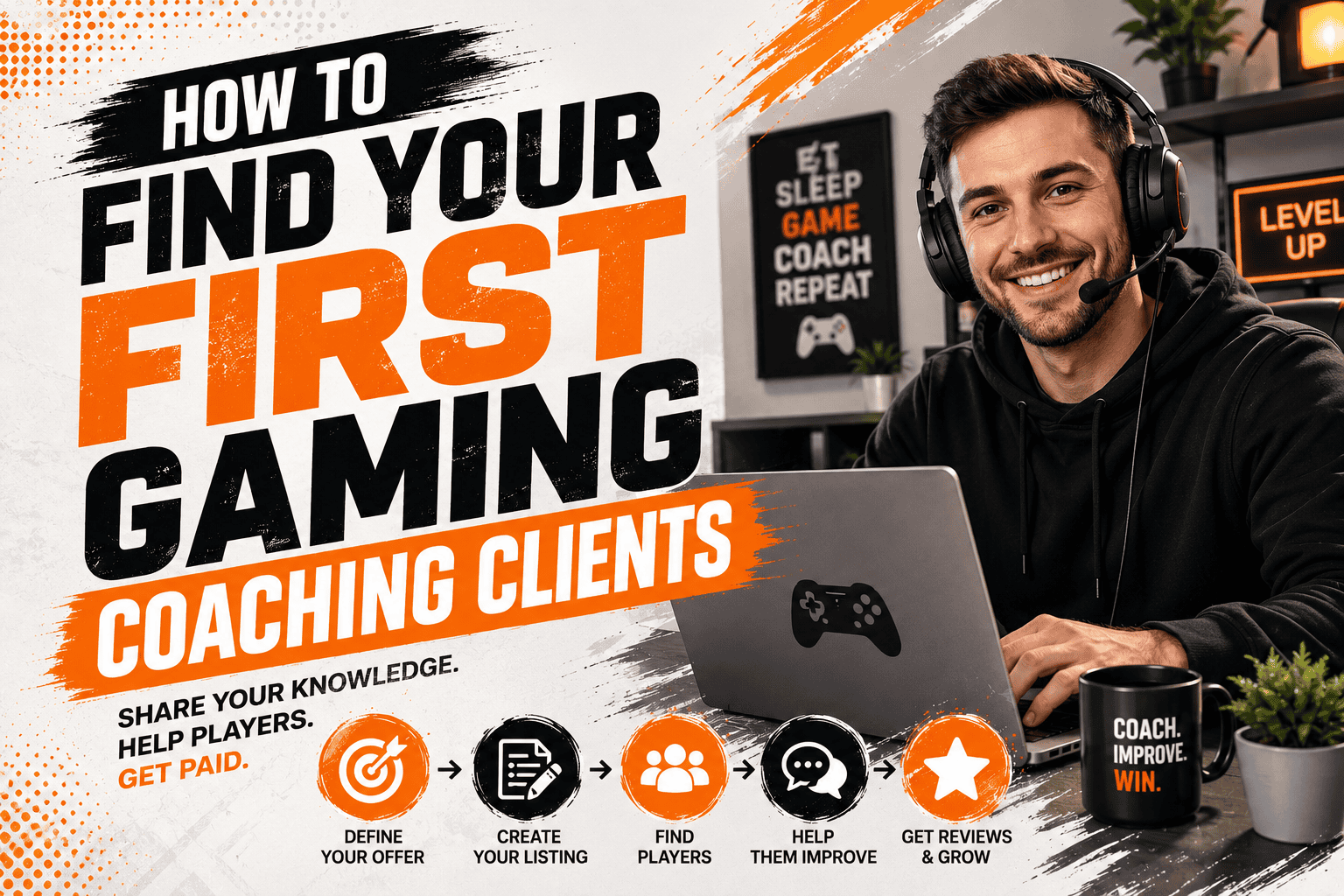
Here’s the basic roadmap:
🎯 Define Your Offer → 📝 Create Your Listing → 💰 Set a Starter Price → 👥 Go Where Players Are → 🧠 Show Your Expertise → ⭐ Get Reviews → 🔁 Build Repeat Clients
Each step makes the next one easier.
🎯 Define Your Offer – Be clear about what game, skill level and type of coaching you provide.
📝 Create Your Listing – Give potential clients somewhere they can see exactly what you’re offering and book your coaching.
💰 Set a Starter Price – Make your first few sessions easy to try while you’re building reviews and experience.
👥 Go Where Players Are – Put yourself in front of communities where players are already looking to improve.
🧠 Show Your Expertise – Share useful tips, answer questions and demonstrate that you actually know your game.
⭐ Get Reviews – Your first positive reviews can make it much easier for the next player to trust you.
🔁 Build Repeat Clients – A player who gets real value from your coaching may book another session, recommend you to friends or become a long-term client.
🚀 Start With One
It’s easy to look at established gaming coaches with dozens or hundreds of reviews and think you need a massive client base to succeed.
You don’t.
Your first goal is much simpler: get one client.
Help that player. Give them a great experience. Earn your first review. Then use that momentum to find the next one.
One client becomes two. Two becomes five. And suddenly, you’re not starting from zero anymore.
2. Define Exactly What You’re Coaching
Before you start looking for gaming coaching clients, get crystal clear on what you’re actually selling.
If you’re still working out your coaching offer, our guide on how to become a gaming coach covers the full process from choosing your game and niche to setting your price and getting started.
“Gaming coaching” is too broad.
Players aren’t usually searching for someone who is simply “good at Valorant” or “knows League of Legends.” They’re looking for help with a specific problem, skill or goal.
Think about the difference:
❌ Valorant Coaching
✅ Valorant Coaching for Bronze-Gold Players – Aim, Positioning & Ranked Improvement
The second offer immediately tells a potential client who the coaching is for and what they can expect to improve.
🎮 Choose Your Game
Start with a game you know extremely well.
Ideally, it should be a game where you have genuine experience, strong game knowledge or a skill level that gives players a reason to learn from you.
Popular coaching opportunities often exist around competitive games such as:
- 🎯 FPS Games – Valorant, Counter-Strike 2, Overwatch 2 and Rainbow Six Siege
- ⚔️ MOBAs – League of Legends and Dota 2
- ⚽ Sports Games – EA Sports FC, NBA 2K and Rocket League
- 🏆 Battle Royale Games – Fortnite, Apex Legends and PUBG
- 🧠 Strategy Games – Teamfight Tactics, StarCraft and other competitive strategy titles
You don’t necessarily need to be a professional player. You just need to be able to provide useful knowledge to players who are less experienced than you.
👤 Decide Who You Want to Coach
Trying to coach everyone can make your offer less appealing.
Instead, think about the type of player you can help best.
For example:
- 🌱 Complete beginners learning the fundamentals
- 📈 Lower-ranked players trying to climb
- 🎯 Intermediate players fixing specific weaknesses
- 🏆 Competitive players looking for advanced analysis
- 👥 Teams wanting to improve communication and coordination
- 🎥 Players wanting VOD or replay reviews
A Diamond-level player might not be the right coach for another Diamond player – but they could be incredibly useful to someone stuck in Bronze.
Understanding the different video game coaching levels can help you identify which players your current skills and experience are best suited to coaching.
Your coaching value is relative to the person you’re helping.
🧠 Focus on the Problem You Solve
Next, ask yourself:
Why would someone pay me for coaching?
The strongest coaching offers usually solve a clear problem.
Maybe you help players:
🎯 Improve their aim
📈 Climb the ranked ladder
🗺️ Learn maps and positioning
🧠 Improve game sense and decision-making
⚔️ Master a specific character, champion or role
🎮 Learn mechanics faster
🔍 Identify mistakes through replay analysis
👥 Communicate better with teammates
🏆 Prepare for competitive matches
The more specific you are, the easier it becomes for the right player to look at your offer and think:
“Yep. That’s exactly what I need.”
📦 Turn Your Skills Into a Clear Coaching Offer
Once you know your game, audience and problem, package them together.
A simple formula is:
Game + Player + Goal + Coaching Format
For example:
🎯 Valorant Coaching for Bronze-Gold Players – 60-Minute Live Session Focused on Aim, Positioning and Ranked Improvement
Or:
⚽ EA Sports FC Coaching – Learn Defending, Build-Up Play and Competitive Tactics in a 1-on-1 Session
Or:
🚀 Rocket League Replay Review – Identify Mistakes, Improve Rotations and Build a Personal Training Plan
You don’t need to make your first offer complicated.
In fact, simple is usually better.
Give players a clear answer to three questions:
What will you help me with? Who is this for? What do I get?
If a potential client can understand those answers within a few seconds, you’re already making their decision much easier.
💡 Start Narrow – Expand Later
When you’re trying to land your first coaching client, don’t worry about offering every possible service.
Start with one strong, easy-to-understand coaching offer.
Once you begin getting clients, you’ll learn what players actually want. You can then add replay reviews, coaching packages, team sessions, specialised training or other options based on real demand.
Your first offer doesn’t need to be perfect. It needs to be clear enough for someone to book it.
3. Create a Coaching Listing That Builds Trust
Once you know what you’re coaching, the next step is giving players somewhere to actually book you.
Your coaching listing is your storefront. When you don’t have reviews or an established reputation yet, it has an even bigger job to do – it needs to convince players that you know your game and can genuinely help them improve.
The goal isn’t to write the longest listing possible.
It’s to answer the questions a potential client has before they need to ask them.
🎯 Start With a Clear, Specific Title
Your title should quickly explain what you’re offering.
Avoid vague titles like:
❌ Professional Gaming Coach
❌ I Will Help You Get Better at Valorant
Instead, make the benefit obvious:
✅ Valorant Coaching – Improve Aim, Game Sense & Ranked Play
✅ Rocket League Coaching – Rotations, Mechanics & Rank Improvement
✅ League of Legends ADC Coaching – Climb Ranked & Improve Decision-Making
A player scrolling through coaching listings should be able to understand yours in seconds.
🧠 Explain Why Players Should Learn From You
If you don’t have reviews yet, your experience becomes especially important.
Tell potential clients what qualifies you to coach them.
That might include:
- 🏆 Your current or highest rank
- ⏱️ How long you’ve played the game
- 🎮 Competitive or tournament experience
- 🧠 Roles, characters or mechanics you specialise in
- 👥 Previous informal coaching or team experience
- 📊 Achievements or relevant statistics
Don’t exaggerate.
You don’t need to pretend you’re an esports superstar if you’re not. A genuine, experienced player who can explain things clearly may be far more useful to a beginner than an elite player who can’t teach.
📦 Make It Obvious What the Client Gets
Don’t make players guess what happens after they book.
Explain exactly what your coaching session includes.
For example:
Your 60-minute coaching session could include:
🎮 Quick discussion about your current rank and goals
🔍 Review of your gameplay or recent matches
🧠 Identification of your biggest weaknesses
🎯 Live coaching focused on specific skills
💡 Practical tips you can immediately apply
📈 Personal recommendations for what to practise next
❓ Time for questions about anything you’re struggling with
This makes the service feel much more tangible.
You’re no longer selling “one hour of gaming coaching.”
You’re selling a structured session designed to help the player improve.
👤 Tell Players Who Your Coaching Is For
Help potential clients quickly decide whether they’re a good fit.
For example:
This coaching is ideal for:
🌱 New players learning the fundamentals
📈 Bronze-Gold players trying to climb
🎯 Players stuck at the same rank
🧠 Players struggling with positioning or decision-making
🔍 Anyone who wants an experienced player to review their gameplay
You can also explain who the coaching isn’t designed for.
If you’re primarily coaching beginners and intermediate players, say so. There’s little value in attracting high-ranked players expecting advanced competitive coaching you don’t offer.
📸 Make Your Listing Look Legitimate
Presentation matters.
A strong featured image, readable description and complete seller profile can make a new coaching listing feel much more trustworthy.
Where possible, add evidence that supports your experience, such as:
🏆 Rank screenshots
📊 Relevant gaming statistics
🎮 Gameplay screenshots
🎥 Clips of your gameplay
👤 A completed seller profile
Just make sure anything you include is accurate and genuinely yours.
Players aren’t expecting a corporate résumé. They simply want some reassurance that there’s a capable gamer behind the listing.
💬 Let Your Personality Show
Gaming coaching is personal.
Your client may spend an hour or more talking, playing and learning with you, so they’re not only choosing based on rank. They’re also choosing someone they think they’ll enjoy learning from.
If you’re relaxed and beginner-friendly, say it.
If your coaching is analytical and highly competitive, say that.
If you’re patient with players who are completely new to the game, make it part of your offer.
Your personality can be part of what makes your coaching different.
🚀 Don’t Wait for the “Perfect” Listing
It’s easy to spend days tweaking your title, rewriting your description and wondering whether your listing is good enough.
At some point, you need to publish it.
Your first version probably won’t be your final version – and that’s fine.
Once players start viewing your listing, asking questions and booking sessions, you’ll learn what information matters most to them.
Create a clear listing. Publish it. Improve it as you learn.
Because the perfect coaching listing sitting in your drafts has exactly zero clients.
4. Set a Starter Price That Makes You Easy to Try
When you have zero reviews, your biggest challenge isn’t proving that gaming coaching works.
It’s proving that your coaching is worth paying for.
A potential client looking at two similar coaches may see one with dozens of positive reviews and another with none. If both charge the same price, the established coach is usually the safer choice.
That’s where a smart starter price can help.
💵 Price for Your Current Reputation
Your gaming knowledge might already be excellent, but your reputation as a coach still needs to be built.
For your first few clients, consider setting a competitive introductory price that makes trying your coaching feel like a low-risk decision.
For example, instead of immediately trying to charge premium rates, you might offer:
- 🎮 An affordable 30-minute introductory session
- ⏱️ A discounted first 60-minute coaching session
- 🔍 A lower-cost VOD or replay review
- 📦 A beginner coaching package at an introductory price
The aim isn’t to become the cheapest coach available.
It’s to give players a compelling reason to choose a new coach without reviews.
⚠️ Don’t Undervalue Your Coaching
There’s a difference between a starter price and practically giving your time away.
Pricing too low can work against you.
Players may assume the service isn’t very good, while you could quickly discover that preparing for sessions, coaching clients and following up takes more time than expected.
Remember, you’re not just selling 60 minutes on Discord.
A coaching session might involve:
📝 Preparing before the session
🎮 Coaching the player
🔍 Reviewing gameplay
💬 Answering questions
📈 Creating recommendations
📨 Following up afterwards
Factor that time into your pricing.
🎁 Add Value Instead of Slashing the Price
Another option is to make your first coaching offer more attractive without dramatically reducing the price.
You could include:
🎥 A short replay review before the session
📝 A personalised improvement plan
⏱️ An extra 10-15 minutes for first-time clients
🎯 Recommended drills or training exercises
💬 A short follow-up after the session
Small extras can make your offer stand out while preserving the value of your time.
📈 Raise Your Price as You Build Proof
Your starter price doesn’t have to be permanent.
As you gain experience and positive reviews, you can gradually increase your rates.
A simple progression might look like:
No Reviews → Introductory Price
First Few Reviews → Standard Price
Strong Reputation + Repeat Demand → Higher Price
This allows your pricing to grow alongside the proof that your coaching delivers results.
You may also discover that certain services are worth more than others. A simple replay review might command one price, while an intensive one-on-one coaching session or multi-session improvement package commands another.
🧪 Treat Your First Price as an Experiment
There’s no magical price that works for every gaming coach.
Before settling on your rate, it can help to compare how much video game coaching costs across different games, coaching formats and experience levels.
Different games, ranks, coaching formats and audiences will support different rates.
Start somewhere reasonable and pay attention to what happens.
If lots of players view your coaching but nobody books, price could be part of the problem.
If you’re getting booked faster than you can handle, you may be charging too little.
If clients repeatedly come back because they’re getting results, you’ve got evidence that your coaching has real value.
🎯 Your First Goal Is Momentum
Early on, the value of your first few clients goes beyond the money they pay you.
They give you something even more useful:
Experience + Reviews + Feedback + Confidence + Social Proof
Those things make winning future clients much easier.
So don’t obsess over squeezing every possible dollar out of your first booking.
Set a fair starter price, deliver more value than the client expects and give them a reason to tell the next player you’re worth booking.
5. Go Where Players Already Hang Out
Creating a great coaching listing is important.
But when you’re brand new, you can’t always publish it and expect clients to magically appear.
You need to put yourself where players already are.
The good news is that gaming communities are everywhere – Discord servers, Reddit communities, social platforms, forums, gaming groups and communities built around specific games.
Your job isn’t to spam them with:
“BUY MY COACHING!!! 🔥🔥🔥”
That’s a fast way to get ignored, muted or introduced to the ban button.
Instead, become part of the community and give players a reason to notice you.
💬 Join Communities Around Your Game
Start with places where players of your game already spend their time.
That could include:
- 💬 Discord servers
- 👽 Reddit communities
- 🎮 Game-specific forums
- 👥 Facebook groups
- 📱 TikTok, YouTube and other social platforms
- 🏆 Competitive gaming communities
- 🎓 Coaching and improvement communities
Look particularly for communities where players discuss strategy, ask questions, share gameplay or look for help improving.
Those conversations reveal exactly what potential coaching clients are struggling with.
🔍 Look for Players Asking for Help
Pay attention to the questions players are already asking.
You might see posts like:
“Why am I stuck in Gold?”
“Can someone review my gameplay?”
“How do I improve my rotations?”
“I keep losing this matchup – what am I doing wrong?”
These are opportunities to demonstrate your knowledge.
Give them a genuinely useful answer.
Don’t immediately follow it with a sales pitch. If your advice is good, players may check your profile, ask you another question or become interested in learning more from you.
Help first. Sell second.
🧠 Become Recognisable for Being Useful
You don’t need to be the loudest person in a gaming community.
You need to become one of the people who consistently gives good answers.
Answer beginner questions.
Explain confusing mechanics.
Give constructive feedback on gameplay clips.
Share useful strategies.
Congratulate players when they improve.
Over time, people begin recognising your name and associating it with someone who knows what they’re talking about.
That reputation can make selling coaching much easier because you’ve already answered the biggest question:
“Does this person actually know their stuff?”
🚫 Don’t Spam Your Coaching Link
Dropping your coaching link into every conversation isn’t marketing.
It’s spam wearing a gaming headset.
Before promoting your services, check the community rules. Some Discord servers, subreddits and forums allow self-promotion in dedicated channels or threads. Others prohibit commercial promotion entirely.
Respect those rules.
Where promotion is allowed, keep it relevant and useful.
Instead of:
❌ “I’m a coach. Book me here!”
Try something closer to:
✅ “I’ve been helping lower-ranked players improve their positioning and decision-making. I’ve also started offering one-on-one coaching for anyone who wants more personalised help.”
Then include your listing only where links and self-promotion are permitted.
🎥 Use Social Content to Attract Players
You can also bring potential clients to you by posting useful gaming content.
It doesn’t need to be a huge production.
Try content such as:
🎯 Quick gameplay tips
🔍 Common mistakes players make
📈 Rank improvement advice
🎥 Short VOD reviews
🧠 Strategy breakdowns
⚔️ Character, champion or weapon tips
❌ “Stop doing this” gameplay examples
✅ Before-and-after coaching examples
A short video explaining one useful concept can demonstrate your coaching ability far better than simply saying:
“I’m a great coach.”
Show people what you know.
🌱 Smaller Communities Can Be Valuable
Don’t assume you need access to the biggest gaming community possible.
A Discord server with 2,000 active members who regularly talk about improving at your game may be more useful than a social account with hundreds of thousands of passive followers.
Smaller communities can also make it easier to become recognised.
Instead of competing with thousands of posts, you can actually participate, build relationships and become known.
🎯 Focus on the Right Players – Not the Most Players
Your goal isn’t to put your coaching offer in front of everyone who plays the game.
It’s to reach players who:
🎮 Play your game
📈 Want to improve
🧠 Need help you can provide
💰 Are willing to pay for personalised coaching
That’s a much smaller audience – and a much better one.
So don’t chase every gaming community on the internet.
Find a few places where your ideal clients already spend their time, become genuinely useful there and let your expertise do the advertising for you.
6. Show Your Expertise Before Asking for the Sale
When you don’t have many reviews yet, potential clients need another reason to trust you.
The easiest way to give them one?
Show them what you know.
Instead of repeatedly telling players you’re a great coach, demonstrate it through useful tips, gameplay analysis and advice.
You don’t need thousands of followers to make this work. Even a handful of genuinely useful posts can give someone considering your coaching a much better idea of what they’ll get from a session.
🎯 Give Players a Taste of Your Coaching
Think of your free content as a preview.
Share small pieces of advice that players can actually use.
For example:
- 🎥 Break down a gameplay clip and explain what went wrong
- 🎯 Share three aim mistakes you regularly see beginners make
- 🗺️ Explain better positioning on a particular map
- 🧠 Break down a common decision-making mistake
- ⚔️ Explain how to approach a difficult matchup
- 📈 Share practical tips for players stuck at a certain rank
- 🎮 Demonstrate a mechanic and explain how to practise it
The important part is to teach something useful.
Generic advice such as “communicate more” or “practise your aim” doesn’t tell players much about your coaching ability.
Explain what to do, why it matters and how to improve it.
🎥 Use the Format That Suits You
You don’t need to become a full-time content creator to promote your coaching.
Choose formats that are easy for you to produce consistently.
That might be:
📱 Short-form videos
🎬 YouTube gameplay breakdowns
📝 Written gaming tips
🖼️ Screenshots with annotations
💬 Helpful Discord responses
👽 Detailed Reddit comments
🎮 Live gameplay demonstrations
If you’re comfortable on camera, video can be particularly effective because players get to see how you communicate and explain concepts.
But it isn’t essential.
A well-written breakdown of someone’s gameplay can demonstrate expertise just as effectively.
🔍 Show How You Think
Good coaching isn’t simply knowing the correct answer.
It’s being able to explain why something happened.
Instead of saying:
❌ “Your positioning was bad.”
Explain:
✅ “You’re taking this fight without cover, which means you have nowhere to retreat if the enemy swings you. Playing closer to the wall gives you an escape route while still letting you contest the angle.”
That explanation shows something valuable.
You’re not just spotting mistakes – you understand them and can teach someone how to fix them.
That’s exactly what a potential coaching client wants to see.
💬 Answer Questions Publicly
One of the easiest ways to demonstrate expertise is simply answering questions.
When someone asks for help in a gaming community, give them a useful response when you can.
Don’t deliberately hold back the good advice because you want them to pay for it.
Giving someone one useful answer doesn’t eliminate the need for coaching. In many cases, it does the opposite.
If a player thinks:
“That one tip helped me – what could I learn in a full session?”
You’ve created a much stronger reason to book.
🆓 Consider a Limited Free Session
If you’re struggling to get that very first client, offering a small number of free or heavily discounted sessions can help you gain experience and prove your coaching format.
The key word is limited.
You might offer:
🎮 A free 15-minute introductory session
🔍 One free replay review
🎯 A few free coaching sessions for your first players
💰 A heavily discounted session in exchange for honest feedback
This shouldn’t become your permanent business model.
The objective is to practise coaching real players, improve your service and start building legitimate feedback.
And never pressure someone into leaving a positive review. Ask for an honest review based on their experience.
🏆 Turn Results Into Proof
Once your coaching starts helping players, use those results to strengthen your offer.
With the player’s permission, you might share:
⭐ Positive testimonials
📈 Rank improvements
💬 Client feedback
🎥 Before-and-after gameplay examples
🏆 Player achievements
📊 Improvements across multiple sessions
Results are much more persuasive than claims.
“I can help you improve” is a promise.
“Here’s how I helped another player improve” is evidence.
🚀 Teach First, Sell Second
You don’t need to give away everything you know.
Your free content can solve smaller problems while your paid coaching provides something much deeper – personalised analysis, live feedback, structured improvement and advice tailored to the individual player.
That’s the difference.
Free content shows players that you know the game. Paid coaching shows them how to improve their game.
When players can already see the value you provide, asking them to pay for more becomes a much easier conversation.
7. Turn Your First Clients Into Reviews and Referrals
Landing your first gaming coaching client is a big milestone.
But that first booking can be worth far more than the price of a single session.
A happy client can give you something that’s difficult to manufacture when you’re starting out – proof that your coaching is actually worth booking.
That proof can come through reviews, testimonials, referrals and repeat sessions.
⭐ Ask for an Honest Review
If a client enjoyed their session and found it useful, ask them to leave a review.
Keep it simple.
You don’t need to chase them around the internet waving five stars at them.
After the session, thank them for booking and let them know that an honest review would help other players understand what your coaching is like.
The best reviews often mention specific things such as:
🎯 What the player wanted to improve
🧠 What they learned during the session
💬 How clearly you explained concepts
🎮 What the coaching experience was like
📈 Whether they noticed an improvement afterwards
A detailed review can be especially valuable when you’re new because future clients can see what someone else actually gained from booking you.
🏆 Give Clients Something Worth Reviewing
Of course, there’s a fairly important step before asking for a great review:
Deliver a great coaching session.
Be prepared.
Show up on time.
Listen to what the player wants to improve.
Explain things clearly.
Be patient when they make mistakes.
Give them practical advice they can use after the session ends.
And don’t spend the entire session demonstrating how much better you are than them. That’s not coaching. That’s just showing off with an invoice attached.
The player should leave feeling like they improved, not like they just watched you play.
💬 Follow Up After the Session
A short follow-up can make your coaching feel much more professional.
You might send the client:
📝 A summary of the main points you covered
🎯 Two or three areas to focus on next
🎮 Recommended drills or practice routines
📈 A goal to work towards before another session
💬 An invitation to ask a quick follow-up question
This doesn’t need to take long.
Even a short personalised message shows that you care about their progress beyond the moment the session ends.
📣 Encourage Referrals Naturally
Gamers know other gamers.
If someone gets real value from your coaching, they may have friends or teammates struggling with exactly the same things.
You don’t need to aggressively ask every client to promote you.
Instead, make it easy.
You could simply mention:
“If you’ve got any friends or teammates who could use some help too, feel free to send them my coaching listing.”
You could also introduce a referral discount later if referrals become an important source of clients.
The best referral strategy, though, is still remarkably old-fashioned:
Be good enough that people want to recommend you.
🔁 Give Good Clients a Reason to Come Back
Not every coaching relationship needs to end after one session.
Gaming improvement takes time, which makes coaching naturally suited to repeat bookings.
If the first session goes well, suggest what the player could work on next.
For example:
Session 1: Identify weaknesses and build an improvement plan
↓
Session 2: Review progress and correct recurring mistakes
↓
Session 3: Work on more advanced skills
↓
Session 4: Review new gameplay and measure improvement
This creates a progression rather than selling disconnected coaching sessions.
You can also offer multi-session packages once you know players are interested in longer-term coaching.
📈 Let Your Reputation Compound
Your first review makes the second client easier to win.
Your second and third reviews make the fourth easier.
Repeat clients create more experience. More experience makes you a better coach. Better coaching leads to stronger reviews and referrals.
That’s when things can start snowballing:
🎮 Client → ⭐ Review → 👤 New Client → 🔁 Repeat Booking → 📣 Referral → 🚀 More Clients
At the beginning, you have to create trust from scratch.
Eventually, your previous clients start creating some of that trust for you.
🎯 Treat Every Early Client Like They Matter
When you’re starting out, don’t dismiss a booking because it’s “only one client.”
That one player could become:
⭐ Your first five-star review
🔁 Your first repeat client
📣 Your first referral source
🏆 Your first success story
Your early clients are helping you build the reputation that future clients will judge you by.
Get the first client. Give them a reason to come back. Then give them a reason to tell someone else about you.
8. Build Repeat Clients – Not Just One-Off Sessions
Getting new gaming coaching clients takes work.
Keeping a good client is usually much easier.
That’s why one of the smartest ways to grow your coaching is to stop thinking only about individual bookings and start thinking about player progress.
If someone genuinely improves after coaching with you, there’s a natural reason for them to come back.
📈 Give Players a Clear Path Forward
At the end of each coaching session, the player should know what to work on next.
Don’t finish with:
“Cool, that’s everything. Good luck!”
Instead, give them a simple progression.
For example:
🎯 Current Problem – Poor positioning during team fights
🧠 What We Worked On – Cover usage, positioning and timing
🎮 Next Step – Practise those concepts across 10 ranked matches
🔍 Future Session – Review new gameplay and identify remaining mistakes
Now the next coaching session has a purpose.
You’re not trying to sell another hour for the sake of it. You’re giving the player a logical next step in their improvement.
🗺️ Create an Improvement Roadmap
For clients who want ongoing coaching, consider creating a simple roadmap.
For example:
Session 1 – Gameplay Assessment
Identify strengths, weaknesses and the biggest opportunities for improvement.
Session 2 – Core Mechanics
Work on the skills holding the player back.
Session 3 – Game Sense & Decision-Making
Improve positioning, awareness, rotations or tactical decisions.
Session 4 – Progress Review
Analyse new gameplay, measure improvement and decide what comes next.
The exact structure will depend on the game, but the principle is simple:
Give the player something to work towards.
📦 Offer Coaching Packages
Once you’ve successfully delivered individual sessions, you can consider offering packages.
Instead of only selling:
🎮 1 x 60-Minute Coaching Session
You could also offer:
📦 3-Session Improvement Package
🏆 5-Session Ranked Climb Coaching Plan
🔍 Coaching + Weekly Replay Reviews
Packages can be useful for both sides.
The client gets a more structured coaching experience, while you gain more predictable repeat business.
Just make sure the package offers genuine value rather than simply bundling several identical sessions together.
🧠 Remember What Each Client Is Working On
Personalisation is one of the biggest advantages individual gaming coaches can offer.
Keep simple notes about each player’s:
🎮 Current rank
🎯 Goals
⚠️ Biggest weaknesses
💪 Strongest skills
📝 Previous coaching topics
📈 Progress between sessions
When a client returns, you can pick up where you left off instead of starting from scratch.
That makes the coaching feel much more personal.
And personal coaching is exactly what the client is paying for.
💬 Stay Helpful Without Becoming 24/7 Support
Being available for a quick question after a session can create a great client experience.
But boundaries matter.
You don’t want a one-hour coaching booking quietly turning into three weeks of unlimited Discord support.
Be clear about what’s included.
For example, you might offer:
💬 One or two quick follow-up questions
📝 A post-session summary
🎯 Practice recommendations
🔍 Feedback during the next booked session
Anything more substantial can become part of another coaching session or package.
Your time has value too.
🏆 Celebrate Your Clients’ Progress
If a client finally reaches the rank they’ve been chasing, nails a mechanic they’ve struggled with or simply starts playing with more confidence, celebrate it.
Gaming improvement should be fun.
Those moments also strengthen the relationship between coach and player.
With permission, client success stories can later become powerful proof for your coaching:
Gold → Platinum 📈
First Tournament Win 🏆
Finally Mastered That Mechanic 🎯
The focus should always be on the player’s achievement – your coaching helped them get there.
🔁 Repeat Clients Can Become Your Foundation
You don’t necessarily need a constant stream of brand-new players to build a successful coaching side hustle.
Imagine having:
10 clients who book once
versus:
5 clients who each book four sessions
The second group produces twice as many bookings from half as many people.
That’s why client retention matters.
A smaller group of players who trust you, enjoy your coaching and keep improving can become the foundation of your coaching business.
🚀 Get One. Help One. Grow From There.
At the beginning, getting your first gaming coaching client can feel like the hardest part.
That’s because it usually is.
You have no reviews. No referrals. No established coaching reputation.
So simplify the goal.
🎯 Define Your Offer → 📝 Create Your Listing → 💰 Set a Starter Price → 👥 Find Players → 🧠 Show Your Expertise → ⭐ Earn Reviews → 🔁 Build Repeat Clients
Don’t worry about finding 100 clients.
Find one.
Give that player a coaching session worth remembering. Help them improve. Earn their trust.
Then find the next one.
That’s how a gaming coaching business starts – one player at a time.
9. Common Mistakes New Gaming Coaches Make
Finding your first coaching clients takes some trial and error.
The good news is that you don’t need to make every beginner mistake yourself.
Here are some of the most common traps new gaming coaches fall into – and what to do instead.
❌ Trying to Coach Everyone
If your offer is:
“I coach gamers who want to get better.”
That’s not very specific.
Different players have completely different problems. A brand-new Valorant player needs different coaching from someone trying to push from Diamond to Ascendant.
Instead, define:
🎮 The game you coach
👤 The players you help
🎯 The problems you solve
🧠 The skills you specialise in
The clearer your offer, the easier it is for the right player to recognise that it’s meant for them.
❌ Charging Premium Prices With Zero Proof
You might be an excellent player.
But if you have no coaching reviews, testimonials or track record, potential clients have very little evidence that you’re an excellent coach.
Start with a fair, competitive price.
Then increase your rates as you build:
⭐ Reviews
🏆 Results
🔁 Repeat clients
📣 Referrals
🧠 Coaching experience
Your price can grow alongside your reputation.
As your reputation and booking volume grow, your earning potential can change considerably too. Our guide to how much gaming coaches earn looks at rates, experience levels and the factors that can affect coaching income.
❌ Competing Only on Price
Going in the opposite direction can be just as problematic.
Being the cheapest coach isn’t much of a competitive advantage if you’re earning so little that coaching stops being worthwhile.
Instead of endlessly cutting your price, compete on value.
Offer better communication, clearer explanations, personalised feedback, useful follow-ups or a more structured coaching experience.
Give players a reason to choose you beyond:
“I’m $2 cheaper.”
❌ Spamming Gaming Communities
Dropping your coaching link into every Discord server, subreddit and gaming group you can find isn’t a client acquisition strategy.
It’s a speedrun to getting banned.
Gaming communities are much more useful when you actually participate in them.
Answer questions.
Share useful advice.
Help players.
Build a reputation.
Then promote your coaching where self-promotion is allowed.
Be useful before being promotional.
❌ Assuming High Rank Automatically Makes You a Good Coach
Being great at a game and being great at teaching it are two different skills.
A strong coach needs to:
👂 Listen
🧠 Diagnose problems
💬 Explain concepts clearly
🎯 Give practical advice
⏱️ Structure sessions effectively
🤝 Adapt to different players
If your answer to every mistake is:
“Just aim better.”
You may have some work to do.
Players are paying for your ability to help them improve – not simply to watch how good you are.
❌ Giving Every Player the Same Session
Two players at the same rank can have completely different weaknesses.
One might have excellent mechanics but terrible positioning.
Another might understand the game well but struggle with execution.
Your coaching should adapt.
Start each session by understanding:
🎯 What the player wants to achieve
📈 Their current level or rank
⚠️ What they’re struggling with
🎮 How they normally play
🧠 What they’ve already tried
Then build the session around them.
Personalisation is one of the biggest reasons players choose coaching instead of simply watching another YouTube guide.
❌ Talking Too Much
A coaching session shouldn’t be a one-hour lecture.
Let the player ask questions, explain their thinking and actually practise what you’re teaching.
Sometimes the most useful question a coach can ask is:
“Why did you make that decision?”
Their answer may reveal far more than simply telling them what they did wrong.
Good coaching is a conversation.
❌ Promising Results You Can’t Guarantee
Be careful with promises such as:
❌ “I guarantee you’ll reach Diamond.”
❌ “You’ll win more games after one session.”
❌ “I’ll get you to your target rank.”
You can control the quality of your coaching.
You can’t control every teammate, opponent, match or how much the client practises afterwards.
Focus on what you can deliver:
✅ Personalised feedback
✅ Practical strategies
✅ Gameplay analysis
✅ Training recommendations
✅ Clear areas for improvement
Sell the quality of the coaching – not an outcome you can’t guarantee.
❌ Forgetting to Ask for Reviews
You can deliver an amazing session and still receive no review.
Sometimes clients simply forget.
If the session went well, politely ask them to leave honest feedback.
Your first few reviews are especially important because they help future clients overcome the uncertainty of booking someone new.
Don’t manufacture reviews or pressure clients into leaving five stars.
Earn them.
❌ Giving Up Too Early
Your listing might not get booked immediately.
Your first social post might get three likes.
Your brilliant Discord contribution might receive the prestigious response:
“nice.”
That’s normal.
Building a coaching reputation takes time.
Keep improving your listing, participating in communities, demonstrating your knowledge and learning from every coaching session you deliver.
Your first client is the hardest because you’re starting with nothing.
After that, you have something you didn’t have before:
Proof.
And every review, referral and successful coaching session makes finding the next client a little easier.
10. Final Thoughts – Your First Client Is the Hardest
Finding your first gaming coaching client can feel like a catch-22.
Players want to see reviews before they book you.
But you need clients before you can get reviews.
The way through is to start small and build proof one client at a time.
You don’t need thousands of followers, an esports career or a page filled with five-star reviews to begin.
You need a coaching offer that solves a real problem – and a player willing to give you your first opportunity.
🎯 Your Roadmap to Your First Coaching Client
Keep the process simple:
🎯 Define Your Offer → 📝 Create Your Listing → 💰 Set a Starter Price → 👥 Go Where Players Are → 🧠 Show Your Expertise → ⭐ Get Reviews → 🔁 Build Repeat Clients
Want to turn that roadmap into a step-by-step schedule? Follow our 30-day plan to find your first gaming coaching client and work through the process one stage at a time.
Start by deciding exactly what you coach and who you can help.
Create a clear listing that explains what players will get.
Set a fair price that makes your coaching easy to try.
Spend time in the communities where your potential clients already hang out.
Share useful advice that demonstrates what you know.
Then, when someone finally books:
Make that session count.
🏆 Focus on Helping the Player
Your first coaching session isn’t just about making your first sale.
It’s your opportunity to prove that you can turn gaming knowledge into something genuinely useful for another player.
Listen to what they’re struggling with.
Identify the problems holding them back.
Explain what they can do differently.
Give them practical things to work on after the session.
If they leave thinking:
“I know exactly what I need to improve now.”
You’ve done your job.
⭐ Let Every Client Make the Next One Easier
Your first client can lead to your first review.
That review can help convince your second client.
Your second client might become a repeat customer.
A repeat customer might recommend you to a teammate.
And suddenly, you’re no longer trying to convince players to take a chance on a completely unknown coach.
You’ve built a track record.
That’s how momentum starts:
1 Client → 1 Review → More Trust → More Clients → More Reviews → More Opportunities
🎮 You Don’t Need Hundreds of Clients
It’s easy to look at established coaches and focus on how far ahead they seem.
Don’t.
They had a first client too.
Your goal right now isn’t to build the biggest coaching business in gaming.
It’s much simpler:
Get your first client.
Help them improve.
Earn their trust.
Then build from there.
Because once you’ve gone from zero clients to one, you’ve already completed the hardest level.
11. Frequently Asked Questions About Finding Gaming Coaching Clients
🎮 How Do I Get My First Gaming Coaching Client?
Start by creating a clear coaching offer for a specific game, type of player and improvement goal. Create a coaching listing, set an attractive starter price and promote yourself in places where players already spend time.
The basic process is:
🎯 Define Your Offer → 📝 Create Your Listing → 💰 Set a Starter Price → 👥 Find Players → 🧠 Show Your Expertise → ⭐ Earn Reviews → 🔁 Build Repeat Clients
Your first client is usually the hardest because you don’t have reviews or referrals yet. Once you’ve successfully coached a few players, that social proof can make attracting new clients much easier.
💰 How Much Should a Beginner Gaming Coach Charge?
There’s no single price that works for every gaming coach.
Your rate can depend on your game, rank, experience, coaching format, session length and the level of competition from other coaches.
When you’re starting without reviews, consider using a competitive introductory price. Once you’ve built positive reviews, repeat clients and proven results, you can test higher rates.
Don’t automatically try to become the cheapest coach available. Price competitively while making sure the session is still worth your time.
🏆 Do I Need to Be a Professional Gamer to Become a Coach?
No.
You need enough knowledge and experience to provide genuine value to the players you’re coaching.
For example, a highly ranked player may have plenty to teach beginners and lower-ranked players without ever competing professionally.
Being a good coach also requires more than being good at the game.
You need to be able to identify problems, explain concepts clearly and help another player improve.
📈 What Rank Do I Need to Start Gaming Coaching?
There’s no universal minimum rank.
It depends on the game and the level of player you want to coach.
Generally, you should have a meaningful skill or knowledge advantage over the players you’re helping. You should also be transparent about your experience and avoid presenting yourself as an elite coach if you aren’t one.
A player doesn’t necessarily need the world’s best coach.
They need a coach who can help them reach their next level.
👥 Where Can I Find Players Who Need Gaming Coaching?
Look where players already discuss the game and ask for help.
Potential places include:
💬 Discord communities
👽 Reddit communities
🎮 Gaming forums
👥 Social media groups
🎥 YouTube and TikTok
🏆 Competitive gaming communities
🛒 Gaming marketplaces with coaching services
Always check community rules before promoting a paid service. Some communities have dedicated self-promotion areas, while others don’t allow commercial posts.
🧠 How Can I Get Coaching Clients Without Reviews?
When you don’t have reviews, demonstrate your expertise in other ways.
You can:
🎥 Share gameplay analysis
🎯 Post useful gaming tips
💬 Answer player questions
🔍 Review gameplay clips
🏆 Show relevant ranks or achievements
📝 Create a detailed coaching listing
🎮 Offer an introductory session or replay review
The aim is to reduce the uncertainty players feel when booking someone new.
Your first few clients create the reviews that make this easier later.
🆓 Should I Offer Gaming Coaching for Free at First?
You can, but you don’t have to.
A limited number of free sessions can help you practise coaching, refine your service and collect honest feedback. However, free coaching shouldn’t become your permanent strategy.
Another option is to charge a discounted introductory rate.
That lets you start building paying clients while still making your offer attractive to players willing to try a new coach.
⭐ How Do I Get More Reviews for My Gaming Coaching?
Deliver a useful session first.
Then ask the client to leave an honest review about their experience.
You can improve your chances of receiving positive feedback by:
🎯 Understanding the client’s goals
⏱️ Arriving prepared and on time
🧠 Giving personalised advice
💬 Explaining concepts clearly
📝 Providing useful takeaways
📈 Giving the player clear next steps
Never buy, fake or manipulate reviews. Genuine feedback is far more valuable for building a sustainable reputation.
🔁 How Do I Turn Coaching Clients Into Repeat Clients?
Give players a reason to continue.
At the end of the session, explain what they should work on next and how another session could build on their progress.
You could offer:
🎮 Follow-up coaching sessions
🔍 Regular replay reviews
📈 Multi-session improvement plans
🏆 Competitive preparation
📦 Coaching packages
The objective isn’t to keep selling sessions a player doesn’t need.
It’s to create a clear improvement journey for players who want ongoing support.
⏱️ How Long Does It Take to Get Your First Gaming Coaching Client?
It could happen quickly, or it could take weeks.
There isn’t a guaranteed timeline.
Your chances improve when you have a clear offer, competitive pricing, a professional listing and an active presence in relevant gaming communities.
If your listing isn’t getting bookings, don’t immediately assume gaming coaching doesn’t work.
Look at what’s happening.
Are players seeing your listing?
Is your offer clear?
Is your price competitive?
Are you targeting the right players?
Does your profile give them a reason to trust you?
Treat your first client as a problem to solve rather than something that should simply appear.
🚀 Can Gaming Coaching Become a Side Hustle?
Yes. Gaming coaching can be offered casually around your existing schedule or developed into a more substantial source of income if demand exists for your skills.
The advantage is that you can start small.
You don’t need 100 clients on day one.
You need one player you can genuinely help.
Do a great job, earn your first review and use that experience to make winning the next client easier.
That’s how you go from being good at a game to getting paid to help someone else get better at it.
12. Ready to Find Your First Gaming Coaching Client?
You’ve got the gaming knowledge.
Now it’s time to turn it into a coaching offer that players can actually find and book.
You don’t need an established coaching business, hundreds of followers or a wall of five-star reviews to get started. Every gaming coach begins in exactly the same place:
Zero clients.
The important part is moving from zero to one.
🎯 Start Selling Your Gaming Coaching
Create a coaching listing that clearly explains:
🎮 What Game You Coach – Focus on a game you know well.
👤 Who You Help – Beginners, ranked players, competitive players or a specific type of player.
🧠 What You Teach – Mechanics, strategy, positioning, game sense, replay analysis or other skills.
⏱️ What Clients Get – Explain the session length, format and what’s included.
💰 What It Costs – Set a fair price that makes your first coaching offer attractive.
📅 When You’re Available – Give players clear times when they can book a session with you.
Then publish your listing and start putting yourself in front of players who want to improve.
🕹️ Turn Your Gaming Knowledge Into Something Valuable
You already spend time learning games, understanding mechanics, developing strategies and improving your skills.
Coaching gives you a way to put that knowledge to work.
A player might be stuck on something you learned years ago.
A mechanic that feels automatic to you might completely change how a beginner approaches the game.
A few pieces of personalised advice could help someone finally understand why they’ve been stuck at the same rank.
That’s the value you’re selling.
Not simply your rank.
Not simply an hour of your time.
You’re selling the ability to help another player learn faster and play better.
🚀 Your First Client Starts With Your First Listing
You can keep planning your coaching service forever.
Or you can put it out there.
Create your listing.
Set your availability.
Publish your offer.
Then start building your reputation one player at a time.
🎯 One Listing → 🎮 One Client → ⭐ One Review → 🔁 One Repeat Booking
That’s enough to get started.
🎮 Start Selling Gaming Coaching on StackedGame
Ready to put your skills to work?
Create your gaming coaching listing on StackedGame and offer your knowledge, experience and time to players looking to improve.
Whether you want to coach occasionally or build a regular gaming side hustle, you can start with a single listing and grow from there.
🎯 Create Your Coaching Listing → Find Your First Client → Start Getting Paid for Gaming
13. Start Finding Gaming Coaching Clients Today
Getting your first gaming coaching client isn’t about waiting until you have the perfect profile, perfect price or perfect coaching setup.
Ready to put everything into action? Use our gaming coaching client checklist to make sure your offer, listing, pricing and client-acquisition basics are ready to go.
It’s about getting started.
You already know the roadmap:
🎯 Define Your Offer → 📝 Create Your Listing → 💰 Set a Starter Price → 👥 Go Where Players Are → 🧠 Show Your Expertise → ⭐ Get Reviews → 🔁 Build Repeat Clients
Now it’s time to put it into action.
🎮 Turn Your Gaming Skills Into a Coaching Service
If you know a game inside and out, there are players who could benefit from that knowledge.
Maybe they’re completely new.
Maybe they’ve been stuck at the same rank for months.
Maybe they understand the mechanics but struggle with positioning, decision-making or strategy.
Or maybe they simply want someone experienced to look at their gameplay and tell them what they’re missing.
That’s where you come in.
You don’t have to be the best player in the world. You need to be able to help someone become a better player than they are today.
📝 Create Your First Coaching Listing
Your first practical step is simple:
Put your coaching offer somewhere players can book it.
Create a listing that explains:
🎯 What you can help players improve
🎮 Which game you coach
👤 Who your coaching is designed for
🧠 Your experience and strengths
⏱️ How your coaching sessions work
💰 What your coaching costs
📅 When you’re available
Don’t spend weeks trying to perfect every sentence.
Your listing can evolve as you gain experience, receive questions and learn what clients are actually looking for.
The important thing is getting it live.
⭐ Build From Your First Client
Once you land that first booking, focus on delivering an experience worth talking about.
Help the player.
Give them actionable advice.
Make the session enjoyable.
Give them something useful to work on afterwards.
Then ask for an honest review.
That single review can make your next booking easier.
And that’s the entire game:
1️⃣ First Listing
↓
🎮 First Client
↓
⭐ First Review
↓
🔁 Repeat Booking
↓
📣 First Referral
↓
🚀 Growing Coaching Business
You don’t need all of those things today.
You just need to start at the top.
🕹️ Start Selling Gaming Coaching on StackedGame
Ready to find your first client?
Create a gaming coaching listing on StackedGame and start offering your skills, experience and gaming knowledge to players who want to improve.
Set your price. Choose your availability. Explain what you can teach.
Then get your coaching offer out there.
🎮 Start Selling Gaming Coaching → Get Your First Client → Get Paid for Gaming
Because every coach with 100 clients once had exactly zero.
14. Final Takeaway – One Client Changes Everything
Finding your first gaming coaching client can seem difficult when you’re starting with no reviews, no referrals and no established reputation.
But you don’t need all of that to begin.
You need a clear coaching offer, a way for players to book you and the confidence to put yourself out there.
Start with the fundamentals:
🎯 Define Your Offer → 📝 Create Your Listing → 💰 Set a Starter Price → 👥 Go Where Players Are → 🧠 Show Your Expertise → ⭐ Get Reviews → 🔁 Build Repeat Clients
Don’t try to skip straight to the end.
🎮 Focus on the Player You Can Help Today
You don’t need to coach professional esports players.
You don’t need to be the highest-ranked player in your game.
And you definitely don’t need to know everything.
You need to know enough to genuinely help the type of player you’re targeting.
Maybe you’re helping a complete beginner understand the fundamentals.
Maybe you’re helping someone finally escape the rank they’ve been stuck in.
Maybe you’re reviewing gameplay and spotting mistakes they haven’t noticed themselves.
That’s where your value comes from.
If you can help someone play better, you have something worth offering.
🚀 Start Before You Feel Established
Reviews come after clients.
Referrals come after great experiences.
Repeat bookings come after players see results.
A reputation comes after you’ve consistently delivered.
So don’t wait until you somehow already have all the things that come after starting.
Create the listing.
Share what you know.
Talk to players.
Get the first booking.
Then make it count.
⭐ Make Your First Client Your Best Advertisement
Your first client isn’t just your first sale.
They’re your first opportunity to prove your coaching works.
Give them personalised advice.
Explain things clearly.
Help them understand their mistakes.
Leave them with practical ways to improve.
If you do that well, one client can become much more:
🎮 1 Client → ⭐ 1 Review → 🔁 Repeat Sessions → 📣 Referrals → 👥 More Clients
That’s how momentum builds.
Not overnight.
Not through some secret growth hack.
One good coaching experience at a time.
🏆 Your First Goal Is Still the Simplest
Don’t worry about finding 10 clients.
Don’t worry about finding 100.
Don’t worry about becoming the biggest gaming coach in your game.
For now, your mission is:
Get Your First Client.
Help them improve.
Earn their trust.
Learn from the experience.
Then do it again.
Zero to one is the hardest jump. Everything after that gives you something to build on. 🎮🚀