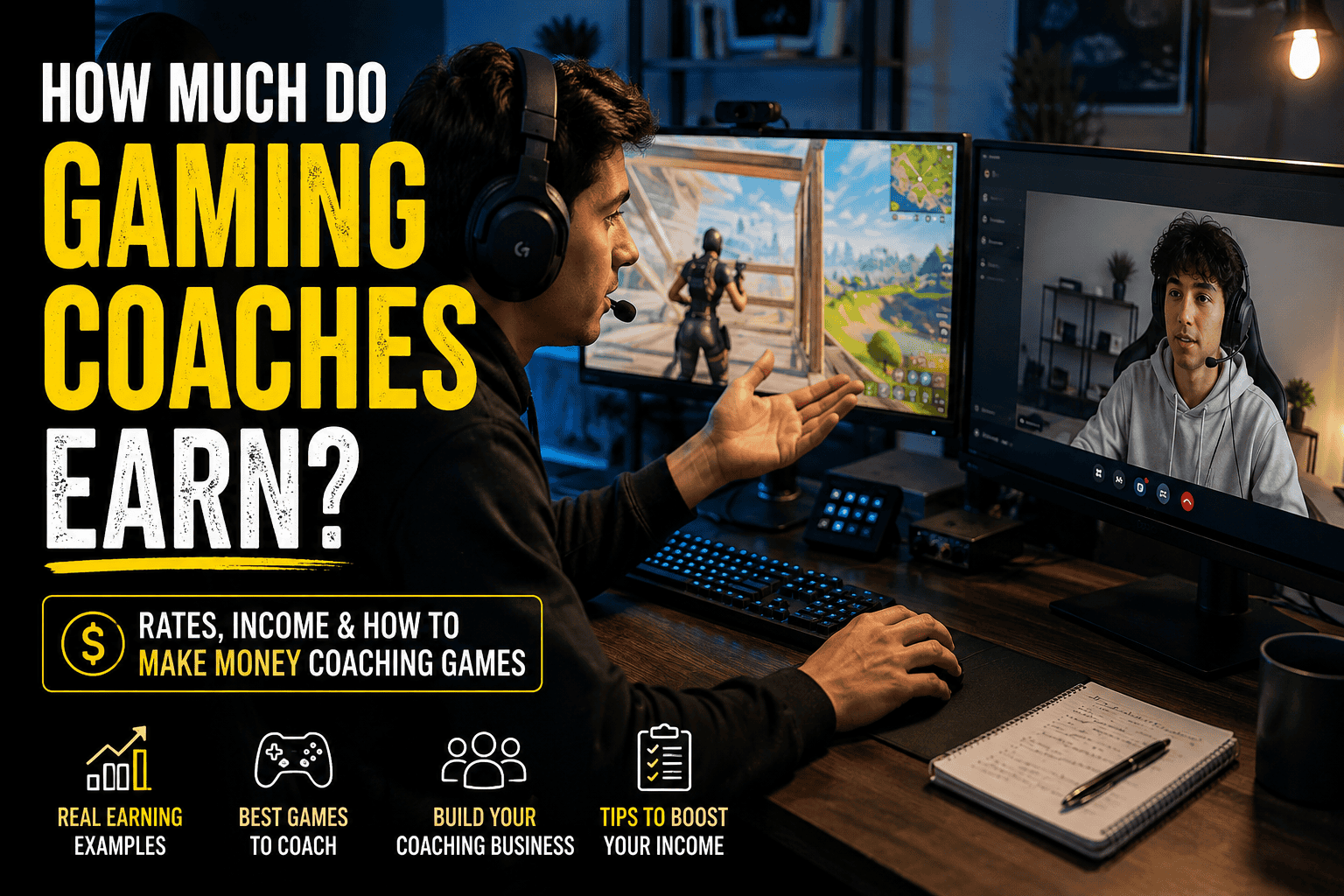
1. How Much Do Gaming Coaches Earn?
If you’re good at a game and know how to help other players improve, gaming coaching can be a genuine way to make money from your skills.
But how much can you actually earn?
There’s no single hourly rate for gaming coaches. What you can charge depends on the game you coach, your rank and experience, how good you are at teaching and the reputation you’ve built with other players.
As a rough guide, gaming coaches commonly charge around $15-$50+ per hour, while highly experienced coaches, top-ranked players and former or current esports professionals can charge $50-$100+ per hour. Some established coaches charge considerably more for specialist or premium coaching.
Current coaching marketplaces show just how wide that range can be. WeCoach, for example, has coaches listed at around $20-$50 per hour, while other coaching marketplaces have listings ranging from single-digit hourly rates to $50+ depending on the coach.
🎮 Gaming Coach Earnings at a Glance
| Coaching Level | Typical Hourly Rate |
|---|---|
| 🌱 New / Casual Coach | $10-$25+ |
| 🎮 Experienced Coach | $25-$50+ |
| 🏆 High-Ranked / Specialist Coach | $50-$100+ |
| ⭐ Pro / Elite Coach | $100+ possible |
These are broad estimates based on publicly advertised coaching prices and should not be treated as guaranteed earnings.
There’s also an important difference between what a gaming coach charges and what they actually earn.
A coach charging $40 per hour isn’t necessarily earning $40 for every hour they’re available. They need paying clients, and depending on how they sell their coaching, there may also be marketplace fees, payment fees, taxes and time spent preparing for sessions or communicating with players.
That means two coaches charging exactly the same hourly rate could end up with very different monthly incomes.
For example, a coach charging $30 per hour and completing five paid sessions each week could generate around $600 per month before fees and taxes. At 20 sessions per week, that same rate could generate around $2,400 per month.
And that’s where gaming coaching gets interesting.
You don’t necessarily need to become a professional esports coach or spend 40 hours a week coaching to make it worthwhile. For some gamers, coaching might mean earning a little extra money from a few sessions each week. For others, it can develop into a more serious side hustle or even a full-time business.
Your earning potential ultimately comes down to a fairly simple equation:
💰 Your Rate × Paid Coaching Sessions = Coaching Revenue
Getting good at the game is only part of it. Building a reputation, attracting students and giving them a reason to book another session can be just as important.
So, let’s take a closer look at how much gaming coaches can charge per hour and what separates a $15 coach from someone charging $50, $100 or more.
2. How Much Can a Gaming Coach Make Per Hour?
Gaming coaches can charge anywhere from around $10 per hour at the lower end to $100+ per hour for highly experienced coaches, with some elite coaches charging even more.
That is a pretty big range.
The reason is simple: gaming coaching doesn’t have a standard hourly rate. Coaches are essentially setting a price for their own skills, experience and ability to help someone become a better player.
Current coaching listings show just how much prices can vary. For example, League of Legends coaching can range from around $20-$40 per hour for Diamond-level coaches to $60-$120 per hour for active Challenger coaches, while some marketplace listings go considerably higher.
Individual coaches can also sit somewhere in the middle. One current Counter-Strike coach offers a one-hour session for $20, two hours for $40 and three hours for $55, while a Madden and College Football coach charges around $40 for a one-hour session.
So what could this look like for someone thinking about becoming a coach?
🌱 New Gaming Coaches – Around $10-$25 Per Hour
If you’re just starting out, charging a lower rate can make sense.
You might be an excellent player, but without reviews or a track record as a coach, potential students have little evidence that you’re actually good at teaching.
Starting at $10-$25 per hour can make it easier to land those first few bookings, learn what players want from a coaching session and start building positive reviews.
It doesn’t mean you need to stay at that price forever.
As your experience and reputation grow, so can your rate.
🎮 Experienced Gaming Coaches – Around $25-$50 Per Hour
Once you’ve built some coaching experience, $25-$50 per hour becomes a more realistic range.
At this point, players aren’t simply paying because you’re better at the game than they are. They’re paying for your ability to spot mistakes, explain what needs to change and give them practical ways to improve.
That’s an important distinction.
A top-ranked player who says “don’t do that” isn’t necessarily a great coach.
Someone who can explain why it was the wrong decision, what the player should have done instead and how to recognise the same situation next time is offering something much more valuable.
🏆 High-Ranked and Specialist Coaches – Around $50-$100+ Per Hour
Higher rates become more realistic when a coach has something that separates them from the crowd.
That could be an exceptionally high rank, years of coaching experience, tournament experience or deep expertise in a particular role, character, strategy or game mode.
A League of Legends Challenger player coaching high-ranked players, for example, occupies a very different part of the market from someone helping beginners learn the basics.
The same applies across competitive games.
A Rocket League coach with SSL or professional-level experience may be able to charge considerably more than a lower-ranked coach. Published 2026 Rocket League coaching estimates put Gold-Diamond coaches around $15-$30 per hour, Champion-Grand Champion coaches around $30-$60 and SSL or RLCS-level coaches around $75-$150, although actual prices vary by coach and platform.
⭐ Professional and Elite Coaches – $100+ Per Hour Is Possible
At the very top end, $100+ per hour is possible.
This is where professional experience, esports credentials, a strong personal brand or an exceptional coaching reputation can make a major difference.
These coaches aren’t necessarily competing with every other gaming coach on price. Players may specifically seek them out because of who they are, what they’ve achieved or the level of expertise they can provide.
But this end of the market is the exception rather than the starting point.
Most new coaches shouldn’t look at a $100+ hourly rate and assume that’s what they’ll immediately earn. Building towards higher rates usually means proving that your coaching is worth paying more for.
💰 Your Hourly Rate Isn’t the Same as Your Hourly Earnings
There’s one more catch.
Charging $40 per hour doesn’t automatically mean you’re earning $40 for every hour you spend on coaching.
You might also spend time:
- 💬 Talking to players before and after sessions
- 🎥 Reviewing gameplay or VODs
- 📝 Preparing notes and training plans
- 📅 Managing bookings and availability
- 🎮 Keeping up with patches, metas and game changes
- ⭐ Building your profile and finding new customers
There may also be marketplace or payment fees depending on where you sell your coaching.
This makes the number of paid sessions you can consistently book just as important as your advertised hourly rate.
A coach charging $30 per hour with 20 bookings could make more than a coach charging $75 who struggles to find five.
And that’s why looking at hourly rates only tells us part of the story.
Next, let’s look at how earnings can change as you move from a new gaming coach to an established or elite coach.
3. Gaming Coach Earnings by Experience Level
Your gaming ability matters when setting your coaching rate, but your reputation as a coach matters too.
Someone starting their first coaching listing may need to charge less than another player with the exact same rank who already has hundreds of completed sessions and glowing reviews.
Over time, coaches can usually justify higher prices by demonstrating that they know how to help players improve – not simply that they’re good at the game themselves.
Here’s how that progression can look.
🌱 Beginner Gaming Coaches
Every gaming coach has to start somewhere.
If you’ve never coached before, your first challenge isn’t necessarily proving that you’re good at the game. It’s proving that you’re worth paying to learn from.
A new coach might have an impressive rank, thousands of hours of experience and excellent game knowledge but still have no reviews, testimonials or previous students to back that up.
That’s why newer coaches will often start with a more affordable rate.
A lower introductory price can help you:
- 🎮 Attract your first students
- ⭐ Build reviews and ratings
- 🧠 Develop your coaching style
- 💬 Learn how to explain complex concepts clearly
- 🎥 Work out which coaching formats suit you
- 🔁 Start building repeat customers
You don’t necessarily need professional gaming experience either.
If you’re significantly better than the players you’re teaching and can explain how they can improve, there’s potentially a market for that knowledge.
A Diamond player, for example, might not be qualified to coach an aspiring professional. But they could still have plenty to teach someone struggling in Bronze or Silver.
Understanding the different video game coaching levels can help you identify which types of players your current skills and experience are best suited to teaching.
That’s one of the advantages of gaming coaching – you don’t always need to be among the best players in the world to provide value.
🎮 Established Gaming Coaches
Once you’ve completed a decent number of sessions, the conversation starts to change.
You’re no longer asking players to take a chance on an unknown coach. You can point to previous sessions, positive reviews and ideally players who have come back for more coaching.
That gives you more room to increase your rates.
Established coaches may also start moving beyond simple one-hour sessions by offering:
- 📦 Multi-session coaching packages
- 🎥 Gameplay and VOD reviews
- 🎯 Role or character-specific training
- 📈 Longer-term improvement plans
- 👥 Team or group coaching
- 🏆 Competitive preparation
This can increase earnings without relying entirely on raising your hourly price.
For example, instead of selling one session for $30, a coach might offer a three-session package that gives the player a structured improvement plan over several weeks.
The player gets more continuity and the coach gets multiple bookings from one customer.
Repeat business can be one of the biggest differences between occasional coaching income and a reliable side hustle.
🏆 High-Ranked and Specialist Coaches
As your expertise becomes more specialised, your potential rates can increase again.
This is particularly true in competitive games where rank, role and game knowledge are easy for buyers to understand.
Think about the difference between:
“I offer Valorant coaching.”
and:
“I’m an Immortal Valorant coach specialising in aim development, positioning and helping Platinum and Diamond players climb.”
The second offer tells a potential student exactly who the coach is, what they’re good at and who they can help.
Specialisation could be based around:
- 🎯 A particular rank or skill level
- 🧙 A specific character, champion or class
- 🗺️ Maps and positioning
- 🧠 Strategy and game sense
- 🎯 Aim and mechanical skills
- 👥 Team communication
- 🏆 Competitive or tournament preparation
You don’t need to offer everything.
In fact, being known for solving one particular problem can sometimes be more valuable than trying to coach every type of player.
⭐ Professional and Elite Coaches
At the top end are coaches with credentials that relatively few people can offer.
That might include:
- 🏆 Professional esports experience
- 🎮 Top-ranked competitive play
- 🥇 Tournament results
- 👥 Experience coaching competitive teams
- ⭐ A large number of successful students
- 📣 An established reputation or personal brand
At this level, players aren’t just paying for an hour of someone’s time.
They’re paying for access to experience and knowledge that can be difficult to find elsewhere.
A former professional player who understands high-level competition, team dynamics and tournament preparation can potentially offer something very different from a standard ranked coaching session.
That scarcity can support premium pricing.
However, professional credentials alone still don’t guarantee coaching success.
The best player in the world could be a terrible teacher.
Great gaming coaches need to be able to watch someone play, identify what’s holding them back and explain the solution in a way that actually makes sense to that player.
💡 Skill Gets Attention – Results Build a Coaching Business
There’s a useful way to think about the progression:
🎮 Gaming Skill → Gets You Credibility
🧠 Coaching Skill → Gets You Results
⭐ Results + Reviews → Build Your Reputation
💰 Reputation + Demand → Support Higher Rates
You don’t need to start at the bottom of that ladder if you already have strong competitive credentials.
But for most coaches, earning more is something that develops over time.
Your first goal isn’t necessarily to charge the highest rate possible. It’s to prove that players get enough value from your coaching that they’ll leave a good review, recommend you to someone else or come back for another session.
Do that consistently and increasing your rates becomes much easier.
4. How Much Can Gaming Coaches Earn Per Month?
Hourly rates are useful, but they don’t tell you how much a gaming coach can actually make.
For that, the number of paid sessions matters just as much as the price of each session.
A coach charging $50 per hour but only booking two sessions a week will earn less than someone charging $30 who consistently books ten.
So rather than asking only “How much should I charge?”, it’s worth asking another question:
How many paid coaching sessions can I realistically complete each month?
💰 Example Monthly Gaming Coach Earnings
Here’s what different combinations of hourly rates and paid coaching hours could look like:
| Coaching Level | Example Rate | Paid Hours Per Week | Approx. Monthly Revenue |
|---|---|---|---|
| 🌱 Casual Coach | $20/hour | 5 hours | $400/month |
| 🎮 Side-Hustle Coach | $30/hour | 10 hours | $1,200/month |
| ⭐ Established Coach | $40/hour | 20 hours | $3,200/month |
| 🏆 Full-Time Coach | $50/hour | 30 hours | $6,000/month |
Examples use a simple four-week month and show gross coaching revenue before marketplace fees, payment fees, taxes and other expenses. They are examples rather than guaranteed or average earnings.
At first glance, the maths looks simple.
$30 × 10 paid hours × 4 weeks = $1,200 per month.
The harder part is filling those ten hours with paying customers.
🎮 Casual Coaching – A Few Sessions Each Week
You don’t have to turn gaming coaching into a full-time job for it to be worthwhile.
For many gamers, the most realistic starting point is simply coaching for a few hours each week.
If you charged $20 per hour and completed five hours of paid coaching each week, you’d generate around $400 per month before fees and taxes.
That could mean one session after work on a few weeknights, several sessions over the weekend or whatever schedule fits around the rest of your life.
This flexibility is one reason coaching can work well as a gaming side hustle.
You’re selling time and knowledge you already have without necessarily committing to a traditional work schedule.
🚀 Building a More Serious Side Income
Once bookings become more consistent, the numbers can start adding up.
At $30 per hour for ten paid hours each week, you’re looking at roughly $1,200 in monthly revenue.
Increase that to $40 per hour and 20 paid hours per week and the example rises to around $3,200 per month.
Getting there is unlikely to happen overnight.
You’ll need enough demand to fill those hours, and that usually means building reviews, encouraging repeat bookings and giving players a good reason to choose you over another coach.
But this is where coaching can move from “a bit of extra gaming money” into a genuine source of side income.
🏆 Can Gaming Coaches Make $5,000+ Per Month?
Potentially – but the numbers need to work.
At $50 per paid coaching hour, reaching $5,000 in gross monthly revenue would require around 100 paid hours per month, or roughly 25 hours per week using a four-week month.
At $75 per hour, you’d need around 67 paid hours.
At $100 per hour, you’d need around 50.
The higher your rate, the fewer sessions you need – provided people are willing to book you at that price.
That’s the part that tends to disappear from flashy income claims.
You can list a coaching session for $100 an hour. That doesn’t mean anyone will buy it.
A coach earning $5,000+ consistently needs some combination of strong demand, competitive pricing, repeat customers and enough available time to deliver the sessions.
📅 Available Hours Aren’t the Same as Paid Hours
This is probably the biggest mistake when estimating potential coaching income.
Imagine you’re available to coach for 20 hours this week.
That doesn’t mean you’ve earned 20 × your hourly rate.
If only eight of those hours are booked, eight hours are generating coaching revenue.
Your real monthly income therefore depends on your booking rate – how much of your available coaching time actually gets sold.
For example:
Coach A: $50/hour × 5 paid hours/week = $1,000/month
Coach B: $30/hour × 15 paid hours/week = $1,800/month
Coach B charges considerably less but generates more revenue because they’re completing more paid sessions.
Finding the right price is therefore a balancing act.
Charge too little and you might be leaving money on the table.
Charge too much and you could end up with plenty of free time and very few customers.
🔁 Repeat Players Can Make a Big Difference
Not every month needs to start from zero.
If a player enjoys their first session and sees an improvement, they might book another one next week. They could then purchase a coaching package or continue working with the same coach over several months.
That can make repeat customers particularly valuable.
Instead of constantly finding ten new players every week, an established coach might have several regular students alongside new bookings.
Packages can help too.
A player who wants to improve their rank over the next month may get more value from four structured sessions than a single one-hour lesson. For the coach, that’s four sessions booked instead of one.
The more predictable those bookings become, the easier it is to build consistent monthly coaching income.
💡 Focus on Booked Revenue, Not Just Your Hourly Rate
It’s tempting to look at the highest-priced coaches and think:
“If they’re charging $100 an hour, I should charge $100 too.”
But the better number to focus on is how much you’re actually earning across the month.
A slightly lower price that attracts more bookings and repeat customers can sometimes generate considerably more revenue than a premium rate that rarely gets booked.
Ultimately, monthly gaming coaching revenue comes down to three things:
💰 Coaching Rate × Paid Sessions × Repeat Business
Get those working together and gaming coaching can grow from a few extra sessions each month into a much more meaningful source of income.
5. Which Games Pay Gaming Coaches the Most?
Not all games offer the same earning potential for coaches.
Games with large competitive communities, deep ranking systems and high skill ceilings tend to create the strongest coaching markets. Players have clear reasons to improve – climb ranks, master difficult mechanics, compete more effectively or simply stop being hardstuck.
Some of the biggest opportunities can be found in games such as:
| 🎮 Game | 💰 Coaching Potential | 🔥 Why Players Hire Coaches |
|---|---|---|
| League of Legends | ⭐⭐⭐⭐⭐ | Ranked climbing, roles, champions, mechanics and strategy |
| Valorant | ⭐⭐⭐⭐⭐ | Aim, positioning, agents, game sense and ranked improvement |
| Counter-Strike 2 | ⭐⭐⭐⭐ | Aim, utility, positioning, tactics and competitive play |
| Fortnite | ⭐⭐⭐⭐ | Building, editing, mechanics, rotations and competitive play |
| Rocket League | ⭐⭐⭐⭐ | Mechanics, positioning, rotations and ranking up |
| Overwatch 2 | ⭐⭐⭐⭐ | Hero mastery, positioning, team play and game sense |
| EA Sports FC | ⭐⭐⭐⭐ | Competitive play, tactics, formations and mechanics |
| Dota 2 | ⭐⭐⭐⭐⭐ | Strategy, heroes, roles, drafting and extremely deep mechanics |
These ratings are a guide rather than a guarantee. A popular game doesn’t automatically mean you’ll earn more from coaching it.
🏆 Competitive Games Usually Create Strong Coaching Markets
The best coaching games tend to have one thing in common – players can clearly see how good they are.
Ranked systems give players something measurable to chase:
🥉 Bronze → 🥈 Silver → 🥇 Gold → 💎 Diamond → 🏆 Elite Ranks
When someone is stuck just below their next rank, paying an experienced player to identify their mistakes can suddenly look very appealing.
This is one reason competitive games such as League of Legends and Valorant have developed active coaching markets. Current coaching marketplaces show coaches across a wide range of price points, with higher-ranked, established and well-reviewed coaches generally able to position themselves toward the higher end.
🎯 High Skill Ceilings Create More to Teach
A game also needs enough depth for coaching to provide real value.
Consider everything a Valorant coach could potentially teach:
- 🎯 Crosshair placement
- 🗺️ Map knowledge
- 🧠 Game sense
- 💥 Ability usage
- 👣 Movement and positioning
- 💰 Economy management
- 🤝 Team communication
- 🔍 VOD and replay analysis
- 📈 Ranked improvement strategies
The more there is to master, the easier it becomes for coaches to build specialised coaching services rather than simply selling a generic hour of their time.
A League of Legends coach might specialise in jungle coaching. A Rocket League coach might focus on mechanics. A Fortnite coach could specialise in competitive play.
Specialisation can make your coaching more valuable.
👥 Player Population Matters Too
You could be the world’s greatest coach for an obscure competitive game, but if hardly anyone is looking for coaching, finding clients could be difficult.
Large gaming communities give coaches a bigger potential customer base.
But popularity comes with a catch:
More players usually means more potential clients – and more competing coaches.
That means the biggest game isn’t automatically the best game to coach.
A smaller game or niche may actually work better if:
- 👥 It still has an active competitive community
- 🔎 Players actively search for help
- 🧠 You have specialist knowledge
- 🥇 You’re highly ranked
- 📉 There are fewer established coaches
- 💬 You’re active within that game’s community
Finding the right niche can sometimes be more valuable than jumping into the biggest coaching market.
💰 Can Certain Games Support Higher Coaching Rates?
Yes, but the game itself is only one part of the equation.
Across the wider coaching market, advertised prices can range substantially. Current examples include coaches charging below $20 per hour through to $50+ per hour, while more structured premium coaching services can charge considerably more per session.
Your potential rate is more likely to depend on a combination of:
🎮 Game – Is there strong demand for coaching?
🏆 Rank – Can you demonstrate advanced ability?
⭐ Reputation – Do you have reviews and successful clients?
🧠 Specialisation – Do you solve a specific problem?
🎓 Coaching Ability – Can you actually teach rather than just play well?
📦 Service – Are you offering live coaching, VOD reviews, improvement plans or packages?
📣 Audience – Do players already know and trust you?
A highly rated specialist coach in a smaller game could therefore earn more than an unknown coach competing with hundreds of others in a massive game.
💡 Don’t Choose a Game Just Because It Pays More
If you’re thinking about becoming a gaming coach, chasing whichever game appears to have the highest hourly rates isn’t necessarily the best strategy.
Your strongest opportunity will usually sit where three things overlap:
🎮 A Game You’re Great At + 👥 Players Who Want Help + 💰 A Coaching Service They’ll Pay For
If you’re already highly skilled at a competitive game, start there.
You already have the knowledge. The next challenge is turning that knowledge into a coaching service players actually want to book.
6. What Determines How Much a Gaming Coach Can Charge?
Two coaches can offer sessions for the same game and charge completely different prices.
One might struggle to get bookings at $20 an hour, while another regularly finds players willing to pay $60 or more.
So what’s the difference?
Your rank certainly matters, but players aren’t paying for rank alone. They’re paying for the value they believe they’ll get from spending time with you.
That value can come from your skill, coaching experience, reputation, specialist knowledge and even how well you present your coaching service.
Here are some of the biggest factors that can influence what you can charge.
🏆 Your Rank and Skill Level
Your gaming ability is one of the easiest things for potential students to understand.
If you’re a high-ranked player, you’ve already demonstrated that you understand the game at a level most players don’t.
For competitive games, ranks such as Challenger, Radiant, Global Elite or Supersonic Legend can immediately give a coach credibility.
But rank needs some context.
A player doesn’t necessarily need the number-one player in the world to help them improve.
Someone stuck in Silver may get enormous value from a Diamond or Master-level coach who understands the mistakes lower-ranked players commonly make.
Your skill level should therefore be high enough to provide genuine value to the players you’re targeting.
⭐ Reviews and Reputation
When you’re buying coaching online, there’s an obvious problem:
How do you know the coach is actually any good?
Reviews help answer that question.
A coach with a history of positive feedback is usually less of a gamble than someone offering their very first session.
Good reviews can show potential students that you’re:
- 🎯 Knowledgeable about the game
- 💬 Easy to communicate with
- 🧠 Good at explaining concepts
- ⏰ Reliable and professional
- 🎮 Helpful during actual gameplay
- 📈 Capable of helping players improve
As your reputation grows, you may find it easier to increase your rates without losing demand.
This is why charging slightly less when you first start can sometimes make sense. You’re not just earning money from those early sessions – you’re building proof that can make future sessions more valuable.
🧠 Your Ability to Actually Coach
Being an incredible player doesn’t automatically make someone an incredible coach.
We’ve probably all played with someone who knows exactly what everyone else is doing wrong but couldn’t explain the solution if their rank depended on it.
Coaching is a separate skill.
A good gaming coach needs to identify mistakes, understand why they’re happening and explain how to fix them in a way the player can actually use.
That might mean breaking down:
- 🎯 Mechanics and aim
- 🗺️ Positioning
- 🧠 Decision-making
- ⏱️ Timing
- 👥 Communication
- 🎮 Game sense
- 📊 Resource management
- 🏆 Competitive strategy
The best coaches also adapt.
A beginner probably doesn’t need the same lesson as someone trying to move from the top 5% into the top 1%.
If players finish a session knowing what they’re doing wrong, why they’re doing it and what to practise next, you’ve given them something valuable.
And value is what ultimately supports higher prices.
🎯 Specialist Knowledge
Sometimes being more specific can make your coaching more valuable.
Instead of simply offering League of Legends coaching, you might specialise in jungle pathing, ADC positioning or helping Diamond players push towards Master.
A Valorant coach might specialise in aim development, controller play, map positioning or VOD analysis.
A Rocket League coach might focus specifically on rotations, mechanics or helping Champion players reach Grand Champion.
Specialisation gives buyers a clearer reason to choose you.
It can also reduce the number of coaches you’re directly competing against.
You’re no longer trying to be the best coach for everyone.
You’re trying to be the right coach for a particular type of player with a particular problem.
🎮 The Game You Coach
Not every game has the same coaching market.
Games with large competitive communities and established ranked systems tend to create natural demand for coaching because players have something measurable they’re trying to improve.
Games such as:
- 🎯 Valorant
- 🧙 League of Legends
- 🔫 Counter-Strike 2
- 🚗 Rocket League
- 🏗️ Fortnite
- ⚽ EA Sports FC
- 🛡️ Overwatch 2
- ⚔️ Dota 2
all give players clear reasons to improve their skills.
However, a large player base also attracts more coaches.
That means popular games can offer more potential customers but also more competition.
A smaller game could have fewer students but fewer established coaches competing for them.
We’ll look at this more closely when we compare which games can offer the strongest opportunities for gaming coaches.
🥇 Competitive and Esports Experience
Competitive experience can add another layer of credibility.
If you’ve competed in tournaments, played professionally or coached an esports team, that’s worth highlighting.
Players looking for advanced coaching may be willing to pay more for someone who has experience beyond ranked matchmaking.
This can be particularly valuable for:
- 🏆 Tournament preparation
- 👥 Team coaching
- 🧠 Advanced strategy
- 💬 Team communication
- 🎯 High-level individual coaching
- 🎥 Competitive VOD analysis
You don’t need esports experience to become a successful gaming coach, but if you have it, it can help separate your service from more general coaching offers.
🌎 Language, Location and Availability
Sometimes your biggest advantage has nothing to do with rank.
It might simply be that you’re available when the player wants to learn.
Gaming is global. A coach who can offer sessions across different time zones or speak multiple languages can potentially reach a much larger group of players.
Flexible availability can also make it easier to secure bookings during evenings and weekends, when many players have more time to game.
This doesn’t necessarily mean you can immediately charge more per hour, but it can help you attract more paid sessions, which ultimately matters just as much.
📦 What You Include in the Session
Not every one-hour coaching session offers the same value.
One coach might jump into Discord, watch you play for an hour and leave.
Another might review gameplay beforehand, prepare notes, spend an hour coaching you and provide a personalised practice plan afterwards.
Both sessions technically last an hour.
They’re clearly not the same product.
You might increase the value of your coaching by including:
- 🎥 Pre-session VOD reviews
- 📝 Personalised feedback
- 🎯 Training exercises
- 📊 Performance analysis
- 📈 Improvement plans
- 💬 Post-session questions
- 🔁 Follow-up sessions
This can help justify a higher price without simply increasing your rate because you want to earn more.
💰 Ultimately, Your Market Sets the Price
You can choose whatever price you want for your coaching.
The market gets the final vote.
If you’re constantly booked out at $20 per hour, that may be a sign you could test a higher rate.
If you’re charging $80 and nobody books, the problem could be your price, your offer, your profile or simply a lack of demand.
Finding the right coaching rate often involves some experimentation.
It can also help to compare how much video game coaching costs across different games, session types and coach experience levels before deciding where to position your own rate.
Start with a price that reflects your current skill and experience, see how players respond and adjust as your reputation grows.
The goal isn’t to become the cheapest gaming coach.
And it isn’t necessarily to become the most expensive.
It’s to reach a point where players feel they’re getting excellent value while your time, knowledge and coaching ability are being properly rewarded.
7. Different Ways Gaming Coaches Can Make Money
When you think about gaming coaching, the obvious format is a one-hour session with another player.
That’s certainly one way to do it.
But it’s far from the only one.
Gaming coaches can package their knowledge in different ways depending on the game, the player’s goals and how involved they want the coaching to be. Some players might need a quick replay review. Others may want several weeks of structured coaching.
Offering different options can also help coaches reach more players and build more consistent income than relying on individual sessions alone.
🎧 One-on-One Coaching
This is the classic gaming coaching format.
A coach works directly with one player, usually through voice chat while watching them play, playing alongside them or reviewing their gameplay.
The session might focus on:
- 🎯 Mechanics and aim
- 🗺️ Positioning and movement
- 🧠 Decision-making
- 🎮 Game sense
- 👥 Communication
- 📈 Ranked improvement
- 🏆 Advanced strategies
One-on-one coaching is popular because everything can be tailored to the individual player.
Instead of watching another generic “10 Tips to Rank Up” video, the player gets feedback on what they’re personally doing wrong and how they can improve it.
For coaches, it’s also one of the simplest services to start offering.
🎥 VOD and Replay Reviews
Not every coaching session needs to happen live.
With a VOD or replay review, the player provides recorded gameplay for the coach to analyse.
The coach can then identify mistakes, highlight good decisions and explain where the player could improve.
Depending on the service, feedback could be delivered through:
- 🎥 A recorded video review
- 🎧 A live call while watching the replay together
- 📝 Written notes and recommendations
- 📊 A personalised improvement plan
This format can be useful for games where positioning, decision-making and strategy are easier to analyse when the action can be paused and replayed.
It can also give coaches more flexibility because the review doesn’t always need to happen at the same time as the player’s session.
📦 Multi-Session Coaching Packages
Some skills aren’t going to improve in an hour.
That’s where coaching packages come in.
Instead of selling one session, a coach might offer three, five or ten sessions designed around a specific goal.
For example:
🎯 “Four-Week Valorant Rank Improvement Program”
could include:
- An initial gameplay assessment
- Weekly one-on-one coaching
- VOD reviews between sessions
- Aim or mechanics exercises
- Progress tracking
- A final review and improvement plan
The player gets a more structured coaching experience rather than a collection of unrelated sessions.
The coach gets something valuable too – multiple bookings from a single customer.
Packages can therefore be one of the most useful ways to turn occasional coaching into more predictable income.
👥 Team and Group Coaching
Gaming coaching doesn’t have to be one-on-one.
Competitive teams, friend groups and amateur esports teams may want to improve together.
Team coaching can focus on areas that individual sessions can’t always address effectively, including:
- 💬 Communication
- 🗺️ Rotations and positioning
- 🧠 Team strategy
- 🎯 Role responsibilities
- 🤝 Coordination
- 🏆 Competitive preparation
This can be particularly relevant for games such as Valorant, Counter-Strike 2, League of Legends, Overwatch 2 and Rocket League.
A coach may also be able to charge more for a team session than an individual session because they’re helping several players at once.
🏆 Competitive and Tournament Coaching
More advanced players may be looking for something beyond general ranked improvement.
They might be preparing for a tournament, joining a competitive team or trying to move towards semi-professional or professional play.
This creates opportunities for specialist coaching around:
- 🧠 Advanced strategy
- 🎥 Opponent analysis
- 🗺️ Map preparation
- 👥 Team composition
- 💬 Communication
- 📊 Performance reviews
- 🏆 Tournament preparation
This type of coaching usually requires considerably more expertise.
But coaches with genuine competitive or esports experience may be able to position themselves as specialists rather than competing with general gaming coaches.
🎯 Role, Character or Skill-Specific Coaching
Sometimes players don’t need help with the entire game.
They have one specific problem they want to fix.
A League of Legends player might want to improve their jungle pathing.
A Valorant player might need help with aim and crosshair placement.
A Rocket League player might be struggling with aerial mechanics.
A Fortnite player might want to improve their building and editing.
These problems can become coaching services of their own.
Instead of offering generic “Fortnite Coaching”, you could offer something much more targeted such as:
🏗️ Fortnite Building & Editing Coaching
or:
🎯 Valorant Aim & Positioning Review
The more closely your coaching matches what a player is searching for, the easier it can be for them to understand exactly what they’re paying for.
📈 Long-Term Coaching
Some players aren’t looking for a quick fix.
They want someone who can work with them over several weeks or months, track their progress and continuously adjust what they should be working on.
Long-term coaching might include regular sessions, replay reviews, training exercises and progress checks.
This can create a different relationship from a one-off lesson.
The coach becomes someone who understands the player’s strengths, weaknesses and goals.
For coaches, that can mean something equally important:
repeat business.
Instead of constantly finding new students, part of your monthly schedule can be filled by players who already know and trust you.
💡 You Don’t Need to Offer Everything
It’s easy to look at all these options and think you need ten different coaching services.
You don’t.
In fact, starting simple is often better.
You might begin with one-on-one coaching and VOD reviews, see what players respond to and expand from there.
Over time, you may discover that players keep asking for the same thing.
That’s useful information.
If five different students ask whether you offer longer-term coaching, perhaps there’s an opportunity for a coaching package.
If everyone wants replay analysis, build a dedicated replay-review service.
The best coaching offers often develop around what players actually want to buy, rather than what a coach assumes they’ll want.
And the more ways you can turn your gaming knowledge into something genuinely useful, the less your earning potential depends on selling one isolated hour at a time.
8. Can Gaming Coaching Be a Full-Time Job?
Yes – gaming coaching can become a full-time job, but getting there takes more than being exceptionally good at a game.
The maths itself isn’t difficult.
If you charge $50 per hour and complete 25 paid coaching hours each week, that’s around $5,000 in gross monthly revenue using a four-week month.
At $75 per hour, 20 paid hours per week would generate around $6,000 per month.
But there’s one rather important word in both examples:
Paid.
Being available for 25 hours doesn’t mean you’ll get 25 bookings.
For gaming coaching to become a reliable full-time income, you need enough demand to consistently fill your schedule.
🎮 Going From Side Hustle to Full-Time Coaching
For most coaches, starting part-time makes much more sense than immediately trying to turn coaching into a career.
You might begin with a few sessions after work, school or university.
That gives you a chance to find out:
- 🎯 Whether there’s demand for your coaching
- 💰 What players are willing to pay
- ⭐ How quickly you can build reviews
- 🔁 Whether players book additional sessions
- 📅 How many hours you can realistically coach
- 🧠 Whether you actually enjoy teaching other players
That last point is worth considering.
Loving a game and loving teaching the same game for several hours every day aren’t necessarily the same thing.
Starting small lets you test the idea while your financial risk is relatively low.
If your schedule gradually fills and you’re regularly turning players away because you don’t have enough availability, that’s a much stronger signal that coaching could become something bigger.
💰 How Much Would You Need to Earn?
Before treating gaming coaching as a full-time job, work backwards from the income you actually need.
Suppose your target is $4,000 per month in gross coaching revenue.
Here’s roughly how many paid hours that would require:
| Coaching Rate | Paid Hours Per Month | Approx. Paid Hours Per Week |
|---|---|---|
| $20/hour | 200 | 50 |
| $30/hour | 134 | 34 |
| $40/hour | 100 | 25 |
| $50/hour | 80 | 20 |
| $75/hour | 54 | 14 |
| $100/hour | 40 | 10 |
Figures are rounded and use a four-week month. They represent gross revenue before fees, taxes and other expenses.
This shows why increasing your value as a coach can matter so much.
Trying to generate $4,000 per month at $20 an hour requires around 50 paid coaching hours every week. That’s already more than a standard full-time working week – before you count preparation, messages, scheduling or finding customers.
At $50 per hour, the same revenue requires around 20 paid hours.
That’s a much more manageable target.
Of course, charging $50 doesn’t magically create 20 customers. You still need enough demand to fill those hours.
📅 Coaching Isn’t Only the Time You Spend in Sessions
There’s another reason 30 paid coaching hours can feel very different from a normal 30-hour working week.
Your sessions aren’t the whole job.
A full-time gaming coach may also spend time:
- 💬 Answering enquiries and messages
- 📅 Organising bookings
- 🎥 Reviewing gameplay
- 📝 Preparing feedback
- 🎯 Creating training plans
- 🔁 Following up with existing students
- ⭐ Managing their coaching profile
- 📣 Promoting their services
- 🎮 Keeping up with patches, updates and changing metas
If you coach for five paid hours in a day, you may have spent considerably longer than five hours working.
That’s why gross hourly coaching rates shouldn’t be treated like a salary.
The $50 someone pays for a session also needs to account for the unpaid work that surrounds it.
🔁 Repeat Customers Make Full-Time Coaching Much Easier
Imagine having to find 20 completely new customers every week.
You’d spend a lot of time selling yourself instead of coaching.
Now imagine that half of your weekly schedule is already filled by regular students.
That’s a very different business.
Repeat clients can make coaching income more predictable and reduce the amount of time you need to spend constantly looking for new customers.
This is where longer-term coaching and multi-session packages can become particularly useful.
A player trying to climb several ranks might work with the same coach every week for a month or longer.
If you’re helping them improve, there’s a natural reason for that relationship to continue.
📦 Don’t Rely on One-Off Sessions Alone
A full-time coach can also create different offers for different types of players.
For example, you might have:
- 🎧 Standard one-on-one sessions
- 🎥 VOD reviews
- 📦 Three or five-session packages
- 👥 Team coaching
- 🏆 Competitive preparation
- 📈 Longer-term improvement programs
This doesn’t mean throwing every possible service onto your profile.
It means finding several ways for players to work with you.
A $30 introductory session might lead to a $120 coaching package. A VOD review might turn into regular weekly coaching.
Instead of treating every booking as a one-off transaction, you’re giving players somewhere to go next if they want more help.
⚠️ Full-Time Income Can Still Be Unpredictable
There’s no salary guarantee when you’re selling coaching independently.
One month might be busy.
The next could be slower.
Demand can change because of new game releases, school holidays, game updates, competitive seasons or simply because players move on to something else.
Individual games can decline in popularity too.
If your entire income depends on coaching one game and that game’s player base starts shrinking, you have a problem.
That’s why someone considering full-time gaming coaching should think about income stability, not just their best month.
🚀 When Does Going Full-Time Make Sense?
There’s no magic number of sessions that tells you it’s time.
But there are some encouraging signs:
- 📈 Your bookings have been consistently growing
- ⭐ You’ve built a strong collection of positive reviews
- 🔁 A meaningful percentage of students book again
- 📅 Your available coaching hours regularly fill up
- 💰 Your coaching income has been consistent for several months
- 🎯 You have a clear coaching niche
- 📦 Players are buying packages or longer-term coaching
- 🏆 Your reputation is generating referrals and new customers
If those things are happening consistently, increasing your coaching hours becomes much less of a leap.
🎯 You Don’t Have to Go Full-Time for Coaching to Be Worthwhile
This is perhaps the most important point.
Success doesn’t have to mean quitting your job and becoming a full-time gaming coach.
For one person, success might mean making an extra $300 a month from a game they already play.
Someone else might aim for $1,500 a month as a serious side hustle.
Another coach might build enough demand to make it their primary income.
All three can be worthwhile.
Gaming coaching is unusually flexible in that respect. You can start with a few hours, increase your availability if demand grows and decide how far you actually want to take it.
For most people, that’s probably the smartest path:
Start part-time, prove the demand and let the numbers tell you whether going full-time makes sense.
9. How to Increase Your Earnings as a Gaming Coach
If you want to earn more from gaming coaching, increasing your hourly rate is the obvious answer.
It’s just not always the best one.
A coach charging $60 per hour with an empty calendar isn’t doing better than someone charging $35 with regular bookings and repeat students.
The real goal is to improve the value of your coaching while building enough demand to keep your available hours filled.
Here are some practical ways to do it.
⭐ Build Reviews Before Raising Your Prices
When you’re new, one of the biggest things working against you is uncertainty.
Players don’t know whether you’re a great coach, an average coach or simply a good player who has decided to start charging for advice.
Positive reviews change that.
Your first few sessions can therefore be about more than immediate earnings. They’re an opportunity to establish a track record.
Once you have players saying that your coaching was useful, easy to understand and genuinely helped them improve, future customers have more reason to trust you.
Of course, building those first reviews starts with finding your first gaming coaching clients and giving players a reason to take a chance on a new coach
As your reviews and bookings grow, you can gradually test higher prices.
You don’t need to jump from $20 to $50 overnight.
Try $25. See what happens.
If demand stays strong, perhaps try $30.
Let actual bookings help determine what your coaching is worth.
🎯 Find a Coaching Niche
“I coach League of Legends.”
That’s fine.
But compare it with:
“I help Gold and Platinum ADC players improve positioning, laning and team-fight decision-making.”
Now a particular type of player can immediately think:
That’s exactly what I need.
A clear niche can make your coaching easier to sell because you’re no longer trying to appeal to everyone.
You could specialise by:
- 🎮 Game
- 🏆 Rank
- 🎯 Role
- 🧙 Character or class
- 🗺️ Map
- 🧠 Strategy
- 🎥 VOD analysis
- 👥 Team play
- 🥇 Competitive preparation
Specialisation can also help justify higher rates if you’ve developed expertise that’s harder to find elsewhere.
🧠 Become a Better Teacher
If you want to make more money coaching, improving your own rank isn’t the only thing worth working on.
Improve your coaching.
Players aren’t paying to watch you be good at the game.
They’re paying because they want to become better themselves.
A strong coach should be able to identify the most important problems without overwhelming the player with twenty things they did wrong in five minutes.
Instead of saying:
“Your positioning is bad.”
Explain where they should have positioned themselves, why that position was safer and what information should have helped them make that decision.
The player should leave the session knowing what to change next time.
The better you become at producing those moments, the more valuable your coaching becomes.
📦 Offer Coaching Packages
If a player wants to improve significantly, one hour may not be enough.
Instead of making them purchase individual sessions every time, consider offering packages.
For example:
🎮 Single Session – 1 Hour
Gameplay analysis and personalised coaching.
🚀 Improvement Package – 3 Sessions
Initial assessment, targeted coaching and follow-up review.
🏆 Rank-Up Program – 5 Sessions
Structured coaching, VOD reviews, training exercises and progress tracking.
Packages can make the buying decision easier for players who already know they want ongoing help.
They can also increase the value of each customer.
Instead of finding five different people to purchase one session each, one satisfied player might book five sessions with you.
🎥 Add VOD and Replay Reviews
Live coaching isn’t the only thing you can sell.
Replay analysis can be particularly valuable because it allows you to pause the action and dig into decisions that might be difficult to explain during a live game.
You could offer VOD reviews as:
- 🎥 A standalone coaching service
- ➕ An optional extra
- 📦 Part of a coaching package
- 🔁 A follow-up between live sessions
It can also give you more flexibility.
A live session requires you and the player to be available at the same time. A recorded VOD review can often be completed when it suits you.
🔁 Give Players a Reason to Come Back
Finding a new customer is useful.
Finding a customer who books five times is better.
If you’ve just finished a coaching session, make it clear what the player should work on next.
Maybe today’s session focused on positioning.
They practise that for a week.
The next session could review their progress and move onto decision-making.
Now there’s a natural path forward rather than the coaching simply ending after 60 minutes.
This shouldn’t mean inventing reasons for players to keep paying you.
Quite the opposite.
If your coaching is genuinely helping someone improve, the next session should have a clear purpose.
That’s what creates repeat customers.
📅 Make It Easy to Book You
Sometimes the difference between getting a booking and losing one is simply convenience.
If a player wants coaching tonight but has no idea when you’re available, they may choose someone else.
Keep your availability accurate and give players enough options where possible.
Evenings and weekends can be particularly useful because that’s when many players have time to sit down for a longer gaming session.
If you coach internationally, different time zones can also create opportunities.
Your evening might be someone else’s morning.
The easier it is for someone to find a suitable time and book it, the fewer potential customers you’ll lose unnecessarily.
💬 Respond Quickly and Professionally
Gaming coaching doesn’t need to feel like a corporate board meeting.
But players are still paying you.
Answer questions clearly. Show up when you say you will. Be prepared for the session and treat the player’s time with respect.
Small things matter.
If two coaches have similar ranks and similar prices but one responds within a few hours while the other disappears for three days, who would you book?
Professionalism isn’t particularly exciting.
It is, however, very good for business.
🏆 Show Why You’re Worth Booking
Don’t make potential students guess what makes you qualified.
If you’ve achieved something relevant, say so.
That could include:
- 🏆 Your current or peak rank
- 🥇 Tournament achievements
- 🎮 Years of experience
- 👥 Team or esports experience
- ⭐ Coaching reviews
- 🎯 Your specialist roles or characters
- 📈 Previous coaching results
Your coaching listing should quickly answer three questions:
Who are you?
Who can you help?
Why should someone choose you?
The easier those answers are to understand, the easier it becomes for players to decide whether you’re the right coach.
💰 Test Your Pricing
There isn’t a magical gaming coaching price hidden somewhere on the internet.
Your ideal rate depends on your game, experience, reputation, competition and demand.
So test it.
If you’re fully booked every week at $25 per hour, try increasing your rate.
If bookings disappear after you raise it to $40, you’ve learned something useful.
You could lower the price, improve your offer or build more reviews before trying again.
The important thing is to base pricing decisions on real demand rather than guesswork.
📈 Focus on Revenue Per Customer – Not Just Hourly Rate
One final number is worth watching.
How much does the average student spend with you?
Imagine two coaches.
Coach A charges $50 for a session and almost every customer books once.
Coach B charges $35, but many students return for three or four sessions.
Coach B could easily generate more overall revenue despite having the lower hourly rate.
That’s why successful coaching isn’t necessarily about squeezing the highest possible price out of each hour.
It’s about creating enough value that players want to keep working with you.
Build a good reputation, become better at teaching, specialise where it makes sense and give players a coaching experience worth coming back for.
Do that well and higher earnings tend to become a result of better coaching – rather than simply a higher number on your listing.
10. How to Start Earning Money as a Gaming Coach
You don’t need an esports contract, thousands of followers or years of professional coaching experience to get started.
If you know a game well and can genuinely help less-experienced players improve, you already have the foundations of a coaching service.
If you’re starting from scratch, our guide on how to become a gaming coach walks through the full process – from choosing your game and coaching niche to setting your price and finding clients.
The trick is turning that knowledge into something another player would actually pay for.
Here’s how to get started.
🎮 1. Choose the Game You Want to Coach
Start with the obvious question:
Which game do you know well enough to teach?
Ideally, it should be a game where you have strong knowledge, plenty of experience and a skill level noticeably above the players you intend to coach.
Competitive games with ranked systems are natural candidates because improvement is easy for players to measure.
But don’t choose a game purely because you think it has the highest coaching rates.
If you’re an exceptional Rocket League player and an average Valorant player, you’re probably going to have a much easier time selling Rocket League coaching.
Play to your strengths.
🎯 2. Decide Who You Can Help
Next, narrow things down.
“I coach Fortnite” tells a player what game you coach.
It doesn’t tell them whether you’re the right coach for them.
Think about the type of player who would get the most value from your knowledge.
For example:
- 🌱 Beginners learning the fundamentals
- 📈 Lower-ranked players trying to climb
- 🎯 Players struggling with a particular mechanic
- 🧠 Experienced players improving game sense
- 🏆 High-ranked players preparing for competitive play
- 👥 Teams looking to improve communication and strategy
You don’t have to coach every skill level.
A Diamond-ranked player might be an excellent coach for Bronze, Silver and Gold players without being qualified to teach someone pushing for the highest ranks.
Be realistic about what you know and where you can genuinely help.
🧠 3. Decide What You’re Going to Teach
Now turn your gaming knowledge into an actual coaching service.
Instead of:
“I’ll help you get better at Valorant.”
Think about what you’ll actually work on.
That might include:
- 🎯 Aim and mechanics
- 🗺️ Positioning
- 🧠 Game sense
- 💬 Communication
- 🎮 Character or role knowledge
- 📈 Ranked progression
- 🎥 VOD analysis
- 🏆 Competitive strategy
The clearer your coaching offer is, the easier it is for a potential student to understand what they’re buying.
You can always expand later.
Starting with one or two things you know exceptionally well is often better than promising to teach everything.
🎧 4. Choose Your Coaching Format
How will the coaching actually work?
A straightforward place to start is a live one-on-one session.
You might watch the player through screen sharing, play alongside them or review a replay together while talking through what they’re doing.
But you could also offer:
- 🎥 VOD and replay reviews
- 📦 Multi-session packages
- 👥 Group coaching
- 🏆 Team coaching
- 🎯 Specialist training sessions
- 📈 Longer-term improvement programs
Choose a format that suits both the game and your coaching style.
If you’re starting from scratch, keep it simple.
You can always add more options once you know what players actually want.
💰 5. Set Your Starting Price
Pricing your first coaching session can feel awkward.
Charge too much and players may choose a more established coach.
Charge too little and you risk undervaluing your time.
Look at what other coaches in your game are offering and pay attention to their:
- 🏆 Rank and experience
- ⭐ Reviews
- ⏱️ Session length
- 📦 What’s included
- 💰 Price
Then position yourself accordingly.
If you’re new to coaching, an introductory rate can make sense while you build your first reviews and learn what works.
You don’t need to stay there forever.
As bookings, reviews and demand increase, you can test higher prices.
📝 6. Create a Coaching Listing
Your coaching listing is where you turn “I’m good at this game” into a service someone can understand and buy.
Keep it clear.
A potential student should quickly be able to work out:
🎮 What game do you coach?
🎯 Who is the coaching for?
🧠 What will you help them improve?
🏆 What makes you qualified?
⏱️ How long is the session?
💰 What does it cost?
Include relevant achievements such as your rank, competitive experience and coaching background, but don’t turn the description into your gaming autobiography.
Players mostly want to know how you can help them.
📅 7. Set Your Availability
Once your coaching service is live, players need to know when they can actually book you.
Choose times you can reliably commit to.
That might mean a couple of evenings during the week, weekends or a broader schedule if you’re taking coaching more seriously.
There’s no need to make yourself available every waking hour.
In fact, it’s better to offer fewer reliable times than constantly cancel or reschedule sessions.
If you’re selling coaching through a marketplace with scheduling tools, keep your availability up to date so buyers can easily find a time that works.
⭐ 8. Focus on Your First Few Students
Your first few coaching sessions are particularly important.
Yes, you want to get paid.
But you’re also building something more valuable:
a reputation.
Prepare properly. Turn up on time. Listen to what the player wants to improve and give them advice they can actually use.
Don’t try to demonstrate how much you know by pointing out every mistake they make.
Find the biggest problems and help them fix those first.
If someone leaves the session thinking:
“I know exactly what I need to work on now.”
you’ve probably done your job.
🔁 9. Turn Good Sessions Into Repeat Customers
At the end of a session, don’t just say goodbye and disappear into the matchmaking queue.
Give the player something to work on.
Perhaps they need to practise positioning for a week before another review.
Maybe you’ve identified two other areas worth covering in future sessions.
If there’s a genuine reason to continue coaching, explain what the next step could be.
Satisfied students may book again, purchase a coaching package or recommend you to another player.
That’s how a handful of individual sessions can gradually turn into consistent coaching income.
🚀 10. Start Selling Your Gaming Coaching
Once you’ve decided what you’re coaching, who you’re helping and what you’re charging, there’s only one particularly useful step left:
Put your coaching service in front of players.
On StackedGame, gaming coaches can create a coaching listing, describe what they offer, set their session availability and sell their time directly to other players.
For the complete setup process, see our guide on how to sell video game coaching sessions on StackedGame, including creating your listing, setting your availability and delivering your coaching sessions.
You might start with a single one-hour session.
If players respond well, you can build from there – adding specialist coaching, replay reviews, packages or more available sessions as demand grows.
You don’t need to have the perfect coaching business mapped out before you begin.
Start with something you’re genuinely good at.
Help your first few players.
Learn what they value.
Then improve the offer as you go.
🎮 Ready to Get Paid for Gaming?
If you’ve spent hundreds or thousands of hours mastering a game, some of that knowledge could be valuable to players who are still trying to get where you already are.
Turn your gaming skills and knowledge into a coaching service and start earning from the games you know best.
🚀 Start Selling
11. Gaming Coach Earnings FAQ
Still wondering whether gaming coaching is worth your time? Here are some quick answers to the most common questions about gaming coach earnings, rates and getting started.
💰 How Much Do Gaming Coaches Charge Per Hour?
Gaming coaches can charge anywhere from around $10 to $100+ per hour, depending on their game, rank, experience, reputation and the type of coaching they provide.
Newer coaches may start around $10-$25 per hour, while more experienced coaches can charge $25-$50+. High-ranked, specialist and professional coaches may be able to charge $50-$100+ per hour, with some elite coaches charging even more.
These are broad ranges rather than fixed industry rates. What a coach can realistically charge ultimately depends on whether players see enough value to book them at that price.
🎮 Can You Make Money Coaching Video Games?
Yes. If you have strong knowledge of a game and can help other players improve, video game coaching can be a legitimate way to earn money from gaming.
Coaches can make money through one-on-one sessions, VOD reviews, team coaching, training packages and longer-term coaching programs.
You don’t necessarily need to be a professional gamer either. What’s important is having enough knowledge to help the players you’re targeting and being able to explain that knowledge effectively.
💵 How Much Can Gaming Coaches Make Per Month?
Monthly gaming coaching income can range from a small amount of extra money to several thousand dollars.
For example, a coach charging $25 per hour and completing five paid hours each week could generate around $500 per month using a four-week month.
Someone charging $50 per hour and completing 20 paid hours each week could generate around $4,000 per month.
These figures represent gross revenue before fees, taxes and other expenses.
The important word is paid. Being available for 20 hours doesn’t mean you’ll automatically book 20 hours of coaching.
🚀 Can Gaming Coaching Be a Good Side Hustle?
It can be.
One of the biggest advantages of gaming coaching as a side hustle is flexibility. You can offer a handful of sessions each week without needing to turn coaching into your full-time job.
For someone who already spends a lot of time playing and learning a particular game, coaching can provide a way to turn that existing knowledge into additional income.
You can also start small and increase your availability if demand grows.
🏆 Do You Need to Be a Professional Gamer to Become a Coach?
No.
Professional or esports experience can certainly help, particularly if you want to coach advanced players, but you don’t need to be a professional gamer to provide useful coaching.
What matters is the gap between your knowledge and the knowledge of the players you’re teaching.
A high-ranked player may have plenty to teach beginners and lower-ranked players even if they’ve never competed professionally.
Being able to teach matters too.
A slightly lower-ranked coach who’s patient, observant and excellent at explaining mistakes may provide more value to some players than an elite player who struggles to communicate.
🎯 What Games Are Best for Gaming Coaching?
Competitive games with large player bases, ranked systems and high skill ceilings tend to create strong opportunities for coaching.
Popular examples include:
- 🎯 Valorant
- 🧙 League of Legends
- 🔫 Counter-Strike 2
- 🚗 Rocket League
- 🏗️ Fortnite
- 🛡️ Overwatch 2
- ⚔️ Dota 2
- ⚽ EA Sports FC
However, popularity isn’t everything.
Large games may have more potential students, but they can also have more coaches competing for those players. A smaller game with an active competitive community and relatively few coaches could still present a good opportunity.
⭐ What Makes a Gaming Coach Worth More?
Generally, coaches can justify higher rates when they can demonstrate more value to the player.
That could come from:
- 🏆 A high competitive rank
- 🥇 Professional or tournament experience
- ⭐ Strong reviews
- 🧠 Proven coaching experience
- 🎯 Specialist knowledge
- 👥 Team coaching experience
- 🎥 High-quality VOD analysis
- 📈 A track record of helping players improve
Ultimately, the strongest evidence is often results and reputation.
If players consistently leave positive reviews, recommend you to others and return for additional sessions, you’ve got much stronger grounds for increasing your rates.
📈 How Can Gaming Coaches Earn More?
There are two obvious ways: charge more or complete more paid sessions.
But there are other ways to increase earnings without simply adding more hours.
Coaches can offer multi-session packages, VOD reviews, team coaching, specialist training and longer-term improvement programs.
Repeat customers can be particularly valuable.
A player who books four sessions with you is generally worth more than four players who each consider your listing but never book.
📦 Should Gaming Coaches Offer Packages?
They can be a great option, particularly for players with longer-term goals.
Instead of buying individual sessions, a student might purchase a package containing several coaching sessions, replay reviews and a structured improvement plan.
This can give the player a clearer path towards their goal while giving the coach multiple bookings from the same customer.
Packages don’t need to be complicated. Even a simple three-session option can give players an alternative to purchasing one hour at a time.
⏱️ How Long Should a Gaming Coaching Session Be?
Around one hour is a practical starting point for many types of gaming coaching.
It’s usually long enough to review gameplay, identify problems, explain improvements and give the player something useful to practise.
However, the ideal length depends on the service.
A quick VOD review might be shorter, while team coaching, detailed analysis or competitive preparation could take considerably longer.
The important thing is to make the session length and what’s included clear before the player books.
🌱 How Do I Start Making Money as a Gaming Coach?
Start simple.
Choose a game you know well, decide which players you can help and create a coaching service around a specific need.
Set a realistic starting price, make your availability clear and focus on delivering a genuinely useful experience to your first students.
You can then use reviews, repeat bookings and demand to guide what comes next.
You don’t need to start as the most expensive or most established coach.
You just need to know something valuable – and be able to teach it well.
12. Final Thoughts – Is Gaming Coaching Worth It?
So, how much do gaming coaches earn?
There’s no single answer.
Some coaches might make a few hundred dollars a month from a handful of sessions. Others can build coaching into a serious side hustle, while experienced coaches with strong demand may be able to turn it into a full-time income.
Your earning potential ultimately depends on a combination of what you know, how well you teach it and whether players are willing to pay for your help.
Being highly ranked certainly helps.
But as we’ve seen throughout this guide, being great at a game isn’t quite enough on its own.
Successful gaming coaches also need to communicate clearly, identify what players are doing wrong and give them practical advice they can take into their next match.
🎮 Start With What You Already Know
One of the best things about gaming coaching is that you don’t necessarily need to learn an entirely new skill before you can start.
You may already have something valuable.
Maybe you’ve spent thousands of hours playing Counter-Strike 2.
Perhaps you’ve reached a high rank in Valorant, mastered a particular League of Legends role or know Rocket League mechanics inside out.
There are plenty of players who haven’t reached that level yet.
The question is whether you can turn your experience into something useful for them.
If you can, there’s potentially someone willing to pay for that knowledge.
📈 You Don’t Need to Go Full-Time
It’s also worth remembering that gaming coaching doesn’t need to replace your day job to be worthwhile.
A few paid sessions each week could provide some extra income without taking over your schedule.
If those sessions start filling consistently, you can make more time available.
If players keep coming back, you can introduce packages.
If demand continues growing, you can test higher prices.
There’s no need to jump straight from “I’m pretty good at this game” to “I’m now a full-time gaming coach.”
Start small, see whether players are interested and grow from there.
💰 Your Reputation Can Become Your Biggest Asset
Your first coaching session probably won’t be your most profitable one.
And that’s fine.
Early sessions give you the opportunity to improve your coaching, learn what students actually want and start building reviews.
Over time, that reputation can become just as important as your gaming rank.
A coach with strong reviews, repeat students and a clear specialisation has something new coaches don’t:
proof that people value their coaching.
That can lead to more bookings, higher rates and more predictable income.
🚀 Ready to Start Earning From Gaming Coaching?
If you know a game well enough to help other players improve, you don’t need to wait until you’re a professional esports player to give coaching a try.
Start with the skills you already have.
Choose what you want to teach, set your availability and create a coaching offer that clearly explains how you can help.
With StackedGame, you can list your gaming coaching, offer bookable sessions and connect with players looking to improve their game.
Whether you’re aiming for a little extra income or something much bigger, it starts with your first session.
🎮 Turn your gaming knowledge into income.