Entering your first gaming tournament is usually much easier than it looks from the outside.
You don’t need to be a professional player, have thousands of hours in the game or arrive expecting to win. Plenty of tournaments are open to ordinary players who simply want to compete, test their skills and experience gaming in a completely different environment.
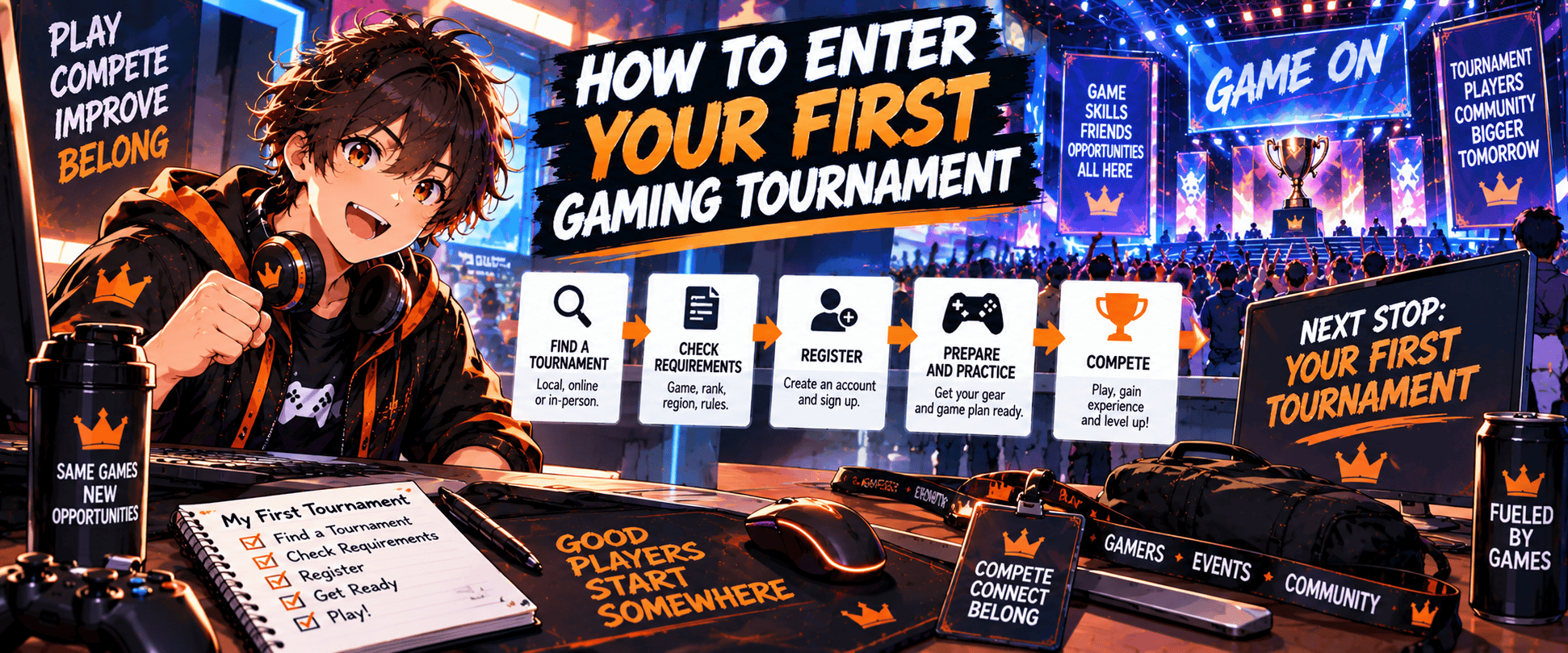
The basic process looks like this:
Find a tournament → check the rules → register → prepare → check in → play
The exact process depends on the game and event. A local Tekken weekly might involve registering on Start.gg and turning up with your controller, while a Valorant tournament could require a complete team, online check-in and specific account or regional eligibility.
If you haven’t found an event yet, start with our guide to finding esports tournaments near you. Once you’ve found something interesting, this guide will take you through what happens next.
And yes, you’ll probably be nervous before your first match.
So was almost everyone else the first time they competed.
🎯 1. Choose the Right Tournament for Your First Event
Your first tournament doesn’t need to be the biggest competition you can find.
In fact, a smaller local or community event can be a much better introduction because you’ll have more room to learn how everything works without turning the weekend into a major financial or logistical mission.
Look for Beginner-Friendly Opportunities
Useful tournament descriptions include terms such as:
- Beginner
- Amateur
- Community
- Local
- Weekly
- Monthly
- Grassroots
- Open
An open tournament generally means eligible players can enter rather than needing an invitation or qualification. It doesn’t necessarily mean the competition is designed for beginners, so check previous events or ask the organiser if you’re unsure.
Some competitions specifically restrict entry by skill or rank, which can make them excellent first events.
Local Tournaments Are a Great Starting Point
A local weekly or monthly tournament removes many of the complications surrounding larger events.
You may not need:
- Flights
- Accommodation
- Several days away
- Expensive convention admission
- Complicated travel planning
More importantly, smaller events can introduce you to the competitive community around your game.
You might enter because you want to test your Street Fighter skills and leave knowing half a dozen people who can tell you where the next tournament is happening.
That’s a pretty good result regardless of where you finished.
Don’t Obsess Over Prize Money
A large prize pool sounds exciting, but it shouldn’t be the main factor when choosing your first competition.
Instead, ask:
- Is the tournament appropriate for my skill level?
- Can I realistically attend?
- Is the entry fee reasonable?
- Do I understand the format?
- Does the community look welcoming?
- Am I actually excited to play?
Your first tournament is primarily about getting competitive experience.
If you win something, fantastic.
If you go 0-2, meet some good people and leave understanding tournament play considerably better than when you arrived, that can still be a successful first event.
📋 2. Check the Tournament Rules and Eligibility
Before registering, read the rules.
Not the most thrilling advice in gaming history, admittedly, but tournament rules determine whether you’re eligible, what equipment you need and how matches actually work.
Current tournament rules commonly specify things such as check-in procedures, match format, game settings, equipment requirements and what happens if you’re late. Some events can disqualify players who don’t report or check in on time.
Check Whether You’re Eligible
Depending on the tournament, entry requirements might include:
- Minimum age
- Country or region
- Platform
- Player rank
- Account standing
- School or university enrolment
- Qualification from another event
- Team membership
- Complete team roster
Some events are open to almost everyone. Others are deliberately restricted to particular regions, ranks or groups of players.
Don’t assume registration available automatically means you’re eligible.
Check Which Game Version and Platform Are Used
Make sure you’re practising on the correct version of the game.
Check:
- PC, PlayStation, Xbox or another platform
- Current game patch
- Allowed characters
- Map or stage rules
- Controller restrictions
- Tournament-specific settings
This matters particularly when the competitive experience differs between platforms.
You don’t want your first discovery on tournament day to be that the event is using a setup you’ve barely played.
Find Out What Equipment You Need
Some tournaments provide everything.
Others expect competitors to bring certain equipment.
For example, fighting game events may require players to bring their own controller or arcade stick. Evo’s 2026 attendee guidance explicitly tells competitors to bring their controller or stick and check their bracket and pool times before competing.
Depending on the tournament, you may need:
- Controller
- Arcade stick
- Headset
- Keyboard and mouse
- Adapter or converter
- Gaming device
- Charging cable
Read the event rules rather than packing half your gaming setup just in case.
Check the Conduct Rules
Competitive gaming gets intense.
That’s part of the fun.
It doesn’t mean normal standards of behaviour disappear the moment somebody loses a close match.
Tournament rules may cover harassment, cheating, abusive behaviour, interference with opponents and other conduct. You don’t need to memorise every sentence, but understand what the organiser expects from competitors.
Play hard.
Don’t be a nightmare to play against.
💰 3. Understand the Entry Fee and Total Cost
Some gaming tournaments are free to enter.
Others charge a tournament entry fee, venue fee or admission price. Competitions held inside larger conventions may also require you to purchase a convention ticket.
Before registering, work out the complete cost of participating.
Check What You’re Actually Paying For
Possible expenses include:
- Tournament entry fee
- Venue fee
- Convention admission
- Travel
- Parking
- Food
- Accommodation
- Equipment
- Team fees
A tournament advertised with a $20 entry fee isn’t really a $20 event if you also need a $90 convention ticket and several hundred dollars of travel.
Look at the complete picture before committing.
Check the Refund Policy
Plans change.
Before paying, check what happens if:
- You withdraw
- The event is postponed
- The tournament is cancelled
- You fail eligibility checks
- Your team can’t compete
- You miss registration or check-in
Refund policies vary between organisers.
This becomes more important when you’re travelling for an event because your tournament registration may be only one small part of the money you’ve committed.
Don’t Choose Your First Tournament Based on the Prize Pool
Prize money is nice.
But if you’re entering your first tournament, build your budget on the assumption that you’re not winning any of it.
That isn’t pessimistic. It’s just a much healthier way to plan.
Treat any winnings as a bonus rather than a method of financing the trip.
📝 4. Register for the Gaming Tournament
Once you’ve checked the tournament and decided it’s right for you, it’s time to register.
Registration may happen through a tournament platform, the organiser’s website, an online form or occasionally directly through the venue.
Platforms such as Start.gg are built around tournament registration, brackets and event organisation, although the exact platform used will depend on your game and tournament.
Create Any Accounts You Need Early
Don’t wait until five minutes before registration closes to discover you need three accounts linked together.
Depending on the event, you may need:
- Tournament platform account
- Game account
- Discord account
- Team profile
- Player ID
- Platform username
Make sure your usernames and account information are accurate.
Tournament organisers need to know which actual player belongs to which registration.
Enter Your Details Carefully
Registration may ask for:
- Real name
- Gamer tag
- Discord username
- Game account
- Region
- Platform
- Team name
- Team roster
Check everything before submitting.
A typo in your favourite pizza topping won’t matter.
A typo in the account name the organiser uses to identify you might.
Team Tournaments Need More Organisation
For games such as Valorant, Counter-Strike or League of Legends, registration may involve an entire roster rather than one player.
Check:
- Required team size
- Substitute rules
- Team captain responsibilities
- Roster lock date
- Whether every player registers individually
- Whether everyone must check in
Some tournament systems revalidate roster membership and eligibility around registration and check-in, so don’t assume you can casually swap players after the deadline.
If you don’t have a complete team, check whether the event offers free-agent registration or has a Discord channel for players looking for teammates.
Save Your Registration Confirmation
Once you’ve entered, save the important information somewhere easy to find.
Record:
Tournament → date → start time → check-in time → registration page → rules → organiser contact
Add the event to your calendar too.
Registering successfully and then forgetting the tournament exists would be an impressively avoidable first-round loss.
🏆 5. Understand How the Tournament Format Works
You don’t need to become an expert in tournament administration.
You should, however, understand what happens after your first match.
The format determines how opponents are assigned, how many chances you get and what you need to do to progress.
Single Elimination
Single elimination is simple:
Lose once → you’re eliminated
Winners continue through the bracket until one player or team remains.
It’s easy to understand and efficient for organisers, but your tournament can end quickly if you lose your first match.
Double Elimination
Double elimination gives you another chance.
Generally:
First loss → move to the losers bracket
Second loss → eliminated
This format is common in fighting game tournaments. Current Start.gg event rules provide examples of double-elimination brackets where players continue after one loss and are eliminated after their second.
If you lose your first match, don’t assume you’re finished.
Check the bracket.
Round Robin
In a round-robin format, players or teams compete against multiple opponents rather than being immediately eliminated after a loss.
Results across those matches determine standings or who progresses.
For a first-time competitor, this can be enjoyable because you’re guaranteed more competitive games.
Groups, Pools and Swiss Formats
Larger tournaments may divide competitors into groups or pools before later stages.
You might also encounter Swiss formats where players continue playing several rounds and are matched partly according to their results.
You don’t need to understand every possible bracket system beforehand.
You just need to understand the one your tournament uses.
Learn How Matches Are Reported
After a match, somebody usually needs to report the result.
Depending on the event, that might be:
- The winner
- Both players
- Team captain
- Bracket runner
- Tournament administrator
- Automatic game integration
Some Start.gg tournaments require players to enter their own results, while physical events may ask winners to report directly to a bracket official.
Find out before your first match.
You don’t want to celebrate your first tournament win, walk away feeling magnificent and then realise nobody told the bracket it happened.
Don’t Worry if the Bracket Looks Complicated
Your first look at a large double-elimination bracket can resemble somebody trying to map every possible timeline in a science-fiction film.
It’s fine.
Find your gamer tag, identify your first match and follow the organiser’s instructions.
After you’ve played a couple of rounds, it starts making considerably more sense.
🧠 6. Prepare for Your First Tournament Without Overdoing It
Once you’ve registered, the obvious temptation is to suddenly treat every gaming session like you’re preparing for a world championship.
You don’t need to.
A little focused practice is useful, but trying to completely reinvent the way you play during the week before your first tournament usually creates more problems than it solves.
Practise What You Already Know
Focus on the parts of your game that are most likely to matter.
Depending on what you play, that could mean:
- Core mechanics
- Your main character or role
- Common matchups
- Map knowledge
- Basic strategies
- Communication
- Consistency
- Playing under competitive settings
Your goal isn’t to learn everything.
It’s to become more comfortable with the things you’re already likely to use.
If you’re entering a fighting game tournament, for example, knowing one character well is usually more useful than suddenly trying to prepare five characters because one of them might theoretically have a better matchup.
Practise the Tournament Settings
If the tournament publishes its settings, use them.
That might include:
- Match length
- Map pool
- Stage rules
- Character restrictions
- Platform
- Game mode
- Server region
- Best-of-three or best-of-five format
The closer your practice resembles the actual competition, the fewer surprises you’ll face on tournament day.
Play Against Other People
Ranked play can help, but tournament preparation becomes more useful when you’re playing against real people who can adapt to what you’re doing.
If possible, practise with:
- Friends
- Teammates
- Local players
- Discord communities
- Stronger opponents
Ask for games where everyone takes the match seriously enough to practise properly.
You don’t need every session to feel like the grand final.
You just want experience making decisions when another player is actively trying to ruin your plans.
Don’t Cram the Night Before
Playing until 3 am because the tournament starts tomorrow is unlikely to unlock a secret competitive transformation.
Get some sleep.
A rested version of your normal skill level is considerably more useful than an exhausted version who spent six hours practising one obscure matchup.
Your first tournament is an experience, not an exam you forgot to study for.
🎮 7. Prepare Your Gaming Equipment
If the tournament requires you to bring equipment, test everything before leaving home.
Tournament day is not the ideal time to discover your controller has developed an exciting new feature where one button only works when it feels emotionally ready.
Test Everything You Plan to Use
Depending on the event, check your:
- Controller
- Arcade stick
- Keyboard
- Mouse
- Headset
- Adapters
- Cables
- Batteries
- Gaming device
Make sure connections are reliable and buttons or switches behave normally.
If anything needs charging, do it the night before.
Bring the Correct Cables and Adapters
Different tournament setups may require particular connections.
Read the equipment rules and check whether you need:
- USB cable
- Wireless adapter
- Controller converter
- Headset adapter
- Charging cable
Don’t assume the organiser will have spare equipment available.
They might.
You don’t want your entire tournament depending on it.
Label Your Equipment
At a busy gaming event, multiple competitors may be using identical controllers, headsets or cables.
A small label or another easy way to identify your equipment can prevent confusion.
This is especially useful for common controller models.
Five black controllers sitting beside one another suddenly look remarkably similar when everyone starts packing up.
Bring Backups Where They Make Sense
You don’t need two of everything.
But if your setup relies on something small and easy to replace – batteries, a cable or adapter, for example – a backup can be worthwhile.
Keep it sensible.
You’re entering a tournament, not opening a temporary electronics store.
🎒 8. What Should You Bring to Your First Gaming Tournament?
Your tournament packing list should be based on what the event actually requires.
For a simple local competition, you may only need your phone, registration details, payment method and controller. A tournament inside a large convention could involve an entire day away from home.
First Tournament Essentials
Consider bringing:
- Registration confirmation
- Photo ID if required
- Phone
- Portable charger
- Payment method
- Required gaming equipment
- Water bottle if permitted
- Small snacks
- Comfortable clothing
- Any personal medication
- Headphones or earplugs if useful
If you’re attending a larger gaming event, our complete gaming convention packing checklist covers the wider day in more detail.
Keep Your Equipment Together
Use a suitable bag or case for anything you’re bringing to compete.
Controllers and gaming equipment shouldn’t be thrown loose into the bottom of a backpack underneath drinks, food and whatever else you’ve packed.
Protect the things you actually need to play.
Bring Water
Competitive matches can involve long periods of waiting followed by short bursts where you’re completely focused.
Stay hydrated throughout the day rather than remembering five minutes before your match that you haven’t had anything to drink since breakfast.
Dress Comfortably
Unless the event has a particular dress requirement, wear something comfortable.
You’ll potentially spend hours sitting, standing and moving around the venue.
This is not an awards ceremony.
Nobody is deducting tournament points because your shoes prioritised comfort.
⏰ 9. Check In and Arrive Early
Registering for the tournament and checking in are not always the same thing.
Some tournaments require competitors to confirm that they’re actually present before the bracket begins.
If you don’t check in by the deadline, you may lose your place.
Find the Check-In Instructions Before Tournament Day
Look for information covering:
- Check-in opening time
- Check-in deadline
- Online or in-person check-in
- Registration desk location
- Pool or bracket assignment
- Tournament start time
Save this information somewhere easy to access.
Don’t rely on finding the original announcement while you’re standing outside the venue.
Arrive Earlier Than You Think You Need To
For an in-person tournament, give yourself enough time to:
- Find the venue
- Park or use public transport
- Pass through security
- Collect a badge if required
- Find the tournament area
- Check in
- Set up equipment
- Use the bathroom
- Get comfortable
Arriving 45 minutes early and having spare time is much better than sprinting through a convention centre while your name is being called for round one.
Find the Tournament Desk
Once you’re inside, locate the tournament area and introduce yourself if necessary.
If you’re confused, ask an organiser.
You can simply say:
“Hey, this is my first tournament. I’ve registered for [game]. Is there anything I need to do before we start?”
That’s a completely normal question.
Organisers would generally rather explain the process beforehand than discover later that you were sitting nearby waiting for something to happen.
Check Your Bracket
Find your gamer tag and first opponent if the bracket has already been published.
Also check:
- Pool
- Station
- Match time
- Reporting instructions
Schedules can change, so keep listening for announcements and checking the tournament’s official channels.
🕹️ 10. What Actually Happens at Your First Gaming Tournament?
This is the part that can feel intimidating before you’ve done it.
You arrive at the venue and everyone else appears to know exactly where to go, who to talk to and what they’re doing.
They don’t.
Well, some of them do.
Others are quietly checking the same bracket for the sixth time and hoping they haven’t misunderstood something.
Before Your Match
Depending on the tournament, your opponent may be announced, displayed in the bracket or assigned to a particular station.
When it’s time to play:
- Go to the correct setup.
- Introduce yourself to your opponent.
- Connect or prepare your equipment.
- Confirm the required game settings.
- Follow any character, map or stage selection procedure.
- Start when both players are ready.
If you’re unsure about something, ask before the match begins.
Nobody expects a first-time competitor to magically understand every tournament procedure.
During the Match
Once the game starts, play.
It sounds obvious, but nerves can make people abandon everything they normally do well.
Try not to spend the match thinking:
This is a tournament.
There are people watching.
What if I lose immediately?
Focus on the game in front of you.
Your opponent is dealing with the same match, and there’s a decent chance they’re nervous too.
People May Watch You Play
At an in-person tournament, other players may stand nearby and watch matches.
That can feel strange the first time.
Try not to interpret every person behind you as a panel of esports judges analysing your future career.
They’re probably waiting for their own match.
Or they saw your character on screen and stopped to watch.
After a while, having people around becomes part of the atmosphere.
What if You Make a Huge Mistake?
You probably will.
Everyone does.
You might miss an easy punish, forget a strategy you’ve practised 200 times, make a terrible decision or somehow press exactly the wrong button at exactly the wrong moment.
Welcome to competitive gaming.
Recover and keep playing.
The mistake usually matters far less than the next decision you make.
What Happens After the Match?
When the match finishes:
- Confirm the result
- Report it if required
- Check the bracket
- Find out when you play next
- Disconnect and collect your equipment
- Give the next players room to set up
A simple “good games” or handshake is enough after most matches.
If you’ve won, great – get ready for the next round.
If you’ve lost, check whether the format gives you another match.
And if you’re eliminated?
Your tournament day doesn’t have to end there.
In many local communities, that’s when some of the most useful part begins.
🤝 11. Learn Basic Gaming Tournament Etiquette
Tournament etiquette isn’t complicated.
Be respectful, follow the rules and remember that the person sitting across from you also gave up part of their day to compete.
You don’t need to become best friends with every opponent. You just need to avoid becoming the player everyone hopes isn’t in their pool next month.
Be Ready When Your Match Is Called
Pay attention to the bracket and tournament announcements.
When it’s your turn:
- Get to the setup promptly
- Have your equipment ready
- Don’t disappear without telling anyone
- Follow the organiser’s instructions
- Report your result when required
Keeping a tournament running on time depends partly on players being where they’re supposed to be.
If you need to leave the area temporarily, check when your next match is likely to happen.
Respect Your Opponent
Competitive gaming can be intense without becoming unpleasant.
Avoid:
- Insulting opponents
- Deliberately distracting them
- Excessive arguing
- Interfering with equipment
- Ignoring tournament officials
- Gloating after wins
- Making excuses after every loss
Celebrating a close win is fine.
Performing a 14-minute victory speech after round one of a local weekly may be slightly ambitious.
Ask Before Touching Someone Else’s Equipment
Controllers, arcade sticks, keyboards and headsets can be expensive and highly personal setups.
Don’t move or use somebody else’s equipment without permission.
Likewise, collect your own gear promptly after your match so the next competitors can use the station.
Don’t Offer Unwanted Advice Immediately After Winning
Some players love discussing matches.
Others need a minute.
If you’ve just beaten somebody, launching directly into a detailed explanation of everything they did wrong isn’t always the beautiful coaching moment you imagine it is.
If they ask for advice, great.
Otherwise, a friendly good games is enough.
Respect Tournament Officials
Organisers and referees sometimes need to make decisions you don’t like.
If you believe something is wrong, explain the situation calmly and use whatever dispute process the tournament provides.
Arguing aggressively rarely improves the ruling.
It does make you considerably more memorable.
Just not in the way you were hoping.
🧠 12. How to Deal With Nerves at Your First Tournament
Being nervous before your first competitive match is completely normal.
Playing ranked at home and sitting beside another player in a tournament are technically the same game, but they don’t always feel like it.
Suddenly your hands are slightly tense, your heart rate is up and the combo you’ve performed thousands of times has apparently been deleted from memory.
Lower Your Expectations
You don’t need to win your first tournament.
You don’t even need to win your first match.
A better first-event goal is:
Show up → compete → learn → enjoy the experience
Anything beyond that is a bonus.
Removing the expectation that you should perform brilliantly makes it much easier to settle into the event.
Focus on One Match
Don’t look at the entire bracket and start calculating your theoretical path to grand finals.
Your next opponent is the only one who matters.
Play that match.
If you win, check what comes next.
If you lose, deal with that when it happens.
Stick to Your Normal Game
Nerves can make players start doing strange things.
They abandon strategies that normally work, choose unfamiliar characters or become much more aggressive or defensive than usual.
Trust your preparation.
Your first tournament isn’t the moment to reveal a revolutionary strategy you’ve never successfully used before.
Take a Moment Between Matches
If you have time, step away from the setup.
Get some water, stretch and reset mentally.
You don’t need to spend every minute between rounds staring at the bracket or analysing your last match.
Sometimes five quiet minutes does more for your next game than another 20 minutes of worrying about it.
Remember Why You Entered
You entered because playing games competitively sounded fun.
Try to actually experience that part.
There is something genuinely different about sitting down against another player knowing the result counts towards a bracket.
Enjoy it.
You only get one first tournament.
📉 13. What if You Lose Your First Gaming Tournament?
There’s a reasonable chance you’ll lose.
Maybe immediately.
That’s normal.
Competitive communities contain players who have spent years learning their game, attending events and playing against strong opponents. Walking into your first tournament and discovering that people are good at the game isn’t evidence that you shouldn’t be there.
It’s evidence that you’ve found people you can learn from.
Going 0-2 Isn’t a Disaster
In a double-elimination tournament, 0-2 means losing your first two matches and being eliminated without a win.
It’s a common first-tournament result.
It has also happened to players who later became considerably stronger competitors.
Your result tells you how you performed at that event.
It doesn’t tell you whether you belong in competitive gaming.
Watch Other Matches
Once you’re eliminated, you suddenly have time.
Use some of it to watch stronger players.
Pay attention to:
- How they approach common situations
- Which strategies work consistently
- How they adapt
- How they handle pressure
- What they do differently from you
Watching high-level play becomes much more useful when you’ve just experienced the same tournament environment yourself.
Ask for Games
Local tournaments often include casual matches before, between or after bracket play.
If setups are available, ask people to play.
These matches can be incredibly valuable because the pressure is lower and you may get much more playtime than you did during the actual tournament.
You can also ask an opponent whether they’d be happy to explain something you struggled with.
Many players are surprisingly generous with advice when it’s actually requested.
Don’t Leave Immediately Because You Lost
Unless you genuinely need to go, stick around.
Talk to people. Watch finals. Play casual games. Learn who’s organising the next event.
If you arrived knowing nobody, this is often how that starts to change.
Your tournament result may have been 0-2.
Your actual day could still be excellent.
Write Down What You Learned
After the event, identify a few things you’d like to improve.
Not 27 things.
A few.
For example:
- I struggled against defensive players.
- My tournament nerves affected execution.
- I didn’t know one common matchup.
- Our team communication became messy under pressure.
- I need more practice on particular maps.
Those observations give your next practice sessions a purpose.
🚀 14. What Should You Do After Your First Tournament?
Your first gaming tournament shouldn’t be treated as a one-off test of whether you’re “good enough” to compete.
It’s your introduction to tournament play.
Now you know what registration looks like, how brackets work, what check-in feels like and how differently a competitive match can feel from playing at home.
That experience makes the second tournament much easier.
Follow the Organiser and Community
If you enjoyed the event, find out what’s next.
Follow:
- Tournament organiser
- Venue
- Local Discord
- Competitive community
- Players you met
- Tournament series
This is one reason finding esports tournaments near you becomes much easier after your first event.
You’re no longer searching from the outside.
You’re starting to know where your local scene actually communicates.
Play Again
If you enjoyed competing, enter another tournament.
You don’t need to wait until you’ve transformed into a dramatically better player.
Tournament experience is itself something you improve at.
The second time, you’ll probably be less worried about check-in.
The third time, the bracket will make more sense.
Eventually, walking into the venue starts feeling normal.
Set a Better Goal for Tournament Two
Your next goal doesn’t necessarily need to be win the tournament.
Try something measurable:
- Win one match
- Stay calmer
- Apply something you practised
- Communicate better with teammates
- Handle a difficult matchup differently
- Meet more players
- Play more casual matches afterwards
Progress doesn’t only appear in the final standings.
Your First Tournament Checklist
Before your first event, make sure you’ve covered the basics:
- Find a suitable tournament
- Read the eligibility requirements
- Read the tournament rules
- Understand the entry costs
- Register before the deadline
- Save your confirmation
- Learn the tournament format
- Practise using the correct settings
- Test your equipment
- Pack what you need
- Check the check-in time
- Arrive early
- Find your bracket or pool
- Play your matches
- Report your results
- Stick around and enjoy the event
That’s really it.
You don’t need a professional contract, a coach standing behind you or an esports documentary crew filming your arrival.
Find a tournament you can enter, understand the rules and show up ready to play.
Your first match might be brilliant.
It might be a complete disaster.
Either way, after it’s over you won’t be wondering what entering a gaming tournament feels like anymore.
You’ll have done it.