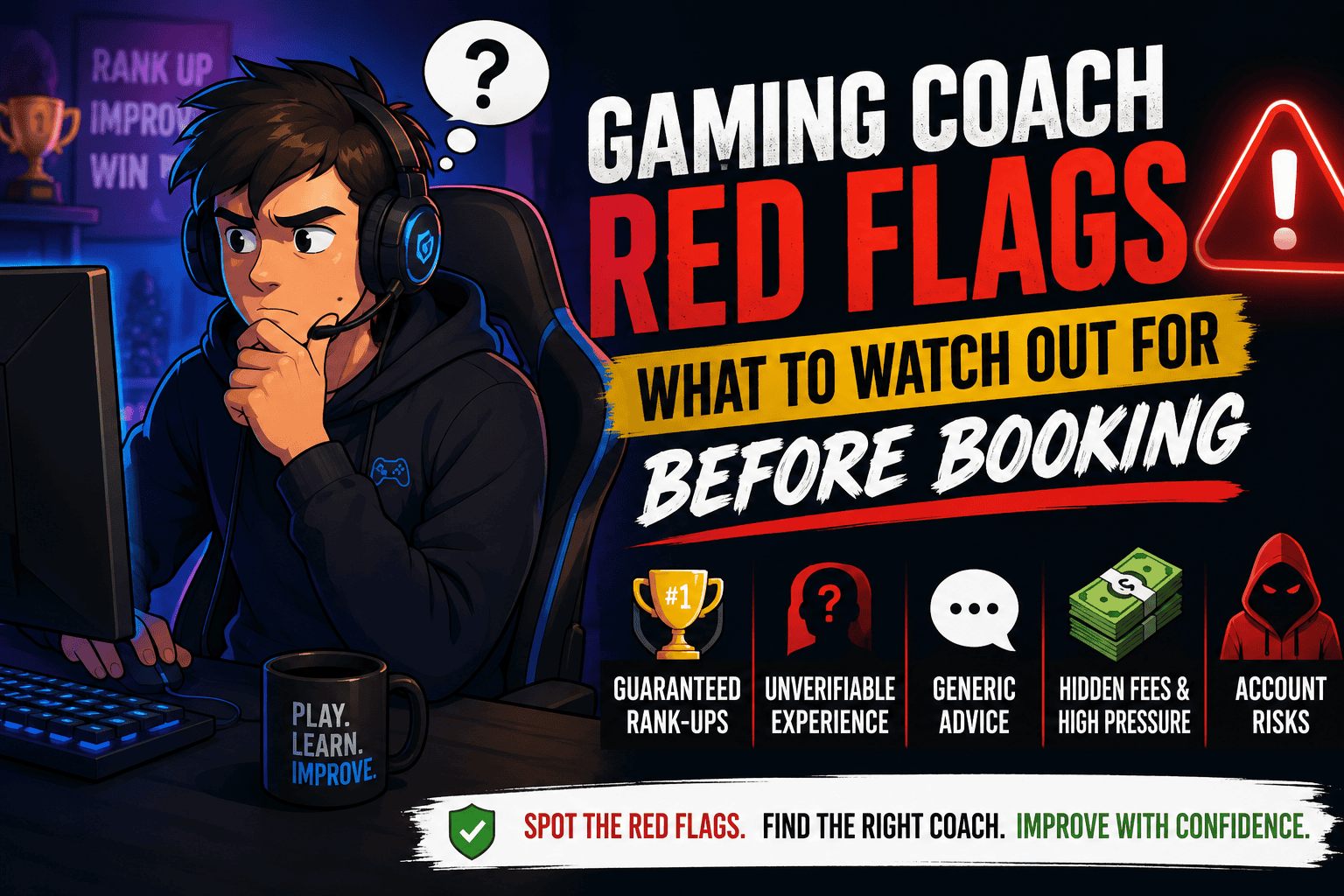
1. Gaming Coach Red Flags – What to Watch Out for Before Booking
You’ve found a gaming coach.
Their profile looks impressive.
High rank.
Great-looking reviews.
Years of experience.
Claims they can help you climb faster.
Maybe there’s even a profile picture involving crossed arms, an esports jersey and enough RGB lighting to illuminate a small city.
Everything looks good.
So you book them… right?
Not necessarily.
Most gaming coaches are simply skilled players using their experience to help other players improve. A good coach can analyse your gameplay, identify mistakes you’ve stopped noticing and give you a much clearer idea of what to work on next.
But coaching quality varies enormously.
And because gaming coaching is usually purchased online, you often need to decide whether someone is worth booking before you’ve ever spoken to them properly or experienced their coaching.
That’s where recognising gaming coach red flags becomes useful.
🚩 Some Red Flags Are Obvious – Others Aren’t
Certain warning signs are fairly easy to recognise.
A coach promising:
“Guaranteed Grandmaster in three sessions!”
should probably cause at least one eyebrow to move upwards.
But other warning signs are much less obvious.
A coach might genuinely be:
Extremely highly ranked
Very experienced
Knowledgeable about the game
and still be completely wrong for you.
Maybe they can’t explain why you should make a particular decision.
Maybe every student receives essentially the same advice.
Maybe they understand elite competitive play but have no idea how to teach a beginner.
Maybe their “live coaching” consists of spending an hour shouting:
“LEFT! LEFT! BACK UP! ULT NOW!”
while you desperately attempt to operate the keyboard.
You might perform better during that particular match.
But did you actually learn anything?
That’s the distinction this guide is going to help you make.
🎮 A Bad Gaming Coach Isn’t Always a Bad Player
This is one of the most important things to understand before choosing a coach.
Playing skill and coaching skill are not the same thing.
Someone can be an extraordinary player because they’ve developed:
Excellent mechanics
Fast reactions
Strong game sense
Years of experience
Deep strategic knowledge
But coaching requires additional skills.
A good coach also needs to be able to:
Identify why you’re making mistakes
Explain complicated ideas clearly
Prioritise what you should improve first
Adapt their teaching to your level
Give you actionable feedback
Help you understand decisions rather than memorise instructions
Think about professional sport.
Being an incredible footballer doesn’t automatically make someone an incredible football coach.
Gaming isn’t particularly different.
You aren’t simply paying someone because they’re better than you.
You’re paying them to help you become better.
🧠 Good Coaching Should Make You Understand More
Imagine two coaches reviewing exactly the same mistake.
You take a fight you shouldn’t have taken.
Coach A Says:
“That was bad. Don’t take that fight.”
Technically correct.
Coach B Says:
“You’re committing while your teammate is still rotating, so you’re effectively taking a 2v3. Wait a few seconds for them to arrive and the same fight becomes much stronger.”
Now you’ve learned something.
The next time a similar situation happens, you have a principle you can apply.
That’s what useful coaching should increasingly give you:
Understanding.
Not just instructions.
🔍 Red Flags Aren’t Only About Scams
When people hear “red flags”, they often immediately think about scams.
And yes, we’ll cover important safety warnings including:
Suspicious payment requests
Account password requests
Misleading services
Cheating or prohibited software
But many gaming coach red flags have nothing to do with someone deliberately trying to scam you.
They can simply indicate:
Poor coaching
Weak communication
Outdated knowledge
A bad match for your skill level
A service that isn’t worth the price
A coach who knows the game but doesn’t know how to teach it
Those things might not be malicious.
They can still result in a disappointing coaching session.
💰 You’re Not Just Protecting Your Money
Suppose you spend $40 on an unhelpful coaching session.
Losing the $40 isn’t the only problem.
You’ve also spent:
Your time
Your attention
Your practice time
and potentially:
Several matches following bad advice.
Poor coaching can even make improvement harder if you walk away focusing on the wrong things.
That’s why it’s worth spending a few minutes checking the coach before booking.
Not conducting an international background investigation.
Just looking for sensible evidence.
⚠️ One Warning Sign Doesn’t Always Mean “Run”
There’s another side to this.
We don’t want to turn this into:
Gaming Coach Detective Simulator 2026.
Not every imperfect profile is suspicious.
A coach might have:
Only three reviews
because they’re new.
They might have:
A relatively basic profile
because they’re better at coaching than marketing.
They might charge:
Less than other coaches
because they’re trying to attract their first clients.
They might not have:
Professional esports experience
because most players don’t need professional-level coaching.
These are not automatically red flags.
Throughout this guide, we’ll distinguish between:
🟡 Yellow Flags
Things worth investigating.
and:
🔴 Red Flags
Things that may give you a strong reason to avoid booking.
Context matters.
Patterns matter.
Evidence matters.
⭐ Don’t Judge a Coach From One Number
It’s tempting to reduce coaching profiles to numbers.
Rank: Radiant
Rating: 4.9
Sessions: 400+
Price: $50
Those numbers are useful.
But none tells the whole story.
Instead, look at the combination of:
Relevant experience
Coaching ability
Clear communication
Realistic promises
Useful reviews
A service that matches your needs
The strongest coaches tend to give you several reasons to feel confident rather than relying on one impressive statistic.
🎯 The Right Question Isn’t “Is This Coach Legit?”
Sometimes that’s exactly the question you need to ask.
But most of the time, there’s a better one:
“Is there enough evidence that this coach can help someone like me?”
Because a completely legitimate coach can still be a poor choice for you.
Suppose you’re:
Gold
New to competitive play
Trying to improve fundamentals
and you find a coach who specialises in:
Top-ranked tournament teams.
They might be outstanding.
But another coach who regularly teaches Gold and Platinum players could be much more useful.
If you’re still working out exactly what kind of coach suits your game, level and goals, our guide to finding the right gaming coach walks through the complete selection process.
This guide focuses on the other side of that decision:
What should make you hesitate?
🚩 We’re Going to Look Beyond the Obvious
By the end of this guide, you’ll know how to recognise warning signs involving:
Rank and credentials
Teaching ability
Service descriptions
Generic coaching
Communication
Reviews
Pricing
Packages and upselling
Payments
Account security
Cheating
and:
Unrealistic promises.
We’ll also look at something equally important:
What isn’t necessarily a red flag.
Because you don’t want to reject an excellent new coach simply because they haven’t collected 200 reviews yet.
And finally, we’ll turn everything around and look at the green flags that can indicate you’ve found someone worth trying.
🛡️ The Goal Isn’t to Find a Perfect Coach
Perfect profiles don’t exist.
Perfect coaches probably don’t either.
What you’re looking for is enough evidence to make a sensible booking decision.
A strong coach should generally leave you thinking:
“I understand what this person coaches.”
“Their experience is relevant to me.”
“Their claims sound realistic.”
“I know what I’m paying for.”
“I feel comfortable asking questions.”
“I know what will happen during the session.”
That’s a pretty good starting point.
On the other hand, if you’re left thinking:
“I’m not entirely sure what they do, I can’t verify anything they’ve said and apparently I’m guaranteed Grandmaster by Friday…”
We may have some red flags.
And that’s exactly where we’ll start.
Because one of the easiest warning signs to recognise is also one of the most tempting promises in gaming coaching:
the guaranteed rank-up. 🚩
2. Quick Answer – What Are the Biggest Gaming Coach Red Flags?
The biggest gaming coach red flags are usually anything that makes it difficult to answer three basic questions:
Can this person actually coach me?
Do I know what I’m paying for?
Can I trust the way they’re offering the service?
You don’t need to investigate every gaming coach like you’re preparing evidence for a courtroom.
But there are some warning signs worth recognising before you book.
🚩 The Biggest Gaming Coach Red Flags
Be cautious if a gaming coach:
Guarantees a specific rank or result
A coach can help you improve, but they can’t completely control how quickly you progress or guarantee that you’ll reach a particular rank.
Makes unrealistic improvement claims
Going from beginner to elite player in a handful of sessions sounds exciting.
It should also sound suspicious.
Claims impressive ranks or credentials that can’t be verified
Not every achievement needs a trophy cabinet attached to the profile, but major claims should have some reasonable supporting evidence.
Has impressive gaming credentials but no evidence they can teach
Being exceptional at a game and being exceptional at explaining it are different skills.
Advertises expertise that doesn’t match their actual experience
A coach specialising in your game, rank, role or problem should ideally have experience relevant to what they’re selling.
Provides an extremely vague description of the service
You should have a reasonable idea of what happens during the session before you pay for it.
Doesn’t ask about your goals, rank or gameplay
Personalised coaching should involve understanding the person being coached.
Gives generic advice that could apply to almost anyone
“Practise more” might be true.
It isn’t exactly a breakthrough analysis of your gameplay.
Tells you what to do without explaining why
This can turn live coaching into backseat gaming rather than helping you develop your own decision-making.
Makes you uncomfortable asking questions
Good coaching requires communication. You should be able to ask for clarification without being mocked or dismissed.
Uses outdated game knowledge
Competitive games change. Coaching based on old patches, outdated mechanics or irrelevant metas can quickly lose value.
Has repeated reviews mentioning the same problem
One unhappy customer can happen. A pattern of similar complaints deserves much more attention.
Pushes expensive packages before understanding what you need
Packages can offer good value, but you shouldn’t feel pressured into making a large commitment before knowing whether the coach suits you.
Uses artificial urgency to force a booking
“Pay in the next ten minutes or you’ll never get this price again” isn’t exactly the foundation of a relaxing coaching relationship.
Changes the price, service or inclusions unexpectedly
What you receive should match what was advertised and agreed.
Asks you to use suspicious payment methods
Be cautious when you’re unexpectedly pushed away from the normal payment process used by the marketplace or coaching platform.
Asks for your password or authentication codes
Ordinary coaching generally doesn’t require someone to take control of your account.
Encourages cheating, prohibited software or other rule-breaking
Coaching should help you become better at the game – not find new ways to get your account banned.
🟡 Not Every Concern Is Automatically a Red Flag
There’s an important difference between:
Something unusual
and:
Something dangerous.
For example, imagine a coach has:
Four reviews
Is that a red flag?
Not necessarily.
They could simply be new.
What if they have four reviews and unverifiable credentials and an extremely vague service and they’re pressuring you to pay outside the platform?
Now the picture looks rather different.
That’s why it’s useful to think in terms of:
🟢 Green Flags
Things that increase your confidence.
🟡 Yellow Flags
Things you should investigate.
🔴 Red Flags
Things that may give you a strong reason not to book.
One yellow flag might simply require a question.
Several red flags appearing together should receive much more attention.
🎮 Example: A New Coach With Few Reviews
Imagine you find a coach with:
Six reviews
A relatively low price
No professional esports experience
At first glance, you might wonder whether they’re worth booking.
But then you notice:
Their rank is clearly shown
Their experience matches your game and level
Their service description is detailed
Their six reviews contain specific feedback
They answer your questions clearly
They recommend starting with one session
That doesn’t sound particularly alarming.
They may simply be a new coach building their client base.
🚨 Now Compare That With This
Another coach has:
300+ sessions
A huge rank claim
An expensive package
Sounds impressive.
But:
Their credentials are unclear
The service description barely explains anything
They guarantee you’ll reach your target rank
They avoid answering questions about how the coaching works
They pressure you to buy multiple sessions immediately
Now there are several signals pointing in the same direction.
That’s when you should slow down before booking.
🔍 Look for Patterns, Not Perfection
No coach will tick every imaginable box.
Maybe their profile description could be better.
Maybe they reply slowly because coaching isn’t their full-time job.
Maybe they’re new and haven’t collected many reviews.
Maybe their graphic design skills peaked with Microsoft Paint.
None of that tells you whether they’re a good coach.
What matters is the overall pattern.
Ask whether you can find credible evidence of:
Relevant game knowledge
Teaching ability
Clear communication
Realistic expectations
A defined service
Satisfied players
Safe, transparent booking
The more of those you can confirm, the less important minor imperfections become.
🧠 The Most Dangerous Red Flags Aren’t Always the Flashiest
A ridiculous promise like:
“Guaranteed #1 Player in the World After One Session”
is relatively easy to recognise.
More subtle problems can be harder to spot.
For example:
A coach may genuinely be highly ranked.
They may genuinely know the game.
Their reviews may even be real.
But if every student receives the same generic advice, the coaching may still offer poor value.
Or they might spend the entire live session telling you exactly what button to press without teaching you how to make those decisions yourself.
Nothing about that necessarily looks suspicious on a profile.
You discover it by looking more closely at:
How the service is described
What previous students say
How the coach answers questions
and:
What the coaching is actually designed to teach.
🛡️ Use the “Would I Be Comfortable Booking This?” Test
After reviewing a coach, ask yourself:
Do I understand what I’m buying?
Does their experience seem relevant?
Are their claims believable?
Do their reviews support those claims?
Do they communicate clearly?
Does the payment process seem normal?
Have they avoided asking for anything they shouldn’t need?
If the answer is yes across the board, you’ve removed a lot of uncertainty.
If several answers are:
“Erm… not really.”
don’t ignore that simply because the coach has an impressive rank.
Ask questions.
Compare another coach.
Or keep looking.
🎯 The Biggest Red Flags Usually Fall Into Five Groups
As we go deeper into this guide, most warning signs will fit into one of five areas:
1. Unrealistic Claims
Guarantees, impossible improvement promises and exaggerated results.
2. Questionable Expertise
Unverifiable credentials, irrelevant experience or gaming skill without teaching ability.
3. Poor Coaching
Generic advice, weak communication, backseat gaming and coaching that doesn’t match your level.
4. Commercial Warning Signs
Pressure tactics, aggressive upselling, unclear pricing and missing deliverables.
5. Safety Problems
Suspicious payments, unnecessary account access, cheating and other behaviour that could put you or your gaming account at risk.
Keeping those five categories in mind makes spotting problems much easier.
And we’ll start with perhaps the most recognisable one of all:
the gaming coach who promises they can guarantee your next rank. 🚩
3. Guaranteed Rank-Ups and Unrealistic Improvement Claims 🚩
You’ve found a coach who promises:
“Guaranteed Diamond.”
Another says:
“Reach Master in five sessions.”
And one particularly ambitious coach appears confident they can transform you from:
Bronze → Grandmaster
before you’ve finished your weekend.
Tempting?
Absolutely.
Realistic?
That’s where you should become cautious.
One of the clearest gaming coach red flags is a coach who guarantees a particular rank, win rate or level of improvement.
A good gaming coach can help you improve.
They can help you improve significantly.
What they can’t do is guarantee exactly what will happen afterwards.
🎯 Coaching Can Influence Your Results – It Can’t Control Them
There are plenty of things a gaming coach can directly help with.
They can:
Identify mistakes
Improve your decision-making
Teach better positioning
Analyse your mechanics
Explain matchups
Improve your game knowledge
Build practice routines
Help you recognise bad habits
Show you what higher-ranked players do differently
All of those things can increase your chances of improving.
But your eventual rank depends on much more than the coach.
It also depends on:
Your current skill level
How much you practise
How consistently you practise
Whether you apply the feedback
How quickly you learn
How often you play
Your performance across future matches
and plenty of game-specific variables.
A coach can influence the process.
They can’t completely control the outcome.
🧠 Think About What a Rank Guarantee Actually Means
Suppose you’re currently:
Gold 2
and a coach says:
“I guarantee I’ll get you to Diamond.”
Before they’ve even watched you play.
How?
They don’t yet know:
Why you’re Gold 2
How strong your mechanics are
Whether your game knowledge is good
Which mistakes you’re making
How much time you can practise
How quickly you respond to feedback
Whether you’re already close to improving
There could be two Gold 2 players who require completely different coaching.
Player A
Excellent mechanics.
Poor positioning.
Player B
Great positioning.
Weak mechanics.
Same rank.
Different problems.
Different development time.
Different coaching requirements.
Guaranteeing the same outcome before understanding either player doesn’t make much sense.
🚩 Be Especially Cautious of Guaranteed Timeframes
There’s another version of the same red flag:
“Reach Diamond in seven days.”
“Hit Master within three sessions.”
“Become an advanced player in two weeks.”
Improvement doesn’t happen on a universal timetable.
One player might understand a concept immediately.
Another might need:
Explanation
↓
Practice
↓
More practice
↓
Gameplay review
↓
Adjustment
↓
More practice
before it becomes consistent.
That’s normal.
Gaming skill isn’t software you install.
There isn’t a:
Download Diamond.exe
button.
📈 A Good Coach Can Still Talk About Likely Progress
This doesn’t mean coaches should never discuss outcomes.
There’s a big difference between:
Guaranteeing a result
and:
Setting realistic expectations.
For example:
🚩 Questionable
“I’ll guarantee you Diamond in three sessions.”
🟢 More Realistic
“I regularly coach Gold and Platinum players. After reviewing your gameplay, I can help identify what’s holding you back and give you specific areas to practise.”
The second coach isn’t avoiding responsibility.
They’re describing what they can actually control:
The quality of the coaching.
🏆 What if the Coach Has Helped Lots of Players Rank Up?
That’s useful evidence.
Suppose a coach has reviews saying:
“Helped me finally reach Diamond.”
“I climbed from Gold to Platinum after working on the mistakes we identified.”
“I broke through a rank plateau I’d been stuck at for months.”
Those are encouraging results.
They suggest the coach may have successfully helped other players improve.
But:
Past results aren’t guarantees of identical future results.
Your situation could be different.
That’s why reviews are best used as evidence of the coach’s:
Teaching quality
Knowledge
Communication
Ability to diagnose problems
rather than a promise that you’ll achieve exactly the same rank.
🎮 Rank Isn’t a Perfect Measurement of Improvement Anyway
Imagine you have a coaching session.
Over the next month:
Your positioning improves
Your decision-making improves
You make fewer unnecessary deaths
You understand matchups better
Your mechanics become more consistent
But your rank temporarily stays the same.
Was the coaching useless?
Not necessarily.
Competitive rankings can fluctuate.
You might:
Win several matches
then:
Lose several matches
while still becoming a better player overall.
Skill improvement and rank progression are related.
They aren’t always perfectly synchronised.
📉 You Can Even Drop Rank While Improving
This sounds strange, but it can happen.
Suppose your coach asks you to change a long-standing habit.
At first, you have to consciously think about it.
That may temporarily make your gameplay feel less natural.
You might even perform slightly worse while adjusting.
Then:
The new behaviour becomes automatic.
Your gameplay improves.
Your results begin catching up.
This is one reason short-term rank guarantees don’t always make sense.
Real improvement can be messy.
🧪 Good Coaching Focuses on Things You Can Actually Improve
Instead of promising:
“You’ll gain 500 rating.”
a useful coach might focus on measurable behaviours.
For example:
Reduce unnecessary deaths
Improve objective timing
Recognise favourable fights
Use utility more efficiently
Improve positioning before team fights
Increase consistency in a specific mechanic
These are things you can deliberately practise.
And improvements in these areas can eventually contribute to better competitive results.
🚩 Be Careful With Guaranteed Win Rates Too
Another variation is:
“Guaranteed 70% win rate.”
A coach doesn’t control:
Your teammates
Your opponents
Matchmaking
Game updates
Your future performance
or:
Whatever spectacular chaos ranked matchmaking decides to produce that evening.
They may be able to help you make better decisions that increase your chances of winning.
That’s different from guaranteeing a percentage.
🥇 “Become a Pro” Claims Deserve Even More Scrutiny
Some coaching services go beyond rank promises.
You might see claims like:
“Become a professional player.”
“Go pro in 30 days.”
“Guaranteed esports career.”
Professional gaming depends on far more than individual ranked ability.
Depending on the game, it may involve:
Exceptional skill
Team experience
Tournament results
Communication
Networking
Consistency
Opportunities
Performance under pressure
Being noticed by the right people
A coach might help prepare you for competitive play.
They might have valuable esports experience.
They may even help you understand what professional-level players need to develop.
But guaranteeing someone a professional career is another matter entirely.
💸 Big Promises Can Make Expensive Packages Easier to Sell
This is one reason unrealistic guarantees deserve extra attention.
Imagine these two offers:
Offer A
Five coaching sessions – $200
Offer B
Guaranteed Diamond Package – $200
The second one sounds more powerful.
You’re not just buying coaching.
You’re buying the idea of the result.
That can make it easier to justify spending more money.
Before paying, separate:
What is being promised
from:
What is actually being delivered.
Are you buying:
Five coaching sessions with personalised analysis?
Great.
Or are you mainly being sold:
A rank guarantee the coach may not realistically be able to control?
Very different proposition.
🔍 Ask What the Coach Actually Does to Help You Improve
If you’re unsure about a claim, ask about the process.
Instead of focusing on:
“Will you get me to Diamond?”
ask:
“How would you help someone at my level improve?”
A useful answer might describe:
Gameplay analysis
Identifying recurring mistakes
Mechanical drills
Decision-making frameworks
Practice goals
Follow-up VOD reviews
Progress tracking
Now you have something concrete to evaluate.
🧠 Look for Process-Based Promises
The strongest coaching claims usually focus on what the coach can actually deliver.
For example:
“I’ll analyse one full replay.”
“We’ll identify your three biggest weaknesses.”
“You’ll receive personalised practice recommendations.”
“We’ll review your positioning and decision-making.”
“I’ll explain what you should work on before your next session.”
These are tangible.
The coach can control whether they deliver them.
Compare that with:
“You will reach Master.”
That’s an outcome involving far more variables.
⚠️ “Guaranteed Improvement” Needs Context
Even the phrase:
“Guaranteed improvement”
deserves a closer look.
What does improvement mean?
Higher rank?
Better mechanics?
Improved understanding?
More wins?
Better decision-making?
And how is it measured?
The broader and less defined the promise becomes, the less useful it is.
Look for coaches who explain how improvement happens, not simply that it definitely will.
🎯 A Better Expectation From Gaming Coaching
Instead of expecting:
Coach → Instant Rank-Up
think:
Coach
↓
Identify Problems
↓
Understand Better Decisions
↓
Practise
↓
Apply Feedback
↓
Review Progress
↓
Adjust
↓
Improve
↓
Potentially Climb
That’s a much more realistic model.
Coaching can shorten the trial-and-error process by helping you focus on the things that matter.
But you still have to turn that knowledge into gameplay.
🚩 The Bigger the Promise, the More Evidence You Should Want
There’s a useful general rule here:
Extraordinary claim = stronger evidence required.
If a coach simply says:
“I offer coaching for Platinum players.”
Fair enough.
If they say:
“My revolutionary coaching system guarantees every Platinum player reaches Immortal within two weeks.”
You should probably have some questions.
Marketing language isn’t automatically dishonest.
Coaches are selling a service and naturally want it to sound appealing.
But there should still be a sensible relationship between:
The claim
and:
What coaching can realistically deliver.
🟢 What a Good Coach Is More Likely to Say
Look for language such as:
“I’ll help you identify what’s holding you back.”
“We’ll focus on the areas with the biggest impact on your gameplay.”
“I’ll give you specific things to practise after the session.”
“Your progress will depend on how consistently you apply the feedback.”
“Let’s review your gameplay first and see where the biggest opportunities are.”
That might sound less exciting than:
“GUARANTEED GRANDMASTER!”
But it’s considerably more believable.
🎮 Coaching Should Improve the Player – Not Just Promise the Badge
Ultimately, your goal may absolutely be:
Reach Diamond.
Reach Master.
Reach Grandmaster.
There’s nothing wrong with that.
A good coach can help you work towards those goals.
But the coaching should focus on improving the skills that make higher ranks possible.
That’s the difference between:
Selling improvement
and:
selling a promise.
So when a coach guarantees a specific rank, win rate or dramatic transformation within a fixed timeframe, treat it as a warning sign and investigate further.
Because impressive promises are easy to write.
The next question is whether the coach’s impressive credentials are any easier to verify.
4. Unverifiable Ranks, Credentials or Experience
A gaming coach’s credentials can tell you a lot.
If someone has reached:
Radiant
Grandmaster
Champion
Top 500
or another high competitive rank, that’s useful evidence that they understand the game at a high level.
Competitive experience can matter too.
A coach might have:
Played in tournaments
Competed for a team
Reached high leaderboard positions
Specialised in a particular role
Coached hundreds of players
All of these can strengthen their profile.
There’s just one small problem.
Anyone can type them into a coaching description.
That’s why impressive credentials should be treated as evidence to evaluate, rather than automatically accepted as proof that someone is the right coach.
🏆 The Bigger the Claim, the More Reasonable Verification Becomes
Suppose a coach says:
“I’ve played Valorant for four years and reached Immortal.”
That’s a fairly straightforward claim.
Now compare it with:
“Former professional player, multiple tournament champion, Top 10 leaderboard and coach to several professional players.”
Those claims are considerably more impressive.
They’re also more important to verify if they’re being used to justify:
Premium pricing
Elite coaching
or:
Competitive-level expertise.
A useful rule is:
The bigger the credential, the more reasonable it is to look for supporting evidence.
🔍 What Can Count as Evidence?
Verification doesn’t always mean finding an official certificate with:
CERTIFIED GAMING LEGEND
printed across the top.
Gaming credentials can be supported in different ways.
Depending on the game and claim, you might find:
Current rank information
Leaderboard profiles
Public player profiles
Tournament results
Team history
Competitive statistics
Gameplay footage
Streaming profiles
Educational content
Previous coaching reviews
Consistent usernames across platforms
Not every coach will have all of these.
They don’t need to.
You’re simply looking for reasonable evidence that supports the experience they’re claiming.
🎮 Current Rank vs Peak Rank
Pay particular attention to the difference between:
Current Rank
and:
Peak Rank.
A coach might say:
“Grandmaster Coach.”
But what does that mean?
They could be:
Currently Grandmaster
or:
Reached Grandmaster three years ago.
Those aren’t necessarily the same thing.
A peak rank can still be valuable.
In fact, a former high-ranked player may remain an excellent coach even if they don’t currently grind ranked for eight hours every day.
But the profile should ideally make the distinction reasonably clear.
For example:
Current Rank: Master
Peak Rank: Grandmaster
That’s much more transparent than presenting an old peak rank in a way that implies it’s current.
🕒 Old Achievements Aren’t Automatically Irrelevant
Games evolve.
Ranks change.
Metas change.
People stop competing full-time.
Someone who reached the highest level several years ago doesn’t suddenly forget everything they know about the game.
The important question is whether their knowledge remains relevant today.
A former professional player who continues:
Coaching
Studying patches
Watching competitive play
Reviewing gameplay
Keeping up with strategy
may still have outstanding knowledge.
The concern isn’t:
“This achievement happened two years ago.”
It’s:
“Is this person presenting old experience accurately, and is their knowledge still current enough for what they’re teaching?”
🚩 Be Cautious When Credentials Are Conveniently Vague
Watch for descriptions such as:
“Top-ranked player.”
“Elite competitor.”
“Professional-level gamer.”
“Played at the highest level.”
“One of the best players.”
Those phrases sound impressive.
But they don’t necessarily tell you anything.
Top-ranked where?
Which rank?
Which season?
Which game mode?
Professional for which team?
Competed in what?
A legitimate coach might simply have written a poor description.
So vague language isn’t automatically proof of dishonesty.
But if their entire selling point depends on an impressive credential, it’s reasonable to want to know what that credential actually is.
🧩 Make Sure the Evidence Matches the Claim
This is where things can get interesting.
Suppose a coach advertises:
“Top 500 Overwatch 2 Coach.”
You find evidence showing they reached:
Grandmaster.
That’s impressive.
But it doesn’t necessarily verify the Top 500 claim.
Or someone advertises:
“Former professional Valorant player.”
Their profile shows plenty of high-ranked gameplay but nothing indicating professional competition.
Again:
High rank is impressive.
It just isn’t evidence of the specific claim being made.
You’re checking whether:
Claim → Evidence
actually connects.
🥇 “Professional Player” Can Mean Different Things
The word:
Professional
deserves particular attention.
Gaming has many competitive levels.
Someone might have:
Played paid tournaments
Competed for a small organisation
Played semi-professionally
Participated in amateur leagues
Competed at a high ranked level
These are all legitimate achievements.
But they aren’t necessarily the same thing.
If professional experience is important to why you’re considering a coach, look for enough context to understand what they mean.
Especially if you’re paying a premium specifically because of it.
🎯 Relevant Credentials Matter More Than Impressive Credentials
Here’s where players sometimes get distracted.
Imagine you’re looking for:
Rocket League coaching for a Diamond player struggling with rotations.
Coach A has:
Professional tournament experience
but mainly specialises in:
Elite mechanics.
Coach B has:
Grand Champion experience
and has coached:
Dozens of Diamond and Champion players specifically around rotations and positioning.
Coach A may have the more impressive competitive résumé.
Coach B may have the more relevant coaching résumé.
That’s the distinction that matters.
🧠 Coaching Experience Is a Credential Too
Don’t focus exclusively on playing achievements.
Suppose you’re comparing:
Coach A
Top 0.5% player
Five coaching sessions completed
with:
Coach B
Top 1% player
400 coaching sessions completed
Extensive reviews
Regularly coaches players at your level
Coach A may be slightly stronger at the game.
Coach B has considerably more evidence that they can actually teach it.
That’s worth considering.
Coaching experience can demonstrate skills that ranked ladders don’t measure:
Communication
Diagnosis
Patience
Teaching
Adaptability
Working with different player types
📚 Educational Content Can Be Useful Evidence
Some coaches create:
Guides
Videos
Gameplay breakdowns
Streams
Tutorials
Social media analysis
This can give you an unusually good preview of how they think.
Ask yourself:
Do their explanations make sense?
Do they explain why decisions work?
Do they break complex ideas into understandable steps?
Do you actually learn something from them?
A coach who consistently produces useful educational content is giving you evidence of something extremely important:
Their ability to communicate gaming knowledge.
⭐ Reviews Can Help Verify Coaching Experience
Suppose a coach says:
“I’ve coached hundreds of players from Bronze to Diamond.”
Then you find a large collection of detailed reviews discussing:
Different ranks
Different problems
Different coaching sessions
Specific improvements
That supports the broader claim.
Reviews aren’t perfect proof of every credential.
But they can help establish whether the coach appears to have the kind of coaching experience they advertise.
🚩 Be Careful With Screenshots Alone
Screenshots can provide useful context.
A screenshot showing:
A rank
A leaderboard position
A tournament result
can support a claim.
But screenshots can also:
Be old
Lack context
Belong to another account
Show only part of the story
This doesn’t mean:
“Never trust screenshots.”
It means you shouldn’t necessarily treat one cropped image as unquestionable proof of an extraordinary claim.
Again, look at the overall evidence.
👤 Does the Gaming Account Actually Belong to the Coach?
This can matter when rank is a major selling point.
If possible, look for consistency between:
Profile name
Gaming username
Public accounts
Gameplay footage
Linked profiles
Competitive history
You aren’t trying to uncover someone’s private identity.
You’re simply checking whether the gaming credentials being presented appear connected to the person offering the coaching.
🚩 Be Wary of Constantly Changing Stories
Perhaps the coach says:
“I’m currently Top 500.”
Later:
“Well, I used to be Top 500.”
Then:
“Actually, it was another account.”
Then:
“The account doesn’t exist anymore.”
Any individual explanation could be perfectly legitimate.
Accounts change.
Games reset ranks.
Old profiles disappear.
But if every attempt to understand the credential produces a completely different story, your confidence should probably decrease.
💰 Credentials Matter More When They’re Being Used to Justify the Price
Suppose a coach charges:
$20 per session
and says:
“I’ve been playing competitively for years.”
You might primarily evaluate:
Reviews
Teaching quality
Service description
and:
Whether the coaching suits you.
Now suppose another coach charges:
$150 per session
because they’re advertised as:
A former professional player with elite tournament experience.
That credential is now a major part of what you’re paying for.
It’s completely reasonable to want stronger evidence.
⚠️ Don’t Turn Verification Into an Investigation
There’s a balance here.
You don’t need:
A driver’s licence
Three references
A signed statement from their former esports captain
and:
A forensic analysis of every ranked season since 2017.
You’re booking gaming coaching.
The goal is simply to have enough confidence that the important claims supporting the service are credible.
For many coaches, that may take only a minute or two.
🟡 Missing Evidence Can Be a Yellow Flag
This distinction matters.
Suppose a new coach says:
“Peak Immortal.”
You can’t immediately verify it.
Is that automatically:
🔴 RED FLAG – DO NOT BOOK?
No.
It might simply mean there isn’t much public information available.
Treat it as:
🟡 Something to investigate.
You could ask:
“Is there somewhere I can see your rank or gameplay?”
Then evaluate the response.
The warning becomes stronger if the coach:
Avoids reasonable questions
Changes their story
Provides contradictory information
or:
Builds the entire service around credentials they can’t support.
🟢 What Good Credential Transparency Looks Like
A trustworthy coaching profile might clearly explain:
Current Rank: Immortal 2
Peak Rank: Immortal 3
Main Role: Controller
Experience: Four years
Coaching Experience: 150+ sessions
Specialisation: Gold–Ascendant Controller players
Competitive Experience: Regional amateur tournaments
Nothing there needs to sound ridiculous.
It simply gives you enough information to understand:
Who the coach is as a player
and:
Why their experience might be useful to you.
🎯 Don’t Ask “Are These Credentials Impressive?”
Ask:
“Are these credentials relevant to what I want to learn?”
That’s the better question.
A coach doesn’t need to be:
World #1
to help you move from:
Gold → Platinum.
They need to understand the game at a sufficiently higher level and know how to help players make that progression.
Likewise, if you’re already competing near the top of the ladder, credentials become more important because you’re searching for increasingly specialised expertise.
The required evidence should match the level of coaching you’re buying.
🚩 Look for Consistency Across the Whole Profile
Ultimately, credentials are strongest when everything points in the same direction:
Rank
Gameplay
Experience
Specialisation
Reviews
Coaching History
Communication
If a coach claims to specialise in high-level competitive play and everything else supports that claim, great.
If the profile contains enormous claims but almost nothing else lines up with them, investigate before booking.
But there’s another important catch.
Even if every credential is completely legitimate…
Even if the coach really is one of the highest-ranked players in the game…
Even if their mechanical skill makes your gameplay look like you’re controlling the character through a fax machine…
there’s still one question left:
Can they actually teach?
5. Great Player, Bad Teacher – Why Rank Isn’t Enough
You’ve found a coach who is:
Top 500.
Fantastic.
They’ve clearly demonstrated that they can play the game at an extremely high level.
But there’s another question you need to answer:
Can they teach someone else how to do it?
Because being brilliant at a game and being brilliant at coaching that game are two different skills.
A player can have incredible mechanics, instinctive decision-making and thousands of hours of experience…
and still struggle to explain why you’re standing in the wrong place.
That’s why choosing a gaming coach based entirely on rank can be a mistake.
🎮 Playing and Coaching Require Different Skills
High-level gaming requires abilities such as:
Mechanics
Game sense
Reaction speed
Decision-making
Strategy
Positioning
Consistency
Experience
Coaching requires many of those things too.
But it also requires:
Communication
Observation
Diagnosis
Teaching
Patience
Prioritisation
Adaptability
The ability to explain why something works
A great player knows how to perform.
A great coach knows how to help someone else perform better.
There’s plenty of overlap.
But they aren’t identical.
🧠 Elite Players Often Do Things Automatically
Imagine a player who has spent 8,000 hours mastering a game.
They don’t consciously think through every basic decision anymore.
They simply:
See
↓
Recognise
↓
React
Years of experience have turned complicated decisions into instincts.
That’s fantastic for playing.
It can create an interesting problem when teaching.
You ask:
“How did you know they were going to rotate?”
And they reply:
“It was obvious.”
Obvious to them?
Yes.
Obvious to you?
If it were, you probably wouldn’t be paying for the coaching session.
A strong coach needs to unpack that instinct.
They might explain:
Which information they noticed
What pattern they recognised
Why that made the rotation likely
What alternatives were possible
How you can recognise the same situation next time
That’s teaching.
🎯 The Coach Needs to See the Game From Your Level
This becomes particularly important when there’s a large skill gap.
Imagine you’re a relatively new player.
Your coach has been competing at an elite level for years.
They might casually say:
“Just track their cooldowns, watch the minimap, predict the rotation, manage the wave and position around the next objective.”
Great.
You’ll just do all five simultaneously while also remembering which button activates your ultimate.
High-level players can sometimes forget how difficult concepts felt when they first learned them.
A good coach can step back and ask:
“What does this player need to understand first?”
🪜 Good Coaches Build the Next Step
You don’t need someone to show you everything they know.
You need someone to identify:
What you should learn next.
Suppose there are 12 things wrong with your gameplay.
A weak coach might point out all 12.
Technically impressive.
Potentially overwhelming.
A stronger coach might say:
“There are several things we can work on, but these two are costing you the most right now.”
Now you have a manageable priority.
Fix those.
Then move to the next problem.
That’s coaching.
🔍 Diagnosis Matters More Than Showing Off
One of the most valuable coaching skills is identifying the real cause of a problem.
Suppose you keep losing fights.
You assume:
“My aim is bad.”
Maybe.
But after reviewing your gameplay, a coach notices you’re constantly entering fights from poor positions.
Your aim isn’t necessarily the main problem.
You’re making every mechanical duel harder than it needs to be.
A good coach doesn’t simply accept:
“I need better aim.”
They investigate.
That’s why personalised gameplay analysis can be so valuable.
💬 Can They Explain Why?
This is one of the easiest ways to distinguish instruction from coaching.
Imagine your coach says:
“Don’t push here.”
Ask:
“Why?”
A useful answer might be:
“Because two opponents are missing, your teammate has recalled and you don’t have vision on the route behind you. You’re taking a fight without enough information.”
Now you have something reusable.
Next match, the situation won’t look exactly the same.
But you can recognise the principle:
Missing Information + No Teammate Support = Higher-Risk Push
That’s much more useful than memorising:
Don’t push at 14:23 on this particular map.
📣 Shouting Instructions Isn’t Coaching
Live gaming coaching can be extremely effective.
But there’s a potential trap.
A highly skilled player watches your screen and starts directing everything:
“Move left.”
“Push.”
“Back.”
“Reload.”
“Use utility.”
“Rotate.”
“ULT! ULT! ULT!”
You follow the instructions.
You win the fight.
Great.
But what happens next game when the coach isn’t there?
If you haven’t learned why those decisions were correct, you may be no better equipped to make them independently.
Good live coaching should gradually improve your own decision-making rather than turning the coach into a temporary additional controller.
🧑🏫 Look for Evidence of Teaching Ability
So how can you tell whether a highly ranked player can actually coach?
Look beyond rank.
Useful evidence can include:
Detailed coaching reviews
Repeat students
Educational videos
Gameplay breakdowns
Guides
Clear service descriptions
Examples of their coaching
Thoughtful answers to questions
Reviews can be particularly useful.
Look for comments such as:
“Explained my mistakes clearly.”
“Helped me understand why I was making bad decisions.”
“Gave me specific things to practise.”
“Adjusted the session to my level.”
“Made complicated concepts easy to understand.”
Those reviews are telling you something a leaderboard can’t.
📹 Educational Content Can Be a Great Preview
If the coach creates videos, streams or gameplay breakdowns, watch some.
Don’t only ask:
“Are they good at the game?”
Ask:
“Do I learn anything when they explain the game?”
Maybe they pause gameplay and explain:
What information was available
Which options they considered
Why they chose one
What mistake the opponent made
What a lower-ranked player might miss
That’s extremely relevant evidence of coaching ability.
You’re essentially getting a small preview before booking.
⭐ Reviews About Improvement Are More Useful Than Reviews About Rank
Compare these:
“Insane player. 5 stars.”
and:
“The coach noticed I was rotating too early, explained what information I should wait for and gave me a simple rule to practise in my next matches.”
The first tells you:
The coach is probably good at the game.
The second tells you:
The coach may be good at teaching the game.
For coaching, the second is considerably more useful.
🧩 The Coach Should Adapt to Different Players
A good coach doesn’t necessarily teach:
Bronze
Diamond
and:
Grandmaster
players exactly the same way.
A beginner might need:
Fundamentals
Simple explanations
Clear priorities
Basic decision rules
An advanced player may need:
Detailed VOD analysis
Small positional adjustments
Advanced matchup knowledge
Meta-specific strategy
Tiny decision-making improvements
The ability to adapt is part of coaching expertise.
🏆 Professional Experience Isn’t a Teaching Qualification
Former professional players can make outstanding coaches.
Their experience can provide insight into:
Elite competition
Team environments
Tournament preparation
High-pressure decision-making
Advanced strategy
That’s extremely valuable for the right player.
But:
Former Pro
doesn’t automatically mean:
Excellent Teacher.
Just as:
Not a Former Pro
doesn’t automatically mean:
Poor Coach.
If you’re choosing between coaches, ask how relevant their experience is to your goal.
If you’re preparing for competitive tournaments, professional experience may carry considerable weight.
If you’re trying to escape Silver?
You probably don’t need someone who can explain how professional teams structure a tournament bootcamp.
You need someone who can explain why you keep walking into the same avoidable fight.
🎯 Your Skill Level Changes What “Good Coaching” Means
For a beginner, a fantastic coach may be someone who can make the game feel:
Simpler
Less overwhelming
More structured
For an intermediate player, the best coach might be excellent at:
Diagnosing plateaus
Correcting recurring mistakes
Building consistency
For an advanced player, coaching may become:
Highly specialised
More analytical
More technical
Focused on smaller advantages
The “best” coach changes depending on who is being coached.
That’s why we’ve also put together a full guide to finding the right gaming coach for your game and skill level rather than recommending players simply choose whoever has the highest rank.
🚩 Warning Signs of a Great Player Who May Not Be a Great Coach
Be cautious if a coach:
Constantly talks about their own rank but rarely about their students
Can’t explain how their coaching sessions work
Gives instructions without explaining the reasoning
Uses advanced terminology without checking whether you understand
Becomes frustrated when you ask questions
Shows off their gameplay instead of analysing yours
Gives everyone the same advice
Can’t identify which weaknesses you should prioritise
Assumes things that are obvious to them should also be obvious to you
None of these automatically means the person knows nothing about the game.
Quite the opposite.
They may be brilliant at it.
The question is whether that brilliance can be turned into something useful for you.
🟢 What Strong Teaching Looks Like
A good gaming coach should increasingly help you move from:
“What should I do?”
to:
“I understand how to decide what I should do.”
That’s a huge difference.
Good coaching helps you develop:
Better judgement
Better habits
Better awareness
Better practice
and eventually:
More independence.
You don’t want to permanently need someone in your headset saying:
“Don’t push.”
You want to reach the point where you look at the situation yourself and think:
“Pushing here makes no sense.”
That’s improvement.
🧠 Rank Shows What the Coach Can Do – Teaching Shows What They Can Help You Do
This is perhaps the simplest way to think about it.
A high rank tells you something about:
The coach’s ability.
Good teaching tells you something about:
Their ability to improve yours.
Ideally, you want both.
So don’t ignore rank.
Don’t dismiss competitive achievements.
Don’t pretend elite gaming experience doesn’t matter.
It absolutely can.
Just don’t let one impressive badge answer every question about whether someone will be a good coach.
Because even when a coach has genuine skill and strong teaching ability, there’s another potential mismatch to watch for:
their experience might have very little to do with the coaching they’re actually selling.
6. Their Experience Doesn’t Match What They’re Selling
A coach can have genuine experience.
They can have a legitimate high rank.
They can even be a genuinely good teacher.
And still be the wrong person for the coaching service they’re advertising.
This is where relevance becomes important.
Suppose you’re looking for:
Advanced League of Legends Jungle coaching.
You find someone who has reached an extremely high rank.
Great.
Then you discover most of their experience comes from playing:
Support.
Does that mean they know nothing about Jungle?
Of course not.
High-level game knowledge transfers across roles.
But if the service is specifically marketed as:
Expert Jungle Coaching
it’s reasonable to ask how much experience they actually have playing and coaching that role.
The issue isn’t whether the coach is good.
It’s whether their experience supports what they’re selling.
🎯 General Expertise and Specialist Expertise Aren’t the Same
Many gaming coaches are perfectly capable of teaching broad skills such as:
Positioning
Decision-making
Game sense
Map awareness
Communication
Fundamentals
These skills can transfer across:
Roles
Characters
Weapons
and sometimes even:
Different games.
That’s particularly useful for beginner and intermediate players.
But the more specialised your problem becomes, the more relevant specialist experience can matter.
For example:
Beginner Valorant fundamentals
may not require someone who has spent 2,000 hours playing your exact Agent.
But:
Advanced Controller utility and mid-round decision-making
may benefit considerably from someone who actually specialises in Controller.
🎮 Look at What You’re Trying to Learn
Before judging whether a coach’s experience is relevant, go back to your goal.
Imagine three players looking for coaching.
Player A
New Valorant player
Goal:
Learn competitive fundamentals.
Player B
Platinum Controller player
Goal:
Improve smoke timing and mid-round decisions.
Player C
Immortal Controller player
Goal:
Prepare for high-level competitive team play.
All three technically want:
Valorant coaching.
But they need very different levels of expertise.
Player A may benefit from a strong general coach.
Player B probably benefits from more role-specific knowledge.
Player C may need someone with:
Advanced Controller expertise
High-level competitive experience
Team-play knowledge
The more advanced and specific the goal, the more closely the coach’s experience should match it.
🧩 Role Specialisation Can Matter
Role-based games make this particularly obvious.
Think about a MOBA.
A high-ranked:
Top Laner
may understand:
Macro
Objectives
Map pressure
Team fights
Matchups
at a very high level.
But that doesn’t automatically make them the ideal person to teach advanced:
Jungle pathing
Invade timing
Smite decisions
Jungle tracking
Objective setup
Likewise, a high-ranked Support player may have fantastic overall game knowledge without being the strongest specialist for advanced mechanical coaching on a particular mid-lane champion.
General knowledge matters.
But specialist knowledge matters too.
🧙 Character and Hero Experience Can Matter
The same applies to games built around individual characters or heroes.
Suppose you’re trying to master:
A difficult fighting-game character
A particular Overwatch hero
A League champion
A specialist Apex Legends Legend
A coach who understands the wider game can probably help with many fundamentals.
But if your problem involves:
Character-specific mechanics
Matchups
Ability interactions
Combos
Positioning
Build choices
you may get more value from someone who regularly plays or coaches that character.
🔫 FPS Coaching Can Become Highly Specialised Too
Even shooters can involve very different coaching needs.
Imagine you’re looking for help with:
Aim.
A coach specialising in:
Mechanical training
Crosshair placement
Mouse control
Movement
might be ideal.
Now imagine your aim is already excellent but you’re struggling with:
Positioning
Utility
Rotations
Mid-round decisions
The aim specialist may still be a strong player.
They’re just not necessarily the person best matched to your problem.
This is why:
“High-ranked FPS coach”
isn’t always enough information.
🏎️ The Same Principle Applies Across Gaming
The exact specialisation changes by genre.
In racing games, it might be:
Racecraft vs raw lap speed
In fighting games:
Matchup knowledge vs execution
In Rocket League:
Mechanics vs rotations
In strategy games:
Build orders vs broader decision-making
In sports games:
Competitive mechanics vs tactical systems
In battle royales:
Fighting mechanics vs rotations and positioning
A coach can be excellent in one area without being equally strong in every area.
That’s normal.
The red flag appears when the service implies expertise that the coach doesn’t seem able to support.
🚩 Watch for “I Coach Everything” Profiles
Some coaches genuinely can work across:
Multiple roles
Several skill levels
Different coaching formats
and even:
Multiple games.
That’s not automatically suspicious.
Experienced coaches can have broad expertise.
But be slightly cautious when a profile seems to claim:
Every Game
Every Rank
Every Role
Every Character
Every Problem
Every Coaching Format
At some point you may reasonably wonder:
What does this person actually specialise in?
Breadth can be useful.
But extraordinary breadth deserves the same scrutiny as extraordinary rank claims.
🧠 Ask How Their Experience Relates to Your Problem
You don’t necessarily need to reject a coach because their main role differs from yours.
Ask them.
For example:
“I mainly play Support and want help with roaming and vision control. Is that something you coach regularly?”
or:
“Most of your profile mentions DPS. Do you also coach Tank players at Diamond?”
Their answer may immediately resolve the concern.
Perhaps they say:
“Yes. DPS is my main role, but I’ve coached more than 50 Diamond Tank players and regularly review Tank positioning.”
Great.
Now you have more context.
Or perhaps:
“I can help with general game sense, but I’m probably not the best person for advanced Tank-specific coaching.”
Also great.
That’s useful honesty.
🟢 A Coach Who Admits Their Limits Can Be a Good Sign
This deserves emphasis.
You ask:
“Can you help me with advanced tournament drafting?”
The coach replies:
“That’s outside my speciality. I mainly focus on ranked individual improvement.”
They just turned down potential money.
But they’ve also demonstrated:
Honesty
Self-awareness
Clear positioning
That’s often much more reassuring than someone who apparently specialises in everything you’ve ever heard of.
Good coaches don’t need to pretend they know everything.
🚩 Be More Cautious When the Profile Keeps Changing to Match You
Imagine this conversation:
You: “Do you specialise in Jungle?”
Coach: “Absolutely.”
You: “I’m actually thinking of switching to Support.”
Coach: “That’s my main speciality too.”
You: “I also want advanced tournament drafting.”
Coach: “Definitely my strongest area.”
You: “And mechanical aim training?”
Coach: “My speciality.”
At some point, the word:
Speciality
has lost some of its specialness.
Again, broad coaches exist.
But if every new requirement magically becomes their primary expertise, it’s reasonable to ask for more detail.
🏆 Competitive Experience Should Match Competitive Coaching Claims
This becomes especially important when coaching is marketed toward:
Tournament players
Teams
Semi-professional players
Aspiring professionals
Competitive team play can be very different from ordinary ranked play.
It may involve:
Drafting
Team strategy
Communication systems
Set plays
Opponent preparation
Scrims
Tournament pressure
Role coordination
A highly ranked solo player may understand the game brilliantly without having much experience in those environments.
So if you’re paying specifically for competitive team coaching, look for experience that supports it.
📊 Skill-Level Experience Matters Too
A coach’s experience can also mismatch your rank.
Imagine a coach who exclusively works with:
Elite players.
You’re:
Bronze.
Could they teach you?
Probably.
Are they automatically the best choice?
No.
They may be accustomed to discussing tiny strategic differences between players who already understand almost every fundamental concept.
You might need someone who’s excellent at teaching:
Basic positioning
Core mechanics
Game awareness
Fundamental decision-making
Practice habits
A coach who regularly works with beginners may actually understand your problems better.
🔄 The Reverse Can Happen
Now imagine you’re already:
Top 1%.
A coach has:
Excellent reviews
Great communication
Hundreds of successful beginner sessions
But most of their coaching focuses on:
Fundamentals
Basic ranked progression
New-player improvement
Again, they might be an excellent coach.
But you’ve potentially reached the point where you need deeper specialist expertise.
The coach’s experience should ideally extend beyond where you’re currently trying to go.
🔍 Look for Evidence in Their Reviews
Reviews can help answer this question.
Don’t only look for:
“Great coach!”
Look for references to:
Your rank
Your role
Your character
Your problem
Your coaching goal
Suppose you’re a Diamond Jungle player.
A review saying:
“Helped me understand my early-game pathing and objective setup as a Diamond Jungler.”
is extremely relevant.
A review saying:
“Really helped me learn the game as a complete beginner.”
is positive.
But it’s less useful for judging whether the coach can solve your particular problem.
📝 Read the Service Description Carefully
Good coaching listings often tell you who the service is designed for.
For example:
Ranks: Gold–Diamond
Roles: Support and Jungle
Focus: Decision-making, positioning and macro
Format: 60-minute VOD review
Best For: Players stuck between Platinum and Diamond
That’s specific.
You can quickly decide whether you fit.
Compare it with:
“Professional coaching for every player who wants to improve.”
Possible?
Sure.
Useful for evaluating fit?
Not particularly.
🎯 Don’t Pay for Expertise You Don’t Need
There’s another side to matching experience.
You don’t necessarily want the most specialised coach available.
Suppose you’re completely new to Rocket League.
You’re learning:
Basic movement
Positioning
Rotations
Simple mechanics
Do you need the world’s foremost specialist in:
High-level flip-reset consistency under competitive pressure?
Probably not yet.
That expertise might be valuable.
It’s simply several exits further down the motorway than you currently need to travel.
Pay for expertise relevant to your next step.
🧠 Think in Layers
A useful way to evaluate coaching experience is:
Game
↓
Skill Level
↓
Role / Character
↓
Specific Problem
↓
Goal
The closer the coach’s experience matches those layers, the more relevant their expertise becomes.
You don’t necessarily need a perfect match across all five.
But the areas that matter most to your goal should line up.
🚩 The Real Red Flag Is Misrepresentation
This distinction is important.
A coach saying:
“I’m primarily a Support player, but I also offer general game-sense coaching across roles.”
is being clear.
A coach saying:
“Expert Jungle Specialist”
despite having little meaningful Jungle experience is a different situation.
The problem isn’t:
Having broad expertise.
The problem is:
Presenting experience in a way that makes the service sound more specialised than it really is.
🟢 Look for Coaches Who Clearly Define What They Do Best
Strong profiles often make this easy.
They tell you:
Who they coach
What they specialise in
Which levels they work with
What problems they solve
and sometimes:
What they don’t cover.
That clarity helps both sides.
You don’t waste money booking the wrong coach.
The coach doesn’t spend an hour trying to teach something outside their strongest area.
Everybody wins.
🎮 Relevant Beats Impressive
When comparing coaches, remember:
Impressive credentials get attention.
Relevant credentials create value.
You don’t need the person with the longest gaming résumé.
You need someone whose experience overlaps strongly with:
Your game
Your level
Your role
Your problem
and:
Your goal.
If those things line up, you’re much closer to finding useful coaching.
But relevant experience still doesn’t tell you exactly what you’re going to receive.
And that’s where another warning sign appears:
A coaching service that sounds impressive…
but never really explains what you’re actually buying.
7. Vague Coaching Services and Unclear Session Details
You click on a gaming coaching service and read:
“Professional coaching to help you become a better player.”
Sounds good.
You keep reading.
“Personalised strategies to take your gameplay to the next level.”
Also good.
Keep going.
“Learn from an experienced player and unlock your full potential.”
Excellent.
So…
What actually happens during the session?
No idea.
A vague coaching description isn’t automatically a sign of a bad coach. Some excellent coaches are much better at analysing gameplay than writing sales pages.
But before you pay, you should have a reasonably clear idea of what you’re actually buying.
If you can’t work that out from the listing – and the coach can’t explain it when asked – that’s a warning sign.
🎮 “Gaming Coaching” Can Mean Very Different Things
A coaching session could involve:
Live gameplay coaching
VOD or replay review
One-on-one discussion
Mechanical training
Strategy analysis
Role-specific coaching
Matchup analysis
Practice planning
Team coaching
Written feedback
These aren’t interchangeable.
A 60-minute live session where the coach watches you play is very different from a 60-minute VOD review where you analyse previous matches together.
Both can be valuable.
But you should know which one you’re paying for.
If you’re unfamiliar with the difference, our Live Gaming Coaching vs VOD Review guide breaks down when each format tends to work best.
🔍 A Good Listing Should Answer the Basic Questions
Before booking, you should ideally be able to answer:
How long is the session?
What coaching format is used?
What happens during the session?
What do I need to prepare?
Will the coach review gameplay beforehand?
Can I ask questions during the session?
Do I receive notes or recommendations afterwards?
Is follow-up support included?
Not every service needs every feature.
A straightforward 30-minute coaching session might be deliberately simple.
The important thing is that the service description matches what you’ll actually receive.
🚩 Be Careful When the Description Is Almost Entirely Marketing
There’s nothing wrong with a coach making their service sound appealing.
They’re selling something.
But compare these two descriptions.
🚩 Description A
“Transform your gameplay with elite personalised coaching designed to unlock your true potential and dominate the competition!”
Okay.
How?
🟢 Description B
“We’ll review one of your recent ranked matches together, identify your three highest-impact mistakes and build a practice plan for your next week of games. The session lasts 60 minutes and includes written notes afterwards.”
Less dramatic.
Much more useful.
Description B tells you:
Format
Duration
Process
Deliverables
Expected outcome
You know what your money is buying.
⏱️ Session Length Should Be Clear
This sounds incredibly basic.
It is.
Yet it’s worth checking.
Are you buying:
30 minutes?
45 minutes?
60 minutes?
90 minutes?
One match?
Two matches?
An unlimited session until the review is complete?
Suppose Coach A charges:
$30
and Coach B charges:
$45.
Coach A initially looks cheaper.
Then you discover:
Coach A = 30 minutes
Coach B = 60 minutes
Suddenly the comparison looks different.
Price only makes sense when you know what’s included.
📹 Know What “VOD Review” Means
Even coaching formats with familiar names can vary.
A VOD review might mean:
You and the coach watch the replay together live
or:
The coach reviews it beforehand and discusses the findings with you
or:
The coach records a separate analysis and sends it to you
or:
The coach provides written feedback
None of these approaches is automatically better.
But they’re different products.
If you’re booking specifically for replay analysis, check what the coach means by VOD review.
For a deeper explanation of how the format works, see our complete guide to VOD reviews in gaming.
🕹️ Know What “Live Coaching” Means Too
Live coaching can also mean different things.
For example:
Coach watches your gameplay and gives feedback between matches
or:
Coach gives instructions while you’re actively playing
or:
You share your screen and pause periodically to discuss decisions
or:
The coach plays alongside you while explaining concepts
Again, these can all be legitimate approaches.
But they create very different experiences.
If you’re expecting detailed analysis and instead spend an hour with someone shouting instructions while you’re mid-fight, you may leave disappointed even if the coach technically delivered “live coaching.”
📦 Packages Need Even More Clarity
Suppose a coach offers:
Ultimate Improvement Package – $250
What’s inside it?
Hopefully more than the word:
Ultimate.
Look for specifics.
Perhaps it includes:
Four 60-minute sessions
Two VOD reviews
A personalised practice plan
Weekly progress tracking
Message support between sessions
Now you can evaluate whether $250 represents good value.
If the package simply says:
“Everything you need to reach the next level!”
you need more information.
🧾 Check What Happens After the Session
Some coaching services end when the call ends.
Others include:
Written notes
Practice drills
Replay timestamps
A recording
Training routines
Follow-up questions
Progress tracking
These extras can significantly change the value of a session.
But don’t assume they’re included.
If something matters to you, check before booking.
📼 Don’t Assume You’ll Receive a Recording
A recording can be useful because coaching sessions often contain far more information than you can remember.
But recording policies vary.
Some coaches may provide one.
Others may allow you to record the session yourself.
Others may not offer recording at all.
So if you want to revisit the session afterwards, ask:
“Will I receive a recording, or am I allowed to record the session?”
Simple question.
Potentially very useful answer.
📝 Preparation Requirements Shouldn’t Be a Surprise
Imagine booking a VOD review.
The session starts.
The coach says:
“Okay, send me your replay.”
You say:
“I thought you already had it.”
The coach says:
“No.”
You spend the next 20 minutes attempting to find the correct file while discovering that your game apparently stores replays in a folder last visited by Indiana Jones.
Not ideal.
A good service should make important preparation reasonably clear.
You may need to provide:
Replay files
VOD links
Match IDs
Rank information
Character or role details
Specific questions
Your improvement goals
Knowing this beforehand helps you use the paid session for actual coaching.
🌍 Check the Practical Details Too
Online gaming coaching can involve players and coaches from anywhere.
That means practical details matter.
Check things such as:
Time zone
Scheduling
Communication platform
Language
Voice chat requirements
Screen sharing
Game region
Platform – PC or console
A coach could be perfect in every other way and still be difficult to work with if:
Your available times never overlap
or:
Their service only supports PC while you play on console.
That’s not a red flag.
It’s simply a mismatch.
The warning sign is when important restrictions are hidden or unclear until after you’ve paid.
🎯 The Service Should Match the Problem You’re Trying to Solve
Imagine you’re struggling with:
Repeated strategic mistakes.
You book what appears to be personalised coaching.
Then discover the service is mainly:
Aim training.
Aim training might be excellent.
It just isn’t what you needed.
This is why a strong service description should tell you what the coaching focuses on.
For example:
Mechanics
Strategy
Positioning
Game sense
Role-specific play
Decision-making
Team communication
Replay analysis
The clearer the focus, the easier it is to decide whether the coach fits your goal.
🚩 Watch for Important Details Appearing Only After Payment
Be cautious if significant conditions suddenly appear after you’ve booked.
For example:
“VOD review costs extra.”
“The advertised session only includes 20 minutes of coaching.”
“Written feedback isn’t included.”
“That price only applies to lower-ranked players.”
“You need to purchase another session to receive the analysis.”
There can be legitimate misunderstandings.
But important pricing, duration and service conditions should ideally be clear before money changes hands.
💬 Ask the Coach to Explain the Session
If the listing is vague, send a simple question:
“Could you explain what normally happens during one of your coaching sessions?”
You don’t need a 2,000-word answer.
Something like this is plenty:
“We’ll spend the first five minutes discussing your goals, then review one recent match together. I’ll identify your biggest recurring mistakes, explain alternatives and finish by giving you two or three things to practise before your next session.”
Excellent.
You now know what to expect.
🚩 Be More Cautious if They Can’t Explain Their Own Service
A vague listing can be fixed with a conversation.
A vague answer to:
“What happens during the session?”
is more concerning.
Imagine receiving:
“Don’t worry bro I’ll make you better.”
Perhaps they’re an undiscovered coaching genius.
But you may want slightly more detail before entering your card information.
A professional coach should generally be able to explain:
What they do
How the session works
What you’ll work on
and:
What you’ll receive.
🟢 Clear Expectations Protect the Coach Too
Detailed service descriptions aren’t only useful for buyers.
They help coaches avoid misunderstandings.
If the listing says:
60-minute live VOD review
One replay
Voice chat included
Written improvement priorities afterwards
then both sides know what has been agreed.
The player doesn’t expect three hours of unlimited coaching.
The coach doesn’t unexpectedly discover the player expected six replay reviews.
Clarity makes the experience better for everyone.
🧠 You Should Be Able to Describe What You’re Buying in One Sentence
Here’s a simple test.
After reading the listing, can you say:
“I’m paying $X for [this amount of time] where the coach will [do this] and I’ll receive [these things].”
For example:
“I’m paying $40 for a 60-minute one-on-one VOD review where we’ll analyse one ranked match and I’ll receive three practice priorities afterwards.”
Perfect.
If your summary is:
“I’m paying $40 for… some sort of coaching… I think?”
Ask a few more questions.
🚩 Vague Doesn’t Automatically Mean Bad – Evasive Is More Concerning
This distinction is worth remembering.
A vague description may simply mean:
The coach hasn’t written a very good listing.
That’s a yellow flag.
But if you ask reasonable questions and the coach:
Avoids answering
Keeps changing what’s included
Refuses to explain the format
Adds unexpected conditions
Can’t tell you how the session works
the concern becomes stronger.
Good coaching doesn’t need to reveal every second of the session beforehand.
But you should know what you’re buying.
And ideally, the coach should want to know something too.
Because if someone is offering personalised gaming coaching but never asks about your rank, goals or gameplay…
how personalised is it really?
8. They Don’t Ask About Your Goals, Rank or Gameplay
Imagine walking into a personal training session.
The trainer doesn’t ask:
What you’re trying to achieve.
They don’t ask:
What you can currently do.
They don’t ask:
Whether you’ve trained before.
They don’t even watch you exercise.
Instead, they immediately hand you a workout plan and say:
“This works for everyone.”
You’d probably have questions.
Gaming coaching isn’t that different.
If you’re paying for personalised coaching, the coach needs some understanding of the player they’re supposed to be coaching.
That doesn’t require a 47-question entrance examination.
But if a coach shows absolutely no interest in your:
Goals
Rank
Experience
Role
Gameplay
or:
Current problems
that’s worth paying attention to.
🎯 A Good Coach Needs to Know What You’re Trying to Achieve
Players book gaming coaches for very different reasons.
You might want to:
Climb ranked
Improve your mechanics
Fix your positioning
Learn a new role
Master a particular character
Understand strategy
Prepare for tournaments
Break through a plateau
Become more consistent
Figure out why you keep losing
Those goals can require completely different coaching.
Even something as simple as:
“I want to rank up.”
needs more detail.
A good coach may ask:
What rank are you now?
What rank are you aiming for?
What do you think is holding you back?
How long have you been stuck?
Which roles or characters do you play?
Suddenly:
“I want to rank up”
becomes something the coach can actually work with.
📊 Your Rank Provides Important Context
Rank isn’t everything.
But it gives the coach a useful starting point.
Suppose two players make exactly the same positioning mistake.
One is:
Bronze.
The other is:
Grandmaster.
The underlying explanation and coaching priority may be completely different.
The Bronze player might need to understand a fundamental positioning concept.
The Grandmaster player may already understand that concept perfectly but made a small timing error in a highly specific situation.
Same visible mistake.
Different coaching.
That’s why your current level matters.
🎮 Your Role or Character Can Change the Advice
Imagine telling a coach:
“I keep dying too much.”
Without context, that could mean almost anything.
Maybe you’re:
An aggressive entry player
who takes fights without support.
Maybe you’re:
A tank
who engages before the team is ready.
Maybe you’re:
A support
who positions too far forward.
Maybe you’re:
A Jungler
who invades without enough information.
The coach needs context before:
“Stop dying so much.”
can become useful advice.
🧠 What You Think the Problem Is Might Not Be the Real Problem
This is one of the biggest reasons good coaches ask questions.
You might say:
“My aim is holding me back.”
The coach reviews your gameplay.
Your aim is actually fine.
The bigger issue is that you’re constantly taking fights from terrible positions.
Or:
“My teammates never follow my engages.”
The coach watches the replay.
You’re engaging before your teammates are close enough to follow.
Or:
“I need to learn more advanced mechanics.”
The coach discovers you’re losing games because of fundamental decision-making mistakes.
A coach shouldn’t blindly accept your diagnosis.
But they should understand what you think is happening before investigating further.
🔍 Good Coaches Diagnose Before They Prescribe
Think of the process as:
Ask
↓
Observe
↓
Identify
↓
Prioritise
↓
Coach
That’s very different from:
Player Pays
↓
Coach Opens Generic Advice Folder
↓
Good Luck
Personalisation begins with gathering information.
📹 Gameplay Can Tell the Coach What You Can’t
Players aren’t always great at describing their own weaknesses.
That’s completely normal.
If you knew exactly:
What you were doing wrong
Why you were doing it
and:
How to fix it
you might not need coaching.
Gameplay gives the coach something objective to analyse.
That might involve:
A replay
A VOD
A match ID
Live gameplay
Clips of specific situations
Watching you play can reveal patterns that neither of you would discover from:
“I’m Platinum and want to improve.”
🎥 A VOD Review Can Be Particularly Useful for Diagnosis
Replay analysis allows a coach to pause, rewind and examine decisions in context.
They can ask:
What information did you have here?
Why did you choose this position?
What were you expecting the opponent to do?
What alternatives did you consider?
That’s much more revealing than simply seeing whether the play succeeded.
Sometimes:
A good decision produces a bad result.
Sometimes:
A terrible decision somehow works.
Ranked gaming has a sense of humour like that.
The purpose of coaching is to understand the decision, not merely judge the outcome.
If you’re interested in how this type of analysis works, our complete guide to VOD reviews in gaming explains the process in more detail.
💬 Pay Attention to the Questions a Coach Asks Before Booking
You can learn quite a lot about a coach from their questions.
Suppose you message:
“Hi, I’m looking for coaching. I’m currently Gold 3.”
Coach A replies:
“Sure. Buy the five-session package.”
Coach B replies:
“Happy to help. What role do you play, what are you trying to improve and is there anything you feel you’re struggling with most?”
Which one sounds more interested in actually coaching you?
Coach B hasn’t proven they’re better yet.
But they’re gathering information that could help them tailor the service.
That’s a positive sign.
🟢 Useful Questions a Coach Might Ask
Depending on the game and service, a coach might ask:
What’s your current rank?
What’s your peak rank?
What rank are you aiming for?
How long have you played?
Which role do you main?
Which characters do you play?
What are you struggling with?
What would you most like to improve?
How often do you play?
Have you had coaching before?
Do you have a replay I can review?
Would you prefer live coaching or VOD analysis?
They don’t need to ask everything.
The relevant questions depend on the service.
What matters is that they’re trying to understand your situation.
🚩 Be Cautious if They Recommend a Big Package Immediately
This is particularly worth noticing.
You send:
“Hi, I’m interested in improving at Valorant.”
The coach replies:
“You need my 12-session Elite Rank-Up Package.”
They don’t know:
Your rank
Your role
Your weaknesses
Your goals
How much coaching you’ve already had
Whether you even like their coaching style
So how do they already know you need 12 sessions?
Maybe the package genuinely offers great value.
But a large recommendation made before understanding your needs can suggest the sales process is driving the recommendation more than the coaching process.
We’ll look more closely at aggressive packages and upselling later in this guide.
🎯 Better Recommendations Usually Follow Some Diagnosis
A more useful conversation might look like:
Player:
“I’m Platinum 1 and trying to reach Diamond. I mainly play Controller and struggle with mid-round decisions.”
Coach:
“Send me a recent replay if you have one. Based on what you’ve described, I’d probably start with a VOD review so we can identify the biggest decision-making problems before deciding whether you need more sessions.”
That’s a recommendation based on:
The player’s level
The problem
The coaching goal
and:
The likely best format.
Much stronger.
🧩 Different Players Need Different Amounts of Coaching
Some players might benefit enormously from:
One session.
They discover two major mistakes, practise them for several weeks and improve.
Another player might benefit from:
Regular sessions
because they’re working through several areas over time.
Neither approach is automatically better.
That’s why it can be sensible to start with one session before committing to a larger package.
Our guide on how often you should have gaming coaching sessions looks at how coaching frequency can change depending on your goals and how much time you have to practise.
⚠️ Watch for Coaches Who Ignore Information You Give Them
There’s another version of this problem.
The coach does ask about your goals.
You explain:
“I mainly want help with positioning and decision-making.”
Then the entire session becomes:
Aim drills.
You remind them:
“My aim isn’t really what I wanted to focus on.”
They continue:
Aim drills.
That’s not personalisation.
That’s a preset lesson wearing a personalised hat.
A good coach may disagree with your initial diagnosis.
That’s fine.
But they should be able to explain why.
For example:
“I know you wanted to focus on positioning, but I’m noticing this movement habit is creating many of the bad positions you’re ending up in. Let’s fix that first.”
Now there’s reasoning behind the change.
🧠 Good Coaches Listen – They Don’t Simply Agree
Personalised coaching doesn’t mean:
The player decides everything.
You’re paying for expertise.
If the coach thinks your priorities are wrong, they should tell you.
Suppose you say:
“I want to spend the entire session practising advanced combos.”
The coach reviews your gameplay and says:
“We can absolutely look at those, but your biggest issue right now is that you’re losing neutral repeatedly. Fixing that will probably improve your results much more than adding another difficult combo.”
That’s useful coaching.
They listened to your goal.
They analysed your gameplay.
Then they used their expertise to recommend a better priority.
🚩 Copy-Paste Questions Aren’t Enough Either
Some coaches use questionnaires before sessions.
That’s perfectly sensible.
It can save time.
But asking questions only matters if the answers affect the coaching.
If every player fills out:
Rank
Role
Goals
Weaknesses
and then receives exactly the same session anyway, the questionnaire hasn’t achieved much.
The real question is:
Does the coaching respond to what the coach learns about you?
🟢 Personalisation Doesn’t Have to Be Complicated
A personalised coaching session doesn’t need a:
37-page Player Performance Assessment™
with graphs, personality testing and a cinematic introduction.
Sometimes it can be very simple.
The coach knows:
You’re Gold
You play Support
You’re struggling with positioning
You’ve been stuck for two months
They review your gameplay.
They identify:
You position aggressively when key enemy abilities are available.
The session focuses on:
Recognising those situations and adjusting your positioning.
That’s personalised coaching.
🎮 Your Coach Should Know More About You at the End Than at the Beginning
A good session often becomes increasingly specific.
At the beginning:
“Gold Support player struggling with positioning.”
After analysis:
“You’re positioning well during neutral situations, but you repeatedly move too far forward immediately after your frontline engages because you’re trying to contribute damage. That leaves you vulnerable to enemy dive abilities.”
That’s a meaningful diagnosis.
The coach has moved from:
General Problem
to:
Specific Behaviour
to:
Actionable Improvement.
That’s exactly what personalised coaching should help uncover.
🔴 When Does This Become a Real Red Flag?
A coach asking only a few questions isn’t automatically a problem.
Some services may not require much information beforehand.
The warning becomes stronger when the coach:
Shows no interest in your goals
Doesn’t know your rank
Never asks what you’re struggling with
Doesn’t review your gameplay
Recommends expensive packages immediately
Ignores the information you provide
Gives every player essentially the same session
At that point, you may not really be buying personalised coaching.
You may be buying generic gaming advice delivered one-to-one.
And that leads directly to the next red flag:
Advice that sounds useful – until you realise it could have been given to almost anyone.
9. Generic Advice That Could Apply to Anyone
You’ve paid for personalised gaming coaching.
The coach watches you play.
Then comes the analysis:
“You need to practise more.”
Okay.
“Work on your mechanics.”
Right.
“Improve your positioning.”
Anything else?
“Try to make better decisions.”
Excellent.
You are now fully equipped to become a professional gamer.
The problem isn’t that any of this advice is necessarily wrong.
The problem is that it could have been given to almost any player in almost any competitive game.
One of the biggest advantages of hiring a gaming coach is getting feedback based on your actual gameplay.
If all you’re receiving is generic advice you could find in the first five minutes of a beginner’s YouTube guide, you may not be getting much value from personalised coaching.
🎯 Good Advice Should Become More Specific
Consider:
“Improve your positioning.”
That’s a reasonable observation.
But it’s only the beginning.
A useful coach should be able to go further.
For example:
“You’re positioning too far forward before team fights begin. That forces you to retreat when the enemy engages and means you’re using your movement ability defensively instead of saving it for the fight.”
Now you know:
What you’re doing
When you’re doing it
Why it’s causing problems
and:
What needs to change.
That’s actionable feedback.
🧠 Generic Advice Identifies a Topic – Coaching Identifies a Behaviour
This distinction is useful.
Generic advice:
“Improve your map awareness.”
Personalised coaching:
“You’re checking the minimap regularly when nothing is happening, but you stop checking it immediately after you begin farming. That’s when you’re missing most enemy rotations.”
The first identifies an area.
The second identifies a specific behaviour inside that area.
That’s where coaching becomes valuable.
🎮 The Advice Should Connect to Your Gameplay
Suppose a coach tells you:
“You need to stop taking bad fights.”
Your obvious next question should be:
Which fights were bad?
A strong coach might pull up three examples from your replay.
Fight One
You engaged while your teammate was too far away to help.
Fight Two
You fought while an important ability was unavailable.
Fight Three
You chased an opponent into an area with no vision.
Now the coach can identify a pattern:
You’re evaluating fights mainly by whether you think you can mechanically win them, rather than checking the surrounding conditions first.
That’s much more powerful.
You’re no longer trying to remember:
“Don’t take bad fights.”
You’re learning how to recognise one.
🔍 Ask “Why?” and “Where?”
Two simple questions can reveal whether feedback has real depth.
If the coach says:
“Your rotations need work.”
Ask:
“Where am I rotating incorrectly?”
Then:
“Why is that rotation a problem?”
A knowledgeable coach should usually be able to point to examples.
Perhaps:
“You’re rotating as soon as the objective appears instead of considering whether your team can contest it. Here, two teammates are dead, so rotating early costs you resources without creating a realistic objective opportunity.”
That’s coaching.
🧩 Good Feedback Often Contains Four Parts
Useful personalised feedback frequently answers:
1. What happened?
You pushed forward.
2. Why was it a problem?
Your teammates weren’t positioned to support you.
3. What should you have done instead?
Hold the position until they finish rotating.
4. What should you look for next time?
Check teammate positions before committing.
That final part is particularly important.
It turns one mistake into a principle you can reuse.
📈 The Best Advice Transfers to Future Matches
A coach shouldn’t only help you understand:
What happened in this match.
They should help you recognise similar situations in:
Future matches.
Suppose your coach pauses a replay and says:
“You should have gone left here.”
Useful for that exact moment.
But unless the identical situation occurs again, you haven’t necessarily learned much.
Now compare:
“Going left is stronger because it keeps hard cover between you and their long-range player while still giving you access to the objective. When choosing your route, look for the path that gives you useful space without exposing you to multiple angles.”
Now you’ve learned a decision-making principle.
The next map may be different.
The opponents may be different.
The exact position may be different.
But the concept still applies.
🚩 Watch for Advice That Never Gets More Detailed
Every coach will occasionally say something broad.
That’s normal.
“Your positioning needs work.”
could be the introduction to a detailed explanation.
The concern is when the entire session stays at that level.
You hear:
“Aim better.”
“Play safer.”
“Communicate more.”
“Watch the map.”
“Don’t tilt.”
“Practise your mechanics.”
All potentially useful topics.
But where is the analysis?
What exactly are you doing wrong?
🎥 VOD Reviews Should Produce Specific Examples
This is one reason replay reviews can be powerful.
A coach has your actual gameplay in front of them.
They can pause at:
07:42
and say:
“Here’s the first example.”
Then:
12:18
“You’re doing the same thing again.”
Then:
16:05
“And here it happens a third time.”
Now you have evidence of a recurring habit.
This is much stronger than:
“Your game sense needs work.”
A good VOD review can turn vague weaknesses into specific patterns you can actually work on.
🎯 Personalised Advice Should Prioritise Your Biggest Problems
Imagine a coach identifies:
Nine different mistakes.
That’s useful information.
But which ones matter most?
You probably don’t want to leave the session thinking:
“Fantastic. Apparently everything I do is wrong.”
Good coaching helps prioritise.
Perhaps the coach says:
“There are several smaller issues, but I want you to focus on these two first because they’re affecting almost every match.”
Now your practice has direction.
🪜 Specific Doesn’t Mean Overwhelming
There’s a danger at the opposite extreme too.
A coach can provide so much detail that the feedback becomes unusable.
Imagine receiving:
43 separate improvements
after one session.
Technically personalised?
Absolutely.
Practically useful?
Maybe not.
You now have a gaming improvement checklist roughly the length of a mortgage application.
Good coaching should balance:
Detail
with:
Priority.
A few high-impact changes you can actually practise may be far more valuable than an enormous catalogue of every mistake you made.
💡 Good Coaches Turn Observations Into Actions
Compare:
Observation:
“Your crosshair placement is inconsistent.”
with:
Action:
“For your next five matches, focus on keeping your crosshair at head height before you clear each angle. Don’t worry about improving everything at once – we’re trying to make that positioning automatic.”
The first tells you what is wrong.
The second gives you something to practise.
Ideally, coaching provides both.
🧪 Your Practice Recommendations Should Reflect Your Weaknesses
Suppose two players both want to improve their aim.
After reviewing them, the coach discovers:
Player A
Good tracking.
Poor crosshair placement.
Player B
Good crosshair placement.
Poor target switching.
Should they receive exactly the same practice routine?
Probably not.
Personalised coaching should increasingly lead to personalised practice.
That might mean different:
Drills
Exercises
Goals
Review methods
or:
Areas of focus.
📋 Be Wary of the Identical “Personalised” Plan
Some structure is good.
Coaches don’t need to reinvent their entire methodology for every player.
They may have proven:
Warm-up routines
Training drills
Review frameworks
Practice templates
There’s nothing wrong with that.
The question is whether those tools are adapted to the player.
A standard framework can still produce highly personalised coaching.
For example:
Review Mechanics → Decision-Making → Positioning → Identify Top Two Priorities
That’s a repeatable process.
But the findings should change depending on the player.
🟡 Generic Advice Isn’t Always Bad Advice
This distinction matters.
Sometimes the correct advice really is:
“Stop chasing kills.”
Perhaps that’s your biggest problem.
Simple advice can be extremely valuable if the coach can show:
Why it applies to you
Where it happens
What it’s costing you
and:
What to do instead.
You aren’t paying for complicated-sounding advice.
You’re paying for useful advice.
Sometimes the most useful coaching insight is surprisingly simple.
🎮 Example: Simple Advice Done Properly
A coach tells you:
“Stop reloading after every fight.”
Sounds basic.
Then they show four situations where:
You eliminate one opponent
↓
Immediately reload
↓
A second opponent appears
↓
You can’t shoot
Suddenly the advice is extremely specific.
The coach then gives you a rule:
“Before reloading, check your remaining ammo, immediate cover and whether another opponent could challenge you.”
Now you’ve turned a simple observation into a repeatable decision.
That’s good coaching.
🚩 Generic Advice Is More Concerning When You’re Paying Premium Prices
If you’re booking an inexpensive introductory session, you may expect relatively broad guidance.
If you’re paying premium rates for:
Advanced personalised analysis
you should reasonably expect more depth.
The more specialised the service claims to be, the less acceptable completely generic feedback becomes.
If the listing promises:
“Detailed personalised VOD analysis tailored to your exact weaknesses”
and you receive:
“Play more and improve your aim,”
there’s a fairly large gap between the marketing and the delivery.
🔎 Listen for Evidence That the Coach Has Actually Observed You
Personalised feedback often includes details such as:
“You repeatedly…”
“In these three situations…”
“When you’re under pressure, you tend to…”
“Your mechanics are strongest when…”
“The biggest pattern I’m seeing is…”
“You understand X, but you’re struggling to apply it when Y happens.”
Those phrases suggest the coach is building conclusions from your gameplay.
Compare that with advice that sounds exactly like the opening chapter of:
Competitive Gaming Tips for Everyone.
🧠 You Should Learn Something About Yourself as a Player
One of the most valuable outcomes of coaching is better self-awareness.
You may enter the session thinking:
“I’m mechanically bad.”
and leave understanding:
“My mechanics are actually good enough for my current level, but I rush decisions whenever I’m under pressure.”
That’s useful.
Now you know what to watch for when you practise.
Over time, good coaching should help you become better at recognising your own mistakes.
🟢 What Good Personalised Feedback Sounds Like
A strong coach might say:
“Across these three matches, you’re consistently entering fights before your teammates are ready. Your mechanics are allowing you to escape some of those situations, which is probably why the habit hasn’t felt as punishing as it should. For the next week, I want you to check teammate positioning before every major engage.”
Notice what happened.
The coach identified:
A recurring behaviour
Why you may not have noticed it
Why it matters
and:
What to practise next.
That’s considerably more valuable than:
“Improve your teamwork.”
🎯 The Personalisation Test
After receiving coaching, ask yourself:
Could this exact feedback have been sent to 100 random players without changing anything?
If the answer is:
Yes
you may be receiving generic advice.
If the feedback clearly references:
Your decisions
Your habits
Your gameplay examples
Your strengths
Your weaknesses
Your priorities
then you’re getting something much closer to genuine personalised coaching.
Because ultimately, a gaming coach shouldn’t simply tell you:
what good players do.
They should help you understand:
what you’re doing now, what needs to change and how to change it.
And sometimes coaches fail at that in another way entirely.
They don’t give generic advice.
They give extremely specific instructions…
every second of the match.
10. Backseat Gaming Instead of Actually Teaching You
You’re halfway through a ranked match.
Your coach is watching.
Then it begins:
“Go left.”
“Use your ability.”
“Push now.”
“Back up.”
“Reload.”
“Rotate.”
“Take that fight.”
“ULT NOW!”
You follow every instruction.
You have a fantastic match.
Maybe you even win.
The session ends and you think:
“Wow. I played so much better with a coach.”
Then you queue another match alone.
Suddenly…
Silence.
No voice telling you when to rotate.
No one telling you which fight to take.
No one shouting:
“BEHIND YOU!”
And within ten minutes, you’re making exactly the same decisions you made before the coaching session.
That’s the problem with backseat gaming disguised as coaching.
🎮 What Is Backseat Gaming in Coaching?
Backseat gaming happens when the coach effectively starts making your decisions for you.
Instead of helping you understand the game, they constantly tell you:
Where to move
Who to attack
When to engage
When to retreat
Which ability to use
Where to position
What to buy
What to do next
That can temporarily improve your performance.
After all, you effectively have a more experienced player helping make decisions in real time.
But the real test is:
Are you becoming better at making those decisions yourself?
If not, you may be receiving instructions rather than coaching.
🧠 Coaching Should Improve Your Decision-Making
The goal of coaching isn’t to create:
Player + Permanent Human GPS
It’s to gradually improve your ability to recognise situations independently.
Instead of:
“Rotate now.”
a coach might ask:
“What information would tell you whether it’s time to rotate?”
You think about it.
Maybe:
The objective timer
Enemy positions
Teammate positions
The state of your lane
Available resources
Now you’re learning how to make the decision.
That’s much more useful.
🎯 Instructions Aren’t Automatically Bad
This distinction is important.
A good coach will sometimes tell you exactly what to do.
Especially during live coaching.
If you’re about to make an obvious mistake, the coach might say:
“Don’t push yet.”
That’s perfectly reasonable.
The important part comes afterwards.
Why shouldn’t you push?
A useful coach might explain:
“Your teammate is still rotating and the enemy has numbers advantage. Wait five seconds and you’ll be able to take the same fight with support.”
Now the instruction has become a lesson.
🔄 The Coaching Loop Shouldn’t Stop at “Do This”
Strong live coaching often looks something like:
Situation
↓
Decision
↓
Result
↓
Explanation
↓
Principle
↓
Try Again
The coach might give you an instruction initially.
Then, when a similar situation appears later, they may ask:
“What do you think you should do here?”
That’s a great sign.
They’re gradually transferring the decision back to you.
🪜 Good Coaching Can Reduce Instructions Over Time
Imagine the same situation appearing three times.
First Time
Coach:
“Don’t engage yet. Your teammate isn’t close enough to follow.”
Second Time
Coach:
“Before you engage, check your teammate’s position.”
Third Time
Coach:
“Would you take this fight?”
You answer:
“No. My teammate isn’t close enough yet.”
That’s progress.
The coach has moved from:
Making the decision
to:
Prompting the decision
to:
You making the decision.
Eventually, you shouldn’t need the prompt.
🚩 Winning the Match Doesn’t Prove the Coaching Worked
This can be surprisingly misleading.
Imagine you normally win:
50% of your matches.
During coaching, you win:
Three games in a row.
Fantastic session?
Maybe.
But what caused the wins?
Did you improve?
Or did a higher-ranked player effectively make your decisions for you?
Those aren’t the same thing.
A coaching session can be incredibly valuable even if you:
Lose every match.
If you leave understanding:
Why you were making mistakes
What better decisions look like
What to practise
then the session may have done exactly what it needed to do.
📈 Judge Coaching by Learning, Not the Session Scoreboard
Instead of asking:
“Did we win?”
ask:
“What can I now do better without the coach?”
Perhaps you now understand:
When to rotate
How to recognise a favourable fight
Where to position before an objective
When to save an ability
How to read an opponent’s intentions
Those skills can affect hundreds of future matches.
One coached victory?
Nice.
But far less important.
🎮 Backseat Gaming Can Feel Better Than Coaching
Here’s what makes this red flag tricky:
Backseat gaming can feel extremely useful.
You’re suddenly:
Dying less
Winning more fights
Making faster decisions
Rotating correctly
Using abilities at better times
Of course you are.
Someone more experienced is helping make those decisions.
It can create an immediate feeling of improvement.
Proper coaching may sometimes feel slower because you’re being asked to:
Think
Explain
Make decisions
Get things wrong
Review them
That’s less spectacular in the moment.
But it can produce more lasting improvement.
🗣️ Look for Coaches Who Ask Questions
One of the strongest signs that someone is teaching rather than simply directing is that they ask you questions.
For example:
“Why did you take that fight?”
“What information did you have?”
“Where do you think the enemy is likely to be?”
“What other option did you have?”
“What would make this position safer?”
“What do you think your priority is here?”
These questions force you to reveal your thought process.
That’s useful because sometimes the visible mistake isn’t the real problem.
🧩 The Coach Needs to Understand Your Reasoning
Suppose you make a bad rotation.
The coach could say:
“Wrong rotation.”
But maybe you rotated because you believed:
An objective was about to spawn.
Now the coach has discovered the actual problem:
You weren’t ignoring the objective.
You had the wrong understanding of when the rotation needed to happen.
That allows much better feedback.
Without understanding your reasoning, a coach may fix the action without fixing the thinking behind it.
💬 “What Were You Thinking Here?” Can Be a Powerful Question
It might sound slightly terrifying when your replay is paused immediately after you’ve done something spectacularly questionable.
But it’s useful.
Perhaps you say:
“I thought their Jungler was on the other side of the map.”
Great.
Now the coach can ask:
“What information made you think that?”
Maybe there wasn’t any.
Now you’ve uncovered a decision-making habit:
You’re assuming enemy positions instead of confirming them from available information.
That’s much deeper than:
“Don’t push there.”
🧠 Good Coaches Teach Decision Frameworks
The best coaching often gives you simple mental frameworks.
For example, before taking a fight:
Numbers
↓
Resources
↓
Position
↓
Information
You quickly ask:
Do we have enough players?
Do we have important abilities/resources?
Is our position favourable?
Do we know where the main threats are?
Now you’ve got a reusable decision-making tool.
You don’t need your coach beside you for every future fight.
🎯 Another Example – Positioning
Backseat gaming:
“Stand behind that wall.”
Coaching:
“Why is that wall useful?”
Because it:
Breaks line of sight
Reduces the angles you can be attacked from
Lets you retreat safely
Still allows you to influence the objective
Now, on another map, you can look for a position with similar qualities.
The exact wall doesn’t matter.
The principle does.
🚩 Watch for Sessions With Constant Micromanagement
Be cautious if most of the session consists of:
Rapid-fire commands
Constant corrections
Little explanation
Almost no questions
No time to think
No review afterwards
You may perform better while the coach is present.
But the session could create dependence rather than independence.
🟡 Some Players May Want More Directive Coaching
Not everyone learns the same way.
Some players prefer:
Immediate instructions
Fast corrections
Highly active live feedback
There’s nothing wrong with that.
In fact, directive coaching can be extremely useful when learning:
Mechanical sequences
New characters
Specific routines
Basic fundamentals
The issue isn’t:
Coach gives instructions = bad.
The issue is:
Coach gives instructions without eventually teaching the reasoning behind them.
📹 This Is Where Live Coaching and VOD Review Can Complement Each Other
Live coaching lets a coach see your decisions as they happen.
VOD review allows you to slow those decisions down afterwards.
For example:
During the match:
“Don’t take that fight.”
During the replay:
“Let’s go back and look at why that fight was dangerous.”
That combination can work extremely well.
You get:
Immediate correction
plus:
Deeper understanding.
Our Live Gaming Coaching vs VOD Review guide explores the strengths and weaknesses of both approaches.
🟢 A Strong Coach Wants You to Need Them Less
This might sound strange for someone selling coaching.
But the goal should be to make you increasingly capable of:
Analysing your own gameplay
Recognising your own mistakes
Making better decisions
Building effective practice
You might still return for coaching because you’ve reached:
A new rank
A new plateau
A more advanced problem
But you shouldn’t need your coach to tell you:
Every move to make forever.
🎯 Use the “Next Match Alone” Test
After a coaching session, imagine playing your next match without the coach.
What do you have?
If the answer is:
“I remember that they told me exactly where to move.”
that’s limited.
If the answer is:
“I now know what information to check before deciding where to move.”
that’s much more powerful.
A useful coach doesn’t simply make better decisions for you.
They help build the skills that allow you to make better decisions without them.
And for that to happen, you need something else from the coaching relationship:
clear communication and the freedom to ask questions when you don’t understand why.
11. Poor Communication or Making You Afraid to Ask Questions
You ask your gaming coach:
“Why should I rotate here?”
They reply:
“Because that’s obviously the right play.”
Useful.
You try again:
“But what makes it the right play?”
This time:
“You should already know this at your rank.”
And congratulations – you’ve just paid someone to make you less comfortable asking questions.
That’s a problem.
Gaming coaching depends heavily on communication. A coach can have incredible game knowledge, impressive credentials and years of competitive experience, but if they can’t communicate that knowledge effectively, much of its value gets lost.
More importantly, you should never feel like asking a genuine question is:
Annoying
Embarrassing
Stupid
or:
A waste of the coach’s time.
Questions aren’t an interruption to coaching.
They’re part of coaching.
💬 Good Communication Starts Before the Session
You can often learn something about a coach before you’ve even booked.
Suppose you send a reasonable question:
“Hi, I mainly play Support and I’m currently Platinum. Do you think your VOD review would be suitable for improving my positioning?”
You don’t need an immediate reply.
Coaches have:
Jobs
School
Other clients
Different time zones
and occasionally:
Lives outside gaming.
A slow response isn’t automatically a red flag.
What matters more is the quality of the communication when they do respond.
Do they:
Answer your question?
Explain whether the service fits your goal?
Clarify anything important?
Ask for more information if needed?
Or do they simply reply:
“Yes buy package.”
🧠 Explaining “Why” Is One of the Most Important Coaching Skills
We’ve already seen how instructions without explanations can become backseat gaming.
Communication is what turns:
“Do this.”
into:
“Here’s why this works.”
Suppose your coach says:
“You need to hold this position instead.”
A useful explanation might be:
“From here, you can still contest the objective but you’re only exposed to one major angle. Your previous position allowed two opponents to pressure you simultaneously.”
Now the position makes sense.
You’re learning a principle you can apply elsewhere.
🎮 You Should Be Able to Say “I Don’t Understand”
This sounds obvious.
But it matters.
Gaming can become extremely technical.
A coach might start discussing:
Tempo
Spacing
Frame advantage
Wave states
Resource economy
Rotational timing
Utility cycles
Animation cancelling
Peeker’s advantage
depending on the game.
If you don’t understand something, you should be able to say:
“Can you explain that differently?”
A good coach doesn’t respond:
“Seriously?”
They find another way to explain it.
🪜 Good Coaches Can Explain the Same Idea More Than One Way
Sometimes an explanation simply doesn’t click.
That’s normal.
Imagine a coach explains positioning using:
Map geometry.
You don’t quite understand.
They try again using:
Enemy sightlines.
Still unclear.
So they load the replay and visually show:
Position A
versus:
Position B.
Suddenly:
“Ohhh.”
That’s teaching.
A coach shouldn’t necessarily repeat the same sentence louder and hope understanding eventually occurs.
🚩 Being Mocked for Mistakes Is Not Coaching
Gaming culture can involve:
Banter
Trash talk
Jokes
and occasionally language that would cause a Victorian schoolteacher to faint.
Some players enjoy a relaxed coaching style with plenty of humour.
That’s completely fine.
But there’s a difference between:
Laughing together about a spectacularly bad play
and:
Making the player feel stupid for making it.
A coach might say:
“Okay, that engage was ambitious 😂 Let’s look at why it went wrong.”
Fine.
Compare that with:
“How are you this rank if you don’t understand something that basic?”
That’s not useful feedback.
🎯 You Are Paying to Learn Things You Don’t Already Know
This seems worth stating.
If you already understood everything the coach wanted to teach you…
you wouldn’t need the coach.
There will probably be:
Concepts you don’t understand
Mistakes you didn’t realise you were making
Questions that seem basic to the coach
That’s the point.
A good coach meets you at your current level and helps move you forward.
They don’t shame you for not already being at the destination.
🧩 Tone Matters – But Coaching Doesn’t Need to Be Soft
Good communication doesn’t mean a coach has to tell you:
“Everything you’re doing is amazing.”
Sometimes the most useful feedback is direct.
For example:
“You’re taking this fight for no good reason. You have no information, your teammate isn’t ready and there’s no objective to gain from winning it.”
That’s blunt feedback.
But it’s:
Specific
Relevant
Explained
Actionable
There’s a big difference between:
Direct coaching
and:
Rudeness.
🟢 A Good Coach Can Challenge You Without Belittling You
Sometimes you need someone to challenge your assumptions.
You might say:
“I only lost because my teammate didn’t follow.”
The coach replies:
“Your teammate could have reacted faster, but let’s look at what you controlled. You engaged before they were in position, so even with a perfect reaction the play was difficult.”
That’s useful.
The coach isn’t simply agreeing with you.
They’re redirecting attention towards something you can improve.
Good communication isn’t about making every conversation comfortable.
It’s about making feedback productive.
👂 Coaches Need to Listen Too
Communication isn’t just:
Coach Talks → Player Listens
A good coach should also understand:
What you’re asking
What you’re struggling with
What you already understand
What you’re confused about
How you prefer to learn
Suppose you say:
“I understand the basic rotation. What I don’t understand is when I’m supposed to leave early.”
If the coach spends ten minutes explaining the basic rotation again, they haven’t really listened.
🔍 Watch What Happens When You Disagree
This can reveal a lot.
You might ask:
“Wouldn’t pushing here also work because we know two opponents are on the other side?”
A good coach might say:
“Yes, that’s a reasonable alternative. Here’s why I’d still prefer the safer route…”
Or:
“Actually, you’re right. I missed that information.”
Coaches don’t need to pretend they’re infallible.
Being able to discuss alternatives can make the session more useful.
🚩 Absolute Certainty About Everything Can Be Suspicious
Gaming decisions are often contextual.
There may be:
Several viable strategies
Different playstyles
Riskier and safer options
Patch-dependent choices
Team-dependent decisions
A coach who treats every disagreement as:
“I’m high rank, therefore I’m right.”
isn’t giving you much room to understand the reasoning.
Rank can support expertise.
It shouldn’t replace explanation.
🌍 Language and Communication Style Matter
A coach may be knowledgeable and friendly but still not be the right communication fit.
Maybe:
You speak different first languages
Their explanations are extremely fast
They use lots of advanced terminology
You prefer visual explanations
They prefer verbal explanations
You like detailed analysis
They prefer short, direct feedback
None of these necessarily makes the coach bad.
They’re questions of fit.
The best coaching happens when the information is delivered in a way you can actually absorb.
🎧 Voice Chat Quality Can Affect Live Coaching
For live sessions, practical communication matters too.
Repeated problems with:
Microphone quality
Audio cutting out
Severe connection issues
Screen-sharing problems
can make coaching frustrating.
One technical issue isn’t a red flag.
The internet occasionally decides that today is simply not your day.
But if live coaching is consistently difficult because the coach’s setup doesn’t allow clear communication, that affects the value of the service.
📝 Written Communication Matters for VOD Reviews Too
Not every coaching service happens live.
If you’re receiving:
Written analysis
Replay notes
Recorded feedback
the same principle applies.
Feedback should be understandable.
Compare:
“Bad rotate 7:42.”
with:
“7:42 – You rotate before your teammate has finished clearing the wave, leaving them unable to follow. Wait until they have priority before committing to this move.”
The second gives you something you can actually learn from.
🚩 Watch for Coaches Who Become Defensive About Questions
You might reasonably ask:
“Why are we focusing on this instead of my aim?”
A good coach should be able to explain.
For example:
“Your aim is actually good enough for your current rank. The bigger issue is that you’re taking low-percentage fights, so improving your decision-making should have a larger impact right now.”
That’s valuable.
If the response is:
“Because I’m the coach.”
not quite as convincing.
💡 The Coach Should Check Whether You’re Following
Communication isn’t complete just because something was explained.
Good coaches may ask:
“Does that make sense?”
“Can you explain what you’d do next time?”
“What information would you check here?”
That allows them to see whether the idea has actually landed.
Sometimes you’ll discover that what you thought you understood…
you absolutely did not.
Better to discover that during the session than 20 ranked matches later.
🧠 The Best Questions Often Come From the Player
A coaching session shouldn’t necessarily be a lecture.
If something interests or confuses you, ask.
Questions can reveal:
Misunderstandings
Alternative strategies
Missing knowledge
Incorrect assumptions
and sometimes:
The reason you’re making a mistake in the first place.
If you’re worried about interrupting your coach every time you need clarification, the learning environment isn’t working particularly well.
🟢 Signs of Strong Coaching Communication
Good communication often feels like:
Clear explanations
Specific feedback
Questions welcomed
Mistakes discussed without humiliation
Your perspective listened to
Technical language explained when necessary
Feedback adjusted when you don’t understand
Disagreement handled professionally
Action points clearly summarised
You should finish the session knowing:
What you did wrong
Why it was wrong
What to do differently
and:
What to practise next.
🚩 Poor Communication Can Turn Great Knowledge Into Poor Coaching
A coach might understand your game at an extraordinary level.
But if their explanations leave you:
Confused
Overwhelmed
Embarrassed to ask questions
or:
Unsure what you’re supposed to practise
that knowledge isn’t transferring effectively.
And that’s ultimately what you’re paying for:
Knowledge that transfers from the coach to you.
The right gaming coach doesn’t need to communicate exactly the way every other coach does.
They need to communicate in a way that you can learn from.
Because even excellent communication won’t help much if the coach is teaching concepts designed for players several ranks above – or below – where you actually are.
12. Coaching That Doesn’t Match Your Skill Level
A gaming coach can give fantastic advice…
to completely the wrong player.
Imagine you’re relatively new to a competitive game and your coach starts explaining:
Advanced animation cancels
Frame-perfect mechanics
High-level matchup adaptations
Tournament drafting theory
Meanwhile, you’re still occasionally pressing the wrong ability when someone jumps out from behind a wall.
The advice might be brilliant.
It just isn’t what you need yet.
One of the less obvious gaming coach warning signs is coaching that doesn’t match your current skill level.
The best coaching isn’t necessarily the most advanced coaching.
It’s the coaching that helps you take the next useful step.
🎯 Different Skill Levels Have Different Problems
Players at different levels often need to focus on very different things.
A beginner may need help with:
Core mechanics
Basic positioning
Game rules and systems
Simple decision-making
Understanding roles
Building good habits
An intermediate player might need:
More consistent mechanics
Better game awareness
Stronger decision-making
Fixing recurring mistakes
Breaking through a rank plateau
An advanced player may benefit more from:
Detailed VOD analysis
Small positional improvements
Advanced matchup knowledge
Meta-specific decisions
Optimising already strong mechanics
High-level competitive strategy
Trying to coach all three players exactly the same way doesn’t make much sense.
🪜 Fundamentals Usually Come Before Optimisation
Suppose you’re learning a fighting game.
Your coach notices:
Your movement is inconsistent
You struggle with basic defence
You don’t understand when it’s your turn to attack
But instead of working on those areas, the session spends an hour on:
A highly technical combo that produces 4% more damage.
Cool combo?
Absolutely.
Best use of your coaching time?
Probably not.
You could execute the most optimised combo in the world…
but it won’t help much if you rarely create an opportunity to use it.
🎮 Advanced Advice Can Actually Make Beginners Worse
More information isn’t always better.
Imagine a beginner trying to remember:
Enemy cooldowns
Teammate positions
Objective timing
Resource management
Map control
Matchups
Advanced movement
Mechanical combos
Opponent tendencies
all at once.
Their brain may respond with:
“Excellent. I will now remember none of this.”
Good beginner coaching reduces complexity.
It helps the player identify:
What matters most right now.
🧠 A Good Coach Knows What to Leave Out
This is an underrated coaching skill.
An experienced coach might notice:
15 different mistakes
in your gameplay.
But they don’t necessarily need to explain all 15 immediately.
They may decide:
“These two are the most important. Let’s fix them first.”
That isn’t withholding useful information.
It’s prioritising it.
Once those behaviours improve, the coach can introduce more advanced ideas.
📈 Coaching Should Build in Layers
Think of gaming improvement like a skill tree.
You usually don’t want to unlock:
Advanced Competitive Macro Level 10
before you’ve invested any points in:
Please Look at the Minimap.
A sensible progression might look like:
Fundamentals
↓
Consistency
↓
Decision-Making
↓
Advanced Concepts
↓
Specialisation
↓
Optimisation
The exact order changes between games and players.
But the principle remains:
Build the foundation before polishing the roof.
🔍 How Can You Tell if Coaching Is Too Advanced?
Watch for situations where you repeatedly think:
“I don’t understand what any of this means.”
Some confusion is completely normal.
You’re learning.
But if the coach constantly uses concepts that depend on knowledge you haven’t developed yet, they may not be adapting sufficiently.
Other signs include:
Too many new concepts introduced at once
Advanced terminology without explanation
Advice based on mechanics you can’t reliably perform
Strategies requiring game knowledge you don’t yet have
Tiny optimisations while major fundamentals remain broken
The coach may be completely correct.
The problem is sequencing.
🎯 Example: The Wrong Priority
Imagine you’re a Gold FPS player.
Your coach notices:
Your crosshair placement is inconsistent
You expose yourself to multiple angles
You rarely use cover effectively
These mistakes affect almost every fight.
But the coach spends most of the session discussing:
Extremely advanced counter-strafing optimisation.
That might eventually help.
But improving your positioning and crosshair placement could potentially have a much larger impact first.
A strong coach asks:
“Which change gives this player the most useful improvement right now?”
🚩 Watch for Coaches Who Seem Bored by Lower-Ranked Players
Some highly skilled players simply aren’t suited to beginner coaching.
They may become frustrated by mistakes that feel obvious to them.
You might hear:
“You should know this already.”
“Everyone knows that.”
“Just do it properly.”
“This is really basic.”
But if the service says:
Beginner Coaching
then explaining basic concepts is quite literally part of the job.
A coach who works with beginners should be comfortable teaching beginners.
🟢 Great Beginner Coaches Make Complicated Games Feel Simpler
A strong beginner coach might take a complicated concept and reduce it to:
One simple rule.
For example:
Instead of explaining every possible factor affecting an engagement, they might initially teach:
“Before you start a fight, check whether your nearest teammate can actually help you.”
Simple.
Useful.
Easy to remember.
Later, the player can add:
Cooldowns
Positioning
Enemy information
Objective value
and more advanced considerations.
Good coaching expands complexity as the player becomes ready for it.
🔄 But Coaching Can Also Be Too Basic
The opposite problem exists.
Imagine you’re already in the top few percent of players.
You book advanced coaching.
The session begins:
“Okay, first we’re going to talk about why positioning is important.”
You know positioning is important.
You’ve spent 3,000 hours thinking about positioning.
You need to know:
Why your positioning is slightly wrong in specific high-level situations.
Advanced players often need coaching that goes deeper.
🔬 High-Level Coaching May Focus on Tiny Differences
As players improve, the obvious mistakes often disappear.
The remaining improvements can become smaller.
A high-level coach might identify:
A rotation that’s three seconds late
A slightly inefficient path
A predictable ability pattern
A subtle positioning mistake
A matchup-specific decision
A small mechanical inefficiency
To a beginner, these differences might seem insignificant.
At advanced levels, they can decide matches.
That’s why coaching expertise needs to scale with the player.
🚩 Generic Beginner Advice Sold as Advanced Coaching Is a Warning Sign
Suppose a service advertises:
“Elite Coaching for High-Ranked Competitive Players.”
You book.
The feedback is:
“Communicate with your teammates.”
“Try to die less.”
“Make sure you practise.”
Again, none of this is necessarily wrong.
But advanced players are paying for advanced analysis.
They should expect the coach to identify more specific issues.
🧩 Rank Alone Doesn’t Tell the Whole Story
Two players at the same rank can still require different coaching.
Imagine two Diamond players.
Player A
Excellent mechanics.
Weak strategic decision-making.
Player B
Excellent game sense.
Inconsistent mechanics.
Same rank.
Very different coaching priorities.
So when we talk about matching coaching to skill level, we don’t mean:
“Every Diamond player receives the Diamond Lesson Plan.”
The coach still needs to understand the individual player.
Rank gives context.
Gameplay provides the detail.
🎯 Your Goal Matters as Much as Your Current Level
Suppose you’re Platinum.
Your goal could be:
Reach Diamond
or:
Join a competitive team
or:
Learn a new role
or:
Improve one specific mechanic
or simply:
Understand the game better.
Those goals change what useful coaching looks like.
That’s why good coaching should match both:
Where you are
and:
Where you’re trying to go.
🧠 The Coach Should Be Able to Adjust Their Language
Skill-level matching isn’t only about what is taught.
It’s also about how it’s explained.
Compare:
Beginner Explanation
“Don’t move forward until your teammate is close enough to help.”
with:
Advanced Explanation
“You’re giving up your numbers advantage because you’re committing before your teammate completes the rotation.”
Same underlying idea.
Different level of explanation.
A good coach can adjust the language without making the concept inaccurate.
🗣️ Tell the Coach When Something Feels Too Advanced
If you’re struggling to follow the session, say so.
Try:
“Could you explain that more simply?”
or:
“Is this something I should be focusing on at my current level?”
A good coach should be comfortable adjusting.
Maybe they’ll say:
“You’re right. Let’s simplify this and focus on one part first.”
That’s a positive sign.
🟡 One Difficult Session Isn’t Necessarily a Red Flag
Sometimes coaching should challenge you.
You may encounter ideas that take:
Several matches
Several practice sessions
or:
Several weeks
to fully understand.
That’s normal.
You don’t want coaching that only tells you things you already know.
The distinction is between:
Challenging you slightly beyond your current ability
and:
Dumping advanced information on you that you have no foundation to use.
🟢 Good Coaching Finds the “Next Step”
Imagine your overall skill progression looks like:
1 → 2 → 3 → 4 → 5 → 6 → 7
You’re currently around:
3.
A useful coach helps you reach:
4.
Then:
5.
They don’t spend the session explaining:
7
while you’re still trying to understand:
3.
Nor do they keep teaching:
1 and 2
when you’ve already mastered them.
The best coaching sits just beyond your current ability.
📊 Your Coaching Needs Should Change as You Improve
The coach who helps you go from:
Bronze → Gold
might not necessarily be the coach you need for:
Master → Grandmaster.
That’s perfectly normal.
As you improve, you may need:
More specialised analysis
Different coaching formats
Higher-level expertise
More advanced practice
You can learn more about how coaching changes across different player levels in our Video Game Coaching Levels – From Beginner to Pro guide.
🚩 The Warning Sign Is a Coach Who Refuses to Adapt
A coach doesn’t need to perfectly judge your level within five minutes.
They may initially:
Pitch something too advanced
or:
Explain something you already know.
That’s normal.
The real warning sign is when you make that clear and nothing changes.
For example:
“I don’t understand this concept.”
Coach continues at exactly the same level.
Or:
“I’ve already mastered this mechanic and wanted help with decision-making.”
Coach continues teaching the mechanic anyway.
Good coaching responds to feedback.
🎮 Coaching Should Feel Challenging – Not Pointlessly Confusing
You should occasionally leave a session thinking:
“I have some work to do.”
That’s healthy.
You shouldn’t consistently leave thinking:
“I have absolutely no idea what we just spent an hour talking about.”
Likewise, an advanced player shouldn’t leave thinking:
“I paid someone to tell me that practising is important.”
The coaching should be difficult enough to move you forward, but relevant enough that you can actually apply it.
🎯 The Right Coach Meets You Where You Are
Good coaching isn’t about demonstrating how much the coach knows.
It’s about selecting the part of that knowledge that is most useful to you right now.
That means understanding:
Your current ability
Your existing knowledge
Your biggest weaknesses
Your goals
and:
Your next realistic step.
When those things line up, coaching becomes far more useful.
But even perfectly level-matched advice can become questionable if it’s based on a version of the game that no longer exists.
Because in competitive gaming, today’s brilliant strategy can become next month’s:
“Wait… that ability doesn’t even work like that anymore.”
13. Outdated Game Knowledge, Strategies or Meta Advice
Gaming moves quickly.
Sometimes very quickly.
A strategy that was brilliant six months ago might now be:
Weaker
Countered
Reworked
Patched out
or:
Completely impossible because the ability doesn’t even do that anymore.
That’s why current knowledge matters when choosing a gaming coach.
A coach can have years of experience, an impressive peak rank and hundreds of hours of coaching behind them.
But if their advice hasn’t kept pace with the game, you could end up paying to learn strategies that belong to a previous version of it.
🎮 Competitive Games Don’t Stand Still
Live-service and competitive games are constantly changing.
Updates can alter:
Characters
Weapons
Maps
Items
Abilities
Cooldowns
Economies
Movement
Objectives
Matchmaking
Game modes
and sometimes:
Entire systems.
Then players adapt.
New strategies emerge.
Old strategies disappear.
Counters develop.
The meta shifts again.
A coach doesn’t need to chase every minor trend.
But they should understand changes that materially affect the advice they’re giving you.
🔄 A Patch Can Change What “Correct” Looks Like
Imagine your coach teaches you:
“Always buy this item first.”
Perhaps that was excellent advice last season.
Then an update:
Increased its cost
Reduced its stats
Changed a competing item
and:
Altered the character it was commonly used on.
Suddenly:
“Always buy this first”
may no longer be particularly good advice.
The underlying strategic concept might still be useful.
The specific recommendation might not be.
🧠 Good Coaches Understand Principles and the Current Game
This is an important distinction.
You don’t want coaching that simply follows whatever happens to be fashionable this week.
Strong coaches understand the deeper principles behind the game.
Things such as:
Positioning
Resource management
Risk
Timing
Map control
Decision-making
may remain valuable even as individual patches change.
But they also need to understand how the current version of the game affects those principles.
Think:
Strong Fundamentals + Current Knowledge
rather than choosing one or the other.
🚩 Watch for Advice That Clearly Belongs to an Old Patch
Some outdated advice is easy to recognise.
Maybe the coach refers to:
An ability that has been reworked
An item that no longer exists
An old map layout
A previous ranking system
An outdated weapon value
A strategy built around a removed mechanic
That’s an obvious problem.
But outdated coaching can also be subtler.
The strategy may still technically work.
It just may no longer be:
Optimal
Common
Efficient
or:
Appropriate against current strategies.
🗺️ Maps Can Change More Than You Think
Map knowledge is particularly vulnerable to updates.
A map might receive:
New routes
Changed cover
Different objective locations
Adjusted sightlines
Reworked spawn points
A coach using an old VOD might recommend:
“Hold this angle.”
Except the latest version of the map now has:
A giant box sitting there.
Slight complication.
Using older gameplay isn’t necessarily bad – the strategic lesson may still be useful.
But the coach should recognise when the details have changed.
🧙 Character Reworks Can Make Old Expertise Less Relevant
Suppose a coach has played a particular character for years.
That’s excellent experience.
Then the developer substantially reworks that character.
Their:
Abilities
Combos
Resource system
Role
or:
Playstyle
changes.
The coach’s historical knowledge still has value.
But they may need time to understand the new version at the same depth.
Be cautious if someone relies heavily on:
“I’ve played this character for eight years.”
while ignoring the fact that the character received a major rework three weeks ago.
📊 Meta Knowledge Matters More at Higher Levels
How important the current meta is depends partly on your level.
If you’re a beginner learning:
Basic movement
Fundamental positioning
Core game mechanics
you probably don’t need a coach who can recite every tournament pick rate from memory.
At higher levels, however, current knowledge becomes increasingly important.
Advanced players may need to understand:
Current matchups
Popular strategies
Optimal builds
Team compositions
Draft priorities
Map trends
Recent balance changes
Small meta shifts can have a much bigger impact when everyone already understands the fundamentals.
🟡 Not Following the Meta Perfectly Isn’t Automatically a Red Flag
This is important.
There isn’t always one universally correct way to play a game.
A coach might deliberately recommend an off-meta:
Character
Weapon
Build
Strategy
because it suits:
Your playstyle
Your rank
Your team
or:
A specific matchup.
Off-meta doesn’t mean:
Wrong.
Sometimes blindly copying professional players can actually be less useful for ordinary ranked players.
The important question is whether the coach understands why they’re recommending something different.
🎯 Ask Why the Advice Differs From What You’re Seeing
Suppose you’ve noticed most high-ranked players using:
Build A.
Your coach recommends:
Build B.
Don’t immediately assume they’re outdated.
Ask:
“I’ve seen a lot of players using Build A since the latest patch. Why do you prefer Build B here?”
A good coach might explain:
“Build A is stronger in coordinated teams, but at your rank you’re getting more value from Build B because fights last longer and you need the additional survivability.”
Excellent.
That’s not outdated advice.
That’s contextual advice.
🚩 The Problem Is When the Coach Doesn’t Know the Game Changed
Now imagine asking:
“Didn’t that item get nerfed last patch?”
and receiving:
“What nerf?”
That’s more concerning.
Especially if the change significantly affects what they’re teaching.
Everyone can miss a patch note.
A single forgotten balance adjustment doesn’t invalidate someone’s entire coaching career.
But repeated gaps in major recent changes can suggest their knowledge isn’t current enough.
🔍 Look at How Recently They Actually Play the Game
A coach’s current activity can provide useful context.
Do they still:
Play regularly?
Coach regularly?
Review current gameplay?
Discuss recent patches?
Create recent content?
Follow competitive developments?
They don’t necessarily need to play ranked every day.
Some excellent coaches spend more time:
Analysing
Teaching
Watching competition
than grinding the ladder themselves.
What matters is whether they’re still engaged enough to understand the current game.
🏆 Former High-Ranked Players Can Still Be Excellent Coaches
Don’t make the opposite mistake.
Suppose someone reached:
Top 500
two years ago but now plays less frequently.
That doesn’t automatically make their knowledge worthless.
They may have:
Exceptional fundamentals
Years of coaching experience
Deep strategic understanding
Strong analytical ability
and:
Up-to-date knowledge from continuing to coach.
The issue isn’t:
“When did you last reach your peak rank?”
It’s:
“Is the advice you’re giving me relevant to the game I’m playing today?”
📹 Check the Date on Educational Content
If you’re using a coach’s:
YouTube videos
Guides
VOD breakdowns
Streams
to evaluate them, check when the content was created.
A brilliant guide from three years ago may still contain useful fundamentals.
But if it’s titled:
“Best Build for the Current Meta”
and the current meta is from 2026 while the video is from 2023…
perhaps don’t treat it as breaking news.
Look for recent material where current knowledge matters.
⭐ Reviews Can Reveal Outdated Coaching
Reviews can sometimes expose this problem too.
Pay attention to comments such as:
“Advice seemed outdated.”
“Coach didn’t know about the latest changes.”
“Some of the recommended strategies no longer work.”
One comment might reflect a misunderstanding.
Several recent reviews describing the same issue deserve more attention.
We’ll look more closely at how to interpret review patterns shortly.
🧪 Ask a Simple Current-Game Question
If you’re uncertain, you don’t need to quiz the coach like they’re appearing on:
Who Wants to Be a Patch Notes Millionaire?
Ask something directly relevant to what you want coached.
For example:
“Do you coach the current version of this character after the recent rework?”
or:
“Has your recommended strategy changed since the latest patch?”
A knowledgeable coach should usually be able to give you a sensible answer.
💬 “I’m Still Testing It” Can Be a Good Answer
Interestingly, uncertainty isn’t always a bad sign.
Imagine a major patch arrived yesterday.
You ask:
“What’s definitely the best build now?”
The coach says:
“It’s too early to say definitively. I’ve been testing two approaches and I’d currently recommend this one for your playstyle, but the meta is still developing.”
That’s actually quite reassuring.
They’re acknowledging uncertainty rather than pretending to have perfect answers immediately.
Gaming metas take time to settle.
🚩 Absolute Confidence Can Be Misleading After Major Changes
Be cautious when someone claims:
“This is unquestionably the only correct strategy.”
especially immediately after a major update.
Strong coaches can have strong opinions.
But good analysis should usually leave room for:
Context
Alternative strategies
Different player strengths
Emerging information
Games aren’t always solved equations.
🔄 Coaches Should Be Willing to Update Their Advice
Suppose your coach recommended a particular strategy last month.
A major patch changes it.
During your next session they say:
“Ignore what I told you previously about that setup. The latest changes have shifted the matchup, so we’re going to approach it differently now.”
That’s not evidence that the previous coaching was bad.
That’s evidence the coach is adapting.
You want someone willing to say:
“The game changed, so our approach needs to change too.”
🧠 Fundamentals Give Coaching a Longer Shelf Life
The strongest coaching often combines current strategy with principles that survive patches.
For example, instead of only teaching:
“Stand exactly here.”
a coach explains:
“We want a position that gives you cover, access to the objective and an escape route while limiting the angles opponents can attack from.”
A future patch might change the exact location.
But you still understand what makes a position strong.
That’s much harder for an update to invalidate.
🎯 Match the Importance of Current Knowledge to Your Goal
If you’re learning:
Basic fundamentals
current meta knowledge matters, but it may not be your biggest concern.
If you’re trying to:
Reach the highest ranks
Compete in tournaments
Master a newly reworked character
Optimise current builds
Prepare for a specific matchup
then current knowledge becomes much more important.
The more specialised and competitive your goal, the less room there is for outdated advice.
🚩 When Outdated Knowledge Becomes a Serious Warning Sign
Be particularly cautious when a coach:
Repeatedly recommends strategies from old patches
Doesn’t know about major recent changes
Uses removed mechanics as part of their advice
Claims to specialise in a character they haven’t followed since a major rework
Dismisses current strategies without being able to explain why
Relies almost entirely on old achievements while showing little current involvement
Any one issue might have an innocent explanation.
A consistent pattern is much harder to ignore.
🟢 What Current Coaching Knowledge Looks Like
A strong coach doesn’t need to memorise every patch note.
They should know the changes that affect:
What they’re teaching you.
And when something is uncertain, they should be comfortable saying so.
That’s far better than confidently teaching outdated information.
Because gaming knowledge has an expiry date when the game changes underneath it.
But figuring out whether a coach is current isn’t always as simple as checking their profile.
Sometimes the clues come from what other players have already said.
And that’s where reviews become useful – provided those reviews actually look trustworthy.
14. What Suspicious Reviews Can Look Like
Reviews can be one of the most useful tools for evaluating a gaming coach.
They can tell you whether previous players:
Actually improved
Enjoyed the coaching
Received what was advertised
Found the explanations useful
Would book again
But there’s a catch.
Not every review deserves the same amount of trust.
A coach might have:
4.9 stars
Hundreds of reviews
and a profile overflowing with comments like:
“Amazing coach!!! 10/10 🔥🔥🔥”
Looks impressive.
But what do those reviews actually tell you?
Not much.
The goal isn’t to become a professional internet detective investigating every five-star rating.
It’s to look for credible patterns.
⭐ Don’t Look at the Rating Alone
A high average rating is encouraging.
But it shouldn’t be the end of your research.
Imagine two coaches.
Coach A
5.0 stars from 18 reviews
Many reviews describe:
The player’s rank
What they struggled with
What the coach identified
How the session worked
What improved afterwards
Coach B
5.0 stars from 250 reviews
Most comments say:
“Great!”
“Amazing!”
“Best coach!”
“10/10!”
Which review profile tells you more?
Probably Coach A.
The number is useful.
The content behind the number can be much more revealing.
🔍 Detailed Reviews Are Usually More Informative
A strong coaching review might say:
“I was stuck in Platinum playing Controller. The coach reviewed two of my matches and noticed I was using utility too early before site executes. We worked on timing and positioning and they gave me three things to practise after the session.”
That review tells you quite a lot.
The coach apparently:
Reviewed real gameplay
Identified a specific weakness
Explained a solution
Provided practice recommendations
That’s much more useful than:
“Best coach ever.”
The shorter review isn’t necessarily fake.
It’s simply less informative.
🎮 Look for Details Only a Real Client Would Naturally Mention
Useful reviews often contain specific details such as:
Game
Rank
Role
Character
Coaching format
Session length
Problem
Teaching style
Practice recommendations
Follow-up
Progress
For example:
“Booked a 60-minute VOD review for my Jungle gameplay. We spent most of the session looking at my first clear, objective timing and two bad rotations. Really liked that the coach explained why each decision was wrong rather than just telling me what to do.”
That’s useful evidence.
It also helps you decide whether the coach might suit your needs.
🚩 Be Cautious When Every Review Sounds the Same
Imagine scrolling through reviews and seeing:
“Amazing coach, highly recommend!”
“Amazing coaching, highly recommended!”
“Great coach, would highly recommend!”
“Amazing experience, recommend this coach!”
Could they all be genuine?
Yes.
People aren’t always especially adventurous when writing reviews.
But if dozens of reviews:
Use almost identical wording
Follow the same sentence structure
Mention the same vague benefits
Appear unusually repetitive
it’s worth paying closer attention.
You aren’t looking for proof of manipulation.
You’re simply deciding how much confidence to place in those reviews.
🤖 Reviews That Sound Overly Promotional Can Be Less Convincing
Consider:
“This phenomenal world-class coaching service completely transformed my gaming journey and delivered unparalleled strategic insights that exceeded every expectation!”
Possible?
Sure.
It’s also roughly how a luxury hotel brochure might describe a gaming session.
Most real customers tend to talk more naturally about:
What happened
What they liked
What improved
What surprised them
A highly polished review isn’t automatically suspicious.
But when every review sounds like marketing copy, it’s reasonable to look for additional evidence.
📅 Review Timing Can Be Worth Checking
Another pattern to notice is timing.
Suppose a coach has:
Three reviews over six months
then suddenly:
Forty-seven five-star reviews in two days.
That doesn’t automatically mean anything improper happened.
Perhaps the coach:
Moved from another platform
Ran a promotion
Asked previous clients to leave feedback
Had a large group coaching event
There may be a perfectly reasonable explanation.
But unusual bursts of reviews are worth considering alongside everything else.
🚩 A Huge Number of Reviews Appearing Immediately Can Raise Questions
Imagine a newly created coaching profile with:
300 glowing reviews
despite apparently having:
Very little visible coaching history.
Again, there may be an explanation.
But you’d reasonably want to understand where those reviews came from.
Review volume should make sense alongside:
How long the coach has been active
How many sessions they’ve completed
Their visible coaching history
Other evidence of experience
Consistency matters.
🧩 Check Whether the Reviews Match the Service
This can be surprisingly useful.
Suppose you’re looking at a coach offering:
Advanced League of Legends Jungle Coaching.
But almost every review talks about:
Valorant aim coaching.
Those reviews may be completely genuine.
They just don’t provide much evidence for the service you’re considering.
Remember:
Relevant reviews > lots of reviews.
You want feedback from players whose situations resemble yours.
🎯 Look for Players Similar to You
If you’re:
Silver
and every review comes from:
Master-level competitive players
the coach may still be excellent.
But those reviews don’t necessarily tell you how well they teach someone at your level.
Look for reviews mentioning:
Your approximate rank
Your role
Your character
Your goal
or:
Your coaching format.
The closer the review is to your situation, the more useful it becomes.
📈 Be Careful With Dramatic Improvement Stories
Reviews sometimes say things like:
“Went from Silver to Diamond in two weeks!”
That might genuinely have happened.
Great result.
But remember what we discussed earlier:
A past result isn’t a guaranteed future result.
Perhaps that player:
Was already mechanically strong
Had recently returned to the game
Played eight hours every day
Had one specific weakness holding them back
Improved rapidly after fixing it
Their experience doesn’t automatically predict yours.
Treat dramatic results as:
Evidence that improvement happened for someone
not:
A promise that you’ll get the same result.
🚩 Be Especially Careful When Reviews Repeat the Coach’s Marketing Claims
Suppose the listing says:
“Guaranteed rank improvement using my revolutionary coaching method.”
Then the reviews repeatedly say:
“The revolutionary coaching method guaranteed my rank improvement!”
That level of wording alignment is worth noticing.
Real reviews often describe the service in the customer’s own language.
Again, this isn’t proof of anything.
It’s simply another reason to look for supporting evidence.
🧠 Don’t Expect Every Review to Be Perfectly Written
Genuine reviews can be:
Short
Messy
Full of typos
Extremely enthusiastic
Written in different languages
Basically just “gg coach good”
That’s normal.
A short review isn’t automatically fake.
A badly written review isn’t automatically genuine either.
You’re looking at the overall pattern, not trying to classify each individual comment.
⭐ A Few Four-Star Reviews Can Actually Be Useful
A perfect wall of five-star reviews might look impressive.
But sometimes a thoughtful four-star review gives you more information.
For example:
“Really knowledgeable coach and the VOD analysis was excellent. The session started about ten minutes late, but they stayed longer to make up the time. Would book again.”
That’s useful.
It contains:
A positive
A criticism
Context
How the issue was handled
It feels much more informative than another:
“BEST COACH EVER 🔥”
Don’t assume a coach needs a flawless rating to be trustworthy.
🟡 Negative Reviews Aren’t Automatically a Deal-Breaker Either
Every coach who works with enough clients will eventually encounter someone who:
Didn’t enjoy the session
Expected something different
Had a scheduling problem
Disagreed with the feedback
Simply wasn’t a good fit
One negative review among hundreds of positive ones may not tell you much.
What matters is:
What happened?
Was the complaint reasonable?
Did the coach respond professionally?
Has the same issue appeared elsewhere?
That last question becomes particularly important.
💬 Look at How the Coach Responds to Criticism
If the platform allows responses, these can be revealing.
Suppose a customer writes:
“The coach was 15 minutes late.”
Coach response:
“Sorry about this. My previous session ran over and I should have messaged you earlier. I refunded part of the session and have changed the scheduling gap between bookings.”
That’s a constructive response.
Now compare:
“This guy is lying and is terrible at the game anyway.”
Slightly different energy.
A coach’s response to criticism can tell you something about:
Professionalism
Accountability
Communication
and:
How they may handle problems with your booking.
🚩 Defensive Responses Can Be More Concerning Than the Review
Sometimes the negative review itself isn’t especially serious.
But the response is.
Watch for:
Personal attacks
Mocking the customer’s rank
Sharing private information
Aggressive language
Blaming every complaint entirely on the player
Refusing to acknowledge obvious mistakes
If a coach publicly humiliates unhappy clients, imagine how comfortable you’ll feel raising a problem privately.
🔍 Reviews Should Support the Claims Made on the Profile
Think of reviews as one piece of evidence.
Suppose a coach claims:
“I specialise in helping beginner FPS players build strong fundamentals.”
You then find review after review saying:
“Really patient.”
“Explained everything clearly.”
“Didn’t make me feel stupid for asking beginner questions.”
“Gave me simple things to practise.”
Excellent.
The reviews reinforce the claim.
That’s much more convincing than the profile saying one thing while reviews describe something completely different.
🎮 Coaching Reviews Should Ideally Talk About Coaching
This sounds obvious.
But notice what reviewers actually praise.
Compare:
“Insane player. Absolutely cracked.”
with:
“Explained my mistakes clearly and gave me a practice plan I could use after the session.”
The first tells you the coach is probably good at the game.
The second tells you something about their ability to coach.
For a paid coaching service, the second is usually more valuable.
🧪 Use the “Three Review” Test
You don’t necessarily need to read 200 reviews.
Try finding three detailed reviews from players reasonably similar to you.
Look for evidence of:
What happened during the session
What the coach actually taught
How the coach communicated
Whether the advice felt personalised
What happened afterwards
If you can find several credible examples, your confidence should increase.
🔎 Cross-Check Reviews Against Other Evidence
Reviews are strongest when they line up with other information.
For example:
Profile says: VOD specialist.
Reviews say: Detailed replay analysis.
Service description says: Pre-session VOD review plus live discussion.
Educational content shows: Clear replay breakdowns.
Everything points in the same direction.
That’s much stronger than relying on a star rating alone.
🚩 Suspicious Reviews Usually Matter Most as Part of a Pattern
One strangely worded review?
Probably nothing.
A sudden review spike?
Could have an explanation.
Several very short reviews?
Completely normal.
But imagine seeing:
Hundreds of near-identical reviews
Unusual bursts of ratings
Very little detail anywhere
Reviews that don’t match the advertised service
Repeated marketing language
No other evidence of coaching experience
Now the overall picture becomes less convincing.
That’s how red flags should generally be evaluated:
Together.
🟢 What Trustworthy Reviews Tend to Give You
Useful reviews help answer questions like:
What is this coach actually like?
How do they teach?
Who do they work well with?
What happens during the session?
Do they personalise their feedback?
Do clients leave with actionable advice?
Would people book them again?
The best reviews don’t simply tell you:
“This coach is good.”
They help you understand:
why.
And when reviews are negative, the same principle applies.
One complaint might not matter much.
But when different players keep describing the same problem, that’s when you should start paying much closer attention.
15. Repeated Complaints You Should Take Seriously
One bad review doesn’t necessarily mean you should avoid a gaming coach.
Ten different reviews describing the same problem?
That’s a different story.
Maybe one player says:
“Coach arrived late.”
Things happen.
Another says:
“Session started 20 minutes late.”
Hmm.
Then another:
“Had to wait nearly half an hour and received no message.”
Then:
“Coach was late again and didn’t make up the missing time.”
At that point, you’re no longer looking at an isolated complaint.
You’re looking at a pattern.
And patterns are one of the most useful things to look for when evaluating gaming coach reviews.
🔍 One Complaint Can Be Noise – Repetition Can Be a Signal
No coach will satisfy every player.
Even an excellent coach can receive criticism because of:
Different expectations
Personality clashes
Technical problems
Scheduling mistakes
Miscommunication
or simply:
A bad day.
That’s why one negative review shouldn’t automatically outweigh dozens of positive experiences.
Instead, ask:
Are other players reporting the same thing?
If the answer is yes, pay attention.
🚩 Repeated Communication Problems
Communication complaints are particularly relevant because coaching depends so heavily on communication.
Watch for repeated comments such as:
“Took days to respond.”
“Didn’t explain things clearly.”
“Made me feel stupid for asking questions.”
“Barely spoke during the review.”
“Ignored my messages after the session.”
One player may simply have preferred a different communication style.
But if many unrelated players describe the coach as:
Impatient
Dismissive
Unclear
or:
Difficult to communicate with
that becomes harder to dismiss.
⏰ Repeated Lateness and Missed Sessions
Everyone is late occasionally.
Internet problems happen.
Appointments run over.
Alarm clocks occasionally betray humanity.
The concern is when reviews repeatedly mention:
Late starts
Cancelled sessions
No-shows
Last-minute rescheduling
Poor communication about delays
A coach’s time matters.
So does yours.
🟡 Look at How Scheduling Problems Are Handled
Suppose several reviews mention that a coach occasionally runs late.
But they also say:
“Coach messaged me beforehand.”
“They extended the session to make up the time.”
“They offered to reschedule.”
That’s different from:
“Coach appeared 25 minutes late and ended at the original finishing time.”
Mistakes matter.
How they’re handled often matters more.
💰 Repeated Complaints About Value
Watch for recurring comments such as:
“Session felt rushed.”
“Didn’t receive the promised analysis.”
“Most of the session was generic advice.”
“Paid for 60 minutes but only received 40.”
“The premium package wasn’t different from the basic one.”
These reviews speak directly to what you’re buying.
A coach can be:
Friendly
High-ranked
Knowledgeable
and still offer poor value.
🎮 Pay Attention to Complaints About the Actual Coaching
These are particularly important.
Repeated comments might say:
“Coach mostly told me what to do without explaining why.”
“Feedback wasn’t personalised.”
“Advice was too advanced for my level.”
“Coach seemed unfamiliar with my role.”
“The strategies were outdated.”
Notice how these align with the warning signs we’ve already covered.
If reviews independently confirm the same concerns, that’s useful evidence.
🧠 Look for Specific Complaints, Not Just Angry Ratings
Compare:
“Terrible coach. Waste of money.”
with:
“I booked a 60-minute VOD review but the coach hadn’t watched the replay beforehand as advertised. We spent the first 25 minutes waiting while they reviewed it.”
The second complaint is far more useful.
It tells you:
What was promised
What happened
and:
Why the customer was unhappy.
Detailed negative reviews deserve closer attention because you can evaluate the actual issue.
🚩 “Didn’t Receive What Was Advertised” Is Particularly Important
If multiple customers say the service description doesn’t match what they received, take that seriously.
For example:
Listing promises:
Pre-session VOD analysis
Reviews say:
Coach watched it for the first time during the session.
Listing promises:
Written improvement plan
Reviews say:
No notes were provided.
Listing promises:
60-minute session
Reviews repeatedly mention:
Sessions ending after 40-45 minutes.
That’s no longer just a question of coaching style.
It’s about whether the advertised service is actually being delivered.
🔄 Check Whether the Complaints Are Recent
Review dates matter.
Suppose a coach received several complaints:
Two years ago
about poor scheduling.
But their last 100 reviews consistently praise:
Punctuality
Organisation
Communication
Perhaps they fixed the problem.
That’s encouraging.
People improve.
Businesses improve.
Coaches improve.
Now reverse it.
A coach has years of excellent reviews…
but the last eight weeks contain repeated complaints about:
Missed sessions
Poor communication
Rushed coaching
That recent trend may be more relevant to your booking than their historical rating.
📉 Watch for a Change in Review Quality
Sometimes the overall rating remains high while recent experiences appear to be getting worse.
For example:
Lifetime rating: 4.9
Looks excellent.
But recent reviews include:
3 stars
2 stars
3 stars
1 star
with similar complaints.
The lifetime average may take a long time to reflect a recent decline.
That’s why it’s worth checking:
Recent reviews
not just:
Overall rating.
🎯 Context Matters When Reading Complaints
Not every complaint indicates poor coaching.
Imagine a review saying:
“Coach wouldn’t guarantee I’d reach Diamond.”
That’s probably not concerning.
In fact, based on what we’ve covered earlier, refusing to guarantee a rank could be a positive sign.
Or:
“Coach told me I needed to practise between sessions.”
Again…
that’s generally how improvement works.
Evaluate whether the complaint reflects:
A genuine service problem
or:
An unrealistic customer expectation.
🧩 Some Complaints Are About Fit Rather Than Quality
A player might say:
“Coach was too direct.”
That could mean the coach was rude.
Or it could mean:
The player prefers a more encouraging coaching style.
Another review might say:
“Too much analysis and not enough live gameplay.”
Maybe the service simply wasn’t the right format for that player.
These reviews can still be useful.
Instead of asking:
“Is this coach bad?”
ask:
“Would this same issue bother me?”
🚩 Complaints About Aggressive Behaviour Deserve Extra Attention
Some issues carry more weight than ordinary dissatisfaction.
Take repeated complaints involving:
Insults
Harassment
Threats
Humiliation
Discriminatory behaviour
Aggressive responses
Sharing private conversations
Publicly mocking clients
seriously.
You shouldn’t need multiple examples before deciding that behaviour makes you uncomfortable.
Reviews are evidence for making your own decision, not a courtroom where every allegation requires a unanimous jury.
🔐 Safety Complaints Should Carry More Weight
The same applies to complaints involving:
Account passwords
Login requests
Suspicious payments
Requests for authentication codes
Pressure to move payments somewhere unsafe
Cheating software
Account access
These are fundamentally different from:
“Coach talked too quickly.”
We’ll look more closely at account and payment safety later, but if reviews repeatedly mention risky behaviour, treat that as a major warning sign.
💬 The Coach’s Response Can Tell You Even More
Suppose a customer writes:
“My session started 20 minutes late.”
A professional response might be:
“You’re right. I was late and should have communicated sooner. I’ve refunded the missed time and apologise for the inconvenience.”
That doesn’t erase the mistake.
But it shows:
Accountability.
Now imagine the response is:
“You were hardstuck Gold anyway. Maybe spend less time complaining and more time practising.”
That’s arguably more concerning than the original complaint.
🟢 Look for Coaches Who Take Responsibility
Nobody gets everything right.
A reassuring response might:
Acknowledge the issue
Explain what happened without making excuses
Offer a solution
Describe how they’ll prevent it happening again
That’s a much healthier sign than automatically attacking every unhappy customer.
🚩 “Every Customer Is Wrong” Is Not a Great Pattern
Scroll through enough negative reviews and you may occasionally find a coach responding to every single one with:
“They’re lying.”
“They didn’t listen.”
“They’re bad at the game.”
“They misunderstood.”
“Not my fault.”
Could some customers genuinely be wrong?
Absolutely.
Could every dissatisfied customer somehow be the problem?
Possible.
Not especially reassuring.
📊 Think in Patterns, Not Percentages
You don’t need a mathematical formula such as:
Three complaints = avoid.
Instead, consider:
Frequency
How often does the problem appear?
Recency
Is it still happening?
Similarity
Are different people describing the same issue?
Severity
Is this minor inconvenience or serious risk?
Specificity
Do reviewers explain what happened?
Response
How does the coach handle complaints?
This gives you much more context than the star rating alone.
🎮 Example: Two Coaches With Negative Reviews
Imagine you’re comparing two coaches.
Coach A
4.8 stars
Several reviews mention:
The coach can be very direct.
But those same reviews often praise:
Detailed analysis
Strong explanations
Useful practice plans
Reliable sessions
If you like direct feedback, this might not bother you at all.
Coach B
4.9 stars
Recent reviews repeatedly mention:
Late sessions
Missing promised notes
Generic feedback
Difficulty getting responses
Coach B technically has the higher rating.
Would you automatically choose them?
Probably not.
The details matter more.
🧠 Negative Reviews Can Help You Set Expectations
Sometimes complaints don’t stop you booking.
They simply help you prepare.
Suppose several people say:
“Fantastic coach, but they speak very quickly.”
You might still book and say beforehand:
“I sometimes need a little time to process explanations – would you mind slowing down if I ask questions?”
Or reviews say:
“The coach is very analytical and spends lots of time reviewing replays.”
Perfect if that’s what you want.
Less ideal if you wanted an hour of live coaching.
Reviews can help identify fit, not just quality.
🟡 Repeated Minor Issues Can Still Add Up
Not every pattern needs to be dramatic.
Suppose reviews repeatedly mention:
Slightly late sessions
Slow replies
Missing follow-up notes
Occasional scheduling confusion
None sounds disastrous individually.
Together, they may suggest the service is:
Poorly organised.
Whether that matters depends on what you’re paying and what you expect.
For a cheap informal coaching session, perhaps you’re comfortable with that.
For an expensive premium coaching package, your expectations may reasonably be higher.
🎯 Focus on Complaints Relevant to What You’re Buying
If you’re booking:
A VOD review
pay particular attention to reviews about:
Replay analysis
Preparation
Feedback quality
Notes
If you’re booking:
Live coaching
focus on:
Communication
Scheduling
Real-time teaching
Technical setup
If you’re buying:
A multi-session package
look carefully at comments about:
Consistency
Follow-up
Progress tracking
Rescheduling
Package value
Not every review carries equal relevance to your booking.
🚩 Multiple Red Flags Can Reinforce Each Other
Imagine a coach has:
Vague credentials
plus:
Guaranteed rank-up claims
plus:
Several reviews mentioning generic advice
plus:
Recent complaints about package pressure.
Each issue deserves consideration.
Together, they form a much more concerning picture.
This is why you shouldn’t evaluate red flags completely in isolation.
You’re building an overall picture of:
Trust
Quality
Fit
and:
Value.
🟢 What a Healthy Review Profile Can Look Like
A trustworthy coach doesn’t necessarily need:
Thousands of reviews
or:
A perfect 5.0 rating.
A healthy profile might have:
Mostly positive experiences
Detailed comments
Different writing styles
Reviews from different skill levels
Specific examples of coaching
Occasional reasonable criticism
Professional responses when something goes wrong
That often tells you far more than a flawless score.
🎯 Trust Repeated Experiences More Than Isolated Extremes
The most glowing review may come from someone who had an extraordinary experience.
The angriest review may come from someone who had an unusually bad one.
The truth is often easier to find in the patterns between them.
If many players independently say:
“Explains things clearly.”
that’s meaningful.
If many say:
“Always pushes expensive packages.”
that’s meaningful too.
And that second pattern leads into another red flag worth examining carefully.
Because a gaming coach should help you decide what coaching you actually need – not make every conversation mysteriously end with:
“Have you considered upgrading to the 20-session Ultimate Grandmaster Platinum Mega Package?”
16. Pressure to Buy Expensive Packages or Upgrade
You message a gaming coach about booking your first session.
You’ve never worked with them before.
They haven’t seen your gameplay.
They don’t know your rank.
They haven’t asked what you’re struggling with.
But somehow…
they already know exactly what you need:
The 12-Session Elite Improvement Package.
Convenient.
Multi-session coaching packages aren’t inherently bad. In fact, they can be excellent when you’re working towards a longer-term goal and have already found a coach who suits you.
The warning sign is pressure.
A good coach should help you work out what coaching makes sense for your goals.
They shouldn’t make you feel like you need to spend hundreds of dollars before they’ve even established what you need help with.
🎮 Coaching Packages Can Be Genuinely Useful
Let’s start with the important distinction.
A package might include:
Several coaching sessions
Regular VOD reviews
Practice plans
Progress tracking
Follow-up feedback
Between-session support
Discounted session rates
That can be valuable.
If you’re trying to make significant improvements over several weeks, ongoing coaching may actually work better than constantly changing coaches.
The issue isn’t:
Packages = bad.
It’s:
Packages should make sense for the player.
🚩 Be Cautious if the Biggest Package Is Immediately Recommended
Imagine your first conversation goes:
You:
“I’m Gold and struggling with positioning. I was thinking about booking a VOD review.”
Coach:
“You really need my 10-session package.”
You haven’t sent any gameplay yet.
The coach doesn’t know:
How serious the problem is
How quickly you learn
How often you play
Whether their coaching style suits you
Whether one session might solve most of the problem
So how have they already concluded you need ten?
Maybe they have a good reason.
But it’s reasonable to ask what that reason is.
🧠 The Recommendation Should Follow the Diagnosis
A healthier process looks more like:
Understand the player
↓
Identify the problem
↓
Recommend the coaching format
↓
See how the player responds
↓
Decide whether further coaching would help
For example:
“I’d start with one VOD review. That will let me see what’s causing the positioning issue. Afterwards, if there are several areas we need to work through, we can discuss whether another session or a package makes sense.”
That sounds much more player-focused.
🎯 One Session Can Sometimes Be Enough
Not every improvement goal requires ongoing coaching.
Perhaps you’re struggling with:
One specific mechanic
One matchup
One role transition
One recurring positioning mistake
A good coach may identify the issue during a single session and give you enough practice material to work independently for several weeks.
You might return later.
Or you might not need to.
Either outcome is fine.
📈 Other Goals Genuinely Benefit From Multiple Sessions
On the other hand, suppose you’re trying to:
Break a long-term plateau
Reach a significantly higher rank
Prepare for competitive play
Learn a complex new role
Build several skills at once
One session probably won’t magically solve everything.
Regular coaching can create a useful cycle:
Review
↓
Identify
↓
Practise
↓
Apply
↓
Review Again
Your coach can see whether you’re actually improving and adjust the next stage accordingly.
The key is that the package has a coaching purpose, not merely a larger price tag.
🚩 Artificial Urgency Should Make You Cautious
Watch for messages such as:
“You need to buy today.”
“This price disappears in one hour.”
“Only one package left!”
“Book now or you’ll lose your chance.”
Sometimes there are legitimate reasons for limited availability.
A coach may only have:
Five weekly coaching slots
for example.
That’s completely reasonable.
But aggressive countdown tactics designed primarily to stop you thinking about the purchase are different.
⏳ Limited Availability Can Be Legitimate
Suppose a coach says:
“I currently have two weekly coaching slots available because I limit ongoing clients to eight at a time.”
That makes sense.
They’re explaining:
What is limited
and:
Why.
Compare:
“LAST CHANCE! ONLY TWO ELITE PACKAGES REMAIN!!!”
For a digital coaching service with no obvious reason packages themselves are limited.
It’s reasonable to wonder what exactly is about to run out.
Perhaps the internet is experiencing a shortage of coaching.
💰 Discounts Aren’t a Red Flag Either
Packages often offer a lower per-session rate.
For example:
Single session: $40
Five sessions: $180
That can be beneficial for both sides.
The player gets a discount.
The coach gets a longer-term booking.
Nothing suspicious about that.
The concern starts when the discount becomes a pressure tactic.
For example:
“If you don’t buy five sessions now, you’re wasting money.”
or:
“Serious players don’t book individual sessions.”
You should be able to choose the option that makes sense for you.
🚩 Watch for Constant Upselling During the Session
You’ve already paid for coaching.
Twenty minutes in:
“You really need my advanced package.”
Ten minutes later:
“This is exactly what my premium students work on.”
Then:
“The full answer is something I teach in my higher-tier coaching.”
Then:
“You should upgrade after this.”
At some point, the coaching session starts feeling less like coaching and more like a sales presentation with occasional gameplay.
A coach can mention additional services.
But the session you’ve already purchased should still deliver what was advertised.
🎮 Your Current Session Shouldn’t Be Deliberately Held Back
This is an important distinction.
Suppose you’ve purchased:
A 60-minute VOD review.
The coach identifies a positioning problem.
You ask how to fix it.
They reply:
“I only explain that in my premium package.”
That’s concerning if solving that problem reasonably falls within the service you’ve already paid for.
Different packages can legitimately contain different things.
For example:
Basic: One VOD review.
Premium: Four VOD reviews + practice plan + follow-up.
That’s clear.
But deliberately giving incomplete coaching purely to force an upgrade is another matter.
🧩 Package Differences Should Be Easy to Understand
Before buying, you should be able to tell what changes between:
Basic
Standard
Premium
or whatever the coach calls them.
Maybe:
| Package | Includes |
|---|---|
| Single Session | 60-minute one-on-one coaching |
| 3-Session Package | Three 60-minute sessions + practice priorities |
| Ongoing Package | Weekly sessions + VOD review + progress tracking |
Now you can compare the value.
The names don’t matter.
The contents do.
If the only explanation is:
Elite Package – For Serious Gamers Who Want REAL Results
you still don’t know what you’re buying.
🚩 Be Careful With “You Can’t Improve Without This Package”
No coach can reasonably know that after a two-minute conversation.
You might hear:
“One session won’t help you.”
Perhaps that’s true for your goal.
But the coach should be able to explain why.
For example:
“You’re trying to improve mechanics, positioning and macro decision-making. We can start with one session, but realistically those areas will need separate practice and review over time.”
Reasonable.
Compare:
“You need ten sessions if you actually want to improve.”
That’s much more sales-focused.
🧠 Good Coaches Can Explain Why They’re Recommending More Sessions
Ask:
“Why do you think I need this package?”
A useful answer might be:
“From the replay you sent, there are three major areas I’d work on. I’d suggest one session on positioning, give you time to practise, then review another match before moving onto your decision-making.”
Now there’s a plan.
The recommendation connects directly to your gameplay.
🎯 The Number of Sessions Shouldn’t Feel Arbitrary
Why:
Five sessions?
Why not:
Three?
Why not:
Eight?
There doesn’t always need to be an exact scientific answer.
But a coach recommending ongoing coaching should ideally have some idea of:
What you’ll work on
How sessions will progress
When you’ll practise
How improvement will be reviewed
You can learn more about structuring coaching over time in our guide to how often you should have gaming coaching sessions.
📅 Beware of Packages That Encourage Too Many Sessions Too Quickly
More coaching isn’t automatically better.
Imagine buying:
Seven sessions in seven days.
You receive enormous amounts of feedback.
But when exactly are you supposed to practise it?
Improvement often needs:
Coaching
↓
Independent Practice
↓
Application
↓
Review
If every spare hour is another coaching session, you may not have enough time to actually implement what you’re learning.
A good coach should understand that.
🎮 Coaching Shouldn’t Become a Subscription to Someone Else’s Brain
Ideally, coaching gradually makes you:
More independent
Better at reviewing your own gameplay
Better at recognising mistakes
Better at practising deliberately
Ongoing coaching can accelerate that process.
But you shouldn’t feel like:
“If I stop paying this coach, I won’t know how to play anymore.”
That can happen when coaching becomes overly dependent on constant direction rather than teaching transferable skills.
🚩 Be Careful With Fear-Based Selling
Some pressure tactics target insecurity.
For example:
“You’ll stay hardstuck unless you commit to the full package.”
“Casual players book one session. Serious players book ten.”
“If you actually cared about improving, you’d invest more.”
That’s not a particularly useful way to determine how much coaching you need.
Your decision should be based on:
Your goal
Your budget
The coach’s value
The amount of practice required
and:
Whether you actually like their coaching.
Not whether someone successfully makes you feel guilty.
🟢 Good Coaches Are Comfortable With You Starting Small
A reassuring coach might say:
“Book one session first and see whether my coaching style works for you.”
That reduces risk for the player.
It also shows confidence.
The coach isn’t relying on locking you into a large purchase before you’ve experienced the service.
If the first session is excellent, you can always book more.
💡 Starting Small Is Especially Useful With a New Coach
If you’ve never worked with someone before, an initial session lets you evaluate:
Teaching style
Communication
Game knowledge
Personalisation
Professionalism
Whether you actually enjoy learning from them
A five-session discount isn’t much of a bargain if you discover halfway through Session One that the coach drives you absolutely insane.
🟡 A Coach Recommending Their Package Isn’t Automatically “Salesy”
Remember that coaches are offering a paid service.
It’s completely normal for them to explain:
Other coaching options
Packages
Discounts
Follow-up services
A coach saying:
“If you want to continue, I also offer a three-session package that works out cheaper per session.”
isn’t a red flag.
That’s simply informing you of an option.
The difference is whether you feel:
Informed
or:
Pressured.
🔍 Ask Yourself Whether the Upgrade Benefits You
When offered a larger package, ask:
What do I get?
Why do I need it?
What will we work on?
How often will we meet?
What happens between sessions?
Is there a genuine saving?
Can I start with one session?
What happens if the coaching isn’t a good fit?
Those questions make it much easier to separate a useful recommendation from an aggressive upsell.
🟢 What Healthy Package Recommendations Look Like
A good recommendation might sound like:
“Based on your VOD, I’d focus on positioning first. We can cover that in one session and you should then practise for a week or two. If you’d like me to review your progress afterwards, you can book another session or use the three-session package. There’s no need to decide now.”
Notice what’s missing:
Pressure.
The coach has:
Explained the problem
Suggested a plan
Provided options
and:
Left the decision with you.
🚩 When Package Pressure Becomes a Serious Warning Sign
Be particularly cautious when a coach:
Pushes large packages before understanding your needs
Uses artificial urgency
Suggests you’ll fail unless you upgrade
Constantly sells during paid coaching time
Refuses to explain why more sessions are necessary
Discourages you from starting with a smaller booking
Withholds normal coaching to encourage an upgrade
Makes you feel guilty for spending less
The common theme is simple:
The sale appears to matter more than the coaching.
🎯 You Should Feel Free to Say “Not Yet”
You don’t owe a coach a multi-session commitment because you asked them a question.
You can say:
“I’d like to start with one session and decide afterwards.”
A professional coach should be perfectly capable of accepting that.
If they react badly because you aren’t immediately buying their largest package…
that’s useful information.
Because before committing more money to any gaming coach, you should know exactly what that money buys.
And that brings us to another warning sign:
prices, fees and deliverables that mysteriously change somewhere between clicking “book” and actually receiving the coaching.
17. Unexpected Prices, Fees or Missing Deliverables
You find a gaming coach offering a session for:
$30.
Great.
You book.
Then you discover:
VOD review: +$10
Written notes: +$8
Replay analysis: +$12
Follow-up questions: +$5
Existing as a human being during the session: presumably included.
Suddenly, that $30 coaching session doesn’t look quite so affordable.
There’s nothing wrong with coaches charging different prices for different services.
The problem is when you don’t know the real price or exactly what you’re getting until after you’ve committed.
Before paying, the basic equation should be reasonably clear:
Price → Service → Duration → Deliverables
If any of those keep changing, slow down and clarify what’s included.
💰 The Price You See Should Reflect What You’re Actually Buying
Suppose a listing says:
60-Minute One-on-One Gaming Coaching – $40
Most players would reasonably expect:
Approximately 60 minutes
One-on-one coaching
The coaching format described in the listing
for:
$40.
There may be optional extras.
That’s fine.
But those extras should be clearly presented as optional.
The advertised service shouldn’t suddenly become unusable without another series of payments.
🚩 Watch for Mandatory Fees That Appear Late
Imagine booking a $40 session.
At checkout, you discover a clearly displayed platform service fee.
That’s transparent.
You can see the total before deciding whether to pay.
Now imagine paying $40 and then receiving a message:
“There’s also a $15 preparation fee before I can review your gameplay.”
That’s different.
If preparation is required to deliver the advertised coaching, you’d reasonably expect to know about that cost beforehand.
🧠 Transparency Matters More Than the Pricing Model
Coaches can price their services in many legitimate ways.
For example:
Hourly
Per session
Per VOD
Per package
Subscription-style ongoing coaching
Different tiers
None of those is automatically better or worse.
A $20 session isn’t automatically good value.
A $100 session isn’t automatically overpriced.
What matters is whether you understand:
What you’re paying
and:
What you’re receiving.
🎮 Compare the Full Service – Not Just the Headline Price
Consider two coaches.
Coach A – $30
Includes:
30-minute live session
Nothing afterwards.
Coach B – $45
Includes:
60-minute session
Pre-session replay review
Written practice priorities
Coach A appears cheaper.
But Coach B may offer significantly more value.
This is why comparing gaming coaches purely by headline price can be misleading.
⏱️ Session Duration Should Be Obvious
One of the simplest things to check is:
How long is the session?
A listing might say:
“Gaming Coaching Session – $25.”
But is that:
20 minutes?
30 minutes?
60 minutes?
90 minutes?
Without duration, the price doesn’t tell you very much.
A $30 coaching session lasting 30 minutes effectively has a very different rate from one lasting 90 minutes.
🚩 Be Cautious if Session Length Changes After Booking
Suppose the listing clearly advertises:
60 minutes.
After payment, the coach says:
“My sessions are actually 45 minutes now.”
That’s something you should question.
Maybe the listing wasn’t updated after a recent change.
Mistakes happen.
But you should be given a reasonable opportunity to:
Accept the change
Reschedule
or:
Request an appropriate solution.
You shouldn’t simply lose part of the service you purchased.
📝 What Counts as a Deliverable?
Depending on the coaching service, deliverables might include:
Written notes
Practice plans
Annotated VODs
Recorded feedback
Session recordings
Gameplay analysis
Training drills
Follow-up messages
Progress reports
Not every coaching session needs these.
Plenty of excellent coaching consists simply of:
A great live session.
The issue is whether the listing promises additional deliverables that never arrive.
🚩 Missing Promised Deliverables Are a Clear Warning Sign
Suppose the package advertises:
60-minute coaching session
Personalised training plan
Post-session written notes
You receive the session.
Then…
nothing.
You message:
“Hi, when will the training plan and notes be sent?”
No response.
Three days pass.
Still nothing.
That’s not merely a difference in coaching style.
Part of the service you purchased hasn’t been delivered.
🟡 Allow for Reasonable Delivery Time
Not every deliverable needs to arrive immediately.
A coach may need time to prepare:
Detailed notes
Recorded analysis
Practice plans
If the listing says:
“Written analysis delivered within 48 hours,”
that’s perfectly reasonable.
The important thing is that expectations are clear.
If no timeframe is provided, ask:
“When should I expect the written feedback?”
🎥 Don’t Assume a Recording Is Included
Session recordings are a good example of something players may expect without checking.
Some coaches:
Record sessions automatically
Others:
Don’t record at all
Some platforms may also have their own recording or privacy rules.
If having a recording matters to you, confirm it before booking.
The same applies to:
Annotated replays
Written summaries
Discord follow-up
Between-session questions
Never assume an extra is included simply because another coach includes it.
📦 Package Names Don’t Tell You Anything
Imagine seeing:
Starter
Pro
Elite
Ultimate
Legendary
Ascended Grandmaster Supreme
Wonderful.
What do they actually contain?
A higher-tier package should clearly explain what additional value you’re receiving.
For example:
Starter – One 45-minute session
Pro – One 60-minute session + VOD review
Elite – Three sessions + practice plan + progress review
Now the difference is clear.
Fancy names are marketing.
The contents are what you’re paying for.
🚩 Watch for Features That Sound Important but Mean Nothing
A premium package might advertise:
Advanced Coaching System
Elite Performance Analysis
Professional Improvement Framework
Exclusive High-Level Techniques
Okay…
What does any of that actually involve?
Ask.
Perhaps Elite Performance Analysis means a genuinely detailed breakdown of:
Mechanics
Positioning
Decision-making
Recurring mistakes
Great.
Or perhaps it means:
The coach watches you play.
You shouldn’t have to guess.
💬 Ask What Is Included Before Paying
A simple message can prevent a lot of confusion:
“Just confirming – does the $50 session include the 60-minute live review and written practice notes afterwards?”
Now both sides understand the booking.
If the answer is:
Yes
great.
If it’s:
“Notes cost another $15,”
you can decide whether the total price still makes sense before paying.
🔄 Watch for the Service Changing Mid-Conversation
Suppose you ask:
“Is VOD review included?”
Coach:
“Yes.”
You book.
Then:
“Actually VOD review is another $20.”
That’s concerning.
Again, genuine misunderstandings happen.
But repeated changes involving:
Price
Duration
Format
Deliverables
can indicate poor organisation or something more questionable.
💸 Be Careful With Add-Ons That Should Reasonably Be Part of the Service
Optional add-ons can be perfectly legitimate.
For example:
Extra VOD analysis
Additional session time
Detailed written report
Additional follow-up session
Those clearly add something.
But imagine a coach advertises:
“Personalised VOD Review.”
Then charges extra to:
Actually watch the VOD.
At that point, you might reasonably wonder what the original service was supposed to involve.
🧩 The Service Description Should Match the Invoice
Before paying, compare:
Listing
↓
Conversation
↓
Checkout
The important details should remain consistent.
If the listing says:
$40
the coach says:
$55
and checkout says:
$70
find out why before proceeding.
There may be legitimate:
Platform fees
Taxes
Currency conversion
Optional extras
But the final amount shouldn’t be a mystery.
🌍 Currency Can Cause Genuine Confusion
Gaming coaching is global.
A coach may live in:
Australia
while the player is in:
Canada
and the marketplace displays prices in:
US dollars.
Currency differences can cause misunderstandings.
Check whether prices are shown in:
USD
AUD
CAD
GBP
EUR
or another currency.
A currency conversion isn’t a hidden fee.
But knowing the currency before paying is rather useful.
💳 Platform Fees and Taxes Aren’t Automatically Suspicious
Some marketplaces add:
Service fees
Payment processing charges
Taxes
depending on how the platform operates and where the buyer is located.
Those charges aren’t necessarily controlled by the coach.
The important thing is whether you can see the final total before confirming payment.
Transparent checkout:
Good.
Unexpected payment request after checkout:
Worth questioning.
🚩 Don’t Let a Low Advertised Price Rush Your Decision
A listing saying:
“ONLY $10!”
may grab your attention.
But ask:
For what?
Maybe it’s:
A 15-minute introductory session.
That’s completely fine if clearly stated.
Maybe the actual 60-minute coaching session is:
$60.
Again, fine.
The issue is when the lowest possible price is prominently advertised while the service most buyers expect costs significantly more and that difference isn’t made clear.
🎯 Price Should Match the Scope of the Coaching
Suppose you want:
A detailed analysis of three full matches
plus:
A written improvement plan
plus:
A live follow-up call.
That naturally requires more work than:
A 30-minute live session.
Higher prices can be completely reasonable when the coach is doing more work.
The useful question isn’t simply:
“Is this expensive?”
It’s:
“Does the price make sense for what I’m receiving?”
📈 Higher Prices Can Be Justified
Experienced coaches may charge more because they offer:
Specialist expertise
Strong coaching experience
Advanced analysis
Competitive experience
High demand
Detailed preparation
Additional support
That’s normal.
Our guide to how much gaming coaches earn looks more closely at how experience, specialisation and coaching formats can affect rates.
A higher price isn’t itself a red flag.
An unclear price is much more concerning.
🚩 Watch for Repeated Attempts to Change the Deal
One pricing misunderstanding?
Could be innocent.
But consider:
Initial price changes
then:
Session duration changes
then:
VOD becomes an extra
then:
Notes become an extra
then:
Another payment is required before the session can happen.
At some point, you should stop and reassess.
The service you originally agreed to may no longer be the service you’re being asked to pay for.
🧠 Keep the Original Listing or Booking Details
For significant purchases or coaching packages, it can be useful to retain:
The booking confirmation
The service description
Relevant messages
What was included
The amount paid
This isn’t about preparing for battle before every gaming lesson.
Most sessions will go perfectly smoothly.
It simply means that if something does go wrong, you can clearly show what was agreed.
🟢 Good Pricing Feels Boring
This is one area where boring is excellent.
You see:
The price.
You see:
The duration.
You see:
What’s included.
You pay:
The stated amount.
You receive:
The stated service.
End of story.
No surprises.
No mysterious upgrade.
No unlock fee for the second half of your VOD.
🎯 Use the “Can I Explain What I’m Buying?” Test
Before paying, try completing this sentence:
“I’m paying [price] for [service], lasting [duration], delivered through [format], including [deliverables].”
For example:
“I’m paying $45 for a 60-minute one-on-one VOD review over Discord, including written practice priorities afterwards.”
Clear.
If instead you have:
“I’m paying somewhere between $30 and $70 for… coaching… possibly for an hour… and I think notes might be included?”
Get clarification first.
🚩 The Biggest Pricing and Deliverable Warning Signs
Take extra care if:
The advertised price changes without explanation
Mandatory fees appear after you’ve committed
The session is shorter than advertised
Promised deliverables never arrive
Important parts of the service unexpectedly become paid extras
Package differences aren’t explained
The coach repeatedly changes what was agreed
You’re pressured to pay additional amounts to receive the original service
Most pricing problems can be avoided by making sure everything is clear before payment.
And speaking of payment…
Where you’re asked to send that money matters too.
Because an unclear $10 add-on is annoying.
A coach asking for your account password, authentication code or a suspicious payment method can be considerably more serious.
18. Suspicious Payments, Password Requests and Account Safety 🔐
Most gaming coaching should require surprisingly little from you.
Usually something like:
Book the session
Pay through the agreed method
Share your gameplay or screen
Join the coaching session
That’s about it.
Your coach generally doesn’t need:
Your game account password
Your email password
Your two-factor authentication code
Recovery codes
or:
Remote access to your computer.
If a simple coaching session suddenly starts requiring access to half your digital life, stop and ask why.
Account and payment safety are different from ordinary coaching quality issues.
A coach giving mediocre positioning advice might waste your money.
Giving someone sensitive account credentials could put your:
Gaming account
Purchases
Items
Personal information
and potentially other connected accounts at risk.
🔐 A Coach Usually Doesn’t Need Your Password
For normal coaching, a coach can:
Watch you play live
Review a replay
Watch a screen share
Analyse recorded gameplay
Review clips
Discuss your decisions
None of those normally requires them to log into your account.
If someone asks:
“Send me your username and password so I can check your gameplay.”
ask yourself:
Why?
Could the same thing be achieved through:
A replay
Match history
Screen sharing
or:
Public statistics?
Often, the answer is yes.
🚩 Never Share Authentication Codes
Two-factor authentication exists specifically to stop someone from logging in with only your password.
If someone asks:
“Send me the code that just arrived on your phone.”
that’s not a normal part of gaming coaching.
The same applies to:
Authenticator codes
Email verification codes
Backup codes
Recovery codes
These can provide access to an account or help someone change its security settings.
Treat them as sensitive.
🧠 “I Need to Verify Your Account” Should Have a Clear Explanation
A coach may legitimately need to know:
Your rank
Your match history
Your role
Your character pool
Your statistics
But that doesn’t automatically mean they need to log into your account.
Depending on the game, you may be able to provide this through:
Public profiles
Screenshots
Replay links
Match IDs
Stat-tracking tools
or:
Screen sharing.
Use the least sensitive method that gets the job done.
🎮 Coaching and Playing on Your Account Are Different Services
This distinction matters.
If someone says:
“Give me your account and I’ll show you how it’s done.”
they’re no longer simply observing and teaching.
They’re proposing to access and potentially play on your account.
That can introduce:
Account security risks
Privacy concerns
and potentially:
Game-rule or platform-policy issues.
If your goal is coaching, the safer approach is usually for you to play while the coach teaches you.
After all, you’re trying to improve your skills – not your coach’s.
🔑 Don’t Reuse Passwords With a Coach
Ideally, you shouldn’t be giving a gaming coach passwords at all.
But more broadly, avoid sharing passwords you also use for:
Payment services
Social media
Other games
Marketplaces
A compromised reused password can turn one account problem into several.
📧 Your Email Account Is Especially Sensitive
Your email can often be used to:
Reset passwords
Confirm account changes
Receive authentication codes
Recover gaming accounts
Someone gaining access to your email may therefore gain a route into other services.
A gaming coach should not need your email password to teach you how to improve at a game.
💳 Be Careful if You’re Asked to Move Payment Somewhere Unexpected
Suppose you discover a coach through a marketplace.
The listing has:
A price
A booking system
A payment process
Then the coach messages:
“Don’t pay here. Send the money somewhere else instead.”
That deserves caution.
There can be legitimate reasons coaches accept different payment methods depending on how their service operates.
But moving a transaction away from the platform where you found the service can potentially change the:
Buyer protections
Dispute process
Refund options
Transaction record
available to you.
Before doing so, understand what protections you’re giving up.
🚩 “Friends and Family Only” Can Be Worth Questioning
Some payment services offer different transaction types.
One may be designed for:
Personal transfers between people who know each other
while another may be designed for:
Purchases of goods or services.
If you’re paying a stranger for a commercial coaching service and they insist that you classify the payment as something it isn’t, ask why.
Especially if the reason appears to be:
Preventing you from having normal purchase protections.
🧾 Keep a Record of What You Paid For
For paid coaching, retain basic information such as:
Booking confirmation
Price
Service description
Payment receipt
Relevant messages
Scheduled time
Again, this doesn’t mean treating every coach like a potential criminal mastermind.
It’s simply sensible online purchasing.
If something goes wrong, you’ll have a clear record of:
What you bought
What you paid
and:
What was agreed.
🚩 Be Cautious With Unusual Payment Instructions
Examples worth questioning could include:
Sending money to an unrelated person
Splitting one payment across multiple accounts without explanation
Buying unrelated digital items instead of paying normally
Sending gift cards
Paying through an unfamiliar link
Being rushed into payment before you can verify the details
An unusual payment method doesn’t automatically mean something is wrong.
But the more unusual the request, the more reasonable it is to ask:
Why is this necessary?
🔗 Check Payment Links Before Using Them
If someone sends you a payment link, make sure you’re actually visiting the service you expect.
Look for:
Misspelled domains
Strange URLs
Unexpected login screens
Requests for unnecessary information
A fake login page can be designed to look convincing.
If you’re uncertain, it’s often safer to navigate to the payment service or marketplace independently rather than relying on an unexpected link sent in a message.
🚩 Don’t Install Random Software Just Because a Coach Says You Need It
Most online coaching can be delivered through familiar tools such as:
Voice chat
Video calls
Screen sharing
Replay files
Recorded gameplay
If a coach asks you to install an unfamiliar program, understand:
What it is
Why it’s required
Where it comes from
before installing anything.
This becomes particularly important if the software requests:
Administrator permissions
Security exceptions
Account credentials
or:
Unusual system access.
🖥️ Remote Computer Access Deserves Extra Caution
There are legitimate remote-support applications that allow someone to control another computer.
But gaming coaching rarely requires a coach to take control of your machine.
If someone says:
“Install this and give me remote access so I can configure everything for you,”
don’t treat that as a routine part of coaching.
Ask whether the same goal can be achieved by:
Screen sharing while you make the changes yourself.
That way, you can learn what to do without handing control of your computer to someone else.
🎥 Screen Sharing Is Usually Enough
If a coach needs to see:
Your settings
Your gameplay
Your controls
Your configuration
you can often share your screen.
They can say:
“Open your sensitivity settings.”
Then:
“Change this value.”
You remain in control.
And you learn where the setting actually is.
That’s generally much more appropriate for coaching.
🛑 Stop if Something Changes From Normal Coaching to Sensitive Access
Imagine this progression:
“Send me your VOD.”
Normal.
“Can you show me your settings?”
Normal.
“What’s your account password?”
Hold on.
“Send me the authentication code too.”
Stop.
You don’t need to continue simply because you’ve already spent:
Money
Time
or:
Twenty minutes talking to the coach.
You’re allowed to stop when a request makes you uncomfortable.
🧠 Don’t Let Technical Language Pressure You
Someone might tell you:
“I need the authentication token to sync your account telemetry with my coaching analytics.”
Sounds impressive.
It may also mean absolutely nothing useful.
If you don’t understand what someone is requesting, ask them to explain:
Exactly what they need
Why they need it
What access it provides
Whether there’s another way
A legitimate coach should be comfortable explaining the tools used in their service.
🚩 Be Especially Cautious if the Explanation Keeps Changing
You ask:
“Why do you need my password?”
First answer:
“To check your rank.”
You point out that your rank is public.
New answer:
“Actually, it’s for your settings.”
You offer to screen share them.
New answer:
“I also need to verify your account.”
Repeatedly changing explanations should reduce your confidence.
🎯 Share Only What Is Necessary
A useful principle for online coaching is:
Minimum necessary access.
If the coach needs:
A replay
share the replay.
If they need:
Your rank
share your rank.
If they need:
Your settings
screen share the settings.
Don’t provide substantially more access than the coaching requires.
🟢 What Normal Online Coaching Often Looks Like
A straightforward session might be:
1. Book through the marketplace or coach’s normal booking system
2. Pay the clearly stated amount
3. Send a replay or gameplay recording
4. Join the scheduled call
5. Share your screen if necessary
6. Receive the coaching
7. Receive any agreed follow-up materials
No passwords.
No authentication codes.
No mysterious software.
No unexpected money transfers.
Rather refreshingly boring.
👤 Coaches May Need Some Basic Information
Not every request for information is suspicious.
A coach may reasonably ask for:
Your in-game username
Rank
Region
Role
Character
Match history
Replay
Discord username or other contact method
These can be necessary to provide the service.
The distinction is between:
Information needed to coach you
and:
Credentials that allow someone to access or control your account.
🚩 Pressure Makes Sensitive Requests More Concerning
Be particularly cautious if the coach combines a sensitive request with urgency:
“Send the code quickly before it expires.”
“I need your password right now.”
“Pay through this link immediately or I’ll cancel your booking.”
Urgency reduces the time you have to think.
When a request involves:
Money
Passwords
Account access
or:
Software installation
taking an extra minute to verify it is rarely a bad idea.
🔐 What if You’ve Already Shared Your Password?
If you’ve accidentally given someone sensitive credentials, don’t wait to see whether anything happens.
Depending on the account, appropriate steps may include:
Changing the password
Ending other active sessions
Checking account security settings
Reviewing recent login activity
Making sure two-factor authentication is enabled
Checking whether recovery information has changed
If the same password was reused elsewhere, change it on those accounts too.
For account-specific recovery steps, follow the official guidance provided by the game, platform or payment provider involved.
💳 What if You’ve Already Made a Suspicious Payment?
Keep:
Receipts
Messages
Screenshots
Booking details
and:
Transaction information.
Then use the official support or dispute process available through the marketplace or payment provider where appropriate.
Avoid sending additional payments simply because someone says:
“I can refund the first payment after you send another one.”
That’s not the direction you want the transaction total moving.
🟢 What a Trustworthy Coach Usually Does
A professional coach should be comfortable with:
Transparent payment
Clear booking records
Limited access to necessary information
Screen sharing instead of account control
Explaining any tools they use
Respecting your account security
They should have no reason to pressure you into giving them access that isn’t needed for the coaching.
🎯 Your Gaming Account Is Part of What You’re Protecting
Players can spend years building accounts containing:
Ranks
Characters
Skins
Items
Currencies
Achievements
Purchase history
and plenty of memories.
Protecting that account is more important than making one coaching session slightly more convenient.
If a coach asks for something sensitive, you don’t need to decide whether they’re definitely trustworthy or definitely malicious.
You only need to ask:
“Is this access actually necessary for the coaching I’m buying?”
If the answer is no, don’t provide it.
And if a coach goes beyond questionable account access and starts recommending cheats, exploits or other rule-breaking as part of your improvement plan, the problem becomes even clearer.
19. Cheating, Exploits and Other Rule-Breaking
You’re looking for a gaming coach because you want to get better.
The coach says:
“I know a much faster way to climb.”
Interesting.
Then comes:
“Install this.”
Less interesting.
Or perhaps:
“Everyone at high rank uses this exploit.”
Or:
“Don’t worry – nobody gets banned for it.”
At that point, the conversation has moved a long way from:
Learning how to improve at a video game.
A gaming coach should help you develop:
Better mechanics
Stronger decision-making
Game knowledge
Positioning
Strategy
Consistency
They shouldn’t need to help you break the rules to produce results.
If cheating, prohibited exploits or other rule-breaking becomes part of the coaching service, treat it as a serious red flag.
🚩 “Everyone Does It” Isn’t Much of a Defence
One common justification for questionable behaviour is:
“Everyone does it.”
Maybe they don’t.
And even if plenty of players do, that doesn’t automatically make it permitted.
Competitive games may have rules covering:
Cheating software
Automation
Bots
Scripts
Macros
Exploits
Match manipulation
Account sharing
Boosting
Unauthorised third-party tools
What is permitted varies between games.
If you’re unsure whether something is allowed, check the game’s current official rules or terms rather than relying solely on:
“Trust me, bro.”
🎮 Coaching Should Improve Your Ability
Think about what you’re actually paying for.
Ideally:
Coach teaches
↓
You understand
↓
You practise
↓
You improve
If the proposed improvement method is:
Software plays better for you
or:
Someone else plays for you
or:
Abuse a broken mechanic before the developer fixes it
you’re not really developing the skills you hired a coach to improve.
Even if your rank goes up, your actual ability may not.
🧠 A Higher Rank Isn’t Worth Much if You Can’t Maintain It
Suppose questionable methods help move you from:
Gold
to:
Diamond.
Your profile now says Diamond.
Great.
But if your underlying ability is still around Gold, what happens when you start playing normally?
You may struggle badly against stronger opponents.
Rank is supposed to reflect your performance.
Improvement should ideally work in this order:
Skill improves
↓
Performance improves
↓
Rank may follow
Not:
Rank improves artificially
↓
Hope skill somehow catches up later.
🚩 Be Very Cautious if a Coach Wants You to Install “Performance” Software
Gaming legitimately involves lots of third-party software.
Players use tools for:
Voice chat
Recording gameplay
Streaming
Hardware configuration
Performance monitoring
Replay analysis
So:
“Install this program”
isn’t automatically suspicious.
But if the software claims to:
Aim for you
Provide information you shouldn’t normally have
Automate gameplay
Control inputs in prohibited ways
Manipulate the game client
that’s a very different situation.
Don’t install unknown software merely because someone describes it as:
“A coaching tool.”
🔍 Ask What the Tool Actually Does
If software is part of a legitimate coaching setup, the coach should be able to explain:
What it’s called
What it does
Why it’s needed
Where it comes from
For example:
“We use this replay tool so I can draw over your positioning while reviewing the match.”
Clear.
Compare:
“Just install it and disable your antivirus if it complains.”
That’s a considerably less reassuring sentence.
🚩 Requests to Disable Security Software Deserve Extra Caution
If unfamiliar software requires you to:
Disable antivirus protection
Turn off security features
Create unusual exceptions
Run unknown files as administrator
stop and investigate before proceeding.
There can occasionally be false positives with legitimate gaming software.
But you shouldn’t weaken your computer’s security simply because a stranger tells you:
“It’s fine.”
🧩 Exploits Can Be More Complicated Than Cheats
Not every exploit involves installing software.
Sometimes a game contains:
Bugs
Unintended interactions
Map glitches
Item duplication problems
Movement exploits
Matchmaking loopholes
Players may discover ways to use these to gain an advantage.
The tricky part is that games can treat different exploits differently.
Something may be:
An accepted advanced technique
An unintended mechanic tolerated by developers
Explicitly prohibited
Temporarily bannable
Patched shortly afterwards
That’s why context matters.
🎯 Don’t Expect the Coach to Define the Rules for the Game
If a coach teaches an unusual technique, it’s reasonable to ask:
“Is this allowed?”
A responsible answer might be:
“Yes – this is a commonly used mechanic and it’s permitted under the current competitive rules.”
Or:
“This interaction is controversial, so check the tournament rules before using it competitively.”
That’s much better than:
“Probably. Nobody I know has been banned yet.”
🚩 “They Haven’t Banned Anyone Yet” Isn’t the Same as “It’s Allowed”
A behaviour can violate rules even if enforcement hasn’t happened immediately.
Developers may:
Investigate first
Ban accounts later
Issue penalties in waves
Change enforcement
Patch the behaviour
Likewise, tournament organisers may have rules that differ from ordinary matchmaking.
If your coach’s reassurance depends entirely on:
“You probably won’t get caught,”
that’s a major warning sign.
🏆 Competitive Players Need to Be Especially Careful
If your goal is:
Tournaments
Esports
Ranked competition
Team tryouts
then learning questionable techniques can create additional problems.
Different competitions may have rules around:
Approved software
Hardware settings
Macros
Scripts
Game modifications
Exploits
Communication
Account ownership
A technique that works in casual play may not be permitted in competition.
A coach working with competitive players should understand that distinction.
🟢 A Good Coach Should Care About Sustainable Improvement
Good coaching gives you skills that continue working after the session.
For example:
Better crosshair placement
Stronger positioning
Smarter rotations
Improved matchup knowledge
Better resource management
Those skills don’t disappear because:
A bug gets patched
or:
A prohibited program gets detected.
They belong to you.
That’s the kind of improvement worth paying for.
🚩 Watch for Coaches Who Treat Rule-Breaking as a Selling Point
Some questionable services may advertise themselves using phrases such as:
“Secret methods nobody wants you to know.”
“Guaranteed wins.”
“Undetectable.”
“Never banned.”
“Private method.”
“Exploit before it’s patched.”
The more the service focuses on:
Avoiding detection
rather than:
Improving your gameplay
the further it has moved away from legitimate coaching.
💬 What if the Coach Jokes About Cheating?
Context matters.
Gamers joke.
A coach watching you miss an entire magazine might say:
“Right, time to install the aimbot.”
That’s obviously different from actually sending you software.
Don’t treat every joke as evidence of wrongdoing.
Look at what the coach is genuinely:
Recommending
Providing
Installing
or:
Asking you to do.
🟡 Unusual Techniques Aren’t Automatically Cheating
High-level gameplay can look strange.
Advanced players may use:
Unexpected movement
Unusual keybinds
Creative map geometry
Animation techniques
Unconventional strategies
Highly optimised inputs
Something being unfamiliar to you doesn’t make it cheating.
Ask:
How does this work?
and:
Is it permitted?
A knowledgeable coach should be able to explain the technique rather than simply insisting you copy it.
🎮 There Is a Difference Between Optimisation and Automation
A coach helping you optimise:
Sensitivity
Graphics settings
Keybinds
Controller settings
Practice routines
can be perfectly legitimate.
Those changes help you perform.
A tool that performs gameplay actions for you can be very different.
The line varies depending on the game and its rules, so check official guidance when there’s any uncertainty.
🚩 Account Boosting Disguised as Coaching Is Another Warning Sign
Imagine booking coaching and being told:
“Actually, it’ll be faster if I just log into your account and rank it up for you.”
That’s not the coaching service you thought you were buying.
You aren’t learning:
Why you’re losing
How to make better decisions
What to practise
You’re outsourcing the result.
It may also conflict with the rules of the game or platform involved.
If you want coaching, make sure you’re actually receiving:
Coaching.
🧠 The Coach Shouldn’t Need to Hide What They’re Teaching
Another useful test is:
Would the coach be comfortable explaining this technique openly?
If everything suddenly becomes:
“Don’t mention this.”
“Don’t record the session.”
“Don’t tell support.”
“Delete these messages afterwards.”
you have a good reason to become cautious.
Legitimate coaching normally doesn’t require secrecy about the fact that you’re learning:
Positioning.
🚩 Be Wary of Claims That Something Is “100% Safe”
Very few things involving third-party game modifications deserve absolute claims such as:
“100% undetectable.”
“Zero ban risk.”
“Completely safe forever.”
Games change.
Detection changes.
Rules change.
Software changes.
A coach cannot control all of those things.
Absolute guarantees around prohibited or questionable tools should make you more cautious, not less.
🔐 Protect Your Computer as Well as Your Game Account
The risk isn’t necessarily limited to a game ban.
Unknown files can potentially expose:
Passwords
Browser sessions
Personal files
Payment information
Other gaming accounts
That’s why requests involving unfamiliar software deserve more scrutiny than ordinary coaching advice.
Your attempt to improve at ranked should ideally not end with:
“So… why is someone in another country logging into my email?”
🎯 If You’re Unsure, Verify Before Acting
If a coach recommends something you’re uncertain about:
Don’t rush.
Find the current official rules for the:
Game
Platform
or:
Competition
involved.
Check whether the technique, software or behaviour is allowed.
Rules change over time, so current official guidance matters more than an old forum post saying:
“I’ve been doing it since 2021 and nothing happened.”
🟢 What Legitimate Coaching Should Leave You With
After a good coaching session, you should ideally leave with more:
Knowledge
Awareness
Skill
Confidence
Practice direction
and:
Ability to make decisions independently.
Those improvements remain useful regardless of whether:
A patch changes
The meta shifts
You change rank
or:
You stop working with the coach.
That’s sustainable improvement.
🚩 When Rule-Breaking Should End the Conversation
Take the situation seriously if a coach pressures you to:
Use prohibited cheating tools
Exploit serious bugs they know are against the rules
Install suspicious software
Share an account so they can play for you
Evade anti-cheat systems
Hide prohibited behaviour
Break tournament or platform rules
You hired someone to help you become a better player.
You don’t need to risk your account to do that.
And importantly, not every concern we’ve discussed throughout this guide deserves the same reaction.
Some are clear red flags.
Others are more like:
“Hmm… I should probably ask another question before booking.”
Those are the yellow flags – and knowing the difference can stop you rejecting a perfectly good coach over something that has a completely reasonable explanation.
20. Yellow Flags That Aren’t Necessarily Deal-Breakers 🟡
Not every slightly unusual thing about a gaming coach means:
RUN.
Some things deserve:
A question
rather than:
An immediate rejection.
Maybe the coach only has:
Four reviews.
Maybe their profile is:
Very basic.
Maybe they’re:
Cheaper than everyone else.
Maybe they don’t have:
Professional esports experience.
None of those things automatically means you’ve found a bad coach.
This is where yellow flags become useful.
A yellow flag means:
“I don’t necessarily have a problem with this, but I’d like a little more information before booking.”
🟡 Red Flags and Yellow Flags Aren’t the Same
Throughout this guide, we’ve looked at warning signs ranging from:
Poor communication
to:
Suspicious payment requests.
Those don’t all deserve the same reaction.
Think of it like this:
🟢 Green Flag
Something increases your confidence.
🟡 Yellow Flag
Something creates uncertainty and deserves clarification.
🚩 Red Flag
Something significantly reduces your confidence or creates a serious risk.
The challenge is knowing which category something belongs in.
⭐ Yellow Flag: The Coach Has Very Few Reviews
You find a coach with:
Three five-star reviews.
Is that suspicious?
Not necessarily.
Every experienced coach once had:
Zero reviews.
They may be:
New to the platform
Starting their coaching business
Moving from another marketplace
An experienced player beginning to coach
The lack of reviews simply means you have less evidence to work with.
So look elsewhere.
Can they demonstrate:
Relevant rank or experience?
Clear game knowledge?
A detailed service description?
Good communication?
Realistic expectations?
A new coach can still be an excellent coach.
🟢 A New Coach May Even Offer Excellent Value
Someone building their reputation may charge less while they:
Gain experience
Collect reviews
Develop their service
That can create good opportunities for players.
You might receive thoughtful coaching from someone who would eventually charge significantly more once they’ve established themselves.
The key is understanding that:
Lower review volume = more uncertainty
not:
Lower review volume = bad coach.
🟡 Yellow Flag: Their Price Is Much Lower Than Other Coaches
Suppose most coaches for your game charge:
$40-$60
and one charges:
$15.
Worth investigating?
Yes.
Automatically suspicious?
No.
Maybe they’re:
New
Building a client base
Living somewhere with different pricing expectations
Offering a shorter session
Running an introductory price
Coaching casually rather than full-time
Ask what the price includes.
If the service is clear and the coach otherwise looks credible, you may simply have found good value.
🟡 Yellow Flag: Their Price Is Much Higher
The opposite can also deserve a question.
Suppose most coaches charge:
$40
and one charges:
$150.
Why?
Maybe they offer:
Elite competitive experience
Extensive preparation
Highly specialised knowledge
Detailed post-session analysis
A strong coaching reputation
Perhaps the premium is justified.
But:
Expensive ≠ automatically better.
Ask whether the additional value matters for your goal.
A beginner learning fundamentals probably doesn’t need to pay a massive premium for a coach specialising in professional tournament preparation.
🟡 Yellow Flag: The Coach Isn’t Currently at Their Peak Rank
Profile:
Peak Rank: Grandmaster
Current Rank:
Diamond
Problem?
Maybe.
Maybe not.
They could:
Play less than they used to
Spend more time coaching
Have switched roles
Be returning after a break
Have experienced ranking-system changes
The more useful question is:
Is their current knowledge and experience strong enough to coach what I need?
A former elite player with years of teaching experience may be a much better coach than a currently higher-ranked player who can’t explain anything.
🟡 Yellow Flag: They Aren’t a Professional Player
This isn’t even much of a warning sign for most players.
You do not need:
A professional esports player
to teach you:
Gold-level positioning.
Professional experience can be valuable for players interested in:
Competitive teams
Tournament preparation
High-level strategy
But plenty of excellent gaming coaches have never played professionally.
Coaching and professional competition are different skill sets.
🟡 Yellow Flag: They’re Not Dramatically Higher-Ranked Than You
Suppose you’re:
Gold
and the coach is:
Diamond.
Can they coach you?
Potentially.
They may have a strong understanding of the problems players face between those levels.
But as your own level rises, the gap may become more relevant.
If you’re:
Grandmaster
and the coach is:
Diamond
you’d reasonably want to understand what specialist coaching expertise they’re bringing.
Rank is one piece of evidence.
Not the whole picture.
🟡 Yellow Flag: Their Profile Is Very Basic
Some excellent coaches are excellent at:
Coaching.
They’re less excellent at:
Writing sales pages.
Their profile may contain:
A short description
Few graphics
No cinematic introduction video
Zero lightning effects
That’s fine.
A basic profile becomes more concerning if you also can’t establish:
What the service includes
What experience they have
Who they coach
How sessions work
A simple profile can be clarified through a simple conversation.
🟡 Yellow Flag: They Don’t Have Lots of Social Media Content
A coach doesn’t need:
50,000 YouTube subscribers
to understand your game.
Some coaches build an audience through:
Streams
Guides
Videos
Others don’t.
Educational content is useful because it lets you preview:
Their knowledge
Communication
Teaching style
But its absence isn’t proof that they can’t coach.
🟡 Yellow Flag: Their Educational Content Is Old
Maybe the coach has fantastic VOD breakdowns…
from:
Two years ago.
That gives you evidence of their ability to explain concepts.
But if your game changes frequently, you’ll also want evidence that their current knowledge is up to date.
Ask:
“Are you still actively coaching the current version of the game?”
A reasonable answer can resolve the concern quickly.
🟡 Yellow Flag: They Coach Several Games
A coach offering:
Valorant
CS
and:
Overwatch
isn’t automatically spreading themselves too thin.
Their FPS knowledge may transfer well across those games.
Even broader coaching can be legitimate if they genuinely have experience in each title.
The concern increases when the profile claims:
Expert coaching in 37 completely unrelated games.
At that point, it’s reasonable to ask how deep that expertise actually goes.
🎮 Broad Experience Can Sometimes Be an Advantage
Cross-game experience can provide useful insights.
A coach who has competed across several FPS titles may understand:
Aim fundamentals
Positioning
Team communication
Decision-making
at a deep level.
The question isn’t:
“Do they coach more than one game?”
It’s:
“Do they have enough relevant expertise in mine?”
🟡 Yellow Flag: Their Coaching Style Is Very Direct
Reviews say:
“Brilliant coach but doesn’t sugar-coat anything.”
That might be:
Perfect for you.
Or:
Your personal nightmare.
A direct style isn’t inherently bad.
Some players want:
“Tell me exactly what I’m doing wrong.”
Others learn better with:
More discussion and encouragement.
This is a fit question.
If you’re unsure, ask the coach how they normally give feedback.
🟡 Yellow Flag: They’re Very Casual
Maybe the coach:
Jokes constantly
Uses gaming slang
Has an informal profile
Doesn’t sound particularly corporate
That’s not automatically unprofessional.
Gaming coaching doesn’t need to resemble a meeting with your accountant.
A relaxed coach can still be:
Reliable
Knowledgeable
Respectful
Organised
Excellent at teaching.
Judge professionalism by behaviour rather than whether someone signs every Discord message:
Kind Regards.
🟡 Yellow Flag: They Don’t Offer Refunds for Completed Sessions
This may sound concerning at first.
But think about the service.
Once a coach has spent:
An hour coaching you
they can’t exactly put the hour back on the shelf and sell it to someone else.
Policies around:
Refunds
Cancellations
Rescheduling
No-shows
can vary.
The important thing is that those policies are clear before booking.
🟡 Yellow Flag: They Require Gameplay Before the Session
This is often a positive sign.
A coach might ask:
“Please send one or two replays before we meet.”
That allows them to prepare.
Perfectly reasonable.
The question is whether they’re asking for:
Gameplay
or:
Sensitive account access.
A replay?
Fine.
Your password?
Very different category.
🟡 Yellow Flag: They Recommend More Than One Session
We’ve already covered aggressive package selling.
But don’t overcorrect.
A coach saying:
“I think we’d need several sessions to work through all of this”
isn’t automatically upselling you.
Perhaps you’ve asked to improve:
Mechanics
Positioning
Game sense
Communication
Three different characters
and:
Your competitive team play.
That’s quite a Tuesday afternoon.
Multiple sessions may genuinely make sense.
The useful question is:
Why?
If the coach can explain the progression, the recommendation may be entirely reasonable.
🟡 Yellow Flag: They Say Your Original Goal Isn’t the Right Priority
You book because:
“My aim is terrible.”
Coach reviews your gameplay and says:
“Actually, I don’t think aim is your biggest problem.”
That’s not necessarily a concern.
It might be exactly why you’re paying them.
Good coaches sometimes identify problems you haven’t recognised.
What matters is whether they can show:
Why their diagnosis makes sense.
🟡 Yellow Flag: They Disagree With Popular Advice
Maybe you’ve heard:
“Always use Strategy A.”
Your coach recommends:
Strategy B.
That doesn’t automatically mean they’re wrong or outdated.
Gaming advice is often:
Contextual
Rank-dependent
Role-dependent
Playstyle-dependent
Ask them to explain.
A strong explanation can turn a yellow flag into a green one.
🟡 Yellow Flag: They Admit They Don’t Know Something
This can actually be reassuring.
You ask about an obscure matchup.
Coach:
“I haven’t analysed that matchup enough to give you a confident answer. Let me check it before I recommend anything.”
Compare that with someone instantly inventing an answer because they feel they must appear omniscient.
Knowing the limits of your knowledge is useful.
A coach doesn’t need to know everything.
They need to be trustworthy about what they do know.
🟡 Yellow Flag: They Don’t Promise Results
This isn’t really a warning sign at all.
A coach saying:
“I can’t promise you’ll reach Diamond.”
may initially sound less exciting than:
“GUARANTEED DIAMOND IN 14 DAYS.”
But the first coach is being realistic.
They can promise:
Their time
Their analysis
Their coaching process
They can’t completely control:
Your practice
Your performance
Your opponents
Your teammates
Your future matches
Realistic expectations are generally a positive sign.
🔍 The Best Response to a Yellow Flag Is Usually a Question
You don’t need an investigation board.
Just ask.
For example:
Few reviews?
“Are you new to coaching or just new to this platform?”
Old peak rank?
“Are you still actively playing or coaching the current version?”
Broad game list?
“How much experience do you have coaching my game specifically?”
Higher price?
“What does your session include compared with your standard coaching?”
Package recommendation?
“Why do you think multiple sessions would be useful for my goal?”
A clear answer can resolve uncertainty very quickly.
🟢 A Good Explanation Can Turn Yellow Into Green
Imagine seeing:
Only four reviews.
Yellow flag.
You ask about it.
The coach explains:
“I’ve coached my university esports team for two years but only recently started offering individual sessions online.”
They can show:
Relevant experience
Current rank
Detailed service information
and:
Educational VOD breakdowns.
Suddenly the small review count matters much less.
That’s exactly why yellow flags shouldn’t automatically become red ones.
🚩 A Bad Explanation Can Turn Yellow Into Red
Now consider the same situation.
You ask:
“Are you new to coaching?”
Coach:
“Why are you asking so many questions? Just book.”
The original concern was:
Few reviews.
The bigger concern has now become:
How they responded to a perfectly reasonable question.
Yellow flags give coaches an opportunity to provide context.
How they respond can be revealing.
🧩 Look at the Whole Picture
Avoid making decisions based on one isolated detail.
A coach with:
Few reviews
but:
Verified experience
Clear services
Strong communication
Realistic claims
Relevant expertise
could be an excellent choice.
Meanwhile, a coach with:
Hundreds of reviews
but:
Guaranteed results
Vague credentials
Aggressive upselling
Poor communication
could deserve much more caution.
The overall pattern matters.
🚦 Use the Traffic-Light Test
A simple way to evaluate a coach is:
🟢 Green
This increases my confidence.
🟡 Yellow
I need more information.
🚩 Red
This significantly reduces my confidence or creates unacceptable risk.
Then look at the overall picture.
One yellow flag among six green flags?
Probably worth asking a question.
Five yellow flags plus two serious red flags?
You may have better options.
🎯 Don’t Search for a Perfect Coach
If you investigate long enough, you’ll probably find something imperfect about almost anyone.
Maybe they:
Don’t have many reviews
Charge slightly more
Have an informal profile
Don’t specialise in your exact character
Prefer a different coaching format
That’s okay.
You’re not searching for:
The Perfect Human Gaming Coach™.
You’re looking for someone who provides enough evidence that they are:
Knowledgeable
Trustworthy
Relevant to your needs
Good at teaching
and:
Worth what you’re paying.
Yellow flags help you ask better questions without becoming unnecessarily suspicious of every coach you encounter.
And once you understand what isn’t necessarily a problem, it becomes much easier to recognise the opposite:
the green flags that suggest you’ve probably found a genuinely good gaming coach.
21. Green Flags – What a Good Gaming Coach Looks Like 🟢
We’ve spent a lot of time looking at what can go wrong.
Guaranteed rank-ups.
Questionable credentials.
Generic advice.
Backseat gaming.
Aggressive packages.
Suspicious payments.
At this point, every gaming coach on the internet may be starting to look like they need a full background investigation before you’re allowed to book 60 minutes of Valorant coaching.
Fortunately, there are plenty of positive signs too.
And identifying a good gaming coach isn’t only about finding someone with no red flags.
It’s about finding evidence that they can genuinely help you improve.
A strong coach usually makes you feel increasingly confident as you learn more about them.
🟢 They Ask About You Before Recommending Coaching
One of the strongest early green flags is simple:
They ask questions.
Perhaps:
“What’s your current rank?”
“What role do you play?”
“What are you struggling with?”
“What would you like to improve?”
“Do you have a replay I can look at?”
“Have you had coaching before?”
This tells you the coach isn’t immediately trying to squeeze you into:
Generic Coaching Package #4.
They’re trying to understand the player first.
🎯 They Want to Understand the Problem Before Selling the Solution
Imagine saying:
“I’m stuck in Platinum and I think my mechanics are holding me back.”
A questionable coach might immediately reply:
“Book my five-session mechanics package.”
A stronger coach might say:
“Send me a representative replay if you can. Your mechanics might be the issue, but I’d like to see whether your positioning or decision-making is contributing too.”
That response tells you something important.
The coach isn’t simply accepting your self-diagnosis.
They’re willing to investigate.
🟢 Their Experience Is Relevant to What You Need
A good coach doesn’t necessarily need:
The highest rank
Professional esports experience
A giant social media following
What matters is whether their experience fits your goal.
If you’re:
A beginner
look for someone experienced in teaching fundamentals.
If you’re:
An intermediate player stuck at a plateau
look for someone good at identifying recurring weaknesses.
If you’re:
An advanced player
you may want deeper role, character or competitive expertise.
The strongest profiles make that relevance easy to understand.
🧠 They Can Explain Their Experience Without Overselling It
Good:
“I peaked Grandmaster playing Support and have coached players from Bronze through Master for the last two years.”
Clear.
Specific.
Useful.
Compare:
“WORLD-CLASS ELITE PROFESSIONAL GAMING EXPERT.”
Slightly less informative.
Good coaches don’t need to make their credentials sound larger than they are.
They can tell you:
What they’ve achieved
What they specialise in
Who they coach
and:
Where their limits are.
🟢 They’re Comfortable Saying “That’s Not My Area”
This is an underrated green flag.
Suppose you ask a coach who specialises in:
FPS mechanics
about:
High-level team strategy.
They say:
“I can help with individual positioning and mechanics, but for advanced team macro I’d recommend someone who specialises in competitive team coaching.”
That might technically cost them a booking.
But it increases their credibility.
Someone who claims expertise in everything is harder to evaluate than someone who clearly understands their own strengths.
🟢 Their Service Is Easy to Understand
You should be able to work out:
What happens
How long it lasts
What you need to prepare
What format is used
What you’ll receive
How much it costs
For example:
60-minute one-on-one VOD review
Send one replay at least 24 hours beforehand
Coach reviews the replay before the call
Session held through voice chat and screen sharing
Three practice priorities provided afterwards
That’s clear.
You know what you’re buying.
🟢 Their Recommendations Match Your Goal
Suppose you say:
“I keep losing fights and I’m not sure why.”
The coach might recommend:
A VOD review
because it allows them to examine:
Positioning
Fight selection
Crosshair placement
Ability usage
Decision-making
That recommendation has a reason behind it.
A good coach shouldn’t automatically recommend whichever service happens to be:
Most expensive.
🎮 They Can Explain Why a Coaching Format Suits You
Perhaps you’re choosing between:
Live coaching
and:
VOD review.
A useful coach might say:
“I’d start with VOD review because your problem sounds decision-based. I want to slow the matches down and understand why you’re choosing certain fights before we try live coaching.”
That’s much more useful than:
“Premium package is best.”
If you’re unsure which format would suit your goal, our Live Gaming Coaching vs VOD Review guide breaks down the differences.
🟢 They Make Realistic Claims
A good coach may be confident.
They might say:
“I think I can help you improve your positioning.”
or:
“This is a common problem at your rank and something I work on regularly.”
What they’re less likely to say is:
“Guaranteed Grandmaster by next Friday.”
Strong coaches understand that improvement depends on:
The player
Practice
Time
Application
Consistency
They can control the quality of their coaching.
They can’t control every future match you play.
🧠 They Focus on the Process of Improvement
Good coaches often talk about:
What you’ll work on
rather than:
The rank they’re going to magically deliver.
For example:
“First we’ll identify your biggest recurring mistakes. Then I’ll give you two practice priorities. After you’ve played enough matches to work on them, we can review another replay and see what’s changed.”
That’s a process.
Processes are much more useful than promises.
🟢 They Explain Why
This may be the single most important green flag.
You make a mistake.
The coach doesn’t just say:
“Wrong.”
They explain:
What happened
Why it was a problem
What information you missed
What a better option looked like
and:
How to recognise the situation next time.
That’s how knowledge transfers.
🎯 Good Coaches Teach Principles You Can Reuse
Suppose the coach tells you:
“Stand here.”
Useful for one situation.
Now suppose they explain:
“This position works because you have cover, access to the objective and only one major angle you need to watch.”
Much better.
Now you can look for similar positions elsewhere.
A strong coach isn’t merely giving you:
Answers.
They’re helping you understand:
How to find the answer yourself.
🟢 Their Feedback Is Specific to Your Gameplay
Good coaching sounds like:
“You repeatedly…”
“In these situations…”
“At 12:40, notice how…”
“The pattern I’m seeing is…”
“You’re strongest when…”
“Your biggest issue right now is…”
The feedback clearly belongs to you.
It couldn’t simply be copied and pasted into the next player’s session.
🟢 They Prioritise Instead of Overloading You
A good coach may notice:
20 things you could improve.
They don’t necessarily give you:
20 things to practise tonight.
Instead:
“There are several smaller issues, but these two are costing you the most. Focus on them first.”
That’s valuable.
Improvement becomes much easier when you know what deserves your attention.
🧠 They Give You Actionable Practice
A strong session shouldn’t necessarily end with:
“Good luck.”
You should ideally know what happens next.
For example:
“For your next ten matches, focus on checking teammate positions before engaging. Don’t worry about changing everything else yet. Save two replays and see whether the number of unsupported fights decreases.”
Now you have:
A focus
A practice period
and:
A way to evaluate progress.
🟢 They Encourage You to Think
During coaching, they might ask:
“What would you do here?”
“Why?”
“What information are you missing?”
“What other options do you have?”
“What would make this fight favourable?”
Those questions can feel more difficult than simply receiving instructions.
That’s good.
You’re practising the mental process you’ll need when the coach isn’t there.
🎮 They Don’t Need to Control Every Move
A good live coach may sometimes give immediate instructions.
But they should also create opportunities for you to make decisions.
Over time, the progression might become:
Coach tells you
↓
Coach prompts you
↓
Coach asks you
↓
You recognise it yourself
That’s exactly what you want.
The goal is independence.
🟢 They Welcome Questions
You should feel comfortable saying:
“I don’t understand.”
or:
“Why?”
or:
“Can you show me another example?”
A strong coach doesn’t interpret questions as challenges to their authority.
They see them as opportunities to teach.
🟢 They Can Adapt Their Explanation
Maybe:
Verbal explanation doesn’t click.
So they:
Show the replay.
Still unclear?
They:
Draw the positioning.
Still not quite there?
They:
Give you a simpler rule to remember.
Different players learn differently.
A coach who can adapt their explanation is much more useful than someone who knows only one way to teach a concept.
🟢 They Can Be Direct Without Being Disrespectful
Good coaching doesn’t need to be endlessly positive.
Sometimes you need to hear:
“This decision is consistently costing you fights.”
That’s useful.
The difference is that the coach attacks:
The mistake
not:
The player.
They don’t need to say:
“You’re amazing!”
after every questionable engage.
They do need to treat you with basic respect.
🧠 They Correct You Without Making You Afraid to Experiment
Learning often involves:
Trying something
Getting it wrong
Understanding why
Trying again
If you’re terrified of making mistakes because the coach will mock you, you may start playing unnaturally.
A good coach creates an environment where mistakes become:
Information.
🟢 They Acknowledge When You’re Right
Coaches are human.
Occasionally, you may spot something they missed.
You say:
“Didn’t we know their Support was on the other side of the map here?”
A good coach might respond:
“Yes, you’re right. I missed that information – with that in mind, your play makes more sense.”
That’s a strong sign.
Expertise doesn’t require pretending to be incapable of mistakes.
🟢 They Keep Their Knowledge Current
For games that change frequently, a good coach understands the relevant:
Patches
Character changes
Map changes
Item changes
Meta shifts
They don’t need to memorise every number in every patch note.
But their coaching should reflect the version of the game you’re actually playing.
And when the meta is unsettled, they’re comfortable saying:
“We’re still figuring this out.”
🟢 Their Reviews Describe the Coaching, Not Just Their Rank
Look for reviews saying things like:
“Explained everything clearly.”
“Found mistakes I hadn’t noticed.”
“Gave me useful drills.”
“Very patient with beginner questions.”
“Helped me understand why I was making the wrong decisions.”
Those comments tell you about:
Coaching ability.
That’s more useful than 50 reviews saying:
“This guy is cracked.”
⭐ Their Reviews Show Patterns of Positive Experiences
One glowing review is encouraging.
Multiple independent reviews describing:
Clear explanations
Reliable sessions
Useful analysis
Personalised feedback
Professional communication
are stronger.
You don’t need perfection.
You’re looking for consistent evidence.
🟢 They Handle Criticism Professionally
Even good coaches receive complaints.
A positive sign is when they respond with:
Context
Accountability
A reasonable solution
rather than:
An argument.
If something genuinely went wrong, they should be capable of saying:
“You’re right. I should have handled that better.”
🟢 They’re Transparent About Pricing
You know:
The price
The duration
The format
The deliverables
before paying.
If there are:
Packages
Optional extras
Discounts
those are clearly explained too.
No surprise:
“Unlock the second half of your coaching for $19.99.”
Just a clear transaction.
Beautiful.
🟢 They Don’t Pressure You Into Buying More
A good coach may recommend additional sessions.
But they can explain:
Why.
They might also say:
“Practise this for two weeks before booking again.”
That’s a particularly encouraging sign.
They’re prioritising:
Your improvement
over:
Maximising the number of sessions you buy immediately.
🎯 Sometimes “Don’t Book Again Yet” Is Excellent Coaching
Imagine finishing your session and asking:
“Should I book another one tomorrow?”
Coach:
“No. You need time to practise what we covered. Play for a week or two, then send another replay if you’re still struggling.”
That’s useful.
More coaching isn’t automatically more improvement.
You need time to actually play the game.
🟢 They Respect Your Account and Payment Security
A trustworthy coach should be comfortable providing coaching without unnecessary access to:
Passwords
Authentication codes
Email accounts
Your computer
They use sensible methods such as:
Replays
Screen sharing
Gameplay recordings
Voice chat
and established payment processes.
Account security shouldn’t become part of the adventure.
🟢 They Want You to Become More Independent
Perhaps the strongest green flag is what happens over time.
Initially, you may need help recognising:
Mistakes
Patterns
Better decisions
But eventually, you begin spotting them yourself.
You start saying:
“I know what I did wrong there.”
Then:
“I recognised the situation before it happened.”
That’s progress.
A good coach isn’t trying to make themselves permanently necessary.
They’re helping you build your own ability to:
Analyse
Decide
Practise
and:
Improve.
🎮 What a Strong First Session Might Look Like
Imagine this.
Before the session, the coach asks for:
Your rank
Your goal
Your main concern
A representative replay
They review your gameplay.
During the session, they identify:
Two recurring problems.
They show specific examples.
They explain:
Why they’re happening.
They ask you questions to check your understanding.
They give you:
Two clear things to practise.
They don’t promise:
Diamond next week.
They don’t immediately sell you:
The Ultimate 20-Session Rank Destruction Package.
Instead, they say:
“Practise this for a while. If you want, we can review another match later and see whether the patterns have changed.”
That’s a pretty healthy coaching experience.
🧩 Look for Several Green Flags Together
Just like red flags, green flags become stronger in combination.
Imagine a coach with:
Relevant experience
Clear service details
Realistic claims
Strong communication
Detailed reviews
Specific feedback
Transparent pricing
No pressure
Current game knowledge
A clear improvement process
Now you have a much stronger reason to feel confident.
🎯 The Best Coach Isn’t Necessarily the Most Impressive Coach
The right coach may not have:
The highest rank
The biggest audience
The most reviews
The fanciest profile
The highest price
What matters is whether they can help you.
A good gaming coach should leave you thinking:
“I understand my game better than I did before.”
Even better:
“I understand what I need to work on next.”
That’s what you’re really buying.
And before you actually click Book, there’s one more useful step:
ask a few smart questions that can reveal many of these green – and red – flags before you’ve spent anything at all.
22. Questions to Ask a Gaming Coach Before Booking
You don’t need to interrogate a gaming coach like they’re applying for security clearance.
But a few good questions can reveal a lot.
In a short conversation, you can often learn whether the coach:
Understands your game
Has relevant experience
Can explain things clearly
Offers the right type of coaching
Has realistic expectations
Is transparent about pricing
and:
Actually seems interested in helping you improve.
You probably don’t need to ask every question below.
Choose the ones that matter for your situation.
🎯 1. “Do You Coach Players at My Rank or Skill Level?”
This is particularly useful if you’re:
A complete beginner
or:
Already highly ranked.
A coach might have excellent knowledge but mostly work with:
Intermediate players.
That doesn’t necessarily make them unsuitable, but it’s useful to know.
A reassuring answer might be:
“Yes. I regularly coach Gold and Platinum players, particularly around positioning and decision-making.”
That’s specific.
Compare:
“I can coach anyone.”
Possible?
Sure.
Informative?
Not particularly.
🎮 2. “How Much Experience Do You Have With My Role or Character?”
This matters more in games where coaching can become highly specialised.
You might be looking for help with:
Jungle in League of Legends
Controller in Valorant
Support in Overwatch
A particular fighting-game character
A specific Rocket League position or mechanic
General game knowledge can still be valuable.
But if you’re paying for specialist coaching, make sure you’re actually getting specialist experience.
🧠 3. “What Do You Think Would Be the Best Coaching Format for My Problem?”
This is a great question because you’re not merely asking:
“What services do you sell?”
You’re asking:
“What do you think I need?”
Suppose your problem is:
“I keep making bad decisions in the mid-game but I don’t know why.”
The coach might recommend:
VOD review
because slowing down your matches makes it easier to analyse the decisions leading to those mistakes.
Alternatively, if you’re struggling to:
Apply concepts while actually playing
they may recommend:
Live coaching.
A good answer should connect the format to the problem.
If you’re still deciding, our Live Gaming Coaching vs VOD Review guide can help you compare the two approaches.
🔍 4. “Can I Send You a Replay Before We Decide What I Need?”
Not every coach will offer free pre-session analysis.
Nor should you expect them to spend:
45 minutes conducting a complete VOD review for free.
But some coaches may be willing to briefly look at:
Your profile
Match history
A short clip
or:
A representative replay
before recommending the best service.
Even if they don’t review it beforehand, their response can be informative:
“Send it through and we’ll use it during the session.”
Perfectly reasonable.
🎯 5. “What Would You Focus on First Based on My Goal?”
Suppose you tell the coach:
“I’m Gold 2, I play Support and I’m trying to reach Platinum. I keep dying before important team fights.”
Ask:
“What would you normally look at first?”
A thoughtful coach might mention:
Positioning
Map awareness
Vision timing
Fight preparation
Whether you’re being caught during rotations
They don’t need to diagnose you perfectly without seeing gameplay.
You’re simply looking for evidence that they understand the problem.
🧩 6. “How Does a Typical Session Work?”
This is one of the simplest and most useful questions.
A clear answer might be:
“We’ll spend five minutes discussing your goals, then review a replay together for around 45 minutes. We’ll finish by identifying two or three practice priorities for your next matches.”
Excellent.
Now you know what you’re buying.
A vague answer like:
“I coach you and help you improve.”
still leaves quite a lot unanswered.
⏱️ 7. “How Long Is the Session?”
Never assume.
A session advertised at:
$30
might last:
30 minutes
while another costing:
$45
lasts:
60 minutes.
Without duration, comparing prices isn’t particularly useful.
Also ask whether:
Setup time
Introductions
Technical problems
are included within the advertised session time if that matters to you.
You don’t need to negotiate every second like you’re hiring a lawyer by the minute.
You just want a clear expectation.
📝 8. “What Do I Need to Prepare Before the Session?”
You may need:
A replay
A match ID
Recorded gameplay
Your current rank
A list of goals
Discord or another communication platform
Specific software
Knowing beforehand prevents your first ten minutes becoming:
“Hang on… where did the replay save?”
🎥 9. “Do You Review My Gameplay Before the Session?”
Some coaches review footage beforehand.
Others review it live with you.
Both approaches can work.
Pre-review may allow the coach to:
Identify patterns in advance
Prepare examples
Use session time efficiently
Live review allows you to:
Hear their reasoning as they analyse
Answer questions immediately
Discuss what you were thinking
Neither is automatically better.
Just know what you’re paying for.
📋 10. “Do I Receive Notes, a Practice Plan or Anything Afterwards?”
Again:
Don’t assume.
Some sessions include:
Written notes
Practice drills
Priority lists
Recorded feedback
A session recording
Others don’t.
If post-session material matters to you, confirm it before booking.
💬 11. “Can I Ask Questions During the Session?”
Hopefully the answer isn’t:
“Absolutely not.”
But this question can reveal how the coach structures sessions.
Some VOD reviews may be highly interactive.
Others may involve the coach:
Analysing first
then:
Taking questions afterwards.
What matters is that you have an opportunity to understand the feedback you’re receiving.
🧠 12. “How Do You Usually Teach Players at My Level?”
This is especially useful if you’re worried about receiving:
Advice that’s too advanced
or:
Advice that’s too basic.
A strong coach might say:
“With Gold players, I normally focus on the two or three biggest recurring mistakes rather than overwhelming you with every small optimisation.”
That’s a useful insight into their teaching style.
🎯 13. “How Do You Decide What I Should Work on First?”
This question gets directly at coaching ability.
A useful answer might be:
“I look for recurring mistakes that have the biggest impact on your matches. We prioritise those before worrying about smaller mechanical optimisations.”
That’s much stronger than:
“I use the same training plan with everyone.”
A framework is fine.
A completely identical coaching session for every player is less convincing.
📈 14. “How Will I Know Whether I’m Improving?”
This is a particularly good question for longer-term coaching.
Rank may be one measurement.
But a coach might also track:
Fewer unnecessary deaths
Better positioning
Improved decision-making
More consistent mechanics
Better objective timing
Reduced repeated mistakes
Progress doesn’t always show up immediately as:
+500 rating.
A thoughtful coach should understand that.
🗓️ 15. “How Often Would You Recommend Coaching for My Goal?”
This is useful before buying a package.
A good coach might say:
“I’d start with one session, then give you a week or two to practise before another review.”
Or:
“Because you’re preparing for a tournament next month, weekly sessions may make sense.”
The recommendation should relate to:
Your goal
Your available practice time
and:
What you’re working on.
Our guide to how often you should have gaming coaching sessions goes deeper into finding a useful coaching schedule.
💰 16. “What Exactly Is Included in the Price?”
A wonderfully boring question.
And very useful.
Confirm:
Session duration
Coaching format
Pre-session preparation
Post-session materials
Follow-up
Any additional fees
You want to know the total service before paying.
📦 17. “Why Would You Recommend the Package Instead of One Session?”
Ask this if you’re being encouraged towards:
Three
Five
Ten
or more sessions.
A strong answer might be:
“You’re working on several areas and we’ll need time between sessions for practice. I’d recommend three sessions over six weeks so we can review your progress.”
Now there’s a reason.
If the answer is:
“Because that’s what serious players buy.”
less convincing.
🎮 18. “Can I Start With One Session?”
This might be one of the most revealing questions in the entire list.
You’re not refusing future coaching.
You’re simply saying:
“I’d like to experience your coaching before committing further.”
A confident coach should usually understand that.
If someone becomes extremely pushy because you don’t immediately want:
The 20-Session Ultra Diamond Transformation Bundle
you’ve learned something useful before spending more money.
🔄 19. “What Happens if I Need to Reschedule?”
Life happens.
Work runs late.
Internet dies.
Your PC decides:
Today is apparently Windows Update Day.
Check the coach’s:
Rescheduling policy
Cancellation requirements
No-show rules
especially if you’re booking expensive sessions or packages.
Strict policies aren’t automatically bad.
Unexpected policies are more frustrating.
🎙️ 20. “What Platform Do We Use for the Session?”
Confirm whether coaching happens through:
Discord
In-game voice chat
Video conferencing
A marketplace system
or another platform.
Also check whether you’ll need:
Screen sharing
A microphone
A webcam
Specific software
Most coaching shouldn’t require complicated setup.
🌍 21. “Do Region, Platform or Time Zone Matter?”
This can prevent surprisingly basic booking problems.
Perhaps the coach specialises in:
PC
while you’re on:
Console.
Maybe your game has different:
Servers
versions
metas
or:
controls
across platforms.
Or perhaps:
7 PM
for the coach is:
3 AM
for you.
Worth discovering before the calendar invitation arrives.
🔐 22. “Do You Need Access to My Account?”
For normal coaching, the answer will often be:
No.
Perhaps the coach needs:
Your username
Match history
A replay
That’s very different from needing:
Your password
Authentication codes
or:
Direct account access.
If account access is requested, understand exactly:
Why
before providing anything sensitive.
🎯 You Don’t Need to Ask All 22 Questions
Please don’t copy this entire section into a message and send it to a coach with:
“ANSWER ALL QUESTIONS BEFORE I PROCEED.”
Unless you particularly enjoy turning a gaming lesson into a procurement tender.
Most players only need a handful.
For example:
“Hey! I’m currently Gold 2 and mainly play Support. I’m trying to improve my positioning and stop getting caught before team fights. Do you regularly coach players around my level, and would you recommend live coaching or VOD review? Also, what happens during the session and is there anything I should send beforehand?”
That one message already tells the coach:
Your level
Your role
Your problem
Your goal
and asks them to explain:
Their experience
Their recommendation
Their process.
🟢 Pay Attention to How They Answer
The answer itself isn’t the only useful information.
Notice whether the coach is:
Clear
Patient
Specific
Professional
Interested in your situation
or:
Dismissive
Vague
Aggressive
Immediately focused on selling
Suppose you ask:
“Would one session be enough to start?”
Coach A:
“Absolutely. I’d start with one VOD review and see what we find. You can always book another later.”
Coach B:
“No. You need at least five if you’re serious.”
You haven’t even sent gameplay.
Those responses tell you something.
🧠 Good Answers Usually Include Reasoning
Watch for:
“Because…”
A good coach can often explain:
Why VOD review suits your problem
Why they want a particular replay
Why they recommend waiting between sessions
Why they’re prioritising one skill
Why a package might or might not make sense
Reasoning gives you much more confidence than:
“That’s just how I do it.”
🚩 Evasive Answers Can Be More Important Than Imperfect Answers
A coach doesn’t need the perfect response to every question.
Maybe they say:
“I haven’t coached that particular character much, although I regularly coach the role.”
That’s useful honesty.
Compare:
“Don’t worry about my experience. Just book and you’ll see.”
One answer reveals a limitation.
The other avoids the question.
Honest limitations are often much easier to work with than exaggerated expertise.
🎯 Ask Enough to Feel Comfortable – Then Make a Decision
You don’t need absolute certainty.
Online coaching will always involve some judgement.
Your goal is to gather enough information to answer:
Does this coach have relevant experience?
Do I understand what I’m buying?
Does their coaching approach make sense for my problem?
Do their claims seem realistic?
Do I feel comfortable learning from them?
If the answers are mostly:
Yes
you’re probably ready to make a decision.
And if you want one final check before paying, the next section brings everything together into a quick gaming coach red flag checklist you can run through before you book.
23. Gaming Coach Red Flag Checklist – Check Before You Pay
You’ve found a coach.
Their profile looks good.
The reviews seem promising.
The price fits your budget.
Your mouse is hovering dangerously close to:
Book Now.
Before you click it, run through one final check.
You don’t need every box to be perfect.
You’re simply looking for enough evidence that:
The coach knows what they’re doing
The service matches what you need
You understand what you’re buying
and:
There aren’t any serious warning signs hiding underneath the shiny five-star profile.
🎮 1. Does Their Experience Match Your Game?
Check whether the coach has genuine experience with:
Your game
and, where relevant:
Your role
Character or hero
Position
Game mode
Competitive environment
General experience can be valuable.
But the more specialised your problem becomes, the more relevant expertise matters.
🟢 Good sign: Their experience clearly relates to what you want to learn.
🟡 Check further: They coach your game but don’t mention your particular role or specialisation.
🚩 Warning sign: They make impressive claims but can’t explain their relevant experience.
🏆 2. Can You Make Reasonable Sense of Their Credentials?
You don’t need to conduct a forensic investigation into someone’s ranked history.
But if they’re selling coaching based heavily on:
Rank
Tournament results
Professional experience
or:
Specialist expertise
you should be able to find reasonable support for those claims.
🟢 Good sign: Specific, consistent experience with supporting evidence where appropriate.
🟡 Check further: Claims are plausible but difficult to verify.
🚩 Warning sign: Major credentials repeatedly change, don’t add up or become evasive when questioned.
🧠 3. Is There Evidence They Can Actually Teach?
Remember:
Great player ≠ great coach.
Look for evidence of:
Clear explanations
Useful reviews
Educational content
Coaching experience
Specific student feedback
An understandable coaching process
You want someone capable of transferring their knowledge to you.
🟢 Good sign: Reviews repeatedly mention explanations, analysis and useful feedback.
🟡 Check further: Strong player but limited evidence of teaching ability.
🚩 Warning sign: Their entire pitch is essentially, “I’m high rank, therefore I can coach.”
🎯 4. Have They Asked About Your Goal?
A personalised coach should ideally know why you’re booking.
Perhaps you want to:
Reach a higher rank
Fix your positioning
Improve mechanics
Learn a new role
Prepare for competition
Break through a plateau
🟢 Good sign: They ask what you want to improve.
🟡 Check further: They haven’t asked yet but respond thoughtfully when you explain.
🚩 Warning sign: They recommend expensive coaching without knowing anything about your goal.
📊 5. Do They Know Your Current Level?
Your current:
Rank
Experience
Role
and:
Skill level
provide context for the coaching.
Advice for a beginner may be completely different from advice for an advanced player.
🟢 Good sign: The coach adapts their recommendation to your level.
🟡 Check further: Skill level hasn’t been discussed yet.
🚩 Warning sign: The coach appears to give everyone the same programme regardless of level.
🎥 6. Will They Actually Look at Your Gameplay?
Personalised coaching usually becomes much more useful when the coach can observe how you play.
That might involve:
VOD review
Replays
Live gameplay
Match history
Clips
or:
Screen sharing.
🟢 Good sign: Their process includes observing your actual gameplay where relevant.
🟡 Check further: Their coaching is discussion-based but they can explain why.
🚩 Warning sign: They claim to provide highly personalised analysis without ever seeing how you play.
🧩 7. Is the Coaching Specific Rather Than Generic?
Ask yourself:
Will this coach identify my mistakes or simply give me general gaming advice?
Good coaching should eventually become specific.
Instead of:
“Improve your positioning.”
you want:
“You’re repeatedly moving away from cover before the enemy commits their abilities, which is leaving you exposed.”
🟢 Good sign: Specific observations lead to specific actions.
🟡 Check further: The initial advice is broad because the coach hasn’t seen your gameplay yet.
🚩 Warning sign: Everything sounds like advice you could have found in a five-minute beginner guide.
🧠 8. Do They Explain Why?
A coach shouldn’t merely become:
A voice telling you which button to press.
Look for explanations behind their recommendations.
🟢 Good sign: They teach the reasoning behind decisions.
🟡 Check further: They use direct instructions but explain them afterwards.
🚩 Warning sign: Constant commands with little attempt to help you understand the game independently.
💬 9. Are You Comfortable Asking Questions?
You should be able to say:
“Why?”
“I don’t understand.”
“Can you explain that differently?”
without being made to feel stupid.
🟢 Good sign: Questions are welcomed.
🟡 Check further: Their style is very direct but still respectful.
🚩 Warning sign: Questions are mocked, dismissed or treated as challenges.
🎓 10. Does Their Coaching Match Your Skill Level?
You want:
The next useful step.
Not:
The most advanced concept the coach knows.
🟢 Good sign: Advice is challenging but understandable and achievable.
🟡 Check further: Some concepts are advanced but the coach slows down when needed.
🚩 Warning sign: You’re overwhelmed with advanced theory while obvious fundamentals remain unfixed.
🔄 11. Is Their Game Knowledge Current?
This matters especially in games with frequent:
Patches
Balance changes
New characters
Map updates
Item changes
Meta shifts
🟢 Good sign: Their advice reflects the current game.
🟡 Check further: Their public content is old but they’re still actively coaching.
🚩 Warning sign: They’re repeatedly teaching mechanics, strategies or builds that are clearly outdated.
⭐ 12. Do the Reviews Actually Tell You Anything?
Don’t stop at:
4.9 stars.
Read.
Look for comments about:
Teaching
Communication
Reliability
Personalisation
Game knowledge
Useful feedback
🟢 Good sign: Detailed reviews describe specific coaching experiences.
🟡 Check further: Few reviews or mostly short comments.
🚩 Warning sign: Reviews look suspiciously repetitive or don’t match the service being advertised.
🚩 13. Are the Same Complaints Appearing Repeatedly?
One complaint can happen.
Patterns matter more.
Look for repeated mentions of:
Lateness
No-shows
Generic feedback
Missing deliverables
Poor communication
Unexpected fees
Aggressive upselling
🟢 Good sign: Complaints are rare, isolated or professionally resolved.
🟡 Check further: A few similar older complaints.
🚩 Warning sign: Recent customers repeatedly describe the same problem.
📦 14. Are You Being Pressured Into a Bigger Package?
Ask:
Do I genuinely need this many sessions?
and:
Has the coach explained why?
🟢 Good sign: The package recommendation connects to your goals and includes a clear progression.
🟡 Check further: The coach recommends multiple sessions but hasn’t fully explained the reasoning.
🚩 Warning sign: Immediate pressure, artificial urgency or guilt because you want to start with one session.
💰 15. Do You Know the Total Price?
Before paying, you should know:
How much the coaching costs.
Not approximately.
Not:
“$30… probably.”
🟢 Good sign: Price and any relevant fees are clear before payment.
🟡 Check further: Currency, optional extras or platform fees need clarification.
🚩 Warning sign: Mandatory charges keep appearing after you’ve agreed to the service.
⏱️ 16. Do You Know How Long the Session Is?
Confirm whether you’re buying:
30 minutes
60 minutes
90 minutes
or something else.
🟢 Good sign: Duration is clearly stated.
🟡 Check further: Duration isn’t obvious but the coach clarifies immediately.
🚩 Warning sign: The advertised session suddenly becomes shorter after payment.
📝 17. Do You Know Exactly What’s Included?
Can you complete this sentence?
“I’m paying [price] for [service], lasting [duration], and it includes [deliverables].”
If yes:
Great.
If not:
Ask.
🟢 Good sign: Service and deliverables are clear.
🟡 Check further: Some optional extras need clarification.
🚩 Warning sign: Important advertised features disappear or become additional paid upgrades.
📅 18. Are Booking, Cancellation and Rescheduling Expectations Clear?
You don’t need to memorise a legal document before every coaching session.
But for expensive bookings or packages, understand what happens if:
You’re late
The coach is late
You need to reschedule
The coach cancels
🟢 Good sign: Expectations are straightforward.
🟡 Check further: Policies aren’t prominently displayed but are easily clarified.
🚩 Warning sign: Important conditions suddenly appear after payment.
🔐 19. Are They Asking for Anything Sensitive?
Normal coaching may require:
Your username
Replay
Rank
Gameplay
Screen share
It generally shouldn’t require:
Your password
Email password
Authentication codes
Recovery codes
🟢 Good sign: They request only information needed for coaching.
🟡 Check further: An unusual request has a legitimate, clearly explained purpose.
🚩 Warning sign: They request credentials or account access that isn’t necessary.
💳 20. Does the Payment Method Make Sense?
Ask yourself:
Am I paying through the method I expected?
Be cautious if someone suddenly asks you to:
Move away from the agreed platform
Send money somewhere unrelated
Use an unusual payment method
or:
Make additional unexplained payments.
🟢 Good sign: Payment is straightforward and documented.
🟡 Check further: The coach offers an alternative method and explains it clearly.
🚩 Warning sign: You’re pressured into an unusual payment arrangement that reduces your normal protections.
💻 21. Are They Asking You to Install Anything Suspicious?
A coach may legitimately use:
Voice chat
Replay tools
Screen sharing
Video software
But unfamiliar programs deserve verification.
🟢 Good sign: Any software has a clear coaching purpose and trusted source.
🟡 Check further: You’re unfamiliar with the tool and want to verify it first.
🚩 Warning sign: You’re told to disable security software, install suspicious files or grant unnecessary computer access.
🚫 22. Are Cheats, Prohibited Exploits or Rule-Breaking Involved?
This one doesn’t require much debate.
You’re paying to become:
A better player.
Not:
A better ban candidate.
If the coach’s improvement strategy depends on prohibited:
Cheats
Automation
Exploits
Account access
or:
Other rule-breaking
walk away.
🎯 23. Are Their Claims Realistic?
Look closely at promises such as:
“Guaranteed Diamond.”
“Double your rank in seven days.”
“Become a pro in one month.”
A coach can be confident without pretending they control your future.
🟢 Good sign: They explain what they can help you improve.
🟡 Check further: Ambitious marketing claims are supported by sensible explanations.
🚩 Warning sign: Guaranteed outcomes are the main sales pitch.
🟢 24. Can They Explain Why They’re the Right Coach for You?
This doesn’t require a sales speech.
You should simply be able to connect:
Their experience
to:
Your needs.
For example:
You: Platinum Support struggling with positioning.
Coach: High-ranked Support specialist who regularly coaches Platinum players and focuses on positioning and decision-making.
That makes sense.
Our guide to finding the right gaming coach for your game and skill level goes deeper into comparing coaches based on exactly this kind of fit.
🧠 25. Does the Overall Picture Make Sense?
Finally, zoom out.
Don’t judge the coach entirely on:
One review
One awkward sentence
One low price
One missing social profile
Instead, combine everything you’ve learned.
Perhaps you have:
Relevant experience 🟢
Detailed reviews 🟢
Clear coaching process 🟢
Realistic expectations 🟢
Transparent price 🟢
Few total reviews 🟡
That’s probably worth considering.
Now compare:
Unverifiable credentials 🟡
Guaranteed rank-up 🚩
Vague service 🚩
Immediate 10-session upsell 🚩
Unexpected payment request 🚩
That’s a very different picture.
🚦 The 60-Second Pre-Booking Check
If you don’t want to work through all 25 points every time, use this shorter version:
Can they prove enough relevant experience for what I need?
Do they seem capable of teaching rather than simply playing well?
Have they tried to understand my goals and skill level?
Do I know exactly what the session includes?
Do I know the total price and duration?
Do their reviews support their claims?
Are their promises realistic?
Are payment and account-security requests normal?
Are there any repeated complaints or serious red flags?
Do I feel comfortable booking them?
If you can answer those confidently, you’ve already eliminated many of the biggest risks covered in this guide.
🎮 Remember: You’re Allowed to Choose Someone Else
One of the easiest mistakes is convincing yourself to book a coach because you’ve already spent:
30 minutes reading their profile
Watching their videos
Comparing reviews
Messaging them
That time doesn’t obligate you to buy anything.
If another coach gives you more confidence, choose them.
There are plenty of reasons one coach may simply be a better fit.
🟡 You Don’t Need Proof That Someone Is a Bad Coach
This is important.
You don’t have to prove:
“This coach is definitely terrible.”
before deciding not to book.
Perhaps you simply don’t have enough confidence.
Maybe:
The service is too vague
The communication feels off
Their experience doesn’t quite match your needs
You don’t like their teaching style
That’s enough.
You’re choosing who receives:
Your money
and:
Your time.
🟢 Equally, Don’t Reject Good Coaches Over Tiny Imperfections
The checklist isn’t designed to make you suspicious of everyone.
A coach can have:
Few reviews
A simple profile
No professional esports history
A relatively low price
and still be excellent.
Look for the overall pattern:
Relevant
Transparent
Knowledgeable
Respectful
Safe
Focused on helping you learn
That’s what matters.
🎯 The Final Pre-Payment Question
Before booking, ask yourself:
“Is there enough evidence that this coach can help someone like me – and do I understand exactly what I’m paying for?”
If the answer is:
Yes
you’re in a much stronger position to book confidently.
If the answer is:
“Mostly… except for those three things that don’t make sense…”
don’t ignore them simply because you want to get started.
Ask another question.
Compare another coach.
Or wait.
And if you’ve already booked and something starts to feel wrong, you’re not committed to blindly continuing.
There are practical steps you can take – which is exactly what we’ll cover next.
24. What to Do if Something Doesn’t Feel Right
Sometimes there isn’t one giant flashing warning sign.
No obvious scam.
No ridiculous:
“Guaranteed Rank 1 by Tuesday.”
No request for your password.
No mysterious software called:
Definitely_Not_Aimbot.exe.
Something just feels…
off.
Maybe the coach keeps avoiding simple questions.
Maybe the price has changed twice.
Maybe their experience doesn’t quite match what they originally claimed.
Maybe they’re pushing you to book immediately.
Maybe you’ve already started the session and the coaching is completely different from what was advertised.
You don’t need to ignore those concerns simply because you can’t immediately prove something is wrong.
The sensible response depends on what has happened and how serious it is.
🟡 If You’re Unsure Before Booking – Ask One More Question
A lot of concerns can be resolved with clarification.
Suppose the coach has:
Very few reviews.
Ask:
“Are you new to coaching or just new to this platform?”
Maybe they explain:
“I’ve coached my university team for two years but only started offering public sessions last month.”
Great.
Concern explained.
Or perhaps the service says:
“Personalised VOD coaching.”
but doesn’t explain what that includes.
Ask:
“Do we review the VOD together live, and do I receive any notes afterwards?”
Again, simple.
You don’t need to guess when you can ask.
🚩 Pay Attention to How They Respond
The response can sometimes tell you more than the original concern.
Imagine asking:
“Can I start with one session before buying the package?”
Coach A:
“Of course. I’d actually recommend starting with one session so you can see whether my coaching style works for you.”
Good.
Coach B:
“Why would you do that? If you’re serious about improving, you need the full package.”
Very different.
A reasonable question shouldn’t create:
Hostility
Pressure
Insults
or:
Evasion.
🧠 Clarification Should Usually Make Things Clearer
You ask:
“What does the $50 include?”
The answer should leave you knowing more than you did before.
For example:
“It’s a 60-minute VOD review. Send one replay beforehand and I’ll provide three practice priorities after the session.”
Excellent.
If five messages later you’re somehow more confused, that’s useful information too.
🎮 Compare Another Coach
One of the easiest ways to gain perspective is simply to look at another option.
Perhaps Coach A feels:
Vague
Pushy
and:
Difficult to evaluate.
Then you message Coach B.
Coach B explains:
Their experience
How the session works
What it costs
What they think would suit your goal
in three straightforward messages.
Suddenly, the difference becomes obvious.
You don’t need to decide whether Coach A is objectively:
A Bad Gaming Coach™.
You can simply choose the person who gives you more confidence.
🟡 If You’re Not Comfortable – Don’t Rush the Booking
There is rarely a good reason to force yourself into an online coaching purchase you’re uncertain about.
Especially because gaming coaching isn’t usually:
An emergency service.
Diamond will still be there tomorrow.
Probably.
Take enough time to:
Read the service description
Check reviews
Ask questions
Compare options
A legitimate coach should not require you to abandon basic judgement just to secure a session.
🚩 If the Pressure Increases, Step Away
Be cautious if uncertainty is met with increasingly aggressive sales tactics.
For example:
“You have to pay now.”
“The discount disappears in ten minutes.”
“Stop overthinking it.”
“Serious players don’t ask this many questions.”
“Just trust me.”
You are allowed to say:
“Thanks, but I’m not going to book.”
That’s enough.
You don’t owe a detailed explanation.
🛑 You Can Stop Even After You’ve Started
Maybe everything looked fine before booking.
Then during the session something changes.
The coach becomes:
Aggressive
Inappropriate
Completely unprofessional
or starts asking you to do something you aren’t comfortable with.
Paying for the session doesn’t mean you’re required to continue regardless of what happens.
If necessary:
End the call.
Then deal with the booking or payment issue separately.
🔐 Stop Immediately if Sensitive Access Is Involved
Some situations deserve a faster response.
If you’re unexpectedly asked for:
Your password
Authentication codes
Recovery codes
Email access
Unnecessary remote computer access
or:
Suspicious software installation
don’t provide it merely because the session has already begun.
Ask why it’s required.
If the explanation doesn’t make sense:
Don’t continue.
Your account security is worth more than finishing one coaching session.
🚫 The Same Applies to Cheats or Prohibited Rule-Breaking
If the coach suddenly introduces:
Cheats
Prohibited exploits
Suspicious automation
Account manipulation
or other behaviour you believe may violate the game’s rules, you don’t have to participate.
You booked coaching.
You didn’t agree to risk:
Your account
Your computer
or:
Your standing in the game.
🧾 Keep Relevant Records if Something Goes Wrong
If you’ve already paid and there’s a genuine problem, keep relevant information such as:
Booking confirmation
Service description
Payment receipt
Relevant messages
What was promised
What was delivered
If the issue involves a missing deliverable, for example, you may want to retain the original description showing:
“Includes written VOD analysis.”
This can make resolving the problem much easier.
💬 Contact the Coach First When Appropriate
Not every problem requires immediate escalation.
Suppose:
Your written notes haven’t arrived.
A simple message may solve it:
“Hi, the booking included post-session notes and I haven’t received them yet. Could you let me know when they’ll be sent?”
Maybe the coach:
Forgot
Had a technical issue
Thought they had already sent them
Problems happen.
Give reasonable issues a reasonable opportunity to be resolved.
🟢 Look for How the Coach Fixes Mistakes
A professional response might be:
“Sorry – you’re right. I missed sending those. I’ll get them to you this afternoon.”
Even better:
They actually send them.
A mistake followed by:
Accountability
and:
A solution
doesn’t necessarily make someone a bad coach.
Sometimes the way a business fixes a mistake tells you more than the mistake itself.
🚩 Repeated Excuses Are Different
Now imagine:
Monday: “I’ll send the notes tonight.”
Tuesday: “Definitely tomorrow.”
Thursday: “I thought I sent them.”
Saturday: “I’ll do them next week.”
At some point, the problem isn’t simply:
A forgotten email.
It’s a pattern.
That’s when it may be appropriate to use whatever support or dispute options are available through the service you booked with.
💳 Use the Official Support Process Where Appropriate
If you booked through a:
Marketplace
Coaching platform
or other service with a support system, use its official process when necessary.
Depending on the situation, that may help with issues involving:
Missing services
Incorrect charges
Cancellations
Undelivered sessions
Other booking disputes
The exact options will depend on the platform and transaction.
Keep your explanation:
Clear
Factual
and:
Supported by the booking information you retained.
🎯 Focus on What Was Agreed
If you’re raising a problem, avoid turning it into:
“This is the worst coach in gaming history.”
You don’t need to prove that.
Focus on the specific issue.
For example:
“The listing advertised a 60-minute session and written practice plan. The session lasted 60 minutes, but I haven’t received the practice plan after contacting the coach twice.”
That’s clear.
Specific facts are much easier to evaluate than general frustration.
🔐 If You Shared Sensitive Credentials, Act Quickly
Suppose you already gave the coach:
Your password
before realising you shouldn’t have.
Don’t simply hope nothing happens.
Consider immediately:
Changing the password
Ending active sessions
Checking recent login activity
Reviewing recovery information
Making sure two-factor authentication is enabled
If you reused the same password elsewhere, change it there too.
Use the game’s or platform’s official account-security and recovery tools if you believe the account may have been compromised.
📧 Protect Connected Accounts Too
Remember that gaming accounts can be connected to:
Console accounts
Payment methods
Social accounts
Other gaming services
If the incident could affect one of those accounts, review its security as well.
Particularly if the same:
Password
or:
Recovery information
was shared.
💻 If You Installed Suspicious Software, Treat It Seriously
If someone convinced you to install software that now seems suspicious:
Stop using it.
Don’t keep opening it while trying to work out whether it’s safe.
Use trusted security tools and official support resources appropriate to your device or operating system.
If payment or account credentials may have been exposed, review those accounts separately.
This has moved beyond:
“Was my gaming coach worth $40?”
and into:
“Is my computer and account secure?”
📝 Leave an Accurate Review if Appropriate
Reviews help future players make better decisions.
If you’ve genuinely used the service, an accurate review can describe:
What happened
What was good
What wasn’t
Whether the service matched the description
How the coach communicated
Whether the problem was resolved
Try to be specific.
Instead of:
“SCAM!!! AVOID!!!”
if the actual issue was:
The coach arrived 20 minutes late and didn’t provide promised notes
say that.
Specific experiences are much more useful to future buyers.
🟢 Don’t Forget to Update Your View if the Problem Is Resolved
Suppose the coach:
Apologises
Fixes the issue
Provides the missing service
and:
Handles everything professionally.
That context matters too.
The goal isn’t to punish coaches for every mistake.
It’s to evaluate whether you’re receiving the service you reasonably expected.
🚩 Some Problems Are Serious Enough That You Don’t Need Another Chance
There’s a big difference between:
A coach forgetting to send notes
and:
A coach requesting your authentication code.
Or:
A coach being five minutes late
and:
A coach pressuring you to install cheating software.
For serious:
Security
Payment
Harassment
Account-access
or:
Rule-breaking concerns
you don’t need to keep giving someone opportunities simply because minor misunderstandings can sometimes be resolved.
Use judgement based on the severity of the issue.
🧠 Don’t Let Sunk Cost Make the Decision for You
Perhaps you’ve already paid for:
Five sessions.
You’ve completed two.
And you’ve realised:
The coaching isn’t useful.
It’s tempting to think:
“I’ve already bought the package, so I may as well keep going.”
But the money you’ve already spent shouldn’t automatically determine what you do next.
First check:
What you’ve purchased
What has already been delivered
What cancellation or refund terms apply
Then decide whether continuing genuinely makes sense.
🎮 A Bad Fit Doesn’t Necessarily Mean a Bad Coach
This distinction is important.
Sometimes nothing has gone wrong.
The coach is:
Knowledgeable
Professional
Reliable
but:
Their teaching style just doesn’t work for you.
Maybe they:
Talk too quickly
Focus heavily on theory
Prefer live coaching
while you learn better through:
Slower VOD analysis.
That’s not necessarily a red flag.
It’s simply:
A mismatch.
You can choose another coach without deciding the first one was terrible.
🟡 Trust Concerns – Then Verify Them
“Trust your gut” can be useful, but it doesn’t mean every uneasy feeling proves something is wrong.
A better approach is:
Notice the concern
↓
Identify what’s causing it
↓
Ask a question if appropriate
↓
Check the evidence
↓
Decide
Maybe your concern disappears.
Maybe it becomes stronger.
Either way, you’ve made a more informed decision.
🟢 Good Coaches Usually Make Things Easier to Understand
As you interact with a trustworthy coach, uncertainty should generally decrease.
You should become clearer about:
Their experience
The coaching process
The price
The session
Your goals
What happens next
If every interaction creates another unanswered question, pay attention to that pattern.
🎯 You Don’t Need Absolute Proof to Walk Away
Ultimately, choosing a gaming coach is your decision.
You don’t need a courtroom-standard case proving:
This person should never coach anyone again.
You only need to decide:
“Am I comfortable spending my money and time here?”
If the answer is no:
Don’t book.
If you’ve already booked and a serious issue appears:
Stop where necessary, protect your accounts, keep relevant records and use the appropriate support process.
And if everything checks out?
Great.
Because the purpose of knowing these red flags isn’t to make gaming coaching feel risky or complicated.
It’s to help you avoid the wrong coach so you can spend your time with someone who can actually help you play better, understand your mistakes and improve.
25. Final Thoughts – Choose a Gaming Coach With Confidence
Gaming coaching can be one of the fastest ways to understand why you’re stuck and what you actually need to change.
Instead of playing another 200 matches hoping something eventually clicks, a good coach can watch your gameplay and spot patterns you may never have noticed yourself.
Maybe you’re:
Taking fights at the wrong time
Positioning badly before objectives
Practising the wrong mechanics
Missing important information
Making the same decision-making mistake every match
Sometimes one outside perspective is enough to create that wonderful gaming moment:
“Ohhh… THAT’S what I’ve been doing wrong.”
That’s the value of good coaching.
But finding a coach shouldn’t simply mean choosing:
The highest-ranked player
The cheapest listing
The biggest package
or:
The profile with the most five-star reviews.
The better question is:
“Is there enough evidence that this coach can help someone like me?”
🎯 Look at the Whole Coach – Not One Impressive Number
Throughout this guide, we’ve seen why individual signals can be misleading.
A coach might have:
An incredible rank
but struggle to teach.
Another might have:
Only five reviews
but provide exceptionally detailed, personalised coaching.
Someone may charge:
More than average
because they offer specialist expertise and extensive preparation.
Someone else may charge:
Less than average
because they’re new to coaching and building their reputation.
None of those facts tells you everything.
Look at the combination of:
Relevant experience
Teaching ability
Communication
Reviews
Service clarity
Current game knowledge
Pricing
Professionalism
Security
and:
Fit with your goals.
That’s a much stronger way to choose.
🚩 Remember the Biggest Gaming Coach Red Flags
If you remember nothing else from this guide, be especially cautious around coaches who:
Guarantee ranks, wins or unrealistic results
Can’t support major claims about their experience
Rely entirely on being a high-ranked player
Don’t ask about your goals or skill level
Give generic advice that could apply to anyone
Backseat game without teaching you why
Make you uncomfortable asking questions
Use clearly outdated knowledge
Have repeated serious complaints
Pressure you into expensive packages
Change prices or deliverables unexpectedly
Ask for unnecessary passwords or authentication codes
Push suspicious payment methods
Want you to install questionable software
or:
Encourage cheating or prohibited rule-breaking.
One minor concern may deserve a question.
Several serious warning signs together deserve much more caution.
🟡 Don’t Turn Every Imperfection Into a Red Flag
At the same time, don’t make the mistake of expecting every coach to have:
500 reviews
Professional esports experience
A Top 0.01% rank
A beautifully produced YouTube channel
Ten years of coaching history
A corporate-quality website
and presumably:
Three professional references and a letter from their mum.
A coach being:
New
Affordable
Informal
Less well known
or:
Not professionally competitive
doesn’t automatically make them a poor choice.
Those are often reasons to:
Ask another question.
Not:
Immediately leave.
🟢 Good Coaches Usually Become Easier to Trust the More You Learn
This is one of the simplest principles in the entire guide.
As you investigate a good coach, things generally become:
Clearer.
You understand:
What they’ve done
Who they coach
What they’re good at
How sessions work
What you’ll receive
What it costs
What they think you should work on
They don’t need elaborate explanations for inconsistencies because there aren’t many inconsistencies to explain.
🎮 Your First Session Doesn’t Need to Solve Everything
It’s also worth setting realistic expectations for yourself.
A gaming coach probably isn’t going to:
Completely rebuild your mechanics
Fix every bad habit
Transform your game sense
and:
Send you flying through six ranks
during one Tuesday evening VOD review.
A successful first session might simply help you discover:
The two biggest things holding you back.
That’s valuable.
Now you know where to focus.
🧠 The Best Coaching Changes How You Think
The strongest coaching doesn’t merely tell you:
What you did wrong.
It helps you understand:
Why it was wrong
and:
How to recognise the situation next time.
Eventually, instead of needing the coach to say:
“Don’t take that fight.”
you start thinking:
“We’re down a player, their ultimate is available and I don’t have an escape route. This fight is terrible.”
That’s real improvement.
The coach isn’t making the decision anymore.
You are.
📈 Your Rank May Follow – But Skill Comes First
Most players understandably want results.
Maybe:
Gold → Platinum
Diamond → Master
Top 10% → Top 5%
There’s nothing wrong with using rank as a goal.
But rank is usually the result of improving the skills underneath it.
Good coaching focuses on things you can actually change:
Positioning
Mechanics
Decision-making
Awareness
Communication
Consistency
Practice habits
Improve enough of those and your results have a much better chance of following.
🏆 The Right Coach for Someone Else May Be Wrong for You
Your friend might love a coach who is:
Extremely direct
Highly analytical
Focused heavily on VOD review.
You might learn better from someone who is:
Patient
Conversational
More practical
and:
Uses live coaching.
Neither coach is necessarily better.
That’s why finding the right fit matters.
Our guide to finding the right gaming coach for your game and skill level can help you compare coaches based on your own goals, level and playstyle.
🎯 Start Small if You’re Unsure
If a coach looks promising but you’re not ready to commit to a large package:
Book one session.
See how they:
Communicate
Analyse your gameplay
Explain mistakes
Answer questions
Adapt to your level
Then decide whether you want more.
A great first session can make that decision easy.
🟢 The Goal Isn’t to Avoid Gaming Coaches – It’s to Find Better Ones
After reading an entire guide about red flags, it would be unfortunate if the conclusion became:
“Right. Never trust another gamer again.”
That’s not the point.
There are plenty of knowledgeable, enthusiastic coaches who genuinely enjoy helping other players improve.
Knowing the warning signs simply helps you separate:
Good coaching
from:
Good marketing.
And sometimes those two things happily exist together.
🎮 Ready to Find a Gaming Coach?
If you’re ready to put what you’ve learned into practice, you can browse gaming coaches on StackedGame and compare different coaching services, formats and specialisations.
Take a look at:
What they coach
Who they coach
How their sessions work
Their experience
Their reviews
Their pricing
Then use the red flags and green flags from this guide to decide who deserves a closer look.
The goal isn’t simply to find:
A gaming coach.
It’s to find a coach who can help you improve.
FAQs About Gaming Coach Red Flags
What Are the Biggest Red Flags When Choosing a Gaming Coach?
Some of the biggest gaming coach red flags include:
Guaranteed rank-ups
Unverifiable experience
Generic coaching
Poor communication
Aggressive package selling
Unexpected fees
Requests for passwords or authentication codes
Suspicious software
and:
Encouraging cheating or prohibited exploits.
The more serious warning signs you see together, the more cautious you should be.
How Can I Tell if a Gaming Coach Is Legit?
Look for a combination of:
Relevant gaming experience
Clear coaching services
Detailed reviews
Realistic claims
Transparent pricing
Good communication
and:
Evidence that they can actually teach.
You don’t necessarily need every credential to be publicly available, but the coach’s overall claims should make sense and remain consistent.
Does a Gaming Coach Need to Be a Professional Player?
No.
Professional esports experience can be useful for certain competitive goals, but it isn’t necessary for most gaming coaching.
A high-ranked player with strong teaching skills may be an excellent coach.
Likewise, a former professional player isn’t automatically a great teacher.
Look for someone with the right combination of:
Game knowledge
Relevant experience
and:
Coaching ability.
Should a Gaming Coach Be a Higher Rank Than Me?
Usually, you’d expect a coach to have stronger knowledge or experience than the player they’re coaching, but rank isn’t the only measure of expertise.
A coach may offer valuable specialist knowledge in:
Strategy
VOD analysis
Team play
A particular role
or:
Competitive preparation.
The more advanced you become, however, the more important it is to understand exactly what expertise the coach offers beyond your own level.
Is It a Red Flag if a Gaming Coach Has Few Reviews?
Not necessarily.
They may simply be:
New to the platform
or:
New to offering paid coaching.
Treat a small number of reviews as a reason to look for other evidence, such as:
Relevant experience
Clear service details
Good communication
Gameplay or educational content
and:
Realistic claims.
Are Cheap Gaming Coaches a Red Flag?
No.
A lower price can reflect:
A new coach
An introductory offer
Different session lengths
Different markets
or:
Someone building their client base.
Check what the session actually includes rather than assuming cheap means bad.
The same principle works in reverse:
Expensive doesn’t automatically mean excellent.
Should I Book a Gaming Coaching Package Straight Away?
You don’t have to.
If you’ve never worked with the coach before, starting with:
One session
can be a sensible way to test:
Their teaching style
Communication
Knowledge
and:
Whether they’re a good fit.
Packages can make sense for longer-term goals, particularly when there’s a clear plan for how the sessions will progress.
Should a Gaming Coach Guarantee That I’ll Rank Up?
Be cautious with guaranteed rank claims.
A coach can help you:
Identify mistakes
Improve skills
Develop better practice habits
and:
Understand the game more deeply.
But they don’t control:
How much you practise
How quickly you learn
or:
Every future match.
A realistic coach is more likely to explain the improvement process than guarantee a particular rank by a particular date.
Should I Give a Gaming Coach My Account Password?
For ordinary gaming coaching, there is generally no need to give a coach your account password.
Gameplay can usually be reviewed through:
Replays
Recorded footage
Match history
Live play
or:
Screen sharing.
Never provide sensitive authentication information simply because someone asks for it.
What Should I Do if a Gaming Coach Asks for My Authentication Code?
Don’t provide authentication codes unless you independently understand and trust exactly why they’re required for the account action you’re performing.
For normal coaching, a coach generally shouldn’t need:
Two-factor authentication codes
Recovery codes
or:
Email verification codes.
If you’ve already shared sensitive account information and are concerned, change your credentials and use the game’s or platform’s official account-security tools.
How Do I Know if Gaming Coaching Is Actually Helping?
Look beyond rank alone.
Useful signs of improvement might include:
Fewer repeated mistakes
Better positioning
More deliberate decisions
Improved mechanics
Greater consistency
and:
Recognising mistakes without the coach pointing them out.
One of the best signs is when you begin applying the coach’s reasoning independently.
What Is the Best Sign of a Good Gaming Coach?
A great coach helps you understand:
What you’re doing
Why it isn’t working
What to change
and:
How to practise it.
Eventually, you should become less dependent on the coach because you’re getting better at analysing and improving your own gameplay.
That’s when coaching has done much more than help you win a few matches.
It’s made you a better player. 🎮