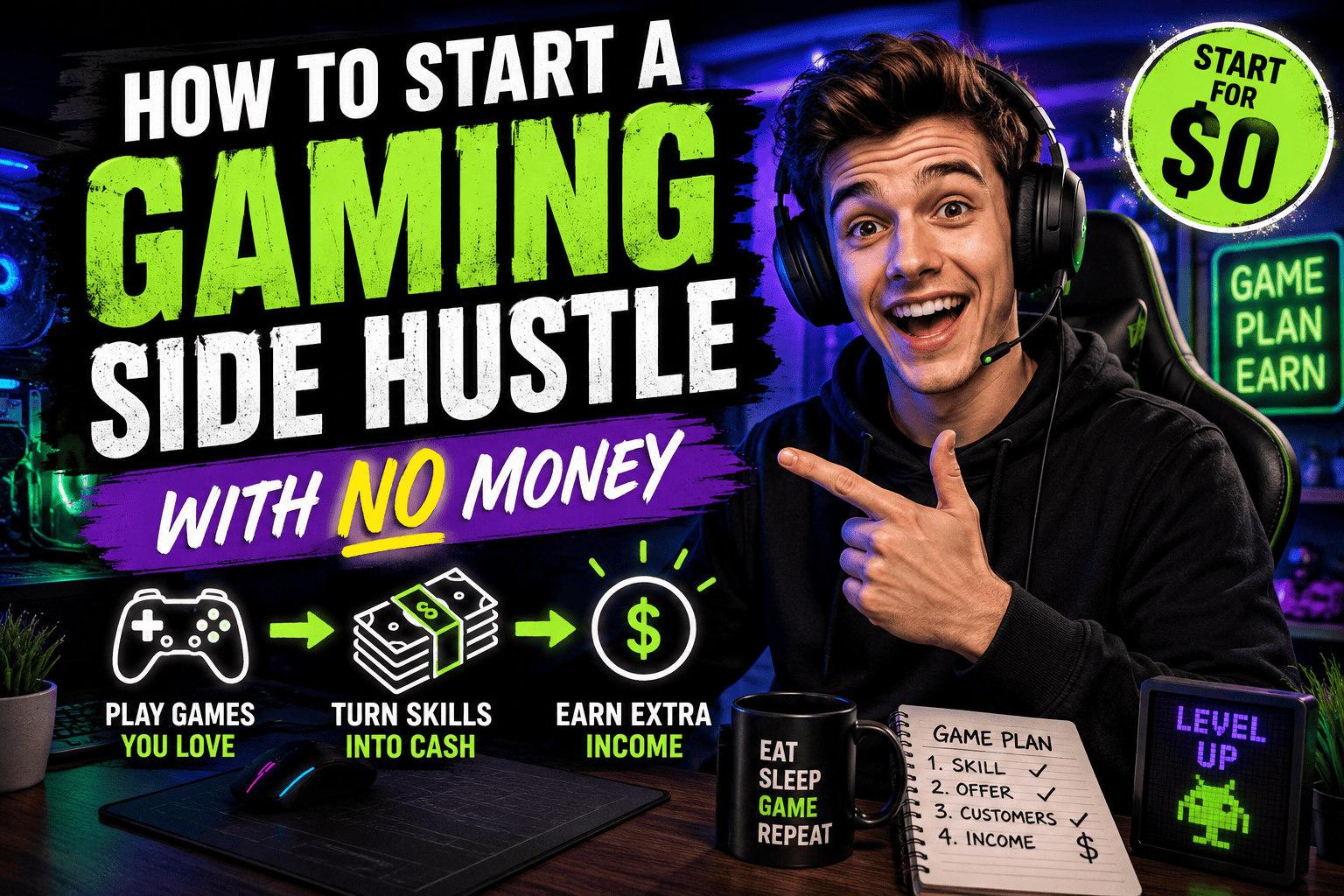
1. You Really Can Start a Gaming Side Hustle With No Money
Starting a side hustle usually comes with one fairly annoying requirement:
Money.
Want to start photography? Buy a camera.
Want to start woodworking? Apparently you need a garage containing $8,000 worth of tools.
Want to open a café?
Maybe sit down before looking at the startup costs.
Gaming can be different.
If you already own a PC, console or mobile device, have an internet connection and spend a reasonable amount of time gaming, you may already have most of what you need to start.
You don’t necessarily need a streaming PC that looks like it was borrowed from NASA.
You don’t need 100,000 followers.
You don’t need a professional microphone, studio lighting or a gaming chair capable of supporting a small spacecraft.
And you certainly don’t need to be an esports champion.
🎮 Quick Answer – Can You Start a Gaming Side Hustle for Free?
Yes.
There are gaming side hustles you can start with little or no additional upfront cost by using the equipment, skills, knowledge and free software you already have.
Depending on what you’re good at, that could include:
- 🎯 Gaming Coaching – Help less experienced players improve
- 🎮 Paid Gaming Sessions – Play with other gamers who want company, assistance or a skilled teammate
- 🧠 VOD Reviews – Analyse recorded gameplay and provide feedback
- 📖 Gaming Guides – Turn useful game knowledge into written or digital guides
- 🎨 Digital Gaming Assets – Create graphics, artwork, overlays or other gaming-related products
- 🎬 Content Creation – Produce gaming videos, Shorts, streams or social content
- 🛠️ Gaming Services – Offer useful technical, creative or game-related services
- 👥 Community Work – Help moderate or manage gaming communities
Some are easier to monetise than others.
Some take longer to get moving.
And content creation occasionally involves spending three hours editing a video that receives 14 views, seven of which may have been you checking whether it uploaded correctly.
But importantly, none automatically requires a pile of startup cash.
💰 Your Existing Skills Are Your Starting Capital
When people hear “start a side hustle,” they often immediately think about what they need to buy.
For a gaming side hustle, that’s backwards.
Start with what you already know.
If you’ve spent hundreds or thousands of hours playing games, you’ve probably accumulated a ridiculous amount of knowledge without really noticing.
You might know:
- 🗺️ Maps, routes and locations
- ⚔️ Weapons, characters and builds
- 🧠 Strategies and game mechanics
- 🎯 Common beginner mistakes
- 💎 Progression systems and resources
- 🤝 How to communicate effectively with teammates
- ⚙️ Settings, optimisation or technical fixes
- 🎨 How to create gaming-related content
- 🏆 How to help less experienced players improve
To you, some of that probably feels completely ordinary.
You’ve played the game for 1,500 hours. Of course you know where everything is.
Then somebody who installed it yesterday arrives.
They’re staring at 43 menus, five currencies, three skill trees, a crafting system resembling an accounting qualification and a chat full of acronyms nobody has bothered to explain.
Suddenly, your “obvious” knowledge doesn’t look quite so obvious.
That’s experience.
And experience can have value.
It’s the same principle behind making money gaming without being a pro. You don’t necessarily need elite mechanical ability. Knowledge, creativity, communication, reliability and the ability to solve another gamer’s problem can all be valuable.
🚫 Don’t Turn a $0 Side Hustle Into a $1,500 Shopping Trip
This deserves its own warning because it’s remarkably easy to do.
You decide you’re going to start making gaming content.
Excellent.
Then you start researching.
“I probably need a better microphone.”
Fair enough.
“And a webcam.”
Maybe.
“And some lights.”
Hmm.
“A second monitor would make editing easier.”
We’re drifting.
“This mechanical keyboard has individually programmable RGB keys…”
Abort mission.
Suddenly your zero-cost side hustle has cost $1,500 and you’ve earned precisely $0.
A better approach is:
Start with the minimum setup required to prove somebody wants what you’re offering.
Use your current PC.
Use your existing headset.
Use free software.
Create something.
Offer a service.
Try to get your first customer.
Upgrade after the side hustle starts earning – not before.
🧠 You Don’t Need to Be the Best Gamer in the Room
Another common barrier is believing you’re simply not good enough.
That depends entirely on what you’re trying to sell.
If you’re advertising elite-level coaching to professional players while you’re currently engaged in a heroic six-year campaign to escape Silver, there may be a slight credibility problem.
But gaming skill is only one thing you can monetise.
You could be:
- 💬 Excellent at explaining complicated mechanics
- 🤝 Patient with beginners
- 😂 Genuinely enjoyable to play with
- 🎨 Good at creating graphics or digital assets
- ✍️ Knowledgeable enough to write useful guides
- 🎬 Skilled at editing gaming videos
- ⚙️ Great at solving technical gaming problems
- 🧠 Extremely knowledgeable about one particular game
The important question isn’t:
“Am I good enough at gaming to make money?”
It’s:
“What can I do that another gamer would find useful?”
That’s a much better place to start.
Our guide to 30 ways to make money playing video games shows just how broad those possibilities have become.
🎯 Your First Goal Isn’t to Build a Gaming Empire
There’s another temptation when starting something new: making it unnecessarily complicated.
You don’t need a business plan containing the phrase “global gaming ecosystem.”
You probably don’t need six social media accounts.
You don’t need a logo animation.
You don’t need branded merchandise.
And please don’t spend three days choosing a font before you’ve worked out what you’re selling.
Your first objective is much simpler:
Find one thing you can offer that solves one problem for one type of gamer.
For example:
Too broad:
“I’m good at Valorant.”
Much better:
“I can review Silver and Gold Valorant gameplay and identify the positioning and decision-making mistakes costing players rounds.”
That’s something another player can understand.
Or:
Too broad:
“I play Fortnite.”
Much better:
“I help newer Fortnite players improve their building, positioning and decision-making through one-on-one sessions.”
Now you have the beginnings of an actual side hustle.
🚀 Start Small, Then Level Up
Don’t worry about replacing your salary.
Don’t worry about becoming a full-time gaming creator.
Don’t worry about building the next enormous gaming business from your bedroom before dinner.
Start smaller.
🎮 Choose one game
⬇️
🧠 Identify one useful skill
⬇️
🛠️ Turn it into one simple service or product
⬇️
👤 Find one customer
⬇️
💰 Make your first gaming income
⬇️
📈 Improve and repeat
That first $10, $20 or $50 matters for a reason that has very little to do with the amount.
It proves the idea works.
Once somebody is willing to pay for what you know, create or do, you can improve your offer, build reviews, increase your prices, add related services and gradually turn a tiny experiment into a genuine gaming side hustle.
And you can do all of that without your credit card taking the opening boss fight.
So keep your wallet closed for now.
Before looking at the best zero-cost opportunities, we need to establish exactly what counts as a gaming side hustle – because getting paid to game covers far more than simply playing matches for money.
2. What Actually Counts as a Gaming Side Hustle?
“Gaming side hustle” is a wonderfully broad term.
At one end, you’ve got someone earning a few dollars helping newer players understand a game.
At the other, you’ve got creators running channels, selling digital products, coaching players and somehow maintaining a Discord server with 47,000 members without losing their minds.
Both count.
Put simply:
A gaming side hustle is any way you use gaming-related skills, knowledge, creativity or time to earn additional income alongside your main job, studies or other commitments.
And that’s an important distinction.
You don’t need to earn enough to quit your job.
You don’t need thousands of customers.
You don’t even need to make money every day.
If you’re earning additional income from something connected to gaming, you’ve got yourself a gaming side hustle.
🎮 It’s Not Just About Getting Paid to Play Games
This is probably the biggest misconception.
When someone says they want to make money gaming, the obvious picture is sitting at a PC playing games while money mysteriously arrives.
A lovely arrangement.
Unfortunately, nobody has yet invented the button that deposits $50 into your account every time you win a match.
The real gaming economy is much broader.
You can potentially earn from playing, but you can also earn from:
🎯 Your Skill – Coaching players, reviewing gameplay or helping others improve.
🧠 Your Knowledge – Creating guides, tutorials, builds or other useful resources.
🤝 Your Time – Playing alongside other gamers through paid sessions or offering game-related assistance.
🎨 Your Creativity – Designing graphics, game art, overlays, maps, mods or other digital assets.
🛠️ Your Services – Providing technical, creative or specialist gaming services.
🎬 Your Content – Creating videos, streams, Shorts, articles or social media content.
👥 Your Community Skills – Moderating servers, managing communities or organising gaming events.
In other words, the game might be the starting point rather than the thing you’re actually selling.
That’s what opens gaming side hustles to far more people than just highly ranked competitive players.
💰 Active Income vs Passive-ish Income
Gaming side hustles also tend to fall into two broad camps.
🎮 Active Gaming Income
You perform work and get paid for it.
Examples include:
- One-on-one coaching
- Paid gaming sessions
- VOD reviews
- Freelance gaming services
- Community management
- Game testing
If you stop doing the work, the income usually stops too.
It’s not glamorous terminology, but active services have one huge advantage for beginners:
They can be relatively quick to start.
You don’t need 50,000 YouTube subscribers before somebody can book an hour of your time.
📦 Scalable Gaming Income
Here, you create something that can potentially be sold or monetised repeatedly.
For example:
- Digital game guides
- Gaming graphics
- Mods
- Templates
- YouTube videos
- Gaming websites
- Courses
- Downloadable resources
You might spend six hours creating a detailed guide and then sell that same guide multiple times.
That sounds considerably better than exchanging every hour for another hour of income.
But there’s a catch.
There is always a catch.
These side hustles often require more work upfront and may take longer to generate meaningful income.
A YouTube video can theoretically earn money for years.
It can also receive 23 views and quietly disappear into the internet’s enormous digital basement.
Neither model is automatically better.
⚡ If You’re Starting With $0, Services Have One Big Advantage
For someone with no startup budget, selling a skill or service is often one of the simplest places to begin.
Why?
Because there’s very little to manufacture.
Suppose you’re an experienced Rocket League player and decide to offer replay reviews.
You might already have:
- 🎮 The game
- 💻 A computer or console
- 🌐 Internet access
- 🧠 Game knowledge
- 🎙️ A headset
- 📹 Free screen-recording software
Your main “product” is your expertise.
Compare that with launching a gaming merchandise brand, where you suddenly need suppliers, designs, inventory or print-on-demand systems, customer service and the disturbing discovery that shipping a hoodie internationally can apparently cost more than the hoodie.
Services strip away much of that complexity.
You can start small, test demand and improve as you go.
🧠 You Can Sell Knowledge Without Being an Elite Player
There’s also an important middle ground between “professional gamer” and “person who installed the game yesterday.”
Most gamers live there.
You might not be qualified to coach a professional Valorant team.
Fine.
They’re probably not looking for you anyway.
But perhaps you’ve played Valorant for three years and understand enough to help a genuine beginner with:
- Crosshair placement
- Basic positioning
- Economy management
- Agent selection
- Utility usage
- Communication
- Common low-rank mistakes
The beginner doesn’t necessarily need the world’s greatest Valorant player.
They need somebody further along the road who can explain what they’re doing wrong.
The same principle applies to guides, gameplay reviews and other knowledge-based services.
Your value is relative to the problem you’re solving.
🎨 Gaming Side Hustles Don’t Even Have to Involve Playing
This is where the definition becomes much more interesting.
Someone who loves gaming but isn’t particularly competitive could still build a side hustle around the industry.
For example, you might be good at:
- 🎨 Creating gaming graphics
- ✍️ Writing guides or gaming content
- 🎬 Editing gameplay videos
- 🎙️ Producing voiceovers
- 🖥️ Creating stream overlays
- 🧩 Developing mods
- 🗺️ Designing maps
- ⚙️ Helping players optimise gaming setups
- 👥 Managing gaming communities
- 💻 Developing websites for gaming creators
You could spend surprisingly little of your paid time actually playing a game.
Which feels slightly fraudulent after telling everyone you’ve started a “gaming side hustle,” but we’ll allow it.
The important part is that you’re using a skill within the gaming ecosystem to create something another person values.
🚀 Side Hustle Doesn’t Have to Mean Small Forever
Calling something a “side hustle” describes how it starts – not necessarily where it ends.
Maybe you earn $30 in your first month.
Then $100.
Then $500.
Perhaps that’s exactly where you want it to stay: extra money for games, holidays, savings or the occasional GPU upgrade that requires a brief conversation with your mortgage broker.
Or perhaps demand grows.
A gaming coach might eventually offer multiple coaching packages.
A guide creator could build a library of digital products.
A video editor might develop a roster of gaming creators.
A content creator could eventually earn through advertising, sponsorships, affiliates and their own products.
There’s no requirement that a side hustle becomes a business.
But there isn’t a rule saying it can’t.
🎯 The Simplest Definition to Remember
Forget complicated business terminology for a moment.
A gaming side hustle really comes down to three things:
Something you know or can do
⬇️
Something another gamer wants or needs
⬇️
A way for them to pay you for it
That’s it.
You don’t need investors.
You don’t need an office.
You don’t need a motivational LinkedIn post announcing that you’re “thrilled to embark on an exciting new entrepreneurial journey.”
You need something useful and somebody willing to pay for it.
The next question is therefore much more practical:
What do you actually need to get started?
Fortunately, if you’re already a gamer, the answer may be considerably less than you think.
3. What You Actually Need Before You Start
Here’s some good news.
The list of things you think you need to start a gaming side hustle is probably much longer than the list of things you actually need.
You don’t need a dedicated gaming room illuminated by enough RGB lighting to be visible from space.
You don’t need the latest graphics card.
You don’t need a professional logo.
And you definitely don’t need a suspiciously expensive course from someone standing next to a rented Lamborghini.
For most zero-cost gaming side hustles, the essentials are surprisingly basic.
🎮 The Four Things You Really Need
If you already play games regularly, there’s a decent chance you have all four.
| What You Need | Why It Matters | |
|---|---|---|
| 🎮 | A Gaming Device | PC, console or mobile device capable of doing whatever your side hustle requires |
| 🌐 | Reliable Internet | Essential for online sessions, communication, uploads and most gaming services |
| 🧠 | Something Useful to Offer | Skill, knowledge, creativity, experience or time that another gamer values |
| ⏰ | Time and Consistency | Enough spare time to actually deliver what you’re selling |
Notice what’s missing.
No $400 microphone.
No DSLR camera.
No second PC dedicated to streaming.
No £200 “entrepreneurship mastermind.”
Just the basics.
Let’s look at each one.
🖥️ 1. Use the Gaming Equipment You Already Own
This is the easiest place to save money.
If your current setup lets you perform the service you’re planning to offer, use it.
For example, someone offering online coaching might only need:
🎮 Their existing PC or console
🎧 Their current headset
🌐 An internet connection
💬 Discord or another communication platform
That’s enough to start.
Would a $250 studio microphone make your voice sound better?
Probably.
Will your student suddenly improve their positioning because your advice is arriving through a microphone with a frequency response of 20 Hz–20 kHz?
Probably not.
Equipment becomes worth upgrading when your existing setup starts limiting the quality of your service.
Until then, let it earn its retirement.
🌐 2. You Need a Reliable Internet Connection
This one’s difficult to negotiate around.
Most gaming side hustles happen online, so your internet connection needs to be reliable enough for whatever you’re offering.
That doesn’t necessarily mean buying the fastest plan available.
The requirements for uploading a written game guide are very different from live coaching somebody while watching their gameplay.
For services involving live gaming, streaming or screen sharing, stability matters particularly.
Because nothing screams “professional coaching session” quite like:
“Okay, push left and use your ulti—”
Disconnected.
If your connection already handles online gaming comfortably, however, you may not need to change anything.
Again: use what works before paying for something better.
🧠 3. You Need Something Other Gamers Find Useful
This is the big one.
Your gaming device is just a tool.
Your actual starting capital is what you know or can do.
Ask yourself:
What am I better at, more knowledgeable about or more experienced with than the average beginner?
Don’t immediately answer “nothing.”
Gamers are remarkably good at underestimating knowledge they’ve accumulated gradually.
Maybe you’ve played the same MMO for four years and understand its economy inside out.
Perhaps you’re the person everyone asks for character builds.
Maybe you’re good at explaining mechanics without making beginners feel like they’ve committed a personal offence by not knowing them already.
Perhaps you make brilliant Minecraft builds.
Maybe you’re great with Photoshop, video editing, Discord moderation or troubleshooting PCs.
All of these can potentially become the foundation of a gaming side hustle.
🎯 Do a Quick Gaming Skill Audit
Before deciding what to sell, spend ten minutes answering these questions.
🎮 What games do I know extremely well?
Write down your strongest two or three.
Not twenty-seven.
We’re trying to start a side hustle, not catalogue your Steam library.
🏆 What am I particularly good at?
Think about:
- Competitive skill
- Strategy
- Building
- Character builds
- Game knowledge
- Team communication
- Leadership
- Progression
- Technical optimisation
- Creative skills
💬 What do other players already ask me for help with?
This is particularly valuable.
If friends constantly ask you:
“What build should I use?”
“Can you look at this replay?”
“Why am I getting destroyed in this matchup?”
“Can you help me set this up?”
…they’re giving you clues.
Repeated questions often reveal problems people might pay someone to solve.
😎 What gaming-related work would I actually enjoy doing?
Don’t ignore this one.
You might technically be capable of editing gaming videos, but if opening editing software fills you with the same enthusiasm as being told there’s a mandatory 7 a.m. meeting, perhaps don’t build your side hustle around it.
You’re much more likely to stick with something you enjoy.
⏰ 4. You Need Time – But Probably Less Than You Think
You don’t need to quit your job and dedicate twelve hours a day to your new gaming empire.
It’s a side hustle.
The clue is in the name.
Even a few consistent hours each week can be enough to test an idea.
For example:
Monday – 30 minutes
Improve your listing or offer.
Wednesday – 1 hour
Share useful advice in relevant gaming communities.
Friday – 1 hour
Complete a paid session or create part of a digital product.
Weekend – 2 hours
Work with customers, create content or improve your service.
That’s roughly four or five hours across an entire week.
The important word is consistent.
Five hours every week will usually get you much further than spending fourteen hours on it one Saturday, becoming wildly enthusiastic, creating three logos and then forgetting the project exists until November.
🛠️ Free Tools Can Handle Almost Everything at the Beginning
One of the biggest advantages of starting online today is the ridiculous number of genuinely useful free tools available.
Depending on your side hustle, your starter toolkit might include:
| Tool | What You Can Use It For |
|---|---|
| 🎙️ OBS Studio | Record gameplay, tutorials and VOD reviews |
| 🎨 Canva | Simple graphics, thumbnails, guides and promotional images |
| 🎬 CapCut | Edit short-form gaming videos |
| 💬 Discord | Voice calls, communities and customer communication |
| 📄 Google Docs | Write guides, plans and coaching notes |
| ☁️ Google Drive | Store and share files |
| 📊 Google Sheets | Track customers, income or content ideas |
| 🖼️ GIMP | More advanced image editing without Photoshop |
You don’t need all of them.
Pick the tools that solve an actual problem.
Installing seventeen productivity apps is not productivity.
It’s collecting productivity apps.
🚫 What You Probably DON’T Need Yet
This list is arguably just as important.
Before you’ve made your first sale, be very cautious about spending money on:
❌ Premium website hosting
❌ Paid advertising
❌ Expensive microphones
❌ Professional cameras
❌ High-end lighting
❌ Premium editing software
❌ Paid social media tools
❌ Custom branding packages
❌ Business courses
❌ New gaming hardware you don’t actually need
Some of those things can become useful later.
The keyword is later.
There’s very little point spending $500 making a service look professional before discovering nobody wants the service.
💰 Follow the “Earn Before You Upgrade” Rule
A simple rule can prevent most unnecessary spending:
Whenever possible, let the side hustle pay for its own upgrades.
Suppose you start offering gaming coaching using your existing headset.
You earn your first $50.
Then $100.
Then $250.
Customers like the sessions, but you’ve noticed your microphone isn’t particularly clear.
Now buying a better microphone makes sense.
You’re not gambling $150 on an idea.
You’re reinvesting money into something that has already demonstrated demand.
The same principle works for:
📹 Better recording equipment
🎙️ Better audio
💻 Hardware upgrades
🎨 Premium creative software
📢 Advertising
🌐 Websites
📚 Training
Make the primitive version work first.
Then improve it.
🎒 Your $0 Gaming Side Hustle Starter Pack
Strip everything back and your starter pack looks something like this:
🎮 The gaming equipment you already own
🌐 Your existing internet connection
🧠 One useful skill or area of knowledge
🛠️ A handful of free tools
⏰ A few consistent hours each week
🧪 A willingness to experiment
That’s enough.
Not enough to build a global gaming corporation by next Thursday, admittedly.
But enough to find out whether someone will pay for what you can offer.
And that’s the first milestone that actually matters.
Now that we’ve established you probably don’t need to buy anything, we can get to the interesting part:
Which gaming side hustles can you genuinely start for free?
4. The 10 Best Gaming Side Hustles You Can Start for Free
Right, enough theory.
You have a gaming device, internet connection, some useful skills and a bank balance you’d prefer not to disturb.
What can you actually do with them?
There are dozens of ways to make money around gaming, but some make far more sense than others when your startup budget is $0.
The best options tend to have three things in common:
💰 Little or no upfront cost
⚡ A realistic path to your first customer
🎮 They use skills, knowledge or equipment you already have
Here are ten of the strongest places to start.
🎯 1. Gaming Coaching
If you’re good at a competitive game and can explain why you’re good at it, coaching is one of the most straightforward gaming side hustles to start.
You could help players improve:
- 🎯 Aim and mechanics
- 🗺️ Positioning and map knowledge
- 🧠 Decision-making
- ⚔️ Matchups
- 🏆 Ranked performance
- 💬 Communication
- 📊 Strategy
- 🔄 Replay analysis
The important part is that you’re not simply playing well.
You’re helping someone else play better.
A cracked Valorant player who responds to every question with “just aim better, bro” may be an excellent player.
They are not necessarily an excellent coach.
💰 What Does It Cost to Start?
Potentially nothing beyond equipment you already own.
You can communicate through Discord, play or spectate online and use free screen-recording tools for reviews.
👤 Best For
Competitive players who are patient, knowledgeable and good at explaining things.
🚀 How to Start for $0
Choose one game and one type of player you can genuinely help.
Instead of:
“Valorant coaching.”
Try:
“One-on-one Valorant coaching for Bronze–Gold players focusing on positioning, decision-making and climbing ranked.”
Specific beats vague almost every time.
If coaching sounds like your strongest option, our guide to how to become a gaming coach goes much deeper into turning your gaming experience into a coaching service.
🤝 2. Paid Gaming Sessions
Not everybody wants coaching.
Sometimes people simply want someone good, reliable or entertaining to play with.
Paid gaming sessions can include:
🎮 Casual play sessions
⚔️ Competitive sessions
🛡️ Hired-gun or carry-style sessions where permitted
🎬 Content and collaboration sessions
🤝 Social gaming sessions
Your value might come from skill.
But it could equally come from being reliable, helpful and genuinely enjoyable to play with.
That last part is more valuable than it sounds.
The internet already has an abundant supply of teammates who rage after losing the pistol round.
💰 What Does It Cost to Start?
Usually $0 if you already own the game and gaming equipment.
👤 Best For
Friendly players who enjoy multiplayer games and communicate well.
🚀 How to Start for $0
Pick a game you already play regularly and define exactly what kind of session you’re offering.
For example:
“60-minute relaxed Fortnite duos session for newer and casual players.”
That’s much easier to understand than:
“I will game with you.”
The second sounds less like a service and more like something your younger cousin says when they’re bored.
🧠 3. VOD and Gameplay Reviews
This is closely related to coaching but doesn’t necessarily require a live session.
A customer sends you recorded gameplay.
You analyse it.
Then you provide feedback through:
📹 A recorded review
📄 Written notes
🎙️ Voice feedback
💬 A follow-up call
This can be particularly attractive if you’re knowledgeable but don’t want to schedule lots of live coaching sessions.
You can review the footage when it suits you.
💰 What Does It Cost to Start?
Potentially $0.
Free tools such as OBS can handle screen recording, while Discord or cloud storage can be used to exchange files.
👤 Best For
Analytical players who notice mistakes and can explain how to fix them.
🚀 How to Start for $0
Review one of your own matches first.
Record yourself analysing:
- Positioning
- Decisions
- Mechanical errors
- Missed opportunities
- What should have happened instead
Now you’ve created both practice and a sample of your work.
Efficient.
📖 4. Create and Sell Gaming Guides
Maybe you’re better at explaining games through writing than voice chat.
Good news.
You don’t have to spend your evenings asking strangers whether they can hear you on Discord.
Gaming guides can cover almost anything useful:
📈 Progression strategies
⚔️ Character builds
💰 In-game economies
🗺️ Maps and routes
🏆 Ranked strategies
🧩 Crafting systems
🎯 Beginner tips
⚙️ Settings and optimisation
The trick is to solve a specific problem rather than trying to write the Encyclopaedia Britannica of your favourite game.
“Complete 180-Page Guide to Everything in Game X” sounds exhausting.
“Fastest Early-Game Progression Route for New Players” solves a recognisable problem.
Much better.
💰 What Does It Cost to Start?
$0 if you use free tools such as Google Docs, Canva or similar software.
👤 Best For
Knowledgeable gamers who enjoy writing, explaining systems or creating resources.
🚀 How to Start for $0
Think about questions you repeatedly see beginners asking.
One good question can become one useful guide.
And one useful guide can potentially be sold more than once.
That’s where digital products start becoming interesting.
🎨 5. Create Gaming Graphics and Digital Assets
You don’t have to be a competitive player to make money around gaming.
Creative skills count too.
Potential products and services include:
🖼️ Gaming thumbnails
🎨 Stream graphics
🟣 Overlays
🏷️ Social media graphics
🧙 Character artwork
📦 Digital asset packs
🎮 Game-related graphics
💬 Discord graphics and banners
Free creative tools have lowered the barrier considerably.
You don’t need an Adobe subscription before you’ve earned a cent.
💰 What Does It Cost to Start?
Potentially $0 using free design software.
👤 Best For
Creative gamers with design, illustration or digital art skills.
🚀 How to Start for $0
Create three to five sample pieces around games you genuinely know.
Your first portfolio doesn’t need paying customers.
It needs to demonstrate:
“This is what I can make.”
🎬 6. Create Gaming Content
This is probably the side hustle everybody immediately thinks of.
YouTube.
TikTok.
Twitch.
Shorts.
Streams.
Clips.
And yes, content creation can eventually become a serious income source.
But we need to be realistic.
It usually isn’t the fastest route to your first $20.
Content creators may eventually earn through:
💰 Advertising
🤝 Sponsorships
🔗 Affiliate marketing
🎁 Donations
⭐ Memberships
📦 Digital products
🎮 Gaming services
But building an audience takes time.
Sometimes quite a lot of time.
Your first YouTube upload is unlikely to receive 800,000 views while you sleep.
If it does, congratulations. Please pretend we predicted it.
💰 What Does It Cost to Start?
It can be $0 if you use your current hardware and free recording/editing software.
👤 Best For
Gamers who enjoy entertaining, teaching, editing or being on camera/microphone.
🚀 How to Start for $0
Don’t try to become “a gaming creator.”
That’s far too broad.
Choose:
One game + one audience + one type of content.
For example:
60-second Valorant tips for lower-ranked players.
That’s a content strategy.
Gaming videos.
That’s a folder name.
🧪 7. Game Testing and Playtesting
Imagine being paid to play unfinished games.
Sounds perfect.
Then you discover that “playtesting” sometimes means repeatedly walking into the same wall to see whether you can fall through it.
Welcome to quality assurance.
Game testing and playtesting can involve:
🐛 Finding bugs
🎮 Testing gameplay mechanics
📝 Writing clear reports
🧭 Checking levels and environments
⚙️ Reproducing technical issues
💬 Providing usability feedback
It’s less about sitting around enjoying free games and more about systematically identifying problems.
💰 What Does It Cost to Start?
Generally nothing if you already have suitable gaming hardware and internet access.
👤 Best For
Detail-oriented gamers who are patient and good at documenting problems.
🚀 How to Start for $0
Look for legitimate developer playtests, beta-testing opportunities and game-testing roles.
Be cautious of anything asking you to pay money to “unlock” testing work.
Getting paid to test games makes sense.
Paying someone for the privilege of potentially being paid to test games deserves considerably more suspicion.
👥 8. Gaming Community Management and Moderation
Gaming communities need people.
More specifically, they need people capable of preventing a Discord server from turning into a digital zoo at 2 a.m.
Community work can involve:
💬 Answering questions
🛡️ Moderating discussions
📢 Posting announcements
🎉 Organising events
👋 Welcoming new members
📋 Managing support channels
🎮 Running community gaming sessions
Small creators, gaming communities, esports organisations, servers and game developers may all need this type of help.
💰 What Does It Cost to Start?
$0.
👤 Best For
Organised, patient gamers who communicate well and don’t immediately declare war when somebody posts in the wrong channel.
🚀 How to Start for $0
Get involved in communities you genuinely understand.
Volunteer moderation can help build experience, but be careful not to become somebody’s unpaid full-time employee disguised as a “community opportunity.”
Experience is useful.
So is eventually getting paid.
🛠️ 9. Offer Gaming-Related Freelance Services
This category is enormous because gaming businesses and creators need many of the same skills as other online businesses.
You could offer:
🎬 Video editing
🖼️ Thumbnail design
✍️ Gaming writing
🎙️ Voiceover work
💻 Website development
⚙️ PC or game optimisation help
📱 Social media management
🧩 Modding or development services
The advantage is that you can combine an existing professional or creative skill with gaming knowledge.
A generic video editor might understand editing.
A video editor who actually understands gaming knows why cutting away from the screen right before the clutch happens is probably not an inspired creative decision.
That context has value.
💰 What Does It Cost to Start?
Potentially $0 depending on the service and software required.
👤 Best For
Gamers who already have a useful creative, technical or professional skill.
🚀 How to Start for $0
Create a small portfolio targeted specifically at gaming.
If you edit videos, edit gaming clips.
If you design thumbnails, make gaming thumbnails.
If you write, create gaming samples.
Show the customer that you understand their world, not just the software.
📦 10. Create Digital Gaming Products
Finally, there’s the broader world of digital products.
This overlaps with guides and graphics but can extend much further.
Depending on the game, platform and relevant rules, examples might include:
📖 Guides and ebooks
🎨 Graphic packs
🗺️ Maps
🧩 Mods
📋 Templates
🛠️ Tools and resources
🎮 Game-related digital creations
📚 Educational resources
The attractive part is scalability.
Create something once and you may be able to sell it repeatedly.
The less attractive part is that you have to create something people actually want.
A revolutionary concept, admittedly.
💰 What Does It Cost to Start?
Potentially $0 if your existing skills and free software are enough to create the product.
👤 Best For
Creative or knowledgeable gamers who prefer making products rather than selling their time.
🚀 How to Start for $0
Start with a small, specific problem.
Don’t spend three months building an enormous product before testing whether anyone cares.
Create the smallest genuinely useful version.
Publish it.
Get feedback.
Then improve it.
🏆 Which $0 Gaming Side Hustles Are Best for Beginners?
There’s no universal winner, but some options are easier to get moving quickly.
| Gaming Side Hustle | Startup Cost | First-Income Potential | Scalability | Best If You… |
|---|---|---|---|---|
| 🎯 Gaming Coaching | $0 | ⭐⭐⭐⭐ | ⭐⭐⭐ | Are skilled and good at teaching |
| 🤝 Gaming Sessions | $0 | ⭐⭐⭐⭐ | ⭐⭐ | Enjoy playing with other people |
| 🧠 VOD Reviews | $0 | ⭐⭐⭐⭐ | ⭐⭐⭐ | Are analytical and knowledgeable |
| 📖 Gaming Guides | $0 | ⭐⭐⭐ | ⭐⭐⭐⭐ | Enjoy writing and explaining |
| 🎨 Digital Assets | $0 | ⭐⭐⭐ | ⭐⭐⭐⭐ | Have creative skills |
| 🎬 Content Creation | $0 | ⭐ | ⭐⭐⭐⭐⭐ | Enjoy creating and can play the long game |
| 🧪 Game Testing | $0 | ⭐⭐ | ⭐⭐ | Are patient and detail-oriented |
| 👥 Community Work | $0 | ⭐⭐⭐ | ⭐⭐⭐ | Are organised and social |
| 🛠️ Freelance Services | $0* | ⭐⭐⭐⭐ | ⭐⭐⭐⭐ | Already have a marketable skill |
| 📦 Digital Products | $0* | ⭐⭐ | ⭐⭐⭐⭐⭐ | Like creating reusable products |
*Assuming you already have the necessary equipment and can use free software.
There’s an important pattern here.
The easiest side hustles to monetise aren’t necessarily the ones with the biggest long-term potential.
Services such as coaching, gameplay reviews and freelance work can give you a relatively direct route:
Find customer → do useful work → get paid.
Content and digital products can be much more scalable, but there’s usually a longer gap between:
Create thing → upload thing → stare hopefully at analytics → eventually get paid.
Neither is wrong.
They’re simply different games.
🎯 Don’t Pick the “Best” Side Hustle – Pick the Best One for You
You could read a list like this and immediately ask:
“Okay, but which one makes the most money?”
That’s understandable.
It’s also not quite the right question.
A side hustle with enormous theoretical earning potential isn’t much use if you hate doing it or don’t have the skills required.
Someone who loves teaching and plays competitive games at a high level might be an excellent coaching candidate.
A creative Minecraft player might be far better suited to digital products.
Someone with a background in video editing could probably get moving faster selling editing services than spending six months trying to become a streamer.
So instead of chasing whichever opportunity currently looks most profitable, look for the overlap between:
🎮 What you enjoy
🧠 What you’re good at
💰 What somebody will pay for
That overlap is where your strongest side-hustle candidates usually live.
And that’s exactly what we’ll work out next: how to choose the right gaming side hustle for your particular skills, personality and gaming style.
5. Choose the Right Side Hustle for Your Gaming Style
You’ve now got ten possible gaming side hustles sitting in front of you.
The temptation is obvious.
Start all ten.
Launch a YouTube channel on Monday. Become a Valorant coach on Tuesday. Sell graphics on Wednesday. Start a Discord community on Thursday. Spend Friday wondering why you’re exhausted and haven’t actually earned anything.
Don’t do that.
When you’re starting with no money, one of your biggest advantages is focus.
You don’t have a huge advertising budget, employees or expensive tools doing the heavy lifting for you.
So instead of asking:
“Which gaming side hustle sounds coolest?”
Ask:
“Which side hustle best matches the skills, games and personality I already have?”
That’s usually where you’ll find the easiest place to start.
🎮 If You’re a Strong Competitive Player…
Start by looking at:
🎯 Gaming Coaching
🧠 VOD Reviews
🤝 Paid Gaming Sessions
These options let you monetise gaming ability directly.
Suppose you’re consistently highly ranked in Rocket League.
You’ve already spent hundreds or thousands of hours learning:
- Rotations
- Positioning
- Recoveries
- Mechanics
- Boost management
- Decision-making
- Team play
You could try becoming a streamer.
But if your immediate goal is to make your first gaming income, there may be a shorter route.
Find someone who wants to improve at Rocket League.
Help them.
Charge for the service.
No algorithm needs to notice you first.
You don’t need 10,000 followers.
You need one customer with a problem you know how to solve.
🧠 If You’re the “Walking Wiki” of Your Favourite Game…
Every gaming group seems to have one.
Someone asks:
“Where do I get that weapon?”
You know.
“What’s the best early-game build?”
You know.
“Does this obscure passive stack with this item after patch 1.7.3?”
Somehow, horrifyingly, you know that too.
If that’s you, consider:
📖 Gaming Guides
🧠 VOD Reviews
🎯 Beginner Coaching
🎬 Educational Content
📦 Digital Gaming Products
Deep game knowledge is especially useful because it can be repackaged in several ways.
The same knowledge could become:
One-to-one advice
⬇️
A written guide
⬇️
A YouTube tutorial
⬇️
Short-form tips
⬇️
A more detailed digital product
One skill.
Multiple possible income streams.
Don’t build all of them immediately, though.
Remember what happened five paragraphs ago.
Pick one.
🤝 If You’re Social and Enjoy Playing With Other People…
Consider:
🎮 Paid Gaming Sessions
👥 Community Management
🎯 Gaming Coaching
🎬 Streaming or Content
Not every gaming side hustle requires you to be mechanically gifted.
Being the kind of person other people genuinely enjoy spending an hour gaming with can itself be valuable.
Think about the best teammates you’ve encountered online.
They’re probably not just good players.
They’re:
💬 Good communicators
😎 Relaxed under pressure
🤝 Helpful
😂 Fun to play with
🧠 Team-oriented
🚫 Not screaming at everyone after one bad round
That final qualification alone eliminates a surprisingly large percentage of the online gaming population.
If you’re naturally good with people, don’t underestimate it.
Gaming is a social hobby.
Services built around playing, teaching and interacting with other gamers can suit you extremely well.
🎨 If You’re Creative…
Maybe your K/D ratio isn’t going to impress anyone.
That’s fine.
Can you make things?
If you’re good at:
🎨 Graphic design
✏️ Illustration
🎬 Video editing
🧩 Modding
🗺️ Map creation
📖 Writing
🎙️ Audio
💻 Development
…you have an entirely different route into gaming income.
Potential side hustles include:
- Gaming graphics
- Stream overlays
- Thumbnails
- Video editing
- Digital guides
- Mods
- Maps
- Gaming websites
- Social media content
- Other digital assets
In this case, your creative skill is the product and gaming is your niche.
That’s a powerful combination.
You already understand the audience you’re creating for.
A designer who plays games doesn’t need someone to explain why a giant corporate-looking stock photo of a man wearing a headset probably isn’t going to excite a Call of Duty audience.
You know what gaming looks and feels like.
Use that.
✍️ If You Prefer Working Alone…
Not everybody wants to spend their evenings talking to strangers on Discord.
Perhaps your ideal working environment involves:
🎧 Headphones on
☕ Coffee nearby
🔕 Notifications off
👤 Absolutely nobody asking you to join voice chat
Perfectly reasonable.
Look at more asynchronous side hustles:
📖 Gaming Guides
🎨 Digital Assets
🎬 Video Editing
🧠 Recorded VOD Reviews
🧩 Mods
📦 Digital Products
✍️ Gaming Writing
These allow you to create or deliver work without constantly coordinating live sessions.
That can also make them easier to fit around a full-time job, study or family commitments.
You work when you have time rather than needing your schedule to match somebody else’s.
⚙️ If You’re the Person Everyone Asks to Fix Things…
You know the conversation.
“My FPS suddenly dropped.”
“Why isn’t this mod working?”
“Discord can’t detect my microphone.”
“My game keeps crashing.”
And somehow these problems become yours.
If you’re technically minded, that can actually be useful.
Potential opportunities include:
🖥️ Gaming PC optimisation
⚙️ Game settings assistance
🧩 Mod installation or troubleshooting
🎙️ Streaming setup help
💻 Gaming-related development
🛠️ Technical freelance services
There’s value in being able to make technology behave.
Particularly because computers occasionally seem to operate according to an ancient curse rather than documented engineering principles.
Just be careful to define exactly what you’re comfortable supporting.
“I’ll help optimise your game settings” is manageable.
“I fix computers” is how you end up troubleshooting someone’s printer at 11:30 p.m.
🎬 If You Love Entertaining People…
Content creation might be your lane.
Look at:
📹 YouTube
⚡ Shorts
📱 TikTok
🎙️ Streaming
😂 Gaming entertainment
📚 Educational gaming content
But there is an important warning here.
Don’t choose content creation purely because you’ve heard successful creators make lots of money.
For every creator earning a full-time income, there are countless channels sitting on:
Subscribers: 37
Latest upload: 11 views
Time spent editing: please don’t ask
Content creation makes most sense if you genuinely enjoy the process.
Because you’ll probably need to keep creating before the money becomes interesting.
If you’d still enjoy making videos when hardly anyone is watching, that’s a much better sign.
⏰ If You Only Have a Few Hours Each Week…
Choose something that works around your schedule.
Good candidates include:
🧠 VOD reviews
📖 Gaming guides
🎨 Digital assets
🛠️ Freelance services
📦 Digital products
Live services can still work, but you’ll need clearly defined availability.
For example:
Coaching available Saturday mornings and Wednesday evenings.
That’s far easier to manage than being theoretically available seven days a week and discovering customers have an uncanny ability to request sessions precisely when you’re eating dinner.
Your side hustle should fit around your life.
Otherwise, the “side” part disappears surprisingly quickly.
💰 If Your Priority Is Making Your First $50…
This changes the decision slightly.
If the immediate goal is proving you can make money from gaming, I’d lean towards a service rather than trying to build an audience from scratch.
Strong candidates include:
🎯 Gaming coaching
🧠 VOD reviews
🤝 Paid gaming sessions
🎨 Gaming design work
🎬 Video editing
🛠️ Other gaming-related freelance services
Why?
Because the route to payment is shorter.
Service
You find one person → solve their problem → get paid.
Content
You create content → build an audience → grow distribution → qualify for monetisation or find another revenue source → get paid.
Content can have much greater long-term leverage.
But if your goal is simply to prove:
“I can actually make money from something related to gaming.”
Selling a small service is often the more direct experiment.
🏆 Quick Match – Which Gaming Side Hustle Fits You?
Use this as a starting point:
| If This Sounds Like You… | Consider Starting With… |
|---|---|
| 🏆 Highly skilled competitive player | Coaching, VOD reviews or gaming sessions |
| 🧠 Know one game ridiculously well | Guides, beginner coaching or educational content |
| 🤝 Friendly and social | Paid gaming sessions, coaching or community work |
| 🎨 Creative | Graphics, digital assets, editing or mods |
| ✍️ Prefer working independently | Guides, digital products or recorded reviews |
| ⚙️ Technically minded | Optimisation, troubleshooting or development services |
| 🎬 Love entertaining people | YouTube, Shorts or streaming |
| ⏰ Limited spare time | VOD reviews, guides or digital products |
| 💰 Want your first income quickly | Coaching, sessions or freelance services |
| 📈 Want long-term scalability | Content, guides or digital products |
Don’t treat this table like a Hogwarts Sorting Hat.
You’re allowed to fit more than one category.
The goal is simply to narrow ten possibilities down to one or two realistic candidates.
🎯 Use the Three-Circle Test
If you’re still unsure, use this simple test.
Your best gaming side-hustle idea usually sits where three things overlap:
🎮 What do I enjoy?
🧠 What am I genuinely good at?
💰 What problem will somebody pay me to solve?
Let’s say you:
🎮 Love Valorant
🧠 Are excellent at analysing gameplay
💰 Know lower-ranked players want help identifying their mistakes
That’s a strong candidate for VOD reviews or coaching.
Or perhaps you:
🎮 Love Minecraft
🎨 Are excellent at building
💰 Know server owners and players need custom builds
Now you’ve got another potential service.
The important part is the third circle.
Being passionate about something doesn’t automatically make it commercially useful.
I may be deeply passionate about organising my Steam library.
Nobody has yet offered me money for it.
🚫 Don’t Choose Based on Income Claims Alone
You’ll inevitably encounter headlines like:
“MAKE $10,000 A MONTH PLAYING GAMES!”
Could somebody make that?
Sure.
Does that tell you what you are likely to earn next month?
Not remotely.
Income depends on:
- Your skill
- The service
- The game
- Demand
- Pricing
- Reputation
- Competition
- How much time you put in
- How well you market yourself
A theoretically lucrative side hustle you abandon after two weeks earns exactly $0.
A modest service you enjoy enough to improve for a year can become something much more valuable.
Choose based on fit first, earning potential second.
🚀 Pick One Direction – You Can Expand Later
Your choice isn’t permanent.
Starting with coaching doesn’t mean you’re now legally forbidden from ever creating a gaming guide.
In fact, successful side hustles often expand naturally.
You might begin with:
🎯 One-to-one coaching
Then notice customers keep asking the same questions.
So you create:
📖 A beginner guide
Then turn parts of that guide into:
🎬 Short educational videos
Those videos bring in:
👤 New coaching customers
Now the different pieces support each other.
That’s a much stronger way to expand than launching five unrelated things simultaneously.
For now, however, keep it simple.
Choose one side hustle.
Then narrow things down even further.
Because if you’re trying to make money gaming with no budget, one of the smartest moves you can make is to stop thinking about every game you play and concentrate on one game where you have the strongest chance of being useful.
6. Step 1: Pick One Game Instead of Five
You’ve chosen the type of gaming side hustle you want to try.
Now we need to narrow things down again.
Pick a game.
One game.
Not your entire Steam library.
Not every competitive game you’ve played since 2017.
And definitely not:
“I offer coaching for Valorant, Fortnite, Rocket League, League of Legends, Overwatch 2, Marvel Rivals, CS2 and basically anything else you want.”
That doesn’t make you look versatile.
It makes you look like you’ve somehow mastered eight games while the rest of us are still trying to remember which button we mapped to melee.
When you’re starting from zero, specialisation makes your life much easier.
🎯 Why Starting With One Game Works
Imagine you’re looking for help improving at Rocket League.
You find two sellers.
Seller A:
“I provide gaming coaching across all major games.”
Then there’s Seller B:
“Rocket League coaching for Gold–Diamond players. Improve rotations, positioning, recoveries and decision-making.”
Which one sounds more credible?
Probably Seller B.
They immediately tell you:
🎮 What game they specialise in
🏆 Who they help
🧠 What they help with
🎯 What outcome they’re targeting
There’s no detective work required.
That’s important because customers aren’t usually looking for a gamer who knows lots of games.
They’re looking for:
Someone who can solve their particular problem in the game they’re playing.
Specificity builds trust.
🧠 Your Knowledge Goes Much Deeper in One Game
There’s another reason to specialise.
The more narrowly you focus, the more useful your existing experience becomes.
Suppose you’ve played Valorant for three years.
You probably know:
- 🗺️ Maps
- 🎯 Crosshair placement
- 💰 Economy management
- 🧙 Agents
- ⚡ Abilities
- 🔫 Weapons
- 🧠 Common strategies
- 📍 Positioning
- 🏆 Ranked progression
- 🤝 Team communication
- 🔄 How the meta has changed
That’s a considerable body of knowledge.
If you try to offer the same level of expertise across six different games, things get much harder.
You have six metas to follow.
Six sets of updates.
Six communities.
Six sets of terminology.
Six groups of competitors.
Six opportunities for a customer to ask you something while you stare at the screen thinking:
“That was definitely true three patches ago.”
Starting with one game lets you go deeper rather than wider.
🎮 Choose a Game You Already Know Well
Remember the premise of this article:
We’re starting with no money.
So don’t choose a game because you’ve heard there’s money in it and immediately spend $70 buying it.
Start with games you already own and understand.
Your strongest candidate will usually be something you’ve played extensively.
Ask yourself:
⏱️ Which game have I spent the most time playing?
Hours aren’t everything.
But experience matters.
Someone with 1,000 hours in a game probably understands considerably more about it than someone who bought it during last weekend’s sale.
🧠 Which game do I understand beyond simply playing it?
Can you explain why something works?
Can you teach strategies?
Can you identify mistakes?
Can you answer beginner questions?
That matters enormously for coaching, guides and educational content.
🏆 Which game am I genuinely good at?
This becomes more important for skill-based services.
If you’re offering advanced competitive coaching, you need enough ability and experience to justify it.
If you’re creating beginner guides, the bar may be different.
Match your offer to your actual level.
❤️ Which game do I still enjoy?
This is surprisingly important.
Maybe you have 3,000 hours in a particular MMO.
You also haven’t opened it for eight months because hearing the login music now causes a mild stress response.
Probably not your best candidate.
You’re going to spend more time around the game once it becomes part of your side hustle.
Choose something you still like.
💰 But Does the Game Have Paying Demand?
Enjoyment and expertise aren’t enough on their own.
There also needs to be an audience.
A game can be wonderful.
You can know everything about it.
But if eleven people are still playing and eight of them are developers keeping the servers alive, monetisation may be difficult.
Look for signs of an active ecosystem:
👥 A healthy player base
💬 Active communities
📺 Regular content creation
🏆 Competitive or progression systems
❓ Players regularly asking for help
🔄 Updates or ongoing development
💰 Existing demand for gaming-related products or services
The existence of competition isn’t automatically bad either.
If other people are successfully selling coaching, guides or services around a game, that can be evidence that customers already spend money there.
Zero competition sometimes means you’ve discovered an incredible untapped opportunity.
It can also mean nobody wants it.
The second explanation occurs rather more often.
🔍 Look Where Players Are Already Asking Questions
You don’t need expensive market-research software.
You can learn an enormous amount simply by looking at the game’s community.
Search places such as:
💬 Reddit
🎮 Discord
📺 YouTube
📱 TikTok
🗨️ Game forums
🔎 Google
🎥 Twitch communities
Pay attention to repeated questions.
For example:
“How do I get out of Gold?”
“What’s the best build for beginners?”
“Why do I keep losing this matchup?”
“Can someone review my gameplay?”
“What’s the fastest way to level?”
“How do I improve my aim?”
Repeated questions are useful because they reveal repeated problems.
And repeated problems can become:
🎯 Coaching services
🧠 VOD reviews
📖 Guides
🎬 Tutorials
🛠️ Other gaming services
You’re not trying to invent demand.
You’re looking for demand that already exists.
⚖️ Big Games vs Smaller Games
You might assume the biggest game is automatically the best choice.
Not necessarily.
Large games have obvious advantages.
🌍 Big Games
Think:
- Fortnite
- Minecraft
- Valorant
- League of Legends
- Counter-Strike 2
- Rocket League
- Call of Duty
Potential advantages include:
👥 Huge audiences
🔎 Lots of searches
💰 More potential customers
📺 Large content ecosystems
🏆 Established competitive scenes
The downside?
Competition.
Lots of it.
If you type “Valorant coach” into a marketplace, you probably won’t discover that you’re humanity’s first person to have the idea.
🎯 Smaller Games
A smaller but active game can sometimes offer a better opening.
You may have:
📉 Fewer potential customers
…but also:
📉 Fewer coaches
📉 Fewer guides
📉 Fewer specialist creators
📉 Fewer competing services
That can make it easier to become known within a niche.
The sweet spot is often:
A game with an active community, clear player problems and enough demand – but where you can still offer something distinctive.
Bigger isn’t automatically better.
Relevant demand is what matters.
If you’re still deciding which games have the strongest earning opportunities, our guide to the best games for making money can help you compare different possibilities.
🎯 Go One Step Further: Pick a Niche Within the Game
Choosing one game is good.
Choosing one game and one specific customer is even better.
Let’s use Valorant again.
Instead of:
Valorant Coaching
You could offer:
Valorant Coaching for Bronze–Gold Players
Better.
Or:
Valorant VOD Reviews for Bronze–Gold Players Struggling With Positioning and Decision-Making
Now we’re getting extremely clear.
Another example:
Broad:
Minecraft Services
Better:
Minecraft Building
More Specific:
Custom Medieval Minecraft Builds for Survival Servers
You don’t necessarily need to go that narrow immediately.
But think in terms of:
Game + Customer + Problem
For example:
🎮 Rocket League
👤 Gold–Diamond players
🎯 Poor rotations
=
Rocket League coaching for Gold–Diamond players who want to improve rotations and positioning.
That’s a service someone can immediately understand.
🧪 You Aren’t Marrying the Game
Some people resist choosing one game because they’re worried about choosing incorrectly.
Relax.
This isn’t a legally binding relationship.
You’re running an experiment.
Pick the strongest candidate and test it.
Give yourself perhaps 30 days.
During that period:
🎮 Focus your offer on that game
🛠️ Create your portfolio around it
📢 Promote within its communities
👤 Speak to its players
📊 Watch what gets interest
💰 See whether anybody buys
If nothing happens, investigate why.
Maybe the offer needs work.
Maybe the price is wrong.
Maybe you’re targeting the wrong players.
Or maybe the game genuinely isn’t a strong market for what you’re offering.
Then you adjust.
Starting focused doesn’t mean staying focused forever.
It simply gives you enough clarity to learn something useful.
🚫 Avoid the “I’ll Just Play Whatever Is Popular” Strategy
Chasing trends can be tempting.
A new game launches.
Everyone’s talking about it.
You immediately abandon the game you’ve played for four years and announce yourself as a specialist in the new one approximately 17 minutes after finishing the tutorial.
There’s a problem.
You have no advantage.
Everyone else is learning too.
Trend-driven opportunities can absolutely work, particularly for content creators, guide writers and technically skilled players who learn games quickly.
But don’t mistake popularity for expertise.
Your existing knowledge is one of the few assets you can leverage without spending money.
Use it.
🏆 The One-Game Test
Before committing, score your strongest game against these five questions.
| Question | Score 1–5 |
|---|---|
| 🎮 Do I genuinely enjoy this game? | ⭐⭐⭐⭐⭐ |
| 🧠 Do I know it extremely well? | ⭐⭐⭐⭐⭐ |
| 🏆 Am I good enough for the service I’m offering? | ⭐⭐⭐⭐⭐ |
| 👥 Does it have an active community? | ⭐⭐⭐⭐⭐ |
| 💰 Are players likely to pay for what I want to offer? | ⭐⭐⭐⭐⭐ |
You don’t need a perfect 25.
But if your chosen game scores:
Enjoyment: 2
Knowledge: 2
Skill: 1
Community: 5
Demand: 5
…you’ve probably selected it because it’s popular rather than because you’re actually positioned to help anyone.
Look for the game where your existing advantage meets real demand.
🚀 One Game. One Audience. One Offer.
At this stage, your gaming side hustle should be getting considerably more specific.
You’ve gone from:
“I want to make money gaming.”
To something like:
“I want to offer Rocket League VOD reviews for Gold–Diamond players who struggle with rotations and positioning.”
That’s progress.
You now have:
🎮 One Game
⬇️
👤 One Audience
⬇️
🎯 One Problem
⬇️
🛠️ One Service
This makes almost everything that follows easier.
You’ll know what your listing should say.
You’ll know which communities contain potential customers.
You’ll know what content to create.
You’ll know what examples to put in your portfolio.
And speaking of portfolios, there’s one obvious problem:
How do you prove you’re worth paying when you’ve never had a customer?
Fortunately, you don’t need to invent seventeen testimonials from suspiciously enthusiastic people called “John.”
You can build your first gaming portfolio completely free.
7. Step 2: Build Your First Gaming Portfolio for Free
You’ve chosen your side hustle.
You’ve picked your game.
You’ve narrowed down who you’re trying to help.
There’s just one slightly awkward problem.
Why should anybody trust you?
Imagine you’re offering Rocket League coaching for $25 a session.
A potential customer finds your profile.
It says:
“I am very good at Rocket League and can help you improve.”
Excellent.
Source?
Trust me, bro.
That’s not going to be enough.
When you’re starting without reviews, customers or an established reputation, your portfolio has to do some of the trust-building for you.
The good news?
You don’t need paying customers to build one.
🎯 Your Portfolio Has One Job: Prove You Can Do What You’re Selling
Forget fancy websites for now.
A beginner portfolio doesn’t need animations, cinematic transitions or your name emerging dramatically from a cloud of smoke.
It needs evidence.
If you’re selling coaching, demonstrate that you understand the game.
If you’re selling graphics, show graphics you’ve created.
If you’re selling video editing, show edited videos.
If you’re selling guides, show that you can explain something clearly.
Your portfolio should answer one simple customer question:
“Why should I believe this person can help me?”
That’s it.
🎮 If You’re Offering Gaming Coaching…
Your portfolio should demonstrate both gaming ability and teaching ability.
Those aren’t the same thing.
A strong coaching portfolio could include:
🏆 Your Rank – Screenshots showing your current or previous competitive rank.
📊 Relevant Stats – Useful performance statistics where they genuinely support your expertise.
🎥 Gameplay Clips – Short examples demonstrating mechanics, positioning or decision-making.
🧠 Sample Analysis – Analyse a match and explain what went right or wrong.
📋 Example Coaching Plan – Show what a typical session might cover.
🎙️ Short Teaching Video – Explain one concept clearly in a few minutes.
For example, instead of simply claiming:
“I understand Rocket League rotations.”
Create a short clip showing a rotation mistake and explain:
What happened
⬇️
Why it was a mistake
⬇️
What the player should have done
⬇️
How to practise the improvement
That immediately demonstrates your ability to teach.
And teaching is what the customer is actually buying.
🧠 If You’re Offering VOD Reviews…
This one’s almost suspiciously easy to demonstrate.
Use your own gameplay.
Record a match.
Then review it as if you were reviewing a customer’s footage.
Pause at important moments.
Highlight:
🎯 Positioning mistakes
🧠 Poor decisions
⚔️ Mechanical errors
🗺️ Map awareness
💰 Resource management
🤝 Team communication
📈 Better alternatives
You could create a five-minute sample called something like:
“Example Valorant VOD Review – 5 Common Gold-Rank Mistakes”
Now potential customers can see exactly what they’ll receive.
No customers required.
No fake testimonials required.
No asking your mate Dave to pretend you transformed his gaming career.
📖 If You’re Selling Gaming Guides…
Create a small free sample.
Not the entire product.
If you’re planning a 30-page guide, perhaps create:
📄 A two-page preview
📋 A sample checklist
🗺️ One example strategy
🎯 One beginner tip section
🖼️ A few screenshots or diagrams
This proves your guide isn’t just:
Page 1: Get good.
Page 2: Try not to die.
Page 3: Thanks for your purchase.
A preview allows buyers to judge:
- Writing quality
- Knowledge
- Presentation
- Depth
- Usefulness
And because the product is digital, you can create the sample using free tools.
🎨 If You’re Selling Graphics or Digital Assets…
This is one of the simplest portfolio categories.
Make examples.
You don’t need someone to hire you before you’re allowed to design something.
Create fictional projects.
For example:
🎮 Three gaming thumbnails
🖼️ Two Twitch banners
🎨 A stream overlay
💬 A Discord banner
🏷️ A social media graphic
📦 A small digital asset pack
If possible, create samples around the games or audiences you want to work with.
A portfolio containing gaming work immediately tells potential customers:
“I understand this niche.”
That’s much stronger than showing them a restaurant menu, a corporate annual report and the logo you made for your uncle’s plumbing business.
Perfectly respectable plumbing logo.
Wrong audience.
🎬 If You’re Offering Gaming Video Editing…
Take your own footage.
Or use footage you have permission to edit.
Then create a few short examples demonstrating different skills:
⚡ Fast-paced short-form edit
😂 Funny gaming montage
🎯 Educational gameplay clip
📺 Longer YouTube-style edit
🔊 Audio and sound-effect work
📝 Captions and subtitles
You don’t need a 47-minute showreel.
Most customers would rather see three strong examples than fifteen mediocre ones.
Show your best work first.
Internet attention spans aren’t famous for their patience.
🛠️ If You’re Offering Technical Gaming Services…
Your portfolio might look different.
Suppose you’re helping players optimise gaming performance.
You could demonstrate:
📊 Before-and-after FPS results
⚙️ Example optimisation settings
📋 A troubleshooting checklist
🖥️ Example setup recommendations
📹 A short optimisation walkthrough
The goal is still the same.
Show evidence that you understand the problem.
Be careful with promises, though.
Don’t claim:
“I will DOUBLE your FPS guaranteed!!!”
unless you’ve recently acquired supernatural control over computer hardware.
Explain what you can realistically do and what results depend on the customer’s setup.
Credibility beats hype.
💬 But What About Testimonials?
Testimonials are valuable.
They’re also difficult to obtain when your lifetime customer count currently stands at:
0
One way around this is to offer a small number of free or heavily discounted trial sessions in exchange for genuine feedback.
For example:
“I’m launching a new Rocket League replay review service and looking for three Gold–Diamond players to test it. I’ll provide a free review in exchange for honest feedback.”
Notice the important word:
honest.
You’re not buying a five-star review.
You’re testing the service.
If the person genuinely likes it and agrees to provide a testimonial, great.
Now you have:
👤 Real experience
💬 Real feedback
🧠 Information about what customers value
⭐ Potential social proof
You might only need two or three trial customers before moving to paid work.
Don’t spend six months working for free because you think you need 47 testimonials before you’re allowed to charge money.
You don’t.
🚫 Never Fake Reviews
This should be obvious.
But the internet exists, so apparently we need to say it.
Don’t create fictional testimonials.
Don’t ask friends to claim they’ve bought something they haven’t.
Don’t create twelve accounts called variations of xXSniperKing420Xx and leave yourself suspiciously enthusiastic reviews.
Fake reviews damage trust and may violate marketplace rules or consumer laws.
If you don’t have reviews yet, say you’re new and prove your ability another way.
A strong sample is considerably more convincing than:
⭐⭐⭐⭐⭐
“Best coach ever changed my life.” – definitely_a_real_customer97
🧪 Your First Customers Can Help Improve the Portfolio
Your portfolio shouldn’t stay frozen forever.
Once you start getting real work, replace your practice examples with stronger evidence.
For example:
Before Customers
🎥 Self-created coaching demonstration
📋 Example session plan
🏆 Rank screenshot
After 3 Customers
🎥 Real anonymised coaching example, with permission
💬 Genuine testimonial
📈 Customer improvement story
⭐ Review
After 10+ Customers
🏆 Best testimonials
📊 Results or outcomes where appropriate
🎬 Polished examples
📚 Multiple service samples
Your portfolio improves as your side hustle improves.
You don’t need version 10 on day one.
You need version 1.
🛠️ Free Tools Are More Than Enough
You can build almost everything we’ve discussed without paying for professional software.
Depending on what you’re creating, useful free options include:
| Tool | Useful For |
|---|---|
| 🎥 OBS Studio | Recording gameplay and VOD analysis |
| 🎨 Canva | Portfolio pages, graphics, guides and simple designs |
| 🎬 CapCut | Editing short gaming videos |
| 🖼️ GIMP | Image editing and graphics |
| 📄 Google Docs | Guides, coaching plans and written samples |
| ☁️ Google Drive | Storing and sharing portfolio files |
| 💬 Discord | Trial sessions, communication and feedback |
Again, don’t install everything simply because it’s free.
Pick what you need.
Your computer doesn’t need another twelve applications launching automatically every time Windows starts.
📦 Keep Your Portfolio Small
A beginner portfolio doesn’t need to be enormous.
In fact, I’d aim for three strong pieces of evidence.
For a gaming coach:
🏆 1. Proof of experience
Rank, stats or relevant gaming background.
🎥 2. Proof you can teach
A sample VOD review or educational clip.
📋 3. Proof of your service
An example coaching plan or description of how sessions work.
For a designer:
🎨 1. Strong gaming graphic
🖼️ 2. Different type of gaming graphic
📦 3. Example closer to the service you’re selling
For a writer:
📖 1. Useful guide
✍️ 2. Different writing sample
🎮 3. Game-specific piece demonstrating expertise
Three excellent examples beat thirty average ones.
Every time.
🎯 Make Your Portfolio Match What You’re Selling
This sounds obvious, but it’s easy to get wrong.
If you’re selling Valorant coaching, your portfolio should make someone think:
“This person understands Valorant and can teach it.”
If you’re selling gaming thumbnails, it should make someone think:
“This person can create thumbnails that would work for my gaming channel.”
If you’re selling Minecraft builds, it should make someone think:
“I want this person building on my server.”
Don’t make customers connect the dots themselves.
Your portfolio should point directly toward the thing you’re asking them to buy.
🚀 The $0 Portfolio Formula
You can reduce the whole process to this:
🎮 Choose the service
⬇️
🛠️ Create 2–3 realistic examples
⬇️
📸 Show evidence of your skills
⬇️
👤 Test the service with a few real people
⬇️
💬 Collect genuine feedback
⬇️
⭐ Replace practice examples with real results
That’s enough to get moving.
Remember, customers don’t expect somebody starting a small gaming side hustle to have Nike’s marketing department behind them.
They just want enough evidence to feel comfortable taking a chance on you.
And once you’ve got that evidence, the next challenge becomes much more interesting.
You’ve got a service.
You’ve got a portfolio.
You’ve spent approximately $0.
Now you need the thing every side hustle eventually discovers it cannot survive without:
Customers.
Fortunately, finding your first one doesn’t necessarily require spending money on advertising either.
8. Step 3: Find Your First Customer Without Paying for Advertising
You’ve picked your gaming side hustle.
You’ve chosen a game.
You’ve created a small portfolio.
Now comes the part that separates a side hustle from an unusually organised hobby:
Someone needs to pay you.
This is where beginners often assume they need advertising.
Google Ads.
Facebook Ads.
Sponsored posts.
Maybe a professionally produced promotional video featuring dramatic music and someone pointing at a graph.
You don’t.
At least, not yet.
When your customer count is currently zero, your first objective isn’t reaching 100,000 people.
It’s reaching the right 10 people.
And you can often do that for free.
🎯 Your First Customer Is Usually Closer Than You Think
One mistake beginners make is imagining their first customer as a mysterious stranger somewhere on the internet.
They might be.
But start with communities you’re already part of.
Think about:
🎮 People you regularly game with
💬 Discord communities
👥 Guilds and clans
🗨️ Gaming forums
📱 Social media communities
🏆 Competitive communities
🤝 Friends of friends
🎥 Creator communities
If you’ve been involved with a game for years, you probably already know where its players gather.
That’s valuable.
You understand how they speak.
You know what problems they have.
You know which questions appear repeatedly.
And, crucially, you don’t look like someone who joined five minutes ago exclusively to post:
🔥🔥 CHEAP COACHING AVAILABLE!!! DM NOW!!! 🔥🔥
Nobody likes that person.
Don’t be that person.
🧠 Help First. Sell Second.
One of the best ways to attract customers without advertising is remarkably simple:
Be useful.
Suppose you’re trying to sell Valorant VOD reviews.
You could enter a community and immediately post:
“I sell VOD reviews. $20. DM me.”
Or you could participate in discussions.
Someone asks:
“Why do I keep losing fights when holding B?”
You give them a genuinely useful answer.
Someone asks about crosshair placement.
You help.
Someone posts a clip asking what they did wrong.
You provide a thoughtful explanation.
Now people can see that:
🧠 You understand the game
💬 You communicate clearly
🤝 You’re helpful
🎯 You might actually know what you’re talking about
Then, where appropriate and permitted, you can mention that you offer more detailed reviews or coaching.
You’re not walking into a room shouting an advertisement.
You’re demonstrating the thing you’re selling.
That’s much more convincing.
💬 Discord Can Be Excellent – If You Don’t Spam It
Discord is particularly useful for gaming side hustles because that’s where many gaming communities already live.
Look for servers related to:
🎮 Your game
🏆 Competitive play
📚 Improvement and learning
🎨 Gaming creators
🛠️ Modding or development
🎬 Content creation
👥 Specific gaming communities
But check the rules first.
Some communities allow self-promotion.
Some have dedicated channels.
Some prohibit commercial promotion entirely.
Respect that.
Getting banned from six Discord servers before making your first sale is technically progress, but not the kind we’re aiming for.
Instead, become part of communities where your expertise is relevant.
Answer questions.
Join discussions.
Help people.
Build a reputation.
Then use promotional channels where they’re available.
👽 Reddit Can Reveal Exactly What Players Need
Reddit can be useful for two reasons.
First, communities often contain thousands of conversations about player problems.
Search your game’s subreddit for terms such as:
- “help”
- “beginner”
- “stuck”
- “improve”
- “rank”
- “build”
- “settings”
- “guide”
- “how do I”
- “what am I doing wrong”
You’re effectively doing free market research.
If you discover fifty posts asking variations of:
“How do I get out of Gold?”
That’s interesting.
If you’re qualified to help those players, you may have found a problem worth building an offer around.
Second, Reddit gives you opportunities to demonstrate expertise through useful comments and posts.
Again:
Don’t spam.
Reddit users can detect badly disguised self-promotion with roughly the same sensitivity sharks have for blood.
Be genuinely useful.
Follow subreddit rules.
Build credibility.
📱 Use Social Media as Proof, Not Just Promotion
You don’t need a huge following to use social media effectively.
Instead of constantly posting:
BUY MY GAMING SERVICE
…create small pieces of useful content around the problem you solve.
For example, a Rocket League coach could post:
🎬 30-second rotation tips
🎯 Common Gold-rank mistakes
🧠 Quick replay breakdowns
🏆 Improvement advice
📊 Before-and-after examples
A gaming designer could share:
🎨 Thumbnail redesigns
🖼️ Before-and-after graphics
📦 Asset examples
⚡ Short design processes
A guide creator could post:
📖 Quick tips
🗺️ Useful routes
⚔️ Build recommendations
🧠 Lesser-known mechanics
Each piece of content becomes a tiny portfolio item.
People see what you can do before you ask them to pay you.
🔎 Find People Who Are Already Asking for Help
This is one of the most effective approaches.
Don’t just search for places where gamers exist.
Search for people expressing the exact problem you solve.
Suppose you offer League of Legends coaching.
A generic League community contains potential customers.
But a thread where someone says:
“I’ve been stuck in Silver for six months and can’t work out what I’m doing wrong.”
…contains someone actively describing a problem.
That’s much more interesting.
The same applies outside coaching.
Someone asking:
“Does anyone know how to make thumbnails like this?”
Potential design customer.
“I need somebody to edit gaming Shorts.”
Potential editing customer.
“Can anyone build this for my Minecraft server?”
Potential building customer.
“Is there a simple beginner guide for this system?”
Potential guide opportunity.
Look for problems, not just audiences.
🤝 Your Existing Gaming Network Matters
Don’t underestimate people you already know.
You don’t need to turn every friend into a customer.
That gets awkward remarkably quickly.
But they can help you find your first few opportunities.
Tell gaming friends what you’re doing.
For example:
“I’ve started doing Rocket League replay reviews for Gold–Diamond players. If you know anyone who wants help improving their rotations, send them my way.”
Simple.
No hard sell.
No presentation deck.
No referral programme involving blockchain.
Just let people know.
Your first customer may come from someone who already knows you’re good at what you do.
🆓 Should You Work for Free to Get Your First Customers?
Sometimes.
But use free work strategically.
There’s a big difference between:
“I’ll provide three free trial VOD reviews so I can test my service and collect feedback.”
and:
“I’ll work for free indefinitely because I’m scared to charge anyone.”
The first is a strategy.
The second is volunteering with extra steps.
A limited free trial can help you:
🧪 Test your service
💬 Get feedback
⭐ Earn genuine testimonials
📸 Build portfolio examples
🧠 Learn what customers actually want
Set a limit.
For example:
3 free sessions.
Not 30.
Once you’ve proved the service works, start charging.
💰 Another Option: Use an Introductory Price
You don’t necessarily need to go completely free.
You could launch with a lower introductory price.
For example:
Normal planned price: $25
First 5 customers: $15
That gives customers a reason to try someone new while establishing from the beginning that your work has monetary value.
Once you’ve collected some reviews and improved your service, increase the price.
Don’t trap yourself permanently at beginner pricing.
Your first price isn’t a blood oath.
🗣️ How to Talk About Your Service Without Sounding Like a Spammer
This is where many otherwise sensible people suddenly start writing like a late-night infomercial.
Avoid:
🚨 ATTENTION GAMERS!!! 🚨
Want to DOMINATE ranked and become an UNSTOPPABLE GAMING BEAST?
Nobody asked for this.
Instead, explain:
Who you help + what you help them with + what they’ll receive.
For example:
“I’m offering Rocket League replay reviews for Gold–Diamond players. I’ll review one full match and provide a recorded breakdown covering rotations, positioning and decision-making, plus a short list of areas to practise.”
Clear.
Useful.
No claims that the customer will become an esports legend before breakfast.
🎯 Make Your Offer Easy to Understand
If somebody has to ask six questions to understand what you’re selling, your offer needs work.
A simple service should explain:
👤 Who it’s for
🎮 Which game
🛠️ What you provide
⏱️ How long it takes
💰 What it costs
📦 What the customer receives
For example:
Valorant VOD Review – Bronze to Gold Players
Submit one full competitive match and receive a recorded 20–30 minute review covering positioning, decision-making, utility usage and your three biggest improvement priorities.
Now the customer knows what they’re buying.
Clarity reduces uncertainty.
And uncertainty kills sales surprisingly efficiently.
⭐ Your First Review Is Worth More Than Your First Profit
Imagine your first customer pays you $15.
Financially, that’s not exactly yacht money.
But you may also gain:
⭐ Your first review
💬 Customer feedback
📸 Portfolio material
🧠 Experience delivering the service
🎯 Better understanding of what customers want
🤝 A possible referral
That’s why the first few customers matter disproportionately.
You’re not simply earning $15.
You’re building evidence that makes customer number two easier to acquire.
Then customer number three becomes easier.
Eventually, you aren’t saying:
“I think I’m pretty good at this.”
You’re saying:
“Here’s what I’ve done and here’s what previous customers thought.”
Much stronger.
🔁 Ask Happy Customers for Referrals
If someone genuinely enjoys your service, don’t be afraid to ask them to recommend you.
Keep it casual.
Something like:
“Glad the review helped. If you’ve got any friends who are also trying to improve, feel free to send them my way.”
That’s enough.
Don’t immediately hand them a 14-page affiliate agreement.
A satisfied customer already has something you don’t:
Access to other people similar to them.
A Gold-ranked Rocket League player probably knows other Rocket League players.
A Minecraft server owner probably knows other server owners.
A gaming creator probably knows other creators.
One good customer can lead to another.
🧠 Learn From Every “No”
Not everyone will buy.
That’s normal.
Your first attempt might get:
0 sales.
Don’t immediately conclude:
“Nobody will ever pay for gaming services. The dream is over.”
Look at what happened.
Did people view the offer but not buy?
Did nobody see it?
Did they ask questions?
Was the service unclear?
Was the price wrong?
Did people want something slightly different?
Early failure is information.
For example, perhaps you’re offering:
60-minute live coaching sessions.
But several players say they’d prefer:
A cheaper recorded VOD review.
Interesting.
The market just gave you an idea.
Listen.
🎯 The First-Customer Challenge
Here’s a simple target.
Over your first seven days:
Day 1 – Join or identify 3 relevant communities
Day 2 – Find 10 questions related to the problem you solve
Day 3 – Answer 3 questions genuinely and helpfully
Day 4 – Publish one useful piece of content
Day 5 – Share your service where promotion is allowed
Day 6 – Contact or respond to people actively looking for relevant help
Day 7 – Review what generated interest and improve your offer
Notice what’s missing.
💸 Advertising budget: $0
You’re trading money for effort.
That’s one of the central realities of starting a side hustle without capital.
If you can’t spend money acquiring attention, you need to earn attention by being useful.
🚀 One Customer Changes Everything
Your first customer is the hardest because you’re starting with almost nothing.
No reviews.
No reputation.
No sales history.
No proof beyond the portfolio you’ve created.
Then somebody takes a chance on you.
You deliver.
They leave a positive review.
Now the next customer sees:
⭐ 1 successful order
Then:
⭐⭐⭐⭐⭐ 3 reviews
Then:
⭐⭐⭐⭐⭐ 10 reviews
Trust begins to compound.
That’s why you shouldn’t obsess over making huge amounts of money immediately.
Your first milestone is simpler:
Get one stranger to willingly pay you for something gaming-related and walk away happy.
That’s proof.
For readers choosing coaching specifically, we’ve put together a much deeper guide on how to find your first gaming coaching clients, including practical ways to build trust when you’re starting without an established client base.
For everyone else, the principle remains the same:
Go where your potential customers already are, demonstrate that you’re useful and make it ridiculously clear what you can do for them.
You now have a game, an offer, a portfolio and a strategy for finding customers without paying for advertising.
There’s just one missing piece.
Where should you actually sell what you’re offering?
9. Free Platforms to Sell Your Gaming Skills
You’ve got something to sell.
Now you need somewhere to sell it.
Technically, you could announce your new gaming side hustle by standing outside your local supermarket holding a cardboard sign.
But your target market may be limited.
The internet seems slightly more promising.
The good news is that you don’t need to build your own website before making your first sale. Existing marketplaces, communities and social platforms can give you access to potential customers without the upfront cost of launching an entire business infrastructure yourself.
The trick is choosing platforms based on what you’re actually trying to achieve.
Because Discord, Reddit, marketplaces and social media can all help your side hustle – but they don’t necessarily perform the same job.
🎮 1. Gaming Marketplaces – Sell Directly to Gamers
If you’re selling something specifically related to gaming, a dedicated gaming marketplace can be one of the most logical places to start.
Rather than trying to convince a general audience that your service exists, you’re putting it somewhere people are already looking for gaming-related products and services.
Depending on the marketplace, you might be able to offer:
🎯 Gaming coaching
🤝 Gaming sessions
📖 Game guides
🎨 Digital gaming assets
🛠️ Gaming services
🧩 Mods and other downloads
⚔️ Game-related assistance
📦 Other digital gaming products
This is where StackedGame’s gaming marketplace fits particularly well.
StackedGame is built specifically around gamers buying and selling gaming-related downloads, sessions and services, which makes it possible to turn many of the side-hustle ideas we’ve covered into an actual listing.
Instead of:
“I do Rocket League coaching. Message me somewhere and we’ll work out the details.”
You can create a defined offer showing customers what you’re selling.
That distinction matters.
A community can help people discover you.
A marketplace gives them somewhere to buy from you.
💬 2. Discord – Build Relationships in Gaming Communities
Discord is less of a traditional marketplace and more of a gigantic collection of communities.
That’s exactly why it can be useful.
There are servers built around:
🎮 Individual games
🏆 Competitive play
🎬 Gaming creators
🧩 Modding
🎨 Game development
👥 Guilds and clans
📚 Learning and improvement
🛠️ Specialist gaming interests
If your side hustle serves a particular type of gamer, there’s a reasonable chance those people already gather somewhere on Discord.
But Discord works best when you treat it as a community, not a billboard.
Bad approach:
Join server → post advertisement → disappear.
Better approach:
Join server → participate → help people → build reputation → promote appropriately where permitted.
The second takes longer.
It also gives people a reason to trust you.
Always check server rules before promoting commercial services. Some communities have dedicated self-promotion channels while others prohibit it entirely.
👽 3. Reddit – Find Problems People Are Already Talking About
Reddit can be extremely useful for research, credibility and discovery.
Imagine you’re thinking about selling beginner guides for a particular game.
Search its community.
What are people asking?
If you repeatedly find:
“How do I build this character?”
“What’s the best route for beginners?”
“Why can’t I get past this rank?”
“Can someone explain this system?”
You’ve just discovered potential demand without paying for market research.
Reddit can also help you build credibility by answering questions and sharing useful knowledge.
But Reddit communities tend to have strong rules around self-promotion.
Read them.
Seriously.
Reddit has been dealing with people arriving solely to advertise things since approximately six minutes after Reddit was invented.
They’re quite good at spotting it.
Use Reddit primarily to:
🔎 Research customer problems
🧠 Demonstrate expertise
💬 Participate in discussions
👥 Understand communities
🎯 Identify potential opportunities
Then direct interested customers toward an appropriate place to purchase your service where the community rules allow it.
🎬 4. YouTube and Short-Form Content – Demonstrate What You Know
Content platforms can work brilliantly as proof of expertise.
Suppose you offer Valorant coaching.
You could create videos such as:
🎯 Three Crosshair Placement Mistakes Lower-Rank Players Make
🗺️ How to Hold a Particular Site
🧠 Why You’re Losing Winnable Rounds
📹 Quick VOD Review Examples
Each piece of content demonstrates that you know what you’re talking about.
Someone watches your advice.
It helps them.
Then they discover you offer coaching or VOD reviews.
That’s a much warmer introduction than a random advertisement.
The downside is that content takes time.
Don’t assume you’re going to publish three Shorts on Tuesday and spend Wednesday fighting off thousands of customers.
Think of content as something that can compound over time.
One useful video might continue attracting potential customers months after you created it.
📱 5. Social Media – Show Your Work in Public
Platforms such as X, Facebook, Instagram and TikTok can also help you showcase what you’re doing.
Again, don’t make every post an advertisement.
If your entire profile consists of:
BUY MY SERVICE
BUY MY SERVICE
BUY MY SERVICE
Inspirational quote
BUY MY SERVICE
…people may detect a theme.
Instead, show your expertise.
A gaming coach could share:
🎯 Quick improvement tips
📹 Short gameplay breakdowns
🧠 Common mistakes
⭐ Customer results, with permission
A designer could share:
🎨 Recent graphics
🖼️ Before-and-after redesigns
⚡ Short creation videos
📦 New digital products
A Minecraft builder could share:
🏰 Finished builds
🎥 Building timelapses
🧱 Before-and-after projects
🗺️ Interesting designs
Your profile gradually becomes a public portfolio.
🛠️ 6. General Freelance Marketplaces – Useful for Transferable Skills
If your gaming side hustle involves a broader freelance skill, general freelance marketplaces can also make sense.
Think:
🎬 Video editing
🎨 Graphic design
✍️ Writing
💻 Development
🎙️ Voice work
📱 Social media management
These platforms can expose you to a much larger customer base.
The trade-off is that you’re usually competing against sellers across many industries rather than operating inside a gaming-focused environment.
That makes positioning particularly important.
Don’t simply advertise yourself as:
Video Editor
Try:
Gaming Video Editor for YouTube and Short-Form Content
Now you’re telling gaming creators:
“This service is for you.”
📦 7. Creator and Digital Product Platforms
If you’re creating downloadable products rather than providing live services, digital product platforms can be useful too.
Depending on what you’re creating, you might sell:
📖 Guides
🎨 Graphic packs
📋 Templates
🗺️ Resources
📚 Educational products
📦 Other digital downloads
The advantage is scalability.
You create the product once.
Multiple customers can potentially purchase it.
The challenge is discovery.
Simply uploading a digital product doesn’t magically summon customers.
Unfortunately, the internet’s “upload thing → become rich” button remains under development.
You’ll usually still need content, community participation, search traffic or some other method of bringing people to the product.
🧠 Don’t Confuse “Selling Platform” With “Customer Acquisition”
This distinction can save you a lot of frustration.
Different platforms can perform different jobs.
For example:
Discord
💬 Community and relationships
⬇️
YouTube
🧠 Demonstrates your expertise
⬇️
🔎 Helps you understand customer problems
⬇️
Social Media
📢 Builds awareness and showcases your work
⬇️
Marketplace
🛒 Gives customers somewhere to purchase
You don’t necessarily need all of them.
In fact, starting with all of them is probably a terrible idea.
You’ll spend your entire evening resizing profile pictures and writing bios instead of doing anything that generates income.
Start with:
One place to find customers + one place where they can buy.
That’s enough.
🎯 A Simple $0 Platform Setup
Let’s say you’re starting a Rocket League coaching side hustle.
Your setup could be:
🎮 StackedGame
Create your coaching listing.
⬇️
💬 Discord
Participate in relevant Rocket League communities.
⬇️
📹 Short-Form Content
Occasionally publish useful coaching tips.
That’s already a functioning little ecosystem.
Or perhaps you’re selling gaming graphics.
You might use:
🛒 Marketplace
Sell your design service.
⬇️
📱 Social Media
Show your best work.
⬇️
💬 Creator Communities
Meet potential customers.
Again:
No website required.
No paid advertising.
No elaborate sales funnel with 19 automated emails explaining how your life changed after discovering thumbnail design.
Just a few tools performing clear jobs.
🚫 Don’t Build Everywhere at Once
This deserves repeating because it’s one of the easiest traps to fall into.
You do not need to simultaneously establish:
❌ A website
❌ YouTube
❌ TikTok
❌ Instagram
❌ Facebook
❌ X
❌ Reddit
❌ Discord
❌ Twitch
❌ Four marketplace profiles
You’ll spend weeks “setting up the business” without actually doing any business.
Pick the platform where your customers are easiest to reach.
Learn it.
Get your first few customers.
Then expand if there’s a reason to.
🛡️ Follow the Rules of the Game and Platform
Before selling anything gaming-related, check the rules that apply.
That includes:
📜 The marketplace’s terms
🎮 The game’s terms of service
💬 Community promotion rules
©️ Intellectual property restrictions
💰 Payment and transaction requirements
👤 Age requirements where applicable
Just because somebody else is selling something doesn’t automatically mean it’s permitted.
Different games have different rules around accounts, virtual items, boosting, mods, commercial services and use of game assets.
If your side hustle depends on a particular game, check its current rules before offering the service.
Getting your first customer is exciting.
Getting your account banned immediately afterwards is less ideal.
💰 What Should You Pay for at This Stage?
Ideally?
Very little.
Remember the objective.
You’re trying to prove:
“Someone will pay me for this.”
Not:
“I can assemble the world’s most sophisticated infrastructure before receiving a single order.”
Use free accounts and existing platforms where practical.
Accept reasonable transaction or marketplace fees as a cost of making sales where applicable.
But avoid unnecessary monthly subscriptions until your side hustle gives you a reason to need them.
🚀 Your Minimum-Viable Selling Setup
At this point, you only need three things:
🛒 Somewhere to sell
A marketplace or platform where customers can understand and purchase your offer.
⬇️
👥 Somewhere to be discovered
A gaming community, social platform, search result or content channel.
⬇️
🎯 One clear offer
A specific product or service solving a specific problem.
That’s enough to begin.
You can add the fancy website, professional branding, email automation and disturbingly detailed spreadsheet later.
Right now, we’re still trying to make the first dollar.
Which brings us to the question you’ve probably been wondering since the beginning:
How much can a gaming side hustle realistically make when you’re starting from absolutely nothing?
10. How Much Money Can You Make Starting From Zero?
Time for the question everybody actually wants answered.
How much money can you make from a gaming side hustle?
The slightly irritating but accurate answer is:
It depends.
There isn’t a universal gaming side-hustle salary.
Someone doing two casual coaching sessions each month might make enough to pay for a few games.
Someone with an established customer base could earn hundreds or potentially thousands of dollars a month.
A successful content creator or digital-product seller could eventually earn considerably more.
And somebody else could spend three months making YouTube videos and earn enough to purchase approximately half a cheeseburger.
Gaming income has a huge range.
So instead of pretending there’s a magical average that applies to everybody, let’s look at what the numbers can actually mean.
🎯 Start With Your First $50 – Not Your First $5,000
When you’re starting from $0, your first financial target should probably be small.
Really small.
Think:
💰 First $10
Then:
💰 First $50
Then:
💰 First $100
Why?
Because your first goal isn’t replacing your salary.
It’s proving:
“A real person will pay me for something gaming-related.”
That’s an important milestone.
Until someone pays you, your side hustle is still an idea.
After someone pays you, it’s a tiny business.
Possibly a very tiny business.
But we’re on the scoreboard.
💰 The Maths Can Be Surprisingly Simple
Suppose you offer a gaming service for $20.
You don’t need thousands of customers.
| Customers | Price | Gross Revenue |
|---|---|---|
| 1 | $20 | $20 |
| 5 | $20 | $100 |
| 10 | $20 | $200 |
| 25 | $20 | $500 |
| 50 | $20 | $1,000 |
That’s before any applicable platform fees, payment fees, taxes or other expenses, of course.
But look at what it tells us.
To make your first $100, you don’t necessarily need a viral video.
You might need five customers.
That’s a much less intimidating problem.
🎮 What Could $100 a Month Look Like?
Let’s keep the numbers deliberately simple.
A gaming coach charging $25 per session could reach $100 with:
4 sessions × $25 = $100
A VOD reviewer charging $20 could reach it with:
5 reviews × $20 = $100
A digital guide selling for $10 could reach it with:
10 sales × $10 = $100
A gaming designer charging $50 for a small project could reach it with:
2 projects × $50 = $100
Different side hustles.
Same destination.
This is why asking:
“How much do gaming side hustles pay?”
is less useful than asking:
“What can I sell, what can I reasonably charge and how many customers can I serve?”
Now you’ve got numbers you can actually work with.
📈 What About $500 a Month?
This is where a small side hustle starts becoming meaningful extra income.
Again, purely as examples:
🎯 Gaming Coaching
10 sessions × $50
= $500
🧠 VOD Reviews
20 reviews × $25
= $500
🎨 Gaming Design
5 projects × $100
= $500
📖 Digital Gaming Guide
50 sales × $10
= $500
🤝 Paid Gaming Sessions
20 sessions × $25
= $500
None of those numbers is a promise that customers will magically appear.
They’re simply showing the different ways revenue can be constructed.
And they reveal something important.
⏰ Revenue Isn’t the Same as a Good Side Hustle
Imagine two people both make $500.
Person A
Completes 25 one-hour sessions at $20 each.
Person B
Completes five $100 projects taking two hours each.
Both generated:
$500
But Person A spent roughly:
25 hours
Person B spent roughly:
10 hours
Their effective revenue per working hour is very different.
This is why you should eventually track:
💰 Revenue
⏰ Time spent delivering
📢 Time spent finding customers
💸 Expenses and fees
🔁 Repeat customers
📈 Profit
Making $500 sounds great.
Making $500 while working 80 hours?
Congratulations.
You’ve invented an extremely badly paid job.
🧠 Don’t Forget the Invisible Work
A one-hour coaching session isn’t always one hour of work.
You may also spend time:
📅 Scheduling the session
💬 Messaging the customer
📋 Preparing
🎮 Reviewing their information
📝 Writing follow-up notes
⭐ Requesting feedback
📊 Tracking the order
Likewise, a $30 gaming graphic might take:
🎨 Two hours designing
💬 Thirty minutes discussing revisions
📁 Fifteen minutes exporting files
🤔 Twenty minutes wondering why the customer wants the text “slightly more epic”
All of that counts.
As your side hustle grows, pay attention to how much time each sale actually consumes.
💵 Your Starting Price Doesn’t Have to Be Your Forever Price
Beginners often feel uncomfortable charging money.
So they price themselves at something like:
$3 for two hours of highly specialised work.
Please don’t.
You can absolutely start below established competitors while you build experience.
But there’s a difference between introductory pricing and working for practically nothing.
For example, perhaps your eventual target is:
$40 per VOD review
You might begin at:
$20
Get several customers.
Collect reviews.
Improve your process.
Build stronger examples.
Then move to:
$25 → $30 → $35 → $40
Your price increases as the evidence supporting it improves.
That’s perfectly reasonable.
⭐ Reviews Can Increase Your Earning Power
Early customers provide more than immediate income.
Imagine these two listings.
Seller A
Rocket League Replay Review – $25
No reviews.
Seller B
Rocket League Replay Review – $35
⭐⭐⭐⭐⭐ 18 reviews.
Seller B may be able to charge more because the customer sees evidence that other people have already taken the risk.
That’s why the first stage of a side hustle is often about building:
⭐ Reviews
💬 Testimonials
📸 Portfolio examples
🔁 Repeat customers
🏆 Reputation
These assets can eventually make it easier to increase prices.
🔁 Repeat Customers Can Change the Maths Completely
Finding customers takes time.
So the best customer may be someone you don’t have to find twice.
This is particularly powerful with services such as:
🎯 Coaching
🤝 Gaming sessions
🎬 Video editing
🎨 Design
👥 Community management
Suppose a gaming coach charges $40 per session.
Five customers book one session each.
That’s:
5 × $40 = $200
But imagine three of those customers decide to book weekly.
Now those three customers alone could generate:
3 × $40 × 4 weeks = $480 per month
Before finding anyone new.
This is why customer satisfaction matters so much.
A happy customer can:
🔁 Buy again
⭐ Leave a review
🤝 Refer friends
💰 Spend more over time
Acquiring one good customer can be worth considerably more than the value of their first order.
📦 Digital Products Work Differently
Services have a natural limit.
There are only so many hours in your week.
You can’t realistically complete 400 one-hour coaching sessions every Saturday.
Digital products work differently.
Suppose you create a gaming guide and sell it for $10.
You could theoretically sell:
10 copies = $100
50 copies = $500
100 copies = $1,000
The work required to create the guide doesn’t increase dramatically with each additional sale.
That’s the attraction.
But don’t skip over the difficult part:
You still need 100 people to buy it.
Creating the product may be scalable.
Generating demand is not automatic.
That’s why digital products often have excellent long-term potential but may be slower to produce your first income than direct services.
🎬 Content Creation Has the Longest Runway
Content can be even more extreme.
For weeks or months, you might earn:
$0
Then:
Still $0
Then:
A slightly more encouraging $0
Content businesses usually need audience growth before monetisation becomes meaningful.
But once established, creators can potentially combine multiple revenue streams:
📺 Advertising
🤝 Sponsorships
🔗 Affiliate income
⭐ Memberships
🎁 Donations
🎯 Coaching
📦 Digital products
🛠️ Services
That’s why content has significant long-term potential.
It simply isn’t necessarily the best option if your goal is:
“I want to prove I can make my first $50 from gaming this month.”
For that, a direct service may be much faster.
🎯 Think in Stages
Instead of setting one enormous income target, break the journey into levels.
🥉 Level 1 – Proof
Goal: First $10–$50
Can somebody be convinced to pay you?
That’s the entire mission.
🥈 Level 2 – Validation
Goal: $100–$250 per month
Can you get customers consistently rather than once?
🥇 Level 3 – Reliable Side Income
Goal: $500+ per month
Can you build repeatable demand, reviews and returning customers?
🏆 Level 4 – Scale
Now you start exploring:
📈 Higher pricing
📦 Productised services
🔁 Repeat customers
🎯 Multiple complementary offers
🎬 Content
📖 Digital products
⚙️ Better systems
Notice how far down the list “buy expensive equipment” appears.
That’s intentional.
📊 Track Your Numbers From the Beginning
You don’t need accounting software that looks like it was designed to operate an international bank.
A simple spreadsheet will do.
Track:
| Metric | Why It Matters |
|---|---|
| 💰 Revenue | How much you’re bringing in |
| 💸 Expenses | What the side hustle actually costs |
| ⏰ Hours Worked | Whether your pricing makes sense |
| 👤 Customers | Whether demand is growing |
| 🔁 Repeat Customers | How much business comes back |
| ⭐ Reviews | How much social proof you’re building |
| 📢 Customer Source | Where buyers are finding you |
That last one is particularly useful.
If you’ve spent ten hours posting on Platform A and received zero customers, while three people found you through Platform B, that’s information.
Do more of what works.
Revolutionary, I know.
🚀 Starting With $0 Can Actually Be an Advantage
Having no startup budget sounds like a disadvantage.
In some ways, it is.
You can’t simply buy traffic.
You can’t outsource everything.
You can’t throw expensive tools at every problem.
But that forces you to answer a very useful question early:
Does anybody actually want what I’m selling?
You have to find customers.
You have to talk to them.
You have to understand their problems.
You have to create something useful.
And you have to earn before you spend.
That’s a surprisingly healthy way to build a side hustle.
If you eventually reach $500 or $1,000 per month, you know the income isn’t being held together by hundreds of dollars in advertising and subscriptions.
You’ve built something people actually pay for.
💰 So, How Much Can You Realistically Make?
There isn’t one honest number.
Your results will depend on:
🎮 What you sell
🏆 Your skill and experience
💰 Your pricing
👥 Customer demand
⭐ Your reputation
⏰ Your available time
📢 Your ability to attract customers
🔁 Whether people buy again
📈 How long you stick with it
For some people, a gaming side hustle might remain $50–$200 of occasional extra income.
Others may build it into hundreds or potentially thousands per month.
A smaller number may eventually turn it into a full-time income.
But don’t start by trying to predict the end.
Start here:
First Customer
⬇️
First $50
⬇️
First $100 Month
⬇️
First Repeat Customer
⬇️
First $500 Month
⬇️
Then decide how far you want to take it.
That’s a much more useful progression than staring at somebody else’s “$10K gaming income” screenshot and wondering why you haven’t achieved it by week two.
Your first gaming income doesn’t need to be life-changing.
It just needs to prove that the idea works.
And if you can make that first money without spending anything to get started, you’ve already cleared one of the hardest parts.
Unfortunately, there’s still plenty of opportunity to sabotage yourself.
So before we build the 30-day plan, let’s cover the beginner mistakes that can turn a perfectly good $0 gaming side hustle into a frustrating waste of time.
I’ve deliberately avoided presenting made-up earnings as if they’re established industry averages. Instead, this uses simple pricing and customer-volume scenarios so readers can see what $100, $500 or $1,000+ could actually require.
11. The Biggest Mistakes Beginners Make
Starting a gaming side hustle with no money has one major advantage.
You can’t lose much money.
You can, however, lose an astonishing amount of time.
That’s arguably the bigger danger.
You spend three weeks designing a logo.
Another week researching microphones.
You create accounts on nine social platforms.
You watch seventeen videos titled “How I Made $10,000 Gaming in 30 Days.”
Then you realise something unfortunate.
You haven’t actually tried to sell anything.
Most beginner mistakes aren’t catastrophic.
They’re small distractions that keep you busy without moving you any closer to your first customer.
Let’s remove as many as possible.
🎮 Mistake #1: Trying Five Side Hustles at Once
We’ve touched on this already because it’s incredibly common.
You discover there are dozens of ways to make money gaming.
Naturally, you decide to try all of them.
Monday:
🎯 Gaming coach.
Tuesday:
🎬 YouTuber.
Wednesday:
🎨 Graphic designer.
Thursday:
📖 Guide creator.
Friday:
😴 Exhausted.
The problem isn’t ambition.
It’s divided attention.
Every side hustle requires slightly different:
- Skills
- Customers
- Platforms
- Portfolios
- Marketing
- Workflows
Starting five simultaneously means learning five systems while becoming particularly good at none of them.
Better approach:
Choose:
🎮 One game
👤 One audience
🎯 One problem
🛠️ One offer
Give it enough time to produce meaningful feedback.
You can expand later.
🛒 Mistake #2: Buying Equipment Before Making a Sale
This is the classic one.
Starting something new creates a strange psychological phenomenon where shopping feels like progress.
You’re going to create gaming content.
Therefore, obviously, you need:
🎙️ New microphone
📹 Webcam
💡 Lighting
⌨️ Keyboard
🖱️ Mouse
🎧 Headset
🪑 Gaming chair
🖥️ Second monitor
Three days later:
Money spent: $1,700
Content published: 0
Buying equipment is easy.
Finding customers is uncomfortable.
So our brains sometimes convince us that researching capture cards for four hours is “working on the business.”
It isn’t.
Use what you already have until your equipment creates an actual limitation.
Remember:
Earn before you upgrade.
Let customers buy your new microphone.
Much nicer arrangement.
🎯 Mistake #3: Offering Something Far Too Broad
Consider these two offers:
“I offer gaming coaching.”
And:
“I offer Rocket League replay reviews for Gold–Diamond players who want to improve rotations and positioning.”
The second is considerably easier to understand.
Broad offers feel safer because you’re technically available to more customers.
But they often create the opposite effect.
Nobody feels like the service was designed specifically for them.
Avoid vague descriptions such as:
❌ Gaming services
❌ Professional gamer
❌ Gaming help
❌ I can help with any game
❌ I do anything gaming-related
Instead, use:
Game + Customer + Problem + Service
For example:
Valorant coaching for Bronze–Gold players focused on positioning, utility usage and ranked improvement.
Now we know exactly what’s being sold.
💰 Mistake #4: Pricing Yourself at Practically $0
You’re new.
You have no reviews.
Charging less initially can make sense.
Charging almost nothing usually doesn’t.
Imagine offering a detailed 60-minute coaching session for:
$5
Sounds like an easy way to attract customers.
Except you also spend:
15 minutes messaging them.
10 minutes preparing.
60 minutes coaching.
15 minutes writing follow-up notes.
You’ve now worked roughly:
100 minutes for $5.
Before fees or taxes.
At that rate, your gaming side hustle may eventually allow you to purchase a medium coffee.
Monthly.
Use introductory pricing if necessary.
But calculate how much time the service actually requires.
Your time isn’t free simply because your startup budget is.
🆓 Mistake #5: Working for Free for Too Long
Free trials can be useful.
They can help you:
🧪 Test your service
⭐ Collect genuine feedback
📸 Build portfolio examples
💬 Learn what customers want
But set a limit.
For example:
“I’ll complete three free trial VOD reviews.”
Great.
After three:
Start charging.
Don’t reach customer number 27 and tell yourself you’re still “building experience.”
At that point, you’ve accidentally created a charity.
There’s nothing wrong with occasionally helping people for free.
Just don’t confuse generosity with a business model.
⭐ Mistake #6: Waiting Until Everything Looks Perfect
This one destroys a lot of side hustles before they begin.
You tell yourself you’ll launch when:
- The portfolio is better.
- Your profile looks more professional.
- You’ve created a logo.
- You’ve improved your rank.
- You’ve recorded better samples.
- You’ve learned more.
- Mercury exits retrograde.
- Everything finally feels ready.
It never does.
Your first offer will probably be imperfect.
Good.
Publish it anyway.
Your first customers will teach you things you cannot learn by endlessly preparing.
They’ll ask questions you didn’t anticipate.
They’ll misunderstand things you thought were obvious.
They’ll request things you hadn’t considered.
That’s how the offer improves.
Version 1 doesn’t need to be perfect. It needs to exist.
📢 Mistake #7: Spamming Gaming Communities
You join a Discord server.
You immediately post:
🔥 CHEAP GAMING COACHING – BEST PRICES – DM ME 🔥
You are banned approximately eight seconds later.
Mystery.
Gaming communities aren’t free advertising databases.
They’re communities.
If you want to attract customers organically:
💬 Participate
🧠 Answer questions
🤝 Help people
🎮 Understand the community
📜 Follow its rules
📢 Promote only where appropriate
Build a reputation before asking people to buy from you.
This takes longer than spam.
It also works better than being banned.
🎬 Mistake #8: Copying Successful Creators Without Understanding Why They’re Successful
You see a huge gaming creator making money.
So you copy what they’re doing.
Same type of videos.
Same thumbnails.
Same game.
Same jokes.
Potentially the same haircut.
There’s one problem.
They already exist.
Successful creators often have advantages you don’t yet have:
👥 Established audiences
⭐ Reputation
🎬 Years of content experience
🤝 Industry relationships
📚 Large content libraries
💰 Existing monetisation
Copying their current strategy ignores the journey that got them there.
Instead, study why something works.
Is the content useful?
Entertaining?
Fast?
Specific?
Well researched?
Does it solve a clear problem?
Borrow principles.
Don’t become a budget photocopy.
🧠 Mistake #9: Assuming Gaming Skill Automatically Equals Business Skill
You can be an incredible player and still struggle to get customers.
That’s because making money from gaming requires additional skills.
You need to learn things like:
💬 Communication
🛒 Selling
⭐ Customer service
📢 Promotion
💰 Pricing
⏰ Time management
📋 Organisation
Suppose you’re an exceptional coach.
But you take four days to reply to customers, regularly miss sessions and communicate entirely through messages containing:
“k”
Your mechanical skill isn’t going to save the business.
Being reliable can be a competitive advantage.
An extremely unexciting one.
But a competitive advantage nonetheless.
📉 Mistake #10: Quitting Before You Have Enough Information
You publish your service.
Twenty-four hours pass.
No customers.
Clearly, gaming side hustles don’t work.
Time to retire.
Not quite.
Your first attempt may fail for dozens of reasons.
Maybe:
👀 Nobody saw it
🎯 Your audience was wrong
💬 The description wasn’t clear
💰 The price didn’t fit
⭐ You lacked enough proof
🛠️ The service wasn’t appealing
📢 You promoted it in the wrong place
One week without sales doesn’t necessarily tell you much.
Instead of asking:
“Did this work?”
Ask:
“What did I learn?”
If nobody saw the offer, improve distribution.
If people viewed it but didn’t buy, improve the offer.
If people asked questions but disappeared after seeing the price, investigate pricing.
If customers bought once but never returned, examine the service.
Failure becomes useful when you diagnose it.
📊 Mistake #11: Not Tracking Anything
You don’t need a 37-tab spreadsheet.
But track the basics.
At minimum:
💰 Money earned
💸 Money spent
⏰ Hours worked
👤 Customers
📢 Where customers came from
⭐ Reviews
🔁 Repeat orders
Why?
Because your memory is terrible.
Mine too.
Everyone’s is.
After two months, you might feel like Instagram has been your best source of customers.
Your spreadsheet might reveal:
Instagram customers: 1
Discord customers: 8
That’s useful information.
Put more effort into what works.
🚫 Mistake #12: Ignoring Game and Platform Rules
This is the boring section that becomes extremely interesting the moment your account gets banned.
Different games and platforms can have rules covering:
📦 Virtual items
👤 Accounts
⚔️ Boosting
🧩 Mods
💰 Real-money transactions
©️ Intellectual property
🤖 Automation
📢 Commercial promotion
Don’t assume something is permitted because you’ve seen somebody else doing it.
Check the relevant rules before building your side hustle around it.
You don’t want to spend six months building a service only to discover the publisher considers it prohibited.
🤑 Mistake #13: Believing Ridiculous Income Claims
The gaming-money niche has no shortage of exciting headlines.
“I MADE $847 WHILE PLAYING GAMES FOR TWO HOURS!”
Lovely.
What does that tell you about what you will earn?
Almost nothing.
Always ask:
- Was this typical?
- Was it revenue or profit?
- Did they already have an audience?
- How much time went into building the business?
- Are they actually making money from gaming – or from selling you a course about making money from gaming?
That final distinction can be rather illuminating.
Use income stories as inspiration.
Don’t use them as financial forecasts.
🧩 Mistake #14: Creating Something Nobody Asked For
This is particularly dangerous with digital products.
You have an idea.
It’s brilliant.
You spend:
87 hours creating it.
You launch.
Silence.
One sale.
From your cousin.
Who you suspect purchased it out of pity.
Before building something large, look for evidence of demand.
Are players asking about the problem?
Are similar products selling?
Do community discussions repeatedly mention it?
Can you create a small version first?
Validation before creation saves enormous amounts of time.
😴 Mistake #15: Turning Your Favourite Hobby Into Something You Hate
This one’s worth thinking about.
Gaming is probably something you currently do because you enjoy it.
Once money becomes involved, the relationship can change.
Playing Rocket League because you feel like it is different from:
“I have three Rocket League coaching sessions tonight and really don’t want to open Rocket League.”
Pay attention to burnout.
Set boundaries.
Keep some gaming purely recreational if you can.
You don’t need to monetise every hobby until your entire life resembles a quarterly earnings report.
A good side hustle should improve your situation.
Not make you resent the thing you loved enough to start it.
🎯 The Biggest Mistake of All: Never Starting
You can research forever.
You can compare platforms.
Study competitors.
Optimise pricing.
Watch tutorials.
Design graphics.
Build spreadsheets.
Plan social media.
And still earn:
$0.
Eventually, you have to put something in front of a potential customer.
That’s the point where the side hustle becomes real.
Remember the formula:
🎮 Pick one game
⬇️
🎯 Choose one useful offer
⬇️
📦 Create proof you can deliver it
⬇️
👥 Put it in front of relevant people
⬇️
💰 Try to make the first sale
Everything else can improve later.
Perfection is the final boss nobody asked you to fight.
🚀 Done Is Better Than Perfect
Your first listing might be average.
Your first video might be awkward.
Your first coaching session might involve checking your notes seventeen times.
Your first digital product might eventually make you wonder why you chose that font.
That’s normal.
The goal isn’t to emerge fully formed as a polished gaming entrepreneur.
It’s to start small enough that mistakes are cheap.
When your startup investment is $0, experimentation is relatively safe.
Try something.
Measure it.
Improve it.
Try again.
And rather than leaving you with another inspirational paragraph telling you to “just start,” let’s make that useful.
In the next section, we’ll turn everything we’ve covered into a 30-day action plan designed to take you from $0 and no side hustle to your first real attempt at earning gaming income.
12. Your 30-Day Plan to Start a Gaming Side Hustle With $0
We’ve covered a lot.
Games.
Skills.
Services.
Portfolios.
Customers.
Pricing.
Platforms.
Mistakes.
At this point, there’s a danger you’ll finish this guide thinking:
“Excellent. I now understand gaming side hustles considerably better.”
Then close the tab and do absolutely nothing.
So let’s fix that.
The next 30 days are designed to take you from:
“I’d like to make money gaming.”
to:
“I’ve created something people can actually buy and tried to get customers.”
Notice I didn’t promise:
“You’ll make $5,000 in 30 days!”
That would be wonderfully clickable.
It would also be nonsense.
Your goal for the first month is much more useful:
Build one real gaming side hustle, launch it, put it in front of potential customers and try to make your first sale.
If you make $10, great.
If you make $100, even better.
If you make $0 but discover exactly why nobody bought, that’s still more useful than spending another month thinking about starting.
Let’s get moving.
🎯 Week 1 – Choose What You’re Going to Sell
Goal: Finish the week with one specific side-hustle idea.
Week 1 is about making decisions.
Not creating a business empire.
Not designing merchandise.
Not registering GamingHustleHoldingsInternational.com.
Just deciding what you’re selling and who you’re selling it to.
📅 Day 1 – Audit Your Gaming Skills
Write down:
🎮 The three games you know best
🏆 Your strongest gaming skills
🧠 Things other players ask you about
🎨 Creative or technical skills you have
❤️ Gaming-related work you’d genuinely enjoy
Don’t overthink it.
You’re looking for existing advantages.
📅 Day 2 – Pick Your Side Hustle
Choose one.
For example:
🎯 Gaming coaching
🤝 Paid gaming sessions
🧠 VOD reviews
📖 Gaming guides
🎨 Digital assets
🎬 Gaming content
🛠️ Gaming freelance services
One.
Your other ideas aren’t being deleted from existence.
They’re simply waiting their turn.
📅 Day 3 – Choose One Game
Apply the test from earlier:
Do I enjoy it?
Do I understand it?
Am I good enough for what I’m offering?
Does it have an active community?
Does my service solve a real problem?
Choose the strongest candidate.
📅 Day 4 – Identify Your Customer
Don’t write:
“Gamers.”
There are rather a lot of them.
Get more specific.
For example:
Bronze–Gold Valorant players who want to improve their positioning and decision-making.
Or:
Small gaming YouTubers who need better thumbnails.
Or:
Minecraft server owners looking for custom medieval builds.
Now you know who you’re trying to reach.
📅 Day 5 – Identify One Problem
Ask:
What problem am I solving for this person?
Examples:
🎯 “They don’t know why they’re stuck in Gold.”
🎨 “They struggle to create professional gaming thumbnails.”
🧠 “They don’t understand a complicated progression system.”
🎬 “They don’t have time to edit their own gaming videos.”
The clearer the problem, the easier your service is to explain.
📅 Day 6 – Write Your Offer
Use this formula:
I help [customer] achieve/solve [result/problem] by providing [service].
For example:
I help Gold–Diamond Rocket League players improve rotations and positioning through recorded replay reviews.
Good.
Specific.
Understandable.
No mention of revolutionising the global gaming ecosystem.
📅 Day 7 – Check the Rules and Validate Demand
Before going further:
📜 Check relevant game rules
🛒 Check marketplace rules
💬 Check community promotion rules
🔎 Look for players discussing the problem
🏆 Look at competing services
💰 Check whether similar offers already have customers
Remember:
Competition isn’t necessarily bad.
It can prove that people already pay for the service.
By the end of Week 1, you should have:
One Game + One Customer + One Problem + One Offer
That’s your foundation.
🛠️ Week 2 – Build Something You Can Actually Sell
Goal: Finish the week with a simple offer and proof you can deliver it.
Now we’re creating.
Still spending:
$0.
📅 Day 8 – Create Portfolio Example #1
Make your strongest example.
If you’re coaching:
🎥 Record a sample analysis.
If you’re designing:
🎨 Create a gaming graphic.
If you’re writing:
📖 Create a sample guide.
If you’re editing:
🎬 Edit a gaming clip.
Make it directly relevant to the thing you plan to sell.
📅 Day 9 – Create Portfolio Example #2
Show another part of your ability.
For example, a coach might create:
Example 1: Gameplay analysis
Example 2: Short educational tip
A designer might create:
Example 1: YouTube thumbnail
Example 2: Stream graphic
Two examples already make you look considerably more credible than:
“I’m good at this, promise.”
📅 Day 10 – Create Portfolio Example #3
One more.
Then stop.
You don’t need 40 examples.
Three strong samples are enough to launch.
📅 Day 11 – Decide What the Customer Gets
Define the actual deliverable.
For example:
Rocket League Replay Review
Submit one full replay and receive:
🎥 20–30 minute recorded analysis
🎯 Breakdown of major mistakes
📋 Three improvement priorities
🏋️ Suggested practice areas
Now there’s something concrete to purchase.
📅 Day 12 – Choose Your Starting Price
Research comparable services.
Then choose a sensible introductory price.
Don’t automatically choose the cheapest price you can imagine.
Consider:
⏰ Time required
🏆 Your experience
📦 What the customer receives
💰 Comparable offers
⭐ Your lack of reviews as a beginner
You can increase your price as your reputation grows.
📅 Day 13 – Write Your Listing or Service Description
Your description should answer:
👤 Who is this for?
🎮 Which game does it cover?
🎯 What problem does it solve?
📦 What does the buyer receive?
⏱️ How does delivery work?
💰 What does it cost?
Keep it clear.
Customers shouldn’t need a decoder ring to understand what they’re buying.
📅 Day 14 – Publish
Yes.
Already.
Publish the offer.
It’s probably not perfect.
Publish it anyway.
You can improve it tomorrow.
By the end of Week 2, you should have:
🛒 A live offer
📸 2–3 portfolio examples
💰 A starting price
📦 A clear deliverable
Congratulations.
You now have something resembling an actual side hustle.
👥 Week 3 – Find Your First Customers
Goal: Put your offer in front of real potential customers.
Week 3 is where people often become uncomfortable.
Building things privately is safe.
Promotion means somebody might say:
No.
Terrifying.
They might also say:
Yes.
Let’s find out.
📅 Day 15 – Find Five Relevant Communities
Look for communities where your target customers already spend time.
Possible sources:
💬 Discord
👽 Reddit
📱 Facebook groups
🗨️ Forums
🎮 Game communities
🎬 Creator communities
Don’t join random giant groups.
Look for relevance.
📅 Day 16 – Research 20 Real Questions
Find questions your target customers are asking.
Write them down.
This gives you:
🧠 Market research
🎬 Content ideas
📖 Guide ideas
🎯 Service ideas
💬 Opportunities to help
If nobody is asking about the problem you’re solving, that’s useful information too.
📅 Day 17 – Answer Three Questions
Help people.
No sales pitch required.
Give genuinely useful answers.
You’re demonstrating expertise.
📅 Day 18 – Create One Useful Piece of Content
Turn one common question into something useful.
For example:
🎬 Short video
📖 Mini guide
📊 Graphic
🧠 Gameplay breakdown
🎯 Quick tip
It doesn’t need to go viral.
It needs to show that you understand the problem.
📅 Day 19 – Promote Your Offer Where Allowed
Now promote.
Use communities with appropriate self-promotion channels or other platforms where commercial posts are permitted.
Keep the message simple.
Explain:
Who it’s for
What you provide
Why it’s useful
Where they can get it
That’s enough.
📅 Day 20 – Offer a Limited Trial
Still no customers?
Consider offering:
2–3 trial sessions/products in exchange for genuine feedback.
Not twenty.
Three.
Your objective is:
🧪 Test the service
💬 Collect feedback
⭐ Build initial proof
📸 Improve the portfolio
Then move to paid customers.
📅 Day 21 – Follow Up and Review
Look at what happened.
Did people:
👀 View the offer?
❤️ Engage with your content?
❓ Ask questions?
💬 Message you?
🛒 Buy?
Don’t simply record:
Sales: 0
Look at the entire journey.
Maybe you’re closer than you think.
📈 Week 4 – Improve What Works
Goal: Turn your first attempt into a better second attempt.
Week 4 is where you stop guessing.
You’ve now collected actual information.
Use it.
📅 Day 22 – Review Your Offer
Read your listing again.
Ask:
Would a stranger immediately understand what I’m selling?
Remove fluff.
Clarify confusing sections.
Improve the headline.
Make the result clearer.
📅 Day 23 – Improve Your Portfolio
Replace your weakest example.
If you’ve completed a real customer or trial order and have permission to show the result, use it.
Real examples usually beat imaginary ones.
📅 Day 24 – Ask for Feedback
Ask early customers or trial users:
“What was most useful?”
And:
“What could I improve?”
Don’t ask:
“It was amazing, right?”
That’s not research.
That’s emotional blackmail.
📅 Day 25 – Collect Genuine Reviews
If someone was happy with your service, ask them to leave a review where appropriate.
Reviews reduce risk for future customers.
Your first:
⭐⭐⭐⭐⭐
can be surprisingly valuable.
📅 Day 26 – Identify Your Best Customer Source
Where did your strongest interest come from?
Discord?
Marketplace search?
Reddit?
Social content?
Referrals?
Double down on the places showing signs of life.
Reduce effort elsewhere.
📅 Day 27 – Review Your Price
If customers are buying comfortably and you’re delivering good work, consider whether your introductory price still makes sense.
Don’t increase it automatically.
But don’t remain permanently underpriced either.
📅 Day 28 – Create a Second Useful Piece of Content
Use something you’ve learned from customers.
Perhaps everyone asks the same question.
Excellent.
Turn it into:
🎬 A video
📖 A post
🧠 A tutorial
📊 A graphic
Now your customer conversations are generating marketing ideas for you.
Very considerate of them.
📅 Day 29 – Ask for a Referral
If you have a happy customer, simply say:
“Glad it helped. If you know anyone else who could use the same kind of help, feel free to send them my way.”
No complicated referral programme required.
Not yet.
📅 Day 30 – Review the Entire Month
Now look at the numbers.
Record:
| Metric | Your Result |
|---|---|
| 💰 Revenue | $_____ |
| 💸 Startup Spending | $_____ |
| 👤 Customers | _____ |
| ⭐ Reviews | _____ |
| 🔁 Repeat Customers | _____ |
| ⏰ Hours Worked | _____ |
| 📢 Best Customer Source | _____ |
| 🎯 Most Popular Offer | _____ |
Then answer three questions.
1. What worked?
Do more of it.
2. What didn’t work?
Change or remove it.
3. What should I test next month?
Pick one improvement.
That’s your Month 2 plan.
🏆 What Does a Successful First Month Actually Look Like?
It’s tempting to define success purely by money.
But after 30 days, success could mean:
🎮 You chose a viable niche
🛒 You published your first offer
📸 You created a portfolio
👤 You worked with your first customer
⭐ You received your first review
💰 You earned your first $10, $50 or $100
🧠 You discovered what customers actually want
If you achieve several of those, you’re moving.
And if you make your first sale?
Even better.
You started with:
$0
And turned existing gaming skills into:
$1+
That may not look spectacular on Instagram.
But it’s a far more important milestone than buying $2,000 worth of equipment and calling yourself a gaming entrepreneur.
🚀 The Entire 30-Day Plan in 30 Seconds
If the daily plan feels like a lot, remember the bigger picture:
Week 1
🎯 Choose
One game + one customer + one problem + one offer.
⬇️
Week 2
🛠️ Build
Create proof + define the service + publish it.
⬇️
Week 3
👥 Find Customers
Help people + promote appropriately + test the offer.
⬇️
Week 4
📈 Improve
Collect feedback + earn reviews + double down on what works.
That’s it.
No startup capital required.
No paid advertising required.
No business degree required.
Just a month of focused action.
And once your side hustle finally starts bringing in a little money, a new temptation will appear:
“Should I spend some of it?”
Yes.
Eventually.
But knowing when to spend money – and what to spend it on – can be the difference between intelligently reinvesting in your side hustle and celebrating your first $100 of revenue by immediately purchasing a $300 microphone.
Let’s avoid that.
13. When Should You Spend Money on Your Gaming Side Hustle?
You’ve made your first few sales.
There’s money in the account.
Naturally, one thought immediately appears:
“I deserve a new gaming setup.”
Steady.
The goal of starting with no money isn’t to never spend money.
It’s to avoid spending money before you know what actually helps you make money.
There’s a big difference between:
💸 Buying things because they feel professional
and:
📈 Investing in something because it removes a real bottleneck
Once your side hustle starts earning, spending money can absolutely make sense.
You just want the business to give you a reason first.
💰 Follow the “Earn Before You Upgrade” Rule
This is probably the simplest rule in the entire article:
Let your gaming side hustle pay for its own upgrades whenever possible.
Suppose you’ve earned your first $200.
You realise your microphone is genuinely making coaching sessions difficult because customers struggle to hear you.
Buying a better microphone?
Reasonable.
Buying a $2,500 gaming PC because the case has little screens displaying animated dragons?
Perhaps less urgent.
Your first revenue gives you something valuable:
Evidence.
Someone has actually paid for your offer.
That’s a much better point to start reinvesting than when the business exists exclusively inside a Google Doc.
🎯 Spend Money to Fix Bottlenecks
The best purchases usually solve a specific problem.
Ask:
“What is currently preventing me from serving more customers, delivering better work or saving meaningful time?”
That might be:
🎙️ Poor audio quality
💾 Insufficient storage
🖥️ Hardware struggling with editing or recording
🎬 Slow editing software
📅 Difficult scheduling
🌐 An unreliable internet connection
🎨 Limited design tools
📦 Inefficient delivery systems
If you can identify the bottleneck, spending becomes easier to justify.
If your answer is:
“I don’t know, but this keyboard has really nice RGB.”
We may not have located the bottleneck yet.
🛠️ Upgrade When Your Current Tools Are Actually Holding You Back
There’s nothing wrong with free software.
In many cases, free tools can support a gaming side hustle for a surprisingly long time.
But eventually, you may discover that a paid tool:
⏰ Saves hours of repetitive work
🎨 Unlocks something customers genuinely need
📈 Helps you deliver more orders
🧠 Makes your workflow substantially easier
📦 Improves the final product
At that point, compare the cost with the value.
Suppose a tool costs:
$20 per month
But saves you:
4 hours per month
If those four hours allow you to complete another $100 of customer work, the subscription may be easy to justify.
Now compare that with a $20 subscription you open twice, forget about and continue paying for until 2029.
Slightly different investment.
🎙️ Upgrade Audio Before Chasing Fancy Video
If your side hustle involves live communication, audio quality matters.
Gaming coaching is a good example.
Your customer needs to understand you clearly.
You don’t necessarily need:
📹 4K webcam
💡 Professional lighting
🎬 Cinematic background
🖥️ Studio setup
But if your microphone sounds like you’re delivering coaching instructions from inside a washing machine, improving it could be worthwhile.
For many service-based gaming side hustles:
Clear audio > expensive visuals
Customers are paying for the service.
Not a Netflix documentary about the service.
🖥️ Upgrade Hardware When It Affects Delivery
A hardware upgrade makes sense when your existing equipment prevents you from doing the work properly.
For example:
🎬 Video editing takes painfully long
🎥 Recording causes serious performance problems
💾 You constantly run out of storage
🖥️ Software required for your service runs poorly
🎮 Your system cannot reliably run the game and required tools together
That’s different from:
“A new GPU would be cool.”
It probably would.
That’s why GPUs sell.
But a business investment should ideally have a business reason behind it.
📢 What About Paid Advertising?
Be particularly careful here.
Advertising feels like the obvious way to grow.
You spend:
$100
The internet sends customers.
Business achieved.
Unfortunately, there’s an inconvenient middle step:
Your offer needs to convert.
If nobody buys your service organically, paying to show the same unproven offer to more people may simply allow you to lose money faster.
Before paying for traffic, try to prove:
🎯 People understand the offer
💰 People will pay the price
⭐ Customers are satisfied
📦 Your delivery process works
🔁 Ideally, some customers return or refer others
Then you can experiment with advertising using a controlled budget.
Advertising should amplify something that works.
Not perform CPR on something nobody wants.
🌐 Do You Need Your Own Website?
Not necessarily.
If a marketplace or platform already handles what you need, your own website may add unnecessary cost and maintenance.
Eventually, a website can become useful for:
🔎 Search visibility
🏆 Building your brand
📖 Publishing content
📧 Collecting leads
🛠️ Explaining multiple services
📊 Tracking your marketing
But don’t assume every side hustle needs one on Day 1.
Remember what happened earlier:
You started with:
One game + one audience + one offer.
You don’t suddenly need a corporate website with:
About Us
Our Mission
Investor Relations
Global Offices
You did one Rocket League VOD review last Thursday.
Let’s build gradually.
🎨 What About Branding?
A professional identity can help.
But branding should support the business rather than delay it.
Early on, you probably need:
✔️ A consistent name
✔️ A decent profile image
✔️ Clear service graphics
✔️ Consistent presentation
You probably don’t need:
❌ A $2,000 branding package
❌ A 46-page brand guideline
❌ Seven logo variations
❌ Custom typography
❌ An animated logo reveal accompanied by thunder
If customers are already finding and buying from you, better branding can make sense.
Before that?
Clarity beats polish.
🎓 What About Courses and Training?
Spending money to improve your skills can be one of the better investments you make.
But apply the same rule.
Buy education because you have a specific skill gap.
For example:
“Customers want more advanced video editing than I currently know how to provide.”
Useful reason.
Less useful:
“A person standing next to a Lamborghini says this $997 course contains the secret to passive gaming income.”
Approach with appropriate caution.
There’s an enormous amount of high-quality free information online.
Use that first.
Pay when structured training, specialist knowledge or faster learning genuinely provides value.
📊 Use a Simple Reinvestment Rule
You don’t need a complicated financial model.
When your side hustle starts making money, decide in advance how much you’re comfortable reinvesting.
For example, you might divide your side-hustle income between:
💰 Money you keep
💸 Taxes or other obligations
📈 Money available for reinvestment
The exact percentages will depend on your circumstances and local requirements.
The important part is not automatically treating:
Revenue = spending money.
If your side hustle earns $500 but you immediately spend $600 “improving the business,” there’s a technical accounting term for what you’ve achieved:
Minus $100.
🧠 Use the “Will This Make or Save Money?” Test
Before purchasing something for your gaming side hustle, ask four questions.
1. What problem does this solve?
Be specific.
2. Is that problem currently costing me customers, money or significant time?
If not, perhaps wait.
3. Is there still a free solution?
Use it if it’s good enough.
4. How will this purchase pay for itself?
If you can’t answer that, reconsider.
For example:
Purchase: $100 microphone
Problem: Customers complain about poor coaching audio.
Benefit: Better session quality.
Payback: Four $25 sessions.
That’s understandable.
Compare it with:
Purchase: $350 gaming chair.
Problem: Current chair insufficiently resembles a racing car.
Benefit: Red stitching.
Payback: spiritually unclear.
One is easier to justify.
🚫 Don’t Let Lifestyle Creep Eat the Side Hustle
There’s another trap.
You make your first $100.
New mouse.
You make another $150.
New keyboard.
Next month:
New headset.
Then:
New monitor.
Then:
New desk.
Six months later you’ve made $2,000 from your side hustle and somehow spent $3,700 celebrating.
Gaming equipment is fun.
But if your goal is earning extra income, occasionally allow the extra income to remain:
income.
Radical concept.
📈 The Best Investments Often Buy Back Your Time
As your side hustle grows, your most valuable resource may stop being money.
It becomes:
time.
Suppose you’re earning $1,000 per month but spending ten hours on repetitive administrative work.
Now paying for a tool that automates part of that work might make sense.
Likewise, you might eventually outsource tasks such as:
🎨 Routine graphics
🎬 Editing
📋 Administration
📝 Transcription
📅 Scheduling
But only once the numbers support it.
Don’t outsource work because a productivity influencer told you CEOs “shouldn’t be doing $10 tasks.”
You started three weeks ago.
You can probably still answer your own emails.
🏆 A Simple Upgrade Order
If you’re unsure where to reinvest, this rough order can help:
1. Fix anything hurting customer experience
🎙️ Poor audio
🌐 Unreliable connection
🛠️ Delivery problems
⬇️
2. Fix anything limiting the quality of your work
🖥️ Necessary hardware
🎨 Required software
🎓 Important skills
⬇️
3. Fix major time-wasters
⚙️ Automation
📅 Scheduling
📦 Better workflows
⬇️
4. Improve customer acquisition
📢 Marketing tools
🌐 Website
💰 Carefully tested advertising
⬇️
5. Improve branding and presentation
🎨 Better graphics
📸 Better visuals
🏆 More professional presentation
⬇️
6. Buy the ridiculous RGB setup
Eventually.
You’ve earned it.
🎯 When Should You Spend Your First Dollar?
Not because:
“Businesses are supposed to spend money.”
Spend when you can say:
“I’ve proven people want this and spending $X should help me deliver it better, save meaningful time or reach more customers.”
That’s a very different mindset.
Starting with no money teaches you to be resourceful.
Once money starts coming in, don’t immediately abandon that advantage.
Keep costs low.
Reinvest deliberately.
Upgrade when there’s a reason.
And let customers fund as much of your growth as possible.
Because some of the best gaming side hustles genuinely can begin with almost nothing.
In fact, when you look at practical examples, you’ll see that many of them follow exactly the same pattern:
Existing skill → free tools → simple offer → first customer → reinvest later.
Let’s look at what that can actually look like.
14. Realistic Examples of Gaming Side Hustles That Cost Nothing to Start
We’ve spent most of this guide talking about strategies.
Now let’s make them concrete.
The examples below aren’t claims about specific people earning guaranteed amounts. They’re realistic side-hustle scenarios showing how someone could use skills, equipment and free tools they already have to start earning without an upfront budget.
Different games.
Different skills.
Same basic formula:
🎮 Something You Already Know
⬇️
🎯 A Problem Someone Has
⬇️
🛠️ A Useful Offer
⬇️
👤 A Customer
⬇️
💰 Your First Gaming Income
Let’s see what that looks like in practice.
🎯 Example #1: The Competitive Player Who Starts Coaching
Imagine you’ve played Valorant for several years.
You’re not an esports professional.
Nobody is creating highlight compilations of your career.
But you’re a strong ranked player and understand:
🗺️ Maps
🎯 Crosshair placement
🧠 Decision-making
💰 Economy
⚡ Utility usage
🤝 Team play
More importantly, you can explain those things clearly.
There’s your potential side hustle.
The offer:
Valorant coaching for lower-ranked players who want to improve their positioning, decision-making and fundamentals.
Startup requirements:
🎮 Existing gaming PC
🎧 Existing headset
🌐 Internet connection
💬 Discord or another communication tool
🎥 Free recording software
Startup cost:
$0
You create a short sample VOD review using your own gameplay.
Then you offer a few introductory coaching sessions.
Suppose you eventually charge:
$25 per session
Four sessions would generate:
$100 gross revenue
You’ve monetised something you already knew.
No warehouse.
No inventory.
No motivational entrepreneur standing next to a rented Lamborghini.
Just knowledge.
🧠 Example #2: The Strategic Player Who Sells VOD Reviews
Perhaps you enjoy analysing games more than live coaching.
You’re the player who finishes a match and immediately wants to know:
“What should we have done differently?”
Meanwhile, your teammates have already queued again.
You could turn that analytical brain into a VOD review service.
Suppose you specialise in Rocket League.
The offer:
Recorded Rocket League replay reviews for Gold–Diamond players.
The customer submits a replay.
You analyse:
🚗 Rotations
⚽ Positioning
🧠 Decision-making
🚀 Boost management
🎯 Major mistakes
📈 Improvement priorities
Then you record a 20-minute breakdown.
Startup cost:
$0
Your portfolio can begin with an analysis of your own replay.
If you charge:
$20 per review
Five customers would equal:
$100 gross revenue
And unlike live coaching, you may be able to complete the work whenever it suits you.
Useful if your schedule is unpredictable.
Or if talking to strangers on voice chat sounds approximately as appealing as fighting Malenia with a guitar controller.
🤝 Example #3: The Social Gamer Who Sells Gaming Sessions
Not every gaming side hustle needs to be about teaching.
Maybe your strongest skill is simply being:
🎮 Good at the game
💬 Easy to talk to
🤝 Reliable
😄 Fun to play with
🧠 A good teammate
That can have value too.
You might offer organised gaming sessions for players looking for a particular experience.
Depending on the game and its rules, this could include:
🎮 Casual sessions
🏆 Competitive sessions
🤝 Team-based play
🎬 Content collaborations
👥 Social gaming
For example:
Fortnite duos sessions for players looking for a relaxed, communicative teammate.
The setup?
Your existing game.
Your existing hardware.
Your existing internet connection.
Possibly the same headset you’ve been using since 2021 that is being held together through a combination of electrical tape and optimism.
Startup cost: $0.
The product isn’t a physical item.
It’s your time and the gaming experience you provide.
📖 Example #4: The “Walking Wiki” Who Creates a Gaming Guide
Every gaming group has one.
Ask a normal question and they respond with:
“Well, technically, after patch 1.14 the optimal route changes if you’ve already unlocked…”
Forty minutes later, everyone has left the voice channel.
Good news.
That knowledge might be monetisable.
Suppose you’re deeply familiar with a complicated RPG.
You notice beginners repeatedly asking:
“What should I do first?”
Instead of answering the same question 100 times, you create:
The Beginner’s First 10 Hours Checklist
You write it using free software.
Add:
📋 Progression steps
🗺️ Important locations
⚔️ Early equipment
❌ Common mistakes
💰 Resource tips
Then package it as a digital guide.
Startup cost: $0.
If you sell it for:
$10
Then:
10 sales = $100
50 sales = $500
Again, those sales aren’t guaranteed.
But the economics are interesting because you create the product once and can potentially sell it repeatedly.
Your encyclopaedic knowledge of fictional crafting systems finally has a purpose.
Your parents will be thrilled.
🎨 Example #5: The Creative Gamer Who Designs Thumbnails
Suppose you enjoy gaming but your strongest skill is actually graphic design.
You already create:
🎨 Thumbnails
🖼️ Banners
📱 Social graphics
🎮 Gaming artwork
You could offer a specialised service for gaming creators.
Instead of:
“I design graphics.”
Try:
“I create YouTube thumbnails for gaming channels.”
Much clearer.
Create three sample thumbnails using free design software.
Those become your portfolio.
Then approach small gaming creators or list the service on an appropriate marketplace.
Suppose you charge:
$25 per thumbnail
Four customers:
$100 gross revenue
As your portfolio and reputation improve, you could increase your price or create packages.
For example:
4 Gaming Thumbnails Per Month
Now a one-off customer could potentially become a repeat customer.
🎬 Example #6: The Gamer Who Already Edits Clips
Perhaps your hard drive contains approximately 900 GB of gaming clips you’ve been meaning to edit “sometime.”
Congratulations.
Your procrastination has accidentally created practice material.
Video editing is a useful skill for:
📺 YouTubers
📱 Short-form creators
🎮 Streamers
🏆 Esports communities
🛒 Gaming businesses
You could specialise in something like:
Short-form gaming video editing for TikTok, YouTube Shorts and Reels.
Use your own footage to create:
🎬 One funny edit
⚡ One fast-paced highlight
📝 One caption-heavy Short
There’s your initial portfolio.
Startup cost: $0 if your existing hardware can handle the work and you use free editing software.
Your first customer doesn’t need to be MrBeast Gaming.
A small creator who hates editing could be a much more realistic target.
And there are quite a few creators who enjoy:
recording videos
but mysteriously become less enthusiastic when confronted with:
four hours of editing those videos.
That’s your opportunity.
🏰 Example #7: The Minecraft Player Who Sells Building Skills
You’ve spent years building in Minecraft.
Not:
square house + door + two torches
We’re talking:
🏰 Castles
🏘️ Towns
🌲 Landscapes
⚔️ Arenas
🗺️ Adventure areas
🏪 Server hubs
Those builds can become a portfolio.
You might offer:
Custom Minecraft builds for server owners and content creators.
You already have the game.
You already know how to build.
Screenshots of your existing creations demonstrate what you can do.
Startup cost: potentially $0.
You could start with smaller commissions, then move toward larger builds as your portfolio develops.
This is a perfect example of something that feels like:
“I’ve just been messing around in Minecraft.”
until someone offers to pay for it.
⚙️ Example #8: The Technical Gamer Who Helps With Setup and Optimisation
You’re the person friends contact when something isn’t working.
Their game is stuttering.
Their settings are wrong.
Their mods won’t load.
Their stream setup is behaving like it has developed independent consciousness.
And somehow:
you’re expected to fix it.
Depending on your skills and the rules around the software involved, that technical knowledge can become a service.
Possible niches include:
🖥️ Gaming performance optimisation
🎥 Streaming setup assistance
🧩 Mod installation support
⚙️ Game settings configuration
🎙️ OBS configuration
🛠️ Gaming-related troubleshooting
For example:
Remote OBS setup help for new gaming streamers.
Your portfolio could include:
📋 Example setup checklist
🎥 Short tutorial
🖥️ Screenshots of configurations
🧠 Troubleshooting examples
Again:
Startup cost: potentially $0.
You’re monetising knowledge that previously earned you nothing except messages from friends beginning:
“Hey mate, quick question…”
It’s never a quick question.
✍️ Example #9: The Gamer Who Can Actually Write
You don’t need exceptional mechanics to earn money in gaming.
Perhaps your strongest weapon is:
a keyboard.
The boring kind.
You could offer gaming writing services such as:
📖 Guides
📰 Articles
🎬 Video scripts
📱 Social posts
🛒 Gaming product descriptions
📝 Community content
Suppose you know a particular game extremely well and can explain complicated mechanics without making readers feel like they’re studying for a physics exam.
That’s useful.
Create two or three sample pieces.
Then specialise.
Instead of:
Freelance Writer
position yourself as:
Gaming Writer Specialising in Guides and Educational Content
Now your gaming knowledge becomes part of the service rather than something unrelated you do after work.
👥 Example #10: The Community Regular Who Becomes a Moderator
Some people are naturally good at online communities.
They:
💬 Answer questions
🤝 Welcome newcomers
📢 Communicate updates
🧯 Calm arguments
🎮 Organise events
🛡️ Enforce rules fairly
If that’s you, community work can become another gaming side hustle.
Gaming creators, servers, communities and projects can all need help managing growing audiences.
You could start by building experience in communities you’re already part of.
Eventually, that experience may support paid work involving:
👥 Community management
💬 Moderation
📅 Event organisation
📢 Announcements
🎫 Member support
Just be careful not to accept:
“Unpaid moderator role – approximately 37 hours per week – fantastic exposure.”
Exposure remains notoriously difficult to use for groceries.
💡 Notice What All These Examples Have in Common
Look back through them.
None required:
❌ A professional studio
❌ Paid advertising
❌ Thousands of followers
❌ Expensive software
❌ A custom website
❌ New gaming hardware
❌ A business loan
They started with resources the person already had:
🎮 Gaming experience
🧠 Knowledge
🎨 Creativity
🛠️ Technical ability
💬 Communication
⏰ Time
🖥️ Existing equipment
Then they turned one of those resources into a specific offer.
That’s the pattern.
🎯 The Side Hustle Is Usually Hiding Inside Something You Already Do
Think about your normal gaming week.
What do you already spend time doing?
Do you:
🎯 Help teammates improve?
🧠 Explain complicated mechanics?
🎨 Create graphics?
🎬 Edit clips?
🧩 Build mods?
🏰 Create impressive worlds?
⚙️ Fix technical problems?
📖 Research everything?
🤝 Organise groups?
💬 Keep communities running?
One of those behaviours might already contain the beginnings of a side hustle.
You don’t necessarily need to learn an entirely new skill.
Sometimes you simply need to recognise that an existing one has value.
🏆 Pick the Example Closest to You
Don’t choose the idea that sounds like it has the biggest theoretical income.
Choose the one where you already have the biggest advantage.
If you’re a strong competitive player:
🎯 Coaching or VOD reviews
If you’re creative:
🎨 Graphics, editing or digital assets
If you’re knowledgeable:
📖 Guides or educational content
If you’re social:
🤝 Gaming sessions or community work
If you’re technical:
⚙️ Optimisation or setup services
If you’re a builder or creator:
🏰 Custom creations or digital products
The easiest $0 side hustle is usually the one where you’ve already completed most of the learning before you even realised it could be a side hustle.
🚀 Start With What You Already Have
That’s really the theme of this entire guide.
You don’t need to ask:
“What business could I start if I had $10,000?”
Ask:
“What useful thing could I offer gamers with what I already know and own?”
That’s a much better question when your startup budget is:
$0.
Your gaming PC doesn’t need to become more expensive.
Your Steam library doesn’t need another 200 games.
Your desk doesn’t need more RGB.
You need:
One useful skill.
One clear offer.
One person willing to pay for it.
Everything else can come later.
And if you’re still wondering whether your particular idea can genuinely be started without money, the final few practical questions are probably already forming.
So let’s answer them.
15. Frequently Asked Questions
Still have questions about starting a gaming side hustle with no money?
Good.
It would be slightly suspicious if you’d reached this point and had absolutely none.
Here are answers to some of the most common questions beginners are likely to have.
🎮 Can You Really Start a Gaming Side Hustle With No Money?
Yes – if you already own the basic equipment required for the activity.
For many gaming side hustles, that could simply mean:
🎮 A PC, console or mobile device
🌐 Internet access
🎧 A headset where communication is required
🧠 A useful gaming-related skill
⏰ Time to work on it
You can then use free tools for recording, editing, communication, documents and basic design.
Gaming coaching, VOD reviews, gaming sessions, guide creation, content creation and some gaming-related freelance services can potentially be started without buying additional equipment.
The key is using what you already have rather than treating your new side hustle as permission to rebuild your entire gaming setup.
💰 What’s the Cheapest Gaming Side Hustle to Start?
Usually, a service based on a skill you already have.
For example:
🎯 Gaming coaching
🧠 VOD reviews
🤝 Gaming sessions
✍️ Gaming writing
🎨 Gaming design
🎬 Video editing
⚙️ Technical gaming help
Why?
Because there’s no physical inventory to purchase.
You’re primarily selling:
knowledge + skill + time.
If you already have the required gaming equipment and can use free software, your upfront cost can potentially be close to zero.
🏆 Do I Need to Be a Professional Gamer?
No.
This is one of the biggest misconceptions around making money from gaming.
You need to be good enough for the thing you’re offering.
That’s different.
A beginner player doesn’t necessarily need coaching from an esports champion.
They may simply need someone substantially more experienced who can explain fundamentals clearly.
Likewise, many gaming side hustles aren’t primarily based on competitive skill at all.
You could make money through:
🎨 Design
🎬 Editing
📖 Writing
🧩 Modding
🏰 Building
👥 Community management
⚙️ Technical services
📦 Digital products
Being able to hit Radiant would be impressive.
It’s not a prerequisite for designing somebody’s Twitch banner.
🎯 What’s the Best Gaming Side Hustle for Beginners?
For many beginners, service-based side hustles are among the easiest to test because you can potentially sell directly to one customer without first building a large audience.
Good options can include:
🎯 Coaching
🧠 VOD reviews
🤝 Gaming sessions
🎨 Gaming design
🎬 Gaming video editing
✍️ Gaming writing
⚙️ Technical services
The best choice depends on what you’re already good at.
A Diamond Rocket League player who enjoys teaching has a very different starting point from a Minecraft builder who hates competitive gaming but can create a medieval city that makes everyone else’s dirt hut look slightly embarrassing.
Start with your strongest existing advantage.
⏰ How Much Time Do I Need Each Week?
You don’t necessarily need 20 or 30 hours.
Even a few focused hours each week can be enough to test a small gaming side hustle.
For example:
Tuesday – 1 hour
Improve your listing or portfolio.
Thursday – 1 hour
Participate in communities and find potential customers.
Saturday – 2 hours
Deliver customer work or create useful content.
That’s four hours.
Consistency matters more than randomly working for fourteen hours one weekend and then disappearing for three weeks.
Build around the time you genuinely have available.
💵 How Quickly Can I Make My First $100?
There’s no reliable timeframe.
Some people may find a customer quickly.
Others could spend weeks or months testing different offers before making consistent sales.
Your speed will depend on things like:
🎮 The game or niche
🎯 What you’re selling
💰 Your pricing
🏆 Your existing skill
👥 Customer demand
⭐ Your portfolio
📢 How effectively you reach potential buyers
A service can sometimes provide a shorter path because you only need a handful of customers.
For example:
5 customers × $20 = $100
But finding those five customers is the difficult part.
Don’t treat any “make $100 gaming this weekend” claim as a guaranteed timeline.
🛒 Do I Need a Website?
No.
You can start using existing:
🛒 Marketplaces
💬 Gaming communities
📱 Social platforms
🎬 Content platforms
☁️ Free portfolio tools
A website can become useful later for branding, search traffic, content and customer acquisition.
But if you haven’t made a single sale yet, building an elaborate website can easily become another way of delaying the uncomfortable part:
asking somebody to buy something.
Prove the offer first.
Build infrastructure when you need it.
📢 Do I Need to Pay for Advertising?
No.
At least not to start.
You can initially find customers through:
💬 Gaming communities
👥 Your existing network
👽 Relevant forums and Reddit communities
📱 Social media
🎬 Useful content
🛒 Marketplace discovery
🤝 Referrals
Paid advertising can make sense later once you know that people actually buy your offer.
Advertising an unproven service isn’t validation.
It’s just paying more people to ignore it.
🎬 Do I Need to Become a Streamer or YouTuber?
Absolutely not.
Content creation is only one gaming side hustle.
If the thought of talking enthusiastically into a camera while nobody watches fills you with dread, choose something else.
You could sell:
🎯 Coaching
🤝 Gaming sessions
🧠 VOD reviews
🎨 Graphics
📖 Guides
🛠️ Freelance services
📦 Digital products
Content can help market these services, but you don’t necessarily need to become a full-time creator.
A few useful clips demonstrating your expertise may be enough.
👤 Can I Start If I Have No Followers?
Yes.
Followers are helpful for audience-based businesses.
They’re much less important for direct services.
A gaming coach doesn’t need 50,000 followers.
They need:
one customer.
A designer doesn’t need a viral TikTok.
They need:
one creator who needs a thumbnail.
A Minecraft builder doesn’t need a huge YouTube channel.
They need:
one server owner who needs a build.
This is another reason service-based side hustles can work well when starting from zero.
You can pursue customers individually rather than waiting for an audience to accumulate.
📦 Can I Make Passive Income From Gaming?
Potentially – but be careful with the word passive.
Digital products such as:
📖 Guides
🎨 Asset packs
🧩 Mods or other permitted digital creations
📋 Templates
🎓 Educational resources
can potentially be created once and sold multiple times.
But creating the product takes work.
Finding customers takes work.
Updating it may take work.
Supporting buyers may take work.
Marketing definitely takes work.
So I’d describe many of these as scalable gaming income rather than magically passive income.
The closest thing to truly passive income in gaming may be discovering $4.37 sitting in an account you forgot existed.
🧠 What If I’m Only Average at Games?
Then don’t build a side hustle that requires elite competitive ability.
Your gaming experience can still be useful.
Maybe you’re good at:
📖 Explaining systems
🎨 Creating graphics
🎬 Editing clips
🏰 Building
🧩 Modding
⚙️ Troubleshooting
💬 Community management
🤝 Helping beginners
There’s a much broader range of opportunities than simply:
“Be incredible at game → get paid.”
If competitive skill isn’t your advantage, use another one.
🎮 Which Games Are Best for Starting a Gaming Side Hustle?
There’s no single best game.
Look for games with:
👥 Active communities
🎯 Problems you can solve
📚 Complicated systems people need help understanding
🏆 Competitive or progression-focused players
🎬 Strong creator communities
🧩 Opportunities for user-created content
💰 Evidence that players spend money around the game
Large games can provide bigger potential audiences but usually more competition.
Smaller games may have fewer customers but less competition.
The best choice is often a game where you already have meaningful knowledge and there is evidence of demand.
💸 How Much Should I Charge at the Beginning?
Enough that the work is worth doing.
You can use an introductory price while building reviews, but avoid pricing yourself so low that the side hustle becomes unsustainable.
Consider:
⏰ How long delivery takes
🏆 Your experience
📦 What the customer receives
💰 Comparable services
⭐ Your current reputation
Then adjust as you learn.
Your first price is a starting point.
Not a legally binding commitment to remain cheap forever.
⭐ How Do I Get Customers If I Have No Reviews?
Use other forms of proof.
For example:
🏆 Relevant experience
📊 Genuine stats or rank
🎥 Sample work
📖 Example guides
🎨 Portfolio pieces
🧠 Demonstration videos
📋 Clear service descriptions
You can also complete a small number of trial jobs to collect genuine feedback.
Remember:
No reviews doesn’t mean no evidence.
Show people what you can do.
🚫 Should I Fake Reviews Until I Get Real Ones?
No.
Absolutely not.
Use portfolio samples instead.
A genuine:
“I’m new to selling this service, so here is an example of exactly what you’ll receive.”
is far more credible than:
⭐⭐⭐⭐⭐ “Amazing service. Best coach on Earth.” – xXDefinitelyNotMySecondAccountXx
Build trust properly.
It takes longer.
It also tends to survive contact with reality.
🧒 Can Teenagers Start Gaming Side Hustles?
Potentially, but age requirements matter.
Games, marketplaces, payment providers, freelance platforms and other services can have minimum-age requirements or require parental or guardian involvement for younger users.
The rules also vary by country and platform.
If you’re under 18, check the requirements for every platform and payment method you intend to use before selling.
Don’t simply enter a different birth year because the dropdown menu is being inconvenient.
⚖️ Do I Need to Pay Tax on Gaming Side-Hustle Income?
Potentially, yes.
Tax obligations depend on:
🌍 Where you live
💰 How much you earn
🛠️ How the activity is structured
📋 Your individual circumstances
Income being earned online or through gaming doesn’t automatically make it invisible to tax authorities.
Keep records of:
💰 Income
💸 Expenses
📄 Platform statements
🧾 Relevant receipts
If your side hustle starts generating meaningful income, check the rules that apply in your country and consider getting professional tax advice where appropriate.
🛡️ Are All Gaming Side Hustles Allowed?
No.
This is important.
Games and platforms can have different rules around activities such as:
👤 Account transactions
⚔️ Boosting
💰 Virtual currencies
📦 In-game items
🧩 Mods
🤖 Automation
©️ Copyrighted content
💵 Real-money transactions
Rules can also change.
Always check the current terms of the relevant game, publisher, marketplace and platform before offering something.
“Other people are doing it” isn’t the same thing as “it’s permitted.”
📈 Can a Gaming Side Hustle Become a Full-Time Business?
Potentially.
Some gaming side hustles can develop into larger businesses through:
💰 Higher pricing
🔁 Repeat customers
👥 Larger customer bases
📦 Digital products
🎬 Content
🤝 Partnerships
🛠️ Additional services
👤 Hiring or outsourcing
But you don’t need to decide that now.
Your first objective isn’t:
Quit job. Become gaming mogul. Purchase suspiciously large house.
It’s:
Make the first sale.
Then make another.
If demand continues growing, you can decide how far you want to take it.
🚀 What’s the Best Thing I Can Do Today?
Pick one idea and make it more specific.
Not tomorrow.
Not after researching another 46 side-hustle videos.
Today.
Write:
I help [type of gamer] with [specific problem] by providing [specific service].
For example:
I help Bronze–Gold Valorant players identify positioning and decision-making mistakes through recorded VOD reviews.
Then create one example.
That’s it.
You don’t need money to do that.
You don’t need followers.
You don’t need a website.
You don’t need perfect branding.
You just need to move from:
“I should start a gaming side hustle.”
to:
“This is what I’m going to sell.”
And once you’ve done that, you’re already further ahead than everyone still watching “17 Passive Income Ideas for Gamers” while opening their sixth bag of Doritos.
There’s only one thing left to do.
Start.
16. Final Thoughts – Start With What You Already Have
Starting a gaming side hustle with no money isn’t about finding some secret loophole where cash suddenly appears because you played enough games.
It’s much simpler than that.
You take something you already have:
🎮 Gaming experience
🧠 Knowledge
🏆 Skill
🎨 Creativity
🛠️ Technical ability
💬 Communication
⏰ Time
…and turn it into something another gamer finds useful enough to pay for.
That’s the entire idea.
You don’t need the ultimate gaming setup.
You don’t need thousands of followers.
You don’t need paid advertising.
And you definitely don’t need to spend three weeks deciding whether your logo should use orange or slightly darker orange.
You need somewhere to start.
🎯 Keep Your First Side Hustle Ridiculously Simple
If you remember nothing else from this guide, remember this:
🎮 One Game
⬇️
👤 One Audience
⬇️
🎯 One Problem
⬇️
🛠️ One Offer
⬇️
💰 One Customer
That’s enough.
You can build everything else afterwards.
Your first offer doesn’t need to become your forever business.
Maybe you start with VOD reviews and later add live coaching.
Maybe you start designing gaming thumbnails and eventually sell complete creator packages.
Maybe you write one gaming guide, discover people actually buy it and create five more.
Maybe your first idea completely fails.
That’s useful too.
When starting costs you almost nothing, you can experiment without betting your savings on the outcome.
💰 Your First $10 Matters More Than It Looks
Nobody is retiring on $10.
Probably.
But your first $10 from gaming represents something much bigger.
Before:
“I think someone might pay for this.”
After:
“Someone did pay for this.”
That’s validation.
Then the question changes.
Can you make another $10?
Can you reach $100?
Can you get a repeat customer?
Can you improve the offer?
Can you charge more?
Can you create something scalable?
That’s how a side hustle grows.
Not:
Idea → $10,000/month
but:
Idea
⬇️
First Offer
⬇️
First Customer
⬇️
First Review
⬇️
Repeat
⬇️
Improve
⬇️
Grow
Less exciting as a YouTube thumbnail.
Considerably more realistic.
🚀 Don’t Wait Until You Feel Ready
You probably won’t.
There will always be something you could improve first.
Your rank.
Your portfolio.
Your editing.
Your profile.
Your equipment.
Your knowledge.
Your confidence.
Eventually, preparation becomes procrastination wearing glasses and holding a clipboard.
Create the first version.
Put it in front of people.
See what happens.
If nobody buys, learn why.
If someone buys, deliver something genuinely useful.
Then improve.
🎮 You Already Have Your Starting Point
Look at what you already do when you game.
Maybe you’re the person who:
🎯 Helps teammates improve
🧠 Understands every mechanic
🏰 Builds incredible things
🎨 Creates graphics
🎬 Edits clips
🧩 Makes mods
⚙️ Fixes technical problems
💬 Organises communities
🤝 Is simply great to play with
There’s your starting point.
The opportunity doesn’t necessarily require learning some mysterious new “gaming money” skill.
It may simply require looking at skills you’ve spent years developing and asking:
“Would another gamer pay for this?”
If the answer might be yes, test it.
🏆 Your $0 Gaming Side Hustle Starts Here
You don’t need to finish this article and create a business tonight.
Just take one action.
Write your offer.
Create your first portfolio sample.
Record a sample VOD review.
Design your first gaming asset.
Draft your first guide.
Create your first listing.
Join a relevant community.
Contact your first potential customer.
One action is enough to move from:
thinking
to:
starting.
And starting is the bit most people never actually get around to.
Your gaming setup is already sitting there.
Your experience is already in your head.
The free tools already exist.
The communities already exist.
Potential customers already exist.
Now you need to connect those pieces.
Start with what you have.
Sell something useful.
Get your first customer.
Then build from there.
Because the best time to spend $1,000 starting a gaming side hustle might be later.
The best time to test whether you can start one for $0?
Now.
17. Quick-Start Checklist – Start Your Gaming Side Hustle for $0
Ready to actually do this?
Here’s the entire guide condensed into one checklist.
You don’t need to complete everything today.
Just start ticking boxes.
🎮 Choose Your Gaming Side Hustle
☐ Pick one gaming side hustle to test
☐ Choose one game or gaming niche
☐ Identify a skill you already have
☐ Decide who your ideal customer is
☐ Identify one problem you can solve for them
🎯 Create One Clear Offer
☐ Decide exactly what you’re selling
☐ Define what the customer receives
☐ Choose a realistic delivery time
☐ Research similar services or products
☐ Set your starting price
Try to describe your entire offer in one sentence:
I help [customer] solve [problem] by providing [service].
If you can do that clearly, you’re already ahead of a surprising number of businesses.
🛠️ Build Your $0 Setup
☐ Use your existing gaming equipment
☐ Choose only the free tools you actually need
☐ Set up a way to communicate with customers
☐ Decide how you’ll deliver your work
☐ Avoid buying equipment before you’ve validated the idea
Remember:
Your gaming side hustle does not require a ceremonial trip to the electronics store.
📸 Create Proof
☐ Make 2–3 relevant portfolio samples
☐ Include genuine evidence of your experience where useful
☐ Create a sample of what customers will receive
☐ Never fake reviews or results
☐ Replace practice samples with real work as you get customers
No customers yet?
No problem.
Create examples.
🛒 Publish Your Offer
☐ Choose somewhere to sell
☐ Write a clear title
☐ Explain who the offer is for
☐ Explain exactly what the customer receives
☐ Add your strongest portfolio examples
☐ Check the relevant game and platform rules
☐ Hit publish
Yes, actually hit it.
Saving Draft #14 – FINAL – ACTUAL FINAL – USE THIS ONE doesn’t count.
👥 Find Potential Customers
☐ Identify relevant gaming communities
☐ Find questions your target customers are asking
☐ Help people without immediately selling to them
☐ Share useful content demonstrating your expertise
☐ Promote your service where community rules allow
☐ Tell your existing gaming network what you’re offering
☐ Consider 2–3 limited trial customers if you need initial feedback
💰 Get Your First Sale
☐ Respond quickly to enquiries
☐ Set clear expectations
☐ Deliver what you promised
☐ Communicate professionally
☐ Ask for genuine feedback
☐ Ask satisfied customers for a review
☐ Record where the customer found you
Then celebrate.
You’ve officially made money from gaming.
You are permitted one victory lap around the room.
⭐ Turn One Customer Into More
☐ Improve your offer using customer feedback
☐ Add genuine reviews to your profile
☐ Upgrade your portfolio with real examples
☐ Ask happy customers for referrals
☐ Encourage repeat business where appropriate
☐ Track which customer sources actually work
Your first customer gives you something valuable:
proof.
Use it.
📈 Reinvest Only When There’s a Reason
☐ Track your revenue and expenses
☐ Keep startup costs low
☐ Upgrade equipment only when it limits your work
☐ Pay for tools when they save meaningful time or improve delivery
☐ Test paid advertising only after proving the offer
☐ Let the side hustle fund its own upgrades where possible
The objective isn’t to maintain a $0 budget forever.
It’s to avoid spending money before spending money makes sense.
🏆 The Ultimate $0 Gaming Side-Hustle Checklist
If everything above feels overwhelming, forget it.
Start with these seven boxes:
☐ Pick one game
☐ Choose one skill
☐ Solve one problem
☐ Create one offer
☐ Show proof you can deliver it
☐ Put it in front of potential customers
☐ Try to make one sale
That’s your entire mission.
Not $10,000 a month.
Not quitting your job next Tuesday.
Not becoming the Warren Buffett of Rocket League.
One sale.
Get that first.
Then figure out what comes next.