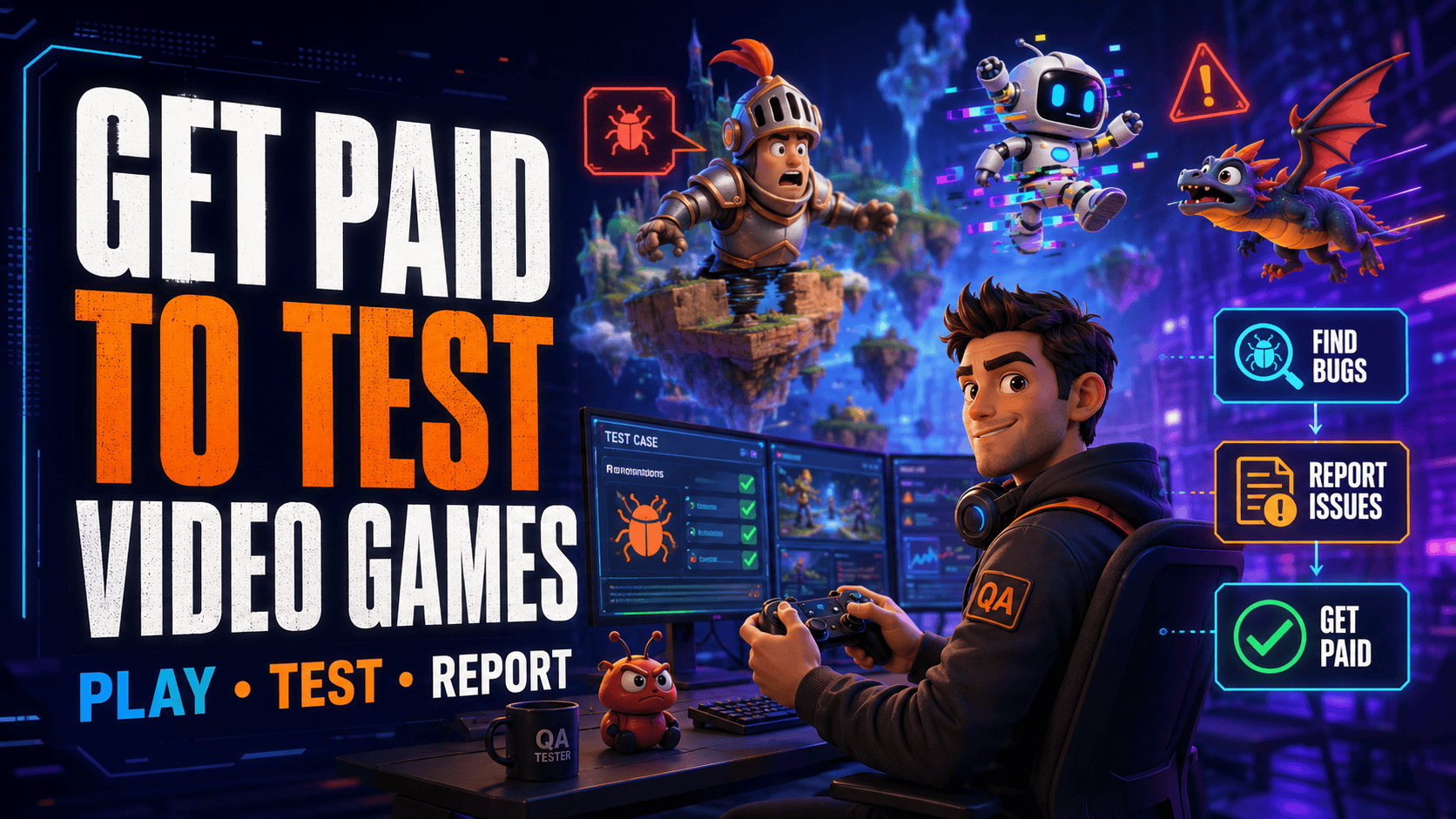
1. 🎮 Get Paid to Test Video Games
Getting paid to test video games sounds suspiciously close to being rewarded for something you already do for fun.
The reality is less “play anything you want all day” and more “repeat the same mission twelve times to discover exactly why the door disappears when the third player crouches beside it.”
Game testing is real work. Developers need people to find technical problems, follow test instructions and explain what happened clearly enough for somebody else to fix it.
Quick answer: You can get paid through quality-assurance jobs, contract testing, remote playtests, user-research studies, focus groups and specialist testing roles.
💰 Paid Game-Testing Routes at a Glance
| Testing route | What you do | Typical commitment |
|---|---|---|
| Quality-assurance job | Find, reproduce and report defects | Regular employment or contract |
| Remote playtest | Play a build and provide feedback | One-off session |
| User-research study | Complete tasks while researchers observe | Scheduled session |
| Focus group | Discuss concepts, features or experiences | One-off study |
| Compatibility testing | Check a game across hardware and software | Project based |
| Localisation testing | Review translated text and regional content | Specialist project |
| Accessibility testing | Evaluate controls, information and usability | Specialist project |
| Multiplayer testing | Test servers, matchmaking and network behaviour | Scheduled test |
The right route depends on whether you want occasional paid sessions or a more structured role in game development.
What Are Testers Paid to Do?
Testers may be asked to:
- Follow a test plan
- Complete specific actions
- Repeat the same scenario
- Find bugs
- Reproduce errors
- Record screenshots or video
- Write reports
- Check updates
- Retest fixes
- Compare different game builds
- Provide structured feedback
- Protect confidential information
The gaming skill helps, but observation and communication matter just as much.
🧪 Testing Is Not the Same as Playing for Fun
| Playing normally | Testing professionally |
|---|---|
| Choose what you want to do | Follow assigned tasks |
| Avoid broken areas | Investigate broken areas |
| Continue after a small issue | Stop and document the issue |
| Focus on enjoyment | Focus on accuracy |
| Play the latest public version | May use unfinished builds |
| Describe a problem casually | Report exact reproduction steps |
A normal player encounters a character floating above a chair, laughs and continues.
A tester asks:
- Which chair?
- Which character?
- Does it happen every time?
- Did it begin after loading a save?
- Does changing equipment affect it?
- Can I reproduce it on another platform?
Then the tester repeats the incident until floating above furniture feels less amusing than it did initially.
Do You Need to Be an Expert Gamer?
Not necessarily.
Different studies and testing roles need different types of players:
- Beginners
- Casual gamers
- Experienced players
- Competitive gamers
- Parents
- Children with appropriate consent
- Players with particular accessibility needs
- Owners of specific devices
- Fans of particular genres
- People who have never played the game
User researchers may specifically want inexperienced players to see whether tutorials and controls are understandable.
Quality-assurance roles generally place more emphasis on testing ability, technical confidence and clear reporting than competitive rank.
🚀 A Realistic Testing Path
Choose a route → Learn testing basics → Practise reporting → Build relevant evidence → Apply for legitimate opportunities
Paid game testing is one route among the broader ways to get paid to play video games.
It is not guaranteed income, and one-off playtests may be irregular. However, testing can provide occasional paid opportunities or become an entry point into a longer quality-assurance career.
2. What Does a Video Game Tester Do?
A video game tester examines a game or feature to identify technical problems, usability issues and unexpected behaviour.
The exact responsibilities depend on the role. A quality-assurance tester may spend days investigating defects. A playtester may complete a one-hour session while researchers observe their reactions.
Tester workflow:
Receive build → Follow test plan → Find issue → Reproduce → Report → Retest
📝 Follow a Test Plan
A test plan explains:
- What needs to be tested
- Which build to use
- Which platform is required
- What actions to complete
- Which results are expected
- What evidence to capture
- When testing must finish
- Where reports should be submitted
Testers should follow the assigned scope before exploring unrelated features.
Finding an exciting visual bug is useful. It does not replace the requested test of whether saved controller settings survive a restart.
🔍 Look for Defects
Testers may search for:
- Crashes
- Freezes
- Missing objects
- Broken quests
- Incorrect menus
- Audio problems
- Visual glitches
- Control failures
- Save issues
- Network errors
- Performance drops
- Incorrect text
- Inaccessible features
- Unexpected game behaviour
Not every unusual outcome is a defect. The tester must compare the actual result with the intended behaviour.
Reproduce the Problem
A bug becomes more useful when developers can repeat it.
The tester may need to determine:
- Where it happens
- Which actions trigger it
- How frequently it occurs
- Whether it affects every device
- Whether it requires a particular character or item
- Whether it appears in a new or existing save
- Whether restarting changes anything
- Whether other players are affected
Use this process:
Find bug → Repeat actions → Change one condition → Record result
Suppose the game crashes after opening a shop.
The tester might discover that it only occurs:
- During multiplayer
- After selling a particular item
- While the second player has the inventory open
- On one game build
That detail turns “shop crashed” into something developers can investigate.
🐛 Write a Bug Report
A useful bug report usually includes:
| Report element | Example information |
|---|---|
| Title | Short description of the problem |
| Build | Tested game version |
| Platform | PC, console, mobile or VR device |
| Location | Level, menu or game mode |
| Steps | Exact actions that reproduce the issue |
| Expected result | What should happen |
| Actual result | What happens instead |
| Frequency | Every time, sometimes or once |
| Evidence | Screenshot, video or log |
| Severity | How seriously the issue affects play |
“Game broken, please fix” contains passion but leaves some investigative gaps.
🔄 Retest Fixes
After developers address an issue, testers may verify that:
- The original bug no longer occurs
- The fix works on supported platforms
- Existing saves remain functional
- Connected systems still work
- No new problems were introduced
This is often called regression testing.
A repaired shop menu is excellent. A repaired shop menu that now deletes the player’s equipment is what professionals refer to as “not quite finished.”
Communicate With the Development Team
Testers may work with:
- Developers
- Test leads
- Producers
- Designers
- Artists
- Localisation teams
- User researchers
- Customer-support teams
- Other testers
Good communication is concise, neutral and evidence-based.
The tester’s job is not to blame the programmer. It is to describe the problem so the team can solve it.
✅ Daily Tester Checklist
- Follow the assigned scope
- Use the correct game build
- Record the testing environment
- Reproduce issues where possible
- Capture useful evidence
- Avoid duplicate reports
- Keep reports factual
- Protect unreleased information
- Retest assigned fixes
- Track completed work
Testing rewards curiosity, patience and an oddly strong willingness to walk into the same wall repeatedly for science.
3. Game Testing vs Playtesting – What Is the Difference?
Game testing and playtesting are related, but they usually answer different questions.
Game testing asks: Does the game work correctly?
Playtesting asks: What is the player’s experience?
Both can involve playing an unfinished game. The purpose, process and feedback are different.
🎮 Game Testing vs Playtesting
| Game testing | Playtesting |
|---|---|
| Focuses on technical defects | Focuses on player behaviour and experience |
| Often follows structured test cases | Often follows tasks or research questions |
| Requires detailed bug reports | Uses observations, interviews or surveys |
| May repeat one action many times | Usually resembles normal play more closely |
| Checks expected behaviour | Investigates understanding and enjoyment |
| Common in quality assurance | Common in user research |
| May continue throughout development | Often occurs at selected development stages |
🧪 Example: Testing a Tutorial
A quality-assurance tester might check:
- Does the tutorial begin correctly?
- Do prompts appear at the right time?
- Can objectives be completed?
- Does progress save?
- Can the player become trapped?
- Do controls work on each platform?
A playtester might be observed to learn:
- Did they understand the instructions?
- Which prompts did they miss?
- Did they know where to go?
- Were they bored or confused?
- Could they remember the controls?
- Did they understand the game’s main objective?
The same tutorial can work perfectly from a technical perspective and still leave every new player wandering into the decorative lake.
That is why both types of testing matter.
What Is Beta Testing?
Beta testing usually involves testing a game or feature before full public release.
A beta may be:
- Closed to selected participants
- Available through invitations
- Open to a wider public audience
- Limited to particular devices
- Scheduled during set periods
- Focused on multiplayer load
- Used to gather technical data and feedback
Beta access is not necessarily paid. Many public betas allow players to participate voluntarily.
Do not assume that playing an early version makes you an employee, contractor or professional tester.
Early Access Is Not Automatically Paid Testing
Early-access players generally purchase or access a game while it is still under development.
They may report bugs and suggest features, but that does not necessarily make the arrangement paid testing.
| Paid testing | Ordinary early access |
|---|---|
| Tester receives compensation | Player may pay for access |
| Tasks may be assigned | Player chooses how to play |
| Feedback follows a process | Feedback may be optional |
| Confidentiality may apply | Content is often public |
| Specific eligibility may apply | Access usually follows store conditions |
Check the exact terms attached to any opportunity.
🧠 Which Route Suits You?
| If you enjoy… | Consider… |
|---|---|
| Finding technical problems | Quality-assurance testing |
| Repeating exact steps | Functional or regression testing |
| Explaining your experience | Playtesting |
| Comparing hardware | Compatibility testing |
| Reviewing language | Localisation testing |
| Evaluating usability | Accessibility testing |
| Testing with other players | Multiplayer testing |
| Discussing game ideas | User research or focus groups |
You can develop skills across several areas, but understanding the difference helps you apply for appropriate opportunities.
4. Types of Paid Video Game Testing Work
“Game tester” is a broad label covering several kinds of work.
Some testers focus on whether a feature works. Others examine performance, translated text, accessibility or player behaviour.
Testing specialisation:
Different risk → Different test method → Different tester skills
🧪 Game Testing Types Compared
| Testing type | Main purpose | Useful strength |
|---|---|---|
| Functional testing | Confirm features behave correctly | Structured thinking |
| Compatibility testing | Check different devices and systems | Technical knowledge |
| Compliance testing | Review platform requirements | Precision |
| Localisation testing | Check translated or regional content | Language skills |
| Accessibility testing | Evaluate usability for more players | Accessibility knowledge |
| Performance testing | Measure stability and resource use | Technical analysis |
| Multiplayer testing | Examine network and player interactions | Team coordination |
| Regression testing | Confirm fixes did not break other features | Patience and consistency |
| User research | Understand player behaviour | Clear verbal feedback |
| Focus groups | Explore player reactions and preferences | Thoughtful discussion |
⚙️ Functional Testing
Functional testers check whether game features work as intended.
They may test:
- Menus
- Controls
- Combat
- Crafting
- Quests
- Achievements
- Save systems
- Inventory
- Progression
- Game settings
A test case might require buying every item from a shop, closing the menu after each purchase and checking whether the correct amount of currency is removed.
It may not provide the emotional drama promised by the game trailer. It can prevent considerable emotional drama after release.
💻 Compatibility Testing
Compatibility testing examines how a game performs across:
- Computer hardware
- Operating systems
- Consoles
- Mobile devices
- Screen resolutions
- Controllers
- Graphics settings
- Drivers
- Network conditions
- Peripheral devices
Testers with unusual or specific hardware may qualify for particular projects.
🌎 Localisation Testing
Localisation testers review content adapted for different languages and regions.
They may look for:
- Incorrect translations
- Text that does not fit
- Missing characters
- Broken formatting
- Cultural problems
- Mismatched voice and subtitles
- Date, time and currency errors
- Untranslated content
- Incorrect regional settings
Speaking a language fluently can help, but testers also need careful observation and reporting skills.
A translated sentence can be grammatically correct and still sound as though it was written by a menu experiencing a personal crisis.
♿ Accessibility Testing
Accessibility testing may evaluate:
- Text readability
- Subtitles
- Colour use
- Control remapping
- Input requirements
- Audio cues
- Visual cues
- Difficulty options
- Interface navigation
- Assistive technology compatibility
Lived experience and specialist accessibility knowledge can be particularly valuable.
Testers should report specific barriers rather than assuming one solution works for every player.
📈 Performance Testing
Performance testers may monitor:
- Frame rate
- Loading
- Memory use
- CPU and graphics usage
- Network activity
- Temperature
- Battery consumption
- Stability over long sessions
- Large numbers of players or objects
The goal is to identify when and where performance declines.
“It became slow after a while” is a beginning. A useful report identifies the build, device, location, duration and conditions.
🌐 Multiplayer and Network Testing
Multiplayer testing can cover:
- Matchmaking
- Parties
- Voice and text chat
- Joining and leaving
- Host migration
- Synchronisation
- Disconnections
- Latency
- Competitive scoring
- Server load
- Cross-platform play
Multiplayer creates countless unexpected combinations because every additional player arrives with their own connection, hardware and creative interpretation of the rules.
Choose a Testing Direction
Begin with the areas that match your experience:
- Technical PC user → Compatibility or performance testing
- Multilingual gamer → Localisation testing
- Detail-focused beginner → Functional testing
- Multiplayer organiser → Network and group testing
- Strong communicator → User research
- Accessibility specialist → Accessibility testing
- Patient problem-solver → Regression testing
Specialisation can make your applications more relevant as your experience grows.
5. Who Pays People to Test Video Games?
Paid testers may work directly for game companies, specialist testing providers, research agencies or platforms that recruit participants for individual studies.
The arrangement might be employment, a fixed contract or a one-off incentive.
Paid-testing market:
Developer need → Testing organisation → Suitable participant → Completed work
💼 Who Hires Game Testers?
| Organisation | Work it may offer | Possible arrangement |
|---|---|---|
| Game developer | Internal QA and development testing | Employment or contract |
| Game publisher | Testing across several projects | Employment or contract |
| Specialist QA provider | Outsourced testing services | Employment or project work |
| User-research agency | Playtests, interviews and studies | One-off participation |
| Playtesting platform | Remote testing opportunities | Individual sessions |
| Independent developer | Small-project testing | Freelance or contract |
| Hardware or platform company | Compatibility and compliance work | Employment or contract |
🎮 Developers and Publishers
Larger studios and publishers may employ internal QA teams or hire contractors.
Possible roles include:
- QA tester
- Functionality tester
- Compatibility tester
- Localisation QA tester
- Compliance tester
- QA analyst
- User researcher
- Accessibility tester
- Test lead
Internal testers may work closely with developers throughout production. Contract roles may run for a specific project or development period.
🧪 Specialist QA Companies
Some companies provide testing services to game studios.
They may work across:
- Multiple games
- Different platforms
- Localisation projects
- Compliance requirements
- Multiplayer environments
- Performance testing
- Pre-release builds
This work can provide exposure to different projects, though confidentiality may prevent you from publicly discussing them.
Your résumé may contain several impressive projects described only as “unannounced title.” Mystery is apparently one of the industry benefits.
👥 User-Research Agencies and Playtesting Services
Research organisations recruit selected participants to test:
- Game concepts
- Tutorials
- Controls
- New features
- User interfaces
- Difficulty
- Store pages
- Promotional material
- Complete game experiences
Participants may complete:
- Remote sessions
- Recorded tasks
- Live interviews
- Surveys
- Focus groups
- In-person studies
Selection depends on the study. A researcher might need experienced strategy players one week and people who rarely play games the next.
Why Don’t You Qualify for Every Study?
Screening questions help researchers find the audience required for a particular test.
You may be excluded because of:
- Age group
- Location
- Gaming habits
- Device ownership
- Genre experience
- Previous participation
- Availability
- Professional background
- Internet connection
- Accessibility requirements
Disqualification is normal. It does not necessarily mean your profile is weak.
Do not lie to qualify. A study seeking people who have never played a certain game will notice when you begin discussing advanced strategies from your 800-hour save.
🔍 Direct Jobs vs One-Off Studies
| Direct testing role | One-off playtest |
|---|---|
| Structured employment or contract | Individual research session |
| Regular schedule | Occasional invitation |
| Detailed QA responsibilities | Feedback on selected tasks |
| Testing skills are central | Player profile may be central |
| May require workplace experience | Often open to ordinary players |
| More consistent potential income | Irregular supplementary income |
Choose based on your goal.
If you want a possible career path, focus on QA skills, applications and relevant experience. If you want occasional sessions, legitimate research panels may be more suitable.
Where Payment Comes From
Compensation may be provided as:
- Employment wages
- Contractor payment
- Fixed project fee
- Session incentive
- Gift card
- Approved platform payment
- Participant reimbursement
Read the terms before accepting. Confirm the amount, payment method, expected work and when compensation will be issued.
Paid-Opportunity Legitimacy Check
- ✅ Organisation has a verifiable identity
- ✅ Opportunity explains the work
- ✅ Eligibility requirements make sense
- ✅ Compensation is stated or discussed clearly
- ✅ No upfront participation fee is required
- ✅ Communication uses credible channels
- ✅ Confidentiality terms are provided
- ✅ Downloads come from a verified source
- ✅ Personal information requested is proportionate
- ✅ Payment conditions are documented
Legitimate testing companies pay testers. They do not ask applicants to purchase a premium registration pack containing “exclusive secrets” about pressing buttons professionally.
6. 🧪 What Is Quality-Assurance Game Testing?
Quality assurance, usually shortened to QA, is the structured process of checking whether a game works as intended.
QA testers find defects, reproduce them, record evidence and verify fixes. They may test one game for weeks or spend an entire afternoon checking whether the same menu behaves correctly under slightly different conditions.
QA testing loop:
Test feature → Find defect → Reproduce → Report → Developer fixes → Retest
🎮 What Does a QA Tester Check?
| Testing area | Example question |
|---|---|
| Functionality | Does the feature produce the expected result? |
| Stability | Does the game freeze or crash? |
| Progression | Can players complete objectives and continue? |
| Interface | Do menus, buttons and prompts work? |
| Controls | Do supported inputs respond correctly? |
| Saving | Is progress stored and restored accurately? |
| Audio and visuals | Do assets appear and play when expected? |
| Performance | Does the game run within acceptable limits? |
| Multiplayer | Do players and servers remain synchronised? |
| Compatibility | Does the game work across supported systems? |
QA is not simply looking around for amusing visual glitches. Testers may be assigned a particular feature, build or section of the game.
Follow Structured Test Cases
A test case normally contains:
- Test objective
- Required setup
- Game build
- Platform
- Preconditions
- Steps to follow
- Expected result
- Actual result
- Pass or fail status
- Evidence requirements
For example:
Objective: Confirm that purchased items remain after restarting the game.
Steps: Purchase item, equip it, save, close the game, restart and load the save.
Expected result: The item remains owned and equipped.
A tester may repeat this with different items, characters, save files and platforms.
The first restart feels thorough. By restart number 23, you and the loading screen have developed a complicated relationship.
🐛 Defect or Design Choice?
Not everything a tester dislikes is a bug.
Compare:
| Observation | Possible classification |
|---|---|
| Button does nothing | Functional defect |
| Text extends beyond menu | Visual or localisation defect |
| Player dislikes the menu colour | Personal preference |
| Quest cannot be completed | Progress-blocking defect |
| Enemy is intentionally difficult | Design choice |
| Enemy becomes invincible unexpectedly | Gameplay defect |
Testers should report what happened without rewriting the entire design according to personal taste.
If feedback is requested, clearly separate:
- Technical defect
- Usability concern
- Balance observation
- Personal preference
Repetition Is Part of QA
A tester might need to:
- Walk into every wall
- Open every container
- Change every setting
- Buy every item
- Repeat every tutorial step
- Disconnect during each multiplayer stage
- Load many save combinations
- Retest the same fixed bug
This repetition helps reveal issues players encounter only under particular conditions.
The job is less “play the new game before everyone else” and more “discover what happens when someone opens the map while climbing a ladder during a network interruption.”
🔄 Regression Testing
Regression testing checks whether a fix or update has broken something that previously worked.
After a shop bug is repaired, a tester might confirm that:
- Shop opens
- Items appear
- Prices are correct
- Purchases work
- Currency updates
- Inventory saves
- Other shops still work
- Multiplayer purchases remain synchronised
Software changes can produce unexpected effects elsewhere. Fixing one door may somehow upset the inventory system. Games contain many connected systems and occasionally behave as though they know this is funny.
QA Tester Quality Check
- ✅ Follow the assigned test case
- ✅ Use the correct build
- ✅ Record the platform and environment
- ✅ Reproduce defects
- ✅ Capture useful evidence
- ✅ Avoid duplicate reports
- ✅ Separate defects from opinions
- ✅ Protect confidential information
- ✅ Retest fixes carefully
- ✅ Report results by the deadline
Good QA work is methodical, specific and sometimes gloriously repetitive.
7. What Happens During a Paid Playtest?
A paid playtest usually asks selected participants to play a game, feature or prototype while researchers study their experience.
The goal may be to discover whether players understand the controls, enjoy the gameplay or become confused at exactly the moment developers hoped they would feel heroic.
Playtest journey:
Apply → Complete screening → Receive instructions → Play → Give feedback → Receive incentive
📝 Step 1: Complete a Screening Questionnaire
Researchers may ask about:
- Age group
- Location
- Gaming habits
- Favourite genres
- Recently played games
- Owned devices
- Experience level
- Accessibility needs
- Availability
- Previous research participation
Answer honestly. The researchers may want experienced players, beginners or people who have never encountered the game.
Trying to appear suitable for every study can make your profile internally impossible: a lifelong expert who has somehow never played anything.
Step 2: Review the Conditions
Before participating, confirm:
| Detail | What to check |
|---|---|
| Session format | Remote or in person |
| Duration | Expected testing and interview time |
| Equipment | Devices or software required |
| Recording | Screen, audio, camera or interaction tracking |
| Confidentiality | What cannot be shared |
| Compensation | Amount or incentive type |
| Payment timing | When it will be issued |
| Cancellation | What happens if the session changes |
| Data handling | What information is collected |
Ask questions if anything is unclear before accepting.
🎮 Step 3: Complete Assigned Tasks
A researcher might ask you to:
- Start a new game
- Complete the tutorial
- Find a particular menu
- Create a character
- Finish a level
- Purchase an in-game item using test currency
- Join a multiplayer match
- Compare two designs
- Explore without detailed instructions
You may be asked to think aloud while playing.
That means explaining:
- What you expect to happen
- What you are trying to do
- Why you selected an option
- What confuses you
- How you feel about the experience
Silently solving every problem may hide the exact information researchers need.
Step 4: Give Honest Feedback
Useful playtest feedback is:
- Specific
- Based on what happened
- Focused on your experience
- Honest without trying to impress
- Clear about uncertainty
- Separate from guesses about development
Instead of:
“The tutorial was bad.”
Try:
“After collecting the first item, I did not notice the objective had moved to the top-right corner. I spent several minutes searching the room because I expected another prompt near the character.”
That explanation tells researchers where and why the confusion occurred.
🧠 You Are Not Expected to Perform Well
Playtesting is not usually an audition for a professional esports team.
If you misunderstand a menu or fail a tutorial, that can be valuable research. It may show that instructions, controls or visual cues need improvement.
Do not hide confusion to appear skilled.
The researcher is studying the game’s ability to communicate—not preparing a highlight reel of your finest menu navigation.
Step 5: Complete the Interview or Survey
After playing, you may be asked:
- What did you enjoy?
- What was confusing?
- Which features did you notice?
- What did you expect to happen?
- Would you continue playing?
- How difficult was the experience?
- How did it compare with similar games?
- Which parts would you change?
Give considered answers without inventing certainty.
“I’m not sure why, but I lost interest during this section” can still be useful if you explain what was happening at the time.
Paid Playtest Checklist
- ✅ Profile information is accurate
- ✅ Session requirements are understood
- ✅ Equipment has been tested
- ✅ Instructions are followed
- ✅ Feedback is honest
- ✅ Technical problems are reported
- ✅ Confidential content remains private
- ✅ Session is completed on time
- ✅ Payment terms are saved
- ✅ Follow-up communication is professional
The best playtester is not necessarily the best player. It is the person who gives researchers a clear view of the experience.
8. Remote vs In-Person Game Testing
Paid testing may happen remotely from your home or at a studio, research facility or testing office.
Remote testing offers convenience and broader access. In-person work may provide specialised equipment, direct observation and more controlled conditions.
Choose based on:
Location + Equipment + Availability + Privacy + Type of testing
🏠 Remote vs In-Person Testing Compared
| Factor | Remote testing | In-person testing |
|---|---|---|
| Location | Home or approved private space | Studio, office or research facility |
| Travel | Usually none | Required |
| Equipment | Often your own | Usually supplied |
| Schedule | May offer greater flexibility | Fixed appointment |
| Technical setup | Participant may configure software | Organisation manages environment |
| Observation | Screen, voice or camera recording | Direct observation |
| Eligibility | May accept wider locations | Limited by travel distance |
| Confidentiality | Requires secure home environment | Controlled by facility |
| Session support | Remote assistance | Staff available on-site |
| Specialised hardware | Limited to what you own or receive | May be available at facility |
Neither is automatically better. The right option depends on the study.
💻 Remote Testing Requirements
A remote test may require:
- Supported computer or console
- Specific operating system
- Stable internet
- Headset and microphone
- Webcam
- Screen-recording software
- Quiet environment
- Private room
- Available storage
- Permission to install a test build
Confirm requirements before the session.
Downloading a large confidential game build ten minutes before the appointment is an excellent way to spend the first half of the test watching a percentage increase slowly.
Protect Confidential Builds at Home
Remote testers may need to:
- Prevent other people from viewing the session
- Avoid streaming or screen sharing
- Disable automatic screenshots
- Hide public activity status
- Store files securely
- Avoid uploading test footage
- Delete files when instructed
- Use only approved devices
- Protect account credentials
Do not test confidential material while broadcasting your desktop or sharing the room with an audience.
🏢 What to Expect In Person
An in-person test may involve:
- Checking in
- Reviewing consent and confidentiality terms
- Receiving session instructions
- Playing in an observed room
- Completing an interview
- Filling out a survey
- Receiving payment information
Researchers may record:
- Gameplay
- Screen activity
- Voice
- Facial reactions
- Controller input
- Eye movement
- Interview responses
The study should explain what is being recorded and how the information will be used.
Consider Travel and Time
For an in-person opportunity, calculate:
Session time + Travel + Waiting + Expenses = Total commitment
A one-hour study can consume several hours once travel and check-in are included.
Confirm whether:
- Parking is available
- Travel is reimbursed
- Late arrival affects eligibility
- The location is accessible
- Identification is required
- Payment is immediate or processed later
Which Format Suits You?
| Your situation | Possible fit |
|---|---|
| Own several gaming devices | Remote compatibility testing |
| Live near testing studios | In-person research |
| Need flexible opportunities | Asynchronous remote tests |
| Have specialist hardware | Remote device-specific studies |
| Prefer direct support | In-person testing |
| Lack a private home setup | Controlled testing facility |
| Have reliable high-speed internet | Large remote test builds |
| Need accessibility adjustments | Ask either format about support |
Testing-Format Checklist
- ✅ Location is practical
- ✅ Total time is understood
- ✅ Required equipment is available
- ✅ Recording conditions are acceptable
- ✅ Confidentiality can be maintained
- ✅ Technical setup is tested
- ✅ Compensation justifies the commitment
- ✅ Organisation is legitimate
- ✅ Cancellation conditions are clear
- ✅ Accessibility requirements have been discussed
Remote testing saves travel. It does not remove preparation, privacy or the possibility that your internet connection will choose the session start time to develop a personality.
9. 💰 How Much Do Video Game Testers Get Paid?
Video game testing pay varies according to the role, country, experience, employer and type of study.
A full-time quality-assurance tester and someone completing a one-off remote playtest should not be compared as though they perform the same job.
Testing income depends on:
Work model + Experience + Location + Specialisation + Time commitment
Testing Income Models Compared
| Testing route | How payment may work | Income consistency |
|---|---|---|
| Full-time QA | Regular wage or salary | Higher |
| Contract QA | Hourly, daily or project rate | Medium |
| Freelance testing | Fixed fee or hourly payment | Variable |
| Remote playtest | Incentive per completed session | Low |
| Focus group | Fixed participation payment | Low |
| Specialist testing | Contract or employment payment | Medium |
| User-research study | Session incentive | Low |
One-off playtesting is best treated as occasional supplementary income rather than guaranteed weekly work.
🎯 What Influences Pay?
| Factor | Why it matters |
|---|---|
| Location | Labour markets and legal requirements differ |
| Experience | Proven testers may qualify for more responsibility |
| Employment type | Staff, contractor and participant payments differ |
| Technical knowledge | Specialist skills can expand available roles |
| Language ability | Relevant for localisation work |
| Device ownership | Some studies need particular hardware |
| Session length | Longer studies may offer different incentives |
| Testing complexity | Technical roles require stronger skills |
| Urgency | Short deadlines may affect contract rates |
| Travel | In-person work creates additional time and costs |
Avoid any service claiming that every tester earns the same amount.
If all applicants are guaranteed unusually high income for playing whatever they like, the main thing being tested may be their willingness to enter payment details.
Employment Pay vs Playtest Incentives
QA employment
Payment covers structured work such as:
- Following test plans
- Writing reports
- Attending meetings
- Retesting fixes
- Tracking defects
- Working scheduled hours
- Collaborating with development teams
Playtest incentives
Payment compensates participants for:
- Session time
- Feedback
- Screening requirements
- Travel where applicable
- Recording or observation
- Confidentiality obligations
A playtest incentive is not a salary and should not be treated as evidence of a stable hourly income.
💸 Calculate the Real Return
For one-off sessions, consider:
Payment − Travel − Equipment costs − Fees = Net return
Then account for time:
Net return ÷ Application, preparation, travel and session time = Effective hourly return
An advertised one-hour test may also involve screening, software installation, technical checks and a follow-up survey.
Those tasks count even if the promotional headline prefers not to invite them to the calculation.
Revenue Is Not Profit
Testing-related costs might include:
- Travel
- Parking
- Internet usage
- Equipment
- Software
- Payment fees
- Currency conversion
- Contractor taxes
- Unpaid application time
- Workspace costs
Do not purchase expensive equipment solely to qualify for one uncertain study unless the expected value clearly justifies it.
🧪 Why Paid Playtests Are Irregular
You may not qualify because researchers need:
- A different age group
- Another country or city
- Owners of a particular device
- Players of another genre
- People unfamiliar with the game
- A specific availability window
- Participants who have not completed similar studies
Accurate profiles can improve matching, but no legitimate platform can guarantee constant invitations.
Testing can be one of several gaming side hustles that actually work, provided it is approached as real work rather than effortless guaranteed income.
Testing-Income Checklist
- ✅ Payment amount or method is understood
- ✅ Total time commitment is calculated
- ✅ Travel and costs are considered
- ✅ Payment date is documented
- ✅ Contractor or tax responsibilities are understood
- ✅ Opportunity does not require an upfront fee
- ✅ One-off testing is not treated as guaranteed income
- ✅ Personal financial records are maintained
- ✅ Equipment purchases are justified
- ✅ Claims are verified through credible sources
Test the opportunity as carefully as you would test the game.
10. Full-Time, Contract and Freelance Testing Compared
Game-testing opportunities can involve permanent employment, fixed contracts, freelance projects or individual playtests.
Each model offers a different balance of stability, flexibility and responsibility.
💼 Testing Work Models at a Glance
| Work model | Stability | Flexibility | Typical commitment |
|---|---|---|---|
| Full-time QA | Higher | Lower | Regular scheduled work |
| Part-time QA | Medium | Medium | Ongoing reduced hours |
| Contract testing | Medium | Medium | Fixed period or project |
| Freelance testing | Lower | Higher | Project dependent |
| One-off playtesting | Low | High | Individual study |
| Focus groups | Low | Medium | Scheduled session |
Full-Time QA Employment
A full-time role may provide:
- Regular pay
- Defined working hours
- Team supervision
- Internal tools
- Training
- Development experience
- Opportunities for progression
- Employment benefits depending on location and employer
Trade-offs may include:
- Less schedule flexibility
- Repetitive assignments
- Office or regional requirements
- Confidentiality restrictions
- Work tied to one employer’s projects
- Periods of higher workload near development milestones
This route best suits people seeking a structured career rather than occasional testing income.
📅 Contract Testing
Contract testers work for a fixed period, project or development stage.
A contract might cover:
- Several months before release
- One platform version
- Localisation
- Compatibility
- Compliance
- Multiplayer testing
- Post-release updates
Contract work can provide professional experience without permanent employment. It may also end when the project or agreed period finishes.
Read:
- Start and end dates
- Work hours
- Payment terms
- Renewal conditions
- Confidentiality
- Ownership
- Notice requirements
- Contractor responsibilities
Do not interpret “possibility of extension” as “guaranteed employment forever.” Recruiters use those words carefully, and so should applicants.
🧑💻 Freelance Testing
Freelancers may test:
- Independent games
- Mobile games
- Small updates
- Websites and launchers
- Server systems
- Game-related applications
- Individual features
Freelancers usually manage:
- Client search
- Quotes
- Schedules
- Invoices
- Equipment
- Testing environment
- Record keeping
- Taxes
- Multiple projects
Flexibility comes with less predictable income and more administration.
🎮 One-Off Playtesting
One-off studies offer the greatest flexibility but the least consistency.
They can suit people who:
- Want occasional opportunities
- Fit specific research profiles
- Own useful devices
- Can attend scheduled sessions
- Give clear verbal feedback
- Do not rely on testing for regular income
Participation may last from a short task to a longer observed session. Eligibility varies with every study.
Choose the Right Testing Model
| Your goal | Suitable route |
|---|---|
| Build a QA career | Full-time or contract testing |
| Gain professional experience | Entry-level contract or part-time work |
| Control your schedule | Freelance testing |
| Earn occasionally | Paid playtests and research studies |
| Use specialist skills | Localisation, accessibility or technical testing |
| Work across projects | QA provider or contract roles |
| Test from home | Eligible remote studies or remote QA roles |
Testing-Model Decision Path
Do you want regular testing work?
- Yes: Focus on employment and contract QA roles.
- No: Look for legitimate one-off playtests.
- Unsure: Build basic testing skills while trying occasional studies.
Do you have specialist knowledge?
- Yes: Explore localisation, accessibility, compatibility or performance testing.
- No: Begin with functional testing and structured reporting.
Work-Model Checklist
- ✅ Employment status is clear
- ✅ Payment method is documented
- ✅ Schedule suits your availability
- ✅ Contract duration is understood
- ✅ Equipment responsibilities are known
- ✅ Confidentiality terms are acceptable
- ✅ Tax obligations are considered
- ✅ Expected testing duties are explained
- ✅ Remote or location requirements are practical
- ✅ Future work is not assumed
There is no universally best model. Choose the one aligned with your income needs, availability and willingness to spend another afternoon confirming that the pause menu still pauses.
11. 🧠 Skills You Need to Become a Video Game Tester
Being good at games can help, but testing requires a different set of skills.
A tester must notice problems, repeat exact actions and explain what happened without turning the report into an emotional review of the development team’s life choices.
Professional testing = Observation + Repetition + Evidence + Clear communication
🔍 Attention to Detail
Testers look for small differences between what should happen and what actually happens.
That might include:
- A button changing position
- An incorrect sound
- Missing text
- A character animation ending early
- Currency updating incorrectly
- A brief frame-rate drop
- An objective appearing at the wrong time
- A setting resetting after restarting
- An item using the wrong description
- Two players seeing different results
A normal player may barely notice that a sword disappears for half a second.
A tester notices it, reproduces it and discovers that it only happens while running downhill after opening the map. Tuesday has gone well.
🧪 Patience and Repetition
Testing often requires repeating the same action under different conditions.
You might test a shop purchase using:
- Different characters
- Different items
- Full and empty inventories
- Online and offline modes
- New and existing saves
- Several supported devices
- Different languages
- Multiple control methods
Repetition is not accidental busywork. It helps isolate the condition causing the problem.
If performing the same tutorial 18 times sounds unbearable, structured QA may be less enjoyable than occasional playtesting.
Clear Written Communication
A useful tester can turn a confusing failure into a report another person can follow.
Compare:
| Weak report | Stronger report |
|---|---|
| Game crashed | Game crashes after equipping the reward sword |
| Menu is broken | Settings menu cannot be closed using a controller |
| Quest doesn’t work | Final objective does not update after defeating the boss |
| Multiplayer is laggy | Second player experiences delayed movement after host migration |
| Text looks weird | French objective text overlaps the minimap at 1920 × 1080 |
The stronger examples identify what, where or when something happened.
🧠 Analytical Thinking
Testers ask:
- What changed before the problem appeared?
- Can I make it happen again?
- Does it affect every save?
- Does it occur on another platform?
- Is another feature involved?
- Is the result technically wrong or merely unexpected?
- What evidence would help the developer?
- Has somebody already reported it?
This is practical investigation rather than guesswork.
Avoid declaring the cause unless you have evidence. The button may stop working after an update, but that does not prove the new character’s hairstyle has somehow corrupted the menu.
Although software has produced stranger plots.
🎮 Gaming and Technical Knowledge
Useful knowledge can include:
- Common control systems
- Menus and interfaces
- Save files
- Multiplayer behaviour
- Graphics settings
- Hardware
- Operating systems
- Error logs
- Network conditions
- Game genres
- Development terminology
You do not need to be a programmer for many entry-level opportunities. Technical confidence makes it easier to collect evidence and describe the testing environment.
Following Instructions
A good tester follows:
- Test cases
- Assigned scope
- Naming conventions
- Report templates
- Confidentiality requirements
- Build-installation instructions
- Submission deadlines
- Communication processes
Creative exploration has value when requested. Ignoring the assigned test to search for amusing physics problems does not.
🤝 Teamwork and Professionalism
Testing often involves developers, designers, producers and other testers.
Professional behaviour includes:
- Reporting facts rather than blame
- Accepting feedback
- Asking useful questions
- Avoiding duplicate reports
- Updating assigned issues
- Meeting deadlines
- Protecting confidential material
- Admitting when something cannot be reproduced
The tester and developer are trying to solve the same problem. A bug report is evidence, not an accusation.
Tester Skills Scorecard
Rate your current ability from one to five:
| Skill | Score |
|---|---|
| Attention to detail | /5 |
| Written communication | /5 |
| Patience with repetition | /5 |
| Following instructions | /5 |
| Analytical thinking | /5 |
| Technical confidence | /5 |
| Time management | /5 |
| Confidentiality | /5 |
| Total | /40 |
Lower scores show what to practise. They are not a formal verdict delivered by the QA council.
12. How to Write a Useful Video Game Bug Report
A bug report should help another person reproduce, understand and investigate a problem.
The developer reading it may not have seen the issue. Your report must provide enough information to recreate the same conditions.
Bug-report formula:
Where it happened → What triggered it → What should happen → What happened instead → Supporting evidence
🐛 Anatomy of a Bug Report
| Field | What to include |
|---|---|
| Title | Concise description of the problem |
| Game build | Exact version tested |
| Platform | Device and operating environment |
| Location | Level, mode, menu or mission |
| Preconditions | Required character, item, save or status |
| Steps to reproduce | Numbered actions |
| Expected result | Intended behaviour |
| Actual result | Observed behaviour |
| Reproduction rate | How often the problem occurs |
| Severity | Effect on the game |
| Evidence | Screenshot, video or log |
| Notes | Useful variations or related details |
Follow the employer or project’s required template when one is provided.
Write a Specific Title
A title should identify the problem quickly.
Weak title
Shop bug
Stronger title
Game freezes after purchasing the final inventory slot
Other useful examples:
- Player falls through the floor beside the northern checkpoint
- Subtitles disappear after changing dialogue language
- Equipped armour is missing after reloading an autosave
- Second player cannot accept party invitation after host migration
Do not attempt to include every detail in the title. That is what the rest of the report is for.
🔢 Write Reproduction Steps
Steps should begin from a clearly defined state.
For example:
- Launch the specified game build
- Load the attached save
- Travel to the northern merchant
- Open the shop
- Purchase the final inventory upgrade
- Close the shop
- Observe the game
Keep each step focused on one action.
Avoid instructions such as:
Play for a while, buy some things and eventually it crashes.
That may describe your experience accurately, but it asks the developer to recreate your entire afternoon.
Expected Result vs Actual Result
Expected result
Describe what should happen:
The inventory slot is unlocked, the correct currency is deducted and gameplay continues.
Actual result
Describe what happened:
The inventory slot unlocks, but the game becomes unresponsive immediately after the shop closes.
Keep both factual. Avoid dramatic additions such as “the entire game becomes completely useless forever” unless that is somehow the measured technical result.
📊 Record the Reproduction Rate
Examples include:
- 5/5 attempts
- 3/5 attempts
- Once in ten attempts
- Only after loading an existing save
- Could not reproduce on another device
“Always” should mean you reproduced it consistently. “Random” often means the trigger has not yet been identified.
Understand Severity
Projects may use their own severity system, but a common structure is:
| Severity | Example |
|---|---|
| Critical | Data loss, security issue or game-wide failure |
| High | Crash or blocked progression |
| Medium | Feature works incorrectly but a workaround exists |
| Low | Minor visual, audio or text problem |
Severity describes the effect of the defect—not how personally offended you feel by it.
📸 Attach Useful Evidence
Evidence may include:
- Screenshot
- Screen recording
- Crash log
- Save file
- System information
- Network details
- Input display
- Performance capture
Show enough context to identify the location and failure.
A screenshot of a completely black screen captioned “this” demonstrates admirable brevity but may need supporting information.
Bug-Report Template
Title:
Build:
Platform:
Location:
Preconditions:
Steps to reproduce:
1.
2.
3.
Expected result:
Actual result:
Reproduction rate:
Severity:
Evidence:
Additional notes:
Final Report Check
- ✅ Title identifies the issue
- ✅ Build and platform are included
- ✅ Steps begin from a clear state
- ✅ Instructions are easy to follow
- ✅ Expected and actual results differ clearly
- ✅ Reproduction rate is accurate
- ✅ Severity follows project rules
- ✅ Evidence contains no unrelated private information
- ✅ Existing reports have been checked
- ✅ Tone remains factual
A strong bug report saves the development team time. That is valuable even when the bug itself is a character rotating slowly inside a table.
13. Common Bugs Game Testers Look For
Games contain connected systems: controls, physics, interfaces, artificial intelligence, saving, networking and countless other parts.
A small change in one area may create a problem somewhere unexpected. Testers therefore investigate both individual features and how those features interact.
🎮 Common Game Bug Categories
| Bug category | Example |
|---|---|
| Crash or freeze | Game closes or stops responding |
| Progression blocker | Player cannot continue a mission |
| Visual bug | Missing texture or broken animation |
| Audio bug | Sound fails, loops or plays incorrectly |
| Interface bug | Button, menu or prompt does not work |
| Save bug | Progress is lost or corrupted |
| Collision bug | Player moves through a solid surface |
| AI bug | Character behaves incorrectly |
| Network bug | Players see different game states |
| Performance bug | Frame rate or loading worsens |
| Localisation bug | Translation or text display is incorrect |
| Control bug | Input is ignored or mapped incorrectly |
💥 Crashes and Freezes
Testers should record:
- What happened immediately before the failure
- Whether the game closed or stopped responding
- Which build was used
- Platform and hardware
- Active game mode
- Loaded save
- Other connected players
- Available crash logs
- Reproduction frequency
A crash after four hours of play may require a different investigation from one that occurs immediately after launch.
🚧 Progression Blockers
A progression blocker prevents the player from continuing.
Examples include:
- Door does not open
- Required character disappears
- Objective does not update
- Mission item cannot be collected
- Cutscene fails to begin
- Player becomes trapped
- Save loads before an unavoidable failure
- Boss cannot be defeated
These issues often receive high severity because they stop progress.
The decorative plant clipping through a wall can probably wait. The missing quest character holding the only key cannot.
🎨 Visual and Animation Bugs
Visual problems may include:
- Missing textures
- Flickering objects
- Incorrect lighting
- Character clipping
- Broken effects
- Objects appearing in the wrong place
- Camera problems
- Animation transitions failing
- Interface elements overlapping
- Incorrect level-of-detail changes
Record the viewing angle, location and graphics settings when relevant.
A character’s head rotating backwards may be easy to spot. The exact animation transition causing it is what makes the report useful.
🔊 Audio Bugs
Look for:
- Missing sound
- Incorrect sound
- Delayed audio
- Dialogue cutting off
- Music failing to change
- Repeated audio loops
- Volume inconsistency
- Positional sound errors
- Subtitle mismatch
- Audio continuing after an event ends
Test with supported speaker and headphone configurations where required.
💾 Save and Progress Problems
Save defects can be especially serious.
They may involve:
- Missing progress
- Duplicated items
- Reset settings
- Corrupted files
- Wrong checkpoint
- Deleted characters
- Achievements not recording
- Cloud and local saves conflicting
- Multiple profiles sharing data
Create backups when instructed and never use personal saves unless the test permits it.
🤖 Artificial-Intelligence Bugs
AI-controlled characters may:
- Become stuck
- Ignore the player
- Detect players through walls
- Walk into hazards
- Fail to attack
- Attack friendly characters
- Forget their route
- Spawn incorrectly
- Repeat one action
- Leave the playable area
An enemy repeatedly running into a closed door is funny once. By the tenth attempt, it is a reproducible navigation defect with comic timing.
🌐 Multiplayer and Network Bugs
Common problems include:
- Matchmaking failures
- Party invitations not arriving
- Players becoming desynchronised
- Items duplicating
- Incorrect scores
- Delayed movement
- Host migration failures
- Voice chat problems
- Players disconnecting
- Matches failing to end
Record which participant hosted, player count, network conditions and whether every player saw the same problem.
Tester’s Bug-Hunting Checklist
- ✅ Test normal behaviour
- ✅ Try valid boundary conditions
- ✅ Repeat actions rapidly where requested
- ✅ Change settings
- ✅ Test full and empty inventories
- ✅ Check save and reload behaviour
- ✅ Test interruptions
- ✅ Compare single-player and multiplayer
- ✅ Review text and audio
- ✅ Record unexpected results
Test deliberately. Randomly pressing every button can reveal problems, but structured exploration makes them easier to reproduce.
14. Equipment and Software Game Testers Need
The equipment needed for game testing depends on the role.
An in-person playtest may provide everything. A remote compatibility project may require a particular console, phone, computer or virtual-reality headset.
Testing setup:
Correct device + Stable environment + Recording tools + Secure communication
💻 Basic Testing Equipment
| Equipment | Why it may be needed |
|---|---|
| Gaming computer or console | Runs the assigned game build |
| Mobile device | Supports mobile testing |
| Controller | Tests supported control methods |
| Headset | Checks audio and supports communication |
| Microphone | Remote sessions and verbal feedback |
| Webcam | Recorded research sessions where required |
| Stable internet | Downloads, multiplayer and remote meetings |
| Storage | Holds builds, recordings and logs |
| Second display | Keeps test plans visible while testing |
| VR equipment | Required for eligible virtual-reality studies |
Do not buy equipment merely because a vague testing advert says it may unlock premium jobs. Confirm the organisation and actual requirements first.
🛠️ Testing Software
A tester might use:
- Bug-tracking system
- Test-case management tool
- Screen recorder
- Screenshot utility
- Communication platform
- Spreadsheet
- Performance monitor
- Log viewer
- Device-information tool
- Secure file-transfer system
- Remote interview software
- Version-management tool
Employers and projects usually specify their required platforms.
Build a Clean Test Environment
Where possible, separate testing from ordinary gaming.
A clean environment may help you:
- Control installed software
- Reproduce issues
- Avoid mod conflicts
- Protect personal files
- Compare game builds
- Reset settings
- Store test evidence
- Remove confidential builds
Keep records of:
- Hardware
- Operating system
- Driver version
- Display resolution
- Controller
- Network type
- Game build
- Installed dependencies
The development team cannot recreate “my normal setup with a few things running.” They need the few things identified.
🎥 Capture Useful Evidence
Your recording setup should:
- Show the problem clearly
- Include relevant actions
- Preserve readable resolution
- Avoid displaying personal information
- Capture audio when needed
- Use manageable file sizes
- Follow confidentiality requirements
- Store files securely
Begin recording before the triggering action when possible.
A video beginning after the crash shows the emotional aftermath but misses the technically interesting part.
🔐 Secure Confidential Test Builds
Protect unreleased files by:
- Using approved download links
- Limiting access
- Avoiding public cloud folders
- Disabling automatic uploads
- Hiding activity from streaming software
- Keeping test accounts separate
- Using suitable account security
- Deleting files when instructed
- Avoiding unauthorised screenshots
- Preventing others from viewing sessions
Do not install confidential builds on shared devices unless the project explicitly permits it.
Internet Requirements
Remote testing may involve:
- Large downloads
- Build updates
- Multiplayer sessions
- Screen sharing
- Video calls
- Uploading recordings
Check:
- Connection speed
- Stability
- Data limits
- Upload performance
- Firewall restrictions
- Wired connection availability
- Backup options
Your internet connection does not need to be heroic. It does need to avoid beginning its weekly existential crisis during the scheduled multiplayer test.
Equipment Checklist
- ✅ Required device is available
- ✅ Hardware meets the stated requirements
- ✅ Storage space is sufficient
- ✅ Internet connection is stable
- ✅ Microphone and camera work when required
- ✅ Recording software has been tested
- ✅ Personal notifications are hidden
- ✅ Confidential files can be stored securely
- ✅ System details are documented
- ✅ No unnecessary purchase has been made
The correct equipment helps you test accurately. The most expensive equipment merely helps you encounter the same bug at a higher resolution.
15. 🚀 How to Become a Video Game Tester With No Experience
You can begin developing game-testing skills without previous professional QA employment.
The goal is to learn how testing works, practise structured reporting and build evidence that you can identify and communicate defects responsibly.
Beginner testing path:
Learn the basics → Practise test cases → Write reports → Build evidence → Apply
Step 1: Learn Core Testing Terms
Understand concepts such as:
- Test case
- Test plan
- Build
- Defect
- Reproduction steps
- Expected result
- Actual result
- Severity
- Priority
- Regression testing
- Compatibility
- Test environment
You do not need to memorise an entire technical dictionary before beginning. You should understand the language used in entry-level listings and test instructions.
Step 2: Practise Structured Testing
Choose a public game, demo or open-source project you are permitted to examine.
Create a small test plan for one feature.
For example:
Feature: Controller settings
Goal: Confirm settings save and apply correctly
Test:
- Changing each setting
- Restoring defaults
- Restarting the game
- Changing controllers
- Loading another profile
- Disconnecting during setup
- Using unsupported inputs where appropriate
The purpose is to practise a repeatable process—not to publish accusations about a finished game.
🐛 Step 3: Write Sample Bug Reports
Create several fictional or responsibly documented reports showing:
- Concise title
- Environment
- Reproduction steps
- Expected result
- Actual result
- Reproduction rate
- Severity
- Evidence
Remove private or confidential information.
Your samples should demonstrate clarity. Nobody reviewing your application needs 40 reports proving that you can find spelling mistakes in the credits.
Step 4: Develop Transferable Skills
Previous experience may already support testing.
| Existing experience | Transferable testing skill |
|---|---|
| Customer service | Clear communication and documentation |
| Technical support | Troubleshooting and reproduction |
| Administration | Accuracy and process-following |
| Programming | Technical investigation |
| Gaming communities | Multiplayer and user understanding |
| Writing | Concise reports |
| Language skills | Localisation testing |
| Accessibility knowledge | Barrier identification |
| Data work | Pattern recognition |
Use honest examples from work, study or personal projects.
Step 5: Participate in Legitimate Public Tests
Public betas and community projects may help you practise:
- Following test instructions
- Reporting defects
- Reading known-issue lists
- Communicating with developers
- Comparing builds
- Respecting disclosure rules
Participation is not necessarily paid employment. Present it accurately on applications.
Do not convert “played the public beta for two hours” into “senior pre-release quality consultant.” Recruiters possess both search engines and a functioning sense of proportion.
🎯 Step 6: Apply for Suitable Opportunities
Look for:
- Entry-level QA roles
- Contract testing
- Localisation testing
- User-research panels
- Remote playtests
- Independent projects
- Accessibility-testing opportunities
- Compatibility roles matching your hardware
Tailor applications to the work.
Highlight:
- Testing knowledge
- Relevant devices
- Sample reports
- Technical confidence
- Communication skills
- Availability
- Languages
- Gaming experience relevant to the role
Step 7: Treat Every Opportunity Professionally
When accepted:
- Arrive on time
- Follow the test plan
- Ask clear questions
- Record the environment
- Submit accurate reports
- Protect confidential information
- Complete required follow-up
- Avoid sharing unreleased material
- Keep payment records
Small testing opportunities can provide experience and evidence for stronger applications.
🗓️ 30-Day Starter Plan
| Week | Main objective |
|---|---|
| Week 1 | Learn testing terminology and bug-report structure |
| Week 2 | Create test cases for a public game or project |
| Week 3 | Prepare several polished sample reports |
| Week 4 | Build a testing CV and apply for suitable opportunities |
The timeline can be adjusted. The purpose is to move from “I enjoy games” to evidence that you understand testing.
Beginner Readiness Checklist
- ✅ Understand basic QA terminology
- ✅ Can follow a written test case
- ✅ Can reproduce a simple defect
- ✅ Can write clear steps
- ✅ Separate facts from opinions
- ✅ Own or can access suitable equipment
- ✅ Understand confidentiality
- ✅ Have sample testing material
- ✅ Can discuss transferable skills
- ✅ Apply only for legitimate roles
Loving games may motivate you to start. Testing skills are what make somebody willing to pay you.
16. How to Build a Game-Testing Portfolio
A game-testing portfolio shows that you understand structured testing, can document defects and know how to communicate useful evidence.
It does not need confidential footage from an unreleased blockbuster. In fact, including confidential footage is a remarkably efficient way to demonstrate that you do not understand testing professionalism.
Portfolio goal:
Show how you test—not merely how many games you play.
🗂️ What Should a Testing Portfolio Include?
| Portfolio item | What it demonstrates |
|---|---|
| Sample bug reports | Clear defect documentation |
| Test cases | Structured testing ability |
| Test plan | Organisation and scope planning |
| Test summary | Ability to communicate results |
| Compatibility matrix | Technical and device awareness |
| Video evidence | Clear reproduction of an issue |
| Public project contribution | Practical testing experience |
| Device list | Available testing environments |
| Technical skills | Tools and software knowledge |
Three polished examples are more useful than 40 reports documenting every visual oddity you have encountered since childhood.
Create a Sample Testing Project
Choose a public game, demo or open-source project you are permitted to test.
Focus on one feature, such as:
- Inventory
- Controller settings
- Character creation
- Save system
- Tutorial
- Shop
- Multiplayer lobby
- Graphics options
- Accessibility menu
Create a small portfolio package containing:
- Testing objective
- Test environment
- Five to ten test cases
- Two or three sample bug reports
- Screenshots or recordings
- Test summary
- Suggested next testing areas
Label fictional examples and self-directed exercises honestly.
🧪 Example Portfolio Test Plan
Feature: Controller settings
Objective: Confirm supported settings can be changed, saved and restored.
Environment: Public PC build with supported controller.
Tests: Remapping, sensitivity, vibration, defaults and restart behaviour.
Evidence: Test-case table and example defect reports.
This demonstrates much more than writing “experienced with controllers” beside a picture of your gaming setup.
Build a Compatibility Matrix
| Test area | Environment A | Environment B | Environment C |
|---|---|---|---|
| Installation | Pass | Pass | Fail |
| Controller input | Pass | Pass | Not tested |
| Save and reload | Pass | Pass | Blocked |
| Display settings | Pass | Minor issue | Not tested |
| Uninstallation | Pass | Pass | Pass |
Record only tests you actually completed. “Not tested” is more professional than quietly inventing a pass.
🎥 Use Evidence Carefully
Portfolio media may include:
- Public game screenshots
- Short reproduction videos
- Redacted logs
- Interface examples
- Performance captures
- Test-case documents
Before publishing, remove:
- Account names
- Email addresses
- Licence keys
- Private server information
- Confidential project names
- Unreleased assets
- Personal file paths
- Other people’s data
Use only material you have permission to show.
Explain Your Testing Decisions
For each sample, briefly describe:
- What you tested
- Why you selected those cases
- How you varied the conditions
- Which issue was most serious
- What evidence you captured
- What you would test next
This shows analytical thinking rather than a talent for filling cells with the word “Pass.”
Portfolio Quality Checklist
- ✅ Examples are original or authorised
- ✅ Test objective is clear
- ✅ Environment is documented
- ✅ Reports use repeatable steps
- ✅ Evidence is readable
- ✅ Severity is applied consistently
- ✅ Confidential information is excluded
- ✅ Writing is concise
- ✅ Documents are organised
- ✅ Contact information is professional
Your portfolio should make a recruiter think, “This person understands testing,” not merely, “This person owns several consoles.”
17. Creating a Game Tester CV and Application
A game-testing application should present you as a careful, reliable tester—not simply an enthusiastic gamer.
Loving games may explain why you want the role. Employers still need evidence that you can follow procedures, communicate defects and repeat a task without declaring the game “literally unplayable” after one visual glitch.
Application formula:
Relevant skills + Testing evidence + Technical experience + Professional reliability
📄 What to Include on a Game Tester CV
| CV section | Relevant information |
|---|---|
| Professional summary | Testing interests, strengths and experience |
| Core skills | Bug reporting, test cases and technical troubleshooting |
| Experience | Employment, projects and transferable responsibilities |
| Testing projects | Public or self-directed portfolio work |
| Platforms | PC, consoles, mobile or VR |
| Software | Relevant testing and collaboration tools |
| Languages | Useful for localisation roles |
| Education or training | Relevant qualifications and courses |
| Portfolio | Link to selected testing examples |
Keep the CV focused on the role. The recruiter does not need a chronological history of every game you have completed.
Write a Strong Professional Summary
A useful summary might say:
Detail-focused entry-level game tester with experience creating structured test cases, reproducing defects and writing clear bug reports across PC and console environments. Strong technical troubleshooting and written communication skills.
Avoid:
Hardcore gamer who plays everything and always finds bugs.
The second statement has enthusiasm. It also leaves the recruiter wondering whether “everything” includes test plans.
🎮 Present Gaming Experience Properly
Relevant gaming knowledge may include:
- Platforms regularly used
- Genres understood
- Multiplayer experience
- Hardware knowledge
- Accessibility experience
- Competitive systems
- Modding
- Server administration
- Community management
Connect the experience to testing.
Instead of:
Played multiplayer games for ten years.
Try:
Familiar with matchmaking, party systems, host migration, voice communication and cross-platform multiplayer behaviour.
Highlight Transferable Experience
| Previous experience | Relevant QA ability |
|---|---|
| Customer service | Clear issue documentation |
| Technical support | Troubleshooting and reproduction |
| Administration | Accuracy and process-following |
| Retail | Communication and deadline management |
| Programming | Technical investigation |
| Writing | Concise reports |
| Data entry | Consistency and attention to detail |
| Community moderation | Multiplayer systems and user behaviour |
You may have more relevant experience than the job title suggests.
Tailor Each Application
Review the listing for:
- Required platform
- Work location
- Contract type
- Testing specialisation
- Language requirements
- Technical tools
- Schedule
- Experience level
- Security requirements
Mirror the role’s genuine priorities using accurate examples. Do not paste keywords into the application like somebody hiding collectibles around a map.
📝 Use Evidence in Cover Letters
A short application letter should explain:
- Why this testing role interests you
- Which relevant skills you bring
- One example showing those skills
- Your availability or practical fit
- Where the employer can view your portfolio
For example:
While testing a public PC demo, I created a focused test plan for its controller settings and documented a repeatable issue that reset custom mappings after restart. The project strengthened my test-case writing, evidence capture and defect-reporting skills.
Specific evidence is more convincing than claiming to possess “unmatched passion.”
Common Application Mistakes
- Leading only with love of gaming
- Sending the same CV everywhere
- Listing games without relevant context
- Claiming confidential projects cannot be discussed
- Exaggerating public beta participation
- Providing no testing examples
- Ignoring location or schedule requirements
- Using an unprofessional email address
- Submitting a poorly formatted document
- Failing to proofread
A tester applying with a CV containing visible errors creates an unfortunate live demonstration.
Application Checklist
- ✅ CV matches the testing role
- ✅ Relevant platforms are listed
- ✅ Transferable skills are explained
- ✅ Portfolio link works
- ✅ Experience is described honestly
- ✅ Confidential information is excluded
- ✅ Application follows instructions
- ✅ Availability is accurate
- ✅ Contact information is professional
- ✅ Spelling and formatting are checked
Treat the application like a test case: follow the requirements, verify the result and do not submit the wrong build.
18. 🔎 Where to Find Legitimate Game-Testing Jobs
Legitimate testing opportunities may appear on developer career pages, specialist QA company websites, employment platforms and user-research panels.
Current vacancies change quickly. Search active official listings rather than relying on an old article promising jobs from companies that stopped recruiting testers several sequels ago.
Opportunity search:
Official source → Clear role → Verifiable organisation → Documented payment
🌐 Places to Look for Testing Work
| Source | Possible opportunities |
|---|---|
| Developer career pages | Internal QA and user-research roles |
| Publisher career pages | Testing across several projects |
| Specialist QA companies | Contract and outsourced testing |
| Employment websites | Full-time, part-time and contract vacancies |
| Professional networks | Recruiter posts and studio opportunities |
| Research agencies | Playtests, interviews and focus groups |
| Playtesting platforms | One-off remote studies |
| Independent developer communities | Freelance and portfolio projects |
| Industry events | Networking and career information |
Use several sources, but prioritise opportunities that can be verified through the organisation’s official website.
Search Using Specific Job Titles
Try terms such as:
- QA tester
- Game tester
- Functionality tester
- Quality-assurance analyst
- Localisation QA tester
- Compatibility tester
- Compliance tester
- User-research participant
- Games user researcher
- Accessibility tester
- Software tester
- Remote playtester
“Paid to play games” searches often attract vague offers. Professional role titles tend to produce more useful results.
🎯 Set Up a Focused Search Routine
A practical weekly routine might be:
- Check selected developer career pages
- Search specialist QA companies
- Review employment platforms
- Check verified research panels
- Save suitable roles
- Tailor applications
- Record deadlines and outcomes
Quality matters more than submitting 50 identical applications.
Use an Application Tracker
| Field | What to record |
|---|---|
| Company | Verified organisation name |
| Role | Exact job title |
| Source | Official listing URL |
| Location | Remote, hybrid or on-site |
| Work model | Employment, contract or one-off study |
| Closing date | Application deadline |
| Date applied | Submission date |
| Status | Applied, interview, declined or accepted |
| Follow-up | Appropriate next action |
Tracking prevents duplicate applications and the awkward moment when a recruiter calls about a role you cannot remember applying for.
🛡️ Verify the Organisation
Check:
- Official website
- Company registration or established business presence
- Professional contact details
- Staff profiles
- Career page
- Consistent job description
- Independent reputation
- Secure website
- Clear privacy information
- Verifiable office location where relevant
Search for the role independently rather than relying solely on a link sent through an unsolicited message.
Questions to Ask Before Accepting
- What will I test?
- Is this employment, contract work or research participation?
- How long will the work take?
- What equipment is required?
- How will I be paid?
- When will payment be issued?
- Which information will be collected?
- Will the session be recorded?
- What confidentiality conditions apply?
- Who can I contact with questions?
A legitimate organisation should be able to explain the work without asking you to first purchase its premium tester certification bundle.
Opportunity Legitimacy Checklist
- ✅ Company can be independently verified
- ✅ Role has a clear description
- ✅ Payment terms make sense
- ✅ No upfront fee is required
- ✅ Recruiter identity is credible
- ✅ Email domain is appropriate
- ✅ Downloads come from approved sources
- ✅ Data collection is proportionate
- ✅ Confidentiality terms are available
- ✅ Pressure tactics are absent
Apply carefully. Testing the job advert may be your first unofficial assignment.
19. How to Qualify for More Paid Playtests
Paid playtests recruit particular types of participants.
Completing more profiles does not guarantee selection because every study has different requirements. You can, however, improve your chances by keeping information accurate and responding professionally.
Playtest matching:
Accurate profile + Relevant study + Availability + Reliable participation
📝 Complete Your Profile Properly
Information may include:
- Location
- Age group
- Gaming frequency
- Favourite genres
- Games recently played
- Owned devices
- Operating systems
- Controllers
- Virtual-reality equipment
- Accessibility needs
- Language skills
- Availability
- Internet connection
Keep the profile current. Owning a console six years ago does not help if the study expects you to test on it tomorrow.
🎮 List Devices Accurately
| Device information | Useful detail |
|---|---|
| PC | Operating system and relevant hardware |
| Console | Model and available accessories |
| Mobile | Device model and operating-system version |
| VR | Headset, controllers and available space |
| Controllers | Standard and specialist devices |
| Audio | Headset and microphone |
| Internet | Connection type and stability |
Never buy equipment solely because a testing profile includes a checkbox for it.
Respond Promptly Without Rushing
Playtest places may fill quickly.
When invited:
- Verify the sender
- Read the requirements
- Confirm availability
- Check equipment
- Review payment
- Complete screening honestly
- Save the appointment details
Responding quickly helps only if you can actually attend.
Accepting a 6:00 am session and hoping your future self becomes an entirely different person is rarely a strong attendance strategy.
🧠 Give Useful Feedback
Researchers value participants who:
- Follow instructions
- Think aloud when asked
- Describe confusion honestly
- Avoid trying to guess the “correct” response
- Complete follow-up surveys
- Arrive on time
- Test their equipment
- Protect confidential information
You are not there to praise the game or prove your skill. You are there to provide an accurate picture of your experience.
Why Screening Disqualification Is Normal
You may be excluded because the study needs:
- Players from another region
- A different age group
- Owners of a particular device
- Beginners
- Highly experienced players
- Fans of a certain genre
- People unfamiliar with the game
- Participants with specific accessibility needs
- People who have not completed a recent study
A rejection may have nothing to do with the quality of your profile.
🚫 Never Lie to Match a Study
False answers can damage research and may lead to removal from a participant panel.
Do not misrepresent:
- Age
- Location
- Device ownership
- Gaming experience
- Employment
- Previous participation
- Accessibility needs
- Familiarity with a game
Researchers sometimes repeat screening questions during the session. Claiming never to have played the game becomes difficult to maintain when you instinctively execute an advanced movement technique during the tutorial.
Maintain a Strong Participation Record
- Attend scheduled sessions
- Cancel with reasonable notice
- Complete technical checks
- Follow confidentiality rules
- Provide thoughtful feedback
- Submit required surveys
- Keep payment records
- Update your availability
- Respond professionally
Reliable participants may remain eligible for future research, though no platform should guarantee invitations.
Playtest Readiness Checklist
- ✅ Profile is current
- ✅ Devices are listed accurately
- ✅ Availability is realistic
- ✅ Technical setup works
- ✅ Screening answers are honest
- ✅ Session conditions are understood
- ✅ Confidentiality can be maintained
- ✅ Payment terms are saved
- ✅ Calendar reminder is set
- ✅ Contact details are professional
Your goal is not to qualify for every study. It is to qualify for the studies that genuinely need someone like you.
20. Testing Mobile, Console, PC and VR Games
Testing methods differ across mobile devices, consoles, computers and virtual-reality systems.
Each platform introduces different hardware, controls, performance conditions and user expectations.
Cross-platform testing:
Same game concept → Different device conditions → Different potential defects
🎮 Platform Testing Compared
| Platform | Main variables | Common testing focus |
|---|---|---|
| PC | Hardware, drivers and settings | Compatibility and performance |
| Console | Fixed hardware and platform rules | Controls, stability and compliance |
| Mobile | Devices, screens and operating systems | Touch input, battery and performance |
| VR | Headsets, movement and physical space | Comfort, tracking and interaction |
💻 Testing PC Games
PC testers may need to consider:
- Processor
- Graphics hardware
- Memory
- Operating system
- Drivers
- Screen resolution
- Graphics settings
- Keyboard and mouse
- Controllers
- Storage type
- Background software
- Multiple monitors
A game may work on one computer and fail on another because the hardware or software environment differs.
Record the complete test setup rather than reporting that the game failed on “a pretty good PC.”
🎮 Testing Console Games
Console testing may cover:
- Controller behaviour
- User profiles
- Storage
- Suspend and resume
- Achievements or trophies
- Network disconnection
- Parental controls
- Account switching
- Display settings
- Platform compliance
- Peripheral support
Testers may need access to specific approved hardware or development environments.
Do not assume that ordinary retail hardware can access confidential test builds.
📱 Testing Mobile Games
Mobile testing may involve:
- Different screen sizes
- Touch controls
- Device orientation
- Notifications
- Calls and interruptions
- Battery consumption
- Heat
- Available storage
- Operating-system versions
- Permissions
- Network switching
- Background and foreground behaviour
A useful interruption test might include:
Launch game → Begin activity → Receive notification → Switch apps → Return → Check progress
Mobile games must cope with players receiving calls, losing signal and accidentally rotating the device while attempting to become comfortable.
🥽 Testing Virtual-Reality Games
VR testing may examine:
- Headset tracking
- Controller tracking
- Hand interaction
- Movement
- Comfort
- Seated and standing play
- Play-area boundaries
- Interface position
- Text readability
- Accessibility
- Performance
- Motion-related discomfort
Testers should follow safety guidance and stop if they feel unwell.
Reporting discomfort accurately is more useful than attempting to “push through” for the sake of professional heroism.
Platform-Specific Bug Examples
| Platform | Example defect |
|---|---|
| PC | Game crashes with a particular graphics setting |
| Console | Controller disconnect prevents menu navigation |
| Mobile | Interface overlaps on a narrow screen |
| VR | Menu appears outside the player’s comfortable viewing area |
| Cross-platform | Players see different match results |
🧪 Build a Device Matrix
| Device | Version | Input | Network | Result |
|---|---|---|---|---|
| Test Device A | Current build | Controller | Wired | Pass |
| Test Device B | Current build | Touch | Wi-Fi | Interface issue |
| Test Device C | Current build | Keyboard and mouse | Wired | Performance issue |
Record only environments you actually tested.
Multi-Platform Testing Checklist
- ✅ Device model is recorded
- ✅ Operating-system version is included
- ✅ Game build is correct
- ✅ Input method is documented
- ✅ Display settings are recorded
- ✅ Network conditions are noted
- ✅ Interruptions are tested where required
- ✅ Performance evidence is captured
- ✅ Platform-specific safety guidance is followed
- ✅ Results are not assumed across untested devices
A bug appearing on one device does not prove it affects every platform. Testing exists because software rarely respects convenient assumptions.
21. ⚠️ Video Game Testing Scams and Warning Signs
Legitimate game-testing opportunities exist. So do fake jobs designed to collect money, personal information or account credentials from hopeful applicants.
The promise usually sounds excellent: enormous income, no experience required and unlimited gaming from home. All you need to do is pay a small registration fee.
Conveniently, testing whether you recognise the scam is the only genuine test involved.
Golden rule: Legitimate employers and research companies pay testers. They do not charge applicants for access to imaginary jobs.
🚩 Common Game-Testing Scam Signals
| Warning sign | Why it matters |
|---|---|
| Upfront fee | Legitimate jobs should not require payment to apply |
| Guaranteed high income | Testing opportunities and pay vary |
| Vague job description | Real roles explain the work |
| Unverified company | The organisation may not exist |
| Personal email account | Sender may not represent the company |
| Urgent pressure | Scammers try to prevent careful checking |
| Account credentials requested | Passwords should not be shared |
| Suspicious download | File may contain malicious software |
| Fake cheque | Payment may later be reversed |
| Equipment purchase request | Seller and recruiter may be connected |
| Cryptocurrency-only payment | Transactions may be difficult to recover |
| Too-good-to-be-true offer | It generally has excellent instincts |
One warning sign does not automatically prove fraud, but several should end the conversation until the opportunity has been independently verified.
💳 Upfront Registration and Training Fees
Be cautious if a company charges for:
- Job registration
- Guaranteed placement
- Application processing
- Tester certification
- Access to exclusive vacancies
- Background checks paid through an unusual link
- Starter equipment packages
- Required training from an associated seller
Optional education exists, but purchasing a course should never be disguised as guaranteed access to paid testing work.
A certificate stating that you are now an “Elite Global Game Evaluation Specialist” may look impressive. Recruiters may remain strangely unmoved.
🔍 Verify the Recruiter Independently
Do not use only the contact details supplied in the message.
Check:
- The organisation’s official website
- Whether the vacancy appears on its career page
- The recruiter’s professional profile
- The sender’s email domain
- The company’s established business presence
- Independent reviews or warnings
- Whether the role description appears copied elsewhere
Contact the organisation through its official website if uncertain.
A scammer can copy a logo and job description. They cannot make an unrelated official company confirm that they employ them.
📧 Inspect the Message
Suspicious messages may contain:
- Unusual sender addresses
- Slightly misspelled domains
- Generic greetings
- Poorly explained responsibilities
- Immediate job offers without an interview
- Requests to move to encrypted messaging
- Links with unrelated domains
- Attachments you did not request
- Pressure to provide identification
- Instructions to send or receive money
Do not open unexpected test builds or software installers until the sender and file source are verified.
🎮 Fake Equipment-Purchase Scams
A supposed employer may send a cheque or payment and instruct you to buy equipment from a nominated supplier.
The original payment may later fail or be reversed, leaving you responsible for the money sent to the fake supplier.
Legitimate employers should explain their equipment process clearly. Verify any unusual arrangement directly with the company.
Protect Personal Information
Before submitting sensitive information, confirm why it is needed.
Do not share:
- Account passwords
- Authentication codes
- Complete banking login details
- Cryptocurrency recovery phrases
- Unnecessary identity documents
- Tax information before verifying the employer
- Remote-computer access without a legitimate purpose
Payment details may eventually be required after a genuine offer or completed research session. Timing and context matter.
🛡️ Opportunity Verification Checklist
- ✅ Organisation has an official website
- ✅ Role or study can be independently verified
- ✅ Recruiter identity is credible
- ✅ Job responsibilities are clear
- ✅ Payment terms are realistic
- ✅ No upfront fee is required
- ✅ Downloads come from an approved source
- ✅ Communication does not rely on pressure
- ✅ Requested personal information is proportionate
- ✅ Contract or participation terms are available
If the opportunity fails several checks, walk away. Missing one possible playtest is better than becoming the subject of an entirely different security study.
22. Confidentiality, NDAs and Tester Conduct
Game testers often work with unfinished games, unannounced features and private development information.
Studios need participants who can find problems without immediately posting those problems online under the title You Won’t Believe What I Just Played.
Confidentiality rule: If you are not clearly authorised to share it, keep it private.
🔒 What Testing Information May Be Confidential?
| Information | Example |
|---|---|
| Game identity | Unannounced title or project name |
| Gameplay | Mechanics, levels and story details |
| Visual assets | Characters, environments and interfaces |
| Development state | Bugs and unfinished features |
| Business information | Release plans and commercial arrangements |
| Research process | Questions, recordings and study objectives |
| Test files | Builds, logs and documentation |
| Participants | Other testers and research staff |
| Communication | Private messages and development discussions |
Confidentiality can apply even after the session ends.
What Is an NDA?
A non-disclosure agreement, or NDA, is a legal agreement defining information you must keep confidential.
It may explain:
- What information is protected
- How you may use it
- Who may access it
- How long confidentiality lasts
- Whether recordings are permitted
- How files must be stored
- When materials must be returned or deleted
- What happens if the agreement is broken
Read the document before signing. Ask questions about terms you do not understand and seek professional advice when appropriate.
Clicking “accept” at record speed does not make the terms disappear. It merely improves your personal best.
📸 Screenshots, Streams and Social Posts
Unless permission is explicit, do not:
- Stream the test
- Record unauthorised footage
- Share screenshots
- Discuss unreleased features
- Post impressions
- Name the project
- Show the game to friends
- Upload files
- Share access
- Add confidential work to your portfolio
Automatic recording and sharing tools can also expose content accidentally.
Before testing:
- Close streaming software
- Disable public activity displays where required
- Hide notifications
- Check screenshot-upload settings
- Use a private room
- Remove unauthorised viewers
🗂️ Handle Test Files Securely
Follow instructions covering:
- Approved devices
- Download location
- File storage
- Account security
- Copying restrictions
- Backup restrictions
- File deletion
- Test-build updates
- Return of supplied equipment
- Reporting lost access or devices
Do not keep a confidential build as a digital souvenir after the project ends.
The developers are unlikely to accept “I wanted to remember the menu” as a security justification.
Separate Confidential and Public Work
A testing portfolio should use:
- Public games
- Open-source projects
- Fictional examples
- Authorised screenshots
- Redacted documents
- Work the client has approved for display
You can describe transferable responsibilities without revealing confidential details.
For example:
Tested controller settings and save behaviour across several development builds.
You do not need to name the unreleased game or attach its final boss.
🤝 Professional Tester Conduct
Professional testers should:
- Follow the agreed scope
- Protect private information
- Communicate respectfully
- Report defects accurately
- Avoid sharing access
- Use approved equipment
- Meet deadlines
- Declare conflicts where required
- Return or delete files
- Ask before publishing anything
Confidentiality is not a minor administrative detail. Trust can determine whether you receive future opportunities.
NDA and Confidentiality Checklist
- ✅ Agreement has been read
- ✅ Protected information is understood
- ✅ Recording rules are clear
- ✅ Testing environment is private
- ✅ Files are stored securely
- ✅ Public activity settings are checked
- ✅ Other people cannot access the build
- ✅ Portfolio use requires approval
- ✅ Deletion instructions are followed
- ✅ Questions are raised before sharing anything
You may be excited about testing an unreleased game. Tell the cat. Its social reach is probably manageable.
23. Common Mistakes New Game Testers Make
New testers often approach testing like ordinary gameplay.
They explore whatever looks interesting, provide broad opinions and report that something “felt weird.” Professional testing requires more structure.
Testing improvement:
Vague observation → Repeatable evidence → Useful report
Mistake 1: Treating Testing Like Casual Play
A test session may assign specific features, paths or conditions.
Ignoring them can leave important areas untested.
Better approach:
- Read the test plan
- Confirm the build
- Follow assigned cases
- Record results
- Explore freely only when requested
You may discover the world’s funniest physics glitch while ignoring the payment-system test. The development team will probably have mixed feelings.
Mistake 2: Writing Vague Bug Reports
Weak reports include:
- “It crashed.”
- “The level is broken.”
- “Multiplayer doesn’t work.”
- “The graphics are weird.”
- “Please fix the menu.”
Better approach: Include the location, build, platform, reproduction steps, expected result, actual result and evidence.
Mistake 3: Failing to Reproduce the Problem
A tester finds a bug once and immediately submits it without trying to understand the trigger.
Better approach:
- Repeat the same steps
- Change one condition
- Record frequency
- Try another save or device where required
- Capture evidence
Not every problem can be reproduced. State that honestly.
🧠 Mistake 4: Confusing Opinion With Defect
| Observation | Classification |
|---|---|
| Menu button does nothing | Defect |
| Tester dislikes the font | Preference |
| Tutorial fails to continue | Defect |
| Tester finds tutorial boring | Experience feedback |
| Enemy damage differs from specification | Defect |
| Tester thinks enemy is too difficult | Balance feedback |
All these observations may be useful when requested. They should not be reported as though they are identical.
Mistake 5: Missing Environment Details
A report without the game build, platform or settings can be difficult to investigate.
Record:
- Game build
- Device
- Operating system
- Hardware where relevant
- Input method
- Display settings
- Network conditions
- Save file
- Installed dependencies
“The current version” stops being useful as soon as another version exists—which software traditionally arranges quickly.
Mistake 6: Reporting Duplicates
Before creating a new issue:
- Search existing titles
- Review similar reports
- Compare reproduction steps
- Add evidence to an existing issue when appropriate
- Follow the project’s duplicate-reporting process
Duplicate reports consume time and divide useful evidence across several places.
Mistake 7: Assigning Every Bug Maximum Severity
Not every visual problem is critical.
A character’s hat floating slightly above their head may be distracting. It probably does not deserve the same severity as corrupted save data.
Follow the project’s definitions rather than using severity to attract attention.
🔒 Mistake 8: Sharing Confidential Information
New testers may post screenshots or mention unreleased content because they are excited.
Better approach: Review confidentiality terms before testing and obtain explicit approval before sharing anything.
One social post can end future opportunities considerably faster than a weak bug report.
Mistake 9: Exaggerating Experience
Do not describe:
- Public beta participation as professional employment
- Casual play as structured QA
- A personal opinion as a formal usability study
- An unfinished course as a qualification
- Team work as a solo project
Present genuine experience confidently without inflating it.
Mistake 10: Expecting Every Application to Succeed
Testing roles and playtests can attract many applicants. Research studies also need precise participant profiles.
A rejection may reflect:
- Location
- Device ownership
- Gaming habits
- Availability
- Study quotas
- Required experience
- Previous participation
Improve what you control and continue applying selectively.
New Tester Checklist
- ✅ Follow the assigned scope
- ✅ Record the test environment
- ✅ Reproduce defects
- ✅ Write numbered steps
- ✅ Separate fact from opinion
- ✅ Use severity correctly
- ✅ Check existing reports
- ✅ Protect confidential material
- ✅ Describe experience honestly
- ✅ Learn from feedback
Mistakes are expected while learning. The important part is not converting each one into a recurring feature.
24. Can Video Game Testing Become a Career?
Yes. Game testing can become a career, although progression requires more than spending years in an entry-level role and hoping somebody notices your flawless ability to reopen menus.
Testers can develop specialist, technical and leadership skills that lead to broader opportunities in quality assurance and game development.
Possible QA progression:
Junior tester → Experienced tester → Specialist or senior tester → Test lead → Broader development roles
Career structures differ between employers, locations and projects.
🎮 Career Paths From Game Testing
| Career direction | Skills to develop |
|---|---|
| Senior QA tester | Advanced testing and mentoring |
| QA analyst | Test planning and defect analysis |
| Test lead | Scheduling, leadership and reporting |
| QA automation | Programming and automated testing |
| Performance testing | Profiling and hardware analysis |
| Compliance testing | Platform standards and documentation |
| Localisation QA | Language and regional expertise |
| Accessibility testing | Inclusive design and specialist evaluation |
| User research | Observation, interviews and analysis |
| Production | Planning, coordination and delivery |
| Game design | Systems, balance and player experience |
| Development | Programming and technical implementation |
Testing experience can provide a broad view of how games are built and where development problems arise.
Build Specialist Skills
Possible specialisations include:
Technical QA
- Programming
- Scripting
- Automation
- Log analysis
- Debugging
- Performance profiling
Multiplayer QA
- Networking
- Server behaviour
- Synchronisation
- Matchmaking
- Load testing
Accessibility QA
- Assistive technology
- Control flexibility
- Information presentation
- Inclusive design standards
Localisation QA
- Language fluency
- Cultural adaptation
- Text presentation
- Regional settings
Specialist knowledge can open roles beyond general functionality testing.
🧠 Learn More Than Bug Finding
Career progression may require:
- Writing test plans
- Estimating workloads
- Organising test coverage
- Analysing defect patterns
- Mentoring testers
- Communicating risk
- Working with producers
- Understanding development pipelines
- Learning technical tools
- Improving team processes
Finding bugs remains important. Helping a team prevent, prioritise and manage them creates broader value.
Testing Skills That Transfer
| Testing skill | Broader application |
|---|---|
| Attention to detail | Quality control and production |
| Bug reporting | Technical communication |
| Test planning | Project organisation |
| Player observation | User research and design |
| Performance analysis | Technical development |
| Regression testing | Software QA |
| Team communication | Production and leadership |
| Game-system knowledge | Design and balancing |
These skills can apply to software outside gaming as well.
Create a Career Development Plan
Current role → Target role → Missing skills → Practical project → Evidence
For example:
| Target role | Skill gap | Development action |
|---|---|---|
| QA automation | Programming | Build basic automated tests |
| Test lead | Leadership | Mentor testers and plan a test cycle |
| User research | Interviewing | Study research methods and assist sessions |
| Game design | Systems documentation | Create and test a small design project |
| Performance QA | Profiling | Learn relevant monitoring tools |
Ask managers or experienced colleagues which skills are required within their environment.
⚠️ Progression Is Not Automatic
Career growth may depend on:
- Available roles
- Employer structure
- Training
- Demonstrated skills
- Communication
- Location
- Professional relationships
- Project experience
- Timing
Testing can be a useful entry point, but it is not a guaranteed shortcut into game design or development.
You still need to build the skills required for the destination. Completing 10,000 test cases does not mysteriously teach character animation while you sleep.
Career Readiness Checklist
- ✅ Professional testing experience is documented
- ✅ Strong bug reports can be demonstrated
- ✅ Test-planning skills are developing
- ✅ Technical knowledge is improving
- ✅ Feedback is requested
- ✅ Target role is defined
- ✅ Relevant training is selected
- ✅ New responsibilities are pursued
- ✅ Confidentiality is maintained
- ✅ Career progress is reviewed regularly
A testing career grows when you deliberately expand what you can contribute.
25. 🏆 Start Getting Paid to Test Video Games
Getting paid to test games is possible, but the work is more structured than the headlines suggest.
Professional testers follow plans, reproduce defects and write clear reports. Paid playtesters complete research tasks and describe their experience honestly. Neither route involves being handed an unreleased game and told to have fun indefinitely.
Your testing path:
Choose a route → Learn the process → Practise reporting → Build evidence → Apply → Test professionally
Choose Your Starting Route
| Your goal | Best starting direction |
|---|---|
| Occasional paid sessions | Research panels and remote playtests |
| QA career | Entry-level employment or contract roles |
| Flexible project work | Freelance testing |
| Use language skills | Localisation QA |
| Use technical knowledge | Compatibility or performance testing |
| Improve player experience | User research or accessibility testing |
| Test multiplayer systems | Network and server QA |
You can explore more than one route, but applications should match the specific opportunity.
🎮 Your First Seven Actions
- Learn basic QA terminology
- Practise writing structured bug reports
- Create several authorised portfolio examples
- List your platforms, devices and technical skills
- Prepare a focused tester CV
- Find opportunities through verified sources
- Apply selectively and track the results
Your application should show more than enthusiasm.
“I have played games since I was five” explains your interest. “I can reproduce defects, write test cases and document evidence clearly” explains why somebody might hire you.
Build Proof Before Chasing Income
Create evidence such as:
- Sample test plan
- Test-case spreadsheet
- Bug reports
- Compatibility matrix
- Short reproduction recording
- Testing summary
- Public project contribution
These materials demonstrate how you think and communicate.
Do not use confidential games or NDA-covered work. A portfolio should support your application without simultaneously creating a legal department meeting.
💰 Keep Income Expectations Realistic
Full-time QA, contract testing and one-off playtests have different payment structures.
Remember:
- Research invitations may be irregular
- Not every applicant qualifies
- Location affects availability
- Specialist roles require relevant skills
- Testing includes repetition
- Confidentiality is common
- Payment should be confirmed in advance
- Upfront job fees are a warning sign
Treat occasional playtests as supplementary opportunities rather than guaranteed income.
Testing is one option within the wider list of ways to make money playing video games, but it rewards methodical work more than raw playing time.
The Final Tester Checklist
- ✅ Choose the appropriate testing route
- ✅ Develop relevant skills
- ✅ Build an honest portfolio
- ✅ Verify every opportunity
- ✅ Follow test instructions
- ✅ Report defects clearly
- ✅ Protect confidential information
- ✅ Track time and payment
- ✅ Learn from feedback
- ✅ Develop specialist skills over time
Turn Gaming Experience Into Testing Value
Playing games teaches you how players behave.
Testing requires you to slow down and explain what happened:
What did I do? → What should have happened? → What happened instead? → Can I reproduce it?
That shift turns a strange gaming moment into useful development evidence.
If you want to compare other games and earning routes, explore the best games for making money and the wider Make Money Gaming guides.
Your next task is simple: choose a testing route, create one strong sample report and begin looking for a legitimate opportunity.
Just remember that if a company asks you to pay $299 to unlock unlimited premium testing jobs, you have already found the first bug.