1. Your Gaming Skills Could Be Worth More Than You Think
If you’ve spent hundreds – or possibly thousands – of hours gaming, you’ve probably developed a fairly impressive collection of skills along the way.
You know maps.
You understand strategies.
You recognise mistakes.
You know which builds work, which weapons don’t and which teammate is absolutely about to blame the lag.
You may even be the person your friends automatically ask when they need help with a game.
And yet, most of us grow up thinking gaming skills have approximately one financial value:
$0.
Unless you’re an esports professional, famous streamer or YouTuber with several million subscribers, gaming is supposed to be something you spend money on.
Games.
Hardware.
DLC.
Battle passes.
Skins.
A suspicious number of Steam purchases during sales that you’re definitely going to play eventually.
But gaming skills can have value outside professional competition.
The question is figuring out which of your skills somebody else would actually pay for.
🎮 Quick Answer – Can You Make Money From Gaming Skills?
Yes.
There are now plenty of ways gamers can potentially turn their skills, knowledge, creativity and experience into income.
Depending on what you’re good at, that could include:
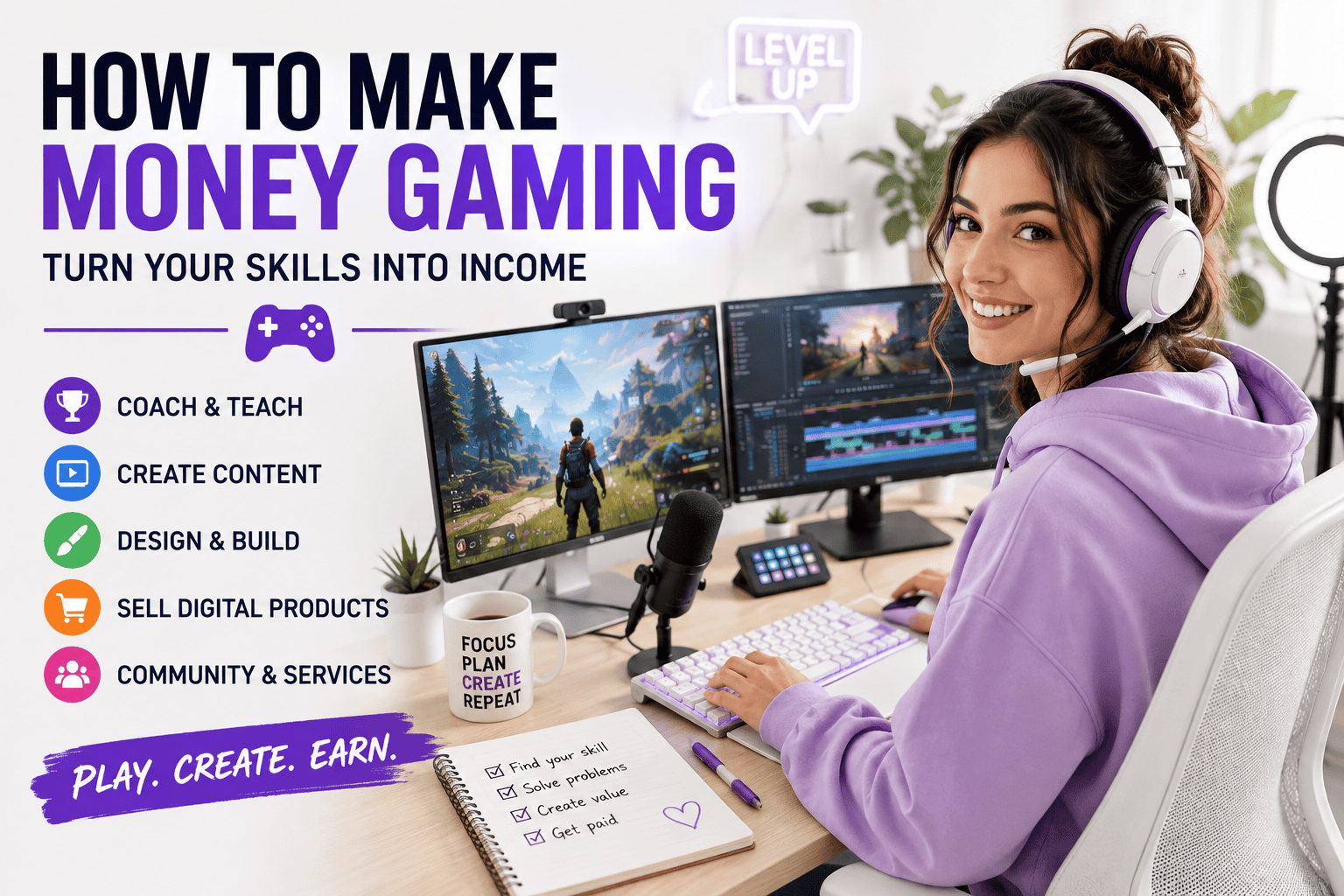
🎯 Gaming Coaching – Help other players improve.
🧠 VOD Reviews – Analyse gameplay and identify mistakes.
🤝 Paid Gaming Sessions – Provide organised competitive, collaborative or social gaming experiences.
📖 Gaming Guides – Turn game knowledge into useful digital resources.
🎨 Gaming Graphics and Assets – Create designs for gamers, creators and communities.
🧩 Mods, Maps and Game Content – Build digital creations where commercialisation is permitted.
🎬 Gaming Content – Create videos, streams, tutorials or entertainment.
✂️ Gaming Video Editing – Edit content for gaming creators.
⚙️ Gaming Services – Use technical or specialist knowledge to help other gamers.
👥 Community Work – Help creators, servers and gaming communities operate effectively.
Some require high-level gaming ability.
Many don’t.
That’s an important distinction.
🏆 Being Good at Games Is Only One Gaming Skill
When people hear:
“Make money from your gaming skills.”
they often imagine somebody who is unbelievably good at a competitive game.
The sort of player who makes you question whether you’re both using the same input device.
Competitive ability can certainly be monetised.
A highly skilled Valorant, Rocket League or League of Legends player might be able to offer coaching or gameplay reviews.
But mechanical skill is only one part of gaming expertise.
Perhaps you’re average competitively but know almost everything about a particular game.
That’s useful.
Perhaps you’re brilliant at explaining complicated mechanics.
Useful.
Maybe you can build incredible Minecraft environments.
Useful.
Maybe you’re good at creating gaming graphics.
Useful.
Maybe you understand OBS, streaming setups and gaming PCs better than anyone reasonably should.
Also useful.
Your opportunity may have very little to do with how quickly you can click someone’s head.
🧠 Think About Everything You’ve Learned From Gaming
Consider a game you’ve played extensively.
You probably didn’t just learn the controls.
Over time, you may have learned:
🗺️ Maps and routes
⚔️ Combat strategies
🎯 Mechanics
📊 Builds and loadouts
💰 In-game economies
🧠 Decision-making
🤝 Team communication
🏆 Competitive strategies
📖 Progression systems
⚙️ Settings and optimisation
🧩 Mods and customisation
👥 Community behaviour
To you, some of this probably feels obvious.
That’s because you’ve already learned it.
To a new player opening the game for the first time and being greeted by seven menus, four currencies, 86 items and a skill tree resembling an electrical schematic, it may be considerably less obvious.
Experience creates shortcuts.
And sometimes people will pay for those shortcuts.
🎯 The Value Isn’t Always the Skill – It’s the Problem You Can Solve
This is where the idea becomes more interesting.
People generally don’t pay you simply because you’re good at something.
They pay because your skill helps them achieve something they want.
For example:
Your Skill: You’re good at Rocket League.
That’s nice.
Now turn it into a problem:
“Gold players struggle with rotations and positioning.”
Suddenly your skill can become:
Rocket League VOD reviews for Gold-ranked players who want to improve rotations and positioning.
That’s a service.
Or:
Your Skill: You’re an excellent Minecraft builder.
Problem:
“Server owners want impressive environments but don’t have the time or building ability to create them.”
Potential service:
Custom Minecraft builds for multiplayer servers.
Or:
Your Skill: You know an RPG ridiculously well.
Problem:
“New players are overwhelmed by the progression system.”
Potential product:
Beginner progression guide covering the first 20 hours.
The important shift is:
“What am I good at?”
⬇️
“Who would find that useful?”
⬇️
“What problem could I solve for them?”
⬇️
“How could I package that into something they can buy?”
That’s how a gaming skill starts becoming gaming income.
💰 You Don’t Need to Be a Professional Gamer
This deserves saying early because it stops a lot of people before they begin.
You do not necessarily need to be a professional gamer.
We’ve covered this in much more detail in our guide to making money gaming without being a pro, but the basic principle is simple:
You need enough skill for the thing you’re selling.
Suppose you’re offering coaching to complete beginners.
You don’t necessarily need to be among the top 0.01% of players.
You need:
🏆 Sufficient expertise
🧠 A strong understanding of the game
💬 The ability to explain it
🤝 Patience
🎯 The ability to identify what the player needs to improve
In fact, the world’s best player isn’t automatically the world’s best coach.
Anyone who has ever received the advice:
“Just aim better.”
will understand this distinction.
🎨 Some Gaming Skills Aren’t Really About Playing Games at All
Here’s where the opportunity becomes much broader.
Gaming is an enormous ecosystem.
Around the people actually playing games are:
🎬 Content creators
📺 Streamers
🏆 Competitive teams
💬 Communities
🛒 Marketplaces
🎨 Designers
🧩 Modders
💻 Developers
📰 Gaming websites
🎮 Server owners
📱 Social communities
All of these can require skills.
Suppose you’re good at video editing.
You could become a gaming video editor.
Good at graphic design?
Create gaming thumbnails, stream graphics or digital assets.
Good at writing?
Create gaming guides, articles or video scripts.
Good technically?
Help with gaming optimisation or streaming setups.
Good at managing complete chaos while seventeen people argue in Discord?
You may have been unknowingly training for community management.
🛠️ Your Existing Skills Are Your Starting Capital
This is one of the best things about trying to make money from gaming.
You may already own most of what you need.
Your starting assets could be:
🎮 Years of experience in a particular game
🧠 Knowledge you’ve accumulated
🏆 Competitive ability
🎨 Creative skills
⚙️ Technical knowledge
💬 Communication skills
🖥️ Gaming equipment you already own
🌐 An internet connection
You don’t necessarily need to go out and buy a new skill.
You need to identify the valuable parts of the skills you already have.
That’s particularly useful if you’re looking for a way to start earning without a large upfront investment.
🔍 Start Paying Attention to What People Ask You
Here’s a surprisingly useful exercise.
Think about the questions other gamers ask you.
Maybe it’s:
“What build should I use?”
“Can you watch this replay and tell me what I’m doing wrong?”
“How did you make that?”
“Can you help me set this up?”
“What should I do next?”
“Can you explain how this works?”
Those questions are clues.
If people repeatedly ask you for the same kind of help for free, there may be an opportunity to turn that knowledge into something more structured.
Not every favour needs to become a business.
Your mate asking how to change his graphics settings does not require an invoice.
But patterns matter.
Repeated problems can become:
🎯 Services
📖 Guides
🎬 Content
📦 Digital products
🤝 Paid assistance
The market sometimes tells you what to sell before you realise you’re selling anything.
🚀 You Don’t Need to Monetise Everything
There’s an important warning here.
Not every gaming skill needs to become income.
Gaming is supposed to be fun.
If you absolutely love spending Sunday afternoon building ridiculous castles in Minecraft, you don’t have to immediately create:
Dan’s Premium Medieval Minecraft Architecture Solutions Pty Ltd.
Some hobbies are perfectly fine remaining hobbies.
The goal isn’t to stare at every enjoyable activity and ask:
“But how do I monetise this?”
Instead, look for the overlap between:
🎮 Something You Enjoy
🏆 Something You’re Good At
👤 Something Someone Else Values
That overlap is where things get interesting.
🎯 The Question to Ask Yourself
Don’t ask:
“Am I good enough at gaming to make money?”
That’s too broad.
Ask:
“What gaming-related skill do I have that could save another person time, help them improve, entertain them or create something they want?”
That’s a much better question.
Maybe the answer is coaching.
Maybe it’s building.
Maybe it’s design.
Maybe it’s editing.
Maybe it’s game knowledge.
Maybe it’s something you’ve never considered monetising before.
And that’s what we’re going to figure out next.
Because before choosing how to make money from your gaming skills, you need to understand exactly which gaming skills can actually be turned into income.
2. What Gaming Skills Can Actually Make Money?
When we talk about gaming skills, it’s easy to picture the obvious stuff.
Lightning-fast reactions.
Perfect aim.
Ridiculous APM.
The ability to somehow know an enemy is behind a wall because they heard half a footstep through an explosion, three teammates shouting and somebody eating crisps into their microphone.
Those skills can certainly be valuable.
But they’re only a small part of the picture.
The gaming skills you can potentially make money from fall into several much broader categories – and there’s a good chance you already have more than one.
🎯 Competitive Gaming Skills
Let’s start with the obvious one.
If you’re genuinely good at a competitive game, that ability can potentially be monetised through things such as:
🏆 Gaming coaching
🎥 Gameplay and VOD reviews
🤝 Competitive gaming sessions
📖 Strategy guides
🎬 Educational gaming content
Competitive skills might include:
- Aim and mechanical ability
- Movement
- Positioning
- Map awareness
- Rotations
- Resource management
- Drafting or team composition
- Matchups
- Decision-making
- Communication
- High-level strategy
And you don’t necessarily need to be playing professionally.
The important question is whether your knowledge and ability are useful to the type of player you’re trying to help.
For example, a highly experienced player might be perfectly capable of coaching beginners and intermediate players even if they’re nowhere near professional level themselves.
That’s why competitive skill is best thought of as a spectrum rather than:
Professional esports player
or
Completely useless.
There’s quite a lot of room in between.
🧠 Game Knowledge and Strategy
This is probably one of the most underrated gaming skills.
Some gamers become walking encyclopaedias.
They know:
🗺️ Every important map location
⚔️ Which weapons work in which situations
📊 The current meta
🧙 Character abilities and combinations
💰 How the game’s economy works
📈 The fastest progression routes
🎒 Which items are actually worth keeping
🏆 Strategies for difficult encounters
🔧 Which settings should be changed immediately
If somebody asks a question about the game, you already know the answer.
If the developer changes one weapon’s damage from 37 to 35, you have opinions.
Strong opinions.
This knowledge can potentially become:
📖 Gaming guides
🎯 Coaching
🎥 VOD analysis
🎬 Tutorial videos
📝 Gaming content
📦 Digital resources
The advantage here is that knowledge can often be packaged in different ways.
The same expertise could potentially become a one-to-one coaching session, a downloadable guide and a YouTube tutorial.
We’ll come back to that later because turning one gaming skill into multiple income streams can be much more effective than constantly trying to learn something new.
🧑🏫 Teaching and Coaching Skills
Being good at a game and being good at teaching a game are not the same thing.
You’ve probably played with somebody who’s mechanically brilliant but explains their strategy like this:
“You just sort of… know when to push.”
Fantastic.
Very useful.
Teaching is its own skill.
A good gaming coach may be able to:
👀 Spot mistakes
🧠 Understand why they’re happening
💬 Explain them clearly
🎯 Prioritise what matters
📋 Create practical exercises
🤝 Adapt to different players
📈 Track improvement over time
Sometimes a slightly less skilled player who communicates brilliantly can provide more value to a beginner than an elite player who struggles to explain what they’re doing.
If you’re the person who enjoys helping friends improve rather than simply carrying them through everything, coaching may be one of your most monetisable gaming skills.
If that sounds like you, our guide on how to become a gaming coach goes much deeper into turning that ability into a coaching service.
🤝 Communication and Teamwork
Some players make every team better.
Not necessarily because they have the best stats.
They’re good at:
📣 Communicating
🧭 Giving direction
🤝 Coordinating players
😌 Staying calm
🎯 Calling strategies
👂 Listening
💬 Helping less experienced players
🏆 Organising teams
These skills can be particularly valuable in multiplayer gaming.
They can translate into opportunities such as:
- Gaming coaching
- Paid gaming sessions
- Community management
- Tournament organisation
- Team management
- Moderation
- Collaborative content
And yes, being pleasant to play with is genuinely a skill.
Anyone who has spent five minutes in competitive matchmaking knows it isn’t universally distributed.
🎨 Creative Gaming Skills
This category gets much bigger than people initially expect.
Gaming gives creative players countless ways to make things.
That might include:
🏰 Minecraft builds
🗺️ Custom maps
🎨 Gaming artwork
🖼️ Thumbnails
📺 Stream overlays
👾 Pixel art
🧩 Mods
🎮 Game assets
📝 Stories and lore
🎬 Machinima and gaming videos
🖥️ UI concepts
Depending on the game, platform and applicable rules, some of these creations can potentially be sold directly.
Others become services.
For example:
Creative Skill: Graphic design
⬇️
Gaming Application: YouTube thumbnails
⬇️
Customer: Gaming creators
⬇️
Offer: Custom gaming thumbnail design
Or:
Creative Skill: Minecraft building
⬇️
Gaming Application: Custom environments
⬇️
Customer: Server owners
⬇️
Offer: Custom Minecraft builds
Notice what’s happening here.
You’re not necessarily monetising playing the game.
You’re monetising a skill that becomes valuable inside the gaming ecosystem.
That’s an important distinction because it massively increases the number of ways gamers can earn.
🎬 Content Creation Skills
Maybe your strongest gaming skill is keeping people entertained.
That’s valuable too.
Gaming content skills can include:
🎥 Recording
🎙️ Commentary
✂️ Editing
😂 Comedy
📖 Storytelling
🧠 Explaining
🎬 Video production
📱 Short-form content
📺 Streaming
You might use these skills to build your own audience through YouTube, Twitch or social platforms.
But you can also monetise them as services for other creators.
For example, somebody who understands gaming and video editing has an advantage when editing gaming content.
They understand:
- Which moments matter
- When a clip is impressive
- Gaming terminology
- Match pacing
- Memes and community references
- What viewers are likely to care about
A generic editor might see 30 minutes of someone playing Counter-Strike.
A gaming editor sees:
“Okay, the ridiculous 1v4 at 18:42 is obviously the opening hook.”
Context has value.
⚙️ Technical Gaming Skills
Are you the person everybody contacts when something stops working?
Your Discord messages probably look something like:
“Mate, why am I getting 47 FPS?”
“How do I install this mod?”
“Why does OBS look terrible?”
“Which settings should I use?”
“My game keeps crashing.”
Congratulations.
You may have technical gaming skills.
These can include:
🖥️ PC optimisation
🎮 Game configuration
📺 Streaming setup
🎙️ Audio configuration
🧩 Mod installation
⚙️ Server configuration
🔧 Troubleshooting
📊 Performance optimisation
Technical knowledge can potentially become services, guides, tutorials or content.
Just be careful to stay within the rules of the relevant games and platforms – particularly when modifications, accounts or third-party software are involved.
👥 Community and Leadership Skills
Gaming communities don’t magically run themselves.
Somebody has to organise everything.
Somebody has to answer questions.
Somebody has to manage events.
And, inevitably, somebody has to deal with two members having a 45-minute argument over something that happened in a match three weeks ago.
Community skills can include:
💬 Moderation
📅 Event organisation
🤝 Member support
📣 Announcements
🏆 Tournament coordination
🛡️ Rule enforcement
🎯 Community engagement
📊 Administration
These skills can potentially lead to paid work with:
- Gaming creators
- Discord communities
- Esports organisations
- Gaming websites
- Server owners
- Game developers
- Online communities
This is also an example of gaming experience developing skills that can become valuable well beyond gaming itself.
📖 Writing and Research Skills
If you enjoy understanding games and explaining what you’ve learned, writing can be another monetisable skill.
Gaming writers might create:
📚 Guides
📰 Articles
🧠 Tutorials
🎬 Video scripts
📝 Reviews
📱 Social content
📖 Walkthroughs
📦 Downloadable resources
The strongest gaming writers usually combine two things:
They understand the game.
They can explain it clearly.
Again, expertise alone isn’t enough.
Knowing the mathematically optimal character build is impressive.
Explaining it without making the reader feel like they’ve accidentally enrolled in an advanced statistics course is another skill entirely.
🧩 Development and Modding Skills
At the more technical end, some gamers develop skills in:
💻 Programming
🧩 Modding
🎨 3D modelling
🎮 Game development
🗺️ Level design
🔊 Audio
🖼️ Textures
⚙️ Scripting
🕹️ Custom game modes
These can potentially become freelance services, digital products or even the foundation of a career in game development.
The important caveat is commercial rights.
Just because you can create something inside or for a particular game doesn’t automatically mean you’re allowed to sell it.
Always check the relevant game’s terms, intellectual property rules and marketplace policies before commercialising mods, assets or other game-related content.
🔍 You Probably Have a Combination of Skills
This is where things become interesting.
Most gamers don’t fit neatly into one category.
You might have:
Competitive Skill + Teaching Ability
→ Gaming coaching
Or:
Game Knowledge + Writing
→ Gaming guides
Or:
Minecraft Knowledge + Creative Ability
→ Custom builds
Or:
Gaming Knowledge + Video Editing
→ Editing for gaming creators
Or:
Technical Knowledge + Communication
→ Gaming setup and optimisation services
Or:
Game Knowledge + Personality + Content Skills
→ Tutorials, streaming or gaming content
Your most valuable opportunity may actually come from the combination.
Someone who can edit videos is useful.
Someone who understands gaming is useful.
Someone who understands gaming and can edit gaming videos extremely well has a much clearer niche.
🎯 The Gaming Skill Value Test
For every gaming-related skill you think you have, ask four questions:
1. Am I genuinely good at this?
Not necessarily world-class – just sufficiently capable to provide value.
2. Does this solve a problem or create something people want?
Skill without demand is difficult to monetise.
3. Can I package it into a clear service or product?
People need to understand what they’re buying.
4. Can I prove I can do it?
Rank, portfolio, examples, previous work, gameplay, reviews or other genuine evidence can help.
If you can answer yes to all four, you’ve potentially found something worth testing.
💡 Don’t Ask “What’s My Best Gaming Skill?”
Ask:
“Which of my gaming skills creates the most value for somebody else?”
That’s a much more useful question.
Your best mechanical gaming skill might be incredibly impressive but difficult to sell.
Meanwhile, your ability to patiently analyse a beginner’s gameplay and explain exactly what they’re doing wrong might make an excellent coaching service.
So before deciding how you’re going to make money from gaming, identify the skills you already possess.
Because in the next section, we’ll take those skills and look at 12 practical ways you can actually turn them into income.
3. The 12 Best Ways to Make Money From Your Gaming Skills
Once you’ve identified the gaming skills you already have, the next question is the obvious one:
How do you actually turn them into money?
Fortunately, there isn’t one correct answer.
A highly competitive player might sell coaching. A creative player might build maps or design graphics. Someone who knows a game inside out might create guides. A technically minded gamer might offer optimisation services.
And if your main gaming skill is somehow keeping four strangers focused on an objective for longer than 30 seconds, you may already possess management abilities normally reserved for senior executives.
The trick is matching what you’re good at with something another gamer, creator or community actually wants.
Here are 12 of the strongest options.
🎯 1. Become a Gaming Coach
Gaming coaching is one of the most direct ways to monetise your ability as a player.
Instead of simply being good at a game, you’re helping someone else become better at it.
A coaching session might focus on:
🎯 Mechanics and aim
🧠 Decision-making
🗺️ Positioning and map awareness
⚔️ Matchups
📊 Builds and loadouts
🤝 Communication
🏆 Ranked improvement
📋 Practice routines
Coaching works particularly well in games where players actively want to improve, such as competitive shooters, MOBAs, fighting games, sports games and other ranked titles.
But being highly ranked isn’t enough by itself.
A good coach needs to be able to identify mistakes, explain them clearly and give the player something practical to work on.
For example, there’s a big difference between:
“Your positioning is bad.”
and:
“You’re repeatedly entering this fight from an exposed angle. Let’s look at where you could position instead and why.”
One makes the player feel terrible.
The other gives them something useful.
If teaching other players sounds appealing, our guide to becoming a gaming coach covers the process in much greater detail.
Best for: Competitive players, experienced players, good communicators and natural teachers.
🧠 2. Offer VOD and Gameplay Reviews
Don’t want to spend an hour live on Discord telling somebody why they should stop charging into a 1v5?
VOD reviews can be an excellent alternative.
The customer sends you recorded gameplay and you analyse it.
You might review:
🎥 Individual matches
🎯 Mechanical mistakes
🗺️ Positioning
🧠 Decision-making
⚔️ Engagements
📊 Builds
🤝 Teamplay
📋 Recurring mistakes
You can then provide feedback through a recorded video, annotated gameplay, written report or live review.
This format has some useful advantages.
You can pause.
Rewind.
Watch important moments several times.
Take notes.
And, crucially, spend 30 seconds staring silently at the screen trying to understand why on earth the player decided that was the right moment to push.
VOD reviewing is particularly suited to gamers who are analytical.
You may not even be the flashiest player mechanically. If you’re excellent at spotting patterns and explaining why decisions work or fail, that ability can have value.
Best for: Analytical players, coaches, strategists and gamers who enjoy reviewing matches.
🤝 3. Sell Paid Gaming Sessions
Not every gamer is looking for formal coaching.
Sometimes people simply want a better gaming experience.
Paid gaming sessions can potentially include different types of experiences depending on the game and its rules, such as:
🎮 Casual sessions
🤝 Social gaming
🏆 Competitive sessions
🎬 Content collaborations
🎯 Organised team play
🧭 Guided gameplay
Some players may want an experienced teammate.
Others might be new to a game and want someone to show them around.
Some simply don’t have a regular group available when they want to play.
This makes communication, reliability and personality just as important as mechanical ability.
If someone books a gaming session with you, they’re not only buying your ability to press buttons effectively.
They’re buying the experience of playing with you.
That means:
💬 Communicate well
⏰ Turn up on time
🤝 Be easy to play with
🎯 Understand what the customer wants
🚫 Don’t behave like the worst person they’ve ever encountered in ranked matchmaking
A surprisingly achievable standard, you would hope.
Best for: Social gamers, strong teammates, communicators and experienced players.
📖 4. Create and Sell Gaming Guides
If you know a game extremely well, you may be able to turn that knowledge into a digital product.
Gaming guides can cover almost anything useful.
For example:
📈 Progression guides
🏆 Ranked guides
⚔️ Character guides
💰 Economy guides
🗺️ Map guides
🎒 Item guides
🧙 Build guides
🎯 Beginner guides
⚙️ Optimisation guides
📋 Checklists
A useful guide saves somebody else time, confusion or repeated mistakes.
Suppose you’ve spent 500 hours learning the most efficient progression route through a game.
A newer player may not want to spend their next 500 hours rediscovering everything themselves.
That’s where your knowledge becomes valuable.
The biggest advantage of a guide over a service is scalability.
With coaching:
1 customer = more of your time.
With a digital guide:
You create it once → multiple customers can potentially buy it.
Of course, you still need demand and the guide needs to be genuinely useful.
A 73-page PDF called Everything I Know About This Game isn’t automatically valuable.
Solve a specific problem.
Best for: Knowledgeable players, writers, strategists and gamers who enjoy teaching asynchronously.
🎨 5. Sell Gaming Graphics and Digital Assets
Gaming isn’t only about playing.
Creators, streamers, communities and gamers constantly need visual assets.
That can create opportunities for designers to sell things such as:
🖼️ Gaming thumbnails
📺 Stream overlays
🎨 Banners
👤 Profile graphics
📱 Social media graphics
🎮 UI assets
👾 Pixel art
📦 Asset packs
🎬 Stream screens
If you’re already comfortable with Photoshop, Illustrator, Canva, Figma or similar tools, specialising in gaming can give your service a clearer niche.
For example:
Generic Graphic Designer
vs.
YouTube Thumbnail Designer for Gaming Creators
The second tells a potential customer much more quickly:
This person probably understands what I need.
Gaming knowledge can also improve the work itself.
Understanding the games, characters, terminology and visual culture makes it easier to create graphics that actually feel appropriate for the audience.
Best for: Designers, artists, content creators and visually creative gamers.
🧩 6. Create Mods, Maps and Other Game Content
Some games provide enormous opportunities for players to create their own content.
Depending on the game and its commercial rules, that could include:
🗺️ Maps
🧩 Mods
🏰 Worlds
🎮 Custom modes
🎨 Textures
🧱 Models
⚙️ Scripts
📦 Asset packs
These skills can sometimes be monetised through direct sales, commissions, creator programmes or related services.
But there’s an important caveat here:
Check the rules before selling anything.
Games have very different policies around user-generated content, intellectual property and commercialisation.
Just because a game lets you create something doesn’t automatically mean it lets you sell it.
Where commercialisation is permitted, however, creation skills can be particularly powerful because you’re building something gamers can actually use.
Best for: Modders, developers, designers, builders and technically creative gamers.
🏰 7. Offer In-Game Creative Services
Sometimes the thing customers want isn’t a downloadable product.
They want you to create something for them.
Minecraft is probably the easiest example.
A talented builder might offer:
🏰 Custom castles
🏙️ Cities
🌲 Landscapes
🗺️ Adventure environments
🏪 Server hubs
🏟️ Arenas
🧱 Custom structures
The same principle can apply to other games with substantial creation systems, provided the activity is allowed under the game’s rules.
This is where spending hundreds of hours building things “for fun” can suddenly look suspiciously like professional development.
The important part is presenting your work properly.
Instead of:
“I’m good at building.”
Show:
📸 Screenshots
🎥 Videos
🏰 Previous creations
📋 Different styles
⭐ Customer feedback
Creative gaming services are highly visual, so a strong portfolio can do much of the selling for you.
Best for: Builders, designers and players who enjoy creative sandbox games.
🎬 8. Create Gaming Content
This is probably the monetisation route most gamers already know.
Create gaming content through:
📺 YouTube
🎥 Shorts
📱 TikTok
🎙️ Streaming
📝 Blogs
📧 Newsletters
🎧 Podcasts
Gaming content can eventually generate income through combinations of advertising, sponsorships, memberships, affiliate marketing, products and services.
But content is usually a longer-term play.
Uploading three videos and checking your bank account probably won’t produce a dramatic transformation.
Building an audience takes:
⏰ Time
📅 Consistency
🎯 A clear niche
🎬 Good content
📈 Experimentation
🧠 Understanding what viewers want
The opportunity becomes much stronger when your gaming skill gives the content a reason to exist.
For example:
High-level player
→ Educational ranked content
Funny player
→ Entertainment
Game expert
→ Guides and tutorials
Creative builder
→ Build videos
Technical gamer
→ Optimisation content
You don’t have to become “a gaming influencer.”
You need to create something people repeatedly want to watch, read or listen to.
Best for: Entertainers, educators, experts and gamers willing to build an audience over time.
✂️ 9. Offer Gaming Video Editing
Here’s an option that doesn’t require building your own audience.
Instead of becoming the creator, help creators produce their content.
Gaming creators regularly need:
✂️ Long-form video editing
📱 Shorts and clips
🎬 Montages
😂 Meme edits
📝 Captions
🎵 Audio editing
🎯 Highlight selection
A gaming editor can have an advantage over a generalist because they understand what they’re watching.
You recognise when a moment is:
🏆 Impressive
😂 Funny
😱 Unexpected
🎯 Important to the match
🧠 Worth explaining
That contextual understanding can save creators time.
You could start with a simple offer such as:
I’ll turn your gaming stream into three short-form highlight clips.
That’s considerably easier to understand and buy than:
I offer comprehensive multimedia post-production solutions.
Nobody loading into Fortnite has ever asked for comprehensive multimedia post-production solutions.
Best for: Video editors, content creators and gamers with strong storytelling instincts.
⚙️ 10. Offer Gaming Setup and Optimisation Services
Some gamers love tweaking settings almost as much as actually playing.
Potential technical services might involve:
🖥️ Gaming PC optimisation
🎮 Game settings
📺 Streaming setup
🎙️ Microphone configuration
🎥 OBS configuration
🧩 Permitted mod setup
⚙️ Server configuration
🔧 Troubleshooting
A customer isn’t necessarily paying because the information is impossible to find.
They’re often paying because:
They don’t know what applies to them.
or:
They don’t want to spend three hours figuring it out.
Your value is making the process easier.
Be careful not to promise impossible results, modify systems in unsafe ways or offer anything that breaches a game’s rules.
But legitimate technical gaming knowledge can absolutely be useful.
Best for: PC enthusiasts, technically minded gamers, streamers and troubleshooting wizards.
👥 11. Work With Gaming Communities
If you’ve spent years participating in Discord servers, guilds, clans or gaming communities, you may have developed useful organisational skills without really noticing.
Gaming communities can need help with:
💬 Moderation
📅 Events
📣 Announcements
🎯 Engagement
🏆 Tournaments
🤝 Member support
📊 Administration
🛡️ Rule enforcement
Community management is particularly suited to people who are:
Reliable.
Patient.
Organised.
Good communicators.
And capable of reading an argument containing 47 messages about whether someone technically broke Rule 6 without immediately closing Discord forever.
You might work with individual creators, established communities, server owners, gaming organisations or developers.
These skills can also transfer well beyond gaming.
Best for: Organisers, moderators, community-focused gamers and strong communicators.
🧪 12. Game Testing and Playtesting
Playing unfinished games sounds like the easiest job imaginable.
You sit down.
Play games.
Get paid.
Done.
Except proper game testing is less:
“I played for six hours and had fun.”
and more:
“I reproduced the inventory bug four times, documented the steps, tested three different conditions and discovered it only occurs after equipping an item immediately before changing zones.”
Still interested?
Good.
Testing and playtesting can use skills such as:
🔍 Observation
🧠 Critical thinking
📝 Clear reporting
🔁 Repetition
🎮 Broad gaming experience
💬 Communication
Playtesters may provide feedback on:
🎯 Difficulty
🗺️ Level design
🎮 Controls
🧠 Tutorials
⚖️ Balance
🐛 Bugs
💡 User experience
You don’t necessarily need elite gaming ability.
In some cases, developers specifically need ordinary players because they want to understand how their target audience experiences the game.
Best for: Detail-oriented gamers, analytical players and people who can communicate useful feedback.
📊 Which Gaming Skill Makes the Most Sense for You?
Here’s the simplified version:
| Your Strength | Potential Ways to Make Money |
|---|---|
| 🎯 Competitive ability | Coaching, VOD reviews, gaming sessions |
| 🧠 Deep game knowledge | Guides, coaching, tutorials |
| 🤝 Communication | Coaching, sessions, community work |
| 🎨 Creativity | Graphics, assets, maps, builds |
| 🎬 Content skills | Videos, streaming, editing |
| ⚙️ Technical knowledge | Optimisation, setup, troubleshooting |
| 👥 Organisation | Community management, events |
| 🧩 Development skills | Mods, maps, assets, custom content |
| 📝 Writing | Guides, articles, scripts |
| 🔍 Analytical ability | VOD reviews, testing, strategy content |
You may fit several rows.
That’s normal.
The goal isn’t to find every possible way you could make money.
It’s to find the one that makes the most sense to start with.
🎯 Start With the Skill Closest to Money
If your goal is earning your first gaming income, ask yourself:
“Which skill could I turn into a clear offer fastest?”
For many beginners, that may be a service.
You don’t need thousands of followers.
You don’t need millions of views.
You don’t necessarily need to create a huge product.
You need:
🎮 A useful gaming skill
⬇️
👤 Someone who needs it
⬇️
📦 A clear offer
⬇️
💰 A customer willing to pay for it
That’s the basic model behind almost every option we’ve just covered.
But with 12 possibilities sitting in front of you, there’s now another problem:
Which one should you actually choose?
That’s what we’ll work out next.
4. Which Gaming Skill Should You Monetise?
At this point, you may have discovered a slight problem.
You don’t have one gaming skill you could potentially make money from.
You have six.
Maybe you’re good at competitive games, know far too much about one particular title, can edit videos, enjoy helping newer players and have spent the last three years building things in Minecraft.
Suddenly the question isn’t:
“How can I make money from gaming?”
It’s:
“Which one of these things should I actually start with?”
The answer isn’t necessarily your most impressive skill.
It’s the skill that gives you the best combination of:
🏆 Ability
❤️ Enjoyment
👤 Customer Demand
💰 Monetisation Potential
Let’s narrow it down.
🏆 If You’re a Strong Competitive Player…
Start by looking at services where your gameplay ability and experience directly help another player.
Good options include:
🎯 Gaming Coaching – Teach players how to improve.
🧠 VOD Reviews – Analyse matches and identify mistakes.
🤝 Competitive Gaming Sessions – Play organised sessions with other gamers where permitted.
📖 Strategy Guides – Package your knowledge into written resources.
🎬 Educational Content – Create tutorials, breakdowns and gameplay analysis.
The important question is:
Can you explain why you’re good?
If you’re mechanically brilliant but can’t explain what you’re doing, coaching may not be your strongest option.
You might be better suited to content, competitive sessions or gameplay-focused opportunities.
But if you find yourself constantly saying:
“You’re losing that fight because you’re entering from the wrong angle…”
and then explaining exactly what the player should do instead, coaching or VOD reviewing could be a natural fit.
Good starting point: Offer one narrowly defined coaching session or gameplay review for the game you know best.
🧠 If You’re the Walking Wiki…
Every gaming group has one.
Someone asks:
“Where do I find that item?”
You know.
“What’s the best build for this?”
You know.
“How does this mechanic work?”
You know.
“When did they change the drop rate?”
You somehow know that too.
If you’ve accumulated an absurd amount of knowledge about a particular game, you don’t necessarily need elite mechanical ability to monetise it.
Consider:
📖 Gaming Guides
🎬 Tutorials
🧠 Strategy Content
🎯 Beginner Coaching
📝 Gaming Writing
📦 Digital Resources
Your biggest advantage is that you’ve already done the research – probably without thinking of it as research.
You’ve spent hundreds of hours learning which strategies work, which mistakes waste time and which Reddit post from 2021 is completely outdated despite somehow still ranking first on Google.
That knowledge can help somebody else reach the answer faster.
Good starting point: Identify one question players repeatedly ask and create the clearest possible solution to it.
🤝 If You’re Great With People…
Don’t underestimate this one.
Gaming can be surprisingly antisocial for something involving millions of people constantly communicating with each other.
If you’re:
💬 Easy to talk to
😌 Patient
😂 Fun to play with
🤝 Good with different personalities
🎯 Helpful without being patronising
📣 A strong communicator
…you already have skills that can improve someone else’s gaming experience.
Potential options include:
🎮 Paid Gaming Sessions
🎯 Gaming Coaching
👥 Community Management
🏆 Tournament and Event Organisation
🎬 Content Collaboration
💬 Moderation
For social gaming services especially, being enjoyable to spend time with can matter as much as your rank.
A customer might not care whether you’re in the top 0.5% of players.
They may care considerably more that you:
turn up, communicate, don’t rage and make the session enjoyable.
The bar sounds low until you’ve experienced online matchmaking.
Good starting point: Look for a service where the experience of interacting with you is part of the value.
🎨 If You’re Creative…
If gaming has always been something you create around, rather than just play, you’ve got plenty of options.
You might be good at:
🎨 Graphic design
🏰 Building
🗺️ Map creation
👾 Pixel art
🧩 Modding
🖼️ Thumbnails
📺 Stream graphics
🎮 Digital assets
🎬 Video production
These skills can become either services or products.
For example:
Minecraft building skill
→ Custom build service
or
→ Downloadable maps
or
→ Building guides
or
→ YouTube tutorials
Likewise:
Graphic design skill
→ Custom gaming thumbnails
or
→ Stream overlay packages
or
→ Premade gaming graphics
or
→ Digital asset packs
Creative skills are particularly useful because they’re easy to demonstrate.
You don’t have to tell someone:
“Trust me, I’m an excellent designer.”
Show them.
A portfolio containing five strong examples can communicate your ability in seconds.
Good starting point: Choose something you can create a convincing sample of before you have any customers.
⚙️ If You’re the Technical One…
Some gamers spend five minutes changing graphics settings.
Others spend three evenings benchmarking twelve configurations because there must be another four FPS hiding somewhere.
If you’re the second person, consider monetising technical knowledge.
Potential opportunities include:
🖥️ Gaming PC Optimisation
📺 Streaming Setup
🎙️ Audio Configuration
⚙️ Game Configuration
🧩 Permitted Mod Setup
🔧 Troubleshooting
🎮 Server Configuration
📖 Technical Guides
🎬 Tutorial Content
Your value isn’t necessarily having access to secret information.
A lot of technical information is available online.
Your value can be knowing:
which information matters to this particular person.
Someone might be able to spend three hours watching videos about OBS audio configuration.
Or they could potentially pay someone experienced to help them get it working correctly.
That’s the difference between information and assistance.
Good starting point: Identify the technical gaming problem you’re repeatedly asked to solve.
🎬 If You’re an Entertainer…
Maybe your greatest gaming ability isn’t actually gaming.
It’s making gaming entertaining.
You might naturally be good at:
😂 Comedy
🎙️ Commentary
📖 Storytelling
🎥 Video
✂️ Editing
📱 Short-form content
🎭 Characters or performance
💬 Audience interaction
That points toward:
📺 YouTube
🎥 Short-form Gaming Content
🎙️ Streaming
✂️ Editing for Gaming Creators
🎬 Content Collaboration
📝 Scriptwriting
Content creation has huge upside, but remember that building your own audience usually takes time.
If you want to monetise the skill sooner, consider selling the skill to someone who already has an audience.
For example:
Instead of:
“I’ll start a gaming YouTube channel and hopefully monetise it eventually.”
you might start with:
“I’ll turn gaming streams into three edited Shorts.”
Same general skill.
Much shorter path to a potential customer.
Good starting point: Decide whether you’d rather build your own audience or provide content services to somebody else’s.
🧘 If You Prefer Working Solo…
Not everyone wants to spend their evenings on voice chat.
Maybe the idea of doing three live coaching sessions after work sounds less like a side hustle and more like an elaborate punishment.
That’s fine.
Look at options that allow you to work independently:
📖 Gaming guides
🎨 Graphics
✂️ Video editing
🧩 Mods
🗺️ Maps
📦 Digital products
📝 Writing
🎬 Pre-recorded content
🧠 Recorded VOD reviews
These can often be created asynchronously.
The customer sends the requirements.
You do the work.
You deliver it.
Nobody needs to ask:
“Can you hear me?”
six times before discovering their microphone is muted.
Good starting point: Choose an offer you can produce and deliver on your own schedule.
⏰ If You Only Have a Few Hours Each Week…
Time matters.
A side hustle that requires you to be available every evening probably isn’t ideal if you can realistically dedicate three hours a week.
With limited time, look for:
🎯 Higher-value individual services
🧠 Recorded VOD reviews
🎨 Defined creative projects
📖 Digital products
✂️ Editing packages
📦 Repeatable deliverables
Try to avoid offers that create large amounts of unpaid administration.
For example, a $10 service that involves:
- 20 minutes messaging
- 15 minutes preparation
- 45 minutes delivery
- 15 minutes follow-up
isn’t really a $10 service.
It’s an excellent way to become very busy while making almost no money.
Good starting point: Calculate the total time per customer, not just the time spent delivering the service.
💰 If Your Goal Is to Make Your First $50…
Your strategy should be different from somebody trying to build a large gaming media business.
If your first objective is simply proving:
“Someone will pay me for a gaming skill.”
services are often the simplest place to start.
Why?
You might only need:
1 customer × $50 = $50
or:
2 customers × $25 = $50
Compare that with a content strategy where you may need substantial traffic before earning anything meaningful.
For a first-income experiment, consider:
🎯 Coaching
🧠 VOD reviews
🎨 Design
✂️ Editing
🏰 Building
⚙️ Technical assistance
🤝 Gaming sessions
You can worry about scalability later.
Your first goal is validation.
Can you turn something you know how to do into something somebody will actually buy?
That’s a much more important milestone than creating the perfect business model on day one.
📊 Quick Gaming Skill-to-Income Matcher
Here’s a simple way to narrow your options:
| If This Sounds Like You… | Start By Exploring… |
|---|---|
| 🏆 Strong competitive player | Coaching, VOD reviews, competitive sessions |
| 🧠 Know one game extremely well | Guides, coaching, tutorials |
| 🤝 Great with people | Sessions, coaching, community work |
| 🎨 Creative gamer | Graphics, builds, maps, digital assets |
| ⚙️ Technical problem-solver | Optimisation, setup, technical guides |
| 🎬 Entertaining personality | Content, streaming, collaborations |
| ✂️ Strong editor | Gaming video editing, Shorts |
| 📝 Strong writer | Guides, articles, scripts |
| 🧩 Technical creator | Mods, maps, development services |
| 🧘 Prefer working alone | Guides, assets, editing, recorded reviews |
| ⏰ Limited spare time | Defined services, repeatable products |
| 💰 Want your first sale quickly | Simple gaming service |
Don’t choose based purely on which option has the highest theoretical earning potential.
Choose something you’re actually capable of delivering well.
🎯 Use the Three-Circle Test
If you’re still unsure, take your potential ideas and run each through this simple test.
🏆 Circle 1 – What Are You Good At?
Be realistic.
Not:
“I’m pretty good at games.”
Instead:
“I’m very good at analysing Rocket League rotations.”
or:
“I create detailed Minecraft medieval builds.”
Specificity helps.
❤️ Circle 2 – What Do You Actually Enjoy?
This matters more than it sounds.
You might be fantastic at explaining League of Legends to beginners.
But if doing it makes you want to uninstall the game, coaching probably isn’t a brilliant long-term business plan.
Ideally, monetisation should sit reasonably close to something you enjoy doing anyway.
👤 Circle 3 – What Do People Actually Want?
This is the one beginners often forget.
You can be:
Excellent at something
and
Love doing it
and still make precisely:
$0
if nobody wants to buy it.
Look for evidence of demand:
🔍 Are people asking for help?
🛒 Are similar services being sold?
💬 Are communities discussing the problem?
📺 Are people watching content about it?
❓ Are the same questions repeatedly being asked?
👥 Is there an identifiable customer?
Where those three circles overlap is where you should pay attention:
🏆 Something You’re Good At
❤️ Something You Enjoy
👤 Something People Want
=
💰 Potential Gaming Income
🚀 Don’t Pick Forever – Pick Something to Test
This decision doesn’t need to determine the next ten years of your life.
You’re not selecting a character class that becomes permanently locked once you click Confirm.
Choose one promising skill and test it.
Give yourself a simple goal:
Can I turn this gaming skill into one clear offer and get somebody interested in buying it?
If yes, keep improving it.
If no, work out why.
Maybe the offer was wrong.
Maybe the audience was wrong.
Maybe the price was wrong.
Maybe the skill wasn’t as valuable as you expected.
That’s useful information.
Because the next step isn’t creating a logo, registering six social accounts or spending three days deciding what font represents your personal brand.
It’s much simpler.
You need to work out exactly what gaming skills you already have.
And that’s where a proper gaming skill audit can help.
5. The Gaming Skill Audit – Find What You’re Already Good At
Before you create a service, set a price or start looking for customers, it’s worth doing something surprisingly few people do:
Take inventory of the gaming skills you already have.
Most gamers are terrible at this.
Not because they don’t have useful skills, but because anything you’ve done for hundreds of hours starts to feel normal.
If you’ve played the same game for five years, knowing every map isn’t impressive to you.
If you’ve built dozens of Minecraft projects, building is just something you do.
If you’ve helped your friends configure their PCs for years, fixing someone’s terrible frame rate feels like another Tuesday.
But familiarity doesn’t make a skill worthless.
Sometimes it just makes the skill harder for you to notice.
🎮 Step 1 – Which Games Do You Know Best?
Start with the obvious question.
Which games have you spent the most time playing?
Write down perhaps three to five.
For example:
🎯 Valorant
🚗 Rocket League
⛏️ Minecraft
⚔️ Elden Ring
🏹 Fortnite
Don’t worry about whether those games can make you money yet.
We’re just building an inventory.
For each game, think about:
⏰ How long have you played it?
🏆 What level have you reached?
🧠 How well do you understand its systems?
🎯 What are you particularly good at?
📖 What could you teach someone else?
👥 How involved are you in its community?
The game you’ve played longest isn’t automatically the best opportunity.
But experience gives you somewhere useful to start.
🏆 Step 2 – What Are You Better at Than the Average Player?
Now get more specific.
Maybe you’re particularly good at:
🎯 Aim
🗺️ Map knowledge
🧠 Strategy
⚔️ Combat
📊 Builds
🏎️ Mechanics
🏰 Building
💰 Trading or economy systems
🤝 Team communication
📈 Progression
🎮 Boss encounters
Don’t fall into the trap of thinking:
“But I’m not one of the best players.”
You don’t necessarily need to be.
What matters is whether your skill is strong enough to provide genuine value to the audience you’re targeting.
A player who is substantially more experienced than a beginner can potentially teach that beginner useful things.
A Minecraft builder doesn’t need to be the greatest builder on Earth to create something another player genuinely wants.
A video editor doesn’t need an Academy Award to edit gaming Shorts.
The useful comparison isn’t always:
“Am I the best?”
It’s:
“Can I do this well enough that someone else benefits from my ability?”
That’s a much more realistic standard.
🧠 Step 3 – What Do You Know That Other Players Struggle With?
This is where the audit starts becoming commercially useful.
Think about problems you’ve already solved.
Maybe you know:
📈 The fastest progression routes
⚔️ How to beat difficult bosses
💰 How an in-game economy works
🎯 How to climb particular ranks
🗺️ Important map strategies
📊 Which builds work and why
⚙️ How to optimise performance
🧩 How to configure permitted mods
🎥 How to set up streaming software
🏰 How to create complex builds
If you’ve forgotten how difficult something originally was to learn, imagine explaining it to somebody who installed the game yesterday.
Suddenly your “basic knowledge” might not look so basic.
💬 Step 4 – What Do Other Gamers Ask You for Help With?
This may be the most useful question in the entire audit.
Think about your friends, Discord communities, teammates and other gamers you’ve interacted with.
What do they ask you?
Maybe:
“What build should I use?”
“Can you look at this replay?”
“How did you make that?”
“Can you help me set this up?”
“Why am I losing these fights?”
“Which settings are you using?”
“Can you edit this clip?”
“Can you help us organise this?”
Repeated questions are particularly interesting.
If different people keep asking you for the same type of help, you may already have evidence that your skill solves a real problem.
Write those questions down.
They can eventually become the basis of your offers.
For example:
Question:
“Can you review my match?”
⬇️
Potential Offer:
30-Minute Recorded Gameplay Review
Or:
Question:
“How did you build that?”
⬇️
Potential Offer:
Custom Minecraft Building Service
The customer problem is often hiding inside the question.
🎨 Step 5 – What Have You Created?
Not all gaming skills are about knowledge or performance.
Look at what you’ve actually made.
That could include:
🏰 Builds
🗺️ Maps
🧩 Mods
🎨 Artwork
🖼️ Thumbnails
📺 Stream graphics
🎬 Videos
✂️ Edited clips
📖 Guides
💻 Scripts
🎮 Custom content
📱 Gaming social posts
You may already have the beginnings of a portfolio without realising it.
That Minecraft city you built six months ago?
Portfolio piece.
The thumbnails you made for your friend’s YouTube channel?
Portfolio pieces.
The detailed beginner guide you wrote for your Discord server because everyone kept asking the same question?
Potential writing sample.
Don’t immediately ask:
“Could I sell this exact thing?”
Ask:
“What skill did I use to create this, and who else might value that skill?”
That’s where the opportunity usually is.
⚙️ Step 6 – What Gaming Problems Can You Fix?
Problem-solving skills are particularly easy to overlook because you tend to notice them only when something goes wrong.
Think about the problems you’re comfortable solving.
Perhaps you’re good at:
🖥️ Improving game performance
📺 Configuring streaming software
🎙️ Fixing audio problems
🎮 Choosing appropriate settings
🧩 Installing and configuring permitted mods
🔧 Troubleshooting crashes
💻 Configuring servers
📊 Diagnosing performance issues
If other people find these things frustrating and you find them relatively straightforward, there may be value in that difference.
The same principle applies beyond technical problems.
A coach solves an improvement problem.
A builder solves a creation problem.
An editor solves a content-production problem.
A guide solves an information problem.
A gaming session might solve a social or gameplay problem.
Money tends to follow useful solutions.
🤝 Step 7 – What Are You Like to Work or Play With?
This part isn’t about your gaming ability at all.
Ask yourself whether you’re:
⏰ Reliable
💬 A good communicator
😌 Patient
🤝 Helpful
📋 Organised
👂 A good listener
🎯 Good at following requirements
🧠 Good at explaining things
These skills matter enormously once money changes hands.
A customer would often rather work with someone who’s very good and reliable than somebody who’s exceptional and impossible to deal with.
For example, imagine two gaming coaches.
Coach A is slightly higher ranked but:
- Arrives late
- Barely communicates
- Gets frustrated
- Gives vague advice
- Takes days to reply
Coach B is slightly lower ranked but:
- Turns up on time
- Explains things clearly
- Sends useful feedback
- Is patient
- Communicates professionally
Who would you book again?
Exactly.
Being good at the service includes more than being good at the game.
🔎 Step 8 – Look Beyond the Game Itself
Now make another list.
What non-gaming skills do you have that could combine with gaming?
For example:
✍️ Writing
🎨 Graphic design
🎬 Video editing
💻 Programming
📱 Social media
📣 Marketing
🎙️ Audio production
📊 Data analysis
🧑🏫 Teaching
👥 Community management
📸 Photography
🖥️ IT
This is where some of the strongest niches appear.
Gaming + Writing
→ Gaming guides
Gaming + Teaching
→ Coaching
Gaming + Design
→ Gaming graphics
Gaming + Editing
→ Gaming video editing
Gaming + Programming
→ Mods or development
Gaming + Community Management
→ Gaming community services
Gaming + Data Analysis
→ Strategy analysis or educational content
The combination can make you much more specialised than either skill alone.
📊 Step 9 – Score Your Best Gaming Skills
By now, you should have several possibilities.
Rather than choosing purely on instinct, give each one a simple score from 1 to 5.
| Skill | Ability | Enjoyment | Demand | Easy to Prove | Easy to Sell | Total |
|---|---|---|---|---|---|---|
| Valorant coaching | 4 | 5 | 4 | 4 | 4 | 21/25 |
| Video editing | 4 | 4 | 5 | 5 | 4 | 22/25 |
| Gaming guides | 5 | 4 | 4 | 5 | 3 | 21/25 |
| Streaming | 3 | 5 | 5 | 3 | 2 | 18/25 |
These numbers aren’t scientific.
There’s no Gaming Side Hustle Laboratory where researchers in white coats have determined that your Rocket League coaching ability is precisely 4.27/5.
The point is to force yourself to compare the opportunities.
Pay particular attention to demand and ease of selling.
A skill can be impressive without being commercially useful.
👀 Step 10 – Find Evidence That People Want It
Before deciding you’ve discovered your future gaming empire, do a little research.
Look at:
🔎 Search results
💬 Reddit discussions
👥 Discord communities
🎥 YouTube comments
🛒 Gaming marketplaces
📱 Social media
❓ Questions players repeatedly ask
Look for evidence that people:
have the problem
and ideally:
already pay for solutions.
For example, if you’re considering gaming coaching, look at whether players are actively searching for coaching in that game.
If you’re considering custom builds, see whether server owners commission builders.
If you’re considering thumbnails, look at how many gaming creators are hiring designers.
If similar services already exist, don’t automatically think:
“Damn, somebody already had my idea.”
Competition can actually be useful evidence.
It tells you there may be customers.
The challenge becomes finding your angle.
🎯 Step 11 – Make Your Skill More Specific
Broad skills are difficult to sell.
For example:
❌ Gaming
Better:
❌ Gaming Coaching
Better again:
✅ Rocket League Coaching
Better still:
✅ Rocket League Coaching for Gold and Platinum Players
Now someone can immediately understand whether the service is relevant to them.
The same applies elsewhere.
❌ Graphic design
→ Gaming graphic design
→ Gaming YouTube thumbnails
→ YouTube thumbnails for FPS creators
Or:
❌ Writing
→ Gaming writing
→ Gaming guides
→ Beginner progression guides for RPGs
You don’t have to remain ultra-specific forever.
But specificity makes your first offer much easier to understand.
💡 Find the Three-Way Overlap
At the end of your audit, you’re looking for three things.
🏆 What You’re Good At
Something you can genuinely deliver.
👤 What Someone Else Values
A problem people actually want solved or something they genuinely want created.
📦 What You Can Turn Into an Offer
Something another person can clearly understand and buy.
Put them together:
🏆 Gaming Skill
👤 Customer Need
📦 Sellable Offer
=
💰 Monetisation Opportunity
That’s the sweet spot.
📝 Your Five-Minute Gaming Skill Audit
If you want to do this quickly, answer these seven questions:
- Which three games do I know best?
- What am I better at than the average player?
- What gaming questions can I answer easily?
- What do other gamers ask me for help with?
- What have I created through or around gaming?
- What non-gaming skills could I combine with gaming?
- Which of these skills solves a problem people might pay to solve?
Don’t overthink your answers.
You’re looking for possibilities, not writing your final business plan.
🚀 Your Skill Isn’t the Product Yet
There’s one final distinction to understand.
Suppose your audit tells you:
“I’m really good at Rocket League.”
Excellent.
But nobody can buy:
Being Good at Rocket League – $30
Your skill still needs to become something tangible.
Perhaps:
🎯 A coaching session
🧠 A VOD review
📖 A strategy guide
🎬 An educational video
🤝 A gaming session
That’s the next transformation:
Gaming Skill
⬇️
Customer Problem
⬇️
Clear Solution
⬇️
Product or Service
⬇️
Something Someone Can Actually Buy
And that’s exactly what we’ll do in the next section: turn your gaming skill into a clear, sellable offer.
6. Turn a Gaming Skill Into Something People Can Buy
Having a valuable gaming skill is a great start.
But there’s a fairly important step between:
“I’m really good at this.”
and:
“Someone just paid me $40 for this.”
You need to turn the skill into an offer.
This is where a lot of beginners get stuck.
They know they’re good at Valorant.
They know they can build incredible things in Minecraft.
They know more about Elden Ring than is probably healthy.
But if someone asked:
“Okay… what exactly can I buy from you?”
the answer gets a little fuzzy.
That’s the problem we’re going to fix.
🎯 Don’t Sell the Skill – Sell What the Skill Does
Customers aren’t usually interested in buying your skill itself.
They’re interested in what that skill can do for them.
Consider:
❌ I’m good at Rocket League.
That’s a skill.
Compare it with:
✅ I’ll review one of your Rocket League matches and show you where your rotations and positioning are costing you goals.
That’s an offer.
Or:
❌ I’m a Minecraft builder.
versus:
✅ I’ll create a custom medieval spawn area for your Minecraft server.
Or:
❌ I know loads about Elden Ring.
versus:
✅ Beginner Elden Ring progression guide – builds, upgrades and what to prioritise during your first 20 hours.
The skill sits behind the offer.
The result is what the customer sees.
🧠 Start With the Customer’s Problem
A simple way to create an offer is to work backwards.
Don’t start with:
“What can I sell?”
Start with:
“What problem can I solve?”
Suppose you’re an experienced Rocket League player.
A less experienced player might struggle with:
🚗 Rotations
⚽ Positioning
🎯 Shot selection
🧠 Decision-making
🤝 Teamplay
🏆 Climbing ranked
You could package your expertise around one of those problems.
For example:
🎮 Skill: Rocket League experience
⬇️
😤 Problem: Gold players repeatedly get caught out of position
⬇️
🛠️ Solution: Analyse their gameplay and explain the mistakes
⬇️
📦 Offer: One-match Rocket League VOD review
⬇️
🎯 Outcome: Player receives specific feedback on positioning and rotations
Now you have something somebody can actually understand.
📦 Package Your Skill Into a Defined Product or Service
The clearer your offer, the easier it is to buy.
A good offer should answer several basic questions:
What do I get?
Who is it for?
What problem does it solve?
How is it delivered?
How long does it take?
What does it cost?
Imagine these two listings.
Listing A:
Gaming Coaching – $30
versus:
Listing B:
60-Minute Valorant Coaching Session for Bronze–Gold Players – Gameplay Analysis, Positioning and Ranked Improvement – $30
The second gives the customer far more information.
They can immediately think:
I’m Silver. I want to improve at Valorant. This is probably for me.
That’s what you want.
🎮 Example 1 – Turn Competitive Skill Into Coaching
Suppose you’re a strong Valorant player.
Your raw skill:
I’m good at Valorant.
Let’s turn that into an offer.
Step 1 – Choose the customer
Bronze–Gold players.
Step 2 – Identify the problem
They’re struggling to understand why they’re losing ranked matches.
Step 3 – Choose the solution
One-to-one coaching.
Step 4 – Define the deliverable
A 60-minute live session covering gameplay, positioning, decision-making and improvement priorities.
Now you’ve got:
60-Minute Valorant Coaching for Bronze–Gold Players
You could include:
🎯 Live gameplay analysis
🗺️ Positioning feedback
🧠 Decision-making advice
⚔️ Combat feedback
📋 Three improvement priorities
🎮 Recommended practice routine
That’s much more compelling than:
I’m Immortal. Pay me.
Rank can provide proof.
But the service is what the customer buys.
🧠 Example 2 – Turn Analytical Skill Into a VOD Review
Maybe you’re excellent at analysing games but don’t particularly enjoy live coaching.
No problem.
Your skill:
I can spot gameplay mistakes.
Customer problem:
I keep losing but don’t know what I’m doing wrong.
Offer:
Recorded Rocket League VOD Review
Deliverables could include:
🎥 Review of one complete match
⏸️ Important moments highlighted
🚗 Rotation analysis
⚽ Positioning feedback
🧠 Decision-making advice
📋 Three priority areas to practise
Now the customer knows exactly what they’re getting.
And because it’s recorded rather than live, you can potentially complete it around your own schedule.
🏰 Example 3 – Turn Creativity Into a Gaming Service
Suppose you’ve spent years building impressive Minecraft structures.
Your skill:
I’m a good Minecraft builder.
Potential customer:
Minecraft server owner
Their problem:
They need a professional-looking spawn area but can’t build it themselves.
Potential offer:
Custom Medieval Minecraft Server Spawn Build
You could specify:
🏰 Approximate build size
🎨 Theme
🌲 Landscaping
🛤️ Paths
🏪 Functional areas
🔄 Number of revisions
📦 Delivery method
Suddenly something you’ve been doing for fun becomes a defined creative service.
Your portfolio then proves you’re capable of delivering it.
🎨 Example 4 – Turn Design Skills Into a Productised Service
Suppose you’re good at graphic design and understand gaming content.
Instead of:
I do graphic design.
Try:
Custom YouTube Thumbnails for Gaming Creators
Then define it.
For example:
🖼️ One custom thumbnail
🎮 Gaming-specific design
📐 YouTube-ready dimensions
🔄 Two revisions
📁 Final high-resolution file
⏰ Three-day delivery
That’s called productising a service.
You’re taking something potentially vague and making it behave more like a product.
The customer knows what they’re buying before they contact you.
📖 Example 5 – Turn Knowledge Into a Digital Product
Services aren’t the only option.
Suppose you know a complicated RPG extremely well.
You’ve noticed beginners constantly asking:
“What should I actually be doing during the first 20 hours?”
Your skill:
Deep game knowledge
⬇️
Customer problem:
Early progression is confusing
⬇️
Solution:
Explain the optimal early-game priorities
⬇️
Product:
Beginner Progression Guide – Your First 20 Hours
That guide could potentially cover:
📈 Progression priorities
⚔️ Recommended early equipment
🎯 Skills to focus on
🗺️ Important locations
💰 Resource management
❌ Common beginner mistakes
📋 Progression checklist
You’ve turned knowledge stored inside your head into an asset somebody else can use.
✂️ Example 6 – Turn Editing Ability Into a Creator Service
Perhaps you’re good at editing gaming videos.
Again, avoid starting with:
Gaming Video Editing
It’s too broad.
Instead, identify a specific customer and deliverable.
For example:
I’ll Turn Your Gaming Stream Into Three Vertical Shorts
Now it’s clear.
The customer provides:
🎥 Stream footage
You provide:
✂️ Three edited clips
📱 Vertical formatting
💬 Captions
🎯 Strong opening hooks
😂 Relevant cuts/effects
📦 Finished video files
That’s an offer.
The creator doesn’t need to figure out what “video editing services” means.
They immediately understand the outcome.
⚙️ Example 7 – Turn Technical Knowledge Into Assistance
Suppose you’re the person everyone asks about streaming setups.
Skill:
OBS and streaming knowledge
Problem:
New streamers can’t get their setup working properly
Offer:
60-Minute Gaming Stream Setup Session
You might help with:
📺 OBS configuration
🎙️ Microphone setup
🎥 Video settings
🖥️ Performance settings
🎬 Scene configuration
⚙️ Basic troubleshooting
Again:
Knowledge alone
isn’t the offer.
Using your knowledge to solve a specific customer’s problem
is.
💡 Use the Gaming Offer Formula
Here’s a simple formula you can use:
I help [TYPE OF CUSTOMER] achieve [RESULT] through [SERVICE OR PRODUCT].
For example:
I help Bronze–Gold Valorant players identify their biggest gameplay mistakes through one-to-one VOD reviews.
Or:
I help gaming creators turn long streams into short-form videos through gaming-focused video editing.
Or:
I help Minecraft server owners create distinctive worlds through custom building services.
You don’t necessarily need to put that exact sentence in your listing.
It’s an exercise to make sure you understand what you’re selling.
If you can’t complete the sentence clearly, your offer probably needs more work.
🎯 Make Your First Offer Narrow
Beginners often want to maximise their potential audience.
So they create something like:
I Can Help With Any Game – Coaching, Playing, Guides, Builds, Editing, Graphics and More!
Technically, you’ve included everything.
Commercially, you’ve communicated almost nothing.
A narrow offer is usually much easier to understand.
For example:
30-Minute Fortnite VOD Review for Ranked Players
or:
Custom Minecraft Fantasy Builds
or:
Three Edited Shorts From Your Gaming Stream
You can always expand later.
Your first offer doesn’t need to represent every skill you possess.
It needs to give one type of customer one good reason to buy something from you.
📋 Define Exactly What’s Included
Ambiguity creates problems.
Suppose you advertise:
Gaming Coaching – $25
Does that mean:
15 minutes?
An hour?
Three hours?
Live gameplay?
VOD review?
Written feedback?
Unlimited messages until the end of time?
Define the boundaries before somebody buys.
For a service, specify things such as:
⏰ Session or project length
📦 Deliverables
🎯 What’s included
🚫 What’s not included
🔄 Revisions if relevant
📅 Delivery time
💬 Communication method
📁 File format where relevant
The clearer you are upfront, the fewer awkward conversations you’ll have later.
💰 Give the Customer Something Easy to Price
A defined offer also makes pricing much easier.
Compare:
Minecraft Building – Contact Me
with:
Small Custom Minecraft Build – Up to 50 × 50 Blocks – $40
The second gives both sides a starting point.
You can still offer custom pricing for larger projects.
But having a defined entry-level offer reduces friction.
The same principle works for:
🎯 60-minute coaching session
🧠 One-match VOD review
🎨 One thumbnail
✂️ Three gaming Shorts
📖 One downloadable guide
🏰 Small custom build
📺 One-hour streaming setup
Customers generally prefer knowing roughly what they’re getting before beginning a negotiation.
🧪 Start With a Minimum Viable Offer
Your first offer doesn’t need:
❌ Twelve pricing tiers
❌ A professionally filmed promotional video
❌ A 47-page sales funnel
❌ A complicated subscription model
❌ Bronze, Silver, Gold, Platinum, Diamond and Legendary Dragon Elite packages
Keep it simple.
For example:
30-Minute Rocket League VOD Review
Send me one ranked match. I’ll provide a recorded review covering your positioning, rotations, decision-making and three areas to focus on next.
That’s enough to test whether people are interested.
If customers start buying, you can improve the offer based on what you learn.
🛒 Think Like the Customer
Before publishing anything, imagine you’ve never heard of yourself.
Would you understand:
What is being sold?
Is it for me?
What will I receive?
What problem will it solve?
How much does it cost?
Why should I trust this seller?
If any answer is unclear, improve the offer.
Your customer shouldn’t need to solve a puzzle before they can give you money.
🔄 One Skill Can Create Several Offers
Once you’ve done this properly, you may realise one gaming skill can create multiple products and services.
For example:
🎯 Valorant Expertise
⬇️
60-Minute Coaching Session
⬇️
Recorded VOD Review
⬇️
Beginner Ranked Guide
⬇️
Aim Training Plan
⬇️
Educational Content
Or:
🏰 Minecraft Building
⬇️
Custom Builds
⬇️
Downloadable Maps
⬇️
Building Guides
⬇️
Build Tutorials
⬇️
Digital Assets
You don’t need to launch all of them.
In fact, please don’t.
That’s how you end up spending three weeks creating six different products and selling none of them.
Start with one clear offer.
🚀 The Goal Is to Make Buying Easy
The transformation we’re looking for is simple:
❌ “I’m good at games.”
⬇️
🎮 “I’m good at Rocket League.”
⬇️
🧠 “I’m good at analysing Rocket League gameplay.”
⬇️
📦 “I offer recorded Rocket League VOD reviews.”
⬇️
🎯 “Send me one ranked match and I’ll analyse your rotations, positioning and decision-making, then give you three areas to work on.”
Now we have something sellable.
That’s the difference between having a gaming skill and having a gaming offer.
But there’s another decision to make.
Should you use your skill to provide a service, where customers pay for your time and expertise?
Or should you turn it into a digital product that can potentially be sold repeatedly?
Both can work – but they have very different advantages.
7. Gaming Services vs Digital Products – Which Is Better?
Once you’ve worked out what gaming skill you can sell, there’s another decision to make:
Should you sell your time as a service, or turn your knowledge and creativity into a digital product?
For example, if you’re good at Rocket League, you could sell:
🎯 A Service – One-to-one coaching or VOD reviews.
Or:
📖 A Digital Product – A ranked improvement guide or training plan.
If you’re a talented Minecraft builder, you could sell:
🏰 A Service – A custom build created for one customer.
Or:
🗺️ A Digital Product – A premade map or build that multiple customers can potentially buy.
Neither model is automatically better.
They simply make money in different ways.
And for many gamers, the strongest long-term approach is eventually to use both.
🎯 What Is a Gaming Service?
A gaming service involves doing something specifically for a customer.
Examples include:
🎮 Gaming coaching
🧠 VOD reviews
🤝 Gaming sessions
🎨 Custom graphics
🏰 Custom builds
✂️ Video editing
⚙️ Gaming optimisation
📺 Streaming setup
👥 Community management
The customer isn’t buying something you’ve already created.
They’re paying for your time, expertise or work.
For example:
A player pays you $30 for a 60-minute coaching session.
You deliver the session.
You get paid.
Simple.
📦 What Is a Gaming Digital Product?
A digital product is something you create that can potentially be delivered to multiple customers without recreating it from scratch every time.
Examples might include:
📖 Gaming guides
🗺️ Maps
🎨 Digital assets
📺 Stream graphics
🧩 Mods where commercialisation is permitted
📋 Training plans
🖼️ Templates
🎮 Other downloadable gaming resources
For example:
You spend several hours creating a detailed beginner guide.
One person buys it.
Then another.
Then another.
You don’t have to rewrite the guide from scratch for every customer.
That’s the fundamental advantage.
📊 Gaming Services vs Digital Products
Here’s the basic comparison:
| 🎯 Gaming Services | 📦 Digital Products | |
|---|---|---|
| Easy to start | ⭐⭐⭐⭐⭐ | ⭐⭐⭐ |
| Fast path to first sale | ⭐⭐⭐⭐⭐ | ⭐⭐⭐ |
| Requires an audience | Low–Medium | Often Medium–High |
| Personalised | High | Low |
| Time required per customer | High | Low |
| Scalability | Low–Medium | High |
| Easy to test demand | High | Medium |
| Upfront creation time | Low | Medium–High |
| Repeat sales without repeating the work | Low | High |
This is deliberately simplified, but it highlights the trade-off.
Services are often easier to start.
Products are often easier to scale.
🚀 Why Services Are Often Better for Beginners
Suppose you’ve never made a dollar from your gaming skills.
You could spend a month creating:
The Ultimate 97-Page Competitive Rocket League Improvement Guide
You design it.
Edit it.
Create graphics.
Format everything.
Publish it.
Then…
Nothing happens.
Because creating something doesn’t automatically create demand for it.
A service lets you test demand much faster.
You could instead offer:
30-Minute Rocket League VOD Review
Now you only need to find one person willing to buy.
If nobody is interested, you haven’t spent four weeks creating a product.
You can adjust:
🎯 The offer
💰 The price
👤 The audience
📦 The deliverables
🎮 The game
That’s why services can be particularly useful when you’re starting from scratch.
💰 Services Can Reach Your First Income Faster
Imagine your first goal is making $100 from gaming.
With a $25 service:
4 customers × $25 = $100
With a $10 digital guide:
10 sales × $10 = $100
Neither is impossible.
But finding four individual customers for a personalised service may be easier than attracting enough traffic to generate ten product purchases when nobody knows who you are yet.
That’s especially true if you don’t already have:
📺 A YouTube audience
📱 Social followers
📧 An email list
🌐 Website traffic
👥 A large community
Services let you sell directly to individuals.
Products often benefit more from having distribution.
⏰ The Problem With Services – Your Time Has a Limit
Services have one fairly obvious weakness.
You only have so many hours.
Suppose you charge $30 for a one-hour coaching session.
Ten sessions:
10 × $30 = $300
Great.
But you’ve also delivered roughly ten hours of coaching, plus whatever time you spent:
💬 Messaging customers
📅 Scheduling
📋 Preparing
📝 Following up
💳 Handling administration
If you want to double the number of sessions, you need to find considerably more time.
Eventually you hit a ceiling.
There are, unfortunately, still only 24 hours in a day despite what certain productivity YouTubers appear to believe.
📦 Why Digital Products Can Be More Scalable
Now imagine you’ve created a $15 gaming guide.
If one person buys it:
1 × $15 = $15
If 10 people buy it:
10 × $15 = $150
If 100 people buy it:
100 × $15 = $1,500
You don’t have to create 100 separate guides.
That’s scalability.
The same principle can apply to:
🎨 Asset packs
🗺️ Maps
📋 Training plans
📺 Stream graphics
🖼️ Templates
🧩 Permitted mods
Once the product exists, additional sales don’t necessarily require the same amount of additional production time.
That doesn’t mean they’re passive money machines.
You’ll still potentially need to:
📣 Market them
💬 Support customers
🔄 Update them
🐛 Fix problems
📈 Improve the product
🎮 Keep information current
A guide about a live-service game’s “best builds” may become outdated approximately seven minutes after the next balance patch.
But compared with one-to-one services, products can separate income from your time more effectively.
🧠 Products Require You to Know What People Want
This is the catch.
Creating a digital product before understanding your customer is risky.
You might think players desperately need:
A 40-Page Advanced Inventory Management Guide
Meanwhile, actual players are searching for:
“what items should I sell pls help inventory full”
Same general topic.
Very different product.
Working directly with customers first can teach you:
❓ What they repeatedly ask
😤 What frustrates them
🎯 What they’re trying to achieve
💰 What they’re willing to pay for
📖 What information they struggle to find
Those conversations can reveal what your eventual digital product should contain.
🔄 Services Can Become Product Research
This is where the two models start working together.
Imagine you coach 20 players in the same game.
You notice that 14 of them struggle with the same problem.
That’s interesting.
You could create:
📖 A guide
📋 A training plan
🎥 A video course
🧠 A checklist
📦 Another relevant digital resource
Your service customers have effectively shown you:
“This problem keeps occurring.”
Instead of guessing what product people want, you’re building something around a problem you’ve already seen.
That’s much stronger.
🎯 Example – From Coaching to Products
Imagine you’re a Valorant coach.
You begin with:
🎯 60-Minute Coaching Sessions
After several customers, you notice beginners repeatedly struggle with positioning.
So you create:
📋 Beginner Positioning Checklist
Then perhaps:
📖 Positioning Guide
Then:
🎥 Educational Content
Your original skill hasn’t changed.
You’re simply packaging the knowledge differently.
The progression becomes:
Gaming Expertise
⬇️
One-to-One Service
⬇️
Repeated Customer Problems
⬇️
Digital Product
⬇️
Multiple Income Opportunities
That’s a much more sensible path than trying to create six products before you’ve spoken to a single customer.
🎨 Example – From Custom Design to Digital Assets
The same approach works for creative skills.
Suppose you create custom stream graphics.
Initially:
🎨 Custom Stream Overlay – $X
Every customer receives something unique.
Over time, you notice several creators want similar layouts.
You could potentially create:
📦 Premade overlay packs
🎨 Stream templates
📺 Scene collections
🖼️ Graphic asset packs
Now you have:
Custom Service
Reusable Digital Products
The custom work can remain your premium option while the products provide a more scalable alternative.
🏰 Example – From Custom Builds to Downloadable Content
A talented builder could follow a similar path.
Start with:
Custom Minecraft Builds
Then potentially create reusable products such as:
🗺️ Maps
🏰 Premade builds
📖 Building guides
📦 Build resources
🎬 Tutorials
Again, this depends on the relevant game’s rules and what you’re permitted to commercialise.
But the business principle is the same:
Do the work once for one person
can eventually become:
Create something useful for many people.
🤔 What About Content Creation?
Content sits somewhere slightly differently.
A YouTube video, article or stream isn’t necessarily a service or digital product in the traditional sense.
It’s often better thought of as audience building.
Content can help people discover:
🎯 Your services
📦 Your products
🧠 Your expertise
🎨 Your portfolio
👤 You
For example, a gaming coach might publish:
5 Positioning Mistakes Keeping Valorant Players in Silver
A viewer watches it.
Finds the advice useful.
Then discovers the coach offers VOD reviews.
Content becomes the bridge between the audience and the offer.
That can be extremely powerful once you have a service or product worth promoting.
🛒 You Can Sell Both in the Same Gaming Marketplace
You also don’t necessarily need completely different sales channels for services and products.
A gaming marketplace can potentially bring multiple types of gaming offers together.
For example, depending on the marketplace and its available categories, a seller might offer:
🎯 Coaching
🤝 Gaming sessions
📖 Guides
🎨 Digital assets
🧩 Gaming content
⚙️ Specialist services
This is where the distinction becomes useful.
Instead of thinking:
“I need to build a business around gaming coaching.”
you can think:
“I have gaming expertise. What are the best ways to package and sell it?”
That gives you much more flexibility.
We’ll look more closely at where to sell gaming skills later in the article.
💡 Which Should You Start With?
For most people starting from zero, I’d use this rule:
If you don’t yet know what customers want, start with a simple service.
Services give you direct contact with customers.
You learn quickly.
You can test pricing.
You discover what problems people actually have.
You start building proof.
Then, once patterns emerge, consider whether part of your expertise could become a digital product.
There are exceptions.
If you already have:
📺 An audience
👥 A community
🔍 Search traffic
📧 An email list
💡 Clear evidence of product demand
…starting with a digital product may make perfect sense.
But if you’re sitting at your gaming PC thinking:
I’ve never sold anything before. Where do I begin?
a small, clearly defined service is often the easier experiment.
🚀 The Strongest Model May Eventually Be Both
You don’t necessarily have to choose forever.
A mature gaming side hustle might eventually look something like:
🎯 Premium Service
One-to-one coaching
🧠 Lower-Cost Service
Recorded VOD reviews
📖 Digital Product
Improvement guide
🎬 Free Content
Tutorials that attract potential customers
One skill.
Several ways to monetise it.
But don’t build all of that today.
Start with the simplest version.
One skill → one offer → one customer.
Once you’ve proven somebody is willing to pay for your gaming ability, you can start thinking about how to make the model bigger.
Before that happens, though, there’s an obvious question:
How much should your gaming skill actually be worth?
8. How Much Can Your Gaming Skills Be Worth?
Once you’ve figured out what gaming skill you can sell, pricing tends to produce one of two reactions.
Either:
“Nobody is going to pay me for this.”
Or:
“I’ve played this game for 4,000 hours, so obviously my coaching is worth $300 an hour.”
The sensible answer is usually somewhere between the two.
There isn’t one universal price for a gaming skill.
A coaching session, custom Minecraft build, gaming thumbnail, VOD review and downloadable guide are completely different things.
What someone might pay depends on:
🏆 Your level of expertise
🎯 The problem you’re solving
📦 What the customer receives
⏰ How much work is involved
👤 Who the customer is
⭐ Your reputation and proof
📊 Competition
🔥 Demand for the skill
So rather than trying to find a mythical “average gaming skill hourly rate”, it makes more sense to understand what creates value – then price your particular offer accordingly.
💰 Start With the Value of the Offer, Not Your Hours Played
One of the easiest mistakes is assuming time spent gaming determines what you can charge.
It doesn’t.
You might have played a game for:
5,000 hours.
That’s impressive.
Possibly concerning.
But it doesn’t automatically mean someone should pay you $100 for an hour of advice.
Customers care more about questions like:
Can this person help me?
Do they understand my problem?
What exactly will I receive?
Can they prove they’re good at this?
Is the price reasonable compared with the alternatives?
Your experience helps establish expertise.
But customer value determines whether that expertise is commercially useful.
🎯 Example – Gaming Coaching
Suppose you offer a coaching session for:
$25
and you get four bookings.
That’s:
$25 × 4 = $100
If you eventually improve your reputation, build strong reviews and refine the service, perhaps you’re able to charge more.
For example:
$40 × 10 sessions = $400
The important point isn’t that $25 or $40 is the “correct” coaching price.
Those are simply examples showing how relatively small numbers of customers can translate into meaningful side income.
Your actual pricing should reflect your game, expertise, session length, competition and what you include.
🧠 Example – VOD Reviews
Recorded gameplay analysis can work differently because you’re not necessarily tied to a live appointment.
Imagine you charge:
$20 per review
and complete five.
$20 × 5 = $100
Ten:
$20 × 10 = $200
Now suppose each review takes you 45 minutes to complete.
That’s very different economically from a $20 review that takes three hours.
Which brings us to something beginners frequently forget.
⏰ Calculate Your Real Hourly Return
A service advertised as “$30 per hour” doesn’t necessarily mean you’re making $30 per hour.
Imagine you sell a one-hour gaming coaching session for $30.
You spend:
💬 10 minutes messaging the customer
📋 10 minutes preparing
🎮 60 minutes coaching
📝 15 minutes creating follow-up notes
📅 5 minutes handling scheduling
That’s:
100 minutes of work
for:
$30 revenue
Your effective revenue per hour is closer to $18 before considering platform fees, tax and other expenses.
That’s why you need to measure the entire customer workflow, not just the obvious delivery time.
Otherwise you can create a side hustle that’s extremely successful at making you busy.
Less successful at making you money.
🎨 Example – Gaming Graphics
Suppose you create custom gaming thumbnails.
At:
$25 per thumbnail
four orders generate:
$100
Twenty orders generate:
$500
Sounds good.
But again, time matters.
If each thumbnail takes 30 minutes, that’s one situation.
If each requires:
- Three hours of design
- Seventeen messages
- Six revisions
- A last-minute request to “make it pop more”
…you have a very different business.
This is why clearly defining deliverables and revisions – as we discussed in the previous section – matters so much.
✂️ Example – Gaming Video Editing
Gaming video editing can often command more per project because the work itself may take considerably longer.
For example, imagine an editor offers:
Three Short-Form Gaming Clips – $75
Five customers would generate:
$75 × 5 = $375
Again, that’s revenue rather than profit.
If each package takes two hours, that’s potentially attractive.
If each package takes eight hours, your pricing probably needs another look.
This is why comparing prices without comparing scope is almost meaningless.
Two gaming editors could both charge $100 while providing completely different amounts of work.
🏰 Example – Custom Gaming Builds
Creative services can be even harder to price because projects vary enormously.
A small custom Minecraft build and an enormous server hub aren’t comparable.
Instead of one universal rate, it may make more sense to create tiers.
For example:
Small Build
→ Defined maximum size and complexity
Medium Build
→ Larger scope and additional detail
Custom Project
→ Individually quoted
This gives customers a starting point without forcing you to charge the same amount for:
“Can you build me a small medieval house?”
and:
“Can you recreate Minas Tirith by Thursday?”
Those are not the same project.
📖 Example – Digital Gaming Guides
Digital products work differently again.
Suppose you create a guide priced at:
$10
Then:
10 sales × $10 = $100
50 sales × $10 = $500
100 sales × $10 = $1,000
The attractive part is that you don’t need to create a new guide for every sale.
But remember what we discussed earlier:
scalability doesn’t guarantee demand.
Selling 100 copies requires 100 customers.
That may require:
🔍 Search traffic
📱 Social media
🎬 Content
👥 A community
🛒 Marketplace visibility
📣 Promotion
A $10 guide that nobody sees generates considerably less than a $50 coaching service sold to one customer.
Specifically:
$0.
📊 Think in Terms of Customers, Not Fantasy Income
It’s easy to think:
“I’d love to make $1,000 a month from gaming.”
Great.
But break it down.
If your service costs $25:
$100 ÷ $25 = 4 customers
$500 ÷ $25 = 20 customers
$1,000 ÷ $25 = 40 customers
If your service costs $50:
$100 ÷ $50 = 2 customers
$500 ÷ $50 = 10 customers
$1,000 ÷ $50 = 20 customers
If your digital product costs $10:
$100 = 10 sales
$500 = 50 sales
$1,000 = 100 sales
Suddenly the target becomes much easier to evaluate.
Instead of asking:
“Can gaming make me $1,000?”
you can ask:
“Could I realistically find 20 customers a month for this $50 service?”
That’s a much better business question.
🏆 Expertise Can Increase What You Charge
All else being equal, stronger expertise can justify higher pricing.
For a competitive gaming service, proof might include:
🏆 Rank
📊 Competitive results
🎮 Experience
🎯 Specialisation
🧠 Game knowledge
For creative work:
🎨 Portfolio quality
🏰 Previous projects
🎬 Finished work
⭐ Customer feedback
For technical services:
⚙️ Demonstrated knowledge
📋 Clear processes
🖥️ Previous results
⭐ Reviews
The key word is proof.
Simply declaring:
“I am an elite gaming expert.”
doesn’t carry quite the same weight as showing evidence.
We’ll look at how to prove your gaming skills in more detail shortly.
🎯 Specialisation Can Make a Skill More Valuable
Compare these two offers:
Gaming Coach
and:
Rocket League Coach for Gold–Diamond 2v2 Players
The second serves a much narrower audience.
That sounds like a disadvantage.
But specialisation can actually increase perceived value because the customer thinks:
This person works with players like me.
The same principle applies to other skills.
Instead of:
Video Editor
try:
Short-Form Video Editor for Gaming Creators
Instead of:
Graphic Designer
try:
YouTube Thumbnail Designer for FPS Creators
Instead of:
Gaming Guide
try:
Beginner Progression Guide for [Specific Game]
Being more specific can make it easier to demonstrate expertise, communicate value and justify your price.
⭐ Reviews Can Change the Equation
Imagine two sellers offer an almost identical service.
Seller A
No reviews.
No portfolio.
No previous sales.
Seller B
27 positive reviews.
Strong portfolio.
Clear examples.
Repeat customers.
Even if Seller B charges more, many customers may still choose them.
Why?
Lower perceived risk.
Reviews tell the buyer:
Other people paid this person and apparently survived the experience.
That’s useful.
When you’re starting without reviews, you may need to compete through:
🎯 A clearer offer
💰 An attractive introductory price
📦 Strong deliverables
🎨 Portfolio examples
💬 Excellent communication
🏆 Other forms of genuine proof
Once you establish a reputation, you can reassess your pricing.
📈 Don’t Stay at Your Beginner Price Forever
An introductory price can make sense.
Permanent underpricing doesn’t.
Suppose you start offering VOD reviews for $15.
You get several customers.
They leave positive reviews.
Your process improves.
Demand increases.
Your schedule starts filling.
At that point, keeping the price at $15 simply because:
“That’s what I started at.”
doesn’t make much sense.
Consider raising prices when:
📈 Demand consistently exceeds your available time
⭐ You’ve built strong reviews
🏆 Your expertise improves
📦 You improve the deliverables
🎯 You become more specialised
⏰ Your service takes more work than expected
💰 Comparable alternatives are priced substantially higher
Pricing isn’t something you decide once and then carve into stone.
🚫 Don’t Race to Be the Cheapest
Being the cheapest seller can seem like an easy strategy.
Sometimes an introductory price helps you get started.
But competing purely on price creates problems.
If everyone charges $30 and you charge $5, customers might not think:
What an incredible bargain!
They might think:
Why is this $5?
Extremely low prices can reduce perceived quality.
They can also attract customers who expect an extraordinary amount of work for very little money.
Instead of trying to be:
the cheapest
try to be:
the clearest
or:
the most specialised
or:
the easiest to trust
or:
the best fit for a particular customer.
Those are much healthier advantages.
💸 Remember Platform Fees and Other Costs
If you’re selling through a marketplace or other platform, the amount the customer pays may not be the amount you ultimately receive.
Depending on how and where you sell, you may need to consider:
💳 Transaction fees
🛒 Marketplace fees
💱 Currency conversion
📣 Advertising costs
🖥️ Software costs
💰 Tax obligations
Other legitimate business expenses may apply too.
So distinguish between:
Revenue
and:
Money you actually keep.
They’re related.
They’re not identical.
🧪 Your First Price Is a Test
This takes some pressure off.
You don’t need to discover the mathematically perfect price before publishing your first offer.
Start with a price that seems reasonable based on:
🏆 Your expertise
📦 The deliverable
⏰ Your time
📊 Comparable offers
👤 Your target customer
Then watch what happens.
If nobody buys, price might be the problem.
But don’t immediately assume it is.
The real issue could be:
❌ Weak proof
❌ Poor presentation
❌ No customer traffic
❌ An unclear offer
❌ The wrong audience
❌ Low demand
Dropping your price from $30 to $10 won’t solve a service nobody understands or sees.
🎮 So, How Much Can You Actually Make?
There’s no honest single answer.
Gaming skills can potentially generate anything from:
a little extra spending money
to:
a meaningful side income
and, for some people who build sufficient demand and scale, potentially much more.
But a better first target isn’t:
“How do I make $10,000 a month from gaming?”
Try:
“Can I get one person to pay me for this gaming skill?”
That first transaction matters.
It proves:
Someone had a problem
⬇️
You offered a solution
⬇️
They valued it enough to pay
That’s validation.
Then you can work on customer number two.
Then five.
Then ten.
And if demand continues growing, you can improve the offer, increase your prices or add more scalable products.
🎯 Don’t Worry About Maximising Income Yet
At the beginning, your biggest question isn’t:
“What’s the absolute maximum I can charge?”
It’s:
“Can I create enough value that somebody is happy to pay me?”
Get that right first.
Because whether you’re charging $15 or $150, customers still need a reason to trust that you can deliver what you’re promising.
And that’s why the next step is so important:
proving that your gaming skills are actually worth paying for.
9. You Don’t Have to Be a Pro Gamer
One of the biggest misconceptions about making money from gaming skills is that you need to be exceptionally good at games.
Professional level.
Top 0.1%.
Esports-ready.
The sort of player whose highlight reel makes everyone else quietly reconsider the last ten years of their gaming career.
You don’t.
Being highly skilled can certainly create opportunities, particularly in competitive gaming.
But there’s an enormous gap between:
“I’m not a professional gamer.”
and:
“I have absolutely nothing gaming-related that somebody would pay for.”
In reality, plenty of gaming skills can potentially be monetised without ever lifting a trophy, joining an esports organisation or becoming terrifyingly good at clicking heads.
🎯 You Only Need to Be Good Enough for What You’re Selling
This is the key distinction.
Your expertise needs to match the service you’re offering and the customer you’re helping.
Imagine a competitive game with ranks something like:
Bronze → Silver → Gold → Platinum → Diamond → Master → Top Rank
Suppose you’re Diamond.
Could you credibly advertise yourself as:
Elite coaching for professional players?
Probably not.
Could you potentially help Bronze, Silver and Gold players understand mistakes you’ve already learned to overcome?
Absolutely.
Expertise is relative to the problem you’re solving.
A customer doesn’t necessarily need the greatest player in the world.
They need someone who knows enough to help them get where they want to go.
🧠 Knowing More Than the Customer Can Create Value
Think about learning almost anything.
If you want to learn basic guitar, you don’t necessarily need lessons from one of the world’s greatest guitarists.
You need somebody who:
🎯 Understands the fundamentals
👀 Can identify your mistakes
💬 Explains things clearly
📋 Gives you useful exercises
📈 Helps you improve
Gaming is no different.
A beginner trying to understand Valorant positioning may gain enormous value from an experienced player who understands the fundamentals and teaches them well.
The coach doesn’t need to arrive carrying an esports trophy.
They need to deliver useful coaching.
🧑🏫 Being Better at Gaming Doesn’t Automatically Make You Better at Coaching
This deserves its own section because it’s easy to confuse performance with teaching.
Imagine two potential coaches.
🏆 Coach A
- Extremely high rank
- Incredible mechanics
- Years of competitive experience
- Terrible communicator
Their feedback:
“Don’t do that.”
Player:
“Why?”
Coach:
“Because it’s bad.”
Excellent.
Money well spent.
Now consider:
🎯 Coach B
- Lower rank than Coach A
- Still highly experienced
- Patient
- Excellent communicator
- Good at analysing mistakes
- Provides clear practice recommendations
Their feedback:
“You’re losing these fights because you’re committing before your teammate is in position. Watch what happens here…”
For many players, Coach B may provide the better experience.
That’s because coaching involves its own collection of skills:
🧠 Analysis
💬 Communication
👀 Observation
📋 Planning
🤝 Empathy
🎯 Prioritisation
🏆 Game knowledge
Being an exceptional player helps.
But it doesn’t automatically make somebody an exceptional teacher.
📊 Rank Still Matters – Just Don’t Treat It as Everything
None of this means you should ignore skill level.
If you’re selling competitive expertise, customers have every right to ask:
“How good are you?”
Rank, results and experience can provide valuable proof.
And you should be transparent about them.
If you’re Platinum, don’t mysteriously become Radiant the moment you create a coaching listing.
Instead, position the service appropriately.
For example:
Beginner Valorant Coaching for Iron–Silver Players
might make perfect sense for an experienced mid-ranked player who genuinely understands the fundamentals and teaches them well.
Your target customer should match your actual expertise.
🎨 Many Valuable Gaming Skills Have Nothing to Do With Rank
This is the bigger point.
What rank do you need to be to design a great gaming thumbnail?
None.
What rank do you need to edit a YouTube video?
None.
What rank do you need to create an impressive Minecraft build?
None.
What rank do you need to manage a Discord community?
None.
What rank do you need to write a useful beginner guide?
Depends on the guide – but probably not “professional esports player.”
Gaming income can come from:
🎨 Design
✂️ Editing
📖 Writing
🏰 Building
🧩 Modding
⚙️ Technical knowledge
🎬 Content creation
👥 Community management
🎙️ Commentary
💻 Development
🧠 Game knowledge
Your K/D ratio has remarkably little influence over your ability to create a good stream overlay.
🧠 Game Knowledge Can Be More Valuable Than Mechanical Ability
Some gamers aren’t mechanically exceptional but understand a game extremely well.
They know:
🗺️ Maps
📊 Builds
⚔️ Matchups
📈 Progression
💰 Economies
🎯 Strategy
🧩 Systems
📖 Lore
⚙️ Optimisation
That knowledge can potentially become:
📖 Guides
🎬 Tutorials
🧠 VOD analysis
✍️ Articles
🎯 Beginner coaching
📦 Digital resources
A person can be extremely useful without being capable of winning an esports tournament.
In fact, some of the best educational content comes from people who are particularly good at understanding and explaining systems, rather than simply executing them perfectly.
🤝 Personality Can Be Part of the Product
This becomes particularly important with gaming sessions and community-based services.
Imagine someone is paying to spend an hour gaming with another person.
Would they prefer:
Player A
🏆 Incredible skill
😡 Rages constantly
💬 Barely communicates
🙄 Blames everyone
⏰ Arrives 20 minutes late
or:
Player B
🎮 Good player
😂 Fun to play with
💬 Communicates well
🤝 Helpful
⏰ Reliable
Unless the customer specifically wants to spend $30 being blamed for losing a ranked match, Player B has a pretty compelling advantage.
Reliability, communication and personality can all create value.
🎬 You Can Make Money Around Gaming Without Being Paid to Play
This is where the definition becomes even broader.
You might never receive a dollar specifically for playing a game.
Instead, gaming becomes your niche.
For example:
Video Editor
⬇️
Specialises in:
Gaming Creators
Or:
Graphic Designer
⬇️
Specialises in:
Gaming YouTube Thumbnails
Or:
Writer
⬇️
Specialises in:
Gaming Guides
Or:
Community Manager
⬇️
Specialises in:
Gaming Communities
You’re still monetising gaming-related expertise.
You understand the audience, terminology, culture and content better than someone approaching the niche completely cold.
That’s valuable.
💡 The “One Step Ahead” Principle
For certain beginner-focused services, you don’t always need to be 100 steps ahead of your customer.
You need to be far enough ahead to provide genuine value.
But there is an important boundary.
Being slightly better than somebody doesn’t automatically qualify you to charge them for expert advice.
You need to be confident that:
🏆 Your knowledge is accurate
🎯 Your advice is appropriate
📈 You can genuinely help
💬 You’re honest about your experience
🚫 You don’t promise results you can’t deliver
Think of expertise as a responsibility.
If somebody is paying you because they believe you know what you’re doing, make sure you actually do.
🚫 Don’t Fake Expertise
This should be obvious.
Still worth saying.
Don’t:
❌ Lie about your rank
❌ Invent competitive achievements
❌ Fake customer reviews
❌ Claim experience you don’t have
❌ Steal portfolio work
❌ Guarantee impossible results
❌ Present someone else’s knowledge as your own
You may think exaggerating your credentials helps you get the first customer.
The problem arrives when that customer expects you to perform at the level you’ve claimed.
Then things get awkward remarkably quickly.
Build your offer around the expertise you actually have.
📈 You Can Improve While You Earn
Your current skill level also isn’t permanent.
Suppose you start offering beginner coaching.
While working with customers, you may improve at:
🧠 Analysing gameplay
💬 Explaining concepts
📋 Structuring sessions
🎯 Identifying common mistakes
📈 Creating practice plans
🤝 Working with different personalities
Meanwhile, you continue improving at the game itself.
Over time, your service can evolve.
Perhaps you:
🏆 Reach a higher rank
⭐ Build reviews
🎯 Develop a specialisation
📦 Improve your coaching package
💰 Increase your price
🧠 Create additional products
The version of your gaming side hustle you start with doesn’t have to be the version you still have two years later.
🎯 Match Your Skill to the Right Customer
This is the principle to remember.
Don’t ask:
“Am I good enough to make money from gaming?”
Ask:
“Who could genuinely benefit from the skills I have right now?”
If you’re highly competitive:
→ Coaching or VOD reviews might work.
If you’re knowledgeable:
→ Guides or educational content might work.
If you’re creative:
→ Graphics, builds or digital assets might work.
If you’re technical:
→ Gaming setup or optimisation might work.
If you’re social:
→ Gaming sessions or community work might work.
If you’re good at content:
→ Editing, writing or creation might work.
There’s no single skill threshold that suddenly unlocks the ability to earn from gaming.
🚀 Stop Waiting to Become “Good Enough”
It’s sensible to improve your skills.
It’s sensible to build experience.
And it’s absolutely sensible not to sell expertise you don’t have.
But don’t create an impossible standard where you tell yourself:
I’ll start once I’m one of the best players in the world.
You could be waiting a while.
Instead, identify what you can genuinely do well today.
Then find the audience for whom that ability creates value.
We’ve explored this idea in much more depth in How to Make Money Gaming Without Being a Pro, including ways to earn through knowledge, creativity, services and content rather than elite competitive ability.
The important takeaway here is simpler:
You don’t have to be a professional gamer.
You have to be good enough at something useful to deliver what you’re promising.
Once you’ve established that, your next challenge is proving it.
Because telling potential customers you’re good is easy.
Showing them is considerably more convincing.
10. How to Prove Your Gaming Skills Are Worth Paying For
You know you’re good at what you do.
Unfortunately, a potential customer doesn’t.
To them, you’re currently a person on the internet saying:
“Trust me, I’m really good at this.”
And the internet has traditionally been a place where everyone is completely truthful at all times.
So you need proof.
If you want someone to pay for your gaming skills, one of the best things you can do is reduce the uncertainty they feel before buying.
Can you actually coach?
Can you really build that?
Are your thumbnails any good?
Do you know enough about the game to charge for advice?
Can you edit gaming videos?
Will you actually deliver what you’re promising?
The stronger your proof, the easier those questions become to answer.
🎯 Proof Beats Claims
Consider these two gaming coaching offers.
Coach A:
I’m an experienced Valorant coach who can help you improve quickly.
Now Coach B:
I’m a Diamond Valorant player specialising in Bronze–Gold coaching. Here’s a 10-minute sample VOD review showing how I analyse positioning and decision-making.
Coach B hasn’t just claimed they can coach.
They’ve shown you.
That’s much more powerful.
The same principle applies to almost every gaming skill:
Don’t just tell people you’re good.
Give them a reason to believe you.
🏆 Use Your Rank and Achievements Where They’re Relevant
For competitive gaming services, rank can be useful proof.
Depending on the game, you might show:
🏆 Current rank
📈 Peak rank
🎮 Competitive experience
🥇 Tournament results
📊 Relevant statistics
⏰ Years of experience
If you’re selling coaching or strategic expertise, this helps customers understand your level.
But keep it relevant.
A customer considering a Minecraft building service probably doesn’t need to know you reached Diamond in Rocket League in 2024.
Impressive.
Completely unrelated.
And always be accurate.
If your peak rank was Diamond, say Diamond.
Don’t round it up to:
“Basically professional.”
That’s not how rounding works.
🎥 Show Your Gameplay
If your offer depends on your playing ability, gameplay can provide immediate evidence.
You might use:
🎬 Short gameplay clips
🏆 Competitive highlights
📺 Recorded matches
🎯 Examples of particular mechanics
📊 Ranked gameplay
You don’t necessarily need a cinematic three-minute montage with dramatic music and enough transitions to cause motion sickness.
The goal is simply to demonstrate:
“I can actually do what I’m claiming.”
For coaching, though, gameplay alone isn’t enough.
A great highlight proves you’re good at the game.
It doesn’t prove you can teach it.
For that, you need a different kind of sample.
🧠 Create a Sample VOD Review
If you’re offering coaching or gameplay analysis, this is one of the strongest portfolio pieces you can create.
Take a recorded match and analyse it as though you were working with a customer.
Show how you:
👀 Identify mistakes
⏸️ Pause at important moments
🧠 Explain what happened
🎯 Suggest alternatives
📋 Prioritise improvements
💬 Communicate clearly
For example:
“At this point you’re rotating towards the fight, but both teammates are already committed. Staying slightly deeper here gives you much better coverage if possession changes.”
That demonstrates far more coaching ability than:
“Top 5% player. I know what I’m doing.”
A potential customer can actually experience your coaching style before buying.
🎨 Build a Portfolio Before You Have Customers
This is especially important for creative gaming services.
A common beginner problem is:
“I can’t get customers because I don’t have a portfolio.”
followed by:
“I can’t build a portfolio because I don’t have customers.”
Fortunately, your portfolio doesn’t have to contain paid customer work.
You can create samples yourself.
If you want to sell gaming thumbnails:
→ Create five example thumbnails.
If you want to sell stream graphics:
→ Design a fictional stream package.
If you want to build Minecraft environments:
→ Create several showcase builds.
If you want to edit gaming videos:
→ Edit your own footage or content you have permission to use.
If you want to write gaming guides:
→ Create a polished sample guide.
The goal is to show:
“This is what I’m capable of producing.”
Customers care considerably more about the quality of the work than whether someone previously paid you to make it.
🏰 Show the Finished Result
Creative gaming skills are particularly easy to demonstrate visually.
If you’re selling builds, maps, artwork or assets, show the finished work properly.
That might include:
📸 High-quality screenshots
🎥 Video walkthroughs
🔍 Close-up details
🖼️ Several examples
🎨 Different styles
📋 Before-and-after comparisons
Don’t spend 20 hours creating an incredible build and then represent it with one dark screenshot taken from a strange angle.
Presentation is part of the sale.
Think of your portfolio as a customer asking:
“What could you make for me?”
Your examples should answer that question.
✂️ Show Before-and-After Examples
This works particularly well for editing, optimisation and transformation-based services.
For example:
Gaming Video Editing
Before:
A two-minute unedited gameplay clip.
After:
A polished 30-second Short with pacing, captions, cuts and effects.
Or:
Gaming Graphics
Before:
Raw screenshot.
After:
Finished YouTube thumbnail.
Or, where you can substantiate the improvement:
Gaming Optimisation
Before:
Poor configuration or performance.
After:
Improved configuration and measurable result.
Before-and-after examples help customers understand what your skill changes.
That’s much stronger than simply listing the software you know how to use.
📖 Give People a Sample of Your Knowledge
If you’re selling knowledge, let potential customers see some of it.
You might publish:
📖 A short guide
🎬 A tutorial
📝 A useful post
🧠 A strategy breakdown
📋 A checklist
🎥 A gameplay analysis
For example, suppose you’re selling a comprehensive ranked guide.
You could publish a useful free article covering:
5 Mistakes New Ranked Players Make
The free content demonstrates that:
🧠 You understand the subject
💬 You can explain it
📖 Your advice is useful
🎯 You know the audience
This doesn’t mean giving away everything you’ve created.
It means providing enough value for someone to think:
If the free stuff is this useful, the paid offer might actually be worth it.
⭐ Reviews Become Powerful Proof
Once you start getting customers, reviews can become one of your strongest assets.
A good review provides something you can’t create yourself:
independent evidence that another customer was happy.
Reviews might demonstrate:
⭐ Quality
⏰ Reliability
💬 Communication
🎯 Expertise
📦 Delivery
🤝 Customer experience
This is particularly valuable for online services because customers often can’t meet you or inspect the product before buying.
They’re deciding whether to trust someone they’ve never spoken to.
Seeing positive experiences from previous customers reduces that uncertainty.
💬 Testimonials Should Be Specific
Compare:
“Great seller!”
with:
“The VOD review showed me three positioning mistakes I hadn’t noticed. The feedback was clear and gave me specific things to practise.”
Both are positive.
The second is far more useful.
Why?
Because it describes what the customer actually received.
Strong testimonials often mention:
🎯 The problem
🛠️ What you did
📈 The result
💬 The experience
You can’t dictate what customers write, of course.
But when requesting feedback, you can ask whether they’d be comfortable describing what they found most useful.
🚫 Never Fake Reviews
When you’re starting from zero, that empty review section can feel painfully obvious.
Resist the temptation to manufacture social proof.
Don’t:
❌ Write fake customer reviews
❌ Ask friends to pretend they bought something they didn’t
❌ Create fake accounts
❌ Copy reviews from other sellers
❌ Invent testimonials
❌ Manipulate screenshots
Aside from potentially breaching marketplace rules, fake reviews undermine the entire thing you’re trying to build:
trust.
Zero genuine reviews are better than ten fake ones.
Everyone starts at zero.
🆓 Use Trial Customers Carefully
One legitimate way to build early proof is to work with a small number of trial customers.
For example, you might offer:
Three free VOD reviews in exchange for honest feedback.
Or provide a heavily discounted introductory service.
This can help you:
🧪 Test your process
⏰ Learn how long delivery takes
💬 Practise communicating with customers
📦 Improve your deliverables
⭐ Potentially collect genuine feedback
But put a limit on it.
You don’t want your business model to become:
Customer gets service → customer pays $0 → repeat forever.
Free work should have a purpose.
Once you’ve proven you can deliver the service, start testing whether people will actually pay for it.
🧪 Your First Customers Are Also Testing Your Offer
Early customers provide more than reviews.
They reveal whether your offer actually works.
You may discover:
Customers want 30-minute sessions rather than 60.
Or:
They value written follow-up notes more than you expected.
Or:
Your VOD reviews take twice as long to produce as you planned.
Or:
Everyone asks for the same additional feature.
This information helps you refine the service.
Your first version might be:
30-Minute VOD Review – $20
After ten customers, perhaps you’ve learned enough to create:
45-Minute Detailed VOD Review + Written Improvement Plan – $35
Proof isn’t only about convincing customers.
It’s also about proving to yourself that the offer works.
📊 Results Can Be Powerful – But Don’t Overpromise
If your service creates measurable results, those can potentially provide useful evidence.
For example:
📈 Player improvement
🏆 Rank progression
⚙️ Performance improvements
🎬 Content performance
📊 Other relevant metrics
But be careful with cause and effect.
Suppose someone receives coaching from you and later climbs from Gold to Platinum.
That’s useful feedback.
But it doesn’t necessarily mean you can advertise:
“My coaching guarantees Platinum rank.”
The player’s own effort, practice, teammates, matchmaking and many other factors contribute.
Use genuine results as evidence.
Don’t turn them into guarantees you can’t control.
👤 Build Trust Around the Seller Too
Customers aren’t only evaluating the skill.
They’re evaluating you.
A strong seller profile can include:
📸 Appropriate profile image or branding
📝 Clear description
🎮 Relevant experience
🏆 Genuine credentials
📦 Clear services
💬 Professional communication
⭐ Reviews
🎨 Portfolio examples
Small details matter.
If your listing is beautifully written but your seller profile says:
idk im pretty good message me
you’ve introduced a slight credibility problem.
You don’t need to sound like a multinational corporation.
You’re a gamer selling to gamers.
Just make it clear that you take the transaction seriously.
🛒 Your Listing Should Contain the Proof
Don’t hide all your evidence somewhere customers will never see it.
If you’re creating a marketplace listing, include the most relevant proof directly where possible.
For coaching:
🏆 Rank and experience
🎥 Sample analysis
🎯 Specialisation
⭐ Reviews
For graphics:
🎨 Portfolio images
🖼️ Previous designs
📦 Example deliverables
⭐ Reviews
For builds:
📸 Screenshots
🎥 Walkthroughs
🏰 Different examples
⭐ Reviews
For editing:
🎬 Showreel
✂️ Before-and-after examples
📱 Finished clips
⭐ Reviews
For guides:
📖 Sample pages
🧠 Your experience
📋 Contents
⭐ Reviews
A customer shouldn’t have to conduct an archaeological expedition across six social profiles to discover whether you’re any good.
🎯 Build a Minimum Viable Portfolio
You don’t need 50 examples before you launch.
For many gaming services, a simple starting portfolio might be:
3–5 strong examples
1 clear description of your expertise
1 sample of how you work
Any genuine relevant credentials
That’s enough to begin testing your offer.
Quality matters more than volume.
Five excellent thumbnails are considerably more persuasive than 37 mediocre ones you created because somebody on YouTube said portfolios need “depth.”
📈 Your Proof Gets Stronger Over Time
The nice thing about credibility is that it compounds.
You might begin with:
Your Own Samples
⬇️
Then:
First Customer
⬇️
First Genuine Review
⬇️
More Customer Work
⬇️
Stronger Portfolio
⬇️
More Reviews
⬇️
Repeat Customers
⬇️
Established Reputation
At the beginning, you rely heavily on showing what you can do.
Later, previous customers help prove it for you.
🚀 Show, Don’t Just Tell
If you remember one thing from this section, make it this:
Every claim you make about your gaming skill should ideally have some form of proof behind it.
Don’t just say:
“I’m a great coach.”
Show a sample analysis.
Don’t just say:
“I’m an experienced builder.”
Show your builds.
Don’t just say:
“I make amazing thumbnails.”
Show them.
Don’t just say:
“I understand this game.”
Publish something that demonstrates it.
The stronger your proof, the less you’re asking the customer to simply take your word for it.
And once you have a clear skill, a defined offer, sensible pricing and genuine proof, you’re finally ready for the next question:
Where should you actually sell it?
11. Where Can You Sell Your Gaming Skills?
You’ve identified your gaming skill.
You’ve turned it into an offer.
You’ve worked out roughly what to charge.
You’ve even created enough proof that a potential customer doesn’t have to rely entirely on:
“Trust me, bro.”
Now you need somewhere to sell it.
And this is where another common mistake appears.
People create a great gaming service and assume customers will somehow discover it through the mysterious forces of the internet.
Usually, they won’t.
You need to put your offer somewhere the right people can actually find it.
Fortunately, you have plenty of options – from dedicated gaming marketplaces to communities, social media and your own content.
The best approach often involves using more than one channel for different purposes.
🛒 1. Gaming Marketplaces
For many gaming-specific services and digital products, a dedicated marketplace is one of the most logical places to start.
Why?
Because the audience is already interested in gaming.
Instead of explaining why someone might want a gaming coach, guide, session or digital asset, you’re putting the offer in an environment designed around buying and selling gaming-related products and services.
Depending on the marketplace, sellers might be able to offer things such as:
🎯 Gaming coaching
🤝 Gaming sessions
📖 Gaming guides
🎨 Gaming graphics and digital assets
🧩 Mods and other permitted game content
⚙️ Gaming services
🎬 Creator-related services
The advantage is buyer intent.
Compare someone scrolling through random social media posts with someone actively browsing a gaming marketplace.
The second person is considerably closer to:
“I’m looking for something gaming-related to buy.”
That’s valuable.
🎮 Selling Your Skills on StackedGame
This is also where a platform such as the StackedGame Marketplace fits naturally into the process.
StackedGame is designed around gaming-specific listings, allowing sellers to turn different types of gaming skills, services and digital products into offers that gamers can browse.
For example, the same seller might eventually offer:
🎯 Coaching – Help players improve.
🤝 Gaming Sessions – Offer organised gaming experiences.
📖 Guides – Package knowledge into digital resources.
🎨 Graphics and Assets – Sell creative gaming work.
⚙️ Gaming Services – Offer specialist skills to gamers or creators.
That makes a marketplace particularly useful if your gaming ability doesn’t fit the traditional:
Become a streamer and hope millions of people eventually watch you.
model.
You’re creating something specific and putting it in front of people who can potentially buy it.
💬 2. Discord Communities
Discord can be extremely useful for finding the communities surrounding a game.
There are servers for:
🎮 Individual games
🏆 Competitive scenes
🧠 Strategy
🧩 Modding
🎨 Creators
📺 Streaming
🏰 Servers and building
👥 Clans and guilds
The advantage is access to highly specific groups.
If you create Minecraft builds, being active in Minecraft server communities puts you much closer to potential customers than posting:
“I make gaming stuff.”
to 47 followers on a completely unrelated social account.
But there’s an important rule:
Don’t join communities purely to spam your service.
If your first message in a Discord server is:
🔥🔥 CHEAP GAMING COACHING DM ME NOW 🔥🔥
your entrepreneurial journey may last approximately eleven seconds.
Instead:
🤝 Participate
💬 Answer questions
🧠 Share useful knowledge
🎯 Understand what members need
📋 Follow promotional rules
🛒 Mention your service where appropriate and permitted
The goal is to become someone who provides value to the community, not the person everyone immediately mutes.
👽 3. Reddit
Reddit can be useful for similar reasons.
Gaming subreddits are full of players discussing:
❓ Problems
🎯 Strategies
🧠 Questions
⚙️ Technical issues
🏆 Competitive improvement
🧩 Mods
🎨 Creations
📖 Guides
That makes Reddit particularly useful for research.
Suppose you’re thinking about creating a guide.
Search the relevant communities.
What questions keep appearing?
What frustrates players?
What existing answers are incomplete?
What problems generate huge discussion threads?
You may discover product and service ideas simply by observing what people repeatedly struggle with.
Reddit can also help you establish expertise by giving genuinely useful answers.
Again, don’t treat it as a billboard.
Many communities have strict self-promotion rules.
Read them.
A surprisingly large percentage of failed Reddit marketing strategies could be summarised as:
“I ignored the rules, posted my link and everyone hated it.”
Avoid that strategy.
📱 4. Social Media
Social platforms can help potential customers discover your work.
Depending on your skill, that might include:
🎥 Short gameplay analyses
🎨 Portfolio examples
🏰 Build showcases
✂️ Editing examples
🧠 Quick gaming tips
📖 Guide snippets
🎬 Before-and-after transformations
The important distinction is that your social content doesn’t need to constantly say:
BUY MY SERVICE.
Show the skill instead.
For example, a gaming coach could post:
One positioning mistake I see Gold players make constantly
Then demonstrate it.
A Minecraft builder could simply showcase an impressive build.
A gaming editor could show an unedited clip followed by the finished Short.
That content does two jobs:
It attracts attention
and
it provides proof.
Someone discovers your work, likes what they see and then finds your paid offer.
🎬 5. YouTube and Short-Form Content
YouTube can be especially powerful for gaming expertise because it allows you to demonstrate your knowledge before asking someone to pay you.
Suppose you offer Rocket League coaching.
You might create videos such as:
🎯 5 Rotation Mistakes Gold Players Make
🚗 Why You’re Getting Caught Out of Position
⚽ How to Review Your Own Rocket League Replays
🏆 What Gold Players Should Practise First
Someone searching for help finds your video.
They watch it.
They find your advice useful.
Then they discover:
You offer individual VOD reviews.
That’s a much warmer potential customer than someone who has never heard of you.
The same model works for:
🎨 Designers
🏰 Builders
⚙️ Technical specialists
📖 Guide creators
🧩 Modders
✂️ Editors
You don’t necessarily need a huge audience.
A small audience consisting of exactly the right people can be much more commercially useful than thousands of completely unrelated viewers.
🛠️ 6. General Freelance Platforms
Some gaming skills overlap with the broader freelance market.
For example:
🎨 Graphic design
✂️ Video editing
📝 Writing
💻 Development
👥 Community management
🎙️ Audio editing
📱 Social media management
If your skill fits these categories, general freelance platforms can provide another route to customers.
The key is positioning.
Instead of presenting yourself as:
Video Editor
you might specialise as:
Gaming Video Editor
Or:
Short-Form Editor for Gaming Creators
Instead of:
Graphic Designer
you could focus on:
Gaming YouTube Thumbnail Designer
Specialisation gives potential clients an immediate reason to consider you over a generalist.
👥 7. Your Existing Gaming Network
Don’t overlook the people you already know.
Your first customer doesn’t necessarily need to come from a stranger finding you through Google.
You may already know:
🎮 Players
📺 Streamers
🎬 Small creators
🏰 Server owners
💬 Community administrators
🏆 Competitive teams
👥 Gaming groups
Suppose you’ve decided to offer video editing.
Maybe someone in your Discord group streams three times a week but never creates Shorts.
That’s potentially a conversation.
Or perhaps you want to offer coaching and know several less experienced players who already ask you for advice.
Your existing network can be particularly useful for testing an early offer because these people already know something about your ability.
Just don’t turn every friendship into an unsolicited sales meeting.
Nobody wants to join voice chat and immediately hear:
“Before we queue, have you considered my Bronze Improvement Coaching Package?”
🌐 8. Your Own Website
Eventually, you may want your own website or portfolio.
This gives you greater control over:
🎨 Branding
📖 Content
🎯 Positioning
📦 Services
🧠 Educational material
📧 Customer relationships
🔍 Search visibility
But beginners sometimes build a website far too early.
They spend:
Three days choosing a domain.
Two days picking colours.
Four days adjusting a logo.
Six hours debating whether the button should say:
Get Started
or:
Start Now
Revenue so far:
$0.
A website can absolutely become useful.
But you don’t necessarily need one to test whether anyone wants your gaming service.
Get the offer working first.
Build additional infrastructure when it solves a real problem.
🔍 Where You Sell and Where Customers Find You Aren’t Always the Same Place
This is one of the most useful concepts to understand.
Suppose your gaming coaching service is listed on a marketplace.
That doesn’t mean the marketplace has to be the only place you promote your expertise.
A customer journey could look like:
🎬 YouTube Tutorial
⬇️
👤 Viewer Likes Your Advice
⬇️
🛒 Finds Your Marketplace Listing
⬇️
🎯 Books Coaching
Or:
💬 Helpful Discord Conversation
⬇️
👤 Player Checks Your Profile
⬇️
🛒 Finds Your Service
⬇️
💰 Purchases a VOD Review
Or:
📱 Minecraft Build on Social Media
⬇️
🏰 Server Owner Likes Your Work
⬇️
🛒 Views Your Listing
⬇️
📦 Orders a Custom Build
Think of this as two separate questions:
👀 Where Will People Discover Me?
Social media, YouTube, communities, search, recommendations.
💰 Where Will They Buy?
Marketplace, freelance platform, store or your own website.
Sometimes they’re the same place.
Often they’re not.
🎯 Match the Platform to the Skill
Different gaming skills naturally suit different channels.
| Gaming Skill | Good Places to Explore |
|---|---|
| 🎯 Coaching | Gaming marketplaces, content, gaming communities |
| 🧠 VOD reviews | Marketplaces, communities, social content |
| 🤝 Gaming sessions | Gaming marketplaces |
| 📖 Guides | Marketplaces, content, your own site |
| 🎨 Gaming graphics | Marketplaces, social media, freelance platforms |
| 🏰 Custom builds | Marketplaces, gaming communities, social media |
| ✂️ Gaming editing | Marketplaces, creator communities, freelance platforms |
| ⚙️ Technical services | Marketplaces, communities, educational content |
| 👥 Community work | Gaming communities, creator networks, freelance platforms |
| 🎬 Content creation | YouTube, short-form platforms, your own channels |
You don’t need to use all of them.
In fact, you probably shouldn’t.
🚫 Don’t Create Accounts Everywhere on Day One
A common beginner plan looks something like:
I’ll create a marketplace listing, YouTube channel, TikTok account, Instagram, X account, Reddit account, Discord server, website, newsletter and Twitch channel.
Congratulations.
You now have nine empty profiles to maintain.
Instead, choose:
One place to sell
One place to find potential customers
For example:
🛒 Marketplace + 🎬 YouTube
or:
🛒 Marketplace + 💬 Gaming communities
or:
🛠️ Freelance platform + 📱 Social portfolio
Keep it manageable.
You can expand once you know which channels are actually working.
⚠️ Always Check the Rules
This is particularly important in gaming.
Before selling anything, check:
📋 Marketplace rules
🎮 Game terms
🧩 Modding policies
💬 Community promotion rules
©️ Intellectual property restrictions
🛒 Platform policies
Just because you see someone else selling something doesn’t automatically mean it’s permitted.
This matters particularly with game accounts, virtual items, currencies, mods and other game-specific transactions where publisher rules can vary substantially.
Build your offer around activities you’re actually allowed to provide.
🚀 You Need Distribution, Not Just a Good Offer
A brilliant gaming service nobody sees will struggle.
A useful digital product buried on page 97 of the internet will struggle.
Your job isn’t finished when you create the offer.
You need a simple path:
🎮 Gaming Skill
⬇️
📦 Clear Offer
⬇️
🛒 Place to Buy
⬇️
👀 Customer Discovery
⬇️
💰 Sale
Start small.
Choose somewhere appropriate to list your offer, then choose one realistic way of getting the right gamers to see it.
You don’t need to become a marketing expert overnight.
You just need to start putting your offer in front of people who might actually want it.
And once you’ve decided where to sell, the next step is making sure the offer itself is presented in a way that makes someone want to click Buy rather than scroll straight past it.
12. How to Create Your First Gaming Offer
At this point, you should have three things:
🎮 A gaming skill
🎯 A problem you can solve
👤 A type of customer who might pay for that solution
Now we need to turn those ingredients into an actual offer.
Not a vague:
“I do gaming stuff – DM for prices.”
A real offer.
Something a potential customer can look at and understand within a few seconds:
What is this?
Is it for me?
What do I get?
Why should I buy it?
How much does it cost?
Your first gaming offer doesn’t need to be complicated.
In fact, simpler is usually better.
🎯 Start With One Customer and One Problem
Trying to serve every gamer immediately makes your offer weaker.
Suppose you’re good at Valorant.
You could create:
Professional Valorant Coaching
That’s okay.
But who is it for?
Beginners?
Diamond players?
Teams?
People struggling with aim?
Players trying to understand positioning?
A more focused starting point might be:
Valorant Coaching for Bronze–Gold Players
Better.
Now narrow the problem:
Valorant Coaching for Bronze–Gold Players Who Want to Improve Their Ranked Gameplay
Now a potential customer can recognise themselves.
That’s important.
Your offer doesn’t need to appeal to everyone.
It needs to strongly appeal to the right person.
💡 Use This Simple Gaming Offer Formula
A useful starting formula is:
I help [TYPE OF GAMER/CUSTOMER] achieve [RESULT] through [SPECIFIC SERVICE].
For example:
I help Bronze–Gold Valorant players identify and fix their biggest ranked gameplay mistakes through one-to-one coaching.
Or:
I help Minecraft server owners create memorable server environments through custom building services.
Or:
I help gaming creators turn long streams into engaging short-form clips through gaming-focused video editing.
This isn’t necessarily the exact sentence you’ll use as your listing title.
It’s your offer foundation.
If you can’t clearly explain who you help, what you do and why it’s useful, your customer probably won’t understand it either.
🏷️ Give Your Offer a Clear Title
Your title should tell people what you’re selling.
Avoid trying to be clever at the expense of clarity.
For example:
❌ Take Your Gameplay to the Next Dimension
Sounds exciting.
Could be coaching.
Could be a graphics card.
Could be an interdimensional portal.
Instead:
✅ 60-Minute Valorant Coaching for Bronze–Gold Players
Or:
✅ Rocket League VOD Review – Rotations, Positioning and Decision-Making
Or:
✅ Custom Minecraft Medieval Server Builds
Or:
✅ Gaming YouTube Thumbnail Design
Or:
✅ Turn Your Gaming Stream Into 3 Edited Shorts
These titles immediately communicate the service.
That’s what you want.
👤 Tell the Customer Who It’s For
One of the easiest ways to make an offer stronger is to specify the intended customer.
For example:
This coaching session is designed for Bronze–Gold Valorant players who understand the basics but struggle to identify what’s holding them back in ranked matches.
Now someone in Silver can think:
Yep. That’s me.
You can do the same with almost any gaming skill.
Gaming editing:
Designed for small gaming creators who have plenty of footage but don’t have time to turn it into Shorts.
Minecraft building:
Designed for server owners who need a custom medieval spawn, hub or showcase build.
VOD review:
Designed for Rocket League players who want detailed feedback without booking a live coaching session.
Specificity makes the offer feel relevant.
😤 Explain the Problem You Solve
Don’t only describe what you do.
Explain why someone would want it.
For example:
Instead of:
I’ll review your Rocket League replay.
Try:
If you’re repeatedly losing ranked matches but can’t identify what you’re doing wrong, I’ll review one complete replay and break down your positioning, rotations and decision-making.
Now the service connects directly to the customer’s frustration.
The same works for creative services.
Instead of:
I’ll edit your gaming videos.
Try:
Have hours of stream footage but no time to turn it into short-form content? I’ll find and edit three moments into vertical gaming clips ready for social media.
You’re connecting:
Problem → Service → Deliverable
That’s far more persuasive than simply listing a skill.
📦 Make the Deliverables Obvious
Customers should know exactly what they’re buying.
Suppose you’re selling a VOD review.
You could include:
🎥 Review of one complete ranked match
🧠 Analysis of decision-making
🗺️ Positioning feedback
⚔️ Mechanical observations
❌ Key mistakes identified
🎯 Three priority areas to improve
📹 Recorded voiceover analysis
⏰ Delivery within three days
That’s concrete.
Compare it with:
I’ll analyse your gameplay and help you improve.
How much gameplay?
How?
When?
What do I receive?
Do you send feedback?
Do we meet live?
Does a mysterious owl arrive with the results?
Don’t make customers guess.
🚫 Say What’s Not Included When Necessary
Clear exclusions can be just as useful as clear inclusions.
Suppose you’re offering:
30-Minute Recorded VOD Review
You might clarify that it does not include:
🚫 A live coaching call
🚫 Multiple match reviews
🚫 Ongoing coaching
🚫 Guaranteed rank improvement
This isn’t negative.
It prevents mismatched expectations.
The customer understands the boundary of the purchase.
And you reduce the chance of someone buying one $20 service and assuming they’ve accidentally acquired a personal gaming coach for the remainder of the season.
⏰ Set a Realistic Delivery Time
Don’t promise:
24-Hour Delivery
because it sounds competitive if you know perfectly well you’ll be completing orders after work, dinner and whatever gaming session somehow becomes three hours longer than planned.
Give yourself enough time.
Consider:
📅 Your availability
🎮 Time required to complete the work
💬 Customer communication
🔄 Revisions
📦 Final delivery
⚠️ Unexpected delays
If you believe something usually takes two days, perhaps promise three.
Delivering early feels good.
Messaging the customer at 11:57 pm explaining why their medieval castle is currently just a wall does not.
🔄 Define Revisions for Creative Work
Revisions matter particularly for:
🎨 Graphics
🏰 Builds
✂️ Video editing
🖼️ Thumbnails
📺 Stream assets
Without a revision policy, a project can quietly transform from:
“Could you make the text slightly larger?”
into:
“Actually, we’ve completely changed direction. Can we make the medieval castle cyberpunk?”
Decide what the customer gets.
For example:
Includes two reasonable revisions based on the original brief.
You can then explain how substantial changes or additional work are handled.
That protects both sides.
💰 Give It a Price
Your first offer needs a price customers can understand.
You don’t necessarily need the perfect price.
As discussed earlier, your first price is a test.
For example:
30-Minute VOD Review – $20
or:
Three Edited Gaming Shorts – $75
or:
Custom Gaming Thumbnail – $25
These are examples, not recommended universal prices.
Your actual price should account for:
⏰ Time
🏆 Expertise
📦 Scope
🎨 Quality
⭐ Proof
📊 Competition
💳 Fees
🔄 Revisions
The important thing is that the relationship between price and deliverable is clear.
📊 Use Packages Only When They Make Buying Easier
You don’t need three packages simply because every service on the internet appears to have:
Basic | Pro | Ultimate
Packages can be useful when customers genuinely have different needs.
For example:
| Package | Example |
|---|---|
| 🎯 Quick Review | One match + key mistakes |
| 🧠 Detailed Review | Full analysis + improvement priorities |
| 🏆 Coaching Package | Live coaching + VOD review + follow-up |
That makes sense because each tier provides something meaningfully different.
What you want to avoid is artificial complexity:
Basic – $20
Advanced – $29
Advanced Plus – $34
Pro – $39
Pro Plus – $43
Elite – $49
At that point the customer needs a spreadsheet.
Start with one offer.
Add packages when customers give you a reason to.
🎨 Add Your Proof
Remember Section 10?
This is where you use it.
Your offer should include the most relevant evidence you have.
For a coach:
🏆 Rank
🎮 Experience
🎥 Sample analysis
⭐ Reviews
For a builder:
🏰 Portfolio
📸 Screenshots
🎥 Walkthroughs
⭐ Previous work
For a gaming editor:
🎬 Showreel
✂️ Before-and-after clips
📱 Finished Shorts
⭐ Testimonials
For a designer:
🎨 Portfolio
🖼️ Example thumbnails
📺 Creator work
⭐ Reviews
The customer should be able to move naturally from:
“This sounds useful.”
to:
“This person looks capable of doing it.”
📸 Make Your Main Image Worth Clicking
If your offer appears in a marketplace, customers may see the image before they read anything else.
Don’t treat it as an afterthought.
Your main image should communicate the service quickly.
For example:
VALORANT COACHING
Bronze–Gold Players
or:
CUSTOM MINECRAFT BUILDS
Server Hubs • Spawns • Custom Projects
or:
GAMING SHORTS EDITING
Turn Streams Into Short-Form Content
Keep it readable.
If your listing image contains four paragraphs, six screenshots, eight icons, your complete pricing structure and what appears to be the terms and conditions of a mortgage, simplify it.
The image’s job is to earn attention.
The listing can explain the details.
📝 Write the Description for a Gamer, Not a Search Engine
Keywords can help people find an offer.
That doesn’t mean your description should read:
Looking for Valorant coaching? My Valorant coaching service provides Valorant coaching for players seeking Valorant coaching…
Nobody deserves that.
Write naturally.
A useful structure is:
1. The Problem
What is the customer struggling with?
2. The Solution
How will you help?
3. What’s Included
What exactly do they receive?
4. Who It’s For
Which customer is the best fit?
5. Your Experience
Why should they trust you?
6. What You Need From Them
Gameplay footage? Server access? Design brief?
7. Delivery
How and when will they receive the work?
That’s enough for most first offers.
📋 Tell the Customer What You Need From Them
Some services can’t begin until the customer provides information.
Make that obvious.
A VOD review might require:
🎥 Gameplay footage
🎮 Game mode
🏆 Current rank
🎯 Goals
❓ Specific concerns
A Minecraft build might require:
🏰 Build type
📐 Approximate size
🎨 Style
🌍 World/server requirements
📸 Reference images
A thumbnail service might require:
📝 Video title
🎮 Game
📸 Screenshots/assets
🎨 Preferred style
💬 Text requirements
The better the brief, the easier it is to deliver good work.
“Make it cool” is technically a brief.
It’s just not an especially helpful one.
🧪 Create a Minimum Viable Gaming Offer
Your first listing only needs:
🎮 One Skill
👤 One Customer
😤 One Problem
📦 One Clear Deliverable
💰 One Price
🏆 Some Proof
That’s it.
For example:
🎯 Rocket League Example
Customer: Gold–Platinum player
Problem: Doesn’t understand recurring positional mistakes
Offer: One-match recorded VOD review
Deliverable: Video analysis + three improvement priorities
Price: $X
Proof: Rank + sample review
Or:
✂️ Gaming Editor Example
Customer: Small gaming creator
Problem: Has long-form footage but no Shorts
Offer: Three short-form gaming clips
Deliverable: Three edited vertical videos with captions
Price: $X
Proof: Three sample edits
That’s a perfectly legitimate starting point.
🚫 Don’t Promise Things You Can’t Control
This is particularly important with gaming offers.
Avoid promises like:
❌ Guaranteed Diamond Rank
❌ Guaranteed 10,000 YouTube Views
❌ Guaranteed Tournament Wins
❌ Guaranteed Viral Gaming Clips
❌ Guaranteed Earnings
You don’t control all the variables involved.
Instead, promise the work you can control.
For example:
I’ll analyse one complete match and provide three specific areas to improve.
Or:
I’ll create three edited vertical gaming clips from your supplied footage.
Or:
I’ll build a custom Minecraft spawn based on the agreed brief.
Clear deliverables are safer and more credible than miracle outcomes.
🛒 Don’t Wait Until Everything Is Perfect
This is where procrastination likes to disguise itself as professionalism.
You think:
I’ll launch once I have better branding.
Then:
Maybe I need a logo.
Then:
Perhaps I need social media first.
Then:
I should probably build a website.
Three weeks later you’re comparing font weights and still haven’t asked anyone to buy anything.
Your first offer is an experiment.
Publish something credible.
Show it to potential customers.
See what happens.
You can improve:
📝 The description
🎨 The images
💰 The pricing
📦 The deliverables
🎯 The positioning
as you learn.
🚀 Your First Offer Doesn’t Need to Be Your Best Offer
It almost certainly won’t be.
That’s fine.
The objective is to move from:
“I have a gaming skill.”
to:
“Here’s something useful you can buy from me.”
The basic formula is:
🎮 Skill
⬇️
👤 Specific Customer
⬇️
😤 Specific Problem
⬇️
🛠️ Useful Solution
⬇️
📦 Clear Deliverable
⬇️
💰 Price
⬇️
🏆 Proof
⬇️
🛒 Offer
Once that’s live, you can stop endlessly preparing to make money from your gaming skills and attempt the part that actually matters:
finding your first customer.
13. How to Find Your First Customer
Creating your first gaming offer feels like a major milestone.
And it is.
You’ve gone from:
“I’m pretty good at this gaming thing.”
to:
“Here’s something people can actually buy.”
Unfortunately, the internet doesn’t immediately respond by sending you a customer, a five-star review and a small ceremonial cheque.
Now you have to find someone.
For most new sellers, the first customer is the hardest.
You don’t have reviews.
You don’t have repeat buyers.
You may not have an audience.
Nobody is recommending you yet.
The good news is that you don’t need hundreds of customers.
You need one.
🎯 Your First Goal Is Validation, Not Scale
Forget about building a six-figure gaming empire for a moment.
Your immediate goal is much smaller:
Can I convince one real person to pay for the gaming skill I’ve packaged into an offer?
That first sale proves several things.
Someone:
👀 Saw your offer
🎯 Had the problem you’re solving
💰 Considered the price reasonable
🏆 Trusted your ability
📦 Wanted the deliverable
That’s valuable information.
Even a relatively small first sale transforms your idea from:
“I think people might pay for this.”
into:
“Someone actually did.”
That’s validation.
👤 Start With People Closest to the Problem
Don’t immediately try to reach every gamer on Earth.
Find the people most likely to need your specific service.
If you offer:
Rocket League VOD reviews
look for Rocket League players discussing:
📉 Ranked struggles
🚗 Rotations
⚽ Positioning
🎯 Improvement
If you create:
Minecraft server builds
look for:
🏰 Server owners
🌍 New server projects
🛠️ Minecraft communities
🎨 Building communities
If you edit:
Short-form gaming content
look for creators who:
🎥 Stream regularly
📺 Publish long-form content
📱 Rarely create Shorts
✂️ Clearly need editing help
The more closely someone matches the problem your offer solves, the less convincing you need to do.
💬 Become Useful in Gaming Communities
Gaming communities can be excellent places to meet potential customers.
That includes:
🎮 Discord servers
👽 Reddit communities
👥 Forums
📱 Social groups
🏆 Competitive communities
🧩 Modding communities
🏰 Server communities
But there’s a right and wrong way to approach them.
The wrong way:
🔥 CHEAP COACHING AVAILABLE – DM NOW – BEST PRICES 🔥
You’ve contributed nothing.
Nobody knows you.
Nobody trusts you.
And depending on the community, your post may disappear faster than your teammates after you ask who wants to play support.
Instead, become useful.
Answer questions.
Share advice.
Participate in discussions.
Give constructive feedback.
Help when you genuinely can.
Over time, people begin associating you with the skill you’re trying to sell.
🧠 Answer Questions That Demonstrate Your Expertise
Suppose somebody posts:
“I’ve been stuck in Gold for months. I keep conceding goals when rotating back. What am I doing wrong?”
If Rocket League is your area of expertise, that’s an opportunity to provide a genuinely useful answer.
Not:
“Book my coaching to find out.”
Actually help them.
Explain one or two likely issues.
If your answer is useful, they may:
👤 Check your profile
🎥 Look at your examples
🛒 Discover your service
💬 Ask you a question
They may not buy anything.
That’s fine.
You’re demonstrating expertise in front of exactly the type of person your service is designed for.
🛒 Make Sure There’s Somewhere to Buy
This sounds obvious.
It isn’t always.
If someone sees your work and thinks:
This person could probably help me.
what happens next?
Can they easily find:
📦 Your offer?
💰 Your price?
🏆 Your proof?
💬 How it works?
🛒 A way to purchase?
Your discovery channel and sales channel should connect.
For example:
Helpful YouTube Video
⬇️
Profile/Description
⬇️
Marketplace Listing
⬇️
Purchase
Or:
Minecraft Build Showcase
⬇️
Profile
⬇️
Custom Build Listing
⬇️
Order
Don’t make an interested customer complete a side quest just to work out how to pay you.
🎬 Create Content Around the Problem You Solve
You don’t need to become a full-time content creator.
A few useful pieces of content can help demonstrate your expertise.
For example, a gaming coach might create:
🎯 3 Mistakes Gold Players Make
🧠 Why Your Positioning Is Costing You Matches
🎮 How I Analyse a Ranked VOD
A Minecraft builder might post:
🏰 Build showcases
🎥 Timelapses
📸 Before-and-after builds
🎨 Design ideas
A gaming editor could show:
✂️ Raw footage vs finished edit
📱 Short-form transformations
🎬 Highlight edits
Content gives people a reason to discover you before they need to buy anything.
Then when they do need the service, you’re no longer a complete stranger.
🎨 Show Your Work Where Potential Customers Already Spend Time
This is particularly effective for visual gaming skills.
If you make:
🎨 Graphics
🏰 Builds
🗺️ Maps
✂️ Videos
📺 Stream assets
…show them.
Don’t simply announce:
“I offer Minecraft building services.”
Post the castle.
Show the server hub.
Upload the timelapse.
Show close-up screenshots.
Let the work do some of the selling.
A server owner seeing an impressive build can immediately imagine:
I want something like that on my server.
That’s much stronger than asking them to imagine whether you’re any good.
🤝 Your Existing Gaming Network Can Be the Easiest Starting Point
Think about people you already interact with.
Do you know:
🎮 Players?
📺 Streamers?
🏰 Server owners?
🎬 Gaming creators?
💬 Discord admins?
🏆 Competitive players?
👥 Guild or clan members?
Somebody you already know may be a good fit for your first offer.
That doesn’t mean aggressively pitching every person on your friends list.
Instead, look for a genuine match.
Perhaps someone regularly asks you to review their gameplay.
You could say you’ve started offering more detailed VOD reviews.
Maybe a small creator you know constantly complains about having no time to edit clips.
You’ve just created a short-form editing service.
There’s already context.
That makes the conversation much more natural.
🆓 Consider a Small Number of Trial Customers
If you have absolutely no portfolio, reviews or customer experience, a few trial customers can help.
For example:
I’m testing a new Rocket League VOD review service and looking for three players to try it free in exchange for honest feedback.
Now you can test:
⏰ How long delivery takes
📦 Whether the deliverable works
💬 What customers ask
🎯 Whether your feedback is useful
⭐ What people think of the service
You may also gain legitimate portfolio material or testimonials where appropriate and with permission.
But set a limit.
For example:
First 3 Reviews – Free Trial
not:
Free Until Somebody Eventually Insists on Paying Me
The objective is to validate and improve the service, then move towards paying customers.
💰 An Introductory Offer Can Reduce the Risk
Another option is an introductory price.
Suppose you eventually expect to charge $30 for a service.
You might initially test it at:
$20 introductory price
Again, that’s only an example.
The point is to make the first purchase slightly easier while you’re building reviews and proof.
Just don’t fall into the trap of thinking:
Lower price = guaranteed customers.
It doesn’t.
A $10 service with no traffic still gets no customers.
A $5 service nobody understands still gets no customers.
Price is only one part of the offer.
🏆 Make Your First Customers Exceptionally Happy
Your early customers are disproportionately important.
If someone takes a chance on a seller with:
0 sales
0 reviews
0 reputation
give them a great experience.
That means:
💬 Communicate clearly
⏰ Deliver when promised
📦 Provide everything advertised
🎯 Pay attention to their goals
🤝 Be easy to work with
⭐ Ask for honest feedback
You don’t need to provide three times the agreed work for free.
Just deliver the service really well.
A satisfied first customer can become:
⭐ Your first review
📸 A portfolio example
💬 A testimonial
🔄 A repeat buyer
🗣️ A referral source
That’s much more valuable than simply collecting the payment and disappearing into the night.
⭐ Ask for a Review
Don’t assume satisfied customers will automatically leave feedback.
Sometimes they will.
Sometimes they’ll think:
That was great.
Then immediately launch another game and never think about your review section again.
After successful delivery, politely ask for honest feedback.
Something simple works:
If you found the service useful, I’d really appreciate an honest review. It helps other players know what to expect.
No pressure.
No:
“Please leave five stars.”
You want genuine feedback.
Positive reviews earned through good service are much more valuable than trying to manufacture them.
🔄 Look for Repeat Customers
Your first customer doesn’t necessarily need to remain your only transaction with that person.
Some gaming services naturally create repeat demand.
For example:
🎯 Coaching
🧠 VOD reviews
✂️ Video editing
🎨 Creator graphics
🏰 Ongoing building
👥 Community services
Suppose somebody buys a VOD review and finds it useful.
Perhaps a month later they want another.
Or a creator buys three Shorts and likes your editing.
Maybe they need another batch next week.
Repeat customers are valuable because you’ve already overcome the biggest barrier:
trust.
They know you.
They know the quality.
They know what it’s like to work with you.
🗣️ Referrals Can Start Surprisingly Early
Imagine your first coaching customer has a good experience.
They play with several friends.
One of those friends says:
“How did you fix your rotations?”
They respond:
“I had someone review my gameplay.”
Now you’ve potentially been introduced to customer number two.
That’s why doing excellent work matters.
A strong customer experience can create:
Customer
⬇️
Review
⬇️
Trust
⬇️
Referral
⬇️
New Customer
You don’t need a sophisticated referral programme on day one.
You need customers who are comfortable recommending you.
📊 Pay Attention to Where Enquiries Come From
Once people begin contacting you, track how they discovered you.
Was it:
🛒 Marketplace search?
💬 Discord?
👽 Reddit?
🎬 YouTube?
📱 Social media?
👥 A referral?
🔍 Search?
You don’t need complicated analytics initially.
A simple note is enough.
After ten customers, you may discover:
6 came from your marketplace listing
3 came from Discord
1 came from social media
That tells you something useful.
Instead of trying to be everywhere, you can put more effort into the channels that are actually producing customers.
🚫 Don’t Spam People
There’s a big difference between outreach and spam.
Good outreach is:
🎯 Relevant
👤 Personal
💬 Respectful
📦 Clearly useful
🚪 Easy to decline
Bad outreach is:
HEY BRO I SAW YOU PLAY GAMES DO YOU NEED COACHING???
sent to 600 people.
Don’t do that.
If you contact someone directly, there should be a clear reason you believe your offer is relevant.
For example, perhaps a small gaming creator publicly says:
“I have so much stream footage and never have time to edit it.”
If you provide gaming editing, that’s a genuine problem you can potentially help solve.
Your message can focus on their problem, rather than immediately launching into your autobiography.
🎯 Don’t Try Ten Customer Acquisition Strategies at Once
Remember the mistake from the previous section?
Marketplace.
YouTube.
TikTok.
Reddit.
Discord.
Instagram.
X.
Website.
Newsletter.
Twitch.
Now you’ve somehow become a full-time social media manager without having a single customer.
Pick one or two channels.
For example:
🛒 Marketplace Listing
💬 Relevant Gaming Communities
Then test them.
If that works, keep going.
If it doesn’t, adjust.
You can add additional channels later.
🧪 Treat Your First 10 Customers as Research
Your first ten customers can teach you an enormous amount.
Pay attention to:
❓ What questions they ask
🎯 Why they bought
💰 Whether price creates resistance
📦 What they value most
⏰ How long delivery takes
💬 What confuses them
⭐ What they praise
🔄 Whether they return
You may discover the thing you thought mattered most isn’t actually what customers care about.
Perhaps your coaching customers love the written improvement summary.
Perhaps creators care more about fast delivery than fancy effects.
Perhaps Minecraft customers repeatedly request the same style of build.
Those patterns can shape what you sell next.
💡 You Can Start Without Spending Much – or Anything
Finding your first customer doesn’t necessarily require:
❌ Paid advertising
❌ Premium software
❌ A custom website
❌ Expensive branding
❌ A huge audience
You can often start with the gaming skills, equipment and communities you already have access to.
If keeping startup costs close to zero is important, our How to Start a Gaming Side Hustle With No Money guide goes deeper into choosing a free-to-start idea, creating an offer, building proof and finding customers without spending money upfront.
For now, keep your goal simpler.
🚀 Get Customer Number One
Don’t worry about:
1,000 customers.
Don’t worry about:
$10,000 months.
Don’t worry about:
building the next gaming empire from your bedroom by Thursday.
Your target is:
1 Customer
The process is:
🎮 Useful Gaming Skill
⬇️
📦 Clear Offer
⬇️
👀 Put It in Front of Relevant People
⬇️
🏆 Show Proof
⬇️
💰 Get the First Customer
⬇️
⭐ Deliver Excellent Work
⬇️
🔄 Learn and Improve
Once you’ve done that, something interesting happens.
You no longer just have an idea for making money from gaming skills.
You have a process that has actually worked.
And once one gaming skill can generate one source of income, you can start looking at how that same skill might create several.
14. Turn One Gaming Skill Into Multiple Income Streams
Getting your first customer proves something important:
Your gaming skill has value.
At that point, it’s tempting to immediately search for an entirely new way to make money.
You’ve sold coaching?
Time to start streaming.
Made money from Minecraft builds?
Better launch a YouTube channel about Fortnite.
Sold a gaming guide?
Clearly the next logical move is becoming an esports commentator.
Not necessarily.
Often, the easier opportunity is to take the gaming skill you’ve already proven people value and find additional ways to package it.
One skill can potentially become several income streams.
🎯 Start With the Skill You’ve Already Validated
Suppose you’re good at Rocket League.
You create a VOD review service.
Someone buys it.
Then another person buys it.
That’s useful information.
Players are effectively telling you:
“Your Rocket League knowledge is valuable enough that we’re willing to pay for it.”
Instead of abandoning that niche and starting again from zero, ask:
“What else could I create using the same expertise?”
Perhaps:
🎯 One-to-one coaching
🧠 VOD reviews
📖 Gaming guides
📋 Training plans
🎬 Educational videos
🤝 Paid gaming sessions where appropriate
📱 Short-form educational content
You’re not learning seven completely unrelated skills.
You’re taking one valuable skill and delivering it in different ways.
🚗 Example – Rocket League Expertise
Let’s follow that example further.
Your core skill is:
🚗 Rocket League Knowledge and Competitive Experience
Your first offer might be:
🧠 Recorded VOD Reviews
You notice some customers want more direct help.
So you add:
🎯 Live Coaching
Other players want something cheaper and self-directed.
That could lead to:
📖 Ranked Improvement Guide
Then you notice the same mistakes appearing repeatedly.
You create:
📋 Rotation Training Plan
Your expertise might also become free educational content:
🎬 Rocket League Tutorials
Those videos could attract people who later purchase your coaching, reviews or guide.
The ecosystem becomes:
🎮 Rocket League Expertise
↙️ ↓️ ↘️
🎯 Coaching
🧠 VOD Reviews
📖 Guides
↓️
📋 Training Resources
↓️
🎬 Educational Content
It’s still the same core skill.
You’re just creating different ways for people to access it.
🏰 Example – Minecraft Building Skills
Creative gaming skills can work the same way.
Suppose you’re an excellent Minecraft builder.
Your starting service might be:
Custom Minecraft Builds
A server owner pays you to create a medieval spawn area.
That’s one income stream.
But your building ability could potentially support several others.
For example:
🏰 Custom builds
🗺️ Premade maps
📦 Downloadable build packs
📖 Building guides
🎬 Building tutorials
📱 Build showcase content
🎨 Design resources
Perhaps custom building remains your premium service.
Someone who doesn’t need a custom project might buy a premade build.
Someone who wants to learn could buy a guide.
Someone who isn’t ready to buy anything might discover you through a tutorial.
Again:
one skill, multiple ways to create value.
🎨 Example – Gaming Graphic Design
Suppose you’re good at gaming graphics.
You start with:
Custom Gaming YouTube Thumbnails
After working with several creators, you could potentially expand into:
🖼️ Thumbnail design
📺 Stream overlays
🎨 Channel branding
📱 Social graphics
📦 Premade graphic packs
📝 Templates
🎬 Design tutorials
You could even specialise further.
For example:
Graphics for FPS creators
Now your portfolio, customer knowledge and reputation all reinforce the same niche.
That’s often much easier than trying to become:
Gaming designer + competitive coach + streamer + Minecraft builder + mod developer + professional voice actor
by next Tuesday.
✂️ Example – Gaming Video Editing
Gaming video editing also lends itself to multiple offers.
Start with:
🎬 Long-Form Gaming Video Editing
Then perhaps customers ask for:
📱 Shorts
✂️ Stream highlights
😂 Meme edits
🎯 Montages
💬 Captioned clips
📺 YouTube editing
You might eventually create packages such as:
Long-Form Video
3 Shorts
Thumbnail
Or you might stay specialised:
I turn gaming streams into short-form clips.
The point isn’t that you need more services.
It’s that your existing customers can reveal adjacent problems you are already capable of solving.
🧠 Example – Deep Game Knowledge
Maybe your biggest strength isn’t mechanical ability.
You’re simply the person who knows everything about a particular game.
That knowledge could become:
📖 Beginner guides
🎯 Strategy guides
🧠 Coaching
🎥 Tutorials
📝 Articles
📋 Checklists
🎬 Educational content
📦 Digital resources
Perhaps you start by selling a beginner guide.
People repeatedly ask follow-up questions.
That could reveal demand for:
One-to-one beginner help
Or perhaps your guide attracts search traffic.
That audience could support more guides covering specific problems.
Knowledge can be packaged repeatedly without changing the underlying expertise.
⚙️ Example – Technical Gaming Knowledge
Suppose you’re the person who knows how to make games run properly.
You understand:
🖥️ PC optimisation
🎮 Graphics settings
📺 OBS
🎙️ Audio
⚙️ Streaming setups
🧩 Mods
🌐 Servers
That could potentially become:
⚙️ One-to-one setup assistance
📺 Streaming configuration
🎙️ Audio setup services
📖 Optimisation guides
🎬 Technical tutorials
📋 Setup checklists
🛠️ Troubleshooting services
A customer who initially hires you to configure OBS might later need help with audio.
The overlap makes additional services easier to introduce.
📦 Think in Terms of Service, Product and Content
A simple way to find additional income opportunities is to ask whether your skill can become three things:
🎯 1. A Service
Something you do for a customer.
Examples:
- Coaching
- VOD reviews
- Custom builds
- Editing
- Design
- Technical assistance
📦 2. A Product
Something you create that customers can potentially buy without requiring the same amount of new work each time.
Examples:
- Guides
- Maps
- Templates
- Asset packs
- Training plans
- Digital resources
🎬 3. Content
Something that demonstrates your expertise and attracts an audience.
Examples:
- YouTube videos
- Shorts
- Tutorials
- Articles
- Build showcases
- Strategy breakdowns
These three can reinforce each other.
For example:
🎬 Free Tutorial
⬇️
Viewer discovers your expertise
⬇️
📖 Buys Your Guide
⬇️
Wants personalised help
⬇️
🎯 Books Your Coaching
One gaming skill now supports several levels of customer demand.
💰 Different Offers Can Serve Different Budgets
This is another advantage of multiple income streams.
Not every customer wants the same thing.
Imagine you offer gaming coaching.
One person might happily pay for personalised one-to-one help.
Another might think:
I’d like the advice, but I don’t need an entire coaching session.
A digital guide could serve them instead.
For example:
Free
🎬 Educational video
↓
Low Cost
📖 Improvement guide
↓
Mid Range
🧠 Recorded VOD review
↓
Premium
🎯 One-to-one coaching
You now have different ways for someone to engage with your expertise.
They don’t have to jump immediately from:
I’ve never heard of this person.
to:
Here’s my money for the premium service.
📈 Products Can Reduce Your Dependence on Time
Multiple income streams can also address the limitation we discussed earlier.
Suppose coaching becomes successful.
Great problem to have.
But eventually:
More Customers = More Coaching Hours
You can’t infinitely increase your available time.
Digital products can potentially create another layer.
For example:
10 coaching sessions × $40 = $400
plus:
20 guide sales × $10 = $200
Total example revenue:
$600
These are illustrative numbers rather than expected earnings.
The point is that the extra $200 doesn’t require another five coaching sessions.
That’s why combining services with scalable products can become attractive once you’ve proven there is demand.
🔄 Let Customer Questions Tell You What to Create Next
Don’t randomly invent your second income stream.
Listen to customers.
Suppose you’re coaching and keep hearing:
“What should I practise between sessions?”
That could suggest:
📋 Training plan
Or customers repeatedly ask:
“Can you review my gameplay without doing a live session?”
That suggests:
🧠 VOD review
Or you’re a Minecraft builder and customers repeatedly ask:
“Do you sell premade builds?”
That suggests:
🏰 Downloadable builds
Or you’re an editor and clients constantly ask:
“Can you make Shorts from this as well?”
That suggests:
📱 Short-form editing
These aren’t random business ideas.
They’re customer signals.
Pay attention to them.
👥 Your Existing Customers Are Often Your Best Research
This is one reason getting customers early is so valuable.
Customers reveal:
🎯 What they want
😤 What frustrates them
💰 What they’re willing to pay for
📦 What additional services they need
❓ What questions keep appearing
🔄 What they might buy again
Instead of sitting alone trying to brainstorm:
What are the 47 best gaming products I could theoretically create?
you can look at actual customer behaviour.
That’s much more useful.
🧩 Look for Natural Add-Ons
Some additional income doesn’t require an entirely separate offer.
It can be a natural extension of the original purchase.
For example:
🎯 Gaming Coaching
Main service:
60-minute coaching
Potential add-on:
Recorded VOD review
🎨 Gaming Thumbnail Design
Main service:
One thumbnail
Potential add-on:
Additional thumbnail variations
✂️ Gaming Video Editing
Main service:
One long-form video
Potential add-on:
Three Shorts from the same footage
🏰 Custom Gaming Build
Main service:
Custom server spawn
Potential add-on:
Additional structures or landscaping
The important word is natural.
The add-on should genuinely make the original purchase more useful.
Don’t become the online equivalent of:
Would you like extended warranty protection with your Rocket League coaching session?
🔁 Look for Recurring Services
Some gaming skills also lend themselves naturally to recurring work.
A one-off customer might become ongoing.
For example:
Gaming Editor
One video
⬇️
Weekly editing
Gaming Designer
One thumbnail
⬇️
Regular creator graphics
Gaming Coach
One session
⬇️
Monthly coaching
Community Manager
One project
⬇️
Ongoing community support
Recurring customers can make income more predictable because you aren’t constantly returning to:
Customer count: 0
at the beginning of every month.
But only create recurring arrangements where the customer genuinely benefits from ongoing work.
📊 Build Depth Before You Build Width
This is the broader strategy.
Imagine two approaches.
Approach A
You offer:
🎯 Valorant coaching
🏰 Minecraft building
🎨 Fortnite thumbnails
🧩 Skyrim mods
✂️ YouTube editing
⚙️ PC optimisation
🤝 Paid gaming sessions
You’re technically diversified.
You’re also trying to build credibility in seven different areas.
Now consider:
Approach B
Your core expertise is Valorant improvement.
You offer:
🎯 Coaching
🧠 VOD reviews
📋 Training plans
📖 Guides
🎬 Educational content
Everything reinforces everything else.
Your content supports your services.
Your coaching reveals product ideas.
Your guides demonstrate expertise.
Your reviews build credibility.
That’s depth.
For many beginners, depth is much easier to build than width.
🚫 Don’t Add Income Streams Just Because You Can
This section is about creating multiple income streams.
That doesn’t mean you should immediately create them.
There’s a big difference between:
“This skill could eventually support five offers.”
and:
“I need to launch five offers this weekend.”
Every additional offer creates more:
📝 Listings
💬 Customer questions
📦 Deliverables
💰 Pricing decisions
🎨 Marketing
⚙️ Administration
🔄 Updates
Start with the offer that’s working.
Then add something when there’s a clear reason.
🎯 A Good Expansion Sequence
A sensible progression might look like:
1️⃣ Start With One Skill
↓
2️⃣ Create One Offer
↓
3️⃣ Get Your First Customers
↓
4️⃣ Notice Repeated Problems
↓
5️⃣ Add One Related Offer
↓
6️⃣ Test Demand
↓
7️⃣ Repeat Only if It Makes Sense
This keeps expansion tied to actual customer behaviour.
Not enthusiasm at 1:30 in the morning after watching a video titled:
“17 Passive Income Streams Every Gamer NEEDS in 2026.”
🚀 One Skill Can Become an Entire Gaming Side Hustle
This is the bigger opportunity.
You don’t necessarily need dozens of gaming skills.
You might only need one useful skill with several applications.
A coach can become a guide creator.
A builder can sell premade assets.
An editor can create recurring packages.
A designer can develop templates.
A knowledgeable player can teach, write and create content.
The path can look like:
🎮 Gaming Skill
⬇️
💰 First Paid Offer
⬇️
⭐ Customer Proof
⬇️
🔍 Repeated Customer Needs
⬇️
📦 Additional Product or Service
⬇️
🔄 Multiple Related Income Streams
That’s how a relatively simple gaming skill can gradually develop into something much bigger.
But there’s an important word in that sentence:
gradually.
Because trying to monetise every gaming skill, launch every idea and build every income stream at the same time is one of the quickest ways to make the whole thing unnecessarily difficult.
15. Don’t Try to Monetise Everything at Once
Once you realise how many ways gaming skills can make money, it’s very easy to get carried away.
You could offer coaching.
And VOD reviews.
And guides.
And gaming sessions.
And start YouTube.
And create Shorts.
And sell digital assets.
And perhaps launch a Discord community while you’re at it.
Suddenly your simple gaming side hustle has become a multinational corporation staffed entirely by you.
This is where a lot of promising ideas become unnecessarily complicated.
You don’t need to monetise every gaming skill you have.
You don’t even need to monetise every opportunity connected to your best gaming skill.
At least not yet.
🎯 Start With One Skill
Pick the gaming skill with the strongest combination of:
🏆 Ability – You’re genuinely good at it.
❤️ Enjoyment – You don’t hate doing it.
👤 Demand – Other people actually want it.
📦 Sellability – You can turn it into something clear.
🏆 Proof – You can demonstrate your ability.
Suppose your strongest opportunity is:
Rocket League gameplay analysis
Great.
Start there.
Don’t immediately add:
Minecraft building, gaming thumbnails, Twitch streaming and a 63-page Elden Ring guide.
Those might all be legitimate opportunities.
They just don’t need to become businesses simultaneously.
📦 Then Create One Offer
Once you’ve chosen the skill, package it into one simple offer.
For example:
30-Minute Rocket League VOD Review
That’s enough.
You don’t immediately need:
Basic VOD Review
Advanced VOD Review
Premium VOD Review
Ultimate VOD Review
Elite Grand Champion Tactical Analysis Package
Start with one.
Your immediate question is:
Will anybody buy this?
Everything else can wait.
👤 Then Find One Customer
This is the progression to remember:
🎮 One Skill
⬇️
📦 One Offer
⬇️
👤 One Customer
⬇️
⭐ One Successful Delivery
⬇️
🔄 One Repeatable Process
That’s the foundation.
Notice what’s missing?
A logo.
A newsletter.
Seven social accounts.
A 12-month product roadmap.
A motivational quote over a picture of a Lamborghini.
You can build more later.
First, prove the basic transaction works.
🧪 Treat the First Offer as an Experiment
You don’t need to know whether you’ll still be selling this service three years from now.
You’re testing a hypothesis:
“I think this type of customer will pay for this gaming skill packaged in this way.”
Then you collect evidence.
Do people click?
Do they enquire?
Do they buy?
Do they understand the offer?
Do they like the result?
Do they leave positive feedback?
Do they come back?
Do they recommend you?
That’s much more useful than spending months planning a business around something nobody has purchased yet.
🧠 Every New Offer Creates More Complexity
Imagine you have one coaching service.
You need to manage:
📦 One listing
💰 One price
🎯 One customer type
💬 One set of common questions
📋 One delivery process
Now imagine you launch ten different services.
Suddenly you have:
📦 Ten listings
💰 Ten pricing decisions
👥 Several customer types
📋 Different delivery processes
🎨 Different portfolios
💬 Different customer questions
📣 Different promotional needs
Each new offer sounds small individually.
Together, they create complexity remarkably quickly.
And complexity costs time.
⏰ Focus Makes Your Limited Time More Valuable
Most people trying to make money from gaming aren’t doing it eight hours a day.
They’re fitting it around:
💼 Work
🎓 Study
👨👩👧👦 Family
🏠 Life
🎮 Actually playing games
If you only have five hours a week, spreading those five hours across six different projects isn’t diversification.
It’s approximately 50 minutes of confusion per project.
Instead, putting those hours into one offer allows you to:
🏆 Improve your skill
🎨 Strengthen your portfolio
📦 Improve the listing
💬 Talk to potential customers
⭐ Deliver better work
📈 Learn what customers want
Focus accelerates feedback.
🎯 Get Good at Delivering Before Expanding
Your first few customers may expose things you didn’t anticipate.
Perhaps your 30-minute VOD review actually takes 75 minutes.
Perhaps customers constantly ask for written notes.
Perhaps your Minecraft projects require much more communication than expected.
Perhaps your video editing customers keep sending footage in formats that make your computer reconsider its life choices.
This is useful information.
You can improve your process before adding another service.
Over time, you might create:
📋 Customer questionnaires
📝 Templates
📦 Standard deliverables
💬 Saved responses
⏰ Better scheduling
🎨 Reusable project assets
🔄 A repeatable workflow
That’s how a side hustle becomes easier to run.
🔄 Aim for a Repeatable Process
The goal isn’t merely:
Get one sale.
It’s:
Understand how to get and successfully deliver that sale again.
For example:
Customer finds listing
⬇️
Customer places order
⬇️
Customer submits gameplay
⬇️
You review the footage
⬇️
You record analysis
⬇️
You deliver the review
⬇️
Customer provides feedback
That’s a process.
Once you’ve completed it several times, you can ask:
How can I make this faster, better or easier?
Perhaps you create a standard intake form.
Maybe you use a consistent review structure.
Perhaps you develop a checklist.
Now customer number ten should ideally be easier to handle than customer number one.
📈 Expand When the First Offer Gives You a Reason
When should you add another offer?
Not because you’re bored.
Not because someone on YouTube said you need seven income streams.
Expand when there’s evidence.
For example:
Signal 1 – Customers Keep Asking for Something
You sell live coaching.
Customers repeatedly ask:
Do you offer recorded VOD reviews?
That’s a strong clue.
Signal 2 – You Keep Solving the Same Problem
Every coaching customer struggles with the same fundamental issue.
That might eventually become:
📖 A guide
📋 A checklist
🎬 A tutorial
Signal 3 – Your Capacity Is Becoming Limited
Your coaching schedule is filling.
A digital product might allow you to help additional customers without adding the same amount of one-to-one time.
Signal 4 – There’s an Obvious Add-On
You edit gaming videos.
Customers repeatedly ask for Shorts from the same footage.
That’s a natural extension.
These are good reasons to expand.
🚫 Don’t Confuse Activity With Progress
This is a particularly dangerous trap when starting something online.
Creating:
🎨 Logos
📱 Social profiles
📝 Business plans
📦 New listings
🌐 Websites
📧 Email templates
🎬 Channel intros
can all feel productive.
And some of them eventually are.
But ask:
Is this helping me prove that somebody wants my offer?
If not, it may not be the priority yet.
Changing your logo for the fourth time doesn’t count as customer acquisition.
Neither does spending two hours choosing between:
GamingProHQ
and:
GamingProHQOfficial
as your social username.
💡 Don’t Chase Every New Game
Gaming creates another distraction:
trends.
A new game launches.
Everyone is talking about it.
You immediately think:
I should build a side hustle around this.
Sometimes that’s a legitimate opportunity.
But constantly jumping between games can prevent you from building meaningful expertise, reputation or search visibility in any of them.
Suppose you’ve spent six months building:
🏆 Rocket League expertise
⭐ Customer reviews
🎬 Useful content
👥 Community relationships
📦 Proven offers
Abandoning all of that every time a new game becomes popular may not make sense.
Evaluate trends.
Don’t automatically chase them.
🎮 You Don’t Have to Monetise Every Hobby
This is worth saying in an article about making money from gaming skills.
Not everything you enjoy needs to become income.
Maybe you love playing a particular game purely because it’s relaxing.
You don’t need to immediately ask:
“How do I extract revenue from this?”
Sometimes a game can just be a game.
If turning your favourite activity into customer work makes you enjoy it considerably less, that’s useful information.
You might choose to monetise:
your editing skill
while keeping:
your Friday-night gaming sessions
completely separate.
That’s perfectly fine.
🧠 Protect the Part of Gaming You Actually Enjoy
Making money from gaming can change your relationship with it.
Playing because:
“I feel like playing.”
is different from playing because:
“I need footage for three customer reviews by tomorrow.”
Creating a Minecraft castle for yourself is different from creating one according to a customer’s brief, deadline and revision requests.
Neither is necessarily bad.
But they’re different.
If gaming is something you genuinely love, build a side hustle that doesn’t destroy the reason you enjoyed it in the first place.
That might mean:
⏰ Limiting working hours
🎮 Keeping certain games purely recreational
📦 Restricting customer capacity
🛑 Saying no to unsuitable projects
❤️ Choosing a skill you genuinely enjoy monetising
More revenue isn’t automatically better if the process makes you miserable.
📊 Go Deeper Before Going Wider
Suppose your first offer works.
Before creating five new ones, ask whether you can improve the original.
Could you:
🎯 Make the positioning clearer?
🏆 Improve your proof?
⭐ Get more reviews?
📦 Improve the deliverables?
💰 Refine the pricing?
⏰ Reduce delivery time?
🔄 Generate repeat customers?
👥 Reach more of the same audience?
Sometimes the biggest opportunity isn’t adding something new.
It’s making the thing that’s already working work better.
🚀 Use the One-One-One Rule
If all of this starts feeling complicated, use a simple rule:
One Skill → One Offer → One Customer
Choose one gaming skill.
Turn it into one useful offer.
Find one person willing to buy it.
Deliver it well.
Then try to do it again.
Once you have:
One Skill
⬇️
One Clear Offer
⬇️
Several Customers
⬇️
Positive Feedback
⬇️
A Repeatable Process
…then consider expanding.
That’s much more manageable than trying to build an entire gaming business before you’ve made your first $20.
And keeping things simple also helps you avoid many of the mistakes that cause new gaming side hustles to stall before they ever really get started.
16. Common Mistakes When Trying to Make Money From Gaming Skills
By now, the process probably sounds fairly straightforward:
Find a useful gaming skill.
Turn it into an offer.
Show people you’re good at it.
Find customers.
Deliver good work.
Simple enough.
But there are plenty of ways to make this unnecessarily difficult.
Some mistakes cost money.
Others cost time.
And some result in you spending six weeks building the perfect gaming side hustle for a customer who, unfortunately, does not exist.
Here are the biggest mistakes to avoid.
❌ Mistake 1 – Assuming Skill Alone Will Attract Customers
Being good at something doesn’t automatically create demand.
You might be:
🏆 An exceptional player
🎨 Brilliant designer
🏰 Incredible builder
🧠 Walking gaming encyclopedia
⚙️ Technical wizard
But customers still need to understand:
What are you selling?
Who is it for?
Why is it useful?
What do I receive?
Why should I trust you?
Compare:
“I’m really good at Rocket League.”
with:
“I’ll review one ranked Rocket League match and show you the three biggest mistakes affecting your rotations and positioning.”
The first describes you.
The second describes something I can buy.
That’s the difference.
🎯 Mistake 2 – Making Your Offer Too Broad
When you’re starting, it can feel logical to offer everything.
More services = more potential customers, right?
Not necessarily.
Consider:
Gaming Services – Coaching, Guides, Editing, Graphics, Builds, Setup, Streaming and More
Who is that for?
What are you particularly good at?
Why should somebody choose you?
Now compare:
Rocket League VOD Reviews for Gold–Diamond Players
Much narrower.
But much clearer.
A Gold Rocket League player immediately knows:
This is relevant to me.
Specificity helps customers recognise themselves.
You can expand later.
🏆 Mistake 3 – Overestimating Your Expertise
Confidence is useful.
Delusion, slightly less so.
If you’re offering competitive coaching, make sure you’re genuinely capable of helping the players you’re targeting.
Don’t advertise:
Advanced Coaching for Elite Players
if you’re still Googling how the ranking system works.
Likewise, don’t sell technical gaming services based on something you successfully configured once after following a 14-minute YouTube tutorial.
Ask yourself:
“Could I confidently deliver what I’m promising to a paying customer?”
If the answer is no, keep learning.
There’s nothing wrong with being a beginner.
There is something wrong with charging people for expertise you don’t have.
📉 Mistake 4 – Underpricing Yourself
New sellers often assume the only way to compete is to be extremely cheap.
You see another coach charging $40.
So you charge $10.
Someone else charges $10.
You charge $5.
Continue long enough and eventually you’ll be paying customers to attend your coaching sessions.
Introductory pricing can make sense when you’re building proof.
But your price still needs to reflect:
⏰ Your time
🏆 Your expertise
📦 The deliverable
🔄 Revisions
💬 Customer communication
💳 Fees and expenses
A service that takes three hours to deliver shouldn’t necessarily be priced like something that takes 20 minutes.
Track your real workload.
💰 Mistake 5 – Assuming Lower Prices Automatically Mean More Sales
The opposite mistake is believing price is the only thing preventing customers from buying.
You launch a service at $30.
Nobody buys.
So:
$30 → $20
Still nothing.
$20 → $10
Nothing.
$10 → $5
Still no customers.
At some point, consider that price may not be the problem.
Perhaps:
👀 Nobody sees the listing
📦 The offer is unclear
🏆 There’s no proof
🎯 You’re targeting the wrong customer
📉 Demand is weak
🎨 The presentation isn’t convincing
Dropping your price doesn’t fix those problems.
A service nobody sees remains invisible at any price.
🖥️ Mistake 6 – Buying Equipment Before You’ve Made Any Money
This one is particularly dangerous because gaming equipment is extremely easy to justify to yourself.
Obviously I need the new GPU. It’s for the business.
Is it?
Or did you already want the GPU and the phrase “business expense” has suddenly entered the conversation?
Depending on your skill, you may already have most of what you need:
🎮 Gaming PC or console
🎧 Headset
🎙️ Microphone
🌐 Internet connection
🖥️ Existing software
📹 Basic recording tools
Don’t assume you need:
❌ New PC
❌ Expensive microphone
❌ Professional camera
❌ Premium software subscriptions
❌ Elaborate streaming setup
before you’ve tested whether anyone wants your offer.
Upgrade when your existing equipment creates a genuine limitation.
🌐 Mistake 7 – Building Too Much Infrastructure Too Early
The same applies to business infrastructure.
You probably don’t need:
🌐 A custom website
🎨 Professional branding package
📧 Email automation
📱 Six social profiles
👥 Your own Discord server
📊 Advanced analytics
📝 30-page business plan
to get customer number one.
Those things can become useful later.
But first:
Can you sell the offer?
Don’t spend three weeks deciding between two shades of orange while the actual service remains unpublished.
🧾 Mistake 8 – Ignoring Game, Platform or Community Rules
Gaming income can involve several different sets of rules.
Depending on what you’re selling, you may need to consider:
🎮 Game terms of service
🛒 Marketplace rules
💬 Community guidelines
🧩 Modding policies
©️ Intellectual property rights
💰 Commercial-use restrictions
📱 Platform policies
This is especially important for activities involving things such as accounts, virtual items, currencies, mods, game assets or other publisher-controlled content.
Something being technically possible doesn’t automatically mean it’s permitted.
Before creating an offer, check the rules that apply to the specific game, platform and service.
🧩 Mistake 9 – Assuming You Can Sell Anything You Create Inside a Game
This deserves special attention.
Suppose you’ve created:
🗺️ A map
🧩 A mod
🎨 Custom artwork using game assets
🏰 A downloadable build
🎮 Another piece of game-related content
You created it.
But that doesn’t necessarily mean you have unrestricted commercial rights to sell it.
Games and development platforms can have their own rules governing:
📦 User-generated content
©️ Copyrighted assets
💰 Commercialisation
🧩 Mods
🖼️ Logos and artwork
🎵 Music
📁 Game files
Check what you’re allowed to distribute or monetise.
If you’re unsure, don’t assume:
Well, I made the mod, therefore international copyright law has bowed before me.
It hasn’t.
⭐ Mistake 10 – Faking Proof
Starting with zero reviews can feel uncomfortable.
Every established seller appears to have:
⭐ Reviews
📦 Sales
🏆 Experience
👥 Customers
Meanwhile, your profile looks like it was created approximately nine minutes ago.
That’s okay.
Everyone starts there.
Don’t shortcut the process with:
❌ Fake reviews
❌ Fake testimonials
❌ Fake ranks
❌ Stolen portfolio work
❌ Invented customers
❌ Manipulated results
❌ False credentials
Build genuine proof.
Create sample work.
Run a few controlled trials.
Show your real achievements.
Collect legitimate reviews.
Trust takes longer to build than a fake testimonial.
It also lasts considerably longer.
📈 Mistake 11 – Promising Results You Can’t Guarantee
Be particularly careful with outcome-based claims.
Avoid promises such as:
Guaranteed Rank Increase
Guaranteed Viral Video
Guaranteed Tournament Wins
Guaranteed 10,000 Views
Guaranteed Gaming Income
You don’t control all the variables.
A coach can provide:
🎯 Analysis
📋 Practice recommendations
🧠 Strategy
💬 Feedback
But the customer still needs to implement it.
A video editor can create a strong video.
They can’t control the algorithm.
A designer can create an excellent thumbnail.
They can’t guarantee 100,000 people will click it.
Promise what you can control:
the quality and scope of your work.
📦 Mistake 12 – Not Defining the Scope
Imagine selling:
Custom Minecraft Build – $50
Customer buys.
Then asks for:
🏰 Castle
🏘️ Village
🌲 Forest
⚓ Harbour
🗻 Mountain
🐉 Giant dragon
and:
“Could you also make the entire thing twice as big?”
If you never defined the scope, things become awkward.
Specify:
📐 Size
📦 Deliverables
🔄 Revisions
⏰ Delivery
🎨 Style
🚫 Exclusions
💬 Customer requirements
The same applies to coaching, editing, design, VOD reviews and technical services.
Clear boundaries protect both sides.
⏰ Mistake 13 – Forgetting About All the Unpaid Time
Remember that a one-hour service may involve more than one hour of work.
There’s also:
💬 Messaging
📅 Scheduling
📋 Preparation
📦 Delivery
🔄 Revisions
📝 Follow-up
🛒 Listing management
📣 Customer acquisition
Suppose you sell a $40 gaming service.
The delivery takes one hour.
But the entire customer process takes two.
Your real revenue per hour is very different.
Track the whole workflow.
Otherwise you may accidentally build yourself a gaming side hustle that pays less than you thought while consuming considerably more time.
🔥 Mistake 14 – Chasing Whatever Game Is Popular This Week
Trends can create opportunities.
But constantly jumping between games can stop you building meaningful expertise or reputation.
This week:
Game A is exploding. I should sell coaching.
Next week:
Game B is trending. I should create guides.
Then:
Game C just launched. Time for a YouTube channel.
Six months later, you have:
🎮 Four abandoned games
📺 Three unfinished channels
📖 Two half-written guides
💰 Zero functioning offers
A new game can absolutely be worth exploring.
Just don’t abandon a working niche every time something shiny appears on the Steam homepage.
👥 Mistake 15 – Trying to Be Everywhere
The same problem applies to marketing.
You don’t need to simultaneously dominate:
YouTube.
TikTok.
Reddit.
Discord.
Instagram.
X.
Twitch.
Google.
Every gaming forum created since 2003.
Choose one or two channels where your customers are likely to be.
Get good at those.
Then expand if there’s a reason.
A consistently useful presence in one relevant community can be more valuable than seven social accounts you update twice a year.
📣 Mistake 16 – Spamming Gaming Communities
Being active in gaming communities can help you find customers.
Spamming them usually achieves the opposite.
Don’t join a Discord server and immediately post:
🔥🔥 BEST CHEAP GAMING SERVICES – DM NOW 🔥🔥
Instead:
💬 Participate
🧠 Answer questions
🤝 Help people
🎯 Demonstrate expertise
📋 Follow community rules
🛒 Promote where permitted
Build familiarity before expecting people to trust you with money.
Your reputation inside a niche can become a genuine competitive advantage.
Protect it.
📊 Mistake 17 – Ignoring What Customers Are Telling You
Suppose five customers tell you:
“The written feedback was the most useful part.”
That’s information.
Or everyone asks:
“Can I buy a shorter session?”
Information.
Or potential customers repeatedly say:
“I don’t really understand what this package includes.”
Also information.
Don’t become so attached to your original idea that you ignore the people actually buying it.
Your customers can help reveal:
📦 Better offers
💰 Better pricing
🎯 Better positioning
🧠 New products
🔄 Repeat services
✂️ Features nobody cares about
Listen.
🚫 Mistake 18 – Expanding Before Anything Works
This follows directly from the previous section.
You launch coaching.
No customers yet.
So you add VOD reviews.
Still nothing.
You create a guide.
Nothing.
Then thumbnails.
Then streaming.
Then a Discord server.
Soon you’ve created six ways to generate zero sales.
More offers aren’t always the answer.
First diagnose the original problem.
Is it:
👀 Traffic?
🎯 Targeting?
📦 Offer clarity?
🏆 Proof?
💰 Pricing?
📉 Demand?
Fix the bottleneck before multiplying it.
❤️ Mistake 19 – Monetising a Gaming Skill You No Longer Enjoy
Just because you can make money from something doesn’t mean you should.
Perhaps you’re excellent at competitive gaming.
But after years of ranked play, the thought of spending your evenings analysing other people’s matches fills you with approximately the same enthusiasm as a mandatory software update.
That’s worth considering.
A side hustle becomes much harder to sustain if you hate delivering the service.
You don’t need to adore every administrative task.
Nobody wakes up thinking:
Excellent. Customer invoicing.
But you should probably enjoy, or at least tolerate, the core activity.
🧠 Mistake 20 – Quitting Before You’ve Learned Anything
The opposite problem is giving up too quickly.
You publish your first listing.
Twenty-four hours later:
0 sales.
Conclusion:
“Nobody makes money from gaming skills. The entire concept is a scam.”
Not quite.
A new offer may need time.
More importantly, you need enough information to diagnose what isn’t working.
Maybe you need:
🎨 Better presentation
🏆 Stronger proof
👀 More visibility
🎯 A narrower audience
📦 Clearer deliverables
💰 Different pricing
💬 More customer conversations
Give yourself enough time to test and learn.
That doesn’t mean stubbornly pursuing an idea forever.
If there’s genuinely no demand, move on.
But distinguish between:
“I tested this properly and the evidence is weak.”
and:
“I posted it Tuesday and nobody bought it by Wednesday.”
🎯 Most Mistakes Come Back to the Same Few Problems
Look closely and most of these mistakes fall into a handful of categories:
❌ Wrong Skill
You’re not sufficiently capable or don’t enjoy it.
❌ Wrong Customer
You’re targeting people who don’t need the offer.
❌ Wrong Offer
The service is unclear or doesn’t solve an important problem.
❌ Weak Proof
Customers don’t trust you yet.
❌ Weak Distribution
The right people aren’t seeing it.
❌ Bad Economics
The price doesn’t justify the time involved.
That’s useful because it gives you something to troubleshoot.
If sales aren’t happening, don’t immediately conclude:
“This doesn’t work.”
Ask:
Which part isn’t working?
🚀 Keep It Simple and Keep Learning
You don’t need to avoid every mistake.
You won’t.
Your first price might be wrong.
Your first listing might be mediocre.
Your first customer process might involve significantly more Discord messages than anticipated.
That’s part of learning.
The objective isn’t perfection.
It’s to gradually build something where:
🎮 You Have a Useful Skill
⬇️
📦 Customers Understand the Offer
⬇️
🏆 They Trust You Can Deliver
⬇️
💰 The Price Makes Sense
⬇️
⭐ Customers Get Good Value
⬇️
🔄 The Process Is Worth Repeating
Get those fundamentals right and your gaming skills can move beyond the occasional $20 sale.
Which raises the bigger question:
Could you eventually turn those skills into a full-time income?
17. Can You Turn Gaming Skills Into a Full-Time Income?
Making your first $20 from a gaming skill is one thing.
Turning that skill into enough income to actually support yourself is something else entirely.
So, can it be done?
Potentially, yes.
People earn money throughout the gaming industry through coaching, content creation, editing, design, development, community management, digital products, gaming services and plenty of other roles.
But there’s an important distinction between:
“It’s possible to make money from gaming skills.”
and:
“I can reliably replace my salary with gaming income.”
The second requires considerably more than simply being good at a game.
You need demand, customers, pricing, consistency and a business model that actually works.
🎯 Don’t Start With “Full-Time”
If you’ve never earned money from your gaming skills before, asking:
“Can this replace my job?”
is probably several steps ahead.
A better progression is:
💰 First Sale
⬇️
🎮 Occasional Gaming Income
⬇️
🚀 Gaming Side Hustle
⬇️
📈 Reliable Monthly Income
⬇️
🏢 Potential Full-Time Business
Each stage answers a different question.
Your first sale proves:
Somebody will pay me.
Repeat sales prove:
More than one person wants this.
Consistent monthly income proves:
I may have a repeatable business model.
Only then does the full-time question become particularly useful.
💰 Stage 1 – Make Your First Sale
Your first milestone might simply be:
$20
or:
$50
or:
$100
The amount isn’t particularly important.
You’re proving the transaction works.
For example:
Gaming Skill
→ Useful Offer
→ Customer
→ Payment
→ Successful Delivery
That first transaction gives you something far more valuable than another 30 hours spent planning:
evidence.
Someone actually valued your gaming skill enough to pay for it.
🎮 Stage 2 – Build Occasional Gaming Income
Next, see whether you can repeat it.
Perhaps you earn:
$50 one month
$120 the next
$80 after that
That’s obviously not a full-time income.
But it’s important.
You’ve moved from:
“I made one random sale.”
to:
“People occasionally pay me for this.”
Now you can start asking:
🎯 Which offers sell?
👤 Who buys them?
👀 Where do customers come from?
💰 What prices work?
⭐ What feedback do you receive?
🔄 Do customers return?
This is where the idea begins becoming a genuine side hustle.
🚀 Stage 3 – Build a Repeatable Gaming Side Hustle
Suppose you start generating customers consistently.
Now you might have:
🎯 A clear niche
📦 A proven offer
⭐ Genuine reviews
🏆 Strong portfolio
👥 Repeat customers
📣 Reliable customer acquisition
💰 Predictable pricing
🔄 A repeatable delivery process
At this point, you’re no longer experimenting with whether gaming skills can make money.
You’re improving something that already does.
This is where optimisation starts becoming more important.
Can you:
📈 Increase demand?
💰 Raise your prices?
⏰ Reduce delivery time?
🔄 Generate more repeat business?
📦 Add a scalable product?
🎯 Improve conversion?
👥 Reach more of the right customers?
Those improvements can gradually turn occasional income into something more substantial.
📊 Revenue Isn’t the Number That Matters Most
Suppose someone says:
“My gaming business made $4,000 this month.”
Sounds excellent.
But what did it cost to generate that $4,000?
Perhaps there were:
🛒 Marketplace fees
💳 Payment fees
📣 Advertising costs
🖥️ Software subscriptions
🎨 Contractors
💱 Currency conversion
💰 Tax obligations
⚙️ Other business expenses
If $4,000 of revenue requires $3,500 of costs, the situation looks rather different.
When evaluating whether gaming income could eventually support you, focus on:
What do I actually keep after the costs of generating that income?
Revenue makes impressive screenshots.
Profit pays bills.
⏰ Your Time Matters Too
Now imagine you generate $4,000 with very low expenses.
Better.
But it requires:
80 hours every week.
Also a problem.
When your side hustle grows, calculate how much time it actually consumes.
Include:
🎮 Service delivery
💬 Customer communication
📣 Marketing
📋 Administration
🔄 Revisions
🎬 Content creation
📦 Product updates
📊 Business management
A business that looks profitable on paper can become much less attractive once you realise you’re earning the equivalent of a very low hourly rate.
The objective isn’t simply to maximise revenue.
It’s to build something economically and personally sustainable.
🧮 Work Backwards From the Income You Need
Rather than asking:
“How much can gaming make?”
work backwards from your own target.
Imagine you eventually wanted your gaming business to generate:
$5,000 per month before expenses and tax.
That’s just an illustrative number.
Now examine the business model.
If you sell a $50 service:
$5,000 ÷ $50 = 100 sales per month
That’s roughly:
25 sales per week
Could you realistically deliver 25 of those services every week?
Maybe.
Maybe not.
If the service takes two hours each, you’ve already found a problem.
🎯 Higher-Value Services Change the Maths
Suppose your average customer instead spends:
$200
Then:
$5,000 ÷ $200 = 25 customers per month
Very different.
But customers don’t pay $200 simply because it makes your spreadsheet more convenient.
You need to create enough value to justify that price.
That might come from:
🏆 Greater expertise
🎯 Specialisation
📦 Larger deliverables
⭐ Strong reputation
🔄 Service packages
👥 Business customers
💬 More personalised work
This is why improving the value of your offer can become more important than simply finding more customers.
📦 Digital Products Change the Maths Again
Now suppose part of your income comes from digital products.
For example:
$20 digital product
To generate $1,000:
50 sales × $20 = $1,000
Unlike a service, those 50 sales don’t necessarily require you to personally deliver 50 separate hours of work.
But you still need to attract 50 customers.
That’s the trade-off.
Services tend to be constrained by delivery capacity.
Products tend to be constrained more heavily by distribution and demand.
A sustainable business may eventually combine both.
🔄 A Mixed Gaming Income Model Can Be Stronger
Imagine someone specialises in competitive gaming education.
Their monthly income might eventually come from several related sources:
🎯 Coaching
🧠 VOD reviews
📖 Guides
📋 Training resources
🎬 Content
🤝 Partnerships
Rather than:
“I need 100 coaching sessions every month.”
the business becomes:
Premium personalised services
Lower-cost products
Content that attracts customers
That’s often much more scalable.
And importantly, every income stream is built around the same core expertise.
📈 Recurring Customers Make Income More Predictable
One major difference between a casual side hustle and something capable of supporting you is predictability.
Imagine earning:
Month 1 – $2,800
Month 2 – $900
Month 3 – $3,400
Month 4 – $600
The average might look okay.
Actually living on it could be stressful.
Recurring customers can help.
For example:
✂️ A gaming creator hires you for editing every week.
🎨 A YouTuber orders regular thumbnails.
🎯 A player books ongoing coaching.
👥 A gaming community retains you for management work.
Recurring work doesn’t guarantee income forever.
But it reduces the amount of new customer acquisition required each month.
⭐ Reputation Starts Working in Your Favour
When you begin, you have to prove everything.
No reviews.
No customers.
No reputation.
No track record.
Later, if you’ve done good work, you may have:
⭐ Reviews
🎨 Portfolio
🏆 Results
🗣️ Referrals
🔄 Repeat customers
👥 Community reputation
🎬 Content
At that point, acquiring customers can become easier.
Instead of constantly convincing people:
“I promise I’m capable.”
you have evidence from previous work.
That credibility can also make it easier to:
💰 Increase prices
🎯 Specialise
📦 Launch products
🤝 Win larger projects
📈 Generate referrals
Reputation becomes an asset.
🧠 Specialisation Can Help You Move Beyond a Small Side Hustle
A common path to higher-value work is becoming known for something specific.
Compare:
Gaming Coach
with:
Competitive Rocket League Coach Specialising in Diamond–Champion 2v2 Players
Or:
Video Editor
with:
Short-Form Editor for FPS Gaming Creators
Or:
Minecraft Builder
with:
Medieval Fantasy Server Hub Builder
Specialisation reduces the number of people you’re targeting.
But it can increase your relevance to the people who remain.
The goal isn’t necessarily to become:
the gaming expert for everybody.
It’s often more realistic to become:
the obvious choice for a particular type of customer.
👥 You May Eventually Need Help
There’s also a point where your own time becomes the bottleneck.
Imagine you run a successful gaming editing service.
You’re completely booked.
You can’t take more projects.
At that point, growth might require:
📦 Higher prices
⚙️ Better processes
🔄 More scalable products
👥 Other people helping deliver the work
Not every side hustle needs to become an agency.
You may be perfectly happy earning extra money independently.
But if your goal genuinely is building something larger, eventually the question changes from:
“How much work can I personally do?”
to:
“How can this business create more value without requiring another hour of my time for every extra dollar?”
That’s where products, systems and teams can become relevant.
⚠️ Don’t Quit Your Job Because You Had One Good Month
This deserves its own heading.
Suppose your gaming side hustle suddenly has a fantastic month.
Excellent.
That doesn’t necessarily mean Monday morning should involve dramatically placing your resignation letter on your manager’s desk while announcing:
“I’m in esports now.”
Income can fluctuate.
Games lose popularity.
Algorithms change.
Customers disappear.
Platforms change rules.
Competition increases.
Your own circumstances change.
Before relying on gaming income full-time, you’d generally want evidence that the business is consistently sustainable, not merely capable of producing one unusually strong month.
🛡️ Build a Margin for Bad Months
If you eventually depend on gaming income, remember that business revenue can fluctuate.
You may need enough margin to handle:
📉 Slower months
🤒 Time off
🖥️ Equipment failure
📣 Marketing changes
🎮 Game popularity changes
👥 Customer churn
💰 Taxes and expenses
A business generating exactly enough to cover your expenses during a good month doesn’t leave much room for anything going wrong.
And something eventually will.
Possibly your GPU.
Probably at the least convenient moment imaginable.
🎮 Gaming Markets Can Change Quickly
This matters more in gaming than in many industries.
You might build expertise around a particular:
🎮 Game
🏆 Competitive scene
🧩 Modding ecosystem
📺 Creator niche
🌐 Community
Then something changes.
The player base declines.
A sequel launches.
A publisher changes its rules.
A platform changes its monetisation.
The competitive scene shrinks.
A major update makes half your guide obsolete overnight.
This is another reason building transferable skills matters.
A good coach learns teaching.
A gaming editor develops editing expertise.
A creator learns audience building.
A designer develops visual communication.
A community manager learns community operations.
Those abilities can survive beyond one individual game.
❤️ Full-Time Doesn’t Have to Be the Goal
This is equally important.
Turning gaming skills into income doesn’t have to end with:
“Quit your job and become a full-time gamer.”
Maybe the ideal outcome is:
$200 extra each month.
Maybe it’s:
$500.
Maybe it’s enough to pay for:
🎮 Games
🖥️ PC upgrades
🏖️ Holidays
💰 Savings
🏠 Household expenses
Or perhaps you simply enjoy having a profitable side project.
A side hustle that fits comfortably around your life can be more valuable to you than a larger business that consumes every evening and weekend.
You get to decide what success looks like.
📊 Look for Consistency Before You Look for Scale
A sensible progression is:
💰 First Sale
Can anyone pay me?
⬇️
🔄 Repeat Sales
Will more people pay me?
⬇️
🚀 Side Income
Can I generate this regularly?
⬇️
📈 Reliable Monthly Income
Is demand predictable?
⬇️
⚙️ Scalable Model
Can revenue grow without my workload becoming ridiculous?
⬇️
🏢 Potential Full-Time Income
Could this realistically support me?
Don’t skip straight to the bottom.
Each stage gives you evidence for the next.
🎯 So, Can You Earn a Living From Gaming Skills?
Yes, it’s possible for gaming-related skills to develop into substantial income.
But there’s no guarantee that a particular skill, game or offer will become a full-time career.
The people most likely to build something sustainable aren’t simply asking:
“How do I get paid to game?”
They’re building around:
🎮 Valuable Skills
🎯 Real Customer Problems
📦 Strong Offers
🏆 Genuine Proof
👥 Consistent Customers
💰 Sustainable Economics
🔄 Repeatable Systems
We’ve explored the full-time question in more detail in Can You Really Earn a Living Playing Video Games?, including the difference between earning some gaming income and actually building something you can rely on.
For this guide, the most useful takeaway is much simpler:
Don’t begin by trying to replace your salary.
Begin by proving that one gaming skill can make one dollar.
Then make it repeatable.
Then make it reliable.
And only then worry about how big it could become.
18. Frequently Asked Questions
🎮 What Gaming Skills Can Make Money?
A surprisingly wide range of gaming skills can potentially be monetised.
Examples include:
🎯 Competitive gameplay and strategy
🧠 Game knowledge and analysis
👨🏫 Teaching and coaching
🎨 Graphic design
🏰 Building and level design
🧩 Modding and development
✂️ Video editing
📖 Writing and guide creation
⚙️ Technical setup and optimisation
📺 Streaming and content creation
👥 Community management
💬 Communication and teamwork
The key question isn’t simply whether you’re good at something.
It’s whether your skill can solve a problem, create something useful or provide an experience that somebody values enough to pay for.
💰 How Can I Make Money With My Gaming Skills?
Start by identifying something you’re already good at, then connect that skill to a problem another gamer, creator or gaming business has.
The basic process is:
🎮 Gaming Skill
⬇️
😤 Customer Problem
⬇️
🛠️ Useful Solution
⬇️
📦 Clear Offer
⬇️
🏆 Proof
⬇️
👤 Customer
For example, competitive knowledge could become coaching.
Minecraft building could become custom build services.
Editing skills could become gaming video editing.
Deep game knowledge could become guides or tutorials.
You don’t need to monetise everything you know. Start with one skill and one clear offer.
🏆 Do I Need to Be Really Good at Games to Make Money?
Not necessarily.
It depends entirely on what you’re selling.
If you’re offering high-level competitive coaching, your gameplay ability and experience will obviously matter.
But many gaming income opportunities rely on different skills.
You might be good at:
🎨 Design
✂️ Editing
💬 Communication
📝 Writing
⚙️ Technical troubleshooting
🏰 Building
🧩 Modding
👥 Community management
You can make money within the gaming ecosystem without being particularly impressive on a ranked leaderboard.
🥇 Do I Need to Be a Professional Gamer?
No.
Professional gaming is only one small part of the gaming economy.
You don’t need an esports contract, enormous Twitch audience or top 0.1% ranking to have a useful gaming skill.
For example, an experienced Diamond player might be perfectly capable of helping lower-ranked players understand fundamentals, provided they’re honest about their expertise and capable of teaching effectively.
Similarly, a gaming video editor doesn’t need to be brilliant at the game they’re editing.
The important question is:
Are you genuinely capable of delivering the value you’re promising?
🧠 Can Game Knowledge Make Money?
Yes, potentially.
Deep knowledge of a game can be valuable because newer or less experienced players often want help understanding complicated systems.
That knowledge might become:
📖 Beginner guides
🎯 Strategy guides
🧠 VOD reviews
👨🏫 Coaching
🎬 Tutorials
📋 Checklists
📺 Educational content
The more complicated the game, the more valuable clear explanations can become.
Anyone who has opened a massive RPG, stared at 74 unexplained inventory items and wondered whether they’re supposed to keep the Ancient Slightly Damp Crystal Fragment understands the problem.
🎯 What’s the Easiest Gaming Skill to Monetise?
There isn’t one skill that’s easiest for everyone.
The easiest for you is usually something you:
🏆 Already do well
🧠 Understand deeply
❤️ Don’t mind doing repeatedly
👤 Can identify customers for
📦 Can turn into a simple offer
🏆 Can demonstrate with proof
If you’re already an experienced competitive player, coaching or VOD reviews may be relatively easy to test.
If you’re an experienced editor, gaming video editing might make more sense.
If you’ve spent five years building absurdly impressive Minecraft cities, starting a generic gaming YouTube channel from zero probably isn’t your shortest route to monetisation.
Start with your existing advantage.
🤝 Can I Get Paid to Play Games With Other People?
Potentially, yes.
Paid gaming sessions can include things such as:
🎮 Casual gaming sessions
🤝 Playing alongside other gamers
🏆 Competitive sessions
🎬 Content collaborations
🗣️ Social gaming experiences
However, the exact activity matters.
Different games, platforms and marketplaces can have rules governing paid services, account access, boosting or other activities.
Always check the relevant terms before offering a particular service.
📖 Can I Sell Gaming Guides?
Potentially, provided you’re selling content you have the right to commercialise and you’re complying with relevant game, marketplace and intellectual property rules.
A useful guide might cover:
🎯 Strategy
📈 Progression
🧠 Game mechanics
🗺️ Navigation
⚔️ Builds
📋 Training
💰 Resource management
👶 Beginner fundamentals
The strongest guides generally solve a specific problem rather than attempting to explain an entire game.
For example:
Beginner’s First 10 Hours Progression Guide
is a much clearer product than:
Everything About This Game
which is also how you accidentally spend nine months writing a digital textbook.
🎨 What Creative Gaming Skills Can Make Money?
Creative gamers have plenty of potential options.
Depending on your abilities, you might create:
🖼️ Gaming thumbnails
📺 Stream graphics
🎨 Gaming artwork
🏰 Custom builds
🗺️ Maps
✂️ Gaming videos
📱 Short-form clips
📦 Digital assets
🧩 Mods or other permitted user-generated content
Again, make sure you understand the commercial-use and intellectual property rules applying to whatever you’re creating and selling.
🧩 Can You Make Money Creating Gaming Mods?
Potentially, but this is an area where you need to check the rules carefully.
Whether a mod can be sold, monetised or commercially distributed can depend on:
🎮 The game
🏢 The publisher or developer
🛒 The distribution platform
©️ Intellectual property rights
📁 Assets included in the mod
📜 Modding and commercial-use policies
Some developers actively support monetised user-generated content. Others restrict commercialisation.
Don’t assume that creating something automatically gives you unrestricted permission to sell everything contained within it.
🛒 Where Can I Sell My Gaming Skills?
Possible sales channels include:
🎮 Gaming marketplaces
💼 Freelance platforms
💬 Gaming communities where promotion is permitted
📱 Social media
🌐 Your own website
👥 Your existing gaming network
For gaming-specific services and digital products, a marketplace can be particularly useful because people are already there looking for gaming-related products or services.
For example, the StackedGame Marketplace is built around gaming products, services, skills and digital items.
The important distinction is between where people discover you and where they actually purchase your offer.
Those don’t necessarily need to be the same place.
💵 How Much Money Can You Make From Gaming Skills?
There’s no reliable universal number.
Your income will depend on factors including:
🏆 Expertise
📦 What you’re selling
💰 Pricing
👥 Customer demand
⭐ Reputation
⏰ Available time
📣 Marketing
🔄 Repeat customers
📈 Scalability
Someone earning occasional side income from a few monthly coaching sessions has a completely different business model from someone selling digital products to a large audience.
Rather than relying on impressive income claims online, calculate the economics of your specific offer.
For example:
$30 service × 5 customers = $150
Then account for your time, fees, expenses and any applicable taxes.
Start with realistic maths.
💸 Can I Start Making Money From Gaming Without Spending Money?
In many cases, yes.
If you already own the gaming equipment needed for the skill you’re selling, your initial costs can potentially be very low.
For example, you may be able to start with:
🎮 Equipment you already own
🖥️ Free software
📱 Existing social accounts
💬 Gaming communities
🎨 Sample portfolio work
🛒 A marketplace listing
Avoid assuming you need an expensive PC upgrade, professional branding or paid advertising before testing your idea.
The first objective is validation, not building the ultimate gaming business headquarters.
👤 How Do I Get My First Customer?
Start by putting a specific offer in front of people who are likely to have the problem it solves.
That could involve:
💬 Participating in relevant communities
🧠 Answering questions
🎬 Creating useful content
🎨 Showing your work
👥 Talking to your existing gaming network
🛒 Listing on a relevant marketplace
🏆 Demonstrating your expertise
Your first goal isn’t thousands of customers.
It’s proving that one real person will pay for your offer.
Once you’ve done that, learn from the transaction and try to repeat it.
⭐ How Can I Make Money From Gaming Skills Without Reviews?
Build proof before you have customers.
Depending on your skill, that could include:
🎥 Sample gameplay analysis
🎨 Portfolio designs
🏰 Example builds
✂️ Sample edits
📖 Free educational content
🏆 Relevant rankings or achievements
🧩 Example projects
You can also consider a limited number of trial customers to test your service and collect genuine feedback.
What you shouldn’t do is invent reviews or pretend you’ve worked with customers you haven’t.
Everybody begins with zero reviews.
⏰ How Long Does It Take to Start Making Money From Gaming Skills?
There’s no fixed timeline.
Someone with an existing network, strong portfolio and obvious service might find a customer relatively quickly.
Someone starting with:
no audience + no proof + no clear offer
may need considerably longer.
Your chances generally improve when you have:
🎯 A specific customer
😤 A real problem
📦 A clear offer
🏆 Strong proof
👀 Relevant traffic
💰 Sensible pricing
Instead of setting an arbitrary deadline, focus on improving those fundamentals.
⚖️ Is It Legal to Sell Gaming Services?
Many gaming-related services are legitimate businesses, but whether a specific service is permitted depends on what you’re doing and the rules that apply.
You may need to consider:
📜 Game terms of service
🛒 Marketplace policies
©️ Copyright and intellectual property
💰 Commercial-use restrictions
🧩 Modding rules
🌍 Local laws and tax requirements
For example, coaching somebody through their own gameplay is very different from accessing their account or participating in activities prohibited by a game’s terms.
Always check the rules for the specific activity, rather than assuming all gaming services are treated the same way.
📈 Can Gaming Skills Become a Full-Time Income?
Potentially.
But there’s a significant gap between earning some extra money from gaming and building income you can reliably live on.
A more realistic progression is:
💰 First Sale
⬇️
🎮 Occasional Income
⬇️
🚀 Repeatable Side Hustle
⬇️
📈 Reliable Monthly Income
⬇️
🏢 Potential Full-Time Business
If you reach the later stages, you’ll need to think about profit, customer acquisition, capacity, recurring revenue, expenses, taxes and how dependent the business is on your personal time.
Don’t begin by asking whether you can quit your job.
Begin by proving that somebody will pay for your gaming skill.
Then see whether you can make it happen again.
19. Final Thoughts – Turn the Skills You Already Have Into Income
Making money from gaming doesn’t have to begin with becoming a professional esports player, building a massive Twitch audience or somehow convincing 500,000 people to watch you open loot boxes.
It can start much smaller.
You may already have a gaming skill that somebody else values.
Maybe you’re:
🎯 Better at competitive games than the players you could help
🧠 Extremely knowledgeable about a particular game
👨🏫 Good at explaining complicated mechanics
🏰 An excellent builder
🎨 A talented designer
✂️ A capable gaming editor
⚙️ The person everyone asks when their setup stops working
🧩 A modder or creator
📖 A good writer
👥 Great at organising gaming communities
🎬 Comfortable creating entertaining or educational content
Those skills might feel ordinary to you because you’ve been developing them for years.
To somebody struggling with the problem you know how to solve, they may be genuinely valuable.
🎮 Stop Thinking Only About “Getting Paid to Play Games”
One of the biggest takeaways from this guide is that gaming income is much broader than simply being paid to play.
Playing can absolutely be part of it.
But the larger opportunity is often the collection of skills you’ve developed around gaming.
Think about everything involved in modern gaming:
🎮 Playing
🧠 Learning
🏆 Competing
🎨 Creating
🎬 Editing
📺 Streaming
✍️ Writing
🧩 Modding
⚙️ Troubleshooting
👥 Building communities
👨🏫 Teaching
💬 Communicating
Each of those activities creates problems that other people may be willing to pay to have solved.
That’s where the opportunity begins.
💡 Your Most Valuable Skill Might Feel Completely Normal to You
This happens constantly.
The Minecraft builder who’s spent four years creating enormous medieval cities thinks:
I’m just building stuff.
The competitive player who’s analysed thousands of matches thinks:
Everyone knows rotations.
The editor who can turn three hours of stream footage into a polished 45-second Short thinks:
It’s just editing.
Except everyone doesn’t know how to do those things.
Expertise becomes normal when you live with it.
That’s why one of the best questions you can ask is:
“What do other gamers regularly ask me for help with?”
The answer may point directly towards something valuable.
🎯 You Don’t Need the Perfect Gaming Side Hustle
You also don’t need to spend months identifying the theoretically perfect way to monetise your skills.
Your first idea might not work.
Your first price might be wrong.
Your first listing might need improvement.
Your first customer may ask questions you hadn’t even considered.
Good.
That’s information.
You learn far more from putting a real offer in front of potential customers than endlessly trying to predict what they’ll do.
Your first gaming offer is not a lifetime commitment.
It’s a test.
🚀 Start Smaller Than You Think
Instead of asking:
“How do I build a full-time gaming business?”
ask:
“What gaming skill could I turn into one useful offer?”
Then:
“Who might buy it?”
Then:
“How can I get it in front of them?”
Then:
“Can I get one customer?”
That’s enough.
You don’t need:
❌ 100,000 followers
❌ Professional esports experience
❌ Expensive equipment
❌ Ten different services
❌ A complicated business plan
❌ Seven social media channels
❌ A website with a dramatic animated logo
You need something much simpler:
a useful skill and somebody who values it.
🧭 Follow the Gaming Skill-to-Income Path
If you remember nothing else from this guide, remember this:
🎮 Gaming Skill
⬇️
😤 Customer Problem
⬇️
💡 Useful Solution
⬇️
📦 Clear Offer
⬇️
🏆 Proof
⬇️
👀 Relevant Customers
⬇️
💰 First Sale
⬇️
⭐ Good Customer Experience
⬇️
🔄 Repeat
That’s the basic process.
You don’t need to complete every step perfectly.
You just need to keep moving through them.
💰 Your First Goal Isn’t to Get Rich Gaming
It’s to prove something much smaller.
Can you take:
something you know
or:
something you can do
and turn it into something another person is willing to purchase?
If the answer becomes yes, you’ve crossed an important line.
You’re no longer simply asking:
“Can I make money from my gaming skills?”
You’ve proved that you can.
Then you can work on:
📈 Increasing demand
⭐ Building reputation
💰 Improving pricing
🔄 Getting repeat customers
📦 Creating additional offers
⏰ Improving efficiency
🚀 Growing the side hustle
But those are problems for later.
First, get the basic transaction working.
❤️ Build Something You Actually Want to Keep Doing
There’s one final consideration that’s easy to overlook when money enters the conversation.
You presumably like gaming.
Try not to build a gaming side hustle that makes you hate it.
You don’t need to monetise every game.
You don’t need to monetise every skill.
And you certainly don’t need to turn every spare gaming hour into productive output.
Choose something that fits your life.
Maybe you want:
💰 A little extra monthly income
🎮 A side hustle connected to something you enjoy
🏆 A way to use years of gaming knowledge
🚀 A business you can gradually grow
🏢 Eventually, something much bigger
All are valid outcomes.
The best model isn’t necessarily the one with the highest theoretical income.
It’s one that creates enough value for customers and still makes sense for you.
🎮 Your Gaming Skills Already Exist – Now Find the Value in Them
You don’t necessarily need to learn an entirely new skill before you can start.
Look at what you’ve already spent hundreds or thousands of hours doing.
What are you unusually good at?
What do you understand better than most players?
What do friends ask you for help with?
What can you create?
What can you teach?
What gaming problem can you solve?
Then choose one.
Turn it into a simple offer.
Put it in front of the right people.
See whether somebody buys it.
Because the path from gaming skill to gaming income doesn’t need to begin with a huge audience, professional contract or once-in-a-generation business idea.
It can begin with something considerably simpler:
🎮 One Skill
📦 One Offer
👤 One Customer
💰 One Sale
Then you build from there.