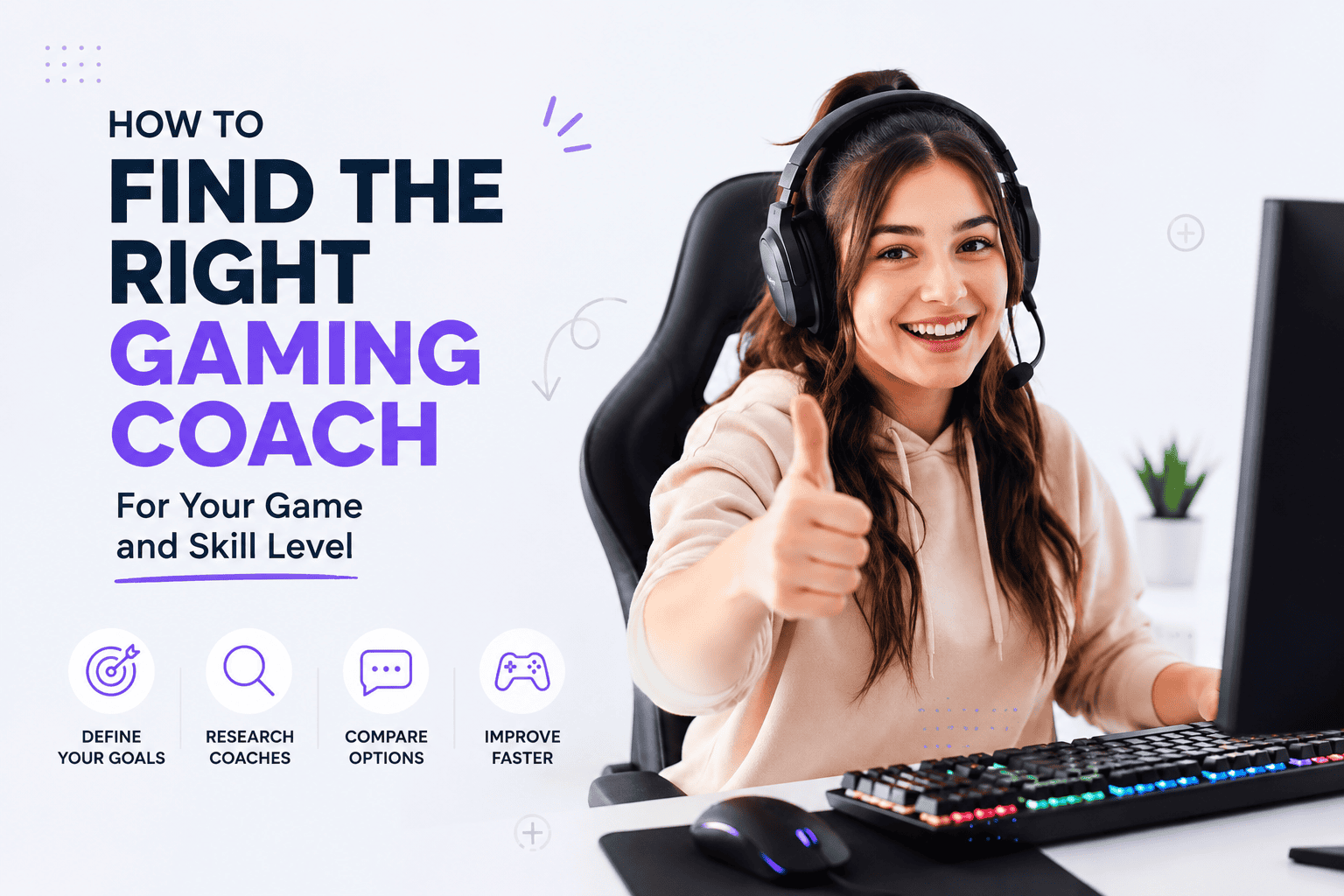
1. Finding a Gaming Coach Is Easy – Finding the Right One Is Harder
You’ve decided you want some help improving at your game.
Excellent.
You search for a gaming coach and discover someone who’s:
Top ranked.
Won tournaments.
Coached hundreds of players.
Has glowing reviews.
Charges $80 an hour.
Sounds perfect.
Except you’re a relatively new player trying to learn the fundamentals and this coach specialises in preparing high-ranked competitive teams for tournaments.
Great coach.
Wrong coach.
Finding gaming coaching isn’t particularly difficult anymore. Players can find coaches covering everything from League of Legends and Valorant to Rocket League, Fortnite, fighting games, strategy games and plenty more.
The harder part is working out:
Which coach is actually right for you?
🎮 The Best Gaming Coach Isn’t Necessarily the Best Player
It’s tempting to start your search by looking for the highest-ranked player you can find.
After all:
Better Player = Better Coach
Right?
Not necessarily.
Playing a game at an exceptional level and teaching someone else how to improve are two different skills.
A great player might instantly recognise that you’ve made a positioning mistake.
A great coach should also be able to explain:
What the mistake was
Why it was a mistake
What you should have done instead
and:
How to recognise the same situation next time
That’s the difference between receiving information and actually learning something from it.
If you’re completely new to coaching, our guide to what video game coaching is and how it works explains what you can expect from the process.
🎯 Start With You – Not the Coach
Before comparing ranks, reviews or prices, there’s a more important question:
What do you actually need help with?
Maybe you’re:
A beginner learning the fundamentals
Stuck at the same rank for months
Struggling with positioning
Trying to improve your mechanics
Learning a new role or character
Preparing for competitive play
Making the same mistakes without understanding why
or simply:
Losing games and becoming increasingly convinced matchmaking has developed a personal grudge against you.
Those problems may require very different coaches.
A coach who’s fantastic at teaching beginners may not have the specialist knowledge needed by an advanced competitive player.
Likewise, an elite-level coach could be complete overkill for someone who mainly needs help understanding the fundamentals.
You’re not searching for the world’s greatest gaming coach.
You’re searching for the coach who can best help you.
🧠 Your Skill Level Changes What You Need
Imagine two players looking for League of Legends coaching.
Player A
Bronze rank.
Still learning basic wave management, positioning and when to take objectives.
Player B
Master rank.
Strong fundamentals but struggling with advanced jungle tracking, tempo and decision-making.
Both want:
“League of Legends coaching.”
But they don’t need the same service.
Player A might benefit enormously from a patient coach who’s excellent at explaining fundamentals.
Player B probably needs someone with much deeper high-level knowledge.
This is why choosing purely by:
Game + Price
isn’t enough.
Your skill level needs to be part of the search too.
🔍 Your Specific Problem Matters Even More
Now let’s make it more specific.
Suppose you’re a Valorant player struggling to climb.
You could hire a general Valorant coach.
That might work perfectly well.
But perhaps your mechanics are already strong.
The real problem is that your:
Utility usage is inconsistent
Positioning is too aggressive
and:
Decision-making falls apart late in rounds.
A coach specialising in tactical decision-making or your particular role could be a much stronger match.
The more clearly you understand the problem you’re trying to solve, the easier it becomes to identify coaches who are genuinely qualified to solve it.
🏆 Credentials Matter – But So Does Relevance
Rank, tournament experience and competitive achievements can all be useful evidence of expertise.
They shouldn’t be ignored.
But ask:
Is this experience relevant to what I want to learn?
Someone might have incredible competitive credentials in one role but relatively little experience coaching yours.
Another coach might have a slightly lower peak rank but hundreds of hours helping players at your exact skill level overcome the exact problem you’re facing.
Which one is more useful?
Potentially the second.
Think of credentials as evidence.
Not an automatic winner.
💬 Coaching Style Can Make or Break the Experience
There’s another factor that’s surprisingly easy to overlook:
Do you actually like being coached by this person?
Some players respond well to direct feedback.
They want:
“That decision was wrong. Here’s why. Do this instead.”
Others learn better with a more conversational coach who asks questions and helps them work through decisions.
Some coaches are highly analytical.
Others are practical and gameplay-focused.
Some explain every detail.
Others concentrate on a few major improvements.
None of those approaches is automatically better.
But one may work considerably better for you.
A coach can have extraordinary game knowledge and still be a poor fit if their teaching style makes every session feel like you’ve been summoned to the principal’s office.
💰 Price Doesn’t Tell You Who the Best Coach Is
It’s also easy to assume:
More Expensive = Better
or:
Cheaper = Better Value
Neither is necessarily true.
A more expensive coach may have:
More experience
Stronger reviews
Professional credentials
Specialist expertise
or:
Higher demand.
That can absolutely justify a higher rate.
But if you’re a beginner who mainly needs help fixing basic mistakes, you might get everything you need from a less expensive coach who specialises in helping newer players.
Likewise, choosing the cheapest option purely to save money isn’t necessarily good value if the coaching doesn’t address your problems.
The question isn’t:
“Which coach costs the least?”
It’s:
“Which coach gives me the best chance of getting the help I actually need?”
⭐ Reviews Help – But Don’t Stop at the Star Rating
A coach with excellent reviews deserves attention.
But look deeper than:
⭐⭐⭐⭐⭐
Read what players actually say.
Do they mention:
Clear explanations?
Personalised feedback?
Good communication?
Useful practice advice?
Improvement over multiple sessions?
Understanding of particular ranks, roles or characters?
Those details can tell you far more about whether the coach suits you than the average rating alone.
We’ll look much more closely at evaluating reviews later in this guide.
📹 The Right Coaching Format Matters Too
You also need to consider how you want to be coached.
Some players benefit from live coaching while they’re playing.
Others get more from having a coach carefully analyse recorded gameplay.
You might prefer:
Live Coaching
for immediate feedback and real-time decision-making.
Or:
VOD Review
for deeper analysis of positioning, strategy and recurring mistakes.
Or perhaps a combination of both.
If you’re unsure, our Live Gaming Coaching vs VOD Review guide explains where each approach tends to work best.
🎯 Think of It as Finding the Right Match
Instead of asking:
“Who’s the best gaming coach?”
ask:
“Who’s the best gaming coach for my situation?”
You’re trying to match:
🎮 Your Game
📊 Your Skill Level
🎯 Your Goals
🧠 Your Biggest Weaknesses
📹 Your Preferred Coaching Format
💬 Your Learning Style
💰 Your Budget
with:
The coach who fits those needs best.
Get that match right and coaching becomes much more useful.
Get it wrong and you can hire an extremely talented coach while still wondering afterwards:
“Was that actually what I needed?”
🚀 What We’ll Work Out in This Guide
By the end of this guide, you’ll know how to:
Identify what you actually need coaching for
Choose a coach suited to your game and skill level
Decide whether specialist coaching is worthwhile
Compare live coaching and VOD review
Evaluate gaming coach experience and reviews
Work out whether a coach’s teaching style suits you
Know what questions to ask before booking
Recognise common coaching red flags
Compare your final choices
and ultimately:
Choose a gaming coach who gives you the best chance of improving.
Because finding someone who offers gaming coaching is the easy part.
The useful part is finding someone who understands:
where you are now, where you’re trying to get to and what’s actually stopping you from getting there.
And that’s where your search should begin.
2. Quick Answer – How Do You Choose the Right Gaming Coach?
The right gaming coach isn’t necessarily the highest-ranked, cheapest or most experienced coach you can find.
It’s the coach whose expertise matches:
Your game + Your skill level + Your goals + The problems you want to solve
If you’re comparing several coaches, start by looking for someone who:
- Specialises in the game you play
- Has enough experience to coach your current skill level
- Understands your role, character or playstyle where relevant
- Has experience solving the problems you’re struggling with
- Offers a coaching format that suits you
- Explains their coaching process clearly
- Has credible gaming or coaching experience
- Receives useful feedback from previous clients
- Communicates in a way you understand
- Charges a price that makes sense for your budget and the service offered
You don’t necessarily need to find a coach who scores perfectly in every category.
You need to find the strongest overall match.
🎮 Start With the Game You Play
This sounds obvious.
If you want Rocket League coaching, you’re probably not about to hire a League of Legends coach and hope their transferable skills include aerial car control.
But even within the same game, expertise can vary enormously.
Take Valorant.
One coach might specialise in:
Beginner fundamentals
Another in:
Aim and mechanics
Another in:
Controller strategy
Another in:
High-ranked VOD analysis
Another in:
Competitive team play
They’re all Valorant coaches.
They’re not necessarily interchangeable.
Start with your game, then narrow the search.
📊 Match the Coach to Your Skill Level
Next, ask:
Does this coach regularly work with players like me?
A beginner needs someone who can explain fundamentals clearly without assuming years of game knowledge.
An intermediate player may need help identifying recurring mistakes that are stopping them progressing.
An advanced player might require detailed strategic analysis and specialist expertise.
A competitive player could need tournament preparation, team strategy or opponent analysis.
This means the coach with the most impressive profile isn’t always the sensible choice.
If you’re Bronze and struggling with basic positioning, you probably don’t need to pay premium rates for someone whose speciality is preparing professional teams for international competition.
You need someone who’s exceptionally good at teaching Bronze players better positioning.
🎯 Match the Coach to Your Goal
Now ask:
What am I actually trying to achieve?
Suppose three players all want Counter-Strike coaching.
Player A wants to:
Improve their aim and mechanics.
Player B wants to:
Understand positioning and rotations.
Player C wants to:
Prepare their team for competitive matches.
Same game.
Three very different coaching goals.
A coach can be excellent at Counter-Strike without being equally strong at solving every possible Counter-Strike problem.
Look at what the coach says they actually help players improve.
The closer their expertise matches your goal, the more relevant their coaching is likely to be.
🧠 Look for Teaching Ability – Not Just Gaming Ability
Rank matters.
Competitive experience matters.
Game knowledge matters.
But you’re hiring someone to teach you.
Look for signs that the coach can:
Identify mistakes
Explain why they happen
Prioritise what matters
Communicate clearly
Suggest practical improvements
Adapt explanations when you don’t understand
Turn feedback into something you can practise
That’s what converts game knowledge into useful coaching.
Imagine two coaches watching you make the same mistake.
Coach A:
“Your positioning is bad.”
Coach B:
“You’re entering this fight too far from cover. When their second player appears, you have nowhere safe to disengage. Play from this position instead and you keep an escape route.”
Both spotted the problem.
Only one really taught you something.
🔍 Check Their Specialisation
The more advanced you become, the more useful specialist coaching can become.
You might search for:
League of Legends Jungle Coaching
instead of:
League of Legends Coaching
Or:
Valorant Controller Coaching
instead of:
Valorant Coaching
Or:
Rocket League Rotation and Positioning Coaching
instead of:
Rocket League Coaching
This can be especially valuable if you already know what your weakness is.
If you don’t know what’s holding you back, broader gameplay analysis may actually be the better starting point.
A good general coach can help diagnose the problem before you decide whether specialist coaching is necessary.
📹 Choose the Right Coaching Format
The coach also needs to offer coaching in a way that suits what you’re trying to improve.
You might choose:
Live Coaching
where the coach watches you play and provides feedback around your decisions and gameplay.
VOD Review
where recorded gameplay is analysed in detail.
One-on-One Coaching
where the entire session is focused on you.
Group or Team Coaching
where several players work on coordinated gameplay together.
Or a combination.
For example, if you keep making the same strategic mistakes without noticing them, a detailed VOD review might reveal patterns more effectively than trying to correct everything during a live match.
If you struggle with immediate decision-making under pressure, live coaching could be particularly useful.
The right coach with the wrong format may still be the wrong choice.
⭐ Look for Evidence
You don’t need to conduct a full criminal background investigation on every gaming coach.
But you should look for evidence supporting what they claim.
That might include:
- Rank or competitive experience
- Coaching experience
- Reviews
- Repeat clients
- Specialist knowledge
- Tournament experience
- Educational content
- Detailed service descriptions
- Examples of how they coach
A new coach might not have dozens of reviews yet.
That doesn’t automatically make them a bad choice.
It simply means you may need to rely more heavily on their experience, service description, communication and perhaps a shorter first session before committing to anything larger.
💬 Pay Attention to Communication
You can learn quite a lot before the coaching session even starts.
If you message a coach with a reasonable question, do they:
Understand what you’re asking?
Respond clearly?
Ask about your goals?
Show interest in your situation?
Or do you receive:
“yeah bro book session”
Not necessarily an automatic disqualification.
But perhaps not the comprehensive pre-coaching assessment you were hoping for.
Good coaching relies heavily on communication.
Early interactions can give you a useful preview.
💰 Don’t Choose on Price Alone
Price matters.
You have a budget.
There’s nothing wrong with that.
But the cheapest coach isn’t automatically the best value.
Imagine:
Coach A – $15
Provides a generic 60-minute session that doesn’t really address your biggest problems.
Coach B – $30
Identifies exactly what’s holding you back, explains it clearly and gives you practical ways to improve.
Coach B costs twice as much.
But could easily provide considerably better value.
The opposite can also happen.
A $70 coach isn’t automatically better for you than a $30 coach simply because the number is bigger.
Pay for the level of expertise and service you actually need.
🚩 Watch for Unrealistic Promises
Be cautious if a coach promises things like:
Guaranteed rank increases
Guaranteed wins
Guaranteed tournament results
A coach can improve your understanding and help you work on weaknesses.
They can’t control:
Your teammates
Your opponents
Matchmaking
How much you practise
or:
Whether your internet connection decides tonight is the perfect time to become experimental.
Good coaches should be confident about what they can teach without guaranteeing outcomes they can’t control.
We’ll cover the major gaming coaching red flags later in this guide.
🧪 When in Doubt, Book One Session First
You don’t have to choose your gaming coach for life.
If someone looks promising, consider booking:
One 30-minute session
or:
One 60-minute session
before purchasing a larger coaching package.
Use that session to evaluate:
Did they understand my goals?
Was the feedback personalised?
Did they explain things clearly?
Did I learn something useful?
Do I know what to practise next?
Would I want another session with them?
If the answer is yes, you’ve probably found a strong candidate.
If not, you’ve learned that without committing to ten sessions.
🎯 The Simple Gaming Coach Checklist
If you want the entire selection process reduced to one quick checklist, use this:
Game
Do they genuinely know your game?
Skill Level
Can they effectively coach someone at your level?
Goal
Do they help players achieve the kind of improvement you’re looking for?
Specialisation
Do they understand your role, character or specific problem where necessary?
Coaching Format
Do they offer live coaching, VOD review or another format that suits you?
Teaching Ability
Can they explain complicated ideas clearly?
Evidence
Do their experience, reviews or credentials support their claims?
Communication
Do you feel comfortable asking questions and receiving feedback?
Price
Does the cost make sense for what you’re getting?
Fit
Most importantly:
Do you think this person can actually help you improve?
That’s the question everything else in this guide will help you answer.
But before you start comparing coaches, there’s something worth figuring out first:
What do you actually want to improve?
3. Start With What You Actually Want to Improve
Before searching for a gaming coach, there’s one question worth answering:
What do you actually want help with?
It sounds obvious.
But a lot of players start with something much broader:
“I want to get better.”
Fair enough.
Most of us do.
Unfortunately, “get better at Valorant” is a goal in roughly the same way “get healthier” is a workout plan.
It’s pointing in the right direction.
It just doesn’t tell you what to do next.
The clearer you are about what you want to improve, the easier it becomes to find a coach whose expertise actually matches your problem.
🎯 Turn “I Want to Get Better” Into a Real Goal
Start by asking yourself:
What would I like to be noticeably better at after coaching?
Your answer might be:
“I want to climb out of Gold.”
“I keep losing fights I feel like I should win.”
“I don’t understand when I should rotate.”
“My mechanics are inconsistent.”
“I’ve been stuck at the same rank for six months.”
“I want to learn Jungle properly.”
“I want to improve my tournament performance.”
“I have no idea what I’m doing wrong.”
That last one is completely valid too.
In fact, identifying why you’re struggling can be one of the most useful things a gaming coach does.
You don’t always need to arrive with the diagnosis.
You just need to explain the symptoms.
📊 Separate the Goal From the Problem
This distinction can make your search much easier.
Your goal might be:
Reach Diamond.
But what’s stopping you?
Perhaps it’s:
Positioning
Decision-making
Aim
Map awareness
Communication
Ability usage
Resource management
Game knowledge
Consistency
Mentality under pressure
or some combination of them.
Two players can have exactly the same goal and need completely different coaching.
Imagine:
Player A
Goal: Reach Diamond
Problem: Excellent mechanics but constantly takes unnecessary fights.
Player B
Goal: Reach Diamond
Problem: Strong decision-making but inconsistent mechanics.
Player C
Goal: Reach Diamond
Problem: Has blamed teammates for 437 consecutive matches and may require a slightly broader intervention.
Same rank goal.
Very different coaching needs.
That’s why searching only for:
“Diamond rank coach”
may not be enough.
🔍 Look for Patterns in Your Gameplay
If you’re not sure what your biggest weakness is, think about what repeatedly goes wrong.
Ask yourself:
How do I usually die or lose?
Which situations make me uncomfortable?
What decisions am I least confident about?
Where do better players seem noticeably stronger than me?
What feedback do teammates repeatedly give me?
What part of the game do I avoid because I don’t understand it?
When matches go badly, what usually happens first?
You might notice patterns.
Perhaps you’re constantly caught out of position.
Maybe you perform well early but struggle in the mid-game.
Perhaps you understand your role mechanically but don’t know how to adapt when the match doesn’t follow the expected plan.
Those patterns give a coach something much more useful to work with.
🎮 Think About Which Part of the Game Is Holding You Back
Different games create different coaching problems.
In a tactical shooter, you might struggle with:
Crosshair placement
Positioning
Utility usage
Peeking
Rotations
Communication
Round decision-making
In a MOBA:
Laning
Wave management
Map awareness
Pathing
Objective control
Team fighting
Champion knowledge
In a fighting game:
Matchups
Spacing
Punishes
Combos
Defence
Neutral game
Decision-making under pressure
In Rocket League:
Mechanics
Rotations
Positioning
Boost management
Recoveries
Team play
The more specific your problem becomes, the easier it is to search for coaches with relevant expertise.
🧠 Don’t Assume You Know What’s Wrong
There’s an important catch.
Players aren’t always good at diagnosing their own weaknesses.
You might think:
“My aim is holding me back.”
Then a coach reviews your gameplay and discovers your aim is perfectly respectable.
You’re simply taking terrible fights.
You could spend another 100 hours practising aim and still struggle because the actual problem is:
Positioning + Fight Selection
This is one reason personalised coaching can be so useful.
A good coach can look at your gameplay from the outside and identify problems you’ve stopped noticing.
You’ve played the same way for so long that certain decisions feel completely normal.
The coach watches one replay and says:
“Why do you keep doing this?”
And suddenly an entire chapter of your ranked history begins to make sense.
📹 If You Don’t Know the Problem, Look for Assessment-Based Coaching
You don’t need to diagnose yourself before hiring a coach.
If your honest answer is:
“I’m stuck and I don’t know why.”
look for a coach who offers:
Gameplay assessment
VOD review
Replay analysis
or:
General gameplay coaching
These formats can be particularly useful for discovering your biggest weaknesses.
Rather than arriving with:
“Teach me better positioning.”
you can arrive with:
“I’ve been stuck at this rank for three months. Can you review my gameplay and tell me what I should prioritise?”
That’s a perfectly useful coaching goal.
🏆 Rank Can Be a Goal – But Don’t Make It the Only Goal
Rank is one of the easiest ways to measure gaming progress.
So it’s completely reasonable to want:
Gold → Platinum
Diamond → Master
or whatever progression system your game uses.
But rank alone can become misleading.
You can’t directly practise:
“Become Diamond.”
You can practise:
Better positioning
Better mechanics
Better decision-making
Better communication
Better map awareness
Those improvements may eventually produce the rank increase.
A useful coaching goal therefore combines the outcome you want with the skills that can help you reach it.
Instead of:
“I want to reach Diamond.”
try:
“I want to reach Diamond and I think my positioning and late-game decision-making are holding me back.”
Now a potential coach has much more to work with.
⚙️ Mechanics and Strategy May Need Different Coaching
Another useful distinction is whether you’re struggling mainly with:
Execution
or:
Decision-making.
Execution includes things like:
Aim
Movement
Combos
Mechanical techniques
Reaction and timing
Decision-making includes:
Positioning
Rotations
Target selection
Resource usage
Map awareness
Risk assessment
Strategy
Some coaches are particularly strong in one area.
If your mechanics are already excellent but your decision-making is holding you back, choosing a coach primarily known for aim training may not solve the real problem.
Likewise, if you understand exactly what you should do but physically struggle to execute it consistently, you may need someone with stronger mechanical expertise and practical drills.
🌱 Beginners Can Keep Their Goals Broader
If you’re relatively new to a game, don’t worry about identifying an incredibly specific weakness.
You may not know enough yet.
A beginner’s goal might simply be:
“Help me understand the fundamentals and stop making obvious mistakes.”
That’s enough.
A good beginner coach should be able to assess where you are and help build a foundation around things like:
Core mechanics
Basic strategy
Game terminology
Positioning
Common mistakes
Practice habits
As your understanding improves, your coaching goals can become more specific.
🚀 Advanced Players Should Usually Get More Specific
The higher your skill level becomes, the smaller your weaknesses may become.
An advanced player probably doesn’t need:
“General Rocket League coaching.”
They might need:
“High-level 2v2 rotation and challenge decision-making.”
A high-ranked MOBA player might want:
“Advanced jungle tempo and objective sequencing.”
A fighting game player might need:
“Matchup-specific coaching against characters I consistently struggle with.”
Specific problems create opportunities for specialist coaches to provide much deeper value.
📝 Write Down Three Things Before You Search
Before opening a coaching marketplace or comparing profiles, write down:
1. My Main Goal
What am I trying to achieve?
2. My Biggest Problem
What do I currently think is stopping me?
3. What I Want From a Coach
What would make the session useful?
For example:
Main Goal: Reach Platinum in Valorant.
Biggest Problem: I struggle with positioning and knowing when to rotate.
What I Want From a Coach: Review my gameplay, identify recurring mistakes and give me specific things to practise.
That’s already enough information to dramatically improve your search.
Compare it with:
“Need Valorant coach.”
One gives potential coaches something meaningful to respond to.
The other mostly confirms that you play Valorant.
🎯 Your Goal Helps You Filter Coaches
Once you know what you’re trying to improve, start using it as a filter.
When looking at a coaching profile, ask:
Does this person mention the problem I’m having?
Do they coach players at my level?
Does their experience relate to my goal?
Does their session format make sense for what I want to improve?
Do their reviews mention similar players or problems?
If yes, keep them on your shortlist.
If not, keep looking.
You don’t need the coach with the longest list of achievements.
You need someone whose expertise lines up with the problem sitting between:
where you are now
and:
where you want to be.
And to judge that properly, you need an equally clear understanding of where you are now – including your actual skill level.
4. What Skill Level Are You Really At?
Once you know what you want to improve, the next step is working out where you’re starting from.
That sounds easy.
You have a rank.
Problem solved.
Except your visible rank doesn’t always tell the whole story.
Two players sitting in exactly the same division can have completely different strengths, weaknesses and coaching needs.
One might have excellent mechanics but terrible decision-making.
Another might understand the game extremely well but struggle to execute under pressure.
A third may be genuinely excellent at everything except recognising when it’s time to stop queueing ranked at 2:17 AM.
Your rank is useful.
It’s just not the entire picture.
📊 Start With Your Current Rank or Competitive Level
For ranked games, your current rank is still the easiest starting point.
Depending on the game, that might mean:
Bronze
Silver
Gold
Platinum
Diamond
Master
or whatever elaborate collection of gemstones, metals and increasingly intimidating titles the developers have created.
Your rank helps potential coaches understand roughly:
What level of competition you’re facing
Which fundamentals you probably already understand
How advanced the coaching may need to be
and:
Whether their own expertise is appropriate for you.
If you’re searching for a coach, include your current rank whenever possible.
Instead of:
“Looking for Rocket League coaching.”
try:
“I’m currently Diamond 2 in Rocket League and want help improving my 2v2 positioning and rotations.”
Much better.
🎮 But Rank Doesn’t Tell the Whole Story
Imagine two Gold players.
Player A
Fantastic mechanics.
Strong aim.
Wins plenty of individual fights.
But regularly:
Overextends
Ignores teammates
Takes unnecessary risks
and:
Turns every small advantage into an opportunity to test the limits of human optimism.
Player B
Average mechanics.
But:
Positions well
Communicates
Understands objectives
Makes sensible decisions
These players may have the same rank.
They don’t have the same coaching needs.
Player A might need help with:
Decision-making and positioning.
Player B may benefit more from:
Mechanics and execution.
That’s why telling a coach your rank is useful – but explaining how you play is even better.
🧠 Think About Your Strengths as Well as Your Weaknesses
Players searching for coaching naturally focus on everything going wrong.
But knowing what you’re already good at helps too.
Ask yourself:
What parts of the game feel comfortable?
Where do I usually outperform players at my rank?
What do teammates rely on me for?
Which situations do I understand well?
What mechanics can I perform consistently?
Suppose you’re strong mechanically but weaker strategically.
That’s useful information.
A coach doesn’t need to spend half the session explaining mechanics you’ve already mastered.
They can focus on the areas where improvement is more likely to move the needle.
🔍 Look at Your Experience Beyond Rank
Rank can also be misleading if you’re:
New to ranked play
Returning after a long break
Learning a new role
Switching games
Playing a new character
Coming from another competitive game
For example, you might be relatively low-ranked in a new tactical shooter but already have thousands of hours of competitive FPS experience.
You’re technically a beginner in one sense.
But explaining:
“This is how movement works.”
for 40 minutes probably isn’t the best use of your coaching session.
Tell potential coaches about relevant experience.
That helps them pitch the session at the right level.
🌱 What Does a Beginner Player Usually Need?
Beginner players often benefit most from building strong foundations.
That might include:
- Core game mechanics
- Basic positioning
- Understanding roles
- Map knowledge
- Common terminology
- Basic strategy
- Resource management
- Good practice habits
- Avoiding common beginner mistakes
A coach who works regularly with beginners can be extremely valuable here.
They know which concepts matter now and which ones can wait.
That’s important.
A beginner doesn’t necessarily need an advanced explanation of tiny optimisation differences used by professional players.
Sometimes the most valuable advice is:
“Before worrying about that, stop doing this.”
📈 What Does an Intermediate Player Usually Need?
Intermediate players often understand the fundamentals.
The problem is applying them consistently.
They may know:
Where they should position
but occasionally drift somewhere dangerous.
They may understand:
When they should rotate
but react too slowly.
They might know:
Which fights they should take
but still make poor decisions under pressure.
This is where personalised coaching can become particularly useful.
Generic guides may have already taught the player what good gameplay looks like.
A coach can help identify why their actual gameplay still doesn’t match it.
Intermediate coaching often focuses on:
Consistency
Recurring mistakes
Decision-making
Positioning
Efficiency
Adaptation
and:
Breaking through skill plateaus.
🏆 What Does an Advanced Player Usually Need?
As players improve, the problems often become smaller and more specific.
An advanced player may already have:
Strong mechanics
Good game knowledge
Solid positioning
Hundreds or thousands of hours of experience
Their coaching might focus on details such as:
Advanced decision-making
Tempo
Matchup knowledge
Optimisation
High-level positioning
Opponent tendencies
Specific mechanical weaknesses
Tournament preparation
At this point, specialist expertise becomes much more important.
A coach who’s brilliant at helping Gold players reach Platinum may not necessarily be the right person to help a Grandmaster player compete at an even higher level.
⚔️ Competitive Players May Need a Different Type of Coach
Competitive play can introduce another layer entirely.
Instead of focusing only on individual performance, coaching might involve:
Team strategy
Communication
Role coordination
Opponent analysis
Drafting or team composition
Tournament preparation
Reviewing scrims
Performance under pressure
A highly ranked solo player isn’t automatically an expert in all of these areas.
If your goal involves organised competitive play, look for coaches with relevant competitive or team-coaching experience.
🎯 Don’t Inflate Your Skill Level
This sounds obvious.
But gaming has a remarkable ability to convince us that our true rank is several divisions above the one displayed on the screen.
Maybe you really have been unlucky.
Maybe your teammates genuinely have been spectacularly creative.
But when choosing a coach, exaggerating your level doesn’t help you.
If you’re Silver, say you’re Silver.
If you’re a beginner, say you’re a beginner.
If you’ve been stuck at the same rank for two years, mention it.
The coach isn’t there to judge your rank.
They’re there to help you improve it.
The more accurate the information you provide, the easier it is for them to understand what kind of coaching you need.
📉 Don’t Undersell Yourself Either
The opposite can happen too.
Some players describe themselves as:
“Pretty bad.”
That tells a coach almost nothing.
You might actually be:
Top 20%
with strong fundamentals and one recurring weakness holding you back.
Give useful information instead.
For example:
“I’m Platinum 2. My mechanics are reasonably strong, but I struggle with positioning during late-game fights and often don’t know when to disengage.”
That’s incredibly useful.
It tells the coach:
Your level
Your perceived strength
Your weakness
and:
The situations you want help with.
📹 Let Gameplay Help Determine Your Level
If you’re unsure how to describe your skill level, gameplay can do much of the talking.
A replay or VOD gives a coach direct evidence of:
Your mechanics
Decision-making
Positioning
Game awareness
Habits
Mistakes
and:
Overall understanding.
That’s one reason VOD reviews can be particularly useful when you’re not sure what’s holding you back.
Rather than trying to explain every weakness yourself, you can let the coach see your actual gameplay.
📝 Create a Quick Player Profile
Before contacting coaches, create a simple snapshot of yourself.
Something like:
Game: Valorant
Current Rank: Gold 3
Peak Rank: Platinum 1
Main Role: Controller
Experience: Around 600 hours
Main Goal: Reach Diamond
Strengths: Aim and basic utility knowledge
Weaknesses: Positioning, rotations and late-round decisions
Preferred Coaching: VOD review or one-on-one session
That’s enough information for a coach to quickly understand whether you’re a good fit for their service.
It also makes comparing coaches much easier.
🧭 Think About Where You Are and Where You’re Going
Ultimately, skill level isn’t just about putting yourself into a box marked:
Beginner
Intermediate
or:
Advanced.
You’re trying to identify two points:
Where am I now?
and:
Where am I trying to get to?
The right gaming coach should understand the gap between them.
A beginner needs someone capable of building foundations.
An intermediate player may need someone who can diagnose recurring mistakes.
An advanced player may need specialist expertise.
A competitive player may need someone with experience beyond ordinary ranked play.
Once you’re clear about your current level, you can start answering one of the biggest questions players have when choosing a coach:
Does my gaming coach actually need to be a higher rank than me?
5. Does Your Gaming Coach Need to Be a Higher Rank Than You?
Usually, yes.
If you’re paying someone to help you improve at a competitive game, you’d generally expect them to have reached a higher level of play than you.
But there’s an important distinction:
Higher Rank = Useful Evidence of Expertise
It doesn’t automatically mean:
Higher Rank = Better Coach
Rank tells you something about how well someone can play the game.
It doesn’t necessarily tell you how well they can teach it.
And when you’re choosing a gaming coach, you need both.
🏆 Why a Higher Rank Usually Matters
Competitive ranks exist for a reason.
Someone who has reached a significantly higher level than you has probably developed a deeper understanding of things like:
Mechanics
Positioning
Decision-making
Game knowledge
Strategy
Matchups
Timing
Resource management
and whatever other skills matter in your game.
They’ve also experienced the levels of play you’re trying to reach.
If you’re Gold and trying to reach Diamond, someone who’s already reached Diamond, Master or beyond may understand:
What changes as you climb
Which mistakes become more costly
Which skills matter most
and:
What separates players at your current level from players above it.
That’s valuable experience.
🎮 But How Much Higher Does the Coach Need to Be?
There isn’t a universal rule.
Your coach doesn’t necessarily need to be:
Rank #7 on the entire server
to help you escape Silver.
The gap simply needs to be large enough that the coach has meaningful expertise you can learn from.
For example, a Diamond player may be perfectly capable of helping:
Bronze
Silver
Gold
and potentially:
Platinum
players improve.
They’ve already successfully navigated the levels those players are trying to progress through.
Would that same Diamond coach be the best choice for a Master player trying to reach Grandmaster?
Probably not.
The higher your own level becomes, the more important the coach’s depth of expertise becomes.
📊 The Skill Gap Should Match Your Goal
Think about where you are and where you’re trying to go.
Suppose you’re:
Silver 2
and your immediate goal is:
Reach Gold.
You probably don’t need the world’s highest-ranked coach.
Someone with strong Platinum or Diamond-level experience who regularly coaches lower-ranked players may be more than capable of helping you.
Now suppose you’re:
Master
and trying to push into:
Grandmaster or professional competition.
The pool of suitable coaches becomes much smaller.
You may need someone with:
Elite ranked experience
Competitive experience
Professional coaching experience
or:
Deep specialist knowledge
appropriate to your level.
As your own skill increases, the expertise required to identify meaningful improvements usually becomes more specialised.
🧠 Playing Skill and Coaching Skill Are Different
Imagine two potential coaches.
Coach A
Top 0.1% player.
Incredible mechanics.
Thousands of hours.
You ask:
“Why was my positioning bad here?”
They reply:
“You just shouldn’t stand there.”
Technically correct.
Not tremendously enlightening.
Coach B
Top 2% player.
Lower ranked than Coach A.
But they:
Analyse the situation
Explain what information you missed
Show you a better position
Explain why that position is safer
Give you a rule for recognising similar situations
and:
Create a simple practice goal for your next matches.
Which session would help you more?
Quite possibly Coach B.
The best gaming coach isn’t simply the person capable of performing the skill.
It’s someone capable of breaking that skill down and helping you develop it yourself.
🔍 Look for Evidence Beyond Rank
When comparing coaches, treat rank as one part of a larger picture.
Also look for:
Coaching Experience
Have they actually worked with players before?
Relevant Skill Levels
Do they regularly coach players around your rank?
Specialisation
Do they understand your role, character or specific problem?
Communication
Can they explain complex ideas clearly?
Reviews
Do previous players say the coaching was useful?
Competitive Experience
Have they played in organised competition where relevant?
Teaching Content
Do their guides, videos or examples demonstrate how they think?
A coach with slightly lower playing credentials but significantly stronger evidence in these areas could easily be the better choice.
🎯 A Coach Doesn’t Need to Be Better Than You at Everything
This becomes particularly important for advanced players.
Suppose you’re an excellent FPS player with exceptional aim.
You hire a coach because your strategic decision-making is weaker.
Does the coach need better raw aim than you?
Not necessarily.
They need to be better at identifying and teaching the area you’re trying to improve.
The same applies across games.
A coach might specialise in:
Draft strategy
Positioning
Macro decision-making
Team communication
VOD analysis
Specific matchups
Tournament preparation
You might actually outperform them in another part of the game.
That’s okay.
You’re paying for the expertise that’s useful to you.
⚔️ Specialist Coaches Can Be Different
Consider a fighting game player.
You’re highly ranked overall but consistently struggle with one particular matchup.
You find a coach who:
Specialises in that character
Understands the matchup deeply
and:
Has extensive competitive experience against it.
Their overall rank might not be dramatically higher than yours.
Their specific knowledge could still be extremely valuable.
Or imagine you’re an advanced MOBA player who needs help with drafting and team strategy.
A coach with extensive competitive team experience might offer knowledge that isn’t neatly represented by their current solo queue rank.
At higher levels especially, expertise can become more complicated than:
My number is bigger than your number.
📅 Check Whether Their Rank Is Current
Another useful question is:
When did they achieve that rank?
A coach might advertise:
Former Top 500
That’s meaningful.
But games change.
There may have been:
Major patches
New characters
Map changes
Item changes
Meta shifts
Ranking-system changes
A former elite player may still have outstanding fundamentals and coaching ability.
But if their specialist knowledge hasn’t kept pace with the current game, that’s worth knowing.
Look for signs that the coach still understands the version of the game you’re actually playing.
🧑🏫 Coaching Experience Can Sometimes Matter More Than a Small Rank Difference
Imagine you’re choosing between:
Coach A
Peak rank: Grandmaster
Coaching sessions completed: 200
Specialises in your role
Strong reviews
and:
Coach B
Peak rank: Top 500
Coaching sessions completed: 3
General coaching
Coach B has the more impressive rank.
Coach A may still be the stronger choice.
Why?
Because Coach A has spent much more time learning how to:
Spot common player mistakes
Explain concepts
Structure sessions
Prioritise feedback
Adapt to different learners
Turn analysis into practical improvement
Playing teaches you how to play.
Coaching teaches you how to help someone else play better.
Those skills overlap.
They aren’t identical.
🌱 Beginners Have More Flexibility
If you’re a beginner, you usually have a much larger pool of potentially useful coaches.
You don’t necessarily need elite-level expertise to learn:
Basic positioning
Fundamental mechanics
Core strategy
Map awareness
Role responsibilities
Common mistakes
In fact, a coach who regularly teaches beginners may be better suited to you than an elite player who spends most of their time coaching advanced competitors.
The beginner-focused coach may be much better at remembering which concepts aren’t obvious yet.
Experts sometimes forget what it’s like not to know something.
You ask:
“How did you know they were going to rotate?”
They answer:
“It was obvious.”
Excellent.
Mystery solved.
🚀 Advanced Players Should Be More Selective
If you’re already highly ranked, the equation changes.
The coach needs enough expertise to see things you don’t already see.
If you’re Diamond, hiring another Diamond player for general gameplay coaching may provide limited value.
If you’re Grandmaster, you probably need someone with either:
Higher-level playing experience
or:
Specialist coaching expertise relevant to your weakness.
The closer you get to the top, the smaller the gaps become.
That can make specialist knowledge increasingly valuable.
🚩 Be Careful With Unverifiable Rank Claims
If a coach’s entire pitch is:
“Trust me, I’m insane at this game.”
you may want slightly more evidence.
Depending on the platform and game, you might be able to look for:
Linked profiles
Rank history
Competitive records
Gameplay footage
Tournament results
Coaching reviews
You don’t need to interrogate someone over a $20 coaching session.
But if their claimed expertise is the main reason you’re considering them, it’s reasonable to look for evidence supporting it.
Especially when you’re paying premium prices.
💡 Don’t Pay for Rank You Don’t Need
There’s another side to this.
Suppose you’re a beginner choosing between:
Coach A – Highly experienced Diamond coach specialising in beginners
and:
Coach B – Former professional player charging several times more
Coach B may objectively be the stronger player.
But do you need professional-level expertise to learn:
Basic positioning?
Probably not.
You could end up paying significantly more for expertise that doesn’t materially improve the coaching you need right now.
A useful principle is:
Hire enough expertise to comfortably take you beyond your current level – not necessarily the most expertise money can buy.
You can always find a more advanced coach later as your needs change.
🎯 So, Does Your Coach Need to Be Higher Ranked?
For most players:
Yes – ideally.
Your coach should generally have enough playing experience and expertise to understand the level you’re trying to reach.
But don’t choose based on rank alone.
Look at:
Their Rank
Their Coaching Experience
Their Specialisation
Their Communication
Their Reviews
Their Experience With Players Like You
The strongest combination wins.
Because the question isn’t really:
“Is this person better at the game than me?”
It’s:
“Does this person know enough – and teach well enough – to help me become better than I am now?”
Once you’ve established that, the next question becomes more specific:
How closely does their expertise need to match the game you actually play?
6. Match the Coach to Your Game
This one sounds almost too obvious to mention.
If you want help with Valorant, find a Valorant coach.
If you want help with Rocket League, find a Rocket League coach.
If you want help with League of Legends, hiring someone because they’re incredible at Counter-Strike probably isn’t going to solve your wave management problems.
But choosing a coach for your game goes deeper than simply matching the title.
You want someone who understands how your game is actually played at your level.
That means:
Current mechanics
Maps
Characters
Roles
Strategies
Matchups
Meta
Ranked environment
and the specific decisions players need to make throughout a match.
🎮 Game-Specific Knowledge Matters
Competitive games can be incredibly complicated.
Take a MOBA.
A useful coach may need to understand:
Champion matchups
Itemisation
Wave management
Objective timing
Map pressure
Rotations
Team compositions
Power spikes
Role responsibilities
Now compare that with a tactical shooter, where coaching might revolve around:
Crosshair placement
Peeking
Utility
Positioning
Map control
Rotations
Economy
Communication
Both are competitive games.
Both involve mechanics, strategy and decision-making.
But expertise in one doesn’t automatically transfer into detailed expertise in the other.
General coaching skills can transfer.
Game knowledge usually can’t.
🔫 FPS and Tactical Shooter Coaches
If you’re looking for coaching in games such as Valorant or Counter-Strike, think about which part of your gameplay needs attention.
You might need help with:
Aim
Crosshair placement
Movement
Positioning
Peeking
Map awareness
Utility usage
Rotations
Communication
Decision-making
A mechanically gifted coach may be excellent for aim and movement.
A more analytical coach might be stronger at reviewing positioning, rotations and tactical decisions.
If your aim is already excellent but you keep dying because you’re standing in places that would make your teammates quietly question your intentions, more aim training probably isn’t the answer.
Look for expertise that matches the problem.
🧠 MOBA Coaches
Games such as League of Legends can become highly specialised very quickly.
You might need coaching around:
Laning
Trading
Wave management
Jungle pathing
Objective control
Vision
Rotations
Macro
Team fighting
Champion-specific mechanics
Drafting
Even two coaches specialising in the same game may offer very different expertise.
A coach who primarily works with:
Top Lane
may not be your strongest option if you’re trying to master:
Jungle.
And a coach who’s fantastic at helping newer players understand laning fundamentals may not be the right choice for a high-ranked player wanting advanced macro analysis.
🚗 Rocket League Coaches
Rocket League creates a completely different set of coaching needs.
You could be working on:
Rotations
Positioning
Recoveries
Boost management
Aerial control
Dribbling
Challenges
Team play
Decision-making
Maybe your mechanics are impressive enough to produce highlight clips.
Fantastic.
Unfortunately, you’re also using all 100 boost to fly across the pitch towards a ball your teammate already has.
A coach specialising in rotations and decision-making might help you more than someone focused primarily on advanced mechanics.
Again:
Same game. Different problem. Different ideal coach.
⚔️ Fighting Game Coaches
Fighting games make game-specific knowledge particularly important.
A coach might need deep understanding of:
Matchups
Frame data
Spacing
Punishes
Combos
Neutral
Defence
Pressure
Character-specific options
And once you reach a higher level, the exact character you play can become increasingly relevant.
A great general fighting game coach can teach fundamentals.
But if you’re struggling with a specific matchup, a coach with extensive knowledge of those characters may offer much more targeted help.
🏎️ Sports and Racing Game Coaches
Sports and racing games can require their own specialist knowledge.
Depending on the game, coaching might focus on:
Mechanics
Positioning
Racecraft
Car setup
Track knowledge
Passing
Defending
Resource management
Team strategy
Decision-making
Even within the same game, the skills required can change depending on the mode.
Someone looking for individual mechanical improvement may need a different coach from someone preparing for organised team competition.
♟️ Strategy Game Coaches
Strategy games can make the difference between general and specialist knowledge even more obvious.
A coach might focus on:
Build orders
Economy
Resource management
Map control
Scouting
Timing
Matchups
Adaptation
Long-term strategy
A player might know the recommended build perfectly but fall apart the moment the opponent does something unexpected.
That’s where a coach who understands decision-making and adaptation, rather than simply memorised strategies, can become particularly valuable.
🔄 Make Sure the Coach Understands the Current Game
Competitive games change.
Sometimes constantly.
A coach who was highly knowledgeable two years ago may have experienced:
New maps
Balance patches
New characters
New weapons
Item changes
Mechanical changes
Meta shifts
Ranking changes
That doesn’t erase their experience.
Strong fundamentals can remain valuable for years.
But if you’re hiring someone for highly specific strategic advice, check whether they’re still actively familiar with the current game.
A coaching profile mentioning:
Current ranks
Recent gameplay
Current patches
Current characters
Recent coaching sessions
can provide useful reassurance.
You probably don’t want to spend the first ten minutes discovering that your coach has just learned three of the abilities they’re recommending were reworked six months ago.
🎯 Look at the Coach’s Actual Experience With Your Game
When comparing profiles, ask:
How long have they played this game?
What rank have they achieved?
Are they still actively playing?
Have they competed?
How much coaching have they done in this game?
Which skill levels do they normally coach?
Which roles or characters do they understand best?
Not every question needs an impressive answer.
You’re looking for enough evidence that this person genuinely understands the game at the level you need.
📊 General Game Knowledge May Be Enough for Beginners
If you’re relatively new, you don’t necessarily need an incredibly specialised coach.
Suppose you’re learning Valorant and still struggling with:
Basic positioning
Crosshair placement
Economy
Map awareness
Ability usage
A strong general Valorant coach may be exactly what you need.
Paying significantly more for one of the world’s leading experts in high-level Controller strategy would probably be unnecessary.
You haven’t reached the problem they’re uniquely qualified to solve yet.
Start with someone who can build your fundamentals.
Specialise later.
🏆 Advanced Players Should Look Deeper
As your level increases, simply finding:
“A coach for my game”
may become too broad.
Suppose you’re a high-ranked League of Legends player.
Instead of searching for:
League of Legends Coach
you might need:
High-Elo Jungle Coach
Then perhaps:
High-Elo Jungle VOD Review
Then even:
Advanced Jungle Pathing and Objective Control
Your search becomes narrower because your problems become narrower.
That’s a good thing.
You’re no longer looking for someone who can teach you the game.
You’re looking for someone who can identify the smaller weaknesses preventing you from reaching the next level.
💡 Don’t Be Impressed by Expertise You Don’t Need
Imagine you’re choosing between two coaches.
Coach A
Professional-level experience.
Specialises in elite competitive play.
Charges $80 per session.
Coach B
Diamond-level player.
Has coached dozens of beginner and intermediate players.
Excellent reviews for explaining fundamentals.
Charges $30.
You’re Silver and struggling with basic positioning.
Coach A might be the stronger player.
Coach B might be the stronger choice for you.
This is an important theme when choosing gaming coaching:
More expertise isn’t automatically more useful.
Relevant expertise is what matters.
🔍 Use Your Game to Narrow the Search – Then Go Deeper
A useful way to search is to gradually narrow your requirements.
Start with:
Game
Then:
Skill Level
Then:
Role or Character
Then:
Problem
Then:
Coaching Format
For example:
Valorant
↓
Gold–Diamond
↓
Controller
↓
Positioning and Utility Usage
↓
VOD Review
Now you’re not searching through every Valorant coach on the internet.
You’re looking for someone whose experience closely matches what you actually need.
If you’re still deciding which type of coaching would work best, our guide to choosing a video game coach covers the broader factors worth comparing before you book.
🎮 Browse Coaches Who Actually Play Your Game
Once you’ve narrowed down what you’re looking for, you can start comparing coaches who offer sessions specifically for the games you play.
The StackedGame Game Coaching Marketplace gives you a place to browse available coaching sessions and compare options based on what you’re trying to improve.
But don’t stop when you’ve found someone who coaches the right game.
That’s only the first filter.
Because within almost every competitive game, there’s another level of specialisation that can make a major difference:
your role, character or playstyle.
7. Look for Coaches Who Understand Your Role or Character
Finding a coach for your game is a good start.
But in many games, it’s only the start.
A League of Legends coach might understand the game brilliantly while specialising almost entirely in Jungle.
A Valorant coach might have deep expertise with Controllers but relatively little experience playing Duelists.
A fighting game coach might know your game inside out but rarely play your character.
At lower skill levels, that might not matter much.
As your coaching needs become more specific, it can matter a lot.
Sometimes the difference between a decent coaching match and an excellent one is finding someone who doesn’t just understand your game.
They understand your part of the game.
🎮 Why Role-Specific Knowledge Matters
Different roles can require completely different skills.
Take a MOBA.
A Jungler might need to understand:
Pathing
Gank timing
Objective control
Tracking the opposing Jungler
Map pressure
Resource efficiency
Meanwhile, a Support player may be focused on:
Vision
Positioning
Roaming
Peeling
Engage timing
Protecting teammates
They’re playing the same game.
They’re even playing in the same match.
But the decisions they’re making can be completely different.
A coach who specialises in your role may notice details a more general coach could miss.
🔫 The Same Applies to Tactical Shooters
Role specialisation can matter in tactical shooters too.
Imagine you’re a Valorant Controller player.
You want help with:
Smoke placement
Utility timing
Site control
Rotations
Supporting teammates
Late-round decision-making
A highly skilled Duelist player might understand Valorant extremely well.
But someone with extensive Controller experience may be able to offer much deeper insight into the exact decisions you’re making.
Instead of:
“Your smoke wasn’t great.”
you want:
“This smoke gives them too much space here. Use it here instead, which cuts this angle and lets your team take control safely.”
That’s the kind of detail specialist experience can provide.
⚔️ Character Knowledge Can Matter Even More
In games built around individual characters, champions, heroes or fighters, specific character knowledge can become extremely valuable.
A fighting game coach might understand:
Your character’s strongest options
Important matchups
Punish opportunities
Spacing
Frame advantages
Common traps
Defensive options
A MOBA coach might understand:
Champion-specific matchups
Power spikes
Ability interactions
Build choices
Trading patterns
A hero shooter coach might understand:
Ability combinations
Positioning
Team synergies
Counters
Ultimate usage
At higher levels, those details can make a substantial difference.
🧠 General Coaches Still Have Plenty of Value
This doesn’t mean you should only ever hire someone who plays your exact role or character.
General coaching can be extremely useful.
Many problems aren’t character-specific at all.
You might need help with:
Positioning
Map awareness
Decision-making
Communication
Mentality
Team play
Reading opponents
Understanding win conditions
A strong general coach may be perfectly capable of improving those areas.
In fact, if you don’t yet know what’s holding you back, broader coaching can be a better place to start.
You don’t want to hire a highly specialised mechanics coach only to discover your mechanics weren’t the problem.
🌱 Beginners Usually Don’t Need Extreme Specialisation
If you’re new to a game, focus on fundamentals first.
Suppose you’ve recently started League of Legends.
You’re still learning:
How lanes work
When to recall
Why objectives matter
What half the champions actually do
At this stage, finding the world’s leading specialist in one particular matchup probably isn’t necessary.
A good beginner coach who understands the game broadly may provide far more value.
They can help you build the foundations that apply regardless of which champion you eventually decide to main.
There’s little point optimising tiny matchup advantages while you’re still occasionally discovering that standing underneath the enemy turret has consequences.
📈 Specialisation Becomes More Valuable as You Improve
As your skill level increases, your problems often become narrower.
A beginner might need:
“Help me understand Jungle.”
An intermediate player might need:
“Help me improve my Jungle pathing and objective control.”
An advanced player might need:
“Help me improve early-game pathing against aggressive invading Junglers in specific matchups.”
Same role.
Increasingly specific problem.
That’s where specialist coaching can become particularly valuable.
The more advanced you are, the more useful it can be to find someone who understands the exact situations you’re struggling with.
🎯 Match the Specialisation to Your Actual Weakness
Don’t choose specialist coaching simply because it sounds impressive.
Choose it because the specialisation solves a problem you actually have.
Suppose you’re a Rocket League player.
Your aerial mechanics are excellent.
Your rotations are terrible.
You find two coaches:
Coach A
Specialises in advanced aerial mechanics.
Coach B
Specialises in positioning, rotations and decision-making.
Coach A might have the flashier profile.
Coach B is probably the better match.
You’re not shopping for the most impressive expertise.
You’re shopping for useful expertise.
🔍 Look for Specific Language in Coaching Profiles
When reading coaching listings, pay attention to how specific the coach is about what they teach.
Compare:
“I offer professional Valorant coaching for all players.”
with:
“I help Gold–Diamond Controller and Sentinel players improve positioning, utility usage, rotations and mid-round decision-making.”
The second description immediately tells you more.
It doesn’t automatically mean the coach is better.
But it gives you evidence that they understand:
Who they help
and:
What they help with.
Look for mentions of:
Roles
Characters
Skill levels
Specific mechanics
Common problems
Game modes
Competitive goals
The more closely those match your situation, the stronger the potential fit.
⭐ Reviews Can Reveal Specialisation Too
Sometimes the coach’s profile doesn’t tell you everything.
Their reviews might.
Look for comments such as:
“Really helped me understand Support positioning.”
“Great at explaining Jungle pathing.”
“Helped me fix my defensive rotations.”
“Excellent matchup knowledge.”
“Really understands Controller utility.”
Repeated comments around the same area can reveal where a coach is particularly strong.
That’s much more useful than simply seeing:
“Great coach!”
for the fiftieth time.
We’ll look more closely at how to evaluate coaching reviews later.
💬 Ask Before You Book
If you’re unsure whether a coach understands your role or character, ask.
You could say:
“I mainly play Support around Platinum level and want help with positioning and team-fight decision-making. Is that something you regularly coach?”
Simple.
Their response can tell you a lot.
A good coach should be able to tell you honestly whether your problem fits their expertise.
If it doesn’t, that’s useful information too.
A coach saying:
“That’s not really my speciality”
is much more reassuring than someone claiming world-class expertise in absolutely everything that has ever appeared on the character-select screen.
🔄 What if You Play Several Roles or Characters?
You don’t necessarily need a separate coach for every character you play.
If you’re trying to improve broadly, look for someone with strong understanding of the game and your general role.
For example, if you play several Support characters, a coach who specialises in:
Support positioning
Team-fight decisions
Resource management
and:
Map awareness
may help across your entire character pool.
The same applies to players who switch between several weapons, classes, cars or strategies.
Look for the common skills underneath them.
🧩 Your Playstyle Can Matter Too
Two players using the same character can still play very differently.
One might be:
Aggressive
Another:
Defensive
One might rely heavily on mechanics.
Another on positioning and strategy.
A useful coach shouldn’t simply try to turn every player into a copy of themselves.
They should understand your strengths and help you develop a style that’s effective.
Sometimes that means changing habits.
Sometimes it means refining what you’re already good at.
The goal isn’t:
“Play exactly like your coach.”
It’s:
“Learn why good decisions work and become better at making them yourself.”
🏆 High-Level Players May Need Very Specific Expertise
For advanced and competitive players, specialist knowledge can become one of the most important selection criteria.
Your search might eventually look like:
Game
↓
Rank
↓
Role
↓
Character
↓
Specific Weakness
↓
Competitive Goal
For example:
League of Legends
↓
Master
↓
Jungle
↓
Specific Champion Pool
↓
Early Pathing and Tempo
↓
Competitive Team Play
At that point, the number of suitable coaches may be much smaller.
That’s okay.
A narrower search can produce a much stronger match.
💰 Specialist Coaching May Cost More
Coaches with particularly valuable expertise may charge higher rates.
That could include:
High-level role specialists
Character specialists
Professional or semi-professional players
Tournament coaches
Advanced analysts
Whether that higher price is worthwhile depends on whether you actually need the expertise.
If you’re a beginner, probably not.
If you’re an advanced player struggling with a highly specific problem, paying more for someone who deeply understands it may make much more sense.
Don’t ask:
“Is specialist coaching expensive?”
Ask:
“Will this specialisation help solve my problem better than a general coach?”
🎯 Go as Specific as Your Needs Require
A useful rule is:
Beginners → Start Broad
Intermediate Players → Add Role or Problem
Advanced Players → Look for Deeper Specialisation
Competitive Players → Match Expertise Very Closely
You don’t need the coach whose profile contains the greatest number of impressive words.
You need enough specialisation to solve the problem you’re actually facing.
Start with your game.
Narrow by your role or character where useful.
Then consider your specific weakness.
Combine that with your current ability and you’re getting much closer to a genuinely good match.
Because the next question isn’t simply whether the coach understands your game.
It’s whether they’re experienced at coaching players at your skill level.
8. Match the Coach to Your Skill Level
A coach can specialise in your game.
They can understand your role.
They might even play your exact character.
But there’s still another important question:
Are they good at coaching players at your level?
This is easy to overlook.
You find someone who’s reached an incredible rank, competed at a high level and clearly understands the game.
Surely they can coach anyone below them?
Maybe.
But coaching a complete beginner and coaching an advanced player are very different jobs.
The right coach shouldn’t just understand the game.
They should understand what someone at your stage of development needs to learn next.
🌱 Beginners Need Coaches Who Can Teach Fundamentals
If you’re relatively new, you probably have lots of things you could improve.
That’s exactly why prioritisation matters.
A beginner coach might notice:
Poor positioning
Weak mechanics
Slow reactions
Limited map awareness
Questionable resource management
Bad decision-making
Missed opportunities
Three abilities you appear to have forgotten exist
They could spend the entire session listing mistakes.
That wouldn’t necessarily make the session useful.
A good beginner coach identifies the few things that matter most right now.
They might say:
“Ignore advanced strategy for the moment. These two positioning mistakes are costing you constantly. Let’s fix those first.”
That’s useful coaching.
🧠 Beginners Need Clear Explanations – Not Expert Shorthand
Experienced players often develop their own vocabulary.
They talk about concepts as though everyone naturally understands them.
A beginner-friendly coach needs to recognise when that isn’t true.
If the session sounds like:
“You lost tempo because you didn’t respect their spike, then your macro collapsed because you failed to convert prio.”
and you’re sitting there thinking:
“I understood the word ‘you’.”
there may be a teaching problem.
Good beginner coaches can explain complicated concepts using simple language.
Then, as your understanding improves, they can introduce more advanced terminology.
🎮 Intermediate Players Often Need Diagnosis
Intermediate players are different.
You probably already understand:
The basic mechanics
The main objectives
Your role
Common strategies
What good gameplay generally looks like
Yet something is preventing you from consistently applying that knowledge.
This is where coaching often becomes less about teaching the game and more about diagnosing your gameplay.
Maybe you:
Know where you should position but don’t do it consistently
Understand rotations but recognise them too late
Have strong mechanics but take poor fights
Know the correct strategy but abandon it under pressure
Play well when ahead but struggle when behind
An intermediate-focused coach should be good at finding those recurring patterns.
You’re no longer asking:
“How does this work?”
You’re increasingly asking:
“Why am I not doing this properly?”
📈 Intermediate Players Often Get Stuck on Plateaus
This is also the level where many players hit the dreaded:
Ranked Plateau.
You’ve improved.
You understand the game.
You’ve watched guides.
You’ve practised.
You’ve played enough matches that your match history is beginning to resemble a full-time employment record.
And yet:
The rank isn’t moving.
This can be an ideal situation for personalised coaching.
A coach may notice habits that have become invisible to you.
Perhaps one recurring decision is costing you several matches.
Maybe you’re practising the wrong thing.
Perhaps your mechanics are fine and the real problem is decision-making.
If you’re stuck at a particular level, look for coaches whose profiles or reviews specifically mention helping players break through similar ranks or plateaus.
🏆 Advanced Players Need Coaches Who Can Find Smaller Edges
Advanced players present a completely different challenge.
You already know the fundamentals.
You probably recognise many of your own mistakes.
You may already understand most of the advice aimed at the average player.
Your coach needs to go deeper.
That might involve:
Small positioning errors
Tiny inefficiencies
Advanced matchups
Opponent tendencies
Tempo
Optimisation
High-level decision-making
Mechanical refinement
Adaptation
At this level, generic advice becomes much less valuable.
Imagine paying for advanced coaching only to hear:
“Remember to communicate with your teammates.”
Technically good advice.
Probably not the breakthrough you were hoping to purchase.
🔬 The Better You Become, the More Detailed Coaching Often Gets
Consider how the same situation might be coached at different levels.
A beginner might hear:
“Don’t take fights when you’re heavily outnumbered.”
An intermediate player might hear:
“You’re taking this fight before your teammate can rotate.”
An advanced player might hear:
“Delay this engagement by two seconds. Their cooldown is still unavailable and your teammate reaches the angle before their support can respond.”
Same general concept.
Very different level of detail.
That’s why coaching experience at your skill level matters.
A coach needs to know how deep the explanation should go.
⚔️ Competitive Players May Need More Than Ranked Expertise
If you’re preparing for tournaments, leagues or organised team competition, ranked expertise alone may not be enough.
Competitive play can introduce:
Team preparation
Communication structures
Set plays
Drafting
Opponent analysis
Scrim reviews
Role coordination
Tournament mentality
Adaptation between matches
A coach who mainly helps individuals climb ranked may still be excellent.
But if your goal is competitive team performance, someone with tournament or team-coaching experience may be a better match.
This is another reason to define your goal before comparing coaches.
🔍 Look for Evidence That They Coach Players Like You
A coaching profile might say:
“Coaching available for all skill levels.”
That’s useful.
But look deeper where possible.
Check whether their profile, service description or reviews mention:
Beginners
Specific ranks
High-ranked players
Competitive players
Players returning after a break
Players learning new roles
Players trying to break a plateau
Suppose you’re Gold and several reviews say:
“Helped me finally reach Platinum.”
That’s particularly relevant evidence.
It doesn’t guarantee the same result for you.
But it suggests the coach has experience helping players navigate the stage you’re currently at.
⭐ Reviews From Similar Players Are More Useful
Not every five-star review has equal value when you’re choosing a coach.
Consider these:
“Amazing coach, highly recommended!”
Useful.
Now compare it with:
“I was stuck in Platinum for months. The coach spotted several positioning mistakes in my VOD, explained what I should be doing instead and gave me specific things to practise.”
Much more useful.
Why?
Because you can see:
The player’s approximate level
Their problem
What the coach did
and:
Why the coaching helped.
If that player’s situation resembles yours, the review becomes particularly relevant.
We’ll dig deeper into evaluating reviews later in the guide.
🎯 Ask Coaches Who They Usually Work With
If it isn’t clear from their profile, ask.
Something as simple as:
“Do you regularly coach players around Gold–Platinum?”
can help.
Or:
“I recently started playing and I’m looking for help with the fundamentals. Do you work with beginners?”
Or:
“I’m currently Master and looking for advanced VOD analysis. Do you regularly coach players around this level?”
The answer helps establish whether you’re entering familiar territory for them.
💡 Don’t Assume an Elite Coach Is Automatically Best for Beginners
This is worth repeating because it’s an easy trap.
Imagine:
Coach A
Former professional player.
Elite ranked history.
Specialises in high-level competitive analysis.
Coach B
Strong high-ranked player.
Hundreds of sessions coaching beginners.
Known for explaining fundamentals clearly.
You’re completely new to the game.
Which one should you choose?
Possibly Coach B.
Coach A may know more about the game.
Coach B may know more about teaching someone who currently knows very little about the game.
Those aren’t the same thing.
🧩 The Same Coach Can Still Work Across Multiple Levels
None of this means coaches must choose exactly one skill level.
A talented coach might work effectively with:
Beginners
Intermediate players
and:
Advanced players.
The important part is whether they can adapt.
A good coach shouldn’t deliver the same session to:
Silver
and:
Master
players.
They should adjust:
What they focus on
How deeply they explain concepts
How many problems they address
What drills they recommend
What they expect the player to already understand
Personalisation matters.
That’s one of the biggest advantages of one-on-one video game coaching – the session can be built around your particular level, weaknesses and goals rather than a generic lesson plan.
📊 Use Your Current Level and Target Level Together
When contacting a coach, don’t just say where you are.
Tell them where you’re trying to go.
For example:
“I’m currently Silver 3 and want to reach Gold.”
or:
“I’m Diamond and trying to push into Master.”
That gap matters.
A coach may be perfectly capable of helping you reach your next target without being the person you’d choose several ranks later.
You don’t necessarily need one coach for your entire gaming journey.
Your coaching needs can change as you improve.
🔄 Be Willing to Change Coaches as You Improve
Finding the right coach today doesn’t mean you’ve found the right coach forever.
Suppose a coach helps you progress from:
Silver → Gold → Platinum.
Excellent.
Eventually, you might reach a point where you need:
More advanced analysis
Different specialisation
Competitive experience
Higher-level matchup knowledge
Moving to another coach doesn’t mean the original coaching failed.
Quite the opposite.
It may mean you successfully outgrew what you originally needed.
Think of coaching as something that can evolve alongside your skill level.
🎯 Match the Teaching to the Player
A simple way to think about it is:
Beginner
Look for someone excellent at fundamentals, patience and clear explanations.
Intermediate
Look for someone strong at diagnosis, consistency and breaking plateaus.
Advanced
Look for deeper expertise, detailed analysis and specialist knowledge.
Competitive
Look for relevant high-level, team or tournament experience.
The right coach should be able to meet you at your current level and show you the most useful path forward.
But skill level isn’t the only thing that changes what good coaching looks like.
A beginner and an advanced player may need completely different types of coaching, even when they’re learning the same game.
And that’s worth looking at more closely.
9. Beginner vs Advanced Gaming Coaches – What’s the Difference?
Not every gaming coach teaches the same way.
And they shouldn’t.
A player learning the fundamentals needs a very different coaching experience from someone sitting near the top of the ranked ladder looking for tiny improvements in decision-making.
The difference isn’t simply:
Beginner Coach = Cheaper
Advanced Coach = Better
It’s about what the coach specialises in teaching.
A brilliant beginner coach might be exceptionally good at turning a confusing game into something understandable.
An advanced coach might excel at finding tiny mistakes that experienced players don’t even realise they’re making.
Both can be excellent coaches.
They’re just solving different problems.
🌱 What Does a Beginner Gaming Coach Actually Do?
Beginner coaching is usually about building strong foundations.
That could mean teaching:
Core mechanics
Positioning
Game objectives
Roles
Basic strategy
Map awareness
Resource management
Common terminology
Practice routines
Common beginner mistakes
The challenge isn’t necessarily knowing these things.
It’s knowing how to teach them without overwhelming someone.
Imagine you’re new to a MOBA and your coach spends the first session discussing advanced wave manipulation, matchup-specific power spikes and obscure optimisation techniques.
Interesting?
Maybe.
Useful right now?
Probably less useful than:
“Here’s why you keep losing your lane.”
A good beginner coach knows what you don’t need to learn yet.
🧠 Beginner Coaching Should Make the Game Feel Simpler
Many competitive games are overwhelming when you’re starting.
There can be:
Dozens of characters
Multiple maps
Hundreds of abilities
Weapons
Items
Matchups
Strategies
An entire dictionary of terminology everyone apparently expects you to know already
Beginner coaching should cut through that noise.
Instead of giving you 27 things to remember next match, a good coach might give you three:
1. Improve your positioning
2. Check the minimap more often
3. Stop taking this particular type of fight
That’s manageable.
You practise those.
They become habits.
Then you add more.
🎮 What Does an Advanced Gaming Coach Do?
Advanced coaching usually works differently.
The player already understands the game.
The obvious mistakes have mostly disappeared.
Now the coach is looking for smaller edges.
That might include:
Advanced positioning
Matchup optimisation
Tempo
Resource efficiency
Opponent tendencies
Mechanical refinement
Risk assessment
High-level decision-making
Adaptation
Competitive strategy
The feedback becomes more detailed because the player is capable of using more detailed information.
Instead of:
“Your positioning is too aggressive.”
the discussion might become:
“This position is normally fine, but because their key ability is available and your teammate can’t immediately trade, you’re taking unnecessary risk.”
That’s a much more specific level of analysis.
🔬 Advanced Coaching Is Often About Tiny Differences
At lower levels, one major mistake might be costing you repeatedly.
Fixing it can create a noticeable improvement.
At higher levels, you may already be doing 90% of something correctly.
The coach is helping with the remaining 10%.
Sometimes even less.
That can mean analysing:
A decision made two seconds too early
A slightly inefficient rotation
An opportunity you didn’t recognise
A predictable habit
A small mechanical inconsistency
A matchup-specific mistake
To a beginner, these differences may seem almost irrelevant.
At high levels, they can decide matches.
📹 VOD Review Can Change Dramatically With Skill Level
The same coaching format can look completely different depending on the player.
Imagine two people book a VOD review.
Beginner Player
The coach might focus on:
Three recurring fundamental mistakes
They explain each one clearly and give the player simple ways to improve.
Advanced Player
The coach might analyse:
Individual decisions throughout specific situations
Why did you rotate now?
What information was available?
What alternatives existed?
What would a stronger opponent punish?
What changes if one cooldown is unavailable?
Same service:
VOD Review.
Completely different depth.
If gameplay analysis sounds useful for your situation, our complete guide to VOD review in gaming explains how the format works and what you can expect from a review.
🗣️ Communication Style Can Be Different Too
Beginner coaches often need to be particularly good at:
Explaining terminology
Using simple examples
Checking understanding
Breaking skills into smaller steps
Building confidence
Advanced coaches may use more technical language because their clients already understand it.
They can move faster.
They can assume more knowledge.
Neither approach is inherently better.
The problem comes when there’s a mismatch.
A beginner listening to an advanced technical breakdown may feel completely lost.
An advanced player receiving an hour of introductory explanations may feel like they’ve accidentally purchased the tutorial again.
🎯 Beginner Coaches Often Focus on Priorities
When you’re new, almost everything can be improved.
That makes prioritisation incredibly important.
A useful beginner coach might identify ten problems but tell you to focus on two.
Why?
Because fixing:
Positioning
and:
Map awareness
might naturally improve several other areas of your gameplay.
Trying to fix everything simultaneously can leave you thinking about so many things that you somehow play worse than before the coaching session.
That’s not the goal.
Good beginner coaching gives you a clear path.
🏆 Advanced Coaches Often Focus on Marginal Gains
Advanced players usually don’t need someone to rebuild their entire game.
They need someone capable of finding the details separating:
Good
from:
Very Good
or:
Very Good
from:
Elite.
That might involve:
Matchup-specific preparation
Frame-by-frame analysis
Detailed mechanical feedback
Strategic adaptation
High-level replay comparison
Tournament preparation
The improvements may appear small individually.
Combined, they can make a meaningful difference.
⚔️ Competitive Coaching Is Another Step Again
Advanced ranked play and organised competitive play aren’t always the same thing.
A player preparing for tournaments may need coaching around:
Team communication
Set strategies
Opponent preparation
Drafting
Role coordination
Scrim analysis
Tournament pressure
Adapting across a series
This can require coaches with experience beyond ordinary ranked play.
If competitive gaming is your goal, look for evidence that the coach understands that environment rather than assuming a high individual rank automatically covers it.
💰 Advanced Coaching Can Cost More – But Doesn’t Always Need To
Specialist and advanced coaches may charge higher rates because they can offer:
Rarer expertise
Higher-level playing experience
Competitive experience
More detailed analysis
Specialist knowledge
But don’t assume the most expensive listing is automatically the most advanced.
Price is just one signal.
A coach could charge more because they’re:
Highly experienced
or simply because:
That’s their price.
Judge the service itself.
Look at:
Experience
Specialisation
Reviews
Session structure
Relevant credentials
What you’ll actually receive
We’ll look more closely at coaching prices later in this guide.
🌱 Can an Advanced Coach Teach Beginners?
Absolutely.
Some advanced players are fantastic teachers.
The question isn’t:
“Are they too good to coach me?”
It’s:
“Do they know how to coach someone at my level?”
Look for evidence that they work with beginners.
If their profile says:
“All ranks welcome – beginner fundamentals through advanced competitive analysis”
and their reviews support that, great.
But if everything about their service revolves around:
High-Elo strategy
Tournament preparation
Advanced analysis
you may be paying for expertise you don’t need yet.
🚀 Can a Beginner-Focused Coach Help Advanced Players?
Possibly – but there’s a limit.
A coach who specialises in helping new and lower-ranked players may be excellent at:
Fundamentals
Explaining concepts
Identifying common mistakes
Building practice routines
But an advanced player may eventually need knowledge beyond that coach’s speciality.
That’s normal.
You don’t need to stay with one coach forever.
As you improve, the type of coaching that provides the most value can change.
🔄 Your Ideal Coach Can Change Over Time
Imagine your progression looks like:
Bronze → Gold
Your first coach helps build fundamentals and removes major mistakes.
Then:
Gold → Diamond
You work with someone strong at gameplay analysis, consistency and decision-making.
Then:
Diamond → Master
You start working with a specialist who understands your role at a much deeper level.
Then:
Competitive Play
You seek someone with tournament or team experience.
Each coach may have been exactly right at the time you worked with them.
Finding the right gaming coach isn’t necessarily about discovering one person who will coach you forever.
It’s about finding the right expertise for your next stage of improvement.
📊 Beginner vs Advanced Gaming Coaches at a Glance
| Beginner-Focused Coach | Advanced-Focused Coach | |
|---|---|---|
| Main Goal | Build strong foundations | Find smaller competitive advantages |
| Typical Focus | Fundamentals and common mistakes | Detailed analysis and optimisation |
| Explanation Style | Clear, simple and structured | More technical and specialised |
| Feedback | Prioritises major problems | Examines smaller details |
| Game Knowledge Needed | Strong general understanding | Deep or specialist expertise |
| Best For | New and lower-ranked players | High-ranked and competitive players |
| Practice Advice | Simple drills and habits | Targeted refinement |
| Specialisation | Often broader | Often narrower |
Neither column is automatically better.
The question is:
Which one describes the coaching you need right now?
🎯 Choose the Coach for Your Next Step
If you’re a beginner, don’t worry about finding the most elite coach available.
Find someone who can:
Teach you the fundamentals clearly and help you build good habits.
If you’re intermediate, look for someone who can:
Diagnose recurring mistakes and help you break through your current plateau.
If you’re advanced, prioritise:
Deeper expertise and specialist analysis.
And if you’re moving into competitive play, consider:
Coaches with relevant team or tournament experience.
The goal isn’t to buy the most advanced coaching possible.
It’s to buy the coaching that’s advanced enough for the problem you’re trying to solve.
Once you’ve established the right level of coaching, the next step is narrowing the search around something even more important:
What do you actually want the coach to help you achieve?
10. Choose a Coach Who Fits Your Goal
By now, you know your game.
You know roughly where your skill level sits.
You’ve thought about your role, character and weaknesses.
Now comes the question that should influence almost everything else:
What do you want your coach to help you achieve?
Because two players can play the same game, at the same rank, using the same character and still need completely different coaches.
One wants to climb ranked.
Another wants better mechanics.
Another wants to compete in tournaments.
Another simply wants to stop being the person whose friends mysteriously become “busy” whenever ranked night is suggested.
Your goal determines the kind of coaching that will provide the most value.
📈 Goal: Climb the Ranked Ladder
This is probably one of the most common reasons players look for coaching.
You might want to move from:
Silver → Gold
Gold → Platinum
Diamond → Master
or finally escape whichever rank has become your personal gaming residence.
If climbing ranked is your goal, look for coaches who understand:
The ranked environment at your level
Common mistakes players make around your rank
What skills usually separate your rank from the next one
How to improve consistency
How to recognise winning and losing situations
What you should prioritise in practice
It can be particularly useful to find coaches with reviews from players who started around your level.
A coach who repeatedly helps Gold players identify the mistakes keeping them from Platinum may be more relevant to you than someone whose entire service is built around professional competition.
🎯 Don’t Just Say “I Want to Rank Up”
Rank is the outcome.
You still need to understand the skills underneath it.
Suppose you’re currently Platinum and want to reach Diamond.
Your coach might discover that the biggest barriers are:
Poor positioning
Inconsistent decision-making
Weak map awareness
Overaggression
Bad resource management
Fix those and the rank may follow.
A good coach shouldn’t simply promise:
“I’ll get you to Diamond.”
They should help you understand what needs to improve for you to play at Diamond level.
That’s a much healthier way to approach ranked coaching.
🎮 Goal: Improve Your Mechanics
Maybe strategy isn’t your biggest problem.
You know what you’re supposed to do.
Your hands simply haven’t received the memo.
Mechanical coaching might focus on:
Aim
Movement
Combos
Aerial control
Dribbling
Execution
Timing
Reaction
Character-specific techniques
If mechanics are your priority, look for a coach who doesn’t just have strong mechanics themselves but can explain how to practise them.
Watching someone effortlessly perform a technique isn’t necessarily coaching.
You need to understand:
What you’re doing wrong
How the technique works
Which drills to use
How often to practise
How to measure improvement
and:
How to use the mechanic effectively in real matches.
Otherwise you’ve basically paid for a private demonstration of how much better someone else is than you.
🧠 Goal: Improve Decision-Making
Some players have excellent mechanics but make questionable decisions.
Frequently.
Enthusiastically.
If this sounds familiar, look for coaches who focus on:
Positioning
Rotations
Fight selection
Map awareness
Timing
Risk management
Objective decisions
Reading opponents
Adapting to situations
Gameplay analysis can be particularly useful here because decision-making problems often appear as repeated patterns.
You might believe you’re losing because of mechanics.
A coach might discover that you’re consistently entering fights from poor positions.
Or rotating too late.
Or chasing low-value opportunities.
Or treating every visible opponent as a personal invitation.
These are problems that detailed analysis can expose.
📹 Goal: Understand What You’re Doing Wrong
Sometimes you know you’re struggling.
You just don’t know why.
This is a perfectly legitimate reason to hire a coach.
In this situation, look for services built around:
VOD Review
Replay Analysis
Gameplay Assessment
One-on-One Analysis
Rather than telling the coach what you think the problem is, give them representative gameplay and ask:
“What are the biggest things holding me back?”
A good coach should be able to identify recurring mistakes and prioritise them.
This can be especially valuable when you’ve reached a plateau and generic advice isn’t helping anymore.
🌱 Goal: Learn a New Game
Maybe you’re starting from scratch.
You don’t need someone to optimise advanced strategies.
You need someone who can make the game less confusing.
Look for coaches who specifically welcome:
New Players
or:
Beginners
A beginner-focused session might cover:
Core mechanics
Game objectives
Basic strategy
Roles
Characters
Maps
Terminology
Good practice habits
A good coach can dramatically shorten the period where every match feels like:
“Something important is happening and everyone except me appears to know what it is.”
🔄 Goal: Learn a New Role or Character
You might already understand the game well but be learning something new within it.
Perhaps you’re:
Switching from Support to Jungle
Learning Controller in Valorant
Picking up a new fighting game character
Moving into a different Rocket League mode
In that situation, you don’t necessarily need beginner coaching.
You need someone who understands that you’re:
Experienced with the game
but:
New to this particular role, character or playstyle.
That’s an important distinction.
A specialist can skip concepts you already understand and focus on the knowledge that actually needs developing.
🏆 Goal: Prepare for Competitive Play
If you’re preparing for:
Tournaments
Leagues
Scrims
Team competition
your coaching requirements may change substantially.
Look for coaches with relevant experience in:
Competitive preparation
Team strategy
Communication
Opponent analysis
Drafting
Role coordination
Replay review
Adapting across multiple games
Performance under pressure
Someone can be outstanding at ranked play without having much experience in organised competition.
If tournaments are your goal, competitive experience becomes much more valuable.
👥 Goal: Improve as a Team
Sometimes the problem isn’t one player.
It’s everyone.
Team coaching can focus on areas that individual coaching can’t fully address:
Communication
Coordination
Role responsibilities
Rotations
Team strategy
Set plays
Decision-making
Reviewing team gameplay
If your entire squad is trying to improve together, a coach who specialises in teams may provide more value than booking individual sessions separately.
The goal isn’t just:
“Make each player better.”
It’s also:
“Make these players work better together.”
⚙️ Goal: Fix One Specific Weakness
This is where specialist coaches can really shine.
Perhaps you’re already confident in most areas but repeatedly struggle with:
Jungle pathing
Defensive rotations
Utility usage
A particular matchup
Late-game decisions
Aerial mechanics
Team-fight positioning
Peeking
Now your search can become much narrower.
Instead of:
“Find me a coach for this game.”
you’re effectively asking:
“Who is particularly good at solving this problem?”
That can make choosing between coaches much easier.
🧩 You Can Have More Than One Goal
You don’t have to choose exactly one.
Maybe you want to:
Reach Platinum
while improving:
Positioning
and:
Decision-making.
That’s fine.
But try to establish a priority.
Ask:
If I could improve only one thing over the next month, what would make the biggest difference?
Make that your primary coaching goal.
Everything else becomes secondary.
This helps prevent coaching sessions from turning into an attempt to fix your entire gaming career in 60 minutes.
📝 Tell the Coach Your Goal Before the Session
Once you’ve chosen a coach, don’t make them guess why you’re there.
Send them useful information beforehand.
For example:
“I’m currently Gold 2 and want to reach Platinum. I mainly play Controller. My aim is reasonably good, but I struggle with positioning, rotations and knowing when to use utility. I’d like help identifying the biggest mistakes in my gameplay.”
That gives the coach something useful to prepare around.
Compare it with:
“help me get better pls”
One is considerably easier to coach.
🚩 Be Careful With Coaches Who Guarantee Your Goal
There’s a difference between:
“I can help you improve the skills needed to climb.”
and:
“I guarantee you’ll reach Diamond.”
No coach controls every variable involved in your results.
They can’t control:
Your practice
Your teammates
Your opponents
Matchmaking
Game updates
How consistently you apply the advice
A coach can provide knowledge, analysis, feedback and practice strategies.
You still have to turn those things into better gameplay.
Be particularly cautious when guaranteed results are used to pressure you into buying larger or more expensive packages.
📊 Match the Service to the Goal
Different goals can also point towards different coaching formats.
| Your Goal | Coaching That May Suit You |
|---|---|
| Learn the fundamentals | Beginner one-on-one coaching |
| Identify unknown weaknesses | VOD review or gameplay analysis |
| Improve decisions during matches | Live coaching or VOD review |
| Improve specific mechanics | Specialist coaching and drills |
| Learn a role or character | Role or character specialist |
| Break through a rank plateau | Personalised gameplay analysis |
| Prepare for tournaments | Competitive or team coaching |
| Improve team coordination | Group or team coaching |
These aren’t rigid rules.
But they’re useful starting points.
🎯 Judge Coaches Against Your Goal
Once you’ve defined your goal, every potential coach becomes easier to evaluate.
Ask:
Does this coach regularly help players with my goal?
Does their expertise match the skills I need to improve?
Do their reviews mention similar problems?
Does their coaching format make sense for what I want?
Can they explain how they would approach my situation?
If the answers are strong, keep them on your shortlist.
If the coach looks impressive but their expertise has very little connection to your actual goal, don’t be afraid to keep searching.
The best gaming coach isn’t the person with the most impressive profile.
It’s the person whose experience is most useful for what you’re trying to achieve.
And once you know that, there’s another important decision to make:
Should you choose live coaching or have a coach analyse your gameplay through a VOD review?
11. Live Coaching or VOD Review – Which Do You Need?
You’ve found coaches who understand your game, skill level and goals.
Now you need to decide how you actually want to be coached.
Two of the most common options are:
Live Coaching
and:
VOD Review
Both can be extremely useful.
But they solve slightly different problems.
Live coaching lets a coach observe your gameplay as it happens.
VOD review lets them slow everything down, analyse recorded gameplay and examine your decisions in much greater detail.
The better option depends on what you’re trying to improve.
🎮 What Is Live Gaming Coaching?
Live coaching usually involves playing while your coach watches your gameplay through screen sharing or another live setup.
Depending on the coach and game, they might:
Observe your decisions
Ask questions
Point out mistakes
Discuss situations between rounds or matches
Help you recognise opportunities
Give feedback while the session is happening
Some coaches provide frequent input during gameplay.
Others deliberately stay quieter while you’re playing, then discuss decisions immediately afterwards.
That distinction matters.
Constant instructions can sometimes turn a session into:
Coach makes decision → You execute decision
rather than:
You learn how to make better decisions yourself.
The best approach depends on the game, your level and what you’re trying to learn.
📹 What Is a VOD Review?
A VOD review involves sending or showing the coach recorded gameplay.
The coach can then:
Pause
Rewind
Replay situations
Analyse positioning
Examine decision-making
Spot recurring patterns
Explain alternative choices
Because the match has already happened, there’s no pressure to keep up with live gameplay.
You can stop at one important moment and spend several minutes discussing it.
That makes VOD review particularly useful for deeper analysis.
If you want a more detailed breakdown of the format, our complete guide to VOD review in gaming explains how VOD coaching works, what coaches analyse and how to prepare your gameplay.
⚡ Live Coaching Is Great for Decisions in the Moment
One of the biggest advantages of live coaching is that your coach sees what happens before you know the outcome.
That’s useful.
When reviewing a replay, it’s easy to look at a terrible fight and think:
“Obviously I shouldn’t have done that.”
Yes.
The three opponents who appeared approximately half a second later have made that reasonably clear.
But during live gameplay, the coach can observe:
What information you noticed
What information you missed
How quickly you reacted
Why you made the decision
Whether you hesitated
How you behave under pressure
That can reveal problems that aren’t always obvious from the replay alone.
🔍 VOD Review Is Great for Finding Patterns
VOD review has a different advantage.
The coach can slow everything down.
Instead of analysing only the obvious mistake, they can investigate what caused it.
Suppose you die because you’re caught out of position.
The immediate mistake is:
Bad positioning.
But why were you there?
Perhaps:
You missed information on the minimap
which caused:
A late rotation
which caused:
Poor positioning
which caused:
You getting deleted from the match.
The death is the visible mistake.
The missed information several seconds earlier may be the actual problem.
VOD review gives the coach time to trace those decisions backwards.
🧠 Choose VOD Review if You Don’t Know What’s Wrong
This is one of the strongest uses for gameplay review.
You know you’re stuck.
You know matches keep going wrong.
But you don’t know what you’re doing incorrectly.
A VOD gives the coach something concrete to analyse.
They can look for patterns across:
Positioning
Mechanics
Map awareness
Decision-making
Timing
Resource usage
Communication
Instead of guessing at your weakness, you’re giving them actual gameplay.
For players who say:
“I don’t know what I need coaching on.”
VOD review can be an excellent starting point.
🎯 Choose Live Coaching if You Struggle to Apply What You Know
There’s another common situation.
You already know what you’re supposed to do.
You simply don’t do it consistently during matches.
For example:
You know you should check the minimap.
You know you shouldn’t overextend.
You know you need to track certain abilities.
You know that charging into a 1v4 is unlikely to be endorsed by any reputable coaching programme.
Yet when the match starts, old habits return.
Live coaching can help connect:
Knowledge
with:
Real-time execution.
A coach can observe when your decision-making breaks down and help you recognise those moments.
📊 Live Coaching vs VOD Review at a Glance
| Live Coaching | VOD Review | |
|---|---|---|
| Gameplay | Watched as you play | Recorded gameplay |
| Best For | Real-time decisions and habits | Detailed analysis and recurring mistakes |
| Analysis Depth | Limited by the pace of the game | Can pause and examine situations closely |
| Pressure | Coach sees you making decisions live | More relaxed analytical environment |
| Feedback | Immediate or between moments | Usually discussed during/after analysis |
| Useful When | You struggle to apply knowledge | You don’t know what’s holding you back |
| Replay Situations | Usually no | Yes |
| Preparation | Be ready to play | Provide representative gameplay |
Neither format is universally better.
They’re simply different tools.
🕹️ Your Game Can Influence the Best Format
Some games naturally lend themselves to particular coaching styles.
Fast games with constant mechanical decisions may make continuous live feedback difficult.
The coach may need to observe and discuss situations afterwards.
Games with:
Rounds
Downtime
Respawns
or:
Natural breaks
can make live discussion easier.
Meanwhile, games with complicated strategic decisions can benefit enormously from replay analysis because the coach can stop at key moments and explore different options.
This is worth asking potential coaches about.
Someone who regularly coaches your game should have a good idea of which format works well for different problems.
🏆 Advanced Players May Benefit From Detailed VOD Analysis
The better you become, the smaller your mistakes often become.
A beginner’s positioning error might be obvious.
An advanced player’s mistake might involve:
Moving several seconds too early
Using a resource inefficiently
Choosing the second-best position
Missing a small timing window
Failing to anticipate an opponent’s response
Those details can be easier to analyse when the coach can pause, rewind and discuss them.
For advanced players, detailed VOD review can therefore become particularly valuable.
🌱 Beginners Can Benefit From Either
Beginners don’t need to automatically choose one format.
Live coaching can help you:
Ask questions
Understand situations as they happen
Build good habits
VOD review can help you:
See your mistakes
Understand basic patterns
Focus on a few major improvements
What matters more is finding a coach who’s comfortable teaching beginners.
A beginner VOD review shouldn’t become a two-hour investigation into every microscopic error you made.
You need priorities.
🔄 Sometimes the Best Answer Is Both
You don’t necessarily have to choose permanently.
A very effective coaching process could look like:
1. VOD Review
Identify the biggest recurring problems.
↓
2. Practice
Work on the changes independently.
↓
3. Live Coaching
See how well you’re applying them during real matches.
↓
4. Another VOD Review
Check whether the original problems have improved and identify the next priorities.
This creates a useful cycle:
Analyse → Practise → Apply → Review
You may find that different formats become useful at different stages.
💰 Compare What You’re Actually Getting
Don’t compare live coaching and VOD review based on price alone.
Look at what’s included.
A VOD review might include:
Pre-session analysis
Written notes
Recorded feedback
Practice recommendations
A live session might include:
Real-time observation
Immediate feedback
Post-match analysis
Follow-up recommendations
Two services that both cost $30 could involve very different amounts of work and value.
Read the description carefully.
If it isn’t clear, ask the coach what’s included before booking.
❓ Ask How the Coach Runs the Session
“Live coaching” can mean different things to different coaches.
So can “VOD review.”
Useful questions include:
Do you give feedback while I’m playing or afterwards?
How much gameplay will you review?
Can I ask questions during the session?
Will you provide notes or practice recommendations?
Should I send gameplay beforehand?
Do you record the coaching session?
What type of gameplay should I submit?
These details can make a big difference to the experience.
🚩 Be Careful With Live Coaching That Becomes Backseat Gaming
There is a potential weakness with poorly structured live coaching.
If the coach tells you every decision to make:
Go here.
Use this.
Rotate now.
Attack them.
Back up.
You might perform better during that match.
But have you actually learned how to make those decisions yourself?
Good live coaching should help develop independent decision-making.
The goal isn’t to temporarily install a higher-ranked player into your headset.
It’s to make you better at recognising the situation next time.
🎯 Which One Should You Choose?
A simple rule of thumb:
Choose Live Coaching if you want help with:
Real-time decisions
Applying knowledge
Habits during matches
Immediate feedback
Performance under pressure
Choose VOD Review if you want help with:
Finding unknown weaknesses
Detailed gameplay analysis
Recurring mistakes
Positioning
Strategic decision-making
Understanding why situations went wrong
And choose both if you want a more complete coaching process.
If you’re still unsure, our Live Gaming Coaching vs VOD Review guide compares the two formats in much greater detail.
Once you’ve chosen the format that suits your goals, there’s another decision worth considering.
Do you want the coach’s attention focused entirely on you?
Or could learning alongside other players work just as well?
That’s where one-on-one and group coaching come in.
12. One-on-One Coaching vs Group Coaching
Another choice you’ll sometimes face is whether to book:
One-on-One Coaching
or:
Group Coaching
Both can work.
But if you’re looking for highly personalised help with your own gameplay, one-on-one coaching usually has a major advantage:
The entire session is about you.
Your mistakes.
Your goals.
Your gameplay.
Your questions.
Your slightly suspicious habit of pushing the same dangerous angle despite everything that happened the previous six times.
Group coaching can be useful too, particularly for teams, friends or players learning similar concepts.
The right option depends on what you want from the session.
👤 What Is One-on-One Gaming Coaching?
One-on-one coaching involves:
One Player + One Coach
The session can be designed specifically around your:
Game
Skill level
Role
Character
Goals
Strengths
Weaknesses
Gameplay
This allows the coach to spend the entire session identifying what you need to improve.
If your biggest problem turns out to be completely different from what you expected, the session can adapt.
That’s one of the biggest strengths of personalised coaching.
Our complete guide to one-on-one video game coaching explores how individual sessions work and what players can expect.
🎯 One-on-One Coaching Gives You Personalised Feedback
Imagine you’re attending a group session about positioning.
The coach explains:
Five common positioning mistakes.
Useful.
But perhaps you only make one of them.
Meanwhile, you have another positioning problem that isn’t covered at all.
In a one-on-one session, the coach can watch your gameplay and say:
“This is the mistake you keep making.”
Then the discussion becomes specific.
Why are you making it?
What should you do instead?
How can you recognise the situation next time?
How should you practise it?
That’s the difference between:
Learning about a problem
and:
Learning about your problem.
💬 You Can Ask More Questions
One-on-one sessions also give you much more freedom to ask questions.
You can stop and say:
“Why?”
“What should I have done instead?”
“Would that still be correct if their teammate was here?”
“What happens if I don’t have this ability available?”
“Can we look at that situation again?”
The coach can follow your understanding rather than moving at the pace of an entire group.
If one concept takes ten minutes to explain properly, that’s fine.
If another takes 30 seconds, you move on.
📈 One-on-One Coaching Can Adapt to Your Level
Personalisation becomes particularly valuable when players at the same rank have different weaknesses.
Two Platinum players might need completely different sessions.
Player A
Strong mechanics.
Weak positioning.
Needs strategic analysis.
Player B
Excellent game knowledge.
Weak mechanics.
Needs drills and execution work.
Putting them through exactly the same coaching session wouldn’t make much sense.
One-on-one coaching allows the coach to adjust the session around the individual player.
👥 What Is Group Gaming Coaching?
Group coaching involves a coach working with multiple players during the same session.
That could mean:
A small group of individual players
or:
An existing team.
The session might cover:
General concepts
Shared gameplay problems
Strategy
Communication
Teamwork
Replay analysis
Questions from multiple players
Group coaching can be particularly effective when everyone shares a similar goal.
For example, several beginner players learning the same game may benefit from covering fundamentals together.
💰 Group Coaching Can Be More Affordable
One obvious advantage is cost.
Because the coach’s time is shared between several players, group coaching may cost less per person.
That can make coaching more accessible.
Suppose:
One-on-One Session: $40 per player
while:
Group Session: $15 per player
If you mainly want help understanding broad concepts, the group session might offer excellent value.
But remember:
You’re also sharing the coach’s attention.
Lower cost doesn’t automatically mean better value if you need highly personalised feedback.
🧠 Group Coaching Can Help You Learn From Other Players
There is another advantage that’s easy to overlook.
You can learn from:
Other people’s questions
Other people’s mistakes
Different approaches
Coach feedback given to other players
Sometimes another player asks a question you hadn’t even considered.
Or the coach reviews someone else’s mistake and you suddenly realise:
“Wait. I do that too.”
Group learning can expose you to situations beyond your own gameplay.
🏆 Team Coaching Is Where Groups Can Really Shine
If you already play as an organised team, group coaching can become much more powerful.
Your biggest problem may not belong to any individual player.
It might be:
Communication
Coordination
Rotations
Role overlap
Team strategy
Objective control
Decision-making
Drafting
Everyone confidently executing five different plans simultaneously
Those problems are difficult to fix through individual coaching alone.
A team coach can examine how everyone works together.
Instead of asking:
“What did Player A do wrong?”
they can ask:
“Why did the team end up in this situation?”
That’s a different kind of analysis.
🎮 Friends Can Learn Together Too
You don’t need to be preparing for an esports tournament to benefit from group coaching.
Maybe you regularly play with:
A duo partner
A trio
A group of friends
If you’re all trying to improve together, a shared session can be useful.
For example, a Rocket League duo might work on:
Rotations
Positioning
Communication
Challenges
Covering each other
Improving those skills together can make more sense than coaching each player separately.
🔍 One-on-One Is Usually Better for Diagnosing Personal Weaknesses
If your main question is:
“What am I personally doing wrong?”
one-on-one coaching is usually the stronger format.
The coach has more time to:
Analyse your gameplay
Ask about your decisions
Identify patterns
Explain your mistakes
Build recommendations around you
That’s especially useful for:
Breaking rank plateaus
Fixing recurring mistakes
Learning a specific role
Advanced coaching
Detailed VOD review
Individual mechanical improvement
The more specific your problem becomes, the more valuable individual attention tends to become.
🌱 Group Coaching Can Work Well for Broader Learning
Group coaching may make more sense when the topic applies equally to everyone.
For example:
Beginner fundamentals
General strategy
Communication principles
Map knowledge
Team concepts
Practice methods
You don’t necessarily need every minute personalised if you’re primarily trying to understand concepts that everyone in the group needs to learn.
⚖️ One-on-One vs Group Coaching at a Glance
| One-on-One Coaching | Group Coaching | |
|---|---|---|
| Coach Attention | Entirely focused on you | Shared between players |
| Personalisation | Very high | Usually lower |
| Questions | Plenty of time for your questions | Time shared across group |
| Gameplay Analysis | Can focus deeply on your gameplay | May review several players |
| Cost Per Player | Often higher | Often lower |
| Best For | Personal weaknesses and individual improvement | Shared learning and team development |
| Session Pace | Adapted to you | Adapted to the group |
| Team Strategy | Limited | Excellent for existing teams |
Neither format automatically wins.
It depends on what you’re trying to accomplish.
🔄 You Can Combine Both
You may not need to choose permanently.
For example, a competitive player could use:
One-on-One Coaching
to improve their individual gameplay.
Then:
Team Coaching
to improve coordination with teammates.
Or a beginner could attend group sessions to learn fundamentals, then book an individual session when they want personalised feedback.
Different formats can solve different problems.
💡 Think About How Much Personal Attention You Need
Ask yourself:
Do I want someone analysing my specific gameplay?
Do I have individual weaknesses I want to fix?
Do I want plenty of time to ask questions?
If yes, one-on-one coaching is probably the stronger choice.
Alternatively:
Am I learning broader concepts?
Do several of us want coaching together?
Is team coordination the main problem?
Would sharing the session make coaching more affordable?
Then group coaching may make more sense.
🚩 Check the Group Size
If you’re considering group coaching, find out how many people will attend.
There’s a big difference between:
Four Players + One Coach
and:
Thirty Players + One Coach.
Both might technically be called group coaching.
The amount of individual attention will be completely different.
Ask:
How many players are normally in the session?
Will my gameplay be reviewed?
Can I ask individual questions?
How much direct feedback should I expect?
That helps you understand what you’re actually buying.
🎯 Which Should You Choose?
For most players looking for help with their own gameplay, one-on-one coaching will usually offer the strongest level of personalisation.
Choose one-on-one coaching when you want:
Personal gameplay analysis
Individual feedback
Help with specific weaknesses
A session adapted to your skill level
More opportunity to ask questions
Choose group coaching when you want:
Lower-cost access to coaching
Help with broader concepts
To learn alongside friends
Team strategy
Communication and coordination
Shared improvement
The important thing isn’t choosing the format that sounds most professional.
It’s choosing the one that gives you the kind of help you actually need.
And once you’ve narrowed your options by game, skill level, goal and coaching format, it’s time to investigate the person behind the coaching profile.
Because anyone can write:
“Experienced Gaming Coach.”
The harder question is:
How do you tell whether they actually know their stuff?
13. How to Tell Whether a Gaming Coach Actually Knows Their Stuff
You’ve found a coach who covers your game.
They work with players around your level.
Their service sounds relevant.
Excellent.
Now comes the slightly harder part:
Are they actually good?
Anyone can create a coaching profile and write:
“Expert player with years of experience.”
That might be completely true.
It might also mean:
“I have played this game since 2019 and possess a headset.”
Before paying for coaching, look for evidence that supports what the coach claims.
You don’t need to conduct a full investigation.
But a few simple checks can tell you a lot.
🏆 Look at Their Playing Experience
Start with the obvious one:
How good are they at the game?
Depending on the game, useful evidence might include:
Current rank
Peak rank
Competitive experience
Tournament results
Team experience
Years playing
Role or character expertise
A coach doesn’t necessarily need professional-level credentials.
As we covered earlier, they mainly need enough expertise to help someone at your level reach their next goal.
But their claimed playing experience should make sense.
If someone offers advanced coaching to top-ranked players, you’d expect stronger credentials than you would from someone specialising in beginner fundamentals.
📊 Current Rank and Peak Rank Tell You Different Things
Don’t assume these are interchangeable.
Current Rank tells you roughly where the coach is playing now.
Peak Rank tells you the highest level they’ve previously reached.
Both can be useful.
A coach might have reached an elite rank several seasons ago but now spend more time coaching than grinding ranked.
That doesn’t suddenly erase everything they know.
But if their peak rank was years ago and the game has changed dramatically since then, you may want to know whether their knowledge is still current.
Look at the complete picture rather than one impressive badge.
🎮 Check Whether Their Experience Is Relevant to You
Imagine you’re choosing between two coaches.
Coach A
Extremely high-ranked player.
Main role completely different from yours.
Mostly coaches advanced players.
Coach B
Slightly lower peak rank.
Specialises in your role.
Regularly coaches players at your level.
Has strong feedback from people with goals similar to yours.
Coach A may have the more impressive headline credential.
Coach B may have the more relevant experience.
That’s the distinction you’re looking for throughout this process.
Don’t ask only:
“How good is this coach?”
Ask:
“How useful is this coach’s experience for me?”
🧑🏫 Look for Actual Coaching Experience
Being good at a game and coaching that game are different skills.
A coach who has completed dozens or hundreds of sessions has probably had plenty of practice:
Explaining concepts
Spotting recurring mistakes
Working with different skill levels
Answering questions
Structuring sessions
Giving actionable feedback
Adapting their teaching style
That’s valuable.
They’ve likely encountered players who:
Make the same mistakes
Misunderstand the same concepts
Struggle with the same transitions between ranks
Experienced coaches can often recognise these patterns quickly.
🌱 Don’t Automatically Reject New Coaches
Everyone has to coach their first player eventually.
A newer coach may still be:
Highly knowledgeable
Excellent at communicating
Well prepared
Enthusiastic
Affordable
They simply don’t have a large coaching history yet.
That can make them harder to evaluate, but not necessarily a poor choice.
If you’re considering a newer coach, look more closely at:
Their gaming credentials
How clearly they describe their service
How they answer your questions
Whether they understand your problem
How the session is structured
You might also start with a shorter or single session before buying anything larger.
📝 Read the Service Description Carefully
A good coaching listing should tell you something meaningful about the service.
Look for details such as:
Who the coaching is for
Which skill levels they work with
What areas they specialise in
How the session works
What you’ll receive
Whether gameplay is reviewed beforehand
What you should prepare
What happens after the session
Compare:
“Professional coaching. I will help you improve fast.”
with:
“I coach Gold–Diamond Valorant players, specialising in Controller positioning, utility usage and mid-round decision-making. We’ll review one VOD before the session, identify your three biggest recurring mistakes and create practice goals for your next matches.”
The second listing gives you much more information to evaluate.
Specificity is useful.
🧠 Look for Evidence They Can Explain Things
One of the strongest signs of a good coach is the ability to make complicated ideas understandable.
If they publish:
Guides
Videos
Gameplay breakdowns
Educational posts
Streams
Short coaching clips
take a look.
You’re not simply checking whether they’re knowledgeable.
You’re checking:
Can I learn from this person?
Listen to how they explain mistakes.
Do they just say:
“This was bad.”
Or do they explain:
What happened
Why it was a mistake
What the better option was
How to recognise the situation next time
That’s much closer to what you want from paid coaching.
🔍 Good Coaches Explain the “Why”
This is one of the easiest ways to distinguish useful feedback from shallow feedback.
Imagine you make a bad rotation.
Weak feedback:
“You rotated too early.”
Better feedback:
“You rotated too early because you reacted before confirming where the opponent was going. Wait for this information first, then make the rotation.”
The second explanation gives you something transferable.
You’re not simply memorising:
“Don’t rotate here.”
You’re learning:
“What information should I use when deciding whether to rotate?”
That knowledge can help in hundreds of future situations.
🎯 Look for Actionable Feedback
Great analysis isn’t much use if you leave the session thinking:
“Interesting. No idea what I’m supposed to do tomorrow.”
Good coaching should eventually turn analysis into action.
That might mean:
A practice routine
A mechanical drill
A positioning rule
A replay exercise
A decision-making checklist
Specific things to focus on during your next matches
Suppose a coach identifies that you rarely check the minimap.
Useful feedback isn’t simply:
“Improve map awareness.”
It might become:
“For your next ten matches, deliberately check the minimap whenever this specific event happens. We’re going to use that trigger to build the habit.”
Now you have something you can actually practise.
📹 See Whether They Analyse Gameplay or Just Comment on It
There is a difference between:
Watching gameplay
and:
Analysing gameplay.
A coach saying:
“Nice.”
“Bad fight.”
“You should have rotated.”
“Good shot.”
for an hour may technically qualify as commentary.
But useful analysis goes deeper.
A strong coach might ask:
What information did you have?
What did you expect the opponent to do?
What alternatives were available?
Why did you choose this option?
What would a stronger opponent have done?
Is this a one-off mistake or a recurring habit?
That turns individual moments into lessons you can apply later.
⭐ Use Reviews as Supporting Evidence
Reviews can tell you whether previous clients actually experienced the qualities the coach claims to offer.
Look for repeated mentions of things like:
Clear explanations
Detailed analysis
Patience
Good communication
Personalised feedback
Useful practice advice
Knowledge of specific roles or ranks
One detailed review is useful.
Several reviews independently mentioning the same strengths are even more informative.
Don’t worry – we’ll look at exactly how to read coaching reviews in the next section.
💬 Ask a Specific Question Before Booking
If the platform allows you to contact the coach, ask something relevant to your situation.
For example:
“I’m Platinum and mainly play Support. I struggle with positioning during team fights. Is that something you regularly coach?”
You’re not trying to test them with a surprise entrance exam.
You’re seeing how they respond.
Do they:
Understand your problem?
Ask useful follow-up questions?
Explain how they might approach it?
Tell you honestly whether it fits their expertise?
The response can reveal a lot about both their knowledge and communication style.
🚩 Watch for Vague Claims
Be cautious when a profile relies almost entirely on statements such as:
“Best coach.”
“Guaranteed improvement.”
“Become a pro fast.”
“Secret strategies nobody knows.”
“Easy rank up.”
Strong coaches usually don’t need to rely entirely on enormous promises.
They can explain:
What they teach
Who they help
How they coach
and:
Why their experience is relevant.
Specific information gives you something to evaluate.
Hype doesn’t.
🚩 Be Careful With Guarantees
No legitimate coach can control every outcome in a competitive game.
They can’t guarantee:
Wins
Rank increases
Tournament victories
Professional contracts
They can help improve:
Knowledge
Decision-making
Mechanics
Practice habits
Game understanding
Those things can improve your chances of reaching your goals.
But coaching isn’t a cheat code where you hand someone $40 and Diamond appears in your account 60 minutes later.
Look for coaches who sell improvement, not certainty.
🧩 Credentials Matter More for Some Goals Than Others
How closely you scrutinise credentials should depend partly on what you’re buying.
If you’re a complete beginner booking an inexpensive session to understand the fundamentals, you probably don’t need someone with a trophy cabinet and ten years of professional coaching experience.
If you’re an elite player paying premium rates for tournament preparation?
Credentials matter considerably more.
The bigger the claim, the more evidence you’d reasonably expect.
🏅 What About Professional or Esports Experience?
Professional experience can be a strong credential.
A former or current professional player may bring:
High-level game knowledge
Competitive experience
Tournament insight
Advanced strategy
Experience playing under pressure
That’s particularly attractive for advanced and competitive players.
But professional experience still doesn’t automatically guarantee excellent teaching.
Use it as an important piece of evidence – not the entire decision.
A brilliant player can still be a terrible explainer.
🔎 Think in Terms of Evidence, Not One Magic Credential
You don’t need every coach to tick every box.
Instead, build a picture from several signals:
Rank
Relevant Experience
Coaching History
Specialisation
Service Description
Communication
Reviews
Educational Content
The more those signals point in the same direction, the more confidence you can have.
For example:
A high-ranked coach who specialises in your role, clearly explains their process, has dozens of detailed reviews and communicates well before the session?
Strong evidence.
Someone with no verifiable experience, a three-line profile and a promise to guarantee Grandmaster by Friday?
Perhaps continue browsing.
🎯 You’re Looking for Proof They Can Help Someone Like You
Ultimately, you don’t need to prove that your potential coach is:
The greatest player in the world.
You need enough evidence to believe they can help:
Someone at your level
with:
Your problem
in:
Your game.
That’s a much more useful standard.
And one of the best places to look for that evidence is sitting directly underneath many coaching profiles:
the experiences of players who have already booked them.
So next, let’s look at how to read gaming coach reviews – and what you should actually be looking for beyond the star rating.
14. Read Reviews – But Know What to Look For
Reviews are one of the easiest ways to compare gaming coaches.
But don’t just look at:
⭐ 4.9
and immediately reach for the booking button.
The most useful information is often hidden inside what players actually say about the coaching.
A five-star rating tells you someone was happy.
A detailed review can tell you:
Why they were happy
What the coach was good at
What type of player they were
What problem they needed help with
and:
Whether their experience sounds relevant to you.
When you’re choosing between several coaches, those details can be far more useful than the overall rating alone.
⭐ Look Beyond the Star Rating
Imagine two coaches.
Coach A
5.0 Stars – 6 Reviews
Coach B
4.9 Stars – 87 Reviews
Which is better?
You can’t really tell yet.
Coach A has a perfect rating but relatively little feedback.
Coach B has slightly less than perfect feedback across a much larger number of sessions.
Neither number tells you:
What they coach well
Which players they work with
How they communicate
Whether their sessions are personalised
or:
Whether they’re a good fit for your problem.
Ratings are useful.
They’re just the beginning.
🔍 Detailed Reviews Are Usually More Valuable
Compare these two reviews:
“Amazing coach. 10/10.”
Nice.
Now:
“I’m a Gold Support player and had been stuck for months. The coach reviewed two of my games, identified positioning and vision mistakes I hadn’t noticed, then gave me three things to focus on over the next week.”
That tells you much more.
You now know:
The player’s level
Their role
Their problem
What the coach analysed
How specific the feedback was
What they received afterwards
If you’re also a Gold Support player struggling with positioning, that review becomes particularly relevant.
🎯 Prioritise Reviews From Players Like You
The most valuable reviews aren’t necessarily the most enthusiastic ones.
They’re the ones from players whose situation resembles yours.
Look for similarities in:
Game
Rank
Role
Character
Skill level
Weakness
Goal
Coaching format
Suppose you’re Diamond and looking for advanced VOD analysis.
A review saying:
“Great for teaching me the basics!”
is positive.
But it doesn’t tell you much about whether the coach can provide the advanced analysis you need.
A review from another Diamond player discussing detailed decision-making feedback is far more relevant.
🧠 Look for Comments About Explanations
One of the strongest signs of useful coaching is repeated praise for how the coach explains things.
Look for phrases such as:
“Explained why I was making the mistake.”
“Made complicated concepts easy to understand.”
“Answered all my questions.”
“Didn’t just tell me what to do.”
“Helped me understand how to make the decision myself.”
These are strong signals because gaming coaching isn’t just about receiving instructions.
You want to leave understanding the game better.
If multiple players independently mention the coach’s explanations, that’s particularly encouraging.
📹 Look for Evidence of Personalised Feedback
Useful coaching should feel connected to the player.
Reviews might mention:
Specific VOD analysis
Personal weaknesses
Individual practice goals
Role-specific advice
Custom drills
Feedback adapted to skill level
Compare:
“Coach gave me lots of tips.”
with:
“Coach noticed I was consistently rotating too early, showed me three examples from my own gameplay and gave me a simple rule for deciding when to rotate.”
The second review suggests the coach isn’t simply delivering the same checklist to everyone.
They’re analysing the individual player.
📝 Look for Actionable Advice
Another useful signal is whether players leave knowing what to do next.
Reviews might mention:
Practice routines
Drills
Homework
Specific focus areas
Written notes
Replay exercises
Goals for future matches
This matters because the real value of coaching often happens after the session.
You might spend one hour with the coach.
Then spend the next ten hours applying what you learned.
If the coach gives you clear priorities, that practice becomes much more focused.
💬 Pay Attention to Communication
Reviews can also reveal what the coach is like to work with.
Look for repeated comments around:
Patience
Friendliness
Clear communication
Listening
Professionalism
Responsiveness
Constructive feedback
Coaching can involve someone pointing out a surprising number of things you’re doing incorrectly.
How they deliver that feedback matters.
You want someone who can be honest without making the entire session feel like you’ve been summoned for disciplinary action.
🧩 Look for Comments About Coaching Style
Different players prefer different styles.
One reviewer might write:
“Very direct and immediately points out mistakes.”
For one player:
Perfect.
For another:
Stressful.
Another review might say:
“Very relaxed and explains everything slowly.”
Again, that could be:
Exactly what you want
or:
Far too slow for you.
Reviews aren’t only about deciding whether a coach is good.
They can help you decide whether the coach’s style fits you.
📈 Improvement Stories Can Be Useful – With a Catch
You’ll sometimes see reviews saying:
“Finally reached Diamond!”
“Climbed two ranks!”
“Won my tournament!”
These can be encouraging.
But don’t treat them as guarantees.
The result may have depended on:
How much the player practised
Their starting level
How many sessions they booked
How consistently they followed the advice
How long the improvement took
A coach can help create the conditions for improvement.
They can’t guarantee identical results for everyone.
Focus on what the coach did to help, not just the final rank mentioned in the review.
🚩 Watch for Reviews That Sound Too Good to Be True
If every review sounds like:
“BEST COACH EVER!!! GOT ME FROM BRONZE TO TOP 500 IN 45 MINUTES!!!”
a little scepticism is healthy.
Strong reviews can absolutely be enthusiastic.
But believable feedback usually contains some detail about:
The session
The coach
The problem
The experience
Look for substance.
You don’t need to become a professional review detective.
Just avoid treating extraordinary claims as proof by themselves.
🔢 Review Quantity Matters – But So Does Quality
More reviews generally give you more information.
A coach with:
150 positive reviews
has a longer visible track record than someone with:
3 positive reviews.
But quantity shouldn’t automatically decide the winner.
Those three reviews might be extremely detailed and relevant to your exact situation.
The coach may simply be new to the platform.
Use review count as another signal rather than an automatic ranking system.
🆕 A Coach With Few Reviews Isn’t Automatically Bad
New coaches face an obvious problem:
They can’t get reviews until people book them.
So don’t immediately dismiss someone because they have:
0–5 reviews.
Instead, compensate by looking more closely at:
Playing experience
Credentials
Service description
Communication
Specialisation
Session structure
You might also reduce your risk by booking:
One shorter session
rather than immediately purchasing a large coaching package.
If they’re excellent, you may have discovered a great coach before everyone else does.
⚠️ Negative Reviews Can Be Extremely Useful
Don’t automatically reject a coach because of one negative review.
Instead, read it.
Ask:
What actually went wrong?
Perhaps the complaint is:
“Coach was very direct.”
If you like direct coaching, that might not bother you.
Maybe it’s:
“Session started 10 minutes late but the coach added the time at the end.”
Not ideal, but perhaps not a deal-breaker.
More concerning complaints might involve:
Repeated lateness
Poor communication
Generic feedback
Rushed sessions
Not delivering what was advertised
Inappropriate behaviour
Ignoring the player’s goals
Repeated cancellations
One complaint can happen.
A pattern is more meaningful.
🔁 Look for Repeated Themes
This is one of the simplest ways to use reviews effectively.
If ten different players mention:
“Excellent at explaining positioning.”
that’s useful.
If several mention:
“Very detailed VOD reviews.”
useful.
If several mention:
“Often late.”
also useful.
Repeated themes are generally more informative than isolated comments.
You’re looking for patterns.
🕒 Recent Reviews Can Matter More
Gaming changes quickly.
So can coaches.
A coach might have excellent reviews from two years ago but very little recent activity.
Or perhaps older reviews mention communication problems while recent ones are consistently positive.
Pay attention to when feedback was posted where that information is available.
Recent reviews can give you a better idea of what the service is like now.
🏆 Reviews Should Support the Rest of the Profile
Think of reviews as one part of the evidence.
Suppose a coach claims:
“I specialise in helping intermediate Jungle players improve macro and objective control.”
Then you read several reviews from Gold, Platinum and Diamond Jungle players praising exactly that.
Everything lines up.
That’s reassuring.
If the profile claims advanced specialist coaching but every review talks about beginner fundamentals, you may want to investigate further.
Consistency between:
Profile
Experience
Specialisation
and:
Reviews
is a good sign.
📋 A Quick Review Checklist
When reading gaming coach reviews, look for:
Players similar to you
Are reviewers around your skill level or working towards similar goals?
Specific feedback
Do reviews explain what the coach actually did?
Teaching ability
Do players mention clear explanations?
Personalisation
Was the coaching adapted to the individual?
Actionable advice
Did players leave with something useful to practise?
Communication
Was the coach professional, patient and easy to understand?
Relevant expertise
Do reviews support the specialisation advertised?
Patterns
Do the same strengths or weaknesses appear repeatedly?
Recent experiences
Are there reviews showing the service is still active and delivering well?
You don’t need every review to cover all of these.
You’re building an overall picture.
🎯 Use Reviews to Reduce Uncertainty – Not Eliminate It
No collection of reviews can tell you with absolute certainty whether you’ll click with a coach.
Different players want different things.
But reviews can help turn:
“This coach looks good.”
into:
“This coach has repeatedly helped players like me with problems similar to mine.”
That’s a much stronger reason to book.
And once you’ve checked the reviews, there’s another source of information sitting right in front of you:
the coach’s service description itself.
A well-written coaching listing can reveal a surprising amount about how seriously someone approaches their coaching – and whether they really understand the players they’re trying to help.
15. Look at How the Coach Describes Their Service
A gaming coach’s service description can tell you a surprising amount before you ever speak to them.
Not because every great coach is also a world-class copywriter.
They’re not.
But a useful coaching listing should give you enough information to understand:
Who the coaching is for
What the coach specialises in
How the session works
What you’ll receive
and:
Why their experience is relevant to you.
If you’re comparing several coaches with similar ranks and reviews, the quality and clarity of their service descriptions can help separate them.
📝 Look for Specifics – Not Just Sales Talk
Compare these two coaching descriptions.
Coach A
“Professional gaming coach. I will help you improve quickly and rank up. All levels welcome.”
Okay.
But what do they actually coach?
Now:
Coach B
“I coach Gold–Diamond Valorant players, specialising in Controller and Sentinel gameplay. Sessions focus on positioning, utility usage, rotations and decision-making. For VOD reviews, send me a recent competitive match and we’ll identify your biggest recurring mistakes before building three priorities for your next games.”
Much better.
You immediately understand:
The game
The target skill level
The specialisation
The coaching format
What will be analysed
and:
What you should get from the session.
Specificity makes a service easier to evaluate.
🎯 A Good Description Should Tell You Who the Coaching Is For
Look for phrases such as:
Beginner-friendly
Gold–Diamond players
High-ranked coaching
Competitive players
Teams
Players learning a new role
Players struggling to climb
This helps you answer:
“Was this service actually designed for someone like me?”
A coach doesn’t need to work with every possible type of player.
In fact, a narrower focus can sometimes be a positive sign.
Someone saying:
“I specialise in helping beginner and intermediate Rocket League players improve rotations and positioning”
isn’t limiting themselves badly.
They’re telling you exactly where they believe they provide the most value.
🎮 Look for Specific Areas of Expertise
A useful description should normally tell you what the coach can help with.
Depending on the game, that might include:
Mechanics
Positioning
Game sense
Map awareness
Rotations
Matchups
Utility
Communication
Role-specific strategy
Decision-making
Team play
The more closely these match the weaknesses you identified earlier, the more relevant the service becomes.
This doesn’t mean the coach needs to list every conceivable gaming skill.
You just want enough detail to understand what they’re particularly good at.
📹 Check Exactly What the Session Includes
Two listings both called:
“60-Minute Gaming Coaching Session”
could provide very different experiences.
One might include:
60 minutes of live gameplay observation.
Another:
Pre-session VOD analysis + 60-minute call + written notes.
Another:
Gameplay review + practice plan + follow-up questions.
The title alone doesn’t tell you enough.
Look for details around:
Session length
Live coaching
VOD review
Pre-session preparation
Written feedback
Practice recommendations
Follow-up support
Recordings
Number of games reviewed
This becomes particularly important when you’re comparing prices.
A more expensive session may include considerably more work.
⏱️ Find Out What “60 Minutes” Actually Means
This sounds unnecessarily specific.
Until it isn’t.
Does a 60-minute coaching session mean:
60 minutes on a call?
Does the coach review your VOD beforehand?
Does setup time count?
Does the session include gameplay?
Is there time for questions afterwards?
Will the coach provide notes?
There isn’t one correct structure.
You simply want to understand what you’re paying for.
If the listing doesn’t explain it, ask.
🧠 Look for a Coaching Process
One of the strongest signs of a well-developed service is some indication of how the coach approaches improvement.
For example:
Step 1 – Discuss your goals
Step 2 – Review your gameplay
Step 3 – Identify your biggest recurring mistakes
Step 4 – Explain better decisions
Step 5 – Create practice priorities
That doesn’t mean every coach needs a five-step branded methodology with an impressive name.
But some structure suggests they’ve thought about how to turn a session into actual improvement.
Compare that with:
“We’ll play and I’ll give you tips.”
Could still be brilliant.
You simply have less information to judge beforehand.
🔍 Look for Personalisation
Watch for language showing that the session will adapt to the player.
Useful phrases might include:
“We’ll discuss your goals before starting.”
“I’ll analyse your gameplay.”
“Sessions are tailored to your rank.”
“We’ll focus on your biggest weaknesses.”
“I’ll create practice recommendations based on your gameplay.”
That’s encouraging.
Personalised coaching should feel different from watching a generic tutorial.
You’re paying for someone to examine your gameplay and help solve your problems.
🧩 Does the Description Match Your Goal?
Go back to the goal you identified earlier.
Suppose you want:
Advanced strategic VOD analysis.
A listing primarily advertising:
Aim training and mechanical drills
probably isn’t the best match.
Or perhaps you’re a beginner who wants:
Help understanding the fundamentals.
A service built around:
High-level tournament preparation
is probably unnecessary.
Every time you read a coaching description, ask:
“Does this service actually solve the problem I have?”
That’s more important than how impressive the listing sounds.
💬 Look for Signs the Coach Wants Information From You
Good coaching requires context.
So it’s encouraging when a coach asks clients to provide information such as:
Current rank
Peak rank
Main role
Characters played
Goals
Weaknesses
Recent gameplay
Specific questions
Why?
Because it suggests the coach wants to understand your situation before deciding what to focus on.
A service that asks:
“What would you most like help with?”
is already moving towards personalisation.
📼 Check What Gameplay You Need to Provide
If you’re booking VOD review or gameplay analysis, the listing should ideally explain what the coach needs.
That could include:
A full match
A recent ranked game
A close loss
A typical match
Several clips
Replay files
A coach may also explain what not to send.
For example, your greatest 14-kill domination of the season may feel like an excellent showcase of your abilities.
But if you’re trying to identify why you’re stuck, a representative close game or loss may reveal considerably more.
Choose gameplay that shows how you normally play, not just footage suitable for the highlight reel.
🚩 Be Wary of Descriptions Built Entirely Around Hype
A little enthusiasm is fine.
Gaming coaching doesn’t need to read like an insurance policy.
But be cautious when almost the entire listing consists of:
“GUARANTEED RANK UP!!!”
“BECOME PRO FAST!!!”
“SECRET STRATEGIES!!!”
“100% WIN MORE GAMES!!!”
“BEST COACH ONLINE!!!”
There may be an excellent coach underneath all those exclamation marks.
But you still need actual information.
Look for substance behind the claims.
What do they teach?
Who do they coach?
What’s included?
How does the session work?
What experience do they have?
🚩 Watch for Descriptions That Are Too Vague
The opposite problem is a listing that tells you almost nothing.
For example:
“I will coach you for one hour.”
That’s certainly concise.
But before booking, you may want to know:
What happens during the hour?
What skill levels do they coach?
What areas do they specialise in?
Is it live coaching or VOD review?
Do you need to prepare anything?
A vague listing doesn’t automatically mean a bad coach.
It does mean you should ask more questions before paying.
⚠️ Check Whether the Coach Promises Something They Can’t Control
A strong service description should focus on what the coach can actually provide.
Things like:
Analysis
Feedback
Education
Practice recommendations
Strategy
Skill development
Be more cautious around promises of:
Guaranteed ranks
Guaranteed wins
Guaranteed tournament results
Improvement is a process.
A coach can help you improve how you play.
They can’t control every future match.
💰 Use the Description to Judge Value – Not Just Price
Suppose you’re comparing:
Coach A – $25
60-minute session.
Little explanation of what’s included.
Coach B – $35
Pre-session VOD review.
60-minute one-on-one analysis.
Personalised practice priorities.
Written summary afterwards.
Coach B costs $10 more.
But you’re also receiving a different service.
This is why asking:
“Which coach is cheaper?”
isn’t always the most useful comparison.
Ask:
“What am I actually getting for the price?”
🔗 Look for Consistency Across the Entire Profile
Ideally, everything should tell roughly the same story.
For example:
Description: Specialises in intermediate Rocket League rotations.
Experience: High-ranked Rocket League player.
Reviews: Players repeatedly praise their positioning and rotation analysis.
Session: VOD review focused on decision-making.
Everything fits together.
That’s reassuring.
If the description says:
“Advanced competitive specialist”
but the rest of the profile provides no evidence of advanced play, relevant coaching experience or specialist knowledge, you may want to ask a few more questions.
📋 What Should a Good Gaming Coaching Listing Tell You?
Before booking, ideally you should be able to answer most of these:
What game do they coach?
Which skill levels do they work with?
What do they specialise in?
What coaching format do they offer?
How long is the session?
What happens during the session?
What do I need to prepare?
What will I receive?
What experience does the coach have?
What problems can they help solve?
Who is this coaching best suited to?
Not every listing will answer everything.
That’s okay.
Anything important that’s missing can become a question for the coach.
🎯 Clear Listings Make Comparison Easier
A strong service description isn’t proof that someone is an excellent coach.
But it does make it much easier to judge whether the service fits your needs.
The best descriptions help you quickly understand:
Who it’s for
What it covers
How it works
What you’ll get
Why the coach is qualified to provide it
Once you’ve checked those things, you can start looking beyond credentials and service features.
Because even two knowledgeable coaches offering almost identical sessions can feel completely different to learn from.
The next question is more personal:
Does their coaching style match the way you learn best?
16. Does Their Coaching Style Match How You Learn?
Two gaming coaches can know exactly the same game.
They can have similar ranks.
Similar experience.
Similar reviews.
They can even identify exactly the same mistake in your gameplay.
And yet you might learn far more effectively from one than the other.
Why?
Because knowing what to teach is only part of coaching.
How someone teaches it matters too.
Some players want direct feedback.
Some want detailed explanations.
Some learn by watching examples.
Others need to practise something repeatedly until it clicks.
The right gaming coach should ideally teach in a way that helps you understand, remember and apply what you’re learning.
🧠 Think About How You Learn Best
You don’t need to take a 74-question learning-style personality test.
Just think about previous situations where you’ve learned something successfully.
Do you prefer someone who:
Explains the reasoning in detail?
Shows you examples?
Lets you try something yourself?
Stops you immediately when you make a mistake?
Waits until afterwards and reviews everything?
Gives you a few priorities rather than twenty corrections?
Challenges you with questions instead of immediately giving you the answer?
There isn’t one universally correct approach.
The question is:
Which approach helps things click for you?
⚡ Some Players Prefer Direct Coaching
Some players want a coach who gets straight to the point.
You make a mistake.
The coach identifies it.
They explain why.
You move on.
Something like:
“You’re taking this fight from a bad position. Move here instead because you’ll have cover and a safer escape route.”
Clear.
Specific.
Useful.
Players who enjoy direct feedback may become frustrated by a coach who spends ten minutes carefully circling around every mistake.
Sometimes you don’t need:
“How did that situation make you feel strategically?”
You need:
“Stop standing there. Here’s why.”
💬 Other Players Need More Explanation
Other players learn better when they understand the logic behind the decision.
They don’t just want:
“Rotate earlier.”
They want to know:
Why should I rotate earlier?
What information tells me to rotate?
What happens if I stay?
When would staying actually be correct?
This style can be particularly valuable for strategic games where decisions depend heavily on context.
Once you understand the reasoning, you can apply the principle to situations the coach hasn’t specifically shown you.
❓ Some Coaches Teach Through Questions
A coach doesn’t always need to immediately tell you what went wrong.
They might pause the gameplay and ask:
“What options do you have here?”
Or:
“What information are you missing?”
Or:
“Where do you think the opponent is?”
Or the particularly uncomfortable:
“Why did you do that?”
Followed by several seconds of you reconsidering every decision that brought you to this moment.
This style can be extremely effective.
Instead of simply receiving the answer, you’re practising the thinking process required to reach it yourself.
That’s important because your coach won’t be sitting beside you forever.
Eventually, you need to recognise these situations independently.
🎮 Some Players Learn Best by Doing
You can explain a gaming concept perfectly.
You can draw diagrams.
You can review examples.
You can discuss it for 20 minutes.
Then the player enters a match and immediately does the exact same thing again.
That’s normal.
Understanding something intellectually doesn’t mean you’ve turned it into a habit.
Some players benefit most from:
Short explanation
↓
Immediate practice
↓
Feedback
↓
Try again
For these players, live coaching or structured drills may be particularly effective.
📹 Others Learn Better by Seeing Their Own Mistakes
There’s something uniquely persuasive about watching yourself make a mistake.
You might believe:
“My positioning is pretty good.”
Then the coach pauses your VOD.
You’re standing approximately three postcode areas away from the rest of your team.
Fair enough.
Seeing the mistake can make an explanation much easier to understand.
If you learn well visually, a coach who uses:
VODs
Replays
Annotations
Examples
Side-by-side comparisons
may be particularly useful.
📝 Do You Like Detailed Notes or Simple Priorities?
Some coaches provide lots of information.
That might include:
Session notes
Practice routines
Multiple weaknesses
Gameplay examples
Mechanical drills
Strategic concepts
Recommended resources
For some players, that’s fantastic.
They finish the session with a complete improvement roadmap.
For others, it’s overwhelming.
If the coach gives you 27 things to improve simultaneously, there’s a reasonable chance you’ll remember approximately four of them.
Sometimes a simpler approach works better:
Priority 1 – Positioning
Priority 2 – Map awareness
Priority 3 – Stop taking unnecessary fights
Three things.
Work on them.
Then reassess.
If you know you become overwhelmed by too much information, look for a coach who prioritises the biggest improvements first.
🎯 Good Coaches Should Be Able to Prioritise
This is especially important for beginners and intermediate players.
Your coach will probably notice more mistakes than you can realistically fix at once.
That’s okay.
You don’t need a live commentary track of every imperfect decision you’ve ever made.
You need to know:
Which mistakes matter most?
Suppose your coach identifies:
12 different issues.
But three of them are responsible for most of your problems.
A strong coach should be able to say:
“Ignore the smaller stuff for now. These are the three things I want you to work on first.”
That gives your practice direction.
🔥 Do You Want Encouragement or Tough Feedback?
Different players respond differently to criticism.
Some want:
“Tell me exactly what I’m doing wrong. Don’t sugar-coat it.”
Others learn better with a more supportive style where mistakes are corrected without turning the session into a 60-minute performance review.
Neither preference is wrong.
You simply want a coach whose approach motivates you rather than shuts you down.
A coach can be:
Honest
without being:
Needlessly harsh.
Likewise, encouragement is useful without pretending every decision was secretly brilliant.
Good feedback should help you improve.
🗣️ Pace Matters Too
How quickly does the coach move through concepts?
An experienced player might want:
Fast analysis
Minimal explanation of fundamentals
Technical terminology
Multiple examples
A beginner may need:
Slower explanations
Simpler language
More repetition
Time to ask questions
A coach who works brilliantly with high-ranked players may naturally move too quickly for a new player.
Likewise, an advanced player might become frustrated if half the session is spent explaining concepts they mastered years ago.
This is another reason why matching the coach to your skill level matters.
🧩 Look for a Coach Who Can Adapt
Your preferred coaching style matters.
But perhaps even more important is whether the coach can adapt when something isn’t working.
Suppose they explain a concept.
You don’t understand it.
A flexible coach might:
Explain it differently
Show another example
Use your gameplay
Demonstrate it
Turn it into a simpler rule
Let you practise it
That’s good teaching.
Repeating the exact same explanation slightly louder is generally less effective.
The strongest coaches often have several ways of teaching the same concept.
👀 Watch Their Content if It’s Available
If a coach creates:
YouTube videos
Streams
Guides
Gameplay breakdowns
Educational clips
these can give you a preview of their teaching style.
Ask yourself:
Do I understand their explanations?
Do they communicate clearly?
Do I like their pace?
Do they explain why decisions matter?
Would I be comfortable asking them questions?
You don’t need their content to be professionally produced.
You’re evaluating the person teaching, not awarding points for cinematic lighting.
⭐ Reviews Can Reveal Teaching Style
Go back to the reviews you examined in the previous section.
Look for descriptions such as:
“Patient and explains everything clearly.”
“Very direct but incredibly useful.”
“Asks questions that make you think.”
“Breaks complicated concepts into simple steps.”
“Gives lots of detailed feedback.”
“Focuses on a few important improvements.”
These aren’t just compliments.
They’re clues about what the coaching experience might actually feel like.
💬 Ask the Coach How They Normally Teach
If you’re unsure, ask.
You could say:
“How do you normally structure your coaching sessions?”
or:
“Do you usually give feedback during gameplay or review mistakes afterwards?”
or:
“I’m fairly new to the game and prefer things explained step by step – would your coaching suit that?”
A good coach should be able to explain their approach.
This is also a useful opportunity to see how they communicate with you before you’ve booked anything.
🚩 A Good Coach Shouldn’t Make You Afraid to Ask Questions
You are booking coaching because there are things you don’t know yet.
That’s rather the point.
You shouldn’t feel embarrassed asking:
“Can you explain that again?”
“Why does that work?”
“What does that term mean?”
“Can you show me another example?”
If a coach makes you feel stupid for not already understanding something, that’s not particularly useful coaching.
The goal is to create an environment where you can identify weaknesses, ask questions and improve them.
🏆 The Best Coach Isn’t Necessarily the One You’d Most Like to Hang Out With
Personality matters.
But don’t confuse:
“This person seems fun.”
with:
“This person is the best coach for me.”
Ideally, you get both.
But the main question is whether their communication and teaching style help you improve.
A highly entertaining coach who provides vague feedback may be less useful than a quieter coach who consistently identifies exactly what you need to work on.
You’re choosing a coach, not filling the final slot in your Discord party.
🔄 Your Preferred Style Might Change as You Improve
Beginners often benefit from:
Clear explanations
Fundamentals
Encouragement
Simple priorities
As you become more experienced, you may prefer:
Faster analysis
More direct criticism
Technical discussion
Smaller strategic details
More independent problem-solving
The coach who is perfect for you now doesn’t necessarily need to be your coach forever.
Your needs can change as your skill level changes.
📋 A Quick Coaching Style Checklist
Before booking, ask yourself:
Do I prefer direct or detailed feedback?
Do I learn better through explanation, examples or practice?
Do I want feedback during gameplay or afterwards?
Do I like lots of information or a few clear priorities?
Do I want the coach to give me answers or help me work them out?
How much encouragement do I prefer?
Do I want written notes or practice tasks afterwards?
You don’t need a perfect answer to every question.
You’re simply becoming more aware of what makes coaching effective for you.
🎯 Choose the Coach You Can Actually Learn From
Credentials can tell you whether someone understands the game.
Reviews can tell you whether other players found them useful.
But coaching style helps determine whether their knowledge becomes your improvement.
The right coach should ideally be able to:
Explain things in a way you understand
Give feedback you can act on
Prioritise what matters
Adapt when you’re struggling
and:
Help you become less dependent on them over time.
Because ultimately, successful coaching isn’t about having someone tell you what to do forever.
It’s about becoming better at recognising the right decisions yourself.
And for that process to work, there’s one ingredient that’s almost impossible to avoid:
good communication.
17. Communication Matters More Than You Might Think
A gaming coach can have:
Elite game knowledge
An impressive rank
Years of experience
Excellent reviews
But if they can’t communicate that knowledge clearly?
You’re going to have a difficult time learning from them.
Gaming coaching isn’t simply about knowing the correct decision.
The coach needs to be able to explain:
What you did wrong
Why it was wrong
What you could have done instead
and:
How to recognise the same situation next time.
That’s why communication should be part of how you choose a gaming coach – not something you think about after you’ve already booked.
💬 Good Communication Starts Before the Session
You can often learn quite a lot from your first conversation with a coach.
Suppose you message:
“I’m currently Platinum, mainly play Support and I’m struggling with positioning during team fights. Is that something you could help me with?”
A useful response might explain:
Whether they regularly coach your level
Whether they specialise in your role
How they would approach the problem
Which coaching format they recommend
They might also ask you a few questions.
That’s a good sign.
They’re trying to understand what you actually need.
Compare that with:
“Yes. Book here.”
Technically an answer.
Not an especially informative one.
🧠 Great Players Still Need to Explain Their Thinking
High-level players often make decisions instinctively.
They’ve encountered similar situations thousands of times.
They see something happen and immediately know:
Rotate.
Back off.
Take the fight.
Don’t take the fight.
Hold this position.
Use the ability now.
That’s useful knowledge.
But coaching requires another step.
The coach needs to explain why.
Otherwise you may understand what you should have done in one particular moment without learning how to make that decision yourself next time.
🎮 Instructions Aren’t the Same as Coaching
Imagine you’re playing live while your coach says:
“Go left.”
“Back up.”
“Push now.”
“Use your ultimate.”
“Rotate.”
You might perform better during that match.
But what happens when the coach disappears?
If you don’t understand the reasoning behind those instructions, you haven’t necessarily learned very much.
Better coaching sounds more like:
“We should back away here because we’re outnumbered and the objective isn’t worth contesting without your teammate.”
Now you have a principle you can apply elsewhere.
That’s the difference between:
Being told what to do
and:
Learning how to make better decisions.
❓ A Good Coach Should Welcome Questions
You should feel comfortable asking:
“Why?”
“Can you explain that again?”
“What should I have noticed?”
“Would that decision change if this player was somewhere else?”
“How can I practise this?”
You aren’t expected to understand everything immediately.
That’s rather the point of coaching.
A good coach should be able to clarify important ideas without making you feel like you’ve committed a serious crime by asking twice.
🔄 Look for Coaches Who Can Explain Things More Than One Way
Sometimes an explanation simply doesn’t click.
Maybe the coach explains something strategically and you’re still confused.
A strong communicator might try:
A gameplay example
A visual demonstration
A comparison
A replay
A simpler explanation
A hypothetical scenario
Instead of repeating exactly the same sentence slightly louder.
This ability becomes particularly valuable when learning complicated concepts.
👂 Communication Also Means Listening
Good coaching isn’t a lecture.
The coach should also listen to:
Your goals
Your questions
Your concerns
Your understanding of the game
What you were thinking during a decision
This is especially important during gameplay analysis.
Suppose you make a terrible rotation.
The coach could simply say:
“That rotation was wrong.”
Or they could ask:
“What made you decide to rotate here?”
Your answer might reveal that the real problem wasn’t your knowledge of rotations.
Maybe you:
Misread the minimap
Missed an objective timer
Expected a teammate to move
Didn’t know where an opponent was
Now the coach can address the reason behind the mistake, not just the visible mistake itself.
🎯 Good Coaches Ask Good Questions
Pay attention to what a potential coach asks you.
Useful questions might include:
“What’s your current rank?”
“What’s your peak rank?”
“What are you trying to improve?”
“Which role do you play?”
“How long have you been stuck at this level?”
“What do you think your biggest weakness is?”
“Can you send me a recent replay?”
These questions show the coach is gathering information before deciding how to help.
That’s usually preferable to someone who apparently knows your entire problem after reading:
“Hi.”
🗣️ Make Sure You Can Understand Each Other Clearly
Gaming coaching happens all over the world.
Your coach could be sitting:
Across town
or:
On the other side of the planet.
That’s one of the advantages of online coaching.
But communication still needs to be clear.
If you’re booking voice coaching, consider whether:
You share a language you’re both comfortable using
You can understand explanations clearly
You feel comfortable asking questions
Technical terminology isn’t becoming confusing
You don’t need perfect communication.
You need communication that’s good enough for detailed ideas to be understood.
🌍 Time Zones Matter Too
Communication isn’t only about what happens during the session.
It’s also about organising it.
If you’re comparing international coaches, check:
Time zones
Typical availability
Response times
How sessions are scheduled
How rescheduling works
Your dream coach being available exclusively at 3:30 AM your time may create some practical difficulties.
Especially if your first coaching objective becomes:
“How do I stay awake?”
📅 Look for Clear Scheduling
A professional coaching service should make it reasonably clear:
When the session takes place
How long it lasts
Where you meet
What you need beforehand
What happens if someone needs to reschedule
The process doesn’t need to resemble booking an international conference.
It just shouldn’t leave you wondering:
“So… are we coaching today?”
five minutes before the session.
🎙️ Check the Technical Setup
Depending on the coaching format, communication may happen through:
Voice chat
Discord
Screen sharing
Text chat
Replay analysis
Video calls
In-game communication
If you have a strong preference, check what the coach uses.
For example, if you learn much better through conversation, a purely text-based coaching service might not be ideal.
Likewise, some players may prefer VOD feedback they can revisit rather than having everything explained live.
📹 VOD Review Still Requires Good Communication
It’s easy to think communication matters mainly during live coaching.
It matters just as much during VOD review.
A coach might correctly identify:
Ten mistakes.
But the real value comes from explaining:
Why they happened
Which ones matter most
What the better decision was
How you can recognise similar situations
What you should practise next
If you’re considering gameplay analysis, our complete guide to VOD review in gaming explains how this coaching format works in more detail.
🧩 The Best Coaches Adapt Their Communication
Remember the difference between beginner and advanced coaching?
Communication should change too.
A beginner may need:
Simple explanations
Clear priorities
Less terminology
More examples
An advanced player may want:
Detailed analysis
Technical terminology
Smaller strategic distinctions
More challenging discussion
A coach shouldn’t necessarily explain the same concept identically to every player.
They should adapt the level of detail to the person they’re teaching.
📋 Good Feedback Should Be Actionable
Imagine your coach says:
“Your positioning needs work.”
Okay.
What now?
Useful communication turns observations into actions.
For example:
“You’re positioning too far forward before fights begin. For your next ten games, focus on staying behind your frontline until the enemy’s main engage ability has been used.”
Now you know:
What the problem is
When it happens
Why it matters
and:
What to practise.
That’s actionable feedback.
🥇 Prioritisation Is Part of Communication
Suppose the coach identifies 14 things you could improve.
Technically, they could explain all 14.
But that doesn’t necessarily mean they should.
A strong coach might say:
“There are several things we can improve, but these three are costing you the most right now.”
That’s extremely useful.
You’re leaving the session with:
Direction.
Without priorities, coaching can become an enormous pile of:
“Things I apparently do badly.”
Not especially motivating.
Not especially practical either.
😬 Direct Feedback Doesn’t Have to Mean Rude Feedback
Gaming can have a fairly… colourful communication culture.
Anyone who has spent enough time in competitive matchmaking has probably received unsolicited coaching from a teammate who appears to have swallowed a megaphone.
Actual coaching should be different.
A coach can absolutely be direct.
Sometimes you need someone to say:
“This decision was bad.”
But they should also explain:
Why
and:
What to do instead.
Useful criticism is specific.
Personal insults aren’t coaching.
🙂 Encouragement Doesn’t Mean Pretending Everything Is Great
The opposite extreme isn’t particularly useful either.
You don’t need:
“Amazing!”
“Perfect!”
“You’re doing brilliantly!”
after every decision.
If something is wrong, the coach should tell you.
Good communication balances:
Honesty
with:
Constructive feedback.
The goal isn’t to protect you from every mistake.
It’s to make those mistakes useful.
🔍 Reviews Can Reveal Communication Style
When reading reviews, look for phrases such as:
“Explained things clearly.”
“Patient with questions.”
“Easy to understand.”
“Very detailed.”
“Straight to the point.”
“Gave me clear things to practise.”
These comments tell you much more about the coaching experience than:
“5 stars, great coach.”
You can also look for repeated criticism involving:
Poor communication
Rushed explanations
Late replies
Unclear instructions
Difficulty organising sessions
Patterns matter.
💬 Ask One or Two Questions Before Booking
You don’t need to interview every coach for 45 minutes.
But if something important isn’t explained in their listing, ask.
For example:
“Do you regularly coach players around Platinum?”
“Would you recommend live coaching or VOD review for my problem?”
“Do you provide practice priorities after the session?”
The quality of the response can help you decide whether you want to work with them.
🧠 Communication Is Part of What You’re Paying For
You’re not simply buying access to someone’s gaming knowledge.
You’re paying for their ability to:
Analyse
Explain
Teach
Answer questions
Prioritise
Adapt
and:
Turn knowledge into something you can actually use.
That’s why an excellent communicator with slightly less impressive credentials can sometimes provide more value than an extraordinary player who struggles to teach.
🎯 The Best Communication Leaves You Knowing What to Do Next
After a good coaching session, you shouldn’t leave thinking:
“That coach knows a lot about the game.”
You should leave thinking:
“I understand what I’m doing wrong and I know what to work on next.”
That’s a much more meaningful outcome.
Once you’ve found coaches who match your game, skill level, goals and communication preferences, there’s another practical question to consider:
How much should you actually pay for gaming coaching?
18. How Much Should You Pay for a Gaming Coach?
Gaming coaching prices can vary enormously.
You might find coaches offering sessions for relatively little.
Others charge premium rates based on their experience, rank, specialisation or reputation.
So how much should you pay?
The answer isn’t:
“As little as possible.”
And it isn’t:
“The most expensive coach must be the best.”
Instead, think about:
Your skill level
Your goal
The coach’s experience
Their specialisation
The coaching format
What’s included
and:
How much personalised attention you’re actually getting.
The best value is the coach who can provide the help you need at a price that makes sense for you.
💰 Don’t Choose a Coach on Price Alone
It’s tempting to sort coaching listings from:
Lowest Price → Highest Price
and start at the top.
Sometimes you’ll find an excellent coach that way.
But price alone tells you almost nothing about whether they’re right for you.
A cheaper coach who doesn’t understand your problem isn’t particularly good value.
Likewise, paying significantly more for an elite coach may be unnecessary if you’re a beginner trying to learn basic positioning.
The question isn’t:
“Which coach costs the least?”
It’s:
“Which coach gives me the best chance of improving what I actually want to improve?”
🎮 Your Skill Level Should Influence Your Budget
If you’re completely new to a game, you may not need an elite competitive coach.
You might simply need help with:
Fundamentals
Basic mechanics
Positioning
Game knowledge
Understanding your role
Building good habits
A good beginner-focused coach may be able to provide everything you need.
As you become more advanced, specialist knowledge can become more valuable.
An advanced player might need someone who understands:
High-level strategy
Specific matchups
Advanced mechanics
Tournament play
Meta decisions
Small mistakes that only matter at higher ranks
That narrower expertise can justify paying more.
🏆 You’re Paying for Relevant Expertise – Not Just Rank
Imagine two coaches.
Coach A
Top 0.1% player.
Charges $80 per hour.
Coach B
Top 2% player.
Charges $35 per hour.
If you’re a beginner, Coach B might easily provide everything you need.
In fact, if Coach B has more experience teaching beginners, they could be the better choice.
Now imagine you’re already in the top 1% and trying to compete seriously.
Coach A’s additional experience might suddenly become much more relevant.
The value of expertise depends on how much of that expertise you actually need.
🧠 Teaching Ability Can Be Worth More Than a Slightly Better Rank
Suppose one coach is marginally higher ranked but struggles to explain their decisions.
Another is slightly lower ranked but is excellent at:
Diagnosing mistakes
Explaining concepts
Building practice plans
Giving clear feedback
Working with players at your level
Who offers better value?
Probably the second coach.
Remember:
You’re not paying someone simply because they’re good at the game.
You’re paying them to help you become better at the game.
Those are different services.
⏱️ Compare the Entire Session – Not Just the Hourly Rate
Hourly prices can be misleading.
Imagine:
Coach A – $25
60-minute live session.
Coach B – $40
Gameplay reviewed before the session.
60-minute coaching call.
Written improvement priorities afterwards.
Coach B is more expensive.
But you’re receiving additional work outside the coaching call.
Depending on what you need, that could offer better value.
Look at the complete package:
Preparation
Session
Analysis
Follow-up
rather than simply:
Price ÷ Minutes
📹 Coaching Format Can Affect the Price
Different coaching formats require different amounts of work.
A live session may involve the coach watching you play for an hour.
A detailed VOD review might involve:
Watching gameplay beforehand
Taking notes
Identifying recurring patterns
Preparing examples
Discussing the analysis with you
Some coaches may provide asynchronous VOD analysis without a live call.
Others combine VOD review with one-on-one coaching.
So when comparing prices, make sure you’re comparing similar services.
Our Live Gaming Coaching vs VOD Review guide explains the differences between the two formats in more detail.
🎯 Specialist Coaching May Cost More
Specialist coaches may charge more because fewer people can provide that expertise.
For example:
Beginner fundamentals
may be teachable by a relatively large pool of experienced players.
But:
Advanced tournament strategy for a specific role at an elite level
is considerably more specialised.
The same applies to coaches with:
Professional experience
Tournament experience
Established reputations
Extensive coaching histories
Rare role or character expertise
A premium can make sense when the expertise is genuinely relevant to your goal.
💎 Don’t Pay a Premium for Expertise You Don’t Need
This is the other side of the equation.
Suppose you’re Silver and want to improve basic positioning.
You find an expensive former professional coach specialising in elite competitive strategy.
Impressive?
Absolutely.
Necessary?
Probably not.
It’s a little like hiring a Formula 1 engineer because your car’s tyre pressure is low.
They can probably solve the problem.
But there may be a more sensible option.
Pay for the level of expertise that helps you reach your next stage, not expertise that sounds impressive on the profile.
📦 Packages Can Reduce the Cost Per Session
Some coaches offer packages such as:
1 Session
3 Sessions
5 Sessions
Monthly Coaching
Buying several sessions may reduce the average cost.
That can be worthwhile if you already know you like the coach.
But there’s an important catch.
If you’ve never worked with them before, buying ten sessions because the per-session price is lower can be risky.
You might discover after session one that:
Their coaching style doesn’t suit you.
Congratulations.
You now own nine more sessions.
🧪 Start Small Before Making a Bigger Commitment
If you’re trying a coach for the first time, consider booking:
One session
or:
A smaller package.
Use it to evaluate:
Their knowledge
Communication
Teaching style
Preparation
Feedback
How useful the session actually feels
If it’s a great fit, you can always book again.
This is particularly useful when comparing several coaches who all look strong on paper.
Sometimes you simply need to experience the coaching.
📈 More Sessions Aren’t Automatically Better
Another pricing trap is assuming:
More coaching = More improvement.
Not necessarily.
Coaching gives you:
Direction
Practice creates much of the improvement.
If you book session after session without spending enough time applying the feedback, you may be paying repeatedly to discuss mistakes you haven’t practised fixing yet.
For many players, a better rhythm is:
Coaching
↓
Focused Practice
↓
Apply Feedback
↓
Review Progress
↓
Next Coaching Session
Our guide to how often you should have video game coaching sessions looks at how to balance coaching with independent practice.
📊 Think in Terms of Cost Per Useful Improvement
You obviously can’t calculate coaching value perfectly.
But consider this.
Coach A costs:
$20
You leave with:
14 generic tips you’ve already heard on YouTube.
Coach B costs:
$45
You leave knowing:
The two recurring mistakes holding you back
Why you’re making them
How to recognise them
and:
Exactly what to practise for the next two weeks.
Coach B costs more.
But they may provide considerably more value.
Price matters.
Useful improvement matters more.
🆕 Lower-Priced Coaches Can Be Excellent
A lower price doesn’t automatically mean lower quality.
A coach may charge less because they’re:
New to coaching
New to a platform
Building reviews
Testing their service
Coaching casually
Based in a market with different typical rates
This can create opportunities to find excellent coaching at a lower price.
Just evaluate the other signals we’ve discussed:
Experience
Specialisation
Reviews
Service description
Communication
Teaching style
If those look strong, a lower price could represent very good value.
🏅 Premium Coaches Can Be Worth It Too
Likewise, expensive coaching isn’t automatically overpriced.
A premium coach might bring:
Years of coaching experience
Professional play
Elite-level game knowledge
Hundreds of successful sessions
Extremely specialised expertise
Detailed preparation
Excellent follow-up resources
For the right player, that could absolutely justify the higher price.
The key phrase is:
For the right player.
🚩 Be Careful With Huge Upfront Commitments
Be cautious if you’re being pushed towards an expensive long-term package before you’ve had any opportunity to evaluate the coach.
Especially if the sales pitch involves:
Artificial urgency
Guaranteed results
Massive upfront payments
or:
Pressure to buy immediately.
A good coaching relationship should make sense because the service is useful – not because you’re worried the “ULTIMATE GRANDMASTER PACKAGE” disappears at midnight.
💬 Ask What’s Included Before Comparing Prices
If anything is unclear, ask.
Useful questions include:
Does the price include preparation before the session?
How long is the coaching call?
Will you review my gameplay beforehand?
Do I receive notes afterwards?
Can I ask follow-up questions?
Is the session recorded?
How many games or VODs are reviewed?
Are there any additional costs?
Once you know what’s included, price comparisons become much more meaningful.
🎮 Browse Several Coaches Before Deciding
Don’t feel you need to book the first reasonable coach you find.
Compare a few.
Look at:
Price
Experience
Rank
Specialisation
Reviews
Session format
What’s included
Communication
You can browse gaming coaches on the StackedGame marketplace to compare different coaching services and find options that match your game and goals.
The objective isn’t to find the cheapest listing.
It’s to find the strongest combination of:
Fit + Quality + Price
💡 Set a Budget Before You Browse
It’s easy to convince yourself that spending slightly more will unlock dramatically better coaching.
Then slightly more again.
Then suddenly you’re analysing whether a former professional player needs to personally explain why you’re still overextending in Gold.
Set a reasonable budget first.
Then look for the best coach within that range.
If a more expensive coach appears genuinely better suited to your needs, you can decide whether the extra cost is justified.
🎯 Pay for the Coaching You Need Right Now
There’s no single price that makes a gaming coach good value.
A $15 session can be fantastic value.
A $100 session can be fantastic value.
Either could also be completely wrong for you.
Instead of asking:
“How much should a gaming coach cost?”
ask:
“What level of coaching do I need, what’s included and is this coach worth the price for my particular goal?”
That shifts the decision away from price alone and towards value.
And if you’re still unsure whether a coach is worth committing to, there’s a very simple way to reduce the risk:
don’t commit yet.
Book a smaller first session and see how well you actually work together.
19. Should You Book a Short Session First?
You’ve narrowed down your options.
The coach understands your game.
Their experience looks relevant.
The reviews are strong.
Their coaching style sounds like a good fit.
The price works for you.
So should you immediately book a five-session package?
Probably not.
If you’ve never worked with the coach before, one of the safest approaches is to start with a single session.
Think of it as your first proper test of the match between:
Player + Coach
Because profiles, reviews and credentials can tell you a lot.
But they can’t completely answer one important question:
“Do I actually learn well from this person?”
🧪 Treat the First Session as a Trial Run
Your first coaching session doesn’t need to solve every weakness you’ve developed over the last five years.
Instead, use it to answer two things:
Did I learn something useful?
and:
Would I want to work with this coach again?
During the session, pay attention to:
How clearly they explain things
Whether they understand your problems
How personalised the feedback feels
Whether they answer your questions
Whether their advice is actionable
How comfortable you feel communicating with them
If those things go well, you’ve got much stronger evidence that further sessions could be worthwhile.
⏱️ How Long Should Your First Session Be?
You don’t necessarily need the shortest session available.
You need enough time for the coach to:
Understand your goals
See your gameplay
Identify meaningful problems
Explain their feedback
and:
Give you something useful to work on.
For some services, that might fit comfortably into a shorter introductory session.
For others, a standard session may make more sense.
A detailed VOD review, for example, may require more time than a quick mechanical assessment.
Rather than automatically choosing the shortest option, ask:
“Is this enough time to properly evaluate the coaching?”
🎯 Give the First Session a Specific Goal
You’ll get much more from your trial session if you arrive with something more useful than:
“Make me better.”
For example:
“I want to understand why I keep losing fights from advantageous positions.”
or:
“I want help improving my rotations.”
or:
“I’ve been stuck at Platinum for two months and want to identify the biggest mistakes holding me back.”
This gives the coach something concrete to work with.
It also makes the session easier for you to evaluate afterwards.
Did they actually help with the problem you brought them?
📹 Send Representative Gameplay if Needed
If the coach offers VOD review, choose gameplay that represents how you normally play.
A useful VOD might be:
A close match
A normal ranked game
A loss where you weren’t sure what went wrong
A match containing several difficult decisions
What you probably don’t need is:
Your greatest match of all time.
Yes, the 17-kill masterpiece was glorious.
Yes, your friends should probably hear about it again.
But if the purpose of coaching is finding weaknesses, gameplay where everything went perfectly may not reveal very much.
Give the coach something useful to analyse.
💬 Tell the Coach It’s Your First Session
There’s no reason to pretend you’re a veteran coaching client.
Tell them:
Your current level
Your goal
What you’re struggling with
Whether you’ve had coaching before
What you hope to get from the session
A good coach can use that information to adjust the session.
If you’re completely new to coaching, they may spend more time explaining how the process works.
👀 Pay Attention to How They Diagnose Your Gameplay
During your first session, notice whether the coach actually investigates your gameplay.
Do they ask:
Why did you make that decision?
What information were you looking at?
What were you expecting the opponent to do?
Is this something that happens often?
Or do they immediately start firing generic tips at you?
Personalised coaching should involve some diagnosis.
A good coach isn’t just demonstrating how much they know about the game.
They’re figuring out what you need to know next.
🧠 Did They Explain Why?
This is one of the most useful things to evaluate.
Suppose the coach says:
“Don’t take that fight.”
Fine.
But ideally, you also understand:
Why was it a bad fight?
What information should have changed your decision?
What was the better option?
How can you recognise a similar situation next time?
The goal is not to memorise individual corrections.
It’s to develop principles you can use without the coach being there.
If you leave understanding why your decisions were wrong, that’s a strong sign.
📝 Did You Leave With Clear Priorities?
After a good first session, you should ideally know what to work on next.
Not:
“Apparently I need to improve everything.”
More like:
Priority 1
Stop taking fights without enough information.
Priority 2
Improve positioning before objectives.
Priority 3
Build a consistent minimap-checking habit.
That’s useful.
You can now play your next matches with specific goals.
A coach who identifies 38 mistakes but gives you no idea which ones matter most hasn’t necessarily made your practice easier.
🏋️ Did They Give You Something You Can Practise?
Useful coaching should connect the session to what happens afterwards.
That might mean:
A drill
A habit
A gameplay focus
A practice routine
A decision-making rule
A VOD exercise
A small set of goals
Ask yourself:
“Do I know what I’m supposed to do differently in my next ten matches?”
If yes, the coaching has given you something actionable.
💬 Did You Feel Comfortable Asking Questions?
This matters more than it might seem.
During the session, were you comfortable saying:
“I don’t understand.”
“Can you explain that again?”
“Why?”
“Can we replay that?”
“What should I have done instead?”
You don’t need to become best friends with your coach.
But you do need to be able to communicate openly.
If you’re too uncomfortable to admit you don’t understand something, you’re going to lose a lot of the value of coaching.
⏰ Did the Coach Respect the Session?
Basic professionalism matters too.
Consider:
Did they arrive on time?
Were they prepared?
Did they understand what you’d booked?
Did you receive the amount of coaching advertised?
Did they stay focused on the session?
Did they deliver anything promised afterwards?
Small technical problems can happen.
Life happens too.
You’re looking at the overall experience rather than demanding military precision.
But repeated disorganisation is worth noticing.
📊 Don’t Judge the Session Only by Your Next Rank Result
Suppose you finish coaching.
You play three ranked matches.
You lose all three.
Was the coaching useless?
Not necessarily.
Competitive games contain too many variables for immediate match results to be a reliable measurement.
Instead, ask:
Am I recognising situations differently?
Do I understand my mistakes better?
Do I know what to practise?
Am I making better decisions?
Did the coach identify something valuable?
Rank improvement may follow.
But the first sign of useful coaching is often better understanding, not an instant promotion screen.
🚩 Don’t Ignore a Bad Fit Just Because the Coach Is Highly Rated
Maybe the coach has:
Hundreds of positive reviews
An elite rank
Excellent credentials
Thousands of followers
But during your session:
Their explanations don’t click.
Or:
Their coaching style stresses you out.
Or:
The feedback feels too generic.
That doesn’t necessarily make them a bad coach.
They may simply be the wrong coach for you.
That’s exactly why starting small can be useful.
🔄 Give Good Coaching Time to Work
There’s a balance here.
Don’t expect one session to transform years of habits overnight.
A coach might correctly identify a problem that takes weeks of deliberate practice to fix.
So when evaluating the session, distinguish between:
“The advice wasn’t useful.”
and:
“The advice was useful, but I haven’t mastered it yet.”
Those are very different things.
📅 Don’t Rush Into the Next Session Either
If your coach gives you several things to practise, give yourself time to actually work on them.
You might spend:
Several days
or:
Several weeks
applying the feedback before another session makes sense.
Otherwise your next coaching session could become:
Coach: “Remember that thing we worked on last time?”
You: “Yes.”
Coach: “Have you practised it?”
You: “Emotionally, yes.”
Coaching and practice should work together.
Our guide to how often you should have video game coaching sessions can help you decide how much time to leave between sessions.
📦 When Should You Consider a Coaching Package?
A package can make much more sense once you’ve established that:
You like the coach
Their teaching style works for you
Their expertise matches your needs
Their feedback is useful
You want ongoing help
At that point, multiple sessions can create continuity.
The coach can:
Track your progress
Review previous weaknesses
Adjust your practice
Introduce more advanced concepts
Identify new problems as you improve
That’s where an ongoing coaching relationship can become particularly valuable.
📈 Look for Progress Between Sessions
If you continue with the same coach, your sessions shouldn’t feel like completely unrelated appointments.
Ideally, there should be a progression:
Session 1 – Identify Major Problems
↓
Practice
↓
Session 2 – Review Progress
↓
Fix Remaining Issues
↓
Practice
↓
Session 3 – Introduce New Priorities
The coach learns more about your gameplay.
You develop new skills.
The coaching evolves.
That’s much more useful than repeatedly starting from zero.
🧾 A Simple Post-Session Test
After your first coaching session, ask yourself:
Did the coach understand my goal?
Did the feedback feel personalised?
Did I learn something I didn’t already know?
Did I understand why my mistakes were happening?
Did the coach explain things clearly?
Did I feel comfortable asking questions?
Do I know what to practise next?
Did the service match the description?
Would I willingly book this person again?
You don’t need a perfect score.
But if most of your answers are:
Yes
you’ve probably found a promising coach.
🎯 Start Small, Then Build From There
A first session gives you something that profiles, ranks and reviews never completely can:
Direct experience of being coached by that person.
If it goes well, great.
Book another session when you’ve had time to practise.
If it doesn’t, you haven’t committed yourself to a huge package.
You can take what you learned and continue looking.
That makes a first session one of the simplest ways to reduce the risk of choosing the wrong gaming coach.
But before you book even that first session, there’s one more thing worth doing:
Ask the right questions.
A few simple questions before booking can reveal whether the coach really fits your game, skill level and goals – and prevent a lot of misunderstandings later.
20. Questions to Ask a Gaming Coach Before Booking
You’ve done your research.
You’ve checked the coach’s:
Game experience
Rank
Specialisation
Reviews
Coaching format
Teaching style
Price
Now there’s one final step before booking:
Ask questions.
You don’t need to send the coach an interrogation containing 37 carefully numbered items.
But a few well-chosen questions can quickly confirm whether they’re the right fit.
More importantly, their answers can tell you things that aren’t obvious from a profile.
🎯 Start by Explaining Your Situation
You’ll usually get better answers if you give the coach some context first.
Instead of:
“Are you a good coach?”
Try something like:
“I’m currently Platinum, mainly play Support and I’m trying to reach Diamond. I think positioning and decision-making are my biggest weaknesses. Do you regularly coach players around my level?”
Now the coach has something useful to respond to.
A simple introduction might include:
Your game
Current rank or skill level
Main role or character
Main goal
Biggest weakness
Preferred coaching format
You don’t need to write your gaming autobiography.
Just enough information for the coach to understand what you need.
1. Do You Regularly Coach Players at My Skill Level?
This is one of the most useful questions you can ask.
A coach might understand your game extremely well but mainly work with:
Beginners
or:
Elite players.
If you’re somewhere in between, their usual coaching approach may not be ideal.
Ask whether they regularly work with players around your level.
You could say:
“I’m currently Gold 2 and trying to reach Platinum. Is that a level you coach often?”
A coach who frequently works with similar players may already understand many of the common problems associated with that stage of progression.
2. Do You Coach My Role, Character or Playstyle?
This becomes increasingly important as your goals become more specific.
For example:
“Do you regularly coach Jungle players?”
“How much experience do you have coaching Controller players?”
“Do you coach this character specifically?”
“Can you help with aggressive playstyles?”
You don’t always need an ultra-specialist.
But if you’re booking coaching specifically to improve one role, character or mechanic, make sure the coach actually understands it.
3. Can You Help With My Specific Problem?
This question sounds obvious.
Ask it anyway.
For example:
“I struggle with positioning during team fights. Is that something you focus on?”
or:
“My mechanics are fairly strong but my decision-making is inconsistent. Would your coaching be suitable for that?”
This gives the coach an opportunity to tell you whether your problem fits their expertise.
A trustworthy answer might even be:
“That’s not really my speciality.”
That isn’t necessarily a bad sign.
In fact, honesty about what they don’t coach can be reassuring.
4. What Coaching Format Would You Recommend for Me?
You may already have decided between:
Live Coaching
and:
VOD Review.
But it’s worth asking the coach what they recommend based on your goal.
For example:
“I’m stuck at the same rank and don’t really know what I’m doing wrong. Would you recommend live coaching or a VOD review?”
A coach might suggest starting with gameplay analysis so they can diagnose your biggest weaknesses.
Or they may recommend live coaching because your main issue appears to involve applying knowledge under pressure.
If you’re still deciding, our Live Gaming Coaching vs VOD Review guide goes deeper into the strengths of each format.
5. How Does a Typical Session Work?
Don’t assume every coach runs sessions the same way.
Ask:
“How do you normally structure a session?”
A coach might explain:
We start with your goals
↓
Review gameplay
↓
Identify recurring mistakes
↓
Discuss better decisions
↓
Finish with practice priorities
Another might use:
Live gameplay
↓
Immediate feedback
↓
Post-match review
Neither structure is automatically better.
You’re checking whether the process sounds useful for you.
6. What Should I Prepare Before the Session?
Preparation can make a huge difference.
Depending on the coaching format, the coach might ask you to provide:
Recent gameplay
Replay files
Your current rank
Your main characters
Specific questions
Examples of situations you struggle with
Your recent match history
If they want a VOD, ask what type.
Should it be:
A win?
A loss?
A close match?
A full game?
Several short clips?
Preparing the right material means less coaching time gets wasted figuring out what you’re there to work on.
7. Will You Review My Gameplay Before the Session?
This is particularly useful when comparing coaching prices.
Some coaches may analyse your gameplay beforehand.
Others review it with you during the session.
Either approach can work.
But they’re different services.
If pre-session analysis is included, the coach may arrive already knowing:
Your major weaknesses
Important timestamps
Recurring mistakes
Situations they want to discuss
That preparation can add significant value.
8. What Will We Focus On During the Session?
You don’t need the coach to diagnose your entire gameplay before they’ve seen it.
But they should be able to explain the general approach.
For example:
“We’ll review your positioning and decision-making, then identify the two or three issues having the biggest impact.”
That’s useful.
You know the session has a direction.
Be cautious if the only explanation is:
“I’ll teach you everything you need to know.”
Everything is quite a lot to fit into an hour.
9. Do You Give Practice Recommendations Afterwards?
This can be extremely valuable.
Ask whether you’ll leave with:
Practice drills
Focus areas
Written notes
Gameplay exercises
Habits to develop
Things to review
A coaching session shouldn’t necessarily end when the call ends.
The feedback should ideally influence what you do during your next matches.
10. Will I Receive Notes or a Recording?
Some players love written notes.
Others prefer a recording they can revisit.
Ask whether either is included.
Being able to rewatch an explanation can be particularly useful when the session contains lots of information.
During coaching, something might make perfect sense.
Three days later:
“What exactly did they say about that rotation?”
Having a recording or notes can save you from relying entirely on memory.
11. Can I Ask Follow-Up Questions?
Find out what happens after the session.
Some coaches may allow:
A few follow-up messages
Questions about the practice plan
Clarification on feedback
Others may consider the session complete once the booked time ends.
Neither is automatically wrong.
You just want to know what you’re buying.
12. How Much Coaching Do You Think I Actually Need?
This can be an interesting question.
You might say:
“Would you recommend starting with one session or do you think this normally takes several?”
A good coach may explain that it depends on what they discover.
For example:
One VOD review might be enough to identify your biggest problems.
Then you could spend several weeks practising.
Alternatively, a larger goal may benefit from ongoing sessions.
You don’t necessarily want someone whose answer to every problem is:
“Buy twelve sessions immediately.”
💬 Ask How Progress Is Tracked
If you’re considering ongoing coaching, ask:
“How do you normally track improvement between sessions?”
Possible answers might include:
Reviewing new VODs
Comparing recurring mistakes
Tracking practice goals
Revisiting previous feedback
Adjusting priorities
Watching how decision-making changes
This can tell you whether multiple sessions are likely to form a structured progression or simply repeat the same process each time.
💰 Ask Exactly What’s Included in the Price
Never feel awkward asking this.
You’re buying a service.
You should understand what you’re paying for.
Ask whether the price includes:
Preparation
Gameplay analysis
The coaching call
Written notes
Practice recommendations
Follow-up questions
Recordings
Additional reviews
This makes it much easier to compare different coaches fairly.
🌍 Check Time Zones and Availability
Not particularly exciting.
Extremely practical.
A perfect coach isn’t much use if every available session begins at:
3:47 AM your time.
Check:
Time zone
Available days
Typical session times
How far ahead you need to book
This is especially important when booking coaches internationally.
🎙️ Check Communication Requirements
Depending on the service, you may need:
Discord
Voice chat
Screen sharing
Replay software
A particular game client
A stable internet connection
If voice communication is important to you, confirm that the coach offers it.
Likewise, if you’d prefer text-based coaching, ask whether that’s possible.
🗣️ Language Matters Too
Gaming knowledge is difficult to learn if you’re spending half the session trying to understand each other.
If there’s any uncertainty, check:
Which languages does the coach teach in?
You don’t necessarily need identical first languages.
You simply need communication to be clear enough for detailed coaching.
🧠 Pay Attention to the Questions They Ask You
This is important.
Don’t only evaluate the coach’s answers.
Notice their questions.
A coach who asks:
“What’s your current rank?”
“What’s your goal?”
“Which role do you play?”
“What do you think you’re struggling with?”
“Can you send me a recent match?”
is trying to understand your situation.
That’s encouraging.
Good coaching starts with diagnosis.
🚩 Be Cautious if Every Answer Leads Back to Buying More
You ask:
“Can you help with positioning?”
Answer:
“Yes. Buy the premium package.”
You ask:
“Would VOD review suit me?”
Answer:
“Yes. Buy the premium package.”
You ask:
“How many sessions do I need?”
Answer:
“Interesting question. Premium package.”
Selling coaching is completely reasonable.
It’s a paid service.
But you still want useful answers to reasonable questions before committing.
🚩 Watch for Guaranteed Results
If you ask:
“Can you help me reach Diamond?”
there’s an important difference between:
“Yes, I regularly coach players at your level and can help identify what you need to improve.”
and:
“Absolutely. Guaranteed Diamond in three sessions.”
The first describes what the coach can provide.
The second promises an outcome they can’t completely control.
Improvement depends on:
Coaching
Practice
Consistency
Your starting point
How well you apply the feedback
and plenty of in-game variables.
Treat guarantees cautiously.
📋 You Don’t Need to Ask Everything
This section contains plenty of possible questions.
Please don’t copy all of them into one message and send the coach a surprise application form.
Most information may already be available in their profile.
Read that first.
Then ask about anything important that’s missing.
For most players, a message like this could be enough:
“Hi! I’m currently Platinum and mainly play Jungle. I’m trying to improve my objective decisions and mid-game rotations. Do you regularly coach players around my level, and would you recommend live coaching or VOD review for that? Also, is there anything you’d like me to prepare before the session?”
Short.
Specific.
Useful.
🎯 Good Questions Help Both You and the Coach
Asking questions isn’t about trying to catch the coach out.
It helps both sides decide whether the match makes sense.
You learn:
Whether their expertise fits your problem
How their sessions work
What you need to prepare
What you’re actually paying for
The coach learns:
Who you are
What you want
Where you’re struggling
How they might help
That’s a much better starting point than arriving at the session with:
“Hi. Make me Grandmaster.”
By this stage, you should have a fairly strong idea whether a coach is right for you.
But before you hit Book, there’s one final filter worth applying.
Some warning signs should make you stop, investigate further or simply keep looking.
And a few of them are bright enough to deserve their own collection of:
gaming coach red flags. 🚩
21. Gaming Coach Red Flags to Watch For 🚩
Most gaming coaches are there for a pretty straightforward reason:
They know a game well and want to help other players improve.
But just like any online service, not every coach will be equally experienced, professional or useful.
Some warning signs simply mean:
Ask another question before booking.
Others should probably make you:
Close the tab and continue browsing.
The important thing is knowing the difference.
Here are some of the biggest gaming coach red flags to watch for.
🚩 1. Guaranteed Rank-Ups
Be cautious of promises such as:
“Guaranteed Diamond.”
“Reach Grandmaster in three sessions.”
“Guaranteed rank increase.”
“100% win more games.”
A coach can help improve your:
Mechanics
Decision-making
Positioning
Game knowledge
Practice habits
But they can’t guarantee a particular competitive result.
Your progress also depends on:
Your starting level
How much you practise
How well you apply feedback
How quickly you learn
How consistently you play
A credible coach can explain how they help players improve.
They don’t need to promise a specific rank by next Thursday.
🚩 2. No Clear Evidence of Their Experience
You don’t need every coach to be a former professional.
But their experience should broadly support what they’re selling.
If someone advertises:
Elite-level competitive coaching
you’d reasonably expect some evidence of high-level knowledge.
That might include:
Rank
Competitive history
Tournament experience
Coaching experience
Role expertise
Educational content
Detailed reviews
Be more cautious if impressive claims are accompanied by almost nothing you can evaluate.
🚩 3. Credentials That Don’t Match the Service
A coach might genuinely be excellent at the game.
But is their experience relevant to the service they’re offering?
Suppose someone advertises:
Advanced Jungle coaching for high-ranked players
but all the evidence on their profile relates to:
Playing Support at intermediate ranks.
That doesn’t automatically prove anything is wrong.
But it’s worth asking questions.
The more specialised the coaching claim, the more relevant you want the supporting experience to be.
🚩 4. Extremely Vague Service Descriptions
A listing that says:
“I will coach you and make you better.”
doesn’t give you much to work with.
What do they coach?
Which levels?
Which roles?
What happens during the session?
Is it live coaching?
VOD review?
Gameplay analysis?
Do you receive anything afterwards?
A vague listing doesn’t automatically mean a bad coach.
But if the description, profile and answers to your questions are all vague, you have very little evidence for what you’re buying.
🚩 5. The Coach Can’t Explain How Their Sessions Work
Ask:
“How does a normal coaching session work?”
A coach should be able to give you some idea.
It doesn’t need to be complicated.
Something as simple as:
“We’ll discuss your goals, review a recent match, identify your biggest mistakes and finish with three things to practise.”
is useful.
If they can’t explain what happens after you pay them, that’s worth considering before you do.
🚩 6. Every Problem Somehow Requires the Most Expensive Package
You explain that you want help with one specific weakness.
Their solution?
Premium package.
You ask whether you could start with one session.
Their recommendation?
Premium package.
You ask what they had for breakfast.
Presumably:
Premium package.
There’s nothing wrong with coaches selling multi-session packages.
Ongoing coaching can be extremely useful.
But recommendations should ideally reflect what you need, not simply the largest possible purchase.
🚩 7. Pressure to Buy Immediately
Watch for unnecessary pressure such as:
“Book right now.”
“You need to pay today.”
“This price disappears in ten minutes.”
“You won’t improve unless you buy the full package.”
Legitimate limited availability can exist.
Popular coaches may genuinely have busy schedules.
But artificial urgency shouldn’t replace your ability to make a sensible decision.
Take enough time to check:
The service
The coach
The reviews
The price
What’s included
before committing.
🚩 8. They Promise Results Without Knowing Anything About You
Imagine sending:
“Hi, I’m interested in coaching.”
and immediately receiving:
“I can definitely get you to Master.”
They don’t know:
Your current rank
Your experience
Your role
Your weaknesses
How much you practise
Your gameplay
That’s an impressive diagnosis considering they’ve analysed approximately zero seconds of you playing.
A stronger coach is more likely to ask questions first.
🚩 9. They Don’t Ask About Your Goals
Personalised coaching requires some understanding of what you’re trying to achieve.
You’d expect questions around:
Your current level
Your target
Your role
Your main problems
What you want from the session
If the coach shows no interest in any of that and immediately begins delivering generic advice, the coaching may not be particularly personalised.
🚩 10. The Advice Feels Generic
You’ve paid for individual coaching.
The feedback is:
“Practise more.”
“Improve your aim.”
“Watch the map.”
“Make better decisions.”
Technically?
Not wrong.
Useful?
Not especially.
Personalised coaching should help you understand things like:
When you’re making the mistake
Why you’re making it
What you should do differently
How you can practise fixing it
The more specific the feedback becomes to your gameplay, the more useful coaching usually becomes.
🚩 11. They Tell You What to Do but Never Explain Why
Instructions can help in the moment.
But if your entire session consists of:
Go there.
Attack now.
Rotate.
Back up.
Use this ability.
you may play better while the coach is directing you.
The problem comes five minutes after the session ends.
Now what?
Good coaching should help you understand the reasoning behind decisions.
Otherwise live coaching can slowly become expensive backseat gaming.
🚩 12. They Make You Feel Stupid for Asking Questions
You’re hiring a coach because there are things you want to learn.
Questions are part of the process.
You should be able to say:
“I don’t understand.”
“Can you explain that differently?”
“Why was that the better decision?”
without being mocked or dismissed.
A coach doesn’t need unlimited patience for someone deliberately wasting their time.
But genuine questions should be welcomed.
Teaching someone who already understands everything would be a remarkably easy coaching business.
🚩 13. They Spend More Time Showing Off Than Coaching
High-level gameplay can be useful to demonstrate concepts.
But your coaching session shouldn’t become:
“Watch how amazing I am at this game.”
for an hour.
You’re not paying for a private Twitch stream.
The focus should remain on:
Your gameplay
Your understanding
Your weaknesses
Your improvement
The coach’s skill matters because it allows them to teach you.
It shouldn’t become the entire session.
🚩 14. Their Knowledge Seems Outdated
Games change.
Sometimes dramatically.
Patches can alter:
Characters
Weapons
Maps
Items
Strategies
Matchups
The meta
Entire systems
A coach doesn’t need to agree with every fashionable strategy.
But if they’re teaching information that’s clearly based on an old version of the game, that can become a problem.
This matters even more at higher levels where small meta changes can significantly affect decisions.
🚩 15. Reviews Repeatedly Mention the Same Problem
One negative review doesn’t necessarily mean much.
Several independent reviews mentioning:
Late sessions
Cancellations
Poor communication
Generic advice
Rushed coaching
Missing promised follow-up
deserve more attention.
Look for patterns.
As we covered earlier, the best way to use reviews isn’t simply:
Good Reviews vs Bad Reviews.
It’s to identify recurring themes.
🚩 16. The Service Doesn’t Match the Description
You booked:
Detailed VOD Analysis
but received:
Thirty minutes of general gaming advice.
You were promised:
Written notes
but nothing arrived.
You booked:
One-on-one coaching
but unexpectedly found yourself in a group session.
That’s different from simply disliking the coaching style.
The service itself hasn’t matched what was advertised.
If something important is unclear beforehand, confirm it with the coach before booking.
🚩 17. Poor Communication Before You’ve Even Booked
Not every coach can reply instantly.
People have:
Jobs
School
Different time zones
Other clients
Lives outside Discord
A slow reply isn’t automatically concerning.
But repeated:
Confusing answers
Ignored questions
Unprofessional messages
Constantly changing arrangements
can give you an idea of what the coaching relationship might be like.
The conversation before booking is often your first preview of how the coach communicates.
🚩 18. They Push You to Move Payment Somewhere Suspicious
Be cautious if a coach unexpectedly asks you to abandon the platform’s normal booking or payment process and send money through an unusual method instead.
Using the platform’s established checkout and messaging systems can provide a clearer record of:
What you booked
What was promised
What you paid
and:
Your communication with the seller.
If a payment request feels unusual, rushed or inconsistent with the marketplace you’re using, investigate before sending anything.
🚩 19. They Ask for Account Access When It Isn’t Needed
Most coaching formats can work through:
Screen sharing
Live observation
Replay files
VODs
Voice communication
A coach usually doesn’t need your password simply to explain your gameplay.
Be cautious about unnecessary requests for:
Login credentials
Passwords
Authentication codes
or other sensitive account information.
You should never need to hand over your account credentials for ordinary coaching.
🚩 20. They Encourage Cheating or Rule-Breaking
Coaching should help you become better at the game.
That means improving:
Skill
Knowledge
Strategy
Decision-making
Practice
It shouldn’t involve:
Cheats
Exploits
Unauthorised software
Manipulating competitive systems
or other behaviour that could put your game account at risk.
If the proposed “coaching strategy” sounds suspiciously like something that could get you banned, that’s a particularly bright red flag.
🚩 21. Their Claims Sound Impossible
Be sceptical of extraordinary promises.
Things like:
“Secret strategy guaranteed to beat every opponent.”
“Become professional in seven days.”
“Never lose ranked again.”
There are no coaching methods that remove:
Bad matches
Better opponents
Mistakes
Learning curves
or:
That teammate who appears to be playing using a steering wheel.
Good coaching can accelerate improvement.
It doesn’t remove reality.
⚠️ Not Every Imperfection Is a Red Flag
This is important.
A coach doesn’t need:
Hundreds of reviews
Professional esports experience
A perfect profile
A massive following
A flawless service description
to be good.
They might simply be:
New
Independent
Building their reputation
Better at coaching than marketing themselves
Don’t confuse:
“This profile isn’t perfect.”
with:
“This coach can’t be trusted.”
Look at the overall picture.
🟡 Think in Terms of Green, Yellow and Red Flags
A useful way to evaluate uncertainty is:
🟢 Green Flag
Clear service.
Relevant experience.
Good communication.
Detailed reviews.
Realistic expectations.
Personalised approach.
🟡 Yellow Flag
Few reviews.
Limited coaching history.
Vague detail that can be clarified.
Unclear specialisation.
Something that makes you want to ask another question.
🔴 Red Flag
Impossible guarantees.
Repeated complaints.
Misleading service information.
Pressure tactics.
Suspicious payment requests.
Requests for unnecessary account credentials.
Cheating or rule-breaking.
A yellow flag means:
Investigate.
A red flag may mean:
Keep looking.
🧠 One Red Flag Doesn’t Always Tell the Whole Story
Context matters.
Suppose a coach has one review complaining that they arrived late.
Not ideal.
But perhaps they have 150 other reviews praising their professionalism.
That’s different from 20 people mentioning repeated lateness.
Likewise, a new coach having only two reviews isn’t suspicious by itself.
They may simply be new.
You’re looking for:
Severity
Patterns
Context
rather than searching for a reason to reject everyone.
🎯 Trust Evidence More Than Hype
The safest approach is to build your decision from multiple signals:
Relevant Experience
Clear Service Description
Realistic Claims
Good Reviews
Strong Communication
A Coaching Style That Fits You
No single signal proves a coach will be perfect.
But together, they give you much more confidence.
And if something doesn’t feel right?
There are usually other coaches to consider.
You don’t need to convince yourself to book someone simply because you’ve already spent 20 minutes reading their profile.
By this point, you may have narrowed your search down to two or three coaches who all look genuinely promising.
That’s a good problem to have.
So how do you make the final choice?
Instead of opening seventeen more tabs and somehow ending up less certain than when you started, let’s compare your finalists properly.
22. Compare Your Final Two or Three Coaches
If you’ve followed the process so far, you probably aren’t comparing 50 random coaching profiles anymore.
You’ve narrowed things down.
Maybe you have:
Coach A
Coach B
and:
Coach C
All three look good.
All three understand your game.
Their experience seems relevant.
Their reviews are positive.
Their prices are reasonable.
So how do you choose?
This is where you stop asking:
“Which coach looks the most impressive?”
and start asking:
“Which coach is the best fit for me?”
A simple side-by-side comparison can make the answer much clearer.
🎯 Start With Your Non-Negotiables
Before comparing coaches, decide which things actually matter most.
Your non-negotiables might be:
They coach your game
They work with your skill level
They understand your role
They offer VOD review
They fit your budget
They’re available at suitable times
These are the requirements that determine whether the coach is even a realistic option.
For example, a coach could have:
Fantastic reviews
Professional experience
An excellent price
but if they don’t coach your role or aren’t available when you can actually attend sessions, the comparison becomes fairly easy.
Start with fit.
Then compare quality.
📊 Create a Simple Comparison
You don’t need a spreadsheet with 46 weighted variables.
A simple table is enough.
For example:
| Factor | Coach A | Coach B | Coach C |
|---|---|---|---|
| Game Expertise | Excellent | Excellent | Good |
| Your Skill Level | Excellent | Good | Excellent |
| Role Specialisation | Excellent | Good | Excellent |
| Relevant Reviews | Good | Excellent | Good |
| Coaching Format | VOD + Live | Live | VOD + Live |
| Teaching Style | Detailed | Direct | Detailed |
| Communication | Excellent | Good | Excellent |
| Price | $$ | $ | $$$ |
| Availability | Good | Excellent | Good |
Suddenly the decision becomes much easier to think about.
Instead of comparing entire profiles in your head, you’re comparing the things that actually affect your coaching experience.
🧩 Weight the Factors That Matter Most to You
Not every category deserves equal importance.
Suppose your main problem is:
Advanced Jungle decision-making.
Then:
Jungle expertise
may matter considerably more than:
Lowest price.
Or perhaps you’re a beginner.
Then:
Clear communication
Beginner experience
and:
Teaching fundamentals
might matter more than whether the coach has reached the absolute highest rank.
Think about what would actually make the session useful.
🏆 Don’t Automatically Choose the Highest-Ranked Coach
This mistake is worth repeating because it’s extremely easy to make.
Imagine:
Coach A
Top 0.1%.
Very impressive competitive history.
Little coaching experience.
Doesn’t specialise in your role.
Coach B
Top 1%.
Hundreds of coaching sessions.
Specialises in your role.
Strong reviews from players at your level.
Which is better?
Coach A may be the stronger player.
Coach B may be the stronger choice for you.
Rank is evidence of game skill.
It isn’t a complete measure of coaching value.
💰 Don’t Automatically Choose the Cheapest Coach Either
Price should absolutely be part of the comparison.
But don’t let a relatively small difference completely override everything else.
Suppose:
Coach A – $25
Good fit.
Coach B – $35
Excellent fit.
If Coach B has much stronger experience with:
Your level
Your role
and:
Your specific problem
the extra $10 might be worthwhile.
On the other hand, if both coaches look equally suitable, the cheaper option may offer better value.
The key is comparing price against fit, not price in isolation.
💎 And Don’t Automatically Choose the Most Expensive
The reverse assumption isn’t any better.
A coach charging premium rates might genuinely offer premium expertise.
But ask:
Do I need that expertise?
If you’re learning beginner fundamentals, you may not need a former professional player specialising in elite tournament strategy.
The expensive coach isn’t necessarily overpriced.
They may simply be selling expertise intended for someone else.
⭐ Compare the Reviews That Matter to You
Don’t just compare:
4.9 vs 5.0
Go back to the actual reviews.
Which coach has feedback from players who resemble you?
For example:
Your Rank
Your Role
Your Goal
Your Problem
A review saying:
“Amazing coach!”
is positive.
A review saying:
“I was a Platinum Jungle player struggling with mid-game decisions and this coach helped me understand exactly why my rotations were late.”
is much more useful if that’s also your situation.
Relevant reviews should carry more weight than generic praise.
🧠 Compare Their Specialisations
This can be the deciding factor when several coaches have strong credentials.
Suppose all three coaches teach the same game.
But:
Coach A
Mechanics specialist.
Coach B
Strategy and decision-making specialist.
Coach C
Role-specific specialist.
Which one should you choose?
Go back to your goal.
If your mechanics are already strong but your decisions are poor, Coach B may be the obvious choice.
If you’re trying to master one specific role, Coach C might be better.
The question isn’t:
“Which specialisation is best?”
It’s:
“Which specialisation solves my problem?”
💬 Compare How They Communicated With You
If you’ve messaged the coaches before booking, use that information.
Who:
Answered your questions clearly?
Asked about your goals?
Seemed interested in your situation?
Explained how they could help?
Was honest about their limitations?
Imagine asking three coaches:
“I’m currently Diamond and struggle with late-game decision-making. Would your coaching suit me?”
Coach A
“Yes.”
Coach B
“Definitely. Buy my five-session package.”
Coach C
“Yes, I regularly coach Diamond players around late-game decisions. I’d probably recommend starting with a VOD review so I can identify where your decisions are breaking down before we decide whether live coaching would help.”
Coach C has already given you useful information.
That doesn’t prove they’ll be the best coach.
But it’s a strong signal.
🎮 Compare the Actual Coaching Service
Don’t assume similarly priced listings provide the same thing.
Coach A might offer:
60-minute live coaching
Coach B:
Pre-session VOD review + 60-minute coaching
Coach C:
60-minute VOD review + written practice plan
These are different services.
Compare:
Preparation
Session length
Format
Personalisation
Follow-up
Notes
Recordings
Practice recommendations
Then ask which combination is most useful for your goal.
🧑🏫 Compare Teaching Style
Think back to how you prefer to learn.
Do you want someone who is:
Direct
Analytical
Patient
Highly detailed
Fast-paced
Encouraging
Question-driven
Practice-focused
If one coach’s reviews repeatedly say:
“Very direct and doesn’t sugar-coat mistakes.”
that might be perfect for you.
Or absolutely not.
The same characteristic can be a strength for one player and a poor fit for another.
📹 Compare Coaching Format
Your preferred format may eliminate some options immediately.
If you want detailed VOD analysis and one coach only offers live coaching, they may not be the strongest choice.
Likewise, if you want someone observing how you make decisions under pressure, a purely asynchronous VOD service might not provide what you’re looking for.
Choose the format that matches the problem.
📈 Think About Where You Want to Go Next
Don’t only compare coaches against your current rank.
Think about your target.
Suppose you’re currently:
Gold
and want to reach:
Diamond.
A coach who frequently works with:
Gold–Diamond players
may be particularly useful because they’re familiar with the progression you’re trying to make.
They may know:
Common mistakes at your level
What usually separates the next ranks
Which skills deserve priority
That’s highly relevant experience.
🕒 Don’t Forget Availability
This isn’t glamorous.
But it matters.
Imagine finding the perfect coach.
Excellent credentials.
Perfect teaching style.
Great price.
Fantastic reviews.
Available:
Every second Tuesday at 4:15 AM.
Perhaps not ideal.
Consider:
Time zone
Session availability
How far ahead they’re booked
Whether their schedule works with yours
A slightly less perfect coach you can actually work with consistently may be the better practical choice.
🌍 Language and Communication Can Break a Tie
If you’re choosing between equally strong coaches, communication can become the deciding factor.
Detailed gaming concepts can be difficult to explain.
You want someone you can understand clearly and comfortably ask questions.
This doesn’t necessarily mean choosing someone from the same country.
Gaming coaching happens internationally all the time.
You simply want communication to work smoothly enough that it doesn’t become a barrier to learning.
🔢 Try a Simple Scoring System
If you’re genuinely stuck, give each coach a score.
For example:
Game Expertise – /5
Your Skill Level – /5
Role Expertise – /5
Goal Match – /5
Teaching Style – /5
Reviews – /5
Communication – /5
Value – /5
Availability – /5
You can even give extra importance to the factors that matter most.
For example:
Role Expertise × 2
if that’s essential to your goal.
This isn’t scientifically determining the greatest gaming coach in existence.
It’s simply forcing you to think about why you prefer one option.
🧮 Example: Comparing Three Gaming Coaches
Imagine you’re:
Valorant
Platinum 2
Controller Main
Goal: Reach Diamond
Main Weakness: Mid-round decision-making
You narrow your search to three coaches.
Coach A
Rank: Radiant
Specialisation: General high-level coaching
Experience: Strong
Reviews: Excellent
Price: $70
Coach B
Rank: Immortal
Specialisation: Controller players, Platinum–Ascendant
Experience: Strong coaching history
Reviews: Excellent reviews from similar players
Price: $40
Coach C
Rank: Immortal
Specialisation: Aim and mechanics
Experience: Strong
Reviews: Excellent
Price: $35
Who looks best?
Probably:
Coach B.
Not because they’re objectively better than the others.
Coach A may be the strongest player.
Coach C may be an outstanding mechanics coach.
But Coach B’s experience aligns most closely with:
Your rank
Your role
and:
Your problem.
That’s what finding the right gaming coach is about.
🥇 If Two Coaches Are Still Almost Identical, Start With One Session
Sometimes there genuinely isn’t an obvious winner.
That’s fine.
Pick the coach who looks slightly stronger and book:
One session.
If it’s excellent, continue.
If it’s only okay, try the other coach.
You aren’t signing a five-year coaching contract.
You can experiment.
The goal is to find someone whose coaching actually helps you improve.
🚫 Stop Searching Once You Have Enough Evidence
There is also a point where more research stops being useful.
You’ve compared:
Rank
Experience
Reviews
Specialisation
Format
Price
Communication
Teaching style
You’ve found someone who looks excellent.
Then you open another profile.
Then another.
Then another.
Three hours later, you have:
26 browser tabs
Four spreadsheets
A minor existential crisis
and:
Still no coaching session booked.
You don’t need to identify the objectively perfect coach.
You need to find a strong match with enough evidence to justify trying one session.
🎯 Use This Final Decision Formula
If you’re struggling to choose, come back to:
Your Game
↓
Your Skill Level
↓
Your Goal
↓
Your Main Weakness
↓
Your Preferred Coaching Format
↓
Coach Expertise
↓
Teaching Style
↓
Reviews and Evidence
↓
Price and Availability
↓
Book One Session
That’s a much better process than:
Highest Rank → Book.
Or:
Cheapest Price → Book.
Or:
Cool Profile Picture → Book.
Once you’ve chosen your coach, the search is over.
But there’s still one thing you can do to make sure the money you’ve spent actually produces as much improvement as possible:
turn up ready to be coached.
Because the quality of the coach matters enormously – but what you bring to the session matters too.
23. How to Get More From Your First Coaching Session
Finding the right gaming coach is only half the equation.
The coach can:
Analyse your gameplay
Spot your mistakes
Explain better decisions
Give you drills
Build a practice plan
But they can’t magically transfer everything they know into your brain through Discord.
Unfortunately.
You also have a role to play.
The more prepared, open and focused you are during your first session, the more value you’re likely to get from it.
So before you load into the game and say:
“Right, make me better.”
there are a few things worth doing.
🎯 Arrive With a Clear Goal
Your coach should already know roughly what you want to improve.
But before the session starts, remind yourself of the main goal.
For example:
Improve my positioning
Understand why I’m losing lane
Fix my rotations
Improve my decision-making
Identify what’s keeping me stuck at my rank
Learn how to use my character more effectively
Try to avoid arriving with:
“I want to improve everything.”
You probably do.
But everything is a fairly ambitious agenda for 60 minutes.
A focused goal gives the session direction.
📝 Write Down Your Biggest Questions
Before the session, make a short list.
Perhaps:
Why do I keep losing this matchup?
When should I rotate?
How do I know whether to take this fight?
What should I practise between matches?
What’s the biggest difference between my current rank and the next one?
You don’t need to fire all of these questions at the coach within the opening 45 seconds.
Keep them nearby.
If something hasn’t been covered naturally by the end, ask.
🎮 Be Honest About Your Skill Level
Don’t exaggerate.
Don’t undersell yourself either.
Tell the coach:
Your current rank
Peak rank
How long you’ve played
Your main role
Your main characters
Your experience with similar games
This helps them pitch the session at the right level.
If you’re a beginner, they can avoid drowning you in advanced concepts.
If you’re experienced, they can skip:
“This is the minimap.”
and move on to something more useful.
🤔 Be Honest About What You Don’t Understand
This one is important.
If the coach explains something and you don’t understand it, say:
“I don’t understand.”
Don’t:
Nod
Say “yeah”
Hope understanding spontaneously arrives later
You are literally paying someone to explain things to you.
Ask:
“Can you explain that another way?”
“Can you show me an example?”
“Why does that work?”
“What should I look for in that situation?”
A good coach would rather explain something twice than have you leave without understanding it.
📹 Prepare the Right Gameplay
If your session involves VOD review, send gameplay that gives the coach something useful to analyse.
Usually, you want something:
Recent
Representative
Competitive
Close enough to reveal real decisions
A normal loss can be extremely useful.
A close win can work too.
What matters is that the game resembles how you normally play.
Your 25-kill highlight reel where everything worked perfectly?
Excellent for the group chat.
Potentially less useful for diagnosing why you’re stuck.
If you’re unsure what to submit, ask the coach before the session.
🖥️ Test Your Setup Beforehand
Nothing burns through coaching time quite like:
“Can you see my screen?”
“No.”
“How about now?”
“Still black.”
“Hang on, Discord wants permission.”
Check anything you’ll need beforehand.
That might include:
Discord
Microphone
Headphones
Screen sharing
Replay files
Game client
Internet connection
Recording software
Any coaching platform being used
Five minutes of preparation can save ten minutes of technical troubleshooting.
⏰ Turn Up on Time
Obvious?
Yes.
Still worth saying?
Also yes.
If you’ve booked a 60-minute session and arrive 12 minutes late, you’ve potentially lost a significant chunk of the coaching you paid for.
Try to be ready a few minutes beforehand.
Game open.
Software working.
VOD available.
Water nearby.
Emotional recovery from your previous ranked match completed.
🧠 Explain What You Were Thinking
When reviewing gameplay, don’t just tell the coach what happened.
Tell them what you were trying to do.
Suppose the coach pauses and asks:
“Why did you rotate here?”
Don’t search for the answer you think sounds correct.
Tell them what you actually thought.
Maybe:
“I thought their Jungler was top.”
or:
“I expected my teammate to push.”
or:
“I honestly didn’t notice the objective timer.”
That information is incredibly useful.
The coach isn’t only analysing your actions.
They’re analysing the decision-making process that produced them.
🔍 Don’t Hide Your Mistakes
This sounds silly.
But players sometimes become strangely determined to prove to their coach that they’re already good.
Remember:
You are not attending a gaming job interview.
You don’t need to impress them.
If you made a terrible decision, that’s useful information.
If you completely misunderstood a situation, also useful.
If you’ve been making the same mistake for six months?
Extremely useful.
The coach needs to see the real problem before they can help fix it.
💬 Ask “Why?” More Often
One of the most useful questions in coaching is:
“Why?”
Why was that position better?
Why should you rotate there?
Why shouldn’t you take the fight?
Why is that resource important?
Why does this matchup change your strategy?
The more you understand the reasoning, the easier it becomes to apply the lesson in situations that aren’t identical.
You don’t want to leave knowing:
“At 12:47 in this exact match, I should have moved left.”
You want to understand:
“When these conditions occur, this type of position is safer because…”
That’s transferable knowledge.
✋ Don’t Try to Fix Everything at Once
A coach may identify:
Poor positioning
Weak map awareness
Bad resource management
Inconsistent mechanics
Late rotations
Questionable target selection
Over-aggression
Under-aggression
A mysterious inability to stop chasing opponents with 4 HP
That’s a lot.
You probably shouldn’t try to consciously fix all of it during your next match.
Ask:
“What are the two or three things I should focus on first?”
Priorities make improvement manageable.
🥇 Focus on High-Impact Mistakes
Not every mistake deserves equal attention.
Suppose your coach notices:
Mistake A: happens once every ten matches.
Mistake B: happens eight times every match.
Guess which one probably deserves more attention?
A useful coaching session should help identify the mistakes costing you the most.
These often become your first practice priorities.
📝 Take Notes – But Don’t Transcribe the Entire Session
Notes can be extremely useful.
But you don’t need to record every sentence manually.
Focus on:
Major weaknesses
Important concepts
Practice drills
Decision rules
Questions to revisit
Your next priorities
For example:
1. Check minimap before committing to fights
2. Stop rotating before confirming opponent movement
3. Practise utility setup on Maps A and B
That’s much easier to use later than seven pages of unstructured notes.
🎥 Record the Session if Allowed
If the coach permits recording, it can be extremely useful.
Gaming coaching sessions can contain a lot of information.
You may understand everything during the call, then three days later vaguely remember:
“There was something important about positioning near that objective…”
A recording lets you revisit:
Explanations
Examples
VOD analysis
Practice recommendations
Just make sure the coach is happy for the session to be recorded before doing so.
🎯 Ask for Clear Practice Priorities Before You Finish
Near the end of the session, ask:
“What should I focus on before our next session?”
Ideally, you leave with a small number of specific priorities.
For example:
Priority 1 – Positioning
Before every fight, identify your safest useful position.
Priority 2 – Map Awareness
Check the minimap whenever a particular in-game event occurs.
Priority 3 – Decision-Making
Before committing, identify whether you have a numbers advantage.
Now your next matches have a purpose.
You’re not just:
Playing more.
You’re:
Practising deliberately.
🏋️ Practise Before Booking Another Session
This is where much of the improvement happens.
The coach identifies the problem.
You understand the solution.
Then you need repetitions.
Think of it like:
Coaching → Practice → Feedback → More Practice
rather than:
Coaching → Coaching → Coaching → Coaching
without applying anything.
Give yourself enough gameplay between sessions to actually work on the feedback.
Our guide to how often you should have video game coaching sessions explains how coaching frequency can work alongside independent practice.
🎮 Practise With a Purpose
There’s a big difference between:
Playing 20 matches
and:
Playing 20 matches while deliberately working on one weakness.
Suppose your problem is map awareness.
For the next ten matches, make that your focus.
You might temporarily care less about:
Rank
Wins
Stats
and more about:
“Did I consistently check the information I was supposed to check?”
That’s deliberate practice.
You are turning coaching advice into a habit.
📉 Don’t Panic if You Temporarily Play Worse
This can happen.
Changing a habit requires conscious effort.
That can temporarily make your gameplay feel:
Slower
Less natural
More awkward
Imagine changing how you position.
Suddenly you’re consciously thinking:
Where should I stand?
Where is the enemy?
Where is my escape route?
What angle am I exposed to?
That’s a lot more mental effort than simply following your old habits.
With practice, the new behaviour becomes more automatic.
Temporary awkwardness doesn’t necessarily mean the coaching was wrong.
📈 Measure More Than Rank
Rank matters.
But it shouldn’t be your only measure of improvement.
You can also track:
Fewer repeated mistakes
Better decisions
Improved positioning
More consistent mechanics
Better awareness
Improved confidence in certain situations
Faster recognition of threats
Better understanding of matchups
Rank can move up and down for many reasons.
Skill development is often easier to see when you look at your gameplay itself.
🔄 Review Your Own Gameplay Between Sessions
You don’t need a coach beside you every time you review a match.
Use what they taught you.
After playing, ask:
Did I repeat the mistake we discussed?
Did I recognise the situation earlier?
Did I apply the new decision rule?
Where did I fall back into old habits?
This helps turn coaching into independent analysis.
That’s a very good sign.
The ultimate goal isn’t to become permanently dependent on coaching.
It’s to become increasingly capable of coaching yourself.
📹 Save Examples for Your Next Session
If you’re planning another session, save useful gameplay.
Maybe you encounter:
A situation you didn’t understand
A mistake you keep repeating
A decision where you weren’t sure what to do
An example where you successfully applied previous feedback
These are excellent discussion points.
Your next session can then build directly on your progress.
💬 Give the Coach Feedback Too
Coaching works both ways.
If something was particularly helpful, say so.
For example:
“The replay examples really helped.”
or:
“I learn much better when we pause and discuss the decision.”
Likewise:
“I’m struggling to follow when we cover too many things at once.”
A good coach can use that information to adjust future sessions.
Remember, you’re trying to create a coaching process that works for you.
🔁 A Good Coaching Cycle Looks Like This
The most effective coaching often becomes a repeating cycle:
Identify
↓
Understand
↓
Practise
↓
Apply
↓
Review
↓
Adjust
↓
Repeat
Each session builds on the previous work.
You’re not simply collecting gaming tips.
You’re systematically improving weaknesses.
🚀 Don’t Expect the Coach to Do the Grinding for You
A coach can dramatically improve the quality of your practice.
But they can’t replace it.
If the coach gives you:
A mechanical drill
and you never do it…
the drill probably won’t help.
If they identify:
A positioning habit
and you never consciously work on it…
the habit probably won’t change.
If they explain:
How to make better decisions
but you immediately return to autopilot…
progress will be slower.
Coaching can show you the shortcut.
You still have to walk down it.
🎯 Your First Session Should Give You Direction
A successful first coaching session doesn’t need to end with:
A new rank
Perfect mechanics
Complete mastery of the game
or:
An esports organisation emailing you a contract.
A much more realistic outcome is:
You understand your biggest weaknesses better.
You know why they’re happening.
You know what better decisions look like.
You know what to practise next.
That’s valuable.
Because once you have direction, every hour you spend playing can become more purposeful.
And that’s really what finding the right gaming coach is about.
Not finding someone who plays the game for you.
Not finding the person with the flashiest rank badge.
Not finding the most expensive option and assuming that must be best.
It’s finding someone who understands where you are now, where you want to go and how to help you close the gap.
So, with everything we’ve covered, let’s bring the entire process together and make choosing the right gaming coach as simple as possible.
24. Find the Coach Who Can Help You Improve
Finding a gaming coach isn’t really about finding:
The highest-ranked player.
The cheapest session.
The coach with the most reviews.
The former professional with the biggest reputation.
Any of those things can be useful signals.
But none of them automatically tells you whether someone is the right gaming coach for you.
The best coach is the person whose experience, expertise and teaching style match:
Your game
Your current skill level
Your goals
Your weaknesses
and:
The way you learn.
Get that combination right and gaming coaching can become much more than someone pointing out mistakes.
It can give you a clearer path from:
Where you are now
to:
Where you want to be.
🎯 Start With Yourself – Not the Coach
One of the biggest themes throughout this guide has been surprisingly simple:
Don’t start by looking for the “best” coach.
Start by understanding what you need.
Ask:
What game am I trying to improve at?
What’s my current skill level?
Where do I want to get to?
What am I struggling with?
Do I know what my weaknesses are?
What type of coaching would help me most?
Once you can answer those questions, choosing a coach becomes much easier.
Instead of browsing hundreds of profiles thinking:
“Who looks good?”
you can ask:
“Who looks good for my situation?”
That’s a much stronger filter.
🧭 Use This Gaming Coach Selection Framework
If you want to simplify everything we’ve covered, use this process:
Your Game
↓
Your Skill Level
↓
Your Goal
↓
Your Main Weakness
↓
Your Preferred Coaching Format
↓
Coach Expertise
↓
Teaching Style
↓
Reviews and Evidence
↓
Price
↓
Book a First Session
Let’s quickly bring those pieces together.
🎮 1. Your Game
Start with coaches who genuinely understand the game you’re trying to improve at.
Then narrow further where necessary by:
Role
Character
Position
Game mode
Competitive format
The more advanced your goals become, the more valuable relevant specialisation can become.
📊 2. Your Skill Level
Look for someone comfortable coaching players around your current level.
A beginner doesn’t necessarily need an elite esports coach.
An elite player probably needs more than beginner-level guidance.
Your coach should understand:
Where you are now
and ideally:
What separates you from where you’re trying to go.
🏆 3. Your Goal
Know what you’re actually trying to achieve.
Maybe it’s:
Reach the next rank
Improve mechanics
Make better decisions
Learn a new role
Fix positioning
Prepare for competitive play
Understand why you’ve plateaued
Different goals can require different coaches.
🔍 4. Your Main Weakness
If you know your weakness, look for a coach who specialises in it.
If you don’t know what’s wrong, that’s fine too.
Consider starting with:
Gameplay analysis
or:
VOD review
so the coach can help diagnose the problem.
Sometimes the most valuable thing a coach can do is reveal that the problem you thought you had isn’t actually the problem holding you back.
📹 5. Your Preferred Coaching Format
Decide whether you would benefit most from:
Live Coaching
VOD Review
One-on-One Coaching
Group Coaching
or:
A combination.
Live coaching can reveal what happens while you’re making decisions.
VOD review allows deeper analysis.
One-on-one coaching provides maximum personalisation.
Group coaching can work well for broader learning and teams.
Choose the format based on what you’re trying to improve rather than which one sounds more impressive.
🧠 6. Coach Expertise
Now evaluate the coach.
Look at:
Rank
Playing experience
Competitive experience
Coaching experience
Role or character expertise
Experience with players at your level
You don’t need the coach with the most impressive credentials imaginable.
You need enough relevant expertise to help you take the next meaningful step.
🧑🏫 7. Teaching Style
This is easy to underestimate.
Can you actually learn from this person?
Think about whether you prefer:
Direct feedback
Detailed explanations
Questions that make you think
Visual examples
Practice-based learning
Simple priorities
Detailed notes
A knowledgeable coach whose explanations never click may be less useful to you than someone with slightly less impressive credentials who teaches brilliantly.
⭐ 8. Reviews and Evidence
Use reviews to check whether other players have experienced what the coach claims to offer.
Look particularly for players with similar:
Ranks
Roles
Goals
Problems
Pay attention to repeated comments around:
Clear explanations
Personalised analysis
Actionable feedback
Communication
Professionalism
Relevant expertise
You’re looking for evidence that the coach has successfully helped players like you.
💰 9. Price
Set a sensible budget.
Then evaluate value.
Don’t automatically choose:
The cheapest
or:
The most expensive.
Compare what you’re actually getting.
A slightly more expensive coach might include:
Pre-session analysis
A longer session
Written notes
Practice recommendations
Follow-up support
Meanwhile, premium expertise may be unnecessary if your needs are relatively straightforward.
Pay for the coaching you need right now.
🧪 10. Book a First Session
Once you’ve found a strong match, stop researching.
Book one session.
See what happens.
Ask yourself afterwards:
Did they understand my problem?
Was the feedback personalised?
Did their explanations make sense?
Did I learn something useful?
Do I know what to practise next?
Would I book them again?
If the answer is mostly:
Yes
you may have found your coach.
If not?
Try someone else.
Finding the right coach can sometimes take a little experimentation.
🏅 The Best Gaming Coach Isn’t Necessarily the Best Player
If there’s one idea worth remembering from this entire guide, it’s this:
The best gaming coach isn’t necessarily the highest-ranked, most expensive or most popular coach.
It’s the coach who understands:
Where you are now
Where you want to go
and:
How to help you get there.
Playing skill matters.
Experience matters.
Rank matters.
But coaching also requires:
Communication
Diagnosis
Teaching
Patience
Personalisation
The ability to turn mistakes into useful lessons
That’s why choosing purely from a rank badge can miss some excellent coaches.
🚀 A Good Coach Should Eventually Make You More Independent
There’s an interesting paradox with good coaching.
The better it works, the less dependent you should eventually become on the coach.
You start recognising:
Your own mistakes
Better positions
Decision-making patterns
When to review your gameplay
What you need to practise
Instead of thinking:
“I need my coach to tell me what to do.”
you gradually start thinking:
“I know how to analyse this.”
That’s progress.
A great coach isn’t trying to become the permanent voice in your headset.
They’re helping you develop the knowledge and habits to make better decisions yourself.
🎮 Ready to Find a Gaming Coach?
Once you know what you’re looking for, you can start comparing coaches based on the things that actually matter.
Browse gaming coaches on the StackedGame marketplace and look for someone who matches your:
Game
Skill level
Goals
Preferred coaching style
and:
Budget.
You don’t need to find the theoretically perfect coach.
You need to find a strong match, book a first session and see whether their coaching helps you improve.
Because sometimes the difference between:
Playing more
and:
Actually getting better
is having the right person show you what you’ve been missing.
❓ Frequently Asked Questions About Choosing a Gaming Coach
How Do I Find a Good Gaming Coach?
Start by identifying your game, current skill level, goals and biggest weaknesses. Then look for coaches with relevant experience, strong communication, clear service descriptions and reviews from players in similar situations.
Don’t choose based on rank alone.
The best coach is someone who combines sufficient game knowledge with the ability to teach players like you effectively.
What Should I Look for in a Gaming Coach?
Look for a combination of:
Relevant game experience
Experience with your skill level
Role or character knowledge where needed
Coaching experience
Clear communication
A teaching style that suits you
Positive, detailed reviews
A clearly explained coaching service
Realistic claims
A price that fits your budget
The more closely these match your situation, the stronger the potential fit.
Does a Gaming Coach Need to Be a Higher Rank Than Me?
Usually, you’d expect a coach to have reached a higher level than the player they’re coaching, particularly when you’re looking for advanced improvement.
However, rank isn’t the only factor.
A slightly lower-ranked coach with excellent teaching skills, relevant specialist knowledge and extensive coaching experience may sometimes be more useful than a much higher-ranked player who struggles to explain their decisions.
Think:
Rank + Relevant Expertise + Teaching Ability
rather than rank alone.
Should I Choose Live Coaching or VOD Review?
Choose live coaching when you want help with things such as:
Real-time decision-making
Applying knowledge under pressure
In-game habits
Immediate feedback
Choose VOD review when you want:
Detailed gameplay analysis
Help identifying unknown weaknesses
Recurring mistake analysis
Strategic feedback
Many players can benefit from combining both.
For a deeper comparison, see our Live Gaming Coaching vs VOD Review guide.
How Many Gaming Coaching Sessions Should I Book?
There’s no ideal number for everyone.
For a new coach, starting with one session is usually a sensible approach.
Use that session to see whether:
Their teaching style works for you
Their feedback is useful
They understand your goals
You know what to practise afterwards
Then spend time applying what you’ve learned before deciding whether another session is necessary.
If you want ongoing coaching, our guide to how often you should have video game coaching sessions explores how to balance sessions with independent practice.
🎯 One Final Rule
When you’re stuck between several gaming coaches, don’t ask:
“Which one is the best coach?”
Ask:
“Which one is the best coach for what I need next?”
That’s the question that matters.