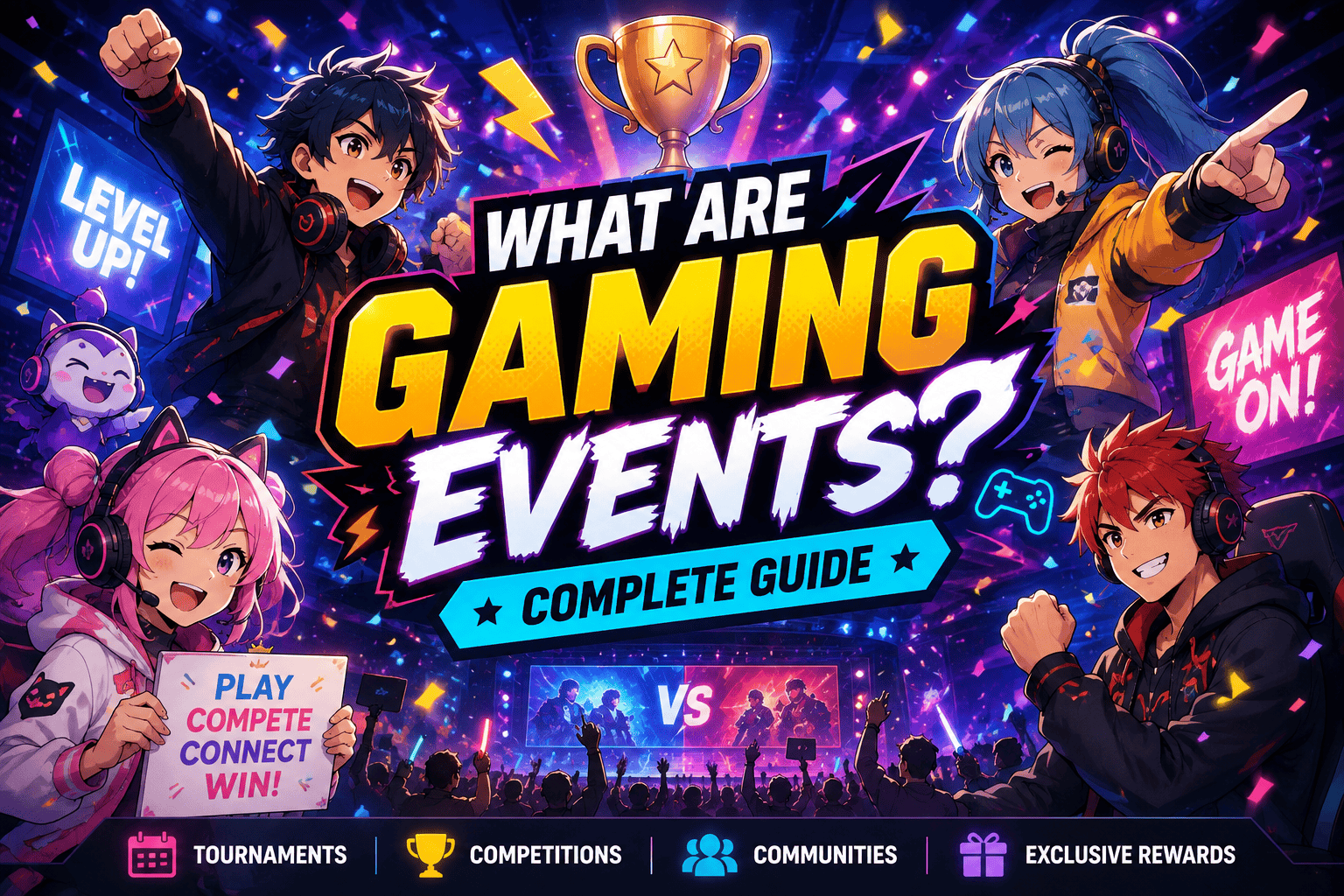
Gaming used to be pretty simple. You had a game, a screen and, if you were lucky, a second controller so you could argue with someone sitting next to you instead of someone halfway around the world.
Gaming events take that experience far beyond the couch.
From enormous conventions packed with new games and thousands of fans to local esports tournaments, indie showcases, retro gaming festivals and community LAN parties, gaming events bring people together around the games and gaming culture they enjoy.
Some people go to compete. Others want to watch professional players, try unreleased games, meet developers, buy gaming merchandise or finally meet friends they’ve spent hundreds of hours gaming with online.
And plenty of people simply want to walk around looking at cool gaming stuff for a day.
So what exactly counts as a gaming event, what happens at one and how do you find an event worth attending?
That’s what this guide is about.
We’ll look at the different types of gaming events, what you can expect when you attend, how much they can cost, how tournaments work and how to find events happening near you or around the world.
🔥 Why Are Gaming Events So Popular?
Video games are naturally interactive, but gaming itself can sometimes be surprisingly isolated.
You might spend hundreds of hours playing with the same group of people without ever being in the same room. You can follow an esports team for years without seeing them compete in person. You might watch trailers for an upcoming game without ever getting the chance to actually play it.
Gaming events change that.
They turn something normally experienced through a screen into something you can experience with other people.
Gaming Becomes a Shared Experience
One of the biggest attractions is simply being surrounded by people who understand what you’re interested in.
At a general gaming convention, you might find competitive players, casual gamers, developers, streamers, collectors, cosplayers, esports fans and someone who has somehow spent 600 hours playing a game they regularly claim to hate.
Everyone is there for slightly different reasons, but gaming gives them something in common.
That makes events particularly good places to meet people, discover gaming communities and turn online friendships into real-world ones.
You Can Experience Games Differently
Gaming events can also give you access to experiences you simply don’t get at home.
Depending on the event, you might:
- 🎮 Play upcoming or unreleased games
- 🏆 Watch professional esports live
- 🕹️ Compete in tournaments
- 💡 Discover indie games you’ve never heard of
- 👾 Play classic consoles and arcade machines
- 🎤 Attend developer panels
- 🦸 See cosplay competitions
- 🤝 Meet creators, developers or professional players
- 🛍️ Browse gaming merchandise and collectibles
A trailer can show you a game.
An event might let you play it, talk to the person who made it and then spend the next twenty minutes explaining to your friend why you absolutely need to buy it.
The Atmosphere Matters
Watching an esports final at home can be entertaining.
Watching the same final surrounded by thousands of people reacting to every play feels completely different.
The same applies to game announcements, cosplay competitions, tournaments and major reveals.
That shared atmosphere is one of the reasons people travel considerable distances for major gaming events rather than simply watching everything online.
🕹️ What Are the Different Types of Gaming Events?
“Gaming event” is an umbrella term rather than one specific type of event.
A 50-person local tournament and a huge international gaming convention can both be gaming events, despite having almost nothing else in common.
Understanding the different types of gaming events is therefore one of the easiest ways to work out what you’d actually enjoy attending.
Here are some of the most common formats.
🎪 Gaming Conventions
Gaming conventions are usually broad events built around multiple parts of gaming culture.
You might find:
- Playable games and demos
- Publisher and developer booths
- Indie games
- Esports competitions
- Cosplay
- Panels and talks
- Creators and special guests
- Merchandise
- Artist areas
- Retro gaming
- Tabletop gaming
- Community meetups
The big advantage is variety.
You don’t necessarily need to arrive obsessed with one particular game or competition. You can spend an hour trying indie games, watch an esports match, wander through the merchandise area and accidentally lose another hour staring at things you had absolutely no intention of buying.
Conventions are often a good choice for someone’s first major gaming event because there are usually plenty of different things to experience.
🏆 Esports Events and Gaming Tournaments
Esports events put competition at the centre of the experience.
At the highest level, these can involve professional teams, large arenas, prize pools, commentators, stage production and thousands of spectators.
But esports events aren’t limited to professional players.
Local and amateur tournaments can be held at gaming cafés, universities, conventions, dedicated esports venues and community spaces.
Depending on the event, you might find competitions for:
- First-person shooters
- Fighting games
- MOBAs
- Sports games
- Racing games
- Battle royale games
- Strategy games
- Mobile games
Some tournaments are primarily spectator events. Others allow ordinary players to register and compete.
If the atmosphere of live competition is what interests you most, exploring some of the best esports events and tournaments to attend can give you a much better idea of how different competitive events work.
🚀 Gaming Expos and Industry Shows
Gaming expos tend to focus more heavily on what’s happening – or what’s coming next – in the games industry.
They can feature:
- Upcoming games
- New hardware
- Technology demonstrations
- Publisher showcases
- Developer presentations
- Industry announcements
- Business networking
- Playable demos
Some expos are designed primarily for consumers, while others are aimed at developers, publishers, media and other gaming professionals.
There is also plenty of overlap between expos and conventions.
An event might call itself an expo while including cosplay, esports, merchandise and community activities. Another might use the word convention while putting enormous emphasis on new game announcements.
There isn’t a Gaming Event Police Department enforcing the terminology.
What matters more is what the event actually offers.
💡 Indie Gaming Events and Festivals
Indie gaming events put smaller developers and independent games in the spotlight.
These can be some of the most interesting events for gamers who enjoy discovering something new rather than heading straight for the biggest publisher booth.
You might get to play:
- Unreleased indie games
- Experimental projects
- Student games
- Early prototypes
- Game jam creations
- Games looking for publishers or community feedback
One of the biggest differences is access to developers.
At a smaller indie showcase, the person standing next to the demo might actually be the person who designed, programmed or illustrated the game.
That creates a very different experience from playing a polished demo at a huge commercial booth.
For gamers who enjoy finding unusual games before everyone else starts talking about them, the best indie gaming events and festivals can be particularly worth exploring.
👾 Retro Gaming Events
Not every gaming event is obsessed with what’s coming next.
Retro gaming events celebrate what came before.
Expect things such as:
- Classic consoles
- Arcade cabinets
- Vintage computers
- Retro tournaments
- Speedrunning
- Collectibles
- Rare games
- Gaming memorabilia
- Console modding and restoration
- Gaming history
These events attract plenty of people who grew up with older consoles, but they’re not just nostalgia festivals for gamers whose knees now make noises when they stand up.
Younger players also attend to experience hardware and games they may only have seen online, while collectors come looking for games, consoles and accessories that are becoming increasingly difficult to find.
Our guide to the best retro gaming events and conventions looks more closely at the events built around classic gaming.
🖥️ LAN Parties and Community Gaming Events
At the other end of the scale from enormous conventions are smaller community events.
Traditional LAN parties involved bringing computers or consoles together and connecting them over a local network for multiplayer gaming.
They still exist, although modern community gaming events can take many different forms.
You might find them organised by:
- Gaming cafés
- Universities
- Schools
- Libraries
- Community centres
- Gaming clubs
- Esports organisations
- Game stores
- Charities
- Groups of local players
Some are competitive. Others are purely social.
The important point is that a gaming event doesn’t need thousands of attendees, celebrity guests or a convention centre to be worthwhile.
Sometimes a room full of PCs, a tournament bracket and enough energy drinks to concern a cardiologist is all that’s required.
🌐 Online and Hybrid Gaming Events
Gaming events don’t necessarily require everyone to be in the same physical location.
Online events can include:
- Esports tournaments
- Community competitions
- Digital game showcases
- Livestreamed panels
- Game jams
- Charity gaming events
- Developer presentations
Hybrid events combine online and physical participation.
For example, tournament qualifiers might take place online before the best players travel to a physical final. A convention might also livestream major panels and competitions for people who can’t attend.
Online events are easier to access and remove much of the cost of travel, but physical events usually offer something online participation struggles to replicate: being surrounded by other people experiencing the same thing at the same time.
🎯 What Actually Happens at Gaming Events?
Knowing the type of event only tells you part of the story.
The better question is often:
What will I actually be doing when I get there?
The answer depends heavily on the event, but most gaming events combine some mixture of playing, watching, discovering and socialising.
🎮 Playing Games
Playable games are one of the biggest attractions at many conventions, expos and festivals.
You may get the chance to try:
- Upcoming releases
- Indie games
- Retro games
- Virtual reality experiences
- Racing or flight simulators
- Arcade games
- Competitive titles
- Local multiplayer games
- New gaming hardware
At larger events, popular demos can attract significant queues, so it helps to identify the games you really want to try rather than attempting to play everything.
Smaller booths can be just as worthwhile.
In fact, wandering into an indie section with no idea what you’re about to play is one of the easiest ways to discover something completely unexpected.
🏆 Watching Esports and Tournaments
Competitive gaming is another major part of many events.
Even conventions that aren’t primarily esports events may have tournament stages, exhibition matches or community competitions running throughout the day.
Live esports can include huge screens, commentators, player introductions, lighting, music and a crowd reacting to every major play.
And you don’t need encyclopaedic knowledge of the game to enjoy it.
Sometimes understanding that one team has just done something spectacular because 4,000 people suddenly started screaming is enough.
🎤 Panels, Talks and Developer Sessions
Gaming events aren’t all noise and flashing screens.
Panels and presentations can cover topics such as:
- Game development
- Art and animation
- Game design
- Writing and storytelling
- Esports
- Streaming
- Content creation
- Voice acting
- Gaming history
- Careers in gaming
- Upcoming releases
These sessions can be particularly valuable if you’re interested in what happens behind the scenes.
At larger conventions, it’s worth checking the schedule before arriving because popular panels may clash with tournaments, demos or other activities you want to see.
🦸 Cosplay, Merchandise and Gaming Culture
Modern gaming events often overlap with the wider culture around games.
Cosplay competitions, artist alleys, collectibles, gaming clothing, fan art and merchandise can occupy substantial parts of a convention.
You may also find:
- Cosplay parades
- Photography areas
- Prop-making workshops
- Artist stalls
- Limited-edition merchandise
- Gaming memorabilia
- Community displays
If you’re buying merchandise, setting yourself a budget beforehand isn’t a terrible idea.
“Event exclusive” is an alarmingly persuasive combination of words when you’ve been walking around a convention hall for six hours.
🤝 Meeting Gamers, Creators and Developers
For many people, the social side ends up being one of the best parts of the event.
Gaming events can be places to:
- Meet online friends in person
- Find local gaming communities
- Meet creators and streamers
- Speak with indie developers
- See professional players and commentators
- Connect with people working in gaming
- Make completely new friends
You don’t need to approach an event like a networking conference with a stack of business cards.
Sometimes it starts with two people standing in the same demo queue talking about a game they both like.
That’s one of the things gaming events do particularly well: they give people who already share an interest an easy reason to start talking.
👥 Who Are Gaming Events For?
One of the biggest misconceptions is that gaming events are mainly for hardcore gamers.
They’re not.
Depending on the event, you’ll find:
- 🎮 Casual gamers
- 🏆 Competitive players
- 👨👩👧 Families
- 🎥 Streamers and content creators
- 👾 Retro gaming fans
- 🎨 Artists and cosplayers
- 💻 Game developers
- 💎 Collectors
- 📣 Esports fans
- 🎓 Students and aspiring industry professionals
- 🤝 People who simply want to meet other gamers
You don’t need to play games eight hours a day. You don’t need an esports ranking. You don’t need to know every character, developer or gaming acronym in existence.
If something about the event interests you, that’s generally enough reason to go.
Different Events Suit Different Gamers
The more important question isn’t whether gaming events are “for you”.
It’s which gaming event is for you.
If you love competition, an esports tournament might be ideal.
If you want a little bit of everything, try a convention.
If discovering strange new games is your thing, look at indie festivals.
If you want to relive the games you grew up playing, retro events might be a better fit.
And if you’d rather meet a smaller group of gamers without spending three days navigating a convention centre the size of a small country, a local gaming meetup could be perfect.
There really isn’t one correct way to attend gaming events.
The goal is simply to find the kind of experience that matches the way you enjoy gaming.
🌱 Are Gaming Events Beginner-Friendly?
Absolutely.
You don’t need to know exactly how gaming events work before attending one. Most people didn’t have a clue what they were doing at their first convention, tournament or LAN event either.
The experience does vary depending on the type of event, though.
Your First Gaming Convention
Large gaming conventions are usually very beginner-friendly because you can explore them at your own pace.
There’s no requirement to participate in everything. You can spend the day trying games, watching tournaments, browsing merchandise, attending panels or simply wandering around until something catches your attention.
The biggest adjustment is often the scale.
Large conventions can involve:
- 👥 Thousands of attendees
- 🎮 Multiple gaming areas
- 🎤 Several stages or panel rooms
- 🏆 Tournaments running simultaneously
- 🛍️ Large merchandise areas
- 🗺️ A venue that takes time to understand
- ⏳ Queues for popular activities
You don’t need a military-grade itinerary, but having a rough idea of what you want to see makes the day much easier.
If you’re heading to a major event for the first time, knowing what to expect at your first gaming convention can help you avoid spending the first hour staring at an event map wondering where everyone else seems to know they’re going.
Watching Is Usually Easy
Esports events can be even simpler for beginners if you’re attending as a spectator.
Find your seat, work out who’s playing and enjoy the competition.
You don’t necessarily need deep knowledge of the game either. Commentary, screens and crowd reactions usually make the important moments fairly obvious.
Competing Requires a Little More Preparation
Entering a tournament is different.
You’ll normally need to understand:
- Registration requirements
- Check-in times
- Tournament rules
- Match formats
- Equipment requirements
- Eligibility restrictions
None of that means tournaments aren’t beginner-friendly.
It simply means you should read the rules before arriving rather than discovering five minutes before your first match that the tournament format isn’t what you expected.
🔎 How Do You Find Gaming Events?
Finding the biggest gaming conventions isn’t particularly difficult.
Finding the smaller event happening 20 minutes from your house next weekend can be much harder.
Gaming events are scattered across convention websites, ticketing platforms, esports communities, gaming venues, social media pages, Discord servers and local organisations.
There isn’t one universal calendar containing every gaming event in existence.
That means finding good events often requires using several different sources.
Use a Gaming Event Directory
A dedicated event directory can make discovery much easier because you can browse events you may not already know exist.
StackedGame Events is built specifically around gaming events, allowing gamers to discover conventions, esports competitions, tournaments, festivals and other gaming experiences.
This is particularly useful because searching normally works best when you already know what you’re looking for.
It’s easy to Google the name of a major convention you’ve heard about.
It’s much harder to Google an interesting local gaming event you don’t know exists.
Search by Game
If you’re interested in a particular game, start there.
Try searches built around:
Game + tournament
Game + event
Game + competition
Game + convention
Game + city
For competitive games, community websites, Discord servers and social accounts can also be particularly useful because smaller tournaments are often promoted directly to existing players.
Follow Gaming Venues and Communities
Local gaming venues can be surprisingly good sources of events.
Look at:
- Gaming cafés
- Esports venues
- Universities
- Game stores
- Arcade venues
- Gaming clubs
- Community organisations
- Local convention centres
Following their social pages can reveal tournaments and community events that might never appear prominently in a general web search.
Use Social Media and Discord
Gaming communities often promote events through Discord, Reddit and social media before they gain much visibility elsewhere.
This is especially common for:
- Community tournaments
- Fighting game events
- LAN parties
- Local esports competitions
- University gaming events
- Game-specific meetups
The downside is fragmentation.
You might need to know which communities to follow before you can discover what they’re organising.
That’s why combining community sources with event directories and normal search usually works better than relying on one method alone.
📍 How to Find Gaming Events Near You
You don’t necessarily need to fly across the country – or halfway around the world – to attend a worthwhile gaming event.
There may already be events happening closer than you think.
The trick is knowing where to look.
Our dedicated guide on how to find gaming events near you goes much deeper into local event discovery, but there are a few good places to start.
Search Your City, Not Just Your Country
Broad searches such as “gaming events Australia” or “gaming events USA” tend to favour major conventions.
That’s useful if you’re looking for large events, but not necessarily if you want something happening nearby.
Try combining your city or region with terms such as:
- Gaming events
- Gaming conventions
- Esports tournaments
- Video game tournaments
- LAN events
- Retro gaming events
- Gaming expos
- Indie game events
You can also search nearby cities if you’re willing to travel.
A two-hour drive for a great event can be much more practical than waiting for a giant convention to arrive on your doorstep.
Look Beyond Traditional Convention Venues
Not every gaming event happens inside a huge exhibition centre.
Smaller events can appear in:
- Gaming cafés
- Universities
- Hotels
- Community centres
- Shopping centres
- Libraries
- Esports arenas
- Game stores
- Pubs and entertainment venues
A local fighting game tournament might have 60 people in a gaming venue rather than 60,000 people in a convention centre.
That doesn’t automatically make it less enjoyable.
For some gamers, it’s exactly the opposite.
Decide How Far You’re Willing to Travel
It helps to think about event discovery in three levels:
Local → National → International
A local event might cost little more than your ticket and transport.
A national event could involve flights or a long drive.
An international convention can become an entire holiday.
All three can be worthwhile, but the decision changes dramatically once accommodation and travel become part of the equation.
🌍 Finding the Right Gaming Event for You
Finding an event is one thing.
Finding one you’ll actually enjoy is another.
A famous event isn’t automatically the best event for you, and the biggest gaming convention isn’t necessarily better than a smaller specialist event.
Start with the experience you want.
Want a Bit of Everything? → Gaming Convention
A broad gaming convention is usually the safest choice if you want variety.
You can move between games, esports, panels, cosplay, merchandise and community areas without committing your entire day to one activity.
They’re particularly good if you’re attending with friends who have different gaming interests.
Want to Watch Competition? → Esports Event
If professional competition is the main attraction, look for an esports event built around a game or league you follow.
The atmosphere of watching a major match live can be one of the most memorable gaming event experiences.
You also know exactly what you’re going for, which makes planning simpler.
Want to Compete? → Gaming Tournament
If you’d rather be holding the controller than watching someone else use it, look for tournaments you can actually enter.
Community and amateur events are often better starting points than trying to launch your competitive career by wandering directly into the toughest event you can find.
Your ego will appreciate the gradual introduction.
Want to Discover New Games? → Indie Festival or Expo
Indie festivals and gaming expos are ideal if discovery is the main attraction.
You can spend hours trying games you’ve never seen before and speaking directly with the people creating them.
For some gamers, finding one unexpected game they love is worth the ticket price on its own.
Want Classic Games? → Retro Gaming Event
If your idea of a good day involves arcade cabinets, old consoles and games that expect you to survive without autosave, a retro event is probably a better choice.
These events can also be great places to meet collectors, discover gaming history and see hardware that’s becoming increasingly difficult to find.
Want Something Social? → Local Community Event
Don’t overlook smaller gaming events.
LAN parties, gaming café tournaments, university events and local meetups can be easier places to actually meet people than huge conventions.
There are fewer crowds, less rushing between activities and usually more opportunity to interact with the same people throughout the event.
The best gaming event isn’t necessarily the biggest one. It’s the one that gives you the experience you’re looking for.
👀 What Should You Expect at Your First Gaming Event?
Your first gaming event can feel slightly overwhelming when you arrive.
There’s noise coming from multiple directions, people moving everywhere and approximately twelve things happening at the same time.
That’s normal.
You don’t need to experience everything.
Expect Crowds
Large gaming events can get busy, particularly around:
- Popular game demos
- Main stages
- Esports finals
- Merchandise booths
- Meet-and-greets
- Food areas
- Entrances and exits
If there’s something you absolutely don’t want to miss, arrive early rather than assuming you’ll be able to walk straight in.
Expect Queues
Queues are part of major conventions.
The most popular demos, signings and activities can have significant waiting times.
Before joining a long queue, ask yourself whether that particular experience is worth giving up an hour of your event.
Sometimes it is.
Sometimes the mysterious indie game with nobody waiting turns out to be much more interesting.
Expect to Walk – A Lot
Comfortable shoes are one of the least exciting but most valuable things you can bring to a large gaming event.
Convention venues can be enormous, and you may spend most of the day moving between halls, stages and activity areas.
This is not the ideal occasion to discover that your new shoes look considerably better than they feel.
Expect Noise and Stimulation
Gaming events can be loud.
You’ve potentially got:
Esports commentary + game audio + music + crowds + stage announcements + thousands of conversations happening simultaneously.
If you’re sensitive to noise, earplugs or noise-reducing headphones can make the experience much more comfortable.
It’s also completely fine to step outside or find a quieter area for a while.
Have a Plan – But Don’t Overplan
Check the event schedule beforehand and identify a few things you definitely want to see.
Then leave space between them.
Some of the best parts of gaming events are the things you didn’t know were there until you walked past them.
Trying to schedule every ten minutes turns a gaming convention into a project management exercise.
A better approach is:
Pick your must-sees → Know when they happen → Explore everything else around them.
That gives you enough structure to avoid missing the important stuff without spending the entire day staring at the clock.
And once you’ve survived your first event, you’ll have a much better idea of what you actually want from the next one.
💰 How Much Do Gaming Events Cost?
Gaming events can cost almost nothing or turn into a fairly serious travel budget.
It depends on the event, where it’s held and how you want to experience it.
A small local tournament might only require an entry fee and transport. A major international convention could involve flights, accommodation and several days of spending before you’ve even considered buying that suspiciously tempting limited-edition collectible.
The Ticket Isn’t the Only Cost
When deciding whether an event fits your budget, consider the full cost:
- 🎟️ Event ticket
- 🚗 Transport or fuel
- ✈️ Flights
- 🏨 Accommodation
- 🅿️ Parking
- 🚆 Local transport
- 🍔 Food and drinks
- 🛍️ Merchandise
- 🏆 Tournament entry fees
- 📸 Meet-and-greets or premium activities
For a local event, many of these won’t apply.
For a large convention requiring travel, the ticket itself might actually be one of the smaller expenses.
That’s why it’s useful to calculate the cost of attending a gaming convention based on the whole trip rather than the advertised ticket price.
Gaming Event Ticket Types
Larger events may offer several ticket options, such as:
Single-day tickets – entry for one particular day.
Weekend passes – access across multiple days.
Premium or VIP passes – potentially offering earlier entry, reserved areas, merchandise or other extras.
Tournament tickets – entry to a specific competition.
Spectator tickets – access to watch an esports competition without participating.
Before paying extra for a premium ticket, check exactly what it includes.
“VIP” sounds impressive.
Standing in a slightly different queue while holding a branded lanyard may or may not be worth an extra hundred dollars.
Free Gaming Events Exist Too
Not every gaming event charges admission.
Community events, game launches, university events, small indie showcases and promotional gaming experiences can sometimes be free.
There may also be free areas attached to larger festivals or esports events.
If you’re new to gaming events, smaller free or inexpensive events can be an easy way to see whether you enjoy the experience before committing to a major convention trip.
🎒 What Should You Bring to a Gaming Event?
You generally don’t need to pack half your house for a gaming convention.
A few practical essentials will make the day considerably easier.
A basic gaming event kit might include:
- 🎟️ Your ticket or QR code
- 🪪 Photo ID if required
- 📱 Phone
- 🔋 Portable charger
- 💳 Card or another payment method
- 💧 Water bottle if the venue allows one
- 💊 Any medication you need
- 👟 Comfortable shoes
- 👕 Comfortable clothing
- 🎒 A small bag if permitted
If your ticket is digital, taking a screenshot before arriving can be surprisingly useful.
Mobile reception becomes considerably less reliable when thousands of people in the same building all decide they need the internet at once.
Check the Event’s Rules First
Different venues have different restrictions.
Before packing, check rules covering:
- Bag sizes
- Outside food and drinks
- Water bottles
- Cameras
- Cosplay props
- Weapons policies
- Gaming equipment
- Re-entry
- Age requirements
Cosplayers should pay particular attention to prop rules.
A perfectly acceptable fantasy sword in your living room may become considerably more complicated when venue security gets involved.
For a more complete packing list, our gaming convention checklist covers what to bring, what to leave at home and the easy-to-forget items that can make a long convention day much more comfortable.
Prepare Before You Leave
Packing is only part of getting ready.
Before the event, it’s worth checking:
- 🗺️ Venue location and entry points
- 🕐 Opening and closing times
- 🎤 Panel and activity schedules
- 🎮 Demo locations
- 🏆 Tournament registration times
- 🚗 Parking or transport options
- 📋 Event rules
If you’re travelling, add accommodation check-in, transport between your hotel and the venue and enough time for unexpected delays.
Our guide on how to prepare for a gaming convention goes into the planning side in more detail.
The goal isn’t to organise every minute.
It’s to deal with the boring practical stuff beforehand so you can spend more time enjoying the event once you’re there.
🏆 Can Anyone Enter a Gaming Tournament?
Sometimes.
One of the great things about competitive gaming is that plenty of tournaments are open to ordinary players.
You don’t necessarily need to be a professional, belong to an esports organisation or have thousands of followers.
But every tournament can set its own eligibility requirements.
Open vs Restricted Tournaments
An open tournament generally allows anyone who meets the basic entry requirements to register.
Other competitions may be restricted according to factors such as:
- Age
- Region
- Rank or skill level
- Platform
- Team membership
- Account requirements
- Qualification results
- League membership
- Entry fees
Professional esports events may also use qualification systems where teams or players earn their place through earlier competitions.
Always read the eligibility rules before registering.
Discovering you’re not eligible after booking travel is considerably worse than discovering it while sitting at home.
Look for Beginner and Community Competitions
Your first tournament doesn’t need to be a major esports competition.
Local tournaments, community events and convention competitions can provide a much easier introduction.
These events often attract a wider range of skill levels and can be less intimidating than highly competitive regional or national tournaments.
You may still get destroyed.
But at least you’ll get destroyed educationally.
A first tournament gives you experience with match pressure, tournament rules, check-in procedures and playing against unfamiliar opponents.
Even losing quickly can teach you things normal matchmaking doesn’t.
🔎 How Do You Find Esports Tournaments Near You?
Finding professional esports events is usually straightforward because major competitions receive plenty of promotion.
Finding smaller tournaments you can actually enter requires a little more digging.
Good places to look include:
- 🏆 Gaming event directories
- 🎮 Game-specific communities
- 💬 Discord servers
- 📱 Social media
- 🖥️ Gaming cafés
- 🏟️ Esports venues
- 🎓 Universities
- 🎪 Gaming conventions
- 🕹️ Local gaming clubs
You can also browse StackedGame Events for gaming events and tournaments rather than relying entirely on knowing the name of an event beforehand.
Search for Your Game Specifically
If you want to compete, generic searches such as “gaming tournament near me” can be too broad.
Try:
Game + tournament + city
or:
Game + esports + region
For example:
Tekken tournament Perth
Valorant tournament Sydney
Rocket League tournament London
The more specific the game and location, the more useful the results are likely to become.
Our guide on how to find esports tournaments near you explores the different discovery methods in more detail, including local competitions that may not receive much mainstream promotion.
Check the Details Before Registering
Finding a tournament isn’t enough.
Before entering, confirm:
- Location
- Date and time
- Game
- Platform
- Format
- Skill requirements
- Age requirements
- Entry fee
- Prize information
- Registration deadline
- Check-in requirements
Also check whether equipment is provided.
Some events supply everything.
Others expect you to bring a controller, headset or even an entire setup.
Turning up ready to compete without the equipment required to actually compete is not an ideal opening strategy.
🥇 How to Enter Your First Gaming Tournament
Entering your first gaming tournament can sound intimidating.
In practice, the process is usually fairly straightforward:
Find → Check Rules → Register → Prepare → Check In → Compete
The stressful part is generally the competing.
The administrative side shouldn’t be.
1. Find the Right Tournament
Start with something appropriate for your experience.
A local or community tournament can be a much better first step than immediately trying to qualify for a major esports event.
Look for:
- Open entry
- Beginner-friendly formats
- Community tournaments
- Local competitions
- Convention tournaments
If the event publishes previous results or player lists, you may also get a rough idea of the competition level.
2. Read the Rules
Don’t skip this.
Tournament rules can cover:
- Match format
- Maps or stages
- Character restrictions
- Equipment
- Controllers
- Pausing
- Disconnects
- Reporting results
- Behaviour
- Check-in
- Late arrivals
Knowing the rules prevents avoidable mistakes and lets you practise under the same conditions you’ll encounter at the event.
3. Register Before the Deadline
Some tournaments allow registration on the day.
Others don’t.
If there’s an online registration system, complete it early rather than assuming there will still be space when you arrive.
Large tournaments can fill up.
4. Practise the Tournament Format
Normal matchmaking and tournament play aren’t always identical.
If matches use a particular map pool, ruleset, game mode or best-of series, practise under those conditions.
You don’t need to transform into an esports professional overnight.
You just don’t want your first experience of the format to happen during your first official match.
5. Arrive and Check In Early
Give yourself more time than you think you need.
You may have to:
- Find the tournament area
- Confirm registration
- Check in
- Set up equipment
- Locate your station
- Meet teammates
- Listen to a player briefing
Arriving early also gives you time to solve problems without immediately entering panic mode.
6. Compete – and Learn Something
Your first tournament might go brilliantly.
It might also last approximately twelve minutes.
Both outcomes are useful.
Tournament play exposes you to different opponents, different pressure and different ways of playing the game.
Pay attention to what stronger players do, talk to other competitors and ask questions where appropriate.
You may leave with a trophy.
You may leave with a very clear understanding of why you didn’t get a trophy.
Either way, you’ve gained something.
If competing sounds like something you’d like to try, our complete guide to entering your first gaming tournament takes you through the process from finding the right competition to preparing for your first match.
✨ Why Attend a Gaming Event?
You can play games at home. You can watch esports online. You can buy merchandise without leaving the couch.
So why bother going to a gaming event?
Because the experience is different.
Gaming events turn something you normally experience through a screen into something happening around you.
Experience Gaming With a Crowd
This is particularly noticeable with esports.
A huge play in an important match feels different when thousands of people react to it at the same time.
The same applies to game reveals, tournament finals, cosplay competitions and other major moments.
You’re not just watching something happen.
You’re part of the audience experiencing it.
Discover Games You Might Otherwise Miss
Events are also excellent for discovering games outside your usual rotation.
Maybe you try an indie game because the booth happens to be nearby.
Maybe you sit down at an arcade cabinet you’ve never played.
Maybe a developer convinces you to try something that looked completely uninteresting in screenshots but turns out to be brilliant once you’re actually playing it.
Gaming algorithms are very good at recommending more of what you already like.
Events are good at putting something unexpected directly in front of you.
Meet People Who Like the Same Things
Gaming events create an easy starting point for conversations.
You’re already surrounded by people who chose to spend their day at the same event.
That might mean meeting:
- 🤝 Other local gamers
- 🎮 People who play the same games
- 🎥 Creators you follow
- 🏆 Competitive players
- 💻 Developers
- 🎨 Artists and cosplayers
- 👾 Collectors and retro gaming fans
For people who mainly interact with gaming communities online, meeting those communities in person can be one of the biggest reasons to attend.
Try Before You Buy
Conventions and expos can also let you experience games and hardware before spending money on them.
That might include:
- Upcoming games
- Gaming peripherals
- VR hardware
- Sim racing equipment
- Controllers
- Handheld systems
- Gaming accessories
A few minutes actually using something can tell you considerably more than another hour watching reviews.
Make an Experience Out of It
For major events, gaming can become the reason for an entire trip.
You might attend a convention with friends, travel to another city for an esports final or build part of a holiday around an international gaming event.
At that point, the event isn’t just something you attended.
It’s something you remember doing.
💰 Are Gaming Events Worth It?
They can be.
But not every gaming event is worth attending for every gamer.
A better question is:
Is this particular gaming event worth it for me?
Look at What You’ll Actually Do
Don’t judge an event entirely by its name, size or marketing.
Look at what’s actually happening.
Check:
- 🎮 Playable games
- 🏆 Tournaments
- 🎤 Panels
- 👥 Guests
- 🦸 Cosplay
- 💻 Exhibitors
- 🛍️ Merchandise
- 🎯 Activities
- 🕐 Event schedule
If there are five things you’re genuinely excited about, that’s a good sign.
If you’re struggling to find one, a famous event logo probably isn’t enough to justify the expense.
Calculate the Real Cost
A $50 ticket doesn’t make something a $50 event if you need another $500 for flights and accommodation.
Consider:
Ticket + Travel + Accommodation + Food + Extras = Real Event Cost
Then decide whether the experience feels worth that amount.
This becomes particularly important when comparing a major convention in another city with a smaller event closer to home.
Consider What You Can’t Get Elsewhere
Some experiences are difficult to replicate.
Watching a major esports final live, playing an unreleased game, meeting a developer or attending an event with friends from around the country can justify travelling further.
If most of what interests you can be experienced locally or online, the calculation may be different.
Our guide exploring whether gaming conventions are worth it looks more closely at the benefits, drawbacks and costs to consider before buying a ticket.
Ultimately, value is personal.
For one gamer, three days in a packed convention centre sounds incredible.
For another, it sounds like a fairly expensive way to stand in queues.
Both are reasonable opinions.
🌍 Gaming Events Around the World
Gaming events happen at almost every scale imaginable.
You might find a 30-player tournament at a local gaming café one weekend and an international convention attracting tens of thousands of people the next.
A simple way to think about it is:
Local Meetup → Regional Event → National Convention → International Gaming Event
Each level offers something different.
Local and Regional Events
Local events are usually easier and cheaper to attend.
They can include:
- Community tournaments
- LAN parties
- Gaming café events
- Retro gaming meetups
- University events
- Indie showcases
- Small conventions
- Local esports competitions
These events may not have enormous publisher booths or famous esports teams, but they can be much better for meeting people in your local gaming community.
They’re also easier to attend regularly.
National Gaming Events
Larger national events can attract gamers from across a country.
They may feature bigger tournaments, major exhibitors, publishers, creators, cosplay competitions and larger gaming showcases.
For many gamers, this is where attending an event becomes a trip rather than simply something to do on Saturday afternoon.
International Gaming Events
At the top end are major international conventions, esports championships, expos and gaming festivals.
These events can attract visitors, developers, players and companies from around the world.
Some gamers even plan holidays around them.
If you’re interested in making a gaming event the centrepiece of a future trip, our guide to the best gaming events in the world is a useful place to start exploring what’s out there.
But remember:
Biggest doesn’t automatically mean best.
A smaller event built around exactly what you enjoy can be more worthwhile than travelling halfway around the world for a famous convention where only a small part of the programme interests you.
📢 Can You List and Promote Your Own Gaming Event?
Gaming events don’t just need attendees.
They need people willing to organise them.
And you don’t need to be running a massive international convention to create something worth promoting.
Gaming events can be organised by:
- 🎮 Gaming communities
- 🏆 Tournament organisers
- 🖥️ Gaming cafés
- 🎓 Universities and clubs
- 💻 Indie developers
- 👾 Retro gaming groups
- 🏪 Game stores
- 🤝 Community organisations
- 🎗️ Charities
- 🏢 Professional event companies
Whether you’re organising a local tournament or a multi-day convention, one of the biggest challenges is getting the right people to discover it.
Make Your Event Easy to Understand
A useful event listing should answer the obvious questions quickly.
People need to know:
- What is the event?
- When is it?
- Where is it?
- Is it physical, online or hybrid?
- What games are involved?
- Who is it for?
- How much does it cost?
- Do attendees need to register?
- Can players enter competitions?
- Where can they get tickets or more information?
Don’t make potential attendees investigate your event like they’re solving an optional side quest.
The easier it is to understand, the easier it is to decide whether to attend.
Promote It Where Gamers Are Looking
Event promotion can involve:
- Social media
- Discord communities
- Gaming forums
- Local gaming groups
- Game-specific communities
- Creator partnerships
- Venue promotion
- Search engines
- Event directories
Different channels reach different audiences, so relying on one social post and hoping the algorithm feels generous that day isn’t much of a promotion strategy.
You can also list your gaming event on StackedGame Events to help gamers discover it while they’re actively looking for gaming events.
For organisers who want to go further, our guide on how to list and promote a gaming event online covers event listings, promotion channels and ways to improve discoverability.
❓ Frequently Asked Questions About Gaming Events
What Is Considered a Gaming Event?
A gaming event is an organised physical, online or hybrid event centred around video games, competitive gaming or gaming culture.
Examples include gaming conventions, esports tournaments, expos, indie festivals, retro gaming events, LAN parties and community gaming meetups.
What Happens at a Gaming Convention?
Gaming conventions can include playable games, esports tournaments, developer booths, panels, cosplay, merchandise, creators, indie games, retro gaming and community activities.
The exact experience varies considerably between events.
Are Gaming Events Suitable for Beginners?
Yes.
Most gaming events don’t require any particular gaming ability or previous event experience.
Large conventions can initially feel overwhelming because of the crowds and number of activities, but you can generally explore them at your own pace.
Do You Have to Be Good at Games to Attend?
No.
Most attendees aren’t competing.
You can attend to watch esports, try games, meet people, browse merchandise, attend panels or simply experience the event.
Skill only becomes relevant when you’re entering competitions with specific eligibility or ranking requirements.
Can Children Attend Gaming Events?
Many gaming events allow children, but age policies vary.
Some require younger attendees to be accompanied by an adult, while particular tournaments, games, evening activities or event areas may have age restrictions.
Always check the event’s official age policy before buying tickets.
Are Gaming Events Free?
Some are.
Local community events, promotional events, indie showcases and smaller gaming activities may offer free admission.
Major conventions and professional esports events are more likely to require paid tickets.
Can Anyone Enter an Esports Tournament?
Some tournaments have open registration, while others have eligibility requirements based on age, region, skill level, qualification results, platform or other factors.
Check the tournament rules before registering.
Where Can I Find Gaming Events Near Me?
Gaming event directories, local gaming venues, social media, Discord communities, universities, esports venues and web searches are all useful places to look.
You can also browse StackedGame Events or use our guide to finding gaming events near you for more ways to discover events in your area.
What’s the Difference Between a Gaming Convention and an Esports Event?
A gaming convention usually covers a broad range of gaming activities such as demos, exhibitors, panels, cosplay, merchandise and community experiences.
An esports event is primarily focused on competitive gaming.
There can be significant overlap – a convention may host esports tournaments, while a large esports event may include merchandise, exhibitors and other activities.
Our comparison of gaming conventions vs esports events explores the differences in more detail.
🚀 Find Your Next Gaming Event
Gaming events can be almost anything.
A huge international convention.
A professional esports final.
An indie festival full of games you’ve never heard of.
A retro event packed with arcade cabinets.
A local tournament with 40 players.
Or a community LAN where everyone turns up because they’d rather spend Saturday gaming with other people than sitting at home.
That’s part of what makes gaming events interesting.
There isn’t one correct way to experience them.
If you want variety, start with a gaming convention.
If you love competition, watch an esports event or enter a tournament.
If you enjoy discovering games, explore indie festivals and expos.
If classic gaming is more your thing, find a retro event.
And if you’re mainly interested in meeting other gamers, don’t overlook smaller community events happening closer to home.
The next step is simply finding one.
Browse StackedGame Events to discover gaming conventions, tournaments, esports competitions, festivals and other gaming events.
Pick something that sounds good.
Grab a friend if you want.
And occasionally give the gaming chair a day off.