1. Introduction and Quick Answer
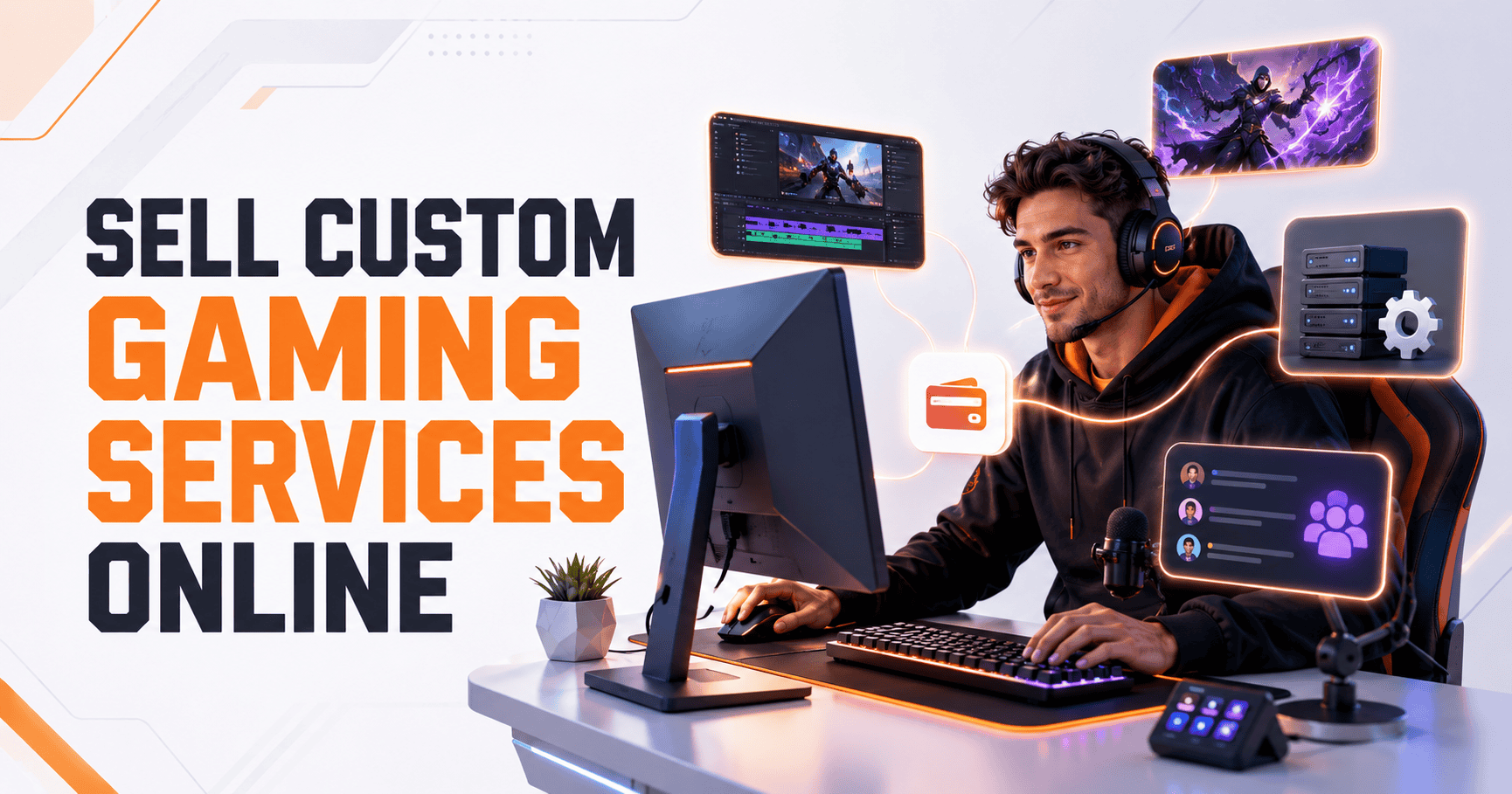
You do not need to be a professional gamer, famous streamer or experienced game developer to sell a gaming service online.
You need a useful skill.
That skill might involve editing gameplay, designing graphics, configuring servers, analysing matches or helping gaming creators manage their communities.
If another person values the result, it could become a service.
🎮 What Is a Custom Gaming Service?
A custom gaming service is paid work completed according to an individual buyer’s requirements.
Instead of selling the same ready-made file to every customer, you use information supplied by the buyer to produce a personalised result.
That could include:
- 🎨 Designing custom Twitch emotes
- 🎬 Editing a buyer’s gameplay footage
- 🛠️ Configuring a gaming server
- 🖥️ Optimising game and PC settings
- 📖 Creating a personalised strategy guide
- 💬 Organising a gaming Discord community
- 🔍 Analysing recorded matches
- 🗺️ Building a custom game map
The service does not necessarily need to involve playing a game.
Many valuable gaming services rely on creative, technical, organisational or communication skills. Understanding gaming culture and the buyer’s needs can be more important than your competitive rank.
⚡ The Quick Answer: How Do You Sell Gaming Services Online?
To sell custom gaming services online:
- Identify a useful gaming-related skill.
- Find a specific buyer problem it can solve.
- Turn the solution into one clear service.
- Define exactly what the buyer receives.
- Set a price and realistic delivery time.
- Create examples showing what you can produce.
- List your service on a suitable marketplace.
- Collect the buyer’s requirements.
- Complete and deliver the agreed work professionally.
- Improve the service using buyer questions and feedback.
The basic model is simple:
Gaming Skill → Buyer Problem → Custom Service → Delivered Result → Income
The difficult part is making each stage clear enough that a buyer feels comfortable placing an order.
🎯 Buyers Pay for Results
Being good at something does not automatically make it a service.
“I understand Discord” describes knowledge.
“I will configure the channels, roles and permissions for your gaming Discord server” describes a result.
The second version tells the customer what will happen after they pay.
A strong custom service answers four questions:
- Who is it for?
- What problem does it solve?
- What does the seller do?
- What does the buyer receive?
If the buyer cannot understand those answers within a few seconds, the offer probably needs more work.
💡 Start With One Focused Offer
New sellers often try to include every skill they have in one enormous service.
They offer video editing, coaching, server setup, graphic design, community management and “anything else gaming-related.”
It sounds flexible.
It also makes it difficult for buyers to understand what the seller is genuinely good at.
Start with one service that produces one recognisable result.
One Customer. One Problem. One Clear Offer.
You can create additional services later.
If you are still considering different ways to earn through gaming, these ways to make money playing video games can help you compare services with other gaming income opportunities.
2. What Are Custom Gaming Services?
Custom gaming services are tasks completed for an individual customer using their instructions, files, goals or technical requirements.
The buyer is not simply purchasing something that already exists.
They are paying the seller to apply a skill to their particular situation.
🧩 What Makes a Service Custom?
At least one important part of the work changes from one order to another.
A graphic designer might use different characters, colours and branding for each buyer. A video editor works with footage supplied by the customer. A technical seller adjusts their recommendations according to the buyer’s hardware and game.
The personalised element could be:
- The game
- The platform
- The buyer’s account or character
- The requested visual style
- The source material
- The intended audience
- The technical issue
- The project size
- The final file format
- The buyer’s goals
The seller may follow the same working process each time, but the delivered result is created for that customer.
🛠️ Services Involve Active Work
A custom service usually requires the seller to complete new work for every order.
That work might involve:
- Reviewing the buyer’s instructions
- Asking questions
- Researching the request
- Creating or configuring something
- Testing the result
- Making agreed revisions
- Preparing the final delivery
This separates services from passive digital products.
A premade overlay can be sold repeatedly without changing it. A custom overlay must be adapted or created for each buyer.
One scales more easily.
The other provides greater personalisation.
📦 The Buyer Should Receive a Defined Result
Every custom service needs a clear endpoint.
For creative work, that might be a collection of completed image files. For technical work, it could be a configured server or personalised settings document. For analysis, it might be a written report with recommendations.
The result should be specific enough that both parties can recognise when the order is complete.
Compare:
I will help improve your gaming content.
With:
I will edit three vertical gameplay videos of up to 60 seconds each, including captions, transitions and platform-ready exports.
The second offer is easier to price, purchase and deliver.
🤝 Communication Is Part of the Service
Custom work normally requires some communication between the buyer and seller.
The seller may need to clarify:
- What the buyer wants
- How the finished work will be used
- Which package suits the request
- What files or access are required
- Whether the deadline is realistic
- Which changes are included
Good communication prevents small misunderstandings from becoming large revisions.
It also helps buyers trust someone they may never have worked with before.
⚠️ Custom Does Not Mean Unlimited
Buyers should be able to personalise the service within its stated scope.
That does not mean they can continually expand the order.
A request for one thumbnail does not automatically include three alternative concepts, a matching banner, five resized versions and the source project file.
A custom service should clearly state:
- What is included
- What is excluded
- How much work is covered
- How many revisions are allowed
- What the buyer must provide
- When additional charges may apply
Customisation gives the buyer relevant choices. It does not remove the service boundaries.
3. Examples of Services You Can Sell
Custom gaming services can be built around many different abilities.
Some depend on gaming knowledge. Others use skills connected to content creation, technology, art, development or online communities.
The best option is usually something you can already do well enough to provide a reliable result.
🎨 Creative Gaming Services
Creative services help buyers improve the appearance of their content, channel, profile or community.
You could offer:
- Custom Twitch emotes
- Subscriber badges
- Stream overlays
- Gaming logos
- YouTube thumbnails
- Character illustrations
- Social media graphics
- Animated stream alerts
- Custom avatars
- Gaming banners
Potential customers include streamers, gaming creators, esports teams, Discord communities and individual players.
A visible portfolio is especially important here. Buyers want to see your design quality and style before ordering.
🎬 Gaming Content Services
Gaming creators often have more raw material than time.
They may need someone who understands gaming content well enough to find entertaining moments, remove dead space and prepare videos for different platforms.
Possible services include:
- Long-form video editing
- Gameplay montages
- Short-form vertical videos
- Captioned clips
- Stream highlights
- Thumbnail creation
- Podcast editing
- Content repurposing
- Gaming scripts
- Video descriptions and metadata
A focused offer is easier to sell than general “content help.”
For example:
I will turn your Twitch stream into five captioned vertical clips.
That gives the creator a clear result and gives the seller a defined workload.
🛠️ Technical Gaming Services
Technical services help players, creators and communities configure systems or solve problems.
Examples include:
- Game-performance optimisation
- Graphics-setting recommendations
- Controller configuration
- Streaming-software setup
- Mod installation
- Game-server setup
- Discord configuration
- Technical troubleshooting
- Accessibility configuration
- Custom game-development support
These services need particularly clear compatibility information.
State which games, platforms, operating systems, software versions and devices you support. “I fix gaming problems” is brave, but perhaps a little broad.
🧠 Knowledge-Based Services
Detailed gaming knowledge can be turned into personalised analysis, recommendations or written resources.
You might provide:
- Gameplay reviews
- Character-build recommendations
- Account or inventory analysis
- Personalised strategy guides
- Progression plans
- Achievement roadmaps
- Team strategy documents
- Game research
- Practice plans
- Tournament preparation
The custom element is what separates these services from general online guides.
A general guide might explain several effective character builds. A personalised service considers the buyer’s character, equipment, resources, experience and preferred playstyle.
💬 Community and Organisational Services
Gaming communities require work that members rarely notice until nobody is doing it.
Services could include:
- Discord server organisation
- Channel and role setup
- Community moderation
- Tournament administration
- Event coordination
- Player onboarding
- Community documentation
- Support-ticket setup
- Bot configuration
- Content scheduling
These services suit organised sellers who communicate well and understand how gaming communities operate.
Competitive skill may be almost irrelevant.
Reliability matters far more.
🕹️ Game Creation and Custom Content
Players, server owners and developers may also purchase custom content made for particular games or projects.
Depending on the game and its rules, this could include:
- Custom maps
- Minecraft builds
- Roblox assets
- Fortnite islands
- Mods
- Textures
- 3D models
- Game-interface elements
- Character assets
- Prototype development
Always check whether the game permits the creation and sale of the relevant content. Publisher policies, asset licences and monetisation rules can vary.
| Service Category | Example Customer | Custom Result |
|---|---|---|
| Creative | Twitch streamer | Five branded subscriber emotes |
| Content | Gaming creator | Three edited vertical gameplay clips |
| Technical | PC player | Personalised optimisation recommendations |
| Knowledge | Competitive player | Gameplay review and practice plan |
| Community | Server owner | Configured Discord channels and roles |
| Game creation | Minecraft community | Custom server spawn build |
💡 Beginner Tip
Do not choose a service only because it appears to have high earning potential.
Choose something that matches the skills, tools and experience you already have.
A skilled editor has a better starting point with gaming videos than with server development. A Minecraft builder should probably test demand for custom builds before spending six months learning animation because somebody online said it pays well.
Start with what you can already demonstrate.
Then improve from there.
4. Services vs Downloads vs Sessions
Custom services are one of several ways to sell gaming-related value online.
Your offer may work better as a digital download, scheduled session or combination of formats. Choosing correctly affects how buyers understand the offer and how much work each order creates.
🛠️ Custom Gaming Services
A custom service involves completing work for a particular buyer.
Examples include:
- Editing supplied gameplay footage
- Designing branded stream graphics
- Configuring a game server
- Creating a custom map
- Reviewing a player’s account
- Producing a personalised strategy document
Each order normally requires fresh input and seller involvement.
This can support higher prices because the result is personalised. However, the number of orders you can complete is limited by your available time.
📥 Digital Downloads
A download is generally created once and sold repeatedly.
Examples include:
- Premade overlay packs
- General gaming guides
- Graphic templates
- Stream assets
- Preset packs
- Printable trackers
- Ready-made maps or resources
Downloads can be more scalable because an additional customer may create little or no additional production work.
The trade-off is that buyers receive a standard product rather than something created specifically for them.
🎮 Gaming Sessions
A gaming session is built around scheduled participation.
Examples include:
- One-on-one coaching
- Casual gaming sessions
- Competitive practice
- Live VOD reviews
- Co-op assistance
- Content collaboration
- Team training
The buyer is primarily purchasing access to the seller’s time, knowledge or live involvement.
The result may be improvement, entertainment or progress rather than a completed digital file.
📊 Quick Comparison
| Feature | Custom Service | Download | Session |
|---|---|---|---|
| Personalised for each buyer | Usually | Rarely | Usually |
| Requires live attendance | Sometimes | No | Yes |
| Includes a finished deliverable | Usually | Yes | Not always |
| Requires new work for every order | Usually | Usually not | Yes |
| Can be sold repeatedly without major changes | Limited | Yes | No |
| Common pricing method | Project or package | Per product | Per session or hour |
🔄 Some Offers Can Combine Formats
The categories do not need to remain completely separate.
A coach might sell a live session followed by a custom improvement plan.
A designer might offer a premade overlay pack with paid personalisation.
A server specialist could complete the setup and provide a downloadable maintenance guide.
A video editor might deliver finished clips and include a reusable caption template.
Combined offers work when each element contributes to the same outcome.
Adding unrelated extras merely to make the package look larger can make the service harder to understand.
🤔 Which Format Should You Choose?
Ask what the buyer is primarily purchasing.
If they are paying for a personalised completed result, it is probably a service.
If they receive the same ready-made file as other customers, it is probably a download.
If they are booking your presence at a particular time, it is probably a session.
Personalised Work → Service
Reusable File → Download
Scheduled Participation → Session
Choosing the right format makes pricing, listing and delivery considerably easier.
5. Identify a Profitable Skill and Buyer Problem
A profitable service starts with something you can do.
It becomes commercially useful when that ability solves a problem another person cares about.
The overlap between those two things is where your offer begins.
🎯 Start With Your Existing Skills
Think about the tasks you already complete confidently.
These do not need to be extraordinary talents. A task that feels ordinary to you may be difficult, frustrating or time-consuming for somebody else.
Ask yourself:
- What gaming tasks do people ask me to help with?
- Which tools or programs can I use well?
- What have I learned through repeated experience?
- What can I create to a consistent standard?
- Which problems can I diagnose?
- What work do I enjoy enough to repeat?
- What could I show in a portfolio?
- What can I complete within a predictable timeframe?
Do not limit the exercise to gameplay.
Your most useful skill might be writing, design, editing, organisation, coding, communication or technical troubleshooting.
🔍 Find the Problem Behind the Skill
A skill becomes easier to sell when it connects to a clear customer problem.
| Your Skill | Buyer’s Problem | Possible Service |
|---|---|---|
| Video editing | Raw streams take too long to edit | Stream highlight videos |
| Graphic design | Channel visuals look inconsistent | Custom gaming graphics |
| Game knowledge | Player does not know what to practise | Personalised improvement plan |
| Technical knowledge | Game runs poorly | Performance-optimisation review |
| Server experience | Community setup is confusing | Game-server configuration |
| Writing | Complex information is difficult to follow | Custom gaming guide |
| Organisation | Discord has become chaotic | Community structure and role setup |
The skill explains how you can help.
The problem explains why somebody might pay you.
💰 Look for Valuable Outcomes
Buyers are more likely to pay when a service does at least one of the following:
- Saves time
- Improves quality
- Solves a frustrating problem
- Provides specialist knowledge
- Produces something the buyer cannot create
- Helps the buyer earn, grow or compete
- Reduces confusion
- Creates a personalised result
- Makes a difficult task more convenient
The problem does not need to be dramatic.
A streamer who dislikes editing may happily pay someone to create clips. A server owner may pay for configuration because learning every permission setting would consume an entire weekend.
Convenience has value.
📏 Choose a Problem With a Clear Endpoint
Specific problems make stronger services.
“Help improve my gaming channel” has no obvious finish line.
“Create five branded Twitch emotes” does.
Look for results that are:
- Easy to describe
- Realistic to deliver
- Useful to a recognisable customer
- Clear enough to price
- Repeatable across multiple orders
- Measurable or reviewable when complete
The clearer the endpoint, the easier it becomes to define the service.
⏱️ Check Whether the Service Can Be Profitable
Interest does not automatically make an offer financially worthwhile.
Estimate the full amount of time each order will require, including:
- Reading the brief
- Communicating with the buyer
- Completing the work
- Testing or checking it
- Making revisions
- Exporting and delivering files
- Providing post-delivery assistance
- Handling administration
A $25 order that requires four hours of work is not a particularly strong business model.
It is unpaid overtime with better branding.
You can begin with competitive pricing while building experience, but the service should eventually pay fairly for the complete workload.
🧩 Combine One Skill With One Problem
Use this simple formula:
Useful Skill + Specific Customer Problem = Potential Service
For example:
Video editing + streamers lacking short-form content = gameplay clipping service
Game knowledge + players repeating the same mistakes = gameplay-analysis service
Graphic design + creators needing channel branding = custom graphics service
Technical experience + players struggling with performance = game-optimisation service
This does not prove that buyers will purchase the offer. Demand still needs to be researched.
It gives you something specific to test.
💡 Quick Test: Is This Worth Exploring?
Before moving forward, ask:
- Can I explain the service in one sentence?
- Can I identify who needs it?
- Does it solve a recognisable problem?
- Can I show evidence of my ability?
- Can I define the completed result?
- Can I estimate the required time?
- Could I complete several orders consistently?
- Would a reasonable price make the work worthwhile?
If most answers are yes, you may have a viable starting service.
If the offer still depends on “I can do anything gaming-related,” narrow it further.
One Customer. One Problem. One Result.
That is enough to begin.
6. Research Demand and Choose Your Customer
You now have a potential service.
Before building the listing, check whether anyone appears to need it.
A little research can prevent you from spending days creating packages, graphics and portfolio samples for an offer that solves a problem nobody is particularly concerned about.
🔍 Look for Evidence of Demand
Search places where your potential customers already discuss problems or purchase services.
Depending on the offer, that might include:
- Gaming marketplaces
- Freelance platforms
- Discord communities
- Reddit communities
- Creator groups
- Game-specific forums
- Social media
- YouTube comments
- Streaming communities
- Development communities
You are looking for recurring problems rather than one isolated comment.
If streamers repeatedly complain that they do not have time to create clips, that suggests demand for editing support. If server owners regularly ask for help with permissions, plugins or configuration, technical services may be useful.
Repeated frustration often points towards a sellable solution.
📊 Study Existing Services
Competition is evidence that buyers understand the service.
Search for comparable offers and review:
- What sellers include
- How they describe the result
- Which packages they provide
- What they charge
- How quickly they deliver
- How many revisions they include
- What their samples look like
- Which questions buyers ask
- What customers mention in reviews
Do not look only at the most successful seller.
Review newer listings, mid-priced offers and specialised services too. This provides a more realistic picture of what buyers can choose from.
💬 Read Reviews and Buyer Questions
Reviews reveal what customers actually value after placing an order.
Positive reviews might praise:
- Fast communication
- Accurate delivery
- Creative quality
- Technical knowledge
- Quick turnaround
- Attention to the brief
- Helpful recommendations
- Easy revision handling
Negative reviews can expose opportunities.
If buyers regularly complain about unclear communication, delayed delivery or missing file formats, you may be able to create a more dependable service.
The goal is not to build a listing around attacking competitors.
It is to understand where buyers are being disappointed.
🎯 Choose a Specific Customer
Different customers can purchase similar services for completely different reasons.
A competitive player buying gameplay analysis wants useful feedback and relevant game knowledge. A creator buying video editing cares about presentation, retention and platform requirements. A server owner wants something stable, organised and easy to manage.
Potential customers include:
- Casual players
- Competitive gamers
- Streamers
- YouTubers
- Gaming communities
- Server owners
- Esports teams
- Tournament organisers
- Indie developers
- Gaming businesses
You do not need to target everyone who owns a controller.
Choose the group most likely to value your particular result.
👤 Build a Simple Customer Profile
A useful customer profile answers five questions:
- Who needs the service?
- What are they trying to accomplish?
- What is stopping them?
- What result do they want?
- What might make them hesitate before ordering?
For example:
Customer: Small gaming creators
Goal: Publish more short-form content
Problem: Editing takes too long
Desired result: Finished clips ready to upload
Concern: The editor may not understand their style
That information helps you decide what to include in the service and what your listing needs to prove.
You do not need to name this imaginary creator or determine what they eat for breakfast.
You need to understand the purchase.
🧭 Look for a Useful Positioning Angle
You do not always need a completely unique service.
A more specific angle can make a familiar service relevant to a particular customer.
Instead of offering:
Gaming video editing
You could offer:
Captioned vertical gameplay clips for Twitch streamers.
Other positioning angles include:
- A particular game
- A specific platform
- A defined customer type
- Faster delivery
- A recognisable visual style
- Beginner-friendly assistance
- A specialised technical skill
- A particular type of finished result
Specialisation can reduce the number of potential customers, but it can also make your service more relevant to the right ones.
💡 Demand Check
Before moving forward, you should be able to complete this sentence:
I found evidence that [type of customer] needs help with [specific problem] and currently looks for solutions through [marketplace, platform or community].
You do not need absolute proof.
You need enough evidence to justify testing the offer.
7. Turn Your Skill Into a Clear Service
Research tells you that a problem exists.
The next step is packaging your solution into something a buyer can understand, compare and purchase.
This means moving from a broad ability to a defined outcome.
🎯 Sell the Result, Not the Skill
Skills support a service, but results sell it.
Compare:
Skill: I am good at video editing.
Service: I will turn your gameplay footage into three captioned vertical videos.
Skill: I understand Minecraft servers.
Service: I will configure the roles, permissions and essential plugins for your Minecraft server.
Skill: I know Valorant strategy.
Service: I will review three Valorant matches and create a personalised improvement plan.
The service gives the buyer something concrete.
They can picture what they will receive after ordering.
🧩 Build the Core Offer
A clear custom service contains four parts:
Customer → Problem → Work Completed → Delivered Result
For example:
Streamer → Lacks time to edit → You edit supplied footage → Three finished gameplay clips
Or:
Competitive player → Cannot identify recurring mistakes → You review recorded matches → Timestamped analysis and practice plan
If one part is missing, the offer becomes weaker.
A buyer should not need to message you simply to discover what you are selling.
✍️ Explain the Service in One Sentence
Use this formula:
I will [complete specific work] for [type of customer] and deliver [defined result].
Examples include:
- I will create five custom Twitch emotes based on your character and branding.
- I will edit your raw gameplay into three captioned YouTube Shorts.
- I will configure a beginner-friendly Discord server for your gaming community.
- I will analyse your current character build and provide personalised recommendations.
- I will optimise your game settings based on your PC hardware and performance goals.
- I will build a custom Minecraft server spawn based on your theme and requirements.
If the sentence needs several paragraphs of explanation, the service may still be too broad.
📦 Decide How Much the Core Service Includes
Your core offer should be large enough to produce a useful result but small enough to price and deliver predictably.
A video editor might offer:
- Three vertical videos
- Up to 60 seconds each
- Captions included
- Footage supplied by the buyer
- One revision round
- Delivery within five days
A gameplay analyst might offer:
- Review of two matches
- Timestamped observations
- Three priority weaknesses
- Recommended practice exercises
- A written improvement summary
These details transform an idea into an orderable package.
🔄 Use a Repeatable Process
Custom does not mean starting from an empty page every time.
A seller can use the same:
- Buyer questionnaire
- Project checklist
- Folder structure
- Editing workflow
- Testing process
- Delivery template
- Revision procedure
The inputs and final result change for each buyer.
The underlying process remains consistent.
Repeatable Process + Personalised Inputs = Custom Service
This balance helps you deliver efficiently without making the buyer feel as though they received something generic.
⚠️ Avoid Combining Unrelated Work
Related tasks can create a stronger package.
A short-form video service might include editing, captions and basic colour adjustment. These tasks contribute to the same result.
Unrelated work creates confusion.
A single listing offering coaching, thumbnails, server setup and video editing does not communicate versatility as clearly as you might hope. It mainly communicates that the seller discovered the “add another feature” button.
Create separate services when the offers:
- Solve different problems
- Target different customers
- Require different skills
- Need different buyer information
- Follow different pricing models
- Produce unrelated results
💡 The Five-Second Test
Show the service title and first sentence to someone unfamiliar with the offer.
Can they explain:
- Who it is for?
- What you will do?
- What the buyer receives?
If not, simplify it.
Clarity beats cleverness.
8. Define Deliverables and Service Boundaries
Deliverables explain what the buyer receives.
Boundaries explain what the order does not cover.
You need both before setting a price or publishing the service.
📦 Define the Final Result
Describe the completed work in measurable terms.
Depending on the service, that could include:
- Number of files
- File formats
- Image dimensions
- Video duration
- Number of designs
- Length of a written report
- Number of games reviewed
- Technical work completed
- Platforms supported
- Included documentation
- Post-delivery assistance
Avoid broad deliverables such as “professional gaming graphics” or “complete optimisation.”
Tell the buyer what will arrive.
🎨 Example: Custom Emote Deliverables
A clear emote service might include:
- Five original emote designs
- One character or theme
- Three required Twitch sizes
- Transparent PNG files
- Two revision rounds
- Seven-day delivery
- Personal streaming use
This helps the seller estimate the workload and allows the buyer to compare the offer with alternatives.
🎬 Example: Gameplay Editing Deliverables
A video-editing service might include:
- Three finished vertical videos
- Maximum duration of 60 seconds each
- Up to 30 minutes of supplied footage
- Basic captions
- Sound effects
- Platform-ready MP4 exports
- One revision round
- Five-day delivery
The source-footage limit matters.
Editing three clips from 30 minutes of footage is not the same job as searching through a 12-hour stream for three moments the buyer vaguely remembers being funny.
🚧 Set Clear Service Boundaries
List the main work that is not included.
For video editing, exclusions might include:
- Recording gameplay
- Writing scripts
- Voice-over production
- Advanced animation
- Licensed music
- Thumbnail design
- Uploading to the buyer’s account
- Source project files
For server setup, exclusions might include:
- Ongoing administration
- Custom plugin development
- Hosting fees
- Moderation
- Unsupported software
- Repairs unrelated to the original setup
You do not need to document every imaginable request.
Cover the exclusions buyers are most likely to misunderstand.
🔁 Define What Counts as a Revision
A revision changes the agreed work.
It does not replace the original brief with a new project.
Revision: Change the caption colour from white to yellow.
New request: Replace the completed editing style, music, captions and selected footage.
Specify:
- How many revision rounds are included
- What buyers can request during a revision
- When requests become additional work
- How quickly buyers should submit feedback
- Whether extra revisions can be purchased
- Whether seller mistakes are corrected separately
If you delivered something incorrectly, correcting it should not consume the buyer’s revision allowance.
🔐 Limit Access and Sensitive Information
Some technical services may require access to a server, community or shared project.
Request only the permissions necessary to complete the work.
Where possible:
- Use official collaborator systems
- Request a temporary role
- Avoid asking for personal passwords
- Explain why access is required
- Keep credentials out of unnecessary messages
- Ask the buyer to remove temporary access after delivery
A service should not expose either party to avoidable risk.
📝 Write a Scope Statement
Summarise the service using this structure:
The buyer provides [required information or files]. I complete [defined work]. The buyer receives [deliverables]. The service includes [revision allowance] and excludes [important limitations].
For example:
The buyer provides up to 30 minutes of gameplay footage and their preferred caption style. I edit three vertical videos of up to 60 seconds each. The buyer receives three platform-ready MP4 files with one revision round. Recording, advanced animation and uploading are not included.
If that statement feels clear, your service is taking shape.
If it resembles the terms and conditions for an international shipping company, simplify it.
✅ Boundary Check
Before continuing, confirm that you have defined:
- The exact result
- The amount of work
- Supported games or platforms
- Required buyer materials
- Delivery format
- Revision allowance
- Important exclusions
- Access requirements
- Optional extras
Clear boundaries make pricing and delivery considerably easier.
9. Create Your Service Workflow
A service workflow is the sequence you follow from receiving the order to delivering the result.
It keeps projects organised and reduces the chance of missing files, unclear instructions or last-minute surprises.
The workflow does not need to be complicated.
It needs to be repeatable.
🛒 Step 1: Review the Order
Start by checking:
- Which package the buyer purchased
- Which extras they selected
- What instructions they submitted
- Whether all required files are attached
- When the order is due
- Whether the request matches your service
Do not begin production simply because the order has arrived.
First, make sure you can complete what was requested.
🔍 Step 2: Check the Requirements
Look for missing or conflicting information.
Common problems include:
- Missing source files
- Unclear design preferences
- Unsupported games or platforms
- Requests beyond the package
- Incorrect dimensions
- Unrealistic deadlines
- Incomplete technical details
- Unclear usage rights
Ask focused questions before starting.
Five minutes spent clarifying the brief can save several hours spent confidently creating the wrong thing.
✅ Step 3: Confirm the Scope
For straightforward orders, the listing and buyer requirements may already provide enough confirmation.
For larger projects, send a short summary.
For example:
I’ll create five custom emotes using the supplied character and blue-and-orange colour palette. You’ll receive transparent PNG files in the required platform sizes, with two revision rounds included.
This gives the buyer an opportunity to correct misunderstandings early.
It also creates a written record of the agreed result.
🛠️ Step 4: Complete the Work
Follow a consistent production checklist.
Depending on the service, that might involve:
- Organising supplied files
- Researching the game or audience
- Preparing an initial concept
- Completing the main work
- Testing technical changes
- Reviewing the result against the brief
- Exporting the required formats
- Checking file quality
Do not rely entirely on memory.
Checklists are considerably cheaper than rework.
👀 Step 5: Provide a Preview
Previews are useful when major changes would become difficult after final production.
A designer might provide a watermarked concept. A video editor could share a low-resolution draft. A server specialist may confirm the proposed channel structure before building it.
A preview allows the buyer to check:
- Overall direction
- Style
- Layout
- Structure
- Major creative choices
- Obvious misunderstandings
Not every service requires this stage.
Small, predictable tasks may be ready for direct delivery.
🔁 Step 6: Complete Included Revisions
Review requested changes against the original agreement.
Separate them into:
- Included revisions
- Corrections to seller mistakes
- New work outside the scope
If a request requires an extra fee or longer delivery time, explain that before completing it.
Do not quietly perform hours of additional work and become angry about an agreement the buyer never knew existed.
📤 Step 7: Prepare the Delivery
Before submitting the completed service:
- Open every file
- Test downloads
- Check formats and dimensions
- Confirm filenames
- Remove watermarks from final work
- Include all promised deliverables
- Add instructions where necessary
- Confirm access changes
- Summarise what was completed
The buyer should not need to search through a folder full of mysterious files to identify the finished result.
🔄 The Complete Workflow
Order → Requirements → Scope Confirmation → Production → Preview → Revisions → Quality Check → Delivery
You can adapt this sequence to your service.
Keep the essential checkpoints.
10. Build a Buyer Requirements Form
A buyer requirements form collects the information you need before beginning an order.
A good form turns the buyer’s idea into a usable brief.
A bad form asks, “What do you want?” and leaves both parties to discover the answer halfway through the project.
🎯 Ask Questions That Affect the Work
Every question should help you understand, create, test or deliver the service.
Common requirements include:
- Game title
- Platform
- Intended use
- Preferred style
- Required text
- Dimensions
- File formats
- Source materials
- Target audience
- Existing branding
- Reference examples
- Deadline
- Technical specifications
- Details to avoid
Only ask for information relevant to your service.
A thumbnail designer probably does not need the buyer’s competitive rank. A gameplay analyst probably does.
✍️ Make Questions Specific
Specific questions produce more useful answers.
Instead of:
Describe what you want.
Ask:
What exact text should appear on the thumbnail?
Which character, weapon or game scene should be featured?
Where will the finished design be used?
What dimensions and file formats do you require?
Please provide up to three examples of styles you like.
The easier a question is to understand, the more likely the buyer is to provide usable information.
📎 Request the Necessary Files
Tell buyers what they must upload.
That could include:
- Gameplay footage
- Character images
- Logos
- Brand colours
- Existing graphics
- Server details
- Configuration files
- Recorded matches
- Screenshots
- Written notes
- Style references
Specify acceptable formats and maximum sizes where relevant.
If the file must meet a technical requirement, explain it before the buyer submits something unusable.
🎨 Ask for Likes and Dislikes
Creative references are useful, but buyers may struggle to explain why they chose them.
Ask what they specifically like about each example:
- Colour
- Composition
- Font
- Editing pace
- Caption style
- Animation
- Mood
- Level of detail
It can also help to ask what they want to avoid.
“Make it exciting” allows considerable interpretation.
“I want fast editing with bold captions, but no meme sound effects” is much more useful.
✅ Separate Required and Optional Questions
Mark essential information as required.
Use optional questions for additional preferences.
For a video-editing service:
Required
- Upload the footage.
- Select the target platform.
- Confirm the number of clips.
- Provide the required format.
- Identify any moments that must be included.
Optional
- Share editing references.
- Provide preferred caption colours.
- Suggest music.
- Identify moments that should be avoided.
This keeps the form thorough without making a small order feel like a mortgage application.
🔀 Adapt Questions to Each Package
Different packages may require different information.
A basic emote package may need one character reference and three expressions.
A premium animated package may also require:
- Animation direction
- Loop preferences
- Frame-rate requirements
- Source-file requirements
- Additional platform sizes
If the platform supports conditional questions, use them.
If not, label clearly which questions apply to each package.
🔐 Avoid Unnecessary Sensitive Information
Do not ask buyers for:
- Personal passwords
- Payment details
- Identity documents
- Unrestricted account access
- Information unrelated to the service
When access is genuinely required, ask for the safest available option.
For example:
- Temporary collaborator access
- A restricted server role
- A separate testing account
- Limited permissions
- Files exported by the buyer
Explain what access allows you to do and when it can be removed.
📋 Buyer Requirements Checklist
Before finalising the form, ask:
- Does every question affect the order?
- Are the questions easy to understand?
- Have I marked essential information as required?
- Have I explained which files are needed?
- Have I included technical specifications?
- Have I asked about the intended use?
- Have I requested appropriate references?
- Have I avoided unnecessary sensitive information?
- Can I begin work using the answers provided?
If the answer to the last question is no, the form is missing something.
💡 Keep Improving the Form
Your first version will not anticipate every possible misunderstanding.
Pay attention to the questions you repeatedly ask after orders arrive.
If every third buyer forgets to provide their preferred dimensions, add that question to the form. If customers regularly submit several hours of footage for a package covering 30 minutes, make the limit more prominent.
A requirements form should improve as your service does.
The goal is not to eliminate communication.
It is to make the first conversation useful.
11. Choose a Pricing Model
Pricing a custom gaming service is not simply a matter of choosing a number that looks reasonable.
The pricing model determines what the buyer pays for, how easily they can compare your offer and how well the price reflects the work involved.
The right approach depends on how predictable your service is.
📦 Fixed-Price Services
A fixed-price service charges a set amount for a clearly defined result.
For example:
Three edited vertical gameplay clips for $75.
Fixed pricing works well when you can predict:
- The amount of work
- The required production time
- The final deliverables
- The number of revisions
- The typical level of complexity
It gives buyers certainty because they can see the total price before ordering.
It also makes your service easier to list on a marketplace.
The risk is underestimating the workload. If one buyer submits organised footage and another submits six hours of unlabeled recordings, the same fixed price may no longer make sense.
Clear limits protect fixed-price services.
⏱️ Hourly Pricing
Hourly pricing charges the buyer for the time spent completing the work.
It can suit services where the scope is difficult to predict, such as:
- Technical troubleshooting
- Custom development
- Ongoing community management
- Complex server configuration
- Large editing projects
- Consulting
- Research
The seller records or estimates the required hours and charges an agreed rate.
Hourly pricing can protect you from unpredictable workloads, but some buyers may hesitate because they do not know the final cost.
Give buyers an estimate or maximum approved time where possible.
For example:
This configuration is expected to take three to four hours. I will contact you before exceeding four hours.
Nobody enjoys watching an hourly meter run while a technical problem develops new and exciting complications.
🧩 Project-Based Pricing
Project pricing is useful for larger custom requests that need an individual quote.
The seller reviews the brief, estimates the work and provides one price for the complete project.
This can work well for:
- Large Minecraft builds
- Complete channel-branding packages
- Custom game development
- Advanced server creation
- Long-form video projects
- Tournament setup
- Ongoing content packages
Project pricing considers the complete value and complexity rather than charging for one standard unit.
It provides certainty once the quote has been accepted.
However, the scope must be documented carefully. A vague project quote is an excellent way to complete substantially more work than anyone originally imagined.
🔁 Recurring Pricing
Some services are delivered repeatedly.
These may use weekly or monthly pricing.
Examples include:
- Community moderation
- Regular video editing
- Social content production
- Server maintenance
- Tournament administration
- Gaming content writing
- Ongoing technical support
Recurring arrangements can provide more predictable income for the seller and reliable support for the buyer.
Before offering one, define:
- How much work is included
- How often work is delivered
- Response times
- Unused allowances
- Revision limits
- Cancellation arrangements
- Requests that cost extra
A recurring package should not become unlimited access to your time.
📊 Compare the Main Pricing Models
| Pricing Model | Best For | Buyer Certainty | Seller Risk |
|---|---|---|---|
| Fixed price | Predictable, repeatable services | High | Higher if scope is unclear |
| Hourly | Uncertain or ongoing work | Moderate | Lower when time varies |
| Project based | Large customised orders | High after quoting | Moderate |
| Recurring | Regular repeated work | High | Higher without monthly limits |
🎯 Choose the Simplest Suitable Model
For most new sellers, fixed pricing is the easiest place to start.
It gives the buyer a straightforward offer:
Defined Result + Clear Price + Stated Delivery Time
Use hourly or project pricing when the work genuinely cannot be standardised.
You can also combine models. A server specialist might charge a fixed price for the basic setup, then use hourly pricing for additional custom development.
The model should make the service easier to understand.
If buyers need a finance degree to calculate the likely total, simplify it.
12. Calculate a Sustainable Price
Once you have selected a pricing model, calculate what the service needs to cost.
Your price should cover more than the most obvious production task.
Custom services also require communication, administration, revisions and delivery.
All of that is work.
⏱️ Estimate the Complete Time Required
Break the order into stages.
A video-editing service might require:
- 15 minutes to review the order
- 30 minutes to organise and watch footage
- 90 minutes to edit
- 20 minutes to create captions
- 15 minutes to export and check files
- 30 minutes for expected revisions
- 10 minutes to prepare delivery
That is three hours and ten minutes of work.
Pricing the service as though it only involves the 90-minute edit will make it less profitable than expected.
💰 Choose a Target Hourly Return
You do not necessarily need to display an hourly rate to buyers.
Use one internally to test whether the fixed price is worthwhile.
For example:
Estimated work: Three hours
Target hourly return: $25
Base labour value: $75
This gives you a starting point rather than a compulsory final price.
Your target return may depend on:
- Your experience
- Service complexity
- Local costs
- Buyer demand
- Quality
- Competition
- Specialist knowledge
- Reliability
- Available time
A beginner may charge less while building experience.
That does not mean working indefinitely for an amount that barely covers the electricity required to keep the computer awake.
🧾 Include Your Costs
Some services require paid tools, subscriptions, assets or other expenses.
Possible costs include:
- Editing software
- Design software
- Stock assets
- Music licences
- Plugins
- Server hosting
- Cloud storage
- Marketplace fees
- Payment-processing fees
- Hardware
- Internet usage
- Contractors
Do not charge one buyer for the entire annual cost of software you use across many projects.
Allocate a reasonable portion to each order.
🔁 Allow for Revisions
Even well-defined services receive revision requests.
Include enough time for the number of revisions promised in the listing.
If you offer two revision rounds, your price should assume that at least some buyers will use them.
Do not calculate the price based on the hope that every customer will approve the first version immediately.
Hope is pleasant.
It is not especially reliable accounting.
📈 Add a Profit Margin
Covering your time and expenses prevents a loss.
Profit allows the service to grow.
A margin can help pay for:
- Better equipment
- Improved software
- Training
- Portfolio development
- Unexpected delays
- Time between orders
- Future business costs
The service should provide some benefit beyond reimbursing you for the exact minutes spent completing it.
🧮 Use a Simple Pricing Formula
A practical starting formula is:
Labour + Direct Expenses + Fees + Revision Allowance + Profit = Service Price
For example:
| Pricing Component | Amount |
|---|---|
| Three hours of work at $25 | $75 |
| Allocated software and asset costs | $5 |
| Expected marketplace and payment fees | $10 |
| Contingency and profit | $20 |
| Suggested service price | $110 |
This is an estimate, not a universal formula.
The market still matters. A mathematically perfect price is not useful if buyers do not value the result at that amount.
🔍 Compare the Price With the Market
Research comparable services after calculating your minimum sustainable price.
Ask:
- Are similar services cheaper or more expensive?
- Do they include the same deliverables?
- Is their quality comparable?
- Do they have more experience or reviews?
- Are they serving the same customer?
- Is your service more specialised?
- Can buyers understand why your price is different?
Do not copy the cheapest seller.
They may be underpricing, working in a different market or discovering the same problem slightly earlier than you.
🎯 Consider the Value to the Buyer
Time is not the only factor affecting price.
A technically simple task may create significant value.
A creator might pay more for an editing package that helps them publish consistently. A server owner may value a reliable configuration because mistakes could affect an entire community. A competitive team may pay for specialist analysis that improves preparation.
Value-based considerations include:
- Time saved
- Specialist knowledge
- Commercial use
- Urgency
- Complexity
- Risk
- Quality
- Convenience
- Scarcity of the skill
- Importance of the outcome
Do not invent dramatic value claims.
Explain what the service genuinely provides.
🚀 Decide Whether to Use Introductory Pricing
A lower starting price can help new sellers attract early customers and build reviews.
Use introductory pricing deliberately.
Set a point at which you will review it, such as:
- After five completed orders
- After three strong reviews
- Once your portfolio improves
- When your delivery schedule becomes full
- When demand becomes consistent
Do not become permanently trapped at a price chosen when you had no samples, no reviews and considerable self-doubt.
✅ Sustainable Pricing Check
Before setting the final price, confirm:
- The complete workload has been estimated.
- Communication time is included.
- Revision time is included.
- Direct expenses are covered.
- Marketplace and payment fees are considered.
- The price provides a reasonable return.
- The amount remains realistic for the target buyer.
- Larger requests can be charged separately.
- The service can still be delivered properly at that price.
A sustainable price should be fair to the buyer and worthwhile for the seller.
13. Create Service Packages
Packages give buyers several versions of the same core service.
They can make pricing easier to understand and allow customers to choose according to their needs, budget and project size.
A common structure uses Basic, Standard and Premium options.
📦 Keep Every Package Focused on the Same Result
All three packages should solve the same general problem.
For example, a gameplay-editing service might offer:
- Basic: One edited clip
- Standard: Three edited clips
- Premium: Five edited clips with additional features
The packages differ in size or depth.
They do not become three unrelated services.
Avoid structures such as:
- Basic: Video editing
- Standard: Gaming coaching
- Premium: Discord management
That is not a package structure.
That is three listings sharing a coat.
🌱 Build the Basic Package
The Basic package should provide a small but complete result.
It may include:
- Lower quantity
- Simpler complexity
- Fewer features
- One revision
- Standard delivery
- Limited file formats
It should not be deliberately unusable.
A weak Basic package can make the entire listing look manipulative. Buyers should receive genuine value even when choosing the lowest tier.
⭐ Build the Standard Package
The Standard package will often suit the largest group of buyers.
It can include:
- Greater quantity
- More customisation
- Additional features
- More revisions
- Useful supporting files
- A broader service scope
This package should represent the service’s strongest balance between price and value.
Do not overload it merely to make the Premium option look less lonely.
🏆 Build the Premium Package
The Premium package is for buyers who need the most complete result.
It might include:
- Higher quantity
- Greater complexity
- Faster delivery
- Additional concepts
- More revisions
- Source files
- Commercial usage
- Extended support
- Advanced features
Only include features you can deliver confidently.
Premium buyers normally expect a smoother experience, not a more ambitious collection of excuses.
📊 Example: Gaming Video Editing Packages
| Feature | Basic | Standard | Premium |
|---|---|---|---|
| Finished vertical clips | 1 | 3 | 5 |
| Maximum supplied footage | 15 minutes | 30 minutes | 60 minutes |
| Captions | Basic | Styled | Custom styled |
| Sound effects | Limited | Included | Included |
| Revisions | 1 | 2 | 3 |
| Delivery | 5 days | 5 days | 4 days |
| Thumbnail frames | No | 1 | 3 |
The package table lets buyers compare repeated features quickly.
It also defines the workload for the seller.
🧩 Choose Meaningful Differences
Packages can differ through:
- Quantity
- Length
- Complexity
- Number of concepts
- Level of customisation
- Revision allowance
- Delivery speed
- File formats
- Source files
- Usage rights
- Support period
Choose differences that matter to the customer.
Adding random features to fill empty package columns does not improve the offer.
➕ Create Optional Extras
Extras allow buyers to expand an order without moving to a larger package.
Possible extras include:
- Additional files
- Faster delivery
- Extra revisions
- Source files
- Commercial usage
- Longer footage
- Additional characters
- Extra platforms or dimensions
- Post-delivery support
- Advanced animation
Price extras according to the additional work involved.
A rush-delivery fee should reflect the inconvenience and scheduling pressure, not simply exist because “rush delivery” looked good in another seller’s listing.
⏱️ Set Realistic Delivery Times
Larger packages usually require more work.
Account for:
- Your existing workload
- Buyer communication
- Time-zone differences
- Revision rounds
- Rendering or export time
- Technical testing
- Unexpected delays
It is better to promise five days and deliver in four than promise two days and begin negotiating with the concept of time itself.
💡 Start With Fewer Packages if Necessary
You do not need three packages simply because a marketplace allows them.
One clear package can be better than three confusing ones.
Start with a single offer when:
- The service is highly customised
- The workload varies dramatically
- You are still learning how long delivery takes
- Buyers need an individual quote
- Package differences would feel artificial
Add packages once you understand which variations customers actually request.
✅ Package Check
Each package should answer:
- What does the buyer receive?
- How much work is included?
- How is it different from the other tiers?
- How many revisions are included?
- When will it be delivered?
- What does it cost?
- Which buyer is it best suited to?
If the differences require a long explanation, simplify them.
14. Build a Strong Service Listing
Your listing has one central job:
Help the right buyer understand what you offer and feel confident ordering it.
It should be specific, useful and easy to scan.
The listing does not need to sound like an advertisement shouted through a gaming headset.
🎯 Write a Clear Service Title
The title should lead with the result.
Compare:
Weak: Professional Gaming Services
Better: I Will Edit Your Gameplay Into Three Short-Form Videos
Weak: Custom Gaming Design
Better: I Will Create Custom Twitch Emotes for Your Channel
Weak: Game Help and Advice
Better: I Will Analyse Your Valorant Gameplay and Create an Improvement Plan
The better titles explain what the seller will do.
Where useful, include:
- The service
- The game
- The customer
- The format
- The main result
Do not force every detail into the title.
It still needs to be readable.
⚡ Open With the Buyer’s Problem
The first few lines should show that you understand why the customer is looking for help.
For example:
Have hours of gameplay footage but no time to edit it? I’ll turn your best moments into polished vertical clips ready for Shorts, TikTok and Reels.
That opening identifies the problem and introduces the solution.
Avoid beginning with a long personal biography.
Your experience matters, but buyers usually want to know what you can do for them before hearing the complete origin story of your editing career.
📦 Explain What Is Included
Give buyers a clear summary of the deliverables.
For example:
This service includes:
- Three vertical gameplay videos
- Up to 60 seconds per clip
- Captions
- Basic transitions
- Sound effects
- MP4 delivery
- Two revision rounds
Keep the list aligned with your packages.
Contradictory information creates hesitation and disputes.
🛠️ Describe How the Process Works
A simple process can reduce uncertainty.
For example:
- Choose your package.
- Upload your gameplay footage.
- Share your style and platform requirements.
- I edit and prepare the clips.
- You review the draft.
- I complete the included revisions.
- You receive the finished files.
Buyers do not need a detailed tour of every button you press.
They need to understand what happens after ordering.
👤 Explain Why You Are Qualified
Include relevant experience naturally.
That might involve:
- Experience with the game
- Years using particular software
- Relevant ranks or achievements
- Previous projects
- Specialist technical knowledge
- Familiarity with the target platform
- Understanding of gaming audiences
Connect experience with buyer value.
Instead of:
I have used Premiere Pro for five years.
Try:
I have five years of editing experience and understand how to turn long gameplay recordings into fast, platform-ready clips.
The second version explains why the experience matters.
🚧 State the Important Boundaries
Include essential limits where buyers can see them.
That might include:
- Maximum footage
- Supported games
- File formats
- Number of revisions
- Commercial-use limitations
- Excluded work
- Access requirements
- Unsupported platforms
- Delivery conditions
Do not hide important exclusions at the bottom of an enormous paragraph.
If a limit could materially affect the order, make it visible.
❓ Answer Likely Buyer Questions
A short listing FAQ can address concerns such as:
- Can you work with my game?
- Which files should I provide?
- Do you supply source files?
- Can I order additional revisions?
- Is commercial use included?
- Can you deliver sooner?
- What happens if my request is unusual?
- Should I contact you before ordering?
Only include questions relevant to the service.
A listing FAQ should solve uncertainty rather than repeat the description.
🔎 Use Relevant Search Terms Naturally
Include phrases buyers may use when looking for the service.
A custom gaming-video listing might naturally mention:
- Gaming video editing
- Gameplay clips
- Stream highlights
- YouTube Shorts
- TikTok gaming videos
- Vertical video editing
- Captioned gaming content
Do not repeat the same phrase until the description sounds as though it was written for a search engine experiencing memory loss.
Clarity comes first.
✅ Service Listing Structure
A strong listing can follow this order:
- Clear title
- Buyer problem
- Service result
- Included deliverables
- Package differences
- Working process
- Relevant experience
- Service boundaries
- Buyer requirements
- Frequently asked questions
- Clear next step
This provides enough information without forcing the buyer to excavate the details.
15. Create Samples and a Portfolio
Buyers want evidence that you can deliver what the listing promises.
A portfolio gives them something more convincing than enthusiasm.
You do not need previous paying customers to begin creating one.
🎨 Create Your Own Sample Projects
Build examples that match the service you want to sell.
If you offer gaming thumbnails, create several fictional thumbnails for different games.
If you offer video editing, use your own gameplay to produce:
- A fast vertical clip
- A captioned highlight
- A short montage
- A before-and-after edit
If you offer technical optimisation, create a sample report showing how you review settings and present recommendations.
Samples should demonstrate the actual result buyers can purchase.
🎯 Match Samples to Your Target Customer
A portfolio should attract the customers you want.
A seller targeting competitive gaming creators might show energetic thumbnails, ranked gameplay clips and esports-style graphics.
A designer targeting cosy-game streamers would probably use a different visual direction.
Your samples communicate:
- Style
- Quality
- Technical ability
- Attention to detail
- Understanding of the customer
- Range within the service
Do not fill the portfolio with unrelated work merely because it exists.
Three relevant examples are more useful than 20 projects that have little connection to the offer.
🔄 Show Before-and-After Examples
Before-and-after comparisons make the service’s value easier to understand.
Examples include:
- Raw gameplay beside the edited clip
- An unorganised server beside the completed structure
- Default graphics beside the custom branding
- Original settings beside the optimised configuration
- General performance notes beside a structured analysis
- A rough concept beside the finished artwork
Make clear what you changed.
The comparison should demonstrate the work rather than exaggerate it.
📝 Explain Each Sample Briefly
Do not rely entirely on the image or video.
Add a short description covering:
- The project goal
- What you created
- Important requirements
- Tools or skills used
- The final deliverables
For example:
Created three vertical gameplay clips from 25 minutes of raw Fortnite footage. Added captions, sound effects and platform-ready exports for YouTube Shorts and TikTok.
That description helps buyers connect the sample with the listed service.
🤝 Use Early Projects Carefully
You may be able to build experience by helping:
- Friends
- Small creators
- Gaming communities
- Community projects
- Your own channel
- A personal server
Agree on what you can show publicly before beginning.
Do not publish private files, usernames, server information or unreleased content without permission.
If work was unpaid, you may describe it as a personal or community project.
Do not invent a paying customer.
⚠️ Never Use Work You Did Not Create
Do not present another artist’s design, editor’s video or developer’s project as your own.
Reference material is not portfolio material.
Copying someone else’s work damages trust and could create copyright problems before your service receives its first legitimate order.
If several people contributed to a project, explain which part you completed.
📸 Present Samples Clearly
Listing images and portfolio items should remain understandable when displayed at smaller sizes.
Use:
- Clear focal points
- Readable text
- Consistent dimensions
- High-quality exports
- Simple labels
- Relevant captions
- Uncluttered layouts
Avoid trying to explain the entire service inside one image.
Small text becomes decorative dust once the image is reduced.
🧩 Build a Small, Focused Portfolio
A practical starting portfolio might contain:
- Three strong examples
- One before-and-after comparison
- One example showing a different style or use case
- A short explanation for each project
Quality matters more than volume.
A weak example does not become helpful merely because it brings the total to six.
📈 Improve the Portfolio Over Time
Replace early samples as you complete stronger work.
Look for opportunities to show:
- Different customer types
- More advanced projects
- Better presentation
- Clearer results
- New service features
- Recognisable improvements
- Positive buyer feedback, with permission
Your portfolio should evolve alongside your ability.
✅ Portfolio Check
Before publishing the listing, ask:
- Do the samples match the service?
- Is the quality consistent?
- Can buyers understand what I created?
- Are the images readable at listing size?
- Have I explained each example?
- Do I have permission to display the work?
- Does every sample strengthen the portfolio?
- Would these examples make me comfortable ordering?
The portfolio does not need to prove that you are the greatest gaming-service seller alive.
It needs to show that you can deliver the promised result.
16. Choose Where to Sell
A strong service still needs somewhere buyers can discover and purchase it.
You can sell through a marketplace, freelance platform, personal website, social account or gaming community. Each option provides a different balance of visibility, control, fees and trust.
The best starting point is usually where your target customers already look for help.
🎮 Gaming Marketplaces
Gaming marketplaces are built for buyers and sellers interested in games, digital items, sessions and related services.
They can suit offers such as:
- Gameplay analysis
- Custom gaming graphics
- Game-server setup
- Minecraft building
- Gaming guides
- Video editing
- Mod development
- Community services
The main advantage is audience relevance.
Buyers are already interested in gaming, so you spend less time explaining why someone might purchase a gaming-related service.
A specialised marketplace may also provide:
- Structured service listings
- Buyer and seller accounts
- Order management
- Payment processing
- Reviews
- Messaging
- Delivery records
- Dispute procedures
The downside is that marketplace rules and fees affect how you operate.
Review them before publishing.
💼 General Freelance Platforms
Freelance platforms serve a much broader audience.
They can work well for services that overlap with established professional categories, including:
- Graphic design
- Video editing
- Writing
- Development
- Community management
- Technical support
- Social media content
The potential audience may be larger, but the competition is also broader.
A gaming video editor may compete against thousands of general editors. Specialising in gaming content can help the offer stand out.
🌐 Your Own Website
A personal website gives you control over:
- Branding
- Pricing
- Service pages
- Portfolio presentation
- Enquiries
- Customer relationships
- Search optimisation
You are not relying entirely on another platform’s layout or discovery system.
However, control comes with responsibility.
You may need to handle:
- Website creation
- Traffic generation
- Payments
- Terms
- Customer communication
- File delivery
- Refunds
- Security
- Disputes
A website becomes more useful once you already have a portfolio, audience or reliable source of visitors.
It is rarely a magical customer dispenser.
📱 Social Media
Social platforms can help sellers demonstrate their work and attract direct enquiries.
Useful content might include:
- Before-and-after edits
- Design processes
- Portfolio examples
- Short tutorials
- Technical tips
- Completed projects
- Customer results
- Behind-the-scenes clips
Social media works particularly well for visual services because buyers can see the quality before contacting you.
The weakness is that discovery can be unpredictable. A large number of views does not automatically produce orders.
Use social media to build interest and direct potential buyers towards a clear service page or ordering process.
💬 Gaming Communities
Discord servers, forums, Reddit communities and game-specific groups can help you understand customers and build a reputation.
They are not automatically advertising spaces.
Before promoting a service:
- Read the community rules.
- Check whether commercial posts are allowed.
- Use the correct channel or thread.
- Avoid repeated promotional messages.
- Contribute something useful.
- Be honest about your connection to the service.
Joining a community and immediately posting “BUY MY SERVICE” is efficient only if your goal is to discover how quickly moderators can remove someone.
📊 Compare Your Selling Options
| Platform | Audience Relevance | Built-In Trust | Control | Traffic Required |
|---|---|---|---|---|
| Gaming marketplace | High | High | Moderate | Low–Moderate |
| Freelance platform | Moderate | High | Moderate | Low–Moderate |
| Personal website | Depends on traffic | Lower initially | High | High |
| Social media | Moderate–High | Built over time | Moderate | High |
| Gaming communities | High | Built through participation | Low | Moderate |
🔍 Review the Platform Before Joining
Check:
- Seller fees
- Payment methods
- Withdrawal rules
- Supported countries
- Prohibited services
- Buyer protection
- Seller protection
- Dispute handling
- Account requirements
- Content ownership
- Communication rules
- Delivery procedures
A platform should support your service rather than create additional uncertainty.
💡 Start With One Primary Sales Channel
Using several platforms can increase exposure, but each one requires:
- Profile setup
- Listing management
- Messages
- Availability updates
- Order tracking
- Customer support
Start with one primary channel.
Learn what buyers ask, refine your listing and improve delivery before duplicating the service elsewhere.
You can expand once the process works.
17. Launch Your First Service
Your first service does not need to be perfect.
It needs to be clear, complete and ready for a real customer.
Launching gives you information that another week spent adjusting font sizes and rewriting one sentence for the twelfth time cannot provide.
✅ Complete a Pre-Launch Review
Before publishing, confirm that the listing includes:
- A clear service title
- A specific target customer
- Defined deliverables
- Realistic pricing
- An achievable delivery time
- Service boundaries
- Revision limits
- Buyer requirements
- Relevant samples
- Supported games or platforms
- Important exclusions
- A simple working process
View the listing from the buyer’s perspective.
Could someone unfamiliar with you understand what happens after ordering?
🧪 Test the Ordering Process
Go through the service as though you were the customer.
Check:
- Is the right category selected?
- Are the package differences clear?
- Can buyers understand the price?
- Are optional extras explained?
- Do requirement questions appear correctly?
- Are portfolio images readable?
- Does the description match the packages?
- Are delivery times consistent?
- Do all links and files work?
Small contradictions can cause hesitation.
If the description promises two revisions while the package table says one, the buyer should not need to conduct an investigation.
📦 Prepare Your Delivery System
Create a basic project structure before the first order arrives.
For example:
- Buyer requirements
- Source files
- Work in progress
- Preview files
- Final delivery
- Archived project
Prepare reusable resources such as:
- Order checklist
- Scope-confirmation message
- Preview message
- Revision checklist
- Delivery template
- File-naming system
Organisation becomes considerably easier when you build it before several orders arrive at once.
⏱️ Protect Your Availability
Decide how many orders you can manage without lowering quality.
Consider:
- Work or study commitments
- Personal responsibilities
- Production time
- Communication
- Revisions
- Time-zone differences
- Other active orders
Set an order limit or extend delivery times when necessary.
Accepting more work than you can complete may generate short-term sales and long-term apologies.
🚀 Publish Before Everything Feels Perfect
New sellers often delay because they want:
- More samples
- Better equipment
- A larger portfolio
- More experience
- A perfect description
- Complete confidence
Improve what genuinely needs improvement.
Then publish.
The first version gives you a starting point. Buyer questions, listing views and completed orders will show what needs attention next.
If you want to examine the wider process of packaging useful knowledge or abilities, this guide to making money from your gaming skills explores how different gaming strengths can become sellable offers.
🎯 Set a Realistic First Goal
Do not begin with:
Replace my full-time income this month.
Start with:
- Publish one complete service
- Receive the first genuine enquiry
- Make the first sale
- Complete the first order
- Receive the first review
- Improve the listing using real feedback
Small results create useful evidence.
You are trying to prove that someone values the offer—not conquer the entire internet by Friday.
📋 Launch Checklist
Before making the service live:
- Confirm every promised deliverable.
- Check the price and estimated workload.
- Review spelling and formatting.
- Test buyer requirements.
- Open every portfolio file.
- Confirm supported platforms.
- Check the revision policy.
- Review the delivery time.
- Prepare response templates.
- Make sure you can accept an order immediately.
If all ten are covered, launch.
18. Find and Attract Customers
Publishing a listing makes the service available.
It does not guarantee anyone will discover it.
New sellers usually need to create some initial visibility while building the reviews and order history that can support marketplace discovery later.
👥 Start With People Already Connected to Gaming
Your first customers may come from:
- Friends
- Teammates
- Gaming communities
- Creator contacts
- Streamers you already follow
- Server owners
- Development groups
- Social followers
- Previous collaborators
You do not need to pressure people into ordering.
Let relevant contacts know what you offer and show them a clear example.
A specific announcement works better than a vague one:
I’m now offering short-form gaming-video editing. I turn supplied gameplay into captioned vertical clips for Shorts, TikTok and Reels.
The reader immediately understands who the service is for.
🎨 Show the Work Publicly
Portfolio content can attract customers without relying entirely on direct promotion.
Share:
- Finished samples
- Before-and-after comparisons
- Short process videos
- Editing breakdowns
- Design variations
- Technical improvements
- Useful tips
- Project summaries
A thumbnail designer can show how a rough screenshot becomes a finished thumbnail. An editor can compare raw footage with the completed clip. A server specialist can explain how they organised a confusing permissions structure.
Demonstration builds trust.
💡 Teach Something Useful
Useful content allows potential customers to experience your knowledge before purchasing.
You might share:
- Common mistakes
- Quick tutorials
- Setup advice
- Editing tips
- Design principles
- Game-specific observations
- Server-management guidance
- Short case studies
The content should be genuinely helpful even if the reader does not buy.
That is what makes it useful marketing rather than an advertisement wearing a fake moustache.
🔍 Use Searchable Language
Describe the service using terms customers understand.
A buyer is more likely to search for:
- Gaming video editor
- Custom Twitch emotes
- Minecraft server setup
- Gameplay analysis
- Discord server configuration
They are less likely to search for:
- Digital gaming excellence solutions
- Bespoke interactive media enhancement
- Strategic player-performance experiences
Creative wording has its place.
The service title is not necessarily that place.
🤝 Participate Before Promoting
Communities respond better to familiar, useful members than strangers arriving with a sales link.
Contribute by:
- Answering questions
- Sharing relevant experience
- Giving feedback
- Joining discussions
- Helping with small problems
- Following community rules
- Supporting other creators
When promotion is permitted, keep it relevant and occasional.
Trust is built through behaviour, not through adding “trusted seller” to your username.
📣 Use Direct Outreach Carefully
Thoughtful outreach can work when you identify someone who clearly needs your service.
A good message should:
- Be personalised
- Explain why you contacted them
- Identify a relevant problem
- Show a suitable sample
- Describe the service briefly
- Avoid exaggerated claims
- Make declining easy
For example:
Hi Alex, I enjoyed your recent Rocket League stream. I noticed you’re publishing longer highlights but not many vertical clips. I edit gameplay into captioned Shorts and have included a relevant example below. No pressure, but I’d be happy to help if you’re looking to create more short-form content.
Do not send the same generic message to hundreds of people.
Mass outreach is remarkably good at making a real service resemble a scam.
💰 Consider a Limited Introductory Offer
A temporary introductory price can help attract early customers.
Keep it controlled.
You might offer:
- A reduced price for the first five orders
- A smaller starter package
- One additional deliverable
- A launch discount
- A sample-sized service
Do not offer unlimited free work.
The goal is to reduce the buyer’s risk while still testing whether people will pay.
⭐ Make Reviews Easier to Earn
Reviews generally follow good experiences.
Focus on:
- Accurate listings
- Clear communication
- Reliable delivery
- Quality work
- Proper files
- Respectful revision handling
- Honest expectations
After completing the order, you can politely remind the buyer that feedback helps you improve.
Do not pressure them or attempt to control what they say.
🔄 Use a Simple Attraction Cycle
Useful Content → Relevant Audience → Clear Service → Good Delivery → Stronger Proof
Your completed work creates better samples.
Better samples can attract stronger customers.
Stronger customer results can improve your reputation.
It begins with delivering one service properly.
19. Communicate With Buyers
Communication is part of the service.
Even excellent work can produce a poor customer experience when messages are unclear, slow or unnecessarily complicated.
Buyers want to know that you understand the request and will deliver what was promised.
⚡ Respond Promptly and Clearly
You do not need to answer every message within 30 seconds.
Give buyers a realistic idea of when you normally respond.
A useful first reply should:
- Acknowledge the message
- Address the main question
- Request missing information
- Explain the next step
- Avoid making unsupported promises
For example:
Thanks for getting in touch. I can edit the three vertical clips you described. Before confirming the order, could you tell me how much raw footage you have and whether you want captions included?
That moves the conversation forward.
🎯 Ask Focused Questions
Do not ask buyers to “provide more details” without explaining what you need.
Ask specific questions:
- How much footage will you supply?
- Which platform will the files be used on?
- What dimensions are required?
- Which game and version are you using?
- How many server members do you expect?
- What style should the finished work follow?
- When do you need the project completed?
- Do you require commercial usage?
Focused questions are easier to answer.
They also demonstrate that you understand the work.
📝 Confirm Important Decisions in Writing
Keep a written record of:
- Agreed deliverables
- Package changes
- Additional fees
- Revised deadlines
- Buyer approvals
- Included revisions
- Scope changes
- Special requirements
Even if part of the discussion happens through voice chat, summarise important decisions in the order conversation.
For example:
To confirm, we’ve changed the delivery from three standard clips to five clips with custom captions. The updated delivery date is Friday and the additional cost is $40.
Written confirmation protects both parties.
Memory becomes surprisingly creative when a deadline arrives.
🤝 Be Friendly Without Becoming Vague
Professional communication does not need to sound cold or corporate.
You can be relaxed, helpful and conversational while remaining clear.
Avoid:
- Excessive jargon
- One-word replies
- Unexplained delays
- Defensive messages
- Sarcasm during disagreements
- Promising outcomes you cannot control
- Agreeing to work you do not understand
Humour can support a friendly exchange.
It should probably take the afternoon off when resolving a dispute.
📅 Provide Updates on Longer Orders
Small services may not require progress reports.
For longer projects, updates reassure the buyer that the work is moving forward.
A useful update might include:
- What has been completed
- What happens next
- Whether information is needed
- Any issue affecting delivery
- When the next update will arrive
For example:
The server structure and permissions are now complete. I’m testing the bot roles today and will send the first review version tomorrow.
Keep updates concise.
The buyer does not need a daily documentary unless the project genuinely requires one.
⚠️ Raise Problems Early
Contact the buyer as soon as you discover:
- Missing files
- Conflicting instructions
- Unsupported software
- Technical limitations
- Potential delays
- Requests outside the scope
- Problems with supplied assets
- Unclear usage rights
Do not wait until the delivery deadline.
Early notice creates options.
Late notice creates excuses.
🧠 Manage Expectations Honestly
Custom work can produce uncertainty.
Be clear about what you can and cannot guarantee.
You may be able to:
- Improve video quality
- Recommend performance settings
- Analyse gameplay
- Configure a server
- Create custom graphics
- Organise a community
You should not guarantee:
- Viral content
- A particular gaming rank
- Specific earnings
- Perfect game performance
- Permanent technical stability
- Audience growth
- Tournament success
Promise the work you control.
Explain the outcomes you cannot.
✅ Communication Check
Before sending an important message, ask:
- Is it clear?
- Does it answer the buyer’s question?
- Does it explain the next step?
- Have I confirmed important details?
- Am I making any unsupported promise?
- Could the tone be misunderstood?
- Does the message need to remain in the order record?
Clear messages save time later.
20. Manage Delivery, Revisions and Scope Creep
Delivering on time matters.
So does ensuring that the finished work still resembles the service the buyer purchased.
A clear delivery process helps you manage revisions without allowing the project to expand indefinitely.
⏱️ Set a Realistic Delivery Time
Estimate how long the complete service requires.
Include:
- Reviewing requirements
- Organising files
- Production
- Testing
- Rendering or exporting
- Communication
- Revisions
- Final quality checks
- Delivery preparation
Then add a reasonable buffer.
If the work normally takes three days, promising 24-hour delivery leaves little room for technical problems, buyer questions or the occasional need to sleep.
📅 Manage Several Orders Carefully
Use a basic order tracker containing:
- Buyer
- Service
- Package
- Order date
- Deadline
- Current stage
- Missing information
- Revision status
- Delivery status
You can use a spreadsheet, task manager or project board.
The tool matters less than consistently updating it.
Do not rely on a heroic collection of open browser tabs.
📤 Deliver Everything Promised
Before submitting the order, compare it with:
- The purchased package
- Buyer requirements
- Scope confirmation
- Approved changes
- Included extras
- Revision agreement
Check every final file.
Confirm:
- Correct format
- Correct dimensions
- Suitable quality
- Clear filename
- Working download
- Complete contents
- Removed watermarks
- Included instructions
A professional delivery should feel deliberate.
🔁 Explain How Revisions Work
When sending a preview or completed order, remind the buyer what feedback you need.
For example:
Please review the captions, clip selection and overall pacing. This package includes two revision rounds, so it helps to combine your requested changes into one clear message.
Encourage specific feedback.
“Make it better” is not particularly actionable.
🎯 Separate Revisions From New Work
A revision adjusts the agreed result.
New work changes the agreement.
For a custom thumbnail:
Included revision
- Change the text colour.
- Move the character.
- Adjust the brightness.
- Correct a spelling error.
Possible scope change
- Use an entirely different concept.
- Replace the featured game.
- Add several new characters.
- Create matching social graphics.
- Redesign the channel branding.
Use the original brief to make the distinction.
Do not reject every change as additional work. Equally, do not treat a new project as a minor revision because the buyer introduced it with “quick question.”
🚧 Respond to Scope Creep Professionally
When a request falls outside the order:
- Acknowledge what the buyer wants.
- Explain why it is outside the agreed scope.
- Describe the additional work required.
- Provide a price or suitable package.
- Confirm any delivery-time change.
- Wait for approval before continuing.
For example:
I can add the two additional animated emotes. The current package covers five static emotes, so the animations would be additional work. The extra cost is $60 and delivery would move to Friday. Let me know if you would like me to add them.
Keep the response factual.
There is no need to accuse the buyer of attempting to annex your afternoon.
⚠️ Handle Delays Early
If delivery may be late:
- Contact the buyer immediately.
- Explain the relevant issue.
- Give a realistic updated estimate.
- Ask for required information.
- Avoid repeated promises you cannot meet.
- Follow the platform’s extension process where available.
Do not disappear.
Silence makes buyers assume the worst, often with impressive efficiency.
✅ Complete a Final Quality Check
Before delivery, review:
- Have all instructions been followed?
- Are all deliverables included?
- Are files named clearly?
- Do files open correctly?
- Are dimensions and formats accurate?
- Have seller watermarks been removed?
- Has private material been excluded?
- Are usage instructions included?
- Have access permissions been restored or removed?
- Does the delivery message explain what is included?
Only deliver when the order is genuinely ready.
💡 Protect Quality as You Grow
Faster delivery is useful only while the work remains good.
As orders increase:
- Extend delivery times
- Limit active orders
- Improve templates
- Refine requirements
- Increase prices
- Remove unprofitable extras
- Simplify your workflow
A packed schedule may look successful.
A packed schedule full of late orders looks rather different.
21. Deliver the Finished Service Professionally
Delivery is more than attaching the files and pressing a button.
It is the final part of the customer experience.
A professional delivery helps the buyer understand what they have received, how to use it and what to do if they notice a genuine problem.
📦 Organise the Final Files
Use clear filenames.
Avoid delivering files called:
final.pngfinal2.pngfinal-final.pnguse-this-one-final.pngactual-final-revised-3.png
Choose names that identify the project and contents.
For example:
AlexGaming_Main-Overlay.pngAlexGaming_Starting-Soon.pngAlexGaming_Emote-Laugh_112px.pngRocket-League-Clip-01.mp4Valorant-Gameplay-Review.pdf
If the order contains several files, organise them into labelled folders.
A stream-graphics package might use:
- Overlays
- Scene Screens
- Alerts
- Emotes
- Source Files
- Instructions
The buyer should be able to find everything without opening every file individually.
✅ Check Every Deliverable
Before sending the order, open and inspect the final files.
Confirm:
- Files open correctly.
- Formats match the listing.
- Image dimensions are accurate.
- Video files play from beginning to end.
- Audio is present and balanced.
- Text is spelled correctly.
- Watermarks have been removed.
- Required versions are included.
- Private working files are excluded.
- Download links function properly.
Do not assume an export worked because the software displayed a cheerful progress bar.
Check it.
📝 Explain What You Completed
Include a concise delivery message.
For example:
Your three gameplay clips are complete and attached. Each video is formatted vertically at 1080 × 1920, includes styled captions and has been exported as an MP4. I have also included three clean thumbnail frames in a separate folder.
This confirms that the order matches the agreement.
It also gives the buyer a simple checklist.
🛠️ Include Instructions Where Necessary
Some services require additional guidance.
You might explain:
- How to install the files
- Where to upload them
- Which version to use
- How to change basic settings
- How to access the completed server
- Which permissions were configured
- How to remove temporary access
- What ongoing maintenance may be required
Keep instructions appropriate to the customer’s experience.
A technically accurate guide is not helpful if the buyer needs another guide to understand it.
🔐 Remove or Return Access
If you received temporary access to a server, shared workspace or community:
- Confirm the work is complete.
- Remove your account where appropriate.
- Ask the buyer to revoke temporary permissions.
- Delete unnecessary local credentials.
- Do not retain private information.
- Explain any access the buyer still needs to change.
Account security should not become an afterthought once payment has been received.
🔁 Explain Post-Delivery Revisions
Tell the buyer how to request included revisions.
For example:
This order includes one revision round. Please combine any changes into one message and send them within five days. Corrections to anything delivered incorrectly are handled separately.
Do not make the buyer search through the original listing to understand what happens next.
💬 End With a Useful Next Step
Finish with a clear invitation:
Please check the files and let me know if anything does not match the agreed requirements.
That gives the buyer a sensible next action.
Avoid immediately trying to sell them three more services. Complete the current order well first.
🏆 What Professional Delivery Looks Like
A strong delivery is:
- Complete
- Tested
- Clearly organised
- Easy to understand
- Consistent with the agreement
- Delivered on time
- Free from unnecessary files
- Supported by a useful message
The buyer should feel that the project has reached a clear and deliberate conclusion.
22. Protect Yourself and Avoid Risky Orders
Most custom gaming-service orders are straightforward.
Some are not.
Clear policies, written records and sensible access practices can reduce the likelihood of disputes, security problems and unpaid additional work.
📝 Keep Important Information in Writing
Retain records of:
- Buyer requirements
- Scope confirmations
- Agreed deliverables
- Package upgrades
- Additional charges
- Approved previews
- Revision requests
- Deadline changes
- Final delivery
- Access arrangements
Use the marketplace or ordering platform’s official communication system where possible.
If a dispute occurs, a clear written record is more useful than both parties confidently remembering different versions of the agreement.
⚠️ Recognise Risky Requests
Be cautious when a buyer:
- Requests work that violates game rules
- Asks you to move communication or payment off-platform
- Refuses to provide necessary information
- Wants substantially more than the purchased package
- Pressures you to begin before agreeing to the scope
- Requests unrestricted account access without a valid reason
- Supplies suspicious files or links
- Asks you to copy another creator’s work
- Promises future payment instead of paying properly
- Creates an unrealistic emergency
- Continually changes the brief
- Wants guaranteed outcomes you cannot control
One warning sign may have an innocent explanation.
Several together deserve attention.
🎮 Check Game and Platform Rules
Gaming-service rules vary between publishers and platforms.
Before selling a service, check whether it allows:
- Commercial custom content
- Mod creation
- Asset sales
- Account access
- Competitive assistance
- Paid gameplay
- Marketplace transactions
- Use of game footage
- Use of logos and characters
- Server monetisation
Policies can change.
A service being offered elsewhere does not prove that it is permitted.
Avoid services involving cheating, unauthorised access, stolen content, account compromise or deceptive competitive activity.
🎨 Respect Copyright and Ownership
Only use files, music, graphics, footage and other materials you have permission to use.
Ask buyers to confirm that supplied assets are theirs or authorised for the project.
Do not:
- Copy another artist’s work
- Resell unlicensed assets
- Use copyrighted music without permission
- Claim somebody else’s portfolio as your own
- Redistribute private customer files
- Sell game assets against the owner’s rules
References can communicate direction.
They do not automatically provide a licence to duplicate the work.
🔐 Minimise Account and Server Access
Some services require access.
Many do not.
Where access is necessary:
- Use temporary roles.
- Request minimum permissions.
- Prefer collaborator features.
- Avoid personal passwords.
- Explain what access is required.
- Keep credentials secure.
- Remove access after delivery.
- Never reuse customer information.
If a task can be completed through exported files, screenshots or screen sharing, unrestricted access may be unnecessary.
💳 Keep Payments Within the Approved Process
Use the marketplace or platform’s supported payment system.
Avoid beginning work based on:
- Screenshots claiming payment was sent
- Promises of payment after delivery
- Exposure or future opportunities
- Unverified external transfers
- Requests to refund through another method
- Overpayment schemes
- Unusual payment arrangements
Exposure has a famously poor exchange rate.
🚫 Know When to Refuse an Order
Decline work when:
- It violates rules or laws.
- You lack the necessary ability.
- The buyer refuses to define the scope.
- The deadline is impossible.
- Required access creates excessive risk.
- The buyer wants copied or stolen work.
- The order depends on dishonest claims.
- Communication has become abusive.
- Payment cannot be handled safely.
A polite refusal is better than accepting an order you cannot complete safely or properly.
💬 Handle Disputes Calmly
If a disagreement occurs:
- Review the original listing.
- Check the buyer’s submitted requirements.
- Read the scope confirmation.
- Compare the delivery with what was agreed.
- Identify whether a genuine mistake occurred.
- Offer a reasonable correction where appropriate.
- Use the platform’s dispute process if necessary.
Keep your messages factual.
Do not insult the buyer, threaten them or conduct the dispute publicly.
Even when you are correct, an angry message can make your position look considerably less impressive.
✅ Risk Check
Before accepting an unusual order, ask:
- Is the service permitted?
- Do I understand the request?
- Can I complete it properly?
- Is the deadline realistic?
- Is payment protected?
- Are the supplied materials legitimate?
- Is the requested access necessary?
- Is the scope documented?
- Can the final result be delivered safely?
If several answers are unclear, pause before proceeding.
23. Improve and Scale Your Service
Your first version is unlikely to remain your best version.
Completed orders reveal where the service works, where buyers become confused and which parts consume more time than expected.
Use that information.
🔍 Review Completed Orders
After several orders, look for patterns.
Ask:
- Which package do buyers choose most?
- Which questions appear repeatedly?
- What information is commonly missing?
- Which revisions happen most often?
- Where do projects become delayed?
- Which tasks take longer than expected?
- Which extras do buyers request?
- Which customers are easiest to serve?
- Is the price still sustainable?
- What do positive reviews mention?
Patterns are more useful than one unusual order.
Do not rebuild the entire service because one customer requested something nobody else has ever mentioned.
📝 Improve the Listing
Buyer questions often reveal missing information.
If customers repeatedly ask whether source files are included, state the answer clearly.
If buyers misunderstand the footage limit, move it higher in the description.
You may need to improve:
- The service title
- Opening description
- Package names
- Deliverables
- Portfolio samples
- Buyer requirements
- Revision policy
- Frequently asked questions
- Delivery times
- Optional extras
A better listing reduces repetitive conversations.
🛠️ Improve the Workflow
Look for steps that can be made faster or more reliable.
You might create:
- Requirement templates
- Scope checklists
- Saved project structures
- Reusable design components
- Export presets
- Message templates
- Quality-control checklists
- Delivery templates
- Frequently used instructions
Templates should remove repeated administrative work.
They should not make every customer’s result look identical.
💰 Raise Prices When the Evidence Supports It
Consider increasing your price when:
- Orders are becoming consistent.
- Your schedule is regularly full.
- Delivery takes longer than the price supports.
- Your portfolio has improved.
- You have strong reviews.
- Your skills have developed.
- Buyers repeatedly choose higher packages.
- Comparable sellers charge more.
- You provide more value than when you launched.
Price increases do not need to be dramatic.
Small adjustments can improve sustainability without making the service inaccessible.
📦 Add Related Services and Extras
Once the core offer works, consider related additions.
A gaming-video editor might add:
- Thumbnail creation
- Additional clips
- Faster delivery
- Long-form editing
- Stream-highlight packages
- Caption-style options
A Discord specialist might add:
- Bot setup
- Documentation
- Moderation structure
- Ongoing maintenance
- Community onboarding
Every addition should serve the same customer or solve a closely related problem.
Expansion should make the business clearer, not recreate the original “anything gaming-related” offer under several new names.
🔄 Turn Repeated Work Into Products
If you repeatedly create similar material, part of the service may work as a digital product.
Examples include:
- Stream templates
- Setup checklists
- Preset packs
- Configuration guides
- Reusable graphics
- Practice worksheets
- Community templates
- General gaming guides
A service may still provide customisation while the product handles common requirements.
Repeated Custom Work → Reusable Resource → Digital Product
This can reduce the amount of time required for each sale.
👥 Consider Outsourcing Carefully
As demand grows, you may eventually need help.
Outsource only when:
- The buyer’s agreement allows it.
- Quality can be maintained.
- Customer information remains protected.
- Responsibilities are clear.
- The other person has the required skill.
- The arrangement remains financially sustainable.
Do not secretly pass sensitive work to an unknown third party.
You remain responsible for what the buyer receives.
📈 Scale Quality Before Volume
Growth does not simply mean accepting more orders.
It can mean:
- Better customers
- Higher-value packages
- Stronger systems
- More efficient delivery
- Clearer boundaries
- Better prices
- Repeat business
- Fewer avoidable revisions
The goal is not to become busier.
The goal is to make the service more valuable and sustainable.
If you want to compare service-based income with other options, gaming side hustles that actually work covers opportunities involving gameplay, content, digital products, development and community skills.
24. Common Mistakes to Avoid
Most early service problems do not come from a lack of talent.
They come from unclear offers, weak boundaries, poor pricing and unreliable delivery.
These mistakes are easier to prevent than repair.
🚫 Offering Too Many Unrelated Services
A broad listing makes it harder for buyers to understand what you do.
Do not combine editing, coaching, graphics, development and technical support into one offer.
Create focused services.
One Customer → One Problem → One Result
🚫 Describing Skills Instead of Results
“I am an experienced gamer” does not tell the buyer what they receive.
Explain the work:
I will analyse two recorded matches and create a personalised improvement plan.
Your experience supports the offer.
It is not the offer.
🚫 Copying Other Sellers
Competitor research can help you understand the market.
It does not give you permission to copy:
- Descriptions
- Images
- Portfolio samples
- Package names
- Designs
- Pricing tables
- Customer reviews
Build your service around your own ability and process.
Being a cheaper version of someone else is not a particularly sturdy identity.
🚫 Underpricing the Work
Low prices can attract buyers.
They can also create:
- Unsustainable workloads
- Rushed delivery
- Resentment
- Poor-quality results
- Too many active orders
- No room for revisions
- Difficulty raising prices later
Calculate the complete workload.
Do not price only the most enjoyable part.
🚫 Overpricing Without Evidence
Buyers will compare your offer with alternatives.
A new seller with no examples, reviews or clear specialisation may struggle to justify premium pricing.
Build evidence through:
- Strong samples
- Relevant experience
- Clear deliverables
- Specialist knowledge
- Reliable communication
- Completed projects
- Positive reviews
Price and proof should develop together.
🚫 Allowing Unlimited Revisions
Unlimited revisions make the workload impossible to predict.
Some buyers will approve the first version.
Others may discover previously unknown reserves of creative curiosity.
Set a reasonable revision allowance and explain what it covers.
🚫 Accepting Unclear Requirements
Do not begin when you do not understand:
- The requested result
- The project size
- Required files
- Technical specifications
- Intended use
- Deadline
- Style
- Supported platform
Clarify first.
Enthusiastically beginning the wrong project does not save time.
🚫 Promising Unrealistic Delivery
Fast delivery can be appealing.
Late delivery is not.
Allow enough time for:
- Production
- Communication
- Testing
- Revisions
- Exporting
- Quality checks
- Existing commitments
Use rush delivery only when you can genuinely prioritise the order.
🚫 Ignoring the Customer Experience
Quality matters, but buyers also remember:
- How clearly you communicated
- Whether you followed the brief
- Whether delivery was organised
- How revisions were handled
- Whether you met the deadline
- Whether the listing was accurate
A technically good result can still feel disappointing when the surrounding service is chaotic.
🚫 Ignoring Rules and Permissions
Do not assume a gaming-related service is allowed because somebody else sells it.
Check:
- Game rules
- Marketplace policies
- Platform terms
- Copyright
- Asset licences
- Account-access restrictions
- Commercial-use rights
Rules are part of the service—not an optional side quest.
🚫 Waiting Until Everything Is Perfect
You need a clear listing, relevant samples and the ability to deliver.
You do not need:
- The best equipment
- An enormous portfolio
- Ten different services
- Thousands of followers
- Complete confidence
- A five-year business plan
Prepare properly.
Then test the service with real buyers.
For additional ideas that do not depend on building an audience through livestreaming, see how to make money gaming without streaming.
💡 Keep the First Version Simple
Your first service needs:
- One target customer
- One problem
- One result
- One package or small package range
- A clear price
- Relevant samples
- A reliable workflow
Complexity can come later.
It usually does without being invited.
25. FAQ and Final Thoughts
What custom gaming services can beginners sell?
Beginners can sell services based on skills they already use confidently.
Possible options include:
- Gameplay clipping
- Basic video editing
- Gaming thumbnails
- Discord organisation
- Custom graphics
- Written gaming guides
- Minecraft building
- Community assistance
- Basic technical setup
Start with a task you can demonstrate and deliver consistently.
The service does not need to be advanced.
It needs to solve a real problem.
Do I need to be a professional gamer?
No.
Competitive skill matters for services such as high-level coaching or gameplay analysis.
Many other services rely on:
- Creativity
- Editing
- Writing
- Technical knowledge
- Organisation
- Communication
- Development
- Community experience
Someone creating excellent content for a professional player may have a lower gaming rank and a more marketable service.
How much should I charge for a gaming service?
Your price should reflect:
- Time required
- Service complexity
- Experience
- Direct expenses
- Marketplace fees
- Revision allowance
- Market demand
- Buyer value
- Desired profit
Calculate your minimum sustainable price, then compare it with similar services.
Do not choose a price only because another seller uses it.
Their workload, costs and experience may be completely different.
Where can I sell custom gaming services?
Potential options include:
- Gaming marketplaces
- Freelance platforms
- Personal websites
- Social media
- Gaming communities
- Direct referrals
A gaming marketplace can provide access to a relevant audience and an established ordering process.
Your own website provides more control but requires you to attract visitors and manage the transaction yourself.
Can I sell gaming services without a portfolio?
You can publish a service, but attracting buyers will usually be harder.
Create samples using:
- Your own gameplay
- Fictional project briefs
- Personal gaming projects
- Community work
- Authorised projects for friends
- Before-and-after examples
Clearly label samples.
Never invent customers or claim that personal work was commissioned.
How many samples do I need?
Three strong, relevant examples can be enough to begin.
A useful starting portfolio might contain:
- Two examples representing the core service
- One example showing a different style or use case
- One before-and-after comparison where appropriate
Replace weaker examples as your skills and completed work improve.
Should I offer unlimited revisions?
Usually not.
Set a clear number of revision rounds based on the service and package.
One or two rounds may suit many small creative projects. Larger custom work may need a different arrangement.
Explain what counts as a revision and what becomes additional work.
Can I sell more than one gaming service?
Yes.
Begin with one focused offer, prove that you can deliver it and then expand into related services.
For example, a gaming-video editor could later add thumbnail design, stream highlights or short-form content packages.
Avoid launching several unrelated services before you have a reliable process for any of them.
Do I need expensive equipment or software?
It depends on the service.
Many sellers can begin using tools and equipment they already own.
You may need specialist software for:
- Advanced video editing
- Graphic design
- Animation
- Development
- Server testing
- Audio production
Do not purchase expensive tools before checking whether the service has genuine demand.
The best games for making money are not necessarily those requiring the most expensive setup. The more important question is whether the game supports a useful opportunity that matches your skills.
How long does it take to get the first customer?
There is no guaranteed timeline.
It depends on:
- Demand
- Pricing
- Listing quality
- Samples
- Competition
- Promotion
- Platform traffic
- Specialisation
- Buyer trust
Focus on actions you can control:
- Improve the listing.
- Create better samples.
- Share useful work.
- Respond clearly.
- Target relevant customers.
- Deliver properly.
The first sale proves that someone will pay.
The next goal is making the process repeatable.
Are custom gaming services profitable?
They can be.
Profitability depends on whether the price covers the complete workload and associated costs.
A service may generate revenue while still paying poorly for the time involved.
Track:
- Production hours
- Communication
- Revisions
- Expenses
- Fees
- Refunds
- Profit
If the service is popular but unsustainable, improve the workflow, reduce the scope or raise the price.
Can a gaming service become a full-time income?
Potentially, but it should not be assumed.
Building consistent income may require:
- Strong skills
- Reliable demand
- Repeat customers
- Good reviews
- Sustainable pricing
- Efficient systems
- Several suitable offers
- Ongoing promotion
- Careful financial planning
Begin by proving that the service can generate one sale and then consistent part-time income.
Do not make major financial decisions based on expected orders that have not arrived.
Is it legal to sell custom gaming services?
Many gaming-related services are legitimate, but rules depend on:
- The service
- The game
- The platform
- The assets used
- The buyer’s location
- The seller’s location
- Publisher policies
- Intellectual-property rights
Check the relevant rules before selling.
Avoid cheating, stolen assets, unauthorised account access, deceptive services and anything prohibited by the game or marketplace.
Final Thoughts
Selling custom gaming services online begins with something useful you can already do.
You then connect that ability with a specific customer problem and package the solution into a result someone can understand and purchase.
The complete process looks like this:
Identify a Skill → Find a Problem → Define the Service → Create Samples → Publish → Deliver Well → Improve
You do not need to launch with ten services.
You do not need an enormous audience.
You do not need to be the best player in the world.
You need one clear offer, evidence that you can deliver it and a process that treats buyers professionally.
Start small.
Learn from real orders.
Build from what works.