1. 🚀 Introduction + Quick Answer
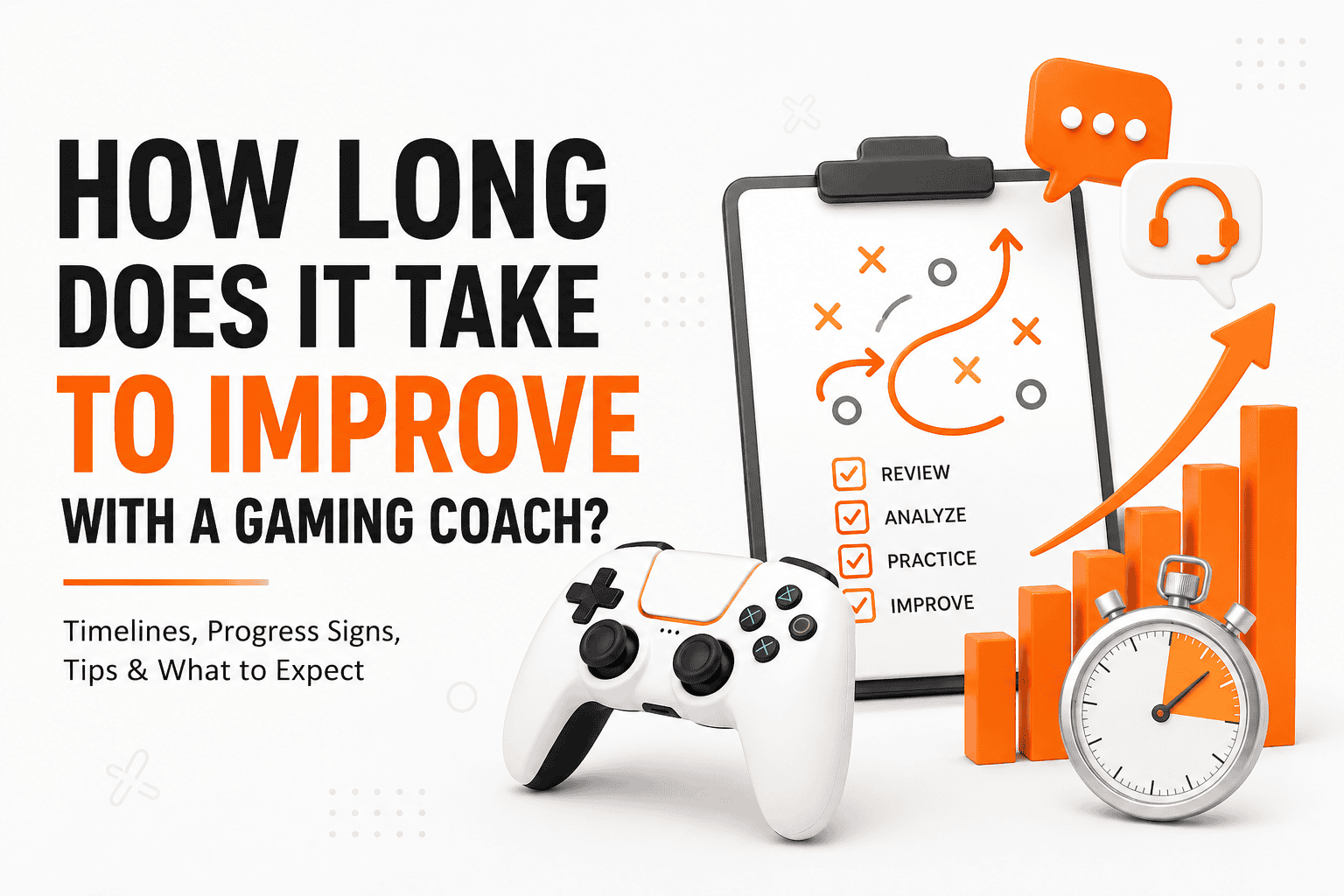
So, how long does it actually take to improve with a gaming coach?
You can start improving after your very first video game coaching session – especially if your coach identifies an obvious mistake, bad habit or misunderstanding. But turning that advice into consistent gameplay usually takes weeks of focused practice, while bigger improvements in mechanics, decision-making and overall skill can take months.
In other words:
Your coach might identify the problem in five minutes.
Convincing your hands to stop doing it?
That can take a little longer.
🎧 Gaming Coaching Can Speed Up Improvement
One of the biggest advantages of video game coaching is that you don’t have to figure everything out yourself.
Without coaching, improvement can look something like:
🎮 Play → 💀 Make Mistake → 🎮 Play → 💀 Make Same Mistake → 🤔 Wonder Why → 🎮 Repeat
A coach can interrupt that cycle.
They can watch your gameplay and say:
“Here’s the problem.”
More importantly:
“Here’s how to fix it.”
That gives you a much more useful improvement process:
🎧 Coaching → 🎯 Identify Weakness → 🏋️ Practise → 🎮 Apply → 🔍 Review → 📈 Improve
Coaching doesn’t remove the work.
It helps make sure you’re working on the right things.
⚡ Some Improvements Can Happen Almost Immediately
Not every gaming weakness takes months to correct.
Some problems are primarily about knowledge or understanding.
Maybe your coach notices that you’re:
- 🎯 Keeping your crosshair too low
- 📍 Positioning too far from cover
- 🚗 Rotating incorrectly in Rocket League
- 🗺️ Ignoring an important part of the map
- ⚔️ Taking fights you don’t need to take
- 🏋️ Using an ineffective practice routine
Once someone points out the problem, you might understand the solution immediately.
You could even start playing better during the same coaching session.
That’s genuine improvement.
But there’s an important catch.
🧠 Understanding Something Isn’t the Same as Mastering It
Suppose your Valorant coach tells you:
“Keep your crosshair at head height.”
Simple enough.
You understand the concept.
Five minutes later, you’re doing it correctly.
Excellent.
Three days later, you’re in ranked.
An enemy appears.
Everything gets frantic.
And your crosshair has somehow returned to examining the floor.
Welcome to skill development.
There’s a big difference between:
💡 Understanding a skill
↓
🎮 Performing it occasionally
↓
🔄 Performing it consistently
↓
⚡ Performing it automatically
The first step can happen quickly.
The last one usually takes repetition.
📅 So, How Long Does Gaming Coaching Take to Work?
There’s no universal timeline, but a rough progression might look like:
🎧 First Session – identify weaknesses and understand what needs to change
📅 First Week – begin practising the corrections and becoming more aware of mistakes
📈 First Month – potentially develop more consistent mechanics, decisions and habits
🏆 3-6 Months – potentially make substantial improvements with regular coaching and focused practice
These aren’t guarantees.
Someone playing 20 hours each week will have far more opportunities to apply coaching than someone playing for two.
Your starting level matters too.
Your game matters.
The skill you’re learning matters.
And most importantly:
how you practise matters.
🌱 Beginners May Notice Improvements Faster
Beginners can sometimes make surprisingly quick progress with coaching.
Why?
Because their biggest weaknesses may be relatively fundamental.
A beginner could be:
Looking at the floor in an FPS.
Chasing the ball everywhere in Rocket League.
Ignoring the minimap in League of Legends.
Button-mashing in a fighting game and calling it “pressure”.
Fixing fundamental mistakes can produce noticeable improvements quickly.
More experienced players often have subtler problems, so progress can become slower and more specialised.
If you’re new to coaching, our Video Game Coaching for Beginners – Complete Guide explains how the process works from your first session onwards.
🏋️ Practice Determines How Quickly Coaching Becomes Skill
Here’s the part nobody can really shortcut.
You need to practise.
A coach can show you better positioning.
They can explain rotations.
They can demonstrate a mechanic.
They can analyse exactly why you lost a fight.
But they can’t perform the next 500 repetitions for you.
Rather selfishly, your hands remain your responsibility.
That’s why one excellent coaching session followed by focused practice can sometimes be more valuable than several sessions squeezed together.
The coach provides the direction.
Practice turns that direction into actual gameplay.
📈 Don’t Measure Improvement Only by Rank
There’s another trap worth avoiding.
You have a coaching session.
You practise for a week.
Your rank doesn’t increase.
Therefore:
Coaching doesn’t work?
Not necessarily.
You may already be:
- 🎯 Aiming more consistently
- 📍 Positioning better
- 👀 Noticing more information
- 🧠 Making smarter decisions
- 💀 Dying less unnecessarily
- 🔍 Recognising your own mistakes
- 🏋️ Practising more effectively
Those are real improvements.
Rank can follow eventually, but it isn’t a perfect week-by-week measurement of your development.
Sometimes you’re becoming a better player before the little badge beside your username gets the memo.
🎯 Coaching Can Shorten the Learning Curve – Not Eliminate It
This is the key idea to remember throughout this guide:
A gaming coach can help you improve faster by identifying weaknesses, correcting mistakes and giving your practice direction.
But coaching isn’t a cheat code for skill.
You still need to:
Learn.
Practise.
Make mistakes.
Correct them.
Repeat.
The real question, then, isn’t simply:
“How long does gaming coaching take to work?”
It’s:
“How long does it take to turn good coaching advice into consistent gameplay?”
And to answer that properly, we first need to look at how quickly different types of gaming improvement can actually happen. 🎮
2. ⏱️ How Quickly Can Video Game Coaching Improve Your Skills?
Video game coaching can sometimes improve how you play almost immediately.
But there’s an important distinction:
Learning what to do can be fast. Learning to do it consistently usually isn’t.
A coach might identify a problem during your first session and explain the solution within minutes.
Actually turning that solution into something you do automatically in the middle of a chaotic ranked match?
That’s where the work begins.
🧠 There Are Different Stages of Improvement
It helps to think about gaming improvement as four stages:
💡 Understand → 🎮 Apply → 🔄 Become Consistent → ⚡ Become Automatic
You can move through the first stage very quickly.
The later stages usually require increasingly more practice.
For example, imagine your Rocket League coach explains that you’re rotating directly towards the ball instead of moving into a better supporting position.
You understand.
Next match, you remember.
Three matches later, things get hectic and you’re back chasing the ball like it owes you money.
That’s normal.
You’ve learned the concept.
You just haven’t turned it into a habit yet.
⚡ Stage 1 – Understanding the Problem
This can happen during your first coaching session.
A good coach can help identify:
- 🎯 Mechanical mistakes
- 📍 Poor positioning
- 👀 Awareness problems
- 🧠 Weak decision-making
- 🔄 Incorrect rotations
- ⚔️ Poor fight selection
- 🏋️ Ineffective practice habits
Sometimes simply having someone explain why something keeps going wrong creates an immediate breakthrough.
You go from:
“I keep losing this situation.”
to:
“I’m losing because I’m putting myself in a terrible position before the fight even starts.”
That’s progress.
You haven’t necessarily fixed the problem yet, but now you know what you’re trying to fix.
🎮 Stage 2 – Applying the Advice
The next step is deliberately using what you’ve learned.
At first, this usually requires conscious effort.
Suppose your coach tells you to check the minimap more regularly.
Your next few games might involve repeatedly reminding yourself:
“Check map.”
“Check map.”
“Check map.”
“Oh, I forgot to check the map for three minutes.”
That’s part of learning.
You’re replacing an old behaviour with a new one.
During this stage, you may actually feel less natural while playing because you’re consciously thinking about something that wasn’t previously part of your routine.
🔄 Stage 3 – Becoming Consistent
This is where improvement starts becoming more noticeable.
Instead of occasionally remembering the coaching advice, you begin applying it across multiple matches and different situations.
Your:
🎯 Crosshair placement stays better
📍 Positioning becomes safer
👀 Map checks happen more regularly
🔄 Rotations become more reliable
🧠 Decisions become less reactive
You won’t execute everything perfectly.
Nobody does.
But the better behaviour starts appearing often enough that it becomes part of your normal gameplay.
Depending on the skill and how much you practise, this could take days, weeks or considerably longer.
⚡ Stage 4 – Making the Skill Automatic
This is where you stop consciously thinking about the improvement every time you use it.
Remember learning to drive?
At first, everything requires attention.
Mirrors.
Speed.
Steering.
Indicators.
Gears.
The suspiciously close concrete pillar in the car park.
Eventually, many of those actions become automatic.
Gaming skills can develop in a similar way.
An experienced FPS player doesn’t consciously repeat:
“Crosshair at head height.”
every three seconds.
They’ve practised it enough that good crosshair placement becomes part of how they naturally move through the map.
That’s the goal.
🎯 Different Skills Improve at Different Speeds
Not every coaching point requires the same amount of time.
Some changes can be relatively quick.
For example:
⚙️ Settings adjustments – potentially immediate
💡 Understanding a mechanic – one session
📍 Recognising a positioning mistake – potentially one session
Other improvements usually require much more repetition:
🎯 Aim – weeks, months and ongoing practice
🚗 Advanced Rocket League mechanics – potentially months
🥊 Fighting game execution – substantial repetition
🧠 Game sense – develops through experience
♟️ Advanced strategy – develops through learning, application and review
This is why asking “How long does coaching take to work?” doesn’t have one simple answer.
It depends heavily on what you’re trying to improve.
🏋️ Your Practice Time Changes the Timeline
Imagine two players receive exactly the same coaching.
Both are told to improve the same skill.
Player A practises:
10 hours during the following week.
Player B practises:
1 hour.
After a month, Player A has potentially had dozens more opportunities to apply the feedback.
That’s why measuring progress purely in:
days
or:
weeks
can be misleading.
Sometimes a better measure is:
How many useful repetitions have you completed since the coaching session?
One month of occasional play and one month of deliberate practice are not remotely the same thing.
🎮 Playing More Isn’t Automatically Practising More
There’s another important distinction.
You can play for five hours without deliberately practising anything.
You queue.
You play.
You win some.
You lose some.
You blame matchmaking.
Evening complete.
Focused practice is different.
You enter those matches with a specific objective.
For example:
“Today I’m concentrating on positioning near cover.”
or:
“For these matches, I’m deliberately tracking my rotations.”
That makes your gameplay part of the learning process.
The quality of your practice can therefore affect improvement just as much as the number of hours you play.
📈 Early Progress Can Be Fast – Then Slow Down
Improvement also tends to change as you become better.
Early progress can sometimes happen quickly because there are obvious weaknesses to fix.
Later, the improvements become smaller.
Think:
🌱 Beginner → Large obvious improvements
📈 Intermediate → More specific improvements
🏆 Advanced → Smaller, specialised improvements
Going from terrible crosshair placement to reasonable crosshair placement may happen relatively quickly.
Going from excellent crosshair placement to slightly more consistent elite-level execution?
Welcome to diminishing returns.
🎧 Coaching Speeds Up the Feedback Loop
This is where coaching can save time.
Without feedback, you might spend weeks practising the wrong thing.
With coaching:
🔍 Problem Identified → 🎯 Correct Priority → 🏋️ Better Practice → 🎮 Application → 📈 Progress
You’re reducing the amount of time spent guessing.
That doesn’t guarantee rapid improvement.
But it can make your practice far more efficient.
🚀 Think in Stages, Not Deadlines
Instead of saying:
“I should be better in 30 days.”
think:
Do I understand the problem?
↓
Can I apply the correction?
↓
Can I do it consistently?
↓
Can I do it automatically?
That’s a much better way to judge progress.
Some improvements may move through those stages surprisingly quickly.
Others will take months.
And occasionally you’ll understand something perfectly on Monday and somehow play on Tuesday as though the conversation never happened.
Also normal.
But this raises an interesting question:
Can a single video game coaching session actually make you a better player? 🎧
3. 🎧 Can You Improve After Just One Gaming Coaching Session?
Yes – one video game coaching session can genuinely improve your gameplay.
But probably not in the way some players imagine.
You’re unlikely to enter the session as a struggling beginner and emerge 60 minutes later ready for an esports contract.
If that service exists, we’d also like the link.
What one good coaching session can do is identify important weaknesses, correct misunderstandings and give you a much clearer idea of what to practise next.
Sometimes, that’s enough to create an immediate improvement.
⚡ Some Problems Can Be Fixed Quickly
Certain gaming problems don’t require months of mechanical training.
They require someone knowledgeable to spot what’s wrong.
For example, a coach might notice that you’re:
- 🎯 Keeping your crosshair too low
- 📍 Positioning too far from cover
- 👀 Missing important information on the map
- 🔄 Rotating incorrectly
- ⚔️ Taking unnecessary fights
- 🦸 Using an ability at the wrong time
- 🏋️ Practising inefficiently
- ⚙️ Using settings that are making things harder
Once the problem is identified and explained, you may be able to change what you’re doing during the session itself.
That’s one of the biggest advantages of personalised coaching.
The feedback is about your gameplay, not what players generally should be doing.
💡 One Session Can Create an “Ohhh…” Moment
Sometimes improvement begins with one surprisingly simple explanation.
You’ve spent 50 matches wondering why you keep losing the same type of fight.
Your coach watches one replay.
Pauses it.
And says:
“Look where you’re standing.”
Ah.
Suddenly the problem isn’t mysterious anymore.
You weren’t losing because your aim was terrible.
You were taking the fight from a position where your opponent had every advantage.
That single observation can change how you approach similar situations in future matches.
🔍 A Coach Can Identify Problems You Didn’t Know You Had
This is where even one session can be valuable.
Players aren’t always good at diagnosing their own weaknesses.
You might think:
“My aim is holding me back.”
Your coach might discover:
Your aim is fine.
The actual problem is that you’re constantly taking low-percentage fights.
Or perhaps you think your Rocket League mechanics are the problem.
After reviewing your gameplay, the coach discovers that your positioning is forcing you into difficult mechanical situations in the first place.
Now your practice changes.
Instead of spending another 20 hours practising the wrong thing, you can focus on the actual weakness.
🎯 One Session Can Improve Your Practice Routine
This may be one of the most valuable outcomes from a single coaching session.
Imagine you’ve been practising for an hour every day.
Sounds productive.
Except you’re practising skills that aren’t particularly important to your current weaknesses.
A coach can help turn:
🏋️ More Practice
into:
🎯 Better Practice
They might give you:
- Specific drills
- Clear priorities
- Match objectives
- Replay-review techniques
- Mechanical exercises
- A simple practice schedule
That improvement continues after the coaching session ends.
You’re not just paying for an hour of advice.
You’re potentially improving how you use many future hours of practice.
🧠 But Understanding Isn’t Mastery
Here’s the important limitation.
A coach might completely change your understanding of a mechanic during one session.
That doesn’t mean you’ve mastered it.
Suppose your coach teaches you better Rocket League rotations.
By the end of the session, you understand exactly where you should be.
Fantastic.
Now you need to recognise those situations:
at full speed
against real opponents
while tracking teammates
while managing boost
while controlling your car
while someone named xXBallChaser9000Xx ignores every rotation known to humanity
That’s where practice comes in.
🏋️ One Session Can Start the Improvement – Practice Makes It Stick
Think of your first coaching session as creating a better direction.
Before:
🎮 Play → ❓ Guess What Went Wrong → 🎮 Play Again
After:
🎧 Coaching → 🎯 Know What to Improve → 🏋️ Practise → 🎮 Apply → 🔍 Review
That’s a significant change.
But the coach can’t complete the rest of the cycle for you.
If you finish the session and never practise the advice, the long-term improvement may be limited.
📈 What Can Realistically Improve After One Session?
After a good first coaching session, you might reasonably expect to have:
✅ A better understanding of your weaknesses
✅ Clearer improvement priorities
✅ Corrections to obvious mistakes
✅ Better knowledge of important concepts
✅ A more effective practice routine
✅ Greater awareness during matches
✅ Specific skills or techniques to work on
✅ A clearer idea of what “better” actually looks like
You might also immediately perform better in certain situations.
But consistency usually comes later.
🎮 Can One Session Be Enough?
Sometimes, yes.
Not everyone needs ongoing coaching.
Maybe you booked a session because you wanted to:
- Learn one mechanic
- Understand a particular strategy
- Fix an obvious weakness
- Get feedback on your gameplay
- Improve your practice routine
- Learn the fundamentals of a new game
One session may give you everything you need to continue improving independently.
You can always return later if you hit another problem.
🔄 When Would You Need Another Session?
Another session becomes useful when you’ve had enough time to apply the first one.
Ideally:
🎧 First Session
↓
🎯 Identify 1-3 Priorities
↓
🏋️ Practise
↓
🎮 Apply Them in Matches
↓
🔍 See What Changes
↓
❓ Develop New Questions
↓
🎧 Follow-Up Session
Don’t rush from Session 1 directly into Session 2 simply because the first one was useful.
Give the advice time to work.
Our How Often Should You Have Video Game Coaching Sessions? guide looks more closely at finding the right balance between coaching and independent practice.
🎯 One Session Can Change Your Direction
Perhaps the best way to think about a single coaching session is this:
It may not transform your skill level immediately – but it can transform how you improve.
If a coach identifies the right weakness, corrects an important misunderstanding and gives you a better practice plan, the effect of that one session can continue for weeks.
That’s considerably more useful than simply playing another hundred matches while repeating the same mistake.
So yes:
You can improve after one gaming coaching session.
But the more interesting question is what happens when you take that feedback and spend the next week actually practising it. 📅
4. 📅 What Improvement Can You Expect After One Week?
After one week of gaming coaching and focused practice, you probably won’t be a completely different player.
But you may already notice meaningful changes.
The biggest improvements after the first week are often not dramatic jumps in rank or suddenly perfect mechanics. They’re usually smaller changes in awareness, understanding, habits and consistency.
And those smaller changes are what bigger improvements are built on.
🧠 You’ll Probably Notice Your Mistakes More
One of the first things coaching can change is your ability to recognise mistakes.
Before coaching:
💀 You die.
🤷 “How did that happen?”
After coaching:
💀 You die.
🧠 “Yep. I was standing in the open again.”
Technically, you’re still dead.
But that’s progress.
Once your coach has identified specific weaknesses, you’ll often start noticing them during your own matches.
You may catch yourself thinking:
“My crosshair is too low.”
“I’m rotating too early.”
“I shouldn’t take this fight.”
“I haven’t checked the map.”
That increased awareness is one of the earliest signs that coaching is starting to work.
🎯 You May Have Clearer Priorities
Before coaching, your improvement plan might have been:
“Get better.”
Ambitious.
Slightly lacking in detail.
After a week of working with specific feedback, your practice might become:
🎯 Improve crosshair placement
📍 Stay closer to cover
👀 Check the minimap more consistently
That’s much easier to act on.
Instead of trying to improve everything simultaneously, you’re concentrating on the weaknesses most likely to make a difference.
🏋️ Basic Habits May Start Changing
A week can be enough time to begin changing simple habits.
For example:
- Keeping your crosshair higher
- Checking the map more frequently
- Reloading at safer times
- Improving basic positioning
- Managing resources more carefully
- Communicating useful information
- Following a better warm-up routine
The important word is begin.
You may remember the new behaviour in one match and completely forget it in the next.
That’s normal.
You’re trying to replace something you’ve potentially done hundreds or thousands of times with a different behaviour.
Your brain may require slightly more convincing.
🎮 You May Start Applying Coaching in Real Matches
This is where the first week becomes particularly useful.
During coaching, everything is relatively controlled.
Your coach explains the problem.
You ask questions.
You practise the correction.
Then you enter an actual match.
Suddenly:
Your teammates are doing something unexpected.
Your opponents aren’t cooperating.
Several things happen simultaneously.
Somebody is communicating exclusively through angry pings.
Now you find out whether you can apply the advice under pressure.
Even successfully using the new behaviour a few times is progress.
🎯 Mechanical Improvements May Begin – But Don’t Expect Mastery
You can certainly improve mechanically within a week.
If you’re practising consistently, you may notice:
- Better aim
- Smoother movement
- More reliable combos
- Cleaner edits
- Better car control
- Improved ability execution
But complex mechanics often require far more than seven days to become consistent.
A Rocket League coach might teach you how to perform an aerial correctly.
Within a week, you might be hitting more of them.
That doesn’t mean every aerial is now destined for YouTube.
Some will still end with your car travelling confidently in one direction while the ball goes somewhere else entirely.
The improvement is in the trend.
📈 Your Consistency May Start Improving
One of the best early signs is that good gameplay begins happening more often.
Suppose you previously maintained good positioning in:
2 out of 10 situations.
After focused coaching and practice, perhaps that becomes:
5 out of 10.
You’re still making mistakes.
But you’re making fewer of them.
That’s meaningful improvement.
You don’t need to go from:
Bad → Perfect
You want:
Bad → Better → More Consistent → Automatic
One week can begin that process.
🔍 You May Discover New Problems
This sounds negative.
It isn’t.
Once you correct one weakness, another may become more obvious.
For example:
Your coach improves your positioning.
Now you’re surviving longer.
Because you’re surviving longer, you’re reaching situations you previously didn’t.
And now you discover:
your late-round decision-making needs work.
Excellent.
You’ve unlocked a new problem.
Gaming improvement has a slightly cruel sense of humour.
But this is how progression works.
Fix → Improve → Discover Next Weakness → Improve Again
📊 Don’t Expect Your Rank to Transform in Seven Days
This is important.
One week is generally too short to judge coaching purely by rank.
You could improve considerably and still:
- Lose matches
- Drop rank
- Have inconsistent sessions
- Make old mistakes
- Perform worse while learning something new
Rank is affected by many factors and short-term results can be noisy.
Instead, look for changes in how you’re playing.
Ask:
Am I making better decisions?
Am I recognising mistakes sooner?
Am I applying the coaching more often?
Are certain mechanics becoming easier?
Those are better early indicators.
🧠 You Might Temporarily Play Worse
This sounds alarming.
But it can happen.
Suppose you’ve spent years playing aggressively without thinking about positioning.
Your coach now asks you to deliberately consider:
Cover.
Angles.
Teammates.
Escape routes.
Suddenly, you’re thinking about far more information during every fight.
For a while, that can make you slower or less natural.
It doesn’t necessarily mean you’re getting worse.
You’re replacing an automatic bad habit with a conscious better habit.
With enough repetition, the better behaviour can eventually become automatic too.
🏋️ The First Week Should Be About Applying, Not Adding
After your first coaching session, resist the urge to immediately collect another dozen things to improve.
If your coach gave you three priorities, work on those three.
You don’t also need:
A new aim routine.
A different sensitivity.
Six strategy videos.
A new character.
Three spreadsheets.
And a 47-minute YouTube video titled:
“YOU’VE BEEN PLAYING WRONG THIS WHOLE TIME!!!”
Keep it simple.
Focused practice usually beats information overload.
📋 What Might Change After One Week?
With consistent practice, you may notice:
✅ Better awareness of your mistakes
✅ Clearer practice priorities
✅ Early improvements in mechanics
✅ Better understanding of positioning or strategy
✅ Fewer repeated mistakes
✅ More deliberate decision-making
✅ Greater confidence in certain situations
✅ Better ability to analyse your own gameplay
You probably won’t have mastered everything.
You shouldn’t expect to.
🎯 One Week Is the Beginning, Not the Deadline
Treat the first week after coaching as an implementation period.
You’re taking ideas from the coaching session and testing them in the real world.
Some will click quickly.
Others will need considerably more repetition.
And some will reveal entirely new weaknesses you didn’t know existed.
That’s all useful information.
The better question after seven days isn’t:
“Have I completely transformed as a player?”
It’s:
“Am I playing, thinking or practising differently than I was a week ago?”
If the answer is yes, you’re moving in the right direction.
Give that process a few more weeks and those early changes may start becoming something much more important:
consistent improvement. 📈
5. 📈 What Improvement Can You Expect After One Month?
One month is where video game coaching can start producing more noticeable and consistent improvements – assuming you’ve actually been practising between sessions.
After four weeks, you may have had enough time to move beyond simply understanding your coach’s advice and start turning some of it into normal gameplay habits.
You probably won’t transform from Bronze to professional esports player.
Your inbox is unlikely to contain a contract from Team Liquid.
But you may look back at gameplay from a month ago and think:
“Why on earth was I doing that?”
That’s usually a good sign.
🎯 Your Biggest Mistakes May Become Less Common
One of the most noticeable changes after a month can be a reduction in repeated mistakes.
Suppose your coach originally identified three problems:
📍 Poor positioning
👀 Weak map awareness
⚔️ Taking unnecessary fights
During the first week, you might simply become more aware of them.
After several weeks of deliberate practice, you may start correcting them before they happen.
Instead of:
Make mistake → Recognise mistake
you begin moving towards:
Recognise situation → Avoid mistake
That’s a significant step forward.
🔄 Better Habits May Start Feeling More Natural
Early in the coaching process, new behaviours can feel awkward.
You have to remind yourself:
Check the map.
Stay near cover.
Watch your positioning.
Don’t chase the ball.
Again.
Do not chase the ball.
After several weeks, some of those behaviours may require less conscious effort.
That’s exactly what you want.
The progression looks something like:
🧠 Think About It → 🎮 Deliberately Do It → 🔄 Repeat It → ⚡ Do It Naturally
A month won’t make every skill automatic.
But simple improvements can start moving in that direction.
🎯 Your Mechanics May Become More Consistent
Mechanical skills usually need repetition.
If you’ve spent several weeks following a structured practice routine, you may begin noticing improvements in:
- 🎯 Aim
- 🏃 Movement
- 🏗️ Building and editing
- 🚗 Car control
- 🚀 Aerial mechanics
- 🥊 Combos
- ⚡ Ability execution
The important improvement may not be your best-ever performance.
It may be your average performance.
Maybe you could already hit a difficult mechanic occasionally.
Now you’re hitting it more reliably.
That’s often a better sign of genuine improvement.
Consistency beats the occasional miracle.
🧠 Your Decision-Making May Improve
Not all improvement happens through faster fingers.
A month of coaching and deliberate gameplay can also improve how you think about the game.
You may become better at recognising:
- When to fight
- When to retreat
- Where to position
- When to rotate
- Which objective matters
- When to use an ability
- What your opponent is likely to do
- What information you’re missing
These improvements can be harder to notice than mechanical ones.
There’s no satisfying ding when your decision-making improves.
You simply start making fewer terrible decisions.
Less dramatic.
Much more useful.
👀 Your Game Awareness May Expand
Beginners and developing players often focus heavily on what’s directly in front of them.
Over time, coaching can help expand your attention.
Instead of seeing:
Enemy → Shoot Enemy
you may start noticing:
Enemy + Position + Teammates + Objective + Resources + Escape Route
That’s a major development.
In MOBAs, it might mean checking the minimap and tracking objectives.
In FPS games, it could mean understanding teammate positioning and available utility.
In Rocket League, it may mean tracking teammates rather than treating the ball as the only object in the known universe.
You’re processing more of the game.
🔍 You May Become Better at Reviewing Yourself
Another important change can happen away from the match itself.
After a month, you may become better at recognising why something went wrong.
Instead of:
“That was unlucky.”
you might think:
“I pushed without enough information.”
Or:
“My mechanics weren’t the problem – my positioning created a difficult fight.”
Or even the rarest sentence in online gaming:
“That was actually my mistake.”
Treasure that moment.
Self-analysis is valuable because it helps you improve between coaching sessions without needing someone else to identify every problem.
📊 Your Statistics May Start Changing
Depending on the game and skill you’re working on, measurable performance indicators may begin improving.
That could include:
- Accuracy
- Deaths
- Damage
- Farming
- Objective participation
- Win rate
- Mechanical consistency
- Successful rotations
- Resource efficiency
But be careful with short-term statistics.
A month is still a relatively small window and performance can fluctuate.
Use stats alongside gameplay quality, rather than treating them as absolute proof that you’re improving.
🏆 Could Your Rank Improve After One Month?
Absolutely.
But it isn’t guaranteed.
If coaching helps you fix important weaknesses and you’re practising regularly, those improvements may eventually translate into better ranked results.
You could climb.
You could stay exactly where you are.
You could even temporarily drop.
That doesn’t automatically tell you whether the coaching is working.
Imagine your positioning, awareness and decision-making all improve during the month.
Those skills are real progress even if your rank badge hasn’t changed yet.
Rank often reflects improvement after enough matches have been played for those better decisions to affect results consistently.
🏋️ Practice Still Determines the Result
There’s a massive difference between:
One Month Since Coaching
and:
One Month of Practising Coaching Feedback
Player A has a coaching session.
Then plays occasionally and mostly ignores the feedback.
Player B has the same session.
Then deliberately practises three times per week and actively applies the advice during matches.
Both can technically say:
“I’ve had coaching for a month.”
Their results may look very different.
The calendar doesn’t improve your gameplay.
What you do during those four weeks does.
🎧 Several Coaching Sessions Can Create a Feedback Loop
If you’re having coaching weekly or fortnightly, one month may include several sessions.
That allows you to build a useful cycle:
🎧 Session 1 – Identify Weakness
↓
🏋️ Practise
↓
🎮 Apply
↓
🎥 Session 2 – Review Progress
↓
🎯 Adjust
↓
🏋️ Practise Again
This is where coaching can become particularly effective.
Instead of receiving isolated advice, you’re creating an ongoing feedback and improvement loop.
If you’re unsure how frequently those sessions should happen, How Often Should You Have Video Game Coaching Sessions? looks at weekly, fortnightly, monthly and as-needed coaching in more detail.
📈 Compare Yourself With Yourself
After one month, one of the best things you can do is compare your current gameplay with older gameplay.
Watch a match from before you started coaching.
You may notice things that weren’t obvious at the time:
“Why am I standing there?”
“Why didn’t I rotate?”
“How did I not see that?”
“Why did I take that fight?”
If you can now recognise mistakes that your previous self couldn’t even see, you’ve improved.
Even better if you’re no longer making them as often.
🎯 What Might Improve After One Month?
With good coaching and consistent practice, you might notice:
✅ Fewer repeated mistakes
✅ More consistent mechanics
✅ Better positioning
✅ Improved game awareness
✅ Smarter decision-making
✅ Better practice habits
✅ Greater confidence
✅ Better self-analysis
✅ Early statistical improvements
✅ Potential ranked progression
Not every player will experience all of these within a month.
Some skills simply take longer.
🚀 One Month Can Show Direction – Not Your Limit
Four weeks is enough time to start answering an important question:
Is the way I’m training actually making me better?
Look for trends.
Are mistakes becoming less frequent?
Are good decisions becoming more common?
Are mechanics becoming more consistent?
Are you understanding situations that previously confused you?
If yes, keep going.
Because while one month can produce noticeable improvements, three to six months of focused coaching and deliberate practice can create a much bigger difference between the player you started as and the player you’re becoming. 🏆
6. 🏆 What Can Change After 3-6 Months of Coaching and Practice?
Three to six months is where the difference between learning something and genuinely developing as a player can become much clearer.
With useful coaching and consistent practice, you may have enough time to improve multiple areas of your gameplay, turn better behaviours into habits and become far more independent in identifying your own mistakes.
That doesn’t mean six months guarantees six new ranks.
Gaming improvement remains stubbornly unwilling to follow a spreadsheet.
But compared with your starting point, the changes can be substantial.
🎮 Your Fundamentals Can Become Much Stronger
Early coaching often identifies weaknesses in the fundamentals.
Depending on the game, these might include:
- 🎯 Aim and crosshair placement
- 📍 Positioning
- 👀 Map awareness
- 🔄 Rotations
- ⚔️ Fight selection
- 💰 Resource management
- 🗺️ Map knowledge
- 🧠 Basic decision-making
After several months of deliberate practice, these skills can become considerably more reliable.
You’re no longer constantly reminding yourself:
“Stay near cover.”
You just naturally position closer to it.
That frees your attention for more advanced decisions.
⚡ Good Habits Can Become Automatic
This is one of the biggest differences between early and longer-term improvement.
At first:
🧠 Think → 🎮 Act
Eventually:
🎮 Act
The thought hasn’t disappeared.
It’s simply become part of how you play.
An experienced FPS player doesn’t consciously calculate crosshair height every time they enter a room.
A good Rocket League player doesn’t stop mid-match to consult a rotation diagram.
A fighting game player isn’t reciting every input aloud while performing a familiar combo.
Hopefully.
Those behaviours have been repeated enough that they require less conscious attention.
Three to six months gives you far more opportunity to reach that stage.
🎯 Mechanics Can Become More Consistent
Mechanical improvement often benefits enormously from time.
You may have performed a mechanic successfully after your first week.
Months later, the important difference is that you can perform it more reliably.
That could mean:
- 🎯 More consistent aim
- 🏃 Cleaner movement
- 🏗️ Faster building or editing
- 🚀 More reliable aerials
- 🥊 Better combo execution
- ⚡ More accurate ability usage
- 🎮 Better overall control
The goal isn’t:
“I managed to do it once.”
It’s:
“I can usually do it when I need it.”
That’s a much higher standard.
🧠 Your Game Sense Can Develop
Game sense is harder to practise in isolation.
It develops through a combination of:
Experience + Feedback + Reflection
You encounter situations.
You make decisions.
You see what happens.
Your coach helps explain why.
Then you encounter similar situations again.
Over several months, you may become better at predicting:
- What opponents are likely to do
- Where pressure is coming from
- When a fight is worth taking
- When to rotate
- Which objective matters
- Where teammates need support
- When to play aggressively
- When doing absolutely nothing is the surprisingly correct decision
This is where a player can begin looking smarter, not simply mechanically better.
🔍 Your Coaching Feedback May Become More Advanced
There’s another interesting sign of progress.
Your coach starts talking about different things.
Early sessions:
“Your positioning is poor.”
Later sessions:
“Your positioning is good here, but you’re rotating three seconds too early because you haven’t accounted for…”
That’s progress.
The coach hasn’t suddenly become fussier.
Hopefully.
The obvious weaknesses have improved enough that smaller problems are now worth addressing.
Your feedback becomes more specific because your gameplay has become more sophisticated.
📈 You May Move Through Several Improvement Cycles
Over three to six months, you won’t usually work on one problem continuously.
Instead, improvement might look like:
🎯 Fix Positioning
↓
📈 Improve
↓
👀 Discover Awareness Problem
↓
📈 Improve
↓
🧠 Discover Decision-Making Problem
↓
📈 Improve
↓
🎮 Discover Another Weakness
This is normal.
Fixing one bottleneck often reveals the next.
It’s less:
“I finally fixed everything.”
and more:
“Excellent. I’ve unlocked more complicated problems.”
Welcome to getting better.
🏋️ Your Practice Can Become More Effective
Long-term improvement isn’t only about what happens during matches.
You may also become much better at training yourself.
After several months of good coaching, you might know how to:
- Identify a weakness
- Choose an appropriate drill
- Set a specific practice goal
- Review your gameplay
- Track recurring mistakes
- Separate mechanical problems from decision-making problems
- Know when you need outside feedback
This is extremely valuable.
Instead of waiting for your coach to tell you what to do every time, you begin running parts of the improvement process yourself.
🎥 Your Self-Review Can Improve Dramatically
Imagine watching one of your old matches from six months ago.
You may start noticing things your previous self completely missed.
“Why did I push that?”
“There was no reason to use that ability.”
“I had absolutely no information there.”
“Apparently cover was optional.”
That’s evidence that your understanding of the game has developed.
You aren’t simply playing differently.
You’re seeing the game differently.
🏆 Your Rank May Improve Significantly
Over several months, stronger mechanics, better decision-making and improved consistency may translate into substantial ranked progression.
But again:
There are no guarantees.
Your results depend on:
- Your starting level
- How often you play
- Practice quality
- The difficulty of your goals
- Your game
- Your role
- Your consistency
- How effectively you apply coaching
Some players may climb several ranks.
Others may make large gameplay improvements while seeing more modest rank changes.
Don’t reduce six months of development to the colour of one badge.
📉 Expect Plateaus Along the Way
Three to six months of improvement won’t look like:
📈📈📈📈📈📈📈📈📈
It may look more like:
📈📈➡️➡️📉📈➡️📈📈➡️
You’ll improve.
Plateau.
Struggle.
Adjust.
Break through.
Then eventually discover another plateau waiting politely around the corner.
That’s normal skill development.
A plateau doesn’t automatically mean your coaching has stopped working.
It may simply mean the next improvement requires a different approach.
🧑🏫 You May Need Less Coaching
Interestingly, several months of good coaching may lead to fewer coaching sessions.
As you improve, you may become better at:
- Recognising your own mistakes
- Creating practice routines
- Reviewing matches
- Finding solutions
- Tracking progress
You might move from:
📅 Weekly Coaching
to:
🗓️ Fortnightly
then:
📆 Monthly
and eventually:
🎯 As Needed
That’s not a step backwards.
A good coach should help you become more capable of improving independently.
🔄 Compare Month 6 With Day 1
One of the best ways to judge long-term progress is to keep some of your older gameplay.
Then compare it.
Don’t only look at highlights.
Watch normal matches.
Compare:
🎯 Mechanics
📍 Positioning
👀 Awareness
🧠 Decision-making
🔄 Consistency
🎮 Overall control
You may be surprised by how many things now feel obvious that once required conscious effort.
That’s often a much better demonstration of progress than obsessing over one week’s win rate.
🎯 What Might Change After 3-6 Months?
With consistent practice and useful coaching, you could potentially develop:
✅ Stronger fundamentals
✅ More reliable mechanics
✅ Better game sense
✅ Smarter decision-making
✅ Fewer repeated mistakes
✅ Greater consistency
✅ Better self-analysis
✅ More effective practice habits
✅ Greater independence
✅ Potentially significant ranked progression
The exact results will vary enormously between players.
But several months gives coaching something extremely important that one session can’t provide:
time for the feedback to become skill.
And there’s another major factor affecting how quickly that happens.
Your starting point.
Because a complete beginner and an experienced player can receive the same amount of coaching and progress at very different speeds. 🌱
7. 🌱 Do Beginners Improve Faster With Gaming Coaching?
Often, yes.
Beginners can sometimes make faster and more noticeable early improvements with video game coaching because they have more fundamental skills to learn and more obvious mistakes to correct.
That doesn’t mean becoming an expert is quick.
It means the first improvements can be relatively large.
When you’re starting from:
“I have absolutely no idea what I’m doing.”
there’s considerable room for improvement.
Convenient.
🚀 Beginners Often Have Bigger Problems to Fix
Experienced players may need coaching to identify subtle mistakes.
Beginners?
The problem may be standing directly in front of everyone.
A beginner FPS player might:
- 🎯 Keep their crosshair pointed at the floor
- 📍 Stand in exposed positions
- 🔄 Reload at terrible times
- 👀 Ignore the minimap
- ⚔️ Take every fight they see
- 🏃 Move predictably
- 💥 Use abilities without much purpose
Correcting even a few of those fundamentals can make an immediate difference.
An advanced player might spend weeks trying to improve a tiny positioning decision.
A beginner might improve simply by discovering that cover is quite useful when people are shooting at you.
💡 Beginner Mistakes Can Be Easier to Identify
One reason beginners can benefit quickly from coaching is that their biggest weaknesses may be obvious to an experienced player.
You might think:
“My aim is terrible.”
Your coach watches five minutes and discovers:
Your sensitivity is extremely high.
Your crosshair placement is poor.
You’re constantly moving while trying to shoot.
Suddenly, you have three specific things to work on.
That’s much more useful than:
“I need better aim.”
Good beginner coaching turns vague problems into clear, actionable improvements.
🎮 Learning the Fundamentals Can Produce Big Gains
Beginners aren’t usually trying to squeeze another 2% out of an already polished skill.
They’re learning foundations.
Depending on the game, that might include:
- 🎯 Basic mechanics
- 📍 Positioning
- 🗺️ Map knowledge
- 👀 Awareness
- 🔄 Rotations
- 🦸 Character or role fundamentals
- ⚔️ When to fight
- 🏋️ How to practise
- 🧠 Basic strategy
These fundamentals affect almost everything else you do.
Improve positioning and you may suddenly survive longer.
Survive longer and you get more opportunities to use your abilities.
Use those abilities more often and you gain more experience making decisions.
One fundamental improvement can create several knock-on benefits.
🏋️ Beginners Can Avoid Practising Bad Habits
This is one of the strongest arguments for getting coaching early.
When you’re new to a game, you haven’t necessarily spent hundreds of hours reinforcing poor habits yet.
Your coach can help establish better ones from the beginning.
Instead of spending six months doing something incorrectly and another three trying to unlearn it, you can start with a better technique.
Because unfortunately:
Practice doesn’t automatically make perfect.
Practice makes things repeatable.
If you’re repeatedly practising the wrong thing, congratulations – you’re becoming extremely consistent at doing it badly.
🧠 Beginners Can Learn How to Practise Properly
A beginner may not even know what deserves practice.
You might spend an hour working on an advanced mechanic because it looks impressive.
Meanwhile, your basic movement, positioning and awareness need considerably more attention.
A coach can help prioritise:
What matters now
versus:
What can wait until later
That can save a lot of wasted practice time.
Your first improvement plan might be as simple as:
🎯 Priority 1: Basic mechanics
📍 Priority 2: Positioning
👀 Priority 3: Awareness
Not:
“Learn every advanced mechanic before Thursday.”
🎯 Early Coaching Can Give Beginners Direction
Many new players improve through random experimentation.
Play.
Watch a video.
Change settings.
Play again.
Copy a professional player’s settings.
Change them back.
Watch another video.
Wonder why the professional’s sensitivity hasn’t magically transferred their aim along with it.
A coach can provide structure.
Instead of consuming random advice, you get feedback based on your current level and your gameplay.
That makes it easier to focus on what will actually help you now.
📈 Beginner Progress Can Feel Faster
Imagine skill progression from 0 to 100.
Moving from:
20 → 30
may be relatively achievable because you’re fixing large fundamental problems.
Moving from:
90 → 91
can require considerably more work.
That’s why beginner improvement can sometimes feel dramatic.
After a few weeks, you might:
- Survive noticeably longer
- Understand what’s happening
- Make fewer obvious mistakes
- Perform basic mechanics more consistently
- Feel less overwhelmed
- Win situations you previously lost
Those changes are easy to notice.
⚠️ Fast Early Improvement Doesn’t Continue Forever
This is important.
Beginners can experience rapid early progress.
Then things slow down.
That’s normal.
Eventually, you’ve fixed the obvious problems.
Your positioning isn’t terrible anymore.
Your mechanics are reasonable.
You understand the maps.
You’re making fewer beginner mistakes.
Now improvement becomes more about:
consistency, refinement, decision-making and smaller weaknesses.
The learning curve changes.
You haven’t suddenly stopped improving.
You’ve simply reached a stage where the next gains are harder.
🎮 Different Beginners Will Improve at Different Speeds
Being a beginner doesn’t mean everyone starts from the same place.
Previous gaming experience matters.
Someone who has played competitive FPS games for ten years and starts Valorant has transferable skills.
They may already understand:
- Crosshair placement
- Angles
- Positioning
- Communication
- Aim fundamentals
Someone playing their first competitive FPS has far more to learn.
Both are technically Valorant beginners.
They’re not the same type of beginner.
🧩 Transferable Skills Can Speed Things Up
Gaming experience often carries across genres.
An experienced Counter-Strike player moving to Valorant may already have strong FPS fundamentals.
A League of Legends player trying another MOBA may understand concepts like:
laning, objectives, map control and team fights.
A fighting game player starting a new title may already understand:
spacing, punishes and matchup learning.
A coach can identify what you already know and concentrate on the gaps.
That can accelerate progress considerably.
🌱 Beginners Still Need Patience
Rapid early progress can create unrealistic expectations.
You improve dramatically during the first month.
So naturally:
“At this rate I’ll be professional by Christmas.”
Probably not.
Early improvements often come from correcting large weaknesses.
As your skill increases, the remaining problems become harder to identify and harder to fix.
Enjoy the early gains.
Just don’t assume improvement will continue at exactly the same speed forever.
🎧 Coaching Can Give Beginners a Better Starting Point
Perhaps the biggest benefit isn’t that coaching makes beginners improve instantly.
It’s that coaching can help them start in the right direction.
Instead of:
🎮 Play → ❌ Develop Bad Habit → 🔄 Repeat It 500 Times → 😩 Try to Unlearn It
you can aim for:
🎧 Learn Fundamentals → 🎯 Practise Correctly → 🎮 Apply → 📈 Improve
That’s a much nicer journey.
If you’re completely new to coaching, our Video Game Coaching for Beginners – Complete Guide walks through choosing a coach, preparing for your first session and getting the most from the experience.
Beginners may therefore make some of the fastest visible early gains from gaming coaching.
But once you’ve moved beyond the fundamentals, improvement becomes a different challenge.
Because intermediate players often know exactly how the game works.
The frustrating part is figuring out why they’re still stuck. 📈
8. 📊 Do Intermediate Players Take Longer to Improve?
Often, yes.
Intermediate players may take longer to see major improvements because they’ve already learned the basics and corrected many of the obvious beginner mistakes.
At this stage, you’re probably not wondering what the objective is or why everyone keeps looking at the minimap.
You know how the game works.
You can perform the basic mechanics.
You may even be pretty good.
And that’s precisely where improvement can become harder.
The better you get, the fewer easy wins remain.
📉 Welcome to Diminishing Returns
When you’re a beginner, relatively simple corrections can produce large improvements.
Maybe you learn to:
🎯 Keep your crosshair at head height
📍 Position closer to cover
👀 Check the minimap
Those changes can immediately affect huge portions of your gameplay.
An intermediate player may already do all three.
Their problem might be:
“My positioning is generally good, but I consistently overextend after gaining an advantage.”
That’s more specific.
And usually harder to fix.
The improvement curve often looks something like:
🌱 Beginner → Big Gains
📈 Intermediate → Smaller, Harder Gains
🏆 Advanced → Tiny, Highly Specific Gains
Unfortunately, games don’t award bonus XP for how difficult improvement becomes.
🔍 Your Mistakes Become Harder to Spot
Intermediate players often know enough to recognise obvious mistakes.
The challenge is identifying the less obvious ones.
You might think:
“My aim is holding me back.”
A coach reviews your gameplay and discovers your aim is perfectly reasonable.
The actual problem?
You’re repeatedly taking fights from positions where you need exceptional aim just to survive.
Or perhaps your Rocket League mechanics look good, but you’re using them in situations where a simpler play would be better.
At intermediate levels, the mistake may happen before the visible mistake.
That’s where detailed coaching and gameplay review become particularly valuable.
🔄 You’re Often Fixing Established Habits
Beginners may still be developing their habits.
Intermediate players have had plenty of time to build them.
Including the bad ones.
If you’ve spent 500 hours:
- Rotating incorrectly
- Overcommitting
- Taking unnecessary fights
- Ignoring certain information
- Using an ability too early
then simply understanding the correct approach may not immediately change your behaviour.
You’ve rehearsed the old habit hundreds of times.
Your brain has become very efficient at doing exactly the thing you’re now trying to stop doing.
Wonderful.
Replacing it takes deliberate practice.
🎯 Consistency Becomes More Important
Intermediate players can often perform skills correctly.
The problem is doing them consistently.
You might have excellent aim in one match and average aim in the next.
Perfect rotations for ten minutes.
Then suddenly decide positioning is apparently optional.
The goal shifts from:
“Can I do this?”
to:
“Can I do this reliably?”
That’s a harder challenge.
Consistency usually requires more repetitions than simply learning the skill for the first time.
🧠 Decision-Making Starts Mattering More
As mechanics and fundamentals improve, decision-making often becomes a bigger part of progression.
You may need to improve:
- ⚔️ Fight selection
- 📍 Positioning
- 🔄 Rotations
- ⏱️ Timing
- 👀 Information gathering
- 🎯 Target selection
- 🗺️ Objective decisions
- 🧠 Risk assessment
These skills aren’t always easy to practise through drills.
You need real situations.
That means playing matches, making decisions, reviewing them and encountering similar situations again.
Experience becomes part of the training.
🎥 VOD Review Can Become More Valuable
This is one reason gameplay review can be particularly useful for intermediate players.
Your mechanics may look fine.
Your obvious fundamentals may be fine.
But across several matches, a coach might notice a pattern:
You consistently rotate too early.
You become too aggressive when ahead.
You use an important ability before the fight actually begins.
You repeatedly choose the wrong target.
You may never have noticed the pattern yourself.
Once identified, however, you can deliberately work on it.
That’s where coaching can help turn a vague plateau into a specific problem with a specific solution.
🚧 Intermediate Players Often Hit Plateaus
This is the stage where many players experience the dreaded:
“Why am I not getting better anymore?”
You play regularly.
You understand the game.
You practise.
Your rank moves slightly.
Then returns.
You watch guides.
You play more.
Still stuck.
Plateaus often happen because the weaknesses that remain aren’t as obvious as they once were.
More hours alone may not solve them.
You may simply become extremely experienced at repeating the same mistake.
A coach can provide the outside perspective needed to identify the next bottleneck.
🏋️ Practice Needs to Become More Deliberate
Beginners can often improve simply by playing more because almost every match provides useful experience.
Intermediate players may need to become more deliberate.
Instead of:
“I’m going to play for three hours.”
try:
“For these matches, I’m specifically focusing on my positioning after winning an engagement.”
That’s a very different type of practice.
Your goal isn’t merely to accumulate hours.
It’s to create repetitions of the behaviour you’re trying to improve.
📈 Progress May Become Harder to Notice
Intermediate improvement can also feel slower because the changes aren’t always dramatic.
You may not suddenly gain three ranks.
Instead, you might:
- Make one fewer bad decision per match
- Survive slightly more difficult situations
- Rotate more consistently
- Use resources more efficiently
- Recognise danger earlier
- Make fewer positioning errors
Each improvement looks small.
Combined across dozens of situations, they can have a significant effect.
This is why intermediate players should avoid measuring progress only through rank.
⏱️ How Long Might Intermediate Improvement Take?
There’s no fixed timeline.
But compared with beginner improvements, you should generally expect specific intermediate weaknesses to require weeks or months of deliberate work rather than expecting everything to change after one session.
A coaching cycle might look like:
🎧 Identify Weakness
↓
🎯 Understand the Correction
↓
🏋️ Practise for Several Weeks
↓
🎮 Apply Across Many Matches
↓
🎥 Review
↓
🔧 Refine
↓
📈 Improve
Some problems will disappear quickly.
Others will stubbornly survive several coaching sessions.
Gaming skills can be inconsiderate like that.
🎯 Don’t Confuse Slower Progress With No Progress
This is important.
Suppose a beginner improves from:
20 → 40
while an intermediate player improves from:
70 → 75
The beginner’s progress looks much bigger.
But moving from 70 to 75 may have required far more sophisticated improvement.
As your skill increases, each additional step can become harder.
That’s normal.
🚀 Intermediate Coaching Is About Finding the Next Bottleneck
At this stage, one of the most useful things a coach can do is identify:
What’s actually holding you back now?
Not six months ago.
Not what a generic guide says.
Now.
Once that bottleneck is identified, your practice can become much more focused.
That’s why intermediate improvement may be slower than beginner improvement – but also much more targeted.
And eventually, if you keep progressing, you’ll encounter an even more stubborn version of the same problem.
Because at advanced levels, finding another meaningful improvement can become a game within the game itself. 🏆
9. 🥇 Why Advanced Players May Improve More Slowly
The better you become at a game, the harder it can be to get noticeably better.
Advanced players have already fixed many of the problems that produce quick improvements.
Their mechanics are strong.
Their game knowledge is extensive.
Their positioning is usually good.
Their decision-making is generally solid.
Which leaves the wonderfully convenient task of finding tiny weaknesses buried inside otherwise good gameplay.
At this level, improvement often becomes slower, more specialised and harder to measure.
📉 The Easy Improvements Are Already Gone
A beginner might gain a huge advantage by learning:
🎯 Better crosshair placement
📍 Basic positioning
👀 Map awareness
An advanced player probably already does those things well.
Their coaching feedback might sound more like:
“Your positioning here is correct, but you’re moving half a second too early and giving your opponent information before your teammate can create pressure.”
Slightly more complicated than:
“Stop standing in the open.”
The obvious problems are gone.
What’s left requires finer adjustments.
🔍 Advanced Mistakes Can Be Extremely Subtle
At higher levels, the difference between a good decision and a bad one may be tiny.
A coach might analyse:
- ⏱️ The timing of a rotation
- 📍 A slightly inefficient position
- 🎯 Target selection
- 🧠 Risk assessment
- 💥 Ability timing
- 👀 Information interpretation
- ⚔️ Fight selection
- ♟️ Tactical decisions
The player may already understand the correct general principle.
The challenge is applying it perfectly enough and consistently enough for the improvement to matter.
🎯 A 1% Improvement Can Be Valuable
Advanced coaching often isn’t about transforming someone’s entire gameplay.
It might be about finding another 1% improvement.
That sounds small.
At high levels, it may be extremely valuable.
If two players are already closely matched mechanically, a slightly better decision, faster recognition or more efficient movement can decide the outcome.
Think of it like motorsport.
Nobody looks at an elite racing driver and says:
“Have you considered learning how to steer?”
They’re looking for fractions.
Gaming can become similar.
🔄 Consistency Becomes the Battleground
Advanced players can usually perform difficult skills.
The challenge is performing them reliably under pressure.
It’s no longer:
“Can you hit this shot?”
It’s:
“Can you hit this shot consistently when it matters?”
Or:
“Can you make the correct decision after playing for three hours, under pressure, against someone actively trying to make your life difficult?”
That level of consistency takes time.
🧠 Game Sense Takes Experience to Develop
Advanced game sense can’t always be accelerated through drills.
You need situations.
Lots of them.
You need to experience:
Different opponents
Different strategies
Different maps
Different team compositions
Different pressure situations
Then review what happened.
A coach can help you interpret those experiences more effectively.
But they can’t instantly give you thousands of competitive situations you’ve never encountered.
Some knowledge has to be earned through actual gameplay.
🎥 Detailed VOD Review Becomes More Important
At advanced levels, VOD review can become especially powerful.
A coach can pause a match and ask:
“Why did you make this decision?”
The answer might reveal something that wasn’t obvious from the outcome.
Maybe the play worked.
But the decision was still poor.
That’s important.
Advanced coaching isn’t only about reviewing:
Did this work?
It’s about:
Was this the correct decision based on the information available?
Sometimes a terrible decision produces a brilliant result.
Gaming is generous like that.
You don’t necessarily want to learn the wrong lesson from it.
🏆 Opponents Are Better Too
There’s another reason advanced improvement can feel slow.
Everyone around you is better.
You improve your mechanics.
So do your opponents.
You develop stronger strategies.
They’re studying the same strategies.
You improve your positioning.
They’re getting better at punishing positioning mistakes.
At higher ranks, the standard required to create a noticeable advantage becomes increasingly demanding.
You’re not improving in isolation.
The ladder is moving too.
📈 Rank Progression May Slow Down
At beginner and intermediate levels, fixing a few large weaknesses may produce noticeable rank movement.
At advanced levels, climbing can require:
better performance over a much larger number of matches.
Small improvements may take time to affect results consistently.
That means an advanced player could genuinely improve while their rank barely moves.
Again, don’t make rank your only measurement.
Look for improvements in:
- Decision quality
- Mechanical consistency
- Positioning
- Efficiency
- Mistake frequency
- Adaptability
- Performance under pressure
Those changes may appear before the rank does.
🏋️ Practice Has to Become More Precise
Advanced players usually don’t need:
“Practise aim.”
They need something more like:
“Work on this specific weakness in these particular situations.”
Practice becomes more targeted.
For example:
🎯 Not: Improve shooting
🎯 Instead: Improve first-shot accuracy while counter-strafing at medium range
Or:
🚗 Not: Improve Rocket League mechanics
🚗 Instead: Improve recovery speed after aerial challenges
The narrower the weakness, the more deliberate the training needs to become.
🎧 Coaching May Become More Specialised
Advanced players may also benefit from coaches with specific expertise.
Instead of looking for someone who simply understands the game, they may want coaching around:
- Particular roles
- Characters or heroes
- High-level mechanics
- Specific matchups
- Competitive strategy
- Team communication
- Tournament preparation
The coach needs to understand the game at a level where they can identify improvements the player can’t easily find themselves.
Our Video Game Coaching Levels – From Beginner to Pro looks more closely at how coaching changes as players progress through different skill levels.
🚧 Plateaus Can Last Longer
Advanced players should also expect plateaus.
Sometimes long ones.
You might spend weeks working on something without seeing an obvious improvement.
Then suddenly:
It clicks.
Your execution becomes more consistent.
Your decisions become faster.
Your performance moves forward.
This is why advanced improvement requires patience.
Progress isn’t always visible while it’s happening.
🥇 Small Improvements Can Produce Big Results
Here’s the strange thing about advanced coaching:
The improvement can be tiny while the impact is significant.
Maybe you make one better decision per round.
Maybe you save half a second during a rotation.
Maybe you recognise an opponent’s intention slightly earlier.
Across hundreds of situations, those small advantages accumulate.
At high levels, you’re not necessarily looking for dramatic transformation.
You’re looking for small edges that happen consistently.
🎯 Advanced Improvement Is About Refinement
Beginners often need transformation.
Intermediate players need refinement.
Advanced players need precision.
The progression might look like:
🌱 Beginner – Learn the right thing
↓
📈 Intermediate – Do the right thing consistently
↓
🥇 Advanced – Do the right thing slightly better, faster and more reliably
That’s why advanced players may improve more slowly even with excellent coaching.
There’s simply less low-hanging fruit left.
Someone already picked it.
Probably several ranks ago.
And skill level isn’t the only thing affecting the timeline.
The game you’re playing can make an enormous difference too – because improving your aim in an FPS, your aerials in Rocket League and your decision-making in a MOBA are very different learning problems. 🎮
10. 🎮 Does the Game Affect How Long Improvement Takes?
Absolutely.
The game you’re playing can have a major impact on how quickly you improve with coaching.
Some games place enormous demands on mechanical execution. Others require huge amounts of game knowledge, strategy and decision-making. Many competitive games rather inconveniently demand all of them at once.
That’s why ten hours of coaching and practice can produce very different results in Valorant, League of Legends, Fortnite or Rocket League.
The coach matters.
The player matters.
But so does the game.
🎯 FPS Games – Valorant, Counter-Strike 2 and Overwatch 2
FPS improvement usually involves a mixture of:
- 🎯 Aim
- ➕ Crosshair placement
- 🏃 Movement
- 📍 Positioning
- 🗺️ Map knowledge
- 👀 Awareness
- 💥 Ability or utility usage
- 🧠 Game sense
Some improvements can happen relatively quickly.
A coach might immediately correct poor crosshair placement or explain why your positioning keeps getting you killed.
Mechanical improvements generally take longer.
You can understand how to aim more effectively after one session.
Developing faster, more accurate and consistently reliable aim takes repetition.
Lots of it.
Unfortunately, your mouse doesn’t award XP simply because someone explained the technique correctly.
🧠 MOBA Games – League of Legends and Dota 2
MOBAs have a slightly different problem.
There’s an enormous amount to know.
You may need to understand:
- 🦸 Champions or heroes
- ⚔️ Matchups
- 💰 Farming and economy
- 🗺️ Map control
- 🏆 Objectives
- 📍 Positioning
- 👀 Vision and awareness
- 🔄 Rotations
- 🧠 Macro decisions
- 🤝 Team fights
A coach can quickly improve your understanding of individual concepts.
But developing strong overall game sense takes time because you need to experience different situations repeatedly.
You don’t simply learn:
“This is the correct rotation.”
You learn:
“This is the correct rotation when these particular conditions exist.”
Then the next match changes the conditions.
How considerate.
🏗️ Battle Royale Games – Fortnite
Fortnite combines several different skill sets:
🎯 Aim + 🏃 Movement + 🏗️ Building + ✏️ Editing + 📍 Positioning + 🗺️ Rotations + 🧠 Decision-Making
That makes improvement particularly dependent on what you’re trying to fix.
A coach might quickly improve your understanding of rotations or positioning.
Building and editing mechanics may require far more repetition.
And then you need to perform those mechanics while fighting another player, rather than peacefully practising them alone.
That’s another level of learning.
🚗 Rocket League
Rocket League is a great example of a game where some skills simply take time.
A coach can explain an aerial.
They can demonstrate it.
They can correct your technique.
Your car may still spend the next week enthusiastically flying past the ball.
Skills such as:
- 🚀 Aerials
- 🚗 Car control
- ⚽ Ball control
- 🔄 Recoveries
- 🎯 Shooting
- 🧱 Wall play
can require substantial repetition.
Strategic improvements such as positioning, rotations and boost management may be understood faster.
But again, understanding the correct rotation and automatically making it at full speed are different things.
🥊 Fighting Games
Fighting games combine mechanical execution with deep matchup knowledge and decision-making.
You may need to develop:
- 👊 Combos
- 🛡️ Defence
- 🦶 Movement
- 📏 Spacing
- ⚡ Punishes
- 🧠 Matchup knowledge
- 👀 Opponent reads
- 🎯 Execution under pressure
A coach might teach you a combo within one session.
You may even perform it perfectly in training.
Then you enter an actual match.
Your opponent moves.
Very inconsiderate.
Performing the same technique against someone actively trying to stop you requires a different level of consistency.
♟️ RTS and Strategy Games
Games such as StarCraft II and Age of Empires can require a combination of:
- 🏗️ Build orders
- 💰 Economy management
- ⚔️ Unit control
- 👀 Scouting
- 🗺️ Map control
- ⏱️ Timing
- 🧠 Strategic adaptation
Some concepts can be learned quickly.
You might understand a new build order after one coaching session.
Executing it consistently while reacting to an opponent takes considerably longer.
Your opponent has once again refused to follow the training exercise.
At higher levels, RTS improvement can become especially demanding because you need to combine mechanical speed with strategic decision-making.
🎮 Different Games Have Different Learning Curves
Even within the same genre, learning curves can vary enormously.
Two FPS games might both require aim, but one may place more emphasis on:
movement
while another emphasises:
utility, positioning or character abilities.
Likewise, two MOBAs may share broad strategic concepts while having completely different characters, maps, mechanics and item systems.
That’s why comparing your improvement timeline with someone playing another game isn’t particularly useful.
Their challenge may be completely different.
🧠 Knowledge-Heavy Games Can Take Longer to Understand
Some games require enormous amounts of knowledge.
Characters.
Weapons.
Maps.
Items.
Abilities.
Matchups.
Counters.
Strategies.
Then the developer releases a patch and politely changes several of them.
Coaching can accelerate the learning process by helping you prioritise what actually matters.
Instead of trying to learn everything simultaneously, a coach can say:
“For your current level, focus on these three things.”
That can dramatically reduce information overload.
🏋️ Mechanically Demanding Games Need Repetition
Other games place more emphasis on physical execution.
You can understand the technique perfectly and still be unable to perform it consistently.
That’s common with:
- 🎯 FPS aim
- 🚀 Rocket League aerial mechanics
- 🏗️ Fortnite editing
- 🥊 Fighting game combos
- ⚡ High-speed RTS control
Coaching can improve technique and practice quality.
But repetition still matters.
There is unfortunately no Download Muscle Memory button.
We’ve checked.
📈 Strategic Games Need Experience
Strategy and game sense present a different challenge.
You need to encounter enough situations to develop pattern recognition.
Over time, you start thinking:
“I’ve seen something like this before.”
You recognise:
- Opponent intentions
- Dangerous positions
- Timing windows
- Strategic opportunities
- Likely rotations
- Resource advantages
A coach can help you understand these patterns faster.
But you still need enough real gameplay to experience them.
📊 The Same Game Can Have Different Improvement Timelines
Even two players learning the same game can progress at very different speeds.
Imagine two Valorant players.
Player A wants to improve:
Crosshair placement
Player B wants to improve:
High-level mid-round decision-making
Same game.
Completely different problem.
Player A may notice substantial improvement relatively quickly.
Player B may need dozens of matches and multiple reviews before the improvement becomes consistent.
So the game matters.
But the specific skill you’re learning within that game matters even more.
For a closer look at which genres and titles are particularly well suited to coaching, see Best Games for Video Game Coaching.
Ultimately, don’t ask:
“How long does it take to get better at this game?”
Ask:
“What exactly am I trying to get better at?”
Because fixing your settings and developing elite-level game sense are both technically “improvement”.
They just happen to exist on very different timelines. 🎯
11. 🎯 Does the Skill You’re Learning Affect How Long Improvement Takes?
Yes – what you’re trying to improve can matter just as much as the game you’re playing.
Some gaming improvements can happen surprisingly quickly.
Others require hundreds or thousands of repetitions before they become reliable.
A coach might fix your understanding of positioning in one session.
Teaching your fingers to perform a difficult mechanic automatically while three opponents are trying to ruin your evening?
That may take considerably longer.
The key distinction is between knowledge, habits, mechanics and game sense.
⚡ Some Improvements Can Happen Quickly
Certain problems are mainly about understanding what you’re doing wrong.
Once the problem is identified, the correction can be relatively straightforward.
Examples include:
- ⚙️ Poor game settings
- 🎯 Incorrect practice routines
- 📍 Basic positioning mistakes
- 🗺️ Misunderstanding a map
- 🔄 Basic rotation errors
- ⚔️ Taking obviously unnecessary fights
- 🦸 Misunderstanding an ability
- 💰 Basic resource management mistakes
A coach might explain one of these during your first session and immediately change how you approach the game.
That doesn’t mean you’ll execute the correction perfectly.
But the knowledge gap can close quickly.
🧠 Knowledge Is Usually Faster to Change Than Behaviour
Suppose your coach explains:
“You’re using this ability too early.”
You understand.
Problem solved?
Partly.
Now you need to stop using it too early when you’re actually playing.
That’s a different challenge.
The progression might look like:
💡 Understand the Mistake
↓
🧠 Remember the Correction
↓
🎮 Apply It During Matches
↓
🔄 Repeat It Consistently
↓
⚡ Make It Automatic
The first step could take minutes.
The last may take weeks or months.
🎯 Mechanical Skills Usually Take Longer
Mechanical improvements rely heavily on repetition.
Examples include:
- 🎯 Aim
- 🏃 Movement
- 🚀 Aerials
- 🏗️ Building and editing
- 🥊 Combos
- ⚡ Ability execution
- 🎮 Advanced controller techniques
A coach can help you improve your technique.
They can identify what you’re doing incorrectly.
They can give you better drills.
But your brain and hands still need to build the coordination required to perform the skill reliably.
There isn’t much negotiating with muscle memory.
It wants repetitions.
🔄 Consistency Takes Longer Than Capability
This distinction is important.
Imagine learning a difficult Rocket League mechanic.
After a week, you successfully perform it.
Excellent.
Does that mean you’ve learned it?
Not necessarily.
There’s a progression:
❌ Can’t Perform It
↓
🎯 Can Occasionally Perform It
↓
🔄 Can Usually Perform It
↓
⚡ Can Perform It Under Pressure
↓
🏆 Can Reliably Use It When It Matters
Those are very different levels of mastery.
A highlight clip proves you did something once.
Consistency proves you actually own the skill.
📍 Habits Can Take Time to Replace
Some weaknesses aren’t caused by a lack of knowledge or mechanical ability.
They’re habits.
Maybe you:
- Reload unnecessarily
- Overextend after winning a fight
- Chase the ball
- Forget to check the map
- Rotate too early
- Position too aggressively
- Use abilities automatically instead of deliberately
You might know these behaviours are wrong.
You might even recognise them immediately afterwards.
And then do exactly the same thing next match.
Old habits can be stubborn because you’ve reinforced them through hundreds of repetitions.
Coaching can identify the behaviour quickly.
Replacing it requires deliberate practice.
🧠 Decision-Making Develops Differently
Decision-making isn’t quite the same as practising a mechanic.
You can’t always load into a training mode and repeat:
“Make good decision” × 500
Shame.
Instead, you need to experience situations and learn how to interpret them.
For example:
Should I take this fight?
Should I rotate?
Should I push the objective?
Should I use this ability now?
Should I support my teammate?
The correct answer depends on context.
That’s why decision-making improves through a combination of:
🎮 Experience + 🎥 Review + 🧠 Understanding + 🔄 Repetition
A coach can accelerate the process by helping you understand why particular decisions were good or bad.
👀 Game Sense Can Take Even Longer
Game sense is often one of the slowest skills to develop because it combines many different abilities.
It includes things like:
- Reading opponents
- Recognising patterns
- Predicting behaviour
- Understanding risk
- Tracking information
- Knowing when something feels dangerous
- Anticipating what happens next
Experienced players often make decisions that look instinctive.
Usually, that “instinct” is built on thousands of previous situations.
They’ve seen something similar before.
A coach can help explain those patterns and speed up your understanding.
But experience still needs time to accumulate.
♟️ Strategy Can Be Quick to Learn and Slow to Master
You might learn a strategy in one session.
Executing it correctly against different opponents is another matter.
For example, an RTS coach teaches you a build order.
You practise it.
Everything works beautifully.
Then an opponent does something unexpected.
Your carefully rehearsed plan catches fire.
That’s where deeper strategic understanding develops.
You need to learn:
the strategy
then:
when to use it
then:
when to change it
and eventually:
how to adapt when the opponent refuses to cooperate with your lesson plan.
📊 Different Skills Have Different Timelines
A rough comparison might look like this:
| Skill Type | Improvement May Begin | Consistency May Take |
|---|---|---|
| ⚙️ Settings/Setup | Immediately | Immediately |
| 💡 Basic Game Knowledge | One session | Days to weeks |
| 📍 Basic Positioning | One session | Weeks |
| 🔄 Habit Changes | Days | Weeks to months |
| 🎯 Mechanical Skills | Days to weeks | Weeks to months+ |
| 🧠 Decision-Making | Weeks | Months |
| 👀 Advanced Game Sense | Weeks to months | Months or longer |
| 🏆 Elite-Level Refinement | Varies | Potentially years |
These aren’t guarantees.
They’re simply a way of showing why asking “How long does coaching take to work?” without identifying the skill can be misleading.
🎯 Focus on One or Two Skills at a Time
Trying to improve everything simultaneously can slow progress.
Imagine your coaching plan says:
Improve aim
Improve movement
Improve positioning
Improve map awareness
Improve communication
Improve decision-making
Improve utility
Improve mental arithmetic
Okay, perhaps not the last one.
Still, that’s too much.
Choose one or two priorities.
Give them enough attention to actually change.
Then move on.
📈 Measure the Right Kind of Progress
Your measurement should also match the skill.
If you’re improving aim, track:
accuracy and consistency.
If you’re improving positioning, review:
how often poor positioning creates unnecessary deaths.
If you’re improving decision-making, examine:
whether you’re making better choices in similar situations.
If you’re improving game sense, look for:
how often you’re recognising situations before they become problems.
Don’t use rank as the measurement for everything.
🎧 Coaching Can Shorten the Learning Process
The coach’s role isn’t to magically accelerate every skill at the same rate.
It’s to help you avoid wasting time.
A coach can help you:
🔍 Identify the real weakness
🎯 Choose the right priority
🧠 Understand the correction
🏋️ Practise it effectively
🎥 Review whether it’s working
That can make the learning process much more efficient.
But ultimately:
Knowledge can change in minutes.
Habits can take weeks.
Mechanics can take months.
Game sense can take much longer.
Which brings us to perhaps the biggest variable of all:
what you actually do between your coaching sessions. 🏋️
12. 🏋️ How Much Should You Practise Between Gaming Coaching Sessions?
Coaching can show you what to improve.
Practice is where you actually improve it.
That distinction matters because one of the easiest mistakes to make is assuming that booking more coaching sessions automatically means faster progress.
It doesn’t.
If your coach gives you three things to work on Monday and you book another session Tuesday without practising any of them, the second session may contain a groundbreaking new discovery:
You still need to work on those three things.
🎯 How Much Practice Do You Actually Need?
There’s no magic number of hours.
A useful starting point is to give yourself several focused practice sessions between coaching sessions, rather than immediately booking more coaching.
The right amount depends on:
- 🎮 How often you normally play
- 🎯 What you’re trying to improve
- 🧠 Your current skill level
- 🏋️ The difficulty of the skill
- 📅 How often you’re being coached
- 🔄 How quickly you’re applying the feedback
A simple positioning correction might begin improving after a few matches.
A difficult mechanic could require dozens or hundreds of repetitions.
Instead of asking:
“Have I practised for enough hours?”
ask:
“Have I had enough opportunities to apply the feedback?”
⏱️ Quality Matters More Than Raw Hours
Ten hours of gaming isn’t necessarily ten hours of useful practice.
There’s a big difference between:
🎮 Playing for 10 hours
and:
🏋️ Deliberately practising for 10 hours
You can play all weekend without meaningfully working on the weakness your coach identified.
Queue.
Play.
Win.
Lose.
Queue again.
Occasionally wonder what happened to Sunday.
Deliberate practice has a purpose.
For example:
“For the next five matches, I’m concentrating specifically on positioning near cover.”
Now you’re creating repeated opportunities to work on the behaviour you actually want to change.
📊 Player A vs Player B
Consider two players who receive exactly the same coaching session.
Their coach identifies poor positioning and gives them specific things to practise.
Player A
🎧 1 coaching session
🏋️ 8 hours of focused practice
🎮 Applies the feedback across multiple matches
🔍 Reviews mistakes afterwards
Player B
🎧 3 coaching sessions
🏋️ 1 hour of practice
🎮 Mostly plays normally
📋 Collects increasingly impressive quantities of coaching notes
Who improves faster?
Potentially Player A.
Player B has received more coaching.
Player A has used more coaching.
That’s an important difference.
🎯 Practise What Your Coach Actually Identified
After coaching, you may be tempted to improve everything.
Don’t.
If your coach says your biggest weakness is positioning, spend time working on positioning.
You probably don’t also need to:
Change sensitivity.
Learn an advanced mechanic.
Switch characters.
Replace your entire warm-up routine.
Watch nine strategy videos.
Buy a different mouse because someone on Reddit said theirs improved their aim.
Stay focused.
If the coach identified 1-3 priority weaknesses, build your practice around those.
🏋️ Break Practice Into Specific Goals
Avoid vague practice goals such as:
“Improve at Valorant.”
That’s not particularly actionable.
Try:
🎯 Keep crosshair at head height
or:
📍 Play closer to cover
or:
👀 Check the minimap at specific moments
or:
🔄 Improve defensive rotations
Specific goals make it easier to tell whether you’re actually applying the coaching.
They also make future coaching sessions more useful because you can report exactly what you’ve been working on.
🎮 Use Normal Matches as Practice Too
Practice doesn’t have to mean spending your entire evening in training mode.
Training environments are useful for mechanical repetition.
But eventually, you need to apply those skills against real players.
A useful structure could be:
🔥 Warm-Up
↓
🏋️ Focused Drill
↓
🎮 Normal/Ranked Matches
↓
🎯 Deliberately Apply One Coaching Point
↓
🔍 Quick Review
Now your normal gameplay becomes part of the practice process.
🔄 Repetition Is What Makes Improvements Stick
Remember the progression from earlier:
💡 Understand → 🎮 Apply → 🔄 Repeat → ⚡ Automatic
Practice is what moves you through those later stages.
Suppose your coach improves your crosshair placement.
During the first few matches, you consciously remember it.
Then you forget.
Then remember again.
Eventually, after enough repetitions, you stop needing the reminder.
That’s the goal.
You aren’t simply trying to know the correct behaviour.
You’re trying to make it your default behaviour.
🎥 Save Gameplay for Review
Another useful habit is recording or saving matches after coaching.
Don’t only save your best games.
Your 27-kill masterpiece may be emotionally satisfying.
Your complete disaster may be more educational.
Save gameplay where:
- You struggled
- The coaching point appeared repeatedly
- You weren’t sure what decision to make
- You tried the new behaviour
- Something went wrong
- Something unexpectedly worked
This gives you useful material for self-review or your next coaching session.
📝 Keep Simple Notes
You don’t need a 14-tab performance dashboard.
Unless spreadsheets bring you joy, in which case nobody is stopping you.
A simple note can be enough:
Current Focus
🎯 Crosshair placement
📍 Positioning near cover
👀 Map checks
Questions
❓ When should I rotate here?
❓ Why do I keep losing this matchup?
❓ Am I applying the positioning advice correctly?
Now your next coaching session starts with useful information rather than:
“So… I think I played better?”
🧠 Don’t Practise Until Your Brain Turns to Soup
More practice isn’t always better.
After a certain point, concentration drops.
Your mechanics become sloppy.
You stop deliberately working on the skill.
You begin repeating bad habits again.
If you’re practising something specific, shorter focused sessions can be more useful than enormous unfocused ones.
You want high-quality repetitions, not merely a heroic number of hours.
📈 How Do You Know You’ve Practised Enough?
Before booking another coaching session, ask:
1️⃣ Have I practised the main feedback?
2️⃣ Have I applied it during real matches?
3️⃣ Am I making the original mistake less often?
4️⃣ Have I discovered new questions or problems?
5️⃣ Would another coaching session now give me useful new feedback?
If yes, you’re probably ready.
If you’re still struggling to apply the original advice, you may simply need more practice.
📅 Match Practice Time to Coaching Frequency
Your coaching schedule should leave enough room for improvement to happen.
For example:
🎧 Weekly Coaching
Works better if you’re playing and practising regularly throughout the week.
🗓️ Fortnightly Coaching
Provides more time to practise and may suit players with moderate gaming schedules.
📆 Monthly Coaching
Can work well for casual players or players who are comfortable practising independently.
For a more detailed breakdown, see How Often Should You Have Video Game Coaching Sessions?.
🎯 Practice Is Where Coaching Becomes Skill
A coach can shorten the learning curve.
They can stop you wasting hours on the wrong problem.
They can improve your technique.
They can give your training direction.
But they can’t skip the part where you repeatedly apply what you’ve learned.
Think of coaching as the map.
Practice is the journey.
Buying four maps doesn’t get you there four times faster.
So before asking whether you need another coaching session, ask something simpler:
“Have I actually used what I learned in the last one?”
If the answer is yes, another session may help you take the next step.
And that leads naturally to the next question:
if you want to improve as quickly as possible, how often should those coaching sessions actually happen? 🎧
13. 📅 How Often Should You Have Coaching if You Want to Improve Faster?
If your goal is to improve as quickly as possible, it’s tempting to assume the answer is:
More coaching. More often.
Weekly?
Twice weekly?
Every day?
Perhaps your coach could simply move into the spare room.
Unfortunately, more coaching doesn’t automatically mean faster improvement.
For many players who are actively practising, weekly or fortnightly coaching can provide a useful starting point. The important part is having enough time between sessions to actually apply the feedback.
🎯 Coaching Frequency Should Match Practice Frequency
The more you practise, the sooner you may be ready for another coaching session.
Imagine two players.
Player A
🎧 Coaching on Monday
🏋️ Practises throughout the week
🎮 Plays 15 matches
🔍 Reviews mistakes
❓ Develops new questions
By the following Monday, another coaching session could be extremely useful.
Player B
🎧 Coaching on Monday
🎮 Plays two matches
🏋️ Barely practises
📋 Still hasn’t worked through the original feedback
Player B probably doesn’t need another coaching session yet.
They need to use the first one.
📆 Weekly Coaching Can Work Well for Active Players
Weekly coaching may suit players who:
- 🎮 Play several times each week
- 🏋️ Practise deliberately between sessions
- 🎯 Have specific improvement goals
- 📈 Are actively climbing ranked
- 🥇 Are preparing for competition
- 🎥 Generate enough gameplay to review
A weekly schedule creates a relatively tight feedback loop:
🎧 Coaching → 🏋️ Practice → 🎮 Apply → 🔍 Review → 🎧 Coaching
The coach can see what changed, correct anything that isn’t working and set the next priority.
🗓️ Fortnightly Coaching May Give You More Practice Time
For many players, every two weeks can offer an excellent balance.
You still receive regular feedback, but you have more time to:
- Practise mechanics
- Build habits
- Play matches
- Apply tactical changes
- Review your own gameplay
- Generate useful footage
- Develop questions
This can be particularly useful when you’re working on something that requires repetition.
If your coach has already identified the right problem, another explanation isn’t necessarily what you need.
Sometimes you simply need another week of doing the work.
🚀 More Frequent Coaching Can Make Sense Temporarily
There are situations where increasing your coaching frequency can be useful.
For example:
🏆 Tournament Preparation
You may want more regular strategic or gameplay review.
📈 Focused Ranked Push
A tighter feedback loop can help identify problems quickly.
🎮 Learning a New Role
More frequent guidance may help establish the fundamentals.
🚧 Breaking Through a Plateau
Several closely spaced sessions may help diagnose and correct a stubborn weakness.
👥 Joining a Competitive Team
You may need help adapting to communication, tactics or team play.
The important word is temporarily.
You might increase coaching frequency for several weeks, achieve the goal and then reduce it again.
⚠️ Coaching Too Frequently Can Slow You Down
Yes, it’s possible.
Suppose every session gives you three new things to improve.
Monday:
🎯 Aim
📍 Positioning
👀 Awareness
Wednesday:
🔄 Rotations
💥 Ability usage
🧠 Decision-making
Friday:
⚔️ Fight selection
🗺️ Map control
🤝 Communication
Congratulations.
You now have nine priorities and no idea what you’re supposed to concentrate on.
Too much feedback can create information overload.
Instead of mastering one or two improvements, you constantly move to the next thing.
🎯 Faster Improvement Usually Means Better Focus
If you want to improve quickly, try narrowing your attention.
For example:
Week 1
🎯 Crosshair placement
📍 Positioning
Week 2
Continue those until they’re becoming more consistent.
Week 3
🎥 Review progress
🎯 Add the next priority
That’s often more effective than trying to repair your entire gameplay simultaneously.
🏋️ Give Difficult Skills Enough Time
Your coaching frequency should also depend on what you’re learning.
If your coach corrects a simple misunderstanding, you might be ready for new feedback relatively quickly.
If you’re developing:
- 🎯 Aim
- 🚀 Aerial mechanics
- 🥊 Combo execution
- 🏗️ Building and editing
- 🔄 Complex movement
you may need substantial repetition before another coaching session adds much.
Your coach can’t negotiate with muscle memory either.
🔍 Another Session Should Answer Something New
A useful test is:
What would we do in the next session?
Good answers:
🎥 Review whether I’ve improved
❓ Answer questions that came up during practice
🔍 Diagnose a problem I’m still having
🎯 Identify my next priority
Less useful answer:
“Probably tell me the same thing again.”
If you’re expecting the second answer, practise a little longer.
📊 Don’t Use Rank to Decide Your Coaching Frequency
Avoid thinking:
Lost rank → Need more coaching
or:
Won five matches → Coaching schedule is perfect
Short-term ranked results fluctuate.
Base your schedule on whether you’re:
- Applying feedback
- Improving weaknesses
- Developing new questions
- Making fewer repeated mistakes
- Ready for another review
That’s a much stronger foundation.
💰 Faster Improvement Doesn’t Mean Maximum Spending
There’s also the cost.
Doubling your coaching sessions doubles the coaching cost.
It doesn’t necessarily double your improvement.
A better approach is to find the point where each session is still producing meaningful new value.
If fortnightly coaching gives you enough direction to practise effectively, moving to weekly coaching may not be necessary.
Spend where it helps.
Practise where it doesn’t cost anything.
A surprisingly efficient arrangement.
🎧 A Good Starting Point
If you’re actively trying to improve and practising regularly, consider starting with:
📅 Weekly or Fortnightly Coaching
Then monitor what happens.
If you’re ready for new feedback sooner:
Increase the frequency.
If you’re still working on previous feedback:
Spread the sessions out.
If you’re progressing well independently:
Keep practising without another session.
We’ve covered this question in much more detail in How Often Should You Have Video Game Coaching Sessions?.
🚀 The Fastest Schedule Isn’t Necessarily the Busiest
If you want to improve faster, optimise the whole learning cycle, not simply the number of coaching sessions.
Think:
🎧 Coaching → 🎯 Focus → 🏋️ Practice → 🎮 Apply → 🔍 Review → 🎧 Coaching
Every stage matters.
Remove the practice and application stages and you’re mostly collecting advice.
So don’t ask:
“How often can I have coaching?”
Ask:
“How often can I have coaching while still giving myself enough time to use it properly?”
That’s much closer to the schedule that can actually help you improve faster. 🚀
14. 🎥 Does Live Coaching or VOD Review Help You Improve Faster?
Both can help you improve faster – but they solve different types of problems.
Live gaming coaching is particularly useful when you need immediate feedback, guided practice or help correcting something while you’re actually playing. VOD review is excellent for slowing gameplay down and analysing positioning, decision-making, strategy and repeated mistakes in detail.
For many players, the strongest approach isn’t choosing one forever.
It’s using the right format for the skill you’re trying to improve.
🎧 What Is Live Gaming Coaching?
Live coaching happens while you’re playing, practising or working directly with your coach.
Your coach can watch what you’re doing and provide feedback in real time.
That might sound like:
“Keep your crosshair higher.”
“Don’t push yet.”
“Watch your positioning.”
“Rotate now.”
“You’ve done it again.”
That last one may become familiar.
The major advantage is immediate correction.
Instead of making the same mistake for an entire match and discussing it afterwards, your coach can potentially catch it as it happens.
⚡ When Can Live Coaching Improve You Faster?
Live coaching can be especially useful for:
- 🎯 Mechanics
- 🏃 Movement
- 📍 Positioning
- 🚀 Mechanical drills
- ⚔️ Fight execution
- 💥 Ability usage
- 🔄 Rotations
- 🏋️ Practice routines
Suppose you’re learning a mechanic incorrectly.
Without feedback, you could repeat the wrong technique hundreds of times.
With live coaching:
❌ Incorrect Attempt → 🎧 Immediate Correction → 🔄 Try Again
That short feedback loop can make practice much more efficient.
🧠 Live Coaching Can Reveal How You Think
Another advantage is that your coach can see decisions developing in real time.
They may ask:
“Why are you pushing here?”
That’s useful because you have to explain what you were thinking before you know the outcome.
Maybe your reasoning was good.
Maybe it wasn’t.
Maybe your entire strategic process was:
“I saw someone.”
We’ve found something to work on.
This can help coaches identify problems with your decision-making rather than simply looking at mechanical execution.
⚠️ Live Coaching Has One Limitation
Constant real-time feedback can sometimes make players dependent on instructions.
If your coach repeatedly says:
“Rotate.”
“Back up.”
“Use your ability.”
you may perform better during the session.
But what happens when the coach disappears?
You need to learn to recognise those situations yourself.
Good live coaching should therefore help you understand why the decision is correct, not simply tell you what button to press next.
The goal is:
Coach identifies pattern → You learn pattern → You recognise it independently
Not:
Coach becomes an additional piece of gaming hardware.
🎥 What Is VOD Review Coaching?
VOD review takes recorded gameplay and analyses it after the match.
This removes the pressure of having to make decisions in real time.
Your coach can:
Pause.
Rewind.
Replay.
Slow things down.
Question your decisions.
That makes it particularly useful for problems that aren’t obvious while everything is happening at full speed.
🔍 When Can VOD Review Improve You Faster?
VOD review is particularly strong for:
- 📍 Positioning
- 🧠 Decision-making
- ♟️ Strategy
- 🔄 Rotations
- 👀 Awareness
- ⚔️ Fight selection
- 🗺️ Map control
- 🎯 Target selection
- 🔁 Repeated behavioural patterns
Your coach might review three matches and notice:
“Every time your team gets an advantage, you immediately become too aggressive.”
You may never have noticed.
One isolated mistake is easy to dismiss.
Seeing the same mistake happen six times?
Slightly harder to negotiate with.
🧠 VOD Review Helps Explain the “Why”
This is where VOD review can be extremely powerful.
Instead of simply saying:
“Don’t stand there.”
your coach can pause the match and explain:
Why the position is dangerous.
What information was available.
What alternatives you had.
What the opponent could do.
Where you should have been instead.
That deeper understanding can help you recognise similar situations in future matches.
You’re not memorising one answer.
You’re learning the principle behind it.
🎯 Live Coaching vs VOD Review – Which Is Faster?
It depends entirely on the weakness.
| Improvement Goal | Often Better Suited To |
|---|---|
| 🎯 Mechanical technique | Live Coaching |
| 🏃 Movement | Live Coaching |
| 🏋️ Practice drills | Live Coaching |
| ⚡ Immediate correction | Live Coaching |
| 📍 Positioning analysis | VOD Review |
| 🧠 Decision-making | VOD Review |
| ♟️ Strategy | VOD Review |
| 🔄 Repeated mistakes | VOD Review |
| 👀 Game awareness | Both |
| 🏆 Overall improvement | Combination |
There’s plenty of overlap.
A good coach can work on positioning live.
They can analyse mechanics through VOD.
The table is a guide, not a law passed by the International Gaming Coaching Council.
🚀 Combining Both Can Be Particularly Effective
For many players, combining the two formats creates an excellent learning cycle.
For example:
🎥 VOD Review
Identify that you’re consistently taking poor fights.
↓
🧠 Understand Why
Your coach explains the pattern.
↓
🎧 Live Coaching
Practise recognising those situations while playing.
↓
🏋️ Independent Practice
Apply the change without the coach.
↓
🎮 Play More Matches
Generate new gameplay.
↓
🎥 VOD Review
Check whether the behaviour actually improved.
Now you’re using each format for what it does well.
🎮 Your Skill Level Can Affect the Best Format
Beginners may benefit heavily from live coaching because they can receive immediate guidance on fundamentals.
Intermediate players may benefit from a combination of live sessions and VOD review.
Advanced players may get enormous value from detailed VOD analysis because their mistakes can be subtle and highly situational.
Again, there isn’t one correct format.
The right choice depends on what you’re trying to solve.
📹 Bring Useful Gameplay to VOD Reviews
If you’re having a VOD review, don’t only submit your greatest performance.
Your 35-kill victory might be magnificent.
It may also conceal half your weaknesses because everything went right.
Consider bringing:
- Close losses
- Average matches
- Games where you struggled
- Matches containing recurring problems
- Gameplay where you tried to apply previous coaching
Your coach doesn’t need a highlight reel.
They need evidence.
Sometimes the ugly match is considerably more useful.
🎧 Don’t Judge Live Coaching by Match Results
Similarly, don’t assume live coaching failed because you lost the match.
The purpose isn’t necessarily to win that particular game.
It’s to improve something you can use across hundreds of future games.
If you lose but finally understand why your positioning keeps creating problems, that session may have been extremely valuable.
The coaching result matters more than the match result.
🎯 Choose the Format Based on the Problem
The simplest approach is:
Need help performing something?
👉 Try live coaching.
Need help understanding why something happened?
👉 Try VOD review.
Need both?
👉 Combine them.
We explore the differences in more detail in Live Gaming Coaching vs VOD Review – Which Is Better?, including the strengths and limitations of each format.
📈 Faster Improvement Comes From Better Feedback
Ultimately, neither live coaching nor VOD review automatically makes you improve faster.
What matters is whether the format helps you receive useful feedback on the problem you’re actually trying to solve.
The strongest cycle might look like:
🎥 Identify → 🧠 Understand → 🎧 Correct → 🏋️ Practise → 🎮 Apply → 🎥 Review
Get that cycle working well and coaching becomes much more than someone telling you what you did wrong.
It becomes a system for turning mistakes into specific things you can improve.
And even with the perfect coaching format, some players will still progress much faster than others.
So why does one player improve dramatically in a month while another seems stuck in exactly the same place? That’s what we’ll look at next. 🚀
15. 🚀 What Makes Some Players Improve Faster Than Others?
Give two players the same game, the same coach and the same number of coaching sessions and you can still get very different results.
One player might make noticeable progress within weeks.
The other may improve much more gradually.
Why?
Because coaching is only one part of the equation.
How quickly you improve depends on your starting level, practice habits, goals, previous experience, consistency and how effectively you apply the feedback.
Unfortunately, there is no hidden “Improve 50% Faster” setting buried in the options menu.
🏋️ 1. How Much You Practise
This is one of the biggest factors.
A player practising four times per week has far more opportunities to apply coaching feedback than someone playing twice a month.
Imagine both players are working on positioning.
Player A
🎧 Receives coaching
🎮 Plays 20 matches
📍 Deliberately works on positioning
Player B
🎧 Receives coaching
🎮 Plays 3 matches
📍 Occasionally remembers there was something about positioning
After several weeks, Player A has accumulated far more useful repetitions.
More practice doesn’t guarantee faster improvement.
But without enough practice, even excellent coaching has limited room to work.
🎯 2. The Quality of Your Practice
Hours matter.
How you use those hours matters more.
There’s a difference between:
🎮 Playing for three hours
and:
🏋️ Practising for three hours
You can queue match after match without deliberately working on anything.
That’s still useful experience.
But focused practice is different.
You enter a session thinking:
“Today I’m concentrating on staying closer to cover.”
Now every match gives you opportunities to practise that specific behaviour.
This is often called deliberate practice – training with a clear objective rather than simply accumulating playtime.
🧠 3. Your Starting Skill Level
As we’ve already seen, beginners can sometimes make rapid early progress because they have large fundamental weaknesses to fix.
An experienced player may already have:
- Strong mechanics
- Good positioning
- Extensive game knowledge
- Solid decision-making
- Effective practice habits
Their remaining weaknesses may be subtle.
Going from:
Beginner → Competent
can sometimes happen relatively quickly.
Going from:
Excellent → Slightly More Excellent
may require considerably more work.
The cruel reward for getting better is that getting even better becomes harder.
🎮 4. Your Previous Gaming Experience
You rarely start completely from zero.
Skills transfer between games.
An experienced Counter-Strike player starting Valorant may already understand:
🎯 Crosshair placement
📍 Angles
👀 Awareness
⚔️ Fight selection
🤝 Communication
Likewise, someone experienced with MOBAs, fighting games or RTS titles may carry useful knowledge into another game in the same genre.
A coach can identify those transferable skills and spend less time teaching things you already understand.
That can accelerate the early learning process.
🎯 5. How Specific Your Goal Is
Compare these two goals:
“I want to get better at League of Legends.”
and:
“I want to improve my early-game wave management as a top-lane player.”
Which one is easier to coach?
The second.
Specific goals make it easier to:
🔍 Identify the problem
🎯 Choose the priority
🏋️ Design the practice
📊 Measure the result
You can always have larger ambitions.
But breaking them into smaller targets makes progress easier to manage.
👤 6. The Quality of Your Coach
Not every coach will produce the same results.
A good coach should do more than simply be good at the game.
They also need to be able to:
- Explain concepts clearly
- Identify your actual weaknesses
- Prioritise improvements
- Adapt explanations to your skill level
- Give actionable feedback
- Create useful practice exercises
- Communicate effectively
Being an exceptional player doesn’t automatically make someone an exceptional teacher.
Knowing how to do something and knowing how to teach someone else to do it are different skills.
When comparing coaches, our Choosing a Video Game Coach – 10 Things to Look For guide covers some of the factors worth considering before booking.
💬 7. How Well You Communicate With Your Coach
Coaching works better when your coach understands:
Your goals
Your experience
What you’re struggling with
How much you practise
What you don’t understand
Don’t pretend you understand something because you don’t want to ask again.
If your coach says:
“Make sense?”
and your brain says:
“Absolutely not.”
Say so.
A good coaching session isn’t an exam.
Ask questions.
Clarify.
Get examples.
The goal is to leave knowing what to do next.
🧠 8. How Well You Accept Feedback
This can be uncomfortable.
Nobody particularly enjoys hearing:
“You’re doing this wrong.”
Especially when you were reasonably convinced you were doing it brilliantly.
Players who improve quickly are usually willing to examine their own mistakes.
That doesn’t mean blindly accepting every piece of advice.
Ask why.
Understand the reasoning.
But if every piece of feedback is met with:
“Yeah, but…”
you may spend more time defending your gameplay than improving it.
🎯 9. How Many Things You’re Trying to Improve
Trying to fix everything at once can slow you down.
Suppose your list is:
Aim
Movement
Positioning
Map awareness
Communication
Decision-making
Utility
Rotations
Strategy
That’s not a practice plan.
That’s the entire game.
Instead, focus on perhaps 1-3 priorities at a time.
For example:
🎯 Priority 1: Crosshair placement
📍 Priority 2: Positioning near cover
Work on those until they’re improving.
Then introduce the next priority.
🔄 10. Your Consistency
A heroic eight-hour practice session once every three weeks may be less useful than shorter, regular practice.
Skill development benefits from repetition.
You want repeated exposure to the behaviour you’re trying to change.
For many players:
🏋️ Regular Focused Practice
will be more useful than:
🔥 Enormous Random Practice Session → 💤 Nothing for Two Weeks
You don’t need to turn gaming into military training.
Just give your brain enough opportunities to reinforce the new skill.
🎥 11. Whether You Review Your Gameplay
Playing gives you experience.
Reviewing helps you learn from that experience.
After a match, ask:
What went well?
What mistake kept happening?
Did I apply the coaching feedback?
Where did I forget it?
What should I focus on next?
You don’t need to analyse every second of every game.
Even reviewing a few important moments can help.
📊 12. How You Measure Improvement
Players who only measure rank can easily miss genuine progress.
Suppose your rank hasn’t changed.
But you’re now:
- Dying less unnecessarily
- Positioning better
- Making smarter decisions
- Hitting mechanics more consistently
- Recognising mistakes sooner
- Communicating better
You’re improving.
Your rank may follow later.
Tracking the behaviours you’re actually working on can give you a much clearer picture of progress.
😴 13. Your Focus and Energy
Practice quality drops when you’re exhausted, frustrated or distracted.
You might technically play for four hours.
But if the final two involve:
Autopilot + Tilt + Questionable Decisions
they may not be particularly useful practice.
Sometimes stopping for the night is more productive than forcing another six matches.
The ranked ladder will still be there tomorrow.
Probably waiting to annoy you.
🎮 14. How Difficult Your Game and Goal Are
Finally, some goals simply take longer.
Improving basic FPS positioning isn’t the same challenge as developing elite aim.
Learning a simple Rocket League rotation isn’t the same as mastering advanced aerial mechanics.
Your improvement speed should always be judged against what you’re actually trying to achieve.
🚀 The Players Who Improve Fastest Usually Do the Basics Well
You don’t necessarily need:
More coaching.
More hours.
More guides.
More complicated training plans.
You need to use what you’re already learning effectively.
A strong improvement cycle looks like:
🎧 Listen → 🎯 Focus → 🏋️ Practise → 🎮 Apply → 🔍 Review → 🔄 Repeat
Do that consistently and you’re giving coaching the best possible chance to work.
But what happens when you’re doing all of that and still don’t seem to be getting better?
That’s where we need to look at why some players struggle to improve even after getting coaching. 🚧
16. 🐌 Why Aren’t You Improving Despite Having Gaming Coaching?
You’ve hired a coach.
You’ve had several sessions.
You’ve played plenty of matches.
And yet…
You don’t feel like you’re getting any better.
Before concluding that coaching doesn’t work, it’s worth looking at what’s actually happening.
Sometimes the problem is the coaching.
Sometimes it’s the practice.
Sometimes you’re improving but measuring the wrong things.
And occasionally, despite an exhaustive investigation, it turns out the problem wasn’t your teammates after all.
Difficult news.
🏋️ You’re Not Practising Enough
This is the obvious one.
Coaching provides feedback.
Practice turns that feedback into skill.
If your coach identifies poor positioning but you barely play before your next session, you haven’t given yourself many opportunities to change the behaviour.
Think:
🎧 Coaching + ❌ Little Practice = Limited Repetition
You may understand exactly what needs improving.
You simply haven’t done it enough yet.
🎮 You’re Playing – But Not Deliberately Practising
This one is easier to miss.
Maybe you are playing 20 hours per week.
But how much of that time is actually focused on the weaknesses your coach identified?
There’s a difference between:
🎮 “I’m playing Valorant tonight.”
and:
🎯 “For these matches, I’m concentrating on positioning near cover.”
The first accumulates experience.
The second deliberately targets an improvement.
Both can be useful, but if you’re trying to correct a specific weakness, focused practice usually gives that weakness more attention.
🎯 You’re Trying to Improve Everything at Once
Your coaching notes currently say:
Improve aim.
Improve movement.
Improve positioning.
Improve communication.
Improve rotations.
Improve decision-making.
Improve awareness.
Excellent.
You have successfully identified the entire game.
Now narrow it down.
Trying to consciously improve seven things at once can make it difficult to improve any of them properly.
Pick 1-3 priorities.
Work on them.
Then move on.
🔄 You’re Changing Your Practice Routine Constantly
Monday:
New aim routine.
Wednesday:
Different sensitivity.
Friday:
New mouse settings.
Sunday:
Entirely different training programme recommended by someone whose YouTube thumbnail contains six arrows and the word BROKEN.
Constantly changing your approach makes it difficult to know what’s actually working.
Give useful practice methods enough time to produce results before replacing them.
🧠 You Understand the Feedback – But Haven’t Changed the Habit
This is extremely common.
Your coach tells you:
“You’re overextending after winning fights.”
You agree.
You understand why it’s bad.
You can identify examples in your VOD.
Then you enter ranked.
Win a fight.
Immediately overextend.
Understanding a mistake doesn’t automatically remove it.
If the behaviour is deeply established, you may need weeks of deliberate repetition before the better response becomes natural.
🎯 You’re Practising the Wrong Thing
Perhaps you’ve decided your biggest problem is aim.
So you practise aim.
A lot.
Unfortunately, your actual problem is positioning.
Now you’ve become slightly better at aiming while standing somewhere you shouldn’t be.
This is one area where good coaching can save considerable time.
A coach should help identify the bottleneck actually limiting your performance, rather than simply giving you more things to practise.
👤 Your Coach Might Not Be the Right Fit
Not every coach works well for every player.
You might have a highly skilled coach whose teaching style simply doesn’t suit you.
Possible problems include:
- Feedback is too vague
- Explanations don’t make sense to you
- Sessions lack structure
- Advice isn’t appropriate for your level
- Too many weaknesses are introduced at once
- You leave without clear practice goals
- The coach doesn’t understand your objectives
Being highly ranked doesn’t automatically make someone a great teacher.
If several sessions consistently leave you confused rather than clearer, it may be worth trying a different coach.
💬 You’re Not Asking Enough Questions
If you don’t understand something, say so.
Don’t leave a session thinking:
“I’m sure that’ll make sense eventually.”
Ask:
Why?
Can you show me?
What should I do instead?
How do I practise that?
What should I look for during matches?
Your coach can’t clarify something they don’t know you’re confused about.
A good session should leave you with actionable next steps, not a collection of mysterious gaming wisdom.
📊 You’re Measuring Progress Only by Rank
This may be the biggest perception problem.
Your rank hasn’t changed.
Therefore:
No improvement.
Not necessarily.
You could be:
- 🎯 Aiming better
- 📍 Positioning more effectively
- 👀 Gathering more information
- 🧠 Making smarter decisions
- 🔄 Rotating more consistently
- 💀 Making fewer unnecessary deaths
- 🎥 Recognising your own mistakes
Those are meaningful improvements.
Rank can lag behind skill development because individual match results fluctuate.
Look at your gameplay as well as the badge beside your username.
📉 You Might Temporarily Perform Worse
Changing an established habit can temporarily hurt your performance.
Suppose you’ve always played extremely aggressively.
Your coach asks you to think more carefully about positioning and fight selection.
Now you’re consciously processing more information.
For a while, you might hesitate.
Your gameplay feels less natural.
Your performance dips.
That doesn’t necessarily mean the change isn’t working.
You’re moving from:
Automatic Bad Habit
to:
Conscious Better Behaviour
Eventually, with repetition:
Conscious Better Behaviour
can become:
Automatic Better Habit
The awkward middle stage is part of learning.
🚧 You’ve Hit a Plateau
Sometimes you’re doing everything reasonably well and progress still slows.
That’s normal.
You may have fixed the weakness that previously held you back.
Now you’ve reached another bottleneck.
Your old practice routine may no longer be targeting the most important problem.
This is where another review can help.
Ask:
What is limiting me now?
The answer may be completely different from three months ago.
🏆 Your Expectations May Be Too High
Suppose you’ve had three coaching sessions.
You’ve practised for two weeks.
You haven’t moved from Gold to Diamond.
Was the coaching unsuccessful?
That’s probably not a reasonable test.
Large improvements can take months.
Advanced mechanics can take longer.
Rank progression can be unpredictable.
Set smaller goals.
Instead of:
“Reach Diamond.”
try:
“Reduce unnecessary deaths caused by poor positioning.”
Then:
“Improve consistency in this mechanic.”
Smaller goals give you something you can actually measure and influence.
🎥 You’re Not Reviewing Whether the Coaching Is Working
Every few weeks, review your progress.
Ask:
What was my original weakness?
Am I making that mistake less often?
What has improved?
What hasn’t changed?
What new problems have appeared?
You can also compare older gameplay with current gameplay.
Sometimes improvement is difficult to notice because you’re experiencing it gradually.
Watching yourself play from two months ago can make the difference much more obvious.
😤 Tilt May Be Undoing Your Practice
You begin the session beautifully.
Good positioning.
Smart decisions.
Calm gameplay.
Then you lose three matches.
Suddenly:
Strategy disappears.
Patience disappears.
Everything you’ve practised disappears.
And apparently the only remaining tactical option is:
“Push harder.”
Learning to apply skills when frustrated is part of becoming consistent.
If your gameplay collapses when tilted, that may itself be something worth addressing.
🧩 You May Need a Different Type of Coaching
Perhaps you’ve mostly used live coaching, but your main weakness is strategic decision-making.
A detailed VOD review might reveal more.
Or perhaps you’ve had plenty of replay analysis but struggle to execute the corrections during matches.
Live coaching might help.
The coaching format should match the problem.
Changing how you’re coached can sometimes be more useful than simply adding more sessions.
🔍 What Should You Do if You’re Not Improving?
Start with a simple reset:
1️⃣ Review your original coaching feedback
What were you actually supposed to improve?
2️⃣ Pick 1-3 priorities
Ignore everything else temporarily.
3️⃣ Practise deliberately
Create opportunities to work specifically on those weaknesses.
4️⃣ Track the behaviour
Is the mistake happening less often?
5️⃣ Review gameplay
Compare current matches with older ones.
6️⃣ Discuss the problem with your coach
Explain what’s not improving.
7️⃣ Adjust
Change the practice method, coaching approach or priority if necessary.
Don’t immediately assume you need more coaching.
First determine what part of the improvement process isn’t working.
🎯 Progress Can Be Happening Before You Notice It
Perhaps the most important point is this:
Feeling stuck and actually being stuck aren’t always the same thing.
You may not have ranked up.
You may still make mistakes.
You may occasionally produce a match so terrible that you question whether the last six months happened.
But look at the trend.
Are you:
Making fewer mistakes?
Recognising them faster?
Making better decisions?
Executing skills more consistently?
Understanding the game more deeply?
If yes, coaching may already be working.
Progress simply isn’t always a straight line.
In fact, improvement often looks considerably messier – which is exactly why plateaus, dips and sudden breakthroughs are a normal part of getting better. 📈
18. 🏆 How Long Does It Take to Rank Up With a Gaming Coach?
There’s no guaranteed amount of time it takes to rank up with a gaming coach.
You might rank up within a few weeks, take several months or improve substantially without immediately changing rank at all.
A coach can help improve the skills that influence your results.
They can’t guarantee when the shiny badge beside your username decides to acknowledge it.
🎯 Coaching Can Improve the Things That Affect Rank
A gaming coach can’t simply add ranking points to your account.
What they can do is help improve the underlying skills that contribute to better performance.
Depending on the game, that might include:
- 🎯 Aim and mechanics
- 📍 Positioning
- 👀 Awareness
- 🔄 Rotations
- 🧠 Decision-making
- ⚔️ Fight selection
- 💬 Communication
- 🗺️ Map knowledge
- 🎥 Self-review
- 🏋️ Practice habits
Improve enough of these areas consistently and you may increase your chances of winning more often.
Over time, that can translate into rank progression.
⏱️ Why There’s No Simple Ranking Timeline
Imagine two Gold-ranked players both receive coaching.
Player A
🎮 Plays 20 matches each week
🏋️ Practises regularly
🎯 Focuses on the coaching feedback
🎥 Reviews mistakes
🔄 Adjusts quickly
Player B
🎮 Plays three matches each week
🏋️ Rarely practises
🎯 Sometimes remembers the feedback
📅 Takes long breaks
Both players started at the same rank.
Both have the same coach.
Their progression timelines could be completely different.
That’s why statements like:
“Coaching will get you from Gold to Diamond in 30 days”
should be treated with considerable scepticism.
Preferably with one eyebrow raised.
📊 Rank Doesn’t Measure Every Improvement Immediately
This is one of the most important points in the article.
Your gameplay can improve before your rank does.
Suppose coaching helps you:
📍 Position better
💀 Reduce unnecessary deaths
👀 Gather more information
🧠 Make smarter decisions
Those improvements may already be happening.
But ranked progression usually depends on producing better results consistently across many matches.
Your rank may therefore lag behind your actual skill development.
🎮 You Still Need Enough Ranked Matches
Even if your gameplay improves quickly, you generally need to play enough ranked matches for those improvements to affect your results.
Someone who plays frequently has more opportunities to convert improved gameplay into wins.
Someone who plays five ranked matches per month may take much longer to see significant rank movement.
This doesn’t necessarily mean they’re improving more slowly.
They’re simply giving the ranking system fewer opportunities to measure it.
🌱 Lower Ranks May Have More Obvious Problems to Fix
Players at lower ranks can sometimes see faster progress because there may be fundamental weaknesses creating large performance problems.
For example:
- Poor positioning
- Weak mechanics
- Limited map knowledge
- Bad rotations
- Low awareness
- Ineffective practice habits
Fixing one major weakness can affect many situations.
That may produce noticeable performance improvements relatively quickly.
But again:
quick improvement doesn’t guarantee quick rank progression.
📈 Higher Ranks Can Take Longer
At higher levels, the difference between ranks may become increasingly difficult to overcome.
An advanced player might already have:
Strong mechanics
Good positioning
Excellent game knowledge
Solid decision-making
Now they’re trying to improve smaller details.
Maybe they need slightly better consistency.
Better timing.
Faster decisions.
More efficient rotations.
Those improvements can take considerable time.
The closer you get to the top, the fewer obvious weaknesses remain.
🧠 Your Rank Can Temporarily Drop While You’re Improving
This sounds contradictory, but it can happen.
Suppose your coach changes how you approach fights.
Your old style was aggressive and instinctive.
Now you’re deliberately considering:
Positioning
Information
Teammates
Risk
For a while, you might hesitate.
You could perform worse.
You might even lose rank.
That doesn’t necessarily mean the coaching has failed.
You’re replacing an established behaviour with a better one.
Once the new approach becomes more natural, your performance may recover and improve.
🎯 Rank Progression Depends on the Size of the Goal
There’s also a considerable difference between:
Gold 2 → Gold 3
and:
Gold → Top 1%
Both are technically “ranking up”.
They’re not remotely the same goal.
The bigger the gap between your current level and target rank, the more weaknesses you’ll likely need to improve.
That means more:
🎧 Feedback
🏋️ Practice
🎮 Experience
🎥 Review
🔄 Adjustment
Set realistic milestones rather than treating your final target as one enormous jump.
🪜 Break Your Rank Goal Into Smaller Steps
Instead of:
🎯 Goal: Reach Diamond
try:
Step 1: Improve positioning
↓
Step 2: Reduce unnecessary deaths
↓
Step 3: Improve decision-making
↓
Step 4: Increase consistency
↓
Step 5: Review ranked performance
↓
🏆 Rank progression
Now your improvement plan focuses on things you can actually control.
You can’t directly control whether your next match is a win.
You can control whether you repeatedly wander into terrible positions.
📉 Don’t Judge Coaching After Five Ranked Matches
You have a coaching session.
Then play:
Win
Loss
Loss
Win
Loss
Conclusion:
Coaching doesn’t work.
Slightly premature.
Short-term match results contain plenty of noise.
Instead, look at your gameplay over a larger sample.
Are the mistakes your coach identified becoming less frequent?
Are your decisions improving?
Are you more consistent?
Those questions tell you far more about whether the coaching is working.
🚨 Be Careful With Guaranteed Rank Claims
No legitimate coach can control every variable affecting ranked results.
They can’t control:
- Your teammates
- Your opponents
- Matchmaking
- Connection problems
- Game updates
- Your practice consistency
- How you perform on a particular day
They can help you become a better player.
That’s different from guaranteeing a specific rank within a specific number of sessions.
If someone promises:
“Guaranteed Diamond in 10 sessions!”
it’s worth asking exactly what that guarantee means.
📊 Track Skills Alongside Rank
Instead of monitoring only:
Current Rank: Gold
track things related to your coaching goals.
For example:
📍 Positioning errors per match
💀 Unnecessary deaths
🎯 Mechanical consistency
👀 Missed information
⚔️ Poor fight selections
🔄 Rotation mistakes
If those numbers are improving, you’re building the skills that may eventually help your rank improve too.
🏆 So, How Long Should You Expect?
There isn’t a reliable answer such as:
4 sessions = one rank
or:
30 days = Diamond
A more realistic expectation is:
🎧 Coaching can identify what’s holding you back.
🏋️ Focused practice can improve those weaknesses.
🎮 Consistent application can improve your overall gameplay.
🏆 Better gameplay over enough matches may lead to rank progression.
That process could take weeks.
It could take months.
For ambitious goals, it could take much longer.
🎯 Focus on Becoming Better Than Your Current Rank
Instead of asking:
“How quickly can coaching get me to the next rank?”
try:
“What skills do players at the next rank consistently do better than I do?”
That’s a much more useful coaching question.
Identify those gaps.
Practise them.
Review them.
Improve them.
Then let the rank become the result of getting better, rather than the only definition of getting better.
Because ultimately, whether your badge has changed or not, there are much better ways to tell if your gaming coaching is actually working. 🔍
19. 🔍 How Do You Know Gaming Coaching Is Working?
Your rank hasn’t changed.
Does that mean your gaming coaching isn’t working?
Not necessarily.
The best signs that gaming coaching is working are improvements in how you play, think, practise and respond to mistakes – not simply whether your rank increases immediately.
Rank matters, particularly if climbing is your goal.
But it isn’t the only scoreboard worth watching.
Sometimes the earliest signs of improvement are much less glamorous.
Like finally noticing that the terrible decision you keep making is, in fact, your terrible decision.
Progress.
✅ You’re Making Fewer Repeated Mistakes
One of the clearest signs that coaching is working is simple:
The mistakes your coach identified are happening less often.
Suppose your first VOD review revealed that you repeatedly overextend after winning a fight.
Initially:
10 opportunities → 8 overextensions
After several weeks:
10 opportunities → 4 overextensions
You’re not perfect.
But the behaviour is changing.
That’s measurable improvement.
🧠 You’re Recognising Mistakes Yourself
This is an even stronger sign.
Early in coaching:
🎮 You make a mistake
↓
🎧 Coach identifies it
Later:
🎮 You make a mistake
↓
🧠 You recognise it yourself
Eventually:
👀 You recognise the situation developing
↓
🎯 You avoid the mistake
That’s a fantastic progression.
You’re becoming less dependent on someone else telling you what went wrong.
🎯 Your Mechanics Are Becoming More Consistent
Don’t only look at whether you can perform a mechanic.
Look at how reliably you can perform it.
Maybe you could already hit difficult shots occasionally.
Now you’re hitting them more regularly.
Perhaps you could perform a Rocket League aerial in training.
Now you’re successfully using it during matches.
Maybe your fighting game combo worked beautifully against a stationary training dummy.
Now it occasionally survives contact with an opponent who, rather rudely, fights back.
That’s progress.
📍 Your Positioning Is Improving
Positioning improvements can be particularly valuable because they affect so many situations.
You may notice that you’re:
- Using cover more effectively
- Getting caught out less often
- Maintaining better spacing
- Rotating into stronger positions
- Giving yourself easier fights
- Creating better escape options
One useful measurement is simply:
How often is poor positioning directly causing me to lose?
If that number is falling, something is working.
🧠 Your Decisions Are Getting Better
Decision-making can be harder to measure than aim or mechanics.
But you can still look for patterns.
Are you:
Taking fewer unnecessary fights?
Choosing better targets?
Using abilities at better times?
Making smarter rotations?
Recognising when to disengage?
Prioritising objectives more effectively?
You don’t need every decision to be correct.
You’re looking for the percentage of good decisions to increase.
👀 You’re Seeing More of the Game
Improved awareness is another major sign.
Maybe you previously focused almost entirely on what was directly in front of you.
Now you’re noticing:
- Teammate positions
- Opponent movements
- Map information
- Resources
- Cooldowns
- Objectives
- Rotation opportunities
- Potential threats
You’re processing more information before making decisions.
That can be a major improvement even though it’s difficult to represent with one convenient statistic.
🏋️ Your Practice Has More Purpose
Good coaching should improve more than your gameplay.
It should improve how you train.
Before:
“I’ll play for three hours and hopefully become better.”
After:
“I’m spending these matches specifically working on positioning after engagements.”
That’s a major difference.
You’re no longer relying entirely on accumulated playtime.
You’re deliberately targeting weaknesses.
🎥 Your Own VOD Reviews Become Better
Here’s a useful test.
Watch gameplay from before you started coaching.
Can you now identify mistakes that you couldn’t see at the time?
Maybe you watch an old match and think:
“Why did I rotate there?”
“Why am I standing there?”
“Why did I take that fight?”
“Apparently the minimap hadn’t been invented yet.”
If you can recognise problems your previous self couldn’t, your understanding has improved.
📋 Your Coach Starts Repeating Themselves Less
Early sessions may contain:
“Remember your positioning.”
Next session:
“Positioning.”
Next session:
“We’ve discussed the positioning.”
Eventually, hopefully:
“Good. That’s much better.”
If your coach no longer needs to repeatedly correct the same fundamental mistakes, that’s a strong sign you’ve made progress.
The feedback may then move to more advanced problems.
🎧 Your Coaching Feedback Becomes More Specific
This is another subtle sign.
Early feedback:
“Your rotations need work.”
Later feedback:
“Your overall rotations are good, but you’re leaving this position slightly too early when your teammate still has control.”
The second problem is smaller and more specific.
That often means the larger problem has improved enough for the coach to focus on finer details.
You’re unlocking more sophisticated mistakes.
Congratulations.
🔄 Better Gameplay Is Becoming Automatic
Early in the process, you may need to consciously remind yourself:
Stay near cover.
Check map.
Watch positioning.
Don’t chase.
Eventually, those reminders happen less often because the behaviour becomes more natural.
That’s one of the strongest signs of genuine skill development.
You’ve moved from:
🧠 Conscious Correction
to:
⚡ Automatic Behaviour
😌 You’re More Confident – For the Right Reasons
Confidence can also improve.
Not:
“I’m definitely going to win.”
But:
“I understand what I’m supposed to do here.”
That’s much more useful.
Good coaching can reduce uncertainty because you understand:
- What you’re trying to accomplish
- Why you’re making certain decisions
- What your priorities are
- What to do when something goes wrong
You’re not simply hoping things work.
You’re playing with more intention.
📊 Your Statistics May Improve
Depending on the game, you might eventually see improvements in:
- Accuracy
- Deaths
- Damage
- Win rate
- Objective participation
- Resource efficiency
- Successful mechanics
- Other role-specific metrics
Statistics can be useful evidence.
Just don’t obsess over one number.
A stat without context can be misleading.
🏆 Your Rank May Eventually Improve Too
Yes, rank still matters.
If your goal is competitive progression, moving upward is an important result.
But rank should ideally be the result of improved gameplay, rather than the only evidence that improvement exists.
Think:
🎯 Better Skills
↓
🔄 Greater Consistency
↓
🎮 Better Performance
↓
🏆 Potential Rank Progression
Your badge sits near the end of that chain.
Not the beginning.
📈 Compare Yourself Over Longer Periods
Don’t ask:
“Am I better than yesterday?”
Ask:
“Am I better than I was one month ago?”
Or:
“How does my gameplay compare with three months ago?”
Longer comparisons reveal trends much better than individual gaming sessions.
A terrible Tuesday doesn’t invalidate three months of improvement.
It was just a terrible Tuesday.
🔍 The Coaching Progress Checklist
If you’re unsure whether coaching is working, ask:
✅ Am I making fewer repeated mistakes?
✅ Can I identify more of my own mistakes?
✅ Are my mechanics becoming more consistent?
✅ Is my positioning improving?
✅ Am I making smarter decisions?
✅ Is my awareness better?
✅ Is my practice more focused?
✅ Am I applying feedback without being reminded?
✅ Is my coach giving me more advanced feedback?
✅ Is my overall gameplay better than it was several weeks or months ago?
If several answers are yes, you’re probably moving in the right direction.
Even if your rank hasn’t caught up yet.
🎯 Look for Better Gameplay, Not Instant Results
The strongest evidence that gaming coaching is working isn’t one amazing match.
It’s that better gameplay starts becoming your normal gameplay.
You make fewer mistakes.
You recognise problems sooner.
You understand more.
You practise better.
You become less dependent on your coach.
And eventually, situations that once felt difficult begin to feel routine.
That’s improvement.
It may happen gradually enough that you barely notice it day to day.
Which is why it helps to occasionally stop staring at today’s rank and look at the bigger picture.
And if you want a quick benchmark for that bigger picture, the next section brings everything together into a simple gaming coaching improvement timeline. 📊
20. 📊 Gaming Coaching Improvement Timeline – What to Expect
So, how long does it take to improve with a gaming coach?
The simplest answer is:
You could learn something useful during your first coaching session, notice early changes within a week and develop more consistent improvements over several weeks or months.
The exact timeline depends on your game, current skill level, goals, practice time and what you’re trying to improve.
Here’s a realistic way to think about the journey.
🎧 After Your First Coaching Session
Your first session is usually about finding the right problems to solve.
You may immediately:
- 🔍 Identify weaknesses you didn’t know you had
- 💡 Understand why certain situations keep going wrong
- 🎯 Get clear improvement priorities
- 🏋️ Learn better practice methods
- ⚙️ Correct simple setup or technique problems
- 📋 Leave with specific things to work on
Some changes can happen immediately.
If your coach identifies poor settings, incorrect positioning or a misunderstanding of a mechanic, you may begin correcting it during the session itself.
Typical goal: Understand what you’re doing wrong and what to do next.
📅 After One Week
After a week of focused practice, you may start becoming more aware of your mistakes.
You might notice:
- 👀 Better awareness
- 🎯 More deliberate mechanics
- 📍 Early positioning improvements
- 🧠 Better understanding of situations
- 🔄 Fewer repeated mistakes
- 🏋️ More structured practice
You may still forget the coaching feedback when matches become hectic.
That’s normal.
You’re moving from:
“I didn’t know I was doing that.”
to:
“I know I’m doing it and I’m trying to stop.”
Not glamorous.
Very useful.
Typical goal: Start applying coaching feedback during real gameplay.
📈 After One Month
After several weeks, some improvements may start becoming more consistent.
You could notice:
- 🎯 More reliable mechanics
- 📍 Better positioning
- 🧠 Smarter decisions
- 👀 Greater awareness
- 🔄 Better habits
- 🎮 More consistent performances
- 🎥 Better ability to analyse your own gameplay
- 🏆 Potential early rank progression
You probably won’t have eliminated every mistake.
The difference is that the good behaviour should begin appearing more frequently.
Typical goal: Turn conscious corrections into repeatable habits.
🚀 After 3 Months
Three months of coaching and deliberate practice can provide enough time for more substantial development.
You may have worked through several improvement cycles:
🎧 Coaching → 🎯 Focus → 🏋️ Practice → 🎮 Apply → 🎥 Review → 🔧 Adjust
By this point, you might notice:
- ⚡ Some improved behaviours becoming automatic
- 🎯 Stronger mechanical consistency
- 🧠 Better game sense
- 📍 More reliable positioning
- 🔍 Faster recognition of mistakes
- 🎥 Better self-review
- 🏆 Possible ranked progression
- 🎮 Greater confidence in difficult situations
Your coach may also begin focusing on smaller, more advanced weaknesses.
That’s often a good sign.
The obvious problems are becoming less important.
Typical goal: Build consistency and begin tackling more advanced weaknesses.
🏆 After 6 Months
Six months can create a much more noticeable difference between where you started and where you are now.
With regular practice and useful feedback, you may have:
- 🎯 Stronger fundamentals
- ⚡ More automatic good habits
- 🧠 Better decision-making
- 👀 Improved game awareness
- 🔄 Greater consistency
- 🎮 More reliable mechanics
- 🎥 Stronger self-analysis
- 🏋️ Better independent practice habits
- 🏆 Potentially significant ranked progression
Perhaps most importantly, you may need less help identifying basic problems.
You’re becoming better at coaching yourself.
Typical goal: Become a stronger, more independent player.
📋 Gaming Coaching Timeline at a Glance
| Time | What You Might Notice | Main Goal |
|---|---|---|
| 🎧 First Session | Weaknesses identified, clearer priorities and immediate corrections | Know what to improve |
| 📅 1 Week | Better awareness and early application | Apply the feedback |
| 📈 1 Month | More consistent habits, mechanics and decisions | Build consistency |
| 🚀 3 Months | Stronger fundamentals and deeper game understanding | Refine your gameplay |
| 🏆 6 Months+ | More automatic skills, independence and potentially substantial progression | Long-term development |
These aren’t deadlines.
They’re rough milestones, not promises.
A beginner fixing basic positioning could progress much faster.
An advanced player refining high-level decision-making may take considerably longer.
⚡ What Can Improve Quickly?
Some improvements can happen during the first few sessions.
For example:
⚙️ Settings
💡 Basic game knowledge
📍 Understanding positioning
🎯 Identifying weaknesses
🏋️ Improving your practice routine
A coach can sometimes correct these simply by showing you something you’ve misunderstood.
🐢 What Usually Takes Longer?
Other skills depend heavily on repetition and experience.
These can include:
🎯 Advanced mechanics
⚡ Mechanical consistency
🧠 Decision-making
👀 Game sense
🔄 Replacing established habits
🏆 High-level competitive refinement
These may take weeks, months or considerably longer.
You can’t speed-run every part of skill development.
Apparently nobody informed muscle memory that we’re in a hurry.
🧩 Your Timeline Will Be Different
Two players can follow exactly the same coaching schedule and progress at completely different speeds.
Your timeline will depend on:
🎮 Game
🌱 Starting level
🎯 Goal
🏋️ Practice frequency
🧠 Practice quality
🎧 Coaching quality
🔄 Consistency
⏱️ Time available
That’s why comparing yourself with another player isn’t particularly useful.
Compare yourself with your previous gameplay.
🎯 The Most Useful Question to Ask
Instead of:
“How many weeks until I’m good?”
ask:
“What should I be able to do better after the next few weeks?”
That’s something you can actually measure.
Maybe the answer is:
Reduce positioning mistakes.
Improve aerial consistency.
Make better rotations.
Stop taking unnecessary fights.
Improve map awareness.
Now you have a target.
🚀 Coaching Can Accelerate the Journey – It Can’t Replace It
A coach can potentially save you enormous amounts of trial and error.
Instead of:
🎮 Play → ❓ Guess → ❌ Practise Wrong Thing → 🎮 Repeat
you get:
🎧 Feedback → 🎯 Focus → 🏋️ Practise → 🎮 Apply → 🔍 Review → 📈 Improve
That’s the real value of coaching.
It doesn’t remove the learning curve.
It can help you travel along it more efficiently.
And ultimately, that’s the answer to the question behind this entire guide:
Gaming coaching can help you improve faster – but how quickly you improve still depends heavily on what you do with the coaching once the session ends. 🎮📈
21. ❓ Frequently Asked Questions About Gaming Coaching Improvement
Still wondering how quickly video game coaching can actually make a difference?
Here are the quick answers to the most common questions.
🎮 How Long Does It Take to Improve With a Gaming Coach?
You may notice useful improvements after your first coaching session, while more consistent changes usually require weeks or months of focused practice.
Simple knowledge or positioning corrections can happen quickly.
Mechanics, habits, decision-making and game sense generally take longer because they require repetition.
🎧 Can One Gaming Coaching Session Make You Better?
Yes.
A single session can help you:
- 🔍 Identify weaknesses
- 🎯 Correct obvious mistakes
- 🧠 Understand important concepts
- 🏋️ Improve your practice routine
- 📍 Fix basic positioning problems
- 🎮 Learn how to approach situations differently
You probably won’t completely transform as a player in an hour.
But one good session can change what you practise for the next several weeks, which can make it surprisingly valuable.
📅 How Quickly Should I Notice Results From Gaming Coaching?
You may notice changes immediately or within the first week, particularly in your awareness and understanding.
More consistent gameplay improvements may become noticeable after several weeks.
Longer-term changes in mechanics, game sense and rank may take months.
🏆 How Many Coaching Sessions Does It Take to Rank Up?
There’s no reliable number.
Ranking up depends on your starting level, game, practice time, performance and the size of the gap between your current and target rank.
Be cautious of claims such as:
“Five sessions guaranteed to get you to Diamond.”
Coaching can help you develop the skills required to climb.
It can’t guarantee exactly when you’ll rank up.
🏋️ How Much Should I Practise Between Coaching Sessions?
Aim for enough practice to meaningfully apply the feedback from your previous session.
Rather than chasing a specific number of hours, ask:
Have I practised the correction?
Have I applied it during real matches?
Am I making the mistake less often?
Do I now have useful questions for my coach?
If yes, another session may be worthwhile.
📆 Is Weekly Gaming Coaching Too Often?
Not necessarily.
Weekly coaching can work well if you play and practise regularly enough between sessions.
For players with less gaming time, fortnightly or monthly sessions may provide more opportunity to apply the feedback.
The best schedule is the one that gives you enough time to:
🎧 Learn → 🏋️ Practise → 🎮 Apply → 🔍 Review
before receiving another batch of feedback.
🚀 Will More Coaching Sessions Make Me Improve Faster?
Not automatically.
More coaching can help if you’re practising enough to use the additional feedback.
But stacking sessions together without applying what you’ve already learned can create information overload.
Sometimes the fastest route to improvement isn’t:
another coaching session.
It’s:
another week of practice.
🌱 Do Beginners Improve Faster With Gaming Coaching?
Beginners can sometimes make faster early improvements because they often have larger fundamental weaknesses to correct.
Fixing basic positioning, mechanics, awareness or game knowledge can produce noticeable changes relatively quickly.
As players become more advanced, improvements generally become smaller and more specialised.
🥇 Does Coaching Still Help Advanced Players?
Yes.
Advanced coaching tends to focus less on fundamentals and more on:
- Fine mechanical improvements
- Decision-making
- Timing
- Positioning details
- Matchups
- Strategy
- Consistency
- Competitive preparation
The improvements may be smaller, but at high levels a small advantage can matter enormously.
🎥 Is Live Coaching or VOD Review Better for Improving Quickly?
It depends on what you’re trying to improve.
🎧 Live coaching can be excellent for immediate corrections, mechanics, movement and guided practice.
🎥 VOD review can be particularly useful for positioning, strategy, decision-making and identifying repeated mistakes.
Using both can create a strong feedback loop.
🎯 Can a Gaming Coach Improve My Aim?
A coach can help identify problems with your aiming technique, settings, crosshair placement, movement and practice routine.
But aim is a mechanical skill.
That means improvement still requires repetition and deliberate practice.
A coach can show you a better road.
Your mouse hand still has to walk it.
🧠 Can Gaming Coaching Improve Game Sense?
Yes, but game sense usually develops gradually.
A coach can help you understand:
- Opponent behaviour
- Positioning
- Rotations
- Timing
- Risk
- Information
- Decision-making
However, you still need real gameplay experience to encounter these situations repeatedly.
Game sense is built through experience + feedback + reflection.
📉 Why Am I Getting Worse After Gaming Coaching?
You might temporarily perform worse when trying to change an established habit.
Previously, your gameplay may have been automatic.
Now you’re consciously thinking about positioning, movement, rotations or decision-making.
That extra mental effort can temporarily make your gameplay feel awkward.
With enough repetition, the improved behaviour can become more automatic.
🚧 What if I Stop Improving?
You may have reached a plateau.
First, identify whether you’re:
Practising enough
Practising the right thing
Applying your coach’s feedback
Trying to improve too many things
Measuring progress correctly
If you’re doing those things and still aren’t progressing, another coaching session or VOD review can help identify your next bottleneck.
📊 Should I Measure Improvement by Rank?
Rank is useful.
It just shouldn’t be your only measurement.
Also look at:
- Mistake frequency
- Mechanical consistency
- Positioning
- Decision-making
- Awareness
- Confidence
- Self-analysis
- Practice quality
Your gameplay can improve before your rank catches up.
💰 Is Gaming Coaching Worth It if Improvement Takes Months?
It can be.
The value isn’t necessarily that coaching makes difficult skills instantly easy.
It’s that coaching can help you spend your practice time working on the right problems.
If a coach identifies in one hour what might have taken you 50 hours of trial and error to discover yourself, that can make the learning process much more efficient.
🎯 What’s the Fastest Way to Improve With a Gaming Coach?
Keep the process simple:
🎧 Get Feedback → 🎯 Choose 1-3 Priorities → 🏋️ Practise → 🎮 Apply → 🎥 Review → 🔄 Adjust
Don’t try to fix everything simultaneously.
Don’t book session after session without practising.
And don’t judge your entire improvement journey by yesterday’s ranked results.
⚡ Quick Answer
If you remember only one thing from this guide, make it this:
You can start learning from gaming coaching immediately, but meaningful and consistent skill improvement usually comes from combining good coaching with focused practice over time.
The coach helps you find the shortcut.
You still have to walk it. 🎮📈
22. 🎯 Final Thoughts – How Long Does It Really Take to Improve?
So, how long does it take to improve with a gaming coach?
There’s no universal countdown.
You could identify and correct a simple mistake during your first coaching session.
You might notice better awareness and decision-making within your first week.
After a month of focused practice, some improvements may start becoming more consistent.
And after three to six months, the difference in your mechanics, positioning, game sense and overall understanding could be much more significant.
The important point is:
Coaching can speed up improvement – but it can’t replace practice.
🚀 Coaching Helps You Take a Shorter Route
Without coaching, improvement can involve a lot of trial and error:
🎮 Play → ❌ Make Mistake → ❓ Guess Why → 🏋️ Practise → ❌ Practise Wrong Thing → 🔄 Repeat
A good coach can shorten that process:
🎧 Coaching → 🔍 Identify Weakness → 🎯 Focus → 🏋️ Practise → 🎮 Apply → 📈 Improve
You’re still doing the work.
You’re simply doing it with better directions.
And when hundreds of hours of gaming are involved, better directions can matter.
⏱️ Don’t Expect Every Skill to Improve at the Same Speed
Some changes can happen quickly.
⚙️ Settings
💡 Game knowledge
📍 Understanding positioning
🎯 Identifying mistakes
Others naturally take longer:
🎯 Mechanics
🔄 Consistency
🧠 Decision-making
👀 Game sense
🏆 Advanced competitive skills
Learning what you’re supposed to do can take minutes.
Being able to do it automatically while everything is exploding around you?
Slightly longer.
📈 Measure Progress Beyond Your Rank
Rank is useful, but don’t let it become your only definition of improvement.
Look for:
- 🎯 More consistent mechanics
- 📍 Better positioning
- 👀 Greater awareness
- 🧠 Smarter decisions
- 🔄 Fewer repeated mistakes
- 🎥 Better self-analysis
- 🏋️ More effective practice
- 🏆 Better overall performance
Your rank may eventually reflect those improvements.
But the skills usually need to develop first.
🎧 Use Coaching When You Need Direction
You don’t necessarily need coaching every week forever.
Use it strategically.
Book a session when you need to:
🔍 Identify what’s holding you back
🎯 Set improvement priorities
🎥 Review your gameplay
🧠 Understand difficult situations
🚧 Break through a plateau
Then practise.
Apply the feedback.
See what changes.
Return when you have something useful to review.
That’s often far more effective than collecting coaching sessions like Pokémon.
🏋️ What You Do Between Sessions Matters Most
A great coach can give you excellent advice.
But if you don’t apply it, very little changes.
The strongest improvement cycle remains:
🎧 Learn
↓
🎯 Focus
↓
🏋️ Practise
↓
🎮 Apply
↓
🔍 Review
↓
📈 Improve
↓
🔄 Repeat
That’s where coaching becomes actual skill.
🎮 Ready to Improve Faster?
You don’t need to wait until you’re “good enough” for coaching.
That’s rather missing the point.
Whether you’re learning the fundamentals, trying to escape a stubborn rank or refining advanced skills, the right coach can help you identify what’s holding you back and what to work on next.
The first step doesn’t need to be complicated:
🎯 Choose your game.
👤 Find a coach who matches your goals.
🎧 Book a session.
🏋️ Put the feedback into practice.
Then compare where you are in a few weeks or months with where you started.
Because ultimately, the goal isn’t to improve overnight.
It’s to make sure the hours you’re already spending playing are helping you become a better player over time. 🎮📈
24. 🎮 Ready to Improve? Find a Gaming Coach
You’ve now got a pretty good answer to the original question:
How long does it take to improve with a gaming coach?
You can start learning immediately.
You may notice changes within your first week.
More consistent improvements can develop over several weeks or months.
But eventually, reading about improvement has to turn into actually doing it.
That’s where coaching comes in.
🎯 Find a Coach for the Skills You Want to Improve
The right coach isn’t necessarily the highest-ranked player you can find.
Look for someone who matches:
🎮 Your game
🌱 Your current skill level
🎯 Your goals
🧠 The skills you want to improve
🎧 Your preferred coaching style
Maybe you’re completely new and want someone to teach you the fundamentals.
Maybe you’re stuck at the same rank and can’t figure out why.
Maybe you’re already experienced and want detailed feedback on the smaller mistakes holding you back.
Different players need different coaches.
👤 Choose a Coach Who Fits Your Goals
Before booking, check what the coach actually offers.
Look at things such as:
- 🎮 Games and roles coached
- 🏆 Gaming experience
- 🎯 Areas of expertise
- 🎧 Coaching format
- ⏱️ Session length
- 💰 Session price
- ⭐ Ratings or reviews
- 📝 Coaching description
Don’t choose purely on rank.
A brilliant player isn’t automatically a brilliant teacher.
You want someone who can identify problems and explain how to fix them.
🎧 Book Your First Coaching Session
Once you’ve found the right coach, keep your first session simple.
Tell them:
Your current level
Your main goal
What you’re struggling with
How often you play
What you’d most like help with
You don’t need to arrive with a professionally prepared performance report.
Something as simple as:
“I’m Gold, I’ve been stuck here for a few months and I think my positioning is holding me back.”
gives your coach somewhere useful to start.
🏋️ Then Put the Feedback to Work
The session is only the beginning.
Afterwards:
🎯 Pick your priorities
↓
🏋️ Practise them
↓
🎮 Apply them in matches
↓
🔍 Review what happens
↓
🎧 Return for more feedback when needed
That’s how coaching becomes improvement.
Not through endlessly booking sessions.
Not through collecting advice.
Through using it.
🚀 Start Improving With StackedGame
Ready to see what gaming coaching can do for your gameplay?
Browse Gaming Coaching Sessions on StackedGame and find coaches offering help across different games, skill levels and coaching styles.
Whether you want to:
🎯 Improve your mechanics
📈 Climb the ranks
🧠 Develop better game sense
📍 Fix your positioning
🎮 Learn a new game
🏆 Push your existing skills further
you can find coaching that matches what you’re trying to achieve.
🎯 Start With One Session
You don’t need a six-month coaching programme mapped out before you begin.
Start with one session.
Find out what’s holding you back.
Get a clear improvement plan.
Then practise it.
Because the fastest way to find out how much gaming coaching can help you isn’t to wonder how good you could become.
It’s to establish where you are now and start working on what gets you to the next level. 🎮📈