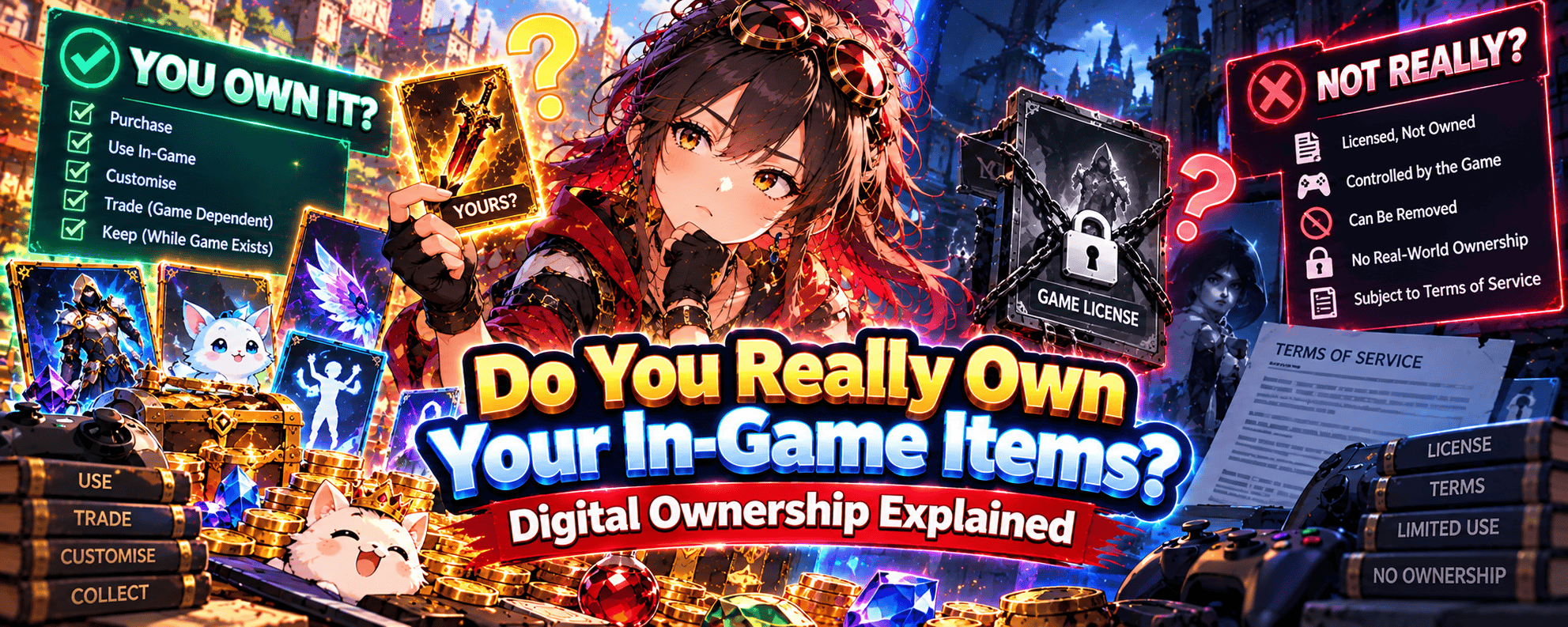
1. Do You Really Own Your In-Game Items? 🎮
You’ve spent hundreds of hours grinding for legendary weapons, collecting rare skins and building the ultimate gaming inventory.
Maybe you’ve even spent real money on cosmetics, premium currency or exclusive items.
They’re sitting in your account. You paid for them. You earned them.
So surely they’re yours, right?
Well, not necessarily.
One of the biggest misconceptions in gaming is that purchasing an in-game item automatically means you own it in the same way you own a physical product.
In reality, many games give players permission to access and use digital items rather than unrestricted ownership of those items.
And there’s a significant difference.
💎 Buying an Item Doesn’t Always Mean Owning It
Imagine purchasing a rare cosmetic skin for your favourite character.
You can equip it, customise your appearance and show it off during matches.
But can you sell it?
Can you transfer it to another account?
What happens if your account is suspended or the game shuts down?
The answers depend on the game’s terms, the rights associated with the purchase and any applicable consumer laws.
For example:
- Fortnite: Players can acquire cosmetics, but existing Locker items generally cannot be freely transferred between accounts.
- Counter-Strike 2: Eligible skins can be traded through supported Steam systems, subject to platform rules.
- World of Warcraft: Players can earn and purchase digital items, but many are subject to character, account and licensing restrictions.
- Roblox: Certain eligible Limited items can be traded or resold under Roblox’s rules, while many other virtual items cannot.
These games demonstrate that having an item in your inventory doesn’t automatically provide unrestricted ownership or transfer rights.
🎮 Why Does Digital Ownership Matter?
Understanding your rights can help you make better decisions about buying, collecting and trading virtual goods.
It matters because digital ownership affects:
- Access: Whether you can continue using an item.
- Trading: Whether an item can be transferred to another player.
- Resale: Whether you can legitimately sell an item.
- Account Security: What happens if your account is compromised or suspended.
- Game Updates: Whether developers can change an item’s functionality.
- Service Closures: What happens when a game becomes unavailable.
- Consumer Rights: What protections may apply when a digital purchase doesn’t meet legal guarantees.
These issues become particularly important when players invest significant amounts of money or time into their gaming inventories.
⚔️ Digital Items Are Different From Physical Items
When you purchase a physical gaming controller, you generally own that particular controller.
You can use it, lend it to a friend or resell it.
Digital gaming items are different.
A cosmetic skin or virtual weapon exists within software operated under rules established by the game provider.
Your ability to access, use or transfer it may depend on maintaining an eligible account and complying with those rules.
Even when an item can be traded, that doesn’t necessarily mean you have unrestricted legal ownership of the underlying digital asset.
Our What Are In-Game Items? Complete Guide explains how virtual goods work across modern games.
🏆 So, Do Gamers Actually Own Their Items?
The answer depends on the game, the item and what you mean by ownership.
In many traditional online games, players receive contractual rights to use digital content rather than unrestricted ownership of it.
However, those arrangements don’t necessarily eliminate consumer protections.
Players may still have legal rights relating to misleading claims, defective digital products or other problems with purchases.
The important distinction is between having access to an item, having permission to use it and having the legal right to transfer or sell it.
Understanding those differences can save you from some expensive surprises.
Because discovering that your legendary sword isn’t actually yours to sell?
That’s one gaming achievement nobody wants to unlock.
2. What Does Owning an In-Game Item Actually Mean? 💎
Ownership sounds straightforward.
You buy something, it belongs to you.
But digital gaming items introduce several different concepts that are often grouped together under the word ownership.
To understand what rights you have, it’s useful to separate four things:
- Ownership of a physical product.
- Ownership of intellectual property.
- Permission to use digital content.
- Permission to transfer or sell digital content.
These rights aren’t necessarily included together.
🛒 Physical Ownership vs Digital Access
Imagine buying a physical copy of a board game.
You own that particular copy.
You can usually lend it to someone, give it away or sell it.
Now imagine purchasing a digital weapon skin inside an online game.
The skin might be accessible only through your gaming account.
You may be allowed to equip it, but not transfer it.
You may also depend on the game remaining operational.
The purchase therefore provides a different set of practical rights.
📜 What Is a Digital Licence?
A digital licence is permission to use software or digital content under specified conditions.
Many games use licensing arrangements for virtual goods.
For example, purchasing a cosmetic might provide permission to display and use it within the game.
However, the licence may restrict:
- Transferring the item to another account.
- Selling the item outside supported systems.
- Reproducing its artwork.
- Using the item commercially.
- Accessing the item after account termination.
- Using the item outside the game.
The precise rights depend on the applicable agreement.
A licence doesn’t necessarily mean the item has no value or that the developer can ignore consumer law.
It means the player’s rights are defined differently from ordinary ownership of a physical object.
🎨 Who Owns the Artwork Behind a Gaming Skin?
Consider a rare cosmetic skin.
You might have paid for permission to use that skin, but the underlying artwork, character design and other intellectual property generally remain with their respective rights holders.
For example, purchasing a character outfit doesn’t normally give you permission to reproduce its artwork on merchandise.
Similarly, acquiring a digital weapon doesn’t mean you own the copyright in its design.
Owning or controlling access to an item is different from owning the intellectual property used to create it.
This distinction applies to many forms of digital content, including music, films, software and video games.
🔄 Does Being Able to Trade an Item Mean You Own It?
Not necessarily.
Some games allow players to transfer eligible items through supported trading systems.
However, that permission may exist within a broader licensing arrangement.
For example, an eligible Counter-Strike 2 skin can be transferred through Steam trading systems, subject to applicable restrictions.
That ability doesn’t automatically grant unrestricted rights to reproduce, commercially exploit or transfer the underlying intellectual property.
Trading rights and intellectual property ownership are separate concepts.
🔐 What Does Account-Bound Ownership Mean?
Some items are permanently associated with a particular account.
For example, a game might allow you to purchase a cosmetic but prevent you from transferring it to another player.
This means you can use the item under the game’s rules without having unrestricted control over where it goes.
Other games allow certain items to be transferred between characters belonging to the same account.
The distinction is important because account-bound, character-bound and tradable items provide different levels of flexibility.
📊 Different Rights Associated With In-Game Items
| Right | What It Means | Automatically Included? |
|---|---|---|
| Access | Use the item within the game | Subject to applicable terms and availability |
| Equip or Consume | Use the item’s intended features | Usually, where applicable |
| Transfer | Give the item to another account | No |
| Trade | Exchange the item with another player | No |
| Resell | Sell the item through a permitted system | No |
| Reproduce | Copy the item’s artwork or digital files | Generally no |
| Commercial Use | Use the item or design for commercial purposes | Generally requires permission |
| Consumer Protection | Legal protections for eligible purchases | Depends on applicable law; cannot simply be excluded by contract |
🎯 Why Understanding These Rights Matters
Players sometimes assume that spending real money provides complete control over a digital item.
But a purchase may provide only particular rights.
Before making an expensive purchase, it’s worth understanding:
- What you’re actually receiving.
- Whether the item is permanent or time-limited.
- Whether it can be transferred.
- Whether it can be resold.
- What happens if access is interrupted.
- What consumer protections apply.
These questions become increasingly important as gaming inventories grow in size and value.
3. What Happens When You Buy an In-Game Item? 🛒
Buying an in-game item might take only a few seconds.
You open the store, select a cosmetic, confirm the purchase and watch it appear in your inventory.
Simple enough.
But behind that transaction, several things may be happening.
Depending on the game, you’re typically purchasing a licence, an entitlement or another contractual right to access particular digital content.
You’re not necessarily receiving an independent digital object that can exist outside the game.
🎮 Step 1: You Select a Digital Item
Imagine purchasing a new character outfit.
The game’s store displays the item, its price and relevant purchasing information.
Depending on the game, you might pay using:
- Real-world currency.
- Premium virtual currency.
- Earnable in-game currency.
- Event tokens.
- Other supported payment methods.
The currency used can influence the transaction structure, but it doesn’t automatically determine your ownership rights.
For example, spending premium currency doesn’t necessarily make an item transferable.
💰 Step 2: The Purchase Is Processed
The game or platform processes the transaction.
This might involve deducting virtual currency from your balance or processing a payment through an authorised provider.
The purchase may then be recorded against your gaming account.
Depending on the platform, you might receive a transaction confirmation, receipt or purchase history entry.
These records can be important if a problem occurs later.
💎 Step 3: The Item Is Added to Your Account
Once the transaction is completed, the game generally grants access to the purchased content.
For example, a cosmetic might appear in your inventory or customisation menu.
However, this doesn’t necessarily mean the game has transferred unrestricted ownership of a separate digital asset.
Instead, the game’s systems may record that your account is entitled to access and use that item.
Your continued access may depend on the game’s operation, your account status and the applicable terms.
🔒 Step 4: The Item Remains Subject to Game Rules
After purchasing an item, you may still face restrictions.
For example:
- The item might be permanently account-bound.
- It might only be usable by particular characters.
- Trading may be prohibited.
- Marketplace resale may be unavailable.
- Certain features may change through updates.
- Access may depend on maintaining an eligible account.
These conditions can apply even when the item was purchased with real money.
⚔️ Do Different Types of Items Have Different Rights?
Yes.
Different item categories can have different purchasing and usage arrangements.
| Item Type | Typical Purchase or Acquisition | Possible Restrictions |
|---|---|---|
| Cosmetic Skin | Official store, reward or marketplace | Account-bound or trade-restricted |
| Weapon or Armour | Gameplay, crafting or trading | Character binding or trading limitations |
| Premium Currency | Official purchase or eligible reward | Non-transferable or non-withdrawable |
| Battle Pass Reward | Progression and reward systems | Account restrictions or time-limited availability |
| Consumable Item | Gameplay or purchase | Used up when consumed |
| Tradable Collectible | Supported marketplace or trading | Platform rules and transfer restrictions |
For example, a cosmetic outfit and a functional weapon may provide very different benefits, but both can be subject to licensing and transfer restrictions.
Our guide to Cosmetic vs Functional In-Game Items explains how appearance-based items differ from equipment that affects gameplay.
⏳ Are In-Game Purchases Always Permanent?
No.
Some digital goods are designed to provide permanent access within the game’s supported systems.
Others are temporary or consumable.
Examples include:
Permanent-Style Cosmetics
Items intended to remain available in your account inventory while the relevant service and entitlement continue.
Time-Limited Items
Items or benefits available only for a specified period.
Consumables
Items that disappear or are depleted when used.
Subscriptions and Membership Benefits
Content or features available while an eligible subscription remains active.
It’s important to understand these differences before purchasing.
A permanent-style cosmetic doesn’t necessarily guarantee access if the entire online service eventually closes.
⚠️ What If You Buy an Item and Don’t Receive It?
If a purchase fails to appear in your account, check your transaction history and the game’s support information.
Keep records of:
- The purchase date.
- The item description.
- The amount paid.
- The transaction reference.
- Any error messages.
- Communications with support.
Depending on the circumstances and applicable law, you may be entitled to a remedy.
In Australia, consumer guarantees can apply to eligible digital products and services, and businesses cannot simply exclude applicable statutory rights through their terms.
However, the appropriate remedy depends on the nature of the problem.
🏆 Does Paying More Give You Greater Ownership Rights?
Not automatically.
A rare cosmetic costing hundreds of dollars may have the same basic licensing restrictions as a much cheaper item.
Its price might reflect scarcity, demand or collector interest rather than additional legal rights.
For example, purchasing an expensive tradable skin doesn’t automatically grant ownership of its artwork or unrestricted permission to sell it outside supported systems.
The price of an item and the rights attached to it are two separate considerations.
And that’s worth remembering before spending your entire gaming budget on something shiny.
4. In-Game Item Ownership vs Licensing: Key Differences 📊
The difference between ownership and licensing is one of the most important concepts in digital gaming.
Players often use the word own to describe anything in their inventory.
And in everyday conversation, that’s perfectly understandable.
But when discussing legal rights, trading permissions and long-term access, the distinction becomes much more important.
💎 What Is the Difference Between Ownership and Licensing?
Broadly speaking, ownership involves legally recognised rights over property.
A licence involves permission to use something under specified conditions.
However, digital goods don’t always fit neatly into the same categories as physical objects.
The legal treatment of a particular digital item depends on the contractual arrangements, applicable laws and nature of the asset.
For many traditional online games, players receive contractual permissions to access and use digital content.
These permissions may be limited in ways that ordinary ownership of physical goods is not.
📊 Ownership vs Licensing Comparison
| Feature | Physical Item Ownership | Typical Licensed In-Game Item |
|---|---|---|
| Possession | Control of a physical object | Access through a game or account |
| Usage | Generally broad, subject to law | Defined by game rules and licence |
| Transfer | Usually possible | May be restricted |
| Resale | Generally permitted | Depends on platform and item |
| Modification | Physical changes generally possible | Usually restricted by software rules |
| Intellectual Property | Copyright not automatically included | Copyright generally retained by rights holder |
| Continued Access | Doesn’t normally require an online service | May depend on servers and account access |
| Account Restrictions | Not applicable | May apply |
| Developer Updates | Cannot normally alter the physical object remotely | May change digital functionality |
| Consumer Rights | Applicable statutory protections | Applicable statutory protections may also exist |
This comparison illustrates typical arrangements rather than a universal legal rule.
Not every digital item is licensed on identical terms, and different jurisdictions may treat particular transactions differently.
🔄 Can You Resell Something You Own?
Physical products can generally be resold, subject to applicable laws.
Digital gaming items are more complicated.
A game might permit resale through an official marketplace.
Another might prohibit transferring items between accounts.
For example, certain Counter-Strike 2 skins are eligible for trading through Steam.
Meanwhile, Fortnite generally doesn’t allow players to transfer existing Locker cosmetics to another account.
Both types of items can be purchased or acquired by players, but their transfer rights differ.
Our guide to Tradable vs Non-Tradable In-Game Items explores how these restrictions affect trading and resale opportunities.
🔐 Can a Developer Change a Licensed Item?
Game developers may reserve rights to update or modify digital content.
For example, an update might change:
- Weapon damage.
- Equipment statistics.
- Cosmetic appearances.
- Item functionality.
- Trading eligibility.
- Supported game features.
However, contractual permissions to make changes aren’t necessarily unlimited.
Consumer laws may still apply, particularly where a product or service fails to meet applicable guarantees or where representations about a purchase were misleading.
A term stating that an item may change doesn’t automatically resolve every legal issue arising from a significant modification.
💰 Does Licensing Mean Digital Items Have No Value?
Absolutely not.
A licensed digital item can provide meaningful value through gameplay, entertainment, customisation or permitted trading.
For example, a cosmetic skin might have substantial collector demand even though the player doesn’t own its underlying intellectual property.
Similarly, an account-bound weapon might provide important gameplay benefits despite being non-transferable.
The distinction between ownership and licensing concerns the rights attached to an item, not whether the item is enjoyable or desirable.
🎮 Why Do Game Companies Use Licensing Models?
Licensing arrangements can help developers manage how their games and digital content are used.
They may support:
- Intellectual property protection.
- Account-based access.
- Multiplayer game balance.
- Content updates.
- Trading restrictions.
- Security enforcement.
- Online service management.
For example, a developer might restrict transferring particular rewards to preserve progression or prevent unauthorised trading.
These systems can serve legitimate gameplay and operational purposes.
However, players still benefit from understanding the conditions attached to their purchases.
🛡️ What About Consumer Rights?
One important point often gets overlooked in discussions about digital ownership.
A game’s licence agreement doesn’t automatically remove your statutory consumer rights.
In Australia, eligible digital purchases may be covered by Australian Consumer Law.
Depending on the transaction and circumstances, consumer guarantees and protections against misleading conduct may apply.
This means the rights described in a game’s terms aren’t necessarily the only rights a player has.
For example, a business generally cannot exclude applicable consumer guarantees simply by stating that digital purchases are non-refundable.
That doesn’t mean every unwanted purchase qualifies for a refund, but it does mean contractual terms must be considered alongside consumer law.
🏆 What Should Gamers Look for Before Purchasing?
Before spending significant money on digital items, consider five questions:
- What am I receiving? A permanent-style entitlement, temporary benefit, consumable or other digital product?
- Can I transfer it? Is trading or gifting supported?
- Can I resell it? Does the game permit marketplace transactions or real-money sales?
- What could affect access? Account restrictions, game updates or service closures?
- What protections apply? Are there relevant refund policies or statutory consumer rights?
Understanding these details can help you make more informed purchasing decisions.
Because buying an expensive gaming item should be exciting.
Finding out afterwards that you can’t trade it, transfer it or use it outside one account?
That’s considerably less exciting.
5. Do You Own Your Skins, Weapons and Virtual Currency? ⚔️
You’ve collected rare weapon skins, unlocked legendary armour and built up a healthy balance of virtual currency.
Your inventory looks impressive.
But how much of it do you actually own?
The answer depends on the game, the type of item and the rights provided under the platform’s terms.
Different games have very different approaches to digital ownership, trading and account access.
Let’s look at some familiar examples.
🎨 Fortnite – Cosmetics and V-Bucks
Fortnite allows players to purchase and unlock cosmetic items, including outfits, emotes, gliders and weapon wraps.
These items are generally associated with the player’s Epic Games account.
However, purchasing a cosmetic doesn’t provide unrestricted ownership of the underlying digital content.
Under Epic Games’ licensing arrangements, players receive rights to access and use eligible digital content within the supported game environment.
There are also important restrictions.
For example:
- Existing Locker cosmetics generally cannot be transferred between accounts.
- Players cannot freely resell individual Fortnite cosmetics.
- V-Bucks are virtual currency, not withdrawable cash.
- Access to purchased content depends on applicable account and service conditions.
Fortnite does support gifting certain eligible purchases, but gifting doesn’t mean players can transfer cosmetics already in their inventories.
What this means for players: You can enjoy your purchased cosmetics within Fortnite, but you generally cannot treat them like physical collectibles that can be freely sold or transferred.
🔫 Counter-Strike 2 – Tradable Weapon Skins
Counter-Strike 2 offers a different experience.
Eligible weapon skins, gloves and other collectibles can be exchanged through supported Steam trading systems.
Some items can also be listed on the Steam Community Market.
This gives players more flexibility than games where cosmetics are permanently account-bound.
However, there are still limitations.
- Trading eligibility depends on the item and account.
- Temporary trade restrictions may apply.
- Steam Community Market proceeds are credited to Steam Wallet funds.
- Steam Wallet balances generally cannot be withdrawn as cash.
- Trading permissions don’t transfer ownership of the underlying artwork or intellectual property.
For example, purchasing a rare weapon skin doesn’t give you the right to reproduce its design commercially.
What this means for players: Counter-Strike 2 offers supported item trading, but those permissions operate within Steam’s contractual and technical rules.
🐉 World of Warcraft – Equipment, Gold and Character Progression
World of Warcraft features an extensive economy involving gold, equipment, crafting resources and player trading.
However, different items have different restrictions.
Some equipment can be traded freely.
Other items become soulbound when acquired or equipped.
Certain rewards are associated with individual characters or accounts.
World of Warcraft also operates under Blizzard’s terms governing access to the game and its digital content.
This means players don’t automatically receive unrestricted ownership rights over everything in their inventories.
For example, a character might possess an extremely rare piece of equipment but have no permitted way to transfer it to another player.
Similarly, accumulating large quantities of gold doesn’t automatically give players the right to exchange that gold for real-world money.
What this means for players: Your items and currency can be valuable within the game, but their transferability and permitted uses remain subject to the game’s rules.
🧱 Roblox – Virtual Items and Limited Collectibles
Roblox provides another interesting example.
Players can acquire avatar items, accessories and other virtual content.
Certain eligible Limited items can be traded or resold through Roblox’s supported systems, subject to membership, account and platform requirements.
However, most avatar items aren’t freely transferable.
Robux also operates under Roblox’s virtual currency rules.
Although Roblox provides a Developer Exchange programme for eligible creators, that doesn’t mean ordinary purchased Robux or virtual items can automatically be converted into cash.
The programme has specific eligibility requirements and applies to qualifying earned Robux.
What this means for players: Roblox supports certain forms of digital trading and creator monetisation, but those activities are governed by specific platform rules.
📊 Digital Ownership Across Popular Games
| Game | Digital Goods | Trading Permissions | Main Ownership Consideration |
|---|---|---|---|
| Fortnite | Cosmetics and V-Bucks | Existing Locker items generally non-tradable | Account-linked licensed content |
| Counter-Strike 2 | Weapon skins and collectibles | Eligible items tradable | Trading rights subject to Steam rules |
| World of Warcraft | Equipment, gold and resources | Depends on item restrictions | Licensed content and item binding |
| Roblox | Avatar items and Robux | Eligible Limited items tradable | Platform-specific virtual item rights |
💎 Does Item Type Determine Ownership?
Not necessarily.
A cosmetic item can be tradable or non-tradable.
A functional weapon can also be tradable or account-bound.
The same applies to virtual currencies and collectibles.
The important questions are what rights the game provides and what restrictions apply.
Our guide to Types of In-Game Items Explained explores the different categories of digital goods and how they’re used across games.
6. Can Game Developers Remove or Change Your Items? 🔒
Imagine spending weeks collecting resources to craft the perfect weapon.
You’ve finally obtained it.
It’s powerful, rare and exactly what your character needs.
Then a game update arrives.
Suddenly, your weapon does less damage, its special ability has changed and your carefully planned character build isn’t quite as impressive.
Can developers really do that?
In many games, developers can modify digital items through updates, subject to their contractual obligations and applicable laws.
However, changing an item’s gameplay statistics is different from removing access to something a player purchased.
⚔️ Can Developers Nerf Weapons You’ve Earned?
Yes.
Game balance updates frequently adjust equipment, abilities and gameplay mechanics.
A weapon might become less powerful because developers want to maintain competitive balance.
For example, an update could:
- Reduce weapon damage.
- Increase ability cooldowns.
- Change equipment attributes.
- Adjust crafting requirements.
- Modify special effects.
- Change how an item interacts with other equipment.
These changes are particularly common in competitive games and online RPGs.
Players may find them frustrating, especially after investing significant time into obtaining particular equipment.
However, ongoing balance adjustments are often part of how live-service games operate.
🎨 Can Developers Change Purchased Cosmetics?
Developers may also modify cosmetic content.
For example, a cosmetic might receive:
- Updated textures.
- Animation adjustments.
- Visual corrections.
- Compatibility changes.
- Altered effects.
- Bug fixes.
Minor changes are generally different from substantially altering or removing the advertised features of a purchase.
If a digital product no longer matches important representations made when it was sold, consumer law considerations may arise.
The outcome depends on the circumstances, including what was promised and the nature of the change.
🚫 Can Developers Remove Items From Your Inventory?
In some circumstances, yes.
Items may be removed because of:
- Technical errors.
- Duplicate or illegitimately generated items.
- Fraudulent transactions.
- Account enforcement.
- Content changes.
- Expired entitlements.
- Game or service closures.
For example, a platform might reverse an unauthorised transaction or remove items obtained through an exploit.
However, the fact that a developer technically can remove content doesn’t automatically mean every removal is legally justified.
Contractual obligations and consumer protections may still apply.
🔐 What Happens If Your Account Is Suspended?
An account suspension can affect access to digital purchases.
Depending on the platform and circumstances, players may temporarily or permanently lose access to:
- Purchased cosmetics.
- Virtual currencies.
- Character inventories.
- Progression rewards.
- Trading privileges.
- Online game services.
Account enforcement systems are commonly used to address cheating, fraud, harassment and other rule violations.
However, the consequences depend on the relevant terms and the reasons for enforcement.
Players who believe a suspension was incorrect should use the platform’s official appeal process.
💰 Do You Get a Refund If an Item Changes?
Not automatically.
A routine gameplay balance update doesn’t necessarily entitle players to a refund.
However, significant changes to purchased digital goods may raise consumer protection issues, particularly if the product no longer meets applicable guarantees or representations.
For Australian consumers, relevant protections may arise under Australian Consumer Law.
Whether a refund or another remedy is available depends on the specific circumstances.
A game’s refund policy doesn’t necessarily override statutory rights.
🛡️ How Can Players Reduce the Risks?
Before making expensive digital purchases:
- Read the item’s description carefully.
- Understand whether the game is regularly updated.
- Check the relevant purchasing terms.
- Keep transaction records.
- Avoid relying on promises of permanent item value.
- Protect your account from unauthorised access.
It’s also worth remembering that an item being powerful or popular today doesn’t guarantee it will remain that way.
🎯 The Reality of Live-Service Gaming
Online games are constantly evolving.
Developers introduce new content, rebalance equipment and update existing systems.
These changes help games remain competitive and engaging, but they can also affect the items players have collected.
The important distinction is between reasonable changes associated with an evolving game and changes that may conflict with legal obligations or representations made to consumers.
Because a legendary sword getting nerfed is disappointing.
Having it disappear entirely without a satisfactory explanation?
That’s a much bigger problem.
7. Can You Sell, Trade or Transfer Items You Own? 🔄
You’ve collected a rare cosmetic that another player desperately wants.
They offer you something valuable in exchange.
Sounds like a straightforward trade.
But before you accept, there’s an important question.
Does the game actually allow you to transfer the item?
Having an item in your inventory doesn’t automatically mean you can sell, trade or gift it.
Trading permissions depend on the game’s systems, the item’s restrictions and the applicable terms.
💎 What Makes an In-Game Item Tradable?
A tradable item can be transferred between eligible players through supported trading systems.
Depending on the game, this might involve:
- Direct player-to-player exchanges.
- Auction houses.
- Official marketplaces.
- Supported gifting systems.
- Other authorised transfer methods.
For example, certain Counter-Strike 2 skins can be traded through Steam.
Meanwhile, many Fortnite cosmetics cannot be transferred from one player’s existing inventory to another account.
Both types of items can be desirable, but their transfer rights differ significantly.
🔒 Why Are Some Items Non-Tradable?
Developers restrict trading for several reasons.
These may include:
Game Balance
Preventing players from bypassing intended progression systems.
Achievement Protection
Keeping exclusive rewards associated with the players who earned them.
Fraud Prevention
Reducing opportunities for unauthorised item transfers.
Economic Management
Controlling how items enter and circulate within player-driven markets.
Account-Based Licensing
Keeping purchased digital content associated with a particular account.
An item might also become non-tradable after being equipped or used.
⚔️ What About Account-Bound and Character-Bound Items?
Account-bound items are generally restricted to one gaming account.
Character-bound items may be restricted to a particular character.
Some games allow account-bound items to move between eligible characters belonging to the same player.
Others impose stricter limitations.
These restrictions can apply to weapons, armour, cosmetics, crafting materials and other digital goods.
💰 Can You Sell In-Game Items for Real Money?
Sometimes, but not always.
Some games and platforms support authorised transactions involving real money.
Others permit trading only for in-game currency or prohibit real-money trading entirely.
For example, selling an eligible item through the Steam Community Market generates Steam Wallet funds rather than withdrawable cash.
This is an important distinction.
An item having a marketplace price doesn’t necessarily mean its owner can receive that amount as cash.
External marketplaces may also offer trading services, but their existence doesn’t establish that the relevant game permits those transactions.
🚫 Can You Sell an Account Instead of an Item?
Some players consider selling an entire gaming account when individual items cannot be transferred.
However, many gaming platforms prohibit or restrict account sales and transfers.
Attempting to bypass item restrictions through account trading can create risks involving:
- Account suspension.
- Fraudulent payments.
- Account recovery disputes.
- Loss of purchased content.
- Unauthorised access.
- Violations of platform terms.
Players should check the applicable rules before considering any account-related transaction.
📊 Item Ownership vs Trading Permissions
| Item Situation | Can You Use It? | Can You Transfer It? |
|---|---|---|
| Account-Bound Cosmetic | Usually within the eligible account | Generally no |
| Character-Bound Equipment | Usually on the eligible character | Generally no |
| Tradable Weapon Skin | Yes, under game rules | Yes, when eligible |
| Temporarily Trade-Locked Item | Usually yes | Not until restrictions expire |
| Purchased Premium Currency | For supported purchases | Depends on platform rules |
| Eligible Marketplace Collectible | Yes, under platform rules | Through supported systems |
🛡️ What Should You Check Before Trading?
Before exchanging an item, confirm:
- The item is eligible for trading.
- Your account meets the trading requirements.
- The intended transaction is permitted.
- The marketplace or trading system is legitimate.
- Any temporary restrictions have expired.
- You understand the payment and transfer conditions.
Our upcoming guide to How to Buy In-Game Items Safely explores practical ways to reduce risks when purchasing digital gaming goods.
🎮 Does Tradability Mean You Have Full Ownership?
No.
Trading eligibility is a permission associated with the item or platform.
It doesn’t automatically grant unrestricted legal ownership or intellectual property rights.
A tradable cosmetic may still be subject to licensing restrictions.
Similarly, a non-tradable item may provide substantial gameplay value despite having no permitted resale market.
The key is understanding what you can legitimately do with the item.
8. What Happens to Your Items If a Game Shuts Down? 💀
Imagine logging into your favourite online game after years of collecting rare equipment, cosmetics and exclusive rewards.
Except this time, the servers are offline.
Permanently.
Your characters, inventory and purchases are no longer accessible.
What happens to everything you’ve collected?
Unfortunately, when an online game shuts down, players may lose access to digital items that depend on its servers and account systems.
The consequences depend on how the game operates, what rights players were granted and whether alternative access remains available.
🎮 Why Do Online Games Shut Down?
Games can close for many reasons.
Common causes include:
- Declining player populations.
- Increasing operating costs.
- Commercial decisions.
- Expiring licences.
- Technical limitations.
- Publisher restructuring.
- Changes in development priorities.
Maintaining an online game requires servers, security systems, customer support and ongoing technical work.
When a developer or publisher decides to discontinue those services, access to some or all game features may end.
🔒 What Happens to Purchased Cosmetics?
If a cosmetic depends on an online account and game service, it may become inaccessible when the service closes.
For example, an outfit stored in an online inventory may have no practical use if the game itself can no longer be launched or played.
The item might still appear in historical account records, but that doesn’t necessarily mean players can continue using it.
This is one of the biggest differences between many online digital purchases and physical collectibles.
A physical gaming figurine remains on your shelf even if the company that made it closes.
An online cosmetic may depend entirely on the continued operation of the game.
⚔️ What Happens to Weapons, Armour and Progression?
In online RPGs, characters and inventories may be stored on the game’s servers.
If those servers shut down, players may lose access to:
- Character progression.
- Equipment collections.
- Virtual currencies.
- Achievement records.
- Crafting resources.
- Housing or customisation features.
- Other account-linked content.
Whether any information can be preserved depends on the developer’s systems and shutdown arrangements.
Some developers may provide account data exports, commemorative features or alternative experiences.
Others may not.
🕹️ Can Offline Games Keep Working?
Yes.
Not every digital game depends entirely on an online service.
Some games can continue functioning offline after official support ends.
For example, a single-player game with locally stored save files may remain playable without active publisher servers.
However, this depends on factors such as:
- Online authentication requirements.
- Digital rights management.
- Local installation files.
- Offline functionality.
- Platform compatibility.
- Required external services.
A game advertised as single-player isn’t necessarily guaranteed to remain playable without internet access.
💰 Do Players Get Refunds When Games Shut Down?
Not automatically.
Refund rights depend on the purchase, applicable laws, representations made to consumers and the circumstances of the closure.
For example, a game shutting down after many years of operation may raise different issues from a newly purchased online product becoming unusable shortly after purchase.
In Australia, consumer guarantees and protections against misleading conduct may apply to eligible digital products and services.
A company’s terms or shutdown policy cannot automatically exclude applicable statutory rights.
However, there isn’t a universal rule that every player receives a refund whenever an online game closes.
📊 What Happens to Different Digital Items After Shutdown?
| Digital Item | Possible Outcome After Shutdown |
|---|---|
| Online Cosmetic | May become inaccessible |
| Server-Stored Equipment | May no longer be usable |
| Premium Currency | May become unusable |
| Online Character Progression | May become inaccessible |
| Locally Stored Single-Player Items | May remain available offline |
| Marketplace Collectibles | Depends on the platform and continued trading support |
| Downloadable Content | Depends on installation, authentication and service requirements |
🛡️ Can Players Protect Their Digital Purchases?
You can’t guarantee that every online game will remain available indefinitely.
However, there are ways to reduce the risks.
1. Understand Online Requirements
Check whether the game requires an active server connection.
2. Review Purchase Conditions
Understand whether digital content is time-limited or dependent on ongoing services.
3. Keep Purchase Records
Retain receipts and transaction confirmations for significant purchases.
4. Avoid Assuming Permanent Access
Consider the possibility of service closure before making expensive purchases.
5. Follow Official Shutdown Announcements
Developers may provide information about remaining access, refunds or account data.
6. Use Supported Offline Features
Where available, local saves and offline modes may help preserve gameplay access.
🏆 Are Digital Collectibles a Long-Term Investment?
Players should be cautious about treating gaming items as guaranteed long-term investments.
Even rare and desirable collectibles can depend on the continued operation of a game or marketplace.
Their value may change because of:
- Declining player interest.
- Trading restrictions.
- Platform policy changes.
- Game updates.
- Marketplace closures.
- Complete service shutdowns.
A rare cosmetic might attract considerable interest today, but its future usefulness and trading opportunities aren’t guaranteed.
🎯 The Biggest Risk of Digital Ownership
The most important thing to understand is that many digital gaming items depend on systems outside the player’s direct control.
You might spend years collecting them.
You might invest substantial amounts of money.
You might even participate in a thriving trading economy.
But if the game or platform becomes unavailable, your ability to access those items may disappear.
That doesn’t mean digital purchases are automatically a bad idea.
Gaming items can provide entertainment, personal enjoyment and meaningful experiences.
It simply means players should understand the difference between paying for access to digital content and owning something that remains independently usable.
Because losing a difficult boss fight is one thing.
Losing access to the entire game—and everything you’ve collected along the way—is a completely different kind of game over.
9. Are NFTs and Blockchain Gaming Items Really Owned by Players? ⛓️
Traditional gaming items usually exist within systems controlled by game developers and publishers.
But what about blockchain gaming?
You’ve probably heard claims that NFTs allow players to truly own their digital weapons, characters, skins and collectibles.
Some blockchain games even promote the idea that players can take their items between games or trade them independently of the developer.
Sounds impressive.
But does owning an NFT actually mean you own the in-game item?
Not necessarily.
Blockchain technology can give players control over particular digital tokens, but that doesn’t automatically provide unrestricted ownership of the artwork, gameplay functionality or underlying digital content associated with those tokens.
💎 What Is an NFT in Gaming?
NFT stands for non-fungible token.
An NFT is a digital token recorded on a blockchain that can represent a unique asset or entitlement.
In gaming, NFTs may be associated with:
- Character skins.
- Weapons and armour.
- Digital collectibles.
- Virtual land.
- Game characters.
- Cosmetic accessories.
- Other virtual assets.
Unlike traditional items that exist solely within a developer’s account database, blockchain tokens can be recorded on an external network.
Depending on the blockchain and token design, players may be able to transfer those tokens between compatible wallets.
However, controlling a token and controlling the associated gaming item are not necessarily the same thing.
🔐 What Does Blockchain Ownership Actually Mean?
Imagine purchasing a blockchain-based sword.
You receive an NFT associated with that sword.
Depending on the system, you may control the wallet holding the token and be able to transfer it to another eligible wallet.
However, several questions remain.
- Do you own the sword’s artwork?
- Can you reproduce its design commercially?
- Can you use the sword in another game?
- Can the developer change its statistics?
- Will the sword still function if the game shuts down?
The answers depend on the game’s implementation, the NFT’s associated rights and the relevant terms.
For example, ownership of a token doesn’t automatically transfer copyright in the artwork it references.
Similarly, possessing a token doesn’t guarantee that a game will continue recognising it.
🎮 Can NFT Items Be Used Across Different Games?
One frequently discussed feature of blockchain gaming is interoperability.
Interoperability means an asset or system can work across different platforms or applications.
In theory, a blockchain-based item could be recognised by multiple games.
Imagine earning a legendary sword in one RPG and using it in another.
That would be an exciting feature.
However, interoperability isn’t automatic.
For an item to function across different games, developers generally need to support it.
They may need to create compatible artwork, animations, statistics and gameplay behaviour.
A blockchain token alone doesn’t make these systems compatible.
A sword designed for one game doesn’t magically become usable in another simply because its ownership record exists on a blockchain.
⚔️ Can Developers Change Blockchain Gaming Items?
Yes, depending on how the game is designed.
Even if a player controls the associated token, the developer may still control:
- Weapon statistics.
- Character abilities.
- Game balance.
- Item functionality.
- Visual rendering.
- Marketplace integration.
- Access to online services.
For example, a developer could reduce the damage of a blockchain-linked weapon through a gameplay update.
The player might still control the NFT, but the weapon’s usefulness within the game could change.
This distinction is important when evaluating claims about permanent digital ownership.
💀 What Happens to NFTs If a Game Shuts Down?
The blockchain token may continue to exist after the game closes, provided the underlying network remains operational.
However, that doesn’t guarantee the associated gaming content will remain accessible.
For example:
- The token may still exist in a wallet.
- Its metadata may depend on external hosting.
- The artwork may become unavailable if its hosting disappears.
- The original game may no longer recognise the token.
- Gameplay functionality may disappear with the servers.
In other words, the ownership record might survive even when the game itself doesn’t.
📊 Traditional Gaming Items vs Blockchain Gaming Items
| Feature | Traditional In-Game Items | Blockchain-Based Gaming Items |
|---|---|---|
| Ownership Record | Usually maintained by the game or platform | Token recorded on a blockchain |
| Item Transfer | Depends on game systems | Token transfers may be supported independently |
| Gameplay Functionality | Controlled by the game | Still generally depends on game support |
| Intellectual Property Rights | Usually retained by rights holders | Not automatically transferred |
| Cross-Game Compatibility | Requires developer support | Also requires developer support |
| Game Shutdown Risk | Items may become inaccessible | Tokens may survive, but functionality may not |
| Transaction Fees | Depends on platform | Blockchain network fees may apply |
| Consumer Protection | Depends on applicable law | Depends on the transaction and applicable law |
💰 Does Blockchain Ownership Guarantee Item Value?
No.
NFT gaming items can fluctuate substantially in value.
Their desirability may depend on:
- Game popularity.
- Collector interest.
- Token supply.
- Gameplay usefulness.
- Marketplace activity.
- Developer support.
- Blockchain network conditions.
An NFT doesn’t automatically become valuable simply because it’s unique.
Nor does blockchain ownership guarantee that someone will want to purchase it later.
🏆 Is Blockchain Ownership Better Than Traditional Digital Ownership?
It depends on what players want.
Blockchain technology can support independently transferable tokens and publicly verifiable transaction histories.
Traditional gaming systems may offer simpler purchasing experiences, integrated support and fewer technical requirements.
Neither model automatically guarantees permanent gameplay access, unrestricted intellectual property rights or future resale value.
The important thing is understanding exactly what you’re purchasing.
Owning a blockchain token can provide control over that token, but it doesn’t automatically mean you own everything associated with it.
And if someone promises that your NFT sword will work in every game ever created?
You might want to ask how they plan to make it work in Mario Kart.
10. What Rights Do Gamers Have When Buying Digital Items? ⚖️
If you’ve purchased an in-game item that doesn’t work properly, disappears unexpectedly or turns out to be different from what was advertised, what can you do?
Does the game’s licence agreement mean you’re out of luck?
Not necessarily.
Players may have consumer rights that exist independently of the terms imposed by a gaming platform.
For Australian gamers, these protections can be particularly important.
🇦🇺 Does Australian Consumer Law Apply to Digital Gaming Purchases?
Australian Consumer Law (ACL) can apply to eligible digital products and services supplied to consumers in Australia.
This can include certain purchases involving video games, downloadable content and digital goods.
The relevant protections depend on the nature of the transaction and the circumstances.
For example, consumer guarantees may require eligible products or services to meet standards concerning quality, fitness for purpose and consistency with descriptions.
Businesses also must not engage in misleading or deceptive conduct.
These protections can apply even when a product is supplied digitally rather than physically.
💎 What If an In-Game Item Doesn’t Match Its Description?
Imagine purchasing a cosmetic advertised as including particular visual effects.
After the purchase, you discover that those effects are missing.
Or perhaps you purchase downloadable content that doesn’t provide the features described.
Depending on the circumstances, this may raise concerns about whether the product matches its description or whether representations made during the sale were misleading.
The appropriate remedy depends on the nature of the issue and applicable law.
This is why it’s useful to retain screenshots of important purchase descriptions.
🛒 Are Digital Purchases Always Non-Refundable?
No.
A store might state that certain digital purchases are non-refundable under its standard policy.
However, that doesn’t automatically remove statutory consumer rights.
In Australia, businesses generally cannot exclude applicable consumer guarantees simply through a contract or refund policy.
For example, a consumer may have rights to a remedy where a digital product fails to meet an applicable guarantee.
However, changing your mind about a purchase doesn’t automatically entitle you to a refund under Australian Consumer Law.
🔒 What If a Purchased Item Is Removed?
If a purchased item is removed from your account, the relevant considerations may include:
- Why the item was removed.
- Whether the removal was temporary or permanent.
- What was represented when the item was sold.
- Whether the item was obtained legitimately.
- Whether account enforcement was involved.
- What the applicable terms provide.
- Whether consumer guarantees or other legal protections apply.
For example, removing an item obtained through a fraudulent transaction is different from unexpectedly removing a legitimately purchased item without an adequate explanation.
Each situation needs to be considered on its facts.
⚔️ What If a Game Update Changes a Purchased Item?
Live-service games regularly receive balance updates and content changes.
A routine adjustment to weapon statistics doesn’t automatically establish a breach of consumer law.
However, substantial changes to a purchased digital product may raise different issues if they conflict with important representations or applicable consumer guarantees.
For example, the legal considerations surrounding a minor visual adjustment may differ from those involving the complete removal of an advertised feature.
💀 What If a Game Shuts Down?
Game shutdowns can raise complicated questions.
Players may lose access to purchased content when online services close.
However, whether a consumer is entitled to a remedy depends on factors such as:
- The nature of the purchase.
- The representations made about availability.
- The length and conditions of access.
- The circumstances of the shutdown.
- Applicable consumer guarantees.
- Other relevant legal obligations.
There isn’t a universal rule requiring refunds for every game shutdown.
Equally, a company cannot necessarily avoid all responsibility simply by describing its products as licensed digital content.
📊 Common Digital Purchase Problems
| Situation | Potential Consumer Rights Consideration |
|---|---|
| Purchased item never delivered | Failure to supply the purchased content |
| Item doesn’t match its description | Consumer guarantees or misleading representations |
| Digital content is defective | Applicable quality or fitness guarantees |
| Purchased content unexpectedly removed | Contractual obligations and consumer protections |
| Game shuts down | Depends on purchase terms, representations and circumstances |
| Player changes their mind | No automatic ACL refund entitlement |
| Account suspended for rule violations | Depends on enforcement circumstances and applicable law |
🛡️ What Should Australian Gamers Do If Something Goes Wrong?
If you experience a problem with a digital purchase, consider the following steps.
1. Gather Your Purchase Records
Keep receipts, transaction references and screenshots.
2. Check the Product Description
Review what was promised when you purchased the item.
3. Contact the Seller or Platform
Explain the problem clearly and request an appropriate resolution.
4. Review Your Consumer Rights
Consult official Australian Consumer Law guidance.
5. Escalate the Complaint If Necessary
If the issue remains unresolved, you may be able to seek assistance from a relevant consumer protection agency.
Useful official resources include:
🎯 Understanding Your Rights as a Gamer
The key point is that licensing arrangements and consumer protections are separate considerations.
A game may provide limited rights to access and use virtual items.
However, those limitations don’t automatically eliminate legal obligations associated with supplying digital products and services.
Players should understand both the permissions granted by the game and the consumer protections that may apply to their purchases.
This section provides general information rather than legal advice. Specific rights and remedies depend on the transaction and applicable law.
11. How to Protect Your In-Game Items and Digital Purchases 🛡️
Whether you’ve spent $10 on a cosmetic or hundreds of hours collecting rare equipment, protecting your gaming inventory is important.
Account theft, trading scams, accidental purchases and unexpected access problems can all affect digital goods.
Fortunately, there are practical steps you can take to reduce these risks.
And most of them are considerably easier than recovering a stolen legendary weapon.
🔐 Step 1: Secure Your Gaming Accounts
Your gaming account is often the gateway to everything you’ve collected.
If someone gains unauthorised access, they may be able to interfere with your inventory, purchases or account settings.
To improve security:
- Use a strong, unique password.
- Enable multi-factor authentication where available.
- Protect the email account associated with your gaming profile.
- Avoid sharing login credentials.
- Review suspicious account activity.
- Use official account recovery systems.
For games with tradable items, account security is particularly important.
An attacker may attempt to transfer eligible items before you regain access.
💎 Step 2: Understand What You’re Purchasing
Before spending money on a digital item, read its description carefully.
Check whether the item is:
- Permanent-style or time-limited.
- Consumable or reusable.
- Account-bound or tradable.
- Restricted to a particular character.
- Compatible with your platform.
- Subject to additional requirements.
Don’t assume that every cosmetic, weapon or collectible works the same way.
A purchase that seems straightforward can have important limitations.
🛒 Step 3: Use Official or Authorised Purchasing Systems
Purchasing through legitimate systems can reduce exposure to certain scams.
Before using an external marketplace, verify that the intended transaction is permitted under the game’s rules.
Be cautious of sellers offering unusually cheap items, guaranteed profits or methods for bypassing restrictions.
An attractive price doesn’t make a prohibited or fraudulent transaction safe.
📜 Step 4: Keep Records of Important Purchases
Purchase records can be useful if an item doesn’t appear, becomes inaccessible or differs from its description.
Consider keeping:
- Purchase confirmations.
- Transaction references.
- Payment receipts.
- Item descriptions.
- Screenshots of important advertised features.
- Relevant support correspondence.
For particularly expensive purchases, having clear documentation may help resolve disputes.
🔄 Step 5: Check Trading Permissions Before Buying
An item might look valuable but be impossible to transfer.
Before acquiring an item for trading purposes, check:
- Whether the item is tradable.
- Whether marketplace sales are permitted.
- Whether real-money transactions are authorised.
- Whether temporary trading locks apply.
- Whether your account meets eligibility requirements.
Never assume that a rare item can be resold simply because other players want it.
🚫 Step 6: Watch Out for Common Gaming Scams
Digital gaming items can attract scammers, particularly when items have strong collector demand.
Warning signs include:
Fake Trading Websites
Websites designed to imitate legitimate marketplaces or login pages.
Account Verification Scams
Messages claiming you must provide login credentials to receive an item.
Fake Middlemen
Individuals pretending to provide secure trading services.
Unrealistic Offers
Promises of expensive items at suspiciously low prices.
Trading Restriction Bypasses
Claims that someone can unlock permanently account-bound items.
Payment Reversal Scams
Transactions involving payments that may later be disputed or reversed.
Avoid sharing account credentials, recovery codes or authentication approvals.
🎮 Step 7: Understand the Risks of Game Shutdowns
Before making substantial purchases in an online-only game, consider how dependent those items are on the game’s continued operation.
Ask yourself:
- Does the game require active servers?
- Can purchased content be used offline?
- Is the item tied to a particular account?
- Does the developer provide information about long-term access?
- Would I still be happy with the purchase if resale were impossible?
These questions won’t eliminate every risk, but they can help you make more informed decisions.
💰 Step 8: Don’t Treat Item Prices as Guaranteed Returns
Some digital collectibles attract substantial marketplace prices.
However, item values can change because of game updates, collector interest, supply changes and platform restrictions.
An item that’s expensive today may become less desirable tomorrow.
Avoid assuming that rarity guarantees future value.
If you’re purchasing an item primarily for enjoyment, consider whether you’d still be satisfied owning it if its resale value declined.
🛡️ Step 9: Know Where to Get Support
If something goes wrong, use official support channels.
Depending on the problem, you might need assistance with:
- Missing purchases.
- Account recovery.
- Unauthorised transactions.
- Trading restrictions.
- Item delivery issues.
- Refund requests.
Avoid responding to unsolicited messages claiming to represent support staff.
Instead, navigate directly to the platform’s official website or support centre.
🏆 Step 10: Enjoy Your Collection Without Taking Unnecessary Risks
Digital items can make gaming more enjoyable.
A rare cosmetic might help personalise your character.
A powerful weapon might improve your gameplay.
An exclusive achievement reward might represent hundreds of hours of dedication.
There’s nothing wrong with enjoying these things.
The important part is understanding their limitations and protecting your access.
Treat your gaming inventory as something worth securing, but don’t assume every item provides unrestricted ownership or guaranteed long-term value.
12. In-Game Item Ownership FAQ ❓
🎮 Do You Really Own Your In-Game Items?
In many traditional online games, players receive contractual rights to access and use digital items rather than unrestricted ownership of the underlying content.
The exact rights depend on the game’s terms, the item and applicable laws.
💎 If I Buy a Skin, Do I Own It?
Purchasing a skin typically provides permission to use it within the relevant game or platform.
It doesn’t automatically transfer ownership of the underlying artwork or provide unrestricted resale rights.
🔒 Can Game Developers Take Away Purchased Items?
Developers may have contractual powers to modify or remove digital content in certain circumstances.
However, those powers remain subject to applicable laws, including relevant consumer protections.
Whether a particular removal is justified depends on the circumstances.
⚔️ Do You Own Weapons and Armour Earned Through Gameplay?
Earning equipment generally provides access to use it under the game’s rules.
It doesn’t necessarily grant unrestricted ownership, transfer or resale rights.
Some equipment may also be character-bound or account-bound.
🔄 Can You Sell In-Game Items You Own?
Only where the relevant game or platform permits the intended transaction.
Some items can be traded through supported systems, while others are permanently non-tradable.
Real-money sales may be subject to additional restrictions.
💰 Do You Own Your In-Game Currency?
Virtual currency is generally governed by the game’s terms and supported systems.
It doesn’t automatically represent withdrawable cash or a transferable financial asset.
The specific rights depend on the currency and platform.
🎨 Can You Transfer Fortnite Skins to Another Account?
Fortnite generally doesn’t allow players to transfer existing Locker cosmetics between accounts.
Although eligible purchases can sometimes be gifted, this is different from transferring an already-owned item.
🔫 Do You Own Counter-Strike 2 Skins?
Players can hold and use eligible Counter-Strike 2 skins and trade them through supported Steam systems.
However, trading permissions don’t automatically provide unrestricted intellectual property ownership or rights outside the platform’s rules.
🧱 Can Roblox Items Be Sold for Real Money?
Certain Roblox items may be eligible for trading or resale through supported platform systems.
However, ordinary item resale and the Developer Exchange programme are different activities.
Developer Exchange applies to qualifying earned Robux and requires meeting specific eligibility conditions.
⛓️ Do NFTs Give Gamers True Ownership?
NFTs can provide control over particular blockchain tokens.
However, token ownership doesn’t automatically include copyright, permanent game functionality or compatibility with other games.
The associated rights depend on the specific project and terms.
💀 What Happens to Purchased Items When a Game Shuts Down?
Players may lose access to items that depend on the game’s online services.
Some offline content may remain usable, depending on the game’s design.
Refund rights depend on the purchase, representations made and applicable law.
⚖️ Are Digital Gaming Purchases Protected by Australian Consumer Law?
Eligible digital products and services may be covered by Australian Consumer Law.
Consumer guarantees and protections against misleading conduct may apply, depending on the circumstances.
A game’s terms cannot automatically exclude applicable statutory rights.
🛒 Can I Get a Refund for an In-Game Purchase?
It depends on the circumstances.
Changing your mind doesn’t automatically create a refund entitlement under Australian Consumer Law.
However, a remedy may be available if an eligible purchase fails to meet applicable consumer guarantees.
🔐 What Happens to My Items If My Account Is Banned?
An account suspension or ban may restrict access to digital purchases, currencies and inventories.
The consequences depend on the platform’s terms, the reason for enforcement and applicable legal protections.
Players who believe enforcement was incorrect should use official appeal procedures.
🏆 Are Expensive In-Game Items Worth Buying?
That depends on your goals and budget.
Digital items can provide entertainment, gameplay benefits and collector enjoyment.
However, high prices don’t guarantee unrestricted ownership, permanent access or future resale value.
🎯 How Can I Protect My Digital Gaming Purchases?
Use strong account security, enable multi-factor authentication, keep purchase records and understand the relevant item restrictions.
Only use authorised transaction methods and avoid sharing account credentials.
🎮 Final Thoughts: Do You Really Own Your In-Game Items?
Digital ownership is more complicated than it first appears.
You might spend real money purchasing a cosmetic, invest hundreds of hours earning legendary equipment or build an impressive collection of rare items.
But having those items in your inventory doesn’t automatically mean you own them in the same way you own physical products.
In many traditional online games, players receive rights to access and use digital content under licensing arrangements.
Those rights may include restrictions on trading, resale, modification and continued access.
Even blockchain-based items don’t automatically provide unrestricted ownership of the associated artwork or gameplay functionality.
However, limited digital ownership rights don’t mean players have no legal protections.
Consumer laws, including Australian Consumer Law, may provide important rights when eligible digital purchases fail to meet applicable guarantees or are sold using misleading representations.
The most important thing is understanding what you’re receiving before you spend money.
Check the item’s restrictions, review the relevant purchasing conditions and consider how much you value the item for its actual gameplay or entertainment benefits.
Because your favourite legendary weapon doesn’t need to have a resale price to be worth enjoying.
And that rare cosmetic doesn’t need to last forever to make your gaming experience memorable.
Buy what you enjoy, protect what you’ve earned and understand the rights that come with your digital collection.
After all, gaming should be about having fun, exploring new worlds and collecting incredible loot.
Not discovering halfway through a boss fight that you need a law degree to understand your inventory.