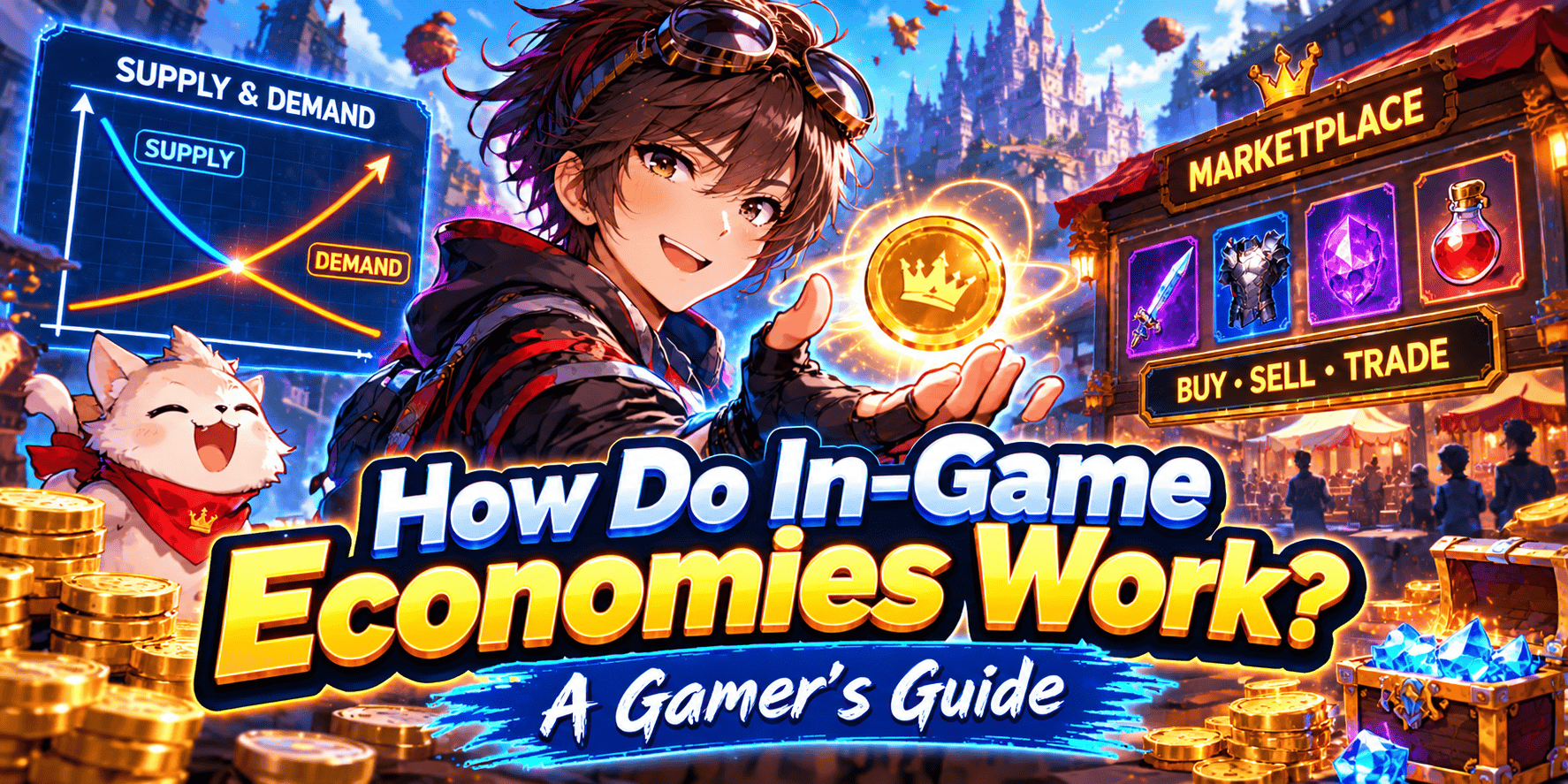
1. How Do In-Game Economies Work? 💰
Ever wondered why a sword made of pixels can be worth more than a week’s groceries?
Or why an item that was practically worthless last month suddenly becomes one of the most sought-after collectibles in your favourite game?
Welcome to the world of in-game economies, where virtual gold, rare equipment, cosmetic skins and digital resources can create surprisingly complex marketplaces.
And just like the real world, gaming economies have their own winners, losers, price crashes and players who somehow always seem to know when to buy.
🎮 Gaming Economies Are More Than Just Virtual Money
An in-game economy is the system that determines how players earn, spend, exchange and use virtual currencies, items and resources.
Some economies are relatively simple.
You defeat enemies, earn gold and spend it on better equipment.
Others are far more sophisticated, featuring player-driven marketplaces, fluctuating prices, rare collectibles and trading systems where supply and demand influence what items are worth.
For example:
- World of Warcraft: Players earn gold, collect resources, craft equipment and trade eligible items through auction houses.
- Counter-Strike 2: Eligible weapon skins and collectibles can be exchanged through Steam’s supported trading and marketplace systems.
- Path of Exile 2: Players trade equipment and crafting currency, with demand influenced by character builds and gameplay progression.
- Fortnite: Players acquire cosmetics through developer-controlled purchasing and reward systems rather than an open player-to-player item marketplace.
Each game approaches its economy differently, but they all involve players acquiring and using digital goods.
💎 Why Do In-Game Economies Matter?
Understanding how a gaming economy works can help you make better decisions about the items and currencies you collect.
It can influence:
- What you buy: Recognising whether an item is reasonably priced.
- What you sell: Understanding demand for eligible tradable items.
- What you collect: Identifying rare or desirable equipment and cosmetics.
- How you progress: Using resources efficiently to improve your character.
- When you trade: Recognising changes in availability and market demand.
- How you spend: Avoiding unnecessary purchases or wasted in-game currency.
You don’t need to become a virtual stockbroker to benefit from understanding these systems.
Sometimes, knowing why a crafting material has suddenly doubled in price is enough to save you hours of grinding.
🏆 Every Item Has a Role in the Economy
Weapons, armour, cosmetics, crafting materials and collectibles can all influence a game’s economy.
However, their economic importance depends on how they’re acquired, used and exchanged.
A common resource might be inexpensive individually but constantly needed by thousands of players.
A rare cosmetic might have little gameplay usefulness but attract strong collector demand.
A powerful weapon might be highly desirable because it supports a popular character build.
Our What Are In-Game Items? Complete Guide explains the different roles digital items play across modern games.
The important thing to understand is that in-game economies are shaped by the relationship between players, items, currencies and the systems developers create.
And once you understand those relationships, many of the strange things happening in gaming marketplaces start making a lot more sense.
2. What Is an In-Game Economy? 🎮
An in-game economy is a virtual system that governs how resources, currencies and items are created, distributed, exchanged and consumed within a video game.
Think of it as a miniature economy operating inside a digital world.
Players earn resources through gameplay, spend currency on equipment, exchange items with other players and make decisions about what they want to keep or use.
Meanwhile, game developers establish the rules that determine how the economy functions.
🪙 The Main Components of an In-Game Economy
Most gaming economies involve several interconnected elements.
| Component | What It Does | Gaming Example |
|---|---|---|
| Virtual Currency | Provides a way to purchase goods or services | Gold, credits and coins |
| In-Game Items | Represent equipment, resources and collectibles | Weapons, armour and skins |
| Resource Generation | Introduces new items or currency | Quests, drops and crafting |
| Shops and Vendors | Allow purchases and sometimes sales | NPC merchants and item shops |
| Trading Systems | Enable permitted player exchanges | Auction houses and direct trading |
| Supply and Demand | Influence player-driven prices | Popular equipment becoming expensive |
| Currency Sinks | Remove currency from circulation | Repair costs and transaction fees |
| Developer Rules | Control how the economy operates | Drop rates and trading restrictions |
Not every game includes all these components.
Some games have no player-to-player trading at all, while others feature extensive markets shaped by thousands of individual transactions.
⚔️ How Do Items Enter an In-Game Economy?
Items and resources enter gaming economies through different activities.
Common methods include:
- Defeating enemies and collecting loot.
- Completing quests and challenges.
- Crafting equipment from resources.
- Purchasing items from NPC vendors.
- Earning seasonal or event rewards.
- Receiving eligible items through trading.
- Purchasing digital goods through official stores.
For example, a player might defeat a boss and receive a rare piece of equipment.
If that equipment is tradable, it could eventually enter a player-driven marketplace.
If it’s account-bound, its economic role is different because the player cannot transfer it to someone else.
🔄 How Do Items Leave an In-Game Economy?
Items don’t necessarily remain available forever.
They might be removed from circulation when players:
- Consume potions or other usable resources.
- Use crafting materials to create equipment.
- Destroy or dismantle items.
- Exchange resources for upgrades.
- Equip items that become permanently bound.
- Stop playing while retaining items on inactive accounts.
This matters because the availability of items can influence their trading value.
For example, imagine a crafting material that players regularly consume when upgrading weapons.
Even if new supplies enter the game every day, demand may remain strong because existing supplies are constantly being used.
💰 What Makes an In-Game Economy Different From a Real Economy?
Gaming economies share several concepts with real-world economics, including supply, demand, inflation and pricing.
However, there’s one major difference.
Game developers can directly change the rules of the economy.
A developer might increase the drop rate of a rare resource, introduce a new currency sink or change which items can be traded.
These decisions can influence prices and player behaviour almost immediately.
Imagine if someone could update the real world overnight so that gold became ten times easier to find.
That’s the kind of economic power game developers can have.
🎯 Are All Gaming Economies Player-Driven?
No.
Some games rely almost entirely on developer-controlled prices.
Others allow players to determine what items are worth through trading.
Many combine both approaches.
Understanding which system a game uses is essential because it determines how prices are established and how much influence players have over the economy.
3. The Different Types of In-Game Economies 🌍
Not every gaming economy operates in the same way.
Some games have fixed prices controlled by developers.
Others feature active marketplaces where players determine how much items are worth.
Many modern games combine elements of both.
Generally, gaming economies can be divided into three broad categories.
🛒 Developer-Controlled Economies
In a developer-controlled economy, the game determines how players acquire items and how much certain goods cost.
Prices are usually established through official shops, vendors or purchasing systems.
Players may have limited or no ability to exchange items with one another.
Fortnite is a good example of a largely developer-controlled cosmetic economy.
Players can purchase eligible cosmetics through the Item Shop, earn certain rewards through gameplay or acquire content through other official systems.
However, players generally cannot freely trade existing Locker cosmetics with other accounts.
This means cosmetic prices are primarily established through Epic Games’ purchasing systems rather than an open player-driven resale marketplace.
Advantages of developer-controlled economies:
- Predictable official pricing.
- Simpler purchasing systems.
- Greater developer control over availability.
- Reduced exposure to certain player-to-player trading scams.
Potential limitations:
- Limited opportunities to exchange unwanted items.
- Restricted resale options.
- Less player influence over prices.
- Availability depends heavily on developer decisions.
These economies can work particularly well in games focused on cosmetics, progression rewards and direct purchases.
🔄 Player-Driven Economies
In a player-driven economy, players have significant influence over the prices and availability of tradable items.
Rather than relying entirely on fixed vendor prices, players exchange goods through supported trading systems.
Prices can fluctuate based on what players are willing to offer and accept.
Path of Exile 2 provides an example of a game with substantial player-driven trading.
Players seek equipment, crafting resources and other eligible items that support their character builds.
An item with particularly desirable attributes might attract considerable interest.
Meanwhile, a common item with limited usefulness might have little trading demand.
The economy responds to player preferences, resource availability and changes in gameplay.
Advantages of player-driven economies:
- Players can influence item prices.
- Trading creates additional ways to obtain equipment.
- Rare and useful items may attract strong demand.
- Specialisation in crafting or trading can become rewarding.
Potential limitations:
- Prices can fluctuate significantly.
- New players may struggle to understand item values.
- Popular items can become expensive.
- Trading scams and market manipulation can create risks.
Player-driven economies can add considerable depth to games, especially when acquiring and exchanging equipment is an important part of progression.
⚖️ Hybrid In-Game Economies
Hybrid economies combine developer-controlled systems with player-driven trading.
For example, a game might have:
- NPC vendors offering fixed-price goods.
- Player auction houses with fluctuating prices.
- Account-bound rewards that cannot be traded.
- Crafting systems that consume resources.
- Official shops offering particular digital goods.
World of Warcraft is a strong example of a hybrid economy.
Players can purchase certain goods from vendors, earn rewards through gameplay and trade eligible items through auction houses.
The developers establish the rules, while players influence the prices of goods exchanged through supported markets.
This creates an economy where fixed systems and player activity operate together.
📊 Types of In-Game Economies Compared
| Economy Type | Who Influences Prices? | Trading Opportunities | Example |
|---|---|---|---|
| Developer-Controlled | Primarily developers | Limited or unavailable | Fortnite cosmetics |
| Player-Driven | Primarily players within developer rules | Extensive for eligible items | Path of Exile 2 trading |
| Hybrid | Developers and players | Varies by item and system | World of Warcraft |
These categories aren’t always completely separate.
For example, Counter-Strike 2 has developer-controlled item creation and availability alongside player-influenced trading prices for eligible cosmetics.
The balance between developer control and player activity determines how each economy behaves.
🎮 Which Type of Economy Is Best?
That depends on what you enjoy.
If you prefer straightforward purchasing without worrying about fluctuating market prices, developer-controlled systems may be more appealing.
If you enjoy trading, collecting resources and searching for valuable equipment, player-driven markets can add another layer of gameplay.
Hybrid systems offer elements of both.
Regardless of the model, developers ultimately determine which economic activities are supported.
4. How Supply and Demand Affect In-Game Item Prices 📈
Why does one weapon skin sell for a substantial amount while another barely attracts interest?
Why do crafting materials suddenly become expensive after a game update?
And why can an item lose much of its trading value even though nothing about its appearance has changed?
The answer often comes down to two important economic concepts.
Supply and demand.
These forces help explain how prices change in player-driven gaming markets.
💎 What Is Supply in an In-Game Economy?
Supply refers to the quantity of an item available within a particular market.
For example, imagine a game contains two types of crafting materials.
Common Iron Ore
- Drops frequently from enemies.
- Can be collected in many locations.
- Is regularly available from other players.
Ancient Dragon Crystal
- Drops from a difficult boss.
- Has a low acquisition rate.
- Is required for certain powerful upgrades.
If both resources are useful, the Ancient Dragon Crystal may attract a higher price because fewer are available.
However, limited supply doesn’t automatically guarantee high value.
Players also need to want the item.
🔥 What Is Demand in an In-Game Economy?
Demand refers to how strongly players want to acquire an item at different prices.
Demand can be influenced by:
- Gameplay usefulness.
- Popular character builds.
- Cosmetic appearance.
- Collector interest.
- Item rarity.
- Seasonal events.
- Game updates.
- Changes in player preferences.
For example, imagine a popular gaming update makes a particular weapon build significantly more effective.
Players might suddenly begin searching for equipment that supports that build.
If the equipment is tradable and available supply is limited, its market price may rise.
📊 How Supply and Demand Influence Prices
| Supply | Demand | Likely Price Pressure |
|---|---|---|
| Low | High | Upward |
| High | Low | Downward |
| High | High | Depends on the balance between them |
| Low | Low | Uncertain; trading may be limited |
| Increasing | Stable | Often downward |
| Stable | Increasing | Often upward |
These are general tendencies rather than guaranteed outcomes.
Prices also depend on trading activity, player expectations, transaction costs and other game-specific factors.
⚔️ Example: A Popular Weapon Gets Buffed
Imagine a fantasy RPG where a particular sword is rarely used.
Most players prefer other weapons, so demand for the sword is relatively low.
Then the developers release a balance update.
Suddenly, the sword becomes one of the strongest options for a popular character build.
What happens next?
- More players want the sword.
- Existing marketplace listings attract greater attention.
- Buyers compete for available copies.
- Sellers may increase their asking prices.
- Additional players may begin farming the sword.
If demand rises faster than supply, the sword’s trading price may increase.
However, if farming becomes much easier or the developers quickly rebalance the weapon, the increase might not last.
🪙 Example: A Crafting Material Becomes Easier to Obtain
Now imagine the opposite situation.
A rare crafting material previously required hours of grinding.
Then a game update introduces several new ways to obtain it.
More players begin collecting the resource, increasing its supply.
If demand remains relatively stable, sellers may need to lower their prices to attract buyers.
The material hasn’t necessarily become less useful.
It’s simply become easier to acquire.
🏆 How Does Rarity Influence Supply?
Rarity often affects how frequently an item enters the economy.
Rare items may have:
- Low drop rates.
- Limited acquisition opportunities.
- Difficult unlocking requirements.
- Restricted event availability.
- Small quantities in circulation.
However, rarity and market value aren’t the same thing.
A rare item with little demand may be worth less than a common resource that thousands of players need.
Our guide to How Does Item Rarity Work in Video Games? explains how rarity systems influence availability and player interest.
🎨 Can Cosmetic Items Be Affected by Supply and Demand?
Absolutely.
In games with tradable cosmetics, collector demand and item availability can influence prices.
For example, an eligible Counter-Strike 2 skin might attract interest because of its appearance, condition or collectible characteristics.
If many players want the skin but relatively few eligible copies are available, its market price may rise.
However, cosmetic prices can also decline when preferences change, supply increases or collector interest weakens.
An expensive skin isn’t guaranteed to remain expensive.
📉 What Happens When Demand Disappears?
Imagine an item that’s valuable because it’s required for a popular character build.
Then a major update makes that build much less effective.
Players might stop searching for the item.
Existing owners may begin listing their copies for sale.
With fewer interested buyers and more sellers, the trading price could fall.
This is one reason gaming item prices can be volatile.
A single balance update can change what players want.
🎯 Why Understanding Supply and Demand Matters
You don’t need to predict every marketplace movement to benefit from understanding supply and demand.
Recognising these basic principles can help you:
- Avoid overpaying during temporary spikes in demand.
- Understand why certain resources become expensive.
- Recognise when increased supply may affect prices.
- Compare items with similar gameplay benefits.
- Make more informed decisions about permitted trades.
Most importantly, it helps explain why an item’s price can change even when the item itself stays exactly the same.
Because in a player-driven gaming economy, an item is worth what willing buyers and sellers agree to exchange for it—not simply what its rarity label suggests.
5. How Do Players Earn and Spend In-Game Currency? 🪙
Every gaming economy needs a way for players to acquire goods, pay for services and exchange resources.
That’s where in-game currency comes in.
Whether you’re collecting gold in World of Warcraft, earning credits in a racing game or spending premium currency on cosmetics, virtual money plays an important role in how gaming economies operate.
But not all in-game currencies work the same way.
Some are earned through gameplay, others can be purchased with real money, and certain games use multiple currencies for different purposes.
💰 What Are the Different Types of In-Game Currency?
Most virtual currencies fall into several broad categories.
1. Earnable In-Game Currency
This is currency players obtain through normal gameplay.
Examples include gold, coins, credits and other rewards earned by completing activities.
Players might earn it by:
- Defeating enemies.
- Completing quests.
- Winning matches.
- Selling items to NPC vendors.
- Participating in events.
- Completing daily or weekly challenges.
In games with trading systems, players may also receive currency by selling eligible items to other players.
2. Premium Currency
Premium currencies are commonly associated with purchases made using real money.
They may be used to acquire cosmetics, battle passes or other digital goods.
For example, Fortnite uses V-Bucks for eligible in-game purchases.
However, premium currency isn’t necessarily transferable between players or redeemable for real money.
3. Specialised Currencies
Some games use particular resources or tokens for specific activities.
These might include:
- Event tokens.
- Competitive rewards.
- Crafting currencies.
- Reputation-based currencies.
- Seasonal resources.
In Path of Exile 2, various crafting currencies also serve important roles in item trading.
This demonstrates how an economy can operate without relying exclusively on a single conventional gold currency.
🎮 How Does Currency Enter an In-Game Economy?
Currency enters a game through systems established by its developers.
For example, imagine an RPG where defeating enemies rewards players with gold.
Every time players defeat enemies and collect gold, additional currency enters the economy.
Other sources might include quest rewards, vendor transactions and repeatable activities.
Economists sometimes describe systems that introduce new currency as currency faucets.
Think of them as taps continuously adding money to the game’s economy.
The more frequently players complete currency-generating activities, the more currency may enter circulation.
🛒 How Do Players Spend In-Game Currency?
Players spend virtual currency on goods and services such as:
- Weapons and armour.
- Potions and consumables.
- Crafting materials.
- Equipment upgrades.
- Character customisation.
- Repairs and maintenance.
- Marketplace purchases.
- Travel or convenience services.
However, there’s an important difference between spending currency at an NPC vendor and purchasing something from another player.
When you pay an NPC vendor, the game may remove that currency from circulation.
When you purchase an item from another player, the currency usually transfers between players, although transaction fees may remove a portion.
🔄 How Does Currency Circulate Between Players?
Imagine three players in a fantasy RPG.
Player One: Collects rare crafting materials.
Player Two: Crafts powerful weapons.
Player Three: Wants to purchase better equipment.
The transactions might work like this:
- Player Two buys crafting materials from Player One.
- Player Two uses those materials to craft a weapon.
- Player Three purchases the weapon from Player Two.
- Player One spends their earnings on other equipment.
Currency moves between players while items and resources change hands.
This creates a functioning player-driven economy.
🚰 What Are Currency Faucets and Sinks?
Two important concepts help explain how developers manage virtual money.
| Economic Mechanism | What It Does | Example |
|---|---|---|
| Currency Faucet | Introduces new currency | Quest rewards |
| Currency Sink | Removes currency from circulation | NPC repair fees |
| Player Trading | Transfers existing currency | Auction house purchases |
| Marketplace Fee | May remove currency from circulation | Transaction charges collected by the game |
| Currency Purchase | May introduce premium currency | Official currency purchases |
Currency sinks are particularly important because they help counterbalance the constant creation of new money.
Without effective sinks, players may accumulate increasingly large amounts of currency over time.
And when everyone has millions of gold coins, that basic healing potion might not stay cheap forever.
6. How Do In-Game Marketplaces and Trading Systems Work? 🔄
In games with player-driven economies, marketplaces allow players to exchange items and resources.
Instead of relying entirely on NPC shops, players can buy and sell eligible goods through supported trading systems.
These marketplaces can become some of the most active parts of a game’s economy.
For certain players, finding a profitable trade is almost as satisfying as defeating a difficult boss.
Almost.
🛒 What Is an In-Game Marketplace?
An in-game marketplace is a system where players can offer eligible items for exchange or purchase.
Depending on the game, marketplaces may support:
- Fixed-price listings.
- Auctions.
- Direct item exchanges.
- Currency-based purchases.
- Searchable item listings.
- Player-to-player negotiations.
Some marketplaces operate entirely inside the game.
Others are provided through official platforms connected to the game.
The key feature is that eligible items can move between participants under the supported trading rules.
🏆 How Do Auction Houses Work?
Auction houses are common in MMORPGs and other games with extensive trading systems.
Players list eligible items, while buyers search for goods they want.
For example, World of Warcraft’s auction house allows players to buy and sell various eligible resources, consumables and equipment.
A typical transaction might involve:
- A player collects a valuable crafting material.
- They check existing auction house listings.
- They list their material at a chosen price.
- Another player purchases it.
- The seller receives the proceeds after applicable fees.
Auction houses help connect players who have items with players who need them.
They also make it easier to compare competing offers.
⚔️ How Does Direct Player-to-Player Trading Work?
Direct trading involves players exchanging eligible items or currencies with one another.
For example, a player might offer a weapon in exchange for crafting materials.
Depending on the game, the transaction could involve:
- An item-for-item exchange.
- Items exchanged for in-game currency.
- Multiple items traded together.
- A negotiated exchange involving different resources.
Direct trading can provide flexibility, particularly when items have unusual attributes or when players want to negotiate.
However, it can also require more effort than purchasing an item through a searchable marketplace.
💎 How Do Official Gaming Marketplaces Work?
Some gaming platforms provide official marketplaces for eligible digital items.
The Steam Community Market is one example.
It allows users to buy and sell eligible items from participating games using Steam Wallet funds.
However, Steam Wallet balances generally cannot be withdrawn as cash.
This means a marketplace price denominated in a real-world currency doesn’t necessarily represent withdrawable earnings.
Understanding the difference between platform wallet value and cash value is essential.
📈 How Are Marketplace Prices Determined?
In player-driven markets, prices are influenced by what buyers are willing to pay and what sellers are willing to accept.
Imagine a rare weapon skin with several competing listings.
One seller lists it for 100 units of currency.
Another lists a comparable item for 95.
A third lists one for 90.
If the items are genuinely comparable, buyers may prefer the lowest-priced option.
However, factors such as item condition, attributes, rarity and availability can justify different prices.
A seller’s asking price also doesn’t guarantee a completed sale.
Completed transactions generally provide stronger evidence of market value than unusually high asking prices.
🔒 Can Every In-Game Item Be Sold?
No.
Marketplace eligibility depends on the game and the item.
Some items may be:
- Permanently account-bound.
- Character-bound.
- Temporarily trade-locked.
- Eligible for direct trading but not marketplace listing.
- Restricted by platform or account requirements.
These distinctions are important when considering the value of an item.
Our guide to Tradable vs Non-Tradable In-Game Items explains how these restrictions affect buying, selling and collecting.
🎯 Why Are Marketplaces Important to Gaming Economies?
Marketplaces help establish prices and distribute resources between players.
They can also create opportunities for specialisation.
Some players focus on collecting resources.
Others enjoy crafting equipment.
Some specialise in acquiring and exchanging rare items.
By connecting these activities, marketplaces allow players to participate in the economy in different ways.
However, market activity doesn’t automatically mean every transaction is safe or permitted.
Players should always use authorised trading methods and understand the relevant rules.
7. What Causes Inflation and Deflation in Gaming Economies? 📊
Ever returned to an MMORPG after a long break and discovered that equipment you once purchased for a few hundred gold now costs thousands?
Your first thought might be that everyone has suddenly become incredibly greedy.
But there could be a more interesting explanation.
Inflation.
Just like real-world economies, gaming economies can experience changes in the purchasing power of their currencies.
They can also experience deflation, where prices fall and currency becomes more valuable relative to goods.
Understanding these concepts helps explain why prices can change dramatically over time.
📈 What Is Inflation in an In-Game Economy?
Inflation occurs when the general price level of goods and services rises over time.
In a gaming economy, this means players may need more currency to purchase the same collection of items.
For example, imagine a game where a typical piece of equipment costs 1,000 gold.
Several months later, comparable equipment costs 1,500 gold.
If similar price increases occur across many goods, the economy may be experiencing inflation.
However, an increase in the price of one rare item doesn’t necessarily mean the entire economy is experiencing inflation.
That particular item might simply have become more desirable.
🪙 Why Does Gaming Inflation Happen?
One common cause is excessive currency generation relative to the economy’s ability to absorb it.
Imagine an MMORPG where players continuously earn gold by defeating enemies and completing quests.
Every day, more currency enters circulation.
If players accumulate currency faster than it’s removed, they may become willing to pay higher prices for limited goods.
This can contribute to inflation.
Other factors can include:
- Increased player wealth.
- Insufficient currency sinks.
- Changes in item supply.
- Popular farming activities.
- Economic exploits.
- Shifts in demand for important resources.
Inflation is not always caused by currency generation alone.
Prices can also rise because goods become harder to obtain or demand increases.
🚰 Example: Too Much Gold Enters the Economy
Imagine a fantasy MMORPG with 10,000 active players.
Initially, players earn approximately 1,000 gold per day.
Then a new activity is introduced that allows players to earn 5,000 gold per day with relatively little effort.
Over time, many players accumulate much larger gold balances.
If the supply of desirable equipment doesn’t increase at the same rate, players may begin offering more gold for those items.
Sellers notice that buyers are willing to pay higher prices.
The prices of many desirable goods may rise.
The result?
Players have more gold, but each gold coin may purchase less than before.
📉 What Is Deflation in a Gaming Economy?
Deflation is a sustained decline in the general price level of goods and services.
In gaming, deflation can occur when currency becomes scarcer relative to available goods or when spending demand weakens broadly.
For example, imagine a game introduces substantial new fees that remove currency from circulation.
If players have less currency available for purchases, they may offer lower prices for tradable goods.
Sellers might respond by reducing their prices.
However, falling prices for one item don’t automatically indicate deflation.
A particular resource might simply become easier to obtain.
📊 Inflation vs Deflation in Gaming
| Feature | Inflation | Deflation |
|---|---|---|
| General Price Movement | Prices rise | Prices fall |
| Currency Purchasing Power | Generally decreases | Generally increases |
| Possible Cause | Currency growth exceeding demand for money | Currency scarcity or weaker spending |
| Player Impact | More currency needed for purchases | Less currency needed for purchases |
| Example | Broad increases in equipment prices | Broad declines in market prices |
⚔️ How Do Game Updates Affect Inflation?
Developers can influence economic conditions through updates.
For example, an update might:
- Increase gold rewards.
- Introduce expensive new upgrades.
- Reduce currency farming opportunities.
- Change vendor prices.
- Adjust crafting costs.
- Introduce new transaction fees.
These changes can affect how quickly currency enters and leaves circulation.
However, their overall impact depends on how players respond.
🛡️ How Do Developers Prevent Excessive Inflation?
One common approach is introducing currency sinks.
These systems remove money from circulation when players spend it.
Examples include:
- Equipment repair costs.
- NPC vendor purchases.
- Crafting fees.
- Upgrade expenses.
- Auction house fees.
- Travel costs.
- Cosmetic services purchased using earnable currency.
Imagine a game where players earn millions of gold but have almost nothing to spend it on.
Currency could accumulate continuously.
Now imagine that upgrading equipment requires substantial payments to NPC vendors.
Those payments remove currency from the economy, helping counterbalance the gold generated through gameplay.
🎮 Is Inflation Always Bad for Players?
Not necessarily.
Moderate price changes can reflect an active, evolving economy.
However, excessive inflation can make it difficult for newer players to afford important items.
Experienced players may have accumulated large currency balances, while beginners struggle to keep up with rising prices.
Deflation can also create challenges.
If players expect prices to keep falling, they may delay purchases, making it harder for sellers to find buyers.
The goal isn’t necessarily to keep every price unchanged.
It’s to maintain an economy where players can participate meaningfully without excessive instability.
8. How Do Game Developers Control In-Game Economies? ⚙️
In the real world, governments and central banks use various tools to influence economic conditions.
In video games, developers have something even more powerful.
They control the code.
A developer can adjust how frequently resources appear, how much currency players earn and which items can be exchanged.
These decisions can influence an entire gaming economy.
And unlike real-world economic policy, some changes can arrive with a single patch.
🎲 Adjusting Item Drop Rates
Drop rates determine how frequently certain items appear through gameplay.
For example, a rare crafting material might have a low chance of dropping from a particular enemy.
If developers increase its drop rate, more copies may enter the economy.
This could reduce scarcity and place downward pressure on its trading price.
If the drop rate decreases, supply may become more limited.
However, the actual price impact also depends on player demand and existing inventories.
💰 Controlling Currency Generation
Developers can influence how much currency players earn through activities.
They might adjust:
- Quest rewards.
- Enemy drops.
- Daily challenge payouts.
- Vendor sale prices.
- Event rewards.
- Currency farming opportunities.
Increasing currency rewards may help players afford goods more easily in the short term.
However, excessive currency creation can contribute to inflation if spending opportunities and currency sinks don’t keep pace.
🚰 Introducing Currency Sinks
Currency sinks remove money from circulation.
They’re particularly useful in economies where players continuously generate currency through gameplay.
Common examples include:
Equipment Repairs
Players pay NPCs to repair damaged equipment.
Crafting Fees
Creating or upgrading equipment requires currency.
Marketplace Fees
A portion of eligible transactions may be collected by the game.
Travel and Convenience Services
Players spend currency on transportation or other services.
Cosmetic Customisation
Players pay for appearance changes or other optional features.
Well-designed currency sinks can help prevent excessive accumulation without making gameplay unnecessarily frustrating.
⚔️ Changing Equipment Balance
Gameplay balance updates can have major economic consequences.
Imagine a particular weapon is extremely popular because it performs exceptionally well.
Players may be willing to pay high prices for equipment supporting that weapon.
Then developers reduce its effectiveness.
Demand might fall as players move to different builds.
Meanwhile, items associated with newly improved builds could become more desirable.
This means even updates that don’t directly change marketplace rules can influence item prices.
🔒 Introducing Trading Restrictions
Developers may restrict which items can be transferred between players.
For example, they might make certain rewards account-bound to preserve progression.
They could also introduce temporary trading restrictions to reduce fraud or prevent rapid item movement.
These changes can affect the supply of items available for exchange.
However, restricting trading doesn’t necessarily increase an item’s legitimate market value.
An item that cannot be transferred may no longer have an individual resale market at all.
🛠️ Adjusting Crafting Systems
Crafting systems influence demand for resources.
Imagine a popular equipment upgrade requires:
- 10 Iron Ore
- 5 Magic Crystals
- 1 Ancient Rune
If developers change the recipe to require 20 Magic Crystals, demand for those crystals may increase.
Alternatively, if the recipe becomes easier, demand for certain materials could decline.
Crafting changes can therefore affect resource prices throughout the economy.
🏆 Introducing Limited-Time Events
Seasonal events can create temporary changes in supply and demand.
For example, an event might introduce:
- Exclusive cosmetic rewards.
- Limited-time crafting materials.
- Special currencies.
- Unique equipment.
- Temporary vendors.
- Event-specific consumables.
Players may rush to acquire particular items before the event ends.
However, limited availability doesn’t guarantee future value.
Demand may decline after the event, and developers might later reintroduce the same rewards.
🔄 Seasonal Resets and Fresh Economies
Some games periodically introduce new seasons, leagues or progression environments.
These systems may provide players with a fresh economy where characters, resources or trading markets begin under new conditions.
For example, Path of Exile 2’s league-based structure can create separate economic environments, depending on the league rules.
Fresh economies can change the availability of equipment and crafting resources.
Early in a new season, particular items may be scarce because relatively few players have acquired them.
As more players progress, supply may increase and prices can change.
Seasonal systems can also give new and returning players opportunities to participate without competing directly against every resource accumulated in an older economy.
📊 Developer Economic Controls Compared
| Developer Tool | What It Changes | Potential Economic Effect |
|---|---|---|
| Drop Rates | Item availability | Changes supply |
| Currency Rewards | Currency generation | Influences purchasing power |
| Currency Sinks | Currency removal | Helps control accumulation |
| Balance Updates | Item usefulness | Changes demand |
| Trading Restrictions | Transfer eligibility | Changes market participation |
| Crafting Recipes | Resource requirements | Changes material demand |
| Limited-Time Events | Item availability and interest | Creates temporary market changes |
| Seasonal Resets | Economic starting conditions | Creates fresh trading environments |
🎯 Why Economic Balance Matters
A well-managed in-game economy can make collecting, crafting and trading more rewarding.
Players need meaningful opportunities to earn resources, acquire equipment and participate in the game’s systems.
If everything is too easy to obtain, valuable rewards may lose their appeal.
If important items are excessively difficult to acquire, progression can become frustrating.
And if currency becomes unstable, players may struggle to understand what their resources are worth.
Developers therefore need to balance accessibility, scarcity, progression and player demand.
Our guide to What Makes an In-Game Item Valuable? explores how rarity, usefulness, availability and demand influence the desirability of digital goods.
Ultimately, the most successful gaming economies aren’t necessarily those with the most expensive items. They’re the ones that give players meaningful reasons to earn, spend, collect and trade.
Because a virtual economy should make the game more enjoyable.
Not make buying a health potion feel like applying for a home loan.
9. How Do Rare Items and Collectibles Affect Gaming Economies? 💎
Why would someone spend thousands of hours chasing a rare weapon skin, exclusive mount or legendary piece of equipment?
And why can a digital collectible sometimes attract more interest than an item that actually improves gameplay?
The answer often comes down to a combination of rarity, scarcity, demand and player perception.
Rare items and collectibles can play an important role in gaming economies, particularly when they’re tradable and desirable to large numbers of players.
But there’s more to item value than simply having a legendary label.
🏆 Why Are Rare In-Game Items Desirable?
Players collect rare items for many reasons.
Some want powerful equipment that improves their character.
Others enjoy collecting cosmetics, completing item sets or showing off rewards that few players possess.
Common reasons include:
- Exclusivity: Owning something relatively few players have.
- Gameplay benefits: Accessing powerful equipment or useful resources.
- Collectibility: Completing collections or acquiring distinctive items.
- Personal achievement: Demonstrating progression or accomplishments.
- Appearance: Customising characters, weapons or equipment.
- Trading opportunities: Acquiring eligible items that other players want.
These motivations can influence demand, even when an item provides no competitive advantage.
For example, a rare Counter-Strike 2 weapon skin doesn’t improve weapon damage or accuracy.
However, collectors may still value its appearance, condition, pattern or scarcity.
💎 How Does Rarity Affect Item Prices?
Rarity can influence prices by limiting how many copies of an item are available.
Imagine two cosmetic skins.
Skin A: Common Soldier
- Frequently obtainable.
- Available to many players.
- Has a relatively ordinary appearance.
- Attracts limited collector interest.
Skin B: Crimson Phantom
- Extremely difficult to obtain.
- Has a distinctive appearance.
- Is highly desirable to collectors.
- Has relatively few tradable copies available.
If demand for Skin B is strong, its limited supply could contribute to a higher trading price.
However, scarcity alone isn’t enough.
An extremely rare item that nobody wants may have little market value.
That’s why rarity and demand need to be considered together.
🎨 Can Cosmetic Items Influence Entire Gaming Economies?
Absolutely.
In some games, cosmetic items form a major part of the trading economy.
Counter-Strike 2 is a particularly recognisable example.
Eligible weapon skins, gloves and other collectibles can be exchanged through supported Steam trading systems.
Their desirability may depend on characteristics such as:
- Visual appearance.
- Item condition.
- Pattern variations.
- Collection or release history.
- Supply and availability.
- Collector preferences.
These characteristics can create different levels of demand even among items with similar gameplay functionality.
Cosmetic markets demonstrate that an item’s economic value doesn’t necessarily depend on how useful it is during gameplay.
Sometimes, looking spectacular while missing every shot is apparently valuable enough.
⏳ What Happens When Rare Items Become Unavailable?
Some items are associated with limited-time events, discontinued content or restricted acquisition methods.
If new copies stop entering a trading market, the available supply may become more limited over time.
However, this doesn’t guarantee prices will rise.
Future value depends on several factors, including:
- Whether players still want the item.
- How many tradable copies remain available.
- Whether the item can return.
- Changes in the game’s popularity.
- The introduction of similar alternatives.
- Marketplace restrictions.
For example, an event-exclusive cosmetic might initially attract strong collector interest.
But if players lose interest or the developer introduces a more desirable alternative, demand could decline.
📊 Rare Items vs Common Items in Gaming Economies
| Factor | Rare Items | Common Items |
|---|---|---|
| Availability | Often limited | Usually more plentiful |
| Acquisition Difficulty | May be high | Often relatively low |
| Collector Interest | Can be significant | Usually more dependent on usefulness |
| Trading Demand | Varies considerably | Can be consistently strong |
| Price Stability | May be volatile | Depends on supply and demand |
| Gameplay Usefulness | Varies | Varies |
| Market Liquidity | May have fewer buyers | May have more frequent transactions |
One important concept here is liquidity.
A highly valuable collectible might have a substantial asking price but very few interested buyers.
Meanwhile, a common crafting material might sell quickly because thousands of players need it every day.
An expensive item isn’t necessarily an easy item to sell.
⚔️ Why Can Common Items Be Economically Important?
Rare collectibles attract attention, but common resources often keep gaming economies functioning.
Think about crafting materials, potions and consumables.
Players may need these resources repeatedly.
Even if individual items are inexpensive, large quantities can be exchanged regularly.
For example, a crafting material used in several popular equipment recipes may experience consistent demand.
That makes it economically important despite being relatively common.
🎯 What Should Players Remember About Rare Items?
Rarity can make an item interesting, but it doesn’t automatically make it valuable.
Before assigning value to a collectible, consider:
- How difficult is it to obtain?
- Do other players actually want it?
- Can it be traded?
- Are comparable items selling?
- Could additional copies become available?
- Is its popularity likely to change?
Understanding these factors can help you distinguish genuine market demand from excitement surrounding a rare-looking item.
Because sometimes a legendary item really is something special.
And sometimes it’s just a common sword wearing a very impressive purple border.
10. Can In-Game Economies Have Real-World Value? 💵
Gaming economies operate inside virtual worlds, but some can connect to real-world financial activity.
Players may purchase digital goods using real money, exchange eligible items through official marketplaces or participate in trading systems where digital assets have observable prices.
However, there’s an important distinction.
An item having a price doesn’t automatically mean it can legally or legitimately be converted into cash.
The rules depend on the game, platform and transaction method.
💰 How Can Virtual Items Have Real-World Value?
Some players are willing to pay real money for particular digital goods.
These might include:
- Eligible cosmetic skins.
- Rare collectibles.
- Certain digital resources.
- In-game items offered through authorised marketplaces.
- Other permitted digital goods.
Real-money interest can arise from scarcity, usefulness, collectibility or convenience.
However, not every game permits players to sell their items for real money.
Some explicitly prohibit real-money trading outside authorised systems.
🎮 Real Money vs In-Game Currency
Different gaming economies use different forms of value.
Consider these three examples.
1. In-Game Currency
A weapon might be worth 50,000 gold in an MMORPG.
That doesn’t automatically mean the gold can be exchanged for real money.
2. Platform Wallet Value
An eligible item might sell through the Steam Community Market for a price displayed in Australian dollars.
However, the proceeds are credited to the Steam Wallet and generally cannot be withdrawn as cash.
3. Real-Money Transactions
Some games or platforms may permit particular digital goods to be sold through authorised systems involving real-money payments.
Where permitted, these transactions may involve payment processing, fees and additional conditions.
These three types of value shouldn’t be treated as interchangeable.
📊 Different Types of Gaming Item Value
| Value Type | Example | Can It Be Withdrawn as Cash? |
|---|---|---|
| In-Game Currency | MMORPG gold | Generally not through official systems |
| Premium Currency | Fortnite V-Bucks | Generally no |
| Platform Wallet Balance | Steam Wallet funds | Generally no |
| Authorised Real-Money Sale | Eligible item sold through a permitted cash marketplace | Depends on the platform’s rules and payout system |
| Personal or Gameplay Value | Account-bound legendary equipment | Not an individual cash value |
🛒 What About Third-Party Item Marketplaces?
External marketplaces exist for certain gaming items and services.
However, the existence of a marketplace doesn’t establish that every transaction it offers is permitted by the relevant game.
Before using any external service, players should check:
- Whether the game permits the transaction.
- Whether the item is transferable.
- Whether real-money sales are authorised.
- What buyer and seller protections exist.
- Whether payment withdrawals are supported.
- What fees and restrictions apply.
It’s also important to understand that marketplace activity can involve fraud, account security risks and disputes.
A platform offering to facilitate a transaction doesn’t override the game’s terms.
📈 Can Gaming Item Prices Change Like Real-World Assets?
Yes.
Tradable gaming items can experience substantial price fluctuations.
Prices may change because of:
- Game updates.
- Collector demand.
- Changes in item supply.
- Marketplace activity.
- Player population changes.
- New cosmetic releases.
- Trading restrictions.
However, digital gaming items shouldn’t automatically be treated as investments.
Their availability, functionality and transferability depend heavily on the game and platform.
Developers may change rules, remove features or discontinue services.
A collectible that attracts significant interest today may become much less desirable later.
⚠️ Does Buying an Item Mean You Own It?
Not necessarily in the same way you own a physical object.
Many games provide contractual rights or licences to access and use digital items rather than unrestricted ownership.
Those rights may be subject to account terms, transfer restrictions and the continued operation of the game.
For example, purchasing a cosmetic doesn’t necessarily give you the right to sell, transfer or reproduce it.
Our upcoming guide to Do You Really Own Your In-Game Items? explores digital ownership, licensing and player rights in greater detail.
🏆 Can Players Earn Money Through Gaming Economies?
Some gaming ecosystems provide legitimate earning opportunities through authorised item sales, content creation, competitions or other supported activities.
However, earning opportunities vary significantly between games.
It’s important to distinguish between:
- Earning virtual currency.
- Receiving non-withdrawable marketplace credit.
- Completing an authorised real-money transaction.
- Participating in activities prohibited by a game’s terms.
Not every virtual earning opportunity translates into actual income.
And even when real-money transactions are permitted, profits aren’t guaranteed.
🎯 Understanding Real-World Value
Gaming economies can involve meaningful financial activity, but players should approach real-money transactions carefully.
Before spending significant amounts on digital goods, consider whether the item has genuine utility or collector appeal, whether resale is permitted and whether you’re comfortable with the possibility of losing its value.
Enjoying a rare cosmetic is one thing.
Treating it like a guaranteed retirement plan is another.
11. How to Understand and Navigate an In-Game Economy 🧠
Understanding economic concepts is useful.
But how do you actually apply them when playing your favourite game?
Whether you’re buying equipment, collecting crafting materials or exploring permitted trading opportunities, a little economic knowledge can help you make better decisions.
You don’t need complicated spreadsheets or a degree in economics.
Although if you already have a spreadsheet tracking every crafting material in your inventory, we respect the dedication.
🔍 Step 1: Understand How the Game’s Economy Works
Start by identifying the type of economy you’re participating in.
Ask yourself:
- Does the game support player-to-player trading?
- Are item prices fixed or player-driven?
- What currencies are used?
- Can players sell equipment and resources?
- Which items are account-bound?
- Are there official marketplaces?
- Does the game permit real-money transactions?
These questions establish what economic activities are available.
For example, collecting cosmetics in Fortnite involves different economic considerations from trading equipment in Path of Exile 2.
💰 Step 2: Learn What Items Are Worth
If your game supports trading, understanding typical item prices is important.
Before purchasing an expensive item, compare similar offers.
Look at factors such as:
- Item rarity.
- Equipment attributes.
- Cosmetic condition.
- Recent completed transactions, where available.
- Current listings.
- Item availability.
- Trading restrictions.
Avoid relying entirely on one seller’s asking price.
An item listed for 100,000 gold isn’t necessarily worth that amount if nobody is willing to purchase it.
Our upcoming guide to How to Check What an In-Game Item Is Worth explores practical ways to assess item values.
📈 Step 3: Pay Attention to Supply and Demand
Look for changes that could influence item prices.
For example:
A New Character Build Becomes Popular
Demand for particular equipment or crafting resources might increase.
A Rare Resource Becomes Easier to Farm
Additional supply could place downward pressure on prices.
A Limited-Time Event Begins
Players may become interested in event-related items or materials.
A Major Update Changes Equipment Balance
Previously popular items may become less desirable.
These changes don’t guarantee particular price movements, but they provide useful context.
🪙 Step 4: Understand How Currency Is Generated
If you’re playing a game with an extensive economy, identify how currency enters circulation.
Some activities generate currency directly.
Others reward items that can be exchanged with other players.
Understanding the difference helps you evaluate how efficiently you’re using your time.
For example, collecting a rare resource might be rewarding, but a more common material with consistent demand could sometimes provide more reliable trading opportunities.
⚔️ Step 5: Consider Opportunity Costs
Every gaming decision involves trade-offs.
Imagine you’ve collected a valuable crafting material.
You could:
- Use it to upgrade your equipment.
- Trade it for another resource.
- Sell it through a supported marketplace.
- Keep it for future crafting.
Choosing one option means giving up the others.
Economists call this an opportunity cost.
For example, using a rare resource to upgrade a weapon might improve your gameplay immediately.
However, it also means you can no longer trade that resource for something else.
There’s no universally correct choice.
The best decision depends on your goals.
🛡️ Step 6: Understand Trading Restrictions
Before buying or selling an item, confirm that the intended transaction is permitted.
Check whether the item is:
- Tradable.
- Account-bound.
- Character-bound.
- Temporarily restricted.
- Eligible for marketplace listing.
- Subject to account requirements.
An item might be desirable but impossible to transfer.
Likewise, a technically transferable item may still be subject to restrictions on real-money transactions.
📊 Step 7: Don’t Confuse Asking Prices With Actual Value
Marketplace listings can be misleading.
A seller can sometimes advertise an item at almost any price.
That doesn’t mean buyers are willing to pay it.
Where available, completed transaction records provide more useful information.
For example, imagine three comparable items are listed for:
- 5,000 gold.
- 7,500 gold.
- 20,000 gold.
If recent comparable transactions consistently occurred around 5,000 gold, the 20,000-gold listing might simply be unrealistic.
Always consider actual demand rather than assuming the highest listing represents an item’s value.
🎮 Step 8: Follow Game Updates
Developers can change gaming economies quickly.
A patch might alter:
- Item drop rates.
- Crafting requirements.
- Equipment effectiveness.
- Currency rewards.
- Trading permissions.
- Marketplace fees.
Following official patch notes can help you understand why certain prices or trading conditions have changed.
This is particularly useful in games where equipment balance and resource availability influence market activity.
💎 Step 9: Avoid Making Decisions Based Entirely on Hype
Rare items and popular cosmetics can attract considerable excitement.
However, popularity doesn’t guarantee long-term demand.
Before spending substantial amounts of currency or money, consider whether you’re acquiring the item because you genuinely want it or because you expect its price to increase.
Gaming economies can change rapidly.
An item that appears highly desirable today may become less popular after an update.
🏆 Step 10: Focus on Enjoying the Game
Understanding an in-game economy should improve your gaming experience, not turn every session into financial administration.
Some players love trading and marketplace activity.
Others prefer collecting rare equipment, crafting useful items or simply enjoying the gameplay.
All of these approaches are valid.
The goal is to understand how the economy works so you can make informed decisions.
Because saving a few thousand gold is satisfying.
But spending three hours calculating the optimal resale price of a common health potion?
That might be taking things a little too far.
12. In-Game Economies FAQ ❓
💰 What Is an In-Game Economy?
An in-game economy is the system that determines how virtual currencies, items and resources are created, distributed, exchanged and used within a video game.
It can include shops, crafting systems, trading marketplaces and player-driven prices.
🎮 How Do In-Game Economies Work?
In-game economies work through interactions between players, virtual currencies, digital goods and developer-controlled systems.
Players earn resources, purchase items, craft equipment and sometimes trade with one another.
Supply, demand and game rules influence how these activities operate.
🪙 Why Do Games Have In-Game Currency?
Virtual currencies provide a way for players to purchase goods, pay for services and participate in economic activities.
They can also support progression systems and reward gameplay.
Some currencies are earned through gameplay, while others can be purchased through official systems.
📈 What Causes Inflation in Video Games?
Inflation can occur when the general price level of goods rises over time.
Possible causes include excessive currency generation, insufficient currency sinks, reduced item availability and increased demand.
However, an increase in one item’s price doesn’t necessarily mean the entire economy is experiencing inflation.
📉 Can In-Game Economies Experience Deflation?
Yes.
Deflation occurs when the general price level falls over time.
It may be associated with reduced currency availability, weaker spending demand or other economic changes.
However, falling prices for one resource don’t necessarily indicate economy-wide deflation.
💎 Why Are Some In-Game Items So Expensive?
Item prices can be influenced by rarity, scarcity, gameplay usefulness, collector demand and availability.
An item may attract high prices when many players want it but relatively few eligible copies are available.
However, rarity alone doesn’t guarantee value.
🔄 What Is a Player-Driven Economy?
A player-driven economy is a system where players significantly influence item prices through permitted trading.
Buyers and sellers determine what they’re willing to exchange for particular goods.
Developers still establish the rules governing the economy.
🛒 What Is the Difference Between an Auction House and an NPC Shop?
An NPC shop generally offers goods or services at prices established by the game.
An auction house allows players to list eligible items for other players to purchase, with prices influenced by player activity.
🚰 What Are Currency Sinks in Gaming?
Currency sinks are systems that remove virtual currency from circulation.
Examples include equipment repair fees, crafting costs and certain NPC purchases.
They can help balance currency generated through gameplay.
⚔️ How Do Game Updates Affect Item Prices?
Game updates can change item usefulness, availability, crafting requirements and trading restrictions.
These changes may influence supply and demand, causing player-driven prices to rise or fall.
💵 Can In-Game Currency Be Converted Into Real Money?
It depends on the game and platform.
Many virtual currencies cannot legitimately be withdrawn or exchanged for cash.
Some games and marketplaces support particular real-money transactions, but players must follow the applicable rules.
🏆 Are Rare Items Always More Valuable?
No.
Rare items may attract collector interest, but their value also depends on demand, usefulness, availability and trading eligibility.
A common resource with strong demand can be more valuable than a rare item that few players want.
🔐 Can Developers Control In-Game Economies?
Yes.
Developers can influence economies by adjusting drop rates, currency rewards, crafting systems, trading restrictions, marketplace fees and other gameplay mechanics.
However, in player-driven markets, prices also respond to player behaviour.
🎯 What Is the Best Way to Understand a Gaming Economy?
Start by learning how the game generates currency and items, whether trading is permitted and how prices are established.
Then pay attention to supply, demand, marketplace activity and official game updates.
Understanding these fundamentals can help you make better decisions when collecting, buying or trading items.
🎮 Final Thoughts: Understanding How In-Game Economies Work
In-game economies are one of the most fascinating systems in modern gaming.
What might initially look like a simple collection of gold coins, crafting materials and equipment can develop into a complex network of player activity, trading markets and virtual currencies.
Some games rely on developer-controlled shops and fixed prices.
Others feature player-driven economies where supply and demand influence the value of equipment, resources and collectibles.
Many combine both approaches.
Understanding how these systems work can help you recognise why prices change, why certain items become desirable and how developers influence economic activity.
The key principles are straightforward: supply affects availability, demand influences desirability, currency enables transactions and developer rules determine what’s possible.
You don’t need to become an expert economist to enjoy gaming economies.
But understanding the basics can help you make smarter decisions, avoid unnecessary purchases and get more enjoyment from collecting and trading.
And the next time someone asks why that rare sword costs 500,000 gold?
You’ll have a better explanation than simply saying, “Because it’s legendary, obviously.”