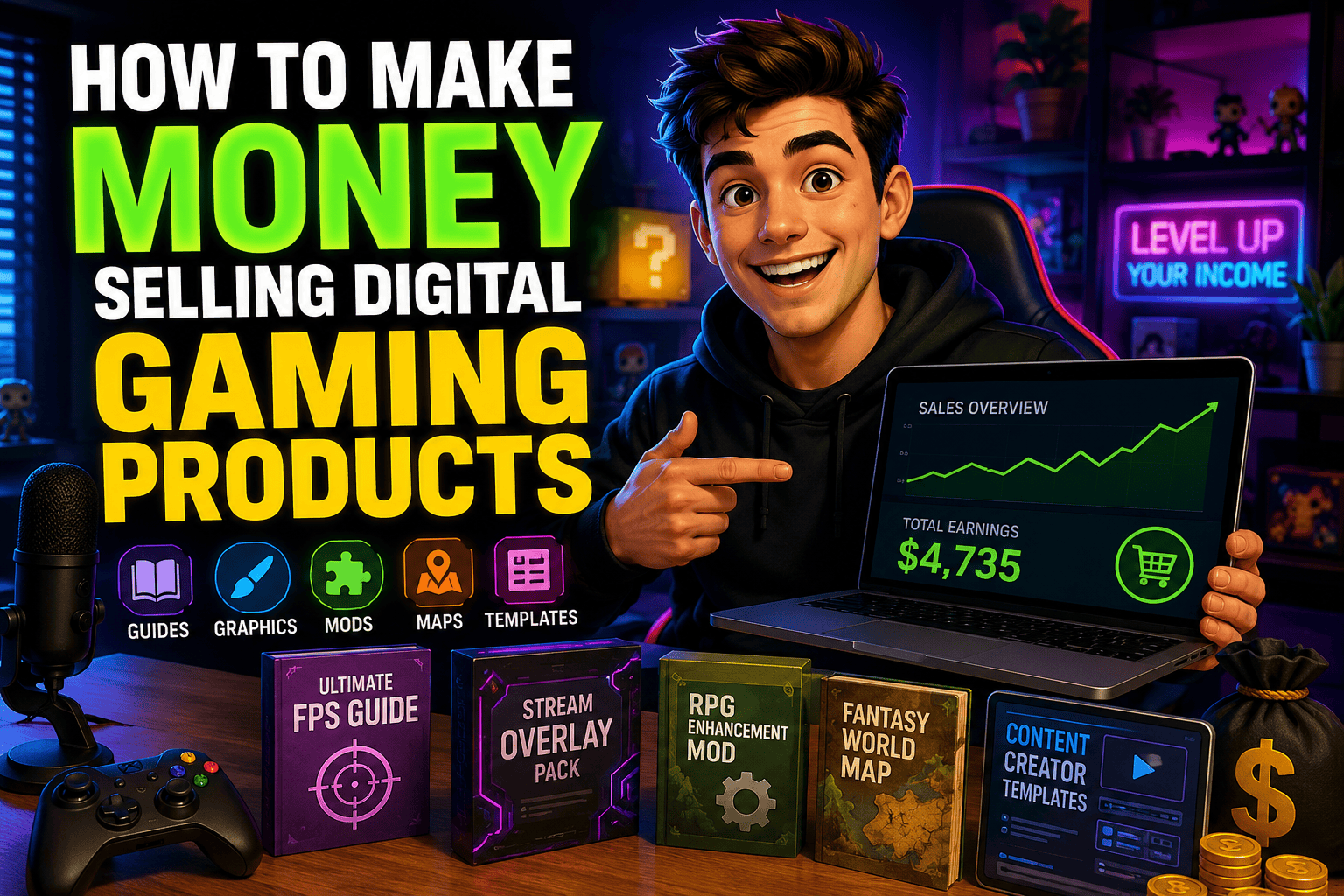
1. 🎮 Your Gaming Knowledge Could Become a Digital Product
If you’ve spent years gaming, you’ve probably accumulated more than achievements, screenshots and a game library containing several titles you’re definitely going to finish one day.
You’ve accumulated knowledge, skills and resources.
Maybe you understand a game’s mechanics better than most players. Perhaps you create incredible builds, design gaming graphics, configure complicated mods or have developed your own way of helping players understand something difficult.
Some of those things can potentially become digital gaming products people will pay for.
And unlike a service, where you normally complete new work for every customer, a digital product can potentially be created once and sold more than once.
That’s what makes the model interesting.
🔥 What Could You Turn Into a Product?
Start by looking at things you already know how to create.
That might include:
- 📚 Gaming guides and strategy resources
- 🎨 Stream graphics and creative assets
- 🧩 Game mods and add-ons
- 🗺️ Maps, worlds and builds
- 📋 Checklists and training plans
- 📊 Trackers and spreadsheets
- ⚙️ Configuration resources
- 🎥 Creator templates and tools
You don’t necessarily need to invent something completely new.
You need to create something useful enough that another gamer would rather buy it than make it themselves.
💡 You’re Selling the Solution, Not the File
A digital product might technically be a PDF, ZIP file, template, graphic or downloadable resource.
But that’s not really what the customer is buying.
They’re buying what the product helps them do.
A beginner might buy a gaming guide because they want to understand a complicated game faster.
A streamer might buy an overlay pack because they want their channel to look more professional.
A server owner might buy a map because creating one themselves could take days.
A competitive player might buy a training planner because they want a better way to structure their practice.
The file is simply how the value gets delivered.
That’s an important idea to remember throughout this guide:
Gaming Skill or Knowledge → Useful Product → Customer Outcome
If you start with the customer outcome rather than simply asking “What file could I sell?”, you’re much more likely to create something people actually want.
🧠 Pay Attention to What Other Gamers Ask You
One of the easiest ways to spot a possible product is to notice questions you already receive.
Maybe it’s:
“What’s the best way to build this character?”
“How did you make that?”
“Which settings do you use?”
“Can you send me that template?”
“How do I install this properly?”
Repeated questions are useful clues.
If you’re constantly explaining the same thing, there may be an opportunity to package that knowledge into something people can use without needing you personally every time.
If you’re still figuring out which of your abilities could potentially earn money, how to make money from your gaming skills explores the wider range of gameplay, creative, technical and community skills gamers can potentially monetise.
🔄 Digital Products Work Differently From Services
Imagine you’re good at designing gaming graphics.
You could offer a custom thumbnail service. A customer orders, you create their thumbnail and you get paid.
That’s a service.
Now imagine you create a downloadable stream graphics pack containing overlays, panels, alerts and screens.
You create the pack once and multiple customers can potentially purchase the same product.
That’s a digital product.
| Gaming Service | Digital Product | |
|---|---|---|
| What you sell | Your time and skills | A reusable digital resource |
| New work per customer | Usually | Not necessarily |
| Delivery | Custom work or session | Digital download |
| Scalability | Limited by available time | Can potentially sell repeatedly |
| Examples | Coaching, editing, custom design | Guides, templates, mods, asset packs |
Neither model is automatically better.
In fact, many gamers can eventually use both.
A graphic designer could sell ready-made overlay packs while also accepting higher-priced custom work. A coach could sell individual coaching sessions alongside downloadable training resources.
The difference is that digital products give you another way to earn from what you know without every sale necessarily requiring another hour of your time.
🚀 Start With One Useful Idea
You don’t need 20 products.
You don’t need a giant online store.
And you definitely don’t need to spend three months designing the logo for your future gaming empire when the empire currently contains zero products.
Start smaller:
One Skill → One Problem → One Useful Product
Throughout this guide, we’ll work through how to find that product, validate the idea, create it, price it, list it and start finding customers.
But first, let’s make sure we’re clear about what actually counts as a digital gaming product.
2. 🔥 What Are Digital Gaming Products?
A digital gaming product is something created for gamers, creators or gaming communities that can be delivered digitally rather than physically.
There’s no parcel to pack, no warehouse full of stock and no delivery driver wondering why your street apparently doesn’t exist.
The customer purchases the product and receives access to a downloadable or digital resource.
That sounds simple, but the category is much broader than just downloadable gaming guides.
📥 Common Types of Digital Gaming Products
Depending on your skills and the rules of the relevant game or platform, digital gaming products could include:
- 📚 Gaming guides and strategy resources
- 🎯 Training plans and checklists
- 🎨 Stream graphics and overlay packs
- 🖼️ Gaming templates and creator assets
- 🗺️ Maps, worlds and builds
- 🧩 Mods and add-ons
- ⚙️ Configuration resources
- 📊 Trackers and spreadsheets
- 🖌️ Digital artwork
- 🛠️ Game-development assets
Some products are built primarily around knowledge.
Others rely on creative ability.
Some require technical skills.
And plenty combine all three.
📚 Knowledge-Based Products
Knowledge-based products turn something you understand into a reusable resource.
For example, you might create a beginner’s progression guide, character build reference, raid preparation checklist or competitive practice planner.
The customer is paying for organised knowledge that helps them achieve something faster or more easily.
That matters because the internet having an answer somewhere isn’t the same thing as that answer being easy to find or understand.
A player might technically be able to piece together everything they need from 12 YouTube videos, three Reddit threads, a wiki and an argument happening in Discord.
Or they could use one well-organised resource.
Convenience has value.
🎨 Creative and Technical Products
Other digital products are things the customer actually uses.
A streamer might download an overlay pack. A Minecraft player might use a custom map. A gaming creator could purchase a thumbnail template. A player might install a permitted mod that adds something useful or entertaining to a game.
These products aren’t primarily selling information.
They’re selling a finished resource.
That opens digital products to gamers with very different skills.
You don’t need to be an expert strategist or top-ranked competitive player. A designer, builder, modder, developer or highly organised spreadsheet enthusiast could potentially create something useful too.
Yes, even the spreadsheet person gets a seat at the table.
🎮 Product, Service or Session?
It’s useful to keep three common gaming income models separate:
📥 Digital Product
The customer purchases a reusable digital resource, such as a guide, template or graphics pack.
🛠️ Service
The customer hires you to complete work specifically for them, such as editing a video or creating custom graphics.
🎮 Session
The customer books your time for something such as coaching or playing together.
There can be plenty of overlap.
A coach might sell coaching sessions and downloadable training plans.
A designer might offer custom graphics and ready-made template packs.
A builder might accept custom commissions while also selling downloadable worlds or resources.
You don’t necessarily have to choose one model forever.
⚠️ Not Everything Digital Is Automatically Sellable
There’s another important distinction.
Something being digital doesn’t automatically mean you’re allowed to sell it.
Games, platforms and third-party assets can have rules covering things such as:
- Copyrighted game assets
- Mods
- Maps
- User-generated content
- Logos and trademarks
- Commercial use
- Distribution
We’ll cover this properly later in the guide.
For now, the important principle is simple: create something useful, but make sure you actually have the right to sell what you’ve created.
Once you understand what digital gaming products can include, the next question is why you might choose them over other ways of making money from gaming.
3. 💰 Why Sell Digital Gaming Products?
The biggest difference between digital products and many gaming services comes down to one thing:
your time.
When you sell a service, every new customer usually creates new work.
When you sell a digital product, most of the creation work can happen before the first sale.
That changes the model considerably.
🔄 Create Once, Sell More Than Once
Suppose you spend ten hours creating a detailed gaming guide.
If one person buys it, you’ve created ten hours of work for one sale.
But the same guide could potentially be purchased by 10 customers, 100 customers or considerably more.
You don’t have to rewrite the entire guide every time somebody buys it.
That’s the scalability digital products can provide.
Of course:
Can Sell Repeatedly ≠ Will Automatically Sell Repeatedly
Uploading a PDF does not cause the internet to start firing money at you.
You still need to create something people actually want and give them a reason to buy it.
📦 No Physical Inventory
Digital products also avoid many of the complications associated with physical products.
You generally don’t need to:
- 🏭 Manufacture stock
- 📦 Store inventory
- 🏷️ Package individual orders
- 🚚 Arrange shipping
- 📮 Replace parcels lost in transit
That can make them relatively accessible for someone starting a gaming side hustle.
Your entire product catalogue could potentially live on your computer rather than occupying half the garage.
🌎 Your Customers Can Be Anywhere
Digital delivery also means your customer doesn’t necessarily need to live anywhere near you.
A gaming resource created in Australia could potentially be purchased by someone on the other side of the world, provided the selling platform supports them.
That’s particularly useful for niche products.
Imagine you’ve created an extremely specialised resource for a relatively small gaming community.
There may not be many potential customers in your city.
Online, those people can be spread across dozens of countries.
A niche that looks tiny locally can become considerably more interesting when the potential audience is global.
🕒 Create Around Your Own Schedule
Digital products can also suit gamers who don’t want every dollar they earn tied to an appointment.
Coaching requires scheduling.
Paid gaming sessions require both people to be available.
Freelance services normally involve customer deadlines.
With digital products, more of the creation work can happen when it suits you.
You might spend evenings writing a guide, weekends creating graphics or a few hours at a time building a useful game resource.
Once the product is finished, customers aren’t necessarily booking those same hours.
💸 Additional Sales Can Cost Less to Fulfil
The 100th sale of a digital product doesn’t normally require you to manufacture the product for the 100th time.
There may still be costs involved, including:
- Marketplace fees
- Payment processing
- Software subscriptions
- Design or development tools
- Advertising
- Customer support
- Taxes
But the cost of fulfilling each additional sale can be relatively low compared with many physical products or services.
That can make a successful digital product increasingly efficient as more people buy it.
📈 You Can Build a Catalogue Over Time
One useful product can eventually lead to another.
For example:
🎮 Beginner Strategy Guide
↓
🏆 Advanced Strategy Guide
↓
📋 Practice Checklist
↓
📦 Complete Strategy Bundle
You don’t need to build all of that immediately.
Start with one product. See whether people want it. Listen to what customers ask for and use that information to decide what comes next.
Over time, you can potentially build a catalogue where several products contribute to your gaming income rather than relying entirely on one thing.
⚠️ Digital Doesn’t Mean Passive
Digital products are often described as passive income.
Sometimes they can become relatively low-maintenance, but good gaming products can still require work.
You may need to:
- 🔄 Update information
- 💬 Answer customer questions
- 🐛 Fix problems
- 🎮 Maintain compatibility
- 📝 Improve your listing
- 📣 Promote the product
A guide explaining the “best build” isn’t particularly valuable if a game update nerfed that build into the ground eight months ago.
Think of digital products as more scalable than services, rather than free money while you sleep.
The model becomes much more interesting when you create something genuinely useful.
And one of the most obvious things gamers can package into a useful product is their knowledge.
4. 📚 Sell Gaming Guides and Resources
If you know a game well enough to explain something other players struggle with, you already have the raw material for a digital product.
Gaming guides turn that knowledge into a structured resource somebody else can use.
The important part isn’t simply knowing a lot.
It’s organising what you know into something that helps another player achieve a specific result.
🎯 What Could a Gaming Guide Cover?
Potential topics include:
- 🌱 Beginner guides
- 🧙 Character guides
- ⚔️ Build guides
- 🧠 Strategy guides
- 🗺️ Map guides
- 📈 Progression guides
- 💰 Economy guides
- 🔨 Crafting guides
- 🏆 Competitive improvement
- 🎯 Training plans
- ⚔️ Raid preparation
- 👥 Team strategies
- 📋 Reference sheets
- ✅ Checklists
The strongest ideas usually solve a specific problem for a specific type of player.
Compare:
Ultimate Guide to Valorant
with:
Beginner’s Guide to Understanding Valorant Economy and Buy Rounds
The first could contain almost anything.
The second immediately tells you who it’s for and what problem it solves.
A useful way to think about guide ideas is:
🎮 Game → 👤 Player → 🎯 Problem → 📚 Resource
That gives you something much more focused than simply deciding to “write a gaming guide”.
🧠 Why Would Someone Pay When Free Information Exists?
This is one of the biggest questions you’ll need to answer.
Gaming information is everywhere.
YouTube, Reddit, wikis, forums, Discord servers and websites contain enormous amounts of free information.
So simply knowing something isn’t enough.
A strong paid resource needs to make that information more useful.
It might:
- ⏱️ Save hours of research
- 📚 Organise scattered information
- 💡 Explain something more clearly
- 🛣️ Provide a structured progression path
- 📋 Include practical templates or checklists
- 🎯 Focus tightly on one problem
- 👤 Be designed for a specific type of player
If your guide simply repeats something a player can find on a wiki in 30 seconds, the value proposition isn’t particularly strong.
But if you’ve taken a complicated topic, removed the noise and turned it into a clear system someone can actually follow, that’s different.
📋 A Product Doesn’t Need to Be a Huge Ebook
It’s easy to assume a paid gaming guide needs to be enormous.
It doesn’t.
Sometimes a smaller resource is more useful.
For example:
🎯 Ranked Improvement Checklist
📅 Weekly Aim Training Planner
⚔️ Raid Preparation Sheet
🧙 Character Build Reference
📈 Beginner Progression Roadmap
👥 Team Practice Template
Someone looking for a quick reference sheet probably doesn’t want to read War and Peace: Diamond Rank Edition.
Choose the format that solves the problem best.
If the answer needs 40 pages, create 40 useful pages.
If it needs four, don’t add another 36 just so the download looks bigger.
🎮 Use Your Actual Gaming Experience
Generic advice is easy to produce.
Experience is what can make it useful.
If you’ve played a game for years, you may understand:
- Common beginner mistakes
- Things other guides explain badly
- Useful shortcuts
- Practical strategies
- Problems players repeatedly encounter
- Advice that sounds good but rarely works in actual matches
That’s the knowledge that can make your resource different.
You’re not simply collecting facts.
You’re helping somebody avoid mistakes you’ve already made.
Preferably including the one where you spent 40 hours upgrading the completely wrong thing.
🔄 Decide How You’ll Handle Game Updates
Some gaming information ages quickly.
A guide covering weapon statistics, character balance, builds, meta strategies or changing game systems may need regular updates.
Before selling it, decide whether the product is intended to be:
🌲 Evergreen – focused mainly on fundamentals that rarely change.
or:
🔄 Updated – maintained as the game evolves.
If you’re promising updates, make it clear what customers can realistically expect.
Be particularly careful with promises such as “lifetime updates”.
That sounds fantastic today.
Future-you may feel differently while rewriting the guide after Patch 17.4 completely changes the game.
💡 One Area of Knowledge Can Become Several Products
You don’t need to squeeze everything you know into one enormous guide.
Suppose your area of expertise is competitive Rocket League.
That knowledge could potentially become:
Competitive Rocket League Knowledge
↓
🎮 Beginner Rotation Guide
📋 Positioning Checklist
🎥 Replay Review Worksheet
📅 Weekly Practice Planner
Each resource solves a slightly different problem.
That can make individual products easier to create, easier to explain and easier for the right customer to discover.
Knowledge works particularly well as a digital product.
But some gaming skills produce something much more visual.
5. 🎨 Sell Gaming Graphics and Creative Assets
Gaming content is extremely visual.
Streams need overlays. Creators need graphics. Communities need assets. Gaming projects need icons, templates and other visual resources.
If you’re a designer or creative gamer, some of the things you create can potentially become reusable digital products instead of one-off client work.
🖼️ What Gaming Graphics Could You Sell?
Depending on your skills and the rights you have to the assets involved, possibilities include:
- 🖥️ Stream overlay packs
- 🎬 Starting, BRB and ending screens
- 🔔 Alert graphics
- 📷 Webcam frames
- 😀 Emotes
- 📱 Social templates
- 🎮 Gaming icons
- 🖼️ Banner templates
- 🎥 Thumbnail templates
- 🧩 UI elements
- 🎨 Graphic packs
The important word here is reusable.
Instead of creating something completely new for every customer, you’re building an asset that multiple customers can potentially purchase.
🎨 Digital Product vs Custom Design Service
Imagine a streamer contacts you and says:
“Can you create a purple cyberpunk stream package using my logo and channel branding?”
You create it specifically for them.
That’s a custom design service.
Now imagine you create a ready-made:
Purple Cyberpunk Gaming Stream Overlay Pack
It includes a starting screen, BRB screen, webcam frame, alerts and stream panels.
Multiple customers can purchase the finished pack.
That’s a digital product.
| Custom Design Service | Digital Product |
|---|---|
| Made for one customer | Designed for multiple customers |
| Customer provides the brief | You choose what to create |
| New work for each order | Core product can sell repeatedly |
| Often higher price per order | Potential for more individual sales |
| Income closely tied to time | More potential to scale |
You don’t necessarily have to choose between them.
A designer can offer both.
Ready-made products can serve customers who don’t need or can’t justify fully custom work, while custom services can provide a higher-value option for customers who want something unique.
📦 Think in Packs, Not Random Piles of Files
Creative products often become more useful when related assets work together.
Instead of selling one stream screen, you might create a matching stream package.
Instead of one social template, you could create several formats that share the same design.
Instead of one gaming icon, you might create a themed icon collection.
The goal isn’t simply to increase the file count.
It’s to make the overall product more useful.
20 useful assets beat 147 random files that nobody understands.
✏️ Make Your Product Easy to Use
If customers are expected to edit or customise the product, make that process straightforward.
Consider providing:
- 🗂️ Clearly organised files
- ✏️ Editable formats where appropriate
- 🏷️ Properly named layers
- 🔤 Font information
- 🎨 Colour options
- 📝 Simple instructions
- 💻 Software requirements
- 📥 Ready-to-use exported versions
Put yourself in the customer’s position.
They’ve just paid for your graphics, downloaded the files and opened the project.
If they’re immediately greeted by:
Layer 46 copy 7
Rectangle copy copy
asdfgh
DO_NOT_DELETE_OLD_FINAL
the product suddenly feels much less professional.
How you package the files is part of what the customer is paying for.
👤 Design for a Recognisable Customer
Trying to create graphics for “gamers” is incredibly broad.
A stronger product might be designed specifically for:
- 🔫 FPS streamers
- 👾 Retro gaming creators
- 🧱 Minecraft creators
- 🏆 Esports teams
- 👻 Horror streamers
- ☕ Cozy gaming channels
- 📱 Mobile gaming creators
A focused style gives the product an identity.
It also makes it easier for the right customer to see your listing and immediately think:
“That’s exactly the look I want.”
You don’t necessarily need to use assets from a particular game to achieve that.
A strong visual theme can often communicate the audience without relying on somebody else’s copyrighted characters, artwork or logos.
⚠️ Be Careful With Game Assets
This is particularly important with gaming graphics.
Just because you can find a game’s characters, logos, artwork, icons or screenshots online doesn’t automatically mean you have the right to package them into a commercial product.
Your strongest foundation is original work and assets you have appropriate rights or licences to use.
We’ll cover copyright, licences and game rules properly later in the article because what’s permitted can vary considerably between games and platforms.
For now, don’t assume “I found it online” means “I can sell it.”
Those are very different things.
💰 One Creative Skill Can Support Two Income Models
A designer selling only custom work continues exchanging time for money.
A designer who also creates reusable products begins building a catalogue of assets that can potentially generate multiple sales.
So the same skill could support:
🎨 Gaming Graphic Design
↙ ↘
Custom Services Digital Products
Custom overlays Overlay packs
Custom thumbnails Thumbnail templates
Custom stream graphics Creator asset packs
Neither side needs to replace the other.
Together, they give you more ways to turn the same creative skill into income.
And graphics are only one possibility.
Some gamers create digital products that don’t simply sit around a game.
They actually change, expand or add something to the game itself.
6. 🧩 Sell Game Mods and Custom Gaming Content
For some gamers, playing the game isn’t enough.
They want to change it.
New mechanics. Better interfaces. Different characters. Extra content. Quality-of-life improvements. Occasionally something completely ridiculous that nobody asked for but everybody suddenly wants.
That’s where game mods and custom gaming content come in.
If you know how to create them, your technical and creative skills could potentially become digital products – provided the game, platform and any licences involved allow you to sell what you’ve made.
🎮 What Kind of Gaming Content Could You Create?
The possibilities depend heavily on the game and its modding ecosystem, but player-created content can include things such as:
- 🧩 Gameplay mods
- ⚙️ Quality-of-life improvements
- 🎨 Visual modifications
- 🗺️ Custom maps
- 🧱 Custom environments
- 🛠️ Tools and utilities
- 📦 Content packs
- 🎮 Add-ons
- 🖥️ Interface modifications
- 🔊 Audio-related content
Some mods make small improvements.
Others can completely transform how a game plays.
The opportunity isn’t necessarily about creating the biggest or most technically impressive mod possible.
It’s about creating something players actually want to use.
💡 Solve an Annoying Problem
Some of the best product ideas come from frustration.
Perhaps players repeatedly complain that an interface is difficult to use.
Maybe a repetitive task could be simplified.
Perhaps there’s a type of content the community constantly requests.
Or maybe players love a particular style of gameplay but the base game doesn’t offer enough of it.
Those frustrations can reveal opportunities.
Think:
Player Frustration → Useful Modification → Potential Product
The same principle applies here as it does with guides and graphics.
Start with the problem rather than immediately deciding what you want to build.
🛠️ Technical Ability Can Be Valuable
Modding can require a mixture of skills, including:
- Coding
- Scripting
- 3D modelling
- Texture creation
- Level design
- Game-system knowledge
- Testing
- Troubleshooting
- Documentation
You don’t necessarily need all of those skills.
A simple but genuinely useful modification can sometimes have more appeal than an enormous project that takes six months to finish.
There’s no bonus prize for making your first product unnecessarily difficult.
🧪 A Mod Needs to Work for Someone Other Than You
This sounds obvious.
Yet it’s easy to create something that works perfectly on your own setup because you already know exactly how it’s supposed to work.
Customers don’t.
A sellable mod or add-on needs to be packaged so another player can reasonably understand:
- What it does
- Which game version it supports
- What it requires
- How to install it
- How to use it
- What conflicts might exist
- How to remove it if necessary
If installation requires the customer to watch a 47-minute video, edit six mystery files and sacrifice a controller under a full moon, the product probably needs better documentation.
We’ll look at testing and professional product packaging in more detail later.
⚠️ Check the Rules Before You Sell Anything
This is particularly important with mods.
Different developers and platforms have very different approaches to:
- Modding
- Commercial use
- Paid mods
- Game assets
- User-generated content
- Distribution
- Third-party marketplaces
- Intellectual property
A developer allowing free mods does not necessarily mean commercial sale of those mods is permitted.
Likewise, being allowed to modify something for personal use doesn’t automatically give you the right to redistribute or sell it.
Before building a commercial product around a particular game, check the relevant developer, publisher and platform rules.
We’ll cover copyright and selling safely in much more detail later in this guide.
📈 Mods Can Become More Than One Product
If you discover a particular type of mod players value, you may eventually be able to create related products.
For example:
Useful Interface Mod
↓
Additional Interface Options
↓
Expanded Feature Pack
↓
Complete UI Collection
You could also learn from customer feedback and community requests.
Players are remarkably good at telling you what they wish a game did differently.
Sometimes loudly.
If you can turn one of those recurring requests into something genuinely useful – and you’re permitted to sell it – you’ve found the foundations of a potential digital product.
And not every player-created product needs to modify the underlying game.
Sometimes the thing people want is a world, map or build they can actually play in.
7. 🗺️ Sell Maps, Builds and Game Resources
Some gamers are extraordinarily good at building things.
Give them an empty Minecraft world and three days later there’s a medieval city with functioning infrastructure, a castle and probably a tavern with better interior design than your actual house.
Those building skills can have value.
Games that support player-created maps, worlds, levels and other resources can potentially give creators another category of digital products to explore.
🧱 What Could You Create?
Depending on the game and what its rules allow, examples might include:
- 🗺️ Custom maps
- 🌎 Downloadable worlds
- 🏰 Buildings and structures
- 🎮 Custom levels
- 🏘️ Towns and environments
- ⚔️ Adventure maps
- 🧩 Puzzle maps
- 🏆 Competitive arenas
- 🎥 Creator environments
- 🖥️ Server resources
- 📦 Build packs
- 🛠️ Templates
The value can come from creativity, technical ability, convenience or simply the enormous amount of time you’ve saved the customer.
⏱️ You’re Often Selling Time Saved
Imagine a server owner wants a large medieval spawn area.
They could build it themselves.
But perhaps that would take them 30 hours.
If you’ve already created a polished downloadable environment that suits what they need, buying it may be far easier than starting from an empty map.
That’s an important value proposition for many digital products:
You spent the time creating it so the customer doesn’t have to.
The same principle can apply to maps, builds, templates and other game resources.
🎯 Give the Build a Purpose
A beautiful creation isn’t automatically a strong product.
Ask who would use it and why.
Compare:
Big Fantasy Castle
with:
Medieval Fantasy Server Spawn With Market, Tavern and Player Hub
The second immediately gives the customer more information about how the build could be used.
Possible audiences might include:
- Server owners
- Content creators
- Roleplaying communities
- Casual players
- Map creators
- Competitive communities
- Game masters
- Other builders
Knowing the customer helps you decide what features the product should include.
📦 Make the Download Easy to Understand
If you’re selling a world, map or build, buyers need clear information before purchasing.
That might include:
- 🎮 Supported game
- 🔢 Game version
- 📏 Map or build size
- 🧩 Required mods or plugins
- 📦 Included files
- 📝 Installation instructions
- 📸 Screenshots
- 🎥 Walkthrough video
- ⚠️ Known limitations
Don’t make the customer buy first and discover later that your creation only works with a particular version and 17 additional mods they don’t have.
Clear expectations reduce unhappy customers.
📸 Presentation Matters More With Visual Products
If you’re selling a map or build, the customer needs to see it.
Strong screenshots can show:
- Overall scale
- Important areas
- Interior details
- Different viewpoints
- Key features
- How the environment looks during gameplay
Video can be even more useful for large environments.
A short walkthrough often communicates more than ten paragraphs describing how spectacular your castle is.
We’ll look more closely at product images and previews later in the guide.
⚠️ Again, Check What the Game Allows
Maps, worlds and builds can raise many of the same questions as mods.
Can the content be sold?
Can you distribute the relevant files?
Are particular game assets allowed in commercial products?
Can content created using certain tools be sold outside the game’s own ecosystem?
The answers aren’t universal.
Check the rules for the specific game, platform and tools you’re using rather than assuming all user-generated gaming content works the same way.
For creators who enjoy building, though, this can be a natural way to turn hours of creative gaming into something reusable.
And digital gaming products aren’t limited to guides, graphics, mods and maps.
There are plenty of less obvious possibilities too.
8. 🛠️ Other Digital Gaming Products You Can Create
Not every good digital gaming product fits neatly into an obvious category.
In fact, some of the most useful ideas can be surprisingly simple.
A gamer doesn’t necessarily need another 200-page strategy guide or an enormous mod.
Sometimes they just need a tool that makes something easier.
📊 Trackers and Spreadsheets
Yes, spreadsheets have returned.
And they’re more useful than they sound.
Gaming communities often track things such as:
- 📈 Character progression
- 💰 In-game economies
- 🏆 Competitive results
- 🎯 Training progress
- 📦 Collections
- ⚔️ Equipment
- 🧙 Builds
- 👥 Team performance
- 📅 Events and schedules
A well-designed tracker can turn complicated information into something much easier to manage.
The customer isn’t buying “a spreadsheet”.
They’re buying:
a better way to organise something they care about.
That’s the product.
⚙️ Configuration Resources and Presets
Experienced gamers often spend a lot of time configuring games, tools and creator software.
Depending on what’s permitted, useful products could potentially include:
- Configuration templates
- Settings resources
- Presets
- Workflow templates
- Creator configurations
- Server configuration resources
Again, the value is often convenience.
If you’ve already spent hours figuring out how to configure something properly, another user may prefer a resource that helps them get started faster.
Just be careful not to promise that your personal settings are somehow magical.
Buying someone’s settings will not automatically turn a Bronze player into an esports champion by Tuesday.
🎥 Resources for Gaming Creators
Gamers who create videos, streams and social content need more than graphics.
Potential creator-focused products could include:
- 📝 Content planners
- 📅 Upload schedules
- 🎬 Video templates
- 🎥 Production checklists
- 📋 Stream planning resources
- 💡 Idea databases
- 🗂️ Workflow templates
- 📊 Performance trackers
A good creator resource helps someone produce content more consistently or efficiently.
That’s a very different product from an overlay pack, even though the customer could be the same streamer or creator.
🛠️ Game-Development Resources
If your skills extend beyond playing games into making them, there may also be opportunities around resources for other developers.
Depending on your skills and licensing rights, this could potentially include things such as:
- UI assets
- Templates
- Development tools
- Code resources
- Design resources
- Game systems
- Documentation
- Project templates
This can become a large category in its own right.
The same principle still applies:
Don’t create something simply because you can. Create something because it helps somebody else do something better, faster or more easily.
🖨️ Printable Gaming Resources
Digital products don’t always have to remain on-screen.
You could potentially create downloadable resources customers print themselves, such as:
- Checklists
- Gaming planners
- Tournament sheets
- Scorecards
- Session planners
- Campaign resources
- Reference sheets
The product is still digital.
You’re supplying the file while the customer handles the printing.
💡 Look Beyond the Obvious Products
When people hear “digital gaming product”, they often immediately think:
Guide. Mod. Graphics.
Those are good categories, but don’t let them restrict your thinking.
Ask:
What do gamers repeatedly spend time doing that I could make easier?
Maybe they need a template.
Maybe they need a tracker.
Maybe they need a checklist.
Maybe they need a resource you already created for yourself.
Some of the strongest product ideas aren’t revolutionary.
They’re simply useful solutions to annoying little problems.
And finding those problems is exactly where product research should begin.
9. 🔍 Find Gaming Problems Worth Turning Into Products
It’s tempting to begin by asking:
“What digital gaming product should I create?”
There’s a better question:
“What problem could I solve for another gamer?”
That small change in thinking can make an enormous difference.
A product exists because somebody wants an outcome.
Find the outcome first and deciding what to create becomes much easier.
🎯 Start With Frustration
Pay attention to things gamers complain about.
Maybe players are constantly asking:
- “How does this system actually work?”
- “Is there an easier way to track this?”
- “Where can I find a decent template?”
- “Why is setting this up so complicated?”
- “Does anyone have a good guide for beginners?”
- “I wish there was a mod that did this.”
Those aren’t just questions.
They’re potential product signals.
A recurring frustration means multiple people may be experiencing the same problem.
That doesn’t automatically mean they’ll pay for a solution, but it’s a much stronger starting point than randomly creating something and hoping somebody wants it.
👀 Look at What Gamers Are Already Doing Manually
Another useful clue is repetitive work.
Suppose players are constantly:
- Building the same type of resource
- Tracking information manually
- Searching multiple websites for answers
- Recreating similar graphics
- Configuring the same tools
- Following complicated setup processes
- Organising the same information
Ask whether you could make that process easier.
A digital product often provides one of three things:
⏱️ Save Time
🧠 Reduce Confusion
🎯 Improve an Outcome
The strongest products may do more than one.
💬 Listen Before You Build
Gaming communities can be extremely useful for research.
Look at discussions in places where your potential customers already spend time.
Pay attention to:
- Frequently asked questions
- Recurring complaints
- Popular tutorials
- Requested features
- Community resources
- Comments on existing products
- Things people struggle to understand
You’re not joining communities just to spam:
“HEY GUYS BUY MY GAMING PDF!!!”
You’re trying to understand how people actually talk about their problems.
Their wording can also help you understand what they might search for later.
🧠 Your Own Problems Count Too
You can also start with something that frustrated you personally.
Maybe you created your own spreadsheet because existing trackers were terrible.
Perhaps you built a configuration template because setting everything up manually took hours.
Maybe you wrote your own progression checklist because every guide you found was confusing.
That’s a legitimate starting point.
If you had the problem, other gamers might have it too.
The important next step is checking whether that’s actually true.
💰 A Problem Isn’t Automatically a Market
This distinction matters.
People can complain about something constantly without being willing to pay to solve it.
Maybe the problem isn’t important enough.
Maybe a perfectly good free solution already exists.
Maybe only six people on Earth care about it, and four of them are in the Discord server you’re reading.
That’s why identifying a problem is only the beginning.
Before spending weeks building a product, you need to investigate whether there’s a real audience behind it.
We’ll do that properly in Section 11 when we validate the product idea.
First, though, there’s another question that needs answering:
Who exactly are you creating it for?
10. 🎯 Choose Who Your Gaming Product Is For
One of the easiest ways to make a digital product difficult to sell is to create it for:
Gamers
That’s approximately as specific as creating a product for:
People who use the internet
The gaming audience is enormous.
A brand-new Fortnite player, competitive Valorant player, Minecraft server owner, Twitch streamer and indie game developer are all “gamers”.
They don’t have the same problems.
They don’t need the same products.
And they won’t respond to the same listing.
👤 Define the Customer Before the Product
Before you create anything, try to describe the person who would actually buy it.
For example:
Too Broad:
Gaming creators
Better:
Twitch streamers
Stronger:
New Twitch streamers who want professional-looking graphics without paying for fully custom design
Now the product becomes much easier to imagine.
You might create a ready-made overlay package that’s attractive, affordable and simple for a beginner to install.
Your customer influences:
- What you create
- Which features matter
- How complicated it should be
- How you describe it
- How much you charge
- Where you promote it
🎮 Different Gaming Audiences Want Different Things
Potential audiences could include:
- 🌱 Beginner players
- 🏆 Competitive players
- ☕ Casual gamers
- 🎥 Streamers
- 📹 YouTubers
- 🖥️ Server owners
- 👥 Gaming communities
- 🧱 Builders
- 🧩 Mod users
- 🛠️ Game developers
You can narrow things further by game, platform, skill level, genre or problem.
For example:
Competitive Players
↓
Competitive FPS Players
↓
Beginner Valorant Ranked Players
↓
Players Struggling With Economy Decisions
That final audience gives you a much clearer product opportunity than simply targeting “competitive gamers”.
🎯 Specific Doesn’t Necessarily Mean Small
New creators sometimes worry that narrowing their audience means losing customers.
Usually, the opposite problem is more dangerous.
A product designed for everybody can end up being particularly useful to nobody.
Compare these two listings:
Gaming Improvement Planner
and:
Weekly Ranked Practice Planner for Competitive FPS Players
The second product won’t appeal to every gamer.
It doesn’t need to.
The right customer can immediately understand why it might be useful.
💬 Learn How Your Customer Talks
Once you’ve identified the audience, pay attention to the words they use.
Beginners may describe a problem differently from experienced players.
Server owners might care about:
- Setup time
- Compatibility
- Performance
- Customisation
Streamers might care more about:
- Appearance
- Branding
- Ease of use
- Software compatibility
Competitive players may focus on:
- Improvement
- Efficiency
- Performance
- Progress tracking
Understanding those priorities will eventually help you create a much stronger product listing.
🔥 Match the Product to the Customer
A simple framework is:
👤 Customer → 🎯 Problem → 💡 Solution → 📦 Product
For example:
New Streamer
↓
Can’t afford custom graphics
↓
Needs an easy professional-looking alternative
↓
Ready-made stream graphics pack
Or:
Competitive Player
↓
Practises without structure
↓
Needs a simple improvement system
↓
Weekly training planner
Once you can clearly explain that chain, you’re getting closer to a product idea worth testing.
But don’t start creating it just yet.
Before you spend your weekend building the ultimate digital gaming product, there’s one more important step:
Find out whether anyone actually wants it.
11. 📊 Validate Your Gaming Product Idea Before You Build It
A product idea can sound brilliant in your own head.
That doesn’t necessarily mean anyone else wants it.
Before spending days or weeks creating something, it’s worth checking whether there are signs of genuine demand.
You don’t need a formal market research department.
You just need enough evidence to answer:
Do people have this problem, are they already looking for solutions and is there room for me to create something useful?
🔍 Start With Existing Demand
Look at what already exists.
Search for products, guides, templates, mods, tools or resources solving the same problem.
If similar products already exist, that’s not automatically bad news.
In fact, competition can be useful.
It proves that other people have already considered the problem important enough to solve.
The question becomes:
Can you make something better, clearer, easier, more specialised or more useful?
⭐ Read Reviews, Not Just Product Titles
Competitor reviews are especially valuable.
Look for recurring comments such as:
- “Great idea but confusing to use”
- “Needs better instructions”
- “Would be perfect if it included…”
- “Doesn’t work with the latest version”
- “Too complicated for beginners”
- “Wish there was a simpler version”
Those comments are effectively free product research.
They’re telling you where existing solutions fall short.
You don’t need to copy competitors.
You need to understand what customers already like and what they still wish was better.
💬 Look for Repeated Questions
Communities are another strong signal.
If the same question keeps appearing in Reddit threads, Discord servers, forums, comments or creator communities, pay attention.
A single person asking something means very little.
Hundreds of people asking variations of the same question can indicate genuine demand.
For example:
“Does anyone have a good checklist for this?”
“Is there an easier way to track this?”
“Can someone explain this without a 45-minute video?”
Those are much stronger signals than inventing a product because you personally thought it sounded cool at 1:30 in the morning.
💰 Check Whether People Are Willing to Pay
Interest and buying intent are not the same thing.
People might love a free resource but refuse to pay for it.
That’s why it’s useful to look for evidence such as:
- Similar paid products already selling
- Marketplace reviews
- Popular premium resources
- Customers asking where they can buy something
- Existing products with clear demand
- Buyers complaining about poor alternatives
You’re not trying to prove you’ll make thousands.
You’re trying to reduce the chance that you create something nobody values enough to purchase.
🧪 Test Small Before Building Big
You don’t always need to build the full product first.
You might test:
- A basic version
- A sample page
- A preview image
- A short demo
- A simplified resource
- A smaller pack
- A prototype
Then see how people react.
If there’s interest, build further.
If nobody cares, you’ve learned that before investing 40 hours.
That’s a win too.
🎯 Look for a Gap, Not Perfection
You don’t need to discover a completely untouched market.
You just need a useful angle.
Maybe existing products are:
- Too advanced
- Too expensive
- Poorly explained
- Outdated
- Ugly
- Difficult to install
- Designed for the wrong audience
That gap can become your positioning.
A useful formula is:
Existing Demand + Clear Weakness + Specific Audience = Stronger Product Opportunity
Validation doesn’t guarantee success.
It simply helps you make a smarter bet.
Once the idea looks promising, the next step is turning what you know into something people can actually buy.
12. 🧠 Turn Your Gaming Skill or Knowledge Into a Product
Knowing something useful isn’t the same as having a product.
You need to package that knowledge or skill into something another person can understand, use and pay for.
The easiest way to think about this is:
Skill or Knowledge → Problem → Useful Solution → Digital Product
🎮 Start With the Skill
Maybe you’re good at:
- Strategy
- Graphic design
- Modding
- Building
- Editing
- Organisation
- Game systems
- Technical setup
- Creator workflows
That’s your raw material.
Now ask what problem that skill can solve.
🎯 Connect It to a Real Problem
For example:
Skill: Competitive gaming knowledge
Problem: New players don’t know how to structure practice
Solution: A clear weekly improvement system
Product: Downloadable training planner
Another example:
Skill: Stream graphic design
Problem: Small creators want better visuals without paying for custom branding
Solution: Affordable ready-made graphics
Product: Stream overlay pack
The product becomes much easier to define when it starts with a specific problem.
📦 Choose the Right Format
The same knowledge could become several different products.
Suppose you know a game extremely well.
You could create:
- A full guide
- A checklist
- A quick-reference sheet
- A planner
- A template
- A video companion pack
- A bundle
The best format depends on how the customer wants to use the information.
Someone checking weapon stats during a match probably doesn’t want a 90-page ebook.
A quick-reference sheet might be far more useful.
🔥 Make the Product Easier Than Doing It Alone
A strong product should remove friction.
It might make something:
- Faster
- Simpler
- Clearer
- Better organised
- More professional
- Easier to repeat
That’s the real value.
You’re not just handing over information or files.
You’re helping the buyer avoid unnecessary effort.
🧩 Build Around One Main Outcome
Avoid trying to solve 12 problems at once.
A focused product is easier to explain.
Instead of:
Complete Ultimate Gaming Productivity Bundle
you might create:
Weekly Ranked Practice Planner
The second has a clear purpose.
Customers understand it immediately.
That clarity helps with everything later, including pricing, product images and listings.
🚀 Don’t Overbuild the First Version
Your first product doesn’t need every possible feature.
Create the smallest version that solves the core problem well.
You can always improve it later.
That’s much better than spending three months building an enormous product, adding 47 bonus files and eventually realising customers only care about one feature.
Start useful.
Then improve.
13. 📦 Package Your Digital Gaming Product Professionally
A good idea can still feel cheap if the files are confusing, messy or difficult to use.
Packaging matters.
The customer should feel confident from the moment they download the product.
They shouldn’t need to solve a puzzle just to work out which file is the correct one.
🗂️ Organise Your Files Properly
Use clear folders and sensible file names.
For example:
01-Start-Here.pdf
02-Beginner-Guide.pdf
03-Checklist.pdf
Assets/
Instructions/
That’s much better than:
newfinal2.pdf
final-final-real.pdf
USETHISONE.zip
We’ve all been there.
Just don’t make the customer go there too.
📝 Include Clear Instructions
If your product requires setup, editing or installation, explain it.
Good instructions should cover:
- What the product includes
- How to access it
- How to install or edit it
- What software is needed
- Which versions are supported
- Any known limitations
- Where to start
Don’t assume the customer knows everything you know.
You created the product.
They didn’t.
🔢 Make Compatibility Obvious
This is especially important for mods, maps, templates and technical resources.
Clearly state things such as:
- Game version
- Platform
- Software version
- Required plugins
- Required mods
- File formats
- Operating system where relevant
Compatibility surprises create unhappy customers.
If the product only works with one specific version, say so before purchase.
🎨 Presentation Changes Perceived Quality
Packaging also affects how professional the product feels.
Two identical resources can feel completely different depending on:
- Layout
- Typography
- File naming
- Cover design
- Documentation
- Organisation
You don’t need expensive design.
You need consistency and clarity.
✅ Make It Easy to Understand What’s Included
Before the customer buys, they should know exactly what they’re getting.
For example:
Included:
- 20-page guide
- Printable checklist
- Editable tracker
- Quick-reference sheet
- Installation instructions
That clarity helps customers decide whether the product suits them.
It also reduces confusion later.
⚠️ Avoid Fake Value
Don’t inflate the package with meaningless extras.
Customers don’t care that your product includes:
73 bonus files!
if 68 are variations nobody needs.
More isn’t automatically better.
A smaller, well-organised product can feel much more valuable than a giant download folder full of clutter.
Professional packaging is about making the product easy to trust and easy to use.
The next step is making sure it actually works.
14. 🧪 Test Your Product Before You Sell It
Never assume your product works just because it worked while you were creating it.
Test it like a customer.
That means starting from scratch and experiencing the product without relying on all the knowledge sitting in your head.
🔍 Test the Full Customer Experience
Check:
- Download
- File extraction
- Installation
- Links
- Instructions
- Compatibility
- Editing
- File names
- Folder structure
If something can go wrong, try to make it go wrong before a customer does.
👤 Get Someone Else to Test It
This is one of the best things you can do.
Give the product to someone who didn’t create it.
Then ask them to use it without you explaining everything.
Watch where they get confused.
You might discover:
- A missing instruction
- An unclear step
- A broken file
- A badly named folder
- A compatibility issue
- A feature that isn’t obvious
Creators often overlook these problems because they already understand how everything works.
🐛 Test Technical Products More Carefully
Mods, maps and configuration products need especially thorough testing.
Consider:
- Supported versions
- Conflicts
- Installation steps
- Save compatibility
- Performance issues
- Required dependencies
If a patch could break the product, think about how you’ll communicate updates.
📚 Check Information-Based Products Too
Guides and resources also need testing.
Check:
- Accuracy
- Spelling
- Broken links
- Outdated information
- Missing pages
- Formatting
- Print layout
A beautifully designed guide loses credibility very quickly if the advice is wrong.
📱 Test Different Ways Customers Might Use It
Where relevant, try:
- Desktop
- Mobile
- Tablet
- Different software
- Different resolutions
Not every product needs all of these tests.
But think about how customers are likely to use it.
✅ Create a Pre-Launch Checklist
Before listing anything, run through a simple final check:
Files open
Instructions work
Compatibility is correct
Product matches the description
No missing assets
No obvious errors
Customer can actually use it
That final point matters most.
A product doesn’t need to be perfect.
It needs to deliver what you promised.
Once you’ve tested it properly, you can start deciding what that product should cost.
15. 💰 How Much Should You Charge for Digital Gaming Products?
Pricing digital products can feel strange.
With a service, you can think about the hours involved.
With a digital product, that logic doesn’t work quite the same way.
You might spend 20 hours creating something that sells hundreds of times.
Or you might spend two hours creating something extremely useful.
So pricing based only on creation time can be misleading.
🎯 Price Around Value
Ask:
What is this product worth to the buyer?
A product might help someone:
- Save five hours
- Improve faster
- Avoid mistakes
- Create better content
- Make their stream look more professional
- Set something up correctly
- Access something difficult to create themselves
That outcome helps shape the value.
🔍 Look at Comparable Products
Research similar products.
Pay attention to:
- Price
- Quality
- Features
- Reviews
- Audience
- Support
- Updates
Don’t copy a competitor’s price blindly.
Use the market as a reference point.
If comparable products cost $10–$20 and you charge $80, you’ll need a very clear reason.
📦 Consider Product Depth
A simple checklist and a complete resource bundle probably shouldn’t cost the same.
Pricing can reflect:
- Complexity
- Amount of useful content
- Quality
- Specialisation
- Included files
- Updates
- Support
- Convenience
The key word is useful.
A 100-page guide full of filler is not automatically worth more than a concise 20-page guide that solves the problem better.
💸 Don’t Undervalue Just Because Delivery Is Cheap
A common mistake is thinking:
“It’s only a file, so I should charge almost nothing.”
Customers aren’t paying for storage space.
They’re paying for what the product helps them achieve.
A digital product can be cheap to deliver and still valuable.
🧪 Starting Lower Can Help, but Be Careful
You might choose an introductory price while gathering early feedback and reviews.
That’s fine.
Just avoid setting the price so low that customers assume the product has no value.
Extremely low pricing can also make later increases harder.
📦 Consider Bundles
Related products can sometimes work well together.
For example:
Individual Product: $8
Three-Product Bundle: $18
The customer gets better value and you increase the average order.
Bundles work best when the products genuinely complement each other.
Don’t bundle random leftovers like you’re clearing a digital garage.
🔄 Factor in Future Updates and Support
If the product requires ongoing maintenance, consider that too.
A static template may need very little work after launch.
A mod tied to frequent game updates could require ongoing support.
That difference matters.
🎯 Keep Pricing Simple
You don’t need 12 pricing tiers.
For many gaming products, a clear price is easier.
Later, if the product becomes more established, you might experiment with:
- Standard version
- Premium bundle
- Commercial licence
- Extended version
But start simple.
Your first goal isn’t to create the world’s most sophisticated pricing model.
It’s to set a price that feels fair to the customer and sustainable for you.
16. 📝 Create a Gaming Product Listing That Gets Attention
You could create the best gaming product in your niche and still struggle to sell it if the listing doesn’t explain why anyone should care.
Your product listing is where a potential customer decides:
“This could actually help me.”
or:
“I have absolutely no idea what this is.”
The goal isn’t to make the product sound incredible using as many adjectives as possible.
It’s to make the value easy to understand.
🎯 Start With a Clear Product Title
Your title should tell the customer what the product is.
Compare:
Ultimate Gaming Improvement Resource
with:
Weekly Ranked FPS Practice Planner
The second is far more specific.
A strong title can communicate:
What It Is + Who It’s For + What It Helps With
You don’t always need all three elements in the title, but the customer shouldn’t have to investigate just to understand what you’re selling.
💡 Lead With the Benefit
Your description shouldn’t begin with three paragraphs about how passionate you are about gaming.
Start with the customer.
What problem does the product solve?
What will it help them do?
For example:
Stop jumping into ranked matches without a plan. This weekly FPS practice planner helps competitive players organise aim training, gameplay practice and match reviews into a simple weekly routine.
Now the customer understands the purpose.
You can explain the files afterwards.
📦 Clearly Explain What’s Included
Don’t make buyers guess.
If the product contains:
- 📚 25-page strategy guide
- 📋 Printable checklist
- 📊 Progress tracker
- ⚡ Quick-reference sheet
- 📝 Setup instructions
say so.
Clear inclusions make the product easier to evaluate.
They also help prevent customers expecting something that was never part of the purchase.
⚙️ Include Requirements and Compatibility
If there are technical requirements, make them visible.
That could include:
- 🎮 Supported game
- 🔢 Game version
- 💻 Required software
- 🧩 Required plugins or mods
- 📁 File formats
- 🖥️ Supported platform
- ✏️ Editing software
Don’t hide important compatibility information at the bottom of a huge description.
A sale to someone who can’t use the product isn’t a good sale.
🧠 Explain Benefits, Not Just Features
Features describe what something contains.
Benefits explain why those features matter.
For example:
Feature: Editable training tracker
Benefit: Adjust your practice routine as your weaknesses change.
Or:
Feature: 20 stream overlay screens
Benefit: Give your stream a consistent visual style without designing everything from scratch.
Both pieces of information matter.
But the benefit is usually what makes somebody want the feature.
❓ Answer Obvious Questions Before They’re Asked
Think about what you’d want to know before buying.
For example:
- Is this beginner-friendly?
- Can I edit it?
- Which version does it support?
- Does it require extra software?
- How do I install it?
- Will I receive updates?
- What exactly do I download?
- Can I use it commercially?
A short FAQ can remove uncertainty and reduce repetitive support questions later.
✨ Make the Listing Easy to Scan
Long blocks of text are difficult to read, particularly on mobile.
Use:
- Short paragraphs
- Clear headings
- Bullet points
- Bold emphasis
- Simple feature lists
Your listing isn’t the place to demonstrate that you can write an uninterrupted 1,400-word paragraph.
Make the important information easy to find.
A strong listing answers three questions quickly:
🎯 What is it?
💡 Why would I want it?
📦 What exactly do I get?
Once the words are doing their job, you need the visuals to do theirs.
17. 🖼️ Create Product Images and Previews That Help It Sell
Digital products have one obvious disadvantage.
The customer can’t pick them up.
They can’t flick through the guide, inspect the graphics pack or load the map before purchasing unless you show them what they’re getting.
That makes your product images and previews extremely important.
👀 Show, Don’t Just Describe
Imagine two listings for the same stream overlay pack.
One has a single image containing the product name.
The other shows:
- 🎥 The overlay during a stream
- 🖥️ Starting and BRB screens
- 🔔 Alert graphics
- 📱 Different layout options
- 🎨 Close-ups of the design
Which one would you feel more confident buying?
Good previews reduce uncertainty.
📸 Show the Actual Product
Whenever possible, use genuine examples.
For a gaming guide, show sample pages.
For graphics, show the designs in realistic layouts.
For a map, show multiple areas.
For a mod, demonstrate what it changes.
For a tracker, show what the interface or spreadsheet looks like.
Customers want evidence that the product actually exists and looks as good as the description suggests.
🧩 Choose Previews Based on the Product
Different products need different types of previews.
| Product | Useful Previews |
|---|---|
| 📚 Gaming Guide | Cover, contents, sample pages |
| 🎨 Graphics Pack | Mockups, individual assets, full layouts |
| 🗺️ Map or Build | Wide shots, interiors, key areas |
| 🧩 Mod | Screenshots, feature demonstrations, video |
| 📊 Tracker | Interface, completed example, key features |
| 🎥 Creator Template | Before/after, editing view, finished result |
You don’t need every possible preview.
You need the ones that help the customer understand the product.
🎥 Use Video When Movement Matters
Some products are difficult to explain with static images.
A short video can be particularly useful for:
- Mods
- Maps
- Animated graphics
- Creator templates
- Complex tools
You don’t need a cinematic production with dramatic orchestral music and a narrator announcing:
“In a world… where spreadsheets have become too complicated…”
A simple demonstration can be enough.
🔍 Show Enough Without Giving Everything Away
Previews should demonstrate value without necessarily revealing the entire product.
For a guide, you might show:
- Contents page
- Selected page
- Example diagram
- Small excerpt
For a template pack, show completed examples rather than distributing every editable file.
Give the customer enough information to make an informed decision while still preserving the value of the purchase.
📱 Make Images Easy to Understand on Mobile
Remember that many customers will first see your listing on a phone.
Tiny text buried inside a complicated image may be unreadable.
Keep important preview images:
- Clear
- Focused
- High quality
- Easy to understand at smaller sizes
If a customer needs to zoom in 400% just to work out what you’re selling, simplify the image.
🎯 Every Image Should Have a Job
Don’t add ten images simply because the listing allows ten images.
Each one should answer a question.
For example:
Image 1: What is the product?
Image 2: What does it look like?
Image 3: What’s included?
Image 4: How does it work?
Image 5: What result can I expect?
That creates a visual sales story rather than a random gallery.
Once the listing and previews are ready, you need somewhere to put them.
18. 🌐 Where Can You Sell Digital Gaming Products?
There’s no single best place to sell every digital gaming product.
The right platform depends on:
- What you’re selling
- Who it’s for
- Where those customers already spend time
- How much control you want
- How you plan to attract buyers
In many cases, creators eventually use more than one channel.
🎮 Gaming Marketplaces
Gaming-focused marketplaces can make sense because the audience is already interested in gaming products and services.
That can make it easier to position something like:
- Gaming guides
- Mods
- Graphics
- Game resources
- Gaming templates
The advantage is relevance.
You’re not trying to explain why a gaming product belongs there.
🛒 General Digital-Product Marketplaces
Broader marketplaces can provide access to larger audiences.
The trade-off is competition.
Your gaming product may be sitting alongside thousands or millions of unrelated digital products.
That means titles, previews, keywords and positioning become especially important.
👥 Gaming Communities
Relevant communities can help people discover your work.
These might include:
- Forums
- Discord communities
- Reddit communities
- Creator groups
- Game-specific communities
But there’s an important distinction between participating and spamming.
If the first thing you contribute to a community is:
“BUY MY PRODUCT – LINK BELOW”
you may discover the community’s ban system before you discover any customers.
Contribute genuinely.
Understand the rules.
Promote only where appropriate.
📱 Build an Audience Around What You Create
Social media and content can also help customers discover digital products.
For example, you might create:
- Tutorials
- Short tips
- Demonstrations
- Before-and-after content
- Build videos
- Product walkthroughs
The content itself can demonstrate your expertise while naturally showing what you’ve created.
We’ll explore this further when we look at marketing your product.
🖥️ Sell Through Your Own Website
Your own website gives you more control over:
- Branding
- Pricing
- Customer experience
- Product presentation
But it also means you’re responsible for attracting the audience.
A marketplace can provide some discovery.
Your own store usually requires you to generate much more of the traffic yourself.
⚖️ Think About the Trade-Off
A useful way to compare channels is:
| Selling Channel | Main Advantage | Main Challenge |
|---|---|---|
| 🎮 Gaming Marketplace | Relevant audience | Marketplace competition |
| 🛒 General Marketplace | Larger potential audience | Less gaming focus |
| 👥 Communities | Direct access to niche players | Promotion rules |
| 📱 Social Content | Builds audience and trust | Requires consistent content |
| 🖥️ Own Website | Maximum control | You need to generate traffic |
You don’t necessarily need to pick one forever.
You might start on a marketplace and later build an audience through content.
Or use your own website alongside marketplaces.
The important thing is to choose somewhere your actual customer can realistically discover you.
For StackedGame sellers, there’s also a marketplace specifically built around gaming products, sessions and services.
19. 🚀 Selling Digital Gaming Products on StackedGame
Once you’ve created a digital gaming product, the next step is turning it into something customers can actually discover and buy.
The StackedGame gaming marketplace is built specifically around gaming, with different marketplace areas for gaming products, sessions and services.
For digital creators, the most relevant area is Downloads.
📥 What Can You List?
Depending on what you’ve created and whether it complies with the marketplace requirements and relevant game rules, digital products can fit into categories such as:
📚 Game Guides
Strategy resources, walkthroughs, training resources and other gaming knowledge.
🎨 Game Arts & Graphics
Gaming graphics, creator assets and other visual resources.
🧩 Game Mods & Trainers
Mods and related downloadable gaming content where permitted.
That means the types of products we’ve discussed throughout this guide can move from being an idea sitting on your computer to an actual marketplace listing.
🎯 Choose the Most Relevant Category
Put your product where customers are most likely to expect it.
A strategy guide belongs with gaming guides.
A reusable stream graphics pack belongs with gaming graphics.
A permitted mod belongs with mods.
Choosing the right category helps customers understand what you’re selling and can improve discovery.
📝 Build the Listing Around the Customer
The principles from the previous sections apply directly.
Your listing should clearly explain:
- 🎯 What the product does
- 👤 Who it’s for
- 📦 What’s included
- ⚙️ Requirements
- 🎮 Compatibility
- 📥 What the buyer receives
- 🖼️ What the product looks like
Don’t assume the category alone explains the product.
A customer should be able to open the listing and quickly understand why it might be useful.
🖼️ Use Your Images to Demonstrate Value
Your featured image needs to get attention.
Your additional images need to build confidence.
For example, if you’re listing a guide, you might show:
Image 1: Product cover
Image 2: What’s included
Image 3: Sample pages
Image 4: Example checklist
Image 5: Who the guide is for
That gives the buyer much more information than simply uploading the same cover image five times.
💰 Set a Price That Matches the Product
Use the pricing principles we’ve already covered.
Consider:
- Product depth
- Usefulness
- Audience
- Comparable products
- Quality
- Updates
- Support
You don’t need to be the cheapest seller.
You need the customer to understand why the product is worth the price.
🧪 Check Everything Before Publishing
Before the listing goes live, check it from the customer’s perspective.
Is the title clear?
Does the description explain the benefit?
Are the previews readable?
Are the requirements obvious?
Do the files work?
Is the correct download attached?
That last one is particularly important.
Nothing says “professional gaming business” quite like selling a strategy guide and accidentally attaching your electricity bill.
🚀 Publishing Is the Beginning, Not the End
Once the product is live, don’t just forget about it.
Watch for:
- Customer questions
- Feedback
- Reviews
- Product issues
- Opportunities to improve the listing
Your first version doesn’t need to be the final version.
The goal is to get a strong product in front of the right customers, learn from what happens and improve from there.
Which leads to the question nearly every new seller asks:
How do I actually get the first sale?
20. 🔎 How to Get Your First Digital Gaming Product Sales
Your product is finished.
The listing looks good.
The screenshots are uploaded.
You hit publish.
Then…
Nothing.
Welcome to one of the least glamorous parts of selling online.
Publishing a product doesn’t automatically mean customers know it exists.
Your first sales usually require some deliberate effort.
👥 Start Where Your Potential Customers Already Are
Think back to the audience you identified earlier.
Where do those people spend time?
Possibilities include:
- 🎮 Game communities
- 💬 Discord servers
- 🧵 Reddit communities
- 📱 Social platforms
- 🎥 YouTube
- 📺 Twitch communities
- 🖥️ Forums
- 👥 Creator groups
You don’t need to be everywhere.
Choose the places most relevant to the customer you’re trying to reach.
💡 Lead With Something Useful
One of the worst approaches is joining a community and immediately dropping a product link.
A better approach is to contribute something useful.
Suppose you’ve created a competitive gaming guide.
You might share:
- A useful tip
- A small checklist
- A strategy explanation
- A common mistake
- A short tutorial
People discover that you know what you’re talking about.
Your product becomes a deeper resource for those who want more.
That’s very different from walking into a Discord server, dropping:
BUY MY GUIDE $9.99 🔥🔥🔥
and disappearing.
🎥 Demonstrate What You’ve Created
Products become easier to understand when people can see them being used.
If you’ve created a map, record a walkthrough.
If you’ve made graphics, show them on a real stream layout.
If you’ve built a tracker, demonstrate how it works.
If you’ve written a guide, share a useful concept from it.
This gives potential customers evidence that your product is real and useful.
⭐ Early Trust Matters
When you have no sales or reviews, customers have less evidence to rely on.
You can compensate by making everything else look trustworthy:
- Clear listing
- Professional previews
- Accurate description
- Sensible price
- Clear instructions
- Quick responses to questions
Your first few customers are especially important.
Treat them well.
Their feedback can help you improve the product and their genuine reviews can make future customers more confident.
💬 Ask for Feedback, Not Fake Reviews
If someone buys your product, it’s perfectly reasonable to encourage genuine feedback where the platform allows it.
What you shouldn’t do is manufacture reviews or pressure people into saying something positive.
You want reviews that tell future customers:
“I bought this and it actually helped.”
That’s far more valuable than a suspicious collection of five-star reviews that all appeared 11 minutes after the product launched.
📣 Use More Than One Discovery Channel
You don’t need to depend entirely on marketplace search.
Your first customers might discover you through:
Marketplace Search
↓
Gaming Communities
↓
Social Content
↓
Tutorials
↓
Word of Mouth
↓
Existing Audience
Different channels reinforce each other.
Someone might see one of your tips on social media, later recognise your product on a marketplace and feel more confident buying because they’ve already encountered your work.
🧠 Learn From What Doesn’t Sell
If a product isn’t selling, don’t immediately assume the entire idea is bad.
Look at the full journey.
Are people seeing the listing?
If yes, are they clicking it?
If they’re clicking, are they buying?
Different problems suggest different fixes.
No impressions
→ Discovery problem
Impressions but few clicks
→ Title or featured image problem
Clicks but few purchases
→ Product, pricing, trust or listing problem
That distinction matters.
Cutting the price won’t solve a product nobody is seeing.
Likewise, posting 50 more promotional links won’t necessarily fix a listing customers don’t trust.
🎯 Focus on the First Customer, Then the Next
Don’t start by asking:
“How do I sell 10,000 copies?”
Start with:
“How do I convince one relevant customer that this product is worth buying?”
Then learn from that sale.
Improve the listing.
Improve the product.
Understand what the customer valued.
Then find the next one.
That’s how something that started as a file on your computer begins becoming a real product.
And one of the best ways to make future sales easier is to stop merely telling people what you’ve created and start showing the product in action.
21. 🎥 Show Your Product in Action
Telling people your product is useful is one thing.
Showing them is much more convincing.
This is particularly important when you’re selling something digital because customers can’t physically inspect it before buying.
Good demonstration content closes that gap.
Instead of saying:
“This is an amazing Minecraft build.”
show people walking through it.
Instead of saying:
“This overlay pack will make your stream look better.”
show the graphics being used in an actual stream layout.
The product gets to prove its own value.
👀 Turn the Product Into Content
Almost every type of digital gaming product can produce content.
For example:
📚 Gaming Guide
Share one useful strategy, diagram or concept from the guide.
🎨 Graphics Pack
Show a before-and-after stream layout.
🗺️ Map or Build
Create a walkthrough or building timelapse.
🧩 Mod
Demonstrate the feature it adds or the problem it solves.
📊 Tracker
Show someone using it to organise their progress.
🎥 Creator Template
Show the starting template followed by the finished result.
You’re giving people a taste of the value without necessarily giving away the entire product.
🎯 Demonstrate the Outcome
Try not to focus exclusively on the file itself.
Show what happens because somebody uses it.
For example:
A screenshot of a training planner shows the product.
A short video explaining how you use that planner to organise a week of practice demonstrates the outcome.
Likewise:
Product: Stream overlay template
Demonstration: Plain stream layout → Finished branded stream
or:
Product: Gaming build guide
Demonstration: Common mistake → Correct approach → Finished result
That gives potential customers a reason to care.
📱 Short Content Can Work Well
You don’t necessarily need long videos.
A 20-second clip can demonstrate:
- A mod feature
- A map area
- A graphics transformation
- A useful guide tip
- A template workflow
- A before-and-after result
That type of content can work across short-form video and social platforms.
The important thing is that the content itself should still be useful or interesting.
If every post feels like an advertisement, people learn to ignore it.
🧠 Teach Something Small
One of the best ways to market a knowledge-based product is to demonstrate that you actually know the subject.
Suppose you’ve created a guide about improving at a competitive game.
You could publish a useful tip explaining one common mistake.
Someone reads it and thinks:
“That actually helped.”
Now they’re much more likely to trust that your full guide contains useful information too.
You’re not hiding all your knowledge behind a payment screen.
You’re using some of it to demonstrate why the deeper product has value.
🛠️ Show How Easy the Product Is to Use
Demonstration content can also remove uncertainty.
If customers are worried that something looks complicated, show the setup process.
For example:
Download → Install → Open → Use
If installation really takes two minutes, demonstrate it.
That’s much more convincing than writing:
“Super easy installation!!!”
in the description.
🔄 One Product Can Generate Plenty of Content
Don’t assume you need a completely new idea every time you promote the product.
One digital product could generate:
- 🎥 Demonstration video
- 📱 Short-form clip
- 📸 Screenshot
- 💡 Quick tip
- 📝 Tutorial
- 🔍 Feature explanation
- 🧠 Common mistake
- 📊 Before-and-after example
That gives you multiple ways to introduce the same product without repeatedly posting the same sales message.
And if people start buying it, their questions and feedback may reveal something even more useful:
what product you should create next.
22. 📈 Turn One Gaming Product Into a Product Range
Your first successful digital gaming product can tell you a lot.
It shows that a particular audience has a particular problem they’re willing to pay to solve.
That’s valuable information.
Instead of immediately jumping to a completely unrelated idea, look at what else that same customer might need.
🔍 Start With the Product That Already Works
Suppose you create:
Beginner Valorant Improvement Guide
Customers like it.
Now ask:
What would naturally help this customer next?
Perhaps:
🎮 Beginner Improvement Guide
↓
🎯 Aim Training Guide
↓
📋 Ranked Improvement Checklist
↓
📦 Complete Improvement Bundle
You’re building around an existing customer rather than starting from zero every time.
💬 Let Customers Give You Ideas
Pay attention to questions such as:
“Do you have one for advanced players?”
“Could you make a version for this game?”
“Does this include a practice tracker?”
“Can I buy these together?”
Those questions can reveal demand for:
- New products
- Expanded versions
- Related resources
- Bundles
- Different formats
You don’t have to build everything customers request.
But recurring requests are worth noticing.
📦 Create Complementary Products
The strongest product ranges usually make sense together.
For example, a gaming graphics creator might build:
Stream Overlay Pack
↓
Social Graphics Pack
↓
Thumbnail Templates
↓
Complete Creator Branding Bundle
A Minecraft creator might offer:
Medieval House Pack
↓
Village Build Pack
↓
Castle Build
↓
Complete Medieval Collection
Each new product can potentially introduce customers to the others.
💰 Bundles Can Increase Value
Once you have several related products, bundles become possible.
Suppose you sell three resources separately.
Some customers only need one.
Others might prefer to buy all three together at a better overall price.
That gives you:
Individual Products → Lower-cost entry point
Bundle → Higher-value complete solution
The key is that the products should genuinely belong together.
A Valorant training planner, Minecraft castle and purple Twitch overlay aren’t a bundle.
They’re an identity crisis.
🔄 Improve Existing Products Too
Growth doesn’t always mean creating something new.
Sometimes improving an existing product is the better move.
You might:
- Add clearer instructions
- Improve graphics
- Update information
- Fix compatibility issues
- Add a requested feature
- Improve templates
- Create better previews
A product with proven demand deserves attention.
Don’t abandon it simply because creating something new feels more exciting.
🧠 Build Around What You Learn
Your first product gives you information.
Your second should ideally use some of it.
Over time, you start learning:
- What customers buy
- What they ignore
- What they ask for
- What they’re willing to pay
- Which problems matter most
That’s how a random collection of products can gradually become a focused gaming side hustle.
If that’s the direction you want to take, how to start a gaming side hustle with no money looks more broadly at building a gaming income stream using skills and resources you may already have.
But before you start building a catalogue, there’s an area you shouldn’t treat as an afterthought:
whether you’re actually allowed to sell what you’ve created.
23. ⚠️ Copyright, Game Rules and Selling Safely
Creating something doesn’t always mean you own every part of it.
This is particularly important with gaming products because you’re often creating something around somebody else’s game, platform, characters or intellectual property.
The rules can vary considerably between games and platforms, so don’t assume that because you’ve seen someone else selling something, it’s automatically permitted.
©️ Understand What You Actually Own
If you create completely original artwork from scratch, you may own rights in your original work.
But if that artwork contains:
- A game’s characters
- Official logos
- Game artwork
- Textures
- Music
- Sound effects
- Other copyrighted assets
the situation becomes more complicated.
You creating the final file doesn’t mean you suddenly own the underlying game assets.
A useful principle is:
Creating Something for a Game ≠ Owning the Game’s Intellectual Property
🎮 Check the Game’s Rules
Before creating a commercial product around a particular game, look for official rules covering areas such as:
- User-generated content
- Fan content
- Mods
- Commercial use
- Community creations
- Marketplace sales
- Game assets
- Screenshots
- Logos
- Trademarks
Some developers actively support creators.
Others place restrictions on commercial use.
Some allow certain activities under specific conditions.
The important thing is to check rather than assume.
🧩 Mods Need Particular Attention
Modding rules can be especially complicated.
A game may allow:
Free mods
but restrict:
Paid mods
or require distribution through a particular platform.
There may also be rules about using game files, third-party libraries or other people’s assets inside the mod.
Before selling a mod, check the relevant developer, publisher and platform terms.
If you’re unsure about your rights to commercialise something, get appropriate professional advice rather than guessing.
🎨 Don’t Treat Google Images Like an Asset Library
This matters particularly for graphics products.
Finding an image online doesn’t mean it’s free for commercial use.
Before including third-party:
- Fonts
- Icons
- Images
- Textures
- Graphics
- Music
- Sound effects
- Templates
check the licence.
Some assets allow commercial use.
Some require attribution.
Some only permit personal use.
Others can’t be redistributed inside products at all.
Keep records of licences for third-party assets you legitimately use.
™️ Be Sensible With Game Names and Trademarks
You may need to refer to a game to explain compatibility or what your product relates to.
But avoid implying that your product is official, endorsed or created by the game’s developer unless that is actually true.
Make it clear when something is an independent third-party product.
Again, the exact rules vary, so check the relevant brand and trademark guidelines where available.
🔐 Protect Your Customers Too
Selling safely isn’t only about copyright.
Your product itself should be trustworthy.
That means:
- 📁 Clean files
- 🛡️ No malicious software
- 📝 Accurate descriptions
- 🔢 Clear version information
- ⚙️ Honest compatibility information
- 💬 Sensible customer support
- 🔒 Responsible handling of customer information
Never ask customers for passwords or account credentials unless there is a legitimate, permitted reason and an appropriate secure process – and for ordinary digital product sales, there usually shouldn’t be any need.
📝 Explain How the Product Can Be Used
Where relevant, tell customers what they’re allowed to do with your product.
For example:
Personal Use
Commercial Use
Editable
Not for Redistribution
Can Be Used in Monetised Content
The appropriate terms depend on what you’re selling.
The point is to remove ambiguity.
If you’re selling creator assets, for example, customers may specifically want to know whether they can use them on a monetised YouTube or Twitch channel.
⚠️ Don’t Make Promises You Can’t Control
Be careful with claims such as:
- “Works forever”
- “Compatible with every future update”
- “100% safe from bans”
- “Officially approved”
- “Guaranteed results”
You usually can’t control future game updates, platform decisions or customer outcomes.
Describe what the product does accurately without making promises you can’t guarantee.
🛡️ Build Trust by Being Clear
Rules can sound like the boring part of selling digital products.
But doing this properly protects both you and the customer.
You want people to feel confident that:
the product is legitimate
the files are safe
the description is accurate
they understand what they’re buying
That’s part of building something sustainable.
Once those foundations are in place, there’s only one thing left to do:
create the first product.
24. 🎮 Ready to Create Your First Digital Gaming Product?
At this point, it’s easy to feel like you need a business plan, 15 products, professional branding, three social accounts and a spreadsheet containing financial projections until 2034.
You don’t.
You need one useful product.
Something you can actually finish, list and put in front of real customers.
1️⃣ Identify Something You Know or Can Create
Start with your existing skills.
Maybe you’re good at:
- Gaming strategy
- Graphic design
- Building
- Modding
- Organisation
- Technical setup
- Content creation
- Game development
If you’re still unsure where your strongest opportunity might be, how to make money gaming without being a pro explores ways ordinary gamers can potentially earn from knowledge, creativity and experience without needing elite competitive skills.
2️⃣ Find a Real Problem
Ask what people struggle with.
Look for:
- Repeated questions
- Annoying tasks
- Missing resources
- Complicated processes
- Poor existing solutions
Don’t start by asking what you can sell.
Start by asking what you can solve.
3️⃣ Choose a Specific Customer
Decide who the product is for.
Not:
Gamers
Something closer to:
New Twitch streamers who want affordable graphics.
or:
Beginner competitive FPS players who need a structured practice routine.
Specific customers make product decisions much easier.
4️⃣ Validate the Idea
Before spending weeks creating it, look for evidence that the problem actually exists.
Research:
- Similar products
- Community discussions
- Reviews
- Search behaviour
- Customer complaints
- Existing solutions
You don’t need absolute proof.
You need enough evidence to make the idea worth testing.
5️⃣ Create the Product
Now build the simplest useful version.
Don’t add features just because you can.
Focus on the main outcome.
Remember:
Useful First → Bigger Later
A finished product that solves one problem is worth considerably more than the spectacular 83-feature product that’s been sitting at 72% complete for six months.
6️⃣ Package and Test It
Organise the files.
Write the instructions.
Check compatibility.
Test the download.
Give it to someone else and see whether they understand how to use it.
Fix the confusing parts.
7️⃣ Set a Sensible Price
Look at:
- Customer value
- Comparable products
- Product quality
- Complexity
- Updates
- Support
Don’t price entirely around how many hours it took you to create.
Remember that a digital product can potentially sell repeatedly.
8️⃣ Create the Listing
Your listing needs to answer:
🎯 What is it?
👤 Who is it for?
💡 What problem does it solve?
📦 What do I get?
⚙️ What do I need to use it?
Then use strong product images and previews to show customers what they’re buying.
9️⃣ Publish and Promote It
List the product somewhere your target customers can realistically discover it.
Then demonstrate what you’ve created.
Share useful content.
Participate in relevant communities.
Show the product in action.
Focus on helping the right people discover it rather than trying to shout the link at everyone on the internet.
🔟 Learn and Improve
Your first version won’t teach you everything.
Actual customers will.
Pay attention to:
- Questions
- Reviews
- Sales
- Feedback
- Problems
- Feature requests
Use what you learn to improve the product, the listing and eventually whatever you create next.
🚀 Your First Product Doesn’t Need to Be Perfect
There’s a point where research becomes procrastination.
You can spend months:
researching niches,
comparing marketplaces,
redesigning covers,
changing prices,
planning future products,
and deciding whether your logo should be orange or slightly different orange.
Eventually, you have to make something.
The complete process is:
🔍 Find a Problem
↓
👤 Choose a Customer
↓
📊 Validate Demand
↓
🛠️ Create the Product
↓
🧪 Test It
↓
💰 Price It
↓
📝 List It
↓
📣 Promote It
↓
📈 Improve It
You don’t need 50 products.
You don’t need thousands of followers.
And you don’t need to build a digital gaming empire this weekend.
You need one useful digital gaming product that solves a real problem for a specific type of gamer.
Create that first.
Then see where it takes you. 🎮